




















































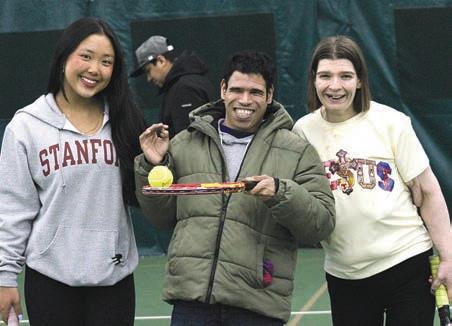
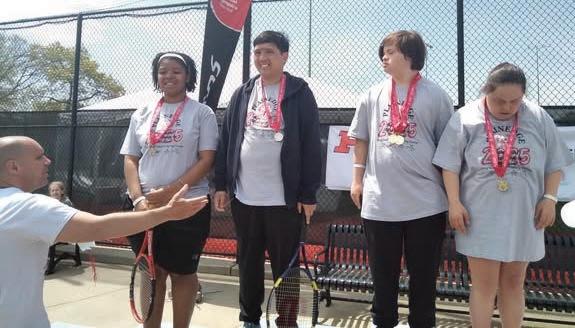
Special needs athletes of all ages were treated to a free clinic at Bethpage Park Tennis Center. The annual event is run by Long Island Tennis Magazine’s (LITM) event staff, as well as staff from the Special Olympics and Bethpage Park Tennis Center.
The athletes, who consisted of individuals from the Special Olympics, kids with down syndrome from local school districts and adults with various disabilities from EPIC LI were provided a fun and exciting afternoon while surrounded by supportive people. The event staff organized drills and games on court to keep all the kids and adults active and happy, while helping to teach and, in some cases, introduce tennis to many of these athletes of all ages.
“The event was great,” said Gavin Costanzo, who coaches the Special Olympics tennis players. “The athletes have fun at every one of our sessions and being able to share that with new volunteers and additional athletes each year keeps it new and exciting.”
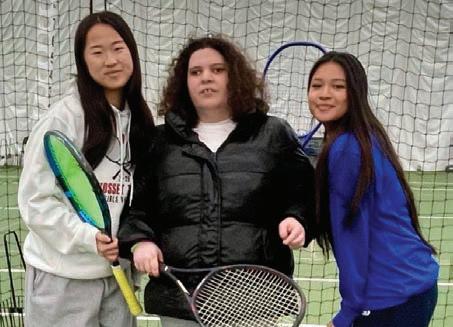
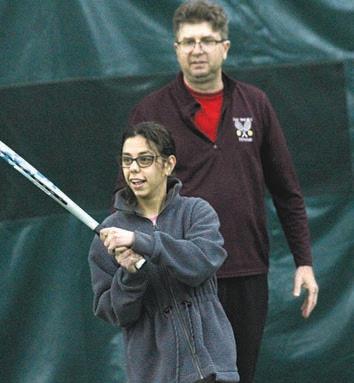
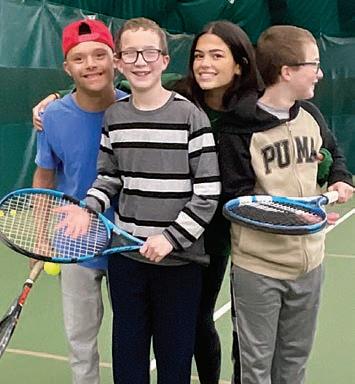
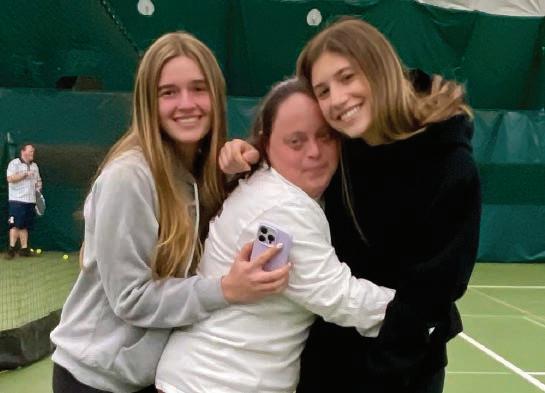
The athletes competed in King and Queen of the Court towards the end of the clinic, where the players in the programs teamed up with local varsity high school tennis players who are also Long Island Tennis Magazine event staff to compete in doubles play. While the activity was a fun one with tons of laughs, it also brought out the competitive side in everyone, especially the special needs athletes.
At the end of the on-court portion, players enjoyed pizza courtesy of Mike Pavlides and USTA Eastern Long Island to cap off a fun afternoon. This event is a part of the year-long LITM Event Series sponsored by Orlan & Cohen Orthopedic Group.
This clinic was unique in the fact that it consisted of special needs individuals from multiple local organizations and those with a variety of needs.
“Over 50 special needs athletes, along with over 40 amazing volunteers and 12 high school and college coaches showed up to learn, laugh and compete in a supportive and inclusive environment,” said Steve Kaplan, Founder and Owner of Bethpage Park Tennis Center. “This is what tennis is truly about.”
Throughout the year, Bethpage Park hosts weekly programming for special needs individuals, and events such as these serve as a pathway to added programming, more players and a way to showcase all that these athletes can do.
Costanzo added:
“We practice in the fall through the spring and take off during the summer months. We take on special needs athletes at any level. Sometimes parents are reluctant for their children to try tennis but I am well trained in advancing their coordination and learning the great game of tennis with my assistant coaches. We focus on safety and fun, and improving every week.”
Long Island Tennis Magazine looks forward to continuing to
partner with local organizations and groups to maintain its objective of providing tennis opportunities to all.
“We were thrilled to once again team up with Steve Kaplan to host this free clinic and share the love of tennis with these deserving individuals,” said David Sickmen, Publisher of Long Island Tennis Magazine. “It’s our goal to continue to grow the game of tennis, and that means bringing the sport to as many
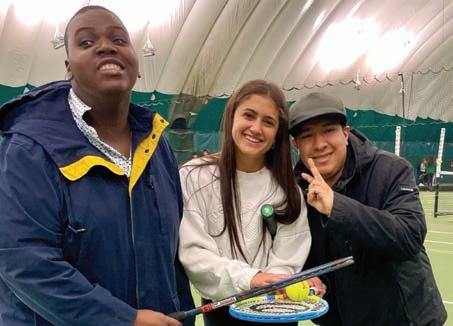
people as possible. This event gives everyone a chance to give back. The energy from our event staff combined with the passion of the athletes creates a connective atmosphere. It’s a tough event to put together and manage, but seeing the end result makes it all worthwhile. We have seen the progress in the level of these athletes and are excited to host more events like this in the future.”
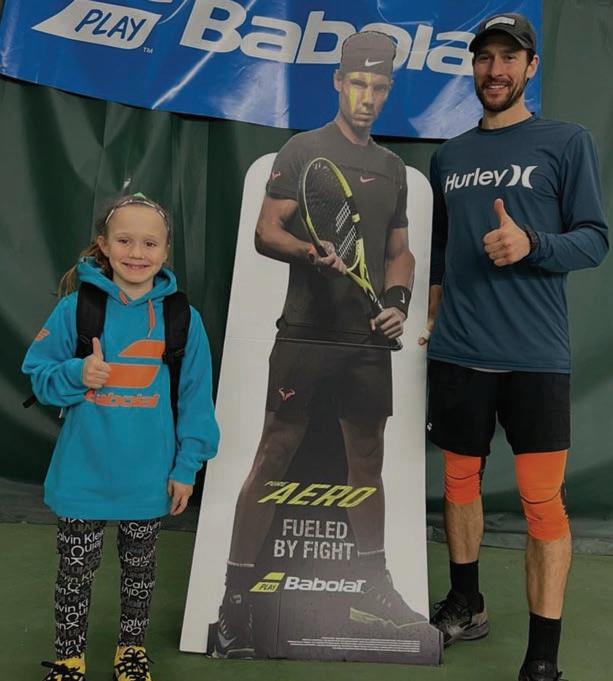
CUSTOM FULL-TIME COACHING FOR HOMESCHOOL PLAYERS
PRIVATE COACHING, HIGH PERFORMANCE CAMPS, AND GROUPS FOR ALL LEVELS
HIGH PERFORMANCE SUMMER CAMP IN VERMONT
TRAIN WITH THE BEST— CHRIS HAS RECENTLY COACHED SEVERAL #1 PLAYERS IN THE US! CHRISLEWIT.COM 914.462.2912 CHRIS@CHRISLEWIT.COM
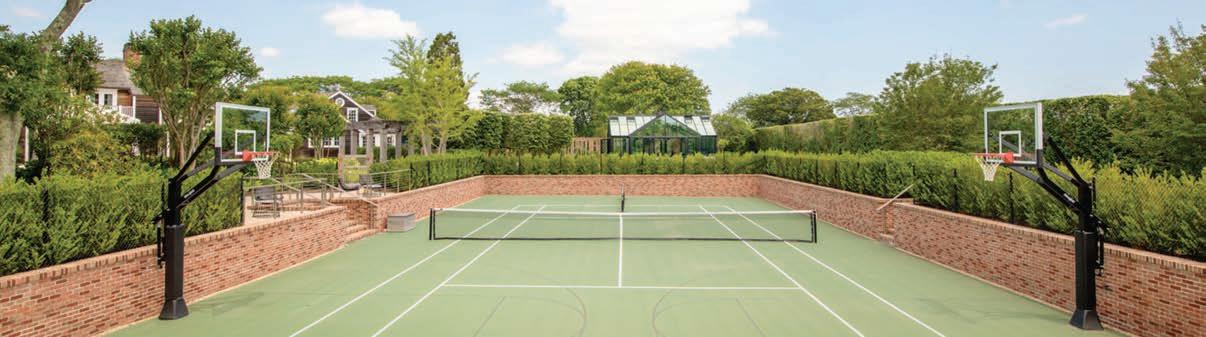
Withnearly four decades of experience, Laurel Tennis & Sport is Long Island’s premier authority for designing, building, and maintaining luxury tennis & sport courts. Serving the North Shore, Hamptons, and all points between, the firm specializes in creating exceptional athletic environments where families and guests enjoy years of active play.
While tennis is our heritage, Laurel has expertly evolved to include modern favorites like pickleball, padel, and basketball. Our certified in-house team manages every technical phase, from sub-base preparation and laser grading to precision paving. We are certified in post-tensioned concrete construction, offering a crack-resistant, long-lasting

solution designed to withstand our environmental elements. Beyond the court surface, we handle all essential infrastructure—including net systems, lighting, fencing, and windscreens— for a truly seamless, turnkey build.
Based in Huntington, the Laurel Group utilizes a seasonal staff of over 300 designers and craftsmen who work tirelessly to deliver impeccable service. By collaborating with our inhouse elite landscape specialists, we integrate courts into cohesive outdoor living spaces that reflect each client's
unique vision. Our industry-leading expertise is defined by:
• Certified by American Sports Builders Association
• Post-Tension Concrete Certified
• Tennis, Pickleball, Padel

• Basketball, Bocce Ball, Multi-Sport
• Har Tru, Red Clay, Turf, Asphalt
• Supporting elements (net systems, lighting, fencing, windscreens)
Whether you desire a traditional red clay court or versatile multi-sport sanctuary, Laurel Tennis & Sport provides an unmatched standard of care from initial design to the final match.
Visit laurelgroup.net or contact tennis@thelaurelgroup.net to begin your project.
"The people I work with are incredible. They are a fun group of talented and creative individuals. The projects we work on are also a big plus as they allow me to visit amazing properties that I then design to create the homeowners’ dream landscape." - Justin
"Thanks so much for stringing the lights on our evergreen tree. Pete and his team did a great job. To see the tree so beautifully lit lent to a festive holiday vibe which was enjoyed by so many." - Max
"I wish to thank the entire TLG Team. What you all accomplished in a few short weeks is nothing shore amazing. So many moving parts & you orchestrated the soil excavation, replacement, planting, planters, window boxes, irrigation, and doing all this when other work was going on. Getting 3 Crape Myrtles in without one hitch was most impressive. Just wanted you to know that we noticed and appreciated all of it. Truly a colossal effort and you made it look so easy, which shows how skilled everyone is! Thanks again." - MS








• LEVEL HIGHEST THE T TENNIS A PURSUE TO Y FLEXIBILIT

• e om anywher Join online classes fr




ubai, and hanghai, Seoul, D ondon, S L ork, o wight campuses in N tudy at D S ew Y





TEAT ASS -CLWORLD ed ummer courses offer S A PRIV EDUCA
• TION SCHOOL
ed #1 in B Rank
iche.com igh School in America by N H nline rivate O est P


• nline seminars and small class sizes O
• IB and AP coursework
• Hanoi recruitment
op college acceptances and To
ederation Juniors F
ennis nternational T of the I artner ducation P Official E admissions@dwight.global
• www.dwight.global






Whenhe was eight-years-old, Aaron Rittberger’s first introduction to tennis came on the courts of Eastern Athletic Clubs in Dix Hills. He played many other sports at the time including baseball, basketball and soccer, but his parents wanted him to try a one-on-one sport to help build his selfconfidence.
“My older sister played tennis at Eastern Athletic, so my mom decided to put me into a lesson there,” Rittberger recalls. “It was simple, but I remember feeling good about being able to hit the ball hard. It kind of took off from there. One of the EAC coaches said I was pretty good, and so I stuck with it. Next thing you know, I was playing tournaments, and ready for continued training.”
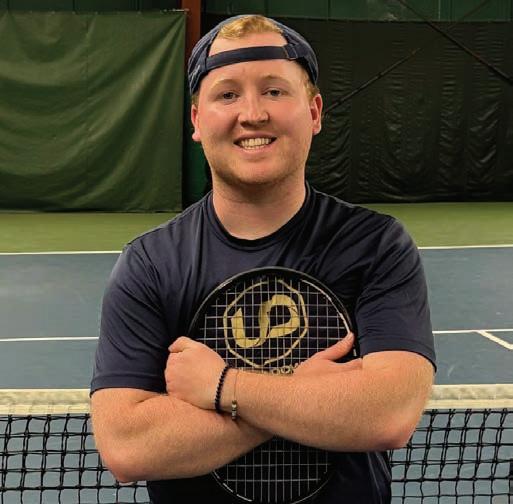
for him when he was younger.
“I had a really good connection with Sheldon Grant, my first coach, a personal connection, which is why I think I love coaching so much. It changed my life completely,” he said.
Rittberger’s life has come full circle as he now works as a teaching pro at Eastern Athletic, helping players of all ages and levels find their love for tennis, just like his coaches did
Rittberger was a top junior player who played on the Harborfields varsity team in seventh grade and eighth grade, before making the decision to move to Miami so that he
could place more focus on his training and competition.
He attended high school online while living in his coach’s house with other likeminded players who were dedicated to their tennis careers and development. Rittberger competed on the ITF circuit and had dreams of making it on the ATP Tour.
“I was living in a house with eight or nine other players, and we all had the same goal, which motivated us and helped keep pushing us to get better,” he recalls.
“There were definitely some weird parts. I didn’t get to have a prom and a lot of other stuff you get to do while attending a normal high school. But I wouldn’t change it for a second; I was 15, traveling internationally to compete in tournaments, which was a dream for me.”
Rittberger began playing in Futures tournaments and had his sights set on becoming a professional, until injuries derailed those plans. A torn rotator cuff and labrum in his right shoulder put his
playing career on hold. And then another set back while undergoing physical therapy forced him to reconsider what his next steps would be.
He returned home to New York prior to his surgery and finished his homeschooling. As he continued training and studying for his degree, he still traveled internationally to compete. During this time, he started teaching more and more, which is when he began to find his calling for teaching.
“I then took a two-month break to finish up school, and just sort of focus on myself,” he said. “And then I reached out to Mike Fehrs and Alexa Sferrazza at Eastern Athletic. I realized how much I missed teaching the game, seeing people smile and seeing them having fun on
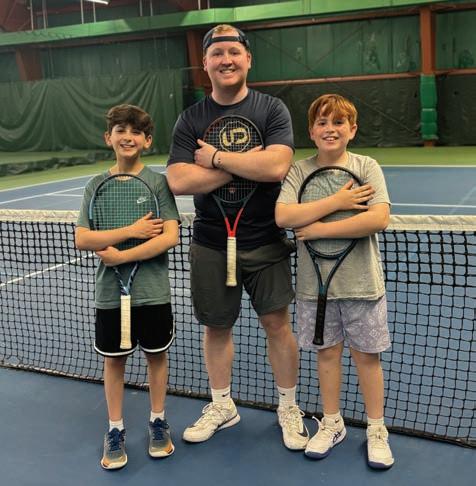
the court. I wanted to bring joy to people playing, the way my coaches did for me. With everything going on in people’s lives nowadays, it’s nice to help someone be able to step
on the court and put everything else aside. That’s how I view it when I practice with my friends, I don’t think about anything else going on in life. The tennis court is my getaway place.”
It was during that time when he was dealing with those injuries, and time spent off the court, that he gained a lot of perspective, and when he truly developed his passion for coaching. It’s that same passion he brings onto the courts while giving lessons, and has found his calling as a coach on the tennis court. Rittberger taught sparingly when he was a kid, helping Jason Wass with Red Ball groups when he was a teenager, and he credits Wass with molding
continued on page 8

continued from page 7
who he is as a coach.
But he has found a home at Eastern Athletic in Dix Hills:
“It’s a great, friendly and fun environment,” he said. “I’ve worked at a lot of places and this is the best environment I have been a part of. Everybody’s working together, we’re not out trying to take other people’s lessons. There's great respect amongst the coaches and we have a shared goal in growing the sport. Between Alexa, Mike and Laurie [Fehrs], I couldn’t ask for a better team to be a part of.”
He emphasizes to his students, especially the high-performance players, about striving to practice until perfection. It’s a mindset he had as a player, and one he tries to stress to his players.
“You have got to try and be as perfect as possible, and that only helps you when it comes to practicing,” he said. “I have a rule with the kids and adults I teach: if we’re doing a drill and it’s 12 balls side-to-side, we’re doing the whole drill again if you miss the last ball. It’s a way to establish a focus level, and if you practice like that, it will
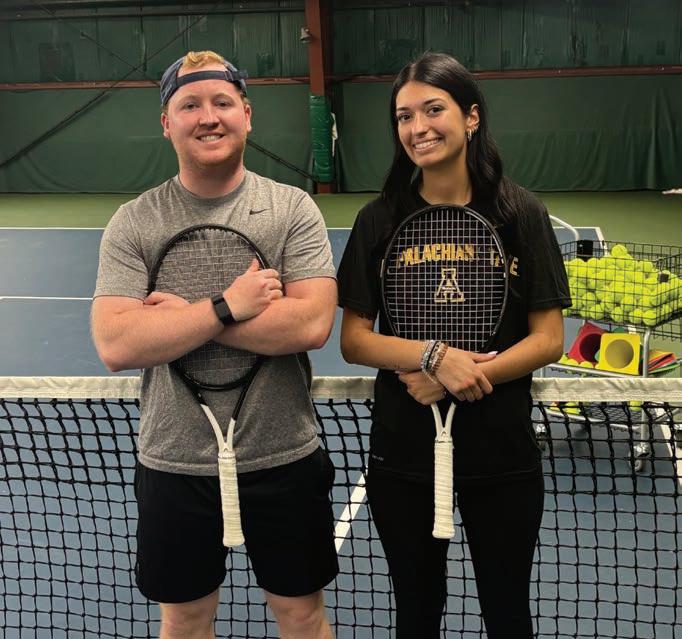
help when you begin competing.”
It’s an approach he continues to use when he is playing. Still only 23-years-old, Rittberger has plans on








rekindling his playing career. Over the last six months, he has begun training again with Tyler Hoffman, one of his friends and a fellow coach at Eastern Athletic.






“He’s trying to get me to go back and play. I’m actually getting back into full playing shape now, and I think I’m going to try and give it a go,” Rittberger said.
Tennis journeys are not always linear, and don’t always go according to plan. And for Rittberger, his is uniquely his. It began on the Eastern Athletic courts when he was a kid, and continues to this day on the very same courts, where he is sharing his love for the sport with a new crop of players. As we approach the spring and summer months, he is excited to see what lies ahead both for his own tennis playing, but primarily for the players who join him on court every day.
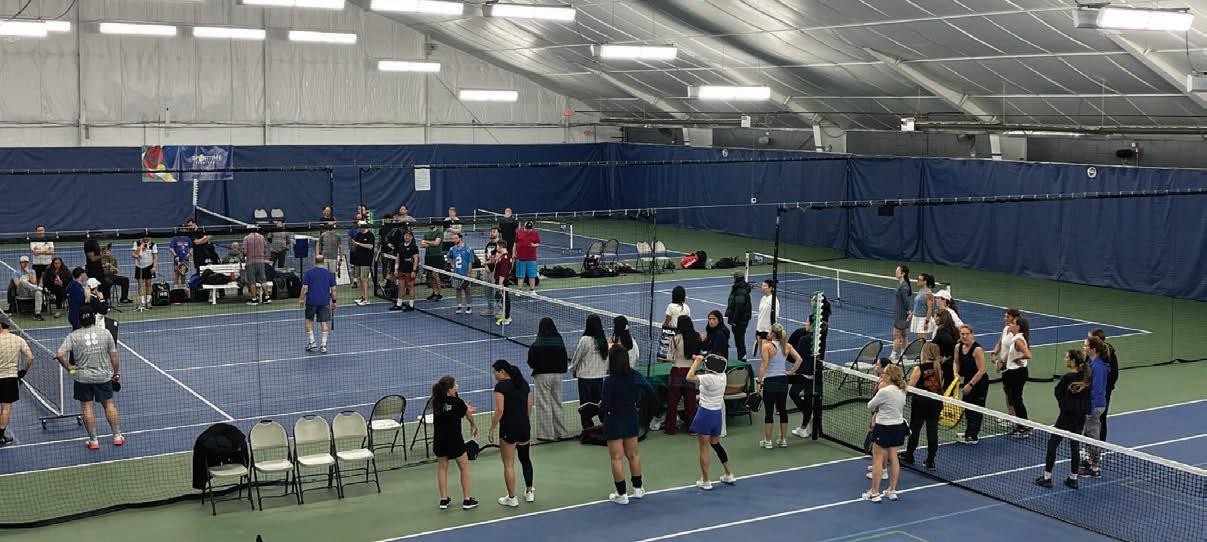
Thefirst tournament of the 2026 Long Island Tennis Magazine Event Series presented by Orlin & Cohen Orthopedic Group brought players to SPORTIME Kings Park for the Long Island Winter Pickleball Challenge.
This event featured four divisions with competitors playing group play matches that fed into the knockout rounds, and included intense pickleball action on the courts within a fun and social environment. Throughout the night, drinks and pizza were provided for
players and spectators.
“The LI Winter Pickleball Challenge was a success!,” said Tournament Director David Sickmen. “We had a great group of players across multiple levels, and we continue to take pride in providing professionally-run and unique tournament options for the racquet sport community. It was nice to see so many “fans” and spectators watching the players and the feedback we received has all been positive. I also want to thank our host facility for this tournament,
SPORTIME Kings Park, my Co-Tournament Director Michelle Stoerback and tournament sponsor Orlan & Cohen Orthopedic Group. This tournament sets the stage for a great year of events and tournaments.”
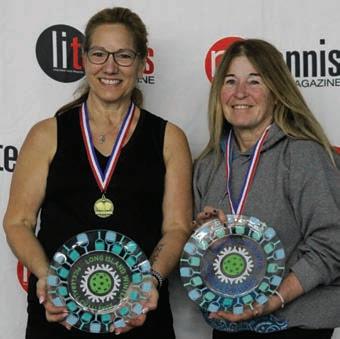
Lisa Goldberg & Donna Ryan teamed up for their second tournament as a tandem, and came away victorious in the Women’s Doubles 3.5 – 4.0 division, utilizing a simple yet effective gameplan.
“Our strategy was just keep the ball on the court as much as possible, and it
worked,” said Goldberg. “The competition was really good, and David and Michelle always put on great tournaments so it was a fun night.”
Goldberg & Ryan defeated Ivanka Asch & Lisa Heldberg 15-6 to earn the Gold Medal, while Asch & Heldberg claimed the Silver. In the Bronze Medal match, Lori Van Houten & Dieu Cai-Hsiu won 11-6 over Lisa Ciangetti & Alison Gladowsky.
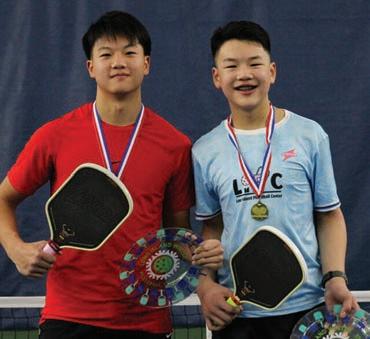
Caleb Wang & Ethan Wang don’t get to play often as doubles partners, but they teamed up for this tournament and demonstrated great chemistry. The pairing captured the Gold Medal in the Men’s Doubles 3.5 – 4.0 division with a 11-8 victory over Dan Palumbo & Chris Biscuiti.
“Playing with my brother was nice because we don’t play many tournaments together,” said Ethan. “Winning of course was awesome, but doing it with him made it even better.”
Caleb added:
“Pedal to the medal was the strategy. Sometimes you have to get back to basics; if you make an error, just get back to the fundamentals and keep going until you win.”
While Biscuiti and his doubles partner Palumbo fell in the championship match, Biscuiti reflected on the importance of not just competing, but the camaraderie of the pickleball community.
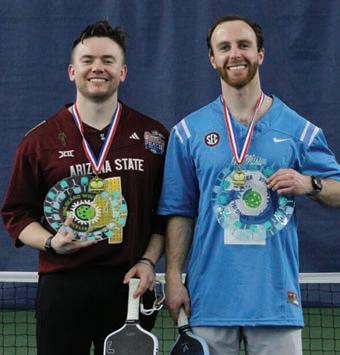
Men’s Doubles 4.0 – 4.5 Champions: Evan Greenberg & Alex Krichmar
“My son Brayden has many special needs and the pickleball community continues to give me a positive outlet and lift me up during hard times. Just getting on the court is a victory and anything else is a bonus.”
In the Bronze Medal match, Dominic Tribelhorn & Jason Wong defeated David Berezow & Christopher Travers 11-8.
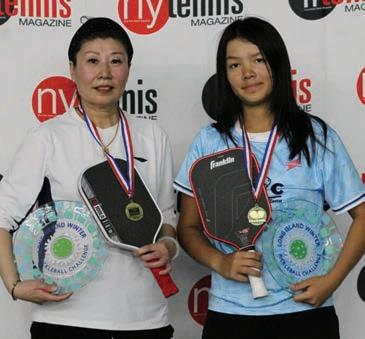
In the Gold Medal match of the Women’s Doubles 4.0 – 4.5 division, Quanxin Liu & Serena Chi powered to a 15-8 victory over Emilie Katz & Kelly Cobbs. The duo had never played together in a tournament, and enjoyed their time together on court.
“This is the first time we played together in a tournament and it was so much fun,” said Liu. “The food and drinks were nice, and we had a great time.”
Angel Valmorida & Cindy Chen were 118 winners over Linda Rose & Whitney McCarthy to claim the Bronze Medal in that division.
Evan Greenberg & Alex Krichmar got into pickleball around the same time four years ago, and being friends from high school, the pairing already had a built-in chemistry together. That would prove crucial as they defeated Max Lieberman & Jordan Baer 11-5 to win the Gold Medal in the Men’s Doubles 4.0 – 4.5 division.
“We know each other’s games very well and just tried to play to each other’s strengths,” said Greenberg. “We wanted to ride the hot hand, and whoever was playing well at the time to take control of the court.”
Krichmar added:
“Winning was probably the best part of the day. This was our first Gold together, so it’s nice to get that monkey off of our back. We were down 0-4 in the finals but we just kept fighting.”
Miguel Cobbs & Carlos Quinonez claimed the Bronze Medal.
The next pickleball tournament in the 2026 Event Series is scheduled for Saturday, June 13 at SPORTIME Hempstead Lake. Visit LITennisMag.com/Events to register.


































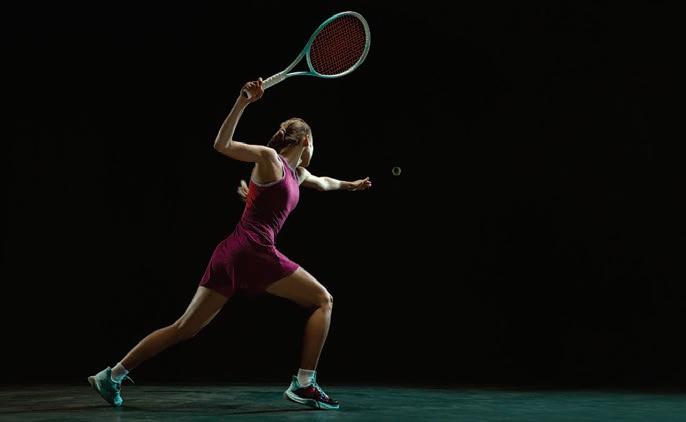
Every February, while our native New York remains bundled against the lingering winter, the Professional Tennis Registry (PTR) draws the global racquets community south for its annual International Racquets Conference (IRC). The 2026 conference was particularly significant, marking the PTR’s 50th Anniversary. This ceremonial milestone created a unique energy among attendees, blending nostalgic reflection on a half century of challenges and successes with a forward-looking commitment to shaping the future of the tennis industry.
The conference’s new home at the recently renovated Saddlebrook Resort, just north of Tampa, FL (relocating from Hilton Head, SC), proved to be an ideal setting. A NYC-based team representing Advantage Tennis Clubs—including Tony Huber (Adult Director of Tennis) and Magnus Gunnarsson (Junior Director of Tennis) from Roosevelt Island Racquet Club, and myself (Director of Red and Orange Ball)—attended the IRC 2026 for what became an unforgettable experience. Our journey was far more than a professional development outing; it was a defining moment for our shared vision for the future of tennis.
From the moment we arrived in Saddlebrook, it was clear this experience would challenge us to
By Joel Richmond
adapt, evolve, and think bigger. Immersion in the conference atmosphere meant early mornings strategizing over coffee, and late afternoons spent reflecting deeply on the day’s most valuable takeaways.
While we soaked in the novelties of the trade show, award ceremonies, and many pools, the heart of our focus was the jampacked agenda of workshops led by some of the most respected voices in the tennis industry. Sessions spanned topics from biomechanics and tech-integrated coaching to communication strategies and business operations. As we took it all in, two consistent themes emerged: first, that adaptation is essential, not optional, and second, that achievement is the process of executing a collaborative plan, not merely the result. Great coaches aren’t islands of information; they’re flexible, responsive, participatory and constantly evolving to meet the needs of modern players.
The on-court demonstrations proved to be the most valuable indicators of these themes. Watching master coaches bring concepts to life in real time fortified the importance of clarity, intention, and energy in every session. It wasn’t just about what was being taught, but how it was delivered. The best sessions were interactive, player-centered, and purpose-
driven—principles that align closely with our own coaching philosophy and will continue to shape how we reimagine our programs moving forward.
Beyond the workshops, the bustling trade show floor allowed us to explore cutting-edge products and services. From AI-powered performance tracking systems to innovative training aids and apparel, the exposure to these new resources immediately sparked discussions about enhancing the player experience at Advantage Tennis Clubs. These interactions also paved the way for potential partnerships and collaborations designed to bring added value to the communities we serve.
Equally impactful was the opportunity to connect with coaches and leaders from around the world. The IRC is not just a place to learn—it’s a place to share. Admiring the flag parade, hearing different perspectives, exchanging ideas, and building relationships with peers reinforced that we are part of a global network of professionals all working toward a common goal: growing the game and improving the experience for players at every level.
Undoubtedly, the highlight of the conference—and a moment that will resonate with our team for years—was the recognition of Roosevelt Island Racquet Club as the 2025 Private Facility of the
Year. Hearing our names called was a surreal and deeply meaningful experience. This award is a testament not just to the quality of our programming, but to the strength of our entire team’s culture: the passion, dedication, and collaborative spirit we bring to the courts daily. It reflects the relationships we build, the standards we uphold, and the welcoming environment we strive to create for each and every player.
Receiving this recognition was humbling and energizing, but it also underscored the responsibility that comes with it. Success in our field—as it is in any organization and in life in general— is never static nor isolated. Success requires constant reflection, growth, and a willingness to collaborate and embrace new ideas. Success is also not a finish line; it’s a benchmark that challenges us to keep improving.
In short, this recognition motivates us to innovate and progress, to stay curious, and to remain committed to excellence in everything we do. Returning from Saddlebrook, we carried not just new knowledge, but a powerful, renewed purpose. The conversations we had, the lessons we learned, and the recognition we were awarded have already begun to influence how we think, plan, and coach. From refining our training sessions to exploring new program offerings, the impact of this trip will be felt across every level of our organization and community.
Ultimately, the PTR IRC 2026 experience reinforced something we’ve always believed: great programs are built by great teams who are willing to learn, adapt, and grow together. This trip was a powerful reminder of what’s possible when we invest in our people and stay connected to the global tennis community. And while we’re proud of what we accomplished, we’re even more excited about what comes next— because if there’s one thing this trip made clear, it’s that adaptation isn’t a one-time effort. It’s the ongoing process that defines achievement and keeps us moving forward.

Joel Richmond is the Co-Director of QuickStart Programs at Advantage Tennis Clubs. Originally from central New York, Joel began playing tennis at the age of 6 and started coaching at 16. Joel competed in Division III tennis and soccer for Bard College, where he was the tennis captain for three years. As a PTR L2 Certified Professional, Joel uses a gamebased approach to help junior players get into the game and develop a proper technical and tactical foundation. He can be reached at jrichmond@advantagetennisclubs.com.

By Brian Coleman
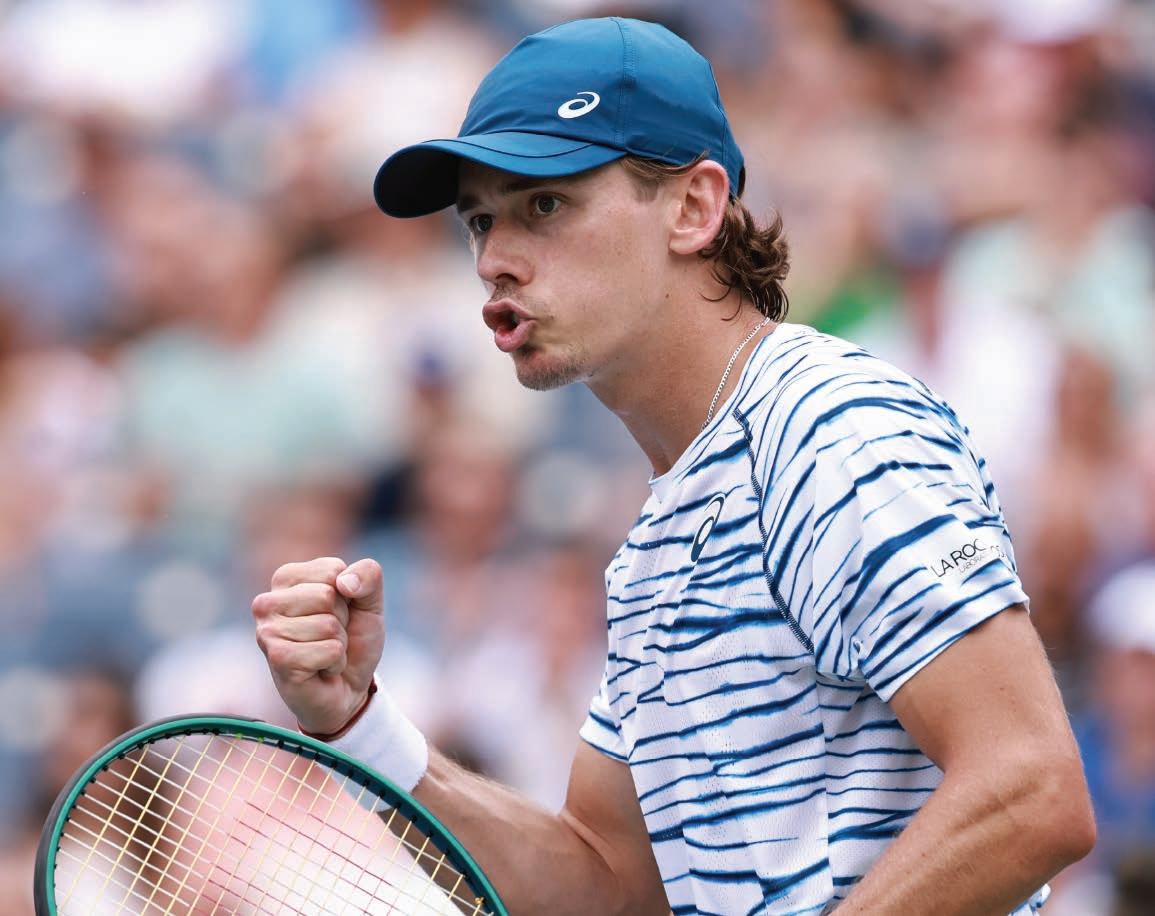
It’s hard not to be romantic about tennis. It’s a beautiful, graceful sport that is even scored using the word ‘love’.
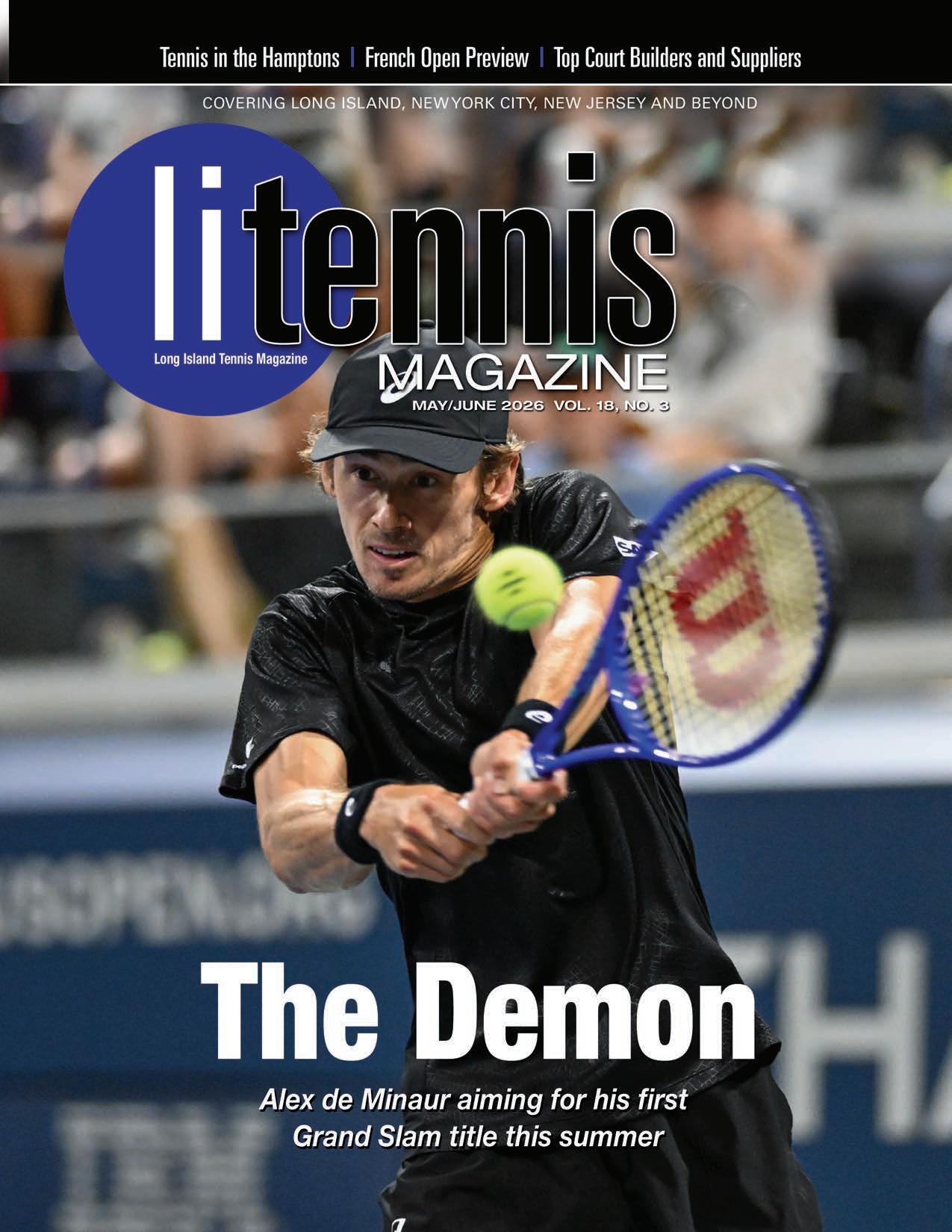
And at the professional level, tennis’ primary power couple represent that notion. Australia’s Alex de Minaur and Great Britain’s Katie Boulter have been two players whose relationship has sustained. Together since 2020, the pairing got engaged in 2024 and will be married later this year.
The two came up the ranks together at the lower professional levels, and met one morning for a cup of coffee.
“We bumped into each other at six in the morning and ended up getting a coffee. From that moment, I knew I was in it for the long haul,” Boulter explained. “He is amazing, he continues to continued on page 16
impress me every day of my life. It’s been almost six years now with him and it’s an inspiration to me as a player and a person. Also, he’s doing so well, and I feel like he’s playing better and better every time I see him.”
Having someone who understands what you are going through, the ups and downs of life as a tennis player and what that requires is an incredible asset, and something that de Minaur and Boulter share with each other.
As Boulter says, the two have helped each other grow as people and also as tennis players. The 27-year-old de Minaur has blossomed into one of the best players on the men’s side as he currently sits at sixth in the world, his career-high ranking.
“We both know what our priorities are,” de Minaur said. “We said this on day one of the relationship: we put our careers first. The great thing is we know what the other person is going through. We know those feelings, the deepest, darkest fears and when we’re feeling great or not feeling good about ourselves. That’s where we can really help each other.”
De Minaur began playing tennis
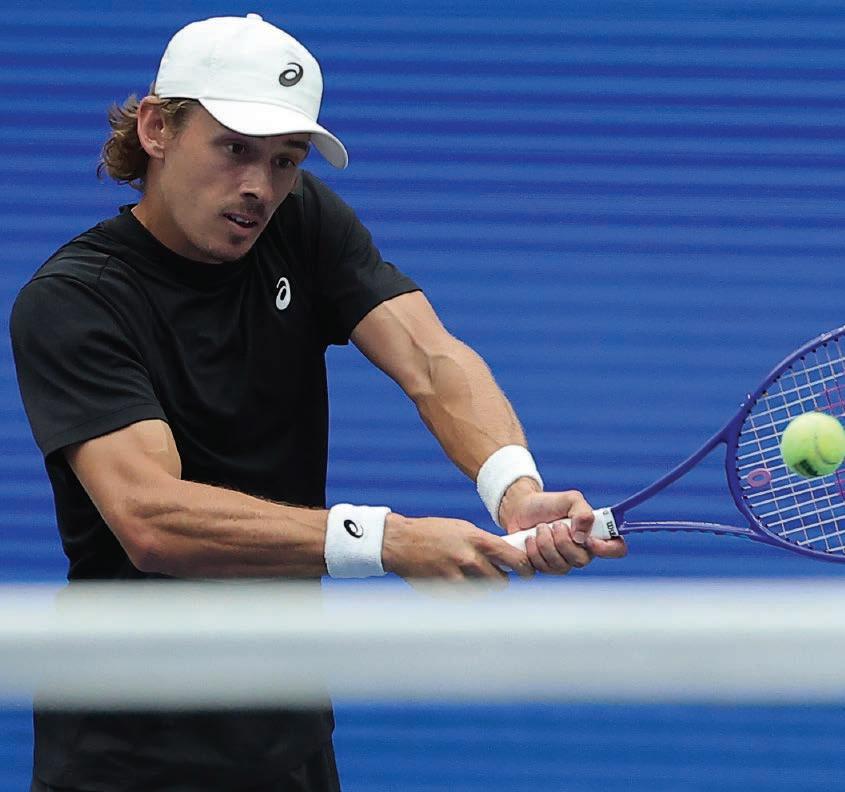
when he was three-years-old, and came up through the Australian system in Sydney. One of his favorite players growing up was Lleyton Hewitt,
someone who has never officially coached him but has always been a mentor.
“Hewitt has always been my idol,” he said during his early days on tour. “I always looked up to him growing up. For him to now be in my corner and helping me out as a mentor, really getting me to believe I belong here where I am and that I have got the level is just incredible.”
His first run deep at a major came in New York at the 2020 U.S. Open when he made his way into the quarterfinals before losing to eventual the demon continued from page 15
De Minaur’s nickname is the “Demon” and he certainly plays like it on court. One of the fastest players on tour, De Minaur is an all-court player who possesses excellent agility and athleticism. That has elevated him to the top of the sport, but the Australian is still in search of his maiden Grand Slam title.
champion Dominic Thiem in straight sets. The loss left a bad taste, and provided motivation for the Australian.
“I’m not satisfied with where I am. This is where I want to be, but I’m not satisfied just coming here and getting to the quarterfinals any more. I want to keep on pushing. I’ll strive for bigger and better things,” he said at the time. “Hopefully with years to come I’ll get bigger, I’ll get stronger, I’ll grow into my body a little more and [reach] another level.”
While he has improved and climbed up the rankings, DiMinaur has yet to advance further than the quarterfinals at any of the four majors. In all, he has reached seven quarterfinals including earlier this year at the Australian Open.
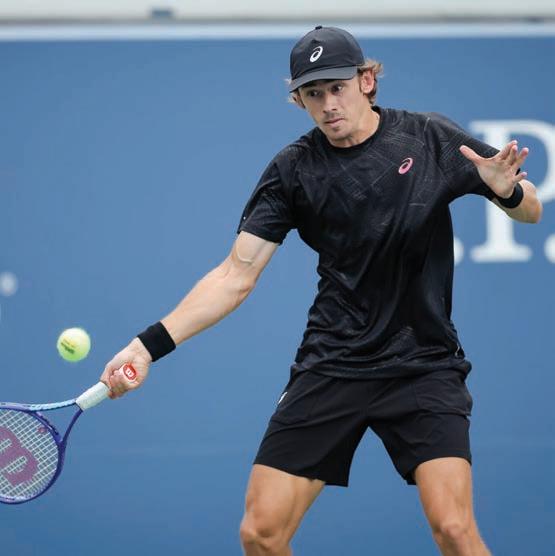
Competing in his second-straight quarterfinals in his home country, de Minaur was beaten by Carlos Alcaraz in straight sets, a loss that left him pondering what he needs to do in order to take that next step.
“It doesn’t feel amazing, I’ll tell you that,” he said after the defeat. “You try to do the right things, you try to keep improving, but when the results don’t

come or the scoreline doesn’t reflect those improvements, then of course you feel quite deflated. There were some good parts out there, but overall I’m playing out of my comfort zone and at times out of my skin. Of course, for me to take that next step, I’ve got to be comfortable in playing that sort of way for the whole match, and that’s what it takes to take it to the next level especially against these types of guys.”





That’s the logical next step in his career progression, finding what it takes to topple the likes of Alcaraz and Jannik Sinner, the two players who have dominated the Grand Slam landscape the last few years. De Minaur will have his opportunity to do so when he heads to Europe for the French Open and Wimbledon. He reached the quarterfinals at each of them, both in 2024, and is poised to make another run at these majors.
As he approaches an important junction of his career, it’s helpful to have a significant other by his side that can relate firsthand to what he is going through. The two are deep into wedding planning, and reports indicate they plan on tying the knot in July.
“This is a 50-50 relationship,” he joked. “I’ve been involved so far with some of the decisions…when it comes to the details of napkins and flowers, that’s not my forte, so I’ll leave that to Katie.”
There will perhaps be no better wedding present that De Minaur could get for himself and Boulter than a Grand Slam trophy, and his next opportunity will be on the red clay in France.




Please visit our website at www.longisland.usta.com or Facebook (Play Tennis Long Island) for more information on these and all USTA Long Island Regional events. For specific questions, email ustaonlongisland@gmail.com.
5/2: LI Special Olympics @ Massapequa High School
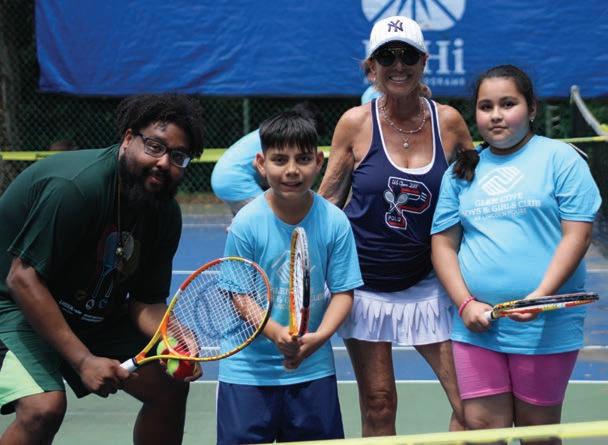
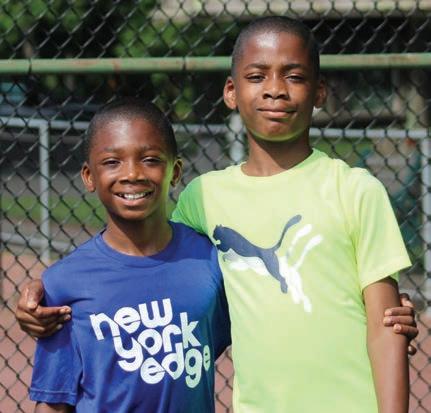
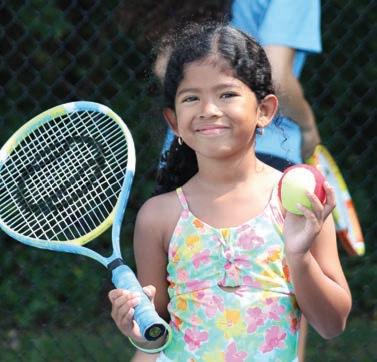
USTA Eastern and USTA Long Island are offering grants to help support your organization’s tennis programming. Grant opportunities include:
• School Youth Tennis Initiative Grant (up to $1200) Deadline 11/13
• Region Grants (up to $1000) Deadline 11/13
• Diversity, Equity and Inclusion Calendar Observances Grant (up to $2000) Deadline 12/4
• Adaptive and Wheelchair Grant (up to $2000) Deadline 12/31
Tennis Venue Services (opportunity to get courts refurbished and more from USTA National)
Visit www.usta.com/en/home/coach-organize/tennissupport/grants-assistance.html to learn more about eligibility and requirements. If you would like to reach out to discuss your program, please contact Neil Thakur at thakur@eastern.usta.com
Play tennis on your terms with USTA Flex! Download the USTA Flex app and join a local USTA Flex league today, with play options across the Eastern Section including Long Island. USTA Flex is designed with your busy lifestyle in mind: you make the schedule, you set the time and you play when it’s convenient for you.
To register:
• Download the USTA Flex app from your app store
• Go to the search tab and search for a competition near you. Programs in the Eastern section are available in New Jersey, NYC Metro, Long Island, Rochester, Rockland County and Westchester County
• Hit pay and join. Cost to join a flight is $35 per player
• You’ll be grouped in a flight (round robin format) with opponents of a similar skill level
• You play each opponent in your group once
• You and your opponent schedule when and where matches are played
• Simply complete each match before the end of the programs
• Register through the USTA Flex mobile app, which allows you to contact opponents, record scores in the app and stay updated with your program
• USTA Flex ladders are also available. Check in the app to see what's offered in your area Questions? Email USTAflex@scalasports.com
Mike Pavlides, Regional Director
Jonathan Klee, Past Regional Director
Sunny Fishkind
Tito Perez
Jason Wass
Randi Wilkins
Neil Thakur, Manager, Schools Tennis and Long Island CTC (thakur@eastern.usta.com)
Milly Keighery, Adult League Coordinator Long Island Region (Keighery@eastern.usta.com) Facebook: Play Tennis Long Island •
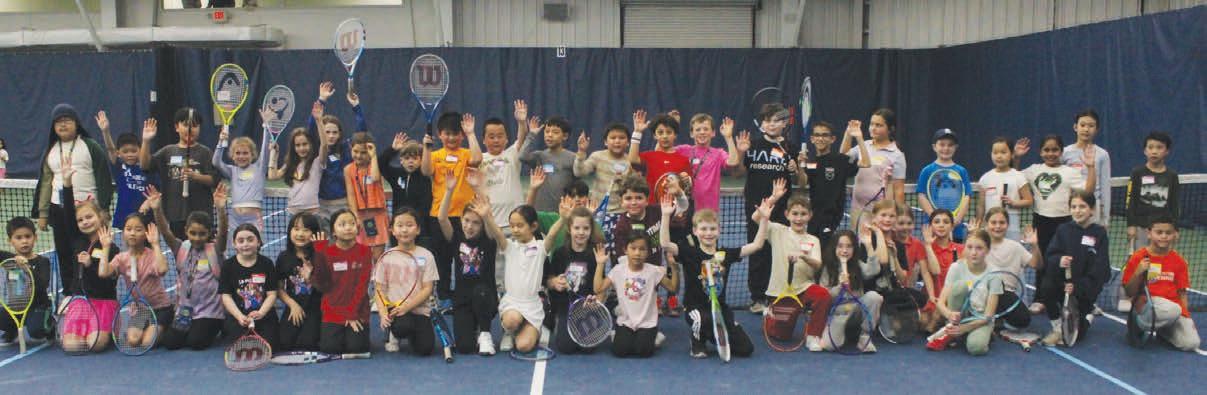
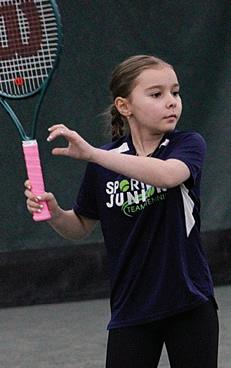
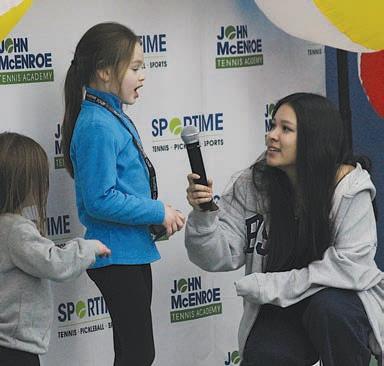
To showcase the development and progress of its junior tennis players in a fun atmosphere, SPORTIME’s World Tour Series continued earlier this spring as SPORTIME Port Washington/John McEnroe Tennis Academy (JMTA) Long Island hosted an Indian Wellsthemed tennis carnival.
“The goals and objectives of the World Tour is to expose as many of our youth players as possible to competition in an inviting and encouraging environment,” said Matt Orobana, the Director of JMTA Mac Red and Orange Ball Programs. “Sometimes the idea of registering for a tournament and being on your own out on the court can be intimidating, especially at such a young age. These events are the perfect way to expose our
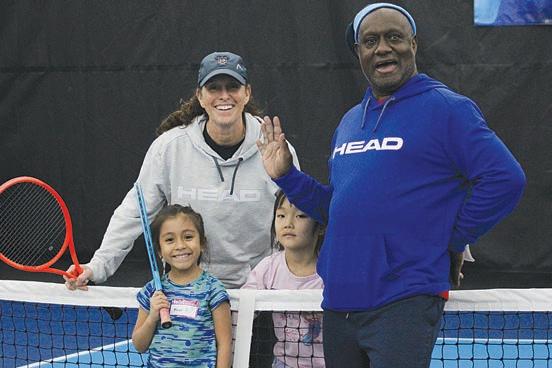
players to a less competitive tournament format with the hope that they will be inspired to get out on the courts and play even more tennis.”
While the primary intent is to encourage these young players to play more competitively or begin to participate in a tournament, the World Tour provides a one-of-a-kind afternoon experience that reinforces how fun tennis can be.
“Most importantly we aim to provide a fun and exciting tennis experience for our players to foster a love for the game that we hope they carry on for life,” Orobona added.
When players arrive on-site, they check in at the registration desk where they have their photo taken and they receive their customized
player passport to give the kids the feel of participating in a professional event.
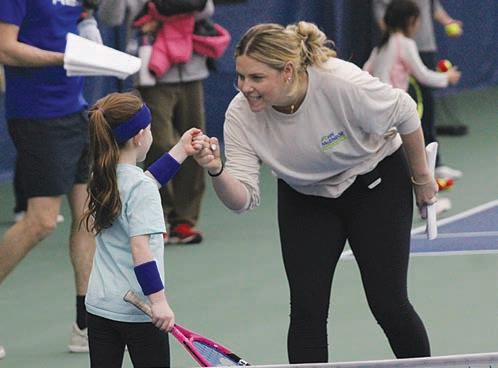
The coaches run out with the players, broken up by age and level, onto the courts as all the parents cheer them on, and the coaches then guide the players through different drills and games. Parents are able to look on and witness how much their child has progressed.
“I’ve been playing tennis for almost two years now,” said Ava. “I loved playing Queen of the Court today.”
Off the court, the players and their families are able to enjoy catered food, a bounce house, music, photo ops and more which creates a festive atmosphere. The on-court tennis and off-court entertainment helps
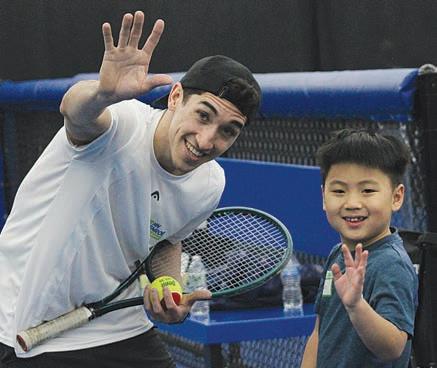
reinforce how fun tennis can be.
“As I speak with some parents during and after the event, I find the feedback to be overwhelmingly positive,” said Orobona. “Everyone is extremely appreciative that we go to such lengths to provide events like the World Tour for our youth players. The combination of time showcasing their skills on the court mixed with the social element of the
food and other fun ensures that no matter the level, there is something for everyone at the World Tour.”
The World Tour will continue to span the globe this spring, with SPORTIME Bethpage hosting a Rome-themed event in early May, followed by a French Open and Paris-themed one at the John McEnroe Tennis Academy at SPORTIME Randall’s Island on
Saturday, June 6.
“This Indian Wells event was the largest World Tour to date, and I think everything went incredibly well. SPORTIME Port Washington has a fantastic team on both the administrative and coaching side,” Orobona concluded. “Things went exactly to plan and I have the amazing team there to thank for how smooth this whole event went.”
By Christopher Pucci
Havingthe right mental approach to learning is essential to your potential success. Like any sport, tennis will take time to master, regardless of your current level. Approaching the learning process the correct way will help with your journey of becoming a better player.
Here are five tips to help in this journey:
1. Playing tennis must interest you in some way. Is it because you appreciate the athleticism of the professionals, or is it for the exercise, or the social component? Could it be you genuinely want to get technically better, tactically better, or to learn doubles tactics? Whatever the reason, never lose sight of what
made you want to play.
2. To develop your game, taking lessons from a “qualified” coach will provide better clarity about the skills you need to acquire to achieve the next level.
3. Stay focused on the learning process:
• Understanding “What” and “Why” you are doing specific actions.
• Taking that understanding and creating a “Feel of Motion”
• Implementing and executing this feel of motion to create “Habits”:
Mental Habits: requires a thought process to achieve. Every habit-forming journey begins here. You will have to remind yourself to perform the habit you


are trying to achieve. Do this enough, and the process moves into the physical habits category.
Physical Habits: requires no thought process, done in the subconscious.
• And finally, how well do these habits perform during a “Performance Routine” or “Pointplay”? Drilling and practice are different learning environments than playing points. You need to spend time in multiple learning environments to become a complete player.
4. A Coach or Racquet Stringer can help you with any of your equipment questions or needs.
Having the proper equipment is important. An example would be making sure the racquet you use is appropriate for your level of play. Mismatching that will slow down your development and may cause an injury.
5. The Five “P”’s and an “F”:
• Patience: The building of the foundation of a player varies from person to person, with numerous variables that need to be considered. Becoming a player does not happen overnight, within a month, or within a season; it takes time.
• Prepare: Be prepared to have good days and bad days. Being able to learn from mistakes will be vital to improving your game. Therefore, you must be prepared and accepting of making mistakes.
• Practice: The only way habits form is by repeating the same process over and over again.
• Progress: Take note of your progress, no matter how small an achievement you may think it is. Recognizing that you have made progress is a confidence boost.
• Positive: Try to always maintain a positive attitude. Expectations are good to have; however, when a player remains positive, the body has less tension, which will allow the required movements to happen more freely.
• Fun: Remember, this is tennis, a sport, something you have chosen


to do. Don’t forget to smile, laugh, and have fun!
In the end, becoming a better tennis player is not defined by how quickly you improve, but by how consistently you commit to the process. Stay connected to your original motivation, trust the guidance you receive, and embrace both the challenges and the small victories along the way. By combining patience, purposeful practice, and a positive mindset, you give yourself the best opportunity to grow, not just as a player, but as a competitor. Keep learning, keep adjusting, and most importantly, keep enjoying the journey every time you step onto the court.
Christopher Pucci is a ‘Master Coach’ and Director of Adult Tennis for CourtSense in New Jersey. He has been coaching for over 40 years and with CourtSense since 2013. Throughout his career, he has coached adult and junior players from beginner to high-profile ATP and WTA players. He is the co-creator of DoublesSense, a technical and tactical program for all levels to improve your doubles play. He can be reached by phone at (201) 266-3708 or by email at christopher.p@courtsense.com .



By Dr. Eric Price
courts dominate the tennis scene on Long Island. While they provide a consistent, fast-playing surface, they also place significant stress on the knees. Compared to clay, hard courts absorb far less shock, meaning more force travels directly through your joints with every step, jump, and stop.
On clay, players can slide into shots, spreading out impact over time. On hard courts, stopping is more abrupt, creating higher stress on the knee. The surface also has more friction, so when your foot sticks and your body rotates, the knee absorbs that twisting force. Over time, this combination of impact and torque can lead to issues like patellar tendinitis, IT band irritation, and general soreness.
Many players assume knee pain starts in the knee, but it often comes from weakness in the hips and surrounding muscles. Strengthening these areas reduces joint stress.
Here are some great hip strengthening exercises:
• Glute bridges: lie on your back with your knees bent and lift your hips by pushing through your heels while squeezing your glutes at the top.
• Bulgarian split squats: place one
foot behind you on a bench and lower into a lunge using your front leg.
• Lateral band walks: they are done by stepping side to side with a resistance band around your legs to activate the hip stabilizers that help keep your knees aligned.
• Step-downs: slowly lower one foot off a step and return.
Tight muscles also increase pressure on the knee. I am a big fan of yoga as a supplement to any sports training. At the very least, before you get moving before your game, warm up a little bit and stretch your quads, hamstrings, hip flexors, and achilles.
Small changes in movement on the court can significantly reduce knee stress. Stay low by bending at the hips rather than just the knees, take quick adjustment steps instead of lunging, avoid locking your knee when stopping, and focus on decelerating under control.

Your legs should act like shock absorbers, not rigid structures.
It also helps to train your movement patterns directly. Lateral shuffles build balance and control, split-step drills improve reaction timing, and deceleration drills—short sprints followed by controlled stops - teach your body how to absorb force safely on hard courts.
And lastly, proper footwear is one of the simplest ways to protect your knees. Tennis shoes designed for hard courts should provide good cushioning and lateral support. As shoes wear down, they lose their ability to absorb shock, increasing stress on your joints.
The repetitive stress of playing on hardcore can definitely be tough on your knees, but with the right training, stretching, and form, you can be in it for the long game.
If your knees, or any joints, are bothering you, don’t hesitate to make an appointment, and I’ll be happy to get you back in action as best I can.
Eric Price is an orthopedic surgeon with 20 years of experience treating athletes. He is passionate about making sure you can get back to the sports you love. He has extensive training and sports medicine in particular focuses on making sure that athletes have proper mechanics when they're playing so they can avoid and overcome injury. For appointments, visit www.northwell.edu/find-care/find-a-doctor/dr-eric-mitchell-price-md-1861491045 or call (516) 536-2800.



Thereal estate market on Long Island is some of the most sought after in the country, and the ever-changing and complicated nature of it requires having an expert in your corner to guide you through the process. With the help of Parsa Samii
of Compass Real Estate, we’re showcasing one of these beautiful homes for sale. Parsa is a former professional tennis player and coach who has transitioned into real estate, with a strong understanding of both the tennis aficionado and the home buyer.
As Compass puts it, “Parsa is the ideal professional to navigate the ever-competitive real estate market.”
For more information, photos or to see more listings, email parsa@compass.com or call 516.965.7445.

Atthe end of a discreet cul-de-sac in Kings Point sits a residence of rare distinction. 15 Gatsby Lane is more than a waterfront home—it's a private luxury estate, elevated high above the Long Island Sound and wrapped in seclusion, grandeur, and breathtaking panoramic views. Set on over an acre of prime Gold Coast land, the property commands attention from the moment of arrival. Mature landscaping, generous setbacks, and its elevated positioning ensure total privacy, while the residence opens dramatically toward the water with sweeping walls of glass, soaring ceilings, and a collection of balconies and terraces designed for life lived above the shoreline.
Inside, 6,300+ square feet unfold with quiet sophistication. Every space feels intentional—layered with natural light, volume, and curated sightlines that celebrate the Sound at every turn. Formal rooms flow with elegance; casual spaces offer relaxed luxury; and each transition


5 beds • 7 bathrooms • 6,357 square feet ASKING PRICE: $9,800,000 A Luxe Waterfront Estate of Privacy & Prestige
reveals another shimmering water view.
The primary suite is a sanctuary of true indulgence— privately set, with dual spa baths, a serene lounge, and direct access to outdoor terraces, including a spectacular rooftop deck that elevates sunrise, sunset, and starlit evenings into unforgettable moments.
With five bedrooms, seven baths (6 full, 1 half), and flexible living spaces for hosting, working, or unwinding, the home supports both intimate daily living and elevated entertaining. The expansive grounds offer endless potential to create a resort-level outdoor environment—pool, gardens, lounge terraces—all enhanced by the estate’s commanding waterfront perch.
In a community defined by exclusivity, 15 Gatsby Lane stands apart—a rare offering where privacy, luxury, and an exceptional waterfront setting converge into one extraordinary Kings Point estate. 15 Gatsby Lane Great Neck, N.Y. 11024
News and notes from across the Long Island and Metro Tennis Communities
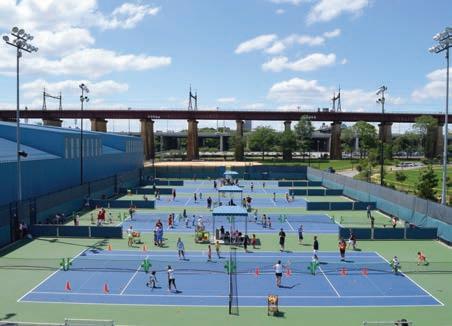
SPORTIME Randall’s Island/John McEnroe Tennis Academy (JMTA) has been named the USTA Member Organization of the Year. Since 1981, this annual award has celebrated organizations that demonstrate extraordinary service to their communities, provide premier tennis programming and coaching for all ages, and champion the growth of tennis at every level.
“The team at SPORTIME Randall’s Island and JMTA has created something truly special,” said Brian Vahaly, USTA President and interim co-CEO. “They are developing players, mentoring young people, and building lifelong connections to the game. Their impact across the tri-state area is significant, and their commitment to excellence shows up in everything they do.”
“We are honored to receive this award,” said Claude Okin, SPORTIME’s President & CEO. “Since the day SPORTIME was founded in 1994, our commitment to delivering high-quality programming that advances the USTA’s mission by promoting lifelong participation, competitive development, and inclusive community access has never wavered. We are proud of what we have accomplished and we will continue to serve our tristate area community with the best playing environments and through our inclusive, mission-driven culture.”
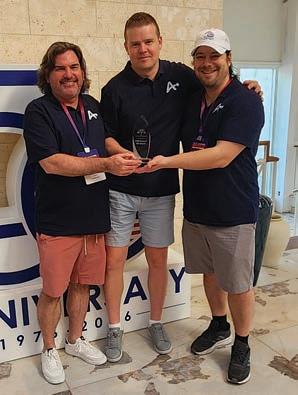
The Professional Tennis Registry (PTR) named Roosevelt Island Racquet Club the Private Facility of the Year at its annual Symposium earlier this year. The award recognizes the facility, as well as the workshops it hosts plus its commitment to developing and certifying coaches through PTR’s curriculum. Coaches Magnus Gunnarsson, Tony Huber, and Joel Richmond from Roosevelt Island Racquet Club represented the club at the symposium in Florida.
Huber said:
“This award reflects the culture we’ve intentionally built at RIRC: one that values education, growth, and giving coaches the tools to be their best. It was a proud moment not just for us, but for our entire tennis community.”
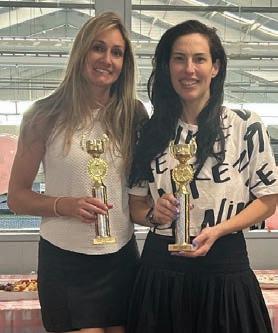
Over the holiday break in April, Carefree Racquet Club hosted two weekend doubles tournaments for adult players, one in the Men’s Doubles 6.0 - 7.0 category, and one in the Women’s Doubles 6.07.0 category.
Laura Crain & Marie Romeo-Gough were the Women’s Doubles winners, while Christopher Arena & Ray
Xerri were the Men’s Doubles winners.
“The event was such a fun experience overall,” said RomeoGough. “It was a great way to bring women together in a competitive but friendly atmosphere, and everyone was so welcoming. I think smaller tournaments like this throughout the year are a great idea because they give players more opportunities to compete, connect and keep improving the game.
Crain added:
“I’m not sure if it’s specific to Long Island, but I feel like winter is mostly dominated by Mixed Doubles USTA events, so it was really nice to find a women’s doubles tournament that enables us to keep playing and working hard as the lead-up to our summer USTA season.”
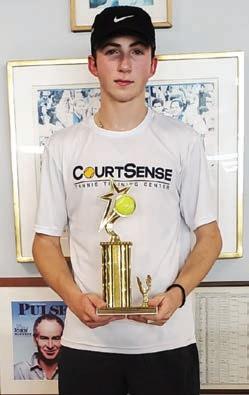
Filip Nikolovski captured the title at the L4 Closed event at SPORTIME Randall’s Island. The top-seed who trains at CourtSense in New Jersey won five matches en route to the title including a three-set victory in the championship match to earn the Boys 18s singles title.


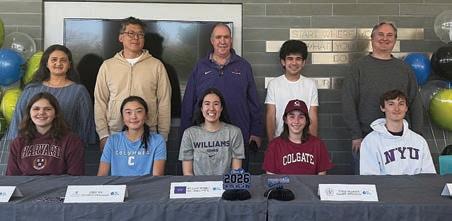
The
Cary Leeds Center for Tennis & Learning honored and celebrated its graduating seniors who will be heading off to college in the fall. The student-athletes will be heading off to Columbia, Harvard, NYU, Colgate and Williams College to begin the next chapters of their lives.
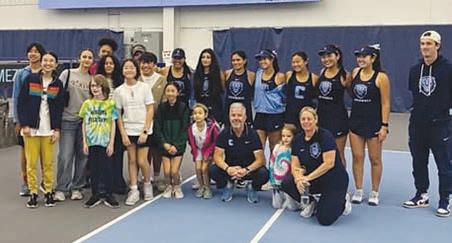
Players from City Parks Foundation were invited to the Milstein Family Tennis Center to watch the Columbia
Women's Tennis team. The young students were able to watch the Lions defeat Ivy League rival Brown 4-3 in a thrilling conference showdown.
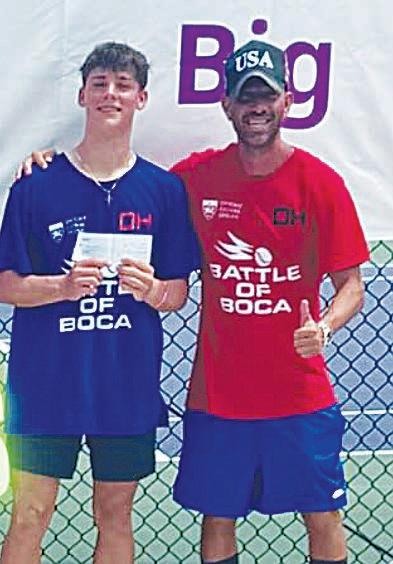
At the Battle of Boca, a UTR Prize Money event run by the Drew Hassenbein Foundation, Kamil Stolarczyk, who trains at Robbie Wagner’s Tournament Training Center, reached the tournament’s quarterfinals. By reaching the final eight, Stolarzcyk earned his first prize money check, and was given the event’s Ultimate Competitor Award. His performance, and the tournament overall, honored Drew Hassenbein and his legacy on the tennis court.”

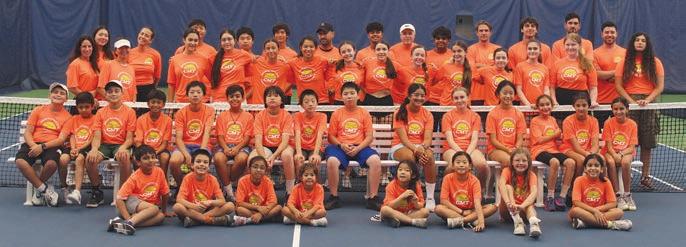

Christopher Morley Tennis offers year round Juniors and Adults tennis programs for all levels. Summer Camps, Holidays Mini-Camps and Tournaments, Fitness, Special events and more.
Ricardo Aguirre raguirre@cmttennis.com 516-214-1921














blefarettes fe erixperiencThe
dluoh,seen,kenicidesmtropnss
n I aReMsuoh-nI ep rtnio j,pih i laicepdseniart w ten-n i0 8revO blefa,rettes
tlacisyh pd an,tnemeg T g Cniraeb-thgie,wyar-lXatigid d
































































































By Brian Coleman
Tennisis a fascinating sport, in that its impact stretches far beyond the white lines on the court. The fuzzy yellow ball has the power to change the lives of men and women, and take them places they may never have dreamed of.
This is true for Cinto Casanova, the Director of Coaching and Junior Development Pathway for the Centercourt Tennis Academy in New Jersey. Casanova joined the Centercourt team at the end of 2022 after a tennis journey that began in Europe, took him to Asia, and eventually landed him here in North America.
“One of the main things I’ve learned as a coach is to be always evolving, and developing yourself as a coach,” said Casanova. “It’s important to learn new things and never stagnate. This is what excites me and motivates me to keep searching for new ways to help our players.”
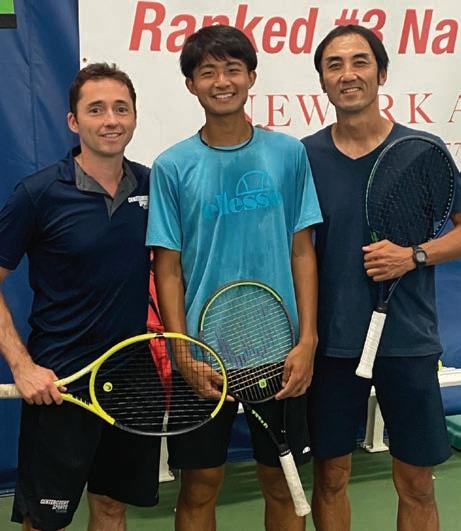
sports. Like most kids from Spain, soccer was a big part of his life when he was young, as was Trialsin, a sport similar to mountain biking.
That motivation has influenced Casanova to teach tennis in multiple continents over the course of his tennis career, and why the team at Centercourt were so eager to bring him into the fold three years ago.
Casanova grew up in a small town in Spain where the nearest tennis club was more than 30 minutes away so tennis was not his initial entryway into
As he grew older and became a teenager, he decided he wanted to take up tennis. His parents were unable to drive him to the tennis club , but thanks to his experience riding a bicycle, he was able to find his own transportation.
“I was around 13-years-old at the time, so I was quite old (compared to the normal starting age) when I began
playing tennis,” he recalls.
Although he trained competitively, he could tell that playing tennis at the next level was not going to be his future, but he always loved sport science and decided to study that when he enrolled at the University of Barcelona.
“I knew competitive tennis was not going to be my path, but coaching tennis would be,” Casanova said. “I knew even before I got to University that I would be a tennis coach. I studied sports science with a focus on tennis. All my work was about tennis, all the projects I did in school were centered around tennis. On my 20th birthday I became a certified tennis coach.”
Soon after, he made the bold decision to move to China, a transition that would elevate him to the next stage of his coaching career, and truly change the course of his life.
“For me, at that time, China represented this land of opportunity,” he explains. “The Western world and Europe in particular were going through an economic crisis. And specifically to tennis, things felt stagnant in Spain, there were not a lot of opportunities to grow or start your own business, whereas China was a playground to build something from
scratch; the way I wanted to. It was a developing country that was becoming an economic power. That was the number one reason I did it, and it turned out to be an amazing decision.”
Casanova put in the work, and became the Director of Pro Players Programs at the China Elite Tennis Academy (CETA), which was the official Academy of the Shanghai Rolex Masters in China for nearly two decades. It was also there in China that he met Conrad Singh, someone who would become his mentor.
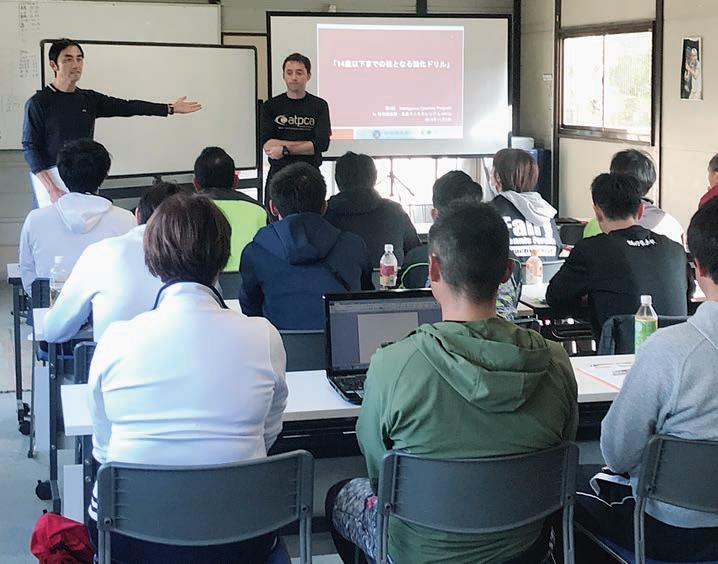
including Li Nah, Shuai Zhang, and many others through their clubs and programs.
Singh and his wife Paola opened the first Foreign Sports Academy in China and were its outright owners. Their academy and Casanova’s CETA worked hand-in-hand to develop and mold the pathway for Chinese players,


“We were both very like-minded, striving for excellence and putting 100 percent into what we do,” said Casanova. “We immediately connected, and we combined our two companies to create the biggest tennis coaching company in Shanghai at that



time.”
The two continued to work together for several years, and after a decade in China, as he was always looking to challenge himself and strive for more, Casanova moved to Japan and began working at a traditional tennis club there.
“I enjoyed learning different ways of doing things, and immersing myself into new cultures. Moving to Asia, and moving from China to Japan, offered me a new perspective which allowed me to improve as a coach, and thus improve the way I taught my students,” said Casanova.. “I think that helped me a lot, and made me learn a lot more about tennis, but also myself.”
continued on page 28



continued from page 27
While he and Singh no longer lived in the same country, they continued to communicate and worked alongside one another on a project for the Australian Professional Tennis Coaches Association (ATPCA). They would see each other at conferences and seminars and continued to discuss future opportunities to further grow their careers.
After Singh moved to New Jersey to become the CEO of Centercourt Club & Sports, he would constantly tell Casanova that he needed to move to the United States and join Centercourt. He would be an asset to the team at Centercourt, and it would provide Casanova with another amazing opportunity.
Having spent 17 years in Asia, 10 in China and seven in Japan, where he also met his wife, Casanova was ready for the next challenge.
“He was always in my ear, and after all that time, I thought maybe it was time,” he says. “America is on the other side of the world, a part of the world I hadn’t seen yet, and I thought that this would be a great
way to experience how things are done there; what it could do for my development, and also what I could bring to Centercourt. It was a project that really excited me.”
Centercourt prides itself on being the “toughest playground in the Northeast”, and is always looking towards innovating and expanding its offerings to players, which lined up perfectly with Casanova’s coaching philosophy.
He was integral in helping launch the Red Ball Performance Center at its Chatham location back in 2023 to create a dedicated location for the first step in their pathway. Casanova oversees the development of the academy’s coaches as well, ensuring that everyone they bring in only coaches that meet their standard.
“We have a pathway for all stages, from Red Ball through highperformance ITF level players,” he explains. “But that’s not what makes our academy successful, I think it’s because we take pride and care for our players, at an individual level. We have coaches that care for what they do, and when I select coaches,
we make sure that they care. We don’t want coaches who come in, clock in and out and leave. We want coaches that are committed, which means that you need to be committed to tennis 24/7. We find it’s the only way to develop kids and instill the values they need to succeed. And that’s why we have such a good system here, and why our coaches are so loved by our players.”
Tennis has taken Casanova from Spain to China to Japan and now to the United States, and the players and families who have the privilege of knowing him at Centercourt are better for it. His cutting-edge, highintensity footwork method has made him a recognized world leader for coordination development and skill acquisition.
“I truly have never seen anyone better,” Singh says of his protege.
The connection he and Singh formed in Asia is paying dividends in New Jersey and the greater Northeast, and Casanova is excited for the opportunity to continue, learning, improving, and strengthening the sport of tennis.



Tennisclubs are always seeking ways to streamline operations, elevate the customer experience, and grow revenue. BLUME, an innovative club management software, helps clubs achieve all of this and more.
Founded by Gowri Guruswamy and developed by her dedicated team, BLUME was first launched at Robbie Wagner’s Tournament Training Center and has since expanded to serve a growing number of clubs across the U.S., with CourtSense, Ardsley Swim & Tennis Club, and Huntington Indoor Tennis recently joining the BLUME family.
What Sets BLUME Apart BLUME is built for flexibility and customization, supporting a wide range of clubs—from private clubs and country clubs to universities and schools. The software adapts to each club’s specific needs, with a hands-on onboarding process and continuous support from the BLUME team.
New in 2026
• Mobile Customer App: A redesigned, intuitive app for players to make reservations, view schedules, and access programs on the go.
• Branding Options: Custom branding to personalize the player and staff experience.
• Food & Drink Module: Efficiently manage snack bar and café orders.
• Improved Pro Shop Module: Enhanced tools for inventory, sales, and digital receipts.
Core Features of BLUME
• Reservations Made Easy: Colorcoded bookings, pop-ups, and icons

simplify scheduling and reservation management.
• Program Management: Create and manage lessons, clinics, tournaments, and social events in one place.
• Membership Management: Tools to grow, manage, and retain your membership base effectively.
• Staff Management: Build and manage staff schedules, and generate digital timesheets for payroll.
• Mobile Access: Mobile apps for players and staff to check schedules, book courts, and manage programs on the go.
• Billing & Invoicing: Easily generate and send invoices, track payments, and reduce administrative load.
• Payment Processing: Integrates with leading payment gateways for secure, seamless transactions.
• Customization: Tailored configurations to suit your club's unique needs.
• Reporting & Analytics: Access performance dashboards, financial summaries, and member engagement data.

Trusted by Top Clubs
"We, at Carefree Racquet Club, have found the program provided by BLUME to be exceptional... The support team is truly remarkable... We couldn't be more pleased with our experience."
— Kathy Miller, General Manager, Carefree Racquet Club
"Columbia University requires an indepth analysis of multiple vendors... Blume customized its software to fit our specific needs and solved all of our unique requirements... The combination of value, efficiency, and customer service is amazing."
— Keith Kambourian, Director of Tennis, Columbia University
Let’s Talk
To learn more about how BLUME can streamline and elevate your club's operations, visit BlumeSoftware.com, call (516) 806-9383, or email info@blumeconnect.com
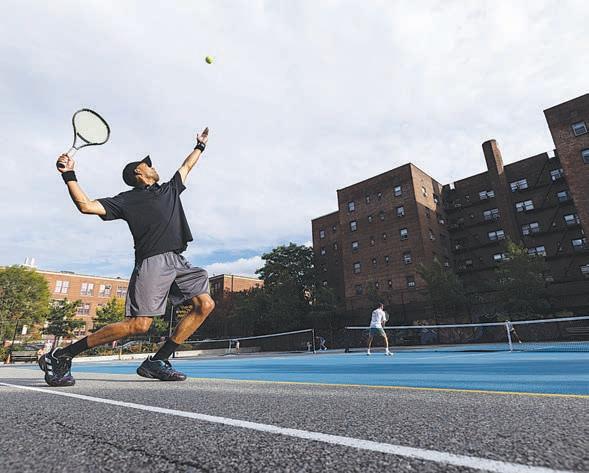
Tennis participation continues to surge across the Eastern section, with 2.6 million people (ages six and older) in New York and northern New Jersey picking up a racquet at least once in 2025— according to findings from the Physical Activity Council (PAC) and the PLAY study, which both monitor the popularity of various sports and activities.
The number grew from 2.3 million in 2024 and 1.9 million in 2020, constituting an average 7.2% increase in players each year over the last five years. (That percentage, incidentally, outpaces the national growth rate of 4.8%.) Overall, an astounding 11.8% of the entire population in the area hit a tennis court in 2025, ranking second out of the 16 geographic sections covered in the report. The naturally warmer Southern California claimed the top spot in that category.
“We are ecstatic to see this kind of sustained growth over the last five years,” said USTA Eastern Executive Director & CEO Amber Marino. “These numbers are a testament to the joy and connection the sport can bring. We are energized to build on this momentum and continue to expand access and develop play opportunities, so that even more individuals and communities across the section can realize the benefits tennis has to offer in 2026 and beyond.”
Of the 2.6 million players, 1.5 were considered “core” players, meaning they engaged with the sport ten or more times. About 500,000 had never before played tennis, a 35% increase over 2024. The study also found that players from the region overall skewed younger than in other parts of the country, with 69% of participants under the age of 45.
Physicalactivity doesn’t just strengthen your muscles; it also helps fortify cognition. And tennis—which often involves strategic, rapid-fire decision making—is uniquely strong in this regard. We spoke with Dr. Richard Mayeux, the neurologist-in-chief at NewYorkPresbyterian/Columbia University Irving Medical Center about why the sport provides such a boost to your brain.
How might specifically playing tennis—as opposed to other sports—positively affect cognitive function and brain health?
Dr. Mayeux: Repeated challenges in planning and implementing a task are demanding of our physical and
mental abilities. While these challenges are common in many sports, few require the attention, reaction time, splitsecond planning of movements and motor control required in tennis. Understanding where you will receive the ball on the court and how you will manage your response requires coordination, cognitive flexibility and experience. Rapid decision making, strategy and visuospatial coordination are also some of the keys to playing tennis.
What are some of the other neurological benefits of playing tennis over time?
Dr. Mayeux: Beyond enhancing hand-eye coordination, playing tennis regularly engages the brain’s frontal lobe by
strengthening executive or sequential planning functions. The premotor cortex and the motor cortex are necessary to plan the subsequent actions needed to serve, return or volley.
Tennis keeps the attention span alert, requiring constant mental engagement. Players must remember complex motor sequences and anticipate their opponent's movements while focusing on the current rally.
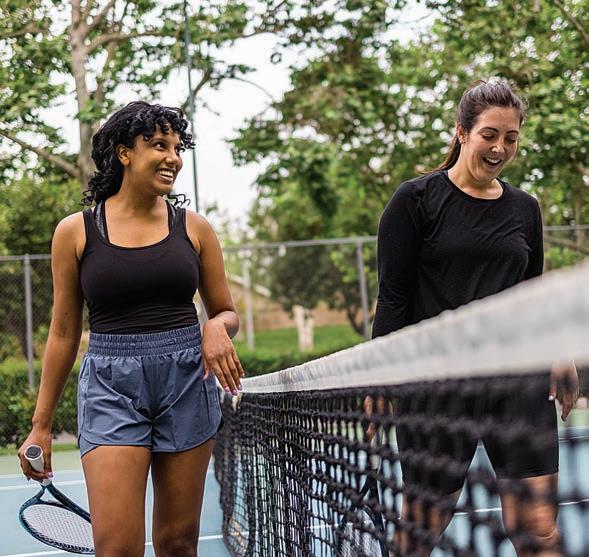
Studies on children have shown that longer tennis training is associated with better working memory and cognitive flexibility. This ‘motor’ memory differs from ‘regular’ memory, which is like if you needed to recall the names of past presidents. We use motor memory to learn to ride a bicycle. It takes a while to learn to ride a bike, but once the motor memory is solidified in the brain, we can ride anytime we are on a bike. It’s the same for tennis. The grip, the positioning of the racket, the follow through on strokes…these are all learned motor memories. The longer one plays the sport, the more consolidated and familiar these motor memories become.
Tennis can also present some mental hurdles. Sometimes athletes struggle to access their best form during a match no matter how much they’ve practiced. What are some methods, exercises or tactics for better handling the stresses and pressures associated with competition? How can players develop stronger mental resilience when things aren’t going their way?
Dr. Mayeux: Starting with a positive attitude, even against a better opponent, can build self-confidence and enjoyment of the game. After all, it is a game of
skill, and you cannot always expect to win. It is easy to start a negative internal dialogue when you make a self-inflicted mistake. However, replacing negative thoughts with positive self-coaching can help athletes develop resilience in reaction to such an error. Additionally, mentally rehearsing each shot—the serve, the return and the volley—can activate neural pathways, activating muscle memory. Visualizing successful outcomes, or even practicing coping with unexpected challenges, can ultimately build resilience. And then relaxation techniques, such as deep breathing or bouncing the ball before the serve, can help athletes take charge of a demanding or stressful situation. It allows the athlete to reimagine the challenge as a manageable opportunity and reduce the likelihood of "choking" under pressure.
To what degree does the social aspect of tennis impact the overall benefits of tennis on your brain’s health?
Dr. Mayeux: Maintaining relationships and finding new ones are vital for a well-rounded and full life. [Building that network around tennis] also means you're adopting healthy behaviors, regularly exercising and reducing stress [in the process].
What else should players know about the sport and overall brain health?
Dr. Mayeux: What is good for the heart is good for the brain! Tennis is a lifestyle choice that involves regular exercise and can lead to better habits, like a healthier diet. Those habits can improve heart health, and as a result, the sport can reduce the risk of cognitive decline.
Helpgrow the sport you love! USTA Eastern invites you to submit an application to serve as a member of its Board of Directors for the 2027-28 term. In this volunteer position, you’ll join a highly passionate group of individuals who work to implement wide-reaching strategies that get more people picking up racquets in communities across New York and New Jersey. You can learn more about this opportunity and apply on the USTA Eastern website. Below, current board member Katrina Campbell shares her own experience serving in this capacity.
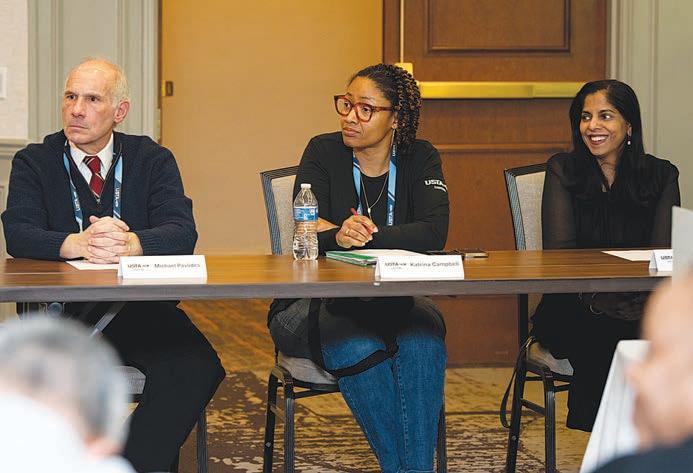
said the section was looking for board members. It’s funny because I really just decided to apply on a whim. “Why not? It’ll be interesting…they probably won’t call me anyway.” Well, they did call. [Laughs]. I was like, “Oh my gosh, what did I get myself into?” [But] I’m a lawyer by trade and an ethics and compliance person. Every organization that has a board needs to be mindful of issues of ethics, compliance, culture, conflicts of interest. For me, I thought it would be really great to offer my skills to an organization that promotes something I think is really good for our society.
When did you first pick up a racquet? What’s your tennis origin story?
Campbell: I took tennis in a physical education class in college, but never really played regularly until 2006, when I moved to New Jersey from Virginia. I was getting divorced and looking for something to do where I could build my own community. There were courts nearby my home in South Orange, and I met someone who asked if I wanted to play. Whenever we showed up at the courts, all kinds of people would hit with us or chat with us. Then this group that I started playing with learned about a USTA league that was in Plainfield, and they said, “Oh, we should join!” I was terrified. [Laughs]. But they convinced me to do it, and I’ve been playing ever since.
You joined the USTA Eastern Board of Directors in 2021. What interested you about applying to serve in that capacity?
Campbell: I’m a USTA member and I saw the email that
Are there any projects you’ve worked on during your tenure in the role that make you particularly proud?
Campbell: To me, a key part of being a board member is that you don’t just sit there and vote. You engage and you challenge and you ask questions so that you can better understand in an effort to fully promote this sport. I'm proud to be the person in the room who is willing to ask the question that no one else is asking. But I’m also really proud that I’m a 50-yearold working professional who [has been] a 3.0 player for 13 years. I represent the people like me who want to have fun and don't want to take it too seriously, but want to compete. I'm really happy to be the person at the table who reflects all those playing tennis for the fun of it. Most of us are not professional players and are not ever going to be professional. Yet it's still transformative for us.

By Brian Coleman
Whenshe was five-years-old, Athina Schlepphorst’s parents signed her up for a summer camp in her native England. It was a way for her to stay active in the summer and try new things, but it also turned out to be the launching pad for her to find her passion.
The camp included many different sports, and the one that stood out most to the impressionable Schlepphorst was tennis.
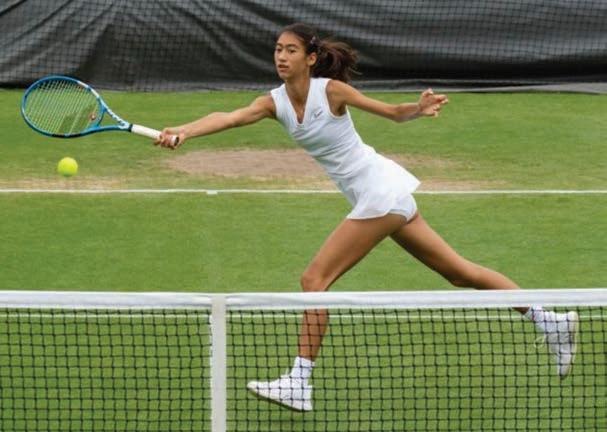
“During the week we played a lot of tennis, as well as other sports, but at the end of the week the tennis coach went up to my mother and said that he saw how much potential I had,” she recalls. “He said I had great hand-eye coordination compared to the other kids in the camp. I began taking lessons at our local club, playing one or two hours a week, and that was really the beginning of my tennis career.”
Soon after that, Schlepphorst competed in a Red Ball tournament, which she won, amplifying her desire to continue playing.
“It was my first tournament, so that was a great memory and ever since then I have been playing tennis.”
Along the way, she did play other sports such as
swimming, golf, a British sport called net ball (similar to basketball). Competing in those sports helped her develop other skills that translate to tennis, but also helped her realize that the tennis court was where she longed to be.
As her tennis development continued, she continued to get better and impressed. Some of her favorite memories of those early tennis days was competing at the Road to Wimbledon, the largest junior tournament in Great Britain. The prestigious under-14 international event is held on the courts of the All-England Lawn Tennis Club, and Schlepphorst qualified for the event three straight years.
It was competing on those courts that she saw what her tennis future could hold, and helped build a foundation of confidence and motivation.
“The tournament mirrored a Grand Slam environment, with all-white dress codes, official umpires and line judges, and access to player areas like the locker rooms and Aorangi Café. I reached the final twice and finally managed to win the title in 2021,” she recalls. “Competing on the same grass as the sport’s greatest players and seeing Centre Court from the cafeteria made the experience so inspirational but also
reinforced the feeling that Wimbledon was no longer a distant dream, but something within reach.”
In the early part of 2021, her father received a job offer here in the United States that moved the family to New Jersey. In order to maintain her training and travel schedule, Schlepphorst and her parents were seeking a school that accommodated those needs without sacrificing academics.
They found that in Dwight Global Online School, and enrolled when they arrived here in the States.
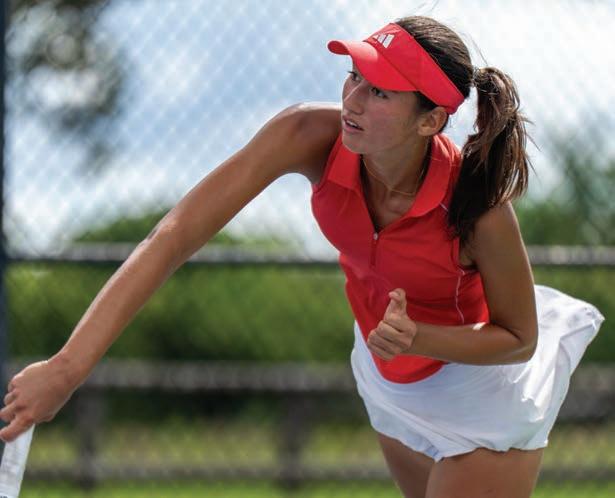
“During COVID, I had experience with remote learning, and I saw that I was able to thrive in the environment, which made for perfect timing when we were looking for schools here,” Schlepphorst, now a senior, recalls. “It’s been the best decision. Dwight has been so supportive, and the school is completely flexible. Back in the UK, I attended an in-person school and it got to the point where it was overwhelming. The students and teachers didn’t really understand my schedule and what my tennis training entailed. The Dwight School understands how much time and effort I put into tennis, and it allowed me to travel more, and play in more tournaments. It’s been great.”
Dwight Global allows its students to pursue excellence without compromise, providing them with the freedom to chart their own course of study, take classes at home or on the road and pursue their passions. Because of this, Dwight has the infrastructure and experience to benefit top tennis players.
“Every year I have been there, the deans and the teachers have been great in making sure we don’t fall behind in our work, staying in contact with us when we are on the road,” said
Schlepphorst. “They give us the support we need to make sure we get the work done, and attain the best possible grades.”
With that freedom and flexibility, Schlepphorst has shined on the tennis court. She has spent time competing in ITF tournaments across the globe, including Canada, and numerous countries both in Europe and South America. She has plans on playing in tournaments in Asia this year as well.
The experience of traveling for these tournaments has not only helped Schlepphorst elevate her tennis game, but gave her an appreciation for the opportunities she has to travel and play the sport she loves.
“I’ve traveled to many countries that without tennis I probably would never have been able to. It’s a great opportunity to learn and experience different cultures rather than just reading or learning about it from a textbook. I’ve visited local museums and tried local foods, so I am very fortunate that tennis has given me these types of opportunities.”
On the court, Schlepphorst is an allcourt player who likes to play aggressive while mixing in a lot of variety. Standing tall at 6’1, she utilizes
a strong serve but is also able to slice and come to the net effectively. Currently her focus is on pressuring her opponents during long rallies, and being smarter with when she chooses to be aggressive during points. Her game caught the attention of college coaches from across the country. Not being from the United States originally, her family and her did not know much about the college recruitment process, and the stress and pressure it often brings. However, that potential trouble was eased when she visited the University of Pennsylvania, the place where she will continue her tennis career.
“It was all very new to us, but after speaking with some of my friends we understood it better. I met some coaches when I was at the USTA Hard Court Nationals in California last summer, and my first visit was to UPenn,” Schlepphorst recalls. “Immediately when I arrived on campus, I loved it. I had a great experience meeting with the coaches and the whole team, the coach was passionate about me joining the team which meant a lot to me. The school is fantastic academically, and that was an important factor to me. The balance between athletics and academics means a lot to my family. Between the great staff, teammates and academics, I knew it was the place for me.”
Her goal before arriving on campus is to continue improving and moving up the rankings of the ITF circuit, as well as earn a WTA ranking. Schlepphorst has begun playing lower-level WTA events in order to achieve that goal.
“I just want to keep improving my tennis in the short-term, but in the longterm I would love to get to a level where I could play Grand Slams, especially Wimbledon,” she said.





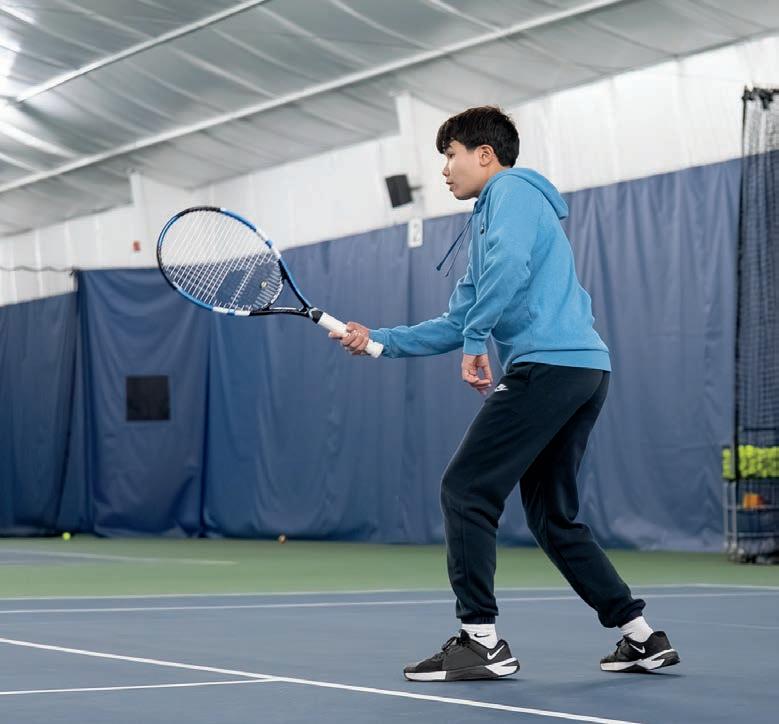

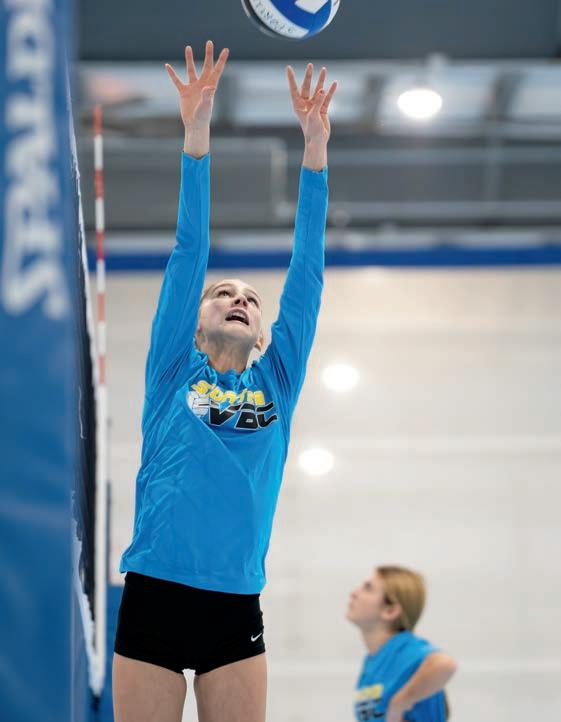


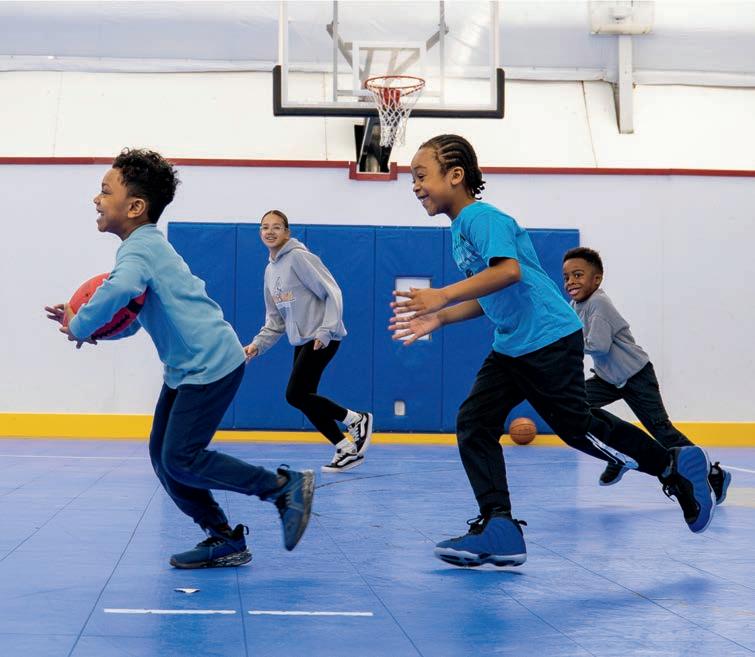




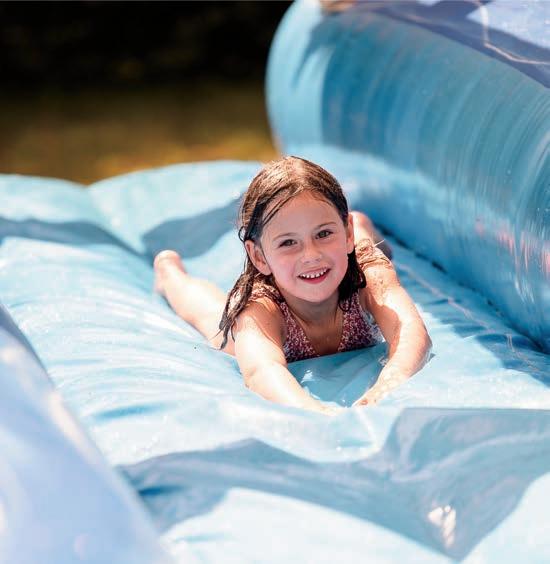








the summer, people from across Long Island and New York City flo to enjoy the sun, while sitting by the pool or ocean, and taking part outdoor activities. One of those activities, and perhaps its most popu It may be the favorite activity for Hamptons-goers, and there is no sho or opportunities to play out on the East End, from hitting around at loca them up and playing on a private court in a luxurious Hamptons home There is so much to enjoy about summer life in the Hamptons, and ten New York Tennis Magazine has compiled some of the best places to p in The Hamptons and the East End this summer!


ock to the Hamptons, in an array of ular, is tennis. ortage of tennis courts al parks or lacing . nnis is at the forefront! lay, stay and shop out
Annacone Tennis Management
AnnaconeTennis.com
info@annaconetennis.com (865) 300-7323

Annacone Tennis Management provides an array of services in the Hamptons, and can help produce programming and consulting for your neighborhood courts, country clubs, tennis clubs, resorts and more. One of the programs offered is MyHamptonsPro, which is a concierge tennis company specializing in providing the highest quality offsite tennis services in the Hamptons.
This service is available on your private court, at one of our private courts, or at your tennis facility. Focused specifically on creating the utmost in customer satisfaction, MHP provides comprehensive tennis services from world-class tennis professionals to fit all of your needs. MHP tennis pros specialize in private tennis lessons that are customized to your specific tennis goals, with flexible times and days available to meet your needs. Steve Annacone, Director of MyHamptonsPro, has been a tennis professional and coach for over 45 years. Originally from Sag Harbor, NY and a graduate of East Hampton High School, Steve has been very involved in the tennis community in the Hamptons.
By understanding that each player has specific needs and creating a customized tennis experience to accommodate these needs, Steve and the MHP staff will help you get the most out of your time on the court.
91 South Fulton Drive Montauk, NY 11954 (631) 267-8525
GothamTennisMTK.com Info@GothamTennis.com
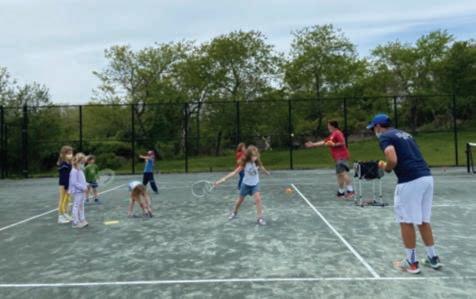
For over a decade, Gotham Tennis Academy has become known for innovative, world-class tennis instruction in NYC and the Hamptons. Gotham Tennis – Montauk is on a beautiful nature preserve, just minutes from the center of Montauk. Their eight pristine clay courts are meticulously maintained and open to the public, offering a full range of popular camps, private lessons, home lessons and clinics suited to your level of play and interests. Beginners, rising stars, recreational players, and tournament players are all welcome. Instruction and fun is always geared to your age and level of play. Private lessons
continued from page 43
with Gotham Tennis Academy’s world-class tennis professionals are available not only at our Montauk club, but also for home lessons throughout the Hamptons from Southampton to Amagansett including East Hampton, Sagaponack, Water Mill, Bridgehampton and Shelter Island.
In the summer, Gotham Montauk offers tennis and sports camps, private lessons, adult clinics, private events and parties, as well as home lessons. Gotham Montauk also offers affordable memberships to get the family get into the game and achieve all of your tennis goals this summer!
Ross School Tennis Center
20 Goodfriend Drive
East Hampton, N.Y.
Ross.org/Tennis tenniscenter@ross.org (631) 907-5162
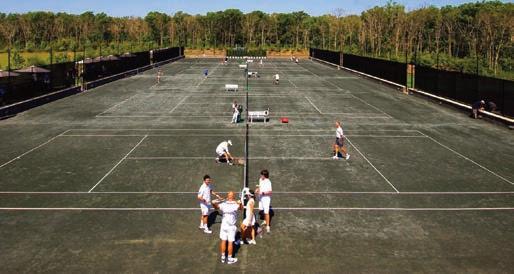
Ross School Tennis Center (RSTC) is the premiere training center in the Hamptons, boasting a beautiful tennis facility that is open to the public and located on the Ross Upper
School Campus in East Hampton, N.Y. The Tennis Center features six HarTru courts that are enclosed by a bubble from mid-fall through mid-spring, allowing for year-round play. The Tennis Center features state-of-theart amenities such as spacious locker rooms, lower level lounge, convenient snack bar, and ping-pong tables, and the staff provides a fun and supportive atmosphere that allows for the greatest amount of success.
After-school programming, a dynamic program for junior players, and specialized summer programs are offered to make Ross Tennis Center the place to play tennis in the Hamptons.
Nursery–Grade 4: Specialized one-hour training program where players build a strong foundation through a variety of game-based and cooperative activities using 10U age-appropriate (Red, Orange, or Green) balls and nets that will prepare them for eventual full-court play.
Grade 5–Grade 12: Players build off their 10U foundation to further develop fundamental skills and techniques as they transition into yellow balls and prepare for full-court tournament competition. Ball control, strategy, and work ethic are all emphasized in this 90-minute session of drills and point play.
Players in kindergarten and higher are required to play twice per week in this program.
RSTA Yellow+ is for players over 12 years old who play either on a JV or Varsity school team. There will be practice every day for two hours after school. Tryouts can also be evaluated by an RSTA coach if you are not yet a team member.



Participation at both UTR and USTA tournaments is encouraged but not a requirement.
Ross School Tennis Center also offers adult clinics, court rentals, and private and group instruction for all ages and levels. The Tennis Center is also used for a variety of special events and is available for private parties.
SPORTIME Amagansett/ JMTA Hamptons
320 Abrahams Path
Amagansett, N.Y.
(631) 267-3460
SportimeNY.com/Amagansett
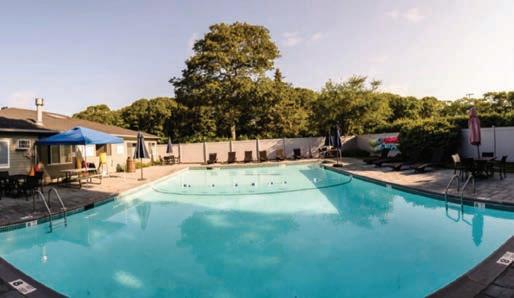
Located in the Town of East Hampton, SPORTIME Amagansett’s 23 acre campus features 33 pristine outdoor Har-Tru tennis courts, one hard-surface tennis and pickleball court, a heated outdoor pool and so much more for members, students and campers to enjoy. The Hamptons’ summer home to the John McEnroe Tennis Academy, SPORTIME Amagansett welcomes aspiring young players to train at one of the world’s best academies when on the East End. The club is also home to East Hampton Sports Camp @ SPORTIME, which offers preschool and multi-sport full-day, full-summer fun for kids ages 3-13.
The SPORTIME Amagansett Sports Arena, open yearround, features a climate-controlled, regulation size rink that subdivides into three smaller courts that allow for multiple sports activities and small group training. Sports offered include hockey, soccer, basketball, volleyball and pickleball.
SPORTIME Amagansett offers both residents and Hampton visitors of all ages world-class tennis, pickleball and sports programming, camps, events, tournaments and more.
2571 Quogue Riverhead Road East Quogue, N.Y. (631) 653-6767
SportimeNY.com/Quogue
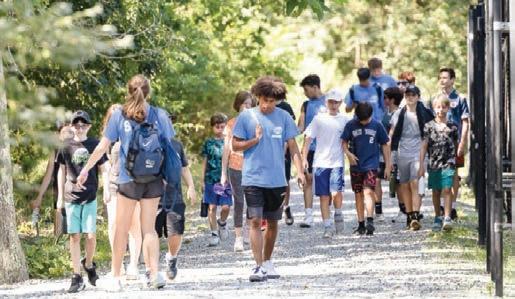
Named the best tennis club on the South Fork by Dan’s Papers each year from 2020-2024, SPORTIME Quogue is a year-round, full-service tennis, fitness, summer camp and sports facility located in East Quogue, catering to the surrounding communities of Westhampton, Remsemberg, Quogue, Southampton, Hampton Bays, Eastport, Riverhead, the Moriches and the North Fork, serving both locals and visitors alike..
SPORTIME Quogue features four indoor Har-Tru softsurface tennis courts and 22 outdoor Har-Tru courts, in addition to a heated outdoor pool, a full-service health and fitness club, a multi-sport court, and locker rooms with saunas. SPORTIME Quogue serves tennis players starting at the age of three, including junior pathway programs, as well as dynamic instructional programs for adults of all levels.
While SPORTIME Quogue thrives year-round, the summer season is alive with a large outdoor tennis community, including Hampton vacationers and snowbirds returning for summer season. SPORTIME Quogue’s full-day summer camp, including preschool, multi-sport and tennis offerings, is recognized as one of the top summer camps in Westhampton.
Tennis East
73 Main Street
Southampton, N.Y.
(631) 283-9535
TennisEast.com

For more than 50 years, Tennis East has been a staple of the tennis community on Long Island’s East End. Tennis East offers an extensive selection of men’s, women’s and junior’s rackets, apparel, sneakers, strings and accessories.
Tennis East keeps up to date with the latest and most popular products to make sure its customers are always up to date with the newest gear. We feature a complete line of 10 & Under Tennis equipment and apparel, as well as a line of other racket sports, such as: padel, platform, squash, beach and pickleball. Stringing services and demo rackets are also available.
Making sure your courts look as pristine as possible is important for all who operate tennis courts and facilities, but when it comes to tennis in the Hamptons, especially in the summer, it’s a must. New York Tennis Magazine has compiled a list of the top companies and brands to use:
www.tweenerusa.com www.10-s.com
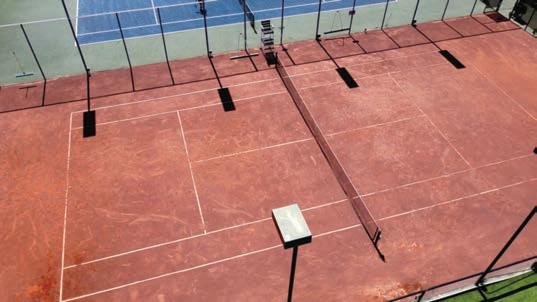
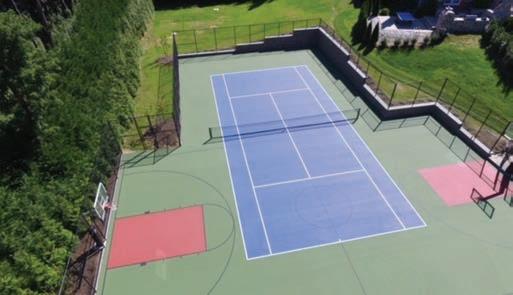

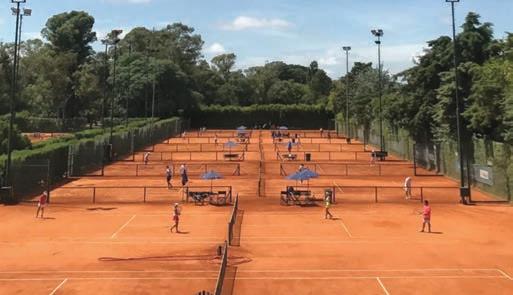
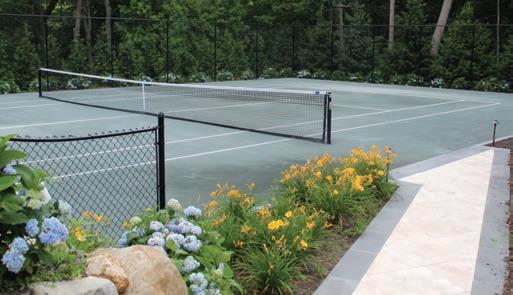

Formerly Baron’s Cove, Faraway Sag Harbor opens in Summer 2026, offering one-of-a-kind lodging including Harbor King Suite, Signature Garden Collection, Village Collection and Lofts Collection rooms. At Faraway, Zagara brings Amalfi-inspired oysters, coastal flavors, and harbor views to the water’s edge. In the lobby, harborside cocktails and light bites set the scene for easy gatherings. Located in the heart of Sag Harbor’s storied harborfriend, every view hints at discovery, every stroll kindles adventure, and the salt-laced air invites something unforgettable. Farway is a sanctuary where perfect strangers become old friends, and local tribes are formed.
continued from page 47

290 Old Montauk Highway Montauk, N.Y. (631) 668-2345
GurneysResorts.com/Montauk
Gurney’s Montauk Resort & Seawater Spa is a Hamptons icon and the only year- round resort in Montauk. Providing guests with direct access to a 2,000-foot long private sand beach, Gurney’s features 158 rooms, suites, and beachfront cottages, all delivering dramatic ocean views. Gurney’s offers guests a pirate beach, dubbed as “one of the most glorious beaches on Long Island”, as well as the Seawater Spa & Bathhouse, where you can enjoy the rejuvenating power of salt, sand and sea at the Thalassotherapy spa in North America. Gurney's Montauk has a wide variety of seaside eateries –everything from ingredient-driven menus featuring healthy bites to locallysourced dishes and seasonal classics.
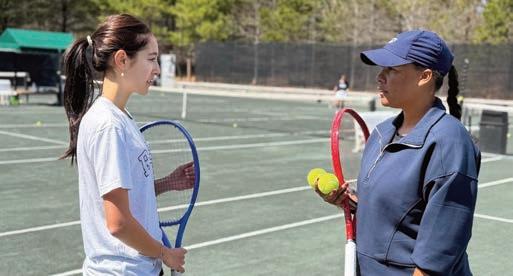
This spring, the Ross School Tennis Center ushered in a new era as Richele LeSaldo was named the program’s tennis Director. LeSaldo will oversee one of the cornerstone athletic programs at the historic East Hampton institution.
“Richele is an extraordinary leader whose experience spans elite competition, academy development, and community-building,” said Tom Sturtevant, Head of School at Ross. “Throughout our search, it was clear we were looking for someone who could both honor the strength and momentum of our current program and elevate it to new heights. Richele brings the strategic vision, global perspective, and student-centered philosophy that will allow the Ross Tennis Center to thrive whether a student is picking up a racquet for the first time or preparing to compete at the collegiate level.”
For more than 50 years we’ve been the year-round, full-service retail tennis, paddle, squash and pickle ball store of choice for East End racquet sport enthusiasts. Tennis East has an extensive in-stock selection of men’s, women’s and junior’s racquets, sneakers, apparel and accessories from the top manufacturers for players of all ages and skill levels. Please call or e-mail us at tenniseastsh@gmail.com to place orders SOUTHAMPTON l 73 Main Street l (631) 283-9535 The Retail Choice for Racquet Sport Enthusiasts!
LeSaldo enters the position with a wealth of both playing and coaching experience. A native of the Bahamas, she earned a scholarship to Clemson University where she helped lead the Tigers to back-to-back NCAA Tournament Final Four appearances. She was also the team’s captain which helped foster valuable leadership skills.
Those skills translated into a coaching career which began in upstate New York when she became an assistant coach for Cornell University. In addition, she has been a national talent scout for the brand Yonex, so she has a keen sense of the junior tennis scene across the country.
“I have real hands-on experience of what’s trending, what colleges are looking for, and so I bring all of that knowledge here to Ross to help build on what we already have here,” LeSaldo said. “It’s exciting, because I think what we’re striving to do here at Ross is be a welcoming home for recreational and community players, but also be a launching pad for those aspiring to play college tennis and even professional tennis. That’s what we’re trying to accomplish here.”
The process of LeSaldo taking over the Ross School’s Tennis Director position began towards the end of 2025, when an industry colleague brought up the opportunity and recommended LeSaldo for the role. After discussions with Sturtevant and other board members, and seeing the vision of the school, LeSaldo felt confident that this was the place she wanted to work, and the leadership at Ross School knew she was the right fit.
In her position, LeSaldo is responsible for overseeing all aspects of the school’s tennis program, including coaching, player development, college recruitment, team management, staff leadership, and facility operations. The role also includes guiding tournaments, daily training, and
summer programming while fostering a vibrant and inclusive tennis culture aligned with Ross School’s mission and values.
“I am honored to join Ross School and lead the Tennis Center at such an exciting moment,” said LeSaldo. “Ross has a lasting commitment to its student athletic development, and I believe tennis is a powerful vehicle for building confidence, resilience, and joy. My goal is to create an environment where every student, regardless of level, feels supported, challenged, and inspired. I look forward to working with our talented coaches, connecting with families, and helping our student-athletes reach their full potential.”
The Ross School Tennis Center is open to the public with adult programs, private and group lessons, as well as court rentals. The sprawling campus includes six Har-Tru courts that are enclosed by a bubble during the fall and winter months which allows year-round play for all levels of play.
“We have some really good players here, and a very strong tennis community in the surrounding areas, so I am very excited and encouraged to join this environment of excellence,” LeSaldo concluded.
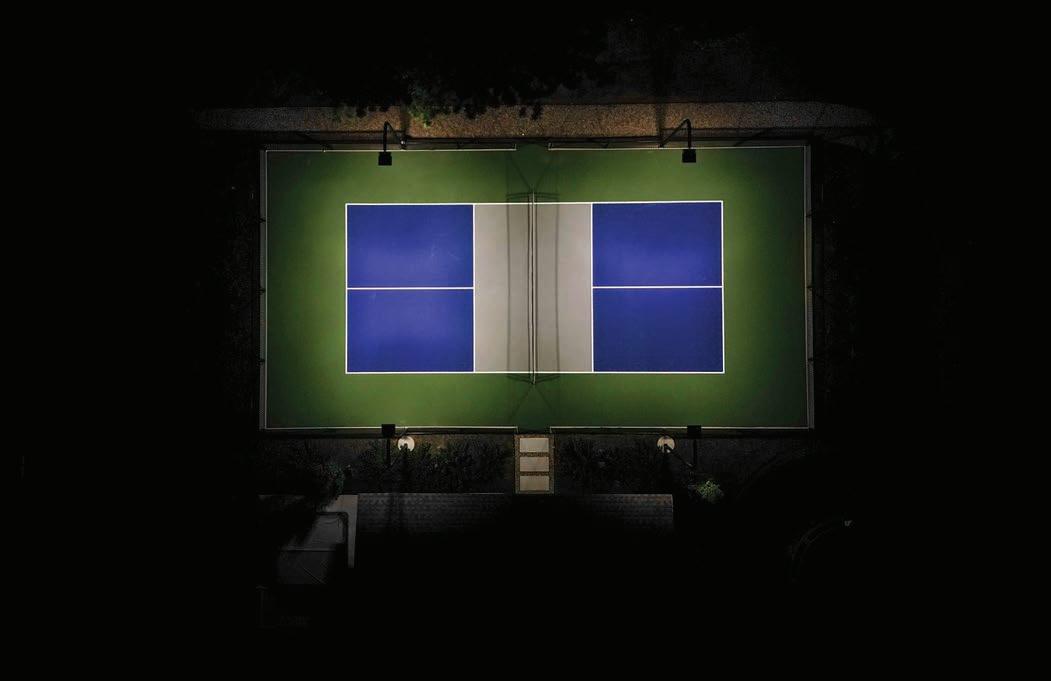





















continued from page 49
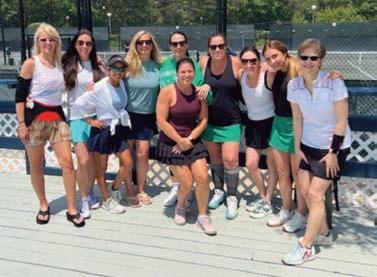
Long Island Tennis Magazine will return to the Hamptons this summer, as it will again host two adult tennis tournaments on the East End. The Long Island Tennis Magazine Tennis Challenge by Orlin & Cohen Orthopedic Group will bookend Summer in the Hamptons, with one event in June and another in September.
The first tournament will take place on Saturday, June 6
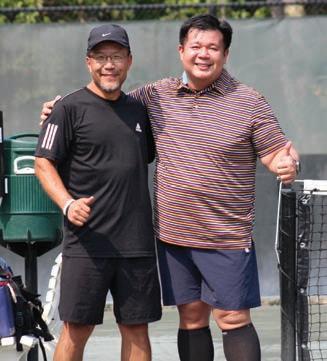
at Sportime Quogue, featuring an assortment of different levels of play, with three Men’s Doubles categories and three Women’s Doubles categories and a Mixed Doubles Division.
The event features all of the amenities players have become accustomed to at our events, including competitive and well-organized doubles play, catered lunch, complimentary happy hour, a lively atmosphere, giveaways, prizes for winners and pictures/features in Long Island Tennis Magazine. Visit LITennisMag.com/Events/SummerChallenge to learn more and to register.
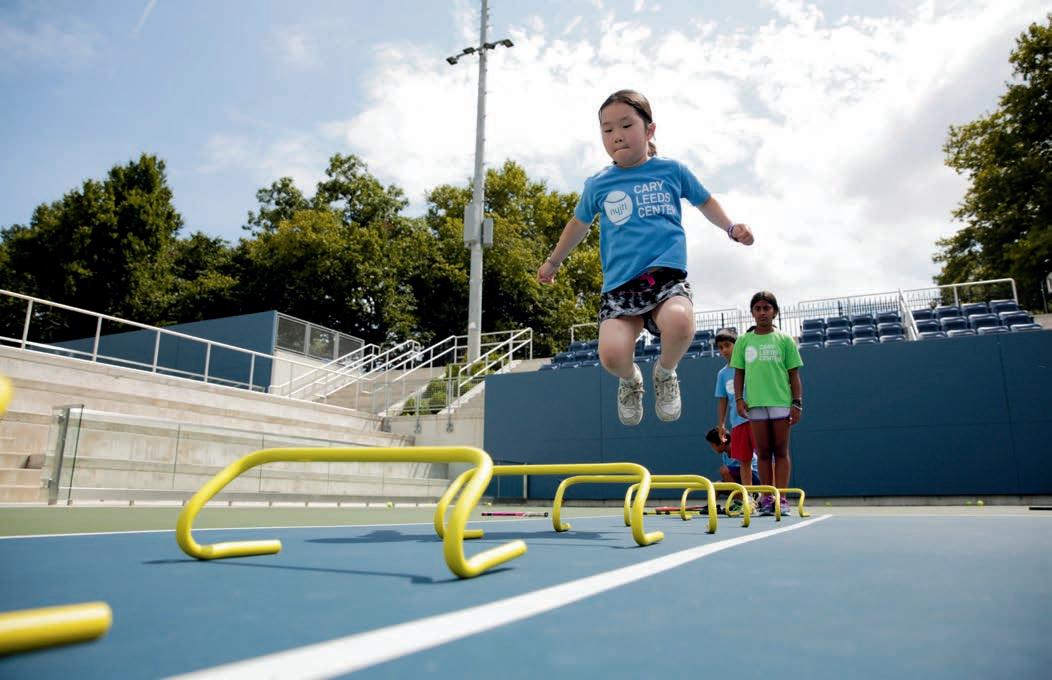

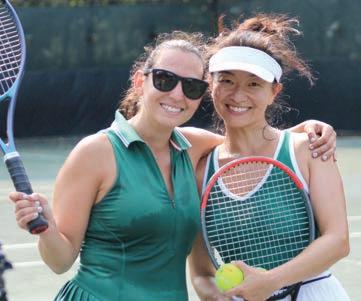
“We are excited to host the LITM Challenges this summer in the Hamptons for the fifth year in a row,” said David Sickmen, Publisher of Long Island Tennis Magazine.
“Sportime Quogue has proven to be the perfect host site as they accommodate our large draws on their outdoor courts, and we are able to bring people the amenities they have become used to on Sportime’s large pool deck. We look forward to seeing everyone back on the courts for fun in the sun this summer.”
To close out the summer, the September Challenge will be held in early September at SPORTIME Quogue. More information and registration portal can be found at LITennisMag.com/Events/SeptemberChallenge.
Here’s what they are saying about the LITM Challenges:
“These events are always so well put together, and they do such a great job of organizing the draws,“There is great food, drinks, and a warm welcoming atmosphere. The LITM Challenges are different than your normal tournament and are phenomenal.” - Ray Omid
“The people were so nice; there were a lot of strong players. We enjoyed this tournament a lot and will definitely join again next time.” - Youngmi Seo
We had a great time, the weather was great, and the food was amazing. We’ll absolutely be back.” - Meiko Boynton “We try to make all of these tournaments, they are such a great time.” - Neil Hyman
The tournament was great, and we were able to meet a lot of new people. Sometimes it’s easy and convenient to stay in your own little tennis group, so to play against different competition was great. Everyone was welcoming and it was very well-run.” - Onalee Batcheller
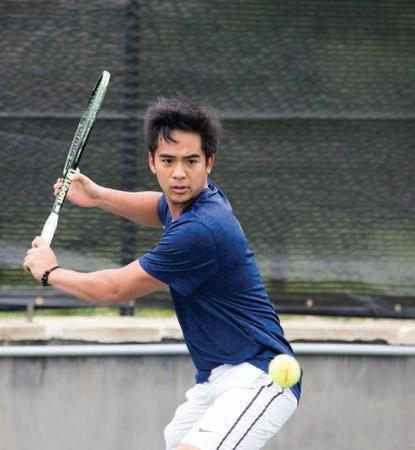


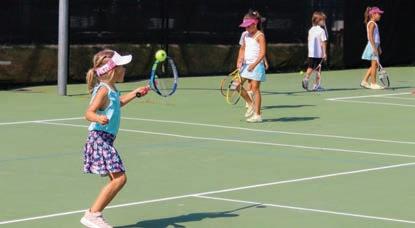
By Steve Annacone
Eachtime you hit the ball in a tennis match, you should be hitting one of these three shots: starting shot, set up the point shot, or try to win the point shot. In the heat of a competitive tennis match, most players tend to either try to “get their shot in” or “go for a winner”. Both of these tend to cause problems over the long haul of a match. Knowing the type of shot you are about to hit will help you execute the shot correctly. If you are serving or returning serve, you will be hitting a starting shot. The server should try to get their first serve in play a high percentage of the time. Since the opponent has no idea how you are going to hit your first serve, it is a big advantage to get that shot in play. On the other hand, most players’ second serves are the weakest part of their game. This shifts the advantage to the returner who may be able to hit a set up the point shot or even a win the point shot. Once the serve and the return are in play, you may be hitting another starting shot if the serve and return resulted in a neutral situation. If either
of those shots got the other player in trouble, a set up the point shot or a win the point shot may be appropriate.
The basic ideas when hitting the starting shots are to hit the shot to a big target using your normal swing at regular speed (50-75 percent compared to your aggressive swing speed). It is extremely important to get these shots in play since most points end within the first four hits. In addition, if you can hit three shots in a row like this more often than your opponent, you will win a lot of points before you have to hit your win the point shot.
When hitting a set up the point shot, try to get the opponent moving, push them back with the depth of your shot, or hit the ball to their weaker side. Keep the speed of the shot no more than 75 percent of your win the point shot and try to hit a big target that is not too close to the sidelines or baseline and has adequate net clearance. If you feel that you have hit this shot well, take a step or two in so that you can keep your opponent in

trouble, or possibly try to hit your win the point shot. When you get in trouble, try going back to your starting shot to reset the point.
If you are having trouble in your match, try to pay attention to the shots you are missing. Ask yourself which type of these three shots were you trying to hit. Did you choose the correct shot? Many of your unforced errors are caused by swinging too fast or too slow. Try to be decisive and don’t be afraid to adjust your swing speed closer to the 50-75 percent mentioned above.
Changing the direction, hitting the ball with some angle, or keeping it relatively low and short are all good ways to set up the point and to win the point. Keeping the speed more consistent will help you time the ball better and allow you to figure out which shots you should be hitting more often. Remember that all of your shots should be to start, set up, or win the point. Pay attention to your winning shots and unforced errors and try to determine if you need to adjust your idea on the next point. Practice all three of these shots regularly to make things become more automatic in your matches.

Steve Annacone, USPTA Elite Pro, is the Director of Annacone Tennis, www.annaconetennis.com and MyHamptonsPro, www.myhamptonspro.com throughout the Hamptons, NY. Steve, Jeevaj Bondalapati, and Gill Gross run the TOP (Tennis Optimization Players-Top Team) program at the Tucson Jewish Community Center (Tucson, AZ) for high level players ages 8-18. Please contact Steve at sannacone@tucsonjcc.org or 865-300-7323
By Ainslie Ellis
Our busy Spring/Summer leagues are about to begin and we look forward to outdoor tennis. We have a record number of teams registered and welcome new teams and old.
Thanks to our dedicated captains and players who help us achieve our mission of growing tennis to inspire healthier people and communities everywhere.
Before the season begins, our winter leagues are competing in postseason play and vying for spots in the Sectional tournaments in June. Metro and Queens Mixed Doubles teams will face off at their Regional tournament in early May.
Until then, congratulations to the following teams that have clinched their spots.
• 18 & Over Manhattan 6.0 Mixed Doubles captained by Lena Wu and David Taur
• 18 & Over Queens 6.0 Mixed Doubles captained

by Lily Lee and Milo Thalrose
• 18 & Over Manhattan 7.0 Mixed Doubles captained by Alina Lekser and Keving Ni
• 18 & Over Manhattan 8.0 Mixed Doubles captained by Nihar Damarasingu and Alina Lekser
• 18 & Over Manhattan 9.0 Mixed Doubles captained by Roy Moynihan and Amy Untch
• 18 & Over Manhattan 9.0 Mixed Doubles captained by Nihar Damarasingu and Andrew Abell
Our Women’s 3.0/3.5/4.0 Tri-Level season has also concluded with the Metro team captained by Pamela Salud and Qing Fan advancing to the Sectional tournament.
As always, if you have any questions about USTA League Play in Metro, please reach out to Metro League Coordinator, Ainslie Ellis, at ellis@eastern.usta.com.
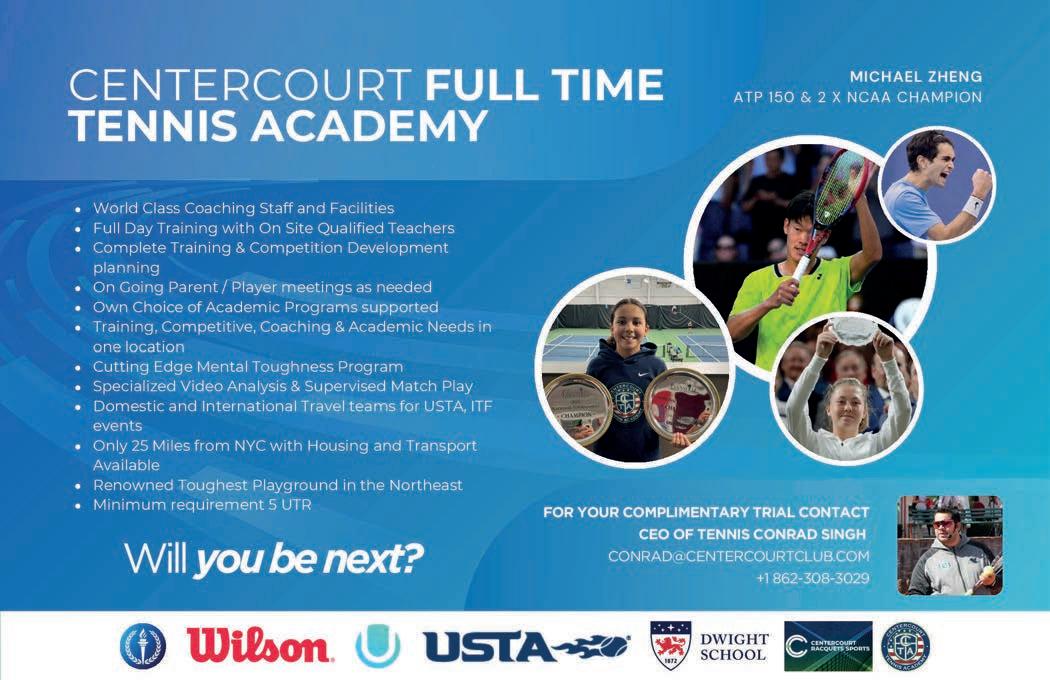
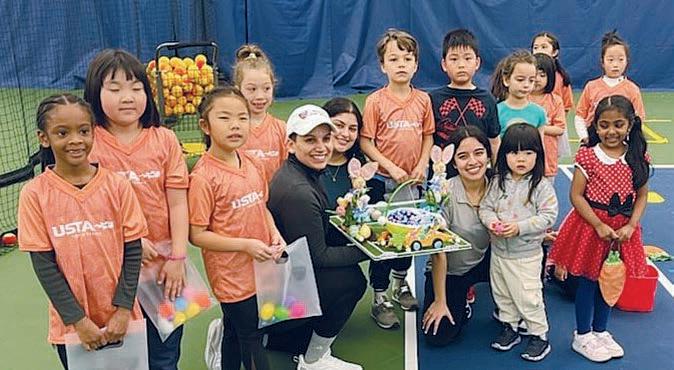
OurUSTA Billie Jean King National Tennis Center passion for introducing tennis to families at an early age and stage requires a thoughtful, patient, and developmentally appropriate approach. At the age of 3, children are still developing coordination and receiving skills in gameplay. Instead of emphasizing structured gameplay, “Mommy & Me” tennis classes provide an opportunity to build foundational motor skills, foster emotional connection, and create a positive first experience with the sport. This is not simply about teaching tennis—it is about nurturing growth, encouraging exploration, and strengthening the bond between parent and child.
At the core of any successful “Mommy & Me” class is connection. Three-year-olds rely heavily on familiarity and emotional security when entering new environments. Having a parent actively participate allows the child to feel safe while trying something new. These shared moments on the court help create a sense of trust and comfort, turning tennis into a positive and enjoyable experience rather than a pressured activity. Before a child can learn a sport, they must first feel confident and supported within it. My favorite aspect is the foundation and pathway we create from Mommy & Me to our Red Aces and Red Champs classes.
Our jobs are to help parents cultivate an environment that focuses on understanding development of motor skills before technique. At this age, children are still building fundamental skills such as balance, coordination, hand-eye coordination, and spatial awareness. Because of this, tennis instruction should not prioritize mechanics like swinging the
By Karla Noboa
racket over the shoulder. Instead, the focus should be on activities that promote movement and coordination— throwing, catching, rolling balls, running, stopping, and engaging in playful exercises. These foundational skills are essential and will naturally support proper technique as the child grows.
Managing expectations is another key component of a “Mommy & Me” class. Success at this stage should not be measured by perfect swings or consistent rallies. Instead, success looks like a child participating, staying engaged, showing curiosity, and enjoying the experience. It is normal for three-year-olds to have short attention spans and moments of distraction. These behaviors are part of their development, not signs of failure. By shifting the focus from performance to participation, both parents and children can have a more positive and meaningful experience.
These classes also serve as an opportunity for parents to develop patience. As much as the child is learning, the parent is learning as well—learning to allow their child to explore, to make mistakes, and to progress at their own pace. The role of the parent is not to control the session, but to support and encourage. Meanwhile, the child is learning how to listen, interact in a group setting, and try something new. The coach plays a vital role in guiding both the child and the parent, creating an environment where

learning and enjoyment can coexist.
Play is the foundation of learning at this age. In a “Mommy & Me” tennis class, games are not simply a way to pass time—they are the primary method of teaching. Through play, children develop confidence, coordination, creativity, and are introduced to the Athletic Development Model. When tennis introduction aligns with these in a playful and engaging way, it becomes something the child wants to do, rather than something they feel required to learn. And most important I am happy to be a part of a team that strives to introduce these in a welcoming manner.
Ultimately, “Mommy & Me” tennis is about building a long-term relationship with the sport that starts here within. Children who are introduced to tennis through connection, play, and positive reinforcement are more likely to remain engaged and continue developing their skills over time. This approach prioritizes enjoyment and growth, setting the foundation for future learning and potential competitive play.
In conclusion, “Mommy & Me” tennis here at the National Tennis Center is all about parental bonding through sports and developing essential motor skills with patience. By focusing on these elements, we ensure an environment for parents and juniors to progress into the next programs. Whether on the courts, or through our seasonal tennis art displays, we aim to promote the love of the game—at your child’s pace.
Karla Ivanna Noboa is a Tennis Professional at the USTA Billie Jean King National Tennis Center. A USPTA Certified Coach, she has held roles at the Parsippany Knoll Club and USA Sports Group since 2020, teaching players of all levels. In these on-court roles, I have honed my skills across various levels, from Tiny Tennis to Adults. She has also worked as a lead coach in the region of Essex County, N.Y. where she guided players as well as trained new coaches.


Formany tennis players, this is the time of year to move from the climate controlled predictability of indoor tennis to the challenges and joys of playing the game outdoors. But how does one best prepare for this adjustment?
Moving from indoor to outdoor tennis requires significant adjustment because outdoors you must contend with unpredictable elements, including weather. Outdoor tennis means dealing with sun, wind, shadows, birds, and many other factors and conditions that can change throughout a match. Outdoors, players need to be adaptable, whether to inconsistent ball bounces, weather and more, with these varieties and surprises far less common in indoor tennis.
Sun and Heat: Start with shorter sessions to allow your body to adapt. Hydrate.
Headwind (Wind in your face): The ball will drop faster, land shorter and travel a shorter distance. Use a fuller backswing and drive through the ball with less topspin to ensure depth. Be aggressive and take more risks, as the wind acts as a natural brake to keep your shots in.
Tailwind (Wind at your back): The ball will sail long more easily. Shorten your swing, use more topspin, and aim for larger targets deep in the court, rather than at the lines.
Use smaller, quicker steps to adjust to unpredictable wind patterns.
Expect higher bounces on outdoor hard courts and slower play on softsurface courts.
Serve: Practice lower tosses for windy
By Simon Childs
days and anticipate needing to adjust to the sun.
Use more topspin on your groundstrokes and serves. This provides a higher margin for error over the net and makes the ball flight more stable in the wind
Spend more time warming up to avoid injury in colder, early-season and late-season weather.
Outdoor environments affect how your racket and the tennis balls perform.
If you play soft-surface tennis during the indoor season, and wear sneakers designed for sliding and traction, switch to durable outsoles designed for hard, gritty courts. If you are a hard-court player during the indoor season and migrate to country club clay in the summer, do the opposite and get a good pair of soft-court sneakers with enough tracking to slide and pivot safely and efficiently.
In hot, dry, outdoor conditions, strings become more elastic; consider a slightly higher tension for better control. In colder weather, lower your tension to maintain power. If you play with natural gut strings indoors, and play on irrigated soft courts outdoors, consider switching to a synthetic string for the outdoor season, as humidity wreaks havoc with gut.
Avoid leaving rackets in a hot car or in direct sunlight, as extreme heat can

cause rapid tension loss. Modern, polyester strings are the most stable in all conditions, and provide a great combination of power and control, so long as you do not get tennis elbow from using them.
If you play in high humidity, use an absorbent overgrip to prevent the racket from slipping due to sweat.

The ability to manage additional factors in an outdoor environment is a skill in itself.
Hydration Routine: Start hydrating 24/36 hours before your match. Outdoors, your body can lose a lot of fluids through perspiration; consuming water and isotonic beverages will help you stay hydrated.
Temperature Management: Wear lightcolored, moisture-wicking clothing to reflect heat and allow evaporative cooling. Keep a wet towel in your cooler to lower your body temperature during changeovers.
Sunscreen Application: Apply a sportspecific sunscreen at least 30 minutes before stepping on the court so it has time to absorb and won't run into your eyes when you sweat.
In tennis, preparation is always key, and that includes preparing for the change of seasons. Identifying and addressing the variables of your outdoor playing situations will provide a strong foundation for on-court success.
Simon Childs is the Director of Tennis at SPORTIME Roslyn. He played for the University of Louisville, where he achieved a NCAA high rankings of #6 in doubles and #49 in singles. Following this highly successful college career, Simon took his talents to the ATP tour, where he secured multiple doubles titles, including an ATP title in Mexico. He held Head Pro positions at numerous country clubs before joining SPORTIME, where he has held various Director-level positions. Simon joined the SPORTIME team in 2012.

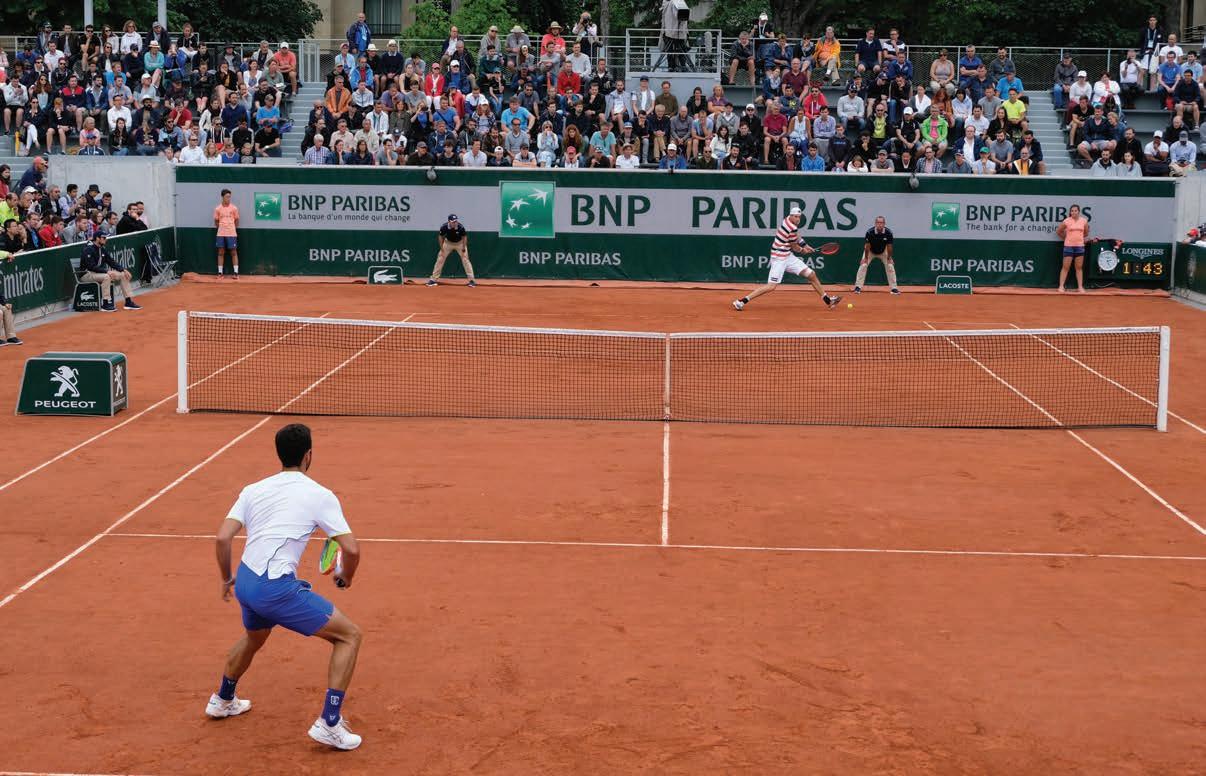
Thestars of the tennis world ascend onto the City of Love and the famed red clay courts of Roland Garros for the calendar’s second major. Closing the curtain on the clay court swing on the tour, the French Open always delivers some of the most unique and memorable moments of the year.
In 2025, that was certainly the case. Both singles finals produced epic matches. American Coco Gauff came back from a set down to beat Aryna Sabalenka 6-7, 6-2, 6-4 and win her second career major title in France. Afterwards, Sabalenka faced criticism for her downplaying of Gauff’s win citing how poorly she herself played and the difficult conditions, but later apologized with the two sharing a reconciliation moment prior to Wimbledon the next month.
“It was not a day for great tennis, honestly,” Gauff said. “I don’t know too many people that couple play great tennis today, but you know, it’s part of the sport and part of playing outside. You just don’t know what to expect, especially in Paris.”
The Men’s Singles final was a battle between Carlos Alcaraz and Jannik Sinner, and was the best showdown between the two of them in their rivalry up to this point. The top two players in the world battled for five hours and 29 minutes, the longest French Open final of all-time, and the second longest major final in the sport’s history.
Alcaraz came back from two-sets-to-love down, and both players had opportunities to serve for the championship, with
Alcaraz prevailing 4-6, 6-7(4), 6-4, 7-6(3), 7-6(2).
“This one was the most exciting match that I’ve played so far, without a doubt,” Alcaraz said. “Today, I think the match had everything. Really good moments, really bad moments. [I’m] just really, really happy. I’m proud about how I dealt with everything today. [It’s] the first match that I came back from two sets to love down. I think it was the [best] occasion to do it in the final of a Grand Slam.”
As we look towards the 2026 edition of the French Open, New York Tennis Magazine breaks down some of the major storylines and plot points to look for.
Despite the difficult loss a year ago, Jannik Sinner has responded strongly in the early stages of 2026. After failing to make the Australian Open final, Sinner turned up the heat, completing the Sunshine Double with wins in Indian Wells and Miami, and then a title in Monte Carlo. That triumph on clay in Monte Carlo will go a long way to instilling
his confidence on clay as he looks to complete the career Grand Slam, and win the first French Open of his career. He has reclaimed the top spot in the world rankings, and will be looking to avenge that devastating French Open final defeat a year ago.
There will be a new men’s singles French Open champion. Twotime defending winner Carlos Alcaraz has withdrawn from this year’s event as he nurses a wrist injury. Alcaraz, a seven-time major champion, said:
“After the results of the tests carried out, we have decided that the most prudent thing is to be cautious and not participate in…Roland Garros, while we wait to assess the evolution to decide when we will return to the court. It’s a complicated moment for me, but I’m sure we’ll come out stronger from here.”
Will Sabalenka Reach ANOTHER Final?
It seems every time there is a major women’s tournament played, Aryna Sabalenka is in the finals. In 2025, she reached all four major finals, only winning the U.S Open trophy, and she began this season with a run to the finals at the Australian Open, which she also lost. Dating back to the 2024 U.S. Open, Sabalenka has reached the last six major finals on the women’s side. This spring, she reached the finals and won both Indian Wells and Miami.
Sabalenka is well-established as the best player in the world, and while she has fell in three of the last four major finals, she is poised to make it back to the French Open final in May and have a chance to win her fifth career major.
Can Swiatek Reclaim Clay Court Dominance?
There was a point where it seemed as if Iga Swiatek could not be beaten on clay. Swiatek, who looked up to Rafael Nadal growing up, was beginning to put up a similar dominant run on the red clay at
Roland Garros, winning four titles in five years between 2020 and 2024. But last season, she had her 26-match winning streak at Roland Garros snapped by Sabalenka in the semifinals, and her 2026 season thus far has been upand-down.
She split with longtime coach Wim Fissette back in March, and after consulting with Nadal, hired his former coach Francisco Roig. With that connection, Swiatek could be due to regain her form overall, and reclaim her dominance in Paris.
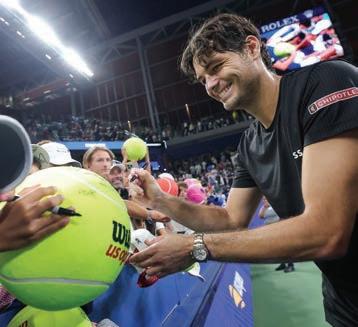
The Incessant Question: Will An American Man Snap The Streak? It’s the question that will continue to be asked until it is no longer applicable. As we know, an American man has not won a major since 2003, and only one American has even reached a major final during that drought (Taylor Fritz, 2024 U.S. Open). The state of American men’s tennis has not been in this good of a place in a long time, however, with four ranked inside the top 20. Ben Shelton, Taylor Fritz, Tommy Paul and Frances Tiafoe have all been deep into majors and have the capability to win one. Although clay may be the least favorable surface for them, this year’s French Open presents another opportunity for the 23 year drought to be ended.

Coco Gauff Looks To Defend Titl

Coco Gauff won her first title in France a year ago, showing the type of fight that has become synonymous with her by coming back from a set down to win the trophy. It was redemption for her defeat to Swiatek in the 2022 final, and she was able to demonstrate the maturity and composure that she has developed in the time since.
“I was going through a lot of things when I lost in this final three years ago,” said Gauff. “I’m just happy to be here, a lot of dark thoughts. Just the fact that I stayed at it just means a lot.”
Gauff enters this year’s tournament as the defending champion, and if she is able to repeat as champion, it will be the third major title of her young career.
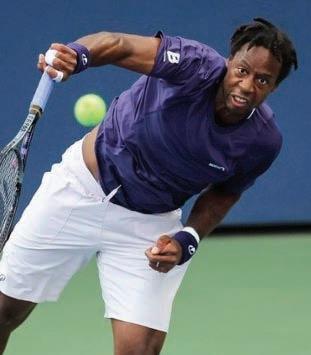
There is perhaps no better entertainer in the history of tennis than France’s Gael Monfils, and he is saying goodbye to the sport at the end of this season. He made his debut at the French Open back in 2005, and 2026 will be the final one for him on his home soil. Roland Garros will look to send him off right with a tribute and ceremony ahead of his last appearance.





“Roland-Garros… my last Roland-Garros. It’s strange to write, but it’s the reality. And rather than let it pass in silence, I wanted to mark the occasion in a way that truly feels like me. I called some friends. Real ones. Players I admire and with whom I’ve shared locker rooms, courts, and fits of laughter,” Monfils wrote on X. “And then some artists I deeply love, Matt Pokora, Martin Solveig, Franglish, because for me, tennis and music have always been intertwined. It’s my life, it’s my DNA. We’ll all meet up on Thursday, May 21, on the main court at Roland-Garros for an evening we’ve simply called: Gaël & Friends. Some tennis, some music, some surprises… and above all, love. Because that’s what I’ve always received from you, and that’s what I want to give back to you that night. I want us to experience something together. Something we won’t forget. See you Thursday, May 21.”









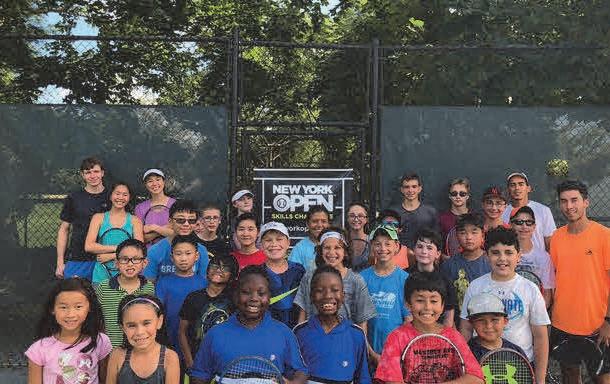
Stan Wawrinka, the 2015 champion and 2017 runner-up, is also retiring at the end of the season, and is set to receive a Wild Card into this year’s main draw so he can grace the red clay one final time. Wawrinka defeated his compatriot Roger Federer in straight sets to win the 2015 title.
By Milly Keighery

May is National Tennis Month—an open invitation for our entire community to step onto the court and reconnect with a sport that brings people together across all ages and skill levels. Whether you’re a coach planning engaging programs, a seasoned competitor, or someone dusting off a racket for the first time in years, there’s no better time to get involved.
Tennis offers more than just a great workout—it builds friendships, strengthens community ties, and creates moments of joy that last well beyond match point. From organized leagues and clinics to casual rallies with friends and family, this month is a celebration of everything that makes the game so special. Let’s take advantage of the longer days and warmer weather to make every swing, set, and match count.
As we celebrate, we also recognize the exciting conclusion of our 18+ Mixed leagues. It was a fantastic season marked by determination, teamwork, and high-level competition across the board. Every team brought energy and passion to the courts, making for a truly memorable run.
Congratulations to our standout teams who have earned the opportunity to represent Long Island at sectionals in early June: in the 6.0 division, Morley led by David Ng and Sophia Yang; in 7.0, Deer Park captained by John Ramo; in 8.0, ST Kings Park with Don Jackson and Jesse Siegelman; and in 9.0, Deer Park under Roslyn Chua-Mcalonie. We wish all of these teams the very best as they take the next step in competition.
Meanwhile, several other leagues are approaching their exciting finals. The 40+ Mixed, 55+ Mixed, and TriLevel leagues are all heading toward the end of their seasons, with sectional championships set for the end of June. It’s been inspiring to see the level of commitment and sportsmanship across these divisions, and we look forward to cheering on all teams as they close out their seasons. Best of luck to everyone competing—you’ve already made your mark with an incredible showing this year.
Of course, as one chapter wraps up, another begins. The highly anticipated Spring/Summer USTA league season is now underway, bringing a fresh wave of excitement to courts across Long Island. This year, nearly 200 teams will compete across all NTRP levels in the 18+, 40+, 55+, and 65+ divisions—a
testament to the strength and enthusiasm of our local tennis community. With so many players involved, the level of competition is sure to be both spirited and inspiring, and we can’t wait to see how the season unfolds.
If you’ve been thinking about joining a team, now is the perfect time. Captains are still finalizing their rosters, and there are plenty of opportunities available for players of all levels. Whether you’re looking to compete, improve your game, or simply meet new people, there’s a place for you in one of our leagues. Don’t hesitate to reach out—I’d be more than happy to connect you with a captain and help you get started this season.
Here’s to a fantastic National Tennis Month and an exciting season ahead. See you on the courts!





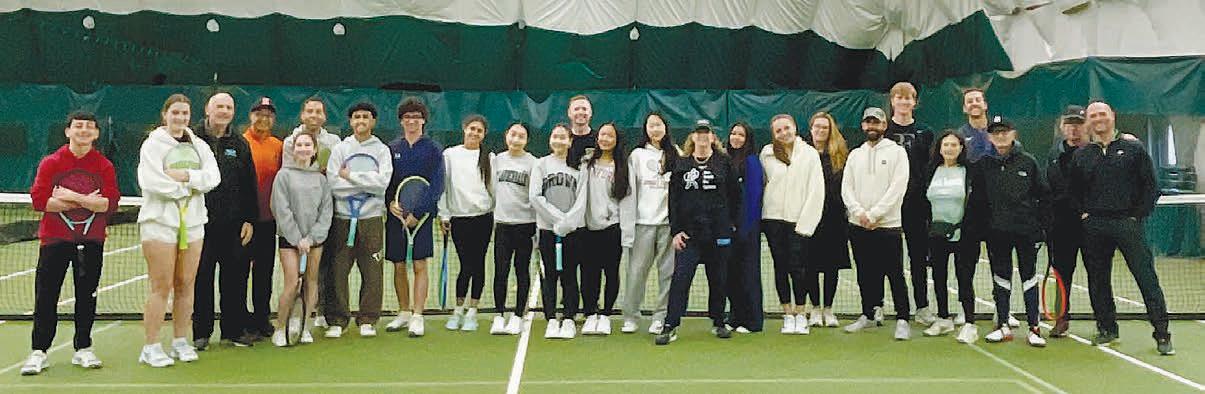
The event stresses the importance of high school tennis and aims to bridge the gap between high school tennis and the private tennis industry
TheHigh School Coaches Workshop returned to Bethpage Park Tennis Center as Steve Kaplan and his team provided instruction and advice to high school tennis coaches from across Long Island. This event is a collaborative effort between Serve & Return, the charitable arm of Bethpage Park Tennis Center, and Grow Tennis New York, the charitable arm of New York Tennis Magazine, two non-profits dedicated to growing the sport of tennis in our community.
The Workshop brought together local high school tennis coaches, both junior varsity and varsity, as well as high school players to learn from Kaplan as well as other guest speakers including Suffolk County Tennis Coaches Association President Jackie Clark, who spoke about new high school initiatives, and Long Island Tennis Magazine Publisher David Sickmen, who explained how high school team’s can be included in the publication’s coverage. Stony Brook head coach Thiago Dualiby was in attendance to explain what college coaches are looking for, and how they prepare their practices.
Strength and conditioning coach Frank Dolan spoke to the coaches about how to properly warm-up their
team prior to both practices and matches, and put the coaches through a variety of drills and exercises to demonstrate, as many times in high school competition, the visiting team gets off the bus and doesn’t have a lot of time to warmup before the match begins. That puts a great deal of importance on how your team warms-up to ensure it's an effective way to prepare for the upcoming match.
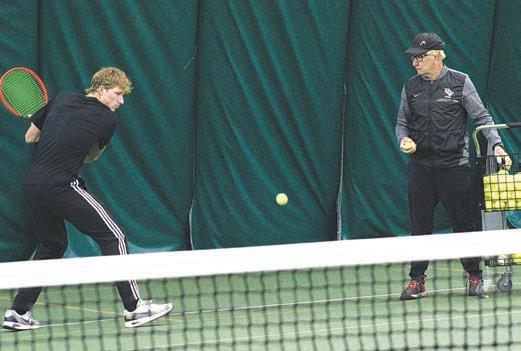
just going through the motions. I think I was able to provide something simple that the coaches can quickly take with them and apply it to their teams right away.”
“A lot of high school tennis programs get out there and just start hitting. But what we wanted to emphasize is having an understanding of not just warming up to get a sweat going or get loose, but it’s also to change athleticism and improve movements if done the right way,” explained Dolan. “What we discussed was doing things with intent, going through the full range of motions, thinking of keeping things in alignment, the right posture, and all those little details that help you avoid
Kaplan discussed many different drills that coaches can use with their proper serve toss and grip, as well as how to generate power on the forehand and backhand strokes. His expertise on the underlying science of tennis helps to understand how to properly teach and coach to maximize a player’s potential.
All of this created a well-rounded event that provided a number of local high school coaches with valuable information they can bring to their teams.
One of the primary goals of the workshop is to bring attention to just how important high school tennis is as Kaplan
is a strong believer that top junior players should play for their high school teams rather than sit out to strictly focus on private training, and wants to provide the necessary resources for high school coaches.
“My goal is to combine the resources of my not-for-profit, Serve and Return, with those supporters of tennis to recognize and value two things. First, when you have more, you have more to
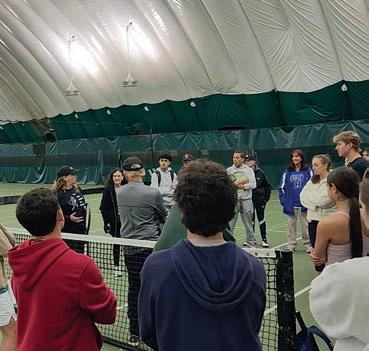
give. Second, school tennis is a wonderful and all too often undervalued part of a young person’s tennis education at every level. I hope the coaches, volunteers, athletes and leaders of the tennis community are as inspired to do more for these worthy goals as much as I am inspired by them.”
David Sickmen, Publisher of Long Island Tennis Magazine, added:





“We have been collaborating on this event for years because we think it’s an important one. I’ve seen the divide between high school and private tennis grow larger throughout the years, and as we do in most situations, we try to use our platform, resources and partnerships to bring people together. At this year’s Workshop, we did just that and we look forward to continue doing that in the future.”












By Chris Lewit
Ifyou or your kid’s forehand lacks power and spin, it’s not a mystery— it’s history. Professional tennis has fundamentally changed how the forehand is struck, yet many players are still using mechanics from a different era.
The modern professional forehand did not appear overnight. Its roots trace back to early frontier players like Björn Borg, Jimmy Arias, and later Sergi Bruguera—players who began breaking away from rigid, linear mechanics and introduced rotation, topspin, and elasticity long before the rest of the sport caught up. What they pioneered has now become the global standard.
The modern forehand at the professional level—particularly on the men’s side of the game—is defined by parabolic swing paths, explosive leg drive, rapid hip and trunk rotation, frequent mid-air ball striking, and lower, reversed, or inverted finishes. Above all else, the defining feature of the contemporary forehand is elasticity.
This elastic quality is not cosmetic. It is structural. It is biomechanical. And it is foundational to how elite players generate effortless power, extreme topspin, and repeatable acceleration under pressure (Elliott et al., 2009).
In the 1970s and 1980s, forehands were taught as mostly linear, grounded, and rigid movements. Players were coached to step forward, lock the wrist, transfer weight cleanly, extend through contact, and finish high and firm—often over the shoulder or near the neck.
This model made sense in an era of heavy wooden racquets, grass courts, lower ball bounces and speeds, and flatter trajectories. But the modern game—played with lightweight yet powerful racquets, polyester strings, high-RPM and high-bouncing balls,
varied surfaces, and extreme court positioning—demands something entirely different.
Today’s forehand is rotational, elastic, and fluid, built around stretch–shortening cycles in the legs, hips, trunk, shoulder, and forearm. Power is no longer pushed through the ball; it is released through efficient kinetic sequencing and delayed segment rotation (Reid et al., 2013).
What’s remarkable—and frankly alarming—is that despite the complete overhaul of professional technique, many coaches still teach young players forehands rooted in the 1970s and 1980s, often branding them as “solid fundamentals.”
This is not fundamentals. This is historical inertia. I have tried for decades to counter this trend by providing modern instruction both in person, through articles in many tennis periodicals, and on my YouTube channels, Chris Lewit and Tennis Evolution.
Children and adults are routinely taught stiff arms, closed stances, linear swing paths, and rigid finishes during the most sensitive windows of motor learning. Later, coaches attempt to modernize these players by layering elasticity on top of a rigid base—a process that is slow, inefficient, and often unsuccessful.
If your kid is stuck with a coach or club that insists on teaching technique from a bygone era, don’t just walk away—run. You are not avoiding discipline or fundamentals; you are avoiding neurological and neuromotor baggage.
In Spain, the forehand has always been sacred. Heavy topspin, physical
endurance, and point construction have long defined Spanish player development. See my classic book, Secrets of Spanish Tennis, to learn more about the Spanish method. Yet even within Spain, there is a split.
The modern forehand is best understood through elastic, loose fluid mechanics rather than rigid lever mechanics. I discuss these keys in detail in my forthcoming book Winning Pretty, which will be the most comprehensive technique and biomechanics book on the market.
Elastic systems outperform rigid ones for several reasons:

Elastic muscles and tendons store energy during the loading phase and release it explosively during the forward swing, increasing racquet-head speed without added tension (Elliott et al., 2009).
Proximal-to-distal sequencing
Power flows from the ground up only if the system stays loose enough to allow timing delays. Stiffness breaks the kinetic chain (Reid et al., 2013).
High RPMs emerge from racquet-head speed, angular velocity, and relaxed pronation. Elastic arms create spin; stiff arms suppress it.
In short, looseness is not a lack of control. It is the key source of control and power.
Around the world, it is still common to see children under 10 years old taught stiff, linear forehands, closed stances, and follow-throughs to the ear or neck—often through low-common-denominator Red, Orange, and Green programs. These approaches are typically justified as
“teaching the fundamentals.” The problem is that fundamentals are not fixed. They evolve over time.
In tennis, what constitutes fundamental forehand technique has shifted dramatically at the professional level, yet coaching methods, by and large, have not kept pace. Many junior programs continue to teach mechanics that no longer reflect how the game is actually played at the highest level.
A client of mine recently pulled his 10year-old son out of a green ball program because the training was not accelerated and was actually moving his technique and footwork backward. I see this reported to me frequently by clients across the United States and the world. Well-intentioned programs often slow development by enforcing outdated movement and stroke patterns that no longer reflect the modern game.
As a result, many families turn to
private lessons
What follows are the technical markers parents and players should look for when evaluating whether instruction reflects the modern forehand:
Next time you are watching a kids’ class or taking a lesson, observe whether the technique being taught reflects the modern game or an outdated textbook. You should see:
— Open and semi-open stances taught early alongside closed stances
Modern tennis is played under speed, time pressure, and imperfect spacing. Open and semi-open stances allow players to rotate efficiently, recover faster, and hit effectively when they cannot step forward. Teaching these stances early prepares players for real match situations rather than idealized ones. Closed stances still have value, but they should be part of a broader movement toolbox, not the only option.
— Parabolic swing paths with windshieldwiper forearm action after contact
The modern forehand travels on a curved, upward-and-around path rather than straight through the ball. This parabolic shape allows players to swing faster while maintaining margin over the net. The windshield-wiper action in the forearm is a natural result of internal shoulder rotation and forearm pronation, not a forced motion. It is a key contributor to modern topspin and control.
— Controlled explosive movement, including players leaving the ground
Many professional players naturally leave the ground during forehands because rotation and force are generated faster than the body can stay anchored. Allowing controlled airtime helps players learn to transfer energy efficiently from the legs through the torso. Suppressing this movement often leads to stiffness and power leaks. The goal is balance and control, not staying glued to the court.
continued on page 64












continued from page 63
— Strong hip rotation creating racquet lag and a whipping effect
Hip rotation is the engine of the modern forehand. When the hips rotate ahead of the arm, the racquet naturally lags behind, storing elastic energy. This lag is what creates the whipping effect seen in high-level strokes. Without hip-driven rotation, players are forced to muscle the ball with the arm, limiting both power and spin.
— A loose, elastic arm
A relaxed arm is essential for speed, spin, and consistency. Tension in the arm restricts racquet-head acceleration and disrupts timing. Elasticity allows energy to flow smoothly through the kinetic chain using proximal-to-distal sequencing rather than getting stuck at the shoulder or wrist. Looseness does not mean lack of control—it enables it.
— Inverted or wrap-around finishes across the body
Modern forehands often finish lower and across the body rather than high over the shoulder. Reverse finishes around the head are also becoming very popular. These finishes are a natural consequence of rotation, spin, and a fast swing path. They help players manage high racquethead speeds without forcing an abrupt finish or inefficient pathway.
— Significant, repeatable topspin
Topspin is the currency of the modern game. It allows players to swing

aggressively while keeping the ball inside the lines and pushing opponents back. Repeatable, highRPM topspin comes from racquet-head speed, upward swing path, and relaxed, whippy internal shoulder rotation. Players who develop heavy topspin early gain margin, safety, and long-term adaptability across surfaces.
If any of these elements are missing, the program is preparing players for the past, not the future.
To read more insights like these, you can preorder my new book at WinningPretty.com.
Chris Lewit is one of America’s leading high-performance tennis coaches and a global authority on Spanish training methods. Known as The Prodigy Maker, he has developed numerous elite juniors, including many #1 players in the nation. A former #1 at Cornell and pro tour competitor, Chris is the author of The Secrets of Spanish Tennis and Winning Pretty. He studied literature at Cornell, Harvard, and Columbia and is pursuing a PhD in kinesiology.
Chris hosts The Prodigy Maker Tennis Show, runs a Vermont academy and online school, and is recognized worldwide for his technical expertise and inspiring coaching. Read more at substack.com/@chrislewit
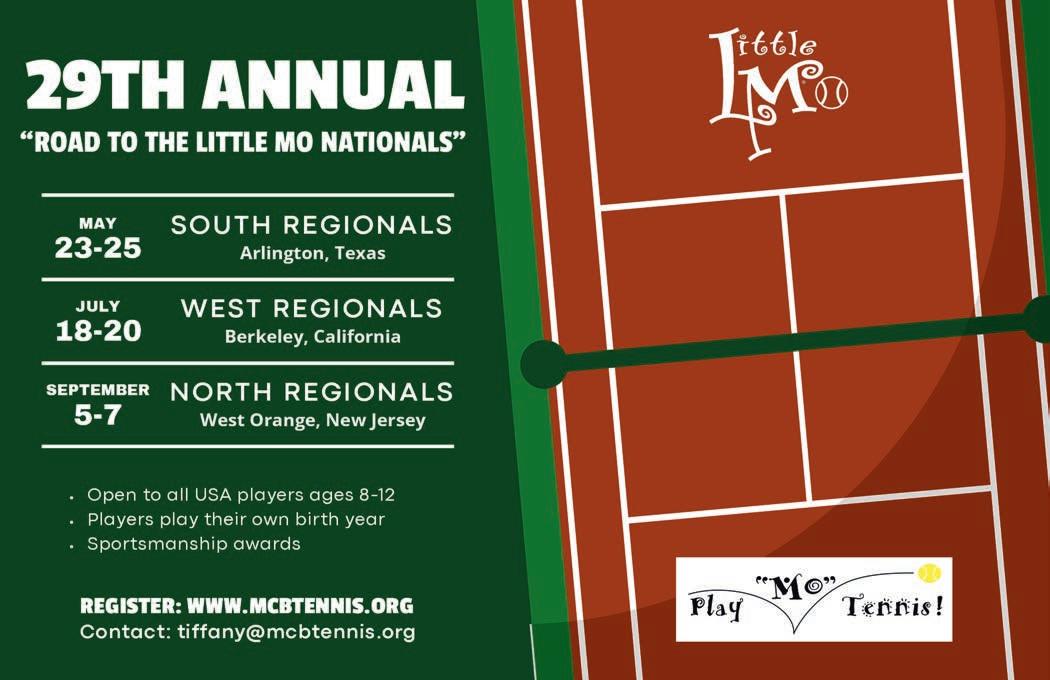


• Print distribution across New York at 600+
• Digital distribution across our websites and social media pages
• The E-edition will be distributed to our
10-S Tennis Supply & Tweener Lighting Systems
www.tweenerusa.com
(800) 247-3907
lucas@10-s.com

Tweener Lighting Systems, distributed in the United States by 10-S Tennis
CaliClay Systems
info@caliclay.net caliclay.net (805) 698-9830
THE CALICLAY SYSTEM SOLVES MANY ISSUES:
• Differentiates your facility from others
• Provides a new revenue stream
• CaliClay court surface is much more forgiving on the body and fun for the players
• Very competitively priced
• Low maintenance and 70% less water use than other clay court surface
• Alleviates cracks in the future
• Installs on top of existing hard court or new 95% compact base in about 5 days
• Water before play – average 150 gallons per day when in use
• Brush and line after use. Add material as needed. Roll occasionally or not at all
• Red basalt material will not stain clothing
EASY MAINTENANCE!
• Brush and line after play.
• Roll once a month or as preferred.
• Never scarify.
• No seasonal closing or re-opening in winter environs.
• Don’t water when not in use – for days, weeks or months.
• Add material as needed – average court uses 3040 bags annually – 10 year warranty

Supply, provide a practical alternative to traditional pole mounted sports lighting for tennis and pickleball courts. Designed specifically for recreational play environments, Tweener installs directly onto existing fence structures, eliminating the need for concrete bases, tall poles, or complex structural permitting in most cases. This fence mounted approach allows facilities to extend court hours quickly and cost effectively while maintaining a low visual profile and minimizing light spill into surrounding areas. As a result, Tweener has become an increasingly popular solution for municipalities, schools, HOAs, private residences, and clubs seeking to activate previously unlit courts without the expense or disruption of conventional lighting infrastructure. Each system is engineered for straightforward installation using standard electrical connections and common tools, allowing contractors and facility teams to complete projects efficiently with minimal site impact. The lighting distribution focuses on the playing surface rather than surrounding property, making Tweener especially effective in residential settings or locations with environmental or zoning considerations. With installations across parks, schools, and private facilities nationwide, Tweener offers one of the most accessible pathways to adding evening play capacity without overbuilding or exceeding budgets on a court lighting project. For all, it represents a smart balance between performance, simplicity, and long term value.


Century Tennis
56 Brook Avenue
Deer Park, N.Y. (631) 242-0220
CenturyTennis.com
Since 1965, Century Tennis has been dedicated to the growing sport of tennis by building quality tennis courts and providing a specialized service to the tennis club industry, as well as the private community. By maintaining a highquality of service and customer satisfaction over the years comes a trust that is ever so hard to attain.
“We simply want to be the best at what we do.”
In order to build great tennis courts, you have to start at the bottom with an understanding of soil conditions and converting it to a good base. Lasercontrolled road graders enable Century Tennis to build with accuracy.
Building Post-Tensioned Concrete, instead of the old asphalt type courts, are proving to be a great alternative for “crack-free” tennis courts.
Whether it is a hard court with the softness of Deco-Turf or Classic Turf Rubber or whether it is a soft court like Har-Tru or Hydro Court, or a surface that offers a little of both like Nova Synthetic Turfs … Century Tennis can deliver.
The company is a member of the American Sports Builders Association (ASBA), Better Business Bureau (BBB) and the Long Island Builders Institute (LIBI). Century Tennis’ building techniques meet and or exceed those of the ASBA and the USTA and with its “Certified Tennis Court Builder” staff assures this quality. The company’s intention is to deliver the very best tennis courts for the most demanding players and tennis club owners.
“Expanding the game of tennis, one court at a time.”

166 Industrial Way Troy, VA 22974 (877) 4-HARTRU HarTru.com
Har-Tru, LLC is a global sports company based in Troy, VA. It is the world’s leading provider of court surfaces, court consultation, court equipment and accessories – serving tennis, pickleball and other sports. The company strives to help others build and maintain the best courts in the world, leveraging its products, knowledge, and experience to meet the needs of each customer most effectively. Har-Tru is active in the industries it serves as an advocate and sponsor of tennis and pickleball related activities.

Laurel Tennis & Sport
31 Prospect Street Huntington, NY 11743 (631) 549-3235
laurelgroup.net
tennis@thelaurelgroup.net
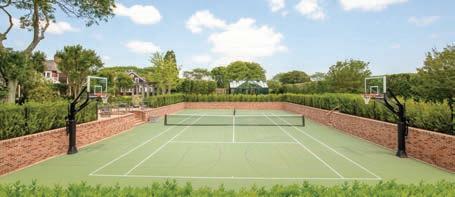
With over 33 years of experience, Laurel Tennis and Sport has been designing, building, and maintaining tennis and sport courts across Long Island. Our experienced team—alongside our extended network of landscape designers and outdoor living specialists—creates and maintains exceptional environments for you, your family, and your guests.
We manage every aspect of your project in-house, from the initial site survey and permitting to full construction oversight. Our services include surrounding landscape installation and even sourcing fine outdoor furnishings for relaxation between matches.
Laurel Tennis and Sport offers comprehensive solutions including construction, maintenance, reconditioning, resurfacing, repairs, and consultation, along with a complete line of court equipment and accessories to support your game from the ground up.
• Certified by American Sports Builders Association
• Post-Tension Concrete Certified
• Tennis, Pickleball, Padel
• Basketball, Bocce Ball, Multi-Sport
• Post-Tension, Asphalt
• Har Tru, Red Clay, Turf
• Supporting elements (net systems, lighting, fencing, windscreens)

VelveTop Products 1455 New York Avenue Huntington Station, N.Y. (631) 427-5904
Velvetop.com

VelveTop Products is a family-owned and operated business since 1968. VelveTop is a stocking distributor of a full line of tennis court materials and equipment, including:
• Deco Turf: The Cushioned Tennis Surface of Champions
• Har-Tru: Developing Champions Since 1932
• Douglas Sports: Nets, Windscreens, Divider Nets
• RiteWay Crack Repair Systems
• Hadeka Red Clay
For more information, call (631) 427-5904, e-mail elsy@velvetop.com or visit VelveTop.com.


If you are old enough, you might remember New York’s John McEnroe’s plea to the umpire after being penalized for an audible obscenity: “I WAS TALKING TO MYSELF!”
A game of tennis will have you talking to yourself quickly. Why is that? Because it is a relational game, a backand-forth with another person. You are relating to and responding to someone else. Someone’s shots, someone’s strategies, someone’s game style, someone’s attitude and energy even. All relationships trigger areas where you feel vulnerable, reveal levels where you are not fully grown up yet. These imagined weaknesses bring out your defense mechanism, including your inner voice.
Most of you will readily admit that you talk to yourself on the court, though some might be wondering: “What’s this guy talking about?”
That’s the voice I am talking about.
When you realize and accept that you talk to yourself, try and become aware of it, in the moment. This is step one in your journey to become the best player you can be. Be curious about the quality of the relationship with yourself on the tennis court. Some of you already know, it is not pretty. Most of the stuff we say to ourselves is X-rated, and we would never dare say to someone else.
It doesn’t have to be like this!
Bring some curiosity and humor on the court with you next time. Catch yourself in the moment of negative selftalk and see the absurdity of it all. The
By Tonny van de Pieterman
part of you that is in charge at that moment thinks it knows everything, even stuff that hasn’t happened yet! See if you can shed light of this ridiculous idea.
It might take a few attempts, but soon enough you can recognize and transform the start of a self-defeating (protecting) cycle with some humor. Fighting it won’t work as it works like quicksand, the more you struggle and resist, the deeper you sink. Try to remember that this ugly, mean, selfcritiquing part of you also wants the best for you. It is just poorly trained, fantastically delusional, and desperately needs some comforting and guidance.

Once you succeed in improving the relationship with yourself on the court, once your inner voice is a little more neutral, more realistic, more affectionate even, lots of energy will be released in you. You will feel lighter on the court, more cheerful, and stronger overall. You are taking ownership of yourself.

A tennis match might still rock your world, shake your emotional tree, but you will stay the course. It is your world, and your tree is deeply rooted.
So, what happens to the relationship to yourself?
It evaporates. It was never real anyway. Why talk to yourself. You ARE yourself. You think it, you see it, you do it.
Tonny van de Pieterman is a tennis professional at Point Set Indoor Racquet Club in Oceanside, N.Y. He was previously named USTA Tennis Professional of the Year for the USTA/Eastern-Long Island Region. He may be reached by phone at (516) 536-2323 or email ahvdp14@hotmail.com.
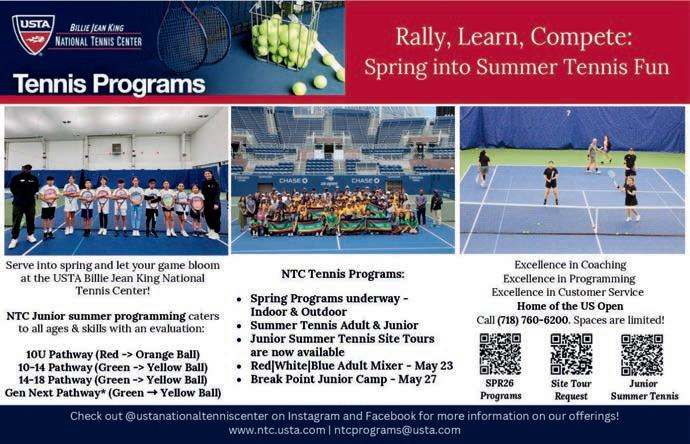
By Dr.Tom Ferraro
Overthe last thirty years, I have treated hundreds of tennis players and others ranging from local teenagers to those at the top of their profession. No matter if they’re a Wimbledon champion, a PGA and LPGA golfer, pro basketball player, Olympic gold medal winner or a major league pitcher, they all eventually succumb to performance anxiety, burn out, perfectionism or identity confusion.
In the following article I will define the signs, symptoms, causes and treatment for these four issues, any of which can produce self-defeat and frustration.
Performance anxiety is ever present and must be coped with if the player is to succeed. The signs of performance anxiety include the yips, choking, racing thoughts, shallow breathing, difficulty sleeping, dry mouth, muscular tension, nausea before matches, migraine headaches, back pain, tremors, dizziness, and fatigue. Performance anxiety is a primary cause for failure and the causes are many.
The player may inhibit their aggression and power. Inhibition of aggression is an internal problem that is unconscious. This type of inhibition is caused by reaction formation or always being nice and never angry. Performance anxiety is also produced externally when the athlete feels pressure to perform in order to live up to expectations. Recent wins, good press coverage, pressure from parents who are spending a small fortune in lessons, are all felt as pressure to perform and this leads to anxiety. So you see there are many reasons why athletes get the yips, choke and feel anxiety. The treatments the athlete initially grab for
include taking drugs like marijuana or cajoling a hapless psychiatrist for tranquilizers.
Research tells us that with the exception of coffee, there is not a single drug on the market that enhances performance and, in fact, most inhibit performance. The athlete may feel calmer when under the influence but their reaction time, focus, motivation and overall performance declines. Generally what is recommended is a twofold approach which includes gaining insight into the cause of their performance anxiety followed by instruction in coping skills which may include relaxation therapy, breathing techniques or positive self-talk. Coping skills alone are not enough and insight alone is not enough but a combination of these two processes together is the most effective and long lasting treatment.
Burnout is another common problem with
elite tennis players who often train beyond their bodies ability to recover. This causes flat performance, slumps, and eventually injuries. Here are the three phases of burnout.
1.The athlete’s performance begins to flatten or decline, they enter a slump which then prompts them to train even harder.
2.In phase two they begin to have more frequent illnesses like colds, sore throats or flu. This is due to exhaustion which weakens their immune system.
3.If intense training continues one will then see the athlete get injured with ACL tears or shoulder or elbow problems.
Elite athletes are highly competitive, have a high pain tolerance and are driven; this combination of factors brings on burnout. One would assume that treatment is easy. Just tell the athlete to slow down and rest for awhile. But often they ignore this guidance given the players driving ambition and workaholic nature. Treatment involves explaining to them the three phases of burnout so they begin to understand the career ending dangers of over training and then have the coach insist on rest and recovery.
Most athletes strive for perfection in their strokes and since perfection is never possible their drive to be flawless will cause them to over analyze, overthink, get mechanical and change what does not need changing. They enter the rabbit hole of doubt. When things go bad for the perfectionist the stroke loses its freedom, power and accuracy. The perfectionist uses the splitting defense which demands they be perfect and if they make a few mistakes they devalue themselves with harsh selfcriticisms. Our world encourages
perfectionism and we are bombarded with perfect images every day.
An example of this is seen in the famous Mercedes commercial with the slogan “the best or nothing at all.” If you’re not as cool as Matthew McConaughey, as rich as Elon Musk or as pretty as Angelina Jolie, you’re a shameful failure in life. A primary treatment strategy I use when working with perfectionistic athletes is to focus on forgiveness. After matches we discuss at length their anger and self-attack after making a few mistakes, and move them towards an understanding of forgiveness. It is helpful to point out that whatever religion they were raised with has an extremely forgiving element to it. Overtime they will become more self-observant of their demanding self-attack and learn to become less angry with themselves and more self-accepting. One does not have to be perfect in order to win matches.
A lack of awareness of who you are and just how good you are leads to losses and despair
“Good enough” is usually all it takes.
Identity, self-worth, body image and selfbelief are all crucial to an athlete’s success and are unconscious. No matter how much talent one possesses and how much work is put in, victory is often dictated by self-image. Self-identity or self-
image is established in childhood and is related to birth order, parental treatment and high school experiences. If ones identity is compromised or diminished in any way during childhood it acts like a magnet which keeps the athlete away from winning. As an example, it is common for a middle child to be ignored as a kid since the parents are preoccupied with the newborn. This means the middle child develops an

emptiness within and an intense drive to win in order to gain love and recognition. Low self-worth hurts confidence and produces higher than normal levels of performance anxiety. We treat these identity issues by enabling the athlete to first gain an understanding of who they are versus who they believe themselves to be. A careful review of childhood and high school experiences helps gain self-understanding. As they begin to see the difference between who they were then and who they are now, they are enabled to resolve this conflict. We then teach better defenses so that they remain focused and aggressive until the end of the match and avoid choking or self-defeat.
I hope I was able to explain a bit more about the four major psychological issues that all athletes must face in order to finally achieve their fullest potential, have more enjoyment and feel better about themselves. Tennis is a great joy but sadly as players move up in ranking, they often lose this joy and instead become stressed, exhausted, angry and sometimes depressed.
Dr. Tom Ferraro is a pioneer in the field of depth sport psychology and his work has been featured in The New York Times, The Wall Street Journal and The London Times. He has appeared on all the major television networks and his books, are published by Routledge and can be found through Amazon and a variety of other major book distributors. He can be reached at drtferraro@aol.com.




Soundtennis strokes are produced by a balanced and synchronized combination of angular and linear forces because we strike a ball by moving in coordinated arcs that produce straight paths.
The underlying physics are: Rotational inertia of the racket (moment of inertia ) leads to centrifugal force which then moves the racquet linearly at a tangent to this rotation.
While it's true that athletes are bigger stronger and faster today, the fundamental principles of physics have not changed since tennis was first played . What has changed is how we utilize the swing using slingshot physics to play better. Physics has not changed,
bio-mechanics has not changed; technology has changed.
Changed, What Hasn’t and Why?
By Steve Kaplan
The players of the pre-tennis technology revolution seemed to be more rigid and less segmented. Their movements had a greater linear component than what we see today. The players of the post-tennis technology revolution seem to rotate in greater separated segments. While I can't dismiss the idea that these changes were primarily the result of a shift in coaching philosophy that just coincidently were parallel to these technique changes, it seems counter to the traditionalist philosophy that permeates tennis instruction even today.
I propose a hypothesis that uses the fewest assumptions as well as the greatest congruence to explain the revolution in tennis technique. Such
changes were directly driven by changes in equipment. This is seen in these most significant areas:
1. The first change is that racquets today are lighter. In physics this matters because lighter objects with less mass have less resistance to linear acceleration. So with a lighter racquet we can rotate our bodies and racquet with greater velocity to produce greater centrifugal acceleration which moves at a linear tangent to our rotation. With a lighter racquet, we can swing faster and sling truer.
2. The second change is the stiffness or restitution frequency of both racquets and strings Synthetic materials used in modern
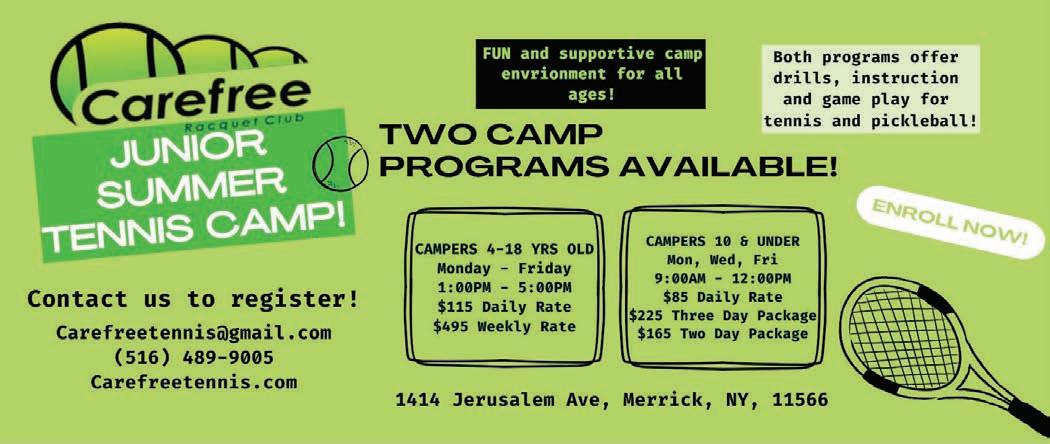

equipment not only CAN be managed to swing faster, we NEED to swing faster to optimize the potential of the equipment we use. Think of a thick, rubber band. It has greater elastic potential, but it requires greater energy to stretch to its full elastic potential.
So older, flexible racquets strung with less elastic strings, transfer forces at a lower frequency and in a less linear path especially when moved at high speeds just as old heavy rickety cars rattle and sway when driven fast. Heavy racquets like heavy cars without power steering are also more difficult to move and control at high velocities.
Force equals mass times acceleration. So a heavy racquet can create equal force at a slower velocity than a lighter racquet. Heavy flexible racquets with less elastic strings demand a slower swing velocity to match its lower restitution frequency. Further unless we have a great degree of strength we will likely want to be less elastically segmented when we swing a heavier object.
Lighter, stiffer racquets with more elastic strings demand a faster swing velocity and require less strength/stability body management demands so we can relax and time our movements to segment more separated. With equipment that transfers energy at a higher coefficient of restitution or vibration resonance we not only can swing faster, we need to swing faster to optimize.
3. The handle and grip of a racket has changed
Old racquet handles were hard and slippery. They didn't conform to our hands the way racquets of today do. You had to grip them firmly, very firmly. It's easier to hold a fuzzy,

pliable tennis ball than it is to hold a smooth, cast iron ball that weighs more. A tight grip results in a more rigid arm leading to less body relaxation and segmentation. This results in less manageable movement speed, and even less variation in grips (try holding a more western grip very tightly and see how well that works?)
We have always used elasticity, rotation and sequencing in a sling like pulling action to propel the racquet. Athletes have evolved but technology has revolutionized which has transfigured many of the techniques we use today to swing the racquet.
Steve Kaplan is the owner and managing director of Bethpage Park Tennis Center, as well as director emeritus of Lacoste Academy for New York City Parks Foundation, executive director and founder of Serve & Return Inc, and co-director of The City Classic Junior Tennis Academy. Steve has coached more than 1,100 nationally- ranked junior players, 16 New York State high school champions, two NCAA Division 1 Singles Champions, and numerous highly-ranked touring professionals. In 2017, Steve was awarded the Hy Zausner Lifetime Achievement Award by the USTA. He may be reached by e-mail at StevenJKaplan@aol.com
By Ricky Becker
Althoughit was over 30 years ago, I remember it like it was yesterday. It was the closest I have ever felt to being knocked out unconscious.
Legendary Long Island coach Adrian Chirici and I received a doubles wildcard into the Hamlet Cup, an ATP Tour tournament that used to be held in Commack. Our first round opponents were Magnus Larsson, who was a top 50 ranked player at the time, and Karel Novacek, who reached the semifinals at the U.S. Open one week later.
In Adrian’s first service game he spun a second serve with me standing at the net. Larsson went full Eastern grip and hit the hardest down-the-line forehand I have ever seen, before or since. Less than a second later his return hit the back fence on the fly and I was on-the-
ground, flat on my back after my successful attempt to get out of the way of the ball.
Whatever message they wanted to send, it was sent and received. Other than the fact it was embarrassing to go down to the ground in a pro match with a crowd on a shot that didn’t even hit me, it was needless to say, not a sign of respect! It could have been to intimidate us or they could have been annoyed that the hometown crowd was pulling for us. I’m still not sure.
We lost 6-4, 6-3 but to be honest, I was really, really happy with how I served and returned that day. But from that first return Larsson hit on, my volleys were garbage the rest of the day.
The irony of this was that year I told my coach that unless I had a huge




tournament coming up that week, I wanted to spend 90 percent of my time in lessons working on my volley. I had committed to a college and thought this would be the best way to turn my weakness into a strong shot long-term. He fed me ball after ball to improve my technique. Over the course of that year, I started volleying better in junior tournaments and I felt strong at the net. Until...that professional Larsson guy took my courage, aggressiveness and confidence away with that one shot. Mike Tyson famously said, “Everybody has a plan until they get punched in the mouth.” This couldn’t be more accurate. That day, I went from having technically sound volleys and wanting the ball to someone with technically sound volleys who was on his heels and protecting his alley like a guard at Buckingham Palace. In my fear, I comically decided it would be the end of the civilized world if they passed me in the alley but really, I didn’t want to get hit so I wanted to hide there. It didn’t hit me so much until I became a coach. Volley technique is overrated. That’s right, I said it. Volley technique is overrated. Confidence, enjoyment of “the net experience” and aggression are equally important and when I say equally, I am not exaggerating. This isn’t the same thing as the game is 90 percent mental that I get tired of hearing. Where yes it’s true between two equally skilled players the better player mentally wins but Tom Brady who owns the mental game is not beating Nick Krygios with his mental game which is supposedly 90 percent of the game.
Sorry, I digress. Although the
aggressive/technique conundrum applies at all levels it is really exposed at country club level co-ed events. Often the women are the more frequent tennis players and the men more frequent golfers. The women are better technically but the husbands come out for these events and they love the net. They love crossing, slamming and finding the ball at the net with some of the wackiest volley grips possible.
Quite simply, they are maniacs. The women have much better volleys technically but when the men start getting aggressive, the better playing wives back off the net, wait on their heels and in the ultimate deference to net supremacy decide they want to play at the baseline.
I have also seen D1 women players with Western volley grips dominate their court because they like being aggressive and aren’t afraid of the ball. I have a pet peeve when somebody who took a few lessons tells me their former coach told them it is important to
step across on the volley and that he or she fed them balls so they can work on it. Do you really have to step across to hit a good volley? What if you are running for it and have to hit it off the foot that didn’t cross (most of the time). Or that the ball is hit to you fast enough that you don’t have time to take a step. This even happens at the pro level. What I don’t like is when a player reaches out wide and only moves one foot and lifts the other leg up to hit the volley like tipping over but once again, this is mindset. If you want the ball you are going to run to it.
At the high performance level this means do you volley from your heals or turn away from the ball for your backhand volley when it’s not friendly fire from a coach feed? Do you cross

in doubles or are you afraid of getting passed in your alley.
I am not saying volley technique should be completely ignored but deadball technical work should be 50 percent of your volley work. Practice volleys by having a coach fire balls toward you, doing quick volley drills where the ball can’t bounce for either player or game-based volley drills to add the component of volleying under pressure. Just like hand-eye coordination is a talent that can be improved with practice, natural aggression at the net falls under the same category. Most if not all the time someone does get hit by an opponent’s shot, they are fine for the next point and it becomes a funny story a couple of years later.
Ricky Becker is The Director of Tennis at Glen Oaks Club. Ricky also coaches highperformance juniors throughout the year and has been the Director of Tennis at three of Long Island’s biggest junior programs. As a player, Becker was the Most Valuable Player for the 1996 NCAA Championship Stanford Tennis team, four-time MVP for Roslyn High School and ranked in the top-five nationally as a junior. He can be reached at rbecker06@yahoo.com or 516-359-4843.

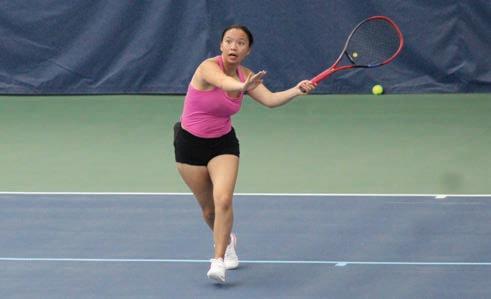
Since2010, the SPORTIME John McEnroe Tennis Academy (JMTA) has supported young athletes in pursuit of their collegiate dreams, through the earning of roster spots, and when possible, full tennis-based scholarships at colleges and universities across the country. Today, JMTA announced the 10th Annual John McEnroe Tennis Academy College Recruiting Combine, to be held June 27th and June 28th, 2026, at SPORTIME Port Washington. This will be the third consecutive year that the Combine is being held at that location.
Now in its milestone tenth year, the JMTA College Combine has become one of the premier recruiting events in junior tennis. The Combine will provide both JMTA and non-JMTA players the opportunity to showcase their technical and tactical tennis skills, and their athletic abilities, in front of coaches from top colleges and universities. The Combine also features a live-streaming platform, which gives players the opportunity to perform for a wider group of coaches. Last year, over 100 coaches from across the country “attended” the event virtually, joining those who
attended in-person.
“Helping players reach the next level has always been central to what we do at JMTA,” said John McEnroe.
“Ten years ago, we created the Combine to give committed players a serious opportunity to be seen and evaluated in a meaningful way. Watching our Combine grow into one of the most respected recruiting events in the country has been incredibly rewarding. Bringing it back again to Port Washington, where my brother
Patrick and I trained as kids, makes this milestone year especially meaningful for us.”
SPORTIME Port Washington, formerly the Port Washington Tennis Academy, is one of two JMTA locations on Long Island. The facility has been operated by SPORTIME, following an $8.5 million renovation, since 2023. The club holds a storied place in American tennis history. In addition to John and Patrick McEnroe, alumni include Vitas Gerulaitis, Mary Carillo and Tracy Austin.
The 2026 JMTA College Combine will welcome 50 boys and 50 girls. Coaches representing all three NCAA Divisions are expected to attend, with 2026 coach commitments to-date including coaches from Brown, Baylor, Cornell, Wake Forest, Yale, Colgate, Bryant, Villanova, Williams, and many other top programs, and with many more coaches expected to confirm their attendance in the weeks to come.
Representatives from prestigious leagues, including the Ivy League, ACC, Big East, SEC, Big 10, Patriot League and NESCAC attended in previous years and are expected again this year.
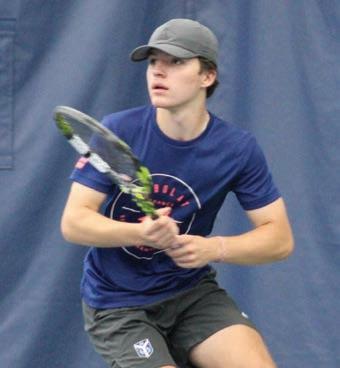
Applications for the 100 available Combine spots will be accepted from now through May 31st. A dedicated Selection Committee will evaluate each application based upon objective competitive criteria. Players will be notified of their status as admitted or wait-listed on a rolling basis.
Each Combine day will begin with an 8:00 a.m. check-in. Participants will compete in singles and doubles



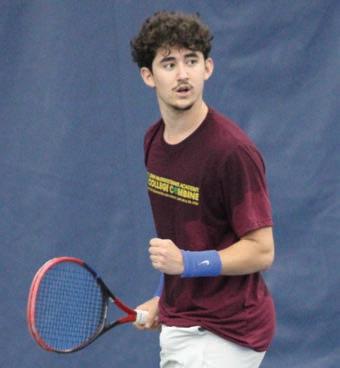
match-play, with tracked results that count toward their UTRs. Players will also receive athletic performance assessments and will be invited to participate in Sports Vision Testing and in a College Coaches’ Panel Discussion. Combine partner Tennis Analytics will be video-recording all matches and will offer participant packages, including match videos with detailed analytics.
Included for each Combine





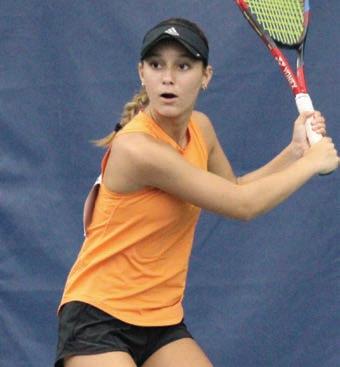
participant is an integrated recruiting package, including the match videos, which are made available, digitally, to both participants and coaches, at the touch of a button on their personal Player Portals.
For further details, and for information about JMTA’s College Placement Service, visit www.SPORTIMENY.com/JMTACombin e or email jmtacombine@sportimeny.com.



























By Eldad Campbell
Inyouth tennis, three roles shape every outcome: the player, the parent, and the coach. Each arrives with different expectations, different pressures, and different definitions of success.
Yet beneath all of this, there is something they are all quietly working toward, something shared, but rarely named in real time.
So what is the word that sits beneath all of this? What is the thing that sits underneath the decisions, the disagreements, and the constant interpretation of progress?
To understand what sits beneath, we have to examine each perspective more closely.
The Coach
For the coach, tennis is craft and profession.
It is a livelihood. But not only that, it is a relational practice shaped over time. Coaching is not just technique. It is the long, often invisible
management of development, emotion, discipline, and trust.
At its best, it is the responsibility of shaping others while continuously refining one’s understanding of performance.
For the player, tennis is aspiration in motion.
It is competition, identity, and possibility, the pursuit of excellence expressed through tournaments, rankings, wins, and losses.
But it is also social, built through friendships, shared struggle, and the emotional experience of competing in public.
For the parent, tennis is both support system and observation point.
It is not simply a sport their child plays; it is an environment in which development is constantly observed, interpreted, and emotionally experienced.
Parents want success, but more



deeply, they want their child to become stronger, more resilient, more disciplined, and more capable of handling challenge.
To understand where perception begins to diverge, each role carries unspoken questions for the others. These questions are rarely spoken directly, but they exist beneath every lesson, match, and conversation.
Parent ↔ Coach
Parent to Coach: How do you evaluate my child’s potential, and how do I know this is a worthwhile investment of time, energy, and resources?
Coach to Parent: Are you willing to allow development to unfold without constant interference? And are you prepared for progress to take time rather than appear immediately?
Parent ↔ Player
Parent to Player: How committed are you to this process? Is this something you truly want enough to endure difficulty for?
Player to Parent: Will you support

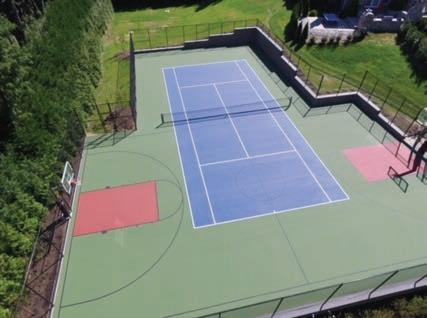
me through both progress and setbacks without turning every result into judgment?
Coach to Player: Are you willing to commit fully to instruction, discipline, and consistency, even when motivation fluctuates?
Player to Coach: Do you genuinely believe I can become a good player, or are you saying that because it is expected of you?
Each member of this dynamic places expectations on the others. Coach and parent expect commitment. Player and parent expect resilience. Coach and player expect understanding.
At this point, something begins to surface. Not fully visible. Not yet named. But increasingly difficult to ignore. Each role is describing something similar, even if they use different language.
The coach speaks in performance. The parent speaks in development. The player speaks in ambition. Different words. Same direction. And yet, it remains unnamed.
Youth tennis is not simply a sport. It is a shared developmental environment shaped by three perspectives interpreting the same reality through different lenses. The mistake is not that they are pursuing
different goals, but that they fail to recognize they are often pursuing the same one.
At their core, they are all reaching toward the same outcome: a player becoming more than they currently are. And the word that gives shape to everything that has been implied, but not yet named, is this: Growth.
Growth is the process of closing the gap between current ability and potential. It is slow, uneven, and often invisible in the short term, but it remains the goal that all three roles are striving toward.
But even here, something is less stable than it appears. Growth is not always visible. And when it is, it is not always agreed upon.
What a coach identifies as technical progress, a parent may not recognize. What a parent experiences as emotional development, a player may resist. What a player feels as improvement may not yet translate into results.
The word remains the same, but interpretation does not. And there are moments when growth itself becomes difficult to locate.
A player may improve technically while competing no better than before. Confidence may rise while discipline quietly weakens. Results may appear to validate progress when, in fact, they are being carried by timing,
circumstance, or a temporary coming together of factors.
In this way, growth can clarify, but it can also conceal. Growth is not always where it appears, and not always absent where it does not. When seen through this lens, everything shifts, but not as cleanly as it first seemed. The player is no longer defined only by results, but by trajectory, if that trajectory can be read accurately. The parent is no longer reacting only to outcomes, but attempting to interpret development, often without full visibility. And the coach is no longer judged only by performance, but by long-term impact, though that impact may not be immediately provable.
The pattern holds. But it does not resolve the tension. It explains it. So when disagreement arises between parent, player, and coach, the question becomes more complex than it first appears.
Not simply: Has growth occurred? But: What kind of growth? Where? And according to whom?
Because in the end, the question is not only whether anyone is growing. It is whether growth is being understood correctly, or whether each person is responding to a different version of it. And that difference, more than the absence of progress itself, is often where the relationship begins to fracture.


has evolved dramatically over the years, not just in terms of technology and player skills, but also in the equipment we use. Among the most notable advancements is the introduction of green tennis balls, which play a crucial role for juniors and beginners.
After years of working to develop a top green ball program in the country, I can confidently assert that these balls are vital for junior competitive players.
Green tennis balls are specifically designed with a lower bounce and slower speed compared to regular yellow balls. Often referred to as "transition balls", they are typically used for players aged 8-10. Their softer feel makes them easier to hit, allowing young players to refine their skills without the frustration that often comes with fast-moving yellow balls.
One of the key advantages of green balls is that they are easier to control. The slower speed and lower bounce provide a more manageable experience for younger players, allowing them to find their own style and work on offensive shots— challenges that can be overwhelming when using high-speed yellow balls.
Additionally, green balls help improve technique. Players can focus on their strokes, footwork, and overall mechanics during these formative
By Tamar Komakhidze
years, laying a solid foundation for future success.
Moreover, the manageable pace keeps players engaged, encouraging longer rallies and enhancing their love for the game. I’ve witnessed how this excitement can translate into a deeper commitment to tennis.
Green balls also serve as an important step between red balls (used for ages 5-8) and standard yellow balls. This thoughtful progression helps players gradually adapt to the game’s demands. By enabling young players to rally successfully, green balls help build confidence, which is crucial for their long-term development.
Studies have shown that players using green balls have improved their rally length and consistency by nearly 30 percent compared to those using standard balls. Many tennis
academies and coaches, including myself, recommend the use of green balls for younger players to facilitate a smoother transition to adult play.
Green balls make tennis more approachable for beginners, lowering the barrier to entry and encouraging more kids to take up the sport. Programs that utilize green balls often see higher participation rates, providing a fun and engaging way for kids to learn.
In conclusion, understanding the significance of green tennis balls is essential for coaches, parents, and players alike. I urge everyone to advocate for the use of green balls as a key component in youth tennis development. Embracing this approach not only nurtures young talent but also ensures a vibrant future for the sport we all cherish.
Let’s champion the green ball movement together!


Tamar Komakhidze is the Head Coach of Centercourt Tennis Academy’s Performance Green Ball Edge Program and its High Performance Regional Program. A former professional player from Georgia, she can be reached at Tamar@centercourtclub.com.