









































































The2026 Long Island Tennis Magazine (LITM) Summer Series presented by Orlin & Cohen Orthopedic Group kicked off the season in style, in the Hamptons, with the Long Island Tennis Magazine June Tennis Challenge.
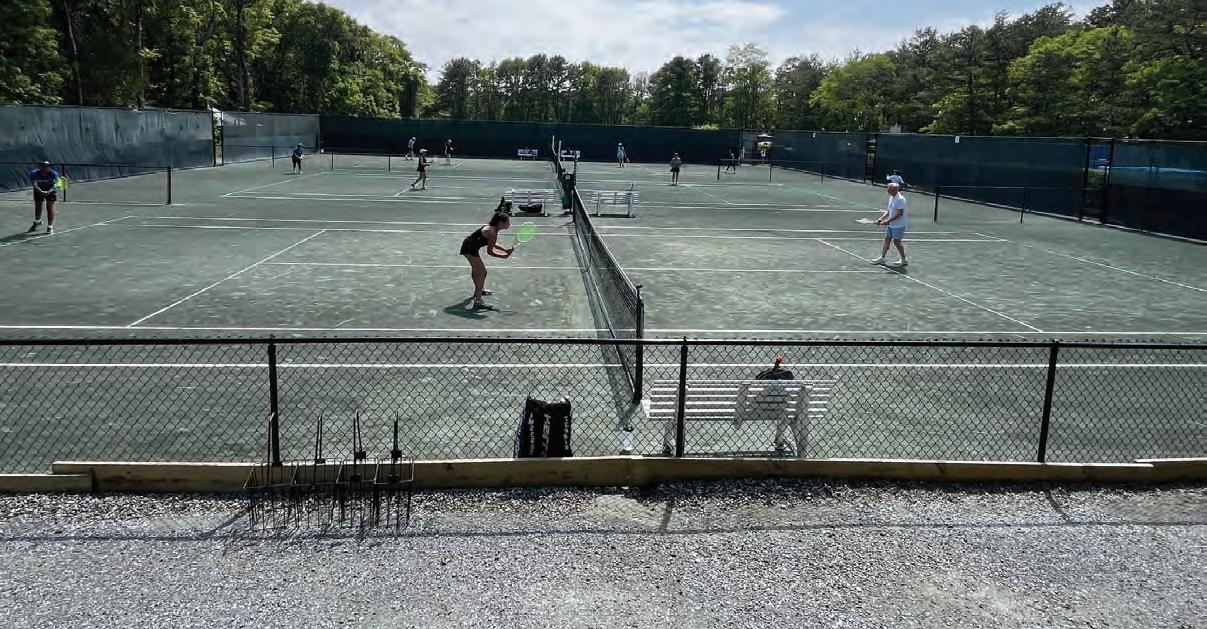
The event was completely sold-out and the packed house provided for a great atmosphere both on and off the courts. This one-of-a-kind event features fierce on-court competition across 18 Har-Tru courts on the sprawling Quogue campus. Doubles pairings battled it out in round-robin competition that fed into the playoff
rounds. The LITM Challenge tournaments, which have been operating for over a decade, are well known for it’s professionalism and organization as well as having great tennis at all levels! Additionally the amenities off the court are a LITM Challenge staple.
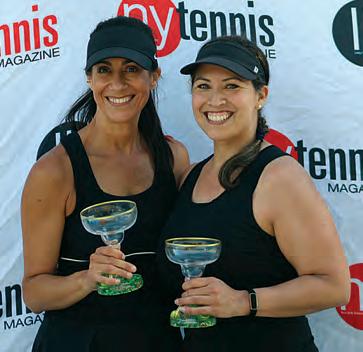
On this day, players were treated to an expansive catered lunch spread which included a variety of heroes, side salads, pizza, pasta, garlic knots, brownies, cookies and fruit as well as a very popular Happy Hour featuring the Michele-A-Rita and the Don-Colada among other options.
“This is always one of the best tournaments out east, hands down,” said Agne Rauskauskas. “I’ve been playing in them for quite a few years now. The whole atmosphere is amazing, there is competitive tennis and such nice people. It was a beautiful day.”
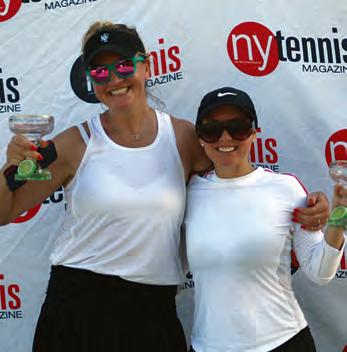
Rauskauskas paired up with Lindsay Katz and the duo captured the title in the Women’s Doubles 7.0 - 7.5 division as they defeated Shannon Becker & Aki Bowman 6-1 in the championship.
“This was our first time playing together, and we'll definitely be coming back,” said Katz. “This tournament was
so well-organized and everything ran smoothly.”
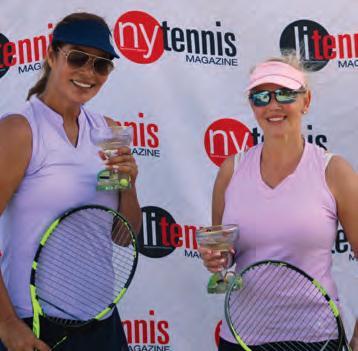
Carissa Orozco & Joanne Genzone, who captured the title in the Women’s Doubles 6.0 - 6.5 division, shared a similar sentiment.
“The people here were so nice and friendly,” said Orozco. “The tennis was great, and I feel like we were able to make some new friends today.”
The duo won a thrilling championship match as they defeated Amy Gillen & Jana Schmidt 7-6(5) to claim the title.
“I love playing here, the location is beautiful,” said Genzone. “We hadn’t played a tournament together before, but decided to team up and it worked!”
In the highest Women’s Doubles level at the event, Barbara Mueller & Theresa Winter had to dig deep to defeat Marilena Discala & Pam Lumpe and win the 8.0 - 8.5 division.
“We were down 1-4 in the finals,” said Mueller. “We went back to a simple game plan, and made sure to pick each other up and just go for it.”
The pairing went for their shots which helped spark a comeback and force a tiebreaker in which they won seven of the nine points to win 7-6(2) and claim the title.
“My favorite part of today was getting to play with my partner here,”
said Mueller “We always have such a great time at these events, and today was no different.”
Sticking with the theme of the day, the Men’s Doubles 7.0 - 7.5 division also came down to a tiebreaker in the finals to determine the winner. Joe Mead & Steve Subject battled past Christian Cedarstrom & Austin Walters 7-6(6) to win the championship.
“We hit the ball over the net one more time than they did, and that’s really what it came down to,” Subject said.
It was a back-and-forth tiebreaker that could have gone either way. Mead & Subject jumped ahead 3-0 only to see their opponents win the next four points. At 6-6, Mead & Subject won the next two points to claim victory.
“We had a match point at 6-5 and lost it, but luckily we were able to regroup and win the next two,” said Mead.
Subject added:
“This was a great tournament, and it’s extremely well-run,” said Subject. “The directors Michelle [Stoerback] and David [Sickmen] do a great job, and the food and drinks are wonderful.”
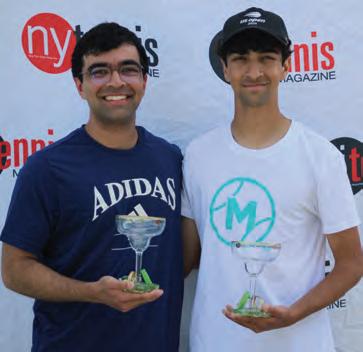
Samir Singh & Vir Singh started slow but played their best tennis in the latter stages of the event, ultimately
capturing the title in the Men’s Doubles 8.0 - 8.5 division, defeating Raimundas Rakauskas & Peder Davis 6-2 in the finals.
“I had to get more consistent because in the beginning I felt like I was missing too many serves and groundstrokes,” said Samir. “We got it going though. He was able to hit well from the baseline and I tried to come in and volley as best I could.”
Vir said the two have games that complement each other which helped them.
“We work together well because I like hitting forehands, so I took the forehand side, and he likes backhands, so he took that side. It gave us great court coverage.”
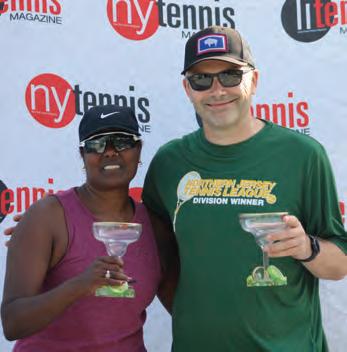
In the Mixed Doubles 8.0 - 9.0 division, Francois Vernet & Sally Pillay defeated Lily Tang & Roman Del Castillo 6-4 in the championship.
“I think we just tried to relax and play our best tennis. We had a little of the Don-Colada drink which helped us calm down a bit,” Vernet said jokingly.
“We actually said to each other during the match, ‘we have nothing to lose, so let’s just play our best and have some fun’,” said Pillay. “This was our first time playing together. He was so easy going, and we enjoyed
continued on page 4
playing together.”
The LITM June Tennis Challenge was again sold-out, and set the stage for a great summer of events ahead. The next Long Island Tennis Magazine on the schedule is Saturday, September 12 (registration is available at LongIslandTennisMagazine.com /Events/SeptemberChallenge) once again at Sportime Quogue.
LITM will also be hosting a charity tennis event, one of its popular Courts & Cocktails outings, on July 14th at Engineers Country Club. In addition throughout the entire summer, LITM will host events across many racket sports for all ages and levels. Check out LITennisMag.com/Events for the latest information on all of our events!
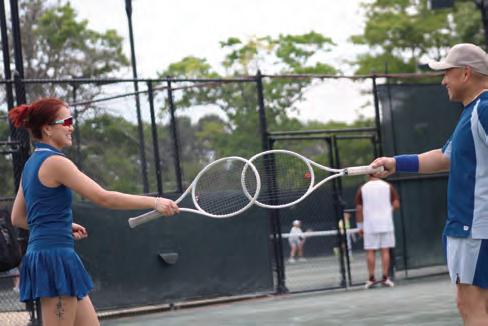
“These tournaments have become

almost like family reunions of sorts, as many of the players have become friends of mine and it’s a very welcoming atmosphere on and off the courts for everyone. As people arrive, all we see on the pool deck is hugs and smiles. Some players bring their own ‘fans’ to support them, and everyone involved with the event works
together to provide a vibe that makes the Long Island Tennis Magazine Challenges stand out as the premier adult tennis tournament in the area,” Sickmen added. We all do everything we can to ensure everyone has the best possible experience. We pay a lot of attention to the small details and we continue to learn from each event, but I want to thank my Co-Director Michelle Stoerback, our main sponsor Orlin & Cohen Orthopedic Group, our beautiful host facility Sportime Quogue and of course all of our supporting players for their part. Hearing that people drove four hours to play, seeing people stay for hours post-event, and getting the feedback we received has us very appreciative and ready for more.”





























el e u yo e lp h ce ien pe r ex r i e Th f y o

ip p





sports in i pecialists eaturing s orthopedists, f ster. a etter, an c e s ti pe r ex d an f o h p s r a pa p an,sca CT ing ea d and ear M MR -hhouse tan t a oo nt e e u acem e pl sho , f knee edicine, , se ,f ar r n I n s a p and management, m ain a weight- y, a ra X-ra ital a g dhand d h , s dankle d a joint e , j hip , a derul n p i e ,s - a




























































































































































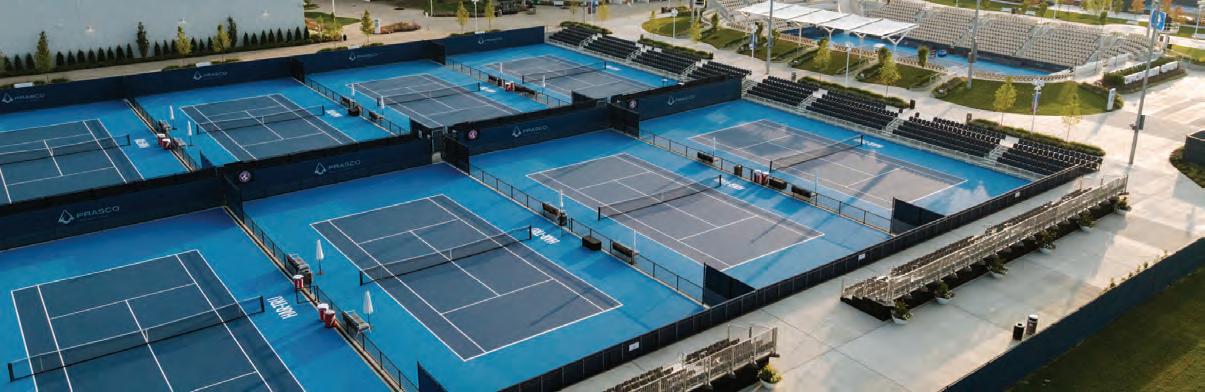
Whentennis fans think of the summer swing, they picture blistering forehands, high humidity, and the intense competition of the hardcourt season. As the world’s best players battle for points and momentum ahead of the final Grand Slam of the year, every variable matters. But while players, coaches, and cutting-edge racquets usually take the spotlight, the literal foundation of the sport often goes unnoticed.

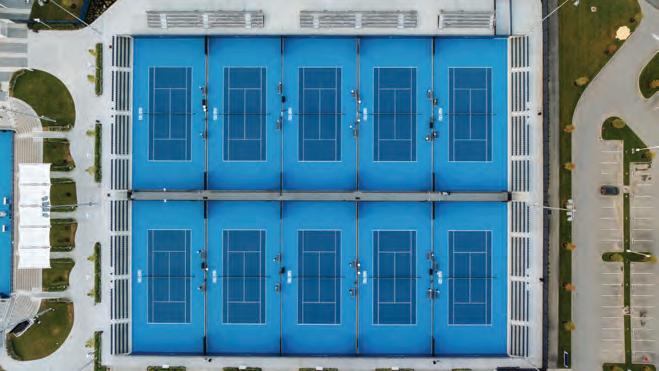
Mention the name "Har-Tru," and most tennis aficionados immediately picture the iconic green clay that has defined American tennis for decades. However, a quiet revolution has taken place on the professional tour. Har-Tru is playing a critical support role in the summer season for both the ATP and WTA tours.
The company’s premier hardcourt product, Proflex high performance surfaces, is the trusted court system for an impressive three out of the eight prestigious tournaments in the US Open Series.
The Mubadala DC Open, the historic Cincinnati Open, and Canada’s premier National Bank
Open have all chosen Har-Tru’s Proflex acrylic system as their surface of choice. Hosting an ATP and WTA 1000-level event requires flawless execution, and tournament directors can’t compromise on the quality and reliability of their courts.
"We are pleased to be working with Har-Tru as our official court surface provider," said Bob Moran, Tournament Director of the Cincinnati Open. "It's an extremely important step for us to be aligning with Tennis Canada and Washington, D.C., to provide the players a consistent speed and surface for the summer swing of the ATP and WTA Tours."
The Proflex system is designed to deliver maximum consistency, medium-fast pace, and a consistently true bounce—crucial factors for top-
tier athletes dialing in their timing. The multi-layered acrylic formulation is calibrated to ensure that the surface plays the exact same way on center court as it does on the outer practice courts. Furthermore, Proflex offers durability against the intense summer sun and heavy, aggressive foot traffic. Its vibrant, UV-resistant pigments ensure that the courts look as stunningly bright on championship Sunday as they do on opening day, providing bright contrast for both the players and the global television broadcast.
The US Open Series is the ultimate proving ground, not just for the athletes, but for the equipment they rely on. By anchoring nearly half of the series, Har-Tru has decisively proven that its expertise extends far beyond clay. Whether you are outfitting a world-class stadium, a college facility, or a private club, Proflex delivers tour-tested excellence. The next time you tune in to watch the summer’s biggest hardcourt matches, take a closer look at the surface below. You might just be looking at a Har-Tru hardcourt.

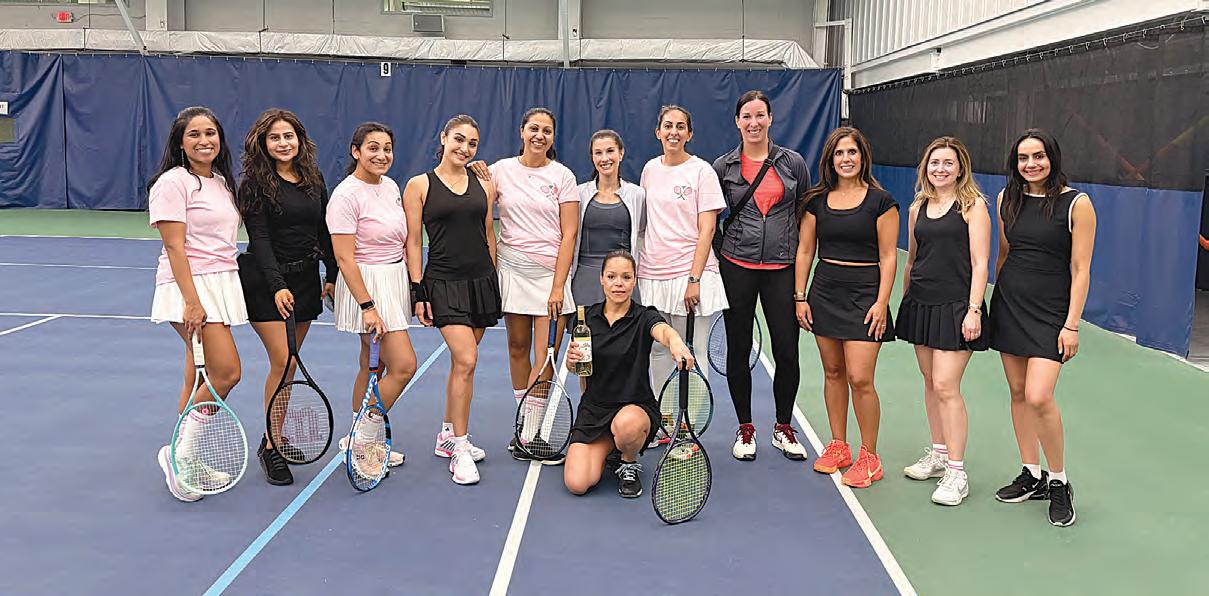
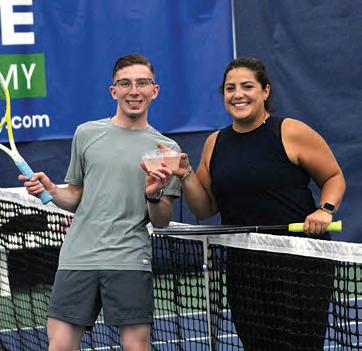
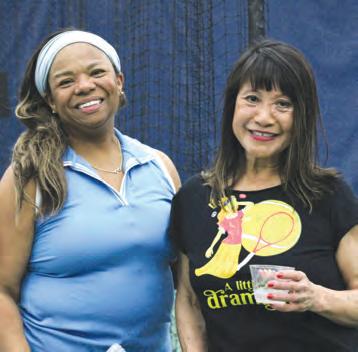
TheCourts & Cocktails Event Series presented by Orlin & Cohen Orthopedic Group returned to the courts of SPORTIME Port Washington, as a full crowd of tennis enthusiasts came out on a Saturday night to enjoy a fun night of playing tennis, hanging out with and making new friends, and enjoying delicious food and drinks.
Our Courts & Cocktails events raise money for various outside charities throughout the year but on this night the proceeds went to Grow Tennis New York, the non-profit arm of Long Island Tennis Magazine.
Played across hard courts inside John McEnroe Tennis Academy’s Long Island
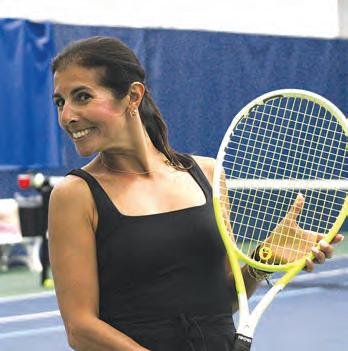
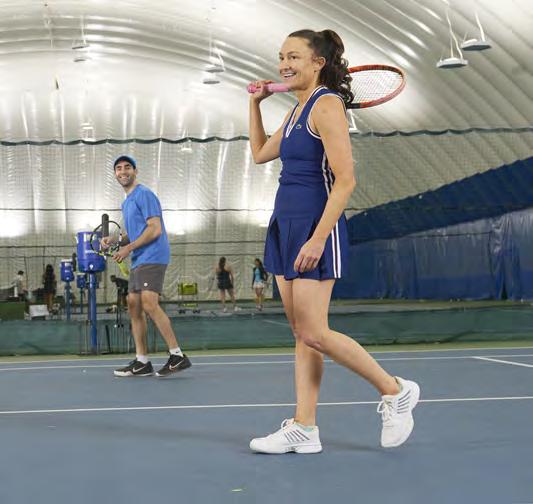
facility, players were broken up by level as teaching professionals guide the groups through fast paced, high energy drills and games. Players switch courts every 25 minutes which allows everyone a chance to play with multiple players throughout the night.
“The turnout and feedback from our Courts & Cocktails events continue to reinforce the need for social tennis options and professionally-run events in this area,” said David Sickmen, Publisher of Long Island Tennis Magazine. “We love being in the community and bringing players of all different levels together. The events have been very popular with adults looking to get away from the monotony of typical Saturday night plans and have a more active weekend evening where they can meet new people or spend time with friends.”
Throughout the on-court portion of the event, LITM’s event staff brought drinks out to the players, including our version
of the famed U.S. Open Honey Deuce, while music plays to keep the event lively and fun.
Following the tennis, the bar remains open while a catered spread of Italian food ranging from pizzas and pastas to wings and grilled chicken, and much more!
“It was a perfect mix of competition, laughter, amazing drinks, and unforgettable moments both on and off the court,” said Daman Dutt.
Dianna Rainone added:
“It was such a well done event with matches followed by cocktails, dinner, and meaningful connections. I loved that it brought together both friends and new faces through tennis.”
The events serve as a way to benefit all aspects of the tennis community, from providing more work opportunities for the teaching pros, to helping fill vacant court time at the host clubs, and reinforcing the players’ passion for
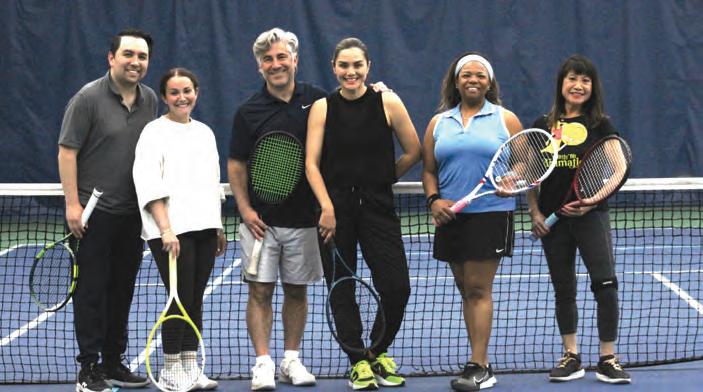
tennis, while giving them a social environment, which leads to them playing more outside of Courts & Cocktails events.
“Our events are well run and showcase all we love about tennis, from the competitiveness to the social side and the fun both on and off the court with like-
minded people,” Sickmen added. “And we embrace using these events as a way to fundraise, and continue growing all aspects of tennis in our community. Thank you to SPORTIME Port Washington for hosting the event at their beautiful facility, and helping us run another successful charity event.”
• Junior Development Program
• After school programs for beginner to intermediate
• Adult tennis
• Summer Tennis and Sports Camp Programs
• Private lessons and group clinics

People from across the USTA Eastern tennis community came together at the USTA Billie Jean King National Tennis Center to take part in the latest event in the Rally For A Cure series, which are fun tennis days designed to raise money and awareness for Angelman syndrome (AS), and specifically the Foundation for Angelman Syndrome Therapeutics (FAST).
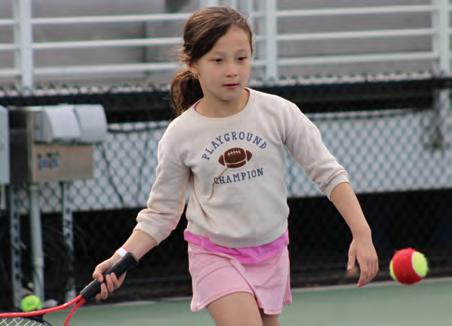
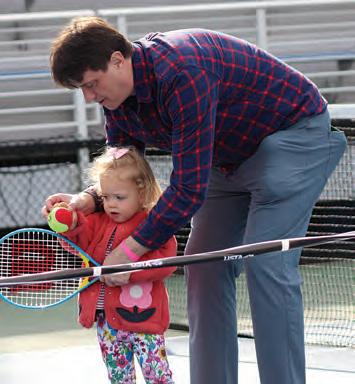
The outdoor courts of the home of the U.S. Open were filled with 60 players of all ages and levels participating in tennis drills and games, from Red Ball Tennis to match play, as well as Cardio Tennis.
“Everyone was so excited to be a part of the event – it was a great success!” said Monica LaMura, the Director of Marketing & Communications for USTA Eastern. “The goal of the Rally For A Cure series is two-fold: to get more people playing tennis and to raise awareness of Angelman syndrome. I think it’s safe to say that our attendees really enjoyed themselves on court!”
Colin, was diagnosed with AS when he was an infant, leaving the couple scared and confused upon first hearing the news.
Angelman syndrome is an extremely rare and also completely random and noninherited mutation of a single gene affecting just one in 15,000 people. People living with Angelman syndrome experience seizures, have balance issues, limited speech and need life-long care.
“My husband and I were devastated [when we first found out]. Before Colin was diagnosed with AS, we had never heard of the condition. The life we had imagined for our infant son was gone. It was an incredibly difficult time for our family,” LaMura recalls.
However, the family was soon connected with FAST which brought them immense comfort and tremendous relief. They met with other Angelman families, and learned there was hope to navigate Colin’s condition.
Throughout the year, USTA Eastern partners with organizations to use tennis as a vehicle to not just raise money for a wide array of charities focused on diseases, disabilities, issues and more, but also shine a spotlight on challenges that oftentimes get overlooked.
“Bringing awareness to people living with disabilities matters because it changes how communities, schools and healthcare systems treat and include people,” LaMura explained. “Building awareness and advocating for people living with a rare disease is not just about ‘understanding differences’–it can directly improve access, opportunity, safety and quality of life.”
While LaMura plays a key role in many Eastern’s initiatives, this event series and its mission in particular holds a special place in the hearts of LaMura and her husband, Rob. Their son,
Specifically, there are treatment options with 23 programs in the drug development pipeline with five in investigational clinical trials.
“The science is there–it’s promising,” LaMura added. “FAST has invested over $64 million in research grants and venture philanthropy in the last five years. Tennis is my tool–it’s what I have to offer families and how I am able to fundraise to contribute to these incredible efforts, and to support FAST. I’m not only interested in helping Colin, I want to help all kids living with AS and their families by helping FAST to get therapeutics approved and across the finish line.”
Through her dedication, and the work done by FAST, individuals and their families suffering from AS have more hope than ever. Colin is now a thriving toddler, and will continue to remain an inspiration to his family.
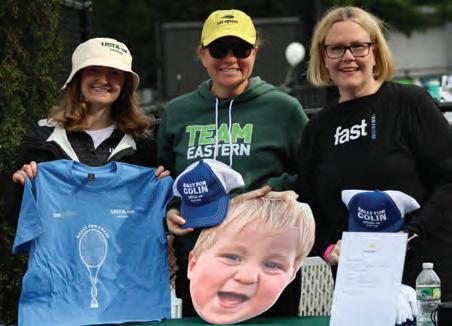
“I want people to understand my son–both the challenges he faces and the joy he brings into the world,” she said. “Colin is an absolutely incredible kid, and he works harder than anyone I know. He lights up every room he walks into, and brings joy and laughter wherever he goes. The pride he brings me is unmatched. I am forever grateful to be Colin’s mom–I want to bring him as much happiness as he’s brought me.”
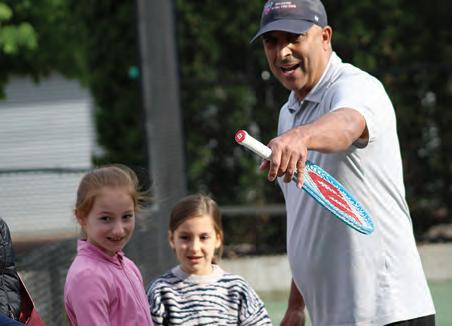
Tennis has a way of bringing people together, and LaMura continues to use the sport to enact positive change for those suffering from AS. There are two more events in the Rally for a Cure series this year which will be held in Connecticut later this summer.
To learn more about Colin, AS, FAST, or to make a donation or learn about sponsorship opportunities, visit bit.ly/rallyforcolin.
By Brian Coleman
Overthe last several years, the adult programs at Advantage Tennis Clubs have seen a significant increase in not just participation, but also quality. By combining expertise and passion, along with a cohesive team of people running things, Advantage Tennis Clubs remains at the forefront of tennis growth in New York City.
And much of that success, specifically at Advantage’s Manhattan Plaza Racquet Club location, can be attributed to Rupie Mukherjee, the Adult Programs Director at the historic facility.
Mukherjee has served in that role since 2024, and has been an integral part of the innovative adult programs that are not just bringing new people into the sport of tennis, but also providing existing players with the type of pathway that resonates with them.
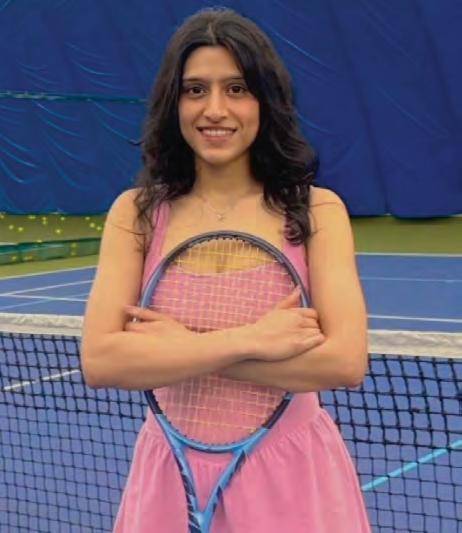
“Growing the sport as much as we can and continuing to expand the sport of tennis is the goal we have at Advantage, at Manhattan Plaza, but also my own personal ones as well,” said Mukherjee. “We want people to feel like they are part of the New York tennis community, and the Advantage community.”
Mukherjee’s rise to the Adult Programs Director was a rapid one. She moved to the United States in 2020 to play college tennis at Dominican University in New York. After a four-year college tennis career and upon graduating, Mukherjee faced a common dilemma: what’s next?
After playing tennis for her entire life, she thought she wanted to do something away from the game. She moved to Brooklyn and put
down a deposit on an apartment near where she planned to take a marketing job. But soon after, Mukherjee came to the realization that the tennis court was where she wanted to be, and tennis was an industry that she wanted to be a part of.
“After I finished college tennis, I had this thing in my mind that I didn’t want to play tennis ever again. I actually told myself, I’ll do anything except work in tennis,” Mukherjee recalls. “I was prepared to take the marketing job, but right before I was supposed to start, I told them I wasn’t able to take the job.. I couldn’t picture myself working at a desk all day, and dealing with the notion of that being the end of my tennis life was something I didn’t want to face.”
As fate would have it, a chance encounter with Gabe Slotnick of the Manhattan Plaza Racquet Club would help her make her way back into the tennis world. After meeting with him and seeing the club, she knew that’s where she wanted to work. She started as a camp coordinator helping out with social media. Soon after, in December 2024, she moved into a role as the
Assistant Adult Program Manager, and last September, was promoted to the Adult Programs Director.
“Rupie has been a tremendous asset to the Advantage Tennis Clubs team at Manhattan Plaza since the day she arrived,” said Slotnick. “Her passion for teaching tennis to all ages, combined with the warm, friendly way she connects and engages with colleagues, club members and students alike is truly remarkable.”
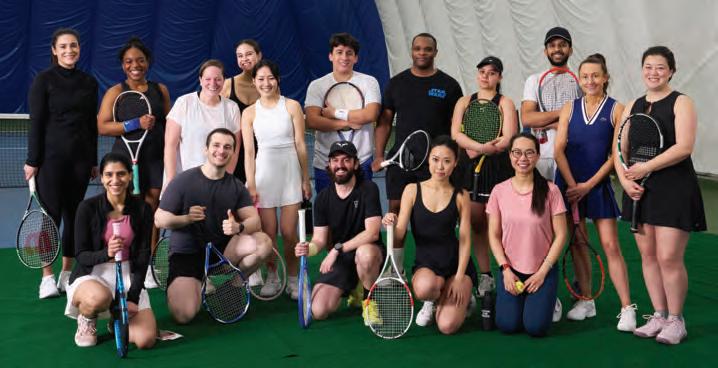
It’s that connection she develops with her students that make her such an effective teacher. Despite being in her early 20s, younger than the majority of people in the adult programs, the management at Advantage saw someone with a high level of maturity, and the capability to run the show.
“Rupie brings immense energy to every task she undertakes, and is
deeply committed to helping every student, doing everything in her power to make that happen,” said Slotnick. “Her organizational and administrative skills, combined with her leadership style are far superior to others her age, making her an invaluable Director of Adult Programs. She truly cares about each player’s development, checking in with them daily and constantly finding ways to improve the experience for everyone who steps through the door at Manhattan Plaza Racquet Club.”
Over the course of the last two years, those players who had barely picked up a racquet prior to walking through the Manhattan Plaza doors,
have progressed up to higher levels. So not only is the participation climbing, but a pathway to improvement is in full effect. It’s that pathway, and seeing the improvement of the players in the program and their increased motivation to get better, that brings Mukherjee the most joy in her job. Despite being younger than the majority of the students under her tutelage, she looks at herself as a proud tennis mom.
“When I see their passion, it really brings out this pride in me and I love to see it,” she says. “I feel like they are all my kids. I have seen many of them start from scratch and now they have improved so much, it makes me so proud and happy. And so I want to do more of that. I am in a manager role now so I am not on court as much as I used to be, but I try to get on court
continued on page 14

continued from page 13
whenever I can to make sure I stay connected to the players.”
Tennis is a sport that can have a profound impact way beyond the training sessions, or the wins and losses that arise from competition. The adults who have picked up the sport of tennis through the programs at Advantage have found so much more than learning how to hit forehands, they have found a community of like-minded individuals who they are able to bond with.
Mukherjee took the ball and ran with it. Through her passion and infectious energy, she has helped exponentially grow the programs.
“I think it’s very important because tennis has so many benefits. It’s great for your body physically, but also great for your mind,” Mukherjee explains. “Everybody has something going on in their life, but getting onto the tennis
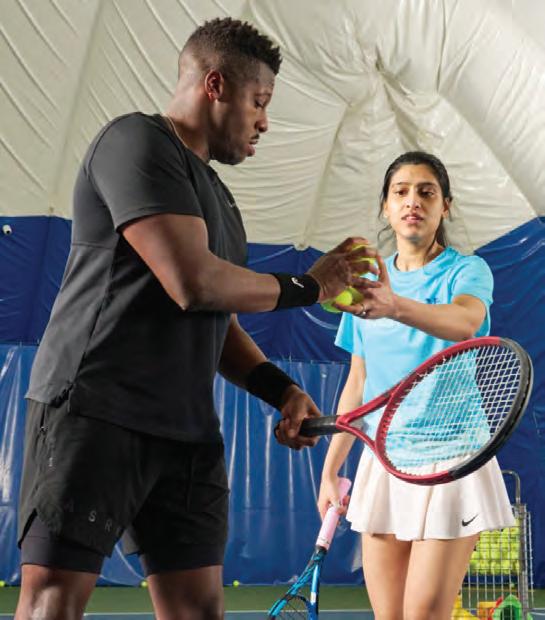
court is a freeing experience. I remember that’s how I felt when I was playing as a kid. If something happened at school, or I had a fight
with my parents, going out and playing tennis would make me feel better. These young adults are able to find a sense of community, and are able to learn about themselves. They put in the effort and find out they had skills they didn’t realize they had. They see the potential in themselves, and it keeps them coming back.”
Tennis often has a high barrier of entry which can discourage young adults from playing. But Mukherjee and the team at Manhattan Plaza Racquet Club and Advantage Tennis Clubs have demonstrated that if done correctly, growth of a facility’s adult programs is attainable.
With the shared goal of expanding our tennis community and keeping players engaged, the sport is in great hands in New York.











Whetheryou are an indoor or outdoor racquet sports facility, 10-S Tennis Supply is ready to provide the equipment and support needed to keep your courts operating yearround.
Founded in 1964, the company has spent nearly six decades delivering innovative court supply products alongside dependable customer service to facilities across the country. With more than 2,000 products ready to ship, 10-S supports the construction, resurfacing, and maintenance of tennis and pickleball courts nationwide through phone, email, and online ordering.
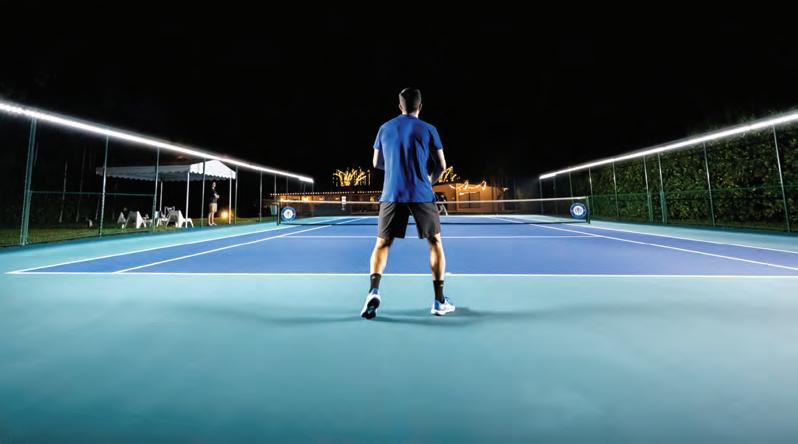

As demand for extended playing hours continues to grow across tennis and pickleball facilities, many court owners face the same challenge. Traditional sports lighting systems can be expensive to install and difficult to permit, especially near residential neighborhoods.
To address this need, 10-S distributes Tweener Lighting Systems, a fence mounted solution designed specifically for racquet sports environments. Tweener installs directly onto existing perimeter fencing at approximately ten feet in height, reducing construction requirements while delivering effective illumination
across the playing surface. By eliminating the need for concrete bases and tall poles, facilities can activate previously unlit courts with significantly less disruption and infrastructure investment.
For municipalities and schools, this approach allows courts to remain open later and support expanded programming without the costs typically associated with conventional lighting upgrades. For HOAs and private clubs, Tweener provides a discreet lighting option that minimizes spill light and visual impact on surrounding properties. Residential court owners benefit from the ability to add evening play without introducing large permanent structures.
“I never thought we would be able to have lights on any of our outdoor
courts due to city light pollution policies in the area surrounding our club. Thankfully, the technology Tweener provides opened the door to the city allowing us to light our outdoor pickleball courts. Our members love these lights, and thanks to Tweener, I am confident that we will be able to add lights to our tennis courts in the near future.” — Ron Steege, Director of Tennis, Club Greenwood
Backed by decades of experience supplying court equipment and infrastructure nationwide, 10-S continues to help facilities expand play opportunities with practical, costeffective solutions designed specifically for racquet sports environments.
To learn more about Tweener Lighting Systems, visit www.tweenerusa.com or contact lucas@10-s.com.
By Brian Coleman
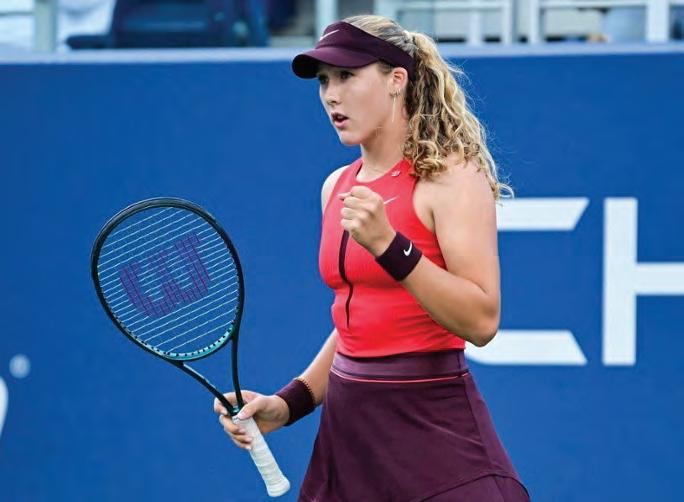
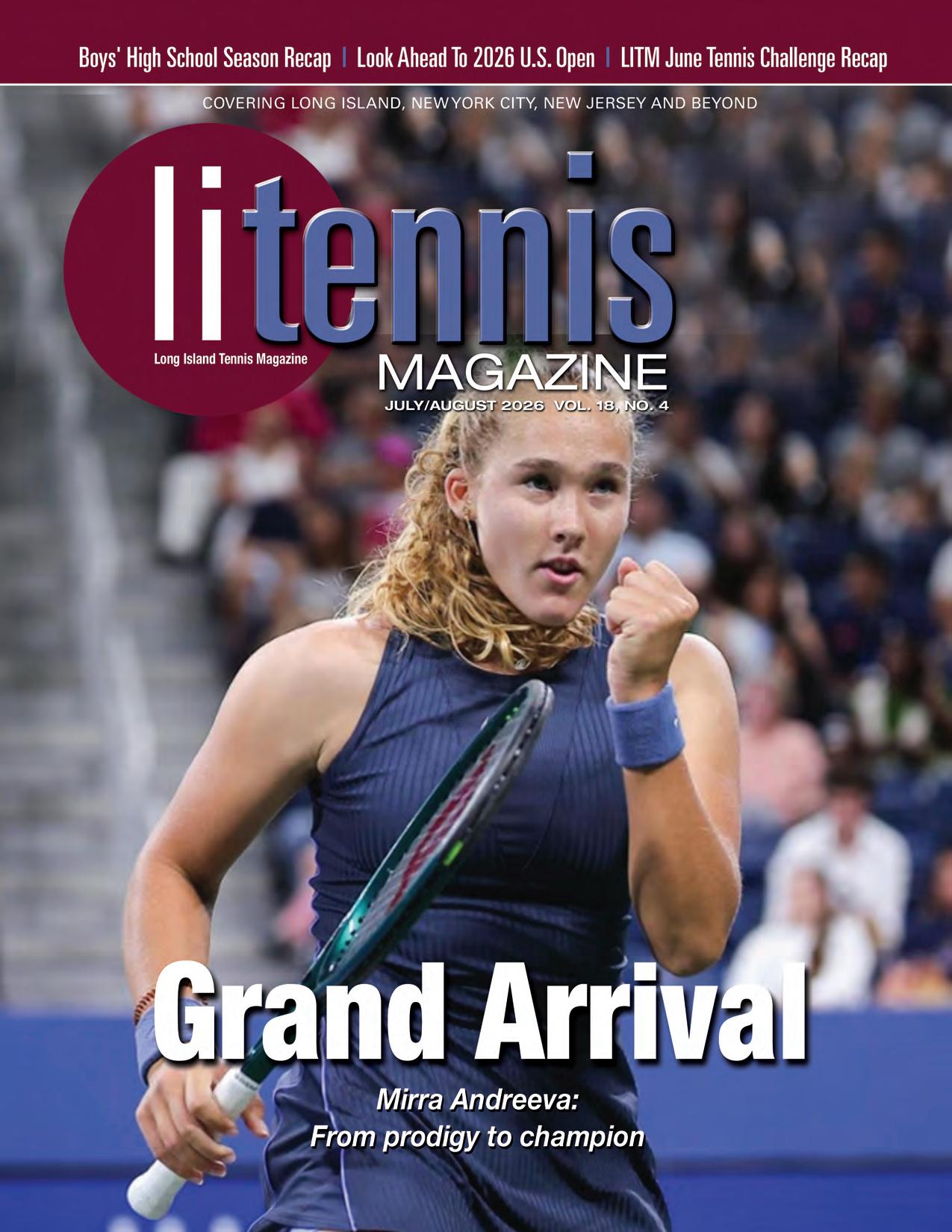
Anewstar was born at the 2026 French Open. A name known to tennis fans is now a worldwide star as Mirra Andreeva captured the first major title of her young, promising career, ending the Cinderella run of Polish qualifier Maja Chwalinska with a 6-3, 6-2 win in the French Open final.
“I still cannot believe that I’m doing a press conference with a Grand Slam trophy by my side,” Andreeva said. “It’s been one of the biggest dreams in my life, and I’m just super happy that I was able to give my best, win the match and win this tournament.”
The 19-year-old Russian put together a dominant run of matches in Paris. She dropped the opening set of her second round match to Marina Bassols Ribera, but that would be the only set she would lose in her fortnight at Roland Garros. In the quarterfinals, semifinals and finals, she lost a combined total of just 12 games.
continued on page 18
continued from page 17
“I feel like I did handle my nerves a little bit better these two weeks,” she said. “I mean, the beginning of the tournament was very tricky, I’m not going to lie. Obviously I’ve had some emotional matches and some emotional moments on the court as well. I actually talked to my psychologist before the semifinals and finals because I thought it would help me be in the right state of mind before the most important matches of my life. I wanted to prepare my best.”
Still just a teenager, Andreeva has been no stranger to those emotional moments on court. Many times in her past, she would have outbursts directed towards her team box, and despite having all the physical tools a tennis player can have, it was the mental side of tennis that needed to catch up if she were to win a major. Taking the recent step to consult with a sports psychologist proved to have real dividends.
“She gave me a lot of advice and techniques that I could try and use on the court to help myself experience these things better and a little easier,” Andreeva said of what she
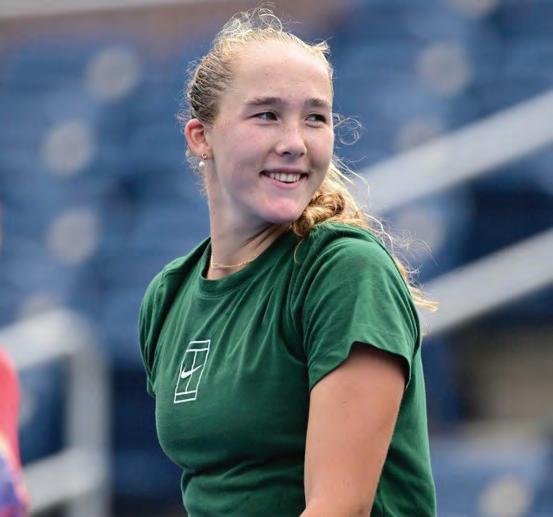
worked with with her psychologist. “That’s why she deserves a lot of credit for this.”
Andreeva has been a player with
high expectations for many years. She was a world number one junior, and was the first player ever to win multiple titles at the W60 level of the ITF World Tennis Tour before the age of 16. In 2023, she received a Wimbledon wild card and reached the fourth round. This put her on the radar of the tennis world, and by the end of the year, she had climbed inside the Top 50 of the WTA Rankings. As her rise continued, she claimed her place as one of the best players in the world in the early parts of 2025. Andreeva won her first WTA 1000 title in Dubai, and backed it up with a triumph in Indian Wells. In doing so, she became the third-youngest Indian Wells champion after Martina Hingis in 1998 and Serena Williams in 1999, and the youngest since Hingis in 1997 to win back-toback WTA 1000 events.
“Maybe it’s happening fast, but I like it,” she said after winning Indian Wells when asked about her rapid rise. “There is nothing bad that I can say about it…it’s not bad to win two tournaments in a row, so I’m really happy about that. If it’s happening fast, I’m okay with it.”
That raised the expectations even higher for Andreeva. And it set the stage for the biggest tournament of her career at the French Open.
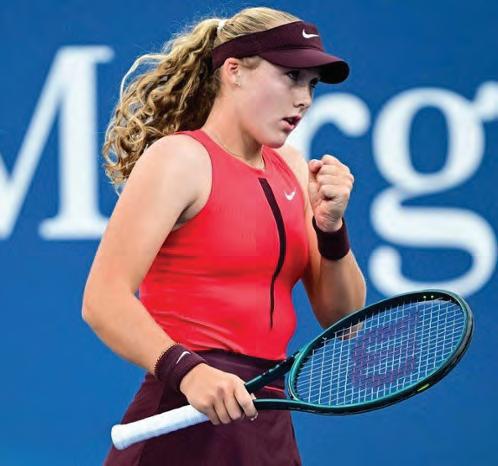
“I’ve been watching Roland Garros on TV since I was very, very young,” she said during the trophy ceremony. “It’s also a big dream of mine to win this tournament, and I honestly cannot believe that I’m holding this trophy right now.”
Because of her age, Andreeva’s wins generally come with a historic
note. Her French Open title makes her the youngest women’s champion there since Monica Seles in 1992.
“I always said that it wouldn’t matter to me, a Grand Slam is a Grand Slam. Whatever comes first, I’ll be super happy with it. [But] I kind of feel happy that Paris came first, because I love playing on clay,”
Andreeva admitted. “I played almost all my life on the surface. I also speak a little bit of French. So I felt like this would be the perfect first Grand Slam for me, and so I am super happy that it happened here.”
Andreeva now climbs to No. 6 in the world. The expectations will only increase, but that is something that Andreeva has been used to, and thrived with since she was a young girl.
Now that she knows what it feels like to hold a major trophy, Andreeva is eager to regain that feeling many more times in her career.
Andreeva said:
“I feel like this thing is a little bit addicting, and I really want to do my best to experience all of this for a second time.”









































The USTA Long Island Regional Council is excited to host several events this summer. Please visit our website at www.longisland.usta.com or Facebook (Play Tennis Long Island) for more information on these and all USTA Long Island Regional events. For specific questions, email ustaonlongisland@gmail.com.
• 7/7 Nassau Kids’ Day at LuHi (Rain date, 7/8)
• 8/10 Suffolk Kids’ Day at Island Quest (Rain date, 8/11)
This past spring, Long Island Council volunteers were out in force helping bring tennis to a variety of communities across the Region.
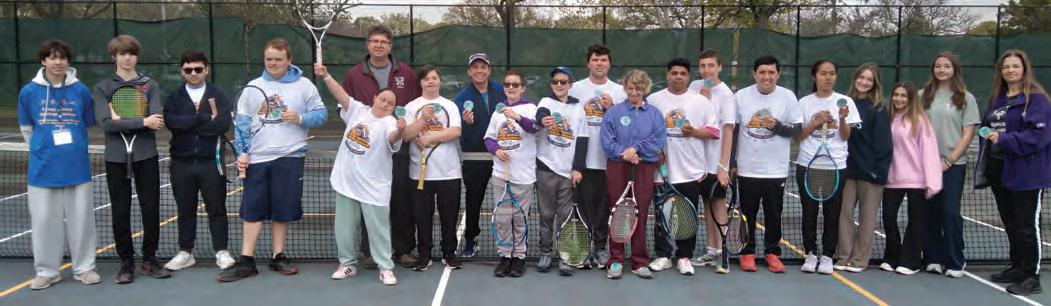
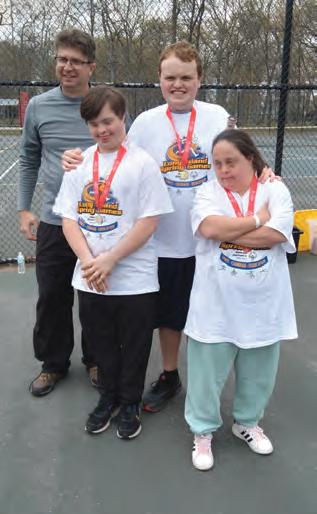
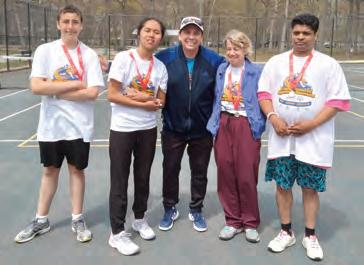
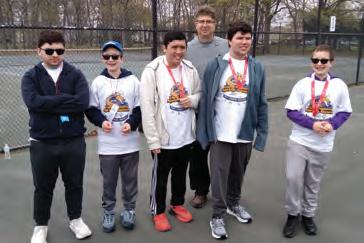
The USTA LI Region was once again a proud sponsor of the Long Island Special Olympics. Council members hosted a vendor table with giveaways and information on USTA initiatives, and provided a Red Ball Tennis center for
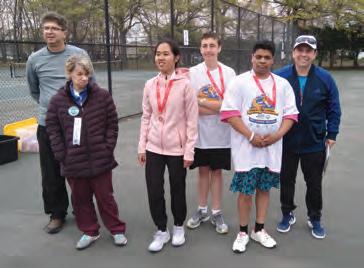
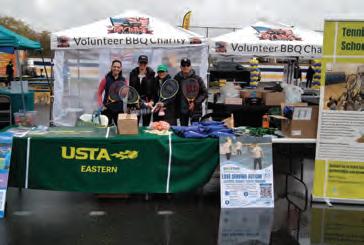
all to try and experience. At the tennis portion of the games, all the participating athletes were presented with USTA Eastern Sportsmanship Award stickers.
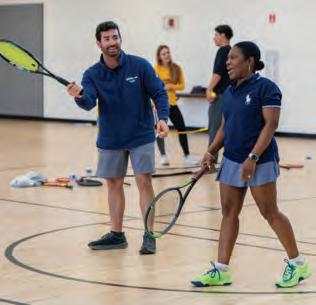
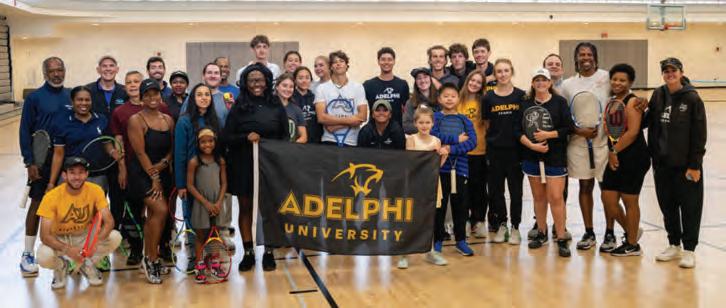
The USTA Long Island Region hosted a red ball tennis clinic at Adelphi University. At the event, the Adelphi Women’s and
Men’s tennis teams worked with regional volunteers to teach tennis at the 2026 Adelphi Alumni and Friends Tennis Clinic.
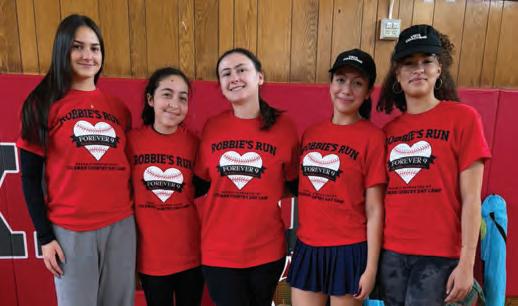
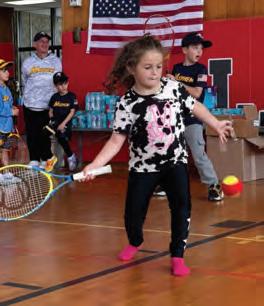
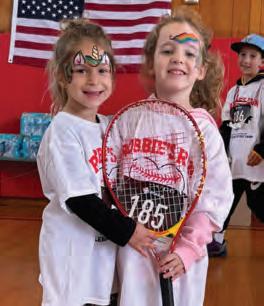
This year marked the 19th anniversary of the Robbie’s Run in Merrick. This event, which includes a 5k, 1k and kids’ run plus a community fair, raises money to provide automated external defibrillators (AED) and CPR training for youth sports teams. The Long Island Council has been a proud supporter of Robbie’s Run since the event’s inception. This year, Council volunteers were joined in teaching Red Ball tennis to kids by members of the Calhoun High School (Merrick) girls’ tennis team and members of the Roslyn High School tennis team who are also members of the Advantage All Foundation.
Mike Pavlides, Regional Director
Jonathan Klee, Past Regional Director
Sunny Fishkind
Tito Perez
Jason Wass
Randi Wilkins
Neil Thakur, Manager, Schools Tennis and Long Island
Milly
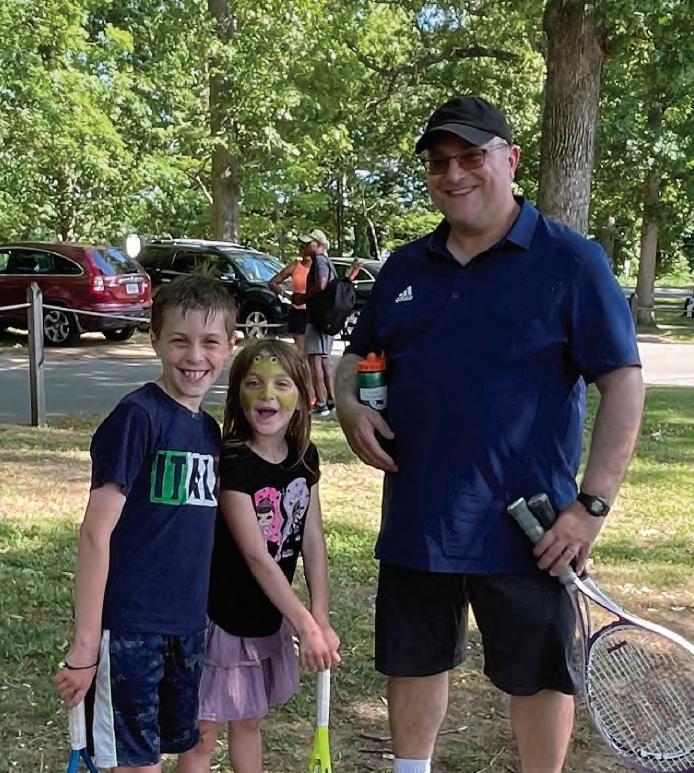

Eastern Long Island, in conjunction with Long Island Tennis Magazine and the Baldwin P.A.L. teamed up to bring free tennis fun to kids and adults alike as the popular Family Tennis Day In The Park event was held at SPORTIME Hempstead Lake State Park.
The event featured engaging tennis instruction and gameplay on the court, but also fun activities off the court including face painting, glitter tattoos, music, prizes and more. The event was completely free to attend and was a reward for the kids who completed an eight-week tennis course. The students are able to bring
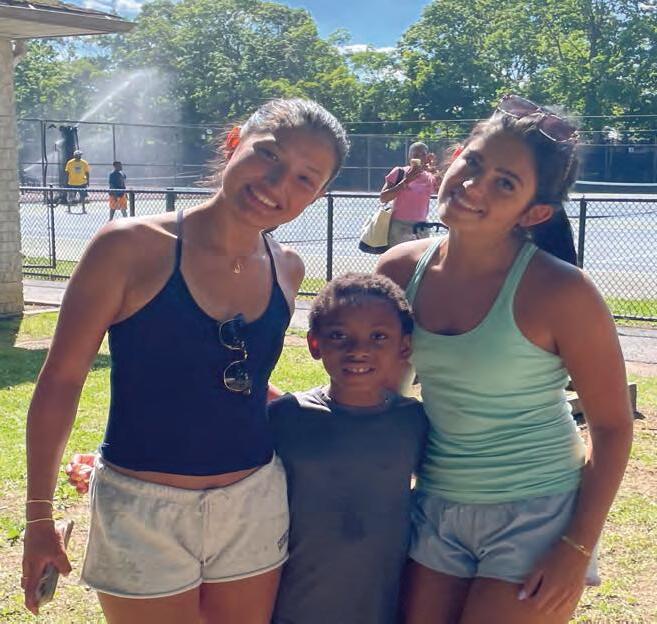
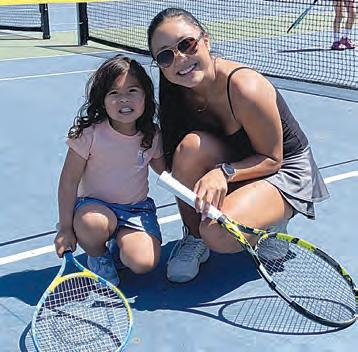
their parents and other family members, as well as other members of the P.A.L., to share time together on court in celebration of their course completion and show everyone their improvement.
“We are proud to sponsor and run programming that brings families into the game of tennis,” said USTA Eastern Regional Director Mike Pavlides. “Tennis is seen as an individual sport, but these events show that the family can get together and experience a day of fun and togetherness, which we hope they will continue to do going forward.”
On the court, USTA Eastern Long
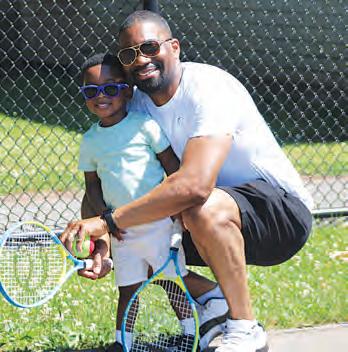
Island Board Member Jason Pasion organized drills and games as parents/siblings went out on court with their kids to partner with them, making the experience fully interactive for the families.
LITM’s event staff, comprised of high school and college tennis players, as well as two additional USTA Long Island board members were involved and available to partner up with kids who needed one for the Tennis games and also to lead the relay race and water balloon toss areas.
After the on-court portion of the event was complete, LITM’s event staff
ran a facepainting/glitter tattoo area while pizza was served to all in attendance. An Ice Cream Truck came by for a sweet treat option as well!
“Family Tennis Day In The Park was a great opportunity to see families bond and have a great time playing tennis together,” said Pasion, who is the Global Director of Tournaments for SPORTIME/JMTA. Tennis is a healthy, lifelong sport, and we had a great turnout of participants engaging in tennis drills and other fun activities.”
By providing this rewarding experience for the kids and their families, the goal is to inspire more kids to take part in the tennis course offered by the Baldwin P.A.L. and get more players on the courts!
“We were proud to partner with USTA Eastern, SPORTIME and the Baldwin P.A.L. to bring tennis to so many kids and adults,” said David Sickmen, LITM Publisher. “Through
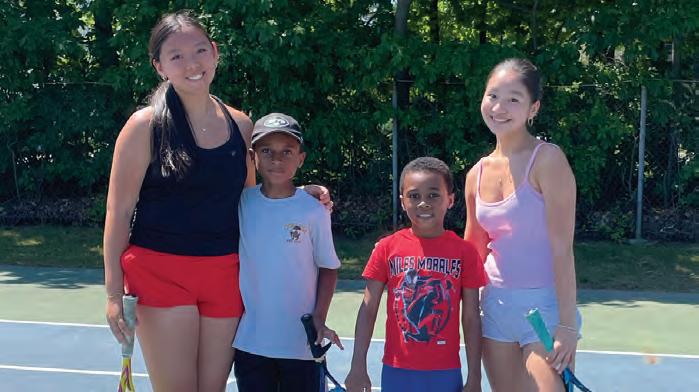
events like this we are able to show just how fun tennis can be, and that was evident through all the smiles we saw on and off the court. The format was great today because it allowed for the entire family to enjoy a tennis event together. The kids had the opportunity to showcase what
they have learned on court to their parents and siblings while also having various interactive activities for the whole family to enjoy. Working within the tennis community for the past two decades, it’s evident how important events like these are to the continued growth of the sport.”

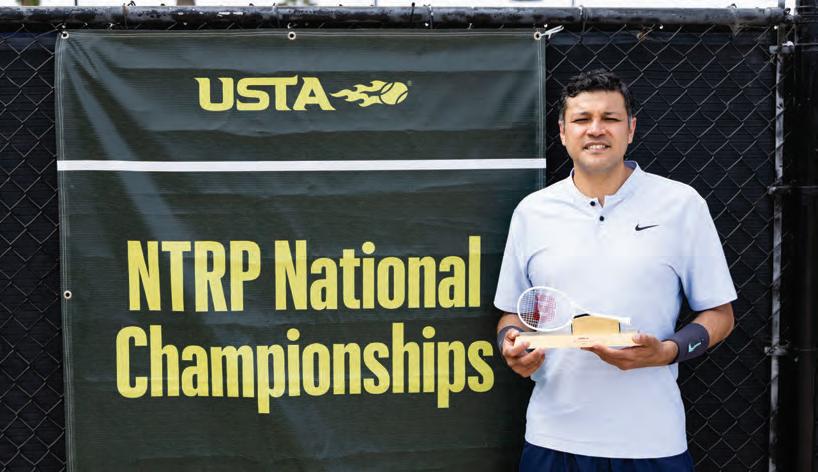
The theme of the weekend for Gomez? "Resilience," he said
Fantasticfive. Eastern players captured an astounding five championship titles at the 2026 NTRP National Championships, held at multiple tennis facilities across the country—including the Barnes Tennis Center in San Diego, Calif., the Giammalva Racquet Club in Houston, Texas, and the USTA National Campus in Orlando, Fla.
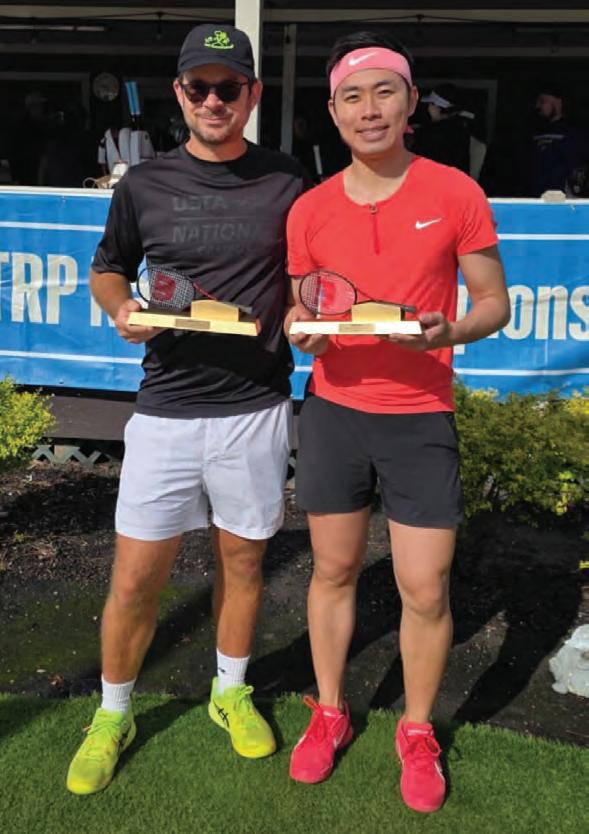
Among the champions were three tri-state area residents. Felix Hui and Noel Paul emerged victorious in the 18 & Over 3.0 Men’s doubles event, while Francisco Gomez claimed the 40 & Over 4.5 Men’s singles title.
Incredibly, Hui and Paul had only contested one doubles match together before pairing up for the National tournament.
“I think that says a lot about how naturally our games complemented each other,” Hui said. “Noel’s serve and forehand were major weapons for us, while I was able to help at net and use my backhand to keep points solid from the baseline.”
Just as important, they were able to develop a strong rapport with each other as the matches unfolded.
“We trusted each other and communicated well,” Hui said. “There were moments when I wanted to press too much, and Noel did a great job reminding me to stay
patient and build the point. That balance helped us a lot.”
And it was that balance that also helped them go undefeated throughout the event—without dropping a set.
“It was an incredibly rewarding feeling,” Hui said of claiming the top trophy. “A lot of time and effort goes into improving the game and competing throughout the year, so to see that work pay off on a national stage was very meaningful. It was also special to share that moment with Noel and represent Eastern.”
Another enjoyable aspect of the experience for Hui was seeing the camaraderie among all the players from the section. He specifically cited Michelle Lau and Pamela Salud, who were competing for Eastern in the 18 & Over 3.5 Women’s doubles division.
“They were especially encouraging, and I learned a lot just from watching how they competed,” Hui said. “Having that support on the sidelines really meant a lot.”
Elsewhere, competing in his first-ever NTRP championship, Gomez experienced very few nerves. He breezed through the round robin stages of the competition, sacrificing just four games through three matches to reach the semifinals.
After that, he faced a decidedly more grueling—and
lung-busting—path to lifting the championship hardware in his division, with both his semifinal and final contests extending to third-set tiebreaks. In the former, Gomez’s opponent Bryan Barley [of USTA Southern California] came out firing right from the outset of the match and didn’t give the Eastern player a chance to do much.
“He played very fast, very aggressive and made no mistakes,” Gomez recalled. “I don’t think I faced that level of tennis in several years.”
Down a set, Gomez resolved to raise his energy, which ultimately helped him to up his aggression and better read Barley’s patterns. He took over in the second and then eked out the third in a tiebreak to advance to the championship.
The battle, though, took its toll, as Gomez started to feel pain in his right heel.
“I wasn’t sure I would even take the court for the final,” Gomez said. “[So] I had no expectations, other than try my best and let it turn out however it would turn out.”
Turns out, Gomez’s challenger Marcio Moran [of USTA Florida] was also coming off a punishing semifinal bout of his own. Both working through physical issues, the athletes traded sets in an up-anddown contest. Moran—who Gomez noted, moved the ball around with incredible precision—began to cramp early in the third but held on to force a tiebreak. After a relentless physical effort, the
outcome hinged on three points.
“He was up 5-4 in the tiebreak of the third set and I won the match at 7-5, so in the end I was able to put together three points in a row,” Gomez said. “Those three points required a lot of patience to not overhit and not provide easy balls, and they equally required a lot of resilience to keep running. But [at that stage] it also took a bit of luck. It came down to a few inches here and there.”
And Gomez added he was lucky the encounter ended when it did.
“I was cramping during that last point,” he said. “We had a long rally, probably over 15 shots. Any more [long] exchanges, it would have been tough to keep fighting.”
But his overall fight is exactly how Gomez will remember his first NTRP championship experience. And it’s precisely what compelled him to start playing NTRP tournaments in the first place.
“I like that the level of players is very [high],” he said. “You are guaranteed to face good competition.”
This could be you! USTA Eastern will hold NTRP National Qualifier tournaments on multiple dates this summer for the multiple divisions at various locations across the section. Champions at these events will automatically qualify and advance to the 2027 NTRP National Championships, to be held in spring 2027. Visit usta.com/easternqualifiers to learn more about how you can earn your spot at Nationals!
USTA Eastern hosts fourth annual Asian-American Native Hawaiian Pacific Islander Heritage Month Tennis Festival in Queens
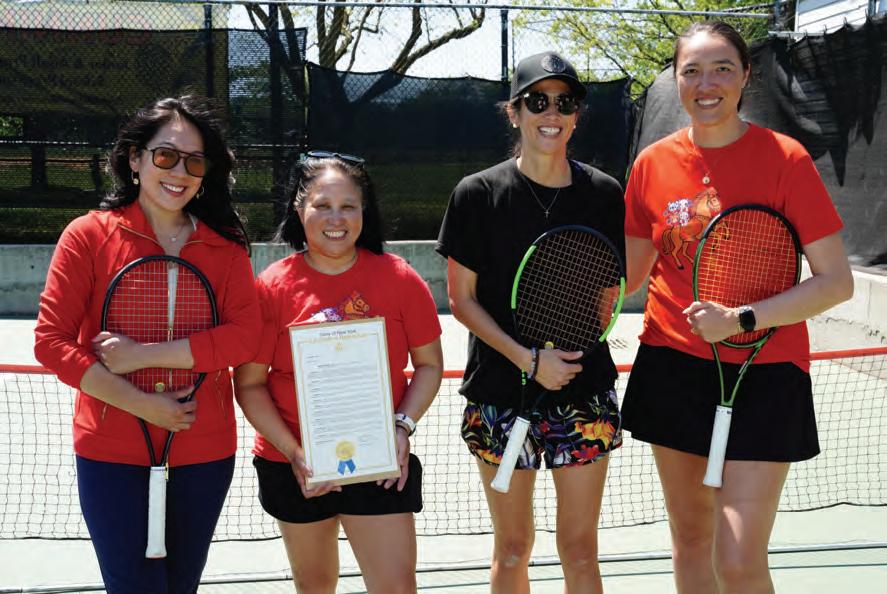
Over600 people flocked to the courts at Cunningham Tennis in Fresh Meadows, N.Y., on May 16 to participate in USTA Eastern’s AsianAmerican Native Hawaiian Pacific Islander Heritage Month Tennis Festival. Families that attended the event got to try a little tennis and learn more about the sport while enjoying Asian music, food and dance, including performances by groups from Queensboro Dance and NYC Chinese Cultural Center.
Also putting on a show: 2012 US Open girls’ singles champion Samantha Crawford and former world No. 159 Tracy Almeda-Singian, who contested a friendly exhibition and then hit a few balls with various attendees.
Participating in the event was a no-brainer for NYC native Almeda-Singian, who got her start at just 10 years old playing junior tennis in New York and later faced
Monica Seles in the first round of the 2000 US Open as a professional.
“Being Filipino is so much a part of who I am,” she explained. “[And] giving back to tennis, I’ll always make time for it.”
Former world No. 98 Crawford echoed that sentiment, noting that her favorite part of the day was watching the dance performances.
“It’s a great event,” she said. “There’s a lot of energy. We’re celebrating AAPI Heritage Month and getting people active too.”
The festival also served as a celebration of National Tennis Month. In a brief ceremony hosted by NYC sports anchor Michelle Yu, New York assemblywoman Nily Rozic presented event organizers with a proclamation from governor Kathy Hochul declaring May National Tennis Month in New York.







































By Brian Coleman
By Brian Coleman
Last November, Avery Nuala PezzolaO’Meara and her family made their first trip to the Evert Tennis Academy in Boca Raton, Florida. The 15-year-old Avery had only begun her tennis journey a few months prior, and had been seeking the best place to improve and find a training program that would most benefit her.
The family lived in Mamaroneck, and played at a couple of local clubs in New York. And while they helped foster her love and passion for tennis, her and her family wanted to continue looking elsewhere for the ideal fit, for top-tier coaching but also to help with scheduling and time management.
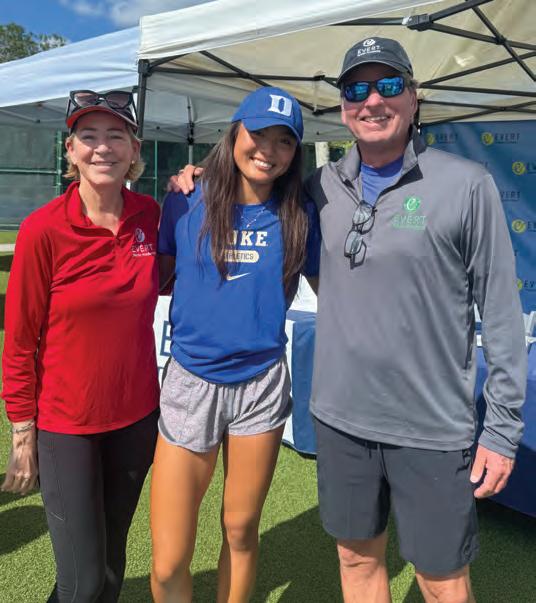
“It was challenging because my husband and I both work, and Avery needed to go to her training, and then fitness,” Avery’s mother, Constance, said. “There were so many elements she needed to go to in order to get better, and Avery was so passionate about going. She knew she had to play as much as she
can to get better.”
So Constance, who by her own admission was not familiar with the tennis world, did what most people would do in her situation: she turned to Google. First, she found the IMG Academy, but while down in Florida visiting, they heard about Evert Tennis Academy.
“We said, ‘let’s go there for one week and see how it goes,” Constance recalls. “It was more challenging to get into Evert because they have certain requirements to get into the camp and programs. I told them how passionate Avery was about playing, and sent them a video of her playing. It was very selective, but thankfully they accepted her to join the programming for one week.”
It was at that time that they were considering full-time options, and relocating to Florida in order to do so was on the table. After that first week, they went back a second time, and while Avery acknowledged the players there were better than her, her drive and passion for the sport and her own improvement was on display for the coaches and directors at Evert.
“She really felt like she had something to prove,” said Constance.
The family will be relocating to Mission Bay later this summer, and Avery will be a full-time student at the Evert Tennis Academy beginning in the fall. This summer also happens to be the 30th anniversary of the ETA, and for the last three decades, the academy founded by tennis legend Chris Evert, her brother John and their father, Jimmy, has threaded the needle of being a top-tier academy for highperformance players from around the country, while also having a small club feel that makes players and families feel welcome.
“You see the same faces every day, and you don’t get lost in the mix,” Constance added. “You aren’t treated as a walking dollar sign. I love the small scale of things, but the talent and coaching there is second to none.”
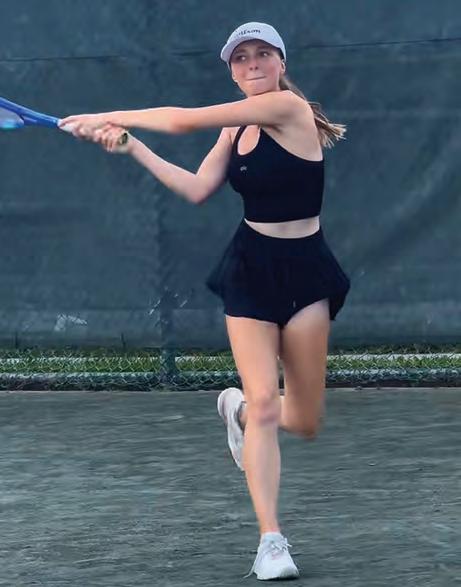
Evert Tennis Academy has tons of experience in welcoming in players from the Northeast, and Pezzola-O’Meara will be the latest to reap the benefits of its environment. One of the best examples of this is Claire An, a native of Manhattan who will be entering her sophomore season at Duke University in the fall and was one of the top-ranked juniors nationally.
She first attended Evert Tennis Academy as an eight-year-old, traveling down to Florida during summer and winter breaks.
“We initially started going down so we could practice tennis, and also enjoy the weather and beaches,” Hannah, Claire’s mother, recalls. “We really liked Evert’s developmental program that combined both group sessions and private lessons, and the coaches were very friendly and supportive. They also made it fun
for the kids with traditions like ‘Chrissie Day’ that Claire looked forward to every year.”
The initial experience was so impactful for Claire, that they would move down to Boca Raton so that she could be there full-time.
She spent a lot of her time working with Jacopo Tezza, Evert’s Director of Tennis Operations and Full-Time Programs.
Together, they developed a plan that put Claire on the college path, introducing her to coaches at National tournaments, and really easing the stress that comes with college recruiting. The collaborative work between Claire, and not only Tezza, but the entire staff including Chrissie and John, demonstrates that the ETA is more than just an academy.
“Claire spent the better part of ten years at Evert,” said Hannah. “It’s where she grew up. There are always many full-time kids that push each other, and campers from all over the world who come and mix things up. And because of Chrissie and John, there are always professionals [from the tours] coming in which adds a source of excitement and motivation for the players. ETA has developed so many pro players but
continued on page 30














more importantly for us, they’ve developed and guided more players towards successful college careers.”
Evert has struck the balance between making sure families feel welcome bringing their children to train there, while also providing some of the highest intensity and highest quality programming, which is the challenge any tennis academy faces.
Ricardo Acioly, the Director of Strategic Development for Evert Tennis Academy, explains how the staff there was able to achieve that:
“ETA has been in operation for 30 years, therefore, there’s a rich tradition behind us and parents undertand what we provide when coming here. It’s a family-oriented place where we are not huge, but not too small. We have a great
ratio of boys to girls, close to 50/50, which is a good thing and different from other places, and I think that is appealing. In the summer, we have a developmental type of program where the kid has access to a private coach included in their program. So it provides a great way to have that individual, one-on-one training to work on specific, individualized things, and then move on to the group program in the same day. It creates a full program for the player.”
Not to mention, the location has a massive appeal for families. The weather is beautiful in Boca Raton, and Evert is close to Miami, West Palm Beach and more, providing endless opportunities to enjoy oneself when there is down time off the court.
chosen home for so many tennis players from across the world, including countless from New York as the coaches and directors have shown they are willing to work as hard as the players.








For the last three decades, Evert Tennis Academy has been the









“While there are plenty of academies in Florida and even in our home Eastern Section, but none match the legacy and tradition of Evert Tennis Academy. The people there make it feel more than an academy,” Hannah An said. “They make it a welcome home; a place that not only helped train an athlete, but also helped raise a confident and respectful person ready for college. Claire never complained about practice or fitness even in the longest summer days, because she always wanted to give as much effort as the Evert coaches gave her. It was the recipe for her successful junior career.”







































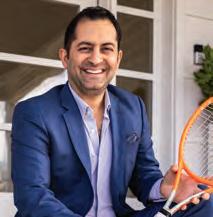
Thereal estate market on Long Island is some of the most sought after in the country, and the ever-changing and complicated nature of it requires having an expert in your corner to guide you through the process. With the help of Parsa Samii
of Compass Real Estate, we’re showcasing one of these beautiful homes for sale. Parsa is a former professional tennis player and coach who has transitioned into real estate, with a strong understanding of both the tennis aficionado and the home buyer.
As Compass puts it, “Parsa is the ideal professional to navigate the ever-competitive real estate market.”
61 Mason Dr Manhasset, NY 11030

For more information, photos or to see more listings, email parsa@compass.com or call 516.965.7445. 4 beds • 4 bathrooms
A charming stone Cape tucked in the coveted Village of Flower Hill. A rare opportunity to own a beautiful home on one of the North Shore's most sought after incorporated villages. Offering over 3,500 square feet of thoughtfully designed living space on a private .23-acre lot, this classic home blends timeless architectural character with the warmth and comfort of everyday living.
Rich wide plank pegged hardwood floors and classic architectural details throughout set the tone from the moment you step inside.
A welcoming center hall entrance foyer opens graciously to a spacious living room anchored by a wood-burning fireplace, and a formal dining room which will be ideal for entertaining. The eat-in kitchen with radiant heated floors features custom cabinetry and a quaint breakfast nook, perfect for casual mornings.


A handsome library/office with floor-to-ceiling custom built cabinetry flows seamlessly into the impressive great room , a sun-filled space with a second fireplace, arched windows, and French doors that opens to a bluestone patio. Whether hosting or simply unwinding, this main level offers a natural and elegant flow throughout.
Upstairs, the generous primary suite enjoys a lovely en suite bath, with three additional bedrooms and two full baths one which is ensuite. A walk-up attic offers exceptional storage. The lower level offers laundry, utilities & recreational space. Enjoy alfresco entertaining under the stars in your private yard, patio amongst the gardens. Close to the Manhasset village for all your shopping & dining needs & an easy commute on the Long Island Railroad to NYC.
A perfect choice to make it your very own located in one of the North Shore's most sought-after communities.

Roosevelt Island Racquet Club hosts end-of-season finals and party for league teams
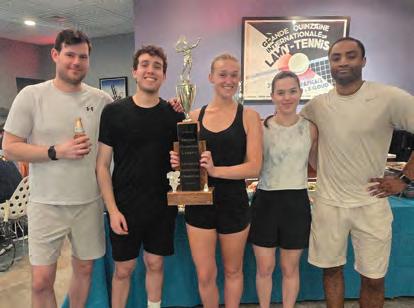
TheMetro Corporate League in New York City is comprised of four total divisions: Intermediate, Advanced Intermediate, Advanced and the Hi-Five. The latter is a division designed more for fun,
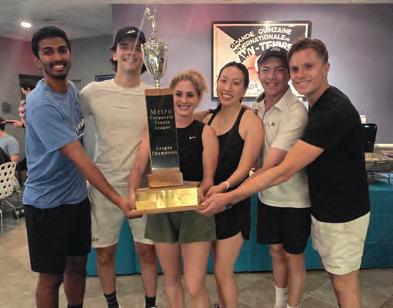
recreational play, where the former three are more competitive-based. At the end of every season, players from all teams are invited to Roosevelt Island Racquet Club in Manhattan for the end-of-season party and finals.
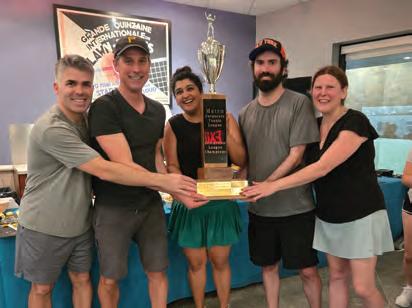
Held over the course of two nights, the top two teams in each of the three competitive divisions battled it out for the league championships, while players from the other teams gather to watch, and enjoy delicious food and drinks, putting a perfect end to the Winter 2026 season.
“Competing in the Metro Corporate League is a lot of fun,” said Alexandra Wojciak. “It allows people to connect in a non-business setting where they might otherwise never meet. Meanwhile, the tennis world is very small, so you are also able to spend time with people you may know very well. For example, my long-time hitting partner since childhood competes in the same division for another firm and we are able to catch-up after matches for happy hour.”
That camaraderie is at the heart of what makes the Corporate League so special for these young adults, but it’s also the competition and high-level of
play that allows these players to maintain that competitive spirit.
Wojciak is the captain of the MUFG team. A year ago, in the Fall 2025 season, her team finished in last place. But that result motivated the team this time around, and MUFG captured the Advanced Intermediate Division title, and will move up into the Advanced Division next season.
“Because the match is determined by total games won across all matches, as a team we knew that we had to try out best to keep each set close, even if we were losing,” explained Wojciak. “Our opponents were very strong and we were actually down heading into the last two mixed doubles sets. In order to seal the victory, we had to win both sets by a decisive margin.”
The key to the victory? Wojciak said:
“I think our team’s chemistry was ultimately what helped us to achieve this. For example, my doubles partner and I have been working together at MUFG for four years. Our shared passion for the sport helped us win both on and off the court.”
MUFG will now compete in the Advanced Division in the Summer 2026 league. The winner of the Advanced Division this past season was AlphaSights, captained by Michelle Sorokko with the trophy now residing in their office.
In the Intermediate Division, the team from Penguin Random House were crowned champions, as the team captained by Gianni Latorre had to pull off a comeback of its own in the finals.
“After the first two matches, we found ourselves down by five games, so we knew we had to dig deep,” explained Latoree. “We locked in mentally and focused on winning one point at a time rather than thinking about the scoreboard, and that mindset helped us claw back some of the deficit through the singles matches.”
Even so, Penguin Random House was still trailing heading into the two mixed doubles contests.
“That’s where the real difference was made. Our strategy going into those was to balance the pairings and give ourselves two strong, competitive courts. We trusted our
depth as a team and it paid off. We ended up winning both matches convincingly and took the finals by six games; it was a real team effort from start to finish.”
Latorre’s team now moves into the Advanced Intermediate Division for the Summer 2026 season, and he and his team are excited for another season in the Corporate League.
“We absolutely love it. The Metro Corporate League has been such a rewarding experience on multiple levels. It's given us the chance to connect with coworkers from our own company that we probably never would have crossed paths with otherwise, which has been a sweet bonus,” he said. “And beyond our own team, we've gotten to meet and compete against great people from other companies across the city. But honestly, it's also just genuinely fun. There's something special about being part of a competitive team at this stage of life — the camaraderie, the competition, the excuse to get out on the court every week. We'd recommend it to any working professional looking for a great outlet.”
The Summer 2026 season in the Metro Corporate League runs through August. Please visit Metrotennis.com to learn more, or contact Luis Espinoza at (347) 886-3117 or luis@metrotennis.com.
By Dr.Tom Ferraro
Mentalhealth has become a central concern in sports. The emotional collapse of Michael Phelps, Naomi Osaka, Tiger Woods and Simone Biles all demonstrate this problem. Burnout, injuries and emotional breakdowns have grown into one of the most common issues in sports and is expressed in three stages.
Stage One Burnout is revealed in a prolonged slump with flat performance, loss of motivation and irritability.
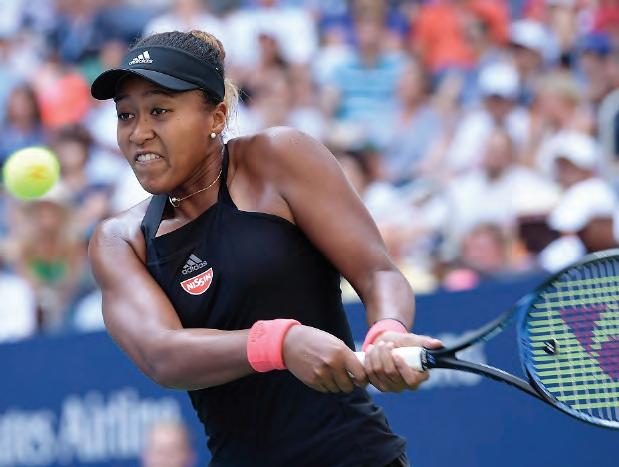
Signs of Stage Two Burnout are vulnerability to colds, the flu and other illnesses.
In Stage Three Burnout, the player gets injured or has an emotional breakdown.
A classic example of burnout was seen in Naomi Osaka when she had her emotional breakdown at the French Open and walked away from her career for nearly two years. The question that needs to be asked is, why is there now so much burnout and emotional breakdowns in athletes?
There is a multitude of factors that have caused the escalation of burn out. Most think year round training and early sports specialization are the cause but really they’re symptoms of a much bigger and deeper problem.
In America everyone wants two things: fame and fortune. Everything else comes after that. Things were not always this way. Back in the 1950s, doctors took off every Wednesday to play golf. They even
made house calls. No one worked on weekends and stores were closed on Sundays. But those days are long gone.
Ever since around 1970, there has been growing income gap and a bigger gap between the haves and the have-nots. The middle class is increasingly pressured to keep up and find a way to the golden zip codes, the right country clubs and the best college for their kids. But good colleges now cost about $100,000 per year which means your kid must get a tennis scholarship. Its either that or a job at McDonalds.
But money and scholarships are not the only reason kids are burning out. Kids want fame too. They are bombarded by approximately 4,000 to 10,000 advertising images each day suggesting you’re either famous or a nobody. You’re either Roger Federer or a zero. As an example of
this pattern look back to 1990 when Andre Agassi did a commercial for Canon cameras. There was the long haired Andre Agassi stepping out of a Lamborghini, lowering his sunglasses and proclaiming “image is everything.” This message means you are look rich, cool and nice looking, or you’re a nobody.
Our age of narcissism forces obsessive selfpromotion to achieve fame. It is both ironic and sad that the famous actually hate being famous. I have worked with many athletes who suffer with The Arrival Fallacy which means that they get depressed after winning an ESPY or a Hall of Fame award and quickly realize that they have not achieved permanent bliss but in fact they must get up the next day and get back to work.
And now kids have social media to worry about which creates FOMO, envy, jealousy and a mad rush to post their own Instagram photo.
The hyper- competitive world we have given to our children often leads to burnout, anxiety and depression. So what can we do about this? Parental influence wanes drastically by the time your kid reaches puberty but before that here’s what you can do to instill some mental health and happiness in them.
1.If you feel they are approaching a burn out point you can reinforce their rest and recovery behavior by pointing it out when they do so. When they are resting say to them: It’s good to see you taking it easy.”
Pointing out desired behavior when you see it is more effective than telling them what you want.

2.Model relaxed restful behavior. Kids learn how to act by observing how you act, not by hearing what you say. If you have a balanced life of both work and play, they will learn this.
If your kid looks like they’re on the verge of burn out, reinforce times when they rest by approving of it
3.Henry Miller, the great American novelist was asked about how to raise happy kids and he said “Make sure you tell them you love them every day.” Parents think that kids knows this but often they don’t so tell them.
4.Applause, fame and winning is a highly additive experience,
more addictive than heroin or cocaine. When your young prodigy begins to win tournaments, trophies and applause, the typical process is that they want more and therefore lose the joy of playing their sport. I say that fame steals the soul of the athlete. Many



athletes I have worked with begin by saying they’ve lost the joy of playing and desperately want to get it back. If your kid is winning big, it would be a good guess that they want more and more wins. But this means less fun and more grind. You can talk to them about this so that they don’t eventually wind up like Naomi Osaka or Tiger Woods, players that got to the top of the world only to come crashing down in shame and confusion.
We live in a hyper competitive, stress-filled anxiety ridden world. Remember that sports are supposed to be fun and enjoyed. If you want to raise a healthy child make sure you live a balanced fun-filled life yourself and talk to them about happiness. Your values will become their values. That’s the secret to good parenting.
Dr. Tom Ferraro is a pioneer in the field of depth sport psychology and his work has been featured in The New York Times, The Wall Street Journal and The London Times. He has appeared on all the major television networks and his books, are published by Routledge and can be found through Amazon and a variety of other major book distributors. He can be reached at drtferraro@aol.com.




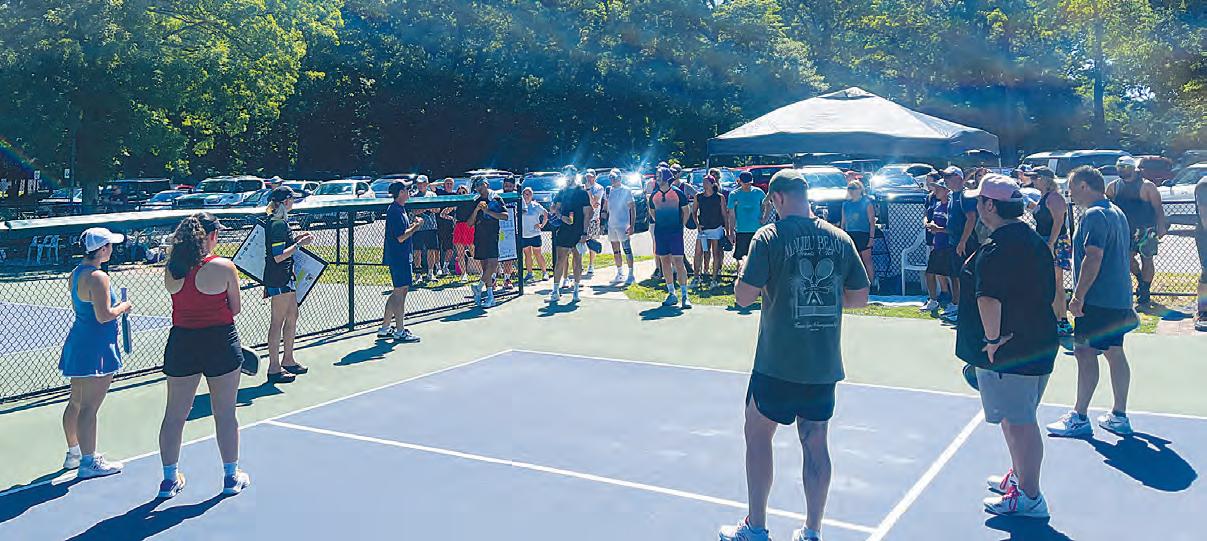
Pickleball teams came out to SPORTIME Hempstead Lake on a hot Saturday morning to compete in the Long Island Pickleball Challenge presented by Orlin & Cohen Orthopedic Group, the first outdoor pickleball tournament of the 2026 Event Series.
Battling through the heat, doubles teams competed across four different divisions, first persevering through roundrobin play that led into the knockout
rounds. There was a continental breakfast including fruit, bagels and muffins provided complimentary for all players, and as the tournament progressed, a happy hour was available.
“I would like to thank our title sponsor Orlin & Cohen Orthopedic Group for their amazing support in helping us put on a professionally-run and successful event. We made sure all participants
played a lot, that the tournament ran on time and that we had food, drinks, etc. available to players during the tournament,” said Tournament Director David Sickmen. “I also want to thank SPORTIME Hempstead Lake for hosting and doing a great job of getting the courts ready for play, and my cotournament director Michelle Stoerback for all of her hard work in tournament coordination. Also, a thank you to the
players who participated. It all works together to make this a successful event. We’re excited to continue to grow our presence in the pickleball community with more tournaments and media coverage for the sport.”
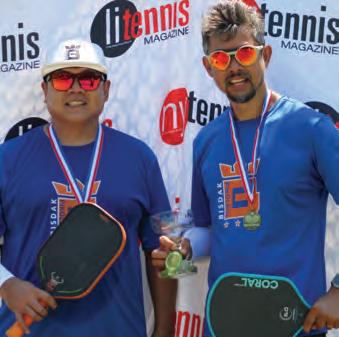
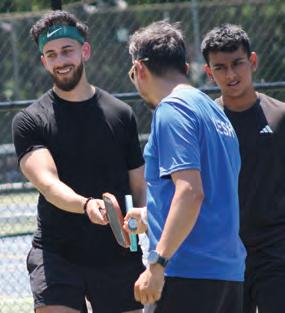
The matches proved to be incredibly competitive, and that was on full display in the final of the Men’s Doubles 3.54.0 Division. Josh Lesh & John Enriquez found themselves down 5-10 in the Gold Medal match against Azmain Chowdhury & Pratham Jain, only to rally and win the final 10 points of the match to claim the title.
“It was all or nothing at that point,” Enriquez said. “We just wanted to go for it. To win the final 10 points and win the title is amazing. Those guys knew how to play, and we just had to be consistent down the stretch.”
Lesh added:
“I was cramping a bit so that timeout when we were down was big for us. The whole experience of this tournament was
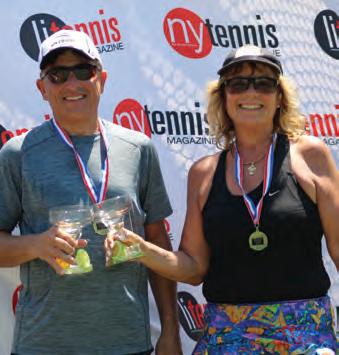
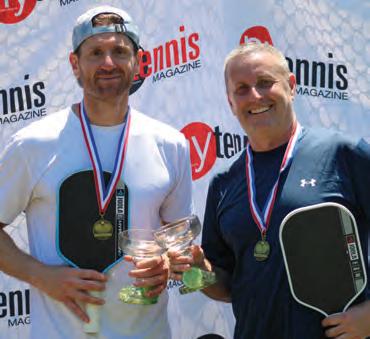
Mixed Doubles 3.5 - 4.0 Champions: Rob Weinstein & Kathy Sadowski
fantastic. It ran smoothly, and the drinks at the end to celebrate were amazing!”
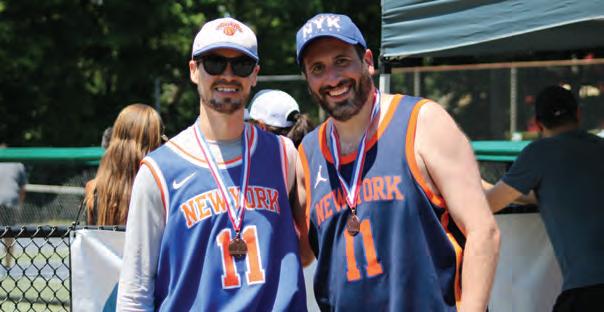
Brad Berger & Jordan Engel claimed the title in the Men’s Doubles 4.0 - 4.5 division as they defeated Luis Paloma & James Valerio 15-10 in the championship.
“It was a very competitive tournament,” said Engel. “I think managing the conditions mattered most. It was hot, humid and windy and I am glad that we were able to pull through.”
When asked what inspired their play, Berger said:
“The Knicks were our inspiration. If they can do it, so can we!”
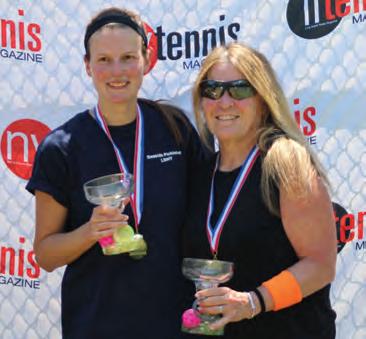
Samantha Perri & Lisa Goldberg were competing in their first pickleball tournament together. But knowing each other for a long time, they were quickly able to find on-court chemistry, and as a result, won the Women’s Doubles 3.54.0 title with a 15-7 victory over Rachel Neuman & Denise Torres.
“We know each other so well it was easy to get used to each other’s games, it came naturally,” said Perri. “The tournament went great, and it was a beautiful day for pickleball.”
“Sam is an amazing pickleball and
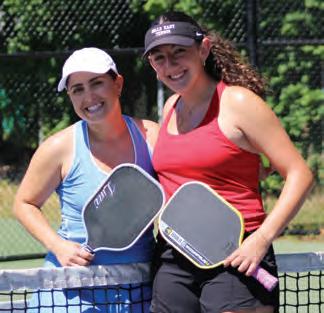
tennis player, and we were able to endure the heat. Everyone here were good competitors and very nice; I’m just glad we were the winners.”
In similar fashion, Rob Weinstein & Kathy Sadowski were competing in their first tournament together. But they play together often in the park and were able to come together as a successful team.
Men’s Doubles 3.5 - 4.0
Gold: Jose Lesh & John Enriquez
Silver: Azmain Chowdhury & Pratham Jain
Bronze: Christian Navarro & Jaime Yoo
Men’s Doubles 4.0 - 4.5
Gold: Brad Berger & Jordan Engel
Silver: Luis Palomo & James Valerio
Bronze: Ari Bisk & Ludovic Masson
Women’s Doubles 3.5 - 4.0
Gold: Lisa Goldberg & Samantha Perri
Silver: Rachel Neuman & Denise Torres
Bronze: Emilie Katz & Abby Learner
Mixed Doubles 3.5 - 4.0
Gold: Rob Weinstein & Kathy Sadowski
Silver: Jason Pomerantz & Lori McBride
Bronze: Christian Navarro & Jaime Yoo
The duo defeated Jason Pomerantz & Lori McBride 15-4 in the championship match of the Mixed Doubles 3.5 - 4.0 division.
“The competition was not easy, we played some good teams, and we were just able to hit better shots today,” said Sadowski.
Weinstein added:
“We played like a team. We play a lot together and it was great to win our first tournament together.”
The feedback from the players was extremely positive, which continues to motivate Long Island Tennis Magazine to continue building off of the success of these events. The next Pickleball Challenge is scheduled for September.


By Dr. Eric Price
he rotator cuff is a group of muscles that originates on the shoulder blade (the scapula) and insert on the top of the arm bone (the humerus).
The function of the rotator cuff is to move the shoulder. Often, the rotator cuff is inflamed or torn in people with painful shoulders. People typically complain of difficulty with overhead activities, like reaching for items off a high shelf, brushing the back of the hair or fastening a bra. Often, people have difficulty sleeping on the painful shoulder.
To evaluate for a rotator cuff tear, a doctor will perform an examination after a history is taken. X-rays are performed, and often an MRI is ordered. The X-rays will evaluate the bones in the shoulder, but not the rotator cuff itself. The MRI will show the muscles and tendons around the shoulder and allow the doctor to see the rotator cuff. If the MRI shows a tear in the rotator cuff, then surgery may be recommended.
If no tear is present, an MRI may show rotator cuff “tendonitis.”
Tendonitis is inflammation of the rotator cuff without tearing. This can be responsible for producing shoulder pain. Tendonitis often occurs with "bursitis.” Bursitis is inflammation of a fluid filled sac (bursa) on top of the rotator cuff that serves to lubricate the movement of the shoulder. The inflamed bursa can be pinched with overhead activities, causing pain.
Bursitis is very common among tennis players. Many factors contribute to bursitis, or rotator cuff inflammation, including poor form, a weak core or overuse, among others. Physical therapy, rest, and antiinflammatory medications like Ibuprofen are key components of treatment for an inflamed rotator cuff.

If surgery is recommended, it is usually performed arthroscopically.
Arthroscopic surgery uses small incisions and small tools, about the size of a pencil, to perform the procedure. All the work is visualized with a small camera, the arthroscope. The surgeon sees inside the shoulder with the arthroscope and its images are projected on a video screen.
During surgery, rotator cuff tears are repaired by stitching the torn tendon back to the bone by using an anchor inserted into the bone.
Patients usually go home the same day, often in a sling. Recovery after rotator cuff surgery is gradual. Several months of physical therapy will be required for a proper recovery. Activity restrictions will apply after surgery until appropriate rehabilitation goals have been achieved. Eventually, return to sports will be permitted.
Eric Price is an orthopedic surgeon with 20 years of experience treating athletes. He is passionate about making sure you can get back to the sports you love. He has extensive training and sports medicine in particular focuses on making sure that athletes have proper mechanics when they're playing so they can avoid and overcome injury. For appointments, visit www.northwell.edu/find-care/find-a-doctor/dr-eric-mitchell-price-md-1861491045 or call (516) 536-2800.



Christopher Morley Tennis offers year round Juniors and Adults tennis programs for all levels. Summer Camps, Holidays Mini-Camps and Tournaments, Fitness, Special events and more.


















• Arthur Ashe Kids’ Day to Kick Off Fan Week on Sunday, August 23
• US Open Mixed Doubles Championship presented by Vital Proteins® Returns to Fan Week
• August 24-26, Adding Free-to-Attend, Eight-Team Qualifying Competition
• Fan Week Expands to Seven Days, All Featuring Free Grounds Admission
• Free Fan Access Pass Required for All Adults for Grounds Entry During Fan Week
• US Open Singles Main Draw to Run Sunday, August 30-Sunday, September 13
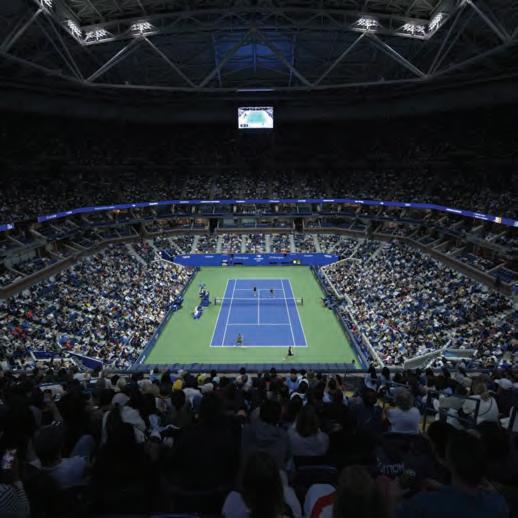
Aswe move through the summer, it means the 2026 U.S. Open is nearly upon us. This year’s event will feature 22 days of tennis and entertainment scheduled for August 23September 13 – eight of which feature free grounds admission – and set to feature the largest event schedule and most competition days in the US Open’s near-150-year history. Scheduling and access updates for this year’s US Open include:
Arthur Ashe Kids’ Day now kicks off Fan Week on Sunday, August 23.
The largest grassroots tennis event in the world and annual US Open tradition honoring Arthur Ashe’s legacy will kick off the US Open on its opening day this year. Admission is free, with family-friendly activities planned throughout the grounds, along with Kids’ Day’s traditional stadium show.
Fan Week – Week 1 of the US Open – offers seven days of free grounds admission, from Sunday, August 23–Saturday, August 29. The full lineup of free and signature
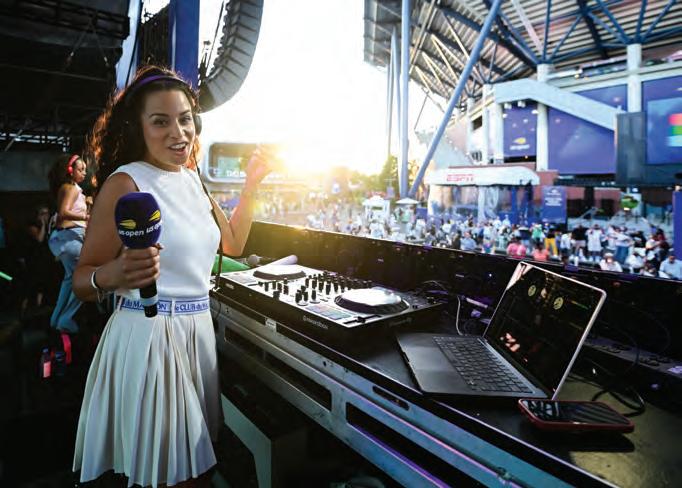
ticketed events taking place during Fan Week – including the second annual Silent Disco and third annual US Open Block Party – is available at usopen.org/fanweek.
Additionally, grounds admission is free on ‘Open for All Day’ on Thursday, September 10, marking eight full days of free grounds admission during the 22 days of the US Open.
The US Open’s free Fan Access Pass is now required for entry for all fans ages 18 and older attending Fan Week. Available through the US Open app, Fan Access Pass is a free digital pass to unlock Fan Week perks, including event registration, giveaways and more. Fans can register now at USOpen.org/FanAccessPass and easily add their pass to their mobile wallet for seamless entry into the grounds.
The US Open Mixed Doubles Championship presented by Vital Proteins® is expanding to add Qualifying. The Mixed Doubles Championship will add an eight-team qualifying competition for two maindraw slots, on Monday, August 24, that is free to attend in Grandstand. This addition follows the US Open Mixed Doubles Championship’s record-

breaking success in 2025 with a reimagined format and never-beforeseen star power, which recently earned Sports Business Journal’s ‘Sports Breakthrough of the Year’ Award.
The 16-team Mixed Doubles Championship main draw will be played Tuesday, August 24 (First Round and Quarterfinals) in Arthur Ashe Stadium, beginning at 10 a.m., and Louis Armstrong Stadium, with the matches in Louis Armstrong free to attend (start time TBC). The semifinals and finals will be played at night on Wednesday, August 25, in Arthur Ashe Stadium, beginning at 7 p.m.
The Mixed Doubles qualifying and main draw entries will be announced in full later this summer.
including Andy
20-time Grand Slam champion, five-time US Open champion, 2026 International Tennis Hall of Fame Inductee and legendary global icon Roger Federer will be returning to the court at the US Open this year to compete in a once-in-a-lifetime exhibition event – ‘Roger Federer: An Icon Returns to New York’ – the night of Tuesday, August 25, inside Arthur Ashe Stadium.
Federer last competed at the US Open in 2019 after famously captivating New York by becoming the only man or woman to win five consecutive US Open singles championships (2004-08). He’ll make his return to Arthur Ashe Stadium this year by playing in an exhibition event alongside 2003 US Open champion and longtime rival Andy Roddick, as well as fellow tennis icons and US Open champions Andre Agassi and John McEnroe. Further celebrity appearances and iconic
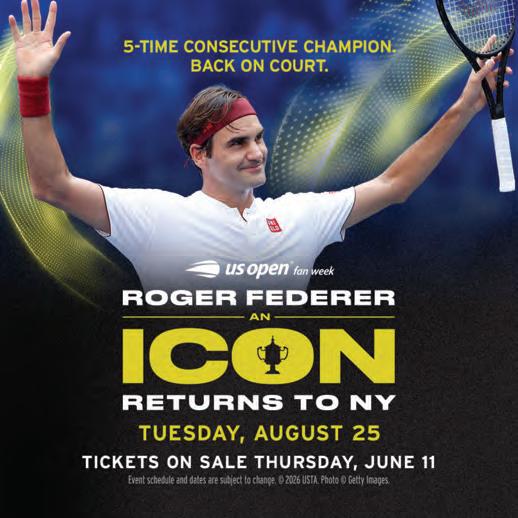
surprises will treat fans throughout the evening, which will begin at 7 p.m. on Tuesday, August 25.
“The US Open has always been one of the most special tournaments for me,” Federer said. “So many unforgettable moments of my career happened in New York, and Arthur
Ashe Stadium is a place that means a great deal to me. I’ve missed being part of that atmosphere and feeling the incredible energy that the fans bring every year. To return to Arthur Ashe and share the evening with Andy, Andre and John makes it even more meaningful. I’m looking forward to celebrating those memories, seeing the fans again, and enjoying a very special night together.”
“It goes without saying that Roger Federer is one of the greatest champions to ever step onto a tennis court, and his legacy at the US Open will carry on for generations,” said Brian Vahaly, Chairman of the Board, President and Interim Co-CEO, USTA. “We're thrilled to welcome him back for this unique and special event, giving fans an opportunity to celebrate Roger's legacy and thank him for all he has meant to our sport."

While warmer weather may have taken its time arriving, Long Island tennis players have wasted no time making their presence felt on the court. Across the region, league competition has been thriving, with players and teams showcasing impressive skill, determination, and sportsmanship throughout the season. As local league play transitions into championship competition, Long Island teams are already proving they can compete with the best in the section.
By Milly Keighery
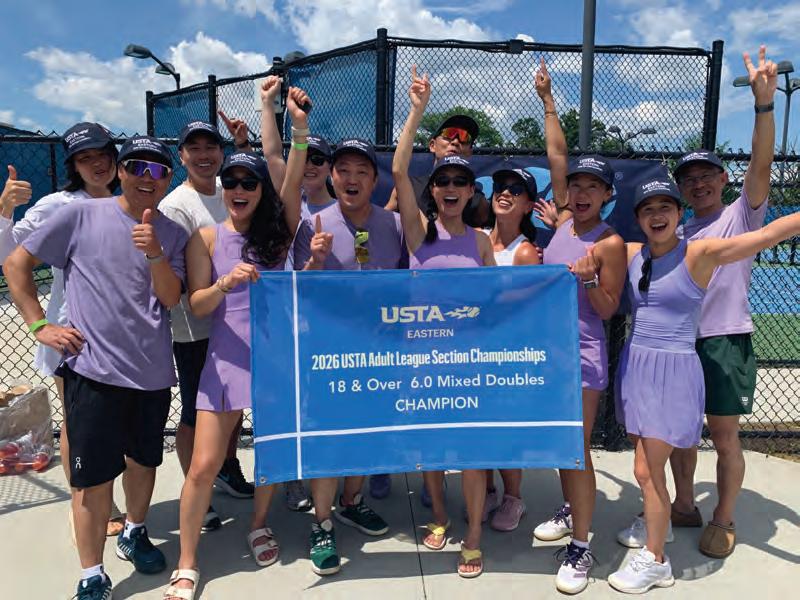
The postseason kicked off with the 18 & Over Mixed Doubles Sectional Championships, where Long Island was represented by a strong group of teams across multiple divisions. Congratulations to the following local champions who earned the opportunity to compete at Sectionals:
• 18+ 6.0 Mixed: Christopher Morley (Captains David Ng and Sophia Yang) – Sectional Champions!
• 18+ 7.0 Mixed: Deer Park (Captains Ramo/Dikman)
• 18+ 8.0 Mixed: Sportime Kings Park (Captains Jackson/Siegelman)
• 18+ 9.0 Mixed: Deer Park (Captain Roslyn Chua-McAlonie)
All of Long Island's
representatives competed with tremendous effort and pride, showcasing the depth of talent within our local leagues. A special congratulations goes to the Christopher Morley 6.0 Mixed team captained by David Ng and Sophia Yang, who captured the Sectional Championship and will now advance to represent Eastern at the USTA National Championships. We wish them the best of luck as they continue their remarkable season on the national stage.
Championship play continued throughout June, with teams competing for local titles in the 55
& Over Mixed and Tri-Level divisions. The level of competition remained high, with many closely contested matches highlighting the dedication and passion that define Long Island league tennis.
Congratulations to the following teams who earned local championship honors and will go on to represent Long Island at their respective Sectional Championships:
• 55+ 6.0 Mixed – Lynbrook (Captain Healy)
• 55+ 7.0 Mixed – Bethpage (Captains Mao/Garfield)
• Men's 4.0 Tri-Level – Kings Park (Captains Jackson/Serbin)
• Women's 4.0 Tri-Level – Long Beach (Captain Simpson)
• Men's 5.0 Tri-Level – Sportime (Captain Hyman)
• Women's 5.0 Tri-Level – Carefree Racquet Club (Captains Bacey/Bonadonna)
We extend our congratulations to all of these teams and wish them continued success as they advance to the next stage of competition.
Meanwhile, local league play has concluded for the 40 & Over Mixed divisions, setting the stage for the final championship events on Long Island's 2026 calendar. These teams will compete at Sectionals in September, providing one final opportunity for Long Island players to pursue championship glory this season.
2026 Long Island 40 & Over Mixed Local Champions
• 6.0 Mixed – Christopher Morley (Captains David Ng and Sophia Yang)
• 7.0 Mixed – Point Set Tennis (Captains Lori Sarnelli)
• 8.0 Mixed – Carefree Racquet Club (Captains Terry Kossegi and Patty Siler)
• 9.0 Mixed – Deer Park (Captain Roslyn Chua-McAlonie)
As we look ahead to the remainder of the championship season, there is much to celebrate. Long Island continues to demonstrate why it is one of the strongest and most competitive tennis communities in USTA Eastern. The commitment of our players, captains, coordinators, and facilities creates an environment where competition and camaraderie go hand in hand, helping the game continue to grow throughout the region.
On a personal note, June marks my one-year anniversary as Long Island Adult League Coordinator. It has been an incredibly rewarding first year, and I am grateful for the opportunity to serve such a passionate and welcoming tennis
community. One of the greatest joys of this role has been getting to know the people who make Long Island tennis so special—from dedicated captains and enthusiastic players to facility managers and volunteers who work tirelessly behind the scenes.
Over the past year, I have had the privilege of watching teams compete, celebrate successes, overcome challenges, and build lasting friendships through league tennis. The sense of community, sportsmanship, and commitment that exists across Long Island is truly remarkable, and it has made this experience both professionally and personally fulfilling.
Thank you to everyone who has welcomed me into this role, offered guidance, and contributed to making my first year such a memorable one. I look forward to continuing to work alongside all of you and to many more seasons filled with competition, camaraderie, and success both on and off the court.


Growingup in Oakland in the late 1980s and early 1990s, Dale Evans was a die-hard fan of his beloved Athletics. Baseball was his first love, and he modeled his own game after the Athletics shortstop Walt Weiss, a native New Yorker. Evans played all sports and began tennis at the age of nine among others, but playing baseball was his favorite as a child. However, after a challenging summer all-star team experience when he was young, he became a bit disillusioned with baseball, and decided to focus his attention on tennis.
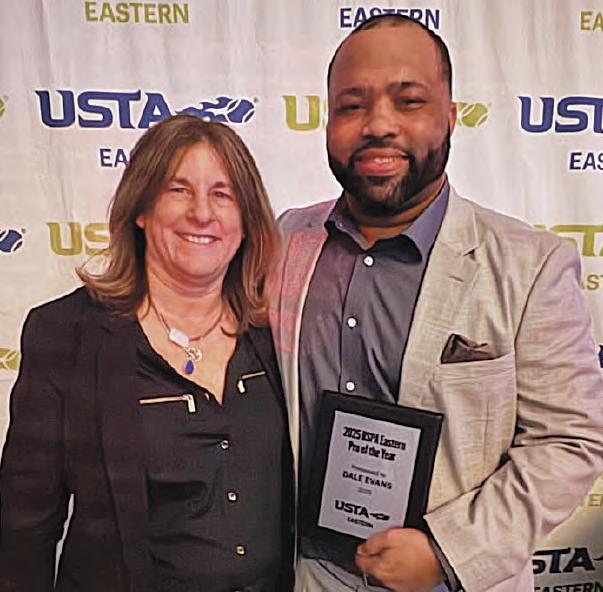
It would turn out to be one of those pivotal moments in a young person’s life that steers them on the right course as Evans stuck with tennis from that point forward.
“A few weeks later, I ended up playing a large tournament called the Pacific Coast Championships,” he recalls. “It was one of the regional championships of the American Tennis Association (ATA), the oldest African-
American sports organization in the United States, and I won the doubles title, and reached the finals of the singles draw. It was a great run, and I pretty much fell in love with tennis during that transition from baseball to tennis.”
His love for tennis translated into a decorated junior career which set him up to play at the next level in college. Out of all the offers he received, one stood out to him above the rest:
Jackson State University in Mississippi.
Both of his parents came from big families (each had 15 siblings) in Jackson, Mississippi, and so Evans and his parents frequently traveled down there to visit family. His father would move back to Jackson during Evans’ teen years, and while down there to see him, he often competed in junior tournaments which put him on Jackson State Head Coach Willie Shepard’s radar.
“He started recruiting me when I was a sophomore in high school, and we had a great relationship from that point forward,” Evans said.
“That combined with the fact that my dad and other family lived in Jackson, made the decision to play there easy for me.”
In his freshman season, Evans helped lead his team to an undefeated conference record and a berth into the first round of the NCAA Tournament, which was the beginning of a wonderful college experience for him.
As his college career wound down, it was time for Evans to consider the next chapter of his life. He competed briefly,
playing in qualifying events for Futures tournaments, but when he did not find much traction there, Evans found himself at a crossroads.
That’s when he leaned on his junior coach and mentor growing up: Mark Manning. Manning was a top junior coach in Northern California, and was the first African American to be President of a USTA Section. Evans debated whether or not he wanted to pursue a professional career in business or marketing, which is when Manning interjected.
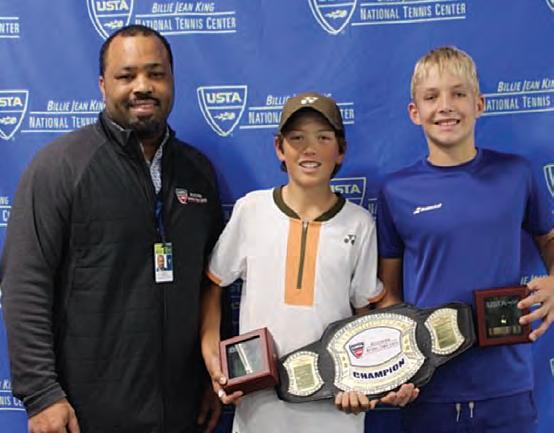
“Quite frankly, the impact that Mark Manning had on my life can never be understated,” Evans says proudly. “He guided me into the USTA family as a committee member, and he really
championed me to become actively involved in the tennis industry. He mentored me to the point where I was able to seamlessly be a part of the USTA at various levels.”
Through that involvement in multiple departments of the USTA, Evans
became exposed to national team coaching where he would become part of the team traveling with the country’s top juniors to national and international events. He became enthralled with coaching and working to improve players both on and off the court. Whereas he was once unsure of what he wanted to do with this life, Evans found his calling.
“The number one thing that I love about coaching is using tennis as a vehicle for connecting with people,” he says.
“Tennis is such a microcosm of life, and being able to utilize the skills that we develop as kids growing up, as well as learn new skills and pick up












continued from page 47
new experiences makes what we do larger than just the sport of tennis alone to me.”
Evans is one of eight people in the U.S. to hold advanced tennis industry certifications as Certified Racquet Sports Executive and University of Florida DORS graduate. Additional certifications include a Racquet Sports Professional Association (RSPA) Elite Professional, Professional Tennis Registry (PTR) Professional and the International Pickleball Teaching Professional Association (IPTPA). He served four terms (eight years) as a board member of USTA Northern California, and more than a decade as a board member of RSPA Northern
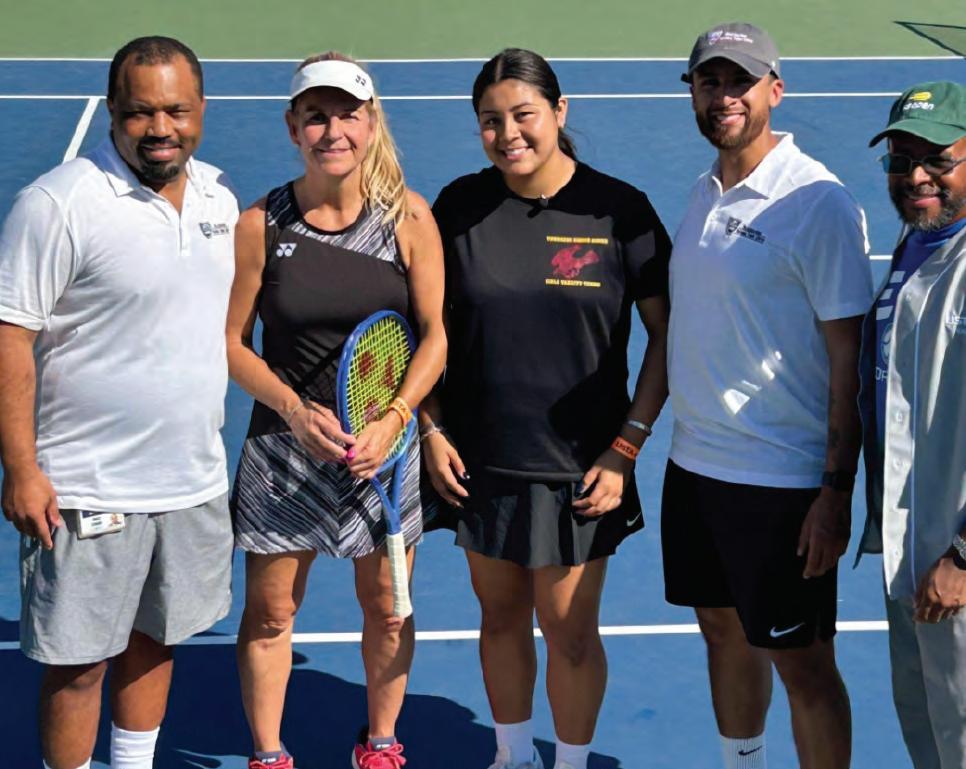
California, among other accolades and distinctions.
Evans worked in the industry for 20 years when in 2022 a new
opportunity emerged. The USTA Billie Jean King National Tennis Center was seeking a new Director of Operations, and Evans was looking forward to a new professional challenge and a fresh experience.











“The opportunity to be a part of the intersection of grassroots tennis and high-performance tennis at a careerdefining facility drove me here,” Evans said. “The USTA is the reason we play tennis as juniors growing up here in America, and the U.S. Open is the goal of everyone who picks up a racquet. The tournament funds grassroots tennis in all 17 sections. I know a lot of people will say that is a corporate answer from someone who has been involved with the USTA for more than two decades. And while that’s true, I grew up in grassroots programs, mainly the Elmhurst Tennis Center in Oakland, and so I have seen just how far that money can go.
It has had a tremendous impact on my life. And so to now work at the epicenter of tennis is a phenomenal opportunity. I don’t take that responsibility lightly, and it’s our priority here to maintain the excellence of our players and programming we have here, while also keeping our eyes open to innovations on the horizon that keep us at the forefront of the game.”
For the last three years, Evans and his team at the National Tennis Center have done just that, continuing the excellent work as both a highperformance haven for top players, but also a community center for tennis lovers throughout Queens and all of New York City.
For those efforts, Evans was awarded the RSPA Eastern Tennis Professional of the Year earlier this year, an award he is quick to credit his staff for.
“This award is very much a National Tennis Center staff award, in
my opinion,” he says. “Our team has set the standard in terms of programming in the New York area, and set the standard in terms of educational and professional development. From Justyna Wereska and Leo Correa embracing continuing education to our team completing over 460 hours of tennis industry education in 2025, our commitment to set the standard is unparalleled.which translates into our NTC tennis players.
Our Red Ball Specialist, Nouri ElHajjar, was awarded the RSI Junior Champion of the Year last year, so it is a total team effort here, and we are excited to continue providing that level of service to the Queens and New York tennis communities."
Evans continued:
“The knowledge base that our pro staff, and the continuous learning they do. Our staff always remain students of the game to make sure they are as versatile in terms of tennis delivery as you can have. We have a team





capable of representing and delivering at all levels and all ages. We have a team that represents the face of New York.”
Evans has been involved in the industry for nearly three decades, and has brought that dedication, passion and expertise to the National Tennis Center. He remains grounded thanks to his wife, Tatiana, and their four children, who joined him as he made the transition from the west coast to the east coast. He is a competitive guy through and through, and that competition which once manifested itself on the court during his playing days, now extends to his work as a coach and a director.
With Evans at the helm, the home of the U.S. Open and one of the core facilities in New York City remains in good hands, as he and his team aim to continue delivering the most elite tennis instruction, coaching and services they can.







By Chris Lewit
Manyyears ago in Spain, I was on court with Lluís Bruguera, the legendary Spanish coach, and a group of American players I had brought to his academy.
One of them was an eleven-year-old boy, very talented, very eager, and very American in the way he had been taught to think about offense. He got a short ball, moved in automatically, and charged the net. Lluís stopped the practice, walked onto the court, and looked at him.
“Why do you always go to the net?”
The boy shrugged. “To be aggressive.”
Lluís kept going.
“How tall are you?”
The boy shrugged again.
“How wide is your arm span?” No answer.
Then Lluís pointed to the court. “How wide is the net?”
Now the boy looked confused. Then came the question that changed the whole lesson. “What is your best shot?”
The boy answered, “Forehand.”
Lluís nodded. “So why do you go to a place that is very wide, when you are not very tall and do not have great reach? Why do you go there to finish the point? Why don’t you use your best shot to attack? Why do you need the net?”
The boy looked shocked, and honestly, so was I. I had grown up in New York and in an American tennis culture that treated the net as an unquestioned good. If you got a short ball, you moved in. If you wanted to be aggressive, you attacked the net. And here was one of the great Spanish coaches saying something that almost sounded taboo.
The more I thought about it, the more I realized this was not a minor disagreement over tactics. This was a completely different philosophy of what aggression is, when net play makes sense, and how a player should be taught to build a point. The Spanish
lesson was not to never go to the net, it was something more demanding: go only when you have earned the right. That distinction has stayed with me ever since.
One reason this moment felt so shocking is that, in American coaching culture, the player who moves forward is seen as brave, assertive, and proactive. The player who stays back is too often described as passive, cautious, or even fearful. But tennis does not reward virtue in the abstract. It rewards sound decisions. A player can move forward and still be making a losing play. A player can stay back and still be the one applying all the pressure in the point. What the Spanish approach does so well is strip the net of its moral aura. The net is not holy ground. It is not automatically a place of advantage. It is simply another area of the court. That is a more mature way of seeing the game that refuses to confuse the appearance of aggression with the reality of control.
Not every short ball is a true opportunity. Some are low and awkward. Some sit in a way that invites a rushed approach without enough penetration on the shot. Some are deliberate traps from good defenders and counterpunchers, who know exactly how eager certain players are to come forward. A player who has been trained to treat every short ball as a command will often walk right into those traps. They see the court opening up, come in too soon, and suddenly has to volley from their shoelaces or defend a clean pass or lob.
In those moments, coaches often blame the volley. But the real error usually happened earlier. The approach was chosen automatically instead of intelligently. What the Spanish coach
teaches is discrimination. They are telling the player that tennis is a reading, not a reflex, game.
Instead of telling the player to rush forward at the first chance, the Spanish method asks him to build the point properly. Use the serve. Use the return. Use the rally. Move the opponent. Attack the weaker side. Create discomfort. Use your forehand—often your real weapon—to do actual damage before you think about coming in. In this model, the net is where you go after you have already been aggressive in a productive way.

It means the approach shot has to buy you something. It has to force a weaker reply, reduce the opponent’s options, and make the next ball manageable. When players are taught this way, the first volley is easier, positioning is better, and the percentage of successful net approaches increases. The point is not to come in more often; it’s to come in under better conditions.
This is the part players almost never think about enough. They assume the only aggressive option is to bring themselves forward. But often the better tactical question is whether you should bring your opponent forward instead. I ask my students this all the time: “You go to the net, where your volley is weakest, and your opponent stays on the baseline, where he is strongest? Why don’t you ever bring him to the net, where he is weakest with the volley and overhead, while you stay back, where you are strongest?”
That line of questioning usually stops them because it forces them to rethink what aggression actually is. It changes the geometry of the point, but more importantly, it changes the logic.
A good drop shot is not just a soft touch
shot or a piece of flair. It can be a way of forcing the opponent out of their comfort zone and into yours. Many players are far less comfortable moving forward, picking up low balls, improvising with touch, and finishing with a volley or overhead than they are grinding from the baseline. Yet players forget this because they are so conditioned to think of the net as a place they themselves are supposed to conquer. Sometimes the strongest play is not to occupy the front of the court but to make your opponent occupy it. That is another form of selective aggression, and often a very intelligent one.
One of the quiet mistakes in junior development is teaching players to finish points before they know how to construct them. A young player may be talented, fast, and eager, but if they are still developing physically, and still building identity from the baseline, then constant net rushing is often a tactical fantasy. That was the brilliance of Bruguera’s line to the boy in Spain. He was forcing him to confront the physical reality of the court. The net is wide. You are not. Why choose the area of maximum exposure when your best weapon is still your forehand? Why abandon your strength to enter a zone that punishes lack of reach?
This is where the Spanish system often
feels more organized and grounded than the American one. It respects the order of development. First, develop the movement, endurance, shot tolerance, patterns, and a weapon from the back of the court. Then, once those things exist, the player can learn how and when to move forward. A player with a solid base can always become more aggressive later. A player who rushes too early often builds major holes into the foundation of the game.
In the end, the case for selective net play is not ideological. It is practical. Tennis is a percentage sport, and the best tactical choices are the ones that improve your odds over time. A player who comes in less often but behind stronger approach situations will usually win a much higher percentage of net points than a player who obeys a blanket rule and charges whenever the ball lands short. This is why the Spanish method makes so much sense. It is based on judgment rather than doctrine. It does not reduce the game to slogans like always attack the short ball




or an aggressive player always finishes at the net.
That is why the lesson with Bruguera stayed with me. What sounded at first like heresy turned out to be realism. The net is not always your friend. Sometimes it is a gift. Sometimes it is a trap. Sometimes the aggressive play is to go forward, and sometimes the aggressive play is to stay back one more ball and let your best shot do the work. Once you understand that, the game opens up in a different way: you stop playing by reflex, and start playing by reason.
What Bruguera said to that boy in Spain has stayed with me because it exposed something deeper than a tactical disagreement. The game is more nuanced and demanding than that. Tennis asks players not just to be aggressive, but to be discerning. Not just to attack, but to understand when, why, and under what conditions an attack makes sense. The sentiment is not anti-net, but rather antiautomatic. Once you see that clearly, you start to understand the difference between playing hard and playing smart.
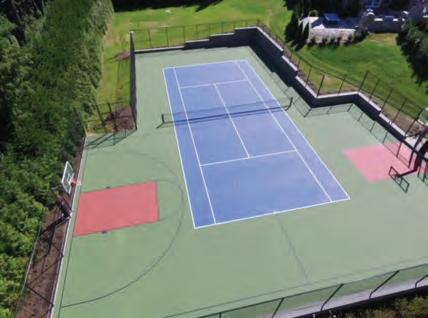
By Brian Coleman
Nearlyevery day of the week, Mark Persaud and his father make the drive from Queens Village to Point Set Racquet Club in Oceanside. It’s a trip they have made four days a week for the last several years as Persaud continues his tennis development and climb the ranks of top junior players in the USTA Eastern Section and the Metro Region.
“It’s about a 20 minute drive depending on traffic,” Persaud said. “I would definitely say it’s worth it. There’s a great group of players there. We all have our mind on the same thing, and that’s improving.”
Persaud is a top junior in the Boys 16s division in Eastern with a UTR north of 8. His introduction to tennis came the way a lot of young people begin playing. His parents were looking for something active for Mark to do, and decided to enroll him in group lessons at Cunningham Park Tennis Center near where he lives in Queens. He also played soccer at the time, but
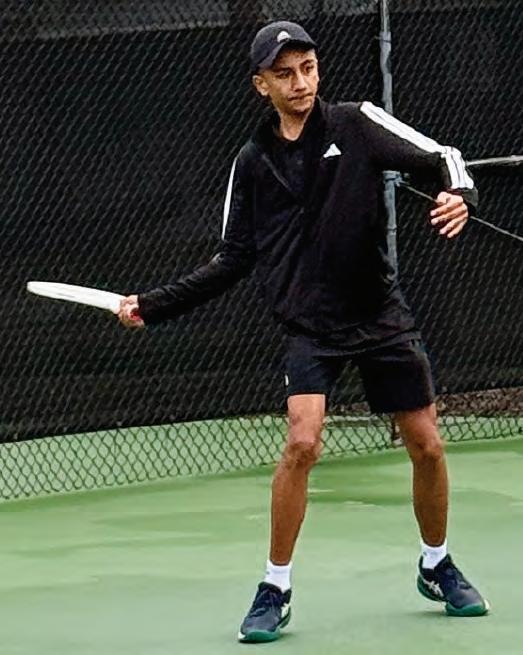
after experiencing the joy and thrill of tennis, it quickly became his true passion and the sport he wanted to focus his attention on.
“I played both sports until I was nine-years-old, but I realized how much I loved tennis,” he recalls. “I think it’s because it’s such an individual sport, and there’s so much you can do with it. I felt like soccer was just passing and scoring, but in tennis you can slice, hit a drop shot, use different spins, and I just decided to stick with it.”
A memorable moment that validated that decision for him was winning a tournament, his first and that winning feeling stayed with him.
As he got older, he wanted to continue to push himself to be the best tennis player he could be, and that’s when he met Danny Casesa of Point Set Tennis. The two were introduced to each other through Persaud’s coach at the time who recommended Casesa to Persaud as a way to further his development.
Casesa gave him a blunt assessment of his game, which
was something that Persaud and his family wanted:
“When I met him and he first saw me play, he told me there was a lot of stuff I needed to fix,” Persaud recalls with a laugh. “He really liked me as a player but my technique needed some work. I could tell he knew the game and knew what I had to do to improve. He was straight to the point, and the most honest coach I had met. I had never really heard that before from a coach, so he really inspired me to work harder and do better.”
While some young players and their families would rather hear all positives from their coaches, Persaud met the challenge head on and knew Casesa was who he wanted to coach him. So for the last three years, Persaud and his father have made that drive out to Oceanside to train with him and within Point Set’s junior programs.
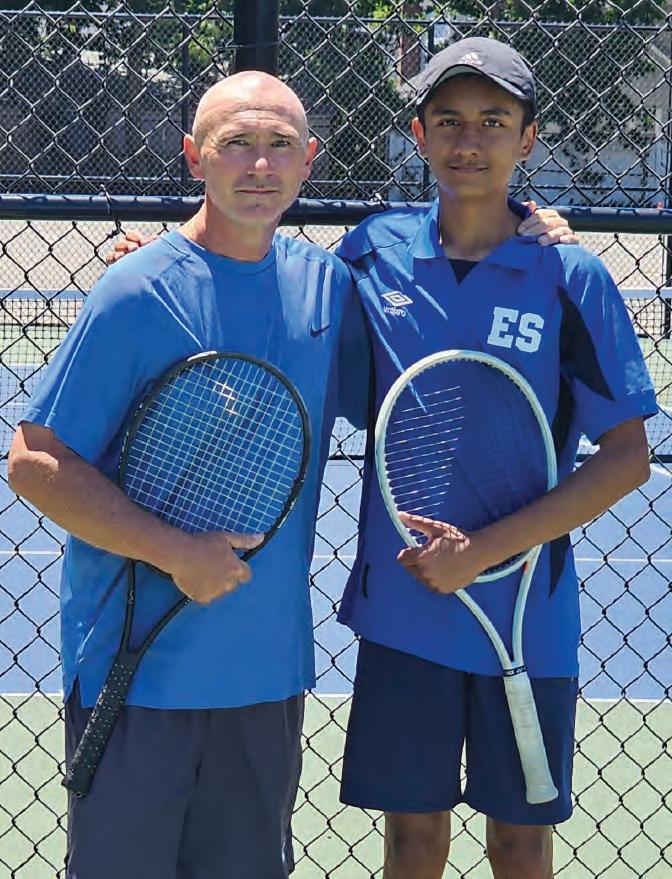
Persaud joined the club’s advanced program and quickly found himself competing and training with players who were a couple of years older than him. He was 13-years-old at the time, and so he had to adjust on the fly.
“It showed me there’s a whole different game, a whole different level to the one I was playing before,” Persaud says. “We trained in a small group of about four or five players, and I was really able to connect with not just them, but everyone at Point Set. The whole team there is nice and supportive, and we communicate well together.”
Training with like-minded players that are older than he is has allowed Persaud to learn a lot about his own
game, and opened his eyes to the areas where he needs to improve in order to elevate to the next level. He takes part in those intimate group lessons on Mondays and Wednesdays, while doing fitness on Tuesdays. On Thursdays is when he has private lessons with Casesa.
Persaud is a player who relies on his variety, utilizing a mix of slices and spins to push his opponent’s back and keep them guessing. His goal in matches, he says, is to make it as difficult as possible on his opponents. Persaud likes to serveand-volley when possible as well.
He admits though:
“I think I need to work on my mental game. Because sometimes I get stuck on a point that I lost, or a game that I lost, and I want to get better at blocking those out and moving on to the next.”
As Persaud has continued to improve in his training and working
alongside Casesa at Point Set, his next goal in the short term is to translate that work into tournament titles.
“I want to win a title in the near future, and at least make consistent deep runs at the tournaments I play,” he said. “It’s come to the point where I have to start showing some positive results. I play L3s and L4s mostly, and I am ready to go deeper in those events.”
When Persaud isn’t training for tennis, he is someone who puts a great emphasis on his academics and spends a lot of time studying for his classes. He loves to remain active even off the court, spending much of his free time throwing the football around with his father, or playing basketball and soccer with his friends. Persaud is big into fitness and spends much of his downtime working out, or swimming on weekends when he isn’t playing in a tournament. His conditioning and fitness will go a long way to helping him achieve his tennis goals both in the short term and the long term.
“Mark is always looking to add more elements to his game, and it’s one of the things that makes him so coachable,” said Casesa. “He’s someone who is comfortable being uncomfortable, and he puts in a lot of time to branch out and get out of his comfort zone in order to improve. He and I will put on the Swing Vision and we go through things after we train or he plays a practice match, and we break down what happened and how to learn from it. I’m proud of his development up to this point and he is always looking for feedback to continue that development.”
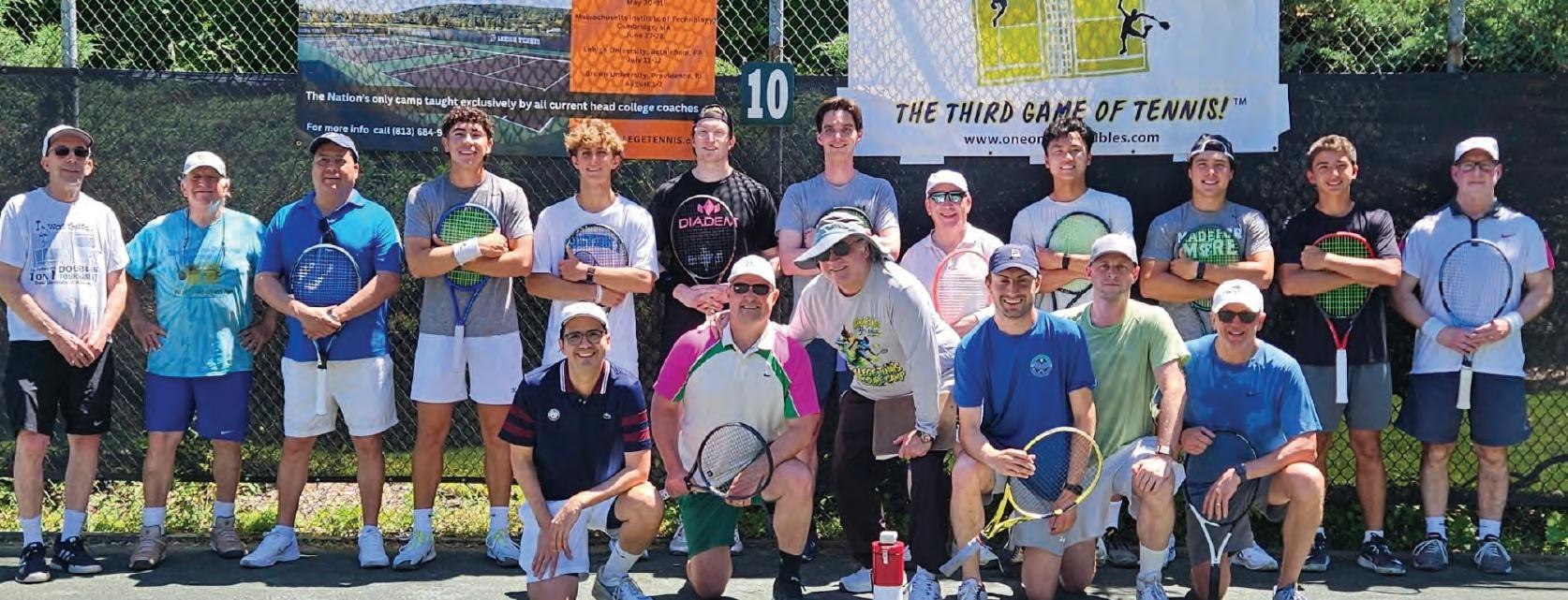
CallumMarkowitz, who will be playing for the University of Pennsylvania this fall after transferring from Vanderbilt, captured the New York One-On-One Doubles title at the Chestnut Ridge Racquet Club in Mt. Kisco.
Markowitz defeated New Rochelle High School’s Alexander Suhanitski, the 2025 NYSPHSAA State Singles Champion who is heading to Notre Dame, 6-2 in the Open Division final. Coming in red-hot after winning the UTR Pro Event in Philadelphia, Markowitz won five sets to win the event.
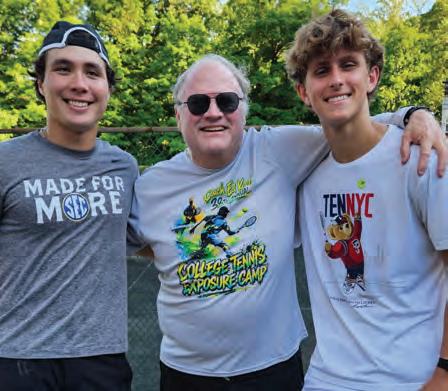
The road to the finals was both difficult and challenging for Markowitz. During the tournament’s round robin phase, Markowitz beat Rye Brook’s Alexander Brzov, 6-5(8-6) and Alexander Suhanitsky, 6-5(7-4). Brzov, who reached #90 in the National Boys 18s tennis recruiting rankings, will be attending Division III powerhouse Amherst College in the fall.
In the semifinals, Suhanitsky defeated Columbia University’s Jordan Chang to reach the finals, while Markowitz beat University of West Florida’s Sebastian Rondon in his semifinal match.
“What a great event. The serve and volley while not nearly as prominent a tennis ploy anymore, is still an effective strategy in winning quick points and developing an all-around game. I always tried to get Callum to play the net more throughout his formative years and still rush the net when the opportunity arises even today as he plays Division 1 college tennis,” said Dan Markowitz, Callum’s father. “The One on One Doubles format is a great way to energize younger plays to add the serve and
volley to their arsenal of shots and plays and it’s also an exciting and athletic style of play for fans viewing the matches as often both players rush the net with the added incentive that if they hit a clean volley or overhead winner, they win two points instead of one. Well done and it’s nice to see tennis played with new innovation.”
Callum said:
“I got better at serving and volleying. I got better at thinking outside the box a little bit more because you can’t play those points like regular tennis points. You have to use more feel; play more cat and mouse. It helps me get better at skills that are important, but you don’t think to use that often. As a high-level player, it’s important to do a lot different things on the court and find new and varied ways to win points.”
The tournament also hosted a Club Division that was won by R.D Ferman, a 6-3 winner over Patrick O’ Mara. The event featured $1,500 total in prize money, with $200 and $100 going to the winner and finalist, respectively, in the Club Division and $700 and $500 going to the winner and finalist, respectively in the Open Division.
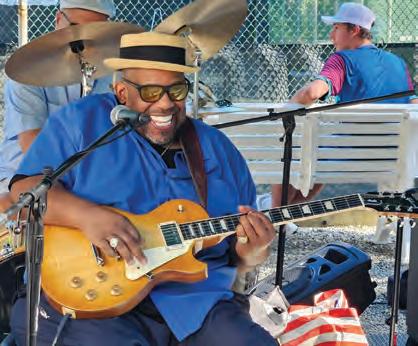
“We’ve hosted Ed Krass three times now, and each time has been a blast! The one-on-one doubles event at Chestnut Ridge Racquet Club has grown stronger and more competitive, and this year, the live band added an extra layer of fun for everyone—on and off the court!” said Brad Breakstone, Director of Tennis at Chestnut Ridge Racquet Club. “It was a fantastic opportunity for some of our members to participate, and we had many others join us to enjoy the music and food. Our owner was there and mentioned that the band really
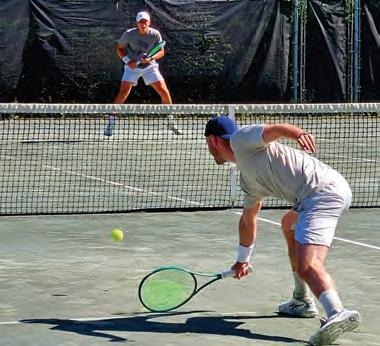
brought a special energy to the club, making it a memorable experience for everyone!”
The next event is the International Tennis Hall of Fame One-On-One Doubles Club Championships, in Newport, RI, on Friday, July 24, followed by a live band and dinner party. This is a private event for members only.
“What makes the four hour event unique, besides all the Serve & Volley Tennis, is the addition of rock and blues music playing during the first two hours. Hudson Valley’s Slam Allen
performed two very lively sets of his original rockin ‘blues and covers the crowd really enjoyed”, stated Ed Krass, Tournament Founder & Event Director.
Tournament sponsors in Mt. Kisco were Diadem Sports and the Pizza Girls NY of Mt. Kisco. On Saturday, September 26, the 2nd Annual New Jersey One-On-One Doubles Championships, will be held at the West Orange Tennis Club, with Mike Smookler, Tennis Director.
For more tournament information, visit www.oneononedoubles.com.




Thereis often a lot of discussion between coaches, parents and experts when it comes to junior and high school tennis. New York Tennis Magazine brought together junior tennis players themselves to find out how they feel and their thoughts on tennis.
What do you enjoy most about playing high school tennis?
Famolari: The team aspect. With tennis being an individual sport, it’s always so rewarding to have a team to turn to, knowing they have my back. Having a team brings everyone together to support each other during matches, no matter the outcome.
Varma: Honestly, it’s the team aspect. Tennis is usually individual, but high school tennis gives us the chance to compete for something bigger than ourselves, represent our school together and be part of a positive competitive environment.
Villacreses: I enjoy playing high school tennis because it’s fun to play with a team and have teammates, and we get to play a lot of matches.
Walsh: Being part of a team. For most of my life, tennis was something I did on my own, so being on a school team gave me a completely different experience. It gave me a sense of family and made the sport feel more connected and supportive. I really enjoyed being surrounded by a great group of people I could relate to.
What are some of the challenges of competing for your high school team while balancing other obligations i.e. private training/tournaments, school work, social life, etc.?
Deckman: Scheduling conflicts is a challenge, but being on the team helped me manage my time well and overall just brought such an amazing experience which taught me valuable lessons. I always try to make time for work and friends so it always ends up working out.
Loewy: Without a doubt, time is the biggest challenge. There simply isn’t enough of it. Our matches can run long, and at home matches we’re short two courts, which makes those days especially tough. During the season, everything else tends to take a back seat, and it can be hard to keep
up with schoolwork and other commitments. But as a team, we rely on each other and do our best to lift each other up.
Ostrow: One of the biggest challenges is managing time between schoolwork, team practices, and individual tournaments. It can be tough to stay on top of academics while also committing to training and matches. Social life often takes a backseat during the season as well.
Shah: I think the main challenge is being able to organize my time and communicate effectively with peers and adults in other activities that I’m involved in. For example, it’s sometimes difficult to compete in academic tournaments while making high school tennis practice and still being able to hangout with friends. However, in my experience, these challenges are always resolvable if I communicate with everyone involved.
Do you play other sports? If so, what sports and how do you feel it helps improve your tennis game?
Lippman: Another sport I play is lacrosse. Playing lacrosse has helped me to work better with a team and has helped me to understand that a missed shot or a bad pass isn’t the end of the game, its a chance to reflect and improve. I have been able to bring these skills over to tennis by being able to communicate with my doubles partner better and not letting a double fault or two ruin the rest of my match.
Loewy: I’ve always played a variety of sports, including basketball, soccer, and flag football. They’ve definitely helped my tennis game by improving my footwork, speed, agility, endurance, and overall court awareness. After this past season, and dealing with some nagging injuries, I decided to take a break from other high school sports. But I strongly believe that playing multiple sports helps build better athletes.
Shah: I don’t play any other sports competitively. However, I play sports like basketball and spikeball recreationally with my friends. I also run in the off season. These activities simply help me stay conditioned for tennis season.
Walsh: I do not play any other sports competitively, but I do enjoy playing different sports for fun with my friends. I also like going to the gym, which helps me stay in shape and build strength. Playing for fun and staying active helps with my movement, coordination, and overall athleticism. I think those things can definitely help me on the tennis court.
How much time do you dedicate to fitness and conditioning?
Bohner: I dedicate about three days a week, for about an
hour a day, more or less depending on my tournament schedule.
Deckman: Around 4-5 times a week when I can.
Famolari: Fitness and conditioning are so important for my game, both for physical and mental toughness and strength. I dedicate a significant amount of time each week to fitness and conditioning, both during the season and in the offseason. I try to go on runs 3-4 times a week during the offseason, it helps me get my cardio in when I’m not playing tennis. Strength training is just as important to me, I go to the gym pretty much every other day after school and weekends. Improving my fitness has helped improve my tennis game so much for the physical and mental aspects.
Ostrow: I usually dedicate a few days each week specifically to fitness, including strength training, agility, and endurance work. During the season, it’s more integrated into practice, but I still try to stay consistent. Overall, it’s an important part of improving performance and preventing injuries.
What is one thing you wish parents/coaches understood better about you and your tennis experience?
Shah: I think my parents and coaches understand this well already, but I’d just like to emphasize that so many of the benefits of my tennis experience have come from playing on a team. While I love the sport, the team aspect of tennis has contributed the most to my growth.
Van Cott: One thing I wish my parents and coaches knew about me in tennis is that no matter how upset or mad I might look during matches their support and cheers still mean everything and help me so much during a match even if it doesn’t always seem like it! Big cheers and celebrations definitely help me pick up my mood and stay more intense in a match which is exactly what I need when I feel down.
Varma: I think one thing is that most of us already put a lot of pressure on ourselves. We care a lot about how we play and improving, so what helps the most is support and trust, especially during tough matches. That’s when it really makes a difference.
Walsh: One thing I wish parents and coaches understood better is that tennis can be very mentally demanding, especially for someone who has mostly played individually. A lot of pressure comes with the sport, and sometimes people only focus on results instead of everything that goes into competing. I think it is important to understand that players are always learning,
adjusting, and trying to improve. Support and encouragement can make a big difference in that experience.
Having the U.S. Open in our backyard is such a unique part of our community. How do you take advantage of having the Open so close to here?
Famolari: It’s an incredible opportunity that not many people get to experience. I take advantage of this by going to the US Open in person. I take the train straight into the city and make a day out of it with my friends. Being able to watch these athletes so close to home is such a great privilege.
Ostrow: Having the U.S. Open nearby is a great opportunity to watch high-level tennis and learn from the best players in the world. It’s really motivating to see that level of competition up close. It also gives me a better sense of what it takes to compete at the next level.
Villacreses: I like to go watch the U.S. Open Fan Week to be able to see a lot of players and even meet them.
Do you feel you will continue with tennis after high school? In college or thereafter, what does your tennis future look like?
Cohen: Right now, the focus is on the team and putting the work in this season. That said, I’ll keep competing after the spring, tennis is something I enjoy too much to step away from. At Ross, you’re encouraged to pursue what you love at a high level while keeping it in balance, so for me it’s about continuing to compete, keep improving, and enjoy the process.
Deckman: I think I’d want to play club tennis when I am in college. I love the sport and do wish to continue in the future.
Varma: Yeah for sure. I don’t see myself ever fully stepping away from tennis. Whether it’s competitive or just playing in college for fun, i truly enjoy the sport so I know I’ll stay involved in some way.
Villecreses: I’m going to keep playing tennis beyond high school. I would love to play in college and hopefully can continue playing afterwards also.
Long Island Tennis Magazine provides season-long coverage of the high school season including written recaps, photos, etc. How much does this enhance the high school and junior tennis experience for you and your peers?
Deckman: I love the season-long coverage. It makes me
so happy when I see my school in the magazine and it’s just an overall positive experience!
Loewy: Long Island Tennis Magazine makes every season feel special. When the photographers show up on my court, I get that nervous excitement that motivates me even more. They always capture the emotion, and it allows us to relive matches off the court. It also helps us stay connected to tennis across the county. We may be rivals, but at the end of the day, we’re one big tennis family.
Shah: Long Island Tennis Magazine always adds a great dimension to the high school season. For players, being interviewed on court and having pictures published in the magazine is really motivating. LI Tennis Magazine also helps build energy and excitement before and during the season. I know all of the guys on my team love when LI Tennis Magazine pulls up to our matches!
Do you think more top players should play high school tennis? Why or why not?
Ostrow: Yes, I do think more top players should play high school tennis because of the amazing opportunity that it gives them. With a chance to compete for their school and in state tournaments, it is a unique opportunity that all top players should utilize.
Varma: Yeah, I do. I think high school tennis gives you something different that you don’t really get from tournaments. You get to be part of a team, represent your school, and just enjoy the sport in a different way. It’s a really valuable experience.
Walsh: I definitely believe that more top players should get involved in high school tennis. Growing up, tennis often felt like an individual sport where you were mostly on your own, so being part of a high school team adds a new and exciting side to it. I think it would be fun for top players to compete alongside each other in a team environment. It would also give players who have never tried high school tennis the chance to be part of something different and meaningful.
What’s something you will remember about your high school tennis career?
Famolari: Something I will remember about my high school tennis career is the amazing accomplishments my team and I have made. By winning All League 3x, winning All State 2x, and being State Finalists last year, we have truly shown up and given it our all. All of our hard work paid off in the end and I am so grateful to have such an amazing team of such talented and hardworking girls.
Loewy: I will always remember the anticipation of having my name, grade and court number called, then walking out with my opponent having no idea what the match would bring. Of course I remember the wins, especially our big county win over Syosset in 2022, along with the unexpected losses. But most of all, I’ll remember my coach and teammates, who became a true family to me.
Villacreses: One thing I’ll remember about high school tennis is meeting a lot of great people, and I have had so much fun playing with my teammates.
What qualities make a good junior tennis coach?
Bohner: A really underrated quality is being able to work with different people, everyone has different needs and levels. If you can help anyone get better that makes you a good coach.
Cohen: I’ve had a few coaches, and perspective is what separates the good from the great. Tennis is such a mental game, and success occurs when we develop the whole player, not just strokes, but mindset. The best coaches create an environment where players feel comfortable competing, not just drilling. They help you think, adapt, and trust yourself under pressure.
Lippman: A good tennis coach knows how to read the player’s/team’s energy and is able to act accordingly. If the player/team is upset they can lighten the moon and provide constructive criticism while still remaining positive.
Van Cott: I think a good junior tennis coach knows how to balance being fun while also pushing you. I feel like for a lot of players and especially for me having a coach that you feel comfortable making mistakes with and not always being perfect is the best type of coach. But knowing how to still be tough and hard at times is also the push I need to really work hard.
What do you struggle with mentally during matches, and how do you handle losses?
Bohner: I struggle with being able to re-center after losing a set or with belief I can come back. I handle losses by seeing where it went wrong and trying to replicate the good stuff I did.
Cohen: Mental struggles stem from a lack of preparation. I’ve gone into competition unprepared, and that’s when you lose mentally. Results are decided in practice; if you’re prepared, you spare the emotions and put your foot forward. Losses are tough, even
worse when emotions get in the way of the win.
Lippman: I struggle with gaining back my composure. When I am not playing my best I get upset with myself and I often need to play mindfully and instead of hitting my hardest shots I need to go back to the basics and work on my form and consistency instead.
Van Cott: During matches I definitely struggle the most with confidence. I feel like I can sometimes get tight during matches, which is why I enjoy having a partner like my twin sister, Anabel, in doubles to help me loosen my nerves. I try to handle losses as best I can. Obviously, some sting more than others but I always try to look at the positives, and then practice things I didn’t do well. I also try to remind myself that a loss doesn’t define me as a player, it only holds as much power as I let it, and I move on to the next match.
What can coaches or coordinators do to improve the overall high school tennis experience?
Bohner: The high school tennis experience could be improved by making matches better scheduled. I feel like the season runs very late and if teams had indoor matches when it rained we could really make it similar to a college tennis atmosphere.
Cohen: Consistency helps, having more structured scheduling and strong match play opportunities would raise the level across the board. For instance, I liked the fixed schedules like they had three years ago, and more MNL matches to raise the competition. But overall, the experience is already really positive. At Ross especially, there’s a strong sense of team and community, and that makes every match feel like something you’re building together. The team is excited for what’s ahead.
Lippman: I feel that the high school tennis experience is very good and I really don’t think I would change anything.
Van Cott: The high school season is fun, but can get a bit stressful during the individual and playoff season. I think fun events like the Play for Pink fundraisers really remove the stress and allows us to just play. I always look forward to that event, whether I get to play with a friend or my sister Anabel, because I love doubles. It’s a laid back event where the only goal is to benefit a good cause. So I think more events like that would improve the high school tennis season!
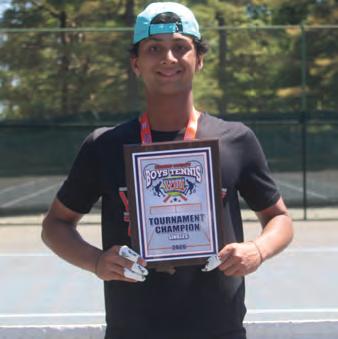
WhenWheatley’s Saje Menon made the decision to return to high school tennis for his senior season, he did so with two goals in mind. One was to win a state championship with Wheatley, just like he and the Wildcats did when he was an eighth-grader, and the other was to win the Nassau County singles title.
He accomplished the latter at the County Championships. First, he defeated Jericho’s Preston Wang 6-3, 7-5 in the semifinals, before beating Will Bohner of Friends Academy 6-4, 6-2 in the county final.
“At the start of the season, I was thinking about winning the county title with the team, and then hopefully being on this stage today,” Menon said. “It’s great to win this
title. I remember playing here four years ago as an eighth grader and I made the quarters. I was pretty happy with that, but this season I started with the goal of winning this, and to do it today is amazing.”
Menon completed the draw without dropping a set, utilizing his aggressive playing style and oftentimes coming to the net while serving and volleying. This approach allowed him to control the points and keep his opponents off balance.
“My kick [serve] was working really well today and bouncing high so I just tried to come in as fast as I could, and it worked out,” Menon said.
Wheatley head coach Mike Kazin spoke glowingly of his star senior,
whom he says has been not only an impact player on court this season, but the ideal leader who has set by example.
“He has been so committed to our team, and is such a stand-up kid,” Kazin said. “He comes to every practice, and has been a pleasure to have around the other guys. He’s got the most composure of any player I’ve coached, and always remains composed and resilient. He’s probably the most mentally tough kid I’ve ever coached and it really makes him stand out.”
As the runner-up, Bohner also qualified for the NYSPHSAA Championships, as did Jericho’s Nick Chin, who beat fellow Jayhawk Preston Wang 6-4, 6-2 in the thirdplace match.
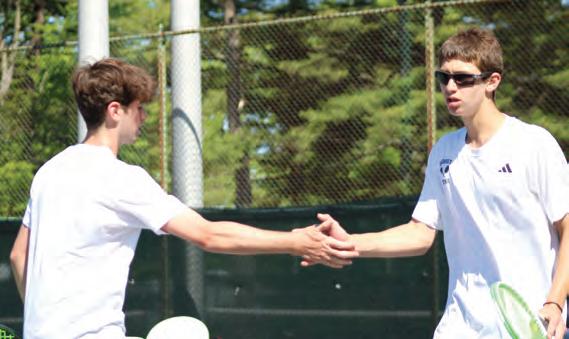
Garden City’s CJ Bravo & Ben Wiese successfully defended their Nassau County doubles title, defeating Aayan Mehta & Nikhil Shah of Syosset 6-2, 6-0 in the championship.
The win in the finals came after the duo beat Roslyn’s Bartek Dziedziach & Oliver Samter 6-1, 6-1 in the semifinals.
“There were a lot of tight matches,” Wiese said. “The score might not show it but every point was close, so to win this again means so much. There was a chance we wouldn’t play doubles again, but decided to and this makes it all worth it.”
Bravo & Wiese got an early break in the opening set of the championship and remained incredibly consistent with their own serves to deny any possibility of a comeback. The two have developed an on-court chemistry where Bravo plays well at the baseline, and Wiese closed down points with aggressive play at the net.
“We’ve trained hard, and I think we both improved a lot from last year,” said Bravo.
Garden City head coach Jen Soper added:
“They are great kids who always put everything into their tennis, day in and day out. It’s a pleasure to coach them. It’s the little things they do, like how smart they are on court and picking each other up. This year they had a lot on their shoulders, and CJ was hurt for a bit in the middle of the season, but they knew what they wanted to accomplish and remained focused on that.”
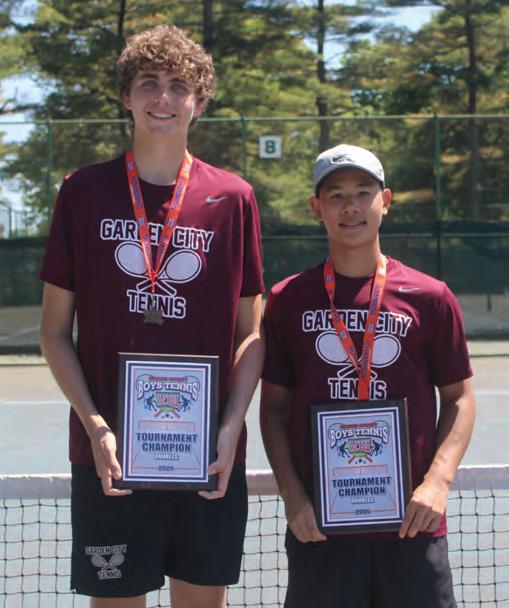
Syosset’s Mehta & Shah qualified for States as the Nassau County finalists, as do their teammates Grayson Prince & Jacob Prince, who defeated Roslyn’s Dziedziach & Samter 6-4, 6-4 in the third-place match.
Alejandro Perez Trapero captured the Suffolk County singles title on a hot afternoon at Smithtown East High School, defeating Ignacio ‘Nacho’ Pena Lopez 6-3, 6-2 in a battle between two Ross School teammates.
“I’ve known Nacho for a while now, he’s a really tough rival and knows how to make me miss my shots,” said Perez Trapero. “It was a really good match, and I’m proud of myself for being able to win. Since the beginning, it’s been the goal I’ve had, to do the best I can at Divisionals and now Counties, and I’m excited for the States.”
Perez Trapero held his nerve and overcame his friend and opponent as well as the hot on-court conditions to capture the county title. He was able to secure breaks
early in each of the two sets and was consistent on serve to win the championship in straight sets.
“I tried to make every point as hard as possible for Nacho, and just play pointby-point,” he added. “I didn’t think about the heat or anything else, and just gave it everything I had.”
In the third-place match, Sachem’s Leo Villacreses defeated William Floyd’s Vidal Macchia 6-4, 6-1.
* Following the completion of the Suffolk County Championships, Perez Trapero was ruled ineligible by Section XI. As a result, Pena Lopez, Villacreses and Macchia represented Section XI at States
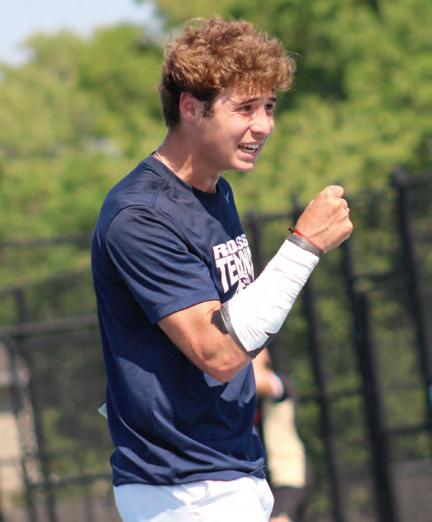
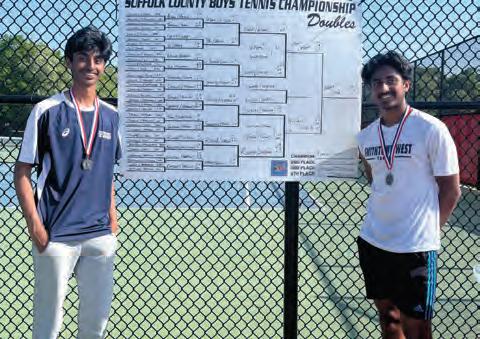
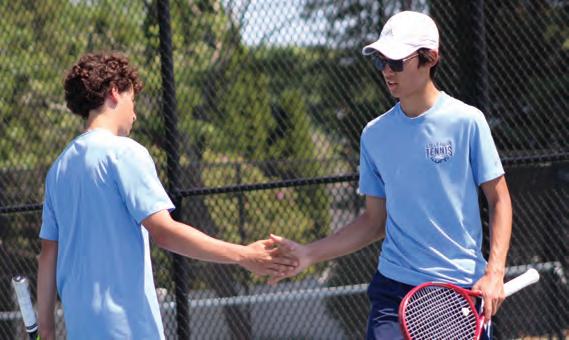
in his final season of high school tennis, Ray Hidaka paired with his younger brother, Kai, to win the biggest match of his high school career. The brothers from Shoreham-Wading River defeated another set of brothers, Smithtown West’s Ishaanth Guduru & Sreeyanth Guduru, 6-2, 7-5 in the finals of the Suffolk County Individual Championships at Smithtown East to capture the county title.
“It’s his last year, and we finally got to the finals, and won it, so it’s pretty indescribable,” said Kai.
The Hidaka’s came out firing in the championship, claiming the opening set before racing out to a 3-0 advantage in the second set. But the Guduru’s responded and would not go away quietly, rattling off the next four games to jump in front 4-3 in the second set.
“We tried to make sure we hyped each other up, if one of us is down, and we talk to one another in Japanese,” said Ray. “So we make sure to communicate a lot, even if we don’t use hand signals, and stay positive.”
It worked, as the Hidaka’s would
rattle off three of the next four games to close out the set and the match, winning the Suffolk County doubles championship.
“It’s been one of the best years of my life.
Before the season I told our coach that we were going to the county finals, so to actually do it is such a great feeling,” said Ray. “Doing it with my brother makes it even better; he’s the best doubles partner I could ask for. This is going to be a memory we keep for a long time.”
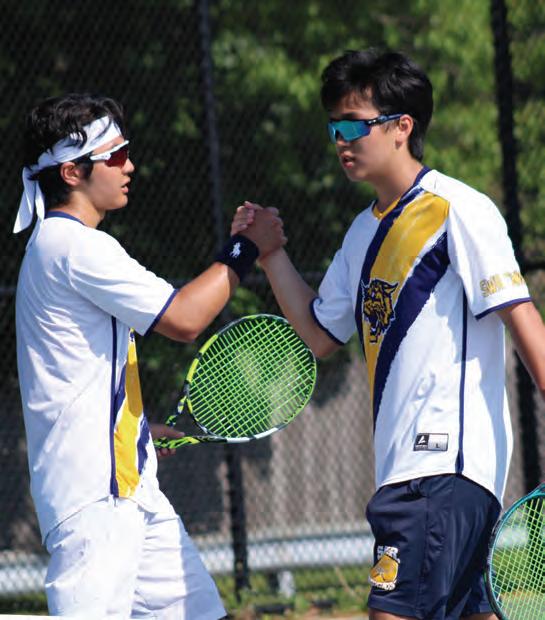
The Hidakas represented Suffolk County alongside the Guduru brothers, as will the Rocky Point
pairing of Luke Mayola & Sena Donnelly, who won 7-6(4), 7-5 over Harborfield’s Boden Rudloff & Brody Surbeck in the third-place match, at the New York State Championships.
is something the Phantoms of Bayport-Blue Point are not only used to, and overcoming it is what they take pride in. After losing in four straight Suffolk County Small School (Division 2) Championships, they defeated Port Jefferson to win its first county title.
And so when the Phantoms fell behind Wheatley 0-2 in the Long Island Division 2 Championship match, no one panicked.
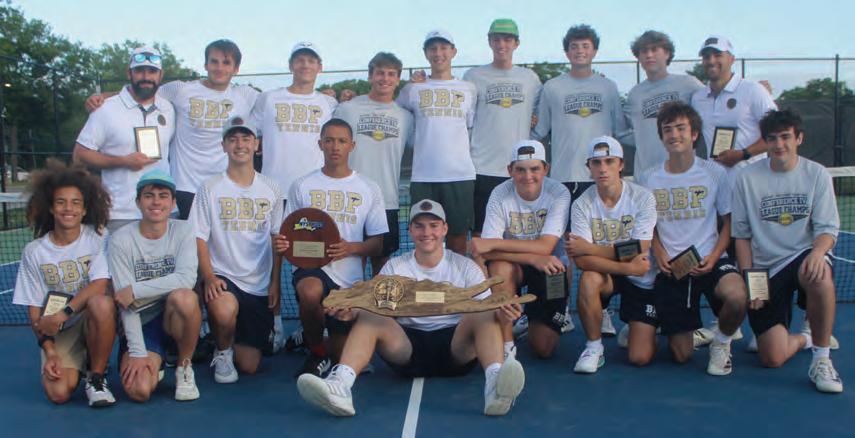
“This team is battle tested,” said Bayport-Blue Point head coach John Selvaggio. “All the adversity they have faced on and off the court has made them stronger as individuals and certainly as tennis players.”
That paid off as Bayport-Blue Point looked to follow up the program’s first Suffolk County boys’ tennis title with its first Long Island title. After Wheatley’s Saje Menon, the Nassau County singles champion, won 6-0, 60 at first singles, and Spencer Edelstein & Maxwell Greenman won 6-3, 6-4 at third doubles, BayportBlue Point needed to win the remaining three courts to accomplish that.
Dominic Linzie & Declan Schug got the comeback rolling as they won 6-4, 6-1 at second doubles. Soon after, on the second singles court, Eric Swinkin brought his team even as he completed a 6-4, 7-6(3) victory.
That brought the Long Island title to be determined on the first doubles court in a showdown between Bayport-Blue Point’s Aidan Apicella & Nick Byman and Wheatley’s Julian Ostrow & Chase Yoon, the latter of
whom had not dropped a set all season long.
Ostrow & Yoon won the first set 6-4, and the second set was back-and-forth which led it to a tiebreaker. Apicella & Byman raced out to a 5-1 lead, and a couple of points later, closed out the breaker to hand the Wheatley pairing its first set loss of the year, and force a deciding third set.
“It was a tough match,” said Apicella. “We were down 1-5 in the first set, and we came back to in the second set, so [going into that third] we knew we needed to make sure we did our best to rally with them and stay calm.”
Both teams battled in the third set, but it was Bayport-Blue Point who would come out on top. After breaking for a 53 lead, Apicella stepped to the service line to try and serve out the championship. They moved ahead 4015, but saw two championship points go by the wayside.
“We knew we just had to stay composed,” Byman said. “There was a big crowd, and we really wanted to win. We knew if we worked together we could win those next two points.”
After winning the next point to set up
a third chance to seal the win, Byman set up an overhead smash and did not miss, emphatically closing out the match and claiming his team’s first ever Long Island title.
“I did miss a couple of overheads that I should have put away earlier, so when it was there for me I knew I had to put it away,” Byman said. “This is for all the seniors the past few years in those county championship losses. From first singles down to the last player on the bench, everyone on this team puts the effort in, and we deserve this.”
Apicella added:
“I’ve been on this team for six years, and it feels great to finally win one. I couldn’t dream of anything better. We couldn’t have done it without all the support from everyone here.”
Selvaggio added:
“This means a lot. This is a special group that has been with us since they were coming to our camps in elementary school. Now they are the ones teaching at and running the camps,” said Selvaggio. “These kids are made for tennis. They go out there and have fun, and I think that’s our recipe for success.”
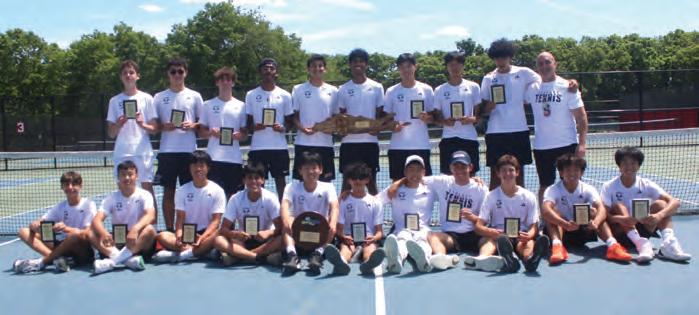
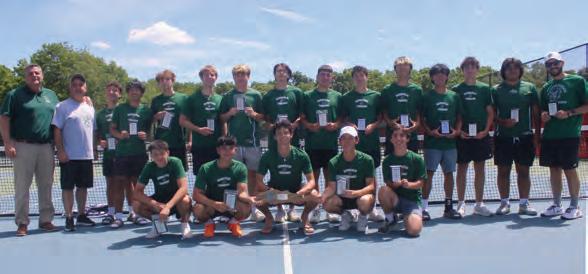
Forthe fourth straight year, the title of Long Island Large School (Division 1) Champions belongs to the boys from Syosset.
The Braves defeated Harborfields 61 at Smithtown East High School, and advanced to the New York State Public High School Athletic Association (NYSPHSAA) Team Championships.
Syosset is the three-time defending State champion.
“It was really important,” senior cocaptain Aayan Mehta said of coming out and setting the tone early in the Long Island Championship. “I think every playoff match, and the Nassau and Long Island finals have been preparation for what we are really striving for, which is the State championship. It’s important we stay locked in during these matches.”
Mehta delivered a 6-2, 6-2 victory at
second singles which clinched the title for Syosset.
“In his whole career, the running joke on the team has been that the more pressure is on Aayan, the more he comes through,” said Syosset head coach Shai Fisher. “In these big matches, whether it’s a county final, Long Island final or a State final, he has a tendency to be the clincher for us. He’s clinched on these courts before, two years ago against Commack, he’s clinched at the USTA National Tennis Center in the States. When he knows he needs to step up, he plays so much better. When the stakes are raised, he puts more pressure on himself and he thrives in that situation, and his teammates know it.”
Mehta’s clinching victory came soon after Leon Zhao & Daniel Kim were 6-0, 6-2 winners at fourth doubles, and Loui Peredo & Anik Paul were 6-0, 6-0
winners at second doubles.
Syosset’s first win on Friday came from Nikhil Shah & Jacob Prince, who posted a 6-0, 6-0 win at first doubles.
“I think we did a good job of sticking to our strengths,” Shah said. “Our games complement each other so well, and we have such great team chemistry.”
Prince added:
“It was great to set the tone for our team today. We started the season playing together, and Niki played singles for a little bit in the middle of the season, but we’re back together now and we are having a lot of fun.”
At third doubles, Ryan Nawaz & Terrence Moy won 6-3, 6-2, while Grayson Prince won 6-3, 6-3 at first singles to round out the scoring for Syosset.
Caiden Veitch won 6-4, 6-1 at third singles for Harborfields.
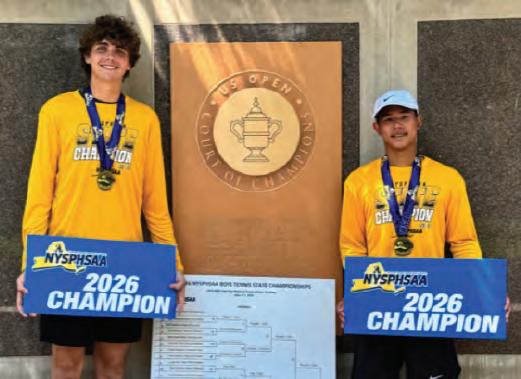
Ayearago, Garden City’s Benjamin Wiese & CJ Bravo finished in fifth place in doubles after falling in the quarterfinals at the New York State Public High School Athletic Association (NYSPHSAA) Individual Championships.
The team that defeated them in the quarterfinals in 2025? Pratik Nyak &
Christopher Cho of Clarkstown South High School. Nyakk & Cho would go on to win the 2025 title, and so it was only fitting that when Weise & Bravo powered their way into the finals of this year’s NYSPHSAA Doubles draw, their opponents were Nyak & Cho.
“We lost in three sets to the team that won it all, and it made us realize that
we had the chance to win and blew it,” said Wiese. “It motivated us to work extra hard this year.”
That motivation powered them throughout the season, as Wiese & Bravo defended their Nassau County doubles title with their sights set on winning a State title. The duo dropped just eight total games en route to the championship match, and had their chance at revenge against Nyak & Cho, and deny their opponents a second straight State title.
“The experience last year helped a lot,” Wiese added. “We got rid of the nerves of playing big matches in a place like the National Tennis Center. The loss helped both of us realize how much further we can improve in the years to come, not just in our high school tennis career but in life.”
Wiese & Bravo put all that to work and defeated Nyak & Cho 6-3, 6-4 in the finials to claim the State title, and bring it back to Garden City High School.
“I think our chemistry and grit makes us a good team,” Wiese added. “We know where to be on the court when one of us gets pushed off the court, and we never give up fighting for every point. We really do treat each point like its match point.”
2026 New York State Doubles Results
1. Benjamin Wiese & CJ Bravo (Garden City)
2. Pratik Nyak & Christopher Cho (Clarkstown South)
3. Nikhil Shah & Aayan Mehta (Syosset)
4. Lucas Yao & Dylan Pai (Scarsdale)
5. Alexander Suhanitski & Fynn Bowman (New Rochelle)
6. Kai Hidaka & Ray Hidaka (Shoreham-Wading River)
7. Grayson Prince & Jacob Prince (Syosset)
8. Vivek Venkat & Easton Chichak (Shenendehowa)
















































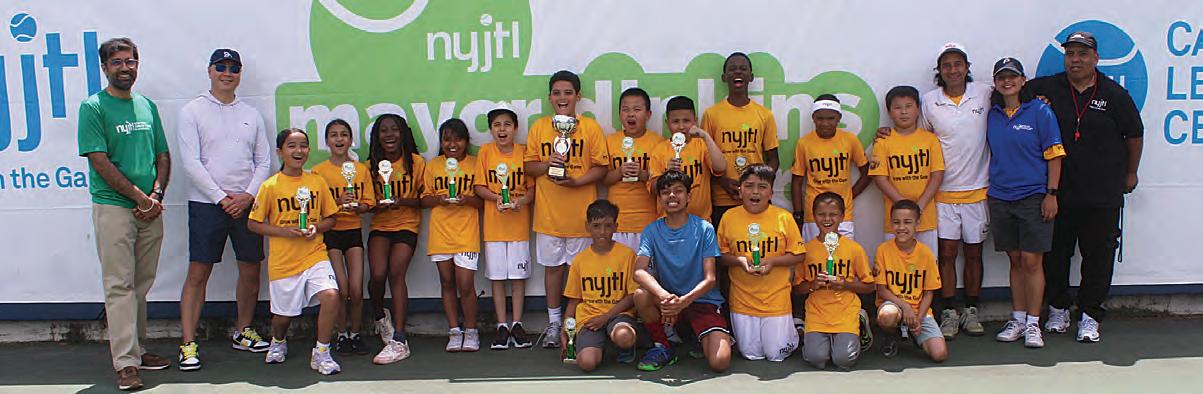
The nation’s largest free interscholastic tennis competition brings NYC players together in the Bronx
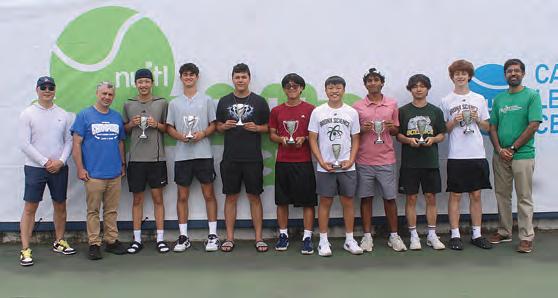
The 2026 New York Junior Tennis & Learning (NYJTL) Mayor Dinkins Cup gathered more than 700 interscholastic athletes from across New York City’s five boroughs at the Cary Leeds Center for Tennis & Learning in the Bronx. The event is the largest free junior interscholastic tennis competition in the nation, with players from all over New York City representing public, parochial, and private schools.
The event is named in honor of New York City’s first black mayor and a dedicated NYJTL board member, David N. Dinkins, who was an incredible supporter of tennis during his distinguished life.
The highlights on the court are numerous and memorable from the main singles and doubles
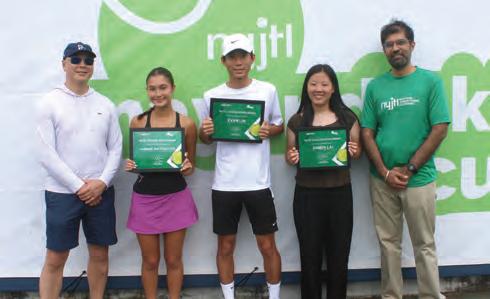
tournaments to the ACES Elementary School Team Competition to the Boys Varsity Tennis Team Championships, and concludes with the Award Ceremony featuring the participants, their families and members of NYJTL’s board as four deserving student-athletes are honored with NYJTL College Scholarship funds.
The Mayor Dinkins Cup is one of the highlights of the calendar for junior tennis players in New York City.
“We are incredibly proud to host the NYJTL Mayor Dinkins Cup here at the NYJTL Cary Leeds Center. Each year, this tournament brings together hundreds of young athletes from across New York City to compete, connect, and represent their schools with pride,” said Steve
O’Keefe, General Manager at NYJTL’s Cary Leeds Center for Tennis & Learning. “As the largest free interscholastic tennis competition in the country, the Mayor Dinkins Cup reflects the heart of NYJTL’s mission: expanding access to opportunity through tennis and education. It is an honor to continue welcoming these students, families, coaches, and schools to our courts.”
2026 Mayor Dinkins Cup Winners
• Elementary School Champions: P.S. 127
• Varsity Team Champions: Bronx Science
• Boys Singles 12U Green Ball: Alexander Kairouz
• Girls Singles 12U Green Ball: Nicole Bagdasaryan
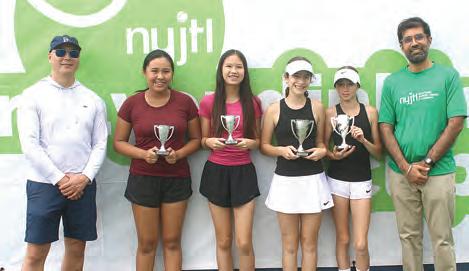
• Boys Singles 12U: Patrick Okla
• Girls Singles 12U: Katie Kubiak
• Boys Singles 14U: Eitan Segev
• Girls Singles 14U: Logan Greene
• Boys Doubles 14U: Mustafo Bobev & Nicholas Roche
• Girls Doubles 14U: Victoria Pinkhasova & Amelia Mastronadi
• Boys Singles 18U: Jeremy Orlicki-So
• Girls Singles 18U: Sofia Berlyant
• Boys Doubles 18U: John Henry Mills & Nikolay Klioutchnikov
• Girls Doubles 18U: Savannah Minter & Maria Vainshtein
Scholarship Winners
• Jasmine Sih-Feiertag
• Amber Lai
• Evan Lin
• Joshua Myers
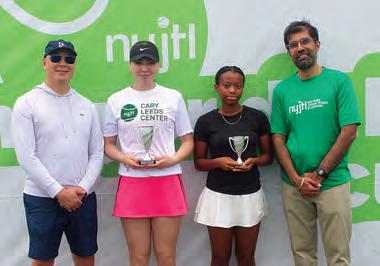
Sportsmanship Award Winners
• 12U Green: Siddhant G. & Kenzie Ho
• 12U Yellow: Prince Roger F. & Emma H.
• 14U: Eitan B & Logan G.
• 18U: Yaspis A. & Samantha H.
CUSTOM FULL-TIME COACHING FOR HOMESCHOOL PLAYERS PRIVATE COACHING, HIGH PERFORMANCE CAMPS, AND GROUPS FOR ALL LEVELS HIGH PERFORMANCE SUMMER CAMP IN VERMONT TRAIN WITH THE BEST— CHRIS HAS RECENTLY COACHED SEVERAL #1 PLAYERS IN THE US!
Bronx Science completed the three-peat and have cemented itself as the top team in New York City.
The Wolverines won the PSAL 2A division title for the third straight year, and for the second straight year did so against Stuyvesant, defeating the Hitmen 3-2 in a thrilling final.
“We knew that we would get everyone’s best shot this season, but we were motivated to defend our last two titles,” said Ishaan Bhagat. “This team has been through a lot, and we have a lot of guys who step up in the big moments.”
Bhagat has been one of the team leaders during the three championships, and delivered a 10-3 victory at first singles to do so once again in the finals.
Stuyvesant’s Hunter Davis won 10-2 at third singles to even things up.
Both teams would split the doubles flights, with Bronx Science’s Leif Emery & Shaunak Thamke winning 10-4 at first doubles, while Stuyvesant’s Daniel Skariin & Hunter Davis were 10-7 winners at second doubles.
That brought the city championship down to second singles, and a matchup between Bronx Science’s Kevin Diao and Stuyvesant’s Skyler Chang.
“We had confidence that Kevin
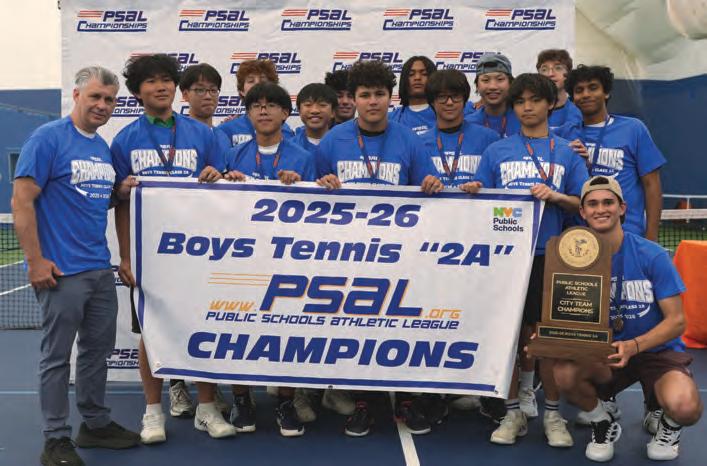
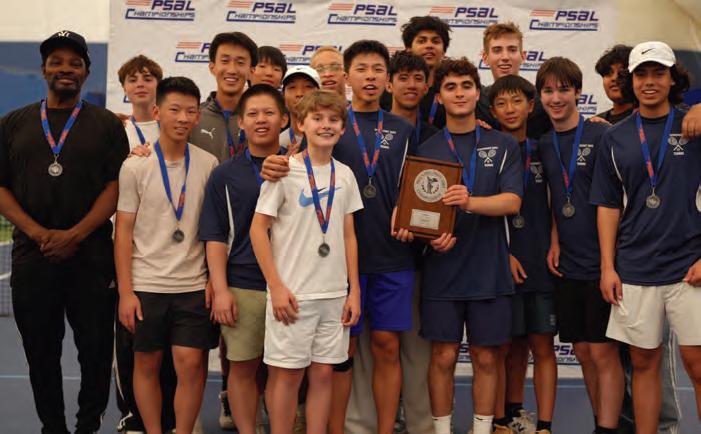
would pull it out,” said Bahagat. With the title on the line, championship experience came
out on top, as Diao won 10-8 to win second singles and seal his team’s three-peat.
The Huskies of Eleanor Roosevelt High School in Manhattan are the 2026 PSAL 1A Boys Tennis Champions after defeating Bard 4-1 in the championship match at Queens College.
As it had been throughout the season, the Huskies’ singles trio led the way in the finals. Viktor Zima completed an undefeated season in the first singles position with a 10-4 triumph to help anchor his team’s victory.
At second singles, Michael Kaplan delivered a 10-6 win, and Lucas Rafiy completed the singles sweep for Eleanor Roosevelt with a 10-4 triumph at third singles.
“Our singles players have helped lead us all season and it was no different in the finals,” said Eleanor Roosevelt head coach Jesse Richardson-Bull. “They have been the leaders of our team and a group we’ve been able to rely on.”
To provide the fourth point, Cian Mulderrig & Karim Ghassemi won
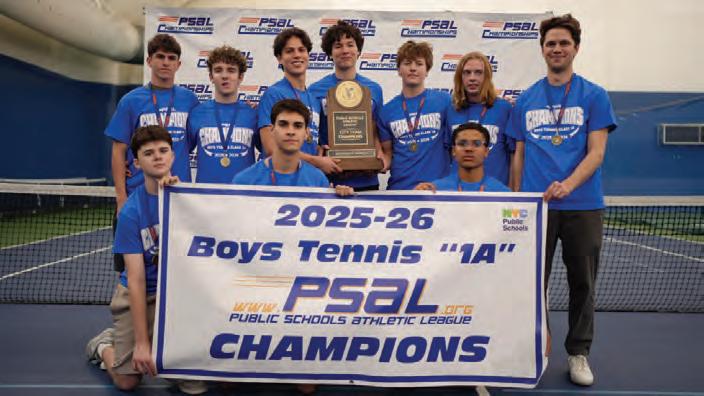
10-5 at first doubles.
Bard’s lone point came from the second doubles tandem of Cassius Nova & Milo Chin, who posted a 10-7 win.
“This is such a meaningful title for our team and program,” added Richardson-Bull. “The boys have put in so much work and effort, and I couldn’t be prouder of them.”
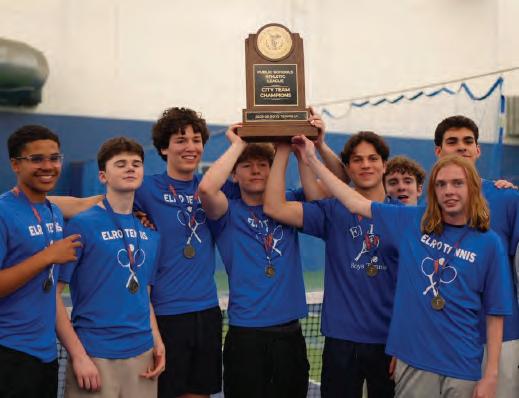
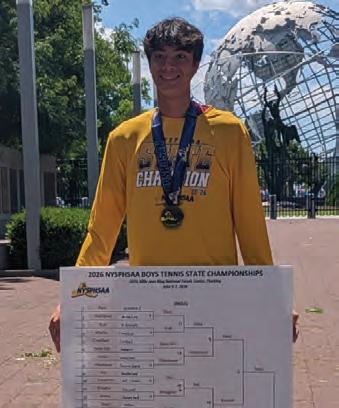
Semifinals
Bayport Blue Point (XI) 3, Jamesville Dewitt 1
Byram Hills (I) 5, Glens Falls (II)
Finals
Byram Hills 4, Bayport-Blue Point 0
Semifinals
Scarsdale (I) 7, Pittsford Mendon (V) 0
Syosset (VIII) 6, Bethlehem 1
Finals
Scarsdale 4, Syosset 3
1. Jack Reis (Scarsdale)
2. Ignacio Pena Lopez (Ross School)
3. Justin Barrett (Le Moyne)
4. Saje Menon (Wheatley)
5. Vidal Macchia (William Floyd)
6. Leo Villacreses (Sachem)
Dick Gould belongs in the International Tennis Hall of Fame.
Most tennis people over the age of 35 know his name. He is, hands down, the greatest and most accomplished college tennis coach in history. Some know him as the legendary Stanford University coach who won an astonishing 17 NCAA championships. Others know him as the coach of 24 players who reached the top 15 in the world rankings in singles or doubles. Those who never had the pleasure of knowing him personally can certainly recognize the lasting influence he has had on college tennis.
But even those accomplishments don’t fully capture his impact on the sport.
As someone fortunate enough to play for Gould, I’ve always felt his greatest contribution wasn’t the championships he won. It was the way he helped reshape college tennis and, in doing so, influence the development of professional tennis in the United States and beyond.
Today, college tennis is viewed as a legitimate pathway to the professional tour. Top players from around the world routinely spend time competing in college before launching professional careers. That seems normal now, but it wasn’t always. For years, college tennis was often viewed as a backup plan. If you were good enough, the thinking went, you turned pro. Gould helped change that perception.
Long before it became fashionable, he built a program that showed world-class tennis, elite academics, personal growth,
and professional aspirations could all coexist. Stanford consistently produced professionals, Davis Cup players, Grand Slam champions, and successful people away from the court. John McEnroe had already reached the Wimbledon semifinals before arriving on campus, and Gould understood something many people didn’t at the time: college tennis and professional tennis were not competing paths. They could complement one another. That idea helped change the sport.
Much of today’s college tennis landscape traces back to programs like Stanford under Gould. The emphasis on player development, professionalism, culture, accountability, and long-term growth became the blueprint many others followed. His influence spread well beyond his own players. Former assistants and players became successful college coaches, academy directors, teaching professionals, and administrators throughout the country.
Gould didn’t inherit a powerhouse. When he arrived at Stanford, the program was struggling. Stanford often had a losing record and its’ facilities were, frankly, lacking. His office was known as “the shack”. Through relentless fundraising, alumni engagement, relationship building, and vision, he transformed Stanford into the gold standard of college tennis. The program eventually became largely self-supporting financially through camps, fundraising, and alumni contributions. Gould wasn’t just coaching tennis teams. He was building an institution.
By Ricky Becker
He had incredibly high standards, but he led with trust rather than intimidation. In many ways, it felt as though he wanted to win for his players more than for himself. Former players rarely talk about fear when they discuss Gould. They talk about loyalty, consistency, respect, and relationships.
Two moments have stayed with me for decades.
During a match, I unfairly disrespected an opponent after losing the first set. Gould sprinted across multiple courts and told me that if I didn’t apologize immediately, he would pull me off the court and forfeit the match. It was embarrassing at the time, but it taught me a lesson I’ve never forgotten: winning mattered, but character mattered more.
The second came in the deciding match of the NCAA Championship. With the team title hanging in the balance, Gould allowed one of his assistant coaches to coach me through the match even though all of the other matches finished and Gould was available. Even after Georgia’s head coach ran over and took over coaching on the other side, Gould never made the moment about himself. He trusted his staff, trusted his players, and trusted the culture he had built.
Those two moments tell you almost everything you need to know about Dick Gould. He cared deeply about winning, but not at the expense of character. He demanded excellence, but without ego. And he understood that great leadership is often knowing when to step in and when to step back
Like many of his former players, I still find myself using things I learned from Gould decades later. His influence shows up in how I communicate with students and staff, how I handle difficult situations, and how I try to stay detail-oriented without losing perspective. He had a calm California way about him that made people feel supported rather than pressured, and many of us carried a piece of that with us long after college.
Critics will argue that the International Tennis Hall of Fame should be reserved primarily for Grand Slam champions and world No. 1 players. That’s a fair argument, but the Hall has also recognized contributors whose impact extended far beyond their own playing careers.
Dick Gould belongs in that category.
The Hall of Fame exists to honor
people who left a lasting mark on the sport. Gould did exactly that. He won 17 NCAA championships. He coached five future Hall of Famers. He helped establish college tennis as a respected pathway to professional success. He built one of the most influential programs in the history of the sport. Most importantly though, he
helped shape generations of players, coaches, and leaders who continue to influence tennis today.
Few coaches in any sport have changed their sport globally as profoundly as Dick Gould changed college tennis.
And that’s why Coach belongs in the Tennis Hall of Fame.

Ricky Becker is The Director of Tennis at Glen Oaks Club. Ricky also coaches highperformance juniors throughout the year and has been the Director of Tennis at three of Long Island’s biggest junior programs. As a player, Becker was the Most Valuable Player for the 1996 NCAA Championship Stanford Tennis team, four-time MVP for Roslyn High School and ranked in the top-five nationally as a junior. He can be reached at rbecker06@yahoo.com or 516-359-4843.
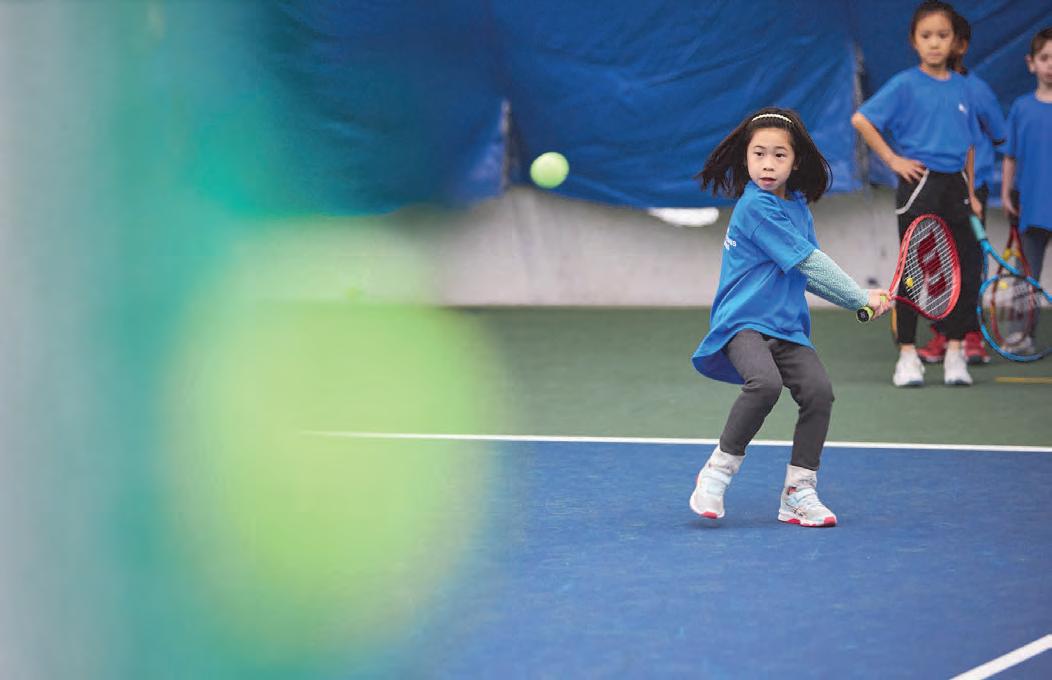

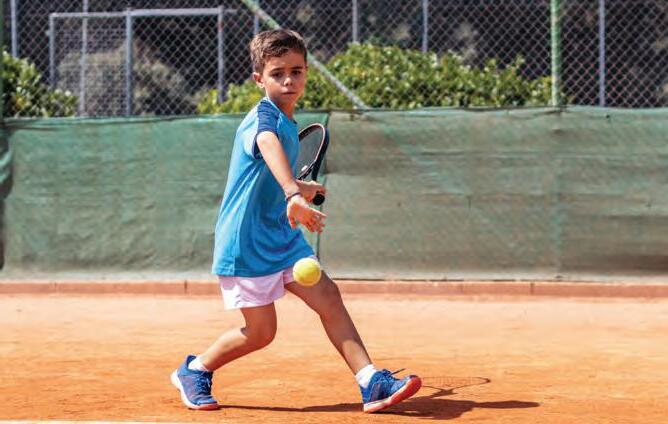
Tennismatches can be a lonely experience. You win or lose, and in singles you do it alone, making many split-second decisions that require self-governance and autonomy.
As coaches, do we prioritize building self-reliance and independent problem solving skills, or instead create a dependency on our coaching abilities?
No player is an island so it takes a collaborative effort of the player, parent, coach and community to achieve the highest level. As the African proverb identifies, “Alone I go faster but together, we go further”. So while player support is vital, so is the development of the freedom to make choices, explore self-discovery and exercise free will.
By Steve Kaplan
If we want players to be accountable and to “own it”, it must be theirs to claim.
The “we language” of a tournament in which parents and coaches talk about how “we have a match”, or “we won” does not imply or encourage player selfdeterminism.
Those who perform best under match pressure practice a framework of conscientious contribution. That is, they prepare for the uncertainty of match pressure by self-regulation that is thoughtful, deliberate and organized when no one is watching. They are independently motivated. What players do when a coach watches is performative and rewardoriented. This structure does help but is not as powerful, especially under
stress as the internal mechanisms that are developed help players solve problems independently. The framework to coach yourself under pressure and stay disciplined during match play is to be proactively diligent, scrupulous and meticulous in carrying out the details needed to perform. There are many studies that indicate that athletes who put effort into doing tasks correctly and consistently achieve the highest level of potential fulfillment under stress.
As parents and coaches, we can be the safety net ensuring a safe and gentle fall so that players feel it's safe to get up and try again. We are not the talent however. “We” do not play the match and “we” do not win or lose the match. “We” are the support team.
If we wish to help students become independent, we can lead them. But leaders don't gather followers…they build leaders.

Steve Kaplan is the owner and managing director of Bethpage Park Tennis Center, as well as director emeritus of Lacoste Academy for New York City Parks Foundation, executive director and founder of Serve & Return Inc, and co-director of The City Classic Junior Tennis Academy. Steve has coached more than 1,100 nationally- ranked junior players, 16 New York State high school champions, two NCAA Division 1 Singles Champions, and numerous highly-ranked touring professionals. In 2017, Steve was awarded the Hy Zausner Lifetime Achievement Award by the USTA. He may be reached by e-mail at StevenJKaplan@aol.com

By Ainslie Ellis
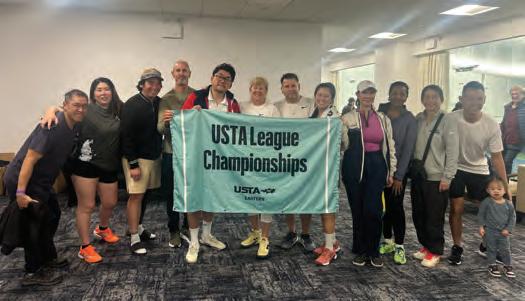
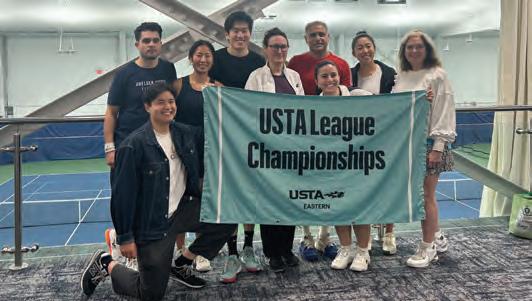
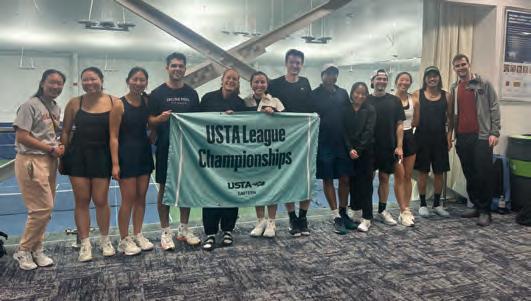
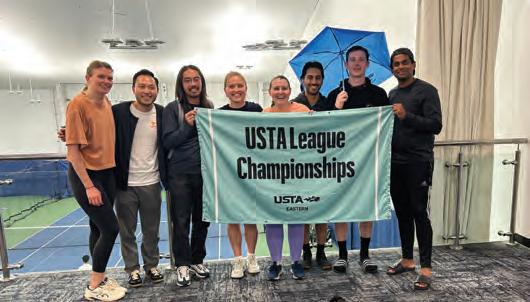
Our Metro Adult Spring/Summer leagues are in full swing with teams participating across all five boroughs. We have had plenty of sun and a much drier season than in years past, and we hope the good weather continues through our championships at the end of July.
Last month we hosted our 18 & Over Mixed Doubles Regional at the USTA Billie Jean King National Tennis Center. Great tennis was played by all, and the following teams are advancing to the Sectional tournament.
• 18 & Over 6.0 Queens - Captained by Lily Lee and Milo Thalrose
• 18 & Over 7.0 Manhattan - Captained by Alina Lekser and Kevin Ni
• 18 & Over 8.0 Manhattan - Captained by Nihar Damarasingu
• 18 & Over 9.0 Queens - Captained by Nihar Damarasingu

• 18 & Over 10.0 Manhattan - Captained by Chrissina Kintanar and Daria Sekerina
All of these teams represented the Metro Region in the Sectional tournament at Donald Van Blake Tennis Facility in early June. Congratulations to our 18 & Over Manhattan 7.0 and 8.0 teams for winning the Sectional tournament and moving on to Nationals this fall!
While there is still plenty of Spring/Summer tennis to be played, we will begin registration for our fall leagues next month, including 18 & Over Manhattan Mixed Doubles and 3.5/4.0/4.5 tri-level.
As always, if you have any questions or want to get involved contact Ainslie Ellis at ellis@eastern.usta.com.
Ainslie Ellis is the Metro Region Adult League Coordinator for USTA Eastern. She may be reached at ellis@eastern.usta.com.
By Eldad Campbell
Theclassifications of "Good Coach" and "Bad Coach" are not absolute metrics of competence, nor should they be used to judge a professional's capabilities based on superficial behaviors. Rather, these archetypes reflect what the mainstream tennis industry conventionally celebrates as exemplary instruction versus what it dismisses as substandard. What, then, is the ugly truth underlying these industry standards?
• The "Good" Coach: Punctual, meticulously organized, and highly articulate regarding technical, strategic, and biomechanical principles. Operating with an efficient, pragmatic ethos, they prioritize rigorous discipline, unwavering commitment, and maximum work output.
• The "Bad" Coach: Prone to occasional lateness, structurally unorganized, and exhibiting a more limited grasp of formal technical frameworks. They adopt a relaxed, laissez-faire teaching style that prioritizes fluid, intuitive interaction over rigid metrics.
To understand how these contrasting philosophies function in practice, we must analyze four core developmental dilemmas, evaluate how each coach responds, and uncover the "ugly truth”, which ultimately reveals itself as a beautiful truth of athletic development.
The Player: A 12-year-old junior possessing elite athletic upside paired with a severe deficit in court focus and a highly conversational, socially driven on-court demeanor.
• The "Good" Coach: Integrates the player into a highly regimented
training program. The entire hour is micro-managed to maximize technical replication and strategic drilling. By eliminating distraction and casual socialization, the coach enforces absolute compliance, ensuring peak productivity for the full 60 minutes.
• The "Bad" Coach: Arrives late, condensing a compensated hour into 50 minutes of direct instruction, and mandates that the student practice serves independently during the delay. The subsequent session lacks formal technical intervention, shifting instead into a prolonged dialogue where the child appears to dictate the trajectory of the lesson.
On the surface, conventional wisdom would immediately favor the structured approach of the "Good" Coach.
Neither methodology is inherently flawed. While a highly managed environment appears superior, the "Bad" Coach's relaxed approach can inadvertently cultivate vital executive functions. Forcing a student to self-start during a structural delay teaches personal accountability, independence, and agency on court. Furthermore, tennis is a deeply isolating, psychological sport. The "Bad" Coach’s willingness to prioritize conversation builds a critical emotional alliance, addressing external anxieties that may be directly hindering the child's oncourt performance. Instructional effectiveness is inherently situational; both approaches offer distinct developmental value.
The Player: An athlete trapped in a cycle of severe self-doubt, exhibiting pervasive on-court negativity and a complete absence of competitive confidence.

• The "Good" Coach: Deploys an unyielding strategy of positive reinforcement, empathy, and emotional support. This supportive dynamic persists for three years, yet the player's defeatist attitude and mental resilience show no measurable improvement.
• The "Bad" Coach: Attempts a supportive approach for a single semester, recognizes a fundamental behavioral impasse, and unilaterally terminates the professional relationship, advising the parents that they are ill-equipped to break the negative cycle.
Most parents and observers instinctively champion a coach who refuses to give up on an athlete.
In this instance, the "Good" Coach's approach requires critical reevaluation. Prolonging a stagnant professional relationship for three years ceases to be supportive; it transforms empathy into enablement, creating a psychological comfort zone within chronic failure. Conversely, the "Bad" Coach demonstrates a sophisticated understanding of professional boundaries. Recognizing that your personal teaching style is a mismatch for a student’s psychology and stepping aside to allow a more compatible fit is the far more responsible and ethical path.
The Player: A talented, highly emotional 13-year-old who routinely cheats, makes intentional bad line calls in practice, and relies on gamesmanship to secure competitive advantages.
• The "Good" Coach: Verbally addresses the infractions but reframes the dishonesty as a predictable, messy phase of adolescent emotional growth, advising the parents to maintain patience as the child matures.
• The "Bad" Coach: Establishes an uncompromising ethical boundary. They articulate that dishonesty is an absolute violation of sportsmanship and threaten immediate, permanent termination of the coaching relationship if the behavior recurs.
This dilemma forces a choice between developmental patience and absolute accountability.
The Ugly Truth
The strict coach establishes necessary behavioral boundaries. The patient coach recognizes that character development is rarely linear. Cheating is frequently a misguided coping mechanism for intense competitive stress rather than evidence of permanent moral deficiency. Yet patience carries its own risks. When accountability is repeatedly delayed, tolerance can quietly become permission. The challenge is not choosing between grace and consequences, but understanding when one must give way to the other. Neither coach possesses a monopoly on ethical development.
The Player: A highly disciplined athlete whose ranking has stagnated for eighteen months despite exceptional effort, commitment, and consistency.
• The "Good" Coach: Conducts a comprehensive assessment, identifies several technical and tactical deficiencies, and implements a
structured developmental plan designed to address each weakness systematically.
• The "Bad" Coach: Attributes the plateau primarily to confidence and insists that the athlete continue training exactly as before, trusting that improvement will emerge organically through persistence.
The Analysis
Many athletes find comfort in continuity. After all, radical change can temporarily worsen performance before it improves it.
The Ugly Truth
This is where the limitations of intuition become visible. Not every problem is psychological. Sometimes a technical flaw is simply a technical flaw. Sometimes an athlete has plateaued because the demands of the next level require a new skill set. In these moments, structure, expertise, and deliberate intervention are not obstacles to development — they are the development. The "Bad" Coach's trust in organic growth, while admirable in theory, can become negligence when it ignores clear evidence that change is

necessary. Freedom without direction can be as limiting as direction without freedom.
Our instinct to categorize these contrasting methodologies as objectively "good" or "bad" reveals an inherent cognitive bias. We routinely mistake our personal, localized experiences for universal truths about athletic development. The real ugly truth is not that one coaching philosophy is superior to another. It is that we often possess far less certainty than we imagine. We confuse preferences with principles, outcomes with processes, and isolated experiences with universal laws. The beautiful truth is that athletic development remains far more complex than any coaching archetype can capture. Some coaches succeed because of their structure. Others succeed despite their lack of it. Some fail because they refuse to adapt. Others fail because they adapt too much. True mastery in coaching lies not in blindly following a rigid philosophy, but in knowing precisely when to abandon one.
Eldad Campbell is the High Performance Talent Development Specialist at Robbie Wagner Tournament and Training Center. He is a four-time representative of the Jamaican Men’s Davis Cup, Junior Davis Cup, World Youth Cup, and Pan American Games teams, and a former No. 1 junior tennis player in Jamaica. He provides counsel to high-performance tennis players, parents, and coaches, offering strategic guidance through the multifaceted landscape of the tennis industry. He can be reached via email at connect@eldadcampbell.com.
For more than 50 years we’ve been the year-round, full-service retail tennis, paddle, squash and pickle ball store of choice for East End racquet sport enthusiasts. Tennis East has an extensive in-stock selection of men’s, women’s and junior’s racquets, sneakers, apparel and accessories from the top manufacturers for players of all ages and skill levels. Please call or e-mail us at tenniseastsh@gmail.com to place orders SOUTHAMPTON l 73 Main Street l (631) 283-9535
The Retail Choice for Racquet Sport Enthusiasts! www.tenniseast.com
By Steven Forte
Tennisis one of the most athletic sports there is and this is evidenced by the display of talent here at the Billie Jean King National Tennis Center during the U.S. Open. Attributes such as speed, explosiveness, and quick reactions are heavily used. A lot of players and coaches emphasize acceleration (moving to the ball) but overlook a major component of what players need to be successful, deceleration. The ability to slow down, stop, and control the body efficiently can be the difference between elite movement and wasted energy, injury risk, or missed shots.
Deceleration can bring about many debates regarding its definition. Within our programs here at the USTA Billie Jean King National Tennis Center, deceleration is defined as the body's ability to absorb force and slow down movement safely and efficiently. In tennis, deceleration happens multiple times every point. When a player sprints towards a ball, they must decelerate effectively in order to hit the ball. If a player doesn’t decelerate properly, a number of things can happen such as the player losing balance, their timing is off, and just overall control. The biggest difference from a muscular standpoint from acceleration and deceleration, is that acceleration uses concentric muscle contractions while deceleration uses eccentric muscle contractions. Concentric is specific to the muscle shortening as in the lifting phase, while eccentric is specific to the muscle lengthening as in the lowering phase of a biceps curl down.
First, the overall shot control will
improve. A tennis player rarely contacts the ball at a full sprint. In order to contact the ball at the desired contact point the player must slow down the body just before contact. It’s important to focus on deceleration so they will be able to maintain better balance, control their overall center of gravity and of course produce a more consistent repeated stroke. If a player is not decelerating as well as they should, it will often lead to many challenges.
The player's ability to change direction will Improve. Tennis movement is not linear, meaning that a point will consist of the player stopping, starting, changing their direction every point, multiple times during the point. Efficient deceleration allows players to stop faster, redirect their bodies quicker, and an overall sense of being in control of their body which will boost the players confidence. As the saying goes “the best players are the best movers”, that saying includes the players who decelerate the best. The perfect example would be Novak Djokovic, who is often regarded as the best mover in tennis. He decelerates his body the most efficiently, also showing his skills sliding on the court. Sliding, which is now mainstream for tennis players, is just one aspect of how a player can decelerate their body.
The most important attribute from deceleration is that it lowers the risk for injuries. Tennis is such a stressful sport for the body, putting a great strain specifically on the knees, ankles, hips, and lower back. When a player cannot absorb force properly, that stress shifts to joints and ligaments, which is when a player could get career ending injuries.

When a player does show effective deceleration mechanics, it will help reduce the risk of injuries.
As mentioned before the best players are the best movers, and we can’t overstate the importance of focusing on these elements. From a defensive standpoint this is the most true. The defensive ability of players requires players to cover large distances and recover quickly. Players who decelerate well can reach difficult balls, control their body, and still produce a quality shot instead of simply blocking the ball back. This is where sliding into the shot, as many if not all high level tennis players do, becomes very important. Sliding allows the player to decelerate their body as they are hitting the ball so the need to stop suddenly doesn’t exist, which allows the players to save time and reduce the amount of stress on their body to hit the shot. Usually a player will perform a defensive slide into a wide ball, or short ball as those shots need to extra attention in order to maintain a better court position after the shot is hit.
While acceleration and speed are usually what players and coaches focus on the most, deceleration is equally important. The ability to slow down, stabilize, and control the body allows players to produce better shots, change direction faster, and reduce injury risk, which is the most important. When players are focused on improving their deceleration, the first step would be to start with the mechanics of deceleration. Being able to decelerate exactly where the players wants and when they want will allow them to move and get ready for the next shot as fast as possible.
What’s better, to be early or to be late?
Early! Most people will answer instantly. In our society, late-comers are frowned upon. It is seen as a lack of respect. As a child, it was drilled into me that there is no such thing as being on time; you are either early or you are late. And being late is just not done. As we all know: Time=Money!
On the tennis court, especially if you are not a novice anymore, you will rarely hit the ball “late”. But I bet you are “early” way too much! I hope you are beginning to understand that it is not your fault. You bring your personality onto the court, and years of conditioning NOT to be late can have a negative influence on making contact with the ball at the exact right moment. And in your tennis game, timing = money (as in, it really helps you play well)!
Perfect timing cannot be sought; it must be understood. When your entire being understands “timing”, it comes to you, it doesn’t need to be sought, it just happens.
Most of us are control freaks whether we realize it or not. Always in survival mode, protecting ourselves from the unknown. To the nervous system, therefore, playing tennis is quite a challenge; lots of unknowns and uncertainties that are anxiety provoking.
When we seek control, when our minds are in seeking mode, it is trying to control reality, an impossibility. On the tennis court this translates to trying hard to time the ball perfectly. This relentless effort is often motivated by the desperate avoidance of being “late”. This FOMO, this fear, prevents you from the work of attention and is accompanied by a silent undercurrent of stress. This interferes and
By Tonny van de Pieterman
scrambles all your senses, thereby confusing your “inner athlete”, undermining your potential.
Recently, during one of my lessons, my client just couldn’t find the right timing. For about 55 minutes of the lesson, she was searching, forcing the issue, working extremely hard for little return on investment. She was playing fine, but she seemed to be working too hard for what was coming off her racquet. The contact with the ball wasn’t crisp, her hits not clean, her shots lacking a punch. I tried to be a valuable coach by offering her several drills and exercises to experiment with space and time. I noticed some improvement, but I still felt she was

underachieving, and I couldn’t put my finger on it.
Then I told her: “You are always a little early on the contact point, because you must be petrified to be late”.
The next four minutes of hitting were the best hitting I have ever seen her do. Every ball clean, solid, and seemingly effortless. Her posture was different, her body totally relaxed. What a transformation!
Was it my comment? Did my attacking judgment break her resistance? Am I a brilliant coach that knows exactly what to say? Or was she perhaps so fed up with 55 minutes of struggling that she was ready to hear it? Good timing?
Let’s go with me being brilliant…

By Guarang
Traditionally, women’s tennis has been associated with longer rallies, given the perception that their serves and groundstrokes generate fewer outright winners or forced errors. However, data from the 2024 U.S. Open challenges this assumption. Contrary to old paradigms, the statistics reveal striking similarities between men’s and women’s tennis in terms of rally length and playing style.
At the 2024 US Open, where 122 out of 127 matches were analyzed for both tours, the The percentage of rallies lasting nine or more shots was nearly identical. The men had 10.3 percent of such rallies, while the women were just behind at 10.2 percent. This small difference shows that both tours feature a comparable number of extended points, challenging the long-held belief that women inherently play longer rallies.
When examining short rallies (04 shots), the pattern remains consistent. Men had 69 percent of their rallies in this range, while women had 68 percent. This similarity highlights that both tours rely heavily on serve-and-return dynamics to dominate points early.
Looking at the average rally length, men averaged 3.83 shots per point, while women averaged 3.87 shots. The difference of only 0.04 shots makes the two tours virtually indistinguishable in this metric. Matches like Naomi Osaka vs. Jelena Ostapenko (average rally length: 2.58 shots, no rallies over nine shots) and Otto Virtanen vs. Quintin Halys (only four rallies of nine or more shots) reinforce this observation.
Interestingly, the success at net
also aligns closely across both tours:
• Net Points Won: Women 66 percent, Men 65 percent
• Serve-and-Volley Points Won: Women
76 percent, Men 70 percent
These statistics illustrate that women are just as proficient, if not slightly better, in net play and tactical execution.
Percentage of Rallies 9+ Shots
• Men: 10.3%
• Women: 10.2%
Percentage of Rallies 0-4 Shots
• Men: 69%
• Women: 68%
Average Rally Length
• Men: 3.83 shots
• Women: 3.87 shots
Net Points Won
One notable area of difference is serve speed. Among men, 87 players recorded serves of 125 mph or faster, compared to just one woman. While serve speed is often highlighted, it doesn’t define the overall excitement or quality of tennis. Instead, rally length—a cornerstone of fan engagement—is nearly identical between men and women.
• Women: 66%
• Men: 65%
Serve-and-Volley Points Won
• Women: 76%
• Men: 70%
The data reveals that men’s and women’s tennis share more similarities than differences. Rally length, tactical play, and point structure are almost identical across both tours.
This provides a strong case for
promoting the women’s game with equal prominence. Rather than focusing on differences like serve speed, tennis should emphasize these shared traits, as they form the foundation for engaging matches.
Any conversation about combining tours should start with data that showcases how much the men’s and women’s games have in common.

Gaurang is a High Performance Tennis Coach at Centercourt Marlboro. He is an ATP Certified Tennis Coach with advanced certifications, and has developed national champions in India, ranging from Top 10 Juniors to Davis Cup players and Grand Slam participants. He is a former Top 20 player in India and has 17 plus years of playing and coaching experience. He can be reached at gaurang1019@gmail.com.
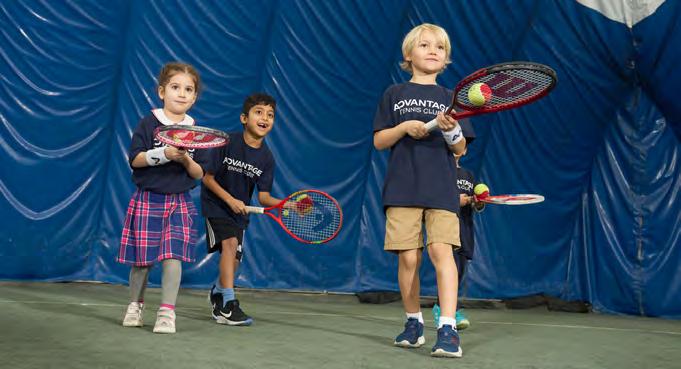

Spots are filling up fast, so don’t wait!
Register for camp by scanning the code and visiting our site, camp programs run through September 4th!








• LEVEL HIGHEST THE T TENNIS A PURSUE TO Y

• e om anywher Join online classes fr




ubai, and hanghai, Seoul, D ondon, S L ork, o wight campuses in N tudy at D S ew Y





• TION SCHOOL TEAT ASS -CLWORLD ed ummer courses offer S A PRIV EDUCA
nline rivate O est P ed #1 in B Rank
igh School in America by N H
iche.com


• nline seminars and small class sizes O
• IB and AP coursework
• Hanoi recruitment
op college acceptances and To

4204.272212. ederation Juniors F ennis nternational T of the I artner ducation P Official E admissions@dwight.global
• www.dwight.global