
Mexico Philharmonic Foundation Inc.
Mexico Philharmonic Foundation Inc.
There are many ways to support the New Mexico Philharmonic and the New Mexico Philharmonic Foundation. We thank our members, donors, volunteers, sponsors, and advertisers for their loyalty and enthusiasm and their help in ensuring the future of symphonic music in New Mexico for years to come.
LOOKING TO MAKE SMART DONATIONS? Based on presentations by professional financial advisors, here are some strategies for giving wisely, following recent changes in the tax law. The advisors identified five strategies that make great sense. Here they are in brief:
GIVE CASH: Whether you itemize deductions or not, it still works well.
GIVE APPRECIATED ASSETS: This helps you avoid capital gains taxes, will give you a potentially more significant deduction if you itemize, and can reduce concentrated positions in a single company.
BUNCH GIVING: Give double your normal amount every other year to maximize deductions.
QUALIFIED CHARITABLE DISTRIBUTION/REQUIRED MINIMUM DISTRIBUTION: If you are required to take an IRA distribution, don’t need the cash, and don’t want the increased taxes, have the distribution sent directly to a qualified charity.
HIGH-INCOME YEARS: If you are going to have highincome years (for any number of reasons), accelerate your deductions, avoid capital gains, and spread out gifts through a Donor-Advised Fund.
BE PROACTIVE: Consult your own financial advisor to help you implement any of these. Please consider applying one or more of these strategies for your extra giving to the NMPhil.
Dear Friends,
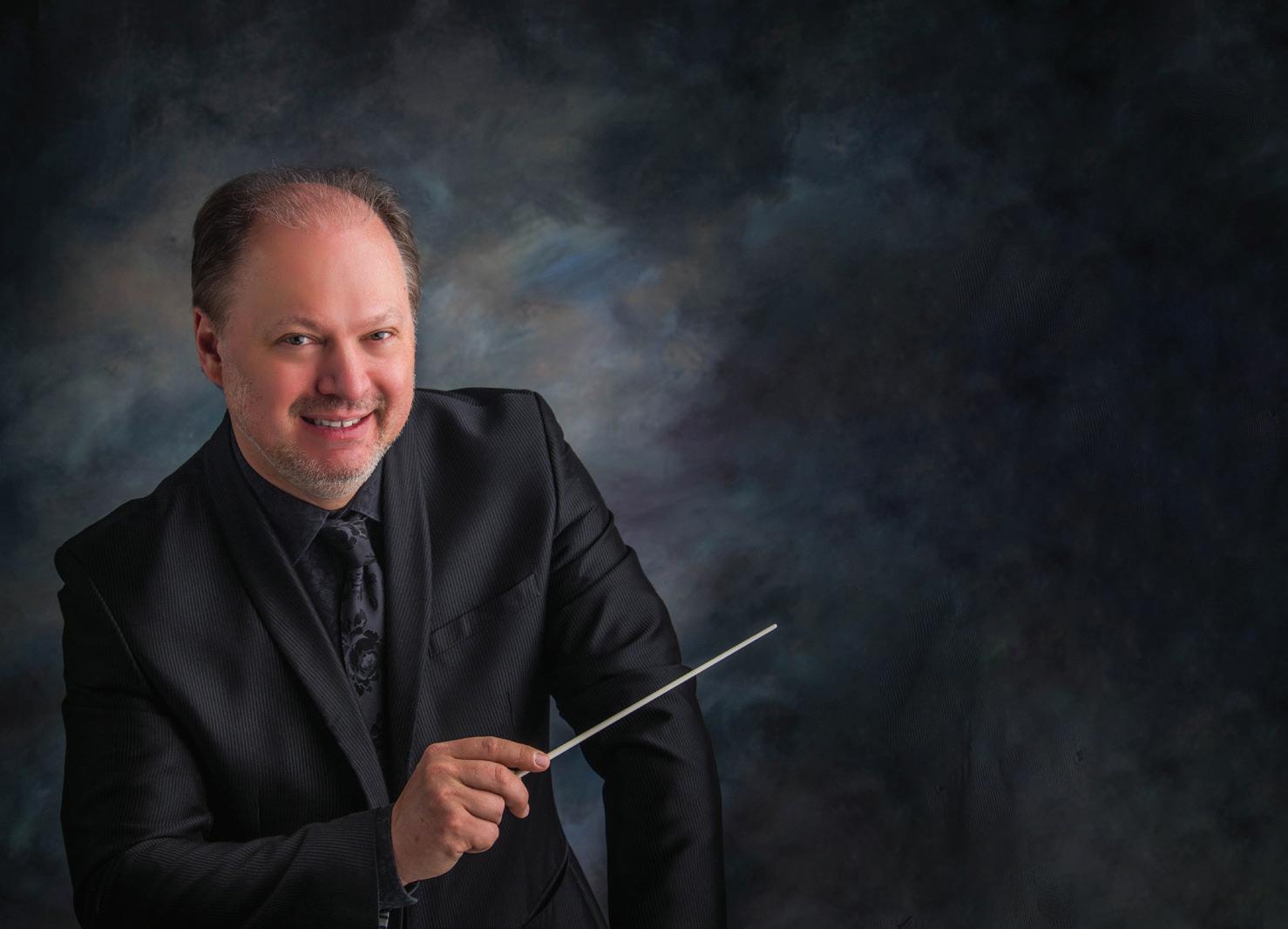
The New Mexico Philharmonic has begun its 15th-anniversary season with a roar. Jurassic Park in Concert was a tremendous success, bringing many families, some for the first time, to experience our orchestra in person. Our classical season is well underway, opening at Popejoy Hall with Mahler’s monumental Symphony No. 4 and continuing with two Afternoon Classics concerts that have already been met with great success. It is hard to believe that the holiday season is already upon us. This year, I have the privilege of conducting a stellar vocal cast and the New Mexico Philharmonic Chorus in Messiah, presented with the orchestration used in its original 1741 Dublin premiere. Please do not miss the other holiday treasures we are offering this season: Home Alone in Concert and Holiday Pops, featuring the wonderful Bosque, V. Sue Cleveland, and Moriarty High School Choirs performing side by side with members of the Albuquerque Youth Symphony and your New Mexico Philharmonic. Thank you for being part of the New Mexico Philharmonic family. Your support makes this orchestra possible. Together, we celebrate fifteen years and counting of music that inspires, uplifts, and unites us all.
I wish you and your loved ones a joyful holiday season.
Sincerely,
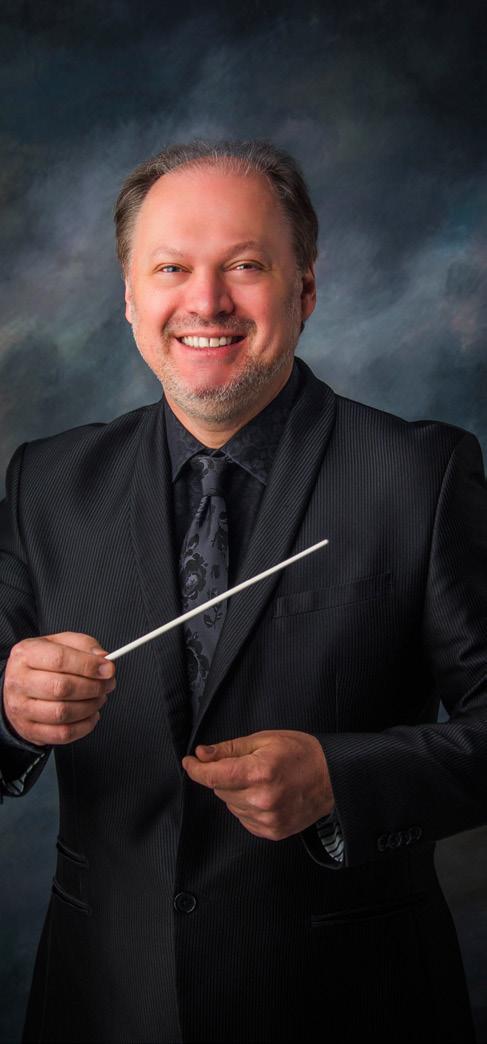
Roberto Minczuk Music Director
In 2017, GRAMMY® Award-winning conductor Roberto Minczuk was appointed Music Director of the New Mexico Philharmonic and of the Theatro Municipal Orchestra of São Paulo. He is also Music Director Laureate of the Calgary Philharmonic Orchestra (Canada) and Conductor Emeritus of the Orquestra Sinfônica Brasileira (Rio de Janeiro). ● read full bio on page 10
(505) 323-4343 crancier@nmphil.org nmphil.org/advertise/ CONNECT WITH US
Nusenda Credit Union is happy to support The New Mexico Philharmonic in its mission to embrace diversity and enrich lives through music, community engagement, and educational opportunities. Together, we can set the stage for positive change in our communities.
Find a nearby branch, services, and more at nusenda.org
@NusendaCU |
|
Saturday, November 1, 2025, 6 p.m.
Francesco Lecce-Chong conductor
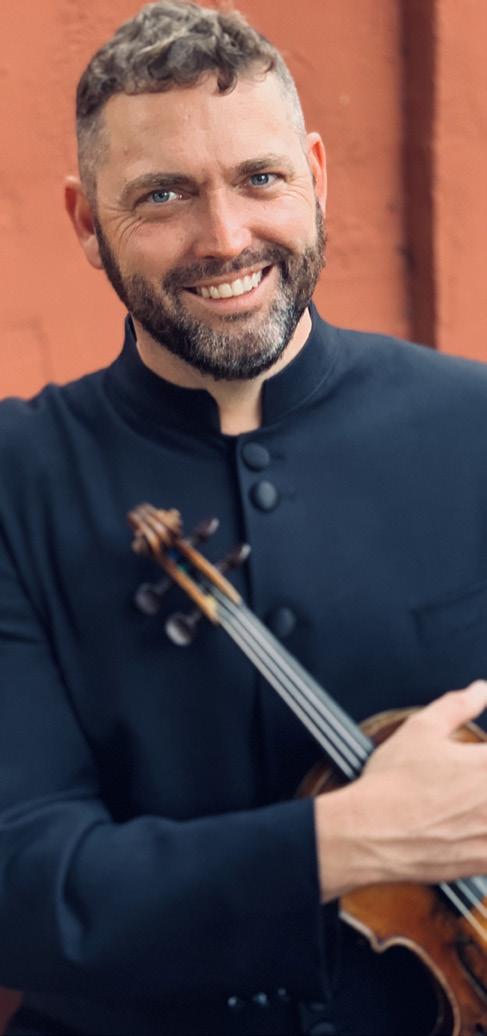
Steven Moeckel violin
The Phoenix Ascends
Petrushka (1947 version)
Popejoy Hall
Shuying Li (born 1989)
Igor Stravinsky
Part I: The Shrovetide Fair (1882-1971)
I. Introduction (at the Shrovetide Fair)
II. The Crowds
III. The Charlatan’s Booth
IV. Russian Dance
Part II: Petrushka’s Cell
I. Petrushka’s Cell
Part III: The Moor’s Room
I. The Moor’s Room
II. Dance of the Ballerina
III. Waltz—The Ballerina & the Moor
Part IV: The Shrovetide Fair (Evening)
I. The Shrovetide Fair (Near evening)
II. Dance of the Wet Nurses
III. Dance of the Peasant and the Bear
IV. Dance of the Gypsy Girls
V. Dance of the Coachmen and Grooms
VI. The Masqueraders
VII. Conclusion (Petrushka’s Death)
Violin Concerto in D Major, Op. 77
Johannes Brahms
I. Allegro non troppo (1833-1897)
II. Adagio
III. Allegro giocoso, ma non troppo vivace—Poco più presto
Steven Moeckel violin
MAKING A DIFFERENCE
This performance is made possible by: Howard Friedman & Debra Wechter Friedman
Celebrating Howard’s 75th Birthday
ADDITIONAL SUPPORT: The Cates-Romero Team at RBC Wealth Management
PRE-CONCERT TALK Made possible by: Menicucci Insurance Company
Hosted by KHFM’s: Alexis Corbin
CONCERT PROGRAM
COFFEE CONCERT:
Friday, November 14, 2025, 10:45 a.m.
Roberto Minczuk Music Director
Divertimento in B-flat Major, K. 186/159b
Wolfgang Amadeus Mozart
I. Allegro assai (1756-1791)
II. Menuetto—Trio
III. Andante
IV. Adagio
V. Allegro
Petite Symphonie. Charles Gounod
I. Adagio—Allegro (1818-1893)
II. Andante cantabile (quasi adagio) attacca
III. Scherzo. Allegro moderato
IV. Finale. Allegretto
Polonaise from Christmas Eve
Brandenburg Concerto No. 3 in G Major, BWV 1048
Nikolai Rimsky-Korsakov (arr. Steven Verhelst)
Johann Sebastian Bach
I. [Allegro] (arr. Christopher Mowat)
II. Adagio
III. Allegro
Chanson de Matin, Op. 15, No. 2
Danza No. 2 from La vida breve
Overture to Nabucco
Edward Elgar (arr. Steven Verhelst)
Manuel de Falla (arr. Steven Verhelst)
Giuseppe Verdi (arr. Tim Higgins)
NOV 14
Congregation Albert
MAKING A DIFFERENCE
This performance is made possible by: The Meredith Foundation
Sunday, November 16, 2025, 3 p.m.
Roberto Minczuk Music Director
Feel the power and beauty of the wind and brass sections in this exciting family concert. The NMPhil features instruments powered by human breath—from flutes to oboes, trumpets to tubas, and much more! Mozart’s Divertimento and Gounod’s elegant Petite Symphonie show how woodwinds can sing and dance, while our brass ensemble brings the power with music that will rattle the rafters in the best way possible! Perfect for curious young listeners and those who love discovering how each section of the orchestra shines.
MAKING A DIFFERENCE
This performance is made possible by: Bernalillo County
• Commission Chair Barbara Baca, District 1
• Commissioner Frank Baca, District 2
• Commissioner Walt Benson, District 4
Albuquerque City Council
• Councilor Dan Champine
• Councilor Brook Bassan POWER CONCERT:
• Councilor Tammy Fiebelkorn
• Councilor Dan Lewis
• Councilor Renee Grout
Friday, December 12, 2025, 7:30 p.m.
Saturday, December 13, 2025, 3 p.m.
Roberto Minczuk Music Director
Amy Owens soprano
Olga Perez Flora mezzo-soprano
James Flora tenor
Michael Hix bass-baritone
New Mexico Philharmonic Chorus/Sharee Gariety director
Sinfony (Overture), Instrumental
Comfort ye my people, Tenor
Ev’ry valley shall be exalted, Tenor
And the glory of the Lord, Chorus
Thus saith the Lord, Bass
But who may abide the day of his coming? Alto
And he shall purify, Chorus
Behold, a virgin shall conceive, Alto
O though that tellest good tidings, Alto & Chorus
For unto us a Child is born, Chorus
There were shepherds abiding in the field, Soprano
And lo, the angel of the Lord came upon them, Soprano
Glory to God, Chorus
Rejoice greatly, O daughter of Zion, Soprano
Then shall the eyes of the blind be opened, Alto
He shall feed his flock like a shepherd, Soprano & Alto
His yoke is easy, and his burthen is light, Chorus
INTERMISSION
Behold the Lamb of God, Chorus
He was despised, Alto
Surely he hath borne our griefs, Chorus
DEC 12 DEC 13
First Presbyterian Church
MAKING A DIFFERENCE
This performance is made possible by: The New Mexico Philharmonic Foundation
And with his stripes we are healed, Chorus
All we like sheep have gone astray, Chorus
Thy rebuke hath broken his heart, Tenor
Behold, and see if there be any sorrow, Tenor
How beautiful are the feet, Soprano
Why do the nations so furiously rage? Bass
Let us break their bonds asunder, Chorus
He that dwelleth in Heaven, Tenor
Thou shalt break them, Tenor
Hallelujah, Chorus
I know that my Redeemer liveth, Soprano
Since by man came death, Chorus
Behold, I tell you a mystery, Bass
The trumpet shall sound, Bass
Worthy is the Lamb that was slain—Amen, Chorus
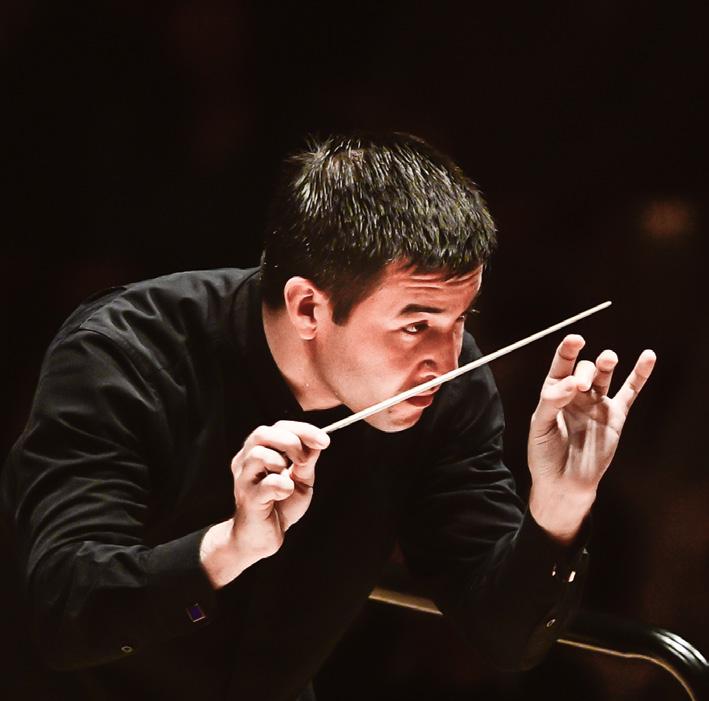
Francesco Lecce-Chong conductor
American conductor Francesco LecceChong has established himself as a respected leader in the orchestral world through his acclaimed performances, innovative projects, and passionate advocacy for the arts. He was appointed Music Director of two U.S. orchestras, the Eugene Symphony and the Santa Rosa Symphony, before he turned 30. With those groups, he successfully launched several groundbreaking projects, commissioning over a dozen major orchestral works and building innovative community partnerships. Now, in his seventh season leading the Santa Rosa Symphony, he has grown the orchestra’s reputation as one of the most exciting and important regional orchestras in the U.S. with performances at one of the most renowned concert halls in the world, the Green Music Center. In the 2024/25 season, Mr. Lecce-Chong takes on the role of Artistic Partner with the Eugene Symphony, a newly created position that allows him to further develop his artistic vision with the orchestra.
Mr. Lecce-Chong regularly appears with major orchestras around the country from the San Francisco Symphony to the New York Philharmonic, collaborating with top soloists such as Renée Fleming and Itzhak Perlman. His subscription debut with the San Francisco Symphony was described by The San Francisco Chronicle as “first rate” and noted the “vitality and brilliance of the music-making he drew from members of the San Francisco Symphony.” Other recent subscription debuts include the Seattle Symphony, Baltimore Symphony, Utah Symphony, North Carolina Symphony, Louisville Orchestra, Kansas
City Symphony, Detroit Symphony, and Saint Paul Chamber Orchestra. In 2023, Mr. Lecce-Chong made his European debut at the prestigious George Enescu Festival with the Romanian National Radio Orchestra, which led to an immediate re-invitation and established a regular relationship with the orchestra.
Through his leadership, Mr. Lecce-Chong has fostered an unparalleled dedication to the future of the orchestral art form through commissions, community initiatives, and arts education. One of his first large-scale endeavors was the “First Symphony Project,” which consisted of major commissions from the next generation of renowned composers across four seasons, complete with multiple residencies in the communities. In less than a decade, he has brought more than a dozen major new orchestral works into the repertoire from composers like Pulitzer Prize winner Ellen Taaffe Zwilich, GRAMMY® winner Michael Daugherty, Conrad Tao, Clarice Assad, and Gabriella Smith. During the pandemic, the Santa Rosa Symphony reached more than two million households in the Bay Area through its “Santa Rosa Symphony Presents” TV broadcasts through local PBS. The programming included more than 20 works by living composers and a partnership with Ellen Taaffe Zwilich, culminating in a recording of her music, conducted by Lecce-Chong and released in 2022 on the Delos label, the first CD release in the orchestra’s history.
Mr. Lecce-Chong is equally committed to the opera repertoire, having first conducted performances of Strauss’s Ariadne auf Naxos at age 24 in New York City. He continued to build his opera credentials as staff conductor with the Santa Fe Opera and leading performances with the Florentine Opera in Milwaukee. More recently, he led the Eugene Symphony through the most ambitious project in its history: a semi-staged presentation of Wagner’s Tristan und Isolde. In Santa Rosa, Mr. Lecce-Chong conducted and directed Mozart’s The Magic Flute, complete with his own original dialogue, in addition to partnering with a local arts high school to create a multidisciplinary experience of the opera. ●
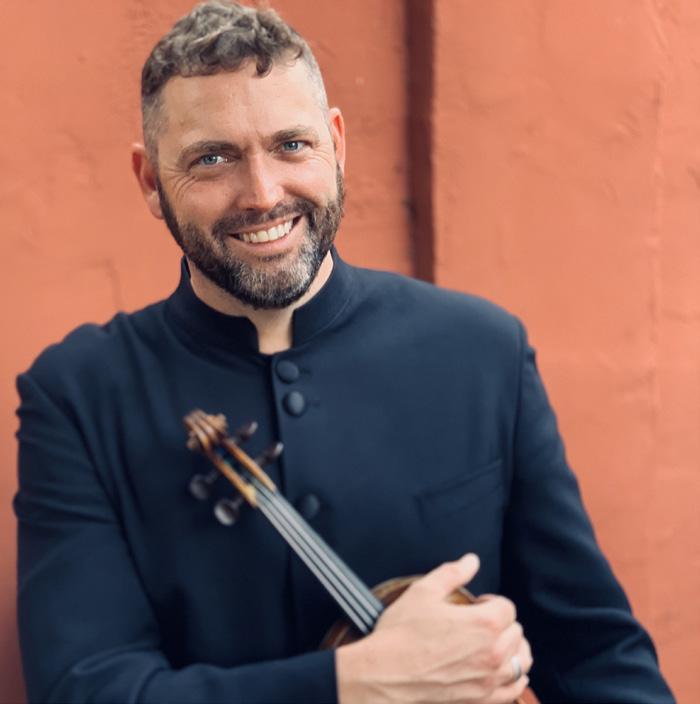
Steven Moeckel violin
As concerto soloist, concertmaster, and recitalist, violinist Steven Moeckel has engaged audiences and critics worldwide with his effortless virtuosity, vivid characterization, and uncanny ability to capture the very essence of a work. A seasoned performer since childhood, Moeckel first appeared as concerto soloist at the age of 8. Since then, he has continued to solo with orchestras throughout the United States, Europe, and Asia, interrupted only by a two-year period as principal soprano soloist of the renowned Vienna Boys Choir.
Moeckel’s concerto repertoire encompasses everything from the standard Classical and Romantic masterpieces to the visceral virtuosity of the Shostakovich Concerto and Corigliano’s The Red Violin. Invited to China under the auspices of the newly formed Ling Tung Foundation, he was the first Western violinist to perform the beloved violin concerto The Butterfly Lovers with a Chinese orchestra. His special affinity for the British repertoire has most recently led to performances of the Elgar, Britten, and Walton concertos.
Steven Moeckel has performed as chamber musician and recitalist with Leon Fleisher and Menachem Pressler at Chicago’s Ravinia Festival and frequently appears in concert with William Wolfram. Notable performances include recitals at the Sewanee Summer Music Festival, the Colorado College Music Festival, and the Sunriver Music Festival. With his longtime partner pianist Paula Fan, Moeckel has toured Europe and the Americas, and performed the complete cycle of the 10 Beethoven sonatas, three times to critical acclaim. Together, they have recorded three
from 9
albums. His most recent album with Indiana University pianist Joanna Goldstein celebrates the works of women composers during the time of Suffrage.
As a communicator, Moeckel’s ability to involve audiences in an astounding range of repertoire distinguishes him as a musician of rare versatility. A Laureate of the venerable Sibelius Competition, his performances earned recognition in the Helsinki press for his ability to probe the mind of a composer. At home in myriad styles, he and pianist Paula Fan performed a 12-hour marathon charity concert featuring masterworks of the classical literature interspersed with intermezzi featuring country, tango, and jazz.
Steven Moeckel is equally at home speaking about music. Since his first appointment as co-concertmaster of Germany’s Ulm Philharmonic at the age of 19, he has been involved in outreach and educational events for orchestras and festivals on both sides of the Atlantic. He has served as a frequent coach for the New World Symphony in Miami, and in 2019 was invited to participate in the National Alliance for Audition Support, a group that trains minority classical musicians in audition preparation in conjunction with the Sphinx Organization, the New World Symphony, and the League of American Orchestras. He has served as orchestra coach at the Peabody Conservatory in Baltimore and has appeared as a guest on the podcast series “Behind the Screen,” hosted by JT Kane and Matt Corey.
A graduate of both the famous Hochschule Mozarteum in Salzburg and Indiana University in Bloomington, Steven Moeckel has served as concertmaster of the Ulm Philharmonic in Germany, the Tucson Symphony Orchestra, the Phoenix Symphony, and the Santa Fe Opera. He is a board member of a nonprofit focused on music awareness called The Wayback Foundation and is currently president of the Arizona chapter of American String Teachers Association. In 2020, he was awarded a tenured violin professorship at Northern Arizona University and is artistic director of the Oxmoor Farm International Chamber Music Festival in Louisville, Kentucky. ●
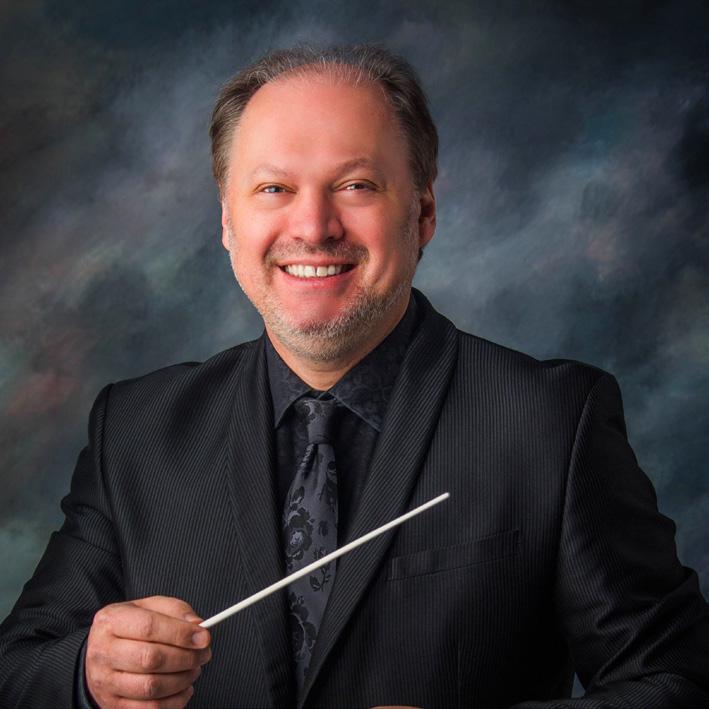
Roberto Minczuk Music Director
In 2017, GRAMMY® Award-winning conductor Roberto Minczuk was appointed Music Director of the New Mexico Philharmonic and of the Theatro Municipal Orchestra of São Paulo. He is also Music Director Laureate of the Calgary Philharmonic Orchestra (Canada) and Conductor Emeritus of the Orquestra Sinfônica Brasileira (Rio de Janeiro). In Calgary, he recently completed a 10-year tenure as Music Director, becoming the longest-running Music Director in the orchestra’s history.
Highlights of Minczuk’s recent seasons include the complete Mahler Symphony Cycle with the Calgary Philharmonic Orchestra; Bach’s St. John Passion, Bruckner’s Symphony No. 7, Beethoven’s Fidelio, Berlioz’s The Damnation of Faust, Mozart’s The Magic Flute, Verdi’s La traviata, Bernstein’s Mass, and Strauss’s Der Rosenkavalier with the Theatro Municipal Orchestra of São Paulo; debuts with the Cincinnati Opera (Mozart’s Don Giovanni), the Tokyo Metropolitan Symphony Orchestra, and Daejeon Philharmonic in South Korea; and return engagements with the Orchestre National de Lille and the New York City Ballet. In the 2016/2017 season, he made return visits to the Israel Symphony Orchestra, as well as the Teatro Colón Philharmonic and Orchestra Estable of Buenos Aires.
A protégé and close colleague of the late Kurt Masur, Minczuk debuted with the New York Philharmonic in 1998, and by 2002 was Associate Conductor, having worked closely with both Kurt Masur and Lorin Maazel. He has since conducted more than 100 orchestras worldwide, including the New York,
Los Angeles, Israel, London, Tokyo, Oslo, and Helsinki Philharmonic Orchestras; the London, San Francisco, Dallas, and Atlanta Symphony Orchestras; and the National Radio (France), Philadelphia, and Cleveland Orchestras, among many others. In March 2006, he led the London Philharmonic Orchestra’s U.S. tour, winning accolades for his leadership of the orchestra in New York, Los Angeles, and San Francisco.
Until 2010, Minczuk held the post of Music Director and Artistic Director of the Opera and Orchestra of the Theatro Municipal Rio de Janeiro, and, until 2005, he served as Principal Guest Conductor of the São Paulo State Symphony Orchestra, where he previously held the position of Co-Artistic Director. Other previous posts include Artistic Director and Principal Conductor of the Ribeirão Preto Symphony, Principal Conductor of the Brasília University Symphony, and a six-year tenure as Artistic Director of the Campos do Jordão International Winter Festival.
Minczuk’s recording of the complete Bachianas Brasileiras of Hector Villa-Lobos with the São Paulo State Symphony Orchestra (BIS label) won the Gramophone Award of Excellence in 2012 for best recording of this repertoire. His other recordings include Danzas Brasileiras, which features rare works by Brazilian composers of the 20th century, and the Complete Symphonic Works of Antonio Carlos Jobim, which won a Latin GRAMMY in 2004 and was nominated for an American GRAMMY in 2006. His three recordings with the Calgary Philharmonic Orchestra include Rhapsody in Blue: The Best of George Gershwin and Beethoven Symphonies 1, 3, 5, and 8. Other recordings include works by Ravel, Piazzolla, Martin, and Tomasi with the London Philharmonic (released by Naxos), and four recordings with the Academic Orchestra of the Campos do Jordão International Winter Festival, including works by Dvořák, Mussorgsky, and Tchaikovsky. Other projects include a 2010 DVD recording with the Chamber Orchestra of Philadelphia, featuring the premiere of Hope: An Oratorio, composed by Jonathan Leshnoff; a 2011 recording with the Odense Symphony of Poul Ruders’s Symphony No. 4, which was featured as a Gramophone Choice in March 2012; and a recording of Tchaikovsky’s Italian Capriccio with the BBC National Orchestra
of Wales, which accompanied the June 2010 edition of BBC Music Magazine. The Academic Orchestra of the Campos do Jordão Festival was the Carlos Gomes prizewinner for its recording from the 2005 Festival, which also garnered the TIM Award for best classical album.
Roberto Minczuk has received numerous awards, including a 2004 Emmy for the program New York City Ballet—Lincoln Center Celebrates Balanchine 100; a 2001 Martin E. Segal Award that recognizes Lincoln Center’s most promising young artists; and several honors in his native country of Brazil, including two best conductor awards from the São Paulo Association of Art Critics and the coveted title of Cultural Personality of the Year. In 2009, he was awarded the Medal Pedro Ernesto, the highest commendation of the City of Rio de Janeiro, and in 2010, he received the Order of the Ipiranga State Government of São Paulo. In 2017, Minczuk received the Medal of Commander of Arts and Culture from the Brazilian government.
A child prodigy, Minczuk was a professional musician by the age of 13. He was admitted into the prestigious Juilliard School at 14 and by the age of 16, he had joined the Orchestra Municipal de São Paulo as solo horn. During his Juilliard years, he appeared as soloist with the New York Youth Symphony at Carnegie Hall and the New York Philharmonic Young People’s Concerts series. Upon his graduation in 1987, he became a member of the Leipzig Gewandhaus Orchestra at the invitation of Kurt Masur. Returning to Brazil in 1989, he studied conducting with Eleazar de Carvalho and John Neschling. He won several awards as a young horn player, including the Mill Santista Youth Award in 1991 and I Eldorado Music. ●
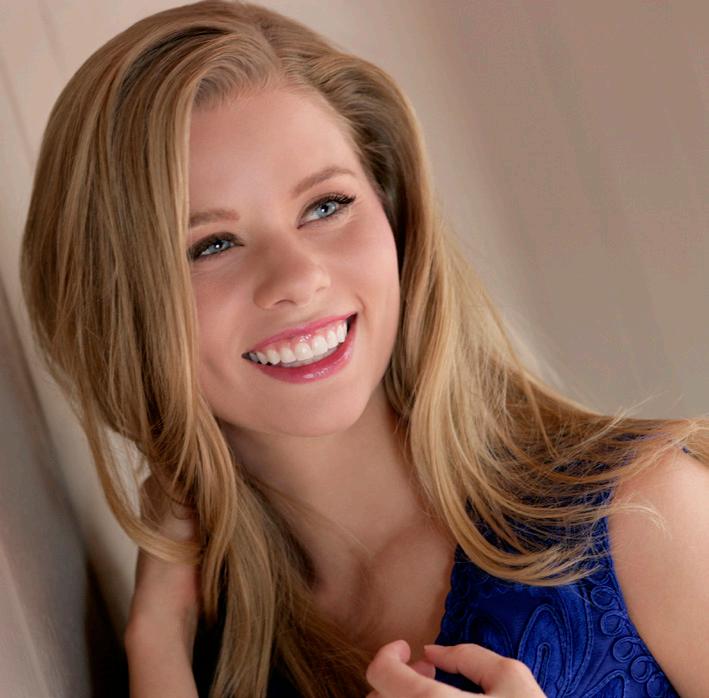
Amy Owens soprano
Amy Owens is known for her “high-flying vocals” and “scene-stealing” charisma (Opera News) on operatic and symphonic stages, as well as her innovative, multidisciplinary pursuits in music and entrepreneurship. Her performing career has taken her to some of America’s most beloved venues, including the Kennedy Center, where her fall 2019 debut as the soprano soloist in Carmina Burana under the baton of Gianandrea Noseda earned praise for “a perfect combination of purring, sensuous phrasing, and pure-toned innocence” (Washington Classical Review). A well-known favorite for Carmina Burana, she has soloed twice with the National Symphony, as well as with the Omaha Symphony, Virginia Symphony, Buffalo Philharmonic, Mobile Symphony, and MidAmerica Productions for her Carnegie Hall debut in 2017. She recently created the title role in Augusta Read Thomas’s Sweet Potato Kicks the Sun with Santa Fe Opera, sharing the stage with legendary beatboxer Nicole Paris in the first commission for the groundbreaking initiative “Opera for All Voices.”
In the 2021/2022 season, Amy made her debut with Chicago Opera Theater in Becoming Santa Claus under Lydia Yankovskaya and covered the roles of Controller and Tina in Dallas Opera’s production of Flight. She also appeared with the Dayton Philharmonic and Lubbock Symphony for performances of Messiah, as well as performances with the Oberlin Contemporary Music Ensemble, Brooklyn Art Song Society, and the Florida Keys Concert Association. She kicked off the 2022 fall season performing Enrique Granados’s
Canciones amatorias with the Brooklyn Art Song Society, followed by her main-stage debut with Virginia Opera as Mabel in The Pirates of Penzance
Other notable roles include Cunegonde in Candide with the Utah Symphony, where she was praised for her “dazzling array of vocal abilities” and “remarkable acting talent,” Johanna in Sweeney Todd with Michigan Opera Theatre, and Florestine in On Site Opera’s North American premiere of La mére coupable, a notoriously difficult score that Owens was hailed as handling with “keen sensitivity,” “gleaming coloratura,” and “impressive accuracy and thrilling high notes” (Broadway World, Bachtrack, Musical America). Her affinity for new music also makes her a sought-after soprano for developing contemporary works, including the Metropolitan Opera workshop of Eurydice, and multiple workshops with American Opera Projects. She covered the role of Faustina in the world premiere of The Phoenix at Houston Grand Opera in 2019, sang as a last-minute replacement in Opera America’s 2016 New Opera Showcase at Trinity Church NYC, was featured in The Intimacy of Creativity Festival in Hong Kong in 2017, and has premiered art song frequently with the NYFOS Next series.
Amy was a resident artist with Utah Opera, Wolf Trap Opera, Santa Fe Opera, and Central City Opera, and was a grand-prize recipient of the Sullivan Foundation in 2014. She also holds awards from the Jensen Foundation (2019 finalist) and Metropolitan Opera National Council (Eastern Region finalist 2015). She is a multiple prizewinner with the George London Foundation and was a featured soloist on their recital series with Anthony Dean Griffey and Warren Jones in 2018.
As a multidisciplinary artist, Amy performed at the 50th annual New Orleans Jazz Festival with renowned musician Glen David Andrews in the Blues Tent in 2019, and as a budding conductor, she was selected to participate in the Hart Institute for Women Conductors at Dallas Opera and the International Conducting Workshop Festival in Bulgaria. She released two collaborative albums in 2019: a debut album of original music, HAETHOR, which received acclaim in the electronica world as “an enchanted force” (Impose), and Songs of Leonard Bernstein, including previously unrecorded vocal music. Other discography
continued from 11 includes her performance as Mater Gloriosa in Utah Symphony’s recording of Mahler Symphony No. 8.
As an educator and producer, Amy cofounded The Collective Conservatory and developed a unique curriculum to forge new and innovative paths for online musical collaboration during the pandemic in 2020. She has also served as the artistic director and co-founder of Bel Canto Productions in Westwood, New Jersey, and production manager for Access Opera, two organizations with missions to increase accessibility and broaden the definition of opera for a wider audience. She developed a unique online education program for vocalists in 2021 called Vocal Revolution and maintains a robust online studio focusing on technique and vocal freedom. In 2022, she co-directed Opera Storytellers, a children’s day camp run through Santa Fe Opera, developing a groundbreaking process for youth to compose and perform an original opera in five days. She also produced a two-week festival for students from her private vocal studio, called Studio Fest, where she produced multiple concerts and conducted a scenes program in Santa Fe, New Mexico.
Amy enjoys developing her interests as a multi-genre vocalist, producer, conductor, accordion player, dancer, yogi, educator, writer, composer, and wellness advocate. She holds an M.M. degree in vocal performance from Rice University and a B.M. in vocal performance from Brigham Young University. ●
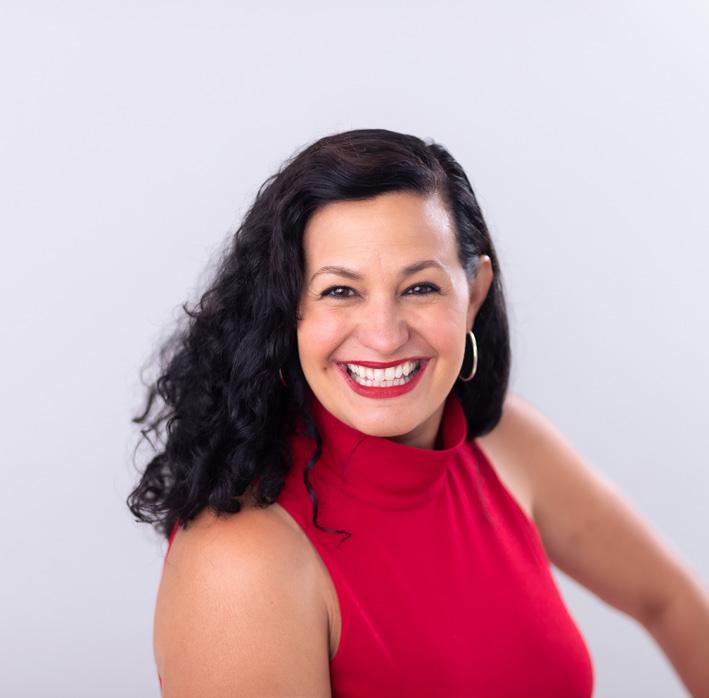
lauded by Opera News for her “smoky tones” and “firm, pleasant voice and lively poise.” She has performed with opera companies and symphonies across the country and internationally and is best known for her sultry Carmen, which she has performed numerous times, including her debut with Amarillo Opera. Dr. Flora was recently featured in Frida with Opera Southwest and Michael Ching’s Completing the Picture, which was recorded and filmed remotely during the pandemic, for Opera Company Middlebury. She has sung with opera companies and symphonies across the United States, including Pittsburgh Opera, Arizona Opera, Opera Company Middlebury, Opera Southwest, Erie Chamber Orchestra, Amarillo Opera, New Jersey Opera Theatre, Akron Symphony, Idyllwild Festival of the Arts, Resonance Works, ReNew, Lake Tahoe Chamber Society, and more.
Upcoming performances include Carmen in Carmen and The Sea in Before Night Falls with Opera Southwest in spring 2024, as well as her debut recording: Canciones de mi Isla: Songs from My Island, featuring Cuban classical songs. She will be returning to Rome, Italy, in summer 2024 to sing the mezzosoprano solos in Verdi’s Requiem. Dr. Flora is currently an assistant professor of voice and head of the voice area at the University of New Mexico where she directs the Spring opera. olgaperezflora.com. ●
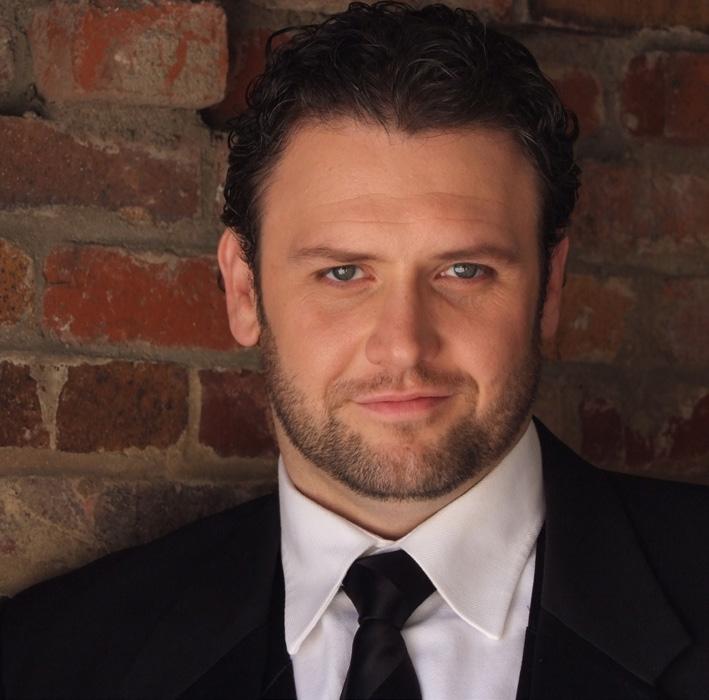
James Flora tenor
Hailed for his “resonant, impeccably trained voice and fearlessness to his singing,” American tenor James Flora has received acclaim in repertoire ranging from Verdi and Wagner to works by Carlisle
Floyd and Daron Hagen, having sung the role of Louis Sullivan from Hagen’s Shining Brow at Frank Lloyd Wright’s 20th-century masterpiece Fallingwater. James has sung with the Metropolitan Opera Chorus under Maestro Donald Palumbo in their most recent productions of Die Meistersinger von Nürnberg and Fidelio. He made his Pittsburgh Opera debut as Fenton in Falstaff, and has since returned for seven productions, including Carmen, Turandot, Lucia di Lammermoor, and most recently as Second Jew alongside the Salome of Patricia Racette.
James has performed leading roles in opera companies across the United States, including Alfredo (La traviata), Tamino (The Magic Flute), Pinkerton (Madama Butterfly), Rodolfo (La bohème), and Don José (Carmen), appearing with companies including Washington Concert Opera, Arizona Opera, Glimmerglass Opera, Opera Company Middlebury, Opera Columbus, and others. Equally at home on the symphonic stage, he has sung with the Pittsburgh Symphony, Reno Philharmonic, Erie Chamber Orchestra, and Buffalo Philharmonic, and recently debuted with the La Voz Humana: Lenguajes Múltiples festival in Cuba with Maestro Leo Brouwer and guitar virtuoso Joaquin Clerch. James’s recent performances include a debut as Florestan in Fidelio with Opera Company Middlebury and Indianapolis Chamber Orchestra, where he has previously been seen as Cavaradossi (Tosca) and Mitch (A Streetcar Named Desire).
James was a Young American Artist with Glimmerglass Opera, a Resident Artist with Pittsburgh Opera, and a Marion Roose Pullin Studio Artist with Arizona Opera, where he made his operatic debut as Malcolm in Verdi’s Macbeth. In 2010, James was a Richard Tucker finalist. He holds voice degrees from The Ohio State University (B.M. in vocal performance, summa cum laude) and Florida State University (M.M. in vocal performance).
He is currently on the voice faculty of the University of New Mexico and has served on the faculties of Arizona State University, University of Nevada—Reno, Central Michigan University, Otterbein University, and Point Park University, and is a member of NATS and AGMA. James has students performing on and off Broadway in productions of Hamilton, Urinetown, Shrek the Musical, and Rent and has students in Dolora Zajick’s Institute for
Young Dramatic Voices. He is the co-artistic director and co-founder of Tito Gobbi Italian Summer Program on the grounds of the Gobbi Villa in Rome, Italy. ●
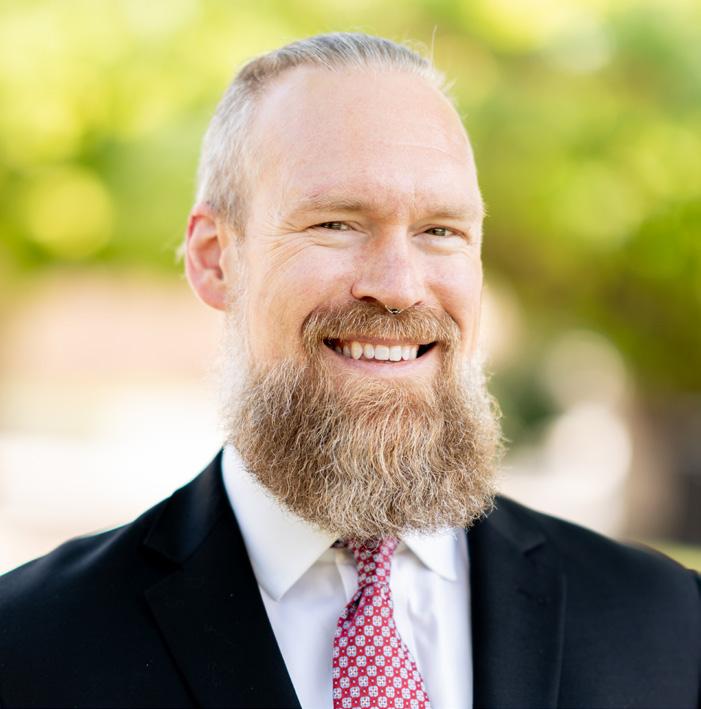
Baritone Michael Hix has been praised by critics for his “expressive voice” and “commanding stage presence.” His career highlights include performances at Carnegie Hall, Tanglewood Music Center, Boston’s Symphony Hall, and Vienna’s Musikverein. Hix is a sought-after performer of concert/ orchestral works with more than 70 oratorio/ cantata/concert roles in his repertoire. His album of solo bass cantatas by Baroque composer Christoph Graupner, My Faith Stands Firm, was recently released by the Affetto Label. He won 3rd Place in the American Prize in Art Song and Oratorio Performance in 2019. European performances include the bass solos in Haydn’s Lord Nelson Mass and Heligmesse at the International Haydn Festival in Vienna, Austria; and song recitals in Leipzig, Dresden, Lobau, and Lindlar, Germany. He has been featured as a soloist in concerts with the Boston Pops, Oregon Bach Festival, Arizona Bach Festival, Durango Bach Festival, Santa Fe Symphony, Santa Fe Chamber Music Festival, Orlando Philharmonic Orchestra, Georgia Symphony, New Mexico Philharmonic, Idaho Falls Symphony, San Juan Symphony, Tallahassee Symphony, Tupelo Symphony, Montgomery Symphony, Brevard Symphony Orchestra, Santa Fe Desert Chorale, True Concord Voices, New York City’s Trinity Lutheran Bach Vespers Series, and the Tallahassee Bach Parley, among others.
Included among his more than 20 stage
roles are Mad King George in Peter Maxwell Davies’s Eight Songs for a Mad King, Falke in Die Fledermaus, Germont in La traviata, Don Alfonso in Cosí fan tutte, Nick Shadow in The Rake’s Progress, the Drunken Poet in The Fairy Queen, Grosvenor in Patience, Lord Mountararat in Iolanthe, Scaramba in El Capitan, Noye in Noye’s Fludde, and Bertouf in the world premiere of A Friend of Napoleon by Pulitzer Prize-winning composer Robert Ward.
Dr. Hix holds a Bachelor of Music degree in music theory from Furman University, Master’s degrees in both voice and historical musicology from Florida State University, and a Doctorate of Music in voice performance from Florida State University. He is a Professor of Voice and Chair of the Department of Music at the University of New Mexico. You can follow Hix on social media, @mhixbaritone, and learn about upcoming performances on his website, www.michaelhixbaritone.net. ●
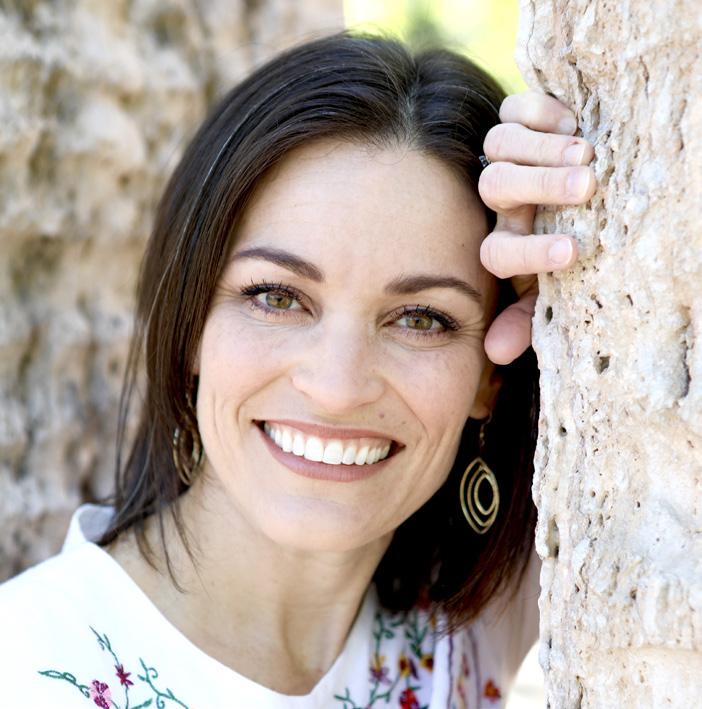
New Mexico Philharmonic Chorus/Sharee Gariety director
The New Mexico Philharmonic Chorus is an ensemble of talented community singers who unite under the leadership of Sharee Gariety, choir director, in the University of New Mexico Music Department. The chorus rehearses weekly, bringing together individuals from diverse backgrounds who share a love of choral singing. Among its members are many parents and their children, enjoying the rare chance to experience rehearsals and performances together as family.
The chorus performs regularly with the New Mexico Philharmonic in a wide variety of concerts throughout the year. In the 2025/2026 performance season, the New Mexico Philharmonic Chorus will join
the orchestra for Messiah, Home Alone in Concert, and Harry Potter and the Prisoner of Azkaban™ in Concert.
Sharee Gariety, a California native, earned a Bachelor of Arts in music from Brigham Young University before relocating to Albuquerque with her husband. For more than two decades, they have made Albuquerque their home while raising their seven children.
An experienced choral director, Sharee has led numerous church and community choirs and holds a Master’s degree in choral conducting from the University of New Mexico. She currently serves as the director of Las Cantantes, UNM’s treble voice choir, and the UNM Children’s Chorus, part of the UNM Music Prep School.
In addition to her university roles, she is an active clinician, adjudicator, and guest conductor, collaborating with middle and high school choral programs throughout Albuquerque and Rio Rancho. For more than 15 years, she has also directed the Children’s Music Theatre summer camp and elementary outreach program helping children gain confidence through introductory experiences in musical theatre. With extensive experience teaching music to all ages—from babies to adults—Sharee is passionate about fostering musical growth through group singing across all stages of life. ●
NOTES BY SHUYING LI
Shuying Li was born in China on November 24, 1989, and is currently on the faculty at California State University, Sacramento. The Phoenix Ascends is scored for piccolo, 2 flutes, 2 oboes, 2 clarinets, bass clarinet, 2 bassoons, 4 horns, 3 trumpets, 2 trombones, bass trombone, tuba, timpani, vibraphone, tom-tom, glockenspiel, lion’s roar, snare drum, cymbals, bass drum, crotales, chimes, harp, and strings. Approximately 6 minutes.
The Phoenix Ascends draws inspiration from the timeless myth of the phoenix, a universal symbol of rebirth, transformation, and renewal. Through its journey from ashes to majestic ascension, the phoenix embodies themes of resilience and regeneration that resonate deeply across cultures.
The composition begins with a majestic opening, depicting the phoenix awakening amid the beauty of dawn. It leads to a dreamlike, tonal atmosphere, where lush harmonies flow seamlessly between strings, woodwinds, and percussion, evoking the joy of flight before transformation. This gives way to an energetic section driven by rhythmic vitality and pulsing percussion, reminiscent of fiery trials and the phoenix’s passage through adversity. The music builds to a climactic moment of dazzling brilliance, as rapid, high-register gestures in the upper strings, woodwinds, and shimmering percussion create the sensation of radiant light. The piece concludes with a majestic final gesture, as the brass choir, trombone glissandi, and resonant chords symbolize the phoenix’s triumphant ascension and ultimate renewal. ●
BY CHARLES GREENWELL
Johannes Brahms (1878)
Johannes Brahms was born on May 7, 1833, in Hamburg, Germany, and died on April 3, 1897, in Vienna, Austria. The Violin Concerto is scored for solo violin, 2 flutes, 2 oboes, 2 clarinets, 2 bassoons, 4 horns, 2 trumpets, timpani, and strings. Approximately 40 minutes.
No discussion of this glorious work can take place without mentioning Brahms’s great friend and colleague, the Hungarian violinist, composer, and conductor Joseph Joachim (1831-1907), for whom the concerto was written. He was perhaps the greatest violinist of the 19th century, an extraordinary child prodigy whose formal debut at age 8 was hailed as the coming of a second Paganini, and whose name became, throughout the sixty-plus years of his career, a byword for nobility and truth in his art. He was also a fine composer, an excellent conductor, a revered teacher, and the leader of the most highly esteemed string quartet of his day. Among other things, Joachim wanted to find a way to make the orchestra and soloist entirely equal in a violin concerto, with a score that would demonstrate the full mastery of the orchestra just as the violin part would display the full virtuosity of the soloist. He attempted to reach this goal with his own Violin Concerto in d minor (called the “Hungarian” concerto), but his ability to write for the orchestra simply did not match his ability to write for the violin. It was not until Brahms composed his Violin Concerto that Joachim’s goal was finally reached.
The Phoenix Ascends draws inspiration from the timeless myth of the phoenix, a universal symbol of rebirth, transformation, and renewal.
There were two Hungarian-born violinists from whom Brahms absorbed the Hungarian strain found in many of his works, among them the present concerto: Joachim was one, the other was Eduard Remenyi, with whom Brahms toured as a pianist before he met Joachim. That meeting took place in 1853, and Joachim was so impressed with Brahms’s compositions and musicianship that, some 50 years later, he said, “Never in the course of my artist’s life had I been more completely overwhelmed.” He recognized a real kindred spirit in Brahms, and introduced him to both Schumann and Liszt, after which the two embarked on an extended series of concert tours throughout Europe, which, among other things, helped to establish a very close personal and professional relationship. Brahms was a superb pianist but knew little about the violin, and it was on these tours that he became familiar with violin repertoire and technique, as well as Joachim’s desire to reinvent the violin concerto. Brahms was fascinated by this, but did nothing about it for 25 years, as the two friends purposely developed their respective careers in such a way as to not create any rivalry. Furthermore, it is known that Brahms did not even make an attempt to write a violin concerto until it was clear that Joachim had stopped composing.
The first mention of a concerto occurred in a letter from Brahms in August 1878 when he was spending the summer on a beautiful lake in southern Austria, a region, he once said, where the melodies were so abundant that care had to be taken not to step on them. The two men met at the lake toward the end of that month, and correspondence continued between them for some time. As he was composing the concerto, Brahms received from Joachim a good deal of technical advice, but sources differ as to whether Brahms accepted most of the violinist’s suggestions or whether he simply showed the score to Joachim out of courtesy and was not much influenced by those suggestions. What seems certain is that the new concerto was created in very broad dimensions in the footsteps of the Beethoven concerto. It must be remembered that Joachim gave the London premiere of the Beethoven in 1844, with Mendelssohn conducting, when he was just shy of his 13th birthday, and by the time he met Brahms some nine years later, virtually every prominent
violinist was playing the Beethoven.
Following the new concerto’s completion, plans were made for a tryout with the Berlin Conservatory Orchestra in the fall of 1878, for Joachim to compose a cadenza, and for the premiere to take place with the Leipzig Gewandhaus Orchestra on New Year’s Day in 1879. It was in this same hall that, some 20 years previously, Brahms’s First Piano Concerto had met with a disastrous reception, and as a result he had not written any kind of a concerto since. At the premiere, the audience seemed unmoved by the first movement, began to warm up to the second movement, and then responded enthusiastically to the finale. Joachim’s playing was universally admired, as was his cadenza, and when the work was premiered in Vienna two weeks later, Brahms reported that Joachim had “… played the cadenza so magnificently that the people clapped right into my coda!” One way in which Joachim definitely influenced the work was in its construction: originally there were to have been four movements, but the scherzo was taken out, and the material was later reworked to become the second movement of the Second Piano Concerto.
Even though Brahms had input from Joachim and others, his musical imagination far exceeded the existing conventions for a violin concerto. Curiously, both Brahms and Tchaikovsky wrote their violin concertos in the same year, and both works changed expectations of how a violin should sound in an orchestral setting. In spite of Brahms’s solid prestige at the time and Joachim’s passionate sponsorship, the new concerto took a long time to establish itself but now is rightly considered to be one of the greatest of all violin concertos. Joachim had wanted the violin and the orchestra to be on an equal footing but in a very real sense, Brahms made the violin the rhythmic force driving the orchestra forward, particularly in the outer movements, and also exploited the high register of the instrument in a lyrical way that was unprecedented. The slow movement contains one of the most beautiful melodies that Brahms ever created, but it was the reason the great Spanish violinist Pablo de Sarasate refused to play the concerto, saying, “I don’t deny that it is very good music, but do you think I could stand, violin in hand, and listen to the oboe play the only good tune in
the whole work?” Then there is the rollicking, boisterous finale, which in the principal section of the rondo was a heartfelt tribute from Brahms to Joachim’s Hungarian roots. However, just as Joachim never returned to Hungary or sympathized with its nationalist causes, other themes intervene that are definitely not Hungarian in character. Finally, the concerto ends in a most unusual way by having the music change meter not once but twice, then slows down almost to a standstill until three powerful chords bring the work to its magnificent conclusion. ●
One of the towering figures of 20thcentury music, Igor Stravinsky was born in Oranienbaum, Russia, on June 17, 1882, and died in New York City on April 6, 1971. While his best-known works remain the three ballet scores based on Russian themes and scenarios—The Firebird, Petrushka, and The Rite of Spring—composed for Sergei Diaghilev’s Ballets Russes in the early 1910s, Stravinsky wrote works that encompass many genres and explore a wide variety of musical
styles, all of which bear his own distinctive traits. Petrushka, whose scenario was created by Alexander Benois, was first performed at Châtelet, Paris, on June 13, 1911, under the baton of Pierre Monteux. Stravinsky revised the instrumentation and simplified the barring of certain passages in 1947. The scoring calls for 3 flutes (3rd doubling piccolo), 2 oboes, English horn, 3 clarinets (3rd doubling bass clarinet), 2 bassoons, contrabassoon, 4 horns, 3 trumpets, 3 trombones, tuba, timpani, bass drum, cymbals, snare drum, tambourine, triangle, tam-tam, xylophone, piano, celesta, harp, and strings. Approximately 35 minutes.
What is it about clowns? Why, on the one hand, do they bring laughter and delight to many, while at the same time seem frightening and repulsive to others? What, indeed, lies behind that painted smile? Ever since the rise of the Commedia dell’ Arte in the 16th century, we know the archetypical clown by many names: Pierrot, Polichinelle, Pedrolino, Pagliaccio, Pulcinella, Punch, Petrushka, Kasperle, to name but a few. In most cases the “sad clown” figure pursues, with no luck, the beautiful Columbine. His rival for her affections is the character Harlequin.
It may be one of music history’s fortuitous coincidences that two of the 20th century’s most important composers—Igor Stravinsky and Arnold Schönberg—within one year of each other, addressed these questions in very
It may be one of music history’s fortuitous coincidences that two of the 20th century’s most important composers— Igor Stravinsky and Arnold Schönberg—within one year of each other, addressed these questions in very different, yet related, ways.
The orchestra in turn retaliates with menacing trumpet-blasts. The outcome is a terrific noise which reaches its climax and ends in the sorrowful and querulous collapse of the poor puppet.
different, yet related, ways. In Schönberg’s case, we have the 1912 song cycle Pierrot Lunaire (Moonstruck Pierrot, or as I prefer, Pierrot the Lunatic), that sets twenty-one poems by Albert Giraud that create a suffocatingly dark scenario that practically defines the artistic movement known as Expressionism. On the other hand, we have Stravinsky’s brilliant score for Alexander Benois’s balletic scenario that tells the story of Petrushka and his fellow puppets, set in the festive and colorful life of a Shrovetide (Mardi Gras) Festival.
Petrushka came into existence while Stravinsky was in the midst of work on a new ballet for Sergei Diaghilev that was to become the Rite of Spring. In researching the project, the composer was steeped in a host of folk tunes from Russia, Lithuania, and other places. As Stravinsky wrote: Before tackling the [Rite of Spring], which would be a long and difficult task, I wanted to refresh myself by composing an orchestral piece in which the piano would play the most important part—a sort of Konzertstück. In composing the music, I had in my mind a distinct picture of a puppet, suddenly endowed with life, exasperating the patience of the orchestra with diabolical cascades of arpeggi. The orchestra in turn retaliates with menacing trumpet-blasts. The outcome is a terrific noise which reaches its climax and ends in the sorrowful and querulous collapse of the poor puppet. [Stravinsky, An Autobiography, 1936; cited in W.W. Norton’s edition of Petrushka edited by Charles Hamm, 1967.]
Here we already have the basic outlines of the story. Diaghilev, expecting to see progress on the Rite of Spring, was delighted with what Stravinsky showed him, and agreed immediately to flesh out and produce Petrushka. The story is divided into four scenes (Tableaux), connected by drum rolls. The storyline is as follows (adapted from Wikipedia):
First Tableau—The Shrovetide Fair
The curtain rises to reveal Saint Petersburg’s Admiralty Square. We hear the cries of street vendors. In the original choreography, a group of Drunken Revelers emerges from the crowd, dancing to Stravinsky’s adaptation of the folk tune “Song of the Volochobniki.”
Suddenly, the festive music is interrupted by strident brass announcing the appearance of the Master of Ceremonies on the balcony of his booth. The equivalent of a carnival “barker,” he boasts of the attractions to be seen within.
The squeaks of a street organ are heard (clarinets and flutes) as an Organ-Grinder and Dancing Girl emerge from the crowd, which at first pays little attention as the barker continues to shout. The Dancer moves downstage and begins to dance to another Russian folk song, “Toward Evening, in Rainy Autumn,” while playing the triangle.
At the other end of the stage, a second Dancing Girl appears, accompanied by a music box (suggested in the orchestra by the celesta). The two Dancing Girls compete for the crowd’s attention to the strains of a ribald French music-hall song about a woman with a wooden leg: “Une Jambe de bois.” The
Drunken Revelers return, interrupted several times by the Barker’s boasts. The street vendor’s cries of the very opening are heard once more.
Suddenly, two drummers summon the crowd to the puppet theater. The Magician appears to mystical groans from the bassoon and contrabassoon. When he has everyone’s attention, he produces a flute and begins to play. The curtain of the puppet theater rises to reveal three puppets hanging on the wall: the Moor, the Ballerina, and Petrushka. When the Magician touches them with his flute, they awaken and begin a vigorous Russian Dance (based on two more Russian folk tunes: “A Linden Tree is in the Field” and “Song for St. John’s Eve”).
Second Tableau—Petrushka’s Room
Drumrolls announce the beginning of the Second Tableau. Without an Introduction, the music begins menacingly. “A foot kicks him onstage; Petrushka falls . . .”
As he gradually pulls himself together, we hear a strange arpeggio in the clarinets: This is the famous “Petrushka Chord” (consisting of juxtaposed triads of C Major and F-sharp Major). The clown gets to his feet to the accompaniment of waves of arpeggios from the piano (revealing the music’s origins in Stravinsky’s Konzertstück). The “Petrushka Chord” returns, now violently scored for trumpets, marked in the score “Petrushka’s Curses,” directed at the portrait of the Magician.
The music turns lyrical as Petrushka falls to his knees and mimes (in turn) his self-pity, love for the Ballerina, and hatred of the Magician.
The Ballerina sneaks into his room, at first unnoticed. As soon as he sees her, he begins a manic, athletic display of leaps and frantic gestures. Frightened by his exuberance, the Ballerina flees.
Another passage of arpeggios for piano grows into a second round of curses directed at the Magician, again represented musically by the “Petrushka Chord,” this time scored for full orchestra.
For just a moment, Petrushka peers out of his room at the crowd assembled in Admiralty Square, before he collapses as we hear a taunting reprise of the clarinets playing the “Petrushka Chord,” followed by an odd trumpet call that brings the Tableau to its end.
Third Tableau—The Moor’s Room
As before, drumrolls link the Third Tableau to its predecessor. Benois’s design for the Moor’s Room evokes a romanticized desert: palm trees, exotic flowers, sand.
In Fokine’s choreography, the Moor reclines on a divan playing with a coconut. He then jumps to his feet and attempts to cut it with his scimitar. When he fails, he believes that the coconut must be a god and proceeds to pray to it.
The Magician places the Ballerina in the Moor’s room. The Ballerina is attracted to the Moor’s handsome appearance. She plays a saucy tune on a toy trumpet and dances with the Moor. This moment provokes a very odd counterpoint, as the Moor’s music and the Ballerina’s can hardly be said to “fit” one another.
Petrushka finally breaks free from his cell, and he interrupts the seduction of the Ballerina. He attacks the Moor but soon realizes he is too small and weak. The clownpuppet flees for his life, with the Moor chasing him, and escapes from the room.
Fourth Tableau—The Shrovetide Fair (Toward Evening)
The orchestra introduces a chain of colorful dances as a series of apparently unrelated characters come and go about the stage as snow begins to fall. The first and most prominent is the Wet-Nurses’ Dance, performed to the tune of the folk song “Down the Petersky Road.” Then comes a peasant with his dancing bear, followed in turn by a group of a gypsies, coachmen and grooms, and masqueraders.
As the merrymaking reaches its peak, a cry is heard from the puppet theater. Petrushka suddenly runs across the scene, followed by the Moor in hot pursuit brandishing his sword, and the terrified Ballerina chasing after the Moor, fearful of what he might do. The crowd is horrified when the Moor catches up with the clown and slays him with a single stroke of his blade.
The police question the Magician, who seeks to restore calm by holding the “corpse” above his head and shaking it to remind everyone that Petrushka is only a puppet.
As night falls and the crowd disperses, the Magician leaves, carrying Petrushka’s limp body. All of a sudden, Petrushka’s ghost
appears on the roof of the little theatre, his cry now in the form of angry defiance. Petrushka’s ghost thumbs its nose at his tormentor.
Now completely alone, the Magician is terrified and departs the scene, which is hushed, leaving the audience to wonder who is “real” and who is not.
The vivid music for Petrushka has become a staple of orchestral concerts throughout the world. Some of its music also may be heard in an arrangement that Stravinsky made in 1921 for Arthur Rubinstein called “Three Movements from Petrushka.” ●
NOTES BY DAVID B. LEVY
Wolfgang Amadeus Mozart was born on January 27, 1756, in Salzburg and died on December 5, 1791, in Vienna. The Divertimento in B-flat Major is one of a pair of works presumably composed in Milan in 1773, the other being the Divertimento in E-flat Major, K. 166/159d. The “K” number used for Mozart’s works refers to the name Ludwig Ritter von Köchel, who first issued the Chronological-Thematic Catalogue of the Complete Works of Wolfgang Amadé Mozart in 1862. The Köchel catalogue has been updated and revised many times to keep pace with musicological revelations. Scored for 2 oboes, 2 clarinets, 2 English horns, 2 bassoons, and 2 horns. Approximately 23 minutes.
Throughout his all-too-brief life, Mozart never considered it beneath his dignity to provide music for parties. The genre of composition known as the serenade, cassation, or divertimento, in fact, may be deemed among the earliest examples of background or “restaurant” music. This should be taken only in the sense that it was created to lend a festive atmosphere to an occasion, rather than to draw attention to itself as a piece intended for “serious” listening. As is the case with nearly everything he wrote, however, Mozart’s works of this kind make for rewarding and delightful attentive
listening.
Mozart’s skill and fondness for composing for wind instruments manifested itself in many forms. Among these, we may count solo concertos for oboe, flute (two, plus a concerto for flute and harp), horn (four), bassoon, and clarinet, as well as a sinfonia concertante for winds (although of doubtful authenticity). In each case, we know that Mozart composed these works for friends and colleagues, such as the hornist Joseph Leutgeb and clarinetist Anton Stadler. We also find in his oeuvre chamber music for winds, piano, and strings. Many of his other compositions also display skillful and delightful writing for wind instruments. His chamber works for winds alone were often titled “divertimento” or “serenade,” whose instrumentation falls under the category of “Harmoniemusik” (Harmonie being the German nomenclature for woodwinds).
The Divertimento, K. 159b was probably commissioned by Grand Duke Leopold I of Tuscany, as part of an unsuccessful attempt by Mozart to seek employment. This charming piece comprises five movements marked Allegro assai, Menuetto, Andante, Adagio, and Allegro, respectively. ●
Throughout his all-toobrief life, Mozart never considered it beneath his dignity to provide music for parties.
French composer Charles-François Gounod was born in Paris on June 17, 1818, and died in Saint-Cloud (near Paris) on October 18, 1893. Best known for his operas Faust and Roméo et Juliette and his setting of the “Ave Maria” based on Bach’s Prelude No. 1 from The Well-Tempered Clavier, Gounod composed many other works spanning a wide variety of genres. His studies in Paris led him to travel elsewhere as a winner of the Prix de Rome. He received encouragement from many composers, including Berlioz and Mendelssohn. His Petite Symphonie for winds was composed in 1885 and is scored for flute, 2 oboes, 2 clarinets, 2 bassoons, and 2 horns. Approximately 20 minutes.
Gounod’s Petite Symphonie was the result of a commission from the Société de musique de chambre pour instruments à vent and its director, the flutist Paul Taffanel, and was first performed at Paris’s Salle Pleyel on April 30, 1885. This lovely four-movement work fuses the Classical elegance of Mozart and Haydn with the color and charm of French Romanticism. Among the earliest and most enduring works of the 19th-century revival of wind chamber music in France, it helped pave the way for later composers such as Ravel, Françaix, and Milhaud. ●
George Frideric Handel was born on February 23, 1685, in Halle, Germany, and died on April 14, 1759, in London, England. His Messiah is scored for 2 oboes, 2 bassoons, 2 trumpets, timpani, continuo, strings, SATB soloists, and chorus. Approximately 120 minutes. The oratorio, one of the great Baroque vocal forms, came from the religious playwith-music of the Counter-Reformation and took its name from the Italian word for a place of worship. The first oratorios were actually sacred operas—and were produced as such. Then, around the middle of the 17th century, the oratorio gradually did away with theatrical trappings and developed its own personality as a large-scale work for solo voices, chorus, and orchestra, usually— but not always—based on a biblical story. These new productions were usually performed in a church or hall without scenery, costumes, or acting, and what action there was, developed with the use of a narrator and a series of recitatives, arias, duets, trios, and choruses, with the role of the chorus being quite prominent. Typical of this form are the oratorios of Handel, probably the finest composer of this popular vocal form. Handel came from the middle class and went on to make
Among the earliest and most enduring works of the 19th-century revival of wind chamber music in France, it helped pave the way for later composers such as Ravel, Françaix, and Milhaud.
his career in England, where the middle class first achieved its strength. As he turned from standard opera to oratorio, he became part of an enormous social change, and in so doing, became one of the founders of a new culture and a creator of our modern mass public. He had very keen instincts and was able to understand the needs of his adopted country, and he produced oratorios that were steeped in the settings of the Old Testament, making them perfectly suited to the tastes of England’s middle class. He achieved this in part by making the chorus—in other words, the people—the center of the drama. Like Bach and other great Baroque masters, Handel’s rhythms were strong and unswerving, and he favored the direct language of diatonic harmony as opposed to Bach’s more ingenious idiom, which at times became highly chromatic. Handel’s melodies unfold in great majestic arches and reveal a depth of feeling that sets him apart from most of his contemporaries. Having grown up in the theatrical world, he was able to make use of tone color for a variety of moods and dramatic expression. Handel first came to England when he was 25, and already celebrated throughout Europe as an outstanding composer of Italian-style opera. His main reason for going to England was to repeat his successes as an opera composer, and he was able to achieve this—for a time. After 25 years of triumphs in this realm, two forces did him in: the inevitable changes in public taste and the rivalries and jealousies that have always been a part of theatrical life. As a result, his final season of opera in London in 1741 was such a disaster that he began to think seriously about returning to Germany. Fate intervened, however, when Charles Jennens, his English literary collaborator, seriously worried about losing this supremely gifted composer, gave Handel the libretto of a new oratorio called simply Messiah. Jennens hoped it would inspire the man to new heights and specifically designed the work to be presented during Holy Week, when theaters would be closed, thus assuring a full house for some kind of benefit performance. Jennens was
correct: Handel thought the new libretto was inspired and could be used as part of a new venture that had come his way. He had recently been invited to Dublin to give a series of oratorio concerts and realized immediately that Messiah, performed as a benefit concert for charity, would be the perfect way to conclude the season.
Handel began work on the new score in late August 1741, and in a phenomenal burst of virtually nonstop energy, finished the entire score, orchestration and all, in the amazing space of just 24 days! He set out for Ireland in early November and arrived in Dublin on November 18. The trip across the water proved to be a revitalizing experience, and in spite of the hard work that the new oratorio season would require, it was almost like a holiday, away from the financial, artistic, and personal problems that he had been dealing with
in London. In addition, when he came to Dublin, he was greeted with the kind of adulation that had greeted his arrival in London some 30 years previously, and once again he was idolized, fussed over, feted wherever he went, and in general, treated like some kind of royalty. The music-loving people of Ireland had in Dublin several musical societies that were unusual in that they were all organized for charitable purposes. This was largely due to the terrible social conditions in the country, compared with the poor people of London and the inmates of its prisons and hospitals who were relatively well off. The citizens of Dublin, appalled by the miserable conditions in their prisons and hospitals, wanted to do everything they could to alleviate this wretched state of affairs, and so they raised money for humanitarian purposes by sponsoring
public concerts. There was then a new Music Hall in the city that was built on order from the Charitable Music Society and their guiding light, a wealthy and influential music publisher named William Neale. He was also the secretary of Dublin’s Charities Commission, and he not only had a commanding position in all that was to follow, but in all likelihood had a hand in the invitation that brought Handel to Dublin and resulted in the production of Messiah.
On March 27, 1742, the Dublin Journal printed an announcement for a new benefit concert, stating that it would take place at the Music Hall on April 12, at which time would be performed “… Mr. Handel’s new Grand Oratorio, called Messiah, in which the Gentlemen of the Choirs of both Cathedrals will assist, with some concertos on the Organ by Mr.
continued from 19
Handel.” As it turned out, the concert did not take place until April 13, but there was a public rehearsal on April 9, about which the Journal had written: “Yesterday Mr. Handel’s new Grand Sacred Oratorio called Messiah was rehearsed…and was performed so well that it gave universal satisfaction to all present; and was allowed by the greatest Judges to be the finest Composition of Musick that was ever heard...” In that article and again on the day of the performance there were requests to the audience that ladies come without hoops in their dresses and that gentlemen come without their swords, so that the greatest number of people could be squeezed into the hall. At the formal premiere, this resulted in an audience of 700 pressed into a space designed to hold 600, but nobody seems to have been upset in the slightest. The premiere was an unqualified triumph, and the press notices outdid themselves in praising the work and its performance, with particular praise being given to the fact that everyone performed gratis, thereby helping to raise over 400 pounds for the advertised charities. Because of its great success, Handel was asked to repeat the work at his last Dublin concert and so began the career of one of the most popular, beloved, and frequently performed works in the history of music.
Messiah was given its first performance in London in March of 1743, but it was not at all the great success it had been in Dublin. It is possible that Handel anticipated certain objections to the work, as he advertised it as “a New Sacred Oratorio” without mentioning its title, but he was certainly unprepared for the hostility it received in some quarters. There were many who were greatly upset that the Scriptures formed the basis for what was presented as secular entertainment and were very vocal in objecting to its having been presented in a theatre with several famous singers as soloists. Even librettist Jennens, after hearing the work for the first time, said that he was dissatisfied with what he called “some weak parts” in the score. As a result of this, Messiah was rarely performed
in London in the mid-1740s, while at the same time it was being performed regularly in Dublin. In 1749, things made a dramatic turnaround, and once again the prime force was a connection with charity. Handel had always been known as a kind and generous man, and at the time he had become interested in the recently created Foundling Hospital for young orphans and children in dire need. In May of 1749, he proposed a concert for the hospital’s benefit, and ultimately was appointed a governor of the establishment. On May 27, the concert was given in the newly built chapel, and it was a great success. The hospital received a considerable sum of money from the concert, and that sum was further increased by a very generous gift from the King. The following year, Handel put together a new season of oratorio, and Messiah played a prominent role. It was given at the Foundling Hospital on May 1, 1750, and the chapel was so packed with eager listeners that the work had to be repeated on May 15. These were successes on the scale of the Dublin premiere and marked the beginning of the oratorio’s great popularity in London and elsewhere.
In the years to come, Handel made it a tradition to include Messiah in his oratorio seasons during Lent and also performed it every year at the Foundling Hospital. (Incidentally, although the Foundation still exists and thrives in London, the chapel in which Handel played, and to which he left a score and parts to Messiah in his will in order that the performances
might continue, was declared unsafe and demolished in 1926. It was the last remaining building in London in which he had promoted concerts.) He continued to conduct performances of Messiah right up until his death, and in fact in March of 1759 gave three performances at Covent Garden. The annual Foundling Hospital performance was scheduled for May 3, but before the rehearsals could begin Handel was taken seriously ill. After a week of steady deterioration, he finally succumbed on April 14, 1759—the day after Good Friday. He had asked to be given a private burial in Westminster Abbey, but because he was so famous and beloved a figure, he was accorded a very public ceremony on the occasion of his internment on April 20. Of all the memorial statues in the Abbey, his is one of the most striking and memorable: In his right hand is a sheet of music containing the opening bars of the great aria from Messiah, “I know that my Redeemer liveth.” After the first London performance, Handel said to a friend, “My Lord, I should be sorry if I only entertained them. I wished to make them better.” He clearly intended the oratorio to mean something special to his audiences because it meant something special to him. At a Messiah performance in 1759 on the occasion of his 74th birthday, Handel responded to the very enthusiastic applause by saying, “Not from me—but from Heaven—comes all.” ●
At a Messiah performance in 1759 on the occasion of his 74th birthday, Handel responded to the very enthusiastic applause by saying, “Not from me—but from Heaven—comes all.”
Steinway Society members make dedicated donations for current and future purchases and maintenance of our Steinway & Sons Grand Piano Model D. Please consider joining the Steinway Society at the donor level that is best for you and be part of your New Mexico Philharmonic by helping us to produce excellence through our music. View benefits online at nmphil.org/steinway-society.
HOROWITZ LEVEL
Donation of $20,000–$50,000
Cliff & Nancy Blaugrund
Lee Blaugrund
Charles & Eugenia Eberle
Roland Gerencer, MD
Dal & Pat Jensen
WHITE KEYS LEVEL
Donation of $6000–$19,999
David Gay
Michael & Roberta Lavin
Diane & William Wiley
Dr. Dean Yannias
BLACK KEYS LEVEL
Donation of $2000–$5999
Meg Aldridge
Carl & Linda Alongi
Joel & Sandra Baca
Stephen & Maureen Baca
William & Paula Bradley
Clark & Mary Cagle
Phillip & Christine Custer
Art Gardenswartz & Sonya Priestly
Robert & Jean Gough
Helen Grevey
Bill & Carolyn Hallett
Stephen & Aida Heath
Christine Kilroy
Dwayne & Marj
Longenbaugh
Mary E. Mills
Jan Elizabeth Mitchell
Jacquelyn Robins
Jay Rodman & Wendy Wilkins
Albert Seargeant III, in memory of Ann Seargeant
Terrence Sloan, MD
PEDAL LEVEL
Donation of $500–$1999
Ron Bronitsky, MD
Michael & Cheryl Bustamante, in memory of Cheryl B. Hall
Daniel & Brigid Conklin, in memory of Marina Oborotova
Richard & Peg Cronin
Mr. & Mrs. Robert Duff
Custer
Leonard & Patricia Duda
David Foster
Peter Gould
Elene & Robert Gusch
Jonathan & Ellin Hewes
Robert & Toni Kingsley
Dr. Herb & Shelley Koffler
Edward J. Kowalczyk
Tyler M. Mason
Thomas & Edel Mayer
Jon McCorkell & Dianne Cress
Bob & Susan McGuire
David & Audrey Northrop
James P. O’Neill & Ellen Bayard
Gary & Carol Overturf
Ruth Ronan
Edward Rose, MD
Marian & Howard Schreyer
Bruce & Sandra Seligman
Frederick & Susan Sherman
David & Heather Spader
Al & Melissa Stotts
Charles & Marcia Wood
PIANO FRIENDS LEVEL
Donation of $50–$499
Wanda Adlesperger
Fran A’Hern-Smith
Joe Alcorn & Sylvia Wittels
Dennis Alexander
Anonymous
Elizabeth Bayne
Judy Bearden-Love
Karen Bielinski-Richardson
Sheila Bogost
Robert Bower & Kathryn
Fry
Stephen & Heidi Brittenham
Dante & Judie Cantrill
Camille Carstens
Olinda Chavez
Beth L. Clark
Henry & Ettajane Conant
John & Katie Cunningham
Marjorie Cypress & Philip Jameson
Thomas & Martha Domme
Martin J. Doviak
Robert B. Engstrom
Jackie Ericksen
Elle J. Fenoglio
David Fillmore
Blake & Liz Forbes
George Gibbs
Ginger Grossetete
Kerry L. Harmon
Jo Ellen Head
Heidi Hilland
Glenn & Susan Hinchcliffe
Bryan “Lance” & Debrah
Hurt
Nancy Joste
Julia Kavet
M.J. Kircher
Ralph & Heather Kiuttu
Larry W. Langford
Susan Lentz
Claire Lissance
Morgan MacFadden
James & Marilyn Mallinson
Nicholle Maniaci & John
Witiuk
Tom & Constance
Matteson
Jane McGuigan
Martha Ann Miller & Henry Pocock
Robert & Phyllis Moore
Cary & Evelyn Morrow
Katarina Nagy
Edward & Nancy Naimark
Geri Newton
Bob & Bonnie Paine
James Porcher
Dan & Billie Pyzel
Mary Raje
Ray A. Reeder
Karl Ricker
Judith Roderick
Dick & Mary Ruddy
John Sale & Deborah
Dobransky
Katherine Saltzstein
Peggy Schey
Jane Nicholson Scott &
Robert Scott
Laurel Sharp & David Smukler
Catherine Smith-Hartwig
Cynthia Sontag
Frances Steinbach
Luis & Patricia Stelzner
Linda Trowbridge
Kevin & Laurel Welch
Jeffrey West
Charles & Linda White
Roland & Wendy Wiele
Diane Zavitz, in memory of Pat & Ray Harwick
Linda R. Zipp, MD
10/16/2025
We invite you to engage more deeply with the orchestra and its musicians. This program comes with wonderful benefits that give you a chance to develop a personal relationship with one of our stellar musicians. Please call to find out the benefits and cost of sponsorship.
SPONSOR TODAY (505) 323-4343
DWAYNE & MARJORIE LONGENBAUGH
Principal Viola Sponsorship: LAURA CHANG
CRESCENDO CIRCLE
$1,000,000 +
The McKinnon Family Foundation
MAESTRO’S CIRCLE
$200,000–$999,999
Lee Blaugrund
Charles, Trustee, & Eugenia Eberle
BRAVO BENEFACTORS
$100,000–$199,999
Robert & Frances Fosnaugh
Thomas Martin, Trustee, & Cynthia
Phillips
PHILHARMONIC SOCIETY
$50,000–$99,999
Stephen, Trustee, & Maureen Baca
Barbara Rivers, Trustee
HARMONY CIRCLE
$20,000–$49,999
William & Carla Cates
Estate of Marian Ausherman
Chavez
Christine Kilroy
SONATA SUPPORTERS
$10,000–$19,999
Ann & Robert Boland
Robert Milne
Dr. Gary & Carol Overturf
Dr. Dean Yannias
RESONANCE GUILD
$6000–$9999
Mary Baca (aka Betty)
Dal Jensen
Jerald & Cindi Parker
Susan Spaven
Richard Zabell & Teresa Apple
PUEBLO PATRONS
$3000–$5999
Daniel & Brigid Conklin
Keith Gilbert
Margaret Harvey & Mark Kilburn
Tyler M. Mason
Thomas & Edel Mayer
David Northrop
John & Karen Schlue
George Thomas
Richard VanDongen
Mary Sue Warner
THE OVERTURE CIRCLE
$1000–$2999
Joel & Sandra Baca
Dorothy M. Barbo
Nancy Berg
Henry & Jennifer Bohnhoff
Paula Bradley
Clarke & Mary Cagle
Kenneth Conwell II
Krys & Phil Custer
Bob & Greta Dean
David Espey
Denise Fligner & Terry Edwards
Howard & Debra Friedman
Roland Gerencer, MD
Charles & Judith Gibbon
Marcia Gordon
Robert & Jean Gough
Justin Griffin
Mike & Blanche Griffin
Dr. Lauro G. Guaderrama
Mary Herring
Jonathan Hewes
Sue Johnson & Jim Zabilski
David Kauffman
Elisa Kephart
Alan & Kathleen Lebeck
Judith Levey
Sonnet & Ian McKinnon
Ina Miller
Scott Obenshain
James O’Neill
W. Pierce & Joyce Ostrander
Jill & David Patterson
Clifford Richardson III
Jacquelyn Robins
Jay Rodman & Wendy Wilkins
John Rogers
Christine Sauer
Scott & Carol Schaffer
Heinz & Barbara Schmitt
Richard C. & Eileen J. Simpson
Michael & Janet Sjulin
Terry Sloan
Sydney (Al) & Melissa Stotts
Marian & Jennifer Tanau
Tony & Ann Saiz Trujillo
Rita Villa
Michael Wallace
Peter & Judy Weinreb
Alice J. Wolfsberg
Thomas & Ann Wood
Linda R. Zipp, MD
VISTA VISIONARIES up to $999
505 Southwest Auto
Fay Abrams, in memory of Joseph & Louise Lavalt
Ninon Adams
Jeffrey G. Allen
Arthur Alpert
Judith Anderson
Lawrence & Katherine Anderson
William Anderson
Anonymous
Leonard & Stephanie Armstrong
David Baca
Thomas J. & Helen K. Baca Family
Fund
Douglas & Dianne Bailey
Fred & Jan Bales
Sarah Barlow
Rom Barnes
Dave Barney
Edie Beck
David & Betty Begeal
Christopher Behl
Mark & Beth Berger
Barry Berkson
Melbourn & Dorothy Bernstein
Stan & Gay Betzer
Charleen Bishop
Lawrence & Deborah Blank
Henry Botts
David & Erin Bouquin
Robert Bower & Kathryn Fry
John Bowers & B.J. Fisher
Marilyn Bowman
Theodore & Sue Bradigan-Trujillo
James & Ann Breeson
W. John Brennan
Jeffrey Bridges
Eric R. Brock & Mae S. Yee
Douglas Brosveen
Susanne Brown
Christopher Calder & Betsey Swan
Dante & Judie Cantrill
A.J. Carson
Ann Carson
Camille Carstens
Robert Case
Joseph Cella
Margaret Chaffey, MD, & John
Linder
Robert Chamberlin
Kyle Champion, in honor of Roscoe & Barbara Champion
Roscoe Champion
Dennis Chavez Development Corp.
Olinda Chavez
Douglas Cheney
Helene Chenier
Edith Cherry & Jim See
Stephen & Judy Chreist, in memory of Judith Chant
Judith & Thomas Christopher
Hugh & Kathleen Church
James Cole
Joan Cole
Kenneth & Jane Cole
Randall & Valerie Cole
Mary Compton
Henry & Ettajane Conant
Marcia Congdon
Mark & Susan Conradi
Martha Corley
Bob Crain
Diane Cress
Mark Curtis
Henry Daise
Barbara L. Daniels
Genevieve Davidge
Sally Davis
Drina Denham
Ronald & Faye Detry
Winnie Devore
Michael Dexter
Jerry & Susan Dickinson
Robert & Carol Diggelman
Fran DiMarco
Thomas & Elizabeth Dodson
Thomas M. Domme
Stephen Donaldson
Garrett & Alma Donovan
Leonard Duda
Jeff & Karen Duray
Edward & Carol Ann Dzienis
Martha Egan
Mary Elrick
Jackie Ericksen
Vicky Estrada-Bustillo
Harry & June Ettinger
Elen A. Feinberg
Helen Feinberg
Rosario Fiallos
Stephen & Merilyn Fish
Diane Linda Fleming
Arthur Flicker
Martin & Ursula Frick
Ronald & Sara Friederich
Marie Fritz
John & Nancy Garth
Allison Gentile
George Gibbs
Bill & Susan Gloyd
Lorraine B. Gordon
Andrea Granger
Alfred & Patricia Green
Peter Gregory
Carl Glenn Guist
Herman Haase
Fletcher & Laura Hahn
Karen Halderson
Samuel & Laila Hall
Fred & Joan Hart
Edgarton (E.R.) Haskin Jr.
Jo Ellen Head
Nancy Hill
Kiernan Holliday
Theresa Homisak
John Homko
Stanley & Helen Hordes
Ralph & Gay Nell Huybrechts
Paul Isaacson
Michael & Sandra Jerome
Lori Johnson
Lawrence & Anne Jones
Robert H. & Mary D. Julyan
John & Julie Kallenbach
Paul Karavas
Stephanie Kauffman
Julia Kavet
Carl & Jeannette Keim
Thomas & Greta Keleher
Henry Kelly
Andrea Kilbury
Barbara Killian
Robert & Toni Kingsley
Marlin E. Kipp
Walter & Allene Kleweno, in memory of Pegg Macy
Gerald Knorovsky
Frances Koenig
Herbert & Michele Koffler
Basil Korin
Hareendra & Sanjani Kulasinghe
Karen Lanin
Rita Leard
Mary E. Lebeck
Margaret Lieberman
Robert & Judy Lindeman
L.D. & Karen Linford
Csaba Linszky
William Lock
Betty Max Logan
Richard & Mary Loyd
Robert Lynn
Douglas Madison
Bruce Malott
Robert & Linda Malseed
Frederic & Joan March
Elizabeth Davis Marra
Salvatore Martino
Janet Matwiyoff
Gary Mazaroff
Joseph McCanna
Andrew McDowell & Natalie Adolphi
David C. McGuire Jr.
Peter McKenna
Charlotte McLeod
Linda McNiel
Donald McQuarie
Eric & Carolyn Metzler
Bruce Miller
Martha A. Miller
Philip Mitchell
Michael Moch
Dr. William Moffatt
Catherine Montgomery
Robert & Phyllis Moore
Claude Morelli
James B. & Mary Ann Moreno
Letitia Morris
Cary & Evelyn Morrow
Guy Frederick & Michelle Morton
Karen Mosier
Sharon Moynahan & Gerald Moore
Michael & Judy Muldawer
Shanna Narath
David & Cynthia Nartonis
Geri Newton
Betsy Nichols
David & Marilyn Novat
Richard & Marian Nygren
Maureen Oakes
Richard & Dolly O’Leary
Daniel T. O’Shea
Eric P. Parker
Robert & Rebecca Parker
Deborah Peacock & Nathan Korn
Cristina Pereyra
Elizabeth Perkett
David Peterson
Michael Pierson & Jane Ferris
Karla Puariea
Noel Pugach
Luana Ramsey
Russell & Elizabeth Raskob
Ray Reeder
Ken & Diane Reese
Bonnie Renfro
Lee Reynis
Kay F. Richards
George & Sheila Richmond
Margaret E. Roberts
Matthew Roberts
Shelley Roberts
Thomas Roberts & Leah Albers
Judith Roderick
Catalin Roman
Jeff Romero
Edward Rose, MD
Gerhard Salinger
J. Sapon & Allison Gentile
Warren & Rosemary Saur
Nancy Scheer
Michael & Lisa Scherlacher
Stephen Schoderbek
Marian Schreyer
John & Sherry Schwitz
Jane Scott
Justine Scott
Gretchen Seelinger
Drs. M. Steven Shackley & Kathleen
L. Butler
Barbara & Daniel Shapiro
James Sharp & Janice Bandrofchak
Arthur & Colleen Sheinberg
Joseph Shepherd & Julie Dunleavy
Frederick & Susan Sherman
Beverly Simmons
Rae Lee Siporin
Linda A. Smith
MaryEllen Smith
Linda Smoker
Charles & Ruth Snell
Lillian Snyder
Julianne Stangel
Alexandra Steen
Patricia & Luis Stelzner
Elizabeth Stevens
Maria Stevens
John & Patricia Stover
Kathleen Stratmoen
Lawrence & Mari Straus
Walka & Jonathan Sutin
Donald & Carol Tallman
Peter & Mary Tannen
Ingeborg Taylor, in honor of Julie Kaved
Ronald T. Taylor
Marta Terlecki
Dolores Teubner
Gary & Nina Thayer
Bruce Thompson & Phyllis Taylor
Betty Tichich
Marvin & Patricia Tillery
Robert Tillotson
Craig Timm & James Wilterding
Dean Tooley
Ronald & Patricia Trellue
Sally Trigg
Jorge Tristani, President, Dennis Chavez Development Corp.
Neda Turner
Harold & Darlene Van Winkle
John Vittal
Volti Subito Productions- Robin Rupe
Lana Wagner
William & Cynthia Warren
Dale Webster
Joyce & Alan Weitzel
Kevin & Laurel Welch
Jeffrey West
Charles & Linda White
Liza White
Kathryn Wissel
Marc & Valerie Woodward
Kenneth Wright
Paula Wynnyckyj
Kenneth & Barbara Zaslow
Diana Zavitz
Andrew & Lisa Zawadzki
Michael & Jeanine Zenge
Peter & Ann Ziegler
Mary J. Zimmerman
Alvin Zuckert
10/16/2025
●
THANK
Donation of $50,000 +
Albuquerque Community Foundation Anonymous
Lee Blaugrund
City of Albuquerque
New Mexico Philharmonic Foundation
Donation of $25,000–$49,999
Meg Aldridge
Bernalillo County Commission Computing Center Inc., Maureen & Stephen Baca
Bob & Greta Dean
Eugenia & Charles Eberle
The Meredith Foundation
Clara M. Young
MOZART CIRCLE
Donation of $10,000–$24,999 Anonymous Anonymous
Ron Bronitsky, MD, in honor of the NMPhil Musicians
Ron Bronitsky, MD, in honor of Olga Kern
Howard & Debra Friedman
Frontier Restaurant/Golden Pride Chicken
Art Gardenswartz & Sonya Priestly
Keith Gilbert
Helen Grevey
Madeleine Grigg-Damberger & Stan Damberger
Mary Herring
Jonathan & Ellin Hewes
Peter Hyde
Dal & Pat Jensen
Thomas & Greta Keleher
Christine Kilroy
Dwayne & Marjorie Longenbaugh
Terri L. Moll, in honor of Mark Moll
Music Guild of New Mexico & Jackie McGehee Young Artists’ Competition for Piano & Strings
New Mexico Oncology Hematology Consultants & New Mexico Health Specialists, practicing at New Mexico Cancer Center
Optum
Cynthia Phillips & Thomas Martin
Sandia Foundation, Hugh & Helen Woodward Fund
Terrence Sloan, MD
Joseph & Carol Stehling
BRAHMS CIRCLE
Donation of $5000–$9999
Carl & Linda Alongi
Anonymous Anonymous
Margaret Ann Augustine & A.
Elizabeth Gordon
Mary “Betty” Baca
Ann Boland
The Cates-Romero Team/RBC
Wealth Management
Richard & Margaret Cronin
Fritz Eberle & Lynn Johnson
ECMC Foundation
Fran Fosnaugh
David Gay
Hancock Family Foundation
Margaret Harvey & Mark Kilburn
The Hubbard Broadcasting Foundation
Chris & Karen Jones
Harry & Betsey Linneman
Myra & Richard Lynch
Bob & Susan McGuire
Menicucci Insurance Agency
Karl & Marion Mueller
Ed & Nancy Naimark
New Mexico Arts
David & Audrey Northrop
George & Mary Novotny
S. Scott Obenshain
Bob & Bonnie Paine
David & Jill Patterson
John Wronosky & Lynn Asbury
Dr. Dean Yannias
CHOPIN CIRCLE
Donation of $3500–$4999
Albuquerque Community Foundation, NDB & CEB Fund
Brian & Laura Bloomquist
D’Addario Foundation
David & Ellen Evans
Charles & Judith Gibbon
Hal Hudson
Hank & Bonnie Kelly
Patricia “Pat” Kneen
Jan Elizabeth Mitchell
Laura Sanchez & Kenny Lipe
Southwest Gastroenterology
Associates
Melissa & Al Stotts
Marian & Jennifer Tanau
Michael Wallace & Carey Salaz
GRACE THOMPSON CIRCLE
Donation of $1933–$3499
Albuquerque Community Foundation, The Ties Fund
AmFund
Anonymous Anonymous
Henry & Jennifer Bohnhoff
Bright Ideas/Frank Rowan
Butterfield’s Jewelers
David & Shelly Campbell
Margaret Casbourne
Edwin Case
Century Bank
Daniel & Brigid Conklin
Marjorie Cypress & Philip Jameson
Leonard & Patricia Duda
Richard & Virginia Feddersen
Firestone Family Foundation
Frank & Christine Fredenburgh
George F. Gibbs
Yvonne Gorbett
Maria Griego-Raby & Randy Royster
Deborah Hanna
Rosalyn Hurley
The Immaculata Fund
Allene Kleweno
KOAT News
Judith Levey
Tyler M. Mason
Thomas & Edel Mayer
Mary E. Mills
Robert Milne & Ann DeHart
Mark Moll
Diane M. Mueller
Ruth & Charles Needham
Noel Company/Phillip Noel
James O’Neill & Ellen Bayard
Jerald & Cindi Parker
Dick & Marythelma Ransom
Robertson & Sons Violin Shop
Jacquelyn Robins
Jay Rodman & Wendy Wilkins
Edward Rose
Vernon & Susannah Smith
Phyllis Taylor & Bruce Thomson
Betty & Luke Vortman Endowment
William Wiley & Diane Chalmers
Wiley
BACH CIRCLE
Donation of $1000–$1932
Perri & Neil Altomare
Andrew Family Foundation, Cheryl
Andrew
Anonymous Anonymous
Joel & Sandra Baca
Gregory Barnes, in memory of
Judith Chant
Nancy M. Berg
Nancy & Cliff Blaugrund
Robert Bower & Kathryn Fry
Sandy Buffett
Michael Bustamante
Kathleen Butler & Steven Shackley
Brian & Aleli Colón
Philip Custer
Jeff & Ashlee Dauenhauer
Jerry & Susan Dickinson
Cynthia Fry & Daymon Ely
Robert Godshall
Jean & Bob Gough
Jean & Bob Gough, in memory of
Joy Eaton
Nancy Elizabeth Guist
David & Judith Harris
James Harvey
JKW Lawyers
Sue Johnson & Jim Zabilski
Stephanie & David Kauffman
Noel & Meredith Kopald
Kathy & John Matter
Roberto Minczuk
David & Alice Monet
Ed Muller
Janice Parker, in memory of Judge
James A. Parker
Stuart & Janice Paster
Mary Raje
Sandra P. & AFLt/Col (r.) Clifford E.
Richardson III
Karl Ricker
Aaron & Elizabeth Robertson
Ruth Ronan
Jasmine Sanchez & Avery Johnson, in honor of their nuptials
Howard & Marian Schreyer
Barbara Servis
Frederick & Susan Sherman
Mark & Maria Stevens
George Thomas
Rogan & Laurie Thompson
Rita Villa
Kathleen Waymire
Judy Basen Weinreb
Jeffrey West
David & Evy Worledge
Diana Zavitz
Donation of $500–$999
Fay Abrams
Albuquerque Community Foundation, Lee Blaugrund Endowment Fund
Albuquerque Community Foundation, Maisel/Goodman
Charitable Endowment Fund
Lawrence & Katherine Anderson
Anonymous
Michael & Leanore Baca
Tonianne Baca-Green
Daniel & Barbara Balik
Elizabeth Bayne
Stan Betzer
Thomas Bird & Brooke Tully
Lawrence & Deborah Blank
Ross Blankinship
Rod & Genelia Boenig
Charles & Aziza Chavez
Paul Clem
Marcia Congdon
James Connell
Bob Crain
John Crawford & Carolyn Quinn
Stephen & Stefani Czuchlewski
Michael Dexter
Michael & Laurel Edenburn
James & Teresa Edens
Roberta Favis
Heidi Fleischmann & James Scott
Denise Fligner & Terry Edwards
Joseph Freedman & Susan Timmons
Reese Gateley
Roland Gerencer, MD
Dennis & Opal Lee Gill
Howard & Janis Gogel
Laurence Golden
Drs. Robert & Maria Goldstein
Berto & Barbara Gorham
Thomas & Linda Grace
Justin M. & Blanche G. Griffin
Harris Hartz
Harris Jewelers
Stephen & Aida Ramos Heath
Donna Hill
Pamelia Hilty (Snow Blossom Gift Fund)
John Homko
Betty Humphrey
Tatiana Hunter
Patrick & Elois Hurley
Stephen Ingram & Amparo Maria
Garcia Ingram
Edwin & Nikolene Isely
Jerry & Diane Janicke
Barbara Johnson
Harrison & Patricia Jones
Marlin Kipp
Stephanie & Kenneth Kuzio
Nick & Susan Landers
Alan & Kathleen Lebeck
Thomas Lenzer
Joe & Pam Limke
Robert Lindeman & Judith Brown
Lindeman
John Linder & Margaret Chaffey
Thomas & Donna Lockner
Dr. Ronald & Ellen Loehman
Marcia & Suzanne Lubar
Anthony Lupinetti & Joanna Fair, in memory of Janet Fair
Bruce F. Malott
Roger & Kathleen McClellan
Jon McCorkell & Dianne Cress
Linda McNiel
Richard & Melissa Meth
Ross & Mary Miesem
Christine & Russell Mink
Napoli Coffee
Mark Napolin
Betsy Nichols
Richard & Susan Perry
Mike Provine
Dr. Barry & Roberta Ramo
Barbara Rivers
Justin Robertson
Robin Jackson Photography
Catalin Roman & Sarita Cargas
Christine Sauer
Sally Schwartz
Jane & Robert Scott
Albert Seargeant
Gretchen Seelinger
Sandy Seligman
Dorothy Stermer & Stacy Sacco
David Stryker
Tamara Tomasson
Total Wine & More
Arthur Vall-Spinosa & Sandra
Louise Nunn
James Vaughn
Margaret Vining
Lauren Wilber
Janice & Harvey Yates
PRINCIPALS CIRCLE
Donation of $125–$499
Dr. Fran A’Hern-Smith
Lisa Aimone, in memory of Pauline Jones
Leah Albers & Thomas Roberts
Albuquerque Little Theatre
Gerald Alldredge
Anonymous
Sally Bachofer
Douglas & Kathleen Bailey
Jan Bandrofchak & Cleveland
Sharp
Aimee Barabe
William Barber
Harold & Patricia Baskin
Susan Beard
Edie Beck
Michael Bencoe
David & Judith Bennahum
Mark & Beth Berger
Beso Jewels
Gregg & Amy Bogost, in memory of
Sheila Bogost
Walter & Celia Bolic
Carolyn R. Brown & William Ranken
Terry Brownell & Alpha Russell
Jonathan & Caroline Bull
Carol Callaway
Luana Carey
Casa Verde Spa
Dan & Tina Chan
Robert & Olinda Chavez
Beth Clark
Jeff Collins
Mark Compton
Amy Couch
Elizabeth Davis-Marra
Mary Ann & Michael Delleney
Raymond & Anne Doberneck
Thomas & Martha Domme
Carl & Joanne Donsbach
Martin J. Doviak
Jeff & Karen Duray
William & Lydia Earnhart
Reverend Suzanne & Bill Ebel
Enchanted Mesa
Robert & Dolores Engstrom
Jackie Ericksen
David & Frankie Ewing
Mary Filosi
Ralph Garza & Kris Williams
Mary Day Gauer
Rod & Maria Geer
Alfred & Patricia Green
Paul & Marcia Greenbaum
Mina Jane Grothey
Jim & Renee Grout
Regina Guest
Lee & Thais Haines
Diana Hardy, in memory of Helen
Feinberg
Matt Tyler Hart
John & Diane Hawley
Robert & Angela Hawthorne
Darren Hayden
Toppin & Robert Hodge
Hughes Homestead Designs
Paul Isaacson
Gwenellen Janov
Ann King
Richard Kozoll & Sally Davis, in memory of Dr. Steven Jubelirer
Phil Krehbiel
Jennifer C. Kruger
Elizabeth Kubie
Erik Kuhlmann
Karen Kupper
Janice Langdale
Michael & Roberta Lavin
Jeffery & Jane Lawrence
Honorable Idalia Lechuga-Tena & Marco Gonzales
Jae-Won & Juliane Lee
Betty Logan
Daniel Lopez & Linda Vigil Lopez
Ruth Luckasson & Dr. Larry Davis
Robert Lynn & Janet Braziel
Gloria Mallory
Robert & Linda Malseed
The Man’s Hat Shop
Jeffrey Marr
Marcia McCleary
Jane McGuigan
Don McGuire
Chena Mesling
Bruce Miller
Jim Mills & Peggy Sanchez Mills
Ben Mitchell
Jan Mitchell
Louis & Deborah Moench
Dr. William Moffatt
Danny & Kristin Montes
Robert & Phyllis Moore
Jim & Penny Morris
Shirley Morrison
Cary & Eve Morrow
Ted & Mary Morse
Karen Mosier & Phillip Freeman
Mr. Tux
Sharon Mullis
Kindred & Michael Murillo
Nambé
NMPhil Audience $5 to Thrive
Janeth Nunez del Prado
Rebecca Okun
Del Packwood & Barbara Reeback
Kyle & Letita Peterson
Lang Ha Pham & Hy Tran
Judi Pitch
Placitas Artists Series
Popejoy Presents
Dan & Billie Pyzel
Robert Reinke
Timothy Renk
Lawrence & Joyce Reszka
Kathryn & Chris Rhoads
Jeff Romero
Charles Rumbaugh
Donald & Loraine Sanchez
Patrycia Sanchez
Sarafian’s Oriental Rugs
John & Karen Schlue
Laura Scholfield
Daniel & Barbara Shapiro
Dean Sherer
Rich Signe
Beverly Simmons
R.J. & Katherine Simonson
R.J. & Katherine Simonson, in memory of Bill Bradley
Ann Singer
Rae Siporin
George & Vivian Skadron
Steven & Keri Sobolik
Susan Spaven, in honor of Valerie
Potter
Jennifer Starr
Luis & Patricia Stelzner
John & Patricia Stover
Larry & Susan Tackman
Tea’ze A More Gourmet Teas
Richard & Dolores Teubner, in memory of Helen Feinberg
Laurence Titman
Dr. Steven Tolber & Louise
Campbell-Tolber
Sally Trigg
Frank & Claire Trujillo
Jay Ven Eman
Tatiana Vetrinskaya
Lawrence Wells
Bronwyn Willis
Linda Wolcott
Uwe Wrede & Michelle Michael
Brian Young & Jennifer Perret
Kari Young
Alvin Zuckert & Louise Martin, in memory of Sam & Mimi Zuckert
FRIENDS OF THE PHILHARMONIC
Donation of $25–$124
Harro & Nancy Ackermann
David & Elizabeth Adams
Natalie Adolphi & Andrew McDowell
Albuquerque Auto Outlet, Paul Cervantes
Jeffrey Allen
Jo Anne Altrichter & Robin Tawney
Judith Anderson
Anonymous
David Baca
Jackie Baca & Ken Genco
Jennifer Bachus
Charlene Baker
Bark Box
Graham Bartlett
Marc & Lorraine Batt, in memory of Helen Feinberg
Kenneth Beebe
David & Betty Begeal
Laura Bemis
Kirk & Debra Benton
Laura Bernay
Melbourne Bernstein
Marianne Berwick
Betty’s Bath & Day Spa
Jocelyn Black, in memory of Helen Feinberg
Dusty & Gay Blech
Henry Botts
Maxine Breland, in memory of
Helen Feinberg
California Pizza Kitchen
Camille Carstens
Joseph Cella
Cindy Chapman & Bill Harris
Cheesecake Factory
Douglas Cheney
Barry Clark
Amanda Cohen-Bandy & Matthew
Bandy, in memory of Helen Feinberg
Lisa Collins
Douglas Collister, in memory of Judy Chant
Lawrence & Mary Compton
Kathy Conforti, in memory of Helen Feinberg
Martha Corley
Edward Curtis & Alfred Papillon
Cara & Chad Curtiss
Daily Grind/Caruso’s
Hubert Davis
Darryl Domonkos
Lisa Donald
Michael & Jana Druxman
D. Reed Eckhardt
Lester & Eleanor Einhorn
Bradley Ellingboe
Matthew Estlack
Vicky Estrada-Bustillo & Juan
Bustillo
Peter & Janet Fagan
Farm & Table
Howard Fegan
Jon & Laura Ferrier
Patrick & Elizabeth Finley
Daniel & Marissa Finnegan
Susan Fitch
Jane & Michael Flax, in memory of Joy Eaton
Rabbi Arthur Flicker
Karin Frings
James & Cynthia Frost
Greg & Jeanne Frye-Mason
Eric & Cristi Furman
Debra Jane Garrett
Lawrence Jay Gibel, MD
Candace Gordon
Great Harvest Bakery
Matthew & Amy Greer
Stanley & Sara Griffith
Kevin Grunewald, in memory of Quay Ann Benton
Kenneth Guthrie & Doni Lazar
J. Michele Guttmann
Ronald Halbgewachs
Leila Hall
Nancy Hamilton
Rachel Hance, in memory of Dolores Hance
Frank & Sue Hardesty
Gloria B. Hawk Revocable Trust
Rosa Herst, in memory of Helen Feinberg
Ursula Hill
Kristin Hogge
Kendell Holmes
Steven Homer
Christopher Isham
Larry James
Peter Jandula-Hudson
Lori Johnson
Ruth Johnson
Barbara Jones
Lawrence & Anne Jones
Brenda Jozwiak
Joel & Debbie Karasik
Ty Kattenhorn
Kelly Jo Designs by Wine
Margaret Knapp
John & Gretchen Kryda
Dana Lambe
Larry W. Langford
Molly “Mary” Lannon
Lorin Larson
Paul & Julie Laybourne
Rita Leard
Daniel Levy
Claire Lissance
Larry & Shirlee Londer, in memory of Bill Bradley
Suzanne Lubar & Marcos
Gonzales, in memory of Dr. Larry Lubar
Joan M. Lucas & David Meyerhofer
Sam Lucero & Ron Lahti
Joan A. March
Elliot S. Marcus, MD
Carolyn Martinez
Carolyn Martinez, in memory of
Judy Chant
Robert & Anne Martinez
Denis & Sallie McCarthy
Moses Michelsohn
George Mikkelsen
Kathleen Miller
Martha Miller
Rachel & John Miller
Mister Car Wash
Bryant & Carole Mitchell
Annette Montoya
Letitia Morris
Baker H. Morrow & Joann
Strathman
John & Patsy Mosman
Sharon Moynahan
Brian Mulrey
Alice Myers
Bette Myerson
Albert & Shanna Narath
Ann & James Nelson, in memory of
Louise Laval
New Mexico Museum of Natural History & Science
Jennifer Newton & Aaron Chacon
NM Escape Room
Ruth O’Keefe
Katherine Ott-Warner
Peter Pabisch
Eric Parker
Howard Paul
David & Martha Peercy
Barbara Pierce
Veronica Potts
Daniel Puccetti
Ray Reeder
Mark Regazzi
Reincarnation INC
Carol Renfro
Kerry Renshaw
Donna Rigano
Margaret Roberts
Gwenn Robinson, MD, & Dwight Burney III, MD
Glenn & Amy Rosenbaum
Michelle Rossbach
Michael & Joan Rueckhaus
Shannon Runyon
Patricia Ryan
Peter & Susan Scala
Screen Images, Inc., Maria Cordova-Barber
Robert & Joy Semrad
Sheehan Winery
Arthur & Colleen Sheinberg
Joe Shepherd
Rebecca Shores
Glen & Barbara Smerage
Carl & Marilyn Smith
Catherine Smith-Hartwig
Smith’s Community Rewards
Jan & Teresa Sole
Allen & Jean Ann Spalt
Laurel Srite
Stan & Marilyn Stark
Charlie & Alexandra Steen
Theodore & Imogen Stein
Elizabeth Stevens & Michael
Gallagher
Robert & Jacqueline Sutton
Gary Swanson
Michael Thompson
Valerie Tomberlin
Top Golf
John & Karen Trever
Jorge Tristani
Tom Vosburgh & Jeannie Forrester
John & Karin Waldrop
Elaine Watson, in memory of
William Seymour
Dale A. Webster
Weem’s Gallery & Framing
Kathy Wharton, in memory of Helen Feinberg
Charles & Linda White
Marybeth White
Bill & Janislee Wiese
Kathryn Wissel
Daniel & Jenny Worledge, in honor of David Worledge
Kenneth Wright
BUSINESS CIRCLE
Bontina
Bright Ideas
The Noel Company
Senspex Incorporated 10/16/2025 ●
Free introductory classes starting Dec.1st on Sundays (3pm) & Mondays (6pm) Casual and 2 left feet welcome. No partner needed, just you.
We are a fun & non-judgemental community here in Albuquerque at Las Puertas 1500 1st st. NW

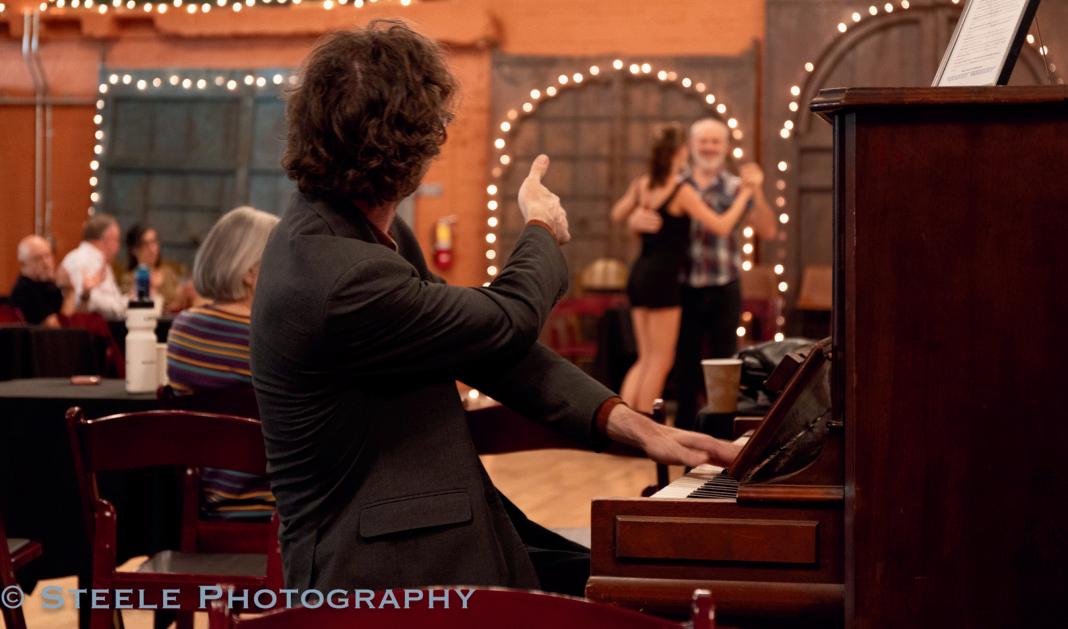
Your continued support makes this possible. The Legacy Society represents people who have provided long-lasting support to the New Mexico Philharmonic through wills, retirement plans, estates, and life income plans. If you included the NMPhil in your planned giving and your name is not listed, please contact (505) 323-4343 to let us know to include you.
Jo Anne Altrichter & Robin Tawney
Maureen & Stephen Baca
Evelyn Patricia Barbier
Edie Beck
Nancy Berg
Sally A. Berg
Thomas C. Bird & Brooke E. Tully
Edison & Ruth Bitsui
Eugenia & Charles Eberle
Bob & Jean Gough
Peter Gregory
Ruth B. Haas
Howard A. Jenkins
Joyce Kaser
Walter & Allene Kleweno
Ron Lahti
Louise Laval
Julianne Louise Lockwood
Dr. & Mrs. Larry Lubar
Sam Lucero
Joann & Scott MacKenzie
Margaret Macy
Thomas J. Mahler
Gerald McBride
Shirley Morrison
Betsy Nichols
Cynthia Phillips & Thomas Martin
George Richmond
Eugene Rinchik
Barbara Rivers
Gary & Kathy Singer
Terrence Sloan, MD
Jeanne & Sid Steinberg
Charles Stillwell
William Sullivan
Dean Tooley
Betty Vortman
Maryann Wasiolek
William A. Wiley
Charles E. Wood
Dot & Don Wortman
10/16/2025
●
The New Mexico Philharmonic would like to thank the following people for their support and in-kind donations of volunteer time, expertise, services, product, and equipment.
& COUNTY APPRECIATION
Mayor Tim Keller & the City of Albuquerque
Trudy E. Jones & the Albuquerque City Council
The Bernalillo County Board of Commissioners
Dr. Shelle Sanchez & the Albuquerque Cultural Services Department
Amanda Colburn & the Bernalillo County Special Projects
Councilor Brook Bassan
Councilor Tammy Fiebelkorn
Councilor Renee Grout
Councilor Dan Lewis
BUSINESS & ORGANIZATION
APPRECIATION
The New Mexico Philharmonic Foundation
The Albuquerque Community Foundation
INDIVIDUAL APPRECIATION
Lee Blaugrund & Tanager Properties
Management
Ian McKinnon & The McKinnon Family
Foundation
Billy Brown
Alexis Corbin
Anne Eisfeller
Chris Kershner
Jackie McGehee
Brad Richards
Barbara Rivers
Emily Steinbach
Brent Stevens
VOLUNTEERS HOSTING VISITING MUSICIANS
Don & Cheryl Barker
Ron Bronitsky, MD, & Jim Porcher
Chris & Tom Brown
Isabel Bucher & Graham Bartlett
Mike & Blanche Griffith
Emily Cornelius
Amy Huzjak
Rita Leard
Nicolle Maniaci
Sarah Manthey
Ron & Mary Moya
Steve & Michele Sandager 10/16/2025 ●
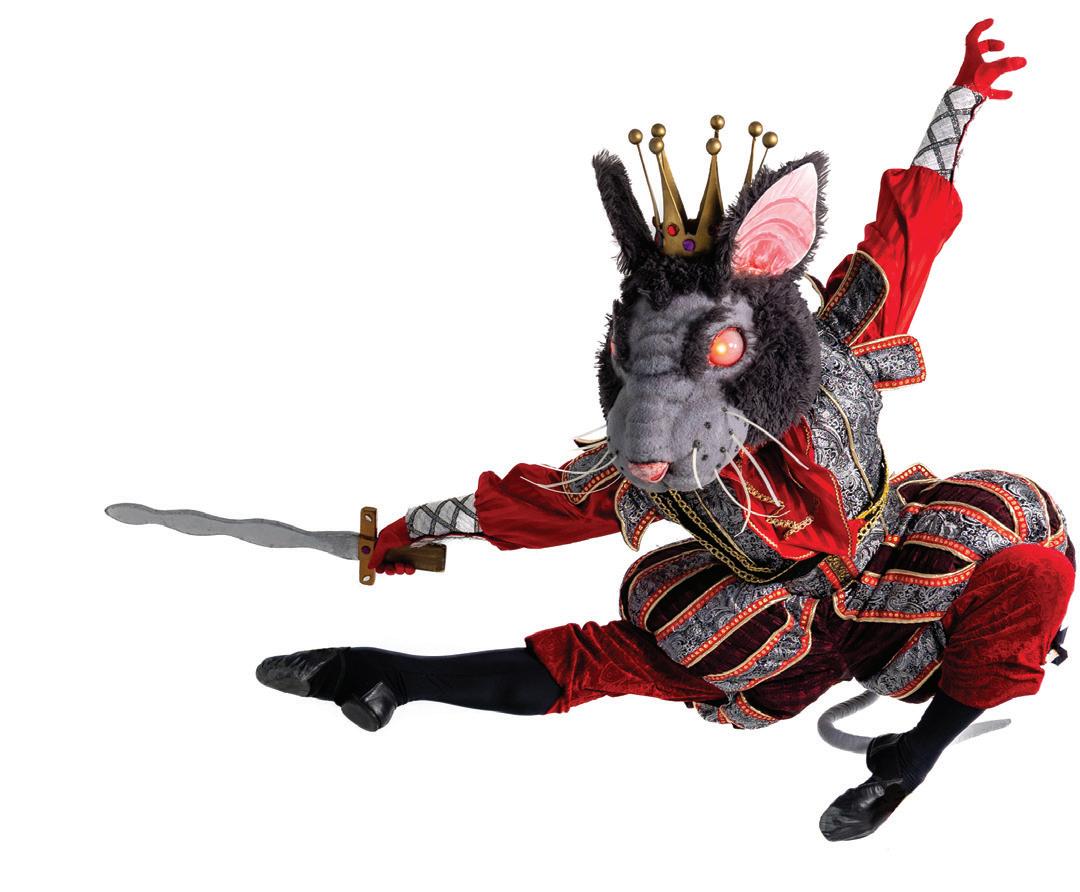
29 & 30
6 & 7
Sound Applause

Albuquerque Community Foundation albuquerquefoundation.org
The concerts of the New Mexico Philharmonic are supported in part by the City of Albuquerque Department of Cultural Services, the Bernalillo County, and the Albuquerque Community Foundation.

Bernalillo County bernco.gov

Computing Center Inc. cciofabq.com
REALTY
Gardenswartz Realty
Music Guild of New Mexico musicguildofnewmexico.org
D’Addario Foundation foundation.daddario.com


David S. Campbell, Attorney davidscampbell.com

koat.com

nmarts.org
Olga Kern International Piano Competition olgakerncompetition.org




Menicucci Insurance Agency mianm.com Meredith Foundation


Philharmonic Foundation Inc. nmphilfoundation.org




The Musicians
FIRST VIOLIN
Cármelo de los Santos •
Karen McKinnon Concertmaster Chair
Elizabeth Young ••
Associate Concertmaster
Sarah Tasker •••
Assistant Concertmaster
Ana María Quintero Muñoz
Heidi Deifel
Olivia de Souza Maia
Lorenzo Gallegos
Juliana Huestis
Barbara Rivers
Nicolle Maniaci
Barbara Scalf Morris
SECOND VIOLIN
Rachel Jacklin •
Carol Swift •••
Julanie Lee
Lidija Peno-Kelly
Liana Austin
Sheila McLay
Jessica Retana
Jocelyn Kirsch
Brad Richards
VIOLA
Laura Chang •
Kimberly Fredenburgh •••
Allegra Askew
Christine Rancier
Laura Steiner
Michael Anderson
Lisa DiCarlo
Joan Hinterbichler
Laura Campbell
Principal •
Associate Principal ••
Assistant Principal •••
Assistant ••••
Leave +
One-year position ++
Half-year position +++
Marian Tanau President & CEO
Roberto Minczuk
Music Director
Christine Rancier
Vice President of Business
Skye Stone
Personnel Manager
Julian Kley
Production Manager
CELLO
Amy Huzjak •
Carla Lehmeier-Tatum
Ian Mayne-Brody
Dana Winograd
David Schepps
Lisa Collins
Felix Wurman Chair
Elizabeth Purvis
BASS
Joe Weldon Ferris •
Mark Tatum •••
Katherine Olszowka
Terry Pruitt
Marco Retana
Frank Murry
FLUTE
Valerie Potter •
Esther Fredrickson
Noah Livingston ••
PICCOLO
Esther Fredrickson
OBOE
Kevin Vigneau • Amanda Talley
ENGLISH HORN
Melissa Peña ••
CLARINET
Marianne Shifrin •
Lori Lovato •••
Jeffrey Brooks
E-FLAT CLARINET
Lori Lovato
BASS CLARINET
Jeffrey Brooks
BASSOON
Stefanie Przybylska •
Denise Turner
HORN
Peter Erb •
Allison Tutton
Maria Long ••
Andrew Meyers
TRUMPET
John Marchiando •
Brynn Marchiando
Sam Oatts ••
TROMBONE
Aaron Zalkind •
Byron Herrington
BASS TROMBONE
David Tall
TUBA
Richard White •
TIMPANI
Tyler Brown •
PERCUSSION
Jeff Cornelius •
Kenneth Dean
Emily Cornelius
HARP
Carla Fabris •
BOARD OF DIRECTORS
Maureen Baca Chair
Al Stotts Vice Chair
Lauren R. Wilber
Secretary
Fritz Eberle
Treasurer
Meg Aldridge
Joel Baca
Ron Bronitsky, MD
Robert Gough
Idalia Lechuga-Tena
Roberto Minczuk
Jeffrey Romero
Terrence Sloan, MD
Marian Tanau
Michael Wallace
ADVISORY BOARD
Thomas C. Bird
Lee Blaugrund
Clarke Cagle
Kory Hoggan
William Wiley
Terry Pruitt Principal Librarian
Genevieve Harris
Assistant Librarian
Nancy Naimark Director of Community Relations & Development Officer
Crystal Reiter Office Manager
Laurieanne Lopez Young Musician Initiative Program Manager
Mary Montaño Grants Manager
Lori Newman Editor
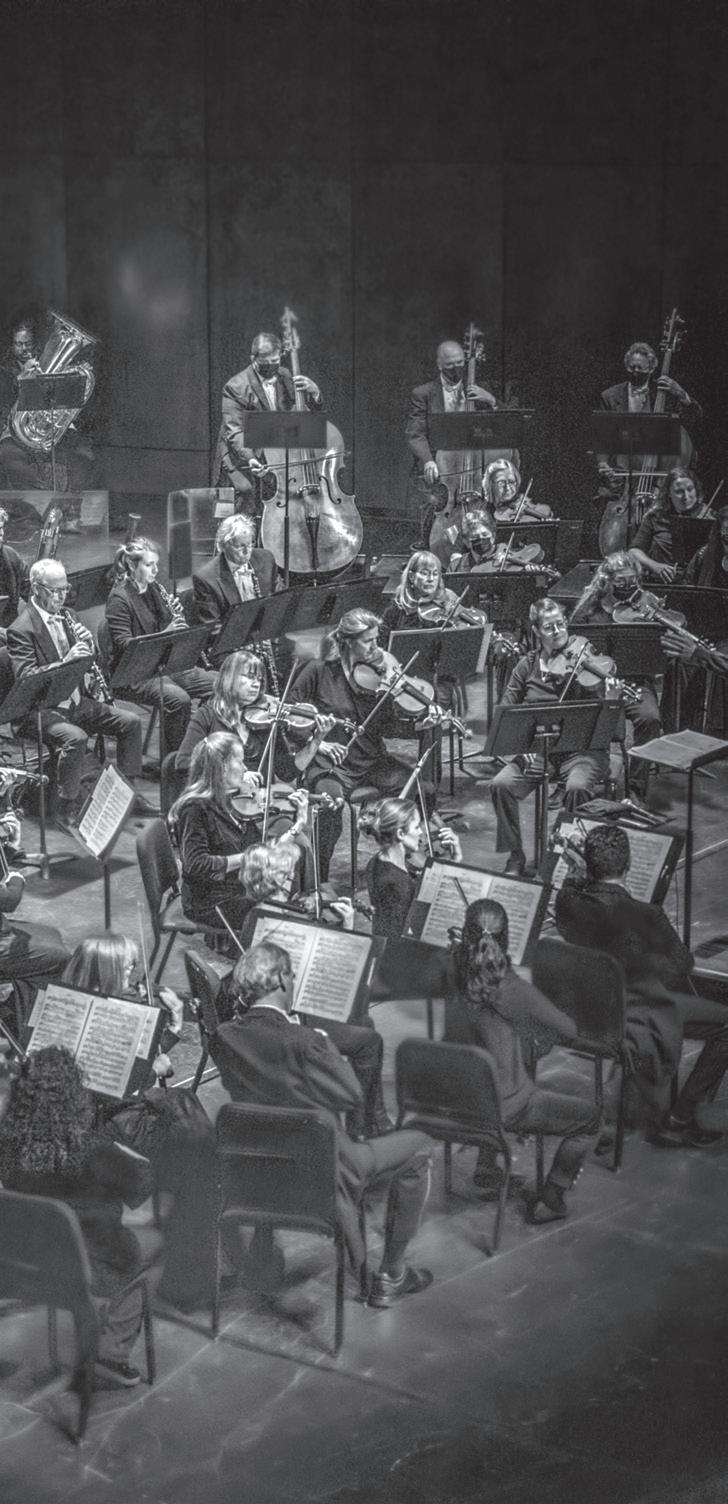
- Thomas Bohlman, Managing Partner