





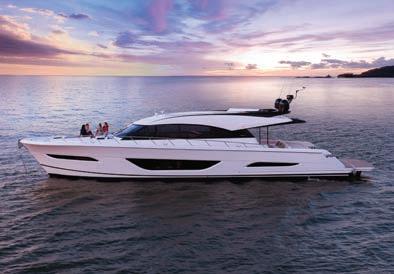
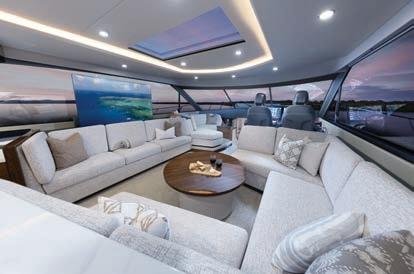
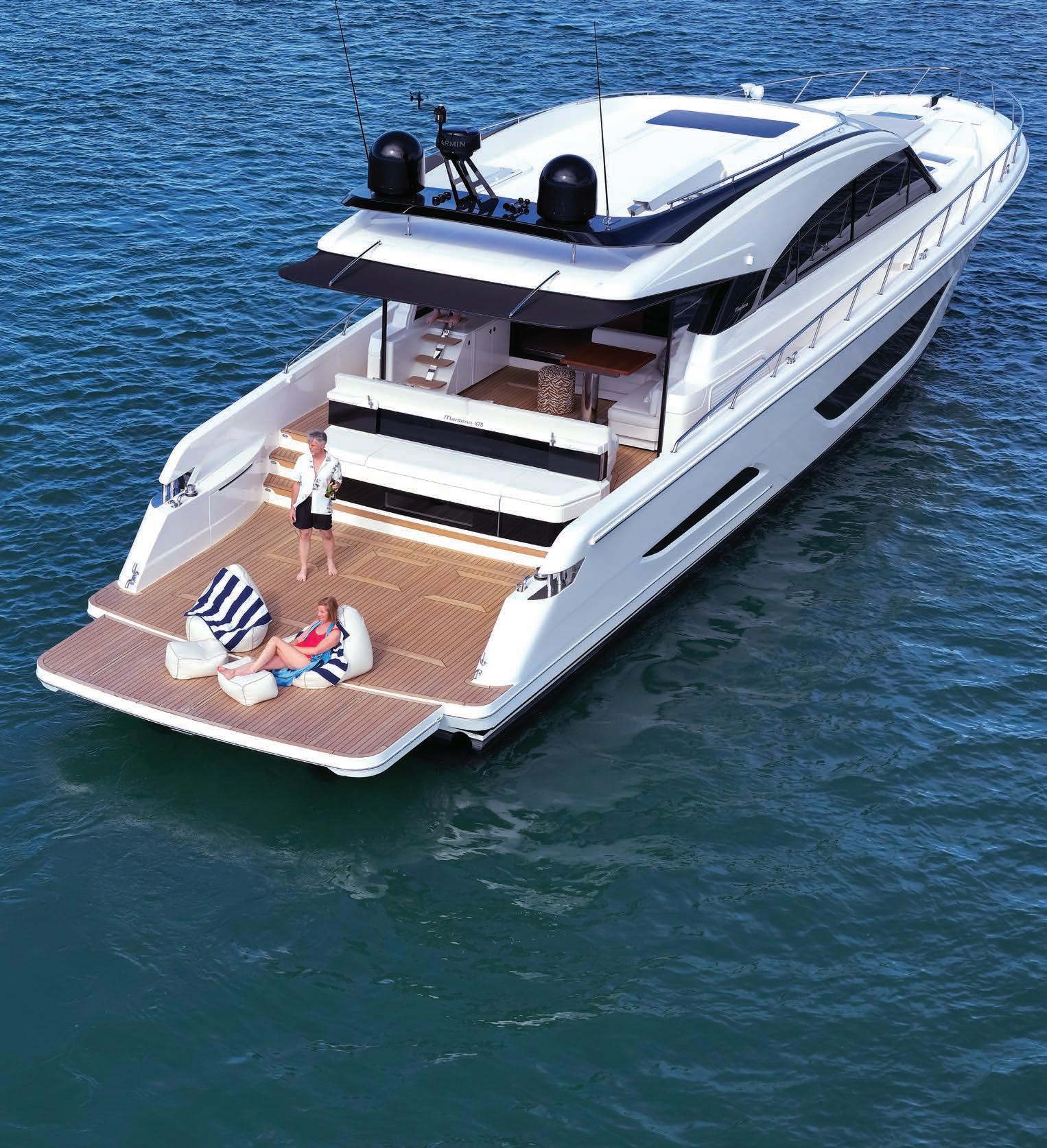
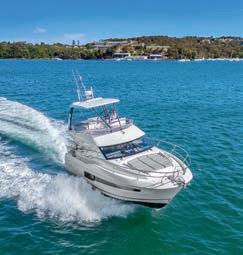
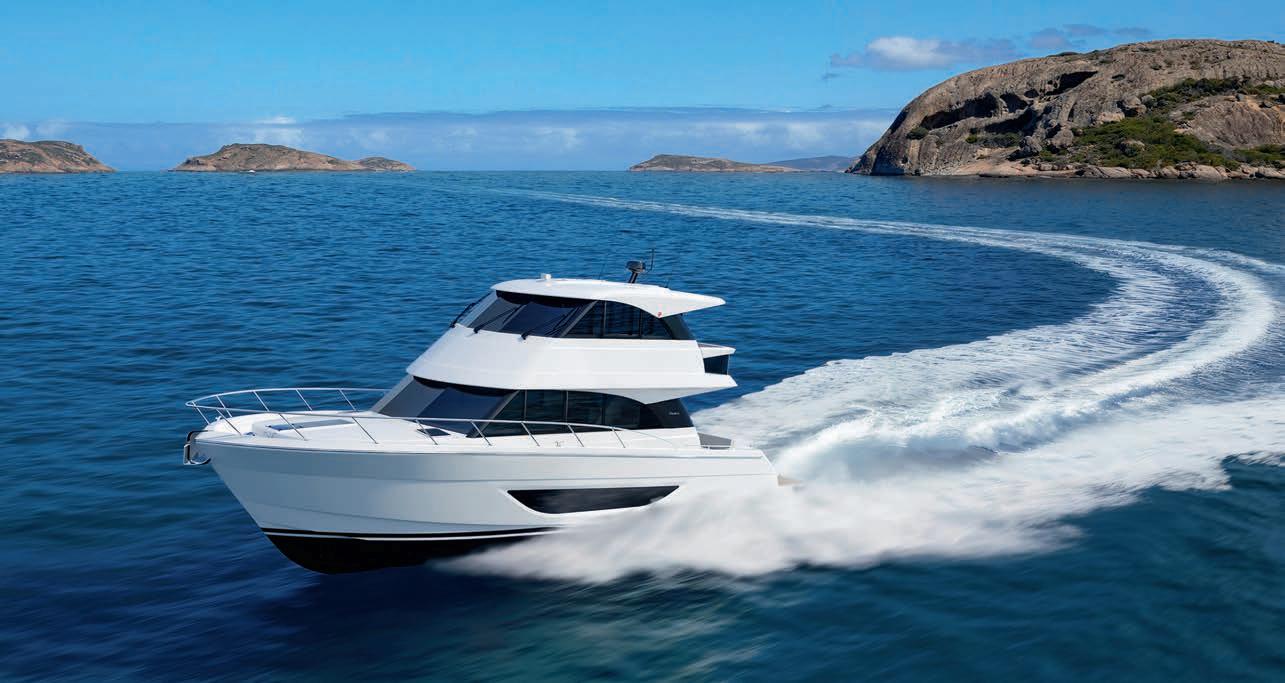
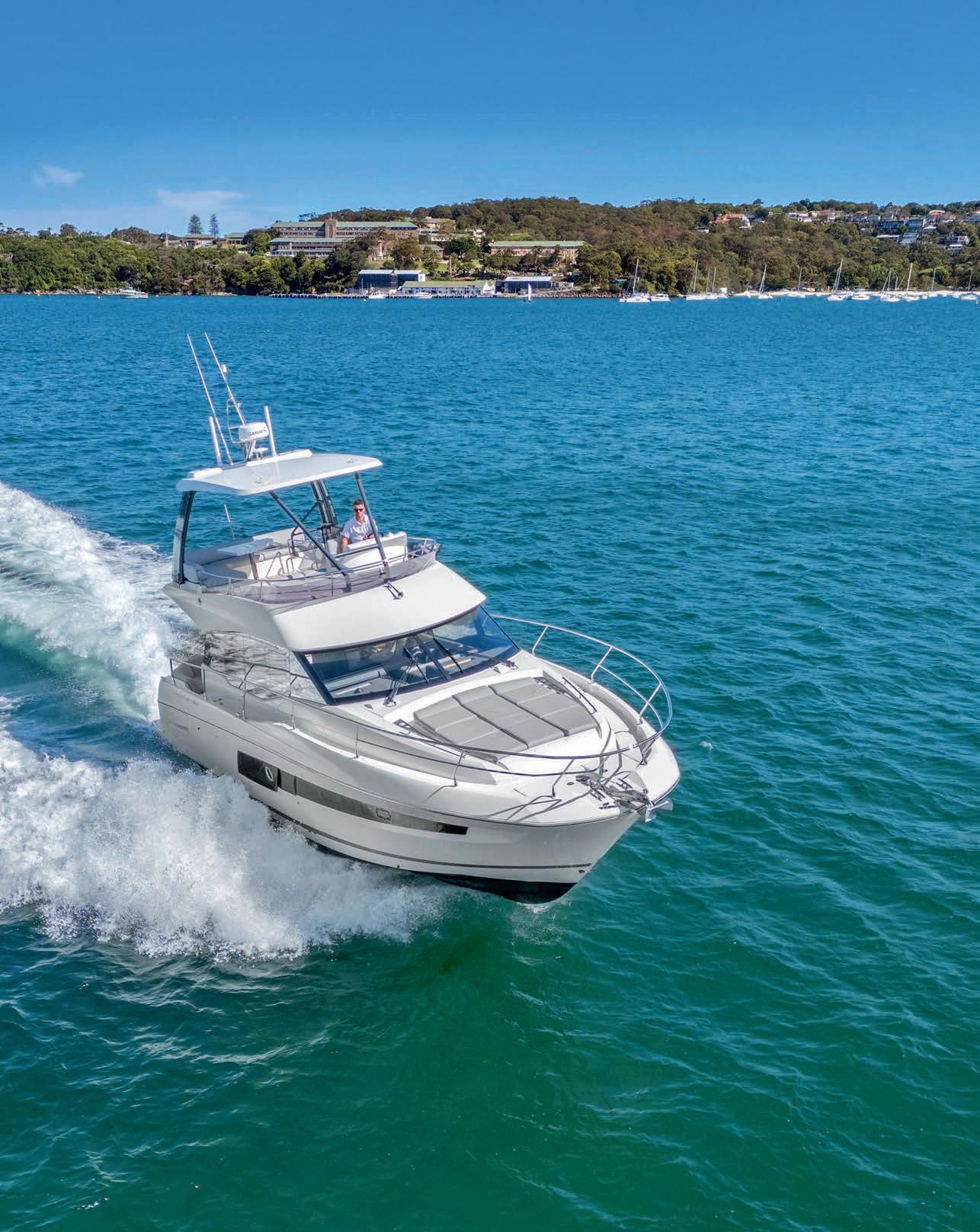
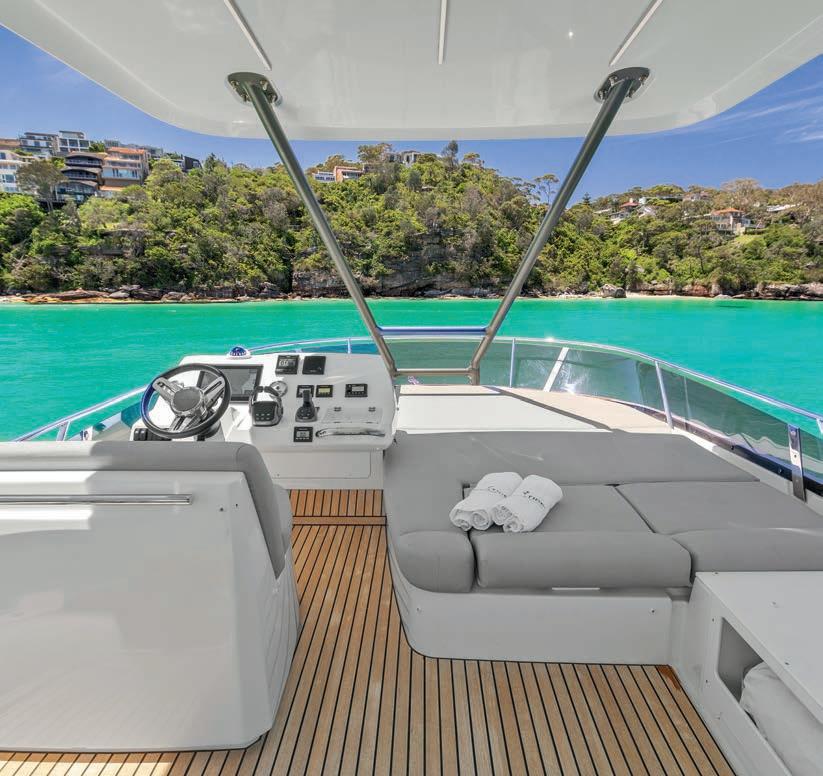
The all new S75 sedan motor yacht combines a synergy of balanced proportions, grace and purpose with an immensity of deck and interior spaces to cater for a vast range of entertaining, relaxation, or adventuring activities. Australian built, its powerful exterior form and grand luxurious interior reset the international standard for cruising sedan motor yachts. maritimo.com.au

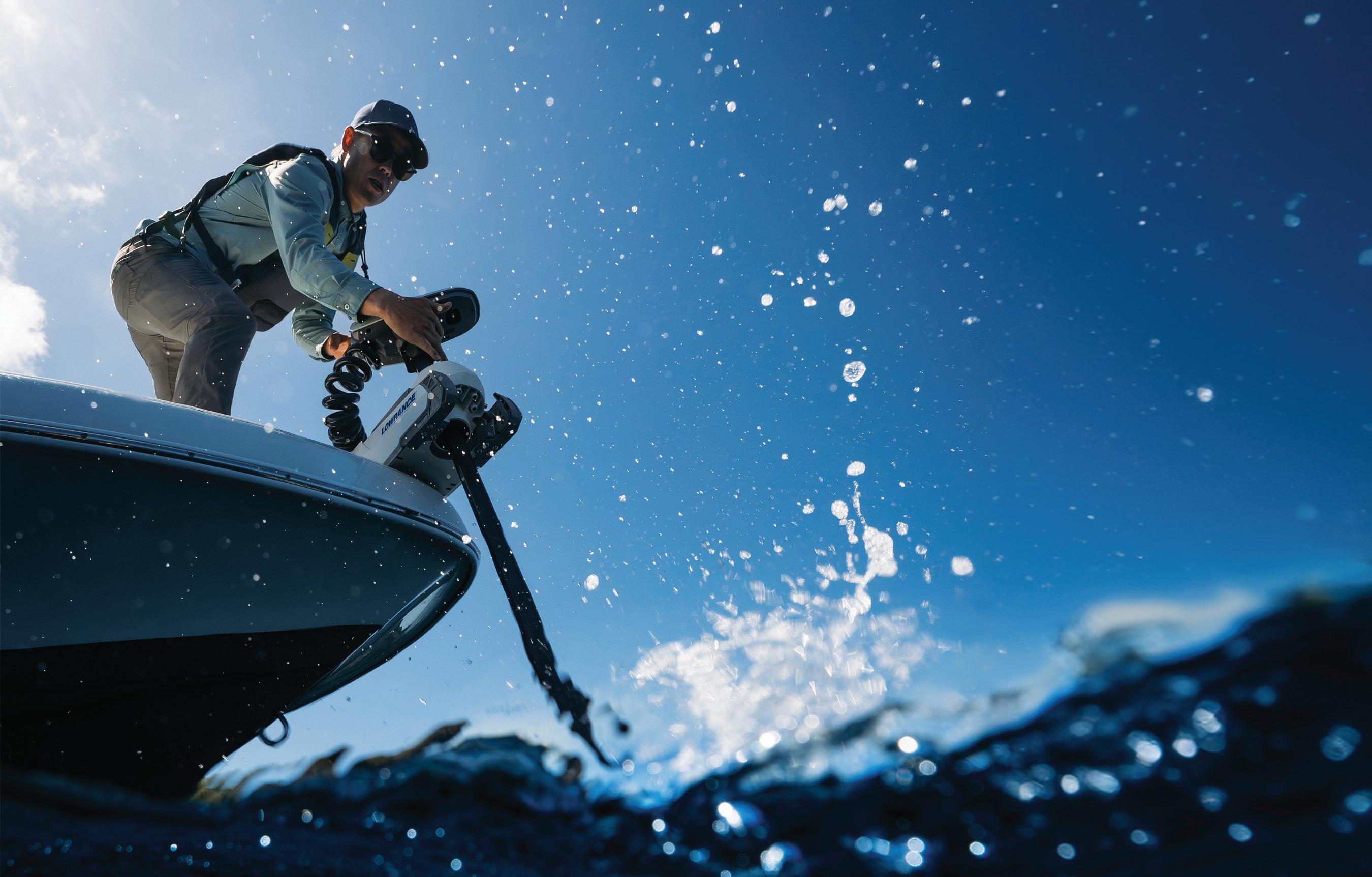
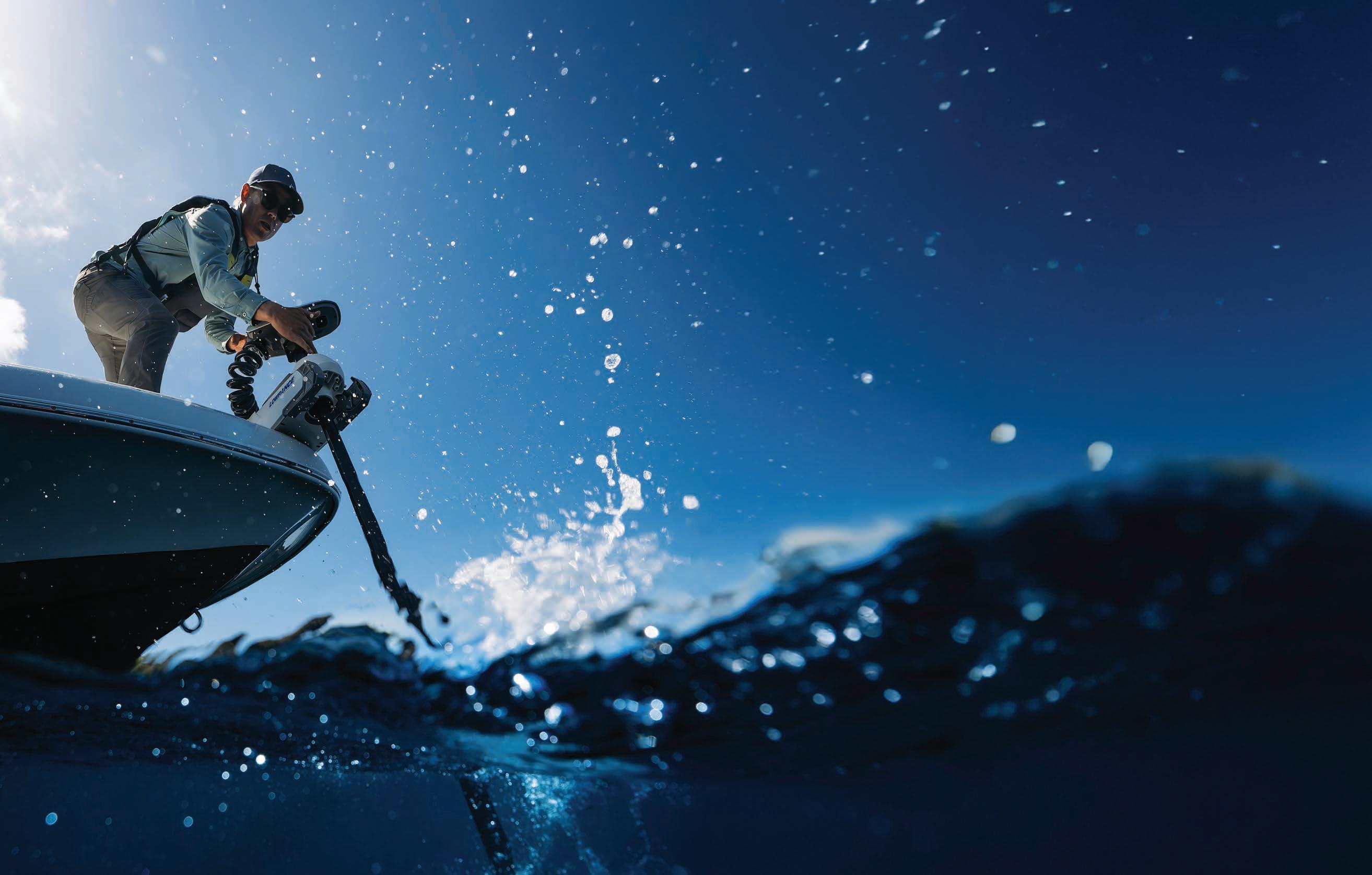
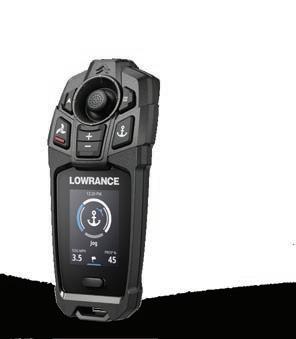
Control begins with Recon – the first salt-ready electric steer trolling motor from Lowrance. A unique joystick remote, wireless foot pedal and display integration allow you to control your motor from anywhere onboard. While best in class GPS and thrust hold you in position, no matter the conditions. With all that taken care of, all that’s left is for you to take control of your cast and reel in the fish.

56 EXPERT’S GUIDE PAINTS AND FINISHES
How to maintain your boat’s surfaces.
58 ASK THE EXPERTS WINTER BOATING SAFETY
Key advice to help you stay safe on the water.
64 WINTER FISHING
Seasonal species guide.
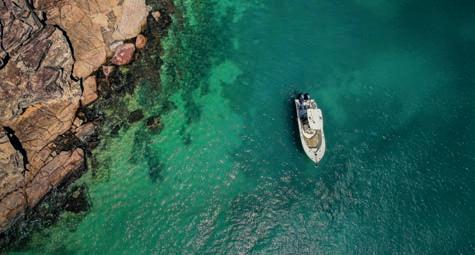
70 HOOKED ON THE TROPICS
Tropical fishing adventures.
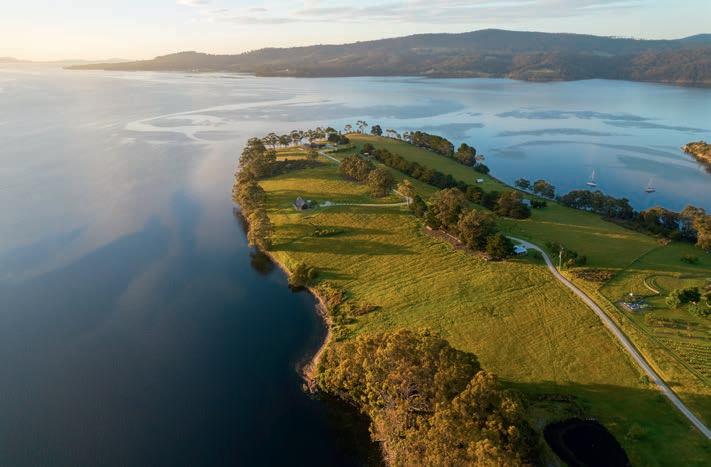
76 HUON VALLEY CALLING
Exploring the Huon Valley and Hobart.
86 A CAPITAL EXPERIENCE
How to spend 48 hours in Canberra.


Welcome to the June-July issue of Nautilus Marine Magazine When it comes to boating in winter, preferences and opinions vary. Many boaties love heading to the boat ramp at the crack of dawn in winter for a day of fishing or enjoy a spot of weekend sailing on a crisp and cool day. For others, winter means vessel storage and a shift in focus to scheduled maintenance. Whatever your preference, this issue has you covered with a line-up of technical features.
Our ‘Ask the Experts’ boating safety panel share some key risk mitigation advice to help keep you safe while winter boating (page 58) and Fishing World Publisher Scott Thomas has penned a comprehensive species guide for those who enjoy winter fishing both offshore and inland (page 64). On the maintenance side of things, Les Binkin, Director of Pelican Waters Marina, has written an article on adopting a proactive approach to scheduled maintenance (page 46) and Brett Mould, Owner of Norglass Paints and Speciality Finishes reveals some advice on maintaining your boat’s finishes and painted surfaces (page 56).
Fresh from their global launches at Sanctuary Cove International Boat Show, we look at two new models from Maritimo: the M50 Flybridge Motor Yacht (page 20) and the S60 Sedan Motor Yacht (page 14).
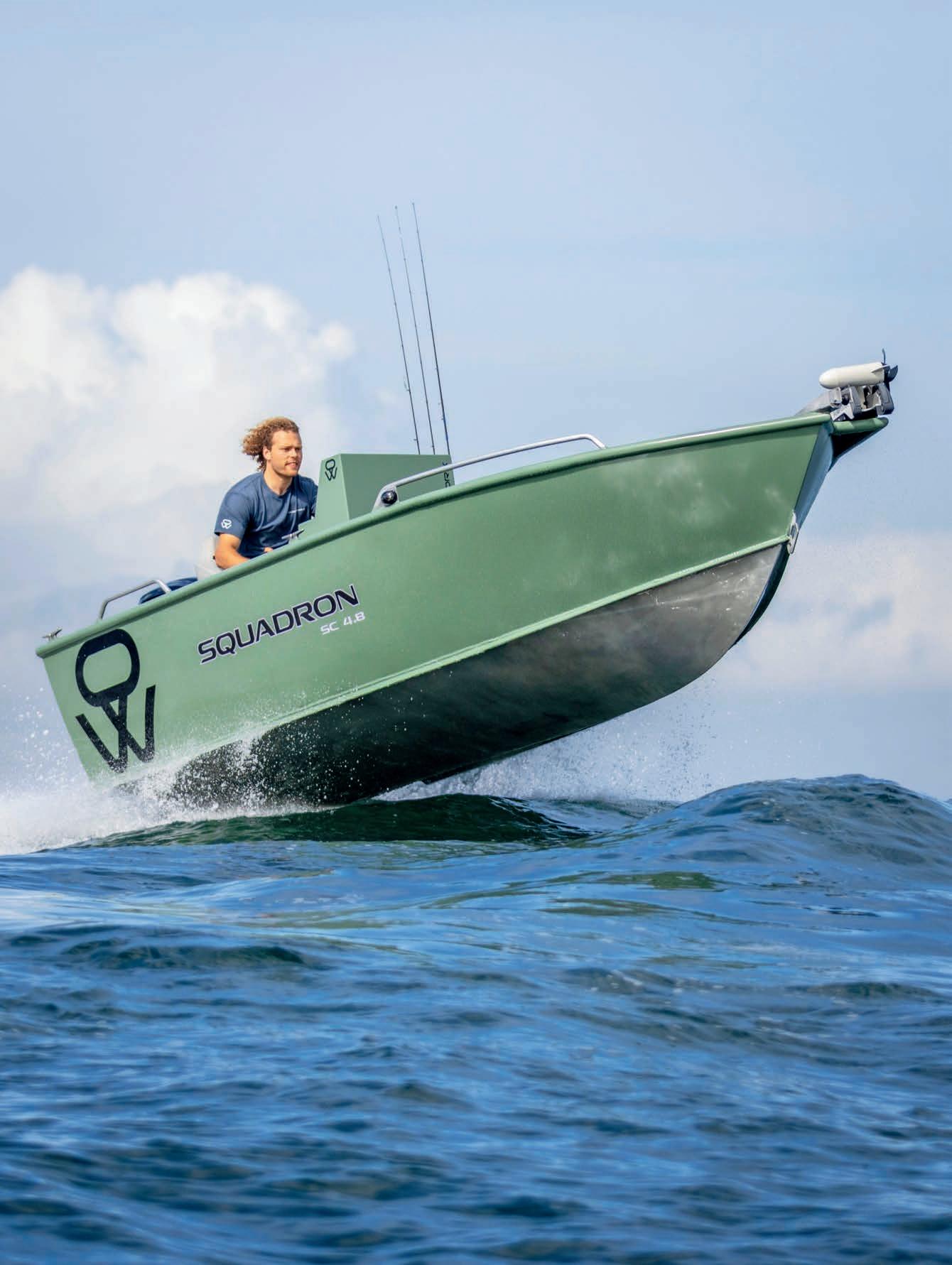
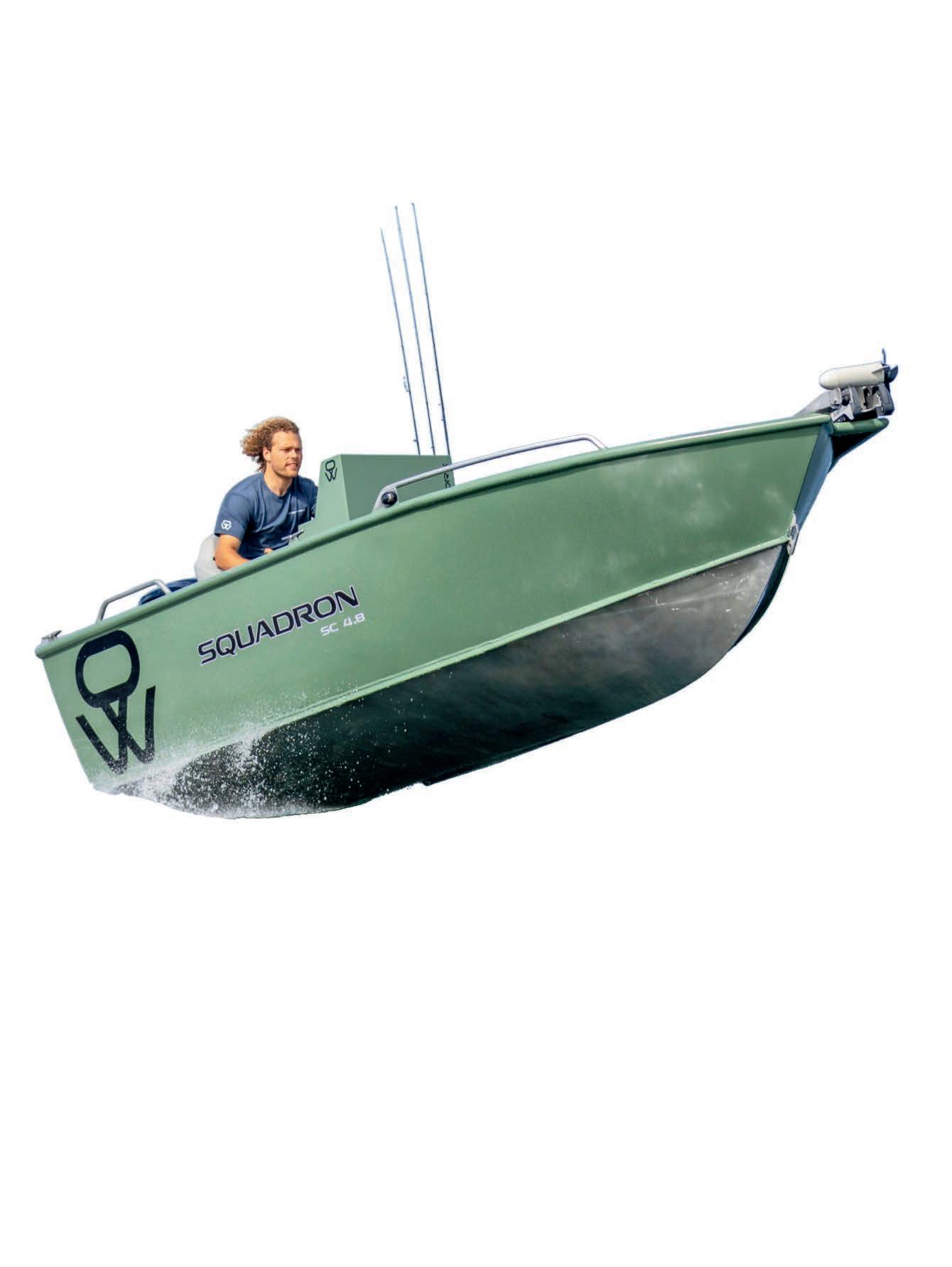
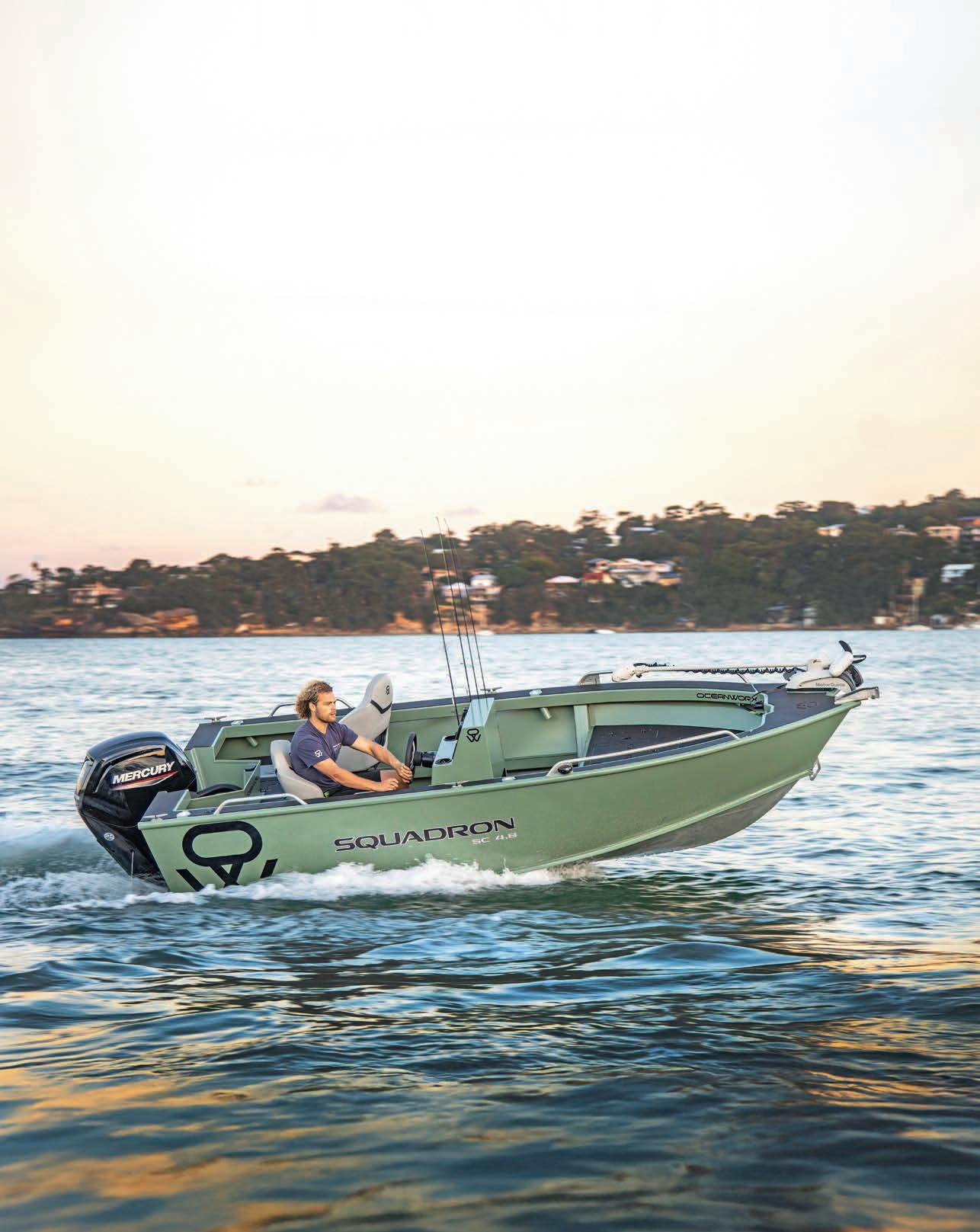
Our ‘cover star’ this issue is the new Squadron SC 4.8 from Sydney-based brand Oceanworx (page 28) and we also profile the Arvor Weekender range (page 36).
Other highlights of this issue include a feature about towing (page 50), an interview with Bellingham Marine’s Bruce Birtwistle (page 96), a profile of d'Albora Yacht Brokers (page 24), and our article showcasing a selection of new trailer boats, outboards and marine tech (page 42). Within our travel and dining pages, we turn our attention to Hobart and the Huon Valley in Tasmania (page 76), spend 48 hours in Canberra (page 86) and profile Catseye Pool Club – Josh and Julie Niland’s new restaurant on Hamilton Island (page 92).
As always, we love hearing your feedback. So, feel free to get in touch with us and share your thoughts on this issue.
Happy and safe boating!
LYNDON TURNER CEO & PUBLISHER

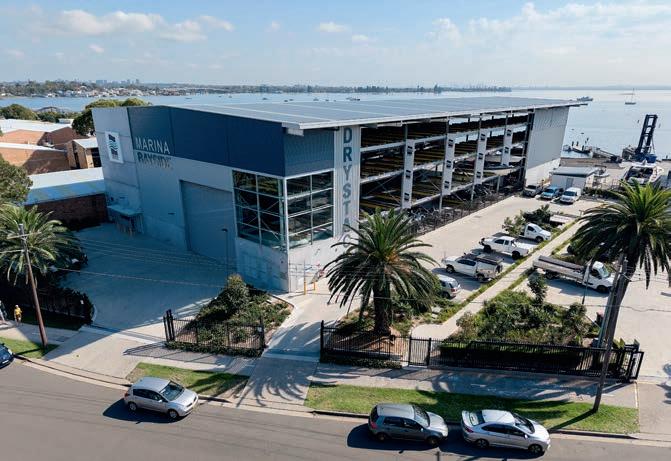
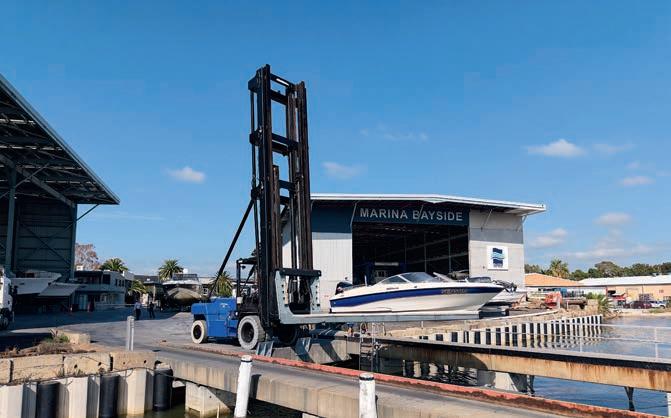
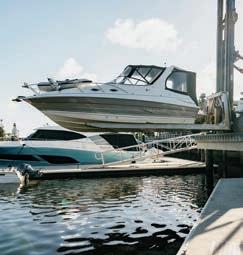
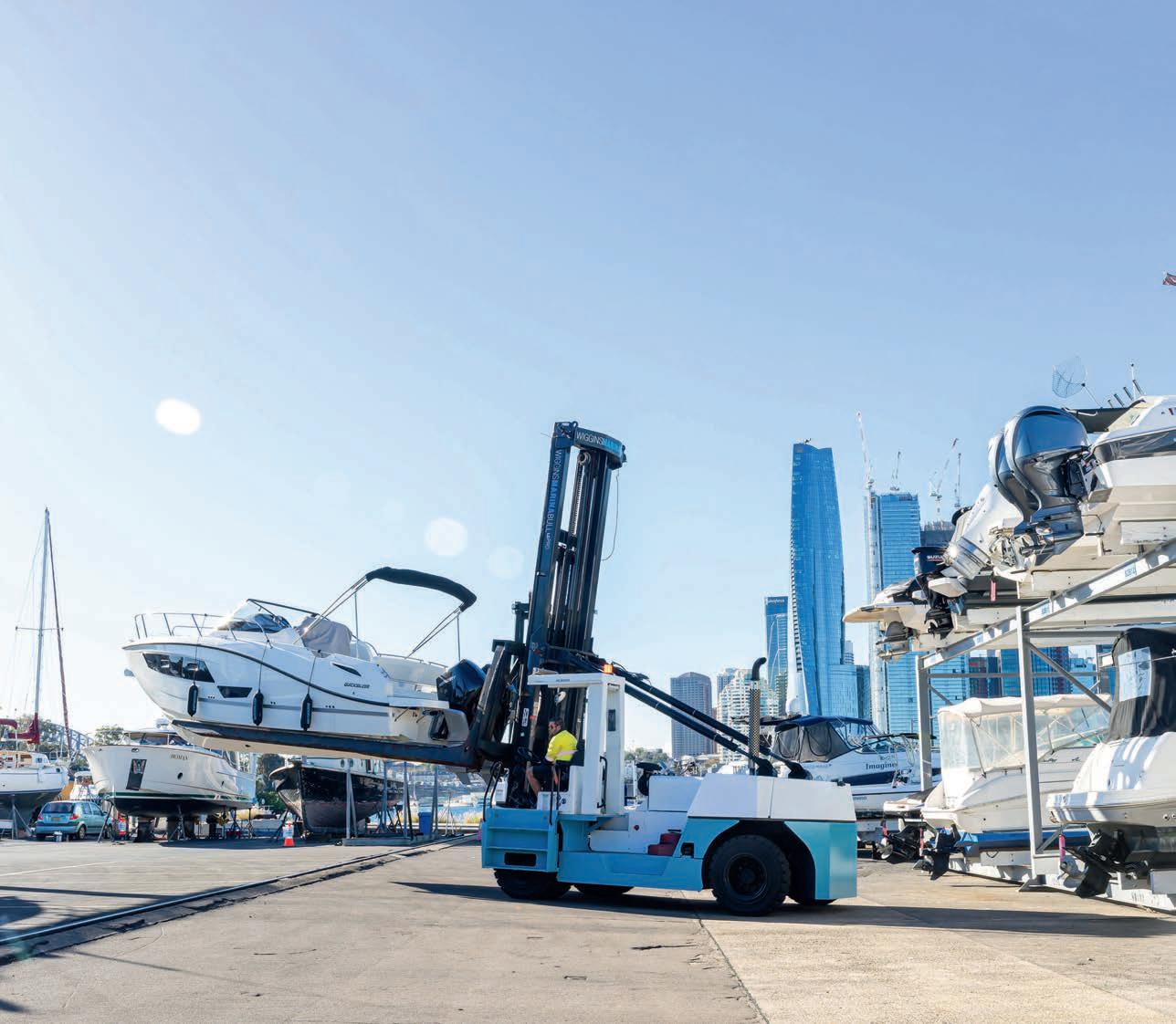
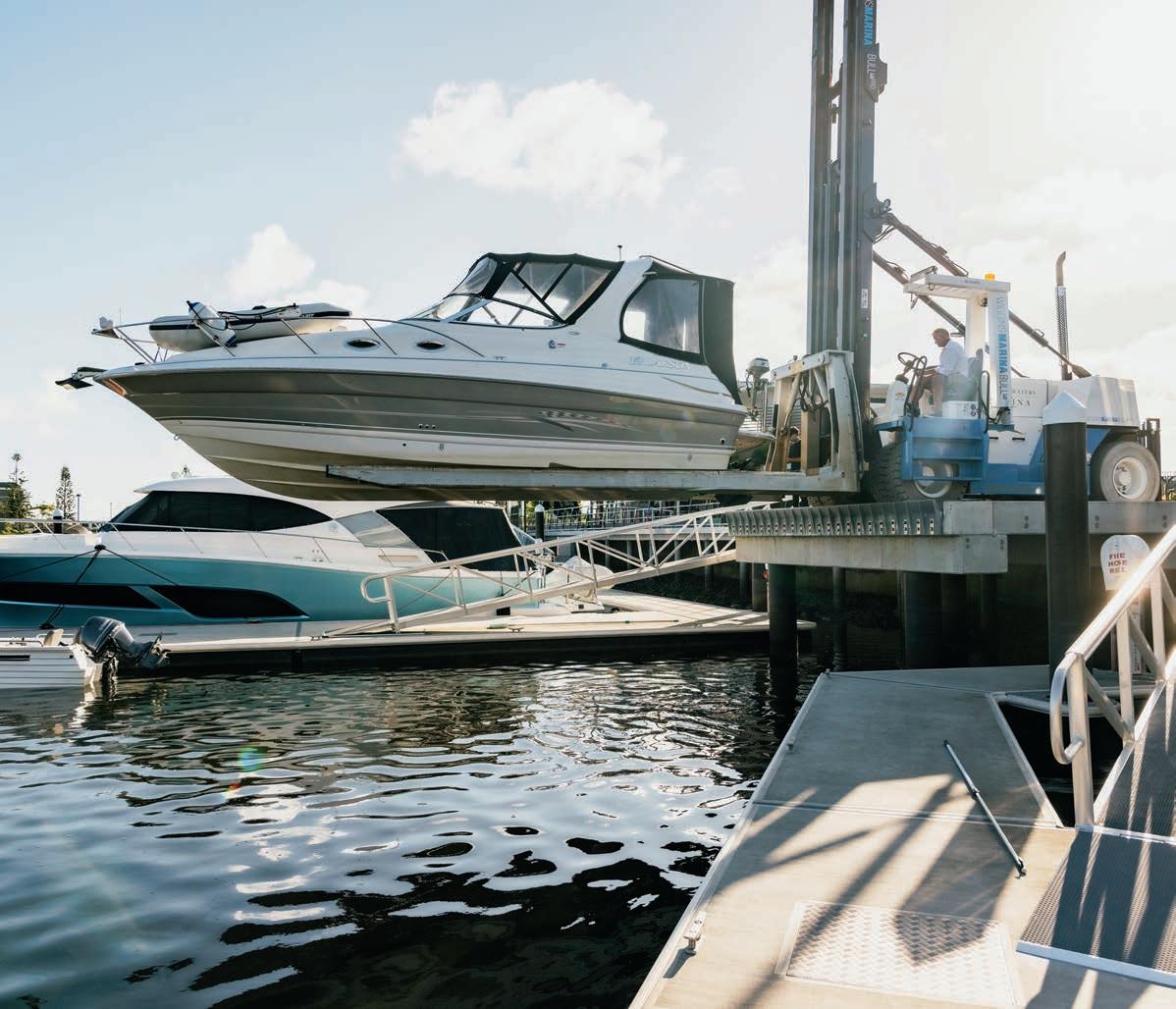
Looking for secure, hassle-free undercover dry boat storage in Sydney? Located at Taren Point, Marina Bayside is home to the Sutherland Shire’s only undercover boat storage facility with direct water access.
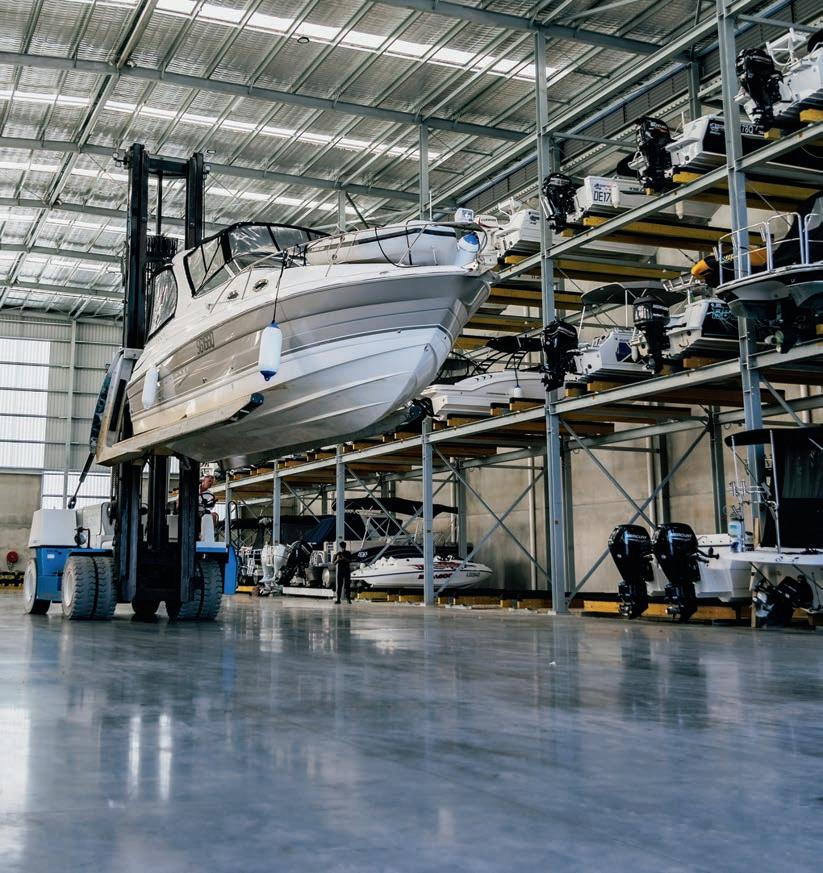
Purpose-built to protect your vessel from the elements, our modern facility accommodates up to 160 boats up to 40 foot (12 metres) long.
Accessing your boat is quick and easy using the SpeedyDock app – just book your launch or retrieval and enjoy true walk-on, walk-off convenience, without the stress of boat ramps or trailers. Whether you’re storing short-term or year-round, Marina Bayside offers the ultimate in safety, service, and simplicity for Sydney’s boating community.
SEAMLESS STORAGE & LAUNCHING
At Marina Bayside, storing your boat and getting it on the water is fast, simple, and stress-free. Our undercover dry boat storage, paired with the app, means your vessel is only ever a few taps away from being launched and ready to go.

6 GREAT REASONS TO USE OUR DRY STORAGE SERVICES
Undercover, Weather-Protected Storage
Your boat is safely stored out of the elements in our purpose-built, undercover facility.
Book & Launch in Minutes
Simple and fast, you’re in control to schedule your launch or retrieval by using the SpeedyDock app.
Walk-On, Walk-Off Convenience
Skip the ramp. Step aboard on our floating pontoon and head straight out onto Botany Bay – no trailers, no waiting.
On-Site Parking & Easy Access
Park and access your boat quickly with our efficient forklifting system.
Professional Care, Every Time
We rinse and flush your boat after every use, helping to maintain its performance and longevity.
Marine Services On-Site
Access trusted boat repairs, servicing, detailing and maintenance without leaving the marina.
Les is the Director of Shellharbour Marina (NSW) and Pelican Waters Marina (QLD), and a successful marine investor and entrepreneur. He’s also an internationally Certified Marina Manager (CMM), sits on the Marina Industries Association’s Board of Directors, and is a Boating Industry Association (BIA) member. After starting in the marine industry by acquiring and successfully operating his first marine engineering business, Les quickly realised designing and operating marinas allowed him to contribute to all marine businesses, and the boating community, by creating places for all to thrive.

BRETT MOULD
Brett is the Director of Norglass Paints and Speciality Finishes and has over 20 years’ experience with marine surface coatings.
Since taking over the Norglass business from his parents back in the early 2000s, Brett has focussed on quality and expert technical advice.
“If you’re ever unsure about any part of the maintenance or painting process, consult your local marine service centre or boatyard for advice, or contact the product manufacturer,” advises Brett.
Robert is the newly appointed Commercial Development Manager for Nautilus Marine Magazine. Robert previously held senior advertising management positions with RoyalAuto, RACV’s magazine and The Herald Sun and Sunday Herald Sun. “Attending Sanctuary Cove International Boat Show and Hutchwilco New Zealand Boat Show recently was a great way to immerse myself in the marine industry,” says Rob. “I am excited to help deliver exceptional outcomes for partners and readers.”
CEO & PUBLISHER: Lyndon Turner – lyndon.turner@nminsurance.com.au
MARKETING DIRECTOR / COMMERCIAL PARTNERSHIP MANAGER: Andrew Mulholland +61 482 854 066 / andrewm@nminsurance.com.au
EDITOR / CONTENT & PR DIRECTOR: Sarah Ranawake – sarahr@nminsurance.com.au
ADVERTISING/COMMERCIAL DEVELOPMENT MANAGER: Robert McWaters – robertmc@nminsurance.com.au
ART DIRECTOR: Kim Gierdien
SUB-EDITORS: Helen Hayes and Josie Gagliano
HEAD OF CLIENT & MARKET DEVELOPMENT: Glen Schembri – glens@nminsurance.com.au HEAD OF BRAND: Neha Taskar – nehat@nminsurance.com.au
HEAD OF DEVELOPMENT – MAJOR ALLIANCE PARTNERS: Tim Baker – timb@nminsurance.com.au

Nautilus Marine Magazine is published by

Pty
ABN
100 633 038 t/as Nautilus Marine Insurance, Level 7, 99 Walker Street, North Sydney NSW 2060 & Nautilus Marine Underwriting Agency Ltd (New Zealand) Co # 3032800.
NM Insurance Pty Ltd (NM Insurance). All rights reserved. No part of this magazine or its content (the Magazine) may be reproduced in whole or in part without the written permission of NM Insurance. NM Insurance makes no representation or warranties with respect to the Magazine including, without limitation, material communicated by third parties. Information in the Magazine is for information purposes only and is not legal, financial or financial product advice. NM Insurance does not warrant that the information in the Magazine is accurate, complete or current. Opinions expressed are those of the respective authors and not necessarily those of NM Insurance. All care has


UPDATES AND EVENTS YOU NEED TO KNOW ABOUT.
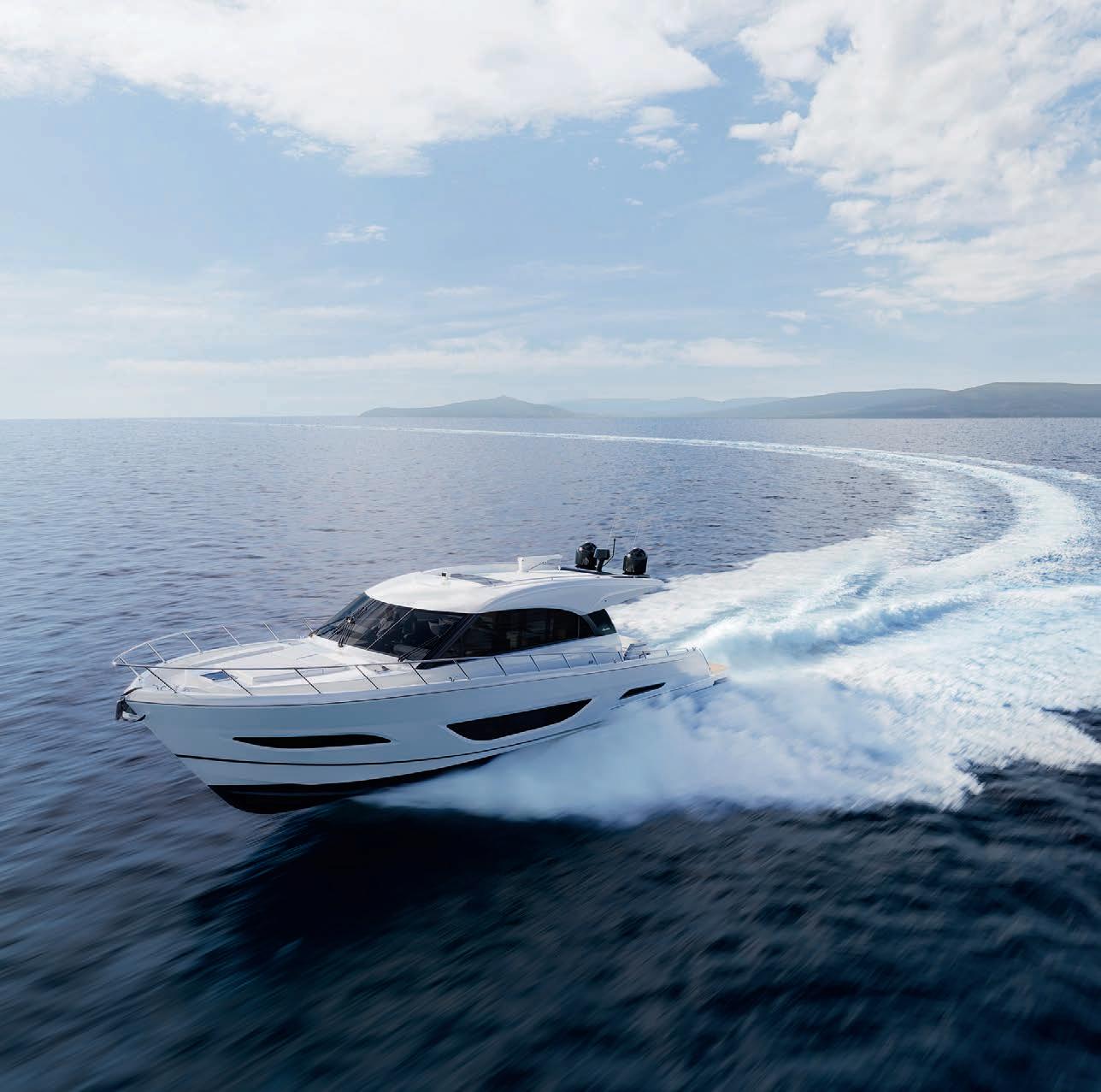
Maritimo proudly held the global launch for the S60 Sedan Motor Yacht at the 2025 Sanctuary Cove International Boat Show (SCIBS). Building on the success of the M60 Flybridge, the S60 boasts sleek Black Edition elements and advanced functionality. Designed for blue-water cruising and entertaining, its long roofline, expanded Adventure Deck that can house tenders or toys or be set up for dining, and the aft galley, exemplify seamless indoor-outdoor living. The S60’s practicality shines through features like its sculpted foredeck sun bed, Epicure BBQ module, fold-away transom gates, and vast Utility Deck.
Luxurious interior spaces include a full-beam Master Stateroom, innovative floating dash, and convertible third cabin. Powered by twin 900hp Scania engines, the S60 offers a range of up to 2,200 nautical miles.
“This is yet another example of how Maritimo builds and delivers vessels that create a catalogue of glorious memories for our owners,” said Maritimo Founder and Owner Bill Barry-Cotter. “This passion is what keeps me, and the entire team that craft each and every Maritimo, as driven today as I was when I started over 60 years ago.”
Visit maritimo.com.au
3.
The best and brightest of the marina industry were recognised at the Nautilus Marine Insurance Marina of the Year Awards, which were staged by the Marina Industries Association (MIA).
“These Awards honour all entrants and finalists who consistently raise the bar and set new standards in our industry,” said Andrew Mulholland, Marketing Director / Commercial Partnerships Manager, Nautilus Marine Insurance. Drawing a parallel with Nautilus Marine Insurance’s values, Mullholland went on to say, “It’s about putting your customers at the core of everything you do, and building trust through integrity and reliability.”
Sydney’s recently redeveloped Jones Bay Superyacht Marina took the title of Best Commercial Marina (under 140 boats). Gold Coast City Marina & Shipyard (GCCM), claimed the Best Commercial Marina (over 140 boats), along with Best Boat Yard (over 20 boats) and the Dry Storage Facility of the Year Award. Royal Queensland Yacht Squadron took home Club of the Year, and White Bay 6 Marine Park in Sydney was awarded Best Boat Yard (under 20 boats).
Visit marinas.net.au
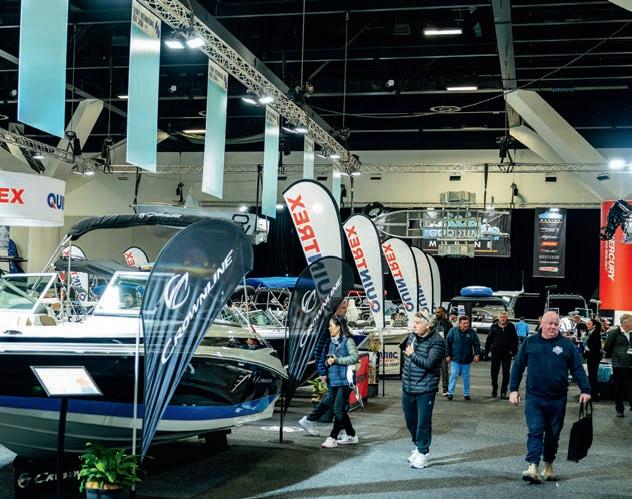
Dates are set for the two Sydney boat shows, with 2025 the first time the show has been split into two. The Boating Industry of Australia (BIA) separated the shows by vessel type, with the first show, the Sydney Boat Show, on from 14-17 August at the Sydney Showground, Sydney Olympic Park.
The Sydney Boat Show is an exciting new-format indoor showcase, featuring the best in boating – from tow sports and fishing, to a wide range of marine accessories and technology –all under one roof.
The Sydney International Boat Show will focus on moored boats, and will be afloat from 13-16 November at the original Cockle Bay location, Darling Harbour. This event will showcase a stunning lineup of luxury vessels on a special event marina, with a program of vibrant onshore activations planned for the surrounding foreshore.
Visit sydneyboatshow.com.au


4.
Maritimo has expanded its brand portfolio by acquiring Caribbean Boats Australia. Established in Melbourne in 1958, Caribbean is renowned for its robust, blue water vessels. Maritimo plans a comprehensive review of Caribbean’s product line, aiming to reinvigorate the range while respecting its rich heritage. “Caribbean is a cherished name in Australian boating, with a rich history of building some of the country’s most enduring and capable vessels,” says Maritimo Founder and Owner Bill Barry-Cotter. “We are excited about the potential this acquisition brings, and look forward to shaping the next phase of Caribbean’s journey.”
Visit caribbeanboats.com
6.
Celebrated Aussie aluminium boat brand, Quintrex, has marked a major achievement – 80 years on the water. Founded by Terry Quantrill in Sydney in 1945, Quintrex started out as a modest operation but has grown into a household name, recognised and trusted by generations of Australian boaties.
“There wouldn’t be a boatie in Australia who doesn’t know the name Quintrex,” says General Manager Sam Heyes. “That’s because for 80 years, we’ve consistently delivered quality, performance, and innovation that keeps people coming back to the brand.”
From the launch of the revolutionary Flared Bow in 1968, to the game-changing Millennium Hull in 2005, followed by the Blade Hull in 2013, and the cutting-edge Apex Hull, Quintrex has continued pushing the limits of what’s possible on the water. The brand is still committed to its founding philosophy of ‘Boating made Easy’, while continuing to evolve its range. Today, the brand is proudly represented by 60 premium dealers across Australia and exports to over 15 countries, spreading the spirit of Australian boating across the globe. Visit quintrex.com.au
5.
Leading marine uniform supplier Quality Marine Clothing (QMC) has expanded into New Zealand with an office now open in Auckland’s viaduct. Formerly operating as Uniform Shelf, the branch will now trade as Quality Marine Clothing New Zealand. Industry veteran Michelle Crooks will manage the office, bringing deep experience in the marine and superyacht sectors.
Founded in 2017, QMC is known for premium uniforms and exceptional service. With offices in Sydney, Cairns, the Gold Coast, and Hong Kong, as well as representation in Fiji, Tahiti, and key Australian locations, this expansion reinforces QMC’s commitment to serving the marine and corporate apparel market throughout the region. “This expansion has been a long time in the making, and we are all incredibly excited to bring our expertise and high-quality service to the region,” says Duncan Curnow, Sales and Marketing Director, QMC. Visit qualitymarineclothing.co.nz
matter what side of the boating spectrum you sit on, power or sail, Nautilus Marine Magazine is a great read.


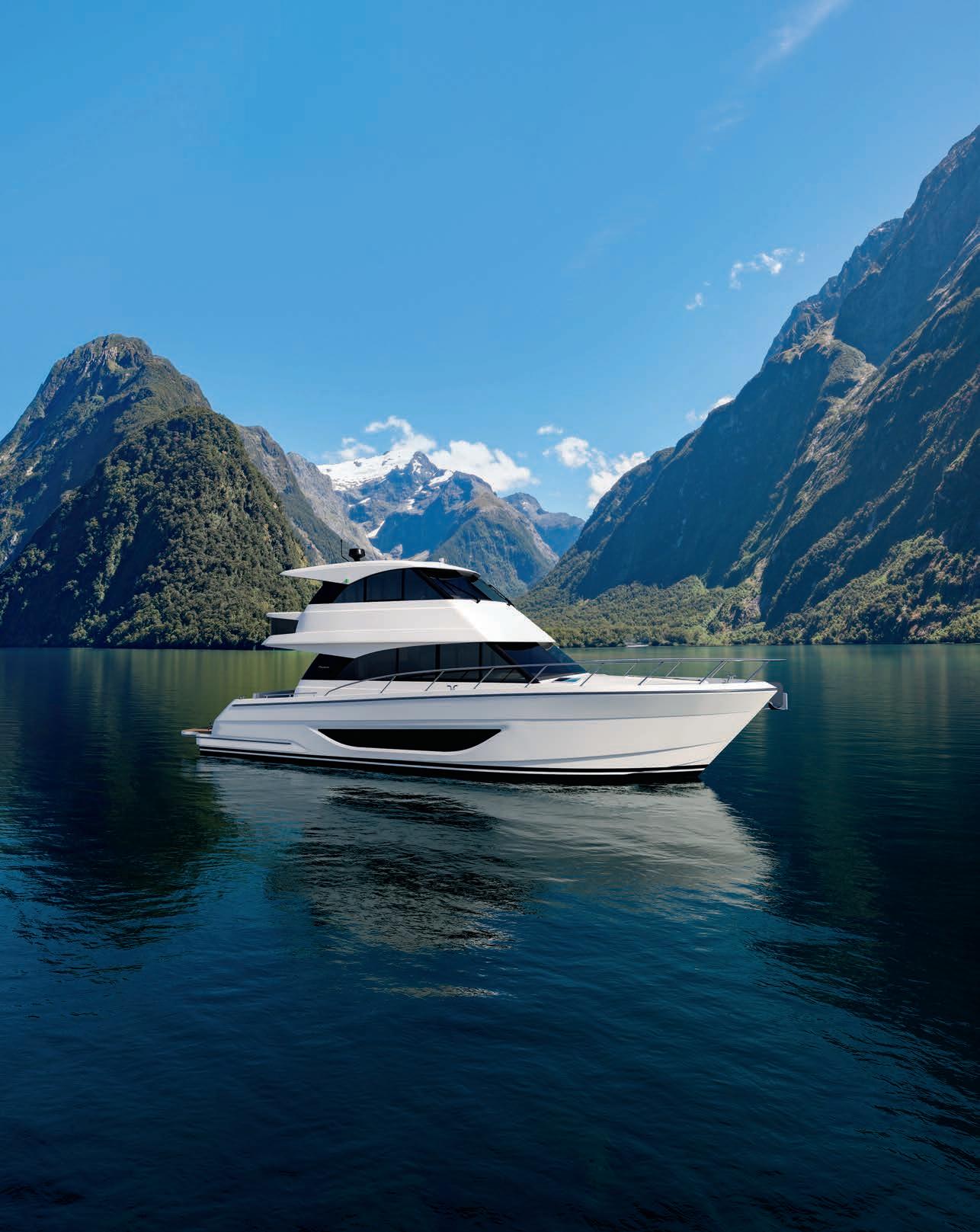

MARITIMO HELD THE GLOBAL LAUNCH OF THE NEW M50 FLYBRIDGE MOTOR YACHT AT SANCTUARY COVE INTERNATIONAL BOAT SHOW.
World-class Australian luxury motor yacht builder Maritimo has expanded its next generation model line-up with the global launch of the all-new M50 Flybridge Motor Yacht at Sanctuary Cove International Boat Show (SCIBS).
A brand defined by its relentless pursuit of perfection, Maritimo has further evolved its acclaimed M and S Series motor yachts. Extensive customer consultation has been fed directly into the Australian-based design team, resulting in a very distinguished 50-foot vessel that’s set to redefine its class.
For over two decades, Maritimo has set the benchmark in long-range cruising motor
yachts, famously pioneering the enclosed flybridge design. Celebrated worldwide, Maritimo motor yachts are renowned for their ocean-going capabilities, exceptional ride quality, and reliability.
“We never rest on our laurels,” says Simon Stewart, Maritimo Marketing Manager. “Every new model stays true to the Maritimo ethos while standing distinctively on its own. The M50, and soon-to-follow S50 Sedan, are outcomes of our collaborative work with owners and stakeholders. It’s a balance of showing the market what we can do while listening to what they want – and with the M50, we’ve enhanced that balance.”
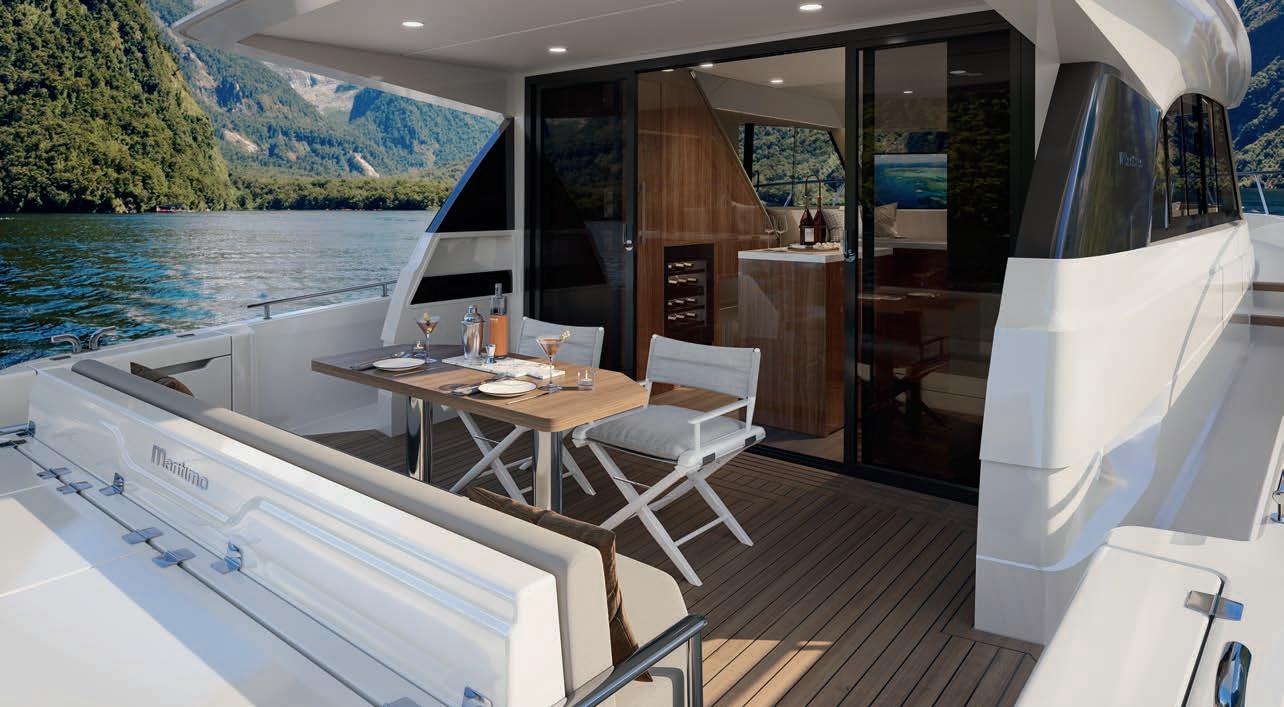
The M50’s fully enclosed flybridge spans the entire 5.22-metre beam, a feature that is unparalleled in this category. Combining spacious design with performance, the M50 is powered by standard Scania Di13 800MHP powerplants. With an impressive 3,800-litre fuel capacity positioned low for better stability, it’s built for both extended offshore journeys and effortless handling.
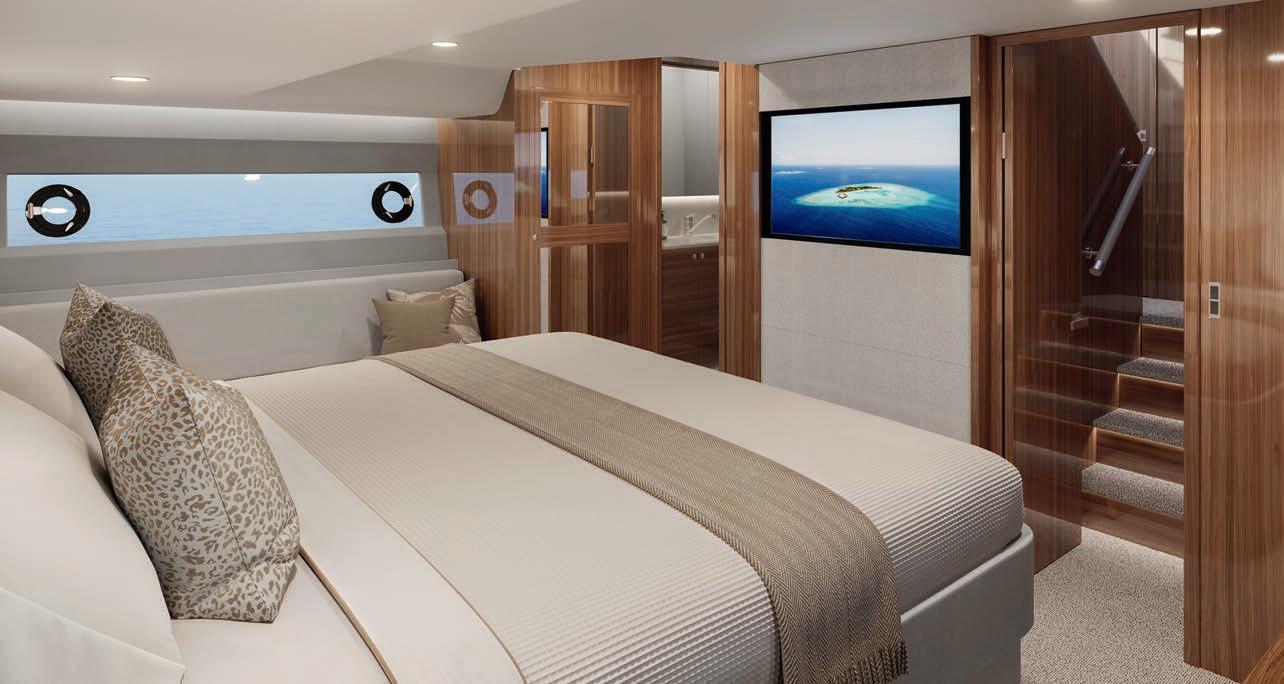
Maritimo’s new 50-foot range doesn’t compromise on luxury. The master stateroom, complete with ensuite and expansive storage, surpasses not only its predecessor but raises the bar for vessels in this category. Thoughtful ergonomics and superior craftsmanship ensure that comfort and functionality are maximised for longer cruising journeys.
3. Seamless indoor-outdoor living
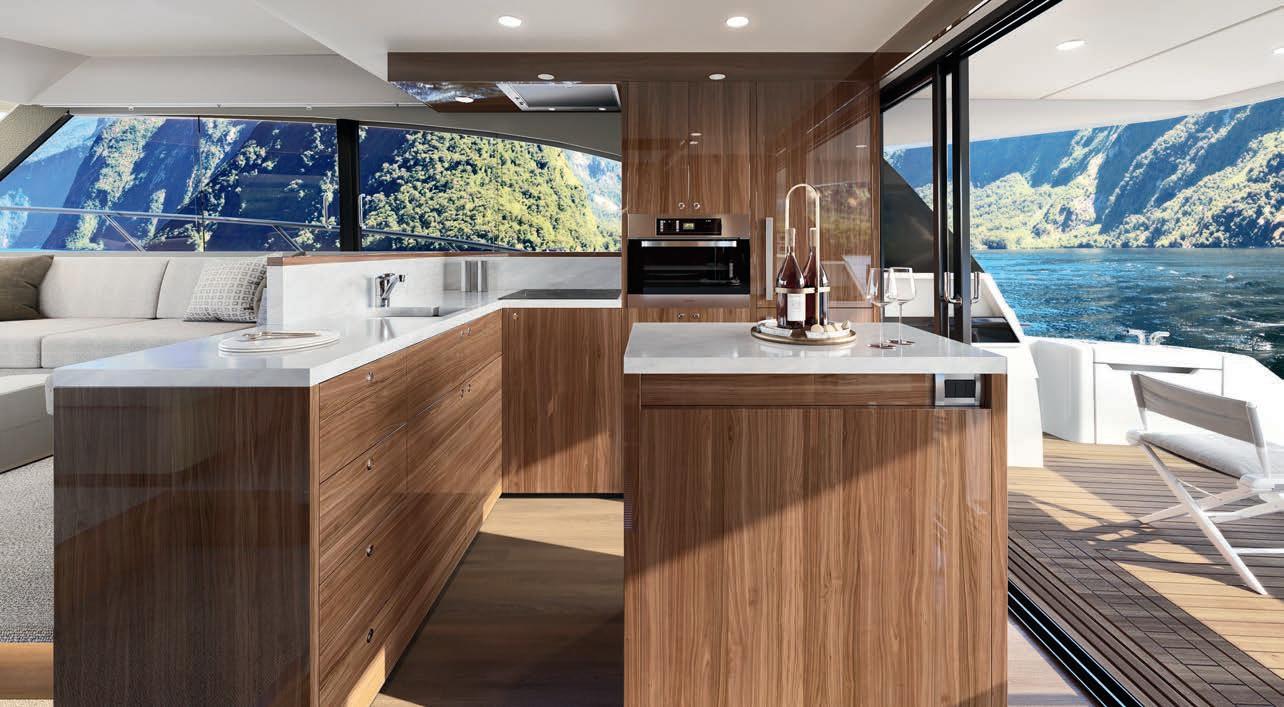
Maritimo’s signature walk-through living concept is at the heart of both the M50 and S50, highlighted by a rear galley that connects the saloon to the cockpit and out to a nearly sea-level swim platform. This layout transforms the vessel into an entertainer’s dream, offering uninterrupted flow and social interaction between indoor and outdoor spaces.
4. Safety led design for longrange cruising confidence
Renowned for its ocean-ready builds, Maritimo maintains a strong safety ethos. Walkaround decks, high sides, and internal rear-facing flybridge stairs enhance safety in both marina and open sea environments. Combined with Maritimo’s race-inspired hull design and ride pedigree, these features provide peace of mind for serious offshore cruising.
Visit maritimo.com.au
THE LAUNCH OF D'ALBORA YACHT BROKERS REPRESENTS A NEW ERA FOR D'ALBORA’S BROKERAGE DIVISION.
Australia’s leading marina network has revealed the next evolution of its brokerage division, with d'Albora Marine now known as d'Albora Yacht Brokers. Unveiled to the boating community at Sanctuary Cove International Boat Show, the launch of d'Albora Yacht Brokers reflects a dynamic new chapter for d'Albora, by combining premium yacht brokerage expertise with seamless access to Australia’s largest network of marinas, berthing services, boatyards, and ownership support.
“The evolution to d'Albora Yacht Brokers is a natural progression,” says Julien Pouteau, Managing Director, d’Albora. “It allows us to better reflect the full range of services we now offer, from buying and selling, to berthing, boatyard services, vessel management, and finance – all under one trusted name.”
d'Albora Yacht Brokers proudly offers premium brokerage services for quality pre-owned vessels and luxury yachts, complemented by a full suite of marina, maintenance, finance, and ownership support services. Backed by the strength
D'ALBORA YACHT BROKERS IS THE NEXT EVOLUTION IN D'ALBORA’S BROKERAGE DIVISION.
of d'Albora’s marina network, d'Albora Yacht Brokers aims to set a new standard in buying, selling, and maintaining boats across NSW and beyond.
At the helm of the d'Albora Yacht Brokers team is Adam Hickey, Sales Manager and Broker, who has 17 years’ experience within the marine industry. “While our name and the visual identity of d'Albora Yacht Brokers has evolved, our core values have remained unchanged,” says Hickey. “Trust, expertise, personalised service, and a passion for life on the water are at the heart of what we do. The boating industry is evolving, with clients expecting more personalised, seamless support throughout their ownership journey. d'Albora Yacht Brokers is perfectly positioned to meet these needs, combining expert brokerage services with local expertise, and comprehensive after-sales support. A key goal behind the d'Albora Yacht Brokers rebrand is to honour our past successes while introducing a fresh, premium platform that expands our
service offering and positions us for future growth throughout Australia.”
The refreshed d'Albora Yacht Brokers business also has some key benefits and service enhancements for boat owners seeking to sell their vessels. “The full integration with d'Albora’s marina network, significantly enhances the power of our sales platform and offerings to the boating community,” explains Hickey. “Behind the scenes our team has worked tirelessly on technical advancements which both streamline the process of locating specific vessels and boost exposure for our premium listings, ultimately expanding our sales capabilities.”
Visit dalborayachtbrokers.com.au
MAIN: CREATING COMPLETE OWNERSHIP SOLUTIONS FOR CLIENTS IS A FOCUS.
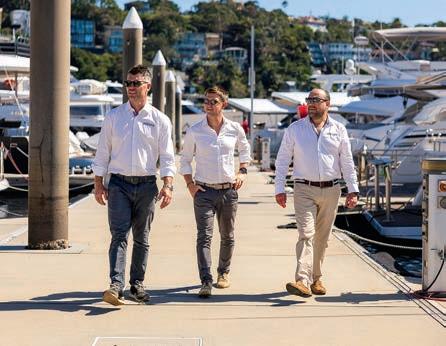
BOTTOM LEFT: ADAM HICKEY, ROSS HAUGHTON AND JEREMY ROSENWAX.
• The fresh brand identity represents a new era for d'Albora’s brokerage division.
• d'Albora Yacht Brokers will have stronger integration with Australia’s leading marina network.
• d'Albora Yacht Brokers gives boaters access to an expanded range of services beyond brokerage alone. These services include vessel consultation, finance and vessel service management.
• The d'Albora Yacht Brokers team is focussed on creating complete ownership solutions for clients. Enhancing their clients’ boating lifestyles is what drives them.
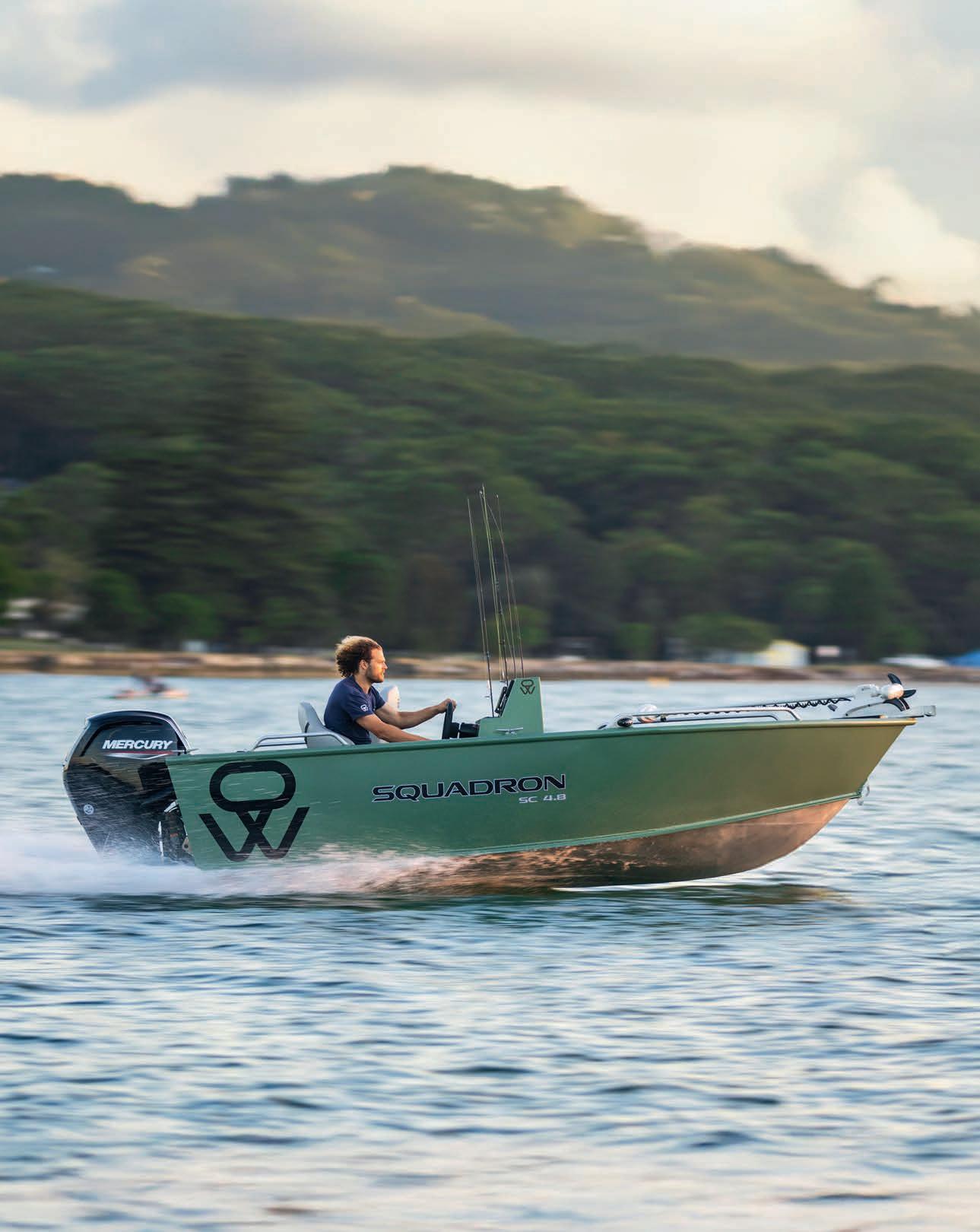

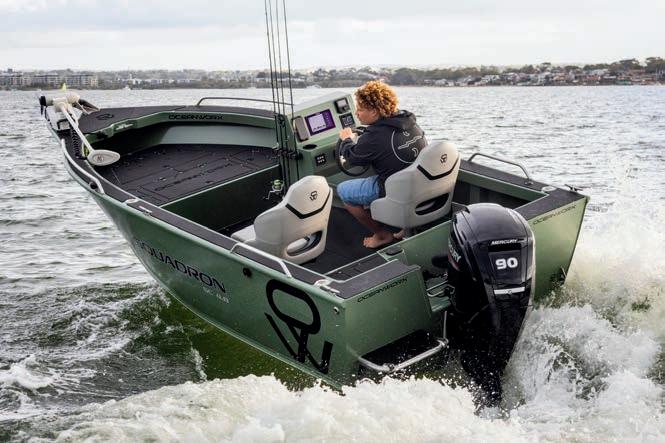
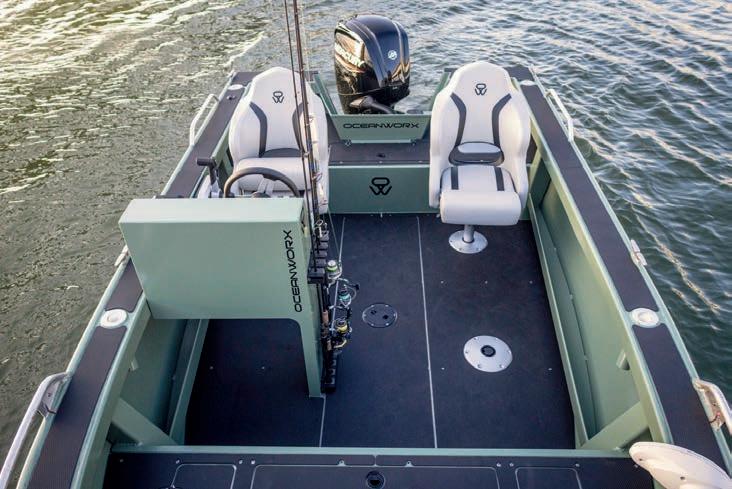
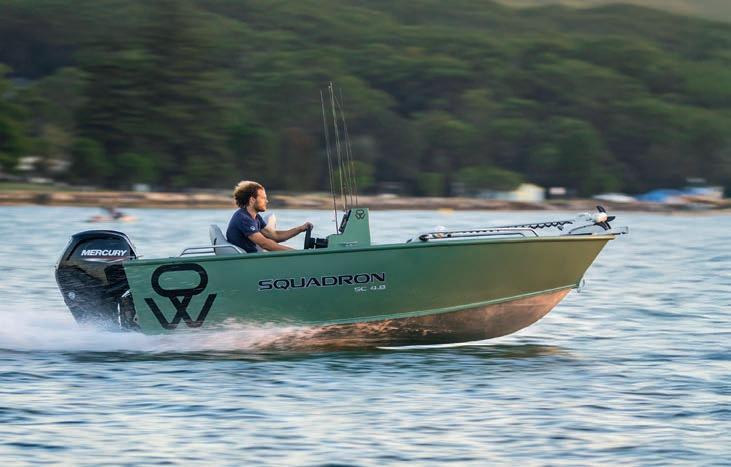
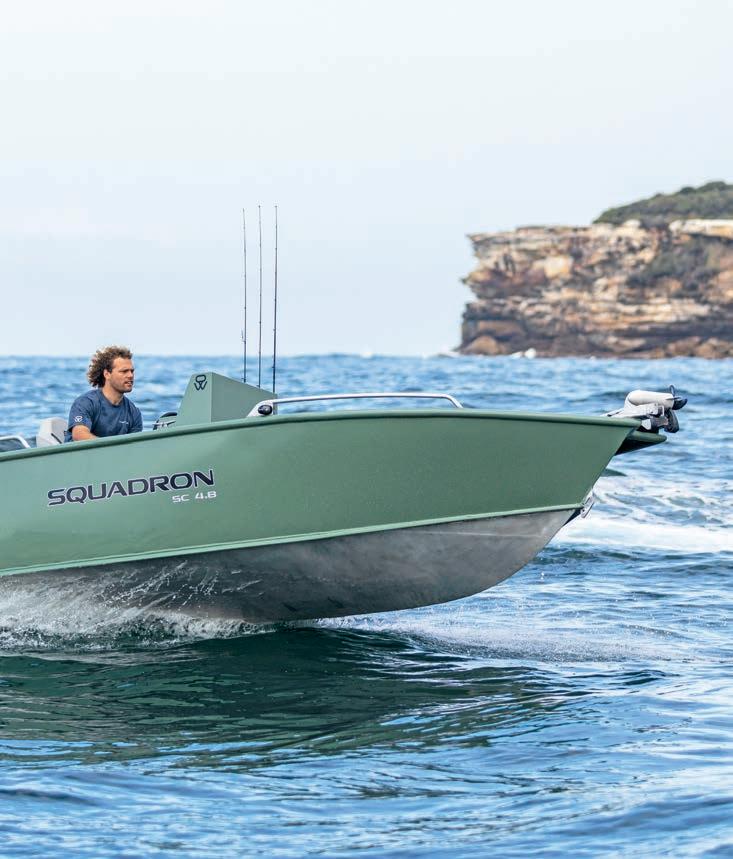
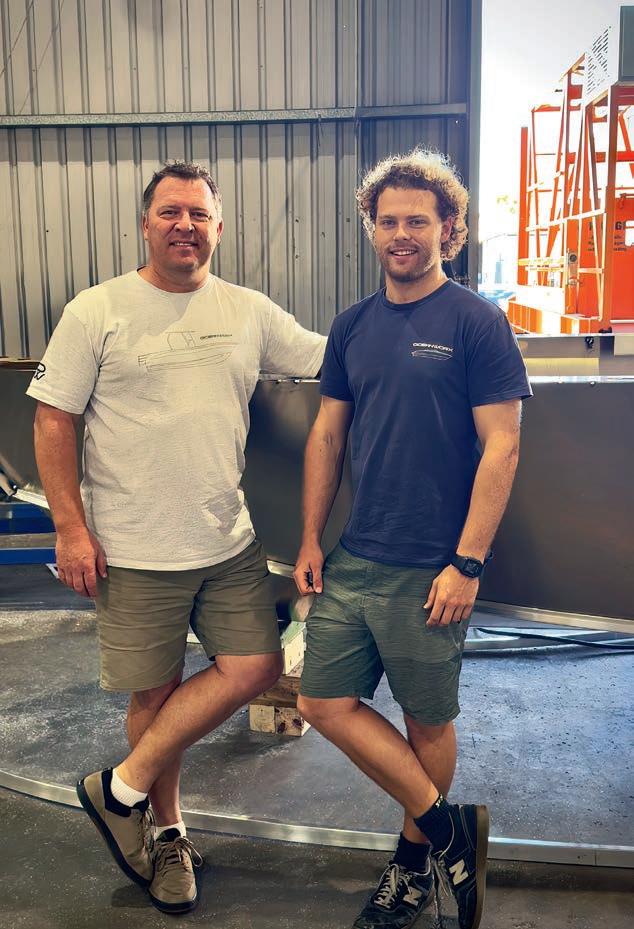
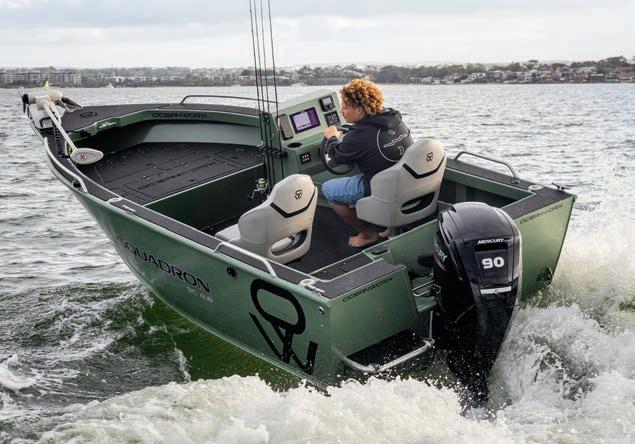
DEREK RODWAY, ONE HALF OF THE FATHER-SON DUO BEHIND OCEANWORX, SHARES SOME INSIGHTS ABOUT THE SYDNEY-BASED BOAT BRAND AND THE NEW OCEANWORX SQUADRON SC 4.8.
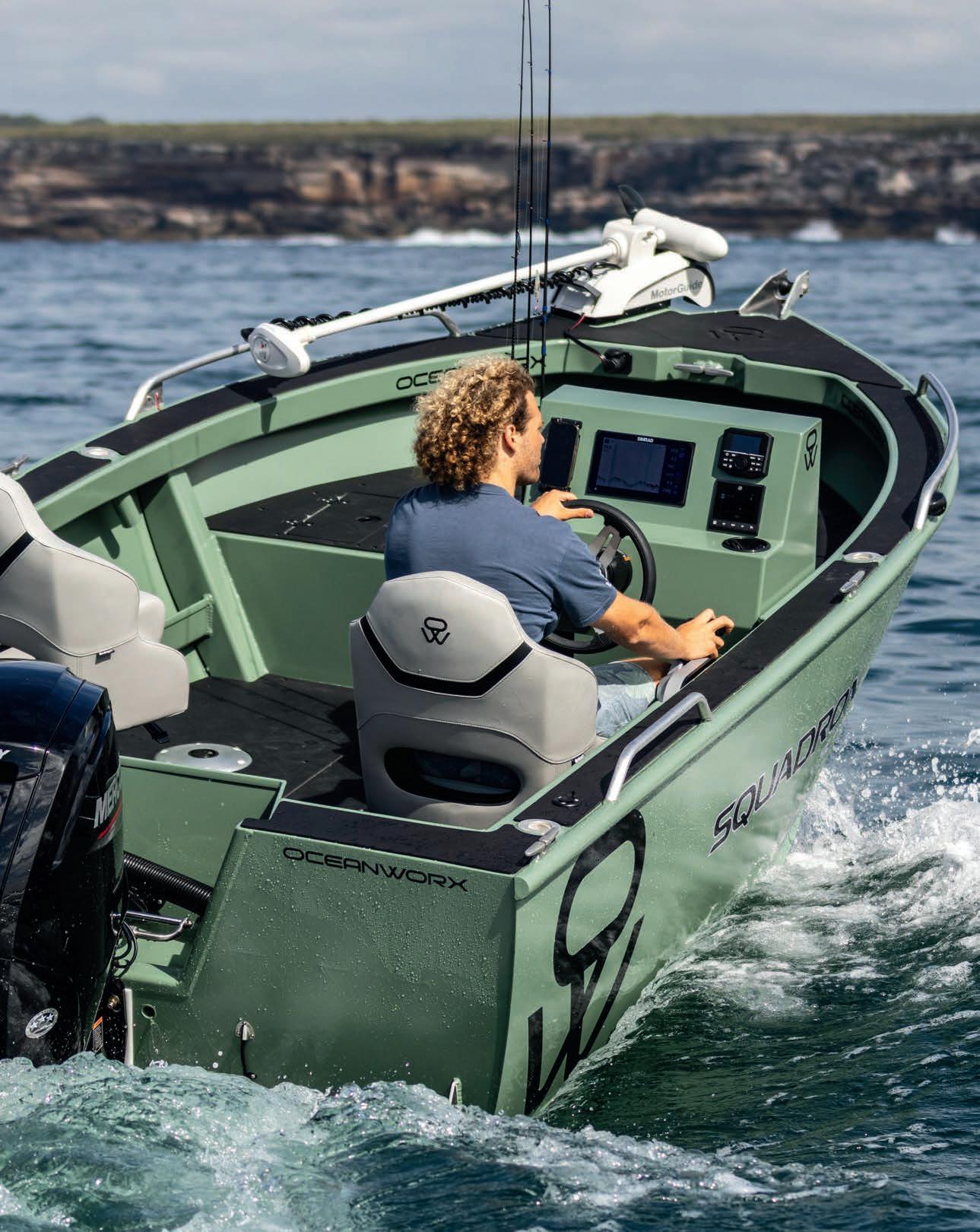
THIS SPREAD: PACKED WITH STANDARD FEATURES.
How did the Oceanworx story begin?
We officially launched the brand at the Sydney International Boat Show in 2023. I own Good Times Marine, so my son Samson grew up around boats and was fascinated by hull shape from an early age. Through my dealership background Samson also had exposure to a plethora of trailer boats, so he studied the impact of various hull shapes in the water. All of this led to Samson developing his own hull technology for Oceanworx.
In your opinion, what sets Oceanworx apart from its competitors?
Oceanworx is a 100 per cent Australiandesigned and made, which is a big factor for many people. A lot of other boats are sold on the basis of their interiors, rather than focusing
on the hull. With Oceanworx we went the other way around; we designed and built a hull which performs phenomenally on the water. Once Samson had the hull really dialled in, we stepped inside and looked at the steering wheel and the helm seat, and focused on the ergonomics of the interior.
Tell us more about the Oceanworx hull design.
We run a very aggressive bow stem transition to get the hull into the water. By doing that we’re creating a longer waterline length than would normally be expected for a hull of its size. Which means you feel like you’re driving a boat with a bigger hull than what it really is. We also run with an aggressive bow cut water deadrise angle which delivers that super soft ride.
If you look at the bottom sheet of the hull, especially when they’re upside down, there are curves heading in every direction. Many hulls have a fairly flat sheet from the keel to the chine. If you look at the bottom of our boat, there’s nothing flat anywhere in the bottom sheet; there’s always curvature. Because of that, it’s very rare to get a bang out of the hull. It’ll always be a soft landing.
So, that design detail is key to a smooth and dry ride?
Yes, that’s what gives you that ride. If you look at our hulls when they hit the chop, the water wraps around the side, it just slides off the hull and comes out the back. That’s why Oceanworx boats are so incredibly dry riding, and fuel efficient, because they’re not forcing their way through the water. They’re literally slicing through the water.

What’s the essence of the Oceanworx brand?
There’s a pretty straightforward response to that. We, both Samson and I, are both ‘thalassophiles’, someone who gets great joy and fulfilment from being in and around the water. We first heard that word when developing Oceanworx and latched onto it, and it has become a guiding principle for us ever since. Oceanworx exists to give our fellow thalassophiles access to on-water adventure.
If someone wanted to box the brand up, they might say Oceanworx is just a fishing boat brand. But if they looked at our research and development, and future plans for model releases over the next two-to-three years,
they’d realise we want Oceanworx to be a lot bigger than just fishing boats.
The brand is really a movement; a celebration of on-water adventures and our vast coastline. There’s so many things that people can do with a boat. Some people just love driving a well-engineered boat; that’s what they get their excitement and enjoyment from. Our goal with Oceanworx is to provide exceptional on-water performance tools that allow those people to access their own ocean adventures.
What sort of buyers does the Squadron appeal to?
The Squadron is made from 5083 marine grade aluminium and shares many of the design cues
from our renowned high tensile models. We’ve had some first boat owners jump straight into a Squadron, but typically a Squadron might be a buyer’s second boat. Someone who has perhaps previously owned a cheaper tinny and wants to step into something that’s going to give them a better ride and stability, and an all-round better boating experience.
What are some of the key optional upgrades people may want to add to the Squadron?
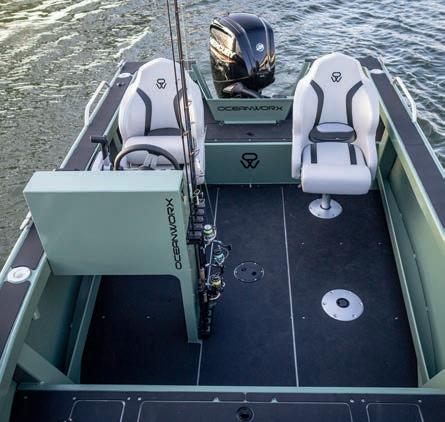
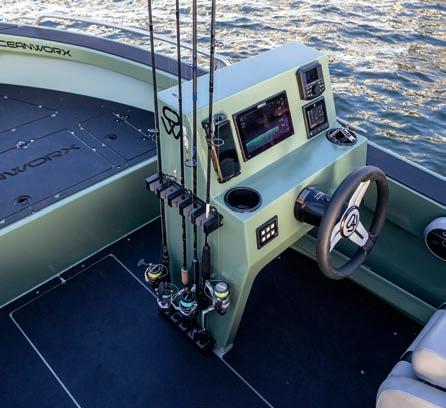
The Squadron already has most things you commonly need up front as standard, including a nine-inch Lowrance screen, plumbed live bait tank, front rear casting decks and premium seats. So, we do find many
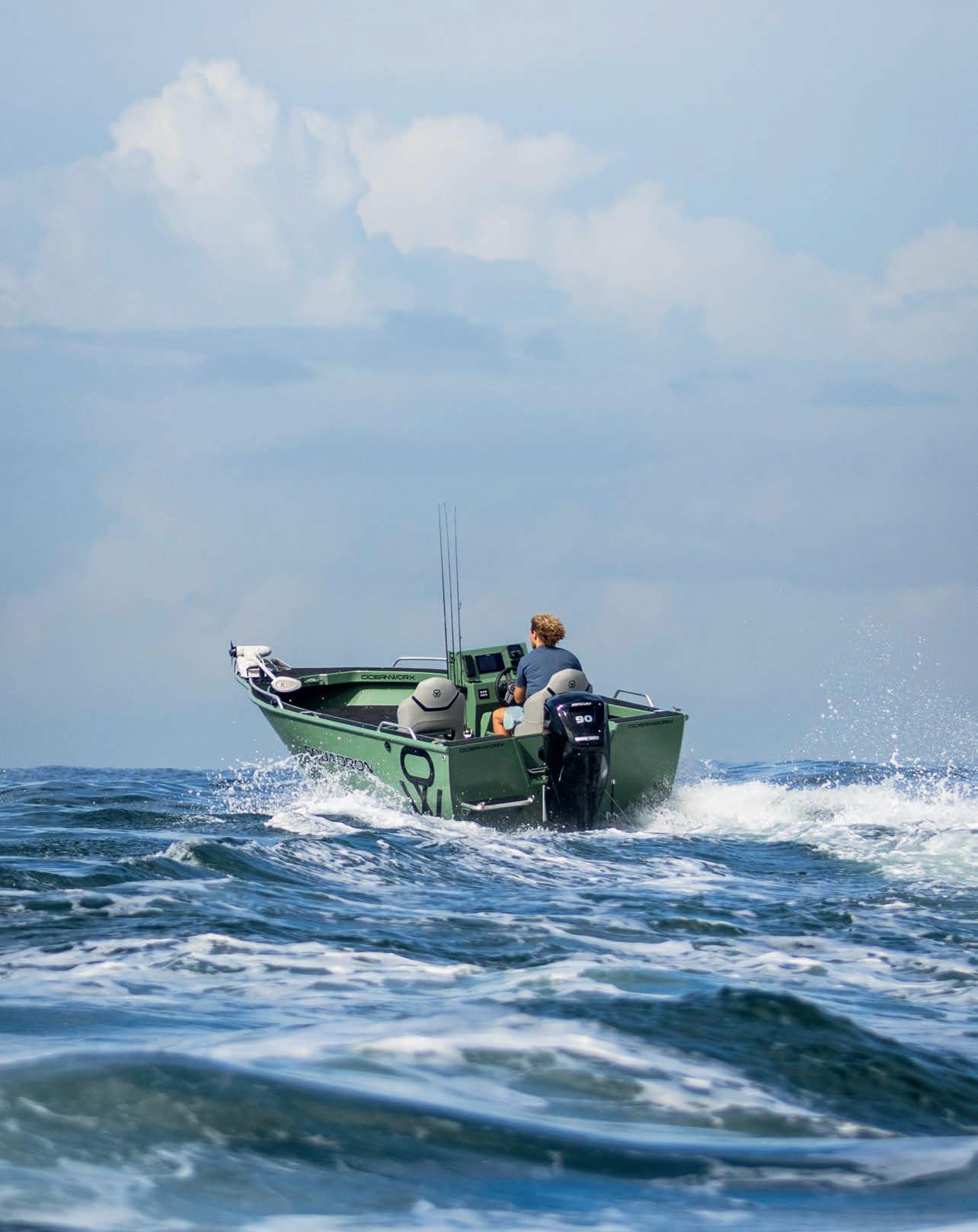
THIS SPREAD: OCEANWORX BOATS ARE VERY DRY RIDING.
people don’t want to option up. However, there are various options you can add into the boat, such as a stereo system, U-DEK foam flooring, two-tone colours, or perhaps a plumbed-in keep tank in the bow.
How do you approach customer feedback?
We have great relationships with our customers and are very flexible when it comes to their feedback. We’re always looking to take it on board and adopt the best of that feedback. We’re constantly improving and evolving our boats, based on our own on-water experience, as well as customer feedback. We’re never going to just be satisfied with our boats and say ‘that’s it, they’re done’.
What’s next for Oceanworx?
We’re basically becoming a global brand. We’ve had enquiries from around the world including across Asia, Europe, the UK, Canada, Africa and the Middle East. We also have a North American build facility that has just begun production and once we launch our forthcoming 5.2 hull later this year, we’ll be looking to officially launch the brand in the US. Closer to home, we’re in conversation with a few dealers in New Zealand, and for Kiwi buyers we already have the capacity to ship boats from our factory in Sydney to New Zealand.
Visit oceanworx.au
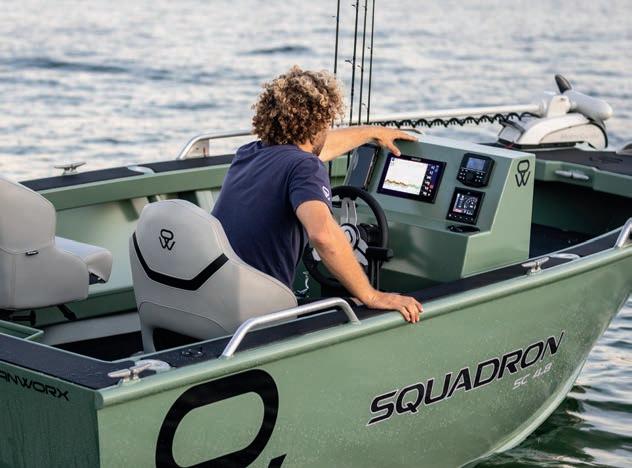
OCEANWORX SQUADRON SC 4.8
Hull length: 4.84m
Hull length overall: 5.05m
Gunwale beam: 2.17m
Waterline beam: 1.94m
Transom deadrise: 15 degrees
Cut water deadrise: 35 degrees
Engine: min. 75hp and max. 90hp
Internal beam: 1.81m
Towing weight wet: 1100kg
Fuel capacity: 80l
Passenger capacity: 5
Scan to find out more about the Squadron SC 4.8.
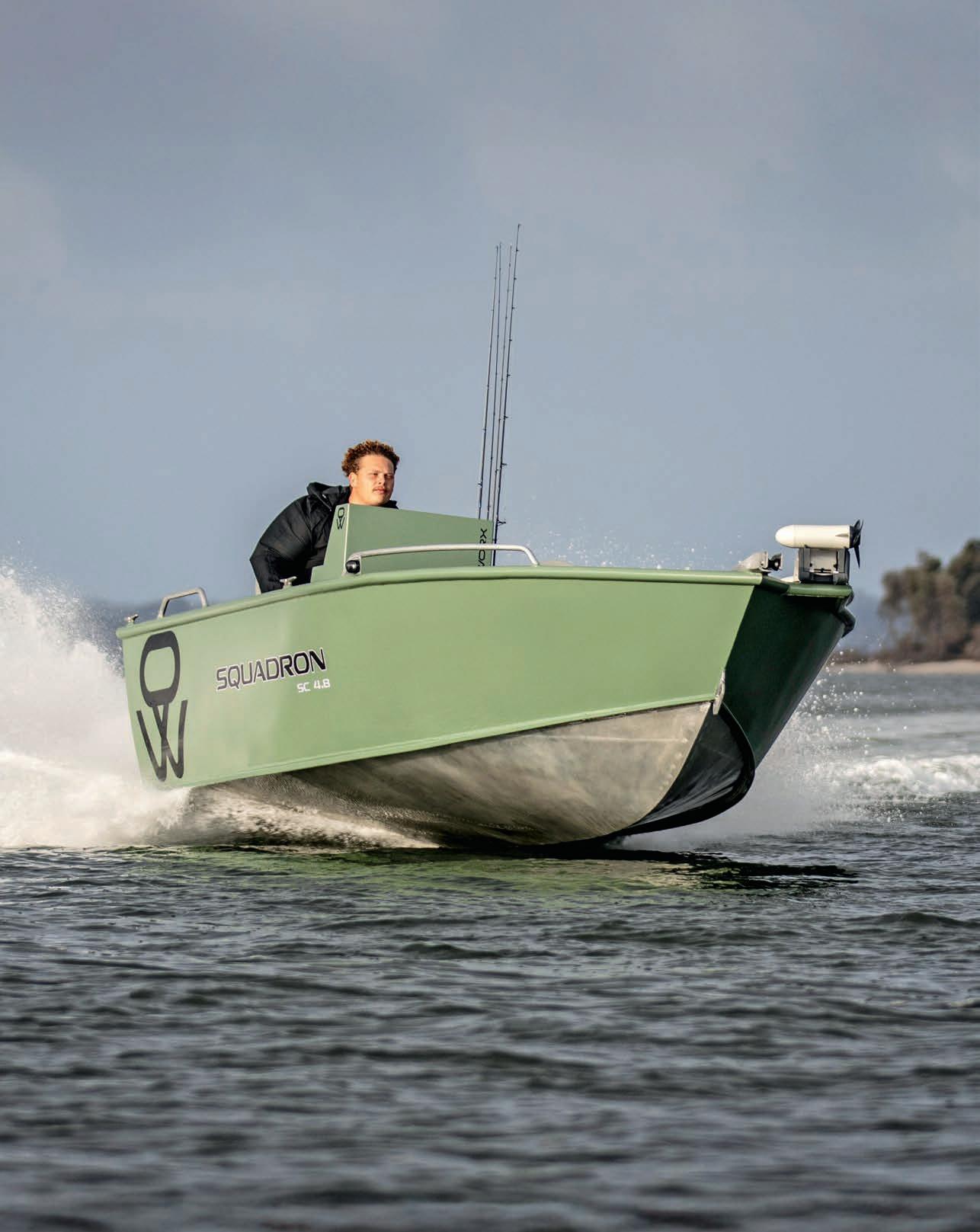
THIS SPREAD: OCEANWORX CONSTANTLY IMPROVES ITS BOATS.
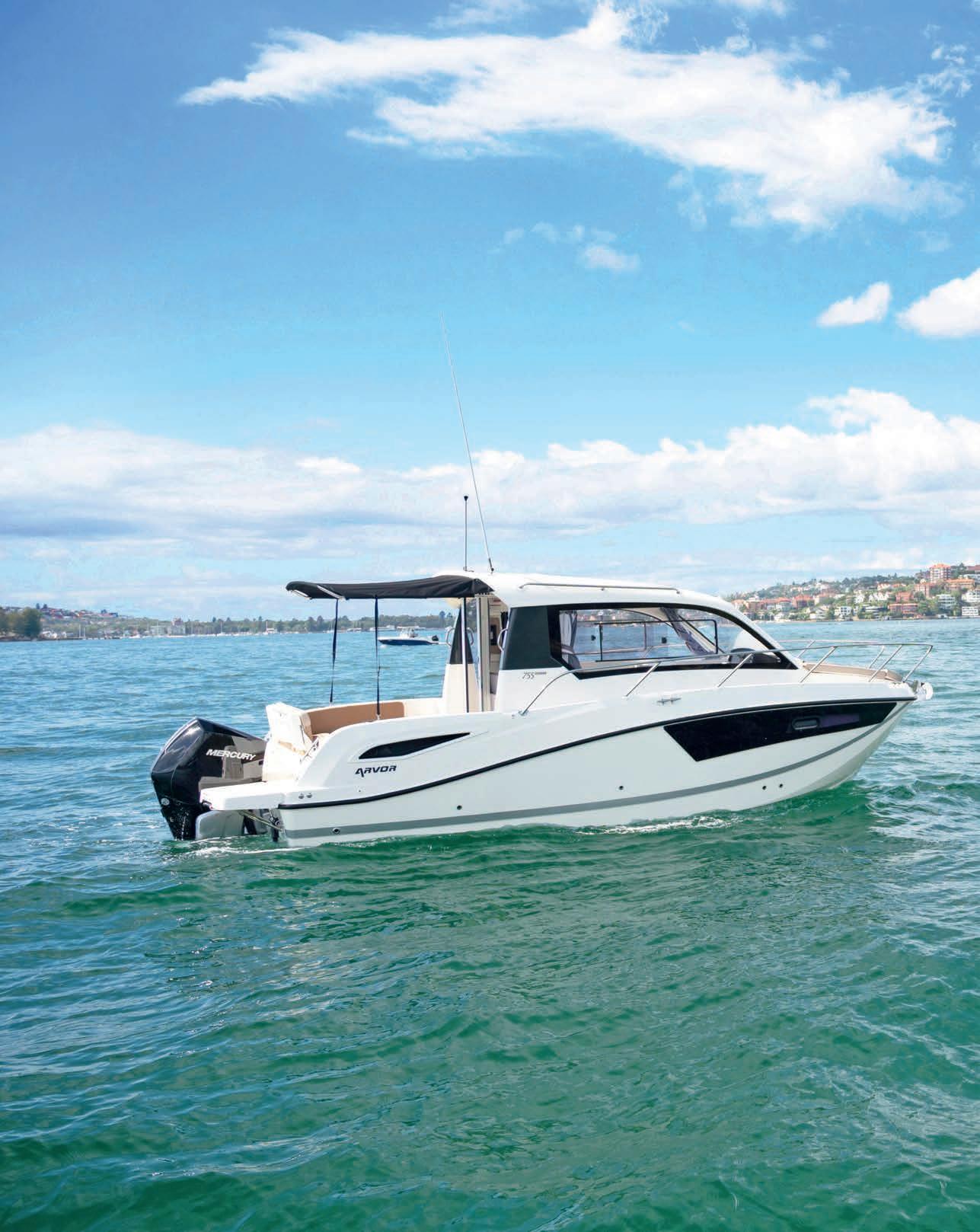
WEEKENDS ARE MADE FOR THIS.
DISCOVER THE ARVOR WEEKENDER RANGE, WHICH OFFERS AN IDEAL BLEND OF COMFORT, ADVENTURE, AND PRACTICALITY ON THE WATER.
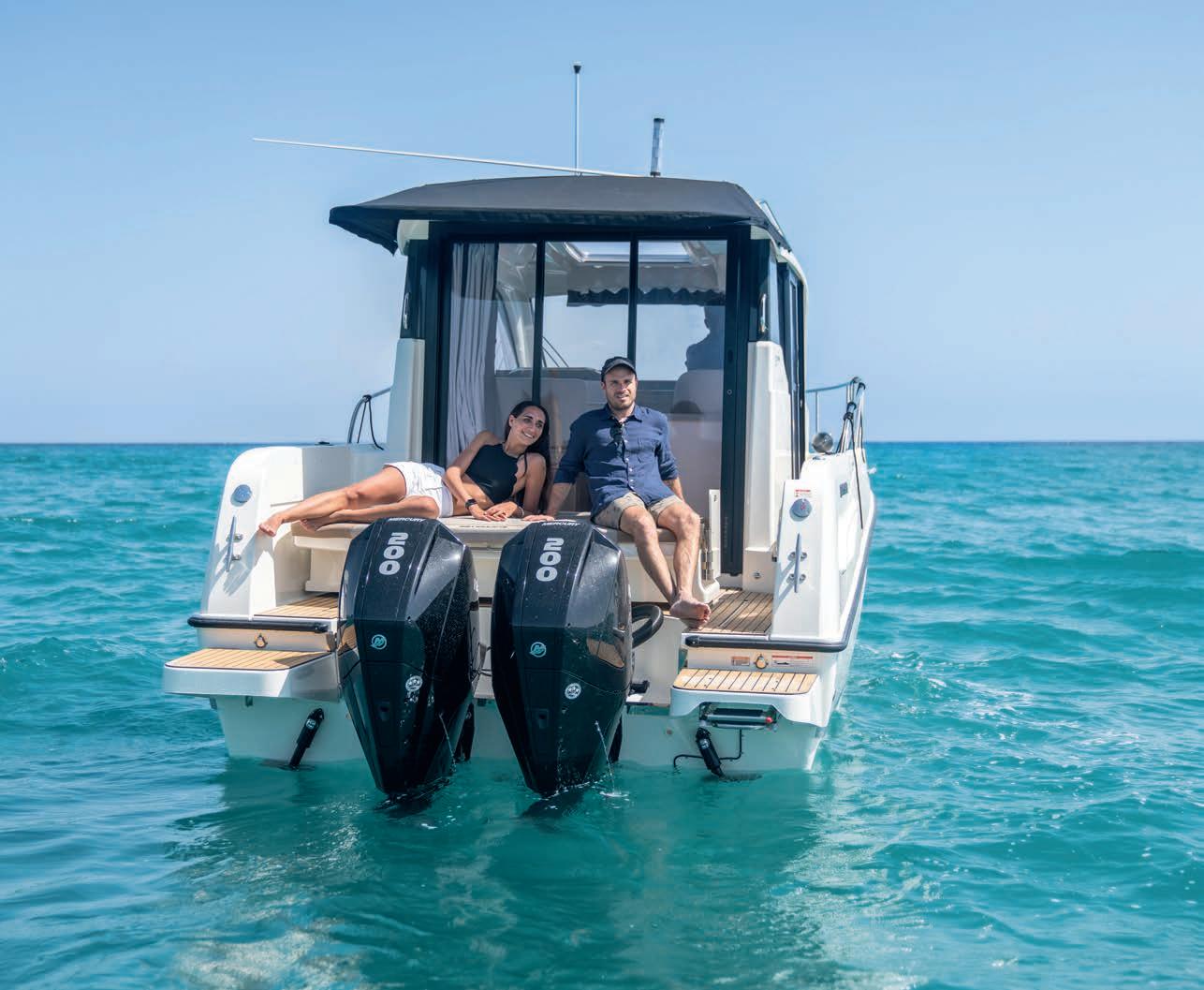
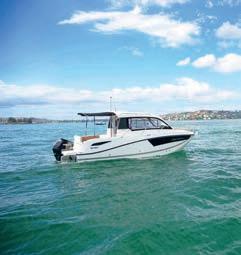
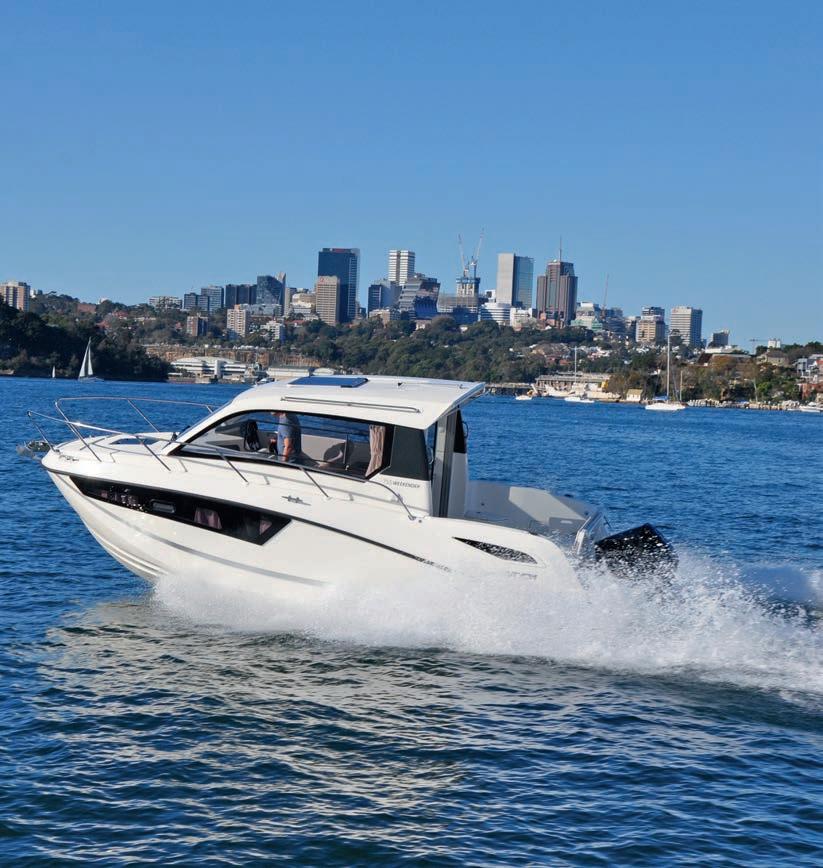
In the world of recreational boating, finding a boat that perfectly suits you, balancing comfort, functionality, and seaworthiness, can be a challenge. For many boating enthusiasts, the Arvor Weekender range is a compelling solution. Whether you’re a seasoned boat owner or a weekend cruiser, the Arvor Weekender boats are an inviting escape to the water, wrapped in a package that’s both stylish and sensible. Designed for short cruising getaways and spontaneous adventures, the Arvor Weekender line delivers a unique experience that appeals to a wide spectrum of boaters.
Arvor boats have long held a reputation for reliability, with their origins rooted in Australia before becoming part of the Brunswick Boat Group, now sold widely under the Quicksilver brand in Europe. Traditionally known for their
tough, no-nonsense fishing boats, Arvor has evolved over the years to embrace the needs of modern boaters. The Weekender range is a prime example of this evolution – a series of vessels that retain Arvor’s practical DNA while introducing new levels of comfort and versatility.
The Weekender series includes several models such as the Arvor 705, 755, and 905 Weekender. Each step up in size brings more features, space, and capability, allowing customers to choose a boat that matches their lifestyle and aspirations. Despite their differences in size, all models share a common goal: to create a user-friendly, multipurpose cruiser that’s as enjoyable for day trips as it is for overnight stays.
What immediately strikes most people about the Weekender range is its thoughtful
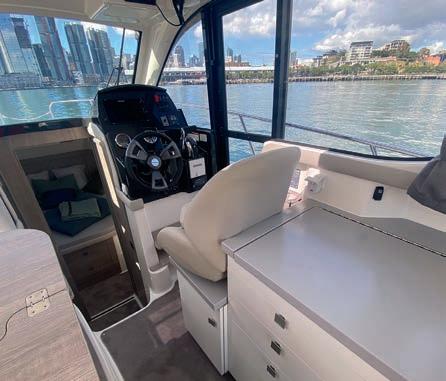
layout. The design of these boats is clearly focused on maximising the use of interior and exterior space, even on the smaller models. The cabins are bright and welcoming, with large windows that flood the interior with natural light. Visibility from the helm is excellent, making these boats easy to handle, even for those new to boating. The enclosed wheelhouse provides shelter from the elements, while sliding doors and roof hatches offer excellent ventilation and easy access to the deck.
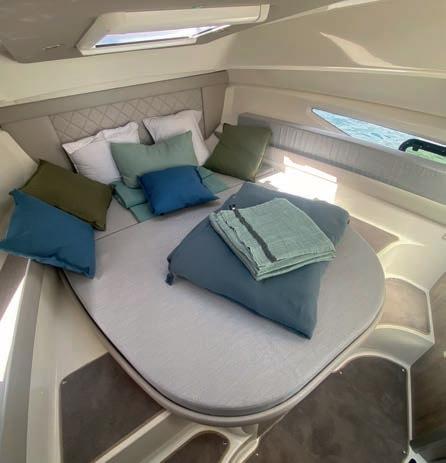
Comfort is at the forefront of the Weekender experience. The interiors are cleverly arranged to provide sleeping accommodation for two to six people, depending on the model. Most include convertible seating areas in the saloon that transform into berths, allowing for flexible
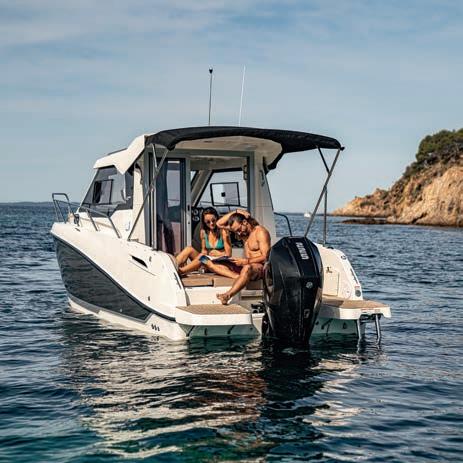
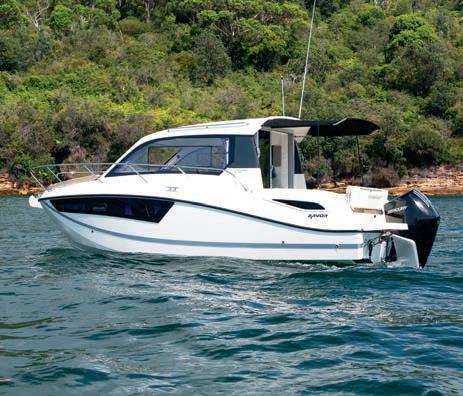
use of space. The cabins are equipped with compact galleys – often featuring a sink, stove, and refrigerator – which are more than adequate for preparing meals during weekend getaways. Marine toilets come standard in some, and larger models like the 755 and 905 even offer fully enclosed heads with showers, making longer trips much more comfortable.
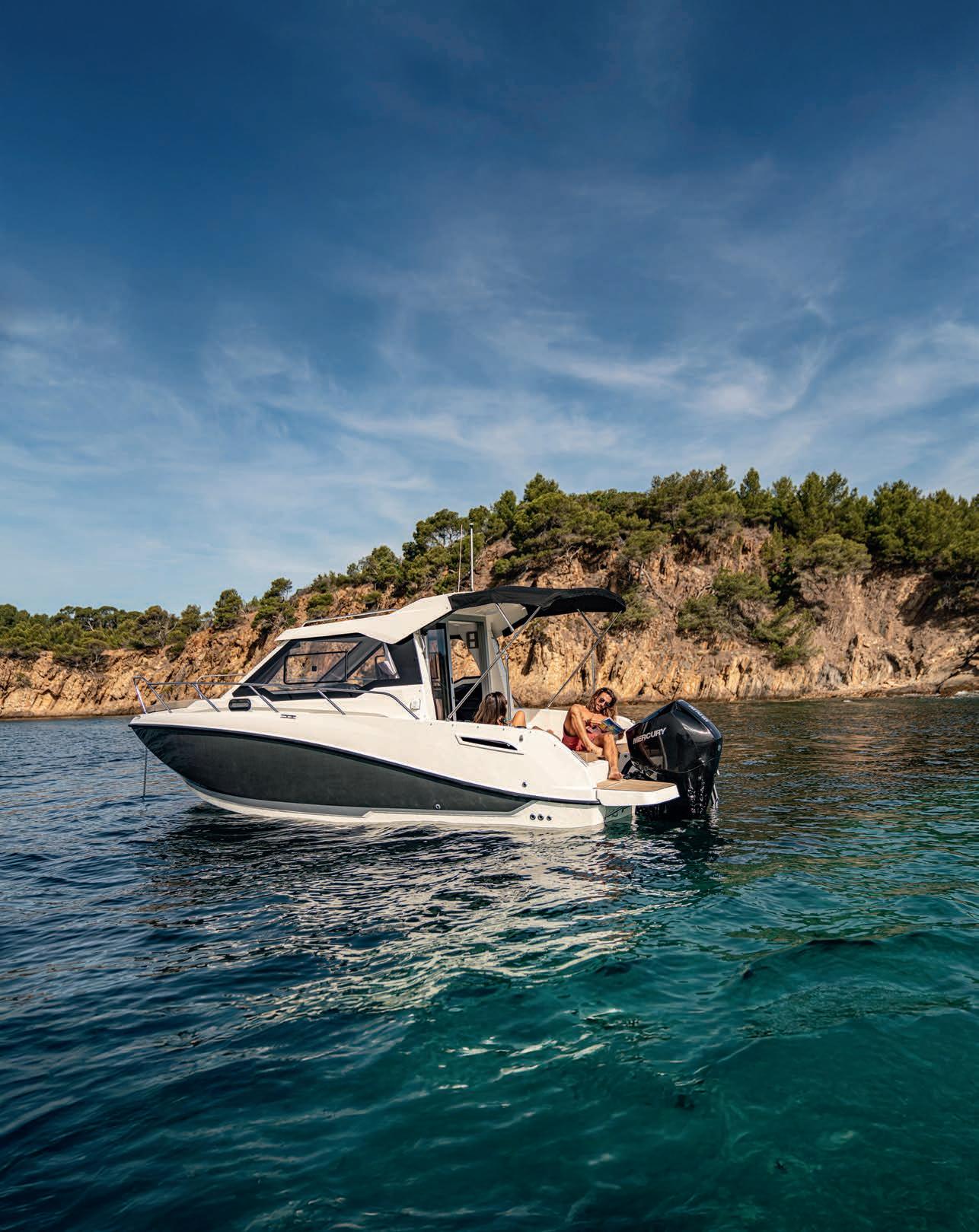
In terms of performance, the Arvor Weekender boats are designed to be both capable and efficient. Powered by Mercury outboard engines, they deliver reliable propulsion with reduced emissions and improved fuel economy. These engines are known for their quiet operation and ease of maintenance, which adds to the overall appeal of the range. The hulls, typically deep-V or semi-planing designs, provide
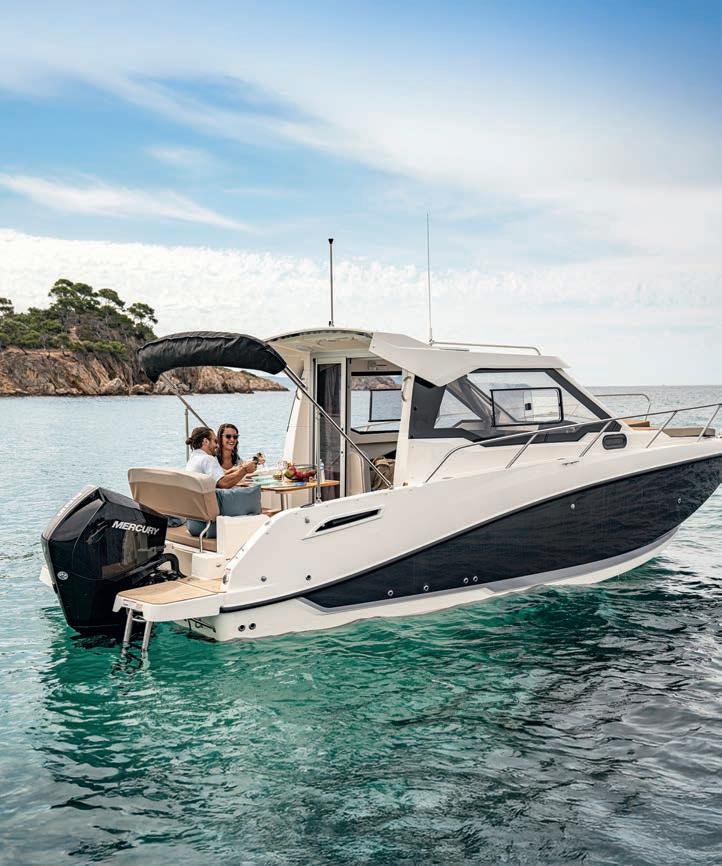
stability and a smooth ride, whether cruising along inland waterways or venturing into open coastal waters. Handling is intuitive, and many models are fitted with hydraulic steering and bow thrusters to assist with docking and tight manoeuvring – features that add considerable confidence for those with less experience.
While comfort and performance are key, the true charm of the Weekender range lies in its versatility. These boats aren’t limited to one style of boating. They can easily pivot between leisurely cruising, fishing, water sports, and entertaining guests. The rear cockpit space is generous and functional, with enough room for outdoor dining or casting a line.
The swim platforms – integrated on the transom in most models – provide easy
access to the water for swimming or boarding from a tender. For families with children or anyone who enjoys water-based recreation, these features make a big difference. Sun pads, folding cockpit seats, and bimini tops also help enhance the experience, allowing you to tailor your setup for a relaxing afternoon in the sun or a practical outing in all kinds of weather.
Among the models, the Arvor 705 Weekender is a popular choice for those seeking a middle ground between size and affordability. It can sleep four people and includes a small galley and marine toilet, making it ideal for short coastal cruises or weekends away. For those who want more space and amenities, the 755 and 905 Weekenders provide larger cabins, extended cockpits, and more refined finishes. The 905
Weekender in particular, feels like a compact floating apartment, complete with multiple sleeping areas, a separate galley and head, and the option to include air conditioning and hot water systems.
Beyond the individual features, what truly sets the Arvor Weekender range apart is its ability to make boating more accessible. These are boats that are easy to handle, removing many of the barriers that typically discourage people from owning and operating a cabin cruiser. The layout and systems are intuitive, maintenance is straightforward, and the reliability of the engine and hull design ensure peace of mind on the water.
For new boaters, the Weekender series offers a gentle learning curve without sacrificing capability. For experienced
cruisers looking to downsize from larger yachts or find a more versatile second boat, the Weekender presents a practical and enjoyable alternative. It’s also a great choice for couples and families seeking new adventures together, with enough comfort and safety features to encourage longer stays aboard.
With a wide range of customisation options, dependable engineering, and a well-earned reputation for practicality, the Arvor Weekender line continues to grow in popularity. For anyone seeking a comfortable, compact cruiser with a sense of adventure baked in, the Arvor Weekender might just be the perfect companion.
Visit arvor.com.au

Scan to find out more about the Arvor Weekender range.
BOAT SHOWS PROVIDE A GLIMPSE OF THE LATEST AND GREATEST IN BOATS, OUTBOARDS AND ACCESSORIES. SCOTT THOMAS REPORTS.
Boat show season is underway!
That’s great news for boat lovers with a long list of new boats, outboards, technology and accessories for 2025. The Sanctuary Cove International Boat Show (SCIBS) and Auckland’s Hutchwilco Boat Show both took place in May, with shows in Sydney, Melbourne and around Australia also coming up. Over the next couple of pages, we’ll look at some new boat models and check out some of the latest accessories and electronics.
SCIBS was the perfect launching pad for many of 2025’s new boat releases. The weather was perfect and the Sea Trial Zone allowed boating media and potential buyers to jump onboard and experience boat s where they belong on the water. There was also the opportunity to test new accessories, outboards, and marine electronics. More on that later.
One boat that caught our eye was the Haines Hunter 620 Patriot. Haines Hunter should need little introduction. The Melbourne-based fibreglass manufacturer has
a solid reputation, and models such as the 620 are highly sought after. The 620 features a large walk-around console that holds a bed with a sleeping area underneath. Plus, there’s plenty of dry space for storage. There’s also an optional T-Top for weather protection.
It’s fitted out with all of the fishing accessories you expect, and importantly, has loads of space to walk fully around the boat and fish. That makes it a unique configuration; an open boat that still features a sleeping area! On the transom, there’s a Suzuki DF250AUN Stealth Line outboard motor. The Stealth Line weighs 289kg, has a 2.08:1 gear ratio and generates 184k w of power driving a stainless 15” x 19” water grip sport propeller.
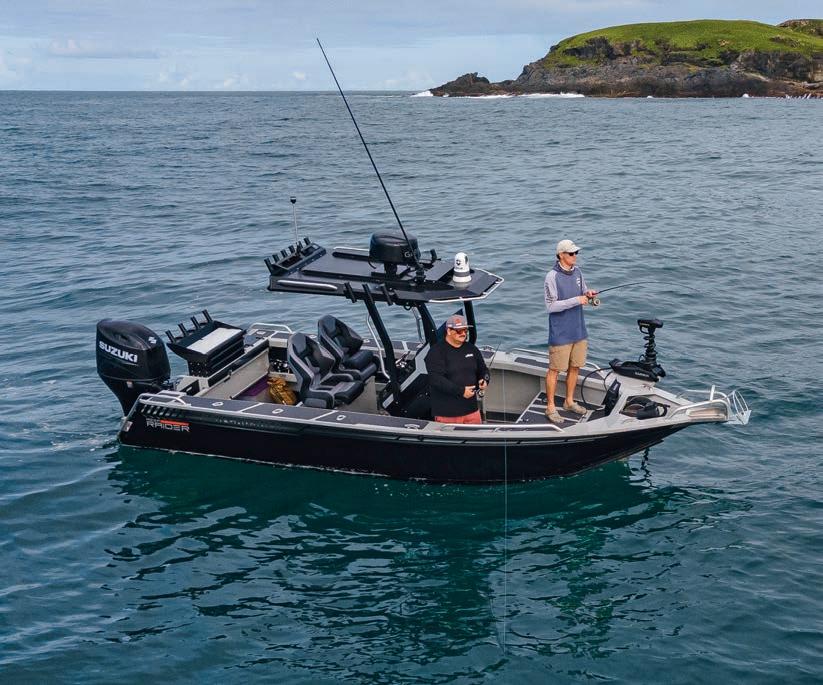
Further along the dock at the SCIBS Sea Trial Area was Bar Crusher’s latest 670XT Reef Raider (Special Edition) I recently spent a day fishing from this very boat off Coffs Harbour, NSW. It’s an awesome boat with a long list of accessories and all the bells and whistles. The Raider Series from Bar Crusher features three models and comes factory-fitted with most things a serious fisho or boater could possibly
need. This boat is 6.7m long and has a Suzuki 200hp four-stroke fitted. There’s also a 16” Garmin sounder at the console and another 12” Garmin fishfinder on the bow, which is useful when fishing from the elevated casting platform and taking advantage of the Garmin Kraken trolling motor. There’s also radar and even a thermal imaging infrared camera (FLIR) for operating the boat after dark. Rod holders are abundant and there’s a T-Top for keeping you dry in bad weather. As the name suggests, the Reef Raider would be a great boat for sneaking out to offshore reefs along Australia’s coastline.
Stabicraft recently released its 2050 Frontier at the Hutchwilco Boat Show in Auckland. The same boat was also on display at SCIBS. The 2050 Frontier is a 6.32m centre console that would make a fantastic Top End sport fishing boat. Stabicraft offers the Frontier in three models that would suit many applications . These include the Adventure, Sportfish and Profish models. The Adventure Package is the entry level option, while the Sportfish and Profish add features to this
already well-designed boat to make it a great open fishing boat. With loads of fishing space and ample storage under the decks, not to mention plenty of fishing features, the 2050 Frontier ticks a lot of boxes for those in the market for a premium aluminium boat.
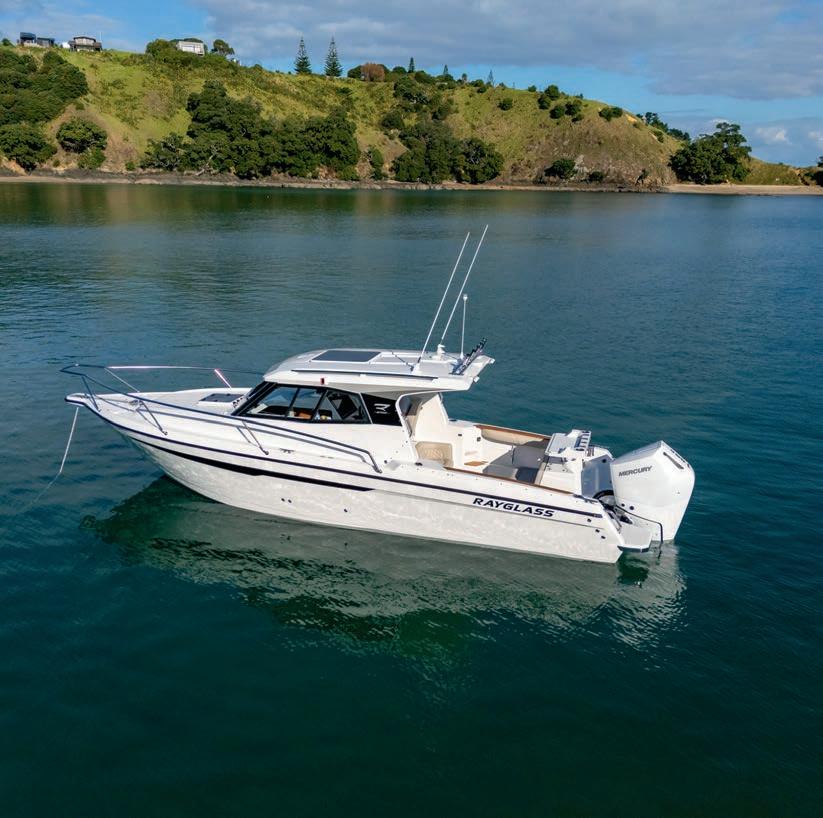
Another iconic New Zealand boat brand, Rayglass, officially launched in Australia at SCIBS. Rayglass had three unique boats on display. The biggest, and newest, was the 2700. This was designed as an all-rounder for families and fishos. It’s a big boat and powered by an inboard diesel. Interestingly, while some inboards take up precious cockpit fishing space, Rayglass has extended the rear platform to allow fishos access to the transom. What you get is unimpeded access to the water and a conveniently placed bait board.
If fishing isn’t your thing, the same boat offers a well-appointed cabin with comfy seats, bed and more. Best of all, despite its
size and features, it’s still a legally trailerable boat. Next up, Rayglass had its popular 2350 model on show. This would make an ideal offshore fishing boat and was fitted with a 250hp V8 Mercury outboard. Finally, Rayglass had a 3000 on display fitted with twin Mercury outboards.
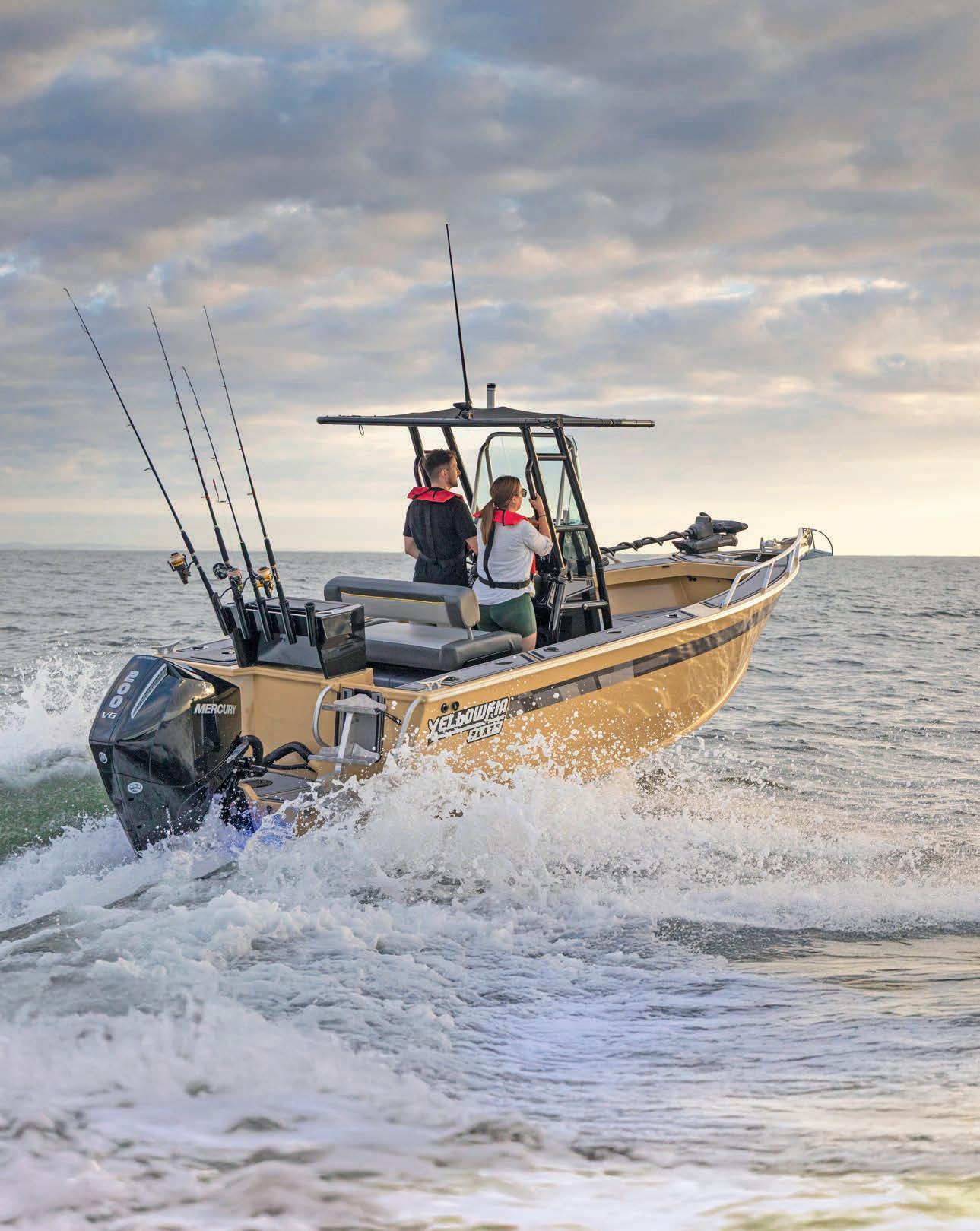
Speaking of iconic brands, Aussie-built Yellowfin Boats unveiled two new console models at SCIBS. The new Centre Console and Rear Console are both built from the ground up for serious offshore fishing. The new models are available in lengths from 5.8m to 7m. Yellowfin says its latest innovations deliver a no-compromise blend of industrial-strength construction, refined design and fishability, engineered to handle the toughest conditions while turning heads on the water.
Both new console models now employ the Inter-Lok Core system which forms the
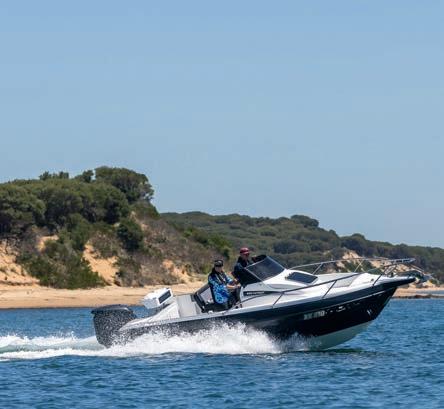
backbone of each boat by utilising a fully welded, interlocking subframe with two full-height and eight full-length stringers. Underscored by 6mm bottom sheets, Yellowfin says this system delivers incredible hull strength and durability, and that the refined HD-R hull provides exceptional ride comfort, stability and tracking. “Everything about this range has been optimised for performance, reliability, and build consistency,” said Lloyd Jaber, Global Product Strategy Manager. “We’ve taken the same approach you’d find in industrial design and engineering, with precision, repeatability, and strength applied to every core component of these boats.”
Suzuki displayed its line-up of outboards with a celebration of 60 years in business. The trusted outboard brand has announced it will extend its Stealth Line to include everything
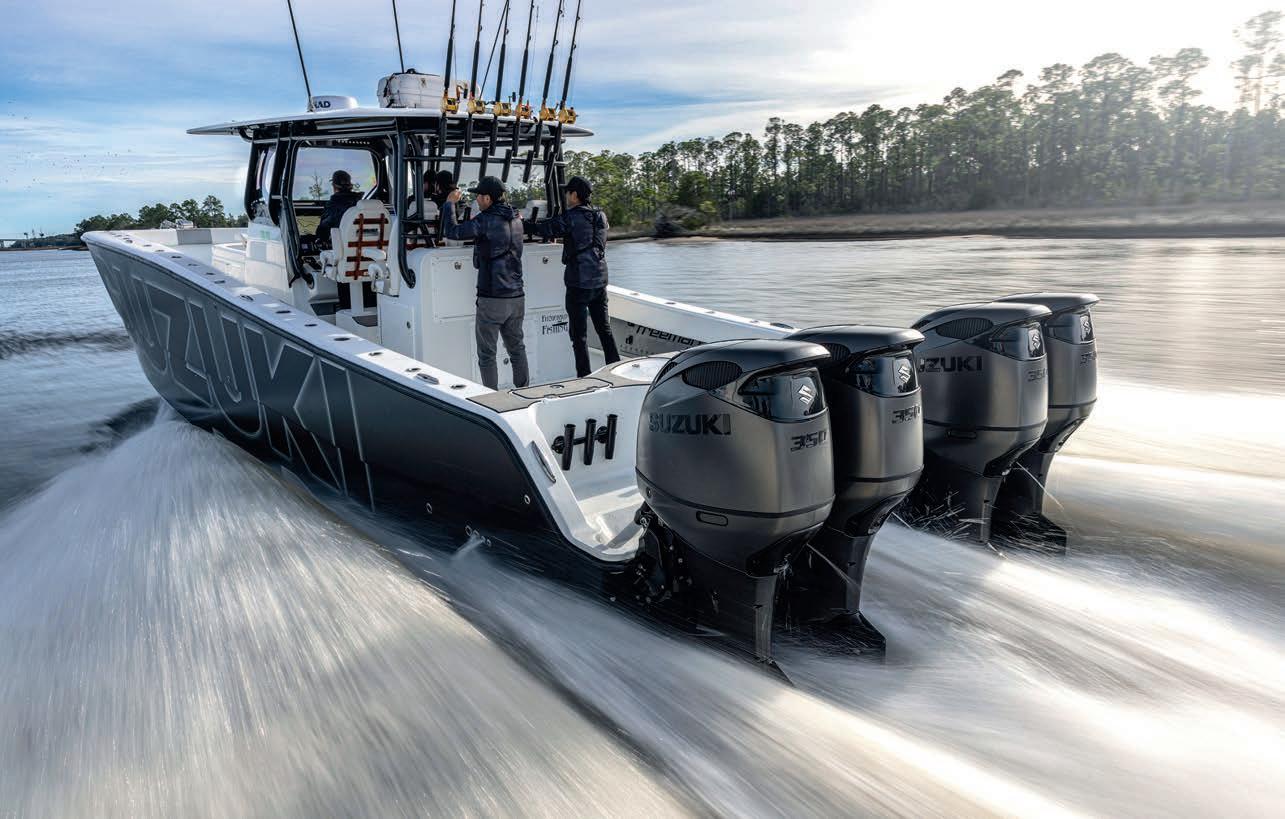
from 115hp right to 350hp. The matt black finish on Stealth Line makes its a standout engine on the water while offering impressive performance and fuel economy. The Stealth Line also features ‘fly-by-wire’ digital technology for class-leading steering.
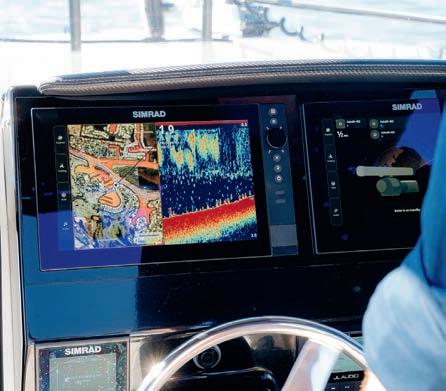
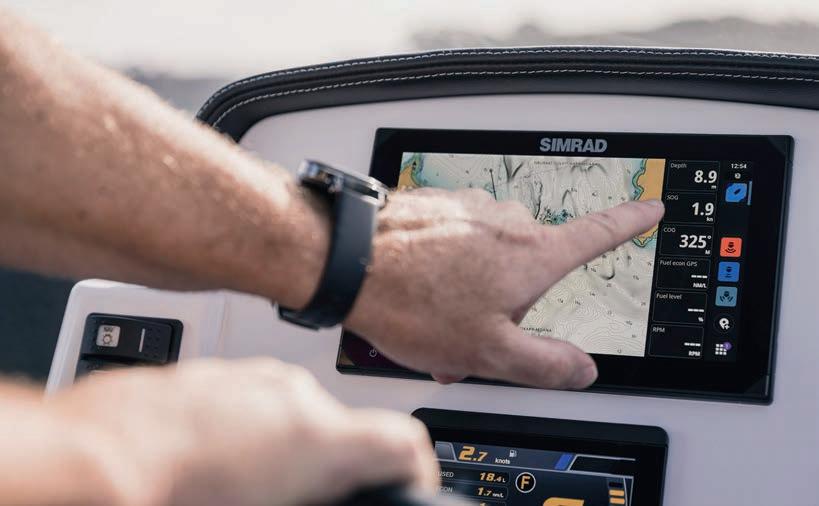
Of course, it’s not just new boats and outboards that are showcased at boat shows. One product that caught our eye was Simrad’s new NSS4. We jumped on board Simrad’s test boat, a Haines Signature centre console, and gave Simrad’s brand new NSS4 a test along some of the Gold Coast’s rocky shorelines. It’s an impressive unit and a perfect example of how far marine electronics have come in recent years. Simrad is a brand often associated with high-end boats and offshore fishing vessels. It offers the best up-to-date technology for sport and game fishos in various water depths.
What really stood out for me, given its complex operating system and long list of
features, was how simple it was to use. It’s so intuitive and comes loaded with some very useful features. The updates to its chartplotter were particularly impressive. Thanks to its 8 Core processor, the NSS4 has lightning-fast processing speeds and some innovative new features that are certain to impress any boater.
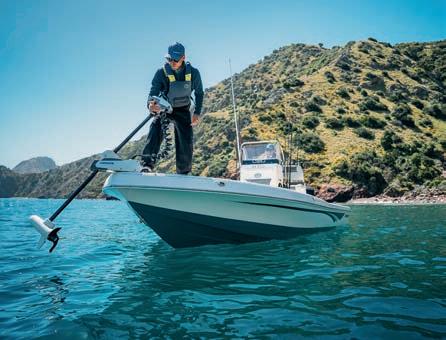
Another product from the same parent company as Simrad, Navico, was the Lowrance Recon Trolling Motor. It was another standout product at SCIBS and it will also be showcased at other upcoming shows around Australia. The Recon is a major release for Lowrance. The trolling motor integrates with other Lowrance technology onboard for seamless operation. One particular feature that stood out was the customisable keys in the hand remote. Lowrance’s Dan Rodriguez set up the remote to make adjustments on the Active Target live sonar, which was fitted to the bow of the test boat. It’s a silent and easy to
use trolling motor that would suit trailer boats of various sizes.
For something completely different, Dometic Marine unveiled its new DG3 gyro stabiliser. The brand says their new gyro has a class-leading 16-minute warm up time. It also features a 40 per cent reduction in power consumption and is compatible with 12, 24 or 48 volt systems. It connects to multifunction displays and is very low maintenance with the elimination of hydraulics. Dometic says this gyro is its first truly active gyro on the recreational market.
This article only highlights a small sample of the boats, outboards and boating accessories that are being released this year. It’s an exciting time to own a boat and I would encourage you to check out all the new boating releases that are currently on offer.
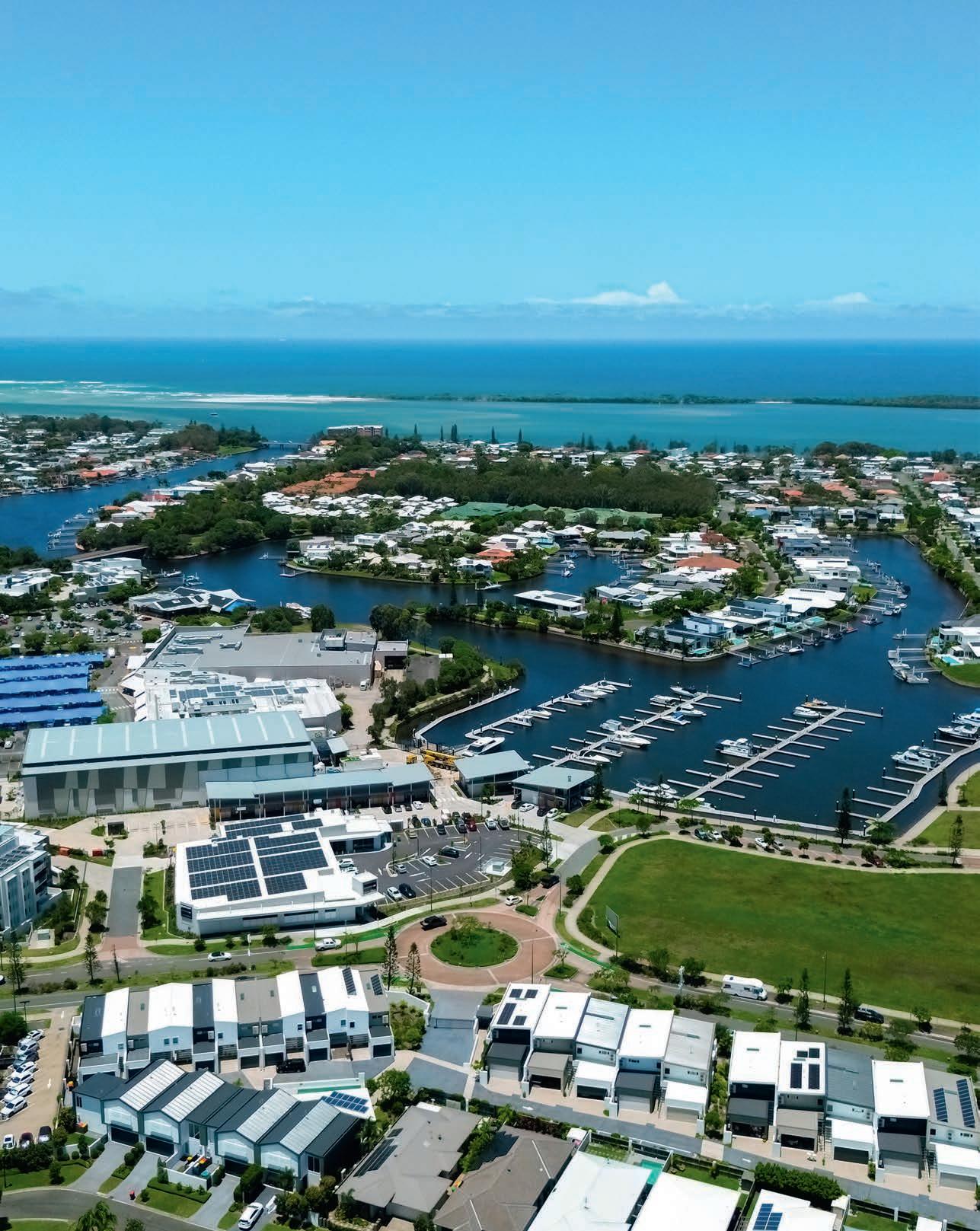
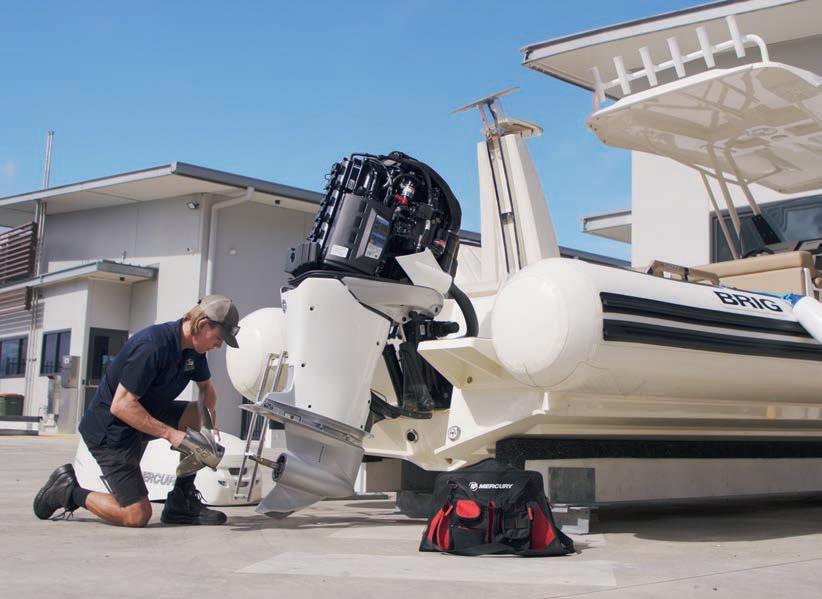
LES BINKIN, DIRECTOR OF PELICAN WATERS MARINA ON QUEENSLAND’S SUNSHINE COAST, SHARES SOME KEY MAINTENANCE ADVICE.
Whether you’re launching a fishing runabout for a morning adventure or maintaining a 16m cruiser, adopting a proactive maintenance approach is critical for keeping your craft safe, efficient, and seaworthy all year round. We spoke to Les Binkin, Director of Pelican Waters Marina, which is located near Caloundra on Queensland’s Sunshine Coast, and asked him to share his top maintenance tips to help keep your boat running smoothly.
Establish a maintenance calendar “Don’t wait for things to go wrong,” says Binkin. “Create a calendar-based maintenance plan that matches your boat usage.” Monthly checks for high-use craft and annual yard maintenance for others are a good rule of thumb. Most marinas and boatyards can help with an annual maintenance plan through their customer management systems.
Flush and check your engine after each use
Essential in saltwater areas, flushing your engine with fresh water helps prevent salt build-up and corrosion. Pay attention to cooling water flow and any warning lights. If you keep your vessel at a dry storage facility, complementary engine flushes are often part of the service, as they are at Pelican Waters Marina.
Don’t ignore the prop and skeg
Always reference your chart plotter and keep an eye on the tide to prevent running aground. Binkin recommends a walkaround inspection after each trip. “Even minor prop damage affects efficiency and puts strain on your gearbox,” he says. “This simple inspection also allows you to identify other problems, like fishing line entanglement, which require attention.”
Battery maintenance is key
Heat, salt air and lack of use drain battery life. Keep terminals clean, monitor charge levels, and use a trickle charger during off periods. “We see a lot of dead batteries after boats sit idle for just a few weeks,” warns Binkin. Most marinas have power connected to the berths, and well-planned marinas have power capabilities for dry storage clients too, making battery charging a breeze.
Protect your boat with covers, shade and gelcoat care
UV rays can be harsh across Australia and New Zealand. Use properly fitted covers and ensure clears and biminis are in good condition. This not only protects the exterior but also electronics and upholstery.
To go a step further, Binkin recommends regular gelcoat polishing and protective coatings. “It’s not just about looking good,” he says. “A polished and protected surface creates a barrier against sun damage, salt, and oxidation – prolonging the life of your gelcoat and paintwork while maintaining the boat’s value.” A well-maintained finish also makes cleaning easier after each trip.
Consider drystack storage
Trailer issues can ruin a day on the water before it even begins. “Flat tyres, corroded brake lines, and seized bearings are more common than you’d think,” says Binkin. Rinse thoroughly after every saltwater launch, inspect tyres, lights, and brakes, and keep wheel bearings greased. Have your marine mechanic service the trailer yearly with your boat’s annual service.
For owners of trailer boats and PWCs who are tired of ongoing trailer upkeep, drystack storage could be a good alternative. “It protects your vessel from sun and salt exposure, eliminates ramp queues, and saves valuable time,” says Binkin. “Some enclosed dry storage sheds also add additional security.”
Inspect your bilge and pumps
A dry, clean bilge is the first sign of a healthy boat. Test bilge pumps, inspect float switches, and clean out oil and debris. This helps you to spot leaks early and prevents harmful discharges into the marina.
Replace fuel filters and keep tanks topped
Condensation can lead to fuel being contaminated by water – especially when tanks sit partially full in fluctuating temps. “Keep tanks full and replace filters every 6–12 months,” advises Binkin.
Monitor and replace sacrificial anodes
Corrosion is a constant battle in salt water. Zinc or aluminium anodes help protect vital
parts of your boat. “Check them regularly and replace them at least annually before they deplete completely,” says Binkin.
Schedule annual professional inspections
Even the most hands-on owners benefit from expert eyes. “A trained marine technician can spot issues you may overlook – especially in engines, electrical systems, and structural fittings,” says Binkin. All of your primary marine service technicians are usually based in a marina or boatyard, making it easy for an owner to get all of their annual maintenance and checks done in one location.
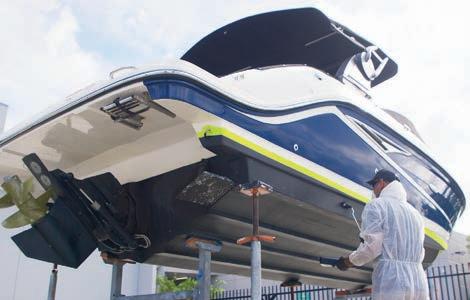
Don’t skip the annual antifoul
A fresh coat of antifoul paint is essential for moored vessels. “It prevents marine growth like barnacles and weed from attaching to the hull,” explains Binkin. “Without it, growth can reduce fuel efficiency, increase drag, and damage hull integrity.” In warmer waters, annual application is often necessary to stay ahead of biofouling and keep your boat performing at its best. This is the perfect time to replace anodes, service your running gear and recoat these while your vessel is out of the water.
Routine professional maintenance isn’t just about prolonging your boat’s life – it’s about safeguarding your time on the water. “It can be the difference between a great weekend and a breakdown out in the bay,” says Binkin.
Visit pelicanwatersmarina.com.au
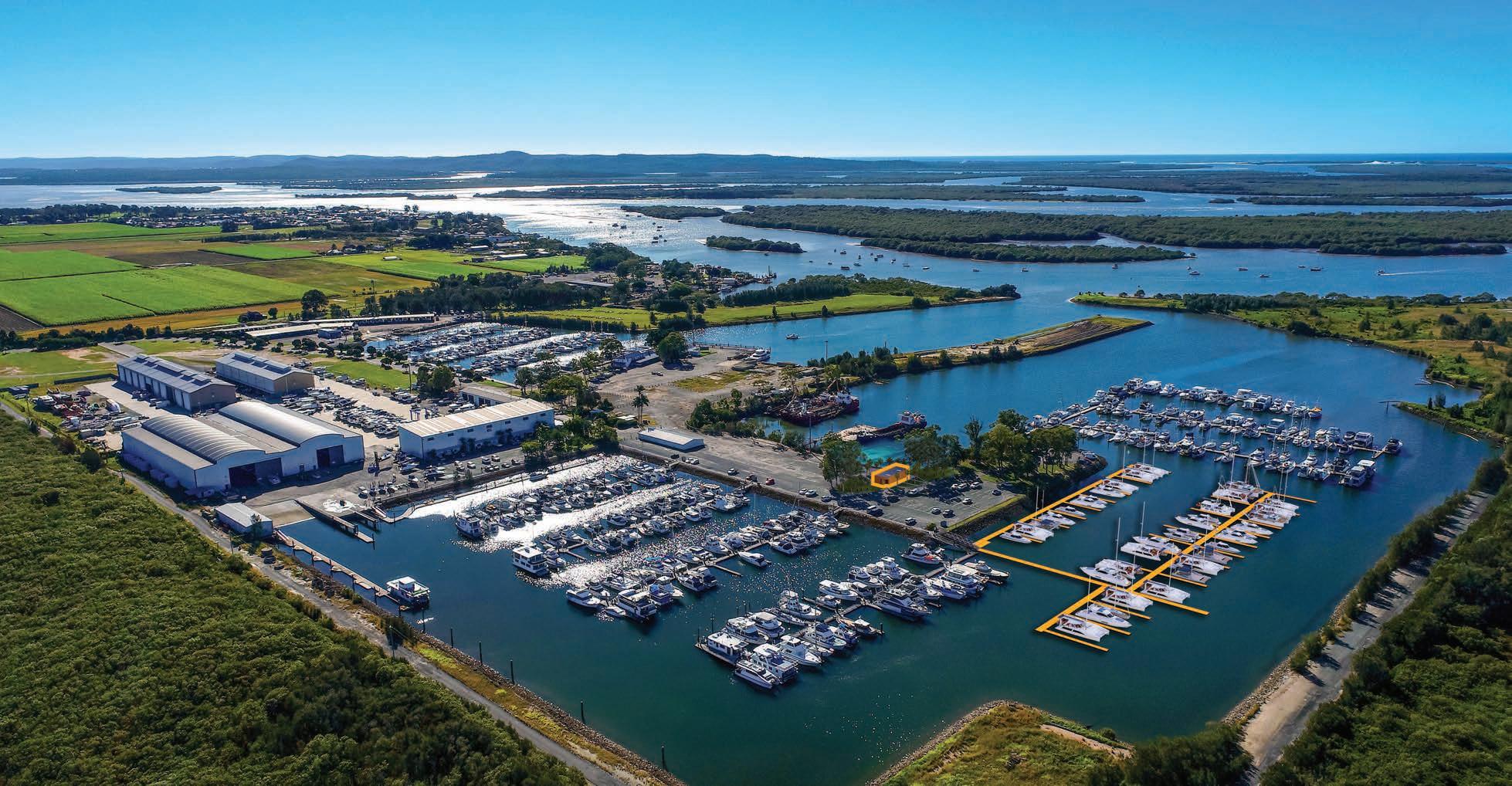
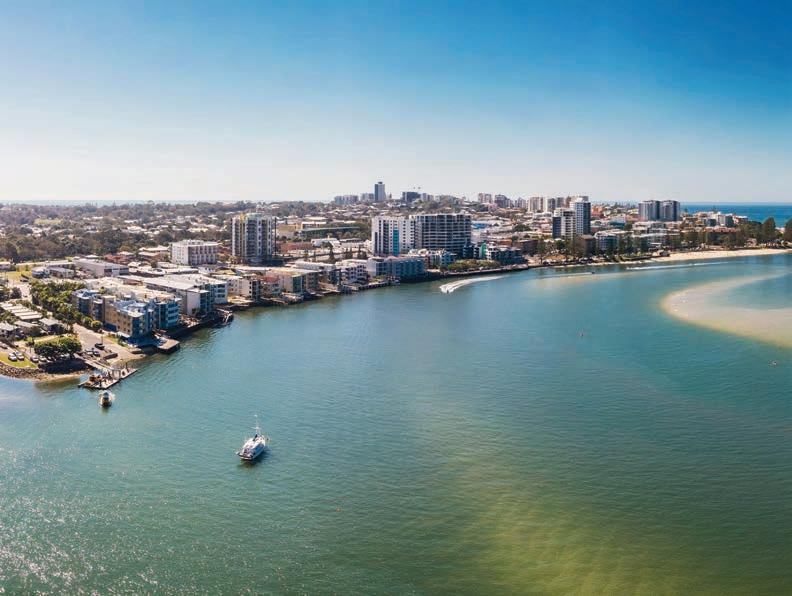
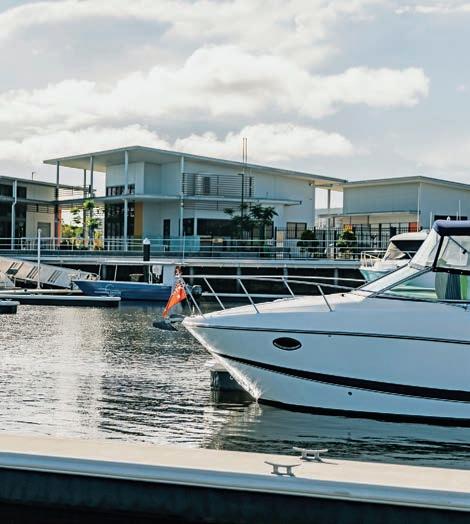
Boating along the Sunshine Coast –particularly in and around Pumicestone Passage and Moreton Bay – offers some of Australia’s most scenic and rewarding onwater experiences. But the same elements that make this region special – salt water and air, variable weather patterns, and tidal flows –also place unique demands on vessel upkeep. Like most passages and inland waterways you will experience variable depths, changing sandbars, and tidal flows that do require a cautious approach. Binkin advises boaters to always check tides and navigation markers and get in touch with the local marine rescue for up-to-date conditions. Binkin says visiting and local boaters should also consider using local marina services for regular safety and maintenance checks.
Lat: 26° 83’ 50.5174321227” Long: 153° 10’ 72.255290941”
• Conveniently located near Caloundra on Queensland’s Sunshine Coast.
• 127-berth capacity with dockhand service.
• Ideal for boats up to 17m in length, annual and casual arrangements.
• Open seven days a week.
• Caloundra’s only on-water fuel dock, offering unleaded, diesel and blackwater pump out.
• Dry storage facility for vessels up to 33ft/10m.
• Range of client services and facilities including ensuites and a client lounge.
• On-site dining options with a marina restaurant and bar and café.
• E xpansive boatyard maintenance facility for hardstand, annual maintenance and refit.
• On-site marine services including marine mechanic, shipwrights, marine electricians, antifoul and chandlery.
• 24/7 security including CCTV.
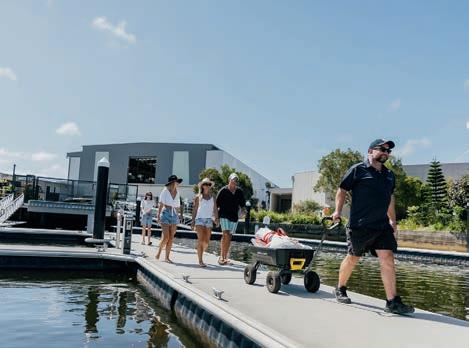
THIS PAGE: TAKE A PROACTIVE APPROACH TO MAINTENANCE.
Scan to find out more about the boat maintenance services on offer at Pelican Waters Marina.

TOWING SAFELY AND UNDERSTANDING VEHICLE LIMITS CAN BE COMPLICATED, BUT IT DOESN’T NEED TO BE. SCOTT THOMAS REPORTS.
Everyone who owns a trailer boat or caravan should understand the fundamentals of towing. It’s often a misunderstood subject and one where opinion sometimes overrules fact and experience. It’s understandably confusing. Online opinions and social media chatter can make it feel more difficult to get reliable information. Over the next few pages, let’s break it down into simpler terms with some understanding of towing jargon and legal limits, plus some practical tips to keep you safe and within legal limits on the road.
Let’s start with why it so important to tow within your vehicle’s limits. It is wise to go one step further and ensure you’re also towing within your own limits when it comes to experience. You’re most likely a boat owner and have years of towing experience under your belt. However, when you buy a new boat, a new car, or even switch to towing a caravan, it’s a completely new learning process. You’re dealing with potentially greater weights, distribution in weight and wind residence. Suddenly you could find yourself in a dangerous situation. Even those with experience towing a boat or caravan can have an accident or receive a large fine.
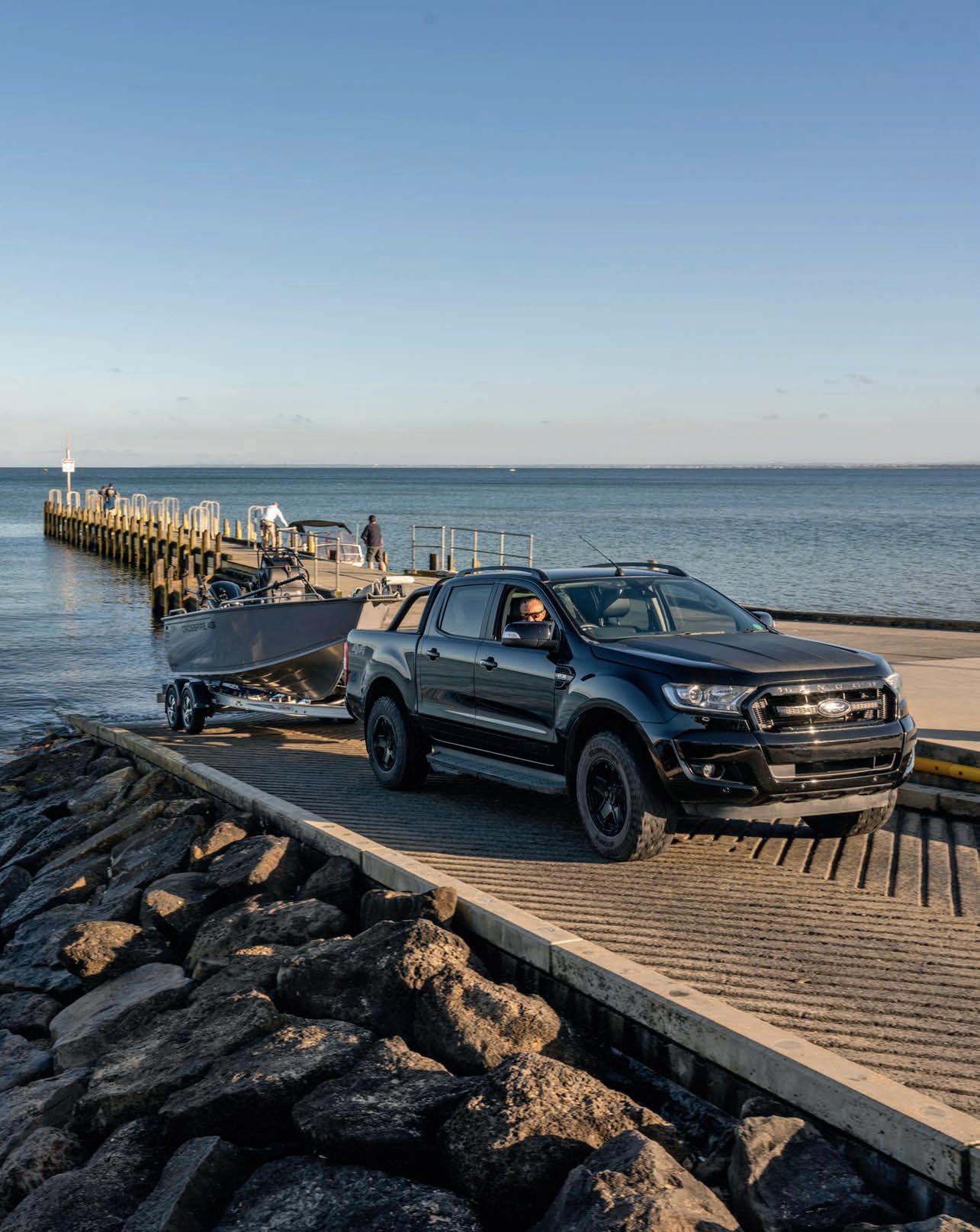
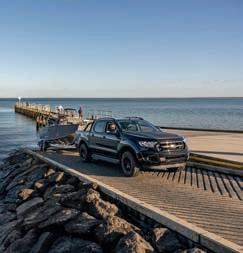
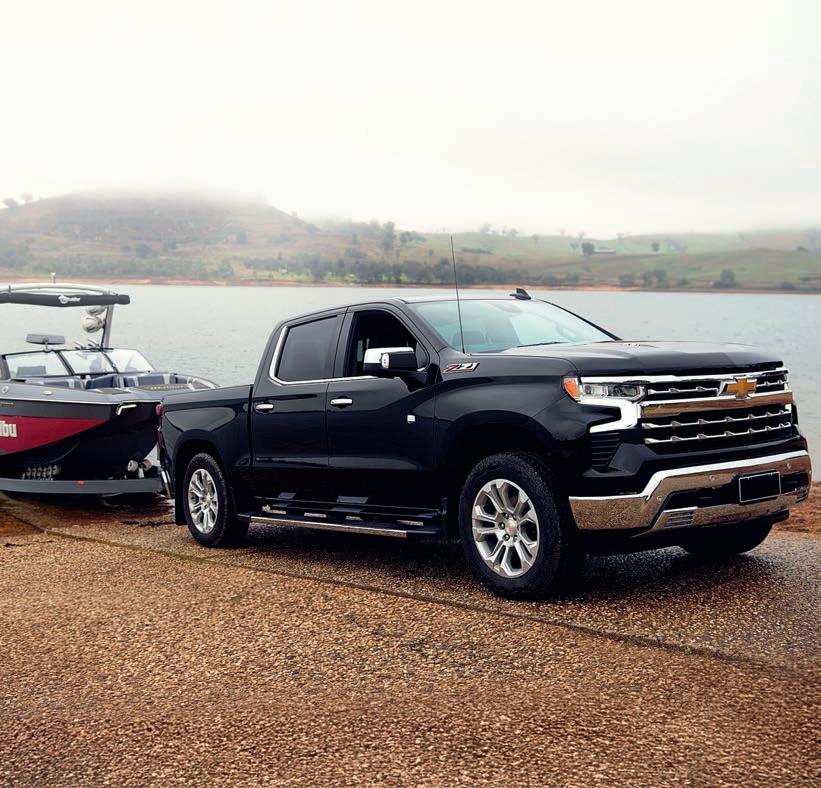
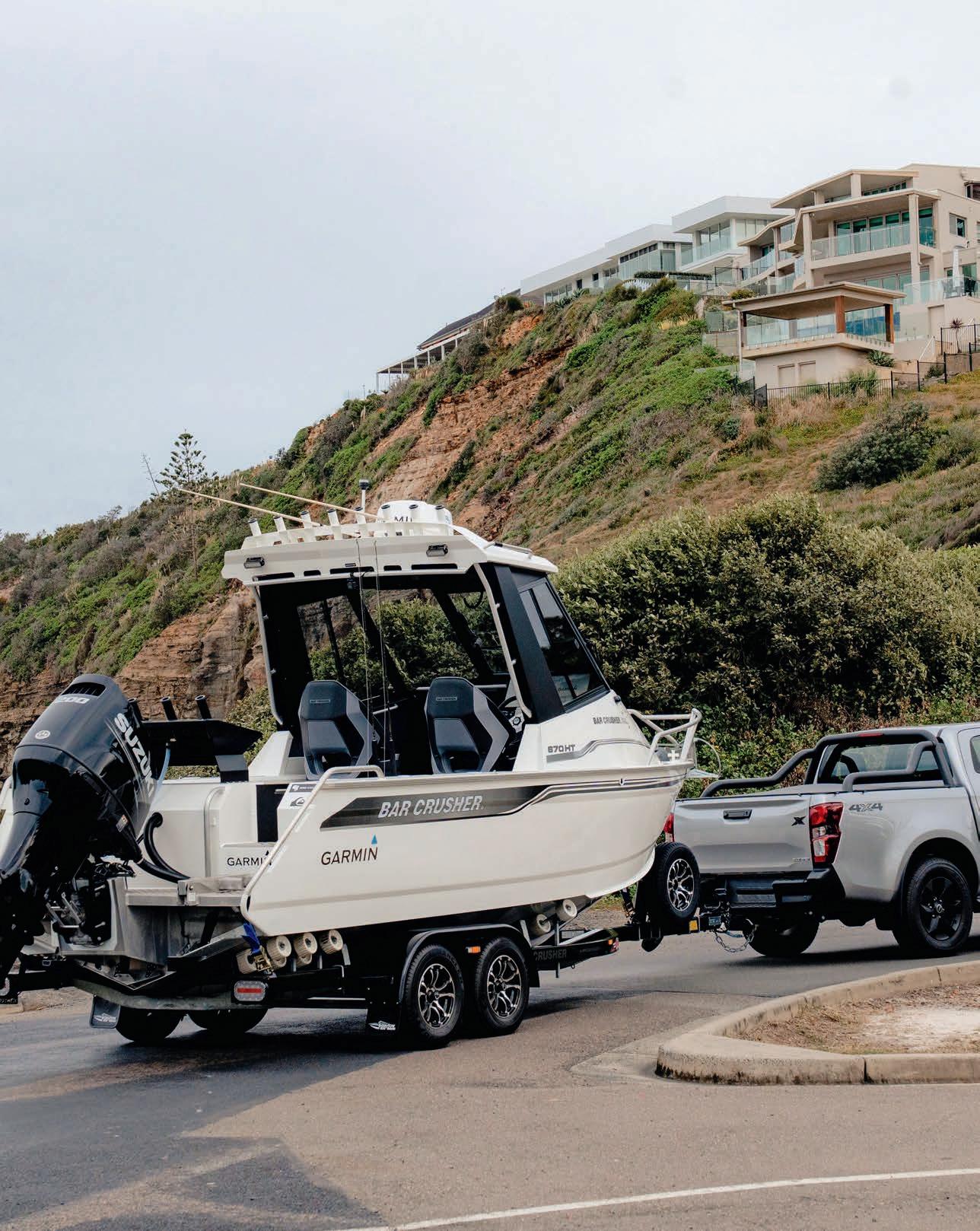
GETTING TO THE BOAT RAMP SAFELY SHOULD ALWAYS BE A PRIORITY.
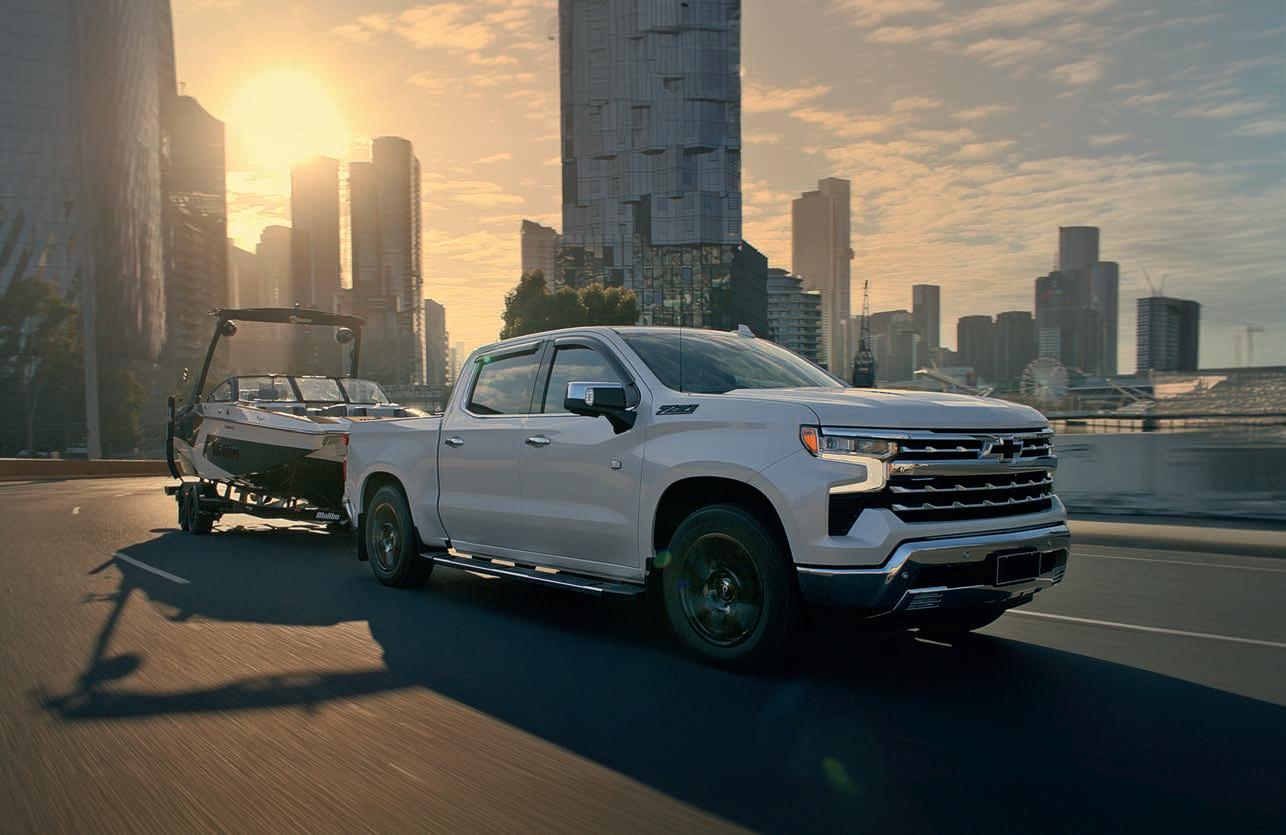
Most of us know our vehicle’s maximum tow weight. Many of us drive 4WDs and it’s a highly competitive market. Often, manufacturers use maximum tow weight and other towing features as selling points and to get a competitive advantage.
If you’re looking at buying a new car it’s certainly worth taking this into consideration. You would ideally want something with a generous towing capability, even if you’re towing a small boat. It always pays to aim high and be sure there’s plenty to play with.
Often, a car manufacturer’s quoted towing capability is a combination of performance, vehicle weight, suspension, brakes, and more. How each manufacturer measures its claimed tow weight would be similar and therefore it’s okay to compare quoted weights against each other when deciding on a purchase. However, this is where it gets a bit tricky. You see, a vehicle’s weight when it leaves the showroom
may be vastly different after you have added extras, fuel, passengers, etc. Some of these extras are very common. Things such as bull bars, canopies, roof racks, fridges, camping equipment and more. They’re all common on 4WDs and they all deduct from the total weight you’re permitted to carry legally and safely.
It pays to do some thorough research. My opinion is to choose a tow vehicle with a high payload. Payload is the weight you can legally add to your vehicle. For example, utes are often called ‘one-tonners’ because you can add one tonne. The higher the payload, the more weight you have up your sleeve to add things like bull bars while still remaining a viable towing vehicle.
The example of a one-tonner is also typical of the misunderstanding around payload and tow weights. If your payload is one tonne, you can’t just add another tonne of load onto the tray or boot of the car. You also have to factor in passengers. Five adults could potentially
weigh 500kg. What about a full tank of fuel? It all adds up and it’s all included in the payload. The combined weight of the vehicle and payload is called the Gross Vehicle Mass (GVM).
You may be asking what payload has to do with tow weight limits? It’s important to understand that any weight you add to your vehicle is deducted when calculating safe limits. More on that soon. The total weight of your loaded vehicle and trailer (boat or caravan) is called the Gross Combination Mass (GCM).
It’s easier than you think to add too much load to a vehicles’ payload and reduce its ability to tow even an average trailer. There are plenty of dual cabs around with custom trays and camping set ups and these can have a massive impact on the GVM.
Many of the above vehicles also choose to upgrade their GVM. This is definitely a good option if you believe your payload is too heavy
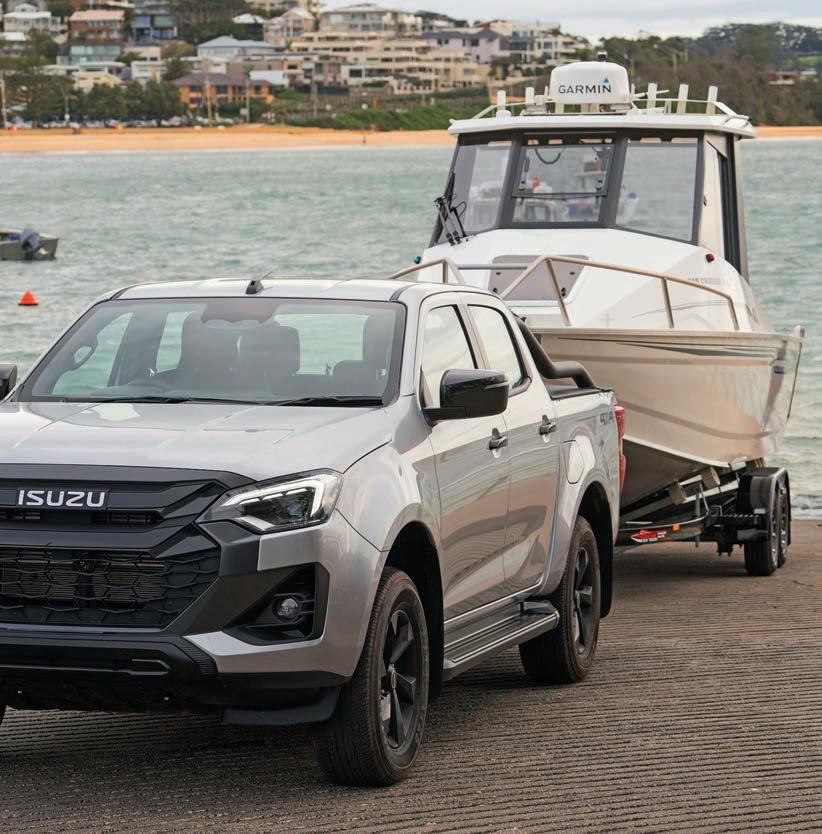
and will impact your ability to tow. It pays to check with your vehicle’s warranty before doing any of these bigger modifications.
There’s something else that’s often overlooked. Tow Ball Weight is another factor that’s linked to the above payload and tow weight combination. The Tow Ball Weight refers to the load that is being transferred from the trailer back to the vehicle. It’s typically 10 per cent of the trailer’s total weight. It can vary depending on what you are towing or even the trailer type. Single and dual axle will differ and boat and caravan will differ.
Either way, the Tow Ball Weight is important because it removes that weight from your vehicle’s payload. So, if you had a large boat or caravan weighing 3, 500kg, your Tow Ball Weight could be 350kg. Let’s say your payload was 1,000kg; you now only have 750kg left. Add passengers, fuel, camping equipment, fishing gear, bull bar etc. and you’re dangerously close to being overloaded. It can be dangerous
and illegal. On that note, authorities check these weights and they will check individual weights such as Tow Ball Weight and measure that against your vehicle’s GVM. If you’re still confused, there are some good YouTube videos on the subject. It’s easy to understand why big US trucks have become so popular. These typically tow between 4 and 9 tonne and leave far more room for error.
If you’re looking at buying a car or even have a new vehicle, it’s worth looking at more than just tow weight. As mentioned above, many 4WD manufacturers offer special towing features. There are features such as Electronic Stability Control and Trailer Sway Control. If you have ever seen a caravan or large boat get the wobbles you would be thankful for these added two features.
What about brakes? These are rather important! Without going into actual road
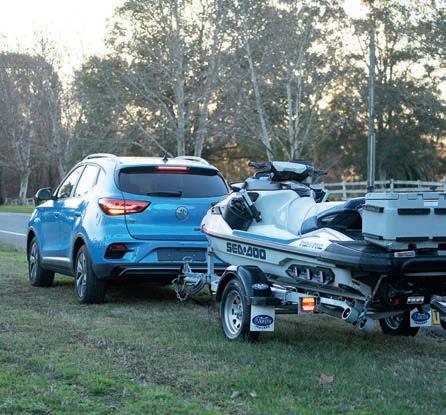
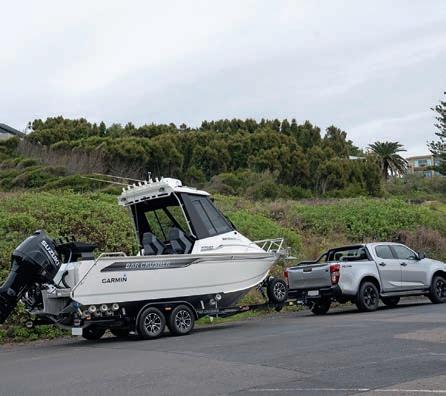
rules (because they vary greatly state to state), trailers above 750kg typically require brakes. These can be manual up to 2,000kg before they require electric brakes. I won’t complicate this any further because there are variations between states. In fact, if you’re buying a boat from interstate, this must be looked at before you drive it home.
You will also need a correct plug. This goes back to the type of brakes you have fitted. You can use a 7 pin or 12 pin and it can vary depending if the brakes are powered via the trailer or car. I would suggest talking to your car dealership or a specialist fitter of trailer and towing accessories. It can get very complex and it’s best left to the experts.
So you now have a suitable tow vehicle. It all measures up, it’s legal and is fitted with good quality brakes and the correct plugs. You’re good to go!
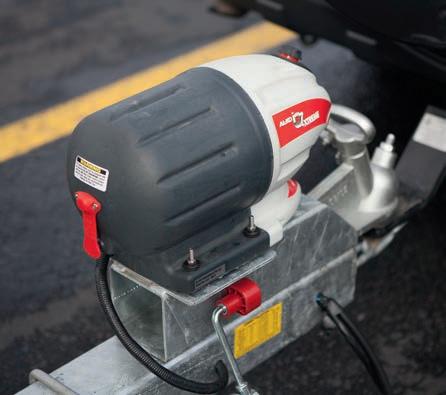
CHECK IF YOUR BOAT TRAILER REQUIRES ELECTRIC BRAKES.
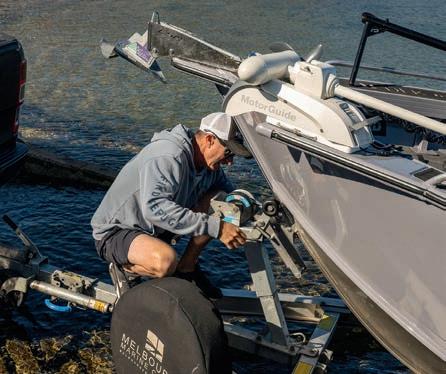
TRY LAUNCHING WHEN THE RAMP IS QUIET.
Some of these tips may seem very straightforward. However, every time I drive up and down the coast, I see many boats and caravans being towed erratically and the odd one that has crashed.
The first tip and the obvious one is your trailer will follow your car. That means if you have a long trailer and cut a corner, it will follow across the corner, not around it! I’ve seen boats hit objects on footpaths because the driver didn’t follow this rule. It can also trick those who have upgraded to a longer boat. Small boats don’t seem to be as effected, but anything over six metres will require some careful driving in tight quarters.
Another basic tip is to simply slow down. Don’t necessarily sit on the speed limit. Drop the speed by at least 10km/h, depending on conditions. Keeping a moderate speed will help reduce the risk of swaying or wobbling. It’s also important if anything suddenly happens. Remember, it takes far longer to brake and react if you need to stop suddenly or change lanes. Plus, there’s so much more that could
CHECK YOUR COMBINED VEHICLE AND TRAILER MASS IS LEGAL.
go wrong. A minor mishap can turn into a big accident when you’re towing three tonnes!
It also pays to familiarise yourself with the new vehicle or new trailer before embarking on a big trip. It may use more fuel and feel entirely different. Take it easy and always remember what is attached to your car.
The final point to mention is another important one. On every occasion before leaving home, I always go over the trailer and ensure everything is in good shape. Firstly, check that your lights are connected and each one is working. If a light is malfunctioning or all lights are out, it’s a good indication (excuse the pun) that there is something wrong with a connection of the wiring on your vehicle or trailer. A good trailer with quality lights and wiring is worth the extra money!
Now go and check your moving parts of the trailer. Make sure the suspension isn’t rusty and everything is in working order. Some trailers sit in one place for a while
and can deteriorate. It’s also important to regularly have your trailer serviced and that includes wheel bearings. Having a wheel bearing fail along a freeway or busy road can be a nightmare! Prevention is key. Check your connection and ensure you have the tow ball secure and the jockey wheel firmly in place. Make sure the safety chain or chains are fitted and any breakaway cable is all connected if it’s a larger trailer. This quick check before embarking on a trip is so important!
Towing should be taken seriously. Dragging a heavy weight behind your vehicle adds risk. Hopefully, this article has cleared up some confusion when it comes to choosing a vehicle, or ensuring your existing tow vehicle is safely capable of towing your boat trailer.
There are different rules around towing across every Australian state and in New Zealand. Rules and regulations can be complicated and for that reason it’s best you do your own research. Armed with the basic information from this article, you can understand what’s required in your local area.
NSW: nsw.gov.au/driving-boating-and-transport
VIC: transport.vic.gov.au
QLD: qld.gov.au/transport/vehicle-safety
SA: sa.gov.au/topics/driving-and-transport
TAS: transport.tas.gov.au
WA: wa.gov.au/organisation/road-safety-commission/towing
NT: nt.gov.au/driving
ACT: accesscanberra.act.gov.au/driving-transport-and-parking
NZ: nzta.govt.nz
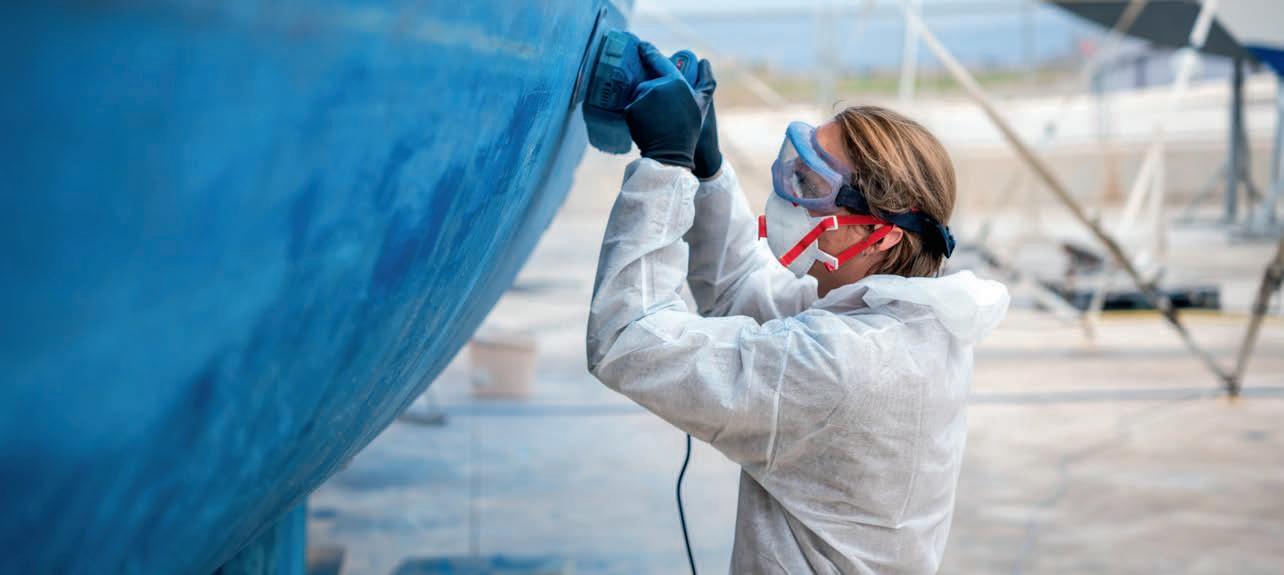
• Preparation is everything
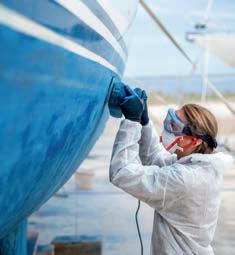
Each marine paint has unique application requirements. Common mistakes occur in preparation, such as using the wrong cleaning product, sanding at wrong times or with an incorrect grade sandpaper, not cleaning between sanding, and mixing paint with incorrect additives. Always read the product label or consult the manufacturer’s website for a product data sheet during surface preparation, this will ensure you get the best finish every time.
• Use the correct solvents
Do not mix products from different manufacturers, particularly when thinning a paint. For example, using one company’s paint with another’s solvent can cause drying, adhesion, or UV resistance issues, and as a worst-case scenario, total product failure. Solvents are often formulated with specific ingredients tailored to their matching paint so it’s best to stick with the same brand, or call the manufacturer to ensure they are compatible.
• For aluminium boats
Regularly inspect aluminium boats for signs of corrosion, which can lead to pinholes or even cracked transoms under engine stress. If corrosion is present, have it repaired by a qualified aluminium welder. Afterward, apply a marine-grade coating system – such as Norglass Shipshape followed by Northane – to help prevent future issues.
Avoid leaving metal items like hooks or swivels inside the hull, especially after exposure to salt water. These can accelerate corrosion through electrolysis, where the aluminium becomes sacrificial to other metals in the presence of salt
water. This process can also occur if exposed or faulty electrical wiring comes into contact with the bare hull.
• For fibreglass boats
Fibreglass boats are prone to internal wood rot, particularly in the transom and floor. These affected areas should be replaced and properly sealed. Products like Norseal wood treatment can help prevent future rot. Another common issue is osmosis, where trapped water within the fibreglass migrates outward, creating pressure blisters that eventually burst. These should be filled with an epoxy and painted promptly to prevent further water intrusion into the hull.
• For timber boats
Timber boats have a timeless appeal but require consistent maintenance. Apply a high-quality marine-grade clear coat annually to protect the wood. Replace any rotted timber and seal it with a marinegrade product. Clear coatings can only contain up to 3 per cent UV inhibitors due to chemical limitations, so applying multiple coats will help increase UV resistance.
• Use a quality boat cover
Protect your boat from harmful UV exposure and water damage from moisture or rain by investing in a high-quality, fullcoverage boat cover. This helps preserve both the top and bottom of the vessel and also protects against insects, rodents, bird droppings and adds security by covering what’s inside. It may be helpful to get a custom cover made specifically for your type of boat, or you can buy one-size-fitsall for a more affordable option.
• Rinse trailer boats after every use
After each outing, rinse your boat with fresh water to remove salt deposits that can degrade paint and underlying materials. Remove organic debris like gum leaves to prevent staining, especially on unpainted surfaces. If stains occur, use a specialist stain remover, or a homemade solution made from 10 per cent white vinegar and 90 per cent water will also do the trick.
• Repainting for protection and appearance
Repainting your boat not only refreshes its appearance but also protects it from the elements. Always use marine-specific paint, which is designed for UV resistance, corrosion protection, and durability against abrasion from trailers, beaches, and docks. Just as you wouldn’t use house paint on your car, painting a boat in anything other than a quality marine-grade coating will not provide the same quality finish or endurance. Small scratches or chips should be able to be touched up to maintain a clean, smooth finish when using a quality marine coating.
• Seek expert advice
If you’re ever unsure about any part of the maintenance or painting process, consult your local marine service centre or boatyard for advice, or contact the product manufacturer. Getting it right the first time will save you time, money, and hassle.
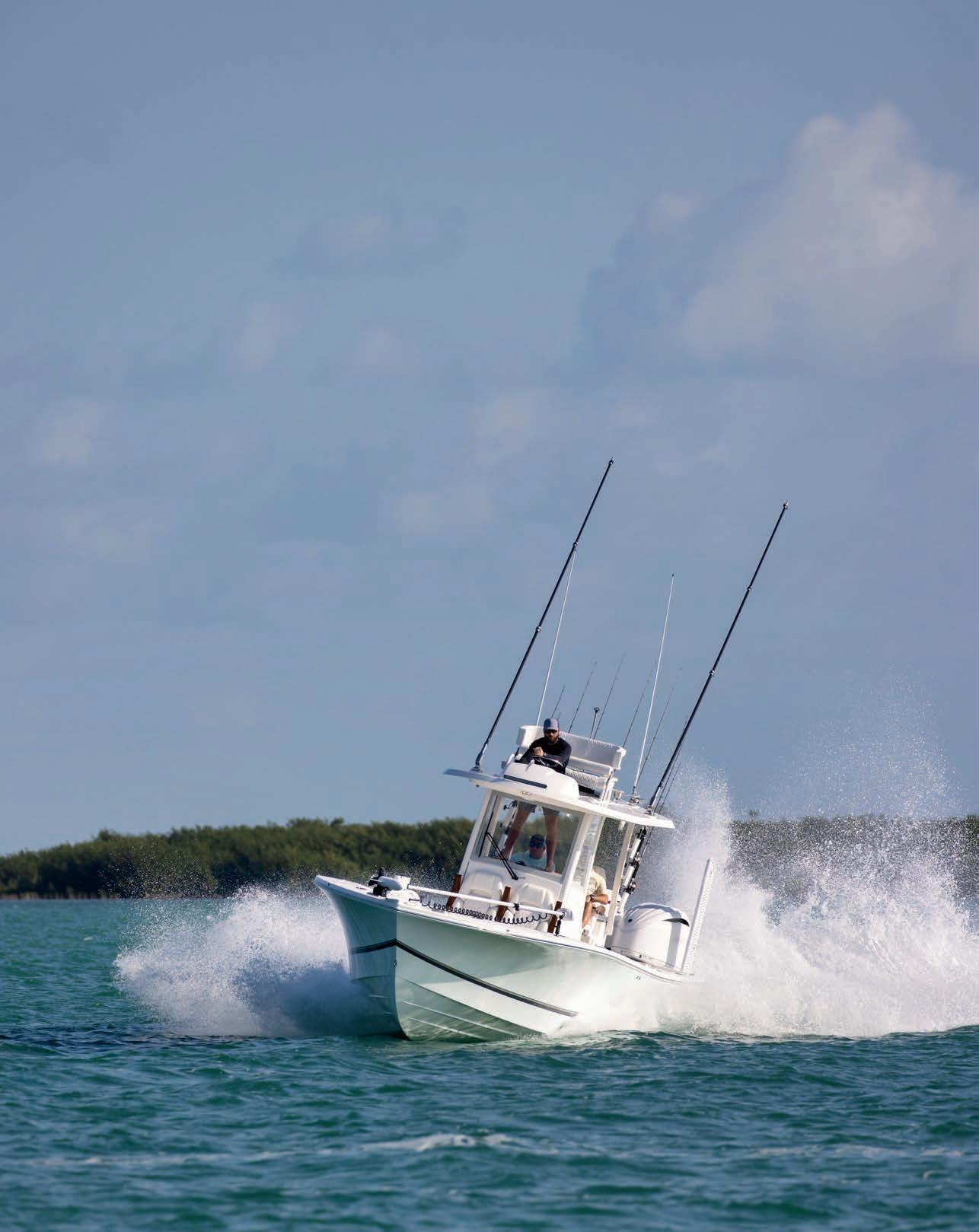
THREE BOATING SAFETY EXPERTS SHARE SOME KEY ADVICE TO HELP YOU STAY SAFE ON THE WATER THIS WINTER.
Superintendent Dan Duemmer, NSW Central Zone Commander, Marine Rescue NSW.
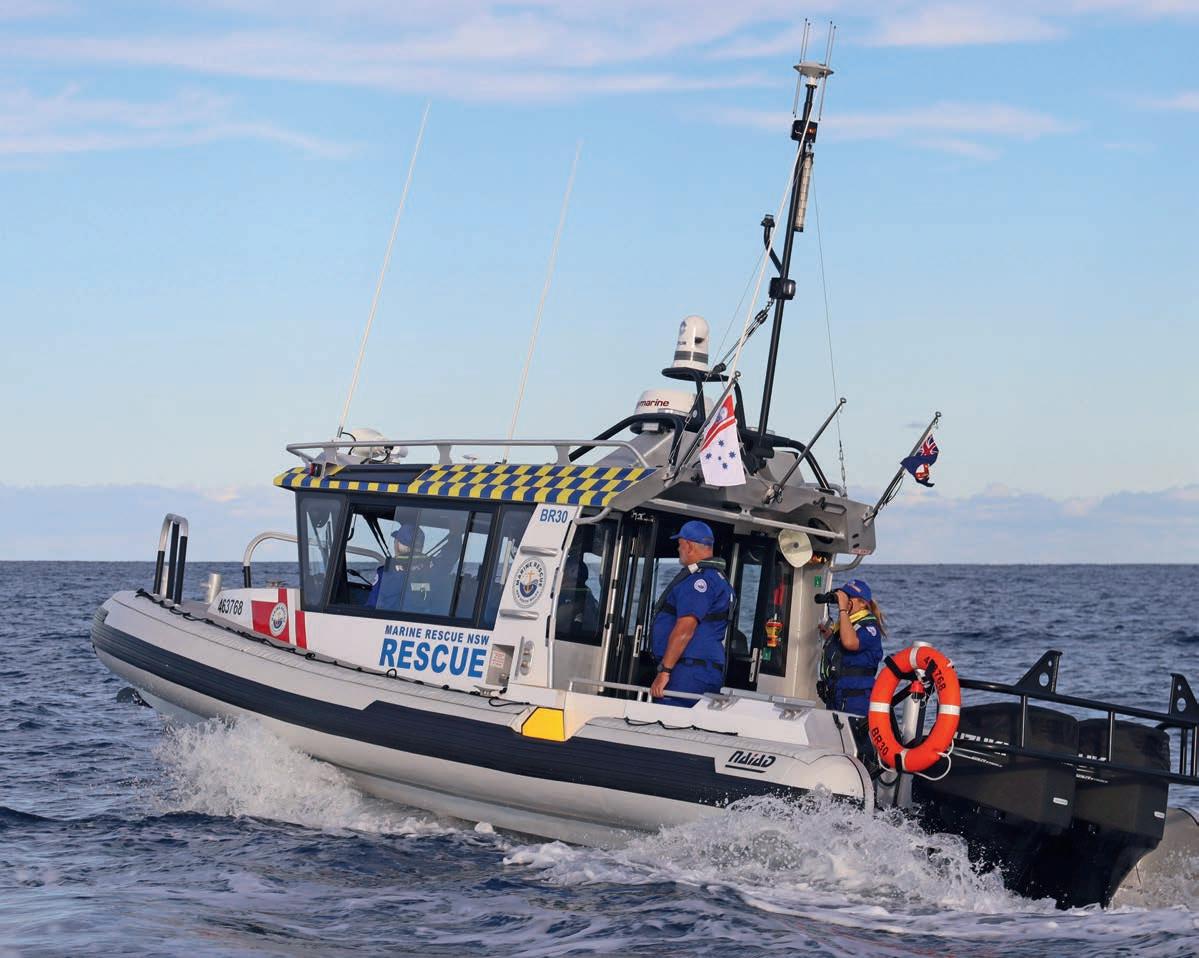
It is vitally important that boaters know the risks associated with boating during the winter months. During winter we see severe and inclement weather more frequently that brings large and powerful waves and strong winds. Having a good understanding of conditions and forecasts is key to making the right decision before going boating.
• Continually check the weather and conditions – winds can develop quickly and weather can change without warning.
• After heavy rain, keep an eye out for submerged hazards that may have entered the water.
• Daylight hours significantly reduce in winter, so be prepared. Check your navigation lights and understand the increased risks of boating during hours of darkness (navigation marker lights, unlit hazards, unlit vessels, shallow water).
• There is also the added risk from our marine mammal friends. During winter whale migration is in full swing and whale sightings and vessel interactions have increased over the years.
• In the unfortunate event you end up in the water, be aware that the drop in water temperatures during winter increases the risk of hypothermia, which develops when the body temperature drops below 35 degrees celsius.
• Reduce the risk of capsizing. Be vigilant when crossing bars, avoid overloading your vessel, distribute weight evenly and stow heavy items as low as possible.
• If in doubt, don’t go out. Your life is not worth risking for a day out on the water. Visit marinerescuensw.com.au

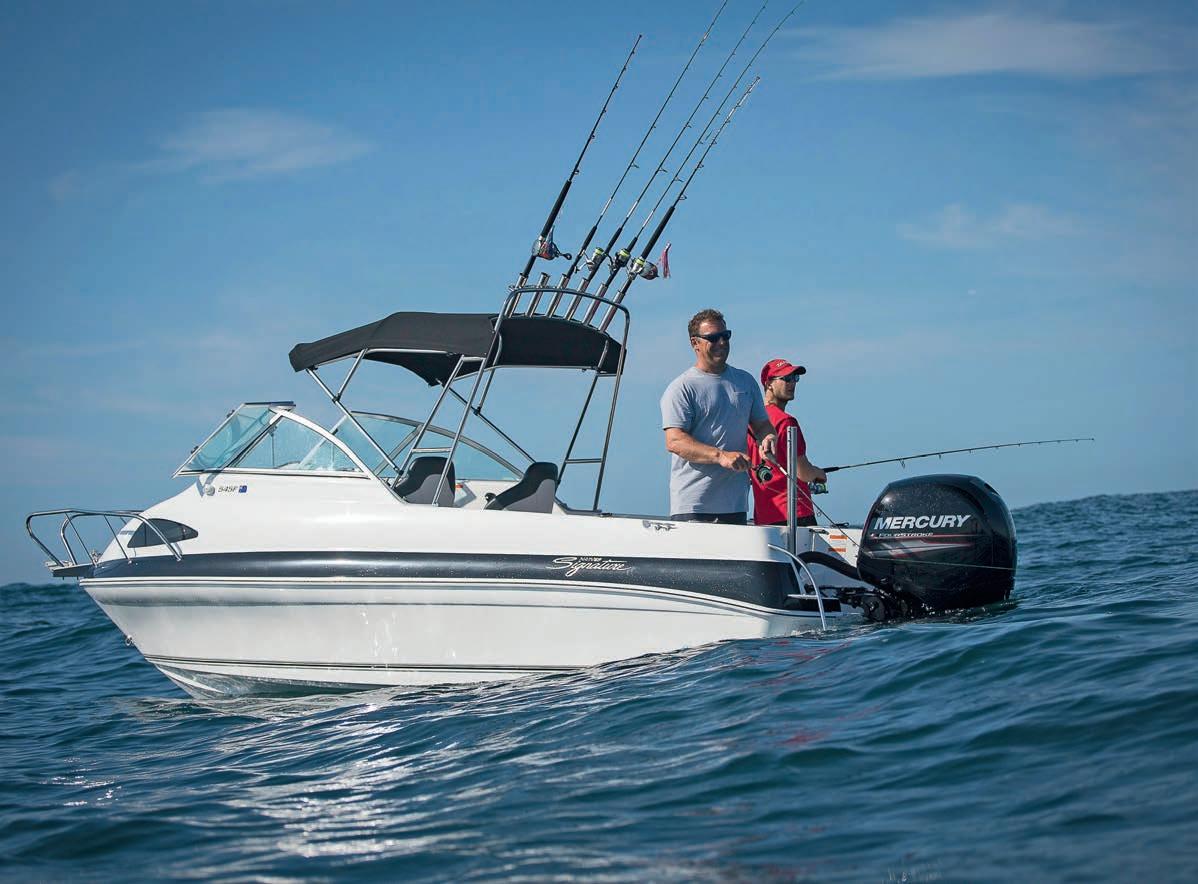
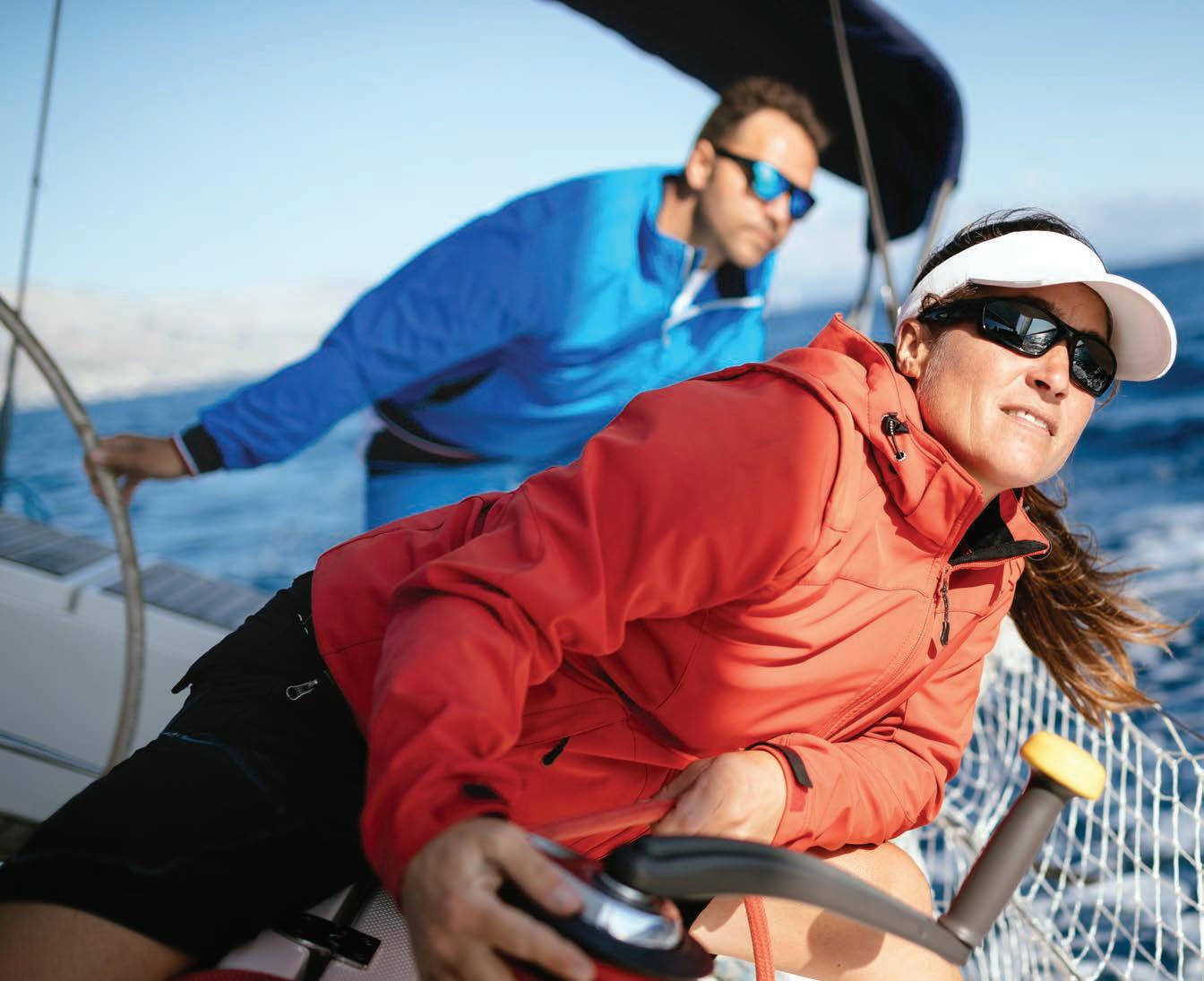
Boating in winter can be spectacular – the waterways are quieter and the scenery is often at its best. However, it also comes with real risks. Cold water, fast-changing weather, and limited daylight mean there’s far less margin for error.
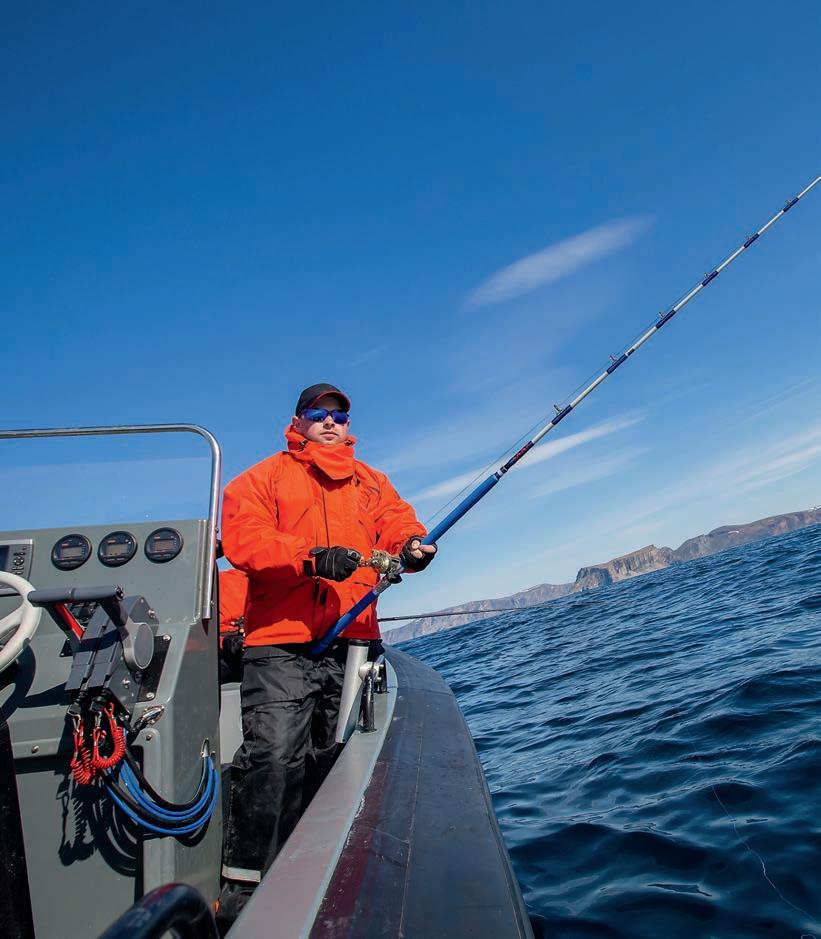
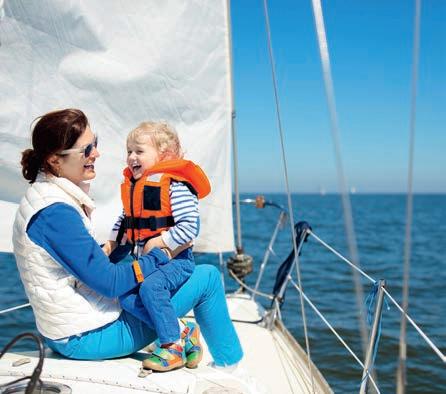
• Dress for the water, not the air – and wear your life jacket. It might feel mild on land, but if you end up in the water, what you wear can make all the difference. Avoid cotton, which holds moisture and loses warmth. Opt for quick-drying synthetics or wool, and add a windproof outer layer. Most importantly, wear a properly fitted life jacket at all times. It could save your life.
• Whether you’re heading out for an hour or the whole day, make sure someone knows your trip details. Tell them where you’re launching, what your intended route is, and when you expect to return. Better still, log your trip with your local coast radio station. If something goes wrong, this information can make all the difference in a rescue.
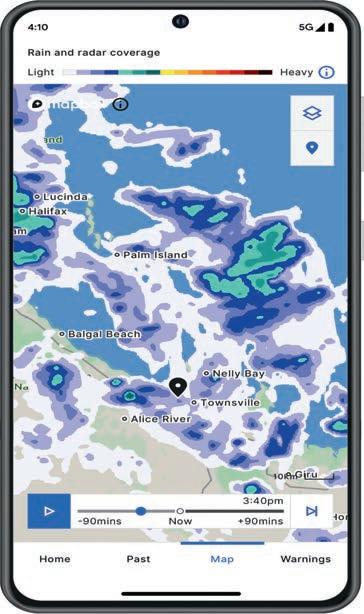
• Winter weather is unpredictable. What starts as a calm morning can quickly become rough, with wind, rain or fog rolling in. Always check the marine forecast before heading out, and monitor conditions throughout the day. The Bureau of Meteorology’s website or app is a good source, and a VHF radio can keep you updated while underway.
• Winter can cause condensation in your fuel tank, leading to water contamination. Start with a full tank of fresh fuel, check your filters, and make sure your battery is fully charged. Test all electrics – including your bilge pump. In cold conditions, a mechanical issue can escalate quickly.
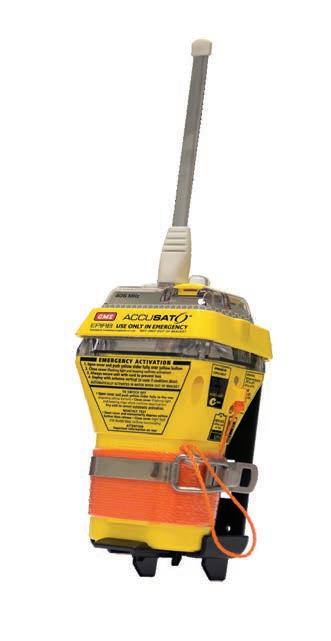
• Ensure you have multiple ways to call for help. Don’t rely on your phone alone. It can get wet, damaged, or lose signal when you need it most. Carry a VHF radio and always have a registered emergency positionindicating radio beacon (EPIRB) or personal locator beacon (PLB) onboard. Waterproof your devices and keep at least one – ideally your PLB – on your person if you are separated from your boat.
• Before every trip, inspect your safety gear. Ensure everything is onboard, in good working order, and up to date. This includes life

jackets, flares, a fire extinguisher, bailer, torch, and anchor. Most importantly, store your gear where you can access it quickly in an emergency.
• B oating solo in winter carries risks. If something goes wrong, there’s no one around to assist or call for help. If you need to go solo, take extra precautions. Ensure you have multiple ways to communicate, wear your life jacket, and be even more cautious with your trip planning.
• Make yourself visible. Reduced daylight, fog, and rain make it harder for other water users to see you. During low visibility, use your navigation lights and make sure they’re functioning properly. Wearing highvisibility clothing can also assist others in spotting you.
Visit mast.tas.gov.au

Adam Smith, President of the Boating Industry Association and Owner of Australian Boating College Sydney.
• Dress for the conditions. Wear layered, moisture-wicking clothing and waterproof outerwear. Have additional warm items like beanies and gloves available if you think they’ll make your time out on the water more comfortable.
• Maintain and test safety gear. Knowing that your safety gear is in good working order will mean you’re chances of survival are maximised. Make sure your lifejackets are in good condition, inflatables having been serviced in the last year, all batteries are working and flares in date. Take a minute to call up your local volunteer marine rescue (VMR) when you head out to make sure you can contact help if you need to.
• Coastal waters can still cause cold shock and hypothermia if you fall in. Know the signs of hypothermia and ensure you have a dry change of clothes onboard. Take
time a moment with any less experienced passengers you may have onboard to make them aware of this risk.
• Winter means less daylight hours, so plan trips accordingly. Ensure navigation lights are functioning and avoid being unexpectedly caught out on the water after sunset. Before sunrise and after sunset, temperatures will feel quite cold without the sun on us.
• Watch for stronger or unfamiliar winds and seas. Winter tends to bring different weather patterns, and possibly bigger swells and gustier winds, which can effect boat stability. Reconsider a plan that includes open waters if wind strength and wave heights could exceed safe limits for your vessel.
• Cold weather can sometimes effect engine performance and efficiency. Ensure fuel
levels are sufficient for your planned trip (remember the ‘rule of thirds’), and check batteries, filters, and electrical systems to avoid breakdowns. Monitor water separating filters for any excessive moisture after prolonged or heavy rain.
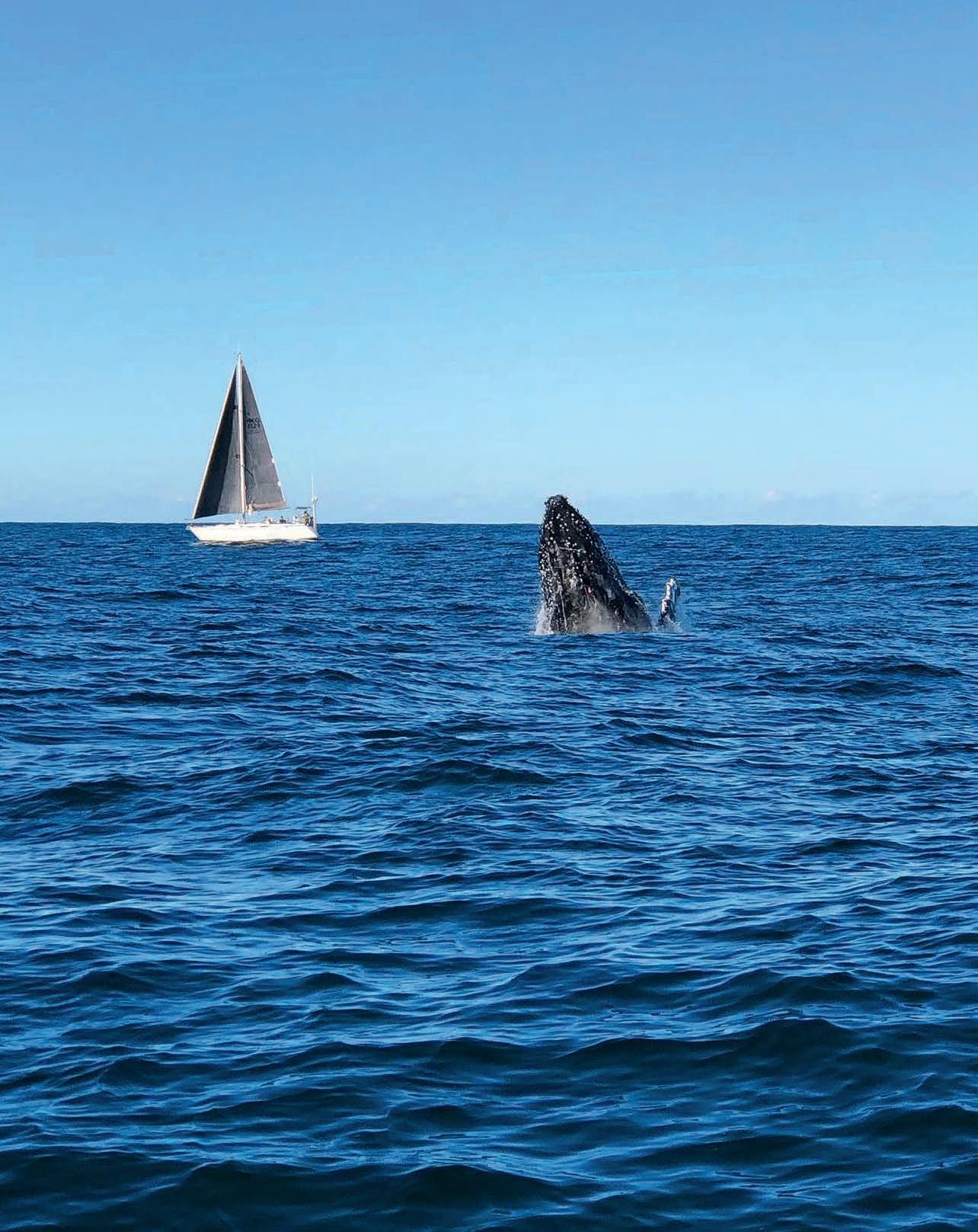
• Be mindful of wildlife and seasonal hazards. Mid-June to mid-July is peak migration time for whales. It’s peak hour on the ‘Humpback Highway’ along Australia’s East Coast. Whales and dolphins are truly spectacular to observe in nature as they migrate, but always be mindful of wildlife distancing regulations, and how to approach marine animals to safely enjoy your experience.
Visit abcboating.net.au and bia.org.au
Did you know?
The most common claims events for Nautilus Marine Insurance customers during winter over the past five years have been collisions, storm damage, and hitting submerged objects.
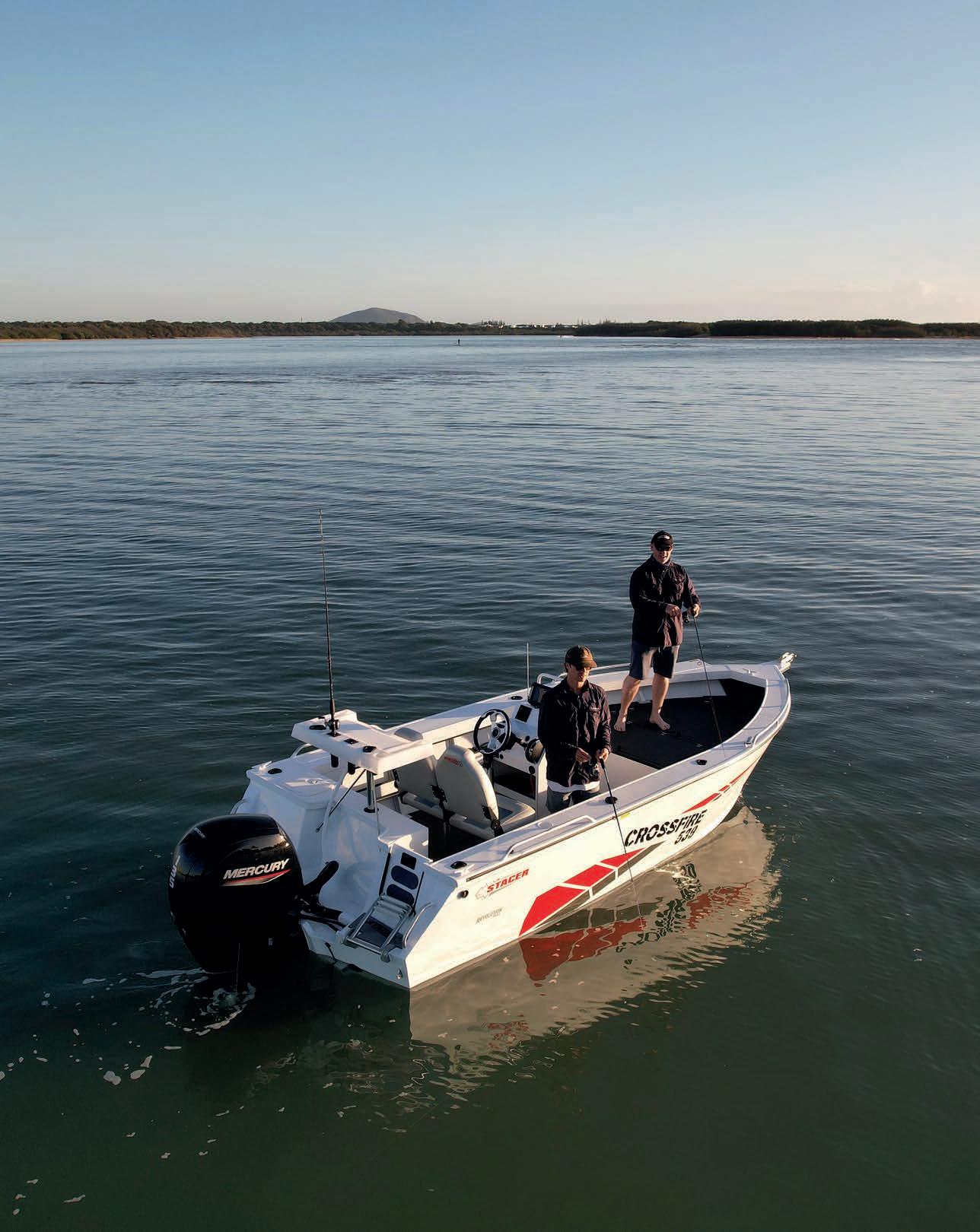
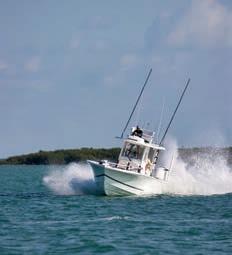
WINTER IS THE PERFECT TIME TO EXPLORE THE WATERS AND FIND A FEW FISH.
COOL MORNINGS, EMPTY WATERWAYS AND PLENTY OF FISH. WINTER IS A FANTASTIC TIME TO GO FISHING. BY SCOTT THOMAS.
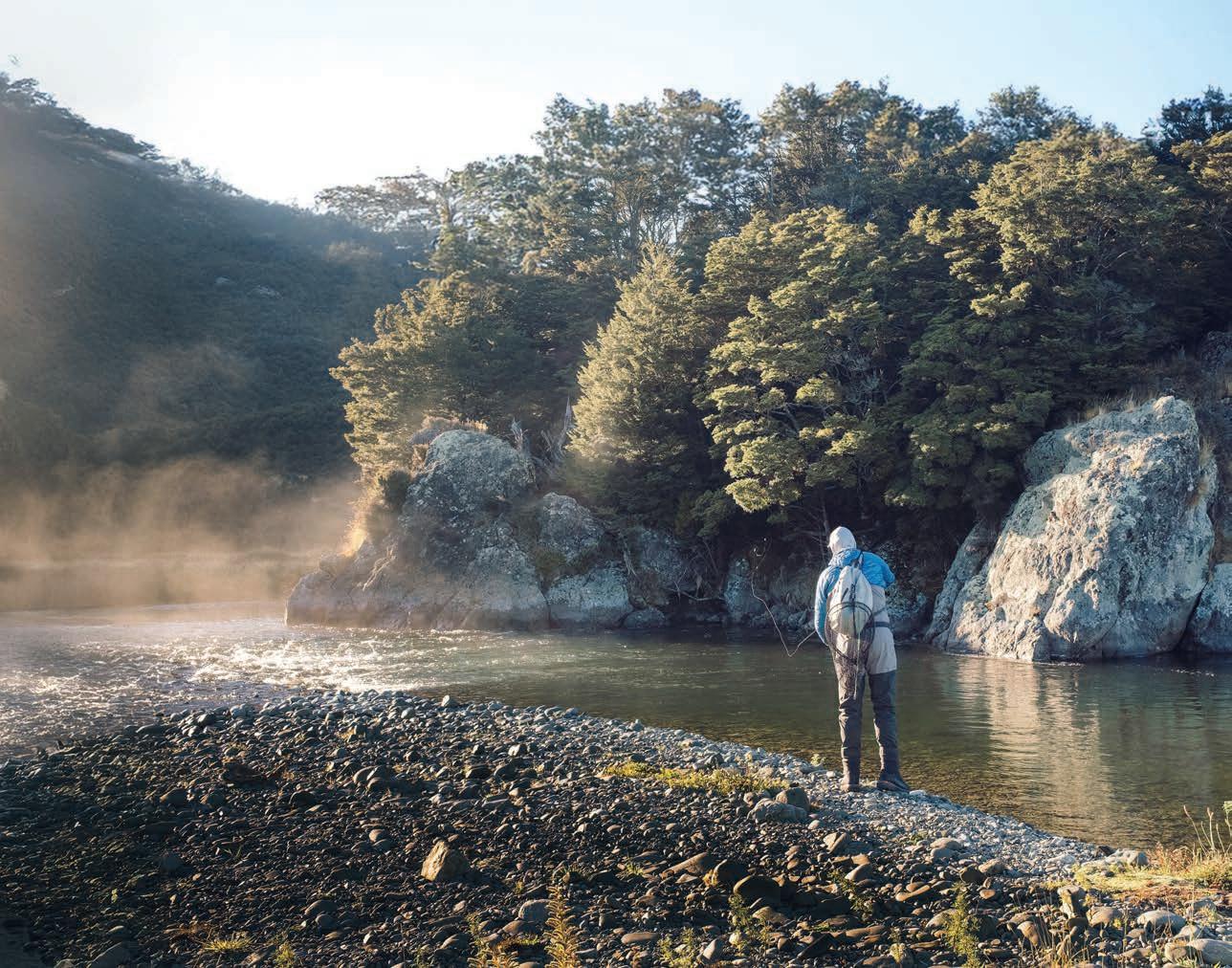
CASTING TO AN EARLY MORNING TROUT. CHECK YOUR LOCAL RULES AND REGULATIONS AROUND SEASONAL CLOSURES DURING WINTER.
Winter is often seen as a lull period for fishing. In some instances that’s true, for the most part however, it’s simply a myth. Maybe the problem stems from this misconception and in turn, some fishos choose to hang up their gear and wait for spring.
It’s a shame, as winter can offer some memorable fishing. There are even some species that are easier to catch in winter. The further south you get, the harder it is to convince fishos about the merits of winter fishing. Let’s look at some of the reasons you should dust off the gear, grab a jacket and keep the fishing going all-year-round.
Do fish get too cold to eat? Yes and no. I’m no fisheries scientist, but from my understanding it largely depends on the
species and water temperature. There’s no doubt cold water will slow a fish’s metabolism and therefore it may not feed as much. Even so, these same fish can be coaxed to eat with the right approach. Then there are other fish, as mentioned above, where winter is the peak season. What about ice fishing? We don’t do this in Australia or New Zealand, but in the USA and Europe, it’s a popular type of fishing. People are literally sitting on thick ice catching fish in sub-zero temperatures. If they can do that and still catch fish, I’m sure we can manage a mild winter.
Species
Let’s start in early winter and look at some of the fish that feed ravenously as the weather cools. Many freshwater fish such as Murray cod, trout and Aussie bass can be caught throughout winter. They’re particularly active when the weather begins to cool. Most fishos
believe these fish are ‘feeding up’ ahead of the cold winter ahead. It makes sense.
In the salt water, fish such as bream and flathead can be targeted in the cooler months. Many fishos associate flathead with warm weather. I guess that’s because they’re often caught while wading the shallow sand flats and that’s more enjoyable in summer. Yet, I’ve caught some memorable fish in the cooler months. Even fish such as whiting will hang around well into winter on the sand flats.
Squid is another popular species that really peak in winter. Squid require a different approach and can be caught on squid jigs around kelp beds. Look for estuaries with clear water. And remember to be careful when you bring a squid onboard. They can squirt ‘ink’ at you. Almost every squid fisho has been ‘inked’ at some point.
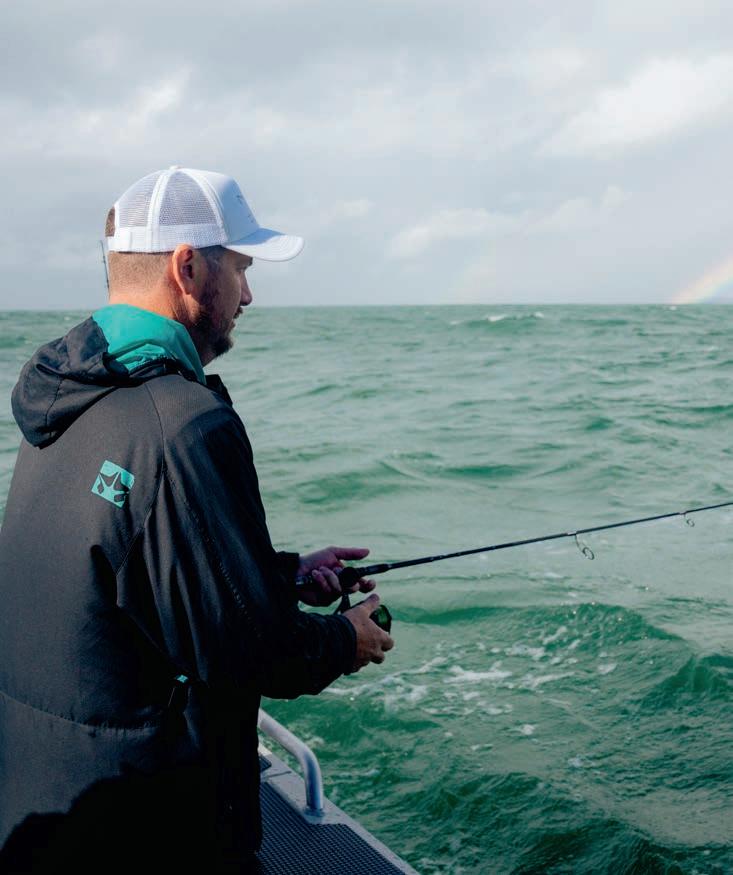
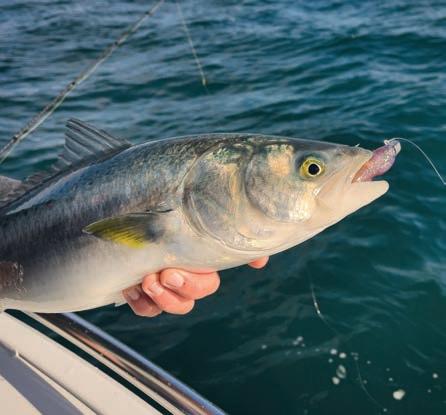
Tailor and salmon are also popular species around the estuaries, headlands and beaches during winter. Look out for birds flying low to the water or ‘dive bombing’. This usually indicates a school of fish such as tailor are nearby. The birds follow and feed on leftover scraps and baitfish. Tailor and salmon are easy to catch on lures and fly and are great fun on light gear. They’re also not bad eating, although not everyone agrees on the eating qualities of salmon.
Further offshore and the marlin of summer have usually moved on. That said, over the past few seasons, game fishos have experienced marlin all-year-round. Maybe it’s a sign of climate change. For anyone who loves catching these amazing fish, it’s a good thing that in some areas they’re available all year!
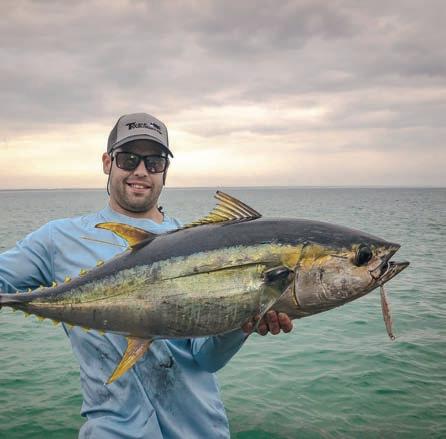
On the East Coast of Australia, winter is a fantastic time to catch big tuna. Schools of yellowfin and southern bluefin tuna migrate
up the coast each winter and can be targeted on bait and lures. They don’t typically hang around long, so if you hear reports of tuna, it’s best to drop everything, hook up the boat and go fishing before they’re gone. Tuna are hard fighters and taste amazing! It’s no wonder they’re so sought after as a recreational and seafood species here and overseas.
We couldn’t have a winter fishing story without mentioning snapper. In NSW, winter is a favourite time for catching snapper. These are incredibly popular and can be caught along the inshore reefs and rocky shorelines. In good weather, you don’t need a big boat , and light gear will usually work well. Bait has traditionally been the best option, however lures such as soft plastics are a fun and effective way of targeting snapper.
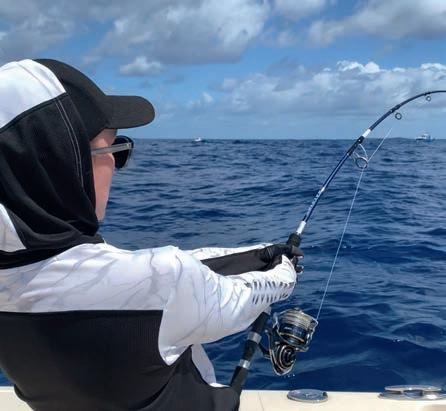
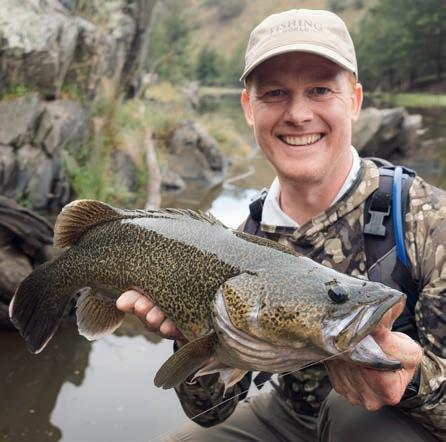
The above mention of tuna along Australia’s East Coast is a great example of the varied seasonal fishing we have in Australia. These same tuna migrate around different parts of Australia (and the world) and can be caught during different seasons. For instance, southern bluefin can be caught off South Australia and Victoria in summer. They’re typically smaller versions of the fish we see off the East Coast . Although, they’re great fun on lighter gear and are often closer to shore and easier to reach.
The same applies in the estuaries. Flathead are a prime species around the Gold Coast and northern NSW in winter. Yet, on the NSW South Coast they tend to slow down in the cooler months. My guess is there’s a trigger point where a certain temperature will slow down their feeding. As mentioned above, however, most fish can be coaxed to eat with
the right approach and I’m sure there are still flathead to be caught year-round regardless of water temperature.
What about further north? Believe it or not, while southerners would consider the air and sea temperatures as hot, even during winter, the Top End does still have a cooler season in winter and that does change the fishing. Once the wet season’s ‘run off’ has ended and the dry season has started, most of the same species can still be targeted. Fish such as barra can be caught in winter, both wild and the stocked variety in dams. You may need to change your approach slightly if it’s very cold, but as mentioned above, they’re still very much a fish worth chasing in winter.
If you’re in New Zealand or plan on travelling there to fish, it’s best to get some
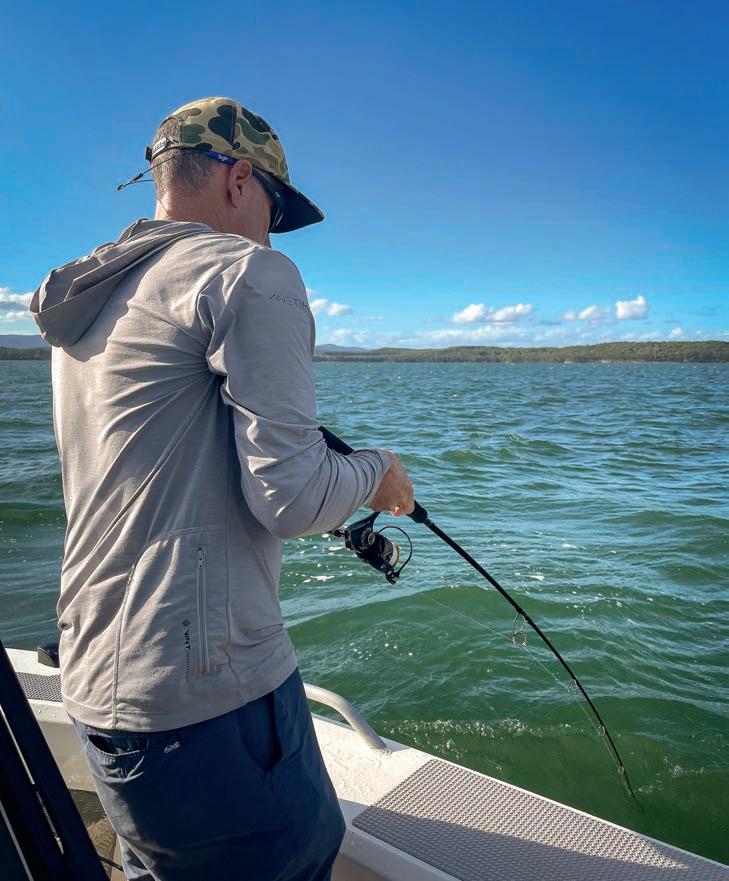
local advice. My experience with New Zealand tells me it has a varied climate and some parts would fish better in winter than others. New Zealanders also have great game fish and it’s not uncommon to catch big tuna along the West Coast of the South Island. Plus, there are many other saltwater fish and trout in the fresh.
When choosing a species or area to fish, keep in mind seasonal closures. These vary state-to-state and for different species. In the fresh water, take note of the trout closure in winter. You can’t fish most rivers, although lakes are open all year and can be quite productive. It’s best to check your state’s Fisheries website for accurate information on seasonal closures and fishing licenses.
If you’re serious about catching fish and having fun, there’s no need to hang up your gear in winter. Most parts of Australia and New Zealand experience mild winters compared to parts of the Northern Hemisphere. Plus, we have such an assortment of species, many of which actually prefer cooler water. As a bonus, there are less leisure boaters on the water, leaving more space at the ramp and on the water for you to enjoy.
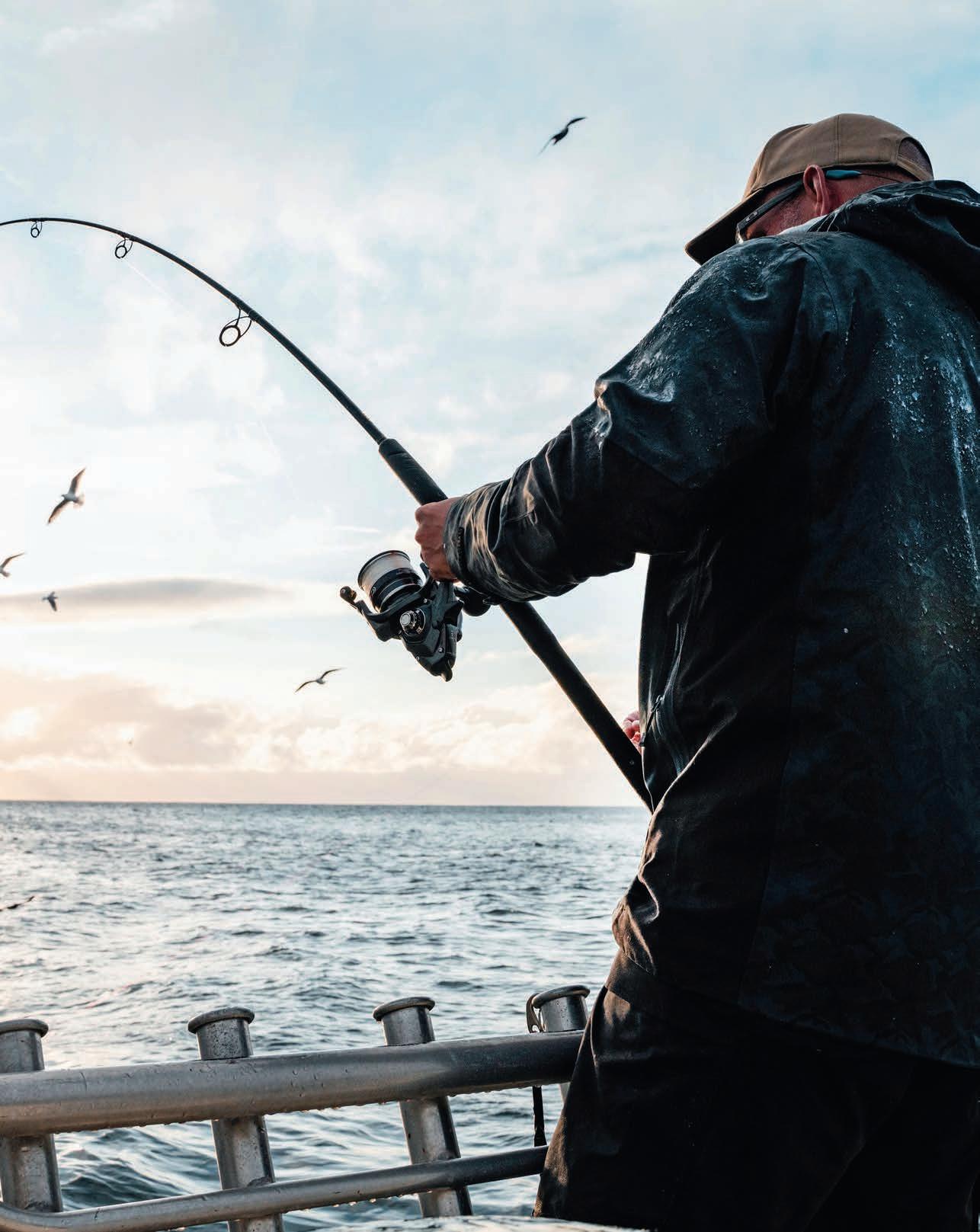
Don’t like the cold? That’s an easy fix. There has never been a better time to buy gear for staying warm and dry. My advice is to visit an outdoor store or a shop that specialises in boating or sailing. There’s an option for most budget s. Although if you’re serious about staying warm and dry, I would spend as much as you can afford. The better quality clothing will outperform the cheaper versions and in very cold and wet conditions, it will allow you to keep fishing. I recently bought a Simms GoreTex jacket. It was an investment, but I’ve since worn it and stayed warm and dry in conditions that potentially could have been dangerous if I wasn’t properly dressed.

PACK YOUR BAGS AND HEAD NORTH THIS WINTER FOR AN ADVENTURE IN THE TROPICS. BY SCOTT THOMAS.
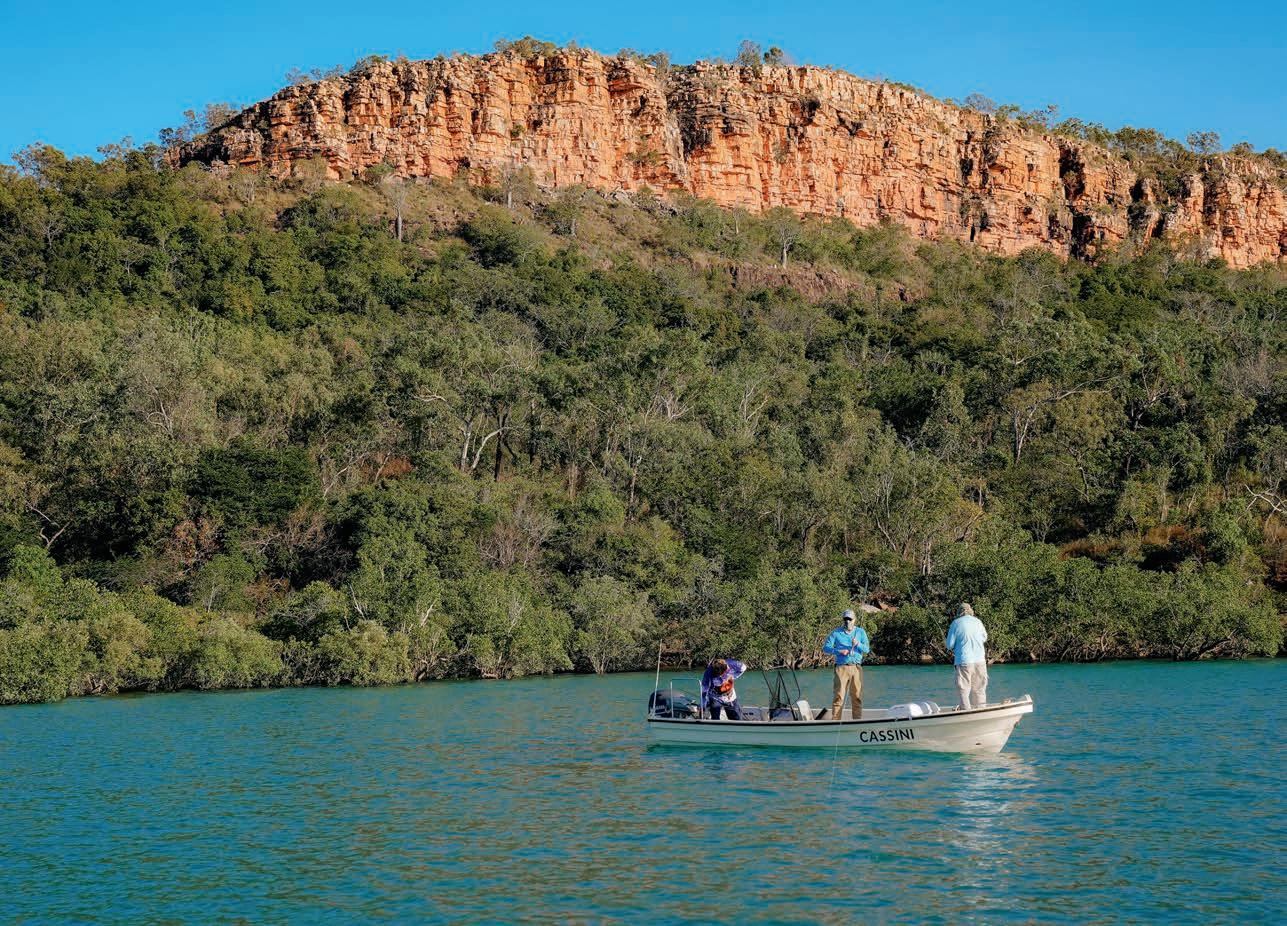
Winter is here and there’s no better time to escape the cold south and head north. The weather is better, and as a fisho, there’s an abundance of good opportunities for catching some memorable fish. Over the next few pages, let’s look at some options for a trip to the tropics and what you can expect to catch.
There’s no clear line where tropical fish start and cooler water fish end. Fish such as giant trevally and mangrove jack are frequently encountered in northern NSW. In fact, mangrove jack are regularly caught as far out as the Mid North Coast. Other fish such as barramundi are now frequently caught as
far as the Gold Coast. We’re seeing more and more northern species move south, while cold water species are moving even further south.
I’ve fished Hervey Bay and caught snapper and coral trout on consecutive casts. It’s a great fishery that allows you to catch these iconic northern and southern species in the one location. On the other side of Australia, I’ve experienced memorable tailor fishing around the Abrolhos Islands off Geraldton. Yet, on the same trip we caught mackerel, coral trout and other tropical species.
There’s definitely an overlap and that extends for quite some distance up and down the coast. I guess officially you would consider anything north of the Tropic of Capricorn as ‘The Tropics’.
Besides the temperature, the main difference when it comes to tropical fishing are the different species. The number one tropical species is the barramundi. As I briefly mentioned above, barra are caught from roughly Brisbane (although more frequently above Hervey Bay) all the way around the top of Australia to Western Australia. In the west, they extend south about as far as Exmouth. They’re also commonly caught in neighbouring countries such as Papua New Guinea (PNG) and other South East Asian countries. PNG has some incredible fishing, but it’s in Australia barra are most famous and that’s for good reason. They really do live up to the hype! They grab lures with gusto and they fight hard and jump spectacularly when
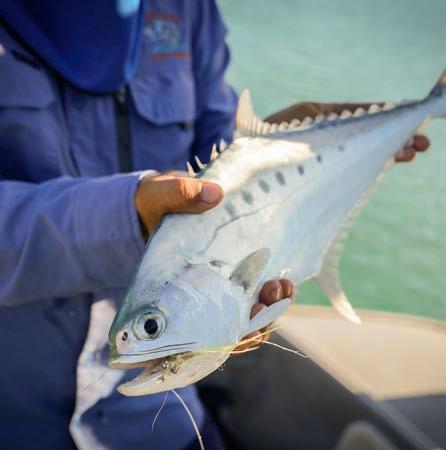

hooked. They grow in excess of a metre and they also taste pretty good for anyone who needs a feed.
Barra are typically caught in the estuaries and creeks. They hold close to structure and are an opportunistic feeder. Throw a lure close enough to a barra and you stand a good chance of hooking up. They also cruise beaches in places like Cape York. Here you can sight fish for them, an exciting way of fishing.
When looking for barra in shallow water, it pays to check the ‘drains’. These are just small channels that run through shallow water. The barra will sit in these tiny drains and wait for baitfish to cruise past before ambushing them in the shallow water. Run a lure along a drain and it’s guaranteed good times.
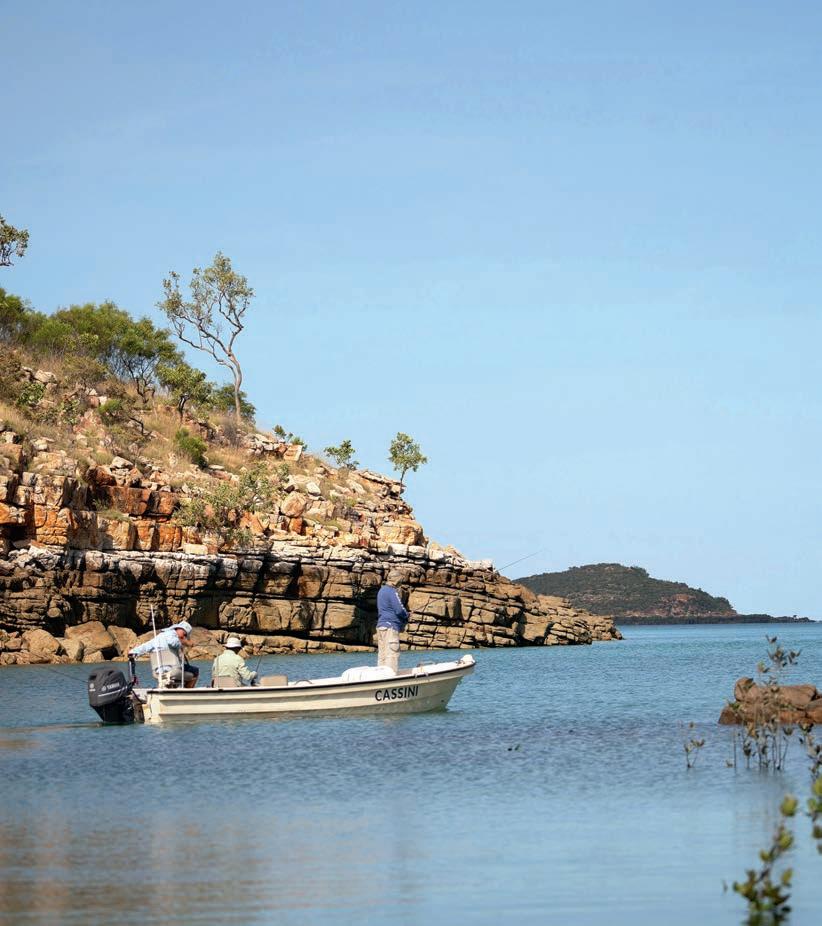
There are a number of other species that call tropical estuaries home. When you’re fishing for barra, you’ll also catch mangrove jack, threadfin salmon, blue salmon, various types of trevally, permit, queenfish, small tarpon and much more. There are so many species in the tropics.
Now it’s time to head offshore. Offshore in the tropics usually means fishing around reefs. The reefs offer some protection from the swells further offshore and for that reason you can usually fish in a smaller boat. Although that all depends on the location. You can still get some very rough weather in the north. Many of these reefs are far offshore and a larger boat will help cut through the chop on the way there.
Once you’re on the reefs you will experience some fantastic fishing. There are various types of mackerel, giant trevally (GT), plus other trevally species, coral trout, red bass, red emperor, and more. Every time you drop a bait or lure down to a reef or troll a lure, it’s always a surprise.
The tropics also have some of the best game fishing in the world. Further north, Cairns and Port Douglas are famous for giant black marlin. Every year around October, fishos come from all around the world hoping to catch a 453kg black marlin. There’s also a small black marlin season in early spring. It’s great for consistent action on lighter gear. As you can see, the tropics has many species of fish. I once fished from a mothership along the
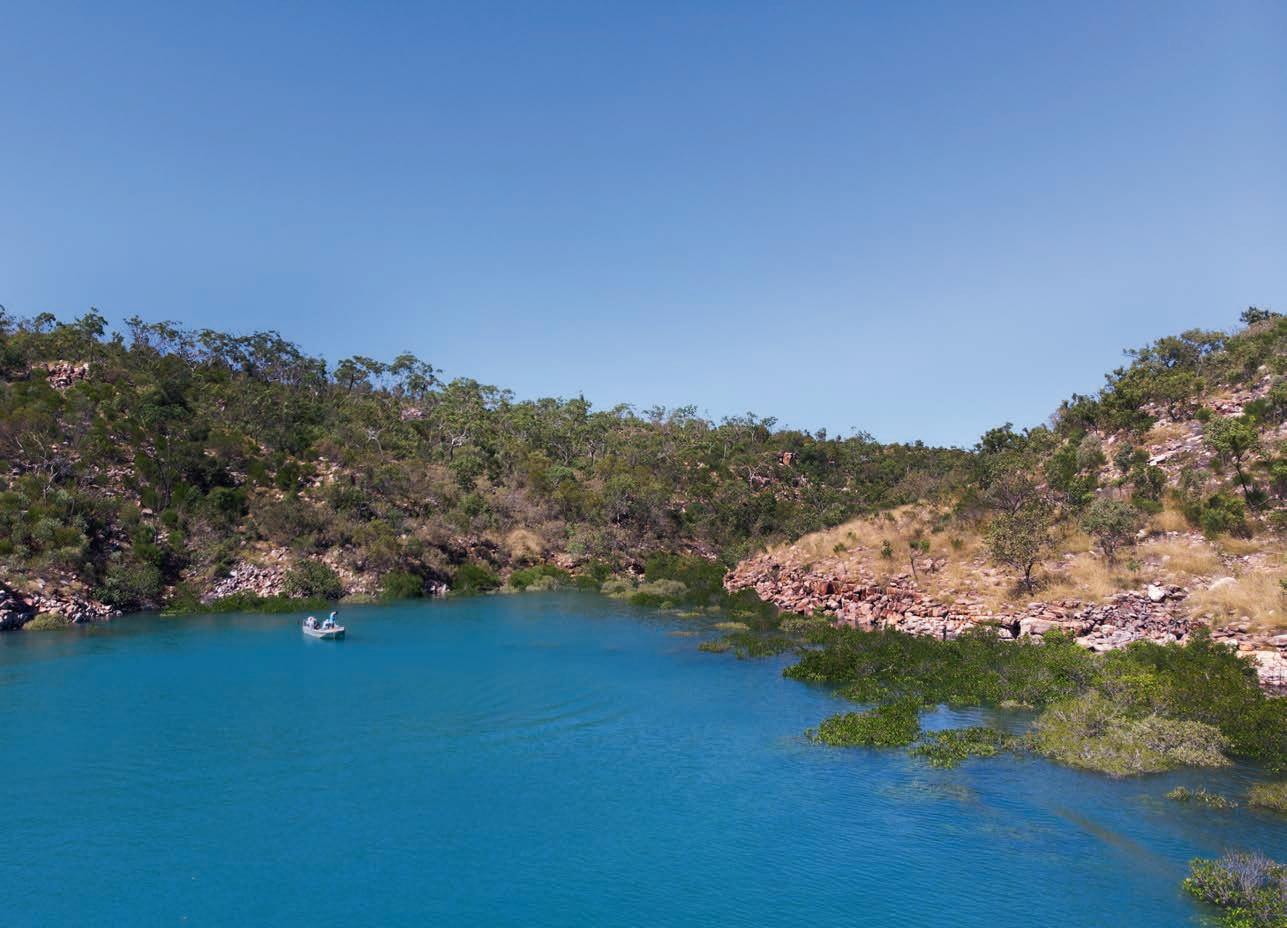
PAY ATTENTION TO THE LARGE TIDES IN TROPICAL AUSTRALIA FOR YOUR BEST FISHING OPPORTUNITIES.
western coast of Cape York, and in the weeklong-trip, the group caught around 45 species of fish!
There are two ways to approach a northern trip to the tropics. Do you tow your own boat north or do you fly and hire a guide or charter boat? Let’s look at the DIY option first. This option is arguably more affordable, especially if you’re spending a longer length of time fishing.
I really love the idea of taking your time and using your own boat for a trip north. If you have a reliable vehicle and a boat trailer that has been well maintained, it’s certainly an option.
Make sure your boat is large enough. All of the rivers in the tropics have saltwater crocodiles and these rivers are no place for small boats or kayaks. You also want to make sure your outboard is reliable. Many of these estuaries and offshore areas are very remote. Another factor with the DIY option is to make sure you do your research. You will be fishing unfamiliar waterways and attempting to catch unfamiliar fish. Prepare yourself for fishless days and lot of learning. Hence these DIY trips should be longer. But once you work out a pattern and figure out how to catch some of the aforementioned fish, it will all be worthwhile. Noting beats catching fish all by yourself without the help of a local guide. Which brings us to the guided option.
The option of hiring a guide is better for quick trips and an assurance you will catch fish. Of course, nothing is guaranteed, but it is far more likely you will catch fish and have a great time. Guides are usually local and have a wealth of experience to share. You will learn a lot and won’t have to worry about towing a boat or even taking gear. Many guides have fishing gear you can borrow. At least this way you’re using the correct rod, reels and lures. They’ll even tie your knots, so they’re more likely to hold when that big fish connects. So, there’s no right or wrong when it comes to choosing between a DIY or guided option. One takes more time and more learning, but
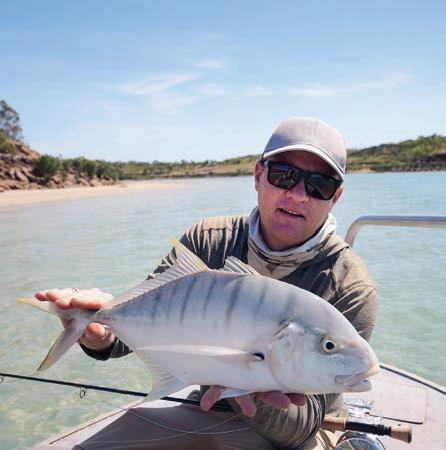
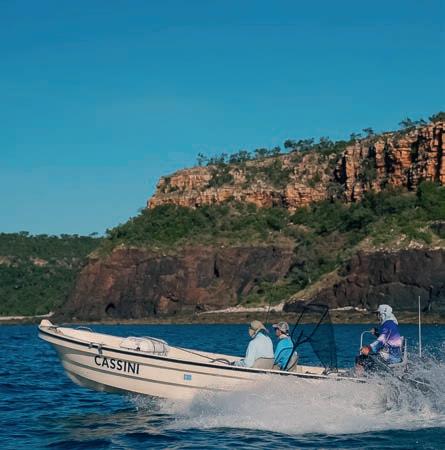
is highly rewarding. The other is a great way of catching fish with less time and experience.
Head overseas
Another option for tropical fishing is to pack your bags and go overseas. Many of Australia’s neighbours have some amazing fishing. Places like PNG, Fiji, Solomon Islands, New Caledonia, Kiribati, and others have options for an affordable trip. If this interests you, you’re best reading as much about the types of species available and booking a package trip that includes airfares, accommodation and guided fishing. That way everything is included and you can just focus on the fishing. The bonus with going overseas is you can experience species that don’t exist
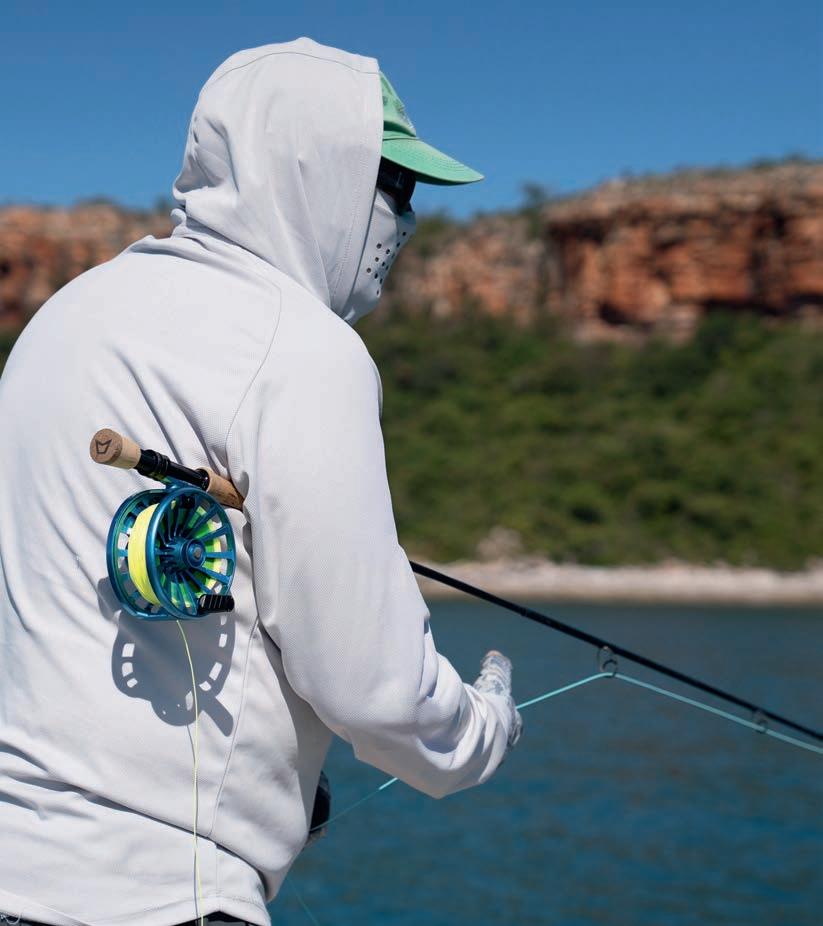
(or don’t exist commonly) in Australia. Fish such as PNG black bass, spot tail bass, and bonefish are just some species highly sought after for travelling anglers.
Go troppo
The tropics offer fishos a diverse range of species and some exciting fishing opportunities. It’s also a vast area. The tropical part of Australia extends across three states. In these states you have some of the most remote fishing in the world in places such as The Kimberley. There are also opportunities close to civilisation and everything in between. You can either go it alone or hire a guide. Either way, you’re guaranteed an adventure and a good time!
Winter is a great time to visit the tropics. It’s dry and cooler and has far less humidity than summer. The fishing is good all year round in the north and it may be worth looking at other seasons as well. Of course, given the wet season in summer, if you plan on driving you will need to take note of road closures and limits to fishing. That said, it’s a fantastic time of year to catch fish if you can handle the heat and humidity. Another great time is the “run-off”. This is the best time to catch barramundi in the big rivers in the Northern Territory. The flood plain are full of water and the fishing action is non-stop.
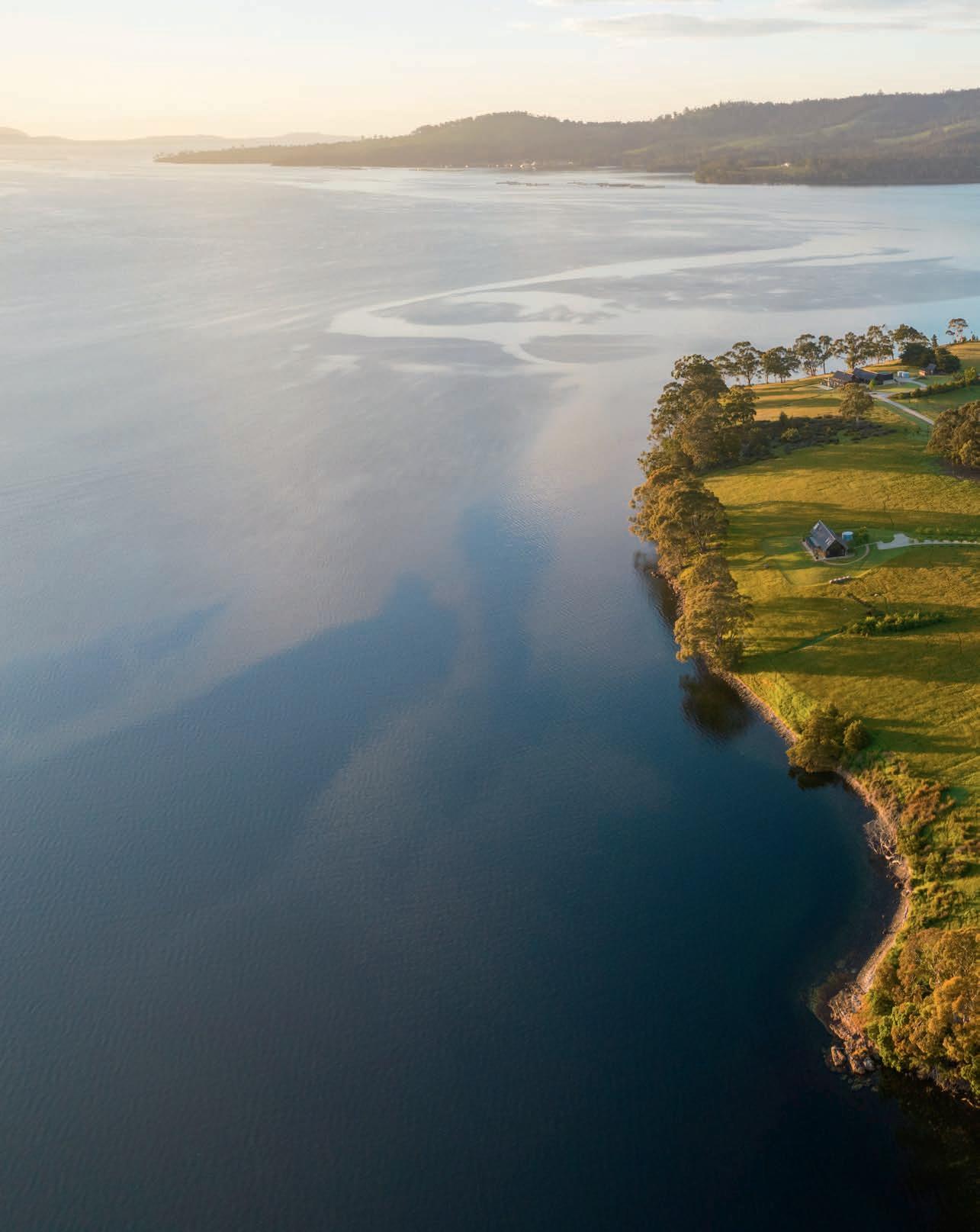
A SHORT ESCAPE TO HOBART AND THE HUON VALLEY OFFERS AN ENTICING MIX OF PRISTINE WATERWAYS, CULTURAL AND CULINARY DELIGHTS, AND BREATHTAKING NATURAL BEAUTY. BY SARAH RANAWAKE.
As I arrive at Tasmania’s Coast House, a discreet residence set on a private peninsula in Lymington, I can’t help being awestruck by the picturesque beauty of this Huon Valley hideaway, just 30 minutes south west of Hobart. On approach, I also spot a glimpse of a striking yacht anchored nearby in Gourlays Bay. I will later find out the yacht is Gretel II, an iconic 12-metre class yacht, which was originally built for Sir Frank Packer for the 1970 America’s Cup challenge series and is now the pride and joy of Coast House Owner Mike Maxwell. Arriving at Coast House, and seeing this famous yacht, set the tone for a memorable stay in the Huon Valley.
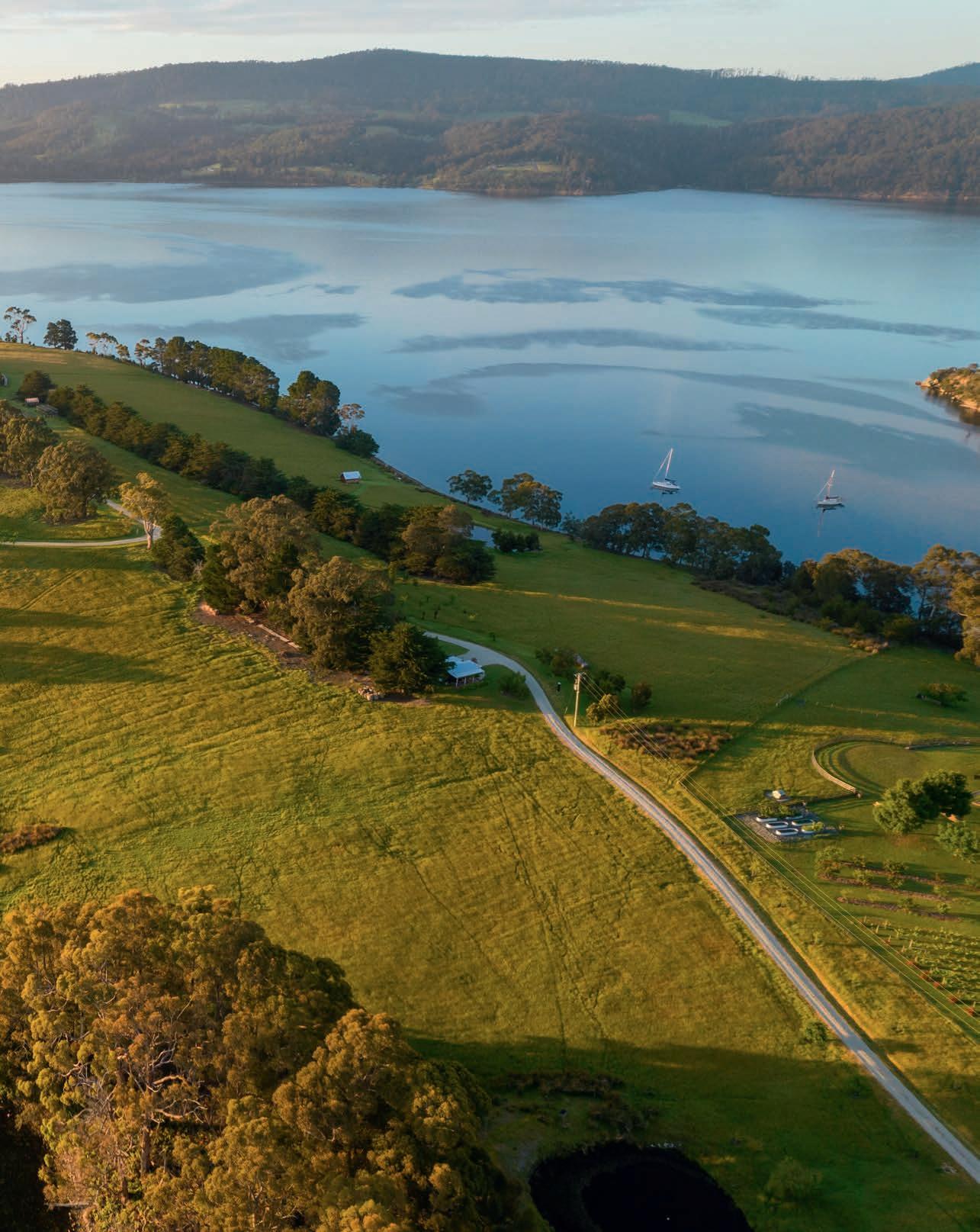
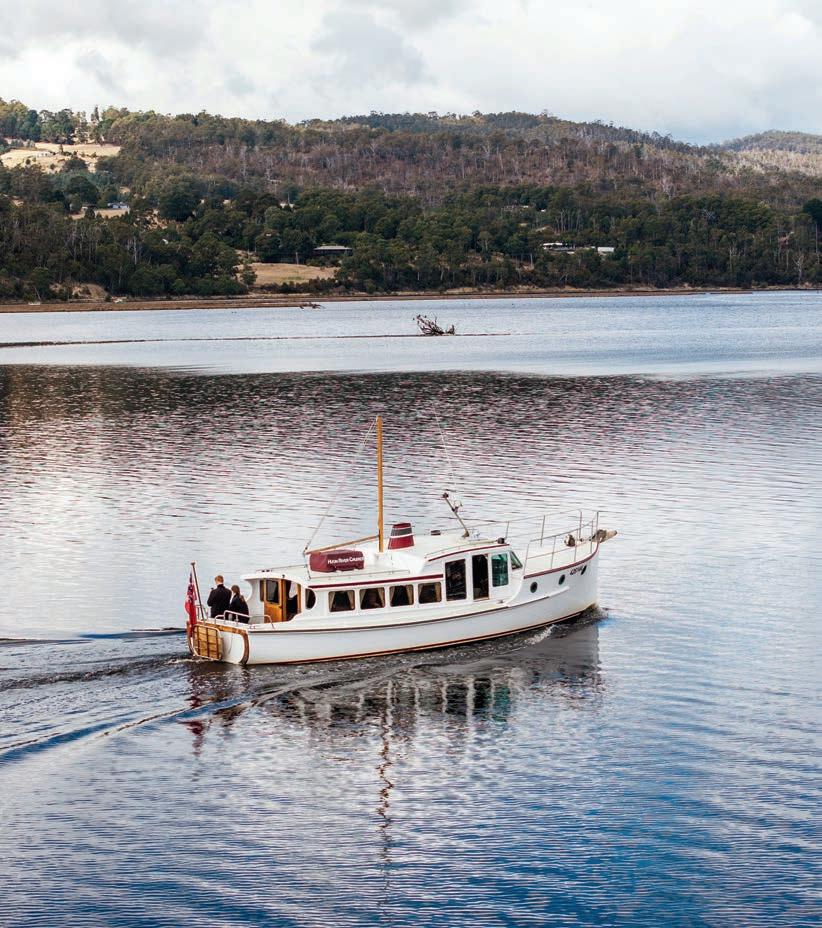
There’s an abundance of picturesque local cruising grounds to explore around the Huon Valley region if you’re able to bring your yacht to Tassie. However, if the plan is to leave the boat at home, then opting for a pleasure cruise with Huon River Cruises (huonrivercruises. com.au) is a wonderful way to take in some magnificent Huon Valley scenery from the water. This authentic Tasmanian river cruise experience takes place aboard La Drone, a fully restored, 38ft wooden motor cruiser from 1948. Embodying craftsmanship, elegance and bygone era charm, La Drone, is truly a Tassie grande dame, having spent her entire life cruising Tasmania’s waters.
Huon River Cruises Owner and Skipper Taylor Wilkin is passionate about the
Huon Valley’s rich history and is known for enthralling his guests with lively tales about the local area. Wilkin is also equally passionate about wooden boats having previously completed a shipwright’s course at the Wooden Boat Centre in Franklin early in his career. More on the Wooden Boat Centre shortly – it’s a Huon Valley must-visit. Of course, no river cruise would be complete without a little indulgence and in this case the culinary offerings are a showcase of local delicacies. The morning tea cruise comes complete with freshly baked scones from local Franklin favourite Frank’s Cider House and Café. Or you could choose to relax on the spacious aft deck in the afternoon with a glass of something cold in hand as you nibble
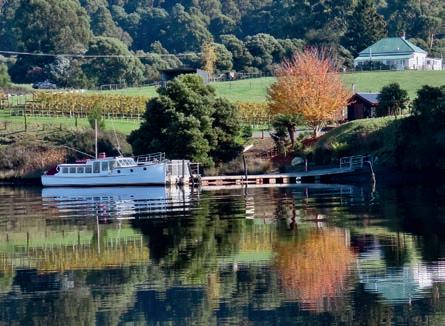
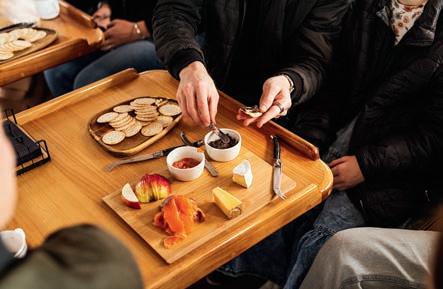
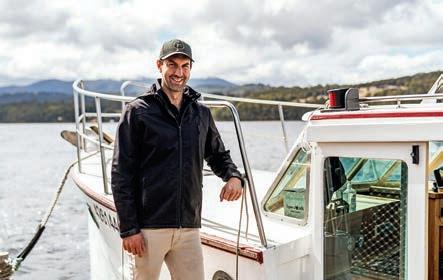
on a grazing board of Bruny Island cheese, seasonal fruit and Tasmanian salmon.
Feeling more energetic? A guided kayaking tour with Esperance Adventures (esperanceadventures.com.au) may appeal. Esperance Adventures offers several kayak tour itineraries, including a tranquil three-hour guided kayak journey along the Huon River. Departing from Franklin, the tour travels at a gentle pace around South Egg Island, taking in some of the best scenery the Huon Valley has to offer. Share morning tea on the water before returning to dry land for lunch and some cider tasting.
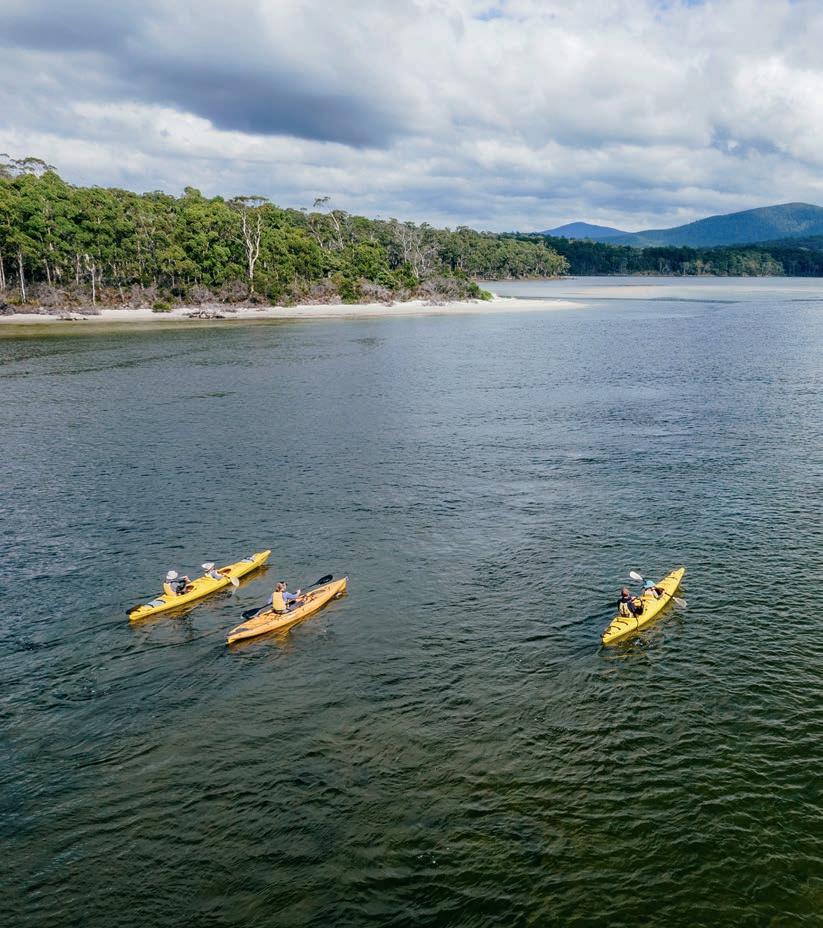
“The D’Entrecasteaux Channel is undoubtedly one of the finest cruising grounds in the world,” says Coast House Owner and passionate yachtie Mike Maxwell. “It is stunningly beautiful and while close to Hobart it’s also relatively remote and not well known. There’s an enormous amount of natural beauty and you can always get out of the prevailing wind with a protected anchorage on one side of the Channel.”
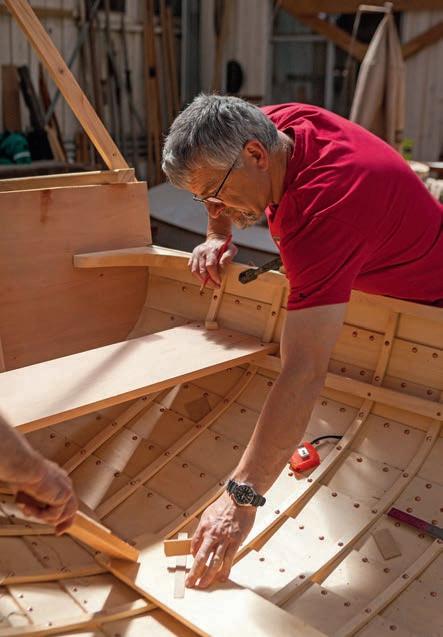
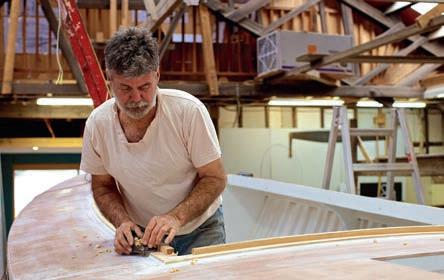
Located in Franklin, the Wooden Boat Centre beckons boaties and all those who appreciate timber craftsmanship. Through courses and tours, this community owned organisation aims to preserve, celebrate and maintain the Huon Valley’s rich heritage of wooden boatbuilding. The Wooden Boat Centre (woodenboatcentre.com) is open every day and tours – which run for around 40 minutes – are usually available on demand with bookings generally not needed unless you’re travelling in a larger group. One of the Centre’s passionate local volunteers will guide
you around the workshop, offer insights about the art of wooden boatbuilding and Tasmanian timbers, and share stories about Franklin's maritime history. You’ll also get a behind-thescenes look at wooden boats that are currently under construction or mid-restoration.
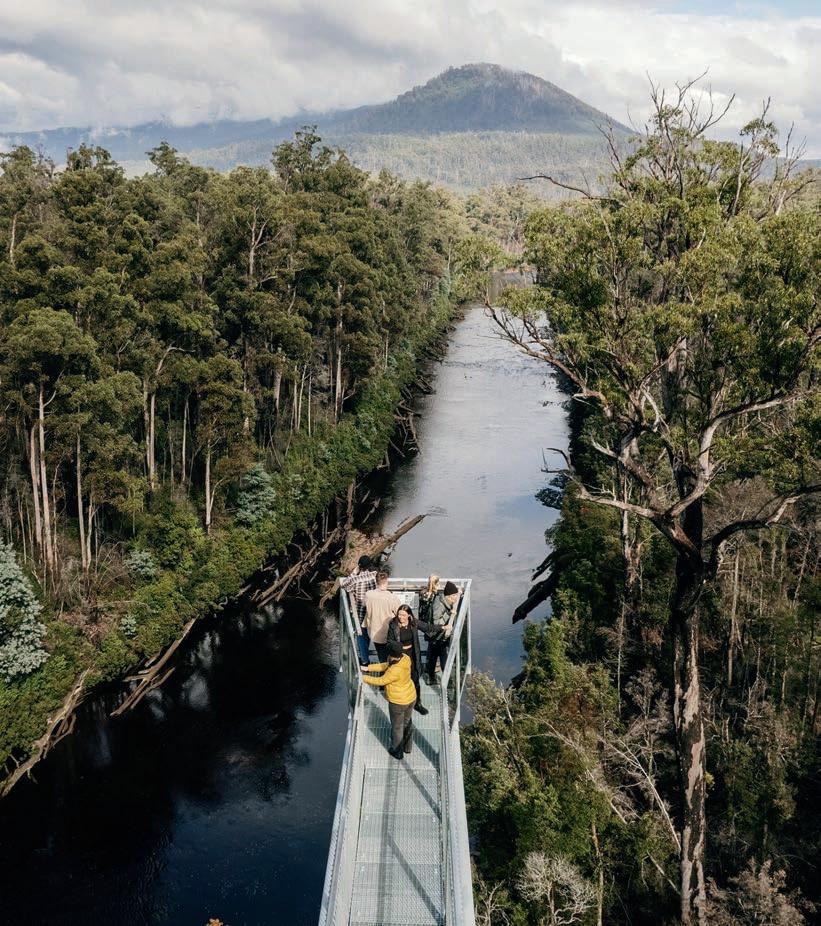
The Huon Valley was once the epicentre of apple growing in Tassie, and the region is still known for its incredible apple cider. However, the same fertile landscape is now also home to lush vineyards producing fine wines, and an array of amazing eateries which take full advantage of the abundance of fresh local produce.
Head to the stunning Home Hill Winery and Restaurant in Ranelagh (homehillwines. com.au) for some award-winning pinot noir and a refined restaurant menu that celebrates modern Tasmanian dining. For a delicious grab-and-go option pop into local institution Summer Kitchen Bakery (summerkitchenbakery.com.au) for woodfired baked goods including sourdough,
inventive pie flavours, croissants and tempting cakes.
Cygnet Old Bank (cygnetoldbank.com.au) is another local favourite that’s just down the road from Coast House – try the all-day café menu or opt for high tea, which is served on Saturday afternoons, and offers a charming experience. Of course, no trip to the Huon Valley would be complete without a spot of cider tasting – make it an outing by stopping into Willie Smith’s Apple Shed (williesmiths. com.au) which is located in Grove. The home of the famous Willie Smith’s Tasmanian cider, there’s a distillery, museum and restaurant on site, along with live music on Friday evenings.

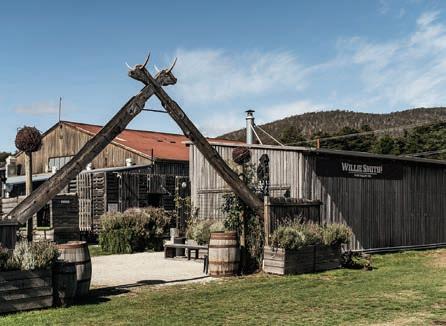

Among its many charms the Huon Valley also offers easy access to some incredible nature-based adventures.
1. Head underground or have a soak in the thermal springs pool at Hastings Caves and Thermal Springs.
2. Enjoy luscious views of the forest canopy and the Huon River at the Tahune AirWalk.
3. Marvel at the natural vistas with a hike along the South Cape Bay Track, within the Southwest National Park, which is part of the Tasmanian World Heritage Wilderness Area. This 15.4km walk, which takes around four hours return, begins at Cockle Creek, which is the most southern road in Tasmania (and Australia).
Scan to find out more about the Huon Valley.
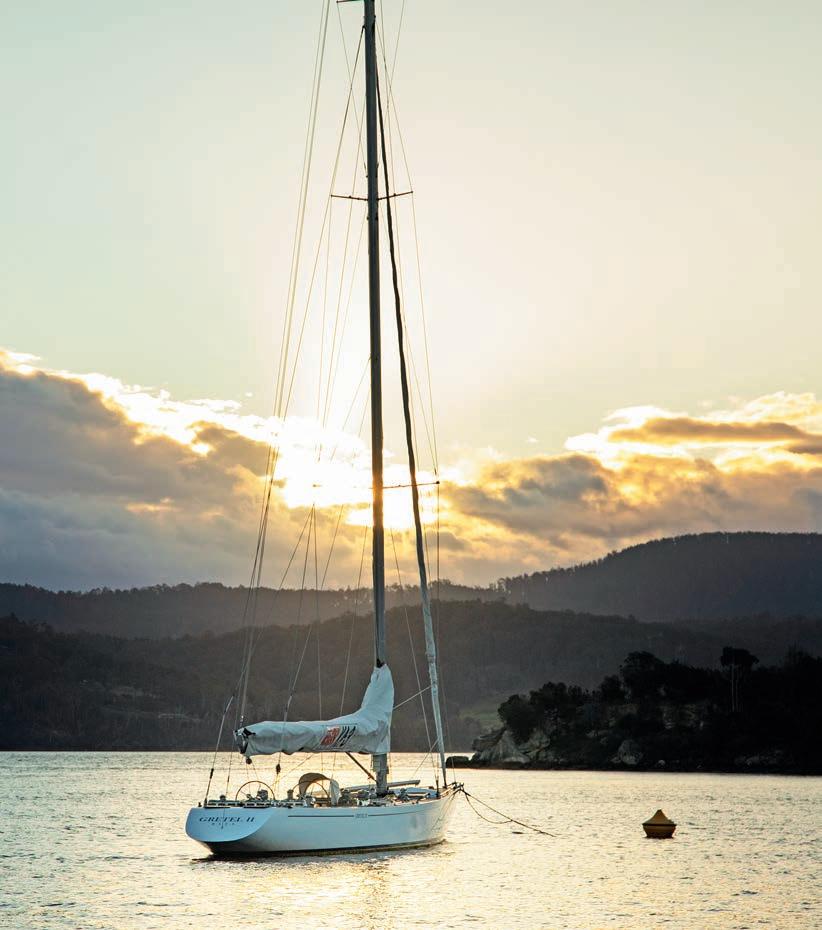
January through to April is festival and regatta season in the Huon Valley. So, if you’re planning a visit for 2026, mark these dates in your diary.
January: Cygnet Folk Festival
One of Australia’s best known folk music festivals, this cultural celebration has been drawing visitors to the Huon Valley for over four decades. Expect an eclectic mix of musical genres, along with art, dance, film, poetry, and family friendly entertainment. Visit cygnetfolkfestival.org
March: Port Cygnet Regatta
Hosted by the Port Cygnet Sailing Club this renowned regatta consists of three days of racing and has a proud history dating back over 160 years.
Visit cygnetsailing.org.au
March: A Taste of the Huon
This Ranelagh-based festival has been celebrating food, wine, arts and crafts and entertainment from the Huon Valley for over three decades.
Visit atasteofthehuon.com.au
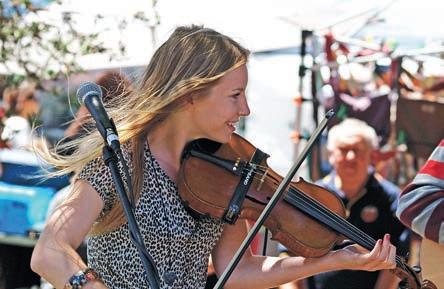
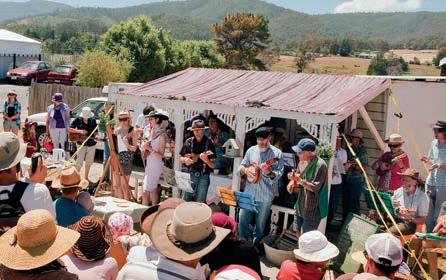
March: Dover Seafest
A charming local food festival that places a special emphasis on seafood available around Dover.
Visit facebook.com/DoverSeafest
April: Dover Regatta
Hosted by Port Esperance Sailing Club this regatta offers racing for keelboats and off-the-beach craft.
Visit pesc.com.au
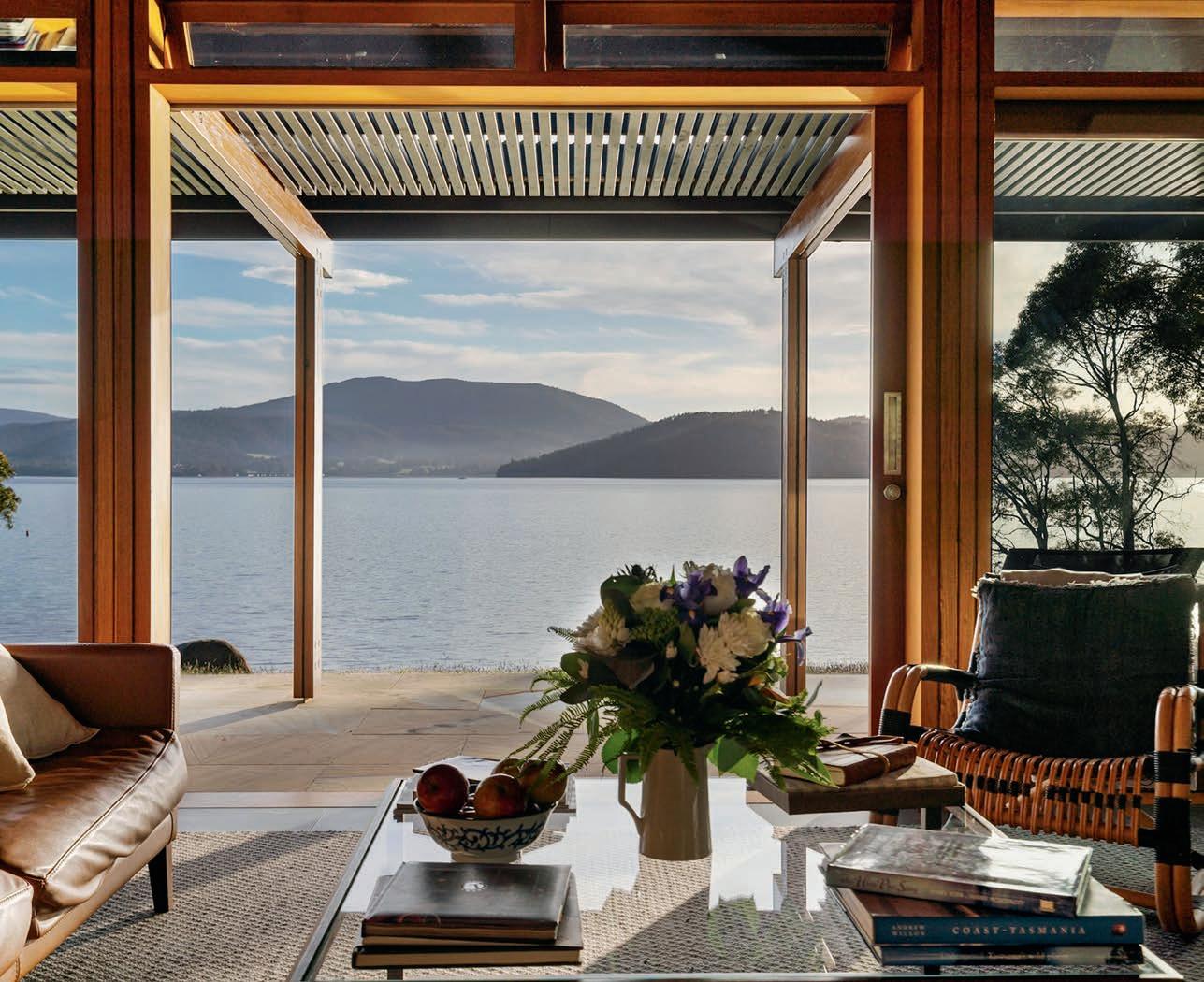
Some destinations truly leave a lasting impression on you. The type of place where time seems to slow down. Where the views can literally take your breath away and you feel a wave of tranquillity wash over you as soon as you walk through the door. Coast House is such a place. This spacious private residence is the epitome of quiet luxury, offering guests a perfect setting to re-connect with themselves, with each other, and with nature.
Located in Lymington in the Huon Valley, Coast House is set on a private peninsula called Beaupre Point. A discreet gate marks your arrival to this award-winning property which boasts magnificent vistas of the Huon River and across the D’Entrecasteaux Channel towards Bruny Island. That is unless you decide to take advantage of Coast House’s direct water access by cruising there and
dropping anchor at one of the many sheltered spots nearby.
Nestled within Coast House’s calm surrounds you really do feel a million miles away from anywhere, yet it’s only a short 10-minute drive from Cygnet Village and around an hour away from Hobart. The property has two queen size bedrooms, located at either end of the house, and each has its own luxurious adjoining bathroom.
There are heated floors throughout Coast House, and the expansive open-plan living and dining space has a wood fireplace and a fully equipped modern kitchen. Bikes are available for guests to borrow, and the covered verandah and outdoor fireplace are also lovely places to sit and watch the light reflect off the water.
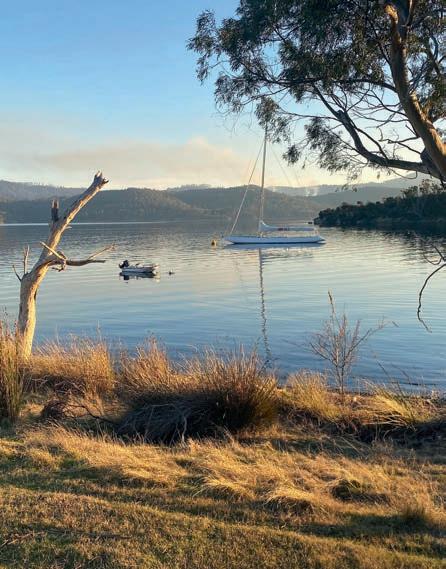

With the Huon Valley only a short drive from Hobart – around half an hour in the car and you can be in Ranelagh or Huonville – it makes sense that any Huon Valley holiday either should begin or end with a few days savouring the culinary and cultural delights of Tasmania’s capital city. Here are three memorable on-water activities to consider adding to your Hobart itinerary.
1. Sail on Lady Nelson
Step back in time with a short sailing cruise on this magnificent tall ship which is berthed at Elizabeth Street Pier on Hobart’s waterfront. Launched in 1988, the Lady Nelson was built locally in Tasmania as a replica of the original HMS Lady Nelson which was involved in Hobart’s settlement. Designed from plans of
the original ship, Lady Nelson’s magnificent twin masts are rigged with square sails, making her a true sight to behold. Help the crew work the lines or just sit back and savour the experience of sailing on this wonderful vessel. Top tip: if you’re feeling hungry after your sail stop by Fish Frenzy, located right next to Lady Nelson’s berth, for some of the best fish and chips in Hobart.
Visit ladynelson.org.au
2. Board the Mona Roma
Walk down to Brooke Street Pier and step aboard the Mona Roma ferry bound for the Museum of Old and New Art. The journey will be almost as delightful as spending a few hours at this remarkable museum.
Visit mona.net.au
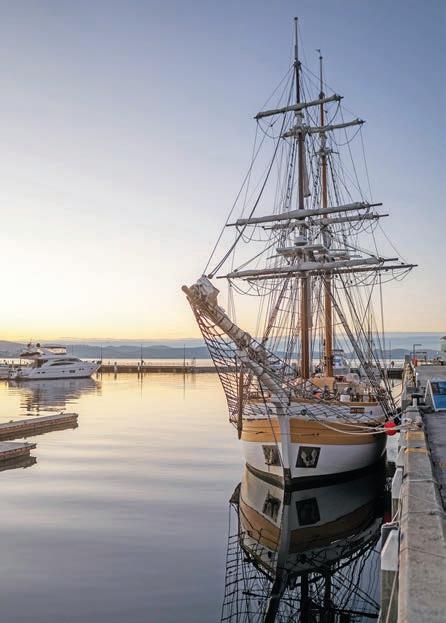
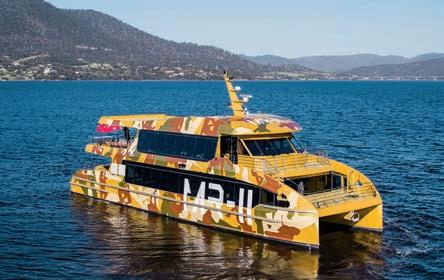
As the name suggests, Dark Paddle Hobart is a guided kayak tour which offers a unique opportunity to witness Hobart by night from the water. Designed to run in conjunction with the renowned annual Dark MoFo festival, Dark Paddle Hobart runs for limited dates each June. Departing just before sunset from Short Beach in Sandy Bay, the tour will take in historic Battery Point, cross the Sydney to Hobart finish line, and head towards Constitution Dock for a well-earned cup of steaming hot chocolate and tasty local treats.
Visit southernseaventures.com
Set in the cultural and historic heart of Hobart, this chic boutique hotel epitomises ‘location, location, location’. Salamanca Wharf Hotel’s striking metal facade is nestled between two historic sandstone warehouses and is just a short stroll away from everything Hobart’s CBD has to offer. The hotel is situated just a few metres from Hobart’s waterfront and backs onto Salamanca Place, making it the perfect place to drop anchor in Hobart.
Upon arrival at Salamanca Wharf Hotel, we parked the hire car in the hotel’s nifty parking stacker, and that’s where it remained for the duration of our stay until we departed for the Huon Valley, such is the convenience of this location.
The self-contained boutique apartments make you feel instantly at home, offering both style and supreme comfort. The luxurious loft penthouse apartments are particularly impressive. Each loft penthouse is flooded with light thanks to five metre windows, and offers a spacious living space, a freestanding bath or spa, and all the mod-cons.
Foodies are spoilt for choice with Hobart’s vibrant dining scene, and Fazi the cafe and restaurant located on the hotel’s ground floor, is also worth well a visit, offering a modern and innovative menu and great coffee. And of course, if your stay includes a weekend, a wander around Hobart’s famous Salamanca Market, which takes place every Saturday and is conveniently located right on Salamanca Wharf Hotel’s doorstep, is a must-do.
Visit salamancawharfhotel.com

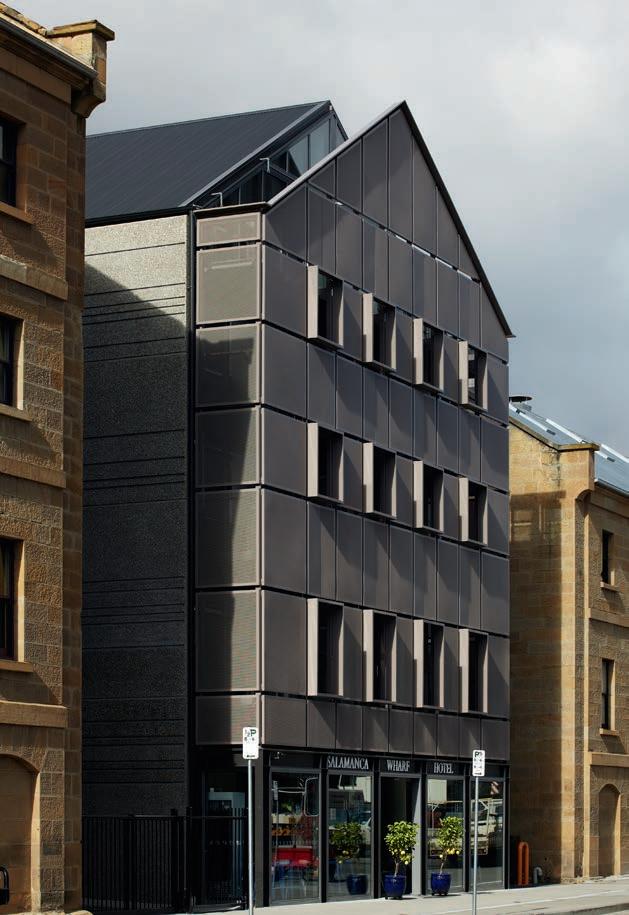
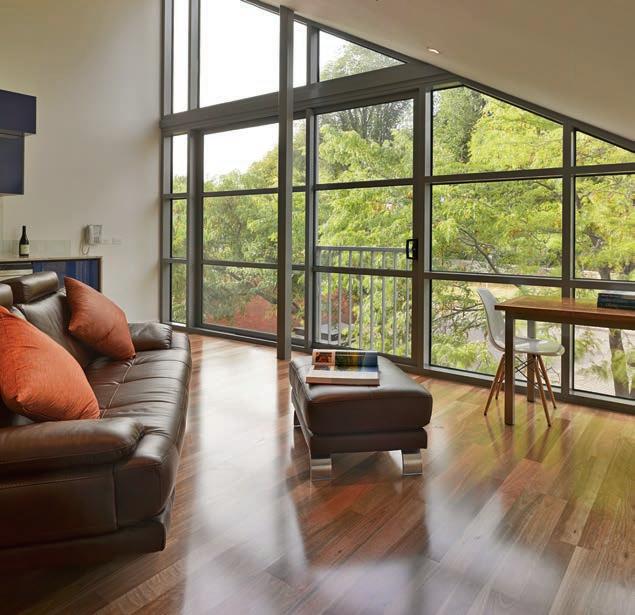
Bellerive Yacht Club was first established in 1926 to promote yachting and provide facilities for its members. Fast forward to today and the club now has over 1000 members and encompasses a clubhouse, marina, slip yard, two bars, and Anchors Restaurant which offers modern classic fare and stunning panoramic views.
The Bellerive Yacht Club prides itself on being a family friendly club with an active social calendar and improvements are continually being made to club facilities. In summer, the club runs twilight sailing on Wednesdays and racing on Saturdays, with Sunday racing taking place over winter. The club also hosts the annual Banjos Shoreline Crown Series Regatta each February, which is one of Tasmania’s largest regattas.
Visit byc.org.au
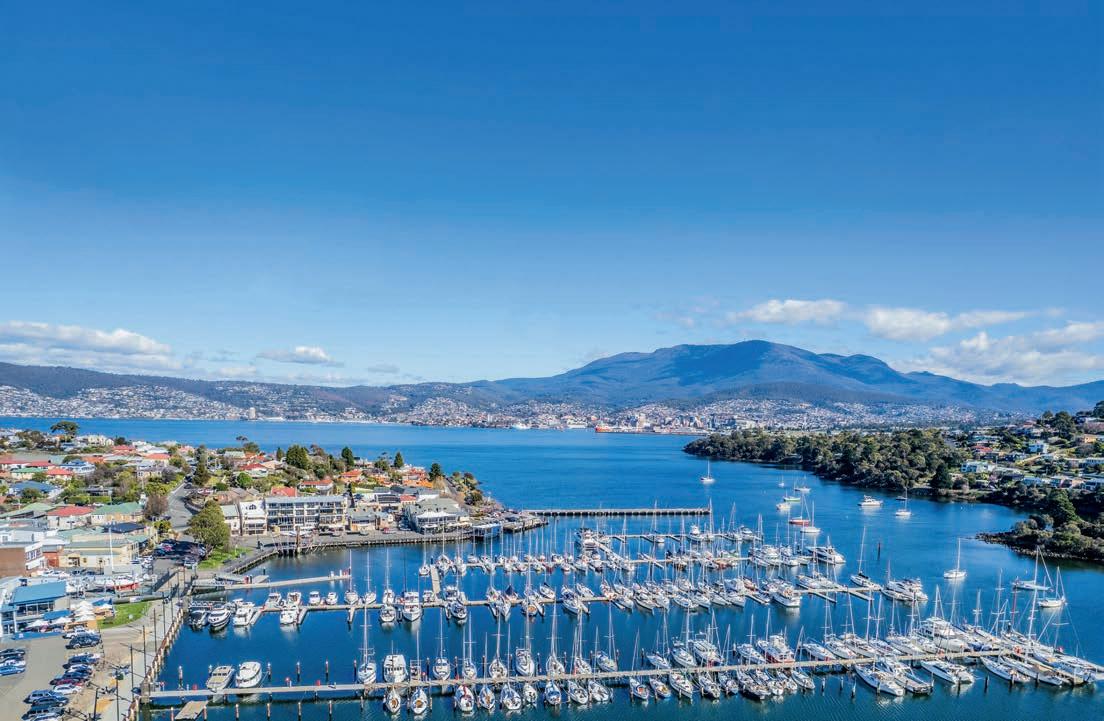
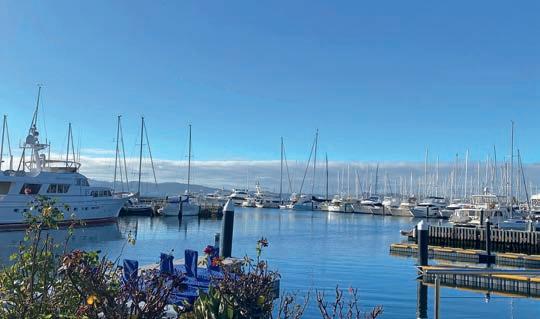
From its humble beginnings in 1906, the Derwent Sailing Squadron (DSS) has grown to become one of Tasmania’s premier yacht clubs, with a renowned sailing program and 1250-stong membership base, many of whom berth their boats in the club’s marina. Situated in a magical spot on the banks of Hobart’s River Derwent, the DSS makes an ideal starting point from which to explore many popular local cruising grounds. With its friendly atmosphere, packed calendar of racing and cruising events, well run marina and boatyard, bar, dining room and outdoor barbecue area, the DSS draws new and experienced sailors alike.
Visit dssinc.org.au

The Royal Yacht Club of Tasmania (RYCT) has a rich and storied past, serving the yachting community for over 130 years. As the Tasmanian home of the Rolex Sydney Hobart Yacht Race, RYCT has a proud tradition of competitiveness on the water and equally strong tradition of offering warm hospitality to all visitors, through its beautiful waterfront clubhouse, bistro, marina, and packed events calendar. A range of onsite marine services are also on offer, along with 24/7 fuel and trailer boat launching facilities
Visit ryct.org.au
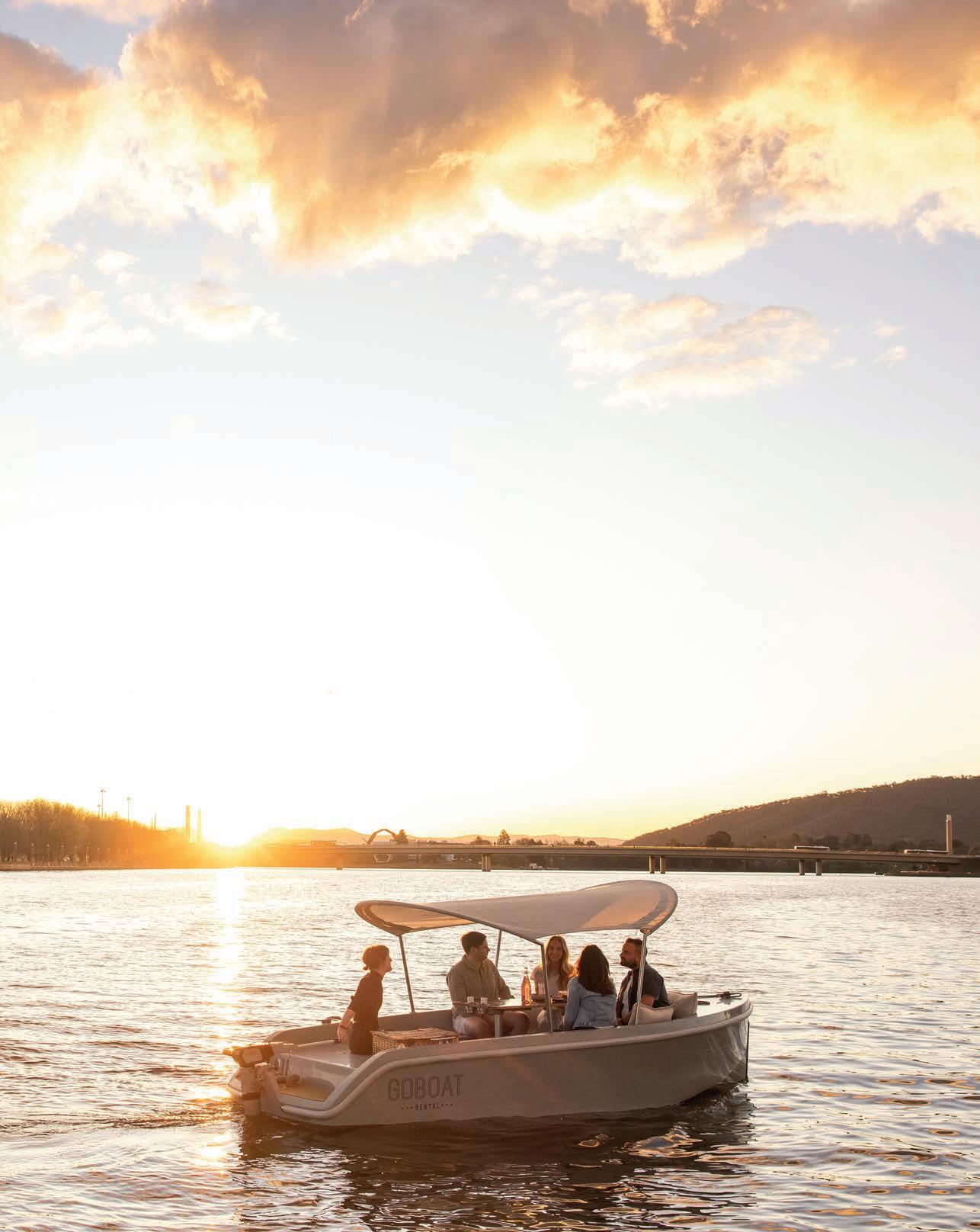
WITH SO MUCH TO SEE, DO, EAT AND DRINK, HERE’S HOW TO SPEND 48 HOURS IN CANBERRA. BY HELEN HAYES.
Our nation’s capital has been undergoing a renaissance over the past decade or two, with a thriving dining scene, magnificent art and culture, along with stunning expanses of naturally beautiful parks and wilderness areas. With a host of other attractions and foodie experiences, it is no wonder that five and a half million
people visited Canberra in 2024. Add to that a string of excellent events, such as Floriade in spring, the Enlighten Festival in autumn, the Truffle Festival in winter, and Summernats in summer. Then add the swag of world-class exhibitions, markets, and the only true national celebration of Australian wine, and you have plenty to attract you all year round.
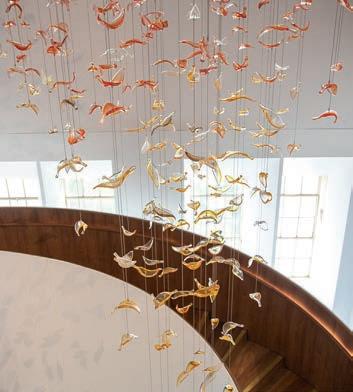
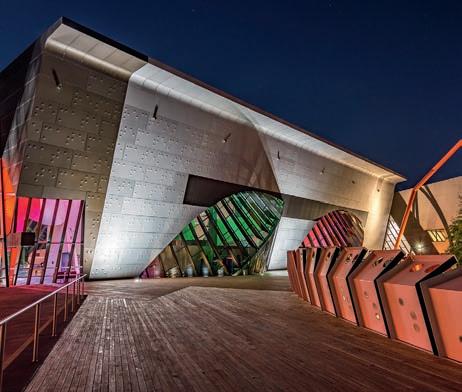

From art to politics and history, Canberra offers a rich variety of museums and galleries. The National Gallery of Australia houses over 155,000 works, including a significant collection of Aboriginal and Torres Strait Islander art, as well as European, American, and Asian pieces. The National Portrait Gallery presents portraits of notable people from various fields such as politics, sport, and the arts, while the National Museum of Australia focuses on our social history, featuring stories of Indigenous cultures, settlement, and national development through modern displays. Questacon – The National Science and Technology Centre, is popular with families for its hands-on exhibits, while the Canberra Museum and Gallery showcases the local history and contemporary culture of the Canberra region.
Parliament House is another place that is well worth visiting, and you can do a tour. It has 11 kilometres of hallways, 2,700 clocks,
17 courtyard areas and a jail cell. You can visit the Senate, see the paintings of nearly all the prime ministers, and in the reception hall where you might be able to have lunch, marvel at the tapestry which is front and centre. It took 13 women weavers two and a half years to complete, and was based on a painting Arthur Boyd did especially for it.
One of the most important museums in Australia, and certainly one of the most revered, is the Australian War Memorial. It is undergoing a major renovation, but it is still open. The new Main Entrance Foyer on level 0 is complete, and is absolutely stunning. At its centre is the striking glass and steel Oculus, which floods the space with light, and which allows visitors to see and admire the copper dome above the Hall of Memory.
Suspended above the new spiral stairs on the eastern and western sides of the concourse, admire the shimmering glass installations created by internationally
renowned artist Annette Blair at Canberra Glassworks. Blair’s artworks, Quiet skies, as the sun rises and Quiet skies, as the sun sets comprise two sculptures, each made of an astonishing 900 glass eucalyptus leaves in colours representing sunrise and sunset. This spectacular work is inspired by the Ode of Remembrance. The Commemorative Courtyard is the heart of commemoration at the Memorial, including the Roll of Honour – bearing the names of more than 103,000 Australians who died serving our country –you can place a poppy in the wall. You will also find the Pool of Reflection, Eternal Flame, Hall of Memory and Tomb of the Unknown Australian Soldier here. Enter through the new Commemorative Entrance, passing the historic Menin Gate Lions from Ypres in France. They were given to the War Memorial in 1936, and still bear the damage from WWI.

The centrepiece of Canberra, Lake Burley Griffin is a tranquil aquatic playground, with plenty of ways to explore it. You can take to the water on stand-up paddleboards or kayaks, go sailing, or fishing. Or stay by the 40km shoreline, where you can cycle, walk or just explore the many parks and gardens along the way. You can get out on the water if you want amazing views, and a close up of the Carillon. Hire a boat through Love Boats, who have a fleet of eco-friendly electric boats that can carry up to 10 people. The boats have a fully enclosed canopy with window enclosures, wraparound cushioned lounge seating, a Bluetooth stereo, and a built-in
fridge. A great idea is to organise catering or you can bring your own. No booking is required, and you don’t need a boat licence. GoBoat is another e-boat option, with their new GoBoat+ picnic boat available. You do need a boat licence for this one, as it features a more powerful e-motor. Only boats with electric motors can be used on the lake.
Drop into the Canberra Yacht Club at Lotus Bay on Lake Burley Griffin. They offer recreational opportunities as well as organised division racing on Sundays during summer, and twilight sailing Wednesday evenings. Fortnightly autumn and winter racing ensures fun year-round sailing.
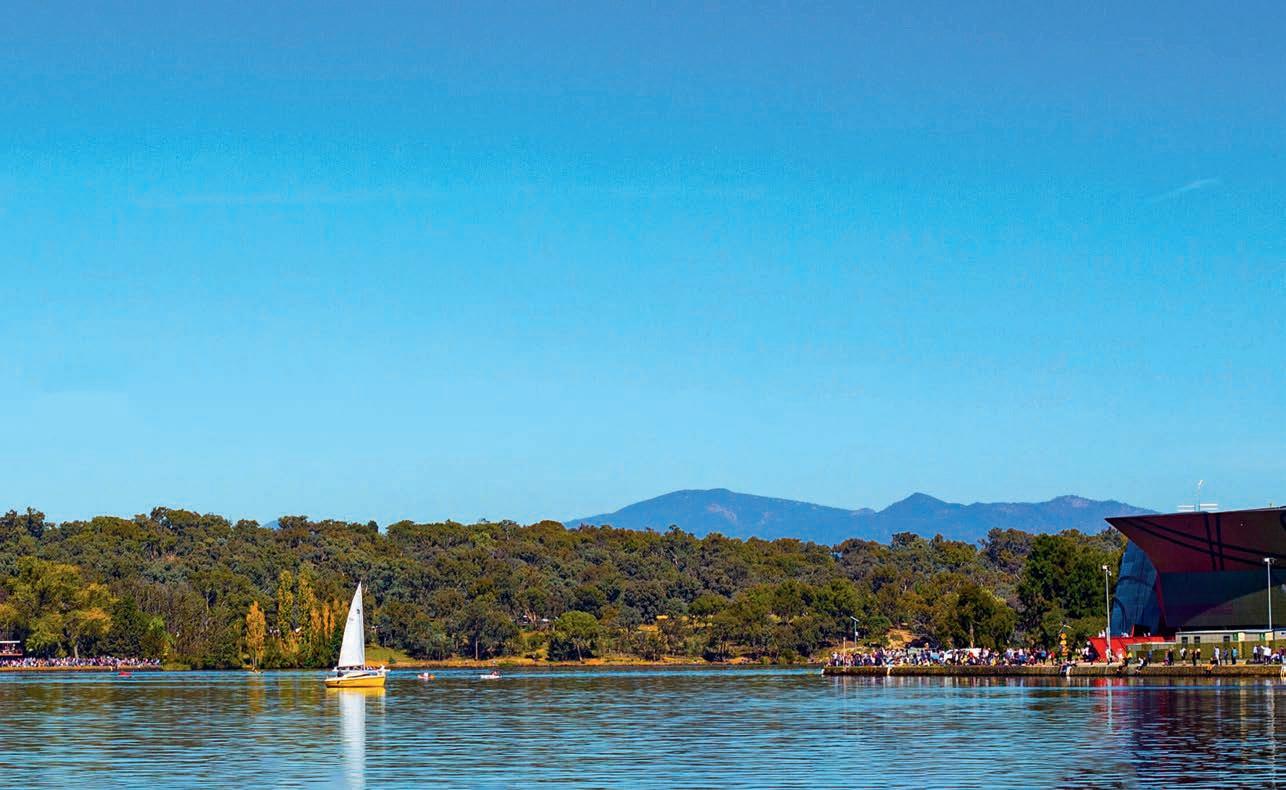
The National Capital Authority (ACA) issues boat permits to powered boats used for private recreational use (e.g. fishing boats and RIBs). These vessels are allowable, but must use auxiliary (electric) motors while on the Lake. Petrol motors do not have to be removed from boats; except in the case of an emergency, they are not permitted to be used on the Lake. Permits are issued throughout the year and are renewed on an annual basis. Temporary permits are also available for short term use such as for events.
Scan to find out more about boating permits for Lake Burley Griffin.
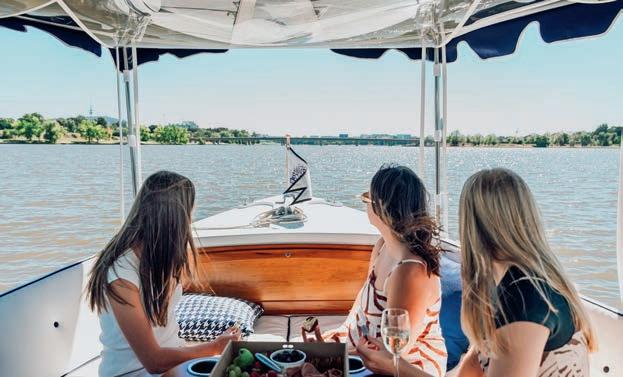
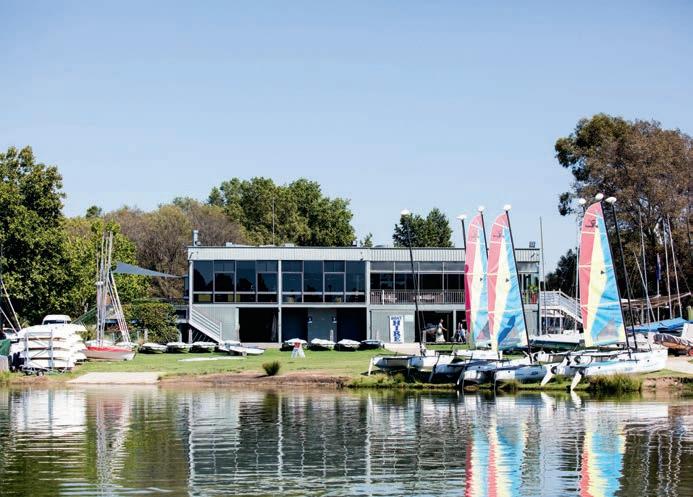
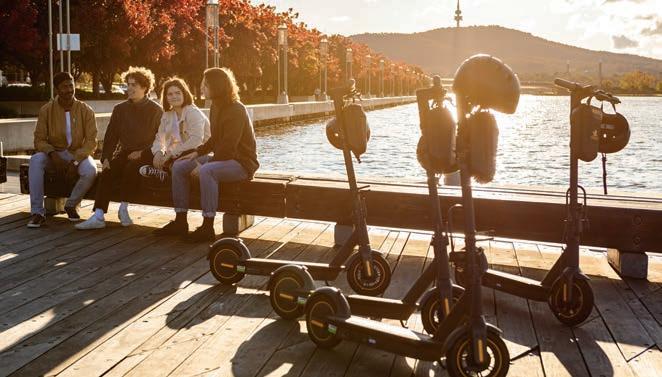

Canberra’s dining scene is well worth spruiking, with the range of culinary experiences covering everything from bar menus to fine dining. Some of the newest restaurants including Lunetta with its Italian fire-driven dishes in a striking architectural setting, Chris Lucas’s first Canberra restaurant Carlotta, Ballyhoo, and Recess, a suburban café with a cool vibe. Other places that should be on the menu are Pilot in Ainslie, Lazy Su, eightysix in Braddon, and INKA.
For some on-trend breweries, head to BentSpoke Brewing Co’s BrewPub in Braddon, which on any given day will serve 26 different draught beers, cider and two hand-pumped beers – all brewed at the Braddon site. Another cool place to grab a beer is Capital Brewing in Fyshwick.
Wine lovers are spoilt for choice in Canberra, with 140 vineyards and 50 wineries
located within 35 minutes’ drive of the city. Visit cellar doors, meet the makers, and come home laden with the fruits of your tastings. The Canberra region is known for thriving varietals like Chardonnay, Riesling, Pinot Noir, and Shiraz. Some of the best wineries to visit include Clonakilla, Helm Wines, Mount Majura and Eden Road, along with Four Winds Winery, which serves delicious wood-fired pizzas as well as fine wines. Grab a fabulous lunch at Shaw Estate Restaurant, or have a picnic through Poacher’s Pantry. You can do a half- or full-day winery tour with Van Du Vin. You can also do an e-bike tour around Murrumbateman with Canberra Wine Region E-Bikes.
June celebrates the 50th anniversary of the National Wine Show of Australia in the Great Hall of Australian Parliament House. June also sees the inaugural launch of the National Wine
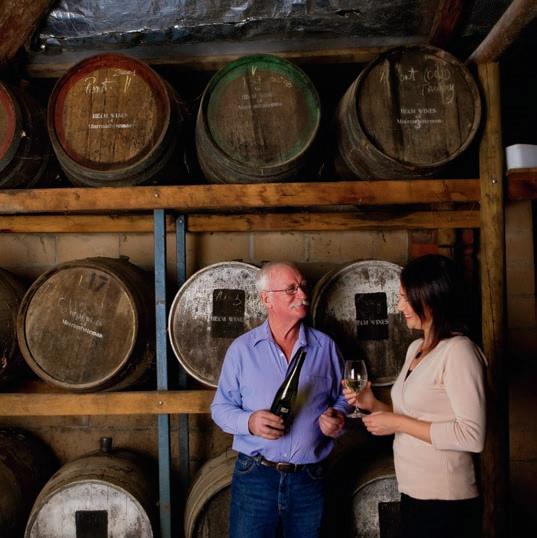
Festival of Australia, a four-day festival that toasts Australian viticulture with wine tastings, masterclasses, themed dinners, and special events, from 12-15 June.
There are plenty of great wine bars in the city as well, including Amici, 11e Cave, HighJinks, Dear Prudence and Wine Room.
In winter, Canberra is known for its world class truffles, one of the few places outside of Western Europe where these soughtafter delicacies, fetching up to $2,000 per kilo, are grown. Visit the Southern Harvest Winter Market on 28 July to meet the region’s growers, or choose from an array of experiences at The Truffle Farm or Beltana Farm. The season runs from June to August, and you can even go on a truffle hunt with the expertly trained dogs.
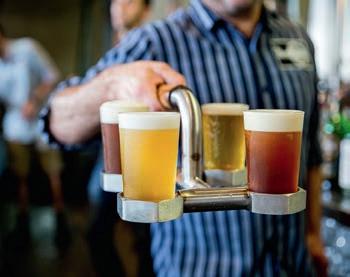



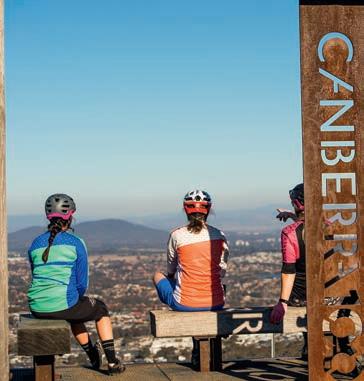

Australia’s capital also offers a massive range of outdoor activities to add to the indoor marvels. Go for a sunset stroll by the lake, take on a more challenging bushland hike, or cycle along Canberra’s world-class cycleways. Hike or ride – or drive if you’re time poor – to Mount Ainslie Lookout, and take in the panoramas over the city and surrounding bushland, and you might see some of the abundant wildlife. Black Mountain also has great views and its summit walk is one of the most famous trails in the city along with other hikes in this 434-hectare Nature Reserve. The Reserve is home to 100 species of birds, 500 species of plants and 5000 species of insects, and is the most diverse of Canberra’s nature parks. Another excellent trail is the Canberra Centenary Trail to One Tree Hill.
If you prefer two wheels to two legs, Canberra is ridiculously bike friendly, with designated bike lanes on the main roads and an extensive network of bike paths weaving their way throughout the city. Mountain bikers will love the trails through the forests and pines, while road cyclists can reward their efforts at a range of bikefriendly cafes and bakeries. If you don’t want to take your bike, hire one from Cycle Canberra or Share A Bike, who have multiple automated bike rental machines around the city.

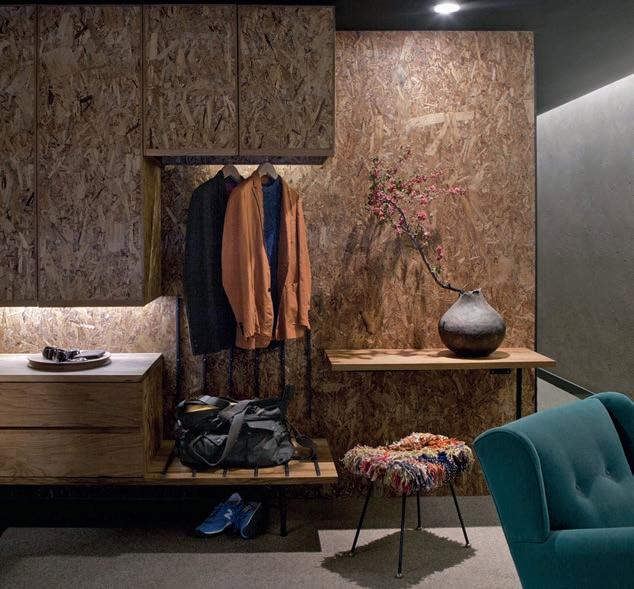
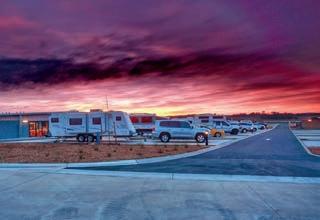

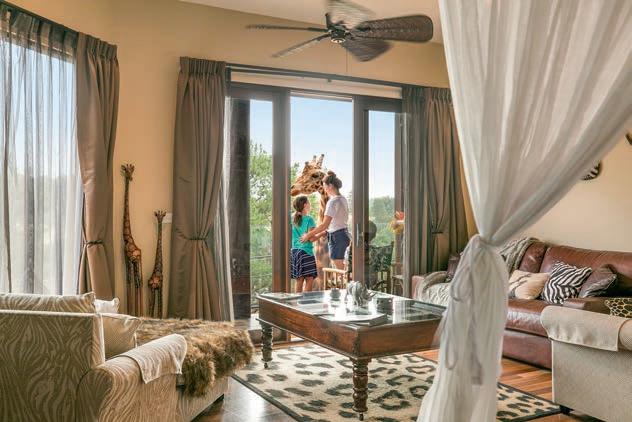
Visit Canberra: visitcanberra.com.au
Vibe Hotel Canberra Airport: vibehotels.com.au
East Hotel: easthotel.com.au
Ovolo Nishi: ovolohotels.com
Discovery Park – Canberra: discoveryholidayparks.com.au
Cotter Campground: parks.act.gov.au
Jamala Wildlife Lodge: jamalawildlifelodge.com.au
Whether you want to tow your boat, stay at a campground or holiday park, or you want to leave your boat at home and stay at a hotel, Canberra has you sorted. Vibe Hotel Canberra is a great choice, located at the airport and it has the wonderful Helix Restaurant and Bar. East Hotel is fabulous for families, and for spectacular design, Ovolo Nishi shines with its entry staircase an Instagrammer’s dream.
If you want to take a boat – be sure to check local rules on where you can take the boat before you hook it up – Canberra Park is a good option. It’s located on the Federal Highway, next door the EPIC Showground, and six kilometres from the city centre. You can also access the light rail system which is close by. Alivio Tourist Park next door to EPIC Showground is another option with a huge choice of modern and spacious villas, cabins, and drive-through powered sites. If you want to get back to nature a bit more, Cotter Campground is beautiful. Set on the banks of the Cotter River near where it meets the Murrumbidgee River, this campground caters for everything, from swags to camper-trailers and large vans. Go for a hike on one of the walking tracks, go fishing, or kayaking, and keep an eye out for wildlife, from kangaroos to emus. You might even see a platypus at dawn or dusk.
For something really wild, book well ahead to stay at Jamala Wildlife Lodge, a luxurious safari-style lodge which can get you up close and personal to lions, bears, giraffe and more. Located at the National Zoo and Aquarium, choose to stay at uShaka Lodge which has seven individual rooms and suites, with its own shark tank, or stick your neck out and stay in one of the Giraffe Treehouses. The five Jungle Bungalows adjoin an enclosure within the Zoo, so you might find yourself with nothing but a (strong) glass pane between you and a lion, cheetah, sun bear or tiger. Guests of Jamala also enjoy an amazing African-influenced dinner in the rainforest cave, and enjoy several special experiences, such as meeting the Colobus monkeys, and doing a guided morning tour before the Zoo opens its gates. With so many things to see and do, your challenge will be just how much you can fit in in 48 hours.

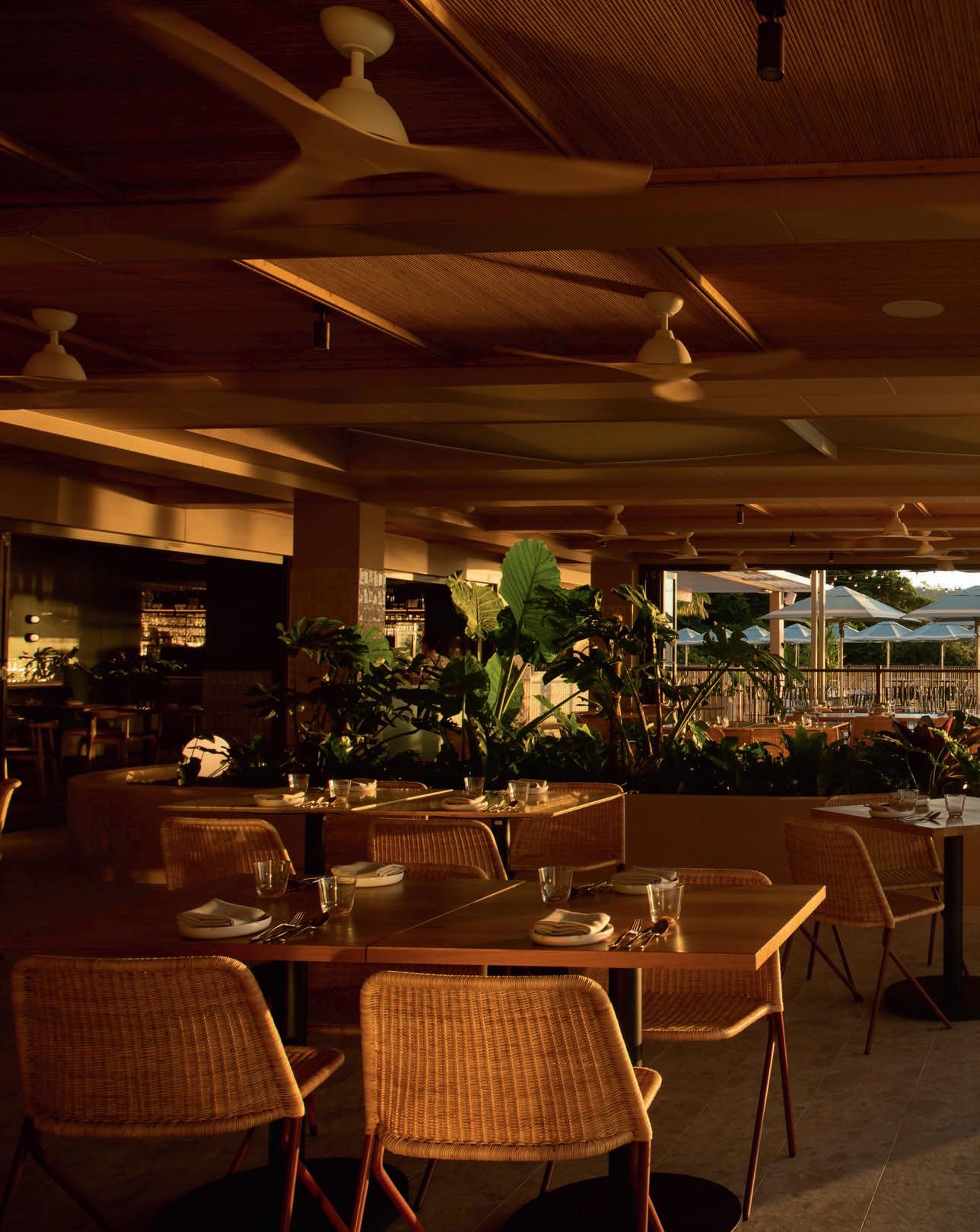
ACCLAIMED CULINARY DUO JOSH AND JULIE NILAND HAVE BROUGHT THEIR SIGNATURE STYLE OF RELAXED, YET ELEVATED DINING TO HAMILTON ISLAND, WITH THE OPENING OF CATSEYE POOL CLUB.
The sun is shining even brighter on Hamilton Island after the muchanticipated opening of its new boutique hotel, The Sundays, along with its signature dining experience, Catseye Pool Club. The restaurant, helmed by Josh and Julie Niland, is already making a splash with its long, leisurely meals by the water, infused with the laid-back spirit of The Whitsundays.
Designed for sun-drenched poolside dining with sweeping views over Catseye Beach, Catseye Pool Club brings a fresh take to communal eating. “While ‘family
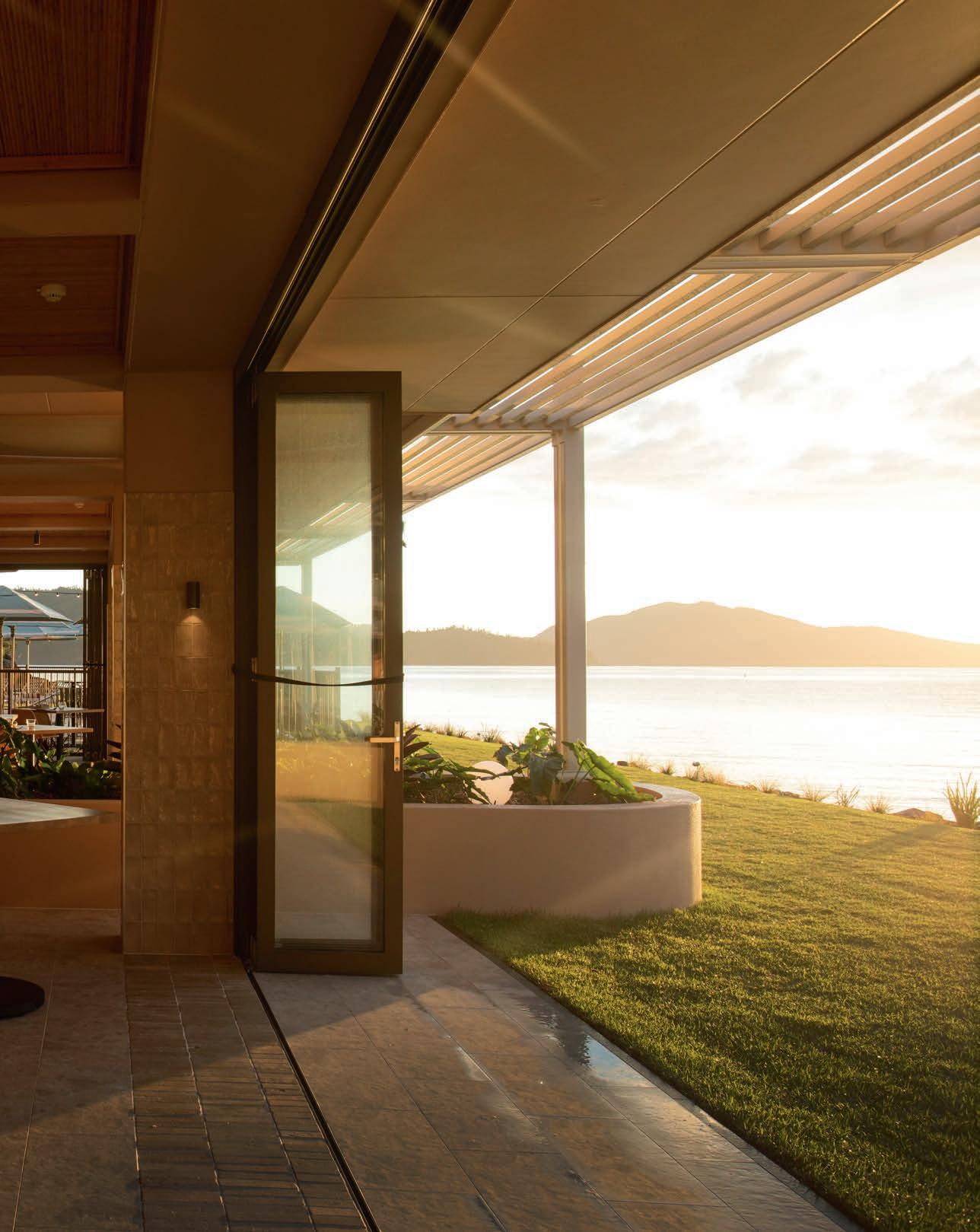
style’ or ‘share style’ dining is very much a way restaurants have operated for many years, the Catseye Pool Club approaches its menu with each item very much designed to be enjoyed as a whole table, with all the trimmings coming with each dish,” explains Josh.
The menu highlights peak Australian produce in a relaxed, coastal setting. Think whole fish cookery (but not a seafood-only focus), sun-ripened flavours, and dishes that celebrate abundance – perfect for gathering with friends and family.
Exclusively for hotel guests, breakfast includes delights like fresh pastries, ‘CPC’ Spanner Crab Royale, and Coconut and Verjuice Honey Bircher.
Beyond the plate, Catseye Pool Club embodies the ethos of The Sundays: rest, connection, and barefoot luxury. “It’s about creating an atmosphere where everyone can detach, unplug, and simply enjoy being together,” says Josh. Paired with a Queensland-focused cocktail list by Sam Cocks, and the ever-stunning Whitsundays backdrop, Catseye Pool Club offers a truly idyllic restaurant experience.
JOSH NILAND SHARES HIS SECRETS FOR CREATING THE ULTIMATE LOBSTER ROLL.
Cooking a crayfish can be very intimidating, so it’s important to follow the steps below for the best results.
• Start with a live crayfish, and make sure it spends at least 60-90 minutes in the freezer to ensure the crayfish is asleep.
• Weigh the crayfish on a pair of scales. For every 100g of crayfish, it ’s 1 minute, plus an additional 2 minutes added to the total. For example, a 1kg crayfish would be cooked for 12 minutes (10 minutes + 2 minutes).
• Bring a large pot of heavily salted water to the boil. The pot needs to have a fitted lid. Carefully place the whole crayfish into the boiling water and fit the lid. Cook for the suggested time frame as mentioned above.
• Once time is up, carefully remove the crayfish from the water with a slotted spoon and place it onto a large tray. Leave to cool for at least 2-3 minutes.
• Proceed to carefully remove the shell from the crayfish.
• A nother really important tip is to detach the tomalley from the head and then add it to a good quality mayonnaise, along with some freshly cut chives, dill or tarragon as a delicious sauce to put on your roll.
• A nother piece of advice is to cook the crayfish when you wish to consume it, as eating crayfish or lobster from the fridge isn’t as luxurious in terms of texture, compared to when it’s warm from the pot.
• Use good quality flake salt, good quality salted butter, and if you don’t want to make your own bread, then don’t complicate the choice with a sourdough or bread that has too much structure. To me, the white, fluffy, floury top rolls that often leave you with floury cheeks are the best.
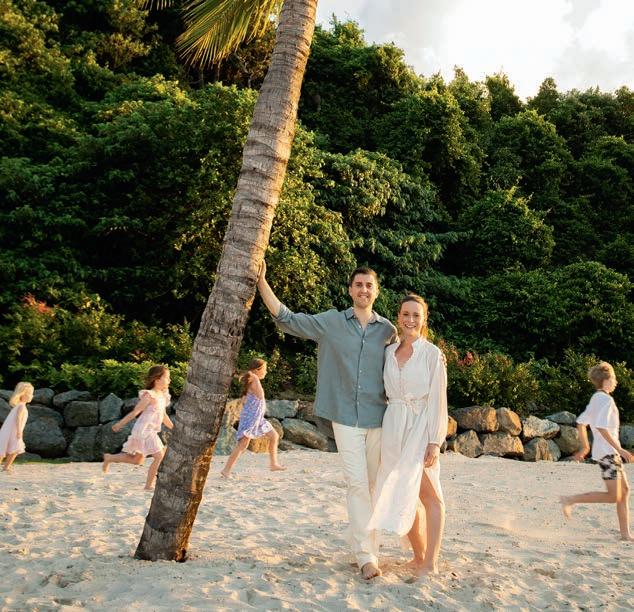
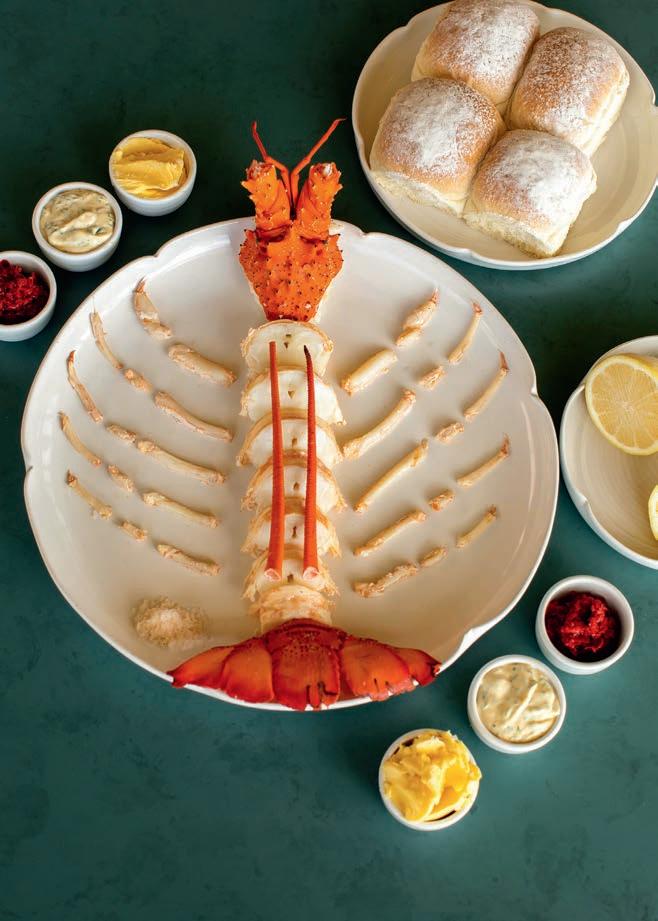
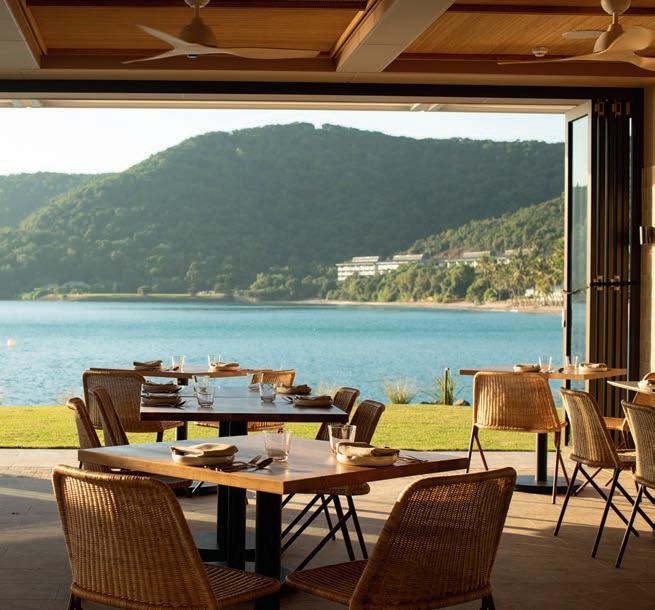
Scan to find out more about Catseye Pool Club.
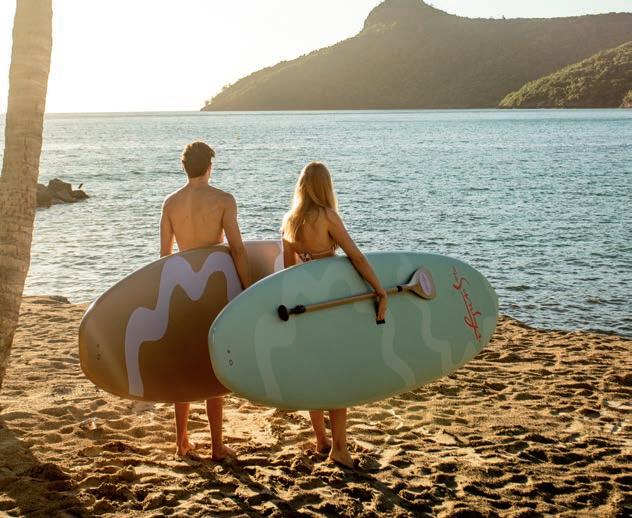
Hamilton Island, one of Australia’s most beloved holiday destinations, has just opened the doors to its newest boutique hotel The Sundays. Now welcoming guests to the heart of the Great Barrier Reef, this beautiful hotel spans 59 rooms, spread over three floors, all just steps from idyllic Catseye Beach. Choose from The Sundays Rooms or Family Connect Rooms, with each suite designed with a relaxed, coastal aesthetic, with ocean or garden views. Every day feels like Sunday at The Sundays, offering a sanctuary for those seeking barefoot luxury in the heart of The Whitsundays
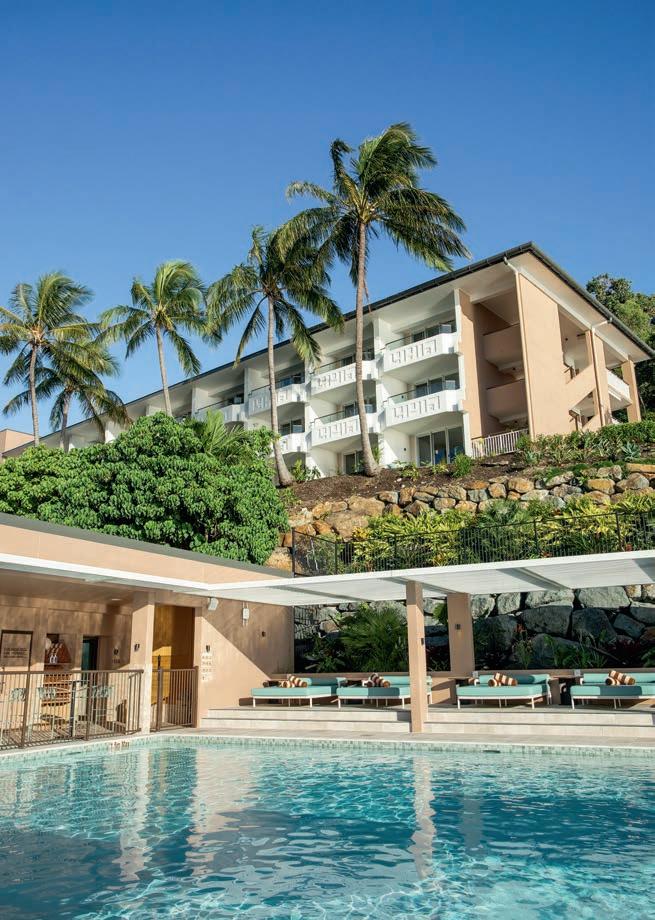
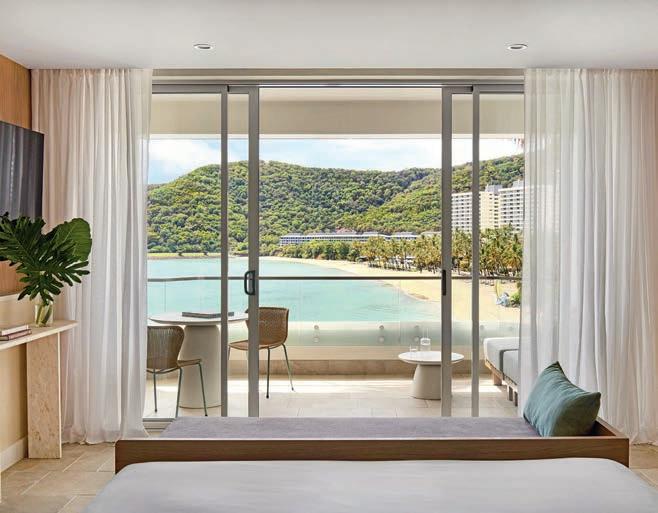
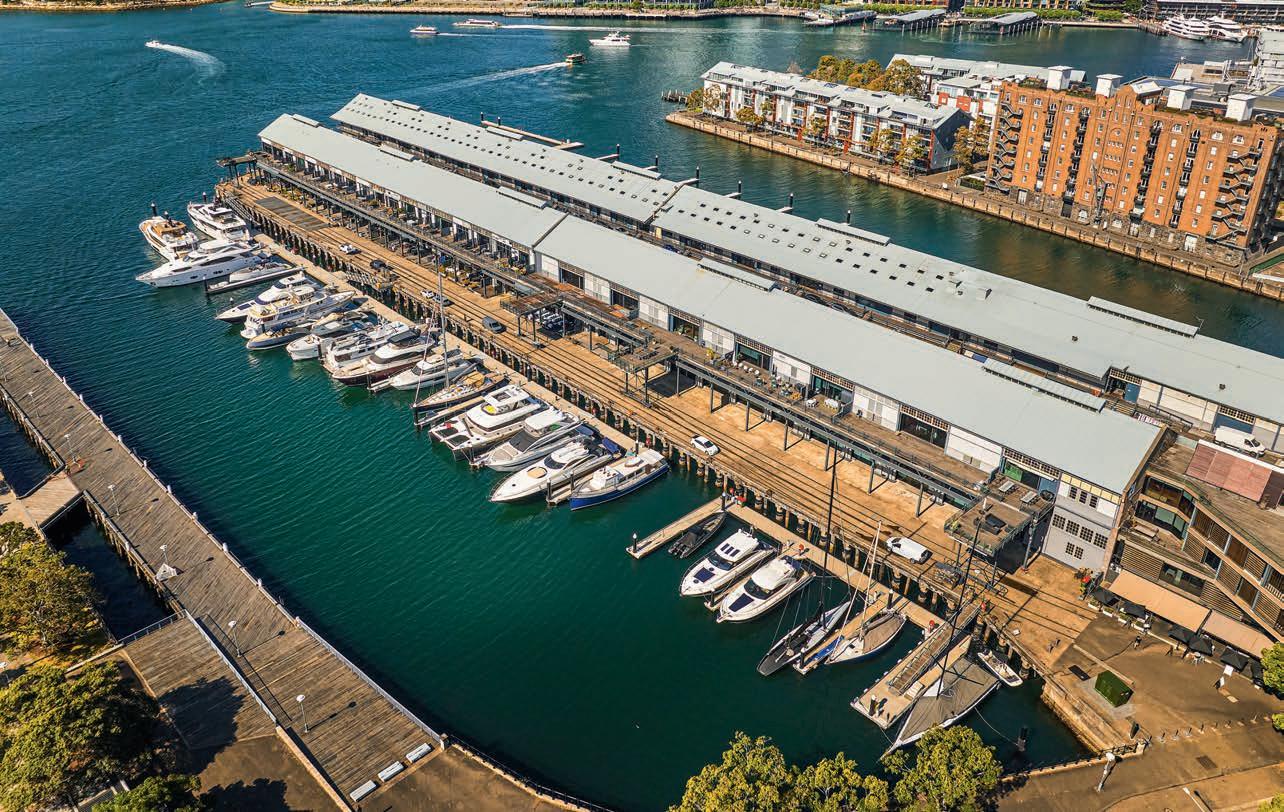
THE GENERAL MANAGER OF BELLINGHAM MARINE SHARES SOME INSIGHTS ABOUT THE BRAND’S OPERATIONS, PROJECTS, AND THE FUTURE OF THE MARINA INDUSTRY.
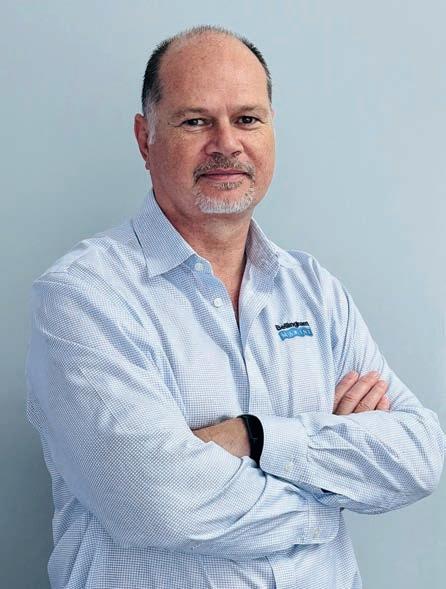
Many of our readers will be familiar with Bellingham Marine, and but for those who aren’t, please share an overview of the company.
For over 65+ years we have been the global leader in building marina structures on the water, setting the benchmark for waterfront excellence. From a superyacht marina in Dubai built inside a Formula One racetrack, to the famous resort golf course 14th hole at Coeur d’Alene in Idaho, and the exceptional lakeside Queenstown Marina with its commercial floating sheds, our projects exemplify excellence across diverse waterfront settings. How did the Bellingham Marine story begin?
Our story began in 1928, when Bellingham Marine was founded as Bellingham Builders Supply. We initially focused on building materials but soon expanded into precast concrete walkways and pontoons to meet local demand. One of our first major marina projects was at Shilshole Marina in Seattle in the late 1950s, where our UNIFLOAT docks stood the test of time for over 50 years. Today, we’ve grown far beyond the Pacific Northwest, with 19 offices and projects on every continent.
Can you give us a snapshot of Bellingham Marine’s operations across Australia and New Zealand?
The 90s marked a time of international expansion for Bellingham Marine. In Australia, this growth kicked off with the acquisition of Pacific Marinas in 1997. A factory and head office were established in Brisbane, along with sales and project management offices in Sydney and Melbourne. Within just a couple of years, Bellingham Marine Australia had become the leading marina builder in the country.
The following year, we expanded into New Zealand with the purchase of marina construction assets from Fletcher Construction, laying the groundwork for Bellingham Marine New Zealand. A head office and manufacturing facility were set up in Auckland, and from there, we built a strong presence throughout New Zealand and the Pacific Islands.
What are the guiding principles that drive the Bellingham Marine brand?
Our guiding principles centre around innovation, integrity, and our commitment to research and development to improve our products and enhance the client experience.
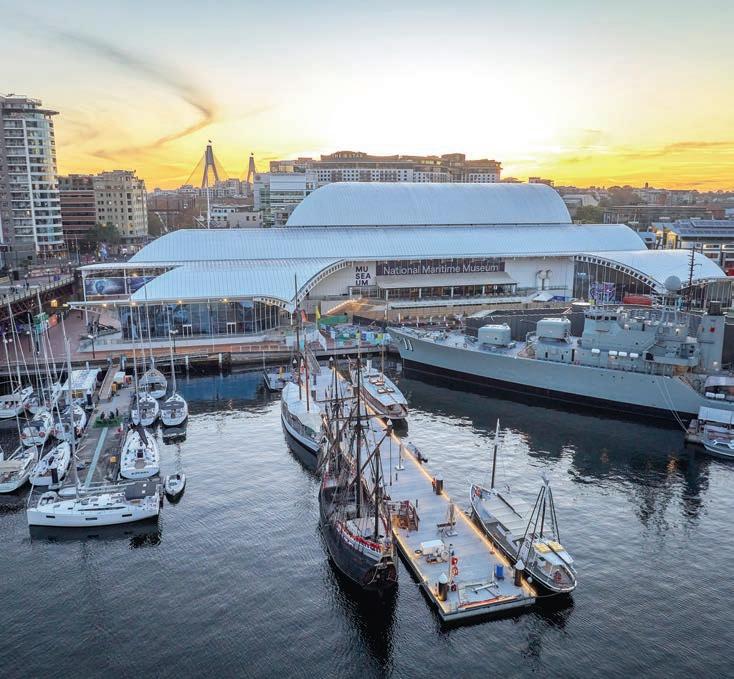
Our teams deliver site-specific solutions to our customers. In terms of sustainability, we’re committed to delivering long-lasting infrastructure that stands the test of time. With a focus on extended lifespan and low maintenance, we help marina owners achieve cost savings over the life of their investment.
What factors do you attribute Bellingham Marine’s success to?
Bellingham Marine’s success comes down to a few key factors: a clear vision, strong technical expertise and a deep understanding of the marina industry. We’ve built long-term relationships by consistently delivering reliable, high-performing infrastructure that meets the real-world needs of marina owners and operators. Our design/build delivers the best value to our customers. This turnkey approach means we take responsibility for quality, price and program.
Can you highlight a few recent standout projects?
A recent standout project is the upgrade at Bucklands Beach Yacht Club in Auckland. The marina suffered major damage during a
2017 weather event, particularly to its floating attenuator and timber pile seawall.
Bellingham Marine provided a unique solution using FRP (fibre-reinforced polymer) technology. We installed the world’s first FRP double walers on a wave attenuator, replacing the traditional timber systems. We also built a non-ferrous seawall using custom FRP panels and underwater plastic fasteners, designed to maintain structural integrity even when fully submerged. This project is a great example of our innovative approach and focus on longterm durability.
Closer to home, Jones Bay Superyacht Marina in Sydney was a challenging project reconfiguring and extending the marina to berth boats up to 250ft. Our subsidiary Marine Technologies did a great job on the power pedestal as well. Jones Bay Superyacht Marina won 2023 Marina of the Year at the Nautilus Marine Awards.
Bellingham Marine recently won the Industry Innovation Award at the Nautilus Marine Insurance Marina of the Year Awards. What did the win mean to yourself and your team?
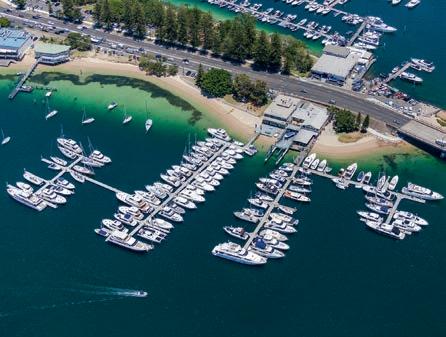

Winning the Industry Innovation Award for our UNIFLOAT system was a proud moment for our entire team. It’s great to see the hard work and forward thinking behind this product recognised at such a respected event.
The award highlights the success of our 100 per cent non-ferrous solution, developed to help marina owners reduce maintenance and extend the lifespan of their infrastructure. A lot of the innovation behind today’s UNIFLOAT system has come from our local team, so this recognition means a lot to us personally and professionally. It’s a reflection of our ability to listen to customers and push forward with smart, durable and sustainable design. Please share some background about your career in the marina industry.
I’ve been in the marina industry since 1997. Over the years, I’ve had the opportunity to lead some incredible teams and projects, first in New Zealand where we grew the business significantly and became a trusted name in marina design and construction. In 2021, I stepped into the role of General Manager for Bellingham Marine Australia. I’m proud to be part of a team that’s constantly pushing the
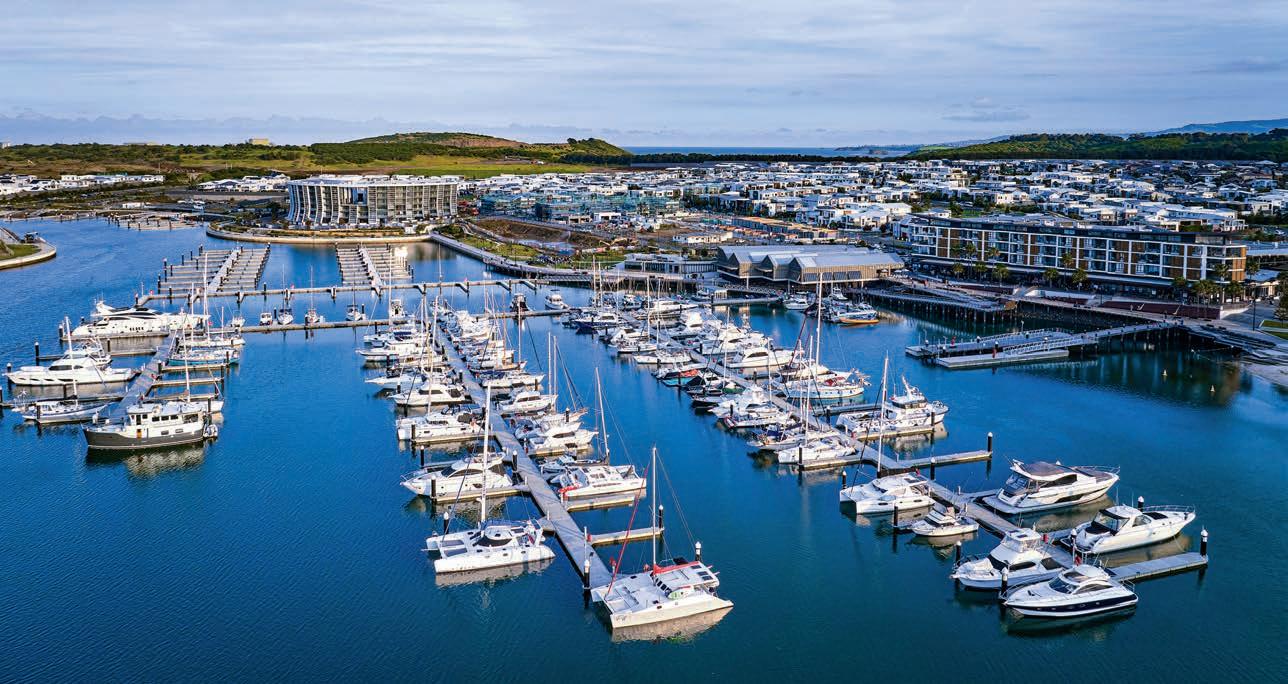
industry forward. I also serve as a Director with the Marina Industries Association and Chair of the Global Marina Institute, which allows me to contribute to the broader growth and development of our sector.
What do you find most rewarding about your role as General Manager of Bellingham Marine Australia?
Leading such a passionate and talented team. I truly believe I work with the best people in the industry. It ’s incredibly fulfilling to see a marina take shape from the ground up, especially knowing that our work will serve the community and waterfront for decades to come.
I also value the strong, long-term relationships we build with our clients. There’s a real sense of trust and collaboration that develops when you work closely together on complex projects. Every site is different, and finding the right solution for each one keeps the work interesting and rewarding.
Talk us through a typical day in your role. There’s really no such thing as a “typical” day, which is part of what I enjoy about the role. One day I might be reviewing project timelines or budgets, the next I’m on site checking progress or meeting with clients. I spend a fair bit of time working with our team across Australia and New Zealand, helping to solve technical challenges, planning future works, or supporting our people in their development.
A big part of my role is making sure we stay aligned as a business. That means keeping in close contact with our operations, manufacturing and design teams, making sure everyone has what they need to deliver quality results. I also stay connected with clients and industry groups to ensure we’re always improving and moving in the right direction.
What advice would you have for someone reading this who is considering pursuing a career in the marine industry?
My advice would be to jump in and get involved. The marine industry offers a wide range of opportunities, whether your interests lie in engineering, construction, project management, manufacturing or client-facing roles. It’s a rewarding field where you can see the impact of your work in real time.
Be curious and open to learning. The industry is always evolving and being willing to adapt and grow will take you a long way. Hands-on experience is just as valuable as formal training, so take every opportunity to be on site, ask questions and learn from the people around you.
On a personal level, are you most passionate about power or sail?
I’ve spent most of my career around marinas, so the boats that I enjoy the most are the ones owned by my friends. When I get time, I enjoy sailing with Pete Cook and the team on GCCM
out
The social side of boating is there for everyone to enjoy.
What does the future hold for Bellingham Marine?
We’re entering a really exciting time for the marina industry. There is more interest than ever in waterfront development, not just for boats but for people. From tourism and hospitality to public access and floating infrastructure, the opportunities are growing. This shift is opening the door to more creative thinking, more complex builds and more innovation. The future of marinas is no longer just about building berths. It is about creating destinations that serve both boaters and the wider community.
Planning the design of these facilities requires developers to keep ahead of the trends. We help identify the shifts in boat sizes, security, power, water, pump-out and accounting for consumption, using eco-efficient systems, as these are constantly changing. The sea is a wonderful place to recreate, rest and recharge. I look forward to seeing you out there!