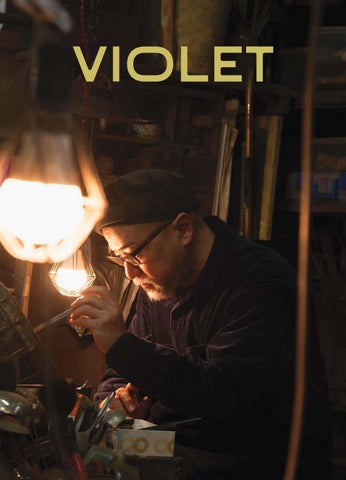
Passion rarely looks the same from one moment to the next. It unfolds over time, shaped by process, change, inspiration, and lineage. This season, we share stories of those carried forward by such forces, and of the ways their practices enrich lives beyond their own.
We glimpse how craft endures not through replication but renewal. In Morioka, Japan, foundry master Shigeo Suzuki Morihisa guides his familyâs centuries-old Nambu tekki studio into its next chapter. On Oâahu, Lydia and Ron Querianâs House of Gongs reimagines an ancestral art practice as an expression of the Filipino diasporaâs evolving identity.
Restaurateur Kumi Isekiâs dining ventures trace a thoughtful arcâfrom teppanyaki counters to mille crêpes salonsâwhile multimedia artist Max Cleary, drawing upon his ancestral homeland of Okinawa and his Hawaiâi upbringing, reflects on time, distance, and belonging. Meanwhile, in Tokyo, world barista champion Hide Izaki approaches coffee as a deliberate practice, transforming the everyday into ceremony.
Such stories prove that what lasts is not the result of a singular gesture or outcome, but of the willingness to return, day after day, with care and intention. As we contemplate the year ahead, weâre reminded that meaning is not found in arrival or achievement, but in the steady work of staying, refining, and building upon what came before.
StÃŒssy RIMOWA | kate spade new york | Island Snow | Kahala | Yumi Kim | Dean & DeLuca | Island Vintage Wine Bar
Doraku Sushi | Noi Thai Cuisine
Changâs | The Cheesecake Factory
Tim Ho Wan
Sixteenth-generation foundry master Shigeo Suzuki Morihisa, photographed by Laura Pollacco at his familyâs 400-year-old Nambu tekki studio in Morioka, Japan.
Under construction at 888 Ala Moana, Älia rises along Honoluluâs shoreline, offering sweeping ocean views, lush terraces, and 1-, 2-, and 3-bedroom residences inspired by Hawaiâiâs beauty and designed to deliver an unparalleled living experience.
CLIENT
Resort-style amenities, open-air gathering spaces, and landscaped gardens are thoughtfully designed to invite relaxation, encourage connection, and enrich daily life.
Suzuki Morihisa is guiding his familyâs storied Nambu tekki studio into its next chapter.
The summons came from Morioka, seat of the Nambu clan. Having cemented their lordship over Japanâs northern region in 1597, the samurai lords turned their attention to its natural resources. Fed by three rivers, the cold mountainous region boasted an abundance of iron sand, clay, and charcoal, the perfect conditions for casting iron.
To transform Morioka into Japanâs preeminent center for iron casting, they called upon skilled artisans. Among them was Ietsuna Suzuki, a metalworker from Koshu, who, upon arriving in 1625, set up a foundry within the city.
Thanks to an abundance of natural materials and the generous patronage of the Nambu clan, Suzukiâs craft flourished. Meanwhile, sandand-clay molds allowed forms to be made and remade, each iteration allowing for further refinement. Centuries of craftsmen have since inherited the approach. Each generation imbued the craft with their own artistry, passing it on until a distinct styleâlater known as Nambu tekkiâtook form.
Sixteen generations later, Suzukiâs lineage remains rooted in Morioka as his descendant, Shigeo Suzuki Morihisa, now stewards one of Japanâs oldest Nambu tekki studios, a role that carries the weight of sustaining the craftâs future.
Nambu tekki was part of Shigeoâs life from an early age. As a child, visits to his grandparentsâ Morioka home were spent playing in the sand used to
make molds. Even so, he did not expect to inherit the family business. It was his mother who was a Suzuki, he explains through a translator, and âthere were other relatives we thought would take over first.â That assumption changed in 1993, when his mother, Shiiko Kumagai, was named the 15th-generation Suzuki Morihisa masterâthe first woman in the family to hold the titleâforever altering Shigeoâs path.
He studied casting at the Tokyo University of the Arts. After graduating, he chose to remain in the capital a while longer, taking work as a graphic designer for his older brotherâs streetwear brand, GDC. He immersed himself in contemporary fashion and modern art, forming friendships with designers who would have a lasting mark on his thinking. Among them was Shinichiro Ogata of Simplicity Co., whose craft-oriented approach offered Shigeo a new framework for bridging tradition and modernity.
In 2008, finally feeling ready to return home, Shigeo moved back to Morioka. With such a long hiatus, though, returning to the craft was a challenge. âIt took a long time for me to feel like my hands knew what they were doing, how to approach the craft with confidence,â he says. For three years, he trained under the studioâs senior craftsman while learning about the history of the Suzuki family and the current situation of traditional crafts from his mother.
Over time, he began to experiment, introducing forms that complement modern interiors and appeal to audiences beyond Japan. In 2014, he assumed the role of representative director from his father. Nine years later, his mother passed the mantle on, naming Shigeo head of the family business.
Though his role was shaped in part by filial obligation, there is no doubt that Nambu tekki is Shigeoâs calling. In the workshop, a meditative focus settles over him. There, his hands deftly shape the testubin (kettle) mold, pressing dozens of nodes onto the surface in an arare (hail) pattern, a hallmark of Nambu ironware. More than mere aesthetics, the technique thickens the iron, increasing its capacity to retain heat.
This step is Shigeoâs favorite part of the process. âOnce the iron is poured in, the mold is destroyed and can never be perfectly replicated,â he says. âIt exists like this only for a moment. Then, it is gone.â Later, once the casting burrs
Iron-cast kettles by Suzuki Morihisa Studio are as artistic as they are functional, with many sporting elaborate designs.
Among the
have been removed, the piece will be charcoal fired at 1,652-degrees for an hour and its interior coated with an oxidized layer, rendering it rust-proof even when filled with water. After firing, the exterior is polished and finished with a lacquer coating, which imparts color and prevents further oxidation.
Even as Nambu tekki wares abound, taking the diverse forms of wind chimes and sukiyaki pots, tetsubin remains ever popular. Devotees swear by the kettleâs health benefits, attributed to the ionized iron released from its oxidized interior into the boiling water. For this reason, tea prepared with water from a tetsubin is thought to have a superior taste. Iron softens the water, resulting in a sweeter, mellower profile. Within the refined world of Japanese tea, there is no better vessel with which to brew.
At Suzuki Morihisa Studio, one can purchase tetsubin from across the familyâs centuries-long oeuvre, including designs by 13th-generation master Shigeyoshi Suzuki Morihisa. The first Nambu tekki craftsman to be named an Intangible Cultural Property, his stylish hino-maru tetsubin are perennial favorites. Alongside them sit Shigeoâs own designs, sporting modern, architectural touches.
In recent years, though, Nambu tekki has faced an uncertain future as demographics change, the market
first metalsmith families in the city, the Suzukis still operate out of Morioka, Japan over 400 years later.
A team assists Shigeo Suzuki Morihisa in crafting the familyâs award-winning wares, from windchime figurines to their ever-popular kettles.
Shigeo continues to evolve his familyâs oeuvre, redesigning elements to complement modern tastes.
shifts, and fewer new artisans learn the art. Rather than consigning the craft to the annals of history, Shigeo works to elevate its place in contemporary life. He has redesigned forms for modern tastes, casting tetsubin with sleek cylindrical shapes and angular handles, while situating Nambu tekki in spaces where the artâs intricacies can be truly appreciated.
In the executive lounge of Hotel Chinzanso Tokyo, for example, an exhibition case displays the familyâs most notable designs. Meanwhile, Shigeoâs old friend, the designer Shinichiro, furnishes his stylish restaurants with Suzuki Morihisa Studio wares. And in late 2025, under Shinichiroâs guidance, Shigeo collaborated with sculptor Clara Imbert to produce three pieces for Beyond Our Horizons, part of Chanelâs la Galerie du 19M Tokyo exhibition. In the gallery space, the craftsmanship of Nambu tekki seemed to transcend its utilitarian origins, asserting itself as art.
For his part, Shigeo is reticent to predict the craftâs future, choosing instead to focus on the present. âI canât foresee that far,â he says. âAll I can do is continue to promote the quality of our product and ensure the knowledge is there to be handed down to the next generation.â
Max Cleary has an obsession with time. Not the past or present, but that evershifting in-between: the liminal space spanning what was and what is. He often finds himself wandering the rooms of a museum. And when he lingers before an artifactâan ancient slab, say, or a well-worn teacupâit is not the object itself that holds him.
âAt some point, that cup was just a cup,â he says. But then, it became someoneâs, then their familyâs. Over time, it was set aside, kept solely for special occasions. Eventually, the weight of history made it too important to use altogether. Now, inside a museum, encased in glass, it carries a significance that transcends its everyday end. Time altered the cup, not in form, but in what it came to mean. âThereâs these weird life cycles to things,â Cleary says, âthat have so much to do with people and time and places.â
Clearyâs work as a multimedia artist is a never-ending meditation on such slippages of meaning. He fashions furnishings that draw on the chip-carved traditions of tramp art, a craft once dismissed as brica-brac yet now housed in museums. He photographs his grandmotherâs Hawaiâi home, memorializing seemingly mundane things on film: a cutout cat with marble eyes hung above the doorway; old jars filled with water, dotted across the yard.
The jars are meant to keep the pests away, his grandmother
Translation by Mutsumi Matsunobu 翻蚳 = æŸå»¶ãã€ã¿
once explained. Someone long ago had passed down the wisdom. Now it persists as a ritual of sorts, inscribing otherwise commonplace objects with a talismanic quality.
Identity is a similarly mutable thing, particularly for Cleary, an Uchinanchu American brought up in Hawaiâi. His ancestors had emigrated to the islands in the early 20th century, seeking work as contract laborers on the plantations. Decades of assimilation followed. In time, cultural and geographic distance eroded their lineage until the contours of his family history were worn smooth.
In that absence, he grew up thinking he was Japanese, as his family claimed. It wasnât until his late teens that his grandmother brought forward a revelation. âNo, youâre not Japanese,â she said to him, almost offhand. âYouâre Okinawan.â
What followed was a reorientation toward his newfound homeland. He learned about the archipelagoâs geography and heritage, its subjugation under Japan. That history unsettled him in its familiarity. âThe relationship between Okinawa and Japan is so related to the U.S. and Hawaiâiâthese two island systems overthrown for a militaristic advantage,â he says. It stirred a long-held unease. âI consider Hawaiâi home. But on some level, I canât escape the feeling thatâI donât knowâIâm the intruder. Iâm trespassing on the lawn.â
That tension kept hold even when Cleary moved to Seattle, where he took up photo media at the University of Washington. The disquiet only deepened with distance. Away from the islands, his Hawaiâi upbringing took on an exotic cast, and the place he had long hesitated to claim as home came to define him.
âPeople were like, âOh my god, youâre a novelty. Youâre from these islands,ââ he recalls. Still, he resisted anchoring his work to a characterization that felt so charged. âIâm not going to capitalize on that,â he told himself.
One can sense this measured distance in his early work, which sidestepped identity in favor of technical inquiry. His photographs revolved around the careful staging of scenes, treated less as subjects than as experiments in seeing.
years, Max Clearyâs debut monograph, The Complex Number Zero, was a meditation on the mechanisms of origin through the lens of his Uchinanchu American identity.
Now based in Los Angeles, Clearyâs artistic practice spans film photography, jewelry making, and woodworking.
In between, he took trips back home, documenting moments with his family on film. On several occasions, they organized excursions to Hawaiâi Island, visiting the plantation towns where his grandmother once lived. Once, he brought his mom to Okinawa, imagining the trip might resolve that displacement he long carried. âIn my mind, I was going to have some profound experience. Like, if by blood, Iâm allowed to be in Okinawa, will I feel at home there?â he says. âAnd I went and realizedânot really.â
All that remained hidden, though, until the Covid-19 pandemic, when lockdown barred him from accessing the studio. Restless and in need of a project, he examined those family photos with a new intentionality. Once-haphazard
The uncanny charge in Clearyâs images is less a stylistic effect than a way of observing how time alters the meanings carried by objects and memories.
Clearyâs latest body of work draws on the chip-carved traditions of tramp art, a late-19th-century American folk practice defined by layered, geometric carvings made on scavenged wood using basic hand tools.
moments revealed unexpected congruences: his grandmother in a plantation town along HÄmÄkua; his mother exploring a cave in Okinawa.
The images traced a triangulation across Oâahu, Okinawa, and Hawaiâi Island, holding the fractures and continuities of his identity in tension. What followed was his first monograph, The Complex Number Zero, an attempt to probe the personhood he never quite understood. Still, âwhile it is ultimately identity work,â Cleary says, âto me, itâs more about the mechanisms of originââthe ways time and distance reassign meaning to what once felt fixed. âThe book was largely me just trying to work through that,â he says. âThere was no real answer.â
If identity appears elusive in Clearyâs work, it is because he treats it like an artifact rather than a claim. Something shaped by time, altered by distance, and continually reassigned meaning. Like the objects that first led him to wander museums, these fragments are neither static nor resolved. They exist in that evershifting in-between, where meaning is never fixed, only heldâfor now.
On the shoreline of Maunalua Bay lagoon, its silty waters textured by late-morning trades, surf feathering on the off-shore reef, I sit with Austin Kino at a wooden picnic table. In the distance, a lone figure drops into a wave.
While residential homes conceal most of the lagoonâs narrow beaches, this patch of sand seems more secluded still: quiet and sacred, as though it were harboring secrets. Kino wants those secrets revealed. The stories of Maunalua Bay were never meant to be hidden.
Looking out to sea, Kino explains that his mentor, Nainoa Thompson, sat in this very spot 50 years ago with
Austin Kino and Jesse Yonoverâs vision for Huli drew from their experiences as crew members aboard the HÅkÅ«leâa
his mentor, master navigator Papa Mau Piailug, learning to read the stars, currents, waves, and cloudsâwayfinding knowledge that would guide HÅkÅ«leâa on its inaugural voyage to Tahiti.
Decades later, Kino would join HÅkÅ«leâa as a crew member, handpicked by Thompson to be an apprentice navigator for the 2014 MÄlama Honua Worldwide Voyage, the Polynesian voyaging canoeâs historic three-year circumnavigation of the globe. âNavigating and sailing gave me identity,â Kino recalls. âWe were traveling and able to share what was unique to people like us from Hawaiâi. It blew my mind that our ancestors had done this thousands of years ago.â
Shaped by his time navigating HÅkÅ«leâa, and the ecological knowledge it imparted, he began looking for a way to carry those lessons homeward. He found a partner in fellow waterman Jesse Yonover, a HÅkÅ«leâa crew member raised, like Kino, along Maunalua Bay. Together, they founded Huli in 2015 to cultivate the next generation of eco-stewards, anchoring the work in their home bay and using place itself as a teacher.
Itâs often hard to get someone to care about something without first understanding it. Itâs harder still to get them to love it as you do. This is a psychological truth that Kino and Yonover understand, especially where the environment is concerned. Through Huli, Kino and Yonover hope to pass on the same sense of magic they grew up with, trusting that love for a place, once formed, becomes a reason to protect it.
Given that HÅkÅ«leâa was among their formative experiences, itâs no surprise that voyaging sits at the core of Huliâs framework. âI wanted to turn something that was my passion and culture into a way of life. Itâs a perfect thing to get kids passionate about navigating,â Kino says.
The Maunalua Future Navigators program, for instance, brings a cohort of public school students from around Maunalua aboard Uluwehi, Huliâs star vessel, in a series of ocean-based field days. From the double-hulled canoe, students see east Oâahu from a different vantage point, all while learning the regionâs traditional place names, rich history, and folklore.
âI wanted to turn something that was my passion and culture into a way of life,â Kino says. âItâs a perfect thing to get kids passionate about navigating.â
Huli engages learners at every stage, from elementary through post-graduate school, using Maunalua Bay as a living classroom.
At times, Kino lets them take the helm, teaching the same Polynesian wayfinding fundamentals that he learned as a HÅkÅ«leâa navigator. This method of navigation eschews modern instruments for cues from nature: natural landmarks, the movement of the waves, the position of the sun and stars.
In sharing the principles of Polynesian voyaging, the students gain a deeper understanding of their community and the stewardship necessary to protect it. Ultimately, the goal is to nurture future leaders on the ocean and in the community. âBasically, we asked ourselves, what can we do to give back that feels like us?â Kino says. âGoing and pulling out invasive weeds is cool, but it isnât something we typically know a lot about.â
The Maunalua Konohiki program, meanwhile, directs that attention to university, graduate, and post-graduate students. Some days unfold at sea, with day-long excursions aboard Uluwehi, though not before theyâve rebuilt sections of the nearby Hawaiian fishponds, KÄnewai and Kalauhaâihaâi. Other days turn inland, hiking up KÅ«lepeamoa Ridge Trail to study the watersheds, or into Niu Valleyâs grove of wiliwili trees to harvest seeds for propagation.
Huli also collaborates with local entities like Patagonia, OluKai, The Kahala Hotel & Resort, and Parley, gathering community members for stewardship days that range from canoe sailing to hands-on
conservation work, including wiliwili replanting and fishpond restoration.
âThe goal with the program is to allow our community to put their hands into the earth and their feet into the sea so that they can have a connection to Maunalua,â Kino says. âOur belief is that when people have a connection to place, they are more likely to want to protect it.â
I, myself, didnât know much about the bay, although Iâm here all the time. Surfing off Wailupe peninsula, I often gaze into the misty valley as it ascends into the clouded folds of the Koâolau Mountain Range. I had no idea that this peninsula began as an ancient Hawaiian fishpond, once covering 41 acres, where fish were raised to feed the surrounding community. It was dredged and filled with concrete in 1948, making way for the oceanfront subdivision that occupies it today.
Neither did I know of Maunaluaâs history as one of the first sites settled by the island chainâs earliest Polynesian voyagers, later becoming home to the Hawaiian monarchy, the birthplace of the Hawaiian sovereignty movement, and a training ground for the revival of Polynesian navigation.
âQueen Kaâahumanu actually ate right around here with the men chiefs when the Kapu system ended, which was pretty wild for that time,â Kino says, referencing how the wife of Kamehameha I dismantled gender-based religious taboos, reshaping society across the islands.
Pointing toward PaikÅ Beach, Kino describes an old lava tube across Kalanianaâole Highway that once pumped so much fresh water into the reef that horses would come down to the water to drink. On his phone, he shows me an old photo of his grandmotherâs horses as proof. Well, Iâll be damned, I think.
Just then, the lone surfer we had been watching paddles in from the outer reef. Coincidentally, or perhaps not in a place like this, itâs Yonover. He walks in with his surfboard, cutting across the lagoon along a sand path. He and Kino throw shakas as he joins us at the picnic table.
âAt the end of the day, the most important thing for us is getting people, primarily students, out into Maunalua,â Yonover says, explaining that a classroom isnât always conducive to truly understanding oneâs home. âIt happens by going out, taking people in the ocean.â He would know. Growing up, he and Kino explored Maunalua together, surfing, fishing, and hiking these parts.
âWe want them to know the past, about Hawaiian place names, and think about where this bay should be going in the future,â Yonover says. âTo actually see it, touch it, smell itâthatâs a different relationship.â
Indeed, besides the name for the stalk and corm of a taro plant, âhuliâ in Hawaiian also means to turn or flip. Or, specifically, to flip perspective, look for, search, seek, and study. And certainly, being at the bayâor in it, as Huli prefersâis the best way to do just that.
House of Gongs began as a dreamâliterally. In 2016, the night before kulintang musician Danongan âDannyâ Kalanduyan passed, Lydia Querian dreamt of a gathering. In it, she and her husband, Ron, sat with Kalanduyan, orchestrating a festival for their Bay Area community.
At the time, Lydia was only two years into playing kulintang, a gong-based musical form from the southern Philippines. It is a centuries-old tradition, with motifs drawn from ancestral chants and boat-lute melodies. Every beat serves as communication: a way of relating to nature and marking celebrations, processions, and shared experiences. Passed down orally, its pieces shift through memory and improvisation, a precolonial tradition ever evolving.
Her and her husbandâs lives had been shaped by kulintang, guided by Kalanduyanâs steady presence through the years. Still, she never imagined being the bearer of such a storied craft. Her dream suggested otherwise, arriving like a message from Kalanduyan, understood only in time. She awoke at 3:30 a.m. to news that he had died.
That morning, his loved ones laid him to rest in accordance with his Islamic traditions. Soon thereafter, friends, collaborators, and students held a memorial at a Filipino community center in downtown San Francisco. The gathering quickly unfolded into a cross-generational reunion of those bound together by the revered musicianâs legacy.
For three days after, Lydia continued to dream. She had visions of a biday, a spirit boat central to the healing ipat ritual of Kalanduyanâs native Maguindanao, said to ferry spirits between worlds. Lydia knew they were more than illusions of the
Translation by Kyoko Hamamoto 翻蚳 = æ¿±å æå
Since moving to Hawaiâi, Lydia and Ron Querian have engaged the local Filipino community through cultural workshops and public performances.
night. In her native Philippines, dreams are considered guidance from the ancestors. âI donât believe that whatever message was moving through those dreams was meant only for me,â she reflects. âBut because of my closeness to that ritual, I think Danny may have seen me as a vessel to send something forward, especially to my husband, who was one of his students.â
The dreams materialized as Gongsters Paradise, a kulintang event in tribute to her mentor. In attendance was every kulintang group touched by Kalanduyanâs work, from San Francisco to Toronto. As each group took the stage, Ron and Lydia flowed through the successive sets, having played with many of the ensembles over the years.
Under warm stage lights, the musicians formed a half-circle, gongs and drums arranged like ritual objects. Mallets struck with precision, coaxing shimmering overtones that rippled into deep, grounding pulses. Bright gongs rung; low drums settled into a shared heartbeat. In the center, Pangalay dancers moved with sinuous grace, fans flicking, janggay-clad fingers tracing the air in fluid arcs. Players and dancers leaned into one another as synchronized storytellers while the audience swayed, caught in the collective pulse.
With few vendors and no headliners, the focus remained on kinship rather than spectacle. Lydia meant for it to be a standalone event held in Oakland, California, in 2017. Instead, it planted the seeds of a diasporic movement.
Nearly a decade on, Ron and Lydia sustain the spirit of that gathering with House of Gongs. Part cultural studio, teaching center, arts incubator, and diasporic sanctuary, it is less an institution than a living organism, shaped by those who enter and their histories. Their mission was articulated from the outset: honor tradition, foster innovation. They name their teachers and cite lineages. They remember those behind the knowledge, a grounding approach as they encourage artists to experiment boldly.
âWe wanted people to have a place to make music, to be their most authentic selves in,â says Ron, for whom music has always been a portal. As a young performer in the Bay Area, he felt the thrill of sound but not its soul.
âI was living the musician lifestyle,â he recalls, âbut something was missing.â Then, he took a Philippine guitar workshop, which led to a Pilipino Cultural Night performance at a local college. The applause, the families cheering on their kids, the shared prideâit filled the long-felt absence.
Pursuing kulintang, he studied under Kalanduyan and entered a community of cultural leaders, including dancer and choreographer Alleluia Panis. Her encouragement to merge kulintang with his roots in disco, house, and dance-floor rhythms pushed him to develop Kulintronica, his pioneering fusion of kulintang and electronic dance music.
Lydia had a parallel path. Born and raised in the Philippines, she was trained in dance, music, art production, and fashion, and her sensibilities were shaped by her heritage. The pair were drawn to one another through their mutual regard for music. Upon Kalanduyanâs passing, informal jam sessions filled their home, where performers shared repertoires and talked story over communal meals. It was from those gatherings that House of Gongs emerged.
In recent years, House of Gongs has found fertile ground in Hawaiâi. Following the familyâs move from the Bay Area in 2020, Ron met Paul Cosme, a student in the doctoral composition program at the University of Hawaiâi at MÄnoa, at a House of Gongs gathering. The encounter would eventually lead to a position at the university, where he now directs the UH Kulintang Ensemble. Guided by kulintangâs tradition of innovation,
Artistic innovation is among the groupâs pillars, a mode that Ron knows well, having pioneered the genre of Kulintronica in the early 2010s.
the group approaches Filipino music not as a fixed heritage but a living practice.
âWith the way communication works now, artists have no excuse not to have some sort of relationship to traditions theyâre claiming to draw from, but youâre also not bound to do things the traditional way. Thatâs where the artistry comes in,â Ron says, citing diasporic musicians such as Gingee or Susie Ibarra, who received the Pulitzer Prize for Music in 2025. âEven traditional culture bearers, they use their own artistry,â he says. âThey take risks. We also need to do that.â
Lydia echoes the sentiment. âInnovation is a form of preservation,â she says. âItâs about how you communicate your work, how you carry the lineage forward.â She looks to Hawaiian hÄlau, where performers are taught to trace their genealogy back 14 generations. For diasporic Filipinos fragmented by a colonial history, such continuity can be difficult, but not unattainable. âThe Filipino community here has a deep lineage thatâs more rooted, more soil-driven,â she says. âTheyâre looking for depth, something more ancestral, less commercial.â
A 2025 collaboration with Tahiti Mana symbolizes this reconnection. Dancing in the Diaspora, a multirun show at UH MÄnoaâs Kennedy Theatre, blended kulintang with Tahitian drumming. Dancers found that their movements translated across cultures, gestures of a shared Oceanic ancestry as much as shared artistry.
Even with significant cuts to federal grants, which once helped sustain them, House of Gongs continues because artists insist on it. At Gongsters Paradise, now a yearly kulintang event, artists offer to participate without pay. Itâs a gesture not of scarcity, but devotion.
Their events form a kind of cultural altar. They are places where diasporic Filipinos can return to themselves, where art becomes an embodied experience.
âItâs not about the festival itself,â Lydia says. âItâs really about how people feel in that specific space. Thereâs a transformative thing happening.â
House of Gongs began as a dream. Today, it lives in the ongoing rhythm of community, evolving with every person who steps into its circle.
Rising above a windswept reef, in the shadow of LÄâahiâs jagged walls, is an estate shrouded in mystique. Iconic in its grandiosity and unmatched in design and locale, the famed residence is surrounded by a suitably idyllic stretch of southern Oâahu: soft sand, waves warm as bathwater, gentle tide pools prime for recreation. Fishermen, surfers, sunbathers, and tourists frequent this shoreline, many unaware of its proximity to the former playground of tobacco heiress Doris Duke, widely regarded in her time as the wealthiest woman in the world.
Enthralled by the Hawaiâi of her honeymoon, Duke commissioned the home in 1936, modeling its design after the Islamic architecture she encountered abroad. Working closely with architect Marion Sims Wyeth, she envisioned a sun-drenched retreat in which she would house her growing collection of Islamic art. No expense was spared, and upon its completion, it became Hawaiâiâs most opulent estate.
Sprawled across nearly five acres, its single-story, white-stucco structures dazzle in the sunlight. Within, spacious courtyards are adorned with intricate tilework, many dating from the Safavid Empire and sourced from the historic city of Isfahan, Iran. At one end of the estate, overlooking a reflecting pool ensconced by a deck of marble, is an extravagant structure modeled after Chehel Sotoun (Forty Columns), a 17th-century Isfahan palace. Its
striking red pillars stand in resolute contrast to the electric blue Pacific Ocean beyond.
Much of the home was crafted by artisans from across the Islamic world and shipped to Oâahu to be carefully assembled. Jali screens, intricately carved from marble, were sourced from India for Dukeâs bedroom and the open-air pavilion. A ceiling of decorated cedar, carved and painted with complex geometric patterns, was brought in from Rabat, Morocco.
The Mughal Garden, with its manicured cypress trees and sweeping views of the Pacific, was modeled after the expansive gardens of South Asia. The gardenâs traditional chahar bagh (four-part garden) layoutâan earthly representation of paradise as described in the Quranâis in keeping with the moniker Duke adopted for the lavish residence: Shangri La. Named after the mythic utopia of James Hiltonâs 1933 novel, Lost Horizon, Shangri La is an apt invocation of what the dwelling would come to represent.
Five thousand miles away, in the coastal enclave of Newport, Rhode Island, a brooding manor stands in sharp contrast to this paradisiacal splendor. If Shangri La is a dreamscape incarnate, then Rough Point, Dukeâs lifelong summer home, is like something out of a film noir. Sprawling grounds are set beneath the estateâs fortresslike silhouette, designed to emulate the country homes of old England. Hewn from granite and red sandstone, the imposing manor projected wealth in an era of Gilded Age aristocracy. Among the grandest on famed Bellevue Avenue, Rough Point was an unfiltered display of power, heritage, and taste.
Worlds away from Shangri La in Honolulu, Doris Dukeâs home in Rhode Island was an antithesis in both location and sensibility.
In Hawaiâi, beyond the prying eyes of Gilded Age society, Duke realized a home that gave form to her bohemian spirit.
At just 12, Duke inherited the expansive property from her father, tobacco magnate James Buchanan Duke, upon his passing in 1925. Once she assumed stewardship, Rough Point was made entirely her own. Her eclectic art collection flooded the halls, alongside the classical heirlooms bequeathed by her parents. Dark oak panels were emblazoned with color. Her pet camels roamed the grounds freely.
The change was not welcomed by onlookers and neighbors. Her bohemian lifestyle and embrace of global culture seemed a threat to the tight-collared, pearlclutching upper crust of New England. Her inheritance and jet-setting ways made her a perennial topic in the tabloids, which found a public ravenous for gossip.
Knowing this, it is clear that Shangri La was more than a holiday home. Secluded and spiritual, the retreat embodied for Duke the fictional haven of its appellation. She immersed herself in island life, befriending legendary Olympian Duke Kahanamoku and learning to surf on a bright yellow board shaped by Dale Velzy. The islands provided her with a social freedom unthinkable in high society back east. This unfetteredness is reflected in Shangri Laâs ambitious construction, where a vision inspired by Dukeâs worldly interests was realized.
Among Shangri Laâs most striking structures is the Playhouse, modeled after a 17th-century palace in Isfahan, Iran.
Though Rough Point and Shangri La are studies in contrast, Dukeâs life-long patronage of the arts forms a common thread.
At a glance, the homes are entirely antithetical. And yet, among Dukeâs dozens of properties throughout the country, Shangri La and Rough Point were her most cherished. Even now, over three decades after their ownerâs passing, they remain meticulously preserved, entrusted to foundations under Dukeâs name. How could such wildly different estates enrapt one woman?
Despite their aesthetic differences, striking similarities exist. Positioned atop rocky, cliffside outcrops fully exposed to the elements, each home is shaped by its proximity to the ocean, foregrounding expansive views of glimmering Pacific swells or wind-ravaged Atlantic breakers. Most importantly, Duke emphasized a sensibility for art and design, curating spaces where her patronage of the arts could flourish.
Still, each home represents a distinct facet of Dukeâs life. Perhaps their respective names are no accident. Rough Point, an unwavering reality. Shangri La, a dream in which the hum of the world falls silent and the simple act of being, if only for a moment, takes precedence.
Iwas a 24-year-old sous chef when I purchased my first hÅchÅ, or Japanese knife. It was an eightand-a-half-inch Nenohi Nenox Corian Gyuto crafted from stain-resistant carbon steel, with a Western-style build that lent it a heavier handle and wider blade than traditional Japanese knives.
The purchase was kindled, in part, by my chefâs own collection of hÅchÅ, which he laid across our prep table every morning for sharpening. Their steel edges glinted from vibrant red, green, and blue handles. There was one made of hammered damascus that was particularly beautiful. And I can still recall his sushi knife, as long as my forearm, as he ran it along a Japanese whetstone until razor sharp. It strikes me now, as it did then: There we were, in an Italian restaurant, using Japanese knives.
For chefs, no matter their cuisine, there is no better knife than a hÅchÅ. Beyond the obvious practical merits, superior edge retention chief among them, Japanese blades stand as a living tradition rooted in the countryâs metalworking and bladesmithing heritage.
Before there were hÅchÅ, there were nihontÅ, Japanese swords. As the samurai class rose in power, so too did the symbolic weight of the blades they carried. Swordsmithing emerged as an esteemed craft, driven by a lineage of techniques that marked the Japanese blade as
Translation by Mutsumi Matsunobu 翻蚳 = æŸå»¶ãã€ã¿
distinctive. Then came the Meiji Restoration of 1868, and with it the abolishment of the samurai class. Later, the HaitÅ Edict banned swordwearing in public, effectively effacing the bladeâs status.
To preserve their centuries-old craft and stay in business, many swordsmiths pivoted to crafting utilitarian items: first farm tools and, eventually, kitchenware such as knives. They applied samurai sword methods to knifemaking, including san mai (three layers), in which a hard steel core is clad in softer layers.
This allowed blacksmiths to use higher-carbon steels without risking damage. The result? A knife of superior sharpness.
âOne of the priorities of Japanese knifemakers is the edge of their knives,â says Will West, general manager of Seisuke Knife, a retailer that has broadened access to hÅchÅ for chefs beyond Japan. âThere is greater emphasis on the sharpness and longevity of an edge, as opposed to the durability or sturdiness.â
As the appreciation for Japanese craftsmanship and cuisine grew, so did the popularity of Japanese knives. In recent decades, chefs and home cooks worldwide have turned to hÅchÅ for all manner of cuisines. At the 16-seat omakase Sushi Sho WaikÄ«kÄ«, executive chef Yasushi Zenda favors hÅchÅ by Nenohi Cutlery Co., wielding a 12-inch yanagiba like a sword through hunks of âahi. Meanwhile, Nae Ogawa of Nature WaikÄ«kÄ« works with blades by Takamura Knives, a prominent forge in Echizen, Japan.
âThe first time I held [the knife] and began cutting, I felt a sense of respect,â Ogawa says. âIt made me realize that I must continue to grow as a chef.â
Similarly inspired, founder Atsuhiro âHiroâ Nakamura launched Seisuke Knife upon meeting renowned blacksmith Takeshi Saji in 2014. Two years later, Nakamura opened his first brick-and-mortar in Portland, Oregon, with knives handcrafted by some of Japanâs leading bladesmiths. In recent years, theyâve expanded this reach through biannual festivals across the Pacific Rim.
In 2025, at Seisuke Knifeâs first Hawaiâi event, some 200 cooks huddled around three blacksmithsâYu Kurosaki, Yoshimi Kato, and Takumi Ikedaâflown in from
In 2025, Seisuke Knife brought three acclaimed blacksmiths from Takefu Knife Village to Honolulu to demonstrate the craft of Japanese knifemaking.
Takefu Knife Village, where a collective of traditional knifemakers have worked to preserve the centuries-old craft since 1973. Working out of a 2,000-degree forge, Kato and Ikeda took turns pulling out red-hot billets of steel, swiftly shaping them with a hammer until flat and uniform in size. Throughout the venue, finished knives glimmered like diamonds against black tablecloths.
Elsewhere, renowned sushi chefs demonstrated the knivesâ prowess. Yoshiki Hatano of Sushi Tonari, a Michelin Bib Gourmand sushi bar with locations in London and Tokyo, sliced perfect slivers of raw âahi with one seamless swoop of his hÅchÅ. Angie Lee, founder of the handroll omakase pop-up Tsuki Maki and an alum of Sushi Sho WaikÄ«kÄ«, sliced oshizushi (pressed sushi) with precision, showcasing the stealth of a Kurosaki knife.
Such craftsmanship is only possible with true devotion. For 12 years, Kurosaki apprenticed under Hiroshi Kato, co-founder of Takefu Knife Village. He spent years making only nakiri, a rectangular-bladed vegetable knife, hammering as many as 120 forged blades a day, until his fingers were stiff and aching. Even then, he did not stop, working until every edge was
Japanese blacksmiths draw methods from samurai swordmaking to craft knives with a superior edge.
Forged with a touch of artistic flair, Japanese knives bring a sense of swagger into an otherwise utilitarian kitchen.
even and true. Later, as a master bladesmith with his own workshop, he began perfecting other knives, such as his signature gyuto and santoku.
By age 39, Kurosaki was recognized as a Traditional Master Craftsman, a distinction other bladesmiths hadnât received until their 60s. The distinction owes much to the artistry he brought to the trade. When he opened his own workshop in 2014, Kurosaki became one of the first Takefu craftsmen to break from convention, favoring a bolder aesthetic over tradition.
Consider his approach to tsuchime. Typically, dimples are hand-hammered onto the bladeâs flat, a finish that marks it as forged. Instead, Kurosaki chisels intricate designs, like the slash marks for the Japanese gods Fujin and Raijin, which is now among his signatures. Then, there is his characteristic bolster: rounded for improved handling and imbued with a certain sensuality, mirroring the sweep of a womanâs curves. For Kurosaki, it does not do well for a knife to merely be pragmatic. It must also carry a certain sex appeal.
This is why chefs like myself obsess over collecting Japanese knives. They become an art collection.
Our vocation prioritizes practicality; luxury clothes and flashy jewelry have no place in the kitchen. So, our knives become our bling, a signal of our devotion to the craft.
âUsing first-class tools naturally raises oneâs awareness and sense of responsibility to perform work worthy of them,â Zenda says. âAs that awareness deepens, it leads to discovering even better tools. I believe this positive cycle is what allows craftsmen to continually improve.â
When I told my boyfriendâalso a chefâthat I was to meet Kurosaki for this story, he stopped short. âYou mean the Yu Kurosaki?â he said. âMaster knifemaker from Japan?â When I later mentioned the exchange to Kurosaki, he gifted me a honesuki, a boning knife noted for its precision. I still havenât used it. I sit with it sometimes, admiring the ebony wood handle and blue carbon steel blade chiselled with a pattern that Kurosaki calls âlight.â The initials I had etchedâmine and my boyfriendâsâ surfaces as I turn it in my hands. I think Iâll have it framed.
Spread across HaleakalÄâs northwestern flank, Upcountry Maui unfolds in long, slow curves of pastureland and forest. The region is a departure from the quintessential vision of Maui: sunlit coral reefs, coconut palms rippling above amber beaches. Here, the air is crisp and cool, scented with eucalyptus and jacaranda. Horses and cattle graze in wide, undulating fields as cowboy-boot-clad ranchers talk story over fencelines. Below, the land falls toward Mauiâs central valley and south and north shores, where views of the Pacific extend to the horizon.
In the townships dotted along HaleakalÄâs slopes, main streets are still lined with the false-front buildings of yesteryear.
While these are the archetypal scenes, itâs impossible to distill the region into a single snapshot. Upcountry is many things beyond its rich paniolo (cowboy) heritage and dramatic landscapes. Perhaps more than anything, its small mountain communities, places shaped by a love for the land, are what truly define the Upcountry spirit.
Makawao, perched halfway up HaleakalÄ, is the gateway to this region. Like many places in Hawaiâi, the small historic town has faced rising tourism in recent decades. Though boutiques and art galleries now line the streets, blocks of aged false-front buildings still hint at the townâs pastoral roots.
Makawao grew in the late 1800s as a hub for paniolo, when ranching took hold along HaleakalÄâs foothills. By the early 20th century, it was a bustling township with markets, movie theaters, and filling stations. Today, the main street of Baldwin Avenue retains much of its original architecture, a vestige of a town once peopled by paniolo and plantation hands. Among the storefronts, T. Komoda Store and Bakery is the most iconic, serving the community since 1916. Even today, the storeâs cream puffs and stick donuts draw a line each morning.
For all that has endured, though, there has been equal change. In the 1970s and â80s, art galleries began to occupy the townâs country-style storefronts. Gradually, Makawao became a creative enclave. Now, some of Mauiâs finest galleries and artists call the town home. Much of that creative identity, locals say, comes from Upcountry itself.
âI personally feel that [Upcountry] inspires so much,â says Jordanne Perkins, plein-air artist and owner of Jordanne Gallery on Baldwin Avenue. âThereâs an aspect of the old paniolo town, but thereâs also this certain upscale country elegance.â This interplay between past and presentâbetween the townâs ranching history and its new artistic sensibilityâis what distinguishes it. âMakawao offers something very different from the normal Hawaiâi beach town,â Perkins says. âUp here, itâs almost like, back to the land.â
Just uphill from Makawao, the landscape shifts immediately. Small town density gives way to rolling pastures as HaleakalÄ Highway climbs in drawn-out swoops. This corridor is the main passage to HaleakalÄ National Park, and nearly every mountain-bound traveler passes through to reach the summit.
Nearing the switchbacks, the landscape settles briefly into the residential stretch of Upper Kula. Here, life is tied closely to âÄina (the land), rooted in its community of ranchers, farmers, and park rangers. Yet, the region can be unforgiving, marked by floods in the winter and fires in the summer. In August 2023, as Lahaina burned, flames whipped through PÅhakuokalÄ Gulch, fueled by hurricane-force winds and invasive black wattle trees. Over 300 acres were taken by the blaze, including 25 homes. Two years later, the burn scar that once marred the mountain face has become imperceptible to most. Yet, the smell of charred earth still catches when the wind shifts.
Other traces are harder to ignore. The slopes remain eroded, while fire-prone trees seed the landscape. Such challenges have proved difficult for residents to tackle alone. âInstead of every resident for themselves, we were like, letâs do it together,â says Sara Tekula, executive director of the Kula Community Watershed Alliance (KCWA). Formed in 2023, KCWA grew out of a grassroots coalition of residents and landowners looking to rehabilitate Upper Kula. Among their initiatives is the removal of invasive wattle and the replanting of native plants in their stead. Today, a burgeoning forest of native koa, âÅhiâa lehua, and mÄmaki grows steadily across the razed mountainside. âWhat weâve been trying to do is tap into the awesome Upcountry spirit,â Tekula says, âwhich is very connected to the land.â
A gentler expression of Upcountry unfolds in the mist-kissed hills of Waipoli, just three miles down the road. Framed by soaring eucalyptus, Oâo Farmâs arcing beds of produce are set against ferns and a meadowy hillside, forming a spectrum of green. While agriculture may seem pervasive, with most of the central valley dominated by farmland, Maui still imports about 90 percent of its food. Itâs an imbalance many are working
Despite Upcountryâs tranquil atmosphere, some landscapes prove temperamental, as in Upper Kula, a community still recovering from the 2023 wildfires.
to correct with a renewed emphasis on food sovereignty. At Oâo, owners Louis Coulombe and Stephan Bel-Robert showcase the possibilities, cultivating about 130 crop varieties across 8.5 acres.
In this upland region, the future is being cultivated slowly, deliberately, and amid persistent challenges. In the end, Upcountry endures in the people who continue to shape the land and who allow the land to shape them.
An iconic Gold Coast destination, on the beach in WaikÄ«kÄ« at LÄâahi
Travel + Leisure, âTop 500 Hotels in the Worldâ Hau Tree Lauded by Hale âÄina, Wine Spectator & âIlima Awards Stunning New Oceanfront Celebration Spaces, for all Occasions Muâu & Mimosas, A Kaimana Tea Party Golden Hour Pau Hana
Culinary delights and
FA RE
delectable hidden gems
The Longest Pour
åç = ã³ãŒã»ãµãµã
Text by Melinda Joe
Images by Laura Pollacco
At Cokuun, world barista
champion Hide Izaki has turned coffee into ritual.
To enter Cokuun, you bow. The passage is low and narrow, like the humble doorways of traditional tea houses, and it delivers you into a dim, curved chamber modeled after a Nambu tetsubin, the cast-iron kettles of Iwate Prefecture. The aesthetic is half chashitsu (tea ceremony room), half steampunk spacecraft. Four seats face a counter. On the counter, an antique cast-iron pot exhales a wisp of steam. For the next ninety minutes, Hidenori âHideâ Izaki will guide you through some of the worldâs most exquisite coffees, paired with seasonal Japanese fruits and ferments to complement the coffeesâ
Hide Izaki hopes to make Cokuun the first Michelin-starred coffeeshop in the world.
fruity and floral aromas. You will leave knowing more about the art and science of coffee than you ever imagined.
Later, when we meet again at his Tokyo officeâa modest space lined with white bags of beans, redolent with red berries and cacaoâIzaki is equally gracious. In a hoodie and baseball cap, he brews me a cup made from Etiope 47 beans, a rare varietal originating in Ethiopia, grown in a high-altitude region of Costa Rica.
I propose a simple word-association game: three words, first instinct. Coffee. âLife.â Success. âFun.â Family. âLove.â When I ask if he was always this lighthearted, he doesnât skip a beat: âAbsolutely not.â
Izaki grew up on the outskirts of Fukuoka, in a household consumed by his parentsâ fledgling coffee business. His father had bought the shop almost on impulseâdrawn, he says, by the beauty of its name, Honey Coffee. The family poured everything into keeping it alive. There were no vacations, no Christmas celebrations, no birthday presents. âEven my otoshidama,â Izaki recalls, referring to the traditional New Yearâs money children receive, âmy father used it to pay off his debts.â
Most days, Izaki and his brother stayed with their grandparents while their parents worked from dawn past dark. In school, he chafed against the rote demands
of Japanese education. Teachers wanted him to memorize that one plus one equals two; he needed to know why. They saw defiance. He felt only frustration.
By junior high, he had stopped trying. He fell in with older kids who smoked behind the gym and rumbled with gangsters from schools in the rougher districts of Kitakyūshū. A badminton scholarship got him into high school, but he quit within 18 months.
What followed was a jumble of odd jobs: construction, day labor, whatever paid. For a time, he worked for a shadowy outfit that specialized in yonige, helping people burdened by debt vanish in the night, before creditors came knocking. âSome of my friends from that time are in prison now,â he says. âI could have been one of them.â
One evening, his father came into his room with a question he had never asked before: âWhat do you want to do with your life?â Izaki had no answer. When his father offered him a job at Honey Coffee, he took it.
He started at the bottom, sweeping floors, hauling sacks of green beans, weighing bags in the back room. But after hours, his father brought him to cuppings and late-night gatherings with roasters and traders, where the conversations ranged from acidity profiles to commodity markets to the politics of Central American exports. Izaki stood at the edge of the table, understanding almost nothing.
âIn order to become a coffee professional, you need to be a great taster,â his father told him. Then one evening, he handed Izaki a cup of Ethiopian Yirgacheffe. It tasted like a revelation: lemon tea, white flowers, and new possibilities. âI didnât know coffee could taste like that,â Izaki recalls. âI needed to understand why.â
At 17, he made two decisions. He would return to high school and compete in the Japan Barista Championship (JBC). He enrolled in a correspondence program and a cram school, waking at 5 a.m. to study, then practicing his competition routine until midnight. A teacher who prioritized reasoning over answers alone became his mentor, elevating his scores to the honor-student range. For the first time, learning felt like discovery.
That same year, he entered the JBC and placed 24th out of 160 competitors. The ranking mattered less than what he felt standing on stage. âIt was like my feet grew roots in the ground,â he says. âThis is the place I could shine. I just knew this is where I belong.â
ãã®å¹ŽãJBCã«åºå Žãããšã160人äž24äœã«å ¥ã£ããã ãäºåŽããã«ãšã£ãŠ é äœãããå¿ã«æ®ã£ãã®ã¯ãã¹ããŒãžã«ç«ã£ãç¬éã«èŠããæèŠã ã£ããã㟠ãã§èªåã®è¶³ããã£ãããšæ ¹ãäžãããããã§ããããšåœŒã¯èªããããããªãèªå ã¯èŒããããããèªåã®å± å Žæã ãšç¢ºä¿¡ããã®ã§ãã
At Cokuunâs four-seat counter, Izaki elevates coffee drinking to a ritual, wherein specialty brews are refined by seasonal Japanese ingredients.
He won the Japan championship in 2012âthe youngest competitor everâand again in 2013. The following year, he became the first Asian to win the World Barista Championship.
Even as a world champion, though, something didnât add up. At pop-up events, Izaki would make 800 cups in a single day, only to notice the booth beside him charging more for something far simpler. His salary was a mere Â¥200,000 ($1300) a month.
âBaristas were essential to the industry,â he says, âbut treated as its lowest tier.â The realization became a mission. Baristas had to be understood as professionals, worthy of a lifelong career. Cokuun, opened in 2022 in Tokyoâs fashionable Omotesando neighborhood, was the concept that could prove it.
Much of Cokuun is rooted in the aesthetics of Japanese culture. Izakiâs mother hails from a prominent samurai family in Kagoshima, raised in a household steeped in calligraphy, poetry, and the traditional arts. He didnât recognize her influence on him until years of traveling abroad kept returning him to the same realization, that he was unmistakably Japanese.
âEvery time I spent time with friends from different cultures, it made me think about where I come from,â he says. At Cokuun, that inheritance shapes every detail, from the handcrafted porcelain to the omakase progression of pour-overs, espressos, and cold-brew cocktails paired with seasonal Japanese ingredients.
A ceremonial stillness settles over the space as one savors a warm latte made with milk from Kikuchi Farm in Hokkaido and crowned with a foam of Tachibana citrus, juniper, and sansho (Japanese pepper). The tasting concludes with an espresso-based mocktail made with pomegranate concentrate, hibiscus cold brew, and yeastfermented white peach, paired with fluffy sponge cake filled with grapes from Yamagata Prefecture and accented with umeboshi (pickled plum) from Wakayama Prefecture. He dreams of earning a Michelin starânot for vanity, but as validation of the profession itself. And heâs spent two years lobbying to bring the 2027 World Barista Championship to Tokyo, hoping to ignite in some young competitor the same spark he felt at 17.
As our meeting draws to a close, I pose one final word: future. âFun,â he says. At 35, Izaki is entering the peak years of his career. For this teenage misfit turned world champion, the fun is just beginning.
Imeet Kumi Iseki at her home in Honoluluâs Park Lane residences just before Christmas. Despite the impending holidays, a melancholia has settled over the islands. The gray clouds blotting out the blue skies might have been a welcome change of pace had they brought even a trace of chill. Instead, the gathering storm leaves only a humidity that clings to everything.
Iseki and I trade grievances, volleying complaints about the weather (stifling) and the city (bleak). All that falls away, though, once Iseki leads me inside, where the dullness finds no purchase.
A crystal chandelier drops gracefully from the ceiling, bathing everything with its warm glow. In the sitting room hangs a painting of a geishaâs back, bare save for an irezumi tattooed across her fleshâa Hisashi Otsuka piece, I later learn.
Elsewhere, a pair of wooden vitrines, richly lacquered and hand-gilded, stand sentinel in the hallway. An arched cornice accents the taller of the two, emulating the grace of a temple pagoda. Inside rests Isekiâs collection of fine china and crystal, lovingly amassed through the years. One full porcelain service bears handpainted botanical drawings, an intricate design instantly recognizable as Flora Danica. The pattern, conceived by Royal Copenhagen in 1803 for a Danish king, remains among the most coveted in the world.
Like the room around her, Iseki is the picture of elegance. She takes the velvet chair across from me, dressed in a matching Brunello Cucinelli knit sweater and linen trousers, her bob styled in a polished coiffe. As Iseki moves, the lurex threads in her cashmere ensemble catch the light, giving her a subtle, radiant sheen.
Such exacting taste has been the currency of Isekiâs life. As a restaurateur, her sensibility has shaped not only what is on the table, but the entire experience that unfolds around it. Isekiâs first venture, ShÅgun, was a Southern Californian teppanyaki chain, a format now ubiquitous even in the suburbs. Back in the â80s, though, Japanese cuisine remained in the margins of mainstream America.
Still, Iseki thought: the food may be unfamiliar, but the atmosphere need not be. âI want you to be comfortable when you come to my restaurant,â Iseki recalls of her thought process. She deployed the accoutrements of European fine diningâporcelain services, polished silver, napkin ringsâputting wary Western diners at ease.
In Hawaiâi, such reassurances proved unnecessary. Japanese fare, alongside that of other immigrant communities, had long defined the local table. Here, Isekiâs sensibilities surfaced without translation or apology.
Isekiâs Park Lane home expresses her sensibility through hand-gilded vitrines and an impressive collection of fine china, including the muchcoveted Flora Danica pattern by Royal Copenhagen.
There was the island-inflected minimalism of Wasabi Bistro in Waikīkī, which quickly drew a devoted following upon opening in 1992. Tokyo Tokyo followed, with its open-air deck and ukiyo-e prints carefully curated by Iseki and displayed throughout.
Though Tokyo Tokyo has since shuttered, its 2001 debut at the Kahala Mandarin Oriental, now the Kahala Hotel & Resort, offered a distinct take on fine dining. Guests gathered around a sizzling robata bar and sipped sake, sitting cross-legged in tatami-lined roomsâa bold counterpoint to the Eurocentric venues that dominated resorts in Hawaiâi.
When asked how she developed such instincts, Iseki gestures toward the coffee and cake before us, served on a fine porcelain set as a matter of course. âHere is a beautiful example,â she says. âI donât have too much basis for [the cuisine itself], just the feeling.â
Nowhere is this sensibility more pronounced, or acclaimed, than at Lady M, the New York confectionery famed for inventing the mille crêpes cake. As an early investor, Iseki helped shape the brandâs understated elegance, curating a space that was less a bakery than a destination. âItâs not only about the cake,â she says, alluding to the patisserieâs marble counters and porcelain tableware. âItâs the whole thing.â
Indeed, in most accounts of Lady M, the atmosphere carries as much weight as the cakes themselves.
One New York Times Magazine piece described the Manhattan flagship as âa clean, bright box done completely in white,â so pristine that ânot even a cash register is visible.â In Eater, the shop is likened to a âhushed, minimalist art gallery.â
Iseki has since passed on the operation of Lady M to her son, Ken Romaniszyn. Lately, sheâs been toying with plans for a Cantonese yum cha-style brunch concept. Whatever comes of the idea, one thing is certain: Her flair for elegance will always be worth savoring.
Opening in late 2027, Kuilei Place blends thoughtfully designed homes, lush green spaces, and inviting places to dine, relax, and connect â all within one landmark address. More than a place to live, itâs where neighbors meet, mornings unfold, and the best of Honolulu is just outside your door.
For more information, please visit our sales gallery.