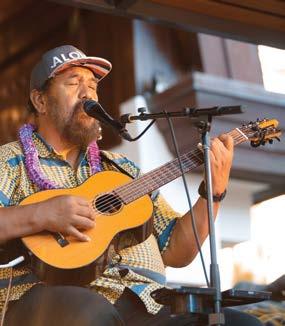
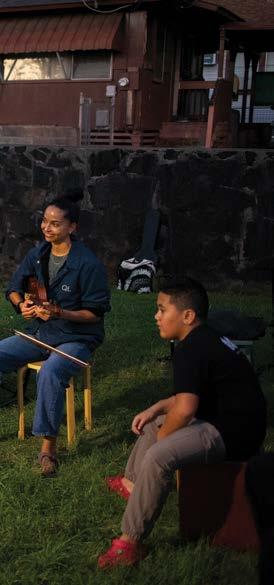
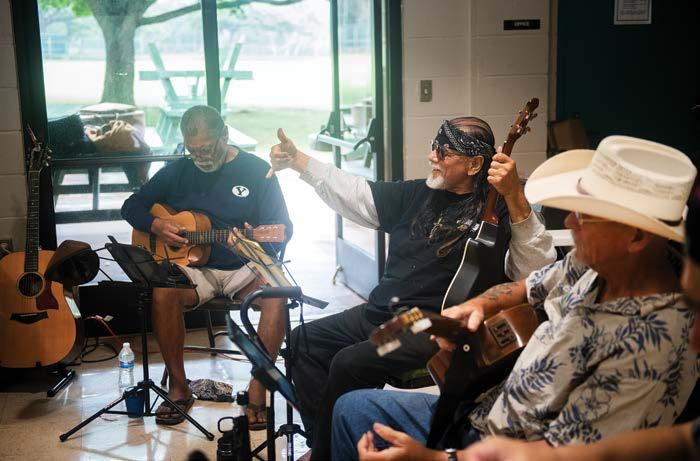
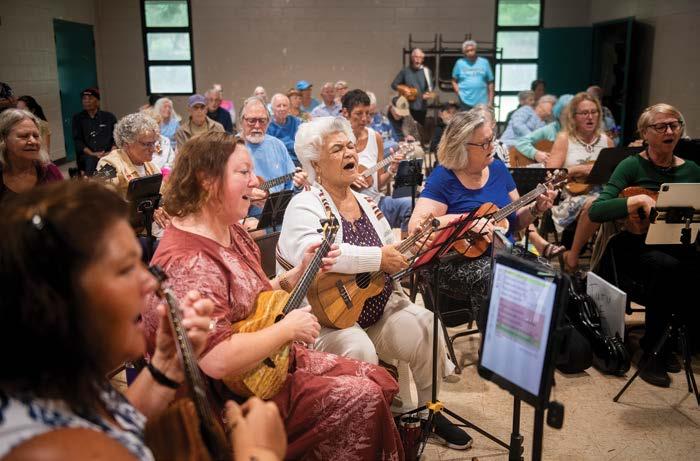
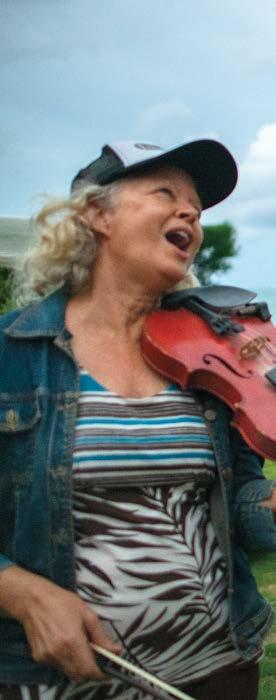
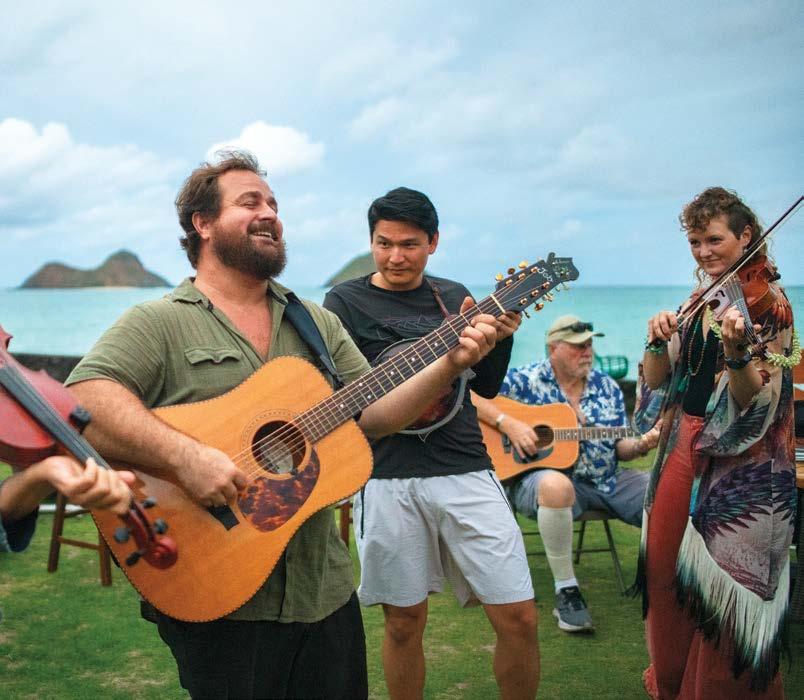
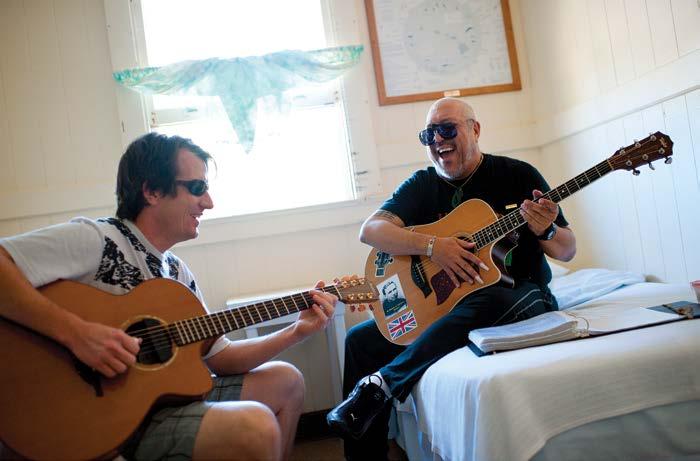
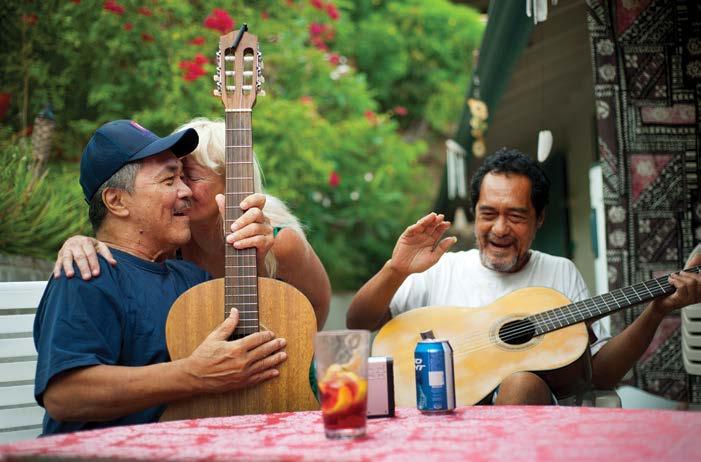
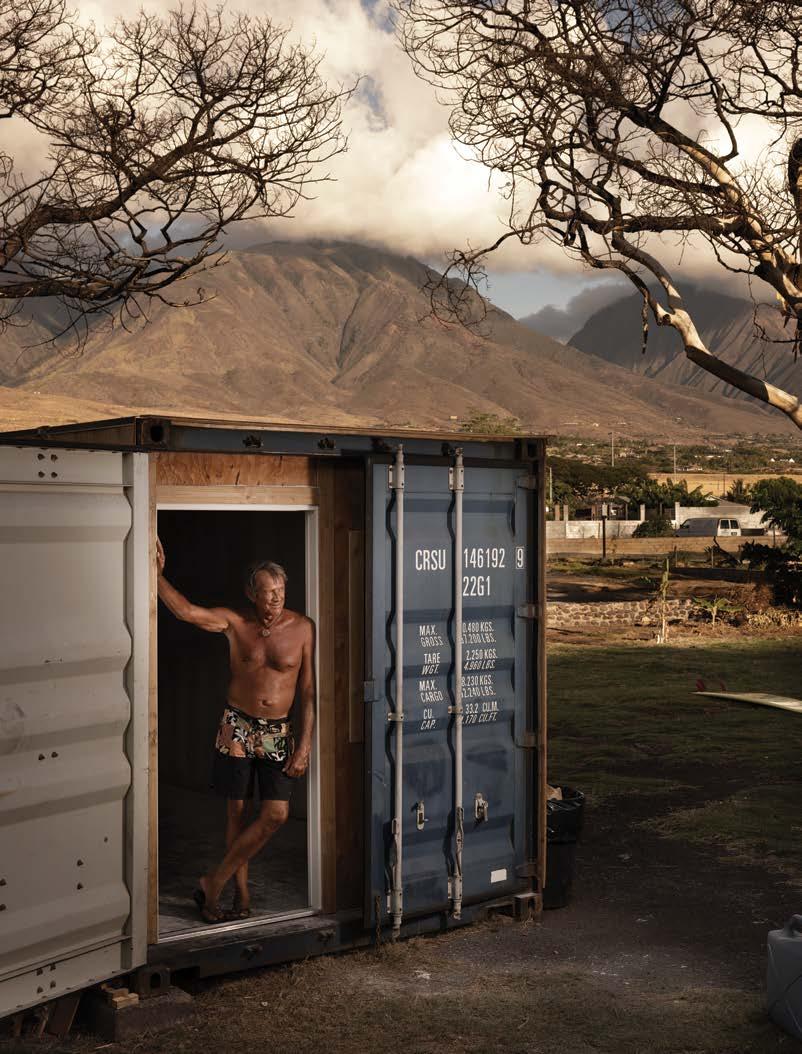
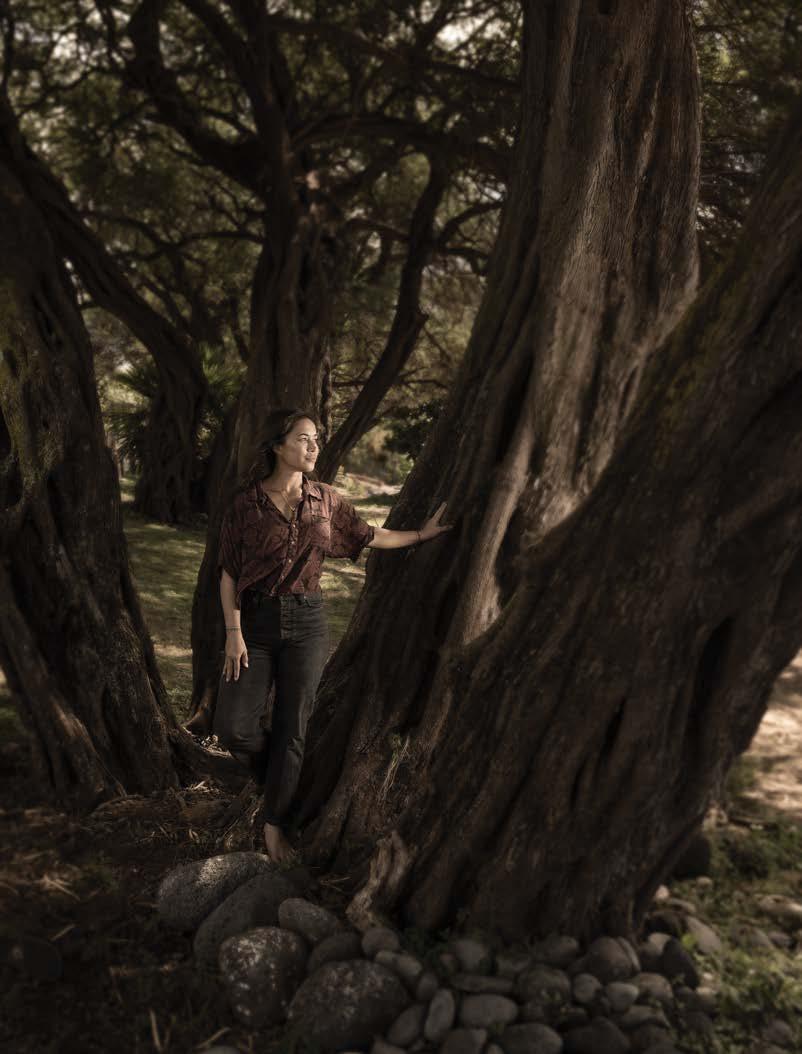
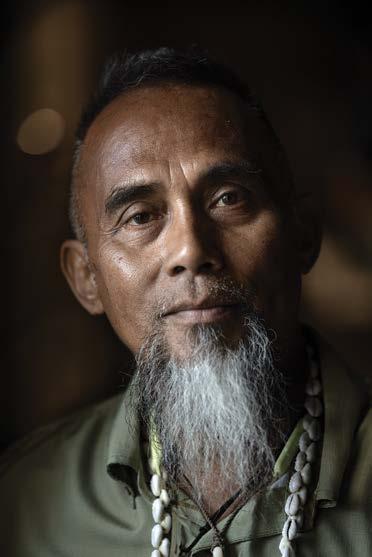
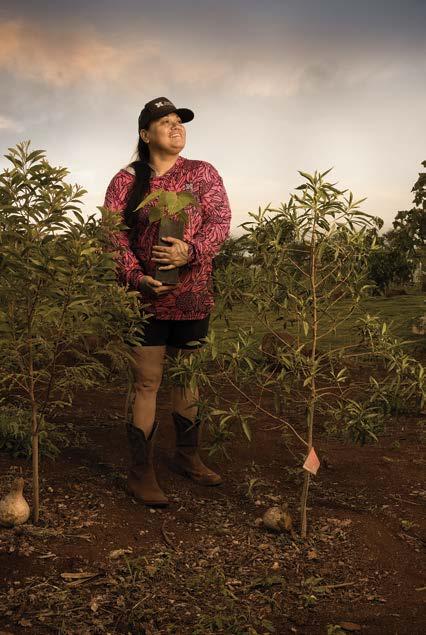
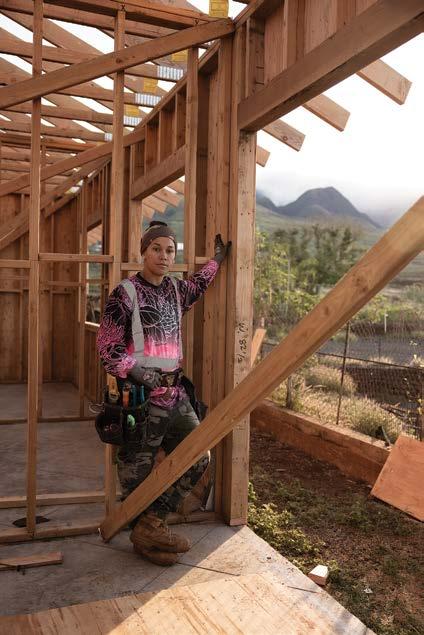
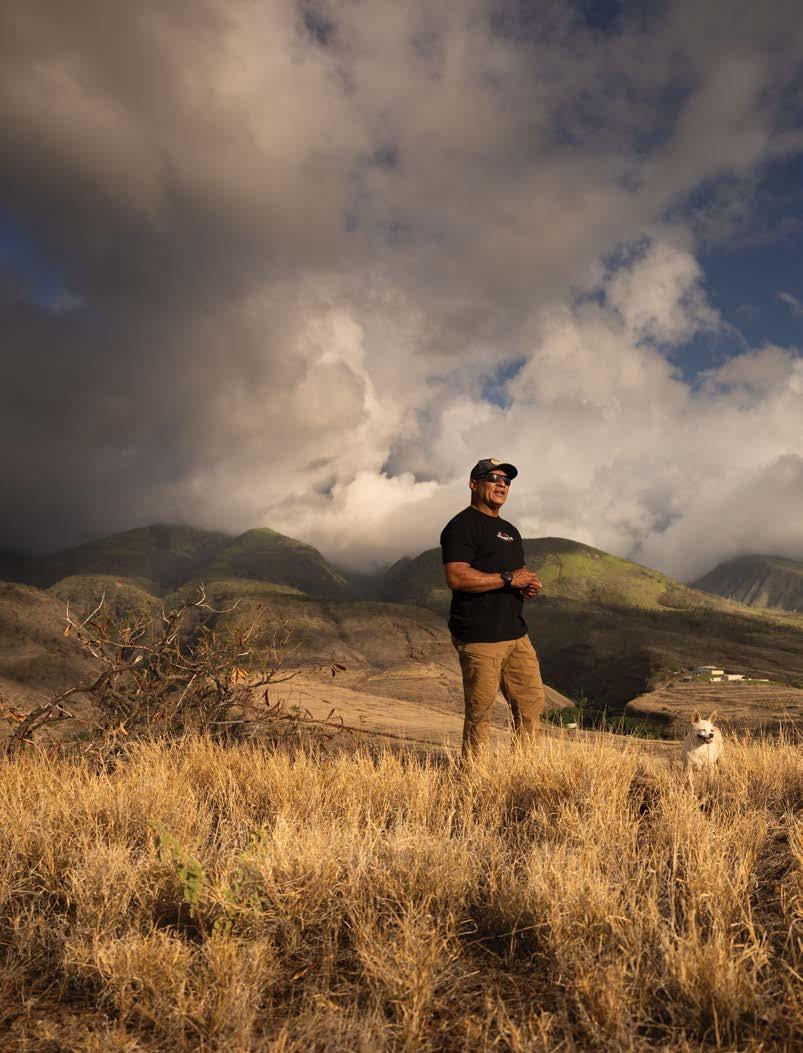
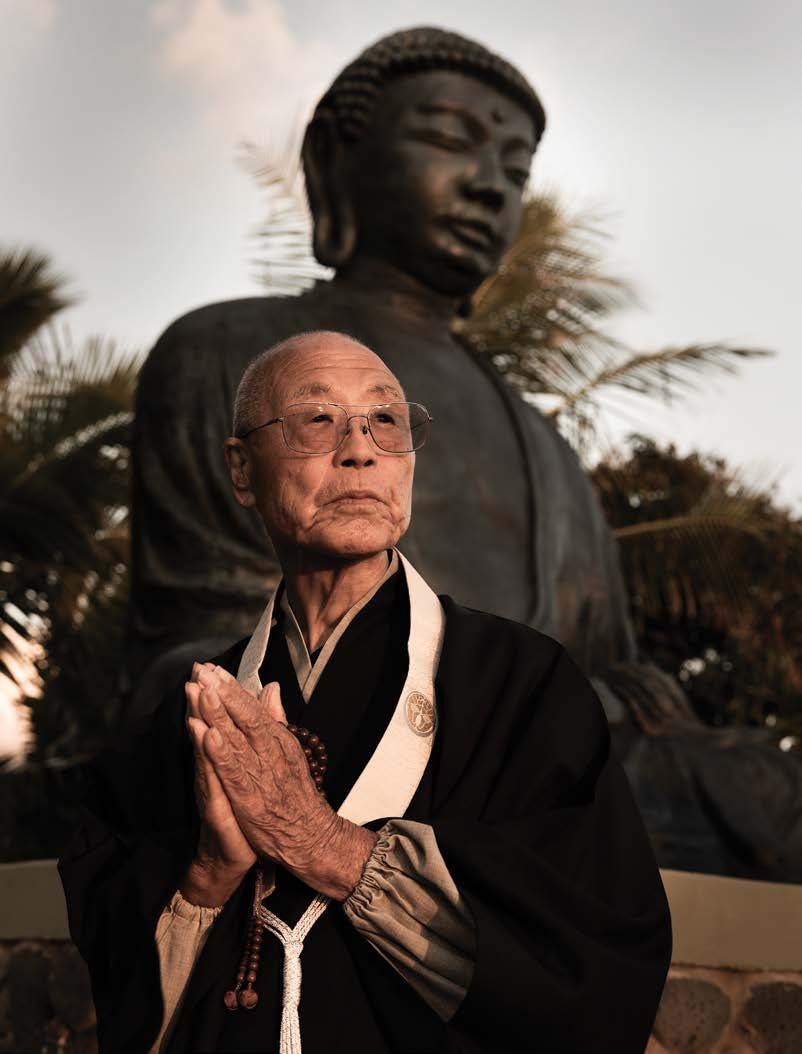
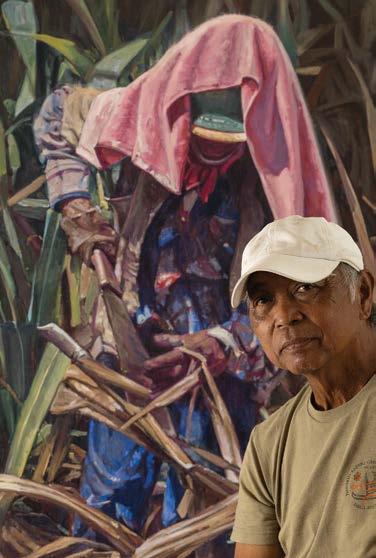
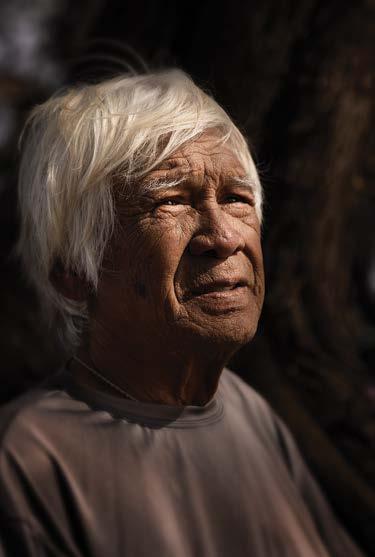
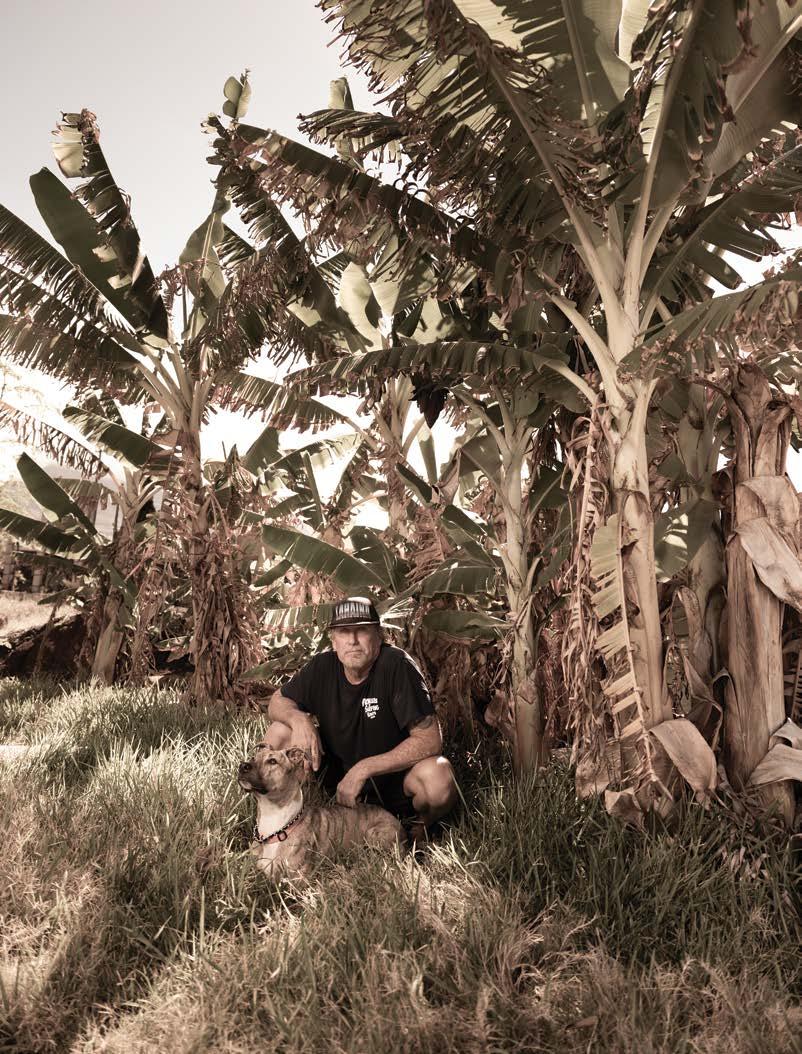
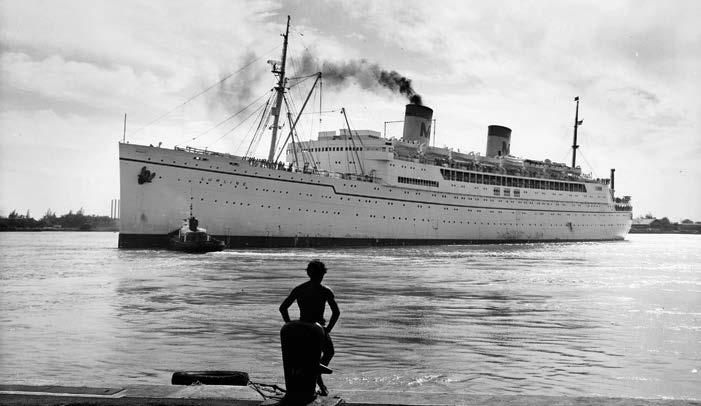
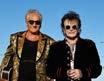
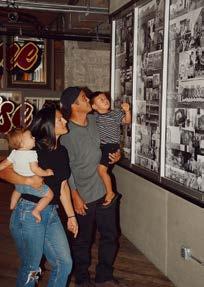
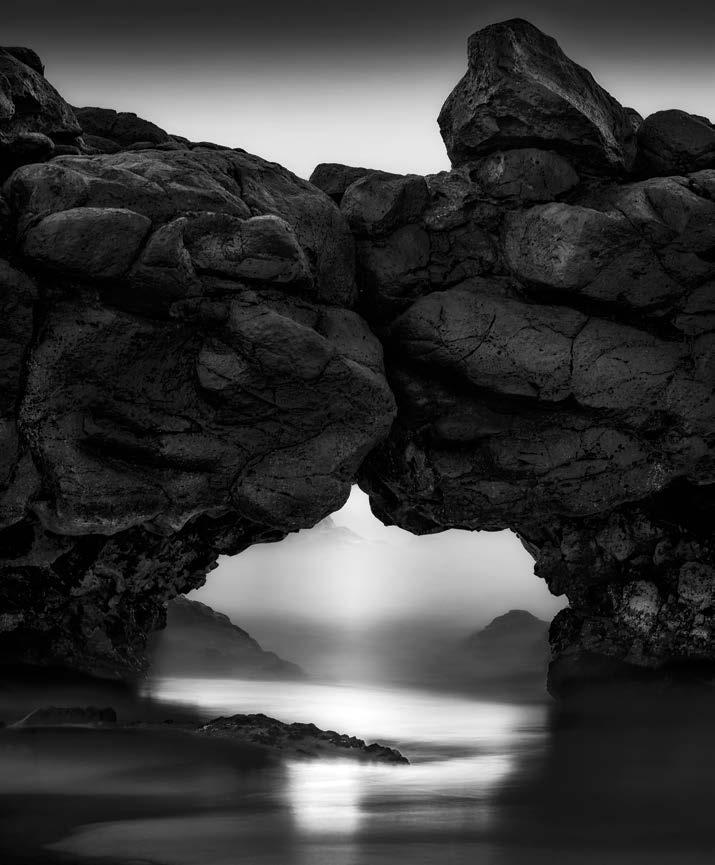
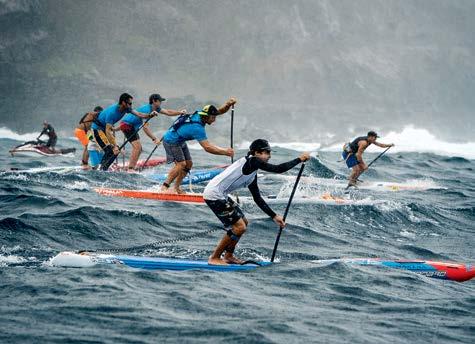
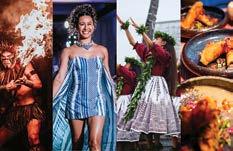
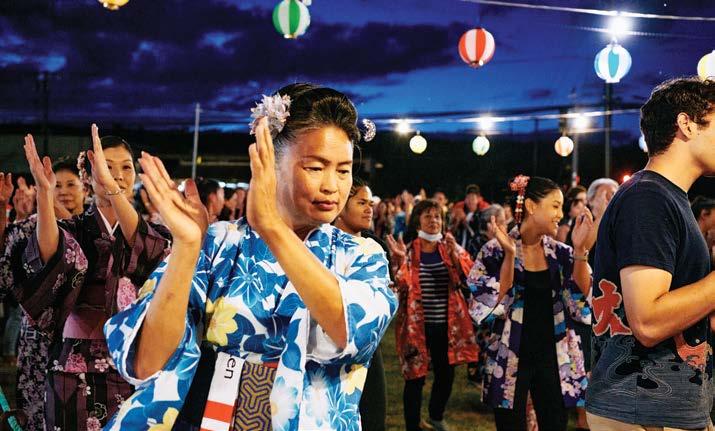
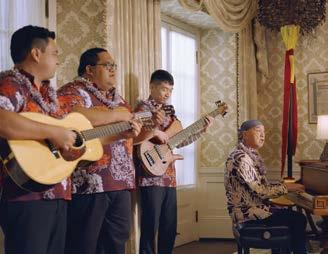
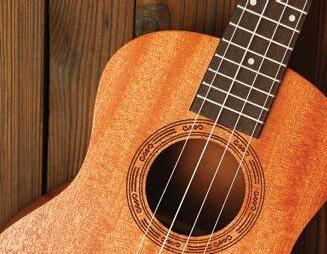
ALL TOGETHER NOW The Island musical tradition of kanikapila LĀHAINĀ RISING Portraits of resilience in West Maui WIN FOR LOSING The Harlem Globetrotters vs. the Hawaii 50th Staters
OluKai.com
Kaua‘i: The Shops at Kukui‘ula / O‘ahu: Hilton Hawaiian Village, Chinatown, Sheraton Waikīkī, Hale‘iwa Maui: Whalers Village, The Shops at Wailea / Hawai‘i Island: Queens’ Marketplace
maunakeabeachhotel.com
FEATURES
STORY BY CONNER GORRY
PHOTOGRAPHY BY MEGAN SPELMAN
/
Court Jesters When the Harlem Globetrotters needed a rival and foil, Hawai‘i stepped up to the basket
STORY BY JARRETT VAN METER
GORRY
STORY BY LARRY LIEBERMAN
PHOTOGRAPHY BY MATT MALLAMS
STORY BY LARRY LIEBERMAN
PHOTOGRAPHY BY MATT MALLAMS
86 /
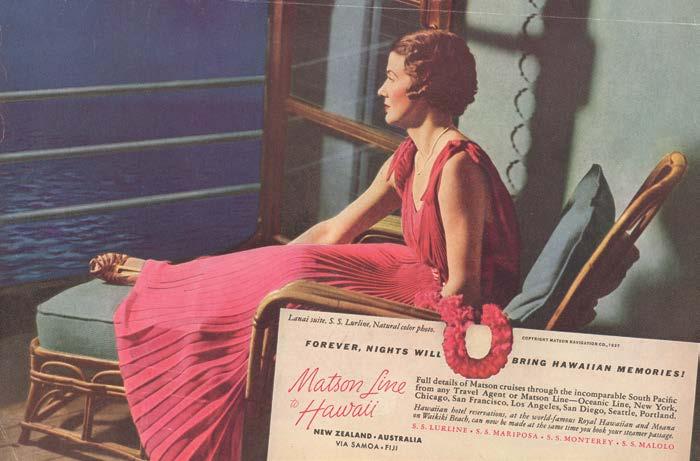
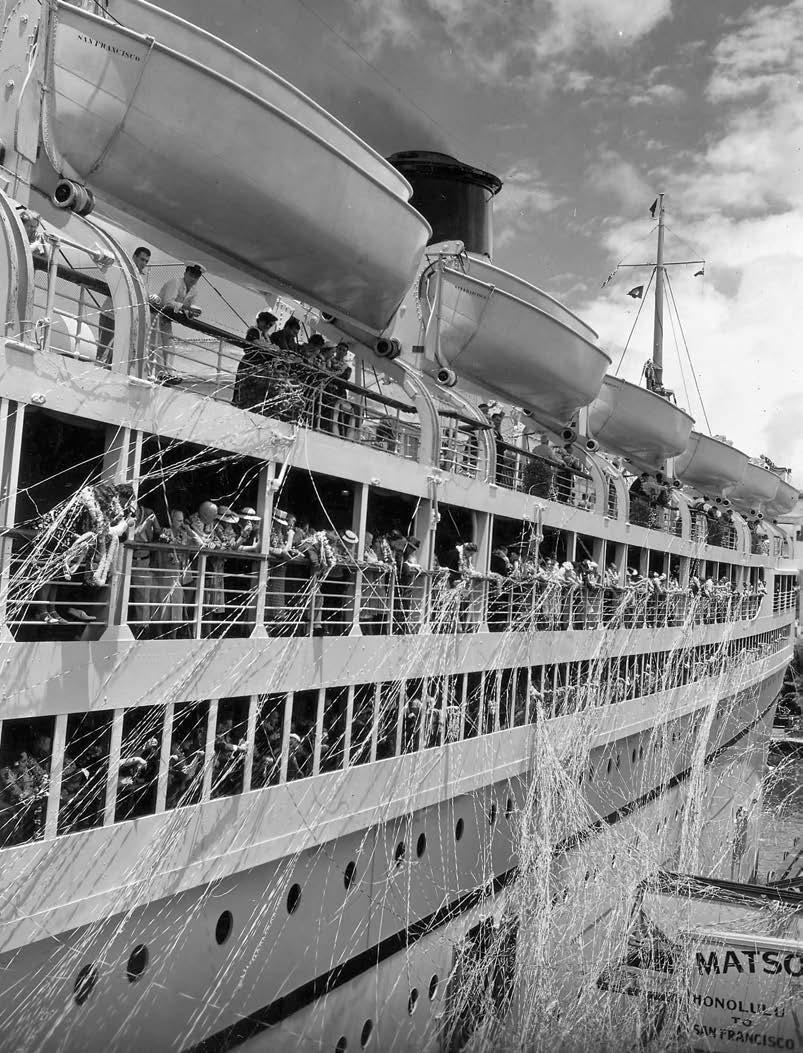
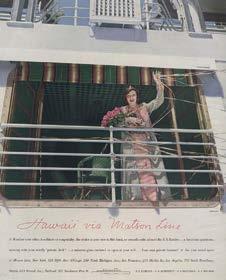
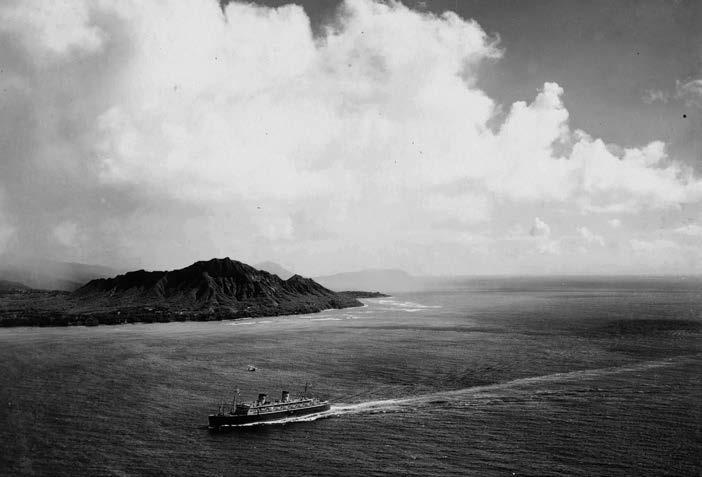
The Golden Age of White Ships A hundred years ago, a cruise ship arrived in Honolulu—along with Hawai‘i’s first tourism boom
STORY BY DAVID THOMPSON
PHOTOGRAPHY COURTESY HAWAI‘I STATE ARCHIVES
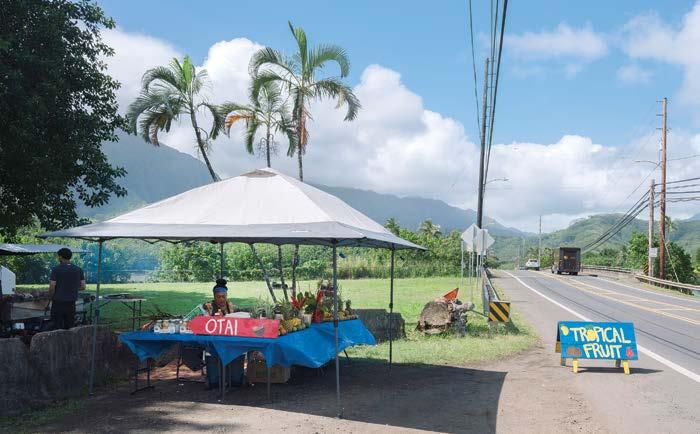
96 / Pull Over and Grind
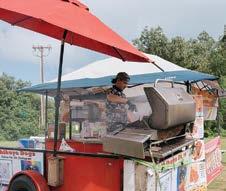
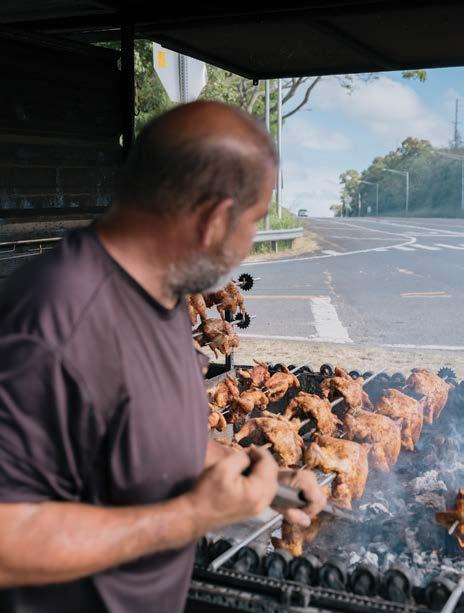
O‘ahu’s roadside food corridor has a little bit of everything, to go
STORY BY STEVE PETRANIK
PHOTOGRAPHY BY CHRISTIAN NAVARRO
FERRAR
PHOTOGRAPHY BY ELYSE BUTLER
STORY BY MADELEINE HILL
PHOTOGRAPHY BY ELYSE BUTLER
PHOTOGRAPHY BY DANA EDMUNDS
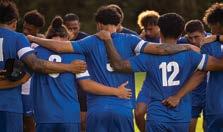
FA‘A FOOTBALL / The national football team of American Sāmoa heads to Apia, Western Sāmoa, for its shot at redemption at the World Cup Qualifiers in September 2024. Will the perennial underdogs best their longtime rivals, Western Sāmoa?
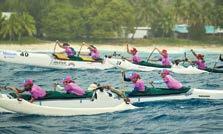
PEOPLE OF THE VAKA / For many who live in the Cook Islands, the vaka (canoe) is a way of life. Visit Rarotonga for Vaka Eiva, an annual paddling festival that draws competitors from around the world to this tiny archipelago, a dreamscape of islands and atolls where everything moves at a slower pace—except, of course, for the canoes.
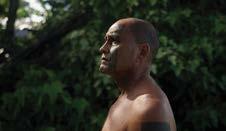
MARKS OF DISTINCTION / Few Polynesian tattoos illustrate one’s commitment to culture and community more than the maka uhi, or facial tattoo. Meet the Native Hawaiian men who’ve earned their maka, revived a nearly lost tradition and assumed the kuleana (responsibility) that comes with it.
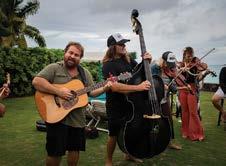
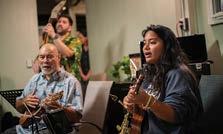
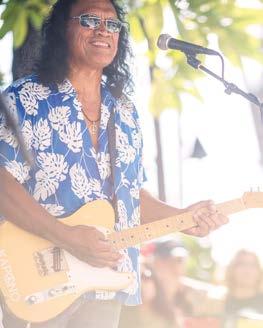
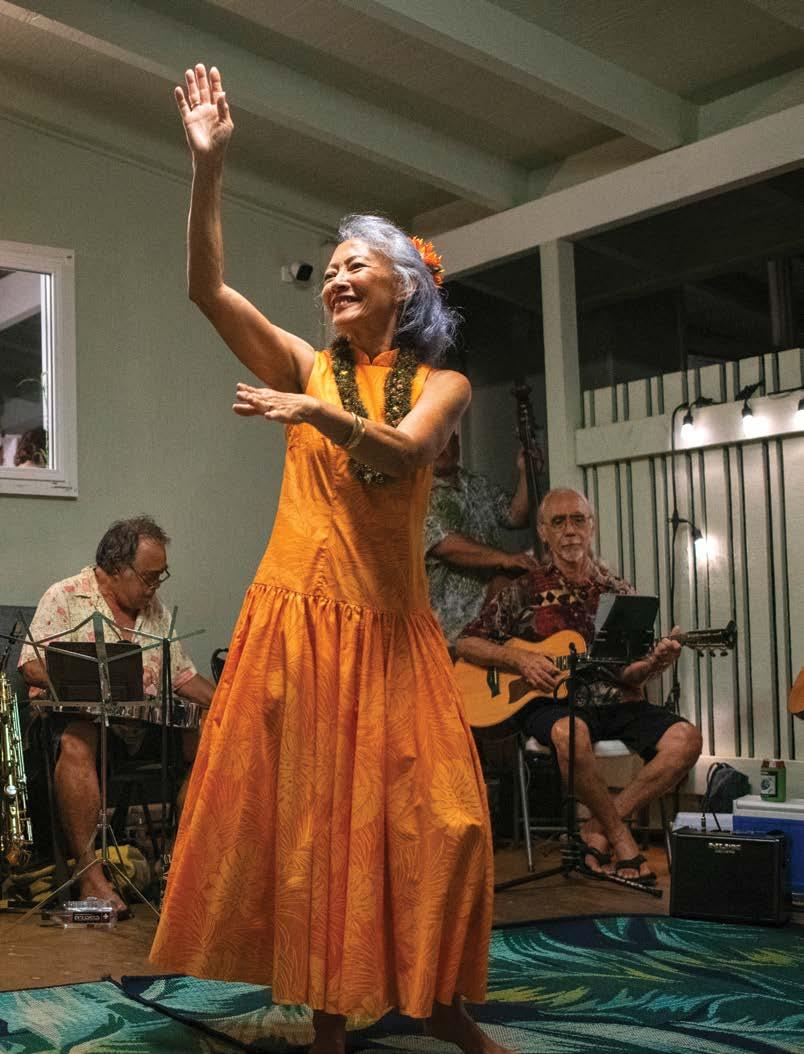
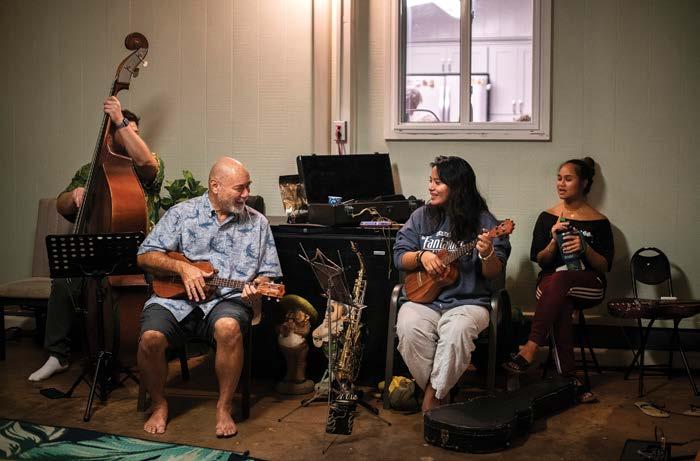
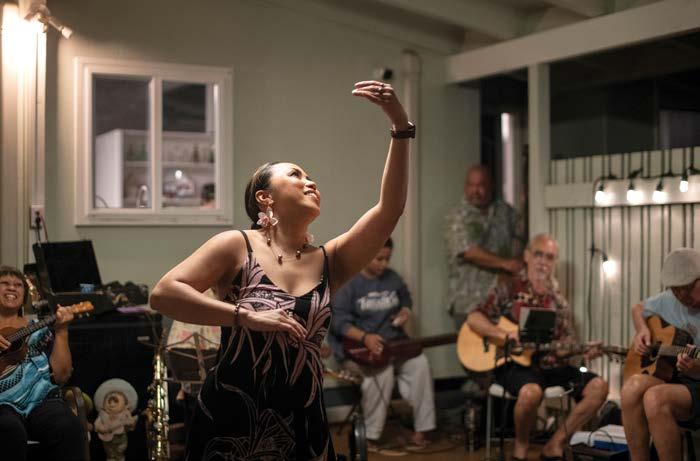
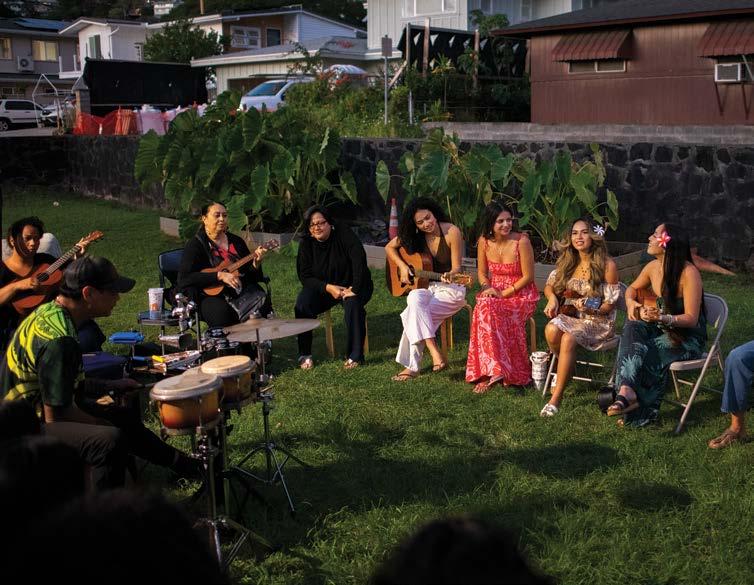
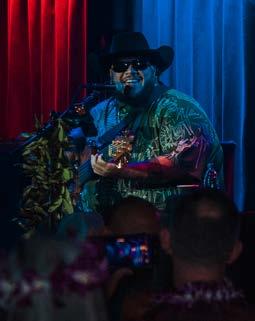
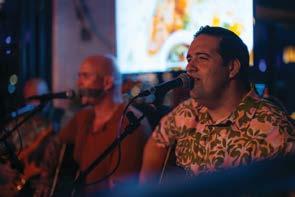
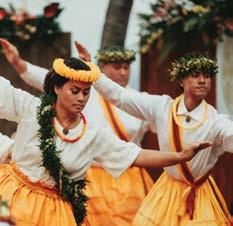
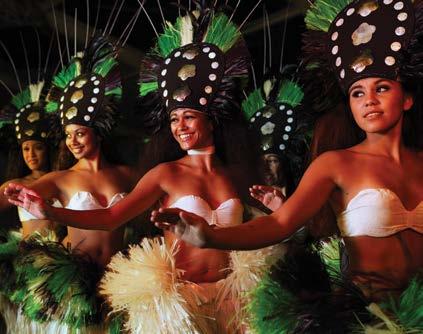
KANIKAPILA! / Making music together, or kanikapila in Hawaiian, is a beloved Island tradition. Inclusive, informal jam circles sometimes go all night in backyards, carports and living rooms throughout Hawai‘i, playing everything from Hawaiian to bluegrass to Bob Marley—sometimes with spontaneous hula breaking out.
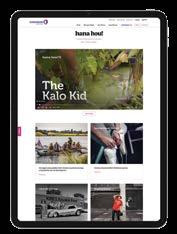
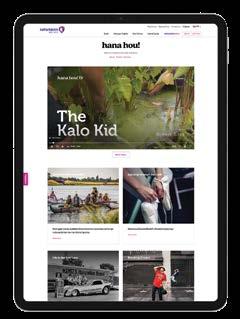
Forget to take your copy of Hana Hou! from the seat pocket? Miss a story from a back issue? Want to share a story or a video you’ve seen on the in-seat media player or on the Hawaiian Airlines app? Hana Hou! is now online as well as on-screen. Visit our website at the link below or scan the QR code to view the current issue and selections from our archive.
hawaiianairlines.com/hawaiistories/hana-hou
photograph by romeo lapitan
photograph by blake abes
photograph by elyse butler
photograph by dana edmudnds
PUBLISHER & CEO
Jason Cutinella
PARTNER/GM —HAWAI‘I
Joe V. Bock
EDITOR-IN-CHIEF
Michael Shapiro
DIRECTOR OF PHOTOGRAPHY
Matt Mallams
ASSISTANT EDITOR
Maria Kanai
MANAGING DESIGNER
Taylor Niimoto
DESIGNER
Eleazar Herradura
VP FILM
Gerard Elmore
EDITORIAL PRODUCER
Anthony Banua-Simon
FILMMAKERS
Blake Abes
Romeo Lapitan
VIDEO EDITOR
Jhante Iga
STUDIO DIRECTOR/ PRODUCER
Kaitlyn Ledzian
DIGITAL PRODUCTION DESIGNER
Arriana Veloso
OPERATIONS
ACCOUNTS RECEIVABLE
Gary Payne
OPERATIONS DIRECTOR
Sabrine Rivera
TRAFFIC MANAGER
Sheri Salmon
OPERATIONS MANAGER
Jessica Lunasco
CREATIVE SERVICES DIRECTOR
Christian Bowman
ADVERTISING
ADVERTISING DIRECTOR
Simone Perez
SENIOR ACCOUNT MANAGER
Courtney Asato
ACCOUNT EXECUTIVE
Rachel Lee
SALES OPERATIONS COORDINATOR
Kylie Wong
CONTACT
EDITORIAL INQUIRIES
editors@NMGnetwork.com
SALES INQUIRIES sales@NMGnetwork.com
CONTRIBUTORS
Andrew Sullivan-Haskins
Beau Flemister
Conner Gorry
Christian Navarro
Dana Edmunds
David Thompson
Derek Ferrar
Elyse Butler
Jarrett Van Meter
Juli Burden
Larry Lieberman
Madeleine Hill
Martha Cheng
Matt Mallams
Megan Spelman
Peter von Buol
Sarah Burchard
Steve Petranik
Published by: NMG Network 41 N. Hotel St. Honolulu, HI 96817
For questions related to travel, visit us online at HawaiianAirlines.com or contact us at any of the following numbers:
UNITED STATES / CANADA 1-800-367-5320 Monday-Sunday, 24 hours Text 38285 Monday-Sunday, 5:00am - 11:00pm HST
AUSTRALIA (61) 1-800-955-912
JAPAN (81) 570-018-011 Monday-Sunday
NEW ZEALAND (64) 0800-449-415
AMERICAN SĀMOA (684) 699-1875
TAHITI (689) 40-866-000
CONSUMER AFFAIRS
HawaiianAirlines.com/CAO
BAGGAGE INQUIRIES
1-866-389-6654
Monday-Sunday, 8:00am - 4:30pm HST
ATMOS REWARDS
For more information on our frequent flyer program, please contact our Atmos Rewards service center: 7:00am - 7:00pm PT, Monday-Friday 8:00am - 5:00pm PT, Saturday 1-877-426-4537
HAWAIIAN AIR CARGO INQUIRIES
1-877-422-2746
HawaiianAirCargo.com
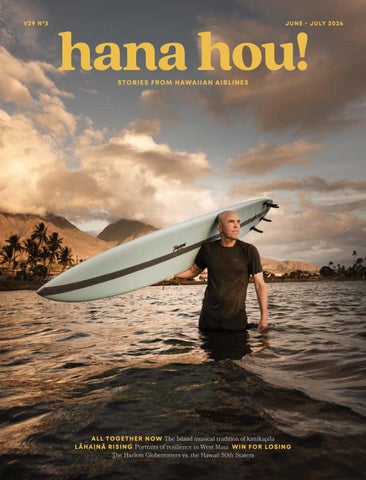
ON THE COVER
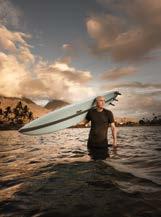
Still Standing
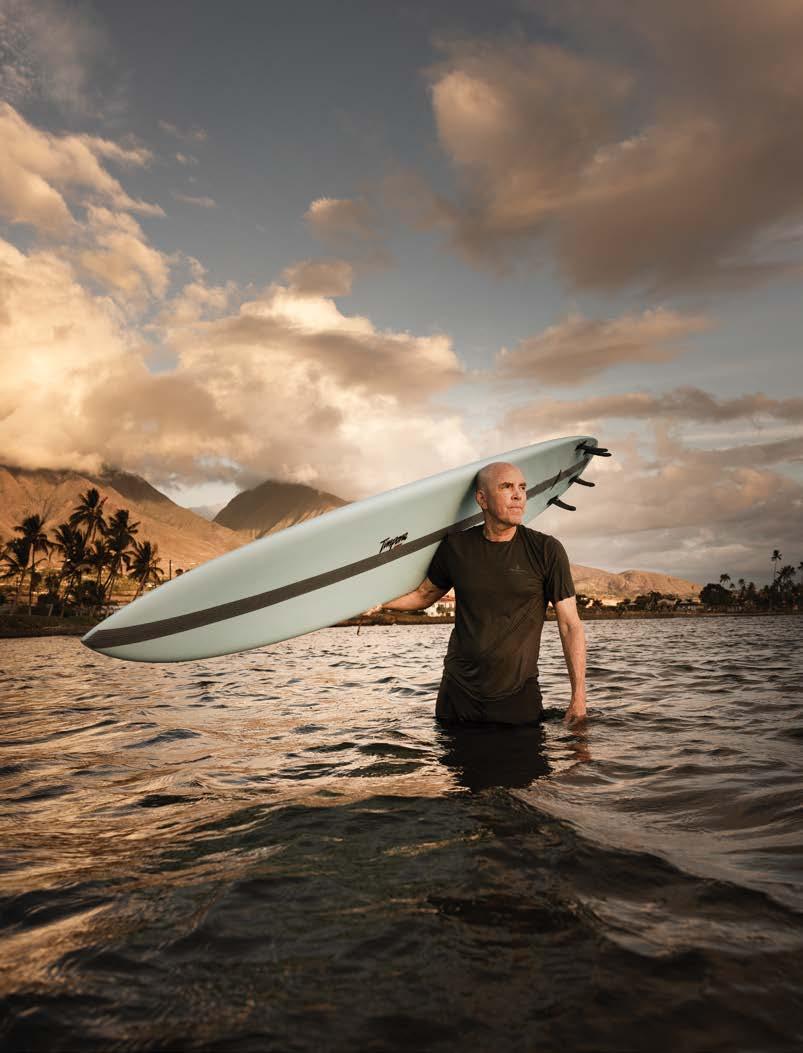
Lāhainā resident Charlie Lyon, a survivor of the 2023 wildfires, in the waters of West Maui.
PHOTOGRAPH BY DANA EDMUNDS
A new dawn of live entertainment rises in Cirque du Soleil ‘Auana— a Hawai‘i-inspired production featuring a cast of powerful acrobats, talented musicians and singers, and profound hula dancers. is unparalleled ensemble brings together international and local talents to shine a fresh light on the spirit of Hawai‘i. Only at the OUTRIGGER Waikīkī Beachcomber Hotel.
Derek Ferrar
For Hana Hou! founding editor and longtime special correspondent Derek Ferrar, getting to write about local “kanikapila” musical jam culture was pretty much a dream assignment. The inveterate musical hobbyist and front man for the oldtimey novelty outfit Hamajang (a.k.a. “Hawai‘i’s favorite jugless jug band”) says the hardest part of “Kanikapila!” was to stop jamming long enough to write the piece. “The more musical gatherings I went to, the more people would tell me about other ones happening all over the place,” he says. “And of course I felt a professional obligation to hit as many as I could.” Ferrar, who dabbles in ‘ukulele, bass and percussion across a range of musical genres from chalangalang to hard rock, says the biggest reward came in “getting to know all these incredible people through the music that I would otherwise never have met. Nothing works better for bonding instantly with strangers than sharing a groove together.”
Steve Petranik
During his sixteen years as editor of Hawaii Business Magazine, Steve Petranik especially enjoyed telling the stories of local entrepreneurs. Now that he’s “retired,” he continues to indulge his passion for storytelling. In “Pull Over and Grind,” he drove back and forth along Windward O‘ahu’s highways to sample food and drinks from roadside vendors, listening to their origin stories, triumphs and obstacles. Like how one truck’s generator always conks out in a big rain. And how one accomplished chef can never forget burning a huge pot of squid lū‘au at his family’s big event. When Petranik isn’t reporting or writing, he likes to paddle outrigger canoes—six- or one-man—swim, hike, lift weights, play board games, read books and listen to audiobooks. He and his wife live in Kailua and just celebrated their forty-fifth anniversary. This is his first story for Hana Hou!
Megan Spelman
For Megan Spelman, who shot “The Exquisite Corpus,”the Hawai‘i Artist Collaboration was a reminder of the importance of play and togetherness. “The artists were so high on life from being together in creativity up on Hōlualoa at Tai Lake’s incredible compound. With our lives becoming more and more solitary, these in-person collaborations felt like a surge of inspiration,” she says. The artists living, eating and working together reminded her of youthful summers at summer camp, where connection and creativity were flowing twenty-four/ seven. She says, “I hope to take some of their energy and ideas into my day-to-day life, and seek out creative communities on the regular.” Spelman is based on Hawai‘i Island, where she lives and plays on the Kona Coast with her family.
“Aside from getting to eat a lot of good food, I enjoyed talking to each vendor and hearing their stories,” says Christian Navarro, who spent weeks documenting the string of food trucks, stalls and popups between Makapu‘u and Kahalu‘u in Windward O‘ahu to photograph “Pull Over and Grind” for this issue. One vendor shared what it was like growing up in Waimānalo and how food used to be more affordable and accessible. “If someone was hungry and didn’t have anything, they could count on a neighbor to feed them,” Navarro says. “I wanted to document the atmosphere, the vendors’ work and the connection between food and culture. These small food stands are not just about food but also about tradition.” Navarro is a documentarystyle photographer based in Honolulu whose work explores identity through culture and community. See more at @christiannavarro.photo.
Christian Navarro
BY DIANA BIRKETT RAKOW CHIEF EXECUTIVE OFFICER, HAWAIIAN AIRLINES
A New Chapter: Sharing Aloha Around the World
As you flip through this issue of Hana Hou!, I hope you will enjoy a quiet moment on your journey.
For me, travel has always been about connection and perspective. It is about reuniting with the people you love, discovering new places and feeling cared for along the way. When we rise above the clouds, see land and sea from a new angle and feel that connection between people and places, it brings a fresh perspective and makes the world feel just a little smaller.
At Hawaiian Airlines, that sense of connection and care is personal. It is also our North Star: We fly for Hawai‘i, connecting within Hawai‘i and linking Hawai‘i to the world while delivering a travel experience with excellence and genuine hospitality rooted in the values that define who we are.
Through our combination with Alaska Airlines, we are expanding opportunities—increasing the breadth of places we can take you, delivering best-in-class value to reward your loyalty and continuing to elevate the experience we deliver to every guest.
Joining the oneworld® alliance is an important step in that journey.
For the first time in our nearly 100-year history, Hawaiian Airlines is part of a global alliance that meaningfully expands how you travel and how you are recognized along the way.
Here is what that means for you.
You can now travel seamlessly to more than 1,000 destinations in over 170 countries through our oneworld partners, including Japan Airlines, Qantas, Fiji Airways, British Airways, Finnair and more.
Your loyalty goes further. As a member of Atmos™ Rewards, including through the Huaka‘i program for kama‘āina, you can earn and redeem points across oneworld airlines.
Your status travels with you. Benefits are recognized across the alliance, including priority check-in and boarding for a more consistent experience throughout your journey. You now have access to hundreds of premium lounges around the world, creating more comfort between flights. And you can book an increasing number of these partner airlines directly on hawaiianairlines.com and alaskaair.com, making it simpler to plan and manage your entire journey in one place.
These enhancements are part of a broader commitment: to make travel more seamless, more rewarding and more connected—no matter where life takes you.
What makes this step especially meaningful is who we are taking it with. oneworld brings together leading flag carriers from around the world — airlines that, like us, carry the culture, language and spirit of the places they call home. From Japan to Australia to the United Kingdom and beyond, each partner reflects a strong sense of place in how they serve their guests.
That is something we believe deeply in.
At Hawaiian Airlines, we take seriously our responsibility to represent where we come from—to carry the spirit of Hawai‘i through our care, our service and the way we welcome you on board. Being part of oneworld means joining a global community that shares that same commitment.
For those of us who call Hawai‘i home, this future opens up new possibilities. It makes it easier to stay connected to family across long distances, to travel for work or school and to explore the world without losing that sense of home. It allows our keiki to see new places and our kūpuna to remain close to loved ones, even when they are far away.
This connection works both ways. It also makes it easier for people
service and the way we welcome you on board.
around the world to experience Hawai‘i. As we welcome them, we carry a shared responsibility to ensure that travel here is thoughtful and respectful. Through our Travel Pono program, we continue to encourage visitors to engage with Hawai‘i in ways that honor our culture, care for our natural resources and support our communities.
When you put it all together, this moment is about more than a single milestone. It is about the future we are building—one where Hawaiian Airlines is more connected globally than ever before while remaining grounded in the values and responsibilities that define us.
Even as we grow, we remain committed to our kuleana (responsibility) for this place. We carry Hawai‘i with us on every flight, not just in where we fly but in how we show up for you. Our promise is simple: to be your trusted choice for travel, delivering genuine warmth and the spirit of aloha on every trip.
Mahalo for being with us on this journey. I hope you enjoy the flight, and I look forward to welcoming you on board again soon.
At Hawaiian Airlines, we carry the spirit of Hawai‘i through our care, our
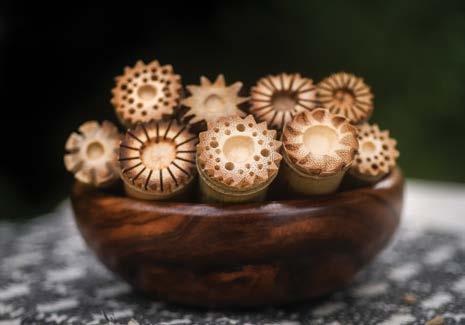
nodes of bamboo segments (seen also on pages 18–19).
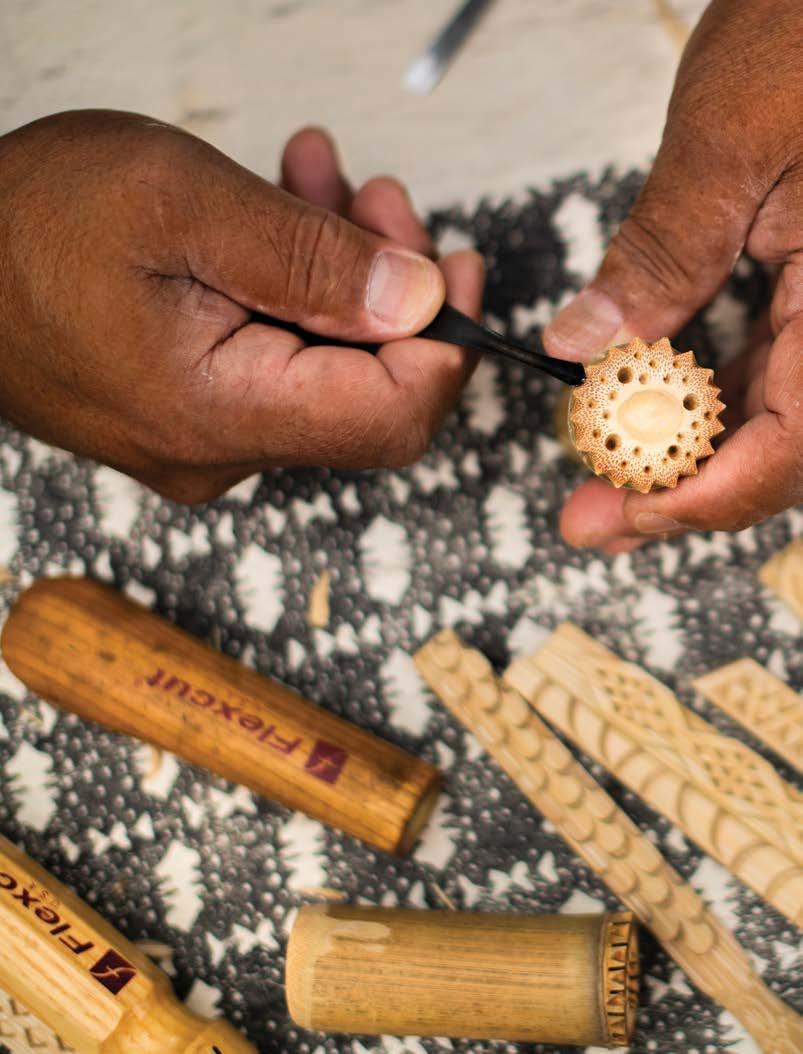
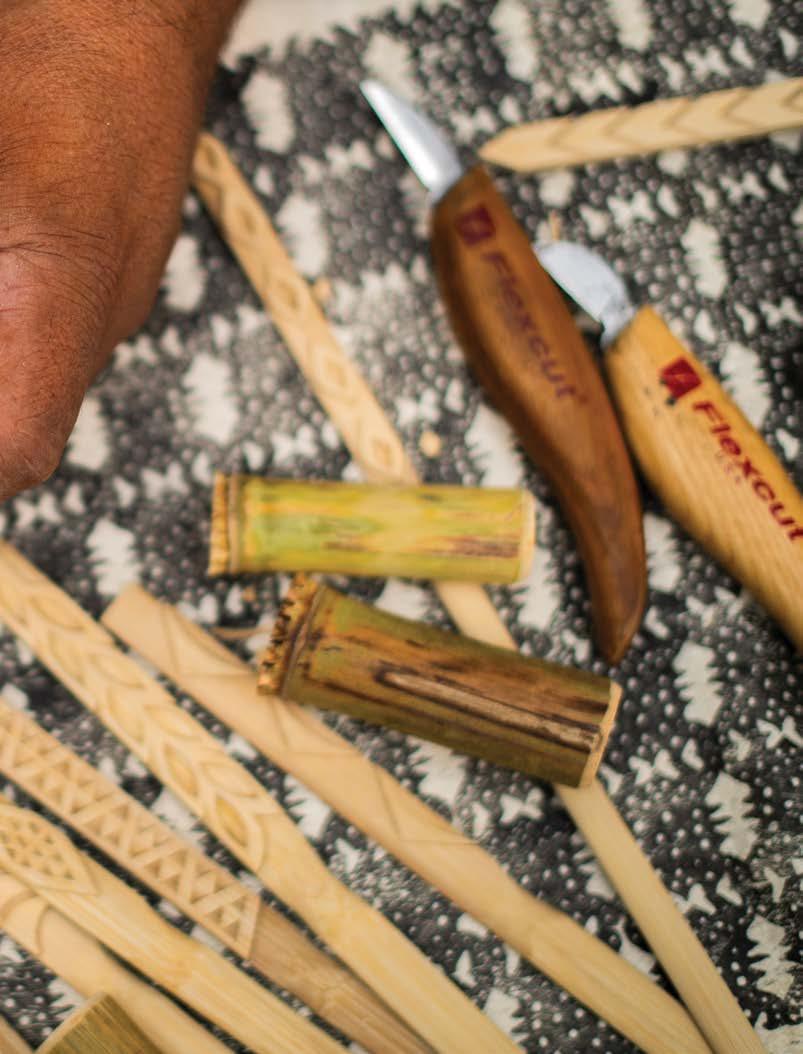
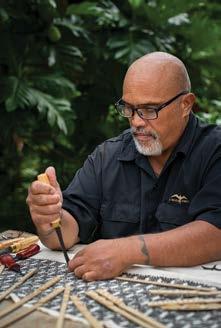
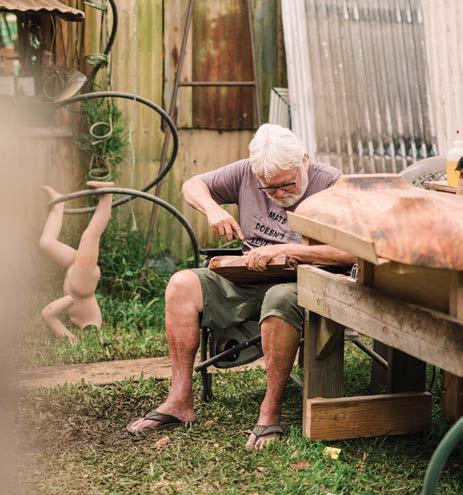
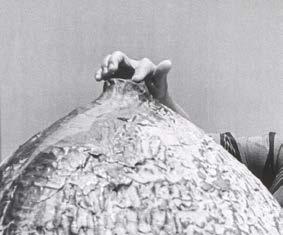
When Nalu Andrade was 17 and assisting members of the Friends of Hōkūle‘a and Hawai‘iloa, he was given a chainsaw and told to cut the hull of Hawai‘iloa, a traditional voyaging canoe built in the 1990s. These days, his wood carving is lower stakes: He makes ‘ohe kāpala (‘ohe is Hawaiian for bamboo, kāpala means ‘to stamp’), slim bamboo sticks traditionally used to stamp patterns onto kapa, or bark cloth.
His intricate, geometric designs might feature wavy tendrils of limu līpoa (seaweed), to represent the Kaiāulu wind, a breeze associated with Wai‘anae, on Leeward O‘ahu, which carries the scent of limu līpoa from the ocean. To stamp the kīhei (a ceremonial garment) of a senior graduating from Kamehameha Schools, he carved bending lau niu (coconut fronds), a nod to the ‘ōlauniu (which translates literally to “coconut-leaf piercing”) wind of Kapālama, where the campus is located. In his designs, he aims to
“replicate nature, its rhythm, its balance,” he says.
Andrade picked up carving when he was young, amusing himself with his father’s tools. He then apprenticed with Sam Kaai, a master woodcarver and assisted with the lashing of voyaging canoe Hōkūle‘a; later, he worked on the construction of Hawai‘iloa. In the beginning, most of his carvings weren’t purely ornamental but functional, meeting “the basic need for all these small things that help others’ hana [work],” he says, whether it’s a papa ku‘i ‘ai (board for pounding poi) for a poi maker, or ‘ohe kāpala for kapa makers and hula hālau [hula school] stamping kapa. Working with these other makers to brainstorm designs and provide them with these tools “are my greatest joy,” he says. Later, he began making ‘ohe kāpala earrings because “I want to compete against the things that are not from here, all the gold and all the silver,” he says. “I want to make our art stand out, where it’s
not just a novelty. This is real ‘ike kūpuna [knowledge of the elders].”
While Polynesians brought two varieties of ‘ohe with them when they settled in Hawai‘i, Andrade says they’re hard to come by these days; instead, he harvests invasive bamboo from Kalihi Valley—removing the fast-growing plant is his way of stewarding the land. After cutting the stalks, he soaks them in salt water, a trick he learned from working on Hōkūle‘a, to deter bugs. After he cures, shapes and sands down the stalks in his Honouliuli studio, he carves the pattern with small chisels and knives—tools that, unlike the chainsaw he was handed decades ago, are much more novice and kid friendly, suited to the workshops he teaches at schools. “It’s foundation work I’m teaching you,” he tells his students. “This is what our ancestors did. Now your foundation is strong. You can carve on anything and make it happen.”
Nalu Andrade (above left) carves a pattern into a strip of bamboo at Ho‘olu ‘Āina in Kalihi. These ‘ohe kāpala (bamboo stamps) are then inked
right, a suite of Andrade’s patterns engraved into the
Photo: Zak Noyle
A Walk Through Infamy
Honouliuli surely lived up to the meaning of its name, “dark bay.”
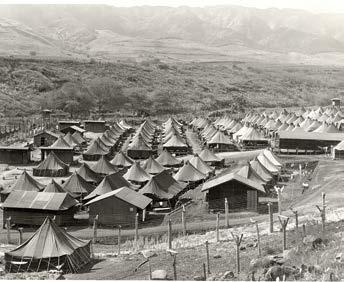
The site is infamous as the US Army’s longest-operating concentration camp for civilians during World War II, where American citizens of Japanese ancestry were interned from 1943 to 1946, along with thousands of prisoners of war.
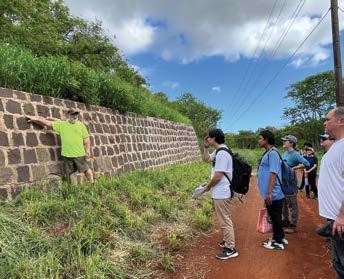
The Army constructed the camp in a gulch in the Wai‘anae Mountains; at its peak more than four hundred civilians and four thousand POWs, most of whom were Japanese, Korean and Okinawan, with a few from Germany and Italy, were interned there. Honouliuli was only one of several such camps throughout the country, and its legacy has been mostly erased, at least visually: After the war, its buildings were razed, leaving behind only concrete pads swallowed by haole koa and California grass.
Beginning in 2015, the effort to remember began in earnest, when the 123-acre site was designated the Honouliuli National Monument. In 2019, it was upgraded to the Honouliuli National Historic Site (NHS), the newest addition to the National Park System
in Hawai‘i and efforts to restore areas of the camp began. And this summer, eighty years since the camp’s closure, its opening back up to the public.
Despite having Japanese ancestry and being born and raised on O‘ahu, Honouliuli NHS superintendent Christine Ogura didn’t know about the camp growing up. “I had no idea that the incarceration of local Japanese Americans happened in Hawai‘i,” says Ogura. “It’s especially personal, as I am nisei,” a second-generation Japanese immigrant. “A generation earlier, people like me and my mother were targeted and taken away.
Throughout its ten-year history, Honouliuli NHS has relied on support from community organizations such as the Japanese Cultural Center of Hawai‘i (JCCH). “We began offering tours shortly after our involvement with the site in the early 2000s,” says Nate Gyotoku, JCCH’s president and executive director, but the tours ended during the pandemic. The renewed tours will be similar. “We conducted most of our tours within the Japanese American detention area of the camp, which is the focus of
our mission,” says Gyotoku. “We hold a sizable collection of oral histories and artifacts related to the site. Our docents drew on this knowledge to craft tours that highlighted key sections of the camp, interwoven with personal accounts from former incarcerees and their descendents. Our usual stops include the aqueduct, the latrine slab, the Hotchkiss guard tower slab and the mess hall slab. Most tours conclude with a moment of reflection at the mess hall slab, followed by a flower offering in the creek that runs behind it.” Because 2026 marks eighty years since the camp’s closure, there will be special events throughout the year, says Ogura, who returned to Hawai‘i from Oregon in 2024 to serve as superintendent. “It was very important to me to come back home to ensure other local kids are aware of this history and have a part in preserving the important lessons about civil liberties and what it means to be an American citizen.”
On the eightieth anniversary of the closure of the concentration camp at Honouliuli, the site is reopening for limited public tours. The infamous camp interned both POWs as well as American citizens of Japanese ancestry from 1943–1946. Above left, the POW compound as it appeared during WWII. Above right, Michael Weibush of the National Park Service leads University of Hawai‘i–West O‘ahu students on a tour.
STORY BY CONNER GORRY PHOTOGRAPHY BY MEGAN SPELMAN
Library on the Lava
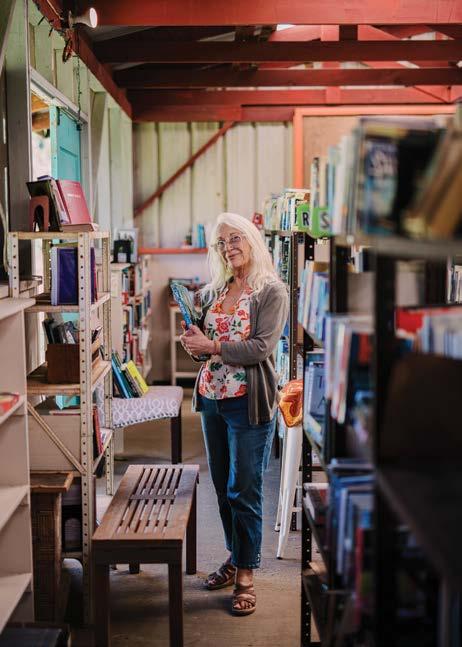
Donna Ambrose of the southernmost bookstore in the United States—the Book Shack in Wai‘ōhinu—finds Kā‘ū residents good, cheap reads—but only on Wednesdays from 10 a.m. to 3 p.m.
Drivers along the Ka‘ū Scenic Byway are obligated to slow to twenty mph on the knee-bend curve through Wai‘ōhinu. Here on the slopes of Mauna Loa, cattle outnumber people
(fewer than two hundred residents at last count in 2023), original property deeds are in ‘ōlelo Hawai‘i (the Hawaiian language) and ancestors are buried on family land. Secrets and
surprises dwell in this outpost, one being the Book Shack, among Hawai‘i Island’s best and probably most remote used bookstore.
“Open Wednesdays, 10 a.m.–3 p.m. ONLY” reads the hand-painted sign propped against the storied building, formerly Wai‘ōhinu School. It’s a brief window, but for those five hours, the Book Shack hosts aunties from Hilo, neighborhood ‘ohana, farmers and offisland visitors. Running the country’s southernmost bookstore on the flank of the world’s most active volcano is a “community effort and labor of love,” says Book Shack caretaker Donna Ambrose, swiping Pele’s hair—thin glass fibers that have drifted in from the volcano’s recent eruptions—off the books in the ample Hawaiiana section. “Sharing the power and joy of reading gives me chicken skin.”
The books, shelves, artwork—even the roof—are donated. When Ambrose assumed stewardship of the project five years ago, the building was “dank, filled with rubbish and piled with moldy books,” she says. Doubters abounded, but Ambrose was determined. “I love this community and wanted to do the Book Shack right. It’s not about money or recognition.” Indeed, books here cost $1, and Ambrose gives away stuffed animals and bookmarks on the regular. Leased from the Kauaha‘ao Congregational Church, the Book Shack opens concurrently with the nearby Nā‘ālehu market, which features the Ka‘ū District’s top craftspeople, bakers and growers.
The Book Shack “is more like a fellowship place, where people go for books but stay to talk story,” says the church’s kahu (priest) Debbie Wong Yuen. “I feel at home when I’m there.” She’s in good company: On Wednesdays, the Book Shack’s grassy knoll bustles with cars, while neighbors browse reading material from Doctor Zhivago to Dr. Seuss. “But I want more books!” a local keiki cries to his mom. She promises they’ll return next week.
STORY BY SARAH BURCHARD
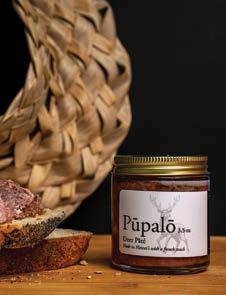
Preserving pork with pa‘akai (sea salt) in Hawai‘i dates back more than eight hundred years, centuries before charcutiers in fifteenth-century France figured it out. Pierre Daguzan combines the two: He applies the craft of his French heritage to Island-raised meats. Daguzan got the idea in 2022, when he prepared fresh venison that his brother-in-law brought from Moloka‘i to his wedding on O‘ahu. His guests devoured Daguzan’s venison pâté. That response, combined with his concerns about Hawai‘i’s food insecurity, led Pierre to start Daguzan Charcuterie. Daguzan never trained as a chef, but he didn’t have to. He was raised in France by a family who grew, hunted and fished for their food. In 1988, his father published Ma Cuisine Gasconne, a cookbook celebrating the cuisine of Gascony—a region west of Daguzan’s hometown of Toulouse, famous for foie gras. In his youth, Daguzan worked as a waiter and cooked at home. Food was everywhere, and after earning a degree in marketing and business it was
inevitable that his culinary upbringing would intersect with his new skill set.
During an internship in China, Daguzan met his O‘ahu-born wife, who was there teaching English. After living together in China for a few years, they moved to O‘ahu in 2015 to start a family, and Daguzan worked in marketing.
When Daguzan set out to source fresh, local ingredients, “I really tried to search for the best producers, the best farmers, and tried to create the best product,” he says. For now, Daguzan Charcuterie offers a selection of pâtés and rillettes made with J. Ludovico chicken liver from the North Shore of O‘ahu, pork from Mountain View Farm on Hawai‘i Island and Makana Provisions Moloka‘i venison. Rillettes are made with pork or venison, cooked slowly with aromatics until it falls from the bone and whipped until smooth— best spread on a crostini with crunchy sea salt or a dollop of fruit preserves. There’s also a creamy chicken liver mousse and two rustic-style (chunky) pâtés, one pork, one venison.
Daguzan credits local accelerators Mana Up and the Wahiawā ValueAdded Product Development Center for getting Daguzan Charcuterie where it is today. Curious gourmands can find Daguzan’s products at Farm Link Hawai‘i, Kaka‘ako Farmers Market, Kailua Farmers Market, Hapa Market and in four Foodland Farms: Kailua, ‘Āina Haina, Ala Moana and Kahala. The venison pâté that started it all was recently nominated for a 2026 Good Food Award. Daguzan hopes to expand to include cured meats next year—an endeavor requiring a temperaturecontrolled room and detailed food safety plan. Perhaps, he muses, an Ibericostyle ham using Hawai‘i Island pigs finished on mac nuts.
“I hope it can be a legacy business,” Daguzan says. “Maybe my sons could take over and it could be like, you know, a famous French-Hawaiian-American success story.”
Pierre Daguzan (seen above right, far right) grew up Gascony, France—foie gras ground zero. He applied his penchant for charcuterie to creating pâtés and rillettes from local meats, including venison pâté (seen above left) made from Moloka‘i axis deer.
STORY BY LARRY LIEBERMAN
Light Harvest
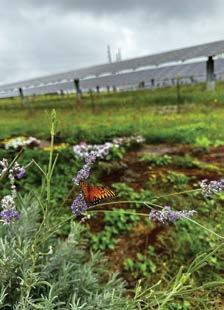
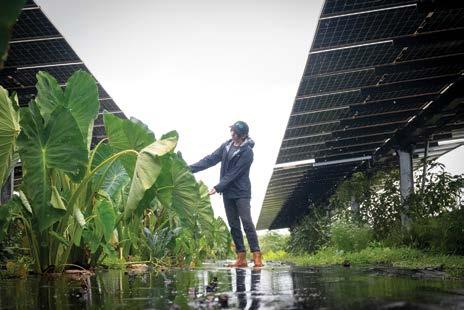
Clearway Energy’s solar farm in Mililani turns sunlight into energy in more ways than one. The pilot project is putting “agrivoltaics” to the test in Hawai‘i by growing food crops in the shade of a solar array. Above right, Hawai‘i Agriculture Research Center associate Juli Burden tends to kalo (taro) under the panels. Above left, heat-tolerant lavender, a pollinator crop, flourishes near a bank of the farm’s 120,000-plus panels.
The sun beams down on Clearway Energy’s 131-acre solar farm in West O‘ahu. More than 120,000 solar panels are converting the relentless sunshine into clean electricity. But there’s something different about this solar installation: Through partnership with the Hawai‘i Agriculture Research Center (HARC), a two-acre section of the farm is doing double duty as an actual farm, cranking out power while also growing crops.
“The combination of solar energy and farming is called ‘agrivoltaics,’” says Juli Burden, a research associate for HARC’s experimental dual land-use research project. The privately funded initiative integrates a variety of local food crops with a forty-three-megawatt utility-scale solar array in the dry reaches of Mililani. “This is critical for Hawai‘i’s land-constrained environment as the state works toward its 2045 food and energy sustainability goals,” Burden says. And those are lofty goals: In addition to its target of achieving 100
percent renewable energy by 2045, the state is also looking for ways to reduce its overreliance on imported food.
Lettuce, strawberries, broccoli, ginger, asparagus—more than thirty different crops grow in the shade of the panels, on land that would otherwise be suboptimal for some of these crops. And these plants require significantly less water—50 to 70 percent less than unshaded crops. HARC is also studying an unexpected reciprocal benefit: The crops might have a cooling effect on the panels, which increases their efficiency.
The panels above HARC’s experimental harvest rotate to track sunlight throughout the day. That tracking system has a higher clearance from the ground than other types of static installations, leaving more space below for cultivation. But even standard, ground-mounted fixed solar arrays can often support agriculture. The Mililani project was retroactively added to a two-acre research area within the existing installation, and HARC’s vision
is to do the same at other compatible solar farm projects around the Islands. Longroad Energy is developing its Mahi Solar project in Kunia, with an agrivoltaic partner already signed up to grow lettuce under the array. “There’s a lot of potential if we can get more agrivoltaic farmers interested and engaged,” Burden says. “For a lot of shade-loving crops like our leafy greens and herbs, these are really optimized spaces for production.”
Crops from the Mililani site have been sold to restaurants, food aggregators and a local bakery. It takes coordination and careful planning between the energy producers and the food harvesters, but if Burden has her way, it might not be long before your next salad comes from the same place as the power running your refrigerator. @HI_SOLAR
STORY BY MADELEINE HILL
Lucky Bunnies
Don’t ask Lawai Diaz to choose a favorite. Each one is an individual, says the 16-year-old founder, board chair and executive director of Better Bunny, O‘ahu’s only rabbit rescue.
Stella the lionhead (the breed has a “mane”) is intelligent and “food motivated.” The lionhead male, Theodore, is reserved. Wilbur, 11, a mixed breed, is sweet with a grouchy streak. Karamel is a shy Holland lop who warms up with patience. Ripple, a Flemish giant, is the most extroverted of Lawai’s five-bunny fluffle.
That rabbits have distinct personalities is a little-known fact.
Another surprise? Bunnies are a lot of work. And they aren’t always as snuggly as the adorable stuffed animals they resemble. “Sometimes they don’t really ever want to be held, even if you get super close to them,” Lawai says. “They’re prey animals, and it reminds them of being carried off by predators.”
Lawai learned all this when she adopted Cottontail. She was 11 at the time and learned that Cottontail needed ample indoor space, a specific diet and neutering if there were to be playdates. The more she went down the rabbit hole, the more determined
Lawai became to educate others. She discovered a YouTuber who rescued stray and neglected bunnies. Shortly after, Lawai spotted a fluffle of strays near her Kāne‘ohe home. She announced her intent to rescue them in a Facebook group of local rabbit owners and, as quickly as rabbits breed (only about thirty-one days of gestation), word spread.
Thus was Better Bunny born. Lawai, who works thirty hours a week at the Haiku Veterinary Clinic in addition to attending high school at Hawai‘i Technology Academy, estimates it took her at least two hundred hours to get Better Bunny hopping. Now, a team of about twenty volunteers—mostly adults—works with Lawai. About five of them help catch strays; others foster surrendered and abandoned bunnies and assist with adoptions, which includes vetting prospective adoptive families. Bunnies stay in foster care as long as it takes to be rehomed. Better Bunny has placed fifty bunnies since its inception.
Lawai hopes that if prospective owners have realistic expectations, they’ll be less likely to surrender or abandon their higher-than-expected-maintenance pets. Leaving these fragile, domesticated animals to fend for themselves is often a death sentence. And, as a nonnative species, they can damage Hawai‘i’s ecosystem. Stray rabbits are a problem on O‘ahu, Lawai says, and she hopes her organization’s efforts will prevent it from getting worse. Money raised from Better Bunny donations and community activities, such as bunny yoga, pays for spaying, neutering and vet care.
Lawai hopes to turn her passion into a career in veterinary medicine. In the meantime, she’s finishing high school and bonding with her bunny brood. It’s well worth it, she says. “There’s something special about having a prey animal trust you. When you get to that point, it’s just a very special bond because it’s just you and them.”
PHOTOGRAPHY BY ELYSE BUTLER
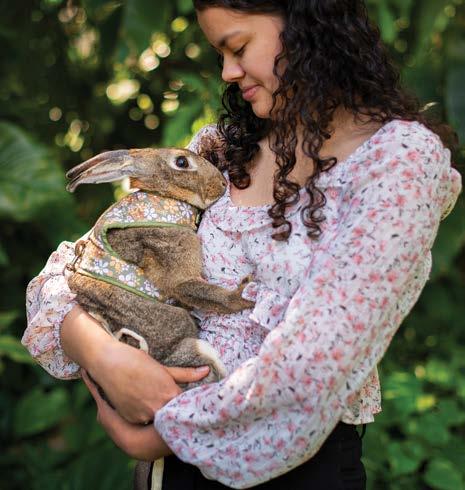
Founder Lawai Diaz cradles a member of the fluffle at Better Bunny in Kahalu‘u, the only rabbit rescue organization on O‘ahu.
departments & features
STORY BY CONNER GORRY
The Exquisite Corpus
A meeting of the imaginations at the Hawai‘i Artist Collaboration
PHOTOGRAPHY BY MEGAN SPELMAN
creators from Hawai‘i and around the world meet for a week at Tai Lake’s family compound
collaborate and create at the annual Hawai‘i Artist Collaboration (HAC). On page 34,
fabricator Ian Rogers team up to create a sculpture that will be auctioned at week’s
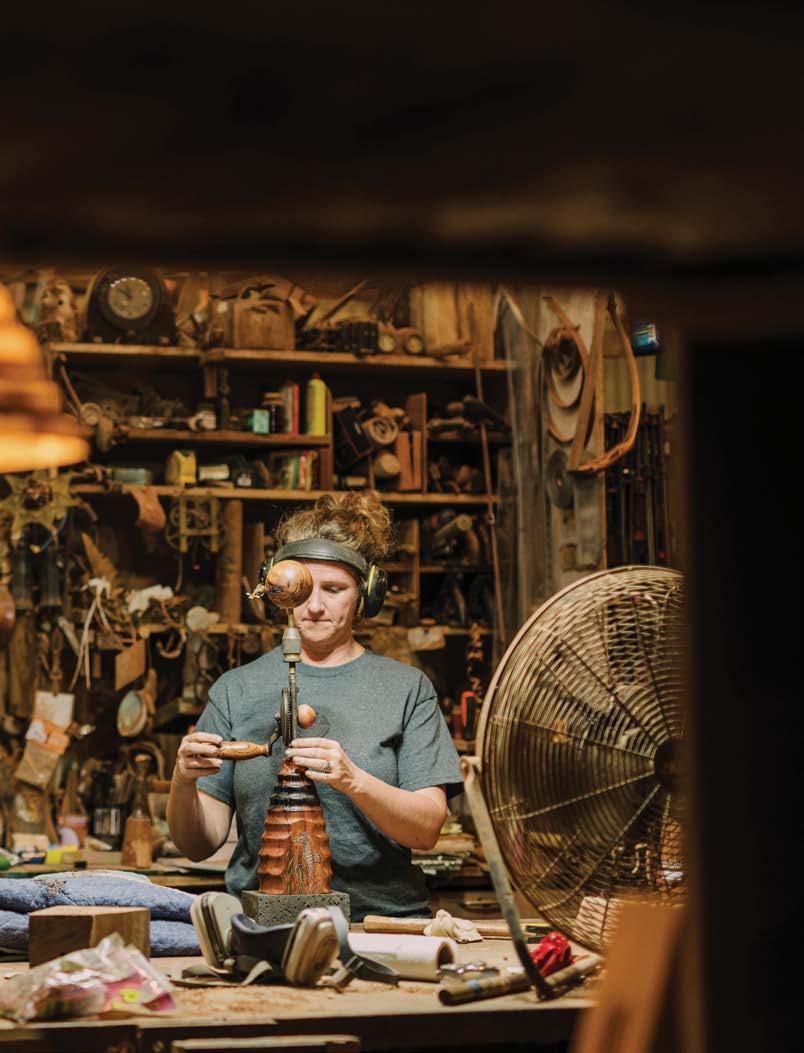
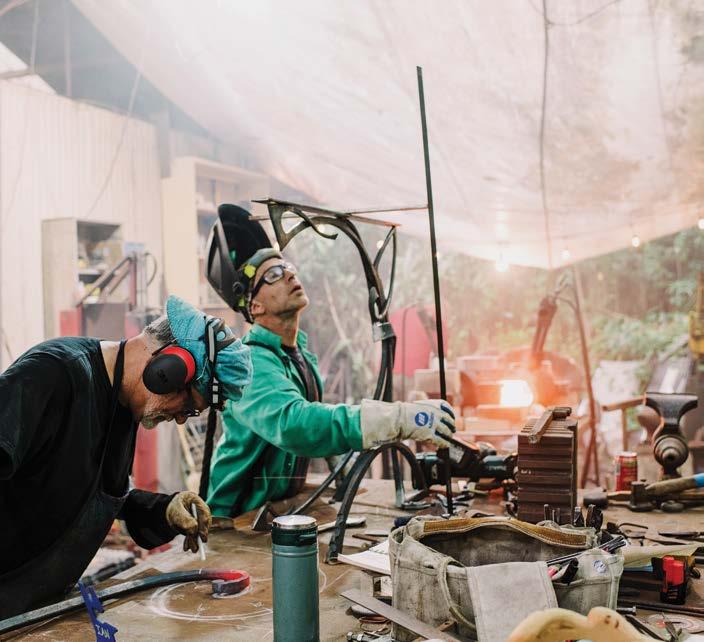
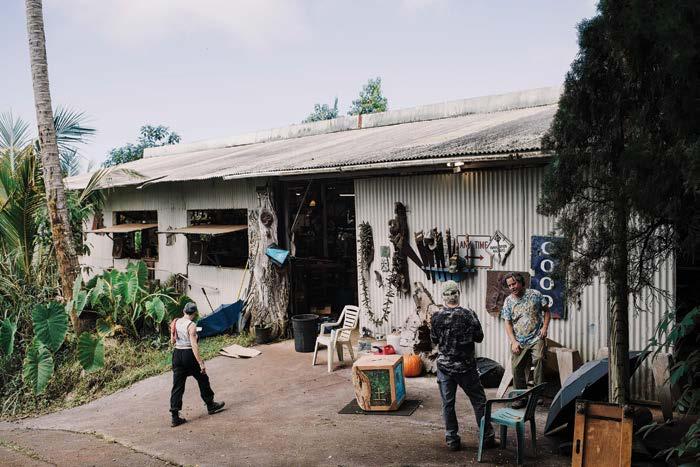
Welcome to the chaos. You might want earplugs,” says Kristen Lake, weaving among table saws, drills and master artists at work. Lake herself is a master lighting designer and jeweler, leading me through the whirlwind of creativity that is the Hawai‘i Artist Collaboration. Every year, painters, woodworkers, blacksmiths, sculptors, jewelers, fabric artists and many others have converged on the Lake family’s homestead and art studio in the usually sleepy coffee-and-art town of Hōlualoa, Hawai‘i Island. “Collab,” as HAC is called, isn’t just any artists’ retreat—it’s a vibrant ecosystem in which imagination and crosspollination fuel a week-long marathon of creativity, genius and cacophony. At its end, the completed pieces—each created by multiple artists working in different media—are sold at a fun and
fast-paced charity auction benefitting arts education on Hawai‘i Island.
Tai Lake, an elder among Hawai‘i Island furniture makers, co-founded Collab but didn’t invent the concept. “In 2006, I experienced the EMMA Collaboration in Saskatchewan and thought, ‘Hawai‘i is so missing this.’ I knew immediately we had to do it here.” Lake participated in other vanguard collabs—Frogwood in Oregon and New Zealand’s CollaboratioNZ—before wrangling local artists for the first Hawai‘i Collab in 2011.
Fast-forward to 2025: The artistic mashup is hosting forty creatives from down the road to Down Under. What the artists call “summer camp for adults” is an opportunity for them to hole up and collaborate with fellow professional artists, three hots and a cot included. It all has a Willy Wonka vibe: magical, implausible and destined to
seed joy. If there’s a real-life equivalent to the chocolate factory’s golden ticket, receiving a HAC invitation might be it.
“Collab is invitational, but also self-selecting,” says Lake. “There’s a certain type of person that wants to be in on this.” After several days sharing the rarified ether of A-list creatives living and learning together, it becomes evident that the type of person drawn to Collab is an accomplished artist, clearly, but also a natural student-teacher who wants to share knowledge: civic-minded, community-oriented, plays well with others. Almost all are polymaths and mentors, several are founders or board members of nonprofits, and there’s a surprising number among this cohort who hold advanced science degrees.
The event has few guidelines and fewer rules, save an authentic commitment to collaboration. Pieces
Forty
in Hōlualoa (seen above) to dream,
blacksmith and sculptor John Medwedeff and metal
end to raise money for Hawai‘i Island arts education.
must be completed within the four-day creative window and donated to the auction (artists may work around the clock, but hammering past 11 p.m. will elicit F-bombs), and no one is limited to their genre or medium—the Collab’s “no rules” rule.
Some artists bring partially cooked ideas or works in progress, but many start from scratch in a process akin to the Surrealists’ “exquisite corpse” method: Each artist adds elements to a drawing or written piece to create a unique collaborative work. The gimmick with original proponents André Breton and Henry Miller was that each artist did not know what the previous one had added. At Collab, though, the artists work together: Ideas spring forth, overlap and morph, everyone taking a capacious “what if?” approach.
Information flows freely while grinding stone or pounding steel
but especially over communal lunch. Master metalsmith John Medwedeff, a.k.a. “Duff,” shares tips on rustproofing metal sculptures using beeswax: “It’s literally a hot mess, but effective.” Nearby, a wizened artist counsels Senden Blackwood on pricing small vessels, a departure for the Australian sculptor accustomed to working on a monumental scale. People lean in when Alaska Native jeweler Denise Wallace, lauded as “a national treasure” by another collaborator, explains her intricate hinge-and-door mechanisms. Beau Jack Imua Key, a kumu (teacher) of traditional Hawaiian cordage making, imparts his knowledge of lashing, which is used in several pieces to be sold at the auction. “Our role is to be that crossroads between art, function and traditional techniques,” says HAC founding member Cliff Johns, who sculpts using pre-contact tools he made from ‘ōpihi (limpet snail) shells, black pearl and coconut shell, the fruit of years of anthropological research.
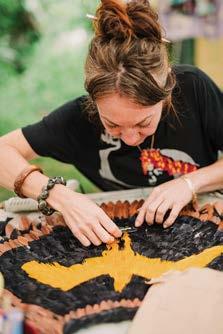
ABOVE / “No glue dots! All hand-sewn!” says Hawai‘i Island artist Kira Kamamalu, about the ‘ahu ‘ula (feather cape) she’s creating.
“What makes HAC so special is the genuine cross-pollination between us. Collaborating with others is nourishing. It’s necessary for maintaining sanity, particularly now,” says woodturner Aaron Hammer, who splits his time between O‘ahu and Hawai‘i Island. The mini-lathe he brought captures the imagination of Nisla, an oil painter who lost her home and work in the Maui fires, precipitating a move to Hawai‘i Island.
“It’s a magical process,” Nisla says, watching Hammer transform a modest koa block into a perfect sphere while explaining that the lathe is the world’s oldest mechanized tool. “You make me want to go out and get a lathe!” Drying blood where sandpaper kissed his finger, Aaron proposes that Nisla paint a bowl he made earlier, and another spontaneous collaboration is born.
“I think collaboration is the future. For many things, not only art. You can move further forward, faster, by collaborating,” says Shelby B. Smith, a
LEFT / Cliff Johns carves mango wood into a papa ku‘i ‘ai (poi-pounding board).
Blue Topaz Sea Turtle
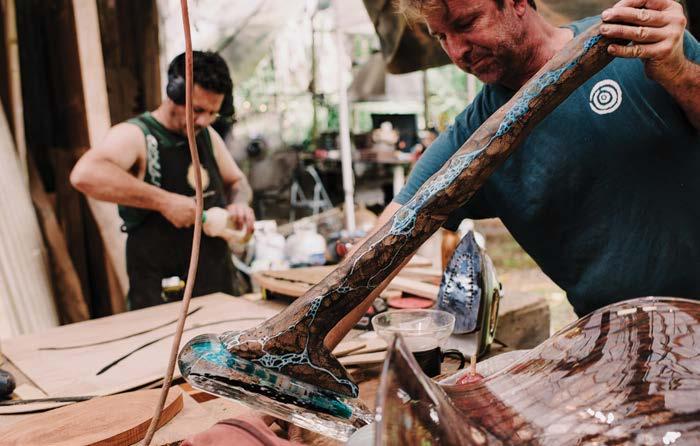
Maui-based glass artist Evan Jenkins does his part on “Ko‘i o Maui,” a sculptural homage to the Hawaiian adze, created in collaboration with five other artists. On pages 32–33, Kristin Lake at work on a piece called “Reelin’ It In.”
ceramicist who incorporates the concept in his classes at the Hawai‘i Academy of Arts & Science in Pāhoa. The first-time Collab participant hit the ground running at this year’s event, titled Holomua Kākou—“moving forward together”—by contributing to several pieces crafted by dozens of artists, including illustrator and insatiable raconteur Alex Gupton. “Here, you have masters sharing all their techniques. They literally sit you down and say, ‘Do it like this. Not like this because you’ll screw it up,’” says Gupton. “You learn something that would take years to figure out in a thirty-second tutorial. It’s amazing.”
Compressing the process into a tight window is an exercise in taming the muse, and it produces exquisite, sometimes peculiar and often hilarious art. Nineteen artists contributed to “Wild Horse Totem,” for example, a sixfoot-tall bejeweled garden protector that raised $300 at the 2025 auction. Often, hidden meanings are woven, sewn, glued or soldered into pieces (guillotines
and “We the People” were noticeably present this year). Inevitably, when one of the collaborators can’t part with a creation, they’ll dive into the bidding fray. A six-foot chicken sculpture protects one side of Cliff Johns’ garden, an octopus sculpture, the other, both acquired in previous HAC auctions.
Proceeds are split down the middle to finance local art education and next year’s Collab. “I do it for the kids,” says mixed media artist Victor Pilolla. “If you give them the opportunity to release and process feelings, they will find a way. Art does that.” In addition to providing money for supplies through the Art Educators Fund, Collab supports curriculum development through their Teach the Teacher initiative; recipients underscored the importance of HAC’s contribution as arts funding is being slashed across the country.
Sahra Indio, a teaching artist at camps hosted by the Society for Kona’s Education and Art and a HAC grant
recipient, knows firsthand how these funds impact Hawai‘i Island youth. “So much of our island is underserved, and these funds allow us to grow our craft with the kids,” she says. “It feels so honoring for teaching artists like me to receive HAC support.” Scholarships for teens to attend the Youth Summer Art Experience at Hōlualoa’s Donkey Mill Art Center, for example, are another way HAC promotes the arts. In 2024, $40,000 in auction proceeds provided funding for seventeen art programs in local schools. Organizers hope the program will spread to other islands.
Therapeutic. Transformative. Uplifting. A career
milestone. That’s what the artists say, many moved to tears, when describing Collab. The medicine is so powerful, artists attest, that afterward their studios feel drained of color and energy, and their work stalls until they rally to create anew. Many find their art has evolved,
A Taste of Home
60 Years in the
Making
Next Stop...Zippy’s. For many Hawai‘i locals, it’s the very rst place they head a er leaving the airport. No unpacking, no detours, just straight to a familiar meal that says, we’re home. As Zippy’s Restaurants® celebrates its 60th anniversary, it honors six decades of serving the avors, values, and spirit of Hawai‘i.
Founded in 1966 by Francis and Charlie Higa, Zippy’s grew from a single neighborhood restaurant into a beloved local institution rooted in family, consistency, and community From longtime regulars to new generations discovering Zippy’s for the rst time, we o er our heartfelt mahalo. Your support continues to inspire us to serve food that feels like home.
As we re ect on the journey so far, we look ahead with excitement. With expansion into Nevada, Zippy’s is sharing the tastes and spirit of Hawai‘i with new communities, while staying true to its roots.
Mahalo for being part of our story, then, now, and for generations to come.
When you land, grab your bags and do what locals do: make your Next Stop...Zippy’s.
Celebrate 60 years of shared memories and the comfort food you love with our limited edition 60th Anniversary merchandise collection!
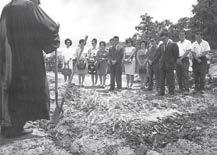
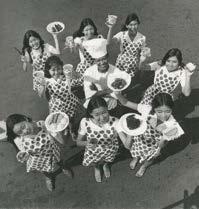
The groundbreaking ceremony for the first Zippy’s location on King Street in Honolulu, Hawai‘i.
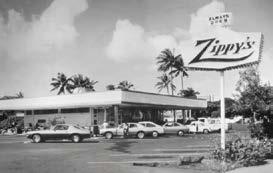
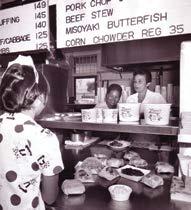
Zippy’s McCully opened on October 17, 1966.
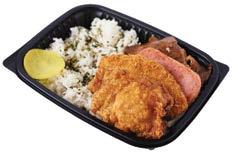
Introduced in 1971, the Zip Pac® has become one of the most iconic and popular items on the menu. Includes local favorites like fried chicken, hoki, SPAM®, and teriyaki beef over a bed of rice with furikake and takuan.
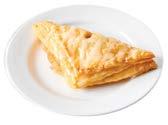
Home of the original Apple Napple® created in 1983. Flaky puff pastry filled with apple pie filling. Other fillings include coconut and ube.
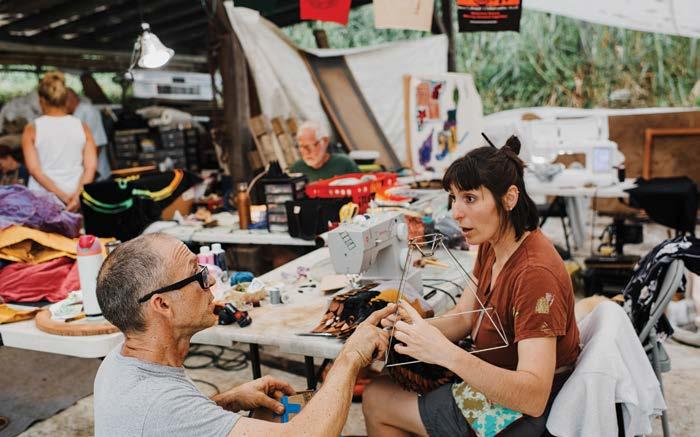
Popping into the Fine Arts tent, Rogers brainstorms with Hawai‘i Island artist Kaylyn Kilkuskie, who added her wearable art to this year’s “Collab.” The final piece, “Threads of Friendship,” incorporated cotton yukata (hand-spun wool yarn), celebrating friendship, including with the five creators who made it.
and they stay connected with fellow artists. Nurturing these relationships in the offseason helps combat CoWS (Collab Withdrawal Syndrome).
“Most artists work alone, in isolation. At Collab, we come out of that,” says Adare, a repeat participant who translated their HAC experience into Abled Hawai‘i Artists (AHA) with co-founder Mar Ortaleza. A self-described activist and “abled artist,” Adare helped launch an annual collaboration modeled on HAC to connect differently abled artists with professionals, art organizers and educators, culminating in a show at Hilo’s One Gallery. “A gallery show is elevating, especially for new artists. We make art, but also good friends and have a strong support network. Participants describe it as lifesaving,” says Adare. Art Immersive, Hawai‘i’s first international abled-artist show organized by AHA and supported by HAC, will be held at Hilo’s Wailoa Center in the summer of 2026.
It’s not a coincidence that Hawai‘i Island has proven such fertile ground for seeding the collaborative movement. It’s home to many master-level artists, but it also supports community building. And overhead costs are lower than elsewhere in the state, says Tai Lake. The island’s fierce DIY streak and the adaptability of its creators don’t hurt— they’ll sleep in cars, tents and sheds for the privilege of attending HAC.
“Collab is a great lesson in using what you got,” says blacksmith Lisa Geertsen of Firelight Forge in Seattle. “Today an artist asked me to make sheet metal clouds, but I didn’t have the right forming hammer. I went to the parts table, grabbed a wooden pear, lashed it to a chair leg and now I have my tool! Here, you have to be resourceful.” To wit: there was no workbench when the five jewelry artists arrived, so they built one.
Smith rummages among dog figurines and rusty gears,
digging for doll heads provided by HAC founding member and “director of acquisitions” Peter Underwood of Kealakekua. Sawdust settles upon woodworker Mats Fogelvik, who puzzles over the mechanism needed for a double-sided coffee table. Fashion designer Kira Kamamalu’s embroidery machine, named Bertha, pounds away, while her terrier mix Mele Mele wags about the Fine Arts tent. “Watch out! This is going to send wire hairs flying!” yells blacksmith/sculptor Ethan Froney over the din.
Halfway through the five-day event, the energy shifts toward composed panic—any piece not completed by Collab’s fourth evening is ineligible for auction. “Every year, things get done that you didn’t think would get done, and other things have to wait until the next Collab,” says Kona photographer/woodworker Matthew D’Avella. “It’s part of the wonder, but it’s also heartbreaking. Will the same collaborators be back
Maui Brewing Co. at the OUTRIGGER Ka’anapali Beach Resort
Duke’s Restaurant at OUTRIGGER Waikiki Beach Resort
Monkeypod Kitchen by Merriman at OUTRIGGER Reef Waikiki Beach Resort
Kani Ka Pila Grille at the OUTRIGGER Reef Waikiki Beach Resort
next year? Will someone take it in the meantime and create something else?” Duff chimes in. “It could happen. I’m aimin’ for the deadline, but could use an extra day right about now,” drawls the Nashville native noted for his public sculptures across the Midwest.
The Collab process “is thrilling and terrifying,” says D’Avella. “It requires a lot of vulnerability” and engenders solidarity. All the artists are in the same boat, rowing together toward the deadline, determined to raise as much money as possible for local educators and young artists. “No stress. If you don’t have it by 8 p.m., no worries,” Adare says reassuringly to jeweler and sculptor Amarette Gregor from Portland, Oregon, who took on the challenge of fashioning a hinge for a moveable sculpture because “the problem tickles my brain,” she says. The strict time limit is
motivation rather than anathema, say the participants, and veterans agree that more time doesn’t translate into more productivity.
As predicted, some creations don’t make the deadline and are tucked away for next year’s Collab. But one hundred pieces are completed and set to sell, stoking a bidding frenzy at the Hawai‘i Island Community Health Center in Kona, host of the 2025 auction. Professional auctioneer Brad Hooley of Bartel & Company Auctioneers, coaxed the on-and-offisland art ‘ohana into raising their paddles early and often during the live and call-in auction. Duff beat the clock, completing the steel legs for “Nouveau Sunset,” a koa table created with four others that netted $9,000, the afternoon’s top price for a single piece. Together with scores of smaller items on display available in
a synchronous silent auction, Collab 2025 broke all previous records, raising almost $50,000.
One of the auction’s most emotional moments was delivered by “Aotearoa Homie” Mike Paora, as he translated the Māori inscription on “Kotahitanga II,” a collaboration with Alex Gupton, John Strohbehn and Noah Lake, Tai’s son: “What is the most important thing in this world? It is the people.” Chicken skin and cheers ran through the pavilion—even Mele Mele gave an enthusiastic yip. “This resonates for me because this is what Collab is all about. I don’t remember all the pieces I’ve worked on, but I do remember all the people and the connections I’ve made. I’m here because of those people and those connections.” Bidding paused for a beat, giving artists and attendees the opportunity to dry their eyes. hh
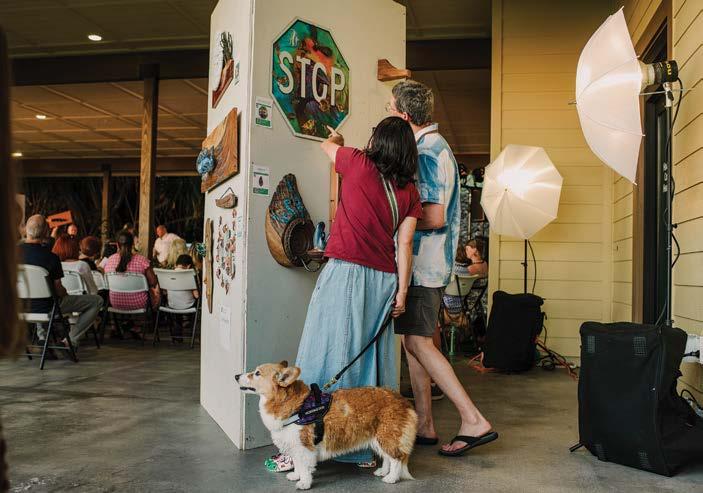
Artists donate the work created at HAC to be sold at auction both live (seen above) and online; Collab 2025 raised nearly $50,000, breaking previous records. Repurposing unique objects, like this stop sign salvaged from Volcano Village, is part of the event’s alchemy—as are the dogs.
STORY BY JARRETT VAN METER
The Court Jesters When
the
Harlem Globetrotters
needed a rival and a foil,
stepped up to the basket
Hawai‘i
On a cold January Saturday, four thousand spectators crammed into the 3,360-seat Coliseum in Sioux Falls, South Dakota, for a basketball doubleheader. The year was 1959, and depending on their seats, attendees paid between one and three dollars per ticket.
The day’s first matchup pitted a female barnstorming team, the Texas
Cowgirls, against a group of local media members. The crowd delighted as the Western-themed visitors lassoed, hogtied and shot their way to a 53–30 victory over the male press corps. The opening act cleared the floor and the building began to crackle with anticipation. The Harlem Globetrotters had been playing basketball for more than three decades by that afternoon, but never
had they boasted such a talented roster: master showman Meadowlark Lemon, dribbling whiz Herman (Honey) Taylor and, in the middle, the seven-footer many in the audience had come to see: Wilt Chamberlain.
Inconsequential to many in attendance that night, and throughout the Globetrotters’ now hundred-year history, were their opponents. The Trotters
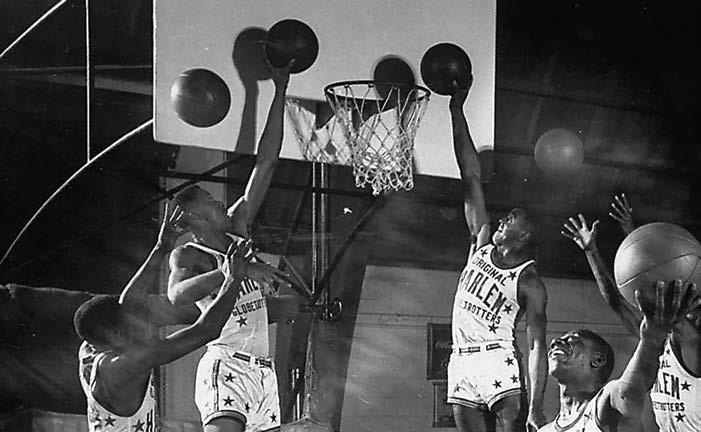
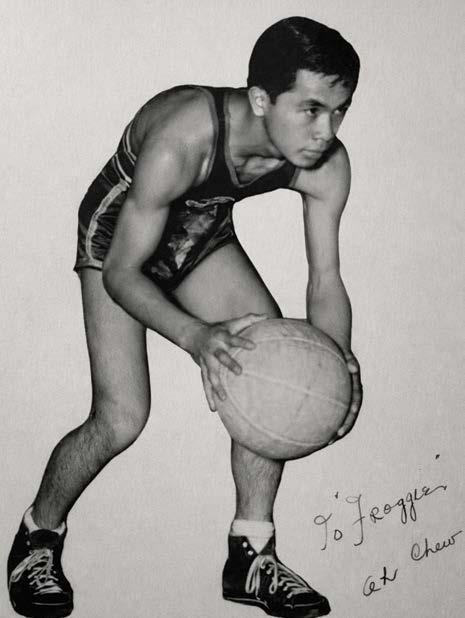
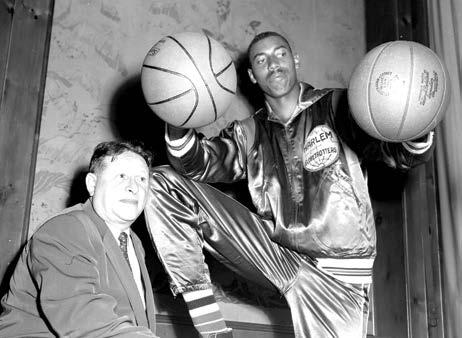
Hilo basketball phenom Ah Chew Goo (seen above) stepped up when the Harlem Globetrotters (seen on page 46 in 1953) needed a team to play against. Goo formed an allHawai‘i team that toured with the Globetrotters, and he invented some of the Globetrotters’ beloved on-court gags, performed to this day.
have taken on everyone, from NBA and NFL teams to local civic groups in the towns along their tours. The New York Nationals served as a mainstay for years, and the Washington Generals, infamous for their losing ways, have long been associated with the act. Yet on that night in Sioux Falls and many nights like it throughout the 1940s, ’50s and early ’60s, their opponent’s jerseys said Hawaii.
The team went through such names as the Hawaii All-Stars and Surfriders, but it was the third iteration, the 50th
Staters, that took the floor in 1959. Unlike the Globetrotters, the Cowgirls, the Nationals and Generals, the 50th Staters largely came from the place they nominally represented. There were exceptions—6’9” Kansas City native Kent Bryan was brought in to guard Chamberlain—but for the most part, from Farrington High’s Willie Lee to St. Louis’ Taddy Song, the team was homegrown. The teams warmed up, the horn blew and the ball was tipped. Chamberlain asserted his dominance with a few quick
slams and Lemon went to work charming the crowd. It was the Trotters’ show, but the Staters always kept the games close. They were, wrote Sioux Falls ArgusLeader sports editor Craig Stolze, “better than the customary touring outfits.”
The still-espoused, widely circulated origin narrative for the Harlem Globetrotters claims that a sports impresario named Abe Saperstein created the team one hundred years ago in 1926, and they played their first game on January 7, 1927, in Hinckley, IL.
But according to Ben Green, author of the 2005 book Spinning the Globe: The Rise, Fall, and Return to Greatness of the Harlem Globetrotters, the Globe Trotters (two words originally) were started by Chicago’s Tommy Brookins, who hired Saperstein to book games for the team throughout Michigan and Wisconsin in the late 1920s. Ultimately, Brookins decided to focus on his music career and Saperstein ended up with the team. In 1947, when the Globetrotters (one word by then) were set to play in Hinckley, Saperstein decided to bill the game, incorrectly and seemingly arbitrarily, as the twentieth anniversary of the team’s first game. But their first documented game in Hinckley was in 1929. “They backdated the whole thing,” says Green. “And ran with it from that point on.”
With or without the discrepancies, the timeline runs more or less parallel with that of the Hawai‘i team that would become the Trotters’ stage rival. In the late 1920s, in the Waiakea section of Hilo, a boy named Ah Chew Goo was already becoming a local legend. Every afternoon, his neighbors would hear him dribbling his worn basketball between pavement and dirt on his way to the local gym. Tink, tink … tunk. Tink, tink … tunk. Then ping … firing a perfect pass to himself off of a telephone pole.
When he got to the gym, Goo walked past his schoolmates’ pickup game to a section of empty wall. Alone in the corner, he’d hammer pass after pass to himself: chest, bounce, between the legs, behind the back. Next it was ball handling: left hand-right hand, right hand-left hand. Eyes up. Knees bent. It was the basketball equivalent of eating your vegetables, and Goo never skipped. Only then did he join his friends.
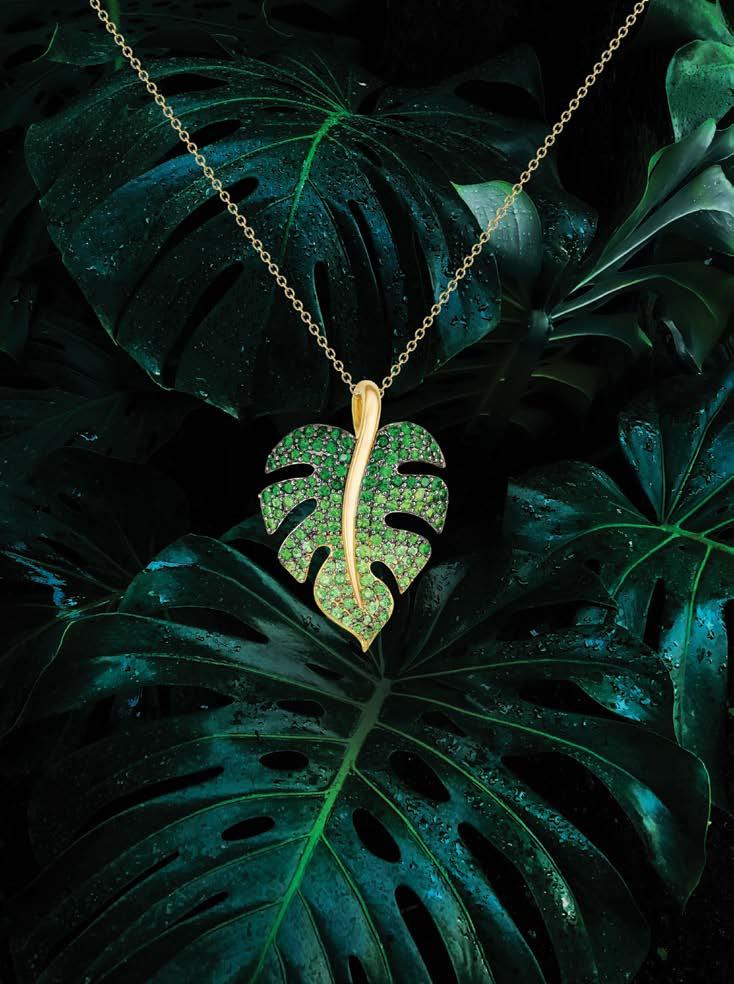
LeVian Aloha Monstera with Forest Green TsavoriteTM in 14K Honey Gold TM
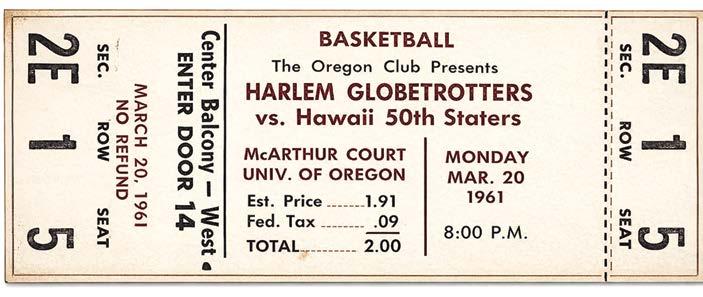
A ticket from the end of the Hawaii 50th Staters run with the Globetrotters. Games were always a show, and the opponents always lost—or almost always: The Trotters dropped a number of games to the Hawaiian All-Stars (the team that preceded the 50th Staters) in 1948.
Goo became so skilled that, as a young fan attending Hilo High School games, he was the only person allowed on the court during halftime. Fans watched in awe as he went through his standard routine in a sort of de facto intermission performance. “The gym was packed, and when the halftime was over, the teams would come back on and about half of the people would leave and go home,” says Vince Goo, Ah Chew’s son and former University of Hawai‘i women’s basketball coach who grew up hearing stories about his father’s basketball career from friends and former teammates at social gatherings.
Goo became a star at Hilo High in the mid-1930s, leading the team to three territorial titles before moving to Honolulu, where he continued to play in men’s leagues and for a team of local all-stars that toured the US continent, facing military base teams and local civic groups. At home, military personnel stationed in Hawai‘i sought out his games, including Navy aviator Press Maravich, who vowed to teach his yet-unborn son (who would become NBA All-Star “Pistol” Pete Maravich) to dribble and pass like the man they called the “Mandarin Magician.”
When the Harlem Globetrotters came to Honolulu in the early 1940s, Goo put together a team of his most talented friends and colleagues, dubbed the Hawaii All-Stars, to take them on.
The two-game series included a practice session to learn when and how to “fall” for the Globetrotters’ ruses. But Goo, it turned out, had a few tricks of his own.
Early in the first game, Goo wound his way to the basket and drew a foul on one of the Globetrotters. A timeout was called, and when Goo huddled with his team on the sideline before his free throws, he grabbed a special ball that he had prepared for the night. While it looked like the game ball, it had a small peg sticking out from it, and tied to the peg was a nearly invisible fishing line. At the end of the timeout, Goo shot the ball, which traveled only a few feet toward the rim before he yanked it back into his hands. Goo had informed the refs ahead of time about his tricks, and they whistled the play dead as the crowd erupted into laughter.
Later in the game, with the Hawaii All-Stars set to inbounds the ball, another timeout was called. Again, Goo snuck the game ball over to the huddle and swapped it for yet another replacement, this one semi-deflated. Goo fluffed the ball up so that it looked round and carried it with him onto the court. When play resumed, he threw it to a Trotter, who tried to dribble it. The ball splatted on the floor. “Everybody was just all hooting and hollering,” says Vince of the fans in the stands.
Goo had a third trick up his sleeve: a bucket of confetti. He had planned to
chase one of the Trotters with it, then throw the contents into the crowd, but the bucket was discovered by one of the Trotters’ employees before he could use it.
Saperstein was livid but impressed. He ordered Goo to drop the gags for the encore performance the following night but offered him a roster spot on the Harlem Globetrotters. Goo, a 5’3” Chinese man who had seen the ugly side of the US continent while on tour with previous teams, declined. In a dispatch from the continent and published in the Hilo Tribune Herald in 1938, Ah Chew wrote: “Basketball fans here laugh at the size of our boys.” “He saw all the racism and bias and everything when they went to different places,” says Vince. “They were cheered because they played good basketball, but they saw the bias that was going on throughout the country.”
Goo stayed in Hawai‘i, but his tricks are still part of the Globetrotters’ repertoire to this day. Saperstein also decided that the skill of the Hawai‘i ballers made for solid competition, able to keep the score close on command for dramatic effect.
The team needed not only a coach but a promoter and advocate, its own Saperstein. Art Kim had earned a reputation as a coach at Roosevelt High in Honolulu, and according to Vince, shared traits with the Globetrotters’ leader. “He was a promoter,” remembers
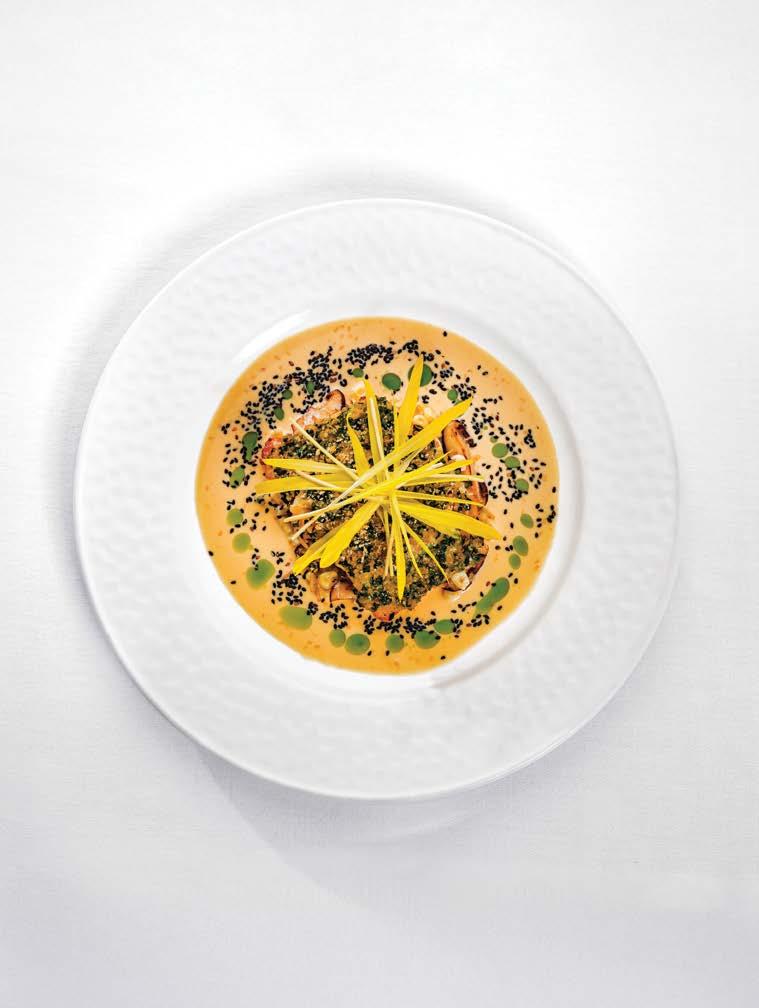
Taste Hawai‘i
Elevated expressions of island flavor.
Vince, who knew the late Kim. “He could tell a story and everybody laughed, a pretty congenial guy.” Joining them in the titular role of team manager was Honolulu police lieutenant Paul Brede.
In early 1947, a group of Kimassembled Hawai‘i players hit the road with the Trotters and two other barnstorming teams, the Kansas City Stars and the House of David. Along for the ride were two hula dancers from Hawai‘i, Barbara Holt and Angeline Hopkins, and a host of Island musicians, including Renny Brooks, for halftime performances. Hawai‘i was not yet a state, and its culture was still foreign to many on the continent. Hula “shakers,” wrote a San Francisco News journalist, were “not to be confused with the small receptacles for distribution of salt and pepper.” During a trip to Omaha in 1948 for a performance scheduled at Creighton University, a Catholic school, the university president forbade the hula dancers from taking the court at halftime. Saperstein was unfazed. Pleased, even, according to Mark Jacob, who, along with his brother Matthew, authored the 2024 biography Globetrotter: How Abe Saperstein Shook Up The World Of Sports. “Abe loved it,” says Jacob. “Anything that would cause publicity would be good news for him.”
The Hawaii All-Stars became the Honolulu Surfriders, which Kim used as the team’s name through most of the 1950s in small American towns and great international cities, Jacksonville, Illinois and Hong Kong; Parsons, Kansas and Manila. In 1958, with statehood on the horizon, they transitioned to the Hawaii 50th Staters. Saperstein usually put multiple versions of the Globetrotters out on the road at once, and each needed an opponent, so for a period the Surfriders and 50th Staters were both in circulation, with the latter taking on the headlining, Chamberlain-led 1958 Trotter team.
Chamberlain had only a one-year contract (worth a reported $65,000, equivalent to about $740,000 today), and by 1961 Saperstein shifted his attention to a new venture: the American Basketball League. His affinity for Hawai‘i led him to place a franchise in Honolulu: the Hawaii Chiefs, led by Kim. The Trotters continued playing, but with Kim now running the Chiefs, it was the end of the 50th Staters.
The ABL was the first league to fully embrace the three-point shot. According to Mark Jacob, Saperstein’s biographer, each team was issued a siren to sound after every made three and generate excitement for the new
gimmick. But it wasn’t enough. The ABL was unsteady from the beginning, competing for attention against the established NBA. The Hawaii Chiefs played just a single season, rotating home games among the Honolulu Civic Auditorium, Pearl Harbor’s Bloch Arena and the Conroy Bowl at Schofield Barracks before moving to Long Beach, California. Their stint in California was short-lived, as the entire league folded midway through the second season.
Saperstein refocused on the Globetrotters and appointed Kim to manage the new nightly opponent, the New York Nationals, before Saperstein passed away suddenly in 1966. A year later, Kim returned to pro basketball as part owner of the Anaheim Amigos, a charter franchise of the brand new American Basketball Association. The new league revived the ABL’s threepointer, and Kim scheduled three of his franchise’s home games to be played in Honolulu. The league caught on and so did the three-pointer, but the Amigos didn’t. Kim sold his share in the franchise in 1968 and the new owners moved the team.
But back on January 10, 1959, Kim and Hawai‘i were still on the sport’s center stage. The 50th Staters were again hanging tight with arguably the best team on Earth in Sioux Falls. Kent Bryan, the 6’9” 50th Stater from the continent, asserted himself in the paint and led the Staters with eighteen points. Former Kaimukī High School star Reynold Freitas got hot and kept the defense honest with seventeen of his own. Kaua‘i’s Ron Holt dropped in several slick buckets over the Globetrotter guards. Deep into the second half, the 50th Staters trailed just 75–71.
But everyone knew what was coming. A few trick plays from Lemon, a couple of slams from Chamberlain and the Harlem Globetrotters sailed to a 102–86 victory. After the game, the show would move on to Worthington, Minnesota, for a game later that evening, then Lincoln, Nebraska, the next day. If everything went smoothly, fans would leave each arena talking about yet another Globetrotters win against the … what were they called again? hh
Harlem Globetrotters founder and longtime promoter Abe Saperstein with Wilt “The Stilt” Chamberlain in 1958.
STORY BY LARRY LIEBERMAN
A Bill for an Act Bill Meyer has done as much for Hawai‘i’s creative industries as the creatives themselves
PHOTOGRAPHY BY MATT MALLAMS
Starfish Collection
In 2001, the World Wide Web was still in its early days. Bandwidth was limited and streaming live video was virtually unheard of. That didn’t stop a group of local musicians, technologists and legislators from conducting Hawai‘i’s first-ever livestreamed concert event. Celebrating a new venue, new technology and a new state tax law designed to help artists, the Hawaii Digital Jam was held on the waterfront at Kapono’s, a then-new spot for live music at Aloha Tower in Honolulu. The show featured namesake club owner and recording artist Henry Kapono along with some of the Islands’ most famous performers, including Kalapana, Willie K, Keali‘i Reichel and others. There was also a signing ceremony for the newly passed Act 221, a pioneering state tax law that incentivized arts, entertainment and technology investment in Hawai‘i.
New video streaming technology from a local high-tech startup allowed the event to be simultaneously webcast onto computer screens around the world. The confluence of music, tech innovation and progressive legislation was a seminal moment, the realization of a longtime dream for attorney William G. “Bill” Meyer III. Meyer was a co-author of the act widely credited with helping stimulate the state’s film and television industry, technology startup sector and performing arts community.
“Getting that act passed was a major victory for Hawai‘i’s creative industry,” says Meyer a quarter-century later. Act 221 ushered in a new golden age for the local production community, as major network dramas and Hollywood film studios set up shop in the Islands. “Within a couple of years, there were at least three major episodic TV series shooting here,” says Meyer, listing Lost, North Shore and Hawaii among the television shows and movies that took advantage of the new law, bringing jobs to local crews and putting images of Hawai‘i on screens across the country. Meanwhile local artists and musicians enjoyed a surge in recognition, and by 2005 the Grammy Awards had even added a Hawaiian music category, in part due to a multiyear lobbying effort by Meyer and Willie K.
Meyer’s successes aren’t surprising to those who know him. His
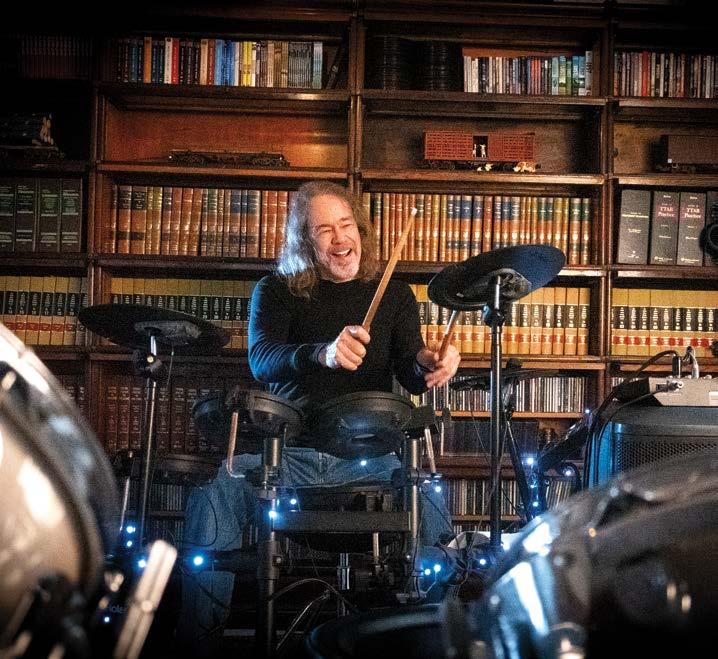
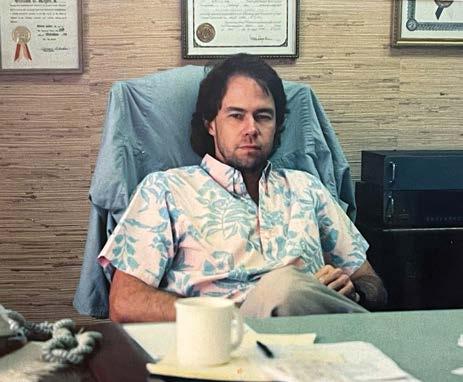
Attorney Bill Meyer, seen above in his office in the 1990s, was instrumental in turning Hawai‘i into a haven for the arts, entertainment and technology. On the title page, Meyer today hitting the skins in his Kailua home office.
instincts for advocacy and influence had been developing since childhood. “In high school I had a job as a janitor, cleaning offices at night,” Meyer recalls. “Sometimes I would just sit behind an executive desk in an attorney’s corner office and imagine myself being a lawyer, because I loved to argue.” And he still does.
As a long-haired, peace-loving Baby Boomer whose coming of age spanned the 1960s and 1970s, Meyer’s been inspired by music most of his life. Bands like Led Zeppelin, Weather Report and Cream provided the soundtrack to his adolescence and got Meyer hooked on playing drums. After moving to Hawai‘i from New York at 13 years old, his tastes evolved to include contemporary Hawaiian music.
By the mid 1970s, Meyer had fully embraced his new, more laidback environment and was surfing, diving and grooving to local groups like Kalapana and Cecilio & Kapono. Like most of his generation, he also
devoured pop culture in movies, TV and radio. While a student at Kaimukī Intermediate School, Meyer would sit under the bodhisattva tree in the schoolyard, looking across the street at the Diamond Head site where the original Hawaii Five-O was being produced and dream about the entertainment industry. He didn’t know it then, but fifty years later he would be representing Alex O’Loughlin and other major cast members of the Hawaii Five-0 reboot. Meyer’s passion for the arts would make him one of the movers and shakers of Hawai‘i’s entertainment economy, an intellectual property lawyer to the stars.
“I sold my favorite drum set to help pay for law school,” Meyer laments from behind a much newer white kit beside a massive library of law books in his Kailua home office. To afford tuition at Gonzaga University in Washington, Meyer scraped. He slept on a box spring (no mattress) and worked part-time cleaning a sandwich shop that let him eat all the free fries he wanted. Meyer crammed in as many credits
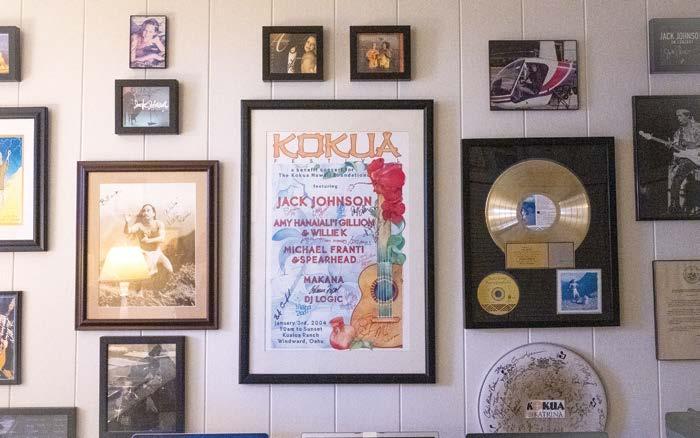
Meyer’s client list reads like a who’s who of the Island arts and entertainment scene, many of whom are also represented on the wall of his home office. “I believe in innovation,” says Meyer. “In art and human expression. And I believe in science. So if there’s a unifying theme in my career, it’s been helping creatives get their work to the public.”
as he could per semester, completing his undergrad degree in just three years and then making it through an accelerated combination JD/MBA program. It was 1979 when the freshly graduated 25-year-old returned home to Hawai‘i, passed the bar and interviewed for his first job as a lawyer. “I had shoulder-length hair and had always let it grow out,” Meyer remembers. “But here I was getting ready for the interview and the big question was, should I cut my hair?”
Meyer decided that if a law firm didn’t accept him for who he was, then it wouldn’t be the right fit. To his surprise, they offered him the job—with one requirement: Keep the hair. The firm felt Meyer’s scrappy, surfer-dude look would make him more relatable to everyman juries comprised of Island residents from all walks of life—particularly important because the firm already had a case in mind for him regarding Native land
rights and real estate development on Moloka‘i. That persona was natural, and it stuck. Meyer built a reputation as a nonconformist with a curious intellect and fresh ideas, a mix of Perry Mason, John Bonham and Hunter S. Thompson. He kept his drums set up in his downtown office (making plenty of noise after hours and on weekends) and gained notoriety for hosting Friday pau hana (end of workday) office parties and flying a large black Jolly Roger flag from the balcony of his otherwise buttoned-down firm whenever he won a case. People in downtown Honolulu saw a lot of that flag.
With his career off and running, Meyer initially focused mostly on real estate and business law, but his appetite for more artistic and innovative pursuits was left unsatisfied. “I remember reading about the coming ‘Information Age’ in the late ’80s and early ’90s,” Meyer says. “I told my partners I thought intellectual
property was going to get really big because of this upcoming thing called the ‘information superhighway,’ or as it was later called, the ‘internet.’” His firm didn’t have an in-house intellectual property practice, so Meyer convinced them to buy the law books and treatises so he could learn it himself.
“There were a lot of artists and musicians here that needed help with copyrights, trademarks and things like that. It was low-hanging fruit, because in Hawai‘i we really don’t have much in the way of manufacturing or patent work, but there are a lot of actors and actresses and entertainers.” Meyer embraced the task of learning about the emerging laws and regulations around creative pursuits and digital content, and in the process became one of Hawai‘i’s most active advocates for the arts. “I gravitate toward creative and innovative people,” says Meyer, looking back on a career that’s seen him represent virtually every type of
artist. “I believe in innovation. In art and human expression. And I believe in science. So if there’s a unifying theme in my career, it’s been helping creatives get their work to the public.”
Meyer’s client list reads like a who’s who of Hawai‘i’s entertainment and technology industries. It has included musicians like Jake Shimabukuro, Jack Johnson, the late Willie K and HAPA; cast members from Lost; producers and directors; entertainment companies like Disney and ABC; and research scientists in medical and computer technology. All sorts of artists, executives and innovators have turned to Meyer for help navigating complex licensing, distribution, publishing and intellectual property issues.
Bryan Spicer, an Emmy Awardwinning producer/director whose filmography includes more than two hundred episodes of Hawaii 5-0 and Magnum P.I., considers Meyer’s past and current efforts to benefit Hawai‘i’s film and television community as highly influential to the success of the industry here. “Bill’s very knowledgeable, and we’re excited to have him involved with our Hawai‘i Film Alliance,” Spicer says, referring to a trade group that organizes legislative testimony and lobbies for the production industry. Meyer’s role in the original Act 221 and other ongoing policy work has helped secure state tax incentives for film and video productions as well as ensure fair royalty and rights agreements for the ecosystem of actors, writers
Meyer with kumu hula (hula teacher) Keali‘i Reichel (at left) and recording engineer Jim Linkner at a signing ceremony for Act 221 in 2001.
and other stakeholders who make those productions possible. “We really appreciate having someone watching our backs, helping out with legislation and advocating for the creative industry,” Spicer says.
Meyer has helped musicians secure copyrights and trademarks, assisted with licensing and royalty agreements and advocated for songwriters and performers to receive fair treatment. He often put in long hours on pro bono cases to protect creators against exploitation by corporate interests, wrestling with giant performers’ rights organizations like BMI and ASCAP to ensure songwriters were compensated when their recordings were played in public. “I was in Waikīkī and walked by a busy, high-end retail store, and they were playing Hawaiian music on the sound system,” Meyer recalls. “The artist was one of my clients, and I heard song after song. They were playing her
whole album, creating the vibe they wanted for their store but not paying her a dime in royalties.”
While artists he knew were struggling to make ends meet, large corporations were making commercial use of their work without properly licensing it. Meyer wrote countless cease-and-desist or demand letters for local musicians and taught a series of “New Media Workshop” classes on the music business and emerging internet issues at Windward Community College and UH–Mānoa, where he’d provide free advice after class to anyone who needed help. “I figured if any of them became successful they could hire me for real once they could afford it.” Island creators, for their part, have returned the love. “He has always prioritized Hawaiian music over profit in every project he’s ever taken on,” says singer, songwriter, kumu hula (hula teacher) and cultural ambassador Keali‘i Reichel.
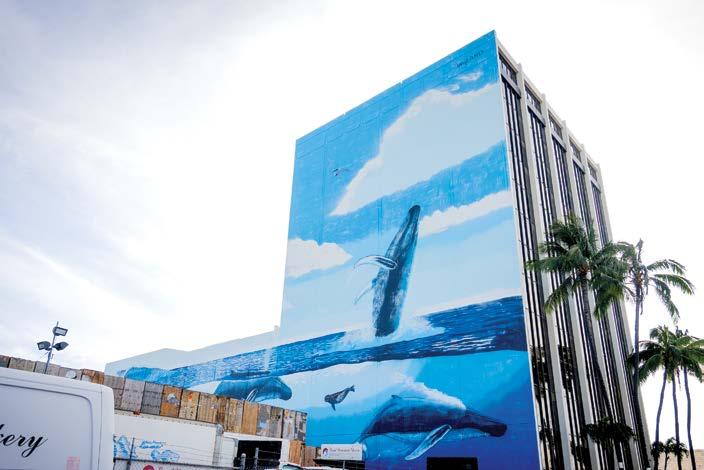
Meyer’s work goes beyond music and film. Robert Wyland, known for painting skyscraper-size whale images on buildings across the globe, nearly had to destroy one of his iconic Honolulu murals. Some had complained that Wyland’s fame meant that the signed image qualified as an advertisement and therefore violated Honolulu’s strict prohibition on billboards. Meyer took the case, he says, because “Artists have the right to put their name on their artwork. So by claiming that Wyland’s work was an advertisement, the city ran afoul of the Copyright Act. They backed down, and the mural is still there.”
Scientific and technical innovations also come under the umbrella of protection. Brad Wilcox is the director of research in the Department of Geriatric Medicine at the University of Hawai‘i’s John A. Burns School of Medicine. Wilcox has developed innovative processes
A breach accused of breaching: Meyer successfully fought to keep one of Robert Wyland’s signature building-sized whale murals in place after the city requested its removal for allegedly violating anti-billboard laws.
to study aging, tracking genetic and physiological biomarkers that provide insights about risk factors for Alzheimer’s and other diseases. But when an overseas organization leveraged Wilcox’s patented research for commercial purposes without permission, the doctor turned to Hawai‘i’s IP guru. With Meyer’s help, they reached a settlement. “Bill’s been a leader in entertainment law in Hawai‘i for a long time, but a lot of people may not recognize or understand the importance of intellectual property nuances related to science and university or federally funded research,” Wilcox explains. “It’s so important to be able to maintain the rights to the work you do.”
Another highlight of Meyer’s career has been activism for charitable causes. With a large network of entertainment industry friends and contacts, Meyer rounded up volunteers for major televised benefit concerts after the 9/11 terrorist attacks and again in 2005 to raise funds for victims of Hurricane Katrina. “I believe our 9/11 benefit here in Hawai‘i was the very first organized, livestreamed concert event of its type, to support the people impacted by that tragedy.”
With wide-ranging work on such a broad mix of cases and causes from pop culture to lab cultures, how does Meyer keep up? “I read a lot. When I was teaching, I always told young lawyers that it’s crucial to read outside of the law that you specialize in,” Myer says. “Don’t be too narrow, just focusing on the latest law-related matters, but read about current events and social issues and politics. Read about psychology and anthropology and philosophy. Because as a litigator you really need to become a citizen of the world and be as wellrounded as possible.”
Despite a career of success, Meyer is still looking ahead: He’s focused on the implications of AI and the new frontier of humanity’s evolution. After recently making a presentation to the Hawaii State Bar Association on copyright issues relating to generative AI, Meyer confesses to still feeling like a rebel swimming upstream against the tide of conformity. “I showed up for the event with long hair and a cowboy hat,” Meyer smiles. “And the receptionist thought I was in the wrong place. I had to tell her, ‘But I’m today’s speaker’ to get in.” hh
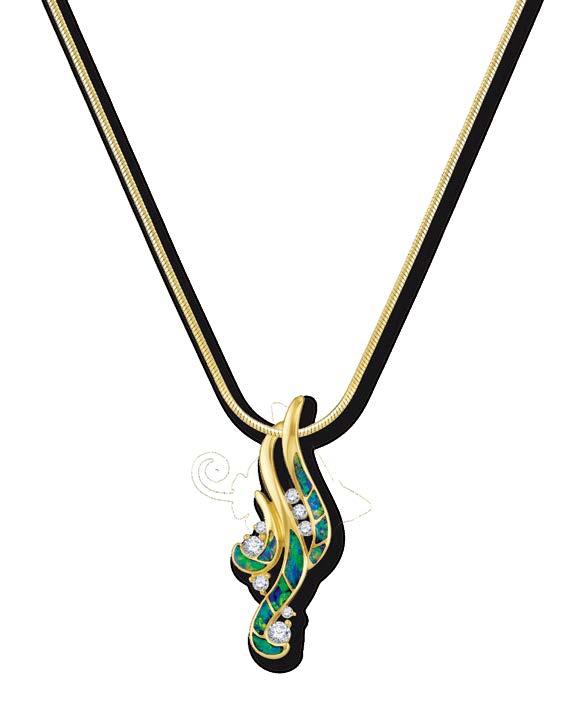
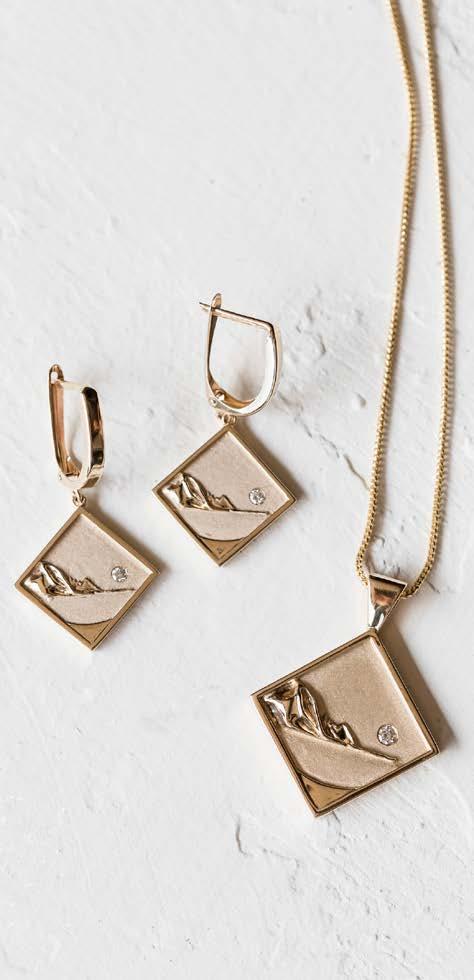
Fine jewelry inspired by Hawai‘i’s landscapes.
By Jaime Ciletti, a third generation jewelry designer from Hawai‘i.
Kanikapila!
In Island backyards, carports, parks and living rooms, the jam goes ever on
STORY BY DEREK FERRAR
PHOTOGRAPHY BY ELYSE BUTLER
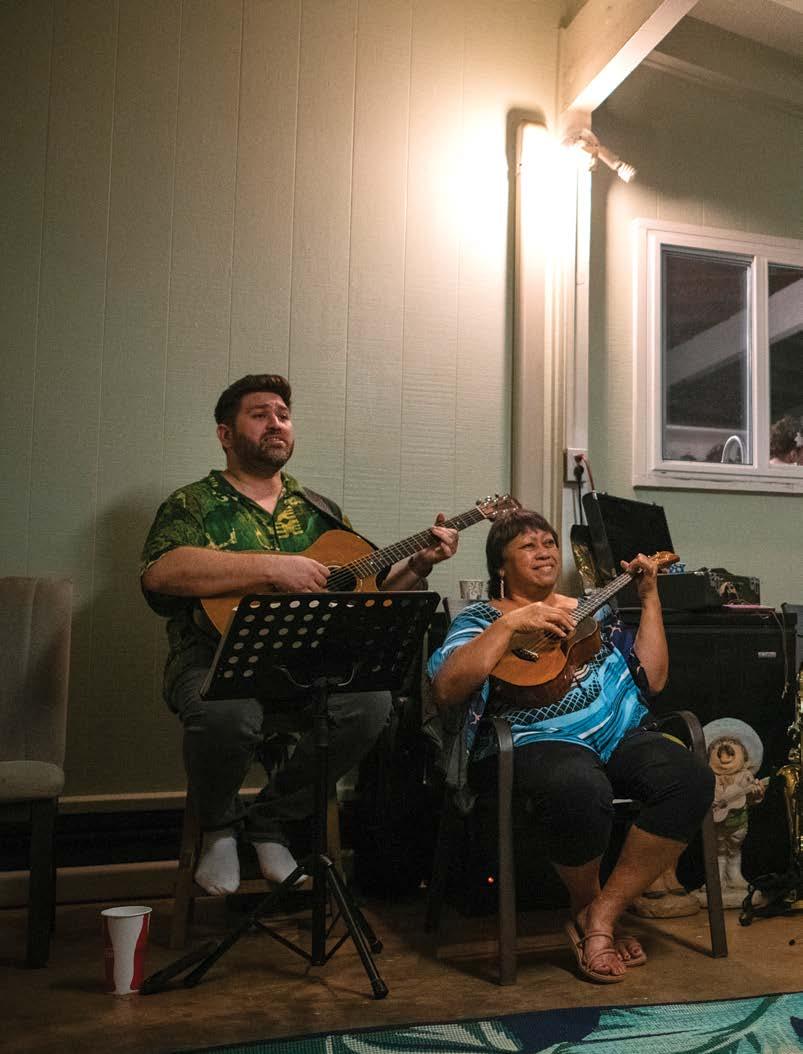
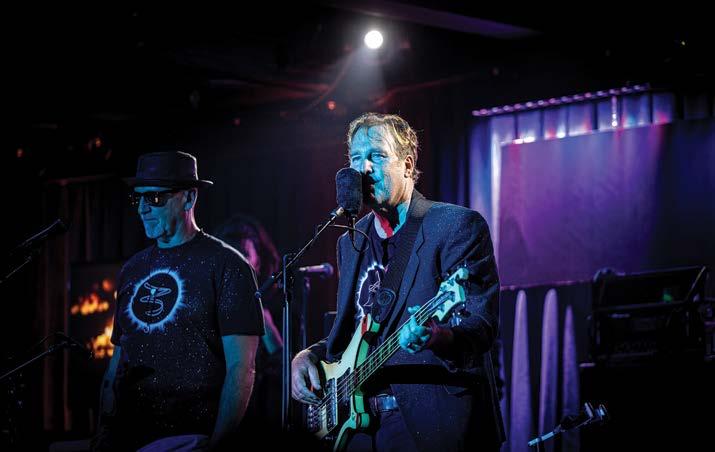
On a quiet evening in the suburban hills above Pearl Harbor, music and laughter waft from an illuminated carport. Inside, a circle of around twenty friends and relatives of the musical Garza family ring the walls on folding chairs, many with guitars or ‘ukulele in hand. A steel guitar sings out with its signature glide as a chorus of voices lets loose on a series of familiar Hawaiian favorites, occasionally accompanied by several generations of hula dancers.
There’s no setlist here. Someone calls out a song name or starts noodling a tune, and everyone jumps in. One uncle blows along unexpectedly on sax, while a younger player thumps along on a single-string washtub bass—called a pakini in Hawaiian music, after the term for tin basin. Meanwhile, Marge Garza, the 93-year-old matriarch of the ‘ohana, or extended family, captures the action on her bejeweled smartphone.
The gathering is what’s known locally as a kanikapila—a colloquial Hawaiian term that loosely translates as “let’s play music!”—a cherished tradition of informal backyard jam sessions where everyone is free to join in, just for the chee-hoo of it. Among the jammers at the Garzas’ are a few recognizable stars, like the well-known singer “Sistah Robi” Kahakalau, young steel guitar sensation Mālie Lyman and the family scion Imua Garza, an award-winning Island music producer and front man of the popular reggaeflavored band the Opihi Pickers. But most of the players here are just regular folks with varying levels of ability and a shared musical passion. “In this garage, everybody who comes along is included, and nine out of ten people play pretty good,” Robi says. “And if they’re not playing, they’re dancing.”
Like most social gatherings in Hawai‘i, kanikapila get-togethers are nearly always accompanied by copious buffets of potluck “grinds.” Taking a break from the music to hit the multicultural spread of local comfort
food ranging from kālua pig and squid lū‘au to sushi and lo mein noodles laid out on his mom’s kitchen counter, Imua says that growing up around these gatherings inspired his music career. “While the other kids were outside playing football or whatever, I was the one that was always in the circle,” he says. “At first I would just watch, and later on maybe grab an ‘ukulele and play along quietly. Then eventually I started jumping in on guitar or bass if they needed one, and I just kind of learned on the spot. But I definitely don’t think I would be making music full-time now if it wasn’t for these little circles that really got me started.”
The Garza ‘ohana kanikapila has its origins in the “Hawaiian Renaissance” of the 1970s, when Indigenous culture, language and activism blossomed amid the era’s wave of social-change movements around the world. Imua’s aunt, Chelo Ka‘i‘ini GarzaMaguire, recounts being a student of ‘ōlelo Hawai‘i, or Hawaiian language under pioneering teacher Larry Kauanoe Kimura at the University of Hawai‘i. “Our language classes were held five days a week, but Fridays were ‘culture day,’” she remembers, “which meant singing, playing and dancing. We didn’t really realize it at the time, but through the music we were learning Hawaiian culture, vocabulary and thinking. Plus, everybody had good fun.”
The students started up a club to promote Hawaiian language and culture called Hui Aloha ‘Āina Tuahine, after the misty Tuahine rains of Mānoa Valley where the university is located. The club went on to play an influential role in the burgeoning cultural revival, including working on a groundbreaking Hawaiian-language interview program on the commercial radio station KCCN. “We didn’t know then that we were part of what people would later call the Hawaiian Renaissance,” Garza-Maguire recalls. “We didn’t think about it; we just did it.”
OPENING SPREAD / Dancer Blossom Logan breaks into spontaneous hula at a carport “kanikapila” jam hosted by Island music producer/performer Imua Garza and his mother, Pam (both at left). “Every time we got together, there was music,” says Pam, who grew up in a family of old-time Hawaiian musicians. “You don’t have to say, ‘Hey, bring a guitar’—they just bring it. Our friends are like that.”
FACING PAGE TOP / With Imua behind the bass, musical attorney Kimo Stone strums an ‘ukulele duet with rising star Mālie Lyman, a gifted multi-instrumentalist and falsetto singer who is carrying forward the traditions of her celebrated musical family.
FACING PAGE BOTTOM / Hawaiian Airlines flight attendant and commercial pilot Malia Mahi gazes to the heavens as she dances to a hula number at the Garza family kanikapila.
Musicians affiliated with the Mana Maoli arts, culture and community-based education collective, jam with youngsters at a monthly kanikapila gathering. “Kanikapila is essential to our culture, because it’s where we gather as one,” says one young participant. “It gives us the chance to share harmony and true aloha, and strengthens the bonds of ‘ohana that carry our music and identity forward.”
Later in life, members of the club started holding periodic reunion parties with music and hula, and these gatherings eventually evolved into broader kanikapila sessions spearheaded by Chelo’s husband, Keoki Maguire, a slack key guitarist and pillar of the Hawaiian music community. At their high point, the musical gettogethers happened every other month at various people’s homes, but then COVID intervened and later the ‘ohana lost Keoki and other key elders, so the kanikapila went dark for a few years. Only recently did Imua’s mom Pam decide to start reconvening the tradition
at the family home a few times a year.
“We’re really inspired to continue this,” Imua says. “I mean, you see the joy that it brings to everyone, and the way that music brings us all together. It’s instant, you know?”
One of the standouts at this evening’s gathering is twenty-something lap steel player and singer Mālie Lyman, who is carrying forward the traditions of her well-known musical family, including her great-grandmother, the Hawaiian falsetto diva Auntie Genoa Keawe, famed for holding impossibly long high notes. Even as an up-andcoming professional, Lyman says she
appreciates the informal kanikapila jams because “we’re not here to perform; this is just for everybody’s individual enjoyment, to learn and have fun. And it’s great being surrounded by people like these who all have different ‘ike, or insights, into the music.”
According to scholar George Kanahele’s Hawaiian Renaissanceera encyclopedia Hawaiian Music and Musicians, the term kanikapila— used as both a noun and a verb and sometimes divided up as “kani ka pila”—is something of a slang phrase
derived from the more formal “ho‘okani mai ka pila.” And “Pila,” meaning a musical instrument, particularly a stringed one, is actually a loanword from English that derives from the Hawaiian pronunciation of “fiddle,” once a common instrument in Hawai‘i following the arrival of Westerners and their music at the end of the 1700s. “Kani,” meanwhile, simply means a sound, or to make one.
Although the term kanikapila may be relatively recent in the Hawaiian lexicon, University of Hawai‘i ethnomusicologist Ricardo Trimillos points out that oral traditions and early
written accounts mention informal occasions in traditional Hawaiian society when people would compose chants or hula on the spot to entertain one another, sometimes as a form of teasing or competition. Such underthe-radar everyday practices later helped preserve critical cultural links through the dark decades during which performances of hula, chant and other traditions were subjected to bans under the influence of early missionaries and their heirs.
Slack key guitar icon Ledward Kaapana often talks about the kanikapila culture of his off-the-grid upbringing in the isolated village of Kalapana, then an idyllic coastal community on Hawai‘i Island that was later overrun by lava flows. During Kaapana’s childhood in the 1960s, the village had no electricity or television, “so we created our own environment to have fun,” he recalled in an interview in 2011, when he was named a National Heritage Fellow. “In Kalapana, from the first house to the last house, everybody was related, and everybody played music. I remember the parties used to last, like, one month. You have different families that come, and they have their own style of playing, their own keys, their own tunings. So as I was growing up, I just listened and watched what they were doing and learned how to carry on the tradition.”
The term kanikapila as it’s used today didn’t really become common until the Hawaiian Renaissance, when, as Trimillos puts it, the idea of the backyard jam emerged as a “kind of pushback to visitor-driven commercialization of Hawaiian music and dance—resistance inspired at least in some part by the ’60s-era American folk music revolution. People here were trying to recapture not only Hawaiian language, which in those days was actually at risk of being lost, but also a Hawaiian style of living and music that was not consumer or performance oriented. So, it’s the idea of playing ‘just for us.’”
and jazz enthusiast, Pahinui gained international repute in his later years as an overalls-clad revivalist of the opentuned fingerpicking guitar style that was introduced to Hawai‘i by Mexican cowboys in the early 1800s and came to be known as kī ho‘alu, or “loosen the key,” in ‘ōlelo Hawai‘i. As a boy growing up in what was then the predominantly Hawaiian inner-city neighborhood of Kaka‘ako, Pahinui had learned the rustic paniolo (Hawaiian cowboy) style from several older men. Then in the 1940s, he began recording a few slack key tunes for a small local label alongside his club career and day job as a county road worker.
Eventually, Gabby’s fame began to spread amid the Renaissance push for greater cultural authenticity, and over time marathon jam sessions at the Pahinuis’ rural Waimānalo home became the stuff of legend. As a family website recounts it: “Weekends were a continuous jam session, as dozens of well-known musicians, young and old, came by to jam with ‘the master.’ With a welcoming pot of beef stew and rice always on the stove, the sessions would begin early on Friday morning and continue straight through to Monday morning.”
In the later ’60s, Pahinui was part of an all-star studio ensemble called the Maile Serenaders, who put out a twoalbum series titled Kani Ka Pila! Let’s Play Music! The term gained further traction when it was adopted by Pahinui protégé and ‘ukulele sensation Peter Moon as the title of annual outdoor concerts he began putting on at the University of Hawai‘i in 1970, featuring who’s-who lineups of Hawaiian stars. In recent decades, members of the Pahinui ‘ohana have carried on the tradition, putting on free annual Waimānalo Kanikapila concerts by the beach, with quick-change rosters packed with downhome talent. Indeed, today the premier Hawaiian music venue in Waikīkī is named the Kani Ka Pila Grille, and the term has become one of the most familiar in the Island vocabulary.
Without a doubt, the artist who most personified this emerging kanikapila ethos was the slack key guitar great Gabby “Pops” Pahinui. Originally a Waikīkī club performer
And Hawaiian-style kanikapila are by no means the only jam scenes happening in the Islands. At parks, beaches, house parties and campouts, a striking diversity of homespun musicians can be found playing just for the heck of it in a rainbow of styles
from backwoods blues to Irish jigs, and these gatherings share a lot of the same communal character as the Hawaiianstyle jams. But let’s get back to that later.
In a county rec center in the central Moloka‘i village of Kualapu‘u, about forty players and friends are arrayed in brown metal chairs for a weekly musical gathering they call “Kanikapila Group Therapy.”
Led by larger-than-life former Hawaiian Airlines gate agent Waipa Purdy and a few other core regulars, the judgmentfree sessions attract a mixture of skilled local elders and earnest “snowbird” retirees who spend several months each year on the Friendly Isle.
“We invite everybody, no matter how well you play,” says Waipa, who during his nearly four decades with Hawaiian Airlines was famed among passengers and staff for his generosity of aloha spirit. These days, the 80-yearold former martial arts instructor and powerlifter sports a signature holy-rocker look, replete with a black bandana tied around his long tresses, dark shades and a honking silver crucifix around his neck.
Most of the participants on this Wednesday morning have an ‘ukulele in hand, but there are also a few guitars and a lap steel player, plus a couple of electronic keyboards, a guy blowing harmonica and another tapping out rhythm with thimbles on an old laundry washboard. Waipa and the other leaders go around the room, inviting each participant to choose a song if they wish, with the repertoire ranging from traditional Hawaiian classics to contemporary Island hits and sentimental country and folk standards.
Nearly everyone playing has an iPad in front of them, loaded with the group’s meticulously compiled digital songbook. As each song gets called out, a volunteer quickly scribbles its name and key on a small whiteboard and holds it up over her head so everyone can look it up on their pads, an innovation that has helped make jamming far more accessible to less experienced players. Would-be jammers of previous eras had to be proficient enough to pick up tunes on the spot, have a large number of
songs committed to memory or rely on cumbersome looseleaf binders packed with song sheets.
Between verses, Waipa and other leaders call on some of the best players to pā‘ani, or take solos. A student of hula gets up to dance on a few songs, while one of the snowbird regulars stands in a corner streaming the session from his phone to the group’s Facebook page— another tech advance common to many kanikapila communities these days. A woman with a classical guitar and turquoise hair leans over and whispers, “You came to the best kanikapila! We love it.”
After the session breaks up, a few of the core group head to the small cafeteria in the island’s nearby hospital, which Waipa touts as having the “best lunch in town for the best price.” Between bites of the daily special, he recounts how the kanikapila sessions began in 2009, when he and his cousin Roy Horner started getting together to play tunes with a couple of friends at the former Coffees of Hawai‘i plantation and espresso shop in Kualapu‘u, which Horner managed.
Over the years the gathering just kept growing. On a big Wednesday nowadays they might get more than a hundred people, with the crowd spilling out onto the community center lānai. Waipa’s hānai (adoptive) sister, Ana Char, who worked in finance on O‘ahu until she moved back to Moloka‘i the first chance she got after she retired, points out that on a small island with few programs for kūpuna (seniors), the kanikapila sessions offer a great opportunity to stay active and social. “And for the snowbirds that come,” she says, “it’s a chance for them to better learn about and respect our Hawaiian culture. So I think it’s good not only for our community, but the visitors as well.”
“You can play anything you like with us,” Waipa chimes in, “and if we don’t know it then we’re gonna learn it. I always tell people, ‘Hey, the group’s got your back. That’s why we call it ‘group therapy.’ What can I say? I love music, and I love making people happy. That’s the key.”
communities flourishing in the Islands? On an oceanfront lawn in the upscale East O‘ahu beach community of Lanikai, with the twin Mokulua islets silhouetted against the fading light out over the water, a circle of about a dozen jammers cradle mandolins, fiddles, guitars, banjos, a stand-up bass and assorted other oldtimey acoustic instruments. The occasion is one of the regular open jam sessions promoted by the organization Bluegrass Hawai‘i, which fosters a tight-knit community of several hundred traditional folk and country music enthusiasts throughout the Islands.
Fiddler Lesley Kline, who hosts Bluegrass Hawai‘i’s semimonthly Old Time Jam focused on vintage barnyard favorites with titles like “Muskrat” and “Pig in a Pen,” says that Hawaiian kanikapila and American folk traditions—and indeed various jam cultures worlwide—share similar roots of “people throughout history just getting together at home to make music purely for their own entertainment. So after a long day of farmwork and that kind of thing, people would get together on the porch with their families and neighbors and play.”
Kline says that, much like Hawaiian slack key and other roots styles, bluegrass music—which first evolved in Appalachia in the 1940s as a blend of rural European- and African-American styles—also enjoyed a resurgence during the folk revival wave of the 1960s and ’70s, sparking an ongoing passion for the genre. “In that era, a lot of young people did start rediscovering some of the older Appalachian folk traditions and going, ‘Oh my god, this stuff is amazing,’ you know?” she says. “So they started playing that music and hanging out
FACING PAGE TOP / Aloha evangelist and longtime Hawaiian Airlines gate agent Waipa Purdy (flashing the shaka, naturally) leads a “Kanikapila Group Therapy” session on Moloka‘i alongside fellow Hawaiian Airlines retiree Sterling Kalua (at left) and paniolo (Hawaiian cowboy) Phil ‘Unco Mango’ Stephens.
Remember that part from earlier about other kinds of jam
FACING PAGE BOTTOM / The welcoming Moloka‘i gathering draws a mix of musical locals and annual “snowbird” visitors eager to learn.
with the old-timers, and eventually taking the music into some newer directions themselves.”
The session at the beach house in Lanikai is Bluegrass Hawai‘i’s monthly “Half Fast Jam,” tailored to those who are still developing their skills or prefer playing a broader palette of acoustic material. This includes what might be termed the hippie wing of the folk jam scene—adherents of the peace-and-love lifestyle who in most cases were first drawn to explore traditional music through the influence of psychedelic jam bands like the Grateful Dead, who folded lots of old-time folk tunes into their cosmic mélange. Not that there hasn’t been friction over the years between hippie jammers and bluegrass traditionalists of a more conservative bent, mind you. But there’s no need to dredge all that up here. Suffice it to say that at this jam, there is copacetic coexistence between hippiefied versions of traditional tunes like “I Know You Rider” or “Deep Ellum Blues” and more orthodox fiddle-oriented numbers like “Soldier’s Joy” or “Arkansas Traveler,” with a few countrified covers of contemporary Hawaiian standards like “Waimanalo Blues” thrown into the mix.
The high-energy host of the Lanikai jam, Bluegrass Hawai‘i President Candis Burton Thomas, is a developing mandolin player who lived in Northern California before moving to Hawai‘i with her late husband in 2007. Candis says she was never really around people playing instruments socially until a musician boyfriend introduced her to jam culture in the late 1990s. “For the first time, I started seeing people playing in the corner at parties,” she says, “and I thought, ‘Hey, I want to be with the cool kids.’ To me, jamming is a great way of socializing, but also using
your brain. At the end of the night, you feel like you did more than just hang out; you feel like you’ve learned something.”
Candis says her favorite thing about Hawai‘i’s bluegrass scene is how open and welcoming it is compared with workshops and jam events she’s been to elsewhere, where a more competitive vibe often left her feeling terrified to step forward and play. “Here, people are still smiling and welcoming even when I struggle,” she says. “I think that’s the thing that’s so special about this community, which I haven’t felt as much anywhere else.”
Plucking the stand-up bass at the Half Fast Jam is a regular on the scene named Rand Anderson, a multiinstrumentalist and producer with a wide-ranging professional music background and a trucker hat atop his long hair. Through his Chee Hoo Records label, Anderson has put out several recordings with artists he first met at the popular jam campouts that Bluegrass Hawai‘i puts on a couple of times a year. His compilation of original tunes called Island Time earned multiple nominations in last year’s Nā Hōkū Hanohano Hawai‘i music awards, including a finalist berth for contemporary acoustic album of the year. To capture the genuine feeling of a backyard jam, Rand says,“We recorded the album in parks, parking lots, porches, living rooms—all over the place. It was pretty wild. And all of
FACING PAGE / Fiddler Lesley Kline (left) hits a high, lonesome note with luthier Jeb Weimer on guitar, Brandon Mow on mandolin and Tiger Tassj at a beachfront Bluegrass Hawai‘i jam session. Kline and other Island players say they appreciate the especially friendly and inclusive vibe of Hawai‘i’s bluegrass scene.
the musicians went into the sessions ‘cold,’ without a chance to rehearse the songs beforehand, to create a sense of spontaneity.”
Rand’s latest effort, Hawaiian Grass, features some of his favorite Hawaiian songs reimagined with bluegrass styling and instrumentation. “Now we’re starting to cross-pollinate with some of the Hawaiian kanikapila folks,” he says. “I’d actually love to put on a ‘hulabilly’ festival sometime to try to mash it up a little bit.”
One artist who already has a foot in two different musical worlds is Stephen Inglis, best known locally as a leading slack key player but with an alter-ego as a psychedelic guitar shaman in the mold of the Grateful Dead’s Jerry Garcia—just a lot more clean-cut. At one point, Inglis was in a band formed by Dead drummer and Kaua‘i resident Bill Kreutzmann, and lately he’s been touring the tie-dye circuit frequently with a quintet of Deadaffiliated heavy hitters going by the name Skeleton Crewe.
During his early childhood, Stephen’s social-activist parents were involved in the ultimately unsuccessful fight to save Hale Mohalu, a medical housing facility on O‘ahu for patients who formerly had been confined at the notorious isolation facilities on Moloka‘i’s remote Kalaupapa Peninsula before they were cured of Hansen’s disease, or leprosy. The protests to try to prevent the state from evicting the patients and demolishing Hale Mohalu are considered to be one of the emblematic social struggles of the Hawaiian Renaissance era.
Stephen remembers being strongly affected by the music the residents and their supporters would play together when his family went to visit the facility every Sunday. “I was only seven when they came in and arrested everybody and bulldozed the place,” he says. “But I vaguely remember it was a mix of Hawaiian music and protest folk songs like ‘Down by the Riverside.’ That kind of stuff.” The spirit of those kanikapila sessions stayed with him later in life, when he took up guitar and began
spending a lot of time playing with friends at parties or beach campouts.
These days, Stephen doesn’t have much time or energy left over for casual jamming between his road tours on the continent and eight to ten lounge gigs a week when he’s at home. But he treasures the times when he and other performers are able to grab some time to play just for fun backstage. His favorite kanikapila of all, he says, is an early-morning jam that Ledward Kaapana leads for the instructors at an annual week-long slack key and ‘ukulele workshop on Maui. “Uncle Led is like a super morning person,” Stephen says. “By five in the morning, he’s the first one in the pavilion, ready to jam with the other teachers. And of course we all set our alarms to be there on time, because the chance to jam with Led is golden no matter how tired you are.”
Whether it’s Hawaiian kanikapila, psychedelic rock, free jazz or any other jam genre, Stephen says, “There’s definitely a shared aesthetic in any kind of group improvisation thing. Whether you’re the one taking a solo or not, everybody is just listening and bouncing off each other in a kind of musical conversation. It teaches you how to react and adapt in the moment, especially if you’re playing with people of varying skill levels. When you get that clicking on all cylinders, it’s like, ‘Wow, okay, this is a whole different level.’ And that can really help you grow as a performer.”
At a weekly kanikapila under a cluster of pop-up tents in central Honolulu’s Ala Moana Beach Park, a mixed plate of jammers is putting improvisational theory into practice without even thinking about it. This jam is an amplified one, with everyone plugged into little battery-powered amps—another tech advance that is transforming jam culture. The song repertoire here spans the essential local appetite, from traditional and contemporary Hawaiian to country, sentimental oldies and soft ’70s rock, plus the occasional religious praise song. The vibe is very beachy, with lots of sunglasses and visors, random park people wandering through the tents and
a few mellow pooches curled up among the instruments.
One of the gathering’s instigators, retired special forces combat medic and later civilian registered nurse Danny Roe, says it all started about ten years ago, soon after he had moved to the island. He was at the park to go paddling and overheard a couple of the guys playing. “They were amazing musicians, so I just sat and listened for a while and then wound up playing with them regularly,” he recalls. “After a couple of years, I told them that I wanted to start a kanikapila around the motto ‘Keep Live Music Alive,’ and they were like, ‘Have at it, man.’ So I started putting the word out, and it’s just kept growing and evolving. That’s what I love about it.”
Asked what kind of rewards he thinks people get from jamming, Danny doesn’t hesitate: “It’s the fellowship, the commonality and the sense of regeneration, renewing our spirits through music. It’s all kinds of people coming together in musical oneness. I just wish everybody could come and experience this kind of aloha.” hh
FACING PAGE TOP / During a tour of Moloka‘i together in 2012, multigenre
FACING PAGE BOTTOM / Photographer Elyse Butler says this image of her musician mom sharing an aloha moment with jam brothers extraordinaire Eddie and Derald Kam embodies the sense of extended family she felt growing up around musical gatherings.
guitarist Stephen Inglis (left) grabs a rare chance to jam with his mentor, the late Hawaiian slack key master Dennis Kamakahi.
From the Ashes
The faces of Lāhainā, three years after the fires
Would the leaves grow back? The iconic 150 year-old banyan tree in the center of Lāhainā had already survived so much, but the fire that destroyed the town on August 8, 2023, seemed like something from which nothing could recover. And after the devastation—100 dead, 2,200 stuctures destroyed or damaged (including 1,500 homes), 2,100 acres burned—it was uncertain whether Lāhainā itself would survive the most destructive wildfire the country had endured in more than a century.
But while Lāhainā’s buildings were erased, its community was not. West Maui banded together, and today Lāhainā is slowly coming back to life. Photographer Dana Edmunds, who lived on Maui for almost a decade and worked on Front Street, has been returning over the past couple of years to document the recovery and capture the resilience and determination of the people who still call Lāhainā home.
Three years on, Lāhainā is rising, hope is growing—and so are the leaves on the banyan tree.
FACING PAGE / Albert Jenks, waterman. His home, built by his grandfather, George Hoapili, in 1965, was destroyed in the fire. A shipping container on family land became his temporary shelter in the aftermath.
“Lāhainā is home. We Hawaiians, we pray for the land and for our family. I’m not a prayer kinda guy, but I was just praying last night. Was sitting watching the sunset. I prayed for my family, everyone to be safe and just let go of the negative.”
ABOVE / Mario Siatris, cultural practitioner
“You have to be deeply rooted in this place to make your stand. I hope people who grew up here will stay. And those who had to move, I hope they come back to Lāhainā. Because life will get better—sometimes you need a little ho‘omanawanui [patience].”
FACING PAGE / Tiare Lawrence, community organizer, surfer and environmental advocate
“No matter where I go, Lāhainā will always be my piko [center]. My kūpuna [ancestors] are buried here, my ‘āina [land] is still here. ... The fire took the town, but the spirit of Lāhainā lives on.”
Shannon I‘i, vice president of Kaiāulu Initiatives, a nonprofit dedicated to regenerating Lāhainā
“My hale [house] may have been taken by the flames, but the ‘āina remains. It is what feeds us, what holds our connection. From deep grief, hope begins to grow because the ‘āina still stands, and so can we. We can begin again!”
Hi‘ilei Bacalso, former University of Hawai‘i basketball player and carpenter building houses for those who lost homes to the wildfire
“There’s hope again—homes are rising, families are returning. After the fire, the town was really desolate. It was hard to see, hard to drive through. Now, homes are getting rebuilt. People are coming back. Everyone’s spirits are lifting as they come back to their hometown. Lāhainā feels alive once more.”
Archie Kalepa, waterman, traditional wayfinder
“Lāhainā was once the capital of the Hawaiian Kingdom, and it was home to the worst disaster that’s ever happened in Hawai‘i. As we rebuild, I believe it’s important to have a museum here. We can share our entire history—not only of Lāhainā, but of Hawai‘i. We need to change the commercialization of Hawai‘i, and it can begin with Lāhainā. We have a clean slate to rewrite and better this place we love and call our home.”
ABOVE / Macario Pascual, artist known for his paintings of sugar plantation workers. His mother’s house, along with almost fifty paintings, were lost in the fire.
“I’m painting again. I want to revisit my roots and do my best work in the years ahead. Through my paintings, the stories of the sugar plantation workers can pass on to the next generation.”
FACING PAGE / Reverend Gensho Hara, minister at Lāhainā Jodo Mission for over sixty years. The temple and pagoda were destroyed; the Buddha statue survived.
“I came here as a young priest, and the community embraced me with kindness and generosity. It warms my heart that even now, in spite of our challenges, the community comes together to help one another in countless ways. I pray for Lāhainā to rise again as a place of compassion and aloha!”
ABOVE / Snake Ah Hee, crew member for the Polynesian voyaging canoe, Hōkūle‘a
“I was born and raised here. As a child, I’d play volleyball and basketball at the park, go down to the harbor to cool off. I want to see Lāhainā be like how it was, with the banyan tree and our harbor, but I know it will take a lot of work.”
FACING PAGE / Mark Anderson, surfboard shaper and waterman
“Lāhainā is who I am. I’ve been here since the mid ’60s, learned to surf at Hot Sands, also known as Puamana Lāhainā. The future is up to us local people and families. I’d love to see the Hawaiians bring some of what Lāhainā looked like way back, maybe with a learning center to educate tourists and bring honor to its people.”
STORY BY DAVID THOMPSON
The Golden Age of White Ships
A hundred years ago, a cruise ship arrived in Honolulu—along with Hawai‘i’s first tourism boom
There was a time, long before you could book airline flights online, when getting to and from Hawai‘i often meant a leisurely sea voyage aboard one of the luxurious ocean liners built by the Matson Navigation Company. For half a century these American-flagged steamships connected San Francisco and Los Angeles with Honolulu and the South Pacific. The exquisite service and hospitality onboard came to be known as the “grand manner of Matson.”
They were called the “white ships,” for they were painted gleaming white. They bore the names Lurline, Monterey, Mariposa and Malolo, later renamed Matsonia. The largest carried seven hundred passengers—a lot then, if not today. A single modern cruise ship, carrying five thousand passengers or more, would have dwarfed the entire white ship fleet.
Duncan O’Brien, an amiable video producer from Canada, knows both today’s megaships and the elegant
ocean liners of the past. When he was a boy in the 1970s, the white ships were the O’Brien family’s preferred means of traveling to Australia to visit relatives, something they did almost every other year. It was a three-week voyage to Sydney from San Francisco aboard one of the twin ships Mariposa or Monterey, with stops in Hawai‘i, Tahiti, Sāmoa, Fiji and New Zealand. O’Brien recalls vividly the carefree days of breakfast buffets, shuffleboard and sloshing around in the seawater swimming pool.
Before the jet age, visitors to Hawai‘i arrived by sea, most aboard Matson’s “white ships,” which were integral to tourism starting in the 1920s. Matson’s marketing emphasized romance and glamour; artists like Alfred Stieglitz—who illustrated the woman above and the woman waving on page 91—helped create the ads. Opening page: A tugboat nudges the SS Lurline away from the dock in Honolulu Harbor.
“I think because the trips were so long, the memories are very clear in my mind,” he says.
He still goes to sea frequently, now as a guest lecturer for Princess Cruises. From October to May, peak cruise-ship season in the Pacific, he’s more likely to be found on the open ocean than on dry land. His talks focus largely on the golden age of steamship travel in the Pacific, with particular attention on the white ships. He’s written two illustrated histories on the subject— The White Ships and The Grand Manner of Matson—plus a children’s book, wherein an adventurous young mouse goes to sea aboard the Lurline, discovering, among other things, the joys of the breakfast buffet.
He gives one forty-five-minute talk for each day his ship is at sea, offering insights into the bygone era that laid the foundation for today’s cruising experience. “Eventually the cruise ship
model took over the steamship model, but it was Matson that set the bar and perfected it,” he says. A popular talk might draw three hundred people—not enough to fill the cavernous cruise ship auditoriums but nearly as many as either the Mariposa or the Monterey could carry.
Matson today focuses on transporting freight between the West Coast and Hawai‘i, something it’s done for more than 140 years. It initially carried passengers, too, though without many frills. That changed in 1927 with the launch of the Malolo —the largest, fastest and most luxurious passenger ship of its day. Five hundred eighty-two feet long, with a top speed of twenty-three knots, the Malolo made the passage from the Golden Gate to Diamond Head in just four and a half days—nearly two days faster than any ship before it.
Malolo (“flying fish” in Hawaiian) was lavishly appointed, with stately furnishings and paintings of hula, surfing, volcanoes and other evocative Island scenes. Its seven passenger decks were connected via elevators, a novelty on ships at the time. Its indoor swimming pool resembled a Roman bath, and its well-equipped gymnasium came with fitness instructors and even a mechanical bull. As O’Brien writes in The White Ships, the Malolo had “a unique ambiance that was part Tudor manor, part grand American hotel and part tropical resort.”
In the 1930s, the Lurline, Monterey and Mariposa joined the Malolo. Even during the Great Depression, enough well-heeled vacationers came to Hawai‘i to keep the ships busy. To accommodate them, Matson built the ritzy Royal Hawaiian Hotel and obtained its regal neighbor, the Moana Hotel. “This was Matson’s way of continuing their ‘grand
manner’ on shore in Hawai‘i, and to ensure there were enough rooms for everybody,” O’Brien says.
The arrivals and departures of passenger liners at Honolulu Harbor were marked with great fanfare, especially in the years before commercial jet travel, when Hawai‘i relied on the steamers for transportation. Large crowds gathered on the piers beneath Aloha Tower to bid aloha—hello and goodbye—to traveling friends and relatives. Bands played. Cocktails flowed. Boys dove for coins tossed by passengers into the water.
Boat days remained a big deal well into the jet age, which drastically reduced Hawai‘i’s dependence on steamships. As O’Brien recalls, the excitement on arriving ships began at first sight of land and intensified after rounding Diamond Head, when Hawaiian entertainers, riding out in a launch to meet the ship, came aboard. “Then, when we entered the harbor, things really went off the charts,” he says. “The crowd on the dock is waving and crying, the ship’s whistles are blasting and there’s an orchestra playing—as a kid from Toronto to come in and experience that was incredible.”
The send-off ceremonies were more misty-eyed. After the visitors who came aboard to say their farewells had returned to shore, the passengers tossed colorful streamers down to them, and each side held an end as the ship eased away from the pier. “When you have five hundred people on deck throwing these things, it creates this massive tangle of color,” O’Brien says. “Then the ship starts pulling out from the dock, and the band is playing ‘Aloha ‘Oe,’ and all these streamers begin tearing apart–and when the last streamer broke, that was it—it was time to go.”
Boat days could draw thousands of well-wishers, especially when celebrity passengers were aboard, which was often. “All the big celebrities from the 1920s on came to Hawai‘i,” O’Brien says. “It was the thing to do. And most of them would mingle freely with the passengers as if they were just another guest.”
When the child movie star Shirley Temple arrived on the Mariposa in 1935, newspapers estimated the crowd at
For you. For Family.
Honey, I'm going to Hawai‘i to play golf with my buddies.
Great, when are we going?
ABOVE / Staterooms for trips to Hawai‘i in 1933 started at $125, about $3,100 nowadays. “Lanai Suites,” seen advertised above, started at $1,000—a whopping $25,000 today.
FACING PAGE / Festive “boat days” marked the arrivals and departures of the white ships in Honolulu. One tradition called for departing passengers to toss streamers to those remaining behind.
ten thousand. As the ship docked, the six-year-old stood on the balcony outside her family’s stateroom and sang “The Good Ship Lollipop,” accompanied by the US Marine Corps band and all the kids who knew the words.
After Elvis Presley performed in Honolulu in 1957, the press reported, five thousand teenagers—mostly girls— turned out for boat day to see him off. As the Lurline pulled away, Elvis appeared near the captain’s bridge in a long-sleeve aloha shirt unbuttoned at the chest. Flinging one leg over the rail, he tossed air kisses and flower lei to his screaming admirers below.
World-famous surfer Duke Kahanamoku sometimes boarded the ships to welcome visiting dignitaries and movie stars, including Groucho Marx in 1937. As the comedian wisecracked nonstop during a shipboard press conference (approaching Honolulu on a stunningly clear morning, he quipped, “looks just like Philadelphia to me”), Kahanamoku hoisted him upon his broad shoulders for the photographers, echoing a photo he’d taken two years earlier with Shirley Temple.
Not every VIP was so lucky. The movie star Bette Davis, who arrived
FEBRUARY 14–JULY 26
As a guest lecturer for a cruise line, Duncan O’Brien teaches about the golden age of steamship travel, when Matson’s white ships connected San Francisco, Honolulu and the South Pacific. Hawai‘i’s modern tourism industry emerged along the way. O’Brien is seen above on a cruise ship in New Zealand.
aboard the Monterey in 1940, was one whom Kahanamoku—who was also Honolulu’s sheriff—missed. As the Honolulu Advertiser explained: “Seems Duke, greeter de luxe, couldn’t come down and shower Bette with leis as he’d have liked to. ‘He sent me apologies instead,’ she choked with laughter, ‘for he was busy putting someone in jail.’”
The white ships carried so many celebrities and appeared in so many movies and TV shows that O’Brien’s
talk entitled “Sail with the Stars! From Hollywood to Hawai‘i” is a two-part presentation. The 1927 debut of Malolo coincided with the dawn of talking pictures, and the ship appeared in one of the earliest “talkies,” Feet First, starring Harold Lloyd as a hapless shoe clerk who becomes an accidental stowaway.
Hawaii Five-O was among the TV shows featuring white ships, often in the background and sometimes more prominently. In the 1968 pilot episode,
the Lurline doubles as a Communist spy ship posing as a luxury liner. In another episode, Five-O’s detectives search for a killer during a voyage of the Monterey. “They actually filmed that one on the Monterey and used real passengers and crew as extras,” O’Brien says. “Some even got speaking parts.”
In a talk entitled “Stowaways!” O’Brien delves into a problem that plagued the steamship companies
for decades. The open gangways that allowed visitors aboard to bid farewell to their friends and family created ample opportunities for stowaways. “It was very common back then,” says O’Brien. “On almost every voyage they caught at least one, and there were always more who probably got away.”
The most audacious case O’Brien discusses was a mass stowaway event aboard Lurline during an overnight
Originally it was “seal brown.”
trip from Honolulu to Hilo in 1955. Eleven stowaways, ages 17 to 20, were arrested. Others slipped away unnoticed. The Star-Bulletin said at least thirty-five people were involved—it was “one of the worst-kept secrets of the year, as many persons in the Waikiki Beach area were invited to join.”
The most colorful unpaid passenger O’Brien discusses was Frederick Butler, a baker from London who set out to see the world in “stowaway class,” sometimes donning costumes and a fake mustache to avoid detection. The Australian press celebrated his exploits in the late 1930s, dubbing him the “Houdini of the Deep” for his ability to slip through the hands of the authorities.
Once he was believed to have been spotted aboard the Mariposa, disguised as a crew member, before it departed Sydney for Auckland. He wasn’t
found during a search of the ship, but two other would-be stowaways were discovered hiding in the crew’s quarters.
In a talk entitled “White Ships
Turn Gray,” O’Brien covers the history of Matson’s passenger ships during World War II, when they were requisitioned by the US government, painted Navy gray and used as troop transports.
Ships that had been carrying a few hundred passengers were jam-packed with thousands of soldiers. Ballrooms and lounges were filled with bunks and cots. Anti-aircraft guns were mounted on decks. Portholes were blackened to block light that might be seen by the enemy. Champagne and caviar service was suspended for the duration. “One of their masts was hit by a crashing German aircraft, but all four ships
survived the war,” O’Brien says. “That added to the Matson mystique.”
In 1948, when the Lurline rounded Diamond Head as a civilian ship for the first time since the attack on Pearl Harbor, it was greeted by a flotilla of two hundred local vessels. An eightyfoot lei was draped around its bow. O’Brien says that “Lurline Day,” as that epic boat day was called, marked “a return to normalcy.”
Matson rebounded after the war stronger than before, building two more Waikīkī hotels, launching new ships christened with the old names, Monterey and Mariposa, expanding its passenger service in the South Pacific and making the “grand manner of Matson” more affordable. But the world was changing. When the first commercial jet airliner touched down at Honolulu International Airport in 1959, the era of mass tourism had begun.
Matson’s SS Malolo rounds Diamond Head on its inaugural voyage to Honolulu in 1927. At the time Malolo was the fastest and most majestic passenger ship at sea—“part Tudor manor, part grand American hotel and part tropical resort,” O’Brien says. But it wasn’t painted white until 1932.
And Matson pivoted, selling its four Waikīkī hotels.
In 1970, with the cruise ship industry on the rise and its ocean liners showing their age, Matson sold the white ships. The new owner, Pacific Far East Line, kept them going until 1978, when the federal subsidies that helped sustain them expired. Foreign owners stepped in, the fleet was dispersed around the globe and the days of American-flagged steamships were done. Eventually all were salvaged or sank.
As a ten-year-old in 1977, during his family’s final white ship voyage, O’Brien had no idea it was the end of an era. He had first traveled by white ship as an infant, and his family connection went even deeper: His parents had met aboard the Monterey in 1962, while sailing from San Francisco to Sydney. “The end of the white ships in the Pacific was a very emotional moment for passengers and crew,” O’Brien says solemnly.
When the Coral Princess pulled into Honolulu Harbor one recent dawn, O’Brien looked down from the Lido Deck, fifteen stories up, and saw just two people on the pier—a dockworker and a security guard. It was a far cry from the rollicking boat days of his youth, though just one of many changes from the wondrous time when top shipboard amusements included driving golfballs into the sea, shooting at clay pigeons or simply whiling away the hours getting to know other passengers.
In the golden age of steamship travel that O’Brien recollects so well, a sea voyage meant leaving the world behind. Now, well into the age of cruise ships, the world comes along for the ride, with NFL games live on the Jumbotron above the pool, twenty-four-hour cable news in every stateroom and hypercharged, nonstop entertainment.
“I look back fondly on the vintage era,” O’Brien says. “And so do a lot of other people who got to experience it. But the flip side is the people who didn’t get to do that, they love cruising. It’s what they know. And they’ve created a new life at sea for themselves.” hh
Walkies® bundles collars
Pull Over and Grind
O‘ahu’s
roadside food corridor
has a little bit of everything, to go
At the entrance to Bellows Air Force Station in Waimānalo, just off O‘ahu’s Kalaniana‘ole Highway, t he roadside opens into a grassy clearing slightly larger than a football field, where a steady stream of cars pulls in and out. On weekends and holidays, about eight vendors fan out across the space, their trucks, tents and folding tables forming an impromptu marketplace.
One man expertly cuts a small hole in chilled coconuts with a pocketknife, so you can drink the water with a straw. His coolers brim with fruit drinks of liliko‘i and guava alongside cans of Coke. Nearby, smoke rises from charcoal grills where slabs of beef and chicken sizzle; other vendors offer everything from fresh-cut fruit to plate lunches. The scene feels like a local beachside party.
The biggest food truck is painted with local scenes suffused with ocean blue
STORY BY STEVE PETRANIK
It doesn’t get more fresh or local than at the tents and stalls of roadside vendors strung from Makapu‘u to Kahalu‘u. On the opening page, Al Marquez with bananas at Be Fruitful, across from Kaiona Beach Park in Waimānalo. Above left, Love (last name withheld) expertly opens a coconut at Tropical Fruits in Kahalu‘u. Above right, soursop, pineapple, banana and other locally grown fruits at Tropical Fruits.
and sunset orange and red. A Hawaiian proverb is printed on the side: ‘A‘ohe hana nui ke alu ‘ia. Nothing is too big when done together. The co-owners and serial entrepreneurs, Lucia “Lucy” Yi and Lance Kaanoi, are living proof of that message. Lucy, who grew up in South Korea, often greets customers with a smile and a sample cup. Meanwhile, Lance, Native Hawaiian and raised in Kalihi, works cheerfully inside the custommade aluminum truck like the cook and craftsman he’s been since childhood.
But when his assistant, Sam, can handle all the orders, Lance will come out to talk story. Offering two versions of the local favorite aku (skipjack tuna), Lance says: “This one is waiting for the bus,” then pointing to the other adds, “This one is getting hit by the bus.”
Translation: one is boring, the other is culinary lightning. They serve delicious steak, too, but “you can get steak anywhere,” Lucy tells customers, nudging them toward the smoked meat, Koreanstyle poke or one of her other special recipes. “This is Hawaiian style.”
In fact, that’s the name of their business: Hawaiian Hawaiian.
Lucy and Lance are part of a loose, colorful fellowship of vendors stretching along the Windward O‘ahu coastal roads, from Makapu‘u to Kahalu‘u, with the Ko‘olau Mountains providing a lush, green backdrop along the way. The episodic string of food trucks and pop-up tents serve everything from smoked meat and barbecue chicken, to garlic shrimp and fresh poke, to fresh coconuts and mangoes. Seems like every cuisine in
the Islands’ ethnic mosaic is represented along the route. Only a few vendors line this stretch of road seven days a week. Even if this is their full-time job, they might move their truck or tent to different parts of O‘ahu depending on the day. For others, roadside food is a side gig on the days off from their main work. But on weekends, it’s a multiethnic buffet from Waimānalo to Kahalu‘u.
Every vendor has a backstory, but Lucy and Lance’s twenty-five-year romance and partnership is an especially powerful chronicle of resilience and commitment. In 2016, Lance suffered an accident that burned 40 percent of his body and nearly killed him. After the worst had passed, doctors expected him to spend many months in the hospital. But with Lucy almost constantly at his
side, he was out in three. One of their secrets: She brought him home-cooked Korean food every day while she ate his hospital food.
But the pain has never fully left him—sometimes it’s like a needle and other times dull—though he rarely takes painkillers anymore. Was it hard to stop? “Oh yeah,” he says. “It was like in the movies, where the bugs crawl up your skin. You can’t go cold turkey.” But Lance and Lucy focus on the joy of living. In fact, Lance’s story of recovery and resilience is so inspiring and instructive that Straub Benioff Medical Center made a video (it’s on YouTube). When Lance takes a day off from cooking, you can often find him in his one-man outrigger canoe, hiking or helping out friends. This past December he ran his fifth marathon.
The roadside vendors come from all the corners of Polynesia; you can find Samoan
condensed milk). Huili Fruit in Kahalu‘u (seen above) offers ‘otai, a Tongan
“We live a really friendly life. Just give back, because everything is all plus from here on. I have nothing to lose,” he says. Lucy agrees: “We are very lucky people.”
Bellows Air Force Station is now used mainly for training and R&R. Its beach and cottages are popular with military families, so that’s one reason why its commanders open the grassy and ungated entrance at the highway to food trucks on Fridays, Saturdays, Sundays and holidays. Everyone—military or civilian, visitor or local—is welcome to stop and try the varied offerings.
That’s often where Matt Lang and his Japanese-born wife, Terashi, set up their truck and tent named Shibuya Dogs. The name comes from Tokyo’s Shibuya Crossing, the busy intersection where hundreds of people cross the street in every direction all at once. The name is also an homage to Hachikō, an Akita dog famous for waiting daily at the
Shibuya train station for ten years after its owner died.
The menu leans comfort-food casual: juicy hot dogs that are crispy on the outside and layered with onions and house-made sauces, including one inspired by In-N-Out Burger’s signature topping. They and their assistant, David, also serve kalbi beef, BBQ chicken, mac salad and rice.
Matt grew up on O‘ahu, attended the University of Hawai‘i and worked in the newsrooms for two of the local TV stations. He met Mimi while teaching English in Japan and they eventually landed in Vancouver, British Columbia, where they ran a business based in Blaine, Washington, on the Canadian border. Canadians would order American goods, but to avoid cross border shipping costs, they would have it sent to the Langs’ shop. Then customers would get their orders at the shop and take it across the border themselves. But COVID devastated that business, so the Langs returned to Hawai‘i. With the pandemic and its
resulting panic-buying at the top of his mind, Matt knew he could not make toilet paper, but he could cook and loved interacting with customers. “I absolutely love that part of the job,” he says, “getting to meet people I wouldn’t normally meet.”
Matt and Mimi live in Salt Lake, on the other side of the Ko‘olau, but they store the truck and equipment at David’s house in Waimānalo. On good weekends, the mix of customers runs roughly equal parts locals, tourists and military families entering or leaving Bellows. The next step is a planned partnership with a Kailua bar that has a parking lot but no food service. As with many of the roadside vendors, Shibuya Dogs operates in a continual process of innovation and adjustments.
Keep driving north on Kalaniana‘ole Highway, and you’ll cross into Kailua. On Sunday mornings, you can pull off the highway into the parking lot next to Adventist Health Castle Hospital for the
favorites like vai fala (a cold beverage of pineapple and
fruit drink made with watermelon, pinapple, coconut and lime.
weekly FarmLovers Market. Hundreds wander among dozens of food and craft vendors, with many—especially families with kids—drawn to one truck with an especially tasty backstory.
In adulthood, Ivy Vibar’s daughter, Xi‘an, and son, Yves, both developed a gluten sensitivity, so she set out to handle the problem. After years of tinkering, she landed on a mochi waffle recipe that hit a sweet spot: crispy edges, soft centers and toppings that feel indulgent but not heavy. Friends and family said she should sell them. It took a little nudging and help from her daughter to take the leap.
‘Aiwi Waffles—the name’s a Hawaiian homophone of her name Ivy—began as a farmers market pop-up in 2021, just a tent and a waffle iron, but the community support was so strong that the family business graduated to a food truck and then added a small storefront at the edge of Waikīkī, plus catering for everything from birthday parties to corporate events. Despite the growth, the operation remains family-run, with mother, daughter and son often working together. Yves laughs about the chaos of busy days, like the time they made 680 waffle dogs for a work event in Kapolei, and how his voice gave out from shouting over the crowd noise.
Their bestsellers reflect the balance they’ve found: comfort food with a healthconscious twist. There’s the banana mac waffles topped with apple banana, macadamia nuts, whipped cream and local honey. The berry medley piles strawberries, blueberries and raspberries onto a gluten-free waffle. “Our favorite
A worker mans the grill at Shibuya Hot Dogs near the entrance to Bellows Air Force Station in Waimānalo.
thing is how much the kids enjoy it,” Yves says. In fact, parents often show up because their kids made them.
Nearby at the same market is a food truck that draws lines of customers even though it sells only one thing. But the green smoothie is so tasty and nutritious that many newbies become converts who come back time and again for their “joy in a jar,” referring to the mason jars used for the large size.
The drink was created thirteen years ago by Troy Yasuda, founder of the ‘Ōma‘o Man food truck. “After I went to San Diego State for a business degree, I came back here thinking, ‘How can I support the local community and local farms?’” Troy says. “We started off looking at the most nutrientdense greens. Kale, bok choy, spinach, all with really high nutrient density and low calories. And by process of elimination, I got the most nutrientdense greens that tasted really well with organic fruit. Mix those together, and after a couple different tries, this is what we came up with.”
‘Ōma‘o, which means green in Hawaiian, spent its first seven years as a farmers market tent, then graduated to a truck that serves as many as six hundred customers a day. “We’re looking at a second truck now, potentially a brick-and-mortar spot if everything works out.”
Running a small business in Hawai‘i isn’t easy, Troy says, but it can thrive when it grows out of something authentic. “Find the community,” he tells aspiring entrepreneurs. “Build something that represents who you are.”
Hawaiian Hawaiian certainly represents who Lucy and Lance are, but it took them a while to find their way to it. They spent years running other businesses: a poke shop, LED lighting, craft ventures and others, but they got tired of paying rent to someone else. So they invested in something they could own, their custombuilt food truck.
Lance picked it up in Las Vegas, drove it to Long Beach and put it on a boat to O‘ahu. Now, they say, they can work when they want, take time
off when they need to and focus on what matters most: the food, their customers and each other. “The truck means not having to pay rent anymore,” Lance says. “We can just do what we love.”
That mindset shows up in the details. Inside the truck, everything is designed for simplicity—“fast, fresh, clean,” as Lance puts it. Even their plates reflect that care: house-made potato mac salad, neatly arranged vegetables and ingredients they would happily eat themselves. “If there are leftovers,” he laughs, “guess who eats them?”
Their approach is rooted in experience that stretches back decades. Lance grew up around large-scale Hawaiian lū‘au, where his grandfather cooked for thousands and where he learned early lessons about food and responsibility—like the time he daydreamed and burned a giant pot of squid lū‘au. Those experiences shaped his philosophy: Keep it simple, do it right and respect the ingredients.
Today, that philosophy blends with Lucy’s Korean culinary background and her instinct for hospitality. Between them, they’ve created not just a business, but a
Choke smoke: Truck driver turned roadside food vendor Manny Derego spreads the coals at Fired Up Huli Huli Chicken, which can be found in Kahalu‘u, Waimānalo or Kailua.
DAVE KOZ
JUNE 16–18
JAKE SHIMABUKURO & PURE HEART
JUNE 24 & 25
AKAASH SINGH
JUNE 26 & 27
rhythm that balances hard work with time to enjoy life.
“We work when other people are off,” Lucy says. “And then we enjoy life when we can.”
Every truck and tent along O‘ahu’s roadside food corridor tells a different story. Some are built on decades of local roots; others are barely a year old. Some thrive, while others are still figuring it out. But all of them share the willingness to try in public, tell their story to strangers and build something one plate at a time.
All you have to do is slow down and pull over. hh
UMI
JULY 3 & 4
JOSH TATOFI
ARTIST-IN-RESIDENCE
JULY 24 & 25 AIR SUPPLY
AUGUST 11, 12, 14–16
TOP / In the truck at ‘Aiwi Waffles at the Sunday FarmLovers market in Kailua.
BOTTOM / Fresh coconut at Be Fruitful.
O‘AHU
S:9.55"
JUNE
CIRQUE DU SOLEIL ‘AUANA
Wednesdays through Sundays
Combining world-class acrobatics, hula and music, this production honors Hawaiian culture and its deep connection to the land. Shows are offered at 5:30 and 8:30 p.m. OUTRIGGER Waikīkī Beachcomber Hotel, cirquedusoleil.com/auana
CAPITOL MODERN FRIDAYS
First and third Fridays
A family friendly evening of art and music, with open access to galleries and the Sculpture Garden from 5 to 9 p.m. Free. Capitol Modern, capitolmodern.org
BISHOP MUSEUM AFTER HOURS
Second Fridays Museum exhibits are open for viewing from 5 to 9 p.m., along with cultural demonstrations, keiki activities and a night market with food trucks and local vendors. Bishop Museum, bishopmuseum.org
HOMA NIGHTS
Fridays
Honolulu Museum of Art remains open until 9 p.m. with opportunities to explore the galleries, stargaze in the courtyards and enjoy live art experiences and music. Honolulu Museum of Art, honolulumuseum.org
KAMA‘ĀINA SUNDAY
Second Sundays
‘Iolani Palace welcomes all residents to Kama‘āina Sunday when guests can explore the palace, immerse themselves in Hawaiian culture, taste ‘ono food, support local vendors, enjoy lively entertainment and more. ‘Iolani Palace, iolanipalace.org
MEMORY BEADS
Through 6/28
Joni knows that Alzheimer’s disease runs in her family and she fears it will take hold of her mother and herself. The play portrays the relationships between mothers and daughters through five generations. Kumu Kahua Theatre, kumukahua.org
TOSHIKO TAKAEZU: WORLDS WITHIN
Through 7/26
This touring retrospective highlights how Takaezu, a groundbreaking 20th-century American artist, was celebrated for her pioneering ceramic work that was shaped by her cross-cultural background and deep appreciation of nature, particularly the Hawaiian landscape. Honolulu Museum of Art, honolulumuseum.org
HAPASYMPHONY FEATURING THE WAITIKI 7
6/5
Join Waitiki 7—a captivating fusion of Waikīkī and tiki—as they partner with Hawai‘i Symphony Orchestra for an evening celebrating mid-century exotica music. Neal S. Blaisdell Concert Hall, myhso.org
VOICE OF NATURE: THE ANTHROPOCENE
6/7
Grammy Award-winning soprano Renée Fleming joins Hawai‘i Symphony Orchestra to celebrate nature with musical selections accompanied by film projections from the National Geographic Society. Neal S. Blaisdell Concert Hall, myhso.org
PAN-PACIFIC FESTIVAL
6/12–14
An annual three-day celebration of the cultures and people of Japan and the Pacific. Expect an eclectic assortment of cultural arts, crafts, food and stage performances. Waikīkī, panpacificfestival.org
CALL OF THE FOREST
6/13&14
Brahms’s stirring Horn Trio and Piano Quartet anchor a program that evokes the mystery and majesty of the natural world. Various locations, chambermusichawaii.org
HALE‘IWA ARTS FESTIVAL
6/13&14
This annual festival features artists, musicians, dancers, storytellers, demonstrations and children’s art activities. 10 a.m. to 5 p.m. Hale‘iwa Beach Park, haleiwaartfestival.org
Dark Side of the Beach
KING KAMEHAMEHA FLORAL PARADE
6/13
Floral floats, pā‘ū (skirt) horseback riders and marching bands traverse the streets of Honolulu beginning at King and Richards streets and ending at Kapi‘olani Park, where a ho‘olaule‘a (celebration) follows. 9 a.m. to 5 p.m. Honolulu, (808) 586-0300
O KE KAI SERIES WITH FRIENDS OF HŌKŪLE‘A AND HAWAI‘ILOA
6/13
This event series features interactive demonstrations, talk-story sessions and live Hawaiian music by Kawika Kahiapo that highlight the legacy of canoe culture and navigation across the Pacific. Free. OUTRIGGER Reef Waikīkī Beach Resort, outrigger.com
DAVE KOZ
6/16–18
Dave Koz is a celebrated American saxophonist, composer and radio host widely recognized for his contributions to smooth jazz. Blue Note Hawaii, bluenotejazz.com/hawaii
’80S WEEKEND
6/26&27
Enjoy iconic ’80s hits with consecutive concerts featuring The Romantics, Information Society and Strangelove. Hawaii Theatre Center, hawaiitheatre.com
OUTRIGGER ZONE DAY
6/27
Celebrate the culmination of World Ocean Month with live music and interactive ocean conservation booths. In collaboration with Genki Ala Wai Project, attendees can create mud balls infused with microorganisms to help cleanse the Ala Wai Canal. 9 a.m. to 12 p.m. Waikīkī Aquarium, outrigger.com
THE NEIGHBOURHOOD
6/30
American alternative rock band The Neighbourhood performs as part of their world tour. Neal S. Blaisdell Arena, blaisdellcenter.com
JULY
KAILUA ANNUAL INDEPENDENCE DAY PARADE
7/4
The Kailua Chamber of Commerce presents its annual Independence Day celebration. 10 a.m. Kailua, kailuachamber.com
DARK SIDE OF THE BEACH
7/18
Hawai‘i’s ultimate Pink Floyd experience plays iconic hits from the British prog-rock outfit’s masterpieces, Dark Side of the Moon, Wish You Were Here, Animals and The Wall, with original visual effects. Hawaii Theatre Center, hawaiitheatre.com
BATTLESHIP MISSOURI MEMORIAL
Step aboard the Battleship Missouri Memorial—where World War II officially ended and one of O ‘ahu’s top attractions. Walk the decks, stand where history happened, and explore immersive exhibits. Admission includes guided tours and shuttle service from the Pearl Harbor Visitor Center. New! Kids can follow mascot Chuck on “Chuck’s Quest – Secrets of the Mighty Mo,” a fun, kid-friendly adventure.
(808) 455-1600 ussmissouri.org
NORTH SHORE MAC NUT
67-250 Kamehameha Highway, Hale‘iwa
Experience the “fresh roasted difference” of Hawaii macadamia nuts at the North Shore Macadamia Nut Company. Established in 1971, this family operated macadamia nut farm is located at the end of Hale‘iwa town on North Shore, Oahu. Open daily from 10a.m. to 5p.m. You can enjoy free samples of the freshest island macadamia nuts and premium coffees, available for purchase at the best prices!
FARMLOVERS FARMERS MARKETS
Immerse yourself in local food culture at any one of our Farmers Markets. Taste the true Hawai‘i. Experience our local farmers, culinary masters, and artisans. Fresh locally grown produce. Tropical Fruits and Vegetables. Come Hungry! Leave Happy. Our chefs cook healthy, island style grindz. Need a Gift? Our local artisans have you covered. Kaka‘ako (Sat), Pearlridge (Sat), KailuaTown (Sun).
(808) 388-9696
farmloversmarkets.com
Arizona Memorial Place, Honolulu
Kaka‘ako, Pearlridge, Kailua Town
Kama'aina Rates Available
MŌ‘ILI‘ILI SUMMER FEST AND BON FESTIVAL
7/4
Dust off your yukata (summer kimono) for this year’s Mō‘ili‘ili Summer Fest. Eat andagi (Okinawan donuts), play festival games like kingyo sukui (goldfish scooping) and dance around the yagura (raised stage). Kapa‘akea Parking Lot, moiliilisummerfest.org
WAIKĪKĪ STEEL GUITAR WEEK
7/5–12
A week-long event celebrating Hawaiian music and the steel guitar with multiple concerts. The event culminates with a festival on Friday and Saturday evenings featuring popular Hawai‘i and Japan steel guitar masters. Royal Hawaiian Center, waikikisteelguitarweek.com
INTERNATIONAL ‘UKULELE FESTIVAL OF HAWAI‘I
7/12
Founded by Kazuyuki Sekiguchi, member of Japan’s Southern All Stars, this festival features performances by leading artists from Hawai‘i, Korea and Japan, along with food and craft vendors. 11 a.m. to 6 p.m. Kapi‘olani Park Bandstand, ukulelepicnicinhawaii.org
JOSH TATOFI
7/24&25
Josh Tatofi returns to Blue Note Hawaii as the 2026 artist-in-residence. Known as the “Polynesian Luther Vandross,” Tatofi’s music blends traditional and modern elements. Blue Note Hawaii, bluenotejazz.com
MOLOKA‘I 2 O‘AHU PADDLEBOARD WORLD CHAMPIONSHIPS
7/26
The world’s premier open-ocean paddleboarding race features a 32-mile course across some of the state’s roughest seas. Starts at Kaluako‘i Beach on Moloka‘i and finishes at O‘ahu’s Maunalua Bay, molokai2oahu.com
RECLAIMING LIGHT IN WAIKĪKĪ
At the heart of Waikīkī, where foot traffic moves fast and history can feel like a distant echo, something rare is unfolding.
Presented by global arts collective Pow!Wow!, In The Southern Sun is not your typical gallery, retail store, or photo op - it’s all of the above and none of the above.
Housed inside a formerly vacant Urban Outfitters at the Hyatt Regency Waikīkī Beach, this year-long immersive art experience transforms 12,000 square feet into a living canvas - where murals, installations, sound, and sensory design come together to tell a deeper story about time, memory, and place.
The name is drawn from a line in Robert Louis Stevenson’s poem Island Rose, but the soul of the project is rooted firmly in Hawaiʻi. Anchored by the Hawaiian proverb “mai ka lā hiki a ka lā kau” - from the rising to the setting sun - the exhibit unfolds as a journey through light, exploring the rhythms of nature, the intimacy of observation, and the enduring presence of Waikīkī as a place of gathering and transformation.
What makes this activation truly unique is not just what’s inside
- but how it came to be. In The Southern Sun is completely self-funded by a group of longtime friends and local creatives: Kamea Hadar of Pow!Wow!, Keola Rapozo of FITTED, Jason Cutinella of NMG Network, Gavin Murai of Reckon Shop and Kimo Kennedy of Eleven 17. With Hyatt’s blessing to try something bold, they reclaimed a prime commercial space and filled it with intention.
Visitors can purchase tickets to the experience, shop locally made apparel and goods in the retail space, or attend special programs and events that bring the space to life in unexpected ways.
Whether you’re a local, visitor, a creative, or simply curious - In The Southern Sun invites you to slow down, look closer, and see Waikīkī through a different lens.
LOCATED AT THE HYATT REGENCY WAIKĪKĪ BEACH RESORT AND SPA CORNER OF KALĀKAUA & KA‘IULANI
OPEN DAILY: SUNDAY-THURSDAY 3:00PM TO 9:00PM | FRIDAY-SATURDAY: 3:00PM TO 10:00PM TICKETS & INFO AT WWW.INTHESOUTHERNSUN.COM
MAUI MOLOKA‘I LĀNA‘I
MOLOKA‘I - KEPUHI BEACH
JUNE
LAHAINA ARTS SOCIETY ARTS FAIRS
Fridays and Saturdays
Browse paintings, ceramics, photography, glass art, woodwork, jewelry and more while supporting local Maui artists, the Lahaina Arts Guild’s children’s art and music classes and Maui United Way. 10 a.m. to 3 p.m. Lahaina Cannery Mall, shopmauiart.com
QKC KEIKI CLUB
Third Saturdays
Monthly crafting and creativity activities for kids presented by Queen Ka‘ahumanu Center and Handmade Gifts & Decor. 10 to 11 a.m. Queen Ka‘ahumanu Center, queenkaahumanucenter.com
MAUI IMPROV MONTHLY SHOWCASE
Last Saturdays
Beginner and experienced performers improvise live theater on stage. 8 p.m. Baila Baila Studio, mauiimprov.org
SPECTACULAR POLYNESIAN HULA SHOW
Fourth Sundays
Polynesian dance and hula are performed at QKC’s center court. 1:30 to 2:30 p.m. Queen Ka‘ahumanu Center, queenkaahumanucenter.com
HŌ‘IKE–KAIAULU
‘ŌLELO:
KULA KAUWELA
6/4–29
These weekly performances celebrate East Maui youth as they share mele (song), hula, and mo‘olelo (stories) learned through Hawaiian language immersion. Each event honors ‘āina (land), culture, and the next generation of Hawaiian language speakers. Hana–Maui Resort, hanaarts.com
KING KAMEHAMEHA CELEBRATION
6/6
A floral parade followed by a ho‘olaule‘a at Moloka‘i Community Health Center, celebrating King Kamehameha. 5 to 10 p.m. Kaunakakai, hoomohala.org
Maui honors the Kamehameha lineage with a parade and ho‘olaule‘a. A pā‘ū parade begins at 9:45 a.m. and runs along Ka‘ahumanu Ave. A ho‘olaule‘a featuring hula, Hawaiian music, food, keiki activities, exhibits and local crafters and artisans starts at 9 a.m. Kahului, kamehamehamaui.com
MAKAWAO PARADE
6/27
Now in its 58th year, this annual parade celebrates the spirit of Makawao town with a procession of pā‘ū riders, community groups, classic cars and rodeo royalty. Makawao, makawaoparade.com
KĪ HŌ‘ALU GUITAR FESTIVAL
6/28
Hawai‘i’s top slack key guitar musicians perform in a laid-back setting with local food favorites. Free. 1:30 p.m. Maui Arts & Cultural Center (MACC), mauiarts.org
JULY
MAKAWAO STAMPEDE 2026
7/3–5
This annual rodeo celebrates paniolo culture with traditional rodeo competitions such as barrel racing, calf roping and bareback bronco riding, all with a few Hawaiian twists. Oskie Rice Arena, oskiericeeventcenter.com
FLOWERWORKS
7/4
A helicopter flower drop over the beachfront lawn honoring Lāhainā’s resilience and the spirit of aloha. After the aerial display, guests, visitors and kama‘āina can enjoy live performances by Nā Ali‘i Band and the Maui Community Band, local vendors, Maui artisan goods and keiki entertainment. 9:30 a.m. OUTRIGGER Kā‘anapali Beach Resort, outrigger.com.
A GENTLEMAN’S GUIDE TO LOVE & MURDER
7/10–8/2
When the lowborn Monty Navarro finds out that he’s eighth in line for an earldom, he figures his chances of outliving his predecessors are slight and sets off down a far more ghoulish path. Historic ‘Īao Theater, mauionstage.com
Paddle Imua 2026
EXPEDITIONS
Explore the enticing beauty of Lāna‘i with one of EXPEDITIONS ecofriendly, USCG certified, daily cruises. Snorkel, hike, drive, tour or just Lounge on Lāna‘i! Aboard Expeditions, you’ll enjoy spectacular views of Maui County, including the islands of Maui, Lāna‘i, Moloka‘i and Kaho‘olawe. For three decades Expeditions has been providing the most reliable, affordable inter-island travel between Maui and Lāna‘i.
(808) 661-3756
go-lanai.com
K Ā ‘ANAPALI GOLF COURSES
2290 Ka’anapali Pkwy, Lahaina
Royal Kā‘anapali and Kā‘anapali Kai Golf Courses offer spectacular Maui golf with panoramic ocean views. The historical par 71 Royal Kā‘anapali Course leads down to the Pacific where players putt alongside ocean waters. At 6,400 yards Kā’anapali Kai focuses on strategy, great for the beginner and avid golfer. Experience Golf Lessons, FootGolf, Fit Club and family “keiki” tees at Kā’anapali.
(808) 661-3691 kaanapaligolfcourses.com
HUI NO‘EAU VISUAL ARTS CENTER
2841 Baldwin Avenue, Makawao, Maui
Located in Upcountry Maui at the historic Kaluanui Estate, Hui No‘eau Visual Arts Center is a nonprofit, community-based arts organization dedicated to creativity, learning, and connection. Hui No‘eau supports artists through art classes, cultural workshops, and exhibitions. Explore the 100-year-old Kaluanui home and scenic 25-acre grounds, or shop curated Made-on-Maui items in the gift shop. Free admission • Open Tuesday–Saturday, 9am–4pm Supported in part by the County of Maui.
(808) 572-6560
huinoeau.com
MANGOLANI INN
Pa‘ia, Maui | Permit #BBPH20120001
Mangolani is newly renovated ocean view Inn located on Maui’s North Shore in the historic plantation town of Pa‘ia. This property is within walking distance to some of Maui’s best beaches, restaurants and one of a kind boutiques. Enjoy the tranquility of our award winning tropical sanctuary with free use of streaming wifi, beach gear, purified water and secured off street parking. Call: (808) 579-3000 Text: (808) 298-4839.
(808) 579-3000
mauipaia.com
Mā‘alaea Harbor (Maui), Mānele Harbor (Lāna‘i)
PADDLE IMUA 2026
7/12
A race benefitting children with special needs on Maui, beginning at Māliko Gulch and ending at Kanahā Beach Park with a festival. The race is open to multiple watercraft including stand up paddle (SUP), OC1, surf ski, windsurf and more. Kanahā Beach Park, discoverimua.com
MOLOKA‘I HOLOKAI
7/17&18
A celebration of ocean sports and community featuring a race from Maui to Moloka‘i with festivities, familyfriendly events, cultural demonstrations and live entertainment. Various locations, molokaiholokai.com
KAPALUA WINE AND FOOD FESTIVAL
7/25–28
World-famous winemakers, master sommeliers, celebrated chefs and industry insiders come together for a series of tastings, festivities and gourmet meals at this nationally acclaimed food and wine extravaganza. Various locations, kapaluawineandfoodfestival.com
MOLOKA‘I 2 O‘AHU PADDLEBOARD WORLD CHAMPIONSHIPS
7/26
The world’s premier open-ocean paddleboarding race features a 32-mile course across some of the state’s roughest seas. Starts at Kaluako‘i Beach on Moloka‘i and finishes at O‘ahu’s Maunalua Bay, molokai2oahu.com
ALI WONG
7/30
Ali Wong is an award-winning actress, comedian, writer and producer known for her breakout Netflix stand-up specials Baby Cobra , Hard Knock Wife and the Emmy-nominated Don Wong MACC, mauiarts.org
HAWAI‘I ISLAND
PHOTOGRAPHY
MAUNA LOA
Spirit Hawaiʻi of The
In every soul lives a quiet search for something genuinely rooted. Hawaiʻi’s original spirit, ʻŌkolehao, once crafted for aliʻi and made from 100% kī root, rose to global acclaim in the late 1800s, only to fade from memory, having not been made for over a century.
Today, after generations of dormancy, we’ve brought it back through regenerative farming, intentional craftsmanship, and deep respect for the kī plant that defines it. With more than 70 international awards and a new oceanfront distillery, we’re ushering in a vibrant new era.
With every visit, every pour, and every sip, you help return Hawaiʻi’s spirit to the world stage—honored, uplifted, and renewed.
JUNE
UNDER THE NEW MOON
Last Tuesdays
An evening of Hawaiian storytelling with kumu Keala Ching, live Hawaiian music and hula performances. Bring your own beach chair or mat. No coolers. Free. 5 to 6 p.m. Outrigger Kona Resort & Spa, nawaiiwiola.org
PUKALANI FARMERS MARKETS
Wednesdays and Saturdays
These weekly markets offer a wide variety of local produce and products, fresh flowers, handmade jewelry and crafts and delicious prepared foods in a historic setting. 8:30 a.m. to 1 p.m. Pukalani Stables, paniolopreservation.org
HILO FARMERS MARKET
Wednesdays and Saturdays
Over 200 local farmers and crafters sell their produce, crafts, gift items and tropical flowers in a festive outdoor atmosphere. Downtown Hilo, hilofarmersmarket.com
ALOHA FRIDAY CULTURAL ACTIVITIES
Fridays
Weekly hands-on cultural demonstrations include lei making, botanical printing, ‘ukulele instruction and lauhala weaving. Topics occur on a rotating schedule. All supplies are provided. Free. 11 a.m. to 1 p.m. Volcano Art Center Gallery, volcanoartcenter.org
MADE IN HAWAI‘I ARTISAN MARKET
Second Saturdays
Local crafters and makers selling gifts, art, crafts and food. 9:30 a.m. to 3:30 p.m. Kona Commons Shopping Center, (808) 854-1439
PĀHOA MUSIC & ART WALK
Second Saturdays
This free monthly event features live music, arts and crafts vendors and local restaurants in Pāhoa town surrounded by the island’s largest collection of centuryold buildings. 5 to 9 p.m. Pāhoa Village Road, (808) 937-4146
HAWAI‘I KUAULI PACIFIC & ASIA CULTURAL FESTIVA l
6/5–7
This three-day event will be packed with food, fashion, cultural expressions, keiki hula, cultural workshops and fireknife competition. King Kamehameha Kona Beach Resort, hikuauli.com
KING KAMEHAMEHA DAY PARADE
6/6
A floral parade through the heart of Kailua-Kona, with pā‘ū riders representing each of the Hawaiian Islands. The parade starts at 9 a.m. and ends with a ho‘olaule‘a at Hulihe‘e Palace. Kailua Village, konaparade.org
KŌKUA KAILUA VILLAGE STROLL
6/7
Ali‘i Drive transforms into a festive, pedestrian-only marketplace filled with music and art. 1 to 6 p.m. The April stroll includes a spring concert. Kailua-Kona, historickailuavillage.com
NORTH KOHALA KAMEHAMEHA DAY CELEBRATION
6/11
A day-long cultural festival with a floral parade and ho‘olaule‘a to honor King Kamehameha in his North Kohala birthplace. North Kohala, kamehamehadaycelebration.org
S. TOKUNAGA ULUA CHALLENGE
6/11–14
The largest shoreline fishing tournament in the state includes both barbed and barbless hook categories. Afook Chinen Civic Auditorium, stokunagastore.com
KĪLAUEA HULA KAHIKO
6/13
Hula and chant on a sacred site near the Volcano Art Center with No‘eau Kalima, Pōlanimakamae Kahakalau-Kalima and hula hālau Kauluola. Call ahead to confirm the monthly event. 10:30 to 11:30 a.m. Volcano Art Center Gallery, volcanoartcenter.org
JULY
HILO BAY BLAST
7/4
An annual all-day celebration with a classic car show, keiki activities, food trucks, music by the Hawai‘i County Band and a fireworks display. Hilo Bayfront, (808) 961-8706
PARKER RANCH ANNUAL RODEO
7/4
Hawai‘i Island ranchers participate in horse races and rodeo events with Parker Ranch cowboys. There will be food and mementos for sale. Parker Ranch, parkerranch.com
Parker Ranch Annual Rodeo
Featured Event
The Hawai‘i Kuauli Pacific & Asia Cultural
Festival
The Hawai‘i Kuauli Pacific & Asia Cultural Festival is a vibrant, multi-day celebration uniting the cultures of Hawai‘i, the Pacific and Asia through authentic, immersive experiences. Hosted by Hawaiian cultural practitioners at the historic King Kamehameha Kona Beach Resort, the festival provides an enriching space where tradition and innovation come together, honoring heritage while creating multigenerational participation.
The event offers a vibrant selection of experiences, including hula performances,
ĀHUALOA FAMILY FARMS
45-3279 Mamane Street, Honoka‘a
Stop by “The Nuthouse” and see what’s crackin’! Āhualoa Family Farms grows, processes, and produces delicious 100% Hawaiian macadamia nuts and 100% Hāmākua coffee in Historic Honoka‘a town, the gateway to Waipio Valley. Come in for free samples, enjoy a cup of coffee on our ocean view lanai, and take home your favorite macadamia nut flavor. See you at The Nuthouse!
IMUA TRADING COMPANY
University of Hawai‘i at Hilo 600 ‘Imiloa Place, Hilo
Embark on a uniquely Hawaiian journey at ‘Imiloa, where our cutting-edge planetarium, interactive exhibits, native garden, and Lehua Restaurant’s farm-to-table dining create memorable learning and cultural experiences in Hilo.
Merrie Monarch Enrichment Programs | April 8–11 Explorers of Lawai‘a: The Quest for Hawaiian Fishing Wisdom | Traveling exhibit until April 26
(808) 932-8901 imiloahawaii.org
Imua Trading Company brings high quality items that are exceptionally functional and aesthetically pleasing to our customers. Our knives are crafted from 67 layers of Japanese super steel and honed to a razor-like edge to deliver outstanding performance. Each handle features genuine Paua shell encased in clear resin. Available online, or at Kona Wine Market (phone number below).
(808) 329-9400
Kailua Kona
‘IMILOA
GREAT WAIKOLOA RUBBER DUCKIE RACE
7/4
An all-day fundraiser for United Cerebral Palsy of Hawai‘i, with a rubber duckie race, live entertainment and a fireworks display over Kings’ Lake. 11 a.m. Kings’ Shops at Waikoloa, (808) 886-8811
FLOWERWORKS
7/4
Helicopters shower the oceanfront with locally sourced flowers in place of traditional fireworks. After the aerial display, guests, visitors and kama‘āina can enjoy lei-making workshops at the Aloha Cultural Center, a beginner’s hula class and ‘ukulele lessons. 9:30 a.m. OUTRIGGER Kona Resort & Spa, outrigger.com
KĪLAUEA HULA KAHIKO
7/11
Hula and chant on a sacred site near the Volcano Art Center with Kāpua Francisco and hula hālau Nā Mamo O Ka Liko Maile O Kohala. Call ahead to confirm the monthly event. 10:30 to 11:30 a.m. Volcano Art Center Gallery, volcanoartcenter.org
SEUSSICAL THE MUSICAL
7/17–8/2
Based on the works of Dr. Seuss, Seussical weaves a story of friendship, loyalty, and love. Despite all odds, Horton and Gertrude band together to save the Whos, free Horton and restore peace and unity to the Jungle of Nool. Aloha Theatre, apachawaii.org
KŌKUA KAILUA VILLAGE STROLL
7/19
Ali‘i Drive transforms into a festive, pedestrian-only marketplace filled with music and art. 1 to 6 p.m. Kailua-Kona, historickailuavillage.com
HILO ORCHID SOCIETY ANNUAL SHOW
7/24–26
The largest and most comprehensive orchid show and sale in Hawai‘i features thousands of orchids, food, entertainment, lectures, demonstrations and craft vendors. Edith Kanaka‘ole Stadium, hiloorchidsociety.org
KAUA‘I
HANALEI PIER
Bon Dances JUNE
WAIPĀ FARMERS MARKET AND ARTISANS FAIR
Tuesdays
Featuring 40-plus local vendors offering fresh and mostly organic fruits, veggies, flowers, value-added products, art, jewelry and much more. 2 p.m. to 5 p.m. Hanalei, waipafoundation.org
KAUA‘I CULINARY MARKET
Wednesdays
A weekly farmers market featuring fruits, vegetables, flowers and a cooking demonstration. 3:30 to 6 p.m. The Shops at Kukui‘ula, kukuiula.com
MAKAI MUSIC & ART FESTIVAL
Wednesdays
A weekly gathering with performances by local musicians and an assortment of handmade jewelry, crafts, art and more from local vendors. Free. 1 to 5 p.m. Princeville, Makai Lawn, (808) 318-7338
ALOHA MARKET
Thursdays
Everything from fresh fruits and vegetables to noodles, spices and treats, along with jewelry, clothing, art and more for purchase. Hula performance at 12:30 p.m. every week. Free. 10 a.m. to 2 p.m. NTBG South Shore Visitor Center, (808) 742-2623
HANAPĒPĒ ART NIGHT
Fridays
Hanapēpē town comes to life with food trucks, street performers, live music and opportunities to talk story with local artists and gallery owners. 5 to 8 p.m. Hanapēpē, hanapepe.org
KAUA‘I MADE CRAFT FAIR
Fridays
Discover local artisans and island-made treasures, from jewelry to home goods and tasty local treats from 3 to 7 p.m., with a welcome performance at 4:30 p.m. OUTRIGGER Kaua‘i Beach Resort & Spa, outrigger.com
HANALEI FARMERS MARKET
Saturdays
Locally grown fruits and vegetables from Kaua‘i’s North Shore along with freshsqueezed juices, locally made honey, fresh baked goods and arts and crafts. 9:30 a.m. to noon. Hale Halawai ‘Ohana o Hanalei, halehalawai.org
OLD KAPA‘A TOWN
HO‘OLAULE‘A
First Saturdays
Food vendors, crafts and treasures from local artisans and services from local nonprofit organizations along with live multicultural performances. 5 to 9 p.m. Old Kapa‘a Town, kbakauai.org
DOWNTOWN LĪHU‘E NIGHT
MARKET
Second Saturdays
Locally made crafts, gifts, food trucks, baked goods, live entertainment and more. Featuring more than fifty vendors each month. 4 to 8 p.m. Kress Street, Līhu‘e, downtownlihue.com
SATURDAY NIGHT LIVE
Second, third and last Saturdays
Live music, delicious food and handmade products from local vendors. 5 to 9 p.m. Anahola Marketplace, anaholamarketplace.com
LOCAL TREASURES MARKET
First Sundays
An outdoor market showcasing products from local artisans, crafters, food trucks, bakers and vintage vendors. 9 a.m. to 2 p.m. Kaua‘i Veterans Center, (808) 635-4314
PRINCEVILLE NIGHT MARKET
Second Sundays
This monthly festival features live music, pottery, paintings, apparel, jewelry and more than forty local artisans. Free. 4 to 8 p.m. Princeville Shopping Center, princevillecenter.com
WAILUA BAY CREATORS FAIR
Fourth Sundays
Artisan goods, clothing, accessories, handsewn items, jewelry, photography, wood carvings, home decor and more accompanied by live music and local food vendors. 8:30 a.m. to 1 p.m. Hilton Garden Inn, Kaua‘i, Wailua Bay, (808) 746-2162
BON DANCES
Throughout June and July
A Japanese Buddhist tradition that honors family members who have passed away through joyful music, dance and community gathering. This year includes events at Waimea Higashi Hongwanji (6/12&13), Līhu‘e Hongwanji Mission (6/19&20), Waimea Shingon Mission (6/26&27), Kapa‘a Hongwanji Mission (7/17&18), Soto Zen Temple (7/10&11) and West Kaua‘i Hongwanji Mission–Hanapēpē Temple (7/24&25). Various locations, kauaibuddhistcouncil.org
TASTE OF HAWAI‘I
6/7
An annual event with unlimited food and drink, plus live music. All proceeds support Rotary Club of Kapa‘a and its multiple projects. 11:30 a.m. to 3:30 p.m. Smith’s Tropical Paradise, tasteofhawaii.net
Experience a Lu¯‘au Like No Other
Gather for an authentic Hawaiian experience under an open-air pavilion and enjoy a breathtaking performance chronicling an epic sea voyage from Tahiti to Hawai‘i with graceful hula dancers, fire poi balls and stunning fire knife dancing.
The epic tale of “Kalamaku” is brought to life by talented local performers, live music and stunning costumery. Relax to live music while sipping a Mai Tai from the open bar under the canopy of a mango tree and witness the traditional imu ceremony where a roasted pig is unearthed from an underground oven. Delightful local dishes with fresh ingredients sourced from Kaua‘i farms. For Reservations Visit: LuauKalamaku.com to book 3-2087 Kaumualii Highway, Lihue|1-877-622-1780
KING KAMEHAMEHA DAY CELEBRATION AND PARADE
6/13
This parade and ho‘olaule‘a celebration honoring Hawai‘i’s first sovereign with pā‘ū riders, hula hālau, live music and more. The event runs from 9 a.m. to 2 p.m. Historic County Building lawn, Līhu‘e, (808) 586-0300
KAUA‘I POKE FEST
6/19&20
Professional and amateur chefs create unique poke dishes for everyone to try. Kōloa Landing Resort, kauaipokefest.com
DARK SIDE OF THE BEACH
6/20
Hawai‘i’s ultimate Pink Floyd experience plays iconic hits from the British prog-rock outfit’s masterpieces, Dark Side of the Moon, Wish You Were Here, Animals and The Wall , with original visual effects. Kaua‘i Community College Performing Arts Center, events.kauai.hawaii.edu
SOUTHSIDE MUSIC AND ARTS FESTIVAL
6/20
This annual festival celebrates the cultural diversity of Kaua‘i with installations and booths from more than fifty local artists, live music and food vendors on Kaua‘i’s South Side. Old Kōloa Town, southsideartsinitiative.com
JULY
DRAG RACING
7/3&4
NHRA drag racing featuring some of the state’s fastest cars. 2 p.m. Kauai Raceway Park, dragracekauai.com
FLOWERWORKS
7/4
Helicopters shower the oceanfront with locally sourced flowers in place of traditional fireworks. After the aerial display, guests, visitors and kama‘āina can enjoy a lei-making workshop and lei competition, complimentary hula lessons, live music and hula, a Kaua‘i-made craft fair and happy hour offerings. 9:30 a.m. OUTRIGGER Kaua‘i Beach Resort & Spa, outrigger.com
SALTY WAHINE GOURMET HAWAIIAN SALTS
1-3529 Kaumuali‘i Highway Unit 2B, Hanapēpē
Salty Wahine Gourmet Hawaiian Sea Salts is a family-owned Kauai Made Company that specializes in Kosher Hawaiian Sea salts, seasonings, and tropical sugars using fruit infusions like mango, coconut, guava, passionfruit, dragonfruit, and pineapple. All products are made by hand with Aloha in our Salty Wahine commercial kitchen/factory in Hanapēpē, Kaua‘i.
GARDEN ISLAND BOOGIE BOARD CLASSIC
7/17–19
This community-based contest joins kūpuna and professional bodyboarders to mentor and coach the amateur divisions. 7 a.m. to 3 p.m. Prince Kūhiō Beach, Kaua‘i, (808) 635-2435
KŌLOA PLANTATION DAYS
7/17–27
This annual celebration honors the plantation heritage and modern-day vitality of Kōloa and Po‘ipū over ten days with multiple events including a rodeo, festival parade and more. Kōloa, koloaplantationdays.com
HANALEI BAY SWIM CHALLENGE
7/25
A competitive swim fundraiser for Namolokama O Hanalei Canoe Club, hosting more than 200 swimmers from around the world. 8 a.m. Hanalei, namolokama.org
DIGITAL. IN-FLIGHT. ADVERTISING IN HANA HOU! GETS SEEN.
(808) 378-4089
saltywahine.com
“Hana Hou! has been our most important form of marketing communication to customers since we started advertising in the magazine in 2000. To achieve the greatest impact, our new ‘Collections’ are introduced first in Hana Hou! and there is no doubt that our advertising in Hana Hou! has contributed greatly to our success.”
COLE SLATER President & CEO, Maui Divers Jewelry
“Our advertisements in Hana Hou! magazine received an excellent response. Our ad reached our target audience, generating significant interest and engagement, resulting in positive outcomes for Kuilei Place.”
ALANA KOBAYASHI PAKKALA Executive Vice President, Kobayashi Group.
Featured Event
Kōloa Plantation Days
Celebrate old Kaua‘i at Kōloa Plantation Days! Sugar built much of Kaua‘i as we know it. Kōloa Plantation Days is a chance to experience those times with ten days of fun and educational events.
Kōloa Plantation brought contract labor from Asia and Europe to Kōloa where they lived in plantation camps and shared the foods, music, stories, and traditions of their homelands—Chinese, Japanese, Portuguese, Korean and Filipino. The generations that followed reflected a mix of cultures, what we know as “local culture” today. Kōloa Plantation Days highlights Kōloa’s sugar legacy and the people and traditions that came together making a plantation upbringing special.
July 17-26
koloaplantationdays.com
This year’s theme “The Last Harvest” commemorates the 30th anniversary of the closing of Kōloa Mill. While the closure marked a solemn chapter in our past, the annual celebration helps keep our plantation history and legacy alive. Events throughout the week are hosted by venues and groups across Kōloa, each highlighting a different aspect of plantation life, from large celebrations to smaller “talk stories.
Join us for an authentic Kaua‘i experience.
Kōloa, Kaua‘i
In 1976, Mauna Loa was founded in Keaʻau, Hawaiʻi,
soil and island
by
Today, we honor that origin in every bite 50 years of snacking on
and sharing a taste of paradise with the world.
nurtured
volcanic
sun.
macadamias
E komo mai
Welcome aboard
E nanea i kā mākou ho‘okipa, a e luana i ka lele ‘ana.
Please enjoy our hospitality and have a relaxing flight. In Hawaiian culture, mea ho‘okipa means "I am your host." This phrase expresses the spirit of hospitality you'll find on our flights, whether you're traveling to the Neighbor Islands, between Hawai‘i and North America or within the Asia-Pacific region. If there is anything that we can do to make your flight more enjoyable, please don't hesitate to let us know.
/
/
/
/
/
/
/ Free Ultra-fast Wi-Fi, thanks to T-Mobile
Mele: Music for your journey
In-flight snacks, souvenirs and beverages
Terminal maps
Loyalty Route map ‘Ohana Pages
We prioritize the privacy and safety of our guests and employees. We do not tolerate physical, sexual, verbal and digital harassment or assault, including unwanted photography/videography. Guests should immediately report unwelcome behavior to an employee; those who feel uncomfortable reporting in person may do so anonymously by calling the Hawaiian Airlines Ethics and Compliance hotline at 1-888-738-1915 or by visiting hawaiianairlines.com/ ethicsreporting. Guests may also report incidents to the FBI by contacting their local FBI office, calling 1-800-CALL-FBI or visiting tips.fbi.gov. Any crime committed onboard our aircraft is a federal offense.
Connect today for free thanks to
The fastest Wi-Fi in the sky
Free Wi-Fi is available to Atmos™ Rewards members on this flight and on all transpacific Hawaiian Airlines flights across our network.
HERE’S HOW TO CONNECT:
1. Connect to hawaiianairlineswifi.com.
2. Follow the prompts to get connected.
3. Any issues? Visit hawaiianairlineswifi.com in your browser.
ALL THE THINGS YOU CAN DO:
Stream and game.
Surf and browse.
Stay connected with collaborative apps, text and email.
FRIENDLY REMINDERS:
Headphones are required for all media.
Voice and video calls are prohibited by law.
Viewing obscene and explicit content is also strictly prohibited.
Mele
Music for your journey
In the Islands, our musical traditions bridge together the past, present and future in beautiful harmony.
Music videos
Enjoy some of our favorite songs by Hawai‘i’s top artists and rising stars, performed at the Islands’ most iconic places. Produced exclusively for Hawaiian Airlines, the music videos are available to view at boarding and on in-flight entertainment screens.*
Legacy by the Kamehameha Schools Children’s Chorus and Royal Hawaiian Band
‘Ālika by Pōmaika‘i Keawe and Mālie Lyman
The Pueo, Tara and Me by Brother Noland and Blayne Asing
Catch A Tan by Kimié Miner and Tiara Gomes
Mama’s Lil’ Baby by John Cruz and Tavana
Kawika by Nathan Aweau and Jake Shimabukuro
Audio channels
Hawaiian Airlines offers curated audio programming devoted to musical styles from across the globe, ranging from award-winning Hawaiian music to jazz and K-pop.*
SLACK KEY SERENITY
Hear a selection of kī ho‘alu masters showcase varied interpretations of the Hawai‘i-born slack-key guitar style.
ISLAND FAVORITES
Enjoy some of the best in Hawaiian music, including 2025 N ā Hōkū Hanohano award winners Kala’e Parish and Seven Suns.
CLASSIC JAWAIIAN RHYTHMS
The melding of Hawaiian melodies with Jamaican rhythms creates a uniquely Island groove.
THE WINGS OF JAZZ
Get to know our local jazz scene with songs from some of Hawai‘i’s top artists.
*Available only on A330 aircraft.
Pau Hana Snack Cart
In-flight snacks and souvenirs
Local favorites
Hawaiian Chip Company taro and sweet potato chips
$10.75
Island Princess caramel macadamia nut popcorn
$8.50
Kona Chips furikake chips
$9.50
Samurai Furikake Popcorn
$8.50
Waiākea Hawaiian Volcanic Water in refillable bottle, 22 oz.˙˙ $6
Crisps, hummus, turkey stick, snack bar, chickpeas, gummies
Keiki (Child) Snack Box
$8.50
Cheese puffs, turkey stick, granola bar, applesauce, oat bite, gummies
‘Ono Snack Box
$8.50
Salami, cheese spread, crisps, olives, fruit bar, snack bar
Cheese Tray˙˙ $7.75
Cheese, crackers and dried fruit
Cozy up with a keepsake blanket, local snacks, sundries and more from the Pau Hana Snack Cart. Our cabin crew will advise when the cart is coming down the aisle on domestic flights or when it’s open in the galley on international flights.
Classic snacks
Peanut M&M’s ® $5.25
Maruchan ramen chicken cup $5.25
Pringles ® $5.25
Sundries
Ear buds with Hawaiian Airlines zipper case˙˙ $4
Hawaiian Airlines blanket and pillow set˙˙ $13.75
Please note that receipts for in-flight purchases through April 21, 2026, are available at HawaiianAirlines.com/receipts until April 30, 2026. For purchases from April 22 or later, visit AlaskaAir.com/receipts.
In-Flight Beverages
Refreshing sips to enjoy
WINES & CHAMPAGNE
JUICES
Passion-orange-guava1 (POG)
Pineapple-orange nectar
Apple juice
Orange juice
Mott’s ® tomato juice / Mr & Mrs T ®
Original Bloody Mary Mix
SOFT DRINKS
Coke / Diet Coke / Sprite
Diamond Head strawberry soda
Canada Dry ginger ale
Milk (lowfat or whole)
Club soda
Tonic water
Flavored sparkling water
BEERS
COCKTAILS
Old Fashione d 2 (On the Rocks)
Dragon fruit hard seltzer2 (Maui Brewing Co.) $ 8.99
Heineke n 2 $ 8.99
SPIRITS
Rum (Kōloa Rum)
Vodka (Ocean) $9.99
Scotch (Dewar’s ®) $9.99
Gin (Tanqueray ®) $9.99
HOT BEVERAGES
Lion Coffee1
Tea
Complimentary beverages provided by Coca-Cola
1 Complimentary on Neighbor Island flights.
2 Available for purchase on Neighbor Island flights.
3 Complimentary glass of wine on flights to/from New York. Complimentary glass of Kōloa Pineapple Passion on flights to/from West Coast North America cities. $8 per glass thereafter.
All beer, wine, and spirits available for purchase on North America flights. Complimentary in First/Business Class. Alcoholic beverages
Only alcoholic beverages provided by Hawaiian Airlines and served by Flight Attendants may be consumed on board the aircraft. No alcoholic beverages will be served to persons who appear intoxicated or to those under 21 years of age. For the safety of our guests and crew members, we limit the number of alcoholic beverages that may be consumed.
Hawaiian Airlines’ complimentary items may change or vary from time to time, and availability can be affected by aircraft schedule changes.
Beverage menu is subject to change. Some items may not be available on all flights and/or classes of service. Beverage availability is limited. Beers, wines, spirits, snacks and sundries are available for purchase with major credit/debit cards only.
Snack box components are subject to availability. Please see snack box for list of included items.
Available on select North America flights only.
Gluten-Free Kosher
Lilikoi Daiquiri 2 (Kō Hana) $12.99
Mai Tai (Kō Hana) $12.99
$12.99
Kōloa Pineapple Passion3 (Kōloa Rum) $7.99
$9.99
Whiskey (Jack Daniel’s ®) $9.99
Big Swell IPA (Maui Brewing Co.) $8.99
Bikini Blonde Lage r 2 (Maui Brewing Co.) $ 8.99
Maui Light Lager (Maui Brewing Co.) $ 8.99
Tide & Vine Red Blend2 $9.99 Tide & Vine White Blend2 $9.99 Tide & Vine Brut Bubbles2 $9.99
INTERNATIONAL TO DOMESTIC
1. Collect baggage and proceed to Customs clearance.
2. Check in at the JAL Domestic Connection Counter on Level 2
3. Proceed through the domestic transfer security inspection area.
4. Take the escalator down to the JAL Domestic Transfers bus stop. Exit the bus at Domestic Terminal 1
INTERNATIONAL TO INTERNATIONAL
• If you have not checked in to your final destination at your departure airport, go to the International Transfers Counter just before Immigration.
• All travelers must go to the Security Inspection Area (entrance next to the Transfers Counter) before heading to Departures on Level 3
For more information regarding transfers, please visit hawaiianairlines.com
1,000 +
GLOBAL DESTINATIONS
Unlock a world of more
AIRLINE PARTNERS 30 + oneworld® BENEFITS
MORE BENEFITS
• Award travel starts at just 4,500 points.
• Reach milestones then pick travel perks before the next status level.
• Enjoy complimentary global Business Class upgrades for Atmos™ Titanium members and a companion, when available.
MORE POSSIBILITIES
• Earn with hundreds of dining, shopping and travel partners.
• Redeem points for exclusive experiences and one-of-a-kind events with Atmos Rewards Unlocked.
• Personalize your membership with Atmos Communities and access benefits tailored to how you travel (later in 2026).
When Chris Hemsworth sends his best friends on a journey to uncover the world’s best-kept wellness secrets, the results are anything but predictable. Travel the globe with Azza & Zoc as they experience new places, cultures and just the right amount of chaos. Stream now on youtube.com /chrishemsworth Look for our very own Flight Attendants in the new Tokyo episode, out now.
Representative network as of 1/12/26. Subject to change. Check alaskaair.com for the latest network information.
Greater access to the world
Harness the power of our global collective, reaching 1,000+ destinations and six continents across Alaska Airlines and Hawaiian Airlines and 30+ airline partners.
Now that Hawaiian Airlines is part of the oneworld® alliance, you can earn and redeem points with member airlines. Plus, your status extends to oneworld® tiers, letting you enjoy more benefits in more places.
PARTNER AIRLINES
...and more.
‘Ohana Pages
Mahina ‘Ōlelo Hawai‘i
Each February, Hawaiian Airlines joins the rest of the state in celebrating Mahina ‘Ōlelo Hawai‘i (Hawaiian Language Month) with a variety of programming and community service activities.
In February, Hawaiian Airlines once again celebrated Mahina ‘Ōlelo Hawai‘i (Hawaiian Language Month). To inspire your language-learning journey, this story is offered in ‘ōlelo Hawai‘i and English versions. Owing to differences in the languages, the English is not a word-forword translation—we encourage reading both to deepen your appreciation of Hawai‘i’s native language:
Mai ka liko a ka lā‘ele, ‘ano‘ai ke aloha iā kākou a pau loa. Ua lilo ka ‘ōlelo Hawai‘i i pulakaumaka ma ka Hui Wa‘alele ‘o Hawaiian nei e ‘āwili pū ana i ke aloha nui no ka ‘ōlelo makuahine me nā lālā o ka ‘ohana, ko ke kaiaulu a nui, e me nā hoa aloha pū kekahi. ‘O kekahi kuleana o kākou ‘o ia ka ho‘opūlama mana‘o ‘ana i waena o nā kānaka ‘akahi‘akahi o ke a‘o ‘ana a hiki i nā mānaleo nāna ke kahu ‘ana i ko kākou ‘ōlelo Hawai‘i ‘ana i loko o nā home, nā kahua hana e me ka ola.
Throughout February, Mahina ‘Ōlelo Hawai‘i (Hawaiian Language Month) took center stage at Hawaiian Airlines, uniting employees as they shared their love for
‘ōlelo Hawai‘i with guests, their families, their communities and each other. At its core, the month is about inspiring and empowering speakers of all ages and skill levels, who continue to normalize a language that was once nearly extinct by using it in their homes, workplaces and everyday life.
This year marked an extension of that effort. Employees from across workgroups welcomed 11 students and two educators from O‘ahu’s Ka Papahana Kaiapuni, a K-12 language immersion education program under the Hawai‘i State Department of Education, as mentees for the day. The students, who are age 17 and are educated primarily in ‘ōlelo Hawai‘i, spent the day doing hands-on activities across operational and training facilities at Hawaiian’s Honolulu hub. Pilots brought them into flight simulators, flight attendants demonstrated training tools and safety scenarios, cargo teams walked them through freighter operations and customer service agents showed how they care for guests—giving students a behindthe-scenes look at various aviation careers right in their home state.
“No nā kānaka a pau ma ka Hui Mokulele ‘o Hawaiian he mea nui ka Mahina ‘Ōlelo Hawai‘i i ‘oi aku ma mua o ka ho‘olaule‘a wale ‘ana nō akā he hō‘oia kēia i ko kākou kuleana ma ko mākou ‘ano he Hui Wa‘alele no Hawai‘i,” wahi a Daniel Chun, Ke Kuhina Manakia o ke ke‘ena launa kaiaulu a me nā kuleana kū‘ai ma ka Hui Wa‘alele, Hawaiian me ka Hui Mokulele ‘o Alaska. “No‘u iho, i ko‘u launa ‘ōlelo Hawai‘i ‘ana, ua hohonu maila ka maopopo ‘ana i nā loina, ka mo‘olelo, a me nā kuleana Hawai‘i. Ua ha‘aheo ko mākou mau hoa hana i ka hāpai ‘ana i ka ‘ōlelo Hawai‘i i luna. ‘A‘ole e hala ko mākou kāko‘o i loko o ka makahiki holo‘oko‘a no nā hanauna e hiki mai ana.”
I kēia makahiki no ka manawa ‘elua o ka welo o ia papahana i ho‘okipa ‘ia ai ma ke kahua hana o ka Hui Wa‘alele ‘o Hawaiian he 11 mau haumāna mai loko mai nō o Ke Kula Kaiapuni ‘o Ānuenue, ‘o ia kekahi kula ma lalo o ka malu o ka moku‘āina ‘o Hawai‘i. Ua laulima maila nā limahana i ‘ano mākaukau ma ka ‘ōlelo Hawai‘i he ‘umikūmākahi e ho‘okipa ana i nā momi ‘ōlelo Hawai‘i o ko kākou kaiaulu. Aia nō ka nui o nā haumāna ma ka papa ‘umikūmākahi a i ka papa ‘umikūmālua, a ua holo koke ka manawa i ka māka‘imāka‘i ‘ana me nā mahele ke‘ena like ‘ole o Honolulu. Ua kau pū lākou ma nā mīkini a‘o pailaka, ua hō‘ike ho‘i nā kuene mokulele i kekahi mau hi‘ohi‘ona o ka papa a‘o, ua wehewehe ko nā kānaka halihali ‘ukana i ke ‘ano o ia hana a ua hō‘ike akula kekahi ‘ākena a me kekahi mea mālama mokulele i ke ‘ano o ko lākou hana, pau pū me ka wehewehe ‘ia ‘ana o nā hana ‘ē a‘e i loko o nā ke‘ena e ho‘opā ‘ole aku ana i kekahi mokulele. He mea paha ia e pūlama ai ka mana‘o e lawelawe ua mau ‘ōpio nei i ka hana ma Hawai‘i ko kākou home aloha.
“For all of us at Hawaiian Airlines, Mahina ‘Ōlelo Hawai‘i is more than a celebration—it’s a reaffirmation of the responsibility we carry as Hawai‘i’s airline,” said Daniel Chun, managing director of Hawai‘i public affairs and sales. “On a personal level, engaging
veinatkakaako.com
vein
vein
with ‘Ōlelo Hawai‘i—whether through language classes or everyday use—has deepened my understanding of how language carries cultural values, history and identity. Our teams take great pride in honoring and uplifting ‘ōlelo Hawai‘i, and we remain committed year-round to supporting efforts that ensure its legacy and vitality for generations to come.”
He mea ma‘amau i ka Hui Wa‘alele ‘o Hawaiian ke kāko‘o i nā papahana ‘ōlelo Hawai‘i kula kaiapuni e holo ana mai ke kāko‘o ‘ana i nā kula ma ka hana manawale‘a me nā māla o ke kula, i ka ho‘olako ‘ana i nā puke ko‘iko‘i i nā hale waihona puke, a hiki i ka mālama ‘ana i lā ‘oihana no nā haumāna o ia mau kula a i alaka‘i ‘ia ho‘i e nā limahana i puka mai ia mau kula, a i ‘ole nā limahana nāna ke keiki ma loko o ke kula kaiapuni.
Hawaiian Airlines has long supported Hawaiian language immersion programs, from sending volunteers to help restore schools’ native gardens and donating culturally significant educational books to inviting students to join the carrier’s youth career development and pathway programs. A number of its employees are also graduates of immersion programs or are parents with keiki (children) who have been or are currently students.
Ma waho aku ho‘i o ka ho‘okipa ‘ana i nā ‘ōpio kaiapuni i loko o ka Mahina ‘Ōlelo Hawai‘i ho‘i i kāko‘o ‘ia ai ka ‘oihana kū i ka ‘auhau ‘ole ‘o Awaiaulu me ka pu‘u kālā he $9,000 i mea e ho‘olako ‘ia ai ‘ane‘ane 150 mau kope o ka puke ‘o Waikaua Spoils of War ma ka ‘ōlelo Hawai‘i a me ka ‘ōlelo Pelekania i nā kula kaiapuni he 13 a me nā hale waihona puke a pau o ka moku‘āina ‘o Hawai‘i. Ua kāko‘o mua ‘ia ho‘i ua Awaiaulu nei me ka makana he $12,000 i ka makahiki 2023 i mea e ho‘olaha ai i nā puke ‘o Ke Kumu Apuni: The Foundation of Hawaiian Nationhood—he papahana unuhi ho‘i i nā mo‘olelo a Samuel Mānaiakalani Kamakau i ke aupuni mō‘ī o Hawai‘i nei, a ua makana ‘ia ho‘i i nā kula he 34 kekahi. Eia hou aku, i ka makahiki 2025 i kāko‘o ka Hawaiian Airlines Foundation i ka Pūnana Leo o Lahaina, he kula kaiapuni i pōpilikia ma muli o nā ahi laha o Maui i kōkua i ke kūkulu hou ‘ana i ia kula no nā kamali‘i ‘ōlelo Hawai‘i o laila.
In addition to welcoming Ka Papahana Kaiapuni students, Hawaiian
contributed $9,000 to the nonprofit Awaiaulu to fund the donation of nearly 150 copies of Waikaua: Spoils of War in both ‘ōlelo Hawai‘i and English to 13 Hawaiian language schools and public libraries across Hawai‘i. The donation adds to the airline’s support of local immersion programs, including a $12,000 donation it made in 2023 to Awaiaulu to aid in the distribution of copies of Ke Kumu Aupuni: The Foundation of Hawaiian Nationhood—a bilingual translation of Samuel Mānaiakalani Kamakau’s nineteenth-century historical writings— to 34 campuses statewide. In 2025, the Hawaiian Airlines Foundation gifted $50,000 to West Maui’s Pūnana Leo o Lahaina, an immersion preschool impacted by the Lahaina wildfires, to help the school rebuild while it continues to nurture Maui’s youngest ‘ōlelo Hawai‘i students.
Welcome Chef Valdez
In March, Hawaiian Airlines announced the appointment of chef Dell Valdez as our new executive chef. Chef Valdez is the culinary leader behind Vein in Kaka‘ako, as well as Dell’s Kitchen & Bakery and MIO PASTALOGY. Known for his deep respect for local food culture, Chef Valdez will bring his modern interpretation of Hawai‘i’s diverse culinary identity to the airline’s First Class dining program while continuing to oversee the airline’s Featured Chef Series.
“Our goal is to elevate the inflight dining experience by prioritizing Hawaiian hospitality,” said Alisa Onishi, managing director of Hawai‘i marketing. “Chef Dell has been part of our culinary ‘ohana since 2021, and his heartfelt understanding of Hawai‘i’s culinary heritage make him an ideal partner as we enhance choice, quality and authenticity for our guests.”
Chef Valdez’s menus for Hawaiian’s international Business Class guests traveling between Honolulu and Japan or Oceania debuted last March. The new menu items include tender braised short rib with a scallion ginger risotto and seasonal vegetables, Asian braised beef paired with saffron rice pilaf, green apple maple cider salad, hearts of palm salad, roasted chicken with shiso beurre
blanc or herb-roasted pork loin with a soy kabocha squash puree. The second service leans into the comforts of home: guests can choose between thick-cut sweet bread French toast draped in berries and lilikoi syrup or go the savory route with a tamagoyaki omelet folded around roasted peppers and kale. Additional options include a kalbi-grilled chicken sandwich or a roasted miso eggplant parmesan sandwich.
“It’s an honor to bring the flavors I grew up with to guests from around the world,” said Chef Valdez. “Hawaiian Airlines is such an important symbol of home, and I wanted these menus to reflect that feeling of warmth and belonging. Every dish is inspired by the ingredients and traditions that make Hawai‘i special, prepared with the same care and intention we put into our food at home.”
Born and raised in the Islands, Chef Valdez has built a reputation for elevating familiar flavors through thoughtful technique, balance and seasonality. His cooking celebrates the Pacific, Asian and continental US influences that shape Hawai‘i’s cuisine, while placing strong emphasis on comfort, approachability and a meaningful sense of place. Whether designing menus for restaurants or large-
Hawaiian Airlines’ new executive chef, Dell Valdez, has a well-earned reputation for taking familiar Island foods to new heights.
scale programs, he is known for creating food that feels both rooted and refined— an approach that aligns seamlessly with Hawaiian Airlines’ commitment to islandinspired hospitality.
The appointment of Chef Valdez is one of several guest-focused commitments the airline is making. Earlier this year, Hawaiian announced the Kahu‘ewai Hawai‘i Investment Plan, a multiyear effort to enhance the guest experience across the travel journey. From upgraded cabin interiors to elevated inflight dining, Hawaiian is investing in experiences that celebrate Island hospitality and deliver greater comfort, choice and authenticity to its guests.
Chef Valdez will succeed Hawaiian’s first-ever executive chef duo, Wade and Michelle Ueoka of Honolulu’s MW Restaurant, who have led the airline’s culinary program since 2021.
“I’d also like to extend my sincerest gratitude to our former Executive Chefs Wade Ueoka and Michelle Karr-Ueoka for their many years of partnership and culinary leadership,” said Onishi. “Their creativity, talent and dedication helped shape a memorable dining experience for our guests, and we are deeply appreciative of their contributions to our inflight program.”
Simplified Lobby Experience
Hawaiian Airlines guests traveling through Hawai‘i airports and several continental US and international airports can now enjoy a more streamlined lobby experience as Hawaiian and Alaska airlines continue to integrate technology and systems. In March, Hawaiian began a phased introduction of modern selfservice bag-tag software on the lobby kiosks at its five Hawai‘i airports, while also shifting to mobile and web check-in as the primary way for guests to obtain their boarding passes. Hawaiian’s continental US and international lobbies are also receiving these updates.
Guests are now able to use kiosks to print and attach baggage destination tags (bag tags) before proceeding to the bag drop areas. The upgrade is designed to reduce lobby wait times and congestion, making it easier for all guests to get to their departure gate. It will also reduce waste by discontinuing printed boarding passes.
Unified App
In April, Alaska Airlines and Hawaiian Airlines rolled out a single, unified Alaska Hawaiian mobile app. Built to support travel across both airlines, the new app brings everything guests need into one streamlined experience—from booking and checkin to day-of-travel updates—with improved performance and expanded features, particularly for legacy Hawaiian Airlines app users. This app redesign also represents an important step in bringing the two airlines closer together while preserving the distinct identities and experiences guests know and love.
“We consistently hear from our guests that they want to spend less time in the airport lobby and prefer to get on their way as quickly and easily as possible,” said Shelly Parker, head of Hawai‘i guest operations. “Our bag tag stations are part of our continued journey to make the airport experience streamlined and as stress-free as possible.”
Alaska Airlines lobbies that transitioned to the same self-service bag tag systems in 2023 have seen improvements in guest wait times and overall experience. On average, Alaska guests who prepay for their luggage spend less than 60 seconds at the bag station before dropping their bags—a model Hawaiian Airlines expects to replicate as travelers adopt the new technology.
“With most of our guests already checking in on their mobile devices, we’re excited to introduce a more efficient self-service bagtag process,” continued Parker. “These added options complement the broader upgrades we’re making across our digital platforms— including our website, mobile app and new lobby technology for our agents—to help guests move from the lobby to the gate with greater ease. For guests who may be unable to check in prior to arriving at the airport or need additional assistance, our guest service agents continue to be available to help at the service counter.”
The new Alaska Hawaiian app is designed around one goal: making travel easier. Instead of switching between apps or navigating different experiences, guests will be able to manage their entire journey in one place—whether flying Alaska Airlines, Hawaiian Airlines or connecting across both.
While the platform is unified, the experience is still personal. Guests can choose between an Alaska Airlines or Hawaiian Airlines-themed experience, aligning the look and feel with the airline they fly most. New features include a refreshed interface with faster load times and improved reliability; ability to change or cancel flights directly in the app; Apple Pay integration; the ability to share boarding passes and to book flights with more than 30 airline partners, including oneworld alliance members.
With our new, unified app, travelers can manage their entire journey in one place, whether they’re flying Hawaiian Airlines, Alaska Airlines or both.
Our newly upgraded lobby kiosks are reducing wait times and congestion, which ultimately gets guests to their departure gate sooner.
STORY BY BEAU FLEMISTER
A Cut Below
On a December evening in the courtyard of the Waikīkī Aquarium, a man attacks a mass of fishing net with professional-grade garden loppers. Not a bad effort, but the woman who goes next, with her saw-like “Makaira blade,” which creates tension on the rope between mechanical mandibles, is more efficient, and the crowd cheers. Next up, someone dressed as the Grim Reaper hacks at the tangle with an actual scythe, which did a good job knifing through paper towels on the Death by Papercut round but doesn’t make much headway in the Ghostnet Gauntlet.
The inaugural Marine Debris Hack-A-Thon is part high school science fair and part Halloween party, but the goal is serious: to find what cuts the best. Organized by the Papahānaumokuākea Marine Debris Project (PMDP) and the University of Hawai‘i Sea Grant College Program, the Hack-A-Thon isn’t, as its name would suggest, a competition to build apps but to solve a stubborn problem in marine
conservation: how to cut through derelict fishing gear, a.k.a. “ghost nets.”
More than 115,000 pounds of net wash ashore in the Papahānaumokuākea Marine National Monument, a remote, protected area of 582,578 square miles to the northwest of the main Hawaiian Islands. “Papahānaumokuākea is a sensitive ecosystem with all these rare species—largely untouched by humans,” says Derek LeVault, Hack-A-Thon organizer and quartermaster for PMDP. He’s dressed as a blue octopus, by the way. “And yet the beaches are covered in rubbish … these reefs and atolls never see humans, but they’re covered in humans’ stuff.” The National Oceanic and Atmospheric Administration began removing debris in the region in the late 1990s, and the program became PMDP in 2019. Today, PMDP conducts roughly three large-scale missions each year, launching small boats from a mother ship onto remote atolls, cutting nets from reefs and hauling tons of debris back to Honolulu. It’s not just nets; PMDP has collected drifting buoys, toothbrushes, bike helmets, Crocs and beer bottles— debris that has traveled thousands of miles across the North Pacific.
But the nets, sometimes deliberately jettisoned from commercial fishing boats, are among the most destructive and difficult to deal with. Some masses of net, encrusted with marine life, can weigh more than a ton. They tear up reefs and entangle endangered species: Hawaiian monk seals, green sea turtles, sharks, seabirds. Removing them is dangerous work. Despite decades of experience, the surprising reality is that the most effective tool for slicing through these nylon beasts is pretty low-tech. “The epitome of our cutting technology right now is, well … a bread knife,” LeVault shrugs. While serrated knives do work, they dull quickly, require tension in the net (often difficult to effect when floating in the ocean), and are slow going when
time is limited. Power tools, pneumatic devices and garden shears have all been tested, with limited success.
Hence, Hack-A-Thon. The event welcomes anyone with a cutting edge: Engineers, students, landscapers, florists, fabricators and science lovers propose new tools and design concepts, submitting videos or proposals. The results are as imaginative as they are unconventional. Sydney West, a 19-yearold University of Hawai‘i mechanical engineering student, designed a “mandible Sawzall” that grips and cuts nets without requiring tension. Liam Martin from Punahou School designed a “light axe” that uses a battery-powered heated wire for cutting—not necessarily optimal for underwater use, but potentially useful for land debris.
Not every idea works. One prototype, powered by more than ten small motors, is ambitious, sure, but impractical in the field. But LeVault isn’t necessarily hoping someone will pull Excalibur from a stone—just design tools that are safer, standardized and incrementally better. Even modest improvements might translate into hours saved underwater, allowing crews to remove more debris and cover new areas during each mission window.
The night’s winning contraption is West’s Sawzall. “Will we ever use the mandible jaw that Sydney made? Maybe, maybe not,” LeVault says. “But she’s been a valuable resource, and she could have a future as an engineer. Maybe someone in STEM sees it and it helps. That relationship building can’t always be measured, but it’s super valuable.” For PMDP, whose mission includes education, outreach and reusing recovered debris, the Hack-A-Thon is a bridge between conservation and local ingenuity. It also invites Hawai‘i’s community to take ownership of a global problem that literally washes up on its shores—eventually with something better than a bread knife. hh
Sydney West with her winning Marine Debris Hack-A-Thon entry, the “Makaira blade.”