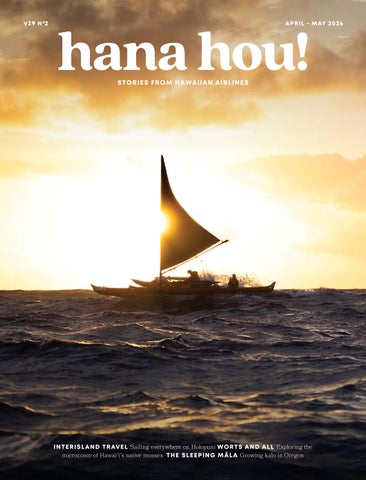
INTERISLAND TRAVEL Sailing everywhere on Holopuni WORTS AND ALL Exploring the microcosm of Hawai‘i’s native mosses THE SLEEPING MĀLA Growing kalo in Oregon
OluKai.com
Kaua‘i: The Shops at Kukui‘ula / O‘ahu: Hilton Hawaiian Village, Chinatown, Sheraton Waikīkī, Hale‘iwa Maui: Whalers Village, The Shops at Wailea / Hawai‘i Island: Queens’ Marketplace
16 / Hula for the Healing Stones
STORY BY MARTHA CHENG
PHOTOGRAPHY BY ANTHONY CONSILLIO
19 / The Rain Man
STORY BY CONNER GORRY
20 / Meet the Singlefins
STORY BY DEREK FERRAR
PHOTOGRAPHY BY ANTHONY CONSILLIO
23 / All in the Family
STORY BY PETER ROSEGG
24 / Connecting Kingdoms
STORY BY CATHARINE LO GRIFFIN
DEPARTMENTS & FEATURES
28 / Reef Relief
Hawai‘i’s corals are losing ground. Could artificial reefs be part of the solution?
STORY BY MADDIE BENDER
PHOTOGRAPHY BY ELYSE BUTLER
40 / Notes from the Understory
The enchanted worlds of Hawai‘i’s native mosses
STORY BY SHANNON WIANECKI
PHOTOGRAPHY BY ZACHARY PEZZILLO
50 / To Sail Everywhere
Two weeks, fourteen canoes, five islands: Holopuni go interisland in the old Hawaiian way
STORY BY CATHARINE LO GRIFFIN
PHOTOGRAPHY BY DAVID MCLAIN
64 / Seeing the Moment John “Jack” Titchen captured a pivotal era in Island history
WORDS BY LARRY LIEBERMAN
PHOTOGRAPHY BY JOHN TITCHEN
76 / Growing Home
How a little patch of kalo brought Islanders back to their roots
STORY BY MARTHA CHENG
PHOTOGRAPHY BY KRISTINA BARKER & JAYDEN KEPO‘O–CASPINO
84 / The Giant’s Return
After a century in exile, the latte stones are headed home
STORY BY STU DAWRS
PHOTOGRAPHY BY MATT MALLAMS
94 /
Events Calendar & Island by Island
125 / Hawaiian Airlines Information
144 / PAU HANA Paddling Out of the Past
STORY BY CATHARINE LO GRIFFIN
PHOTOGRAPHY BY DANA EDMUNDS
Now showing on your in-seat media player and at HawaiianAirlines.com
THE GOOD FIGHT / Honolulu stevedores pull no punches in Sydney, Australia, during War on the Wharves, an annual boxing event where dockworkers from Hawai‘i, New Zealand and Australia duke it out for charity, camaraderie and bragging rights.
SLIDING SCALE / Drivers of Team Saiko clutch remotes instead of steering wheels and compete for style and synchronicity—not speed. In regional and national RC competitions, the objective of drifting isn’t to be the first to cross a finish line but to achieve perfect synchrony as the cars slide across a course full of hairpin turns.
IMAGE CORRECTION / Using the archaic technology of wet-plate photography, Kenyatta Kelechi creates modern images with a nineteenth-century feel. The aim, he says, is to accurately portray Native Hawaiians as a corrective to the kinds of wet-plate images being produced in the Islands during the latter half of the 1800s.
Forget to take your copy of Hana Hou! from the seat pocket? Miss a story from a back issue? Want to share a story or a video you’ve seen on the in-seat media player or on the Hawaiian Airlines app? Hana Hou! is now online as well as on-screen. Visit our web site at the link below or scan the QR code to view the current issue and selections from our archive.
MĀLAMA MOENA / At one time, large floor mats woven from the leaves of the hala tree were common in homes throughout Hawai‘i. Not many of these large mats, or moena, survive today, and those that remain often need repair. Join the weavers of Keanahala, as they mālama (care for) these legacy moena and perpetuate the art of ulana, or weaving.
hawaiianairlines.com/hawaiistories/hana-hou
photograph by kenyatta kelechi
photograph by matt mallams
photograph by blake abes
photograph by justin turkowski
Green Flash Sunset Pendant with Opal Inlay, Diamonds
PUBLISHER & CEO
Jason Cutinella
PARTNER/GM —HAWAI‘I
Joe V. Bock
EDITOR-IN-CHIEF
Michael Shapiro
DIRECTOR OF PHOTOGRAPHY
Matt Mallams
ASSISTANT EDITOR
Maria Kanai
MANAGING DESIGNER
Taylor Niimoto
DESIGNER
Eleazar Herradura
VP FILM
Gerard Elmore
EDITORIAL PRODUCER
Anthony Banua-Simon
FILMMAKERS
Blake Abes
Romeo Lapitan
VIDEO EDITOR
Jhante Iga
STUDIO DIRECTOR/ PRODUCER
Kaitlyn Ledzian
DIGITAL PRODUCTION DESIGNER
Arriana Veloso
OPERATIONS
ACCOUNTS RECEIVABLE
Gary Payne
OPERATIONS DIRECTOR
Sabrine Rivera
TRAFFIC MANAGER
Sheri Salmon
OPERATIONS MANAGER
Jessica Lunasco
CREATIVE SERVICES DIRECTOR
Christian Bowman
ADVERTISING
ADVERTISING DIRECTOR
Simone Perez
SENIOR ACCOUNT MANAGER
Courtney Asato
ACCOUNT EXECUTIVE
Rachel Lee
OPERATIONS & SALES ASSISTANT
Kylie Wong
CONTACT
EDITORIAL INQUIRIES editors@NMGnetwork.com
SALES INQUIRIES sales@NMGnetwork.com
CONTRIBUTORS
Anthony Consillio
Catharine Lo Griffin
Conner Gorry
Dana Edmunds
David McLain
Derek Ferrar
Elyse Butler
John “Jack” Titchen
Kristina Barker
Larry Lieberman
Maddie Bender
Martha Cheng
Megan Spelman
Peter Rosegg
Sarah Burchard
Shannon Wianecki
Stu Dawrs
Zachary Pezzillo
Published by: NMG Network 41 N. Hotel St. Honolulu, HI 96817
For questions related to travel, visit us online at HawaiianAirlines.com or contact us at any of the following numbers:
UNITED STATES / CANADA 1-800-367-5320 Monday-Sunday, 24 hours Text 38285 Monday-Sunday, 5:00am - 11:00pm HST
AUSTRALIA (61) 1-800-955-912
JAPAN (81) 570-018-011 Monday-Sunday
NEW ZEALAND (64) 0800-449-415
AMERICAN SĀMOA (684) 699-1875
TAHITI (689) 40-866-000
CONSUMER AFFAIRS
HawaiianAirlines.com/CAO
BAGGAGE INQUIRIES
1-866-389-6654 Monday-Sunday, 8:00am - 4:30pm HST
ATMOS REWARDS
For more information on our frequent flyer program, please contact our Atmos Rewards service center: 7:00am - 7:00pm PT, Monday-Friday 8:00am - 5:00pm PT, Saturday 1-877-426-4537
HAWAIIAN AIR CARGO INQUIRIES
1-877-422-2746
HawaiianAirCargo.com
ON THE COVER
Last Light on a Long Voyage Home
Sailing canoe Hi‘iaka crosses the Ka‘ie‘ie Waho Channel between O‘ahu and Kaua‘i at sunset on the final leg of the 2025 Holopuni Hawaiian Voyage.
BY DAVID MCLAIN
PHOTOGRAPH
A new dawn of live entertainment rises in Cirque du Soleil ‘Auana— a Hawai‘i-inspired production featuring a cast of powerful acrobats, talented musicians and singers, and profound hula dancers. is unparalleled ensemble brings together international and local talents to shine a fresh light on the spirit of Hawai‘i. Only at the OUTRIGGER Waikīkī Beachcomber Hotel.
Martha Cheng
“The most profound part of the voyage was witnessing how these small canoes cover vast distances, both in a linear sense—in that they cross channels—and also temporally, by linking past and present,” says Catharine Lo Griffin, who tagged along on Nick Beck’s Holopuni Hawaiian Voyage for “To Sail Everywhere” in this issue. “By marking a beginning and an end, and moving slowly, the journey allows you to arrive at a destination feeling integrated— and not alone but as part of a shared experience,” Lo Griffin was most moved by landing on the beach she called home when she first moved to O‘ahu. “It was like traveling through time to pull into the bay where I learned to surf twenty-seven years ago and then walk around the point to find my 10-year-old daughter playing in the shorebreak.” A regular contributor to Hana Hou!, Lo Griffin is grateful to Mike Buden for welcoming her aboard Hi‘iaka and to Beck and Kavika Knight for inviting her on the voyage.
When Martha Cheng, who wrote “Growing Home” for this issue, heard about a kalo (taro) patch in Portland, she was astonished. “Curiosity about this māla kalo attracted me to the story,” she says, “but even more than that, ever since recent census results showed that more Hawaiians live on the continent than in Hawai‘i, I have wondered, what does it feel like for those who left? What does a Hawaiian community outside of Hawai‘i look like?” The answer, of course, differs for everyone, but she learned that for those gathered at KALO in early November, there was a deep longing—and for some, anguish—for Hawai‘i. At the same time, Polynesians and Hawaiians have long been great voyagers and adventurers; around the time Cheng and volunteers put the kalo to “sleep” for winter, the Polynesian voyaging canoe Hōkūle‘a was landing in Aotearoa/New Zealand. “Perhaps we are always exploring and always looking for home,” she says. Based on O‘ahu, Cheng has been writing about home, exploration and connection for nearly two decades.
“As a photographer from Maine, these were guys I’d only read about in The Surfer’s Journal,” says David McLain, about photographing the crews on the epic, multi-island Holopuni Hawaiian Voyage for “To Sail Everywhere.” “Sometimes you get let down when you meet people you admire, but these people exceeded my expectations,” he says. After the assignment, McClain described to his kids back home how the Polynesians have a different currency. “For most of us living in America, our currency is money. For the Polynesians on the Holopuni voyage, their currency is respect, giving, honor and humility. That ethos, fused with the canoeing sport, was unlike anything I’ve ever experienced.” Through his images McLain hopes both the beauty of the culture and the sport comes through. He also hopes that when he reaches the age of 87, he will be like the voyage’s leader Nick Beck—healthy, respected, humble and enjoying life. See more of his work at davidmclain.com.
David McLain
Catharine Lo Griffin
BY DIANA BIRKETT RAKOW CHIEF EXECUTIVE OFFICER, HAWAIIAN AIRLINES
With gratitude for what’s ahead
Mahalo for flying with us. We know that every time you board one of our airplanes, it matters—and we’re grateful to share our ho‘okipa (hospitality) with you.
As we look ahead to the busy summer season, we are excited to provide new technology and loyalty benefits that will improve your travel experience and open up access to hundreds of destinations around the globe.
This spring, we will launch a modern app, supporting both Hawaiian Airlines and Alaska Airlines, with more self-service options to simplify your travel planning. Designed to address your feedback, the app will offer enhanced functionality such as Apple Pay, flight changes and award travel redemption with over thirty global airline partners.
On board we continue to roll out industry-leading free and fast Starlink Wi-Fi across our combined fleet. By 2027, in partnership with T-Mobile, we will offer Wi-Fi on every transpacific flight.
In late April, Hawaiian Airlines and Alaska Airlines will come together onto a single passenger service system, or PSS, the core technology that powers applications across our airlines, from booking and ticketing to check-in, reservation and loyalty programs. Under a shared PSS, our team members will be able to manage your travel much more seamlessly. We are also investing in innovative bag tag stations that reduce waste and make your time at the airport more efficient.
Hawaiian Airlines will become an official oneworld® member airline in late April. Already, members of our Atmos Rewards loyalty program can earn and redeem points with our oneworld® and other airline partners who together serve more than one thousand cities around the globe.
Hawai‘i residents who are Huaka‘i by Hawaiian members will continue to enjoy exclusive kama‘āina benefits that include a free checked bag on neighbor island flights, 10 percent or 20 percent
quarterly discounts when flying within the state and monthly deals across our network.
As we expand globally, we look forward to sharing our ho‘okipa with more guests from around the world and welcoming them to Hawai‘i through our Travel Pono program, which encourages thoughtful experiences that respect our culture and benefit our communities.
This year we are also celebrating the fifteenth anniversary of our flights connecting Hawai‘i and Japan, a key route in our international network alongside destinations across Oceania. We are excited to open new doors— with one-stop service between Hawai‘i and Europe—this spring when we launch new flights, already on sale, from Seattle to Rome (starting April 28), London (May 21) and Reykjavík, Iceland (May 28).
While we continue to expand our reach, invest in our guest experience and create a bright future for our employees and communities, we remain committed to Hawai‘i. February was Mahina ‘Ōlelo Hawai‘i (Hawaiian Language Month), and we celebrated with events across the community, dedicated Hawaiian-language flights and classes open to all our thirty thousand-plus employees. Consistent with our legacy and our responsibility to Hawai‘i, language and culture remain an important part of who we are, and we invite you to join us.
Mahalo for sharing this journey.
Hawaiian Airlines CEO Diana Birkett Rakow joins the service agent crew at Honolulu International Airport to see how agents drive the timeline to on-time departures and support guests with care.
island intelligence
STORY BY MARTHA CHENG
Hula for the Healing Stones
Alittle show about transgender healers isn’t, you know, what you thought you were gonna see when you got to Waikīkī,” says Patrick Makuakāne, a kumu hula (hula teacher) and the composer, choreographer and director of that “little show,” The Return of Kapaemahu. And yet every Wednesday since its debut in January 2025, its audience in front of the Kūhiō Beach hula mound includes a few local families laying blankets on the sand and visitors turning their backs to the ocean sunset as the free performance begins:
The dancers emerge, their iridescent costumes shimmering.
Through narration in ‘ōlelo Ni‘ihau (the Ni‘ihau dialect of the Hawaiian language) and English—and against a soundtrack of historic chants layered with a groovy beat and a touch of electronica—The Return of Kapaemahu recounts the story of four healers who voyaged from Tahiti to Waikīkī long ago. According to the mo‘olelo (story), “They were not male. They were not female. They were māhū … a mixture of both … in heart, mind and soul.” The
healers were so beloved that the people of O‘ahu quarried four large stones from nearby Kaimukī and carried them to Waikīkī as a tribute. The stones were rediscovered in 1963 after being buried under a bowling alley and now lie about five hundred feet from the hula mound, between a public restroom and the Duke Kahanamoku statue.
Makuakāne, who was named a MacArthur “Genius” Fellow in 2023, was working on a show in 2022 called Māhū. He had wanted to open it with the story of Kapaemahu, with Hinaleimoana WongKalu, who is herself māhū and a kumu hula and cultural practitioner, as the lead. Coincidentally, she had just finished directing an animated short about Kapaemahu with the co-founders of Lei Pua ‘Ala Queer Histories of Hawai‘i, Dean Hamer and Joe Wilson, who were looking for other ways to share the mo‘olelo. Hamer was drawn to the legend, he says, because “this isn’t a story about people who had to struggle because they’re māhū,” he says. “It’s a story about people who were admired in part because they were māhū.” The legend is in keeping with Hawaiian culture, in which māhū were respected figures, often wisdom-keepers and healers.
Hamer and Wilson were also excited that the mo‘olelo was marked in the physical landscape by the healing stones in Waikīkī, “but that story was not available to people,” Wilson says. “We felt [the story] needed to be restored in a physical sense.” And what better place than the hula mound not far from the stones. Makuakāne adapted his Kapaemahu segment for Waikīkī and “made it better,” he says. He added healing chants that “deal with sexual potency. It’s like all these subjects are now taboo because of Western encroachment. By no means are we perfect, but we did have a very progressive outlook, and I think it’s an important thing and not to be ashamed of it.”
Every Wednesday at sunset, hula dancers perform The Return of Kapaemahu at Kūhiō Beach Park in Waikīkī. The free show tells the story of the legendary stones of Kapaemahu, rediscovered in 1963 and now lying nearby.
PHOTOGRAPHY BY ANTHONY CONSILLIO
Photo: Zak Noyle
The Rain Man
Meteorologist Harry Durgin (seen above left) started Puna Weather to track the notoriously mercurial weather of the East Hawai‘i district. Hundreds of citizen-scientists all over Puna contribute to refine the reports and forecasts, as well as help coordinate during extreme weather events—not uncommon for Hawai‘i’s most windward-facing region.
YouTube gurus and shadow alchemists, witches, oracles, hippies and thieves—Hawai‘i Island’s rural and semi-rogue Puna district is weird and unruly. And so is its weather. The statewide forecasts on local news often get it wrong. Harry Durgin and his team of weather watchers want to get it right.
Volunteer meteorologist Durgin and a group of almost ten thousand Hawai‘i Island residents—some citizen-scientists, some just science curious—are doing just that with Puna Weather. A communitycurated, localized resource, Durgin launched the Facebook page in 2014 to fill the information gap intrinsic to off-island forecasts for East Hawai‘i, from Hāmākua to Ka‘ū. “Our TV stations are based in Honolulu, so they’re forecasting for O‘ahu mostly,” says Durgin, who moved to New York in 2023 to study climate change at Cornell University, concurrently with journalism at UCLA online. “And windward weather is so varied,” he adds, stating the obvious for anyone who’s had to swap sunglasses for wipers and back
again while driving around Hilo, the country’s wettest city, with measurable rain 275 days of the year.
The site also aims to build community and promote science. Launched in the wake of powerful tropical storm Iselle, administrators describe the page as a “test case for engaging in bi-directional science communication.” Durgin posts weather information, including forecasts and maps, which are then enhanced by member reports on daily rainfall totals and vog (volcanic fog) thresholds, plus weather-related questions—“the wonkier, the better,” Durgin says. “Contemporaneous reports by the community are invaluable. We have an intelligent, on-the-ground network gathering and distributing weather information. I don’t know if there’s a better use of social media.”
The page also serves as an information hub and support network when extreme weather threatens. Preparing for a particularly bad storm,
Puna Weather members step up, helping kūpuna (elders) secure tarps and stow furniture. “This happens a lot on our page. It’s amazing to see the community come together,” Durgin says, hoping it will serve as a model. He intended to pass the baton when he relocated, but realized “my connection to Puna Weather allows me to do some good in the world. Plus, people asked me to keep it going. It’s hard to say no to people you care about.”
Browsing in a local hardware store a few years ago, Durgin overheard two women wielding weather terms and scientific concepts so advanced that his jaw dropped. He leaned in to hear them better, smiling when he learned they acquired this knowledge through Puna Weather. “My goal is to gain people’s trust about the weather and then whip a little climate science at them every once in a while.” He continued browsing nuts and bolts, confident it’s working.
STORY BY DEREK FERRAR
Meet the Singlefins
You’d never know it from the modest suburban exterior, but inside the Park family home in central O‘ahu lies a world-class shrine to surfing’s “golden era,” circa 1960s. Stacked by the dozen in the garage and meticulously arranged with a curator’s eye across the home’s high walls is a treasure trove of classic surfboards, movie posters and other memorabilia from the time when surfboards first started being made out of fiberglass instead of wood, and the ostensibly carefree surfing lifestyle— think Gidget, the Beach Boys and Endless Summer —exploded into the national consciousness.
Growing up in California in the 1980s and ’90s, Darren Park—a.k.a.
Mr. Singlefin—always had a penchant for riding old-school longboards. But it wasn’t until after he and his wife, Amanda, moved to Hawai‘i in the early 2000s that Darren got serious about collecting vintage surfboards and memorabilia. “Even from a young age, I’ve just been very intrigued by the progression of surfing,” says the lanky longboarder, who works at Pearl Harbor when he’s out of the water. “Younger generations aren’t really interested in the history of it, so I wanted to step in and preserve as much information as I can.”
He soon crossed paths with eminent surfer, contest promoter and memorabilia trader Randy Rarick and began helping Rarick handle the
heavy surf history relics. Along the way, Darren began building his own collection—often through word of mouth from people he’s met in the surf. “I prefer working through relationships,” he says. “You meet someone in the lineup on a surf trip, or someone’s uncle has an old board under the house. That’s the part I really love.”
It was just such serendipity that led to Darren purchasing his first seriously collectible board, a noseriding model first designed in 1965 by celebrated shapers Bing Copeland and David Nuuhiwa. “I was out surfing on a modern Bing,” Darren recalls, “and a guy just paddled over and said, ‘Would you want an old one of those?’ So I saved all my pennies and bought the vintage one.” Other gems include lustrous balsawood boards and a sleek model by Hobie Alter (of Hobie Cat fame), which hangs on the wall above the couple’s bed as their “headboard.”
Darren says he focuses on 1960s surf culture because “it was just a period of great innovation progressing at 110 miles per hour and such a beautiful time in the sense of the cars, the lifestyle, the movies. I didn’t get to live through it, so I guess this is kind of my way of getting to do that.”
For Amanda, who teaches school, the pursuit of vintage surf finds makes for great family fun now that their teenage kids Kai and Maile have started getting into the act. The family always knows what to get each other for birthdays, and they even take the risk of actually riding some of their antique treasures on family surf days—albeit very cautiously. Thanks to their connections in the vintage surf world, Amanda says, “I feel like my kids can be out in the water and the uncles will all watch over them. So we’re really very fortunate.”
Ultimately, Darren would love to see Hawai‘i, the birthplace of surfing, have a truly comprehensive museum dedicated to the sport. In the meantime, the best way to see the family’s classic beauties is on Instagram at Singlefin808.
PHOTOGRAPHY BY ANTHONY CONSILLIO
A few of the vintage items from the collection of Darren Park (seen also on pages 14–15), who has turned his Mililani home into a shrine honoring 1960s surf culture.
All in the Family
The opah is an amazing fish. As the only known warm-blooded ocean fish, it has advantages as a predator in the cold depths where it lives. From the side, an opah appears almost perfectly round, at times as large as an automobile tire, weighing sixty to two hundred pounds. Its circular, silvery body with radiant hues of red, orange and pink explain its other popular name, the moonfish.
Recreational and solo fishers sometimes land opah but most are bycatch of commercial longline vessels fishing for tuna and swordfish. When these dock in Honolulu, any opah end up at the busy United Fishing Agency auction house. That’s where fish buyer Garrett Kitazaki noticed something curious: Some opah had much bigger eyes, and their spots and coloration looked different. This led to an important discovery about a
fish that’s becoming increasingly popular in restaurants and home kitchens.
Researchers took measurements and sent tissue samples to John Hyde of the National Oceanic and Atmospheric Administration Fisheries’ Southwest Fisheries Science Center in La Jolla, California, who examined their DNA. Kitazaki’s keen observations led to a discovery. The DNA allowed researchers to identify not one or two but six different species of opah roaming the world’s oceans. Each is distinguished by differences in eye size, fin length and other measurements. While these might be minor, the fact that there are multiple species matters to fishers, resource managers and consumers: Different species could have different nutritional values, flavors and requirements. “The discovery that opah is actually a complex of multiple species, including two that are caught by Hawai‘i-based commercial fishers in the North Pacific, has important implications for sustainable management,” says Hyde.
Perhaps ironically, the Honolulu Fish Auction is one of the few places that such a discovery could have been made. It’s only here that so many fish from Hawaiian waters can be seen side-by-side daily, including tuna, mahimahi, swordfish, wahoo (ono) and opah. Between seventy and ninety thousand pounds of fish come through the auction house daily, with up to one hundred thousand pounds on a busy day.
Interesting though this may be to biologists, and important to fisheries resources managers, what does discovery of a new species of opah mean to consumers, who may rarely encounter a complete opah before it’s filleted by fish mongers? Not much, at least in the short term, given the current status of fresh-fish labeling. “Seafood mislabeling is a big problem, and in this case it may be more difficult because it takes expert analysis to differentiate among opah species,” says Hyde. “Continued research and consumer interest in each of the species will get us more answers.”
An eagle-eyed buyer at the United Fishing Agency auction in Honolulu noticed subtle differences among the opah, or moonfish, available for purchase. What was thought to be a single species turned out to be six distinct species.
Connecting Kingdoms
The British Museum holds one of the world’s foremost collections of Hawai‘i-related artifacts. The relationship between the two kingdoms is being celebrated in the museum’s new exhibition, Hawai‘i: A Kingdom Crossing Oceans. Above
of
Vactivist Haunani-Kay Trask; right, a magnificent
isitors wishing to enter must pass under the intimidating gaze of a nine-foot-tall, two-hundred-year-old ki‘i (carving) of the war god Kū, dressed in a malo (loincloth) made by contemporary Hawaiian artist Verna Takashima. This combination of modern and ancient Hawaiian art is one feature of the British Museum’s new exhibition, Hawai‘i: A Kingdom Crossing Oceans. The museum holds one of the most significant collections of Hawaiian artifacts outside of the Island, some of which were brought to Britain by Captain Cook. Curated in collaboration with Native Hawaiian cultural experts and running through May 25, the exhibition features 150 modern and ancient works that celebrate the complex and enduring relationship between Hawai‘i and England.
One highlight is an 1810 letter from King Kamehameha I asking King George III for his protection of the newly unified Hawaiian Kingdom from other foreign powers, along with an extraordinary gift of friendship: An ‘ahu ‘ula (feather cloak), the largest known in the world, on display for the first time
in more than a century. These artifacts represent the antecedent to a pivotal moment in the shared history of the two island nations: In 1823, King Liholiho (Kamehameha II) and Queen Kamāmalu sailed across the Pacific, around Cape Horn and across the Atlantic. The Times of London called the six-month, ten-thousand-plus-mile journey a “very long voyage, so unusual with crowned heads.” The young monarchs—Liholiho was 27 and Kamāmalu 22—sought to ally with England and demonstrate that Hawai‘i, though small and isolated, was a sovereign, globally minded nation. Tragically, they died before they could meet with King George IV, having contracted measles while visiting an orphanage. But their delegation completed the mission. Included in the exhibition are hand-colored lithographs of the royal couple, dressed in Western garments after their arrival, as well as the landmark Anglo-Franco Proclamation of 1843, in which France and England formally recognized the Hawaiian Kingdom, thus forestalling its colonization by European powers.
British Museum curator Alice Christophe is grateful for the collaboration with Hawaiian cultural experts who shaped every aspect of the exhibit, from preparing works using proper protocol to design and storytelling. “Liholiho, Kamāmalu and their delegation came to the UK in 1824 to reaffirm Hawai‘i’s place in the world,” Christophe says, “and we hope this exhibition centering the history and artistry of this Pacific Island nation will do just this.” She notes that Liholiho and Kamāmalu visited the museum in 1824 and likely saw some of the objects Cook and George Vancouver had brought back with them, which are on display. Hawai‘i: A Kingdom Crossing Oceans “is a celebration of multiple ways of knowing and experiencing these collections,” says Christophe. “We hope community members from across the pae ‘āina [archipelago] will feel welcome into this space that so many have shaped with us, and that this inspires conversations and reconnections in the future.”
left, photographer Kapulani Landgraf’s portrait
Native Hawaiian
‘ahu ‘ula (feather cloak) gifted to King George III by King Kamehameha I.
departments & features
STORY BY MADDIE BENDER
Reef Relief
Hawai‘i’s corals are losing ground. Could artificial reefs be part of the solution?
The last imu maker of Hā‘ena disappeared after a tsunami on April Fools’ Day in 1946. When The Garden Island newspaper reported Kalei Kelau’s disappearance, it brought Kaua‘i’s death toll from the devastation to seventeen. The loss of life and generational knowledge for the tight-knit North Shore community was incalculable.
Half a century later, an elder told Kawika Winter about Kelau and the forgotten practice of constructing imu—underwater fish habitat—that had disappeared with him. “From 1946 until we started rebuilding them maybe a decade ago, nobody had been building imu in Hā‘ena that whole time,” Winter says. “That’s three solid generations.”
Today, on the northwestern tip of Kaua‘i, Winter is preparing to snorkel
out with a group of young scientists and volunteers to survey imu constructed by ‘A‘ali‘i Kelling, one of Winter’s graduate student researchers. These imu are not like the pit ovens of the same name, the ones you’d bake kālua pork in. They’re man-made piles of rock built underwater, which were just as important for feeding the early Hawaiians. “They were traditionally reserved for the elderly and children,
Graduate student ‘A‘ali‘i Kelling adjusts the stones of an imu kai, an old Native Hawaiian technique for aggregating fish, off Moku o Lo‘e (Coconut Island), O‘ahu. These imu are part of an effort to study ways that Indigenous knowledge can be applied to the task of restoring Hawai‘i’s coral reefs.
because they were more accessible” than deepwater fishing holes, says Kelling. He is self-assured in the water— it’s not hard to picture him arranging the bread-loaf size stones into nine, metertall pyramids. The other scientists and volunteers? Winter’s not so sure.
The purpose of imu—and, by extension, this experimental setup at the mouth of the Limahuli River—is to attract fish. A few feet beneath the water, one imu sits in a vast desert of sand. Colorful fish dip in and out of its crevices: Manini (convict tang) flit up and down, and groups of na‘ena‘e (orangebar surgeonfish) pause to nibble algae off of the rocks. The fish treat the structure just like a coral reef, which is the point.
Humans have made their own reefs for centuries as a way to boost the ocean’s productivity. Amid colonization and the privatization of land, the practice was largely abandoned in the Islands. In recent decades, the state has sunk everything from derelict
ships to abandoned cars in an effort to counteract coral reef decline, with limited success beyond creating some interesting diving sites. Now, ongoing projects are re-envisioning what artificial reefs can accomplish, in part by combining Indigenous principles with modern methods. These aren’t your father’s reefs, but their elements might not feel so foreign to your greatgreat-grandfather.
The Kumulipo, the Hawaiian creation chant, doesn’t start with light out of darkness. In the beginning, there was coral. The ko‘a, or coral polyp, directly follows the first beings, Kumulipo and Pō‘ele, in the hierarchy of creation. In another mo‘olelo (story), a fisherman named Kapūhe‘euanui pulls up his line, only to discover he’s hooked a piece of coral. “Don’t throw away that piece of coral,” a priest admonishes. The priest deifies the coral and names it Hawai‘iloa. Kapūhe‘euanui throws his
bycatch back, and it becomes Hawai‘i Island. Various ‘ōlelo no‘eau (Hawaiian proverbs) emphasize the hardiness of coral, which was used to build heiau (temples).
The imu Hawaiians built might be the first examples of artificial reefs in the world. To Winter, an ecologist and the director of the He‘eia National Estuarine Research Reserve, imu seem like a textbook case of imitation as the highest form of flattery. When you build them in shallow water, he says, “You basically build a fish house so that species that usually live in the outer reef can now live right along the shoreline.”
The nine experimental imu in the Hā‘ena Community-Based Subsistence Fishing Area exemplify that apparent transformation. In contrast to the desolate seabed around them, the stone structures crackle with the sound of marine life. It’s well known that rugosity, or roughness, plays an important role in the development of complex undersea ecosystems. Like the
KULEANA
n. right, privilege, concern, or responsibility
At the University of Hawai‘i at Mānoa, we help you develop a sense of purpose beyond yourself. Be among the innovators who are creating, rethinking and reinventing our world. Where will your learning take you?
MANOA.HAWAII.EDU
Climate change is affecting everything, it’s important to protect our smallest species, as well as our largest.”
Kelsey Maloney Bachelor of Science, Marine Biology, 2021
The University of Hawai‘i at Mānoa is an equal opportunity institution.
PICTURED: KELSEY MALONEY
nooks and crannies of a coral reef, the three-dimensional geometry of an imu gives algae traction and juvenile fish safe haven. In contrast, flat expanses of sand bear the brunt of wave energy and expose fish to predators.
Thomas Hashimoto, born in 1934 at Hā‘ena, witnessed the practice of building imu fade away. In a 2003 oral history by ethnographers Kepā and Onaona Maly, he describes how manini would swim into the crevices formed by the round stones of imu and stay until they were harvested by throw net.
“And so you catch all the manini kind?” Kepā Maly asks.
“You catch whatever fish stay there, if get anything, you going catch ’em. That’s how the imu is,” Hashimoto replies.
“You saw. So someone was doing that?”
“Well, maybe once in my lifetime I seen that. But this is the old times now.”
There are more than four hundred thousand acres of living reef around the main Hawaiian Islands, but disease and a series of large-scale marine bleaching events have devastated corals over the past decade. A 2019
OPENING SPREAD / Left, Madeleine Sherman and Alyssa Varela of the Coral Resilience Lab at the Hawai‘i Institute of Marine Biology (HIMB) set up nets to collect coral gametes in Kāne‘ohe Bay. Right, a kūpīpī (blackspot sergeant) swims in HIMB’s coral nursery.
TOP / The R3D hybrid reef, developed in partnership with the Department of Defense, consists of round modules that slot into a four-ton concrete backbone.
BOTTOM / A diver plants coral into an R3D settlement module at HIMB.
LEFT / Chris Suchocki tends the coral nursery at HIMB.
survey of the main islands found that coral cover had declined nearly by half in just six years.
“Coral is one of the slowest-growing organisms here in Hawai‘i,” says Jake Reichard, a biologist with the state Division of Aquatic Resources (DAR). While branching corals are more common in other parts of the world and can grow up to fifteen centimeters each year, Hawai‘i’s reefs are dominated by bouldering corals. These loveable slowpokes grow just one or two centimeters per year—in a fastchanging world, Hawaiian corals simply can’t keep up, Reichard says.
In Western histories of artificial reef building, Native Hawaiian approaches are lucky to get a footnote. It’s common for these texts to claim that the practice “first” began in earnest in the twentieth century, with scuttling ships and sinking cars—including on the state of Hawai‘i’s official website on the topic. The state’s first official artificial reef was created in Maunalua Bay, off the southeast coast of O‘ahu. Had you visited the site from the 1960s through the ’80s, some seventy feet deep, you’d be forgiven for mistaking it for an ancient car lot. Over a twenty-fiveyear period, state biologists sank 1,600 stripped auto bodies, two derelict barges and 550 automobile tires into the bay, ostensibly to increase fish populations. An underwater photo taken in the late ’80s shows clusters of tires embedded in concrete that look like sheets of Oreo cookies. But it’s as if someone dropped the package, and the cookies have fallen into a messy pile.
“The scientific knowledge at the time supported the idea,” Reichard
says, but after a few decades of pushing abandoned cars off the back of barges into the ocean, biologists had second thoughts. “They learned that was probably not great for the environment, and a lot of the cars actually rusted away pretty fast.” A 1989 analysis of the Maunalua Bay artificial reef found that these techniques amounted to “scrap materials dumped haphazardly” and did little to enhance the fishery. Elsewhere, the authors of the report wrote, low-cost reefs hurt marine communities more than they helped. Everything from cars, fridges, tires and concrete pipes were dumped into the ocean around the country, as much to dispose of waste as to create habitat. Today, little remains of the rustedaway cars apart from the occasional axle. In their place, DAR has placed thousands of Z-shaped concrete blocks across four sites on O‘ahu and Maui, including at Maunalua Bay. The division has an ingenious method of collecting donated concrete from leftover construction projects: “Our
molds are right next to the concrete plant,” Reichard says. “The scraps going into the mold allow us to reuse that concrete, so it’s not wasted.”
DAR is working on the permitting to deploy 2,200 Z-blocks in the bay, and a statewide reef habitat plan aims to integrate these efforts with both modern designs and traditional imu.
Any caretaker of a newborn would have spotted the dark circles under Carlo Caruso’s eyes from a mile away. The senior scientist at the Hawai‘i Institute of Marine Biology was up all night babysitting millions of coral embryos, formed after their parents released clouds of egg and sperm into the water. This species of coral, Montipora capitata, might only spawn twice in the entire year, in the dead of night.
Scientists still don’t know why this happens, but prevailing theories include some combination of sea temperature, sunlight and moon phase.
Above right, a volunteer for nonprofit Mālama Maunalua fastens corals bred at HIMB to plugs as part of Hana Pūko‘a, the first communitybased coral restoration effort in Hawai‘i. Above left, the glued fragments are handed off to diver Kiyana Poki to be planted in a coral nursery in Maunalua Bay.
Come dine here
From the iconic sands of Waikīkī to the sacred shores of Kā‘anapali, OUTRIGGER Resorts & Hotels invites you to discover the food scene at all our Hawaii resorts.
Whether you’re ready for laughs, romance, or the best live music on any island, OUTRIGGER will take care of the food and set the right mood. Let’s eat
Piko at OUTRIGGER Kona Resort & Spa
Maui Brewing Co. at the OUTRIGGER Ka’anapali Beach Resort
Kani Ka Pila Grille at the OUTRIGGER Reef Waikiki Resort
Naupaka Terrace at the OUTRIGGER Kaua‘i Beach Resort & Spa
Fake it ’til they make it: The R3D team tested more than a dozen substrates for the hybrid reef before landing on concrete. “Everything from Quikrete from Home Depot, to Hardie Board, limestone and basalt,” says project manager Ben Jones. Above, Josh Levy (right) and Ayrton Medina count the R3D project’s coral growth modules at the precast yard in Kapolei.
Caruso scoops up coral gametes at Kāne‘ohe Bay and brings them to the Coral Resilience Lab’s larval rearing system: a few dozen funnel-shaped tanks hooked up to bubblers that agitate the water to mix the eggs and sperm. But the real magic lies in the lab’s temperature control experiments. Caruso and his colleagues are testing a hypothesis that ratcheting up the heat during the early stages of coral development will produce adults that can tolerate warmer water and survive marine heat waves. Scientists can then clone and outplant the most resilient corals.
These thermal-resistant “supercorals” play a key role in a new hybrid reef that combines living and artificial components and will be launched off of Kalaeloa, on O‘ahu’s Leeward side as soon as the spring of 2026. The Defense Advanced Research Projects Agency (DARPA) is funding the $27 million, fifty-meter concrete prototype through a team led by the University of Hawai‘i at Mānoa’s Applied Research Laboratory.
Ben Jones, a no-nonsense Navy oceanographer with a soft spot for bar trivia, manages the thirty-person team working on all aspects of the Rapid Resilient Reefs for Coastal Defense, or R3D, project. The reef will consist of “crest” and “back” concrete structures that resemble five-to-seven-foot-tall cheese graters. The “holes” in the graters will be filled by pizza-box-size modules. At a dry lab in Mānoa, Jones holds up 3D-printed prototypes of some of these igloo-shaped add-ons. One bears deep ridges curling up to the dome’s apex, while another has rectangular indentations carved along its surface, the way a child might draw windows on a building. Live corals will be plugged into some of the gaps, allowing researchers to see exactly what works and what doesn’t.
One goal of the hybrid reef—and the reason for DARPA’s interest—is to mitigate coastal erosion from rising sea levels. “The Department of Defense has this real issue with installations around the country and around the world that are getting impacted by rising
sea level,” Jones says. Simultaneously, UH’s research focuses on the cultural and commercial ramifications of reef loss. In designing the structure, Jones says, the team drew inspiration from what nature has provided for millennia, “but also recreated the foundational ecosystem that was supporting large communities near the ocean.”
The R3D project collaborates with other research groups and coral nonprofits around the state. Kuleana Coral Restoration (KCR) has taken the lead with community engagement and will assist in the eventual deployment. Sheba, the cat food brand, also funds KCR (“More coral today, more fish tomorrow” is the program’s slogan).
Alika Peleholani Garcia was a commercial fisherman for fifteen years before starting KCR. He sees two parallel housing crises in Hawai‘i—one on land, one in the ocean. “There are so many invasive species displacing native fish, and we have so many things in competition. With habitat loss on top of that, that’s basically the housing shortage,” he says. “So what do we do?
Back to the garden: For artificial reef researchers, the holy grail is a structure that, like a healthy natural reef, both protects the shoreline and nurtures marine life. Replenishing coral reefs is one way to mend our reciprocal relationship with the ocean, says Kawika Winter. “It’s not only take, take, take—it’s give before you take.”
We need to build affordable housing— and that is artificial reefs.”
KCR tailors its strategy to particular sites. In partnership with state and federal agencies earlier this year, KCR reattached two hundred individual corals to the reef at O‘ahu’s Kewalo Basin with cement, epoxy and steel pins after a boat anchor gouged the reef, dislodging century-old coral colonies. In December, KCR planted more than a thousand coral fragments in Olowalu, Maui, to help the reef recover after the 2023 wildfires.
KCR’s investment in small, hybrid structures is intentional. “We’re not focused just on the fish we eat. We’re focused on building up the little creatures,” Garcia says. “As it was written in the Kumulipo about the worms, the sea urchins, the little things—that’s creating an ecosystem.” This way of thinking has helped Garcia reconnect to his Native Hawaiian roots. “I think this coral project actually brought me much closer to my culture than I’ve ever been.”
After a hard morning’s work in Hā‘ena, Winter’s group decamps for
lunch. Laughter whirls overhead as kids splash in a nearby pool of streamwater. Neat, tiered rows of kalo (taro) sit next door at the Limahuli Garden and Preserve, just as lo‘i (taro ponds) did eight hundred years ago.
Winter recalls the reaction to a keynote address he’d given days earlier at a massive fisheries conference in Honolulu. He spoke to a packed exhibit hall about weaving Indigenous knowledge into fisheries management and research. “I live within the context of Indigenous science. If I am a fish, this is my water,” he told the audience. So it startles him when other scientists ask him what Indigenous science is. “I’m always taken aback by this question because to me, that’s like asking, ‘Hey, what is this water you speak of?’” Winter wonders whether the organizers recorded the standing ovation he received, but more in bewilderment than braggadocio. “When I was a graduate student and basically saying the same things I’m saying now, it used to get silence punctuated with chuckles,” he says. “I was basically labeled a pseudoscientist.”
On his mind, too, is a school group that visited Limahuli years ago. He’d
overheard the teacher telling her young students that the worst invasive species in the world were human beings. Winter was dismayed. “If all you teach children is that they’re the problem, they’ll never think of themselves as part of the solution,” he says. Winter would know: His daughter, Kalālapa, was a youth plaintiff in the landmark climate lawsuit Navahine F. v. Hawai‘i Department of Transportation. A group of thirteen youth sued the state, asserting a legal right to a safe and healthy climate. The state settled in 2024, committing to transition to a zero-emissions transportation system over the next twenty years.
A shift in the academic tide has taken Winter from being laughed out of rooms to commanding them. And his most provocative opinion might be his most optimistic: that sustainability is possible through emulating Indigenous practices and applying that knowledge to saving reefs. He envisions an aquatic ‘āina momona—a land that is sweet, plentiful and fat. “How fat can we make our ocean so that it feeds humanity?” he asks. hh
STORY BY SHANNON WIANECKI
Notes from the Understory The enchanted worlds of Hawai‘i’s native mosses
Zach Pezzillo has been lying face down on the forest floor for the better part of an hour. “I’ve always wanted to see things from the moss’s perspective,” he says. “Now I can.” He maneuvers his newest gadget— an unconventional wide-angle probe lens—into a dew-speckled patch of bristly haircap, or Polytrichum piliferum
From the moss’s perspective, humans are barely worth noting—a
mere blip on the evolutionary timeline. Even the trees towering above are Johnny-come-latelies. Eldest of the terrestrial plants, mosses emerged from the pond around 400 million years ago and have since survived multiple mass extinctions. They function as the forest’s cradle, incubating the eggs and seeds of numerous other species. These climate engineers can sequester water, prevent erosion and slow the
wind. They inhabit every continent and ecosystem, from cracks in Manhattan sidewalks to Hawaiian rainforests and Himalayan peaks. Despite their diminutive size, mosses are every bit as beautiful and diverse as the trees and shrubs they grow beneath.
To learn more about these Lilliputians, I followed Pezzillo into the Waikamoi Forest Preserve in East Maui. The Nature Conservancy manages
PHOTOGRAPHY BY ZACHARY PEZZILLO
reveals the delicacy of its leaves.
this nearly pristine wonderland, which stretches almost nine thousand acres from the base of Haleakalā National Park to the top of Olinda Road. Thanks to the conservancy’s efforts to build fences and remove invasive species from the preserve, Waikamoi is a refuge for many imperiled Hawaiian plants, insects and birds. Perpetually cool and damp, it’s basically a moss cathedral.
I have visited this forest numerous times, but typically my gaze has trained upward, into the canopy searching for Hawaiian honeycreepers, rare endemic birds. This is my first time focusing on the spongy carpet. I feel the earth bounce slightly beneath my step and recall the scene in Shōgun when Lady Mariko scolds the uncouth Englishman: “You should not walk on moss,” she says. “It is very disrespectful.” That advice is impossible to follow in Waikamoi, where nearly every surface is draped in skeins of green, rust and gold.
“There’s a lot going on here,” Pezzillo says, inspecting an ‘ōhia limb
laden with little ferns, lichens and multicolored mosses. “At least twenty species on this single tree.”
Rattling off their Latin names, he brings me up to speed, botanically.
Mosses belong to a trio of plants known as bryophytes—from the Greek words for moss and for growth. The group’s lesser-known members, liverworts and hornworts, tend to be much smaller, with simpler leaf arrangements. Bryophytes are primarily defined by what they lack: flowers, roots and the complex vascular tissues that allow other plants to grow upright. Confined to the horizontal plane, bryophytes absorb water directly through their surfaces and reproduce via spores. Underfoot and underappreciated, they are the essential workers of the forest. It’s easy to see how these spongy mats cushion the fall of raindrops and prevent downpours from washing soil away. I’d need a microscope to appreciate the texture of their leaves, which buffers the wind and helps moderate the temperature close to
the earth—creating a stable habitat for seedlings and tiny creatures.
I put my face up to a prickly hump of Grimmia, a common alpine moss, and notice a speck marching along its edge. “That’s a fancy case caterpillar,” Pezzillo says. These teensy caterpillars, which exist only in Hawai‘i, are famous for their fashion sense. Before they mature into Hyposmocoma moths, they spin silken cases and camouflage themselves with leaves, sand and twigs—even the bones and wings of other invertebrates. I’ve always wanted to see one. Turns out, I should’ve been searching through the moss—with a hand lens. It’s impossible to fully appreciate this guy’s outfit without magnification.
Before Pezzillo can offer me his camera, I’ve lost the caterpillar’s trail. But there’s plenty else to see. Pezzillo points to a fallen log covered in feathery fire moss, or Pyrrhobryum spiniforme. Hundreds of tiny stems sprout from the scruff. These delicate, flame-colored filaments are sporophytes, the moss’s
Zachary Pezzillo, seen above, worked with bryologists Virginia Freire and Emmet Judziewicz to identify Kahakuloa operculispora, an entirely new species, genus and family of liverworts native to the Islands. Mosses can live just about anywhere, but they thrive in the cloud forest above Hāna in East Maui, seen on page 40. A close look at Porella acutifolia—a common liverwort throughout the Pacific (seen on page 41)—
Under magnification, the differences among bryophytes really begin to pop. Pictured above left to right: Homaliodendron flabellatum, a fan-shaped moss, Plagiochila mauiensis, a liverwort found only in Hawai‘i and Pyrrhobryum spiniforme, a fire moss favored by Hawaiian flycatchers for nest material.
reproductive structures. Each wears a little cap, called a calyptra, which protects the spores until they are ready to scatter and fill the forest with more fire moss. These slender threads are useful to other species. Biologists on O‘ahu documented an ‘elepaio (Hawaiian flycatcher) that wove its nest almost entirely out of P. spiniforme sporophytes.
Pezzillo is perhaps the best possible guide for this adventure. An unapologetic champion of little things, he grew up not far from here and has logged many hours in this forest. He first worked for the Maui Forest Bird Recovery Project and now serves as Maui coordinator of the Plant Extinction Prevention Program (PEPP). His workdays are spent helicoptering into the most remote regions of Maui, where he monitors the rarest of the rare: plant species with fewer than fifty individuals in the wild.
His career trajectory began at age 6 on a trip to the Smithsonian Institution in Washington, DC. His grandmother knew someone who worked in the Museum of Natural History, who took them behind the scenes and showed Pezzillo drawers full of exotic specimens: giant stick insects and hissing cockroaches from Madagascar. Later, Pezzillo’s mom gave him a camera, and his love of insects and photography merged. After high school, he enrolled in the Rochester Institute of Technology, the
only university in the country that offered a bachelor of science degree in photography. He brings an artist’s eye to his conservation work.
Birdsong ricochets through the trees as we descend deeper into the forest, stopping every few feet to probe patches of fuzz. I’m beginning to understand what Robin Wall Kimmerer meant when she wrote, “Learning to see mosses is more like listening than looking.” It requires slowing down, even lying down. Kimmerer draws from her experience as an environmental science professor and member of the Potawatomi Nation in her most recent book, Gathering Moss. She recounts scouring botanical records for traditional Potawatomi uses of moss and finding a single note: “widespread use for diapers and sanitary napkins.” Marveling at the genius of Indigenous mothers, she calls sphagnum “more powerful than Pampers.” After all, the moss can absorb up to 40 percent its weight in water and its astringent properties could prevent diaper rash.
Hawai‘i’s bryophytes also suffer from a thin ethnobotanical record. The Hawaiian Dictionary lists limu kau lā‘au as the general term for “all tiny ferns … lichens, liverworts and mosses growing on trees.” Further investigation yields more detailed names, such as ‘ōnohiawa (literally the milkfish’s eyeball), a black moss that grows in fresh water. Huluhulu a ‘īlio (fur like a dog) refers to a velvety green, carpetlike moss with conspicuous spore cases. And then there’s the tantalizing
huluhulu a ka‘auhelemoa. Lei makers reportedly favor this moss, which grows only in Pālolo Valley on O‘ahu. It was named after the supernatural rooster Ka‘auhelemoa: After a feisty hen defeated the cock in battle, his feathers turned to moss.
Sadly, these traditional names weren’t recorded with any taxonomic information, so modern bryologists can only guess which species they refer to. A single specimen among hundreds in the Bishop Museum collection bears a Hawaiian name: limu kuni kuni, collected in 1855 by Charles Forbes in the saddle between Mauna Loa and Mauna Kea.
Bryophytes are expected features of a rainforest, but they play a crucial role also in harsh, alpine environments. The barren summits of Mauna Kea and Haleakalā offer scant protection from the intense solar radiation and frigid winds. In these moisture-starved cinderscapes, stiff beards of Racomitrium moss provide shelter for a host of native insects and seedlings. Bryophytes even thrive at the edge of active volcanoes. The sulphur banks moss, Scopelophila infericola, creeps along the rim of Kīlauea’s volcanic steam vents. It evolved to tolerate the heavy metals spit out by eruptions, and its greenish yellow mats have a metallic sheen.
Tolerance is a bryophyte superpower. When water is abundant, some mosses swell to ten times their
Blue Topaz Sea Turtle Collection
weight. During dry spells, they go dormant, shrinking to a fraction of their original size. They can endure this purgatorial state for long periods, plumping back up with a sprinkle of water. Botanists have reported specimens “coming back to life” after fifty years in storage.
But bryophytes are water babies by nature; the greatest diversity is found in the wettest places. Pezzillo was slogging through a West Maui bog in March 2023 when he spotted an unfamiliar liverwort, unlike any he’d seen before. He photographed the oddity, collected a sample and sent it to Stevens Point, Wisconsin. Two retired biology professors there have devoted themselves to identifying Hawaiian liverworts.
Emmet Judziewicz and Virginia Freire met while teaching at the University of Wisconsin. She introduced him to bryophytes—her field of study—and he introduced her to Hawai‘i—his favorite place to escape Wisconsin winters. In 2019 the retirees rented a cabin in Volcano on Hawai‘i
Island. For the next seven years they tracked unidentified liverworts across the archipelago—in lava tubes, cloud forests and museum collections. They haunted the herbariums at Bishop Museum and the National Tropical Botanical Garden on Kaua‘i (NTBG). They accompanied Pezzillo and the PEPP team on collecting trips.
The dauntless couple sought to fill a gap. Bryophytes are chronically understudied. While bryology students can consult the 1933 Manual of Hawaiian Mosses, there is no guide whatsoever for liverworts. “Liverwort is an ugly name,” Judziewicz admits. “If it had a different common name, it would get three times the funding.”
During a recent trip to Stevens Point, I paid Judziewicz and Freire a visit. Their home beside the university is filled with plants they’ve propagated. Upstairs they have his-and-hers labs: two stations equipped with dissecting and compound microscopes, and shelves stuffed with more than two thousand specimens tidily wrapped in wax paper packets.
When Freire received Pezzillo’s liverwort in the mail, she recognized its spongy, lettuce-like leaves. She had seen something similar at Bishop Museum, an unnamed species collected in the same location in 1980. She and Judziewicz got to work documenting its morphological features and consulting colleagues around the globe. They determined that the mystery liverwort was not only a new species but an entirely new genus and family—an extraordinary discovery.
“It’s the dream of any bryologist,” says Freire. “It fell into our laps, thanks to Zach.” They named it Kahakuloa operculispora, after the stream where Pezzillo found it. Judziewicz is captivated by the ramifications. “The DNA shows it separated from its relatives around 80 to 100 million years ago, but Maui has been an island only for two million years,” he says. “So how did it get there?” Either it hopped along the island chain for millions of years as islands appeared and disappeared, or it arrived more recently, blown by the wind from an undiscovered population elsewhere. Either way, it’s a tremendous testament to survival.
Freire shows me her lab, where she’s preparing an herbarium specimen: Frullania meyeniana, one of Hawai‘i’s few low-elevation liverworts. I peek at it through the dissecting microscope. Reddish-brown sprigs resemble ship’s ropes or snakes with well-defined scales. I switch to the compound microscope to view them at forty times magnification. I am astonished. What looked like scales are individual leaves, each one patterned like an ‘upena, a Hawaiian fishing net. They are gorgeous. They remind me of Kimmerer’s awestruck discovery of the bryophytes’ world: “Just at the limits of ordinary perception lies another level in the hierarchy of beauty.”
Freire points to the little water bladders at the base of each F. meyeniana leaf. “Tardigrades and other little creatures live in those tiny pockets,” she says. Tardigrades, also known as “moss piglets,” might be my favorite animals. The size of a pencil tip, these adorable invertebrates clamber about on eight legs, snuffling with wee snouts to suck juice out of plant cells. Tardigrades are
A splotch of broom moss Dicranum speirophyllum may not look like much, but this wee bryophyte captures rainfall, incubates seedlings and eggs and provides habitat for microfauna such as the charismatic tardigrade, or “moss piglet.”
“When you collect a chunk of liverworts, it’s like you’re collecting a
along with Judziewicz. The living tapestries found
extremophiles—incredibly resilient, able to tolerate extreme cold, heat, dryness and radiation—just like the bryophytes they inhabit.
Bryology can be addictive. In the short time since Freire and Judziewicz turned their attention to Hawaiian liverworts, they became the experts in the field. “You can say I’m obsessed with them,” says Judziewicz. Freire grins. “Yeah, he is. It’s so satisfying to have knowledge no one else knows.”
They aren’t keeping this knowledge to themselves. In May 2025 Freire and Judziewicz published the first of their five-volume opus, Hawaiian Liverworts and Hornworts: A Bryologists’ Notebook. Volume one includes four hundred pages of notes,
the
color photographs (many by Pezzillo) and tributes to Hawai‘i bryologists past and present. The couple’s passion for liverworts and hornworts comes through in their descriptions of these “exquisite but neglected jewels of Hawaiian land plants.” Frullania have “indescribably rich brownish-mahogany pigments” and Lopholejeunea are “shiny ebony black in color, almost like little kūkaenēnē berries.”
Mosses are getting a fresh look, too. Over on Kaua‘i, Tim Flynn and Amanda Vernon have compiled a field guide showcasing thirty common Hawaiian mosses for the NTBG. They’re also working to transform the 1933 manual into an interactive online identification tool.
Certainly Hawai‘i’s wee plants warrant more investigation. Take the endemic liverwort Radula cordata for example. Its genus is known to produce psychoactive cannabinoids similar to THC. With more study, Hawaiian bryophytes may yet produce compounds valuable to medicine and other fields. Racopilum cuspidigerum could help answer anthropological puzzles. This large, leafy moss is widespread throughout the South Pacific, but in the Northern Hemisphere it’s found only in Hawai‘i. The Revised Checklist of Hawaiian Mosses notes that it could be a Polynesian introduction, carried from island to island by canoes during the voyaging era. Why? We don’t yet know.
whole forest,” says Freire, who recently co-authored a book on the subject
in
Hawaiian forest offer a plethora of species still waiting to be discovered and named.
Perhaps if more students (or retirees) take an interest in bryophytes, these holes in our knowledge can be filled. Seeing things from the moss’s perspective could benefit us in untold ways. Mosses and their tiny inhabitants, tardigrades, have both traveled with astronauts to outer space. Upon return, both successfully reproduced—the only living organisms known to have survived the vacuum of space. Could they be capable of colonizing new planets? I wouldn’t be surprised. Could we somehow harness their powers to survive extreme environments ourselves? That might be a stretch. But the future may very well belong to the bryophytes. hh
To Sail Everywhere
Two weeks, fourteen canoes, five islands: Holopuni go interisland in the old Hawaiian way
STORY BY CATHARINE LO GRIFFIN
PHOTOGRAPHY BY DAVID MCLAIN
Pitch black—that’s the ocean before dawn, even under a starstudded sky. Forty of us load gear onto our Holopuni at Sunset Beach, glimpsing each other every few seconds when the strobe lights attached to our booms go off like concert flashbulbs. With sight reduced, we hear everything: waves sweeping onto shore, the clanging of hardware, white noise from the radios.
At 4:45 a.m. Nick Beck, the 87-yearold captain of our fleet and the man who invented these canoes, calls us into a circle. Days earlier, he’d offered a warning: “Be ready. Nothing is unbreakable. If you think it’s unbreakable, it’s going to break. It could be in the middle of the ocean, and you have to be resourceful.” Then he quoted Psalms: “‘If I ride the morning winds to the farthest reaches of the sea, even there your hand will guide me.’ That gives me faith and gets me home.” Now, we join hands and pray for a safe passage.
Three of us push Hi‘iaka off the sand and paddle to a channel. Soon our triangular sail catches a breeze. I can’t see the horizon; I can’t see even five feet in front of us. My crewmate, Hugo Sanchez, hikes out on the trampoline— the net stretched between the ‘iako (crossbeams)—to counter the pull of the wind and let the ama (outriggers) skim the surface. Our captain, Mike Buden, steers by feel, switching his paddle from one side of the hull to the other. Before long, Hi‘iaka finds her rhythm. This is her first time across the Ka‘ie‘ie Waho, the channel between O‘ahu and Kaua‘i—the widest in Hawai‘i—and we have twelve hours and ninety roughwater miles to go.
This crossing is the last leg of what’s been a longer odyssey, the 2025 Holopuni Hawaiian Voyage: fourteen canoes, fifty crew members, three escort boats, seven legs, five islands, three hundred nautical miles. As land becomes a memory, my mind stills. When the sun rises, the sails are bright against the blue sea. Soon there is no land in sight.
Born and raised on Kaua‘i, Beck began experimenting with canoes as
a kid. He remembers cutting up old jibs and attaching them to a paopao (Samoan dugout canoe) his dad had rigged in the yard. He learned through trial and error and from mentors—watermen including Duke Kahanamoku, Rabbit Kekai, George Downing, Wally Froiseth, Steve Mokuahi and Moku Perkins. “Somehow they took me in. Some of them would teach me,” Beck says. “Others wouldn’t tell me their secrets, but they let me hang out and watch.”
Inducted into the Hawai‘i Waterman Hall of Fame in 2024, Beck co-founded the Hawaiian Sailing Canoe Association as well as the Hanalei Hawaiian Civic Canoe Club. In 1981, National Geographic commissioned him to sail among the islands and write a story about Hawai‘i “then and now,” says Beck. “To see what was left of old Hawai‘i, there was only one way to do it, and that’s in a traditional Hawaiian canoe.” So he built a three-person outrigger canoe that he could also sail solo. To name it, Beck consulted Grandma Rachel Mahuiki of Hā‘ena. He told her he intended to sail it to all the islands. “Holopuni,” she said. “To sail everywhere.” “That’s it,” Beck nodded. She looked at him and said, “You’re going to go places you never thought of going.”
Beck’s 1981 voyage unfolded over several months, with crew rotating in and out. His teenage sons, David and Hobey, sailed the last leg home with him. Beck saw firsthand the impact of development—petroglyph fields bulldozed for golf courses, fishponds filled in for subdivisions. Yet, he recalls, “Every place I went, I was enthralled with what was left.” To protect these places, he never wrote the story.
What he did choose to share was the thrill of voyaging on Holopuni. He built more and more canoes, calling the type of canoe also Holopuni, and true to Grandma Rachel’s prediction they are now sailed throughout the Pacific, the Mediterranean and on the coasts of the continental United States. Along with Kavika Knight in Tahiti, Beck
OPENING SPREAD / Kaua‘i waterman Jeff McBride sets the pace in his Holopuni canoe, Navi Nalu, along the west coast of Maui. He was 22 when he sailed with Nick Beck (seen on the facing page) on the first Holopuni voyage in 1981.
TOP / Wa‘a (canoe) culture shines on Moloka‘i. Here, paddlers sand recently repaired koa canoes before returning them to the ocean.
BOTTOM / Kimokeo Kapahulehua, founder of the Hawaiian Outrigger Canoe Voyaging Society, blesses the fleet of Holopuni at Kīhei, Maui, before the first leg of the Holopuni Hawaiian Voyage 2025. Fourteen canoes embarked on the two-week, fiveisland odyssey.
FACING PAGE / “She was simply Holopuni,” says Beck, now 87, about the original canoe he built to sail the Hawaiian Islands in 1981. Her name is Hawaiian for “to sail everywhere,” and she has: The design, based on Polynesian sailing canoes, spread and is now popular around the world. “Now she’s a great-great-great-grandmother—probably plenty more greats,” Beck says. “And to think she was to be a one and only.”
PAGE / Tewera Henare from Kāpiti Island, Aotearoa/New Zealand, checks his rigging before crossing the Pailolo Channel.
co-founded the Holopuni International Sailing Canoe Association. In 2017, they organized an interisland voyage across Hawai‘i, followed by the 2018 Hawaiki Nui passage through French Polynesia.
“When you arrive somewhere on a sailing canoe, people are amazed. ‘How’d you get here? Where’d you come from?’” says Knight, who manages logistics—timetables, escort boats, communication, lodging, trailers, permits. “The Holopuni has created a family bound by friendship, a love for sailing, respect for the ocean, and deep appreciation for the example Nick has set,” he says. “I hope we can carry that legacy forward.”
Kīhei To Kaho‘olawe
Midway through the twenty-mile crossing to Kaho‘olawe, the wind switches from calm to wild and woolly. Lō‘ihi’s backstay snaps, Holomua’s outhaul cleat rips from its boom and Hi‘iaka’s mast step cracks. Buden busts out a wing (an inflatable kite used in foiling) that crew member Zane Schweitzer deftly flies to tow Hi‘iaka
the final few miles to Honokanai‘a, on Kaho‘olawe, where the canoes negotiate a heaving shorebreak.
Once all the Holopuni land safely, Kelvin Ho leads a kapu kai, a purification ritual. As we dunk our heads underwater, the sea calms and the swells subside. Ho, a kahu (priest) from Kaua‘i, is a member of Protect Kaho‘olawe ‘Ohana (PKO), a nonprofit working to heal the island after fifty years of US Navy occupation and bombing. Due to unexploded ordnance, public access to Kaho‘olawe remains restricted. But it also remains sacred to the Hawaiian people.
“Kaho‘olawe calls people at a certain point in time,” Ho tells us, explaining that Kanaloa, the island’s ancient name and also the god of the ocean, still radiates life-changing energy. “They say you come over here, and there’s all these answers you don’t know the questions to yet. When you go home, you’ll see that shift that comes from being true to yourselves and so finely attuned to the elements you walk in.”
Only a handful of modern sailing canoes have ever landed on Kaho‘olawe, once a traditional Polynesian navigational training ground. To give back, we kneel in the sand and plant ‘aki‘aki, a hardy native grass that prevents erosion. Looking inland, earlier volunteer efforts have yielded a healthy groundcover. An ‘awa (kava) ceremony caps our evening. Voyagers present gifts from home: a turtleshellshaped stone from Bora Bora, ‘awa (kava) and kalo (taro) grown on Kaua‘i, pounamu (Māori healing stones) from Aotearoa. Viking captain Todd Sandvold, who’s been sailing with Beck and Hobey since high school, offers a piece of quartzite from the Northern Marianas to honor the art of navigation. During Makahiki, the traditional season of games and peace in honor of the god Lono, Ho says the altar at the end of the multiday closing procession is a canoe carved out of ‘ulu (breadfruit) or kūkui (candlenut). Offerings are placed inside of it, and it’s launched toward Tahiti. He lingers on the sacredness of a canoe, whether it’s made of wood, carbon or fiberglass. “What turns a swim in the ocean into a kapu kai is the reverence we have, the lineage we
represent. The same is true of the wa‘a,” he says, using the Hawaiian word for canoe. Wishing us a safe crossing back to Maui, he leaves us with this: “Like your wa‘a lashing, stay strong and flexible in all conditions.”
Kaho‘olawe To Kīhei
Mother Nature sets up another brawl on the return trip to Kīhei. Thirty-plus-knot winds stir up a gauntlet of steep, square waves intent on swallowing canoes whole. Sailors are being tossed up and down on the trampolines and blasted by horizontal sheets of salt spray. Three canoes sustain damage, and the escort boat tows them in.
When the adrenaline ebbs, Hobey’s relief turns to pride. His 17-year-old daughter, Ella, who steered half the grueling crossing, has a giant smile on her face. “When we first hit the beach, a lot of people were really shaken up, and somebody goes, ‘Your daughter had the most fun of anybody I’ve ever seen today,’” he says.
Repairs are needed before tomorrow’s coastal run to Kapalua, and Holomua captain Dave Parmenter comes to the rescue with a five-gallon bucket stocked with fiberglass, carbon, epoxy, thickener, peel ply and acetone. “Dave is the King of Maintenance,” says his wife, Marleny, a Holomua crew member. “He inspects everything all the time. He’s always carrying gear for other people that aren’t carrying gear.” Despite the eighty years of combined ocean experience he and Marleny share, Parmenter still considers himself a novice. “It takes fifty years just to be a kook,” he jokes. “Most of these guys have been on their boats for a long time and can put them together in their sleep.” A writer, surfboard shaper and former pro surfer, Parmenter’s commitment to safety is ingrained from surfing big waves in remote places and training with O‘ahu ocean safety guru Brian Keaulana. “Nick, Hobey, Kavika— they’re freakin’ hellmen, but they know they have to be safe. I don’t want to be that guy that ruins their trip because I overestimated my abilities.”
Part of what’s drawn Parmenter to the voyage is the chance to better appreciate the achievements
ABOVE / Crew members rely on their expertise and experience to safely land their Holopuni at night.
FACING
Kelvin Ho (seen here) told the voyagers when they landed on Kaho‘olawe.
FACING PAGE / At the beginning of the voyage, Kapahulehua presented a paddle to a 3-year-old future sailor on Maui, a gesture representing the transmission of knowledge from one generation to the next.
PREVIOUS SPREAD / Beck steers Kapeka the entire fifty-eight-mile leg past the cliffs of Moloka‘i.
of Polynesian voyagers, whom he considers the greatest seafarers in history. “They were carrying their families, their genealogy, their precious canoe crops. They’re not going to squander that,” he says, imagining what would happen if they were stalled by dangerous conditions: “Immediately people peel off. Someone’s gotta throw net, someone’s gotta find sisal, someone’s gotta repair the lauhala. … Everybody has a skill, and they do it because they have to. There’s no store.”
Kīhei To Kapalua
The coastal cruise to Kapalua takes us past Lāhainā, a landscape still healing almost exactly two years after the wildfires. There is a lot of reflection about the past and the future on this leg. We set up camp behind Honokahua Bay at Kahākūkahi Ocean Academy (KOA), a
nonprofit established by Lāhainā native and fifteen-time surf and paddleboard world champion Zane Schweitzer to support kids affected by the fire. In July 2024, Schweitzer was severely injured when he was struck by a motorboat’s propeller. During recovery, he directed his energy toward expanding KOA.
During our stay, we take a group of KOA students sailing. The experience is not just about water knowledge but also self-awareness, Zane says: “The wa‘a connects our keiki to culture, purpose and place. It teaches them to move with intention in the ocean and in life.”
Voyager Tewera Henare, who hails from Kāpiti Island north of Wellington, also uses Holopuni canoes as a teaching tool. “In Aotearoa, culture is big,” Henare says. “We wear our culture, we wear our whakapapa—our genealogy— loud and proud. For Māori, the moana [ocean] is a way to connect to our whānau [family].”
“Māori. Maoli. In Tahitian we call them Mā‘ohi. It’s the same people,” adds Patrick Bourligueux, who has been our de facto voyage chef. “We share the same way of life—sailing, paddling, fishing, eating, take care of nature, take care of the parents, take care of the kids. Te ta‘amu i roto i te mau nuna‘a no Patifita,” he says in Tahitian. “We come to integrate the Pacific Islands, to receive the knowledge in our hearts.”
The morning before leg four across the Pailolo Channel, the beach is buzzing. Some days demand caution; others promise pure exhilaration. Tomorrow it’ll be the latter. “Everyone’s rigging for downwind sailing,” Parmenter grins. “You see jibe preventers. Everyone’s putting center tramps on. Everybody’s just ready. We’re going surfing!”
Maui To Moloka‘i
Beck is at the helm of Kapeka, steering into long, indigo runners along Moloka‘i’s “backside.” From the escort boat, on which Beck’s wife, Libby, and I are following, the scale of the Hawaiian wilderness is awesome, a vertical world of emerald cliffs and silver waterfalls. Our steadfast captain, Imua, who is from Moloka‘i, shares the history of the dense valleys, agricultural strongholds where
Hawaiian civilization once flourished. Parts of old Hawai‘i still exist, thanks to isolation and to activists working to preserve them, Beck says. Not much has changed here or along Kaua‘i’s Nā Pali Coast since the first time he sailed to these places.
For Beck, today’s sail captures the quintessential Holopuni experience. His nephews, Robert, who lives in Washington state, and Benjamin, who lives in Texas, are aboard. The brothers are hungry to paddle, taking breaks only for water and snacks. On interisland trips, adventure trumps fatigue and accelerates time. Some crews fish. Some listen to music. Everyone relishes the scenery. Nobody gets bored.
Robert remembers paddling on O‘ahu as a kid. Their mom, who is from New Zealand, initially insisted Sundays were for church, not regattas. “Eventually she realized ‘This is family history,’” Robert says. “As we paddled, we could feel it. This is the same thing our ancestors did. This is how we got around. This is who we are. Every time I’m in the water, I’m part of that connection.”
“There’s a painting of a canoe paddler hunched over from being tired,” Benjamin says, describing “He Noho Kou I Ko‘u Wa‘a” (“You Have a Seat in My Canoe”) by Leohone Magno. “Sitting in the seat behind him is the spirit of one of his ancestors carrying him, paddling him through a channel. It’s one of my favorite paintings.”
Beck mentions he has an etching of this coastline by John Webber, an artist who sailed with Captain Cook. It looks like a black-and-white version of the photos we’re capturing today. In researching canoe designs, Beck relied heavily on drawings of canoes by Webber and other artists on Cook’s expeditions. Beck’s high standard of craftsmanship derives from his passion for traditional canoes—he has built and restored koa canoes, and he had the honor of making Hōkūle‘a’s first mast, boom and steering blade out of wood from Kaua‘i. When Beck designed the Holopuni, he was intent on making a Hawaiian canoe, to which he made functional adaptations: a centerboard to sail upwind efficiently, a second ama for safety, a Dacron sail and carbon mast for strength.
ABOVE / “Through this huaka‘i [pilgrimage] you are weaving together the stories of your teachers,”
“Hawaiian canoes were built for use. They were built to fish, to carry people from here to there, to gather food,” says Beck. “But the sailing canoe was also built to have fun.” He recalls a story written by a sailor on a ship off of Lāhainā: “They see this canoe with two guys in it, a small canoe coming out to their big vessel,” Beck says. “They’re not fishing. They sail circles around the big ship, wave and take off going the other way. All of a sudden, they make a turn and they’re going right through the breakers, hooting and hollering. That’s beyond traveling and everything. It’s fun.”
During the debrief, the stoke from fifty nautical miles of fun is undeniable. “We had waves that were screaming. The centerboard slot was shooting a rooster tail six feet high,” says Jordan Nelson, who steered Lō‘ihi. “My lip was cracked and bleeding, but it was so fun I couldn’t stop smiling.”
“I just closed my eyes and said, ‘Jesus, take the wheel,’” Parmenter chimes in.
The afternoon before we’re scheduled to sail to O‘ahu, a small craft advisory is issued. Beck and Knight consult with Parmenter, who’s an expert at interpreting weather data. They decide to postpone. Nobody’s complaining about another unhurried day on Moloka‘i. At night, herds of deer gather outside our condos. When we walk down to check on the canoes, all the constellations seem within reach.
Moloka‘i To O‘ahu
The Kaiwi Channel between Moloka‘i and O‘ahu, so often unpredictable, is mellow and infinitely glorious. The approach to Kāne‘ohe—where escort boat captain and Holopuni skipper Cliff Tillotson has opened his home—calls to mind Jack London’s description of making landfall on O‘ahu: “On one side, the azure sea lapped across the horizon into the azure sky; on the other side, the sea lifted itself into great breakers of emerald that fell in a snowy smother upon a white coral beach. … It was a most beautiful dream.”
For the final three legs—Kepuhi to Kāne‘ohe, Kāne‘ohe to Sunset Beach and Sunset Beach to Hanalei—I sail on Hi‘iaka, a survivor of the 2023 wildfires.
Buden, who embraced canoe sailing after his first race in 1999, ordered a Holopuni from Beck in 2005. Buden’s friends, the Lindseys, a Native Hawaiian family with Lāhainā roots dating back to the 1800s, let Hi‘iaka reside on their Front Street property. “If we weren’t going whale watching, we’d be shooting over to Lāna‘i, or we’d do a triangle up to Moloka‘i and down to Lāna‘i,” Buden says. All the canoes in Lāhainā besides Hi‘iaka and the Lindseys’ sailing canoe, Naleilehua, were destroyed in the fire.
The fact that Hi‘iaka survived brings hope, Buden believes. In Hawaiian mythology, Hi‘iaka is Pele’s sister, sent to Kaua‘i to search for Pele’s lover, Lohi‘au. “I always thought it would be so cool to go to Kaua‘i, because that’s what Hi‘iaka did for Pele. The main thing was getting Hi‘iaka back on the water. She is like medicine, bringing people out there with her to heal.”
Buden, along with Hugo Sanchez, an apprentice of LeVan Sequeira, the late carver of Maui’s first modern double-hulled voyaging canoe, Mo‘olele, which also burned in the fire, patched Hi‘iaka and revived her spirit. Sailing her to Kaua‘i now, in the company of likeminded watermen who instantly became friends, feels especially meaningful. “Most of us were strangers,” Buden says. “What we have in common is the canoe.”
O‘ahu To Kaua‘i
As we round Kaua‘i’s Kīlauea Point on the final leg, a memory pops into Buden’s head—steering Steve Long’s canoe, Lō‘ihi, in Hanalei Bay. The full moon was rising, and they were catching wave after wave. Long and his girlfriend were sitting in seat one together. Seizing the moment, Buden pulled up “Hanalei Moon” and played it through the speakers. Long turned and gave him a look that said, “This is so cool.”
Long was an architect from Kaua‘i who helped communities rebuild after Hurricane ‘Iniki in 1992. Familiar with post-disaster reconstruction and permitting, he flew to Maui immediately to assist after the Lāhainā fires. Two months later, he died unexpectedly.
Long was among the first members of the Holopuni family. He taught his
son, Arthur, and Arthur’s friends—Jake Bernard and Jordan Nelson—the fundamentals of sailing. The three boys, classmates at Hanalei School, where Beck was principal, crewed for Long aboard Lō‘ihi during the 2017 voyage. Arthur explains that the canoe’s name was inspired by the undersea volcano forming off Hawai‘i Island. It also means “long,” a nod to their family name. After Long passed, the boys took ownership of Lō‘ihi. “The Lō‘ihi boys are the first ones to show up and help launch every boat, and the last ones to leave—the ones who clean up,” says Holomua crew member Alicia Hedlesky.
“We talk a lot about passing it down,” Hobey says.“They are the next generation. You hear them arguing about who’s in charge of the radio and whatnot. They have to figure out all these little things— and that’s good for them.”
“My dad was not patient on the canoe—my friends called him ‘Pirate Captain Steve,’” Arthur chuckles. “Even though he was often hot in the moment, we always came back together as a team. That was a great lesson.”
Returning to land after an epic, two-week voyage is bittersweet, but arriving by canoe allows us to process the feeling. “When I arrive on a plane, it takes me a day to acclimate,” Hobey says. “With the Holopuni, you’re not just suddenly there. As you arrive, you see the island. Hours later, you still see the island. You’re experiencing the water, watching the clouds, seeing the mountains grow. You’re coming intact.”
It is the way their ancestors, Abner and Lucy Wilcox, arrived on Kaua‘i in 1838, and it is how both father and son connect with the history of the place. “Whenever I sail in now, I imagine what the very first voyagers must have felt, landing on the beach with no footprints,” Beck says, grateful that development has been limited at Hanalei Bay.
But the ocean is always calling him back. With a new vision forming for a voyage throughout Aotearoa, Nick Beck knows where his peace lies. “Whenever I’m out on our Holopuni, the problems, whatever they may be, totally disappear from my mind,” he says. “I’m with my crew and with those who have been here long before me. It’s being in the moment, and it’s healing.” hh
Seeing the Moment
Photojournalist John “Jack” Titchen captured
a pivotal era in Hawai‘i
history
My dad never really thought about his newspaper photography as art,” says John K. Titchen, whose late father, Alexander John “Jack” Titchen, was a staff photographer at the Honolulu StarBulletin for twenty-five years (1959–1984). The elder Titchen went on to freelance for publications like Life, Sports Illustrated and Time for the rest of his life. “His personality was his superpower. He had an amazing ability to connect with people, and that got him access.” The award-winning photographer’s disarming charm helped him get close to presidents, pop stars, athletes, astronauts and everyday Island residents to chronicle the history and highlights of midtwentieth-century Hawai‘i.
Titchen was there when President John F. Kennedy visited Hawai‘i in 1963. When Elvis Presley held a fundraiser in 1962 for the USS Arizona Memorial. And when the Apollo 12 crew arrived at Hickam Air
Force Base after splashdown on a successful lunar mission.
Never shy and never unprepared, Titchen immersed himself in the middle of whatever was happening, capturing historic and often iconic images in the process. Whether covering volcanic eruptions, surf contests or the daily rattle and hum of O‘ahu, Titchen’s creative intuition and artistic sensibility led him to new ways of seeing the Islands.
Today the younger Titchen, retired from the US Coast Guard in 2020, is undertaking the monumental task of digitizing hundreds of thousands of his father’s prints and negatives. A large portion of the collection will be available free online, a testament to an era when images were published undoctored and the news left ink on your fingers. It’s a collection where virtually every shot tells a story, a remarkable archive of a pivotal time in Hawai‘i’s history that’s soon to pass out of living memory.
ABOVE / Full immersion: Jack Titchen on the scene at a Honolulu building demolition, early 1960s.
FACING PAGE / Paddlers in the Ala Wai Canal, January 1961.
“
Cars parked alongside the Duke Kahanamoku Lagoon at Hilton Hawaiian Village, circa 1960.
Kids get soaked at the Kapahulu wall, a.k.a. “the Groin” in August 1959.
Duke Kahanamoku shapes a surf ski in July 1967.
ABOVE
President on King: Crowds gather on King Street, Honolulu, to welcome President Lyndon B.
motorcade in October 1966.
FACING PAGE
Johnson’s
A collage of Titchen’s celebrity portraits: Top row, left to right: Lauren Bacall, Mary Martin Middle row: Julie Andrews, Muhammad Ali, President Richard Nixon Bottom row: Mel Blanc, Arnold Palmer
Waikīkī Beach Boy funeral for Duke Kahanamoku, January 27, 1968.
Famed waterman Eddie Aikau (second from left) stands among the Waikīkī Beach Boys gathered to honor Kahanamoku, January 27, 1968.
ABOVE
Out-of-service cargo ships moored in Honolulu Harbor during a shipping strike in April, 1974 .
FACING PAGE
Apollo 12 astronauts Charles “Pete” Conrad (left) and Alan Bean peer out of the mobile quarantine facility in Honolulu following their successful lunar mission in November, 1969.
STORY BY MARTHA CHENG
Growing Home
How a little patch of kalo brought Islanders back to their roots
On a cold November morning in Portland, a group of volunteers are putting the kalo to sleep for the winter. Everyone is bundled in sweatshirts, rain jackets and beanies—standard wear for the Pacific Northwest, but not so much the typical attire you’d find in a lo‘i kalo (taro patch) in Hawai‘i. The early fog struggles to lift, and all around the māla kalo (dryland taro patch), fallen
golden leaves signal the changing season. The day’s tasks are on the whiteboard: Harvest lau (leaves), huki (harvest) kalo and plant garlic.
The last harvest day was supposed to have been last weekend, but an atmospheric river brought heavy rains and wind to Oregon for days. Incidentally, one such atmospheric river—the Pineapple Express— originates in Hawai‘i and flows to the
West Coast. A few weeks after we put the kalo to bed, the Pineapple Express came charging through Oregon—Hawai‘i arrives in the PNW in many forms.
All of the volunteers here have ties to Hawai‘i. One was born in the Philippines and baptized at the Lahaina United Methodist Church on Front Street. Another is a Native Hawaiian who is the third generation to grow up on the continent. One first-time
PHOTOGRAPHY BY KRISTINA BARKER & JAYDEN KEPO‘O-CASPINO
volunteer found the māla through Instagram; born and raised on O‘ahu, he moved to the continent for college and has found ways to connect with his Island culture—through paddling, perfecting plate lunches and dressing like a Spam musubi for Halloween. Some things are done differently in Portland. In addition to hibernating the kalo, the workday begins with an oli (chant) acknowledging the land and the Indigenous people who once lived here: the Multnomah, Wasco, Cowlitz, among many others. Nicole lee Ellison, who is on the board of Ka ‘Aha Lāhui O ‘Olekona— the Hawaiian Civic Club of Oregon and Southwest Washington, known by its acronym KALO—says, “People from back home are like, ‘You guys are doing what? Kalo grows where?!’ We were navigators,
right? We took our canoe plants with us everywhere. They adapted. We adapted.”
Kalo multiplies as it slumbers
Leialoha Ka‘ula, executive director of KALO, discovered this in 2023 when she returned to the māla after its first winter. She drew back the tarp in the early spring and saw that the kalo plants had tripled in number. This fall, the volunteers are thinning the garden to give the kalo more room to rest and reproduce through the winter.
Some of the plants in this māla kalo started in Ka‘ula’s home in 2015, from huli (taro sprouts) gifted from Hawai‘i. “Our goal was to eat,” she says, of those first plantings. In Hawai‘i, kalo is a staple, most often eaten as poi
(kalo pounded and thinned with water), and the leaves wrapped for laulau or braised into a lū‘au stew. “It led to this.” She gestures to the four-hundredsquare-foot plot planted with a mix of Hawaiian kalo varieties, including lehua from Maui and O‘ahu, which typically need about nine months or more of warmth and sun, mingled with an Asian variety that matures more quickly—each produces corms about the size of small potatoes. It’s not quite enough for poi, but a kalo lumpia (Filipino spring rolls) workshop is planned for the end of the month.
The māla shares space with the Oregon Food Bank’s Unity Farm. On one side is the food bank’s parking lot, and on the other are participants of the food bank’s farm incubator program,
Early November in Portland, Oregon, is the time to prepare the māla kalo (taro patch) for winter “sleep.” Above, pelekikena (president)
Cheryl Hanamaika‘i (left) and research and development director Lexie Jackson (right) of Ka ‘Aha Lāhui O ‘Olekona (KALO) thin the māla. On page 76, volunteer Caydence Cadelina harvests lau (leaves).
including Baylasan Botanicals, a Syrian-led farm cultivating medicinal herbs; and Mabuhay Gardens, where a Filipino grower raises dahlias. The māla kalo, however, isn’t a business. It’s one of KALO’s community spaces. Kalo is the main crop, but there’s also garlic, carrots and, as the farm manager shows me excitedly, an ipu gourd, used as an instrument in hula.
Since the māla started in 2023, the group has harvested more than a thousand pounds of lau (leaves). Volunteers usually take it home, though this particular harvest will be simmered into a lū‘au stew for an upcoming volunteer appreciation day, alongside Mānoa lettuce and chili pepper water made with peppers grown at the māla, for a taste of home.
The thinned plants seed other gardens. Ka‘ula estimates about two hundred have gone to UTOPIA Washington, a queer and trans Pacific Islander community in Kent, Washington. She ticks off the other plots that KALO has helped to sprout at Kindness Farm, Pacific University, Oregon State University and the University of Oregon. “This māla feeds other māla,” she says. “And that’s the goal.” Several volunteers also grow kalo at home, even if it’s a single plant in a pot indoors.
“The only method in which to rehabilitate the [Hawaiian] race was to place them back upon the soil,” wrote Prince Jonah Kūhiō Kalaniana‘ole after the 1920 census showed that the number of
For you. For Family.
Honey, I'm going to Hawai‘i to play golf with my buddies.
Great, when are we going?
KALO volunteer Reiley Kai Brewster with freshly harvested lau, which will be used to make laulau—meat or fish wrapped in kalo leaves and steamed.
Native Hawaiians had plummeted— from estimates as high as 680,000 to 23,723, due to introduced disease and displacement. At his urging, the US Congress passed the Hawaiian Homes Commission Act in 1921. His words continue to motivate Ka‘ula, especially in light of more recent data: According to the 2020 census, more Native Hawaiians now live in the continental US than in Hawai‘i. “So given the fact that we’re not in Hawai‘i,” Ka‘ula asks, “how do we rehabilitate our people with pilina [relationship] to land, bringing their culture and food to have that connection?”
For Kānaka Maoli (Native Hawaiians), kalo is more than food—it is an ancestor. According to mo‘olelo (story), kalo was the first, stillborn child of Wākea, the sky father, and Ho‘ohōkūkalani. From his buried body grew the first kalo plant. A second child, Hāloa, was born soon after, and it’s from him that all Hawaiians descend— making kalo the older sibling of the Hawaiian people. When KALO formed
in 2019, its founders knew that starting a māla was essential to creating and nourishing community. KALO joined the network of Hawaiian civic clubs—the first founded in Honolulu by Kalaniana‘ole himself in 1918. There are now about sixty such clubs, with sixteen on the continent.
“I didn’t know what it meant to live in the diaspora until I moved here,” Ka‘ula says. In 2001, she left Hawai‘i to attend Washington State University. Eight years later, she started a hula hālau (hula troupe), beginning with about a dozen students in her garage. Ka‘ula’s mother, Cheryl Young, who is also working at the māla today, recalls when they were living in Hilo and Ka‘ula had choreographed her own hula show when she was in the sixth grade. Soon after, she began learning ‘ōlelo Hawai‘i (the Hawaiian language) and craved more. She transferred to Ke Kula ‘o Nāwahīokalani‘ōpu‘u, a Hawaiian-language immersion school in Kea‘au. Because of that experience— and years in hula and paddling—Ka‘ula
says even after leaving Hawai‘i, “I didn’t need to learn how to be Hawaiian, I am Hawaiian.” It wasn’t until she started her hālau that she began hearing her students’ stories of loss.
“What they’re searching for here on the continent is a place of being,” she says. “Some of our people living on the continent have never lived in Hawai‘i. Some are two or three generations in. So they try to lean on what Google or the media provides about what Hawai‘i looks like. And so sometimes our culture gets diluted— not by anyone’s fault. It’s just that there’s no access. For KALO, I want us to be that bridge to Hawai‘i.”
The māla became that bridge for her own mother. When Ka‘ula moved to the Pacific Northwest, Young relocated with her younger children as well. She had been working three jobs in Hawai‘i, constantly uprooting from island to island, and hoped the move would offer more opportunities and stability. Now, at the māla, she works the soil alongside her children and
During a community day last June, volunteers (left to right) David Frye, Kanani Miyamoto and Anchila Monks tend to the māla kalo. “Kalo is a strong medicine,” Monks says. “It grounds me, it healed me, and it carries me forward. So I get really emotional. I’m so grateful that we have [this] down the street where I live.”
grandchildren. She connected with kalo only after leaving Hawai‘i. “Unfortunately, I didn’t have this culture growing up,” she says. “Both my parents never had families. They grew up in group homes.” At times she considered returning home, “but there is a purpose of us being here— to do what we’re doing. It’s like a calling.” Rediscovering her cultural heritage, she says, “feels like a true connection. It helps you know who you are and where you come from.”
It took Nohea Waiwai‘ole more than a year to work up the courage to come to the māla. “I felt like I wasn’t Hawaiian enough to be with the māla, to be with the kalo, to be with everyone else,” she says. A third-generation Hawaiian born on the continent, she feared judgment. “It sounds really silly when you say it out loud. But it feels like we’re so far removed we’re not Hawaiian anymore. That we’re gonna show up and people will say, ‘You don’t belong here. You don’t really count.’”
We are in KALO’s community center, tucked into a nondescript office park in Beaverton, west of Portland. We take our shoes off at the door and gather for plate lunches—chicken katsu and teri chicken— under fluorescent lights softened by panels printed with blue sky and clouds. One corner holds a library of books on Hawai‘i and in Hawaiian, including a keiki section. Waiwai‘ole meets up with her daughter, who has just finished her keiki hula class. We introduce ourselves the classic Hawai‘i way: What high school did you go to? Waiwai‘ole attended Aloha High School in Aloha, Oregon—a name some attribute to the area’s large Hawaiian population. The Pacific Northwest has long been a site of Hawaiian relocation, beginning in the late eighteenth century and expanding through the fur trade. (Locally, however, by non-Hawaiians, the city is pronounced “uh-LO-uh”; another origin story traces the name to an early twentieth-century postmaster who named the post office “Aloah” after a Wisconsin lake resort—the letters were rearranged, but the original pronunciation kept.)
Waiwai‘ole’s family has lived away from Hawai‘i since her great-grandfather, born in Pearl City, was displaced as
FEBRUARY 14–JULY 26
KALO grows an Asian variety that matures in three to five months, along with Hawaiian varieties that take about nine months. “You’ll see them pair up [like] friends in the garden,” says KALO executive director Leialoha Ka‘ula. “They just grow together.”
a merchant marine in World War II. Unlike other Hawaiians she met on the continent—those who grew up in hālau and with cultural resources—“We’re on the other side of the spectrum of disconnection,” she says. “It feels like we’re the outcome of a really bad experiment: What happens if you put people out there untethered to anything, don’t have access to their culture and don’t have their experiences mirrored to them … it’s easy to feel isolated.” This disconnect ran so deeply that her family didn’t know how to pronounce their own last name. “It’s so hard to approach that without bringing out the
shame of why don’t you already know this,” she said in a KALO podcast.
Back in the community center, she says, “I don’t think a lot of people understand the severity of what’s happening. Especially if you think about everyone who’s moving out more recently. I feel like my family is a weird opportunity for folks to see into the future—what happens if there’s not access, support and a bridge to back home.” The effects could also be more than psychological: Native Hawaiian and Pacific Islanders face disproportionately high rates of heart disease, cancer, diabetes and other
chronic diseases. KALO is currently conducting research to see if there are links between the work and food of the māla with physical and emotional health.
For Waiwai‘ole, the māla has offered a way forward: “learning what it means to me to be Hawaiian, and how do I figure that out within myself, then within my community and then within ‘āina [land]?” She has brought her father, who told her he wished they had this earlier. She brings her daughter, too. While Waiwai‘ole felt she had to learn to “be Hawaiian in Hawaiian spaces,” she hopes her daughter will simply know.
“It’s cool to see her get to be in that space and already have such a different experience at such a young age, versus what it was like for me growing up or for my dad or my grandpa.”
That, Ka‘ula says, has always been the goal. “Our kuleana [responsibility] here is to provide māla and language and empower people to feel like they belong. They belong because they’re Hawaiian. And not just our kānaka, but the people from Hawai‘i, the generations of people for whom Hawai‘i was home and left. They will always belong in all our spaces.” hh
The Giant’s Return
After a century in exile, the latte stones are headed home
If you visited O‘ahu’s Bishop Museum between the spring of 2024 and last August you would have seen seven massive basalt stones on the Gallery Lawns: Four rectangular haligi (columns) all lying flat, the largest roughly seven feet long and weighing about five thousand pounds; three hemispherical tåsa (bowls) of similar size, with one—maybe five feet in diameter and two feet tall—sitting at the center of the arrangement with the others, haligi and tåsa, encircling it. These stones were carved roughly a thousand years ago by Chamorro, the Indigenous people of the Mariana Islands. The haligi originally stood upright with the tåsa atop, forming a chalice-shaped structure known as latte. Lined up in rows, three or more to a side, latte were used to raise other structures anywhere from two to thirteen feet above ground—dwellings, canoe houses, storage platforms. They also often shared space with burial
According to Chamorro tradition of Guam, the massive latte stones of I Gima’Tåga (House of Taga) were erected on Tinian island for a mythic giant named Taga. Several of these stones were taken from the Northern Marianas islands and brought to Bishop Museum in Honolulu in the 1920s. Now, as part of a “rematriation” project, the stones, along with other artifacts in what’s known as the Hornbostel Collection, are returning home.
grounds and the ancestral spirits that inhabit them: Taotaomo’na, the “people of before.”
The latte at Bishop came to Honolulu more than one hundred years ago, along with roughly ten thousand other items, including the remains of more than three hundred Chamorro. All were gathered in the early 1920s and sent via US Navy ship by Hans Hornbostel, an ex-Marine working on behalf of the museum. The latte’s 2024 arrival on the Gallery Lawns was the first time in decades they’d been on display. It was also the last time they
would be seen in Hawai‘i: After nearly a century of appeals from generations of Chamorro, the latte were going home.
Home is 3,800 miles west: The fifteen islands of the Marianas, from Guåhan (Guam) through Rota, Tinian, Saipan, with most of the rest being uninhabited. The archipelago is divided between the single-island Territory of Guam and the Commonwealth of the Northern Mariana Islands (CNMI), comprising the other fourteen. Both are “unincorporated territories” of the
United States—two separate entities with a shared history.
The latte are similar to structures from the Philippines and Indonesia. This is not coincidence: The Philippines are the likely origin of the first inhabitants, who arrived in the Marianas between 1500 and 1400 BCE—potentially the earliest settlement of the Pacific Islands region. (By contrast, Hawai‘i was settled roughly 2,500 years later.)
That’s one version of the stones’ origin story. There’s another, specific to Guam: “Puntan sacrificed his body to
create the island of Guåhan. Fu’una moved the parts of her brother’s body to make the geological formations … as well as the elements such as the sun and moon to create the life rhythms of the island. Fu’una then sacrificed her own body so that life could be breathed into the landscape and made plentiful for the future generations of the land. Her body became the Fu’a Rock, located in the southern part of Guåhan, from which the first Chamorro were born. … According to Chamorro worldviews, Chamorro people share genealogy
Prior to the move, the stones were painstakingly cleaned by a
with Puntan and Fu’una, and are descendants of the stones.”
This version of the story is recounted by Chamorro artist Hila’an San Nicolas and Sarah Kuaiwa, Bishop Museum’s curator for Hawai‘i and Pacific Cultural Resources, in the catalog for an exhibition titled Ka ‘Ula Wena: Oceanic Red. The placing of the latte stones and the opening of the exhibition were timed to the Festival of Pacific Arts and Culture—the premiere cultural gathering in Oceania, which Hawai‘i hosted for the first time in June of 2024. All three events converged at a moment when Bishop was confronting the questionable origins of the Hornbostel Collection.
Two years earlier, the Native Hawaiian Pacific Islander Museum Institute (NHPIMI) had brought cultural heritage professionals from throughout the Pacific to Hawai‘i to learn best practices. Among them were Michael Lujan Bevacqua, the curator of the Guam Museum and Nicole DeLisle Dueñas, the archaeological collections
manager at the Guam Cultural Repository. At last count, there are just under 10,500 Chamorro living in Hawai‘i, and at the time of the NHPIMI, says Bevacqua, there were long-standing questions, both at home and in Hawai‘i, about the Hornbostel material.
“Every time someone from Guam—a Chamorro stationed at Pearl Harbor, a Chamorro attending the University of Hawai‘i or someone like Patrick Lujan, our state historic preservation officer here [in Guam]—would see a rare item from their heritage at the Bishop Museum, it would always lead to them asking questions: ‘How did you get this? Can you have this here? Is it okay?’” he recounts.
In 1990, the Native American Graves Protection and Repatriation Act (NAGPRA) became federal law. And while NAGPRA did not directly apply to the Hornbostel Collection, it provided impetus for the repatriation of the Chamorro skeletal remains, which took place in 2000. By 2022, the groundwork was being laid for the rest
of the collection to be returned. But there was still work to do, including addressing concerns within the Chamorro community regarding how information about the collection had— or had not—been communicated in the past.
“This history is what the Bishop Museum had to make right,” says Dueñas. “Part of the reason people didn’t hear a lot from the museum in the earlier days is because parts of the Hornbostel Collection weren’t fully accessioned into the Bishop Museum’s permanent collection, and they were still trying to make their way through the records—they were still becoming familiar with the collection, and with the legacy of collecting that Hornbostel was a part of.”
To understand that legacy, you have to go back some five hundred years. The Marianas were the first Pacific islands to be colonized by European powers. In 1521 Spanish
The latte at Bishop Museum were outdoors and untended for several decades before being relocated to the museum’s Gallery Lawns in 2024.
group of volunteers, seen above.
Sinahi (“new moon”) necklaces made from giant clam shells are often worn by modern Chamorro. Hila’an San Nicolas made the sinahi pictured above, which Bishop Museum purchased in 2023.
explorer Ferdinand Magellan came upon the islands and dubbed them Las Islas de los Ladrones—the Islands of the Thieves; in 1667 Spain claimed the islands, naming them for Queen Mariana. The Spanish–Chamorro Wars occurred over the following thirty years, from 1670 to 1699. Opinions differ about whether more Chamorro were killed by European weapons or diseases, but the result was a population collapse, from a pre-contact estimate of between 50,000 and 100,000 to just over 3,500 in the year 1710. Not coincidentally, 1700 is often used as the end year for what is now known as the Latte Period.
In 1898 the US Navy defeated the Spanish in the Philippines and took possession of Guam. In 1899 Spain quit the Pacific altogether and sold the rest of the Marianas to Germany. In 1914, with the outbreak of World War I, Japan seized the Northern Marianas (and all of Micronesia except Guam) from the Germans, and in 1919 Japan’s occupation was formalized via the Treaty of Versailles. The Northern Marianas remained under Japanese rule until the end of World War II, when they became part of the United Nationsmandated Trust Territory of the Pacific Islands, before transitioning to the current Commonwealth status in 1978.
Hornbostel, a New Yorker who studied horticulture and natural history at Harvard before joining the Marines, was stationed on Guam when World War I broke out. He and his wife Gertrude—a Swiss native who grew up on Saipan and was fluent in Chamorro— left for San Francisco in 1916. They
returned to Guam after the war, with Hornbostel continuing his Marine service as the island’s chief forester. He resigned in 1922 and travelled to Hawai‘i, where he came to the attention of the Bishop Museum’s recently hired director, Herbert Gregory.
“Gregory came from Yale and had a vision of expanding the research areas of the museum,” recounts Sarah Kuaiwa.“Hornbostel had no formal archaeological or anthropological training, but because of the military situation in Guam at the time he had a wide range of access to different areas. One of the things we learned through community conversations is that a lot of the pieces that he collected from families were taken under duress, because of his association with the military—people were just so uncomfortable saying no to him.”
Hornbostel’s former military training made him valuable to the Office of Strategic Services (OSS), the
precursor to the CIA. In the post-WWI era, Japan largely closed off international access to Micronesia. Fearing that the Japanese were preparing for another war, the OSS enlisted the help of civilians in the region. So Hornbostel was both collecting and spying in the Northern Marianas. One story has it that he smuggled photo negatives in the skulls of Chamorro ancestors shipped from Saipan, knowing that Japanese officials would not examine them closely owing to their own religious beliefs. While his methods in the Northern Marianas were clandestine, his work on Guam is well documented: A 1925 Honolulu Star-Bulletin article tells of Hornbostel’s program encouraging children to trade artifacts for movie tickets. Or, as the article put it, “... for the joy of watching the dashing cowboys, thrilling train wrecks, and hair-raising shooting scrapes which appear as the silver screen representations of the great country known as America.”
This was in line with a larger effort to Americanize Guam, says Bevacqua, noting that while elder Chamorro had grown up under Spanish rule, their children had not. “If your parents and grandparents tell you to be respectful around the latte stones, to ask for permission of the Taotaomo’na before you go into the jungle, but then there’s this guy who’s saying, ‘Hey, kids, go and get artifacts, bring them to me and you get tickets for American cinema,’ it becomes a reason to break taboo in the name of asserting your new identity. As far as we can tell, dozens to perhaps hundreds of kids took advantage of that.”
Hornbostel gathered an array of material: slingstones and bone spears; a stone pictograph chiseled out of a cave in southern Guam; stone adzes; shell beads and larger body adornments carved from hima (giant clamshell); mortars and pestles; pieces of pottery found in caves and burial sites. While much of the material was Chamorro,
The latte were bid aloha in a special ceremony in August 2025 before being shipped back to Guam. Attendees included government officials from Guam, along with members of the local Chamorro diaspora.
some came from Caroline Islanders who began settling in the Marianas in the 1800s. The quantity of material was such that, in 2025, the Hornbostel collection was estimated to account for roughly one-eighth of the Bishop Museum’s entire ethnographic collection.
In recent years, there have been several high-profile instances of museums in the United States repatriating material that had been acquired under questionable circumstances. Last fall, when Bishop announced the return of the latte to the Marianas, it was called “rematriation.” Healoha Johnston, director of cultural resources and curator for Hawai‘i and Pacific arts and culture at the museum, says that repatriation is often associated with human remains and largely a one-time, one-way exchange: Something that was taken is returned. End of story. Rematriation, on the other hand, fosters an ongoing relationship. In the case of the Hornbostel Collection, this involved two years of monthly Zoom meetings with Dueñas, Bevacqua and others, as well as having Kuaiwa and others from Hawai‘i travel to Guam to share what had been discovered while inventorying the collection.
“Rematriation offered the ability for us to think in much deeper terms about how we wanted to connect with the collections and communities,” says Johnston. “There could be no real potential for partnership had the museum not returned the Hornbostel Collection, but we also realized that we could do it in a way that was meaningful for the Chamorro diaspora, and that it could be the beginning of an entirely different way of working together, based on reciprocity.”
Elyssa Santos, a doctoral student in history at UH–Mānoa, participated in the 2022 museum institute as a representative from Guam. Leading up to the latte display in 2024, she served as a bridge between groups in Guam and Hawai‘i and recruited graduate and undergraduate students at UH, her Chamorro language professor and community elders to help clean the latte, which had been outdoors and largely untended for decades.
“They had leaves or cigarette butts, things like that, so the first step
were welcomed home last October
was picking out the debris and then basically flooding them to get as much mud out, so that no plant life would regrow and break them down,” she says. There were debates about whether to remove rebar that had been inserted into the stones and what to do with any loose rock that came off them—in essence, how to properly care for and revive them. “We had our families video chat, so our parents were with us throughout the cleaning. And then there was one moment after we’d finished and they’d been moved, where we came back and just sat among
them—opened our laptops, did our homework and just shared space with them. Those little moments here [in Hawai‘i] were just as important as the moment they were unpacked in Guam.”
Last October, in a bit of circularity, the US Navy and Matson collaborated to ship the latte back to Guam. There are plans to place them at the far end of Tumon Bay, out on a point named Satpon, beyond the island’s tourist district. “It will be called the Naftan I Mañaina-ta, the Shrine of Our Ancestors,” says Bevacqua. “Along with the ancestral remains that were
returned from Bishop Museum, there are thousands of others displaced by hotel development, government development. … Once the shrine is built, the latte and remains will be placed there.”
In the meantime, the stones have been set in a plaza fronting the Guam Museum. When they were displayed at Bishop, Santos worked with museum staff and her cohorts in Guam to negotiate their exact placement. Once back in Guam, things were more organic.
“I really appreciate all the things that Bishop does to make sure they are
The latte
with ceremonies at the Guam Museum (seen above). The stones will remain at the museum until a permanent shrine is completed farther up the coast at Tumon Bay, where they will be housed along with previously displaced ancestral remains.
handling things appropriately and carefully,” says Santos. “But there’s also the unique way we do things back home. For the installation, it was important that different communities had their hands in it … not just government officials or museum specialists but maintenance workers and community members— to actually touch the stones. That really brought my heart joy. It’s what we’ve always wanted.” hh
AFROMAN
APRIL 19 & 20
KALAPANA
APRIL 28 & 29
JOSH TATOFI
ARTIST-IN-RESIDENCE
MAY 9 & 10
MARLON WAYANS
MAY 22 & 23
CHRIS BOTTI MAY 25-27
YUKI CHIBA
JUNE 6
PHOTO COURTESY MICHAEL BEVACQUA
ALA MOANA BOWLS, WAIKĪKĪ
Cirque du Soleil ‘Auana
APRIL
CIRQUE
DU SOLEIL ‘AUANA
Wednesdays through Sundays
Combining world-class acrobatics, hula and music, this one-of-a-kind production honors Hawaiian culture and its deep connection to the land. Shows at 5:30 and 8:30 p.m. OUTRIGGER Waikīkī Beachcomber Hotel, cirquedusoleil.com/auana
CAPITOL MODERN FRIDAYS
First and Third Fridays
A family-friendly evening of art and music, with open access to galleries and the sculpture garden from 5 to 9 p.m. Free. Capitol Modern, capitolmodern.org
BISHOP MUSEUM AFTER HOURS
Second Fridays
Museum exhibits are open for viewing from 5 to 9 p.m., along with cultural demonstrations, keiki activities and a night market with food trucks and local vendors. Bishop Museum, bishopmuseum.org
HOMA NIGHTS
Fridays
Honolulu Museum of Art remains open until 9 p.m. with opportunities to explore the galleries, stargaze in the courtyards and enjoy live art experiences and music. Honolulu Museum of Art, honolulumuseum.org
VOLUNTEER MONTH HAWAI‘I
Throughout April
Through a partnership with the Hawai‘i Tourism Authority and their Community Enrichment Program, the month of April will offer hundreds of volunteer opportunities across the Islands. Various locations, volunteermonthhawaii.org
TOSHIKO TAKAEZU: WORLDS WITHIN
Through 7/26
This touring retrospective highlights how Takaezu, a groundbreaking 20th-century American artist, was celebrated for her pioneering ceramic work that was shaped by her cross-cultural background and deep appreciation of nature, particularly the Hawaiian landscape. Honolulu Museum of Art, honolulumuseum.org
Takaezu: Worlds Within
IRIE LOVE
4/4
Hawaiian reggae artist Irie Love shares her message of unity and aloha through sweet reggae melodies and soulful vocals. Blue Note Hawaii, bluenotejazz.com
ZACHARIAH PORTER
4/10
Brooklyn-based comedic creator Zachariah Porter takes the stage as part of his Big Back Behavior Tour. Hawaii Theatre Center, hawaiitheatre.com
‘IOLANI SCHOOL FAIR
4/17&18
A weekend of family fun with games, rides, crafts, keiki activities and food. Proceeds from the fair benefit students’ travel opportunities. Noon to 10 p.m. ‘Iolani School, iolanifair.org
PANJI AND THE LOST PRINCESS
4/17–26
A large-scale Balinese shadow puppetry performance dynamically staged with giant shadow puppetry, actors, dancers, special lighting effects and a live gamelan ensemble. John F. Kennedy Theatre, (808) 956-7655
Toshiko
Hōkūle‘a 50
HŌKŪLE‘A 50
4/18&19
Experience the captivating story of Hōkūle ‘ a and the art of Polynesian wayfinding, from her monumental first voyage to the inspiring current voyages of Moananuiākea, all brought to life through powerful symphonic music. Neal S. Blaisdell Concert Hall, myhso.org
HAWAII SUSTAINABILITY EXPO AND ELECTRIC HOME SHOW
4/24–26
A weekend of exhibitions, speakers, demonstrations and test drives of the newest sustainable vehicles, products and clean energy solutions. Blaisdell Exhibition Hall, electrichomeshow.com
WAIKIKI SPAM JAM
4/25
This annual festival celebrates Hawai‘i’s love for the canned meat. A variety of food kiosks, live entertainment stations and Hawaiian craft vendors line Kalākaua Avenue. Free. 4 to 10 p.m. Waikīkī, spamjamhawaii.com
MARGARET CHO
4/25
Emmy and Grammy-nominated comedian and actress Margaret Cho takes the stage with an all new blistering and brutally honest show, Choligarchy. Hawaii Theatre Center, hawaiitheatre.com
HALE‘IWA METRIC CENTURY &
ALOHA FUN RIDE
4/26
A noncompetitive cycling event that showcases O‘ahu’s beautiful North Shore with 62-, 8- or 3-mile route options. 7:30 a.m. Kaiaka Bay Beach Park, hbl.org
“I LOVE KAILUA” TOWN PARTY
4/26
An annual celebration of Kailua town with food booths, shopping, arts and crafts, plant sales and keiki activities. 11 a.m. to 4 p.m. Kailua, LKOC.org
MAY
LEI DAY CELEBRATION
5/1
The city’s annual Lei Day Celebration, begun in 1928, features the Lei Day queen or king and their court, local entertainment, hula, food vendors and, of course, some of the most exquisite lei in the world. Kapi‘olani Park, honolulu.gov/dpr/lei-day
BATTLESHIP MISSOURI MEMORIAL
Step aboard the Battleship Missouri Memorial—the site where World War II officially ended and a must-see attraction on O ‘ahu. Located in Pearl Harbor, one of the island’s top destinations, the Mighty Mo invites visitors to walk her decks, stand on the very spot where history unfolded, and explore exhibits that bring the past to life. Shuttle service from the Pearl Harbor Visitor Center is included with admission.
(808) 455-1600 ussmissouri.org
FARMLOVERS FARMERS MARKETS
Immerse yourself in local food culture at any one of our Farmers Markets. Taste the true Hawai‘i. Experience our local farmers, culinary masters, and artisans. Fresh locally grown produce. Tropical Fruits and Vegetables. Come Hungry! Leave Happy. Our chefs cook healthy, island style grindz. Need a Gift? Our local artisans have you covered. Kaka‘ako (Sat), Pearlridge (Sat), KailuaTown (Sun).
(808) 388-9696
farmloversmarkets.com
Arizona Memorial Place, Honolulu
Kaka‘ako, Pearlridge, KailuaTown
HAWAIIAN AIRLINES
MAY DAY 2026
5/1
The Brothers Cazimero with Keauhou are joined by special guests for an evening of music and hula honoring the flower lei and Hawaiian culture. 5 to 9 p.m. Bishop Museum, mele.com
KAMALEHUA: THE SHELTERING TREE
5/1–5
A world premiere from Hawai‘i Opera Theater, this original work tells the true story of Timoteo Ha‘alilio, Royal Secretary and lifelong friend to King Kamehameha III in the mid-19th century. Neal S. Blaisdell Concert Hall, hawaiiopera.org
HAWAI‘I ADAPTIVE SURFING CHAMPIONSHIPS
5/5–8
The first stop of the inaugural Adaptive Surfing Professionals World Championship Tour with ranging categories for competitors. Waikīkī Beach, accessurf.org
JOSH TATOFI
5/8&9
Josh Tatofi returns to Blue Note Hawaii as the 2026 artist-in-residence. Known as the “Polynesian Luther Vandross,” Tatofi’s music blends traditional and modern elements. Blue Note Hawaii, bluenotejazz.com
KATHY GRIFFIN
5/16
Kathy Griffin is a two-time Emmy and Grammy Award-winning comedian known for her brand of pull-no-punches comedy. Hawaii Theatre Center, hawaiitheatre.com
SHINNYO LANTERN FLOATING HAWAI‘I
5/25
This annual ceremony brings together more than 50,000 residents and visitors, who set afloat more than 6,000 candlelit lanterns bearing remembrances and prayers. Magic Island, Ala Moana Beach Park, lanternfloatinghawaii.com
RECLAIMING LIGHT IN WAIKĪKĪ
At the heart of Waikīkī, where foot traffic moves fast and history can feel like a distant echo, something rare is unfolding.
Presented by global arts collective Pow!Wow!, In The Southern Sun is not your typical gallery, retail store, or photo op - it’s all of the above and none of the above.
Housed inside a formerly vacant Urban Outfitters at the Hyatt Regency Waikīkī Beach, this year-long immersive art experience transforms 12,000 square feet into a living canvas - where murals, installations, sound, and sensory design come together to tell a deeper story about time, memory, and place.
The name is drawn from a line in Robert Louis Stevenson’s poem Island Rose, but the soul of the project is rooted firmly in Hawaiʻi. Anchored by the Hawaiian proverb “mai ka lā hiki a ka lā kau” - from the rising to the setting sun - the exhibit unfolds as a journey through light, exploring the rhythms of nature, the intimacy of observation, and the enduring presence of Waikīkī as a place of gathering and transformation.
What makes this activation truly unique is not just what’s inside
- but how it came to be. In The Southern Sun is completely self-funded by a group of longtime friends and local creatives: Kamea Hadar of Pow!Wow!, Keola Rapozo of FITTED, Jason Cutinella of NMG Network, Gavin Murai of Reckon Shop and Kimo Kennedy of Eleven 17. With Hyatt’s blessing to try something bold, they reclaimed a prime commercial space and filled it with intention.
Visitors can purchase tickets to the experience, shop locally made apparel and goods in the retail space, or attend special programs and events that bring the space to life in unexpected ways.
Whether you’re a local, visitor, a creative, or simply curious - In The Southern Sun invites you to slow down, look closer, and see Waikīkī through a different lens.
LOCATED AT THE HYATT REGENCY WAIKĪKĪ BEACH RESORT AND SPA CORNER OF KALĀKAUA & KA‘IULANI
OPEN DAILY: SUNDAY-THURSDAY 3:00PM TO 9:00PM | FRIDAY-SATURDAY: 3:00PM TO 10:00PM TICKETS & INFO AT WWW.INTHESOUTHERNSUN.COM
MAUI MOLOKA‘I LĀNA‘I
KAIAKA ROCK, MOLOKA‘I
East Maui Taro Festival
APRIL
MELE: THE HAWAIIAN MUSIC EXPERIENCE
Tuesdays and Saturdays
A fusion of music, dance and 360-degree visuals created by Maui’s own Eric Gilliom. Mele celebrates the beauty, tradition and innovation of Hawai‘i’s rich musical heritage. The Maui Sphere, mauioceancenter.com
WILDLIFE WEDNESDAYS
Wednesdays
Join naturalists from the Hawai‘i Wildlife Discovery Center every Wednesday and learn about humpback whales, monk seals and more Maui wildlife. 10 a.m. to noon. Whalers Village, whalersvillage.com
HĀNA FARMERS MARKET
Fridays
Locally grown produce and products from East Maui. Free. 2:30 to 5:30 p.m. Hāna Town Center, hanafarmersmarket.org
KĪHEI FOURTH FRIDAY
Fourth Fridays
A monthly community street party with food trucks, entertainment, crafters and kids’ games.
6 to 9 p.m. Free. Azeka Shopping Center, kiheifridays.com
LAHAINA ARTS SOCIETY ARTS FAIRS
Fridays and Saturdays
Browse paintings, ceramics, photography, glass art, woodwork, jewelry and more while supporting local Maui artists, the Lahaina Arts Guild’s children’s art and music classes and Maui United Way. 10 a.m. to 3 p.m. Lahaina Cannery Mall, shopmauiart.com
MAUI SWAP MEET
Saturdays
Maui’s largest outdoor market features an array of souvenirs, art, clothing, bags and jewelry, food vendors, fresh fruits, vegetables and flowers. 7 a.m. to 1 p.m. University of Hawai‘i Maui College, (808) 244-3100
UPCOUNTRY FARMERS MARKET
Saturdays
Locally grown produce, fish, prepared food and products. Free. 7 to 11 a.m. Kulamalu Town Center, upcountryfarmersmarket.com
QKC KEIKI CLUB
Third Saturdays
Monthly crafting and creativity activities for kids presented by Queen Ka‘ahumanu Center and Handmade Gifts & Decor. 10 to 11 a.m. Queen Ka‘ahumanu Center, queenkaahumanucenter.com
MAUI IMPROV MONTHLY SHOWCASE
Last Saturdays
Beginner and experienced performers improvise live theater on stage. 8 p.m. Baila Baila Studio, mauiimprov.org
Wildlife Wednesdays
WHITE HAWAIIAN
Sundays
Broadway’s Eric Gilliom celebrates Hawai‘i’s rich history and unique multiethnic culture through an array of characters in his one-man musical comedy. ProArts Playhouse, proartsmaui.org
MAUI SUNDAY MARKET
Sundays
An evening marketplace with local food and product vendors and live entertainment. Free. 4 to 8 p.m. Kahului Shopping Center, mauisundaymarket.com
MAUI GIFT & CRAFT FAIR
Sundays
With over 50 vendors, this weekly craft fair offers a variety of offerings from local Maui artists and creators, along with food and beverage options and activities for kids. 9 a.m. to 2 p.m. Lahaina Gateway, mauigiftandcraftfair.com
SPECTACULAR POLYNESIAN HULA SHOW
Fourth Sundays
Polynesian dance and hula are performed at QKC’s center court. 1:30 to 2:30 p.m. Queen Ka‘ahumanu Center, queenkaahumanucenter.com
VOLUNTEER MONTH HAWAI‘I
Throughout April
Through a partnership with the Hawai‘i Tourism Authority and their Community Enrichment Program, the month of April will offer hundreds of volunteer opportunities across the Islands. Various locations, volunteermonthhawaii.org
RENT
Through 4/5
Set in the East Village of New York City, Rent is about falling in love, finding your voice and living for today. ProArts Playhouse, proartsmaui.org
PANDAMONIUM
4/4
Imua Family Services’ Annual Fundraising Gala takes on the theme “PANDAmonium: Shanghai Swing Festival” with big-band beats, swing dancing, Chinese-inspired flavors, festive libations. Hyatt Regency Maui Resort & Spa, discoverimua.com
EAST MAUI TARO FESTIVAL
4/18
This annual festival honors kalo, also known as taro, through a variety of dishes, music, hula and cultural demonstrations. Hāna Ballpark, tarofestival.org
MAUI MARATHON
4/26
Full and half marathon courses along West Maui’s beautiful beaches. Kā‘anapali, mauimarathon.com
MARGARET CHO
4/26
Emmy and Grammy-nominated comedian and actress Margaret Cho takes the stage with an all new blistering and brutally honest show, Choligarchy. Maui Arts & Cultural Center (MACC), mauiarts.org
MAY
LEI DAY HERITAGE FESTIVAL
5/1
Hosted by the Maui Historical Society, this festival celebrates the art of lei making with cultural workshops, live Hawaiian music, local Maui entertainment and more. Bailey House, Wailuku, mauimuseum.org
MAUI CLASSICAL MUSIC FESTIVAL
5/8–17
Musicians from around the world perform in some of Maui’s most beautiful and historic sites. Various locations, mauiclassicalmusicfestival.org
50TH SEABURY HALL CRAFT FAIR
5/9
Artisans and crafters, food, live entertainment, keiki activities, a silent auction, a rummage sale and a plant sale to benefit Seabury Hall’s financial aid program. 9 a.m. to 4 p.m. Seabury Hall, seaburyhall.org
MAUI MATSURI CHILDREN’S FESTIVAL
5/9
Free multicultural entertainment, handson activities and crafts for keiki, STEM demonstrations. 10 a.m. to 1 p.m. Free. University of Hawai‘i Maui College, mauimatsuri.com
MAUI MATSURI FESTIVAL
5/23
A Japanese festival with free entertainment, crafters, food booths and trucks, various contests, craft activities, exhibits, free giveaways and ends with a community obon dance. 3 to 9 p.m. Free. University of Hawai‘i Maui College, mauimatsuri.com
MAUI COUNTY AGRICULTURAL FESTIVAL & 4-H LIVESTOCK FAIR
5/30
This annual celebration offers food booths, workshops and demonstrations, a keiki zone, farmers market and more. War Memorial Complex, mauicountyfarmbureau.org
Mā‘alaea Harbor (Maui), Mānele Harbor (Lāna‘i)
Explore the enticing beauty of Lāna‘i with one of EXPEDITIONS ecofriendly, USCG certified, daily cruises. Snorkel, hike, drive, tour or just Lounge on Lāna‘i! Aboard Expeditions, you’ll enjoy spectacular views of Maui County, including the islands of Maui, Lāna‘i, Moloka‘i and Kaho‘olawe. For three decades Expeditions has been providing the most reliable, affordable inter-island travel between Maui and Lāna‘i.
(808) 661-3756
go-lanai.com
HUI NO‘EAU VISUAL ARTS CENTER
2841 Baldwin Avenue, Makawao, Maui
Located in Upcountry Maui, Hui No‘eau Visual Arts Center is a nonprofit, community-based arts organization offering classes, workshops, exhibitions, and events for all ages and skill levels. Explore the gallery, the historic 25-acre grounds, or shop Made-onMaui items in the gift shop. Free and open to the public Tuesday–Saturday, 9am–4pm. Supported in part by the County of Maui.
(808) 572-6560
huinoeau.com
MANGOLANI INN
Mangolani is newly renovated ocean view Inn located on Maui’s North Shore in the historic plantation town of Pa‘ia. This property is within walking distance to some of Maui’s best beaches, restaurants and one of a kind boutiques. Enjoy the tranquility of our award winning tropical sanctuary with free use of streaming wifi, beach gear, purified water and secured off street parking. Call: (808) 579-3000 Text: (808) 298-4839. Pa‘ia, Maui | Permit #BBPH20120001
(808) 579-3000
mauipaia.com
HAWAI‘I ISLAND
Spirit Hawaiʻi of The
In every soul lives a quiet search for something genuinely rooted. Hawaiʻi’s original spirit, ʻŌkolehao, once crafted for aliʻi and made from 100% kī root, rose to global acclaim in the late 1800s, only to fade from memory, having not been made for over a century.
Today, after generations of dormancy, we’ve brought it back through regenerative farming, intentional craftsmanship, and deep respect for the kī plant that defines it. With more than 70 international awards and a new oceanfront distillery, we’re ushering in a vibrant new era.
With every visit, every pour, and every sip, you help return Hawaiʻi’s spirit to the world stage—honored, uplifted, and renewed.
Agventure!
APRIL
NIAULANI NATURE WALK
Mondays
A one-hour nature walk through an oldgrowth Hawai‘i rainforest on an easy loop trail. Walkers are introduced to the native plants and birds of Kīlauea volcano. Free. 9:30 a.m. Volcano Art Center’s Niaulani Campus, volcanoartcenter.org
UNDER THE NEW MOON
An evening of Hawaiian storytelling with kumu Keala Ching, live Hawaiian music and hula performances. Bring your own beach chair or mat. No coolers. Free. 5 to 6:30 p.m. Outrigger Kona Resort & Spa,
KOHALA NIGHT MARKET
A monthly community event featuring local products for sale, live entertainment, food trucks and service booths. 4 to 7 p.m. (808) 889-5523
HO‘OULU FARMERS MARKET & ARTISANS FAIR
Wednesdays and Fridays
A market featuring 100 percent locally made, grown and created products and live entertainment. 9 a.m. to 2 p.m. Outrigger Kona Resort and Spa,
PUKALANI FARMERS
Wednesdays and Saturdays
These weekly markets offer a wide variety of local produce and products, fresh flowers, handmade jewelry and crafts and delicious prepared foods in a historic setting. 8:30 a.m. to 1 p.m. Wednesday and 9:30 a.m. to 1 p.m. Saturday. Pukalani Stables, paniolopreservation.org
HILO FARMERS MARKET
Wednesdays and Saturdays
Over 200 local farmers and crafters sell their produce, crafts, gift items and tropical flowers in a festive outdoor atmosphere. Downtown Hilo, hilofarmersmarket.com
PORTUGUESE BREAD BAKING
Thursdays
Observe the traditional art of baking Portuguese bread in a large wood-fired stone oven, or forno. Bread sales begin at 1 p.m. Program begins at 10 a.m. Kona Historical Society, (808) 323-3222
FRIDAY NIGHT MARKET
Fridays
A weekly market in downtown Hilo with live entertainment, local food, unique crafts, gifts, jewelry and more. Hilo Town Market, hilotownmarket.co
ALOHA FRIDAY CULTURAL ACTIVITIES
Fridays
Weekly hands-on cultural demonstrations include lei making, botanical printing, ‘ukulele instruction and lauhala weaving. Topics occur on a rotating schedule. All supplies are provided. Free. 11 a.m. to 1 p.m. Volcano Art Center Gallery, volcanoartcenter.org
MADE IN HAWAII ARTISAN MARKET
Second Saturdays
Local crafters and makers selling gifts, art, crafts and food. 9:30 a.m. to 3:30 p.m. Kona Commons Shopping Center, (808) 854-1439
PĀHOA MUSIC & ART WALK
Second Saturdays
This free monthly event features live music, arts and crafts vendors and local restaurants in Pāhoa town surrounded by the island’s largest collection of centuryold buildings. 5 to 9 p.m. Pāhoa Village Road, (808) 937-4146
VOLUNTEER MONTH HAWAI‘I
Throughout April
Through a partnership with the Hawai‘i Tourism Authority and their Community Enrichment Program, the month of April will offer hundreds of volunteer opportunities across the Islands. Various locations, volunteermonthhawaii.org
EVENTS:
MERRIE MONARCH FESTIVAL
4/5–11
A week of Hawaiian cultural events centered around Hawai‘i’s most prestigious hula competition. The festival includes exhibits, music, arts and crafts, as well as the Miss Aloha Hula, kahiko (ancient) hula and ‘auana (modern) hula competitions. Edith Kanaka‘ole Stadium, merriemonarch.com
MERRIE MONARCH HAWAIIAN
ARTS & CRAFTS FAIR
4/8–11
Held in conjunction with the Merrie Monarch Festival, this event offers daily Hawaiian entertainment, artisans, crafters and food vendors from around the Islands and across the Pacific. Free admission. Afook-Chinen Civic Auditorium, merriemonarch.com
HAWAII ARTS, CRAFTS & FOOD FESTIVAL
4/9–11
An annual festival during Merrie Monarch Week that celebrates Hawai‘i’s cultural diversity with music, entertainment, performances and food. Free. 9 a.m. to 5 p.m. Nani Mau Gardens, hawaiiartsandcraftsfestival.com
MAISEY RIKA
4/17
One of Aotearoa’s most treasured voices, Maisey Rika is a Māori singer-songwriter whose music blends soul, folk, acoustic and tradition with a deeply rooted cultural spirit. Kahilu Theatre, kahilu.org
KĪLAUEA HULA KAHIKO
4/18
Hula and chant on a sacred site near the Volcano Art Center with Kinohi Neves, Nāmaka DeMello and Kimo Miranda with hālau Ha‘a Kea o Kinohi. Call ahead to confirm the monthly event. 10:30 to 11:30 a.m. Volcano Art Center Gallery, volcanoartcenter.org
Ā HUALOA FAMILY FARMS
45-3279 Mamane Street, Honoka‘a
Stop by “The Nuthouse” and see what’s crackin’! Āhualoa Family Farms grows, processes, and produces delicious 100% Hawaiian macadamia nuts and 100% Hāmākua coffee in Historic Honoka‘a town, the gateway to Waipio Valley. Come in for free samples, enjoy a cup of coffee on our ocean view lanai, and take home your favorite macadamia nut flavor. See you at The Nuthouse!
775-1821
KŌKUA KAILUA VILLAGE STROLL
4/19
Ali‘i Drive transforms into a festive, pedestrian-only marketplace filled with music and art. 1 to 6 p.m. The April stroll includes a spring concert. Kailua-Kona, historickailuavillage.com
BIG ISLAND CHOCOLATE FESTIVAL
4/23–25
The festival includes guided farm tours, agricultural seminars, culinary demonstrations and a gala with sweet and savory stations, live entertainment, dancing and a silent auction. Waikoloa Beach Marriott Resort & Spa, bigislandchocolatefestival.com
University of Hawai‘i at Hilo 600 ‘Imiloa Place, Hilo
Embark on a uniquely Hawaiian journey at ‘Imiloa, where our cutting-edge planetarium, interactive exhibits, native garden, and Lehua Restaurant’s farm-to-table dining create memorable learning and cultural experiences in Hilo.
Merrie Monarch Enrichment Programs | April 8–11
Explorers of Lawai‘a: The Quest for Hawaiian Fishing Wisdom | Traveling exhibit until April 26
(808) 932-8901 imiloahawaii.org
HILIA SWIM
Kailua-Kona, HI hiliaswim.com (808)
Hilia Swim as a brand has a mission to create swimwear for all to embrace the bodies they have been blessed with and to help make Hawai‘i known for quality. Being gifted with the ability to make each and every bikini by hand allows me the opportunity to provide a customizable bikini of quality made just for you.
HANDCRAFTED
HAWAIIAN KOA WOOD
Hawaiian koa pieces and a curated collection of island-made works by over 60 local artists.
Craftsmanship rooted in Hawai‘i
Hawaiian Jewelry for everyday wear
Crafted with aloha and intention
EVENTS: HAWAI‘I ISLAND
MAY
MOTHER’S DAY ORCHID SHOW & SALE
5/2
Kona Orchid Society’s annual sale features a variety of flowers and plants, crafts and gifts. 9 a.m. to 2 p.m. Old Kona Airport Park Event Pavilion, konaorchidsociety.squarespace.com
KĪLAUEA HULA KAHIKO
5/9
Hula and chant on a sacred site near the Volcano Art Center with Keala Ching with Hula Hālau Nā Wai Iwi Ola. Call ahead to confirm the monthly event. 10:30 to 11:30 a.m. Volcano Art Center Gallery, volcanoartcenter.org
ROBERT CAZIMERO
5/16
Hawai‘i’s beloved kumu hula, singer, songwriter and entertainer, Robert Cazimero, will continue his 40-year tradition of performing live in Waimea with an evening of music, hula and storytelling. Kahilu Theatre, kahilu.org
KŌKUA KAILUA VILLAGE STROLL
5/17
Ali‘i Drive transforms into a festive, pedestrian-only marketplace filled with music and art. 1 to 6 p.m. Kailua-Kona, historickailuavillage.com
CELEBRATION OF LIFE
5/24
Koa is more than a beautiful wood — it’s history, music, and legacy
FAMILY-OWNED - MADE IN HILO DOWNTOWN HILO 308 Kamehameha Ave. Ste.105 Hilo, Hawai’i Island
A free community event featuring a lantern floating ceremony to honor lost loved ones, live music, food and drinks. 3 to 7:30 p.m. Reeds Bay Beach, Hilo, hawaiicarechoices.org
KAMUELA PHILHARMONIC: POPS!
5/31
A concert of famous classical works intermixed with selections from the stage and silver screen that will have every generation saying, “I know that one!” Kahilu Theatre, kahilu.org
KAUA‘I
HANALEI PIER
WAIPĀ FARMERS MARKET AND ARTISANS FAIR
Tuesdays
Featuring 40-plus local vendors offering fresh and mostly organic fruits, veggies, flowers, value-added products, art, jewelry and much more. 2 p.m. to 5 p.m. Hanalei, waipafoundation.org
TODDLER TUESDAYS
First and Third Tuesdays
Dance and sing along with the Showtime Characters and featured guests followed by photos. 11 a.m. Kukui Grove Center, kukuigrovecenter.com
KAUA‘I CULINARY MARKET
Wednesdays
A weekly farmers market featuring fruits, vegetables, flowers and a cooking demonstration. 3:30 to 6 p.m. The Shops at Kukui‘ula, kukuiula.com
MAKAI MUSIC & ART FESTIVAL
Wednesdays
A weekly gathering with performances by local musicians and an assortment of handmade jewelry, crafts, art and more from local vendors. Free. 1 to 5 p.m. Princeville, Makai Lawn, (808) 318-7338
ALOHA MARKET
Thursdays
Everything from fresh fruits and vegetables to noodles, spices and treats, along with jewelry, clothing, art and more for purchase. Hula performance at 12:30 p.m. every week. Free. 10 a.m. to 2 p.m. NTBG South Shore Visitor Center, (808) 742-2623
ALOHA FRIDAY ART NIGHTS
Fridays
Each Friday night, Kress Street fills with live art demonstrations. From music to murals, artists share their craft with the community. Kress Street, Līhu‘e, downtownlihue.com
Pedal to the Meadow Bike Race
HANAPĒPĒ ART NIGHT
Fridays
Hanapēpē town comes to life with food trucks, street performers, live music and opportunities to talk story with local artists and gallery owners. 5 to 8 p.m. Hanapēpē, hanapepe.org
KAUA ‘ I MADE CRAFT FAIR
Fridays
Discover local artisans and island-made treasures, from jewelry to home goods and tasty local treats from 3 to 7 p.m., with a welcome performance at 4:30 p.m. OUTRIGGER Kaua‘i Beach Resort & Spa, outrigger.com
ADVERTISING IN HANA HOU! GETS SEEN.
“We have a great partnership with Hana Hou!, and our advertising gets strong results. We don‘t advertise anywhere else and are pleased with the business generated by our ad in Hana Hou!—both in person and through website sales.”
Sales
BRYCE ZANE
Manager,
Dole Hawaii
“Hana Hou! has been our most important form of marketing communication to customers since we started advertising in the magazine in 2000. To achieve the greatest impact, our new ‘Collections’ are introduced first in Hana Hou! and there is no doubt that our advertising in Hana Hou! has contributed greatly to our success.”
COLE SLATER
President & CEO, Maui Divers Jewelry
“Our advertisements in Hana Hou! magazine received an excellent response. Our ad reached our target audience, generating significant interest and engagement, resulting in positive outcomes for Kuilei Place.”
ALANA KOBAYASHI PAKKALA Executive Vice President, Kobayashi Group.
EVENTS: KAUA‘I
HANALEI FARMERS MARKET
Saturdays
Locally grown fruits and vegetables from Kaua‘i’s North Shore along with freshsqueezed juices, locally made honey, fresh baked goods and arts and crafts. 9:30 a.m. to noon. Hale Halawai ‘Ohana o Hanalei, halehalawai.org
OLD KAPA‘A TOWN HO‘OLAULE‘A
First Saturdays
Food vendors, crafts and treasures from local artisans and services from local nonprofit organizations along with live multicultural performances. 5 to 9 p.m. Old Kapa‘a Town, kbakauai.org
Experience a Lu¯‘au Like No Other
Gather for an authentic Hawaiian experience under an open-air pavilion and enjoy a breathtaking performance chronicling an epic sea voyage from Tahiti to Hawai‘i with graceful hula dancers, fire poi balls and stunning fire knife dancing.
The epic tale of “Kalamaku” is brought to life by talented local performers, live music and stunning costumery. Relax to live music while sipping a Mai Tai from the open bar under the canopy of a mango tree and witness the traditional imu ceremony where a roasted pig is unearthed from an underground oven. Delightful local dishes with fresh ingredients sourced from Kaua‘i farms.
For Reservations Visit: LuauKalamaku.com to book 3-2087 Kaumualii Highway, Lihue|1-877-622-1780
DOWNTOWN LĪHU‘E NIGHT MARKET
Second Saturdays
Locally made crafts, gifts, food trucks, baked goods, live entertainment and more. Featuring more than 50 vendors each month. 4 to 8 p.m. Kress Street, Līhu‘e, downtownlihue.com
SATURDAY NIGHT LIVE
Second, Third and Last Saturdays
Live music, delicious food and handmade products from local vendors. 5 to 9 p.m. Anahola Marketplace, anaholamarketplace.com
LOCAL TREASURES MARKET
First Sundays
An outdoor market showcasing products from local artisans, crafters, food trucks, bakers and vintage vendors. 9 a.m. to 2 p.m. Kaua‘i Veterans Center, (808) 635-4314
PRINCEVILLE NIGHT MARKET
Second Sundays
This monthly festival features live music, pottery, paintings, apparel, jewelry and more than 40 local artisans. Free. 4 to 8 p.m. Princeville Shopping Center, princevillecenter.com
WAILUA BAY CREATORS FAIR
Fourth Sundays
Artisan goods, clothing, accessories, handsewn items, jewelry, photography, wood carvings, home décor and more accompanied by live music and local food vendors. 8:30 a.m. to 1 p.m. Hilton Garden Inn, Kaua‘i, Wailua Bay, (808) 746-2162
VOLUNTEER MONTH HAWAI‘I
Throughout April
Through a partnership with the Hawai‘i Tourism Authority and their Community Enrichment Program the month of April will offer hundreds of volunteer opportunities across the Islands. Various locations, volunteermonthhawaii.org
TALES OF LAUGHING FOX
4/12
Native American storyteller and flutist Laughing Fox performs with special guest, pianist Monica Chung. Hale Līhu‘e, kauaiconcert.org
HIGH COUNTRY KAUA‘I
4/17–19
This annual three-day music festival is thrown by headliners Leftover Salmon with many special guests. Proceeds benefit Anaina Hou’s Lokahi Music in the Schools Program. Anaina Hou Community Park, anainahou.org
KAUA‘I BREWERS FESTIVAL
4/18
Featuring over thirty different beers, dishes from local restaurants, live music and games. 3 to 6p.m. Līhu‘e, kauaibrewersfestival.com
RAY OBIEDO’S LATIN JAZZ QUARTET
4/25
Contemporary Jazz composer and guitarist from the San Francisco Bay area, Ray Obiedo debuts on Kaua‘i. Sheraton Coconut Coast Luau Pavilion, kauai-concert.org
MAY
WALTER & IRMALEE POMROY LEI CONTEST
5/1
Kaua‘i Museum holds its annual lei contest, followed by a silent auction to bid on the winning designs, giveaways and more. Kaua‘i Museum, kauaimuseum.org
WAIPĀ ‘ĀINA FESTIVAL
5/3
Connect back with ‘āina, culture and community at this annual festival featuring live Hawaiian music, ‘ono food, handson cultural activities, local vendors and artisans plus a waterslide for keiki. Waipā Foundation, waipafoundation.org
THE KAUA‘I SONGWRITERS MUSIC FESTIVAL
5/16
This annual festival includes workshops with world-class songwriters, musicians and presenters, as well as a Saturday evening concert open to the general public. Hilton Garden Inn Kaua‘i at Wailua Bay, artskauai.org
PEDAL TO THE MEADOW BIKE RACE
5/24
A 15.75-mile USA Cycling-sanctioned hill climb race along the Waimea Canyon rim up to the Kanaloahuluhulu Meadow in Koke‘e State Park. Kekaha, pedaltothemeadow.com
HORSES ARE GOOD COMPANY 4427 Papalina, Kalāheo
From tack to teapots, it’s a real blend of farm to table goods and fashion. Inspired by local history, set in a quiet mountain town, this is a store for hard work and days off.
SALTY
WAHINE GOURMET HAWAIIAN SALTS
378-2116
(808) 378-4089
Salty Wahine Gourmet Hawaiian Sea Salts is a family-owned Kauai Made Company that specializes in Kosher Hawaiian Sea salts, seasonings, and tropical sugars using fruit infusions like mango, coconut, guava, passionfruit, dragonfruit, and pineapple. All products are made by hand with Aloha in our Salty Wahine commercial kitchen/factory in Hanapēpē, Kaua‘i. 1-3529 Kaumuali‘i Highway Unit 2B, Hanapēpē saltywahine.com
E komo mai
Welcome aboard
E nanea i kā mākou ho‘okipa, a e luana i ka lele ‘ana.
Please enjoy our hospitality and have a relaxing flight. In Hawaiian culture, mea ho‘okipa means "I am your host." This phrase expresses the spirit of hospitality you'll find on our flights, whether you're traveling to the Neighbor Islands, between Hawai‘i and North America or within the Asia-Pacific region. If there is anything that we can do to make your flight more enjoyable, please don't hesitate to let us know.
/
/
/
/
/
/
/ Free Ultra-fast Wi-Fi, thanks to T-Mobile
Mele: Music for your journey
In-flight snacks, souvenirs and beverages
Terminal maps
Loyalty Route map ‘Ohana Pages
We prioritize the privacy and safety of our guests and employees. We do not tolerate physical, sexual, verbal and digital harassment or assault, including unwanted photography/videography. Guests should immediately report unwelcome behavior to an employee; those who feel uncomfortable reporting in person may do so anonymously by calling the Hawaiian Airlines Ethics and Compliance hotline at 1-888-738-1915 or by visiting hawaiianairlines.com/ ethicsreporting. Guests may also report incidents to the FBI by contacting their local FBI office, calling 1-800-CALL-FBI or visiting tips.fbi.gov. Any crime committed onboard our aircraft is a federal offense.
Free Wi-Fi is available to Atmos™ Rewards members on all transpacific Hawaiian Airlines flights across our network.
You’ll be directed to hawaiianairlineswifi.com.
HOW TO CONNECT:
1. Connect to HawaiianAirlinesWiFi.com.
2. Follow the prompts to get connected
3. Any issues? Visit HawaiianAirlinesWiFi.com in your browser
ALL THE THINGS YOU CAN DO:
Stream and game.
Surf and browse.
Stay connected with collaborative apps, text and email.
FRIENDLY REMINDERS
Headphones are required for all media.
Voice and video calls are prohibited by law.
Viewing obscene and explicit content is also strictly prohibited.
Mele
Music for your journey
In the Islands, our musical traditions bridge together the past, present and future in beautiful harmony.
Music videos
Enjoy some of our favorite songs by Hawai‘i’s top artists and rising stars, performed at the Islands’ most iconic places. Produced exclusively for Hawaiian Airlines, the music videos are available to view at boarding and on in-flight entertainment screens.*
Legacy by the Kamehameha Schools Children’s Chorus and Royal Hawaiian Band
‘Ālika by Pōmaika‘i Keawe and Mālie Lyman
The Pueo, Tara and Me by Brother Noland and Blayne Asing
Catch A Tan by Kimié Miner and Tiara Gomes
Mama’s Lil’ Baby by John Cruz and Tavana
Kawika by Nathan Aweau and Jake Shimabukuro
Audio channels
Hawaiian Airlines offers curated audio programming devoted to musical styles from across the globe, ranging from award-winning Hawaiian music to jazz and K-pop.*
SLACK KEY SERENITY
Hear a selection of kī ho‘alu masters showcase varied interpretations of the Hawai‘i-born slack-key guitar style.
ISLAND FAVORITES
From the latest songs to all-time classics, Island Favorites presents the best of Hawaiian musicians.
CLASSIC JAWAIIAN RHYTHMS
The melding of Hawaiian melodies with Jamaican rhythms creates a uniquely Island groove.
THE WINGS OF JAZZ
Get to know our local jazz scene with songs from some of Hawai‘i’s top artists.
*Available only on A330 aircraft.
Pau Hana Snack Cart
In-flight snacks and souvenirs
Cozy up with a keepsake blanket, local snacks, sundries and more from the Pau Hana Snack Cart. Our cabin crew will advise when the cart is coming down the aisle on domestic flights or when it’s open in the galley on international flights.
NOHO HOME x Hawaiian Airlines
We are proud to partner with NOHO HOME by Jalene Kanani. Through artful pattern, color and textures, woven with native Hawaiian intelligence and cultural storytelling, Kanani reimagines the Hawai‘i home aesthetic, rooted in aloha. The limited-edition Leihōkū Collection is available while supplies last.
Products may also be available at NohoHomeHawaii.com. Prices may vary.
Travel blanket ˙˙
$25
Reusable cleaning cloths (3) $12
Chopsticks (5 pairs) $12
Travel wrap $16
Local favorites
Hawaiian Chip Company taro and sweet potato chips $10.75
Island Princess caramel macadamia nut popcorn $8.50
Kona Chips furikake chips $9.50
Samurai Furikake Popcorn $8.50
Waiākea Hawaiian Volcanic Water in refillable bottle, 22 oz.˙˙ $6.00
Classic snacks
Peanut M&M’s ® $5.25
Maruchan ramen chicken cup $5.25
Pringles ® $5.25
Snack packs˙
Island Princess Made in Hawai‘i Snack Sampler $13.25
Crisps, hummus, turkey stick, snack bar, chickpeas, gummies
Keiki (Child) Snack Box $8.50
Cheese puffs, turkey stick, granola bar, applesauce, oat bite, gummies
‘Ono Snack Box $8.50
Salami, cheese spread, crisps, olives, fruit bar, snack bar
Cheese Tray˙˙ $7.75
Cheese, crackers and dried fruit
Sundries
Ear buds with Hawaiian Airlines zipper case˙˙ $4
Hawaiian Airlines blanket and pillow set˙˙ $13.75
Please note that receipts for in-flight purchases through April 21, 2026, are available at HawaiianAirlines.com/receipts until April 30, 2026. For purchases from April 22 or later, visit AlaskaAir.com/receipts.
In-Flight Beverages
Refreshing sips to enjoy
Available for purchase Complimentary
WINES & CHAMPAGNE
Tide & Vine Red Blend2 $10
Tide & Vine White Blend2 $10
Tide & Vine Brut Bubbles2 $10
BEERS
Big Swell IPA (Maui Brewing Co.) $9
Bikini Blonde Lage r 2 (Maui Brewing Co.) $9
Maui Light Lager (Maui Brewing Co.) $9
Dragon fruit hard seltzer2 (Maui Brewing Co.) $9
Heineke n 2 $9
Red or white wine glas s 3 $8
Summer Club pogmosa $10
COCKTAILS
Lilikoi Daiquiri 2 (Kō Hana) $10
Mai Tai (Kō Hana) $10
Old Fashione d 2 (On the Rocks) $10
SPIRITS
Rum (Kōloa Rum) $9
Vodka (Ocean) $9
Scotch (Dewar’s ®) $9
Whiskey (Jack Daniel’s ®) $9
Gin (Tanqueray ®) $9
Kōloa Pineapple Passion3 (Kōloa Rum) $8
JUICES
Passion-orange-guava1 (POG)
Pineapple-orange nectar
Apple juice
Orange juice
Mott’s ® tomato juice / Mr & Mrs T ®
Original Bloody Mary Mix
SOFT DRINKS
Coke / Diet Coke / Sprite
Diamond Head strawberry soda
Canada Dry ginger ale
Milk (lowfat or whole)
Club soda
Tonic water
Flavored sparkling water
HOT BEVERAGES
Lion Coffee1
Tea
Complimentary beverages provided by Coca-Cola
1 Complimentary on Neighbor Island flights.
2 Available for purchase on Neighbor Island flights.
3 Complimentary glass of wine on flights to/from New York. Complimentary glass of Kōloa Pineapple Passion on flights to/from West Coast North America cities. $8 per glass thereafter.
All beer, wine, and spirits available for purchase on North America flights. Complimentary in First/Business Class. Alcoholic beverages
Only alcoholic beverages provided by Hawaiian Airlines and served by Flight Attendants may be consumed on board the aircraft. No alcoholic beverages will be served to persons who appear intoxicated or to those under 21 years of age. For the safety of our guests and crew members, we limit the number of alcoholic beverages that may be consumed.
Hawaiian Airlines’ complimentary items may change or vary from time to time, and availability can be affected by aircraft schedule changes.
Beverage menu is subject to change. Some items may not be available on all flights and/or classes of service. Beverage availability is limited. Beers, wines, spirits, snacks and sundries are available for purchase with major credit/debit cards only.
Snack box components are subject to availability. Please see snack box for list of included items.
Available on select North America flights only.
Gluten-Free Kosher
INTERNATIONAL TO DOMESTIC
1. Collect baggage and proceed to Customs clearance.
2. Check in at the JAL Domestic Connection Counter on Level 2
3. Proceed through the domestic transfer security inspection area.
4. Take the escalator down to the JAL Domestic Transfers bus stop. Exit the bus at Domestic Terminal 1
INTERNATIONAL TO INTERNATIONAL
• If you have not checked in to your final destination at your departure airport, go to the International Transfers Counter just before Immigration.
• All travelers must go to the Security Inspection Area (entrance next to the Transfers Counter) before heading to Departures on Level 3
For more information regarding transfers, please visit hawaiianairlines.com
Turn everyday shopping into unforgettable adventures
The longstanding Hawaiian Airlines and Foodland partnership continues with Atmos™ Rewards.
Link your Foodland Maika‘i and Atmos Rewards accounts to keep enjoying the benefits you love:
y Shop at Foodland and earn 1 Maika‘i point per $1 spent.
y Redeem 250 Maika‘i points for 200 Atmos Rewards points or 1,000 Maika‘i points for 1,000 Atmos Rewards points.
y Spend $100 or more in the same transaction and earn an additional 300 Atmos Rewards points.
Visit Foodland.com/earn-atmosrewards to link your accounts.
Greater access to the world
Harness the power of our global collective, reaching 1,000+ destinations and six continents across Alaska Airlines and Hawaiian Airlines and 30+ airline partners.
Now that Hawaiian Airlines is part of the oneworld® alliance, you can earn and redeem points with member airlines. Plus, your status extends to oneworld® tiers, letting you enjoy more benefits in more places.
PARTNER AIRLINES
...and more.
Investing in our home
Hawaiian Airlines recently announced the Kahu‘ewai Hawai‘i Investment Plan, a more than $600 million, five-year commitment to modernize infrastructure and guest experience while further enhancing its dedication to the community and sustainability.
Hawaiian Airlines recently unveiled a five-year investment plan of more than $600 million to comprehensively enhance the experience for guests traveling to, from and within the Islands. The Kahu‘ewai Hawai‘i Investment Plan will improve guest experience from booking to the day of travel, while also providing airport and in-flight teams with modern tools and spaces to welcome travelers. Investments will also help advance lower-emission technologies and programs promoting regenerative tourism, culture and conservation.
“Hawaiian Airlines is proud to call Hawai‘i home, to reflect the spirit of the Islands, to take care of our guests and support our communities,” says Diana Birkett Rakow, Hawaiian Airlines’ chief executive officer. “Our Kahu‘ewai Hawai‘i Investment Plan represents one of Hawaiian Airlines’ largest single investments in our infrastructure, products and services in Hawai‘i.”
“Kahu‘ewai” signifies fresh water bursting forth as a metaphor for vital resources. Much like water that flows and nurtures, these new investments
will deliver benefits across Hawaiian Airlines and within Hawai‘i for years to come.
Starting this year and running through 2029, Hawaiian Airlines will renovate lobbies and gates in Honolulu, Līhu‘e, Kahului, Kona and Hilo to improve passenger flow and comfort, with bright, open spaces, better seating and amenities like increased power charging. In Honolulu, Hawaiian’s busiest hub, the airline will build a 10,600-square-foot premium lounge at the entrance of the Mauka Concourse in Terminal 1, setting a new standard of preflight comfort.
This spring, Hawaiian Airlines will launch an updated app and website with improved functionality to simplify travel planning, booking and trip management, with self-service features like changing flights and redeeming award travel on global partners.
Starting in 2028, Hawaiian Airlines’ fleet of widebody Airbus A330s, based in Honolulu, will undergo a full interior upgrade with new seats, carpets, lighting, first class suites and a premium economy cabin. Guests will also enjoy a Bluetooth-enabled
in-flight entertainment system with high-definition seatback screens and an extensive movie and music library, along with fast and free Starlink Wi-Fi.
Later this year, Hawaiian Airlines will reward Hawai‘i residents who are members of its popular Huaka‘i by Hawaiian loyalty program with a 50 percent bonus on Atmos Rewards points and status points earned on neighbor island flights, adding to exclusive kama‘āina benefits that include a free checked bag, quarterly discounts when flying within the state and monthly systemwide deals.
Hawaiian Airlines remains deeply engaged in the community, with expanded partnerships in education and workforce development initiatives, new grant-making opportunities, promotion of regenerative tourism efforts and new investments to preserve Hawai‘i’s natural resources and advance new sustainability technologies.
“Hawaiian Airlines’ investment is exactly the kind of long-term commitment Hawai‘i needs,” says Hawai‘i state governor, Josh Green. “We appreciate Hawaiian Airlines’ partnership in advancing workforce development, regenerative tourism, clean energy and community programs that reflect the values of our Islands.”
In Honolulu, Hawaiian Airlines will build a spacious 10,600-square-foot premium lounge at the entrance of the Mauka Concourse in Terminal 1.
Honoring a legacy of wayfinding in Auckland
Members of Hawaiian Airlines’ ‘ohana were on hand to welcome Hōkūle‘a and Hikianalia when the voyaging canoes arrived at Auckland’s Ōkahu Bay. Hawaiian Airlines has been a proud supporter of the Polynesian Voyaging Society for nearly five decades.
Hawai‘i’s Polynesian Voyaging Society (PVS) has sailed with the spirit of exploration for over fifty years, reviving traditional wayfinding and inspiring cultural pride throughout the Pacific. That legacy was honored late last year in Aotearoa (New Zealand) when Māori communities welcomed crews aboard the double-hulled canoes Hōkūle‘a and Hikianalia. The arrival of the two sailing canoes coincided with the return of our 2025–2026 seasonal service between Auckland and Honolulu.The previous month our Airbus A330, also named Hikianalia after the star Spica, touched down in Auckland. Debbie NakaneluaRichards, Hawaiian Airlines’ director of community and cultural relations, was among those on board the flight that evening. The following morning, she joined Ngāti Whātua Ōrākei tribal members at Ōkahu Bay—their ancestral homeland—to welcome the two PVS canoes to port.
As Hōkūle‘a and Hikianalia emerged on the horizon, they were greeted and escorted by the waka hourua (Māori double-hulled canoe) of the Te Toki Voyaging Trust—a nonprofit dedicated to preserving traditional wayfinding knowledge in Aotearoa. The welcome was a powerful gesture of collective respect for the canoes and their crews, who had sailed from Honolulu to Tahiti, Rarotonga and finally Aotearoa using the same
ancient wayfinding techniques as their ancestors, without modern navigational instruments or technology.
The Aotearoa arrival marked another successful leg of PVS’s Moananuiākea Voyage, a 43,000-nautical-mile, 47-month circumnavigation of the Pacific that touches 36 countries and archipelagoes, nearly 100 indigenous territories and 345 ports.
As a teenager in the 1970s, Nakanelua-Richards developed a keen interest in the Polynesian Voyaging
Debbie Nakanelua-Richards, Hawaiian Airlines’ director of community and cultural relations (right), welcomes PVS navigator Navigator Kalā Baybayan Tanaka to Aotearoa.
Society. The nonprofit was founded in 1973 and spent years reconstructing traditional Hawaiian double-hulled voyaging canoes and recovering ancient wayfaring knowledge. Hōkūle‘a, the first and foundational canoe of PVS, made history in 1976 when it completed its first voyage to Tahiti. The canoe was welcomed by more than seventeen thousand Tahitians, over half of Pape‘ete’s population at the time, underscoring a shared commitment to safeguarding indigenous values and practices across Hawai‘i and the Pacific.
“It was a time when Hawaiian culture was at risk of extinction, so there was deep concern to preserve and pass on important cultural knowledge— our language, dance, music, art, carving and the legacy of exploration and navigation,” says Nakanelua-Richards. “Hōkūle‘a ignited a cultural renaissance in Hawai‘i, which continues today.”
Hōkūle‘a continues to carry crews around the world to convey messages about respecting oceans, protecting cultural knowledge and caring for native communities and the environment.
Hawaiian Airlines has proudly supported PVS for nearly five decades. As the official airline sponsor of the Moananuiākea Voyage, we’ve contributed 34 million miles (now points) to help transport voyagers during crew swaps and critical cargo during food and supply restocks. While welcoming the canoes, NakaneluaRichards reiterated Hawaiian Airlines’ long-standing commitment to PVS and Hawai‘i’s rich culture.
“Deeply embracing culture and supporting organizations like the Polynesian Voyaging Society is and has always been a priority,” she says. “When people see Hawaiian Airlines, they see Hawai‘i and think of a people, a place and a culture. There is kuleana, or responsibility, that comes with that, and so it matters how we show up to celebrate Hawai‘i and share our culture—not just at home, but also with the communities we serve.”
To learn more about the Moananuiākea Voyage and the Polynesian Voyaging Society, visit hokulea.com.
Advancing Sustainable Aviation Fuel in Hawai‘i
Hawaiian Airlines and Alaska Airlines recently announced a collaboration with Par Hawaii to invest in the development of sustainable aviation fuel (SAF) in Hawai‘i using locally grown agriculture feedstock to reduce aviation carbon emissions.
This initiative will enable SAF production for more sustainable future flying and deliver economic benefits through the creation of a new energy sector and fuel supply chain in Hawai‘i.
Hawaiian Airlines and Alaska Airlines, which together provide the most flights to, from and within Hawai‘i, and Par Hawaii, the largest producer of energy products in the Islands, are partnering with Pono Pacific, through its Pono Energy, Inc. subsidiary, to study Camelina sativa (camelina) as a multipurpose crop that can be used as raw material for SAF while also supporting local agriculture.
The combined airlines also will become Par Hawaii’s launch SAF customer, with plans to take delivery of Hawai‘i’s first locally produced SAF in the first quarter of 2026. SAF, a fuel made from sustainable feedstock—such as plant-based oils or used cooking oil—can cut life-cycle
carbon emissions by up to 80 percent compared to conventional jet fuel.
Pono Pacific, the state’s largest private resource company, will launch Pono Energy, Inc. in early 2026 to accelerate its work on camelina, a high-yield, pestresistant cover crop that can be grown in rotation with food crops, reaching maturity in just eight to nine weeks. Its oil seeds can be crushed to produce renewable fuels, including SAF, while the remaining seedcake can be turned into government-approved, nutrientrich feed for cattle and chickens.
“Camelina represents a rare opportunity for Hawai‘i to build a true circular-economy model around renewable fuels,” says Chris Bennett, vice-president of sustainable energy solutions at Pono Pacific Land Management. “By growing this crop locally, we strengthen our agricultural sector, keep more dollars circulating within the state, and reduce our dependence on imported fossil fuels. We will also explore food crops that can be grown alongside camelina to increase food security. It’s a win for our economy, a win for local agriculture and a win for the environment—an example of how Hawai‘i can lead the way in innovative,
homegrown climate solutions.”
As Pono Pacific advances the agricultural foundation for camelina, Par Hawaii, the state largest fuels manufacturer, is preparing to deliver SAF in the first quarter of 2026. Earlier this year, Par Pacific, parent company of Par Hawaii, formed Hawai‘i Renewables and partnered with Alohi Renewable Energy, a joint venture between Mitsubishi Corporation and ENEOS Corporation, following a $100 million investment to convert and upgrade one of the refinery’s processing units into a renewable hydrotreater capable of processing plant-based and waste oils.
“This is an important milestone for our company and Hawai‘i, but there is still more work to do,” says Alanna James, who serves as sustainability innovation director for Hawaiian Airlines and Alaska Airlines. “While SAF is the best option to reduce aviation emissions, it is two to three times more expensive than regular jet fuel and supply is limited. We will need strong collaboration across airlines, fuel and feedstock producers, investors and government to grow the SAF industry and reach our decarbonization goals.”
Hawaiian Airlines and Alaska Airlines partner with Par Hawaii and Pono Energy to enable Sustainable Aviation Fuel (SAF) production in Hawai‘i, with the first deliveries taking off in early 2026.
veinatkakaako.com
vein
vein
Flying for Hawai‘i
While fans across America tuned in to the Super Bowl last February, Alaska Airlines and Hawaiian Airlines made their mark with new commercials celebrating each brand’s distinct identity. Hawaiian Airlines’ ninety-six-year legacy as Hawai‘i’s carrier is at the heart of its new spot, “We Fly for Hawai‘i,” now airing
across the Hawaiian Islands. The campaign features content made and submitted by the airline’s employees, highlighting their pride in connecting Island communities with each other and the world.
The commercial is the first in a year-long series featuring stories by Hawai‘i, for Hawai‘i—celebrating
Launching a new training hub
The state-of-the-art Global Training Center will be a hub for flight attendants, pilots, customer service agents and others, centralizing operations into one space.
Thousands of Alaska Airlines and Hawaiian Airlines employees will now receive training in a new 660,000-square-foot, state-of-theart facility, which officially opened its doors in January. The facility will be a hub for flight attendants, pilots, customer service agents and more.
“The Global Training Center is spectacular and worthy of our amazing frontline employees,” said Jason Berry, chief operating officer of Alaska Airlines. “This is the first time in our nearly 95-year history that employees across frontline workgroups will train under the same roof.”
The investment in training capacity and quality will continue to
the ways kama‘āina (residents) fly Hawaiian for work, to visit friends and family and to get a head start on their vacation. Do you want to be featured in the next commercial? Instagram users can share their favorite Hawai‘i moments with Hawaiian Airlines for a chance to be featured by using #WeFlyForHawaii.
fuel Alaska Accelerate—the combined company’s strategic plan to deliver on its vision of connecting guests to the world with a travel experience rooted in safety, care and performance.
Located in Renton, Washington, the building that houses the training center was formerly owned by Boeing and was purposefully built to house an aviation training facility. The total investment in the Global Training Center is more than $200 million. Training at the new center will be augmented by existing pilot and flight attendant training facilities in Honolulu.
In a new video spot, Hawaiian Airlines ‘ohana share personal photos that express their pride in welcoming guests and sharing the culture of Hawai‘i with the world.
Celebrating the spirit of giving
Last year at the height of the holiday season, Hawaiian Airlines celebrated Giving Tuesday by awarding 500,000 points to each of its 14 Atmos Giving by Hawaiian partners. The special gift marked a commitment to local nonprofits that rely on air travel to deliver essential services across the Hawaiian Islands and beyond.
Atmos Giving by Hawaiian matches up to 500,000 points annually for each partner based on member contributions. In recognition of the nonprofits’ critical work and to commemorate the debut of Atmos Rewards, Hawaiian Airlines granted the full match to all partners—regardless of how many points they raised through member donations in 2025.
The fourteen Atmos Giving by Hawaiian partners receiving 500,000 points each were: American Cancer Society Hawai‘i Pacific; American Red Cross of Hawai‘i; Big Brothers Big Sisters Hawai‘i; Blood Bank of Hawai‘i; Coral Reef Alliance (CORAL); Friends of Hōkūle‘a and Hawai‘iloa; Hawaiian Humane Society; HUGS (Help, Understanding & Group Support); Make-A-Wish Hawai‘i; Maui Forest Bird Recovery Project;
National Kidney Foundation of Hawai‘i; Shriners Hospital for Children of Honolulu; Special Olympics Hawai‘i and Surfrider Foundation O‘ahu.
These organizations use donated points to support a wide range of critical needs, including transporting patients and caregivers for medical treatments; enabling youth mentorship programs; supporting conservation
teams in remote areas; rescuing and relocating animals; coordinating disaster response; and connecting cultural practitioners across the Hawaiian Islands.
“As a local nonprofit with a statewide mission, these points are truly transformative, says Kim-Anh Nguyen, president and CEO of Blood Bank of Hawai‘i. “Air transportation is one of our biggest operational costs, and Hawaiian Airlines consistently steps forward to help us reach the communities that rely on us. This gift allows us to focus more time and lifesaving resources on the people we serve.”
Hawaiian Airlines established a charitable program—previously known as HawaiianMiles Charities— nearly twenty years ago to provide members an easy, meaningful way to contribute to organizations strengthening Hawai‘i. The program’s impact has grown annually, with millions of miles (now points) donated by members and matched by the airline to help nonprofits travel where they are needed most. With Atmos Giving by Hawaiian, members can donate points year-round to any of the fourteen partners, helping ensure vital services continue across the state and throughout the Pacific region.
Atmos Giving by Hawaiian surprises Hawai‘i nonprofits with gifts. Pictured are representatives from Hawaiian Airlines, Alaska Airlines, Friends of Hōkūle‘a and Hawai‘iloa, Make-A-Wish Hawai‘i, Big Brothers Big Sisters Hawai‘i and Blood Bank of Hawai‘i.
Nonprofits like Maui Forest Bird Recovery Project use donated points to support a wide range of critical needs, including supporting interisland collaboration.
STORY BY CATHARINE LO GRIFFIN
Paddling Out of the Past
Just before sunrise, conch shells heralded the return of the A‘a to the ocean. The moment the storied koa canoe touched the water at Ke‘ehi Lagoon on O‘ahu’s South Shore, the sun burst over the pali (cliffs), laying a path of gold onto the glassy surface. Fifteen younger koa canoes belonging to clubs across O‘ahu paddled out to join the hundred twenty-three-year-old wa‘a (canoe), and a double rainbow consecrated the occasion.
Regatta Day was big in the 1800s. Established by King Kalākaua to celebrate his birthday, every manner of vessel would race—rowing shells, whaleboats, Japanese sampans, sailing canoes, twelve-oared racing cutters and, of course, Hawaiian outrigger canoes— with some ten thousand spectators at Honolulu Harbor cheering on their teams. Competitive spirit was high— wagering on heihei wa‘a (canoe racing) was customary—and the two top teams at the turn of the twentieth century were Honolulu’s Outrigger Canoe Club and an all-Kānaka Maoli (Native Hawaiian) crew from Kailua-Kona, Hawai‘i Island. In 1901, Prince Jonah Kūhio
Kalaniana‘ole commissioned a koa canoe specifically for the Kona team to race. It was named A‘a, or ‘the A’ for short, after the red-footed booby. Allan Dowsett, whose family stewarded the A‘a for seventy-five years, calls it “the Kitty Hawk of six-man racing canoes.” Six-man outrigger canoes are standard today, raced all over the world. But “it started with Prince Kūhiō’s vision,” says Dowsett, “They were racing five-man fishing canoes. The guy was smart and went, ‘You know what? One more horsepower, we’re going to win.’”
Standard prizes for regattas then were $30 for first place and $15 for second—in today’s dollars, a lot more than modern purses for canoe racing. Led by steersman Manuia Manupau, A‘a dominated from 1906 to 1910. The Hawaiian Star recapped the 1907 Territorial Championships: “Three crews were in the contest of six-paddle canoe … the Alabamas, the Kamehamehas and the ‘A’ crew. ... This was the celebrated Kona crew, entered by Prince Cupid, and these husky paddlers seemed to have little difficulty
in giving their Honolulu rivals their wash all along the course.”
After Kūhiō’s death, A‘a was gifted to the Bishop Museum in 1923. By 1952 it had begun to decay, so waterman Herbert Dowsett (Allan’s grandfather), brought it to his home in Lanikai to restore it. In 1953, A‘a became one of the club’s first racing canoes. In the 1960s, A‘a returned to the museum, and when again time took its toll, Allan led the effort to fix it and put it back in the water in 2000; his brother Jay did so again in 2012. “Our job as custodians was to keep the A‘a alive. Because if it isn’t alive, it’s gone,” Allan says. “If you were restoring a car, would you park it in the garage or take it out?” asks Jay. “Canoes are meant to be on the water.”
“Koa canoes are healed by being put into the water,” says Bishop Museum curator Sarah Kuaiwa. “It helps seal them. It helps identify areas that need care and restoration.” Kuaiwa curated the museum’s exhibition, Kū a Lanakila! Expressions of Sovereignty in Early Territorial Hawai‘i, 1900–1920, which was inspired by the story of the A‘a and demonstrated the importance of koa canoes in asserting Native traditions during the early territorial period.
That exhibit has culminated in the day’s celebration: After careful restoration by canoe carver Tay Perry and his apprentice, Ryan Olivares, the A‘a returned to the water at Ke‘ehi Lagoon on November 8, 2025.
A couple of hundred spectators watch from shore as A‘a leads the procession, her hull cutting through the water with the same quiet authority as over a century ago. Seated in the canoe are her caretakers, including Jay Dowsett, who’s patched and sanded and planed her back to seaworthiness time and again. Whenever he’s working on a canoe, he says, he looks for its “heart.” “You get to a spot, and you notice it’s a good spot, and you hang out there for a little while and do a little more work,” he says. “The A‘a has a really big heart.” hh