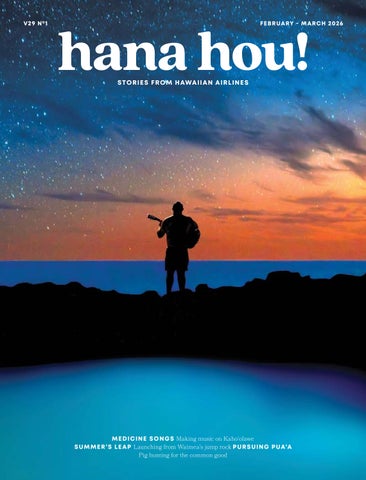
Hana Hou! V29 Nº1 February-March

Page 1


STORIES FROM HAWAIIAN AIRLINES

MEDICINE SONGS Making music on Kaho‘olawe SUMMER’S LEAP Launching from Waimea’s jump rock PURSUING PUA‘A Pig hunting for the common good

N 0 1 FEBRUARY - MARCH 2026

INTELLIGENCE 16 / Life in the Twilight Zone

STORY BY PETER ROSEGG 19 / Fit for a Chief

STORY BY CATHERINE TOTH FOX

PHOTOGRAPHY BY MARTIN S. FUENTES

20 / Mobile Musubi

STORY AND PHOTOGRAPHY BY JESSE RECOR

23 / Golf Oysters

STORY BY MARTHA CHENG 24 / Global Garden

STORY BY KATE MIRA

PHOTOGRAPHY BY JACK WOLFORD 26 / Honey of the Gods

STORY BY SARA STOVER

PHOTOGRAPHY BY MEGAN SPELMAN

DEPARTMENTS & FEATURES

30 / Keepers of the Bay

Twenty years in, Mālama Maunalua has done some major cleanup work

STORY BY DW GIBSON

PHOTOGRAPHY BY ELYSE BUTLER

40 / Earthly Vessel Revolutionary ceramicist Toshiko Takaezu was a shaper of the imagination

STORY BY ALEXIS CHEUNG

50 / Good Hunting

Protecting O‘ahu’s forests, pig by pig

STORY BY BEAU FLEMISTER

PHOTOGRAPHY BY CABLE HOOVER

58 / The Healing Island

Fifty years since the occupation of Kaho‘olawe, eight musicians visit the island to compose songs of reconnection

STORY BY SHANNON WIANECKI

PHOTOGRAPHY BY PF BENTLEY 70 / Free Falling Taking the plunge from Waimea’s jump rock

PHOTOGRAPHY BY BENJAMIN ONO

82 / The Learning Laboratory ‘Iolani School’s Community Science Program takes research far beyond the classroom

STORY BY CATHARINE LO GRIFFIN

PHOTOGRAPHY BY TIM HUYNH

90 / Filming Hōkūle‘a

Almost sixty years ago, Dale Bell documented the end of a voyage— and the start of a cultural awakening

STORY BY PETER VON BUOL

PHOTOGRAPHY BY WALESKA SANTIAGO

STORY BY SARA STOVER PHOTOGRAPHY BY MEGAN SPELMAN

A new dawn of live entertainment rises in Cirque du Soleil ‘Auana— a Hawai‘i-inspired production featuring a cast of powerful acrobats, talented musicians and singers, and profound hula dancers. is unparalleled ensemble brings together international and local talents to shine a fresh light on the spirit of Hawai‘i. Only at the OUTRIGGER Waikīkī Beachcomber Hotel.

Coming Soon

A NATION CONNECTED BY WATER / There’s no more awe-inspiring cultural event in Oceania than the Festival of Pacific Arts and Culture. In June 2024, Ric San Nicolas, one of the world’s foremost Hawaiian featherworkers, brought his mahiole (helmets) and ‘ahu ‘ula (cloaks) to the festival and shared his ‘ike (knowledge).

photograph by dana edmunds

THE PIZZAIOLO OF KAUMAKANI / Xavier John Paul Machado had a dream: to create a pizza in Hawai‘i rivaling the venerated pies of New York and Chicago. With only YouTube tutorials and a pizza obsession, the teenager in a small Kaua‘i town now bakes with the best of them— ask any visiting East Coaster.

photograph by j . matt

CLOSE ENCOUNTERS OF THE HAWAI‘I KINE / Whatever they are, people in Hawai‘i are seeing a lot of them—for centuries, the Islands have been a hotspot for strange sightings in the sky. Head into the world of unidentified anomalous phenomena (UAPs), where science, Hawaiian cosmology, military secrecy and New Age spirituality collide.

THE HEALING ISLAND / A group of local musicians visit Kaho‘olawe to mark the fiftieth anniversary of the beginning of the island’s reclamation from military bombing. They pule (pray) at sacred sites and compose new music for an album inspired by the island’s mana (spiritual power) and the work of nonprofit Protect Kaho‘olawe ‘Ohana.

Forget to take your copy of Hana Hou! from the seat pocket? Miss a story from a back issue? Want to share a story or a video you’ve seen on the in-seat media player or on the Hawaiian Airlines app? Hana Hou! is online as well as on-screen. Visit our web site at the link below or scan the QR code to view the current issue and selections from our archive.

hawaiianairlines.com/hawaiistories/hana-hou

photograph by andrew richard hara
photograph by pf bentley

PUBLISHER & CEO

Jason Cutinella

PARTNER/GM —HAWAI‘I

Joe V. Bock

EDITOR-IN-CHIEF

Michael Shapiro

DIRECTOR OF PHOTOGRAPHY

Matt Mallams

ASSISTANT EDITOR

Maria Kanai

MANAGING DESIGNER

Taylor Niimoto

DESIGNER

Eleazar Herradura

VP FILM

Gerard Elmore

EDITORIAL PRODUCER

Anthony Banua-Simon

FILMMAKERS

Blake Abes

Romeo Lapitan

VIDEO EDITOR

Jhante Iga

STUDIO DIRECTOR/ PRODUCER

Kaitlyn Ledzian

DIGITAL PRODUCTION

DESIGNER

Arriana Veloso

OPERATIONS

ACCOUNTS RECEIVABLE

Gary Payne

OPERATIONS DIRECTOR

Sabrine Rivera

TRAFFIC MANAGER

Sheri Salmon

OPERATIONS MANAGER

Jessica Lunasco

CLIENT SERVICES DIRECTOR

Kristine Pontecha

ADVERTISING

HEAD OF PARTNERSHIPS–HAWAI‘I

Alejandro Moxey

ADVERTISING DIRECTOR

Simone Perez

ACCOUNT EXECUTIVE

Rachel Lee

OPERATIONS & SALES ASSISTANT

Kylie Wong

CONTACT

EDITORIAL INQUIRIES

editors@NMGnetwork.com

SALES INQUIRIES sales@NMGnetwork.com

CONTRIBUTORS

Alexis Cheung

Beau Flemister

Benjamin Ono

Cable Hoover

Catherine Toth Fox

Catharine Lo Griffin

DW Gibson

Elyse Butler

Jack Wolford

Jesse Recor

Kate Mira

Martin S. Fuentes

Martha Cheng

Megan Spelman

PF Bentley

Peter Rosegg

Peter von Buol

Sara Stover

Shannon Wianecki

Tim Huynh

Waleska Santiago

Published by: NMG Network 41 N. Hotel St. Honolulu, HI 96817

©2026 by NMG Network. Contents of Hana Hou! are protected by copyright and may not be reproduced without the expressed written consent of the publisher. Hana Hou! assumes no liability for products or services advertised herein.

3375 Koapaka Street, G-350 Honolulu, HI 96819

Phone: 808-835-3700

Fax: 808-835-3690

Mailing Address: PO Box 30008 Honolulu, HI 96820

For questions related to travel, visit us online at HawaiianAirlines.com or contact us at any of the following numbers:

UNITED STATES / CANADA

1-800-367-5320

Monday-Sunday, 24 hours Text 38285

Monday-Sunday, 5:00am - 11:00pm HST

AUSTRALIA (61) 1-800-955-912

CHINA (86) 10-6502-6766

JAPAN (81) 570-018-011 Monday-Sunday

NEW ZEALAND (64) 0800-449-415

AMERICAN SĀMOA (684) 699-1875

SOUTH KOREA (82) 2-775-5552

TAHITI (689) 40-866-000

CONSUMER AFFAIRS

HawaiianAirlines.com/CAO

BAGGAGE INQUIRIES 1-866-389-6654 Monday-Sunday, 8:00am - 4:30pm HST

ATMOS REWARDS

For more information on our frequent flyer program, please contact our Atmos Rewards service center: 7:00am - 7:00pm PT, Monday-Friday 8:00am - 5:00pm PT, Saturday 1-877-426-4537

HAWAIIAN AIR CARGO INQUIRIES 1-877-422-2746 HawaiianAirCargo.com

ON THE COVER

Song for a Wounded Land

Ka‘ikena Scanlan sings to the stars above Sailor’s Hat, a pond created by the bombing of Kaho‘olawe.

PHOTOGRAPH BY PF BENTLEY

PF Bentley

“To be on Kaho‘olawe with Hawaiian musicians of such remarkable talent was a truly magical experience,” says PF Bentley, who photographed a musical project on the sacred island for “The Healing Island.” It was Bentley’s second visit to Kaho‘olawe, which remains off-limits to the public and continues to undergo cleanup after decades of use as a bombing range by the US Navy. “Kaho‘olawe doesn’t look extraordinary when you first arrive,” Bentley says, “but after a few days, the presence and mana of Kanaloa—the Hawaiian god for whom the island is also named—moves you deeply. I always leave with tears in my eyes. I love that place.” Today, Kaho‘olawe is reserved exclusively for Native Hawaiian cultural, spiritual and subsistence purposes, as well as for environmental restoration, historic preservation and education. The island has no permanent residents. Bentley is a frequent contributor to Hana Hou!

Benjamin Ono, photographer and filmmaker on O‘ahu’s North Shore, spent most of his summer at Waimea Bay shooting the popular “jump rock” for this issue’s photo feature, “Free Falling.” “I treated the project a lot like street photography. Just showing up, observing and capturing moments as they happen, without posing or staging,” says Ono. To him the rock is an epitome of the freedom of a summer vacation. “It’s a whole experience,” he says. “People take turns, because there are only a couple spots where you can jump. I tried to capture those moments— local kids huddled up before the jump, no phones, a real analog moment where they’re all together doing that one activity. That’s rare these days. There’s just this little world on top of the rock,” he says. “When it’s your time to jump, you’re looking down at a thirty-footdrop. It’s intimidating, but everyone’s shouting support.” See more of Ono’s work at benjaminono.com.

“The story of Hōkūle‘a’s maiden voyage has fascinated me since I was a kid,” says Peter von Buol, who wrote about the replica Polynesian voyaging canoe and the documentary film about its successful 1976 voyage to Tahiti for “Filming Hōkūle‘a.” “I especially admired Dale Bell’s documentary, how it didn’t shy away from the challenges that the Polynesian Voyaging Society faced. Even though some were upset by the portrayal, Bell sought to tell the truth.” Buol traces part of the Hawaiian Renaissance of the 1970s to the influence of Hōkūle‘a and Bell’s documentary. “My good friend and sailor Herb Kāne often said, if the Hawaiian people did not accept the Hōkūle‘a, the effort wouldn’t have meant anything. It was a revival, bringing back the culture by bringing back the canoe. That’s what Bell captured.” Buol is a longtime Hana Hou! contributor, journalism professor and an avid Beatles fan.

Kaho‘olawe has captivated Shannon Wianecki ever since she was a kid growing up across the channel in South Maui. “We could hear the bombs from our house,” she says, “and someone told me about the navigator’s chair on top of Mōaulaiki. I never imagined I would see it in person.” Her first trip to the island was in 1999, as a volunteer with the Kaho‘olawe Island Restoration Commission. She wonders if some of the ‘a‘ali‘i and pili grass she planted are the same plants she saw while reporting for “The Healing Island.” “Tagging along with the musicians offered me a window into their world of nonstop banter and wordplay worthy of Shakespeare. They never stopped making music—while riding the ATVs, eating lunch, even while swimming.”

Shannon Wianecki

LEGENDARY SHOPPING, DINING & EXPERIENCES

Investing in Our Home

From Hawaiian Airlines’ office overlooking our Honolulu hub, I often stop to watch one of our aircraft take off or land. It is a beautiful sight, with Pualani shimmering against the sun and guiding us on our journey.

As Hawai‘i’s airline, we operate about 230 daily flights to, from and within the Islands. That means we have an aircraft departing from or arriving at any of our five Hawai‘i airports every eight minutes. Last year, our 6,600 Hawai‘i-based team members welcomed some 11.5 million guests, along with roughly 66,500 tons of cargo.

On board are residents commuting, families en route to visit relatives or explore the world and visitors taking a special vacation. In the belly of our aircraft are products from businesses large and small, ranging from produce and critical blood supply to mail and machinery. Our Hawai‘i flight activity not only safely moves people and goods on time; it has also in recent years contributed to as much as 11 percent of our state’s annual gross domestic product.

This kuleana to our community is top of mind for me as Hawaiian Airlines integrates with Alaska Airlines to offer greater value to our guests. Hawai‘i will always be our home, and to better serve you as we grow as a combined company we are comprehensively upgrading our airport spaces, technology, aircraft and offerings — and investing in sustainability and across our communities — through our recently announced Kahu‘ewai Hawai‘i Investment Plan.

Kahu‘ewai, signifying fresh water bursting forth as a metaphor for vital resources, is a five-year, $600-plus million initiative to enhance our guests’ experience from booking to the day of travel, equip employees with new tools, modernize our infrastructure, support our communities and strengthen our collective future.

What can you expect? Reimagined lobbies and gates to reduce congestion and improve comfort, with amenities like

increased power charging in Honolulu, Līhu‘e, Kahului, Kona and Hilo, plus a spacious 10,600-square-foot premium lounge at Honolulu airport’s Terminal 1.

Fully refreshed interiors of our Hawaiian Airlines widebody Airbus A330s — a top-to-bottom retrofit including new seats, carpets, lighting and in-flight entertainment systems, Business Class suites and a new premium economy cabin to accompany our fast and free Starlink Wi-Fi.

An updated, modern app and website that simplify trip planning, booking and managing your travel with self-service features like changing flights or redeeming credits.

To underscore our commitment to Hawai‘i residents, later this year we will begin awarding kama‘āina 50 percent bonus Atmos™ Rewards points and status points on Neighbor Island flights, enriching our Huaka‘i by Hawaiian suite of exclusive benefits that include a free checked bag when flying within the state and network-wide discounts.

Beyond our operations, we remain deeply engaged in our communities, supporting the economy and local

businesses, investing in workforce development programs in Hawai‘i and advancing the sustainability of our flying to protect the environment. We are helping develop sustainable aviation fuel on O‘ahu, assessing innovative, lower-emission aircraft technologies and have begun transitioning to electric ground service vehicles at Honolulu airport.

Our newly combined Alaska Airlines | Hawaiian Airlines Foundation will grow our community giving by awarding grants to local organizations promoting cultural programs, environmental preservation and the perpetuation of native Hawaiian art and language.

This work, which we will continue to build on, reflects our essential role and kuleana to keep the Islands connected and strong. Mahalo for flying with us, for joining us on this journey, and for helping to make us who we are.

As aircraft land at Honolulu’s iconic Reef Runway, we’re reminded how each flight carries our commitment to Hawai‘i.

island intelligence

PHOTOGRAPHY BY ROBERT K. WHITTON

Life in the Twilight Zone

If you want to be dazzled by the reefs of the deep ocean without getting wet, you’re in luck. Bishop Museum’s new exhibition, Explore EXCORE: The Art of Underwater Science features innovative underwater cinema from the museum’s Center for the Exploration of Coral Reef Ecosystems (EXCORE) and demonstrates the evolution of the diving tech and the cameras that make the visuals possible. “We take the latest technology to explore and document biodiversity on coral reef habitats in ways

that our predecessors were unable to,” says Richard Pyle, director of EXCORE. Pyle co-curated the exhibition with Brian Greene, Bishop Museum ichthyology research specialist and expedition coordinator for EXCORE.

Both are protégés of John E “Jack” Randall, widely regarded as the greatest ichthyologist in history, who spent most of his career at Bishop Museum. Randall started diving with an early scuba rig he bought at an Army-Navy surplus store and went on to describe over eight

hundred species of marine life across the Indo-Pacific. He was also a skilled underwater photographer, and his illustrated field guides are still used by divers, snorkelers, aquarium hobbyists and conservationists.

But scuba technology in Randall’s day limited divers to two hundred feet for only a few minutes at time, and even that was pushing it. Advances in diving gear have allowed divers to reach extreme depth—three or four hundred feet, sometimes deeper. The reefs there,

A new exhibition at Bishop Museum features high-def video of coral reefs in the “twilight zone” shot by the deep divers of EXCORE (seen on pages 14–15). Above, divers deploy a sensor array at 330 feet in American Sāmoa. Facing page, a larval cusk eel photographed at depth.

in what’s known as the mesophotic or “twilight” zone where light begins to fail, could once be surveyed only with submarines or remotely operated vehicles—expensive and less adept than human eyes and hands when it comes to exploring a reef. But it’s worth the effort: There’s a profusion of life in the twilight zone, much of it new to science.

The exhibit, running through March 22, 2026, in the museum’s JM Long Gallery, features crystal-clear underwater video, originally captured in 8K, showing

some of the world’s most unexplored regions and unseen aquatic creatures. Over in the museum’s Science Adventure Center, visitors can view some of the preserved specimens EXCORE has collected, like deep-sea black lattice coral and rarely seen reef fish. These have a fitting home at the Bishop Museum, which holds more than 24 million animal, plant and insect specimens—the world’s largest archive of Pacific biodiversity.

For scientists the work is about documenting biodiversity, but for the

museum goer, it’s also breathtakingly beautiful—and important. “Global biodiversity is arguably the most valuable resource on Earth,” Pyle says, “and its loss is perhaps the greatest existential threat to humanity. … Most people have no idea how much our lives and the lives of our children utterly depend on the health of biodiversity—for the oxygen we breathe, for the food we eat.”

STORY BY PETER ROSEGG
PHOTOGRAPHY BY BRIAN D. GREENE

Fit for a Chief

In Apple TV+’s Chief of War, Hawai‘iborn star Jason Momoa dramatically wraps himself in a red-and-gold ‘ahu ‘ula (feather cape) in epic slow-mo. On his head is a matching feathered mahiole, a helmet with a broad crest made from the ‘i‘iwi (scarlet honeycreeper), signifying his status as ali‘i (chief). Rarely has the traditional Hawaiian garb been featured on such a public stage.

The show brought in a wave of requests for custom mahiole to Joshua Marks, one of the few master craftsmen around. At least, that’s his theory as to why business is booming—he had to stop taking orders for 2025 by September. From his workshop in Nevada, Marks has been perfecting the craft for fourteen years. After moving with his family from Wahiawā in 2011 to

Pahrump, a town about fifty miles west of Las Vegas, Marks wanted a way to stay connected to his Native Hawaiian roots. He started by weaving baskets, a skill he learned by watching YouTube. “I started to learn everything I could,” says Marks, 34. “Cordage, feather lei, hooks, mahiole. Out of everything I tried, I loved making mahiole the most.”

He devoted years to learning everything about mahiole. “I became obsessed with looking at old mahiole and drawing them,” Marks says.

Authentic material is hard to find in Nevada, so Marks makes do. The frame is traditionally woven from ‘ie‘ie, a woody vine endemic to Hawai‘i’s wet forests. The vine’s aerial roots were used to construct mahiole and ‘ie (woven baskets). It’s hard to come by ‘ie‘ie in Vegas, so Marks makes a concession to necessity and uses reeds instead.

Depending on the style—there are a few different ones, including his most recent version of mahiole pōheoheo, with woven knobs forming the crescent— it takes between two to four weeks for Marks to complete just one mahiole. In a year he can make only about a dozen.

The process is meticulous. It takes Marks a few days to dye the reeds. Then, every morning, he soaks the reeds in a pot of hot water to make them pliable. After a cup of coffee, he begins weaving, starting with the base. “This is the most difficult part because you have to make sure the designs match with the client’s head measurements,” he explains.

The tighter the weave, the longer it takes—but the better it looks. So he takes his time, doesn’t rush, spending about ten hours a day working and weaving. It’s become his full-time job, each mahiole ranging from $1,400 to $2,500.

“It’s all about keeping the culture alive,” he says. “That’s my biggest goal.”

Joshua Marks sports a mahiole, or helmet, he wove himself. Originally from Wahiawā, O‘ahu, the Las Vegas-based artist recreates ancient regalia once worn by ali‘i (chiefs) to perpetuate Hawaiian culture.

Mobile Musubi

You could say musubi is the PB&J of Hawai‘i,” says Kelly Kakalia, coowner of The Musubi Truck.

Musubi arrived in Hawai‘i in the early 1900s with Japanese plantation workers in the form of onigiri—pressed triangular rice balls wrapped in nori. A portable, eat-with-your-hands kind of meal that was delicious. Musubi in Hawai‘i, though, is unique. In the 1980s on Kaua‘i, Barbara Funamura packed sushi rice into a custom koa wood mold, turning the traditional triangle into a now-iconic brick. But the coup de grace was a slab of Hawai‘i’s favorite cargocult lunch meat, Spam, layered on top. Spam musubi has been an Island staple ever since, so much a part of the culture that you can get it in 7-Elevens.

Decades later, in a little black-andwhite food truck on the island of its birth, Spam musubi continues to evolve. It started as beachside banter among the Kakalia family about how many beloved

“plate lunch” items could go on musubi: chicken katsu, kimchi, local farm-raised beef. Along with their close friends, the Aguinaldo family, they put their money where their mouths are and bought a retired UPS truck, parked it on a vacant tow-truck lot in Kapa‘a and The Musubi Truck rolled into business.

They built their business on a few principles: Forgo plastic, source locally (except for the Spam), serve the community and evolve. They swapped plastic wrap for their signature blackand-white-checkered paper. Local vendors and farms supplied the ingredients, and housemade sauces made the traditional musubi pop with new flavors. It worked: In just four years they added two more locations—a truck in Kōloa and a restaurant in Kalapaki—and grew to more than fiftyfive employees.

It’s the original spot in Kapa‘a, however, that became a community

resource. Strategically parked near downtown as well as the school and skate park, it served the afterschool rush. But not every kid had the three bucks for a musubi. Taking a cue from the pay-it-forward program of a New York City pizza shop, the owners launched “Feed the Keiki,” where guests can cover the cost of a keiki meal for the next kid: Spam musubi, mandarin orange and a juice box. A local nonprofit distributes the vouchers, redeemable at any Musubi Truck window.

“Our heart is to serve with aloha, support local families and invest in the next generation,” says Kakalia. The Musubi Truck might always remain true to Funamura’s creation (“We sell over 11,500 Spam musubi a month,” says Kakalia) but the ‘ahi katsu musubi with spicy aioli is coming for the crown.

The Musubi Truck in Kapa‘a (seen above right) combines two Hawai‘i staples, the food truck and the musubi—pressed rice with nori and, most often in the Islands, Spam. Above left, The Musubi Truck’s ‘ahi katsu musubi, which is a solid runner-up to Spam as a local favorite.

Golf Oysters

Sometimes, on Thursday mornings, a homeowner at Hualalai Resort on Hawai‘i Island steps out onto his lānai to watch the harvest at Pūnāwai pond, a water feature by the fifth hole on the resort’s golf course. Then, in the evening, he’ll head down to one of the Four Seasons’ restaurants and order the freshly plucked and shucked oysters on the half shell. “Farm-totable” has become a cliché, but the Four Seasons Resort Hualalai is likely the only hotel to lay claim to golf-totable seafood. It’s also one of only two commercial farms growing oysters for consumption in Hawai‘i—the other is Kualoa Ranch on O‘ahu.

In 2001, David Chai, the thendirector of natural resources at the Four Seasons Resort Hualalai, designed the 2.3-acre pond, which pumps in

underground seawater, and a few years later, introduced oysters to help clear the water of algae. Initially, he populated the pond with Hawai‘i’s native oysters, but they didn’t grow fast enough. He then tried Eastern oysters, but they grew too quickly—Nicole Tachibana, who replaced Chai after he retired recently, remembers the bivalves ballooning to a size nearly the length of her hand. The Hualalai chefs fried them up into po’ boy sandwiches, but requested a smaller shellfish. The aquaculturists found a happy medium in the Pacific and Kumamoto oysters, of which they harvest about a thousand per week for the Four Seasons’ restaurants.

But “pondside is the best way to eat it, directly from the pond to the plate,” Tachibana says. Hualalai offers a tour of the operation for guests and

club members, accompanied by an oyster-and-champagne pairing set up on the edge of the pond. During the tour, aquaculture specialist Jason Falcone points out some of the pond’s other inhabitants, including native awa (milkfish) and ‘ōpae huna (also known as feeble shrimp). “The pond has to serve an aesthetic purpose,” Falcone says, “but it was also built to be its own ecosystem.” The roots of vegetation growing on the floating islands in the middle of the pond control the nutrient balance and have also become a nesting habitat for rare native ae‘o (Hawaiian stilt birds) in the spring. Also part of the ecosystem: the occasional errant golf ball. But, Falcone says, “you’ll really have to slice it bad to get it in here.”

Above left, Kelsey Makida wades into Pūnāwai pond‚ a water trap-cum-oyster farm on the fifth hole of Four Seasons Resort Hualalai’s golf course. The Kumamoto oysters not only clean the pond and help sustain a healthy aquatic ecosystem, they’re a coveted menu item at the resort’s restaurants (above right).

Global Garden

Between the dorms and science buildings at the University of Hawai‘i–Hilo, the world feels suddenly ancient. Bromeliads glimmer like jeweled cups after morning rain, and prehistoric cycads stretch skyward. Both classroom and time capsule, this eighthof-an-acre garden is one of the island’s most extraordinary corners.

Founded in the 1980s by nowretired biology professor Don Hemmes, the Botanical Gardens at the UH–Hilo began with a simple question. “A student once raised her hand in my botany class and asked, ‘What’s a pine tree?’” he recalls. “That’s when I realized our students needed to see plants from beyond Hawai‘i … to

understand global diversity, not just what grows here.”

From that moment, Hemmes began planting exotic seeds. Decades later, his “living classroom” has evolved into a worldclass collection accredited by Botanic Gardens Conservation International (BGCI) and is recognized as a national arboretum. The garden showcases more than 120 species of cycads representing 10 genera, hundreds of bromeliads and hybrids—none of them native to Hawai‘i.

Each section of the garden features flora from different regions of the world—Asia, Africa, Central and South America—creating a miniature map of global biodiversity. The cycads—ancient, cone-bearing plants often mistaken for palms—are hand-pollinated, and their seeds are collected to share with other botanical gardens around the world.

“Some species here are extinct in the wild, making our collection an ark of survival,” says Hemmes.

The bromeliads, with their bursts of sherbet pink, lime green and crimson red, steal the spotlight. Relatives of the pineapple, these flowering plants rarely need attention and add color year-round. They bloom just once in their ten- to fifteen-year lifecycle. In Hilo’s tropical climate, both cycads and bromeliads grow as if they belong here.

Because many of the plants in the garden are endangered, the UH–Hilo collection supports global research and conservation efforts through the BGCI network. School groups and nearly a thousand visitors from around the world walk its shaded paths each year.

For Hemmes, who taught at UH–Hilo for more than forty years, the garden remains both a lesson that took root and a sanctuary he still tends weekly along with a handful of volunteer plant enthusiasts.

“Students always said this was the most valuable thing they did during their time here,” says Hemmes. “You can read about plants anywhere, but out here, you can feel them breathing.”

HILO.HAWAII.EDU/GARDENS

PHOTOGRAPHY BY JACK WOLFORD
HAWAI‘I
A bromeliad in the genus Neoregelia, one among many hundreds of bromeliad and cycads at the Botanical Gardens on the campus of the University of Hawai‘i–Hilo. Started in the 1980s as a teaching tool for UH–Hilo botany students, the garden features varieties from all over the world.

Honey of the Gods

Drink like a Viking: Alex Haban (crouching) and Tomek Bilan (in black T-shirt) of Kvasir’s Mead in Mountain View fuse an ancient Polish recipe with Hawai‘i Island-grown ingredients—banana, roselle, longan, liliko‘i—to put an Island twist on one of the world’s oldest alcoholic drinks.

Alex Haban sits on the edge of a rainforest, sipping mead. A fermented honey wine once guzzled by Norse raiders might seem out of place in the tropics, but not to Haban. Along with her husband, Tomek Bilan, Haban owns Kvasir’s Mead in Mountain View, Hawai‘i Island. The couple’s adventure in mead making began in the more appropriately wintry Chicago, where they met rock climbing and discovered their shared love for mead.

Bilan brought tradition and Haban brought the bees. “Growing up in Germany, I watched my aunt keep bees and dreamed of caring for them myself,” Haban says, “It wasn’t until I lived in Chicago that I finally had my own apiary and honey.” Bilan, for his part, grew up in Gniezno, a Polish city where the first written mead recipe was found. As a boy, he helped his babcia (grandmother) make mead using the recipe passed down by her grandmother.

The couple arrived in Mountain View a decade ago, where they lived in a tent

on two acres and used machetes to clear enough land for a house and some fruit trees. Using Babcia’s recipes, they made mead with their harvest and named it after a Norse creation myth. “Kvasir, the wisest of beings, was born from a peace pact between gods, stolen by dwarves, stabbed and drained of his blood, which was mixed with honey to preserve his wisdom,” says Bilan. “Thus the first mead was made.”

Bilan and Haban’s process was less gruesome but perhaps more grueling. After four years of navigating a daunting permitting process, Kvasir’s Mead produced its first licensed batch of Dark Horse bochet, a mead made with caramelized honey, in 2023. “We source all of our fruit from Hawai‘i,” says Bilan, opening a bottle of The Yeastie Boys, a banana-longan mead, with label art by Haban. “Sometimes we buy surplus or imperfect produce and create new flavor profiles from ingredients that might otherwise go to waste.”

From punchy Kvasir’s Blood, a mead infused with roselle (a type of

hibiscus) to the liliko‘i-flavored Lilith, named for one of the meadery’s cats, the flavors might vary, but Hawai‘i Island honey remains a consistent star of the show. “Each flavor profile has its own unique narrative, sometimes drawing from our personal lives, other times from mythology,” adds Haban, who’s excited about the upcoming blueberryand butterfly pea-flavored Song of the Whale, which will feature a QR code on the label linking to a whale song recorded in Hawai‘i. “Partial proceeds from each bottle will be donated to the local nonprofit Dolphin Institute, so you can toast to the dolphins,” says Haban. Despite the modern innovations, “Our meads are a marriage of Island ingredients and old Polish recipes passed down for over a thousand years,” says Bilan. “That’s a lot of time to perfect a drink, and we’re proud to keep that tradition alive.”

departments & features

Keepers of the Bay Twenty years in, Mālama Maunalua has done some major cleanup work

Karen Gleason has known Maunalua Bay for just about as long as any living person. At 83, she’s been steps from the shoreline all her life and remembers when her family’s home was surrounded by fishponds and farms. There was a dairy in Niu Valley and another in Kuli‘ou‘ou. She grew up a few miles from the beaches of Waikīkī but in an entirely different world. “I used to ride up the street on my bicycle

to the dairy,” Gleason says. “My mother would call and tell them what she wanted, and I would just go up there and pick it up. Country, you know, that’s what it was when I was young.”

But as she made her way through elementary school, that started to change. As a third grader, she was in one of the first classes to attend ‘Āina Haina School, built on the land of a dairy that had closed. “Kaiser came

in and started a housing development.” she says, referring to Henry J. Kaiser, the industrialist who played a central role in development of the area. “That spread and brought more houses and people and roads and everything else that comes with it.”

As the population swelled, the area became known as “Hawai‘i Kai,” a new name that nodded to the role that Kaiser played in changing the landscape.

Gleason noticed the bay where she had grown up swimming, surfing and fishing was changing, too. “We were going down toward the Koko Head end of the bay to go out because seaweed was settling in the other end.” With each passing year, three types of invasive algae—leather mudweed, gorilla ogo and prickly seaweed—spread and eventually filled the bay. “The streams that ran down into the ocean were built into concrete culverts,” recalls Gleason. “The water from the forestland up from the houses was rushing down these culverts, and with it all of the rubbish from the houses, the garden pesticides and

stuff like that. You could see and smell gasoline in the water.”

She wasn’t the only one who noticed. Gleason’s neighbors were equally dismayed by what had become of their bay. In the early 2000s, several families living in the area formed a hui (group) to answer the pressing question: How could they restore the bay they had enjoyed for so many years? The hui included land stewards such as Laura Thompson, mother of navigator Nainoa Thompson, who was instrumental in reviving traditional Polynesian voyaging. Gleason and her late husband were central to the hui as well. In 2005,

OPENING SPREAD / The waters of Maunalua Bay (seen also on pages 28–29) are among O‘ahu’s most used and abused; twenty years ago, it was choked with invasive algae. Today Mālama Maunalua maintains the bay by clearing algae, planting coral and working with homeowners.

TOP / Dan Arencibia (left) and Alex Awo (right, seen also on page 31) identify coral and algae found in Maunalua Bay.

BOTTOM / Gorilla ogo, an aggressive invasive alga affecting the bay.

AT LEFT / Mālama Maunalua founding member Karen Gleason.

the group officially formed the nonprofit Mālama Maunalua, and the long work of restoration began.

Those early efforts have now fully matured into a robust organization that is celebrating its twentieth anniversary. The milestone was recently capped by securing a Fisheries Management Area (FMA) designation—one of only thirteen in Hawai‘i. That designation is a major victory that began as a quixotic pursuit, requiring years of paperwork and community meetings. It’s redefining what’s possible in the years to come for the bay, the hui that cares for it and potentially for other

Blue Topaz Sea Turtle Collection

Clearing algae is only the first stage of restoring a complex marine ecosystem like Maunalua. Rehabilitating reefs requires volunteers like those seen above to identify corals resistant to environmental stressors, then plant them and monitor their growth—one small patch of reef at a time.

communities hoping to steward their lands and waters.

The group’s work is now more expansive than ever, requiring everything from band saws to hammers and chisels, along with a steady stream of volunteers and no fewer than half a dozen partner organizations. The work is paying off—and setting an example of what a community can do.

Removing invasive algae is, if nothing else, unglamorous. Teams of volunteers wade into the silty waters and pull algae by hand, filling one five-pound bucket at a time. These are loaded onto a truck and distributed to area farmers. “They compost it,” says Doug Harper, the executive director of Mālama Maunalua. “So it’s a really kind of closed circle regenerative project.”

Alex Awo is one of the leads for the volunteer teams removing algae. He’s been with the organization for a decade and serves as the director of habitat restoration programs. But his relationship to Maunalua Bay extends much further into his past.

Awo was born and raised in the Pauoa neighborhood of Honolulu. As a teenager, he and his friend wanted to avoid the surfing crowds in Waikīkī, so they ventured a few miles east to Maunalua, looking for less crowded waves.

“In 2009, the reef was just carpeted with invasive algae as far as the eye could see—three, four hundred yards out,” Awo recalls. “We had to trudge through that stuff. It was like walking through deep snow. And that wasn’t even the worst part. You pull your leg up, it’d be covered in this black sludge. Not only dyed your leg black for the rest of the week, it smelled, and that smell would get in your nostrils for the week. I remember telling my friends at one point, ‘Guys forget this, we’re not doing this anymore. We’re not trudging to all this pollution just to go surfing.’ We thought at that point as kids that we had lost Maunalua forever, because we weren’t planning on coming back.”

But when Awo learned about Mālama Maunalua, he jumped at the opportunity. “We came back a few years after that to volunteer with one of the hui events. And were just blown

away at how clean the water was looking.” From the time the work began, it took more than a year for the water to start clearing, and even then the work was only beginning. The hui founders understood that this wouldn’t be a case of fixing a problem and closing shop; it would be about creating a new system of maintenance.

Over the past twenty years, more than forty-six thousand volunteers have removed some 4 million tons of algae. They come from all over O‘ahu, neighbor islands, the continental US and the world. In 2024, the organization worked with 2,900 student volunteers alone. “We do lots of outreach events to share what’s going on in the environment,” says Harper. “We do it all over the island but especially here in Maunalua Bay—a lot of the work is hyperlocalized.”

Getting the algae under control revealed a deeper problem: The coral was unhealthy. In 2019, the organization started identifying areas where restoration might be possible. “They’re called ‘corals of opportunity,’” says Harper, “and we basically started

Restoring the bay also means tending the land, in part by capturing rainwater before it becomes runoff.

the Green Stormwater Infrastructure program, coordinates with area homeowners to install rain barrels and plant rain gardens.

Mālama Maunalua’s education and outreach coordinator Lauren Bailes maintains the

doing biopsies on them. We take the coral pieces to the Hawai‘i Institute of Marine Biology, who’s a partner on the project, and they do resilience testing.”

A diamond-plated band saw is used to cut away the dead coral and rock; the pieces of resilient live coral are eventually placed back into the water and monitored. “Almost all of our staff are certified divers,” says Harper. “We’re planting corals that have shown an ability to survive and spawn in warmer conditions. We’ve all been trained on how to do the coral survey work, and we go out there with some regularity to track things. We can get 3D images of the coral then go back a month later and see if they’ve grown.”

Mālama Maunalua now offers an “adopt-a-plot” program—individuals or groups take responsibility for a ten-byten-meter section of the bay. “We tell them what their GPS location is, train them and then they can go out on their own, remove invasive algae, put it in bags and leave the bags by the beach access,” Harper says.

Gleason’s house doubles as the storage facility for the tools that volunteers use for the work. “I have the wagons and buoys and lines and all

the stuff stored on the side of my yard, and the group stops here,” she says. She’s used to volunteer teams coming through at least a couple of times a week, often students who show their competitive edge.

“It’s funny,” says Awo. “Each year we tell students how much other classmates have pulled from the bay. Like, ‘Oh, they pulled two thousand pounds last year,’ and the kids want to beat those records. But now it often works out to where they end up disappointed. ‘Oh, we didn’t pull this much.’ And I say, ‘Well, you need to remember, that’s a good thing. It means we have less and less invasive algae to remove. Each year we have cleaner and cleaner plots. We’re starting to see a lot more of our native species come back.” Awo listed eight different types of marine life that have made a comeback, including the bright green pūako‘ako‘a, a native calcareous algae, and the feathery red hulu pua‘a, a type of limu (seaweed).

Harper says the bay had nearly 100 percent invasive algae coverage when the work began; now it’s down to roughly 30 percent. “Going from 100 percent to 30 percent is a pretty big win,” he says.

But the work hasn’t slowed—if anything it’s accelerated, and more and more people want to get involved. This year, three hundred people applied for about a dozen internships. And the work has moved up into the valley to address the root issue: rainwater runoff, accelerated by the development. You can’t stop the rain, but you can redirect it. “We’re incentivizing homeowners to do rain gardens, rain barrels and plant trees,” says Harper. “When we talked to homeowners in the community, they kept saying that they don’t know how to do green storm water infrastructure, and they don’t have the money to do it.”

Within a month of announcing the Green Stormwater Infrastructure (GSI) program, in 2023, Mālama Maunalua had over 2,300 applicants. To date, more than two hundred rain barrels have been installed, along with about a dozen rain gardens and a few dozen trees. It’s what Harper calls “ridge to reef” management. While it’s a small program with limited funding from the Hawai‘i Community Foundation Fresh Water Initiative and the Ulupono Initiative, Harper hopes it will eventually encourage the City and

Mālama Maunalua’s newest initiative,
Above,
Koko Head rain garden on a community work day.

Come dine here

From the iconic sands of Waikīkī to the sacred shores of Kā‘anapali, OUTRIGGER Resorts & Hotels invites you to discover the food scene at all our Hawaii resorts.

Whether you’re ready for laughs, romance, or the best live music on any island, OUTRIGGER will take care of the food and set the right mood. Let’s eat

Piko at OUTRIGGER Kona Resort & Spa
Maui Brewing Co. at the OUTRIGGER Ka’anapali Beach Resort
Kani Ka Pila Grille at the OUTRIGGER Reef Waikiki Resort
Naupaka Terrace at the OUTRIGGER Kaua‘i Beach Resort & Spa

With the bay’s designation as a Fish Management Area last May, Mālama Maunalua claimed another victory and demonstrated what a dedicated community can achieve. Gone are the days when Awo and his friends had to wade through thick, black sludge to reach the surf. “We’re doing the right thing in the best way that we can,” he says. “Really standing by—not just our environment—but also our Hawaiian culture.”

County of Honolulu to do the same work on a much larger scale across O‘ahu.

In May, Mālama Maunalua hit a milestone: They completed an eight-year campaign to get the bay designated as a Fisheries Management Area. The FMA designation is the result of painstaking work that included scores of community meetings, years of survey work and engagement with various state agencies. Working closely with the community, Mālama Maunalua hosted more than two hundred meetings and produced a carefully crafted proposal to request FMA designation from the Board of Land and Natural Resources.

One of the central rules that the FMA establishes for the bay is a ban on nighttime spear fishing. “The reason for that is a lot of those species are most heavily impacted at night because they’re sleeping,” says Harper. “People can go out and just hammer a reef. You can protect a lot of those species just

by eliminating that one practice. And so we did that with cutouts for a few traditional practices.”

There’s also a ban on fishing certain invertebrates, including certain crabs, lobsters and Triton’s trumpet. According to Harper, these bans had widespread support from the start: “Those were ones that all the fishers were like, ‘It’s really hard to find those species already—they deserve special protection.’” Including the people who fish in the bay—and have for generations, in some cases—was critical. The FMA designation also establishes an advisory panel made up of different stakeholders, from fishers and researchers to community organizers and cultural representatives. “It’s been a really exciting demonstration of fishers working with conservationists, working with government, all saying, ‘Let’s talk equally here as to what we want to see done, what we can do legally, and what we want to see happen,’” Harper adds.

Mālama Maunalua now serves as a detailed model for other communities

throughout Hawai‘i and beyond. The organization’s ever-growing legion of volunteers is the best possible chorus for spreading the word to others who might be looking for a roadmap to restore the ecosystems in which they live.

Awo says the best part of his job is when people recognize him long after they pulled algae from the bay. “I run into parents at the supermarket,” he says, “and I see teachers outside of school, or little kids that will run up to me and be like, ‘Mr. Alex. Mr. Alex, you work from Mālama Maunalua!’ I wasn’t really expecting people to remember a field trip that they were required to go to for school. To hear feedback from people about how inspiring that experience was for their keiki, or how impactful it was for them even as adults, really makes what we’re doing out here that much more worthwhile. We’re doing the right thing in the best way that we can. Really standing by—not just our environment—but also our Hawaiian culture.” hh

Earthly Vessel Revolutionary ceramicist

Toshiko Takaezu was a shaper of the imagination

In the photo, Toshiko Takaezu is walking in an open field on a shining day. The grass is verdant and unclipped, a vast blue and cloudless sky stretches behind her. Everything is bright, save for a row of five large sculptures puncturing the horizon. They stand towering and phallic, in muted earthen colors with inky streaks of purple and flecks of ochre.

Takaezu is almost indistinguishable from her forms, in height and even color—dressed in a purple shirt and brown slacks with a straw hat—as she walks in profile, caught mid motion between two sculptures. Taken in 1998, thirteen years before the acclaimed Hawai‘i artist died, the photograph blurs the distinction between the artist and the art; it’s emblematic of the lifelike nature of her pieces. “Star Series,” the installation in the photo, illustrates the impressive impact of her oeuvre, which helped transform ceramics from a small-scale functional practice into a large-scale abstract form in the art world.

This February 14, Takaezu’s national retrospective, Toshiko Takaezu: Worlds Within—which opened March 2024 at the Noguchi Museum in New York City before traveling to Cranbrook Art Museum in Bloomfield Hills, Michigan; the Museum of Fine Arts, Houston; and the Chazen Museum of Art, University

of Wisconsin–Madison—will finish at the Honolulu Museum of Art (HoMA), the institution where her earliest exhibitions took place. On view will be approximately 125 objects from private and public collections, including 27 from HoMA’s own 104-piece Takaezu collection.

“It’s a re-rooting versus reintroducing, because her story began in this place, which really shaped her,” says Darlene Fukuji, the artist’s grandniece and board president of the Toshiko Takaezu Foundation. “Everything from her glazes, which reflect the landscape,

to the community she built had deep Hawai‘i roots.”

The sixth of eleven children (the “navel child,” she called herself, because “I’m right in the center”), Takaezu was born to Okinawan émigré parents on June 17, 1922, in Pepe‘ekeo, Hawai‘i Island. Her father, Shinsa Takaezu, arrived in the Islands in 1906 as a farm laborer, followed by his new wife, Kama Taba, four years later. Initially the newly married couple settled on Maui, in Lāhainā, finding work on a sugar plantation. By 1920, they relocated to Pepe‘ekeo, near Hilo, working their own rented sugarcane plot.

TOP / Takaezu with her parents in 1966.

BOTTOM / Takaezu’s work blends her Japanese heritage with her Western arts education. “I realized that it isn’t East or West, really, it’s yourself,” she said in 1993. “You take the best of both.”

LEFT / A prolific ceramicist throughout her life, Takaezu was unafraid to experiment. Here she throws a pot at a YWCA in Hawai‘i, 1951.

While her father was a dreamer (“he was sort of a musician, and he likes to play music and read books and play chess,” Takaezu remembered), her mother was industrious, raising all eleven children, cooking, cleaning and sewing kimono by hand. By 1931, during the Great Depression, with her father out of work, the family uprooted to an uncle’s watercress farm back on Maui. The land was abundant, with fresh spring water, an ocean full of fish, fruiting papaya trees. Her uncle raised domestic turkey and pigs, harvested fresh honey and planted a vegetable garden.

OPENING SPREAD / Toshiko Takaezu walks among Star Series, a fourteen-piece installation created in her late seventies.
LeVian Aloha Monstera with Forest Green TsavoriteTM in 14K Honey Gold TM

Takaezu leads a workshop at California State University, Hayward in 1982.

The farm would have a vital effect on Takaezu, though she didn’t yet know it. Decades later she would become renowned for her own garden and homecooked meals at her future home and studio in Quakertown, New Jersey, near Princeton University, where she taught from 1967 until her retirement in 1992. For Takaezu, tending to the earth was another form of artistic communion. “In my life I see no difference between making pots, cooking and growing vegetables,” she wrote in her 1975 essay, “Thrown Form.” “They are all related.”

Against her mother’s wishes— because her “father thought that girls should not be educated,” as Takaezu said in a 1998 interview—she dropped out of high school her sophomore year in 1940. She moved from Maliko Bay, Maui, (where the family had moved in 1937) to Honolulu, where her two sisters already lived and worked, becoming a housekeeper for Hugh and Lita Gantt, the founders of the Hawaii Potters Guild (HPG). The job would prove pivotal to Takaezu’s career, allowing her to work at HPG during World War II and putting her into direct contact with the medium.

“Once I started touching clay, I loved it,” Takaezu explained in the same 1998 interview. Although HPG, the first ceramics manufactory in the Islands (initially set up in 1936 after a clay deposit was found in the cutting of a road in the Ko‘olau Range on O‘ahu), focused

on making kitschy molded objects and domestic items, Takaezu’s instinct that the form could transcend function was already developing. “I loved the clay, I knew there was something much more than making commercial things.”

There Takaezu honed her technical skills—slip casting, firing, sculpting, glaze chemistry—and met her first artistic mentor, a military cartographer named Carl Massa, in 1944. “He felt that I was so limited in so many ways, because I was brought up in a family that didn’t have any freedom of expression or whatever,” she remembered. He assigned her books like The Fountainhead by Ayn Rand and Lust for Life by Irving Stone. He wanted to take her to concerts and opera. “Since he was my teacher, I fell in love with him,” Takaezu said. Massa eventually left for cartography work during Iwo Jima but intermittently wrote her letters.

In 1944, after a stint working in the ceramics studio at the Honolulu Planing Mill and teaching grade school and adult classes at the YWCAs in Honolulu and Hilo (the O‘ahu YWCA would name its ceramics studio in her honor in the 1970s), Takaezu began her formal artistic education by enrolling in drawing classes at the Honolulu Academy of Arts. Later she studied design, art history, weaving and ceramics under the tutelage of Claude Horan, an artist from California tasked with starting the University of Hawai‘i at Mānoa’s ceramics program.

Takaezu’s talent was immediately evident. Her first year, she exhibited about fifty pots and three sculptural busts at a one-person show at the Library of Hawai‘i in Honolulu. The next year, in 1945, her work was accepted into the Ceramic National in Syracuse, the leading annual survey of the field. In 1947, she had her first institutional exhibition at the Honolulu Academy of Arts (HoMA’s previous name) in a group show titled Hawai‘i Creates. It would mark the beginning of a long relationship with the museum.

Takaezu would eventually eclipse her teacher’s career—even beating him for the Best of Show award given at a national exhibition hosted by the Smithsonian in 1961—but Horan instilled in her a taste for experimentation. His students tried salt glazing, incorporating local volcanic

sand and exploring nonfunctional vessel shapes with tops sealed shut, similar to the “closed forms” for which Takaezu would become celebrated.

“The ceramics department under Claude Horan was very dynamic. Its importance is underappreciated,” says Tyler Cann, senior curator of modern and contemporary art at HoMA. Takaezu herself deemed Horan “the father of ceramics in Hawai‘i.” Cann is talking with me in a room in the basement of HoMA, along with associate curator of contemporary art Katherine Love. Ten Takaezu pieces are sprawled before us: functional wine goblets; a large open bowl; a wide platter; small, rounded pots; toddler-size cylindrical pots with Takaezu’s signature nipple-like opening at the top. All share her remarkable glazes, with layered washes of color. There’s a sense of vitality animating every piece.

The pieces on display during Worlds Within show Takaezu’s progression from smaller functional works to massive, three-dimensional sculptures. This evolution was marked by three pivotal points in her life away from the Islands: 1951, when attending Cranbrook Academy of Art, a leading graduate school in Bloomfield Hills, Michigan; 1955, during an eight-month trip to Japan with her mother and sister, Miriam; and 1956, when she taught at the Cleveland Institute of Art.

At Cranbrook, Takaezu’s teacher was Maija Grotell, a Finnish-American artist and the most accomplished ceramicist working in the United States. Though Takaezu began formally playing with glazes by applying broad strokes and explored forms like asymmetrical multispout pots that moved away from functionality, Grotell would help Takaezu develop any artist’s most important asset: her individuality. “She tried to teach you to have your own identity,” Takaezu said of Grotell. “And to have your own identity is not that easy.” As a result, Takaezu has said, “Hawai‘i was where I learned technique. Cranbrook was where I found myself.”

Takaezu continued the journey of self-discovery on a family trip to Japan to connect with her heritage. Importantly, Takaezu encountered the potter Tōyō Kaneshige, who reintroduced her to Shōji Hamada, Sōetsu Yanagi and other leaders of the mingei (folk craft) movement, which

Takaezu was a technical master, especially with glazing. “She would say it was like painting in the dark,” says her grandniece, Darlene Fukuji. “Because you couldn’t know what would come out.” Takaezu invented her own cerulean shade and named it Mākaha Blue (above right) after the beach on the west side of O‘ahu.

focused on elevating ordinary forms like bowls to high art. Takaezu was more drawn, however, to the work of Kazuo Yagi, the head of the avant-garde clay group Sōdeisha, or the “Crawling through Mud Association,” which was formed in opposition to the dominant ceramic style of mingei. Their work emphasized the sculptural over the functional, and their pieces lacked the holes or “mouths” that defined quotidian vases and pots.

Before the trip, Takaezu was close to quitting ceramics. “I returned from Japan with renewed vigor and inspiration,” she said afterward. “I put into practice what I had learned of the artistry of Japanese ceramics with my own perception of the Western world. I threw myself into weaving and painting, too, with tireless energy. I discovered in clay a life of its own.” After taking a job teaching in Cleveland, Takaezu pushed her experimentation. She crafted two- to six-spouted pots, vessels that resembled tamarind pods with three lobed sections, two pot forms connected by stretched membranes. She was finding ways that pottery could be a viable medium for abstraction.

When I first encountered Takaezu’s work in May 2024 at

the Noguchi Museum in New York’s staging of the retrospective, her work emanated a sense of aliveness, and not just because of its sheer size. The same energy infuses her smallest wares. I ask the curators in Honolulu what accounts for that vitality. “She would leave the throwing lines in these pots,” Cann says, gesturing to where Takaezu’s fingers pulled the clay up for an added sense of movement. “She embraces imperfection,” as local sculptor and artist John Koga explains in a phone interview. He met Takaezu while working as chief installer of the Contemporary Art Museum (which later became the Honolulu Museum of Art Spalding House). You can see “where she holds the form and dunks it into the glaze. Some of those are the most precious pieces—seeing her actual hand or finger marks.”

Kaili Chun, a former Princeton student and now Honolulu-based Native Hawaiian artist, remembers how during one raku firing (an ancient Japanese ceramic technique) at Takaezu’s Quakertown property, she ventured into the home where many of Takaezu’s sculptures lived. “I blew into one of them,” she explained, “and when I lifted my lips off of the little pinhole, it breathed back. That’s when I realized its ‘hā,’” she says, using the Hawaiian word

for breath. “There is breath in there, meaning there is life in there.” In 1975, Takaezu told Ceramics Monthly, “When an artist produces a good piece, that work has mystery, an unsaid quality; it is alive.”

Takaezu considered the inside of her forms as important as their exteriors. She often scribbled notes only she knew about inside of the slabs and later dropped in a small ball of clay, wrapped in paper to burn off in the firing, known as a “rattle.” Back at HoMA, an art handler named Bill picks each vessel up. He holds them like infants, cradling them, gently turning them upside down in his gloved hands. The goblets sound high and ringing, like small bells. “Ocean Edge”—a closed form awash with swirling turquoise, purple, black and tan glazes, like a seascape—sounds delicate, like a pebble being kicked under someone’s shoe. (Though rattling the pots during the exhibition isn’t an option, the multisensory nature of the art will be amplified throughout the retrospective by videos and interactive installations exploring the hidden sound of Takaezu’s work by Native Hawaiian composer Leilehua Lanzilotti, a cocurator of the original Noguchi show with Noguchi curator Kate Weiner and art historian Glenn Adamson.)

Chun suggests the idea of ‘āina, land or earth or “that which feeds,” as she phrases it, suffuses Takaezu’s entire practice. “Literally, she was growing food not only for herself but for her students and her community. It was also feeding her spiritually and intellectually and creatively,” she explains.

Hawai‘i’s ‘āina most literally comes through in a series called Trees, inspired by a 1973 visit to Hawai‘i Island’s Devastation Trail in Hawai‘i Volcanoes National Park, a stark landscape dotted with vestiges of trees that is the result of a 1959 volcanic eruption. In “Homage to Devastation Forest (Tree Man Forest),” seven treelike forms are clustered on a field of crushed rocks, glazed in striated tones of moon white, obsidian black and soil brown. Another work, entitled “Lava Forest,” stands among the plant life in the front courtyard of Hilo International Airport, their slender forms stained in inky black and ochre hues. (Several “Trees” will be installed on HoMA’s grounds.) Takaezu’s Mākaha Blue glaze,

a rich cobalt hue, was inspired by the ocean on the West side of O‘ahu.

“The beauty found in nature is really from your na‘au,” Koga says, a Hawaiian word meaning gut feelings, of ‘āina in her work. “It’s from your guts, from your soul, what you’re feeling when you’re back here in Hawai‘i.” Takaezu would have agreed, at one point saying the impact of the natural world on her work wasn’t intentional. “I feel that if you enjoy something, like the landscape, the sunset, whatever it is, you don’t do it directly,” she said in an interview. “But it’ll come out in some other way.”

After all of her years away—Takaezu never lived in the Islands full-time after leaving in 1951—it was only later that she found “Hawai‘i was a great influence on my work,” recognizing in a different interview that “the colors and all the lushness of Hawai‘i is part of me.” She died in Honolulu on March 9, 2011, of natural causes after experiencing a stroke the previous year.

The HoMA retrospective will recognize Hawai‘i’s influence, showing

not only Takaezu’s work but also Horan’s pieces and some from the Hawaii Potters’ Guild. Her legacy extends far beyond her chosen medium and lives on in her students. “She’s one of the reasons why I’m an artist,” remarks Chun. “She showed me that it could be done and that it was worth doing. That being an artist was a meaningful life that involved relationships with people and place.” Takaezu’s last major retrospective at the museum was in 1993, over thirty years ago. While Takaezu was known in Hawai‘i and internationally for her ceramics during her lifetime, “One of the purposes was to shift that narrative from her being recognized not only just as a ceramicist but as this pioneering abstract expressionist, multidisciplinary artist,” says Fukuji. To have the exhibition return to Takaezu’s home, she says, “feels like an overdue recognition and celebration.” hh

Toshiko Takaezu: Worlds Within runs at the Honolulu Museum of Art from February 14, 2026 to July 19, 2026. Visit honolulumuseum.org for more information.

A trip to Hawai‘i Island in the 1970s inspired Takaezu to create her own version of the hollow, skeletal tree forms dotting Devastation Trail in Hawai‘i Volcanoes National Park. Kate Weiner, curator at the Noguchi Museum in New York, says “the way that she’s able to achieve something sublime is by making you feel that you’re both grounded and experiencing something quite intimate, but also opened up to the world.”
Starfish Collection

Good Hunting Protecting O‘ahu’s forests, pig by pig

About four hours into the hunt, I’m beginning to wonder if I’ll make it out in one piece. An old surfing injury in my right knee is throbbing. My back is flaring up. My dogs—the metaphorical ones, not the six we’re following—are barking.

I’m following Satid Tongmee, a hunter from Mākaha and member of the Pig Hunters Association of Oahu (PHAO), through the forest. At the moment, our path is a rocky streambed, dry after a long, hot summer. We lost the trail about an hour ago and are literally doing a walking breaststroke through ginger blossoms and prehistoric ferns. Following Satid on a pig hunt isn’t hiking; it’s bushwhacking. And I’m unprepared.

Roy Kainoa, president of PHAO, a social hunting club that cooperates with state and private landowners to eradicate invasive feral pigs, checks in every so often over Satid’s radio. Roy is our liaison into this backcountry behind the Hawaiian Cement facility in Hālawa, while Satid is our guide.

Satid pauses, and puts a finger to his lips. We obey and pause, too, the sound of his six dogs panting wildly mixed with morning birdsong, the soundtrack to the day’s trek. He crouches low and points to fresh hoofprints in the soft mud. Apparently, we’re standing in a boar’s nest. “See these tracks?” Satid says. “That’s a pretty good size one.”

He pulls out a bottle of high-proof DEET Off! bug spray, closes his eyes

Satid Tongmee of the nonprofit Pig Hunters Association of Oahu rests in Hālawa Valley with his dogs while he checks the GPS and two-way radio. Besides a sensor to locate each dog, there’s a metal plate fitted into their collars to protect them from wild boar tusks. “The dogs can get messed up,” says Tongmee, “but they’re really brave.” On the opening spread, PHAO member Dave Iaea pats the head of a pig strapped to the top of a pen holding several hunting dogs in ‘Āhuimanu, O‘ahu.

and shoots a thick cloud straight into his face. He passes it to us and I follow, spraying some on the back of my neck and my skin is immediately on fire. Satid is kitted out in camouflage pants, a long-sleeve shirt and Nike football cleats, which he says are a great hack for navigating this terrain. I almost showed up for today’s adventure in Vans high tops, but swapped them for actual hiking boots. Good thing, or I’d have sprained an ankle in the first twenty minutes.

Satid motions for us to continue, communicating with his eager pack of dogs through a steady Morse code of finger snaps. The morning wears on and sunlight filters through the trees in brilliant rays. A guava drops from a tree next to me and I flinch, walking straight through a spiderweb, scratching at my face cartoonishly. I thought we’d have caught a pig (or, the dogs would have) three hours ago, but instead we keep getting farther and farther away from the sound of cars whooshing along H-3.

Watching a hunter like Satid, who spends a lot of time in the forest, is

like looking at a moving work of art. A construction worker for Hawaiian Dredging during the workweek, he glides over this perilous terrain in a way we mortals could only achieve on flat asphalt. Suddenly, the dogs take off, exploding through the ferns and low brush, a white noise that zigzags up the mountainside toward a ridge above us.

Satid tilts his head into the radio mounted on his pack’s right shoulder strap and whispers to Roy, who’s waiting by the truck a mile away, “I think we got one.”

Satid grabs his GPS to follow the dogs; each has a tracker attached to their collars so that Satid can find them quickly once they corner a boar. That, and a metal plate fitted into their collar to protect their jugular. Losing dogs to boars isn’t uncommon among the estimated five hundred or so pig hunters on the island, whether through being trampled or gored by tusks. Satid watches tiny, digital triangles move frantically around the screen. We hear a squeal echo in the distance—a cornered pig Satid explains—so we’ve got to get there fast, before any dogs are injured. The “grab-and-stab” happens

when the hunter arrives on the scene, approaching the pig from behind while the dogs keep it distracted and then piercing the heart. Not all pig hunters use this fairly intense method—many prefer bow and arrow or traps.

We move to intercept the dogs, but Satid stops short, looks at the device and frowns. Suddenly, we hear the roar of something barreling through the ferns, the brush undulating like swell through water, rushing toward us. I brace for impact, expecting to face a furious charging boar, but it’s a dog, the first of six, bursting through the brush— with no pig.

“Guess they lost the pig,” Satid shrugs, “Or it outran them.”

Satid gives the animals a rest, their hyperventilation deafening in the quiet jungle. They drink a little water from pockets of the parched streambed. I look at their faces and muzzles and they’re covered with nicks, scratches, some still healing from the last hunt.

I ask Satid if he’s lost any of his own to this dangerous pastime.

“You catch a big pig … and it comes with a price,” Satid says, scratching

“I love to hunt, but when you catch that animal and then you prepare it into one delicious dish for friends and family,” says Iaea (seen at right, making sausage with Kevin Tamura) making sausage with Kevin Tamura, “that’s a higher feeling. That’s what the hunt is all about.” The 160 or so hunters in PHAO help public and private landowners to remove destructive feral pigs at no cost—the reward is the bounty of pork and the satisfaction of a job well done.

one of his dogs’ heads. “The dogs can get messed up. But they’re really brave.” He recounts some of their heroics, telling me about one dog that chased a boar off a cliff and falling, luckily, on top of the pig when it hit the ground fifteen feet below. Another was gored by a boar in the side, and his uncle had to staple the wound on the spot. The dog healed at home for a few weeks. “Only the strong survive,” Satid says matter-of-factly.

Roy whispers something into Satid’s radio that I can’t quite hear and I ask him what’s up. “We’re gonna start to circle back.”

“Oh, thank gawd,” I think, almost aloud.

“You want to walk back this way,” he says, pointing to the insane schlep we just did, “Or do you want to go up and over along the ridge?” He points up toward the side of the valley above a thick bluff of ferns.

“Whatever is easier,” I chirp.

“I think the ridge,” he says, and we begin to hike. It is, however, not easier, and three hours later we reach the truck, crumpling on the ground, broken.

“No luck, ah?” smiles Roy. “No mattah, get plenty pig in da freezer from oddah days.”

In a home somewhere between Waipi‘o and Mililani, large, mounted animal heads, most of them introduced or invasive species in the Islands, glare from every wall: axis deer, antelope, Russian boar, mouflon ram, even a few whole pheasants—all frozen trophies from the hunt. We are at Dave Iaea’s house, another PHAO member, along with a few other hunters and club members talking story as pork sizzles on various plates. Although all of them have largely blue-collar careers through the workweek—Dave’s a construction supervisor, Kevin Tamura’s a carpenter, Roy works for the Dept. of Education—all are multigenerational hunters who travel interisland with their kids and now even grandkids to hunt game of all kinds. I ask what they love about hunting pigs specifically.

“Hunting pig with the dogs—it’s definitely more exciting,” says Kevin.

“There’s something different about dog and knife,” says Dave. “Just being on the mountain with them—it’s refreshing. I dunno what it is, but hunting pig’s like a disease. It gets under your nails. Even if I no catch, when I come out of the mountain, I feel so good.”

“But more frustrating now because with GPS you can see the dogs futting around or getting lost, but back in the day when no more GPS, you thought they were doing so good! Nah, nah, nah …”

The PHA of Oahu (there’s also a Pig Hunters Association on Hawai‘i Island), was formed in 1969, primarily as a social hunting club. Members pay a nominal annual fee and foot the bill for liability insurance, but mostly they used to get together to hunt pig, talk story and share info. Through the decades, they also got more legal access to hunting grounds on an increasingly lessaccessible island.

“Everybody is buying up land down at the base of the mountains, but all the hunting is higher,” explains Kevin. “You gotta get into the mountain from

“We share the meat we catch ‘Hawaiian style,’ so, free of charge,” says Iaea, seen above loading cuts of meat into his backyard smoker. “Unless I have a vet bill,” he jokes.

lower areas, right? So, the access is important, so that you’re not trespassing on homeowners’ property.”

“We get more access, but we also get to work more as a team,” adds Dave.

Now a nonprofit, PHAO displays official placards on their vehicles that authorize access. They stay afloat through nominal members fees and  donations.

Within the last few decades, though, PHAO (with currently 160 members) has largely become an eradication task force, so to speak, to control the ballooning numbers of feral pigs that have become a major ecological problem. Once a smaller, domesticated breed brought to the Islands by Polynesian wayfinders over eight hundred years ago, they mixed with larger species introduced by Westerners and then ran wild in the mountains. These feral pigs do serious damage, rooting up native vegetation, trampling seedlings, promoting invasive species, disturbing soils, causing erosion. If you want to restore a native ecosystem, a necessary step is always to get rid of the pigs. Rainwater ponds in their wallows, becoming breeding pools for mosquitoes that carry avian malaria, a major killer of susceptible native Hawaiian birds. And, occasionally, aggressive boars pose a threat to humans.

PHAO works closely with the state Department of Land and Natural Resources (DLNR) to track and kill pigs. Landowners can fill out a form on the PHAO website, alerting them about a pig sighting. Roy deploys the troops, an eradication team that scouts the area

perk that PHAO affords hunters—besides

poacher turned PHAO member, Tongmee (pictured

first to get a feel for the landscape and then: a) make sure it’s not actually a pet pig; b) alert neighboring homeowners of their presence; and c) hunt. Roy says that PHAO members eradicate a whopping eighty to one hundred (or more) pigs per month. “The club is important because people reach out to us because the state, DLNR, the Humane Society—they just don’t have the resources. So, we do it out of love. We’re here to help the community.”

PHAO uses various methods to remove pigs, from dogs and knives to bows and arrows to traps. “The issue when it comes to traps, though, is when pigs find out there’s food for the bait in one, it attracts more pigs,” says Roy.

“Like leaving sugar out for roaches,” adds Kevin.

“Everybody think pigs cute,” says Dave. “But they’re cute until they multiply. Then they’re a nuisance.” We begin sampling Dave’s work, a selection of smoked pork, fried cuts, in-house crafted pork links—all from pigs caught and killed in Hālawa Valley. Clearly he enjoys the culinary arts, and he’s a master. Groans of delight echo sporadically throughout the kitchen. Pure decadence. “Hunting is good, but when you catch that animal and then you prepare it into one delicious dish—that’s a higher feeling,” Dave says, closing his eyes and tilting his head back. In the rare case that the hunters tire of eating pork, they’ll trade pigs for fish from longshoremen.

I ask them if they’ve seen many changes out there in the mountains

through the decades. Are the feral pig numbers dwindling or growing?

“Maybe there’s less these days, but they’re definitely smaller,” says Kevin. “When we were younger, we’d pack out 200- to 225-pound pigs. These days, you’d be lucky to find one that’s 140. Most are eighty to a hundred.”

“I think they used to get nice and fat eating the pineapples in the fields, that’s why,” says Dave.

We’re slowing down, now, but that hasn’t stopped Dave from busting out the sausage maker he picked up in Vegas.

Listening to the hunters swap stories from the field, though, you get the sense that pigs or no pigs, they just plain love being out there in nature. Maybe that’s why Satid kept us out

Another
killer BBQ—is access to hunting grounds they might not normally be permitted to enter. A
above) enjoys a (legal) hunt in a restricted area of Hālawa Valley.

there for a solid eight hours. They mention a few zones, though, that the club gets special access to that they’ve particularly enjoyed like the primordial bush behind Valley of the Temples in Kahalu‘u; the undeveloped jungle beyond the Newtown Estates in ‘Aiea.

“I like getting my family in on the hunt, passing down that bloodline and the knowledge,” says Dave. “But also, it’s not about hunting. It’s about the mountain. People can get lost in those mountains. Like, sometimes, I’ll be coming back with the dogs and we’ll get a certain view of the island that I’ve never seen before. That’s special, and you can only get that perspective if you’re actually in there, on foot.” hh

The Healing Island

Fifty years since the occupation of Kaho‘olawe, eight musicians visit the island to create songs of reconnection

White-tailed tropicbirds

dive for fish as the ‘Ōhua motors across the still dark sea. Ahead, Kaho‘olawe hunkers on the horizon like a humpback whale. I’m buckled into a lifejacket on the bow, along with eight musicians from across Hawai‘i. The Protect Kaho‘olawe ‘Ohana (PKO) has invited us to spend the weekend on Kaho‘olawe to commemorate the fiftieth anniversary of their first landing on the island.

Just seven miles southwest of Maui, Kaho‘olawe exists in a parallel universe. The smallest of the main Hawaiian Islands looms large in Hawaiian history, ancient and modern. The island is considered a kinolau, or embodiment, of Kanaloa, the Hawaiian god of healing and the ocean, who manifests as a whale, dolphin, seal or octopus. While it never supported a large population, Kaho‘olawe/Kanaloa was known throughout the Pacific as a navigational center and source of superior adze stones.

No one lives here today and none may visit without permission due to the danger of unexploded ordnance. From 1941 to 1990, the US Navy used the island for target practice. Many Maui residents, myself included, remember the window-rattling explosions that turned the sky green. The bomb blasts were scary enough for a kid, but for those with knowledge of what was being struck, they were unbearable. The tale of how the “Target Isle” once again became Kohemālamalama o Kanaloa (Place that Gives Birth to Light), is bittersweet.

Fifty years ago, Protect Kaho‘olawe ‘Ohana, known familiarly as “the ‘Ohana,” defied the US military and reclaimed this battered island. They launched a movement that not only restored Kaho‘olawe to local rule but helped ignite a Hawaiian cultural renaissance that continues today. Inheritors of this legacy, the eight musicians aboard the ‘Ōhua have come on a special errand: to remind the younger generation that

Kaho‘olawe is a living, breathing hub for the lāhui (Hawaiian nation). To give life to its seldom visited sacred sites. To sing of these places and let their names ring.

The ‘Ōhua drops us off at Honokanai‘a, an empty beach on the southwest shore. There are no buildings, not even a dock, so we hoist our bags and step off the sloshing boat ramp into the sand. Our first task is a cleansing ritual. Craig Neff, our guide, passes out a tonic of wai (fresh water), pa‘akai (salt), ‘alaea (red clay) and ‘ōlena ( turmeric). We drink it in silence, then wade into water as clear as turquoise glass. “Make sure you dunk your head,” Neff says. “That’s what needs the most cleansing! Hemo [release] your cares. Detox, forgive, let go!” We each submerge. A brown shape swims up to Neff. He’s startled by the sleek and curious Hawaiian monk seal, one of only 1,600 on Earth. It’s a hō‘ailona, a good omen.

Well in advance of the anniversary, the ‘Ohana began planning commemorative events. Songwriter, producer and recording artist Kimié Miner teamed up with reggae artist Ka‘ikena Scanlan to invite local musicians to collaborate on an album. Several will contribute from afar, while others—Miner and Scanlan, plus Isaac Nāhuewai (who performs as Ikaakamai), Kaipulaumakaniolo Keala, Blake “Brutus” LaBenz, Keahi Pi‘iohia, Pōki‘i Seto and Kiliona Young—are committed to making music on the island. “It’s perfect: eight musicians, eight arms of the octopus,” says Miner. “The island puts out its own kāhea [call]. Kanaloa calls the ones it wants to its shores.”

Everyone who visits Kaho‘olawe must adhere to safety protocols. The military spent ten years and $400 million cleaning up before it left, but the danger remains. Only around 75 percent of the island’s surface was cleared of ordnance, so visitors must stay within marked paths. Beyond that, cell phones don’t work here, and facilities are simple barracks with outdoor showers

OPENING SPREAD / Summoning rain on the arid island of Kaho‘olawe: Kaipulaumakaniolo Keala pours an offering of wai (fresh water) onto a rain ko‘a (altar) with (left to right) Craig Neff, Blake “Brutus” LaBenz, Ka‘ikena Scanlan, Kimié Miner, Pōki‘i Seto, Isaac Nāhuewai and Keahi Pi‘iohia. Their kīhei (capes) bear the Protect Kaho‘olawe ‘Ohana logo.

FACING PAGE, TOP / Bring a dry bag—the journey to Kaho‘olawe invariably involves a baptism. Passengers aboard the‘Ōhua get doused by swells en route to Honokanai‘a, where they will disembark in the surf.

FACING PAGE, BOTTOM / “ A‘ohe hana nui ke alu ‘ia,” goes one Hawaiian proverb. “No task is too big when done together by all.” Left to right: LaBenz, Scanlan, Pi‘iohia and Seto help build a stone mua (gathering place) above Honokanai‘a Beach.

FOLLOWING PAGE / To commemorate the fiftieth anniversary of Native Hawaiians reoccupying Kaho‘olawe, the Protect Kaho‘olawe ‘Ohana invited eight musicians— including Seto, seen here—to spend the weekend composing music on the island.

and composting toilets. Pack light and secure your belongings in a dry bag— you might have to swim ashore.

The restrictions haven’t hampered Miner’s style. She wears a bright pareo, gold hoops and rock-star sunglasses. “I like to bring my favorite things here to get energized,” she says. Scanlan sports a hilariously chic towel cape by Hilo designer Sig Zane, and the others wear T-shirts emblazoned with clever Hawaiian slogans. Their instruments include a pair of guitars, two ‘ukulele, two pū (conch shell trumpets), a bamboo flute and a plastic melodica.

We head to the old military camp, where a lone coconut tree stands lookout over the worn wooden barracks. Even weeds struggle to grow in this moisture-starved environment.

Native grasslands and dry forest once covered Kaho‘olawe, ringed with wetlands and coral reefs. The ecosystem took its first hit in 1793, when Captain George Vancouver gave Maui chief Kahekili a herd of goats. Sheep and cattle followed, and for the next hundred-plus years, failed ranching attempts decimated the island’s vegetation. A New York Times article published in 1922 decried “the seething mass of goats that swarm like lice upon Kahoolawe’s humped back.”

While wild goats nibbled the grass to nubs, it was the bombs that ultimately rendered Kaho‘olawe uninhabitable. After the 1941 attack on Pearl Harbor, the US Navy seized the island and shelled it for five decades. Even fishermen were forbidden from coming within two miles of its shore. Hawai‘i residents protested, but Navy commanders claimed they could not defend the Pacific without this tactical training ground.

Then, on January 6, 1976, a small flotilla set sail for Kaho‘olawe. Around one hundred Native Hawaiians and supporters decided to risk arrest or live fire, hoping to draw national attention to Indigenous causes. The Coast Guard intercepted the fleet, but one boat slipped through. Those who made landfall were later known as “the Kaho‘olawe Nine,” and two of them dodged arrest to occupy the island for

three days. What they saw changed them: huge bomb craters, and the island’s iron-rich soil hemorrhaging into the sea.

“It was like the land was calling to me, pleading, crying, asking us to do something,” Emmett Aluli told reporters after the experience. He and his fellow activists embraced a new motto: “Aloha ‘Āina,” or “Love of the Land.” They organized as PKO and began a sustained effort to reclaim the island. Through repeated occupations, protests and lawsuits they loosened the military’s grip. In 1994, David beat Goliath. The Navy returned Kaho‘olawe to the State of Hawai‘i. The cleanup took another ten years. Finally, in 2004, the Navy departed Kanaloa.

Today, the Kaho‘olawe Island Restoration Committee (KIRC) runs state-sponsored restoration projects out of the old military camp, outfitted with ATVs and protocols for planting in a former faux war zone. The ‘Ohana focuses on cultural rehabilitation from an off-grid basecamp across the island at Hakioawa. They’ve partnered with KIRC on this trip to give the musicians access to as many sites as possible.

Neff begins our tour at a site under construction. Overlooking Honokanai‘a, the half-built rock platform will be a stunning landmark when finished. Neff explains that it’s a mua ha‘i kūpuna—a gathering place for kūpuna (elders) and stakeholders. Pualani Kanaka‘ole Kanahele, one of Hawai‘i’s most respected cultural experts, created a cultural plan for Kaho‘olawe in 2009, which details how to restore historic sites, construct new ones and establish practitioners dedicated to Kanaloa—both the island and the god, as they are considered one and the same. Kanahele recommends that everyone observe three guiding principles while on island: “justified” physical labor, observation and ceremony.

Neff points to a pile of stones. “Now is time for justified labor,” he says. “You can add your mana [spiritual power] to the mua.” Without hesitation, Pi‘iohia heaves a boulder from the pile. We all line up and pass rocks forward. It’s

ABOVE / After bombing Kaho‘olawe for forty-nine years, the US Navy left in 2004, having cleared unexploded ordnance from 75 percent of the island’s surface. Ten percent of Kaho‘olawe was cleared to a depth of four feet; 25 percent was not cleared and remains unsafe.

grueling, hot work. Neff tells us that Peleke Flores, a master mason from Kaua‘i, plans to finish the mua overnight “On the winter solstice—the shortest day, but the longest night. He’ll bring forty stone setters and work from sunset to sunrise—just like the menehune!”

I have heard stories of how the menehune—a legendary race of smallstatured people—built rock walls and fishponds overnight. I look over to our pile, which has disappeared after only an hour’s labor. Maybe it’s possible.

Our next stop is a sober one: Sailor’s Hat, a man-made pool full of pale blue brackish water. In 1965, the Navy detonated 1,500 tons of TNT to simulate a nuclear bomb. Operation Sailor Hat blasted a fifty-foot-deep crater into the coastline. More devastatingly, it cracked the aquifer, allowing saltwater to seep in and compromise the island’s supply of freshwater. “This is the opposite of aloha ‘āina,” Scanlan says. Along the crater’s edge, tufts of lichen grow on rocks melted by the blast. Two species of ‘ōpae ‘ula, endemic shrimp, now inhabit the pool. Even after abomination, life persists.

Back at camp, we dine on pork and cabbage, rice, quinoa salad and cheesecake. The kitchen once cranked out meals for military personnel; now it keeps KIRC staff and volunteers well fed. Sharing reflections on the day, Pi‘iohia expresses his appreciation for how eager everyone was to carry rocks at the mua. Nāhuewai mentions how many times the word “dream” came up. Young observes how ‘ula (red) the island is—stripped bare to its bones. “Kua ‘ula,” red-backed, he says. “That could be a theme,” says Miner. “Red also represents sacred leadership, of being called to lead with aloha and connection to ‘āina” Riffing off this metaphor, they begin chanting verses.

I ask Neff about his first visit to Kaho‘olawe back in the 1980s. “I was still in college, kind of a punk,” he says. “You know, you get one Hawaiian flag sticker on the back of your car and think you Hawaiian? After I came here and had the full experience, I cried all the way back to Maui. I just knew that something had changed my life.” He chokes up when naming mentors who have passed. “Uncle Emmett, Harry Mitchell, Les Kuloloio, Collette Machado … in those days the massive pillars of the Hawaiian community were here on island.” At Hakioawa, they could simply be Hawaiian without any distraction. They slept outdoors, cooked in an imu (underground oven) and stayed up into the night playing music, dancing hula and feeling the same winds their ancestors felt. This privilege came at cost. Says Neff, “George and Kimo gave their lives so that people could come here.”

He’s referring to two young men who disappeared in March 1977. George Helm Jr. was a charismatic leader from Moloka‘i with a beautiful falsetto voice. He and Kimo Mitchell, a Maui park ranger and experienced waterman, set out on a rescue mission. Two ‘Ohana members had been occupying the island for a month; Helm was worried for their safety. Unbeknownst to him, the military had already apprehended them. Helm and Mitchell searched the island in

vain, then waited for the boat scheduled to retrieve them. It never came. They attempted to paddle back to Maui on a single surfboard and were never seen again. Their boat was later discovered sunk, its bilge plugs pulled.

Before Helm disappeared, he and Aluli had filed the lawsuit that ultimately compelled the Navy to conduct an environmental impact study and sign a consent decree with PKO. Starting in 1980, the ‘Ohana was granted monthly access to conduct religious and cultural practices. Neff remembers having to perform ceremonies while military personnel stood by, chatting over their radios. “Not that I thank the military,” he says, “but it helped us to be strong, to focus on what we were doing.”

The bombing continued for another ten years. During that time, Harry Mitchell Sr.—Kimo’s father—composed “Mele Kaho‘olawe,” which served as an anthem for the ‘Ohana. “Uncle Harry had the vision,” says Neff. “Towards the end of the song is ‘nāpua lanakila o Kaho‘olawe.’ The pua, the young, eventually will lanakila—triumph. All of those words have come true.”

I head off to bed, while Nāhuewai serenades the band with a melodica solo. They are working out verses to a new anthem: “We can rebuild our home … hand by hand, stone by stone.” They finish the song before going to sleep.

At four a.m. the next morning, the crushed cobalt sky is studded with stars so numerous and bright it’s plain why the ancients looked upward for direction. A brilliant halo circles the moon—another hō‘ailona to start our day. We pile into the ATVs and head upland, bumping and lurching on the dirt road past “DANGER: UNEXPLODED ORDNANCE” signs. A pueo—the

RIGHT / Sitting within the circle of the Kuhike‘e star compass, Neff shares mo‘olelo (stories) of the canoes that sailed here via Kealaikahiki, the legendary “path to Kahiki,” a.k.a. Tahiti.

Hawaiian short-eared owl—silently wings above our caravan.

Sunbeams begin to wrap around Haleakalā on Maui, revealing the close relationship between the two islands. One lies in the other’s shadow. At 1,483 feet, Kaho‘olawe’s summit isn’t high enough to catch clouds, so it relies on its towering neighbor, Haleakalā, to collect and share moisture. Back when both islands had thriving native forests, Hawaiians sang of the nāulu cloud that moved between them. Two centuries of ranching and bombing broke this natural cycle. Conservation biologists and Native Hawaiians believe it can be restored—though their approaches sometimes differ.

Historically, Hawaiians honored Lono, the god of agriculture, fertility and peace, during a four-month winter season. Makahiki was a time to rest, give thanks for nourishing rains and petition Lono for abundance. The beginning and end of the season were marked by processions around each Hawaiian Island, during which people offered gifts of wai, ‘awa (kava) and ‘ulu (breadfruit) to the priests of Lono. After Christianity became established in the 1800s, people stopped petitioning Lono. In 1982, the ‘Ohana conducted the first Makahiki procession in modern times, on Kaho‘olawe. According to founding member Davianna McGregor, the ‘Ohana’s greatest accomplishment wasn’t reclaiming the island, it was reviving Hawaiian spiritual practices.

Our caravan stops at Ka Ipu a Kāne. The small stone tower is one of three rain ko‘a (altars) constructed in modern times. Each corresponds to a similar ko‘a on Maui or Lāna‘i. In times past, Hawaiian priests would activate ko‘a to send rain where it was needed, from one island to another.

Neff and the musicians change into ceremonial clothing: white muslin kīhei (capes) and malo (loincloths). They approach the altar barefoot, wind whipping through their loosened hair. Together they chant “E ala e,” a prayer to welcome the rising sun. Each person has brought an offering of wai from their home. Keala, who has trained as a priest of Lono, accepts the offerings in turn. As he pours the water onto the altar, it becomes a rippling silver cord,

connecting each person’s community to this place. Squalls on the horizon draw closer. And then it begins to rain: fat drops plash onto the dry hardpan.

Miner sings the first verse of their new song. Pi‘iohia fetches the ‘ukulele, and all eight voices swell in harmony. Neff watches in admiration, then joins in to sing “Mele Kaho‘olawe.” “For the kūpuna of Hakioawa,” Neff shouts. “They watching!”

We head to Lelehune for breakfast, where the KIRC crew is waiting. In the shelter of a little shed they’ve set up a hot buffet. “Welcome to the Four Seasons,” Paul Higashino jokes. The wiry and irreverent 71-year-old is Kaho‘olawe’s closest approximation of a permanent resident. He first came to the island in 1978 to conduct botanical surveys for the Navy. After volunteering with the ‘Ohana in the 1980s, he took a job managing the island’s ecological restoration. He’s been with KIRC since its inception.

Studies from initial restoration efforts showed that Kaho‘olawe lost nearly 1.9 million tons of soil to erosion each year. The island was literally blowing away in the wind. Higashino, a self-proclaimed “moisture farmer,” has spent his career trying to coax life out of the hardpan. He’s tried just about everything with the limited available resources, shoring up plantings with hay bales, cardboard and even dinner plates.

He’s seen gains. On the sunbaked summit, hardy ‘a‘ali‘i bushes have taken root. A rare hinahina flower grows within their protection. A wiliwili tree stands in the lee of the shed. Its massive, gnarled trunk crouches close to the ground, but its limbs hold up fiery orange blossoms. This elder has weathered many storms.

Keala says that he saw a family of ‘apapane, crimson Hawaiian honeycreepers, here last May. At age 27, he’s the youngest among our group, but speaks with gentle authority. He first came to Kaho‘olawe as a child and grew up immersed in Native traditions that were suppressed during his parents’ and grandparents’ time. “That’s not lost on me,” he admits. “It’s hard to feel worthy,

FACING PAGE / Inspired by the mana (spiritual power) of Kaho‘olawe’s cultural sites, Pi‘iohia, Seto and Nāhuewai (seen left to right) record a new track onsite.

but I have to be. I owe my life to PKO. Everything I’m interested in, my job at the university—it’s all because of the magic that happened in the 1970s.”

He describes the exhaustion and euphoria he felt while carrying the ki‘i (image) of Lono during the Makahiki procession—a twenty-one-mile trek from Hakioawa to the opposite shore. The annual procession stops at our next site: Moaula‘iki, the knobby peak shaped like a dorsal fin on Kaho‘olawe’s spine. “This summit was a natural target for the Navy,” says Keala. “It couldn’t be desecrated by bombs—even though they tried. The mana of our kūpuna shielded this place.”

Neff tells us it’s best to ascend the narrow ridge barefoot. I step carefully past jagged rocks carpeted in reddishorange lichen. At the top I gasp at the unexpectedly vast view. Most of the archipelago—Maui, Lāna‘i, Moloka‘i, Hawai‘i Island and even O‘ahu—can be seen from here on clear days. The islands overlap like folios, the channels between them defined, as if drawn on an atlas.

Miner sits on a natural stone seat: the famed navigator’s chair. Generations of sailors came here to study the winds, currents and stars. When the Micronesian master navigator Mau Piailug visited in 2004, he recognized this site from

ABOVE / Left to right: Pi‘iohia, Nāhuewai, Kiliona Young and Scanlan add their voices to those of the Hawaiian activists who risked their lives to occupy Kaho‘olawe fifty years ago.

dreams and conversations with ancestors. He reminded his fellow navigators that Kaho‘olawe is the piko, or center, of the Hawaiian archipelago, and declared that all Hawai‘i voyages should begin and end here.

We continue on to Pōkāneloa, a huge stone perched over a gulch with small holes chiseled into its face. Kanahele studied the shadows that fell on this stone during various equinoxes and times of day and determined that Pōkāneloa is a sophisticated sundial. When the sun reaches a certain point above the horizon, it begins to bend due to the curvature of the Earth. The Hawaiian term for this phenomenon is ke‘eke‘e, and the stone’s markings make it visible to the naked eye.

Neff explains this esoteric process as best as he can—but stops when LaBenz points upward. Directly above Neff’s head, a colorful halo encircles the sun. Neff laughs. “Beam me up! I ready!” He uncaps his flask of ‘awa, pours milky liquid into each carved hole and ushers us back onto the road.

Our final site of the day is more material than metaphysical. “Pu‘u Mōiwi was the island’s economic engine,” says Keala. We climb up through scrubby kiawe (mesquite) trees to the adze quarry, where red flakes of basalt lie strewn on the sand—as if the carvers who chipped them left only moments ago. For millennia, the adze was the most important tool in the Pacific, used to shape canoes, household goods and weapons. The basalt at Pu‘u Mōiwi is high in iron oxide, producing its reddish hue. The adzes made here were light red, sleek as obsidian and very hard. Coveted as trade gifts, they have been found as far as the Tuamotus and, Keala says, Peru.

“I’ve never visited so many sacred spots in one day,” Neff says after we return to camp. The musicians are inspired and busy composing a second song. “There is a dream … Moaula‘iki … ‘apapane singing so sweetly. … The seven seas surround me. …We are living their dream, it’s our reality.”

On our final day, we travel along the southwest coast to Kealaikahiki: the path to Tahiti. Two rock pillars point the way out to sea. When Piailug said all voyages should begin and end

on Kaho‘olawe, he meant here, on this particular point. Four channels converge here into a single sea road flowing south, straight to Kahiki (Tahiti), the Hawaiians’ ancestral homeland. In 2011, the Tahitian crew aboard Fa‘afaite followed Piailug’s instruction and sailed their double-hulled canoe here from Tahiti. “They came and collected their ancestors,” says Neff. “They said they felt a weight lifted from centuries.”

Yet another rainbow appears above Neff’s head, even though the sky shows no sign of rain. Magical things happen so frequently here, it’s enough to make you believe in the old gods.

We continue along the coast to the star compass at Kuhike‘e. Bleached conch shells mark the cardinal directions on a large platform of white coral and black lava rocks. We sit within the circle and drink cups of honey-sweetened ‘awa. The midday heat intensifies as the sun seems to pause in its arc. The musicians take no notice, enraptured by the mana of this place. Sharing another round of ‘awa, they compose a love song. “I want to taste your waters,” Scanlan sings. Miner answers: “E lei nāulu i ku‘u poli.” The lei of nāulu rain fills my heart. The others laugh and build on the innuendo comparing parched Kaho‘olawe and the rapturous rain cloud to lovers. Well on their way to completing an album, they’ll record these songs back home.

We eat lunch at Kaukakapapa Beach. LaBenz strums the ‘ukulele while we float like seals in a tidepool. Across the road, a recent wildfire scorched what was Hawai‘i’s largest grove of ma‘o (Hawaiian cotton) trees. Higashino packed a bag of ma‘o seeds along with our lunch; Miner and I scatter handfuls as we return to camp. It’s hard to imagine that they will take root and thrive in this blackened ground. And yet, who would have imagined that the US military would surrender a strategic training ground? Or that Lono would be resurrected? That night, Neff surprises us with the “Lucky Number Game.” We each draw a number and as he calls the numbers out, he tosses the lucky recipient a T-shirt or sticker that he screen-printed at Hawaiian Force, his shop in Hilo. Then he shares his

personal recipe for change. “The Five Ps are pule [prayer], protest, politics, persistence and punch ’em,” he says. “You always gotta start with prayer. And sometimes, you just gotta punch ’em. Do something big and unexpected, like when they first occupied this island.”

Before we board the ‘Ōhua the next morning, we chant a prayer asking Kanaloa to release us. “‘O ‘awe-kue o kai uli … pointing tentacle of the deep sea … release me from my obligation as your guest.” But the truth is, once you have felt the warmth of Kaho‘olawe, you don’t want to be released. hh

FACING PAGE / Singing new life into ancient rites on Kaho‘olawe: Seto, Young and Nāhuewai (seen left to right) welcome the rising sun with the pū and bamboo flute.

Free Falling

Taking the plunge from Waimea’s jump rock

For kids growing up on O‘ahu’s North Shore, leaping from the “jump rock” in Waimea Bay is a nearmandatory rite of passage, a literal and figurative milestone. It’s also an at-your-own-risk activity and allowed by the lifeguards only on days with no surf, usually during the summer when Waimea’s waters go from terrifying to tranquil—and even then, it’s discouraged. But you wouldn’t know it from the huddled mass of people, mostly kids, waiting their turn. You’ll encounter the full range of the human experience— simultaneously—up on the rock: courage and encouragement, relief and regret, first loves and last rites; naked fear and momentary bliss. On the jump rock, cultures collide, but they also share space. A trained gymnast from Nebraska on scholarship at the University of Hawai‘i finds herself planted next to a teen from Waialua demonstrating the notorious “suicide” dive: A jumper leaps, splayed out in a dangerously exposed, faux-belly-flop position, then tucks into

a ball a millisecond before hitting the water. A tight “sui” is peak jump rock valor. While the scene might look chaotic on the rock, there’s a code of etiquette and expressions of kindness: The crowd parts and shouts encouragement for a trembling child’s first leap.

The jump rock wasn’t always a jump rock, and if it ever had a different name, it’s lost to history. In black-and-white photos from the first half of the twentieth century, when the beach was much larger, the rock is half buried in sand. In the 1950s and ’60s, two hundred thousand tons of Waimea’s sand was dug up and hauled away, to be mixed in cement for Honolulu’s hotels and high-rises. The ocean filled in, giving jumpers their present twenty-five-foot platform, with ten to fifteen feet of post-cannonball clearance below the shimmering surface. Should you find yourself among the daring on a waveless day, wait your turn, keep your tongue in your mouth and always look before you leap.

The Learning Laboratory

‘Iolani School’s Community Science Program takes research far beyond the classroom

On a clear February morning, a dozen third graders from Wai‘alae Elementary School line up shoulder to shoulder across a shindeep section of Mānoa Stream. Arms outstretched, they hold open ‘ōpae (shrimp) nets and wait as another line of students upstream marches toward them, herding stream life into the traps. Then they trudge up the bank, eager to see what they’ve captured, hoping they’ve snared an ‘o‘opu, a native freshwater goby.

On the grass, they parse out their haul like Halloween candy—piles of introduced catfish, smallmouth bass, crayfish, guppies, mollies. No ‘o‘opu or any other native species. Some of the 8-year-olds shriek as they sequester the invasives in buckets, particularly the gloopy, spine-finned, suckermouth catfish. These will be converted into fertilizer.

The students take observations about turbidity and shade, and then over snacks they listen to a mo‘olelo (story) about Kahalaopuna, a legendary princess of Mānoa. Aquatic biologist Cory Yap wraps up the field trip by announcing the tally: They’ve removed 126 invasives of 11 different species. Their data will be added to the state’s most extensive dataset on streams in this watershed, compiled in great part by students like them. “You’re researchers!” cheers Yap’s colleague Andi Charuk. “You’re scientists! It’s happening!”

Yap and Charuk are the coordinators of Pa‘ēpa‘ē o Waikolu, an anchor of ‘Iolani School’s groundbreaking Community Science program. Waikolu (wai means “fresh water” and kolu means “three” in Hawaiian) refers to the urban streams— Mānoa, Pālolo and Makiki—that fed Waikīkī when it was a wetland. Those waterways were diverted into the Ala Wai Canal (located in ‘Iolani School’s backyard), constructed in the 1920s. The rapid urbanization of the area—the booming population, new homes and roads, and toxic runoff—laid the streams to waste. “It’s extremely clear in the spaces we work in that people don’t value our streams, and we’re trying to change that,” says Yap. At conservation conferences, he frames the work Pa‘ēpa‘ē o Waikolu does by talking about Hawai‘i’s remarkable biodiversity and how its unique habitats are disappearing. He’ll ask, “How can we reconnect to evaluate and protect these places that don’t exist anywhere else?” The answer, for proponents of Community Science, is to empower young people.

Over the past decade, Pa‘ēpa‘ē has engaged thirty thousand students from K–12 public, private and charter schools, who have performed assessments at twenty different sites and removed more than 130,000 nonnatives. Yap notes that over time they have seen the number of giant catfish, a voracious predator of native fish, decline. “These students and these schools are responsible for

by ‘Iolani School’s Pa‘ēpa‘ē o Waikolu program, Chaminade University undergrads assess

inventory of the stream life (seen also on page 82 with program coordinator Cory Yap). Over the past decade, the

by

has organized some thirty thousand students and removed more than 130,000 nonnatives from Makiki, Mānoa and Pālolo Streams.

bringing those numbers to a reasonable level,” he says. “It’s wild to think about.”

The goal is for students to understand that native fish mean healthy streams and, more broadly, why healthy streams are essential. The Stream Index of Biological Integrity ranks Mānoa Stream’s status as “impaired,” a step down from “poor,” because of the lack of native species. In many of the areas where students have been working, though, they have moved the needle from “impaired” to “poor.” This exceeds what local government agencies, which invest substantial funds in stream surveys without removing invasives, have achieved. “But it doesn’t stay that way unless we’re actively going out all the time,” Yap says. “Abundance can happen in the presence of people, but they must have the mindset that they are the ones

driving the effort. It’s not something that we expect in this urban place. But it doesn’t mean it can’t happen.”

The visionary behind ‘Iolani

Community Science was John “Papa Jack” Kay, who taught science at the school for fifty-two years. Kay saw how examining the phenomena of life fostered a sense of agency and belonging in young people searching for their place in the world. Seeking to spark curiosity in students, Papa Jack created the Research Lab on the fourth floor of ‘Iolani’s Sullivan Center for Innovation and Leadership, which has become a hub for scientific inquiry for teachers, students and collaborators statewide. Community Science is anchored by four programs: STEMplus focuses

on professional development for faculty; Independent Research supports student projects; Pa‘ēpa‘ē o Waikolu emphasizes place-based stewardship; and the ‘Āina-Informatics Network (AIN; ‘āina is Hawaiian for “land”) provides stateof-the-art equipment and expertise to support genome science.

Much of Community Science’s success can be attributed to a collaborative network of scientists and scholars. “Because we all came from other labs—some of us multiple labs—locally, it enables us to operate in continuity with the local research landscape,” says Community Science genomics specialist Eric Tong. “That means we, as a high school lab, can do a lot more research here that is in alignment with, and also in partnership with, outside labs.”

Led
biodiversity in Pālolo Stream
taking an
program

Tong is the chief coordinator for AIN. In 2017, ‘Iolani became one of the first high schools in the world to procure a MinION sequencer. The portable, palm-sized device made by Oxford Nanopore Technologies—Tong calls it “the GoPro of genomic sequencing”—is a game-changer, allowing for real-time DNA sequencing on the fly in the most remote places (like the International Space Station). The darling of AIN’s mobile sequencing lab, the MinION can be brought into classrooms, where students can watch it spit out long text strings—thousands and thousands of base pair letters—as it reads DNA. The AIN mobile lab can perform DNA extraction, polymerase chain reaction (PCR) testing, gel electrophoresis and nanopore sequencing, offering an array of genomic research possibilities.

Tong’s dynamic role takes him to science classrooms across the state, like the AP biology lab at Moanalua High School, where he was a guest instructor last winter. There he taught eleventh and twelfth graders how to extract genetic material from wild mushrooms they’d gathered. Over the course of a week, the students sequenced the DNA, mapped their findings and uploaded them to a database for the Hawai‘i Fungi Project, which aims to identify various mushroom species found in Hawai‘i. “In grad school, I would prepare my samples and I would send them away for sequencing, but the technology in our mobile lab makes that process visible to students, which I find really, really exciting,” says Tong.

AIN recognizes that supporting teachers is as valuable as supporting

Return of the native: Pa‘ēpa‘ē o Waikolu coordinator Andi Charuk releases an endemic ‘o‘opu nākea (goby) back into Pālolo Stream.
DISCOVER ALOHA IN ALOHA WEAR .

High school students across the state are conducting cutting-edge genome research, from discovering new lava cave microbes to assessing the impact of microplastics on cell growth. ‘Iolani’s ‘Āina Informatics Program features a portable MinION sequencer, which allows students to perform DNA extraction, polymerase chain reaction testing, gel electrophoresis and nanopore sequencing.

students. Some teachers have expertise but lack equipment, while others have equipment they don’t know how to use. “If you were doing this alone, you might not have the right reagents or know which DNA extraction kit to use for your sample,” says Community Science specialist Joanna Kobayashi, who helps plan teacher development workshops. “But teachers can reach out to our team, or send a picture of a gel, and we can help troubleshoot. It’s like having on-call tech support.”

Tong runs workshops on operating the equipment, designs curricula and gets students thinking about how research can advance food security, amplify Indigenous knowledge and protect biodiversity. Among the projects

AIN has tackled: ‘Aiea High School students investigated aquatic microbes in Hālawa Stream during the Red Hill water crisis, when jet fuel leaked from Navy storage tanks into the water table. Kaua‘i High School students analyzed eDNA from ‘Alekoko Fishpond to collect data on phytoplankton and fish populations. At the height of COVID, fourteen Hawai‘i high schools sequenced 420 coronavirus genomes to track the spread of different variants statewide.

“The volume of sequencing that we do at the high school level, I haven’t seen anywhere else,” says director of Community Science Yvonne Chan, who still marvels at the MinION’s instant reveal of genetic code. “The first time I sequenced something and

saw the As, Cs, Gs and Ts, I thought, ‘This is incredible. I’m seeing the genetic sequence of a bird whose DNA I extracted.’ That lightning bolt of realization? That’s the hope we have for our students.”

Over the past seven years, 7,443 students, 52 schools and 118 teachers have participated in AIN projects, and as those numbers grew, so did the wealth of data, which created a new challenge: storing, sorting and organizing it all. “We’re talking about hundreds of thousands of pieces of data, and each data point having hundreds of thousands of coding units,” Tong says, explaining that teachers simply don’t have the hardware to handle that much data. “We needed somebody with the

bioinformatics chops to wrangle all that data and mine the signal from the noise.”

Enter Ethan Hill, who joined Community Science as its bioinformatics specialist following his graduate school work associated with the COVID variant trackers project. Hill writes software incorporating various analysis tools (many of which are written in different coding languages), tests for compatibility and creates a user-friendly, plug-and-play interface. The platform is hosted on a high-capacity Google Cloud server, allowing teachers to upload data, set parameters, save the results and even create visualizations to present their findings. “There are a handful

High school researchers extract genetic material using micropipettes as ‘Iolani’s director of community science, Yvonne Chan, looks on. “The first time I sequenced something and saw the As, Cs, Gs and Ts, I thought, ‘This is incredible,’” Chan says. “That lightning bolt of realization? That’s the hope we have for our students.”

of tools that can be used for different types of sequencing projects that we do,” says Hill. “If we’re looking for native species in stream water, there’s a tool for that. If we want to assemble bacterial genomes and look for genes of interest or genes associated with antibiotic resistance, we can do that, too.”

‘Iolani covers the overhead costs for the development and deployment of these tools, providing a community resource underpinning the success of all Community Science projects. Additionally, all source code for the tools and workflows are publicly available through GitHub for anyone to adopt and modify. “In the spirit of science, everything should be open-source and free,” says Hill. “We’re not trying to limit science here.”

With accessibility comes power, and that raises big, ethical questions and bioethics are an essential part of AIN’s curriculum. In making decisions, students consider scientific ramifications, social integrity and cultural sensitivity—especially

important with respect to gene-reading and gene-editing technology. Consider the full-genome sequencing of a native species, Chan says: “Yes, you can sequence it, but then how will the data be stewarded and shared? Who benefits from that data?” She adds that Hawai‘i has seen its share of “genetic resources appropriation,” with biotech companies developing antibiotics or cancer drugs using genetic information from endemic species. In the early 2000s, the University of Hawai‘i (unsuccessfully) attempted to patent varieties of kalo (taro), which underscored the clash between Western intellectual property rights and Indigenous culture. “It’s great that we’re finding new therapies, but the benefits should be shared with the communities they came from.”

A number of research projects co-facilitated by AIN have reached far beyond local communities. One involves the discovery of new lava

cave microbes like BL16E, which were collected from Hawai‘i Island’s Kaūmana Cave and sequenced by Hawaii Baptist Academy students as a collaboration between AIN, the Donachie Lab at the University of Hawai‘i, Los Alamos National Laboratory, the NASA Exobiology Program and NASA’s Johnson Space Center. The bacteria from the cave (which researchers were careful to ensure contains no iwi kupuna (bones) or Hawaiian archaeology), can provide insight on what life might look like on Mars, which has geologically similar caves. Because BL16E was new to Western science, the Hawaii Baptist Academy student microbiologists were given the opportunity to name it. In a nod to their school emblem, they proposed Paraflavitalea speifideiaquila, an “eagle of faith and hope.”

Another group of novel organisms sequenced by AIN students are nontuberculous mycobacteria (NTM), pathogens that contribute to NTM

pulmonary disease. Jennifer Honda, an associate professor at the University of Texas Health Science Center at Tyler and a 1993 ‘Iolani grad, has spent two decades studying this growing issue. “Being a local girl from O‘ahu, elucidating the environmental, host and NTM factors that contribute to this lung disease is critical. It’s a disease that affects kūpuna,” or elders, says Honda, noting that Hawai‘i has the highest percapita prevalence of NTM pulmonary disease in the nation.

These microbes can proliferate in soil, but they’re typically contracted through repeat exposure to plumbing systems: showerheads, faucets and hoses. In 2017, Honda tapped AIN to assist with the largest NTM environmental sampling campaign ever conducted. Funded by a $2.6 million research award from the National Science Foundation Ecology, Evolution and Infectious Disease program, the project involved 400 students from 11 Hawai‘i schools. Together they collected more than three thousand samples from O‘ahu, Kaua‘i, Hawai‘i Island and Maui. The genomes will be compared to strains found in the lungs of patients with NTM pulmonary disease. The researchers are also analyzing the data to identify the sources of exposure.

“It’s simply amazing that students and mentors from Hawai‘i are helping to sequence these novel genomes in their classrooms,” Honda says. “The translational goal will be to spark a passion for NTM science, because the field needs more great minds to reduce the burden of a pulmonary disease that is escalating not just at home but also globally.”

This kind of research is precisely what the Community Science staff works to achieve. “Our goal is two main things,” Chan says. “We want students to realize that science isn’t just facts from a biology book. It’s actually trying to understand the world around us. The other is addressing questions that come from the community and helping find inroads toward solutions.” Chan’s motivation reflects the students’ drive to make a difference. “What we are really building is pilina, relationships between our students, their community and their home, Hawai‘i.” hh

For you. For Family.

Honey, I'm going to Hawai‘i to play golf with my buddies.

Great, when are we going?

Filming Hōkūle‘a

Almost sixty years ago, Dale Bell documented the end of a voyage—and the start of a cultural awakening

Honolulu was bustling on June 6, 2024. More than two thousand delegates from twentyeight nations and tens of thousands of visitors converged on the Hawai‘i Convention Center for the opening day of the Festival of Pacific Arts & Culture (FestPAC). Held every four years since 1972, the elevenday festival showcases the arts and culture of Pacific Islanders, fosters

cultural practices and facilitates cultural exchange.

It was a poignant return for one documentary filmmaker. Nearly fifty years ago, Dale Bell arrived in Hawai‘i to work on a film for the National Geographic Society, Voyage of the Hokule‘a, about the maiden voyage of a wa‘a kaulua (Polynesian voyaging canoe). The success of Hōkūle‘a’s threethousand-mile journey from Hawai‘i

to Tahiti in 1976 sparked a wave of cultural pride throughout Polynesia and proved that early wayfarers deliberately crossed vast stretches of ocean to find and settle islands—all without the use of modern instruments.

To do it, the crew had to relearn ancient navigational techniques that had been lost in Hawai‘i. Master navigator Mau Piailug, from the Micronesian island of Satawal, taught the would-be

PHOTOGRAPHY BY WALESKA SANTIAGO

Thousands exuberantly welcomed the Hawaiian sailing canoe Hōkūle‘a to Tahiti (seen above) on June 6, 1976. The voyage from Hawai‘i proved that ancient Pacific wayfarers could navigate thousands of miles of ocean without the use of modern instruments. The success sparked a wave of cultural pride throughout Polynesia, and filmmaker Dale Bell (seen on page 90) captured the experience for posterity. “On the beach,” Bell later wrote, “had assembled the largest crowd ever since the arrival of Captain Cook nearly two centuries before.”

Hawaiian voyagers to use a traditional star compass, to read waves and currents, to follow clouds and marine life. Over the decades since, the Polynesian Voyaging Society (PVS) has taken Hōkūle‘a on voyages all over the world, even, between 2013 and 2019, around the world. And Bell was there at the beginning of it all, filming a small group of adventurers who could not have known what their work would inspire. Bell came to FestPAC to reconnect with the voyaging ‘ohana and to document the aftermath of that epic achievement. “I came to listen and record the voices of those Pacific peoples,” he says. “How has the Hōkūle‘a affected them over the past fifty years? ”

Bell was a kid at summer camp in Maine in 1947 when he first heard about Pacific voyaging. Thor

Heyerdahl was sailing a handmade raft, Kon-Tiki, from Peru to prove the theory that early Polynesians had come from South America. Back then, the hypothesis was that the first humans to reach remote Pacific islands must have drifted there, carried by the winds and currents, which flowed west from the coast of South America. Finding islands, that theory went, had been pure luck. “One of the camp counselors had just heard a shortwave radio transmission from Kon-Tiki in the middle of the Pacific,” Bell recalls. “The voice was either Thor Heyerdahl or Knut Haugland,” who accompanied Heyerdahl. Later that summer, Kon-Tiki reached Raroia in the Tuamotu Archipelago. The story captivated the young Bell. “Why would someone attempt something like this? It was so adventurous. It had scientific goals, too. Heyerdahl was like the future astronauts. He could not go

into space so he set out to explore the Pacific Ocean, the biggest body of water on the planet.”

But in Polynesia, not everyone agreed that Heyerdahl’s experiment proved much more than that a quixotic Norwegian could float with the current. In 1973, anthropologist Ben Finney, artist/historian Herb Kawainui Kāne and waterman Tommy Holmes founded the Polynesian Voyaging Society to test the theory that the ancestors of the Hawaiians not only came from the east, but that their voyages were intentional. And they would prove it by doing it, so they built a canoe and relearned traditional wayfinding.

Bell’s documentary of this process turned out to be not just a chronicle of a voyage; it became part of a cultural movement now called the Hawaiian Renaissance, a period when traditional Hawaiian culture and language experienced a renewal after 150 years of

The making of Bell’s film, Voyage of the Hokule‘a was an achievement in itself, and became the cover story of the February 1977 issue of American Cinematographer.

suppression and near extinction. Kāne hoped the voyage would not merely prove the theory but spark such a revival— and that a documentary would be instrumental to it. “When an important object, such as a voyaging canoe, is forgotten, all useful culture associated with it disappears too,” wrote Kāne in a 1976 article for National Geographic “The voyaging canoe! It lay at the very heart of Polynesian culture. Without it, there would be no Polynesia.” Kāne’s hope for a revival became a central theme in Voyage of the Hokule‘a

When the film aired on TV stations around the world, including in the Pacific, in 1977, it inspired not just Native Hawaiians but countless Pacific Islanders who might not have otherwise even known about the voyage. Fifty years later, the impact is still being felt. “Many of the people at FestPAC said that if it had not been for Hōkūle‘a,” says Bell, “this cultural revival throughout the Pacific would not have happened.”

Ironically, Bell started out about as far from the arts as one can get. He was a skilled fundraiser, which he’d done for the theater department while a student at

At ‘Iolani School, students from Hawai‘i and around the world come together to learn, grow, and lead with purpose. Here, they are encouraged to take intellectual risks, think creatively, and collaborate with peers in a community that values humility, respect, and connection. In our boarding program, every student is known—by name, by story, and by heart.

As a boy, Bell had been inspired by the adventures of Thor Heyerdahl, who

Pacific. Later, in 1977, Bell documented Heyerdahl’s aborted effort to sail the

(Easter Island) in 1986.

Princeton University, and which he was later hired to do for the New York Citybased National Educational Television network, a predecessor of the Public Broadcasting Service, in 1964. “I had the ability to juggle money like crazy. I could really move numbers logistically in my head. I knew nothing about producing video or film,” he says. “All I could do was listen and to keep track of money and equipment.”

But working with storytellers like the renowned Gordon Parks and cameramen like David Myers, Bell learned filmmaking and cultivated the ability to listen empathetically to the subjects he was filming. In 1967, British broadcasting executive Aubrey Singer chose Bell to work as an associate producer on Our World, the first live multinational satellite television production—The Beatles performed live as the headliner. Two years later, Bell was associate producer

on a documentary about the 1969 Woodstock Music and Art Fair. Also ironic, because he didn’t know anything about rock music. “I could hum Verdi and Bach on the Woodstock stage. I could even hum Puccini. And I sure could juggle and organize teams of twenty to thirty people,” Bell says. “As a result of working for four years on multiple projects, I had lists of camera and camera assistant names as long as my arm. I had worked with all of the film laboratories and all of the equipment rental houses in New York City. They trusted me. They knew I paid the bills.”

Woodstock was a box office hit and won the 1971 Academy Award for Best Documentary. It was successful not only because it featured mesmerizing performances from the biggest musical acts of the era, it documented the highwater mark of 1960s counterculture. Bell says he’s still inspired by Jimi

Hendrix’s performance of “The Star Spangled Banner” at Woodstock. That moment, seen as a symbolic critique of the Vietnam War, had a lasting effect in the United States, and around the world. After Woodstock, Bell worked on The Medicine Ball Caravan, a 1971 bigbudget documentary about the hippie movement. “It failed miserably. It was ugly. I had a big fight with the producers. They didn’t pay me for my work. I finally sued them and got paid twice!” Bell also worked on feature films, including Martin Scorsese’s Mean Streets and The Groove Tube, a quirky sketchcomedy movie featuring Chevy Chase and Richard Belzer.

Shortly afterward, Bell was offered a position at WQED, Pittsburgh’s PBS station, which had been trying to bring National Geographic specials from commercial to public television. To do it, WQED needed an underwriter with deep pockets. Bell’s reputation as a

sailed a raft, the Kon-Tiki, from South America to the South
Tigris River. Above, Heyerdahl (at left) with Bell on Rapa Nui

fundraiser had preceded him, and Gulf Oil signed on. “WQED asked me to help manage not only the financial but also the logistics and the programming stuff. They also told me I would be project supervisor,” says Bell. He joined with one stipulation: He would make National Geographic documentaries. “I told them I would not sit at a desk,” he says. “I had to make films.”

The December 1974 issue of National Geographic featured a cover story about Pacific wayfinding by David Lewis, who had studied with traditional navigators, accompanied by Kāne’s illustrations. Shortly after WQED told Bell about a possible documentary covering the voyage of a Polynesian canoe from Hawai‘i to Tahiti. “They told me, ‘We’re thinking about signing a contract with the Polynesian Voyaging Society’ to which I said, ‘I am your man! You can’t go ahead without me!’” Bell recalls.

When Bell arrived in the Islands in July 1975, nearly eighty years after the United States had illegally annexed what was once an independent kingdom in 1898, Hawai‘i was in the midst of a reckoning—with the displacement of Native Hawaiians, the loss of the Hawaiian language, the US military’s impact, along with many other issues. “I began Voyage of the Hokule‘a as a film about a vessel, but I quickly realized I was making a film about human rights,” says Bell. “This was the same kind of stuff I had been working through in previous documentary films.” At the same time, there was a resurgence of interest in the Hawaiian language, hula kahiko (ancient hula) and other cultural practices. Bell quickly realized that this was a much bigger story than most people beyond the Islands—and even in the Islands—realized.

Producers at PBS and the National Geographic Society had asked for a sixty-minute documentary, but Bell needed more time. “I told my station this was not going to just be a sixty-minute piece. I explained what an incredible story it was. If we are going to tell the complete story, we would need to listen to all the voices. We had to be there on a daily basis,” says Bell. “And that’s what

Though Bell has enjoyed a storied and successful career as a filmmaker, Voyage of the

left a lasting impression. Above, Bell’s home in Santa Monica is filled with lithographs of Herb Kāne’s paintings of Polynesian

and a scale

.

began Voyage of the Hokule‘a as a film about a vessel,” says Bell. “But I quickly realized I was making a film about human rights.”

happened.” The film was expanded to ninety minutes.

Bell was lucky enough to have help from those who wanted the story told, people like Paige Kawelo Barber, a PVS board member who headed the provisions committee for the Tahiti voyage. She taught ancient Hawaiian methods of food preparation for long-distance voyages. Barber introduced Bell to influential Native figures throughout the Islands, including Walter Ritte, who was involved in wresting Kaho‘olawe from the control of the US Navy, which had been using that island as a bombing range since 1941. Ritte appears in the film questioning why French and not Hawaiian is taught in Island schools. “Paige taught me to listen to different viewpoints in Hawai‘i,” says Bell. “She introduced me to Walter Ritte, George Helm and Noa Emmett Aluli,” all

members of the “Kaho‘olawe Nine,” Native rights activists who risked their lives by occupying that island in 1976 to stop the bombing. “And the food preparation was also a way to bring the ancestors along. She told me, ‘We’re not just preparing food. We’re bringing in the ancients. By cutting, slicing and drying the bananas, we are communing with the ancestors.’”

Barber’s daughter, Irish Barber, says her parents helped Bell with the documentary because they had experienced the loss of culture and dedicated their lives to doing something about it. Her mother had started the Nānākuli Housing Corporation, helping Native Hawaiians to build their own homes. To them, Hōkūle‘a was the future. “Hōkūle‘a represented the light that we needed. Hōkūle‘a spearheaded this renaissance, from the launch day forward,” says Irish. Did it matter that

Bell was haole, and an outsider to Hawai‘i? Not to Paige, says Irish. “My mother took him all over. She just didn’t see color, at all. We were raised in a traditional Hawaiian family. She never had a bad thing to say about anybody. She introduced Uncle Dale to these perspectives. And now Uncle Dale’s documentary has all of these stories from that time.”

Following the success of Voyage of the Hokule‘a, Bell continued creating films for PBS and commercial television, including a 1977 documentary about Thor Heyerdahl’s ill-fated attempt to sail the Tigris River on a replica of a Mesopotamian reed boat, 2018’s Backfired: When VW Lied to America about Volkswagen’s diesel data manipulation scandal and 1999’s The Chronicles of Narnia. But Voyage of

Hokule‘a
canoes
model of Hōkūle‘a
“I

the Hokule‘a left a lasting impression on Bell; in his home office in Santa Monica, Kāne’s art features prominently, as does a scale model of Hōkūle‘a.

Nearly a half-century after Hōkūle‘a’s maiden voyage, Bell came to FestPAC seeking answers about cultural changes in Hawai‘i since 1976. “I wanted to hear how the Hawaiian language is being taught. I wanted to know how hula was being taught. Is today’s food now more representative of what their ancestors had eaten? Are there still the rifts within the Native Hawaiian community or are they being sewn together?”

On June 8, the festival hosted an outdoor event, Ho‘i Mau I ka Iwikuamo‘o: Wa‘a Community Day. Armed with a video camera and a microphone, Bell returned to Kualoa Beach Regional Park, where Hōkūle‘a was first launched in 1975. It was a poignant moment: Abraham Snake Ah Hee, Penny Rawlins Martin and Nainoa Thompson, all of whom sailed on the 1976 return voyage to Hawai‘i, were present.

And there were far more present: “Twenty-five Pacific nations brought their own versions of Hōkūle‘a to the same hallowed sands,” says Bell. “Each of them touched the same sands and gathered together in the little harbor out there. It was extraordinary.” Bell took video of the canoes sailing together in the same waters where the Hōkūle‘a first launched. He was heartened, he says, about the future for Pacific Islanders, due in part to the cooperation fostered by Hōkūle‘a

“It was one reverb and echo back and forth. Pacific Islanders, motivated in large part by Hōkūle‘a, have greater power,” says Bell. “They represent the world’s largest nation by area, the Pacific Nation. They can protect the Pacific; they can protect the world from the destruction of their ocean, the Mother Ocean that feeds this little Island Earth.” hh

HAWAII THEATRE

EVENTS: O‘AHU

FEBRUARY

BISHOP MUSEUM

AFTER HOURS

Second Fridays

Museum exhibits are open for viewing from 5 to 9 p.m., along with cultural demonstrations, keiki activities and a night market with food trucks and local vendors. Bishop Museum, bishopmuseum.org

H o MA NIGHTS

Fridays

Honolulu Museum of Art remains open until 9 p.m. with opportunities to explore the galleries, stargaze in the courtyards and enjoy live art experiences and music. Honolulu Museum of Art, honolulumuseum.org

LEI PO‘O WORKSHOP

2/1

Learn to make lei po‘o, high on the Wai‘anae Mountain Range at Pālehua. Guests can look forward to refreshments and time to explore the famous cabin. Ossipoff Cabin, palehua.org

GROUNDATION: A TRIBUTE TO BOB MARLEY

2/6

Celebrate the life, legacy and music of the great Bob Marley with dynamic reinterpretations of his classics, woven together with the deep grooves and signature sound of the Groundation catalog. The Republik, jointherepublik.com

REGGIE WATTS

2/6

Musician, comedian, writer and actor Reggie Watts currently stars as the bandleader on CBS’s The Late Late Show with James Corden. Using his voice, looping pedals and vast imagination, Watts blurs the lines between music and comedy with performances that are 100 percent improvised. Blue Note Hawaii, bluenotejazz.com

PUNAHOU CARNIVAL

2/6&7

Punahou School’s annual fundraiser features carnival food, games and rides, white elephant treasures and live music. Punahou School, punahou.edu

WORLD WETLANDS DAY 2026

2/7

A community event that aims to celebrate the vital role of wetlands and native birds, featuring informative booths from local organizations, a speaker series, guided tours and hands-on activities. Free. 9 a.m. Keawāwa Wetland, lhkh.org

JOSH GROBAN

2/7

Singer, songwriter, actor and philanthropist Josh Groban performs as part of his Gems World Tour. Neil S. Blaisdell Arena, blaisdellcenter.com

BRAHMS AND THE BLACK DRAGON

2/8

The geomungo, a traditional Korean instrument, serves as the focus of Black Dragon, a captivating concerto by Honolulu composer Donald Reid Womack performed by geomungo virtuoso Yoon Jeong Heo and the Hawai‘i Symphony Orchestra. Hawaii Theatre Center, myhso.org

ZIPPY’S HAWAII ESPORTS INVITATIONAL 2/13–2/15

Hawai‘i’s premier collegiate esports competition is a celebration of gaming culture and community. The three-day event brings together top collegiate teams from across the mainland and Hawai‘i to compete in Rocket League and Super Smash Bros. Ultimate. University of Hawai‘i–West O‘ahu, vantaesports.com

HAPASYMPHONY FEATURING KEAUHOU

2/27

An evening of traditional Hawaiian music with award-winning trio Keauhou and the Hawai‘i Symphony Orchestra. Neal S. Blaisdell Concert Hall, myhso.org

LEI COURT SELECTION

2/28

This annual competition determines this year’s Lei Court, which presides over the city’s annual Lei Day celebration on May 1. Contestants compete in lei making, hula ‘auana (modern hula), English- and Hawaiian-language skills, poise and personality. Free. 9 a.m. to 1 p.m. Mission Memorial Auditorium, (808) 768-3020

BATTLESHIP MISSOURI MEMORIAL

Step aboard the Battleship Missouri Memorial—the site where World War II officially ended and a must-see attraction on O ‘ahu. Located in Pearl Harbor, one of the island’s top destinations, the Mighty Mo invites visitors to walk her decks, stand on the very spot where history unfolded, and explore exhibits that bring the past to life. Shuttle service from the Pearl Harbor Visitor Center is included with admission.

(808) 455-1600 ussmissouri.org

FARMLOVERS FARMERS MARKETS

Kaka‘ako, Pearlridge, KailuaTown

Immerse yourself in local food culture at any one of our Farmers Markets. Taste the true Hawai‘i. Experience our local farmers, culinary masters, and artisans. Fresh locally grown produce. Tropical Fruits and Vegetables. Come Hungry! Leave Happy. Our chefs cook healthy, island style grindz. Need a Gift? Our local artisans have you covered. Kaka‘ako (Sat), Pearlridge (Sat), KailuaTown (Sun).

Arizona Memorial Place, Honolulu

LUNAR NEW YEAR 2026: YEAR OF THE HORSE

2/28

Director Dane Lam leads the Hawai‘i Symphony Orchestra in a program of seasonal favorites, featuring renowned violinist Cho-Liang Lin and Canadian pianist virtuoso Sophia Liu. Neal S. Blaisdell Concert Hall, myhso.org

MARCH

JOE HISAISHI CONDUCTS HISAISHI

3/4

For one night only, world-renowned composer and conductor Joe Hisaishi will lead the Hawai‘i Symphony Orchestra in a program featuring his own classical works and a symphonic suite based on a beloved film score. Neal S. Blaisdell Concert Hall, myhso.org

SOUNDS OF SHAKESPEARE FESTIVAL: MENDELSSOHN‘S MIDSUMMER NIGHT‘S DREAM

3/8

Director Dane Lam opens Hawai‘i Symphony Orchestra’s Sounds of Shakespeare Festival with Mendelssohn’s enchanted music from A Midsummer Night’s Dream in collaboration with Mānoa Valley Theatre. Neal S. Blaisdell Concert Hall, myhso.org

BIG TIME RUSH

3/13

American boy band and stars of the namesake Nickelodeon show Big Time Rush perform every song from every episode alongside special guests Katelyn Tarver and Stephen Kramer Glickman. Tom Moffatt Waikiki Shell, blaisdellcenter.com

THE 30TH HONOLULU FESTIVAL

3/13–3/15

An annual festival celebrating cultures from across the Pacific through art, music, dance and crafts, with a lively parade through Waikīkī. Hawaii Convention Center and other locations, honolulufestival.com

WESTERN FANFARE

3/14&15

Honolulu Brass Quintet performs compositions by Copland, Ives, Ewazen and more, celebrating the cinematic sounds of Americana. Doris Duke Theatre & Palikū Theatre, chambermusichawaii.org

ST. PATRICK’S DAY PARADE

3/17

This annual parade features marching bands, school groups, community organizations and more along Kalākaua Avenue from Fort DeRussy to Kapi‘olani Park bandstand. Free. Waikīkī, friendsofstpatrickhawaii.com

Step into a hidden gem in Downtown Chinatown— an oasis where bold Thai and soulful Lao flavors come alive.

HAMADA GENERAL STORE

Originally a grocery store, H. Hamada Store, catered to local clientele on Queen St. since 1958 and closing its doors in 2007. Hamada General Store is now a takeout restaurant rooted in the same values as the original H. Hamada Store, proudly serving the community with Aloha. Our vision is to carry on the legacy of providing good food with a sense of place, always served with Aloha.

( 808) 379-1992

Kaka‘ako

EVENTS: O‘AHU

SOUNDS OF SHAKESPEARE

FESTIVAL: PROKOFIEV‘S ROMEO & JULIET

3/19

The Hawai‘i Symphony Orchestra performs selections from Prokofiev‘s ballet Romeo and Juliet , and Gramophone Young Artist of the Year, violinist Stella Chen, performs Violin Concerto No. 2. Neal S. Blaisdell Concert Hall, myhso.org

STARDEW VALLEY SYMPHONY OF SEASONS

3/21

A 35-piece orchestra performs music from the game, while a screen above the stage displays gameplay footage and original content created exclusively for this concert, celebrating the game’s artistic style. Hawaii Theatre Center, hawaiitheatre.com

ALLMAN BETTS BAND

3/22

Led by the sons of Allman Brothers Band founders, the late Gregg Allman and Dickey Betts, the Allman Betts Band is known for their classic blend of throwback rock, soul, blues, country, jazz and jams. Hawaii Theatre Center, hawaiitheatre.com

SOUNDS OF SHAKESPEARE

FESTIVAL: TCHAIKOVSKY‘S ROMEO & JULIET

3/22

The Hawai‘i Symphony Orchestra performs Tchaikovsky‘s Romeo and Juliet Fantasy Overture in collaboration with Ballet Hawaii and Michael-Thomas Foumai’s Lady Dark, inspired by the Dark Lady Sonnets. International Tchaikovsky Competition silver medalist George Li performs “Piano Concerto No. 1.” Neal S. Blaisdell Concert Hall, myhso.org

ANJELAH JOHNSON-REYES

3/28

Actress and stand-up comedian Anjelah Johnson-Reyes performs her newest material as part of her Family Reunion Tour. Neal S. Blaisdell Concert Hall, blaisdellcenter.com

RECLAIMING LIGHT IN WAIKĪKĪ

At the heart of Waikīkī, where foot traffic moves fast and history can feel like a distant echo, something rare is unfolding.

Presented by global arts collective Pow!Wow!, In The Southern Sun is not your typical gallery, retail store, or photo op - it’s all of the above and none of the above.

Housed inside a formerly vacant Urban Outfitters at the Hyatt Regency Waikīkī Beach, this year-long immersive art experience transforms 12,000 square feet into a living canvas - where murals, installations, sound, and sensory design come together to tell a deeper story about time, memory, and place.

The name is drawn from a line in Robert Louis Stevenson’s poem Island Rose, but the soul of the project is rooted firmly in Hawaiʻi. Anchored by the Hawaiian proverb “mai ka lā hiki a ka lā kau” - from the rising to the setting sun - the exhibit unfolds as a journey through light, exploring the rhythms of nature, the intimacy of observation, and the enduring presence of Waikīkī as a place of gathering and transformation.

What makes this activation truly unique is not just what’s inside

- but how it came to be. In The Southern Sun is completely self-funded by a group of longtime friends and local creatives: Kamea Hadar of Pow!Wow!, Keola Rapozo of FITTED, Jason Cutinella of NMG Network, Gavin Murai of Reckon Shop and Kimo Kennedy of Eleven 17. With Hyatt’s blessing to try something bold, they reclaimed a prime commercial space and filled it with intention.

Visitors can purchase tickets to the experience, shop locally made apparel and goods in the retail space, or attend special programs and events that bring the space to life in unexpected ways.

Whether you’re a local, visitor, a creative, or simply curious - In The Southern Sun invites you to slow down, look closer, and see Waikīkī through a different lens.

LOCATED AT THE HYATT REGENCY WAIKĪKĪ BEACH RESORT AND SPA CORNER OF KALĀKAUA & KA‘IULANI

OPEN DAILY: SUNDAY-THURSDAY 3:00PM TO 9:00PM | FRIDAY-SATURDAY: 3:00PM TO 10:00PM TICKETS & INFO AT WWW.INTHESOUTHERNSUN.COM

MAUI MOLOKA‘I LĀNA‘I

WEST MAUI MOUNTAINS
PHOTOGRAPHY

Wildlife Wednesdays

FEBRUARY

MELE: THE HAWAIIAN MUSIC EXPERIENCE

Tuesdays and Saturdays

A fusion of music, dance and 360-degree visuals created by Maui’s own Eric Gilliom. Mele celebrates the beauty, tradition and innovation of Hawai‘i’s rich musical heritage. The Maui Sphere, mauioceancenter.com

WILDLIFE WEDNESDAYS

Wednesdays

Join naturalists from the Hawai‘i Wildlife Discovery Center every Wednesday and learn about humpback whales, monk seals and more Maui wildlife. 10 a.m. to noon. Whalers Village, whalersvillage.com

HĀNA FARMERS MARKET

Fridays

Locally grown produce and products from East Maui. Free. 2:30 to 5:30 p.m. Hāna Town Center, hanafarmersmarket.org

KĪHEI FOURTH FRIDAY

Fourth Fridays

A monthly community street party with food trucks, entertainment, crafters and kids’ games. 6 to 9 p.m. Free. Azeka Shopping Center, kiheifridays.com

LAHAINA ARTS SOCIETY ARTS FAIRS

Fridays and Saturdays

Browse paintings, ceramics, photography, glass art, woodwork, jewelry and more while supporting local Maui artists, the Lahaina Arts Guild’s children’s art and music classes and Maui United Way. 10 a.m. to 3 p.m. Lahaina Cannery Mall, shopmauiart.com

MAUI SWAP MEET

Saturdays

Maui’s largest outdoor market features an array of souvenirs, art, clothing, bags and jewelry, food vendors, fresh fruits, vegetables and flowers. 7 a.m. to 1 p.m. University of Hawai‘i Maui College, (808) 244-3100

UPCOUNTRY FARMERS MARKET

Saturdays

Locally grown produce, fish, prepared food and products. Free. 7 to 11 a.m. Kulamalu Town Center, upcountryfarmersmarket.com

QKC KEIKI CLUB

Third Saturdays

Monthly crafting and creativity activities for kids presented by Queen Ka‘ahumanu Center and Handmade Gifts & Decor. 10 to 11 a.m. Queen Ka‘ahumanu Center, queenkaahumanucenter.com

WHITE HAWAIIAN

Sundays

Broadway’s Eric Gilliom celebrates Hawai‘i’s rich history and unique multiethnic culture through an array of characters in his one-man musical comedy. ProArts Playhouse, proartsmaui.org

MAUI SUNDAY MARKET

Sundays

An evening marketplace with local food and product vendors and live entertainment. Free. 4 to 8 p.m. Kahului Shopping Center, mauisundaymarket.com

ADVERTISING IN HANA HOU! GETS SEEN.

“We have a great partnership with Hana Hou!, and our advertising gets strong results. We don‘t advertise anywhere else and are pleased with the business generated by our ad in Hana Hou!—both in person and through website sales.”

BRYCE ZANE

Dole Hawaii

“Hana Hou! has been our most important form of marketing communication to customers since we started advertising in the magazine in 2000. To achieve the greatest impact, our new ‘Collections’ are introduced first in Hana Hou! and there is no doubt that our advertising in Hana Hou! has contributed greatly to our success.”

COLE SLATER

& CEO, Maui Divers Jewelry

“Our advertisements in Hana Hou! magazine received an excellent response. Our ad reached our target audience, generating significant interest and engagement, resulting in positive outcomes for Kuilei Place.”

MAUI GIFT & CRAFT FAIR

Sundays

With over 50 vendors, this weekly craft fair offers a variety of offerings from local Maui artists and creators, along with food and beverage options and activities for kids. 9 a.m. to 2 p.m. Lahaina Gateway, mauigiftandcraftfair.com

SPECTACULAR POLYNESIAN HULA SHOW

Fourth Sundays

Polynesian dance and hula are performed at QKC’s center court. 1:30 to 2:30 p.m. Queen Ka‘ahumanu Center, queenkaahumanucenter.com

2026 HUI NO‘EAU ANNUAL JURIED EXHIBITION

Through 2/20

Hui No‘eau Visual Arts Center presents its Annual Juried Exhibition, sharing ceramics, printmaking, sculpture, photography, painting, drawing, jewelry, digital media, fiber, wood and mixed media. Hui No‘eau Visual Arts Center, huinoeau.com

GROUNDATION: A TRIBUTE TO BOB MARLEY

2/8

Celebrate the life, legacy and music of the great Bob Marley with dynamic reinterpretations of his classics, woven together with the deep grooves and signature sound of the Groundation catalog. Da Playground Maui, daplaygroundmaui.com

WORLD WHALE DAY

2/9–2/15

A week-long celebration of humpback whales, including specialty cruises, volunteer opportunities, a film festival, a community celebration and parade. Presented by the Pacific Whale Foundation. Various locations, pacificwhale.org

ME KEALOHA

2/14

A community event offering residents and visitors a full day of cultural learning, with storytelling, hula performances, craft makers, local cuisine, homestead farm produce and live entertainment. Kiowea Park, kalamaula.com

MAUI OPEN STUDIOS

2/14–3/1

An annual series of self-guided tours of artist studios and exhibition spaces, offering collectors an opportunity to buy art directly from the artists. Various locations, mauiopenstudios.com

20TH ANNUAL WHALE TALES

2/19–2/23

This educational event offers presentations by leading scientists and visual storytellers, a Mauka to Makai Science Expo featuring local organizations and hands-on activities, a Community Art Expo highlighting Maui’s artists and businesses, whale watches and keiki activities. The Ritz-Carlton Kapalua, whaletrust.org

ART AFFAIR 2026 BLUE REVIVAL: A REIMAGINING OF PICASSO’S BLUE PERIOD

2/28

Hui No‘eau’s signature fundraising event celebrates the importance of visual arts education in Maui at the historic Kaluanui Estate and features gourmet food, live music, a live auction and dancing. Hui No‘eau Visual Arts Center, huinoeau.com

ART AFFAIR 2026 BLUE REVIVAL: A REIMAGINING OF PICASSO’S BLUE PERIOD

2/28

Hui No‘eau’s signature fundraising event celebrates the importance of visual arts education in Maui at the historic Kaluanui Estate and features gourmet food, live music, a live auction and dancing. Hui No‘eau Visual Arts Center, huinoeau.com

2026 GREAT WHALE COUNT

2/28 & 3/28

This annual community science event brings volunteers together to count whales from shore as part of a long-term survey of humpback whales in Hawai‘i. Various locations on Maui, pacificwhale.org

MARCH

MAUI 5K 3/1

This annual 5K footrace is accompanied by a 1-mile fun run for keiki. Proceeds go to athletic and recreational play programs in Maui’s schools. Maui Ocean Center, maui5k.org

MAUI POPS ORCHESTRA: HAWAIIAN SOUL

3/15

Three-time Nā Hōkū Hanohano Awardwinning singer-songwriter Paula Fuga, hailed as the voice of modern Hawaiian soul, graces the stage alongside the Maui Pops Orchestra. Maui Arts & Cultural Center (MACC), mauiarts.org

ALLMAN BETTS BAND

3/21

Led by the sons of Allman Brothers Band founders, the late Gregg Allman and Dickey Betts, the Allman Betts Band is known for their classic blend of throwback rock, soul, blues, country, jazz and jams. MACC, mauiarts.org

ANJELAH JOHNSON-REYES

3/27

Actress and stand-up comedian Anjelah Johnson-Reyes performs her newest material as part of her Family Reunion Tour. MACC, mauiarts.org

PRINCE KŪHIŌ MAUI HO‘OLAULE‘A

3/27

An evening with hula, Hawaiian music, exhibits and workshops honoring Prince Jonah Kūhiō Kalaniana‘ole and individuals and organizations who perpetuate his legacy of preserving Hawaiian culture and the well-being of the Native Hawaiian community. Queen Ka‘ahumanu Center, queenkaahumanucenter.com

White Hawaiian

EXPEDITIONS

Explore the enticing beauty of Lāna‘i with one of EXPEDITIONS ecofriendly, USCG certified, daily cruises. Snorkel, hike, drive, tour or just Lounge on Lāna‘i! Aboard Expeditions, you’ll enjoy spectacular views of Maui County, including the islands of Maui, Lāna‘i, Moloka‘i and Kaho‘olawe. For three decades Expeditions has been providing the most reliable, affordable inter-island travel between Maui and Lāna‘i.

(808) 661-3756

HUI NO ‘EAU VISUAL ARTS CENTER

Located in Upcountry Maui on the historic Kaluanui Estate, Hui No‘eau Visual Arts Center is a nonprofit community hub for creativity, offering art classes, cultural workshops, exhibitions, and events for all ages. Tour the 100-year-old Kaluanui home, discover local artwork in the gallery, stroll the scenic 25-acre grounds, or shop curated Made-on-Maui goods in the gift shop. Sign up for a class or workshop and tap into your creativity. Let the Hui inspire you to make art part of your life! Supported in part by the County of Maui.

MANGOLANI INN

Pa‘ia, Maui | Permit #BBPH20120001

Mangolani is newly renovated ocean view Inn located on Maui’s North Shore in the historic plantation town of Pa‘ia. This property is within walking distance to some of Maui’s best beaches, restaurants and one of a kind boutiques. Enjoy the tranquility of our award winning tropical sanctuary with free use of streaming wifi, beach gear, purified water and secured off street parking. Call: (808) 579-3000 Text: (808) 298-4839.

(808) 579-3000

mauipaia.com

huinoeau.com

(808) 572-6560 go-lanai.com

SURFING GOAT DAIRY

3651 Omaopio Rd, Kula

Surfing Goat Dairy, nestled on the slopes of Haleakalā in Maui’s Upcountry, is evolving from a commercial dairy into a culinary agro-tourism haven. Visitors can experience the sweet magic of our goats and their milk. Book an interactive tour, or simply enjoy our award-winning cheeses and freshly made culinary offerings, like our famous Goat cheese chocolate truffles.

(808) 878-2870

surfinggoatdairy.com

2841 Baldwin Avenue, Makawao, Maui
Mā‘alaea Harbor (Maui), Mānele Harbor (Lāna‘i)

HAWAI‘I ISLAND

MAUNA KEA (LOOKING TOWARD AN ERUPTION ON MAUNA LOA)

Spirit Hawaiʻi of The

In every soul lives a quiet search for something genuinely rooted. Hawaiʻi’s original spirit, ʻŌkolehao, once crafted for aliʻi and made from 100% kī root, rose to global acclaim in the late 1800s, only to fade from memory, having not been made for over a century.

Today, after generations of dormancy, we’ve brought it back through regenerative farming, intentional craftsmanship, and deep respect for the kī plant that defines it. With more than 70 international awards and a new oceanfront distillery, we’re ushering in a vibrant new era.

With every visit, every pour, and every sip, you help return Hawaiʻi’s spirit to the world stage—honored, uplifted, and renewed.

Portuguese bread baking

FEBRUARY

UNDER THE NEW MOON

Last Tuesdays

An evening of Hawaiian storytelling with kumu Keala Ching, live Hawaiian music and hula performances. Bring your own beach chair or mat. No coolers. Free. 5 to 6:30 p.m. Outrigger Kona Resort & Spa, nawaiiwiola.org

KOHALA NIGHT MARKET

First Wednesdays

A monthly community event featuring local products for sale, live entertainment, food trucks and service booths. 4 to 7 p.m. Kohala Village Hub, (808) 889-5471

HO‘OULU FARMERS MARKET & ARTISANS FAIR

Wednesdays and Fridays

A market featuring 100 percent locally made, grown and created products and live entertainment. 9 a.m. to 2 p.m. Outrigger Kona Resort and Spa, bigislandmkt.com

PUKALANI FARMERS MARKETS

Wednesdays and Saturdays

These weekly markets offer a wide variety of local produce and products, fresh flowers, handmade jewelry and crafts and delicious prepared foods in a historic setting. 8:30 a.m. to 1 p.m. Wednesday and 9:30 a.m. to 1 p.m. Saturday. Pukalani Stables, paniolopreservation.org

HILO FARMERS MARKET

Wednesdays and Saturdays

Over 200 local farmers and crafters sell their produce, crafts, gift items and tropical flowers in a festive outdoor atmosphere. Downtown Hilo, hilofarmersmarket.com

PORTUGUESE BREAD BAKING

Thursdays

Observe the traditional art of baking Portuguese bread in a large wood-fired stone oven, or forno. Bread sales begin at 1 p.m. Program begins at 10 a.m. Kona Historical Society, (808) 323-3222

ALOHA

FRIDAY CULTURAL ACTIVITIES

Fridays

Weekly hands-on cultural demonstrations include lei making, botanical printing, ‘ukulele instruction and lauhala weaving. Topics occur on a rotating schedule. All supplies are provided. Free. 11 a.m. to 1 p.m. Volcano Art Center Gallery, volcanoartcenter.orgvbv

MADE IN HAWAII ARTISAN MARKET

Second Saturdays

Local crafters and makers selling gifts, art, crafts and food. 9:30 a.m. to 3:30 p.m. Kona Commons Shopping Center, (808) 854-1439

PĀHOA MUSIC & ART WALK

Second Saturdays

This free monthly event features live music, arts and crafts vendors and local restaurants in Pahoa town surrounded by the island’s largest collection of century-old buildings. 5 to 9 p.m. Pāhoa Village Road, (808) 937-4146

GROUNDATION: A TRIBUTE TO BOB MARLEY

2/5

Celebrate the life, legacy and music of the great Bob Marley with dynamic reinterpretations of his classics, woven together with the deep grooves and signature sound of the Groundation catalog. Hilo Town Market, hilotownmarket.co

WAIMEA CHERRY BLOSSOM HERITAGE FESTIVAL

2/7

This annual celebration of the blossoming of Church Row Park’s historic cherry trees features a full lineup of hands-on Japanese and multicultural activities and performances. Free. 9 a.m. to 3 p.m. Waimea, (808) 961-8706

JAKE SHIMABUKURO

2/14

Since rising to fame in the early 2000s, Jake has redefined the possibilities of the ‘ukulele—effortlessly blending jazz, rock, classical, blues and folk into a sound all his own. Kahilu Theatre, kahilu.org

KĪLAUEA HULA KAHIKO

2/14

Hula and chant on a sacred site near the Volcano Art Center with kumu Ipolei Lindsey-Asing and hula hālau Nāwehiokaipoaloha. Call ahead to confirm the monthly event. 10:30 to 11:30 a.m. Volcano Art Center Gallery, volcanoartcenter.org

KŌKUA KAILUA VILLAGE

STROLL

2/15

Ali‘i Drive transforms into a festive, pedestrian-only marketplace filled with music and art. 1 to 6 p.m. Kailua-Kona, historickailuavillage.com

Ā HUALOA FAMILY FARMS

‘IMILOA

University of Hawai‘i at Hilo 600 ‘Imiloa Place, Hilo

Stop by “The Nuthouse” and see what’s crackin’! Āhualoa Family Farms grows, processes, and produces delicious 100% Hawaiian macadamia nuts and 100% Hāmākua coffee in Historic Honoka‘a town, the gateway to Waipio Valley. Come in for free samples, enjoy a cup of coffee on our ocean view lanai, and take home your favorite macadamia nut flavor. See you at The Nuthouse!

(808) 775-1821

45-3279 Mamane Street, Honoka‘a ahualoafamilyfarms.com

Embark on a uniquely Hawaiian voyage at ‘Imiloa in Hilo! Immerse yourself in our cutting-edge Planetarium, traverse our interactive Exhibit Hall, and wander through our lush outdoor native garden. ‘Imiloa is ideal for family visits, educational experiences, farm-to-table dining,and unforgettable events. Inquire about our membership discounts to make the most of your journey!

(808) 932-8901 imiloahawaii.org

LOVE THE ARTS GALA

2/21

Volcano Art Center’s annual fundraiser offers an evening of tasty treats, fine wines, live entertainment and live and silent auctions. Volcano Art Center’s Niaulani Campus, volcanoartcenter.org

SOKO ARTISTS STUDIO TOUR

2/21&22

Artists from Keauhou to Hōnaunau open their studios and homes to showcase their work and meet with the public. Various locations in South Kona, sokoartists.com

HEIVA I HAWAI‘I 2026

2/21&22

Tahitian drumming, solo and group dance performances and competitions; the Mister and Miss Heiva i Hawai‘i Pageant; inflatables for keiki and a village of Polynesian vendors selling arts, crafts and food. Old Airport Maka‘eo Event Pavilion, heivaihawaii.com

PANA‘EWA STAMPEDE RODEO

2/14&15

An annual test of cowboy skills, featuring rodeo clowns, a rodeo queen contest and uniquely Hawaiian rodeo events. Pana‘ewa Equestrian Center, hawaiirodeostampede.com

RAIATEA HELM: A LEGACY OF HAWAIIAN SONG AND STRING

2/27

Renowned vocalist Raiatea Helm brings her crystalline leo ki‘eki‘e (Hawaiian falsetto) to the stage, breathing life into mele (songs) composed during the Hawaiian monarchy, reimagining them with a lush string ensemble featuring ‘ukulele, steel guitar, fiddle and more. Kahilu Theatre, kahilu.org

MARCH

KĪLAUEA HULA KAHIKO

3/14

Hula and chant on a sacred site near the Volcano Art Center with kumu Pele Kaio and hula hālau Unulau. Call ahead to confirm the monthly event. 10:30 to 11:30 a.m. Volcano Art Center Gallery, volcanoartcenter.org

KONA BREWERS FESTIVAL

3/14

Craft beers from Hawai‘i and the Mainland plus gourmet food, a brewers’ dinner, a “trash fashion” show and a Run for the Hops. Kona, konabrewersfestival.com

KŌKUA KAILUA VILLAGE STROLL

3/15

Ali‘i Drive transforms into a festive, pedestrian-only marketplace filled with music and art. 1 to 6 p.m. Kailua-Kona, historickailuavillage.com

BIG ISLAND INTERNATIONAL MARATHON

3/15

Full and half-marathons, 5K and 10K runs and a 2-mile walk, starting and finishing in Hilo, with courses along the Hāmākua coast. Virtual options available. Hilo area, hilomarathon.org

KAUA‘I

HANALEI BAY

Parker Quartet

FEBRUARY

PAU HANA MONDAY MARKET

Mondays

Peruse farm-fresh produce, fruits and flowers, snacks and food products while enjoying live music. 3 to 5:30 p.m. Kukui Grove Center, kukuigrovecenter.com

WAIPĀ FARMERS MARKET

Tuesdays

Featuring local vendors offering fresh and mostly organic veggies, fruits, flowers and a variety of foods and crafts. 2 p.m. to dusk. Hanalei, waipafoundation.org

TODDLER TUESDAYS

First and Third Tuesdays

Dance and sing along with The Showtime Characters and featured guests followed by photos. 11 a.m. Kukui Grove Center, kukuigrovecenter.com

KAUA‘I CULINARY MARKET

Wednesdays

A weekly farmers market featuring fruits, vegetables, flowers and a cooking demonstration. 3:30 to 6 p.m. The Shops at Kukui‘ula, kukuiula.com

MAKAI MUSIC & ART FESTIVAL

Wednesdays

A weekly gathering with performances by local musicians and an assortment of handmade jewelry, crafts, art and more from local vendors. Free. 1 to 5 p.m. Princeville, Makai Lawn, (808) 318-7338

ALOHA MARKET

Thursdays

Everything from fresh fruits and vegetables to noodles, spices and treats, along with jewelry, clothing, art and more for purchase. Hula performance at 12:30 p.m. every week. Free. 10 a.m. to 2 p.m. NTBG South Shore Visitor Center, (808) 742-2623

ALOHA FRIDAY ART NIGHTS

Fridays

Each Friday night, Kress Street fills with live art demonstrations. From music to murals, artists share their craft with the community. Kress Street, Līhu‘e, downtownlihue.com

HANAPĒPĒ ART NIGHT

Fridays

Hanapēpē town comes to life with food trucks, street performers, live music and opportunities to talk story with local artists and gallery owners. 5 to 8 p.m. Hanapēpē, hanapepe.org

HA NALEI FARMERS MARKET

Saturdays

Locally grown fruits and vegetables from Kaua‘i’s North Shore along with freshsqueezed juices, locally made honey, fresh baked goods and arts and crafts. 9:30 a.m. to noon. Hale Halawai ‘Ohana o Hanalei, halehalawai.org

OLD KAPA‘A TOWN HO‘OLAULE‘A

First Saturdays

Food vendors, crafts and treasures from local artisans and services from local nonprofit organizations along with live multicultural performances. 5 to 9 p.m. Old Kapa‘a Town, kbakauai.org

SATURDAY NIGHT LIVE

Second, Third and Last Saturdays

Live music, delicious food and handmade products from local vendors. 5 to 9 p.m. Anahola Marketplace, anaholamarketplace.com

LOCAL TREASURES MARKET

First Sundays

An outdoor market showcasing products from local artisans, crafters, food trucks, bakers and vintage vendors. 9 a.m. to 2 p.m. Kaua‘i Veterans Center, (808) 635-4314

WAILUA BAY CREATORS FAIR

Fourth Sundays

Artisan goods, clothing, accessories, hand-sewn items, jewelry, photography, wood carvings, home decor and more accompanied by live music and local food vendors. 8:30 a.m. to 1 p.m. Hilton Garden Inn, Kaua‘i, Wailua Bay, (808) 746-2162

THE WOMAN IN BLACK

Through 2/15

Step into a chilling world where past and present blur in this spine-tingling ghost story. A lawyer’s tale of haunting secrets unfolds onstage, drawing you into a suspenseful journey where every shadow whispers a mystery. Puhi Warehouse Theater, kauaicommunityplayers.org

E KANIKAPILA KĀKOU 2026

2/2–3/25

E Kanikapila Kākou is a concert program held every spring, featuring composers, musicians and storytellers. Monday nights from 5:30 to 8:30 p.m. KCC Performing Arts Center, gardenislandarts.org

GROUNDATION: A TRIBUTE TO BOB MARLEY

2/7

Celebrate the life, legacy and music of the great Bob Marley with dynamic reinterpretations of his classics, woven together with the deep grooves and signature sound of the Groundation catalog. Anaina Hou Community Park, anainahou.org

NORTH SHORE KAUA’I

Experiences, Hiking, Weddings, & Private Events

Shop & Dine

Come visit us at the end of Kuawa Road in Kīlauea on the island of Kaua’i. Our outdoor venue and farm offers guided tours and lei workshops followed by a 100% locally sourced, prix fixe dinner prepared by our team of chefs. Enjoy exploring our 63-acre campus, take a sunset walk to the nearby historic Stone Dam, or end your evening with a cocktail in our lei garden.

4900 Kuawa Rd, Kīlauea commongroundkauai.com @kauaicommonground

PRINCEVILLE NIGHT MARKET

2/8

This monthly festival features live music, pottery, paintings, apparel, jewelry and more than 40 local artisans. Free. 4 to 8 p.m. Princeville Shopping Center, princevillecenter.com

KAUA‘I QUILT SHOW & BOUTIQUE 2026

2/13–2/25

This annual event features more than 70 locally made quilts, many of which are for sale. Opening reception on 2/13 from 5 to 7 p.m. Kukui Grove Center KSA Gallery,

DOWNTOWN LĪHU‘E NIGHT MARKET

2/14

Locally made crafts, gifts, food trucks, baked goods, live entertainment and more. Featuring more than 50 vendors each month. 4 to 8 p.m. Kress Street, Līhu‘e, downtownlihue.com

4427 Papalina, Kalāheo

From tack to teapots, it’s a real blend of farm to table goods and fashion. Inspired by local history, set in a quiet mountain town, this is a store for hard work and days off.

SALTY WAHINE GOURMET HAWAIIAN SALTS

Salty Wahine Gourmet Hawaiian Sea Salts is a family-owned Kauai Made Company that specializes in Kosher Hawaiian Sea salts, seasonings, and tropical sugars using fruit infusions like mango, coconut, guava, passionfruit, dragonfruit, and pineapple. All products are made by hand with Aloha in our Salty Wahine commercial kitchen/factory in Hanapēpē, Kaua‘i. 1-3529 Kaumuali‘i Highway Unit 2B, Hanapēpē saltywahine.com (808) 378-4089

Kaua‘i Quilt Show & Boutique 2026

WAIMEA TOWN CELEBRATION

2/14–2/22

A week of continuous events, with a canoe race, concerts, cultural exhibits, basketball tournament, rodeo and more. Waimea Town, waimeatowncelebration.com

PARKER QUARTET

2/22

Known for their bold interpretations of canonical works, the Parker Quartet brings a dynamic presence to stages around the world. KCC Performing Arts Center, kauai-concert.org

MARCH

PRINCEVILLE NIGHT MARKET

3/8

This monthly festival features live music, pottery, paintings, apparel, jewelry and more than 40 local artisans. Free. 4 to 8 p.m. Princeville Shopping Center, princevillecenter.com

DOWNTOWN LĪHU‘E NIGHT MARKET

3/14

Locally made crafts, gifts, food trucks, baked goods, live entertainment and more. Featuring more than 50 vendors each month. 4 to 8 p.m. Kress Street, Līhu‘e, downtownlihue.com

ASSASSINS

3/26–4/12

Through sharp wit and unforgettable music, the stories of notorious figures who attempted to alter history are brought to life, offering a provocative reflection on dreams, disillusionment and the pursuit of the American promise. Puhi Warehouse Theater, kauaicommunityplayers.org

BASSEL & THE SUPERNATURALS

3/28

Bassel & The Supernaturals delivers deep funk, smooth soul and stirring storytelling that explore themes of love, loss, identity and the ongoing Syrian crisis. KCC Performing Arts Center, kauai-concert.org

Experience a Lu¯‘au Like No Other

Gather for an authentic Hawaiian experience under an open-air pavilion and enjoy a breathtaking performance chronicling an epic sea voyage from Tahiti to Hawai‘i with graceful hula dancers, fire poi balls and stunning fire knife dancing.

The epic tale of “Kalamaku” is brought to life by talented local performers, live music and stunning costumery. Relax to live music while sipping a Mai Tai from the open bar under the canopy of a mango tree and witness the traditional imu ceremony where a roasted pig is unearthed from an underground oven. Delightful local dishes with fresh ingredients sourced from Kaua‘i farms. For Reservations Visit: LuauKalamaku.com to book 3-2087 Kaumualii Highway, Lihue|1-877-622-1780

The Classic

macadamias. Classic signature chocolate. The most delicious journey begins now.

E komo mai

Welcome aboard

E nanea i kā mākou ho‘okipa, a e luana i ka lele ‘ana.

Please enjoy our hospitality and have a relaxing flight. In Hawaiian culture, mea ho‘okipa means "I am your host." This phrase expresses the spirit of hospitality you'll find on our flights, whether you're traveling to the Neighbor Islands, between Hawai‘i and North America or within the Asia-Pacific region. If there is anything that we can do to make your flight more enjoyable, please don't hesitate to let us know.

/

/ 130 / 132 / 134 /

Streaming entertainment

In-flight snacks, souvenirs and beverages

Terminal maps

Loyalty Route map

‘Ohana pages

/ 138 / In-flight meals

We prioritize the privacy and safety of our guests and employees. We do not tolerate physical, sexual, verbal and digital harassment or assault, including unwanted photography/videography. Guests should immediately report unwelcome behavior to an employee; those who feel uncomfortable reporting in person may do so anonymously by calling the Hawaiian Airlines Ethics and Compliance hotline at 1-888-738-1915 or by visiting hawaiianairlines.com/ ethicsreporting. Guests may also report incidents to the FBI by contacting their local FBI office, calling 1-800-CALL-FBI or visiting tips.fbi.gov. Any crime committed onboard our aircraft is a federal offense.

Flavors of Hawai‘i Delicious complimentary meals

It’s true. We’re one of the only airlines left in the country to serve you a complimentary meal at mealtime in every cabin. You’ll find Hawai‘i-inspired meals on select flights to and from the Islands, served with our unique brand of Hawaiian hospitality.

Meet the Featured Chef Series

Our in-flight service shares the sights, sounds and tastes of Hawai‘i. And when it comes to our First Class meal service, that means exciting, varied Pacific Rim cuisine with our Featured Chef Series. This esteemed collaboration showcases some of Hawai‘i’s most dynamic tastemakers creating menus for meals served in our forward cabin.

The Featured Chef Series is overseen by Hawaiian Airlines Executive Chefs Wade Ueoka and Michelle Karr-Ueoka.

A taste of tradition

Executive Chefs Wade Ueoka and Michelle Karr-Ueoka opened MW Restaurant in Honolulu in 2013. Their cuisine combines inspirations from travels around the world with Hawai‘i’s culinary traditions and local bounty.

To sample their latest creations, visit MW Restaurant at 888 Kapi‘olani Blvd in Honolulu.

MWRestaurant.com

Wine pairings by our Master Sommelier

Chuck Furuya has a passion for the world’s oldest fermented beverage and holds the distinction of becoming only the 10th person in the United States to pass the rigorous Master Sommelier examination, in 1988.

Chuck Furuya
Left to right: Wade Ueoka and Michelle Karr-Ueoka
Left to right: Chef Robynne Maii of Fête Restaurant, Chef Mark Pomaski of Moon and Turtle in Hilo, Executive Chefs Wade Ueoka and Michelle Karr-Ueoka of MW Restaurant, Chef Jason Peel of Namikaze and Chef Keaka Lee of Kapa Hale.

Starlink In-Flight Wi-Fi

Available on A321neo and A330 aircraft

Hawaiian Airlines is proud to be the first major airline to offer Starlink Wi-Fi onboard our A321neo and A330 aircraft. It is the fastest Wi-Fi in the sky and free from the moment you board. Starlink Wi-Fi is coming soon to all 787 aircraft in 2026.

Switch to airplane mode and connect to “Starlink WiFi on HawaiianAir”.

Mele

Music for your journey

Hawaiian Airlines offers curated audio programming devoted to musical styles from across the globe, ranging from award-winning Hawaiian music to jazz and K-pop.*

Featured channels

SLACK KEY SERENITY

Hear a selection of kī ho‘alu masters showcase varied interpretations of the Hawai‘i-born slack-key guitar style.

ISLAND FAVORITES

Enjoy some of the best in Hawaiian music, including 2025 Nā Hōkū Hanohano award winners Kala‘e Parish and Seven Suns.

CLASSIC JAWAIIAN RHYTHMS

The melding of Hawaiian melodies with Jamaican rhythms creates a uniquely Island groove.

THE WINGS OF JAZZ

Get to know our local jazz scene with songs from some of Hawai‘i’s top artists.

*Available only on A330 and A321neo aircraft.

Pau Hana Snack Cart In-flight snacks and souvenirs

Keepsake blanket, local snacks, souvenirs and sundries are available from the Pau Hana Snack Cart. Cabin crew will advise when the cart is heading down the aisle on domestic flights or is open in the galley on international flights.

Selections and quantities are limited and may vary. To print receipts of in-flight purchases, visit HawaiianAirlines.com/receipts

NOHO HOME x Hawaiian Airlines

We are proud to partner with NOHO HOME by Jalene Kanani. Through the use of artful pattern, color and textures, woven with native Hawaiian intelligence and cultural storytelling, Kanani reimagines the Islands’ home aesthetic, rooted in aloha. The limited-edition Leihōkū Collection is available while supplies last.

Products may also be available at NohoHomeHawaii.com.

Prices may vary.

Popular local snacks

Hawaiian Chip Company taro and sweet potato chips $10.75

Island Princess caramel macadamia nut popcorn $8.50

Kona Chips furikake chips $9.50

Samurai Furikake Popcorn $8.50

Travel blanket ˙˙$25

Reusable cleaning cloths (3)

$12

Chopsticks (5 pairs) $12

Travel wrap

$16

Hawaiian Volcanic Water in refillable bottle, 22 oz.˙˙ $5.50

Classic snacks

Peanut M&M’s ® $5.25

Maruchan ramen chicken cup $5.25

Pringles ® $5.25

Sundries

Ear buds with Hawaiian Airlines zipper case˙˙ $4

Hawaiian Airlines blanket and pillow set˙˙ $13.75

hummus, turkey stick, snack bar, chickpeas, gummies

Snack Box $8.50
‘Ono Snack Box $8.50
Salami, cheese spread, crisps, olives, fruit bar, snack bar
Waiākea
Island Princess Made in Hawai‘i Snack Sampler $13.25
hoco-caramel popcorn, choco mochi, lightly salted Maui onion macadamia nuts, Mele Macs

In-Flight Beverages

Complimentary beverages

JUICES

Passion-orange-guava1 (POG)

Pineapple-orange nectar / apple / orange

Mott’s ® tomato juice / Mr & Mrs T ® Original Bloody Mary Mix

SOFT DRINKS

Coke / Diet Coke / Sprite

Diamond Head strawberry soda

Canada Dry ginger ale

Milk (lowfat or whole)

Club soda / tonic water / flavored sparkling water

Available for purchase

COCKTAILS

Lilikoi Daiquiri 2 (Kō Hana) $10

Old Fashione d 2 (On the Rocks) $10

SPIRITS

Rum (Kōloa Rum) $9

Vodka (Ocean) $9

Scotch (Dewar’s ®) $9

Whiskey (Jack Daniel’s

Gin (Tanqueray ®) $9

Kōloa Pineapple Passion (Kōloa Rum) $8

Complimentary beverages provided by

WINES & CHAMPAGNE

Mionetto Prosecco sparkling wine split $10

Woodbridge Cabernet red wine split 2 $9

Woodbridge Chardonnay white wine split 2 $9

Red or white wine glas s 3 $8

HOT BEVERAGES

Lion Coffee1

Tea

BEERS

1 Complimentary on Neighbor Island flights.

2 Available for purchase on Neighbor Island flights.

3 Complimentary glass of wine on flights to/from New York. Complimentary glass of Kōloa Pineapple Passion on flights to/from West Coast North America cities. $8 per glass thereafter.

All beer, wine, and spirits available for purchase on North America flights. Complimentary in First/ Business Class.

Only alcoholic beverages provided by Hawaiian Airlines and served by Flight Attendants may be consumed on board the aircraft. No alcoholic beverages will be served to persons who appear intoxicated or to those under 21 years of age. Hawaiian Airlines’ complimentary items may change or vary from time to time, and availability can be affected by aircraft schedule changes.

$9

Bikini Blonde Lage r 2 (Maui Brewing Co.) $9

Da Hawai‘i Life Lite Lager (Maui Brewing Co.) $9

Dragon fruit hard seltzer2 (Maui Brewing Co.) $9

Heineke n 2 $9

Beverage menu is subject to change. Some items may not be available on all flights and/or classes of service. Beverage availability is limited. Beers, wines, spirits, snacks and sundries are available for purchase with major credit/debit cards only. Snack box components are subject to availability. Please see snack box for list of included items. Available on select North America flights only. Gluten-Free Kosher

Big Swell IPA (Maui Brewing Co.)
Mai Tai (Kō Hana) $10
Summer Club pogmosa $10

INTERNATIONAL TO DOMESTIC

1. Collect baggage and proceed to Customs clearance.

2. Check in at the JAL Domestic Connection Counter on Level 2

3. Proceed through the domestic transfer security inspection area.

4. Take the escalator down to the JAL Domestic Transfers bus stop. Exit the bus at Domestic Terminal 1

INTERNATIONAL TO INTERNATIONAL

• If you have not checked in to your final destination at your departure airport, go to the International Transfers Counter just before Immigration.

• All travelers must go to the Security Inspection Area (entrance next to the Transfers Counter) before heading to Departures on Level 3

For more information regarding transfers, please visit hawaiianairlines.com

Your bag flies free between the Islands — including your bike or surfboard.*

Access monthly deals across our combined network with Alaska Airlines.

Receive quarterly discounts on Neighbor Island flights with no blackout dates. Join for free today at hawaiianairlines.com/huakai

Earn 50% bonus points and status points for Neighbor Island travel, starting later in 2026.

Turn everyday shopping into unforgettable adventures

The longstanding Hawaiian Airlines and Foodland partnership continues with Atmos™ Rewards.

Link your Foodland Maika‘i and Atmos Rewards accounts to keep enjoying the benefits you love:

y Shop at Foodland and earn 1 Maika‘i point per $1 spent.

y Redeem 250 Maika‘i points for 200 Atmos Rewards points or 1,000 Maika‘i points for 1,000 Atmos Rewards points.

y Spend $100 or more in the same transaction and earn an additional 300 Atmos Rewards points.

Visit Foodland.com/earn-atmosrewards to link your accounts.

Hawai‘i Walls 2025

Hawai‘i Walls is more than a showcase of murals—it’s a movement. As a longtime supporter of the local art festival, Hawaiian Airlines proudly aided a 2025 cohort of artists from Hawai‘i and around the world in transforming a section of urban Honolulu with colorful murals and community celebrations.

The thirteenth annual Hawai‘i Walls festival, which took place last September 15 through 21, brought together over 50 acclaimed artists to collaborate on large-scale murals, gallery exhibitions, artist talks and free public events. The gathering is hosted by World Wide Walls (formerly known as POW! WOW! Hawai‘i), a global network of artists and events that first took root in Honolulu.

Jasper Wong, founder of World Wide Walls, was born and raised on O‘ahu and launched the festival with friends in 2010. Those initial events, which enlivened metropolitan areas with large-scale paintings and walkable art experiences, quickly gained

notoriety and popularity. Today, World Wide Walls engages with mural, street and contemporary artists and hosts over 85 festivals across North America, Asia, Europe and the Pacific.

“We really believe in the impact that art can have on a community, not just in sharing stories, providing platforms and building bridges, but also in how it can create pride in places that may otherwise feel forgotten,” said Wong.

The 2025 Hawai‘i Walls festival focused on Farrington High School in Kalihi, an urban Honolulu neighborhood with one of the highest concentrations of public schools in the state. Home to a large and diverse population, Kalihi is considered a cultural melting pot, with various Pacific Islander and Asian groups contributing to its vibrant community.

“Kalihi was an important neighborhood for me to give back to because, in a lot of ways, I grew up there,” said Wong. “My mother had a grocery store across from Farrington High School, and I spent much of my childhood in that store.”

Over the course of a week, Wong and a team of volunteers and artists transformed the Farrington High School campus into an open-air gallery with over 50 permanent murals, including a 71-foot community-painted piece that depicts a playful “class photo” with multicultural characters and creative nods to the neighborhood’s unique roots and characteristics. Located near classrooms for special needs students, the mural now greets those students and their teachers with bursts of color and pride.

“[The mural] is meant to celebrate the diversity of Hawai‘i and Kalihi and help brighten up the school—especially for the local kids who learn and play on the campus every day,” Wong shared.

The massive paint-by-numbers mural, designed by Wong, was brought to life by students, families, teachers and community members working side by side. Hawaiian Airlines’ Team Kōkua employee volunteers joined in, rolling up their sleeves to paint their own section of the wall and honoring artists with fresh lei.

Members of Huaka‘i by Hawaiian were also invited to join a special tour of the Kalihi murals, where they had the chance to hear directly from the artists about the stories behind their larger-than-life creations.

“This festival goes beyond creating art,” said Jennifer Gee, senior manager of partnerships and experiential marketing at Hawaiian Airlines. “It strengthens communities, uplifts local voices and opens doors for the next generation of Hawai‘i’s creators. “Working with World Wide Walls has allowed us to connect with communities and artists—not just across our Islands, but also throughout our global network—in a meaningful and colorful way.”

Hawaiian Airlines has been a proud sponsor of World Wide Walls and the Hawai‘i Walls festival for a decade. Our investment has ranged from lending volunteers at community events to providing financial contributions and travel support for participating artists from across our network.

Hawai‘i Walls 2025 brought together more than fifty artists to transform Honolulu’s urban Kalihi neighborhood with vibrant murals, including a community-painted piece at Farrington High School (pictured above). Hawaiian Airlines has been a proud supporter of the art festival for the past ten years.

Collect ’Em All!

Exclusive in-flight collectibles are making a splash across our Hawaiian Airlines fleet, including a new set of pilot trading cards, a first-of-its-kind collectible digital card program and clippable wings for our youngest guests.

Guests can ask a pilot for one of four exclusive trading cards designed and produced in partnership with Hawaiian Airlines pilots, represented by the Air Line Pilots Association, International (ALPA). Each card features one of our four aircraft—the Boeing 717, Airbus A321neo, Airbus A330 and Boeing 787-9 Dreamliner— and includes fun facts about each plane type, along with a signature field for pilots to autograph.

Printed on rainbow foil board for a Hawai‘i-inspired shine and finished with a UV gloss laminate, the cards are made to last and stand out.

“These cards were designed in collaboration with our pilots and embody ALPA’s mission to promote and champion all aspects of aviation,” said Boeing 787-9 captain Larry Paine, who also serves as Hawaiian Airlines Master Executive Council chair for the ALPA. “They’re more than collectibles— they give guests a chance to learn about Hawaiian Airlines aircraft and connect with the pilots who operate them. We’re proud to partner with Hawaiian in sharing our passion for flying and inspiring future aviators.”

Ready to collect your first card? Ask your flight’s captain or first officer. Pilots might not have every card on hand, as they’re given on a first-come, first-served basis.

Honoring Our Veterans

For the 30,000-plus employees across Alaska Airlines, Hawaiian Airlines and Horizon Air, serving military members is a deeply personal experience. Whether they’re employees, guests or active-duty military members flying on assignment, we’re honored to call veterans and service members a part of our family and prioritize their care and comfort on every flight and in every interaction.

Last October, fourteen Vietnam War veterans from Hawai‘i returned home on Hawaiian Airlines after a once-in-a-lifetime trip to Washington, DC. When they landed, Hawaiian Airlines and Alaska Airlines employees

gathered at the gate and made sure every veteran in the group received a proper hero’s welcome. The trip was completely free for the veterans and made possible through our partnership with the Honor Flight Network’s Lone Eagle program, which was created to fly our nation’s veterans to Washington, DC, to visit the memorials and monuments dedicated to honoring their service and sacrifice.

Alaska Airlines, Hawaiian Airlines and Horizon Air also have a long history of recruiting military talent. Our Alaska Military Veterans & Allies (MVA) Resource Group supports current and future military and veteran employees with career development, promotes education and awareness, and provides networking opportunities. To learn more about how we hire and support veterans, visit: careers. alaskaair.com/our-people/veterans/

Week of CARE

At Alaska Airlines, Hawaiian Airlines, Horizon Air and McGee, we’re dedicated to caring for the people and places we serve, whether we’re on board our aircraft or out in our communities. Each October, we host our Week of CARE, a companywide week focused on uplifting our local communities.

This year, nearly 500 volunteers supported 24 community partners’ projects across our network, including Alaska, California, Florida, Idaho, Oregon, Washington and Washington, DC. In Hawai‘i, through a new program called Mohala Liko Lehua, Hawai‘i Land Trust created a first-of-its-kind partnership with the John A. Burns School of Medicine to provide ‘āinabased behavioral health services on O‘ahu, Maui, Kaua‘i and Hawai‘i Island. In turn, this program will create a cohort of homegrown mental health providers who can serve with cultural fluency. In support of this, Hawaiian Airlines has donated 9,000,000 ATMOS Rewards Points toward travel of the program fellows and their advisors to the island of Maui in an effort to address the ongoing recovery of victims of the 2023 wildfires. During Week of CARE, we doubled down with sweat equity at worksites in every county.

In-flight collectibles are available across our Hawaiian Airlines fleet, including a set of four trading cards designed in collaboration with our pilots.
Hawaiian Airlines is proud to partner with the Honor Flight Network’s Lone Eagle program, which aids veterans traveling to war memorials and monuments in the nation’s capital.

“For Hawaiian Airlines’ inaugural Week of CARE in the Hawai‘i Region, Team Kōkua supported Hawai‘i Land Trust, an organization dedicated to acquiring lands in Hawai‘i for perpetual preservation,” said Manakō Tanaka, senior community and cultural relations manager at Hawaiian Airlines. “Rooted in mālama ‘āina (care for the land), each site offered a unique perspective on land management, from fishpond restoration to coastal management and beyond. Each site had different activities that allowed us to give back to the land what it continues to provide to us, both physically and mentally. It was an excellent byproduct to find opportunity to connect colleagues old and new through working alongside one another.”

New Foundation

As two of the longest-serving US airlines, Alaska Airlines and Hawaiian Airlines have come together to honor the distinct identities and legacies of both brands by creating a new 501(c)(3) foundation to support nonprofits with grants in each of their namesake states. The Alaska Airlines | Hawaiian Airlines Foundation, rooted in a shared legacy of service to the forty-ninth and fiftieth states, will continue investing in programs that celebrate and preserve the unique way of life in Alaska and Hawai‘i.

For over 90 years, each airline has played a vital role in connecting communities and supporting the wellbeing of the regions they serve. The Foundation is dedicated to supporting initiatives that uplift cultural programs, protect place and preserve art and language in Alaska and Hawai‘i.

“As we continue to grow and reach new markets as a combined organization, it’s essential that we remain grounded in the origins of our two airlines—Alaska and Hawai‘i,” said Debbie Nakanelua-Richards, Alaska Airlines | Hawaiian Airlines Foundation board member and director of community and cultural relations at Hawaiian Airlines. “This new foundation reflects our enduring commitment to supporting the people, places and cultural practices that shape our identity and carry forward the rich traditions of these two remarkable places we call home.”

Now Boarding

Every fall and into the winter storms in the North Pacific stir powerful ocean swells that generate world-class waves in Hawai‘i and across California, two key regions in Alaska Airlines and Hawaiian Airlines’ combined network.

This year, as our traveling surfers plan their next adventure, they will enjoy not only unmatched connectivity

between these two US surfing meccas— and many popular international surfing destinations throughout our expanding global network—but also peace of mind when bringing along their most valued companion: surfboards.

Our new surfboard policy—the most generous among premium US airlines—allows guests flying on Alaska and Hawaiian aircraft to check

Our new surfboard policy was designed with all surfers in mind, from traveling pros and big-wave hunters to those who just want to ride some new waves while on vacation.

multiple surfboards in a single bag measuring up to 10 feet 5 inches (from nose to tail) and 50 pounds. For flights operated on our regional E175 aircraft, surfboard bags must not exceed nine feet 7 inches.

We developed our new policy to accommodate all surfers: Thrillseekers tracking large seasonal surf and bringing big surfboards on strike missions to places like Tahiti and Mexico, families looking for yearround warm water and gentle waves to longboard (Costa Rica, anyone?) or guests venturing into the far reaches of our network to explore coastlines in Australia, American Samoa, the Cook Islands, Japan and New Zealand.

We also treat surfboards as standard checked baggage—with no special item fees—and offer bag allowances anywhere we fly for guests booking with our branded credit cards and earning points in our new Atmos Rewards loyalty program. In recognition of surfing’s cultural significance in Hawai‘i, we provide one free checked bag, inclusive of surfboards, for residents traveling interisland through our Huaka‘i by Hawaiian program.

The recently formed Alaska Airlines | Hawaiian Airlines Foundation will build on a long legacy of community support in Alaska and Hawai‘i.

The Networker

Uncle” Apo Aquino welcomes me, barefoot and beaming, into his studio. I’m here to learn the art of making ‘upena, fishing nets. It’s my first day, but I’m already picturing myself leaving with my own handmade, floor-to-ceiling-length ‘upena like the one hanging behind him. I don’t know how to fish, but Uncle says he can teach me that, too.

Back in the day, Hawaiians made their own nets from cordage, which they also made. But modernity rendered the tedious, painstaking craft obsolete and it, like so many traditional arts, is dying. Apo is one of only a few Native weavers left. Growing up in a large Kona family, young Apo had to help feed the ‘ohana, so his father and uncles taught him to weave ‘upena, as much out of necessity as passing on tradition. “I’ve been fishing the Kona Coast my whole life, mostly with monofilament nets like this,” says Apo, pointing to a rainbowhued kiloi ‘upena (throwing net) in

Uncle Apo Aquino with an ‘upena (net) he wove himself. The Kona artist and fisherman is one of only a few Native craftsmen left who practice (and teach) traditional Hawaiian net making and throwing.

Kona Town Hui, his art studio-cum‘upena making classroom. “If you see a local fisherman with a multicolored net made of monofilament line, I wove it with my own two hands.”

That one’s a utility net, meant to catch fish. But not all of Apo’s nets are plastic. He points to a bowl filled with strips of dried, curling hau bark. “That cordage? I made it for this net after I stripped the bark off a local tree,” he says, pulling out a net suspended in a triangular frame. This one’s more artistic than functional—he won’t be fishing with it—but Apo says he’s “most proud of this net.”

Maybe I’ll learn how to make cordage tomorrow. For me today, it’s the most basic of basics: the half hitch knot and how to create the piko (center) of the ‘upena, from which the “eyes” radiate. A plastic spacer helps ensure that each eye will be the same size. As Apo’s nimble fingers make an embarrassment of my own, he tells me how he went from subsistence fisherman to artist.

“A year or two ago, I wanted to know how my ancestors, who fished this coast for hundreds of years, did things. So I started making ‘upena out of plant fibers. I never thought of them as artistic until people would visit and say, ‘Wow, what an art!’ Now they’re hanging at the Mauna Lani Resort, the Volcano Art Center and even in some homes across the country. They’re going to places where people might not have an understanding of my ancestors.” On his mother’s side, Apo descends from Keōua Kū‘ahu‘ula, an ali‘i (chief) of Ka‘ū in the late 1700s.

I manage to produce a series of tangles where knots should be. Apo chuckles. “You’re not gonna learn it in just a day. Took me a long time to figure it out.” He quickly ties a half hitch, a loop and another eye while he explains how to calculate the circumference of the ‘upena. Apo hasn’t written down the formula; it’s in his head. I’m about to tell him that this is more math than I bargained for when he points to a yellow ‘upena. “I dyed this with ‘ōlena [turmeric] I grew. And I dyed this one blue using indigo growing wild on the island. That’s the art part of me. The fishing part of me connects all of this to our ocean and caring for it by not overfishing, which my kūpuna [elders] taught me. Use my nets to catch fish, but take only what you need. My legacy is to keep my Hawaiian culture alive by sharing this knowledge with my students.”

We head out back to kiloi ‘upena, or “throw net.” Apo tosses a slipper onto the pavement—almost as good as a fish. He throws, and the net dances in the wind before landing on our catch. My attempts are less graceful, and I spend more time disentangling myself than throwing.

All is not lost, though: I leave with my unfinished net, and maybe with some practice, I’ll eventually catch a slipper. Hanging it up at home later that day, though, I see the artistry in the knots and think that maybe the point isn’t to create a functional ‘upena—it’s to make art so that a vanishing craft can live on in a modern world. hh

Turn static files into dynamic content formats.

Create a flipbook