‘O ka mele ho‘i ka mea e holo ai ka wa‘a. Songs, chants, and music are what sails the canoe.
90 _ THE
UNRELENTING
RESILIENCE OF LOISANN YAMANAKA
The local author is accustomed to controversy, pain, and the darkness in writing the truth. Still, she finds the light against all odds.
_ WHAT OUR HANDS REMEMBER
Obscured for more than two centuries, an ancient Ryūkyūan tattoing practice is carried forward by Hawai‘i’s Uchinanchu community.
_ WHERE YOU STAY?
The photographer Christian Navarro documents boyhood through O‘ahu’s streets, beaches, and homes.
136 _ HAWAI‘I ISLAND
Hāmākua
148 _ DIVES
Smith’s Union Bar
LIVING WELL
158 _ SPORTS
Aloha Vintage Base Ball League
168 _ NOODLES
Adela’s Country Eatery
ART & DESIGN
CULTURE
FARE
STYLE
POLITICS
SOCIETY SUSTAINABILITY
Let’s eat
Come dine here
From the iconic sands of Waikīkī to the sacred shores of Kā‘anapali, OUTRIGGER Resorts & Hotels invites you to discover the food scene at all our Hawaii resorts.
Whether you’re ready for laughs, romance, or the best live music on any island, OUTRIGGER will take care of the food and set the right mood.
Piko at OUTRIGGER Kona Resort & Spa
Maui Brewing Co. at the OUTRIGGER Ka’anapali Beach Resort
Kani Ka Pila Grille at the OUTRIGGER Reef Waikiki Resort
Naupaka Terrace at the OUTRIGGER Kaua‘i Beach Resort & Spa
STAY CONNECTED TO FLUX HAWAII BEYOND THE PAGE WITH OUR DIGITAL NEWSLETTERS
Sign up for our namesake newsletter to get the newest stories, fresh issue drops, and digital exclusives delivered straight to your inbox.
For a more curated vibe, subscribe to Flux Fridays, a weekly editors’ roundup of everything captivating our attention in arts and culture, from must-see exhibitions and new music to compelling reads and local happenings.
However you tune in, our newsletters keep you plugged into the conversations and creativity defining the islands now.
STREAMING VIDEOS, NEWSLETTERS, LOCAL GUIDES, & MORE
We’ve updated Flux Hawaii for a more dynamic viewing experience. Watch all the original episodes from our themed seasons, and browse past issues of the print magazine for purchase.
Blue Note Hawaii delivers a world-class concert experience in the heart of Waikīkī. Located inside the OUTRIGGER Waikiki Beach Resort, the intimate venue hosts everything from jazz and reggae to comedy, rock, and pop, showcasing top national touring acts alongside Hawai‘i’s finest talent.
Josh Tatofi
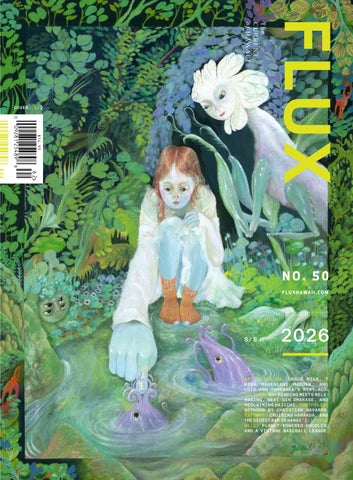
Reflecting the dynamism of stories in every edition, our new issues are released with multi-cover runs to express the kaleidoscopic and shifting landscape of the islands. L to R: 1. Outskirts of the Forest Castle, an otherwordly painting featuring a heroine and nishikigoi; 2. As Hōkūle‘a sails off of Hōnaunau, the offwatch crew sings to her, including Kaipo, Joe Tassill, Steve Morse, Liko Martin, and Charlie.
Images, L to R, by:
1. Grace Milk
2. Kimo Hugho
FLUX HAWAII
_ JASON CUTINELLA PUBLISHER/CEO
_ JOE V. BOCK
PARTNER/GENERAL MANAGER
EDITORIAL
_ LAUREN MCNALLY
EDITORIAL DIRECTOR
_ MATTHEW DEKNEEF DIRECTOR OF EDITORIAL STRATEGY & STORYTELLING
KARA AKIYAMA is a yonsei (fourth generation) Japanese Okinawan born and raised on the east side of O‘ahu. She has a BFA from the University of Hawai‘i at Mānoa, currently works as a flight attendant, runs a vintage business, and picks up the camera as much as she can. She’s grateful for opportunities that allow her to tell stories connected to the past, whether it’s through photography or through vintage garments of Hawai‘i in her love of nostalgia. This love stems from fond memories of the time spent with her grandmother growing up, and finding all the old family photographs. She takes pride in being the great-granddaughter of a brave “picture bride” from Okinawa. Since her
Aloha kāua e nā mea heluhelu, eia nō au kāu wahi mea kākau ‘o MĀHEALANI FIGUEROALEE he kama au na ka ua Kanilehua o Hilo a me ka ‘Ō‘ūholowaiola‘a kaulana o Puna ma ka mokupuni o Hawai‘i ho‘i. Ua kula ‘ia au ma ke kula ho‘āmana ‘o Ka ‘Umeke Kā‘eo e waiho nei ma Keaukaha, Hawai‘i, a ma laila nō au i a‘o a hānai ‘ia ma ka ‘Ōlelo Hawai‘i. Ua lei ‘ia ka lei o ka lanakila i ko‘u puka kula ki‘eki‘e ‘ana ma ka makahiki 2025 a eia nō au ke ho‘omau nei i ke a‘o ma ke kula nui ‘o Mānoa ma O‘ahu nei. Ke ‘imi nei au i ka mea e pono ai wau a mākaukau loa no ka lilo ‘ana he kumu ‘Ōlelo Hawai‘i. Mai ke kula ki‘eki‘e a i kēia wā ma ke kula nui nei ua mau ko‘u ‘i‘ini e ho‘oholomua i ka ‘ōlelo Makuahine o ko kākou ‘āina.
ERIC STINTON is a writer from Kailua, O‘ahu. He has written about Hawai‘i and sports and sports in Hawai‘i for publications including Bamboo Ridge, Dwell Magazine, Flux Hawaii, Hana Hou!, Hawai‘i Pacific Review, Honolulu Civil Beat, Ka Wai Ola, Sport Literate, and Vice, among others. “I’ve always been drawn to the way sports intersect with larger ideas, how they can frame, contextualize, and influence things like politics, culture and history,” Stinton says. On page 158, he reported on the inaugural Kalākaua Base Ball Jubilee, a vintage baseball tournament that follows the sport’s rules of the 1880s with players suited up in era-appropriate uniforms. “It was fascinating to learn that Hawai‘i
KINA TAKAHASHI is a writer and aspiring curator born in Tokyo, and raised in Singapore and Honolulu. Hawker centers, humidity, and multilingualism are what feels most like home. She earned a BA in Art History and English Literature from the University of Chicago, where she gained a love of publishing writing for the Chicago Maroon and assisting at Chicago Review. Prior to moving to Tokyo, she served as Education and Public Programs Coordinator for Hawai‘i Triennial 2025: Aloha Nō with Hawai‘i Contemporary, affirming her belief in the vitality of community-based arts programming for all ages. She is pursuing a graduate degree in the Global Arts Program at Tokyo University of the Arts
grandma’s passing she has looked for ways to connect to her Okinawan roots, creating portraits of two Okinawan tattooists on O‘ahu for the feature about hajichi on page 104. “Hajichi is a beautiful tradition that brought Uchinanchu women together hundreds of years ago and in its bold revival is doing the same today,” she says. “I felt honored to shoot Bee and Kiya and hope to one day get my first hajichi from one of them! It feels especially important in today’s climate to bring back something that was once deemed taboo and nearly lost due to assimilation.”
‘O ka‘u mea e noke mau nei ‘o ia nō ka
‘oihana kākau ma o ka ‘ōlelo Hawai‘i a me nā ‘ano like ‘ole e ho‘olaha aku i ka ‘ōlelo Hawai‘i i lohe ‘ia apuni. ‘O ka ‘ike kōli‘u ka‘u e pūlama mau ai a pa‘a ma ka ipu o ka ‘ike!
has such a deep, storied history of this game, that it was the third nation in the world to play it, decades before the overthrow. It helps us better understand life in Hawai‘i during that time. The Aloha Vintage Base Ball Association is keeping this history alive and retelling these stories, all by dressing up and playing a game. It’s perfect.”
and aims to work at the intersection of curation, education, and public arts. Takahashi wrote about the artist Grace Milk, on page 26, in her first piece for Flux Hawaii. “Writing about Grace was incredibly special. Her solo exhibition was the first show I saw after returning from Chicago, and her paintings resonated with my own experience of growing up between places, finding comfort and beauty in interior worlds while remaining grounded in community,” she says. “I am immensely grateful to Flux, Grace, and the Shuns for entrusting me with writing about Grace’s personal offering to her family history, and hope this article helps nurture a stronger doll-making community in Hawai‘i.”
JAMIE MAKASOBE is a Native Hawaiian storyteller through design. Guided by a deep aloha for the mo‘olelo of her people and homeland, she has spent more than two decades shaping a multidisciplinary practice spanning media, fashion, architecture, and spatial design. Her work is rooted in honoring her kūpuna and nurturing pilina across Moananuiākea. Through each project, she approaches design as an act of cultural stewardship, creating spaces and experiences that carry forward ‘ike, memory, and collective identity. Makasobe is a co-founder of Kealopiko, a wāhine-led, Moloka‘i-based design studio and clothing brand that weaves ancestral knowledge, native plants, and Hawaiian language into contemporary apparel
CHRISTIAN NAVARRO is a Honolulu-based photographer whose work explores identity through culture and community. Born in Richmond, California, he grew up in a family where road trips through the American Southwest and into Mexico were a common occurrence. These early journeys sparked his curiosity about unfamiliar places and perspectives, eventually leading him to backpack across several countries in Southeast Asia. His travels deepened his passion for visual storytelling, a pursuit he further cultivated at the University of Hawai‘i at Mānoa, where he earned a BA in Journalism and a BFA in Photography. “I approached working on this project as if I’m taking a small road trip driving
KYLIE YAMAUCHI is an UchinanchuJapanese creative from Kāne‘ohe, O‘ahu. Since interning with NMG Network in 2018, she has contributed numerous stories on Hawai‘i arts, culture, and history, covering topics such as Princess Ka‘iulani, hanafuda, and local literature. Now based in New Jersey, Yamauchi has concentrated her efforts on activism, advocating for the Free Palestine movement, and the abolition of ICE in her community. Her local upbringing and the rich history of resistance and care across the pae‘āina shapes everything that she does abroad. In this issue, she examines the buried history of hajichi, the ancient Ryūkyūan hand and wrist tattoos, on page 104, and documents
through sustainable practices. She also co-founded Waiwai Collective, a contemporary Hawaiian space for community, culture and commerce, and is creative director for the design house of Malanai. In her second contribution to Flux Hawaii, on page 72, she explores the songs of voyaging canoes and highlights the collaborative project Manuihu, a small hui of wa‘a crew dedicated to uplifting the value and legacy of mele wa‘a. The crew includes Kainani Kahaunaele, Kelli Heath Cruz, and their ‘ohana wa‘a. Makasobe and crew contributed creative direction, visual storytelling, and design support for this feature saying, “our intention is to help bring the spirit and intention of Manuihu to life,” she says.
around the island with curiosity and no expectations,” Navarro says of the photo essay published in Flux Hawaii, on page 118. “It amazes me how having a camera heightens my senses and allows me to see familiar places in a new way.”
its recent revival among Hawai‘i’s Uchinanchu diaspora. “It was such a privilege to research and write this story as a yonsei Uchinanchu,” Yamauchi says. “I felt a huge responsibility to my ancestors and the hajichā reviving this practice to tell its history accurately and authentically.”
“There
is no end. There is no crossing of a threshold as much as we’d like to believe that’s true. It’s just
something that remains in flux.” — T Kira Māhealani Madden
The Love That Holds
BETTER KNOWN FOR PAINTINGS OF IMAGINED FORESTS AND GIRLHOOD FABLES, GRACE MILK NOW TURNS INWARD, RETRACING FRACTURED FAMILIAL LINKS THROUGH INTIMATE MINIATURE WORLDS.
TEXT BY IMAGES BY _ KINA TAKAHASHI _ MAR MIZUNAKA
On the winding path toward adulthood, teenage girls often build secret worlds in their heads. These inner lives sometimes surface through handmade zines, outlandish outfits, or bedroom walls plastered floor-to-ceiling with posters and letters. For the Oʻahu-based artist Grace Milk, her mind travels “super far away” at times, “drifting beyond the borders of the island,” she says. Yet her paintings, with their lush green acrylics and anthropomorphic figures, feel deeply rooted in Hawai‘i’s valleys, even as they brush up against the uncanny edges of girlhood.
Her first solo exhibition, Your Eyes Have Become a Hunger, in 2024, at Manini Gallery, the small contemporary art venue formerly located inside Hawaiʻi Theatre, served as a singular
manifestation of Milk’s world. Inside, visitors encounter a self-portrait, “Welcome to the Forest Castle,” depicting herself puppeteering two young Asian women clothed in moss green and periwinkle harlequin costumes set within a shadow box frame. The show of 15 paintings and three sculptures, created between Hawaiʻi and New York City during the pandemic, traced Milk’s ongoing meditations on community, isolation, and trauma. These paintings also marked a metaphorical homecoming that bridged the fantastical and the familiar landscapes that shaped her. In “Outskirts of the Forest Castle,” a young heroine crouches beside a still pond surrounded by a verdant tangle of moss, plants, and shadowy greens. She reaches toward the parted mouth of an unearthly nishikigoi (a mythical Japanese aquatic figure), unaware of the spirits peering silently from the trees, guarding her bond with the forest.
Recently, the 30-year-old has entered a new phase in her artistic practice, one turned toward her family and the intimacy of living spaces through doll- and diorama-making. Her lifelong fascination
GRACE MILK AT HER HOME STUDIO IN KALIHI, WHERE MATERIALS ARE ARRANGED AROUND AN IN-PROCESS DIORAMA.
ACROSS PAINTINGS, DOLLS, AND MINIATURE DIORAMAS, MILK BUILDS INTIMATE WORLDS WHERE GIRLHOOD, MEMORY, AND HAWAI‘I’S LANDSCAPES QUIETLY INTERTWINE.
with people’s stories, domestic objects, and how environments shape the psyche are taking on deeper personal resonance.
While living in New York City, she admits never feeling like “just a painter,” nor did she imagine being a full-time artist. Watching colleagues hustle for gallery commissions, she realized that path didn’t align with her own artistic compass. What draws her in, she says, “is the ability to access childlike wonder.” As a “functioning adult in this society,” it is “not necessarily easy to open yourself to whimsical moments all the time.” Milk
explains that while she continues to identify as a painter and sculptor, doll-making is an extension of those core disciplines and allows her to continue telling stories in “a more tangible, kinetic way.”
For a group show this past March at Kaiao Space with Manini Collective, a Hawaiʻi-based initiative that gathers local painters as a means to challenge the solitary nature of the medium, Milk built a diorama of her grandparents’ single-walled home in Pauoa Valley. The house, built in the postwar era and set across Booth Park, stands as both
architectural relic and emotional anchor.
The diorama, Grace explains, is “a way to keep history,” her personal offering to her family.
The impulse to preserve the home emerges from a childhood shaped by distance rather than daily intimacy. Born and raised in California until high school, Milk saw her grandparents, Henry and Lily, on O‘ahu mostly during holiday visits. Geographic and familial estrangement narrowed her world to the intimacy of her parents, Jon and Hannah, alone. Familial bonds and the complexity of
such relationships are central themes explored in her previous paintings. Living on O‘ahu now, she observes the close bonds many multigenerational families maintain, especially to their elders, whom she felt she did not grow up with.
As an adult, Milk returns to these rifts through the act of assemblage. Surrounded by tchotchkes and sumi-e frog paintings, her Kalihi home studio orbited around the diorama-in-progress, which included a miniature mod-style bookshelf by a pocket-sized couch sewn from Fabric Mart scraps. On her desk, recycled cuttings of Sig Zane aloha shirts — repurposed as doll dresses and leggings — sprawled across every inch of the surface. Stitch by stitch, Milk poured long hours over her desk, sewing, molding, and reconstructing each doll, garment, and piece of miniature furniture. Nearby, her MacBook glowed with family photos she uses as references: Lily in a 1958 qipao wedding dress; Jon and Henry on a couch in the mid-2010s; Hannah and Henry smiling at each other from opposite ends of a ‘60s floral sofa during the early days of COVID-19. Milk emphasizes that the diorama is not about replicating her grandparents’ home exactly, but a reanimation of its “feelings and magic.” Her artistic practice is a closed circuit of care and fixation, where hours of repetitive labor collapse into touch, and memory is rebuilt at a scale small enough to be held.
Prior to residential redevelopment, Pauoa Valley was a site of loʻi fields and
a garden named ʻUluhaimalama, designated by Queen Liliʻuokalani in 1894. Following her death in 1917, the garden was destroyed and turned into a cemetery that’s still visible along Auwaiolimu Street. “I realized my parents lived in a time that is passing,” Jon says. “As I saw them getting older and passing away, I felt like this is an era that is being lost.”
After Lily’s passing from cancer in 2021, the home was blanketed in grief. Henry’s sorrow echoed through its rooms. The blue vases once filled with lilies now sat empty, their absence mirroring Lily’s own; within the diorama, Milk depicts her grandma as a beautifully aged lily blossom. Milk’s own memories conjure a Pauoa home in miniature teeming with textures: newspapers and books stacked high, graduation photos yellowed from humidity, bookshelves layered with sticky notes covered in grandma’s handwriting.
Despite now residing on Oʻahu as an adult, Milk still feels like a visitor. “The history of someone is not necessarily beautiful,” she says, a sentiment she hopes this diorama will hold. Her father, Jon, views the diorama as “a reflection of time past.” The youngest of three brothers, and the only one still living on Oʻahu, Jon was the primary caretaker for his father in his final years. During that same period, Milk herself spent consistent stretches of time tending to her grandfather, acutely aware of how much of their family history had slipped into silence. The diorama is her way of breaking the silence, of giving it a form.
AS A PAINTER, ILLUSTRATOR, AND NOW DOLL-MAKER, MILK NAVIGATES THE PROFESSIONAL DEMANDS OF BEING AN ARTIST WHILE FIERCELY EXPANDING SPACE FOR CURIOUS, OPEN-HEARTED EXPLORATION.
Weathered by decades of storms and sun, the Pauoa home’s endurance speaks to the love embedded in its care. Even with modest means, Henry and Lily faithfully dedicated themselves to the house: painting its walls, repairing the roof, coaxing weeds in the garden. Every bathroom tile remains intact today, still gleaming after 80 years. Through her diorama, Grace mirrors the same quiet devotion, stitching memory into miniature forms that honor a home where her grandparents’ humble world continues to breathe. Within those single
walls, one can still feel the love that held the house together. A love, layered like paint, patient as time, and enduring as the island itself. a
WATCHED OVER BY HER CALICO CAT, MISS MAHINA SHUN, MILK REFLECTS ON THE CHALLENGES OF BELONGING IN HAWAI‘I.
“IF YOU’RE NOT BORN INTO A COMMUNITY HERE, IT’S HARD TO FIND OR CREATE ONE INITIALLY,” SHE SAYS, AN EXPERIENCE MIRRORED IN HER PAINTINGS OF FANTASTICAL STORIES POPULATED BY CASTLES, FOREST REALMS, AND CARETAKING SPIRITS
THIS STORY IS PART OF FLUX HAWAII’S HAWAIIAN-LANGUAGE REPORTING
SERIES FEATURING ARTICLES PRODUCED IN ‘ŌLELO HAWAI‘I.
TO READ THIS STORY IN ENGLISH: FLUXHAWAII. COM/SECTION/OLELO-HAWAII.
Ola Ka Hawaiʻi i Ke Akamai o Ka Hakuhia
UA OLA NĀ MO‘OLELO O KO KĀKOU PO‘E I KA HAKUHIA O KE KAHAKI‘I A
ME KA WIKIŌ.
KĀKAU ‘IA NA
HO‘OPONOPONO ‘IA NA _ MĀHEALANI FIGUEROA-LEE _ N. HA‘ALILIO SOLOMON
Waipunalau ke aloha, e nā puʻuwai haokila e noiʻi nowelo ana i nā moʻolelo o ko kākou poʻe kūpuna, ka moʻolelo Hawaiʻi hoʻi, eia au kou wahi mea kākau ke hōʻikeʻike aʻe nei i kekahi mau hana lawe haʻaheo a ka Hawaiʻi, he mau hana hoʻi e hāpai aʻe nei i nā ʻōlelo kaulana o ke kulāiwi, ʻo ia hoʻi ka ʻōlelo Hawaiʻi a me ka ʻōlelo paʻiʻai. Ma ka hoʻolaha ʻia o kēia mau papahana ʻelua e holomua, a e mau nei hoʻi ka moʻolelo a kaʻao no ko kākou ʻāina aloha.
He mea i ʻike maopopo leʻa ʻia ma waena o kākou, i kēia mau lā, he laha ʻole ka nui moʻolelo Hawaiʻi, nā moʻolelo hoʻi i paʻa mua i ka naʻau o ke kupuna i ka wā i hala. Me he mea lā ua nele kēia mau moʻolelo a kūpuna iā kākou. Ua lawa hoʻi kēia nele a kākou e noho nei a no laila mai kēia mau hana lawe haʻaheo e kālai ana he ala hou e hānai aku ai i nā moʻolelo Hawaiʻi i kā kākou poʻe kamaliʻi, i lako ai nā ʻohana a me nā kauhale o ka ʻāina i ia māna mikiʻai i pūʻā aloha ʻia mai e kūpuna mā. He mau ala nō hoʻi kēia mau papahana e komo pū ai kākou a pau ma kēia hoʻopaʻa maoli ʻana
i ka moʻolelo i manomano mau ka ʻikena a ka Hawaiʻi.
ʻAuhea ʻoukou, e nā kamaliʻi e puni nei i ka puke kākuni, eia nō ʻo Waikaua ka puke kākuni kau i ka hano a ka Hawaiʻi e ʻumeʻume mai ana i ka maka. He nanea nō i ka heluhelu i ka moʻolelo o nā aliʻi o ka wā i hala! Ma ua Waikaua nei kākou e luana ai i ka moʻolelo kupanaha ʻoiaʻiʻo o ko kākou Naʻi Aupuni, o Kamehameha hoʻi, i hoʻolako mua ʻia e Samuel Kamakau, i hoʻonohonoho hou ʻia mai hoʻi ma ke ʻano puke kākuni, ka mea e kaulana a e laha nei ma waena o nā kamaliʻi o kēia au nei. He leo haʻahaʻa hoʻi kēia e mahalo hoʻomaikaʻi aʻe nei i nā haku o ia puke ʻo Waikaua, iā Keawe Goodhue lāua ʻo Pāʻani Kelson, no ko lāua hoʻolako ʻana mai i puke kākuni no ke kamaliʻi (me ka makua, a me ke kupuna nō hoʻi!) i ʻike ʻole ʻia ma mua. E like hoʻi me kā kūpuna, “E kanu meaʻai, o nānā keiki i kā haʻi”, ua lawa nō ko kākou mau moʻolelo Hawaiʻi ponoʻī, ʻo ka laha hou aʻe nō ka pono, a ola hou nā iwi ma o ke ō ʻana mai o ko ke au kahiko. E aho ka puke kākuni e moʻolelo ana no ko kākou
mau moʻolelo ponoʻī ma mua o kā haʻi aku. He papahana kēia na ka Hawaiʻi, no ka Hawaiʻi, no nā mea a pau hoʻi kekahi. Penei iho ko lāua mau manaʻo no kēia moʻolelo puke kākuni a lāua:
Keawe Goodhue: He kahua nui ka moʻolelo Hawaiʻi a me ka ʻoiaʻiʻo o ia moʻolelo Hawaiʻi ma kēia moʻolelo a māua no ka mea, ʻo ka pahuhopu nui a māua ʻo ia hoʻi ka heluhelu ʻana o ke keiki i ka moʻolelo a poina wale ʻo ia he moʻolelo ʻoiaʻiʻo kēia o nā kūpuna, makemake māua e luʻu ke keiki, kona kino holoʻokoʻa, kona noʻonoʻo i loko o ka moʻolelo me ka
manaʻo ʻole o ke aʻo ʻana a he mea leʻaleʻa a he mea nanea wale iā ia. Eia naʻe no mākou hoʻi ma waho aku, nānā mākou a he ʻano aʻo nō, he pahuhopu nō, ʻike nō māua, a ma o kēlā ʻano leʻaleʻa ʻo ia ko māua nei e hoʻāʻo nui nei e hana a ma o ka leʻaleʻa e aʻo ai ke keiki a ʻo ia ke ala hou o ka puke kākuni.
Pāʻani Kelson: Ua aʻo māua e kākau i kēia moʻolelo a hōʻike a hoʻomōhala i nā hāmeʻe he mau kānaka kēia mau aliʻi, kekahi manawa fantasize kākou i ke ʻano o kēlā poʻe no laila hōʻike ʻia ka pilina ma waena o lākou he hoa hānau,
he ʻanakala, he kaikuaʻana, kēlā ʻano hukihuki ma waena o ka ʻohana ke hala ka makua, he mau haʻawina kanaka kēlā, ola kanaka kēlā.
ʻAʻole makemake e koi i ke keiki “E noho ʻoe i lalo iwakālua minuke a heluhelu i kēia puke,” akā ʻo ka pahuhopu nui na ke keiki e kiʻi i ka puke, a na ke keiki e noho a nanea i loko o kēia moʻolelo. I ka ʻike ʻana o kēia keiki i ke ʻano kanaka o kēia mau hāmeʻe pēlā e komo loa ai ke keiki i loko o ka moʻolelo.
KG: He ala ʻokoʻa, he pouhana ʻokoʻa paha e kū ai ka haʻi moʻolelo ʻana e
hoʻokuluma i ka walaʻau moʻolelo ʻana ma kauhale, hoʻokuluma i ka ʻiʻini a me ka ʻono o ka heluhelu ʻana i nā moʻolelo. ʻAʻole hoʻokuluma i nā mea i kuluma ua kuluma ʻē a eia nō kākou i kēia wā nei pono e hoʻoholomua, ʻaʻohe kanaka e hoʻopuka nei i nā puke a piha ka hakakau puke a kamaliʻi, ʻaʻohe! Noho nei nō kākou i loko o ka nele, he mau makahiki noho ana ma loko o ka nele, manaʻo nui nei māua he pouhana hou kēia e kū ai ka haʻi moʻolelo ʻana. ʻAe alakaʻi ʻia ma nā mea kuluma a nā kupuna, nā moʻolelo, he hōʻike loa kēia i kēlā eia naʻe eia nō kākou nā Hawaiʻi kēia lā e kālai ana i
KE ‘IKE ‘IA MAI NEI HE ‘ELUA KI‘I NO KE KI‘I ‘ONI‘ONI
MAI ‘O KAPŌ MA‘I LELE, HE MO‘OLELO NŌ IA E PA‘A
NEI KA NOHONA O NĀ AKUA A KUPUA HO‘I O KA WĀ KAHIKO, ‘O PELE, ‘O KAMAPUA‘A, A ‘O KAPŌ HO‘I. MAHALO E KA
PO‘E HAKU PĀHEONA NĀNA I
HO‘OLAKO MAI IA MAU KI‘I.
mua ke ala e makemake ʻia a na kākou kēlā kuleana.
PK: Hoʻokuluma i kēia ʻano moʻolelo ma waena o nā keiki a me nā ʻohana i mea e maʻamau ai kēia ma waena o nā ʻohana i loko o kauhale a lohe ʻia a walaʻau pū ʻia no Kīwalaʻō, Keawemaʻuhili, a pēlā wale aku, a e nīnau ʻana ke keiki i kona mau mākua ʻua lohe ʻoe no Kīwalaʻō? Pehea ʻoiaʻiʻo kēia?’ a maopopo ʻole a maopopo paha a laila he mea kēlā e lohe ʻia ai kēia paipai i ka paʻa ʻana o kēia mau moʻolelo ma ka ʻohana. No ka mea i koʻu wā kamaliʻi ʻaʻole au i lohe no Kīwalaʻō ā hiki i- ma hope o koʻu puka ʻana mai ke kula kiʻekiʻe. ʻAʻole i maopopo i nā moʻolelo e like me kēia no laila inā hoʻomaka ma ka wā kamaliʻi a lohe ʻia a ʻike i kēia mau moʻolelo a laila e hoʻi mai ana kēia loina o ka hoʻoili ʻana i ka ʻike a paʻa ka ʻike ma waena o ka ʻohana.
No laila, e nā hoa e noke mau nei i ka hoʻomanawanui i ke kūʻokoʻa o Hawaiʻi me kona lāhuikanaka, iā ʻoukou, e nā kamaliʻi me nā ʻohana o kauhale, aia nō a luʻu piha ke kino a me ka noʻonoʻo i loko o kēia puke kākuni ke kuluma ʻana o ka moʻolelo Hawaiʻi, he ala hou nō ia e pāpahi ai i ka lei o ka lanakila.
E like hoʻi me ia manaʻo o ka waele ʻana i ala hou e holomua ai ʻo Hawaiʻi, eia
aʻe nō kekahi hana e pono ai nā mamo a Hāloa. . He kiʻi ʻoniʻoni ālai maka nō hoʻi me ka hoʻohū i ka ʻaka o ka naʻau! ʻO Kapō Maʻi Lele hoʻi i hoʻomākaukau ʻia mai e Kumu Hinaleimoana Wong, no kekahi kaʻao no loko mai o nā moʻolelo no ke kupuʻeu kaulana o ka paeʻāina, no Kamapuaʻa hoʻi, me kāna mau hana kolohe e pūpule ai kānaka!
ʻO kahi o kēia moʻolelo, he puʻu nō ia i kaulana i ka hehi nui ʻia e kānaka piʻi mauna ma Oʻahualua nei, ʻo ia nō ʻo Kohelepelepe. ʻO ka inoa naʻe i laha a e hea hewa ʻia nei i ka hapa nui o ka manawa e kānaka,ʻo “Koko Head”. ʻAkahi, ʻo Koko Head ka puʻu ʻē aʻe e kaʻawale ai ke kai ʻo Maunalua me ke kai ʻo Hanauma, ʻalua hoʻi, ʻo ia kona inoa haole e uhi mai nei i kona inoa Hawaiʻi. ʻO ka pōmaikaʻi, na ia kiʻi ʻoniʻoni e hoʻokuluma hou nei ka inoa i paʻa mua, i maʻa hoʻi iā kūpuna, me ka hoʻolaha hou mai he moʻolelo e pili pū ana me ia ʻāina. ʻO ka mea kupanaha nō hoʻi o kēia kiʻi ʻoniʻoni, ʻo ia kona hoʻopuka piha ʻia ma ka ʻōlelo Paʻiʻai. No ka poʻe kamaʻāina o Hawaiʻi nei, he mea nui koʻikoʻi ko kākou ʻōlelo Paʻiʻai, he ʻōlelo i hele ā kuluma mai ka wā ʻoihana mahikō mai a hiki kēia lā.
He manaʻo akamai ko nā haku o ua Kapō Maʻi Lele nei, no ka hoʻohana ʻana i ia ʻōlelo no ka haʻi ʻana mai i kēia moʻolelo Hawaiʻi, pēlā e nui hou aʻe ai ka hoʻolaha ʻia o ke kiʻi ʻoniʻoni, a me kona hoʻomaopopo ʻia nō hoʻi e ka poʻe i maʻa ʻole i ka ʻōlelo Hawaiʻi. Na kākou ponoʻī, na poʻe kamaʻāina hoʻi o Hawaiʻi, ka ʻōlelo Paʻiʻai, no ka mea ua komo aku nō kekahi mau analula, huaʻōlelo, a mea pilinaʻōlelo hoʻi no loko aʻe o ka ʻōlelo Hawaiʻi a loko o ka ʻōlelo Paʻiʻai, a he ʻōlelo nō ia e haʻaheo ai nā lāhui like ʻole o kēia paeʻāina āiwaiwa. He mea kēia i maopopo wale iā Kumu Hina, a penei hoʻi kona mau manaʻo ma laila:
Kumu Hinaleimoana Wong: Ua manaʻo mua nō au e tūtala aku i tēia mau manaʻo i tēia moʻolelo ma ta ʻōlelo kanaka a no tā mātou noke mau, noke mau, hoʻāʻo nō e noʻonoʻo pono pehea lā e hoʻowehewehe pono ai i ka manaʻo nui, i ta haʻina hoʻi, ʻo Pele me Kamapuaʻa me Kapō a me tāna mau puʻu wahine lele. “Pehea lā kātou e hoʻowehewehe ai i ta nui poʻe? Pehea kātou e hoʻowehewehe ai iā kātou kānaka?” No ka mea kātou kānaka loaʻa nō kātou ka poʻe maʻa nō i ka ʻōlelo makuahine, ua mākaukau mua nō lātou i ta ʻōlelo
kanaka a ma waena o tēlā poʻe he poʻe mānaleo a me ta poʻe kula ʻia ma ke kaiapuni ʻoe, Pūnana Leo ʻoe, kula haʻahaʻa, kula waena, kula kiʻekiʻe, kula nui, ʻaʻole tēia haʻi ʻana o ta moʻolelo no lātou ka poʻe e ʻano maʻa nei i ka ʻōlelo Makuahine tēia haʻi ʻana o ta moʻolelo. ʻO toʻu matemate e lohe a e ʻaʻapo a paʻa pono nō hoʻi iā kātou lāhui kanaka e maʻa wale nei i ta ʻōlelo Paʻiʻai no ka mea ʻo lātou ta poʻe pono e maopopo a pono e hoʻomaopopo iā lākou, e tūtala aku iā lākou.
Iaʻu nō e noho ana a noʻonoʻo pehea lā e tūtala ai tēia moʻolelo, hele pololei nō i ka manaʻo kikoʻī, ta manaʻo nui, ta manaʻo toʻitoʻi o
tēia moʻolelo. ʻAʻole nō hiti te haʻi ʻia tēia moʻolelo ma ta ʻōlelo Pelekānia maitaʻi, lōʻihi ana, pono e hoʻowehewehe, noʻonoʻo wau, “Pehea au e hoʻowewehe atu ai no ta pono o kātou lāhui kanaka e paʻa ʻole nei i ta ʻōlelo Makuahine?” Pēlā no au i hoʻoholo ai pono e tūtala aku ma ka ʻōlelo Paʻiʻai.
ʻO wau te nānā nei nō au i to kātou lāhui kanaka tēlā no ta kumu aʻu i hana ai ka moʻolelo ma ka ʻōlelo Paʻiʻai.
ʻO kā kākou mea e ʻike nei, ma waena o ia mau waiwai hou i makana ʻia mai iā kākou ʻo Waikaua lāua ʻo Kapō Maʻi Lele hoʻi, ua akamai hoʻi ka Hawaiʻi i kona
HE MAU ALA NŌ HO‘I KĒIA
MAU PAPAHANA E KOMO PŪ
AI KĀKOU A PAU MA KĒIA
HO‘OPA‘A MAOLI ‘ANA I KA
MO‘OLELO I MANOMANO MAU
KA ‘IKENA A KA HAWAI‘I.
hoʻokumu ʻana i ala hou e ola ai ia mau moʻolelo a e mālama pū nō hoʻi ʻia ka Hawaiʻi o ko kākou nohona Hawaiʻi. I ke au nō ma mua a ke au nō e holo nei ua mau ke aloha ʻāina a me ke kūpaʻa o ka Lāhui kanaka. No laila e kuʻu Lāhui aloha nui ʻia me aʻu i kēia heluhelu ana, ua maha ʻole koʻu naʻau i ka noho wale ʻana ma kahi ʻoluʻolu me ka holomua ʻole o ko kākou poʻe moʻolelo a nohona hoʻi. E lawe hoʻi kākou i ke aʻo a mālama, e kaʻi like pū nō hoʻi kākou i ke ala hou i waele mua ʻia e ia mau alakaʻi hanohano. E ʻimi mau aku i ka pono, me ka ʻauamo pū nō hoʻi i ke kuleana, i mea hoʻi e kō ai ia mau huaʻōlelo kaulana o ka ʻāina, e mau ke ea o ka ʻāina i ka pono. a
To put it lightly, these aren’t your momma’s hibiscuses. The common island flower, in the hands of O‘ahubased floral outfitter Voodoo Plants, packs an explosive punch with colorful blooms of psychedelic proportions—a far cry from the monotonous red-and-yellow varieties one readily associates with Hawai‘i imagery of yesteryear. Voodoo’s versions are electrifying: two- or threetoned things with a visual ferocity that’s almost physical, like the feeling of being burned or thrust forward at high speed. Imagine a stirring, deep-red center that gives way to the most mesmerizing lavender edged in a simmering hot pink that softens to pale yellow. Or a soft, silky shade that swirls in as lilac and swirls out a velvety gray, with sleek, creamy white
An Electric Eden
TEXT BY
IMAGES BY
FLORAL ARRANGEMENTS BY
petals and a golden stamen rooted in a shock of deep raspberry magenta that is so saccharine you can almost taste it.
Then, there are the hibiscus flowers’ shapes, which have their own sartorial flair. Some balloon out in undulating waves like layers of fluffed silk in a petticoat. Others proffer just a single layer of petals, each smooth on one edge with a wisp of a ruffle where it overlaps with the adjacent petal, creating a natural seam as delicate as a lace-edged skirt. It’s no wonder that the Voodoo name has been generating buzz. Otherworldly and outrageous, these are botanicals that demand your attention. “We love to see the joy from people and the shock factor when people react to these flowers,” says co-founder Ryan Kalaniakea Quick, who started Voodoo Plants with Kyrsten Malulani Pia Kaitoku. “Once you have a hibiscus, [you go] out every single morning just to see which flower is opening. It kind of just gets you up and gets people excited.”
In the realm of botany, some things take time and fastidious care to bloom, while others seemingly sprout with abandon when you least expect it. Some very
_ NATALIE SCHACK _ JOHN HOOK _ ANDREW MAU
CO-FOUNDERS KYRSTEN MALULANI PIA KAITOKU AND RYAN KALANIAKEA QUICK STARTED VOODOO PLANTS IN 2020 AND SPECIALIZE IN PSYCHEDELIC BLOOMS.
VOODOO PLANTS TURNS THE FAMILIAR HIBISCUS INTO A RIOT OF PSYCHEDELIC COLOR AND HIGH-DRAMA HYBRIDS.
special, unusual, and unique phenomena, however, require a little bit of both. So it was for Voodoo Plants.
The duo’s journey into the floral industry began as a simple hobby during lockdown in 2020. In a time of unspeakable transition, amid the chaos of a global pandemic, prodigal islanders Kaitoku and Quick found themselves knee-deep in soil, nurturing an unexpected passion
that would bloom into something truly extraordinary. First they started with cultivating “weird” vegetables, Kaitoku remembers, the sort you’d never stumble upon at the local grocer, like purple-green tomatoes. With practically no knowledge about horticulture, Kaitoku and Quick planted all the seeds they owned, thinking only a few might sprout. To their surprise, every vegetable seed sprung to
AT THEIR FLORAL FARM IN WAIMĀNALO, VISITORS CAN VIEW VIBRANT HYBRIDS BORNE OUT OF KAITOKU AND QUICK’S PANDEMIC-ERA HOME EXPERIMENTATION.
life, sparking a curiosity that led the selftaught beginners into the wild and winsome world of tropical floriculture. That course eventually led to the protean realm of the queenly hibiscus. “[It] just became our obsession,” says Kaitoku, attributing their fixation to “the showy flowers and all of the different combinations you can do. There’s just a whole range of colors.”
Experimental hybridization quickly followed, and the dyad began combining different varieties into brilliant detonations of pigment like two artists playing with paint. With no formal training (Kaitoku’s background is as a chef, Quick’s is as a landscaper), they relied on trial and error, fueled by a passion for exploration and a healthy dose of YouTube tutorials. Together, they approached their newfound hobby unbound by convention or expectation. Their efforts soon bore fruit, as their unique hybrids began to garner favor within the local community. Voodoo Plants has received an outpouring of support for their creations, beloved by island flower enthusiasts and gardeners. The visual intensity of these moody and melodramatic blossoms also makes them ideal for show-stopping lei and flower art, and with Voodoo’s bloom box, which comes with a variety of statement-making stems, makers can let their imaginations run wild.
As for the future, the duo has big plans. They’ve recently expanded Voodoo’s operations, purchasing a patch of land in Waimānalo that they want to convert into a U-cut flower farm, nursery, and community gathering space. Lining the road at the front fence of the property are their notable hybrid hibiscuses; inside sit a cluster of plots with a variety of other blooms, where chickens cluck cheerfully around the perimeter. At the back of the property, a cleared field is the site of a planned grove for another iconic local flower. “We’re going to dive into plumerias now!” Quick exclaims.
With more growth in sight, Voodoo Plants doesn’t plan to abandon its work of slinging singular and strange florals and concocting unusual hybrids for its ardent fans anytime soon. “It’s our passion. We’re very nature-oriented, very outdoorsy people,” Quick says, describing the practice of tending to flowers and cleaving close to the land as a form of therapy. And when nature’s your medium,
the opportunities for growth are endless. “Once you think you’ve seen them all, you see another, and you just fall in love all over again. The list goes on with the varieties that can be made.” a
LEARN MORE
No Easy Answers
AFTER SURVIVING A STALKER, MEMOIRIST T KIRA MĀHEALANI MADDEN TURNED TO POLYPHONIC FICTION. THE RESULT IS A PROBING NOVEL ABOUT REVENGE, TRAUMA, AND THE MESSY AFTERLIVES OF ABUSE.
TEXT BY IMAGES BY
_ MITCHELL KUGA _ JILLIAN FREYER
In April 2017, the writer T Kira Māhealani Madden boarded a ferry to Whidbey Island, just north of Seattle, Washington, where she had been accepted into the Hedgebrook writing residency. What was intended to be a creative program supporting projects by women-identified writers from around the world would also become, for Madden, a deeply personal refuge. For months prior she’d been living in constant exhaustion and fear after publishing a literary essay online in late 2016 about being sexually abused as a child, which prompted the man who abused her to begin an aggressive stalking campaign; over time, it spiraled into death threats, the purchase of a firearm, and a federal investigation. So when a male passenger Madden met on the ferry asked her why she looked so sad, the question hardly surprised her.
More shocking to her, however, was how quickly she divulged her story to him, a complete stranger, and his disturbing response: a proposal for a revenge plot akin to Patricia Highsmith’s Strangers on a Train , a psychological thriller about two people who attempt to
FOLLOWING HER CELEBRATED MEMOIR LONG LIVE THE TRIBE OF FATHERLESS GIRLS, T KIRA MĀHEALANI MADDEN TURNS TO FICTION TO EXPLORE ANGER, OBSESSION, AND THE LONG SHADOW OF HARM IN HER DEBUT NOVEL WHIDBEY
swap murders. Madden quickly laughed away his suggestion, but their exchange lingered long after she exited the ferry: How would it have felt, she wondered, to say yes to this scheme? To indulge, wholeheartedly, in a fantasy of revenge?
Whidbey , Madden’s searing, empathetic, and darkly propulsive debut novel, is her response to those questions. The book weaves together the lives of three very different women who were impacted by the same child molester: Birdie Chang, a self-proclaimed “dyke” from Brooklyn, and Linzie King, a reality TV star turned best-selling memoirist, who were both abused by him; and the perpetrator’s plucky mother, Mary-Beth Boyer, a gas station attendant in Florida who remains endlessly devoted to him. When Mary-Beth learns of her son’s murder, Whidbey turns into a whodunit,
but the book seems more interested in probing its characters from unexpected angles than identifying a murderer, exposing the long web of trauma that accompanies abuse.
The novel is a bold but not entirely surprising leap from Madden’s first book, Long Live the Tribe of Fatherless Girls, which was a finalist for the John Leonard Prize, an award from the National Book Critics Circle that recognizes the best first book in any genre. Released in 2019, the queer coming-of-age memoir follows Madden’s childhood growing up in Boca Raton, Florida, where she was raised by a Chinese Hawaiian mother and a Jewish father, in a house as privileged as it was dysfunctional. Widely celebrated, the New York Times selected it as an Editors’ Choice, calling it “compulsively readable” while praising Madden’s devastating humor and “gift for salient detail.”
“The first book was all about forgiveness, in ways that I didn’t even realize when I started writing it,” says Madden, 37, speaking to me from Massachusetts, where she’s an assistant professor in creative writing and Indigenous literatures at Hamilton College. “It became a project of listening, understanding, finding compassion, and asking the question, ‘Why?’ ‘Why would my mom choose this?’ ‘Why was my dad like this?’”
Whidbey , on the other hand, “was an exploration of anger,” she says. “All of these characters are really angry for different reasons, and that’s what I wanted to keep digging at: rage — how it manifests when it’s obsessive rage, and what it looks like when it’s repressed.”
Locating her anger didn’t come naturally to Madden. About a decade ago, while workshopping a chapter in her memoir about her mother’s attempted overdose, she remembers the writer Lidia Yuknavitch asking her, “Where does your rage live?” “And I realized I couldn’t find it anywhere in my body,” Madden says. “I couldn’t find it on the page.”
A few years later, Madden discovered that rage through her abuser’s stalking campaign, which resulted in a trial and conviction. During her residency on
Whidbey Island, Madden made multiple trips to Florida to appear in federal court, where she gave lengthy victim impact statements to move forward with her injunction. Her anger, she found, extended far beyond her abuser and into the systems that had failed him.
“When I learned that my abuser had been denied mental health care over and over again, and that people who disclose to a therapist or a doctor that they feel attracted to children are not provided support, and are in fact reported to the police, I felt really angry about that,” says Madden. “That’s something that impacts [my abuser], but it also impacts survivors that we supposedly care about.”
At their hearts, both Long Live the Tribe of Fatherless Girls and Whidbey are complex character studies, the work of a writer interested in taking an unflinching, sometimes funny, often painful look at people who’ve caused harm, and finding ways to empathize with them anyway. “Trying to find the humanity or the fullness of a person is how I can deal with the terrible things they do,” says Madden, who, in spring 2024, was a Distinguished Writer in Residence at the University of Hawai‘i at Mānoa. “Otherwise, it feels unbearable to me.”
To help her achieve Whidbey’s intricately woven storytelling, Madden says she employed the Native Hawaiian concept of makawalu, which translates to “eight eyes.” “Writing is meditation and summoning to me, with many silences between the lines and pages,” she says. “In this polyphonic book, as I worked through all the characters and voices, I asked myself to try eight ways of seeing or understanding, at least eight ways of saying it.”
As an amateur magician, she also considers the importance of surprise — the mechanics of illusion and the pitterpatter meant to disguise a narrative sleight of hand. On days off from teaching, when she was lucky enough to write, she gave herself a prompt: write into three surprises, or things she didn’t see coming about her own characters.
T Kira was photographed in and around her home in Northampton, Massachusetts. She also spends part of her time teaching at Hamilton College, a liberal arts school in upstate New York.
“I feel like writing is just tapping the ground over and over again, looking for a trap door.”
TO ACHIEVE WHIDBEY’S INTRICATE NARRATIVE, MADDEN EMPLOYED MAKAWALU, A NATIVE HAWAIIAN PARADIGM FOR VIEWING SITUATIONS FROM MULTIPLE PERSPECTIVES.
“I feel like writing for me is just tapping the ground over and over again, looking for a trap door,” she says. “And it’s often a day, or days, of tapping around and hearing nothing until you find the spot that opens.”
Despite some autobiographical parallels — like the book opening with Birdie meeting a stranger on a ferry to Whidbey Island who offers to kill the man who abused her — Madden wants to be explicitly clear: Whidbey is not a work of autofiction. As she writes in the book’s foreword: “None of the characters in Whidbey represent my own experience; I have the genre of memoir for that.” But, “I would say that the questions that drive each character felt true to my life,” she says, highlighting the thorny question of who gets to “own” a narrative of suffering — something Madden encountered as a “credible witness” in court by virtue of being a published writer working in academia.
Not that Whidbey offers anything in the way of answers. By exploring her own anger through fiction, Madden says she learned that there are no tidy resolutions, that the redemptive allure of a revenge fantasy is just that: pure fantasy.
“Grief doesn’t stop. Healing, rehabilitation, all these things are false,” she says. “There is no end. There is no crossing of a threshold as much as we’d like to believe that’s true. It’s just something that remains in flux.” a
Where Sushi Reigns Supreme
TWO SUSHI CHEFS SHOWCASE THE DIVERSITY OF HONOLULU’S OMAKASE, FROM THE CLASSIC TO THE EXPERIMENTAL.
TEXT BY IMAGES BY
_ MARTHA CHENG _ JOHN HOOK
In the 14 years since the release of Jiro Dreams of Sushi, the documentary film that highlighted the precise devotion of sushi master Jiro Ono, whose Michelinstarred restaurant operates out of a Tokyo subway station, omakase sushi counters have proliferated across the U.S. But few cities have quite the range of Honolulu’s omakase, where you’ll find sushi chefs holding court in sports bars and the Ritz Carlton, and background soundtracks that range from pop music to worshipful silence. Joining an already robust a la carte sushi restaurant scene, about two dozen omakase-only counters have opened in Honolulu in recent years. Here are two among the most lauded, where the sushi chefs obsess over the rice and vinegar as much as the seafood, and where the service matches the quality of the fare.
sushi sho
“The sushi counter is a really intimate space for the chef and customer,” Yasushi Zenda says through a translator. “There’s nothing else [like it] where you could make sushi with your bare hands and then serve it to the customer and see their reaction.” It’s this intimacy that drew Zenda to apprentice at sushi restaurants
in Tokyo since he was 16 years old, eventually following Keiji Nakazawa — “one of the most influential sushi masters in the world,” the New York Times declared — to Sushi Sho in Hawai‘i.
Nakazawa was renowned for reviving Edomae-style sushi, finding that old techniques, such as pickling and aging fish, once meant for preservation, also concentrated and developed flavor. Nearly 30 years after debuting his first restaurant in Tokyo in 1989, Nakazawa moved to Honolulu, interested in the challenge of working with Hawai‘i’s local ingredients.
The 10-seat counter he opened in The Ritz-Carlton Waikiki Beach quickly became one of Honolulu’s hardest reservations to snag. When he left a few years ago to open a New York City location, Zenda, whom Nakazawa used to call “the scientist,” took over.
Nakazawa’s spirit still guides the details at Sushi Sho. The procession of about 25 courses (for $350 a person) alternates between small bites and sushi. In one of the first dishes, lengths of Japanese sardine are wrapped around julienned cucumber, ginger, and heart of
palm, then sliced like a maki roll, revealing a cross section resembling a stainedglass window. Fluffy shreds of crab are topped with powdered, vinegared egg yolk. The monkfish liver is paired with a shaving of pickled baby watermelon, picked at the size of a plum and marinated for three years — a foil to the liver’s lushness. Fillets of greeneye fish, its skin crisped with heat, are dotted with pops of finger lime. And then, as part of the okonomi section — if the first act of dinner is the chef’s choice, then the second is the diner’s, with à la carte add-ons
UTILIZES EDOMAE-STYLE TECHNIQUES TO ELEVATE THE RESTAURANT’S OMAKASE OFFERINGS.
AT SUSHI SHO, CHEF YASUSHI ZENDA
— two-week aged bluefin tuna belly, exemplifying the Edomae techniques Sushi Sho is known for.
Particularly attentive sushi connoisseurs will note that the vinegars in the shari, or sushi rice, change in relation to the fish. A richer fish, such as chutoro, requires a bolder red vinegar, while delicate crab meat is paired with a lighter white vinegar. Throughout dinner, Zenda’s support chefs frequently call out for a new batch of shari from the back kitchen to ensure it is always at the perfect temperature.
Since helming Sushi Sho, Zenda has made small adjustments here and there, mostly by instinct — changes barely noticeable to the casual observer. His relentless experiments have resulted in cooking the rice (a blend of Yumepirika from Hokkaido and Tamaki from California) with a combination
of Evian and Contrex mineral waters, which he says gives the shari a slightly firmer texture and keeps the flavor in the grains. He notes the difference in the taste of tuna each year — this year, he finds it sweeter than previous years, when it was more acidic, and adjusts its preparation accordingly. The black cod, which he served glazed and sprinkled with sansho pepper when I went, he initially found below his exacting standards. He went to Santa Barbara and spoke directly with the fisherman, convincing him to undertake the ike jime method, a series of steps meant to quickly disrupt the fish’s brain and spinal cord and quickly bleed out the fish, which helps preserve the flavor and texture of the flesh.
Other changes are in subtle displays of showmanship. Behind the counter, the chefs now toast strips of nori over
a small charcoal fire, and they chop fish finely for the tuna tartare in front of guests. It’s particularly delightful to watch them chill and slice the slippery, glistening noodles made from kudzu flour, which was among the dessert options on the night of my visit. “I want the customer to enjoy the taste and also enjoy watching,” Zenda says. It’s the reason he was drawn to sushi in the first place, and he uses the space to close the distance between himself and his diners even further — but not too much.
“Part of sitting at the counter is the little nervousness between customer and chef, the tension,” he says. While a chef in an open kitchen faces the vulnerability of having every movement scrutinized by the diner, so, too, does the diner. I found myself seated next to three regulars who could have easily become rowdy and taken over the atmosphere of the
SPARE COUNTERS AND A NOREN CURTAIN SIGNAL A WARM BUT FOCUSED ATMOSPHERE WHERE ALL WHO ENTER EITHER RESTAURANT FEEL PERSONALLY ATTENDED TO.
room. And yet, while they were clearly enjoying themselves, they kept their voices low. The chefs, modeling attentiveness and respect, brought out the same in us, the diners.
Zenda says he’s always “looking for the spaces in between” — the space between what an ingredient is and what it could be, the space between courses, the space between customers. The quality he puts forth is undeniable, but it’s this extra attentiveness that elevates the meal beyond food to an art form and act of exquisite hospitality.
sushi gyoshin
During the day, on busy Pi‘ikoi Street, Sushi Gyoshin lies hidden behind an unmarked black door. Only in the evening does the restaurant announce itself, the name printed discreetly on a noren curtain that owner Hiroshi Tsuji
hangs outside the entrance just before the first seating. Inside, the sushi counter seats eight, a slim altar where diners go to worship, for “Gyoshin” means “fish god.”
I am welcomed almost immediately with Tsuji’s signature monaka — two crisp wafers cradling seafood that might include finely diced toro or Hokkaido snow crab topped with uni. The $150 set of 15 courses then progresses through a series of seasonal appetizers: in the winter, perhaps shirako (cod milt) combined with kudzu starch to create a soft and creamy tofu, or in the spring, firefly squid, each the size of a thumb, bathed in ginger sauce. Between the first act and procession of sushi, Tsuji displays the fish yet to come: blush-pink slabs of toro and silvery kohada, its skin glinting in the light. The fatty yet firm kinmedai arrives with its skin lightly torched, and sweet
and crunchy mirugai is finely scored and belted to a lozenge of rice. Throughout Tsuji’s omakase are modern flourishes: a dab of caviar on a prawn, saba smoked under a dome and unveiled with a dramatic swirl.
Tsuji is the sole chef at Gyoshin, which he opened in early 2024. He grew up in Toyama, on the west coast of
Japan, and was drawn to the “stature of the sushi chefs,” he says through a translator. Throughout his 20-year career, he learned sushi and washoku (traditional Japanese cuisine), with its emphasis on harmony and seasonality. He intended to go to Europe “to become a better chef,” he says, but then a friend working at Rinka in Hawai‘i reached out to him, asking him
AS OWNER AND SOLE CHEF, HIROSHI TSUJI DICTATES SUSHI GYOSHIN’S REPERTOIRE OF OMAKASE WITH MODERN FLOURISHES.
I Ka Pō Me Ke Ao
Fashion. Dining. Culture.
Hermès | Harry Winston | Fendi | Saint Laurent | Valentino | Tiffany & Co. | Ferragamo | Moncler | Kith | Stüssy kate spade new york | Yumi Kim | Island Snow | Kahala | RIMOWA | Dean & DeLuca | Island Vintage Wine Bar
Doraku Sushi | Noi Thai Cuisine | Restaurant Suntory | P.F. Chang’s | The Cheesecake Factory | Tim Ho Wan
to come. “Right away,” he told his friend, without hesitation.
After about five years working at Rinka at Ward and Yoshitsune in Waikīkī, he decided he wanted his own small space where he could develop a relationship with his diners. At Gyoshin, there is little separation between customer and chef; we are close enough to hear the satisfying crack as the nori is sliced, close enough to see the edges of fish flesh curl up as Tsuji scores it. It can feel like a one-man show,
but it’s not merely a performance. Tsuji’s devotion to the sushi is clear. For his shari, he mixes two varieties: Sashanishiki for texture and Nanatsuboshi for sweetness. He then seasons the rice with a blend of three different vinegars, ranging in maturity from three to ten years, to achieve his desired level of acidity. “The shari defines the quality of the experience,” he says. “If the neta (topping) is good but shari is not prepared with proper care, the sushi will not be delicious.” a
DINERS SIT INCHES FROM THE MASTER CHEFS, WITNESSING EVERY STEP OF PREPARATION FROM SLICING NORI TO SCORING FISH, CREATING A SENSE OF CLOSENESS AND CONNECTION
CometoWDIGroupforabold&freshculinaryadventure.
FEATURES
“There was something about it, that it
was so solid, so visible, and so permanent that I needed to learn more.”
CHRISTIAN NAVARRO
— Bee Tanji
Mele Wa‘a
Songs
KĀKAU ‘IA NA
_ KAINANI KAHAUNAELE
JAMIE MAKASOBE
KELLI HEATH CRUZ
MARA‘AI
MARA‘AI TEXT BY
_ KAINANI KAHAUNAELE
JAMIE MAKASOBE
KELLI HEATH CRUZ
of the Canoe
FLUX _ FEATURE
‘O KE MELE HO‘I KA MEA E HOLO AI KA WA‘A.
SONGS, CHANTS, AND MUSIC ARE WHAT SAILS THE CANOE.
Kahiki Ka Wahine ‘O Pele
Mai Kahiki ka wahine ʻo Pele, Mai ka ʻāina i Polapola, Mai ka pūnohu ʻula a Kāne, Mai ke ao lalapa i ka lani, Mai ka ʻōpua lapa i Kahiki.
Lapakū i Hawaiʻi ka wahine ʻo Pele; Kālai i ka waʻa Honuaiākea, Kou waʻa, e Kamohoaliʻi.
I ʻapoa ka moku i paʻa; Ua hoa ka waʻa o ke Akua,
Ka waʻa o Kānekālaihonua.
Holo mai ke au, aʻeaʻe Pelehonuamea;
Aʻeaʻe ka Lani a i punia i ka moku;
Aʻeaʻe Kini o ke Akua,
Noho aʻe ʻo Malau.
Ua kā ʻia ka liu o ka wa’a.
Iā wai ka hope, ka uli o ka waʻa, e nā hoa ’liʻi?
Iā Pelehonuamea.
Aʻeaʻe kai hoe o luna o ka waʻa.
ʻO Kū mā, lāua ʻo Lono, Noho i ka honua ʻāina, Kau aku i hoʻolewa moku.
Hiʻiaka, noʻiau, he akua, Kū aʻe, hele a noho i ka hale o Pele.
Huahuaʻi Kahiki, lapa uila, e Pele.
From Kahiki came the woman, Pele, From the land of Polapola, From the red cloud of Kane, Cloud blazing in the heavens, Fiery cloud-pile in Kahiki.
Eager desire for Hawaii seized the woman, Pele; She carved the canoe, Honuaiakea, Your canoe, O Kamohoalii.
They push the work on the craft to completion. The lashings of the god’s canoe are done. The canoe of Kane, the world-maker.
The tides swirl, Pelehonuamea o’ermounts them; The god rides the waves, sails about the island; The host of little gods ride the billows;
Malau takes his seat; One bales out the bilge of the craft. Who shall sit astern, be steersman, O, princes? Pele of the yellow earth. The splash of the paddles dashes o’er the canoe.
Ku and his fellow, Lono, Disembark on solid land; They alight on a shoal.
Hi iaka, the wise one, a god, Stands up, goes to stay at the house of Pele.
Lo, an eruption in Kahiki! A flashing of lightning, O Pele! Belch forth. O Pele!
Mai
Ka Piko o Wākea ceremony at the equator, Tahiti–Hawai‘i voyage, 2024. Image by Jamie Makasobe. Opening spread, Moloka‘i crew training, 1975. Image by Kimo Hugho.
Ua paʻa nō he mau mele o ka wā kahiko loa no ka holo loa ʻana mai o Pele i Hawaiʻi nei ma kona waʻa ʻo Honuaiākea. Aia nō ia mau mele o ia akua holo moana ke oli ʻia nei a hiki i kēia wā ʻānō mai kahi pae a kahi pae. Ma ia olo ʻana mai e leʻa ai ka hula i ka hoʻopaʻa. Kuhi ka lima, holo ka wāwae, lewa ʻo lalo. Hoʻomau ʻia ka pilina o kānaka me ka moʻolelo.
ʻO ka manu ka ihu o ka waʻa. I naue mai nei ʻo Manuihu, he hui nāna e hāpai ana i nā mele waʻa o kēia au i luna mai nā leo o nā manu kani leʻa o Hōkūleʻa a me kāna mau pulapula. ʻO ka nou ʻana aku o nā manu ihu o ka waʻa i loko o ka ʻale nui me ka ʻale iki, ʻo ia nā mea mua e ʻike ana i nā ala o ka moana nui ākea.
There are many mele about Pele’s voyage moving to Hawaiʻi from Tahiti. Her voyage mele are still being chanted vividly throughout our world until this very day. The bold delivery of the brilliantly crafted chants delightfully connect to the dancer in the precise movements of their bodies. Mele waʻa and the people who deliver it continue this story.
Manu, or manu ihu are the forward bows of the waʻa. Manuihu is the name of a small hui of waʻa crew highlighting the value of the mele & musicians of Hōkūleʻa and her descendants.
We liken the slicing of the manu through the vast realm and pathways
Kohu like me ke mele. ʻO ke mele ka waʻa a ʻo kona mau manu, ʻo ia ka leo nāna e holo ai ka moʻolelo i mua. ʻO mākou nā manu o Manuihu, ʻo Jamie Makasobe, Kelli Cruz, Kainani Kahaunaele, a me Maraʻai Productions.
ʻO Pius Mau Piailug ke kāne. ʻO Satawal kona one hānau. ʻO “Papa Mau” ka ihupani hoʻokele waʻa i holo pololei aku ai ʻo Hōkūleʻa i Tahiti. Nāna i hoʻomālamalama mai no ia mea ʻo ke kilo hōkū i kō Hawaiʻi nei, kō Aotearoa, kō Tahiti, a me kō Cook Islands mā. He ala iki kona kahuna. Ua kuluma i loko ona nā mele magic a kona mau kūpuna. Lohe pepeiao ʻia kāna pule ʻana. ʻAʻole pohā kona leo. Puka pono ka leo a ola!
of Kanaloa to the voices who are first to carry these stories forward. The Manuihu crew are Jamie Makasobe, Kelli Heath Cruz, Kainani Kahaunaele, and Maraʻai of Maraʻai Productions.
Mau! What would our world look like without this man trained as a navigator from birth?! This Satawalese native agreed to help the Hawaiians find their way to Tahiti without the use of modern navigational tools. He helped the cousins of the South Pacific islands rediscover their voyaging eyes too. Papa Mau’s knowledge of his mele was innate. We were able to witness him chanting the magic on land and out at sea.
HŌKŪLE’A OFF KAIMANA WITH CREW MEMBERS CLYDE AIKAU, EDDIE AIKAU, JOHN KRUSE, MALA‘ALA YATES, AND BILLY RICHARDS; AUNTY CLARA MANESSA OF HŌNAUNAU IS SERENADED BY LIKO MARTIN AND THE HAWAI‘I ISLAND CREW. IMAGES BY KIMO HUGHO. CREW CHIEF KIMO HUGHO OF HŌKŪLE‘A ON A TRAINING SAIL. IMAGE BY GORDON HALEMANO.
He aha ia mea he mele? Haku maiau ʻia mai ia mea he manaʻo, he ʻike, a he kani a komo i loko o ka pepeiao me ka naʻau a pā. Puana ʻia aku kahi pūʻolo ʻike i loko o ka ʻohana waʻa a kani! Pohā aʻe ka leo, ʻoni mai ke kino, kāmau kīʻaha hoʻi, ʻoliʻoli ka mauli ma nā ʻōlelo like ʻole. Pumehana nō! Ma loko o ka Hawaiian Renaissance, kani maila ka leo o ka hanauna hou! He mau mele hou e hoʻoikaika ana i ka mauli Hawaiʻi o ka lāhui. Mahalo nā mele waʻa na ka poʻe uʻi o ia wā ʻo Kaʻupena Wong, Kalena Silva, Larry Kimura, Lolena Nicholas, Liko Martin, Roland Cazimero, Cecilio & Kapono, Nā Keonimana, Keliʻi Tauʻā, Hōkūleʻa Band, Carlos Andrade, Nā Pali, me Palani Vaughan mā.
What’s a mele? Mele are skillfully crafted songs and chants transported through people’s voices, much like a voyaging canoe and its crew. The voices ring, the bodies dance, we toast, and our spirits soar no matter which language.
The Hawaiian Renaissance was in full swing in the ’70s as Hawaiʻi’s young people yearned to strengthen their Hawaiian knowledge, identity, and practices. Hawaiian and contemporary music was right up their alley. These musicians represent a significant group of creators and deliverers of mele waʻa of this era.
The modern and inaugural voyage of Hōkūle‘a in 1976 in the path of
LEFT TO RIGHT, CREW MEMBER, KAINANI KAHAUNAELE, SAILING ON HŌKŪLE‘A TO MOKUMANAMANA, 2005; LYRICS TO E MAU Ē BY KAINANI, WRITTEN TO HONOR PAPA MAU DURING THE 1999 VOYAGE TO SATAWAL. IMAGES BY KELLI HEATH CRUZ. PWO NAVIGATOR CHAD PAISHON AND THE MAKALI‘I CREW SAIL TO NĪHOA AND MOKUMANANA, 2019. IMAGE BY JAMIE MAKASOBE.
Ulu aʻela ka hoi i waena o ka lehulehu no ka holona mua a Hōkūleʻa i ka makahiki 1976 ma Kealaikahiki a pae aku i ka ʻāina o Pele me kona ʻohana. Holo aku ka waʻa, holo pū nā mele o ka wā ma mua a me nā mele hou. ʻO Star of Gladness kahi mele hou o iā wā na Uncle Boogie Kalama i haku. ʻO ia kekahi o nā kaʻupu hehi ʻale o ka moana ma ia manawa kūikawā. He mele punahele hoʻi na ka lāhui! Na ka Mākaha Sons of Niʻihau i hoʻolaulaha aku a laha mai ʻō a ʻō! No ka hoʻomākaukau ʻana o nā ʻaukai, aʻo ʻia mai nā ʻano mele waʻa like ʻole i mea e ʻike ai i ka hana a ke mele. He mau mele pule, mele inoa, a wahi pana hoʻi. ʻO ka haʻa, he ʻano hula no Hōkūleʻa lāua ʻo
Kealaikahiki to Pele’s home inspired many musicians to compose mele. Uncle Boogie Kalama, an illustrious ’76 crew member, penned this insightful and defining mele of the time, Star of Gladness. The Mākaha Sons of Niʻihau took it to the mainstream.
Rigorous crew training includes mele training for formal and informal settings. Various types of mele are employed including prayers, honorific, ceremonial, and hula songs. A fond memory is recalled of a Hōkūleʻa and Makaliʻi haʻa in action by dozens of crew students in Kawaihae. We showcased the reverence, unity, tradition and innovation among the generations.
Boogie Kalama, Jumbo Foo, and Billy Richards at the arrival of Hōkūle‘a to Hanalei, Kaua‘i, 1975. Image by Kimo Hugho.
Star of Gladness
By Boogie Kalama
Raindrops they hamper my vision
Falling down and cutting incisions in my mind
While we sail away our time
Blow makani, shout jubilation
Carry us down to our destination
Go wikiwiki, on ke ala Tahiti
Millions of stars up in the sky
Looking up they all make us high, but Hōkūleʻa, Star of Gladness (You’re the happy star)
Oh Hōkūleʻa, Star of Gladness
Stand beside me and be my friend
Make me smile and laugh again, yes
Hōkūleʻa, you’re the Star of Gladness (You’re the happy star)
Hōkūleʻa, Star of Gladness
Lift your bow, your hulls slice through the sea
Guide Hōkūleʻa, Lord, we ask you please
In this we pray, Lord, you show us the way, ah Hōkūleʻa, Star of Gladness (You’re the happy star)
Oh, Hōkūleʻa, Star of Gladness
Happy, happy, happy, happy star!
Makaliʻi. Hāliʻaliʻa aʻela i ka pihaʻū o ka uapo kū moku o Kawaihae, Hawaiʻi. Nui ʻino nā ʻōpio o Makaliʻi e lālani ana me ka leo oli i ke alo o nā waʻa. Kuʻi maila ka lono!
Hoʻokahi nō leo aloha o kēia ʻohana nui! Mele pū mai nā kāhuna pule, nā koa, nā kamaliʻi, nā hālau, me nā ʻohana. Ahuwale ke koʻikoʻi o ia mea he mele pū ma ka ʻāina, ke kai, nā ʻaha, a me nā pāʻina. Kani leʻa maila nā manu, he wehi hoʻoheno no uka ala.
ʻO Pius Mau Piailug ke kāne. ʻO Hōkūleʻa ka wahine. Noho pū lāua a hānau mai ʻo Makaliʻi he waʻa kiakahi ma ke kai hāwanawana o Kawaihae i ka malu o ka piʻo lua lani o ka makahiki 1995. ʻO “Cap” Clay Bertelmann ke kāpena o Makaliʻi a no kona kaikaina ʻo Shorty Bertelmann kēia waʻa kaulua. ʻO Shorty ka haumāna mua loa a Papa Mau. ʻO
Our voices are united in aloha and gratitude as so much support came through in our training in the form of mele. Whether on land or sea, formally or informally, our spiritual guardians, warriors, pre-school children, hālau hula and families brought, lifted, taught, and advised us via mele.
Mau is the father and Hōkūleʻa is the mother. Born from their union is Makaliʻi, a single mast double-hulled canoe built in 1995 in Waimea, and launched in Kawaihae. Hōkūleʻa crew members of Waimea, Hawaiʻi Clay Bertelmann and brother Shorty, Mau’s first student, led the charge. Makaliʻi was built for Uncle Shorty to sail his beloved kumu home to Satawal as an homage and more importantly to pass the test. He sure passed with flying colors!
Makaliʻi ka waʻa e hōʻoia ana i ka mākaukau o ua Uncle Shorty nei e hoʻokele aku i kāna kumu aloha mai Hawaiʻi nei a hiki i kō Papa Mau ʻāina iho nō. Ua kō ʻiʻo nō! ʻO E Mau ka inoa o kēia holona! Ua paʻu ʻiʻo nō kō Makaliʻi ma luna o nā hana a mākaukau. He mau makahiki hoʻi ka holo ʻana ma nā kapa kai, nā kōā kai, a me nā kaiāulu o Hawaiʻi nei. He hoʻoikaika nō hoʻi ma ka ʻaoʻao mele ma ka wā hana a me ka wā e nanea ana ma hope. A pau ka hana, wahi a Papa Mau, “Make happy!”
Ahu maila nā mele hou no Makaliʻi a me ka holo ʻana i kēia au hou. ʻO Kāpena Chadd Paishon lāua ʻo kāna wahine ʻo Pōmai Bertelmann nā mea nona ka ʻike he nui no nā mele waʻa. ʻO E Mau Ē kekahi o nā mele waʻa hou na Kainani Kahaunaele i haku ma E Mau. ʻOhuʻohu maila nā kuahiwi i ka makani ʻĀpaʻapaʻa!
E Mau was the name of the voyage! Loaded with meaning, the crew trained vigorously for several years between the Hawaiian Islands. It wasn’t all work, though. There was a balance of working very hard and then making time to relax together singing and “making happy” filling the space with the mele both realms would appreciate. Mau coined the term “make happy.”
Many mele waʻa have since been composed for Makaliʻi and today’s voyaging scene. Captain Chadd Paishon and Pōmai Bertelmann are true jukeboxes of mele, deep sea voyaging, navigating, educating, and living as the encyclopedia pairing mele with the story. The mele waʻa E Mau Ē, composed by Makaliʻi crew member Kainani Kahaunaele, is dedicated to Mau and the E Mau voyage. We are blessed with mele to learn!
DANCERS OF TAUTIRA, TAHITI, A PROUD COMMUNITY THAT HAS HOSTED HAWAI‘I CANOES FOR THE PAST 50 YEARS. THE HOE OF PAIKEA, A DOUBLE-HULL SAILING CANOE OF AITUTAKI. MANU JOHNSTON, CREW CAPTAIN OF KĀNEHŪNĀMOKU, IN A JAM SESSION ON HAUNUI, 2025. IMAGES BY JAMIE MAKASOBE.
E nui hou aku nā mele waʻa!
E mele mau! Ola nā kini! There will be more mele to come! Keep the jams going! Life for us all!
Haunui (Aotearoa) and Kānehūnāmoku (Hawai‘i) crews share an evening jam before sailing into Ōkahu Bay, 2025. Image by Jamie Makasobe.
E Mau ē,
E kau mai ana kuʻu haliʻa i kāu mele ʻana ma ka hale mua o kou one hānau. He mau mele pule nō ia, he mau mele nō mai nā kūpuna mai. Ma E Mau, e hoʻōho ana kō mākou leo i ke mele no ka uhuki kumu lāʻau ʻo I Kū Mau Mau! Ua hoʻopili ʻoe i kēia mele Hawaiʻi i mele inoa nou iho. Oli akula mākou ma ma ʻō a ma ʻaneʻi a puni ka pae moku. Lewa hoʻi kou kīkala, kuhi nō ka lima, onaona ka maka. Hīmeni hoʻi hā ka ʻohana me ke kaiāulu. Nuʻanuʻa aʻela kō poʻohiwi i nā lei aloha hanohano, e Ka Ihupani!
Naʻu nō me ke aloha, Na Kainani
Dearest Papa Mau,
I fondly remember you chanting in the men’s house in Satawal. I believe they were ancient prayers, the ones fed to you by your grandpa. I am also remembering you claiming our Hawaiian chant “I Kū Mau Mau” as your own mele inoa. Across the archipelago, our crew chanted this mele waʻa with all our might, honor, and love. I Kū Mau Mau indeed embodied you. We saw your love for dancing formally and informally. You geev em! And so did we, with you!
Love, Kainani
Hōkūle‘a, Hikianalia, and Paikea anchored in Avana, Rarotonga, 2025. Image by Kelli Heath Cruz.
Ma nā makahiki he kanalima i hala akula, paʻa maila ka pilina i waena o kō Hawaiʻi me ka ʻohana waʻa o Aotearoa, Tahiti, Cook Islands, Rapa Nui me nā ʻohana waʻa ʻē aʻe o ka Pākīpika. Hoʻokipa aku, hoʻokipa mai. Mele aku, mele mai.
Na ke mele waʻa e hoʻokele a hoʻolōkahi mai i ka ʻohana waʻa nui. Māhuahua aʻela nā waʻa hou na Hōkūleʻa me Papa Mau e like me Kānehunamoku no Koʻolaupoko, Oʻahu; Kiakahi no Hilo, Hawaiʻi; Laʻiʻōpua no Kona, Hawaiʻi; Mānaiakalani no Lahaina, Maui; a me Ihuwaʻa no Hanalei, Kauaʻi. E nui hou aku nā mele waʻa! E mele mau! Ola nā kini!
In the last 50 years, the voyaging waʻa crews of Hawaiʻi, Aotearoa, Tahiti, Cook Islands, Rapa Nui and other ʻohana waʻa of the Pacific have been able to strengthen and exchange, to host and be hosted thereby allowing us to maintain traditions and celebrate each other’s company.
Our collective mele waʻa unifies us. It is a spiritual strengthening that binds and builds our relationships among our crews and communities. The waʻa genealogy of Hōkūleʻa and Papa Mau continues. Their offspring have since birthed their moʻopuna generation including Kānehunamoku of Koʻolaupoko, Oʻahu; Kiakahi of Hilo, Hawaiʻi; Laʻiʻōpua of Kona, Hawaiʻi; Mānaiakalani of Lahaina, Maui; and Ihuwaʻa of Hanalei, Kauaʻi. That means more mele to come! Keep the jams going! Life for us all! a
A GUITAR SIGNED BY THE MAKALI‘I CREW ON THEIR VOYAGE TO MOKUMANAMANA
HULI‘IA VOYAGE UP NĀPALI COAST WITH A FLEET OF FIVE SMALL DOUBLE-HULL SAILING CANOES. CANOES AND CREWS GATHERED IN HANALEI BAY FOR HO‘ĀKEA AND A JAM SESSION. IMAGES BY MARA‘AI.
About Manuihu
Manuihu is a project dedicated to honoring and documenting the mele and musicians of our voyaging canoe ‘ohana. Our efforts focus on gathering mo‘olelo and mele while celebrating the rarely seen kinship between the canoes, their crews, the communities they serve, and the songs that carry their stories.
To support this project, please follow and connect with us at @maraaiproductions on Instagram.
STILL, SHE FINDS THE LIGHT AGAINST ALL ODDS.
BY IMAGES BY STYLING BY
The Unrelenting Resilience of Lois-Ann Yamanaka
TEXT
ALEXIS CHEUNG
VINCENT BERCASIO
REISE KOCHI
In 1998, there was a squabble. A very niche, insular squabble that nonetheless made national news. It was among the Association for Asian American Studies, an even more niche organization committed to advancing the interdisciplinary field after which it is named. Annually this association bestows literary awards. It honors writers from each genre: poetry, fiction, cultural studies, history, and so on. That year, Blu’s Hanging, a novel by Moloka‘iborn Lois-Ann Yamanaka, won the top fiction prize.
Most years, the awards are given without incident. Not this time. No sooner was the fiction award announced, it was rescinded. The abridged story goes like this: A contingency of members complained. Their critiques? The book was laden with Filipino stereotypes about men who were sexual predators and Filipino girls who were sexual deviants. And for an ethnic group already marginalized in Hawai’i (despite a Filipino American man being the state’s governor at the time), this was like kicking someone already sleeping on the ground. Other writers and scholars bristled. Famous ones, including Amy Tan, Jessica Hagedorn, and Maxine Hong Kingston penned letters in Yamanaka’s defense. The dispute intensified. Nearly the entire governing board of AAAS resigned amid the discord. The award was revoked. The Atlantic wrote about it several months later. Twenty-eight years on, the controversy remains a permanent ink blot on the organization.
This was not Yamanaka’s first published book, nor her first AAAS distinction. (In 1994, her debut poetry collection Saturday Night at the Pahala Theatre won that year’s AAAS genre award.) It wasn’t even her first brush
with criticism; plenty of people took issue with that collection’s first poem, “Kala Gave Me Anykine Advice Especially About Filipinos When I Moved to Pahala.” But it was on a national, vitriolic scale. Blu’s Hanging was Yamanaka’s second novel that followed the Japanese American Ogata family and its three children on the island of Moloka‘i who have lost their mother. The coming-ofage story centers on the eldest, Ivah, who must raise her younger siblings, Blu and Maise. Together the children are forced to contend with childhood grief, a loving but absent father, neighborhood pedophiles, and omnipresent physical and sexual violence.
Yamanaka, then a public school educator and graduate of University of Hawai‘i at Mānoa, who was born in Ho‘olehua on Moloka‘i and lived between Pāhala and Hilo on Hawai‘i Island, had exploded onto the literary scene. She wrote in Pidgin. She made art with it. This was exciting. It won her two Pushcart Prizes. What wasn’t exciting were the tropes or the stereotypes, or in plainer terms, the realities she unveiled about living in a classist, racist society outsiders primarily believed to be paradise.
While many people brought up that distinction — or the argument that authors are not their narrators and that art should be freed from the manacles of ethnic PR — hardly anyone broached whether this controversy would have occurred if Yamanaka wasn’t a woman, a relatively young one, at 37, succeeding on a national scale.
Across and on the previous page, Lois-Ann is wearing a sleeveless gathered tunic shirt and cotton midi bubble skirt by CO. The earrings, necklace, rings, bracelets, and boa worn throughout are the stylist’s and Lois-Ann’s own. Wardrobe from Neiman Marcus, Ala Moana Center. Photographed at 3rd Space in Honolulu on January 21.
In 2003, I learned to write from LoisAnn Yamanaka. I knew nothing of her
controversy nor of her literary merit. Only that my mother insisted I sign up for her classes. I was 11 or 12, dissatisfied with my life for the usual prepubescent reasons (parents, boredom, insularity), usually reading a library book.
Yamanaka, along with a man named Melvin E. Spencer III, taught in a twostory brick building off the Pali Highway. It was essentially a squat, cubed strip mall with a franchised Papa John’s downstairs and a small nail salon upstairs next door. A chainlink fence enclosed the area, and abandoned Safeway carts, from the supermarket nearby, sometimes rolled down the sidewalk.
Every weekend that summer, my mom drove me to their teaching institution, Na‘au, its name taken after a Hawaiian word for “intestines,” but used colloquially to mean a gut feeling or inner sense of knowing. In the mornings, I would plod up the concrete stairs, walk through a door affixed with silver wind chimes, and enter a modest room with a zen garden to rake in the waiting area and a gurgling desk fountain. There was lucky bamboo on several surfaces and an abundant snack drawer filled with Gushers and Cheez-Its.
My first task was to pick a worksheet. These were ad libs of sorts: real poems by published authors missing certain words. The underlined blank spaces were our canvas. I inserted substitutes for colors. (Cerulean instead of blue.) I plucked out new verbs. (Sprinted in lieu of ran.) I unearthed new adjectives. (Wavy, glittering, rotund.) The worksheets provided
syntactical scaffolding, but the word choices were always our own.
Yamanaka sat behind a desk facing our communal work table. She was a foreboding presence but also tirelessly warm. Her hair color changed every so often, from shoyu black to Pele hues. She would read our worksheets, not effusive with praise but affirming when we shared anything original and teasingly angry when we produced anything rote, often tossing them into the trash can.
“Back in the chair!” she seemed to say. She spoke to us frankly, unafraid to swear in our presence, peppering in Pidgin like Fadda and Madda. Sometimes she laughed and pushed her nose back to resemble a pig before making a deadpan face and handing us the worksheet to improve.
I liked Aunty Lois, as we called her. I liked that there was no rigid instruction or pedagogy. Only an expectation to try, to experiment, to listen to our na‘au. If I learned anything, it was the mandate: Do not use clichés. There is a language full of novel, zany, brilliant, singular words; it is your duty to discover and play and choose what resonates with you as a writer. So if a stereotype is nothing but a character cliché, why would Yamanaka, a teacher who abhorred them, perpetuate it?
original publisher Farrar, Straus and Giroux. The new edition, by the small, independent Kaya Press, contained an afterword essay by educator erin Khuê Ninh acknowledging the book’s contentious history, how “Yamanaka’s writing had been met with acclaim and ire from the start.”
I had become a professional writer by now, keenly aware of the literary vendettas lodged against my former teacher and how she became a stand-in for truths about Hawai‘i’s culture no one wanted to examine. And so I called Yamanaka over Google Meet one evening this past November — not to rehash the past, but to understand where she stands now.
She sounded the same. She was boisterous and conspiratorial, always ready with a swear word. “Oh, fuck it,” she said by way of greeting when her camera wouldn’t turn on. “I’m so dumb with these things.” It had been years since we had spoken. (After my middle school stint, I returned later to Na‘au in high school for assistance with college essays.) There was much to discuss.
In 2025, Blu’s Hanging was reprinted. The book wasn’t banned or pulled from shelves, just quietly discontinued by the
She’s divorced now. She lost 100 pounds. She closed Na‘au during the pandemic. She also wrote two new novels — they form a trilogy with her third novel, Heads by Harry , published in 1999 — which she began after her father, who served as inspiration for many of her characters, died in 2022. “When I put the last period down on December 31, 2024, I felt like I had completed my purpose,” Yamanaka says.
As a child, her Southern Baptist grandmother taught her about “the calling.” “She gave me this whole story about how when I go to heaven, I’ll have one box to take to God who is going to ask: ‘What do you have for me?’ Then I supposed to open it and the box is empty. And when God asks, ‘What happened to the gifts I gave you?’ She taught me to answer Him: ‘I gave them all away.’”
“So I did that to the last period,” she says. “And now it’s like, ‘What do I do now?’ It’s been one of the most difficult transitions of my life.”
Yamanaka’s last novel, Behold the Many , was published in 2006, meaning there has been a nearly 20-year hiatus between books. Because teaching took up much of her time, the practice of focusing on her art was energizing. Each morning, in her small apartment post-divorce, she would “ground myself in my writer’s chair and then tie myself down with my invisible rope.” Then she’d imagine falling out of the window backwards into a realm she calls “the fifth dimension,” where time passes furiously as you create. Only once the novels were done, “I couldn’t even get an agent.”
“If there’s one word that defines Lois, it’s resilience,” Yamanaka’s friend the poet, novelist, and playwright R. Zamora Linmark tells me, referring to her resuscitated writing practice and her entire career. As students in Faye Knickosway’s undergraduate class at UH, they learned to embrace voice — including the Pidgin English that Hawai‘i’s educational institutions frowned upon (“The Department of Education will tell you not to speak Pidgin, then assign Huck Finn,” Linmark drolly stated) — and how to make setting its own character. “Our teacher, Faye, believed you couldn’t write about a place if you didn’t know it inside and out.”
Linmark, whose 1995 novel Rolling the R’s follows the misadventures of Filipino, Vietnamese, Okinawan, and haole fifth graders, is a Filipino man. I asked him for his opinion on the
criticisms that Yamanaka perpetuated racist stereotypes against his ethnic group and gender. He was living in the Philippines at the time, distant from Yamanaka and any internecine conflict.
“I thought, ‘Wow, here’s this internal war [within the Association of Asian American Studies], but the one who got bombed is Lois.’ I thought, this is censorship.” He explained how Yamanaka’s chief critic was Jonathan Okamura, a Japanese American sociologist in the ethnic studies department of the University of Hawai‘i, who admitted to The Atlantic that he hadn’t actually read Blu’s Hanging . Instead Okamura flipped through it looking for scathing passages. “She was cancelled before ‘cancel culture’ became a popular and hip term,” states Linmark.
As Stephen H. Sumida, author of And the View from the Shore , an academic survey of Hawai‘i’s pastoral, heroic, and local literary traditions, and an attendee of AAAS meetings since the ’80s and moderator during the controversy in 1998, told me, the focus on the stereotypes missed so much about what’s important about Yamanaka’s art: the veiled mentions of leprosy and the historical colonial context which engendered male Filipino stereotypes to begin with, namely migrant workers forced to move and live in bachelor societies on plantations.
“She writes in a way that’s unselfconscious about ideology or politics,” he says. If Wild Meat and the Bully Burgers or Blu’s Hanging had been written during the time of his research, “I would have said both of these works exposed, not repeated, the issues and stereotypes” that already exist in Hawai‘i.
“It’s the idea of exile upon exile upon exile,” Yamanaka said of her work. This exile is deeply personal, starting when Yamanaka was a child and her parents sent her to Moloka‘i when she acted out; the exile of native and local people with leprosy to Kalaupapa, the forced isolation community on the island, where
A TEACHER AS MUCH AS A WRITER, YAMANAKA CHALLENGES HER STUDENTS TO REJECT CLICHÉS, PLAY WITH LANGUAGE, AND DISCOVER THEIR OWN SINGULAR WORDS.
“I am never going to censor myself. I will never let another person or body or people ever censor me again.”
The metallic dot-embroidered tulle mini dress on the page opposite, page 96, and the opening spread that Lois-Ann wears is by Akris Punto. Wardrobe from Neiman Marcus, Ala Moana Center. Her pooch, Maisie, was a natural model. Photographic assistance: Cole Turner.
Yamanaka’s grandfather painted buildings for the government and where his first wife lived after contracting Hansen’s Disease; the exile of the eccentric individual from the popular group; the exile of Hawai‘i writers from the Continental U.S. where “culture” is anointed.
Though I never asked Yamanaka directly about the AAAS saga — why force a writer to relive what still defines her career and work ad nauseam? — she addressed it in the form of three writing rules: “First, I am never going to censor myself. Second, I will never let another person or body or people ever censor me again. And third, if I embark on this, I am going to give back as generously to the gift as the gift was given to me.” (Linmark tells me part of this ethos stems from Knickosway: “The attitude Faye gave us is you have to be tough and not give a flying fuck what anyone says about you or your work,” he said.)
Yamanaka’s generosity unfolded in the form of her teaching. “Until you see yourself in literature, you don’t exist,” she once told me, quoting local short story writer Darrell Lum. Even now, I wonder if I would have become a writer if I didn’t know Aunty Lois. Not only for the language lessons she imparted, but the fact she existed as a professional writer at all.
“It takes me maybe three seconds to read a person and then see their light,” she says of herself as an educator. “Even if it’s just a pinpoint of light, I can zero in on that light. And my job is to expand it in them.” Yamanaka’s description of her gift is fitting. Because her camera doesn’t work on our video call, my own screen is filled with blackness, save for a splotch of luminescence radiating like a partial eclipse from the left-hand corner.
Like an aura photo, this visual representation captured something essential of Yamanaka’s being. There is a darkness to her — her humor, always acerbic; her syntax, laden with f-words; her hair,
dyed inky shades — and, of course, her work where children are abused, families are broken, animals are tortured and killed. “That idea of violence and beauty, there’s such a thin line between them for me,” she said early in our conversation, bringing up her father, Harry, who hunted and practiced taxidermy in their home and inspired the taxidermist patriarch in Heads by Harry I laugh silently, keeping my observation to myself. It’s only later, after spending time with her work again and those who watched her live through the literary pillorying, that I understand this is what the controversy missed too: that by examining the darkness and giving it voice, she found the hidden, suppressed light of Hawai‘i and its people. Through her books she was sharing that though darkness surrounds us, if you notice, pay attention, and write it down, that’s how the light tumbles in. observation to myself. It’s only later, after spending time with her work again and those who watched her live through the literary pillorying, that I understand this is what the controversy missed too: that by examining the darkness and giving it voice, she found the hidden, suppressed light of Hawai‘i and its people. Through her books she was sharing, though darkness surrounds us, if you notice, pay attention, and write it down, that’s how the light tumbles in. a
BLU’S HANGING, THE COMINGOF-AGE NOVEL FOLLOWING THE OGATA SIBLINGS ON MOLOKA‘I, WAS QUIETLY REPRINTED BY KAYA PRESS IN 2025.
What Our Hands Remember
TEXT BY IMAGES BY
OBSCURED FOR MORE THAN TWO CENTURIES, AN ANCIENT RYŪKYŪAN TATTOOING PRACTICE IS CARRIED FORWARD BY HAWAI‘I’S UCHINANCHU COMMUNITY.
_ KYLIE YAMAUCHI
_ KARA AKIYAMA
MARK KUSHIMI
Once upon a time, in a kingdom of islands in the Pacific, there once ruled a kikoe-ōgimi, or high priestess. The most venerated woman in the royal court and consequently in all the land, she served as the king’s spiritual protector and oversaw the local priestesses from villages dotted across the Ryūkyūan archipelago. Villagers and royalty alike saw the priestess as a deity incarnate, a mediator between the spiritual world of their ancestors and the physical world of their reality.
Legend has it that one day, the kikoe-ōgimi was taken — and here the narrative varies — by a rogue pirate, a cruel samurai, or a lowly chief and forced to marry. Determined to repel her captor, the cunning kikoe-ōgimi secretly tattooed the backs of her hands, using ink, a few needles, and a steady, patient grip. (In other versions of the story, she is aided by her handmaiden.) On the day of the marriage ceremony, the kikoe-ōgimi concealed her hands beneath the heavy folds of her sleeves. She waited patiently and unassumingly for the moment in the ceremony when delicate cups of sake were brought out for the bride and groom. At last, she extended her hands from where they hid, unveiling her hajichi tattoos to the unsuspecting groom. Sharp lines stretched along the length of her fingers and to the beds of her nails, rounded shapes marred each knuckle, and bold circles blackened the backs of her palms. The very sight of her marked hands caused her captor to spill his sake — a bad omen that ended the ceremony at once. Tainted by such strange and grotesque designs, the kikoe-ōgimi was deemed unfit for marriage and returned home to the royal court where she lived out the rest of her days.
Less than a decade ago, hajichi was considered the stuff of legends. In 1899, the Meiji government banned the practice of tattooing, enforcing it especially among their colonial subjects, the Ryūkyūan and Ainu people. Over a century later,
the traditional hand and wrist tattoos existed mostly in memory, preserved in esoteric Ryūkyūan myths such as this one from the sixteenth century and in fading family photographs dating three to four generations back. To see hajichi “in the flesh” was a rare case, and even harder to find someone who knew the meanings of the ancient markings.
Then, around 2020, a young generation of diasporic Ryūkyūans began to follow in the footsteps of fellow Indigenous peoples from around the world. Cultural tattoo revivals spearheaded by Kanaka Maoli, Māori, Inuit, Filipino, and many others set the stage for the restoration and reinvention of hajichi occurring today. It is no surprise that Hawaiʻi, with a thriving Okinawan population and a long history of both modern and Indigenous tattooing, would join in hajichi’s renaissance.
What sparse literature exists on hajichi indicates that the custom was exclusive to women. Written circa 1605 by a traveling Japanese monk, the Ryūkyū Shintō-Ki, a five-volume treatise on Ryūkyūan religion and spirituality, contains the earliest known mention of hajichi, briefly recording the monk’s dismissal of the women who wore them. In British Naval officer Basil Hall’s 1818 account of the “Loo-choo” islands, he observed, “The men wear no ornaments through their flesh, nor are they tattooed. We saw indeed some fishermen who had fish spears marked on their arms, but this does not prevail generally.”
Hajichi marked significant moments in a woman’s life: when she married, gave birth to children, or became a grandmother. A full set of hand tattoos represented a life well lived.
Ryūkyūan spiritual beliefs seem to explain why hajichi was reserved for women. Not all Ryūkyūan women were priestesses as in the story, but all were thought to possess spiritual power by nature. This belief, known as onarigami, informed daily life, in which women were tasked with maintaining household shrines and performing village rituals, and inspired an abundance of folklore and songs. It is said that when girls reached puberty, they received the first of their hajichi: delicate dots called tontomi, approximately the size of a grain of rice, for their middle and ring fingers. Vibrant melodies and lively chatter accompanied the tattooing of these humble markings, as family and friends celebrated a girl’s first step toward womanhood.
Fittingly, most tattooists, called hajichā, were women, making sessions an intimate, gendered, and often intergenerational exchange. The pain that girls felt when receiving their tontomi would become a familiar sensation as they matured, their hajichi growing bolder and more complex with every new addition. In adulthood, women from Okinawa Island received “spears”
or “arrows” on their fingers that covered the earlier tontomi. Below these, scaleor petal-like shapes rested on their base knuckles, a “rounded star” at the center of their hands, a similar star on their left wrist, and a five-pointed star on their right wrist.
Hajichi marked significant moments in a woman’s life: when she married, gave birth to children, or became a grandmother. A full set of hand tattoos represented a life well lived, whereas incomplete hands represented a life still in progress. The designs themselves held different interpretations
based on the region, and thus hajichi took on various meanings. Whether an arrow or a spear, a moon or a stone, hajichi was regarded less by its individual components and more by what it mapped as a whole. On a pragmatic level, the overall appearance linked her to the village and island of her upbringing. (Rare hajichi designs common to Miyako Island, for instance, were more linear and less uniform in appearance, with an assortment of simple symbols scattered on the backs of the hands.) When her hajichi wrinkled with age and dulled like bruises, and the ma-
INSPIRED BY A
OF HER GREAT-GREAT-GRANDMOTHER NABE OF MOTOBU, OKINAWA, BEE TANJI WEARS HAJICHI AS BOTH INHERITANCE AND DECLARATION. ALL IMAGES BY KARA AKIYAMA, EXCEPT WHERE NOTED.
triarch had accomplished all that she wished, her hajichi would have one last purpose: reuniting her with her ancestors in the afterlife.
By the time the first women from the Ryūkyūan Islands immigrated to Hawaiʻi in 1905, following husbands, brothers, and fathers, their kingdom had been designated a prefecture under Japanese colonial rule and the custom of hajichi officially banned. Of the over 40,000 Okinawans in Hawaiʻi today (now commonly called Uchinanchus), only a few
By 2025, three hajichā in downtown Honolulu had brought more than 100 Uchinanchu closer to their ancestors through hajichi.
have the privilege of remembering the hajichi of their women ancestors.
One of these fortunate descendants is Bee Tanji, a yonsei (fourth-generation) Uchinanchu, who has a portrait of her great-great grandmother Nabe from Motobu, Okinawa Island, holding her hands in her lap with her palms facing down, proudly displaying her hajichi in her old age, as she was known for doing despite the pressures of cultural assimilation. Over a FaceTime call, Tanji shares, “When my mom told me that [about my great-great-grandmother] I felt it was okay to get hajichi.” This was a surprising comment from the 37-yearold tattoo artist, who, like most in her field, is covered with modern designs, and has since become one of three esteemed hajichā on Oʻahu.
Far from the tropical climate of her ancestors, Tanji spent her early childhood in the arid, landlocked desert of Arizona, without an Uchinanchu community in an overwhelmingly white town. “You were either Chinese, or you were Chinese,” she jokes. Luckily for Tanji, her family made frequent visits to Oʻahu, where she shadowed her late grandmother Meri in the kitchen as she prepared goya dishes and reminisced on her immigrant upbringing in Hawaiʻi. After permanently settling down on Oʻahu in middle school, Tanji
accompanied Meri to picnics with her Uchinanchu club and helped prepare andagi at the Okinawan Festival in Kapiʻolani Park. But it wasn’t until Tanji was an adult that the opportunity, and with it the drive, to become a hajichā fell into her lap.
Around 2023, a couple years into becoming a tattoo artist, Tanji was working at Bespoke Custom Tattoos when an Uchinanchu mother and daughter duo came in requesting hand-poked hajichi. At the time, Tanji only knew of hajichi to the extent that her great-great grandmother Nabe had them, but she was unaware of the blossoming revival taking place around the world. Tanji was nervous about granting her clients’ wishes, especially since this would be the first visible tattoo for both women. And yet, “after I did their tattoos, it looked so cool,” Tanji says. “There was something about it, that it was just so solid, and it was so visible, and it was so permanent that I needed to learn more.” Tanji’s clients turned her on to the work of Moeko Heshiki, a second-generation hajichā pioneering a revival of the art form in Naha, Okinawa. Heshiki had been extensively documenting her hajichi assignments on the Instagram account @hajichi_project since January of 2021, along with reference images and documents from her research.
HAJICHI RE-IGNITED ERIN NAGAMINE’S RELATIONSHIP TO TATTOOING AND TO HER RYŪKYŪAN ROOTS. PORTRAIT AND OVERLEAF BY MARK KUSHIMI.
Later that year, Tanji received the first of her hajichi — a few arrows and kaitama, or “sewing spools,” on one hand — from fellow hajichā Kiyanna Gloriani Hamamura of Chopstick Tattoo Hawaiʻi. Unlike Tanji, Hamamura didn’t grow up with a strong connection to her Ryūkyūan heritage. For most of her childhood, the Filipina-Uchinanchu artist considered herself Japanese, a sentiment passed down by the ancestors of many present-day Uchinanchus in the wake of colonization. For Hamamura, discovering hajichi, and especially learning that her great-grandmother Kami from Haebaru, Okinawa Island, wore it, was the first step to reclaiming her Uchinanchu identity.
“In my head, I grouped Japanese and Okinawan culture together,” Hamamura admits. “Tattoos really separated it for me historically.” Thrilled to have made a connection between her current work as a tattoo artist and her ancestry, Hamamura made a post on her Instagram account detailing her findings about hajichi’s history and its revival. Soon after, in 2021, she booked her first client as a hajichā, an intimidating prospect despite her tattooing experience. Hamamura couldn’t help but wonder, “Should I be doing this? Am I doing this right? How close should I stick to tradition?” But upon further research, she sadly realized how much of hajichi’s history had been lost to time on both skin and paper. “We don’t know exactly what went down or what went through [Ryūkyūan] people’s minds,” Hamamura says. “So when I do [hajichi] now, I ask [the client] what feels right, what feels natural, because that’s what they were doing back then.”
With this learned confidence, Hamamura encouraged fellow shop artist Erin Nagamine, another Filipina-Uchinanchu, to begin taking on hajichi clients. It wasn’t Nagamine’s first intro-
duction to hajichi, which came almost a decade prior through her Uchinanchu hair stylist while she was living in Los Angeles. “I had taken a break from tattooing,” shares the ʻEwa-born artist. “I wasn’t sure if it was what I wanted to do. But after [my stylist] introduced me to hajichi, that’s what started sparking my interest again. Maybe this isn’t just an occupation that I chose. Maybe this is some divine thing that’s supposed to happen. What are the chances that I’m from a culture that has a very important history of tattoos?”
For many years after, Nagamine quietly researched and followed the works of Heshiki and a handful of hajichā scattered across the globe. Like Hamamura, Nagamine thought of herself as Japanese growing up and felt more at home in the Filipino culture of her upbringing. Grappling with imposter syndrome, she initially hesitated to take on hajichi appointments. But entrusted with Hamamura’s Uchinanchu clients, Nagamine soon found her confidence and knack for the traditional hand-poked tattoos. To further their understanding of the ancient practice, Nagamine, Tanji, and Hamamura joined a global online community composed of other hajichā, artists, students, scholars, and cultural practitioners dedicated to hajichi’s revival work. In this digital space, Ryūkyūans from the diaspora share their findings and relate their experiences in an effort to undo more than a century of cultural erasure. By 2025, the three hajichā worked within blocks of each other in downtown Honolulu and had brought more than 100 Uchinanchu of different generations closer to their ancestors — and to themselves — through hajichi. Liberated from heteronormative conventions of old Ryūkyūan society and embraced by a younger generation of Uchinanchus who are proudly queer, trans, and
Indigenous, hajichi takes on new meaning with each day. “It’s a way for me to carry my grandma and ancestors with me,” says Shalev Eckert, a trans yonsei Uchinanchu, who received her hajichi from Nagamine. “It’s a reminder to treat myself and the people around me and the land around me like my ancestors would have.”
For Tanji, Hamamura, and Nagamine, the ancestral designs that they’ve gently and intimately impressed on each other’s hands and wrists hold a special place on the map of tattoos that is their bodies. Hajichi is a form
of “time travel,” as Hamamura calls it, connecting them to Ryūkyūan women and village hajichā of ages past. But it also binds their former selves to their current calling as cultural practitioners, and to the wonder, doubt, apprehension, and responsibility that accompany the role of a hajichā. “I read that there’s a lot of songs in which women used to say that they weren’t beautiful until they got hajichi, and I feel like I can understand,” Tanji says. “Even though I have a lot of tattoos, when I look at my hajichi, it makes me happy. I feel beautiful — proud to be Uchinanchu.” a
LEARNING THAT HER GREAT-GRANDMOTHER WORE HAJICHI TRANSFORMED KIYANNA GLORIANI HAMAMURA’S UNDERSTANDING OF IDENTITY, COLONIZATION, AND WOMANHOOD. IN 2026, SHE MOVED TO ARIZONA TO CONTINUE HER HAJICHI PRACTICE.
THE PHOTOGRAPHER CHRISTIAN NAVARRO DOCUMENTS BOYHOOD THROUGH O‘AHU’S STREETS, BEACHES, AND HOMES.
I approach my photography like poetry images loosely strung together, allowing the viewer to slow down and arrive to their own interpretation of the work. Although photography often gives the illusion of truth, my approach is to create a narrative that offers a truth rather than a definitive one. In my project Where You Stay?, I explore the relationship between boyhood and the social landscape of Hawaiʻi as a way to make sense of the world around me and reflect on the passage of time.
My process relies heavily on intuition. When photographing, I rarely know exactly where I am going or who I will meet. My priority is to remain curious and open, allowing genuine connections to form with the people and places around me. Working with a bulky medium-format film camera slows my pace and encourages presence, helping me engage more deeply with my surroundings.—C.N.
“You’re going
to Hawai‘i.” — Dwight Lockwood
Hana Hou, Hāmākua
THE LURE OF THE HĀMĀKUA COAST ISN’T IN ITS BUCOLIC SIGHTS OR SMALL-TOWN FEEL. RATHER, IT’S IN THE DISTRICT’S BROODING CLIMATE AND COMPLICATED SUGAR PAST. A WRITER TAKES TO ITS CLIFFS AND PLANTATION TOWNS TO SIT IN THE UNEASE.
TEXT BY IMAGES BY _ EUNICA ESCALANTE _ MICHELLE MISHINA
There are no resorts on the Hāmākua Coast. No hotels with poolside mai tais served under flickering tiki torches. No lūʻau at sunset, where a red-faced newlywed from Idaho fumbles through a hukilau as poi sits cold on the crowd’s plastic plates.
Instead, here along Hawai‘i Island’s damp windward coast, the wind blows cold and hard, and there are more days pelted with rain than sun. The ocean does not greet you gently where the white sands meet the sea. It lies 2,000 feet below, at the base of a steep sea cliff, where great waves batter toothed outcrops and the restless white water suggests a kind of insouciance. Here lies a coast that does not yield so easily.
The old plantation towns still line Hawaiʻi Belt Road: clapboard houses with wide lānai and peeling exteriors; false-fronted main streets, where half the stores close their tills by mid-afternoon. It remains possible to go about your day without ever encountering a convoy of tour buses, to cruise the same residential streets and see the same houses held by the same families. Even the unofficial “state bird,” those towering construction cranes so rampant in the Honolulu skyline, is absent from view.
In many ways, Hāmākua, the roughly 50-mile stretch of coast between Hilo and Waipiʻo Valley, personifies a certain notion of Hawaiʻi — what some might even call the “real” Hawaiʻi — one encased in the amber of an indeterminate time, before phrases like “median housing income” and “average home price” and “10 million visitors a year” had become casual parlance. I went to Hāmākua, I suppose, in search of that particular Hawaiʻi. I went to flee my complicity in the version of the islands I claim to resist. Only later did I realize that this, too, was a way of wanting something from the place.
I first visited Hāmākua in 2023 to write about an architect and the sleek house he designed in Paʻauilo. It was a modernist marvel, a concrete edifice anchored to Mauna Kea’s northeast slopes. All these years later, though, it was not the house, but the drive there that has remained with me.
As we drove north from Hilo, the highway wound past thick, canopied valleys and cattle pastures where the buffalo grass ran long until it reached
OLD MĀMĀLAHOA HIGHWAY WINDS ALONG THE COAST, CUTTING THROUGH DENSE JUNGLE AND PAST PASTURELANDS, WITH STEEP CLIFFS AND THE PACIFIC STRETCHING OUT BELOW.
the cliff’s edge. Beyond lay the Pacific, not the lapis blue of a postcard, but a kind of mutable slate, burnished silver in the rising dawn and blackened by afternoon squalls.
Anywhere else and signs reading “Keep the Country, Country” would be fixed all along the highway, like a talisman against the specter of development. Such reminders don’t seem necessary here. Perhaps the landscape serves as its own warning. Unruly jungle presses into the road; kudzu and moss blanket everything. Gulches cut through the land, bringing with them a persistent sense of spatial unease: that at any moment the cliffside would crumble, the bridges fail, the entire coast proving precarious.
And yet, the wild terrain carried an archetypal romance too, one I found myself reaching for a touch too eagerly. Even the former plantation towns — Laupāhoehoe, Honomū, Hakalau — evoked a readymade nostalgia, that phrase “old Hawaiʻi” rising involuntarily to the front of my mind.
We rolled through Honokaʻa, collecting the rest of our group at the Hotel Honokaʻa Club, a lodging house that in the 1930s through ’60s boarded unmarried sugar workers and traveling salesmen. Today, the two-story, wood-frame structure remains the only place that passes for a hotel for miles.
Other markers of local life were similarly unchanged. Down the road sat the old movie house, “People’s Theatre” and “1930” set into its façade. At Andrade’s Honokaʻa Café, you could slide into the same wooden booths and order a bowl of Portuguese bean soup, still made much as it was when the place opened in 1924. For years afterward, the trip would flicker in and out of my memory, growing rosier with each recollection. Still, it was only in 2025 that I had the opportunity to return, this time under the guise of writing a travelogue for a luxury property magazine. To the editor I pitched it as a “hidden gem,”
with “sleepy, plantation-era towns” and “cascading waterfalls,” one of the “last places in Hawaiʻi that still feels off-thebeaten path.” In my brazen yearning, the place had taken on a pastoral impression.
I spent the morning moving along Old Māmālahoa Highway, a four-mile stretch of back road along Onomea Bay that took me deeper into the jungle than the highway could. I drove with the windows down, listening for the bird song drifting from the surrounding canopy. But the mosquitoes inevitably got in, along with a dampness that would not lift until I shut the windows and blasted the air-conditioning on full. I drove the rest of the way in silence.
There was supposed to be a trailhead somewhere. I had read about it in a Hilo travel guide I dusted off a friend’s bookshelf. In the inventory of Hāmākua’s half-dozen hikes, this ranked among the lesser. Still, I was taken, briefly and for no very good reason, by its name: Donkey Trail. It brought to mind an impression of the past, one of pack mules trotting through the verdant jungle, plantation provisions heaped on their backs. The image was so charming — as if lifted from a Gabriel García Márquez novel — that it seemed the only hike to take.
The path was short, barely a quarter mile, but it was steep and rough with roots. It wound down to a cove that sat between Kenenue and Kahaliʻi Bays. I heard the sea before I saw it, a thunderous roar that swallowed the coqui song from the underbrush. Ahead, the ocean stirred like a live thing, its great waves roiling toward the sea cliffs and lashing against the ʻopihi and lichen that held fast there.
There, on that black, pebbled beach, another image surfaced in my mind: Ships anchored offshore, toward which poor plantation hands rowed rickety skiffs, ferrying the precious sacks of sugar on which the whole of the coast — by the late 1800s, already known as sugar country — depended. I could almost feel
THE COAST’S WILD LANDSCAPES AND RURAL TOWNS EVOKE AN ARCHETYPAL ROMANCE, CONJURING THE PHRASE “OLD HAWAI‘I” INVOLUNTARILY TO THE FRONT OF ONE’S MIND.
the sting of salt spray, the violent heaving of the tides, my breath tightening as the boat pitched beneath me.
Even on the hike back, the scene seemed to follow me. The mules’ trot had diminished to a desolate plod, the plantation workers who led them inland sodden from the sea. I kept stumbling on the roots underfoot, and the roar of the ocean was something, by then, I wanted to leave behind. I drove the rest of the morning still in silence.
Later in the day, I would stop at Honomū, pulling up alongside a bakery famed for having 200 types of jam. Two uncles sat sipping coffee on the benches out front, one greeting me with a nod, “Wet up dea?” He took me for one of the hundreds of tourists that drive through this hamlet every day en route to ‘Akaka Falls. He recognized my car as a rental, no doubt, my stiff windbreaker as that of somebody unused to the Hāmākua chill. Suddenly, absurdly, it seemed necessary to prove myself a local.
I hadn’t come from ʻAkaka Falls at all, I said, but from farther up the coast. “Donkey Trail,” I answered him, pointing toward Onomea, wagering my offhand delivery would connote some fellow-feeling. His brows only furrowed in confusion. “Where’s that?” the other uncle asked. I tried to describe the winding road, the
hike down, the ocean, the cove — but they had already moved on, nodding at me politely in a feint of acknowledgement.
By midday, I had made it to Laupāhoehoe, where an old train museum sits along the highway. It occupies what was the station agent’s house until 1946, when a tsunami destroyed much of the coast. It was reopened as a museum in 1983 and has been sustained solely by local volunteers. Inside, the rooms are kept as they were when the trains stopped running. Weathered armchairs. Dust-softened furniture. All of it heightened the sense of temporal suspension that disquieted me all morning.
The museum’s director asked if I would like to watch a documentary. “It’s not that long,” he said. “Maybe eight minutes?” I said yes, partly because the film seems rarely to have an audience to play to. I took a seat at the glass-top table at the center of the room while the director fiddled with the CRT TV in the corner. Ahead, the entrance was propped open onto the porch and, just beyond that, the highway. The passing of traffic became a kind of white noise. He pushed in the VHS tape. The film faded up on a newsreel of Hāmākua in
1924. The footage was in grainy black and white. A camera tracked a train as it passed over a gulch, the railroad rising 230 feet above the canyon floor. The narrator explained how sugar was transported from Hāmākua to Hilo Harbor, that the trains were built expressly by the plantations to make the whole operation more efficient. Here were the flumes that carried cane to the mills. Here were the railroad trestles, vertiginous above the gulches. Here were the fields that justified it all.
The documentary was not, in the end, about the railroad but about sugar, and
the museum was much the same. The place seemed to be a shrine to the plantation days, preserving even the most innocuous of keepsakes. A mannequin donned a faded palaka shirt, authenticated purely by the dirt stains along its hem. A pair of leatherbound albums held an amateur photographer’s snapshots of camp life: a backyard with laundry drying on the line; two boys pounding mochi with a mallet. A pink sticky-note on the latter read, “This is 101 Kaiaʻakea Camp. The Ah Puck family lived here until 1990.” Other sticky-notes on other photos identified who was where when.
The coast remains a chimerical image, sustained by a deep historical fixation.
One photograph showed three boys, stiff before the camera, labeled simply, “Joey Lincos brother — Bruce Acqlong,” identified not only as themselves, but by their proximity to someone else.
The photo was, in a way, emblematic of Hāmākua itself, a coast forever defined only by its relation to the past, to the plantations, to sugar. The landscape and the people seem to enter the archives obliquely — place names as shorthand for the sugar mills, individuals remembered solely through their employers. I once met a documentarian whose film returned to her family’s history in
Hāmākua. As she spoke, it became clear that the film was not about her family but, as so often happens here, the plantations. Later, I met a photographer whose work led him back to his grandmother’s Hāmākua childhood. His photographs, too, resolved into the plantations.
In a way, Hāmākua has never moved on from sugar’s ghost. Hiking down to Hakalau Beach Park, I saw the ruins of a mill, its walls overwritten by decades of graffiti. Driving along the coast, I glimpsed the railroad trestles, what little remained of them after the 1946 tsunami, still soaring above the gulches. I was told they were once the height of island engineering. Now their posts are patinaed and veiled in kudzu. In Honoka‘a, I passed through the town heritage center, where a glossy pamphlet promised a chance to “relive the days when Honokaʻa was a sugar town.”
In the end, Hāmākua dwells not on the plantations’ sharpest edges, not the exploitation of labor nor the paternalistic system it sustained. The coast remains a chimerical image, sustained by a deep historical fixation. The thriving towns before the bust; camp life and its familiar rhythms; the old belief that as long as there is sugar, there is money to be made
IN TOWNS LIKE HONOKA‘A AND LAUPĀHOEHOE,
HISTORY ISN’T
STAGED
FOR VISITORS. IT LINGERS IN WEATHERED STOREFRONTS, TRAIN DEPOTS, AND STORIES TOLD WITHOUT SPECTACLE.
— these are the things Hāmākua clings to most ardently. No industry transformed Hāmākua as sugar did. None will ever register in quite the same way again. The collective memory seems fixed on the point when the last mill closed. The towns and landscape, too, remain fixed, like a monument to those bygone days. Nostalgia, here, is less a yearning for the past than a salve for what has been lost. Perhaps that is why we are drawn to places like Hāmākua. Perhaps that is why I ran there from O‘ahu when I grew weary of hearing of Ward Warehouse’s impending demolition for yet another high-rise, of Kaʻaʻawa as practically impassable at high tide, of the median home price rising yet again. In the end, we run to the places that let us believe things are just as it has always been, if only to trick ourselves into thinking that we, too, remain unchanged. a
Bayudan herself has moved four times since the fire, which claimed her family’s recently renovated family home in Wahikuli, where she lived along withers. “Being a part of a neighborhood like Wahikuli was a blessing,” she says,bles popular in Filipino cooking that her
In 2010, a 32-year-old Dwight Lockwood was already living his dream. He owned his home, a pontoon boat, a car, and two dogs, all on a lake in Southern Illinois. Then came a call from his commanding officer in the Army that would alter his life forever: “You’re going to Hawaiʻi.” Despite requesting Fort Campbell, Kentucky, Lockwood was stationed on Oʻahu. He sold everything in his name, said goodbye to his dogs, and left with only the clothes on his back.
At the time of his arrival to the islands, Smith’s Union Bar — widely known as the oldest bar in the state — was owned by his second cousin, Mark Jensen. A
The Smith’s Saga
AFTER 92 YEARS IN BUSINESS, SMITH’S UNION BAR IS STILL DOGGED BY RUMORS OF CLOSURE. AS THE FATE OF HAWAI‘I’S “OLDEST BAR” HANGS IN THE BALANCE, LOYAL REGULARS GATHER OVER BEERS TO TRADE STORIES IN DEFENSE OF A HONOLULU LANDMARK.
TEXT BY
IMAGES BY _ SARAH BURCHARD _ JOHN HOOK
fixture of a bygone Honolulu, Smith’s has been open since 1934. The historic dive predates Chinatown’s red-light district era in the 1940s, the openings of Sailor Jerry’s tattoo parlor and Maunakea Marketplace, First Fridays, and Hawaiʻi’s statehood. With its Navy origins and everyone-is-welcome-here atmosphere, Smith’s quickly became Lockwood’s favorite hangout. Eventually, he bought the business from his cousin, inheriting not just a bar, but a long lineage of colorful owners and nearly a century of stories.
Then, in December 2025, after more than 13 years of Lockwood’s stewardship, rumors circulated that Smith’s would close at the end of the following month. Longtime patrons mourned publicly as local media announced the loss of Hawaiʻi’s oldest continually operating bar. Lockwood, however, framed the situation differently. While ongoing tenant disputes and building repairs have complicated matters, he has maintained that his goal has never been to shutter Smith’s, but to ensure its survival under a new owner who can continue its legacy.
Founded by Joseph “Joe” Holley, a U.S. Army sergeant in World War I,
AFTER DECADES OF OWNERSHIP CHANGES AND CLOSE CALLS, SMITH’S UNION BAR REMAINS BUOYED BY A COMMUNITY DETERMINED NOT TO LET ITS HISTORY FADE QUIETLY.
Smith’s was designed to resemble the inside of a submarine, with seafoam green walls and red-and-black stripes painted down its curvatures. During World War II, it became a de facto gathering place for U.S. Navy sailors, and the Holley family ran it for generations, cementing its reputation as the official watering hole of the U.S.S. Arizona . After Holley’s wife and son died in the early 2000s, ownership turned over to Joe Kopp Jay, who renamed it Smitty’s Smith Union in 2003. Then, when Jay later died a few years later, the bar was left to his daughter, Chantel Jay-Pedro, who lived in California and had no interest in owning it. Lockwood’s cousin, who was a bartender there, purchased the business from her for $37,000, according to Lockwood. “Back then it wasn’t so much a bar,” he said. “There were white folding tables in here and people just kind of hung out. It wasn’t worth the paint on the walls.”
Under Jensen, the space briefly transformed into what Lockwood described as “a gay māhū bar,” decorated with pictures of waterfalls, flowers, and “lots of shirtless Hawaiian dudes running around.” But Jensen’s tenure was short-lived. After his fourth D.U.I., which resulted in a jail sentence, Lockwood stepped in, proposing to buy the bar in 2013 rather than see its liquor license revoked and the doors permanently closed.
Lockwood, now 48, always held faith he could return Smith’s to its glory days. Once he took over, he promptly began restoring Smith’s legacy as a military bar, first by changing its name back to Smith’s Union Bar and welcoming U.S.S. Arizona survivors through its doors. A table across from the bar is topped with a wooden plaque in honor of Lauren Bruner, the second to last sailor to escape the U.S.S. Arizona and a longtime patron, who passed away in 2019. Bruner also donated all of the military photographs that line the length of the bar, a modest, deeply personal archive that regulars often refer to as “a mini Pearl Harbor museum.” If Smith’s does close, Lockwood said the military photographs will be donated to Pearl Harbor, except for those autographed to him. “It should be in the museum,” he said. “Not my closet.”
These changes all took place before trendy eateries opened on Hotel Street and the neighborhood was still singing with dives. As bar owner, Lockwood would start the day with a shot of Fireball and a PBR and often end it having emptied the bottle and downed 15 beers. If a bell rang anywhere on the block signaling a free round, everyone — himself included — would come running, even if they had been sitting at a countertop three doors down at a different bar. “We had a lot, a lot, a lot of fun back then,”
Lockwood said. The neighborhood was chaotic and colorful then. Nikki’s Arcade, still open and just two doors down, had arcade games in front and rentable rooms in the back for allegedly illicit affairs.
Smith’s, however, was never only about debauchery. Lockwood, who served in the military eight and a half years — five in the Navy and three and a half in the Army — holds space for his brothers every year on the anniversary of Pearl Harbor. When survivors of the U.S.S. Arizona were still alive, they gathered at Smith’s to share their memories of the time in the service. Meeting them was “the highlight of my life,” he said.
In 2023, Lockwood’s hard living finally caught up with him. He spent nine days in the hospital with irreversible liver and kidney damage, which were the only days he has ever taken off work in more than 12 years of owning Smith’s. Since then, his role has shifted even more clearly into that of a caretaker, not only of Smith’s, but Hotel Street as a whole. He hoses down sidewalks, shoos disruptive folks away from nearby diners, and advocates fiercely for preserving Hotel Street’s history.
But even a bar owner has limits, especially when the very walls of his bar are at risk. About a year ago, Lockwood told his landlords, Lee and Allen Stack Jr., that he wanted to sell the business, and to do so, he needed a long-term lease. For more
than seven years he had been on a monthto-month arrangement, and according to Lockwood, the Stacks had promised a lease but never delivered.
The stakes then became unignorable when the building itself started failing and “collapsing on itself,” Lockwood claimed. He informed the Stacks, whose family own a number of historic buildings as well as new large-scale properties and play a meaningful role in both Chinatown’s preservation and redevelopment, that the staircase in the back had ripped off the wall and caved in beneath
him, dangling precariously above the floor. Still, neither Stack came to look at it, says Lockwood. But after warning them that he might have to involve the building department, they finally came inside to see the damage and began some repairs. Even so, Lockwood remains without the lease he needs to sell the business or feel secure in its future.
“The reason why this is all happening is I’m kind of forcing their hand,” he said, noting the building’s historic nature and the maintenance required to keep it safely operating.
Following the news of its closure, regulars have continued showing up. Cooks from Fête, a James Beard Awardwinning restaurant across the street, stop by nightly for pau hana. “It’s the perfect hole-in-the-wall spot to have a drink,” said line cook Nicholas Galvez. “We’re not looking for fancy drinks. We just want a really cold beer and good company.” For him, Smith’s offers “really terrible karaoke, really cold PBRs, and some of the best conversations I’ve had with my co-workers after really hard nights. It sucks to see it go.”
His co-worker Alec Parker echoed the sentiment, crediting the bartenders for always making the bar feel like home. “All the bartenders, I like all of them … the conversations were always good,” he said.
Leila Navarro, a bartender at 8 Fat Fat 8 who also frequents Smith’s for pau hana, comes for the opposite reason, which is the ability to keep to herself without being bothered and because the drinks aren’t $20 apiece. “After dealing with people all day, I don’t really want to deal with more people,” she said. “So that was a nice place to just kind of relax.”
I’m sentimental about Smith’s, too. Moving here nearly a decade ago from San Francisco, a city of historic dives, Smith’s was one of the first bars my ex-husband and I came to love. I still bring visitors from out of town there. It was also the last place I shared drinks with my mentor before he passed away from cancer, doing what made him happiest: singing Sinatra at karaoke.
Lockwood, who has weathered his fair share of Chinatown chaos, insists he never intended to close its doors. Where some might see Smith Union Bar as an
OPEN SINCE 1934, THIS HOTEL STREET BAR HAS WEATHERED WARS, STATEHOOD, AND DECADES OF NEIGHBORHOOD CHANGE. THROUGH IT ALL, THE BEER IS STILL COLD AND THE STORIES ARE WARMER THAN EVER.
eyesore or a magnet for trouble, others celebrate it as their “third space,” a place where Honolulu’s history and everyday life intersect. For them, home is where the bar is. a
“This is one more avenue to find cultural identity,
local or Hawaiian.” — Matias Solario
The King’s Diamond
HAWAI‘I DOESN’T USUALLY SHOW UP IN BASEBALL’S ORIGIN MYTH. A VINTAGE LEAGUE THAT MADE ITS JUBILANT DEBUT AT CARTWRIGHT FIELD IS HAPPILY CORRECTING THE RECORD.
TEXT BY
IMAGES BY
You hear it before you see it — a sharp crack, ball meeting bat, the sound echoing with a distinctly wooden pop. It’s a sound as summery as cicadas, but on an island where seasons are more theory than law, a November morning can feel just like summer.
The sounds grow louder as you get closer to Makiki’s Cartwright Field, unofficially the oldest baseball field in America, which the city is trying to formalize through the Guinness Book of World Records. The recognition is deserved, though the title is a bit of a misnomer: the field was established in the Kingdom of Hawaiʻi in 1852, nearly half a century before the islands were subsumed by the United States. But the historic field, bearing the name of Alexander Cartwright, the oft-disputed inventor of modern baseball who made Hawaiʻi his home until his death, is a fitting host for the inaugural Kalākaua Base Ball Jubilee, a four-game, two-day weekend tournament marking the debut of the newly formed Aloha Vintage Base Ball Association.
Vintage baseball honors the rules, equipment, and verbiage of the game
_ ERIC STINTON _ TOMMY SHIH
THE KALĀKAUA BASE BALL JUBILEE MARKS THE DEBUT OF THE ALOHA VINTAGE BASE BALL ASSOCIATION, WHERE A WEEKEND OF GAMES INTRODUCED THE LEAGUE AND ITS NOVEL RULES TO SPECTATORS.
as it was played in the 1880s. Bats must weigh at least 40 ounces — more than half a pound heavier than their modern counterparts — and gloves are fingerless with minimal padding and no webbing, about as useful for joining a musically inclined street gang as they are for catching pop flies. A single ball is used for the entirety of the game, forcing players to adapt to the warp and wear it accrues. Three strikes is still out — called a “hand” — but seven balls are needed for a walk. Trickery and the use of foreign substances to the ball are permitted, though players can be penalized for abusing such tactics. Pitchers are “hurlers,” batters are “strikers,” and the game is not baseball; it’s “base ball.”
Vintage baseball has quietly exploded in popularity across the continent, with
over 400 clubs in the US and Canada, the first two countries to play the game. Now Hawai‘i, the third nation to play it, is adding a few clubs to the mix: the Waikiki Base Ball Club, also known as The Waikikis, and the Royal Hawaiian Base Ball Club, or The Royals. The Kalākaua Jubilee is the debut for both clubs, accompanied by the Barbary Coasters and the San Francisco Pelicans, two teams from the Bay Area.
The Kalākaua Base Ball Jubilee doesn’t feel like traveling back in time
so much as it feels like the past crashlanded into our timeline. Almost every player is spectacularly bearded. Some go for the mustacheless chinstrap or goatee, others do the opposite: all ’stache, no beard, waxed into wingtips. Bushy handlebar mustaches sprawl into mutton chops that would make the Merry Monarch himself proud.
Uniforms would be pilgrim-approved, covering the body from ankle to wrist to neck. Some players roll their sleeves up to their elbows and tuck their pants into
BASEBALL TERMS ARE TRANSLATED INTO ‘ŌLELO HAWAI‘I AND USED DURING GAMEPLAY. PITCHERS ARE REFERRED TO AS “HURLERS” AND BATTERS AS “STRIKERS.” EVEN ENGLISH LANGUAGE USAGE REMINDS PLAYERS THEY ARE REPRESENTING A BYGONE ERA
“Hawaiʻi was the third nation to play baseball, but that history just gets folded into an American narrative.”
_ matias solario
knee-high socks. In the 1880s, uniforms were made of wool, but in the 2020s they are mercifully polycotton. The Waikikis’ digs are brown with orange stripes, The Royals’ yellow with red trim. In any other context they’d look charmingly garish, but here it works. It’s the sort of sight your great-great-grandparents likely knew, and now feels at once unrecognizable and distantly familiar.
Fans also get into it, rocking suspenders and muʻumuʻu with straw hats, like they came straight from a parlor room or tropical garden party at Washington Place. “What’s most important to us is community engagement,” says Fai Visuthicho, the association’s treasurer. The Makiki community is definitely engaged. An older gentleman who lives across the street wanders among the spectators. “My neighbor knocked on my door and said, ‘They’re playing baseball out there!’ So I came down.”
A tray of musubis and a tobacco pipe sit behind The Waikikis’ bench. “This is somewhere in the middle of straight up competition and a beer league,” says commissioner and co-founder Matias Solario. “We got people who played in high school and college, players who have never played or haven’t played in 15 years. Some older men and women, some fresh out of college. But ultimately this is fun.”
Off the field Solario is known for his work as an artist and illustrator, but on the field he’s known as “Butcher,” folksy nicknames being another part of the fun. Alongside co-founder Chester Sebastian, also known as “Janitor” while in uniform, they plan on expanding the Aloha Vintage Base Ball Association until there’s enough teams for an all-Hawaiʻi league.
At the top of the fourth inning, a player for The Waikikis runs across home plate and proceeds to faceplant into the chalk scoreboard on the side of the field.
“This is my first baseball game,” he says. “I don’t have depth perception. I just heard coach say, ‘Go, go, go!’ and realized I needed to stop.” His teammates hoot and holler on the sidelines, yelling, “He has a nickname now!” The player catches his breath. “So, I guess I’m Scoreboard.” Nicknames must be earned.
The game is not all spectacle, though it does put on quite a show. “Scoreboard” teaches Hawaiian history at Mid-Pac, and despite having no prior experience or interest in baseball, playing this game in this way is important to him. “I play so I can sing to that flag,” he says, pointing to the Hawaiian flag waving in the wind.
The retro aesthetics and throwback rules are fun, but the era represents more than playful frivolity or sport history cosplay. In 1886, Hawaiʻi was a
sovereign nation. Reliving that window of time, even in a small way, is an act of resistance, reclamation, emergence even.
“This is one more avenue to find cultural identity, local or Hawaiian,” Solario says. “It’s an opportunity to find out more about what that means to people, a way to stake our claim for the history of baseball and what it means to Hawaiʻi. Hawaiʻi was the third nation to play baseball, but that history just gets folded into an American narrative. We’re trying to dredge up a lot of those stories. They need to see the light of day.”
The Aloha Vintage Base Ball League translates vintage base ball terminology into Hawaiian and uses them in its official handbook as well as during gameplay. At the conclusion of the Jubilee, the teams, their families, and fans — the burgeoning Aloha Vintage Base Ball
CO-FOUNDERS CHESTER SEBASTIAN AND MATIAS SOLARIO SEE VINTAGE BASEBALL AS BOTH RECREATION AND RECLAMATION. PLAYING THE OLD GAME BECOMES A WAY TO SURFACE OVERLOOKED HISTORIES.
community — form a circle on the field. Kumu Anuhea Kanealiʻi leads the group in a closing oli. “When you speak ʻōlelo Hawaiʻi, you are bringing life back,” she says. “That’s what being Hawaiian is. Putting as much intention out there, hoping it’ll come back.” a
AT ADELA’S COUNTRY EATERY, TARO, ‘ULU, AND MORINGA ARE TRANSFORMED INTO VIVIDLY COLORED NOODLES THAT ARE AS VISUALLY STRIKING AS THEY ARE SUSTAINABLE
Land to Lab
AT ADELA’S COUNTRY EATERY, AN UNASSUMING TAKEOUT COUNTER IN KĀNE‘OHE, SUSTAINABILITY TAKES SHAPE —
ONE COLORFUL NOODLE AT A TIME.
TEXT BY IMAGES BY _ ANNABELLE LE JEUNE
_ JOHN HOOK
They come in purples and greens so pigmented they border on the uncanny. And yet, their vivid hues are rooted in ingredients long familiar to local kitchens: island-grown ʻulu, kalo, and ʻuala, to name a few. It isn’t just their appearance that sets them apart, even the dishes they produce seem conjured from an imaginarium. There’s a pasta of shrimp, lūʻau leaves, mushrooms, and coconut cream sauce, all piled atop taro noodles so purple they look almost sculpted from Play-Doh. Another pairs crispy pork belly with a mouth-puckering glaze and verdant moringa leaf noodles that seem to have sprouted straight from the earth. The noodles themselves have achieved near cult status among locals and visitors alike. Still, they’re more than a novelty act. Owner Millie Chan, who opened Adela’s Country Eatery in 2019, sees the noodles as a realization of a long-held ambition: to make sustainable food part of everyday dining in Hawaiʻi.
It all began in 2017, when Millie and her husband Richard, who helps manage Adela’s, were working with local farmers.
There they noticed perfectly edible produce, like ʻuala, being discarded or used as animal feed. “The farmers are too busy making ends meet,” Richard explains. “A lot of times the products are wasted because they don’t have enough time to get it to the market.” For over 50 years, the husband and wife had operated in Hawaiʻi’s food industry, working in agriculture, retail and restaurants, hospitality and distribution. They had grown well-aware of the state’s food security dilemma, wherein upwards of 85 percent of food is imported yearly to feed the approximately 1.4 million locals and millions more tourists. A lifelong culinarian, Millie began experimenting with turning leftover local produce into fresh pasta, soon developing delicately chewy strands that worked well in her favorite dishes. Here, she thought, was an opportunity to shift into food sustainability. They began manufacturing pasta noodles using Millie’s proprietary recipe, with roughly 30 percent of each batch composed of locally grown produce sourced from small farms and
neighborhood community growers. Today, noodles derived from moringa leaves, ʻulu, avocados, and kalo are menu mainstays. Meanwhile, plate lunch-style combinations drawn from Hawaiʻi’s multicultural heritage quickly attracted a following. In 2023 and 2024, Adela’s ranked in the top 10 of Yelp’s Top 100 for two years in a row — a distinction they reclaimed in 2026. At peak hours, a crowd forms outside the restaurant, which even with its popularity, has remained takeout only. Millie greets each customer personally, a headset microphone clipped in place as she
moves throughout the restaurant, taking orders at the check-out counter, then flitting to the back to check on the aunties rolling fresh pasta and cooking the dishes. It all adds to the charm, according to Richard, who acknowledges that, sure the food is tasty, but much of the acclaim is credited to Auntie Millie’s personality. “People really like her,” he says.
On an April morning, in 2025, the usual lunch rush crowd buzzed with a different energy. Instead of gathering at Adela’s, though, they filed into the space next door, where the restaurant’s former backroom had been transformed into its
newest venture: Aunty’s Hapa Hawaiian Foodlab. Industrial refrigerators stocked with locally grown ʻulu, kalo, and ʻuala lined the walls. Alongside, high-capacity dehydrators drew moisture from sheets of watercress and moringa, priming the leaves for their turn through the commercial noodle rollers nearby. There were microscopes and educational displays and, against the wall, a bounty of sea asparagus grew under the purple glow of LED lights.
A year earlier, Millie and Richard began ruminating on what else Adela’s could offer. They noticed that aquatic
crops such as sea asparagus and seaweed, long valued as traditional foods in Hawaiʻi, were still mostly treated as garnishes, despite being easy to cultivate and rich in fiber and vitamins. Aquatic crops are often seen as food sustainability’s next frontier, particularly in Hawaiʻi, where limited agricultural lands restrict how much food can be locally grown. Early experiments, however, proved difficult: the crops’ high water content made it challenging to maintain the noodle texture and taste Adela’s is known for.
Recognizing the need for expertise, they turned to Millie’s alma mater
HIGH-CAPACITY DEHYDRATORS AND LED-LIT INCUBATORS IN THE LAB HELP PREPARE LEAVES AND ALGAE FOR INTEGRATION INTO NOODLES AND OTHER DISHES.
— the University of Hawaiʻi’s College of Tropical Agriculture and Human Resilience (CTAHR) — which connected them with Rock Du. For years, the associate professor of molecular bioscience and bioengineering had long bridged local farms with restaurants through his research, helping farmers refine cultivation techniques and applying biochemical analysis to help manufacturers improve product quality. Most crucially for Millie and Richard, Du’s research focused on the very field they were most eager to understand: aquaculture. Inside his UH-Mānoa lab, Du captures ultra-high-resolution images of
living cells and tissues with a confocal scanning laser microscope, photographing details of algae invisible to the naked eye, and 3-D printers create custom components for specialized aquaculture tanks, where sea asparagus and microalgae grow. In a temperature-controlled room, LED-lit incubators line the walls, simulating the optimal factors for yielding an abundance of aquatic crops.
The collaboration between the Chans and Du would give rise to Aunty’s Hapa Hawaiian Foodlab, a research and development partnership between Adela’s and CTAHR. The collaboration operates in two parts. Research happens in Du’s
AUNTY’S HAPA HAWAIIAN FOODLAB TURNS LOCAL AQUATIC CROPS LIKE SEA ASPARAGUS AND ALGAE INTO POWDERED INGREDIENTS FOR EXPERIMENTAL NOODLE RECIPES.
lab, where he grows and experiments with locally grown microalgae such as spirulina and chlorella, then processes them into a fine powder suitable for noodle making. The finished products, such as a high-quality, emerald-green spirulina, are then used at Aunty’s Hapa Hawaiian Foodlab in Kāneʻohe, where they are folded into batches of dough. Beyond processing microalgae for making noodles, Du’s lab acts as a research center of sorts. Alongside a team of students, he studies the nutritional value of aquatic crops grown outside the lab, such as watercress from Sumida Farm or ogo seaweed from Olakai Hawaii, the only farm to commercially grow sea asparagus in the country (an ingredient that lab has just begun testing too).
The lab-to-kitchen partnership explores the viability of aquaculture as a food resource in a different way: part research, part development, and part food science. If successful, their efforts could signal a new trend for Hawaiʻi’s food independence. It’s a long time coming, says Du, who has long
regarded aquaculture as an underutilized resource. “We’re on islands, with very limited agricultural lands,” he says. “But we do have the ocean.” Still, the Chans acknowledge that true food sustainability requires myriad strategies. At Aunty’s Hapa Hawaiian Foodlab, they’ve begun drying their noodles, extending their shelf life, and expanding distribution, their ways of contributing to island resiliency.
Whether from land or sea, Adela’s is helping to shift ideas about how food sustainability can operate. For some, the concept can feel too abstract, an unrealistic goal for a state that has tethered itself to global imports. Yet, Adela’s and the Foodlab provide a test case for what prioritizing local food production can look like in the real world. From land to lab to local community, the model centers a reciprocal relationship, a vital approach in building a robust island ecosystem. “The key thing is: how can we be more sustainable,” says Richard. “How can we build a future for the next generation?” a
E Ho‘omana‘o
Mai ka hikina a ka lā i Kumukahi
A ka welona a ka lā i Lehua
From the sunrise at Kumukahi
To the fading sunlight at Lehua
Kumukahi in Puna, Hawai‘i was called the land of the sunrise, and Lehua, the land of the sunset. This saying also refers to a life span — from birth to death.
Awaneba itoshisa iya masaru
Not to meet makes one’s love grow stronger
IN MEMORY OF FRANCINE NAOKO BEPPU. OUR FRIEND. YOU ARE DEEPLY MISSED.