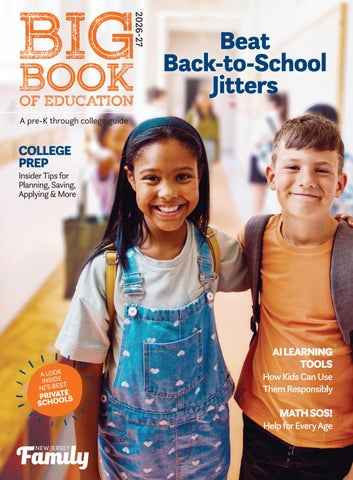
2026-27
Beat Back-to-School Jitters
A pre-K through college guide
COLLEGE PREP
Insider Tips for Planning, Saving, Applying & More
A LOOK INSIDE T NJ’S BES
TE PRIVAO LS O SCH
AI LEARNING TOOLS
How Kids Can Use Them Responsibly
MATH SOS!
Help for Every Age
A lifelong love of learning begins here. in New Jersey
Ninety percent of a child’s brain develops in the first five years, and our Balanced Learning® approach makes the most of this important time. Through purposeful play and nurturing guidance from teachers, we inspire children to think with curiosity, creativity, confidence and compassion.
Now Enrolling Ages 0-5
Learn more about the 15 Primrose schools in New Jersey. Each Primrose school is a privately owned and operated franchise. Primrose Schools is a registered trademark of Primrose School Franchising SPE, LLC. ©2026 Primrose School Franchising SPE, LLC. All rights reserved.
Give them the best of everything. Your child's health journey is a story we write together. Summit Health Pediatrics offers expert care from the very first days of life through young adulthood. Routine checkups, sick visits, and urgent care at multiple locations throughout New Jersey.
973–587–8000 summithealth.com/pediatrics
9
10
21
CONTENTS 59
73
29
82
Get to know independent schools in NJ and beyond.
9 Back-to-School Ready
25 Make It Count
Smart finds for the new year
10 Calming School Jitters
Get an inside look at independent schools in and around NJ
55 The Right Private School Fit
What to consider before you choose
17 Be Your Kid’s Best Advocate Ways to prep for your child’s IEP meeting
21 AI Primer
How the NJBEST 529 College Savings Plan helps families plan ahead
29 Meet the School
Tips to help kids start the year with confidence
13 Preschool vs. Daycare
70 From Our Sponsor
Math help for every age
How to find the best match for your kid
73 College Countdown Your teen’s year-by-year roadmap through high school
76 Better Test Prep Help for the SAT and ACT
59 Out & About!
78 College Application Advice
Our mega list of educational field trips
69 College Prep Guide Advice to help you plan and save
Parents who’ve been there share what they wish they’d known
82 Considering a Gap Year?
Help your kid use it responsibly
What to know before you decide
COVER IMAGE: ©ISTOCKPHOTO.COM / GOODBOY PICTURE COMPANY
NJFAMILY.COM
BIG BOOK OF EDUCATION
5
EDITOR'S LETTER
Volume 10, Issue 1 • 2026 Editorial Director Dina El Nabli editor@njfamily.com Art Director Leeza Hernandez Managing Editor Jennifer Amato
A FRESH START September brings with it a chance to begin again, but it can also come with plenty of nerves. With so many unknowns, it’s normal for kids to feel uneasy. On page 10, we share advice to help ease back-to-school anxiety and build confidence for the year ahead. It’s pretty much a given that math can be a major source of stress—and more than a few meltdowns. On page 25, we list resources to help kids work through math struggles at every age. AI has changed the way kids learn, study and do homework, leaving many of us worried that they’re taking shortcuts and not developing critical thinking skills. On page 21, we share AI tools that can help with studying, note-taking and more, along with tips for using them responsibly while still making sure kids do the thinking for themselves. If your kid has an IEP, now’s the time to make sure the right supports are in place. On page 17, we explain who may be at an IEP meeting, what questions to ask and how to be your child’s best advocate. We’re also excited to showcase the area’s most innovative independent schools. Get to know them in our Meet the School section starting on page 29. No matter what grade your child is in, it’s never too early to think about college. On page 70, our partners at NJBEST walk you through saving, and our college guide covers year-by-year planning, test prep and advice from parents who’ve been through the application process. Here’s to a great school year!
Contributors Catherine Donaldson-Evans Jennifer Kantor, Ronnie Koenig Jennifer Lesser, Nayda Rondon Arricca Elin SanSone Production Designer Rosa M. Joseph Business/Project Manager Erica Barton Director of Advertising Marcy Holeton Advertising Ann Cusack, Cathy Grote Debbie Lubranski, Pamela Peterson Erin Salman, Andrea Thorne Co-Publishers Dina El Nabli / Marcy Holeton Founding Publisher Cindy Mironovich The acceptance of advertising by New Jersey Family does not constitute an endorsement of the products, services, or information being advertised. We do not knowingly present any products or services that are fraudulent or misleading in nature. Editorial inquiries and advertising rates may be addressed to Kids Monthly Publications, Inc., P.O. Box 669, New Providence, NJ 07974. New Jersey Family can be reached by sending an email to editor@njfamily.com, or by visiting njfamily.com.
FOLLOW US!
Scan to subscribe + get the best things to do in NJ!
Instagram @newjerseyfamily Facebook /NewJerseyFamily X @njfamilymag Threads @newjerseyfamily
6
BIG BOOK OF EDUCATION
NJFAMILY.COM
Reproduction of New Jersey Family or Big Book of Education in whole or in part without written permission from the publisher is prohibited. All rights reserved. Copyright 2026 by Kids Monthly Publications, Inc.
Meet the heart of our new Congenital Heart Center. Welcome Dr. Rajiv Verma, the only pediatric interventional cardiologist in New Jersey treating patients of all ages. Leading a team of specialists at the new Saint Peter’s Fetal and Adult Congenital Heart Center, Dr. Verma is treating newborns, children, and adults with complex congenital heart conditions. Their decades-long years of expertise is creating a higher level of specialized cardiac care right here in New Jersey.
Scan now to learn more or book a consultation with Dr. Verma by calling 732.339.7460.
That’s treating you better...for life. 254 Easton Avenue, New Brunswick, NJ 08901 • saintpetershcs.com/childrenshospital Sponsored by the Roman Catholic Diocese of Metuchen
Princeton Ballet School ����O�������������������������R���������������
FIND YOUR
JOY
8
NEW JERSEY FAMILY
BIG BOOK OF EDUCATION
PACKED & READY
Cute and practical finds for the new school year
1 2 3
4
5
1. SWEET NOTES These Girl Scout-themed colorful gel pens have cookie-inspired scents and playful phrases like “Peanut-Better Together” and “Mint to Lead.” OOLY x Girl Scouts Cookie Scented Gel Pens (set of 6), OOLY. $5.95, ooly.com 2. PACK LEADER Sized for preschoolers and young elementary schoolers, this durable backpack has two bottle pockets, a roomy interior sleeve, a name card, a cross-chest strap, and an organizer pocket. Cool Kid Backpack, Storq. $54.90, kindredbravely.com 3. LUNCH, SORTED This durable stainless steel lunch box keep foods fresh and separated with a leakproof silicone lid and four individually sealed compartments. Voyager Leakproof Lunch Box, PlanetBox. $39.96, planetbox.com 4. SPIDEY SIP Inspired by the blockbuster Spider-Man: Brand New Day, this insulated bottle keeps drinks cold for up to 24 hours and has a leakproof lid, roomy handle and sipor-swig spout. FreeSip Sway Stainless Steel Water Bottle Swing of Things, Owala. $39.99, amazon.com 5. STAY CHILL Fill, freeze and pack these reusable squeeze pouches with yogurt, applesauce, smoothies, juice or water. They double as ice packs to help keep lunch chilled. Arctic Chill Freezable Squeeze Packs (2-pack), PlanetBox. $12.71, planetbox.com
BIG BOOK OF EDUCATION
NJFAMILY.COM
9
Back-to-School
JITTERS
How to help kids manage anxiety and start the school year with confidence
By ARRICCA ELIN SANSONE
W
hether your kid is starting kindergarten, entering middle school, or has reached high school, you’ve probably heard, “I don’t want to go to school!” at least once. With all the unknowns that come with a new school year, it’s not surprising that kids sometimes feel nervous. “Some level of anxiety is completely normal when adjusting to changes,” says Stephanie Marcello, PhD, chief psychologist at Rutgers University Behavioral Health Care. “Emotions aren’t good or bad. They’re just there to give us information.” What you help your kid do with their emotions is what matters. “Part of our kids’ growth is to experience challenges and to be able to overcome them, even if it’s not fun,” says Gwendolyn Messer, MD, pediatrician, child psychiatrist, and division head of child and adolescent psychiatry at Cooper University Health Care. “Then they prove to themselves they can do it, and this lesson is applied again and again in life.” School anxiety can show up at any age, and it doesn’t always look like worry. “Little kids may show anxiety by acting out, throwing tantrums or being irritable. Some kids have physical symptoms such as headaches, body aches, or tummy aches,” says Anne Frederickson, MD, clinical director of child and adolescent psychiatry at Newark Beth Israel Medical Center. “Older kids are usually better able to describe their anxiety, though they also may isolate themselves, have sleep difficulties or trouble concentrating.” If you’re sure your child isn’t resisting school because of a health issue or a safety concern, such as being bullied, here’s how to help him or her manage school anxiety:
EMPATHIZE AND LISTEN
©ISTOCKPHOTO.COM / MINISERIES
Acknowledge your child’s anxiety, and give them space to talk. With little kids, you may need to suggest a few options: Are you feeling sad? Scared? Excited? For older kids, instead of judging their emotions, say something like, “That’s interesting. Why are you feeling this way?” It’s important to remember that you can’t tell them how to feel, says Messer.
AVOID PLATITUDES Kids worry about a lot of things that might seem silly to us, but don’t say “that won’t happen” or “everything will be fine”—which destroys your credibility. “The majority of fears are things that actually could happen,” says Messer. “However, just because something could happen doesn’t mean it will. Reassure your child that we all take reasonable precautions, but then we have to go out in the world. You cannot wait to do something until you think nothing bad will happen because you’ll never have a life.”
DIG DEEPER Draw your child out about what he or she specifically doesn’t like about school, then make a plan together. If it’s that they’re worried about a specific class, get them tutoring. If it’s a fear of meeting new kids, arrange a playdate ahead of time so there are familiar faces on the first day, says Frederickson.
HELP THEM IDENTIFY A ‘SAFE’ PERSON This can be a teacher, a member of the office staff, or a coach— anyone they feel they can go to if they’re feeling overwhelmed. Chances are, they likely won’t need to do so, but it can feel reassuring to know they have someone close by for support, says Marcello.
HAVE A PRACTICE RUN Before the first day, take your child to school to meet the staff and do a walk-through of the building. Knowing what to expect is calming. “It’s sort of like if you go to the dentist and he or she walks you through the procedure: ‘Now I’m going to do this, now I’m going to do that,’” says Marcello. “That helps alleviate anxiety because you know what’s coming next.”
TEACH BREATHING EXERCISES Showing kids of any age how to use breathing techniques can be helpful—and no one will know they’re doing them. Try belly breathing: Place your hand on your belly and let it fill up like a balloon, then exhale through the mouth. Or square breathing, when you breathe in through your nose for a number of counts, then out through your mouth. “Breathing helps your brain tell your body you’re safe,” says Marcello. (Try it yourself! It’s an effective reset during stressful moments.)
ESTABLISH ROUTINES Kids (and parents!) need routines to stay on track and manage stress. Start a few weeks before school begins: Make sure kids get to bed on time, get them up at the same time, pack lunches the night before, and set backpacks by the door. Try to keep routines intact on weekends and during school breaks for a more seamless transition back to school, says Marcello.
KNOW WHEN TO GET HELP For most kids, school jitters taper off once they get into the classroom. But if anxiety extends past the first few weeks, if it’s impairing their normal functioning, if they’re flat-out refusing to attend school, or if grades begin to decline, it’s time to seek support. Your pediatrician can connect you with the resources your child needs, says Frederickson. — Arricca Elin SanSone is a health and lifestyle writer.
10
BIG BOOK OF EDUCATION
NJFAMILY.COM
“…YOU CAN TELL KIDS WHAT BEHAVIORS ARE EXPECTED, BUT YOU CAN’T TELL THEM HOW TO FEEL.” BIG BOOK OF EDUCATION
NJFAMILY.COM
11
Be ready to learn with school supplies Youth can receive this extra benefit through Wellpoint
School supplies can add up quickly. To help make a difference, Wellpoint is offering benefits that can help kids succeed in school. Wellpoint will provide up to $25 toward the purchase of school essentials such as: • Backpacks
• Pencils and pens
• Notebooks
• Calculators
• Folders
• Other supplies
Schools may have different requirements for school supplies. Our school supply benefit helps Wellpoint members purchase what they need. To qualify, your child must be a Wellpoint member between the ages of 5 and 18 and must have completed an annual wellness exam within the last 12 months with their doctor. This benefit is available for redemption July 1 through September 30 and given on a yearly basis to eligible Wellpoint members.
Sign up today to start earning Healthy Rewards. For more information, call 877-453-4080 (TTY 711) or visit us online at wellpoint.com/nj/medicaid/extras /healthy-rewards. We are available Monday through Friday from 8 a.m. to 5 p.m. Eastern time.
Serving Wellpoint members for over 25 years wellpoint.com/nj/medicaid This extra benefit is limited to Wellpoint members ages 5 through 18 only. Extra benefits are subject to change.
Do you need help with your healthcare, talking with us, or reading what we send you? We provide our materials in other languages and formats at no cost to you. Call us toll free at 833-731-2147 (TTY 711). ¿Necesita ayuda con su cuidado de la salud, para hablar con nosotros o leer lo que le enviamos? Proporcionamos nuestros materiales en otros idiomas y formatos sin costo alguno para usted. Llámenos a la línea gratuita al 833-731-2147 (TTY 711). 1045659NJENWLP 04/24
OMHC 078-23-10
©ISTOCKPHOTO.COM / ZELJKOSANTRAC
THE RIGHT START From teaching styles to cost to hours, here’s what to consider when choosing the right early learning setting for your child
C
By JENNIFER AMATO
hoosing childcare for the first time can feel overwhelming, especially when you’re trying to understand the difference between preschool and daycare. Preschool generally focuses on early learning for 3- and 4-year-olds, while daycare typically serves a wider range of ages and has longer hours. The right fit depends on your child’s age and personality, your family’s schedule, what each program offers and, of course, your budget. We asked early education experts what parents should consider before making a decision.
STARTING YOUR SEARCH Allison Friedman-Krauss had a lot of professional experience prior
to raising her kids, but then her mom brain kicked in. Holding a PhD as an associate research professor for the National Institute for Early Education Research (NIEER) at the Graduate School of Education at Rutgers University in New Brunswick, she relied on NIEER’s State of Preschool report, which names the most important factors for 3- and 4-year-olds, in deciding what was best for her child’s start to school. The report says to focus on small class size with low child-toteacher ratios, having qualified teachers with a background in early childhood education or child development, a center director who also has a background in early childhood, and convenience, including how close the program is to your home and whether its
BIG BOOK OF EDUCATION
NJFAMILY.COM
13
hours work for your family. “As a developmental psychologist and early childhood education researcher, I may have had a slight advantage navigating these decisions—but as a first-time mom with a tiny infant, it was still a challenge to know what would be right for my child and our family,” she says. Starting your search early and taking a tour of any potential facilities is key, especially when it comes to seeing how staff members interact with children. “During your tour, notice how teachers speak to children and respond to their needs. Look for classrooms that feel calm, engaging and nurturing. Ask how the school communicates with families and keeps them connected to their child’s day,” says Amina Gunaratne, franchise owner of Primrose Schools in Berkeley Heights and New Providence. “Those small, real-time moments often provide the most meaningful insight. They help parents understand not just what a program offers, but what their child’s daily experience will feel like—which is at the heart of finding the right fit. Starting the search early can also help families feel less rushed and more confident in that decision.”
©ISTOCKPHOTO.COM / :SDI PRODUCTIONS
GETTING DOWN TO BASICS
14
Preschool and daycare serve different purposes, but there can be plenty of overlap between the two. Preschool generally refers to an educational program for children before they enter kindergarten, most often around ages 3 and 4. Daycare programs may accept children as young as 6 weeks old and often provide longer hours and year-round care that works for families who need full-time coverage. Some also offer preschool or pre-K classrooms as part of their programming. Requirements can vary, too. Some preschool programs require children to be potty-trained or follow a school-day schedule, while others are more flexible. That’s why it’s important to compare each program’s hours, curriculum, age groups, staffing and expectations. “In terms of academic vs. play, there is likely substantial variation within childcare and within preschool. Most state- or districtfunded preschool programs are required to use a curriculum. Many childcare programs also use a curriculum but many may develop their own,” Friedman-Krauss explains. Gunaratne agrees, saying that preschool provides a more structured environment where children begin building foundational skills in language, early math and problem-solving, while also developing independence and confidence. “Consistent routines and guided, play-based learning experiences support both social-emotional growth and school readiness, helping children feel secure and prepared,” she explains. For working families, one of the biggest advantages of daycare is that it is often designed around the need for longer and more flexible hours, says Chelsy Smith, senior director of Zadie’s Early
NEW JERSEY FAMILY
BIG BOOK OF EDUCATION
Childhood Center and Zadie’s of the Oranges in East Orange. “Childcare programs typically offer longer hours, year-round care, and in some cases, before- and after-care options. That consistency can be extremely valuable for parents who need dependable care beyond a traditional school-day schedule. “Another major benefit is socialization,” she continues. “Children learn how to function as part of a group, build friendships, communicate their needs, follow routines, resolve conflicts, and develop independence. High-quality daycare programs can also provide meaningful academic preparation through developmentallyappropriate, play-based learning.” Another deciding factor is cost: state-funded preschool programs are usually free for families, while private preschool and daycare programs are typically paid for by parents. “Families should ask what is included in tuition such as meals, enrichment programs, supplies, field trips or extended hours,” Smith says.
RESEARCHING RESOURCES While there’s no single go-to resource for parents, FriedmanKrauss recommends starting with NIEER’s quality standard benchmarks. “Parents can also look at childcare licensing reports to check for any licensing violations, particularly any serious ones,” she says. You should also determine which type of program and educational philosophy feel right for your child and family. Options may include a child-led Montessori school, a faith-based program, or a center offering added enrichment activities, such as Lightbridge Academy, which provides daycare, preschool and pre-K programs. “No childcare program will be perfect every single day. Children have hard days, teachers are human, and unexpected situations happen,” Smith says. “What matters is whether the program communicates honestly, responds appropriately, maintains strong standards, and treats families as true partners. The right childcare center should give parents confidence that their child is not only safe, but genuinely cared for and supported.”
ESSEX YOUTH THEATER In Residence at The Studio Playhouse Upper Montclair
STRONG SKILLS
START HERE!
Acting Classes for KIDS! IN-PERSON, IN THE THEATER!
9 LOCATIONS ACROSS NJ
SCAN TO BOOK YOUR
FREE TRIAL CLASS!
TO CK TO BACK BA R! FER! OFFE OL OF HOOL SCHO SC
NOW SIGN UPA GI & GET T W SIGN UP NO * & GET A GIFT
s
Let's make wave together!
• Be a Star This Fall! • Musicals and Non-Musicals – Something for Everyone!
Offer valid Aug 15–Sep 30, 2026, for new students only. Terms and conditions apply. FiveStarSwimSchool.com FiveStarSwimSchool.com
• Lots of individual attention in a friendly atmosphere • Ages 5-13 Every child gets a starring role!
Success Begins at Westmont
Come see why we’ve been Montclair’s PREMIERE Acting School for Kids for over 30 years!
973-746-3303 EssexYouthTheater.com
An Accredited School for Children Ages 18 months - 6 years
Mendham 908-879-6355 westmontmontessori.org
“Essex Youth TheaterWhere Every Child is a Star!”
Gallery of little SmileS
Pediatric Dentists:
Specialized Dental Care For Children and Adolescents “My kids love going to Dr. Lam. He makes their dental experience fun and not stressful. He’s professional and his office staff and assistants are always friendly and kind.” - M.P. Dennis W. Lam, DDS, MS, FRCD(C)
Mike Lateiner, DMD Peter Paradiso, DMD and Associates
kidzworlddental.com
Orthodontists:
Christopher Sohn, DMD
218 Ridgedale Ave., Suite 203, Cedar Knolls
973-585-6756 kidzworld218@gmail.com
Diplomate, American Board of Pediatric Dentistry
Jeannette G. Glass, DMD, MS Cosmetic Dentistry
www.GalleryofLittleSmiles.com • (973) 295-6700 220 Ridgedale Avenue, Suite B1 • Florham Park, NJ 07932
BIG BOOK OF EDUCATION
NJFAMILY.COM
15
rockaway orthodontics “where great smiles begin”
GET YOUR BEST SMILE EVER IN UP TO 35% LESS TIME
It is our mission to provide the highest quality orthodontic treatment in a warm, nurturing environment. We strive to create beautiful smiles through individualized treatment, in which our patient’s comfort is our highest priority.
Unmatched Expertise Unrivaled Technology Unprecedented Service
• Consultations are Always Complimentary • Most Insurances Accepted • No Down Payment and Interest Free Financing
It is orthodontics with a mom’s touch!
Diamond Plus Invisalign Provider | NJ Top Doc 2009-2026 New Jersey Family’s Favorite Kids’ Docs™ 2009-2025 | Best of Essex/Morris Magazine
Every smile is backed by our 100% CAGGIANO SMILE WARRANTY
Dr. David Caggiano
Melissa Roberto, DMD
973.887.8780
Orthodontics for Children & Adults
272 Parsippany Road, Parsippany
141 US Hwy 46 West #101 Rockaway, NJ
Most Insurance Plans Accepted
MorrisCountyBraces.com
AUTHOR OF “A PARENT’S GUIDE TO UNDERSTANDING ORTHODONTICS”
973-298-5900
www.rockawayortho.com
TIMOTHY P. McCABE, D.M.D., Board Certified JULIE JONG, D.M.D., Board Certified KELLY WALK, D.D.S., Board Certified MARIA SHIN, D.D.S., Board Certified MYRA TARIQ, D.M.D., Board Certified
We believe in caring for each patient the way we would treat our own family: with compassion, patience and even a little bit of fun! Our goal is to give patients a head start to a lifetime of great oral health and beautiful smiles.
General Anesthesia • Autism Friendly • Laser Treatment of Lip and Tongue-Tie 555 Westfield Avenue, Westfield, NJ 07090 • kidsandsmiles.com • 908-232-1231
16 NEW JERSEY FAMILY
BIG BOOK OF EDUCATION
Be Your Child’s
BEST ADVOCATE Here’s how to walk into your child’s IEP meeting feeling informed and prepared
©ISTOCKPHOTO.COM / VEJAA
A
By RONNIE KOENIG
ttending your child’s first Individualized Education Program (IEP) meeting can feel overwhelming. Between the educational jargon, stacks of paperwork and the team of teachers, therapists and specialists gathered around the table, many parents walk in unsure of what to expect—or even what questions to ask. But experts say parents should remember one important thing: they are a key part of the IEP team. “Many parents are afraid to ask for ‘more,’” says Adara Heilmann, director of children’s advocacy for The Arc of New Jersey, a nonprofit organization that supports individuals with intellectual and developmental disabilities and their families. “Whether it’s services, accommodations, modifications,
*Name has been changed to protect privacy.
goals or an interpreter at meetings, don’t be afraid to ask for more if you or your child can benefit from the support.” From understanding who’s in the room to knowing what questions to ask, here’s what parents should know before attending an IEP meeting—and how to feel more prepared once they’re there.
WHO’S IN THE ROOM AT AN IEP MEETING? One of the biggest surprises for many parents is just how many people attend an IEP meeting. In addition to your child’s teacher, meetings often include members of the Child Study Team, which may include a school psychologist, school social worker and
BIG BOOK OF EDUCATION
NJFAMILY.COM
17
DON’T BE AFRAID TO ASK QUESTIONS
learning disabilities teacher-consultant, as well as speech therapists, occupational therapists, behavioral specialists and other providers depending on your child’s needs. “Jumping into the world of special education can sometimes feel like eating a bowl of alphabet soup,” says Jon Gottlieb, Esq., helpline and family advocacy director at Autism New Jersey, a nonprofit that provides advocacy, education and support for individuals with autism and their families. “People will be using unfamiliar acronyms and long, official-sounding words. Don’t be afraid to politely interrupt to ask what a word or acronym means.” While the large group and educational jargon can initially feel intimidating, parents should remember they are an important part of the team and play a key role in helping develop goals, accommodations and supports for their child.
©ISTOCKPHOTO.COM / NIMITO
HOW TO PREPARE BEFORE THE MEETING
18
One of the best ways parents can feel more confident heading into an IEP meeting is to prepare ahead of time. Experts recommend reviewing your child’s current IEP, evaluations and progress toward existing goals before the meeting so you have a clear understanding of what’s working, or what may need to change. “My top IEP tip: push to get a copy of the draft IEP well in advance of the meeting,” says Anne*, the parent of an 11-year-old girl in Princeton. “It’s hard to advocate and make good use of the meeting time when you don’t have the full picture of what is being proposed.” Gottlieb recommends making a list of questions ahead of time and sharing any outside evaluations with the school team before the meeting whenever possible. “IEP meetings can move very rapidly,” he says. “Keeping a list can ensure you get the answers to your most important questions.” Heilmann suggests talking through any concerns with your child ahead of time, if appropriate for their age and developmental level. She also recommends reaching out to support groups, advocacy organizations or trusted friends who have experience with the special education process. Parents can also choose to bring a trusted friend, advocate or support person to the meeting if it would help them feel more comfortable and supported.
NEW JERSEY FAMILY
BIG BOOK OF EDUCATION
Parents should never feel pressured to stay silent during an IEP meeting—especially if they don’t understand a term, recommendation or proposed accommodation. “Parents can ask anything,” says Gottlieb. “It’s important to make sure you understand everything that’s been said so that you can make an informed decision.” He also recommends asking for clarification in plain language if testing scores, goals or evaluation results feel confusing. Parents can also ask for breaks during the meeting or request a followup meeting if they feel rushed or overwhelmed by the amount of information being discussed. Another important thing for parents to remember: they do not have to sign the IEP immediately at the meeting. Some parents find it helpful to take detailed notes or ask in advance about recording the meeting so they can revisit information later before signing paperwork. Heilmann recommends taking time to review the document at home before providing consent. “Sometimes questions or concerns come up after the meeting,” she says. “It’s easier to address these before you sign rather than have to amend the IEP later.”
FOCUS ON THE WHOLE CHILD While test scores and academic goals are important parts of the IEP process, parents should remember to consider how their child functions day to day in the classroom and at home. “Standardized scores may not fully capture the level of support a child needs to participate successfully throughout the day,” says Jessica McCarthy, PsyD, founder and director of Elements Psychological Services and a licensed psychologist, clinical neuropsychologist and certified school psychologist. She recommends parents share concrete examples of what challenges look like in real life, whether that means difficulty transitioning between activities, taking hours to complete homework or becoming overwhelmed during independent work. McCarthy says parents should remember that they are the experts on their own child and can offer valuable insight into what supports may help them feel more successful, confident and comfortable at school. No parent walks into an IEP meeting knowing every acronym, evaluation score or educational term—and they shouldn’t feel like they have to. Asking questions, taking time to review recommendations and speaking up about a child’s needs are all important parts of the process. Most importantly, parents should remember they are not just attendees—they are an essential part of the team helping to shape their child’s educational support system. —Ronnie Koenig is an NJ mom of twins. Find her at facebook.com/AutismGirlMom.
share the wonder!
2026/2027
SEASON
LIVE THEATRE for Families in Morristown
10/3
10/24
11/27
Mutts Gone Nuts
Unleashed!
12/11 12/27
1/9
more family-friendly shows 10/3 10/18 10/24 11/27 12/11-27 1/9
Sesame Street Live: Elmo's Got the Moves Ghostbusters in Concert Coco Live-to-Film Concert A Charlie Brown Christmas Live On Stage New Jersey Ballet's The Nutcracker with New Jersey Symphony Mutts Gone Nuts - Unleashed!*
1/31
Please check with the Box Office for age appropriateness of events
1/27 1/30 1/31 2/12 2/20 2/27 3/6-7 3/20
Cirque Alice Reza: Edge of Illusion Pinkalicious* Step Afrika! Dog Man: The Musical Grand Shanghai Circus New Jersey Ballet presents Once Upon A Time Michael Carbonaro: Wonderboy
*Sensory Friendly performance offered. See MayoArts.org for details.
MPAC is grateful to the following donors whose major support helps to sustain the general operating needs of our organization:
Tickets at MayoArts.org Box Office (973) 539-8008 100 South St, Morristown
Special thanks to the A.P. Kirby, Jr. Foundation, Inc. for their longstanding support of the theatre.
Discover what’s within. What do you get when you join Girl Scouts? Adventures. Exploration. New experiences. Confidence that grows from within. At Girl Scouts, every young person can turn “What if?” into “Look what I did!” Surrounded by supportive leaders and friends, they’ll build confidence, discover new passions, and develop skills that last a lifetime.
Join a troop. Renew your membership. Volunteer.
Scan to discover all you can do and be with Girl Scouts.
©ISTOCKPHOTO.COM / MILAN_JOVIC
A
By JENNIFER KANTOR
AI can be a powerful homework helper as long as kids learn to question it, check it and think for themselves
rtificial Intelligence has forever changed education. Parents used to worry their kids would stop thinking and just cut-and-paste from websites. Now there are bigger worries that kids will cut-and-paste from an authoritative chatbot that got it wrong. Add concerns about inappropriate chatbot interactions, privacy, and the environmental costs of data centers, and it’s easy to understand why many parents are wary. And yet, we know AI is here to stay. So how can kids use it wisely and responsibly? According to a recent Stanford University study, AI tools can improve student performance across a range of subjects by easing cognitive burden and creating more positive learning experiences, though potentially at the expense of deeper thinking. Critically, the research suggests that tutoring tools with guardrails that guide students through step-by-step reasoning, rather than simply providing answers, support more durable learning. “One key thing to consider is: are kids using AI just to do tasks,
or is it helping them develop skills and learning that will stick?” asks Robbie Torney, head of AI & Digital Assessments at Common Sense Media. Age matters when using AI tools independently— or at all. “We suggest supervision for most kids ages 6–12. We recommend that kids under 5 don’t use AI chatbots; they need hands-on, sensory-rich learning and human interaction, and they can’t reliably tell the difference between AI and real people,” says the youth AI safety expert. Teens 13 and up may be ready for independent use, with the caveat that it’s used primarily for studying, homework help, skill building and research—with a healthy dose of skepticism. Even older children and teens need to develop critical thinking skills that enable them to question AI-generated facts. Whenever possible, choose educational tools that build real understanding, that consider the age-appropriateness of reading levels and interfaces, and that are designed from the get-go with built-in filters. “A true AI tutor asks follow-up questions, adapts to
BIG BOOK OF EDUCATION
NJFAMILY.COM
21
“This isn’t just about cheating. The bigger worry is that kids will miss the opportunity to learn and develop their own thinking skills.”
where a student is struggling, and guides them through reasoning rather than just handing over answers like multi-use chatbots do,” says Torney, adding that the best tools show the work and help kids understand why, not just what. Under no circumstance should AI be used to do your child’s work. “This isn’t just about cheating. The bigger worry is that kids will miss the opportunity to learn and develop their own thinking skills,” he says. And make it clear that an AI chatbot is not a friend, therapist or substitute for a trusted adult. Despite their flaws, popular general chatbots like ChatGPT, Claude and Gemini can be incredibly useful if used with clear rules and guidelines. They can quiz your child on a topic, create practice math problems (and explain the tricky parts), chat in a foreign language to shore up fluency, and give feedback on written essays. Remind your child that they’re trained to “polish” and will do so without permission—so always save original drafts. AI should never be the final source for research, but it can help students find search terms, questions to ask and credible sources to verify. Here’s a selection of AI tools to consider for your child’s academic toolkit. Age ratings and features can change, so check each platform’s current terms, privacy settings and parental controls before signing up.
AGE 3 AND UP BUDDY.AI: Voice-based learning AI teaches the ABCs, early math and basic reading skills through games and engagement. POK POK: Montessori-style interactive learning has select exploration-focused, AI-adjacent content.
©ISTOCKPHOTO.COM / PRESSMASTER
AGE 8 AND UP
22
KHANMIGO: Khan Academy’s AI-powered personal tutor prompts kids to think deeply by debating topics, asking Socratic questions, and engaging as historical and literary figures. CANVA: This popular design tool incorporates AI to generate graphic elements for book reports, eye-catching posters and other visual projects. PHOTOMATH: Upload an image of a stumper and voilà: step-by-step solutions to math problems ranging from basic arithmetic to advanced calculus. This is best used to check work or understand a missed step, not to skip the problem-solving. QUIZLET: Turn class notes and materials into flashcards and practice tests to boost memorization for middle schoolers
BIG BOOK OF EDUCATION
NJFAMILY.COM
and beyond.
AGE 13 AND UP GEMINI: Google’s multimodal AI integrates with its entire app ecosystem, including Socratic, which solves and explains homework questions; Storybook Gem, which lets younger children create illustrated stories via a parent’s account; and Notebook, which transforms class notes, PDFs and articles into outlines and study guides. CHATGPT: Its ask-me-anything ability and quick homework help make it a favorite for younger teens. Older kids use the generative AI to simplify complex topics and assess essay quality and alignment to rubrics with parent-set rules about what counts as help versus doing the assignment. GRAMMARLY: Grammarly provides writing suggestions and analysis wherever your child writes, from a Canvas assignment to a standalone document. QUILLBOT: This paraphrasing tool, citation generator and plagiarism checker helps teens refine phrasing, check citations and review originality for research papers and complex essays. PERPLEXITY: Real-time responses with footnotes and easy-tovet sources allow for improved fact-checking compared to other AI-powered search tools. STUDYFETCH: Class notes and lecture materials for contentheavy curricula (like AP History) are turned into structured exam prep centered on must-know material.
AGE 16 AND UP SCISPACE: Searching summarized academic papers and extracting key findings and data points are used as an entry point for teens beginning to tackle complex scientific research. ELICIT: This AI research assistant scans academic papers to assess the breadth of published research, pulls key information, and compares findings so you can see what the evidence shows. CLAUDE: Anthropic’s generative AI shines when used for sustained back-and-forth thinking that sharpens logic and hones persuasive writing. Rated 18+ by Anthropic, many older high schoolers use it with parent oversight, but families should be mindful of its age requirements before creating an account. —Jennifer Kantor is a lifestyle and parenting writer and mother of two from Maplewood.
Live. Laugh. Smile.
Looking for something? We’ve got you covered.
State-of-the-ar t or thodontics in a caring and comfor table environment
Barbara A. Fodero, DDS, MS SPECIALIST IN ORTHODONTICS FOR CHILDREN AND ADULTS 33 Main Street, Suite 104, Chatham • Permit #5268
973.701.2200 • chathambraces.com Baby & Maternity
Education
Camps
Family Fun
Childcare
Voted Top Dentist by NJ Monthly and New Jersey Family’s Favorite Kids’ Docs™
Farms
Stanley Gersch, dmd, pa Scott D. Gersch, dmd Ilona Rossignol, dmd
Evening & Sat urd ay Hours
Halloween
Health
Kids’ Birthday Parties
Voted NJ Top Orthodontist by NJ Monthly & New Jersey Family’s Favorite Kids’ Docs™
Diplomate, American Board of Orthodontics Director of Invisalign, NYU College of Dentistry Kids’ Programs
Legal & Professional
Shopping & Services
Invisalign ELITE Top 1% Provider for Teens and Adults! Complimentary Evaluation
BROWSE OUR DIRECTORIES AT: www.njfa www.njfamily.com/directories
www.GerschOrtho.com • 908-233-8668 547 East Broad Street, Westfield (Across from Library)
401 North Wood Avenue, Linden (Across from Post Office)
118 North Avenue West, Cranford (Across from Rustic Mill Diner)
the world always looks brighter from behind a smile! for infants, children, adolescents & special needs patients
Newton-Sparta Pediatric Dentistry & Orthodontics
Pediatric
Orthodontics
Michael Lateiner, DMD Kevin Lehnes, DMD and Associates Peter Paradiso, DMD and Associates
11 Lawrence Road, Newton
973.300.0002 • drmikedmd.com
Treating infants, children, adolescents & special needs patients
Pediatric Dentists: Dentists
Orthodontist: Orthodontist
Michael Lateiner, DMD Peter Paradiso, DMD and Associates
Rupali Shah, DMD
121 Shelley Dr., Hackettstown, NJ • (908) 979-0606
www.BrightSmiles4Kids.com BIG BOOK OF EDUCATION
NJFAMILY.COM
23
LET’S GO FURTHER, TOGETHER
Stand Up To Cancer, with support from American Airlines, is charting a course toward cures. They bring together the best scientists and doctors to accelerate research leading to life-saving treatments. Because the ultimate destination is ending cancer once and for all. Learn more at StandUpToCancer.org/AA Lily Collins Stand Up To Cancer Ambassador Roger Lo, MD, PHD SU2C Cancer Researcher Kimberlynn Customer Service Agent, Breast Cancer Survivor Photo by Elizabeth Viggiano
Stand Up To Cancer is a 501(c)(3) charitable organization.
What to do when math gets frustrating—from preschool through college
child is doing his math homework, his brow furrowed and a look of frustration on his face. face. Rather than going smoothly, it’s a struggle—one that’s growing more stressful by the minute. It’s enough to make any parent feel helpless. How can you support your kids when it comes to doing well in math? You’re not imagining what an uphill battle it is. About 53 percent of NJ fourth-graders can’t do math at grade level, and 60 percent aren’t up to speed by sixth grade, according to Wake Up Call New Jersey, a nonprofit that educates parents about public schools. “Often when kids are struggling with math, it’s not just because they’re anxious, it’s that they don’t have the sense that it’s useful,” says Laura Overdeck, founder of Bedtime Math and co-founder of Wake Up Call New Jersey. “That’s why at home, it’s such a huge opportunity to complement what they’re doing in school by showing them math in real life. We take what kids already think is
fun and find the math in it.” Jen Martins, president of the Association of Mathematics Teachers of New Jersey and co-director of curriculum, instruction and testing for Hazlet Township Public Schools, says the goal is to take the struggle and stress out of math in the classroom. “From a district perspective, we do not emphasize homework heavily,” Martins says. “We are working to remove the stress of homework.…We are also working toward a stronger model that gives the classroom teacher time in the math block to work with students struggling with a particular concept. Additionally, in K-8 we have built-in WIN [What I Need] time to further assist students who may struggle.” Here are some tips and tools for children of all ages that can help them succeed in math:
PRESCHOOL AND KINDERGARTEN You can set up your child for success even before they start
BIG BOOK OF EDUCATION
©ISTOCKPHOTO.COM / WONGMBATULOYO
A our
By CATHERINE DONALDSON-EVANS
NJFAMILY.COM
25
“PARENTS SHOULD ENCOURAGE THEIR CHILD TO TAKE A BREAK AND GO BACK TO THE HOMEWORK LATER.”
grade school. For very young kids, the focus should be on building confidence and keeping things light. Parents can try the following: Use Khan Academy for children ages 2 to 8 to perfect math skills. “Khan Academy is fantastic,” says Overdeck, a Khan board member. “It’s really granular. You can figure out where your kid is stuck.” Try Bedtime Math, which is designed to make math fun. “Whatever you talk about at dinner, talk about it in math terms,” Overdeck advises. “For example, how many claws do you have to clip if you have two dogs? [Bedtime Math asks] a funny little question every night that has math in it.” Math Learning Center apps break math down by category (fractions, money pieces, etc.) to teach kids basic concepts. Count everything. Counting stairs, flowers and toys can be a smart way to incorporate math into your child’s daily life. Break out the games. Play Go Fish or lock in to Candy Land or Chutes and Ladders. Count the spaces as you move around the board. Have a cooking playdate. Talk about measuring ingredients as you follow the recipe to weave practical math into an activity you can do together. Emphasize play. Working with numbers can be fun! Keep it playful to build confidence.
©ISTOCKPHOTO.COM / EWONGMBATULOYO
ELEMENTARY SCHOOL
26
By the time your child enters first grade, math will be part of the curriculum, and it will look pretty different. But there’s still plenty you can do to boost your kid’s math IQ—and confidence. Here’s how to help: Khan Academy is your friend again. Keep at it with your little ones in elementary school for grade-level math practice that’s not a drag. Have them try Prodigy math for grades 1 to 8. The site has games kids can play that incorporate math problems. Tap into Math Playground, which uses games and puzzles to help them grow as mathematical thinkers. Use game-based math apps like Mr. Nussbaum and Fun Brain. Practice math in short bursts. They’ll retain more given their limited attention spans. Play Uno and dice games. Numbers games make math less intimidating and more fun. Follow the “math is life” mantra. Incorporate math into daily routines: at the grocery store, in recipes, and while comparing prices. Take away the stopwatch. Avoid doing timed math problems, which can be stressful. “In school, everything is under timed pressure; there’s a schedule, even if it’s not a timed test,” Overdeck says. “What’s great about playing with math as a family is that you can give your child as much time as they need. That’s a completely different experience.”
BIG BOOK OF EDUCATION
NJFAMILY.COM
Martins says the teachers in her district encourage students who are having trouble with math to get extra help during the day. “We find that built-in time during the school day is more beneficial for math extra help than after-school or before-school sessions,” she says. Teachers also try to get creative and fun with homework, especially with the younger kids. “Sometimes for homework, in the early grades, we have students play a simple math game with a parent or represent groups of numbers with objects at home instead of doing a worksheet, and then discuss it the next day,” says Martins. Parents should make an effort to stay calm at home, even when math becomes frustrating. “Parents should refrain from using negative language when helping or talking about math with their child,” says Martins. “Parents should praise their child for their hard work, regardless of whether the solution is right or wrong. They should be sure to focus on the progress their child has made.” She said asking open-ended questions such as “Can you show me what you understand so far?” is a better strategy than asking questions that require a specific answer, which can stress the child more. It can also help to play math games, have family math nights, use visuals whenever possible, and stop for a bit when things get overwhelming. “Parents should encourage their child to take a break and go back to the homework later,” Martins says.
MIDDLE SCHOOL Math gets more complex for kids in middle school, so it’s important to help them stay on top of it. Many kids wind up doing pre-algebra or algebra by the time they’re in eighth grade. Here are some ways to support your middle-schooler: Keep up with Khan Academy for skill review. It gives them math problems at their level and makes it engaging so they don’t get bored or frustrated. Try math on IXL. This personalized learning site helps students understand math concepts by grade level. Use Desmos for visual graphing and exploring equations. Desmos lets students plot equations, create 3D visuals of math concepts, and use interactive geometry tools. Photomath, an app that uses AI and phone cameras to solve math problems, shows the steps it takes to get the answers.
Teach your kids math principles that apply in the real world using sports statistics, shopping discounts, baking, sales tax and budgeting. Get a tutor. A high school student who’s strong in math is a smart and affordable choice! Practice with game apps like Math Playground, Fun Brain and Mr. Nussbaum.
HIGH SCHOOL By the time your kid is in high school, math is very sophisticated and will involve not only algebra but also pre-calculus, calculus, geometry and trigonometry. Keep boosting your teen’s confidence in math and make sure they understand what they’re learning so they don’t fall behind. Here’s how to help your high school student: Stick with Khan Academy for algebra 1 and 2, geometry, statistics, and calculus, plus SAT and AP test review. Desmos can help with graphing math concepts and visualizing functions. Your child can use Photomath for checking his or her work and seeing problems step-by-step to bolster their understanding. Seek out school-based support, including help from math teachers and peer tutoring.
Be sure to have your teen study for math before they’re confused, not just right before a test. Cramming isn’t effective. Suggest your kid keep a notebook to redo missed problems and jot down what they did wrong. Continue to emphasize how math shows up in everyday life using budgeting, shopping trips, restaurant bills, traveling (How many nights will we be staying in the hotel and how much does it cost a night? How much will we spend altogether?), and even ordering pizza (How many slices will each person eat? How many pies do we need?). “Home is a great place to make math playful and fun,” Overdeck says.
COLLEGE Once your teen heads to college, math challenges won’t disappear—and neither will the support. Remind them to take advantage of the resources available on campus, including tutoring centers, professors’ office hours, TA support and study groups. The key is encouraging them to ask for help early, before a small struggle turns into a bigger problem. —Catherine Donaldson-Evans is a parenting and health writer and Cranford mom of two.
BIG BOOK OF EDUCATION
NJFAMILY.COM
27
GET CONNECTED WITH YOUR COMMUNITY
WTONNJ.COM Welcome to Our Neighborhood (WTON) invites you to explore and support the many local businesses in your community.
Join Our Team We are looking for Community Representatives. Turn your community connections into a business. To learn more about our organization, email wpy.wton@gmail.com or visit wtonnj.com
Follow us on Social
@welcome-to-our-neighborhood
Proud to be a distribution partner for NJ Family magazines.
SPECIAL ADVERTISING SECTION
Get to know independent schools in NJ and beyond.
©ISTOCKPHOTO.COM / GLOBALSTOCK
[M E E T T H E S C H O O L]
THE HUDSON SCHOOL 601 PARK AVE. /422 WILLOW AVE., HOBOKEN • 201-659-8335 • THEHUDSONSCHOOL.ORG
Finding Joy, Purpose and Possibility in Learning
B
uilt on a foundation of courage, compassion and commitment, The Hudson School (THS) is the only pre-K through grade 12 independent day school in Hudson County. The school provides inquisitive students with a rigorous and relevant college-preparatory education that inspires independent thinking and intellectual risk-taking. “We’re proud to be a city school; Hoboken is truly our campus here,” says Jamie Nestor, assistant head of school for admissions and development. “We think our location makes the school extra special.” Hudson’s Lower and Middle schools have outdoor recess time at Church Square Park, and the school’s youngest students spend every Friday afternoon at a different park in Hoboken. COMPASSIONATE, RESPONSIBLE CITIZENS The Hudson School is a vibrant learning community where individual talents are shared and celebrated. Students are encouraged to think critically and develop their unique voices so that they aren’t just memorizing, but instead can explore, question and create. The school’s goal is to develop compassionate, responsible and principled citizens who are socially conscious and committed to lifelong learning and service. “Our school embraces the whole child, and we strive to engage each child’s individual imagination,” Nestor says. The diverse and dedicated faculty is comprised of experts in their fields who are passionate about sharing their knowledge; several of the teachers have taught at the school since its founding in 1978. Hudson’s small size also provides endless opportunities for teachers to be creative, collaborate and experiment with curriculum design. “Our small class sizes mean that students can receive individual attention and build relationships with their teachers; that
30
NEW JERSEY FAMILY
way, when they’re applying to college, they know exactly who they can ask for recommendations, or if they’re struggling in a particular subject, they feel comfortable seeking that extra help,” she says. THS also boasts a thriving and engaged community of parents and families; the school’s Parents’ Association does everything from coordinating service projects to benefit community organizations to organizing events like movie nights. JOY IN LEARNING The school fosters an eclectic and supportive learning environment that challenges students and faculty to develop their passions and talents through a stimulating, balanced and creative interdisciplinary curriculum. The Lower School’s Reggio Emilia approach hails from the early childhood schools of the Reggio Emilia region of Italy; the collaborative, child-led and community-based approach honors students’ curiosity and teaches them how to be researchers. The Middle School emphasizes independent thinking, learning and intellectual risk-taking, and in the Upper
BIG BOOK OF EDUCATION
School, students learn to be socially conscious, empathetic and open-minded. “We instill intellectual and social values that equip our students to be both lifelong learners and responsive members of the human community,” she says. Travel is an important component of a THS education; Upper School students have traveled internationally to countries such as Thailand, Vietnam and Japan. The school also emphasizes world languages for all students: kindergarteners may practice learning Spanish a few times a week, and by grade 5 students are studying languages like French, Japanese or Mandarin. “There is so much joy in learning across all of our divisions,” Nestor says. “I used to be a high school principal and at other schools, I’ve observed the level of stress that so many students are dealing with; it was all about how many AP classes you’re taking or commiserating about how many hours you were able to sleep last night…and I don’t see this at THS at all.” CONNECTED TO THE CITY— AND THE WORLD Outside of the classroom, THS is home to an array of extracurricular opportunities for students. The school’s athletic programs include soccer, basketball, track and field, cheer and volleyball. “We ensure that if students want to play a sport, they get to be part of the team,” she says. Students can pursue the arts with programs such as jazz band, art classes and clubs, music classes, and even private music lessons offered during the school day. The school is also home to a popular bi-annual, student-led rock band and music concert called Between the Lines that’s produced, organized and performed by Upper School students. “The hallmarks of our school are independence, responsibility, community— and the fact that we remain closely connected with the city itself,” she says.
SP EC IAL ADVE RT I S I N G S ECT I O N
BIG BOOK OF EDUCATION
NJFAMILY.COM
31
[M E E T T H E S C H O O L]
MORRISTOWN BEARD SCHOOL 70 WHIPPANY RD., MORRISTOWN • 973-539-3032 • MBS.NET
Where Confidence, Curiosity and Purpose Are Built
A
private, independent and co-educational day school for Middle School (grades 6-8) and Upper School (grades 9-12) students, Morristown Beard School (MBS) is a place where students develop individual pathways to academic success and personal fulfillment while becoming enlightened, morally responsible citizens of the world. The school’s small class sizes and dynamic curriculum allow students to engage in deep learning and explore their passions. Students are supported on their journey of self-discovery while being challenged to explore their unique ideas, find their distinct voice and cultivate a love of learning. BALANCING ACADEMIC EXCELLENCE WITH PERSONAL GROWTH “We believe MBS is a place of possibilities, where kids have the freedom to discover their passions and dive deeper into areas they may already be interested in,” says Head of School Ryan Liese. “Our students go on to some of the most competitive schools in the country, and we believe it’s because we’ve created a space where students can feel confident taking advantage of the variety of opportunities on their journey at MBS.” MBS offers an independent study program, advanced course offerings, competitive athletic programs, and 40 student-led clubs and community service opportunities, including student government, Model UN and coding. Although academic rigor is prioritized at MBS, it’s never at the exclusion of personal growth—class schedules are designed so that students can successfully balance academics with the pursuit of their passions. The vast majority of students play at least one sport and the last period of the school day serves as dedicated time to
32
NEW JERSEY FAMILY
participate in their activities. “We don’t believe that high school should be about how long a student can survive being sleep-deprived; we strive for a balance between rigorous academics and enriching extra-curricular activities,” Liese says. “We’re interested in teaching our students to think analytically and fully understand the depth of the subjects they’re studying in the classroom—not how late they’re getting home each night or how heavy their backpack is.” To help students become responsible, active global citizens, the school requires everyone in grades 6-12 to complete community service. From local to international outlets, MBS students and faculty contribute their time and talent to support the needs of surrounding communities. The school supports organizations such as Habitat for Humanity and InterFaith Food Pantry, hosts two yearly blood drives and coordinates annual international service trips in addition to other opportunities for students and their families to give back. INNOVATIVE TEACHING AND LEARNING MBS is a place for experiential, handson learning, with signature academic
BIG BOOK OF EDUCATION
programs that include Learning Outside the Classroom Walls and Social Emotional Competencies in Middle School. In the Upper School’s Interdisciplinary Concentrations Program (ICP), students apply for one of four concentration pathways at the end of their freshman year: Arts and Innovation; Ethics, Leadership, Justice; Data Analysis and Research Methods; or Sustainability. The 22-acre campus provides stateof-the-art spaces to facilitate the school’s commitment to innovative teaching and learning, highlighted by the 8,000-squarefoot Center for Innovation & Design (CID), 25,000-square-foot Math & Science Center and Science on a Sphere®, a six-foot diameter sphere that uses computers and video projectors to display planetary data. The CID offers cutting-edge technology and dedicated studio spaces where students are empowered to explore emerging fields and make a positive impact in their community. The school’s Centers for Learning provide an unparalleled network of academic support services for students as well as opportunities to foster creativity, innovation and collaboration. A CLOSE-KNIT, SUPPORTIVE COMMUNITY At MBS, all students are known and seen, and the school strives to create a close-knit sense of community and belonging for both students and their families. “One thing people always point out to us is how happy our students are. There’s a lot of pressure on kids today, but our students know that going to school can be fun—and they genuinely want to be here,” Liese says. “We’re very intentional about cultivating and nurturing the community we hope to provide, and that includes our incredibly gifted educators who know how to work with students and help them thrive.”
SP EC IAL ADVE RT I S I N G S ECT I O N
BIG BOOK OF EDUCATION
NJFAMILY.COM
33
[M E E T T H E S C H O O L]
WINSTON PREPARATORY SCHOOL 901 RTE. 10 EAST, WHIPPANY • 973-500-6480 • WINSTONPREP.EDU
The Power of Individualized Learning
W
inston Preparatory School is redefining what it means to educate elementary through high school students with a range of specific learning differences, including dyslexia, dysgraphia, executive function challenges (such as ADHD), and NVLD. Guided by its mission to facilitate the development of essential academic and social-emotional skills, the team takes the time to understand how each student learns, then groups them with students who learn in similar ways so the teaching in every classroom is designed specifically for those in it. Because Winston Prep’s unique approach is grounded in ongoing research, they’re able to do much more than just help students keep up—they help them become confident, independent learners. It’s why so many families and professionals consider Winston Prep one of the top schools for children with learning differences. “Our students’ success is a result of highly individualized educational programming that reaches them in ways they’ve never experienced before,” says Head of School Erica Piche. “Every student’s education here begins with understanding who they are, how they learn and what they need. It’s what allows us to create customized curricula that meets them where they are—and then we move them forward from there. Each child’s progress is monitored in an ongoing way, and instruction is adjusted based on what’s working…and what’s not.” FOCUS SESSIONS FOR STUDENT SUCCESS A cornerstone of a Winston Prep education is that every student receives a daily 45-minute, one-on-one Focus session that’s built into their school day and aimed at remediating their primary
34
NEW JERSEY FAMILY
areas of academic weakness, while building their “Qualities of a Sustainable and Independent Learner,” such as resilience, self-advocacy and problem solving. Parents hear from their child’s Focus teacher every week, and they also serve as the hub for all communication amongst the team. “Our Focus teachers develop a deep understanding of their students’ learning profiles to maximize skill development and ensure that teaching never deviates from their needs,” Piche says. “We are proud of how our educators keep a finger on the academic, social and emotional pulse of their students, and how closely they work with parents. We truly value parent partnerships and believe they are an invaluable part of the team.” PREPARING STUDENTS FOR COLLEGE AND BEYOND Winston Prep stays up-to-date on research and best practices in the field of special education, and invests more than 200 hours per year in professional growth opportunities for teachers. “The result is a school where students master the skills and
BIG BOOK OF EDUCATION
strategies they need to thrive in college and beyond,” Piche says. They have a full-time college counselor, and juniors and seniors can take dual-enrollment college classes through Fairleigh Dickinson University and Landmark College for college credit. This allows their high schoolers to learn how to navigate the advanced academic and executive function skills they need to thrive in college. According to Winston Prep’s Lives Over Time research, 99.7% of their students graduate from high school compared to just 70.8% nationwide for LD students. Also notably, 80% of Winston Prep graduates enroll in college compared to just 33% nationwide for LD students. “Our individualized, systematic approach to learning allows students to access their personal best. Independence isn’t just a goal here, it’s an outcome,” Piche says. BEYOND THE CLASSROOM Learning and connection don’t stop when the school day ends. From overnight experiential education trips to social events and after-school activities, students have countless opportunities to build friendships and grow. Athletes, performers, leaders and curious minds all find their place— whether it’s basketball, cross country, disc golf or pickleball; theater or choir; student council or the big buddy program; or exploring 3D Design, D&D, coding, chess and debate. Winston Prep also places significant emphasis on involving students in community service opportunities. Social responsibility is woven into the fabric of the school, with students leading food and book drives, hosting charity breakfasts, organizing fundraisers for local responders, and more. “When students give back it strengthens not just the community, but our students’ confidence and sense of self,” Piche says.
SP EC IAL ADVE RT I S I N G S ECT I O N
BIG BOOK OF EDUCATION
NJFAMILY.COM
35
[MEET TH E SC H O O L] S P ECI A L A DV E RT I S I N G S ECT I O N
CHATHAM DAY SCHOOL 700 SHUNPIKE RD., CHATHAM • 973-410-0400 • CHATHAMDAYSCHOOL.ORG
Excelling Academically, Flourishing Emotionally
C
hatham Day School (CDS) offers an ambitious program that promotes intellectual achievement and emotional growth in a diverse and nurturing environment, where students learn in small classes and can take advantage of its sprawling 15-acre campus. The school celebrates and values each child as a unique learner with extraordinary potential. PERSONALIZED ATTENTION AND INDIVIDUALIZED LEARNING CDS is committed to keeping class sizes small, with a maximum of 14 students per class, to allow teachers to provide differentiated teaching strategies and personalized attention. “We will never sacrifice on the size of our classes,” says Head of School David Buffum. “We feel very strongly about holding to that philosophy of small classes, because that really is the most important part of our mission.” The school offers an array of extracurricular activities, including theater, basketball, soccer, cross-country, fencing, chess and robotics competition teams. At CDS, every student is known, valued and celebrated, and the school is dedicated to fostering interests and encouraging meaningful relationships. “Parents appreciate the frequent communication from teachers and the personalized approach from the ‘institution’—we always put that in quotes because we prefer to handle most issues relationally and not institutionally,” Buffum says. CELEBRATING AND REWARDING BRAVERY As students push themselves outside of their comfort zones and into the spotlight, from classroom presentations to participation in the spring musical, teachers and fellow students reward this bravery. In turn, students reach higher and further than
36
NEW JERSEY FAMILY
they ever thought possible. “We are proud of our teachers for being such good communicators, and proud of our students for rewarding bravery in one another,” Buffum says. At CDS, teachers encourage selfadvocacy and leadership from even the youngest grades, whether it’s an eighth-grader assisting a kindergartner in reading a new book, or a pair of third-
BIG BOOK OF EDUCATION
graders assisting younger students with a science experiment. “Teachers are ubiquitous in all areas, and our administrators know each student and family member by name,” Buffum says. “We have school events like everyone else, but it is in the aggregate of interactions that a community is truly made. When you attend CDS, you become part of our extended family.”
[MEET TH E SC H O O L] SP EC I A L A DV E RT I S I N G S ECT I O N
CHRISTIAN BROTHERS ACADEMY 850 NEWMAN SPRINGS RD., LINCROFT • 732-747-1959 • CBALINCROFTNJ.ORG
Celebrating Brotherhood, Achievement for 66 Years
A
t Christian Brothers Academy (CBA), high school students are encouraged to unlock their full potential. In addition to the pursuit of high academic achievement, CBA promotes well-being, resilience and empathy while supporting the bonds of brotherhood formed within its halls. DEVELOPING THE WHOLE PERSON A two-time National Blue Ribbon School of Excellence, CBA’s educational model is known for its complete, holistic educational experience both in and out of the classroom. Based on the teachings of St. John Baptist De La Salle, and nurtured by the founders and lay people of the academy, CBA’s mission to provide a contemporary and balanced Catholic high school education that develops intellectually mature and morally responsible leaders has shaped men of character since 1959. “No child is simply the student who sits in row two with an 85.5 GPA, but rather a child entrusted to the care of the educator— deserving of mentorship and support in mind, body and spirit,” says Director of Mission Integration Matthew Meehan. A Bloomberg financial lab, digital media studio, makerspace, visual arts studio and expanded performing arts room provide students with opportunities to explore their passions and develop skills in core academic disciplines. CBA students are involved in award-winning theater and music programs, 20 interscholastic varsity sports (including new weightlifting and powerlifting options) and more than 55 extracurricular activities including academic, service-based, cultural, social and creative clubs. A COMMITMENT TO HELPING OTHERS “Students at CBA are learning at a high level while developing as grounded, wellrounded men of character,” says Director
of Enrollment & Institutional Marketing Jennifer Maccarella. In addition to daily theology classes, school-wide Masses, class-level retreats and clubs devoted to community outreach, CBA offers service immersion trips to sites around the country, giving students meaningful opportunities to put their faith into action. “I’m inspired by our students’ dedication
and commitment to impactful service experiences, both locally and across the country,” says Principal Neil Begley, Class of 1996. “Each component speaks to the holistic approach of CBA’s Lasallian educational model, developing young men of faith, character and action.” Campus tours will be offered on Sept. 19 and Nov. 7, with Open House events on Oct. 4 and 14.
BIG BOOK OF EDUCATION
NJFAMILY.COM
37
[MEET TH E SC H O O L] S P ECI A L A DV E RT I S I N G S ECT I O N
THE ELISABETH MORROW SCHOOL 435 LYDECKER ST., ENGLEWOOD • 201-568-5566 • ELISABETHMORROW.ORG
T
Cultivating Tomorrow’s Ethical Leaders
he Elisabeth Morrow School (EMS) provides exemplary academics and character development in a diverse, inclusive community that inspires students to become curious scholars, ethical leaders and global citizens. For nearly a century, this vision has honored the wonder of childhood while expanding intellectual curiosity. “We intentionally move beyond a high-stress, test-focused environment to focus on deep intellectual challenge and a genuine love of learning,” says Head of School Marek Beck, Ph.D. “Students engage critically with subjects that excite them, anchoring their academic passion in our core values of courtesy, consideration, cooperation and compassion.” INNOVATING BEYOND THE CLASSROOM Through a project-based curriculum, students tackle real-world challenges and understand that learning goes beyond test prep. “They’ll explain how it relates to an issue they’re solving or an innovation they are piloting,” Dr. Beck says. As a designated UN Global School, EMS channels learning into global problemsolving. EMS earned major 2025–2026 honors: It is one of just two New Jersey independent schools named a National Blue Ribbon School and the state’s only elementary and middle school designated a National Gold Star School by NAESP. EMS students continue a tradition of elite performance, earning top national math awards, high honors on the National Spanish and Latin exams, a Best Overall Large Delegation win at regional Model UN, and recognition from NAIS for top worldwide student innovation. FOSTERING LEADERSHIP WITH LASTING CHARACTER As NJ’s only independent Apple
38
NEW JERSEY FAMILY
Distinguished School, EMS integrates technology with purpose, earning the Middle States Association’s Responsible AI in Learning Endorsement—one of just 71 schools worldwide. Additionally, the middle school student council received the National School of Excellence Award for the second consecutive year, making EMS one of just 54 schools nationwide recognized by the American School Counselor Association (ASCA).
BIG BOOK OF EDUCATION
EMS graduates move on to elite secondary day and boarding schools, with 95% of the Class of 2026 accepted to a topthree choice. “Admissions officers tell us they spot our students right away,” says Dr. Beck. “They’re the ones who give a firm handshake and meet your eyes with a confident smile, hold the door, and thank their teachers. Their character and intellect shine through.”
[MEET TH E SC H O O L] SP ECI A L A DV E RT I S I N G S ECT I O N
FAR BROOK SCHOOL 52 GREAT HILLS RD., SHORT HILLS • 973-379-3442 • FARBROOK.ORG
F
The Power of a Progressive Education
or nearly 80 years, Far Brook School has reimagined what education can be. Known for its progressive, hands-on approach, arts integration, focus on social justice and emphasis on learning in nature, Far Brook has remained true to its child-centered philosophy since 1948. This strategy continues to inspire generations of students, families, staff and alumni who often describe Far Brook simply as “school as it should be.” PLAY IS ESSENTIAL TO LEARNING “At Far Brook, students age 3 through eighth grade build confidence by engaging deeply with the world around them,” says Head of School Amy Ziebarth. “They are trusted to explore, experiment, and solve problems for themselves, learning to think critically and compassionately. They are ready for whatever comes next.” The school’s caring, highly-trained educators value childhood and nurture development and social-emotional growth through intentional, tactile, play-based activities. The belief that play is fundamental to learning creates the foundation for the student experience at Far Brook. IMMERSIVE, HANDS-ON EXPERIENCES The school’s philosophy comes to life daily through engaging hands-on experiences in and beyond the classroom. Creative, arts-infused projects bring science, math, history, social studies and languages to life, while Far Brook’s immersive trips, learning in nature and community partnerships illuminate the curriculum and connect children to the world around them to foster a kind, compassionate community in which students feel a sense of belonging. “A unique quality of our school is that everybody does everything—students have countless opportunities to explore things they’ve never tried before, push outside of their comfort zones and grow
their self-confidence and independence,” Ziebarth says. Students learn to grow food in the teaching garden and share the harvest with neighbors experiencing food insecurity. Junior High students create TED Talk-style projects, mentor younger students and deliver personal graduation speeches. All Far Brook students participate in athletics,
art, world language, music, drama and woodshop. “Far Brook graduates are known by high schools as students who are prepared to contribute, thrive and lead,” reflects Director of Diversity, Equity and Community Mikki Murphy. “Their confidence, curiosity and willingness to fully engage make them stand out wherever they go.”
BIG BOOK OF EDUCATION
NJFAMILY.COM
39
[MEET TH E SC H O O L] S P ECI A L A DV E RT I S I N G S ECT I O N
FAR HILLS COUNTRY DAY SCHOOL 697 RTE. 202, FAR HILLS • 908-766-0622 • FHCDS.ORG
Inspiring Students to Discover Their Own Excellence
A
t Far Hills Country Day School, every child is known not simply by name, but by their strengths, interests and potential. Grounded in tradition and inspired by joy, the preschool to grade 8 program cultivates confident, curious learners while preparing them for success in a rapidly evolving world. “At Far Hills, we believe success requires more than strong academics,” says Head of School Georgia S. Zaiser. “Our students develop the confidence to lead, the curiosity to explore, and the character to make a meaningful impact.” WHERE EVERY CHILD IS TRULY KNOWN The Small by Design philosophy creates an intentionally personal learning experience where meaningful relationships are at the heart of every child’s journey. Small class sizes allow teachers to truly know each student, tailoring support, challenge and encouragement to help them thrive. Through inquiry-based learning, meaningful mentorship and hands-on experiences, students build the skills to think critically, solve problems creatively, communicate effectively, and lead with integrity. The school’s motto, In virtute multi ascensus— there are many degrees of excellence— reflects the belief that every child’s path is unique. Across the 54-acre campus, learning extends far beyond the classroom. Signature experiences, including outdoor education, capstone projects, public speaking, athletics, performing arts, STEAM and service learning invite students to stretch themselves, discover new strengths, and grow with confidence. Whether presenting original research, navigating the ropes course, collaborating across grade levels or taking the stage, students are encouraged to embrace challenges and find their authentic voice.
40
NEW JERSEY FAMILY
BUILDING CHARACTER, CONFIDENCE AND CURIOSITY By graduation, Far Hills students have become confident communicators, compassionate leaders, and engaged learners who are prepared not only for the next step in their education, but for lives of purpose and impact. They leave with the curiosity to keep asking questions, the resilience to navigate
BIG BOOK OF EDUCATION
challenges, and the confidence to pursue their passions. “Every experience at Far Hills is intentionally designed to help students discover who they are and who they can become,” says Zaiser. “Our greatest goal is that each child leaves knowing themselves, believing in themselves, and ready to make a meaningful difference in the world.”
[MEET TH E SC H O O L] SP EC I A L A DV E RT I S I N G S ECT I O N
FRANKLIN SCHOOL 80 TOWN SQUARE PL., JERSEY CITY • 201-234-4781 • FRANKLINJC.ORG
F
An Extraordinary High School Experience
ranklin School has been providing students with an extraordinary educational experience since 2022. The independent high school was recently named the “Most Innovative School in the World” by T4 Education— not only for its innovative approach to learning, but for all the opportunities students can’t find anywhere else, such as its Academic Care program, Franklin Student Ventures (its incubator program), and a state-of-the-art Fab Lab. The school has become known for its advanced courses, AP classes, microclasses taught by industry leaders, and real-world challenges in AI, robotics and entrepreneurship. “Our academic programs are technology-forward, but we’ve also created a synergy between innovative pedagogical practices and those that have been tried and tested…and it works,” says Founding Head of School William Campbell. “We just graduated our first group of learners who have been through our entire program, and we’re proud to report that they each landed at the perfect school for them.” STUDENTS PURSUE PASSIONS WITH A PURPOSE With a globally-oriented, rigorous curriculum and a strong advisory model, students benefit from exceptional mentoring, emotional support and sustained academic development. In addition to a strong core curriculum and AP courses, students can take microcourses and electives that allow them to pursue their passions while building essential skills for success in today’s top universities and workplaces. “We started our school knowing that the world doesn’t need more test takers—it needs deep thinkers,” Campbell says. “We help students
develop an insatiable love of learning, while providing them with an unparalleled level of support.” STUDENTS SOLVE REAL-WORLD PROBLEMS The state-of-the-art Franklin Fab Lab empowers students to design and create through project-based learning; the oncampus incubator helps them develop start-ups and non-profits, building the mindset of ethical entrepreneurs. The
Franklin Capstone Project is designed for students to explore their personal areas of interest and complete projects based on relevant systems and applications. “Our commitment to transdisciplinary learning enables students to make connections that solve real-world problems…which is why Franklin students are standing out, winning global competitions and earning admission to top-tier public and private universities,” he says.
BIG BOOK OF EDUCATION
NJFAMILY.COM
41
[MEET TH E SC H O O L] S P ECI A L A DV E RT I S I N G S ECT I O N
MONTCLAIR COOPERATIVE SCHOOL 65 CHESTNUT ST., MONTCLAIR • 973-783-4955 • MONTCLAIRCOOP.ORG
Progressive Education and Compassionate Students
T
he Montclair Cooperative School is a leader in progressive education where student voice is valued and respected, and children become active participants in their own learning journey. Following the cooperative model, teachers, parents and students work together to create an equitable, supportive environment where all students thrive. From early ages at age three through eighth grade, the school’s small class sizes provide opportunities for deep connections between students and teachers. This affords students ownership of their work and the development of a lifelong love of learning. “These authentic relationships create meaningful experiences for students, teachers and parents—they truly are the heart and soul of our school,” says Director of Enrollment Management Emily Kohan. NURTURING SKILLS THROUGH PERSONAL CONNECTIONS Montclair Cooperative School’s mission is to create a nurturing and diverse environment where children grow and flourish intellectually, emotionally and socially. “Our school puts just as much emphasis on social-emotional growth as it does on academics—our classrooms provide opportunities for collaboration, problem-solving and developing empathy,” Kohan says. “We believe a child who is socially and emotionally in a positive, balanced environment has a strong foundation for continued study, growth and academic risk-taking.” Co-op teachers create deep and personal connections with students, and get to know each child’s way of thinking individually and in groups to ensure the curriculum meets the needs of each new cohort. “We always say we aren’t teaching
42
NEW JERSEY FAMILY
lessons, we’re teaching children. When you put the emphasis on the child, that’s where the magic unfolds,” she says. A STRONG SENSE OF COMMUNITY At the heart of Montclair Cooperative School’s success is community and a deep sense of connection with everyone involved in the co-op. The school believes parents are partners in their children’s education; they are invited to participate
BIG BOOK OF EDUCATION
in numerous aspects of co-op life, from assisting in their child’s classroom to lending their time and talent by serving on various committees. “When family members are visible in the school setting, children realize how large their support system is,” Kohan says. “Developing care and compassion for everyone within our school community is so important to us, and we wouldn’t be who we are without it.”
[MEET TH E SC H O O L] SP EC I A L A DV E RT I S I N G S ECT I O N
RANNEY SCHOOL 235 HOPE RD., TINTON FALLS • 732-542-4777 • RANNEYSCHOOL.ORG
Students Become Critical and Curious Thinkers
A
t Ranney School, an age 3 through grade 12 college preparatory school, students are encouraged to become curious learners. The school offers a robust and rigorous course of study across disciplines with expert and nurturing faculty that inspire, challenge and support students. SUCCESS IN TODAY’S COLLEGE LANDSCAPE Ranney students receive personal attention through small class sizes and a myriad of programs to support them in their academic and personal growth. A dedicated college counseling team with the lowest student-to-counselor ratio in the area helps Upper School students navigate the college application process, while a robust advisory program addresses the social-emotional learning needs of all students. “Our highly experienced team is well-positioned to help Ranney students succeed in an increasingly competitive college landscape,” says Head of School Dr. John Griffith. The school is rolling out engaging and innovative AI courses, allowing Ranney to embrace the positive elements of the technology while remaining faithful to its core values and enhance—but never replace—human elements of learning like critical thinking, collaboration and creativity. They are also excited to introduce a brand-new Lower School playground that will welcome students back in the fall. “We feel strongly that play represents creativity and exploration— and that it’s critical to a child’s overall development,” Griffith says. EXPERIENTIAL LEARNING Ranney School’s collegiate-style campus provides countless opportunities for students, such as a finance and business
studies certificate and co-curricular opportunities like an award-winning Future Business Leaders of America club through its Bloomberg Finance Lab. Ranney students pursue their passions at a high level, from an award-winning arts department and three Middle School ensembles to more than 40 varsity, junior varsity and middle school athletic teams. The school recently built new science
labs and offers a wide range of AP science courses, including a scientific research class in the Upper School and a focus on experiential and hands-on learning in Lower and Middle School. “The opportunity to learn about science at our pond, the greenhouse or in the community garden—or take classes outside using the outdoor classroom—are a benefit to students in all divisions,” he says.
BIG BOOK OF EDUCATION
NJFAMILY.COM
43
[MEET TH E SC H O O L] S P EC I A L A DV E RT I S I N G S ECT I O N
SAGE ALLIANCE MAHWAH / PARAMUS / ROCHELLE PARK / NEW YORK CITY • SAGEALLIANCE.COM
Students Learn to Believe in and Love School Again
S
age Alliance provides an individualized and therapeutically integrated school environment for students who need support with emotional and behavioral development, helping them re-engage with learning, build confidence and make meaningful academic and emotional progress. ENSURING STUDENTS FEEL SEEN AND UNDERSTOOD “Many families come to us after their child has struggled in a traditional school setting, so they appreciate the fact that our staff takes the time to understand each student’s needs, strengths and goals,” says Samantha Messer, vice president of operations. “Sage Alliance is a place where students can begin to believe in school—and in themselves—again.” The goal of each Sage campus is to empower its students with the skills, knowledge and confidence to return to their home school district when they’re ready. “Small, structured classes, flexible instruction, licensed clinicians, individualized education planning, a close partnership between home and school, and a welcoming school community all work together to help students feel seen, valued and understood,” Messer says. Sage also provides college and career transition support, and every graduate has a postsecondary plan in place prior to graduation. BUILDING CONFIDENCE AND DISCOVERING NEW STRENGTHS Outside of the classroom, the school’s Arts Academy gives students opportunities to explore music, performing arts, visual arts, portfolio art, theater production and schoolwide enrichment opportunities such as the annual school musical and Arts Festival. “These experiences are not just ‘extras’ for our students; they help students build confidence, express themselves,
44
NEW JERSEY FAMILY
collaborate with peers and discover strengths that may not always show up in a traditional classroom setting,” Messer says. Students may explore physical education, health, contemporary topics and other hands-on learning experiences. Students are also encouraged to participate in extracurricular and athletic opportunities through their home districts, including team
BIG BOOK OF EDUCATION
and intramural sports. “Students appreciate that Sage Alliance feels different from school environments where they may have previously felt overwhelmed, disconnected or misunderstood,” she says. “Over time, we see students begin to trust school again, participate more fully and recognize their own potential.”
[MEET TH E SC H O O L] SP EC I A L A DV E RT I S I N G S ECT I O N
TRINITY HALL 101 CORREGIDOR RD., TINTON FALLS • 732-291-1297 • TRINITYHALLNJ.ORG
Empowering Young Women to Achieve Their Full Potential
A
n independent, all-girls school that educates and empowers young women in the Catholic tradition, Trinity Hall provides an innovative college preparatory program grounded in four core values: leadership, respect, perseverance and faith. The school prepares its students to achieve their full potential as they embrace their place in the world. PROVIDING A COMMUNITY OF SUPPORT “Trinity Hall is a place designed specifically for girls and how they learn best,” says Head of School Theresa Kiernan. “Students are immersed in an environment of academic, athletic and artistic excellence while being supported in a nurturing, caring community that puts students at the center. We believe girls can do anything when they know how much they matter.” As an independently governed school with an all-honors curriculum in the Catholic tradition, the school’s Circle of Support ensures students have resources to help them reach their full potential while fostering a sense of community, such as a student advisory program, Big Sister/Little Sister program, health and wellness program, and a daily student support period. ELEVATING EXCELLENCE FOR EVERY GIRL The school’s comprehensive college counseling program assists students in reaching their goals, while robust arts and athletics programs allow young women the opportunity to learn, create and compete at the highest levels. Trinity Hall is home to more than 40 clubs and student organizations and 16 sports teams. In the fall of 2025, Trinity Hall opened its new academic wing and expanded
community space, adding 17,000 square feet to the campus footprint. The new academic building added state-of-the-art STEM labs, a new arts conservatory and a full counseling suite. These additions further enhance the experience of every Trinity Hall student while attracting and retaining the best educators. “In addition to the exciting enhancements to our school building, we will continue to look for ways to provide
more opportunities for our community and foster an environment where students can stretch themselves, grow by taking risks and persevere in the face of failure,” Kiernan says. “Our girls are supported by a world-class faculty that’s dedicated to providing the necessary support to help them thrive. Our school community lives in faith and shows up for each other—not just on special occasions, but every day.”
BIG BOOK OF EDUCATION
NJFAMILY.COM
45
[MEET TH E SC H O O L] S P EC I A L A DV E RT I S I N G S ECT I O N
THE WARDLAW+HARTRIDGE SCHOOL 1295 INMAN AVE., EDISON • 908-754-1882 • WHSCHOOL.ORG
Preparing Global Citizens to Lead and Succeed
T
he hallmarks of The Wardlaw+Hartridge School are academic rigor, athletics and visual and performing arts—and, above all, how the school educates the whole child. The school’s programs aim to stretch students’ imaginations, develop athletic and artistic skills, foster collaboration and global understanding and provide opportunities for leadership and personal growth. Founded in 1976 as a merger of two schools with roots tracing back to the late 1800s, the school has evolved into a co-educational, college preparatory day school serving students in pre-K (age 3) through grade 12 in three divisions. PERSONAL CONNECTIONS WITH STUDENTS The school’s small class sizes allow educators to make personal connections with each student. This approach to educating and developing the whole child enables students to achieve the highest standards of academic performance and personal growth. “We say that our teachers are ‘not the sage on the stage but the guide on the side,’ and we take immense pride that no student gets lost here,” says Director of Enrollment Management Gerard Gonnella. “Our students aren’t here to memorize facts; they’re here to engage in active learning.” Wardlaw+Hartridge has also launched two new Signature Programs: the Dalal Entrepreneurship and Technology Program and Conservatory Program. These new programs enhance the school’s vision to prepare students for college and career readiness. CULTIVATING STUDENTS WHO SHAPE THE FUTURE The Wardlaw+Hartridge School prepares students to lead and succeed in a world of global interconnection within an
46
NEW JERSEY FAMILY
educational atmosphere that’s characterized by academic challenge, rigorous inquiry, support for individual excellence, diversity and a familial sense of community. Wardlaw+Hartridge enrolls students from a large catchment area, and takes pride in student matriculation to top-tier colleges and universities. The school’s state-of-the-art facilities include an indoor pool, fitness center, two artificial turf
BIG BOOK OF EDUCATION
fields, recently renovated tennis courts and genetics lab and a performing arts center. Nearly all students regularly perform community service. “We equip students with important skills like critical thinking and problem solving, as well as the ability to debate or accept criticism,” Gonnella says. “We’re committed to teaching students to have the courage and character to shape the future of our world.”
[M EET T HE S CHOOL ] S P ECI A L A DV E RT I S I N G S ECT I O N
ABILITY SCHOOL 75 KNICKERBOCKER RD., ENGLEWOOD • 201-871-8808 • ABILITYSCHOOLNJ.ORG
A
bility School is a private, independent school in Englewood that has been providing personalized education, emphasizing individual abilities and nurturing diverse talents for students in pre-K through eighth grade for close to 50 years. With small classes and a proficiency-based curriculum, students work on individual programs tailored to their abilities and interests; children can take extra time on a subject or lesson if needed, as well as move ahead in areas in which they are excelling. “We see our students as individuals, and we focus on mastery over memorization of the material,” says Headmistress Joan Marrazzo. “Our goal has always been to foster self-determined, independent students who have a true love of learning.” Through engaging phonics instruction, personalized lessons and hand-picked books, students build confidence, curiosity and lifelong learning habits. “We want students to be able to think for themselves,
articulate what they’ve learned and apply that understanding to real-life situations,” Marrazzo says. The school also emphasizes community service and fostering a close parent-school partnership to support the whole child. The curriculum is carefully curated and designed to grow with each student throughout the program in all subjects and interests, with a focus on competency,
study skills and literacy. Reading is a cornerstone of an Ability School education; through its highly effective early reading curriculum, students often begin reading at age four. “We want students to discover that learning is a joy and an adventure, and as a result become avidly self-motivated, rigorously self-disciplined and highly selfconfident,” Marrazzo says.
ACADEMY OF SAINT ELIZABETH 2 CONVENT RD., CONVENT STATION • 973-290-5200 • AOSENJ.ORG
T
he oldest all-girls Catholic high school in New Jersey, the Academy of Saint Elizabeth (AOSE) is an independent college preparatory school that has cultivated academic excellence and moral responsibility within young women for more than 165 years. Founded by the Sisters of Charity of Saint Elizabeth in 1860 as Saint Elizabeth’s Academy (SEA), the Academy has continued to uphold its mission to develop students’ minds in wisdom, hearts in service and lives in faith. “It’s an honor to continue the legacy of the countless young women who have walked our hallowed hallways, while continuing to enhance that legacy so future young women can thrive and discover their voice,” says Dr. Beth Azar, principal. “This has been our hallmark since the Academy’s founding in 1860—to help young women discover their potential, actualize it and become who they’re meant to be.” AOSE boasts a rigorous curriculum and extensive course catalog—including 19
AP courses and several dual enrollment courses offered through the University of Delaware and Saint Elizabeth University—along with 13 varsitylevel sports (including golf), more than 50 student-led clubs (with the latest addition being sailing) and a robust dance and performing arts program. Small class sizes ensure students form close relationships, develop their individual
interests and receive personalized instruction from teachers. “The consistent feedback we receive is that throughout their time at the Academy, our young women grow in confidence,” Dr. Azar says. “In each of our classes and extracurricular activities, we seek to foster a place for everyone so they can truly become all they’re meant to be during their high school experience.”
BIG BOOK OF EDUCATION
NJFAMILY.COM
47
[M EET T HE S CHO OL ] S P ECI A L A DV E RT I S I N G S ECT I O N
SIMON’S ROCK AT BARD COLLEGE 30 SEMINARY DR., BARRYTOWN, NY • 845-752-5600 • SIMONS-ROCK.EDU
S
imon’s Rock at Bard College is where independent minds thrive. Simon’s Rock offers an academically rigorous curriculum in the liberal arts and sciences that is taught by supportive, highly trained faculty who are both leading scholars in their field and actively passionate about teaching students. “As a community of thinkers and creators, we come together from across the nation—and around the world—to discover, pursue and share our passions,” says Dr. John B. Weinstein, provost and vice president. Students typically enter Simon’s Rock after finishing 10th or 11th grade; they opt to make a deliberate break from the standard academic track to dive into college at an age when most of their peers are heading into their junior or senior years of high school. The close engagement with faculty— including opportunities to engage in research together—is another unique aspect of Simon’s Rock. Students earn
their A.A. degree through Simon’s Rock, then matriculate to the main Bard College campus to earn their B.A. degree. “Having agency over their education makes our students excited about learning. Our students are ready for a different educational experience than what traditional high schools offer,” Weinstein says. In addition to academics, students have the opportunity to participate in activities
ranging from jazz band and theater productions, to student government and newspaper, to sports like soccer and basketball. “Students appreciate the opportunities to explore their curiosity and take initiative here…and parents appreciate that we’re able to meet their students where they are and to challenge them to grow and be successful,” he says.
THE CENTER SCHOOL 2 RIVERVIEW DR., SOMERSET • 908-253-3870 • THECENTERSCHOOL.COM
T
he Center School has developed many new offerings and programs over the past several years as the school continues to expand opportunities and individualized support for its students. Recently, the school created a new 3-tiered life skills program (multiyear curriculum) which maps educational objectives to ensure continuous, cohesive skill development for high school students. The program is designed to build independence, confidence and practical skills students can use both in and outside the classroom. The school has successfully implemented a Digital Executive Functioning (DEF) course to equip middle school students with essential transferable skills of technology so they can become efficient, digitallyliterate creators, researchers and communicators. By using modern digital tools, students will learn how to streamline their workflows, manage
48
NEW JERSEY FAMILY
their responsibilities, and prepare for the demands of high school and future work environments. The school’s transition program has also expanded over the past two years to include additional job training opportunities and career-readiness training along with a track to assist students aiming to attend college programs. These opportunities help
BIG BOOK OF EDUCATION
students explore future pathways while building the skills needed for greater independence after graduation. And finally, this past year, The Center School opened its first ABA-based classroom. The classroom creates an additional level of support for students who may need ABA-informed services for a period of time before transitioning back to a regular program.
[M EET T HE S CHOOL ] S P ECI A L A DV E RT I S I N G S ECT I O N
CHAPIN SCHOOL 4101 PRINCETON PIKE, PRINCETON • 609-924-2449 • CHAPINSCHOOL.ORG
A
t Chapin School, pre-K through eighth-grade students develop lifelong habits of mind and heart within a vigorous, student-centered educational program. Chapin emphasizes the wonder of exploration and discovery, promotes academic and personal excellence, and prioritizes five virtues of character: respect, responsibility, honesty, kindness and perseverance. “What makes Chapin unique is the deliberate balance we strike between three things that too many schools treat as separate: curriculum, character and community,” says Head of School Steven C. Bristol. “We build them together as equal pillars because a child who can think critically but hasn’t learned integrity, or who has strong values but no intellectual foundation, isn’t fully prepared for what comes next.” Chapin offers a broad range of cocurricular activities and clubs, competitive interscholastic athletic teams and visual and
performing arts programs to encourage students to explore existing talents while also making it safe to be a beginner. On the academic side, the school intentionally designs age-appropriate and hands-on learning programs for students so they can reach their full potential while learning and growing at their own pace. “Families consistently tell us that their children feel known here, not just
taught—they say their kids are excited to come to school and know they are seen as individuals,” Bristol says. “I’ve watched students tackle a difficult problem with real perseverance, then turn around and show real kindness to a classmate who’s struggling. That’s not a coincidence— it’s what happens when character and curriculum are built together instead of taught separately.”
THE CRAIG SCHOOL CRAIG LOWER/MIDDLE SCHOOL - CRAIG HIGH SCHOOL • 973-334-1234 • CRAIGSCHOOL.ORG
A
n independent school specializing in working with students with learning disabilities in grades 2-12, The Craig School features small class sizes and proven research-based learning strategies, including structured language, multi-sensory instruction and a whole-child approach. “The magic of The Craig School is that students’ strengths are known and understood, since they all face similar challenges,” says Head of School Susan Schmitt. “These challenges may have set them apart in their previous schools, but at Craig we celebrate achievements and strengths to create confidence in each student.” For 45 years, The Craig School has employed teachers trained in specific learning strategies and techniques, such as Orton Gillingham, who can effectively support students with diverse learning profiles, customize educational programs and provide transition support for students as they progress through each grade or move
on to post-secondary education. The school prioritizes individualized programming to create enriched learning environments that ignite passion and curiosity among students. The Craig School provides a multi-sensory teaching approach to enhance learning and retention and uses technology such as textto-speech software, speech recognition tools and specialized apps. Occupational, speech and language therapy and counseling are
integrated into each student’s academic schedule. “We strive to create a nurturing and supportive environment for students,” Schmitt says. “The staff is trained to understand the social-emotional aspects of learning disabilities and provides emotional support to help students build self-esteem, develop resilience and foster positive relationships.”
BIG BOOK OF EDUCATION
NJFAMILY.COM
49
[M EET T HE S CHO OL ] S P ECI A L A DV E RT I S I N G S ECT I O N
THE DERON SCHOOL OF NJ / MONTCLAIR & UNION CAMPUSES 1140 COMMERCE AVE., UNION • 908-206-0444 • 130 GROVE ST., MONTCLAIR • 973-509-2777 • DERONSCHOOL.ORG
S
ince its founding in 1967, The Deron School has provided a warm, supportive and structured learning environment that empowers students with special needs to achieve their highest level of independence and success. Students benefit from comprehensive, individualized educational and therapeutic programming within a small classroom environment. Deron’s teachers, paraprofessionals, BCBAs, and speech, occupational and physical therapists work collaboratively to provide a well-rounded educational experience. Through a nurturing, familyoriented environment and individualized instruction, students with autism, Down syndrome, intellectual disabilities, traumatic brain injuries and other developmental disabilities are supported in reaching their fullest potential. “We nurture and care for our students because we want them to become the very best versions of themselves. That
commitment is at the heart of everything we do,” says Director Lori Alter, whose family founded the school. Deron educators prepare students to lead meaningful, productive lives by fostering independence, building functional life skills and helping them become active members of their communities. The Union campus features a fullyequipped Daily Living Apartment, where
students develop essential functional life skills. At the Montclair campus, students participate in a Family & Consumer Science program to learn food safety, culinary techniques, teamwork and vocational skills. Deron takes pride in building meaningful relationships with every student and family. “That sense of connection, belonging and partnership is one of the things that makes Deron such a special place,” she says.
IMMACULATE HEART ACADEMY 500 VAN EMBURGH AVE., TWP. OF WASHINGTON • 201-445-6800 • IHANJ.COM
A
n all-female college preparatory high school in the Archdiocese of Newark, Immaculate Heart Academy (IHA) cultivates traditional Christian values while upholding exceptional academic standards. At IHA, women develop independence, confidence and accountability as they pursue opportunities to foster their interests, academic strengths and long-term career objectives—all while developing a lifelong sisterhood. “The sense of community within the building is unmatched—the IHA sisterhood truly lasts a lifetime,” says Kerry Carroll, principal of IHA. Recognized repeatedly as the Best Private School in Bergen County, IHA’s rigorous academic program—which includes four levels of classes, 15 dual enrollment courses with partner colleges and 27 AP courses—develops every aspect of the individual. IHA’s Scholae@theheart Program enables students to investigate areas for
50
NEW JERSEY FAMILY
post-secondary education and pursue extracurriculars to capitalize on their strengths and interests. The school also recognizes student achievements through 10 national honor societies and offers more than 80 clubs and 17 athletic programs. Students are empowered on a daily basis to lead with confidence and contribute meaningfully to the world around them. “The foundation of our program
BIG BOOK OF EDUCATION
is rooted in faith and service; we provide numerous opportunities for students to support those in need,” Carroll says. “Our students graduate as compassionate and empowered young women in control of their futures and prepared for a lifetime of service.” This is evident in IHA’s 2026 graduates, who are attending some of the most prestigious colleges in the nation after receiving over $50 million in scholarships.
[M EET T HE S CHOOL ] S P ECI A L A DV E RT I S I N G S ECT I O N
LANDMARK COLLEGE 19 RIVER RD. S., PUTNEY, VT • 802-387-6718 • LANDMARK.EDU
S
ince 1985, Landmark College (LC) has been revolutionizing education for students with learning differences such as dyslexia, ADHD, autism and executive function challenges in a welcoming, supportive environment. Students have access to comprehensive supports including advising, executive function coaching and social pragmatics to help them identify the right strategies for their learning profiles. Therapy dogs are available to provide support, companionship and comfort. LC’s unique first-year Perspectives in Learning course encourages students to research and understand their diagnosis to better self-advocate for their learning needs. Classes are taught in a number of ways, including visually, auditorily and kinesthetically. There are a wide variety of bachelor and associate degrees to choose from, including new majors in
history, health sciences and media arts production. LC also offers two fully online associate degree options, online dual enrollment for high school students and summer programs for both high school and college-age learners. “We continue to invest in the quality of our student experience and remain laser-focused on the unique needs of the students we serve,” says Senior Director for Admissions Sydney Ruff.
Additionally, LC works with employers worldwide to support neurodivergent students in becoming career-ready and building connections. “We focus on connecting student interests with exciting internship and employment opportunities,” Ruff says. “Companies are actively seeking out students like ours because they see the value in recruiting a workforce that approaches problems in different ways.”
MOUNT ST. DOMINIC ACADEMY 3 RYERSON AVE., CALDWELL • 973-226-0660 • MSDACADEMY.ORG
F
or more than 130 years, Mount St. Dominic Academy has been shaping young women who lead with confidence, compassion and purpose. Founded by the Sisters of St. Dominic, whose vision transformed a quiet hillside in Caldwell into a place of extraordinary opportunity, the Mount remains rooted in the belief that when young women are empowered to discover their voices, there’s no limit to the impact they can make. Rooted in the Dominican pillars of prayer, study, community and mission, the Mount’s curriculum inspires intellectual curiosity while nurturing character, faith, resilience and a lifelong commitment to service. In addition to 17 AP courses and 17 dual enrollment courses with Seton Hall University, the Mount’s signature academic programs include the L.E.O. Entrepreneurship Program, Capstone in Directed Research, and concentrations in health sciences and social justice, complemented by championship-winning
athletics, award-winning performing arts and clubs and leadership experience. “At the Mount, every opportunity is designed not simply to prepare students for college and careers, but to help them discover who God calls them to become,” says Head of School Juliette M. Picciano. “Academic rigor and meaningful opportunities are essential, but just as important is the confidence students gain through encouragement and
community.” The Class of 2026 earned a collective $20 million in college scholarships and awards, with acceptances into more than 130 schools. Mount students graduate with the skills and self-assurance to excel at leading colleges and universities, and the character to make meaningful contributions as thoughtful leaders and compassionate changemakers wherever life leads them.
BIG BOOK OF EDUCATION
NJFAMILY.COM
51
[M EET T HE S CHO OL ] S P ECI A L A DV E RT I S I N G S ECT I O N
RUSSIAN SCHOOL OF MATHEMATICS LOCATIONS IN EDISON / LIVINGSTON / PRINCETON / WEST WINDSOR / MONTGOMERY • MATHSCHOOL.COM
F
or more than 25 years, the Russian School of Mathematics (RSM) has built a reputation among parents as a trusted partner in their children’s math education. Founded in 1997 by Inessa Rifkin and Irina Khavinson, RSM has grown into one of the largest K-12 after-school math enrichment programs in North America—today spanning more than 85 locations and serving over 90,000 students worldwide, including four locations throughout New Jersey. “Mathematics isn’t just about finding answers, but learning how to explain ideas clearly, question assumptions and approach unfamiliar problems with confidence,” says Inessa Rifkin, co-founder of RSM. RSM’s curriculum begins at age 4 and runs continuously through fall, spring and summer terms, allowing students to build on prior learning and progress with classmates. Rather than emphasizing memorization, RSM invites students to articulate their thinking through classroom discussions,
oral presentations and structured problemsolving. “Our curriculum harnesses a child’s natural inclinations and thinking patterns to ensure that they remain engaged and challenged,” says Sona Antonyan, RSM regional vice president. The curriculum continues to be refined by a team of specialists in mathematics, education and child development.
RSM offers a competition track that prepares students for elite regional, national and international math contests, along with summer classes designed to prevent learning loss. “Our students are extremely hard workers with a thirst for knowledge,” Antonyan says. “Parents often say their children leave RSM not only stronger in math, but more confident and willing to engage with difficult material.”
SADDLE RIVER DAY SCHOOL 147 CHESTNUT RIDGE RD., SADDLE RIVER • 201-327-4050 • SADDLERIVERDAY.ORG
A
sk Saddle River Day School Director of Admissions Geoffrey Bowman how he sees his students and these words are top of mind: Innovators. Thinkers. Leaders. The school “empowers students with the tools, space and encouragement to find their passions and thrive,” Bowman says. “The result? Graduates who own their future.” SRDS was founded in 1957 and offers a Lower School (Pre-K3 to grade 4), a Middle School (grades 5-8) and an Upper School (grades 9-12). Bowman says the school differentiates itself by balancing the familiarity of a small school with the programmatic slate of a big one. “Families love SRDS because of our rigorous academic program and because of our warm and caring community,” he adds. “We live our core values of Everyone Counts, Love of Learning and Intellectual Risk-Taking.” In recent years, the school has launched a number of new programs and initiatives such as the Upper School honors research
52
NEW JERSEY FAMILY
program (Gateway Diplomas) allowing seniors the opportunity to differentiate themselves in the college application process, a year-long Capstone Research Project for middle schoolers and an entrepreneurship program for Lower School students. The school will be opening a new 30,000+-square-foot science and entrepreneurship center in Fall 2026. Education here focuses on “cultivating an
BIG BOOK OF EDUCATION
entrepreneurial mindset” with the school’s Center for Innovation and Entrepreneurship offering programs in business, graphic arts, videography, engineering and computer science. In addition, 40+ AP and honors courses are taught in grades 8-12 for qualified students in addition to 30 no-cut upper and middle school teams, clubs and musical/theater groups as well as many extracurricular activities for all ages.
[M EET T HE S CHOOL ] S P ECI A L A DV E RT I S I N G S ECT I O N
THE WILLOW SCHOOL 1150 POTTERSVILLE RD., GLADSTONE • 908-470-9500 • WILLOWSCHOOL.ORG
T
he Willow School empowers students to better understand the world and make a difference. At Willow, students learn joyfully, care for the natural world, and practice core values that inform every part of the school’s preschool through eighth grade curriculum and community. The interweaving of ethics into all aspects of student life and a commitment to sustainability sets Willow apart. “Parents value our ability to provide a rigorous, experiential curriculum—one that reflects our deep commitment to outdoor education, fosters meaningful connections with the natural world, and weaves a deeply integrated and meaningful virtues program into every aspect of learning,” says Head of School Francisco Ayala. “Willow virtues—like respect, responsibility, and honesty—form a shared language and ethos that help us collectively raise ethical children with a deep sense of purpose,” Ayala says. Students, parents, and faculty work
together to fulfill the school’s mission as a close-knit community. Morning gatherings, community lunches, and service-learning build ethical character and civic engagement. Students in all grades learn through cross-curricular, project-based work with their classmates. In the lower school, students begin accelerated math studies and STEM work. In middle
school, students take on leadership roles throughout the community including public speaking, experiential learning opportunities, and capstone projects. “Our mission is to graduate students who are curious, critical thinkers, that will use these skills and their deep ethical foundation to be positive change-makers,” Ayala says.
THE WINSTON SCHOOL OF SHORT HILLS 30 EAST LN., SHORT HILLS • 973-379-4114 • WINSTONSCHOOL.ORG
T
he Winston School of Short Hills is a vibrant learning community that unites students’ unique strengths with purpose-driven instruction to empower individuals with learning differences such as dyslexia, dyscalculia, dysgraphia and ADHD. Through its highly specialized environment and direct, phonicsanchored Orton-Gillingham multisensory instruction for students in grades 1-8, the school seamlessly integrates daily reading, speech and occupational therapies into the academic day. Winston students develop skills as innovative thinkers and imaginative creators, joyfully reaching for their potential by building confidence, optimism and self-advocacy. “Our students build a ‘Winston Toolbox’—a personalized set of academic, executive functioning and self-advocacy strategies and skills that foster lifelong independence and confidence,” says Head of School Dr. Josephine Diemond. “Through a
philosophy that’s centered on deep empathy, expert collaboration and individualized learning paths, students master the core academic and social/emotional skills needed to thrive in mainstream public, independent and religiously affiliated schools.” The Winston School of Short Hills also offers structured extra-curricular programming, providing students with a safe, encouraging space to explore new
interests and build social connections. Afterschool enrichment programs range from STEM, coding and LEGO engineering to fine arts, theater, cooking, tabletop gaming and recreational sports. “Winston has successfully guided hundreds of students from initial academic frustration to mastery, confidence and selfadvocacy,” Diemond says. “Winston truly transforms lives and families!”
BIG BOOK OF EDUCATION
NJFAMILY.COM
53
FRIENDS, FITNESS, & FUN AT THE Y
From swim lessons and youth sports to fitness and enrichment classes, the Y has programs for every age and interest. Come grow stronger with us – in spirit, mind, and body. Explore programs at gscymca.org/programs
FALL 1 PROGRAMS
Sept. 8 - Nov. 1 Registration Now Open! GREATER SOMERSET COUNTY YMCA
The Private School
FIT TEST
How to look beyond reputation and rankings to choose the private school where your child can thrive
T
By NAYDA RONDON
here’s no such thing as one perfect private school. There are, however, many excellent schools with different personalities, priorities and learning environments. The real challenge for parents isn’t finding the “best” school, but the one where their child feels most supported, challenged, and confident being themselves. Here’s what educators and parents familiar with the process say families should keep in mind:
KEEP IT CHILD-FOCUSED
© ISTOCKPHOTO.COM / SDI PRODUCTIONS
William Campbell, founding head of Franklin School in Jersey City, encourages families to think honestly about their child’s personality, learning style, stress tolerance and interests before falling in love with a specific school’s reputation. “A school that aligns with who they are will always outperform one chosen purely for prestige,” he says. Some students thrive in structured, traditional environments. Others flourish in discussion-based classrooms that prioritize creativity, flexibility and collaboration. The key question, Campbell says, is simple: Where does your child naturally gain confidence? Carlton Tanis, director of admissions at Barnstable Academy in Oakland, says he often asks prospective families what they want—and don’t want—from their next school because the answers usually reveal whether a school is a genuine fit. His
tells you everything.” Tanis agrees: “If the overall energy feels unhappy or disengaged, that’s a warning sign.” Other red flags include overpromising outcomes, guaranteeing success, or signs of high staff or student turnover. “Watch how students talk to each other and if they flaunt expensive brands,” says Franklin School parent Rahul Mehendale. “Watch how parents behave and what they talk of. If every conversation sounds like a LinkedIn humblebrag competition for 14-year-olds, pay attention.” He also suggests examining how teachers react when students challenge ideas or think creatively. “Do they say, ‘That’s interesting, let’s explore it,’ or do they immediately push everything back into a rigid system?”
STUDY STUDENT-TEACHER INTERACTIONS
advice: “Be upfront with the admissions team about who your child is and what their previous school experiences have been so the school can ensure they’re well-supported and set up for success.”
© ISTOCKPHOTO.COM / NICKYLLOYD
BALANCE RIGOR WITH RELEVANCE
56
A demanding curriculum only works if the environment supports the student navigating it. Campbell recommends looking for schools that connect academics to real-world experiences through interdisciplinary projects, mentorships and hands-on learning. “Many schools promise innovation; fewer consistently deliver exceptional college placements and student growth,” he says, adding that parents should look for evidence that students are genuinely developing, not just accumulating credentials. Take advantage of shadow days and direct access to staff. “A student-for-a-day experience can provide invaluable insight,” Tanis says. Admissions tours are polished by design; shadow days reveal what the school feels like when nobody is performing for visitors. Pay attention to hallway interactions, classroom energy, lunchroom dynamics, and how staff—from custodians to teachers— interact with students in real time. Alyson Waldman, director of enrollment management, admissions and financial aid at Montclair Kimberley Academy, says websites and marketing materials are helpful, but “a conversation with someone in admissions will tell you much more.” Ask straightforward questions: What kinds of students thrive here? What happens when a student falls behind? What values define the community?
CONSIDER CULTURE Some schools emphasize competition and achievement. Others prioritize collaboration, entrepreneurship, creativity, inclusivity, or emotional well-being. “Trust your instincts about culture and fit,” Waldman says. “A school can look perfect on paper, but the culture of a community
NEW JERSEY FAMILY
BIG BOOK OF EDUCATION
Small classes only matter if teachers are genuinely engaged with students. What actually happens inside classrooms? Are students actively participating? Do teachers know students individually? Is feedback personalized? Educators say strong advisor relationships can shape students emotionally as much as academically. For families of students with learning differences, Meghan Peters, head of Cambridge School in Pennington, emphasizes it’s essential to scrutinize teacher certifications, literacy programs, progress monitoring, small-group instruction and integrated support services. “Early intervention is critical. A wait-and-see approach is a major red flag,” she says, advising parents to prioritize schools offering personalized schedules and targeted support tailored to each student’s learning profile from the get-go.
KEEP IT REAL Convenience may not sound glamorous, but it can dramatically affect quality of life. Long commutes can impact sleep, sports participation, homework, stress levels, and overall family balance. And tuition is rarely the full financial picture. Transportation, athletics, trips, uniforms, fundraising expectations and social expenses also factor into the equation. Can your family foot the bill for multiple years? For multiple kids? Does the school offer financial aid? Kimberly Gervais, whose two sons attended Christian Brothers Academy in Lincroft, recommends evaluating whether a school’s values align with their own, particularly at faith-based schools. Apart from academics, consider the school’s ability to nurture your child’s social, emotional and spiritual development. Her husband summed up their experience this way: “Everyone is pulling the rope in the same direction,” referring to the collaborative support among teachers, coaches, counselors and parents in helping students build confidence, resilience, values and community. For the insider low-down on what the actual daily life and overall culture are like, Waldman encourages prospective parents to have open conversations with families already at the school. “Their candor and lived experience are invaluable,” she says. “At the end of the day, schools are ecosystems, not products,” Mehendale says. “Parents spend a lot of time comparing academics, but your child is also absorbing values, confidence, ambition, humor, resilience and social norms every single day. That hidden curriculum is probably the most important one in determining fit.” —Nayda Rondon is a lifestyle and parenting writer based in New Jersey.
CAPE MAY
Take your pick of wows in NJ! From beautiful beaches to splashy water parks and lakeside getaways. Lighthouse tours, planetarium shows and family-fun campground stays. It’s one wow after another. Find your wow at visitnj.org.
let’s be social #visitnj
We Put the FIELD in Field Trips! Group Tours Available Monday - Friday AM & PM.
hollandridgefarms.com/group-trips
“Best School Assembly Ever!” Chango E.S.
s ie om pl re.c p u to
rS
he Sup ac Rock e s T
S er
r
au os
n Di
School Events & Parties 917-375-4248
DinosaursRock.com
58 NEW JERSEY FAMILY
BIG BOOK OF EDUCATION
Going Places
From zoos and planetariums to living history sites and museums, NJ and its neighbors are full of hands-on places to take learning beyond the classroom.
For a list o f programs school presentatiand in NJ, hea ons njfamily.c d to o assembliem/ s.
EDELMAN FOSSIL PARK & MUSEUM
EDELMAN FOSSIL PARK & MUSEUM 66 Million Mosasaur Dr., Mantua Twp. 856-284-DINO (3466) • efm.org Get your prehistoric fix by digging for real New Jersey fossils in the outdoor quarry or climbing on the pteranodon-shaped playground. Inside, check out dinosaur and marine animal replicas, the Discovery Forest play area and a virtual reality game.
BIG BOOK OF EDUCATION
NJFAMILY.COM
ADVENTURE AQUARIUM 1 Riverside Dr., Camden 844-474-3474 • adventureaquarium.com The aquarium is home to more than 15,000 aquatic animals, including the largest number of sharks in the Northeast, two hippos and a collection of Little Blue African penguins. Take a walk through the shark tunnel and get hands-on at the touch tank. Kaleidoscope Cove dedicates an area to bioluminescent creatures.
BRUCE SPRINGSTEEN CENTER FOR AMERICAN MUSIC 382 Cedar Ave., Long Branch 732-571-7515 • springsteencenter.org The museum explores the life and music of The Boss, the E Street Band and other music legends. Teachers can plan workshops and school visits, while the TeachRock partnership, founded by E Street Band member Steven Van Zandt, offers K-12 lesson plans and curriculum.
BAYSHORE CENTER AT BIVALVE
128 Hooton Rd., Mount Laurel 856-231-1885 • alicepaul.org
2800 High St., Port Norris 856-785-2060 • bayshorecenter.org
Named after NJ-born suffragist Alice Paul, the institute offers opportunities to learn how she dedicated her life to gender equality initiatives through K-8 programs, teen education, a Girls Leadership Council and community endeavors.
When you arrive, look for the A.J. Meerwald, a former oyster schooner that now serves as a handson sailing classroom. The Delaware Bay Museum offers shore-based programs on campus and along the scenic Maurice River.
ALLEY POND ENVIRONMENTAL CENTER
BIG BROOK PARK
229-10 Northern Blvd., Douglaston, NY 718-229-4000 • alleypond.org Explore nature with a walk outside, spend time with animals and take a lesson on topics ranging from endangered species to animal adaptations.
AMERICAN MUSEUM OF NATURAL HISTORY
Main Entrance: 521 Rte. 520, Marlboro Activity Center: 80 Boundary Rd., Marlboro 732-842-4000, ext. 4312 monmouthcountyparks.com The rolling hills and open meadows attract families who want to hike, cycle or look for wildlife. The real attraction is fossil collecting in Big Brook, where you can hunt for prehistoric treasures.
BROOKHOLLOW’S BARNYARD
200 Central Park W., NYC 212-769-5100 • amnh.org Learn about everything from dinos to outer space. Check out Encounters in the Milky Way, a stegosaurus fossil named Apex, and the Life at the Limits and Invisible Worlds exhibits.
301 Rockaway Valley Rd., Boonton brookhollowsbarnyard.com/field-trips
CAPE MAY POINT STATE PARK 303 Rte. 629, Cape May 609-884-2159 • capemay.com The giant lighthouse is 157.5 feet (or 199 steps) from the base to an all-around view of the southernmost area of NJ. Visit the Nature Center aquarium-meets-museum, walk along wooden paths to the beach, and see World War II bunkers.
CENTENARY STAGE COMPANY 715 Grand Ave., Hackettstown 908-979-0900 • centenarystageco.org Kids can watch a variety of theater, music and dance programs. Young thespians can join the touring company or take part in a Young Performers workshop.
CHARLES J. MUTH MUSEUM Hinchliffe Stadium, 186 Maple St., Paterson thehinchliffestadium.com/museum
AMERICA’S GROW-A-ROW
BRONX ZOO
The New Jersey Jackals’ stadium is one of the country’s last remaining Negro League ballparks. Inside the museum, learn about Paterson’s Larry Doby, who was the first Black player in the American League; walk through exhibits of baseball artifacts; and watch a documentary in the mini theater.
150 Pittstown Rd., Pittstown 908-662-6304 • americasgrowarow.org
2300 Southern Blvd., Bronx, NY 718-220-5100 • bronxzoo.com
CIRCLE LINE SIGHTSEEING CRUISES
Lessons offer education on nutrition, culinary skills and the importance of volunteering, since the mission is to end hunger using fresh produce.
Pier 83, W. 42nd St., NYC 212-563-3200 • circleline.com
BATTLESHIP NEW JERSEY
Listen to the roar of tigers, watch red pandas from the monorail and see dozens of butterflies in the greenhouse. This season’s Daniel Tiger’s Neighborhood area brings kids into a real-life version of the TV series.
62 Battleship Pl., Camden 856-966-1652 • battleshipnewjersey.org
BROOKLYN BOTANIC GARDEN
COOPER GRISTMILL
990 Washington Ave., Brooklyn, NY 718-623-7220 • bbg.org
66 Rte. 24, Chester Twp. 908-879-5463 • morrisparks.net
Make sensory observations, discover plant adaptations and learn about tree diversity while exploring gardens filled with multicolored flowers.
When you visit one of the only remaining restored water-powered mills in the state, a costumed master miller will show you how the machinery runs.
Walk through the sailors’ quarters, administrative offices, mess hall, commissary and even the jail aboard the decommissioned U.S. Navy ship docked in the Delaware River. You can book an overnight stay and sleep in the sailors’ bunks.
60
NEW JERSEY FAMILY
Kids will be given a bucket of carrots to feed the animals before they take a tractor or train to pick their own pumpkin.
BIG BOOK OF EDUCATION
From the outdoor deck you’ll have stellar views of NYC’s landmarks. Sail toward the Statue of Liberty and see Manhattan’s skyline up-close. ADVENTURE AQUARIUM
ALICE PAUL INSTITUTE
DA VINCI SCIENCE CENTER PPL Pavilion, 815 W. Hamilton St., Allentown, PA 610-841-1875 • davincisciencecenter.org The center is all about making science fun. Go through the My Body, Curiosity Hall and Science in the Making areas. Paintings come to life through the Impressionists Immersive Exhibition, which also has a Little Painter’s Garden.
FOSTERFIELDS LIVING HISTORICAL FARM 73 Kahdena Rd., Morris Twp. 973-326-7645 • morrisparks.net
DINOSAURS ROCK
Kids can experience life as it was in the 1920s when Cara Foster—whose father, Charles, purchased the land in 1881—ran the farm. They’ll collect eggs, ride wagons and see antique autos.
Multiple Locations 917-375-4248 • dinosaursrock.com
THE FRANKLIN INSTITUTE
The museum comes to you—whether at a school, camp, library, or your kid’s birthday party—with info on dinosaurs, oceans, sharks, gems, rocks, minerals and insects that amaze your child.
222 N. 20th St., Philadelphia, PA 215-448-1200 • fi.edu
THE DISCOVERY CENTER AT POINT BREEZE
The science museum and planetarium named after Ben Franklin has a Star Wars experience coming next year. There’s a giant heart you can walk through, a journey through space, and an interactive sports zone.
101 Park St., Bordentown 609-924-4646 • drgreenway.org
FRANKLIN MINERAL MUSEUM
The 200-year-old house-turned-museum is on land that was occupied by Lenape tribe members for thousands of years. There are archaeological displays, a painting of former resident Joseph Bonaparte (the exiled King of Spain), and a garden of 27 heritage crops that were grown by the earliest settlers.
DREAM WHEEL NJ 1 American Dream Way, East Rutherford 833-263-7326 • skyviewsobservationwheels.com It looks like a Ferris wheel, but it’s actually an observation wheel with views of the New York City skyline 300 feet above the city.
DUFFIELD’S FARM 280 Chapel Heights Rd., Sewell 856-589-7090 • duffieldsfarm.com During Many Hats of a Farmer, students get to participate in an interactive skit and experience the many jobs a farmer has in a day. During the fall, take a hayride to the orchard to pick a small bag of apples. Stop into the Learning Barn, check out the Play Yard, and wander through the corn maze.
DUKE FARMS 1112 Dukes Parkway W., Hillsborough 908-722-3700 • dukefarms.org/field-trips This “living lab” among 2,700 acres in Somerset County offers interactive nature activities during a free, self-guided tour—like birding, field journaling, exploring native habitats and walking the trails.
ESSEX COUNTY TURTLE BACK ZOO DEMAREST FARMS
and the Essex County TreeTop Adventure Course.
560 Northfield Ave., West Orange 973-731-5800 • turtlebackzoo.com Take a behind-the-scenes tour to get up close with giraffes, sea lions, sea turtles, penguins and butterflies. Other attractions in the area include mini golf, the Children’s Regatta Playground, paddle boats,
32 Evans St., Franklin 973-827-3481 • franklinmineralmuseum.com Kids will learn about the history of mineralogy and geology in a hands-on way. Exhibits include the Fluorescent Room, featuring a 32-foot-long display of fluorescent minerals; and the American Indian Room, which has Native American tools.
As part of The Children’s Theatre of New Jersey inside The Historic Palace Theatre, you can go on field trip matinees where students watch a show and then have a Q&A session with the artistic team.
THE GUGGENHEIM MUSEUM 1071 Fifth Ave., NYC 212-423-3500 • guggenheim.org Aside from the museum’s incredible collections of Impressionist, Post-Impressionist and modern French masterpieces, the building itself is one of eight Frank Lloyd Wright designs designated as a UNESCO World Heritage Site.
HARRIET TUBMAN MUSEUM OF NJ 632 Lafayette St., Cape May harriettubmanmuseum.org/learn Did you know that Harriet Tubman lived in Cape May, and that New Jersey played a role in the Underground Railroad? Learn about Tubman’s contributions to the end of slavery through field trips, museum visits and guided tours.
HEALTHBARN USA The Barn, 1057 Hillcrest Rd., Ridgewood And on-site school programs 201-444-2955 • healthbarnusa.com Nutrition and whole foods are the focus here. Kids ages 3 to 15 can take a garden-to-table field trip where they’ll learn about organic gardening and composting, make a fresh smoothie and test their food IQ.
THE FUNPLEX 3320-24 Rte. 38, Mt. Laurel 182 Rte. 10, East Hanover thefunplex.com Depending on the location, there’s a mix of arcade games, bowling, laser tag, go karts, bumper cars and maybe even a waterpark.
GREAT SWAMP WATERSHED ASSOCIATION 568 Tempe Wick Rd., Morristown 973-538-3500 • greatswamp.org High schoolers can learn about water quality monitoring or explore terrestrial ecology and wetlands hydrology, while younger kids can search for macroinvertebrates in a local body of water.
GROUNDS FOR SCULPTURE 80 Sculptors Way, Hamilton 609-586-0616 • groundsforsculpture.org More than a garden, this beautiful spot boasts more than 270 sculptures across 42 acres. Plus, you’ll see the resident peacocks walking around. Sign up your kid for a Tots for Sculpture or Creative Kiddos class, or bring everyone to the Family Open Studio days on the first Saturday of the month.
THE GROWING STAGE 7 Ledgewood Ave., Netcong 973-347-4946 growingstage.com/classroom-resources
DEMAREST FARMS 244 Werimus Rd., Hillsdale 201-666-0472 • demarestfarms.com If you’ve got a school group of 20 or more, make a weekday reservation in September to pick your own pumpkins. Go on a hayride, visit the petting zoo, hang out in the play area, and snack on apple cider and donuts.
BIG BOOK OF EDUCATION
NJFAMILY.COM
61
JOHNSON’S LOCUST HALL FARM 2691 Monmouth Rd., Jobstown 609-353-9000 johnsonslocusthallfarm.com
HIDDEN BROOK RANCH ALPACA AND LLAMA FARM 196 State Park Rd., Blairstown 908-543-4808 • hiddenbrookranchalpaca.com The owners love to share their knowledge of the small herd that lives on 10 acres at the foot of Jenny Jump State Park. Call ahead for a meet-and-greet, guided walk or chores tour.
This spectacular springtime tulip farm puts on a gorgeous flower festival filled with sunflowers, kids’ activities and photo ops in the fall. Field trip activities include taking a hayride, feeding farm animals, learning about the flower planting process, and touring the onsite Dutch windmill.
INTREPID MUSEUM Pier 86, W. 46th St. and 12th Ave., NYC 877-957-7447 • intrepidmuseum.org
HOWELL LIVING HISTORY FARM
Visitors to the legendary aircraft carrier will see the Space Shuttle Pavilion, where they’ll get a closeup look at a retired NASA space shuttle, a former military submarine kids can walk through, and the interactive Exploreum.
70 Woodens Ln., Hopewell Twp. 609-737-3299 • howellfarm.org
IPLAY AMERICA 110 Schanck Rd., Freehold 732-577-8200 • iplayamerica.com
HISTORIC LONGSTREET FARM
Trips to this farm from the 1700s include handson experiences that engage kids in the chores of a working farm. They’ll be taught about the food and the work that animals provide. Every Saturday, the farm has free admission.
44 Longstreet Rd., Holmdel 732-946-3758 • monmouthcountyparks.com
INDIAN ACRES TREE FARM
IRON PEAK SPORTS & EVENTS
111 Tuckerton Rd., Medford 609-953-0087 indianacrestreefarm.com/school-tours
137 Mountain View Rd., Hillsborough 908-758-2739 • ironpeakse.com
Tour the farmhouse, milk a cow, play games from the Victorian period, shear sheep, and use a wood stove for cooking. Get an up-close look into Dutch building traditions at the Holmes-Hendrickson House Museum, built back in 1754.
THE HISTORIC VILLAGE AT ALLAIRE 4263 Atlantic Ave., Farmingdale 732-919-3500 • allairevillage.org Kids will get a glimpse of life during the 19th century as historic interpreters dressed in period garb give tours and put on demos about life pre-electricity. They’ll visit a block of row houses, the bakery, the general store, the chapel and the blacksmith shop.
HOLLAND RIDGE FARMS 108 Rues Rd., Cream Ridge hollandridgefarms.com
62
NEW JERSEY FAMILY
Fall tours offer a 20-minute wagon ride through the natural woodlands and Christmas tree fields of the 151-acre preserved farm. Pick your pumpkin at Betty’s Patch and take a photo inside the giant inflatable pumpkin. Leave time for the play area, too.
INFOAGE SCIENCE & HISTORY MUSEUMS 2201 Marconi Rd., Wall Twp. 732-280-3000 • infoage.org Explore more than two dozen museums and exhibits where you can learn about space exploration, electronic warfare, radio technology, military communications, World War II artifacts, computers, the Lenni-Lenape tribe and more.
BIG BOOK OF EDUCATION
There are indoor rides, arcade games, boardwalkstyle games, virtual reality, laser tag, a candy shop, a restaurant and an events center all on site.
Whether the kids like soccer, lacrosse, football, basketball, volleyball or baseball, there’s an activity for them at this indoor and outdoor sports complex. There are also climbing walls, field games, an arcade, duckpin bowling and aerial ropes.
DR. JAMES STILL HISTORIC OFFICE SITE AND EDUCATION CENTER 210 Medford-Mt. Holly Rd., Medford drjamesstillcenter.org Stop into the Visitor Center to learn about the legacy of “The Black Doctor of the Pines.” There are presentations, tours and events held on site.
JENKINSON’S AQUARIUM 300 Ocean Ave., Pt. Pleasant Beach
ELIZABETH MAE PHOTOGRAPHY
The preserved farm from the 17th century offers The Farm Field Trip Experience during spring, summer and fall, where kids jump on a hayride, pick the crops of the season, feed the animals, and have lunch in the picnic area.
MUSEUM OF EARLY TRADES & CRAFTS 732-892-0600 • jenkinsons.com/aquarium Aside from seeing the awesome aquatic animals, kids can join the Junior Keepers, Aquatic Adventures or other science programs.
MANASQUAN RESERVOIR
9 Main St., Madison 973-377-2982, ext. 10 • metc.org Field trips give you a look into early American toys, simple machines, the ABCs of architecture, the American Revolution in NJ, and challenges of the immigrant experience. One Saturday a month, the Makerspace program gives kids ages 5 to 12 the chance to use a 3D printer, build with LEGOs and learn coding.
89 Mt. Pleasant Rd., Columbia 908-496-9244 • lakotawolf.com
Visitor Center: 311 Windeler Rd., Howell Environmental Center: 331 Georgia Tavern Rd., Howell 732-919-0996 • monmouthcountyparks.com
Take a Wolf Watch tour to see majestic wolves, bobcats, lynxes and foxes at play inside the largest natural-habitat animal preserve in the Northeast.
Inside the Environmental Center you’ll find live animals like turtles and snakes. Outside, take a hike, rent a rowboat, or spend time on the playground.
LIBERTY HALL MUSEUM
MEDIEVAL TIMES
MONTCLAIR ART MUSEUM
1003 Morris Ave., Union 908-527-0400 • libertyhall.kean.edu
149 Polito Ave., Lyndhurst 201-933-2220 • medievaltimes.com
3 S. Mountain Ave., Montclair 973-746-5555 • montclairartmuseum.org
This 50-room mansion offers a hands-on look into the daily life of a Colonial child of the 1700s through their toys, games, folktales, adventures and chores.
As a guest of the Queen at this royal banquet, you’ll be part of a dinner show that stars knights, horses and falcons. There’s plenty of hand-to-hand combat and jousting action.
There are more than 14,000 paintings, ceramics, sculptures, beadwork, and works on paper to explore. Kid-friendly activities include Sunday Studio work and the Family Learning Lab.
MONMOUTH COUNTY PARK SYSTEM
MORRIS COUNTY PARK COMMISSION
Multiple Locations monmouthcountyparks.com
Various locations morrisparks.net
Group programs focus on animals, nature walks, eco-adventures, freshwater ecology and marine life. Visit Historic Walnford for 19th-century learning, or Longstreet Farm to meet more animals.
If your kid loves nature, they can visit sites like the Cooper Gristmill, Fosterfields Living Historical Farm, Great Swamp Outdoor Education Center or the Pyramid Mountain Natural Historic Area.
MONMOUTH MUSEUM
MORRIS MUSEUM
765 Newman Springs Rd., Lincroft 732-747-2266 • monmouthmuseum.org
6 Normandy Heights Rd., Morristown 973-971-3700 • morrismuseum.org
Different wings include a play space where kids can board a pirate ship or climb the Sandy Hook Lighthouse, learn about fossils, check out space gear, and see pollinators in the gardens.
The galleries touch on dinosaurs, Native American art, earth science, music, model trains and more. A highlight is the Spark!Lab, where you can be an inventor for the day.
LAKOTA WOLF PRESERVE
LIBERTY SCIENCE CENTER 222 Jersey City Blvd., Jersey City 201-200-1000 • lsc.org
MUSEUM OF EARLY TRADES & CRAFTS
about the Morris Canal; and viewing the works of cartoonist Thomas Nast.
The kids will get hands-on experience on the Infinity Climber, through the Touch Tunnel and inside the biggest planetarium in the western hemisphere. The newest exhibits include Pixel Art, the Dino Dig Adventure, Energy Quest 2.0, and the Thomas the Tank Engine traveling exhibit.
MACCULLOCH HALL 45 Macculloch Ave., Morristown 973-538-2404 • maccullochhall.org Programs include touring the garden, kitchen and drawing room; getting the scoop on composting; going on a garden scavenger hunt; hearing details
BIG BOOK OF EDUCATION
NJFAMILY.COM
63
OLD BARRACKS MUSEUM 101 Barrack St., Trenton 609-396-1776 • barracks.org Head to the state’s capital to see where soldiers lived during the Revolutionary War. Go back to 1777 as Old Barracks interpreters present the experience of what life was like in Washington’s Army as you “Meet the Past.”
ecology in the animated Connected Worlds, view architecture at CityWorks, see how energy powers our lives at Powering the City, and learn the science behind bubbles at The Big Bubble Experiment.
ORT FARMS 25 Bartley Rd., Long Valley 908-876-3351 • ortfarms.com/field-trips-1 Each of the 90-minute field trips is centered on the season: spring planting; strawberry, vegetable, apple or pumpkin picking; or visits with the farm animals.
PA OUTDOOR ADVENTURE PASS njhalloffame.org/entertainment-learning-center
30 Washington Pl., Morristown 973-539-2016, ext. 210 • nps.gov/morr Located at the site where General George Washington and the Continental Army survived the winter of 1779, there are 27 miles of hiking trails to explore. Go on a scavenger hunt to become a Junior Ranger.
MUSEUM OF ICE CREAM 558 Broadway, NYC 866-665-1018 • museumoficecream.com There are more than a dozen immersive rooms and playscapes where you can jump in the sprinkle pool, ride NYC’s highest indoor slide and learn about the history of ice cream.
NATIONAL MUSEUM OF MATHEMATICS 225 Fifth Avenue, NYC 212-542-0566 • momath.org MoMath exhibits dive into cryptography (deciphering secret messages), geometry (via shifting shapes), graph theory (using maps), probability (playing dice games) and topology (using tic-tac-toe).
49 Washington St., Newark 973-596-6550 • newarkmuseumart.org Travel around the world in a day with exhibits highlighting Asian, African and Mediterranean art. Lie inside a kaleidoscope, stand before a Tibetan Buddhist altar, and gaze at Native American clothing.
1 American Dream Way, East Rutherford
64
NEW JERSEY FAMILY
NEW JERSEY SEA GRANT CONSORTIUM Various locations 732-872-1300 • njseagrant.org The Coastal Experience offers a collection of marine science field trips for kids in grades pre-K to 12 based on salt marsh ecology, the Lenape at the Jersey Shore, and barrier beaches.
NEW JERSEY STATE HOUSE 145 W. State St., Trenton 609-847-3150 • njstatehousetours.org Kindergartners to second graders will learn about state symbols, county flags, and what makes NJ unique. Third through sixth graders will learn how laws are made, visit the Senate and Assembly chambers, and explore the building’s architecture.
NEW JERSEY STATE MUSEUM 205 W. State St., Trenton 609-292-1382 • nj.gov/state/museum
THE NEWARK MUSEUM OF ART
NEW JERSEY HALL OF FAME
You’ll feel lots of Jersey pride exploring interactive exhibits about our state’s history and icons, including Jon Bon Jovi, Whitney Houston and Thomas Edison. Sing with a hologram on stage or host an interview on late-night TV.
Dive into fascinating pieces of Garden State history like Native American artifacts and dinosaur and shark fossil records. Visit the planetarium or see gigantic-sized toys from years gone by.
NEW YORK HALL OF SCIENCE 47-01 111th St., Corona, NY 718-699-0005 • nysci.org It’s all about STEM education here. Learn about
BIG BOOK OF EDUCATION
Throughout Pennsylvania paoutdooradventure.com Little adventurers in fourth and fifth grades get a full year to access PA’s best outdoor attractions, like ski resorts, caves, waterparks and rock climbing.
PATERSON GREAT FALLS 72 McBride Ave., Paterson 973-523-0370 • nps.gov This stunning natural attraction has magnificent waterfalls that are a must-see. You’ll also learn about the history of the city’s industrial renaissance.
PHILADELPHIA ZOO 3400 W. Girard Ave., Philadelphia, PA 215-243-1100 philadelphiazoo.org If seeing 1,900 rare and endangered animals isn’t enough zoo fun, the Behind-the-Scenes Experiences are semi-private meet-and-greets with your favorite animals and the keepers who care for them.
PLAY BIG ZONE 300 Campus Dr., Morganville 732-991-1993 • playbigzone.com Super-active kids will have a ball on The Spin Zone Bumper Cars, playing Human Foosball, running inside the Laser Maze, and combatting obstacles in The Amazing Race.
PLEASE TOUCH MUSEUM 4231 Avenue of the Republic, Philadelphia, PA 215-581-3181 • pleasetouchmuseum.org Here, kids are required to get hands-on in a GIANT supermarket replica, carousel house, Slinky exhibit and imagination playground. The newest area is based on the Daniel Tiger’s Neighborhood TV series.
OLD BARRACKS MUSEUM
MORRISTOWN NATIONAL HISTORICAL PARK
BIG BOOK OF EDUCATION
NJFAMILY.COM 65
TENAFLY NATURE CENTER 313 Hudson Ave., Tenafly 201-568-6093 tenaflynaturecenter.org
1 Humane Way, Forked River 609-693-1900 • ahscares.org/education-programs At this sanctuary for injured, ill and elderly farm animals, birds and wildlife, kids will see goats, peacocks and bears all in one place. Hear stories of the animals’ rescues from a tour guide, take a selfguided tour, or ask to meet an Ambassador Animal.
QUEENS COUNTY FARM MUSEUM 73-50 Little Neck Parkway, Queens, NY 718-347-3276 • queensfarm.org The School to Farm Education Programs have a “menu” by season, including farmyard adventures, terrariums as self-sustaining ecosystems, apple cider pressing, composting, and a corn maze adventure.
RAMANESSIN CREEK Holmdel Park, 44 Longstreet Rd., Holmdel 732-946-9562 • co.monmouth.nj.us Walk the Ramanessin Trail along the brook or the Steeplechase Trail by the site’s old farm routes. You can access Bayonet Farm, as well as an area to collect Cretaceous marine fossils and
NEW JERSEY FAMILY
165 Hobart Ave., Summit 908-273-8787 • reeves-reedarboretum.org
THE RAPTOR TRUST
Wander at your own pace through the gardens of this pretty 13.5-acre arboretum. Play on the Great Lawn, sign up for a Discovery Weekend program or come back for maple sugaring.
1390 White Bridge Rd., Millington 908-647-2353 • theraptortrust.org
POPCORN PARK ANIMAL REFUGE
66
shark teeth.
Kids can learn about hawks, eagles, owls and other birds of prey that are rehabilitated on site. They’ll explore the histories of these species and see them in action while touring the facility.
RARITAN VALLEY COMMUNITY COLLEGE PLANETARIUM 118 Lamington Rd., Branchburg 908-231-8805 raritanval.edu/private-shows-planetarium Journey through the solar system, ride alongside a star or enter a black hole while inside the planetarium. Sign up for a scavenger hunt and then treat the kids to astronaut ice cream.
RED MILL MUSEUM 56 Main St., Clinton 908-735-4101 • theredmill.org STEAM-focused tours give kids a glimpse into what life was like in the 1800s and 1900s through visits to the schoolhouse, mill and quarry. Or, they’ll learn about Colonial life in the 1700s with a trip to the log cabin, herb garden and springhouse.
REEVES-REED ARBORETUM
BIG BOOK OF EDUCATION
RISENY 160 W. 45th St., NYC 718-701-4998 • 646-619-8615 for student groups • riseny.co Experience New York from a different view: Fly 30 feet above ground on a flight simulation ride as you soar over the Big Apple, sit down for an immersive film about the New York subway, and explore seven interactive exhibits at the museum.
RUTGERS FARM TOURS College Farm, Cook Campus of Rutgers University 65 Sheepfold Ln., New Brunswick farmtours.rutgers.edu Farm staff or a student farmer will lead you on a tour of the farm to see cattle, goats, horses, sheep and pigs.
RUTGERS GEOLOGY MUSEUM 85 Somerset St., New Brunswick 848-932-7243 • geologymuseum.rutgers.edu Take a guided tour to learn about dinosaurs, geology, the Ice Age and mummies, with special
JOSH SAZER
Spend time along the Bellflower Faerie, bird or storywalk trails; or bring animal lovers to see frogs, salamanders and birds of prey. Kids can go geocaching, backpacking, letterboxing and wildlife watching throughout the grounds.
The ultimate garden-to-table, hands-on on experience for kids!
At Schools: Try it, You’ll Like It Assembly Super Salad Bar Assembly Food, Nutrition, Science Workshop After-School Enrichment Program
At the Barn in Ridgewood: School & Scout Field Trips Featured on The Rachael Ray Show, CNN, CBS-TV & FOX Good Day New York & in The New York Times & Women’s Health Magazine
Call 201-444-2955! www.healthbarnusa.com
BIG BOOK OF EDUCATION
info@healthbarnusa.com
NJFAMILY.COM 67
—Jennifer Amato, James LaForge, Sunny Sequeira and Nia Sylva contributed to this story.
ZIMMERLI ART MUSEUM 71 Hamilton St., New Brunswick 848-932-7237 zimmerli.rutgers.edu See thousands of pieces of art across several mediums, create stories inspired by portraits, and go on interactive educator-led discovery tours.
HISTORICAL PARK 211 Main St., West Orange 973-736-0550, ext. 11 • nps.gov
attention given to NJ-based exhibits.
then lets them experience a live orchestra concert.
SCHAEFER FARMS
STATUE OF LIBERTY
1051 County Rte. 523, Flemington 908-782-2705 • schaeferfarms.com
Liberty Island, NYC 212-363-3200 • nps.gov/stli
Take a tractor-drawn hayride through 200+ acres of a working farm. In the fall, pick a pumpkin from the fields and stroll through the corn or hay mazes.
Climb the pedestal to access Lady Liberty’s crown, stop by the Statue of Liberty Museum and theater, then head to the National Museum of Immigration on Ellis Island.
SCHIFF NATURE PRESERVE
Your kids may know Thomas Edison invented the lightbulb, but what about his other works? Here, they can explore his chemistry lab, machine shops and music room; and tour his film studio.
TiLT MUSEUM 1 American Dream Way, East Rutherford 833-263-7326 • americandream.com/venue/tilt Become one with the art at TiLT, which offers an immersive art experience and optical illusions designed by award-winning artist Tracy Lee Stum.
STERLING HILL MINING MUSEUM
TWO RIVER THEATER
30 Plant St., Ogdensburg 973-209-7212 • sterlinghillminingmuseum.org
21 Bridge Ave., Red Bank 732-345-1400 • tworivertheater.org
SEA LIFE NEW JERSEY
For an underground experience, tour the Zobel Hall Museum, the zinc mine and the Warren Museum of Fluorescence. Sluicing lets kids sift sand for minerals and fossils through a water trough.
Education here supports the artist in each student through student matinees, free playwrighting workshops, abridged Shakespeare plays, The ART of Social Justice and Project Write Now.
1 American Dream Way, East Rutherford 551-234-6382 • visitsealife.com/new-jersey
STORM KING ART CENTER
UNION COUNTY PERFORMING ARTS CENTER
Schiff is home to 12 miles of trails and 768 acres of protected land; don’t miss the Great Meadow and the plant garden filled with native species.
Check out 3,000 different aquatic creatures in more than 20 marine exhibits. You’ll learn about habitats, water chemistry and animal behavior.
1 Museum Rd., New Windsor, NY 845-534-3115 • stormking.org
SOUTH STREET SEAPORT MUSEUM
Kids will marvel at the large-scale works of art and on-site commissions at this 500-acre outdoor museum located in NY’s Hudson Valley.
12 Fulton St., NYC 212-748-8600 • southstreetseaportmuseum.org
TEAM MAKERS
This museum offers tours of historic buildings and ships. Kids can ride a tugboat or schooner after learning about the 19th-century port of NY.
SPACE FARMS ZOO & MUSEUM 218 County Road 519, Sussex 973-875-3223 • spacefarms.com The 11 buildings here are dedicated to showcasing American history; you can see 50+ antique cars and motorcycles, a series of dolls, a hand-built train set, a mini circus, and 500 live wild animals.
400 Tenafly Rd., Tenafly 201-500-8076 • teammakersnorthjersey.com Team Makers offers STEM-based field trips to more than 100 school in New Jersey. There are 18 unique programs where kids work on team building, engineering and skills games at different stations.
TEANECK CREEK CONSERVANCY
1601 Irving St., Rahway 732-499-8226 • ucpac.org Upcoming events include “Skullduggery–A Magical Pirate Adventure,” a play reading of “To Kill a Mockingbird,” and movie days for “Hamlet.”
VALLEY SHEPHERD CREAMERY 50 Fairmount Rd., Long Valley 908-876-3200 • valleyshepherd.com During a guided tour to learn about European dairy farming practices, kids can see lambs and sheep, and then take a wagon ride up the mountain to learn about the cheesemaking process.
20 Puffin Way, Teaneck 201-836-2403 • teaneckcreek.org
YOGI BERRA MUSEUM W& LEARNING CENTER 8 Yogi Berra Dr., Little Falls 973-655-2378 • yogiberramuseum.org
15 Livingston Ave., New Brunswick 732-246-7469 • stnj.org
In addition to community science walks and story hours in partnership with the Teaneck Public Library, the Conservancy offers family-friendly programs like guided nature walks, seasonal environmental activities, and exploration of local wildlife and ecology.
Aside from the schedule of shows, the Symphony Scholars program teaches kids about classical music,
THOMAS EDISON NATIONAL
STATE THEATRE NEW JERSEY
68
NEW JERSEY FAMILY
BIG BOOK OF EDUCATION
This museum located at Montclair State University is dedicated to the New York Yankees legend, but also has exhibits on Negro Leagues Baseball, New York City’s Golden Boys, vintage catcher’s mitts, plus an interactive pitching mound.
ROY GROETHING
339 Pleasant Valley Rd., Mendham 973-543-6004 • schiffnaturepreserve.org
The Road to College A PARENT’S GUIDE TO PLANNING AND SAVING
THE SMART SAVINGS MOVE Tips for Every Age and Stage THE COLLEGE TIMELINE A Year-by-Year Prep Guide
APPLICATION ADVICE Parents Who’ve Been There Share
In partnership with:
S P E C I A L A D V E R T I S I N G S E C T ION
What NJ Families Should Know About Planning for College Costs
70
BIG BOOK OF EDUCATION
NJFAMILY.COM
Potential 529 Plan Use
Four-year college or university
Qualified higher education expenses at eligible institutions
Community college
Tuition and other qualified expenses
Trade or vocational school
Qualified expenses at eligible vocational and career credentialing programs
Graduate or professional school
Eligible expenses for advanced degrees
Apprenticeship programs
Qualified expenses for registered apprenticeship programs
K-12 education
Up to $20,000 per year for tuition at eligible public, private or religious schools
International study
Eligible expenses at many qualifying institutions outside the US
Unused funds
Change the beneficiary to another eligible family member
Long-term savings flexibility
Transfer unused funds to a Roth IRA for the beneficiary, subject to federal requirements
©ISTOCKPHOTO.COM/SKODONNELL
Education Path or Need
In partnership with:
I
f you have a young child at home, college may feel far off. But the years move quickly, and before long, higher education is right around the corner. That’s why starting early can make such a difference: when it comes to saving for future education expenses, time is one of your greatest assets.
The Difference Between Saving and Investing for College
Many parents begin by putting money into a savings account, and that’s a great first step. But preparing for future education costs often means understanding the difference between simply saving and investing. A 529 savings plan is designed to help families save for education over the long term. Instead of keeping contributions in cash, a 529 lets you invest in portfolios based on your goals, timeline, and comfort with risk. Many plans also offer target enrollment year options that become more conservative as your child gets closer to college or another education milestone. A 529 plan can also make it easier for loved ones to help. Instead of another toy or gift card, grandparents, relatives and family friends can easily contribute toward a child’s future education turning birthdays, holidays and special milestones into opportunities to grow the account. The biggest advantage is time. Starting early gives your money more opportunity to benefit from potential investment growth and compounding. Even small, consistent contributions can add up and help build a stronger foundation for future expenses.
Why 529 Plans Offer More Flexibility Than Many Families Realize
One common misconception is that 529 plans are only for traditional four-year colleges. Many families wonder: What if my child chooses a different path? What if plans change? The reality is that today’s 529 plans can support a wide range of education and career goals. Perhaps most importantly, a 529 plan can adapt as your family’s plans evolve. If one beneficiary does not use all the funds, the account owner can generally transfer the assets to another eligible family member, such as a sibling, cousin, child, parent, or even themselves, without losing the tax advantages. The bottom line: A 529 plan is not a commitment to one educational path. It is a flexible, tax-advantaged savings tool that can support college, trade schools, apprenticeships, K-12 tuition, and other education goals as a family’s needs change.
The Tax Advantage Every 529 Saver Benefits From
Regardless of which state’s 529 plan you choose, contributions grow federal income tax-free, and withdrawals used for qualified education expenses are also free from federal income tax. For families investing over many years, that taxfree growth can add up. Contributions are made with after-tax dollars, but the compounding growth and tax-free withdrawals can provide a meaningful benefit over time, especially when you start early.
Why New Jersey Families Have Even More Reason to Save with NJBEST
For families living in New Jersey, saving through the NJBEST 529 College Savings Plan unlocks benefits that go beyond standard 529 advantages. • A NJ state tax deduction. New Jersey taxpayers with a gross income of $200,000 or less may qualify for a state income tax deduction of up to $10,000 per year on contributions to an NJBEST account. • A tax-free college scholarship. NJBEST beneficiaries who attend a New Jersey college or university can receive a tax-free scholarship worth up to $6,000, depending on how long the account has been open and how much is contributed. • A one-time matching grant. Households with an adjusted gross income between $0 and $75,000 may qualify for a one-time grant of up to $750, matched dollar-for-dollar on the initial deposit into a new NJBEST account. Accounts can be opened with as little as $25. Specific requirements must be met. Review terms and conditions.
The Bottom Line for NJ Families
Planning for future education expenses does not require a large lump sum. It requires a plan, consistency, and time. Opening an NJBEST 529 account now, even with modest contributions, puts invested growth, federal tax advantages, and New Jersey’s home-state benefits to work for your family. The families who tend to feel most prepared when college bills arrive are not necessarily the ones who saved the most in any single year. They are the ones who started early, stayed consistent, and used the tools available to them. For New Jersey families, NJBEST is one of those tools.
To learn more or to open an account, visit njbest.com Investors should consider the Plan’s investment objectives, risks, charges and expenses before investing. Read the Program Description carefully before investing. Obtain one at njbest.com or by calling (877) 4NJ-BEST. Before investing, consider whether your or the beneficiary’s home state offers state tax or other benefits available only through that state’s qualified tuition program. NJBEST is offered and administered by the New Jersey Higher Education Student Assistance Authority (http://HESAA.org) and managed and distributed by Franklin Distributors, LLC. Investments are not FDIC insured, are not guaranteed by the State of New Jersey, Franklin Templeton, or their affiliates, and may lose value. Investing in NJBEST does not guarantee admission to, or sufficient funds for, any educational institution. © 2026 Franklin Distributors, LLC. Member FINRA/SIPC.
BIG BOOK OF EDUCATION
NJFAMILY.COM
71
What Are You Doing This Weekend? We’ve got ideas!
Sign up for New Jersey Family emails for the best things to do in NJ, including free events, hidden gems, openings and more.
©ISTOCKPHOTO.COM / MARTINEDOUCET
Scan to join our list!
COUNTDOWN TO COLLEGE
From freshman-year classes and activities to testing and applications, here’s what to focus on —and when—during high school
©ISTOCKPHOTO.COM / WEBOND CREATIONS
By JENNIFER KANTOR
BIG BOOK OF EDUCATION
NJFAMILY.COM
CONNECT WITH AN ADVISOR There’s no right time to hire a college counselor, but some begin working with someone as early as freshman or sophomore year. “A college counselor provides expert guidance from the start, advising students on course selection, extracurricular activities and standardized testing timelines, ensuring that students are happily engaged and thus on track,” says Cataneo. Later on, advisors can help curate a school list tailored to your child and help manage essays and the application process. For some parents, this alone is worth the cost, which can range from $5,000 up to more than $25K for comprehensive packages. Expensive? Sure, but for many the fee is recouped via scholarships, and school guidance counselors simply don’t have the bandwidth to deep-dive into the unique needs of your child. To find a consultant, look for someone affiliated with the Independent Education Consultants Association or the New Jersey Association for College Admission Counseling, or tap into your parent network for recommendations (they always know). If you’re late to the game, don’t worry—college counselors are skilled at meeting kids where they are.
74
NEW JERSEY FAMILY
BIG BOOK OF EDUCATION
CURATE SCHOOL ACTIVITIES Extracurriculars matter in that they give context to grades and test scores. Schools want to know: Who is the applicant? What do they love? Does what they love align with school values? Freshman year, kids should try whatever piques their interest to see what sticks. Sophomore year is time to narrow focus to activities they’re passionate about. Junior and senior years belong to star turns, leadership roles, and outside endeavors from contests to internships.
LEVEL UP ACADEMICALLY There’s no way around it—consistently doing well academically in the most rigorous classes your student can handle (handle being key) is THE most important factor—especially since colleges weigh standardized tests differently. It’s common for students to struggle to get their footing freshman year, and their grades forever reflect this fact. So if you have to choose between pricey test prep and academic tutors to boost grades, budget for tutors. According to Cataneo, colleges like to see progression (i.e., four years of increasingly difficult language, or Art 1 through AP) and completion. For example, many colleges want to see algebra through calculus on a transcript—even for non-STEM students—which requires getting on an advanced track in middle school or taking a math class over the summer. Generally speaking, if your child plans to take a slew of AP classes, you need to plot this out early in high school to make sure they are in the right courses and there’s room in their schedule each year. AP classes and dual enrollment classes show rigor and allow for college credit, but if deciding between them, make sure they are weighted equally—every point counts.
HIT THE ROAD Touring colleges is a rite of passage, and the summer after sophomore year (or even freshman year) is a great time to start making the rounds. During the school year, take advantage of school breaks to visit schools in session to get a true sense of what a college is like when classes are running. Tours can help your child figure out what they want in terms of size and setting, which can help narrow down their list. And while it may be impossible to tour every school on your child’s wishlist, those at the top definitely deserve a visit no later than junior year. This is how some schools gauge demonstrated interest, and real interest can potentially boost the
©ISTOCKPHOTO.COM / GUMMYBONE
ith so much talk about college admissions and building the perfect résumé, it’s easy to feel like your child is already behind. The truth is, they probably aren’t, but knowing what to tackle—and when—can make everything feel more manageable. Getting a jump on the process can be the difference between settling and a moon shot. It all depends on your child and what their goals are. “It’s also important to understand that every student is different, so the timeline is not a ‘one-size-fits-all’ method,” says Jenna Shulman, a college consultant based in Florham Park. For students with their eyes on a topranked university, competitive programs and merit dollars, the process can begin even before they start high school. And while that may sound like added stress, getting a handle on the timeline early actually allows for a sane pace that wraps up while some students are just getting started. “Being proactive helps prevent last-minute scrambling and the feeling of ‘if I had only known’ and reduces anxiety by keeping students on track for their goals,” says Elaine Cataneo, an educational consultant based in Maplewood. Here’s what you need to know.
“The best money almost always comes from the institution itself, so keep your grades up.” chance of admission. On the flip side, some prefer to save visits until after acceptance so as not to fall into unrequited love and, pragmatically, to determine if the financial package is enough.
PREP FOR SUCCESS Is your child planning to take the SAT or ACT? It’s not a given—some schools are test-optional or even test-blind, and some (like art schools) weigh other criteria more heavily. But if your child is going to give it a go, plan to start studying at least 2 to 3 months before the exam and register early to secure a seat nearby. Cataneo advises students to take the SAT or ACT as soon as they finish Algebra II—making the summer before junior year (or even earlier) ideal for test prep. “Many students think they need pre-calculus, and this just isn’t the case. The further they get from Algebra II, the harder it becomes to recall topics like slope calculations or basic geometry, making test prep harder.” Taking the test early also leaves room for retakes. For students taking the ACT, Cataneo notes the science section rewards scientific reasoning over mastering every subject, so that’s worth prioritizing. One thing to note: test-optional policies mean once-solid SAT scores are now less competitive—at many selective schools, a 1400 is below average for admitted students. If your child isn’t a strong test-taker, every metric will be that much more important.
APPLYING—THE MOMENT IS HERE Detail-oriented? Good—there’s a ridiculous amount to do. Students should start requesting teacher recommendations junior year and follow up on stragglers after summer. Over the summer before senior year, they should finalize their school list, sign up for and complete the Common App, note deadlines (especially for early decision/action), work on essays, and polish portfolios or major-related supplemental materials. They should also get familiar with the application process—like how the guidance office handles recommendations and transcript requests. Parents, meanwhile, should start gathering tax information for FAFSA and CSS to submit for financial aid and scholarships. And come spring, when acceptances arrive, students will need to accept, decline, or—if waitlisted—prepare to express continued interest.
BUT THERE’S MORE...
©ISTOCKPHOTO.COM / PEOPLEIMAGES
“With the exception of undecided students, a case can be made that every major requires extra planning, some majors more seriously than others,” says Shulman, which is why it’s extra important that students, especially ones with a focus, talk to admissions counselors to ask them what they expect when reviewing an application.
ART AND DESIGN Many art schools and programs require prospective students to submit anywhere from 10 to 20 samples in a variety of media (check specifics early). It’s common for students to attend portfolio classes or hire art teachers to help create pieces that showcase talent across multiple forms of media—which many will present at a National Portfolio Day Association event sophomore or junior year in order to have pieces evaluated.
PERFORMING ARTS Theater majors will have to present their work through audition reels
(it’s not uncommon to hire advisors junior year to help select and perfect monologues), and show interest in performing, whether in school plays, attending theater programs, or working at a camp.
HEALTH SCIENCES Along with a transcript stacked with advanced sequential science classes, schools like to see expressed interest in their desired field, whether audiology or nursing. This may mean a pre-college program devoted to medical research, volunteering as an EMT, or getting a job at a doctor’s office, says Shulman. Many health science majors also want to see shadowing hours (following a practitioner in the field), as do most accelerated health programs (BS/MD, accelerated PT and OT), as well as high science grades.
ENGINEERING AND COMPUTER SCIENCE Top grades in advanced math are the minimum for acceptance into engineering and computer science programs, plus involvement in STEMrelated clubs (like robotics), pre-college STEM programs, and real-world tech endeavors (such as teaching kids to code). It also doesn’t hurt to have an award, a patent, or a successful app under their belt. Arguably the most competitive major, it’s tricky to transfer into once already attending a school, so for many kids this is their only shot.
COMMUNICATIONS AND OTHER MAJORS Even less “competitive” departments may want to see expressed interest for admission. For example, a school focused on “fit to major” will want to see that a would-be communications major runs club social media pages, takes English classes at the highest level, participates in the school’s newspaper or television station, edits the literary journal, strings for a local publication, or even simply maintains a personal blog or thriving social media presence, says Shulman. Likewise, a would-be psychology major should engage in peer counseling and take AP Psych. An education major might tutor or work at an after-school program. Political science majors should join Model UN and run for student council.
SPORTS AND SCHOLARSHIPS Athletes hoping to earn a school scholarship or play at the college level will need to attend sports camps and showcases, and prepare and submit a 5–10-minute reel (sometimes professionally edited) to coaches at prospective schools. Hoping to get money? Don’t waste time chasing small outside scholarships. “The best money almost always comes from the institution itself, so keep your grades up,” says Cataneo. And what if your child doesn’t want to stress about timelines, test prepping, or playing the college game? That’s fine, too. There are lots of less competitive (but still excellent) schools, fabulous community colleges, fantastic two-year programs leading to interesting careers, and other roads to be taken.
BIG BOOK OF EDUCATION
NJFAMILY.COM
75
From free practice tests and AI tools to tutors and programs, here’s how to build an SAT or ACT plan for your teen
Ready, Set, Prep! By JENNIFER KANTOR
Pick up the Official SAT Study Guide from the College Board or The Official ACT Prep Guide from the ACT. The former comes with several
NEW JERSEY FAMILY
GO TO THE SOURCE Online practice tests provide a more realistic sense of the exam. For the SAT, the College Board’s Bluebook app hosts full-length adaptive digital practice tests—after finishing one, you can link into a personalized review (satsuite.collegeboard.org/practice). For the ACT, act.org’s free prep hub offers full-length practice tests and section drills with answers included, plus a daily practice question through a free MyACT account. Check out their mobile apps for on-the-go practice.
GET SCHOOLED
GET THE GUIDE
76
full-length digital practice tests; the ACT guide includes multiple full tests plus answer explanations and a diagnostic to identify weak spots. Many tutors also teach from these DIY must-haves so you might as well order a copy.
BIG BOOK OF EDUCATION
Khan Academy’s stellar teaching reputation extends to helping kids prepare for college entrance exams. The nonprofit has an exclusive, official partnership with the College Board for the SAT, offering personalized
©ISTOCKPHOTO.COM/VISUAL GENERATION
oing well on the ACT or SAT isn’t magic. It mostly comes down to deliberate practice—taking tests, analyzing mistakes, and learning from them. A good tutor or test-prep center offers strategies, academic support, and keeps kids on task—it’s worth the investment if you can swing it—but a motivated student can do the same using free and low-cost resources and a bit of AI help. Parents should register early for primo dates and locations timed so that students have completed all or most of Algebra II. This can mean late summer/early fall before junior year stress kicks in, or later in the year if that suits them more. In any case, plan for 3–4 months of prep time to learn the format, level-up content, build new skills, and take multiple fulllength practice tests without burning out. Here’s where to start:
IT’S PERSONAL Easily accessible online, companies like JBG Educational Group & Consulting Advice, ArborBridge, Compass Education Group, Summit Educational Group, and Ivy Experience offer customized prep plans built around one-on-one tutoring. It’s ideal for kids who need scheduling flexibility and tailored support in a specific area—closing a math gap, targeting a particular section score, etc.
SELF-PACED PREP For a few hundred dollars, students get self-paced video lessons, practice questions with detailed explanations and full-length tests. Kaplan and Princeton Review both offer this lower-cost tier. However, newer onlineonly companies like Magoosh and PrepScholar offer real advantages—the former undercuts on price, the latter with a larger question bank built around the current test format.
ELITE BOUTIQUES practice plans, video lessons, skill drills, and full-length practice tests built from real test questions. It doesn’t offer an official ACT program, but it’s still excellent to shore up general math and reading skills.
BEYOND BOOKS Your local library may be a goldmine for test-prep resources. Cardholders with access to the proprietary database LearningExpress can explore interactive practice tests with explanations, along with assorted test-prep materials like skill-building tutorials and ebooks. Plus, free subject tutoring is commonly offered as just one of the many wonderful things available at the library.
From private local gurus whispering word of mouth to boutique firms specializing in high-achieving students, there’s no shortage of options for families willing to invest in premium prep. Often, test prep is folded into a broader advisory strategy that may include course planning, extracurricular guidance and overall admission strategy.
OPTING OUT IS OK Standardized tests just aren’t your child’s thing? That’s fine—many schools are test-optional. Even some of the highest GPA kids skip submitting if their score isn’t at least the median of admitted students (which has been rising at many schools as higher-scoring students are more likely to submit). Test or no test, there’s a path forward for all.
LOOK LOCAL Keep your eye out for free practice exams. Often hosted by local tutoring centers (at libraries or even your child’s school), results will typically be accompanied by a tutoring schedule that may or may not be right for you. Even if you don’t bite, lots of information can be gleaned and practice makes perfect.
POWER PREPPERS Princeton Review and Kaplan have been preparing students for more than 40 years. The classic model is now enhanced by online learning and AI, with national players like C2 Education, Sylvan and Huntington Learning joining the field. Upside? Proven programs and competitive pricing. Downside? A one-size-fits-all approach doesn’t suit some students. Stop in for a consultation or diagnostic session to see if it’s the right fit for your child.
Standardized tests just aren’t your child’s thing? That’s fine—many schools are test-optional.
BIG BOOK OF EDUCATION
NJFAMILY.COM
77
78
NEW JERSEY FAMILY
BIG BOOK OF EDUCATION
If Only I Had Known:
College Application Edition Practical advice from parents who’ve been there
O
By JENNIFER KANTOR
ne of the ironies of parenting is that just as you reach your peak expertise, you can no longer fully benefit from that accrued wisdom. That’s why we asked parents who’ve been through the college application process to share what they’ve learned. Here are a few of the things they wish they had known before their kids committed.
©ISTOCKPHOTO.COM / GREENLEAF123
LEAN ON THE EXPERTS What parents wish they’d known: How helpful a college advisor can be. Parents tout the benefits of a professional to help students identify their interests and goals, and identify schools, while suggesting the right classes, tutoring schedules, extracurriculars, service trips and summer intensives. Noelle Harteveld, a Maplewood mom, found her children’s college counselor’s depth of knowledge and pointed questions to be essential in helping them better understand what they wanted. “They both had fantastic college experiences and graduated with distinction because they knew themselves, what they wanted, and were in the right place!” Bonus: A college advisor can help keep your student on task and on deadline so you don’t have to nudge them (as much). But paid help isn’t the only way to get expert guidance. Your child’s high school counselor is a free, built-in resource who understands the competition within your child’s class in a way an outside advisor may not. Make the most of that relationship by having your child schedule meetings early, come prepared with questions, ask for feedback on
BIG BOOK OF EDUCATION
NJFAMILY.COM
79
without scrambling under pressure. Often, school acceptance precedes major acceptance, effectively requiring students to apply twice. Either way, it pays to know early what you’re in for.
APPLYING EARLY IS A MUST
It’s worth applying as early as possible—even earlier than the Early Action deadline. their college list and find out which schools have historically been a good fit for students from their high school. Facebook groups are another source of support. Groups like Paying for College 101 make it easy to lean on the collective expertise of parents. There’s also plenty of free and practical information and advice from parent groups for specific colleges that you can join before committing.
IT’S OK TO SKIP TESTING IN SOME CASES What parents wish they’d known: A middling score can do more harm than good. Not every school requires SATs or ACTs, so if your child has other strong attributes, is bound for a school with a high acceptance rate or is genuinely test-blind, consider forgoing the stress and expense by reallocating resources toward boosting GPA, finessing a portfolio, working on outside projects, shadowing a professional in their chosen field—anything to add oomph to their application. That said, if you’re committed to taking a test, parents suggested taking practice tests under real-world conditions—timed, by the rules, with genuine effort. Then follow up with a debrief over what went wrong and why (with or without a tutor), and repeat the process as needed.
©ISTOCKPHOTO.COM / GREENLEAF123
CREATIVE KIDS HAVE TWICE THE WORK
80
What parents wish they’d known: The two-track application for art programs requires serious planning. Competitive visual arts, music and theater programs—especially those embedded in larger universities—expect students to excel academically while also presenting polished portfolios, prescreen reels and live auditions. As one parent put it: “We have to get into both the college and the music school.” Each art form requires intensive preparation, and each school has its own demands, from media requirements to performance submissions—plus essays talking about their art. “It’s not for the faint of heart,” says South Orange mom Ciara McElroy, who suggests hiring coaches early so students can develop application materials
NEW JERSEY FAMILY
BIG BOOK OF EDUCATION
What parents wish they’d known: It’s worth applying as early as possible—even earlier than the Early Action deadline. Some say your chances are better applying early (it feels true even if it’s hard to prove). Merit and financial aid are sometimes given out on a first-come basis—if you wait to apply, you could lose out. You can submit a deposit and get first dibs on freshman housing (which can be limited and competitive). You know where you stand and have time to pivot if you don’t get into your top choices. And most of all, that early “Yes” takes the pressure off—for your child and you. This means standardized tests taken, essays polished, and the Common App should be ready to go ideally by the end of the summer before senior year.
LESS REALLY IS MORE What parents wish they’d known: Apply only to schools your child would actually attend. The Common App makes it way too easy to overdo it. Princeton? Hey, you never know (you do). All the Big Ten schools? Go Blue. The anxiety that kids won’t get into any school (usually unfounded) leads many families to hedge with 15+ applications. In hindsight, many parents wish they’d curated a more intentional list, since too many options can create decision fatigue and regret about the roads not taken. Prevent application overload by vetting schools early with your child and using early or rolling admissions as mentioned previously to secure a solid safety, so the final list stays focused only on schools that truly matter. In a nutshell: apply to right-fit schools and a few moonshot dream schools. Don’t apply to places that won’t make the cut no matter what.
YOU CAN WAIT TO VISIT SCHOOLS What parents wish they’d known: Saving school visits until after acceptances (and financial aid info) can be the right move. Exploring a variety of colleges, big and small, is informative for sure—some parents feel like they should have seen even more schools. Typically this means spending summers and breaks starting in 10th grade checking out the competition, but criss-crossing the country is expensive and exhausting—and potentially heartbreaking. “It’s not worth falling in love with the school you’re not going to get into, and why spend the money?” said Jamie Ellenbogen Twersky of Livingston, suggesting it’s better to attend admitted student days— you’ll get the same open house tour plus a look at who might actually be classmates. And take time to hang out (i.e., at the dining hall) and see what it’s really like at each school. To this point, if you can, revisit on a regular school day when it’s just students, no swag.
AP CLASSES AREN’T EVERYTHING What parents wish they’d known: In many cases, dual enrollment beats AP classes for college credit. Universities love the rigor of AP classes and the ability to compare students apples to apples. But if you don’t get at least a 4 on the exam, chances are you won’t get credit— unlike dual enrollment classes, which run through accredited colleges. Suzanne Metric’s son earned an associate’s degree while
Competitive visual arts, music and theater programs expect students to excel academically while also presenting polished portfolios, prescreen reels, and live auditions.
DON’T RULE OUT SCHOOLS YOU CAN’T AFFORD DURING THE APPLICATION PROCESS What parents wish they’d known: Expensive private schools offer the best merit. Each spring finds parents lamenting that their child’s dream school admittance didn’t come with sufficient financial aid. It’s heartbreaking. A waste of time and an application fee. But was it? Despite the solid advice to run the Net Price Calculator (NPC) and check the General Data Set on prospective schools, the process can be a bit mysterious. Many applicants get far more in scholarships, grants and aid than the NPC would suggest for reasons known only to the school. And here’s a not-so-secret tactic colleges employ—many schools try to court middle-class families by offering enough merit to make them competitive against state schools (especially out-of-state schools). If an unaffordable school wants your child, they may make an offer you really can’t refuse. And don’t think they have to be highstats kids; plenty get merit aid without taking a long list of AP classes or a very high SAT or ACT score. So be open.
BIGGER ISN’T ALWAYS BETTER What parents wish they’d known: Don’t get swept up by flagship fanfare. The rah-rah can be irresistible, but many parents noted that
big-school hype comes at a literal price—tuition can be substantially higher compared to smaller in-state schools (and forget out-ofstate tuition). They can also come with academic and social costs— massive survey classes taught by teaching assistants, challenging registration with perpetually filled classes, and so many students it’s harder to stand out. The smaller the school, the more likely your child is to actually be known. Instead of razzle-dazzle, many parents wish they’d prioritized the quality of programs that less high-profile schools often offer, including hands-on experience with easier access to mentors, opportunities and connections.
THE STUDENT SHOULD BE IN CONTROL—NOT YOU What parents wish they’d known: They should have let their child lead. Several parents mentioned how they wish they had taken cues from their child about what they wanted and whether they were truly ready. We all know parents whose intense involvement made things miserable. Maybe you are that parent—and it’s understandable. There’s so much riding on this process, and it’s terrifying to think they might bungle it and that it could determine their entire future. Except it won’t. There are many successful paths, and the wrong fit or a late start won’t change that. There’s a lot of pressure to post that “commits” pic from all sides, and if you do one thing: dial it back and let your child run the show. As one parent wisely suggested, focus on making sure your kids feel loved, respected, and that they enjoy their lives–the rest will work itself out. —Jennifer Kantor is a lifestyle and parenting writer and mother of two from Maplewood.
BIG BOOK OF EDUCATION
NJFAMILY.COM
©ISTOCKPHOTO.COM / GREENLEAF123
attending Keyport High School through a partnership with Brookdale Community College; the now rising junior started college with a whopping 56 credits to put toward electives. Schools offering degrees are limited in NJ, but many like Columbia High School in Maplewood offer individual courses in partnership with local universities (in their case, NJIT and Seton Hall).
81
Thinking about a
GAP YEAR?
Here’s how to make it meaningful
enior year of high school is filled with milestones: last firsts, prom, graduation and newfound freedom. But there’s also the pressure of what comes next, and the realization that life with the friends your teen has seen every day for years is about to change. With so much focus on the next step (whether that’s college, a trade school, the military or work), it’s easy to assume teens are ready just because it’s time. But some may feel burned out or unsure of what they want next. That’s where a thoughtfully planned gap year comes in. Here’s how to figure out if a gap year is right for your teen and how to spend it.
KNOW YOUR KID Stephanie Kozlowski, director of admissions at Dynamy Internship Year (dynamy.org), says one of the biggest misconceptions about taking a gap year is that it’s only for students who don’t know what they want to do next. “The reality is that many students simply aren’t ready to head straight into another four years of school…and that’s okay!” Kozlowski says. Founded in 1969, Dynamy is one of the country’s oldest gap-year programs. The Worcester, Massachusetts, program gives young adults ages 17 to 22 experience through internships, independent living and mentoring. But uncertainty isn’t the only reason to consider a gap year. It can also make sense for teens who need a break from academics, learn better through handson experiences or would benefit from more time to grow into what’s next. So how do you know if a gap year could be right for your teen? Consider whether they’re genuinely excited about the next step or simply going because it feels expected. Have they had a chance to explore what interests them? Can they manage everyday responsibilities independently?
PLAN THE YEAR WITH INTENTION A productive gap year might combine an internship, paid work, volunteering, travel, classes, certifications or community service. It’s not a year off from responsibility. At Dynamy, for example, students spend much of their week interning while also living in shared apartments and managing everyday responsibilities such as budgeting, cooking and transportation. Katherine Stievater, founder of Gap Year Solutions (gapyearsolutions.com), describes the year as a potential “gift of time”: a chance to explore interests, develop skills and mature before taking on bigger adult responsibilities. Gap Year Solutions builds plans around each student’s goals, interests and budget, but Stievater says the student ultimately makes the decisions. “We are a student’s coach and mentor throughout this process, and
82
NEW JERSEY FAMILY
BIG BOOK OF EDUCATION
A productive gap year might combine an internship, paid work, volunteering, travel, classes, certifications or community service. continue to work with them and check in regularly throughout their gap time.” Unlike others, Gap Year Solutions is not a “placement service,” says Stievater, who has raised four boys, all of whom have taken gap years and have gone on to attend both public university and private colleges. “We truly understand today’s teens and the complex demands they face. Our approach leads to honest conversations, and ultimately, transformative experiences,” she says.
DO YOUR HOMEWORK If you’re considering a formal program, ask what students actually do each week, how much structure is provided, how staff members are trained, who is available in an emergency and how housing and transportation are handled. Ask how often students meet with mentors or advisors, how progress is tracked and whether you can speak with alumni. It’s also worth finding out what students typically gain from the program, whether that’s professional experience, college credit, new skills, greater independence or a clearer sense of what comes next. Families should also understand exactly what tuition covers, whether financial aid is available, and whether the program is eligible for 529 savings plan funds. If a program is accredited through an organization such as the Gap Year Association, ask what that accreditation means when it comes to safety standards, risk management and program quality. What matters most is that there’s a reason behind the choices your teen is making, and that the year is helping them move toward something rather than simply delaying a decision. “I believe that college success begins before students arrive on campus,” Kozlowski says. “I also believe that a gap year should be intentional because when the time is used well, a gap year doesn’t put life on hold. Instead, it helps students move into college and life with greater confidence, clearer goals, and a better understanding of who they are and what they want from their next chapter.”
©ISTOCKPHOTO.COM / COFFEEKAI
S
By DINA EL NABLI
www.TheMathTutors.com High School Math College Math AP Calculus SAT/ACT Prep
The Math Tutors 908-603-7236 Highly skilled and experienced former teacher will tutor your student with patience, clear explanations, enthusiasm, and encouragement.
BIG BOOK OF EDUCATION
NJFAMILY.COM
83
cirque dreams holidaze Sat, Dec 26 @ 4 & 8PM The perfect day-after-Christmas outing for the family! This breathtaking holiday spectacular is reimagined for 2026.
3-day festival oct 15 – 17
three all-star performances interactive panels dozens of local poets free family fun day book signings • workshops open mics • mixers and more!
my hero academia in concert Sun, Oct 18 @ 3PM Friendship, heartbreak and heroism! The hit anime series celebrates 10 years with a full-throttle multimedia concert.
the nutcracker The State Ballet Theatre of Ukraine Sun, Dec 13 @ 3PM Celebrate the season with a timeless classic! This family-friendly ballet will fill you with wonder and holiday joy.
cinderella The State Ballet Theatre of Ukraine Sun, Jan 17 @ 3PM The gang’s all here: Prince Charming, the evil stepsisters, the fairy godmother and the glass slipper! Bring the family.
bluey’s big play Sat, Feb 6 @ 11AM, 2PM & 6PM Sun, Feb 7 @ 11AM & 2PM The TV show comes to life with puppets, music and “jump-out-ofyour-seat excitement” (Guardian). Bring the whole family.
performing arts programs Oct 3 – Dec 12 Ages 9 – 18 Join us this fall for high-energy performing arts programs! Led by world-class faculty, young artists will engage in multiple disciplines, sharpen their creative skills and use the arts to tell their stories. Visit njpac.org/education to learn more!
@NJPAC • 1.888.MY.NJPAC • njpac.org One Center Street, Newark, NJ
family series
NJPAC thanks its generous Arts Education sponsors. For a full listing, please visit njpac.org/education.