
Thaddeus Radell—Mt Gretna: 100 Drawings

Page 1


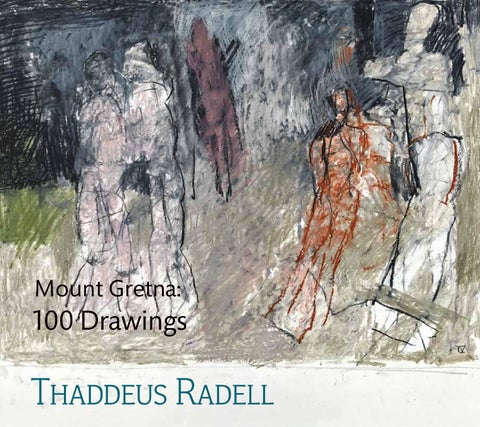
Mount Gretna: 100 Drawings
Thaddeus Radell
Front cover: No Exit (detail)
2019, oil pastel, graphite and wax crayon on Bristol paper, 19 x 24 in.

Thaddeus Radell

Mount Gretna:

100 Drawings

Portrait Study
2019, oil pastel, graphite and wax crayon on Bristol paper, 9 x 6¼ in.

For Lloyd Jerome Radell, who relentlessly and ever-restlessly inspired my life and art. And continues to.

This catalog accompanies the exhibition “Speak, Memory,” on view at Thomas Deans Fine Art in Atlanta, Georgia from October 8 to November 6, 2021.

All drawings were produced during the artist’s two-week teaching enagagement at the Mount Gretna School of Art, July-August 2019.

ISBN 978-1-68524-746-1

All images ©2021 Thaddeus Radell Catalog printing: The Studley Press Photography & design: John Goodrich

Van Gogh XX 2019, graphite on Bristol paper, 10½ x 5½ in.

Thaddeus Radell: Looking for Meaning

John Seed

Thaddeus Radell’s Mount Gretna Drawings

Mark kanter

Drawing, Ritual, Identity:

The Work of Thaddeus Radell

SiMon Carr

Engaging the World

John GoodriCh

Seeing the Part That Isn’t Done

JaSon ViSeltear

Thaddeus Radell: The Mystery of Connection

thoMaS deanS

On the Banks of the Acheron (detail) 2019, oil pastel, graphite and wax crayon on Bristol paper, 14 x 17 in.

Thaddeus Radell: Looking for Meaning

John Seed

Thaddeus Radell’s drawings start with mark making. From rich grounds of jotted, smudged and briskly applied strokes, figures emerge in improvised relationships. Narratives emerge too—implied rather than illustrated—and Radell’s disinterest in academic drawing methods ensures that much will be left open to the imagination. A certain tension is also maintained, as Radell likes the marks of his process to be very taut, both as vectors and as carriers of meaning. He likes to begin abruptly and keeps in mind that “any one mark will shift all the others.” It is the attitude of an artist/alchemist who understands the implicit magic of image making.

The idea of the artist/alchemist, which James Elkins explored in his book “What Painting Is,” has a considerable draw for Radell. Interested in the idea

of hypostasis—a religious term which describes the infusion of spirit into something inert—Radell is fascinated by the idea that an artist manipulating and responding to materials can discover a kind of window into deeper meaning. As Elkins comments in his book, the artist/alchemist is capable of “hypostatic contemplation” in which paint “seems irresistibly to mean, as if the littlest dab must signify something.”

Radell’s process is both intuitive and counter-intuitive as he has an inclination to “not accept” any mark as it first appears. Consciously restless, his sense that “search is everything” reveals the underlying spiritual inclinations that motivate his art. When he makes a mark, Radell will often recognize not that it is something, but rather that it might be something: an arm, a bent leg, a face. Radell is fascinated by the idea that

an artist manipulating and responding to materials can discover a kind of window into deeper meanings. The uncertainties that his process generates raise questions—about meaning and about narrative— and as the questions multiply the work generates an enormous sense of imaginative possibility. Or to put it another way, they glow with the fire of possibility and can reveal some of life’s meanings.

At a subliminal level some of Radell’s images seem to connect with memories: possibly of Old Master paintings and drawings.The traces of transcendence, resurrection and mortality that flicker behind his gestural traces link Radell’s work to the longer history of art. He is attuned to the work of Modernists—Giacometti, de Kooning and Gorky—who channeled the anxieties of their times by re-shaping and re-constituting form. The integrity of Radell’s art is rooted in its insistence that finding is everything. In his view, the past is best understood when it can be reinvigorated with subjec-

tivity. The job of a living artist—in that situation—is to ask the right questions and open up the ripest possibilities. “I’m looking for some kind of meaning” is how Radell puts it. “I’m a visual person and my art reflects how I see the world.” And a challenging and invigorating world it is indeed.

During the summer of 2019, painter Thaddeus Radell taught life drawing at the Mount Gretna School of Art. When he wasn’t teaching, Radell was in his studio drawing constantly, creating well over 130 works, using wax crayons, graphite and oil pastel. Although the school’s scenic location offered the opportunity to work from nature, Radell spent his free time rendering images of the human figure drawn from his imagination. Each of the varied drawings Radell made while at Mount Gretna relies on figurative imagery, some invented and some inspired by studies made in his sketchbook. A selection of these studies have been selected for this catalog.

The Acheron 2019, oil pastel, graphite and wax crayon on Bristol paper, 19 x 24 in.
Led to Loss
2019, oil pastel, graphite and wax crayon on Bristol paper, 19 x 24 in.
Excavation
2019, oil pastel, graphite and wax crayon on Bristol paper, 19 x 24 in.
Expulsion
2019, oil pastel, graphite and wax crayon on Bristol paper, 19 x 24 in.

Advance

As Soldiers
2019, oil pastel, graphite and wax crayon on Bristol paper, 19 x 24 in.
Confrontation
2019, oil pastel, graphite and wax crayon on Bristol paper, 19 x 24 in.
No Exit
2019, oil pastel, graphite and wax crayon on Bristol paper, 19 x 24 in.
Homecoming
2019, oil pastel, graphite and wax crayon on Bristol paper, 19 x 24 in.
Threshold 2019, oil pastel, graphite and wax crayon on Bristol paper, 14 x 17 in.
Matriarch
2019, oil pastel, graphite and wax crayon on Bristol paper, 19 x 24 in.
On the Banks of the Acheron 2019, oil pastel, graphite and wax crayon on Bristol paper, 19 x 24 in.
The Prodigal Son 2019, oil pastel, graphite and wax crayon on Bristol paper, 19 x 24 in.
The Vision
2019, oil pastel, graphite and wax crayon on Bristol paper, 19 x 24 in.
Return of the Prodigal Son 2019, oil pastel, graphite and wax crayon on Bristol paper, 19 x 24 in.
Penelope 2019, oil pastel, graphite and wax crayon on Bristol paper, 19 x 24 in.

At Sea (detail)

2019, oil pastel, graphite and wax crayon on Bristol paper, 14 x 17 in.

Thaddeus Radell’s

Mount Gretna Drawings

Mark Kanter

In July, 2020 the artist Thaddeus Radell was invited to work and teach at the Mount Gretna School of Art residency program in Central Pennsylvania. Radell took this opportunity to set for himself a manageable yet ambitious task: to complete a series of one hundred drawings over the course of his sixteen days at Mount Gretna. These drawings are published for the first time in this catalog. The completed project includes three modes of work: drawings of imagined groups of figures; nebulous, imagined portraits; and imagined portraits of one of Radell’s artistic heroes, Vincent van Gogh.

Radell is an artist who works through pure process. He approaches each and every drawing or painting with no a priori concept of what the end result will be. He finds each drawing or painting purely through the

act of drawing and painting. This manner of working requires an artist to be in constant dialogue with their work. The artist sometimes insists, sometimes cajoles, sometimes inflects, but first and foremost they must be able to listen consistently to what each work in process asks of them. Working with this type of process frequently means that an overly insistent act by the artist made upon the drawing or painting will often end in failure. Conversely, if the artist remains alert to the varieties of accidents which occur in process, what first appear to be apparent failures can open the work up to new, unforeseen discoveries.

There is a well known saying in some lineages of painting and drawing that “the first mark is the fifth line.” From the very first moment that a two

dimensional picture plane is interrupted, that initial mark instantly relates to the absolute unity inherent within the four sides of the plane itself. That first interruption, by nature, is in relationship to the whole; in relation to the unity within the blank rectangular plane. For the process oriented artist, this “picture plane”embodies the infinite, with all the possibility therein. Every subsequent mark made by the artist must then relate both to the whole, and to each prior and subsequent mark. It is, therefore, the artist’s task throughout the process to maintain, and, ultimately, arrive again at absolute unity. What we name the “drawing” or “painting” is the record of this labor, the artist’s odyssey from unity to unity.

Radell is a member of what I call the “meta-process” painters; artist sfor whom the elements, materials and activity of painting and drawing make for both the resultant work’s “object matter” and towards a more elusive “subject”. In Radell’s case “object matter” means recognizable forms of people, animals, and landscapes, for non-figurative painters “object matter” is simply form and space, without specific imagery. I refer to all these artists as “meta-process” because their studio work is aimed towards subjects that can not be predetermined, nor limited to nameable form. Object and subject are not the same. Yet the artist has to be willing to discover forms for the true subject to be realized. The subject cannot only inhere in the object matter of the works, just as poetry doesn’t inhere in only the form of language in which it is written. Meta-process artists do not seek to simply mimic perception or to make statements, they seek the ineffable.

Radell has many series of paintings and drawings in his oeuvre which are configured from meta-process instincts and practice. I’ve written before about his connection to the poetry of Dante Alighieri. I wrote about how the modern myths from Dante’s “Commedia” set Radell’s intention for several works which embody found moments from Dante’s poem. Radell has said that his intention for the Mt. Gretna series of drawings, on the other hand, was simply to make one hundred pieces by the end of the residency. Unlike much of his overtly mythologically oriented work there was no other precipitating idea upon which to embark except the project itself.

I believe the task that Radell set for himself at Mt. Gretna liberated the artist and his process from tried and true forms contained by mythological reference. By Radell’s having avoided this type of intentionality, he allowed himself to travel in unknown states, with no roadmap. The groups of figures in the Mount Gretna drawings have no names. They are mysterious, without reference, like figures encountered distantly in a dream, or briefly imagined at a glance passing in the dark.

The later imagined portraits are refinements of these dream figures, like mugshots for the perpetrators of those moments found in the earlier drawings. They look like indistinct beginnings of police sketches. These suspects are only slightly less mysterious than the distant figures, their intent is unknown and uninterrogated.

Radell completed his Mount Gretna odyssey with a further series of portraits. As the work progressed,

The Victor 2019, oil pastel, graphite and wax crayon on Bristol paper, 14 x 17 in.
Purgatorio
2019, oil pastel, graphite and wax crayon on Bristol paper, 14 x 17 in.

the portraits became more and more specific. Radell began to find that the new portrait figures were becoming familiar. In his search, through the vehicle of drawing, Radell found himself repeatedly uncovering the image of Vincent van Gogh.

The van Gogh drawings from Mount Gretna find van Gogh painting, or trudging off to paint. In these resonant images of van Gogh at ceaseless work (exceptionally prolific, van Gogh famously only sold one painting in his lifetime) Radell unconsciously embodies the notion of “process” itself.

The irony for me, as a long time viewer of Radell’s work, is that despite setting a task with no prior

intent towards manufacturing content, in the end Radell arrived at content regardless. It’s the image of van Gogh, the tragic hero of process painting, that Radell uncovers.

Having abandoned a mythological intent in this series of 100 drawings, Radell, in the figure of van Gogh, ends up mythologizing the very act of drawing and painting. Like Homer’s Odysseus at the River of Ocean, Radell pours libations and makes sacrifices to summon shades. Some are indistinct, some more clear, but Radell’s vocal Achilles and Tiresias turns out to be van Gogh, whose timeless message to Radell, and all who care to hear it is to draw and paint in order to understand creation.

Hailing Charon 2019, oil pastel, graphite and wax crayon on Bristol paper, 14 x 17 in.
Swagger
2019, oil pastel, graphite and wax crayon on Bristol paper, 14 x 17 in.
Prisoner
2019, oil pastel, graphite and wax crayon on Bristol paper, 14 x 17 in.
Poet
2019, oil pastel, graphite and wax crayon on Bristol paper, 14 x 17 in.
At Sea 2019, oil pastel, graphite and wax crayon on Bristol paper, 14 x 17 in.
Complicity
2019, oil pastel, graphite and wax crayon on Bristol paper, 14 x 17 in.

Departure for Conflict

2019, oil pastel, graphite and wax crayon on Bristol paper, 14 x 17 in.
Captain 2019, oil pastel, graphite and wax crayon on Bristol paper, 14 x 17 in.
And the Sky is Blue 2019, oil pastel, graphite and wax crayon on Bristol paper, 14 x 17 in.
Running with the Clouds 2019, oil pastel, graphite and wax crayon on p Bristol aper, 14 x 17 in.
Bathers
2019, oil pastel, graphite and wax crayon on Bristol paper, 14 x 17 in.
Battle Scene
2019, oil pastel, graphite and wax crayon on Bristol paper, 14 x 17 in.
The Mask
2019, oil pastel, graphite and wax crayon on Bristol paper, 19 x 24 in.
The Obedient 2019, oil pastel, graphite and wax crayon on Bristol paper, 14 x 27 in.
The Road Goes Ever Ever On 2019, oil pastel, graphite and wax crayon on Bristol paper, 14 x 17 in.
The Suitors
2019, oil pastel, graphite and wax crayon on Bristol paper, 14 x 17 in.
To Heal
2019, oil pastel, graphite and wax crayon on Bristol paper, 14 x 17 in.
The Informant 2019, oil pastel, graphite and wax crayon on Bristol paper, 14 x 17 in.
Blue
2019, oil pastel, graphite and wax crayon on Bristol paper, 14 x 17 in.
Exit Stage Right 2019, oil pastel, graphite and wax crayon on Bristol paper, 14 x 17 in.
To Beckon 2019, oil pastel, graphite and wax crayon on Bristol paper, 14 x 17 in.
Awakening 2019, oil pastel, graphite and wax crayon on Bristol paper, 14 x 17 in.

Ochre Interior (detail)

2019, oil pastel, graphite and wax crayon on Bristol paper, 11 x 17 in.

Drawing, Ritual, Identity: The Work of Thaddeus Radell

Drawing is fundamental to our practice as artists, as so many of us were taught and continue to teach. For a visual artist drawing comes close to being the process of thinking itself. The weighing and balancing, the investigation of process and questioning of results is cognition for an artist. It might even be said that without drawing we can’t “see” at all. Despite contemporary voices that see drawing as “marks” or just another medium to use, Drawing’s place as a fundamental core of experience itself still holds for many.

My own admiration for Thaddeus Radell’s drawings come from an appreciation of his grace and elegance as a draughtsman, his sure, delicate line is a pleasure to experience. But beyond that, for those who know his paintings, it is seeing the juggling of so many ideas and possibilities, the insights these drawings give us into how line or color represent, or how they maintain their own identity in the visual world of his imagination. Imagination is the key to understanding these

drawing, his own imagination and how he provokes our own. He convinces the viewer that something of importance is happening, like any good drawing, but beyond that gives us entrance into that world of weights and lines, all moving within a limitless field, a limitless horizon of space. His lines are projections into that space, circling and colliding with larger masses of color and shape, opening up our visual field and inviting us in. How these elements resolve and balance is the drama, the emotional climax of these brief sonatas. Like the Bach he loves, these images display the elements of Drawing, and then extend the visual possibilities beyond what we might have thought possible, not just formally, but as in a Bach Cello Suite, into emotional ground we couldn’t have anticipated.

My apologies for this wordy, overwrought text. A text like this tries to do the impossible, to appreciate or describe something that can’t be caught in a net of words. I can only hope to point, emphatically, to the work here reproduced.

Falling 2019, oil pastel, graphite and wax crayon on Bristol paper, 11 x 17 in.
Bathers Resting 2019, oil pastel, graphite and wax crayon on Bristol paper, 11 x 17 in.

Into the Night

2019, oil pastel, graphite and wax crayon on Bristol paper, 11 x 17 in.

Night Wanderings

2019, oil pastel, graphite and wax crayon on Bristol paper, 11 x 17 in.
Ochre Interior
2019, oil pastel, graphite and wax crayon on Bristol paper, 11 x 17 in.
Step 2019, oil pastel, graphite and wax crayon on Bristol paper, 11 x 17 in.

Artist I (detail)

2019, oil pastel, graphite and wax crayon on Bristol paper, 14 x 17 in.

Engaging the World

Drawing serves artists in such different ways. Ingres famously called it the “probity” of art. Color was for him just an added attraction: “It takes 25 years to learn to draw, one hour to learn to paint.” For his contemporary Delacroix, on the other hand, drawing acted as the scaffolding for expressions of color. “Painters who are not colorists produce illumination,“ he wrote, “not painting.” Degas arguably bridged the two positions; an avid collector of the work of both masters, he combined, in his most rigorous drawings, Ingres’ linear precision and Delacroix’s urgent arabesques.

Expectations of drawing were reshuffled in the modern age. Cubism investigated the contradictions inherent in re-creating an object from any one point of view, while Abstract Expressionism

foregrounded the very process of the searching for a truth. Pop probed, by mimicking, the genericization of images in a post-modern, mass-consumption society.

Given the bewildering possibilities, today’s artist could easily wilt when picking up a pencil or stick of charcoal. Thaddeus Radell, however, found his own path many years ago, and has stuck doggedly with it ever since, continuously refining and extending his approach.This catalog includes scores of some of the artist’s most recent drawings, produced during a 2019 teaching engagement at the Mount Gretna School of Art.

Radell’s reworked, quivering lines recall the anxiety of Cézanne or Giacometti, but he employs a wider range

of materials than either of these modern masters. We might in fact detect the stronger influence of de Kooning or Pollock in his preference for urgent nests of marks over classical intervals and lucid geometries. Delicacy and rawness of touch combine in his drawings, shaping human figures and the occasional tree or architectural element in looping, criss-crossing lines, and aerating their masses with cannily untouched regions of paper. Noble events—heroic battles, journeys, encounters—emerge with a certain abject raggedness, as if the artist were reliving, in real time, his subjects’ doubts and trials. Radell seems compelled, in short, not by the aesthetic mannerisms of the epic, but by its down-to-earth ramifications.

Among these recent drawings, a series depicting a lone backpacker, variously standing and striding in a featureless space, stands out in its simplicity and directness. I like to think of them as inspired by a much-reproduced photograph of Cézanne, posing alongside a roadside with a French easel strapped to his back. What image more powerfully evokes the lonely intensity of the artist, about to confront the immense variety of nature? It’s an effect vividly captured in Radell’s modeling of human forms—coarse, yet taut amidst the expansive surround of paper. It’s the dilemma of every artist before an easel: fully alone, engaging the whole world.

Artist IV
2019, oil pastel, graphite and wax crayon on Bristol paper, 14 x 17 in.
Artist II
2019, oil pastel, graphite and wax crayon on Bristol paper, 14 x 17 in.
Artist IX
2019, oil pastel, graphite and wax crayon on Bristol paper, 14 x 17 in.
Artist VII
2019, oil pastel, graphite and wax crayon on Bristol paper, 14 x 17 in.
Artist XIV
2019, oil pastel, graphite and wax crayon on Bristol paper, 14 x 17 in.
Artist V 2019, oil pastel, graphite and wax crayon on Bristol paper, 14 x 17 in.
Artist XII
2019, oil pastel, graphite and wax crayon on Bristol paper, 14 x 17 in.
Artist VIII
2019, oil pastel, graphite and wax crayon on Bristol paper, 14 x 17 in.
Artist X 2019, oil pastel, graphite and wax crayon on Bristol paper, 14 x 17 in.
Artist XI
2019, oil pastel, graphite and wax crayon on Bristol paper, 14 x 17 in.
Artist XIII
2019, oil pastel, graphite and wax crayon on Bristol paper, 14 x 17 in.
Artist I
2019, oil pastel, graphite and wax crayon on Bristol paper, 14 x 17 in.
Artist VI
2019, oil pastel, graphite and wax crayon on Bristol paper, 14 x 17 in.
Artist III
2019, oil pastel, graphite and wax crayon on Bristol paper, 14 x 17 in.
Bathers
2019, oil pastel, graphite and wax crayon on Bristol paper, 14 x 17 in.
Red Figure Rising 2019, oil pastel, graphite and wax crayon on Bristol paper, 14 x 17 in.
Procession
2019, oil pastel, graphite and wax crayon on Bristol paper, 14 x 17 in.
Breaking Camp 2019, oil pastel, graphite and wax crayon on Bristol paper, 14 x 17 in.
Charon
2019, oil pastel, graphite and wax crayon on Bristol paper, 14 x 17 in.
Silence
2019, oil pastel, graphite and wax crayon on Bristol paper, 14 x 17 in.
Flagellation
2019, oil pastel, graphite and wax crayon on Bristol paper, 14 x 17 in.
Entombment
2019, oil pastel, graphite and wax crayon on Bristol paper, 14 x 17 in.
Entrance 2019, oil pastel, graphite and wax crayon on Bristol paper, 14 x 17 in.
On the Edge of the Crowd
2019, oil pastel, graphite and wax crayon on Bristol paper, 14 x 17 in.
Fallen Soldier 2019, oil pastel, graphite and wax crayon on Bristol paper, 14 x 17 in.
Battle Scene
2019, oil pastel, graphite and wax crayon on Bristol paper, 14 x 17 in.
The Elders 2019, oil pastel, graphite and wax crayon on Bristol paper, 14 x 17 in.
Embarkment
2019, oil pastel, graphite and wax crayon on Bristol paper, 14 x 17 in.
Assisting the Fallen 2019, oil pastel, graphite and wax crayon on Bristol paper, 14 x 17 in.

Judgement

2019, oil pastel, graphite and wax crayon on Bristol paper, 14 x 17 in.

Wild Horses
2019, oil pastel, graphite and wax crayon on Bristol paper, 14 x 17 in.
Dante and Virgil, Charon
2019, oil pastel, graphite and wax crayon on Bristol paper, 14 x 17 in.
Encounter 2019, oil pastel, graphite and wax crayon on Bristol paper, 14 x 17 in.

The Question

2019, oil pastel, graphite and wax crayon on Bristol paper, 14 x 17 in.
Musicians 2019, oil pastel, graphite and wax crayon on Bristol paper, 14 x 17 in.
Woodland Nymphs
2019, oil pastel, graphite and wax crayon on Bristol paper, 14 x 17 in.
The Aggressed 2019, oil pastel, graphite and wax crayon on Bristol paper, 14 x 17 in.
Pan
2019, oil pastel, graphite and wax crayon on Bristol paper, 14 x 17 in.
Blue Arrival
2019, oil pastel, graphite and wax crayon on Bristol paper, 14 x 17 in.
Bathers
2019, oil pastel, graphite and wax crayon on Bristol paper, 14 x 17 in.
Late to Harvest 2019, oil pastel, graphite and wax crayon on Bristol paper, 14 x 17 in.
Prelude to Batttle 2019, oil pastel, graphite and wax crayon on Bristol paper, 14 x 17 in.
Mythological Scene
2019, oil pastel, graphite and wax crayon on Bristol paper, 14 x 17 in.
Away, Away, Ere Break of Day
2019, oil pastel, graphite and wax crayon on Bristol paper, 14 x 17 in.
The Descent to the Acteon 2019, oil pastel, graphite and wax crayon on Bristol paper, 14 x 17 in.

Van Gogh XII (detail)

2019, graphite on Bristol paper, 11½ x 6 in.

Seeing the Part That Isn’t Done

Jason Viseltear

It’s a Tuesday night and I’m meeting Thaddeus at Spain. At, not in. At the restaurant on 13th St. called Spain, here, in New York; not in the country that is called Spain. We’re here, not there.

So Spain’s a good place. There’s just enough to eat and drink to match one’s wallet and time. Certainly enough to go with the conversation. And when that’s done—be you with friends, colleagues, family—you retire, say farewell, easily, until the next time, which is not so much a promise but a proposition repeated and proved. Maybe the table benefits from the relationship that friends bring to it, and not the other way around. Intertwined at least if not parallel. Never mind which comes first, as long as the one supports the other. That, we do mind.

That takes attention. The structures that support like a table better hold some weight—of a meal, a

drink, a stain, a conversation; the things that are laid out, spilled, thrown down, consumed. These theses, secrets, dares, ideas. Built up. Reduced down. Repaired. What’s a table to do without our words? And how will our wounds repair without a surface to support them? Too early for that maybe, Thaddeus arrives, we smile, wine is poured. Sliced potatoes drenched in hot sauce are placed before us without anyone asking; meatballs with toothpicks, paper napkins.

Thaddeus draws. That, you know. Finally there’s a picture that can’t contain what a face or figure can’t contain. When it bursts inward with emotion or out in action. When it can’t hold its bounds. When, like Euclid’s lines, it extends off the page—there’s either some bit we’re missing or too simple an assumption about how things will maintain their relationship

when they pass into a space extended. It’s too far away. And a couple thousand years of trying to prove that what’s current might be maintained indefinitely, failed. It seems we have to be there and here. Which of course we can’t. The work done that brought us up must both be trusted as sound and recognized as impossible to reproduce in one sitting. Would an explosion or failure allow its picking up or piecing back together? We’d be well to doubt that very much. To include that in the picture is something else.

Thaddeus’ drawings help me see this part that isn’t done, the parts that if not inserted will remain missing or go missing. To give an origin now to what precedes us or not recognize ourselves going forward, nor actions for which we are responsible—crucial

this, yes, but half the task. The other part I think is to see the things Thaddeus draws so well, the things he has the courage to fail at capturing, and by doing so drawing us into it. I wonder at how much work is there. How much that takes! In order to join the table that is layered and cluttered and to both discern a difference between the two and to explode it in a way that could mean absolutely everything to us, that may be beautiful to us, that may be loved by us, allowing a collapsing into that space, where our absence is both recognized and allowed to reside there. How to prop that up? How to set it like my friend for those who will arrive and leave something of themselves to return to, and who by looking, listening, speaking, playing, may be every single time, at least, or at long last…missed.

Van Gogh XV 2019, graphite on Bristol paper, 11 x 5 in.
Van Gogh X 2019, graphite on Bristol paper, 11 x 6½ in.
Van Gogh I 2019, graphite on Bristol paper, 12½ x 6 in.
Van Gogh III 2019, graphite on Bristol paper, 12 x 5½ in.
Van Gogh XVI 2019, graphite on Bristol paper, 12 x 5½ in.
Van Gogh IV 2019, graphite on Bristol paper, 12 x 5½ in.
Van Gogh IX 2019, graphite on Bristol paper, 12 x 5½ in.
Van Gogh V 2019, graphite on Bristol paper, 11½ x 5½ in.
Van Gogh XIX 2019, graphite on Bristol paper, 11½ x 6 in.
Van Gogh VIII 2019, graphite on Bristol paper, 11 x 5½ in.
Van Gogh VI 2019, graphite on Bristol paper, 11½ x 5½ in.
Van Gogh XIV 2019, graphite on Bristol paper, 12 x 6 in.
Van Gogh XII 2019, graphite on Bristol paper, 11½ x 6 in.
Van Gogh XVIII 2019, graphite on Bristol paper, 12 x 5½ in.
Van Gogh II 2019, graphite on Bristol paper, 12 x 5½ in.
Van Gogh VII 2019, graphite on Bristol paper, 12 x 6 in.
Van Gogh XI 2019, graphite on Bristol paper, 12 x 5½ in.
Van Gogh XIII 2019, graphite on Bristol paper, 12 x 6 in.
Van Gogh XVII 2019, graphite on Bristol paper, 11½ x 5 in.

Portrait

Thaddeus Radell: The Mystery of Connection

Thomas Deans

When I first met Thaddeus Radell on a visit to his studio, I already knew his reputation as an artist’s artist of exceptional gifts and fidelity to his vision. For me, the power of his paintings commanded great admiration.

My surprise was in seeing his drawings, which provoked a love affair. I remember that he produced a stack, which he balanced on a small, unsteady computer stand while explaining that his normal process was to draw daily for an hour before commencing to paint. From the first glance, I fell under the spell of his drawings.

My background was in this area, both as a collector and later as a dealer. I saw in Thaddeus’s work an artist familiar with the long history of Western art, unafraid to take a tradition for his own, and able to do it with a rare gift for making every line inten-

tional and meaningful. This strength of intention illuminates the slightest of his works. Even those not consciously completed nevertheless have a quality of rightness; the artist has taken his ideas as far as was needed to express something essential.

I have seen my engagement with Radell’s drawings repeated countless times in the gallery by clients of every level of experience. Browsers, designers, collectors, consultants, and dealers have all stopped in their tracks in front of his drawings.

Several facets of these works appear to make them compelling to this broad swath of viewers. One is the use of local color, which plays an essential role in most of his drawings. Radell chooses his colors to heighten emotion. At times color defines the “action” or the

limits of the pictorial space. Sometimes the color stands apart from both. On occasion, color conveys the atmosphere, and less frequently, it all but disappears.

Radell’s figures compel interest, though they are virtually always “faceless.” Some create action through pose and gesture, while others act as onlookers. A figure may stand in opposition to another or a small group of others.

When I look at Radell’s drawings, I’m often reminded of compositional sketches by George Romney (1734-1802). The artist seeks to find the most affecting grouping possible without defining a single face or expression. Another example is a heavily worked ink sketch of St Peter the Hermit by Salvator Rosa (1615-1673). It shows the artist repositioning the saint’s arms multiple times, creating a Shiva-like effect of devotional intensity as one idea is quickly overlaid by another. I see this same effect in Radell’s work, where multiple countervailing lines in a drawing create a sense of stasis, indecision, or movement.

I’m surprised at how often admirers fail to notice that Radell’s figures are rarely complete as figures because they appear so fully alive. The artist draws enough to activate them as participants in a drama while sparing viewers the careful description of limbs that would allow all mystery to escape. Noteworthy, however, is their placement on the paper, which conveys a sense of three-dimensional space. This space unites them as interactive participants in a drama instead of individual unaffiliated sketches.

Radell creates his magic in part by leaving room for viewers to bring to bear their ideas and experiences. Avoiding depiction of something absolute, Radell provokes viewers’ interest in imagining narratives and attributing meaning. The sheer beauty of the marks, textures, and colors create an added enticement. In the end, all of these elements, combined with the artist’s certainty in mark-making, create a masterful pictorial space that allows viewers to contemplate, ponder, or react, experience, and feel a connection with Thaddeus Radell’s remarkable creations.

Portrait Study I

2019, oil pastel, graphite and wax crayon on Bristol paper, 8½ x 5½ in.
Portrait Study VIII 2019, oil pastel, graphite and wax crayon on Bristol paper, 9½ x 5½ in.

Study V

Portrait
2019, oil pastel, graphite and wax crayon on Bristol paper, 9 x 6 in.
Portrait Study IV 2019, oil pastel, graphite and wax crayon on Bristol paper, 9 x 6 in.

Portrait Study III

2019, oil pastel, graphite and wax crayon on Bristol paper, 8¾ x 6¾ in.
Portrait Study XXIV 2019, oil pastel, graphite and wax crayon on Bristol paper, 8¾ x 5½ in.
Portrait Study VII
2019, oil pastel, graphite and wax crayon on Bristol paper, 8¾ x 6 in.
Portrait Study X 2019, oil pastel, graphite and wax crayon on Bristol paper, 9 x 6¼ in.

Portrait Study XI

2019, oil pastel, graphite and wax crayon on Bristol paper, 8¾ x 6 in.
Portrait Study XII 2019, oil pastel, graphite and wax crayon on Bristol paper, 9 x 6 in.

Portrait Study XIX

2019, oil pastel, graphite and wax crayon on Bristol paper, 8½ x 5¾ in.
Portrait Study XVI 2019, oil pastel, graphite and wax crayon on Bristol paper, 9¼ x 6 in.
Portrait Study XVII
2019, oil pastel, graphite and wax crayon on Bristol paper, 9¼ x 6 in.
Portrait Study XX 2019, oil pastel, graphite and wax crayon on Bristol paper, 9 x 5¾ in.

Portrait Study XVIII

2019, oil pastel, graphite and wax crayon on Bristol paper, 9¼ x 6½ in.
Portrait Study II
2019, oil pastel, graphite and wax crayon on Bristol paper, 9½ x 6¾ in.

Portrait Study XV

2019, oil pastel, graphite and wax crayon on Bristol Bristol paper, 9¼ x 5¾ in.
Portrait Study IX
2019, oil pastel, graphite and wax crayon on Bristol paper, 9½ x 6½ in.

VI

Portrait Study
2019, oil pastel, graphite and wax crayon on Bristol paper, 9¼ x 6 in.
Portrait Study XXI
2019, oil pastel, graphite and wax crayon on Bristol paper, 9 x 6¼ in.
Portrait Study XIII
2019, oil pastel, graphite and wax crayon on Bristol paper, 8½ x 5½ in.
Portrait Study XXIII
2019, oil pastel, graphite and wax crayon on Bristol paper, 9 x 6½ in.
Portrait Study XIV
2019, oil pastel, graphite and wax crayon on Bristol paper, 8½ x 6 in.

Born and raised in Michigan, the son of two artists, Thaddeus Radell completed his B.F.A. at the University of Detroit/Mercy. He moved to New York City in 1980 to study at Parsons School of Design with Paul Resika, Leland Bell and Jack Heliker. After receiving his M.F.A. in 1982, he spent the next several years painting in the city and working as the studio assistant to Resika, Robert DeNiro, Sr., and the sculptor, Sydney Simon. In 1984 he moved to France, where he spent the next 14 years, dividing his time between studios in Paris and Provence.

Radell returned in 2000 to New York City, where he lived and worked until moving to Catskill, NY in 2019. He presently is Professor of Painting and Director of Studio Art at the Borough of Manhattan Community College/CUNY. He exhibits and curates regularly and occasionally writes reviews of exhibitions for such online publications as Artcritical.com and Paintingperceptions.com.

Radell is represented by Thomas Deans Fine Art in Atlanta, Georgia, and Alice Gauvin Gallery, Biddeford, Maine.

He has been a member of Bowery Gallery in New York City since 2014.

Simon Carr is a painter who lives in New York City and Cherry Plains, NY. He exhibits at Bowery Gallery in New York City and the Alice Gauvin Gallery in Portland, Maine. He teaches drawing at the Borough of Manhattan Community College.

Thomas Deans founded Thomas Deans Fine Art in 1983. He has written and lectured on the fine and performing arts in the United States and abroad for over four decades.

John Goodrich is a painter and writer on art who paints, teaches and writes in the New York City area. He currently exhibits at Bowery Gallery and teaches at Haverford College and Borough of Manhattan Community College.

Mark Thomas Kanter is an artist, educator, writer and curator who has exhibited widely in the US and abroad. He has taught fine art at Columbia University, American University in Washington, D.C., Dartmouth College, and SUNY New Paltz, among others. He lives and works near Woodstock, NY.

John Seed is a retired art professor—and also a painter, writer and curator—living on California’s central coast. His most recent book is Disrupted Realism: Paintings for a Distracted World which includes the work of 38 contemporary artists who are disrupting the traditions of realism in art.

When not making violin family instruments in his New York studio, award winning luthier Jason Viseltear has been trying to keep up with some reading and a number of friends whose ideas and works draw his love and attention. His writing can be found here and there, but more instruments than words out making a noise.

Many thanks to Jay Noble and the Mount Gretna School of Art for providing me the opportunity and context for this series of drawings.

Thanks also to John Seed, Mark Kanter, and Jason Viseltear for their discerning essays.

Special thanks and appreciation to Thomas Deans for his essay, enthusiasm, support and belief in my work.

Particular thanks to John Goodrich for his essay, patience and intrepidness in putting together this catalog.

A very special thanks to Simon Carr. In addition to being a lifelong friend and writing a thoughtful essay, he is my greatest inspiration for what drawing is.

And to Elaine, for her unflagging interest and trust in this project.

Back cover:

Figure Group VIII (detail) 2019, oil pastel, graphite and wax crayon on paper, 19 x 24 in.

Turn static files into dynamic content formats.
Create a flipbook