A MINIATURE MAESTÀ
Eliot W. Rowlands

A Miniature Maestà
by Bernardo Daddi and the Master of the Misericordia

Eliot W. Rowlands
by Bernardo Daddi and the Master of the Misericordia
BY NICHOLAS H. J. HALL
I will never forget the morning in Marco Grassi’s studio in SoHo when with enormous, and justi able pride, the celebrated restorer showed me an extraordinary triptych by Bernardo Daddi. It was in mint condition. I must have seen it in about 1993 and the painting was soon after acquired by the J. Paul Getty Museum, but I can remember as if it were yesterday the powerful impression that this painting made both for its expressive intensity and its sophistication of color, form and pa ern. e Virgin Mary with Saints omas Aquinas and Paul was on the cover of an exhibition held in 2012 entitled e Dawn of the Renaissance. It gives our gallery enormous pleasure to present another masterpiece by Bernardo Daddi which, though known to scholars, has never hitherto been fully studied.
It is all the more fascinating to be able to have delved into what Eliot Rowlands in his learned essay on the following pages describes as a “unicum,” in other words a unique survival from the late fourteenth century. For what we now see is a dialogue between two artists, Bernardo Daddi and the so-called Master of the Misericordia, now generally believed to have been Giovanni Gaddi, the eldest son of Taddeo and the man who continued his father’s successful workshop in Florence. e patron, we can assume a wealthy churchman, of this miniature Maestà adapted what may have been part of a triptych or diptych by Daddi and transformed it into a small altarpiece which he probably installed in a niche in his home for use as an aid to private devotion.
I have long been fascinated by so-called Gothic art and the history of its collecting. England was one of the rst countries to take an interest in the eld and Rowlands raises the intriguing possibility that this work, which we know was in Bath in the early twentieth century, may have been owned by a gure such as Horace Walpole or William Beckford. When I was at Colnaghi we were proud of our relationship with Isabella Stewart Gardner who was a pioneer collector in the field in the U.S. After her, a plethora of collectors including Johnson in Philadelphia and Lehman and then Kress in New York enriched American public collections with gold ground paintings of the highest quality. is interest is re%ected in the choice of curators appointed to important museums such as John Pope-Hennessey, Evere Fahy, Keith Christiansen, Laurence Kanter and Carl Strehlke who were all specialists in the eld.
Some of the highest prices paid for Old Master paintings have been in this area in recent years, among them the Stoclet Madonna by Duccio acquired by the Metropolitan Museum and the Cimabue bought by the Louvre, attesting to the importance that we still attach to this extraordinary moment in the history of Western art. So too does, at a more popular level, the enthusiasm shown by the public for the recent exhibition of Sienese art in New York and London and that of Fra Angelico in Florence.
Students of the period have historically held Bernardo Daddi in especially high regard. Raimond van Marle describes him as “one of the most re ned painters to be found in Florence in the early 14th century” while arguably the most distinguished scholar in the eld Richard O ner describes Daddi as “An artist of rare and exquisite gi(s…a master of supreme lyrical inspiration...(whose) lyricism suited a miniature rather than the monumental Gio esque mode of presentation.” e central part of this altarpiece is a perfectly preserved example of Daddi’s miniaturist style and so it is an honor for the gallery to be bringing such a remarkable work of art to the market.
March 2026

BY ELIOT W. ROWLANDS
FIG. 1
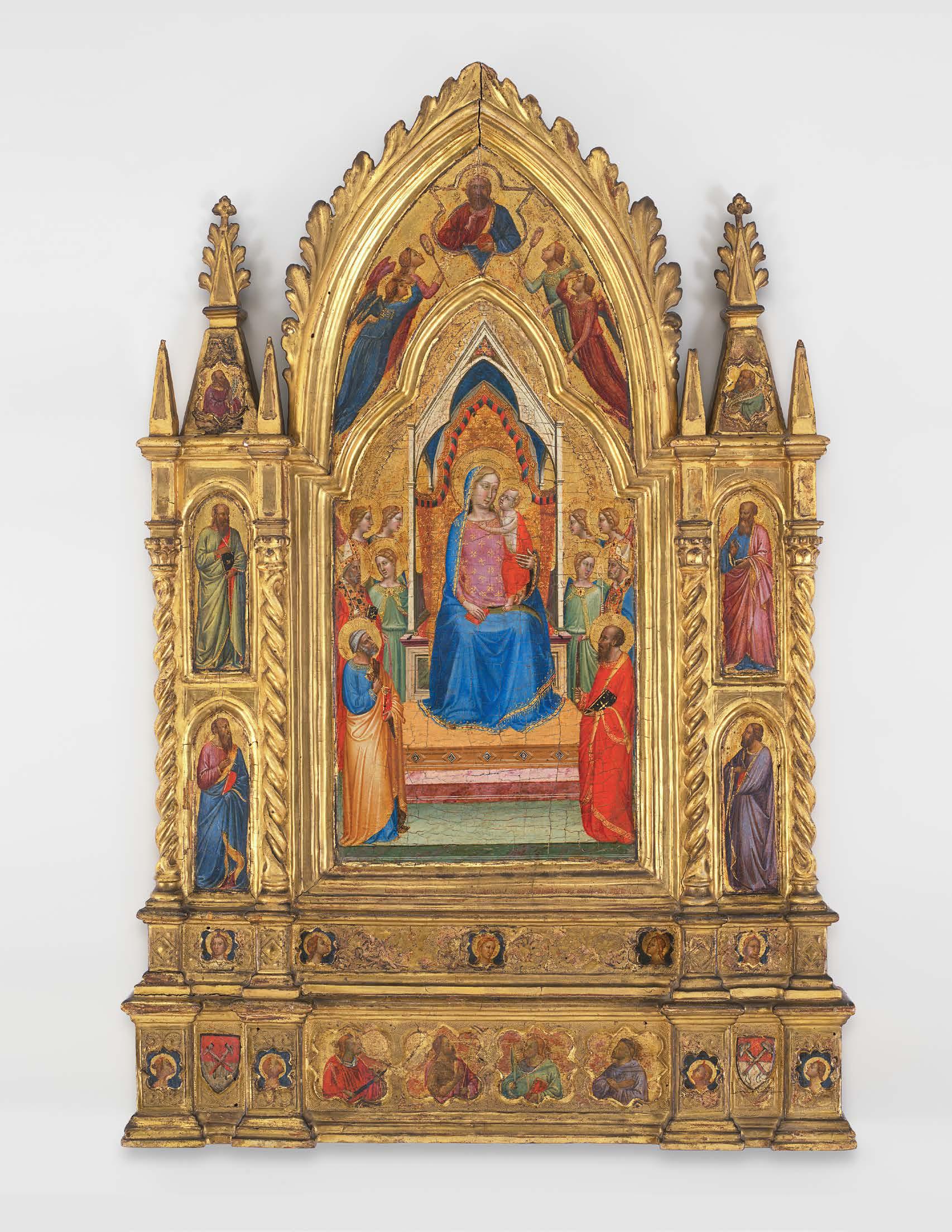
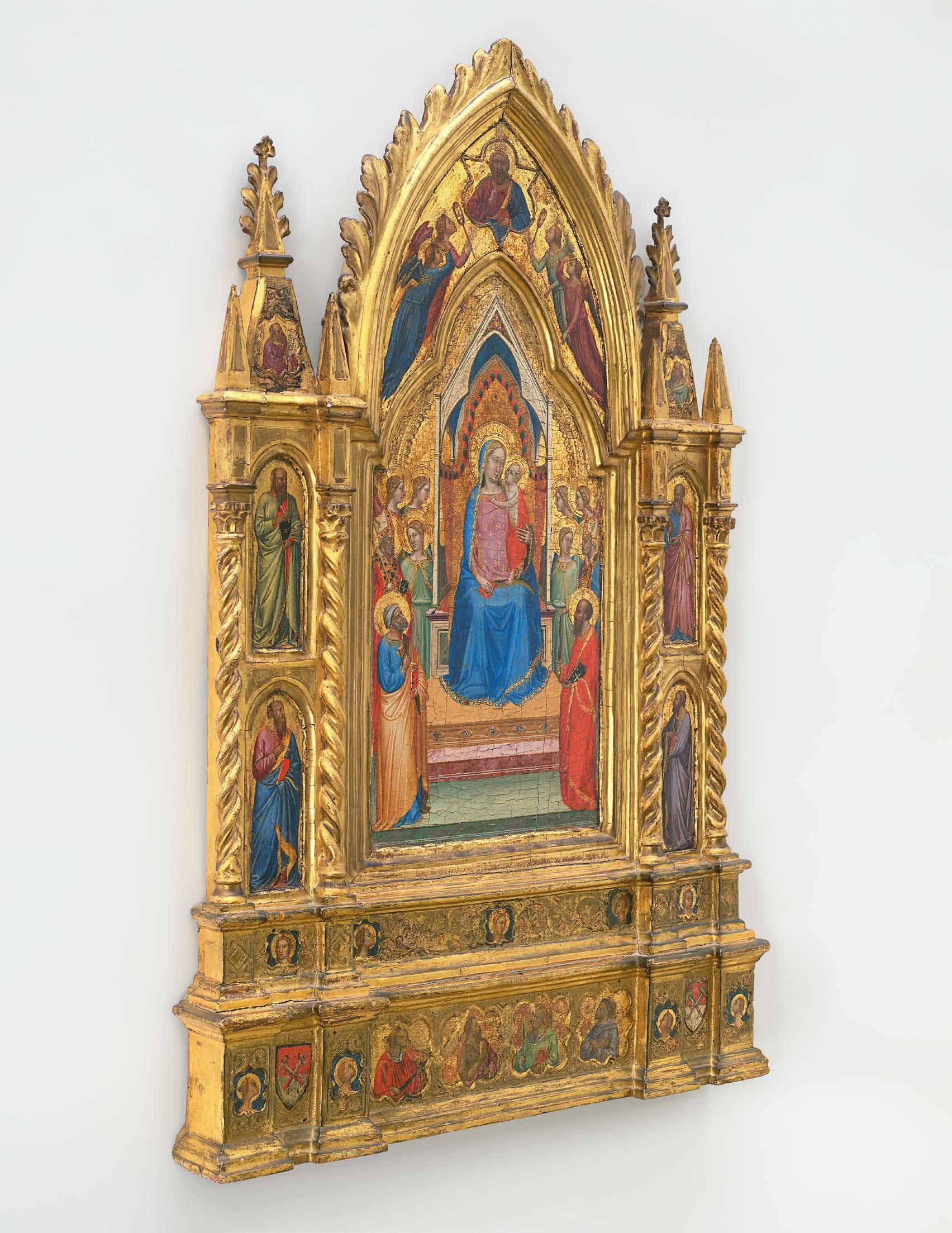
Bernardo Daddi and Master of the Misericordia, Madonna and Child Enthroned with Saints and Angels, 1335–37, recon gured ca. 1380. Private Collection
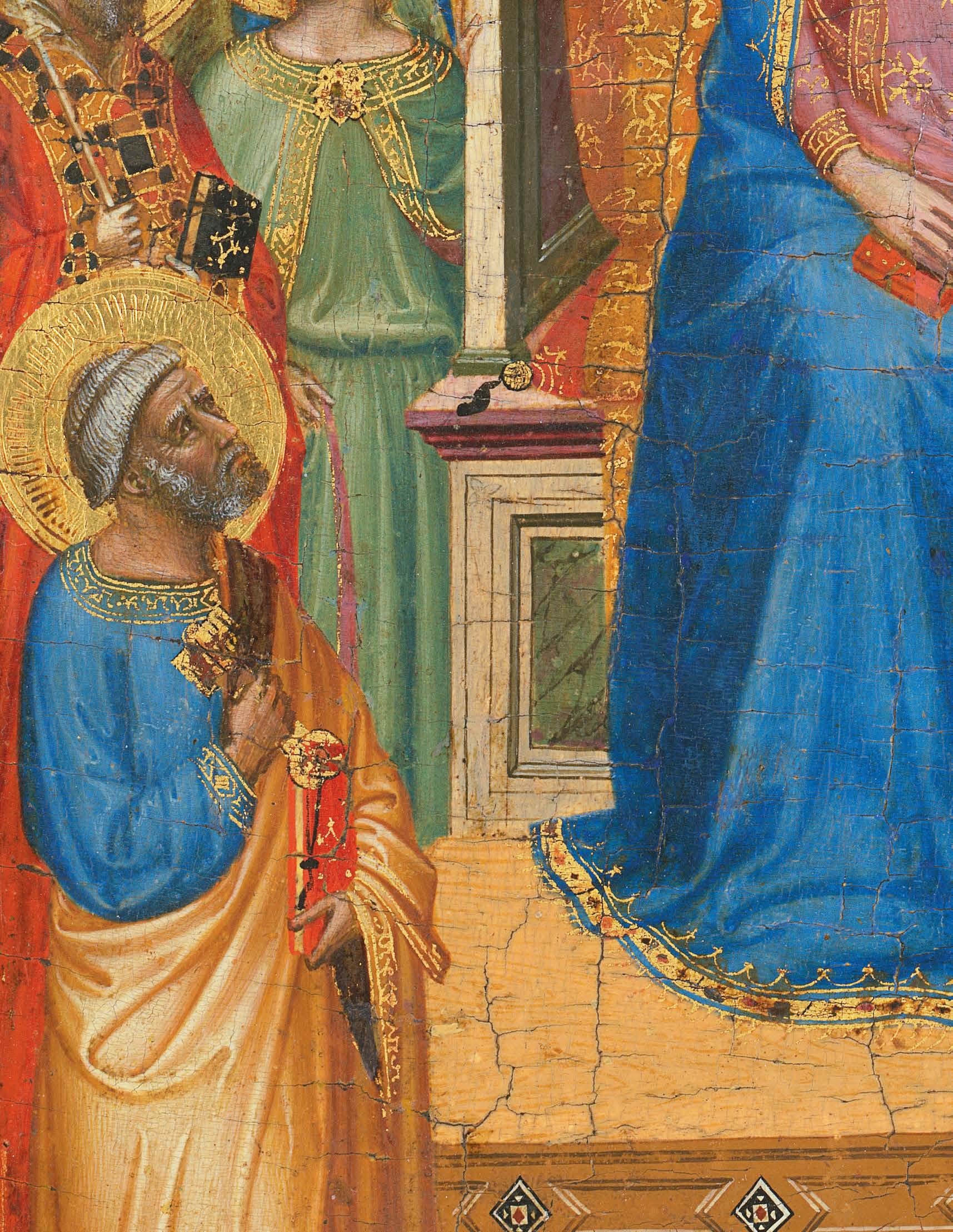
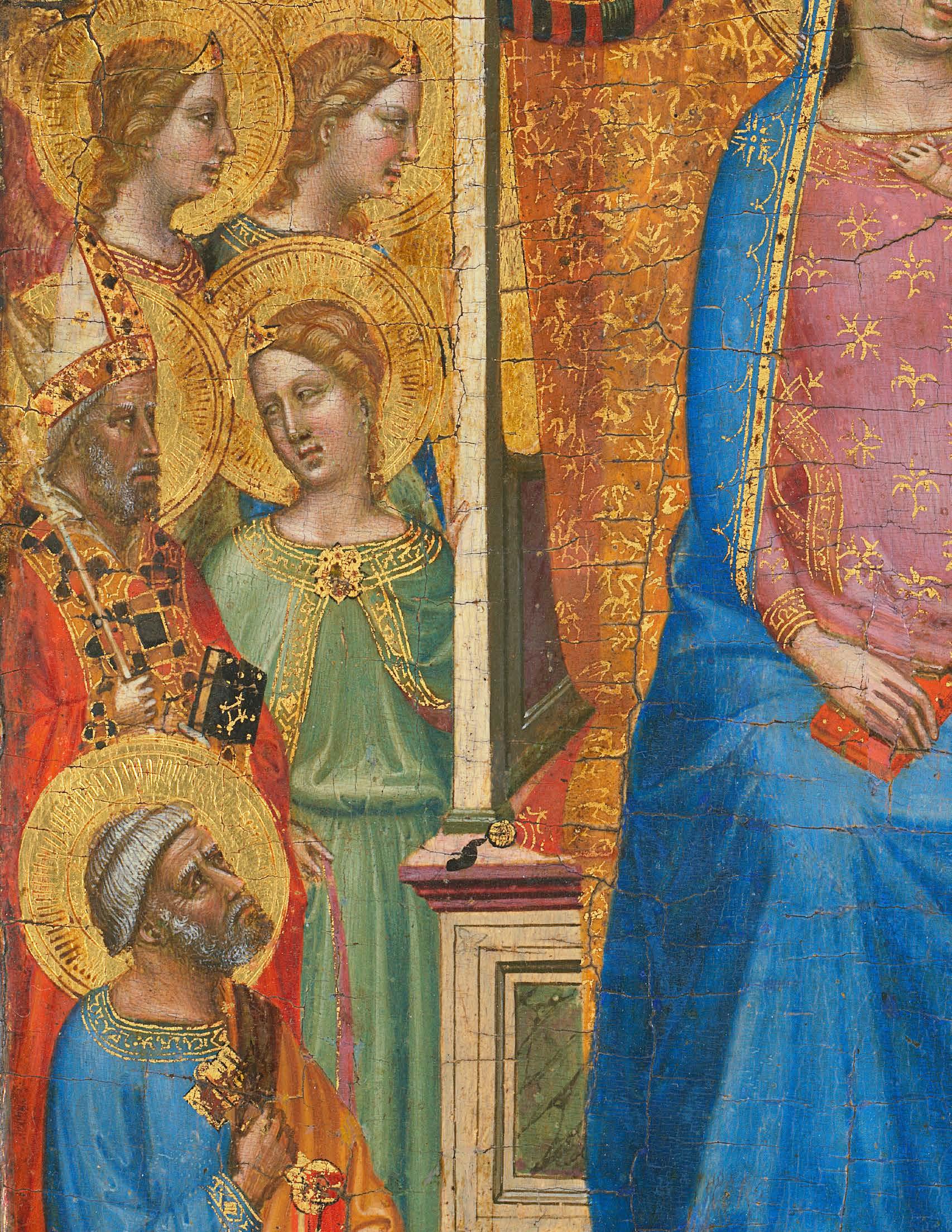
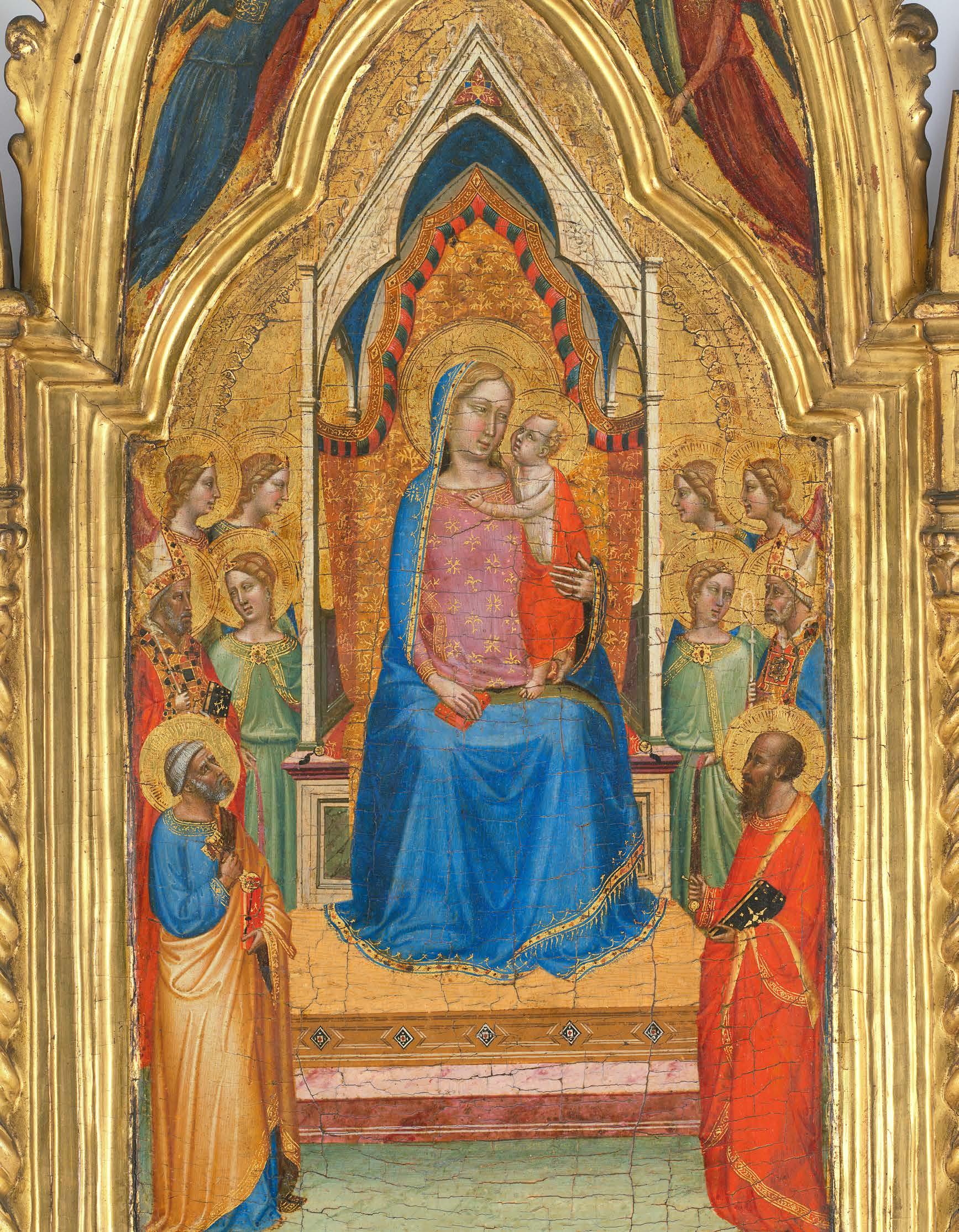
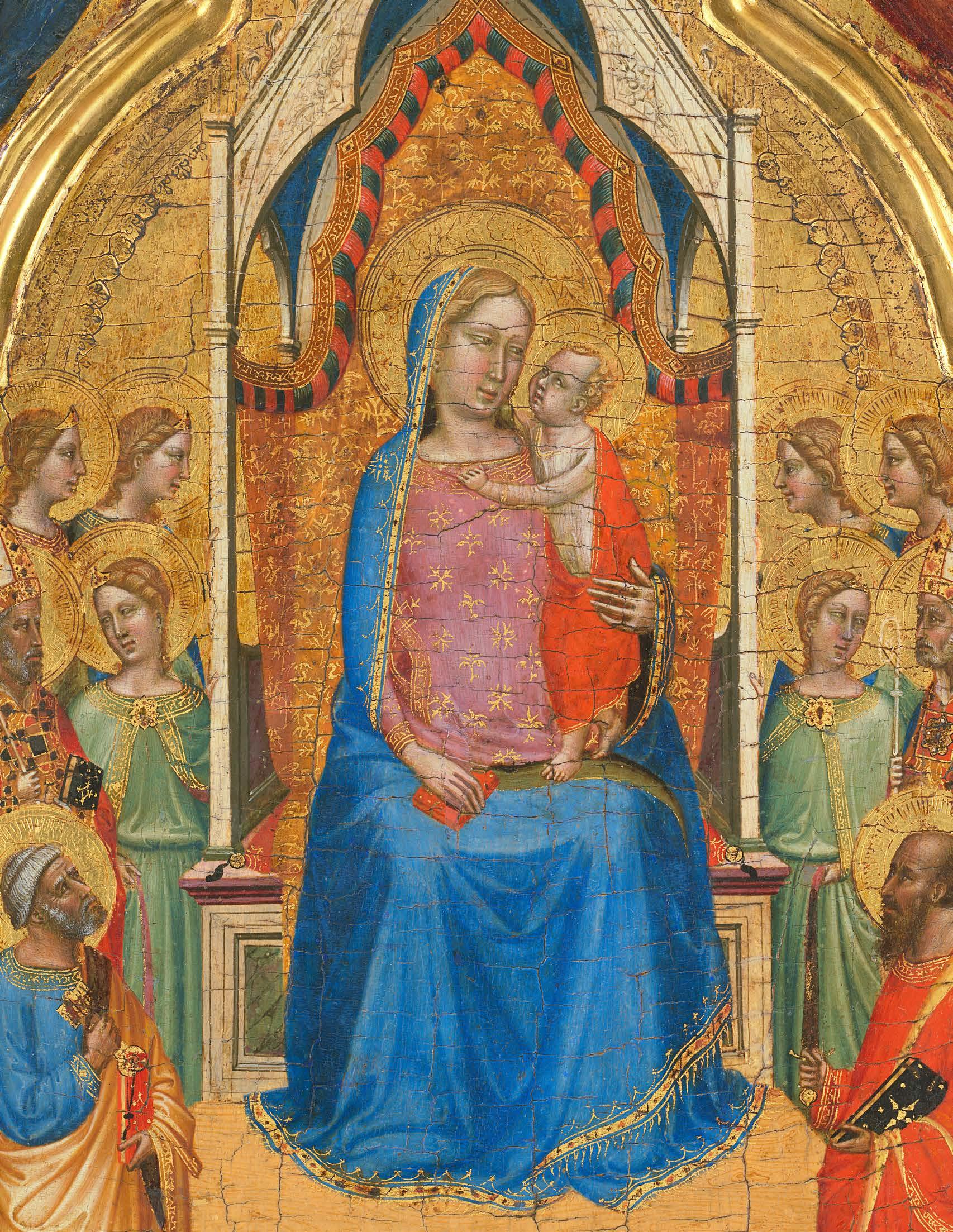
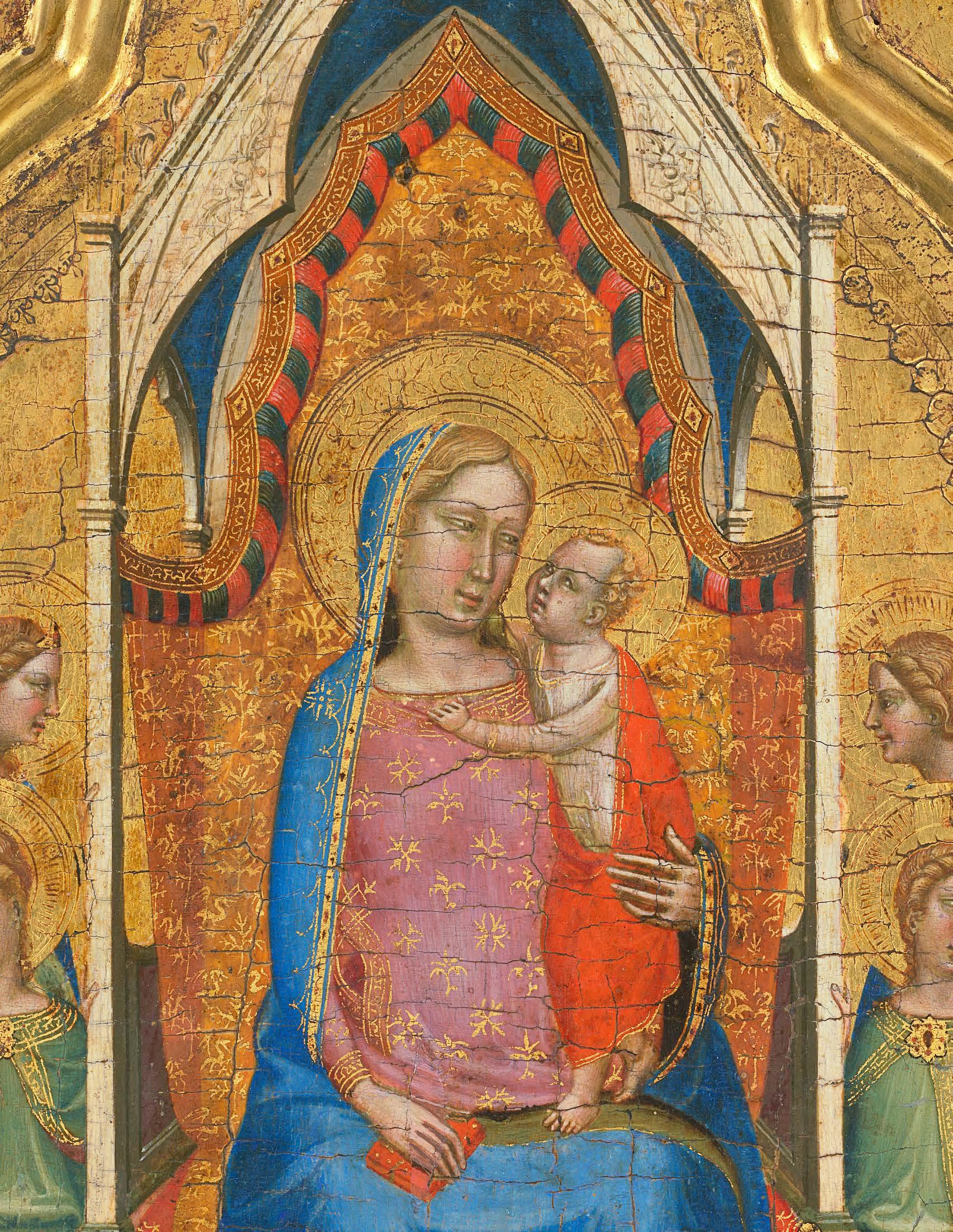
For reasons explained below, the present work ( g. 1) is a unicum in the history of early Italian painting. e central picture eld ( g. 2) depicts the Virgin enthroned in majesty under a Gothic tabernacle, with the standing Christ Child at right embracing her, their bond sealed with a loving, reciprocal gaze.1 ( eir scale is the largest among the host of gures here, as commensurate with their supreme, hieratic importance.) Flanking the throne’s steps, in the foreground plane, are Saints Peter and Paul; behind each of these gures is a bishop saint (otherwise unidenti able) and a companion angel who directs his glance toward his neighbor. Completing this group are four angels in the furthest row who gaze inwardly in adoration of the Godhead. is section of the painting is by the Florentine master Bernardo Daddi, who painted the subject in his telltale miniaturistic style on several occasions, beginning in the early 1330s, usually in a small, triptych format that included two double-sided painted wings that close over the central scene.
Surrounding the Daddi Madonna and Child Enthroned with Saints and Angels is an elegant, architectural setting composed of flanking buttresses framed in each case with Solomonic columns and including two Evangelists each, one above the other. (Each of the four gures carries a book but lack any additional identifying a ributes.) The two spires above these two buttresses include a half-length image of an Old Testament prophet bearing a scroll with an illegible script. One of those two gures surely represents Isaiah, who (in the opening lines of Isaiah 6)2 describes in general terms the scene in the pinnacle above, namely the blessing Christ, who, with a book in his le( hand, is adored by four angels. Two such gures hold an object to shield their eyes from the blinding light that emanates from the Redeemer; the other two simply place a hand to their face with the same intent. This scene was presumably inspired by what was once the pinnacle to Gio o’s Coronation of the Virgin altarpiece ( g. 3) in the Baroncelli Chapel in Santa Croce, Florence.

3
FIG. 2
Bernardo Daddi, Madonna and Child Enthroned with Saints and Angels, detail: center panel
FIG. 3
Gio o di Bondone, God the Father Adored by Six Angels, ca. 1325–30. San Diego Museum of Art, San Diego
Finally, this architectonic ensemble has a base composed of two predellas. The upper one bears ve angel heads each set in a quatrefoil frame. e lower predella contains four similarly framed angel heads decorating the bases of the Solomonic columns above. Between each of these two pairs are an unidenti ed coat of arms. On the center stretch of the bo om predella are four, half-length images of saints, all of whom are set in quatrefoil frames and gaze upwards: they are (from left to right): Saints Julian, John the Baptist, an unknown male saint holding the palm of martyrdom, and Saint Francis.
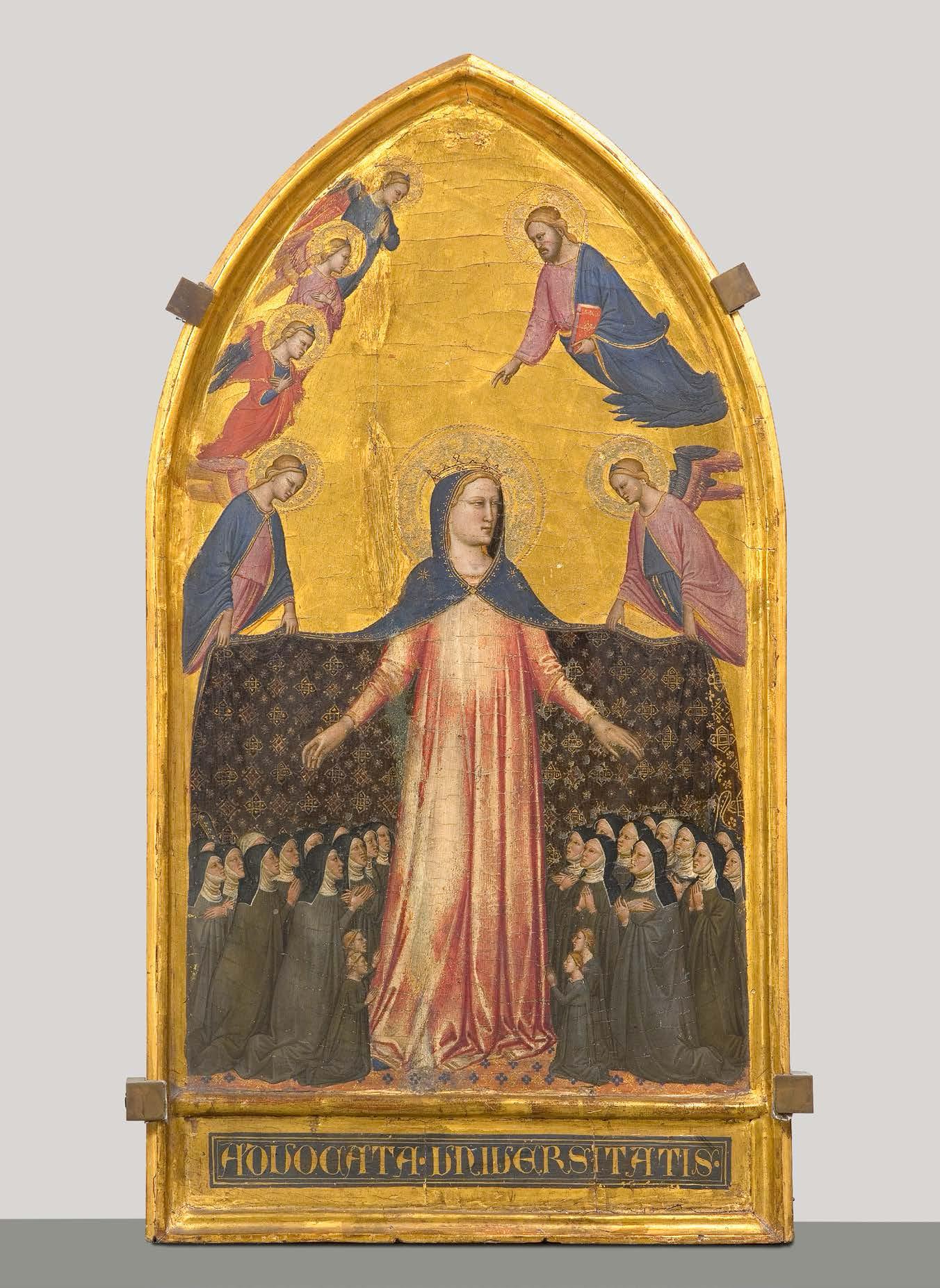
Laurence B. Kanter confirmed to an earlier owner, in July 2012, the autograph quality of Daddi’s central panel, while attributing the remaining painted parts to a younger Florentine painter, the Master of the Misericordia, so named for his eponymous work, Madonna della Misericordia with Franciscan Tertiary Sisters and Four Worshippers; Christ Blessing and Angels ( g. 4) in the Galleria dell’Accademia, Florence.3 His early assessment: that the Daddi panel was out ed with the above later additions to create what is a remarkable miniature Maestà-and not added to in the nineteenth century with fragments of a younger Florentine painter’s oeuvre (as one scholar, not having access to the work itself, had tentatively concluded)4is now con rmed by the technical report of M. Alan Miller and Kristin Holder of the Metropolitan Museum of Art painting conservation department, which will be partially summarized and quoted in the following pages.
FIG. 4
Master of the Misericordia, Madonna della Misericordia with Franciscan Tertiary Sisters; Christ Blessing and Angels, ca. 1365–70. Galleria dell’Accademia di Firenze, Florence
“An artist of rare and exquisite gi s”5 and His
A(er Gio o, Bernardo Daddi (ca. 1290–1348) was the most important painter of the rst half of the fourteenth century in Florence, although whom he studied with remains unknown. His earliest dated work is from 1328-an impressive Madonna and Child with Saints Ma hias and Nicholas (Gallerie degli U/zi, Florence). He is rst mentioned, some ten years earlier, in a register of 1312–1320 listing members of the Arte dei Medici e Speziali, the guild to which Florentine painters belonged and for which Daddi provided a now-damaged altarpiece, now in the Uffizi, that bears the date 1333. In 1335 Bernardo completed an altarpiece for the altar of Saint Bernard in the Sala dell’Udienza of the Palazzo della Signoria (untraced) and was a founding member (and, later, consigliere) of the painters’ confraternity, the Compagnia di San Luca. In 1347 he received payments for the large Madonna and Child with Angels for the church of Orsanmichele (in situ), in which the archaic composition-namely the stacked placing of eight angels-suggest that the picture was commissioned to replace an earlier image. On August 18, 1348, Bernardo is mentioned as deceased, a victim presumably of the bubonic plague that year.
Daddi, as the above, rapid biographical sketch suggests, was clearly a prominent gure in the Florentine art world and was eminently productive. Undocumented, on the other hand, are his small-scale, private devotional works. These portable tabernacles, in diptych, triptych, or even broader form, were commissioned by rich clergymen, who were o(en obliged to travel to distant locales, such as councils and other ecclesiastical gatherings. To allow for such activity, the tabernacle tended to have one or two movable wings that could fold over to protect the central image, the subject of which was usually the Virgin and Child with saints and angels and, less frequently, the Cruci xion or the Coronation of the Virgin. Such works were intended to meet the needs of personal devotion; in no case, however, did they function as bona de, consecrated altarpieces. 6 e tabernacle form, initially, was rare (earlier examples include two by the Sienese master, Duccio). Then, with Daddi, in the words of John White, it became the centre of an industry. To the already intimate scale and jewelled colour he added intimacy of design and iconography. e demand for small altarpieces for personal use grows naturally from the century-long emphasis on the personal and human aspects of the divinity, backed by the fervent emotionalism of contemporary preaching…and the continued creation of new wealth…Like all successful innovations the new form greatly increased the strength of the demand it was designed to satisfy.7
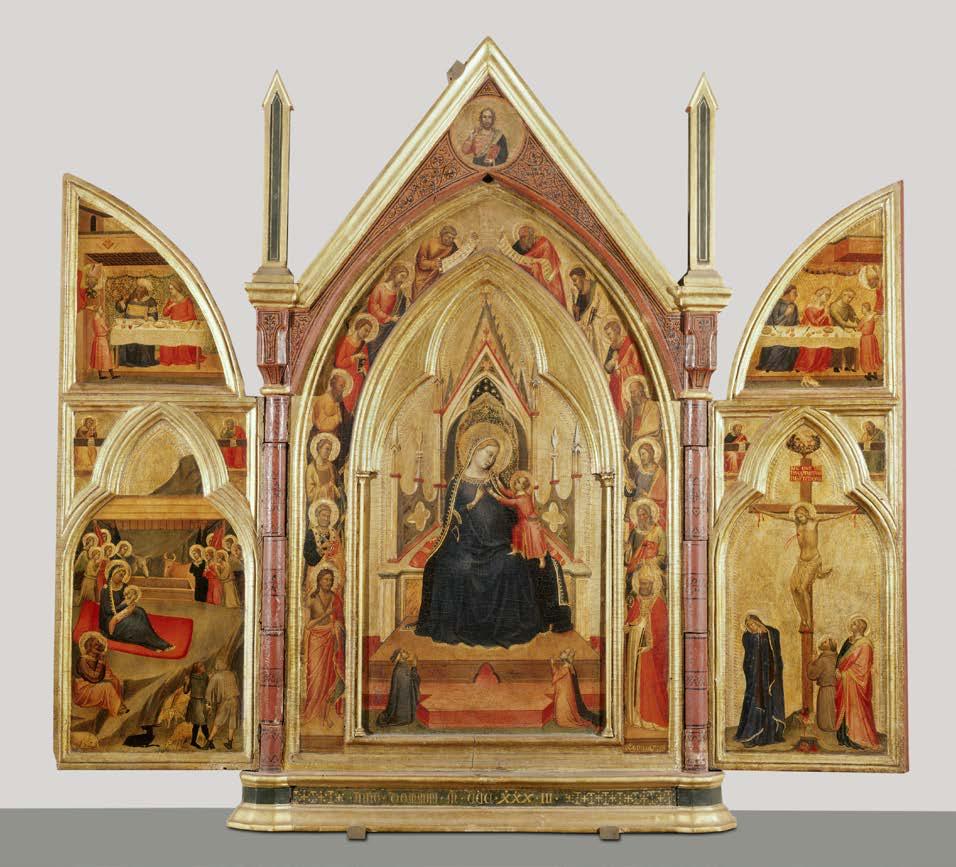
Some thirty-eight examples of a diptych or triptych form-with, in addition, disassociated parts of such constructions - have been ascribed to Bernardo Daddi and/or his workshop.8 Dated triptychs range for almost every year from 1333 to 1339.9 Of these the earliest is in the Museo del Bigallo, Florence ( g. 5). 10 Scenes from the legend of Saint Nicholas that fill the semi-lunette spaces of the inner sides of both wings highlight the charitable functions of the Bigallo, an ancient Florentine fraternity. It is a landmark of Marian devotion and the masterpiece of its type-in modelling, color scheme, spatial organization and superior cra(manship. No less an artist than Gio o’s leading pupil, Taddeo Gaddi, executed a copy of it (Gemäldegalerie, Berlin), which bears the date of 1334.11 A later example is the relatively well-preserved tabernacle in the Courtauld Gallery, London (fig. 6) , notable for “its rich pristine glow.”12 Dated 1338, it bears close comparison to the central panel here, in the throne type, rich textile display and color scheme, as well as the courtly gathering of adoring saints and angels.
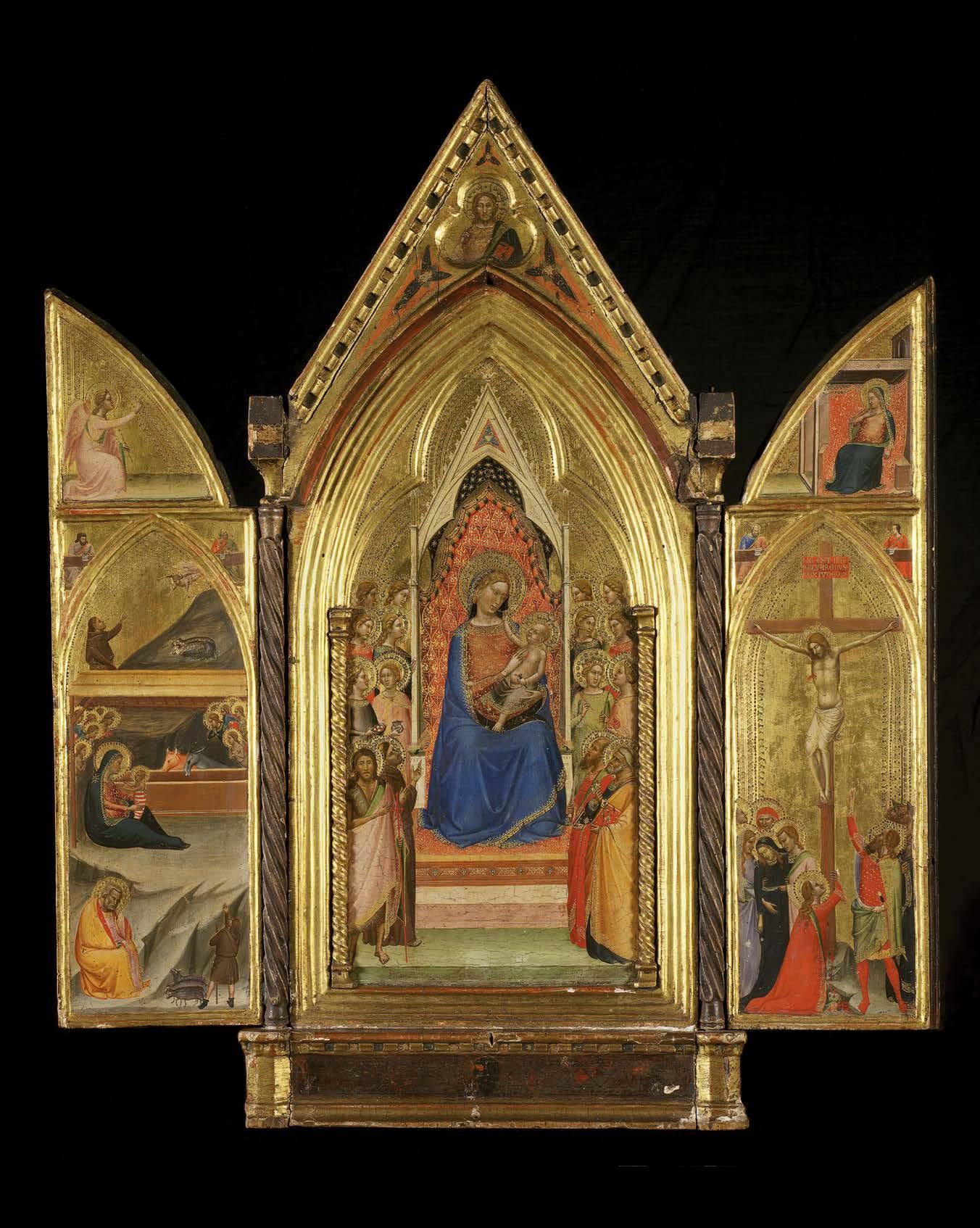

FIG. 6
Bernardo Daddi, e Virgin and Child Enthroned with Saints (Seilern Tabernacle), 1338. Courtauld Gallery, London
FIG. 7
Bernardo Daddi, Santa Reparata altarpiece, ca. 1335–40. Gallerie degli U/zi, Florence
e above Marian works evidence Daddi as (to quote Richard O ner) “a master of supreme lyrical inspiration. His expression is like an irradiation of inner light, and his personages are forbearing and detached.”13 ese features nd their apotheosis in the central panel of the painter’s high altarpiece for Florence Cathedral, then known as Santa Reparata, a provenance that, only relatively recently, has come to light ( g. 7). 14 ere, at the very center of Florence’s devotional life, Daddi’s image of a serene Virgin Mary radiating love for the infant savior, the two adored by a host of supplicant angels, must have presented an unforge able impression.15
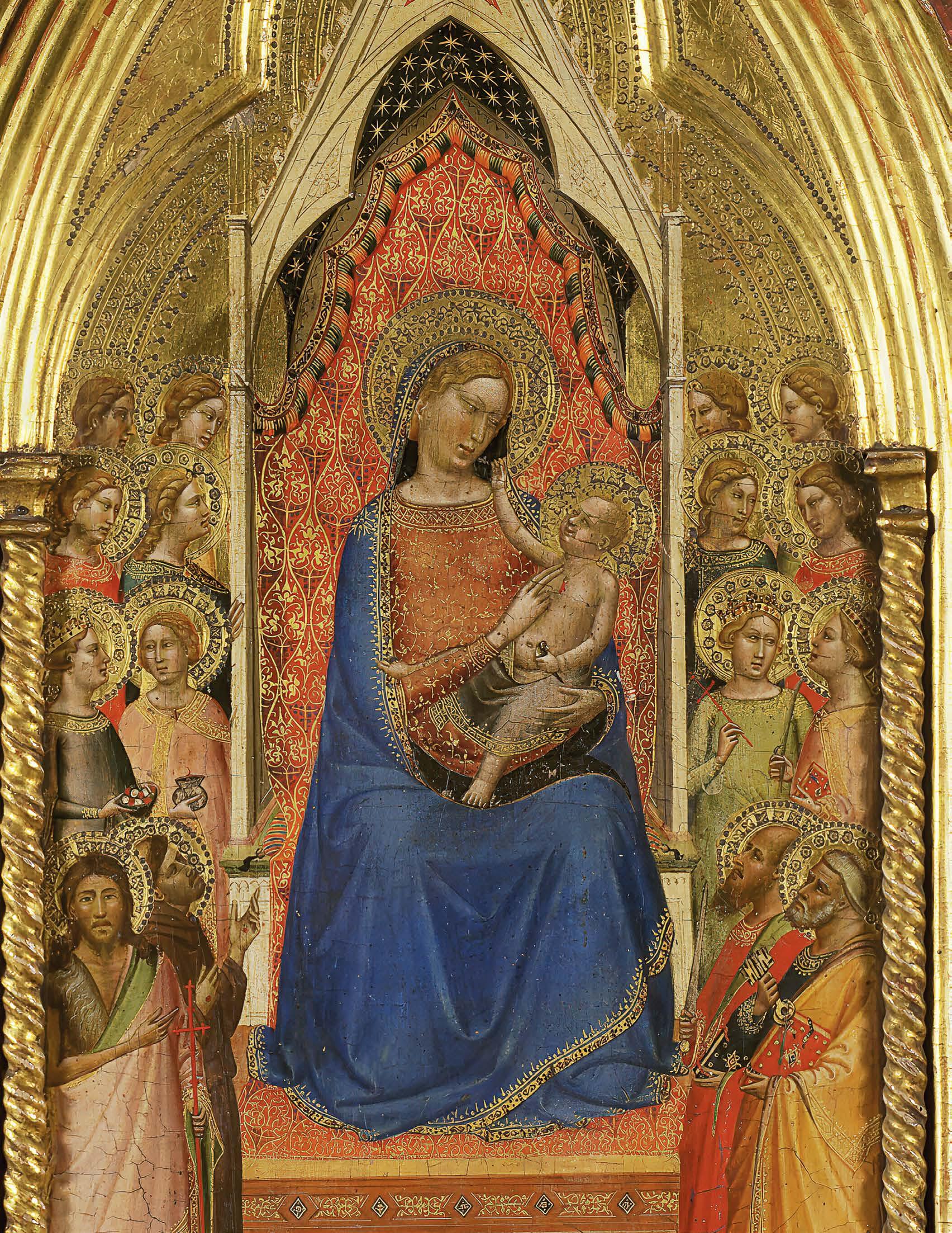
Images of the Virgin and Child in Majesty, small as well as large, were meant to invoke a future in Paradise. Rich textiles replicated in paint became a part of such settings, either as clothing for the Madonna and, especially, as a veritable cloth of honor to highlight the Mother and Child on their throne. Daddi, especially, was prone to replicate luxurious, Hispano-Moresque figured silks in his smaller, devotional paintings, as in the Courtauld Gallery’s Seilern Tabernacle of 1333 ( g. 8) ese were known as “some of the most expensive cloths of gold available at that time…The dense gold pattern indicates a cloth of gold woven with a continuous pattern weft of gold thread, while the red ground implies the use of kermes, the costliest of all medieval dyes.”16 Gold, as a color, moreover, symbolized majesty, whereas red was the hue associated with the theological virtue of Charity. Additionally, the cloth of honor in the Seilern Tabernacle-as well as the related panels in the Nelson-Atkins Museum of Art and the Minneapolis Institute of Art, dated 1339 - also include repeated motifs of grape clusters (in black pigment) among a network of gilt vines (in the technique of oil mordant gilding), clearly appropriate symbols, here, of the Eucharist.17
China
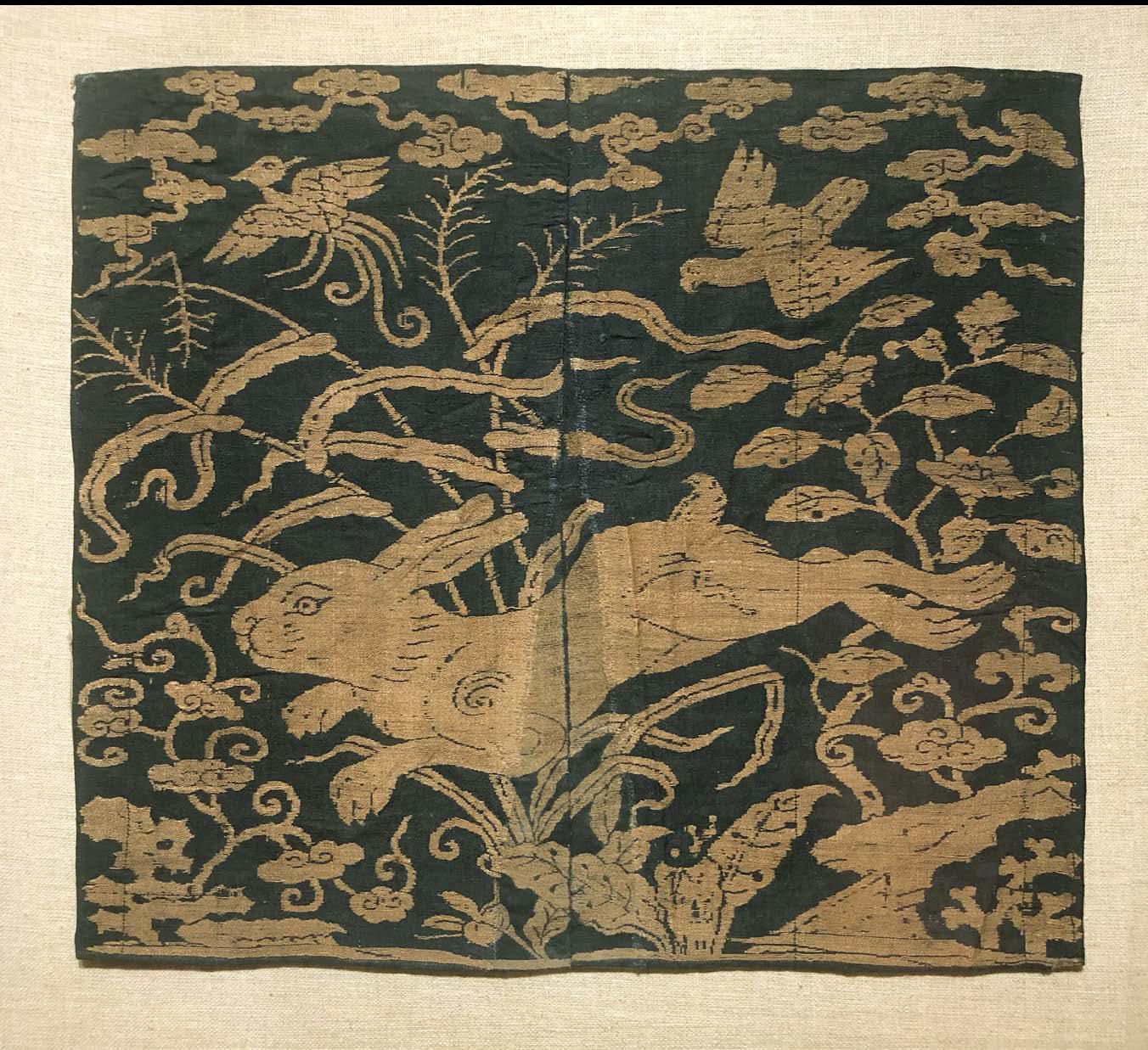
A prominent feature in the paintings of Bernardo Daddi was this decorative use of textiles, both as vestments worn by the protagonists and as a cloth of honor, draped over the throne and/or behind the main figure, usually the Virgin Mary. e technique involved the painting of a pa ern in mordant (a glue-like substance) with a fine squirrel-hair brush over the colored fabric. Onto the mordant would be laid a thin layer of gold which would adhere, forming a gilded decoration in the pattern of the artist’s choice. Sometimes these would be abstract and geometric and sometimes they included repeated motifs such as grapevines, palmettes or birds. Florence derived much of its wealth in the fourteenth century from the fabric industry, so the attention paid by Bernardo Daddi to luxuriously embroidered silks would have been appreciated by his affluent audience. The silks depicted by artists such as Simone Martini in Siena and Bernardo Daddi in Florence were o(en inspired by actual textiles, either Hispano-Moresque or else originating in China and imported to Italy via the Silk Road or from replicas of Chinese embroidered silk manufactured since the twelfth century in Lucca. Early Italian inventories record Lucchese camacas woven with vines and grapes. e pa erns taken directly from imported Chinese textiles are often those woven with calligraphically rendered birds and plants ( g. 9), both of which were auspicious images in China.
The exquisitely rendered cloth of honor in the present painting- of a brownish pink, as opposed to the red hue of the Seilern Tabernacle’s throne back- is decorated with mordant-gilded palme es interspersed with stylised birds, almost certainly pelicans, which symbolise Christ’s sacri cial love and serves as a reminder of redemption and spiritual nourishment. This motif is also present in Daddi’s tabernacle of the Madonna and Child with Saints Bernard, Francis, John the Baptist and Augustine in the Museo Nazionale di Capodimonte, Naples. 18 (A related pa ern with a similar colored backdrop also decorates the cloth of honor in Daddi’s Madonna and Child with Saints Francis, Margaret, John the Baptist and James, the left part of a diptych in the Museo Horne, Florence.) The prominence given to luxurious textiles in Trecento Florentine painting is an eloquent testament to the cultural interplay between East and West in the fourteenth century and the prestige associated with Eastern culture. e inclusion by Daddi of such luxury cloths in his painted tabernacles drew a ention to this major source of Florence’s wealth in the early Trecento.19
Additional decoration featured in devotional tabernacles by Bernardo Daddi and his shop consists of freehand incisions in the gold leaf along the borders of a panel painting and in rendering the haloes of the Madonna and Child, which were outlined using a compass. For that of the Virgin Mary in the present panel, Daddi applied a “rose-and-leaf” design, as he had as early as ca. 1320. The haloes of the remaining figures in this composition-that is, the saints and angels -are (what Skaug calls) “incised ray haloes,” in the manner of a spoked wheel. e application of gold leaf in early Italian devotional paintings was essential in stressing their holy nature, as well as to rendering them more accessible to the faithful gathered in the o(en-murky light of a church. e incisions made to the gilded surface, described above, also contributed to the panels’ lustrous e ect.
A further re nement was the use of individualized metal punch marks, which were pressed along the edges of the gilt surface and, in the case of large-scale paintings, added further sparkle to halo decoration. Recent studies of the various punches stress the uniqueness of each tool as used by a painter’s workshop (although, in some cases, individual punches were exchanged between artist studios).20 Particular punch marks signaled a painter’s own style of ornament. Thus, as Erling Skaug has written, they “can offer a key to the place of origin and also to the date of a painting.”21 Indeed, what might at rst seem an arcane pursuit, when incorporating what is already known about early Italian workshop practices, instead provides much-welcome, new and valuable empirical evidence. For anyone studying Daddi today, this development is a distinct boon, especially given the huge output of Bernardo’s workshop and (beginning ca. 1333) his expanding accumulation of punches. Indeed, as Skaug notes, whereas the artist’s “early production before 1333–34 is de ned en bloc, the order of works of his middle and late periods until 1348 [the year of Daddi’s death] is suggested with more precision.”22
10
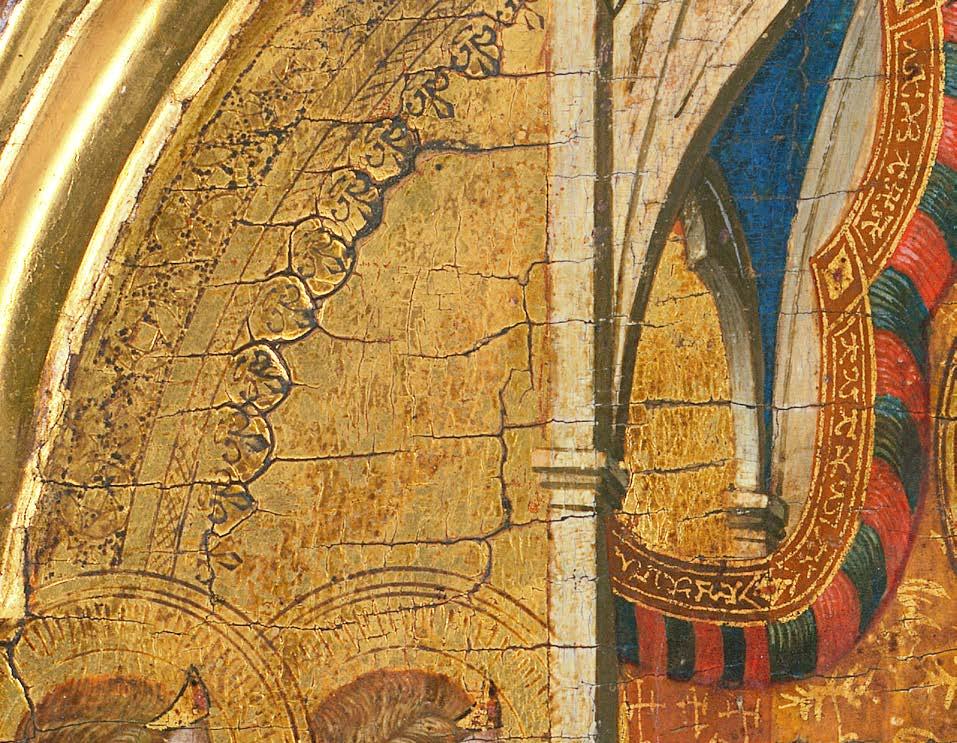
Bernardo Daddi, Madonna and Child Enthroned with Saints and Angels, detail: punch marks and band of crosshatching at upper le( of center panel
10
Thus, thanks to Skaug’s detailed investigations, the presence of a single punch mark along the edges of this panel-the %eur-de-lis design, punch 732 in Daddi’s repertoire, measuring 3/8 inches, or 1.6 mm. (fig. 10)-we can deduce a more precise moment when Daddi produced the central panel in this painting. e punch is one of six or seven new, larger punches that “form the standard border in small and medium-size panels” issuing from Daddi’s workshop, beginning in 1334.23 In keeping with works from this time, Daddi also produced a band of freehand crosshatching-also visible in this image-that parallels the row of punch mark 732. Here, again, the dogged and inspired research of the late Professor Skaug has gauged the extent of this decorative touch. Daddi’s workshop, he has determined, ran from around 1320 to ca. 1337, at which point “stippled (granulated) backgrounds in haloes and frame borders” supplanted earlier decorative bands -as seen hereof cross-hatching. With such accumulated data now at hand, one can reliably date Daddi’s central panel to ca. 1335–37.
Two nal queries regarding Daddi’s Madonna and Child Enthroned with Saints and Angels remain: did this vertical-grain panel originally have flanking, historiated wings and, if so, can such missing parts be now identi ed? Secondly, is the work an autograph creation by Bernardo Daddi or can the hand of assistants be discerned in the execution of parts of the present scene?
To the rst question, according to a “Construction Assessment,” dated December 2025/January 2026 and commissioned from M. Alan Miller, the Metropolitan Museum of Art’s conservator for panel painting, there “is currently no definite evidence showing the central panel was the central panel of a triptych.” Evidence for, say, ring hinge hardware that would have a/ xed lateral panel doors to Daddi’s painting here is absent. Nor is there any suggestion that such tabernacle parts were once attached using interior columns, as in the example of the above-mentioned Seilern Tabernacle. Even less likely is the possibility of there ever having been wooden barrel hinges serving the same function, as is the case with the Bigallo Triptych of 1333. Some fifteen years ago, Sonia Chiodo considered possible candidates for the “missing” companion panels to the present work, without a conclusion. 24 If ones were ever to surface, they would naturally have to include Skaug’s punch mark 732-and share the outstanding modelling, brilliant palette, and expressiveness so evident in the present miniature Maestà.
Daddi’s central panel ( g. 11) is clearly an autograph work. It is even proposed that it actually precedes the Seilern Tabernacle of 1338. As we have seen, the decorative detail applied by the artist to define the panel’s upper edges - the combination of punch mark 732 and the band of cross-hatching- was a practice that ended in Daddi’s studio by 1337. With the saints and angels here, the use of highlights and shadow to variously express emotion in convincing ways contrasts with the somewhat more mechanical rendering of the gures accompanying the Virgin and Child in the London painting. e play of drapery worn by the gures is likewise more active and accomplished, as in the delicate inner garment of the Christ Child and the way the Virgin’s rose-colored tunic gathers below at her lap. Notable, too, are the sage green robes of the two angels at her side that spill over, almost comically, each figure’s waist. Below, their vertical folds lead directly down to the figures of Saints Peter and Paul, and emphasize the upward thrust of the monumental, Gothicstyle throne. Finally, Daddi provides exacting linear detail to the seat front, thereby stabilizing the lower part of the composition, as well as the play of curving lines that characterizes the forms of the Madonna and Child. To sum up: not only the design of this Maestà , but its actual execution can be confidently assigned to Bernardo Daddi alone, at one of the high points of his production of the intimate, devotional works done in his telltale “miniaturistic tendency.” Typical of the artist at his best, it succeeds here in capturing “the appearance, the movement and emotion of life.”25
FIG. 11
Bernardo Daddi, Madonna and Child Enthroned with Saints and Angels, detail: center panel
During the 1330s, as we have seen, Bernardo Daddi was engaged in a steady business in the production of small-scale devotional works for private clients. is activity must have necessitated the help of assistants, at least in the execution of certain commissioned works. Presumably, the painter charged a customer less if such were the case, or if the intended work was planned on a smaller scale. To expedite such an anticipated workflow, the master may have even ordered a series of, say, tabernacles with frames in advance from a carpenter, and then, perhaps, completed part of a panel painting in anticipation of a future sale. ( is rst step is documented in an entry from 1460 in the Ricordanze [accounts book] of the fifteenth-century Florentine painter, Neri di Bicci.)26 Then, with a commission in hand, the artist would query his customer as to what sacred subjects he might require and what saints, as part of his personal devotional life, he might wish to have included.
In the case of Bernardo Daddi, active in the mid-to-late 1330s, about one third of his roughly thirty painted tabernacles-either autograph or with di erent degrees of workshop assistance-include paired images of Saints Peter and Paul. As the two founding patron saints of Christian Rome, their image on such a private work would indicate that its patron was a member of the church hierarchy. e following are eleven such examples in chronological order: 27 (1) Florence, Gallerie degli U/zi, inv. 8564 (center panel only); (2) Cambridge, Mass., Fogg Art Museum, inv. 1918.33, Triptych (Crucifixion in center panel), 1334; (3) Pittsburgh, The Frick Art Museum, inv. no. 1973.27; (4) Siena, Pinacoteca Nazionale, inv. 60. 1336; (5) Washington, D.C., Dumbarton Oaks Museum, inv. HC.P.1936.57.(T) (center panel only), 1337; (6) London, Courtauld Gallery, Seilern Bequest, inv. P.1978. PG.81. 1338; (7) Kansas City, Nelson-Atkins Museum of Art, inv. F61-61 (center panel only), 1338–40; (8) Minneapolis Institute of Art, inv. 34.20. 1339; (9) Bern, Kunstmuseum Bern, inv. 871. Triptych (Crucifixion in center panel); (10) Washington, D.C., National Gallery of Art, inv. 1140 (center panel only); and (11) Siena, Pinacoteca Nazionale, inv. 73 (center panel only).
What can be said about the later work campaign that surrounds Daddi’s panel of ca. 1335–37 along every side? As was customary with panel painting production in Tuscany at the time, the wooden structural support would have been made rst. That was the task of the carpenter, who likewise provided the framing elements, a/ xing them along the panel’s edges (and in the present example: originally a %amelike, or acanthus leaf, trim at the object’s gothic-arched top, the pinnacles rising above the side panels and the lower level of the predella). Several layers of gesso were then applied over the future paint surface, as well as the frame, this time by the painter (or, more likely, a garzone, or shop assistant), whose next task was to apply select areas of gold leaf, on what would become the final paint surface, as well as the frame. e same painter, or perhaps a practiced assistant, would incise freehand decoration along the edges of the panel and, probably, also the punch marks, which were emblematic of the master painter’s shop. en the painter (Bernardo Daddi and-decades later-the Master of the Misericordia) would set to work.
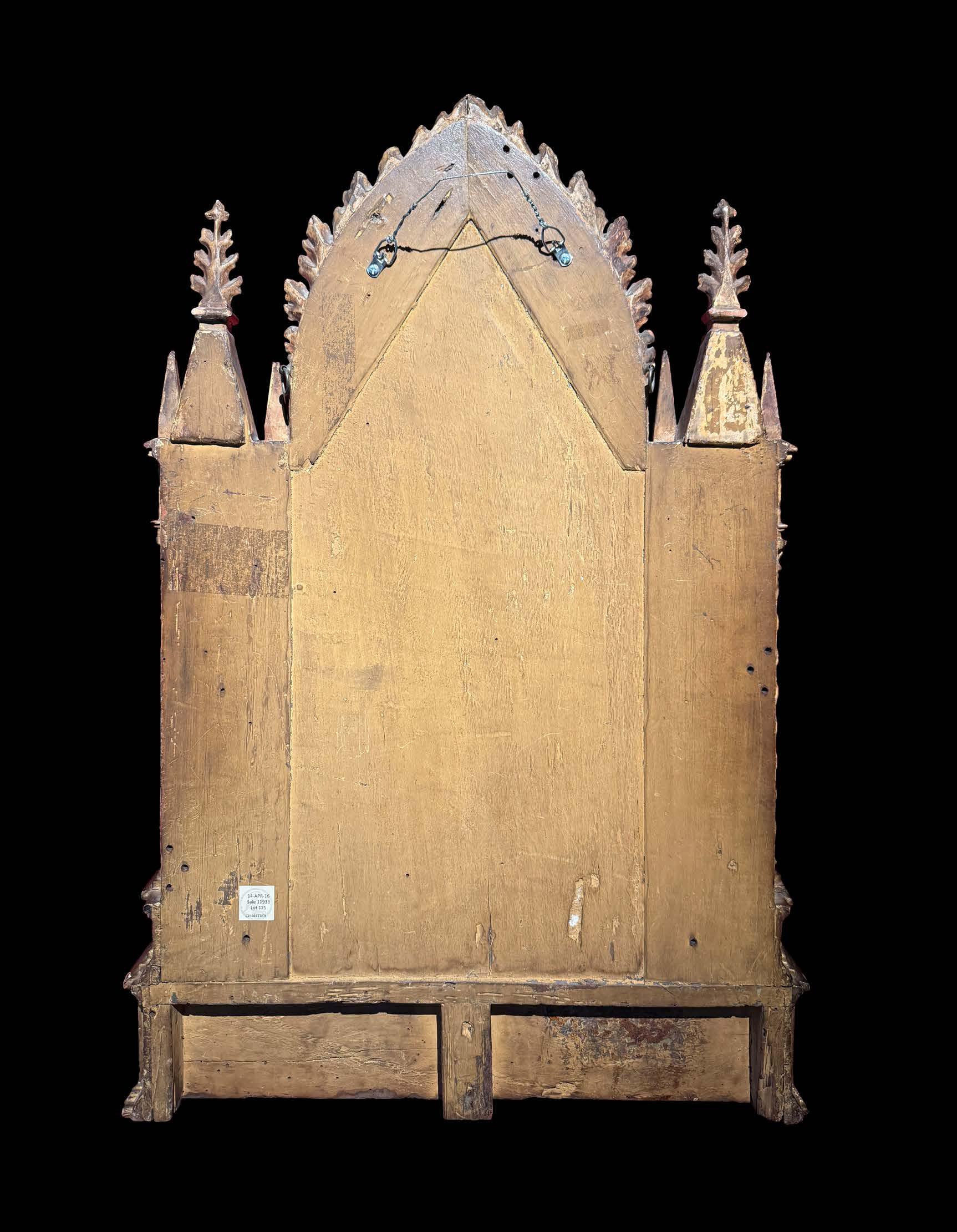
Typically, as in the distant past, the carpenter’s name became lost to history. But this second chapter in the present work’s construction has survived to the present, as is clearly evident in a photograph of its verso ( g. 12). Laurence B. Kanter, once again in 2012, examined the painting’s back and concluded that it amounts to original, late fourteenth-century construction (although the gilding on the right-most pinnacle is not original). Also, the beige paint applied to the verso-as a standard step of the time to extend the life of the original, wood support-may be original, although partly “refreshed” in later years.
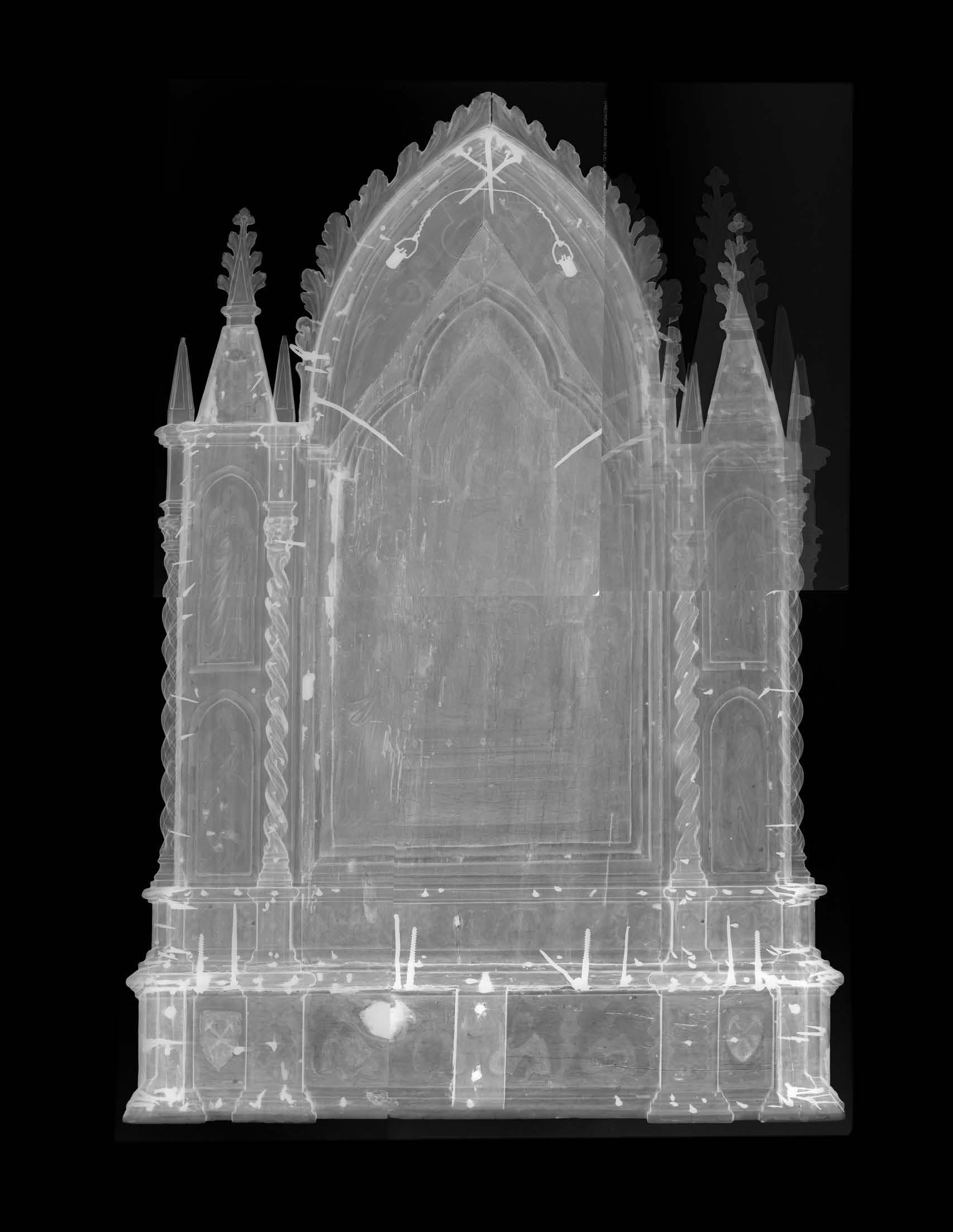
Comprehensive insights into the support’s step-by-step carpentry have been supplied thanks to the recent, above-mentioned “Construction Assessment” of Alan Miller and Kristin Holder, whose research was assisted by X-radiography at the Conservation Center of the Institute of Fine Arts (fig. 13). What follows, in summary form, are some of their most salient conclusions:
In preparing for a new Gothic-arched capping, the carpenter removed some of the Daddi’s “acutely peaked” top and adjacent framing. (What remains, the above report states, are visible “shattered barbe edges on the right and possibly left.”) Originally, the Daddi’s framing there “was quite narrow in dimension,” as is also the case with two of Daddi’s earliest triptychs, the Bigallo Triptych ( g. 5) and that of the Seilern bequest to the Courtauld Gallery ( g. 6). Also, they continue, “the cusped projecting molding beneath the peak [of the Daddi panel here] is original.”
From the painting’s verso Miller and Holder deduce that “the single verticalgrained board” of Bernardo’s panel “includes what is now the top register of the current predella base,” i.e., that part that the Master of the Misericordia remade, applying gilt and painted images of angel heads. From the x-radiograph,28 one learns even more about this subsequent construction, to wit:
e [upper, i.e. newer] pointed arch is made from two pieces of wood with grain parallel to the original peaked sides. The thickness of this addition a empts to equal that of the original panel and cusped molding thickness to create a %ush surface for painting…Five long cut iron nails…[visible here]… hold the archtop additions. e two nails at the bo om mechanically a ach to the original panel. Two crossing nails at the top of the peak a ach the two pieces to each other-much like mitered corner frame construction. The (h top central nail may have been an a empt to secure the top of the arch to the original panel. However, this nail does not penetrate into the original panel…this type of “mistake” is almost never seen.
FIG. 14
Bernardo Daddi and Master of the Misericordia, Diagram outlining in red the original panel used by Bernardo Daddi, with the bo om and the tip later overpainted by the Master of the Misericordia
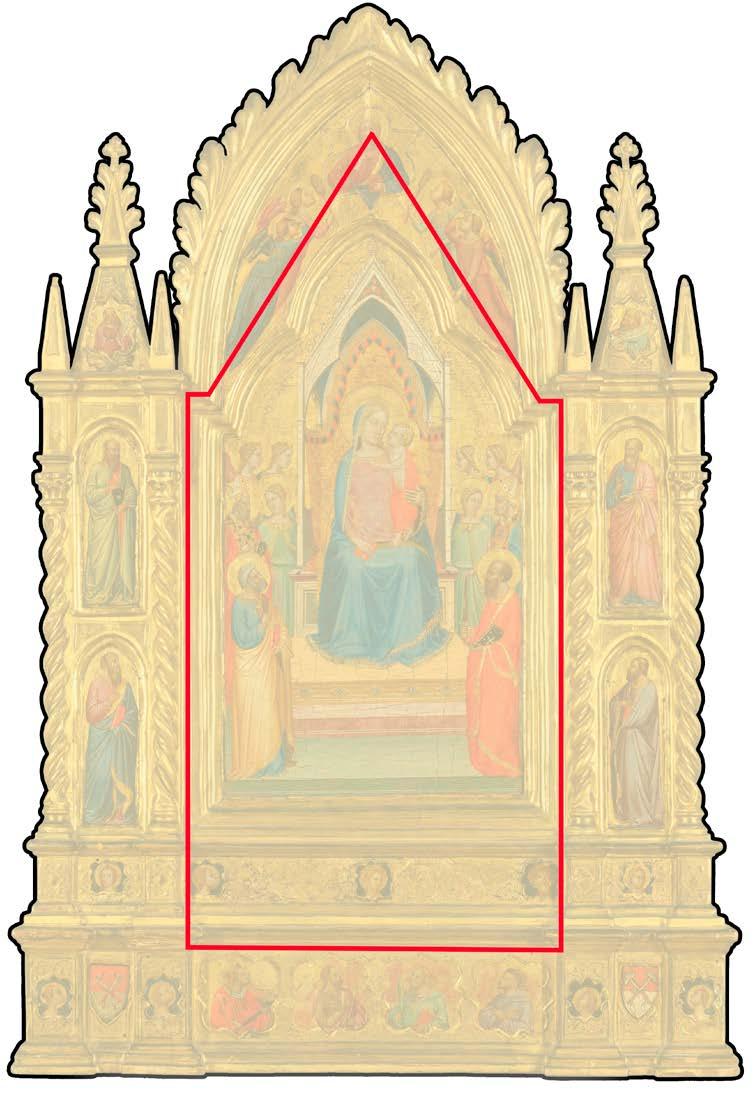
What Miller and Holder then describe as a possible “stepped lap joint” appears to have been made in order to join the above-mentioned “two pieces of wood with grain parallel to the original peaked sides.” Such a recourse could then provide “an increase[d] degree of connectivity.”
Typically, the new vertical elements such as “the left and right pilasters are… made from vertical-grain boards,” and the predella box base is “made from a single horizontal board face, horizontal deck,…vertical grain sides and center strut.” X-radiography also reveals “longer cut nails driven up into pilaster boards and the original [Daddi] panel.” Here, the report concludes: “the construction technique (including the nails)…is consistent with what would be expected in the 14 th through 16th centuries.” Below it adds the “observations of panel construction do not con%ict with an a ribution of Phase I to Bernardo Daddi or an a ribution of Phase II” to the Master of the Misericordia. In addition, “the overlapping of…[the latter artist’s]…paint onto Daddi’s panel…rules out a collaboration of the two hands and clearly de nes two distinct phases” ( g. 14).
With the “how” of the enhanced additions to the earlier panel by Bernardo Daddi now examined, the natural follow-up question would be: “why”-in the rst place”were they undertaken?” Here one can only speculate. Certainly, they were made for someone with a special appreciation of Daddi’s well-preserved panel-perhaps even for the painter (presumably a victim of the plague in 1348) himself. Still, the prime motivation, surely, was to satisfy the owner’s particular devotional needs, short of the nished product functioning as a private altarpiece which, in any case, could not be sanctioned (see above). A pressing need, for instance, would have been for a new selection of saints, chosen by the patron or an adviser, to ll the lower predella (to be discussed below). e choice, too, of the four Evangelists-as narrators of the Christ Child’s coming-would have been a natural to ll the bu resses, thereby %anking the central scene. Old Testament patriarchs who prophesized Christ’s birth would have been featured. Here two of them, half-length, though not identi ed, were included, one above each of the two pairs of Evangelists. One of those two prophets, surely, is Isaiah, who predicted the Virgin’s birth of the saviour. In one passage (Isaiah 6, 5), he declared that “…mine eyes have seen the King, the Lord of Hosts,” having just described that overwhelming spectacle (Isaiah 6, 1–3):
I saw also the Lord sitting upon a throne, high and lifted up, and his train lled the temple. Above it stood the seraphims: each one had six wings; with twain he covered his face, and with twain he covered his feet, and with twain he did %y. And one cried unto another, and said, Holy, holy, holy, is the Lord of Hosts, the whole earth is full of his glory.
Although, this vision is not a perfect match for the scene that caps the newer top of the miniature Maestà , it had a lasting, powerful effect: the quotation’s last line became the basis of the triple “Sanctus”-”Holy, holy, holy”-recited by the faithful to this day at Mass.
Now for the company of saints, selected by the unknown patron. The inclusion below of Saint John the Baptist, the leading patron saint of Florence, and Saint Francis would suggest that this work was made for a Franciscan cleric (the latter station, as deduced from the presence of Saints Peter and Paul in the Bernardo Daddi panel) who was probably a/ liated with a church, monastery or convent in Florence.29 Indeed, the subject of Christ adored by angels, the top-most scene here by the Master of the Misericordia, might even have been chosen for its reference to the central pinnacle ( g. 3) once part of Gio o’s Coronation of the Virgin altarpiece, still in its original location in the Baroncelli chapel in Santa Croce, Florence’s most important Franciscan destination-with the exception that in the San Diego fragment, God the Father, not Christ, is depicted. Perhaps the prominence of the Solomonic columns in the present painting was even inspired by the same framing device as appears in the Baroncelli Chapel frescoes by Taddeo Gaddi.
This type of small-scale Maestà seems without precedent in Trecento Florence. Without folding shu ers, it would have been less portable than a triptych and so it must have functioned as a private object of devotion, to be installed at home, for the patron who commissioned these additional elements painted by the Master of the Misericordia.
e Master of the Misericordia, as we have seen, is named for this anonimo’s striking depiction of the Madonna of Mercy (fig. 4) sheltering a gathering of nuns and other worshippers, with the blessing Christ above, three angels at upper left, and two supporting the Virgin Mary’s capacious mantle below. Here are visible the salient stylistic and morphological characteristics of this proli c, and rather lovable, artist: the prevalence of square-shaped heads, delicately drawn hands, sausageshaped noses and a preference, in depicting faces, to go for a three-quarter pose.30 Most of those features likewise present themselves in the present work. Over eighty paintings have been a ributed over the past century to this master, who practiced from ca. 1355 to ca. 1380.31
It is not known if the Master of the Misericordia actually knew Bernardo Daddi, but he certainly knew his art, and in a few cases actually borrowed aspects from some of the earlier Florentine master’s oeuvre. As Federico Zeri-who also made important contributions to the anonimo’s catalogue of works-has wri en: “His most personal characteristic is his deliberate archaism in imitating the compositions of several Florentine painters of the rst half of the fourteenth century, especially Bernardo Daddi and his immediate circle. He has sometimes been confused with Daddi.”32
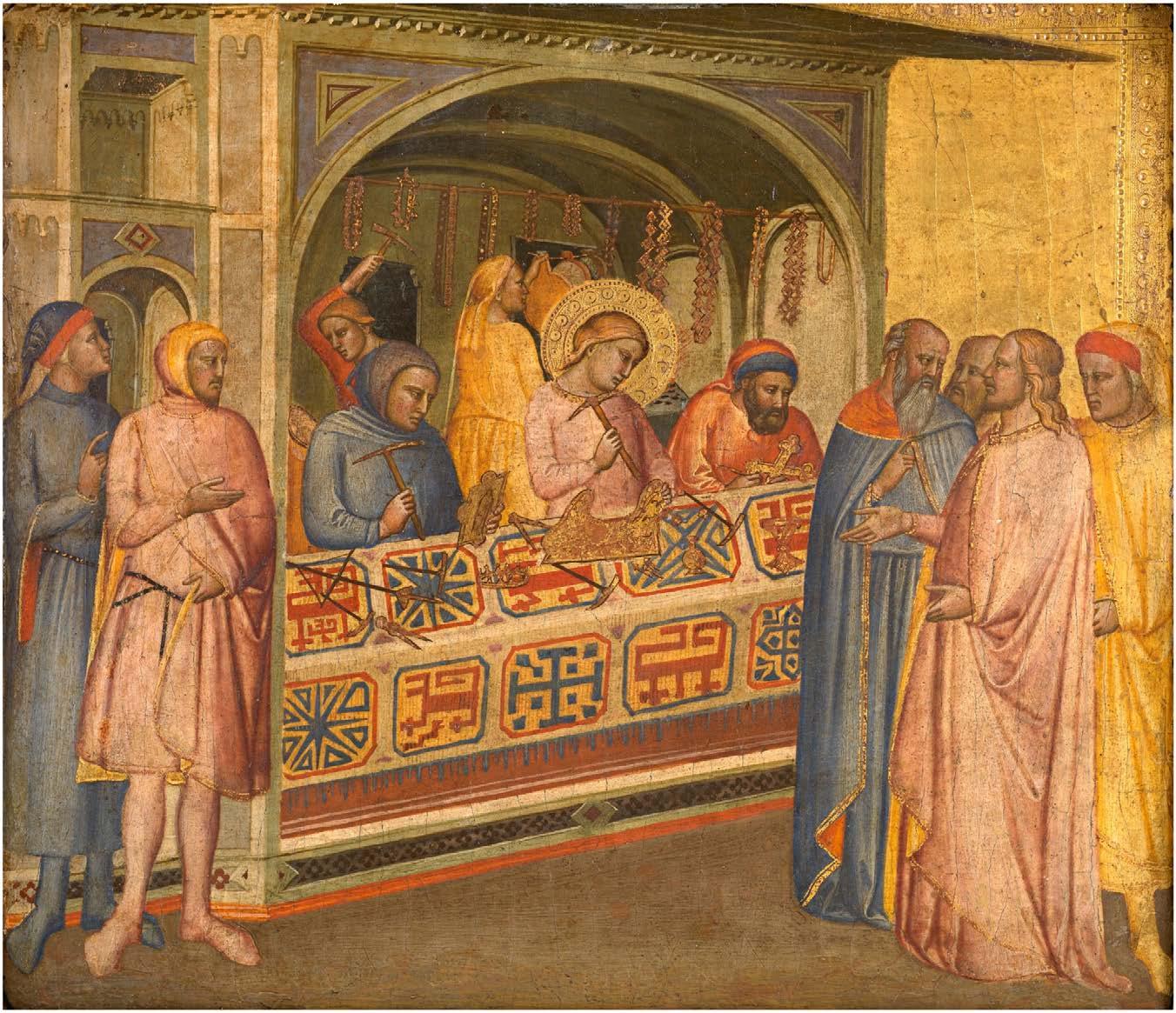
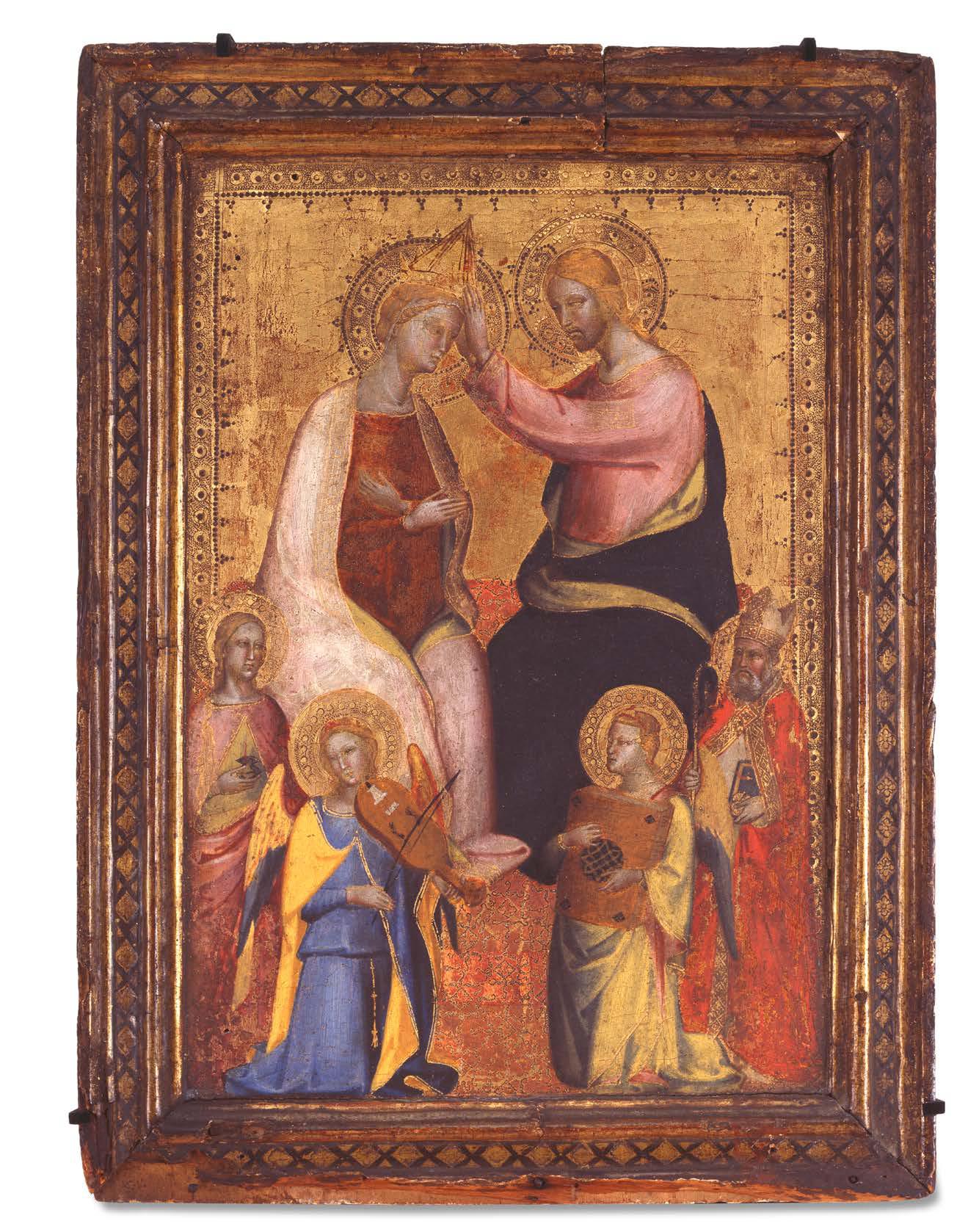
One such example is the Madonna and Child in the Pinacoteca Stuard, Parma, an early work that, according to Boskovits, is based on Daddi’s late painting of the same subject at the Villa I Ta i in Florence.33 Such an in%uence is far less prominent in the Master of the Misericordia’s name piece ( g. 4), which Boskovits has dated to ca. 1375–80.34 Before that time, though, the anonimo had a Gaddesque bent,35 as in his two predella panels at the Prado, which includes a stirring scene, Saint Eligius in his Goldsmith’s Workshop of ca. 1365–70 (fig. 15). 36 Indeed, here the standing males at either side of the depicted scene-digni ed, con dent and concernedseem of the exact same stripe as the Evangelist gures in the Daddi/Master of the Misericordia picture. Another apt analogy is with the gure types in the remarkable Misericordia Master’s Coronation of the Virgin with Two Saints and Two Angels (Kunstmuseum Bern; g. 16) of ca. 1370–75.37 Incidentally, for this work, Richard Offner made the happy comment (on the back of a photograph in the archive of the Corpus of Florentine Painting): “Stürler pictures 38 all unrestored deserve a monument to the good taste of this collector.”
FIG. 15
Master of the Misericordia, Saint Eligius in his Goldsmith’s Workshop, ca. 1365–70. Museo Nacional del Prado, Madrid
e history of the Bernardo Daddi and Master of the Misericordia, Madonna and Child Enthroned with Saints and Angels
What we know is sparse indeed, despite e orts to track its past ownership. Perhaps it was commissioned by a member of a family or, perhaps, an organization (?) whose coat of arms appears twice, %anking the four saints mentioned above, on the lower predella. Unfortunately, identifying the owner of that device has eluded all a empts so far and, in any case, the paint surface in that particular location appears to date from modern times.39 According to the picture’s consignor at a New York, Christie’s sale in 2016 (see “Provenance” section, below), it had been purchased in 1969 from one “Mrs. Bredin of Bath.” A search in the database, “Ancestry.com,” disclosed more: she was born Lucy Carter Byrd (August 16, 1902–July [?], 1994) in New York, the daughter of William Byrd (1876–1952), a lawyer, and Philadelphiaborn Margaret Baird Fox (1876–1941); the family lived at 69 Park Avenue, New York City. We next hear of Lucy Byrd’s marriage at the Cathedral Church of Saint Mary, Edinburgh, on November 13, 1925, to Lieutenant Hugh W. Bredin (1901–1961) of the Royal Navy,40 who was the son of a Sri Lankan co ee plantation owner and accomplished athlete, Edgar Chichester Bredin (1868–1934), and his second wife, Alice Aplin (born ca. 1873).41 At the time of that marriage, July 20, 1898, E.C. Bredin is described as a “widower.” (Interestingly, the la er’s rst marriage, to Mary Emily Nind Purcell some six years earlier, had taken place at Christ Church, Bath.) Hugh Bredin and Lucy C. Byrd seemingly spent their honeymoon at Bermuda, where they had “many friends.”42 Sometime in 1946, however, the couple obtained a divorce in Monroe, Florida. Lucy (Byrd) Bredin seems to have then spent most of her remaining years at the historic resort town of Bath. at connection might lead one to suspect that the picture here discussed had once belonged to the passionate, pioneer collector of early Italian paintings, William Beckford (1760–1834), who spent his last years at Lansdown Tower in Bath. As a “Gothik curiosity,” too, it might surely have appealed to an earlier voracious aesthete, Horace Walpole (1717–1797) of Strawberry Hill. Still, no evidence seems to exist that prove either connection.
BERNARDO DADDI
Florence ca. 1290–1348
Madonna and Child Enthroned with Saints Peter and Paul , Saint Zenobius, a Bishop Saint and Six Angels, 1335–37 tempera and gold on panel, in an engaged frame
recon gured circa 1380 as a small altarpiece measuring 30345 x 20346 x 2745 inches or 76.5 x 52.1 x 6.7 cm [at widest part] by
Master of the Misericordia [Giovanni Gaddi?]
Florence act. 1350s–1383
with pinnacles, Two Prophets; lateral columns, e Four Evangelists; lower register in roundels, ve female saints; predella, four Angels in octagonal shaped painted elds, an unidenti ed coat of arms and in the center, Saint Julian, Saint John the Baptist, Saint Bartholomew(?) and Saint Francis(?), the Christ the King adored by four Angels in the cusp of the central panel
provenance
Mrs. Lucy Carter (Byrd) Bredin (1902–1994), Bath, Somerset, Great Britain, until 1969; sold to Private Collection
Christie’s, New York, Old Master’s: Part I, 14 April 2016, lot 125; where acquired by a Private Collection
bibliography
Sonia Chiodo, Painters in Florence after the “Black Death.” The Master of the Misericordia and Ma eo di Pacino, in Miklós Boskovits, ed., A Critical and Historical Corpus of Florentine Painting, sect. IV, vol. IX, Florence and Milan, 2011, pp. 82–83 (dates the Master of the Misericordia section of painting to “between the eighth and ninth decades of the Trecento”) and note 240 (notes punch 732 [Skaug] and dates Daddi section to the same time as that in The Nelson-Atkins Museum), 312–16, reproduced plate LIII1–4
Angelo Tartuferi, in Christine Sciacca, ed., Florence at the Dawn of the Renaissance: Painting and Illumination, 1300–1350, Los Angeles, 2012, exh. cat. no. 23, p. 113 (entry incorrectly a ributes the scene of the Blessing Christ Adored by Four Angels to Daddi), reproduced p. 110, g. 2.17.
Notes
1. For this particular pose of the Virgin and Child, see Dorothy C. Shorr, The Christ Child in Devotional Images in Italy During the XIV Century, New York, 1954, pp. 140–45 (Type 21), who notes that “the posture of the Child’s le( hand as it clutches his Mother’s robe at the neck…is typical of the school of Daddi…” (p. 142). In an autograph Madonna and Child with Four Saints and Four Angels by Daddi (dated 1337; Dumbarton Oaks, Washington, D.C., inv. HC.P.1936.57.[T])-which is missing its side panels-the Christ Child stands, as in the present work, but with his right leg held in his mother’s right hand. Comparable, too, is the glance and hands of the Christ Child (in this case, seated) in the central panel of Pietro Lorenze i’s Madonna and Child with Saints of ca. 1320 (Santa Maria della Pieve, Arezzo; Shorr, e Christ Child in Devotional Images, illus. p. 145, g. 21 Siena 4).
2. See the iconographical discussion below. My thanks to Pastor Paul Turner of the Cathedral of the Immaculate Conception, Kansas City, Missouri, for identifying the biblical source for this subject (his e-mail to the author, January 17, 2026).
3. For this work, see Sonia Chiodo, Painters in Florence after the “Black Death.” e Master of the Misericordia and Ma eo di Pacino [ A Critical and Historical Corpus of Florentine Painting , ed. by Miklòs Boskovits, sect. 4, vol. 9], Florence and Milan, 2011, pp. 167–71; for the author’s identification of the order of sisters displayed, see ibid., p. 167, note 2.
4. Chiodo, Painters in Florence after the “Black Death ,” p. 312, notes the later additions to the Daddi panel, “painted a few decades later, added along all sides…at an unspecified period, presumably at the nineteenth century.” See also, p. 83.
5. See essay by Richard Offner, “Introduction,” republished in Richard Offner, A Critical and Historical Corpus of Florentine Painting , sect. 3, vol. 3, The Works of Bernardo Daddi , ed. by Miklós Boskovits, assisted by Enrica Neri Lusanna, Florence, 1989, p. 13. Offner’s monumental publications on Daddi are a world in themselves. The ability of this great connoisseur to evoke the individual style of an artist and his development remains phenomenal. (For an assessment of Daddi studies at the present moment, see the cogent remarks of Carl Brandon Strehlke, in idem and Machtelt B. Israëls, e Bernard and Mary Berenson Collection of European Paintings at I Tatti , Milan and Florence, 2015 pp. 223–24.) On a personal note, I cannot resist recalling stories about Offner from his devoted pupil (and my worthy graduate adviser), James H. Stubblebine. Here I will quote only one - passed around by other pupils at the Institute of Fine Arts, to be sure. It was said that Richard O ner loved Gio o, but [referencing the Cole Porter song] “his heart belonged to Daddi.”
6. David G. Wilkins, “Opening the Doors to Devotion: Trecento Triptychs and Suggestions Concerning Images and Domestic Practice in Florence,” in Italian Panel Painting of the Duecento and Trecento [proceedings of the symposium; Florence, Istituto Universitario Olandese di Storia dell’Arte, 5–6 June 1998; and Washington, D.C., Center for Advanced Study in the Visual Arts, 16 October 1998], ed. by Victor M. Schmidt [Studies in the History of Art, vol. 61], New Haven and London, 2002, pp. 370–93; see also Victor M. Schmidt, Painted Piety: Panel Paintings for Personal Devotion in Tuscany, 1250–1400, Florence, 2005, chapter 7 (“Standard and Customized Products: Buyers, Users and Special Commissioners”), pp. 205–12; and (regarding tabernacles by Daddi and other Tuscan painters) pp. 32; 65, note 30; 65–66, note 31.
7. John White, Art and Architecture in Italy, 1250–1400, 3rd ed., New Haven and London, 1993, p. 406. White’s sensitive analysis of Daddi’s art and its historical context is well-recommended (ibid., pp. 405–11). For a partial list of triptychs by fourteenthcentury Florentine painters, see Wilkins, “Opening the Doors to Devotion,” pp. 387–88, note 17. For Daddi’s devotional tabernacles, see, also, Giovanni Damiani, “Daddi, Bernardo,” in Dizionario biogra co degli italiani, vol. 31, Rome, 1985 (h ps:// www.treccani.it/enciclopedia/bernardo-daddi_(DizionarioBiogra co)/?search=DADDI%2C%20Bernardo%2F) [pp. 6–8].
8. For “the vast Daddesque material…[with] a large proportion of ‘school’ products,” see the list of Erling S. Skaug, Punch Marks from Giotto to Fra Angelico. Attribution, Chronology, and Workshop Relationships in Tuscan Panel Painting, with Particular Consideration to Florence, c. 1330 to 1430, Oslo, 1994, vol. 1, pp. 99–105.
9. In the ma er of Daddi’s career, for “presumably the rst thirteen years” of it, only “two dates are known (1328 and 14 August 1333).” However, for his last (een years-i.e., from 1333 to his death (1348)-there are twenty-one dates, sixteen of which “fall to the four-year period 1334–1338.” Erling S. Skaug, “Bernardo Daddi’s Chronology and Workshop Structure, as Defined by Technical Criteria,” in Da Gio o a Bo icelli: pi ura orentina tra Gotico e Rinascimento: atti del convegno internazionale, Firenze, Università degli Studi e Museo di San Marco, 20–21 maggio 2005, ed. by Francesca Pasut and Johannes Tripps, Florence, 2008, p. 96, note 34. As we will propose, the la er stage of Bernardo’s activity is consonant with the date assignable to the present miniature Maestà.
10. Offner, A Critical and Historical Corpus of Florentine Painting, sect. 3, vol. 3, ed. by Boskovits, pp. 19–22, 170/81–83; according to O ner (p. 170), the central panel was by Daddi, whereas the wings were mostly executed by studio assistants. Here it should be noted that the columns that serve to a ach the wings to the central panel, as well as the area of decoration in the upper part of the central gable, evidence modern repaint; the same may be said of the base with its date of MCXXXIII, which presumably replicates Daddi’s original inscription. For the Bigallo triptych’s historical context, see William R. Levin, “ e Bigallo Triptych: A Document of Confraternity in Fourteenth-Century Florence,” Con aternitas, vol. 29, no. 1, spring 2018, pp. 55–101.
11. Andrew Ladis, Taddeo Gaddi: Critical Reappraisal and Catalogue Raisonné, Columbia, Missouri, and London, 1982, pp. 127–29, no. 7; Miklós Boskovits, Gemäldegalerie, Berlin. Katalog der Gemälde: Frühe italienische Malerei, ed. by Erich Schleier, Berlin, 1987, pp. 47–52, no. 22.
12. Richard Offner, A Critical and Historical Corpus of Florentine Painting , sect. 3, vol. 8, Glückstadt, 1958, pp. 19–21 (as “Bernardo Daddi [assisted]”). Here O ner notes (p. 19) that the angel gures “lack the vitality and crispness of Daddi’s modelling, due to the presence of workshop assistance.” For a stylistically close derivation, see the central panel of a dispersed triptych, the Madonna and Child with Saints and Angels (from the Samuel H. Kress Collection) in The Nelson-Atkins Museum of Art (Eliot W. Rowlands, e Collections of the Nelson-Atkins Museum of Art: Italian Paintings, 1300–1800, Kansas City, 1996, pp. 47–54, no. 3 [as Bernardo Daddi and workshop]). Also related is the triptych at the Lindenau Museum, Altenburg, inv. 15 (O ner, A Critical and Historical Corpus of Florentine Painting, sect. 3, vol. 3, ed. by Boskovits, pp. 18, 22, 47, 222/27).
13. O ner, “Introduction,” p. 13.
14. For an account of this discovery, see Strehlke, in idem and Israëls, The Bernard and Mary Berenson Collection of European Paintings at I Tatti, p. 324, note 1. In 1442, the altarpiece was sold to a Florentine private citizen, who placed it in the church of San Pancrazio, which had been presumed to be the original destination of Daddi’s pala.
15. Incidentally, the throne design in Daddi’s ex-Santa Reparata center panel amounts to an amalgam of the same furniture in Daddi’s Bigallo Triptych and that of the Seilern Tabernacle (and, by extension, the present work).
16. Lisa Monnas, Merchants, Princes and Painters. Silk Fabrics in Italian and Northern Paintings, 1300–1550 , New Haven and London, 2008, p. 78. For Monnas’ pioneering discussion of textiles in the work of Daddi, see pp. 76–84 and the same author’s “Silk Textiles in the Paintings of Bernardo Daddi, Andrea di Cione and Their Followers,” Zeitschrift für Kunstgeschichte, vol. 53, no. 1, 1990, pp. 39–58; see, especially, pp. 40–49.
17. For this motif, see Brigi e Klesse, Seidensto e in der italienischen Malerei des 14. Jahrhunderts, Bern, 1967, p. 455, cat. no. 472.
18. For an illustration, see Bernard Berenson, Italian Pictures of the Renaissance: Florentine School, London, 1963, I, pl. 169.
19. For the historical background to this phenomenon, see Cecilie Hollberg, ed., Textiles and Wealth in 14th-Century Florence: Wool, Silk, Painting, Florence, 2017, exh. cat., pp. 12–13.
20. Mojmir S. Frinta, Punched Decoration on Late Medieval Panel and Miniature Painting, Prague, 1998, and, especially, Skaug, Punch Marks om Gio o to Fra Angelico, 2 vols. See also the essay by Laura Rivers, “Tooled and Punched Decoration of Gilding,” in Christine Sciacca, ed., Florence at the Dawn of the Renaissance: Painting and Illumination, 1300–1350, Los Angeles, 2012, exh. cat., pp. 356–59.
21. Skaug, “Bernardo Daddi’s Chronology,” p. 80.
22. Skaug, Punch Marks from Giotto to Fra Angelico, I, p. 116. As Rivers, “Tooled and Punched Decoration,” p. 357, relates, punched decoration of panel paintings began with Sienese painters as of ca. 1315, especially in the work of Simone Martini. Presumably, the practice was taken up by Florentine artists, “...as if the more complex punches had arrived from Siena in the pocket of an itinerant artist, Florentine panel paintings exploded with punch work.”
23. Skaug, “Bernardo Daddi’s Chronology,” p. 85.
24. Chiodo, Painters in Florence after the “Black Death,” p. 82, note 140.
25. Richard Offner, “The Art of Bernardo Daddi,” in Offner, A Critical and Historical Corpus of Florentine Painting , sect. 3, vol. 3, Bernardo Daddi, New York, 1930, pp. xv–xvii; reprinted in Miklós Boskovits, The Fourteenth Century: The Painters of the Miniature Tendency [A Critical and Historical Corpus of Florentine Painting, sect. 3, vol. 9], Florence, 1984, p. 12.
26. Schmidt, Painted Piety, p. 206.
27. According to Skaug, Punch Marks om Gio o to Fra Angelico, vol. 1, pp. 99–105. For a short discussion of the prevalence of the paired Saints Peter and Paul in Daddi’s private devotional works, see Rowlands, e Collections, p. 53.
28. We are grateful to Dianne Modestini and Matthew Hayes for allowing the X-radiography to be conducted at the Conservation Center of the Institute of Fine Arts.
29. As Offner pointed out (on other occasions, besides), the tabernacle form “was a peculiarly Franciscan” type of object. Offner, A Critical and Historical Corpus of Florentine Painting, sect. 3, vol. 8, p. viii.
30. See the excellent entry on the Misericordia panel by Sonia Chiodo in Miklós Boskovits and Daniela Parenti, Dipinti [catalogue of the Galleria dell’Accademia, Florence], vol. 2, Il tardo Trecento, dalla tradizione orcagnesca agli esordi del Gotico Internazionale, Florence and Milan, 2010, pp. 81–85.
31. On this subject, see the detailed account in Chiodo, Painters in Florence a er the “Black Death,” pp. 15–20, who cites O ner as the first art historian (in unpublished notes composed in the 1920s) to assemble a corpus of works by an artistic personality he then dubbed the Master of the Orcagnesque Misericordia. Essential to any study of this master is the chronology proposed by Miklós Boskovits and that scholar/connoisseur’s many additions to the artist’s oeuvre. See Miklós Boskovits, Pittura orentina alla vigilia del rinascimento, 1370–1400, Florence, 1975, pp. 62–65, 366–72.
32. Federico Zeri, assisted by Elizabeth E. Gardner, Italian Paintings. A Catalogue of the Collection of e Metropolitan Museum of Art: Florentine School, Greenwich, Conn., 1971, p. 38.
33. Boskovits, Pi ura orentina, p. 62. Regarding the Daddi painting at the Villa I Tatti, datable to ca. 1340 and once, probably, the centerpiece of a multi-paneled altarpiece, see, especially, Strehlke and Israëls, e Mary and Bernard Berenson Collection, pp. 228–31 (entry by Carl B. Strehlke).
34. Boskovits, Pi ura orentina, p. 368. For the identi cation of the order of nuns depicted here and the painting’s provenance, see Chiodo, Painters in Florence a er the “Black Death,” p. 167, notes 2–3.
35. On the basis of a general stylistic similarity that the Misericordia Master demonstrates, at about this time, to the art of Taddeo Gaddi - as well as the chronological span of the anonimo ’s career - it is sometimes suggested that that painter could be identified with Taddeo’s eldest son, Giovanni. This is a hypothesis, however, since no documented or signed works by the latter painter apparently exist. For documentation on Giovanni Gaddi [active 1362–1385], see the entry in Domenico Ellis Colnaghi, A Dictionary of Florentine Painters, om the 13th to the 17th Centuries, ed. by P.G. Konody and Selwyn Brinton, London, 1928, p. 111; for this subject, see the general discussion in Chiodo, Painters in Florence a er the “Black Death,” pp. 17, 19–20, 81–85, with bibliography.) One connection of Daddi to the Gaddi family is worthy to observe: the fact that Taddeo, Gio o’s pupil, made a copy of the Bigallo Triptych, dated one year a(er the inscribed date on the la er Daddi painting. e view that the Master of the Misericordia is Giovanni Gaddi is widely accepted, by among others, Sonia Chiodo, Angelo Tartuferi, and Andrea de Marchi.
36. This dating is according to Boskovits, Pittura fiorentina, p. 369. Chiodo, however, dates the pair to about a decade earlier; see Sonia Chiodo, “Il Maestro della Misericordia e Niccolò di Pietro Gerini: un problema di pi ura Fiorentina di secondo Trecento,” Arte Cristiana , vol. 9, January–February 2005, p. 45; see also idem, Painters in Florence a er the “Black Death,” p. 139. Recently, this predella has been dated to c. 1370; see Sciacca, Florence at the Dawn of the Renaissance, p. 304, no. 46 (entry by Christopher W. Pla s).
37. For this date, see Boskovits, Pittura fiorentina, p. 367. See also the entry in Chiodo, Painters in Florence a er the “Black Death,” pp. 207–09.
38. Chiodo, Painters in Florence a er the “Black Death,” p. 207, note 2; the collection of Adolf von Stürler (1802–1881), Bern-writes Chiodo-was partially formed during his residence in Florence (1829–1853) and presented to the museum in Bern by his son in 1902.
39. Chiodo, Painters in Florence a er the “Black Death,” pp. 312, note 3; 316.
40. e New York Times, December 2, 1925, p. 25.
41. h ps://theminters.co.uk/familygroup.php?familyID=F369&tre e=fri on
42. “Miss Byrd Becomes Bride of Lieut. H.W. Bredin,” Royal Gaze e and Colonist Daily [Hamilton, Bermuda], December 16, 1925. My thanks to Cathy Sorokurs, reference librarian, of the New York Public Library, General Research Division, for her aid in locating this article via the ProQuest Historical Newspapers database (accessed: January 8, 2026).
Eliot W. Rowlands has published extensively on Italian paintings, and the Florentine Renaissance in particular, since his time as a curator at the Nelson-Atkins Museum of Art. Among his publications are The Collections of the Nelson-Atkins Museum of Art: Italian Paintings, 1300–1800 (1996); Masaccio: Saint Andrew and the Pisa Altarpiece (2003); and, most recently, “‘Worth a Pilgrimage to See It:’ e History of Filippino Lippi’s Holy Family Tondo, from the Santangelo and Warren Collections to the Cleveland Museum of Art” in Alexander J. Noelle, ed., Filippino Lippi and Rome (2025); he is currently working on a book on the art agent, Harold Woodbury Parsons (1882–1967).

Nicholas Hall is a private gallery in New York specializing in museum-quality European Old Master paintings. With over 40 years of experience, the gallery is distinguished by its quality scholarship and exhibition programme. Before founding his eponymous gallery in 2016, Nicholas was the International Chairman of the Old Master and 19th-Century Departments at Christie’s. His rst gallery, Hall & Knight, was acquired by Christie’s in 2004.
Alte Pinakothek, Munich
Art Gallery of New South Wales, Sydney
Art Institute of Chicago, Chicago
Cleveland Museum of Art, Cleveland
Detroit Institute of Arts, Detroit
Fine Arts Museum of San Francisco, San Francisco
J. Paul Ge y Museum, Los Angeles
Gallerie degli U/zi, Florence
Kimbell Art Museum, Fort Worth
Metropolitan Museum of Art, New York
Musée des beaux-arts de Montréal, Montreal
Museum of Fine Arts, Boston
National Gallery of Art, Washington, D.C.
National Gallery of Canada, O awa
Nivågård’s Malersamling, Nivå
Princeton University Art Museum, Princeton
Qatar Museums, Doha
Sammlung Scharf-Gerstenberg, Staatliche Museen zu Berlin
Sarah Campbell Bla er Foundation at the Museum of Fine Arts, Houston
Wadsworth Atheneum Museum of Art, Hartford
Yale University Art Gallery, New Haven

Figs. 1, 2, 10, 11, 12, 13 Bernardo Daddi and Master of the Misericordia, Madonna and Child Enthroned with Saints and Angels, 1335–37, recon gured ca. 1380, tempera and gold leaf on panel, 30345 x 20346 x 2745 inches (76.5 x 52.1 x 6.7 cm). Private Collection. Photo courtesy Christopher Burke Studios / Fig. 3 Giotto di Bondone, God the Father Adored by Six Angels, ca. 1325–30, tempera and gold leaf on panel, 28345 x 29745 inches (71.4 x 75.2 cm). San Diego Museum of Art, San Diego, Gi( of Anne R. and Amy Putnam, 1945.26. Bridgeman Images / Fig. 4 Master of the Misericordia, Madonna della Misericordia with Franciscan Tertiary Sisters; Christ Blessing and Angels, ca. 1365–70, tempera and gold leaf on panel. Galleria dell’Accademia di Firenze, Florence, 1890 n. 8562. ©Galleria dell’Accademia di Firenze e Musei del Bargello, Fotografo Serge Domingie / Fig. 5 Bernardo Daddi, Bigallo Triptych, 1333, tempera and gold leaf on panel. Museo del Bigallo, Florence, inv. 8345. Scala / Art Resource, NY / Figs. 6 and 8 Bernardo Daddi, The Virgin and Child Enthroned with Saints (Seilern Tabernacle), 1338, tempera and gold leaf on panel, 34346 x 1694: inches (87.5 x 42.5 cm). Courtauld Gallery, London, Samuel Courtauld Trust, P.1978.PG.81.1. Photo © e Courtauld / Bridgeman Images / Fig. 7 Bernardo Daddi, Santa Reparata altarpiece, ca. 1335–40, tempera and gold leaf on panel. Gallerie degli U/zi, Florence, 8345. Photo courtesy George Bisacca / Fig. 9 Lampas Badge with Falcon Chasing Hare, Yuan Dynasty (1271–1368). China National Silk Museum, Hangzhou. Photo courtesy Yuan Fang / Fig. 14 Diagram outlining in red the original panel used by Bernardo Daddi, with the bo om and the tip later overpainted by the Master of the Misericordia. Drawn by Yuan Fang based on an original illustration by Alan Miller. / Fig. 16 Master of the Misericordia, Saint Eligius in his Goldsmith’s Workshop, ca. 1365–70, tempera and gold leaf on panel, 1394: x 1534; inches (35 x 39 cm). Museo Nacional del Prado, Madrid, Bequest of Francisco de Asís Cambó i Batlle, P002841 / Fig. 17 Master of the Misericordia, Coronation of the Virgin with Saints Lucy and Nicholas of Bari and Two Angels, ca. 1370–75, tempera and gold leaf on panel, 16346 x 12345 inches (41.3 x 30.8 cm). Kunstmuseum Bern, Bern, Bequest of Adolf von Stürler, Versailles, 876. Photo © Kunstmuseum Bern
I would like to thank all those who have made the publication of this catalogue and the presentation of this extraordinary work of art possible. First of all, our home team of Yuan Fang and Alexandra Coutavas. en the team at Pressroom Printer and Designer, especially Désirée Bucks and Steven Hui. e author Eliot Rowlands has been a pleasure to work with, a font both of knowledge and enthusiasm. I would particularly like to thank all who made the technical analysis, which is such a critical part of this publication, possible: Ma hew Hayes and Dianne Modestini at the Conservation Center of the Institute of Fine Arts, and Michael Alan Miller and Kristin Holder who examined and then wrote so clearly about the complex construction of the altarpiece. Finally, I would like to thank the various scholars who we have consulted who were so generous with their time and opinions, notably Sonia Chiodo, Andrea De Marchi, Laurence Kanter and Angelo Tartuferi. For their advice on fourteenth-century textiles, I am grateful to Lisa Monnas, Cecilie Hollberg, Michael Francis, and Mei Mei Rado. My thanks also go to George Bisacca for his last-minute in situ photography.
© 2026 Nicholas Hall Ltd.
All rights reserved
No part of this catalogue may be reproduced, stored in a retrieval system, or transmi ed in any form or by any means, electronic, mechanical, photo-copying, recording, or otherwise, without the wri en permission of the publisher, except for the purpose of research or private study, or criticism and review.
ISBN: 978-1-7326492-9-3
Printed in Hong Kong
17 East 76th Street
New York NY 10021 +1 212 772 9100
nicholashall.art