WILLIAM DE MORGAN SUBJECT OF THE FIRST PROGRAM
IN SEPTEMBER
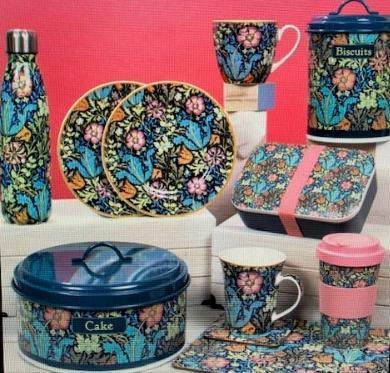
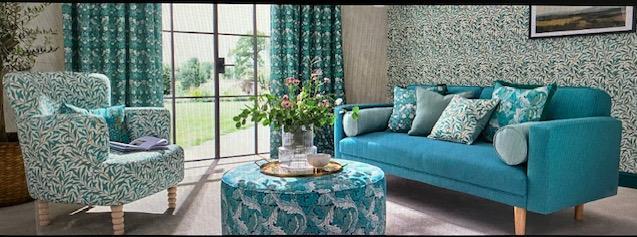
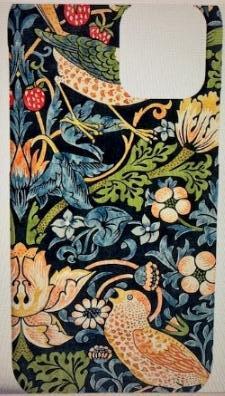
The Ceramics Study Club of Boston opened its 2025-2026 program year at the Parish House in Boston with a talk by two of our fellow members; Nancy Carlise, Curator Emerita, Historic New England and Abigail Homer, ceramics scholar, enthusiast, and collector. Their presentation was entitled: English Ceramicist William de Morgan Goes Ottoman Empire and More. Nancy is a passionate collector of DeMorgan’s pieces as well as other objects from that period and Gail is an avid tile collector with an interest in William Morris and his influence on this entire period. In addition to their talk and slide presentation there was a table full of images and examples of products demonstrating Morris’ design influence still prevalent to this day.
William Morris (1834-1896) was a Pre-Raphaelite designer whose work inspired fellow designers like William DeMorgan with his promotion of handmade arts and crafts that touched all aspects of later 19th century decorative arts. Morris harshly criticized the industrial and mechanized world they lived in and the products it produced. He encouraged harking back to the Middle Ages for design inspiration and the integrity and reward of making and having hand-made objects.
William De Morgan (1835-1917) raised in a very progressive family; his mother was a spiritualist, abolitionist, and suffragette, his father was a professor of mathematics. William thrived as a student at the Kerry School, a feeder school for Royal Academy. His work from this early period reflects the influence of the Pre-Raphaelites. In 1863 De Morgan meets Morris and is greatly influenced by both Morris’ strong personality and artistic talent. Morris also seems to have been impressed by De Morgan as he hires by him to work in his studio where he received a couple of commissions for stained glass windows. It was during this assignment working with glass that De Morgan made an error/discovery: that overfiring colors made them lustrous. This fascinated him, for in addition to being an artist, he had a very scientific mind and continued throughout his life to experiment with lustrous glazes, the nature of glazes, the clays he used and the designs of the forms themselves. In addition to the stained glass commission, De Morgan also received a job to install tiles at the Leighton House in South Kensington.
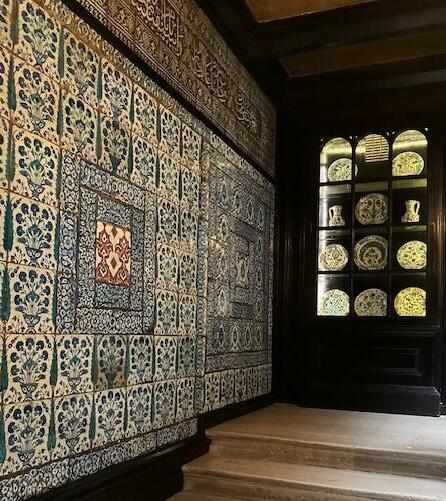
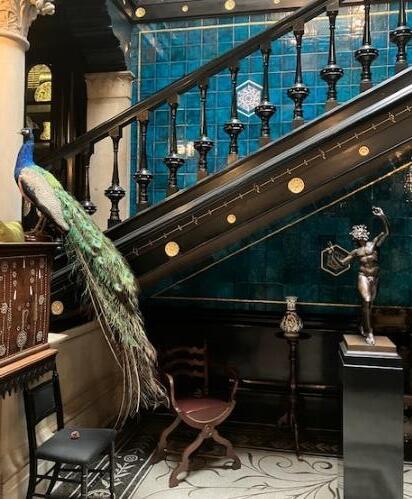
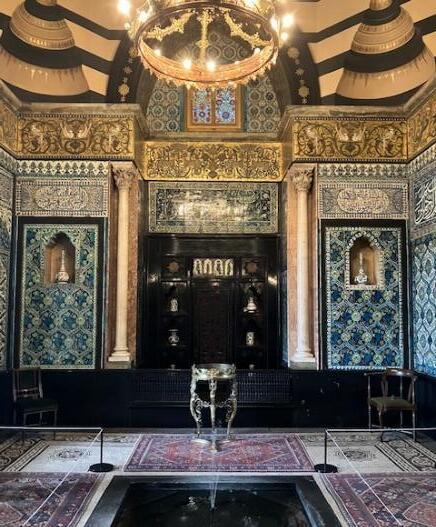
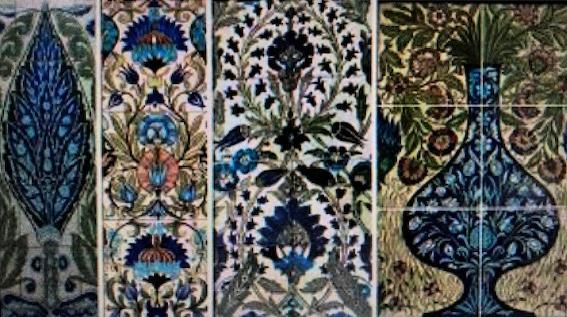
This “studio house” was designed for pre-eminent artist and President of the Royal Academy Sir Frederic Leighton and it included the lavish use of Turkish tiles imported from the Mid-East and De Morgan’s task included creating and matching and installing tiles that already were in situ if the imported ones were of insufficient quantity. It is also most likely that De Morgan got to install a complete corridor of his own work which would have been great publicity for that own work.
See images on the next page Page 2
Images of the uses of tile in Leighton House, South Kensington, London
De Morgan continued to work hard, setting up a kiln of his own, unfortunately he manages to set his roof on fire, and a very perturbed landlord asks him to vacate the premises. Around this time De Morgan marries a Miss Evelyn Pickering, sixteen years his junior, a successful artist working in the Pre-Raphaelite style, who was also a trained artist from the Kerry School. They move into Cheyne Row in Chelsea where he opens a show room and starts selling his tiles. The third floor of their house was used as a tile decorating studio. Most of his painters are women and, typically, remain nameless to us today. Two of his decorators and his kiln manager remain with him throughout their careers.
During this time, William Morris has lived in his famous ‘Red House’ for two years where he creates some of his great Arts and Crafts designs before moving on to Bloomsbury where he settles near the British Museum.
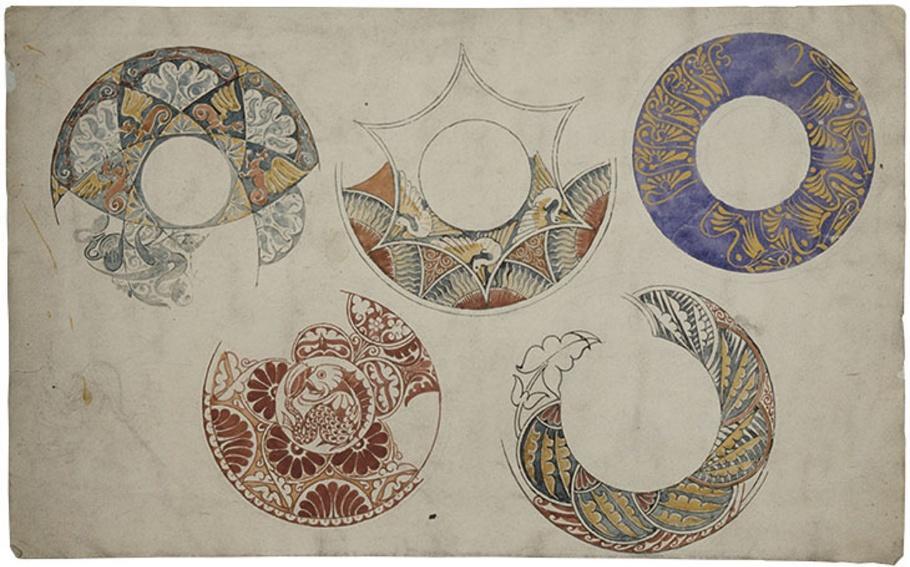
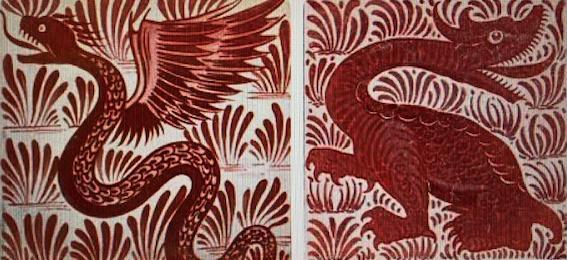
De Morgan has by now published a book of his designs as a marketing tool and opened a shop right across the street from Liberty’s of London. Like so many artists, he wasn’t a great business man and the shop didn’t last that long, despite his talented work. It is important to note that De Morgan didn’t create the ceramics himself but rather created the designs on paper for others to replicate. Many of these original designs survive today. Some of his favorite motifs showcase his love of animals – either drawing them directly from nature or making them up. Where did he get inspiration for some of these creatures? Nancy and Gail suggested perhaps the fantastical creatures came from ancient bestiaries with their not-so-exact renditions of animals. Gail said he did versions of every kind of bird, fish, and animal, real or imagined and became known as “the potter who was in love with dragons” . De Morgan was also a master of symmetry – not your usual mirror-image sort of symmetry, but rather the complex symmetry created by the balance of elements in a design, the positive/negative use of space.
See images next page….
Page 3
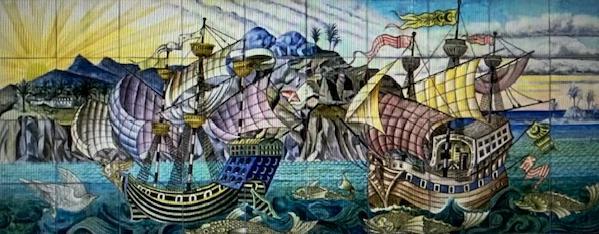
De Morgan landed a wide range of commissions – he is well-known for a group of large multitiled images of ships which were intended for passenger ship interiors – some of which still exist in situ to this day (See below). And on a smaller scale, he was actually asked to design the tiles for the fireplace surround in Lewis Carroll’s room at Christ’s Church, Oxford during its re-decoration. Which begs the question, “Who gets to go to college and re-decorate their room(s)??!!”.
4
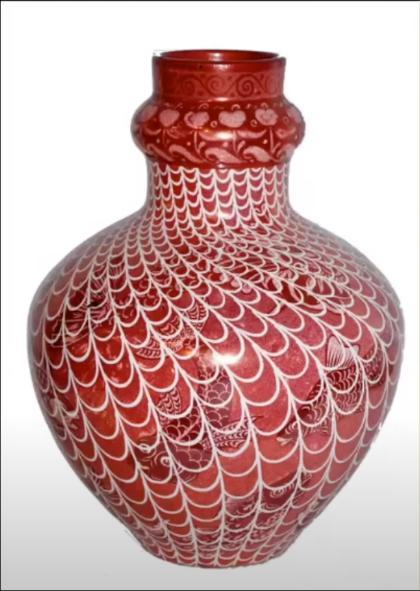
Towards the end of his life William De Morgan and Evelyn spend their winters in Italy and it was there that he partnered with one of the famous glass factories and created what many think is his masterpiece – a red glass vase with an underwater scene of fish beneath a net, the depth and detail in design was a technical triumph of decorating….
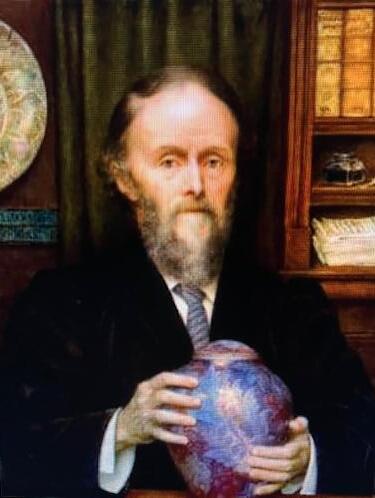
By the beginning of the 20th century, the interest in Pre-Raphaelite ceramics was gone and the De Morgan’s finances suffered. Remarkably, William salvages their comfortable retirement and becomes a best-selling author! The portrait his wife Evelyn painted of him (above) best reflects the story as William is seen holding one of his masterful creations, another piece is displayed partially behind him as well a shelf with the books that saved the couple’s finances.
Gail concluded the talk with an emphasis on the long term influence that William Morris and his Arts & Crafts Movement had not only upon William De Morgan but upon scores of artists during the last half of the 19th century and into our present time as there has been a recent resurgence of interest in his designs in fashion, home and décor…..
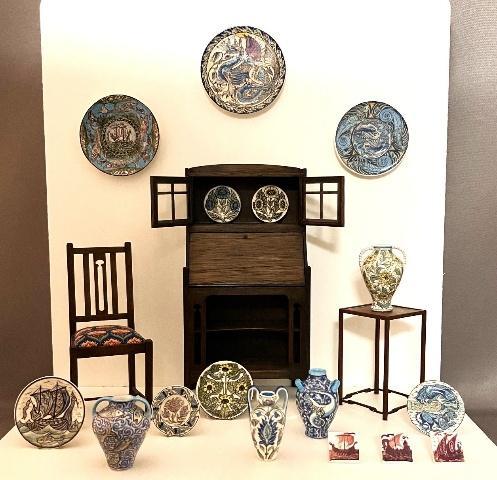
And in addition to the day’s tribute to De Morgan’s influence, Club member and noted miniature ceramicist Lee-ann Wessel brought in a miniature room vignette decorated with William De Morgan pieces she created in 1/12th scale. (Furniture by Mark Murphy; petit point by Pat Rogers).
Places to research and see De Morgan ceramics: The DeMorgan Foundation, Sarah Hardy, Director. Cannon Hall, Barnsley, Northamptonshire; as well as there being works by De Morgan at the Metropolitan Museum, NY; the Victoria & Albert Museum, London; and the Delaware Art Museum to name a few.
ANOTHER MEMBER PRESENTATION IN OCTOBER ON THE SUBJECT OF DEALING IN CHINESE EXPORT PORCELAIN
October’s talk offered another member presentation by newsletter editor, yours truly, Jeffrey Brown. I was inspired to do this talk by an earlier one given by member Nic Johnson on the subject of his collecting odyssey and, having recently ended a thiry-year part-time job as an assistant to noted Chinese export porcelain dealer Polly Latham, I decided to do a sort of memoir of my time ‘in the trade’ with Polly.
When I took the job to augment my freelance design and illustration work little did I know it would be the longest job I would ever have as we were together for thirty years! I would later consider another source of employment when I became (and still am) a personal property appraiser. That's when I fully began to appreciate just how much I had learned under Polly's tutelage and from the numerous clients, collectors, curators, and ceramics fanatics that passed through our Boston shop at 96 Charles Street. This has been an instrumental network that I can call upon when researching objects for an appraisal job or making connections to other areas of interest to me. None of this is apparent at the time when you're just “doing your job”, but when one reflects back, it was an amazing series of experiences for which I remain very grateful.
Page 6
To set the stage, one must consider the rich environment of antique buying and selling at the time. Charles Street in Boston was lined with antiques shops of every sort - it was, at one point, America's antiquing center. Auction records were being set at every sale, there were antique shows somewhere every couple of weeks; it is a world that pretty much has drastically changed if not disappeared. I count myself lucky to have had the smallest role in it and to have witnessed some of its cast of characters. These characters provided a wealth of anecdotes many of which I shall have to edit out here to best focus on just a small portion of the porcelains that I enjoyed working with and learning from.
Although Polly carried a wide variety of Chinese and Japanese export ceramics, all of which cannot be covered here in one article, over the course of time she gained a strong reputation for having some of the best Chinese export porcelain made for the American market. These are not always highly elaborate wares but reflect the restrained and classical aesthetics of the Federal period and are valued relics of our republic’s early history. Special orders were placed by a ship’s Supercargo and in Canton tea and dinner services were hand-decorated with the client’s initials, shipping and naval imagery, as well as emblems of national pride such as American eagles, flags, or states’ seals
Page 7
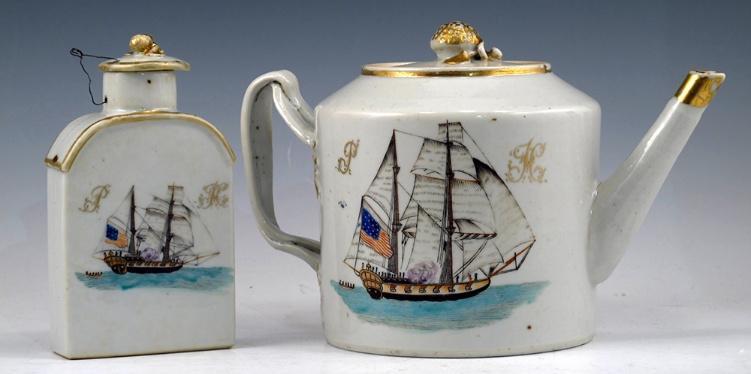
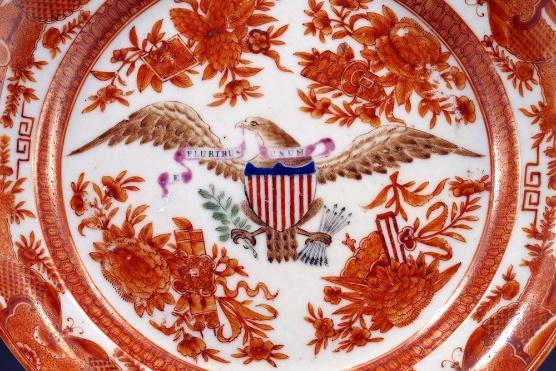
AboveLeft : Teawares bearing the image of a ship flying an American flag with the captian’s initials, circa 1800. Right:a close up of a American eagle-decorated plate in the Orange Fitzhug pattern. The eagle image from the Great Seal of the United States, the service ordered by the Stockton family of New Jersey. C 1820.
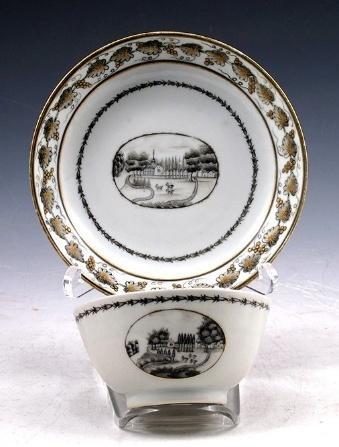
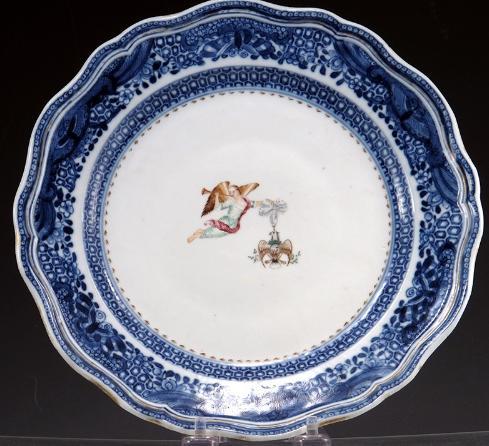
AboveLeft:A tea bowl bearing a naive image of Mt. Vernon, after a print taken from a painting – I think these wares in black were part of a cult of national mourning after Washington’s death in 1799. Center:a very rare plate bearing the image of the Order of the Cincinnati, a fraternal order of Washington’s staff
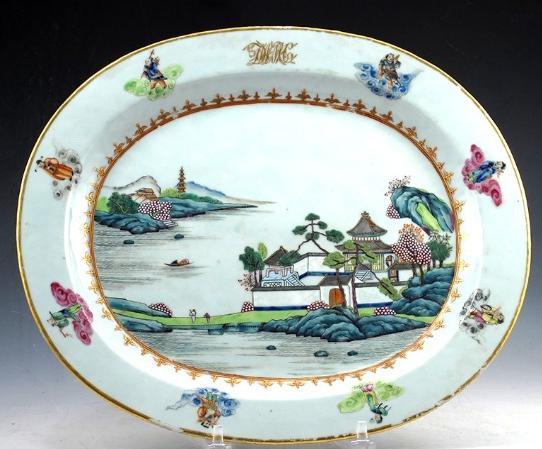
created after the Revolution which is still in existence today – members must be direct male descendants of the original staff. It features Fame blowing her trumpet and holding the Order’s eagle badge. Late 1780s. Right: From an unusual American Market dinner service ordered for Governor DeWitt Clinton of Erie Canal fame, a platter bearing his and his wife’s initials, but with a completely Chinese-themed decoration with Chinese landscape and images of the Immortals. Circa 1810.
The next category I touched upon was always one of my absolute favorites – and that was the Kangxi Period (1654 -1722) where some truly extraordinary blue and white wares were produced characterized by a brilliant white porcelain body and often decorated in intense cobalt blue. The designs remained almost entirely in the Chinese taste and were prized status symbols and luxury items to European collectors who were fascinated by the themes and designs which held great meaning to the Chinese but were pure ‘exotica’ to a Western consumer.
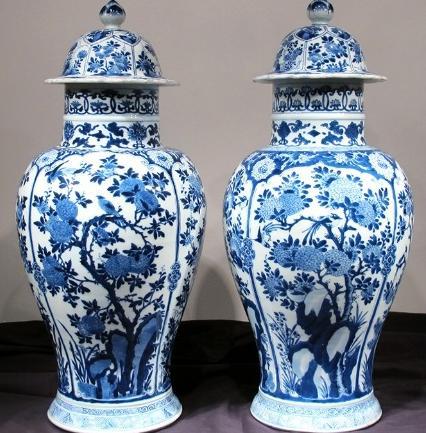
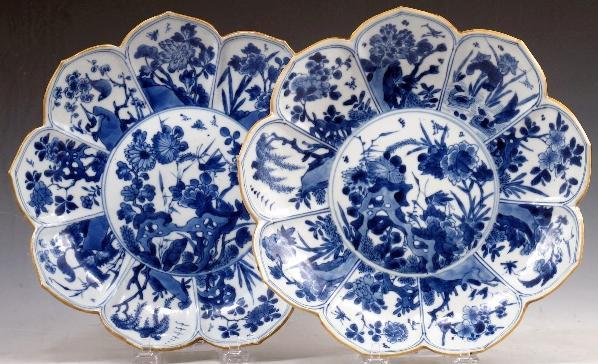
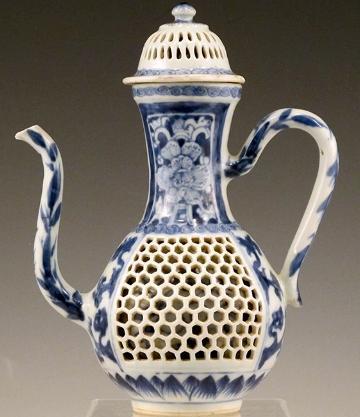
Left: A large pair of Kangxi period baluster vases hand-painted with flowering branches of peony (the “Queen of the Flowers”, a symbol of nobility. Center: a pair of Lotus-form dishes, the center with flowers amongst rockwork – a very popular theme, within a paneled border of flowers representing the Four Seasons – Prunus, Peony, Lotus and Chrysanthemum. Right: an extraordinary double-walled ewer with hand-cut reticulation and decoration painted on the innerwall ! The Chinese called this ‘Ling Long’ or ‘Devil’s Work’. Most of the items we had in the shop from this period dated at about 1690 1722.
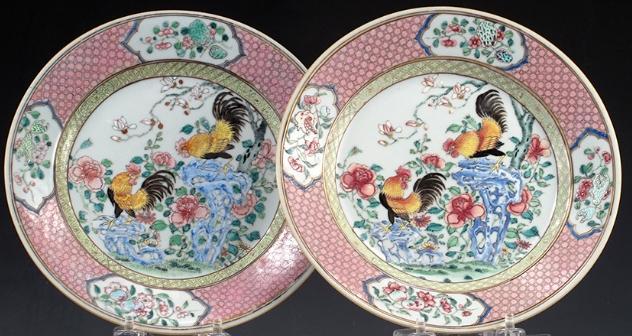
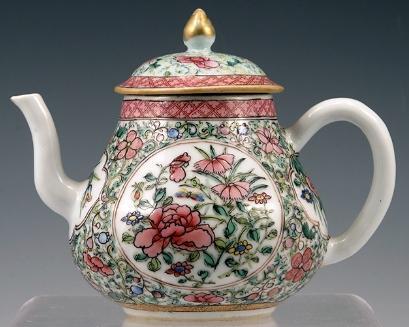
Another enormously popular category that we represented was the next period of Chinese export named for the Emperor Yongzheng (1722-1735). It was during this period that a broader spectrum of enamel colors was developed, the Famille Rose palette. It was a period of ‘eggshell’ thin translucent porcelain and refined painting with a broader range of colors….see below
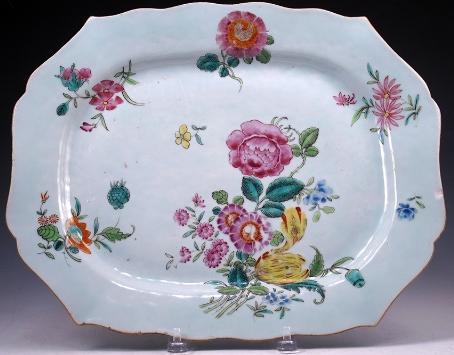
Western market demand continued to grow during the long reign of the Emperor Qianlong (17361796) and the Chinese continued to increasingly cater to special orders and so we now see European-themed designs such as special-order armorial dinner services being made, as well as pieces being made in the taste and style of European porcelains.
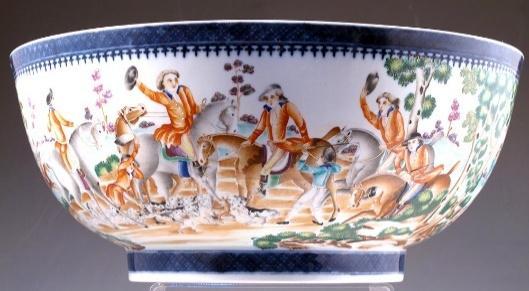
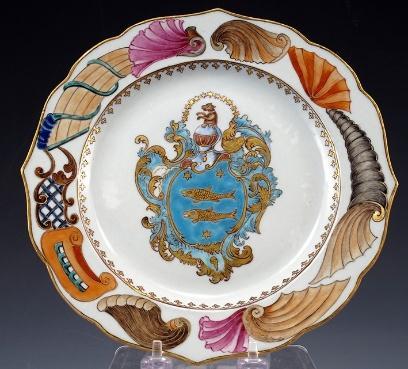
Above Left: A Chinese export shaped platter with European style floral decoration, the form most likely after a European silver shape, circa 1760s. Center : A Chinese export punch bowl with an English fox-hunting scene, circa 1760-1780. Right:A Chinese export dinner plate from an armorial service made for a French family ‘Guilot’ with rococo cartouche and seashell border, circa 1750s-1760s.
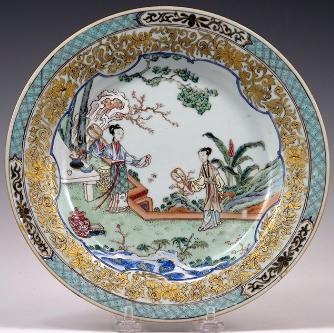
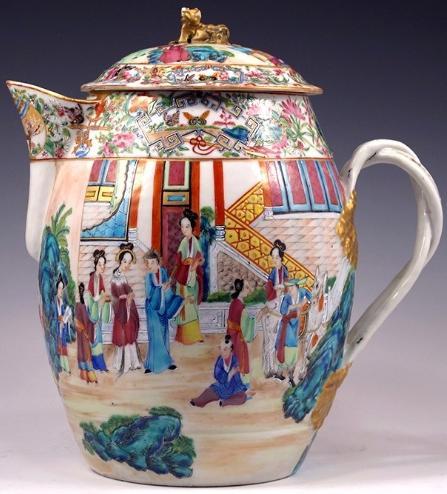
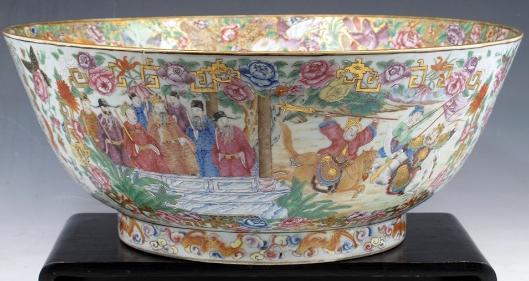
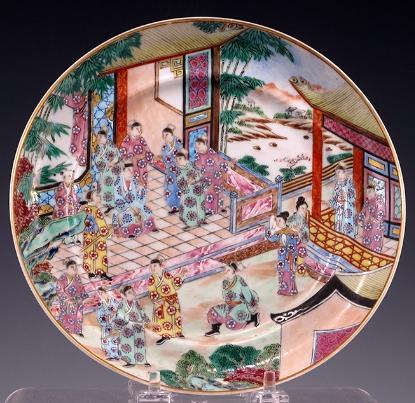
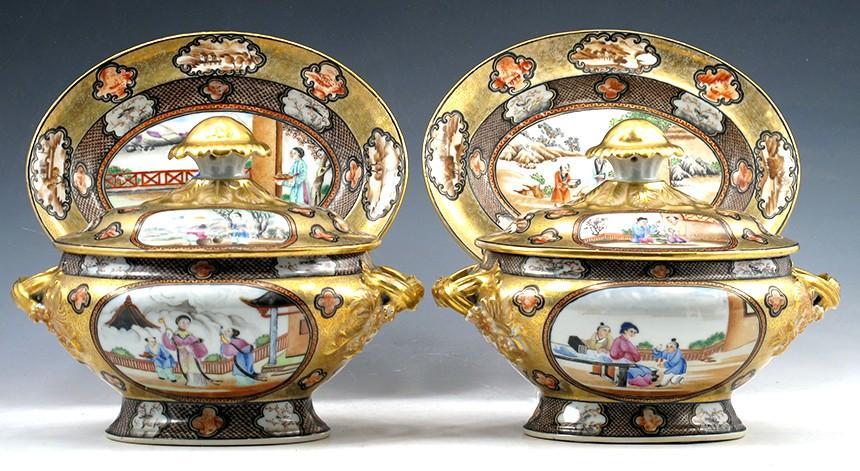
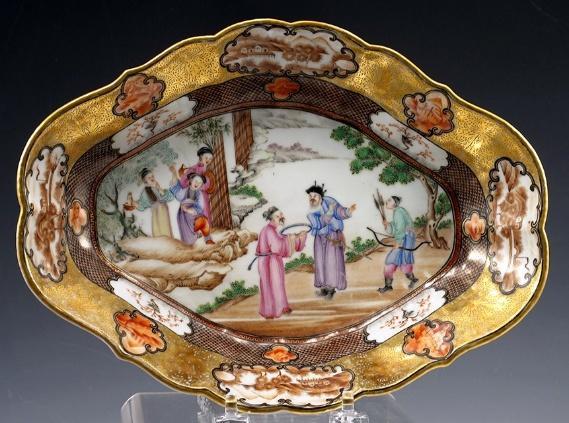
I shall close with one of Polly’s personally favorite categories – the Mandarin group of export wares which basically continued the theme of Chinese figural decoration. Going into the early 19th century, these wares are often painted with courtly scenes of Mandarin officials or ladies in garden settings, or images taken from classic Chinese legends, all set within elaborately rendered borders packed with birds, butterflies, and flowers, often against a rich gilded ground. Also, an extension of this category was the rather rare ‘Rockefeller’ or ‘Palaceware’ patterns, their names speak to their rarity and expensive production.
Above: Examples of the ‘Mandarin’ style of export porcelains circa 1800-1830, note the rich and detailed courtly scenes. The plate on the right is part of a an especially rare group of ‘borderless’ plates, the scenes rendered across the surface like a painting on a canvas – highly unusual for Chinese export as scenes are almost always bordered or compartmentalized.
Page 9
And last, several examples of Chinese export porcelain in the ‘Rockefeller’ or ‘Palaceware’ pattern with finely rendered courtly imagery within amazingly detailed gilded borders. Very few of these services were ordered, they were time-consuming and expensive to decorate and produce. A dinner service of 150-200 pieces would have a different scene on each piece from the largest platter or bowl down to the smallest salt cellar. Gov. Nelson Rockefeller of New York had a complete service, and Polly Latham was fortunate to broker the sale of about 180 pieces of another service. Needless to say, it made a very impressive display at major antiques shows….
So that is a very brief overview of the thirty-year, part-time job that has enriched my life, meeting and learning from collectors and curators, customers and dealers, all the while being surrounded with beautiful objects. I urge everyone who is a collector to, at some point, sit back and reflect upon your journey – where you acquired a piece, who you met along the way, who inspired you, or helped educate you…you will be pleasantly surprised when you start connecting the dots and see the trajectory of your journey.
And as for me, my deepest appreciation and gratitude to Polly Latham!
REDWARES WITH MAGICAL ‘MEDICINAL’ PROPERTIES CLOSE OUT OUR AUTUMN PROGRAM
The autumn half of our program season concluded with a Zoom presentation by noted British ceramics scholar and dealer Errol Manners who spoke on the unusual, and fascinating, subject of ‘medicinal earths; with a talk entitled The Mysterious World of Redwares: Medicine and Magic in the Pottery of Pre-Enlightenment Europe. Errol is Chairman of the French Porcelain Society; a member of the vetting committees of major antiques fairs such as Maastricht and Masterpiece London, as well as a Fellow of the Society of Antiquaries of London amongst other learned associations.
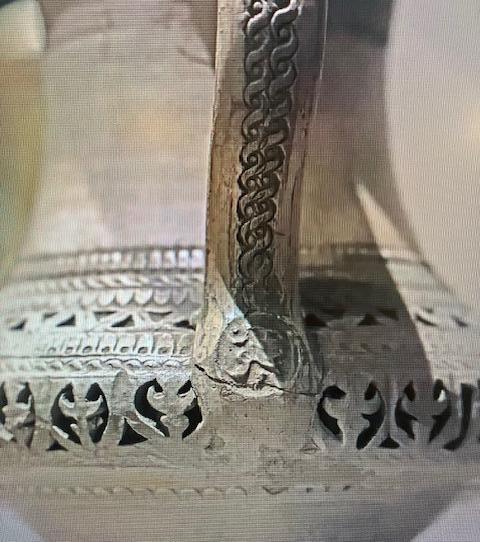
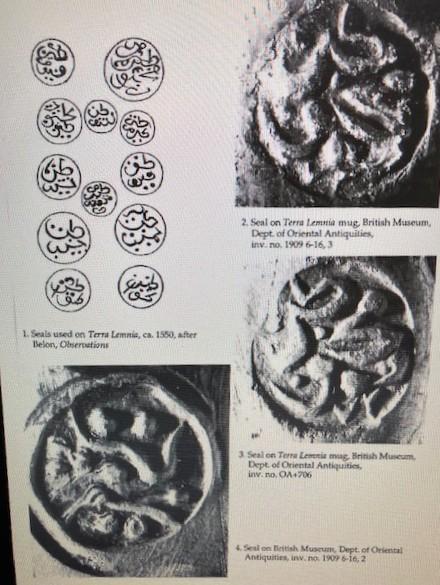
Errol’s opening remarks began with an image of the Hapsburg Kunstkammer at the Kunsthistorisches Museum in Vienna where, amongst a dazzling array of treasures, he pointed out a shelf of somewhat humble earthenware vessels, each one exhibiting at the base of their handles, a small round impressed seal. He then showed us a page from an historic paper written by scholar Page 10
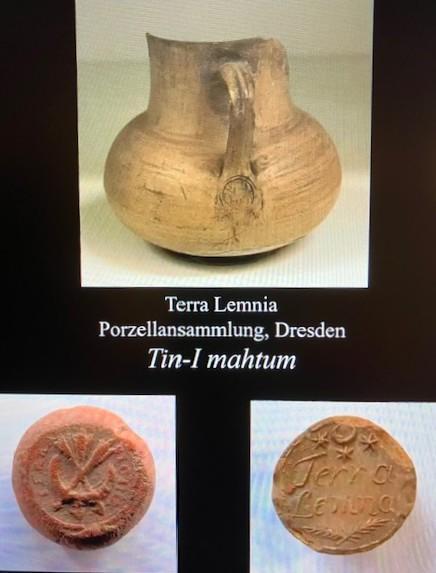
Julian Raby featuring similar seals of Terra Lemnia. These small seals had been a subject that have intrigued Errol for years. These seals indicated that the wares were guaranteed to have been made from a very special clay which, since antiquity, had been credited with having medicinal properties.
These clays, of which the most highly prized were only mined on the Island of Lemnos in the North Aegean Sea between Greece and Turkey. Pliny the Elder in the 1st Century AD wrote about this clay which was widely regarded as an antidote to poisons and was also effective in the treatment of fevers and plague. The clay was ceremoniously harvested on only one day a year and fashioned into small tablets. Well-known in antiquity, it became largely forgotten during the Middle Ages, but knowledge of these clays was preserved by Arab scholars as the Island of Lemnos fell to the Turks in 1480 and mining was revived, again, on only one day a year, this time under Eastern Orthodox and Turkish supervision. The seals were most likely made in kilns on Lemnos; the rest of the clay was sent to Istanbul to be made into vessels. Over the centuries, fewer attended the annual mining of the clay and the last time it was done was in 1918. Today the hill is largely forgotten.
The excavated clay was graded and the finest was sent to the Sultan who had small quantities of it grated upon his food. Earthenware mugs were also fashioned from this magical soil; these wares were valued more highly than Chinese porcelain, although none could ever be bought as the objects never appeared on the open market. The seals alone, called Terra Lemnia Sigillata, were so esteemed that they were presented as gifts to foreign ambassadors and were considered to have magical powers like amulets. The Holy Roman Emperor, Rudulph II - always in fear of being poisoned - sent an embassy to the Turkish Sultan to procure some of these seals and wares.
Page 11
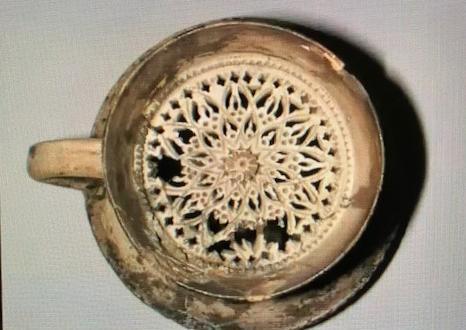
Above Left: A Terra Lemnia pitcher and seals. Right: Top view of a pitcher with a fretwork filter. Allowing as much water to pass through the filter instilling it with maximum protective powers.
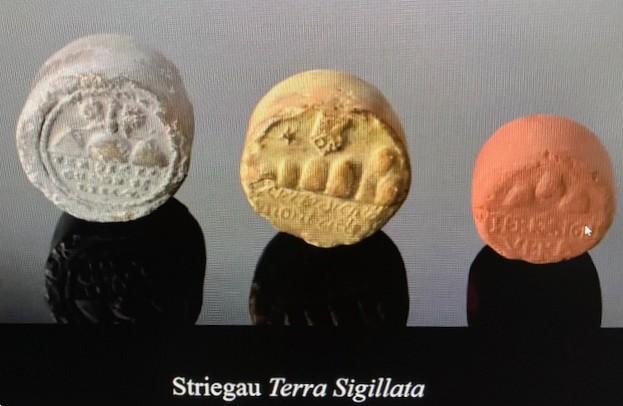
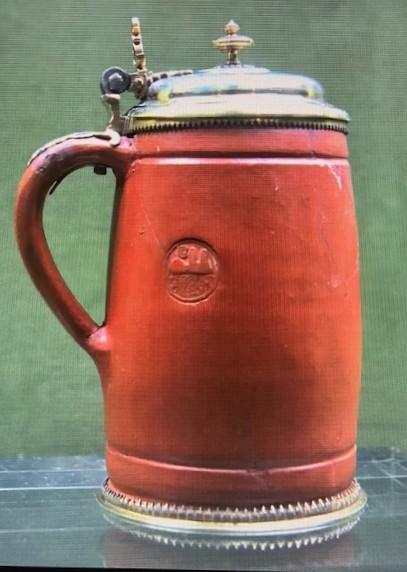
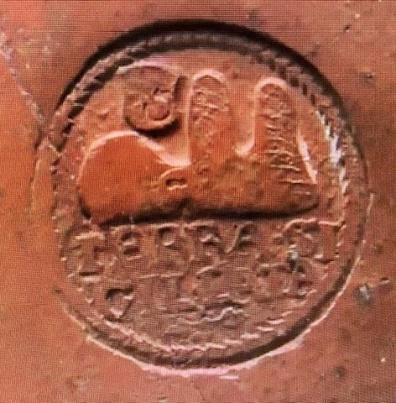
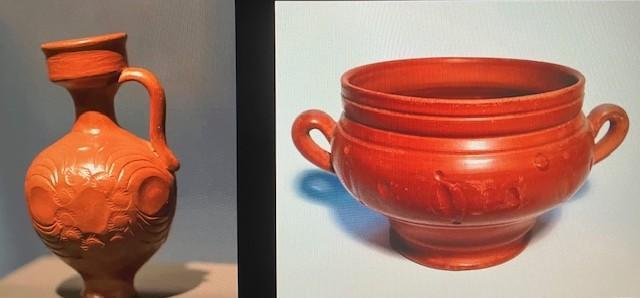
Terra Lemnia was not the only earth valued for its protective properties; there was also Terra Melitea from Malta as well as others from the Holy Land. In the Germanic world of the late 16th century there were sources also found in Silesia and these earthen seals were stamped with images of three Silesian mountains, a town coat-of-arms and its description Terra Sigillata. See below. Note the simplicity of the red earthenware tankard – the value of the clay and its health-preserving properties are emphasized by the silver cover and its authenticity by the seal mark.
12
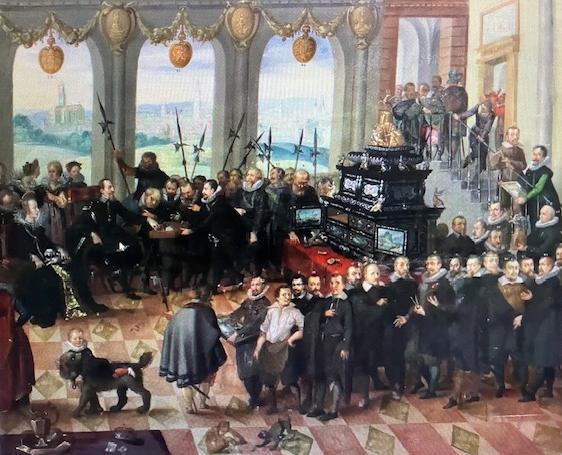
The importance of these earthenwares is emphasized by their inclusion in the Kunstschrank of the period. Known as “art cabinets” or “cabinets of curiosities”, these magnificently carved repositories of treasures - both manmade and natural - were huge status symbols of royalty and nobility as pictured above. C. 1625-1660.
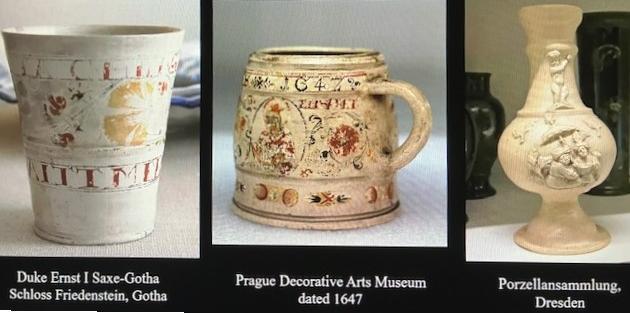
Between 1630-1660 other wares were produced in this style as other veins of this ‘magical clay’ –such as one in Bohemia – were discovered that produced both buff and red bodied wares, always with the ubiquitous seal of authenticity. Also found in this period collections were molded and colored pieces. See below.
These objects were obviously sought-after for their curative powers, but did they actually work? Modern day analysis shows they do contain elements of magnesium, aluminum oxide, iron oxide and chalk – all ingredients modern indigestive medicines.
By the mid-17th century, there was then a chemical myth of certain elements possessing curative powers which led Errol to the second half of this story – the cults of the Mexican redwares and their presence in Europe. Much of what we know about these pieces come from a letter written by Italian Count Lorenzo Magalotti, in 1695:
Page 13
The earth contains certain veins of clays, odoriferous by nature. The best of these are found in the Americas…vases and vessels that have the property of imparting the water poured into them the subtle and sweet aroma with which they are impregnates. Ever since the day when the specimens were imported into Europe the scented property of America has found numerous admirers, and the taste for that precious ware has spread with amazing rapidity into the upper classes of society. They are now counted amongst the essential adornments of all mansions which have pretenses to supreme elegance; they shine as precious works of art in the palaces of kings and princes.”
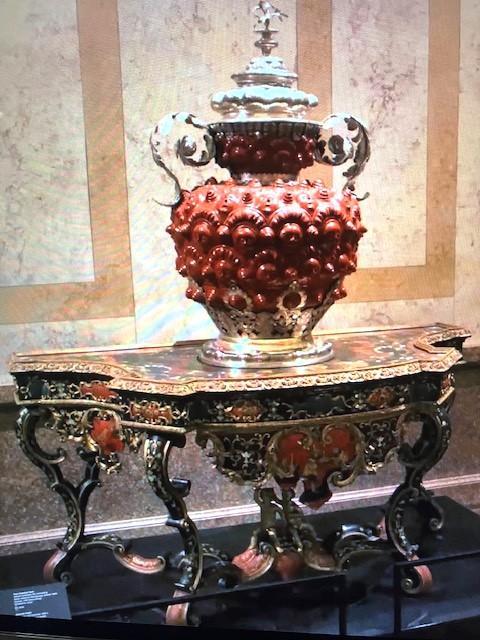
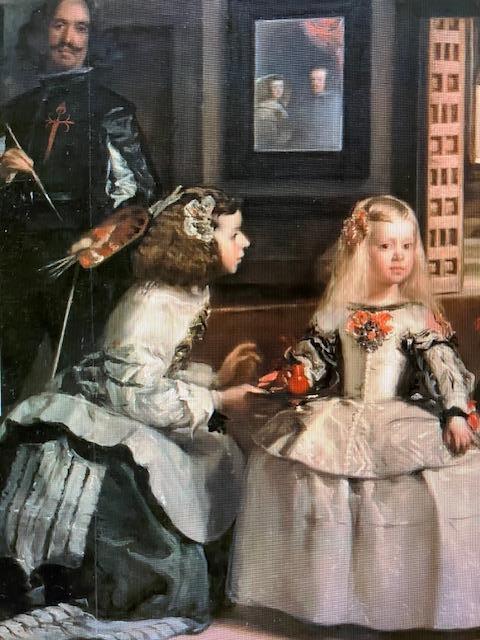
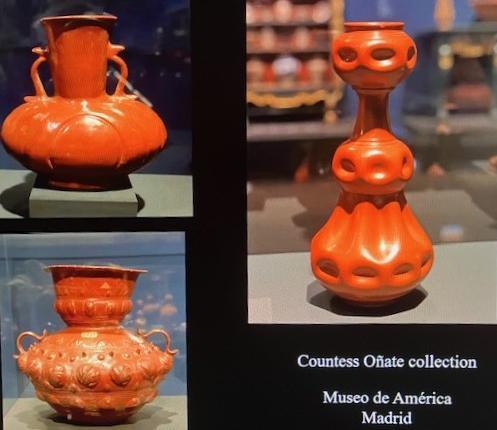
Left: An example of one of the magnificent objects fashioned from Mexican redware. Right: An example of the status that these wares enjoyed – a close-up from Diego Velazquez’ famous painting depicting the Infanta Margaret Theresa of Spain being offered a cup – or Bucaro as they were called - of water by a lady’s maid…note the precious unmistakable red/orange earthenware cup.
As the Spanish empire covered such a large swath of the southern hemisphere it is difficult to ascertain if these ‘New World’ redwares were made exclusively in Spain. Some possibly were made in Chile. To make things even more confusing, Portugal, with its longstanding tradition of potterymaking began to create redwares in the burnished style of the Mexican ones, theirs having been made mostly in Estremoz. See below.
14
One of the best places to study and compare these wares is at the Museo de America in Madrid, Spain which holds the Countess Ornate Collection of over 900 pieces of redware from the southern hemisphere and beyond. Once considered an important resource of Mexican redware, only recent scholarship has shown many of the pieces to be Portuguese! One of the best ways to decide which is which is to know that the Portuguese pieces tend to be wheel-thrown whereas the Mexican pieces are coil-built and sculpted – both reflecting the methods used most commonly in both places.
Errol concluded remarking that redwares of every ilk were enormously popular judging from their presence in period still lifes and portraits. This may explain the popularity of later Chinese Ixing redwares, as well as those produced at Meissen, Holland, and Staffordshire…all subjects for another day.
NOTE FROM THE EDITOR
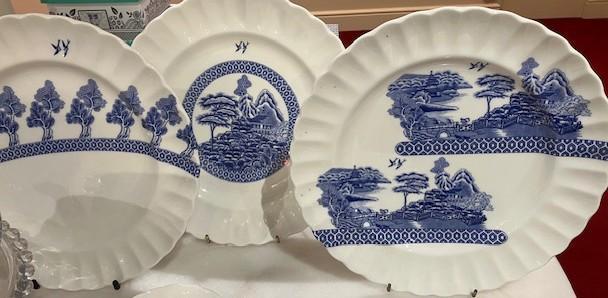
Liz and I got to visit London in September which always includes a trip to Fortnum & Mason’s and while perusing their inventory of all things luxurious, I thought I recognized this china pattern…and assumed fellow members would as well. It is based upon designs by contemporary ceramic artist Paul Scott who has addressed our Club on several occasions. His work incorporates traditional English ceramic design elements and reinterprets them in a more contemporary way as he does here with parts of the well-known Blue Willow pattern. Retailing at 495 pounds sterling each.
15
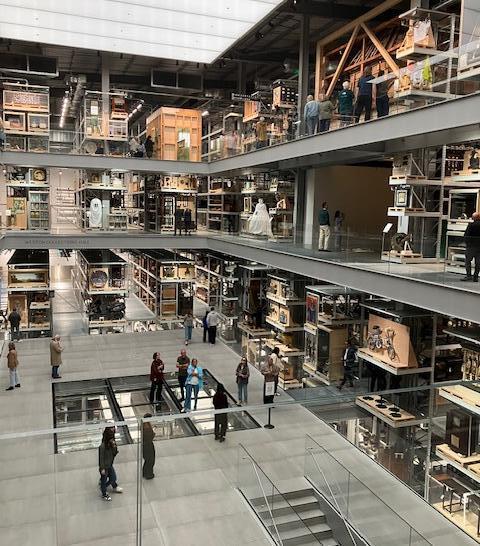
We also got to visit the new Victoria & Albert Museum Warehouse outside of London in Stratford. What a kaleidoscope of decorative arts: a Renaissance cassone, next to a motorbike, next to a collection of 1930s radios, next to a Chippendale chair, on and on, over three floors –ceramics, clocks, sculpture, textiles, fashion…it’s the most fun I’ve ever had in a warehouse! Specific items can be scheduled for individual study, and there’s a conservation lab onsite with conservators at work.
READING SUGGESTION
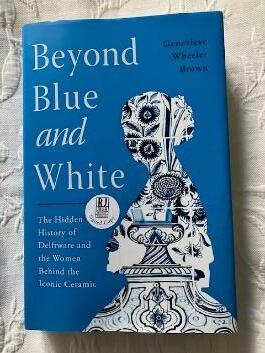
A very enjoyable read for the ceramic enthusiast, Beyond Blue and White, The Hidden History of Delftware and the Women Behind the Iconic Ceramic, by Genevieve Wheeler Brown. A very interesting look into 17th century city of Delft, its ceramic industry, and the important role women had in the running of the business. It also discusses patrons like Queen Mary collecting the wares, as well as going into the late 19th century and discussing women’s roles in collecting, the museum world, and the preservation movement in the decorative arts.