News in Conservation INTERNATIONAL INSTITUTE FOR CONSERVATION OF HISTORIC AND ARTISTIC WORKS
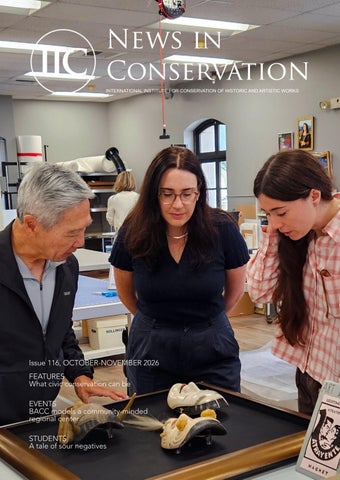
Issue 116, OCTOBER-NOVEMBER 2026 FEATURES What civic conservation can be EVENTS BACC models a community-minded regional center STUDENTS A tale of sour negatives
PRESERVING SAINT FRANCIS IN THE DIGITAL AGE On the beautiful hills of Umbria, the 13thcentury Basilica of Saint Francis of Assisi has survived centuries of war, fire, floods and more than 20 earthquakes—but a pair of devastating earthquakes in 1997 nearly brought the magnificent church down. The disaster killed four people, collapsed part of the roof and severely damaged priceless medieval frescoes by artists including Giotto, Cimabue, Pietro Lorenzetti and Simone Martini. Nearly 30 years later, restoration work continues. Chief restorer Sergio Fusetti has painstakingly reconstructed portions of the damaged frescoes, but tens of thousands of fragments remain unidentified. In storage beneath the basilica are more than 80,000 pieces of plaster and painted decoration, carefully catalogued but still waiting to be matched to their original locations. For Fusetti, the problem has become too complicated for traditional restoration methods alone. His hope is that artificial intelligence may finally help solve the enormous puzzle. The friars have partnered with technology company Haltadefinizione to create a remarkably detailed digital twin of the basilica. Using robotic gigapixel cameras, drones and laser scanners, the team—led by Chief Technology Officer Giovanni Borelli—is capturing hundreds of thou-
Basilica of Saint Francis of Assisi (2024) by Hagai Agmon-Snir/Wikimedia Commons. Licensed under CC BY-SA 4.0
News in Brief
sands of images and measurements. The resulting three-dimensional model will document the building and its artworks in extraordinary detail, providing restorers with a precise record should another disaster strike. AI could also help analyze cracks, discoloration, lifting paint and other problems far more quickly than a human team could. Eventually, researchers hope it will help identify where the remaining fragments belong. But the project is about more than safeguarding the basilica. The same technology is being used to reveal archaeological sites and create immersive virtualreality experiences, allowing visitors to explore places and artworks that might otherwise remain inaccessible. For the Franciscan friars and Borelli’s team, all recognize that technology is not the destination in this endeavor; It is a tool for sharing the basilica’s “treasure of faith and beauty” with future generations—and perhaps ensuring that, even if the real building is ever threatened again, its history will not be lost. For more information and to watch a video interview, visit the original article here: https://www.cbsnews. com/news/italy-saint-francis-basilica-digitalpreservation-60-minutes/
FOTOGRAFÍAS PERDURABLES: A NEW SPANISHLANGUAGE PLATFORM FOR PHOTOGRAPH CONSERVATION In August 2026, members of the Grupo de Investigación en Materia de Fotografías (GIF) launched Fotografías Perdurables, a new Spanish language digital platform dedicated to the research, conservation, and management of photographic heritage. Created as a bridge between GIF’s activities and a broader community, Fotografías Perdurables seeks to make specialized knowledge accessible while creating opportunities for exchange, connection, and collaboration. The project brings together professionals and students from different generations, disciplines, institutions, and geographic regions, connecting the photograph conservation community in Latin America with colleagues working internationally. The platform presents specialized content through a highly curated editorial approach that combines texts, images, interviews, and other digital formats. Essays, case studies, technical resources, conversations with specialists, and visual materials explore the materiality, deterioration, conservation, and management of photographs. By bringing these different formats and perspectives together, the
project aims not only to share existing knowledge but also to encourage new conversations and contribute to the development of new resources in Spanish. Collaboration has been central to the project from the beginning. Fotografías Perdurables brings together the perspectives of students and emerging professionals alongside those of experienced conservators, scientists, curators, art historians, photographers, and other specialists. The project launched with the participation of more than 50 contributors from 12 countries. Although Spanish is the common language of the platform, the knowledge and experiences it brings together cross linguistic and geographic boundaries. Contributions and conversations originating in different languages are translated and adapted for publication in Spanish, creating connections between communities that do not always have access to the same professional resources and discussions. Fotografías Perdurables is conceived as a living and evolving resource. As new content and contributors are added, the project aims to continue expanding these connections, fostering inspiration and collaboration, while creating a space where different approaches to the conservation and study of photographic heritage can meet.
Fotografías Perdurables: A New Spanish-Language Platform for Photograph Conservation. © Fotografías Perdurables, 2026.
By Alejandra Mendoza, Fernanda Valverde, Karla Alvarez, and Santiago Navarrete
Public sculpture has always had to contend with the elements, but as climate change brings more extreme heat, flooding, hurricanes, wildfires and dramatic swings in temperature, conservators are being forced to rethink what it means to keep outdoor art permanent. A recent Observer article by Daniel Grant examines how museums, sculpture parks, and public-art agencies are adapting their conservation practices to a less predictable climate. At the Museum of Fine Arts, Houston, for example, the 24-foot-tall bronze Satellite by Simone Leigh presents an unusual problem; its large, dish-shaped head could catch powerful winds during increasingly intense hurricanes and tornadoes. The Museum’s solution may be decidedly low-tech— remove the head and bring it indoors when severe weather threatens. The Museum also convenes a disaster-mitigation committee before hurricane season to review
past storms and improve its preparations. Other institutions are taking a more analytical approach. The New Orleans Museum of Art has worked with architects to use computer modeling to determine whether sculptures in its 12-acre
Heat and drought create their own conservation headaches. At Grounds for Sculpture in New Jersey, hotter summers can make it difficult to apply protective wax coatings to bronze sculptures, while water restrictions can limit the cleaning and maintenance that help prevent larger problems.
"Conservation is becoming less about preserving public art unchanged and more about anticipating an uncertain future." garden can withstand winds of up to 150 or even 175 miles per hour (240-280km/h). Hurricane Ida in 2021 demonstrated the stakes when several works were knocked over or damaged. Yet even careful planning has its limits: an unexpected snowstorm in 2025 caused welding joints on some sculptures to fail, reminding conservators that climate-related risks are not limited to heat and hurricanes.
Laumeier Sculpture Park in Missouri experiences repeated cycles of extreme heat and cold causing materials to expand and contract, contributing to costly damage. As a result, Laumeier increasingly accepts new works on temporary two-year loans, allowing staff to observe how they withstand outdoor conditions before considering permanent acquisition. Climate concerns are also influencing public art before a sculpture is
Museum of Fine Arts Houston (2010) by elaine/Flickr. Licensed under CC BY-NC-ND 2.0
“Satellite” by Simone Leigh (2026) by Joe Loong/Flickr. Licensed under CC BY-SA 4.0
THINKING OUTSIDE THE BOX TO PRESERVE PUBLIC ART AGAINST CLIMATE CHANGE EXTREMES
Katrien Keune, Rijksmuseum and the University of Amsterdam, presenting the GoGreen Project in Venice on 3 September 2026.
even made. Organizations such as Storm King Art Center and Indiana’s Indy Arts Council are paying closer attention to materials, foundations, drainage, wind loads, seismic risks and the location of artworks. In flood-prone areas, some agencies now require engineers to design foundations capable of withstanding future conditions. Conservation is becoming less about preserving public art unchanged and more about anticipating an uncertain future. With thousands of outdoor artworks across the United States—and many made from relatively new, insufficiently tested materials—institutions are learning that permanence may require flexibility, careful monitoring and, occasionally, knowing when to let a sculpture come inside. Read the original article here: https://observer. com/2026/10/conservation-climate-change-andpublic-art/
HORIZON EUROPE'S GOGREEN PROJECT CONCLUDES, SETTING NEW STANDARDS FOR SUSTAINABLE CONSERVATION OF CULTURAL HERITAGE GoGreen, a four-year research project funded by the European Union’s Horizon Europe programme, has come to a close after developing and testing a new generation of environmentally sustainable conservation practices for museums, archives and heritage sites. The project’s consortium of 13 research institutions, museums and heritage organisations across seven countries marked the occasion with a closing international conference, “Green Strategies and Innovations for Cultural Heritage Conservation,” held on 3 September 2026 at the Scuola Grande di San Marco in Venice, Italy. The closing conference drew delegates from across Europe and further afield—among them many students and early-career conservation scientists—for an engaging and discussion-driven day. Participants were particularly interested in the application of the project’s outputs and resources, inquiring about practical, hands-on access to the tools and methods the consortium has developed—a conversation the consortium looks forward to continuing. The programme opened with a keynote from Aruna Francesca Maria Gujral, Director-General of ICCROM (the International Centre for the Study of the Preservation and Restoration of Cultural Property), with further contributions from Prof. Dr. Stefan Simon (Director, Rathgen-Forschungslabor), Prof. Ilaria Saccani (CESMAR7), and Prof. Andrea
Consortium partners used the occasion to thank Professor Keune for her coordination of the project and leadership over the past four years. While EU funding for GoGreen concluded in September 2026, its impact on the conservation field is only just beginning. The consortium partners are committed to keeping the GoGreen tools, standards and resources alive for the conservation field and are already discussing how best to carry the work forward beyond the project's lifetime. The green conservation definition and parameters, and the Digital Support App, the Decision Making Model, and the materials and methods developed give museums, conservators and heritage organisations practical tools to make sustainability part of everyday practice—a shift the consortium expects to shape the profession for years to come. Full details on a key project outputs—including publications, downloads and guidance—as well as more information on GoGreen are available at: gogreenconservation.eu
Detail from the cover image of the Getty Research Journal, Issue 21.
GETTY RESEARCH JOURNAL The 21st issue of the Getty Research Journal is available for free download HERE, featuring articles on the visual arts of all cultures, regions, and time periods that advance the journal’s commitment to presenting diverse perspectives and methodological approaches.
National Palace Museum Archway (2005) by Rod Wilson/Flickr. Licensed under CC BY-NC-ND 2.0
At the closing event, Prof. Dr. Stefan Simon, Director of the Rathgen-Forschungslabor, described GoGreen as a “lighthouse project,” pointing to the strength of collaboration across the consortium—including with its partner projects in the Green Conservation Cluster, MOXY and GreenArt—and to project outputs such as the glass-stabilisation treatment based on greenchemistry practices developed by the Istituto Italiano di Tecnologia (IIT), which has already been patented and led to a spin-off company.
More News Click on the images below
CONSERVATION EXHIBITION IN TAIWAN The National Palace Museum in Taipei has a new exhibition focused on the preservation and conservation of cultural heritage. Reviving Cultural Treasures: Conservation and Restoration runs from 8 October to 3 January. Etchmiadzin Cathedral (2009) by Ibán/Flickr. Licensed under CC BY-NC-SA 2.0
Del Bianco (Academy of Fine Arts, Bologna). Sessions covered green education and the sector’s new working definition of “green conservation,” followed by dedicated sessions on greener preventive conservation and greener remedial (treatment) methods.
CORRECTION An image caption in the article “Incorporating Sustainability in Conservation Education” in News in Conservation, June-July 2026, Issue 114, p. 6061 should be corrected; the community member and host institution were not credited. The caption should have read: “Veronica Peña shares knowledge with UCLA/Getty Conservation students Naomi Rosenkranz, Rachel Moore, and Hattie HŌpai at La Historia Historical Society Museum in El Monte, California during a community workshop organized as part of a conservation graduate course. Photo Credit: Justine Wuebold."
ARMENIA’S NEW CONSERVATION WORKSHOP A new conservation workshop at the Alex and Marie Manoogian Treasury, with support from the Japanese government’s Grassroots Cultural Grant Program, was inaugurated on 2 October at the Mother See of Holy Etchmiadzin.
The 166-foot bell tower of First Christian Church (Eliel Saarinen, 1942) under scaffolding during masonry repairs in 2023. Photo: Hadley Fruits for Landmark Columbus Foundation
When Conservation Becomes Civic By Richard McCoy
I
trained as a conservator-restorer in the United States. My education at New York University's Institute of Fine Arts, internships at the Metropolitan Museum of Art and the Museum of Modern Art, and a decade at the Indianapolis Museum of Art formed the habits that still shape how I work: close examination, material analysis, documentation, and the ethics of intervention. The profession trains judgment before action. It teaches restraint and places the conservator within a continuum of time. The art and artifacts we care for may outlast us. Every individual thing we work on carries its history in its material condition, so care begins with close attention to what is there, physically. I did not expect those habits to lead me out of museum life and into a leadership position in the civic life of a small Indiana city. In 2013, I found myself on the other side of a new museum director's vision. Days later, I appeared at the Redevelopment Commission in Columbus, Indiana, to pitch my services. That meeting set me on the path toward creating Landmark Columbus Foundation, an organization charged with caring for, celebrating, and advancing the cultural heritage of a city with one of the most significant concentrations of modern architecture in North America. Columbus has about 50,000 residents. Its schools, churches, parks, and civic buildings include works by Eliel Saarinen, Eero Saarinen, Harry Weese, I. M. Pei, Kevin Roche, and Deborah Berke. These buildings did not appear by accident, and they have not endured by accident. The story usually gets told as patronage, and it began that way. In 1942, the family of the industrialist J. Irwin Miller commissioned Eliel Saarinen to design a new home for their own congregation, First Christian Church. The family funded the construction and led the building decision-making process as well. Fifteen years later, something different began. In 1957, the Cummins Foundation, the philanthropic arm of the engine company led by Miller, paid the architect's
"These buildings did not appear by accident, fee for a public elementary school, Lillian C. Schmitt Elementary, designed by Harry Weese. While the money came from a corporation, the design decisions were made by a school board answerable to voters. Three years later, the foundation formalized this funding-design model, opening it to any public building in Columbus,
and they endured
y have not d by accident" Bryony Roberts Studio's "Soft Civic," a 2019 J. Irwin and Xenia S. Miller Prize installation for Exhibit Columbus. Photo: Hadley Fruits for Landmark Columbus Foundation
provided the architect came from a list assembled by a jury of design professionals. The model was used for fire stations, libraries, parks, and government offices. Boards and committees chose whether to participate on a project-by-project basis, and they have continued to do so for decades. This building practice in Columbus survived Miller’s death in 2004 because it had become an institutional expectation that no longer required his presence. The program remains active today with two new buildings currently under construction. Learning this legacy taught me that the central focus for maintaining this established Columbus cultural tradition for the built environment is in discovering how to sustain the civic habits that made those buildings possible. This quest inevitably leads to other questions. How does a community care for what it inherits? How does it decide what deserves protection? How does it build support for stewardship measured in decades? How does it create conditions in which new work will be seen as worthy of the same care?
Conservators are familiar with working through these questions. We recognize when quality has been protected over time, and we know how fragile that continued protection is. Materials and documentation often survive, but Institutional memory may only partly survive over time. A culture of attention continues only when the community and institutions actively choose to renew it. Even museums evidence how easily that transmission of collective knowledge can break. Standards may slip. Context is forgotten. Short-term pressures hold more weight than longterm judgments. At the civic scale, the responsibility of continued care becomes political and more widely distributed. Care passes among property owners, institutions, public bodies, professionals, and residents who possess different forms of authority and unequal resources. Increasing neglect over time can be overlooked because buildings can remain standing while the discipline of caring for them weakens. For a decade, Landmark Columbus Foundation has worked to sustain the city’s habits of civic awareness
Left: High school students from TuFuturo lead a Spanish-language walking tour along Washington Street in downtown Columbus, August 2024. Right: The twin-arched overpass carrying State Road 46 over Interstate 65, designed by Jean M. Muller of J. Muller International and completed in 1997, photographed during repair work in 2023. Both photos by Hadley Fruits for Landmark Columbus Foundation
"Increasing neglect over time can be overlooked because buildings can remain standing while the discipline of caring for them weakens"
Into the Hedge by SO-IL, a J. Irwin and Xenia S. Miller Prize installation for the 2019 Exhibit Columbus exhibition. Photo: Hadley Fruits for Landmark Columbus Foundation
and action. Some of our work follows established preservation practices—research; documentation; conservation planning; advocacy; and fundraising for significant buildings, landscapes, and artworks. Other work is public and experimental. Through Exhibit Columbus we commission installations that place real design questions in public spaces. We created Progressive Preservation as a system to treat preservation as continuous, anticipatory, and embedded in everyday decisions. With our newlyformed Civic Design Institute we have begun working with communities across Indiana to understand how design excellence can become a civic practice beyond Columbus. An Exhibit Columbus commission from 2019 is a model case study of the Foundation in action. SO–IL, one of that year’s five recipients of the J. Irwin and Xenia S. Miller Prize, began with a maintenance problem at the Miller House and Garden. The 70-year-old arborvitae hedge surrounding the outdoor swimming
pool at the Miller House and Garden, one of seven National Historic Landmarks in Columbus, had reached the end of its life and was scheduled for replacement. SO–IL procured the replacement trees early and temporarily installed all 130 of them on the lawn of the Bartholomew County Courthouse, strung with a hand-woven hammock structure whose nylon webbing takes its colors from Alexander Girard's palette for the Miller House dining chairs. For one season, a hedge that had always marked a private boundary held the public interest. The next spring, the trees were planted at the Miller Garden where they continue to grow. The temporary public installation had become part of the preservation project, situated transitionally between the arborvitae hedge removal and replanting. It made a maintenance cycle public and allowed the replacement material to carry civic meaning before assuming its permanent role at the landmark. In this instance, contemporary art and design became part of the preservation method itself.
Oftentimes, art and design are used as community engagement tools to bring people together, but the work we have commissioned through 10 years of Exhibit Columbus has allowed new ideas to emerge that build collective memory throughout the community and create meaning that is transferable to other places. What is preserved is just as much the personal connections to the material or formal aspects of art as it is the ideas they represent in their original state and their continued evolution. These ideas from Exhibit Columbus commissions now rest on a strategic framework our board recently adopted—Design Excellence as Civic Practice—which claims that design excellence is a civic discipline, sustained by habits belonging to, and sustained by, an entire city rather than any one project. Communities practice those habits through attention, collaboration across public and private interests, public participation in decisions about Above: Richard McCoy, Executive Director of Landmark Columbus Foundation, welcomes participants to the 2024 Exhibit Columbus Community Kickoff, opening the program's fifth cycle. Hadley Fruits for Landmark Columbus Foundation Below: Opening weekend crowds gather at Accessing Nostalgia, the 2024–25 J. Irwin and Xenia S. Miller Prize installation by Chicago-based Adaptive Operations at the Crump Theatre. Hadley Fruits for Landmark Columbus Foundation
stead of added afterward, as a community engagement tactic? What changes when public art becomes part of how a community understands memory and belonging? What changes when stewardship is understood as public meaning-making alongside physical protection?
shared space, and investment measured in decades. This year we will convene a national summit, Prove It, to test that claim with other communities. This year I am also testing the Landmark Columbus Foundation strategic framework against the wider field. The James Marston Fitch Charitable Foundation has awarded me a Mid-Career Fellowship for research titled Preservation in Public: Art, Design, and the Making of Civic Belonging. The project maps practitioners and organizations working where contemporary art, experimental design, and preservation meet; develops a framework to explain what they share; and tests that framework against Columbus and other programs in North America and Western Europe. The fellowship’s namesake matters here. James Marston Fitch co-founded the nation’s first graduate program in historic preservation at Columbia University (New York) in 1964. His major book, Historic Preservation: Curatorial Management of the Built World, framed preservation as curatorial work at the scale of the built environment. Its title leaves an enduring question: who gets to be the curator? My fellowship follows that question into practices where professional expertise, institutional authority, artistic authorship, and community knowledge all have a place at the decision-making table. Three questions organize this fellowship—and for now I want to keep them as questions rather than as conclusions. What changes when art and design are built into preservation practice as part of the work, in-
Current preservation discourse often assigns material care to specialists, and public meaning is left to interpretation by those specialists. In practice, every technical decision carries cultural consequences. Choices about treatment, access, reuse, documentation, and investment influence who feels included in a community’s heritage. Expertise establishes material evidence, identifies constraints, and clarifies the consequences of intervention. Civic relationships reveal how cultural, economic, and political value is created, experienced, contested, and renewed. With this in mind, preservation decisions emerge through the interaction of professional knowledge and the ways communities use, interpret, and care for what they inherit. My training gave me a method before it gave me a career. It taught me that care is an intellectual act, that stewardship is inseparable from judgment of cultural significance, and that what survives depends on materials and on whether institutions remain capable of recognizing their obligation to what earlier generations built and entrusted to them. If you are a conservator-restorer asking questions that exceed your current role, follow them. The field needs people willing to carry conservation’s habits of mind into adjacent fields and test what those habits can contribute to larger public questions while remaining grounded in the discipline’s evidence, ethics, and limits. Conservation becomes civic when its habits of care enter the life of a city and a community takes up those habits as its own. Close attention matters in civic work. So do evidentiary honesty, restraint, and respect for what already exists. These habits aid in caring for the past as an act of optimism about the future rather than living in nostalgia.
.......................................................
Richard McCoy is the founding executive director of Landmark Columbus Foundation in Columbus, Indiana. Trained as a conservator at New York University's Institute of Fine Arts, he previously worked at the Indianapolis Museum of Art. He is a 1998 Fulbright scholar, a 2004 Kress Fellow, and a 2026 James Marston Fitch MidCareer Fellow.
Radiographic Evidence for a Vessel in the Cruci�x from Musse, Denmark By Noëlle L. W. Streeton, José Tapia Reguera and Jacopo Melada
“That looks like… a relic holder” This was the start of a conversation in June 2026 during X-radiography of a monumental medieval crucifix at Stiftsmuseum, in Maribo on the island of Lolland, Denmark. This conversation
among the researchers for POLYCHROME – The Survival of Damaged Medieval Heritage in the Nordics has led to questions that are both intriguing and problematic.
X-radiograph, head of the Musse crucifix, 35 × 43 cm directradiography panel (image: ERC POLYCHROME project)
Figure 3. Removing the crucifix from display mounts (image: ERC POLYCHROME project)
Strong interest in the possibility of a relic has meant that there is pressure on the POLYCHROME team (the authors of this article) to categorise the vessel without delay despite its inaccessibility in a sealed head cavity and the early stage of the project. Fieldwork started in February 2026 and will continue through 2028. As such, it is premature to comment directly on the meaning of this find and too early to contextualise it with other analytical data and with archival sources. A possible relic is, in addition, only tangentially relevant to the project, which instead centres on post-Reformation damage, histories of restoration and early-career conservation training. Nevertheless, finding something so potentially exciting during radiography should not be set aside and, in this case, raises two questions: What might a concealed 14th-century relic holder look like? And is there sufficient evidence to identify it as such? Answers to these questions would help us to respond to those who have already enquired about the possibility of opening the cavity. This short article starts with a very brief background to the POLYCHROME mission to Maribo before considering the evidence and its implications.
MISSION TO MARIBO The POLYCHROME team left Oslo in the mobile laboratory on the morning of 1 June 2026. The van rolled into Maribo late that same day, and early on 2 June, the Stiftsmuseum (Museum Lolland-Falster) staff were ready to help us to dismount two crucifixes, including the crucifix from Musse church (Figures 2 and 3). They also supplied us with ladders to allow us the best view of other crucifixes that could not be moved without a small army or lifting equipment.
��
��
��
��
��
standard imaging equipment for visible light and ultraviolet-induced visible fluorescence to visualise surfaces, repairs and later interventions. portable digital X-ray radiography to examine construction and internal structures (Teledyne® 120 kV, 1 mA max. X-ray tube and two PACSESS NDT digital plates, 35 × 43 and 17 × 23 cm). portable X-ray fluorescence for point analysis and 2D-elemental mapping to characterise pigments and restorations (Bruker® ELIO PLUS®). a 2D/3D optical microscope to study damage, stratigraphy and repaints (HIROX® up to ×2500). handheld structured-light 3D scanner to record, measure and compare topographies and cut marks (Einstar 2®, resolution to 0.06 mm).
A significant goal of our systematic examinations is to gather directly comparable data from medieval polychromed objects, particularly those that appear to have been selectively mutilated after the Reformations (declared 1527 in Sweden and 1536 in DenmarkNorway). The data will eventually allow us to characterise and differentiate between damages, repairs and restorations. From data gathered already, there are clear signs of purposeful destruction as well as evidence related to restorations which played key roles in concealing or disguising damage. Ultimately, this research will help us to paint a more nuanced picture of the impact of both religious change and restorers on medieval church inventories. We also anticipate a significant impact on the training of new conservators, training them to recognise a range of physical phenomena that are not necessarily associated with accidents, environment or ageing.
THE X-RADIOGRAPHY The team then had two-and-a-half weeks to examine a total of seven objects with a suite of non-invasive instruments. Those that are central to POLYCHROME fieldwork include:
The narrow focus here is on X-radiography. We acquired 10 overlapping radiographs with the large detector panel (35 × 43 cm,
Left: Figure 4. X-radiograph, head of the Musse crucifix, 17 × 23 cm direct-radiography panel (image: ERC POLYCHROME project) Right: Figure 5. Hirox macro-photo, Head-hole plug (image: ERC POLYCHROME project)
100 µm lateral resolution) situated to the proper left, and the X-ray source was situated at the right to avoid the steel crossbar that supports the cross from the back. The voltage, intensity and exposure time were 80 kilovolts (kV), 1 milliamp (mA) and 18 seconds per image. We then attempted to gain a clearer view of the contents of the cavity. Using the same settings and the smaller detector (17 × 23 cm, resolution 75 µm), we situated the panel behind the head to acquire eight further radiographs.
*Lena Liepe. 2020. Reliker och relikbruk I det medeltida Norden. Stockholm, pp. 25, 31–32, 119– 120.
These images revealed a strongly radiopaque vessel-like mass in the head (Figure 4), which measures roughly 4.5 (h) × 2.7 (w) × 2.6 (l) cm. The mass sits low in the cylindrical cavity, roughly 3.7 cm below the upper surface of the
wooden plug (Figure 5). The cavity extends vertically from the plug, which fills the opening of the workbench hole (diameter c. 2.8 cm). The X-radiography compelled us to look more closely at the plug and surrounding wood on the top of the head. Both are riddled with channels from woodworms and deterioration consistent with microbial attacks. These features suggest that the plug has not been disturbed since these attacks, and possibly not since the object was carved in the early 14th century.
MIGHT THIS BE A RELIC HOLDER? The radiopaque material is plausibly lead, which appears to have been folded into a pouch that has taken the
form of the cavity. A similar capsule (1.5 (h) × 3.2 (w) × 4.5 (l) cm) made from a folded sheet of lead was found in a wooden box with multiple relics in the church at Ignaberga in Skåne.* Ignaberga and other locations are plotted in Figure 6 to show their proximity to Musse. Another lead container (2.3 (h) × 3 (w) × 4.6 (l) cm) was found in the high altar of Sanderum church on Funen, north-west of Lolland. This container holds 16 relics, one of which was labelled “de sepulcro domini” (“from the tomb of our Lord”) written on a parchment tag. A further cylindrical lead capsule was found in the spire of St Nicolai church in Køge in Zealand.
Although this capsule no longer has its relics, it contains a parchment strip that explains that the capsule held pieces of the Holy Cross and the Lord’s tomb, among other items. If the vessel in the Musse crucifix was made for a relic, it would have been a relic related to Christ–such as a fragment from the Crown of Thorns, a piece of the True Cross, or contact relics from Jerusalem, e.g. a stone or earth from the Garden of Gethsemane or Golgotha. A fragment might be held in a pouch, as opposed to being encased in a reliquary of precious materials, like the jewel-encrusted
golden cross hidden in the head of the monumental crucifix from Roskilde church. If the item found in the Musse crucifix is indeed a relic, we find it interesting that the crucifix does not showcase its contents, which is similar to the Roskilde relic-cross that was only discovered when the sculpture was hacked apart for firewood. This raises questions related to the value of such a relic to parishioners and this parish church. Prior to the Reformations, it seems unlikely that knowledge of a meaningful object would have been hidden from a congregation and pilgrims. However, after the Reformations, a hidden object, left unadvertised in the head of Christ,
would have been effectively separated from superstition, rituals and patterns of behaviour that church leaders were keen to snuff out. Reformers would be less likely to associate the presence of a hidden relic with material that would inspire what John Calvin considered to be “idolatrous delusions”.
EVIDENCE AND ITS IMPLICATIONS This find was intriguing enough to send a thrill through the museum. However, we advised against jumping to conclusions and asked them to wait for due diligence. Part of this has involved preparing this article for
the conservation community. Should readers have information that could help the POLYCHROME team, please contact n.l.w.streeton@iakh.uio.no . The evidence gathered to date is consistent with vessels made to hold relics, but the evidence is not conclusive. Further radiography beyond 120 kV might improve penetration and reveal additional details—work that would have to be carried out by another group as our approvals from the Danish radiation authorities are limited to 100 kV. Having said this, better penetration is unlikely to address questions related to the contents of the vessel if it is composed of a low-density
Left: Figure 2. Crucifix from Musse church, before 1325, oak, Museum Lolland-Falster, Stiftsmuseum, inv. LFS22009 (image: ERC POLYCHROME project) Right: Figure 6. Locations for Maribo, Musse, Skåne, Sanderum and Køge (map: Jacopo Melada)
organic material (e.g., a fragment of the True Cross). The most cautious conclusion is therefore that the object resembles known lead containers for relics. Beyond this, any proposal to open the cavity would require an ethical and material assessment that weighs advantages of new information against the irreversible disturbance that would result from opening a structure that has been sealed for centuries. POLYCHROME is funded by the European Research Council (ERC) Consolidator Grant issued to Professor Noëlle Streeton, University of Oslo, ERC Grant number 101125383
.......................................................
Noëlle L. W. Streeton is Professor of Conservation in the Department of Archaeology, Conservation and History, University of Oslo. She is a conservator and materials historian, educated at the University of Chicago and University College London. Professor Streeton was chief editor and lead author of the recent book, Sacred Medieval Objects and Their Afterlives in Scandinavia (Leiden: Brill, 2025). She is PI and leader of the POLYCHROME project (ERC project no. 101125383). José Tapia Reguera is a postdoctoral researcher with the POLYCHROME project at the University of Oslo. A physicist specialising in X-ray–based techniques for cultural heritage, he was educated at the Madrid UAM and Paris-Saclay Universities. He completed his PhD at the Louvre-based C2RMF laboratory (CNRS / PSL University) and later held a research fellowship at the Italian Institute of Heritage Science (CNR-ISPC).
Jacopo Melada is a postdoctoral researcher with the POLYCHROME project at the University of Oslo. A conservation scientist by training, he developed an interdisciplinary background in cultural heritage and environmental science at the Università degli Studi di Milano. His research addresses microclimate, preventive conservation, and non-invasive diagnostics.
SAVING DOUMÉ FORT A German Colonial
Heritage Site Facing Climate Change By Ligue Engamba Fernando, PhD
O
n a wooded hill overlooking the town of Doumé in eastern Cameroon stands a remarkable reminder of a complex past: the Doumé Fort. Built between 1909 and 1911 during the German colonial period, the fort is more than a century old. Its thick walls and surviving structures still tell the story of a period when European colonial administration was expanding into the interior of Cameroon.
Lower right: An abandoned German colonial building in Doumé, illustrating the wider loss of the town's colonial architectural heritage. © Ligue Engamba Fernando, Doumé, 12 August 2024.
Today, however, this important heritage site is in precarious condition. Rainfall, humidity, heat, biological growth, ageing materials, inappropriate alterations and a lack of regular maintenance are progressively weakening the structure. The question is no longer simply how to remember the fort, but how to prevent its physical disappearance.
A FORT BUILT TO CONTROL THE HINTERLAND Doumé is located in the East Region of Cameroon, at approximately 4°14'34.75"N and 13°27'15.10"E. The Fort stands north of the town, on the slope of a hill with a commanding view of the surrounding landscape. Its location was strategic. During the German colonial period, the Fort served as a base from which commercial routes could be monitored and expeditions organised as German forces expanded their control of the Cameroonian hinterland. The site was initially conceived as a residential and administrative centre before becoming an important administrative post. German administrators occupied the site from around 1909 until 1916.
A surviving section of the fort that has been given a new function. © Ligue Engamba Fernando, Doumé,
Entrée du fort de Doumé enlevé le 25 Juillet 15. (image taken 20 November 1915 by Chaveyron/ Wikimedia Commons. Licence under CC BY-SA 4.0
Four examples of Interior deterioration within Doumé Fort, including visible signs of ageing and material decay. © Ligue Engamba Fernando, Doumé, 12 August 2024.
"The challenge, then, is to reconnect the community with the site not just by presenting the Fort as a monument of the German colonial administration, but as an integral part of Doumé's history."
After the First World War, French colonial administrators continued to use it until Cameroon gained independence in 1960. Following independence, the site continued to have administrative functions, with local authorities using some of its surviving buildings.
ods of heat and moisture can contribute to cracking, biological growth and material deterioration. Mosses, lichens, fungi and other organisms can colonise damp surfaces, while insects and termites can affect vulnerable materials.
This long history gives Doumé Fort an unusual significance. It is simultaneously a physical record of colonial expansion, a witness to institutional change, and a place through which local communities can explore the transformation of their town.
The effects are not always dramatic or immediate. Heritage buildings often deteriorate gradually. A damaged roof allows water to enter. Persistent moisture weakens materials. Vegetation takes root in cracks. Small structural weaknesses become larger ones. Eventually, a building that appeared relatively stable can reach a critical point.
But the Fort also raises difficult questions. Colonial heritage can evoke painful memories and conflicting interpretations. For some people, these buildings represent an oppressive colonial past; for others, they are important historical evidence and potential resources for education, cultural tourism and local development. This tension should not be ignored. Instead, it makes interpretation and community dialogue essential parts of conservation.
MORE THAN A CENTURY OF EXPOSURE The durability of the Fort's original construction is striking. More than 100 years after its construction, substantial parts of the building remain standing, yet durability is not the same as permanence. Field observations carried out in Doumé in August 2024 revealed an advanced state of deterioration in several parts of the site. Walls and bricks show signs of degradation, while some structures have been abandoned or substantially altered. Other former German buildings in the surrounding area have already disappeared.
CLIMATE IS AN IMPORTANT PART OF THIS STORY Doumé experiences significant rainfall and high humidity. Water can penetrate walls and roofs, weakening construction materials over time. Alternating peri-
Climate change adds another layer of uncertainty by potentially increasing the intensity or frequency of extreme weather events and altering environmental conditions to which historic buildings have adapted over many decades. The Doumé Fort therefore needs to be understood as a living structure exposed to a changing environment.
WHAT DO LOCAL PEOPLE THINK? Conservation cannot succeed if it is imposed from the outside. It has to involve the people who live alongside the heritage. As part of the research undertaken for the proposed safeguarding project, 45 people in Doumé were asked about the condition of the Fort and the threats affecting it. Forty-two respondents (93.33%) recognised that climatic factors were contributing to the deterioration of the site. Only three respondents did not identify climate as a significant threat. This result is important because it shows that concern about the Fort is not restricted to researchers or heritage professionals. Local residents are already aware that the building is deteriorating and that action is needed. At the same time, awareness alone does not guarantee conservation. The Fort has suffered from
The rear elevation of Doume Fort showing surviving elements. © Ligue Engamba Fernando, Doumé, 12 August 2024.
A surviving section of the Fort with a new function. © Ligue Engamba Fernando, Doumé, 12 August 2024. The Doumé Fort viewed from outside, showing its current state of deterioration. © Ligue Engamba Fernando, Doumé, 12 August 2024
abandonment, inappropriate modifications, urban pressure and the gradual disappearance of traditional construction knowledge. The availability of modern construction materials and techniques has also reduced interest in older building practices. The challenge, then, is to reconnect the community with the site not just by presenting the Fort as a monument of the German colonial administration, but as an integral part of Doumé's history.
FROM EMERGENCY PROTECTION TO COMMUNITY STEWARDSHIP The proposed safeguarding project brings together local authorities, researchers, heritage specialists and community representatives. Its first priority is documentation. Before any major intervention, the remaining buildings and associated archaeological and architectural traces need to be recorded. Photographs, measurements, oral histories, architectural observations and material studies can help establish what survives and what has already been lost. A detailed assessment should then identify the most urgent structural and environmental problems. Roofs, walls, foundations and drainage systems require particular attention. The objective should not be to make the Fort look new, but to stabilise and conserve as much authentic material as possible. Preventive conservation is equally important. Controlling water infiltration, improving drainage,
But physical intervention is only one part of the solution. Training local people in basic heritage monitoring and preventive conservation could create a long-term system of stewardship. Community members could help identify new cracks, water infiltration, biological growth or other changes before they become severe.
TURNING HERITAGE INTO AN OPPORTUNITY Saving Doumé Fort should not mean freezing it in the past. Heritage can contribute to the future of a community when it is carefully integrated into local development. The fort could eventually become part of a cultural and historical route through Doumé, connecting surviving colonial structures with local histories, traditions and landscapes. Such an approach could create opportunities for guides, craftspeople, accommodation providers and other local businesses. Tourism, however, should follow conservation rather than replace it. Increased visitation without proper management could accelerate deterioration. Any future tourism programme should therefore be based on carrying capacity, maintenance, interpretation and community participation.
The rear elevation of Doume Fort showing surviving elements. © Ligue Engamba Fernando, Doumé, 12 August 2024.
Security is another concern. Appropriate fencing, controlled access and other discreet security measures could help reduce vandalism, inappropriate use and accidental damage.
The Doumé Fort viewed from outside, showing its current state of deterioration. © Ligue Engamba Fernando, Doumé, 12 August 2024.
monitoring humidity and protecting vulnerable surfaces can prevent minor problems from becoming irreversible damage.
A substantially modified section of Doumé Fort, where later interventions have altered the appearance of the original structure.
"this fragile survivor from the colonial period can become a place where the past is preserved, studied, and critically analysed, while also reclaiming its place in the history and life of the Doumé community." General view of the fort showing the extent of its physical and structural deterioration. All images on this page © Ligue Engamba Fernando, Doumé, 12 August 2024.
The Doumé Fort viewed from outside, showing its current state of deterioration.
A surviving section of the fort that has been given a new function.
The fort can also become a place for education and research. Archaeology, architectural history, conservation science, tourism and environmental studies can all contribute to a better understanding of the site. Most importantly, the interpretation of the fort should acknowledge the complexity of colonial history. Presenting the building honestly including the violence, inequalities and transformations associated with colonial rule can help turn a difficult heritage into a space for learning and dialogue.
AN URGENT CHOICE The Doumé fort is at a turning point. Some of its structures can still be preserved, but the lack of ongoing maintenance will make any future intervention increasingly difficult and expensive. So the proposed project is based on a simple principle: document before it disappears, stabilize before it collapses, and involve the community before making decisions. The implementation of this project will still depend on several conditions: identifying any potential adminis-
trative and technical obstacles, securing funding to kick off the first actions, and setting a realistic timeline for carrying them out. So, at this stage, it would be important to clarify what resources are already available, what steps still need to be taken, and whether a start date or period is planned. The survival of the fort would preserve much more than just walls and bricks. It would keep the traces of Doumé's transformation through more than a century of political and social changes. Climate change makes this work more urgent, but it also offers a chance to rethink how heritage is protected in Cameroon: not only through restoration work carried out by specialists, but also through local knowledge, preventive conservation, education, research, and community management. The future of the Doumé Fort shouldn’t be decided by its deterioration. With coordinated action, clear resources, and a set timeline, this fragile survivor from the colonial period can become a place where the past is preserved, studied, and critically analysed, while also reclaiming its place in the history and life of the Doumé community.
.......................................................
Ligue Engamba Fernando is a Cameroonian archaeologist, heritage scientist and lecturer-researcher specialising in archaeology, conservation and management of cultural heritage. He has worked in heritage consultancy and higher education, teaching heritage sciences, museology and conservation. He is a member of the Society of Africanist Archaeologists (SAfA), an associated researcher at COPROTEVCameroon, and an independent lecturer-researcher associated with the University of Bertoua.
Image above and on page 36: Portraits of Stephen Koob, courtesy of the Corning Museum of Glass.
In Memoriam
Stephen Koob 1951 – 2026 By Lisa Goldberg, with help from Tony Sigel and Astrid van Giffen
Koob unexpectedly passed away on Saturthe American School of Classical Studies in Athens Sday,tephen June 13, 2026. Formerly Chief Conservator at the from 1979 to 1984. While he treated a wide range of Corning Museum of Glass and known to many for his work with B-72, glass, ceramics, and archaeological materials (as well as his fondly labeled “Koob Tubes”), his impact on our field is widely acknowledged and appreciated. Stephen was born in Aberdeen, Maryland, to a military family; they lived in many locations before settling in Chambersburg, Pennsylvania, for his high school years. Always interested in putting things back together, he loved jigsaw puzzles, disassembling and reassembling clocks and watches, and playing games that involved detailed memory such as scrabble, chess, and bridge. Like his father, brothers, and sons, he achieved Eagle Scout status in 1968, although he rarely let anyone know of this achievement. He left for college early, having skipped two grades, to attend Depaw University where his brother Joseph was already a student. Stephen then went on to study classical archaeology at Indiana University in Bloomington. After working as an archaeologist at Haliesis, the Franchthi Cave, and the Nafplion Museum in Greece, he realized that his real talent lay in the care of excavated archaeological materials. He completed his conservation training at the Institute of Archaeology, University of London in 1980. He stayed in touch with many of his classmates from his graduate years for the rest of his life. His early conservation career included work at the British Institute of Archaeology in Ankara, the Greek Museum at Newcastle-upon-Tyne in the UK, and for
freshly excavated archaeological materials, his great love was the conservation and reconstruction of archaeological ceramics. In 1985, his passion for pottery restoration led to a hiatus from his work at the Athenian Agora to treat the entire red-figure ceramics collection at the Penn Museum, University of Pennsylvania. During this time, he began his life-long partnership with his wife, Lisa Goldberg, and he wrote his first paper on the use of Paraloid B-72 as an adhesive in the library at the Conservation Center, Institute of Fine Arts, New York University, while visiting her. Between 1986 and 1998 he worked at the Freer Gallery of Art and the Arthur M. Sackler Gallery (Freer Sackler, now known as the National Museum of Asian Art), Smithsonian Institution, where he specialized in the conservation of ceramics and glass. During his time at the Smithsonian, he worked on multiple exhibits, trained interns, traveled extensively for archaeological and collaborative conservation projects as well as conferences, and he published widely. From December 1993 to October 1994, he briefly worked at the Corning Museum of Glass (CMOG) to experience working on glass full time. He and his family moved back to Corning, New York, in 1998, where he dedicated the rest of his career to glass conservation at CMOG as conservator and later, chief conservator. Forever experimenting, his innovative work on ceramics and glass conservation changed the course of the field. From his early work on aged shellac, consolidation of archaeological bone, desalination of ceramics,
and the degradation of cellulose nitrate adhesive, to his development of the now ubiquitous use of Paraloid B-72 as an adhesive, removable fills, and his many publications on the conservation and deterioration of glass, Stephen pioneered practical conservation techniques that remain in common use today. A prolific author, his publications, conference presentations, and his 2006 book Conservation and Care of Glass Objects are wide-ranging in scope, depth, and utility. Likewise, his collaborative work with Robert Brill and others committed to research about glass science is foundational and frequently cited. He also published widely in journals like The Conservator and Studies in Conservation, and he frequently reviewed articles and books destined for conservation and glass enthusiast audiences. Stephen was committed to teaching the next generation of conservators, showing great patience, humility, and constancy; he trained countless students, interns, and colleagues throughout his career in myriad venues worldwide. These included archaeological fieldwork at Sardis, Gordion, Samothrace, the Athenian Agora, glass conservation workshops through International Academic Projects, and his role in hosting conservation interns, first at the Freer Sackler and later at the CMOG. He was a regular lecturer at conservation graduate programs in North America and taught in a wide range of countries abroad, including Canada, China, India, Lebanon, and the UK. A teacher, mentor, innovator, and advocate for the use of improved materials and methods, his authoritative voice was often heard offering valuable, practical advice on AIC online fora: from the early ConsDistList and AIC’s Objects Specialty Group list-serve (OSG-L), to our current online communities where generations of conservators have benefited from his knowledge and willingness to share. His opinion was often sought by colleagues worldwide; he consulted on important conservation treatments such as the Blaschkas’ glass flower (Harvard University), invertebrate model (Cornell University and the Paleontological Research Institute) collections, other Blashka models at Tufts University and Vassar College, The Metropolitan Museum’s Tullio Lombardo Adam treatment, and many others.
His accomplishments have been widely recognized by the conservation community and other academic societies. He was a Fellow in AIC and was honored with the Sheldon and Caroline Keck Award, the Feller Award, and Honorary Membership. Stephen was also a longstanding member and Fellow of IIC; he served on Council from 2015 to 2021 and on the editorial board of Studies in Conservation from 2012–2024. He served on the Managing Committee of the Archaeological Institute of America and was their representative for the American Association for the Advancement of Science. He was also a member of the Wiener Laboratory Committee for the American School of Classical Studies in Athens. Stephen was a Fellow of the Corning Museum of Glass and chairman of the Archaeometry of Glass (TC17) of the International Commission on Glass. After his retirement in 2020, Stephen continued to advise on glass conservation projects worldwide, including in Lebanon following the harbor explosion that destroyed an important glass collection. He also spent his time helping many private clients repair their treasured possessions and was devoted to playing bridge, tending his beloved garden, whittling wood sculptures, and spending time with his countless friends in Corning. Just the week before he passed, he was awarded Life Master and Bronze Life Master status in the American Contract Bridge Association. He is survived by his wife, Lisa Goldberg, and his two sons and their partners—Julian Koob and wife Mieko Palazzo, and Jeremy Koob—as well as his brothers George Koob and wife Barbara Mason, Joseph Koob and wife Lisa Gold. A legion of conservators throughout the world recall him fondly and mourn his passing.
Lisa Goldberg: lgoldberg@lgpreservation.com Tony Sigel: tony_sigel@me.com Astrid van Giffen: VanGiffenNAR@cmog.org
Originally published: Goldberg, Lisa, Tony Sigel, and Astrid van Giffen. “In Memoriam: Stephen Koob (1951-2026).” AIC News 51 (3): 18-20.
LO STATO DELL'ARTE 24: Sardinia MARIO SIRONI ACADEMY OF FINE ARTS, SASSARI October 22–23–24, 2026 Sardinia will be the next region to host State of the Art 24, at the Academy of Fine Arts in Sassari from October 22 to 24, 2026! The call for abstract is focus on the following topics: archaeological conservation of waterlogged materials and sites, issues related to project planning and intervention; diagnostics, research and applied studies; preventive conservation; and ethics and sustainability in the conservation of cultural heritage.
CONTEMPORARY PHOTOGRAPHY: METHODS, MATERIALS AND CONSERVATION | Academy of fine arts, Bologna February 2027 (day to be confirmed) On the occasion of the 200th year of the birth of photography, the conference will focus on the contemporary techniques of photography, the alteration of the materials, effects of the public exposition and the conservation strategy. CALL FOR ABSTRACT OPEN UNTIL 16TH NOVEMBER
Cleaning Ceramic Materials: Methodologies, Innovation, and Ethics of Intervention. 5th edition of the biennial study days. | MIC, FAENZA 10 June 2027 This new event is open to proposals that address the cleaning of ceramic materials based on the following thematic areas: Cleaning of archaeological and collectionrelated artifacts, methodologies and products for cleaning contemporary works of art, the boundaries of cleaning - when to stop; innovation, tools, and new technologies. CALL FOR ABSTRACT OPEN UNTIL 31 OCTOBER
Colour changes from the indicator strips showing deterioration. Copyright Royal Navy Museums
FROM STUDENT PROJECT TO FULL-BLOWN CRISIS: A Tale of Sour Negatives By Jade Pinkett
for a master’s degree in preventive conservation, evolved into a largescale collaborative conservation project. In 2021, as a master’s student studying preventive conservation at Northumbria University, I undertook a placement at The Royal Navy Museums (previously the National Museum of the Royal Navy) in Portsmouth, UK. My project was to conduct a condition audit of one of the museum’s negative stores and to produce a report with recommendations for the next steps. One of the collections in this store was the Royal Marines negative collection that was housed in closed storage metal cabinets. This collection came over to Royal Navy Museums from the Royal Marines Museum in 2020, where it remained in the same metal cabinet. Due to lack of resources, this collection stayed in the same cabinets and were un-accessioned and not regularly accessed, so the full contents and condition were unknown. My knowledge of photographic materials was limited, and the conservation
team at the time also did not have experience with photographic materials either. I spent the first part of my placement deep in research to learn about identifying the type of negatives as well as their proper storage techniques and how to both prevent and slow deterioration. During the condition audit, it became clear that most negatives showed signs of deterioration. Using my research, I was able to identify that many of the negatives were cellulose acetate due to their faint vinegar
Working on condition audit during placement. Copyright Royal Navy Museums.
What started as a placement project
smell known as vinegar syndrome. When I opened the enclosures, I saw other signs of cellulose acetate deterioration including channelling and warping. There was also another type of negative in this collection. I was able to use the notch codes present on some of these negatives to identify them as cellulose nitrate. However, their stable condition caused me to doubt the validity of this identifier, as I would have expected cellulose nitrate negatives to be a discoloured yellow and to become sticky or powdery.
My report recommendations were to confirm the negatives as cellulose nitrates, cellulose acetates or polyester, as each type requires different considerations for storage. I further suggested to move the negatives from the metal cabinets into more suitable storage to prevent and slow further deterioration caused by off-gassing acetic acid. In 2023 I accepted the role of conservation technician at the Museum. After a year in this role, I found that the vinegar smell had worsened and could now be smelt from outside the store, and I was
curious to find out more. My line manager at the time had also been my placement manager, so she was supportive of me revisiting my initial placement project. Along with the support of my current line manager, it has now become a large-scale conservation project that is still ongoing today. To begin, I first wanted to investigate the deterioration level of the negatives, specifically the cellulose acetates, to help plan the next steps. I decided to use acid indicator strips, called A-D strips, produced by the Image Permanence institute, which change colour
Opposite page: Example of a degrading cellulose acetate negative. Copyright Royal Navy Museums. Left: Photo of the negative store during placement. Copyright Royal Navy Museums. Below: Members of Conservation and Collection Teams re-boxing negatives. Copyright Royal Navy Museums.
depending on the concentration of acid in the air. Every few months over a year period, I placed these strips in a random selection of drawers, leaving them for about a week, and then, using the scale pencil and instruction booklet with the A-D strips, I was able to compare the colour scale on the pencil to the colour change of the strips. The strips start as blue and will change to dark green, light green and yellow the more acetic acid is present. The strips I observed were dark green (fair to good condition, deterioration starting), light green (poor condition, actively degrading) and an in-between on
light green and yellow (critical condition, shrink and warping present). To further expand my knowledge of photographic degradation, I applied for and received a Continuous Professional Development grant with the Anna Plowden Trust/Clothworkers’ Foundation. This course was online based and led by Conserve Photography. After the course I was able to share what I had learnt with our archives team and presented the information to the conservation team in one of our monthly meetings.
The course allowed me to determine the next steps of the project and work closely with the archives team to create a plan going forward. This involved separating the suspected nitrates from the acetates into archive boxes. I began by researching new storage materials and planning the procedure, timeline and the cost of exchanging the old storage for an open shelving system. The first step, however, was a condition audit. During the audit, I attended a webinar led by Northeast Document Conservation Centre on strategies for cellulose acetate and cellulose
Team assembling shelving for the boxes of photographic negatives. Copyright Royal Navy Museums
While estimating three years to complete categorisation, Jade also estimated five years until all the cellulose acetates would be actively deteriorating in the current storage conditions—a number too close for comfort.
Above: Positive result of polyester negative using polarising filters. Copyright Royal Navy Museums. Right: Conservator testing suspected cellulose nitrate negatives. Copyright Royal Navy Museums
nitrate negative film which highlighted that I needed to be more thorough with health and safety procedures. This is because cellulose nitrate is highly flammable and self-combustible and requires very strict health and safety guidelines for storage. In addition, when both cellulose nitrate and acetate degrade, they off-gas chemicals that are hazardous for humans and other nearby materials in the collection. Our health and safety team provided me with advice and guidance on how to proceed. I also had a phone conversation with a photographic conservator at Lux and Livre who advised on how to test and prioritise the potential cellulose nitrates as well as the health risk of the off-gassing cellulose acetates. During further conversations with our health and safety team, the collections team, and the conservation team, it was decided to prohibit access to the store until a risk assessment and safe working practices procedure had been created. Once these tasks were done, I started separating the suspected nitrates for testing. With the help of another conservator, we were able to test a sample of 14 suspected nitrates with a diphenylamine spot test, which was negative. This led us to consider whether these yet unidentified negatives could instead be polyester. We found we could cross two polarising filters, so they became dark, and place the negative in between. When moving the filters, with the negative sandwiched between, to a position where the filters appeared light, the appearance of rainbow colours signified that the sandwiched negative was a polyester. Polyester negatives are known to be more stable than either cellulose nitrate or acetate, which I observed and confirmed during the condition audit. Using this new knowledge and identification technique, I revisited the negatives that I already audited to check that they were correctly identified.
Even though the negatives initially thought to be cellulose nitrates were correctly identified as polyester, and the health and safety risks were managed, we still had concerns about harmful acetic acid being created by the cellulose acetate negatives present. The metal cabinets caused a build-up of acetic acid, which is released as an autocatalytic reaction, which means the acid’s presence fuels further deterioration. This poses a risk to people and accelerates the rate of deterioration of the negatives in storage. I started separating the degrading cellulose acetates to be prioritised for condition auditing and digitisation. However, I soon realised this approach would take longer than initially planned. By calculating the days, it would take one person, one day a week, to complete the audit (using the drawers already audited as a guide), I estimated that the full project would take three years to complete. I also used the FilmCare.org storage calculator for acetates (which uses the storage temperature and relative humidity to predict the degradation time for acetate), inputting our environmental data at the time, which estimated five years until all the cellulose acetates would be actively deteriorating. Therefore, I proposed that we prioritised removing the negative collection out of the metal cabinets into archival boxes to try to prevent the build-up of acetic acid causing faster deterioration. While this would not stop the deterioration, it could slow it down allowing us more time to plan and prioritise our next steps. Through planning with both the conservation team and the collections team, we were able to adjust our approach. First, we repurposed a shelving unit no longer in use from one of our other sites. We planned team days where we removed
Background: Colour changes from the indicator strips showing deterioration. Copyright Royal Navy Museums. Above: Negative Store after storage changes. Copyright Royal Navy Museums.
While this has already been a long project... it has given me so much experience and confidence. the negatives from the drawers of the metal cabinets into allocated archive boxes. These boxes were separated into four categories: good acetates, degrading acetates, polyester, and glass plate negatives. This took six full days, with six people. For these sessions, I trained participating staff on how to identify each type of negative using a visual assessment with polarizing filters. Once this removal and categorisation process was complete, a team of four were able to remove the metal cabinets and dispose of them at our local recycling centre. Since completing the reboxing, we have noticed a significant reduction in the vinegar smell in the store. While the project is far from complete, we have made significant progress over the last few years. The next steps are to continue condition checking the degrading negatives and prepare them for freezer storage to stabilise the deterioration and then potential digitisation. We plan to expand the identification and condition audit to the rest of the negative collections at our Ports-
mouth site as well as those at Royal Navy Museums: Naval Aviation in Yeovilton. In addition, there were several duplicate negatives which we were able to dispose of and which I was able to then use to test cleaning methods as well as treatments for silver deterioration. This testing is still ongoing due to the prioritisation of the degrading cellulose acetates, so my aim is to continue with this at a later date. Overall, this project has given me so much experience and confidence; it has taught me the importance of correct identification of photographic materials, as this is vital at determining the preservation requirements. I now have an enhanced knowledge of photographic materials which has allowed me to share my experience not only with internal teams but also with the wider conservation community. I presented a lightning talk at the Institute of Conservation Photographic Materials in 2025. While this has already been a long project, I look forward to further progress in the project and to building and sharing my knowledge and my experience with other museum professionals.
.......................................................
Jade Pinkett has an MA in preventive conservation from Northumbria University. She is currently a conservation technician at the Royal Navy Museums, Portsmouth, UK focusing on collection care. This includes carrying out the integrated pest management strategy and assisting with environmental monitoring as well as ongoing projects including working to improve storage and carrying out condition audits.
PAST FORWARD From Paint to Finishes Review by Anastasija Antić
Past Forward, from Paint to Finishes Edited by Bernice Crijns, Kathrin Hinrichs Degerblad and Phillipa McDonnell Archetype Publications: 2024 Paperback 206 pages / £55.00 ISBN 9781916642010
P
ast Forward, From Paint to Finishes, edited by Bernice Crijns, Kathrin Hinrichs Degerblad and Phillipa McDonnell, is a collection of papers presented at the Architectural Finishes Research Conference held in Amsterdam in 2024 and published by Archetype Publications. At the very beginning, the reader encounters a significant terminological development within the discipline: the transition from the traditional term ‘architectural paint research’ (APR) towards the broader concept of ‘architectural finishes research’ (AFR), which encompasses not only painted surfaces but also wallpaper and self-finished materials. The title Past Forward accurately reflects the central premise of the publication. Rather than treating the history of architectural finishes as a static field of knowledge, the contributors repeatedly return to previous research, conservation interventions and profes-
sional practices in order to question how they can inform future approaches. The conference and publication are organised around several interconnected themes: the benefits of hindsight; innovative techniques and skills for the future of AFR; standards; transcultural influences; regional research in the Low Countries; and the increasingly important relationship between health, environmental awareness and climate change. The volume opens with a diverse group of case studies examining historical architectural finishes across different periods, materials and geographical contexts. These range from the evaluation of a 19th-century Egyptian temple in Antwerp Zoo and the study of verdigris at Colonial Williamsburg to research into 17th- and 18th-century plaster decoration in the Netherlands, Josef Frank’s Villa Beer in Vienna and Paul Balin wallpapers. Together, these
Detail from book cover. Image courtesy of Archetype Publications
Ds contributions demonstrate the breadth of AFR and reinforce the editors’ decision to move beyond the narrower concept of paint research. One of the most compelling aspects of the first section is its emphasis on learning from previous interventions. Fabian Rasson and Emma van Dijk’s study of the Egyptian temple at Antwerp Zoo is particularly revealing. Their reassessment of an extensive 1980s research and reconstruction campaign demonstrates how easily the historical record of conservation projects can become idealised. Through archival research, technical investigation and interviews with people involved in the earlier intervention, the authors were able to uncover information that had been absent from the original published account. The case
highlights not only the importance of critically evaluating previous research but also the need for sustainable documentation and archiving of conservation decisions. This example also raises broader questions about reconstruction and authenticity. The original research involved approximately 1,250 paint scrapes, yet only a fraction of the photographic documentation has survived. The later reconstruction was also found to be more rigid and simplified than the original decoration. The authors therefore demonstrate how insufficient documentation can directly influence future conservation decisions, while also showing how interviews and surviving physical evidence can recover information that has disappeared from written records.
The second major strength of the volume is its examination of new research methodologies. The chapter on the Berlin Modernism Housing Estates, for example, advocates a critical reassessment of earlier research methods and restoration histories. The project combines archival research, oral history, material samples and modern analytical techniques, bringing together architects, art historians, conservators and heritage scientists. The aim is not simply to reconstruct historical appearances but to reconsider previous approaches and shift attention towards preservation. The case study is particularly valuable in demonstrating how preserved samples and archives can become essential sources when original surfaces have been lost. Material samples from Gartenstadt
Book cover image courtesy of Archetype Publcations
Falkenberg were re-examined using visual examination, Raman spectroscopy, SEM-EDX, FTIR and colorimetric measurements. The comparison of handheld and laboratory-based analytical techniques illustrates the increasingly flexible methodological possibilities available to architectural finishes researchers. Another particularly interesting contribution addresses the human
element of recreating decorative finishes. Stephanie M. Hoagland demonstrates that technical research alone cannot reproduce a historic finish when the execution itself depends on specialised craft knowledge. In one case, several contractor mock-ups were rejected before a decorative painter became involved. The eventual solution emerged through collaboration between the researcher and the painter, combining analytical
information about historical finishes with the painter’s practical understanding of materials and techniques. This provides an important reminder that conservation does not simply preserve information about historic craftsmanship; it may also depend upon keeping specialised practical skills alive. The volume further expands the discussion by placing architectural finishes within their historical, economic and transcultural contexts.
Contributions on cochineal red and African green, developments in 20th-century house-paint technology, wartime paint production and the polychromy of the Bogd Khaan Palace demonstrate that materials and techniques cannot always be understood exclusively through the buildings in which they survive. Trade, availability, technological development and political circumstances all influenced the materials available to painters and decorators.
fall and drought increasingly complicate the preservation of painted surfaces, while conservation may also need to account for biodiversity and protected species inhabiting historic buildings. Such examples broaden the traditional
countries with different professional traditions and levels of experience in AFR. Overall, Past Forward, from Paint to Finishes provides a valuable overview of a discipline in transition. Its greatest strength lies in its ability to connect historical research with contemporary conservation questions: how previous interventions should be evaluated, how knowledge and documentation can be preserved, how analytical and practical skills can be combined, and how conservation can respond to health and environmental challenges.
"conservation does not simply preserve information about historic craftsmanship; it may also depend upon keeping specialised practical skills alive."
The final section brings the discussion firmly into the present by addressing health and climate awareness. The paper on the development of pigments in Dutch architecture traces the gradual replacement of hazardous materials such as lead white and chromate pigments with less toxic alternatives. More recent developments, including pigments with lower toxicity and improved environmental properties, suggest possibilities for a more sustainable future for architectural paints. This is complemented by the discussion of climate change and its effects on architectural finishes. Changing humidity, extreme rain-
understanding of conservation, demonstrating that architectural finishes cannot be considered independently from the environmental systems surrounding them. A further important contribution is the discussion of EN 17543:2021, the European standard for the investigation and documentation of finishes of built heritage. The volume presents standardisation not as a replacement for professional judgement but as a framework for establishing shared good practice while retaining local flexibility. The process described also reveals the complexity of developing common standards across
The volume demonstrates that architectural finishes research is no longer limited to identifying layers of paint. It is an interdisciplinary practice involving materials science; architectural history; craftsmanship; documentation; conservation theory and, increasingly, environmental awareness. In this sense, Past Forward succeeds in doing precisely what its title proposes: looking backwards not for replication, but for knowledge that can help the field move forward.
.......................................................
Anastasija Antić is a master’s student in conservation and restoration, currently completing her thesis on the conservation and restoration of a 19th-century book. She holds a BA in conservation and restoration, with a thesis focused on the correction of deformations in canvas paintings. Her practical experience includes the conservation of paintings on canvas and wooden supports, and frames, with additional experience in wall paintings. Her current interests increasingly focus on book and paper conservation.
Materializing Absence Interdisciplinary Perspectives on Mummy Portraits of Roman Egypt Review by Alfredo A. Ortega-Ordaz
H
ans Belting, in his influential book An Anthropology of Images, defines the image through its close and paradoxical relationship with funerary rites: images make an absence present. In this sense, images become a medium that virtually embodies those who are gone. Roman Egyptian mummy portraits are a perfect example of this idea. Attached over the face of the deceased, the symbolic painted face acts as an illusion that bridges the gap between death and life. Despite being nearly two millennia old, mummy portraits remain strikingly familiar. Their presence in museum collections, exhibitions, publications, and even pop culture has kept them visible, while the likeness and naturalism of their gestures and expressions still evoke an empathy that reminds us—as viewers—of our own mortality. This enduring relevance makes a book like Mummy Portraits of Roman Egypt such an important contribution. Instead of treating these paintings as fixed objects tied to the past, the book sees them as expressions that are still echoing into the present. The APPEAR project (Ancient Panel Paintings: Examination, Analysis and Research), founded in 2013 by the Getty Foundation, is an international initiative
aimed at centralizing and systematizing technical, material and historical studies of Roman Egyptian mummy panel paintings. The project responded to the dispersal of these objects across museums worldwide and to the lack of shared methodologies that would allow comparisons between collections. With participation from many museums, conservation laboratories, and research centers, APPEAR seeks to reconstruct the material history of these paintings while identifying broader patterns of artistic production and technological practice, as shown throughout this book. Unlike many collective volumes, whose articles often consist of independent case studies linked only by a common theme, the 17 chapters here share a united research framework. While each chapter addresses specific images or research questions, collectively they build a broader discussion about mummy portraits. Archaeology, art history, conservation, and science converge to explore artistic practices, materials, workshop traditions, and technologies. Such insights would be impossible to reconstruct through stylistic analysis alone, which was often the principal method used before instrumental methods were implemented.
Detail of book cover image, courtesy of J Paul Getty Museum
One of the most important highlights is its recognition of the challenges posed by the lack of archaeological context and documentation. From this perspective, the renowned historian Carlo Ginzburg pointed out that the difficulty of historical interpretation comes from its construction from fragmentary traces. But what traces do these images still hold? In this context, mummy portraits represent a significant challenge, since many have lost their archaeological provenance and original funerary context due to 19thcentury excavations and collecting practices. Given these absences, the volume suggests that the image itself and its materiality might become the primary historical source, as the field of technical art history research has argued. The volume’s originality, therefore, lies in treating material evidence as historical testimony. By studying groups of paintings rather than single portraits, the contributors go beyond iconographic and stylistic classifications to reconstruct artistic technologies, workshop practices, and patterns of material importation. To achieve this, the authors use a wide range of analytical techniques, including MA-XRF, VIL, infrared reflectography, ultraviolet imaging, optical microscopy, Raman spectroscopy, FTIR, XRD, SEM-EDS, and GCMS, to name a few. While these methods are employed to identify wooden supports, underlaying sketches, preparatory layers, pigments, binders, and protective coatings, they also address broader historical questions. These include how painters organized
Mummy Portraits of Roman Egypt Volume 2: Emerging Research from the APPEAR Project Edited by Marie Svoboda and Caroline R. Cartwright J Paul Getty Museum (2026) 250 pages / 267 color illustrations
"The volume’s originality, therefore, lies in treating material evidence as historical testimony"
Book cover image courtesy of J Paul Getty Museum
their work, how supports and pigments were chosen, how raw materials circulated, how portraits were created, and even the angles from which they were meant to be viewed. Thus, scientific data and historical interpretation merge into a unified approach. In addition to studying manufacturing techniques, the volume pays significant attention to the material biographies of the portraits after they were made. Several chapters recognize that restoration practices, collecting, and museum display from the 19th and 20th centuries have shaped the objects we study today. Retouching, cleaning, structural modifications, and even forgeries are viewed as historical evidence of changing Western attitudes towards what it means for something to be “Egyptian”, particularly through the gaze of collectors and connoisseurs.
be a remarkable example of how interdisciplinary collaboration can create new historical knowledge. This volume achieves a coherent methodology because all 17 contributions are interconnected. While some chapters might seem repetitive due to the recurrence of similar analytical methods, the value lies in the accumulation of case studies and the comparative perspective that makes their integration possible. Thus, the book's main contribution, beyond improving our understanding of Roman Egyptian mummy portraits, is the methodology it proposes. Instead of studying each portrait as an isolated artwork, the researchers approach these paintings as part of a wider constellation of objects whose material histories can be reconstructed through the combination of archaeology, conservation, art history, and science.
"restoration practices, collecting, and museum display from the 19th and 20th centuries have shaped the objects we study today"
Although the contributors do not address issues about colonialism, cultural heritage plunder, or the politics of collecting, the comparative framework created by APPEAR invites such reflections. The volume illustrates how the modern understanding of mummy portraits has developed through collections spread across Europe and North America. This opens up new lines of research into collecting practices, museum histories, and the global dissemination of Egyptian cultural heritage. For this reason, the project decentralizes the interpretation of antiquity based solely on its ancient context. Instead, it shows that the histories of collecting, conservation, restoration, and museum display are also important to the cultural biographies of these objects. As a conservator and art historian interested in the scientific study of ritual images, I found this book to
Returning to Hans Belting's idea that images make an absence present, Mummy Portraits of Roman Egypt shows that this presence extends beyond the individuals once portrayed. Even if their archaeological contexts have been lost, these portraits still carry the traces of their own cultural biographies. Their materials, pigments, restorations, and journeys through collections around the world embody an absence that interdisciplinary research can help recover. Ultimately, the volume advances the study of Roman Egyptian painting while also providing a model for understanding how images continue to reflect the relationship between materiality and history. Read a review of Mummy Portraits of Roman Egypt Vol I in the February-March 2021 "News in Conservation" Issue 82, p. 46-48
.......................................................
Alfredo A. Ortega Ordaz is a Mexican art conservator and art historian based in Mexico City. He is a manager at Pictórica Taller and head conservator at the Fundación Cultural Antonio Haghenbeck y de la Lama. He holds a master’s degree in art history from the National Autonomous University of Mexico (UNAM) and a BA in conservation and restoration of cultural heritage from the Escuela de Conservación y Restauración de Occidente (ECRO), Guadalajara, Mexico. His research interests focus on the conservation, technical study, and social history of sacred New-Spanish art.
Left: Katie Foggiano, Director of Operations at BACC, exploring cochineal with a group of local kids at a community resource fair. ©BACC Right: Global map showing BACC Regions of Service. ©BACC
Building a People-Centered Practice By Leticia Gomez Franco, Morgan Wylder, and Katie Foggiano
WHO IS BACC The Balboa Art Conservation Center (BACC) was established in 1975 in San Diego, California, on the ancestral and current homelands of the Kumeyaay Nation. BACC was founded as part of a national movement in the United States to establish regional conservation centers, designed to bring relief to collecting institutions by fulfilling their conservation needs without replicating the administrative, equipment, staffing, and resources needed to run a conservation lab. As the art world’s ultimate shared resource, regional centers continue to fulfill a critical need for accessible conservation services, serving both institutional and private collections, and also provide training to emerging conservators, collections caretakers, and first responders for cultural heritage. There are fewer than a dozen nonprofit regional conservation centers currently in the U.S., and BACC is the only one located on the West Coast. BACC has a long history of providing conservation services, focusing on treatment, technical imaging and analysis, research, and skill-building for conservators at all levels. This expertise, historically, has remained exclusive to established collectors and museums and inaccessible to the diverse communities and collections of our region. The field of art conservation in the U.S. has historically focused on the preservation
of established, well-resourced collections, marginalizing the varied material culture and voices not represented within them. In 2020, BACC set out to pursue a different model.
CENTERING PEOPLE BACC takes the responsibility to provide access to culturally inclusive conservation education and services very seriously, particularly to communities historically underserved by the field and underrepresented in museum collections. Putting this vision into practice, we have developed inclusive conservation programs that broaden the role of regional conservation centers by supporting training and education opportunities, partnering with stewards of community cultural collections, expanding our conservation knowledge base to include culturally conscious
and responsive methods of care, and learning from and dialoguing with artists and caretakers of diverse cultural heritage and ancestral collections. BACC’s transformation into an equitable and accessible institution is ongoing. Reframing our purpose as an art conservation nonprofit, through a critical conservation lens, begins with our core values: INCLUSION in our knowledge, QUALITY in our practice, ACCESSIBILITY in our service, GENEROSITY in our partnerships, REPRESENTATION in our workplace, and BOLDNESS in our vision. As a regional art conservation center, we were founded with an acknowledgment that cultural heritage preservation services are necessary and that those services should be accessible to all. Our transformation is a realignment to fulfill this original purpose and has been centered in three vision areas: Demystify, Democratize, Decolonize. We have delivered on these in powerful ways.
knowledge and preventive practices needed to safeguard the materials they care for. With this in mind, BACC launched our Community Consultation Day Program.
COMMUNITY CONSULTATION DAYS Community Consultation Days at BACC sound simple at surface level; once a month, members of the public can sign up for a 30-minute, pay-what-you-can consultation session with one of our conservators. During these sessions, participants bring their belongings to our labs for one-on-one guidance. Together, we assess condition, discuss care strategies, and share practical ways to protect their most treasured possessions, blending science, history, and art in the process.
When we are successful at co-defining art conservation as something that belongs to all of us, when we hold space for the continued redefining of language, spaces, and practices, we build safe spaces to welcome the community into.
Democratization of BACC’s services means ensuring all communities have access to the resources they need to preserve their history. While museums play an important role in preserving cultural heritage, not all communities are represented or have access to them. The objects that reside in the homes of our region's diverse neighborhoods represent a larger part of our region's cultural heritage. As the region’s only nonprofit conservation center, BACC has a responsibility to share our knowledge beyond institutional walls, particularly as climate change and cultural erasure increasingly threaten community heritage. By focusing on historically underserved communities, BACC supports the culture bearers, and the keepers of family and community memory with the
What makes BACC community consultation days different from other conservation clinics? They are not the singular outreach activity of an organization trying to make a case for community engagement, but rather part of a larger reframing of preservation that merges institutional and community resources. A reclaiming if you will, of spaces, tools, services, and knowledges that have historically been reserved for the few are made available to the many. This program is only successful if it is attended by the audience we are seeking to reach, this starts with intentional audience building, which itself is a longterm commitment to building trust. For an organization and a field with a long history of exclusive practices, this includes deep self-reflection, accountability,
Community Consultation Day – Preventive Conservator Dr. Elizabeth Salmon and Objects Conservator Carla Miller examine a set of Japanese masks ©BACC
Left: Dr. Elizabeth Salmon, Preventive Conservator at BACC, exploring different paper-making processes and discussing how they impact preservation. ©BACC Right: Carla Miller, Objects Conservator at BACC, treating a Japanese Warrior doll. ©BACC
healing, and reparative justice that is centered in solidarity, not charity. Building trust for BACC has meant leaving the labs and existing in community with our region, not as spectators, but as co-producers of culture. It also means opening the doors to the lab and inviting the community in, to explore, to be curious with us, to challenge, to learn, and to teach. When we are successful at co-defining art conservation as something that belongs to all of us, when we hold space for the continued redefining of language, spaces, and practices, we build safe spaces to welcome the community into. Our community consultation days take place in our laboratories. The vast majority of participants who walk into our labs are walking into an art conservation lab for the first time and are meeting their very first art conservator. In the lab, they have the opportunity to explore their objects with us, asking questions and sharing knowledge sometimes passed down for many generations. They also get to explore our spaces, letting curiosity guide them into explorations of pigments, art history, elemental analysis, and the many paths the conservators have taken to arrive at this career.
THE BENEFIT GOES BOTH WAYS Participants leave with tailored advice for safeguarding their items and sometimes choose to pursue a more in-depth examination or conservation treatment with BACC. As the materialization of solidarity over charity, this program is mutually beneficial for both the participants and the organization. Through this program, BACC conservators are able to engage with a range of objects much wider than what is available through institutional partnerships, not only in cultural representation, but in material composition and condition. The conservators get to consult on and treat objects they may have otherwise not been exposed to, expanding their treatment skills and developing new knowledge and approaches to offer back to the field.
WHOSE STORIES GET TO SURVIVE Through Community Consultation Days, BACC is often able to collaborate with members of the public to preserve critical memory keeping efforts whose importance ripples far beyond the caretaking family, into entire communities, and across oceans. One such project was the preservation of a fragile portrait of Jassim al-Oboudi, a renowned Iraqi theatre director and educator, brought to BACC by his daughter, a member of San Diego’s Iraqi refugee community.
Morgan Wylder, Paintings Conservator at BACC, discussing the various material tests involved in the treatment of the portrait of Jassim al-Oboudi. ©BACC
The portrait, a mid-20th-century oil painting on plywood, had suffered severe structural damage; only the image-bearing top ply remained, and it had dozens of splits. The al-Oboudi painting exemplified both the challenges and the promise of more inclusive conservation. It is the type of piece that is neither collected nor prioritized for treatment in most museums, and it presented a rare challenge for our conservators. Too fragile to display or handle safely, the painting required hundreds of hours of thoughtful research, testing, and treatment—a financial investment unaffordable for most. BACC made the decision to take on the project as a research-driven, grantsupported conservation initiative. The treatment itself broke new ground. No established protocols existed for this type of support in a similar condition. While long-term stability was a treatment priority, it was equally important that the object remain materially familiar and functional to the family. BACC staff consulted with experts across conservation specialties in major museums in the U.S. and the U.K., created mockups, tested adhesives and
support systems, and ultimately developed a novel solution using a custom balsa-wood interlayer and Finnish birch plywood backing. The final result stabilized the painting and revealed a vibrant portrait, one that can now be passed on to future generations. For us, the most powerful result of this project was not technical, it was ethical. It asked: Who has the right to preserve their stories? And how can conservation centers like BACC help shift the answer toward equity? Our community consultation days are supported in part by funding from the Mellon Foundation and Prebys Foundation, representing a small but necessary intervention in a field still grappling with an access problem. There are no simple solutions. Conservation is resource-intensive work. But as this program shows, when institutions think beyond transactional models, and embrace their role as stewards of collective memory, they become part of a larger community that shifts whose stories get to survive.
.......................................................
Leticia Gomez Franco (she/ella) is the executive director of BACC. She previously served as the City of San Diego’s senior arts and culture funding manager and co-founder/director of Casa Familiar’s The Front Arte & Cultura. She holds a B.A. from UC Berkeley in English and Chicana/o studies and an M.A. in curatorial theory from San Diego State University. (Photography Credit: Ghia Larkins)
Morgan Wylder (she/her) is an associate conservator of paintings at BACC. She is a co-founder/editor of Materia: Journal of Technical Art History, an international, open-access, peer-reviewed journal for technical art history. Morgan holds a B.A. in fine art and art history from Cornell University and an M.A. in easel paintings from the University of London. (Photography Credit: Ghia Larkins)
Katie Foggiano (she/they) is the director of operations at BACC. They previously held roles with the Museum of Us, PersuasionPoint, Addison Group, La Jolla Playhouse, Actor’s Theatre Louisville, and First Floor Theater in Chicago. Katie holds a B.A. in theatre from Concordia University Irvine and an M.A. in museum studies from Johns Hopkins University. (Photography Credit: Ghia Larkins)
News in Conservation INTERNATIONAL INSTITUTE FOR CONSERVATION OF HISTORIC AND ARTISTIC WORKS
News in Conservation is published by The International Institute for Conservation of Historic and Artistic Works, 3 Birdcage Walk, London SW1H 3JJ Website: iiconservation.org Email: iic@iiconservation.org ISSN 1995-2635
The International Institute for Conservation of Historic and Artistic Works (IIC) is a learned society, a registered charity and a company limited by guarantee with no share capital. Charity No 209677. Company No 481522.