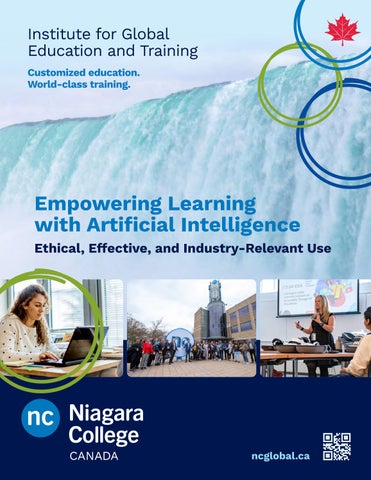
Institute for Global Education and Training Customized education. World-class training.
Empowering Learning with Artificial Intelligence Ethical, Effective, and Industry-Relevant Use
ncglobal.ca
About
Niagara College Established in 1967, Niagara College (NC) has grown to become a leading global college and one of Canada’s most enterprising postsecondary institutions. With a mission to provide outstanding applied education and training for a changing world, and through strategic areas of focus, the College is dedicated to offering a wholistic student experience, academic excellence,
In Niagara and Around the World Currently, more than 10,000 students study in 120+ programs based at specialized campuses in the Niagara region. Leveraging its expertise in program development and delivery, NC has campuses, projects and partnerships around the world, while drawing students from more than 95 countries to its Niagara-based campuses each year. In addition to its two Niagara campuses, NC operates campuses in Toronto and the Kingdom of Saudi Arabia. As one of Canada’s leading global colleges, NC was recognized by the World Federation of Colleges and Polytechnics (WFCP) in 2024 with a silver Award in Applied Research and Innovation and, in 2022, with a bronze in Global Citizenship. NC was also recognized nationally by Colleges and Institutes Canada (CICan) in 2022 with a silver Award of Excellence in Global Engagement.
global reach, alumni and partner engagement, social inclusion, environmental sustainability, and organizational excellence.
Schools of Study The Welland Campus, set on 100 acres (404,686 square meters) of green space, is home to NC’s schools of Technology, Trades, Nursing and Personal Support Work (PSW), Allied Health, Justice and Fitness and more. It houses an open-to-public dental clinic, Performance physiotherapy and occupational therapy clinic, massage clinic, the NC Teaching Hair Salon, and a hub for advanced manufacturing research. The Daniel J. Patterson Campus in Niagara-onthe- Lake is home to NC’s schools of Business and Management, Community Services, Environment and Horticulture, Hospitality and Tourism, Culinary Arts and Wine, Beer and Spirits. Unique learning enterprises on campus, include Canada’s first Teaching Winery, Teaching Brewery, Teaching Distillery and Teaching Greenhouse – which are ‘living labs’ for students and support student learning. The campus is a hub for research with innovation centres for horticultural and environmental sciences, food and beverage, and business and commercialization. Located on the base of the Niagara Escarpment, the campus includes 15 acres (60,703 square meters) of student-restored wetlands, an apiary and more.
Tour Our Campus virtualtour.niagaracollege.ca
Empowering Learning with Artificial Intelligence: Ethical, Effective, and Industry-Relevant Use | 2
Campus
Locations
This program can take place at either the Welland Campus or the Daniel J. Patterson Campus in Niagara-on-the-Lake.
Niagara College is located in the beautiful Niagara Peninsula, close to the world famous Niagara Falls. The Niagara Region is in the southwestern part of the province of Ontario, 135 km from the city of Toronto by car, bus or train. Transportation around the region is easily accessible with Welland, St. Catharines and Niagara Falls all within a 20 minute drive. Academic sessions are held at the Daniel J. Patterson Campus in Niagara-on-the-Lake which is set on a UNESCO Bioreserve and houses the School of Culinary Studies. The International Division at Niagara College has grown exponentially over the past ten years. In June 2013, the new Segal International Centre was unveiled boasting an 8,500 square-foot facility designed to accommodate the growing international enrolment and activities. The Segal International Centre provides a one-stop service experience for Niagara College’s international students. The open-concept design includes a reception and service area that includes international admissions, housing and financial aid services, along with offices and workspace for staff and international development projects.
Daniel J. Patterson Campus in Niagara-on-the-Lake
Toronto
tario Lake On
Niagara-on-the-Lake St. Catharines
A NAD
CA
. A . S U.
Niagara Falls
Welland
Lake Erie
Welland Campus Empowering Learning with Artificial Intelligence: Ethical, Effective, and Industry-Relevant Use | 3
Daniel J. Patterson Campus in Niagara-on-the-Lake This program can take place at the Daniel J. Patterson Campus. At this location, you can also find the following Schools of Study: School of Business and Management
School of Community Services
School of Culinary Arts
School of Wine, Beer and Spirits
School of Academic and Liberal Studies
School of Environment and Horticulture
School of Hospitality and Tourism
Campus Highlights • 40-Acre Vineyard • Benchmark Restaurant •C annabis Teaching Facility “The Cannabunker” • Ecological Lagoons and Wetlands • Marotta Family Innovation Complex •P op-Up Culinary/Wine/Beer /Spirits Events • Research and Innovation • Residence • Teaching Brewery • Teaching Distillery • Teaching Greenhouse • Teaching Spa • Teaching Winery
Empowering Learning with Artificial Intelligence: Ethical, Effective, and Industry-Relevant Use | 4
Welland Campus This program can take place at the Welland Campus. At this location, you can also find the following Schools of Study: School of Academic and Liberal Studies
School of Allied Health
School of Justice and Fitness
School of English Language Studies
School of Media
Myhal School of Nursing
School of Technology
School of Trades
Campus Highlights • Applied Health Institute • Athletic Centre • Dental Clinic •E va M. Lewis Library and Learning Commons • Green Automotive Technology Lab •M arilyn I. Walker Centre of Excellence in Visual Arts and Technology • Massage Therapy Clinic • Ranking Technology Centre • Research and Innovation • Residence • Teaching Hair Salon • Walker Advanced Manufacturing
Empowering Learning with Artificial Intelligence: Ethical, Effective, and Industry-Relevant Use | 5
Empowering Learning with AI Ethical, Effective, and Industry-Relevant Use Program Overview Niagara College is pleased to offer this customized Empowering Learning with AI: Ethical, Effective, and Industry-Relevant Use Program, designed for undergraduate and graduate students across diverse academic disciplines. Delivered in flexible formats, this 20-hour learning experience features interactive workshops, hands-on labs, guided discussions, and real-world exploration of leading AI tools. Facilitated by experienced educators and AI-literate industry practitioners, the program equips students with the knowledge, skills, and ethical grounding needed to engage confidently with artificial intelligence in both academic and professional settings. Through applied practice, discipline-specific breakouts, and critical reflection, learners develop the capacity to use AI responsibly, enhance their productivity, and prepare for the evolving demands of a technology-driven world.
As AI reshapes the world around us, students have the chance to lead with curiosity, creativity, and integrity, transforming these tools into pathways for deep learning and bold new possibilities.
Exploration of Fundamental Principles • Ethical implications of AI in education • Responsible AI use for academic success • AI tools that support learning and productivity • AI-enhanced approaches to discipline-specific work • Critical evaluation of AI-generated content • Human–AI collaboration and future skill development
Empowering Learning with Artificial Intelligence: Ethical, Effective, and Industry-Relevant Use | 6
Program Details Below is an outline of the program’s seven modules, including detailed topics and the learning outcomes participants will achieve at each stage of Empowering Learning with AI: Ethical, Effective, and Industry-Relevant Use.
Module 1 Introduction to AI in Education
2 hours
Topics
• What is AI? Definitions and key concepts • Types of AI tools used in education (ChatGPT, Grammarly, Notion AI, etc.) • Benefits and limitations of AI in learning • Case studies of AI in classrooms
Learning Outcomes
• Understand basic AI terminology and how modern AI tools work. • Identify common tools that support academic tasks. • Recognize both the advantages and limitations of AI in learning contexts. • Connect real classroom examples to their own academic experience.
Module 2 Ethics and Responsible Use of AI
3 hours
Topics
• Academic integrity and plagiarism concerns • Bias in AI models and training data • Privacy and data protection • Institutional and global responsible-use policies • Group discussion: “Should AI be allowed in exams?”
Learning Outcomes • Understand ethical considerations and risks associated with AI use. • Recognize how bias and privacy issues affect AI outputs. • Follow responsible-use expectations and academic integrity standards. • Engage in informed debate about ethical boundaries of AI in education.
Empowering Learning with Artificial Intelligence: Ethical, Effective, and Industry-Relevant Use | 7
Module 3 AI Tools for Learning and Productivity 3 hours Topics
• Writing assistance & research support • AI for note taking, summarizing, and organizing • AI for coding and technical problem solving • Hands on lab: Test three tools and reflect on usefulness
Learning Outcomes • Use AI tools to support writing, studying, and organization. • Apply AI to improve research efficiency and workflow. • Explore AI assisted approaches for coding and technical tasks. • Evaluate which tools enhance their personal learning style.
Module 4 AI in Your Discipline
3 hours
Breakout Sessions by Field:
• STEM: Data analysis, simulations, coding support • Humanities: Writing, translation, interpretation • Business & Economics: Market analysis, forecasting, decision making • Health & Life Sciences: Diagnostics, research, case analysis • Arts & Design: Creative generation (visual, audio, written), critique
Includes:
• Industry examples • Tool demonstrations • Mini project: Apply an AI tool to a discipline specific task
Learning Outcomes • Identify AI applications relevant to their academic major. • Understand how AI is transforming industry practices in their field. • Apply an AI tool to complete a discipline specific task or project. • Gain insight into emerging professional applications of AI.
Empowering Learning with Artificial Intelligence: Ethical, Effective, and Industry-Relevant Use | 8
Module 5 Critical Thinking and AI Collaboration 3 hours Topics
• How to evaluate AI generated content • Basics of prompt engineering • Strengths and weaknesses of human-AI collaboration • Activity: Improve an AI generated essay or analysis • Group discussion: “Should AI be allowed in exams?”
Learning Outcomes • Critically assess the accuracy and quality of AI generated outputs. • Write effective prompts for academic and creative tasks. • Understand when to rely on AI and when human judgment is essential. • Strengthen critical thinking by refining flawed AI work.
Module 6 Capstone Project & Presentations
4 hours
Topics
• Select a real‑world or academic problem • Use AI tools to research, analyze, or create a solution • Present findings • Peer feedback & instructor evaluation
Learning Outcomes • Apply AI tools to explore or solve a real world or academic challenge. • Communicate findings clearly through a structured presentation. • Reflect on how AI shaped their process and outcomes. • Provide constructive feedback to peers based on shared criteria.
Module 7 Future of AI in Education and Careers 2 hours Topics
• Emerging trends in AI and education • AI literacy for future career pathways • Building a personalized AI toolkit • Panel discussion with industry experts or faculty
Learning Outcomes • Understand how AI is shaping the future of learning and work. • Identify the AI skills needed for future academic or career success. • Build a personal AI toolkit to support ongoing learning. • Connect with experts to explore real-world applications of AI.
Empowering Learning with Artificial Intelligence: Ethical, Effective, and Industry-Relevant Use | 9
Sample Schedule – Week 1 Time
Monday
9:00
Orientation Breakfast
10:00
Welcome Presentation
11:00
Campus Tour
12:00
Welcome lunch
1:00
Module 1: Introduction to AI in Education
2:00
Tuesday
Module 2: Ethics and Responsible Use of AI
Wednesday
Module 4: AI in Your Discipline
Lunch break
Lunch break
5:00
Module 7: Future of AI in Education & Careers
Lunch break
NC TRAC Session
Graduation Ceremony and Lunch
Module 3: AI Tools for Learning and Productivity
Module 6: Capstone Project & Presentations Trip to Niagara-on-the-lake
Trip to Niagara Falls (Niagara City Cruises)
Module 5: Critical Thinking and AI Collaboration
Friday
Program Reflection and Goal Setting
3:00
4:00
Thursday
Free time! Perhaps try out our Fabulous Fridays at the WineVEC with live music, food trucks and of course... NC wine, beer and spirits!
6:00
Please note that this program may also be delivered over a two‑week period and can be complemented by additional student development modules offered through Niagara College’s Institute for Global Education and Training.
Empowering Learning with Artificial Intelligence: Ethical, Effective, and Industry-Relevant Use | 10
Optional
Residence Accommodations Participants stay at the modern on campus residence and will live in a two bedroom suite where they will have their own furnished room. They will share a suite with another attendee, which includes a kitchenette and bathroom with a toilet, sink and shower. Although meals are not included in residence accommodations, shopping is only a 15-minute walk away.
Bedroom Floorplan
• Enjoy privacy in your own bedroom • Satellite television • Internet access • Window in each bedroom
Double Suite Layout • Microwave • Full-size refrigerator sink • Storage • Table • Chairs
Empowering Learning with Artificial Intelligence: Ethical, Effective, and Industry-Relevant Use | 11
Optional
Homestay Accommodations The best way to introduce a student to a new country is to allow them to experience it through the warmth of a family home. We believe that a homestay family is as important to a student’s experience as their classes. Homestay is a housing program offered to international students studying at Niagara College, which puts emphasis on a first-hand introduction to Canadian culture and the Niagara Region. Wonderful local families provide support and assistance while students adapt to the lifestyle and demands of learning a second language. Homestay families are as diverse as the international students who attend Niagara College and have the desire to contribute to the lives of others. Every student in a homestay has their own room, bed, closet and study area. Three nutritious meals a day are included in the Homestay option for added convenience.
Homestay Includes Meals
Desk
Private Bedroom
Dresser
Bed
Internet
Empowering Learning with Artificial Intelligence: Ethical, Effective, and Industry-Relevant Use | 12
Cost & Dates Program Timeline Any time of the year Contract Agreement Two months prior to the training start training start
Program Payment One month prior to the training start
Program Cost
Program Cost
$2,395 CAD
$2,695 CAD
With Homestay per participant
With Residence per participant
Inclusions are:
Inclusions are:
• Program tuition
• Program tuition
• Course materials and Resources
• Course Materials and Resources
• Site Visits
• Site Visits
• Orientation
• Orientation
• Welcome Lunch
• Welcome Lunch
• NC Graduation Lunch & Ceremony
• NC Graduation Lunch & Ceremony
• Statement of Participation
• Statement of Participation
• Cultural Activities and Excursions
• Cultural Activities and Excursions
• Airport Transportation
• Airport Transportation
• Medical Insurance
• Medical Insurance
• Regional Bus Pass
• Regional Bus Pass
• Accommodations (Homestay) - 6 nights
• Accommodations (Campus Residence) - 6 nights
• 3 meals a day
• Meals are not included
For more information on this training program contact:
Institute for Global Education and Training globalinstitute@niagaracollege.ca Note: • Program fruition is dependent on sufficient participant registration •P rogram pricing and accommodation is dependent on availability at time of booking.
Institute for Global Education and Training ncglobal.ca 13 | Niagara College’s Institute for Global Education and Training