TH E VOIC E O F THE HARDWOOD IN DUSTRY
H A R D W O O D M AT T E R S OCTOBER 2025
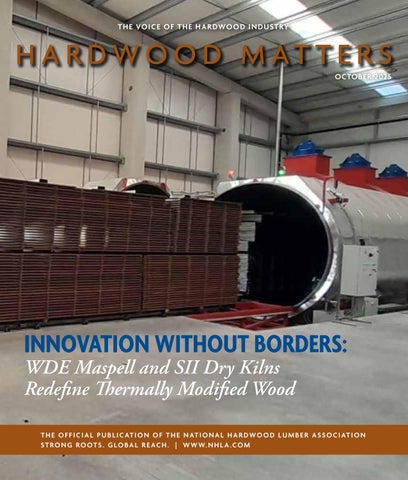
INNOVATION WITHOUT BORDERS: WDE Maspell and SII Dry Kilns Redefine Thermally Modified Wood
T H E O F F I C I A L P U B L I C AT I O N O F T H E N AT I O N A L H A R D W O O D L U M B E R A S S O C I AT I O N S T R O N G R O O T S . G L O B A L R E A C H . | W W W. N H L A . C O M
DO MORE WITH LESS eLIMBS | Agility | TallyExpress | Neural Grader Ease the pain of staffing shortages with inventory management solutions made for hardwoods. DMSi is your one software partner from timber to consumer.
Watch the success story
SCAN TO WATCH
FRANK MILLER LUMBER CO
dmsi.com
CONTENTS October 2025 • Issue 271
WHAT'S INSIDE feature 26
Innovation Without Borders: WDE Maspell and SII Dry Kilns Redefine Thermally Modified Wood by Brennah Hutchison, Hardwood Industry Liaison & Content Director
departments 26
8
10
One Common Ground Repairing the Market Takes Time and Money by Dallin Brooks, Executive Director Inside NHLA NHLA and AHEC Showcase American Hardwoods at Tecnomueble 2025
reader services 6 34 38 40
Chairman’s Message Educational Calendar Jartek Advertorial Market Trends
MISSION LEADERS
Rob Cabral, Market Impacts UCS Forest Group Bill Courtney, Membership & Networking Classic American Hardwoods Sam Glidden, ITS and ITSEF GMC Hardwoods, Inc. Joe Pryor, Education Services Oaks Unlimited, Inc. Rich Solano, Convention Pike Lumber Company, Inc.
16
Greg Fitzpatrick, Convention Fitzpatrick & Weller, Inc.
22 30
36 W W W. N H L A .C O M
Jon Syre, Past Chairman 2022-2024 Cascade Hardwood, LLC
Ray White, Lumber Services Harold White Lumber, Inc.
18
18
Stephanie VanDystadt, Vice Chairman Hull Forest Products
Membership Matters 12 Don't Mess With Hardwoods by John Hester, Chief Development Officer 14 Member Benefits
12
16
EXECUTIVE COMMITTEE
Bucky Pescaglia, Chairman Missouri-Pacific Lumber Co., Inc.
Education Spotlight NHLA ITS 209th Class Graduates at Missouri Walnut Legislative Log The Hardwood Federation: The Hardwood Industry's Federal Advocate by Dana Cole, Executive Director of the Hardwood Federation Member Spotlight Messersmith Manufacturing Rules Corner Fifteen Years Forward: Strengthening Quality, Training, and Inclusion at NHLA by Dana Spessert, Chief Inspector
DEPUTY MISSION LEADERS Tom Coble, Market Impacts Hartzell Hardwoods, Inc.
Brant Forcey, ITS and ITSEF Forcey Lumber Company Tom Oiler, Lumber Services Cole Hardwood, Inc. Chris Rider, Membership & Networking AHC Hardwood Group George Swaner, Education Services Swaner Hardwood Co., Inc. Trent Yoder, Lumber Services Yoder Lumber
COMMITTEE CHAIRMAN Sam Glidden, Rules GMC Hardwoods, Inc.
Follow us
Lumber Services From the Field: Benji Richards O C T O B E R 2 0 2 5 H A R D W O O D M AT T E R S |
1
H A R D W O O D M AT T E R S T H E VO I C E O F T H E H A R DWO O D I N D U ST RY National Hardwood Lumber Association PO Box 34518 • Memphis, TN 38184-0518 901-377-1818 • 901-382-6419 (fax) info@nhla.com • www.nhla.com
THE MISSION OF NH LA To serve NHLA Members engaged in the commerce of North American hardwood lumber by: maintaining order, structure and ethics in the changing global hardwood marketplace; providing unique member services; promoting North American hardwood lumber and advocating the interest of the hardwood community in public/private policy issues; and providing a platform for networking opportunities.
ADVERTISER INDEX
NHLA STAFF Dallin Brooks, Executive Director dallin@nhla.com Desiree Freeman, Chief Financial Operating Officer d.freeman@nhla.com John Hester, Chief Development Officer j.hester@nhla.com Natalie Thelen, Chief Marketing Officer n.thelen@nhla.com Dana Spessert, Chief Inspector d.spessert@nhla.com
ACCOUNTING Jens Lodholm, Database Manager j.lodholm@nhla.com Kathryn Mitchell, Office Assistant k.mitchell@nhla.com
INDUSTRY SERVICES
11
AFS Energy
IBC Pike Lumber Company, Inc.
35
AW Stiles Contractors
33
Ressources Lumber
13
Baillie
3
RossiGroup
Tom Byers, National Inspector t.byers@nhla.com
13
BreezeDried
32
Sunset Transportation
Simon Larocque, National Inspector s.larocque@nhla.com
37
Brewco
44
TimberRisk Agency
IFC DMSi Software
31
TM Polyfilm
Benji Richards, Industry Services Sales Manager b.richards@nhla.com
5
Farm Credit
7
TMX Shipping Co.
20
Heartwood Brands
15
24
Jartek
UCS Forest Group of Companies
17
Onsite Technologies
21
USNR
9
Pennsylvania Lumbermens Mutual Insurance Co.
33
Wagner Meters
4
WDE Maspell
Sailesh Adhikari, Director of Research and Development s.adhikari@nhla.com
Drew Snider, National Inspector d.snider@nhla.com Marty Westeen, National Inspector m.westeen@nhla.com
INSPECTOR TRAINING SCHOOL Roman Matyushchenko, Instructor of the Inspector Training School r.matyushchenko@nhla.com
MARKETING/MEMBERSHIP Melissa Ellis Smith, Creative Director m.ellis@nhla.com
For advertising contact: John Hester j.hester@nhla.com or 901-399-7558
Brennah Hutchison, Hardwood Industry Liaison & Content Director b.hutchison@nhla.com Ashley Johnson, Convention and Events Director a.johnson@nhla.com Jared Klepko, JD, MBA, Corporate Partnership Manager j.klepko@nhla.com Darci Shannon, Member Services Advisor d.shannon@nhla.com
2 | O C T O B E R 2 0 2 5 H A R D W O O D M AT T E R S
W W W. N H L A .C O M
See the forest through the trees The RossiGroup has been helping customers navigate the global hardwoods industry for almost a century. We have raised the bar with our new state-of-the-art Emporium Mill and kiln facilities, our long-term supply agreements, and our uniquely personal brand of customer service. We deliver a world class selection of hardwoods – including the gold standard in cherry – all sorted, milled and dried to tolerances, consistencies, and yields that were not even possible five years ago.
Visit us www.rossilumber.com or call 860-632-3505
THE FUTURE OF WOOD TECHNOLOGY The demand for thermally modified wood is growing rapidly across the U.S. market. Thanks to its superior durability, dimensional stability, and eco-sustainable profile, it’s becoming the preferred choice for both architects and manufacturers seeking high-performance and green solutions.
At WDE MASPELL, we specialize in thermal modification systems designed to enhance the quality and performance of hardwood, softwood and tropical species. This advanced process uses controlled heat and steam—without any chemical additives—to improve the wood's resistance, dimensional stability, and lifespan. Our technology allows manufacturers and designers to work with a natural, uniform, and long-lasting material, suitable for both interior and exterior use. Whether you're building for durability, sustainability, or aesthetics, thermally modified wood is the smart choice for the future of design and constructions
Proudly represented in the United States by SII Dry Kilns, WDE MASPELL has already installed numerous thermal modification systems across the country. Our expertise, combined with SII’s industry presence, ensures local support, technical excellence, and complete reliability. Visit us at the NHLA Annual Convention & Exhibit Showcase in San Antonio, TX – we’ll be there to show how thermal modification can revolutionize your wood production.
Call us: 800-545-6379 Visit: www.wde-maspell.com | www.siidrykilns.com
Financial solutions for the hardwood industry shouldn’t be one-size-fits-all. That’s why Farm Credit delivers lending strategies built for scale—designed to support the complex operations of large sawmill and logging businesses. With deep industry knowledge and a commitment to long-term partnerships, we offer financing that aligns with your business goals, whether you’re expanding capacity, investing in new technology, or navigating market cycles.
Let’s build something lasting. Visit FarmCredit.com to connect with us today. Loans subject to credit approval. Additional terms and conditions may apply. Farm Credit is an equal opportunity lender.
CHAIRMAN'S MESSAGE
INDUSTRY INNOVATORS
I
am an NHLA grading rules guy. A graduate of the Inspector Training School, I spent more than eight years grading lumber full-time for our company. I still occasionally grade lumber at our facility to keep my skills honed. I have been a member of the NHLA Rules Committee for 25 years. I even collect old NHLA Rule books, of which I have over 45 different editions dating back to 1911. The grading rules establish the parameters that separate the values of each board for a hardwood lumber producer. When running a sawmill, it is important to be a rules guy. Spending my entire life in the sawmill business, it is easy to have tunnel vision around the rules. But for consumers of our products, the grading rules don’t always align with the specific requirements of how they want to use the lumber. As an amateur woodworker, I have come to understand that fact more than ever. If I need a 5-1/2” finished width for a project I am making, I need to dig through my pile to find a board that will provide me with the least waste and will reduce “my labor” costs. The same situation is happening for our customers. For many of our customers, random widths, random lengths, and minimum-sized cuttings offer too many opportunities for increased waste and higher labor costs. This is where the companies I call “Industry Innovators” have stepped in to fill this great void. In the file rack, on the corner of my desk, sits a Proprietary Grading Specifications Guide for Walnut Lumber published by Hardwood Industries, Inc., headquartered in Sherwood, OR. It was given to me about nine years ago by one of their purchasing agents during a visit to our mill. In this catalog, 20 different proprietary grades of Walnut lumber are offered in six different thicknesses. This catalog blew my mind as I contemplated how a company could take the three basic NHLA grades of FAS/F1F, 1-common, and 2-common and turn them into 20 different separations. If you go to their website, you can also find additional catalogs for ten other hardwoods. I have kept the catalog within reach all this time because I thought they were really on to something. In my conversations with Jeff Wirkkala, President of Hardwood Industries, Inc., he reiterated the same issues that I have as an amateur woodworker. “When you watch a customer select lumber, you get some insight into the way they think. Bottom line, a customer wants to purchase the least amount of lumber to get their job done.” All the principles of good business are contained in this statement. “Less lumber needed, less labor for processing, less waste, less inventory left over after the job is done, less risk, and the job is repeatable.
6 | O C T O B E R 2 0 2 5 H A R D W O O D M AT T E R S
Customers will pay more if you can make that happen for them. So, we set out to help make that happen for our customers.” My next eye-opening experience was during a Hardwood Manufacturers Association tour at Classic American Hardwoods (CAH) in Memphis, TN, back in March of this year. During our tour, I was amazed by the multitude of sorts that they were making. Bill Courtney, President of CAH, told me during the tour, “We have over 1,500 different SKUs in our system. 1,500 different opportunities to meet our customers’ needs.” They, too, have recognized that the consumers of hardwoods need to reduce their waste and labor by having the ability to purchase a product that meets their precise needs. On their website is this statement: Because we refuse to be bound by traditionally perceived restrictions of the national hardwood lumber industry, we have been able to outperform our competition by meeting our customers’ ever-changing needs and specifications. The innovative thinking of these two companies has had a tremendously positive impact on their customers and on the entire hardwood lumber market. These innovators are risk takers and have invested a remarkable amount of capital in equipment and marketing as they pursue their vision of meeting their customers’ needs. Jeff told me, “It was ten years or so before our reputation drove customers to our door to pay higher prices for our products. Today, the market knows we have better than industry-graded products.” As an NHLA rules guy, I understand the need for standard grading rules for North American hardwoods. The rules must remain an integral component in the manufacture and consumption of hardwood lumber. Most sawmills have a difficult time modifying their production to produce products that meet the specific needs of every one of their customers, so we welcome the “Industry Innovators” like Hardwood Industries, Inc., Classic American Hardwoods, and others like them that are helping us grow and stabilize our industry.
Bucky Pescaglia NHLA Chairman | Missouri-Pacific Lumber Co., Inc. W W W. N H L A .C O M
TRANSPORTATION MANAGEMENT EXPERTS
DETAIL MINDED FORWARD THINKING
Servicing U.S. Lumber & Log Exporters from all U.S. Ports: East Coast, Gulf & West Coast
VISIT US AT THE 2025 NHLA CONVENTION
BOOTH #400
WWW.TMXSHIP.COM l INFO@TMXSHIP.COM CORPORATE OFFICE 727 Arendell Street, PO Box 747 Morehead City, NC 28557 Tel: 252-726-1111 l Fax: 252-726-9097
VIRGINIA OFFICE 2105 McComas Way, Suite 300 Virginia Beach, VA 23456 Tel: 757-563-6200 l Fax: 757-563-0300
ONE COMMON GROUND
Repairing the Market Takes Time and Money
T
he global economy is a complex machine. I don’t pretend to know all the factors that make it run, much like modern cars, but I do know it doesn’t take much to break it down.
When I was a kid, I used to work on old cars with my dad. Back then, you could tune a carburetor yourself, and there was enough room under the hood to crawl inside if you had to. Behind our barn sat eight or nine broken-down cars, each waiting its turn. We’d haul one out, fix it up, and send it back on the road, always choosing the one that cost the least to repair. Then came my dad’s 1997 Ford F-150, the first with a sloped aerodynamic hood and a fuel injector. Years later, when it broke down, it never made it behind the barn. When I asked why, Dad shrugged: “Too complicated. Too expensive.” Electronic issues had made repairs out of reach. Today, the problem is even worse. My 2017 Honda Ridgeline can’t even start or shift gears because of a short in the control panel. One glitch and the whole thing shuts down. That’s what our economy feels like now: fragile, unpredictable, and far too easy to stall. For hardwood, the breakdown points are clear. Tariffs on incoming goods and equipment, retaliatory tariffs on our exports, and rising interest rates all drive lumber prices down while pushing production costs up. No single fix exists. It’s complicated. It’s expensive. And we’re stuck in the middle of it. The administration is trying to boost U.S. exports and domestic production. Still, these efforts can hurt industries like hardwood lumber, which already maintains a trade surplus and makes an easy target for retaliation. In a global market this interconnected, one disruption can set off a chain reaction. It already has, multiple times, and it will again.
8 | O C T O B E R 2 0 2 5 H A R D W O O D M AT T E R S
The hardwood market has become like my Ridgeline: every repair costs more, and the question becomes whether to keep fixing it or walk away. For now, I continue to repair it because a new truck is even more expensive and comes with its own risks. In the same way, we patch up our broken-down market, one repair at a time. If there were an easy solution, we’d have found it years ago. What we need are stronger pulp markets, better cogeneration facilities to handle byproducts, and improved infrastructure, including more rail lines, increased trucking capacity, and expanded uses for secondary products such as bedding and crane mats. But most of all, we need more value-added commodities: thermally modified lumber, pressure-treated lumber, glued and molded lumber, structural lumber, and beyond. That’s where NHLA is stepping in, working to develop value-added markets that diversify your options and provide lower-cost “repairs” to keep you running. But we can’t do it alone. Please don’t wait for us to call and offer a tow. Take action. Reach out. Get involved. Repairing the market will take time and money. But together, we can keep it running and keep on trucking.
Dallin Brooks NHLA Executive Director dallin@nhla.com | 901-377-0182
W W W. N H L A .C O M
INSIDE NHLA
NHLA and AHEC Showcase American Hardwoods at Tecnomueble 2025
T
he NHLA’s Chief Marketing Officer, Natalie Thelen, traveled to Guadalajara, Mexico, from August 13–16 to represent the association at the Tecnomueble trade show. Tecnomueble is Mexico’s largest trade show for the furniture manufacturing sector, which includes exhibitors of machinery, hardware, wood, veneer, and more. The American Hardwood Export Council (AHEC)’s pavilion, built from U.S. hardwood and thermally modified hardwood, served as an information hub and networking point for visitors. Several U.S. hardwood companies exhibited within the pavilion, providing potential buyers with direct access to exporters. NHLA members who exhibited within the pavilion included Banks Hardwoods, Inc., Beasley Forest Products, Inc., Classic American Hardwoods, Edwards Wood Products, Inc., Hartzell Hardwoods, Inc., Hermitage Hardwood Lumber Sales, Inc., Pike Lumber Co., Inc., Robinson Lumber Company, Rutland Lumber Co., Inc., and Savage Lumber Co., Inc. Additionally, three NHLA members had their own exhibit booths: Baillie Lumber Co., Parton Lumber Co., Inc., and Gutchess Lumber Co., Inc.
Mexico remains a vital market for U.S. hardwood exports. In 2024, combined exports of hardwood lumber, veneer, plywood, flooring, moulding, and millwork surpassed $226 million.
Mexico remains a vital market for U.S. hardwood exports. In 2024, combined exports of hardwood lumber, veneer, plywood, flooring, moulding, and millwork surpassed $226 million. By the end of last year, Mexico ranked as the fourth-largest export destination for U.S. hardwood products, with moulding, Red Oak, and Yellow Poplar lumber driving demand. As Mexico imports nearly 30% of its wood needs, U.S. suppliers play an essential role in meeting demand. However, recent tariffs implemented by the Trump administration are already creating challenges for U.S. exporters, and the market outlook remains fluid. NHLA’s presence at Tecnomueble underscored the Association’s commitment to supporting AHEC and its members in expanding international sales and strengthening trade relationships in priority markets. By showcasing U.S. hardwood products and creating opportunities for members to connect directly with buyers, AHEC continues to highlight the value, quality, and sustainability of American hardwoods. Despite challenges such as shifting trade policies and tariffs, Mexico remains a promising and strategically important market, and NHLA, through its support of AHEC, will remain actively engaged in helping members navigate changes while capitalizing on export opportunities.
1 0 | O C T O B E R 2 0 2 5 H A R D W O O D M AT T E R S
W W W. N H L A .C O M
Providing Turnkey Biomass Energy Solutions Since 1990
420 Oak Street•Lemoyne, PA 17043•717.763.0286•AFSenergy.com
MEMBERSHIP MATTERS
DON’T MESS WITH HARDWOODS I n my life, there have been a handful of shows that didn’t just entertain me—they made me want to be part of the story. “The Dukes of Hazzard” made me want to launch a car over a river and stick the landing like it was nothing. “Miami Vice” had me rolling up the sleeves of a white suit, driving a Ferrari, and chasing down drug dealers with my best friend. “Magnum P.I.”? Same Ferrari, just red this time—and now I’m solving crimes in short shorts with a legendary mustache.
Taylor Sheridan—genius, by the way—has done the same thing with “Yellowstone.” He made ranch life, cowboy grit, and wideopen skies feel like the new American Dream. And there’s something magnetic about that cowboy spirit: standing your ground, protecting what’s yours, and riding shoulder-to-shoulder with people you trust. That same spirit is calling all of us to San Antonio for the 2025 NHLA Annual Convention and Exhibit Showcase. Much like Sheridan’s cowboys, we’re coming together with purpose. But instead of defending a ranch, we’re here to grow, stabilize, and protect the hardwood industry.
sharing a drink with someone who becomes a friend, and walking away with knowledge that makes you stronger. San Antonio has always been a rallying point—ever since the Alamo. This year, it’s our turn. Because history tells us that when people rally in San Antonio, big things happen. And this time, it’s not just about Texas. It’s about the future of hardwood. Together, we’ll make it clear: you don’t mess with Texas, and you sure don’t mess with hardwood.
John Hester Chief Development Officer
At Convention, you’ll hear from speakers who push us to think differently. You’ll sit in Ed Sessions that tackle real problems with real solutions. You’ll walk the Exhibit Hall, where suppliers, partners, and innovators are ready to make connections and deals that move your business forward. And it’s more than business. This Convention is about people. It’s about shaking hands with someone who becomes a customer,
1 2 | O C T O B E R 2 0 2 5 H A R D W O O D M AT T E R S
W W W. N H L A .C O M
ROOTED IN EXCELLENCE. DRIVEN TO SERVE.
Learn more: www.thebailliegroup.com
W W W. N H L A .C O M
TESTED TRUSTED
Succeeding in business is hard. Buying your hardwoods shouldn’t be. We make it simple and easy!
O C T O B E R 2 0 2 5 H A R D W O O D M AT T E R S |
13
MEMBERSHIP MATTERS
MEMBER BENEFITS As a member of NHLA, your association investment delivers far more than industry credibility—it opens the door to meaningful connections, business tools, and exclusive resources. 1. Networking & Matchmaking Support • Human Connections: Our National Inspectors aren’t just experts—they know the hardwood industry inside and out. They can connect you with the right people, whether you’re looking for new clients, partners, or suppliers. • Member Directory & Buyer’s Guide: The NHLA Buyer’s Guide lets you browse members by company type and service—making it easy to find exactly who you need. The print version is available free of charge to members, and additional copies can be ordered at no extra cost, aside from shipping. 2. Live & Upcoming Networking Opportunities • Educational Webinars & Short Courses: Learn from industry experts while connecting with peers who face the same challenges and opportunities you do. • Meet and network in person at the NHLA Annual Convention & Exhibit Showcase, where ideas spark and business happens. 3. Marketing & Brand Exposure • Be seen by the hardwood world through “Hardwire” (weekly e-newsletter), Hardwood Matters magazine, Hardwood & Design magazine, social media channels, and the NHLA website. Take full advantage of your NHLA membership— connect with inspectors, explore the Buyer’s Guide, and expand your network today.
1 4 | O C T O B E R 2 0 2 5 H A R D W O O D M AT T E R S
Some see wood, we see purpose.
With hardwood lumber, we enhance our customers' business's and the health of the planet. From responsible harvest to fabrication and installation, from use and re-use, hardwood lumber enriches and sustains the places we live, work, and play. As North America's leading distributor of hardwood lumber, we are proud to partner with you to bring unique products to the market through the untold possibilities of hardwood lumber.
What you need. When you need it. By people that know and care.
www.ucfp.com
www.sierrafp.com
EDUCATION SPOTLIGHT
NHLA ITS 209th Class Graduates at Missouri Walnut
Left to Right: Michael Chandler (D&D Hardwood), Quinton Rogers (Missouri Walnut), Roman Matyushchenko (NHLA), and Jim Long (D&D Hardwood) Not pictured: Matthew Yoder and Jason Yoder (both of Yoder Hardwoods)
O
n August 29, 2025, NHLA was proud to celebrate the latest group of graduates from an education session hosted at Missouri Walnut. The program was led by NHLA Instructor Roman Matyushchenko, whose guidance and expertise helped prepare the class for success in hardwood lumber grading and inspection. Among the graduates were Michael Chandler of D&D Hardwood, Quinton Rogers of Missouri Walnut, and Jim Long of D&D Hardwood. Also completing the program, though not pictured, were Matthew Yoder and Jason Yoder of Yoder Hardwoods. Each participant brought energy and commitment to the class, making this session especially memorable. As part of the graduation, several awards were presented to recognize outstanding achievement. Jason Yoder distinguished himself by earning both the Highest Overall Average and the Highest Board Run Average. Matthew Yoder earned the Highest Overall Average. Quinton Rogers of Missouri Walnut was honored with the Best Attitude and Citizenship Award, a reflection of the positive spirit and teamwork that helped define this class.
sharpening their technical knowledge and practical skills, they are not only investing in their own careers but also helping to ensure the long-term success of their companies and the industry as a whole. That same opportunity is now available to others through NHLA’s upcoming educational programs. This fall, classes include Hardwood Processing 101 in Memphis (November 5–7, 2025), and for those seeking a shorter, intensive experience, NHLA is also offering a three-day Introduction to Grading Hardwood Lumber in Memphis (December 3–5, 2025). Specialized courses will round out the year with $PC: Control the Process to Improve Lumber Value (December 10–11, 2025, in Memphis) and a Saw Filing Fast Course in Kahoka, Missouri (December 10–12, 2025), which includes hands-on training, meals, and accommodations. Whether you’re looking to deepen your knowledge, gain valuable hands-on experience, or connect with peers across the industry, NHLA’s education programs provide the tools and expertise to help you succeed. We congratulate our Missouri Walnut graduates on their achievements and look forward to seeing the next class of students take their place as future leaders in the hardwood industry.
The dedication of these graduates is a reminder of how vital continued education is to the strength of the hardwood industry. By
1 6 | O C T O B E R 2 0 2 5 H A R D W O O D M AT T E R S
W W W. N H L A .C O M
LEGISLATIVE LOG
THE HARDWOOD FEDERATION: The Hardwood Industry’s Federal Advocate By DANA COLE, Executive Director of the Hardwood Federation
W
elcome to San Antonio! The Hardwood Federation is always excited to be a part of this wonderful event. Congratulations to the Board of Directors, Board President Bucky Pescaglia, Executive Director Dallin Brooks, and the entire staff of the National Hardwood Lumber Association for putting together what promises to be another successful, exciting, and inspiring Annual Convention. The Hardwood Federation has fought for you, your companies, and your employees for over twenty years. We remain steadfast in our mission to strongly advocate on behalf of U.S. hardwood businesses and their employees to federally elected officials, regardless of party.
1 8 | O C T O B E R 2 0 2 5 H A R D W O O D M AT T E R S
We are on the political frontline for you, fighting every day so you can have a successful tomorrow. The Trump Administration is three-quarters through its first year of a four-year term. The speed and breadth of the President’s agenda, policy, and otherwise, have in many ways stunned D.C., the nation, and the globe. More than twenty years ago, hardwood industry leaders, many of whom were members of the NHLA, wisely thought to put representatives of hardwood companies on the ground in Washington, D.C. to serve as a first line of engagement with political leaders. Since 2004, the Hardwood Federation has represented the hardwood industry in D.C., leveraging the voices of NHLA leaders W W W. N H L A .C O M
At this point, trade is our primary focus, although we continue to weigh in on issues such as tax reform, transportation, and regulation when appropriate.
(and those from our thirty-two other member associations) to make sure the White House, Administration Officials, and Congressional Leaders clearly understand the valuable contributions the production of hardwood logs, lumber, and products can make on multiple levels of the U.S. economy.
of Congress, Hill staff, and Administration officials since the first day of the new Administration. By developing a proposal early and being proactive in sharing it widely with the full range of decision makers — not just once or twice, but multiple times over the past several months — we are pursuing this goal every day.
In 2025, under a Trump-led, Republican-dominated federal bureaucracy, the Hardwood Federation’s main focus has been on how the Administration’s global trade and tariff policy will impact hardwood companies, both those exporting and those with a domestic focus. This means regularly engaging with the Administration and congressional leaders to ensure that legislation and regulations recognize and support the hardwood industry.
• We have centered our story on how the U.S. hardwood industry exemplifies many of the objectives pursued by the Trump Administration. Net exporters. Rural jobs. Made in America. Essential products ranging from interior furnishings to vital industrial supplies and residual components for paper, cardboard, and pellets. Highlighting how the hardwood industry already meets these goals, and how we can do more, is crucial for getting the attention of those in charge today.
It is no secret that Washington, D.C., under the Trump Administration, is not business as usual. Their swift and aggressive pursuit of their agenda has created a level of unpredictability that has spread from the halls of Capitol Hill to all sectors of the economy and private life. The U.S. hardwood industry, already stressed by decreasing domestic markets, faces additional uncertainties as global markets adjust to the President’s use of steep tariffs as trade negotiation tools. This rapid restructuring of American life and global commerce delights some and is of grave concern to others. However, the Hardwood Federation’s job is to think of new and alternative ways to navigate this new reality so that we can successfully advocate for policy decisions that support U.S. hardwood companies and, at the same time, adjust our operations to align with industry fortunes.
WE ARE DOING THIS IN SEVERAL WAYS:
• The hardwood staff and board developed a proposed tariff relief proposal that, if funding becomes available, would support agriculturally-based industries negatively impacted by trade policies. This proposal was developed before President Trump took his oath of office and has been the topic of dozens of meetings with Members W W W. N H L A .C O M
• Given the reduced resources related to the economic and business challenges faced by our member associations and their company members, the Federation has trimmed our expenses and focused available dollars and resources on the issues that matter most now. At this point, trade is our primary focus, although we continue to weigh in on issues such as tax reform, transportation, and regulation when appropriate. • To augment our manpower and resources dedicated to trade policy-related efforts, we have engaged Monument Advocacy on a short-term basis to expand outreach and access in the second half of 2025. Special reserve funds were raised to support this effort from industry companies. The Hardwood Federation is proud to partner with and represent NHLA and its members in our nation’s capital, Washington, D.C. Having a coordinated, consistent, and united voice in Washington is critical for the U.S. hardwood industry. It is more important than ever in times when policy and regulatory changes are happening at breakneck speed. Our job of educating those in O C T O B E R 2 0 2 5 H A R D W O O D M AT T E R S |
19
Having a coordinated, consistent, and united voice in Washington is critical for the U.S. hardwood industry. public office must be ongoing . . . and we are never done. Although making our message heard can feel like an almost impossible task, we must continue to reach out, communicate, and advocate. This is the value of having a full-time, dedicated presence in D.C., a team working daily, full-time for you, your business, and your employees. It is hard, and it is slow, but it is necessary because the only assured outcome of inaction is failure. The NHLA provides crucial financial and advocacy support to the Hardwood Federation, but at the same time, the direct participation of the NHLA’s membership cannot be underestimated, and we are grateful.
NHLA MEMBERS:
• Come to Washington to meet and discuss policies impacting the industry with Members of Congress. • Educate Members of Congress by hosting them in mills, yards, and facilities to give them a first-hand look at the industry. • Write letters, e-mail, and call Congressional offices to share concerns about bad policy and applaud good policy. • Contribute financial resources, both on an individual and company basis, to the Hardwood Federation’s Political Action Committee and Administrative Operating Fund, both essential to our continued success. Please support us at www.hardwoodfederation.com The Hardwood Federation staff will be at the NHLA convention and look forward to meeting you and discussing our efforts in Washington. Have a wonderful convention! W W W. N H L A .C O M
O C T O B E R 2 0 2 5 H A R D W O O D M AT T E R S |
21
MEMBER SPOTLIGHT MESSERSMITH MANUFACTURING
Messersmith Manufacturing: Leading the Way in Wood Boiler Systems for the Forest Products Industry
M
Left: A 500HP Messersmith boiler during installation at Kretz Lumber in Antigo, WI. Right: A new Messersmith cogeneration boiler system being installed at Northern Hardwoods in Atlantic Mine, MI.
essersmith Wood Boilers delivers efficient, reliable wood boiler systems, cogeneration solutions, and material handling systems for the forest products industry, turning wood waste into energy for lumber drying, building heat, and power production.
Supporting the Forest Products Industry for Over Four Decades
Messersmith Manufacturing has been a trusted name in the forestry industry for 43 years, delivering cutting-edge biomass boiler systems, fuel handling equipment, and cogeneration solutions that keep operations running efficiently. They proudly support over 20 forestry associations, kiln drying clubs, lumberman’s organizations, and forest product industry partners, ensuring their equipment is trusted to handle the challenges mill owners and operators face every day.
Long-Term Vision of Customer Satisfaction
Customer service is Messersmith’s top priority as they strive to build long-term relationships and business partnerships with vendors and customers. Their customers prefer Messersmith because service matters. Supporting your success is their commitment.
2 2 | O C T O B E R 2 0 2 5 H A R D W O O D M AT T E R S
Addressing Industry Challenges Head-On
With the closures of many paper mills and other forestry-related companies, the outlets for mill residues are going away. Many operators are now looking for new ways to utilize mill residues like sawdust, wood chips, planer shavings, and bark. Messersmith is committed to helping these businesses adapt by providing high-efficiency biomass boiler systems and biomass cogeneration systems that transform mill residues into valuable, renewable energy.
Biomass Boiler Systems Built for Reliability
In forestry and lumber production, downtime means lost productivity and revenue. That’s why every Messersmith biomass boiler system is engineered for maximum durability, performance, and low mainteW W W. N H L A .C O M
Pictured left Jeremy Mortl (Owner and President), and right Craig Albright (Sales Manager).
nance. Their equipment helps reduce operating costs, giving mill operators a sustainable, cost-effective way to dry lumber, heat their buildings, and generate power.
State-of-the-Art Manufacturing Capabilities
Messersmith Manufacturing’s facilities are located in the Upper Peninsula of Michigan in the small town of Bark River. For over 43 years, they have been developing and manufacturing custom-engineered industrial wood boiler systems for the forest products industry.
ture where the fuel is burned to minimize clinker formation with dirty fuels like bark. The grate oscillates for automatic ash removal, and the use of pre-heated combustion air increases combustion efficiency. Messersmith also makes their own custom boiler system controls and can upgrade the controls in existing wood boiler plants. New boiler controls make the operation of a boiler plant easier for operators and sends fault notifications via email or text message for any issues with the plant. Operators will also get a secure site to log into and view the operation of the boiler system in real time.
Emissions Control
Maximizing system efficiency and minimizing maintenance are hallmarks of Messersmith’s systems. The result is a lower total boiler room cost that creates increased, ongoing profitability for you.
By combining advanced manufacturing technology with decades of engineering expertise, they deliver biomass systems that are not only high-performing but also built to last for decades of continuous operation.
For post-boiler emissions control, Messersmith can handle state and federal emissions regulations with advanced control systems, multicyclone particulate collectors, ESP’s, and ceramic filtration systems. Messersmith can retrofit these technologies onto existing wood boilers to keep post-boiler emissions under control.
Material Handling Solutions
After-the-Sale Service That’s Second to None
At Messersmith, the sale is just the beginning. Example of Messersmith’s Messersmith has decades of experience in moving Customer service is Messersmith’s top priority water-cooled oscillating woody biomass material. Their material handling equipment with 24/7 support, preventative maintenance prograte technology. starts with a traveling auger fuel reclaim system with hungrams, parts and service, and long-term partnerships. dreds of successful installations moving all types of woody biomass throughout the U.S. and Canada. The traveling auger system Custom Engineering for Evolving Needs moves material out of a storage area and into a transfer conveyor, where Environmental regulations and operational requirements are conit is transported to the boiler or other processes. stantly changing. That’s why their engineering team is always innovating — from new biomass control systems to emissions reduction Messersmith’s conveyors include a low-friction drag chain conveyor, technologies and custom fuel handling solutions. which is quiet and requires less horsepower to move material compared to competitors’ conveyors. These conveyors can be designed for various lengths and incline angles to adapt to any layout. Messersmith also makes custom augers and belt conveyors.
For sorting out oversize material, a Messersmith disc sorter can be incorporated with their line of drag chain conveyors. They also have a simple, cost-effective solution for sorting oversize material with a belt conveyor. To round out the material handling equipment, Messersmith manufactures metering bin assemblies to meter the amount of fuel for your boiler. These can be custom-made for different fuel types and engineered with auger designs for each specific application.
Messersmith works directly with mill operators, kiln facilities, and forestry companies to design systems that meet today’s standards while being flexible enough to adapt to future demands.
Industry Partnerships That Drive Innovation
Messersmith’s strong ties with forestry associations, kiln drying clubs, and lumbermen’s organizations give them direct insight into industry trends and needs. These partnerships allow them to create forestry industry energy solutions that aren’t just technologically advanced — they’re practical, efficient, and proven in the field. The NHLA has been a great partner for Messersmith in the industry by helping with training and education for mill owners and operators.
Combustion Systems & Controls Technology
Messersmith makes several types of combustion systems, with the newest design being their water-cooled oscillating grate, which allows for a wide range of material to be efficiently burned. This watercooled grate design allows Messersmith to control the grate tempera-
W W W. N H L A .C O M
For information on how Messersmith Manufacturing can help with your wood boiler system needs, contact Craig Albright at calbright@burnchips.com or Jeremy Mortl at jmortl@burnchips.com. Craig and Jeremy can regularly be found supporting forest product associations at regional and national meetings. O C T O B E R 2 0 2 5 H A R D W O O D M AT T E R S |
23
THERMALLY MODIFIED WOOD.
FUTURE O F S US TAINABL E B UILDING.
Aurum Architect: ARGO Photo: Wellu Hämäläinen, ©Lunawood Product: Lunawood Battens
THERMOWOOD® IS THE SUSTAINABLE, CHEMICAL-FREE ALTERNATIVE TO TROPICAL HARDWOODS — CREATED ONLY WITH HEAT AND STEAM. AS DEMAND GROWS FOR ECO-FRIENDLY MATERIALS IN FAÇADES, DECKING, INTERIORS, AND FURNITURE, THERMOWOOD® ALLOWS YOU TO MEET THAT DEMAND WHILE OFFERING CUSTOMERS NATURAL BEAUTY AND LONG-LASTING PERFORMANCE. JARTEK KILNS ENSURE QUALITY AND RELIABLE PRODUCTION, ALWAYS MEETING THE HIGHEST INTERNATIONAL STANDARDS. WITH JARTEK, YOU CAN DELIVER THERMOWOOD® THAT EARNS THE TRUST OF ARCHITECTS, BUILDERS, AND DESIGNERS ALIKE WORLDWIDE.
STEP INTO THE FUTURE OF SUSTAINABLE WOOD PRODUCTION WITH JARTEK KILNS.
WHY CHOOSE THERMOWOOD® WITH JARTEK KILNS?
DURABLE RESULTS: CONSISTENT, HIGH-QUALITY OUTPUT STABLE PROCESS: PRECISION CONTROL EVERY RUN SUSTAINABLE CHOICE: ENERGY-EFFICIENT, ECO-FRIENDLY PRODUCTION
Meet Us at the NHLA Convention! LET’S TALK ABOUT HOW THERMALLY MODIFIED WOOD CAN TRANSFORM YOUR BUSINESS! OCTOBER 2025, BOOTH #304
LUMBER POTENTIAL UNLOCKED WWW.JARTEK.COM
Innovation Without Borders: WDE MASPELL and SII Dry Kilns Redefine Thermally Modified Wood Alessio Lucarelli
I
By BRENNAH HUTCHISON, Hardwood Industry Liaison & Content Director
magine if common ash or oak could be transformed into a darker, more durable, and more dimensionally stable material using only heat and steam. This is the promise of thermally modified wood (TMW), a sustainable, chemical-free process that improves durability, stability, and appearance. Until recently, its potential was limited by technical challenges—particularly smoky odors and volatile organic compound (VOC) emissions—that kept TMW mostly for exterior use. That’s where WDE MASPELL, an Italian manufacturer of thermal modification systems, and SII Dry Kilns, their U.S. partner, are
2 6 | O C T O B E R 2 0 2 5 H A R D W O O D M AT T E R S
making their mark. Speaking with Alessio Lucarelli, Commercial Director of WDE MASPELL, and Dan Mathews, Chairman of SII Dry Kilns, it’s clear that innovation and partnership are fueling a new chapter for the global hardwood industry. Odorless, Health-Conscious Wood “If you have no mass loss at the end of the process, you have no thermally modified wood,” Lucarelli explained. “But what sets our systems apart from competitors is that the VOC levels in the wood modified by our systems are almost the same as those in unmodified lumber. That means the wood from our kilns has virtually no smell.” W W W. N H L A .C O M
The implications are significant. Odor has long been a barrier to using TMW indoors, where flooring, paneling, and furniture need to perform well and be livable. With WDE MASPELL’s technology, thermally modified wood can now be used in interior settings without concerns about smell or the health risks from lingering gases. A Design Advantage: Exotic Colors from Local Species Thermal modification also alters wood’s color, deepening tones as the process nears 428°F—just below the self-ignition temperature. “This creates rich, exotic-like shades,” said Lucarelli. “Architects and project leaders often want the look of imported tropical species, but thermally modified wood allows them to achieve those aesthetics with local lumber.” From oak and ash to southern yellow pine, nearly every species can be effectively modified—offering cost-effective options that strengthen local economies, reduce dependence on unsustainable imports, and broaden design possibilities for architects.
“. . . What sets our systems apart from competitors is that the VOC levels in the wood modified by our systems are almost the same as those in unmodified lumber. That means the wood from our kilns has virtually no smell.” Proven Performance in the U.S. The WDE MASPELL–SII Dry Kilns partnership has also been tested in the U.S. market. Mathews recalled a Pennsylvania customer who first invested in their technology for musical instruments, then scaled up for larger production. After briefly turning to a competitor, the customer returned in 2022. “They told us, ‘We made a big mistake. Whatever the cost, we need another of your sysO C T O B E R 2 0 2 5 H A R D W O O D M AT T E R S |
27
Before
Thermally Modified Decking 2 8 | O C T O B E R 2 0 2 5 H A R D W O O D M AT T E R S
W W W. N H L A .C O M
After tems,” Mathews recounted. “They had never seen such high-quality thermally modified wood as what came from our equipment.” For buyers making significant capital investments, return on investment is paramount. Both Lucarelli and Mathews emphasized that their equipment consistently produces the highest quality TMW, ensuring customer confidence and long-term profitability. Green by Process, Green by Product Another advantage is sustainability, both in the product and the process. Thermal modification requires no chemical additives, meaning the resulting wood is eco-sustainable throughout its lifecycle. “Even after 25 years of use, it remains a green product,” Lucarelli said. WDE MASPELL’s process also eliminates gases and liquids, aligning with Europe’s stringent green transition policies and global sustainability goals. Looking Ahead: U.S. Manufacturing While demand in the U.S. was once limited, the last three years have seen significant growth. “The tide has come in,” Mathews noted. “Hardwood manufacturers are looking for new markets, and thermal modification is becoming an excellent path forward.” WDE MASPELL has its sights set on U.S. manufacturing to meet that demand. “Our intention is to eventually produce equipment directly in the United States, with Italian technology, proudly manufactured in North Carolina alongside SII Dry Kilns,” Lucarelli shared. Though some time is still needed, the plan underscores how seriously both companies invest in North America.
W W W. N H L A .C O M
“We’ve become good friends as well as business partners. That trust has allowed us to confidently introduce new technology, and it’s helping the industry grow.” A Partnership Built on Trust Both leaders emphasized that the strength of their partnership has been central to success. “SII is not just an agent; they know kilns, they know the market, and they are reliable,” Lucarelli said. “When they speak, people listen.” Mathews echoed the sentiment: “We’ve become good friends as well as business partners. That trust has allowed us to confidently introduce new technology, and it’s helping the industry grow.” Conclusion From odorless wood technology to exotic aesthetics and sustainable processes, WDE MASPELL and SII Dry Kilns prove that thermal modification has global potential beyond decking and siding. By expanding applications and raising quality standards, they are helping hardwood claim new ground in global markets and preparing the industry for the next wave of growth.
O C T O B E R 2 0 2 5 H A R D W O O D M AT T E R S |
29
RULES CORNER
Fifteen Years Forward: Strengthening Quality, Training, and Inclusion at NHLA By DANA SPESSERT, Chief Inspector
O
n the 26th of this month, I will have served 15 years as Chief Inspector of the NHLA. It has been a very challenging and rewarding career and has afforded me opportunities that most can only dream of. International travel and working with industry professionals are the most gratifying parts of my job. Each month, I have written articles to educate and hopefully inspire the industry to keep moving forward and to help all to understand the Rules and other aspects of our industry. This is why we continue to grow our programs and help in any way that we can.
We want to help in any way we can through both challenging and prosperous times, as I personally feel that this is the best industry in the world! If you have any questions or are interested in a Yield Analysis or the Inspector Training School, please reach out to me at d.spessert@nhla.com.
One of our newer programs that is showing a lot of success is the Yield Analysis for sawmills. This program is part of a much larger Quality Control initiative that we offer, but it is still underutilized in many sawmills. To encourage participation, we are currently offering Yield Analysis at a 75% discount — making this an excellent time to take advantage of the program. I do realize that when the average person in production hears the acronym “QC,” the first thought is that it is not necessary; we focus on production. Well, production of unsellable or inferior quality is not really production; it is a waste of time and money. Our QC program is designed to ensure that every machine and operator is performing at their best. This approach helps achieve higher yields of sellable material and, therefore, truly increases production. Another issue that has been growing in the industry is the shortage of lumber inspectors. The interest in working in our industry is waning for many reasons that will take years to overcome. As a result, we have worked hard to create new techniques and grow our team to teach and inspire future industry professionals.
Inclusive Training for a Bilingual Workforce
Our Instructor Training School (ITS) is evolving to meet the needs of today’s workforce. Our instructor, Roman Matyushchenko, has learned to teach in Spanish over the last couple of years so we can better serve the many Spanish-speaking and bilingual professionals in our industry. We now offer in-house classes to train your teams in lumber inspection and other skills, ensuring everyone has equitable access to learning and professional development.
3 0 | O C T O B E R 2 0 2 5 H A R D W O O D M AT T E R S
W W W. N H L A .C O M
Lumber Covers & Pallet Bags Sheeting
Plywood/Drywall Pallet Bags
10 ft. x 300 ft. 3 mil White Center-Slit Sheeting
(Fits 4 ft x 4 ft x 8 ft Pallet) 148 x 72 3 mil White 25 bags/roll
Shingle & Cement Bags (Fits 4 ft x 4 ft x 4 ft Pallet) 52 x 50 x 70 2 mil Clear 100 bags/roll
(Fits 4 ft x 4 ft x 12 ft Pallet) 196 x 72 3 mil White 25 bags/roll
Items in Stock
No Minimums
(For quantities above 20 rolls per size —please call for pricing)
CUSTOMIZATION AVAILABLE CALL FOR PRICING TM Polyfilm, Inc. CARLTON OGLETREE Phone: (800) 831-2738 ext. 212 E-mail: carlton@tmpolyfilm.com
YOUR CUSTOMERS CANT WAIT.NEITHER CAN WE
Fast, reliable logistics that keep projects moving and schedules intact. When project timelines are tight, every minute matters. At Sunset Transportation, we understand the demanding pace of building materials and commercial construction. Our expedited and project logistics solutions ensure your materials arrive exactly when and where they’re needed — keeping builds on schedule and your reputation strong.
CALL TODAY: 866-803-2265
SALES@SUNSET-FREIGHT.COM 501-850-7800
“ALL YOUR LUMBER ESSENTIALS” Ask about our BIRCH & EXPORT possibilities! Visit us in Booth 120! Claude Henri Lapointe, Export Manager / chlapointe@pfsierra.com Matt LeBlanc / mleblanc@rlumber.ca Lumber Resources Inc. 866-815-0404 ph / 418-624-1008 fx / www.rlumber.ca Philippe LeBlanc / pleblanc@rlumber.ca
W W W. N H L A .C O M
O C T O B E R 2 0 2 5 H A R D W O O D M AT T E R S |
33
EDUCATIONAL CALENDAR
EDUCATIONAL OPPORTUNITIES Register for classes at www.nhla.com/Education.
November 5-7
Hardwood Processing 101
NHLA will host a workshop to broaden the knowledge of hardwood processing for those industries and people who support sawmills and mill operations. The 3-day workshop will explore the process path from tree to kiln and includes a tour of a local sawmill and concentration yard. Housing and meals are included. Venue: NHLA Headquarters Location: Memphis, TN
December 3-5 Intro to Hardwood Lumber Grading
December 10-11
$PC, Control the Process to Improve Lumber Value
A two-week Intro class to gain a basic understanding of the NHLA hardwood lumber grading rules and how the rules affect the value of lumber. Housing and weekday meals are included.
A 2-day course to teach your team the first steps in implementing your own Yield Improvement program using statistical process control techniques adapted to a sawmill environment
Venue: NHLA Headquarters Location: Memphis, TN
Venue: NHLA Headquarters Location: Memphis, TN
Instructor: Roman Matyushchenko, NHLA ITS Instructor
December 10-12 Band Saw Filing Class
Fast-paced, hands-on training to build core skills in benching & tensioning, fitting, and sharpening—ideal for experienced filers, newcomers, and recent hires. Venue: Yoder Saws Location: Kahoka, MO Instructor: Levi Yoder, Yoder Saws
December 1-12
Inspector Training School Online Program MODULE 1 Two weeks of hands-on training.
Venue: Yoder Lumber Co., Inc. Location: Millersburg, OH Module 2: Online study Module 3: Three weeks handson training and final testing at NHLA headquarters. Instructor: Roman Matyushchenko, NHLA ITS Instructor
3 4 | O C T O B E R 2 0 2 5 H A R D W O O D M AT T E R S
W W W. N H L A .C O M
LUMBER SERVICES
From the Field: Benji Richards Helping Mills Find Yield in Challenging Markets
For NHLA National Inspector Benji Richards, the most rewarding part of his job is also the simplest: “Helping facilities and employees become more profitable, and sharing my knowledge and experience to help make lumbermen for the future.”
O
ne of Benji’s most memorable projects took place at a flooring company. By carefully reviewing operations, he uncovered approximately a 4% increase in yield in their process. That small adjustment translated into roughly $4 million in recovered revenue each year, a reminder of how precision and expertise can make all the difference.
While many know Benji for his inspection work, he also has specialized skills that members may not realize. “I’m very good on the finished side of lumber products, finding missing yield in furniture, flooring, and cabinet plants,” he says. This knowledge makes him a valuable partner for companies looking to maximize value where margins are tightest. The global hardwood market is presenting no shortage of challenges. “Low lumber prices and oversupply have kept production at a minimum,” Benji explains. “Most mills have an abundance of logs, but profitability is another story. Rail ties are keeping mills at breakeven at best, and with several lumberyards closing, mills are struggling to find new places to sell lumber, with limited success.” These challenges highlight the ripple effects of global oversupply and shifting demand; realities that members must navigate daily. In this climate, Benji sees his work as a lifeline for members. He partners with mill managers to streamline processes, increase efficiency, and recover more yield. He also trains inspectors to remanufacture and upgrade lumber, ensuring companies capture the highest possible grades and profits. “Even when markets are uncertain, there are opportunities to be found,” Benji says. His efforts provide exactly that, helping members discover hidden value and keep their businesses resilient in the face of global pressures.
3 6 | O C T O B E R 2 0 2 5 H A R D W O O D M AT T E R S
W W W. N H L A .C O M
ADVE RTO RI AL
Carbon-Conscious Construction: Thermally Modified Hardwood for a Low-Emission Future
T
he construction industry accounts for nearly 37% of global energy-related CO₂ emissions (UNEP & GlobalABC, 2022). While much of the focus has been on creating energyefficient building operations, there is growing recognition that embodied carbon – the emissions from producing and maintaining building materials – should also be addressed. This movement has led architects and builders to increasingly seek natural, durable materials that can both store carbon and withstand the test of time. An increasingly recognized solution is thermally modified hardwood, which becomes more durable, stable, and weather-resistant through heat treatment—without chemicals—making it ideal for low-emission building design. At Jartek, we have witnessed how the combination of hardwood and advanced thermal modification technology can deliver both performance and support sustainable efforts.
Beyond Harvest - Carbon and the Lifespan of Wood
Wood is unique among construction materials; it is carbon-negative at the point of harvest, storing atmospheric CO₂ captured during tree growth. That carbon remains locked in as long as the material is in use. Durability is central to this benefit. Exterior hardwood, for example, can last 10–15 years before replacement is needed—each replacement bringing new emissions from harvest, manufacturing, and installation. Extending service life, therefore, directly reduces a building’s long-term embodied carbon footprint.
Untreated vs. Thermally Modified Hardwood: A Lifecycle Perspective
Thermal modification means that wood’s structure is altered at the molecular level using heat and steam. The result of the thermal modification process is a material that exhibits improved decay resistance and dimensional stability, making it suitable for demanding outdoor conditions. There is a significant difference between the carbon performance of untreated versus thermally modified
3 8 | O C T O B E R 2 0 2 5 H A R D W O O D M AT T E R S
hardwood. In an outdoor setting, untreated hardwood will likely require at least one complete replacement within the lifespan of a building. Thermally modified hardwood, on the other hand, may last the whole period of a building’s lifespan – and often beyond – with minimal maintenance. Due to its extended lifespan, thermally modified wood effectively reduces the carbon cost per year of service and additionally cuts any emissions associated with manufacturing, transportation, and maintenance. Another factor supporting the use of thermally modified hardwood is the process itself, which involves no chemicals, ensuring that the wood remains safe for reuse or energy recovery at the end of its lifecycle. This factor also aligns with the principles of a circular economy system—where resources are kept in productive use for as long as possible and materials are disposed of in ways that prevent further environmental harm. W W W. N H L A .C O M
Jartek’s Expertise: Precision, Consistency, Sustainability
Maintaining uncompromising quality while refining the process on an industrial scale has been the key to Jartek’s market position as one of the world’s leading suppliers of thermal modification technology. By exercising precise process control and achieving consistent results that meet demanding performance specifications, Jartek chambers embody the Finnish engineering heritage that underpins every chamber designed and manufactured. Focusing on energy efficiency within the process itself is also important to us. Using heat recovery systems and optimized cycles help lower the environmental footprint of the process. Reliable performance with reduced production-related emissions can be critical for hardwood producers and building project partners alike in their pursuit of meeting modern sustainability goals and various green building certifications.
Building for a Low-Carbon Future
Thermally modified hardwood gives NHLA members a powerful story to share with architects and builders: a material that avoids chemical additives, supports circular economy principles, and delivers natural beauty while lowering embodied carbon. By offering products that align with today’s sustainability standards and design trends, members can not only meet market expectations but also strengthen hardwood’s reputation as the premier low-emission building material. Longterm material performance is becoming increasingly important as the market shifts towards solutions that address not only operational efficiency but also meet the growing demand for greener building practices. The path to carbon-conscious construction is clear: buildings must be designed with both operational and embodied emissions in mind. At Jartek, thermally modified hardwood is the cornerstone of this approach. By combining the natural advantages of hardwood with our advanced thermal modification technology, we deliver a product that performs, lasts, and supports sustainable initiatives.
Thermally modified hardwood can therefore be seen as more than a technical upgrade – it is a commitment to a lower-carbon, higherquality built environment. For forward-looking architects and builders, thermally modified wood is a material choice that delivers today and endures for the years to come.
Source citation: UNEP & GlobalABC, Global Status Report for Buildings and Construction (2022) — “In 2022, buildings were responsible for 34% of global energy demand and 37% of energy and process‑related carbon dioxide (CO₂) emissions.” W W W. N H L A .C O M
O C T O B E R 2 0 2 5 H A R D W O O D M AT T E R S |
39
MARKET TRENDS
HARDWOOD MARKETS
MATTER
Hardwood Markets Matter, and it is important for NHLA to share market details of the entire Hardwood Industry. We appreciate the support of allied associations and publishers in gathering and sharing this important market information that can help you understand the complete hardwood industry picture.
$5,000
US$/MBF (Net Tally)
www.hardwoodreview.com
Export Values vs. 4/4 Lumber Prices
$4,500
Avg. Export Value
$4,000
FAS/1F Price
$3,500
#1 Com Price
$3,000
#2 Com Price
$2,500
$2,000 The combined effect of the tariff/trade battles and the $1,500 continuation of a broader, seven-year decline in global demand for U.S. hardwood lumber left first-half export $1,000 totals 10% lower this year than in 2024. Less evident in $500 all the turmoil were year-over-year volume increases of $0 2% to the EU, 13% to the UK, and 14% to secondary Asian Walnut Cherry Red White Ash Hickory Aspen/ Poplar markets outside of China and Vietnam. Also potentially Oak Oak Cot missed is that Red Oak (-0.3%) and White Oak (+9.8%) (Chart and lumber pricing: Hardwood Review; Export values: USITC) exports fared far better than all other species in the first half—a somewhat odd result, especially for White Oak, Oak, despite White Oak’s significantly lumber higher prices. While given that average White Oak prices were 8% higher this year than there are other factors to consider, including the often lower priclast. However, we can reasonably infer that overseas buyers have es of European White Oak, it appears buyers leverage the lower adapted to higher White Oak prices by reducing the average qual- prices of species like Cherry, Red Oak and Aspen to procure much ity of lumber purchased. higher average lumber qualities than they can with White Oak.
Even excluding shipments to Canada and Mexico, which are traditionally of lower grades, the average unit value of White Oak lumber exported in the first half was just higher than the average KD 4/4 #2 Common White Oak lumber price.1 In fact, the average export value of Red Oak lumber was actually higher than White
4 0 | O C T O B E R 2 0 2 5 H A R D W O O D M AT T E R S
4/4 lumber prices are shown to help visualize relative differences in quality shipped between species. In reality, a much wider range of grades and thicknesses is shipped, and export values are further affected by width, length, color and other specifications.
1
W W W. N H L A .C O M
www.hmr.com
The HMR Demand Index (HDI) is a feature in HMR Executive® that illustrates monthly trends in reported demand from 10 major domestic markets for hardwood lumber. Components of the index are color coded with various shades of blue when demand is slow, they transition to gray when demand is fair, and then to light red and deep red when demand moves from good to strong.
Index for August which is published the first week of September.
Aug-23 Sep-23 Oct-23 Nov-23 Dec-23 Jan-24 Feb-24 Mar-24 Apr-24 May-24 Jun-24 Jul-24 Aug-24 Sep-24 Oct-24 Nov-24 Dec-24 Jan-25 Feb-25 Mar-25 Apr-25 May-25 Jun-25 Jul-25 Aug-25
HMR Demand Index (HDI) Cabinets Residential Flrg. Truck Trailer Flrg. Upholst. Furniture Wood Furniture Moulding/Millwork Wood Components Board Road Pallets Railroad Ties Quite Slow
W W W. N H L A .C O M
Slow
Fair/Steady
Good
Quite Good
O C T O B E R 2 0 2 5 H A R D W O O D M AT T E R S |
41
www.rta.org
Wood Tie On-Track Observations By Nathan E. Irby, Ph.D., RTA Executive Director
North America’s railroad tracks are built on wood ties and timbers. Wood is natural, renewable, more environmentally friendly than alternatives like concrete, steel, or rubber/plastic composites, and wood ties and timbers can generally endure track dynamics better. This is a small collection of notable observations of—and on—wood ties and timbers in railroad track applications today: wood vs. alternatives, wood bridge timber cuts, gum stamina, and wood tie R&D.
Wood ties in track in track are typically replaced in “cycles” to prevent over-burdensome wear and replacement costs. As one gazes down track, you may see new ties just installed in that year, to ties experiencing “mid-service” lifespan, to ties in need of replacement that have been in service more than 3 or 4 decades.
Field cuts of wood bridge timbers occur often, as track settling changes rail geometry, but remedial treatments for the altered areas of the timber are hit and miss. It is important that any field cuts of wood be remedially treated to protect the exposed untreated portions of wood subject to decay fungi and insects. Wood is easily machinable, and often a preferred construction material for that singular property
Wood can flex when a load is applied, and, more importantly, can return to its degree or proportionality, likewise. Trains today are heavier and longer than traditional ones, so the repeated impacts of railcar wheels rolling over ties is now super-succinct. Wood keeps on performing, better when installed sap-side up (see May/June Crossties Director’s Perspective commentary), as the forces experienced do not disintegrate the integrity of the ties like the common failure point in concrete ties (flat spots on railcar wheels as they apply force to rail then ties, pound concrete into dust). Steel ties experience similar fates as their rigidity is ultimately what causes premature failure in breakage and distortion. If a rubber/plastic composite tie makes it into track, many failures occur just trying to install them as the roadbed has settled (plate cut) and the forces of pushing them in cause midpoint breakage, they are often spiked/screwed to the tie plate too close to the outer edge of the tie, and fissures occur. Once the first heavy trains roll over them, they break under the rail.
Wood timber bridges are fantastic displays of wood’s mechanical fortitude. When replacement bridge timbers are needed, it is important to give the most accurate sizes for the final application to avoid any field cuts that may go beyond the preservative envelope and need retreating. If unavoidable, a variety of available industry standardized products are available to remedially-treat those field cut areas.
The oldest wood ties found on track are consistently 50+-year-old ties. We can still identify wood species groups even after preservative treatment. For example, the oaks still have visible rays, the elms still have wavy pores, and the gums still depict inter-locking grain patterns. Call them legacy and beyond if you wish; gum ties are the single species enduring North American rail traffic 50+ years as the oaks/hickories that lay beside (i.e., nesting) those gum ties have been replaced two to three times and took the brunt of the load of the train. The wood tie on the far left is an example of a gum tie, exhibiting tight inter-locking grain. This tie was properly conditioned before preservative treatment and has endured track service on this industrial lead just outside of Redwood, Miss., for nearly 40 years.
While walking track in Arkansas, this rubber/plastic composite tie was noticed with one end rising out of the ballast considerably more than the opposite end. Upon closer examination, the tie was broken under the rail on the like-side of the rise, and subsequently marked, and pulled due to no longer holding gauge.
4 2 | O C T O B E R 2 0 2 5 H A R D W O O D M AT T E R S
W W W. N H L A .C O M
Even though wood ties have been utilized in track nearly two centuries, technology is still evolving. Over the last decade, on-rail lidar imaging systems have been implemented on a larger scale, covering thousands of miles of track examination annually. RTA trains all facets of the wood tie industry on etiquette to grade wood ties with precision, yet we cannot visually detect spot hollow wood ties, a fundamental failure of ties to hold gauge and perform on-track. New collaborative research on the rationale and justification for nondestructive testing techniques along the supply chain to maximize “sound” value-addition of wood ties that are full and lack any hollow spots is ongoing: Nondestructive and Destructive Testing of Wood Railroad Ties in: Forest Products Journal Volume 75: Issue 2 | Forest Products Journal
Mechanical testing of full-size, 7”x9”x8.5’, hardwood crossties at Mississippi State University’s Forest Products Laboratory Mechanical Lab. During the study, both destructive testing (as seen above), and non-destructive testing (acoustic velocity and ground-penetrating radar) methodology was employed and compared. Data collected included modulus of elasticity, modulus of rupture, and acoustic velocity.
www.nwfa.org
RAW MATERIAL COSTS Nearly 60 percent of NWFA manufacturer members said in the 2025 Hardwood Floors magazine industry outlook survey that raw material costs would increase in 2024 and half expected that trend to continue in 2025. Many said those increased costs come from demand for white oak, limited availability, market conditions, and poor weather conditions.
W W W. N H L A .C O M
O C T O B E R 2 0 2 5 H A R D W O O D M AT T E R S |
43
THANK YOU! 2025 NHLA ANNUAL CONVENTION SPONSORS Premier Sponsor
PINNACLE LEVEL Baillie Group
ALDER LEVEL
Cascade Hardwood, LLC
WALNUT LEVEL
Classic American Hardwoods, Inc. Jartek NWH
CHERRY LEVEL
Comact Continental Underwriters DMSi Software Hermitage Hardwood Lumber Sales, Inc. MO PAC Lumber Co. Nyle Dry Kilns Pennsylvania Lumbermens Mutual Insurance Co.
SII Dry Kilns UCS Forest Group of Companies WDE Maspell
MAPLE LEVEL
Breeze Dried, Inc. Onsite Technologies USNR
RED OAK LEVEL
Adentra Group Alan McIlvain Co. Anthony Oak Flooring A.W. Stiles Contractors, Inc. Brenneman Lumber Cole Hardwood Eagle Machinery & Supply, Inc. East Ohio Lumber Co. Farm Credit East Farm Credit Mid-America Farrow Lumber Co. FedEx
Fitzpatrick & Weller Frank Miller Lumber Froedge Machine & Supply Co., Inc. Gutchess Lumber Co. Hardwood Industries, Inc. Harold White Lumber Heartwood Brands Holt & Bugbee The Horton Group Horizon Farm Credit Hurst Boiler & Welding Co., Inc. Matson Lumber Co. Baird - The Mazelon Chambers Neff Group McClain Forest Products Pike Lumber Company, Inc. Ressources Lumber, Inc. Stephens Hardwood Sunset Transportation Swaner Hardwood TMX Shipping Co. Yoder Lumber