A Program of the Greater Reading Chamber Alliance
2 WOMEN2WOMEN themagazine winter2026
Solidarity & Strength Woman2Know: PA Senator Judy Schwank
pg. 10
Help Wanted
pg. 13
B-I-N-G-O!
pg. 18
WE’RE THE REASON YOUR COMPETITOR LOOKS SO GOOD. They didn’t get lucky. They called MADJ. Want in? Level the playing field at madjmarketing.com
SCAN HERE TO LEARN MORE
marketing
Winter 2026
2 GROW CONNECT LEAD Kirsten P. Haas, Managing Editor 606 Court Street • Reading, PA 19601 greaterreading.org/women2women • 610.376.6766
Women2Women Council: Tracy Parmer, Chairwoman
Kristi Bonanno, Tracey Ciesnolevicz, Laurie Grube, Katie Johnsen, Sarah McDaniel, Jes Prutzman, Alyssa Redding, Regina Rinehimer, Brenda Roasdo, Erika Ruelas, Dennie Smith, Jackie Stiles, Ruthann Woll Women2Women is Greater Reading Chamber Alliance’s catalyst for developing women leaders and connecting women from diverse backgrounds to learn, share ideas, and mentor each other. W2W offers a forum for women to create connections, gain knowledge, and build strategic alliances to foster their personal potential and career advancement. Joining the network is open to all who support women and Women2Women Magazine is a publication of the Greater Reading Chamber Alliance.
Contents
26
FEATURES
To join: W2W@greaterreading.org Stay connected: Greaterreading.org/women2women BerksWomen2Women
berks_w2w
Berks Women2Women
Title Sponsors
SPONSORS
Kingsview Partners Penn State Health St. Joseph
Diamond Sponsors East Penn Manufacturing Company, Inc. Penske Truck Leasing
05 Rising to the Challenge: The Impact of the Federal Shutdown and PA Budget Impasse on Berks Nonprofits 13 Help Wanted?! The Changing Landscape of Entry-Level Jobs 15 The Power of Saying No: Leadership Lessons from Cheryl Heckman of Manor Golf Club
17 Boundaries Without Guilt 18 Ditching Resolutions and Embracing Bingo: My New Favorite Way to Start a Year 21 Menopause Decoded: Turning Confusion into Confidence 23 2026 Healthcare Checklist
Platinum Sponsors Alvernia University Highmark Blue Shield Our Konnection Reading Hospital Tower Health Reading Truck Body
Gold Sponsors
Bent Limb Farm Berks County Living Customers Bank EnerSys First National Bank Fulton Bank Grey Girl Photography Herbein + Company, Inc.
ber Alliance
Reading Cham
MEN 2 MEN2WO WO themagazine A Program of
the Greater
winter2026
Kozloff Stoudt Attorneys Lala Glam Events M & T Bank Masano Bradley-Attorneys at Law RKL LLP Tompkins Community Bank VA Productions, Inc. Visions Federal Credit Union
In Every Issue Solidarity & Strength •
w: Woman2Kno nk Judy Schwa
PA Senator
pg. 10
Help Wanted •
pg. 13
B-I-N-G-O!
pg. 18
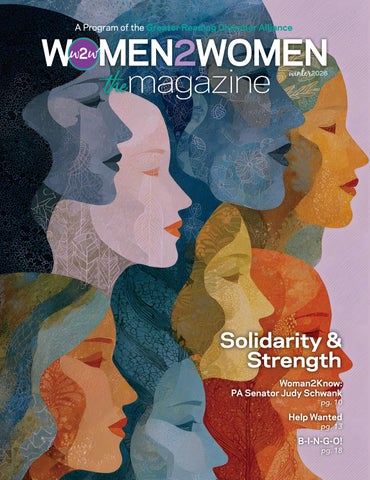
THE COVER: Solidarity & Strength
04
Reflections
10 Woman2Know 26
W2W Around Town
30
On The Calendar
Swag Sponsor Assured Partners
De Mujer a Mujer Berks Community Television
Women In Business Diamond Credit Union GAGE Personnel Irish Creek Construction Met-Ed/A FirstEnergy Company
The opinions expressed in this material are for general information only and are not intended to provide specific advice or recommendations for any individual.
© 2026 All rights reserved. No portion of this publication may be reproduced electronically or in print without the expressed written permission of the publisher. Women2Women Magazine is published quarterly by Hoffmann Publishing Group • Reading, PA HoffmannPublishing.com • 610.685.0914
FOR ADVERTISING INFO CONTACT: Sales@HoffPubs.com or (610) 685-0914 ext. 715 SPREAD THE WORD #W2WMag greaterreading.org/women2women 3
Reflections Welcome to the Winter 2026 issue of W2W Magazine! In the aftermath of the vibrant holiday whirlwind, winter offers a profound opportunity for reflection and renewal. This issue explores topics that explore not only reflection and renewal but how those processes lead us to create solidarity and find strength. We look at: • How to support organizations in the wake of funding challenges • The importance of setting boundaries for yourself • Fun, new ways to set new year goals • Why you need a healthcare “to do” list Plus, Woman2Know PA Senator Judy Schwank and more! Winter, at its core, is a season of hope and potential. The season reminds us that as the new year begins, life is preparing for its grand return. May these pages inspire you to stoke the fires of your inner ambitions, to renew your power and to put it to work for yourself and the world-at-large. Thank you for allowing W2W Magazine to be a part of your winter journey. Onward!
Kirsten P. Haas Kirsten P. Haas Managing Editor, W2W Magazine
B
y the time you begin voraciously reading this issue, I will have already failed at one or all my New Year’s resolutions.
I know, I know. I shouldn’t beat myself up about it. Besides, “resolutions,” as it were, are passe. Now, they’re “micro” or “mini” goals instead. Baby steps one takes towards the finish line. Progress measured not by total achievement, but rather by the fact that you at least took the first steps. Sigh. As a Type-A personality, a self-diagnosed obsessive-compulsive and, you guessed it, eldest daughter, not finishing what I start is anathema to my very being. I harbor feelings of failure for the 12 journals languishing in my office, all with earnest introductions written with gusto, each entry getting progressively shorter until…well, no more entries. My stop-and-go reading habit haunts me with every glance at the pile of books on the shelf (I keep the in-progress reads in a pile as a reminder, “Read me!”). And don’t get me started on the two boxes of half-finished cross-stitch and “Hey! Why don’t I teach myself to crochet?” projects. Plus, there is a ukelele in my closet waiting for me to learn how to unleash its twangy tunes. You get the picture. 4 Women2Women | Winter 2026
Inspiration But a strange thing happened to me as the year wound down. Instead of obsessing over all the things I didn’t get completed, I began to embrace the baby steps philosophy and pat myself on the back for what I DID, in any measure. For example: • I stopped wearing my smart watch and started wearing my old-school Citizen. It tells me the time. And the date. No more buzzing, beeping or task-interrupting. • I stopped reading news and emails at breakfast and started reading a book. I get at least one chapter read daily. The other stuff will be there when I begin the workday. • I started and almost finished crocheting a doll of a kitten (I’m a slow crocheter). I bought the kit years ago and decided I had a better chance of completing a project with defined parameters. Finally, and this goal is the one I really, really want to achieve: I want to be okay with not doing ALL the things, ALL the time for ALL the peoples in my life. Perhaps, I’m not failing after all. Baby steps.
2
FEATURE
Rising to the Challenge:
The Impact of the Federal Shutdown and PA Budget Impasse on Berks Nonprofits
O
n November 12, when the headlines announced the end of the 2025 federal government shutdown (43 days) and Pennsylvania’s state budget impasse (135 days), many breathed a sigh of relief. But for nonprofits in greater Reading and across Berks County, the story doesn’t end there. The ripple effects of these disruptions, including delayed funding, paused programs and strained resources, continue to shape the lives of those these organizations serve. For organizations whose mission is to provide stability, safety and hope, the uncertainty of the past months has been more than a challenge; it’s been a test of resilience. Nonprofits are the heartbeat of our community. They build homes, protect families and offer second chances when life feels impossible. Yet, when government funding stalls and state budgets freeze, these lifelines are stretched to their limits. For many nonprofits, the shutdown wasn’t merely a temporary inconvenience; it created gaps that may take months or even years, to fill. Behind every statistic, is a family waiting for housing, a survivor seeking safety, or a mother striving to keep her children together. These impacts are not abstract; they are deeply human. Four organizations provide real visibility into the struggles and the strength that define this moment: Habitat for Humanity, Safe Berks, Hannah’s Hope Ministries and United Way. Each organization faced unique challenges during the shutdown and budget impasse.
HABITAT FOR HUMANITY OF BERKS COUNTY: Building Homes of Dreams For nearly four decades, Habitat for Humanity of Berks County has worked to make the dream of homeownership a reality for local families, many of them single women striving to create stability for themselves and their children. Through affordable mortgages, financial literacy education, and hands-on partnership, Habitat Berks has helped transform lives and neighborhoods alike. While Habitat Berks was not immediately affected by the Pennsylvania state budget impasse, federal funding cutbacks, particularly to the U.S. Department of Housing and Urban Development (HUD), pose a serious long-term concern. HUD programs help make affordable housing projects possible by supporting infrastructure and development. Without these essential funds, the ripple effects will inevitably reach the families in our community who need Habitat most. Continued on page 6 greaterreading.org/women2women 5
FEATURE “Every dollar that supports affordable workforce housing, is an investment in a stronger, more stable community,” says Executive Director Timothy Daley. “When funding dries up, it’s not just our projects that stall, it’s the future of our entire community that hangs in the balance.” Habitat Berks has long served single women looking to achieve homeownership through its First Time Homebuyer’s Program. These hardworking women represent resilience, dedication and hope as they have broken cycles of housing insecurity. The recent revitalization efforts of the Buttonwood Gateway neighborhood— where several of these homeowners are building their futures in safe, affordable homes—stands as a testament to what’s possible when community, government and philanthropy work together. Sustaining that progress requires consistent, reliable funding. An affordable home doesn’t just provide a roof, it builds opportunity. As Habitat Berks looks to the future, the organization remains steadfast in its mission: building strength, stability and self-reliance through homeownership.
SAFE BERKS: Unyielding Commitment Amid Financial Strain Safe Berks is a Berks County lifeline for survivors of domestic violence and sexual assault. Behind the unassuming doors of its shelter and offices, lives are rebuilt daily—survivors find safety, children rediscover stability, and families begin to heal. The organization’s 24-hour hotline, text line, emergency shelter, counseling and education programs have been provided to those in need at no cost for 50 years. But in July 2025, that lifeline began to fray. Safe Berks was one of numerous organizations caught in the middle of a state budget impasse, leaving reimbursements for critical services frozen. Without those funds, the organization’s ability to operate at full strength unraveled. Vacant positions remained unfilled due to a hiring freeze. Bills to local vendors went unpaid. Debt piled up. And most painfully, staff were laid off—a blow that immediately rippled through every corner of the organization. The impact was immediate and unmistakable. Fewer advocates in hospitals and courthouses. Fewer counselors to meet with survivors. Fewer staff to answer crisis calls. The organization’s reach—once woven tightly into schools, law enforcement and community partners—was depleted even as the need for its services continued unabated.
6 Women2Women | Winter 2026
HANNAH’S HOPE MINISTRIES: Sustaining Hope in Uncertain Times In a season when headlines are dominated by stories of federal and state budget gridlock, many nonprofits find themselves navigating the ripple effects of funding delays and cutbacks. Hannah’s Hope Ministries is deeply aware of these challenges—even as they are sustained entirely by the generosity of private donors, churches and community partners. While their funding model shields them from the immediate impact of government shortfalls, the strain is reflected in the lives of neighbors and in the growing number of families who seek help in crisis. When other organizations—those reliant on public funding— are forced to scale back or close programs, the safety net grows thinner for everyone. The need does not disappear; it shifts and often lands in the laps of privately funded ministries like Hannah’s Hope. This reality raises a vital question: What if the solution isn’t an either/or between government and private funding, but a both/and? What if sustainable community care depends on collaboration— where private generosity and public resources work hand in hand to ensure that no family falls through the cracks? Continued on page 8
“Our clients, survivors, question why this happens,” said Beth Garrigan, CEO of Safe Berks. “They ask if these services aren’t considered important—and where they’ll go if Safe Berks isn’t here.” For staff, the strain is emotional as well as professional, “We know what’s at stake—every day without funding risks lives.” The situation at Safe Berks reflects a larger, systemic problem: the fragility of Pennsylvania’s funding model for essential social services. Domestic violence and sexual assault programs rely heavily on state and federal reimbursements that are tied to the state budget. When lawmakers fail to pass that budget on time, payments freeze—even though the violence, trauma and the need never do. “Funding for lifesaving services shouldn’t be treated as optional or negotiable,” Garrigan said. “No organization can sustain long periods without reimbursement for work already done.” Every budget impasse is more than a political stalemate. It is a matter of safety, survival and trust. Private donations and community fundraisers, while vital, simply cannot fill the gap left when government reimbursements stall. Yet even in the face of uncertainty, the organization persists. Staff continue showing up for survivors with compassion and determination, proving every day that Safe Berks’ commitment to safety and healing is stronger than the uncertainty of the financial hardships it endures.
th i w e c on a F w A Ne ear Visi
a Cl
Eye Consultants of Pennsylvania welcomes Tianyu (Tom) Liu, MD, an award-winning, board-certified retinal specialist. Fellowship-trained in vitreoretinal surgery, he treats retinal detachments, diabetic retinopathy, and age-related macular degeneration. A Perelman School of Medicine graduate, Dr. Liu has earned national honors and trained at the top programs in the country. Whether you’re facing a complex retinal condition or seeking expert guidance on your eye health, you can trust Dr. Liu to provide compassionate, personalized care to protect and preserve your vision. NOW ACCEPTING NEW PATIENTS IN WYOMISSING AND POTTSVILLE Call 1-800-762-7132 or visit eyeconsultantsofpa.com.
greaterreading.org/women2women 7
FEATURE Hannah’s Hope is profoundly grateful for the individuals, churches, businesses and foundations that keep their doors open. That commitment allows mothers and children to find refuge, healing and the chance to rebuild their lives. They recognize that compassion cannot exist in silos. Whether dollars flow from a grant, a church collection or a state budget line, the goal is the same: to restore stability, dignity and hope to those who need it most. In times when “the money dries up,” the question becomes not just who will give, but how we can give together.
UNITED WAY OF BERKS COUNTY: A Steadfast Partner Many human service programs across Berks County continue to face a fragile and uncertain future even as both the longest running Pennsylvania budget impasse and the recent federal government shutdown have ended. While operations have technically resumed, funding delays of four to six weeks or more are expected, caused by administrative backlogs, delayed contract processing, and reimbursement lags at both the state and federal levels. For nonprofits already operating on the edge with depleted reserves, maxed out lines of credit, or paused programs, this delay prolongs an already critical situation. As a result, local organizations continue to struggle to deliver essential services to vulnerable residents who depend on them. Compounding these challenges are changes to SNAP (Supplemental Nutrition Assistance Program) as well as Medicaid renewal and enrollment processes, which are causing eligible individuals to lose benefits, often due to confusion over paperwork or new, more frequent renewal deadlines. This trend is expected to grow, placing even more strain on families who are already struggling and the agencies that support them. Significant disruptions in federal housing funding are expected to intensify this crisis. Upcoming budget proposals and programmatic changes at the U.S. Department of Housing and Urban Development (HUD) are projected to reduce resources for permanent housing and rental assistance, placing even more individuals and families at risk of eviction or homelessness. For example, one proposed policy change reduces the proportion of funding allocated to permanent housing projects from approximately 87% to as low as 30%. These cuts would undermine proven housing strategies at a time when demand is rising, and stable housing is more critical than ever. This crisis is far reaching and deeply human: organizations are under strain, and the very people who depend on them, children, working families, seniors and individuals with disabilities are bearing the weight. United Way of Berks County remains a steadfast partner to our community. Beyond the stable funding provided through our annual investments, we are working closely with local funders and partner agencies to offer support where we can make connections, to share empathy, and to provide targeted financial assistance to help bridge the gap.
8 Women2Women | Winter 2026
WHAT CAN WE DO? Across Berks County and beyond, nonprofits of every size and mission have felt the strain, whether they provide food, shelter, education or advocacy. The shutdown may have ended, but its impact is not and the need for community support has never been greater. This is where you come in. Whether it’s swinging a hammer with Habitat, donating to Safe Berks, mentoring a mother at Hannah’s Hope Ministries, or supporting another local nonprofit that speaks to your heart, your involvement can turn setbacks into stepping stones. Every dollar, every volunteer hour and every voice advocating for change, matters more than ever. Let’s ensure that the story of 2026 is not one of scarcity and struggle, but of solidarity and strength. To learn more about how these organizations and countless others are rising to the challenge, and how you can rise with them, check out the information below: Habitat for Humanity of Berks County at https://www.habitatberks.org/ Safe Berks at https://safeberks.org/ Hannah’s Hope Ministries at https://www.hannahshopeministriesreading.org/ United Way of Berks County at https://www.uwberks.org/ Photos courtesy of the contributing organizations
2
Because your life is on a
EMPLOYEE BENEFITS SOLUTIONS
NEED TO KNOW basis.
Smoke Detected
PK Benefits Consulting helps employers plan, design, implement and manage comprehensive and cost-efficient employee benefits programs
OUR SERVICES: Employee Benefits Consulting Services Compliance and HR Support and Advocacy When You Need to Know.
Clinical Wellness Programs
CONTACT US
Security | Fire | Camera | Doorbell
610-685-1790
sahinc.com | 610.372.8872
www.pkbenefits.com
Let Us
Assist
Your Loved One!
Help them stay in their homes and keep the independence they cherish. We always conduct regular, confidential in-home quality assurance visitations to go hand-in-hand with a customized care plan specifically for your loved one. We are locally owned and operated, giving us a stake in your community. • Senior Care • Housekeeping • Transportation • Laundry Services • Errand Services
• A Few Hours a Week or 24/7 Coverage • Meal Preparation • Personal Hygiene • Shopping/Groceries • And More...
Stair Lifts • Locally Owned and Operated Scan here to visit our website check out Installation by our • Expertand mental health services, including: Certified Technicians Individual• Therapy Bruno Stair lifts Made in the USA Group Therapy • Will Beat All Factory Couples Counseling Sale Pricing School-BasedDirect Services Don’t forget to check out our wellness services, including: Nutrition Coaching Accountability Coaching STAIR LIFTS • RAMPS Life Coaching
Fully insured and bonded
www.assuredassistance.com
Call 610-796-4737 today for your free consultation.
1-800-886-6364 or 484-509-5024 paramountlivingaids.com
greaterreading.org/women2women 9
Woman2Know As the representative for Pennsylvania’s 11th Senatorial District, Senator Judy Schwank is not just a legislator; she is a trailblazer whose roots in Berks County run as deep as the agricultural heritage she champions. From making history as the first woman elected to the Berks County Board of Commissioners to serving as the Dean of Agricultural and Environmental Sciences at Delaware Valley College, Judy has spent decades breaking barriers. Today, as a fierce advocate for women’s health and a steadfast voice for education and economic development, she continues to prove that effective leadership is about listening to your community and fighting for the resources they need to thrive. Jackie Stiles of Women2Women (W2W) interviewed Senator Schwank to learn more about her journey, what she’s learned along the way and why she thinks the future of Pennsylvania is female.
W2W: What’s your mission? My mission as an elected official is to serve everyone in my district equally, whether they voted for me or not. That can be difficult at times. But I truly believe the role of a public servant is to focus on the greater good and what’s best for the area you represent. I try to make decisions that I think will benefit Berks County in the long run. I listen to people’s ideas and concerns, even when they don’t align with my own. I rely on stakeholder input and thoughtful feedback. And I understand that I can’t please everyone.
W2W: Why is your position unique to women in our community? It’s important for women to take on leadership roles and seek elected office at every level of government, because our perspective has historically been underrepresented. I’ve seen firsthand how women’s voices strengthen government. When I began my career as an elected official here in Berks County, there were very few women holding office. Oftentimes, I would walk into meetings or community events and realize I was the only woman in the room. You notice that.
Name: Judy Schwank Company: Pennsylvania Senate Job Title: State Senator, 11th District Years: 14 years (won a special election on March 15, 2011; sworn in on April 5, 2011)
Thankfully, the landscape has changed dramatically. Today, Berks County is represented by three women in the State Senate (one being me) and two more in the House of Representatives. We have two congresswomen representing us at the federal level. And across our municipalities and school boards, we see women stepping into leadership roles at a rate that would have been hard to imagine when I got started. Being a woman doesn’t automatically make you a good elected official, but most of us bring a seriousness, empathy and lived experience that influence how we listen and approach problem-solving.
W2W: What shaped your current career path? My original career was in agriculture. I’ve always loved plants and all that goes into cultivating crops. Agriculture gave me a front-row seat to the issues affecting
10 Women2Women | Winter 2026
WOMEN2KNOW families, small businesses and rural communities in Berks. I worked with farmers, local officials, nonprofits and educators. I drove all over Berks County and met people with different stories. You start to see how government, especially at the local and state level, impacts people much more directly than some of what happens at the federal level. It was through that work that I first interacted with elected officials. I didn’t grow up imagining myself in politics. But I’ve always had a strong sense of service, and eventually that pushed me to run for Berks County commissioner. That was back in 2000. I sought a second term in 2003 and was the leading vote-getter by over 7,000 votes, so I must have done something right. All these years later, I’m still serving, now in the state senate. I’ve never taken the support I’ve received from voters for granted.
W2W: How have you led other women in their career paths? One of my greatest joys is working with young people, especially young women, and helping them see themselves as future leaders. I spend a lot of time visiting schools, meeting with student groups, and speaking with classes about government. Young people are curious and open-minded, and I believe exposure to the democratic process at an early age can be truly life changing.
My office hosts a Model Senate Program for high school students in my district. It’s a hands-on simulation of what it’s like to be a state senator. They debate bills, learn parliamentary procedure, and collaborate across the political spectrum. It’s a respectful and fun environment that the kids and teachers seem to really enjoy. Even if they don’t pursue careers in government, the experience helps them develop confidence, communication skills and an understanding of the legislative process. I also take interns in my office every year. Many of them are young women, and they bring such energy, creativity and insight. I joke that I learn as much from them as they learn from me, but it’s true. They push me to see issues through a generational lens. Some go on to law school, some work in Harrisburg or Washington, others go into community or nonprofit work. One former intern is currently serving in the Dominican Republic with the Peace Corps. I keep tabs on them and cheer on their achievements. They truly make me proud! Mentorship doesn’t have to be formal. Sometimes it’s a conversation after an event, a kind word via email, or a moment where I can help a young woman see her own potential. My goal is to show them that they belong in these spaces.
W2W: What three things do you recommend that contribute to your success? First, be present. Nothing replaces showing up both physically and mentally. It’s how you build relationships and understand the community around you. Second, do your homework. I love digging into issues. I want to know how our nonprofits operate, what challenges our businesses face, what our school districts need, and how state policies impact people’s lives. When you understand the details, you make better decisions. Third, never be afraid to ask questions. Curiosity has served me well throughout my career. I regularly meet with secretaries of state agencies, department leaders and Pennsylvania’s row officers. Knowing what programs and resources exist, allows me to help my district more effectively. Collect as much information as you can; you never know when it will become valuable.
W2W: What words of wisdom would you offer to other women? If you don’t see someone who looks like you in a certain role, be that person. The absence of someone who resembles you shouldn’t be discouraging. Use it as motivation! Never doubt that you can take something on and be successful. You don’t have to have every Continued on page 12
greaterreading.org/women2women 11
WOMEN2KNOW
answer or every qualification from day one. You can grow into a role, and you can learn along the way. I’ve spent my entire career in male-dominated fields (agriculture and government). There were times when I was underestimated or overlooked. But I learned to trust my instincts and bet that if I did the right thing and worked hard, people would notice. So, if you think you can do a good job, you are probably right.
W2W: What is your favorite mantra or words that keep you grounded? My unofficial mantra is simple: Show up. In government, and in most professions, the people who show up consistently are often the ones who get things done. When you’re present, engaged and accessible, you build trust. Showing up means taking on meetings, making phone calls, going to community events, walking into spaces where people aren’t expecting you, and listening with intention.
W2W: How do you want to be perceived or remembered? I hope people remember me as someone who always tried to do the right thing and who genuinely cares about the future of Berks County. I love this community. I’ve spent my entire career working to make it a better place to live, raise a family, start a business, and build a future. There have been great achievements and plenty of setbacks, but I’ve always done my best to break through and make a difference. If my work leaves Berks County stronger, more connected and more hopeful, then I consider that a legacy worth being proud of. 2
By Jackie Stiles GRCA, Vice President of Business Development & Special Programs *Photos courtesy of Senator Judy Schwank
I am always amazed by how much you can learn just by being in the room. A conversation you didn’t expect to have, a concern you hadn’t heard about, or a connection you didn’t know you needed. All that happens when you show up. It keeps me grounded and reminds me that leadership is about much more than having a title. You must have a presence to lead. Serving in government has taught me to be humble. It has taught me resilience. And it has made me deeply grateful for the people of Berks County, whose trust I will never stop seeking to earn.
PAMELA L. VANFOSSEN
PVanfossen@MasanoBradley.com
875 Berkshire Blvd, Suite 100 ◆ Wyomissing, Pa 19610 610.372.7700 ◆ Fax 610.372.4865 A PA Limited Liability Partnership
12 Women2Women | Winter 2026
FEATURE
HELP WANTED?! The Changing Landscape of Entry-Level Jobs
E
ntering the job market after college has long been considered a milestone, yet today’s graduates are facing an increasingly complex employment landscape. Economic uncertainty, rapid technological development, and evolving workplace expectations are reshaping how—and if—new workers gain access to entry-level roles. Two major factors have emerged as defining features of today’s job market: the rise of the “job hugging” phenomenon and the accelerating influence of artificial intelligence (AI). Together, they are transforming what it means to start a career in the 21st century. One of the most significant trends affecting job seekers is the “job hugging” phenomenon. This term refers to employees who remain in their current jobs longer than planned—often even when they feel underpaid, disengaged or unfulfilled—because suitable employment opportunities are scarce. Economic instability, high housing and living costs, and unpredictable market conditions have made individuals more cautious about switching roles. While job hugging may provide personal stability for workers, it reduces the availability of positions for recent graduates. When fewer workers leave their jobs, fewer openings emerge, creating heightened competition for the limited number of entry-level roles that do exist. As a result, new graduates often find themselves in a cycle of delayed employment, temporary work or extended job searches. Adding to this challenge is the growing influence of AI in the workplace. AI is no longer a peripheral tool—it is becoming central to hiring processes, business operations and entry-level job structures. Many tasks traditionally assigned to junior employees—such as scheduling, data entry, administrative support, basic research and customer communication—are increasingly being automated or assisted by AI technologies. These roles historically provided necessary experience Continued on page 14 greaterreading.org/women2women 13
FEATURE are unreliable. Around 7.6% reported that their institution banned AI on campus, and 17% said AI was not accurate or helpful enough in their job search process.
So, what does all this mean for today’s graduates? It means the definition of “entry-level work” is evolving. The combination of job hugging and AI-driven automation has created a highly competitive market in which traditional entry-level roles are shrinking—or transforming into hybrid positions that demand higher skill levels from the start. Graduates are not just expected to have degrees; they are increasingly expected to bring technical proficiency, adaptability and digital literacy to the table. Fortunately, AI can also serve as a career tool rather than a threat when used effectively. It can help students craft stronger applications, research industries and understand employer expectations more efficiently. When combined with real-world experience—internships, projects, networking and skill-building—AI may enhance a student’s chance of standing out in the crowded job market. Today’s job market is changing—and so must the strategies of new job seekers. The rise of job hugging has reduced turnover across industries, limiting entry-level opportunities. At the same time, AI is reshaping not only how companies hire but also who they hire. While these changes bring challenges, they also create new pathways for students who are willing to adapt. The key is not to fear AI—but to learn it, leverage it, and grow with it.
for early career professionals. However, as AI becomes capable of handling these functions, companies are finding less need to hire new graduates. According to recent findings, 13.3% of jobs now require AI-related skills, and 10.5% of entry-level job descriptions include AI expectations. This shift is pushing students to adapt, whether through learning AI tools or reconsidering their career paths altogether. Colleges and universities are responding to this shift by integrating AI into career services and recruitment practices. In one survey of graduating classes, 76% of career centers reported using AI as an assistive tool when working with students. Its uses are wide-ranging: • 89% help students create resumes • 82% assist with cover letters • 73% support job searching
For the next generation of workers, success will depend not on waiting for opportunity, but on preparing for a job market where technology and human skills must work hand in hand. The workforce of tomorrow is not disappearing, it is transforming, and those who embrace change will be the ones ready to enter it. 2
By Yoheli Ortiz PA CareerLink® Berks County, Community Outreach Specialist References “Job Outlook 2026.” NACE (National Association of Colleges and Employers), 2024. Survey Data on AI in Career Centers. Internal survey results from college career services (Class of 2028 reporting). Smith, John. “Automation and the Future of Entry-Level Jobs.” Journal of Workforce Trends, vol. 12, no. 3, 2024.
• 64.8% answer student questions • 59% help students learn about job qualifications and needed skills
NOW HIRING!
• 58% gather labor market information • 28.8% assess career competencies and skills Yet despite AI’s benefits, student opinions on its importance remain divided. Among the Class of 2028, 11.2% believed AI skills are not important at all, while 32.8% considered them somewhat important and 24.2% viewed them as very important. Only 15.1% of students said AI skills are extremely important, showing that awareness is growing—but slowly. Some students are reluctant to use AI due to concerns about data privacy, ethical implications or potential employer reactions. Others simply feel unprepared or believe AI tools
14 Women2Women | Winter 2026
Scan here to browse available positions
ALWAYS LIFT. NEVER QUIT.™ The heritage of American Crane & Equipment Corp. remains steadfast. Its mastery fuses the dependability of the past with the pioneering spirit of the future. A tribe of those willing to forge ahead, whatever the obstacle, elevated to a category that few family-owned businesses can boast: built to last for generations. Learn more at
AMERICANCRANE.COM
Your Trusted Leader in Overhead Lifting Equipment Since 1972
FEATURE
The Power of Saying No: Leadership Lessons from Cheryl Heckman of Manor Golf Club
W
hen a woman says “no,” the world doesn’t always listen— but when Cheryl Heckman says it, people stop, adjust and follow her lead. As owner and manager of Manor Golf Club for nearly 28 years, Cheryl has built a reputation in one of the most male-dominated environments in sports: golf course management. And she does it without raising her voice. At the Women2Women golf outing last May, a group of men confidently announced to Cheryl that they planned to tee off at a specific hole to avoid another group they saw ahead of them. Without missing a beat, Cheryl calmly considered her mental map of the course, predicted where every group would be at that moment in the afternoon, and redirected them to a different starting point. One man tried to push back—as if he knew the course better than the woman who’s run it for nearly three decades. Cheryl didn’t budge. With complete composure, she told him, “That won’t work. Start over there.” And that was that. That moment is what The Power of Saying No, the first Women2Women event of 2026, is all about. It’s the strength of drawing boundaries rooted in expertise. It’s the confidence to make decisions without apology. And it’s the reminder that “no” can be a tool for leadership, not conflict.
A Woman Leading in a Male-Dominated Field The golf industry remains overwhelmingly male: only 24% of golf club managers in the U.S. are women (Zippia, 2024). Yet women now make up 60% of the recent growth in on-course participation, signaling a sport rapidly diversifying (National Golf Foundation, 2024).
Cheryl’s leadership is part of that cultural shift. She challenges outdated expectations—not with confrontation, but with clarity and calm authority. Her presence alone expands what leadership looks like in the world of golf.
What Happens When Women Aren’t Heard? Cheryl’s steady confidence raises an uncomfortable truth: many women aren’t listened to even when they know exactly what they’re talking about. A 2024 report on unconscious gender bias found that: • 81.7% of women say they’ve been interrupted or talked over in meetings. • 62% say their ideas are dismissed until repeated by a male colleague (Source: Jo Wise Leadership, 2024). Continued on page 16 greaterreading.org/women2women 15
FEATURE
This dynamic often teaches women to shrink—to soften their statements, hedge their opinions, or wait for the “right moment” to speak. But silence doesn’t serve anyone: not women, not teams and not organizations. Cheryl models a different approach. She doesn’t compete for volume. She doesn’t justify her decisions. She simply stands on her expertise and expects others to respect it. That is the power of a well-placed “no.”
What We Hope to Learn from Cheryl As we prepare for our January event, we’re excited for Cheryl to share her wisdom on boundary-setting, confidence and leading in spaces not always designed to hear women’s voices. When asked what she wants other women to know—especially those whose ideas are dismissed or overshadowed—Cheryl offered this powerful guidance: “Do not allow your inner voice to be silenced or subdued. Your inner voice is your intuitive gift earned from your experience, skills, and desire for the best outcomes. This is a gift meant to be shared and meant to be taken into consideration by all of those around you.” She also shared that saying no is something she practices daily on the golf course, and it’s not about authority for authority’s sake—it’s about fairness and the collective experience.
16 Women2Women | Winter 2026
“Many times on the golf course, my ability to say ‘no’ is based on my desire to have the best experience for all my golfers. Individual golfers will sometimes challenge that, hoping to create the best experience for themselves, but not necessarily for everyone else on the course. My voice of ‘no’ helps level that playing field.” It’s this blend of intuition, expertise and commitment to fairness that makes Cheryl’s “no” so powerful—and why her leadership resonates far beyond the course. In a world that often expects women to soften themselves, Cheryl Heckman shows us how strength can be quiet, grounded and decisive. She reminds us that “no” is not a closed door—it’s a leadership strategy. In 2026, Women2Women is ready to start the year by learning exactly how powerful that small word can be. 2
By Katie Johnsen Event Coordinator, GRCA
FEATURE
Boundaries
Without Guilt H
ow many times have you said “yes” to something when what you really wanted to say was “no”? For many women, overcommitting leads to stress, exhaustion and quiet resentment. It may be agreeing to take on the special project at work, cancelling personal plans to work overtime, delivering your child’s homework to school, or hosting the family holiday dinner. If you consistently find yourself doing things that you really don’t want to do, it may be time to set boundaries in your life. One example of not setting boundaries is answering work correspondence outside of normal business hours. Doing this demonstrates that you are available 24/7. Managers and colleagues will quickly learn that you are always “on” and will expect a response regardless of the time. To prevent this from happening, choose to respond only during standard business hours so you establish a healthy boundary. Whether it’s in one’s personal or professional life, setting boundaries helps to protect your emotional, physical and mental well-being. A healthy boundary can help people feel safe, respected and balanced. Setting boundaries teaches people how to treat you. Many people, especially women who were brought up to be “agreeable” or “helpful,” feel guilt when they prioritize their own needs. But the guilt you feel doesn’t mean you’re doing something wrong, just that you’re doing something different.
“ Daring to set boundaries is about having the courage to love ourselves, even when we risk disappointing others.” – Brené Brown, PhD, LMSW If you are ready to break free of the guilt that is sometimes associated with establishing boundaries, consider the four Cs of boundary setting: Clarity | Use specific and concise language to express yourself. Vagueness can lead to misunderstanding.
Communication | Rather than hoping someone understands your intentions, communicate what you want directly and calmly. Don’t assume others know what you are thinking or need. Consistency | Make sure you do not lapse on an expressed boundary or apply it differently in different situations. If you let the boundary slide, it loses its power. Courage | It takes courage to establish boundaries, especially for those who are people-pleasers. You may get more buy-in on a boundary if you collaborate with the recipient on creating it. Standing up for yourself takes practice, and in the long run, it leads to stronger and healthier relationships. So how can you put this into practice? After establishing the boundaries or ground rules, try these responses when a boundary needs to be reinforced: • When a co-worker emails you after business hours, try: “I don’t check emails after 6 pm. I’ll respond during work hours.” Then stick to it. • When your child forgets to take their homework to school, try: “I asked you to put your homework in your backpack when you’re finished. I can’t bring it to school.” • When asked to host the holiday dinner (again!), try: “I love when we get together as a family. Last year we spoke about taking turns hosting and I look forward to seeing everyone at Molly’s house.” Setting healthy boundaries can feel uncomfortable at first, especially if you’re used to taking care of everyone else’s needs before your own. But discomfort is temporary, and the benefits of boundaries are lasting. Boundaries are not barriers, but bridges to healthier and more respectful relationships at work and at home. Remember, “No” is a complete sentence.
2
By Karen Klein Fulcrum Information Resources
greaterreading.org/women2women 17
FEATURE
Ditching Resolutions and Embracing Bingo:
My New Favorite Way to Start a Year
E
very January, I used to do what so many of us do: Make a shiny new list of resolutions that absolutely, definitely, seriously I was going to stick to this time.
And every January, reality would show up—usually disguised as freezing temperatures, early sunsets and a general vibe I like to call, “seasonal nope.” Suddenly that resolution to go for a walk after work? Gone. That promise to “never skip meal prep again”? Optimistic at best. And then the guilt rolls in, because nothing says, “Happy New Year!” quite like feeling bad about not becoming a brandnew person immediately on January 1. So, in 2025 I decided to try something different. Somewhere on social media—where excellent ideas and terrible crafting tutorials coexist—I saw a woman who had replaced her resolutions with a New Year Bingo Board. And something in my brain said: That. That is the energy I want for my year. Instead of habits to maintain, she chose goals. Instead of daily pressure, she gave herself a year-long runway. Instead of perfection, she aimed for Bingo. So, I made my own 2025 Bingo Board: 24 goals arranged in a grid, plus one free space (because we believe in achievable wins). These weren’t “be a whole new person by Friday” goals. They were the things that had been gently tapping me on the shoulder for months—household projects I kept shoving to “next weekend,” friends I kept meaning to schedule dates with, professional moves I wanted to make but hadn’t found my opening for. Some were big. Some were tiny. Some were the kind of goals where checking the box gives you a weirdly satisfying endorphin rush, like “organize that one kitchen drawer that is definitely a health hazard.”
Over the year, something lovely happened. Whenever I opened my bullet journal (which is where my Bingo board lives—and if you’ve never fallen down the bullet-journal rabbit hole, come find me at the next event and I’ll give you a full TED Talk), I’d see my goals waiting patiently for me. No guilt. No urgency. Just a gentle reminder of the life I wanted to build, one square at a time. And the best part? When I realized I was one or two squares away from completing a row, suddenly I’d feel this spark—“Oh! I can do this one. That’s totally doable.” And just like that, I’d finish a goal not out of pressure, but out of genuine momentum. By the end of the year, I had completed multiple Bingos without ever feeling like the year was judging me back.
And here’s the magic: I didn’t expect to finish all of them. For once, I built in grace.
Continued on page 20
18 Women2Women | Winter 2026
greaterreading.org/women2women 19
So, for 2026, we’re offering a tear-out Bingo board in this issue—a little gift from me (actually from Past Me, who wants Future You to have more joy and fewer guilt-ridden resolutions). Put it on your fridge. Tuck it into your planner. Tape it to your bathroom mirror. Add things that matter, that excite you, or that simply feel satisfying to check off. And if you only get one Bingo this year? That’s still a win. Honestly, that’s the whole point.
2
By Katie Johnsen Event Coordinator, GRC
Bingo Board Idea Starters • Finally schedule that doctor/dentist appointment • Organize one truly chaotic drawer • Take yourself on a solo coffee date • Try a new restaurant in Berks • Host a game night • Read one book just for fun • Take a mental health day—no guilt • Clean out your car (yes, even under the seats) • Reach out to a friend you’ve been missing • Try a new fitness class • Update your résumé or LinkedIn • Plan a weekend getaway • Donate clothes you’re done with • Learn one new skill (big or tiny) • Take a walk somewhere you’ve never been • Sign up for a W2W event you haven’t tried before
20 Women2Women | Winter 2026
FEATURE
MENOPAUSE DECODED: Turning Confusion into Confidence
H
ave you heard more about menopause hormones from social media, news and friends? Many of my patients have questions related to hormones and how hormones impact our bodies. The changes that occur during perimenopause and menopause are as normal as puberty, but that does not mean they are not without symptoms! When women understand these normal changes that are occurring, they are empowered to speak up to their health care providers for answers to their questions and for support. The key hormones that are involved are estrogen, progesterone, testosterone and Follicle Stimulating Hormone (FSH) and Leutinizing hormone (LH). Each hormone has a unique role, and they all work together in different feedback loops between the brain and body to function. As ovarian reserve begins to change, estrogen levels can fluctuate. This time is known as perimenopause and estrogen levels can vary widely, being high some months and low other months. Progesterone levels may also not consistently rise if ovulation does not consistently occur. Perimenopause can last on average five to ten years before the final menstrual period. A woman may begin to experience symptoms such as changes in menstrual timing, irregular periods or changes in flow such as heavy or light bleeding. Since hormones affect more than menstrual cycles, women may also experience many other symptoms. Hormones influence thermoregulation, brain chemistry, metabolism, sleep cycles and emotional well-being. This is why many women report other symptoms including hot flashes, night sweats, sleep disturbances, brain fog, mood swings, changes in libido and vaginal dryness. When the ovaries cease to function, a woman will no longer menstruate, and one year after their last menses, a woman is considered menopausal. After this time, it is very normal to have low or undetectable estrogen and progesterone levels. The FSH level typically rises during this time as well. Many times, checking these hormone levels, especially during perimenopause and early menopause, does not have much clinical significance because women can begin to experience many physical changes, but their lab levels may still result as normal. This can be very frustrating and difficult for patients, to be told that everything is “normal” when they are experiencing a myriad of changes and symptoms.
greaterreading.org/women2women 21
FEATURE
Seeing a provider who is well versed and understanding this transition can help during this time. Many times, the diagnosis of perimenopause and menopause can be made with a woman’s clinical history. Additional lab work may be used to help support the diagnosis or rule out other causes for symptoms such as anemia, glucose level variations, low iron, thyroid dysfunction, low vitamin D and on! Make sure to discuss the changes and symptoms you are experiencing so your provider can determine what is best for you. Hormone therapy, also called hormone replacement therapy (HRT) or menopausal hormone therapy (MHT), is an option for many women experiencing symptoms. The Food and Drug Administration (FDA) approved indications for use of HRT include moderate to severe menopausal vasomotor symptoms, and vulvovaginal atrophy. It is also approved to prevent postmenopausal osteoporosis. HRT is available in many different forms including oral, transdermal (through the skin), vaginal and in non-FDA approved options such as pellets. Some women may want to consider options that are considered "bioidentical" (lab-manufactured hormones with the same chemical structure as naturally produced hormones). There are FDA approved “bioidentical” prescription options.
22 Women2Women | Winter 2026
Other, newer nonhormonal options are available for women who are not candidates for use of hormone therapy, that can also be used for vasomotor symptoms. The FDA also recently approved the removal of warning labels on HRT, which should help women feel more comfortable in considering HRT treatment and in having a discussion with her providers regarding treatment. When considering use of hormone therapy, it is important to reach out and speak to a provider who is educated in the various treatment options. A provider should discuss important clinical history including your age, age of menopause, relevant health history, whether you have had a hysterectomy, current symptoms, prior treatments, as well as any cancer history. When reviewing different treatment options, a provider who has a good understanding and training will be able to discuss the differences among the many options and which options might be best for you. Hormone therapy is not one sized fit all! 2
By Jessika Kissling, MD, FACOG, MSCP Lead Physician, Ob/Gyn Penn State Health St. Joseph
FEATURE
e v a S ate D the
Make 2026 the year you move health to the top of your
to-do list Before you know it, your 2026 calendar will be jam-packed with girls’ nights, beauty appointments, weekend getaways, volunteer activities, and work deadlines. But don’t forget that your health deserves a VIP spot on your schedule, too. Make sure to save some space for your annual vaccines and medical screenings. From your 20s to your 60s and beyond, your health journey evolves. Prioritizing the right checkups helps you stay strong and thrive through every stage of life. So, this year, skip the guesswork and use our at-a-glance Women’s Health Checklist to easily pencil in your must-do appointments.
“Screenings are an essential part of preventive care. A few quick appointments can make all the difference because the earlier we catch something, the better,” says Sarah Dreibelbis, DO, OB/GYN Department, Reading Hospital-Tower Health. “They also give you dedicated time to ask questions and get reliable information. Believe me, having peace of mind is powerful. Your mind and body will thank you.” By Reading Hospital-Tower Health.
greaterreading.org/women2women 23
2026 Women’s Health
Checklist
VACCINES
FREQUENCY
FLU Age: 6 months to 80+ years
One dose annually
Date: Time:
HPV Age: 11 to 26 years
Two doses for age 11 to 15 Three doses for age 15 to 26
Date: Time:
COVID-19 Age: 12 to 80+ years
One or two doses, depending on vaccine type
Date: Time:
DISEASE SCREENINGS
FREQUENCY
APPOINTMENT
STI / HIV Age: 18 to 80+ years
Regular testing based on sexual activity and other risk factors
Date: Time:
DIABETES Age: 20 to 80+ years
Regular hemoglobin A1c testing Prediabetes and type 2 diabetes testing from age 35 to 70 for those who are overweight or obese
Date: Time:
LIPID PANEL Age: 40 to 80+ years
Regular testing with blood test Start testing earlier (age 20) with coronary artery disease risk factors
Date: Time:
OSTEOPOROSIS Age: 65 to 80+ years
First DEXA bone scan at 65 Repeat as directed by your physician
Date: Time:
CANCER SCREENINGS
FREQUENCY
APPOINTMENT
CERVICAL CANCER Age: 21 to 65 years
Every three years from age 21 to 30 Every five years from age 30 to 65
Date: Time:
BREAST CANCER Age: 40 to 75+ years
First mammogram at age 40, even if in good health Mammograms earlier for women at higher risk of breast cancer, or who notice a lump or changes in the breast Age to end screening mammograms should be discussed with your healthcare provider
Date: Time:
COLON CANCER Age: 45 to 75 years
Repeat normal colonoscopy every 10 years Repeat normal stool screening annually
Date: Time:
LUNG CANCER Age: 50 to 80+ years
Annual chest CT scan for anyone who has smoked the equivalent of one pack a day for 20 years or has quit in the last 15 years
Date: Time:
APPOINTMENT
Speak with your healthcare provider, as timing of some tests may be different based on your personal risk factors and medical history.
Notes 24 Women2Women | Winter 2026
You're Expecting the Best Care.
We Deliver. When it comes to welcoming your little one, you deserve care that’s as extraordinary as the moment itself. Our experienced maternity team combines advanced medical expertise with compassionate, personalized support—ensuring both you and your baby receive the very best. From prenatal visits to postpartum care, we’re here to make every step of your journey safe, comfortable, and unforgettable.
Trust us with life’s most precious delivery.
TowerHealth.org/WelcomeBaby greaterreading.org/women2women 25
W2W AROUND TOWN
9.09.2025
Regional Networking at RPM Photos by Zerbe Photography
26 Women2Women | Winter 2026
W2W AROUND TOWN
Evening of Empowerment photos by Lauren Little
10.10.2025
greaterreading.org/women2women 27
W2W AROUND TOWN
11.11.2025
Building Your Beehive
28 Women2Women | Winter 2026
W2W AROUND TOWN
11.11.2025
Mujer Mujer De Mujer a Mujer: Salud Menta Para Familias (Mental Health for Families)
greaterreading.org/women2women 29
ON THE CALENDAR
2 GROW CONNECT LEAD Women2Women (W2W) is Greater Reading Chamber Alliance’s catalyst for developing women leaders and connecting women from diverse backgrounds to learn, share ideas, and mentor each other through offering a forum for women to create connections, gain knowledge, and build strategic alliances to foster their personal potential and career advancement. Joining the network is open to all who support women. De Mujer a Mujer, una iniciativa de W2W, continúa conectando a mujeres de diversos orígenes al ofrecer programación especializada en la noche y destacar a oradores de diversos orígenes.
JANUARY 2026
FEBRUARY 2026
THE POWER OF SAYING NO Thursday, January 15, 11:30-1 p.m.
POWERHOUSES: WOMEN IN ENGINEERING Wednesday, February 5, 7:30-9:30 a.m.
West Reading Motor Club
Reading Country Club
416 Penn Avenue, West Reading 19611
Start your year with strength, clarity and a little inspiration from one of Berks County’s most respected women in leadership. Join Women2Women as we welcome Cheryl Heckman, owner and manager of Manor Golf Club for nearly 28 years, for a conversation on The Power of Saying No—and how setting boundaries with confidence can transform the way you lead. In a field long dominated by men, Cheryl has built a career defined by expertise, composure and the ability to say “no” with authority and grace. She’ll share real-world stories from nearly three decades running one of the region’s busiest golf courses, along with practical insights for women who find their ideas overlooked, their voices talked over, or their authority questioned. Expect to learn: • How to say no with confidence (and without apology) • Strategies for being heard in male-dominated or high-pressure environments • Ways to use your expertise as the foundation of your authority • Tips for navigating pushback while staying composed This event is perfect for anyone looking to start 2026 with stronger boundaries, clearer communication and a renewed sense of personal leadership.
5311 Perkiomen Avenue, Reading 19606
Women are still underrepresented in engineering—but that hasn’t stopped trailblazers here in Berks County from reshaping the field. Kick off the year with GRCA’s Breakfast4Success in partnership with Women2Women for an inspiring morning featuring local women engineers who are challenging norms, driving innovation and paving the way for the next generation. Hear firsthand how these leaders overcame obstacles, turned challenges into opportunities, and built successful careers in a traditionally male-dominated profession. From technical breakthroughs to leadership lessons, their stories will motivate, educate and empower you—whether you’re already in the field or simply curious about engineering. Why Attend: • Real stories from women making an impact in engineering and STEM • Insights into career paths, workplace culture, and innovation in technical fields • Practical tips for advancing your own professional journey • Opportunities to connect with other professionals and expand your network Celebrate innovation, gain valuable takeaways and be inspired by the women who are engineering a brighter future. Reserve your spot today!
For more information about Women2Women events including event registration, go to https://greaterreading.org/women2women/. 30 Women2Women | Winter 2026
TRAVEL WITH US TO
CROATIA! Nov. 1 - Nov. 10 Embark on a remarkable adventure as you explore the elegance of Opatija, the coastal charm of Split and the stunning highlights of the Dalmatian Coast. From Opatija’s grand villas and seaside promenades to Split’s vibrant history and Roman architecture, this journey offers the perfect blend of culture, relaxation and scenic beauty. Discover enchanting villages, sun-kissed shores and centuries of history along Croatia’s breathtaking Adriatic coastline.
Book your trip today and discover the beauty of Croatia! Sign up to travel with us & learn more! Sign up now to attend the trip info session on Feb. 4. Early Bird pricing ends: March 1
THE BEST READING IN READING. CALL TODAY FOR ADVERTISING OPPORTUNITIES. HoffmannPublishing.com 610-685-0914 ext. 715