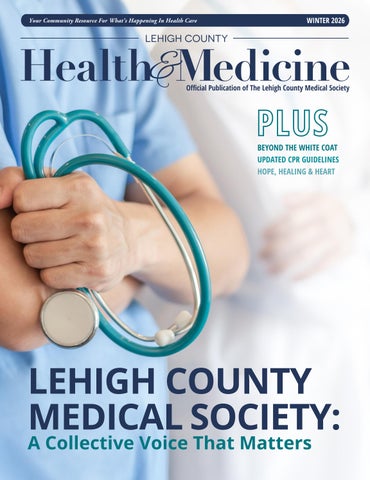
WINTER 2026
Official Publication of The Lehigh County Medical Society
PLUS
BEYOND THE WHITE COAT UPDATED CPR GUIDELINES HOPE, HEALING & HEART
LEHIGH COUNTY MEDICAL SOCIETY: A Collective Voice That Matters
contents
WINTER 2026
LEHIGH COUNTY MEDICAL SOCIETY P.O. Box 8, East Texas, PA 18046
610-437-2288 | lcmedsoc.org
2026 LCMS BOARD OF DIRECTORS* Kimberly Fugok, DO President Alissa Romano, DO President Elect Gregory Wheeler, DO Vice President Oscar A. Morffi, MD Treasurer Charles J. Scagliotti, MD, FACS Secretary Chaminie Wheeler, DO Immediate Past President *effective February 1, 2026 - for two-year terms
5 IN THIS ISSUE FEATURES 6 BEYOND THE WHITE COAT: WHY THE LEHIGH COUNTY MEDICAL SOCIETY MATTERS MORE THAN EVER
CENSORS Laura Nicole Oswald, MD Mia Mattioli, MD
TRUSTEES
ON THE COVER 8 L EHIGH COUNTY MEDICAL SOCIETY
Wayne E. Dubov, MD Kenneth J. Toff, DO Mary Stock, MD
A Collective Voice That Matters
EDITOR David Griffiths Executive Officer The opinions expressed in this publication are for general information only and are not intended to provide specific legal, medical or other advice or recommendations for any individuals. The placement of editorial opinions and paid advertising does not imply endorsement by the Lehigh County Medical Society. All rights reserved. No portion of this publication may be reproduced electronically or in print without the expressed written consent of the publisher or editor.
OPINION ARTICLE 12 T HE $200 MILLION MISTAKE PENNSYLVANIA PATIENTS CAN’T AFFORD
14
16 THE COMPASSIONATE CORE: Lehigh County Medical Society’s Award for Humaneness in Medicine
18 LEHIGH COUNTY MEDICAL SOCIETY ESTABLISHES SCHOLARSHIP AT COMMUNITY FOUNDATION 20 U PDATED CPR GUIDELINES TACKLE CHOKING RESPONSE, OPIOID-RELATED EMERGENCIES AND A REVISED CHAIN OF SURVIVAL
By Chaminie Wheeler, DO
14 HOPE, HEALING & HEART:
The Jones Family’s Fight Against Heart Disease Fuels a Movement
Hoffmann Publishing Group is the official publisher of the Lehigh County Medical Society’s Lehigh County Health & Medicine magazine. Sinking Spring, PA | HoffmannPublishing.com | (610) 685.0914
FOR ADVERTISING OPPORTUNITIES CONTACT: Sales@HoffPubs.com, 610-685-0914 x715
L C M E D S O C .O R G
IN THIS ISSUE
W
elcome to our winter edition of Lehigh County Health & Medicine! In this issue, we bring you critical insights and inspiring stories that will impact you and your patients, such as:
• A New Era of Leadership: Hear from our incoming president, Kimberly Fogok, DO, as she shares her vision for a stronger Lehigh County Medical Society—one built on mentorship, physician well-being and achieving equitable care access. Confident that collective action is the key to a strong medical community, she is grateful for the opportunity to serve and excited to get started. • The 2025 House of Delegates: Read a summary of the outcomes from the 2025 hybrid sessions and hear from some of the LCMS delegates. • Lifesaving Updates: Be prepared with the 2025 AHA Guidelines for CPR/ECC, featuring expanded recommendations for opioid overdose and choking, along with other critical interventions you need to know now. • Heart & Hope: Read the inspiring story of Hailee-Anne Jones, whose personal heart journey fuels her family’s dedication to the American Heart Association and the upcoming Eastern Pennsylvania Heart Ball.
We believe medicine and wellness are the foundations of strong communities. Read on to empower your practice and strengthen our collective voice. If you are interested in reading past issues or want to access Lehigh County Health & Medicine online, please visit https://lcmedsoc.org/our-publication. We welcome your ideas and suggestions for future issues—feel free to reach out to us at https://lcmedsoc.org/. Contribute to the ongoing conversation about how medicine and wellness can help us build strong communities in Lehigh County! Thank you for reading!
WINTER 2026 | Lehigh County Health & Medicine 5
FEATURE
Beyond the White Coat:
WHY THE LEHIGH COUNTY MEDICAL SOCIETY MATTERS MORE THAN EVER The mission of the Lehigh County Medical Society is to encourage physicians and healthcare professionals to have the highest moral and ethical standards; to council and censor them when necessary; to serve as a strong and united voice for our Lehigh County physicians, our patients and our community; to promote healthful living and well-being and to advance the highest standards of healthcare and service in our region through education, service and advocacy.
I
n an era defined by administrative burnout, shifting healthcare landscapes and the increasing isolation of clinical practice, the decision to join a professional organization is often met with a skeptical: “What am I actually going to get out of this?” It is a fair question. Today, physicians are pressed for time and inundated with
6 Lehigh County Health & Medicine | WINTER 2026
requests for dues from national boards, specialty colleges and alumni associations. Amidst this noise, the Lehigh County Medical Society (LCMS) stands apart as a vital, local lifeline. We asked several of our members questions about why they value LCMS membership and here’s what they shared:
KIMBERLY FUGOK, DO INCOMING LCMS PRESIDENT For me, the LCMS provides a local space to connect and to strengthen ties in the medical community, discussing the needs and successes, to ultimately foster growth and improvement for our patients and the community that we serve and live in. The opportunities are endless: networking and mentorship, advocacy and health policy exposure, leadership and professional development, community engagement and service, education and continuing learning, career and job opportunities— just to name a few. Education is a strong passion of mine. I am involved in the Health Career Club that the LCMS coordinates at a local high school. It is geared to engage students in the options of a healthcare career and the different opportunities that exist for them. LAURA OSWALD, OB/GYN, LABORIST ST. LUKE’S UNIVERSITY HEALTH NETWORK Most tangibly, I am looking forward to the Opioid CME because I need it for licensure. However, personally, attending board meetings and developing relationships with other physicians in the community absolutely brings me a unique satisfaction. PAMED speaks to physician concerns that are not easily addressed on a personal,
L C M E D S O C .O R G
institutional or specialty-specific venue. They advocate for appropriate physician reimbursement, protection against litigation, and autonomy in addition to the patient care that we are all concerned about.
Medical students and residents can really shape PAMED policies and engage in leadership roles. It is the perfect venue to learn about advocating for patients and policies that are important to you with the support of senior physician mentorship. ROBERT D. BARRACO, MD, MPH, FACS, FCCP, CPE, CHIEF ACADEMIC OFFICER LEHIGH VALLEY HEALTH NETWORK I have been a member since 2011. With PAMed and the Lehigh County Medical Society, I feel I am making a difference in the day-to-day lives of colleagues through their initiatives. Many issues of interest for physicians are addressed by these organizations. Also, it expands my network of valued colleagues and friends in the profession. I have been a County Medical Society President and Board member and have participated in the House of Delegates. I also get valuable CME through the PAMed website. To learn more about the Lehigh County Medical Society and how you can reap the benefits of membership, go to https:// lcmedsoc.org/become-a-member-or-renew.
A STRONG MEDICAL COMMUNITY & A HEALTHY FUTURE
I
t is an honor and a privilege to step into the role of President of the Lehigh County Medical Society. Having served on the Board for the past several years, I have had the opportunity to witness firsthand the dedication, professionalism and resilience that define our physician community. As I begin this two-year term, I am genuinely excited for the opportunity to serve, to collaborate with each of you and to continue strengthening the voice of medicine within our county and across our state. We are practicing in a time of profound change. Shifting regulations, evolving payer requirements, expanding administrative burdens, and the increasing demands placed on physicians have created a landscape that is more complex than ever. Yet, despite these challenges, our mission remains constant: To deliver exceptional care and to advocate fiercely for our patients and for our profession. I believe our medical society plays a critical role in that mission— by elevating physician leadership, fostering collaboration and ensuring our collective voice is heard where it matters most. Over the next two years, my priorities will focus on deepening engagement among our physicians, strengthening our partnerships with community stakeholders, and expanding our advocacy efforts locally and at the state level. I hope to create more opportunities for dialogue, mentorship and shared learning, while also supporting initiatives that address physician well-being, practice sustainability and improved access to quality care for our community. But most importantly, I want this society to reflect the needs and aspirations of you, its members. I invite your ideas, your concerns and your vision. Our impact will depend on the strength of our collective involvement, and I look forward to working side-by-side with you to advance the values we all share. I am enthusiastic about the work ahead and grateful for the chance to lead an organization that represents the very best of our profession. Together, I am confident we can continue to build a stronger medical community—and a healthier future—for the patients we serve. With respect and appreciation, Kimberly Fugok, DO Incoming President, Lehigh County Medical Society
WINTER 2026 | Lehigh County Health & Medicine 7
FEATURE
FOCUS ON HEALTH SYSTEM REFORM AND PRIOR AUTHORIZATION The central theme of the 2025 HOD revolved around enhancing the professional environment for Pennsylvania physicians and improving patient access to care, with significant attention paid to the pervasive challenges posed by insurance payers. Delegates grappled with resolutions seeking new strategies to combat the burdensome nature of electronic and algorithm-driven prior authorization denials, which often delay essential treatments and contribute substantially to physician burnout. The policy adopted reflects a strong organizational commitment to advocating for state legislation that mandates greater transparency, faster turnaround times, and clear clinical review criteria for insurer utilization management programs. Beyond prior authorization, the HOD considered numerous resolutions spanning the breadth of modern medical practice. Discussions included: • Public Health Initiatives: Policies concerning updated respiratory virus vaccine recommendations and improving public health communication, particularly in underserved regions of the Commonwealth.
LEHIGH COUNTY MEDICAL SOCIETY A Collective Voice That Matters 8 Lehigh County Health & Medicine | WINTER 2026
L C M E D S O C .O R G
• Graduate Medical Education (GME): Resolutions addressed the challenges within Pennsylvania’s GME system, focusing on supporting resident well-being and ensuring sufficient funding for training programs to combat the physician shortage. • Scope of Practice: Delegates discussed maintaining the physician-led team model, evaluating proposed changes to the scope of practice for non-physician practitioners to ensure patient safety remains paramount. • Health Equity and Intolerance: Continuing the work from previous years, resolutions sought to further solidify PAMED’s commitment to addressing health disparities and fostering a culture of zero tolerance for discrimination and racism within the healthcare system.
My own career transition to becoming a self-employed physician was a refreshing change, yet it came with considerable difficulty. The intricate details of running a primary care office were daunting, particularly because my years of training offered limited exposure to the private practice models I needed to learn from. Fortunately, several physicians presenting at the HOD recognized this exact limitation within our current ACGME training model. They have worked tirelessly to introduce resolutions designed to empower our medical school programs and our Society to bring non-corporate medicine to the forefront. Diversity in practice is key to delivering excellent patient care, and the evolving desire from our patients for more independent and accessible options is a critical driver for these changes.
Overall, the 2025 HOD affirmed PAMED’s aggressive advocacy stance, focusing on systemic issues that undermine the physician-patient relationship.
A significant victory was the adoption of a resolution seeking to mandate exposure to independent private practice models, including Direct Primary Care (DPC) and Direct Specialty Care. This resolution will specifically:
A BRIGHT FUTURE FOR PHYSICIAN CHOICE As the premier advocate for Pennsylvania physicians, PAMED once again lived up to its reputation at the 2025 HOD meeting. Physician leaders convened with a shared, forward-looking vision, actively tackling the concerns of our profession and setting a course for the future of medicine. Specifically, several pivotal resolutions were adopted or advanced that promise profound and positive changes in the years ahead.
“Direct its American Medical Association (AMA) delegation to ask the AMA to work with the ACGME and other relevant accrediting and educational bodies for the formal inclusion and recognition of diverse practice model exposure as a vital component of Systems-Based Practice training, better preparing future physicians to avail themselves of innovative practice models that have the promise to strengthen the patient-physician relationship and deliver optimal care across all healthcare settings.”
One of the most pressing concerns for physicians is the dramatic shift from self-employment to an employed model, a trend that accelerated significantly after the COVID-19 pandemic. Statistics from 2024 reveal that 77.6% of all physicians are now employed.
continued on next page >
The Pennsylvania Medical Society (PAMED) convened its annual House of Delegates (HOD) meeting in the fall of 2025, concluding its hybrid sessions that combined a September Virtual Business Session with in-person proceedings held October 17-19 at the Hershey Lodge. As the organization’s legislative arm, the HOD brought together delegates representing county medical societies, specialty groups and various member sections to debate, refine and establish the broad policies that will guide PAMED’s advocacy efforts for the coming year.
WINTER 2026 | Lehigh County Health & Medicine 9
On the heels of the ACGME resolution was another exciting proposal: empowering PAMED to develop a comprehensive educational model providing guidance and resources for physicians who wish to operate independent medical offices as small businesses. This includes actively publishing this crucial content. This resolution was referred for study to the Board, and it is poised to result in exciting future efforts by PAMED.
In addition to shaping policy, the HOD offers valuable CME opportunities and time to connect with colleagues from across Pennsylvania. I found the sessions insightful, the discussions engaging, and the conversations with fellow physicians incredibly meaningful. It reminded me how important it is for us to come together—especially during a time when the practice of medicine is becoming more complex and more demanding.
It is inspiring to witness this active movement to promote choice in medicine. Since becoming self-employed, I regularly hear comments from patients about the refreshing change our practice offers. They tell me they missed the days of truly independent care.
I encourage all physicians to consider becoming involved through your county medical society to ensure your voice is heard in the broader conversation about the future of medicine in Pennsylvania. Your voice truly matters and I encourage you to consider getting involved.
With these innovative resolutions and the dedicated work of our physician leaders, I am optimistic that many of my colleagues will soon be able to hear those same words of appreciation from the patients they serve. We can thank PAMED for its commitment to strengthening the patient-physician relationship and making the future of medicine bright.
Kimberly Fugok, DO Incoming LCMS President
Greg Wheeler, MD A COLLECTIVE VOICE THAT MATTERS This past October, I had the privilege of attending the 2025 PAMED HOD in Hershey as a representative of our county. Each year, this meeting brings together physicians from every corner of our state—various specialties, backgrounds and practice settings—to discuss the most pressing issues affecting how we practice medicine and how our patients receive care. Being part of that collective voice was both energizing and inspiring. As delegates, we had the responsibility of debating and voting on policies that directly impact our profession. Topics this year ranged from administrative burdens and payer challenges to physician workforce concerns, public health initiatives and measures aimed at strengthening the physician-patient relationship. The decisions made at this meeting now guide PAMED’s advocacy efforts for the upcoming year, ensuring that frontline physician perspectives remain central at the state level.
10 Lehigh County Health & Medicine | WINTER 2026
REPRESENTED WELL It was a great time for your LCMS delegation at the PAMED HOD! Your five delegates had already reviewed and testified on resolutions to come before the House in the first business session (held virtually) on September 13th. The second session, live from Hershey with a hybrid option, was a time for physicians from across Pennsylvania to come together for lively debate, education and celebration, as well as to vote in some new leaders both for PAMED and our delegation to the American Medical Association (AMA). LCMS proposed or contributed to several resolutions this year, including Resolution 25-407, which addressed whether PCPs (primary care providers) can meaningfully assess and clear patients for care at ambulatory surgical centers and was referred to the PAMED Board for further study. Resolution 25-503, which recommended creation of an educational program to teach physicians how to open and operate independent practices, was initially recommended as “Not Adopt” by the Reference Committee, however, after additional testimony by Dr. Kimberly Corba on the HOD floor, this item will now be referred to the Board for further study, meaning the Board must further investigate this issue and report its findings next year.
L C M E D S O C .O R G
The PAMED HOD is unique for physician groups across the state in that it represents physicians across the entire span of professional experience, diversity of practice style and location, and variety of medical specialties. The unique perspectives of so many different individuals and groups come together to intentionally consider how the entirety of the House of Medicine can improve the lives of the people of Pennsylvania. It’s always a thought-provoking weekend of business, celebration and connection that reminds me how much more we can accomplish by coming together! Mary Stock, MD LCMS Vice President CHANGE AND ADVOCACY FOR GOOD Seems like it’s been a blink of an eye since joining the Pennsylvania Medical Society/Lehigh County Medical Society (PAMED/ LCMS) in 1992, when I first started private family practice. I had some great mentors and colleagues who were very active members in the Society at that time and encouraged me to join. I have not regretted a moment since. It has been a privilege to serve on the delegation of representing Lehigh County at the HOD meetings in Hershey for decades. That also led me to be able to serve as a delegate to the American Medical Association (AMA) House of Delegates for 17 years, representing Pennsylvania physicians and patients.
At this most recent HOD meeting, I was joined by my distinguished colleagues Kim Legg Corba, DO; Kim Fugok, DO; Mary Stock, MD; Greg Wheeler, MD; and Chamanie Wheeler, DO (outgoing LCMS president), who outstandingly represent our Lehigh County physicians and patients. Your LCMS representatives continue to advocate for the physician-patient relationship at the state and federal level. Efforts continue relentlessly in areas of health care workers safety, climate and health, enhancing private practice, health insurance reform, Medicare and Medicaid stabilization, workforce shortage issues, reducing drug costs, transparency in healthcare cost, vaccination safety and advocacy, graduate medical education, and Artificial Intelligence and its impact on the future of medicine. Even though I am recently retired from the practice of family medicine, I will remain an active member and delegate for Lehigh County at PAMED, because my colleagues and my patients will always be near and dear to me. Judith R. Pryblick, DO
Decades of face-to-face meetings abruptly came to a halt due to Covid-19. PAMED had to find a way to make the HOD meeting fully virtual. And they did! Reflecting, it’s amazing that at those early meetings in the 1990-2000s, we carried binders (probably weighing five pounds!) with reams of paper information containing the resolutions and informational packets for the three-day meeting. Testimony took place throughout the day, Saturday morning and afternoon. Resolution committee reports were printed overnight, and those packets were distributed in the early morning for delegates to read and digest (in only two hours or so) before coming back to the House session on Sunday to vote. Over the years, technology did move things along a bit quicker, and we were able to dump the binders and move to laptops. Although there are some die-hards that still like paper! The one thing that Covid-19 and the virtual meeting did was to streamline the processes of the HOD, now in hybrid form. Members can choose to be in person or can join virtually. Preparation for the meeting starts weeks before with online testimony as well as oral testimony that allows the resolution committee much more time to review and analyze. Additional testimony and then voting on the resolutions takes place both by individuals who are in person and those on-line members at the one-day meeting.
HYPNOSIS CAN HELP YOU AND YOUR PATIENTS WITH ... • Smoking cessation • Weight management • Stress management • Pain management • Control habits
Call 570-617-5323 or visit Streamhypnosis.com for more information.
Vanessa Perez Weiss Certified Consulting Hypnotist Streamhypnosis.com | 570-617-5323 vperezweiss@streamhypnosis.com
WINTER 2026 | Lehigh County Health & Medicine 11
OPINION
THE $200 MILLION MISTAKE PENNSYLVANIA PATIENTS CAN’T AFFORD CHAMINIE WHEELER, DO
F
or months, Pennsylvania struggled to pass a balanced state budget. Deadlines came and went, negotiations stalled, and Harrisburg could not agree on how to close the financial gaps. But instead of fixing the underlying spending problems, the Commonwealth ultimately “balanced” the budget by taking money from physicians, specifically, by seizing malpractice funds that doctors have paid into for decades to protect their patients and to keep their practices open. This decision has set off a chain reaction that threatens the stability of healthcare across the state, and patients deserve to understand what this means for their access to care. Patients deserve to understand what is happening in Pennsylvania’s healthcare system, because the decisions being made in Harrisburg today, will directly affect your ability to find a doctor tomorrow.
Two malpractice funds, MCARE and the JUA, were originally created to protect patients by making sure physicians could obtain malpractice insurance and continue practicing safely. MCARE, which stands for the Medical Care Availability and Reduction of Error Fund, was created in 2002 to replace the CAT Fund (the state’s Catastrophic Loss Fund, which once covered large malpractice claims that exceeded a physician’s insurance limits). MCARE was part of statewide reforms to stabilize Pennsylvania’s malpractice market during a major liability crisis. The JUA, which stands for the Joint Underwriting Association, was created earlier, in 1975, to provide primary malpractice insurance for physicians who could not obtain coverage in the private market, helping ensure essential medical services remained available across the state. Physicians have paid into both MCARE and JUA for decades. Every dollar in these funds was contributed by physicians and NOT by taxpayers. But instead of safeguarding these malpractice reserves for patient care and physician stability, the Commonwealth has been using them as a piggy bank to plug holes in the state budget. This 12 Lehigh County Health & Medicine | WINTER 2026
practice is already driving physicians out of Pennsylvania, and if it continues, patients will face a severe decline in access to care. Over the years, Pennsylvania has raided MCARE multiple times to close budget gaps even though MCARE was created to stabilize malpractice coverage and protect access to essential services like obstetrics, neurosurgery, and trauma care. Then the state turned its attention to the JUA, the fund that provides primary malpractice coverage for physicians who cannot obtain private insurance. In Act 44 of 2017, Pennsylvania attempted to force the JUA to transfer $200 million to the state’s general fund. The JUA fought back in court for years, arguing that the money belonged to physicians who paid the premiums. But in December 2024, the Third Circuit Court of Appeals ruled that the JUA is a “public entity,” meaning that the state could claim ownership of its surplus even though physicians funded 100% of it. This ruling cleared the path for the state to seize that money. And that is exactly what happened: in August 2025, Pennsylvania took $200 million from the JUA. Now the state is preparing to take an additional $100 million. Even more concerning, pending legislation like HB 416 would dissolve the JUA entirely and transfer all remaining physician-funded assets to the state. This is happening for one reason: Harrisburg was unable to balance the budget. Instead of fixing the structural problems, the government balanced the budget by taking money that physicians paid to protect their patients and their practices. When malpractice funds are drained, malpractice premiums go up. Coverage becomes harder to obtain. And when physicians cannot secure malpractice insurance, they cannot legally practice medicine. This crisis is made worse by Pennsylvania’s return to venue shopping, a policy that allows lawsuits to be filed in counties known for high payouts, even when the care occurred elsewhere. Venue shopping dramatically increases malpractice costs, especially in high-risk specialties. It pushes more physicians out of the state
L C M E D S O C .O R G
and makes Pennsylvania one of the most expensive and legally hostile environments in which to practice medicine in the country. When you combine budget raids, venue shopping and legislative overreach, you create a perfect storm that threatens the entire healthcare system. Obstetricians may stop delivering babies. Neurosurgeons and trauma surgeons may leave for safer states. Rural hospitals, already fragile, may lose the physicians they depend on. Independent practices, which offer the most personal and patient-centered care, will struggle to survive. And for patients, this means longer wait times, fewer specialists, fewer emergency services and entire communities left without essential care. Even if these actions are technically legal, they are not ethical, not sustainable and certainly not supportive of the physicians who care for our communities or the patients who depend on them. Pennsylvania cannot continue to patch budget shortfalls by taking money from the very clinicians who hold the hands of our newborns, comfort our elderly, and stand at the bedside when families need us most. If this pattern continues, physicians will leave not out of choice, but out of necessity because the system is making it impossible for them to continue practicing here with integrity and stability. And when physicians are forced to leave, it is patients who lose access, lose time and ultimately lose care. That is the difficult truth Pennsylvanians deserve to hear, and it must be the truth that guides us toward a better, more ethical, and more patient-centered path forward. To foster a balanced dialogue among peers, Lehigh County Health & Medicine invites submissions that offer alternative opinions or critiques of those presented. This article is an opinion piece and is representative of the opinion of the author; it does not imply endorsement by the Lehigh County Medical Society.
Works Cited 1.
American Medical Association. “Physician Medical Liability Funds Protected from State Raids.” AMA Advocacy Resource Center, 2015.
2.
Attorney General of Pennsylvania. “Attorney General Announces $200 Million from Pennsylvania Professional Liability JUA Transferred to State General Fund.” Press Release, 12 Aug. 2025.
3.
Carrier Management. “Third Circuit Clears Pennsylvania to Access JUA Surplus Funds.” Carrier Management, 18 Dec. 2024.
4.
Carrier Management. “Pennsylvania Considering an Additional $100 Million Transfer from JUA Surplus.” Carrier Management, Sept. 2025.
5.
Duane Morris LLP. “Pennsylvania Settles Litigation over $100 Million Transfer from the MCARE Fund.” Duane Morris News Alert, 12 July 2014.
6.
Insurance Business America. “Pennsylvania Transfers $200 Million from JUA After Court Ruling.” Insurance Business America, 14 Aug. 2025.
7.
Insurance Journal. “Appeals Court Rules Pennsylvania JUA Is a Public Agency; Surplus Accessible to State.” Insurance Journal, 19 Dec. 2024.
8.
Justia Law. Pennsylvania Professional Liability JUA v. Wolf, 3rd Cir., 2024. Lexology. “Pennsylvania High Court Upholds MCARE Transfer.” Lexology, 2014.
9.
Pennsylvania General Assembly. House Bill 416 (2025–2026 Session), Printer’s Number 392, and Act 45 of 2025. Pennsylvania General Assembly. WINTER 2026 | Lehigh County Health & Medicine 13
FEATURE
HOPE, HEALING
HEART:
The Jones Family’s Fight Against Heart Disease Fuels a Movement AMERICAN HEART ASSOCIATION
O
n February 7, 2026, the American Heart Association will cancel them. You’re not going to work. You’re not doing anything. host the Eastern Pennsylvania Heart Ball—an elegant We made an appointment for you.’” evening inspired by the City of Light, filled with Parisian Doctors gave John and Andria a sobering reality. charm, purpose and passion. Behind the glamour and glow of this unforgettable night are two individuals whose hearts beat deeply for “They told us there’s a good chance she may not survive, and you the cause: Andria and John Jones, this year’s Heart Ball co-chairs. need to be prepared for everything,” says John. For the Jones family, their motivation isn’t just philanthropic; it’s Diagnosed with a complex congenital heart defect, double inlet profoundly personal. left ventricle with an interrupted aortic arch, Hailee-Anne’s journey Their daughter, Hailee-Anne, now 15, has lived her entire life began with three successive surgeries. with a complex congenital heart defect. Her journey began before Her first procedure was complicated and harrowing. After several she was even born. attempts and blood transfusions, surgeons were able to repair her “We were told in the hospital, it was the last ultrasound before heart but gave her only a 50 percent chance of surviving the night. delivery,” John recalls. “They said, ‘Whatever your plans are tomorrow, 14 Lehigh County Health & Medicine | WINTER 2026
L C M E D S O C .O R G
Hailee-Anne’s first three months were spent in the hospital, with two and a half of those on life-saving measures. She faced multi-organ failure, feeding issues, a brain bleed that threatened developmental delays, a clot in her leg that nearly led to amputation, and temporary paralysis on her left side. Doctors even warned she might be blind in one eye. But Hailee-Anne defied every expectation. Despite the bleak prognosis, subsequent surgeries went smoother, and her heart was successfully repaired. At age five, she received a pacemaker, a medical breakthrough originally funded by the American Heart Association in 1957. Due to her unique anatomy, the device was placed in her lower abdomen. “My pacemaker helps me if I need it,” Hailee-Anne explains. “I even have an app connected to it. If something’s wrong, it sends an alert to the hospital so they can call my parents.” Though she understands she may be faced with challenges and is being monitored for coronary and pulmonary issues, she doesn’t let that define her. Where she once had no use of her left side, she’s now left-handed. Where doctors considered amputating her leg, she’s now a dancer. Where she was told she might be blind, she has 20/20 vision. Hailee-Anne embraces life with remarkable energy and joy. She dances in styles ranging from jazz to lyrical and is a cheerleader at her school. “I love to dance,” she says. “It’s my favorite thing to do.” Her journey is marked not only by medical milestones but by quiet courage. “Usually when something’s wrong with someone’s body, you see signs,” she says. “With mine, you don’t. I don’t feel any different. Life feels normal. The only difference is a scar going down my chest.” Every member of the Jones family, including Hailee-Anne’s three siblings, has been impacted by her journey. In a speech she wrote about her older brother Dillard, now 17, Hailee-Anne shared how he inspired her to be courageous and outgoing. “I’m a pretty shy person,” she admits. “But he had to grow up fast when I was born because my parents were in the hospital. He showed me how to keep going when life gets hard.”
Professionally, Andria and John bring leadership to their roles with the American Heart Association. Andria is the CFO of Vinco Academy and Pennsylvania Integrative Clinical Services, and John is the CEO of Lehigh Valley Adult Services. But it’s their personal passion that fuels their work with the Heart Ball. “We volunteer with the American Heart Association because heart disease is deeply personal to us,” Andria shares. “We’ve witnessed our daughter’s challenges and triumphs firsthand. Today, she lives a full and meaningful life. That experience has inspired us to give back.” The Jones’ involvement began in 2015 with their first Heart Walk team. Since then, they’ve supported numerous American Heart Association initiatives including Go Red for Women, Leaders of Impact and the Heart Ball. Their dedication is fueled by a desire to raise awareness, honor their daughter’s journey, and help create a healthier future for all. “What motivates us most is the opportunity to make a meaningful difference,” says John. “We truly enjoy the energy and excitement that comes with fundraising, especially seeing it all come together at events like the Heart Ball.” The Heart Ball is a celebration of progress, driven by four chambers like the heart itself: ACCESS, KNOWLEDGE, DISCOVERY and ADVOCACY. These pillars reflect the American Heart Association’s mission to ensure everyone, everywhere has access to basic health needs, community education and lifesaving policies. “Heart disease touches every family, every workplace and every community,” Andria adds. “But many forms are preventable or manageable with early diagnosis and care. When we unite to fight heart disease and support one another, we can create real, lasting change.” This year’s Heart Ball will be a night to remember not just for its elegance, but for the powerful stories it will showcase. “We’re honored to serve as chairs for this year’s Heart Ball,” says John. “Join us for a night of hope and heart. Together, we can help create more success stories, just like Hailee-Anne’s.” As guests gather under the Parisian lights on Feb. 7, 2026, they’ll be reminded of the life-changing impact their support can have and the strength of one remarkable girl whose heart continues to inspire. For more information on how to support or attend the Eastern Pennsylvania Heart Ball, visit www.heart.org/EasternPAHeartBall or contact Jessica Escobar-Eck, American Heart Association Development Director, at Jessica.Escobar-Eck@heart.org.
WINTER 2026 | Lehigh County Health & Medicine 15
FEATURE
THE COMPASSIONATE CORE: Lehigh County Medical Society’s Award for Humaneness in Medicine
16 Lehigh County Health & Medicine | WINTER 2026
L C M E D S O C .O R G
I
n a world where medical advancements often dominate the conversation, the Lehigh County Medical Society (LCMS) Award for Humaneness in Medicine stands as a powerful reminder that compassion, empathy and respect are just as critical as clinical skill. This prestigious award is dedicated to recognizing a resident and/or fellow in Lehigh County who best embodies these essential humanistic qualities in their daily work. UPHOLDING THE IDEALS OF CARE The Humaneness in Medicine Award actively highlights and reinforces the significance of humanistic qualities within the rigorous educational environment of residency and fellowship training. By singling out exemplars, the LCMS fosters a caring, compassionate culture that serves as a positive reinforcement to prospective physicians, reminding them of the desirability of these virtues in the patient-doctor relationship. The award is presented to a resident and/or fellow who has best displayed their ideals of:
• Outstanding compassion in the delivery of care. • Respect for patients, their families and healthcare colleagues. • Demonstrated clinical excellence. The award is not a substitute for recognition of clinical competence, but rather an affirmation that the highest standard of medicine integrates technical skill with a deep and abiding sense of humanism. A LOOK AT AWARD RECIPIENTS The true impact of the award is best seen through the actions of its recipients. Past honorees serve as illuminating examples of physicians who go above and beyond the strictly medical to address the human needs of their patients. MICHAEL BRACCIA, DO An example of Dr. Braccia’s dedication to and compassion for his patients is the story of a nonverbal patient with cerebral palsy. In addition to noticing an acute process underlying the patient’s admission, Dr. Braccia also personally found time to care for the patient’s hygiene and to provide help to the nursing staff, who had been struggling with a shortage of personnel. A colleague wrote: “He is not only an amazing resident physician, but a loving and compassionate individual.”
Described as innovative, caring, compassionate and a leader, Dr. Niyibizi is known to deeply care for patients, and to care for their whole person, not just a specific ailment. He often is found advocating for his patients with social workers, who can sometimes find additional support services for their often-complex needs. Also known for his leadership, he is active in St. Luke’s Resident Organization, the network of Black physicians, and was elected by his peers as a chief resident for the academic year. THE NOMINATION PROCESS AND ITS IMPACT The rigorous nomination process underscores the broad recognition and value of these humanistic qualities. Residents and/or fellows from all specialties in Lehigh County are eligible, and a complete nomination packet requires a completed nomination form, the nominee’s curriculum vitae and a letter of support from a member of the healthcare team:
• Medical student • Director of Residency Training • Physician colleague • Nurse or allied health care professional This multidisciplinary approach ensures that the recipient’s humanism is acknowledged by those who observe their work from all angles—the trainees, the faculty and the essential nursing and allied health staff. It speaks to the idea that humanism is a quality felt by the entire care ecosystem, not just the patient. The LCMS Humaneness in Medicine Award provides a significant, early career affirmation that the virtues of care and compassion are cherished and paramount. In an era of increasing technological complexity in medicine, the LCMS Award for Humaneness in Medicine affirms that the art of medicine is fundamentally an act of human connection. It serves as a vital anchor, rooting clinical practice in the empathy and kindness that patients deserve and that define the noblest aspects of the medical profession. To learn more about the Award for Humaneness in Medicine and/or to submit a nomination, go to https://lcmedsoc.org/ award-for-humaneness-in-medicine.
AUGUSTE NIYIBIZI, DO Dr. Niyibizi was deeply involved with the formation, development and on-going staffing of the student-led Interprofessional Care Center, a free healthcare clinic that offers comprehensive services to marginalized communities. WINTER 2026 | Lehigh County Health & Medicine 17
FEATURE
Lehigh County Medical Society
ESTABLISHES SCHOLARSHIP AT COMMUNITY FOUNDATION T
he Lehigh County Medical Society (LCMS) has established the Lehigh County Medical Society Scholarship Fund at the Lehigh Valley Community Foundation (LVCF) to support Allentown School District graduates pursuing healthcare education at Lehigh Carbon Community College (LCCC). Beginning in spring 2026, up to three scholarships of $2,500 each will be awarded annually. Scholarships are renewable for one additional year if the student remains in good academic standing at LCCC and continues in an eligible healthcare-related program. WHO IS ELIGIBLE Eligible applicants are:
• Graduating seniors or individuals who graduated within the past three years from an Allentown School District high school, and • Students planning to attend LCCC in a traditional healthcare-related degree or training program (examples include nursing, radiologic technology, and medical assisting), excluding dental and veterinary programs. Selection will prioritize:
• Financial need • Acceptance into a healthcare-related program at LCCC
18 Lehigh County Health & Medicine | WINTER 2026
• Academic achievement • Extracurricular involvement and/or community service Recipients will be selected by a committee convened by LVCF in accordance with the Foundation’s scholarship policies and IRS regulations. HOW TO APPLY The application will be available through the Lehigh Valley Community Foundation’s online scholarship portal. The opening date has not yet been determined and will be shared on the Foundation’s website and with local schools once finalized. HOW TO SUPPORT THE SCHOLARSHIP Community members can help grow the fund:
• Online via the LVCF website by designating the Lehigh County Medical Society Scholarship Fund at https:// www.lehighvalleyfoundation.org/lehigh-countymedical-society-scholarship-fund/. • Through the United Way campaign, by designating Lehigh Valley Community Foundation–Lehigh County Medical Society Scholarship. By supporting this fund, donors are helping local students access education that leads to strong healthcare careers— and strengthening the future healthcare workforce in the Lehigh Valley.
DISCOVER
Your new digital gateway to the latest WellSpan advances. With articles, research updates and exclusive insights tailored for physicians, MacroScope is our new content platform to inform and inspire. We look forward to sharing medical innovations, clinical research and new technologies that will empower and inform your professional journey. • Stay up to date: Keep abreast of the latest developments across various specialties. • Gain insights: Benefit from expert analyses and studies that can directly impact your practice. • Expand your network: Connect with other experts shaping the future of healthcare.
Magazine
For another healthy dose of valuable medical content, subscribe to our companion publication. Complete the subscription form on MacroScope online for delivery to your home or office three times a year.
MacroScope.WellSpan.org
FEATURE
UPDATED CPR GUIDELINES
TACKLE CHOKING RESPONSE, OPIOID-RELATED EMERGENCIES AND A REVISED CHAIN OF SURVIVAL
AMERICAN HEART ASSOCIATION
20 Lehigh County Health & Medicine | WINTER 2026
L C M E D S O C .O R G
T
he “2025 American Heart Association Guidelines for Cardiopulmonary Resuscitation (CPR) and Emergency Cardiovascular Care (ECC),” published in October 2025 in the Association’s flagship journal, Circulation, marks the first full revision of lifesaving resuscitation guidance since 2020. Among the updates are expanded recommendations for managing choking and suspected opioid overdose, in addition to other lifesaving interventions. Each year, approximately 350,000 people in the U.S. experience an out-ofhospital cardiac arrest —when the heart suddenly stops beating—which results in death 90% of the time, according to the Association’s statistics.1 The 2025 CPR guidelines provide an extensive review of the latest science, translating it into clear, lifesaving recommendations that empower people to act when every second counts. Out-of-hospital cardiac arrests caused by respiratory emergencies or asphyxia occur in more than 9% of adults and 39% of children in the U.S.2 New guidance on choking recommends alternating five back blows followed by five abdominal thrusts for conscious children and adults, until the foreign object is expelled or the person becomes unresponsive. Choking guidance for adults was not included in the previous guidelines, and earlier guidance for children called for performing abdominal thrusts only. For infants, rescuers should alternate between five back blows and five chest thrusts using the heel of one hand, until the foreign object is expelled or the infant becomes unresponsive. Abdominal thrusts are not recommended for infants, due to the risk of injury. The guidelines also provide updated recommendations for treating people experiencing a suspected opioid overdose, which is the cause of 80% of all drug overdose deaths worldwide.3 According to the World Health Organization (WHO), opioid use can lead to death because opioids affect the part of the brain that regulates breathing. Signs of an opioid overdose include:
• Slow, shallow or no breathing • Choking or gurgling sounds • Drowsiness or loss of consciousness • Small, constricted pupils • Blue or grey coloring of the skin, lips or nail beds For the first time, the guidelines provide public access instruction on when to use naloxone, a medication used to reverse or reduce the effects of opioids. “The American Heart Association’s 2025 CPR guidelines represent gold standard science. It reflects a rigorous examination of the most up-to-date evidence that guides how resuscitation is provided for critically ill patients,” said Ashish Panchal, M.D., Ph.D., volunteer chair of the American Heart Association Emergency Cardiovascular Care Science Committee, physician and professor of emergency medicine at The Ohio State University. “As the science continues to evolve, it’s important that we continue to review new research specific to the scientific questions considered of greatest clinical significance that affect how we deliver life-saving care.” Together with the American Academy of Pediatrics, the Association co-developed the pediatric and neonatal guidelines that help protect the youngest and most vulnerable lives. These chapters were co-led by volunteer experts from both organizations, with writing groups evenly balanced between their members, resulting in a unified set of recommendations that reflect the shared expertise, dedication and vision of both organizations. Alongside major changes to choking recommendations for infants, the neonatal guidelines provide further direction for treating newborns. For most term and preterm infants not needing immediate resuscitation, delaying umbilical cord clamping for at least 60 seconds–-up from the previously recommended 30 seconds–has been shown to improve a newborn’s blood health and iron levels.
“We’re proud that these guidelines will be jointly published in the American Heart Association journal Circulation and the American Academy of Pediatrics journal Pediatrics. This action underscores our joint commitment to advancing pediatric and neonatal resuscitation—together,” said Javier Lasa, MD, FAHA, FAAP, American Heart Association and American Academy of Pediatrics volunteer and co-chair of the 2025 Pediatric Advanced Life Support Writing Group and associate professor in critical care and cardiology at Children’s Health in Dallas. Further updates offer suggestions for increasing lay rescuer intervention in a cardiac emergency, noting that only approximately 41% of adults experiencing cardiac arrest outside of the hospital receive CPR before emergency medical services arrive.4 Early CPR could double or triple a person’s chance of survival. New recommendations include:
• Consolidating the chain of survival into one chain, which highlights the importance of doing compressions and breaths, especially in children and infants. Previously, there were separate chains of survival for adults, infants and children experiencing a cardiac emergency, and for cases of in-hospital and out-of-hospital cardiac arrest. • Aligning with new scientific evidence that suggests children 12 years old or older can be taught effective CPR and defibrillation. • Further improving lay rescuer response to out-of-hospital cardiac arrests, by recommending the use of media awareness and education campaigns, increased instructor-led training, and expanded community training. The American Heart Association updates and publishes CPR guidelines periodically, as it has since issuing the first CPR guideline in 1966. The Association also plays a unique dual role in resuscitation— continued on next page > WINTER 2026 | Lehigh County Health & Medicine 21
FEATURE
leading global efforts in public awareness, education and policy change, while also serving as the scientific authority that develops the official CPR and emergency cardiovascular care guidelines used by other CPR and first aid training providers in the U.S. and in over 90 countries worldwide. For more than five decades, the Association has trained millions of people each year in CPR, first aid and advanced cardiovascular care through its programs and awareness campaigns. As a founding member of the international committee that shapes lifesaving resuscitation guidelines, the Association ensures the CPR recommendations reflect the most advanced research from global experts around the world. “We know high-quality CPR saves lives, and we need dedicated support to ensure that everyone who needs high-quality CPR receives it,” said Panchal. “That starts with
learning it yourself. We encourage everyone to take a CPR class to learn the skills and techniques to provide life-saving care in an emergency. Everyone has a role to play in the chain of survival.” To learn more about the American Heart Association’s work in Lehigh Valley, email Development Manager Jessica Escobar-Eck at jessica.escobar-eck@heart.org or visit heart.org/en/affiliates/pennsylvania. Resources
1. Martin, S. S., Aday, A. W., Allen, N. B., Almarzooq, Z. I., Anderson, C. A., Arora, P., Avery, C. L., Baker-Smith, C. M., Bansal, N., Beaton, A. Z., Commodore-Mensah, Y., Currie, M. E., Elkind, M. S., Fan, W., Generoso, G., Gibbs, B. B., Heard, D. G., Hiremath, S., Johansen, M. C., . . . Palaniappan, L. P. (2025). 2025 heart disease and
Stroke Statistics: A report of US and global data from the American Heart Association. Circulation. https://doi. org/10.1161/cir.0000000000001303
2. 2024 CARES Annual Report: https://mycares.net/sitepages/ uploads/2025/2024_flipbook/index. html?page=32 3. 2023 United Nations Office on Drugs and Crime World Drug Report: https:// www.unodc.org/unodc/en/data-andanalysis/world-drug-report-2023.html 4. 2024 CARES Annual Report: https://mycares.net/sitepages/ uploads/2025/2024_flipbook/index. html?page=38
YOUR PATIENTS’ SAFETY - ON THEIR BUDGET Bathtub to Walk-In-Shower Conversion Experts offer aging in-place bathing solutions Using the TubcuT® process, One Day Bath cuts out a section of the existing tub wall, then installs a seamless, color-matched factoryappearance step-through, converting any existing tub into a walk-in shower. A shower curtain is all that is needed to keep the water in. Other options and features include: • Handicapped accessible options meet ADA Standards • Users keep dignity by maintaining independence in the bathroom • Customizable opening width to accommodate individual needs • Reduce falling risk with the low 4” threshold • Increase safety with professionally installed grab bars, built-in seats and shelves • Most installations take less than a day minimizing home disruption • Reversable should the tub need to be restored to its original condition • TubcuT® can be installed on existing fiberglass, acrylic, steel or cast-iron bathtubs. • VA Reimbursable in some cases • Save thousands over complete bathroom remodels, plus a lifetime guarantee • Also offering bathtub to barrier-free shower conversions and bathtub to low threshold walk-in shower conversions
22 Lehigh County Health & Medicine | WINTER 2026
BEFORE
AFTER
For more information view our video at RenewYourBath.com or call 866-927-8247 to schedule a free in-home consultation.
MEDICAL PROFESSIONALS PROGRAM Fulton Mortgage Company has designed a mortgage program dedicated to making homeownership easy and affordable for medical professionals1 including Physicians, Pharmacists, Dentists, Veterinarians, and Podiatrists. If you have a medical doctorate degree, this program may work for you. • 100% financing2 available for loan amounts up to $1.5 Million • 95% financing2 available for loan amounts up to $2 Million • 90% financing2 available for loan amounts up to $3 Million • Mortgage Insurance not required • Up to 6% seller paid closing cost 3 and prepaids allowed • Gift funds are allowed from immediate family members • Student loan payments that are deferred for 12 months or longer are not included in the credit approval process • Find and close on new home up to 90 days prior to start of new employment • 30 & 15 Year Fixed Rate 4 as well as Adjustable Rate5 Options (5/6, 7/6, 10/6, & 15/6)
Contact us today!
SHERRI ROHL
KYLE MAYER
Senior Mortgage Loan Officer
CRA Mortgage Loan Officer
NMLS# 1000854
NMLS# 1367735
484.330.9547
610.905.6206
srohl@fultonmortgagecompany.com
kmayer@fultonmortgagecompany.com
fultonbank.com/mortgage Fulton Bank, N.A. Member FDIC. Subject to credit approval. 1Medical Doctorate degree required. Restrictions apply. 2Financing is based on the lesser of the appraised value (fair market value) or the contract sales price. Interest on any portion of the loan that exceeds the appraised value of the dwelling is not tax deductible. Please consult your tax advisor. 3Closing costs may include items such as an origination fee, title fee, credit report, flood determination, and other applicable fees. These costs typically range from 2% to 6% of the total loan amount. 4Monthly payment for a $250,000 mortgage with a 15-year term at a 6.469% Annual Percentage Rate (APR) would be $2,144. Monthly payment for a $250,000 mortgage with a 30-year term at 6.469% Annual Percentage Rate (APR) would be $1,539. Monthly payments exclude taxes and insurance, which will increase the total payment amount. 5Adjustable rates are subject to increase after the initial fixed-rate period. APR may increase after consummation. Monthly payment for a $250,000 mortgage with a 5/6 adjustable-rate mortgage (ARM) at 6.722% APR, and an initial interest rate of 6.5% would be $1,580 for the first 60 months, followed by a variable rate of 8.08% would be $1,848 for the remaining 300 months. Monthly payments exclude taxes and insurance, which will increase the total payment amount.
YOUR JOURNEY BEGINS WITH
Hope Hope
at the St. Luke’s Cancer Center With You Every Step of the Way When it comes to cancer care, choose the team you can trust. At St. Luke’s, our compassionate clinical teams provide innovative and personalized care in our state-of-the-art facilities. From advanced radiation therapy and cutting-edge infusion technology to life-changing clinical trials, we give every patient hope through unmatched care and support.
484-503-HOPE | sluhn.org/cancer