BEEKEEPING AT THE ROCKS | RAISING THE PAVILION
N E W H A M P S H I R E ’ S C O N S E R VAT I O N M A G A Z I N E
Under the Canopy
A closer look at New Hampshire’s sugar maples
SPRING/SUMMER 2026
forestsociety.org
Get Outside. Get Involved. Celebrate. For 125 years, we have been lucky to have our membership come together to protect New Hampshire’s forests. Whether you’re volunteering on a trail crew, joining us at The Rocks, or exploring a new trail, there’s a place for you in the next chapter of conservation. Join us this summer as we continue to celebrate our 125th anniversary.
5 HIKES CHALLENGE August 15–October 31 | Registration Opens August 1 Fuel Your Hike. Feed Your Spirit. Complete five hikes on Forest Society properties and earn special anniversary rewards, including commemorative swag items, guided hike opportunities, and our new Tree Cookie Scavenger Hunt!
VISTA & VIBES AT THE ROCKS August 22 | Registration Requested Pack a chair, bring a picnic, and enjoy an evening of live music, mountain views, and community at The Rocks in Bethlehem. Featuring the Wicked Smart Horn Band and food from the Tot Spot Food Truck, this free summer concert is one of our premiere 125th anniversary events.
MONADNOCK TRAILS WEEK September 10-14 | Registration Opens in July Help protect, improve, and promote the trails of the Monadnock Region during this annual partnership between the Forest Society and New Hampshire State Parks. This year, Monadnock Trails Week celebrates its 20th anniversary, bringing volunteers together for a week of trail stewardship, skill-building, and community on one of our most beloved mountains.
125th ANNUAL MEETING OF THE FOREST SOCIETY September 26 | Registration Opens August 1 Join us at Forest Society North at The Rocks in Bethlehem for the 125th Annual Meeting of the Society for the Protection of New Hampshire Forests. We’ll celebrate this anniversary milestone with morning field trips to sites with historical significance: Franconia Notch, The Flume, Weeks State Park, and The Rocks. We’ll gather at noon for lunch, the business meeting, an awards ceremony, and a talk by Tony d’Amato, co-author of Tending Your Forest and director of the forestry program and research forests at the University of Vermont.
Learn more and register at forestsociety.org/events.
TABLE OF CONTENTS: SPRING/SUMMER 2026, No. 324
18
20 DEPARTMENTS 2 FROM THE PRESIDENT’S DESK
12
A Shared Effort
4 THE WOODPILE
FEATURE 12 Tracking Tomorrow’s Maples What does it take for a sugar maple to thrive? According to recent research in New Hampshire, the answer may be diversity.
+ Many Faces Join Special Places Conference in Waterville Valley + Well-Grounded Leadership: Weisiger Earns Carey Award + A Trail for All Opens in Concord + Highlights from the 2026 Women Landowner Summit + Earth Day, By the Numbers + Spring 2026 Volunteer Land Steward Field Day
10 PUBLIC POLICY The Repeal of the Endangerment Finding
BEEKEEPING AT THE ROCKS | RAISING THE PAVILION
18 IN THE FIELD
N E W H A M P S H I R E ’ S C O N S E R VAT I O N M A G A Z I N E
Under the Canopy
A closer look at New Hampshire’s sugar maples
SPRING/SUMMER 2026
On our cover:
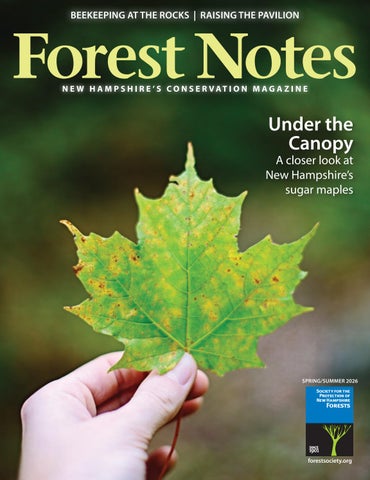
Photographer Emily Lord holds a sugar maple leaf at the Monadnock Reservation in Dublin, N.H.
+ The History of Beekeeping at The Rocks + The Forest Society Pavilion at The Rocks
24 PROJECT IN PROGRESS Help Conserve 650 acres in the Nelson Highlands
26 MANY FACES OF CONSERVATION Ossipee’s Tim Nolin
forestsociety.org
FROM THE PRESIDENT’S DESK
CHAIR Jason Hicks, Meredith
VICE CHAIR Drew Kellner, Brookline
SECRETARY Susan Arnold, Strafford
TREASURER Allyson Hicks, Concord
PRESIDENT Jack Savage, New Durham
BOARD OF TRUSTEES Philip Bryce, Deering Deb Buxton, Greenfield George Epstein, Silver Lake Peter Fauver, North Conway Don Floyd, Concord Jameson French, Portsmouth Patricia Losik, Rye
Jim Merrill, Manchester Amy Reagle Meyers, Jaffrey Michael Morison, Peterborough Elizabeth Salas, Weare Bill “Tuck” Tucker, Goffstown Tom Wagner, Campton Janet Zeller, Concord
STAFF Josh Abbott, Regional Stewardship Manager Ben Aldrich, Field Forester Frank Allen, Building and Grounds Assistant Sarah AlSamaraee, Stewardship & Forestry Administrative Coordinator Dave Anderson, Senior Director of Education Kristine Arey, Program Director, The Rocks Emily Bartolini, Southeast Region Program Manager Brie Belisle, Regional Stewardship Manager Nik Berube, Maintenance Assistant Naomi Brattlof, Director of Easement Stewardship Adam Buxbaum, Christmas Tree Farmer, The Rocks Rita Carroll, Tree Farm Administrator Tony Cheek, Vice President for Finance Connie Colton, Administrative Assistant Linda Dammann, Development Assistant Carrie Deegan, Vice President for Recreation Management and Public Engagement Leah Hart, Land Conservation Project Manager Stacie Hernandez, Land Conservation Project Manager Brian Hotz, Senior Land Conservation Project Manager Steve Junkin, Field Forester Susanne Kibler-Hacker, Senior Philanthropy Advisor Allan Krygeris, Senior Technology Specialist Matt Leahy, Public Policy Director Margaret Liszka, Membership Director Jeremy Lougee, Vice President for Land Conservation Kaylin Lustig, Concord Community Engagement Manager Nigel Manley, Senior Outreach Manager, The Rocks Ann McCoy, Development Manager Stephanie Milender, Human Resources Director Michelle Morse, Finance Specialist Carl Murphy, Facilities Manager Nora Noble-Christoff, Land Protection and Stewardship Coordinator Cara Pearson, Membership Specialist Meredith Reed O’Donnell, Foundation Relations Manager Tina Ripley, Administrative Coordinator Ilissa Sargent, Regional Stewardship Manager Jack Savage, President Matt Scaccia, Recreation and Community Relations Manager Ryan Smith, Communications Manager Justin Smulski, Digital Marketing & Content Manager Kaity Stanton, Regional Development Manager – Seacoast Maria Stewart, Senior Executive Assistant Dylan Summers, Stewardship Projects Manager Laurel Swope-Brush, Land Steward & Volunteer Programs Coordinator Lauren Thomas, Administrative Assistant, The Rocks Anne Truslow, Vice President for Development Wendy Weisiger, Managing Forester Brenna Woodman, Director of Communications Harriette Yazzie-Whitcomb, Administrative Assistant
2 | FOREST NOTES Spring/Summer 2026
A Shared Effort
A
s we move into the heart of summer, the Forest Society’s lands are alive with learning, exploration, and connection. At Forest Society North at The Rocks, the new pavilion now stands as a gathering place for community, education, and celebration. In this issue, you’ll read more about how the pavilion came to be—shaped by vision, partnership, and a commitment to creating spaces where people can experience the land together. We are also sharing new insights from a sugar maple regeneration study, helping us better understand how these iconic northern hardwood forests are responding to changing conditions and what that means for long-term stewardship. Across the organization, educational programming is in full swing. From Forest Society North to our Conservation Center and Creek Farm, people of all ages are engaging directly with the land through hands-on learning, outdoor exploration, and programs that deepen their understanding of forests, wildlife, and conservation. On the advocacy front, we continue to engage in conversations at both the state and federal level about the future of New Hampshire’s forests. This spring, I joined Policy Director Matt Leahy in Washington, D.C., as part of the Land Trust Alliance’s annual Advocacy Days, where we met with members of the state’s congressional delegation and federal officials. These discussions underscored the importance of Farm Bill reauthorization and the conservation programs it supports for protecting working lands, the potential for a new Forest Conservation Easement Program within the Natural Resources
Conservation Service to strengthen longterm forest protection, and the broader value of land as highlighted in the report the Forest Society contributed to called The Benefits of New Hampshire’s Open Space. Summer also brings a renewed focus on recreation and time spent outdoors. Trails and conserved lands across the state are welcoming hikers, families, and visitors, and programs like the annual Five Hikes Challenge, along with many other events, are helping mark this 125th anniversary year in active and meaningful ways. As we continue through the season, we invite you to join us—on the trails, at programs, and in the community—as we celebrate the places that connect us and the work that sustains them. Thank you for being part of this shared effort.
Jack Savage is the president of the Forest Society. He can be reached by email at jsavage@forestsociety.org.
WEB EXCLUSIVES
Anniversary Events Join an outing or two near you forestsociety.org/events
Rescuing the Raptors The case for rodenticide reduction nhpr.org/somethingwild
Forever Farm The Shost family’s gift to Goffstown forestsociety.org/sugarbushfarm
(OPPOSITE PAGE) ANNE TRUSLOW; (THIS PAGE, CLOCKWISE FROM TOP LEFT) NPS | D. MACHADO, FOREST SOCIETY, HARRY LICHTMAN PHOTOGRAPHY
CONNECT WITH US! facebook.com/ForestSociety
@ForestSociety
T ag #forestsociety on Instagram for a chance to be featured in a future issue of Forest Notes.
Instagram photo: Light Cascade “In May 2026, I was standing in almost the exact location as I was 2 months earlier. But rather being surrounded by thick ice, a rain squall moved in across Great Bay. Spring has made its mark. Fortunately, this was a bugless evening.” —Harry Lichtman
Sign Up! Tree Mail E-Newsletter Stay on top of land protection projects, advocacy news, and upcoming events with our monthly e-newsletter, Tree Mail. Sign up at forestsociety.org/ get-social-media.
Society for the Protection of New Hampshire Forests A nonprofit membership organization founded in 1901 to protect the state’s most important landscapes and promote wise use of its renewable natural resources. Basic annual membership fee is $45 and includes a subscription to Forest Notes. Editor: Ryan Smith Design & Production: The Secret Agency Printing: R.C. Brayshaw & Company, Inc. Forest Notes is printed on elemental chlorine-free Sappi Flo paper with 10 percent post-consumer recycled content. Sappi Flo is made from pulp purchased from suppliers who document sound environmental practices and sustainable forest management. Permission is required for reproduction of any part of this magazine. Copyright 2026 SPNHF. US ISSN: 0015 7457 54 Portsmouth Street, Concord, N.H. 03301 | Phone: 603-224-9945 | Fax: 603-228-0423 info@forestsociety.org | forestsociety.org The Forest Society proudly supports the following organizations:
Cosponsor
Underwriter
Member
Spring/Summer 2026 FOREST NOTES | 3
THE WOODPILE—NEWS NOT SO NEATLY STACKED
Many Faces Join Special Places Conference in Waterville Valley In April 2026, New Hampshire’s conservation community gathered in Waterville Valley for the Saving Special Places conference. This energizing and bustling annual event organized by UNH Cooperative Extension provides valuable opportunities for professional education and networking for a wide range of conservationists. More than 245 people attended, representing the breadth of conservation practitioners from across the state, including staff and board members from land trusts, state and local agency partners, independent natural resource professionals, and many others. An inspiring keynote presentation was delivered by Leila Philip—the awardwinning author of Beaverland (Twelve Books 2002), who discussed the region’s long social history with beavers, how they have shaped and maintained the watersheds of North America throughout the millennia, and how beavers have an increasingly important role to play in helping communities across the country create climate resiliency. A total of 17 informative workshop sessions were held throughout the
From left, New Hampshire Land Trust Coalition Coordinator Cassie Bernyk and UNH Extension State Specialist Emma Tutein welcome participants to the 2026 Saving Special Places Conference. day covering a variety of topics such as developing strategic organizational plans, forming partnerships, integrating ecological reserves into conservation planning, and effectively implementing trail stewardship projects. Forest Society staff members Matt Leahy, Wendy Weisiger,
Naomi Brattlof, and Dave Anderson led workshops on the benefits of open space in the state, planning and implementing timber harvests, discretionary consent and conservation easements, and reflecting on the Forest Society’s 125 years of protecting forests.
Well-Grounded Leadership: Weisiger Earns Carey Award At the New England Society of American Foresters (NESAF) annual winter meeting on March 19, 2026, in South Portland, Maine, Managing Forester Wendy Weisiger was awarded the Austin Carey Practicing Professional Award. This award is presented to NESAF members who have shown outstanding achievement as a practicing forest manager or consulting forester. Austin Cary (1865–1936) graduated from Bowdoin College and introduced northern landowners to forest sampling, growth estimation, and simple silvicultural techniques. Cary’s Woodsman’s Manual, written in 1909, continued to be used as a textbook until the 1960s. Weisiger began her career with the Forest Society in 2004 where, as a field forester, she 4 | FOREST NOTES Spring/Summer 2026
implemented a host of field-based forestry activities with an emphasis on inventory and management planning. In 2016, she was promoted to managing forester—a natural fit given her industry knowledge and dedication to the Forest Society’s mission. Weisiger and her team work with forestry consultants and loggers to sustainably manage more than 68,000 acres across 200-plus properties. Her team also provides guidance to the Forest Society’s easement stewardship staff who oversee an additional 130,000 acres. Weisiger’s vision of and leadership in forward-thinking, data-driven forest management practices has long been key to the Forest Society’s success in protecting New Hampshire’s forests. Congrats, Wendy!
Wendy Weisiger.
EASEMENT STEWARDSHIP
A Trail for All Opens in Concord On May 15, 2026, nearly 60 people gathered at the Merrimack Floodplain Forest for the grand opening of the new All Persons Trail. The new trail traces the same long-used route that was, until recently, in need of repair after decades of compaction and erosion. Forest Society staff and board members attended the event in addition to Concord Mayor Byron Champlin, donors that helped raise money for the trail’s construction, members of the Governor’s Council on Accessibility, members of the Conservation Commission’s Trails Committee, and frequent visitors of the trail from the Heritage Heights Retirement Community. Thank you to everyone that helped us imagine, design, raise funds for, and build this important community space.
Dark green bars on a beech leaf are a sign of a tree infected with beech leaf disease. Heritage Heights Retirement Community residents try out the new All Persons Trail.
All Persons Trail Donors: Granite State Independent Living, NH Recreational Trails Program, Davis Conservation Foundation, Athletic Brewing All Persons Trail Sponsors: Merrimack County Savings Bank, Northeast Delta Dental Trail Design & Construction: DiSanto Recreational Trails LLC
DISCOVER ADVENTURE
BOOK ON
11 boulder caves, 1-mile boardwalk trail & more!
E TODAY LIN
NO KOOB
(OPPOSITE PAGE) FOREST SOCIETY FILES; (THIS PAGE) JUSTIN SMULSKI
OPEN MAY - OCTOBER. 1712 Lost River Road, Woodstock, NH 03262
LOSTRIVERGORGE.COM 603.745.8031
Field season is in full swing and the stewardship managers are actively scheduling site visits across the state. In the woods this summer, the managers have noticed beech trees are extra stressed! Have you noticed the impact of Beech Leaf Disease (BLD)? While there is no cure for BLD in forest settings, early detection and reporting are important for tracking its spread and supporting research. UNH Cooperative Extension county foresters can provide management support. To contact a county forester, visit extension.unh.edu. Easement Open Woods Day! Keep an eye out for registration details and to join us for this exciting event on August 8th! Select easement landowners across the state will graciously open their conserved properties to Forest Society members and friends! To learn more about this event and other upcoming Forest Society events, please visit: www.forestsociety.org/events
Spring/Summer 2026 FOREST NOTES | 5
THE WOODPILE—NEWS NOT SO NEATLY STACKED
Highlights from the 2026 Women Landowner Summit By Amy Gaudreau On March 13, 2026, fifty-three forest landowners and managers from across New Hampshire gathered at the Women Landowner Summit held at Sanborn Mills Farm in Loudon, N.H. The Summit, part of the Women in the Woods project, offered a unique opportunity for women who own and manage land in the Granite State to come together, learn, and connect. Women in the Woods is a collaboration between UNH Cooperative Extension, NH Timberland Owners Association, the Society for the Protection of New Hampshire Forests, and other partners aimed at connecting women forest landowners, managers, and stewards with the resources, skills, and community they need to make informed stewardship decisions that promote healthy forest resources. The Summit was supported in part by a donation from the Alnoba Lewis Family Foundation and was co-sponsored by New Hampshire Project Learning Tree. Women in the Woods programming is open to all participants, regardless of gender or sex. This program provides a diversity of learning opportunities, including hands-on one-day workshops on topics such as chainsaw safety and maintenance, tree identification, winter wildlife tracking, nature journaling, tool maintenance and sharpening, bird and mushroom identification, and map and compass skills. Whether they own land individually or jointly with a spouse, family, or partner, women landowners are making crucial decisions that affect the future of New Hampshire’s forests. These decisions have a far-reaching impact on the health of New Hampshire’s forests, influencing timber resources, wildlife habitats, recreational access, clean water, and so much more. The Women Landowner Summit drew participants with a wide range of experience and offered a variety of expertled sessions designed to enhance their understanding of forest management and 6 | FOREST NOTES Spring/Summer 2026
Forest Society Managing Forester Wendy Weisiger leads a workshop at the 2026 Women Landowner Summit in Loudon, N.H. other key topics. These educational sessions were tailored to meet the diverse needs of women landowners, whether they were just beginning their journey or looking to deepen their expertise. Topics included exploring nature with kids, forest health, vernal pool ecology, tree and shrub identification, wildlife tracking, firewood marking, and setting goals for land management. These sessions were aimed at providing women landowners and managers with the tools, knowledge, and resources they need to make informed decisions on their land. Following the Summit, participants shared positive reflections on their experience. One attendee noted that they now have “many ideas and tips to use with my granddaughters, can’t wait to get started.” Several participants also described actions they plan to take as a result of attending. One shared, “I’m going to find and map out the vernal pools on
our property,” and another said, “I plan to contact my county forester to start developing a forestry management plan.” The Women Landowner Summit is just one example of educational opportunities available to women landowners and managers. By continuing to provide women-focused educational opportunities, UNH Extension and the Forest Society provide women landowners with the knowledge and resources necessary to manage their land effectively, benefiting both their properties and the natural resources community of New Hampshire. To receive information on upcoming events and trainings, resources, and news relevant to your role as a woman landowner, visit https://extension.unh.edu/naturalresources/forests-trees/woodlot-management/ women-woods. Amy Gaudreau is a forest resources field specialist for UNH Extension.
Consulting Foresters Top: Staff and volunteers remove graffiti from a ledge near the top of Mount Major. Left: Dylan Summers looks on as Carrie Deegan weighs a bag of trash collected during the Mount Major trail cleanup event.
The Forest Society encourages landowners to consult with a licensed forester before undertaking land management activities. The following are paid advertisers. Evergreen Forest Management, LLC Specializing in creative, ecological approaches to forest management that are designed to provide long-term economic benefits to landowners and their forests.
752 Rt. 103A Newbury, NH 03255 • 802-310-0292 efm-llc.com
Martin Forestry Consulting, LLC Offering complete forest management services, including timber sales, cruises, appraisals, and wildlife habitat management. Ask us about recreation trail planning, construction, Brontosaurus mowing, and forestry excavation services.
P.O. Box 89, New Hampton, NH 03256 • 603-744-9484 Email: martinforestry@gmail.com
Meadowsend Consulting Company
FOREST SOCIETY FILES (X3)
Earth Day, By the Numbers Mount Major’s trails are much cleaner thanks to 24 participants who stepped up on April 22 (Earth Day) to collect everything from plastic bottlers and aluminum cans to dog waste bags and food wrappers. In total, the volunteers collected 46 pounds of trash from the trails, summit, and parking lot. The event coincided with the start of the Mount Major Volunteer Trail Outreach Program (VTOP) season. Now in its fourth year, VTOP engages and shares information with visitors at the Mount Major
trailhead parking area. The program is modeled after trailhead stewardship programs in the White Mountain National Forest and the Adirondacks. Volunteer training includes basic information about Mount Major, visitor engagement, LeaveNo-Trace etiquette, and HikeSafe and Recreate Responsibly principles. Currently, 11 volunteers are enrolled in the program, but Land Steward & Volunteer Coordinator Laurel Swope-Brush says she is actively training and looking for more participants. To sign up, visit forestsociety.org/VTOP.
Quality Consulting Forestry with Integrity. Guaranteed.
Jeremy Turner, NHLPF #318 – Southern NH jturner@meadowsendco.com Matthias Nevins, NHLPF #518 – Central NH mnevins@meadowsendco.com Ryan Kilborn, NHLPF #442 – Northern NH rkilborn@meadowsendco.com Vast range of quality land management services. Connect with us for a free site consultation!
meadowsendco.com • 603-526-8686
Licensed foresters should address inquiries about advertising to Anne Truslow by calling 603-224-9945 or emailing atruslow@forestsociety.org. Spring/Summer 2026 FOREST NOTES | 7
THE WOODPILE—NEWS NOT SO NEATLY STACKED
The 2026 class of volunteer land stewards pose for a photo outside the Conservation Center in Concord.
Spring 2026 Volunteer Land Steward Field Day In March 2026, 16 newly minted volunteer land stewards joined Forest Society staff at the Conservation Center in Concord for the annual Land Steward Field Day. After two months of virtual training sessions, the field day allowed the stewards from across the state to meet in-person, hone their stewardship skills, test their knowledge, and—as a bonus celebration to fete the Forest Society’s 125th anniversary—nosh on some cupcakes and raise a glass. With this new class, the Forest Society’s cohort of land stewards grows to 184 volunteers helping monitor and manage approximately 180 properties across 60,000plus acres throughout New Hampshire. These volunteers are an essential part of the Forest Society’s land management 8 | FOREST NOTES Spring/Summer 2026
operations. They visit properties, walk trails, assess and improve recreational infrastructure, and catalog cultural as well as natural resources. Not only do these important tasks help ensure that the conservation value of our lands is maintained in perpetuity, but it also helps the Forest Society do this nimbly and effectively with a reduced carbon footprint. With proper training and resources, volunteer land stewards monitoring properties in their local communities offer up-to-date information and quick response times to issues without the Forest Society staff having to drive long distances or use expensive remote monitoring technology. For some land stewards, conservation work by the Forest Society in their local
community served as the inspiration to join. That was the case for Kerri Murphy, a wildlife photographer and avid adventurer in this year’s cohort of volunteers. In 2023—just a year after Murphy moved to Shelburne to be more immersed in nature—permanent protections were put in place for the Shelburne Valley Forest as part of the Mahoosuc Highlands Initiative. “I knew I wanted to be involved so I could merge my love of nature with practical, hands-on action,” said Murphy, who is also a member of Shelburne’s Conservation Commission. “The field day allowed me to form and strengthen my relationship with the Forest Society and complete the training needed to feel comfortable in my land steward duties.”
Water-powered since 1856.
Craft & creativity since 1986.
Top: Forester Steve Junkin leads a workshop at the Conservation Center during the Land Steward Field Day.
JUSTIN SMULSKI (X3)
Bottom: Volunteer land stewards hone their map-and-compass skills during the field day. At the end of the event, the land stewards were presented with certificates of completion acknowledging their months of training, both online and in-person, to build stewardship knowledge and important practical skills—all in service of the Forest Society’s lands and the communities we serve in. Just as the certificates were being handed out, Forest Society staff, board members, donors, and other volunteers streamed
into the Conservation Center to celebrate the newest class as well as the Forest Society’s 125th anniversary. While we can’t guarantee that all our volunteer trainings will include cupcakes and after parties, we can be sure that they’ll always include the tools, resources, and skills that land stewards need to effectively monitor and manage land—as well as our utmost gratitude for taking on a role so important to our organization’s mission.
Enduring elegance.
garlandmilltimberframes.com Lancaster, New Hampshire 603.503.0217
Spring/Summer 2026 FOREST NOTES | 9
PUBLIC POLICY
A Major Climate Rollback:
The Repeal of the Endangerment Finding By Matt Leahy
O
n February 12, 2026, the U.S. Environmental Protection Agency finalized its decision to rescind the 2009 Greenhouse Gas Endangerment Finding. That action eliminated the legal basis for federal regulation of Greenhouse Gas (GHG) emissions from vehicles and other sources under the Clean Air Act. The questions here go beyond the questions about what legal authorities federal agencies have to address climate change. Instead, what is most troubling is that the EPA’s decision represents a deliberate rejection of the well-established scientific consensus regarding the causes and effects of climate change. We believe the EPA must reverse its February decision. In the 2009 decision, the EPA found that the six key greenhouse gases that are the driving source for all the carbon pollution on the planet—carbon dioxide, methane, nitrous oxide, hydrofluorocarbons (HFCs), perfluorocarbons (PFCs), and sulfur hexafluoride—were endangering public health and welfare. Therefore, it determined the Clean Air Act (CAA) authorized and compelled the agency to regulate GHG emissions from cars and trucks and, by extension, from power plants and other large sources of GHG emissions. The EPA’s claimed reason for its recent action is that the agency never had the authority under the CAA to regulate GHG emissions. It also alleged the rule’s repeal will bring over $1.3 trillion “in relief from crushing regulations for American families and businesses.” Finally, the EPA declared that, even if the U.S. were to eliminate all GHG emissions from all vehicles, “there would be no material impact on climate change.” Although the EPA may attempt to scrub from the federal rule book a policy tool that is a foundational piece of our country’s campaign against global climate change, this careless step will not 10 | FOREST NOTES Spring/Summer 2026
eliminate the threat to human health and the health of the planet. Unfortunately, we need to remind policy makers what those threats are. This statement from the Intergovernmental Panel on Climate Change serves as a good starting place to discuss these risks: “The scientific evidence is unequivocal: climate change is a threat to human wellbeing and the health of the planet. Any further delay in concerted global action will miss the brief, rapidly closing window to secure a liveable future.” Furthermore, despite the decision in 2025 by the federal government to stop conducting the legally mandated U.S. National Climate Assessment, we know from the past assessments, like the Fourth National Climate Assessment, that: “it is extremely likely that human activities, especially emissions of greenhouse gases, are the dominant cause of the observed warming since the mid-20th century. For the warming over the last century, there is no convincing alternative explanation supported by the extent of the observational evidence.” New Hampshire is not immune to the negative effects of climate change. The N.H. Climate Assessment Report says temperatures across New Hampshire increased by an average of 3 degrees since 1901; the amount of water stored in the snowpack decreased between 1971-2020 from 59-91 percent (depending on specific locations) across central New Hampshire. Sea levels at Portsmouth have risen roughly 0.7 inches per decade for 80 years. Projecting into the future, the report says that by the year 2100 most of New Hampshire could expect 50 to 60 days a year to be above 90°F while winter temperatures are expected to be an average of 10°F higher by the end
of the century. And along the coast, by 2100, sea levels could rise by 1.6–6.6 feet, increasing coastal flooding, erosion, and storm damage to infrastructure. The New Hampshire Forest Action Plan notes how climate change will have significant impacts on wildlife habitat and species over time; how it will increase threats to forest health, including insect pests, diseases and invasive plants since many insect pests and invasive plant species may be able to expand their ranges northward in response to warmer temperatures; and how recreational activities are already seeing impacts because of the direct effects of temperature shifts and changes to precipitation patterns and severity. (To get a fuller understanding of how our state will be affected by the continued increase of carbon pollution in the atmosphere, we would encourage you to read the N.H. Climate Assessment Report and the Forest Action Plan.) The argument the EPA uses to justify the repeal—“relief from crushing regulations”—fails to acknowledge the cost that comes from not acting. It also falls flat; the International Energy Agency’s 2024 analysis determined that in 2023, clean energy added around $320 billion to the world economy. This represented 10% of global GDP growth—equivalent to more than the value added by the global aerospace industry in 2023 or to adding an economy the size of the Czech Republic to global output. No doubt other critically important federal policies, like the passage of the Clean Water Act and of the Safe Drinking Water Act, came with a cost. Yet, the benefits they have had on the well-being of communities across the United States— reducing the exposure to waterborne diseases, lowering exposure to toxins like lead and arsenic, and ensuring over 90
percent of the U.S. population receives safe tap water—overwhelm those costs. Similarly, federal actions to address climate change and carbon pollution would likely also come with a cost. Is that cost greater than the return on investment from limiting emissions from motor vehicles and setting standards for emissions from coal-fired and natural gas power plants? No, it isn’t. It is therefore time to stop debating whether climate change is actually occurring and if it will upend our daily lives. Instead, we need to strengthen the efforts to mitigate these impacts. The encouraging point to remember is that many solutions already exist to accomplish this goal; we do not need to invent new solutions. For the Forest Society, this includes keeping forests as forests while tapping into the natural processes that allow them to sequester and store carbon. Ultimately, however, public policies must result in a real and significant reduction in the amount of CO2 that is projected to be discharged into the atmosphere. Improving energy efficiency, adopting sustainable transportation, increasing the use of mass timber in building construction, supporting Renewable Portfolio Standards and, yes, reducing emissions from motor vehicles are just a few ways to achieve this overarching goal. Are we too late to limit global warming to 1.5°C above pre-industrial levels, as called for in the Paris Agreement? There is legitimate concern among climate scientists about this question. Actions like the EPA’s decision to repeal the Endangerment Finding have exacerbated this pessimism. Yet, we continue to be hopeful. As we have seen often in history, we the people have demonstrated both the will and ingenuity to solve problems. While the likelihood that the EPA will reverse its decision to repeal the Endangerment Finding is small, the threats posed by carbon pollution-driven climate change are real. It is not too late to act. Matt Leahy is the public policy director for the Forest Society.
Celebrate 125 Years in Style Commemorate 125 years of conserving New Hampshire’s forests with our new merchandise line! From classic t-shirts and hats to collectible postcards, these limited-edition items let you show your love for the Granite State’s forests while honoring a remarkable conservation legacy.
Scan the QR code or visit forestsociety.org/store to get shopping. Spring/Summer 2026 FOREST NOTES | 11
Tracking Tomorrow’s Maples
By Carrie Deegan | Photos by Emily Lord 12 | FOREST NOTES Spring/Summer 2026
I
t all started at the local diner. With maple syrup flowing over pancakes all around them, Will Abbott, former Forest Society vice president of land management and policy,
and Dr. Natalie Cleavitt, Cornell University ecologist, hatched a plan for a new research project involving Forest Society lands, community volunteers, students, and sugar maples (Acer saccharum). At the U.S. Forest Service Hubbard Brook Experimental Forest in Woodstock, N.H., Nat Cleavitt had been tracking the progress of three generations of sugar maple seedlings. What she discovered was concerning: sugar maples were struggling to regenerate, with seedling survival averaging only 3.4 percent over a period of 7 years. Cleavitt wondered whether what she was observing at Hubbard Brook was happening elsewhere in New Hampshire. “This was in 2018, and the timing for a new project just worked out on all fronts,” Cleavitt explains. The Forest Society was looking to engage volunteers in scientific research on its forests, Cornell University had just launched a new grant program to support community engagement work, and New Hampshire’s sugar maples had just experienced their first big mast year in almost a decade. “The community science aspect was brand new for me, but the project was a potential win for everyone, and Will and I guessed that studying sugar maples would be a good fit for community interest,” Cleavitt says. Left: Volunteer Wanda Rice measures a sugar maple on one of the forest study plots at Mount Monadnock. Spring/Summer 2026 FOREST NOTES | 13
A year-old sugar maple seedling pictured at Mount Monadnock in Dublin. Sugar maple seedlings growing in forest understory often remain very small for many years— decades even—waiting to take advantage of any new gap of light that pokes through the canopy.
T
he sugar maple is the darling of New England’s forests, thanks to its incandescent fall foliage, high-quality wood for flooring and furniture, and sweet sap transformed each spring into maple syrup, maple sugar, maple candies—really, maple anything. Ecologically speaking, however, the sugar maple is also a bit of a prima donna. Sugar maples prefer rich, well-drained soil with plenty of calcium and magnesium, their seedlings are sensitive to heat and drought, and the roots of young trees are particularly vulnerable to freezing. When they are stressed—for example, during extreme heat or freeze-thaw events now more frequent with climate warming—sugar maples are more susceptible to pests, pathogens, and general decline than many other tree species. All of this has raised concerns about the long-term future for sugar maples in New England. When a call went out in the Forest Society’s e-newsletter recruiting volunteers for a study on sugar maple regeneration, people responded quickly. Volunteer Kim Colson recalls her reaction on seeing the advertisement: “Sugar maples are a huge deal around here. When I saw there was concern for their survival, I knew this was something I could bond to quickly. It was a way for me to help.” In preparation for the project’s first field season, Cleavitt of Hubbard Brook developed a training manual complete with drawings and instructions for plot layouts as well as detailed protocol for seedling assessment and soil sampling. It was dense enough that there were initial concerns that it might scare off potential volunteers. “You definitely had to be interested enough to read this entire manual,” Nat says with a laugh. It turns out that wasn’t a problem. In early spring 2019, 12 eager volunteers gathered at Hubbard Brook along with Cleavitt, Sarah Thorne (then an educator with Hubbard Brook Research Foundation), and numerous Forest Society staff to begin training in the data collection process. “I’ve always been interested in science and the natural world,” volunteer Herrika Poor says. “I was intrigued 14 | FOREST NOTES Spring/Summer 2026
by the amount of actual science that was part of this volunteer project. This was something I could really dig down into, and that interested me.” The details, rather than scaring volunteers away, seemed to increase their attention. “The initial training made me confident that the people organizing the project had their act together,” Kim Colson notes. “As a volunteer, you want to make sure your time is going to be well utilized and that was very clear from the beginning.” As the volunteers were assigned to specific Forest Society properties spanning the sugar maple’s latitudinal range in New Hampshire, initial hypotheses about what the research crews might discover were developed by the group. Some thought that sugar maple seedlings would do better in southern sites, thanks to the longer growing season. Another idea was that seedlings in northern sites were more likely to benefit from insulating winter snowpack, which could improve seedling survival rates. A final hypothesis proposed that sites with soil nutrients favored by sugar maple—calcium, magnesium, and other essential base cations—would produce the best seedling regeneration. The field crews would follow more than 1,000 seedlings sprouted from seeds dropped in 2017, a good mast year for sugar maples, and track their progress for five years to find out which, if any, of these hypotheses were correct. The Sugar Maple Regeneration Community Science Project had officially launched.
Field Work As the first field season got underway in spring 2019, volunteers, working alongside Cleavitt, Thorne, and Cornell University undergraduate student field technicians, established 12 plots each on four Forest Society properties: Kauffman Forest in Stark, Sudrabin Forest in Orange, Yatsevitch Forest in Plainfield, and Monadnock Reservation in Dublin. All trees within each 500 m2 circular plot had to be identified, measured and catalogued,
and any sugar maple seedlings along a transect were tagged and numbered. It was common to see volunteers down on their hands and knees in the leaf litter, tying colored twist ties on tiny stems, or recording data on clipboards. As the seasons ticked by, the field crews became quite fond of their “sugar babies” as they diligently tracked leaf numbers, leaf size, and pest damage. Volunteer Wanda Rice describes the seedling checks as her favorite part of the research. “It was interesting to go back each year and see what had happened to the seedlings,” she says. “Often the ones that weren’t doing well last year ended up dying, but sometimes we were surprised to find one of last year’s struggling seedlings fully alive and fine.” For the community volunteers, who were mostly retirement age, working directly with scientists and undergraduate students created an interesting dynamic. “I appreciated connecting with people who know more about something than I do,” Kim Colson recalls. “Working with the undergraduate students was enjoyable and refreshing. It was cool to see how eager they were to solve some big problems through their careers in science.” Field crews consisting of volunteers, students, and scientists working collaboratively were part of the project’s initial design, partly so that volunteers were never left wondering what they were supposed to be doing, but also because the model allowed Cleavitt to maintain confidence in the quality of the data. “In the end I think we came up with a really good middle ground, where there was enough control and enough openness in the project that it worked out really well for everyone involved.”
Challenges and Opportunities As with most ecological research, the field work didn’t always go smoothly. Spring 2020 brought the Covid-19 epidemic, which necessitated new safety protocols. Everyone wore masks that season, even in the field, where bushwhacking up steep slopes to reach study plots fogged glasses and made everything more challenging. And then there were the animals. At Yatsevitch Forest, flocks of turkeys scratched away whole lines of seedlings as they looked for insects and acorns. Bears overturned 16 out of 18 litter collection baskets at Sudrabin Forest one autumn, perhaps out of curiosity or just for fun. There was so much apparent wildlife damage on some of the plots that the group decided to install game cameras on each property just to confirm who the culprits were. For the volunteers, it was a lesson in accepting the twists and turns of complex ecological systems.“You never have full control in ecology,” Cleavitt chuckles. “If you want control, you work in a lab.” If nothing else, downloaded images of moose, bears, deer, and turkeys kept everyone entertained and helped maintain group camaraderie. Volunteers, student field technicians, Forest Society staff, and Cleavitt and Thorne met routinely in the field, but also for other project-related gatherings each year. There were group sessions to practice sorting the leaf and seed litter collections, as well
Study plots for the Sugar Maple Regeneration Community Science Project were established at four Forest Society conservation properties, chosen because of their similarity in forest composition to Hubbard Brook Experimental Forest and their locations spanning the latitudinal gradient of the sugar maple’s range in New Hampshire. as periodic updates from Cleavitt—sometimes on Zoom and sometimes in person—reporting her analysis of the data collected each season. “Nat was extremely inclusive, engaging and open in the way she approached communication around the project,” Thorne notes. “There was never a strong sense of hierarchy, and Nat encouraged everyone to ask questions and make comments and suggestions. There was a lot of learning going on beyond just the data collection we were focused on.” At one meeting, a volunteer suggested hanging strong-smelling deodorant soap in the plots to keep animals away from the litter collection baskets. Nat polled the group and they agreed to give it a try, attaching drilled bars of Irish Spring to the sides of the litter baskets with zip ties. “That was one collective decision I think we all ended up regretting,” Cleavitt says. While they may repel herbivores such as deer, the fatty tallow content of the soap bars appeared to attract bears, mice, and other rodents. Some of the bars even ended up with bite marks in them! Spring/Summer 2026 FOREST NOTES | 15
Cornell University undergraduate Katie Sims (right) assesses a sugar maple seedling while volunteer Jennifer Zakrzewski records data.
Results In 2023 the five years of field data collection commenced with several of the study sites having few maple seedlings left to track. One site, Kauffmann Forest, had only 11 seedlings left of the original 233. When the data was crunched, the results indicated no significant latitudinal pattern in seedling survival. Sugar babies in the northern sites didn’t do better than southern ones, or vice versa. Soil nutrients also appeared to have little bearing on seedling survival, even when sugar maple seeds were germinated and grown in pots off-site using soil from each of the four study sites. The significant pattern that did emerge was that locations with a higher density of mature sugar maples in the canopy (greater than 50 percent dominance) had the lowest seedling survival. At first glance, this makes little sense, as more mature maple trees should translate into greater seedling density. In fact, the sugar-maple dominant sites did have greater seed production; however, these sites also showed evidence of higher foliar pest populations as seedlings had more severe leaf damage. Although none of the group’s original predictions were supported by the data, it turns out there is a hypothesis that explains these results. The Jantzen-Connell hypothesis theorizes that high densities of a single tree species can result in correspondingly high densities of pests and pathogens specific to that type of tree. The high pathogen and pest loads, in turn, make it difficult for the seedlings of this same species to survive. 16 | FOREST NOTES Spring/Summer 2026
“Our original hypotheses were focused on abiotic factors, for the most part,” Cleavitt says, “and it turned out it was the biotic factors that were most critical here.” Sarah Thorne, who led many of the fieldwork sessions, agreed that the findings were thought-provoking for all involved. “In the end, it was very humbling to grasp how enormously complex the ecosystem is. Despite decades of tremendous research at Hubbard Brook and throughout the forestry community, there is really a lot we still don’t know, especially about the interactions between species and the synergistic effects of things like soil chemistry, climate change, and pests and pathogens.”
Wrap up and significance In the months following the conclusion of field work, a subset of the volunteers tackled one more aspect of the scientific process along with Cleavitt and Thorne: writing and publishing a peer-reviewed journal article. Those with interest and availability waded through related studies as part of a thorough literature review, compiled temperature and precipitation data for the study period, and made edits on the text and figures of a draft article. In spring 2025, the research paper was published in the Canadian Journal of Forest Research under an open access license, meaning it is available to the public online free of cost or subscription. After all, if community members were involved in collecting the data, it made sense that research results should be accessible to the community as well.
A soil sample is collected by Cornell University student Alex Ding (right) while volunteer Kim Colson records data and holds a previously bagged sample. Volunteers and undergraduate students took turns with different data collection roles in the field, giving everyone a chance to learn each skill. What was the significance of the Sugar Maple Community Science Project to the community? For one thing, the project’s findings do have forest management implications. “The strongest management implication here is to diversify your forest,” Cleavitt explains. “There could be many reasons for saying that, but in this case it’s because your regeneration is going to be healthier if you’re not on a site that is dominated by one or two species of tree that then accumulates the pests and pathogens for those species. There ends up being no safe spot for the babies to grow.” Sugarbush owners interested in managing their lands for future generations to make maple syrup may want to encourage the growth of several species in addition to sugar maples if they want to ensure robust regeneration. Perhaps the most meaningful outcome of the sugar maple project is its significance as a model for an exceptional community science effort. Currently, with funding for all types of research under threat, alternative models for completing and financing scientific study are needed more than ever before. Involving community members in research may take more effort and coordination, but it also builds support for science through understanding. “Community science projects are so important,”
Kim Colson emphasizes. “They help people appreciate the process of science which means they may support funding it, and they’ll also believe more fully in the results and information that come from good science.” From the perspectives of all involved—ecologists, educators, students, Forest Society staff and volunteers—this project was a resounding success. For the five years of the study, this group bonded and collaborated towards a common goal, saw their project come to fruition, and learned a lot about the scientific process and ecosystem complexity along the way. “The research brought all of us together. We developed a community, and no one wanted to stop once we had that community going,” Colson says. Nat Cleavitt agrees. “I’ll be forever grateful to the volunteers and the undergraduates in this project. They were so interested in everything, and it’s heartening to know that there are people who care about science, who believe in the process of science, and who enjoy the detail involved in the process.... A lot of my science is more solitary,” she adds, “but this was a lot of fun. They made it fun.” Carrie Deegan is the vice president for recreation management and public engagement.
Learn More To read the entire sugar maple research paper published in the Canadian Journal of Forest Research, visit https://shorturl.at/PLlw9. Spring/Summer 2026 FOREST NOTES | 17
IN THE FIELD
The History of Beekeeping at The Rocks By Nigel Manley
T
he Rocks in Bethlehem was gifted to the Forest Society in 1978. At 1,400 acres, it was the largest gift of contiguous land the organization had received up to that point. The connection between The Rocks and the Forest Society began much earlier, however, when John J. Glessner, owner of the property, became a member in 1903. Decades later, two of his grandchildren, John Glessner Lee and Martha Lee Batchelder, had the foresight to donate the property to the organization that their grandfather had supported almost since its founding in 1901. Today, more than 4,000 people visit The Rocks annually to cut a Christmas Tree, learn about maple syrup production, or simply take in the magnificent view of Mount Washington and the Presidential Range. As the property’s Christmas Tree Farm manager and then director from 1988– 2023, I learned a lot about the history of the property and the people connected to it through discussions with many people, including Martha Lee Batchelder before she passed away in 1994. It was from Martha that I first heard about the Bee House at The Rocks, an unusual historic building located a short distance from where John J. Glessner’s original mansion, dubbed the “Big House,” once stood. Fortunately, Martha’s grandmother, Frances Glessner, kept detailed journals, and it is through those journals that I learned how beekeeping first began on the property. Frances Glessner started keeping bees at The Rocks in May 1895. But why did she begin? As she explained, she “got the honeybee in her bonnet” from her Aunt Betsy, who kept a row of white beehives in her garden off the property and allowed Frances to cut all the white and gold honey she wanted from the combs. When Frances decided to begin beekeeping in the late 1800s, she, of course, could not search the Internet for
18 | FOREST NOTES Spring/Summer 2026
John and Frances Glessner’s house at The Rocks, aptly named The Big House, stands above The Bee House. information on apiculture, but instead found plenty of knowledge in bookstores. She read everything she could about beekeeping and later joined an association of beekeepers. Eventually, Frances purchased two colonies of Italian bees from a beekeeper in Vermont, who personally delivered them. He traveled by express train, carefully managing the transfer of the hives at stations along the route. The hives were placed at the recently built Bee House, which, as Frances wrote, “was built for me by a very dear friend, a friend who had a poet’s soul if not a poet’s song.” The Bee House was renovated in 2003, and the intrinsic carvings created by builder Isaac Scott are preserved for visitors to enjoy. Scott carved many sayings into the house, but one in particular written by Scottish poet and lyricist Robert Burns reflected its purpose: “As bees fly hame wi’ lades of treasure, The minutes wing their way wi’ pleasure.” Bees typically travel within a radius of about two miles from their hive. Frances
noted this range while traveling by buckboard—a four-wheeled horse-drawn vehicle—where she would often see bees and examine them, knowing that her bees were the only Italian bees in the neighborhood. In her best year, Frances recorded in her journal that she gathered “a fraction over one thousand pounds, seven hundred and seven of these were sections of comb honey and the balance was extracted honey.” Managing an apiary required a tremendous amount of work, which raises the question of why Mrs. Glessner devoted so much effort to it. Her friend Bradford Torrey once asked whether she received any commercial return from her honey. Frances replied that she gave it to her friends, to which he answered, “Oh then you have.” Finally in 1909, Frances gave up beekeeping because managing the hives had become too much for her. Dr. James B. Paige of the University of Massachusetts Amherst was invited to inspect the hives,
PHOTOS COURTESY OF THE GLESSNER HOUSE ARCHIVES
From left, Frances Glessner tends to her garden and her beehives at The Rocks. and he accepted them for the school, where beekeeping is still taught today. Years after John J. Glessner died in 1937, his daughter-in-law, Alice, constructed a large in-ground pool next to the Bee House, which was converted into a pool house. By the time the property was gifted to The Forest Society in 1978, the small structure needed some overdue maintenance. Drainage was installed and trees were cut around the perimeter to increase air flow. In 2003, several Glessner descendants funded a restoration project of the Bee House to increase its appeal to the public and preserve the past. The pool was filled in and landscaping was added, beautifying a location that dates back to the early origins of the property. In 2018, the Forest Society began working with Jan Mercia of the North Country Beekeepers Association to bring beekeeping back to the property and once again make Rocks honey available. Jan and her husband Joe constructed a platform and installed three hives. The bees were doing
The Bee House. well until February 2019 when a fire tore through the Tool Building and Electrical Building. On that day, more than farm tools and material items were lost. The bees reacted to the intense smoke from the fire by gathering food and leaving the hives, only to die in the freezing temperatures. “The snow was littered with tiny yellow bodies; it was a very sad day,” Jan said.
After the fire, Jan decided to wait until the Carriage Barn, Pavilion, and landscaping was finished on the grounds before introducing new hives on the property. Maybe sometime in the future beekeeping will return to The Rocks. Nigel Manley is the senior outreach manager at The Rocks. Spring/Summer 2026 FOREST NOTES | 19
IN THE FIELD
From left, Dana Southworth looks on as brothers Luke and Seth Colby install the gable-end structural rafter assemblies. These are attached to both sides of the diagonal corner “dragon beams,” and carry the curvilinear roof overhang that runs around the perimeter of the pavilion.
Timber, Craft, and Community:
Building the Pavilion at The Rocks By Dana Southworth
A
5-year collaborative effort involving Garland Mill Timberframes and The Forest Society was concluded this winter in the form of a unique and stately red oak pavilion at The Rocks in Bethlehem. The project was truly a team effort comprising a diverse collection of talented folks, some nineteenth century sawmilling technology, and a good dose of traditional timber frame joinery. In 2020, the project kicked off in just the right idiom with Garland Mill co-owner Ben Southworth suggesting that 20 | FOREST NOTES Spring/Summer 2026
there might be a more suitable (local) material than the douglas fir timbers initially pondered for the Forest Society’s structure. Managing Forester Wendy Weisiger rose to the occasion immediately, and in the affirmative, shipping multiple truckloads of top-quality red oak logs from the Forest Society’s Heald Tract in Troy, N.H., to Garland Mill in Lancaster. Garland Mill Timberframes owner Dana Southworth and a stout crew sawed out the posts, beams, rafters, etc. for the pavilion on the water-powered mill, which is listed
in the National Register of Historic Places and has been in continuous commercial operation since it was built in 1856. From there, the timbers were carefully stacked and air-dried at the mill and then planed to dimension on the 17,000pound timber sizer used to prep stock for the shopwork phase of the project. Layout and hand-chiseling of each component of the timber frame then commenced and took approximately six months to complete. Dana’s son, David, did quite a bit of the initial sawing of oak timbers
Many Hands, One Pavilion Building a pavilion from timber grown on Forest Society land sounds simple in concept, but it required an exemplary oak stand and a team of skilled forestry professionals to bring the idea to life.
Carefully and methodically, crews load the 36-foot-wide king-post trusses onto a flatbed trailer for the journey from The Garland Mill in Lancaster to The Rocks in Bethlehem.
(OPPOSITE PAGE) RYAN SMITH; (THIS PAGE) DANA SOUTHWORTH
while son Robert notched a significant portion of the structure with his dad. Long-time collaborators and seasoned timber-wrights, Seth and Luke Colby, masterminded the cutting and assembly of four 36-foot-wide king-post trusses that carry the free-span roof system of the pavilion. And woodworking colleague and furniture-maker Jamie Savage worked on the curvilinear pieces that define the pagoda-style radial roof overhangs. Delivery, assembly, and raising of the timber frame was a delightful challenge in and of itself. Landing already notched 10x10 posts and all their interconnecting joinery on heavy duty precast concrete piers went very smoothly, thanks in no small measure to the accurate excavation and site prep work done by Presby Construction. The pièce de resistance of the pavilion construction was the aforementioned roof trusses. Exacting to layout, notch, and fit together; and quite a feat to transport 25 miles from the mill to The Rocks, all four swung neatly into place on a sunny late-October day just in
time for Facilities Manager Carl Murphy, President Jack Savage, and Vice President of Finance Tony Cheek to inspect. After driving in the final pegs of the frame, which were made from Heald Tract oak and milled at Northcott Woodturning in Walpole, N.H., Murphy stood atop the structure while the traditional frame blessing was read and whetting bush attached (see sidebar). Closely involved from project inception were engineer Janet Kane and timber frame architect Andrea Warchaizer. Each of these remarkable women have been long-time collaborators with Garland Mill Timberframes. Their structural and aesthetic contributions at every stage of project development and design truly defined the pavilion, and made it a handsome and enduring addition to The Rocks. Vision, commitment, and hard work by the Forest Society team ultimately made the pavilion possible. Former Vice President of Land Management and Policy Will Abbott got, and kept, the ball rolling. Carl Murphy tirelessly sorted out
When staff foresters were first approached with the idea of sourcing the pavilion timbers from our woodlands, we knew the challenge would be finding enough high-quality oak while staying true to the forest’s longterm management goals. Working with consulting forester Jeremy Turner of Meadowsend Consulting Company, we reviewed the harvest area to ensure the project could be completed without compromising the silvicultural prescription. Jeremy carefully identified and marked enough clear, high-value oak trees to meet the mill’s specifications. Equally important was the expertise of D.H. Hardwick and Sons Logging. Joey Hardwick meticulously felled the marked trees, while Donnie Hardwick Jr., operating the slasher processor at the landing, sorted through the logs and set aside those that met the strict requirements for the pavilion. Each qualifying log was marked, measured, and tallied until the order was complete. The process demanded extra time, attention to detail, and close coordination among foresters, loggers, and the sawmill. What made the project remarkable was that everyone involved understood they were contributing to something unique. The Rocks pavilion stands not only as a beautiful structure but also as a testament to thoughtful forest management, skilled craftsmanship, and the many hands that helped transform trees from the forest into a lasting community landmark. —Wendy Weisiger, Managing Forester Spring/Summer 2026 FOREST NOTES | 21
IN THE FIELD
As has been the custom for centuries, Garland Mill Timberframes attached an evergreen bough to the ridge of the newly raised pavilion frame (pictured above).
First: to honor and pay homage to the forest for providing the timbers used in the frame.
Second: to bring good fortune to the structure and its owners.
Third: to celebrate the community of family and friends who worked together to cut and raise this new building.
22 | FOREST NOTES Spring/Summer 2026
From start to finish, a team effort was required to build what now stands as a testament to thoughtful planning, skilled craftsmanship, and a renewed vision for visitor use at The Rocks. logistics and managed the project seamlessly. Savage, Cheek, and Vice President of Development Anne Truslow continuously breathed life and encouragement into the undertaking. And Rocks staff members Kristine Arey and Lauren Thomas enthusiastically welcomed the construction crew at the facility and kept them going with hot coffee and good cheer. Senior Outreach
Manager Nigel Manley, Communications Manager Ryan Smith, and others not here mentioned also contributed to the success of this meaningful project. It has indeed taken a village to raise this pavilion and we couldn’t be prouder. Dana Southworth is the owner of Garland Mill Timberframes in Lancanster, N.H.
(CLOCKWISE FROM TOP LEFT) DANA SOUTHWORTH, RYAN SMITH, KRISTINE AREY
Blessing the Frame
Together Making New Hampshire a Great Place to Live, Work, and Explore We thank our business partners for their generous support during our 125th anniversary year.
Summit Circle ($5,000 and up)
Partner (continued)
Matching Gift Companies
Athletic Brewing Company Garnet Hill Inc. Granite State Independent Living Mainstay Technologies Merrimack County Savings Bank Nathan Wechsler & Company Seaboard International Forest Products, LLC Whalen Public & Media Relations, LLC
The Lyme Timber Company LP Meadowsend Timberlands Limited Milestone Construction LLC The Music Mill NH Conservation Real Estate Pine Springs R.M. Piper, Inc. RSP Studio Leigh B. Starer, LLC Whole Wealth Management, LLC
ADP, LLC Advent International American Biltrite, Inc. Amgen, Inc. Bank of America Bank of New Hampshire Boston Scientific Bristol-Myers Squibb Company The Cigna Group Cleveland H. Dodge Foundation, Inc. Davis Polk & Wardwell, LLP Dell, Inc. Erie Insurance Gartner, Inc. Gilead Sciences, Inc. Google, LLC Gradient Hearst Communications, Inc. Intel Corporation Jacobs Solutions, Inc. Jefferies Financial Group, Inc. Johnson & Johnson Liberty Mutual Insurance Lincoln Financial Group Macy’s, Inc. Manulife Financial Corporation Microsoft Corporation Motorola Solutions, Inc. NetApp, Inc. Prudential Financial, Inc. Raytheon Technologies Corporation Shell Oil Company Takeda Pharmaceuticals, Inc. Thermo Fisher Scientific, Inc. The Travelers Companies, Inc. UnitedHealth Group Vertex Pharmaceuticals, Inc. VMware, Inc.
Trustees’ Circle ($2,500 to $4,999) Collette Travel Mallory Portraits Newburyport Bank Northeast Delta Dental The Secret Agency, LLC
President’s Circle ($1,000 to $2,499) Aesthetic Dental Center Badger, Peabody & Smith Realty, Inc. BCM Environmental & Land Law, PLLC Bensonwood & Unity Homes Chinburg Properties EOS Research Ltd. Frog Hollow Forestry Lumbard & Kellner, LLC Maxfield Real Estate Meredith Village Savings Bank New England Private Wealth Advisors, LLC Northland Forest Products, Inc. Ransmeier & Spellman, P.C. Rockywold-Deephaven Camps, Inc. Upstream Tech W.S. Badger Company, Inc.
Steward ($750 to $999) Law Office of Leonard D. Harden
Partner ($500 to $749) Arcomm Communications Corporation Blue Loon Bakery R.C. Brayshaw & Company Blue Mountain Forest Association Brookdale Fruit Farm Capitol Craftsman, LLC Durgin and Crowell Lumber Co., Inc. Half Moon Enterprises
Colleague ($250 to $499) Ancient Traditions Natural Medicine, LLC Banyan Global Family Business Advisors Bittner Property Management Blaktop, Inc. Dog Cove Corp. Dublin Road Tap Room & Eatery Evergreen Forest Management LLC Forest Land Improvement, Inc. Frost Pond Carpentry Gideon Asen LLC Grappone Management Company Great Brook Veterinary Clinic Hammond Lumber Company H.L. Turner Group, Inc Innovative Natural Resource Solutions, LLC Kel-Log, Inc. Kozikowski Properties, LLC Law Office of Michael M. Ransmeier, PC Mulligan Forest, LLC Old Mill Properties, LLC Pelletier Realty Group Pembroke Automotive Services Proctor Hill Forestry and Logging, LLC REI Co-op Bedford Rek’-Lis Brewing Company Robbins Lumber Inc. Seven Birches Winery Tri-State Iron Works Twin State Sand and Gravel Co., Inc. Underhill Acres, Inc. Viking Forest Products Winnipesaukee Chocolates Zachary Berger Associates, Ltd.
We are grateful to the many businesses that support the Forest Society with gifts of less than $250.
The Forest Society…Where Conservation and Business Meet For information about business memberships, sponsorships, or to initiate a gift membership program for your clients or employees, please contact Anne Truslow at (603) 224-9945 or atruslow@forestsociety.org.
Spring/Summer 2026 FOREST NOTES | 23
PROJECT IN PROGRESS
Making a Key Connection in the Quabbin-to-Cardigan Landscape
Help Conserve 650 acres in the Nelson Highlands
Holt Hill and Rollstone Mountain (right of center) overlook Nubanusit Lake. The Forest Society is raising funds to protect 650 acres surrounding the two peaks as part of the Nelson Highlands Forest conservation project.
S
tretching across four peaks at the northerly end of Nubanusit Lake, the Nelson Highlands Forest encompasses 650 acres of mixed forest, vernal pools and streams, and varied terrain for wildlife. This unbroken forest forms the expansive view enjoyed by explorers around Nubanusit Lake, and spans three towns: Nelson, Antrim, and Hancock. Held in family ownership for decades, this acreage forms a key link in the landscape of contiguous forestland that stretches from Mount Monadnock to Mount Sunapee and beyond. It sits at the heart of both the Harris Center’s SuperSanctuary focus area and the 2-million-acre Quabbin-to-Cardigan region that runs from Massachusetts to the White Mountains. The 650-acre property encompasses four peaks over 1,600 feet, each with rocky ridge tops and red spruce forest on north facing slopes. It includes several high-elevation vernal pools, intermittent and perennial streams, and an impressive boulder field. 24 | FOREST NOTES Spring/Summer 2026
Stonewalls crisscross the land, with several cellar holes located along the main woods road calling back to the agricultural history of the property. The former fields were likely used for livestock, abandoned around the time of the American Civil War. The property has since been managed as a woodlot and wildlife area but could be subdivided and sold given its multiple tax lots in three different towns. Now, the Forest Society has an agreement to purchase this property as an addition to its permanent network of conserved forestland. It is in close proximity to the Forest Society’s 366-acre Welch Family Farm and Forest and 3,800acre Peirce and Williams Forests to the north, as well as nearby Willard Pond and Robb Reservoir, protected by NH Audubon. When the Forest Society purchases the Nelson Highlands property, the Harris Center for Conservation Education, which owns abutting lands, will hold a conservation easement.
Together, the Forest Society and Harris Center are working to raise a total of $1.7 million to support the purchase, costs, and stewardship funds for this acquisition. Fortunately, through grant programs, private fundraising led by the Harris Center and local supporters, nearly $1.2 million is already committed to the project, with several grant proposals pending. Our goal is to secure the final $500,000 by the end of 2026, in order meet the deadline of closing by March 2027. Given recent delays in federal funding programs, this project will rely more heavily on generous private donations— please make your contribution today! Generations to come will enjoy the view from a kayak on Nubanusit Lake, while moose, bear, and bobcat roam through this exceptional corridor of conserved forestland. To visit the property, join in our field trip on August 27, with both paddling and hiking options.
A house-sized glacial erratic rests beneath a verdant hardwood canopy at the Nelson Highlands Forest.
YES! I SUPPORT THE PROTECTION OF 650 ACRES IN NELSON, ANTRIM, AND HANCOCK Name: Address:
Town/City:
Telephone:
Email:
State
Zip:
Enclosed is my tax-deductible contribution of $ ________________ VISA
MasterCard Number:
Exp. date:
Security code:
RYAN SMITH (X2)
Please mail the completed form to: Society for the Protection of New Hampshire Forests 54 Portsmouth Street, Concord, NH 03301
Donate online at forestsociety.org/nelsonhighlands For more information, call Anne Truslow at 603-224-9945 or email atruslow@forestsociety.org.
Thank you for your help!
4104T316 NH266FN
SOCIETY FOR THE PROTECTION OF NEW HAMPSHIRE FORESTS 54 Portsmouth Street Concord, NH 03301-5400
Nonprofit Organization US Postage Paid Manchester, NH Permit No. 0494
Address Service Requested
THE MANY FACES OF CONSERVATION
Tim Nolin with Ryder
Forest Land Improvement Ossipee, N.H. Member since 1982
MEMBERS MAKE THE DIFFERENCE! Tim is among the 10,000 members who help the Forest Society protect and manage critical lands for wildlife, water quality, wood, and wellness across the state. AL KAREVY
To join him, visit forestsociety.org/join-today.
I
grew up as the fourth generation on my family’s working farm in Moultonborough, N.H. This gave me a firsthand understanding that my management decisions will impact future generations working the same piece of ground decades down the line. I am now working in stands of timber that my grandfather thinned from the 1950s to the 1980s. As a consultant forester, I try to take a long-term philosophical approach with all the properties I work on, doing the right thing for the current landowner and improving things for those who will be involved long after we’re gone. One of the things I find most gratifying about working with conservation groups like the Forest Society is that they
follow this same approach on their lands. There is nothing more frustrating than seeing decades of hard work ruined in a few weeks when the management goals of a new landowner don’t follow the same sustainable long-term vision you have been working toward. Protecting farms and forestland from development and ensuring that future management will adhere to proper standards helps remove some of the variables that can negatively impact our landscapes and the communities they support. As the Forest Society celebrates its 125th anniversary, I’m encouraged by the work they are doing to sustain future generations. They understand actions matter—for the health of our forests and communities.”