FLOODPLAIN ADVENTURES | CARBON MARKET PILOT PROJECT
N E W H A M P S H I R E ’ S C O N S E R VAT I O N M A G A Z I N E
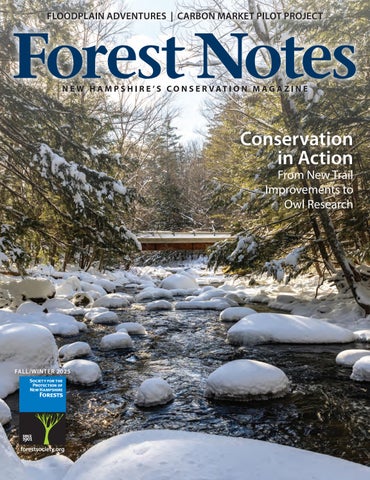
Conservation in Action From New Trail Improvements to Owl Research
FALL/WINTER 2025
forestsociety.org
Experience The Rocks: Beauty, History, Home Wake up to sweeping mountain views, quiet mornings, and the timeless charm of The Rocks. The Gardener’s Cottage—once part of the historic Glessner family estate—has been thoughtfully restored to welcome today’s visitors while honoring more than a century of conservation and care. • Sleeps up to nine, perfect for families and groups. • Step outside to trails, history, and peaceful landscapes. • Your stay supports year-round education and land stewardship at The Rocks.
Plan your visit at brettonwoodsvacations.com/rocks
TABLE OF CONTENTS: FALL/WINTER 2025, No. 323
14
24
18 DEPARTMENTS 2 FROM THE PRESIDENT’S DESK A Season of Reflection and Resolve
4 THE WOODPILE + Students Explore the Roots of Forensic Science at The Rocks + Forest Society Wins Society of American Foresters Award + Five Hikes Challenge Recap + Welcome the New Year with First Day Hikes + Rocks Newsletter Signup + Spirit of NH Award
8 IN THE FIELD
FEATURES 14 Toots in the Night Cracking the Mysteries of New Hampshire’s Cutest Owl
18 A Floodplain Adventure
+ New Improvements Made to Floodplain Trails + Carrying the Promise Forward + Monadnock Trails Week 2025 + Forest Society Launches Voluntary Carbon Pilot Project
20 GET OUT! Enjoy Small-Scale Wildlife Watching on a Micro Hike
21 STAFF SPOTLIGHT
A FLOODPLAIN RENAISSANCE | UNDERSTANDING CARBON MARKETS
Who’s Who at Creek Farm N E W H A M P S H I R E ’ S C O N S E R VAT I O N M A G A Z I N E
Conservation in Action From New Trail Improvements to Owl Research
FALL/WINTER 2025
forestsociety.org
On our cover:
The Whiteface River flows through the Nye Conservation Easement in North Sandwich. Photo: Ryan Smith
22 PUBLIC POLICY Our Duty to the Land
24 PROJECT BRIEFS Thank You for Giving—Your Dollars Make it Happen!
30 THE MANY FACESOF CONSERVATION Annette and Tony Immorlica
FROM THE PRESIDENT’S DESK
CHAIR Drew Kellner, Brookline
VICE CHAIR Peter Fauver, North Conway
SECRETARY Allyson Hicks, Concord
TREASURER Jason Hicks, Meredith
PRESIDENT Jack Savage, Middleton
BOARD OF TRUSTEES Susan Arnold, Strafford Philip Bryce, Deering Deb Buxton, Greenfield George Epstein, Silver Lake Don Floyd, Concord Jameson French, Portsmouth Patricia Losik, Rye
Amy Reagle Meyers, Jaffrey Michael Morison, Peterborough Elizabeth Salas, Weare Bill “Tuck” Tucker, Goffstown Tom Wagner, Campton Janet Zeller, Concord
STAFF Josh Abbott, Regional Stewardship Manager Ben Aldrich, Field Forester Frank Allen, Building and Grounds Assistant Sarah AlSamaraee, Stewardship & Forestry Administrative Coordinator Dave Anderson, Senior Director of Education Kristine Arey, Program Director, The Rocks Emily Bartolini, Southeast Region Program Manager Brie Belisle, Regional Stewardship Manager Nik Berube, Maintenance Assistant Naomi Brattlof, Director of Easement Stewardship Adam Buxbaum, Christmas Tree Farmer, The Rocks Rita Carroll, Tree Farm Administrator Tony Cheek, Vice President for Finance Connie Colton, Administrative Assistant Linda Dammann, Development Assistant Carrie Deegan, Vice President for Recreation Management and Public Engagement Leah Hart, Land Conservation Project Manager Stacie Hernandez, Land Conservation Project Manager Brian Hotz, Vice President for Land Conservation Steve Junkin, Field Forester Susanne Kibler-Hacker, Senior Philanthropy Advisor Allan Krygeris, Senior Technology Specialist Matt Leahy, Public Policy Director Margaret Liszka, Membership Director Nigel Manley, Senior Outreach Manager, The Rocks Ann McCoy, Development Manager Stephanie Milender, Human Resource Director Michelle Morse, Finance Specialist Carl Murphy, Facilities Manager Nora Noble-Christoff, Land Protection and Stewardship Coordinator Cara Pearson, Membership Specialist Meredith Reed O’Donnell, Foundation Relations Manager Tina Ripley, Administrative Coordinator Ilissa Sargent, Regional Stewardship Manager Jack Savage, President Matt Scaccia, Recreation and Community Relations Manager Ryan Smith, Communications Manager Kaity Stanton, Regional Development Manager – Seacoast Maria Stewart, Senior Executive Assistant Dylan Summers, Stewardship Projects Manager Laurel Swope-Brush, Land Steward & Volunteer Programs Coordinator Lauren Thomas, Administrative Assistant, The Rocks Anne Truslow, Vice President for Development Wendy Weisiger, Managing Forester Brenna Woodman, Director of Communications Harriette Yazzie-Whitcomb, Administrative Assistant
2 | FOREST NOTES Fall/Winter 2025
A Season of Reflection and Resolve
A
s the solstice approaches, I’m reminded how much the Forest Society’s work depends on longterm commitment—commitment from landowners, partners, members, and staff who believe deeply in the future of New Hampshire’s forests. This year at our annual meeting in the Sunapee region, we recognized the intern class of 1975, celebrating the 50th anniversary of internships that were formative to their lives. We also heard from more recent interns, Ian Aldrich and Sophie Oehler, who are embarking on careers in forestry and advocacy using skills honed at the Forest Society, destined for new frontiers. The Forest Society’s investment in interns and young professionals helps build the leaders who will take us into the future, and we’re committed to deepening that investment in the coming years. The future of conservation also requires new tools for the proverbial toolbox. Earlier this year, the Forest Society enrolled 800 acres of land in a carbon credit pilot project. With a land base of more than 67,000 acres, this is a modest sized project. As a landowner, our intent is to gain first-hand experience of the pros and cons of carbon programs, and we will transparently share our experience with other private landowners and the
public. The introduction on page 12 is just the first installment of our ongoing reporting on the different aspects of the pilot project. This issue also highlights advocacy, land protection, and community engagement. From our policy work in Concord to the science happening on the ground to trail stewardship, these stories are all connected by a simple fact: conserved land continues to offer positive solutions to the many challenges our state faces. As we close out the year, I find myself reflecting on the decades of people and decisions that have brought us to this moment. Next year, the Forest Society will celebrate its 125th anniversary—a milestone that invites both pride and resolve. We have inherited an extraordinary legacy. Now we get to carry it forward. Thank you for being part of it, and for journeying with us as we step into the next chapter for New Hampshire’s forests.
Jack Savage is the president of the Forest Society. He can be reached by email at jsavage@forestsociety.org.
WEB EXCLUSIVES
Lend a Hand Extreme Birding New Opportunities Abound in 2026 Gino Ellison’s Big Year forestsociety.org/somethingwild forestsociety.org/land-steward-program
(OPPOSITE PAGE) RYAN SMITH; (THIS PAGE, CLOCKWISE FROM TOP LEFT) RYAN SMITH, GINO ELLISON, COLLEEN ELIASON
A Welcome Addition Adding More to the Morse Preserve forestsociety.org/mpaddition
“A longtime NH bucket list item for me has been to visit the Forest Society’s Madame Sherri Forest, but making the drive just to see it seemed impractical. I finally got the chance as it was a quick detour on the way home from the Big E. All that’s left of the castle-like home of socialite and actress Madame Antoinette Sherri is a stone staircase and a few stone pillars. Oh, what a treat it must have been to have been invited to one of her lavish parties.” –Colleen Eliason (#colleeninthe603)
CONNECT WITH US! facebook.com/ForestSociety
@ForestSociety
T ag #forestsociety on Instagram for a chance to be featured in a future issue of Forest Notes.
Society for the Protection of New Hampshire Forests A nonprofit membership organization founded in 1901 to protect the state’s most important landscapes and promote wise use of its renewable natural resources. Basic annual membership fee is $45 and includes a subscription to Forest Notes. Editor: Ryan Smith Design & Production: The Secret Agency Printing: R.C. Brayshaw & Company, Inc. Forest Notes is printed on elemental chlorine-free Sappi Flo paper with 10 percent post-consumer recycled content. Sappi Flo is made from pulp purchased from suppliers who document sound environmental practices and sustainable forest management. Permission is required for reproduction of any part of this magazine. Copyright 2025 SPNHF. US ISSN: 0015 7457 54 Portsmouth Street, Concord, N.H. 03301 | Phone: 603-224-9945 | Fax: 603-228-0423 info@forestsociety.org | forestsociety.org The Forest Society proudly supports the following organizations:
Cosponsor
Underwriter
Member
Fall/Winter 2025 FOREST NOTES | 3
THE WOODPILE—NEWS NOT SO NEATLY STACKED
St. Johnsbury Academy students pose in the Jane A. Difley Classroom at The Rocks in Bethlehem.
Students Explore the Roots of Forensic Science at The Rocks On October 21, students in grades 10–12 studying forensic science at St. Johnsbury Academy traveled to The Rocks in Bethlehem to learn more about Frances Glessner Lee and her pioneering work in the field. During the 1940s, while living at The Rocks, Lee created a series of miniature models depicting meticulously detailed crime scenes, which she used to train police detectives. Before the trip, teacher Jessica Angell introduced the class to Lee’s work by showing a video about her life and 4 | FOREST NOTES Fall/Winter 2025
teaching lessons on crime scene analysis and evidence collection. To apply what they learned, students built their own dioramas that classmates then examined to determine the cause of the fictional crimes. “Visiting The Rocks brought my students’ studies to life with a closer look at the real history behind forensic science,” Angell said. To deepen their experience, students studied the Nutshell Studies of Unexplained Death exhibit currently on display at The Rocks and viewed images
of other “nutshells” housed with the Maryland Office of the Chief Medical Examiner, where they are still used for training seminars today. The class then shared the evidence they gathered and presented several hypotheses about what they believed could have happened to the victims in the scenes. Before departing, students completed The Rocks’ new outdoor mystery walk, rounding out a day that connected forensic history, creative problem-solving, and hands-on investigation.
EASEMENT STEWARDSHIP
Ilissa Sargent.
It was a busy field season for the easement stewardship team. We met many new landowners (more than 20 with more to go!); visited with more than 150 existing landowners; and are still trekking through the woods, even as the snow flies.
From left, Forest Society President Jack Savage, Managing Forester Wendy Weisiger, and field foresters Steve Junkin and Ben Aldrich accept the Employer Leadership Award at the Society for American Foresters Annual Convention in Hartford, Conn.
FOREST SOCIETY FILES
Forest Society Wins Society of American Foresters Award At the Forest Society, it’s always been about the people behind the trees—the foresters, stewards, and conservationists who give their time and talent to keep New Hampshire’s woods healthy and thriving. This year, that dedication was recognized on a national stage when it received the 2025 Employer Leadership Award from the Society of American Foresters (SAF). Each year, SAF honors those who help shape the future of forestry—from scientists and educators to field foresters and the organizations that support them. The Employer Leadership Award highlights workplaces that go above and beyond in nurturing professional growth and encouraging their staff to take part in the broader forestry community. “Workplace culture matters, and the Forest Society is setting a gold standard,”
said Karen Bennett, UNH Extension Forester Emeritus. “Their commitment to professional growth, sustainability, and prioritizing people shows how a conservation organization can lead from the roots up.” For Forest Society president Jack Savage, the recognition reflects a long-standing value. “Our commitment to professional development and to our staff’s engagement in the Society of American Foresters has been unwavering,” he says. “When our people are supported to lead and learn, the entire profession—and New Hampshire’s forests—benefit.” Here in New Hampshire, the Granite State Division of SAF recognized our own Wendy Weisiger as 2025 Forester of the Year, an honor that celebrates those who advance both the science and heart of forestry in New Hampshire. Congratulations Wendy!
We said “see you later” to our seasonal stewardship staffer, Abraham Ames, who came back to join our team for the summer; “welcome back” to Brie after much deserved time off bonding with her newborn daughter; “job well done” to Josh Abbott on a very successful first field season; and now “welcome to the team” to our newest recruit, Ilissa Sargent, who will be taking over as our southwest region stewardship manager. EASEMENT LANDOWNERS: As we head into the quiet that shorter winter days bring, and you begin to plan your next projects, keep us in the loop! We’ll be busy at our desks over the winter and ready to talk through your next big plan! See you after mud season! —Naomi Brattlof Easement Stewardship Director forestsociety.org/steward-contact
Fall/Winter 2025 FOREST NOTES | 5
THE WOODPILE—NEWS NOT SO NEATLY STACKED
Welcome the New Year with First Day Hikes On January 1st, NH State Parks invites hikers of all ages and abilities to start 2026 outdoors with the annual First Day Hikes. This year, two beloved Forest Society destinations stand out.
Monadnock State Park: Join park staff for a self-guided loop along the scenic Pond Loop Trail at Gilson Pond Campground. It’s an accessible escape into mixed woods beside the water—a lovely way to ease into the new year. Hikers enjoyed sweeping views from an outlook on Chesley Mountain in Farmington during the final guided hike of the 5 Hikes Challenge.
Five Hikes Challenge Recap On a cool and sunny day in October, a group of hikers taking part in the Forest Society’s 5 Hikes Challenge hiked to an outlook on Chesley Mountain at the Bean Forest in Farmington to enjoy some time in nature and good comradery. “It was a great hike and a great group of friendly people,” said Senior Director of Education Dave Anderson. “It was the last hike of the 2025 guided series, and some folks were completing the challenge as part of this trip. Others were just along for
the experience—and why not? It was a beautiful day to be in the woods.” August, September, and October were remarkably dry during this year’s event. Paddlers griped about water levels, but hikers reveled in the consistently calm and predictable weather pattern. With these kinds of conditions, it’s no surprise that participation numbers were up this year from 187 in 2024 to 213. Here are a couple of testimonials from enthusiastic participants who finished this year’s challenge.
Creek Farm/Wentworth-Coolidge Mansion: Explore the tidal flats, coastal woodland, and salt-marsh habitat preserved at the Forest Society’s Creek Farm, accessed via the Wentworth-Coolidge Mansion site. This gentle hike offers a striking contrast to Monadnock’s mountain trails—a refreshing coastal dose of New Hampshire’s natural diversity. First Day Hikes 2026 delivers the perfect opportunity to reconnect with nature and perhaps make a new tradition out of it. Registration is required in advance, so be sure to reserve your spot soon! Find out more at nhstateparks.org/things-to-do/ first-day-hikes-2025.
Rocks Newsletter Signup
“Dawn has been a member of the Forest Society for four years, and we have completed the 5 Hikes Challenge for the last three years. This year, we visited parts of the state we haven’t been to before and hiked on some of the less crowded and lesserknown trails. We really enjoy hiking at these beautiful Forest Society properties! –Charlie and Dawn Bourret, Thornton, NH 6 | FOREST NOTES Fall/Winter 2025
“And that’s a wrap on another hiking challenge! Hummingbird and I finished the Forest Society’s annual 5 Hikes Challenge today at Weeks Woods in Gilford. Nice easy trail through the woods with a short detour to an expansive viewpoint.” –TrailChaser, a.k.a. Dragonfly
We are excited to introduce our Forest Society North at The Rocks newsletter. This newsletter will focus on events and happenings not only at The Rocks but at Forest Society Properties across the North Country. We had a busy summer season with many groups using the property— theater in the amphitheater, a concert in the amphitheater, local parks & rec groups field tripping and more. As fall fades and winter ramps up, we are continuing to see more visitors on site daily. This new quarterly newsletter will focus on what is coming in the next few months at The Rocks and other properties in the North Country. To sign up, visit forestsociety.org/the-rocks.
Spirit of NH Award On October 27, 2025, Ashleigh Roberts was honored with the Spirit of New Hampshire Award in recognition of her outstanding dedication and service as a Forest Society volunteer. Since completing the Forest Society’s Land Steward Training in spring 2024, the Laconia native has conducted 22 monitoring visits at the Morse Preserve in Alton, helping the forestry and stewardship departments advance their goals at the property. In addition to her monitoring work, she has also actively supported three University of New Hampshire student volunteer workdays focusing on wildlife habitat management on Pine Mountain, the Morse Preserve’s high point. Ashleigh continues to be very active in the Volunteer Trailhead Outreach Program at Mount Major, ranking as one of the program’s most bustling participants since its inception in 2022. Furthermore, she volunteered on all five days of this year’s Monadnock Trails Week—an exhausting but incredible feat! “Ashleigh is a go-getter,” says Laurel Swope-Brush, land steward and volunteer programs coordinator. “Her commitment, professionalism, and positive attitude have made her an invaluable member of
Consulting Foresters Ashleigh lends a hand during a recent stewardship project. the Forest Society community. With more than one hundred volunteer hours across multiple programs this year, Ashleigh truly embodies the spirit of service and stewardship that the award celebrates.” Hosted by Volunteer NH, the Spirit of NH Awards is New Hampshire’s largest volunteer recognition ceremony. This year’s event took place at the Capitol Center for the Arts in Concord.
The Forest Society encourages landowners to consult with a licensed forester before undertaking land management activities. The following are paid advertisers. Calhoun & Corwin Forestry, LLC Realize what you value the most in your forest. Serving individual, municipal, state, non-government, and industry forest owners.
41 Pine St., Peterborough, NH 03458 • 603-562-5620 Email: swiftcorwin@gmail.com
Martin Forestry Consulting, LLC Offering complete forest management services, including timber sales, cruises, appraisals, and wildlife habitat management. Ask us about recreation trail planning, construction, Brontosaurus mowing, and forestry excavation services.
P.O. Box 89, New Hampton, NH 03256 • 603-744-9484 Email: martinforestry@gmail.com
Meadowsend Consulting Company
Passing the Mic
Quality Consulting Forestry with Integrity. Guaranteed.
Jeremy Turner, NHLPF #318 – Southern NH jturner@meadowsendco.com Matthias Nevins, NHLPF #518 – Central NH mnevins@meadowsendco.com Ryan Kilborn, NHLPF #442 – Northern NH rkilborn@meadowsendco.com Vast range of quality land management services. Connect with us for a free site consultation!
meadowsendco.com • 603-526-8686
In addition to retiring after 35 years as a senior biologist for NH Audubon, Chris Martin (right) signed off from NHPR’s Something Wild podcast in December 2025 after 18 years with the station. Martin will pass the mic to new co-host Grace McCulloch (middle), who will continue making the show with Dave Anderson (left) and producer Jessica Hunt. To listen to Martin’s last show and many others, visit nhpr.org/somethingwild.
Licensed foresters should address inquiries about advertising to Anne Truslow by calling 603-224-9945 or emailing atruslow@forestsociety.org. Fall/Winter 2025 FOREST NOTES | 7
IN THE FIELD
Greg DiSanto of Martin Forestry Consulting LLC regrades the Les Clark Nature Trail at the Merrimack River Outdoor Education & Conservation Area.
Open and Accessible: New Improvements Made to Floodplain Trails Story and photos by Ryan Smith
T
his fall, the Forest Society completed an important accessibility project at the Merrimack River Outdoor Education & Conservation Area in Concord. The goal was to make a section of the Les Clark Nature Trail more inclusive and welcoming for all visitors—especially those using wheelchairs, strollers, or other mobility devices. “Trail infrastructure that is not designed to meet their needs has long been a barrier for people with disabilities who are trying to gain access to the outdoors,” Stewardship Projects Manager Dylan Summers says. “With the completion of this project, the Forest Society is thrilled to welcome more community members by investing in their needs and creating trails that are accessible to all.” The Les Clark Nature Trail is the main trail on the Merrimack River floodplain. By upgrading the trail to federal accessibility
8 | FOREST NOTES Fall/Winter 2025
standards, people in wheelchairs or using other mobility devices will be able to more easily access and enjoy the property. The section of trail spanning from the parking area on Portsmouth Street to just past the riverside welcome kiosk was re-surfaced with compacted crushed stone to create a more uniform and durable treadway for pedestrians, strollers, and those using mobility devices. The rebuilt section ends at a turnaround loop in the open field near the Merrimack River. Several benches will be installed along the trail so that visitors can rest and enjoy the scenery and wildlife viewing opportunities along Mill Brook and the Merrimack River. The Merrimack River Outdoor Education & Conservation Area is a popular destination for many. Concord elementary school classes visit the floodplain trails every year, with 150-200 students attending Forest
Society-led programs to learn about the natural environment. NHTI, UNH, and UNH Cooperative Extension also bring classes throughout the year. Northeast Delta Dental hosts an annual 5K running race on the trails and Pope Memorial SPCA hosts a fundraising walk. Generous funding for improvements to the Les Clark Nature Trail was provided by the New Hampshire Bureau of Trails Recreational Trails Program, Davis Conservation Foundation, Athletic Brewing Company’s Two for the Trails grant program, Granite State Independent Living, and annual support from our Floodplain sponsors, Merrimack County Savings Bank and Northeast Delta Dental. Moving forward, it is the Forest Society’s hope that the accessibility improvements will allow a broader segment of the population, including those with disabilities
Top: Greg DiSanto blows leaf duff from a section of the Les Clark Nature Trail that will be graded and surfaced. Middle: DiSanto and Stewardship Projects Manager Dylan Summers discuss the type of surfacing gravel to be used on the new trail. Bottom: Summers measures the grade of a the newly surfaced trail. who may have been unable to visit previously, to enjoy the property. Education and stewardship staff will continue to offer programs on the floodplain, including guided walks, experiential learning opportunities, and events that celebrate the positive influences that natural spaces can have on our physical and mental wellbeing. Their goal is to make the property welcoming for all visitors, and they recognize this starts with welcoming and celebrating diversity to make our community healthier and stronger. The trailbed needs to settle over the winter, and we’ll host a formal grand opening of the “new” trail in the spring.
Learn More: For more information about this project visit forestsociety.org/floodplain. Fall/Winter 2025 FOREST NOTES | 9
IN THE FIELD
Carrying the Promise Forward By Brenna Woodman
A
t the Forest Society’s 124th Annual Meeting, held September 27 at Colby-Sawyer College in New London, members and friends gathered to celebrate conservation milestones, recognize outstanding leadership, and reflect on the enduring promise of New Hampshire’s forests. President Jack Savage opened the afternoon with remarks that balanced pride in the organization’s accomplishments with a clear-eyed call to courage. Over the past year, the Forest Society protected nearly 2,400 acres—including its 200th forest, restored wildlife habitat, improved trails, and strengthened sustainable forestry practices, all the while engaging more than 15,000 people in programs and outdoor adventures across the state. Yet, as Jack reminded the audience, conservation in our time demands more than celebration; it requires resolve. “Across the country—and yes, even here in New Hampshire—we’re seeing efforts to roll back the hard-won victories of land protection and environmental stewardship,” he said. “To resist, we must be robust.” He framed the organization’s path forward around three commitments: to have the courage to fight back, to be prepared to defend the lands and easements entrusted to our care, and to engage the next generation of conservation leaders who will carry that fight forward. Those commitments provided a fitting prelude to the awards that followed, each one embodying the enduring strength of community that sustains the Forest Society’s mission. The President’s Award was presented to the Forest Society’s intern class of 1975— Jane Difley, Jamey French, Dijit Taylor, Zib Corell, Diane Kostecke, Lucia Kittredge, Mike Grossberg, Stephen Goldman, and Peter Mazur—a group whose early experiences as interns laid the foundation for a lifetime of service to New Hampshire’s forests. Their careers have since touched nearly every corner of conservation in the
10 | FOREST NOTES Fall/Winter 2025
The intern class of 1975 accepts the President’s Award. state, from forestry and land protection to leadership and education. As Jack noted, welcoming interns and mentoring emerging professionals remains one of the most powerful ways the Forest Society can perpetuate its conservation ethic. The story of the Class of ‘75 is proof that when young people are invited into the work of stewardship, they carry its lessons with them for decades, passing on knowledge, care, and conviction to those who follow.
sign-making projects. David Roby of Lyme was named Conservationist of the Year for his decades of leadership advancing land protection, wildlife habitat conservation, and open-space stewardship across New Hampshire and beyond. Together, their efforts illustrate the range of ways individuals contribute to a shared mission—through time, skill, generosity, and steadfast belief in the power of land to connect and sustain us all.
That intergenerational spirit took tangible shape when Board Member Jamey French, one of the 1975 interns, used the moment to launch a new challenge: the creation of a $2 million Fund for Future Conservationists. With a seed gift pledged through his estate plan, Jamey invited others to join him in building a lasting source of support for internships, training, and early-career development in conservation. His vision embodies the very charge Jack delivered moments before— to ensure the next generation has the resources and opportunity to defend New Hampshire’s forests with the same passion and purpose as those who came before. Other honorees reflected the same continuum of dedication. George Beaton of Bradford received the Trish Churchill Volunteer of the Year Award for more than 11 years of service—from trail work and mentoring teens to woodworking and
As the meeting ended, Jack returned to the theme woven through the afternoon: that conservation is not a static achievement but a living promise. From the courage of the organization’s founders in 1901 to the passion of today’s members, volunteers, and partners, our work endures because people continue to stand up for the forests, again and again. “Every forest saved is a promise made,” he reminded the audience. “A promise to our children. A promise to our health and livelihood. A promise to the living heart of New Hampshire.” As the Forest Society approaches its 125th anniversary, that promise remains both a legacy and a call to action— inviting all who care for New Hampshire’s landscapes to keep carrying it forward. Brenna Woodman is the director of communications for the Forest Society.
Learn, Improve, and Make Connections: Monadnock Trails Week 2025 By Laurel Swope-Brush
FOREST SOCIETY FILES
T
his fall, one of New Hampshire’s most hiked peaks received some tender loving care from more than 50 volunteers during the 19th annual Monadnock Trails Week from September 4–8. The weather couldn’t have been better, and morale and productivity were noticeably high. Staff from the Forest Society and New Hampshire State Parks led volunteers, including groups from The Wediko School, REI of Bedford, Trailwrights, and a women-only and veteran affinity crew, on many improvement projects. These leaders went to great lengths to match volunteers with projects that fit their interests and abilities to improve the experience for all. Starting with the lower stretch of the Marlboro Trail, volunteers rebuilt three stone water bars totaling more than 40 feet in length in a wide section of the trail. Another area was improved with one new stone water bar and repairs made to two others. Near the Old Toll Road, both the Royce Trail and the Parker Trail were revitalized. A crew spent three days on the upper section of the Parker Trail installing seven stone check steps to improve the treadway and reduce erosion. On the Royce Trail, crews added step stones in a flat area of the trail that is notoriously wet and muddy, resulting in hikers inadvertently widening the trail by walking around and not through the mud. On Gap Mountain, about a quarter of a mile from the summit of South Peak, a section of wooden steps installed over fifteen years ago had degraded to the point of needing repair. Rather than replacing these steps, crews relocated 400 feet of the trail on a more sustainable grade and built a 10-foot retaining wall to control erosion. The crews also restored an additional 150 feet of original trail as part of this project.
Top left: REI Bedford employees Jeff McLynch, Chris Burke, and Adam Zienkiewicz pose for a photo while conducting trail work on the Marlboro Trail. Top right: From left, Ally Scholtz, Mary Clark, and Kevin MacKenzie work together to move a rock to place on Mount Monadnock’s Marlboro Trail. Bottom right: Forest Society Forestry Technician Es Sweeney removes organic matter on a trail reroute on Gap Mountain. On each day of the event, crews cleared drainages of debris and removed branches that were encroaching on the trail corridor. Over the years, a volunteer group has tackled this type of maintenance on a regular basis. The current Monadnock volunteer trail crew is in the rebuilding stages, so our NH State Park partner hosted a training for interested volunteers during the week. We are excited to see this program grow in the coming years! In total, 15 Forest Society staff and temporary crew leaders spent more than 400 hours supporting volunteer efforts. This was an increase of more than 200 hours from the previous year! By the end
of the event, 51 volunteers had contributed approximately 775 hours to trail improvements. The Forest Society would also like to thank the Dublin Road Taproom & Eatery for hosting the event’s kick-off party and Fassett Farm Nursery in Jaffrey for including trails week participants in their Music on the Meadow event. These businesses help us engage with the greater Monadnock community while stewarding some of the most popular trails in the state. Laurel Swope-Brush is the land steward and volunteer coordinator for the Forest Society.
Fall/Winter 2025 FOREST NOTES | 11
IN THE FIELD
Forest Society Launches Voluntary Carbon Pilot Project By Wendy Weisiger
T
he Forest Society has been evaluating carbon markets for nearly 20 years as they have developed and changed. In recent years, voluntary carbon markets have emerged that are more accessible to average woodlot owners, including those enrolled in the New Hampshire Tree Farm program. Some carbon developers have produced voluntary programs that will enroll as little as 40 acres over a 20- to 40-year timeframe. This is a big shift from the 100-year commitments and large acreage requirements seen in the regulated compliance carbon markets. With the advent of these new programs, the Forest Society began to look more closely at enrolling a portion of our lands in one.
What is a Carbon Market? In the Northeast, the most common carbon market, or offset, falls under a category referred to as “Improved Forest Management” projects. The basic premise of a carbon offset is that carbon credits are produced when landowners manage their forests in a way that increases or maintains the current level of carbon stocks on the land through reducing or delaying timber harvesting. That additional tonnage of carbon above a business-as-usual baseline scenario, which is determined by the developer, can be converted into carbon credits and sold by the developer, who then pays the landowner in accordance with the program contract.
Exploring Opportunities for Landowners As a land trust and forestry organization, our mission is to keep forests as forests. We have long maintained that well-managed working forests provide opportunities for landowners to produce income while 12 | FOREST NOTES Fall/Winter 2025
managing their land for sustainable forest products, climate resilience, wildlife habitat diversity, and forest health. These opportunities exist because of our region’s historically strong traditional forest products markets. Carbon markets have gained traction as an alternative for landowners to keep their land forested, produce a modest income, and gain some level of comfort with long-term land encumbrances. Might these markets become an avenue for landowners to permanently protect their land? While these markets remain a complex topic for many forest landowners, several have expressed interest in enrolling their lands. To this end, the Forest Society’s board and forestry committee felt it was important for us to engage with the voluntary market through a small pilot project, so that we could share our first-hand experience—positive or negative—with other woodlot owners. While our staff holds varied opinions, we all agree that this small acreage will not detract from the broader important forest management work we practice across our nearly 70,000 acres.
Our Pilot Project After careful review of many voluntary carbon programs, we found that the American Forest Foundation’s (AFF) Family
Forest Carbon Program (FFCP) offered an option more closely aligned with our values that requires landowners to have a management plan and forester, allows continued active management, provides a modest income stream to support the land, and ensures forests remain intact for the duration of the project. The FFCP developers provide two options for landowners to enroll in: Grow Old Forests (GOF) and Enhance Your Woodlands (EYW). These programs both require a 20-year commitment, but they differ in the rate a landowner will be paid and the practices that a landowner may implement on those acres during the contract period.
Prioritizing Our Mission The Forest Society’s strength stems from its robust portfolio of more than 200 properties across New Hampshire ranging in size from one acre to nearly 5,000 acres. We essentially have a land base comprised of small, individual tree farms. This allows us an opportunity to enroll in a carbon project that we can track for 20 years while continuing to focus on sustainable, climate resilient forest management across the remainder of our lands.
We spent two years reviewing voluntary carbon market developers and ultimately chose to work with the FFCP. Their program is designed to apply only to northern hardwood forests that meet certain stocking criteria. An analysis of our lands database showed several qualifying forests from which we chose stands on three properties: The Rocks in Bethlehem (215 of 1,276 total acres enrolled); Yatsevitch Forest in Plainfield and Cornish (251 acres of 1,255 acres enrolled); and Cockermouth Forest in Groton (267 of 1,260 total acres enrolled). The Rocks and Cockermouth are enrolled in EYW while the Yatsevitch ecological reserve is enrolled in GOF. The GOF program maximizes carbon on the land by deferring any harvest activity for the 20-year commitment, and it pays a higher per-acre rate of $300/acre in partial payments over the 20 years. The EHY woodlands program allows landowners to harvest small amounts of annual firewood and provides some opportunity for timber harvesting with silvicultural options that will not reduce stocking below certain levels. This program will pay landowners $200/acre over the course of 20 years with additional payments for updating a management plan. The income derived from these programs is modest over the timeline of the project. This can be particularly attractive to landowners who aren’t ready to implement forestry work on their land. At the Forest Society, we view this as an opportunity to compare our normal climate
resilient forestry work on similar woodlots with a potential harvest project within the parameters of the EYW program which aims to maximize carbon. Are the program requirements easy to meet? Will the outcome of a harvest on an enrolled parcel produce meaningful income and meet our silvicultural goals? These are questions we hope to answer, but it will be many years before we get to that point. Carbon markets aren’t without controversy, and the Forest Society recognizes all the questions and concerns surrounding them. Questions like whether these programs lead to real climate change benefits and whether they will have an effect on the forest products industry are just two of the issues the Forest Society considered as we decided whether or not to participate. While there are many questions and a healthy skepticism around these markets, we have always been at the forefront of new opportunities and strategies to protect and manage land. By participating in this pilot project, we will gain firsthand experience which we are committed to share with woodlot owners and others with interest in the issue. Wendy Weisiger is the managing forester for the Forest Society.
Learn More: For more information about this project visit forestsociety.org.
RYAN SMITH
DID YOU KNOW? There are several carbon developers in the voluntary market. Each developer has their own set of guidelines and calculations for determining a baseline, additionality, and accounting for leakage. Some developers require a landowner to enroll all their land while others allow only partial land holdings. Their programs are available to a range of forestland owners who hold 40 acres all the way up to several thousand acres. The payments, restrictions, and duration of a contract all vary depending on the program. Any landowner who is considering selling carbon and entering into one of these long-term contracts should consult with their forester to understand the financial and silvicultural implications of this decision. For more details about these programs and developers in addition to a wealth of information about managing land for carbon or climate resiliency, visit northeastforestcarbon.org.
GLOSSARY Additionality: the level of carbon stocking accumulated throughout the project timeline that is above the baseline scenario. Baseline: a reference scenario created through modeling the business-as-usual scenario determined by location and forest type. Carbon Credit: a tradeable certificate representing one metric ton of reduced carbon dioxide equivalent emissions and sold on a carbon marketplace. Compliance Carbon Market: governmentally regulated markets where companies are required to reduce greenhouse gas emissions through cap and trade or carbon taxation. These are heavily regulated and mandatory for some high-emissions industries. Enhance Your Woodland: a Family Forest Carbon Program in which landowners can enroll their land and are paid by the acre to maintain or enhance the carbon stocking on their lands above a baseline level. They may make modest timber removals over the course of the contract. Forest Stand: an area of a forest that has similar tree species, sizes, age classes and structure. Grow Old Forests: a Family Forest Carbon Program where landowners agree to defer any harvesting on their enrolled lands during the life of the contract. Leakage: an increase in the level of carbon removal outside of the enrolled lands to compensate for reduced harvesting on enrolled lands. Stocking: an indication of the number of trees in a stand as compared to the optimum number of trees to achieve specific management goals. Voluntary Carbon Market: an unregulated market where companies or individuals may purchase carbon credits to offset their carbon emissions voluntarily, often through short-term contracts.
NH CARBON REGISTRY www.nhdfl.dncr.nh.gov/ forest-carbon-climate-change
Fall/Winter 2025 FOREST NOTES | 13
TOOTS IN THE NIGHT Cracking the Mysteries of New Hampshire’s Cutest Owl By Carrie Deegan
BY CARRIE DEEGAN 14 | FOREST NOTES Fall/Winter 2025
O
n a recent field trip to the Black Mountain Banding Station in Sutton to observe
Northern Saw-whet Owl banding, station founder and licensed bander Lindsay Herlihy queried the group of 15 assembled participants, “How many of you have actually seen a Saw-whet Owl in the wild?” Two people lifted their hands. “Wow!” exclaimed Herlihy. “That’s more hands than I usually see!” Saw-whet Owls may well be the cutest animals in New Hampshire’s forests. They are also the most elusive. These owls are solitary, secretive, and fully nocturnal, and they’re also very small— about the size of a softball if you include all their feathers generously fluffed out. Lead bander Lindsay Herlihy holds a newly banded owl just before releasing it back to the woods. Photo: Dotty Holcomb Doherty Fall/Winter 2025 FOREST NOTES | 15
Saw-whet owls have amazing night vision and a disc-like facial structure that funnels sounds to their very sensitive ears hidden beneath their head feathers. They favor small, nocturnal rodents such as deer mice for their prey, even though they may need to consume a larger mouse in two meals!
A
ll of this makes saw-whets less likely for people to encounter than some of our state’s other owl species such as Barred Owls or Great Horned Owls. On the night of this particular field trip, however, participants were in for a treat as they were able to see nine individual Saw-whet Owls up close of the 15 that were banded that night. No surprise that the group collectively delighted in each owl’s diminutive adorableness. The Black Mountain Banding Station (BMBS), which was established in 2024 on the Forest Society’s Black Mountain Forest to monitor breeding bird populations through the MAPS (Monitoring Avian Productivity & Survivorship) Program, is now also participating in Project Owlnet. Beginning in the 1990s, Project Owlnet was formed to collaborate and share data and information about Northern Saw-whet Owl migration banding. Saw-whet banding at BMBS has been generously supported by funding from the Nuttall Ornithological Club’s Blake-Nuttall Grant program. More than 125 banding stations across Canada and the United States are actively collecting data on these pint-sized owls, including several in New Hampshire such as BMBS in Sutton and the Harris Center for Conservation Education in Hancock. Why? Although Saw-whet Owl populations are thought to be healthy 16 | FOREST NOTES Fall/Winter 2025
and stable, there is still a lot that reasearchers don’t know about the owls’ biology, habitat use, and migration behavior. “These owls are so elusive and hard to observe during their non-migratory period that it’s difficult to study them outside of migration,” says Herlihy. “Project Owlnet is one of the few studies that is attempting to do total population monitoring during migration.” Through the collected data from banding stations, researchers aim to solve some of the owl’s mysteries, including how long they live; how far, fast, and when they migrate; and whether they have set migration routes. In order to band and release an owl, you first must catch it. Saw-whet Owl banding stations accomplish this with the help of an audio lure and ultra fine nylon nets, called mist nets, set up in an appropriate habitat. The audio lure plays a male saw-whet’s courtship call, a whistled toot, toot, toot that sounds somewhat like a saw being sharpened on a whetstone. As owls approach to investigate who is calling, they fly into the mist nets before being carefully extracted by trained station volunteers. From there, it is Herlihy’s duty as BMBS’s lead bander to affix a lightweight and uniquely numbered aluminum band on each owl’s right foot, and to weigh, measure, sex, and age each bird. All banding, marking, and sampling is conducted under a federally authorized Bird Banding Permit issued by the U.S. Geological Survey’s Bird Banding Laboratory, and a bander’s priority is the safety of the birds. “We do everything we can to minimize a bird’s stress and make sure that every saw-whet is released unharmed, though maybe with a crazy alien encounter story to tell their mate next breeding season,” Herlihy says. Sometimes flying squirrels, bats, and other nocturnal animals also encounter the mist nets at a Saw-whet Owl banding station. This isn’t ideal, as unlike owls, many of these animals can chew, and they aren’t afraid to employ their gnashers on the delicate mist nets. To keep an ear out for this sort of activity, as well as for owls that might enter the nets, one volunteer is always stationed close to the mist net array, sitting down in what is fondly referred to as the “stakeout chair.” The first area where BMBS set up nets this fall was quickly abandoned for a new site after it became apparent that Northern Flying Squirrels were extremely abundant. Flying squirrels—who, incidentally, could give Saw-whet Owls a serious run for their money in both the cutest and most elusive award departments—are also incredibly difficult to extract from mist nets without getting bitten, which requires precautionary rabies treatment, and leaving behind a huge hole in the net. “I learned the hard way that [squirrels] can chew through leather work gloves,” Herlihy recalls. ““Two fully ruined mist nets and a series of rabies shots later, and I decided to relocate the nets.” Decades of Project Owlnet banding data is already leading to a better understanding of Saw-whet Owl migration. We now know that migration distance varies both by the year and by where the owl’s breeding territory is. “Saw-whet Owls that breed in New
(OPPOSITE PAGE) DOTTY HOLCOMB DOHERTY; (THIS PAGE, FROM TOP) DOTTY HOLCOMB DOHERTY, LISA ARNOLD
Above: Ultraviolet “blacklight” is often used to help age the owls. Newly grown feathers fluoresce under UV light due to pigments called porphyrins, which fade over time. Using this knowledge as well as known molt patterns for wing feathers in Saw-whet Owls, the particular pattern of glowing (or not glowing) feathers can help determine a bird’s age. Right: Banding station volunteer Erin Burger records data as lead bander Lindsay Herlihy prepares to weigh a Saw-whet Owl. Hampshire may go as far south as the Carolinas or Georgia,” Herlihy says. “While at the same time, some owls that breed in the boreal forests of Canada may overwinter here.” There also appear to be age-differentiated migration trends with juvenile owls in some regions migrating later than adults. One mystery that remains to be solved is why the vast majority of all owls captured and banded across all Project Owlnet banding stations are female. Saw-whet Owl sexes don’t look overtly different, but females are slightly larger, and using a combination of wing length and mass of the bird, it is possible to determine the sex of most captured individuals. It may be that females are attracted to the audio lure in greater numbers since it is a male’s breeding song, but there is also mounting evidence that females migrate in greater numbers and for longer distances, while males remain on or near their breeding territory. In the future, Herlihy has plans to employ more sophisticated technology at BMBS and contribute to a migratory connectivity project that uses radio telemetry or cellular tracking tags to
monitor the migration of Saw-whet Owls in real time. The tags are expensive, ranging from $300–$1,700 per tag depending on the technology. But if sufficient funds can be raised, Herlihy hopes to begin this parallel project during the 2026 spring migration season from February to March. If you are interested in seeing the owl banding process in action, the Forest Society plans to host field trips during this same timeframe. You’ll want to bundle up, as March nights can be frosty and snow-covered, but the cuteness reward will melt your heart if not your chilly fingers and toes! Carrie Deegan is the vice president for recreation management and public engagement for the Forest Society. Fall/Winter 2025 FOREST NOTES | 17
A Floodplain Adventure Story and Photos by Dave Anderson
First and second grade students from Mrs. Olszewski’s class at Beaver Meadow School enjoy a riverside snack after learning about a variety of wildlife habitats that exist at the Floodplain.
S
eptember, October, and November feel like Floodplain Month as the Concord property and adjacent Conservation Center host multiple groups for field trips and education programs. The formal property name, Merrimack River Outdoor Education & Conservation Area, is a mouthful and the acronym MROECA isn’t much better. So, for most of the staff and frequent visitors, they tend to call it “The Floodplain” for short. No matter what its called, Forest Society educational programing continues to grow each year, illustrating the draw of the floodplain trails for both recreation and education purposes. This fall was no different as new and returning schools and organizations alike discovered the magic of this special place that is a stone’s throw from the Capitol Building and the bustling downtown. To welcome even a broader array of visitors, this fall, the Forest Society completed the first portion of an All Persons Trail 18 | FOREST NOTES Fall/Winter 2025
that was built to meet wheelchair accessible standards and make it easier to engage more residents and visitors. Turn to page 8 to learn more about this exciting project. Generous funding for the Merrimack River Outdoor Education & Conservation Area is provided by Merrimack County Savings Bank and Northeast Delta Dental.
Project SEE First up, the Concord School District’s Project SEE ran its popular wildlife habitat field trips for the 2nd grade. Over the course of 3 weeks, 260 students and 20-plus adults visited The Floodplain to explore a variety of habitats and think about the animals that live there and the resources they need to survive. “The Floodplain offers an easy, short loop for students and allows them to explore four different habitats—pond, forest, river, and meadow—in close proximity to each other,” Project SEE Program
Assistant Madeline Champlin says. “The forest and river along The Floodplain are great places for students to stop and look closely at the soil, which allows them to compare soil from other habitats.”
Building Community in New Hampshire Next, more than 50 people, including families of new Americans originally from the Democratic Republic of Congo, Myanmar, Afghanistan, and Ukraine, visited the Floodplain and Conservation Center on October 11 and attended Building Community in NH led by directors Rick Minard and Vijay Bhujel. The day included various craft projects for kids, an easy walk to the Merrimack River, and a box lunch. “Thank you for welcoming our clients and their families to share the Conservation Center, the forest, the trails, and the river,” Vijay Bhujel said. “Your guidance made the hike approachable and educational for everyone, especially those visiting for the first time. We are grateful for the thoughtful craft activity you provided to the kids.”
Arts and crafts and a walk along the Merrimack River made for a fun-filled day for families taking part in Building Community in NH at the Conservation Center on October 11.
Broken Ground School teachers Wendy Harrison (back left) and Ellen Kenny (back right) lead the school’s Explorers program on a trip to the floodplain in Concord.
Explorers Who Rock! The Broken Ground School’s self-titled Explorers program is a new after-school nature club that began in late September 2025 and ran for five weeks until early November on Monday afternoons. Forest Society Senior Education Director Dave Anderson accompanied Broken Ground School teachers Wendy Harrison and recently retired Ellen Kenny on a guided exploration of the trails along Mill Brook and the Merrimack River. The day was full of hiking, pond-net fishing, and enjoying snacks along the river. Students also took part in a scavenger hunt, a tree identification game, and mindfulness yoga. The last session included a spirited round of Coyotes vs. Deer tag,
cardinal direction 101, and a treasure chest hunt and pizza party on the Conservation Center’s deck and conference room. One impromptu opportunity for the students included attending the dedication ceremony for the restored monument clock tower in East Concord with Mayor Byron Champlin and helping him cut the ribbon to dedicate the revitalization of Eastman Park. From the educational programs to the upgraded All Persons Trail, the Forest Society’s goal is to welcome visitors and neighbors. Another goal is to unite the Conservation Center and the Floodplain through programs designed to welcome schools during the spring and fall seasons. One challenge will be to continue to protect the dynamic riverbank vegetation and specialized wildlife habitats for increasingly rare bank swallows and nesting snapping turtles in springtime while providing public access to the unique silver maple floodplain forest community on the trails extending beyond the recent All Persons Trail upgrades. Success will include having a greater and more diverse community of residents feel welcome at programs at the Conservation Center and on the trail network along the Merrimack River and Mill Brook. Dave Anderson is the senior director of education for the Forest Society.
Get Out! Visit forestsociety.org/MROECA for more information about The Floodplain and to plan your next trip! Fall/Winter 2025 FOREST NOTES | 19
GET OUT!
Enjoy Small-Scale Wildlife Watching on a Micro Hike By Lindsay Webb
How to Go on a Micro Hike
Big Adventures in Small Places In recent years, more families have turned to the outdoors for connection and adventure. Popular trails have seen record numbers of hikers chasing sweeping views and challenging climbs, but not every adventure needs to be big to be meaningful. Enter the micro hike: a small-scale exploration that invites kids (and adults) to see the world from the ground up. Whether you live in a city apartment, a suburban neighborhood, or a rural homestead, a micro hike opens your eyes to the tiny-but-huge world under our feet. Micro hikes are gaining traction in classrooms and homeschool programs because they encourage curiosity and discovery. They’re also easy, fun, and don’t require special gear or a trip to a trailhead. All you need is imagination, and maybe a magnifying glass.
Celebrating the “Little Guys” When people think of wildlife, the stars are usually moose, bears, eagles, and turkeys. These creatures deserve our appreciation, but the smallest critters are just as important. Ladybugs, ants, pillbugs, and grasshoppers might not get as much attention, but without them, the big animals wouldn’t survive. A micro hike helps kids and adults to understand that ecosystems depend on these smaller contributors. 20 | FOREST NOTES Fall/Winter 2025
The fun starts when you shrink your perspective. Imagine you’re the size of an ant or a ladybug, or think Honey, I Shrunk the Kids. Get down on your hands and knees and explore a patch of ground. You might crawl through grass, peek under rocks, or follow an insect on its travels, but remember to carefully replace anything you move. One easy way to create a “trail” is with a piece of string. Lay it down in a winding path and follow it with your eyes and hands. Bring along tools such as a magnifying glass, journal, or camera to document your discoveries. Try setting your string near a puddle (a pond, in miniature), across a rock (a mountain), or through clover (a meadow). Another approach is to create a frame, about 12 inches by 12 inches, and study everything within it. Scientists use this same method, called a plot survey, to record vegetation and wildlife. Kids get a hands-on lesson in ecology while building patience and observation skills.
insects, eat plants. Secondary and tertiary consumers feed on insects and smaller animals. Without invertebrates, the chain collapses. Watching a dragonfly dart after a mosquito or a spider weaving its web reveals the interconnectedness of life on a small scale. These moments help children see that “the little guys” keep the bigger system running.
Nature’s Tiny Services Micro hikes also highlight ecosystem services, the invisible jobs nature performs for us. Insects pollinate crops, earthworms enrich soil, fungi recycle nutrients, and beetles clean up waste. These small-scale workers keep habitats functioning. One simple activity is to peel back layers of leaf litter. On top, you’ll see whole leaves and twigs. Beneath, decomposers like fungi, grubs, and beetles are breaking material into rich soil. Kids can literally watch the recycling process that fuels forests, gardens, and food chains.
Why Micro Hikes Matter
The Food Web, Shrunk Down
Micro hikes offer more than just entertainment. They teach children to value small things, to slow down, and to observe carefully. They encourage critical thinking, curiosity, and respect for the interconnectedness of life. Most importantly, they help kids grow into environmentally aware citizens who understand that protecting nature means caring for creatures of every size. When you are looking for a family adventure, don’t think big—think small. Grab some string, get down on the ground, and start exploring the wild world right under your feet.
Micro hikes provide a living illustration of the food web. Plants convert sunlight into energy. Primary consumers, such as
Lindsay Webb is the wildlife education coordinator for New Hampshire Fish and Game.
Location Matters No two micro hikes are the same. A spruce-fir forest may offer needles, cones, beetles, and mosses, while a hardwood forest may reveal mushrooms, acorns, and earthworms. Even small patches, like your garden, the edge of your driveway, or a backyard stone wall, are alive with discoveries. Encourage kids to use all their senses—listen for rustles, smell the soil, and feel the textures of moss or bark. Each setting becomes its own tiny adventure.
STAFF SPOTLIGHT
Who’s Who at Creek Farm By Ryan Smith
P
rograms might be winding down for the season at the Forest Society’s Creek Farm education center, but planning for next year is already in full swing. In fact, the 2026 calendar is shaping up to be even more robust thanks to the recent hiring of Southeast Region Program Manager Emily Bartolini. Hired in November and based full-time at Creek Farm, Bartolini has hit the ground running—developing programs and building connections across the Seacoast and beyond. One of her goals is to continue connecting with partner organizations at the center and to show what the Forest Society is all about to all ages, experience levels, and backgrounds in the Portsmouth region. With a background in wildlife rehabilitation and ecology research, Emily is well suited to a role that advocates for the value of open space—not only for people, but also for the land and aquatic species that call these special places home. Forest Notes caught up with Emily to learn more about her passions and her new role.
(OPPOSITE PAGE) KATE WILCOX; (THIS PAGE) RYAN SMITH
1. What drew you to join the Forest Society? Broadly, I’ve always been drawn to purposeful work, and I always knew I wanted to do conservation. What many don’t realize, especially early in their careers, is that conservation as a field is mission oriented, not discipline oriented. Engineers do engineering, mathematicians do math, but a conservation scientist could specialize in almost anything. If you use your powers for conservation, you’re a conservation scientist. But it took me a while to learn that! My earliest idea of what a career in conservation meant was working with animals. And thus, I worked in humane education at animal shelters, in wildlife ecology research, with disabled wildlife in sanctuaries, and in wildlife rehabilitation. My passion and interest
became less about specific animals and species, and more about the interactions of the entire ecological community, humans included. Through the years, I continued to return to education. Because what I learned, and now live by, is that conservation is for everyone. To have a career in conservation is to be a conservation leader. I had been aware of the Forest Society for a long time as a New Hampshire local and held a deep respect for its tenure, its place in the history of statewide conservation, and its work in advocacy and conservation, especially in uncertain and tumultuous times. As I finished my master’s degree, I looked back and ahead at my journey as a conservation leader. When I saw the Forest Society was looking for an educator ingrained in the Seacoast that could grow the mission to a unique place, my home, I jumped at the chance. Early conversations with the Forest Society team showed shared values and vision. It’s an honor to be part of the Forest Society’s legacy and help write the next chapter!
3. What part of the job are you most excited about? That moment when you can see a spark in someone. When people connect with nature, learn something new, and get inspired—you can see it! That spark turns into action, and those inspired actions change the world.
2. What kind of work will you be doing in your new role?
4. What’s something you enjoy doing outside of work?
Creek Farm will be my home base. It’s here that I’ll develop, update, and deliver conservation education programming geared to the Seacoast. But many other amazing organizations who are focused on ensuring our natural and cultural heritage is there for the next generation operate on this campus, too. My aim is to strengthen and build upon those connections and beyond. Many who live and work in the area can get to one of our amazing Merrimack Valley or Lakes Region properties quicker than they can get to a good pizza place, so there is no reason we can’t move towards a more connected New Hampshire!
I love visiting art museums. It’s never just paintings on a wall; it’s a study of the human condition, history, anthropology, and yes, conservation sciences! It’s one of my favorite ways to get inspired.
5. What’s one interesting fact about you that most people wouldn’t guess? I’ve worked with animals for so long, so as you can imagine I’ve been bitten by a lot of creatures. Only one has left a scar. What beast is my one battle scar from, you ask? A bunny. A small, warm, fluffy brown bunny named Coco. He was adopted by a lovely family, but I bet he’s still out there plotting against me. Fall/Winter 2025 FOREST NOTES | 21
PUBLIC POLICY
Our Duty to the Land By Matt Leahy
T
22 | FOREST NOTES Fall/Winter 2025
Bean Forest, Farmington. Our state has been fortunate to have had a broad network of public agencies, elected officials, and private organizations who promote sustainable resource management to ensure long-term ecological health. This network, together with others from across the country who share the same commitment, pushed the federal government and state governments to act as lead trustees with a fiduciary duty to protect and manage public trust resources for the benefit of all citizens. No doubt, it does feel like those hard to achieve environmental successes in the past could slip away. However, just as nature adapts and evolves to respond to external stimuli, so should the stakeholders who care deeply about the world we have been charged with stewarding. So how should we respond to the changed dynamics that are now driving public policy? While the details of a specific response will vary depending on the exact circumstances at hand, the overarching message must stress that natural resources are not luxury items that we have the option of keeping or discarding. Instead, they are our responsibility to protect. It may be hard to believe now but a little over five years ago Congress passed the Great American Outdoors Act with
a large bipartisan majority. The act guaranteed permanent, full funding of $900 million annually for the Land and Water Conservation Fund. That milestone should not be the end point of our country’s commitment to conserving our special landscapes and natural resources. As President Trump stated at the act’s signing ceremony in August 2020, “We want every American child to have access to pristine outdoor spaces. When young Americans experience the breathtaking beauty of the Grand Canyon; when their eyes widen in amazement as Old Faithful bursts to the sky; when they gaze upon Yosemite’s towering sequoias, their love of country grows stronger, and they know that every American has truly a duty to preserve this wondrous inheritance. And that’s what they’re doing and that’s what we’re doing: We’re preserving an incredible inheritance.” That statement perfectly captures the essence of what the public trust doctrine should be about. Now would be a good time to remind our leaders that by conserving the land and water, we truly are preserving an incredible inheritance. Matt Leahy is the public policy director for the Forest Society.
RYAN SMITH
he public trust doctrine is a legal principle where the government holds certain natural resources in trust for the benefit of the public. This principle requires the state to manage these resources for public uses like navigation, commerce, fishing, hunting, and recreation, while protecting them for present and future generations. It is true that legal concepts are always subject to debates and discussions over their origins, intent, and application. Also, for full disclosure, I am not an attorney. However, for the purposes of this piece, I am going to use this non-legal definition of the public trust doctrine: All of us, particularly the public agencies, have an obligation to steward, protect, and manage the natural systems that comprise the Earth for the long-term benefit of people and wildlife living right now and those still to come. That statement does not seem like it should be a matter for debate. Yet, in the past year, we have witnessed significant changes in the capacity and the commitment of the federal agencies whose mission is to safeguard these critical natural resources. The layoffs of federal employees at the natural resource–related departments, the elimination and freezing of existing grant contracts, proposals to reduce federal funding for conservation and environmental protection programs, and a push to sell off federally protected lands all point to an underlying pullback in the recognition of our public trust obligations. We cannot let that happen. As highlighted in the recently released report The Benefits of New Hampshire’s Open Space (see Forest Notes, Summer 2025), the forests, water resources, and other natural areas contribute so much to the health and vitality of New Hampshire.
Together Making New Hampshire a Great Place to Live, Work, and Explore We thank our business partners for their generous support.
Summit Circle ($5,000 and up)
Partner ($500 to $749)
Colleague (continued)
Athletic Brewing Company Badger, Peabody & Smith Realty, Inc. Garnet Hill Inc. Gates Industrial Corporation Mainstay Technologies Merrimack County Savings Bank Nathan Wechsler & Company OnX Maps Seaboard International Forest Products, LLC Whalen Public & Media Relations, LLC
Arcomm Communications Corporation Blue Loon Bakery R.C. Brayshaw & Company Brookdale Fruit Farm Blue Mountain Forest Association Brookdale Fruit Farm Capitol Craftsman, LLC Durgin and Crowell Lumber Co., Inc. Half Moon Enterprises The Lyme Timber Company LP Maxfield Real Estate Meadowsend Timberlands Limited Milestone Construction LLC The Music Mill Pine Springs R.M. Piper, Inc. RSP Studio Leigh B. Starer, LLC Whole Wealth Management, LLC
Rek’-Lis Brewing Company Robbins Lumber Seven Birches Winery Twin State Sand and Gravel Co., Inc. Underhill Acres, Inc. Viking Forest Products Winnipesaukee Chocolates Zachary Berger Associates, Ltd.
Trustees’ Circle ($2,500 to $4,999) Collette Travel Littleton Food Coop Mallory Portraits Meredith Village Savings Bank Newburyport Bank Northeast Delta Dental The Secret Agency, LLC
President’s Circle ($1,000 to $2,499) Aesthetic Dental Center BCM Environmental & Land Law, PLLC Bensonwood & Unity Homes CheckmateHCM Solutions Chinburg Properties EOS Research Ltd. Frog Hollow Forestry Froling Energy Lumbard & Kellner, LLC Meredith Village Savings Bank New England Private Wealth Advisors, LLC NH Conservation Real Estate Northland Forest Products, Inc. Ransmeier & Spellman, P.C. Rockywold-Deephaven Camps, Inc. Savings Bank of Walpole Upstream Tech W.S. Badger Company, Inc.
Steward ($750 to $999) Exterus Business Furniture Law Office of Leonard D. Harden TMS Diesel North
Colleague ($250 to $499) Ancient Traditions Natural Medicine, LLC Banyan Global Bittner Property Management Blaktop, Inc. Dog Cove Corp. Dublin Road Tap Room & Eatery Forest Land Improvement, Inc. Frost Pond Carpentry Gideon Asen LLC Grappone Management Company Great Brook Veterinary Clinic Hammond Lumber Company Hancock Lumber H.L. Turner Group, Inc Innovative Natural Resource Solutions, LLC Kel-Log, Inc. Kozikowski Properties, LLC Law Office of Michael M. Ransmeier, PC Mediation Partners of New England, LLC Mulligan Forest, LLC Northeast Forest Services Office of Michael M. Ransmeier, PC Old Mill Properties, LLC Pembroke Automotive Services Portsmouth Paddle Board Company, LLC Proctor Hill Forestry and Logging, LLC REI Bedford
Matching Gift Companies ADP, LLC Advent International American Biltrite, Inc. Amgen, Inc. Bank of America Bank of New Hampshire Boston Scientific Bristol-Myers Squibb Company The Cigna Group Cleveland H. Dodge Foundation, Inc. Davis Polk & Wardwell, LLP Dell, Inc. Erie Insurance Gartner, Inc. Gilead Sciences, Inc. Google, LLC Gradient Hearst Communications, Inc. Intel Corporation Jacobs Solutions, Inc. Jefferies Financial Group, Inc. Johnson & Johnson Liberty Mutual Insurance Lincoln Financial Group Macy’s, Inc. Manulife Financial Corporation Microsoft Corporation Motorola Solutions, Inc. NetApp, Inc. Prudential Financial, Inc. Raytheon Technologies Corporation Shell Oil Company Takeda Pharmaceuticals, Inc. Thermo Fisher Scientific, Inc. The Travelers Companies, Inc. UnitedHealth Group Vertex Pharmaceuticals, Inc. VMware, Inc.
We are grateful to the many businesses that support the Forest Society with gifts of less than $250.
The Forest Society…Where Conservation and Business Meet For information about business memberships, sponsorships, or to initiate a gift membership program for your clients or employees, please contact Anne Truslow at (603) 224-9945 or atruslow@forestsociety.org.
Fall/Winter 2025 FOREST NOTES | 23
PROJECT BRIEFS
Thank You for Giving—Your Dollars Make it Happen!
T
hese pages are usually devoted to requesting your help to conserve new land or help steward our shared favorite places. In the spirit of the season, we’d like to thank you for giving! Your support has made conservation work possible throughout the state—we truly could not do any of it without you. Thank you. Here’s a look at how your support is driving real impact in our recent projects.
MORRILL FARM DAIRY 208-acre Conservation Easement in Penacook STATUS: Almost Done! At long last, the 208-acre conservation easement at the Morrill Farm Dairy along the Merrimack River in Penacook will be completed in early January 2026. This project has required extensive survey work and boundary line adjustments, which have taken a long time to complete. The fundraising, however, has been brisk throughout! Our goal was to raise a total of $270,000 to support this project, including grants from the NH Land and Community Heritage Investment Program (LCHIP) and the Merrimack Conservation Partnership. Nearly 300 individuals stepped forward with gifts totaling over $176,000! We exceeded the fundraising goal by about $15,000, which is fortunate since the complexity of this project has also added cost. Best of all, the Morrill Farm dairy cows will continue to graze with a far view to the capitol dome, and another two miles of frontage on the Merrimack River and Oxbow Pond will be forever undeveloped, thus protecting water quality and wildlife habitat into the future.
OLD TOLL ROAD TRAILHEAD 30-acre Fee Acquisition in Jaffrey STATUS: Complete Located on Mountain Road in Jaffrey, the Old Toll Road is an historic approach 24 | FOREST NOTES Fall/Winter 2025
Campton Bog. to Mount Monadnock. The Forest Society already owned the existing trailhead and parking area, which is managed by Monadnock State Park. When the former Grandview Inn property went on the market, we were delighted to be able to secure 30 acres adjacent to the existing trailhead to further conserve this popular site. We were able to use our Land Action Fund to acquire the property in early 2025 under the short deadline. To date, more than 370 donors have contributed funds for the project. Thank you.
CAMPTON BOG 750-acre Conservation Easement Project in Campton and Rumney STATUS: Coming Soon Campton Bog does not disappoint. The colors that drench the bog change from vibrant to sublime with the changes of seasons. The Forest Society is working with two different landowner groups to secure conservation easements over much of the bog and uplands. Due to extensive survey
work on multiple parcels, the project will not be completed until early 2026, and the project costs have increased. Fortunately, the response from donors exceeded our expectations. We’ve received over 140 gifts, raising $160,000 from individuals, which will be leveraged by funds from the USDA Natural Resources Conservation Service, LCHIP, and the State Conservation Committee’s Moose Plate grant program.
MOUNT KEARSARGE 230-acre Fee Acquisition in Warner STATUS: Final Stretch Fundraising is still in progress in the towns surrounding Mount Kearsarge, and we have about $125,000 left to raise to purchase some of the last unprotected land at the top of the mountain. As Forest Society members who participated in our Annual Meeting field trip on Kearsarge in September can attest, this is a beautiful spot. These properties are located along the state park access road, and protecting them will assure the approach to the summit
remains forested and unspoiled. So far, 325 generous donors have contributed to this exciting project, which will be completed at the end of December. There is still time to give at forestsociety.org/ conservekearsarge.
MERRIMACK RIVER FLOODPLAIN TRAIL Access for Everyone STATUS: Complete In our last issue, we announced the re-construction of the main access trail from Portsmouth Street to the Merrimack River at the Forest Society’s headquarters in Concord. Just one issue later, work is complete (read more on page 8)! Built to U.S. Forest Service standards, the upgraded trail offers a pleasant walk to the river, wide enough for two-way walking or wheelchairs, with new benches installed along the way and at the riverside. We met our fundraising goal thanks to community contributions, with special thanks to Granite State Independent Living for their support! We’ll celebrate the new trail with donors, sponsors, and neighbors in the spring, after the new surface has settled and the weather warms up. All these projects were made possible through the power of people, each giving what they can to make a bigger impact. We are deeply grateful to those of you
The upgraded entry to the Les Clark Nature Trail in Concord. who respond to the call we make in every issue of Forest Notes and to new friends who respond to letters in their mailboxes or posts in their social media feeds. We hope that everyone who gives, no matter the size of the gift, feels the sense of accomplishment that these places will be conserved and cared for into the future— thanks to you! As we reach the end of 2025 and the season of giving, please consider making
a gift to the Forest Society’s Land Action Fund. This fund allows us to develop new projects, incur expenses that advance projects before all the required funding is in hand, and is used as a capital revolving fund so that we can seize opportunities to acquire priority lands. Most of the projects mentioned above used or borrowed funding from our Land Action Fund—it is the grease that moves the gears of land acquisition. Thank you!
YES, I WOULD LIKE TO SUPPORT THE FOREST SOCIETY’S LAND ACTION FUND. Name: Address:
Town/City:
Telephone:
Email:
State
Zip:
Enclosed is my tax-deductible contribution of $ ________________ VISA
MasterCard Number:
Exp. date:
Security code:
RYAN SMITH (X2)
Please mail the completed form to: Society for the Protection of New Hampshire Forests 54 Portsmouth Street, Concord, NH 03301
Donate online at forestsociety.org/laf For more information, call Anne Truslow at 603-224-9945 or email atruslow@forestsociety.org.
Thank you for your help!
LAF25CFN 4104T00
SOCIETY FOR THE PROTECTION OF NEW HAMPSHIRE FORESTS 54 Portsmouth Street Concord, NH 03301-5400
Nonprofit Organization US Postage Paid Manchester, NH Permit No. 0494
Address Service Requested
THE MANY FACES OF CONSERVATION
Annette and Tony Immorlica with Geppetto
Mont Vernon, N.H. Members since 2013
MEMBERS MAKE THE DIFFERENCE!
AL KAREVY
Annette and Tony are among the 10,000 members who help the Forest Society protect and manage critical lands for wildlife, water quality, wood, and wellness across the state. To join them, visit forestsociety.org/join-today.
W
e have always enjoyed hiking and backpacking in forests, wilderness areas, and national parks and have visited many in the United States. So, when we moved to southern New Hampshire in 1996, we looked forward to exploring its open spaces, and we quickly became aware of the Forest Society and its many conserved properties. In the late 90s, Mont Vernon was a small, rural New Hampshire town perched on a hilltop. When he was young, our local dairy farmer recalls riding the milk wagon up the hill to the town center with his sled and then taking a memorable slide back down the hill—a distance of one mile. Today, that hill has transformed from a two-lane country road to a busy Route 13. Over the years, there has been a diminution of open land near Mont Vernon and elsewhere. We believe these places are a
special resource, offering peace and tranquility, a respite from the pressures of everyday life, a haven for wildlife, and a chance to see that we are a part of nature, too. The Forest Society understands the importance of permanently protecting large forested landscapes for wildlife corridors and passive recreation. And, they collaborate with a variety of partners to influence decisions on a wide range of environmental issues. These lyrics from Joni Mitchell’s hit song Big Yellow Taxi, “they paved paradise and put up a parking lot,” couldn’t relate more to what’s unfolding in our state. So, we are grateful to the Forest Society for working to keep New Hampshire as the New Hampshire we love. As Mitchell goes on to sing, “Don’t it always seem to go, that you don’t know what you’ve got ’til it’s gone.”