GORDON SYRON RETROSPECTIVE
19 March – 23 April 2026
Presented by Newstead Art
Curated by Djon Mundine
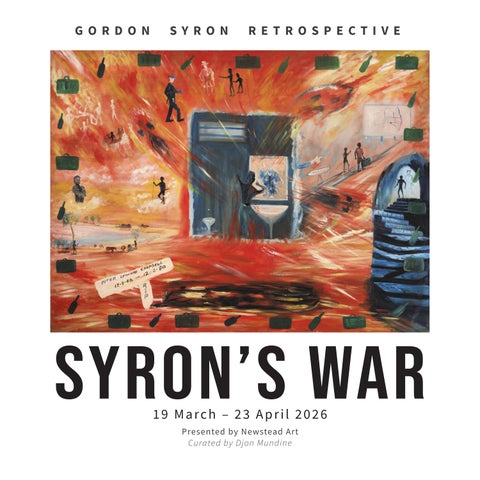
19 March – 23 April 2026
Presented by Newstead Art
Curated by Djon Mundine
19 March – 23 April 2026
Newstead Art
31 Lamrock Ave Bondi Beach NSW 2026
OFFICIALLY OPENED BY Professor Jason Rudy
University of Maryland, Syron’s Biographer
CURATED BY Djon Mundine OAM
MASTER OF CEREMONIES
Dr Jeff McMullen AM
CATALOGUE ESSAYS BY Djon Mundine OAM &
Adj. Prof, Margo Ngawa Neale
Emeritus Senior Curator/ Head Centre for Indigenous Knowledges
National Museum of Australia
ACKNOWLEDGEMENT OF COUNTRY
Kacey Blakeney
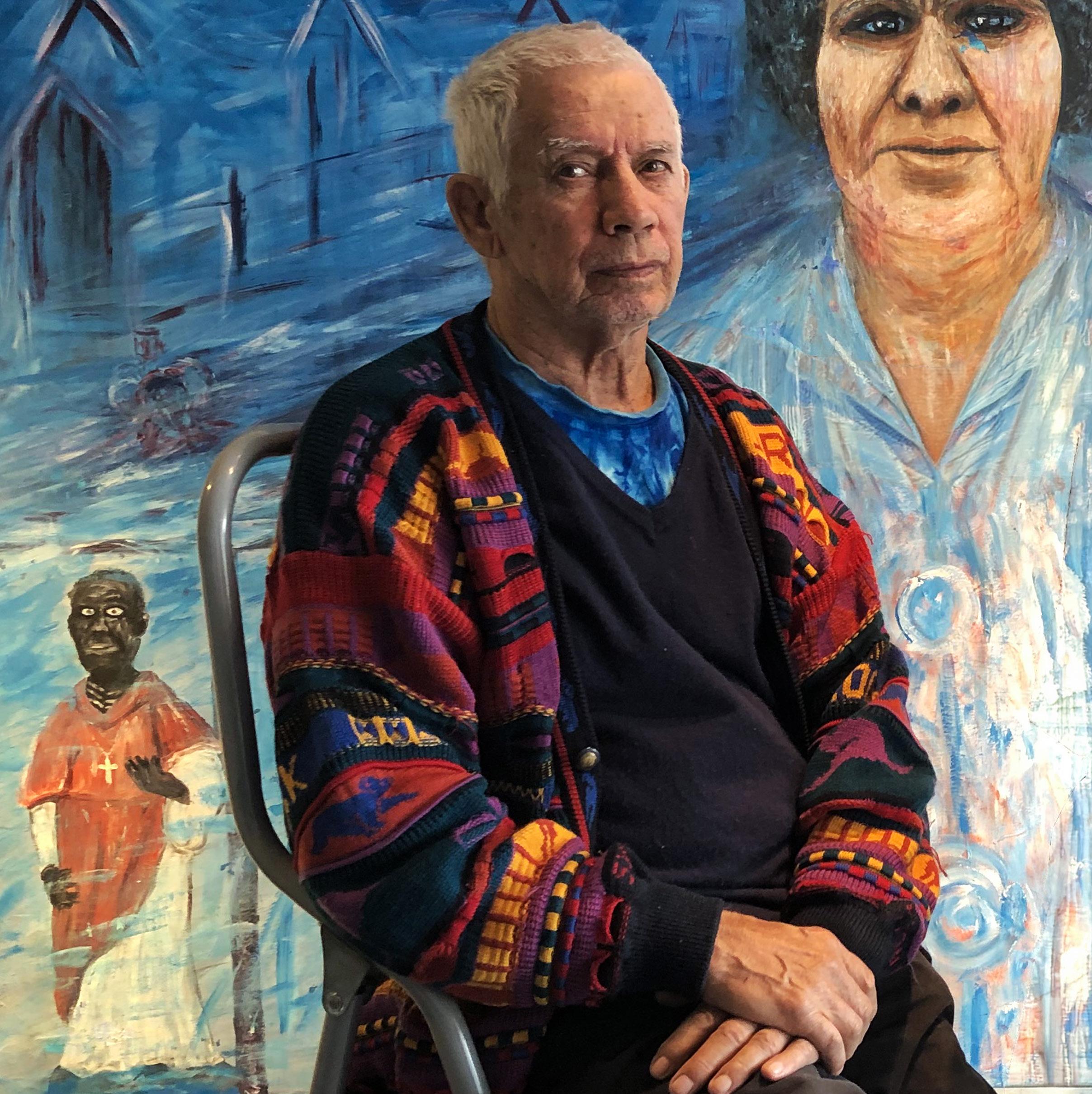
The Black Bastards are coming, beware the Fairies
Emeritus Senior Curator / Head Centre for Indigenous Knowledges
National Museum Australia
Once upon a time in an abandoned railway shed on the rail line facing Wilson St Redfern, a woman slept on a floor-bound mattress sheeted in totemic red, black and yellow. The kindly face of the legendary Mum Shirl, in an aura of blue, loomed large above her head. At her feet, was the mythic songman David Gulpilil. Statuesque in posture, his body glistening, his muscles flexed, poised to dance clad only in a naga.1
On the right side of the woman was a forest full of ethereal fairies wafting through the bush, spirits of the land. On the left was a fleet of tall ships unloading their human cargo of ‘red coats’ with loaded muskets, onto the shores of Botany Bay, surrounded by natives scurrying around in shock and wonderment. In this song cycle, the naturally white skinned ‘red coats’, were painted black, and the bodies of the scurrying natives were white.
1 Gulpilil was both a student in my class in Maningrida in the early 1970s and a clan friend. His portrait was entered, but not hung, in the Archibald Prize in the Bicentennial Year, 1988.
Humour is the deadliest weapon for oppressed people the world over and role reversal the most effective for putting others in your shoes.
‘Curiouser and curiouser…’ exclaimed Alice (in Wonderland).
That woman was me, and the visions surrounding me were a representative repertoire of Gordon Syron’s paintings. It was no accident that it was those visions, in that order, that were arranged in this way, in that place, at that time. He was strengthening me for his enduring campaign to save his (and wife Elaine’s) collection for a blakfulla keeping place, and to help me choose paintings to acquire for a public cultural institution for the first time. This collection remains the only collection of Aboriginal art for Aboriginal people, by Aboriginal people, in Australia.
On this occasion Gordon choreographed the main subjects that had preoccupied him especially for me (his number two wife as I was playfully referred to, blakfulla way). He was so attentive, he personally hand washed the bedding and made up the mattress in this sleeping nook where he carved out a space amongst hundreds of boxes of photographic archives belonging to Elaine (wife number one), where I regularly camped while working with them.
The leaky railway shed of some 1500 square metres was chocka-block, floor to ceiling, packed with artworks from Arnhem Land, the Kimberley, and the deserts, islands, cities and towns where Aboriginal art was made around Australia. I could find myself face to face with a stuffed crocodile rammed against a group of didgeridoos standing, cheek by jowl, with master paintings. Some were his own, while others he’d swapped with artists such as Karla Dickens, Gordon Hookey, Christine Chrisopherson, and Blak Douglas. There were works from some of the founding members of Boomalli (1987)2 including Jeffery Samuels and Euphemia Bostock. A unique historic survey of the five decades of what became known as Aboriginal ‘art’3 enveloped me in that keeping
2 Boomalli is a Sydney-based Aboriginal artists cooperative founded in Redfern by 10 Aboriginal artists 1987.
3 Aboriginal art only emerged as an acceptable category in the 1980s after previously being viewed as either artefact from remote areas or as ‘transitional ‘inauthentic Aboriginal art’ from urban and rural artists.
place - an Aladdin’s cave of deadly delights.
Gordon and devoted wife Elaine Syron (Kitchener), a photographic documentary artist of note, lived in that rail shed for a period with their burgeoning collection. They lived rough to remain with their proto museum of Aboriginal art though this was only one of the many stopovers on their peripatetic journey.
At the time, Gordon Syron was best known for his prophetic and iconic painting, Judgement by his Peers, (1978) which was first exhibited at Murraweena, Everleigh St, Redfern under the title of The Real Australian Story, while he was serving a life sentence for murder.4
As he tells it, he graduated with first class honours from ‘Her Majesty’s Royal School of Art,’ in reference to his prison experience and his introduction to art when an inmate in Long Bay jail. What stuck in his craw most was not the guilty judgment per se, but how it was arrived at. He was judged by the enemy, the dreaded ‘red coats’ and not by his black peers.
4 After decades of attempting to sell the iconic painting, Judgement by his Peers, at a sum deemed to be appropriate to its historic and political significance, was considered too high in the marketplace. It has finally found a home at the National Gallery of Australia, nearly 50 years since it was painted.
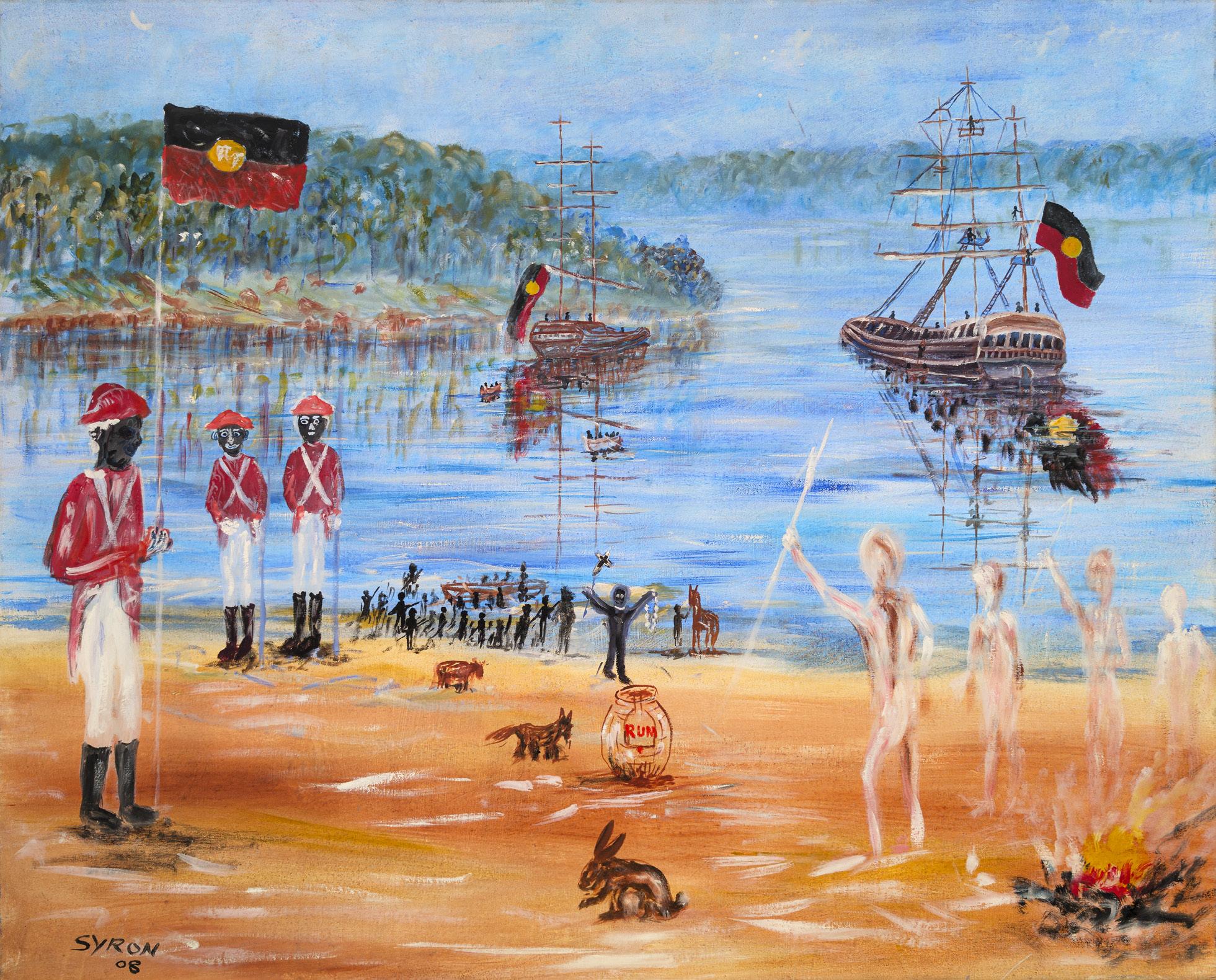
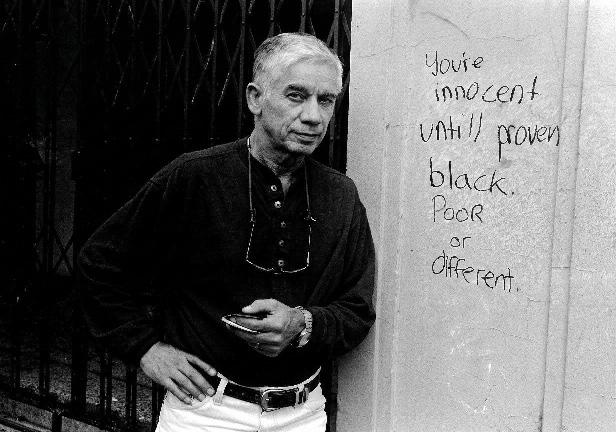
Syron’s preoccupation with the arrival of the British invaders, who he refers to as the ‘redcoats’, has persisted throughout his 40-year career. He depicts the eleven tall ships of the First Fleet hugging the horizon as spectres of doom. Long boats crowded with blakfullas in British uniforms give rise to his tongue-in-cheek expression ‘the black bastards are coming!’ As they approach and alight on their newly claimed land, they encounter the startled white indigenes on the shoreline. It provokes a response to the question: “How would you feel if our roles were swapped?”
From his first painting in the late 1970s to his last, with fire in his belly, Syron has maintained the rage. He has never succumbed to financial stress, market pressure, or changing stylistic taste as others may have , thereby assuring him of an unwarranted degree of invisibility. His uncompromisingly graffiti-like style incisively animates the surface of provocative works, often fuelled by anger. Syron’s work has always been about the message, not the ‘look’.
To be Aboriginal is to be political !
Adj. Prof, Margo Ngawa Neale
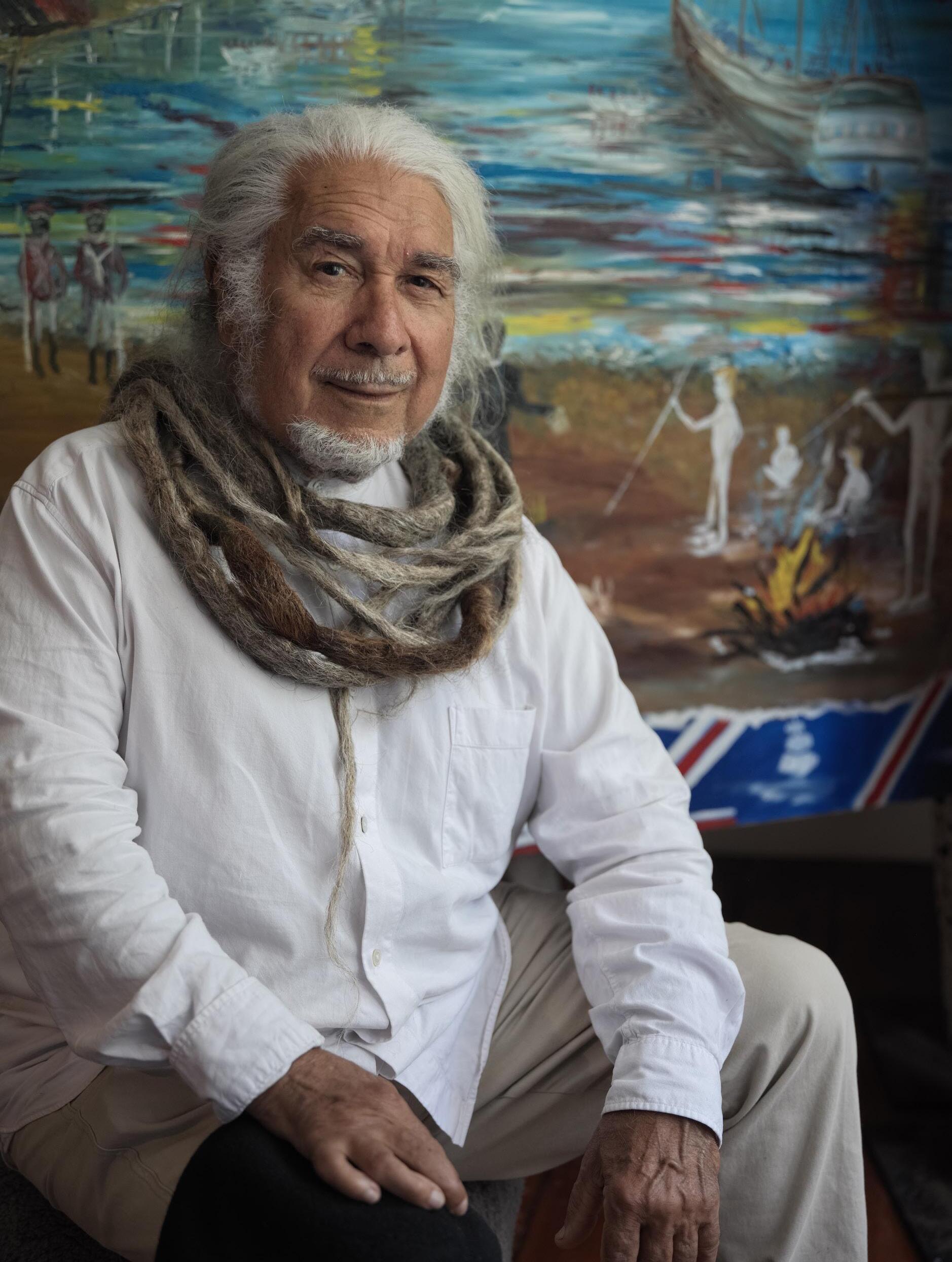
Djon Mundine OAM
Curator, author, artist and activist
I am the land I am the trees I am the river That runs to the sea.
Kevin Gilbert, Indigenous artist (1933-93)
This poem speaks to the unbroken ever-present connection of Aboriginal people with the land and all sentient beings. Whether fish and fowl, minute insects, trees, and the seasons, for us they are all part of the creative spirit.
Many creation stories feature a tree with its’ roots weakened by heavy rain. It topples into the floodwater and the floating trunk and branches are carried down to the sea, as death where one moves into a different realm. This act may also represent rebirth; a woman’s water breaking, and
the creation of new life. In my own Bandjalung story, that tree is a native fig.
Nga ba ya!
Ah is it so!
Kore wommang ke …?
Where is the man?
Kore yo!
Man away!
Kore wommang ke …?
Where is the man?
Kore yo!
Man away!
Nga ba ya!
Ah is it so!
Birapi lament sung by women recorded on paper by the missionary Threlkeld in 1830.
Gordon Syron was born in 1941 at Nabiac (Forster), the place of the native fig. It is a place in the Minimbah region of Biripi country on the mid-north coast of New South Wales, Australia, a place of many birds. A green-blue paradise still, despite some 200 years of British colonisation, theft, murder, and disempowerment of the Indigenous population.
The name Syron comes from Gordon’s Irish grandfather who settled on the mid north coast of NSW during the colonial settlement of the continent. Of mixed descent, his White Australian name, Syron, has several roots, but is primarily a shortened form of the Gaelic name Ó Sírín - associated with the motto “Hope and Justice”. Another root is found in a song-poem of a half woman - half bird being, an entangler of enchanting voices and mesmerising songs. Though Syron is of Irish and Biripi and Worimi1 descent, in the colonial environment in which his family existed during his youth, Aboriginal people were mere shadows with no legal status. He experienced discrimination as his Irish British rights were conveniently ignored.
Gordon Syron’s story has been told in other publications, notably in Vivien Johnson’s essay for the groundbreaking Koori84 – the 1984 Aboriginal art exhibition that heralded the
1 Biripi on his mother’s side and Worimi on his father’s side
urban art movement. A monograph on the artist, written by Syron’s biographer, Professor Jason Rudy, of the University of Maryland is soon to be published.
His life journey begins in paradise, on a dairy farm, on lush coastal lands, edged by sea. After hard work on the farm, he would fish and hunt in a rich natural environment of native game, fish and fowl. He was healthy, fit, and at home in a family of fifteen equally active, intelligent siblings.
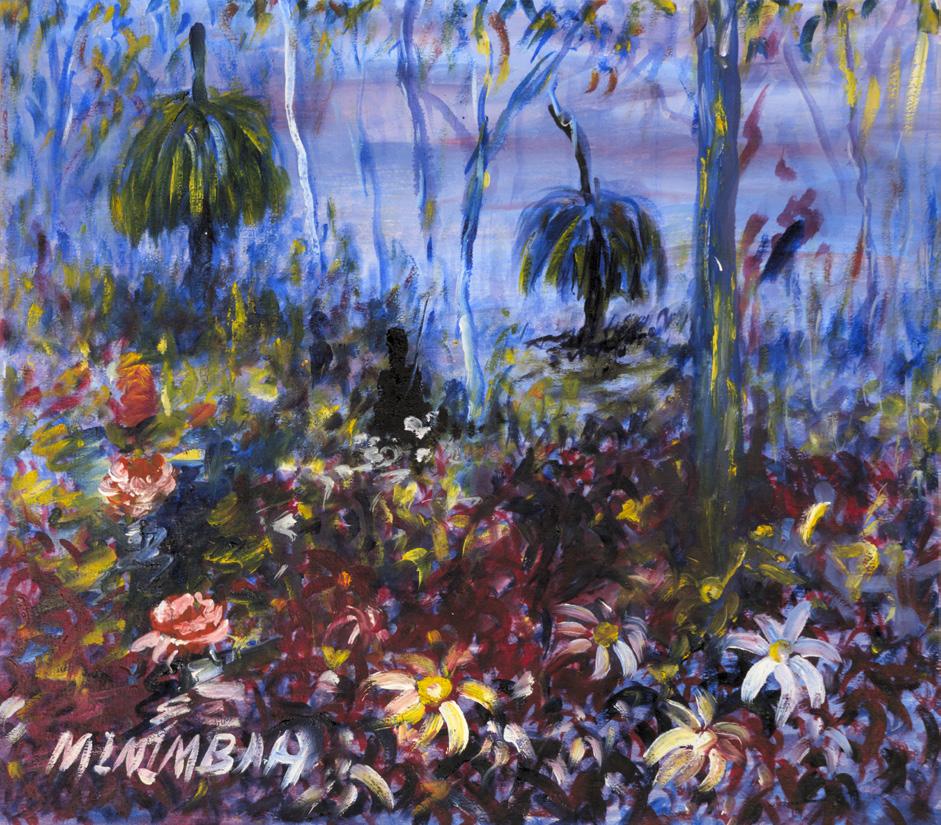
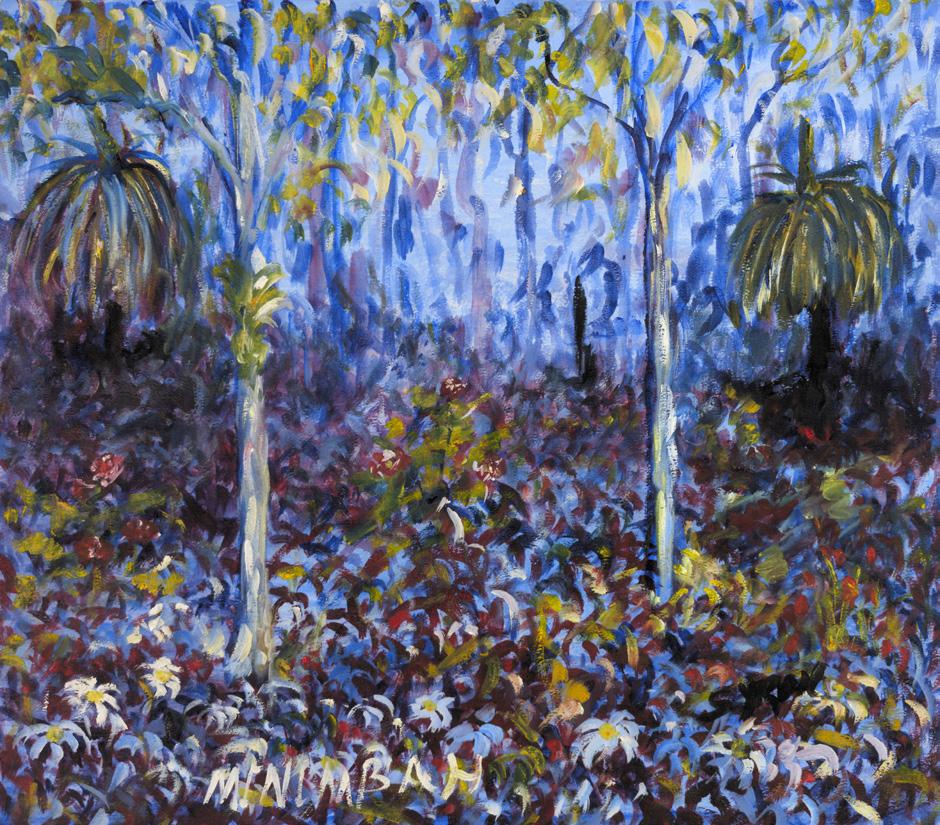
In a series of mid-career works, he visually describes the profusion of native flowers that would appear in the bushland of his youth.
‘When I was young I could lean off my horse and in seconds have an armful of breathtakingly beautiful wildflowers, I wouldn’t even have to get off my horse to pick them. This Land was sacred to me that is why I chose to paint about it.’
If you have been passing through the Swinging Gates
Chances are you have looked behind you And wondered where you are And wondered where you are
Tim Buckley, Dream Letter: Live in London, 1968
In 1972, everything changed when Gordon’s uncle-in-law died. As Aboriginal people had not been permitted to own land when the family acquired the farm, it was purchased in the name of the white husband of Gordon’s father’s sister. Oral promises and a will made clear that the Syron family were the rightful owners, having paid for and worked the land. Although the law had changed by this time, they were swindled out of it by the uncle’s white adopted son and his mother, who altered the will so he became sole inheritor and immediately put the farm up for sale. Facing eviction from their 3,000-acre paradise, Gordon’s older brothers decided to
seek retribution. As Gordon was the eldest son without a family of his own, he was chosen to be the avenger, and he subsequently received a life sentence.
The irony of Syron’s court case and sentencing was that it occurred at a time of change in awareness of the very elements that had robbed him of his own freedom. In the late 1970s Aboriginal people had begun to find a voice through art with the stirrings of the incipient Aboriginal art industry. The power of Indigenous art of all forms including painting, song, and dance was gaining recognition.
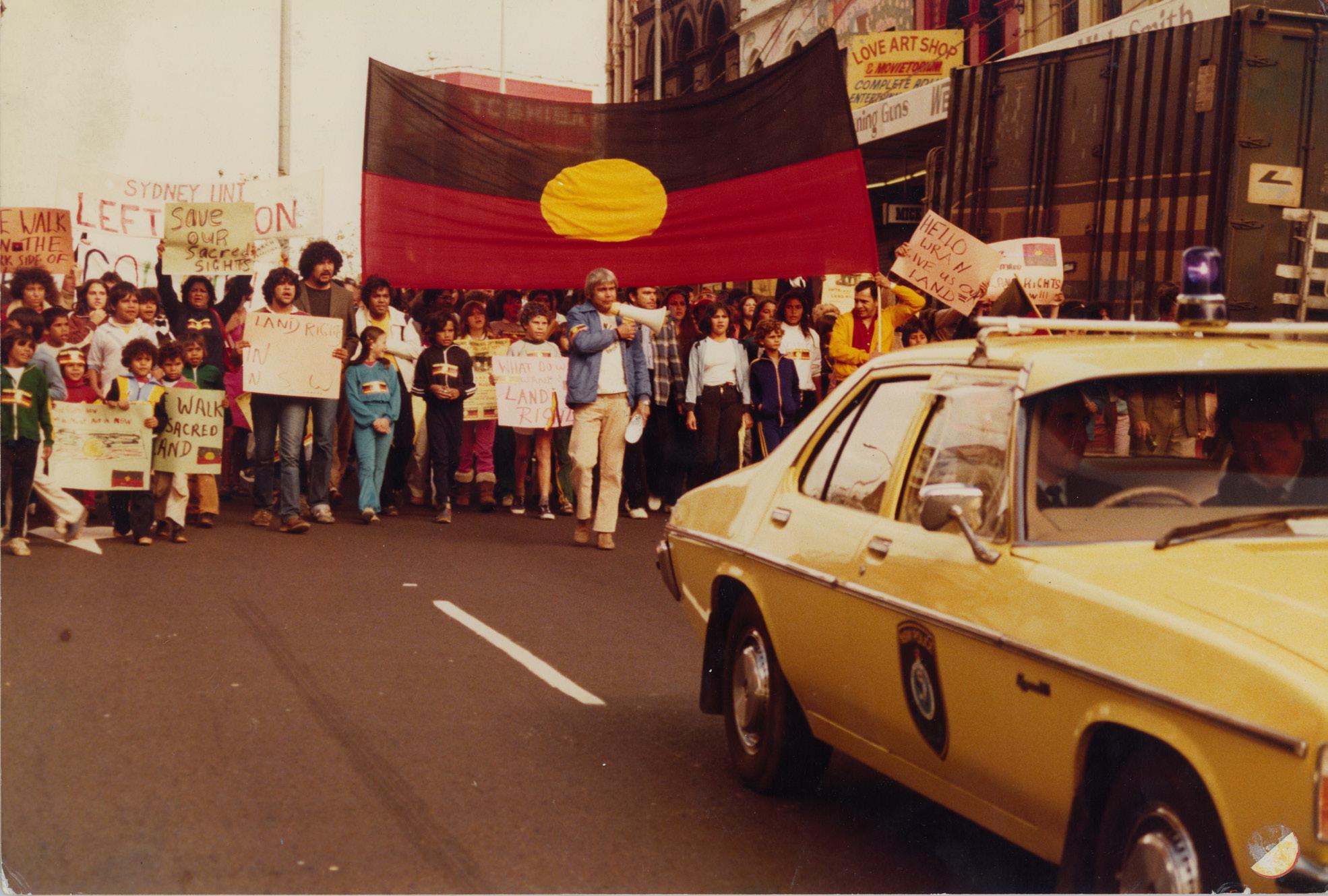
Land Rights March from Redfern down George St, c.1979-1980
© Elaine Pelot Syron
At the same time the movement for land rights peaked when the Northern Territory legally recognised Land Rights in the Act of 1978 paving the way for other gains in this area. A powerful blend of land and art fuelled Syron’s future as an artist. An early example was set when artworks were used to claim Aboriginal land rights during the 1960s. The Yolngu of Yirrkala in eastern Arnhem Land, presented their statement of land ownership in the form of a set of small bark paintings to Federal Parliament. Meanwhile down south, a small group of Aboriginal activists established most powerful performance art creation when they installed the enduring Aboriginal Tent Embassy at the front of Parliament House in Canberra 1972.
Gordon Syron went to jail, and re-emerged 10 years later with a new, powerful form of expression, giving him the ability to convey his anger and resentment with clarity and power through art. A much more persuasive tool than the physical expression of his anger. His painting, Judgement by His Peers (1978), originally exhibited under the title of ‘The Real Australian Story’, spoke to two clear forms of racism and injustice; displacement, and denial of identity. This is revealed in the story of a journalist who when touring with a white Australian artist through western NSW in the 1960s, published that the real Aboriginal problem of NSW was that they somehow survived the massacres and
other oppressions – it would have been better if they’d all been killed. The core point and key to understanding Syron’s signature piece was then, and it is still today, ‘identity’. What defines a person as Aboriginal, and what are our inherent rights under Australian law.
Having found his voice through art, and still hurting from the loss of family’s land to whitefellas, was a double propulsion. Gordon could now give expression to his political beliefs and make powerful statements to a willing and sympathetic audience, in most cases. His ability to move forward and not look back except to provide sustenance for his art resonates with the moral in French filmmaker Marcel Camus’ post-colonial version of the tale of Orpheus and Eurydice where Black Orpheus gets his desire on the condition that he must walk ahead into the world without looking back, maintaining patience and trust.
Throughout his 50-year artistic career, Syron’s imagery has progressed from realistic landscape influenced by Albert Namatjira and colonial artists; to stark and confronting political statement; followed by fantasy; and then largescale surreal pastiche. There is a progression that links these four major themes, or lines of thought, in his practice.
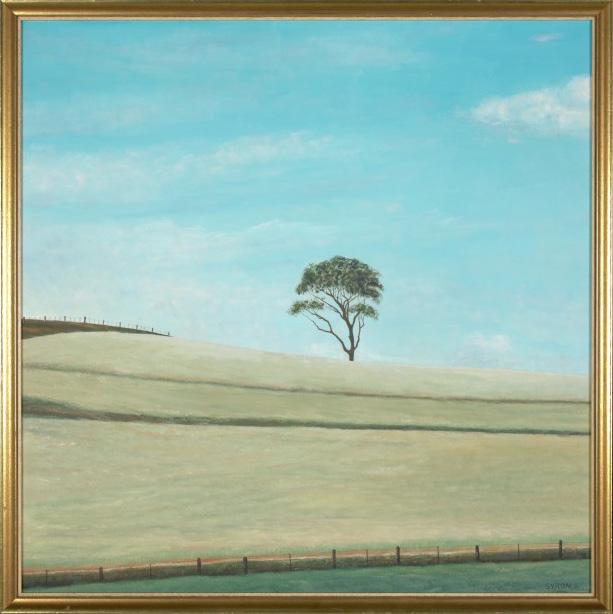
The first of these themes is pure landscape with naturalistic images in which peace, calmness and order prevail. These works exhibit gleeful wonderment in the environment - an Aboriginal spirituality in little insect like black fairy beings; the souls of unborn children perhaps. These morph into the little ‘black swan’ ballerinas. When the British and other Europeans came to the continent they found many contrary images – black swans, not white swans, and seasons in reverse for example. Never-the-less, these works are characterised by equality, fraternity and justice for all.
The second theme deals with the arrival of the British, and the violence that came out of the second phase of colonisation. Now, those almost ‘Irish-emerald’ green forests are hung with the ‘strange fruit’ of colonisation. Soldiers poisoning the waterholes. At massacre sites such as the Appin Massacre site, bodies of dead Aboriginal men women and children were hung in trees by the red-coated British soldiers as a warning to others. In this context Syron’s Emus (despised by the early colonists for destroying their crops) symbolise the Kadaitcha, the featherfooted guardians and avengers, responsible for enforcing tribal law.
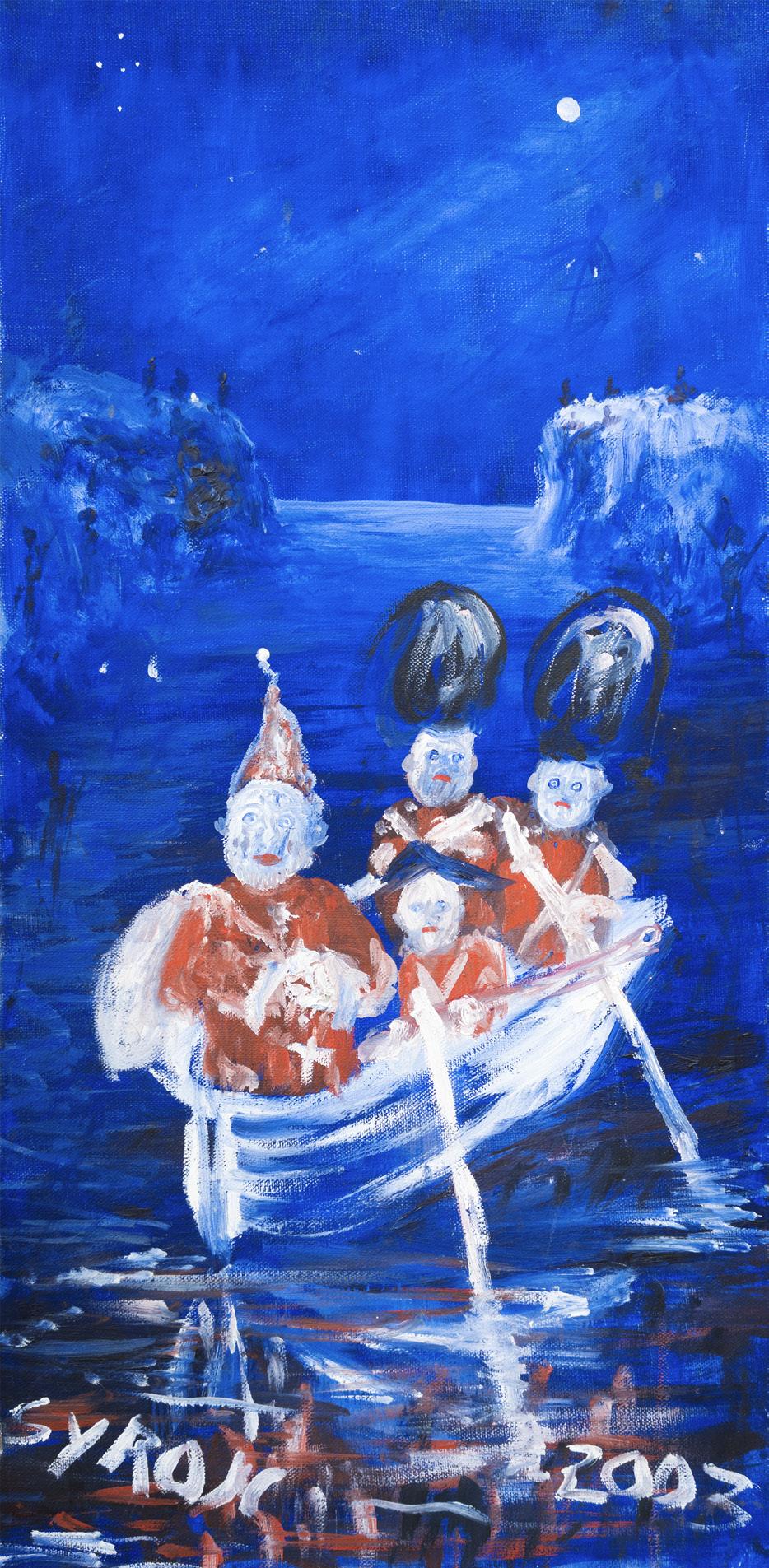
And then, there are those numerous compositions of the arrival of the ships into what is now Sydney Harbour and their red coated cargo, harbingers of colonial repression, and the theft of the land and its’ treasures.
Syron’s ‘peer’ portraits, referenced in his iconic painting, Judgement By His Peers, feature Aboriginal activists and cultural heroes such as renowned actor and dancer David Gulpilil, and the Warumpi Band’s singer George Rrurrambu, famous for composing My Island Home. The portrait of Mum Shirl speaks to her activism and advocacy on Indigenous incarceration, the removal of children, and black deaths in custody. At the 2024 Venice Biennale, the centre piece of Archie Moore’s epic family tree was a pool of over 500 reports on Black Deaths in Custody, still ignored.
The fourth and final theme in Syron’s oeuvre is characterised by large scale surreal images of frustration and attempts to maintain his sanity when faced with ongoing injustice and colonisation. It is clear Gordon Syron’s biggest war has been an internal one - a war within, and with himself.
7
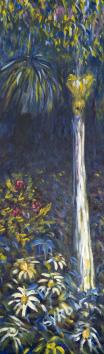
Red Coat Invasion, 2003 oil on canvas, 75 x 36.5 cm
Syrons’ paintings are commonly rendered in blue or its complementary colour orange. These are rarely used in traditional Aboriginal art where earth colours naturally predominate.
A senior linguist told me that in fact there was no word in any Aboriginal language for the colour ‘blue’ though, according to a New York survey of western tastes, found the colour blue to be the favoured colour in a painting.
It is a different story for Aboriginal artists in urbanised areas, many of whom went to art school and all of whom lived in two worlds and had access to the full spectrum of colours. Aboriginal artists including Bronwyn Bancroft and Gordon use blue to depict the sky, the ocean waters, and the blue of the Australian eucalyptus bush. Gordon has said that while ‘inside’ he painted with the blue sky appearing as freedom though a window to the outside world. But in his cell and within his own mind, powerful societal forces were at play. A chess game in which he is pitted against the power of the military, the church, and the moneyed class, in his arm wrestle with the world.
An Aboriginal life is one of contested identity. An enigma wrapped in a paradox and shrouded in a conundrum (a mystery-riddle). At various times I’ve run courses in several places of incarceration.
As an Aboriginal man in the contemporary art world your ideas and identity are often contested. Gordon’s work talks of this attack on his identity. And I thought, my classes were even more so.
So, I began every class with this African-American mantra as a whole group declaration.
I am Somebody!
I may be black, brown, yellow. I might be fair! I may be poor I may be in jail But I am somebody!
Djon Mundine OAM FAHA
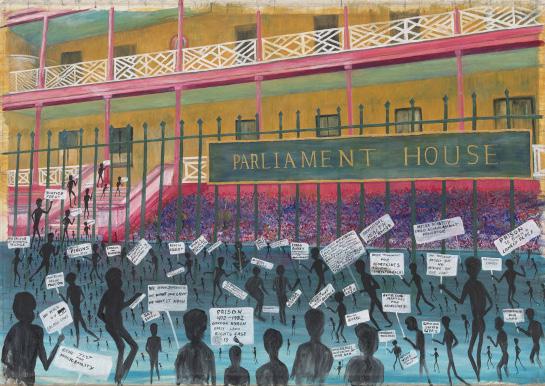
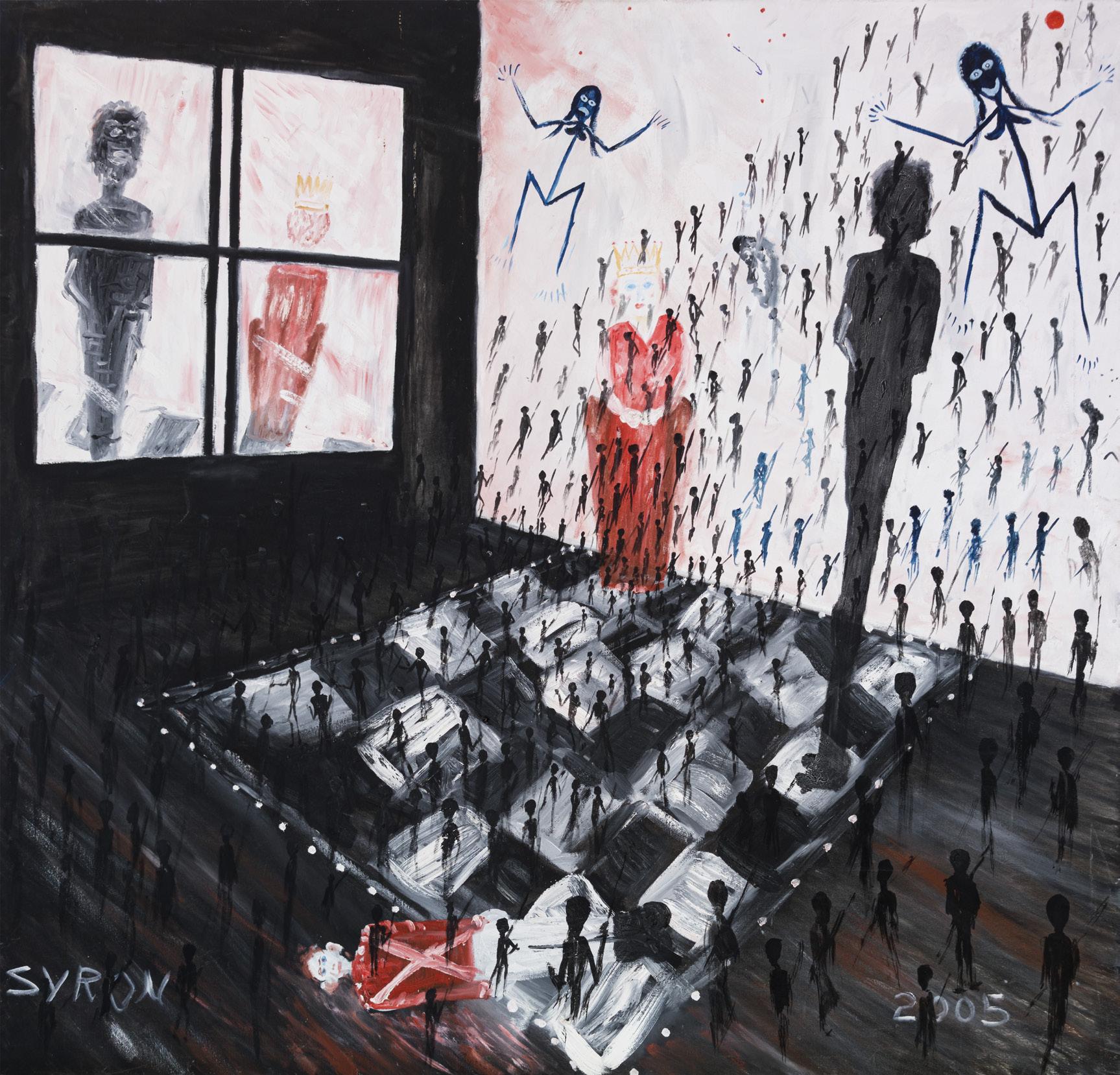
Meeting Place: Spirits of the Past and Present, 2005 oil on canvas, 148.5 x 227 cm
On loan from the National Museum of Australia
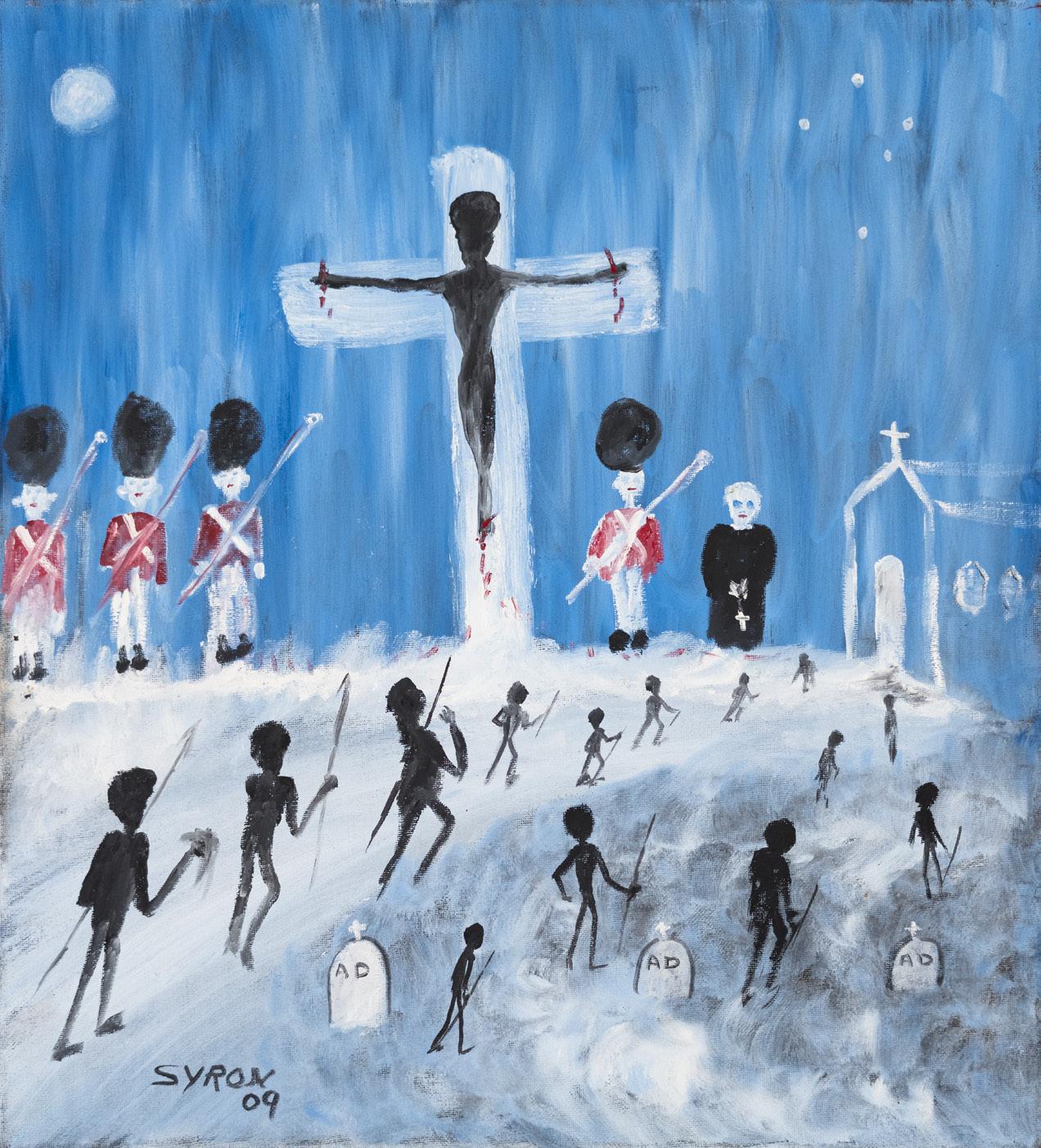
The Gender of God, 2009 oil on canvas, 50 x 45 cm
What is the gender of God? Is God a man or a woman? I ask is God black or white or pink or yellow?
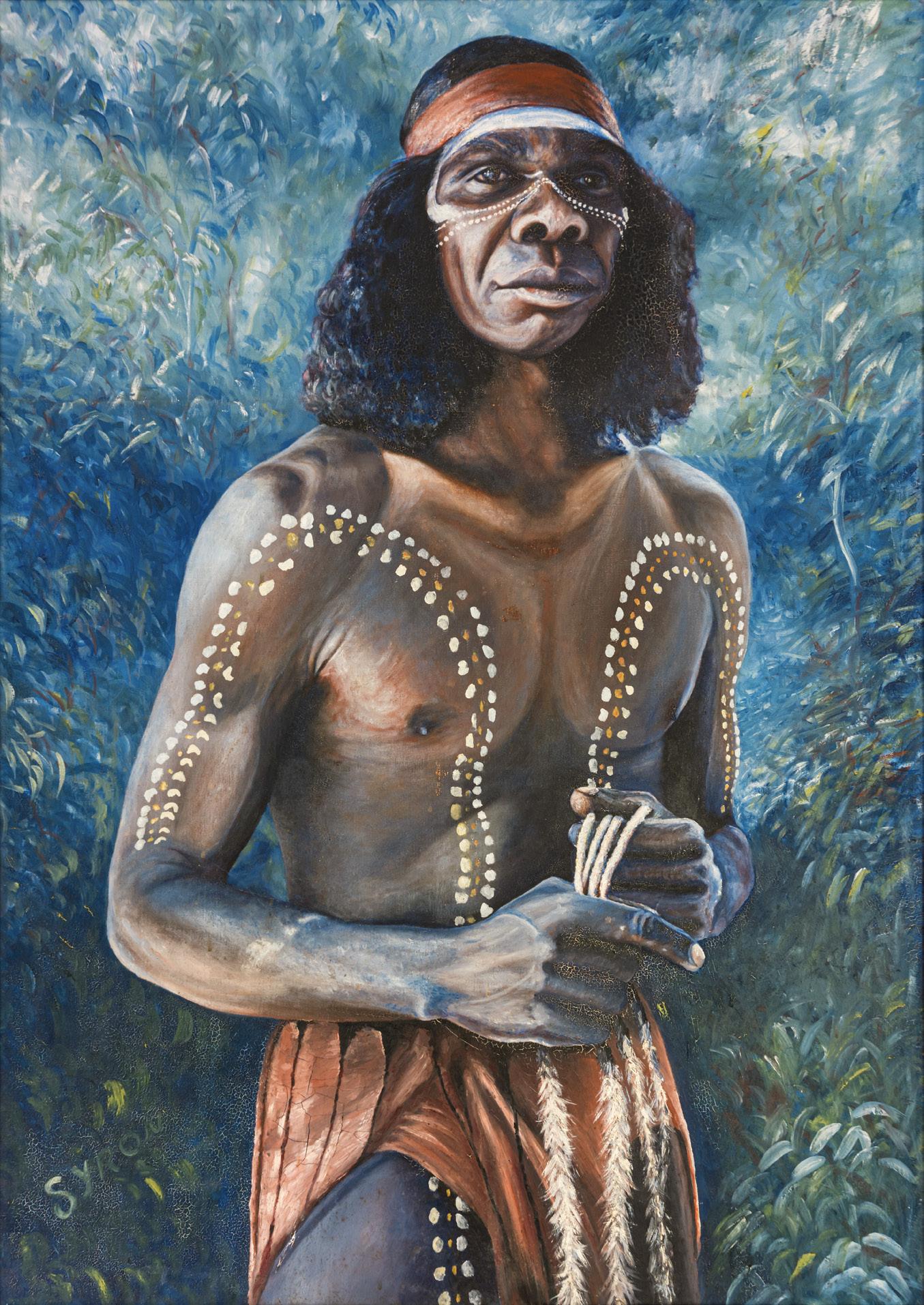
David Gulpilil AM, 1998 oil on canvas, 140 x 99 cm
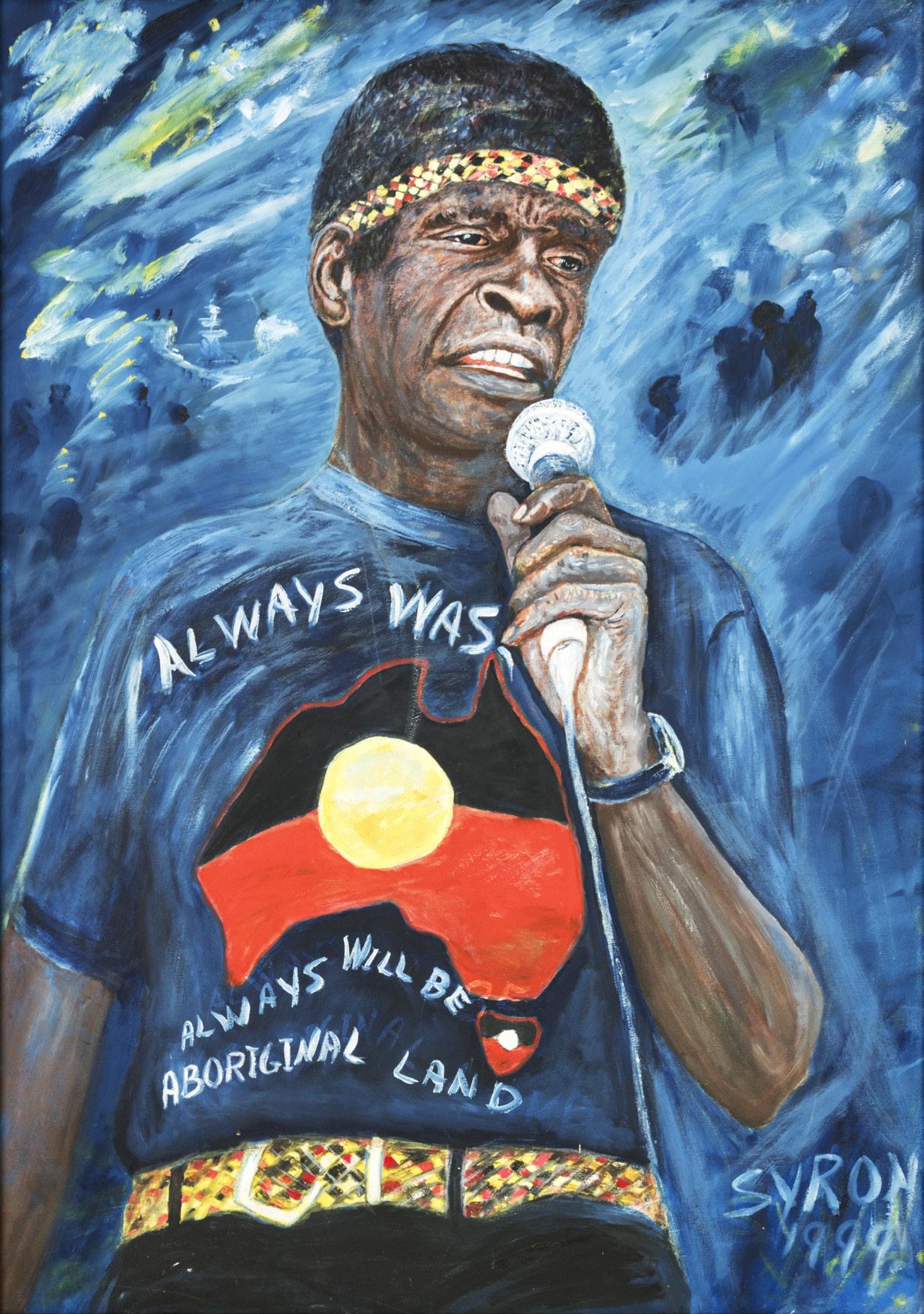
George Rrurrambu (Warumpi Band), 1999 oil on canvas, 107 x 76 cm
George was the front man of the famous Warumpi Band. Syron identified with his personal story of spending time in prison. Painted after George sang at Survival Day Concert January 26,1999. His shirt read ‘Always Was Always Will Be Aboriginal Land’.
12
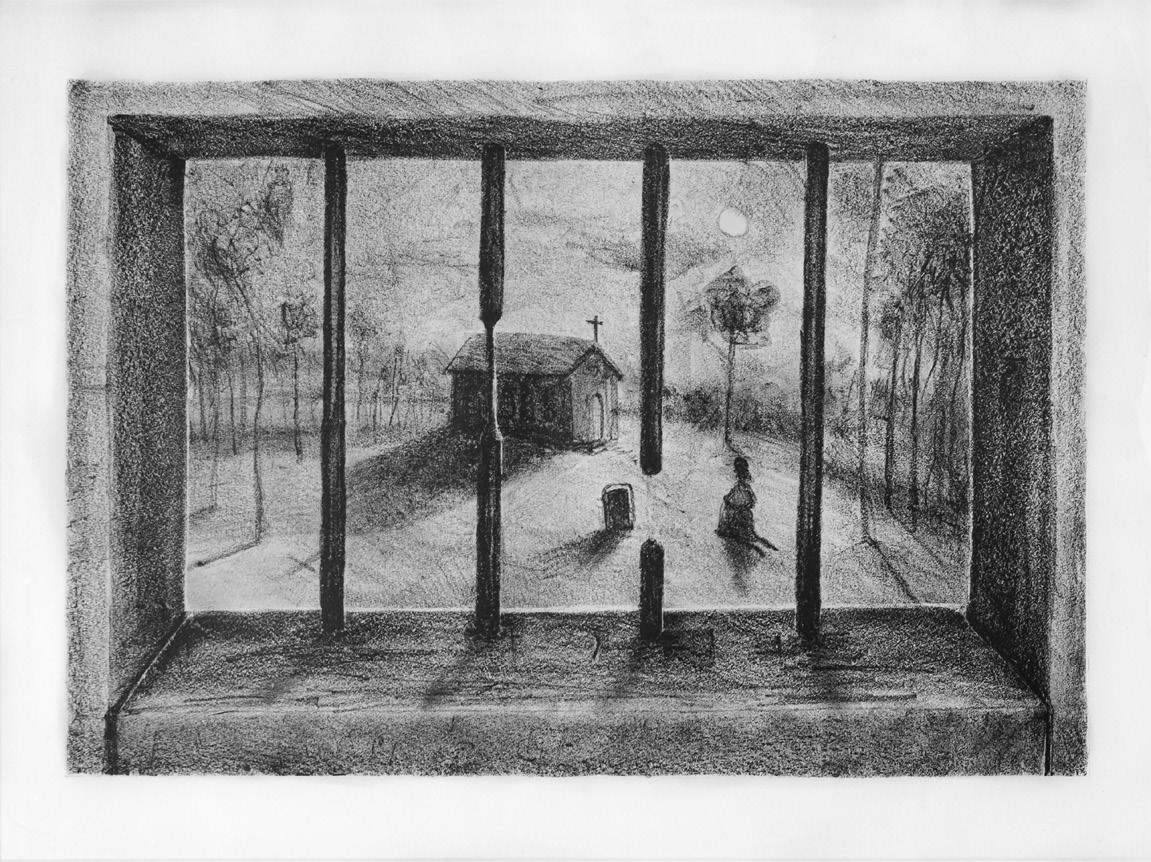
Bury the Living, 1993 lithograph, 58 x 76 cm
‘This artwork is unsigned because prison is such a lonely place. This is my prison window that I looked at for 10 years and I saw history through these bars that the redcoats brought to us; disease, rum, religion and death and destruction for my culture.’
Syron taught himself to paint during a decade spent in gaol in the 1960s. This lithograph represents his first experiment with printmaking.
Looking through the bars of his gaol cell window, he could see a church and graveyard — potent symbols
of Aboriginal dispossession and the death of culture — themes that recur throughout his work..
The metal bars are depicted with both an inner and outer layer. Like a person who survives terrible adversity while retaining their humanity, they appear soft on the outside but are case-hardened at the centre. There is no escape except through the imagination — a bleak thought represented by the gravestone that substitutes for the missing section of bar.
On loan from the National Museum of Australia
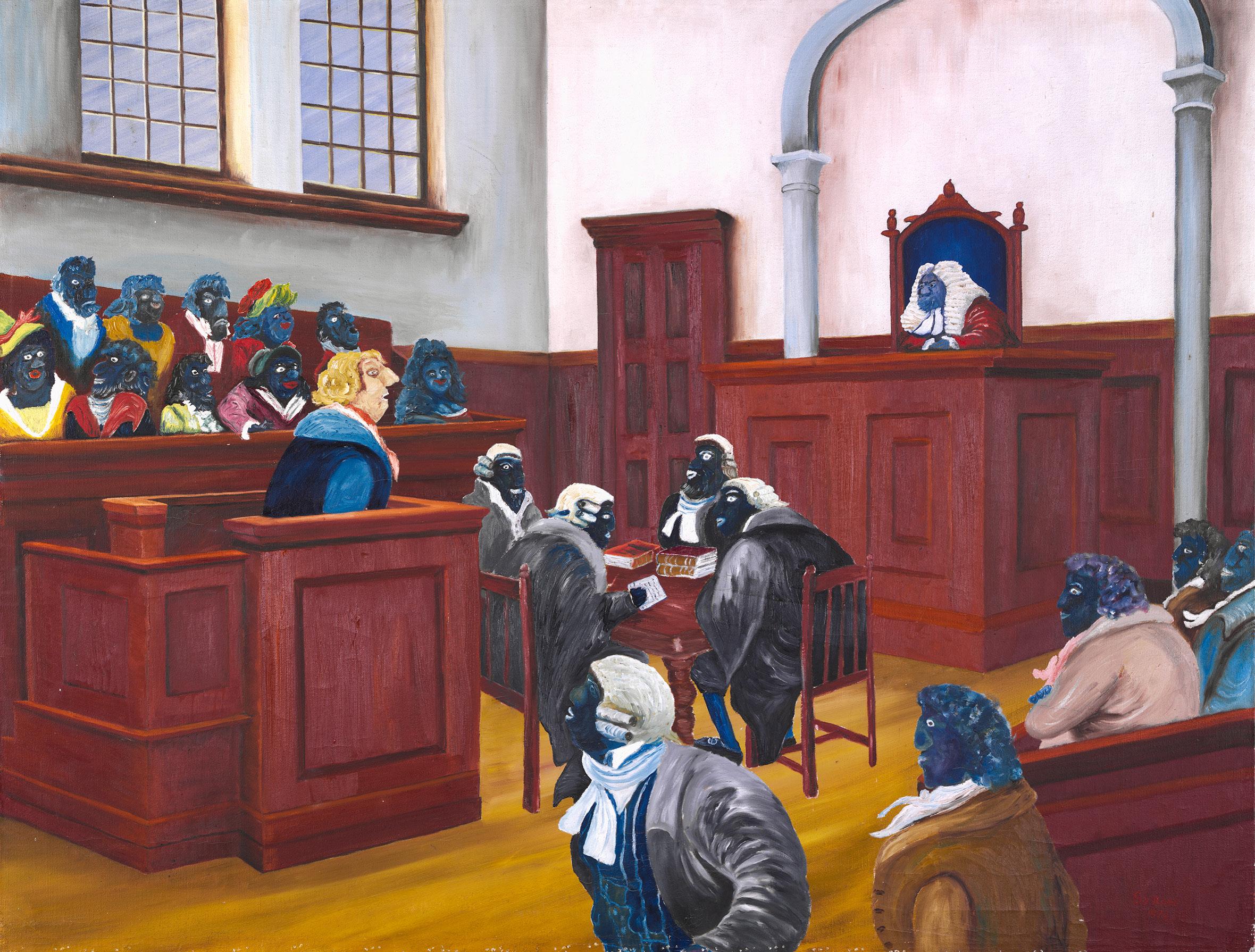
Judgement By His Peers, 1978 oil on canvas, 75 x 105 cm On loan from the National Gallery of Australia
This painting was created in Long Bay Gaol and first hung in the artist’s prison cell while he was serving a life sentence for a death that resulted from tribal retribution.
It was first shown publicly at Murawina (meaning ‘Black Woman’) — a childcare centre on Eveleigh Street, Redfern — in 1978–79. The exhibition was organised by three of the seminal women working with children on ‘the Block’: Mrs Bostock, Mrs Merritt and Mrs Ingram. The Block was a hotbed of political tension at this time, yet according to the artist:
‘Not one car was touched. All who came were safe. Many law people attended. I came out of prison for the evening to attend my own art exhibition and a prison officer accompanied me. He said, “Just call me Jack for the evening instead of Sir!”’
The painting was initially exhibited under the title
The Real Australian Story. Reflecting on its subject, the artist later stated:
‘I believe I would not have been sentenced at all, had I been judged by an Aboriginal jury. In British law a man is judged by his peers.’
In explaining the background to this work, Syron said:
‘This painting is my most meaningful work. It is the story of my life. This trial happened to me. I challenged the jury system of Australia. I asked that I be judged by my peers, and your peers are your equals. I asked to have some Aboriginal people on my jury. One lawyer said that I wasn’t black enough to be black and the other lawyer said that I wasn’t white enough to be white. They then argued this point in front of me for some time. Both my parents were Aboriginal. It was such an insult to me and my family. I was judged by an all-white jury. (If you are a pink fella then according to British law and now Australian law you are entitled to have a pink person on the jury.) I served a life sentence.’
The painting instantly struck a chord with Aboriginal audiences given the high rates of incarceration at the time.
Today the disparity has grown even more stark: Aboriginal people make up roughly one-third of the prison population in New South Wales while representing just over 3% of the state’s population.
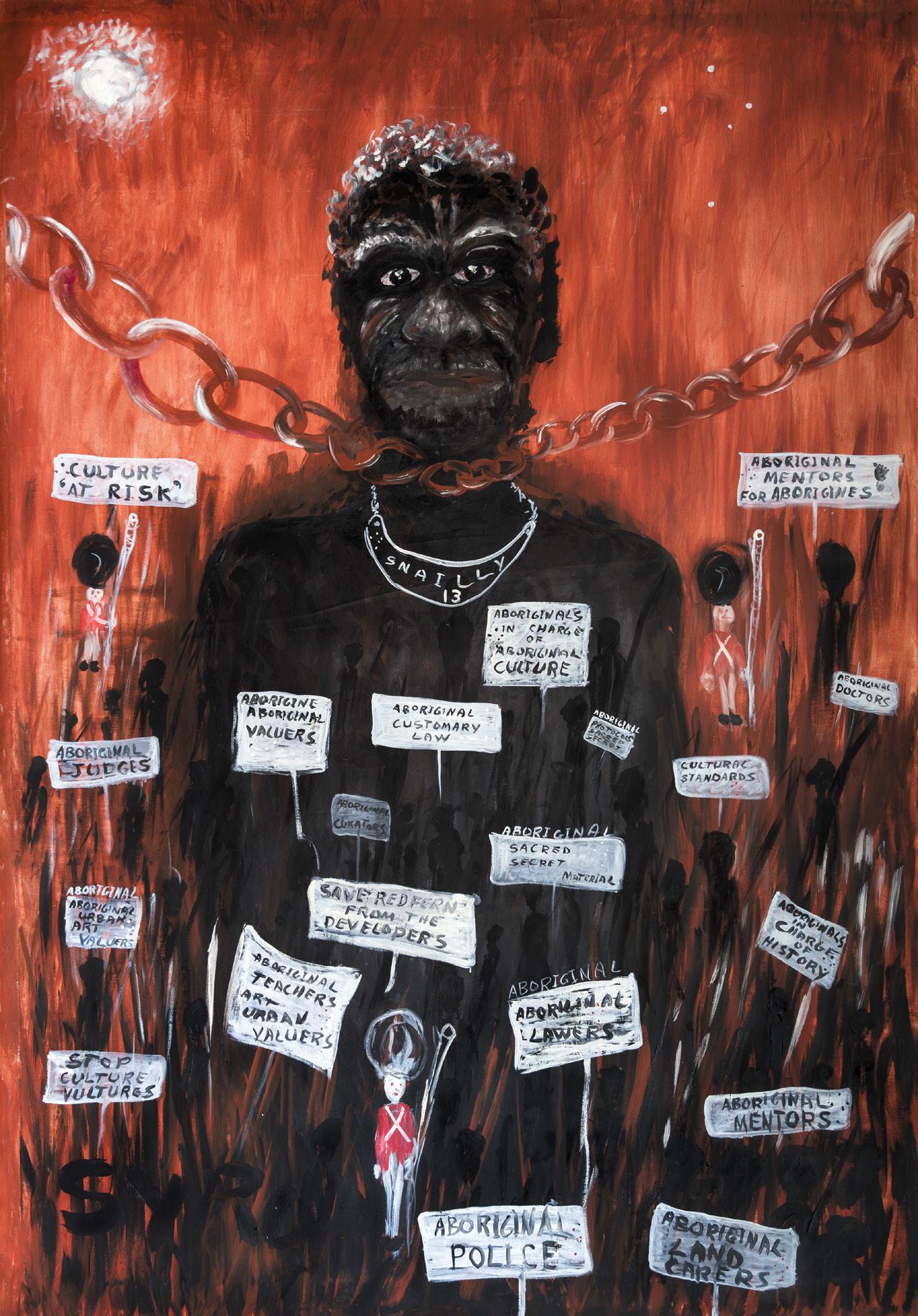
Snailly 13, 2007-08 oil on canvas, 202 x 140 cm
Exhibited in Black Deaths in Custody, Balmain Community Centre, 1993
The title of this self-portrait, Snailly 13, references a brass breastplate held in The Keeping Place collection, engraved ‘Snailly, King of the River Paroo.’ The number 13 refers to the prison identification number by which Gordon Syron was known during his incarceration — a system that stripped inmates of their personal identity and further dehumanised them.
At the centre of the composition is the artist’s own naked, chained body. The inscriptions painted across the figure function as both personal testimony and political commentary. The word ‘culture’ appears repeatedly, alongside phrases such as ‘Culture
Vultures’, referencing the colonial forces — often symbolised by the Redcoats — who first imposed physical chains on Aboriginal people and later more insidious mental and cultural restraints.
Painted messages across the body further articulate the artist’s vision for cultural self-determination. The phrase ‘Aborigines In Charge Of Aboriginal Culture’ calls attention to the many restrictions historically imposed on Aboriginal people—such as bans on speaking language, practising ceremony, or living according to traditional law. Through this declaration, Syron asserts the necessity for Aboriginal leadership in cultural, legal, and historical representation.
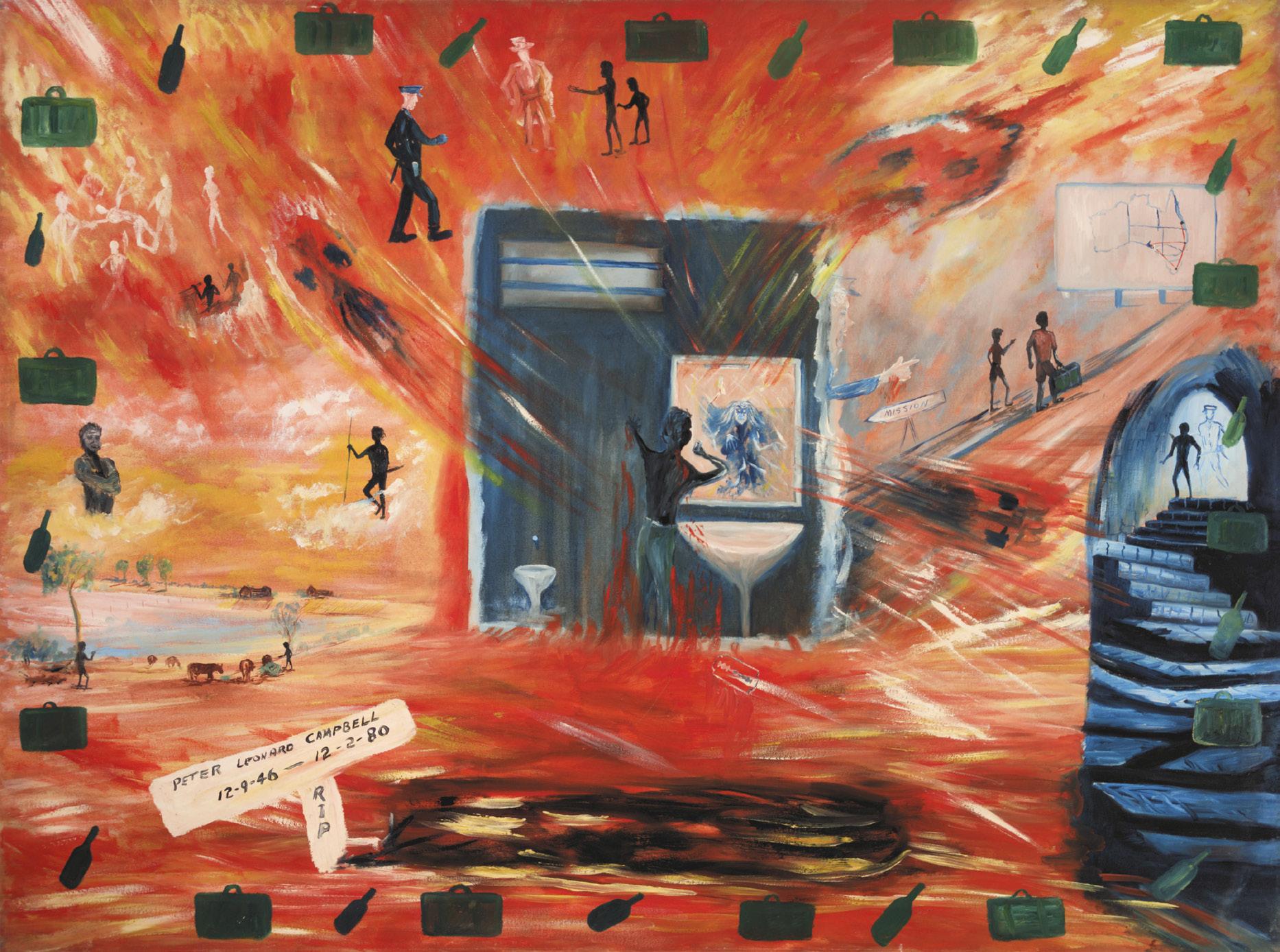
First exhibited in Black Deaths in Custody at the Balmain Community Centre in 1993 as part of a series of nineteen paintings, these works were inspired by the findings of the Royal Commission into Aboriginal Deaths in Custody. The exhibition was supported by the Aboriginal Arts Board of the Australia Council.
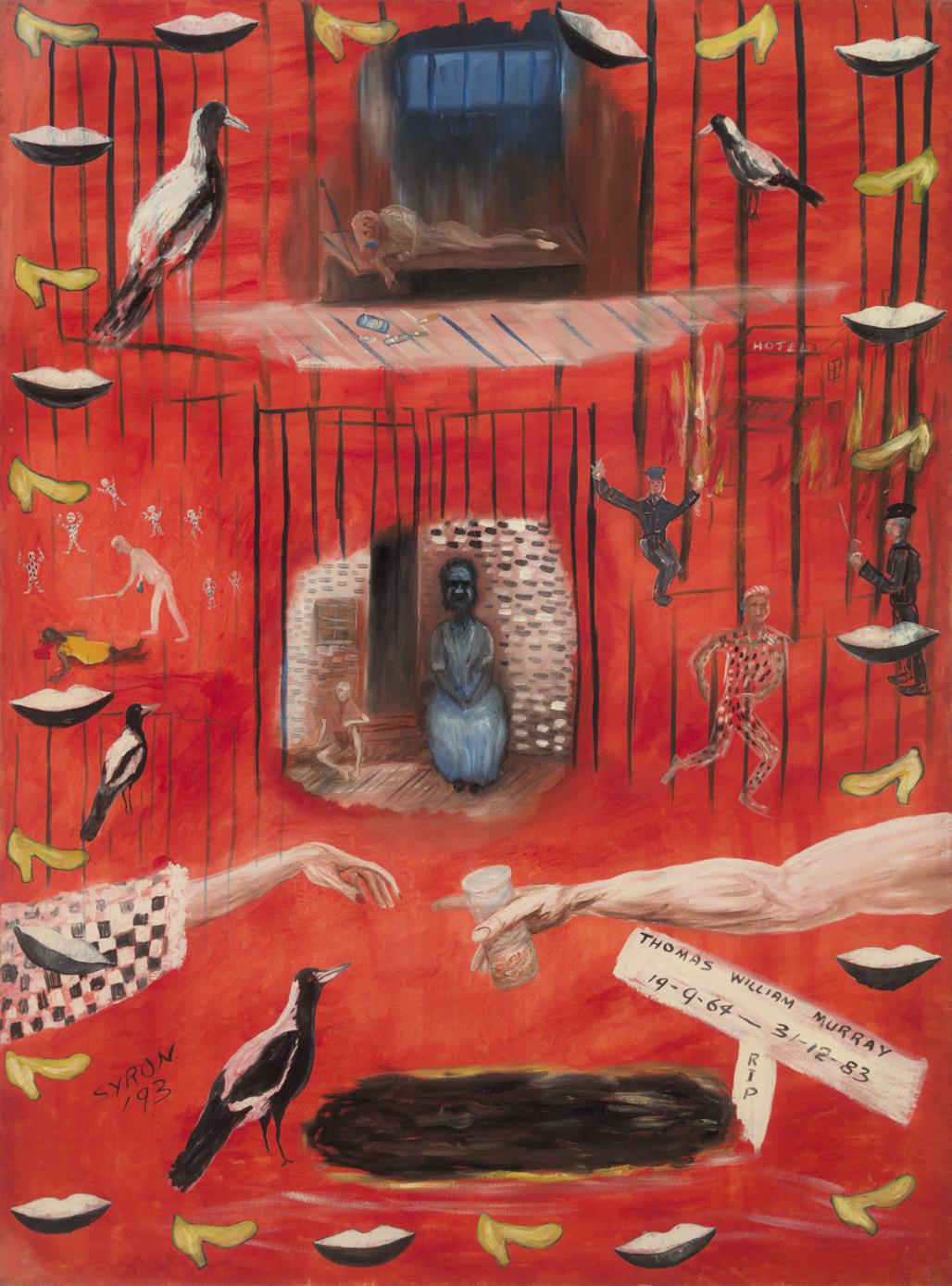
Exhibited in Black Deaths in Custody, Balmain Community Centre, 1993
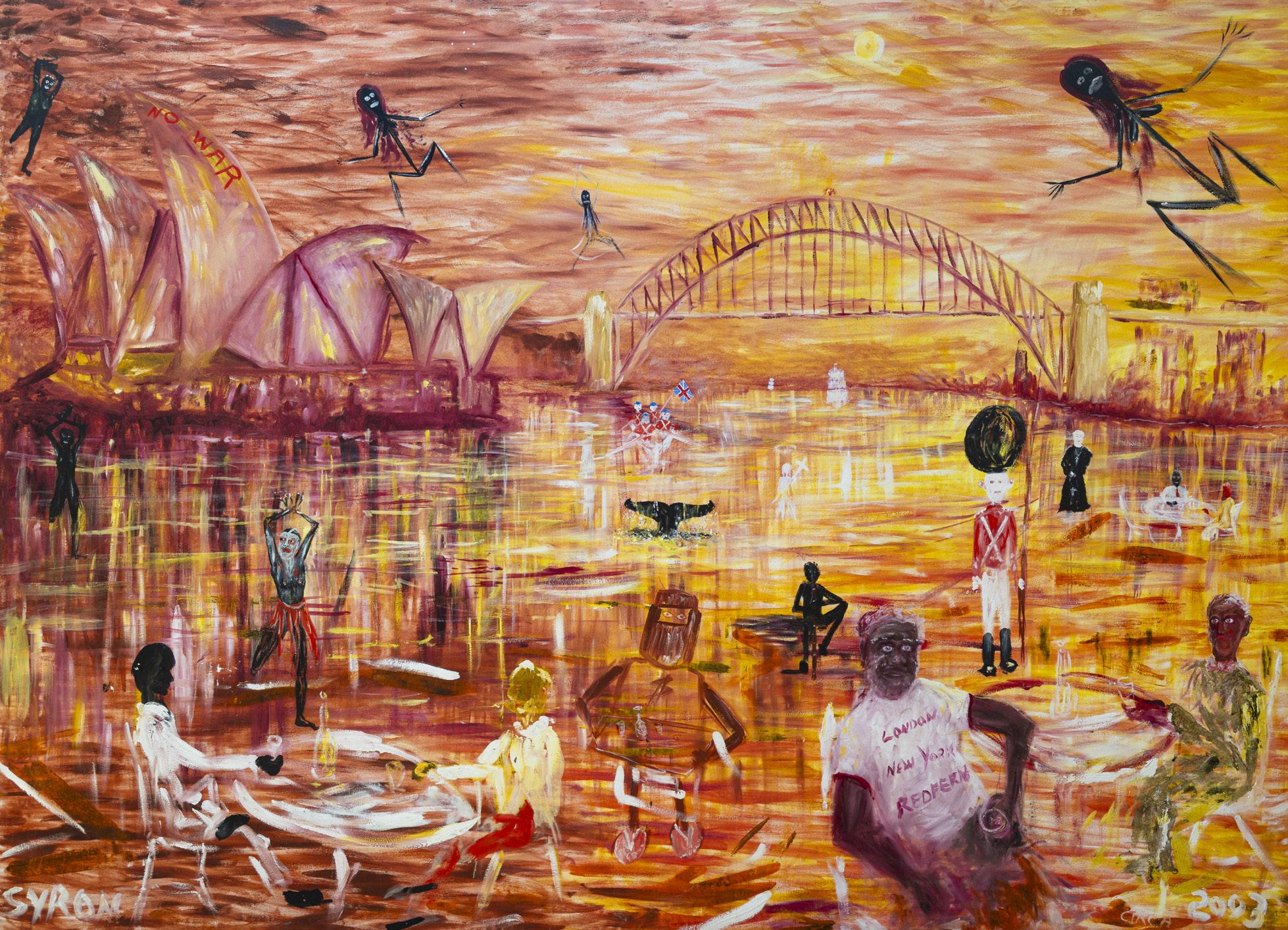
Sydney Harbour, An Aboriginal Perspective , 2003 oil on canvas, 172 x 235 cm
I live above my gallery in Redfern, only seven minutes by bus from the most beautiful harbour in the world. The year is 2003. Sydney — following the success of the 2000 Olympic Games — is a wonderful place to live.
The sunsets on the edge of Sydney Harbour are an artist’s dream. The orange and burnt yellow and the glowing ochres are imprinted on my mind forever. It is as if the clouds have opened and heaven has appeared
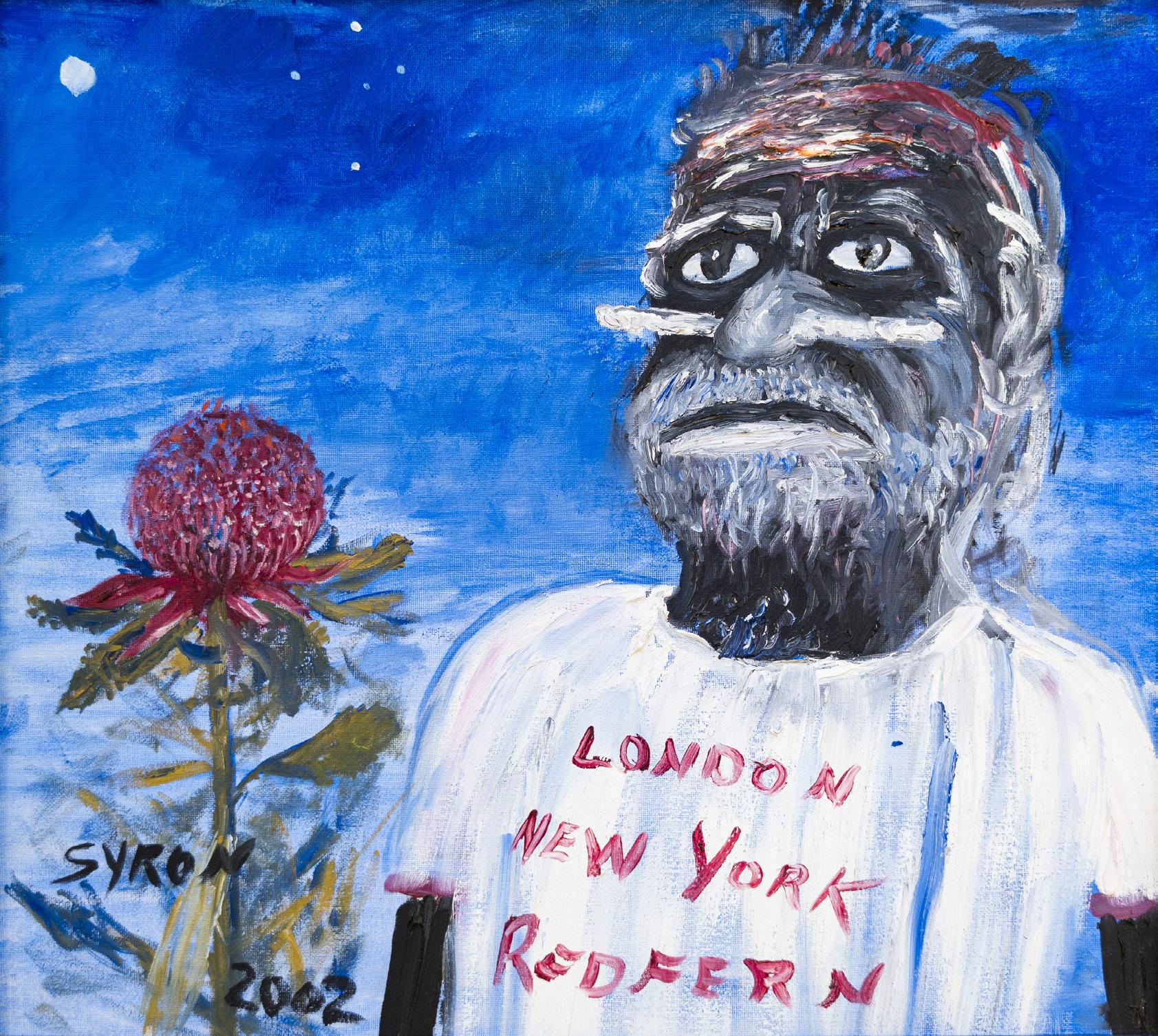
In the foreground of this painting is a self-portrait of myself and my wife-to-be the following year, Elaine. We are seated at a table with a cold drink in hand. Nearby are other tables served by Ned Kelly, one of our national icons. Aboriginal people dominate the scene. In the foreground is another table with Gary Foley sporting a shirt marked, London New York Redfern
I use this theme in my series of paintings to give credit to Redfern as the cradle — or the bridge — between the traditional Aboriginal community and my heroes, who in the 1970s and 1980s, established
the Aboriginal Legal Service, the Aboriginal Medical Service, Land Councils, Aboriginal Childrens’ Service, Black Theatre and Murawina.
In 2003 Sydney Harbour was still clean following the enormous clean-up undertaken for the Olympic Games, and a whale even wandered into the warm waters and performed for journalists and tourists in front of the Sydney Opera House.
That same year a brave soul climbed onto the top sail of the Opera House and wrote “NO WAR”. I was impressed. It was a death-defying act of passion and conviction.
On March 19, the United States declared war on Iraq and Australia followed, sending troops as well.
The Sydney Harbour Bridge is an Australian icon in it’s own right. A strong and beautiful dancer represents NAISDA and Bangarra. Friendly female Mimi spirits dance in the sky and the children are safe tonight. A pale moon is rising. The Redcoat stands guard, ever present since colonisation. The preacher man and others hover nearby, and the Holy Cross hangs in the background, always present.
A year earlier, in 2002, Chika Dixon, a respected Elder and activist, officially opened my museum in Darlinghurst on Oxford Street. Four generations of Chika’s family — Rhonda, Nadeena and her children — danced and sang on the street and into the gallery. It had been thirty years since I received a life sentence in the Darlinghurst Court across the street, next door to Clover Moore’s office.
Oxford Street is the centre of Sydney’s nightlife and the restaurants are packed. Darlinghurst is not far from the harbour. I grew up on the Coolongolook River, so I love the water and I especially love the most beautiful harbour in the world: Sydney Harbour.
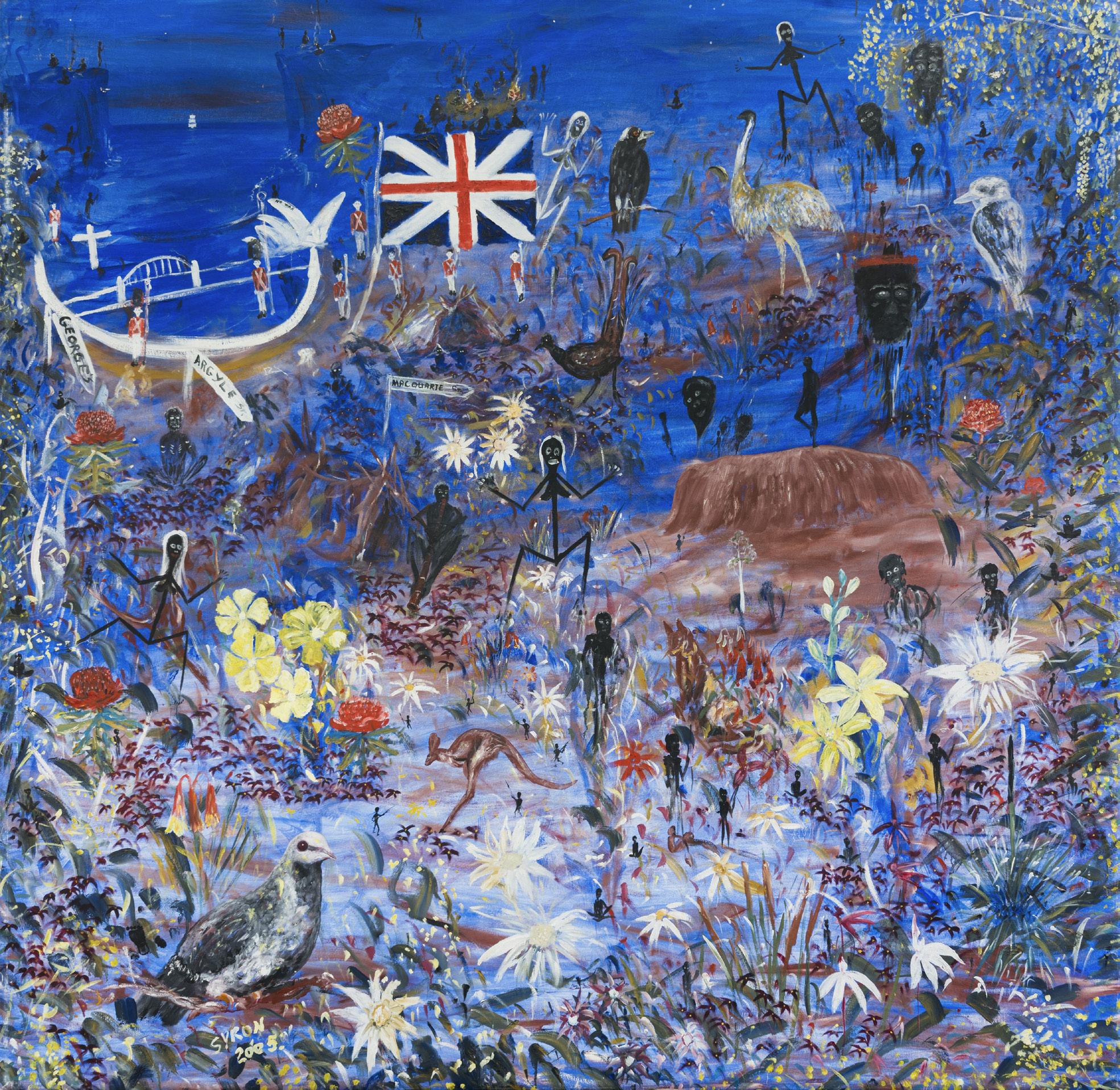
Invasion Day, 2005 oil on canvas, 173 cm x 173.5 cm
Depicted in the top left corner of this painting are miniature Redcoats, a cross (representing death) and the British flag, flanked by a Mimi Spirit.
As they advance from the North and South Heads of Sydney Harbour, past the Harbour Bridge and the Sydney Opera House, named streets lead to a gunyah — an Aboriginal dwelling.
Aboriginal people appear throughout the scene, alongside detailed birds and flowers. Waratahs, the NSW State flower, dot the landscape and flannel
flowers with delicate points droop across the terrain.
Ayers Rock, officially renamed Uluru in 2002, dominates the outback landscape and represents remote Aboriginal communities, accompanied by wildlife including emu, kangaroo and birds. Female Mimi Spirits take giant steps as they guard the sky.
This painting tells the story of colonisation, the dispossession of Aboriginal people, and how this beautiful land was cleared.
20
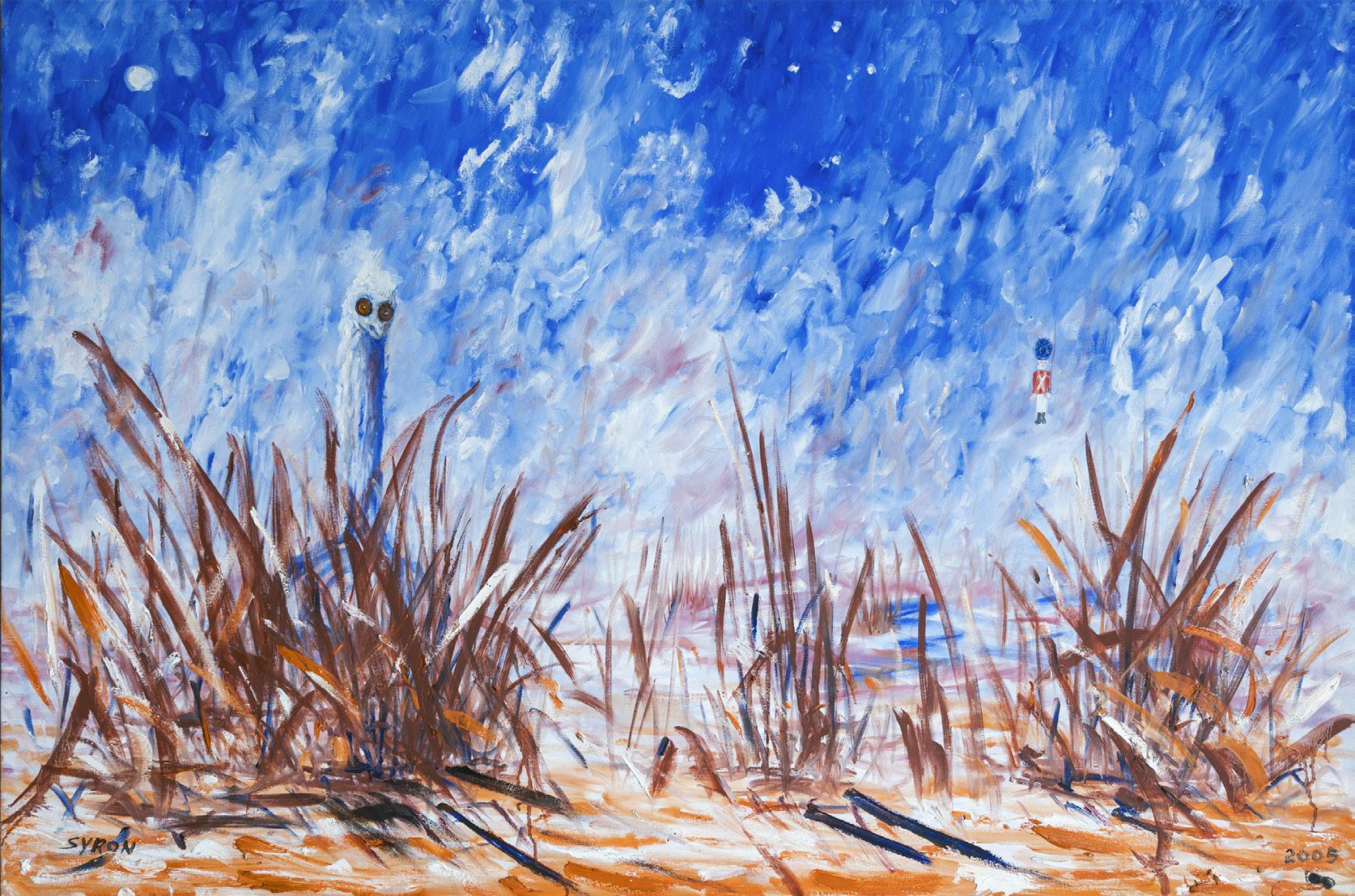
No Trees and Here Come the Red Coats, 2005 oil on canvas, 121.5 x 182.5 cm
No Trees & Here Comes The Redcoat is a cry for the environment. Australia’s fragile ecosystem depends on a delicate balance, and the clearing of the land and decline of native wildlife disrupted the Country on which Aboriginal people depended. Syron recalled his grandmother telling him that when she grew up around Forster–Tuncurry there were emus everywhere.
The emu holds an important place in Aboriginal culture. In some traditions the Featherfoot, or Cleverfoot, could carry messages between places, while the powerful Kadaitcha man — an enforcer of tribal law — was said to wear emu feathers on his feet.
In this way the emu symbolises both guardianship and the authority of Aboriginal law.

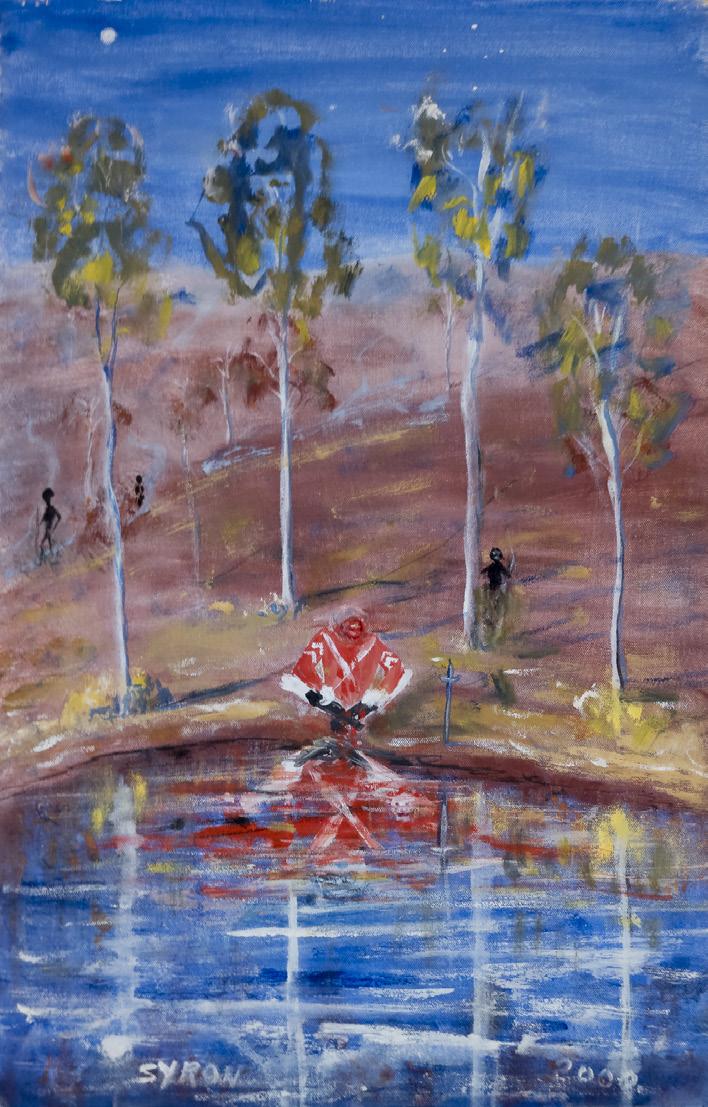
Poisoning of the Waterholes, 2000 oil on canvas, 49 x 31 cm
Aboriginal people gather nearby as the Redcoats invade and pour poison (arsenic) into their precious waterhole.
These paintings depict the colonial plan to do away with Aboriginal people so that squatters could take over the land more easily.
A sign was probably put up to warn other white men. But Aboriginal people, and the wildlife who depended on the waterhole, could not read the warning. In this way the poisoning of waterholes became an effective method of destroying the Aboriginal population.

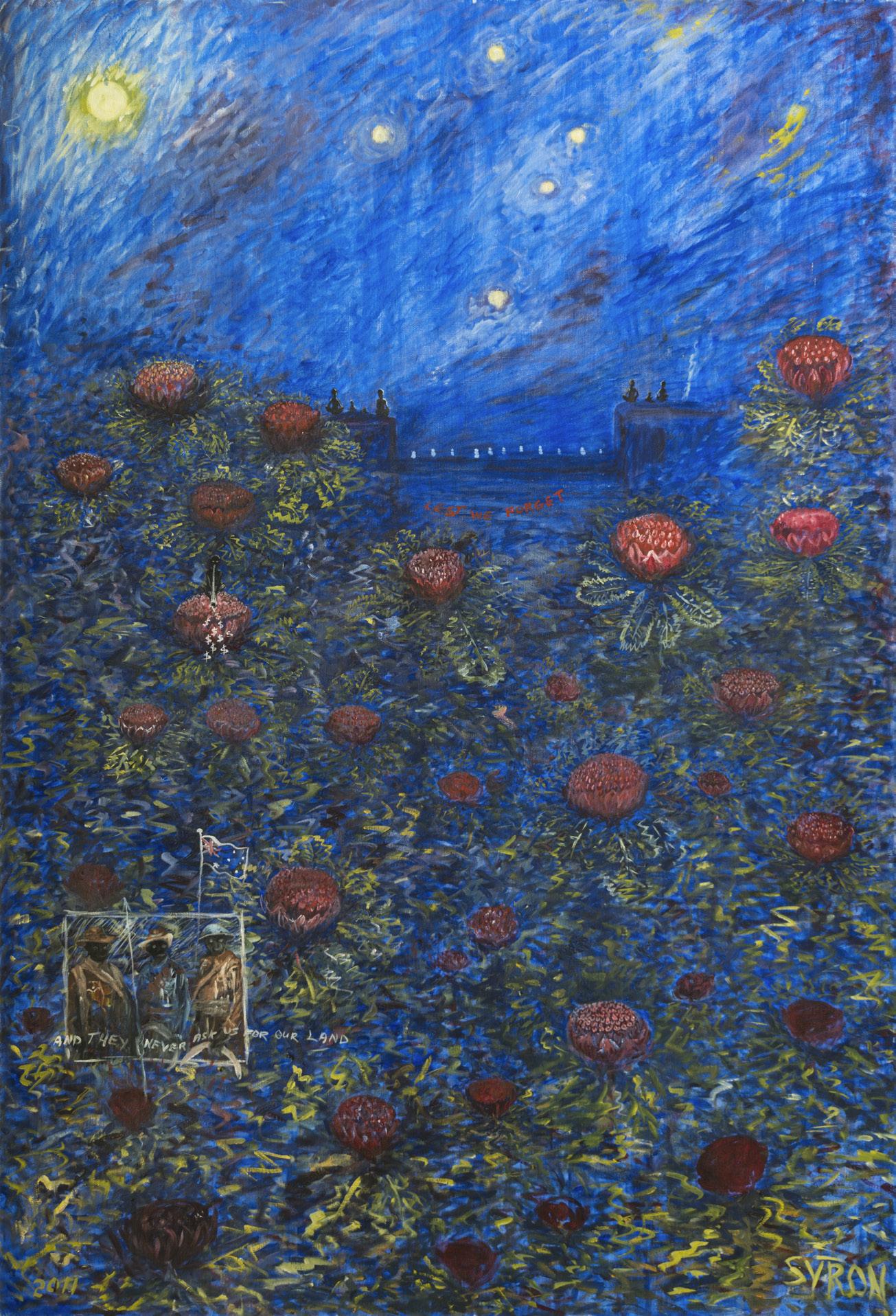
I grew up in a forest of tall trees where beautiful wildflowers were everywhere. My grandmother remembered when there were many waratahs in our forest. She also remembered how poachers came often and took them all to sell in Sydney. Soon there were no waratahs left in our forest.
I understood these stories because when I was growing up there were still beautiful wildflowers everywhere. That is why I painted the series Where the Wildflowers Once Grew — to remember and to explain what happened to the wildflowers and to
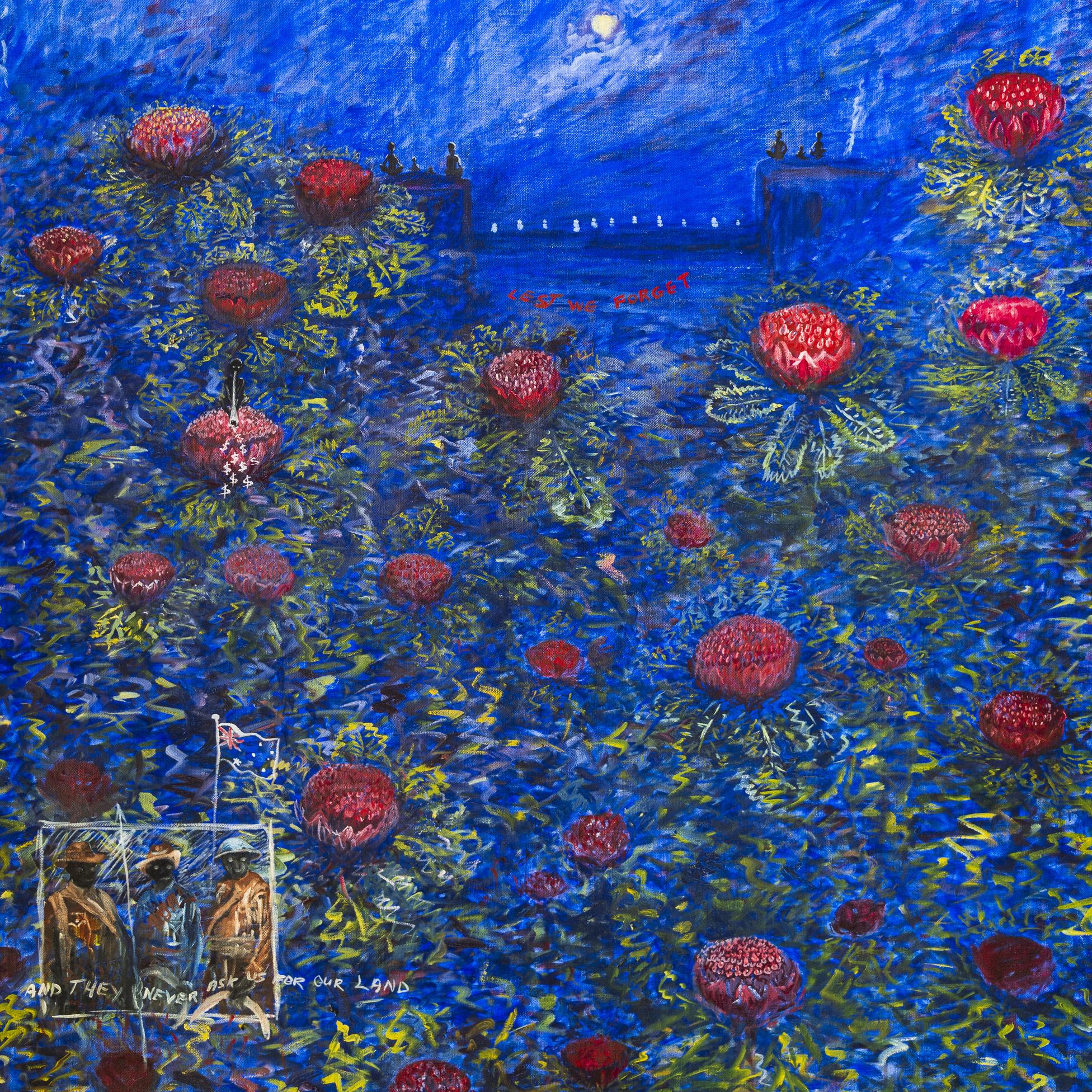
Waratah Forest, 2011 oil on canvas, 60 x 50 cm
The Waratah Forest is my imagining of what our forest once looked like. In this series of paintings I created a fantasy forest of giant waratahs where Aboriginal people live like kings among Aboriginal fairies. 23
the waratahs. The wildflowers disappeared suddenly when huge machines came in and thinned the forest, leaving only the very largest trees. Later even some of those large trees were cut down for timber. The machines scraped away a foot of the rich rainforest soil that had been full of minerals.
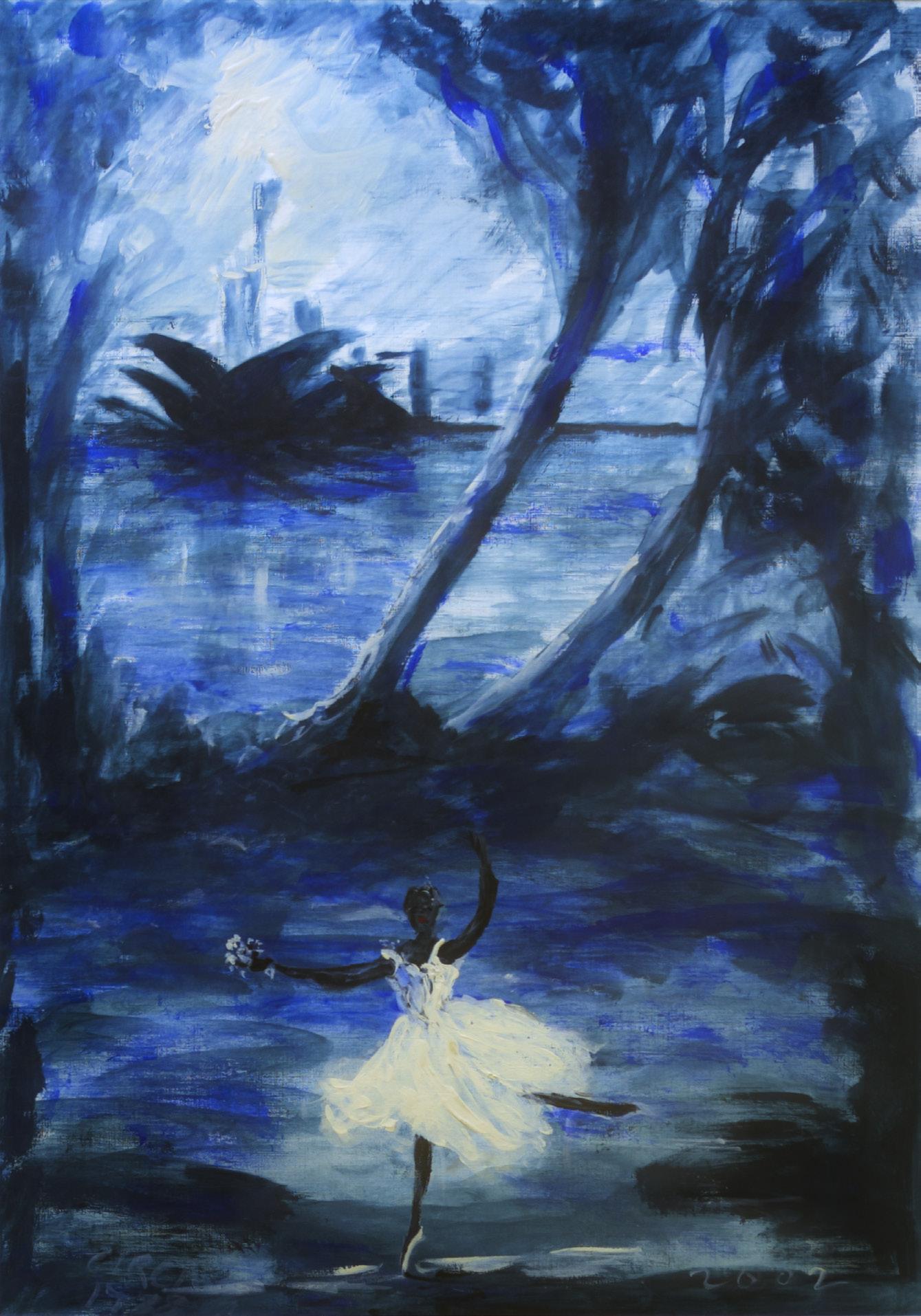
Black Ballerina, 2002 oil on canvas, 58 x 41 cm
The Black Ballerina is one of a series. It is a special painting to me because the first one I ever did… well, I burned it. I burned it as a protest.
A short film was later made about it by the journalist and activist, Mungo McCallum, and his wife Jenny. They filmed it in front of my museum and art gallery, Black Fella’s Dreaming, in Bangalow in 2005. The protest is followed by an interview with Mungo McCallum and can now be found on YouTube.
When you say the words “The Aboriginal Ballerina”, you realise they don’t quite sound right. How many Aboriginal ballerinas do you know?
I say self-determination will truly be taking place when we do see Aboriginal ballerinas, and lots of them.
Some say this painting is satirical. It is true that I often turn things around, but this painting is not satire. It is simply asking: in Sydney, how many scholarships are given to study dance?
Our dance groups are highly professional, yet why are they not given more support emotionally and financially? Our professional organisations are always begging for more money. Why?
If governments really want to close the gap, they should invest in the organisations that are already doing the work. Many grassroots organisations struggle to survive because of a lack of funding. The failure of our society to produce wonderful Aboriginal ballerinas is society’s problem. It reflects a lack of care for the very Indigenous culture this society took over.
I placed the Sydney Opera House in the background to mark the landmark of Sydney. How many young Aboriginal girls have ever dreamed of dancing at the Sydney Opera House? Are dreams important to young Aboriginal girls?
I hope this series of paintings inspires young Aboriginal girls to study dance.
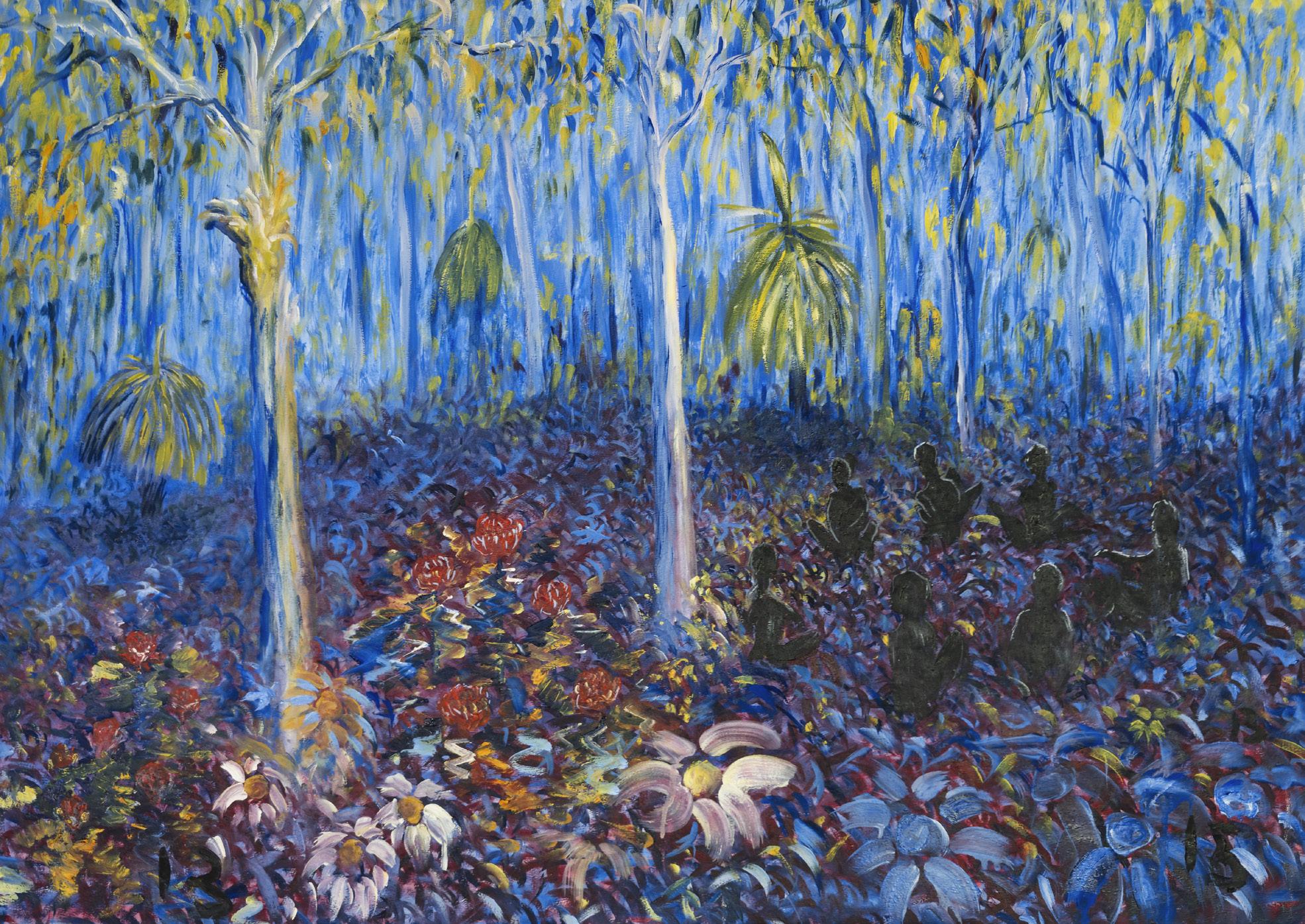
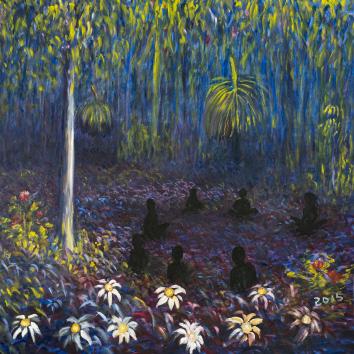
Women’s Circle, 2015 oil on canvas, 75 x 104 cm
Women come together to rest after digging, foraging and gathering food. They share their bounty and talk together before making their way home.
The peaceful scene is set within a beautiful rainforest filled with wildflowers.
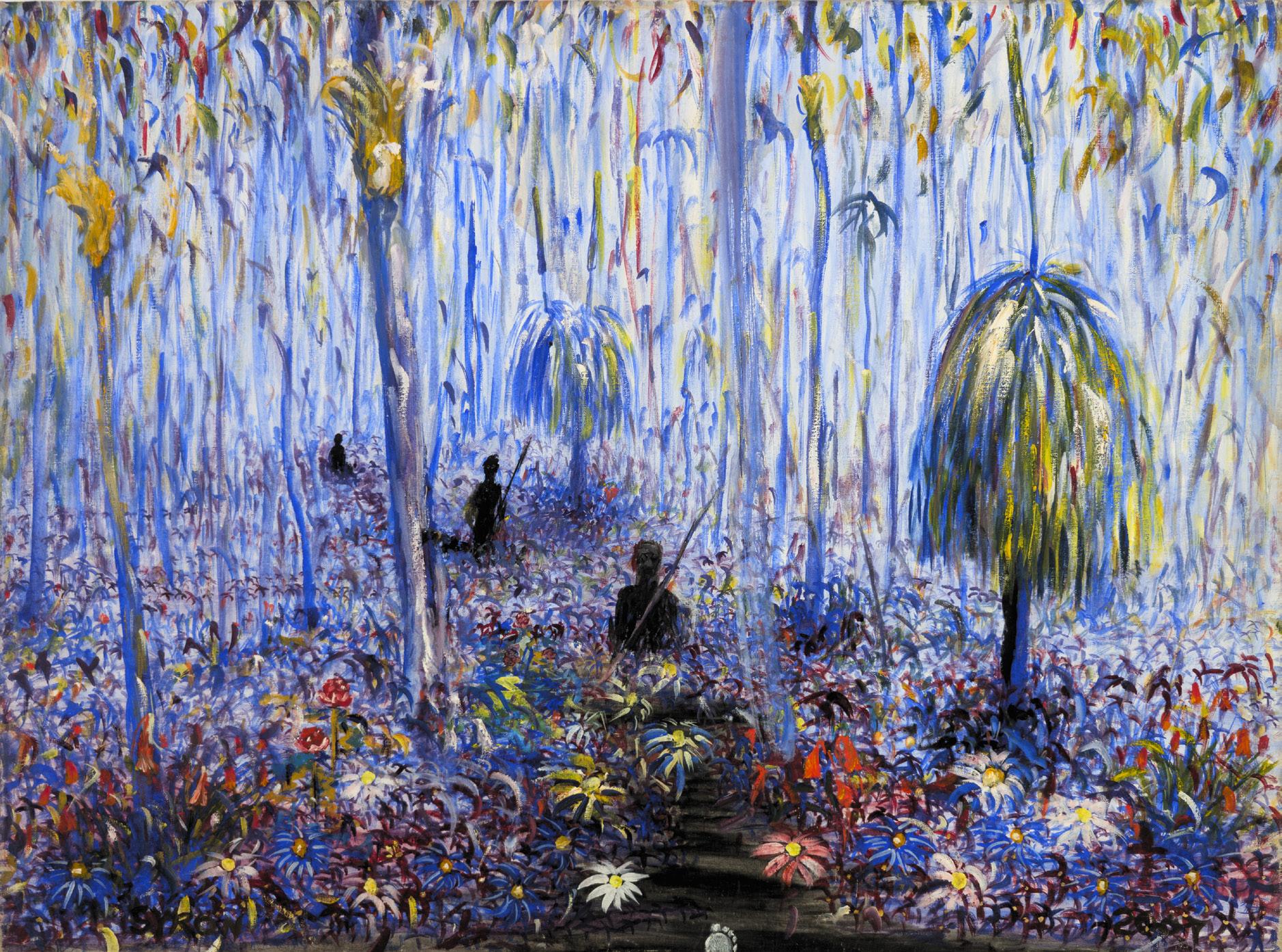
Where the Wildflowers Once Grew, c. 2005 oil on canvas, 76 x 100 cm
This painting is out of my memories as a child growing up in a rainforest on thousands of acres owned by my family.
The wildflowers don’t grow there anymore as it was logged and divided up into smaller farms, after it was mined and lost by thievery.
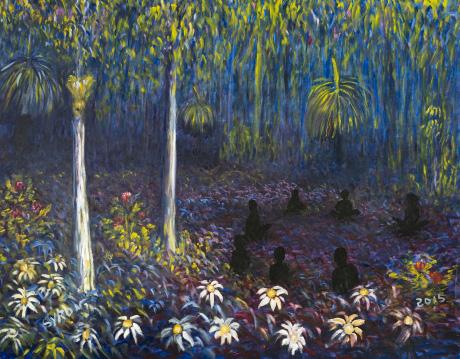
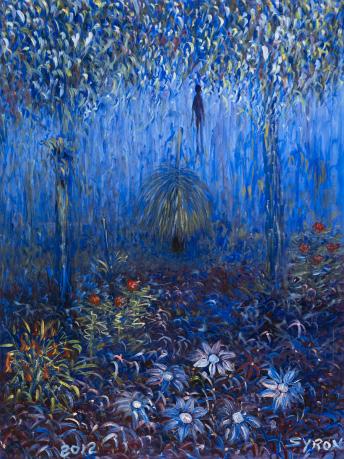
Hanging Gums, 2012 oil on canvas, 120 x 90 cm
Now, those almost ‘Irishemerald’ green forests are hung with the ‘strange fruit’ of colonisation.
— Djon Mundine OAM
GORDON SYRON CV
Born 1941, Nabiac, NSW. Lives in Melbourne.
Language Worimi - Father
Biripi - Mother
“My strength in painting is political”, says Syron. “I use satire and raw imagery to send a message that Australian History has left out the Aboriginal people and their stories. Art is a way to convey and tell these stories.”
• President Aboriginal Deaths in Custody Committee, Sydney NSW
• 1982-86 Co-founder and head teacher (Visual Arts) of Eora Visual and Performing Arts College, Redfern
• 1998 to 2005 owner of Black Fella’s Dreaming Aboriginal Art Gallery and Museum, Darlinghurst
• Featured in “Shimmer in the City”, SBS Television Documentary on Urban Aboriginal Art
• Produced lithographs in collaboration with Theo Themblay, Lecturer in Printmaking, University of Sydney and Canberra College of the Arts
• 1987 - Lecturer in Fine Arts, Aboriginal Education Unit, University of Sydney
Selected Solo Exhibitions
2015 Culture War I, Opened by Patron Jeff McMullen, Linda Burney, Ray Minnecon, NSW National Parks & Wildlife, Mosman, Curated by Jordan Reed & Saha Jones
2015 Culture War II, Opened By Auntie Millie Ingram, Larissa Behrendt, Hon Michael Kirby, Downing Centre, Sydney. Curated by Jordan Reed & Saha Jones, NAIDOC week, 1 to 31 July 2015.
2014 Kirribilli Dreaming, Loreto, Kirribilli
2010 Blackboy Creek, Coo-ee Aboriginal Art Gallery, Sydney.
For the Dead are Many, Addison Road Art Centre, Marrickville, 24 April to 23 May 2010.
2009 Rewriting the History Books of Australia, Ruby’s Place, Chapel by the Sea, Bondi Beach, 20 Dec 2009 to 4 Feb
2010
Forgotten History, COFA 2008 Professional Development Award exhibition, College of Fine Arts, Sydney, NSW
2007 Fairies On The Ropes, Tony Mundine Gym, officially opened by Merideth Burgmann
2006 Solo exhibition, Downing Centre, Sydney.
Where the Wildflowers Once Grew and Black Fairies series, Tony Mundine Elouera Gym, Redfern. 16 Sep 2006
2005 Retrospective, Boomalli, Sydney.
Black Fairies and Black Room Politics, Black Fella’s Dreaming Aboriginal Art Gallery and Museum, Darlinghurst
2004 Retrospective, The Australian Museum
Black Fairies for Aboriginal Kids, Black Fella’s Dreaming Aboriginal Art Gallery and Musuem, Bangalow
2002 Reconciliation, Black Fella’s Dreaming Aboriginal Art Gallery and Museum, Darlinghurst
2000 The Rightful Owner, International Convention Humanist Society, University of Technology, Sydney
1999 The Quiet Achiever, Australian Museum, Sydney
Dreaming the Republic: Aboriginal Responses to the Coming of the Republic, Newcastle Regional Art Gallery, Newcastle, NSW
1998 My Rally Against Racism, DQ Art on Oxford Gallery, Sydney
1998 Retrospective, Australian Museum curated by Sheryl Connors and officially opened by Dr Vivien Johnson.
1997 Aboriginal Reconciliation, DQ Art on Oxford Gallery, Sydney
1997 A Perspective, DQ Art on Oxford Gallery, Sydney
1993 Black Deaths in Custody, Balmain Community Centre
1978 The Block, Murawina, Redfern
Selected Group Exhibitions
2025 Blak In-Justice: Incarceration and Resistance, Heide Museum of Modern Art, 5 April -20 July 2025
2024 Glow, Boomalli Aboriginal Art Gallery Sydney
2021 JAALA International Art Exchange Exhibition Jenny Fraser, Teho Ropeyarn, Susan Reys and Gordon Syron, Yokohama Arts Foundation Tokyo
2020 Ship and Shore, Australian National Maritime Museum the TERRA within, Shoalhaven Regional Art Gallery, Nowra
2016 Dancing at Dawn, opened by Hon Philip Ruddock, Aunty Millie Ingram and Prof Larissa Behrendt Downing Centre, Sydney, NAIDOC week
2014-17 East Coast Encounter, Australian National Maritime Museum Sydney, 9 May 2014 – 24 August 2014, The Glasshouse, Port Macquarie 20 February 2015 – 5 April 2015, Gold Coast City Gallery, 25 April 2015 – 7 June 2015, Caloundra Regional Gallery, 1 July 2015 – 16 August 2015, , Redland Art Gallery, 11 October – 22 November 2015, Fraser Coast Cultural Centre, 4 December 2015 – 22 January 2016, ArtSpace Mackay, 29 January 2016 – 13 March 2016, Nature’s Powerhouse Cooktown, 11 June 2016 – 19 September 2016, Pinnacles Gallery, Townsville 23 September 2016 – 30 October 2016, Caboolture Regional Art Gallery 19 November 2016
– 21 January 2017, University of the Sunshine Coast Gallery, 16 February 2017 – 25 March 2017 Coffs Harbour
Regional Gallery, 28 April 2017 – 17 June 2017
2012 How Ironic. Curated by Terry Cutcliffe, Addison Road Community Gallery
2009 Featured in ‘Art & About’, by the City of Sydney. His painting ‘Spirits of the Past and Present The Meeting Place’, a painting about NSW Parliament House is featured on flags in Macquarie St Sydney in the month of October
Say No To Racism, South Sydney Uniting Church
2008 Ngadhu, Ngulili, Ngeaninyagu, Campbelltown Gallery, curated by Djon Mundine
Invasion Day II, Foyer of the Australian Pavilion Olympics in Beijing
Aboriginal Diggers, Damian Minton Gallery, Redfern
2007 70% Urban Forum presenter and group exhibition at the National Museum of Australia, Canberra ACT
2005 First People: First State, NSW Parliament House, Sydney
Urban Masters, Gordon Syron and Elaine Pelot Syron, Darlinghurst
2004 Cultural Copy: Visual Conversations on Indigenous Art & Cultural Appropriation, co-curated by Tressa Berman, Jennifer Herd, and Marie Bouchard. UCLA Fowler Museum of Cultural History, Los Angeles, USA.
Spirit, featuring works by Gordon Syron, Lila Kirby, Walangari Karntawarra, Yondee, Darren Cooper, John Bilyarra James Black Fella’s Dreaming Aboriginal Art Gallery and Museum, Darlinghurst
The Re-writing of Australian History, Gordon Syron and Walangari Karntawarra, Black Fella’s Dreaming Aboriginal Art Gallery and Museum, Darlinghurst
Our Place: Indigenous Australia Now, Cultural Olympiad, Athens, Greece – exhibition touring to Beijing and other international venues
2003 Private Clubs and Politics, paintings by Gordon Syron and James P. Simon with photographs by Elaine Pelot.
Black Fella’s Dreaming Aboriginal Art Gallery and Museum
New Works, Black Fella’s Dreaming Aboriginal Art Gallery and Museum, Darlinghurst
This Land is Me, Gordon Syron, Clifford Possum, Walangari Karntawarra
Black Fella’s Dreaming Aboriginal Art Gallery and Museum, Darlinghurst
All Us Now, Gallery Amici, Sydney
2001 In Ya Face, Gordon Syron and Gordon Hookey, Boomali, Annandale
2000 A Tribute to Mum Shirl, Boomali Gallery, Annandale and Powerhouse Museum, Sydney
Festival of the Dreaming, Cultural Olympiad, Sydney 2000 Olympics, Australian Pavillion, Sydney Olympic Games
1999 Bamaradbanga, Museum of Sydney
1998 Australian Heritage Exhibition, Old Parliament House, Canberra
Dreaming the Republic, Aboriginal Responses to the Coming of the Republic Newcastle Regional Art Gallery
1997 The Redfern Rainbow Serpent, Gordon Syron and Elaine Pelot DQ Art on Oxford Gallery, Sydney
I Shoulda Been A Statistic – Aboriginal Deaths in Custody, Paintings by Gordon Syron and photographs by Elaine Pelot Kitchener, North Adelaide School of Arts Gallery, South Australia
1996 Aboriginal Deaths in Custody – A History, paintings by Gordon Syron and photographs by Elaine Pelot Kitchener, NSW Parliament House, Sydney
1995 Lithographs of Urban Aboriginal Art, Coo-ee Aboriginal Art Gallery, Sydney
1984 Koori Art, Art Space, Surry Hills
1983 Group Exhibition, organised by APMIRA, Paddington Town Hall
1972 Prison Art, Ball and Chain Gallery, Argyle Art Centre, The Rocks, Sydney
Awards
2009 University of NSW College of Fine Art (COFA) award for his painting titled, ‘...And They Never Asked Us For Our Land’. It is presently touring NSW.
NSW Parliament House Prize
2008 25th Telstra National Aboriginal and Torres Strait Islander Art Award, Museum and Art Gallery of the Northern Territory, Darwin, NT.
NSW Parliament Aboriginal Art Award
Commissions
1982 Painted backdrop for Face, Masks & Costume Jewellery Pavillion, Commonwealth Games, Brisbane
Painted backdrop for The Cakeman, Black Theatre, Sydney
1984 Works featured in film The City’s Edge, starring Hugo Weaving.
Biography
• Syron, a film by Dr Jenny Fraser, 2021 https://youtube/lfjhjBZXFQ0?si=rZ0h-HmVhPj_vhaj
• Featured at heal 2020, an interdisciplinary event presented by artist and curator Dr Jenny Fraser, Centre of Contemporary Arts Cairns, 8-9 February 2020. http://worldscreenculture.weebly.com
• Bogias, Jonathon, Australian Art Collector, 1 July – September 1997, p.55
• Croft, Brenda, Periphery, no. 40-41, Spring/Summer 1999/2000, p.52-55.
• de Lorenzo, Catherine, “A Changing Relationship: Aboriginal Themes in Australian Art cc1938-1988”, Exhibition Catalogue, S H Ervin Gallery, National Trust of Australia, NSW
• Hazelhurst, Kathleen M (ed), Ivory Scales: Black Australia and the Law, NSW University Press, 1987 – painting “Judgement by His Peers” reproduced on front cover.
• Johnson, Vivien, “Koori Art ‘84”, Art Network, Summer/Autumn 1985
• Johnson, Vivien, “Into the Urbane: Aboriginal Art in the Australian Art Context”, Art Monthly, 1990, pp.20-23. Johnson examines Syron’s work at the Eora Aboriginal Art Centre and states that Syron “deserves recognition as the pioneer of a westernised, overtly political urban Aboriginal art”.
• Nicholls, Christine, Artlink, v.20, no.1, 2000, pp.36-39.
• Powerhouse Museum and Museum Victoria, Our Place: Indigenous Australia Now – Australia’s Contribution to the Cultural Olympiad of the Athens 2004 Olympic Games, Powerhouse Publishing, 2004.
Collections
• National Gallery of Australia
• National Museum of Australia, Canberra
• Flinders University, South Australia - “Howard’s Way”
• Western Australian University – two paintings
• University of New England
• Aboriginal Legal Service – paintings in offices throughout Australia
• Maritime Museum, Sydney
• Australian Museum
• Sydney Museum
• US Consulate - Australia
Copyright all artworks © Gordon Syron
Published by Newstead Art
Catalogue design by Jasmin Smith
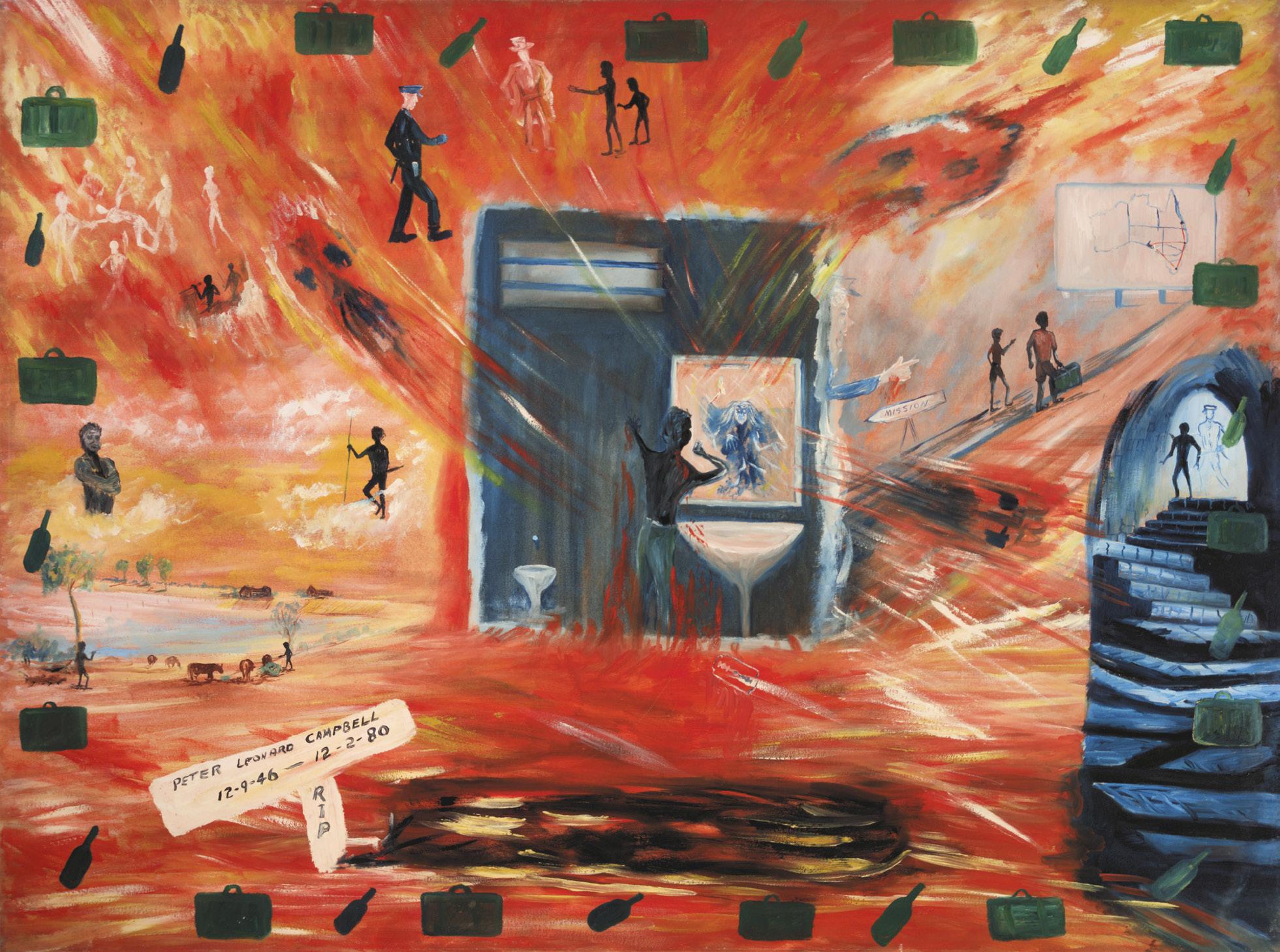
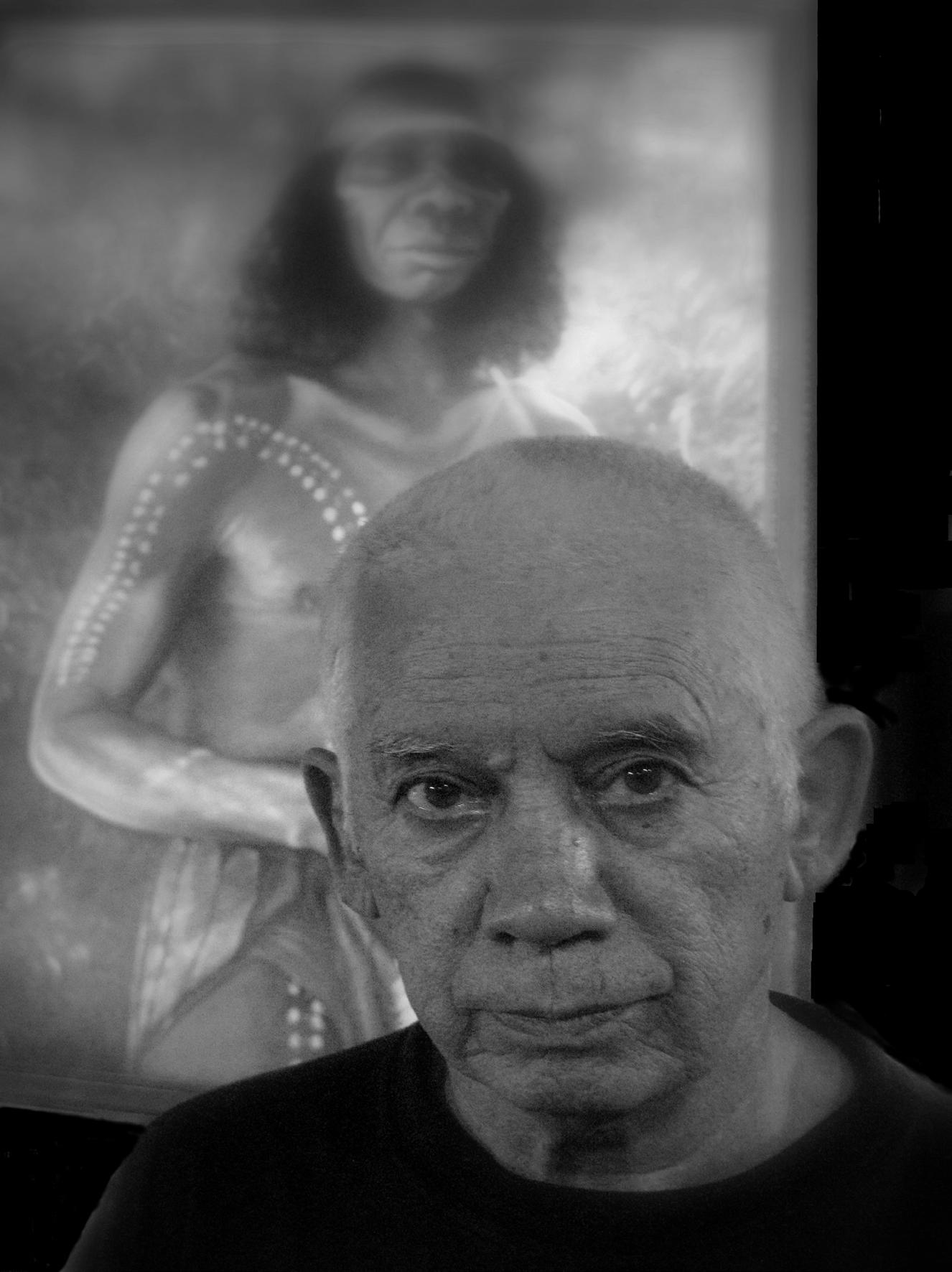
Front cover image: Peter Leonard Campbell,1993
Back cover image: The Waratah Forest, 2011
Inside back cover image: Women’s Circle, 2015