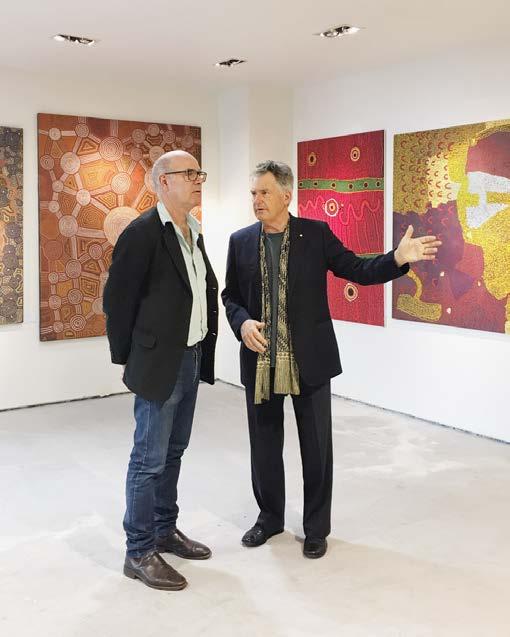
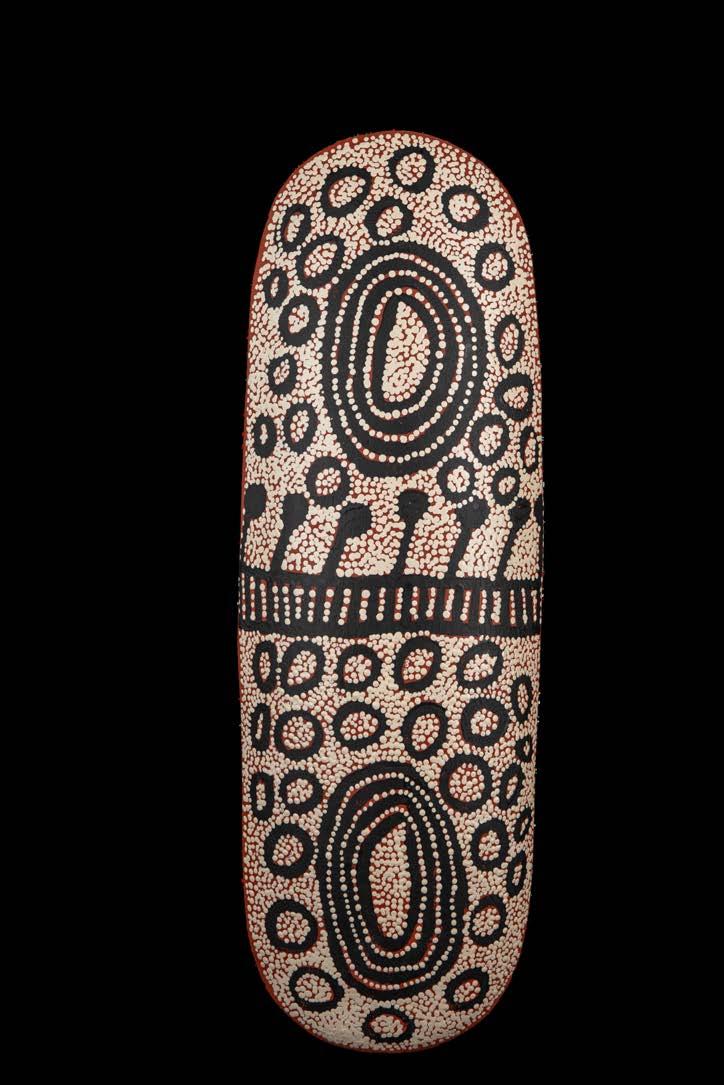
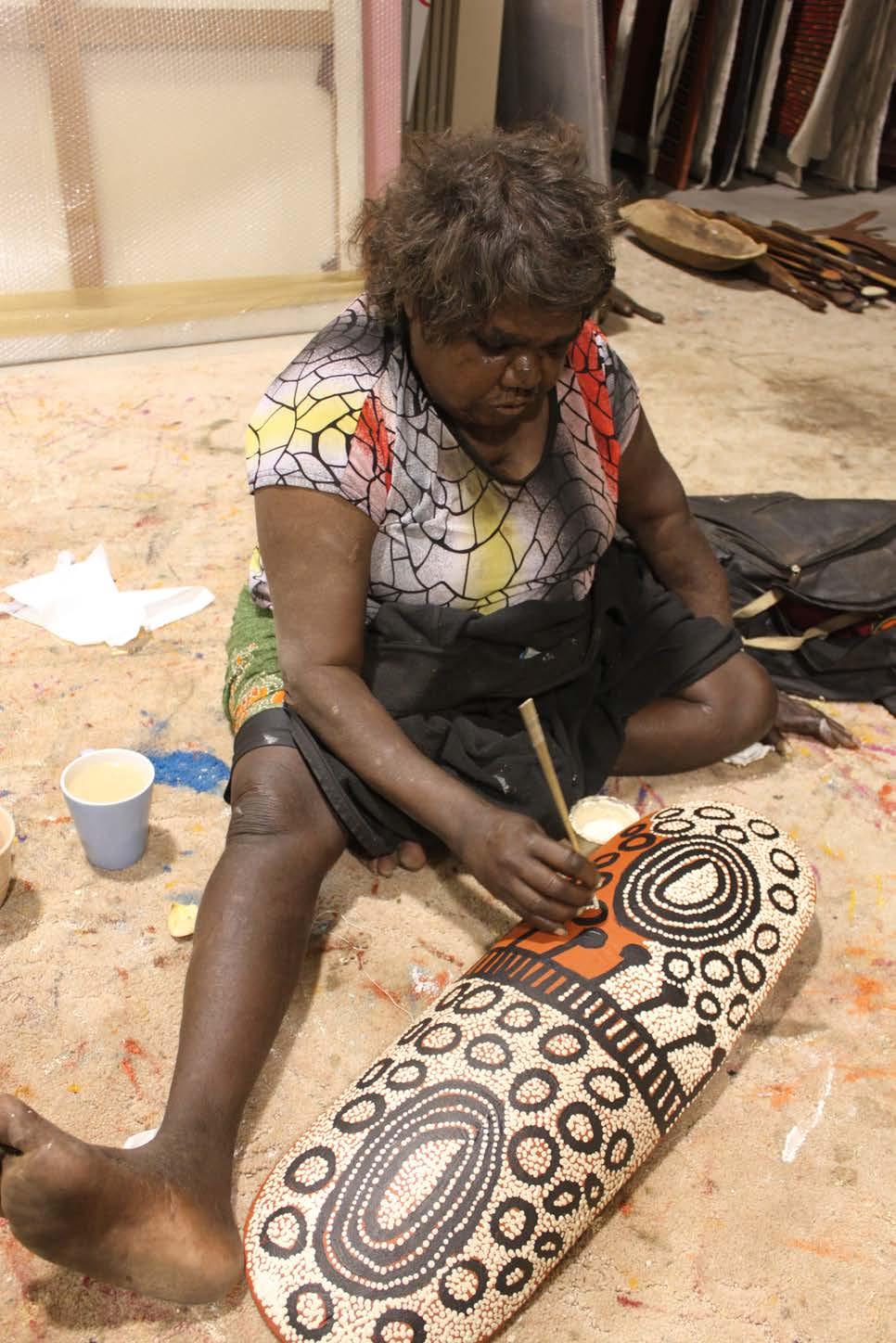
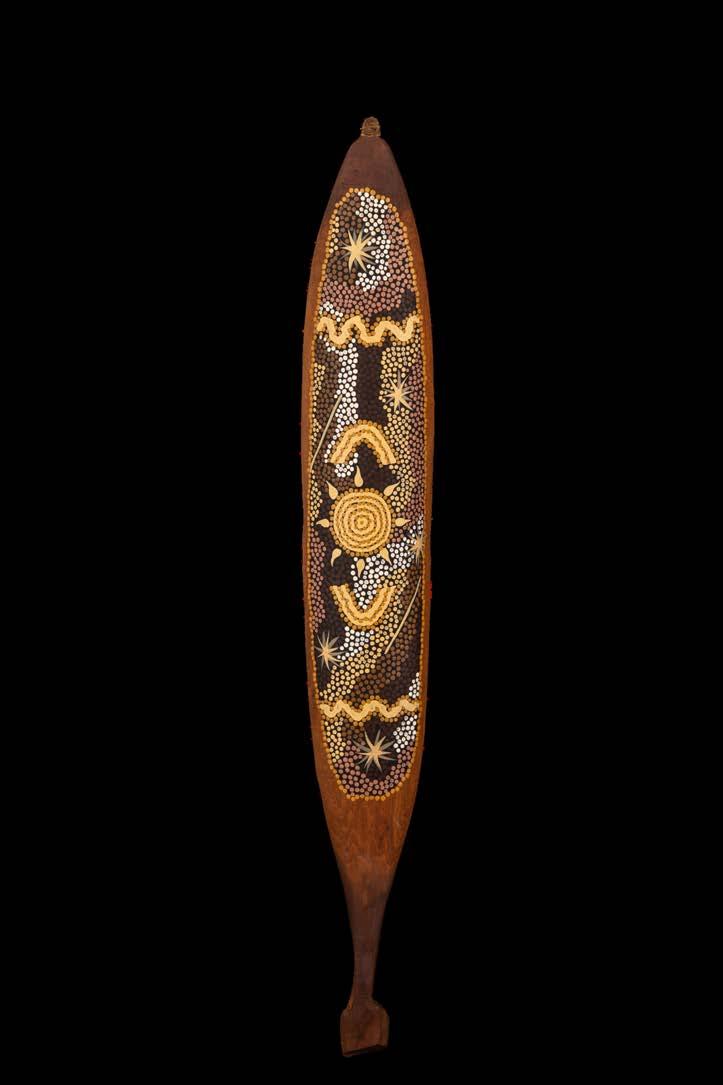
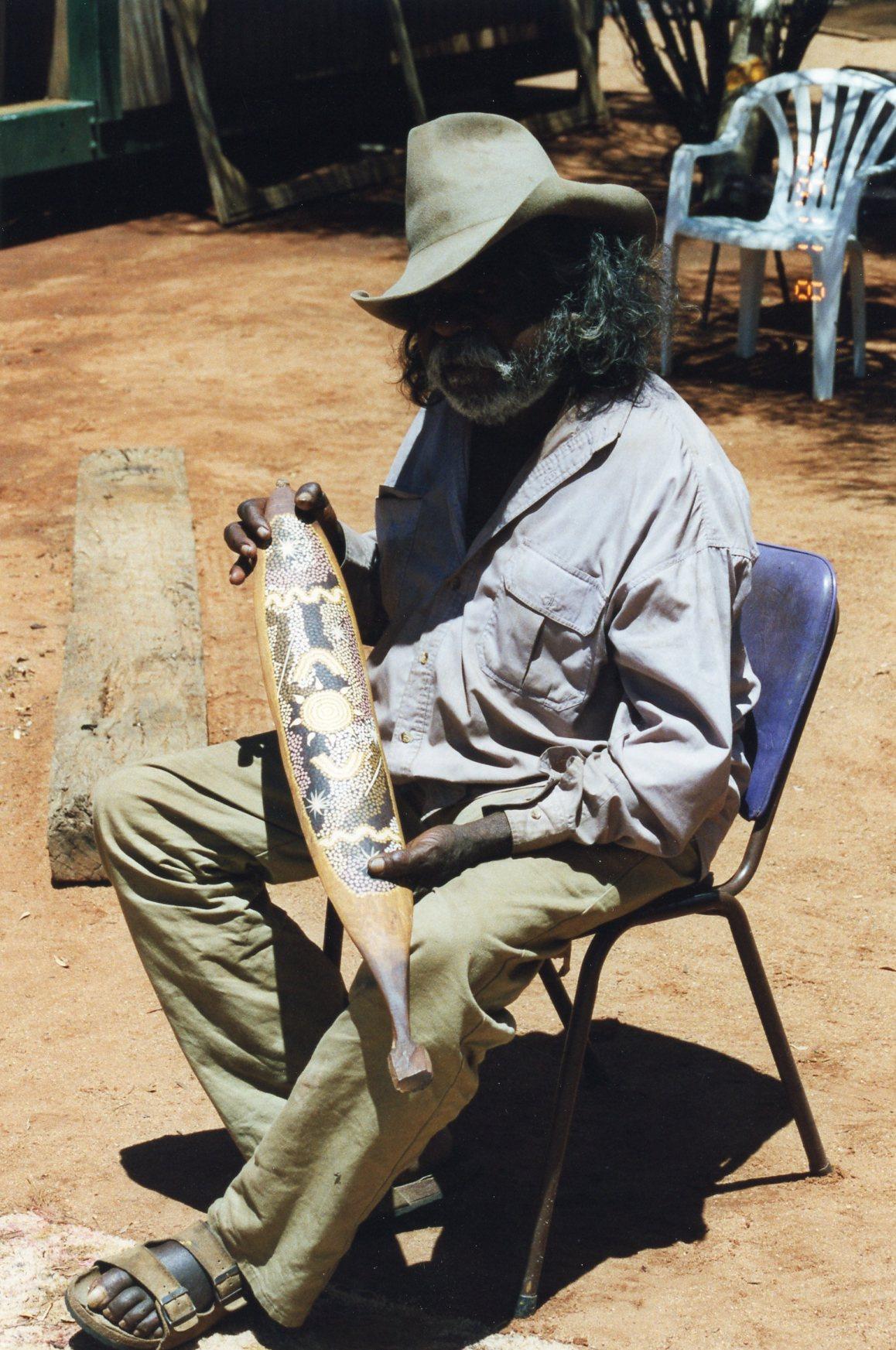
team bios
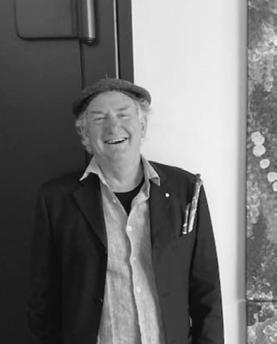
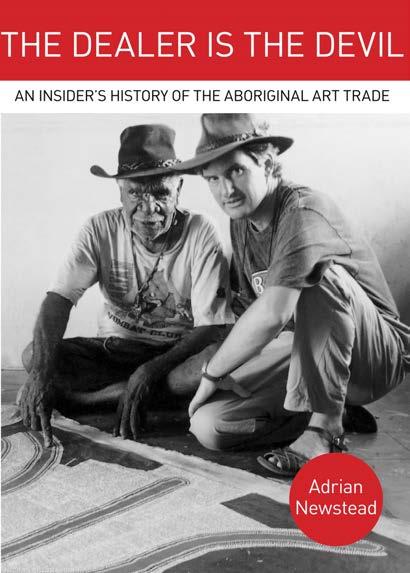
ADRIANNEWSTEADOAM
Adrian Newstead is one of Australia’s most respected authorities on Aboriginal art. He is the current President of the Aboriginal Art Association of Australia and has been a leading advocate for Indigenous artists and culture for over four decades. Adrian founded the Aboriginal art department at Lawson Menzies in 2003 and went on to serve as Managing Director of Menzies Art Brands. A former President of the Art Consulting Association of Australia and Director of Aboriginal Tourism Australia, he has written extensively on the Aboriginal art market and Indigenous cultural affairs, contributing to numerous publications, monographs,andmediaoutlets.
DR.JIMELMSLIE
Dr Jim Elmslie is an economist, political scientist, and long-standing dealer and specialist in Aboriginal and Oceanic art. He began his career in the field in 1983, running a gallery on Oxford Street, Sydney, for fifteen years before transitioning into the auction industry in 2004. Jim holds a PhD from the University of Sydney and currently serves as President of the Oceanic Art Society. His academic and commercial expertise has underpinned decades of engagementwithOceanicandIndigenousculturalmaterial.
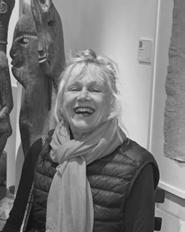
ANNENEWSTEAD
AnneNewsteadhaslivedandworkedacrossEurope,Argentina,andNewYorkin diverse roles including research science, hospitality, and education. Since returning to Australia, she has collaborated with her husband Adrian on a range of creative projects involving Indigenous textiles, design, and art events both locally and internationally. She plays a crucial role behind the scenes at Newstead Art, overseeing the conservation, restoration, and archival care of artworks. She is also an avid reforestation advocate, devoting time to planting nativetreesonherpropertyintheNorthernRiversregionofNewSouthWales.
MIACOLLIS
Mia Collis is the Auction Manager at Newstead Art. With academic foundations in Art History and Economics from the University of Sydney, Mia has held roles atShapiroAuctioneersandCooeeArt,whereshespecialisedindecorativearts and auction operations. Having lived in London, Tokyo, Paris and Sydney, she brings a cosmopolitan perspective to the business of art, balancing intellectual insight with a pragmatic approach to event curation and collection management.
KATHLEENROBERTS
KathleenRobertsisaPerth-bornscholarcurrentlycompletingaPhDinArtHistory at Ludwig-Maximilians-Universität München. Her academic and professional trajectory has spanned major cultural institutions across Sydney, where she earned a Master of Museum and Heritage Studies at the University of Sydney. Her work has continually engaged with the intersection of art and cultural heritage law, supported by further studies at the Université de Genève, Universiteit Leiden, and in Juris Doctor studies at the Australian National University. A long-time collaborator of both Adrian Newstead OAM and Dr Jim Elmslie,KathleencurrentlyresidesinMunich.
JASMINSMITH
JasminSmithspentherearlyyearsintheAboriginalcommunitiesofYuelamuand Alpurrurulam, and was raised in Alice Springs (Mparntwe), NT, where her love for Aboriginalarttookroot.In2018,shemovedtoSydneytostudyaBachelorofFine Arts (Honours) at UNSW Art & Design, majoring in painting and drawing. Alongside her studies, she worked for five years as a paralegal and executive assistant in a prominent family law firm. Two years ago, she became Gallery Manager at Newstead Art, where she brings her lifelong appreciation for Aboriginalarttoherrole.
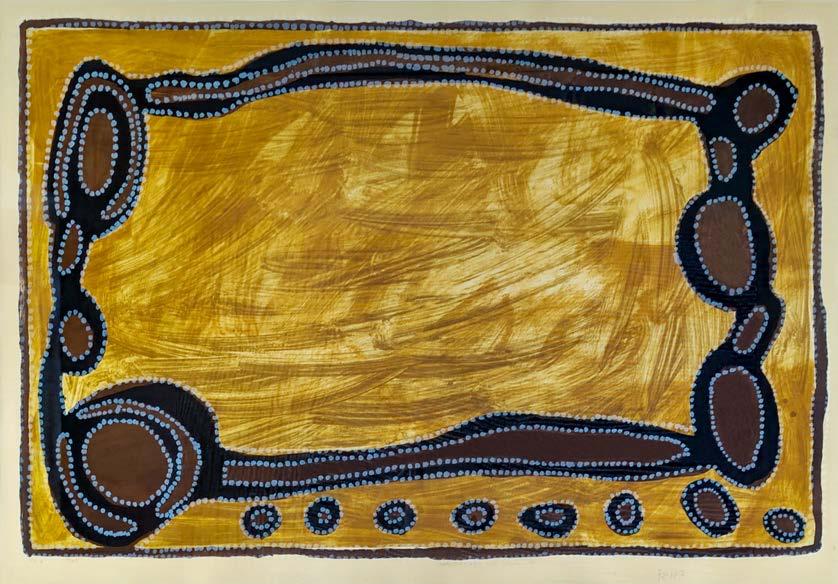
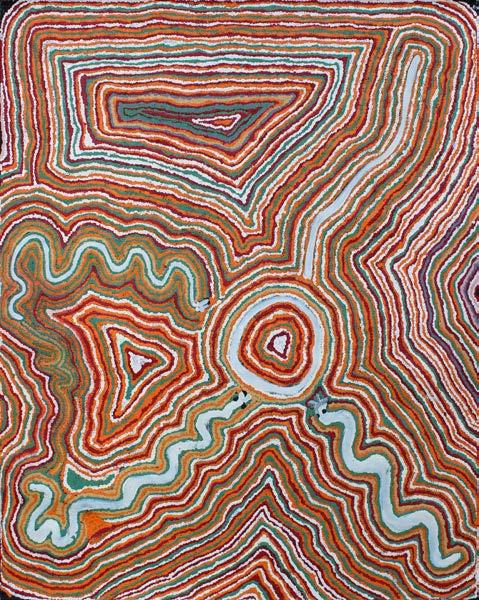
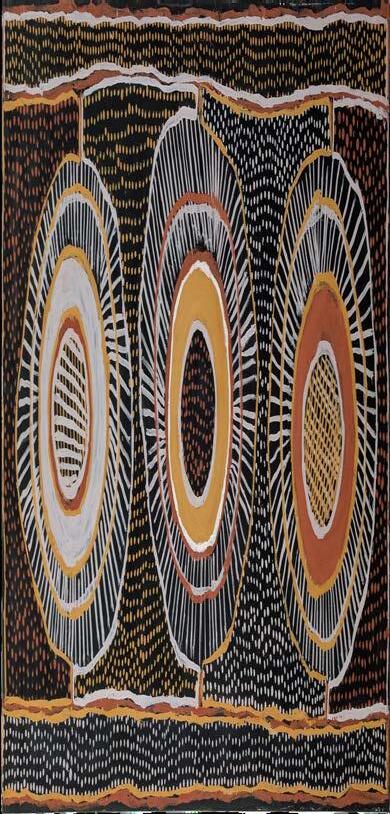
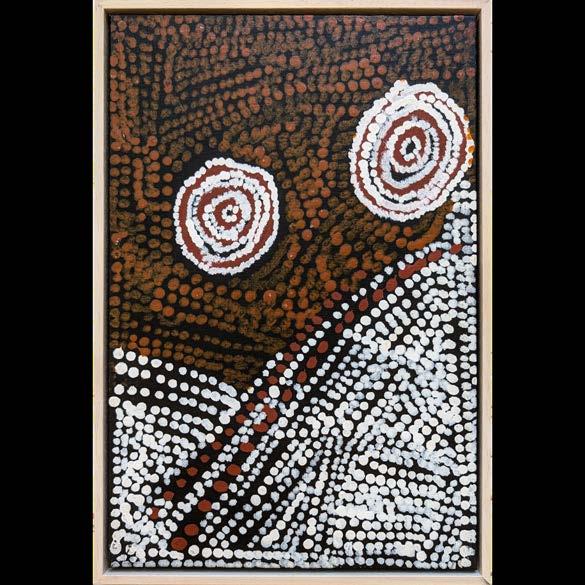
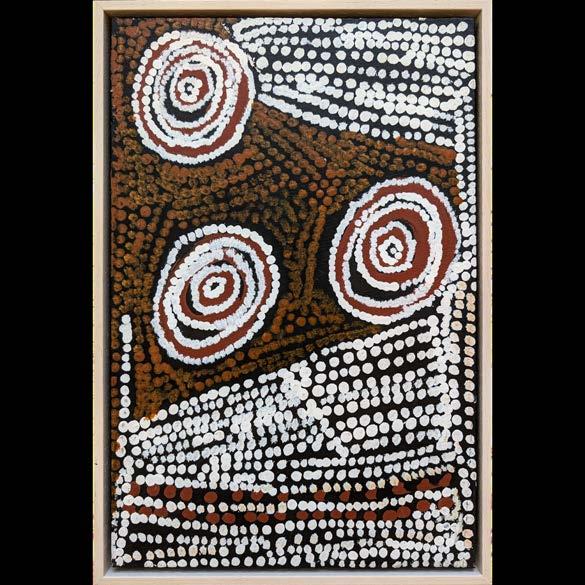
UTA UTA TJANGALA (C.1926-1990) YUMARI,1979
naturalearthpigmentoncompositionboard 61x45.5cm
PROVENANCE
PapunyaTula,NT,CatNo.UU790419
BobDurnanCollection* PrivateCollection,NSW
*BobDurnanworkedwithFredHollowson indigenouseyehealthinAliceSpringsand severalindigenousdesertcommunitiesbefore becomingtheCEOoftheTangentyerehousing company.
EST $4,000 - 6,000
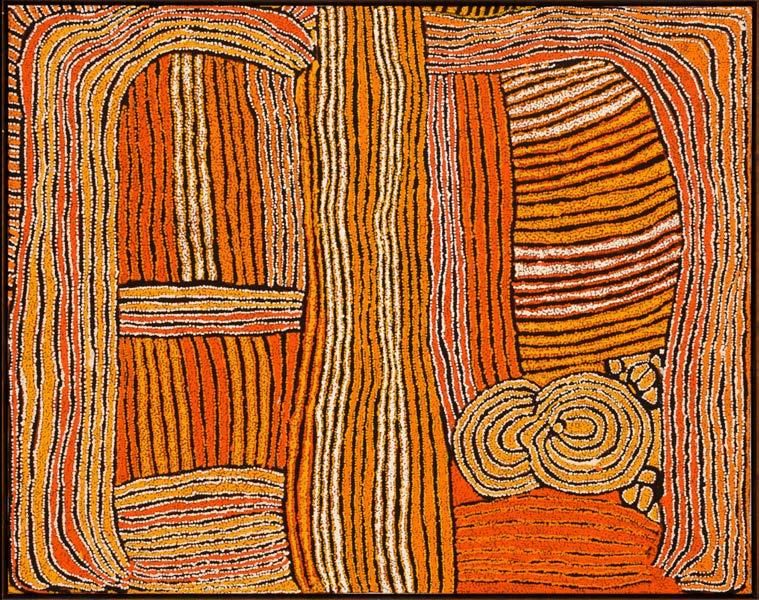
Uta Uta was a founding member of the painting men and became one of the most senior and influential painters amongst the group. His influence iscreditedwithenablingthegrouptobreakthrough the political and cultural constraints towards a safe stylistic conformity, thereby preparing the way for personal and distinctive styles to emerge amongst thePapunyamen.
Despite his advancing age during the late 1970s, he continued to paint as he spent increasing time at outstations west of Papunya and, at the beginning of the 1980s, he completed what was to become one of the most important and revered works of the entire Western Desert art movement, Yumari, 1981possibly the largest and most significant Tingari painting ever created. Yumari is a rocky outcrop in his home country and the key ceremonial site of the area.
02 syntheticpolymeronBelgianlinen 122x92cm
MAKINTI NAPANANGKA (1922-2011)
WOMEN'SHAIRSTRING,2007
PROVENANCE
PapunyaTulaArtists,NT,CatNo.NN0702158 PrivateCollection,Vic
EST $15,000 - 18,000
Makinti Napanangka stands among the most acclaimed Australian Aboriginal artists of the Western Desert, renowned for her fluid, abstracted depictions of women's ceremonial practices. In Women’s Hairstring, she renders a motif associated with both ritual and daily life: the spinning of human hair into string, used for belts,ceremonialwear,andbabyslings.
The rhythm of her linework echoes the twisting motion of the practice itself - long, looping forms rendered in warm ochres and whites. Makinti’s signature style, often described as gestural and luminous, transforms functional materialsintosymbolsofculturalvitality.
She was awarded the 2008 Telstra National Aboriginal and Torres Strait Islander Art Award and is represented in major public collections acrossAustralia.
Works such as this, while deceptively minimal, arecelebratedfortheirvitalityandtheabstract expressionofembodiedculturalknowledge.
AUCTIONRESULT
COMPARISON
Type:Closelyrelated
Auction:Deutscherand Hackett,Important AustralianIndigenous Art,Melbourne, 26/03/2025,LotNo.23
Price:A$42,955
Description:Lupulnga, 2004
syntheticpolymerpaint onBelgianlinen,Papunya TulaArtistscat. MN0408018,121.5x92 cm
03
SALLY GABORI (1924-2015)
DIBIRDIBICOUNTRY,2007
syntheticpolymeroncanvas 121x91cm
PROVENANCE
MorningtonIslandArt,Qld,CatNo. 2619-L-SG-1007
WoolongabbaGallery,Qld PrivateCollection,NSW
EST$30,000-40,000
This painting recalls Dibirdibi country, sacred to the Kaiadilt people of Bentinck Island, and particularly to Sally Gabori’s late husband, Pat Gabori,whosetotemwastheDibirdibi(RockCod). Sally’s canvases are not literal topographies but emotive mappings of identity, kinship, and memory.
Her painterly style—vigorous, layered, and saturated—translates personal and ancestral stories into powerful fields of colour. In this work the sweeping strokes evoke the tidal waters and reef systems where the rock cod swims, while anchoring her husband's presence in the currents ofCountry.
Although she only began painting in her eighties, Sally Gabori quickly gained recognition for her intuitive abstraction and profound cultural specificity. Her works are now held in major collectionsworldwide.
AUCTIONRESULT COMPARISON
Type:Closelyrelated
Auction: Sotheby's, AboriginalArt,NewYork, 23/05/2023,LotNo.60
Price:A$61,135
Description:ThundiBarramundiStory,2008 acryliconcanvas,bears
MorningtonIslandArts andCraft,CatNo.3139L-SG-0508,121x91cm
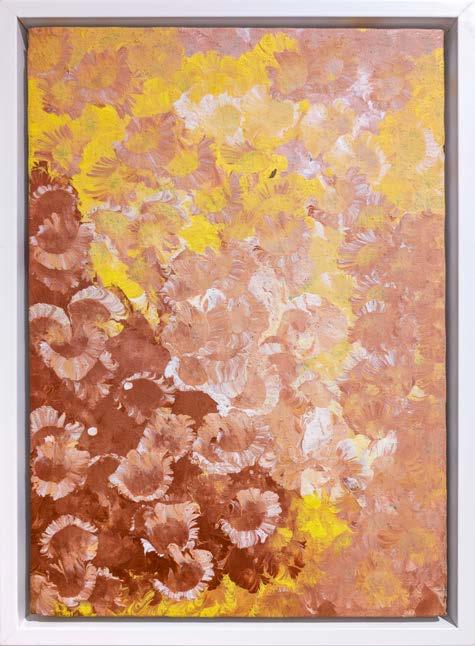
EMILY KAM(E) KNGWARREY(E) (C.19101996)
WILDFLOWER,1995
syntheticpolymeroncanvas
35.5x25cm,38.5x28.5cmframe
PROVENANCE
DacouGallery,NSW,CatNo.110020
PrivateCollection,NSW
EST $5,000 - 8,000
Emily Kngwarreye's paintings of wildflowers reveal a spontaneous confidence and intuitive mastery rarely equalledinAustralianart.InWildflower,sheconjures an explosive bloom of layered marks—short, gestural brushstrokesthatdanceacrossthesurfaceinvibrant succession.
This work likely references the annual blossoming of bush flowers in Alhalkere country after desert rains, an event of great cultural and ecological importance. Her painting does not describe flora in a botanical sense, but embodies the essence of seasonalrenewalandancestralfertility.
Emily Kngwarreye’s capacity to distill story, Country, and law into gestural abstraction is what continues to elevate her legacy. For collectors, works like this offer both emotional immediacy and intellectual depth—testaments to one of the most profound artisticvisionsofthe20thcentury.
DOROTHY NAPANGARDI (1956-2013) MINAMINA,2004
syntheticpolymeronlinen 91x122cm
PROVENANCE
GalleryGondwana,NT MetroFiveGallery,Vic PrivateCollection,Vic
EST $5,000 - 7,000
AUCTION RESULT
COMPARISON
Type:Closelyrelated
Auction:LawsonMenzies (nowtradingasMenzies), AboriginalFineArt, Sydney,23/05/2007,Lot No.183
Price:A$18,000
Description:MinaMina, 2004,syntheticpolymer paintonlinen,122x92 cm
When, in 1997, Dorothy began producing works which traced the grid-like patterns of the salt encrustations on the Mina Mina clay pans, it marked a significant artistic shift in her work. Over a three-year period, her paintings became less and less contrived and increasingly spare, all detailparedbacktothebarestessentials.
In these new works, Dorothy began to explore the Women's Digging Sticks Dreaming and other stories relatedtothetravelsoftheKarntakurlangu.
Astheseworksdeveloped,herextraordinaryspatialability enabled her to create mimetic grids of the salt encrustations across the claypans of Mina Mina. The lines of white dots trace the travels of these ancestral women astheydancedtheirway,injoyousexultation,throughthe saltpans, spinifex and sandhills, clutching their digging sticks in their outstretched hands, during the region's creation. 05
06 syntheticpolymeronlinen 94x92cm
KATHLEEN PETYARR(E) (1940-2008) MOUNTAINDEVILLIZARDDREAMING,2008
PROVENANCE
Collected Alice Springs, 2008 Private Collection, France Private Collection, Denmark
EST $6,000 - 9,000
Kathleen Petyarre painted the Mountain Devil Lizard Dreaming throughout her life. The thorny devil lizard —her totem—is associated with a vast expanse of desert country, and her paintings evoke the lizard’s slow, meandering path across the land as it absorbs andtransmitsancestralknowledge.
Her dotting technique is meticulous and atmospheric, building luminous fields that echo the shimmerofheat,sand,andspiritualpresence.These paintings are not maps in the Western sense; they aretopographiesofceremony,ofmovement,andof thelayeredknowledgeembeddedinCountry.
Kathleen Petyarre’s work is now held in major collections internationally. Mountain Devil Lizard Dreaming remains one of the most significant Dreamings in the desert canon—highly desirable for collectors drawn to works of meditative scale and ancestralprecision.
AUCTIONRESULT COMPARISON
Type:Closelyrelated
Auction:Gibson's Auctioneers&Valuers, Australian& InternationalArt, Melbourne,10/04/2022, LotNo.137
Price:A$9,516
Description:Mountain DevilLizard2008 acryliconlinen,94x94 cm
GABRIELLA POSSUM NUNGARRAYI (1967 - )
MYGRANDMOTHER'SCOUNTRY,2021
synthetic polymer paint on Belgian linen 142cmdiametre
PROVENANCE ArandaArt,Vic PrivateCollection,NSW
EST $6,000 - 8,000
Gabriella began painting at an early age under the tutelage of her father, Clifford Possum Tjapaltjarri, one of the most famous of the founding group of painters who worked at Papunya during the 1970s and 1980s. She was just 16 years of agewhenshewontheAliceSpringsArtPrizein1983.Sixyears later she received a grant from the Australia Council for the Arts which not only helped her to develop her recognisable painting style, but also brought her work to the attention of galleries and collectors. Since that time Gabriella has been one of Australia's most successful independent Aboriginal artists.HerworkfeaturedinJamieDrury'sGoldMedalwinning entry in the Chelsea Flower Show and her work now hangs in the Royal Collection alongside that of her father. At the 2014 Melbourne festival her work was used to decorate a tram as part of a major public art project called Melbourne Art Trams and two years later images of her paintings were projected ontotheSydneyOperaHouseduringVivid.
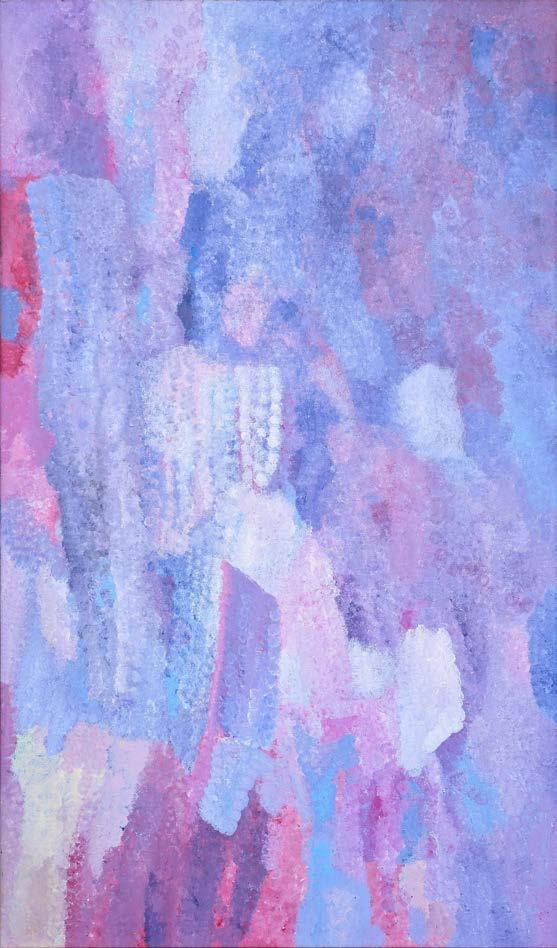
KATHLEEN NGAL(E) (1930-2021)
ARNWEKETY-BUSHPLUM,2010
syntheticpolymeronlinen 151x91cm
PROVENANCE
DelmoreGallery,NT,CatNo.10E053
MetroFiveGallery,Vic PrivateCollection,Vic
EST $6,000 - 8,000
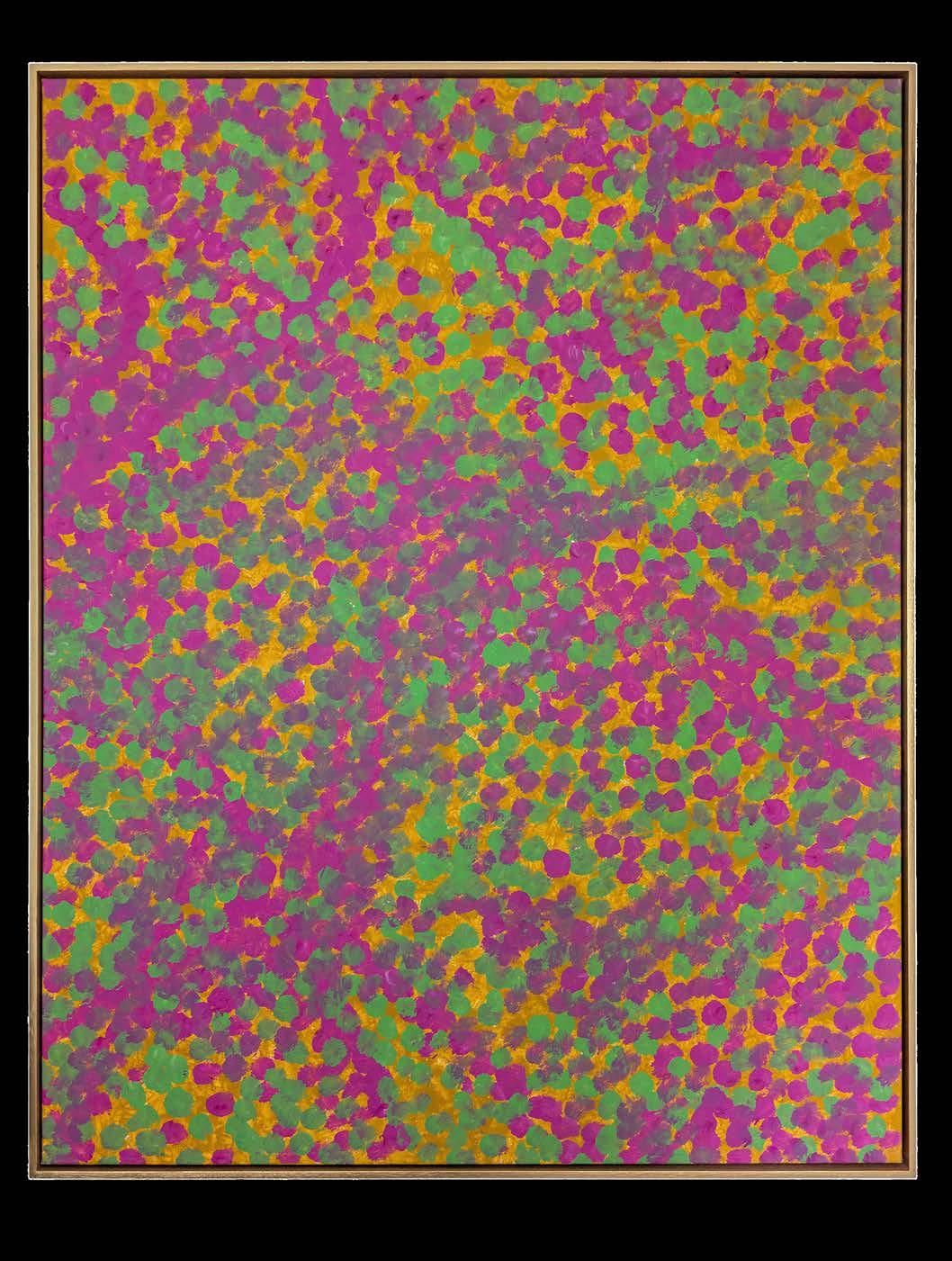
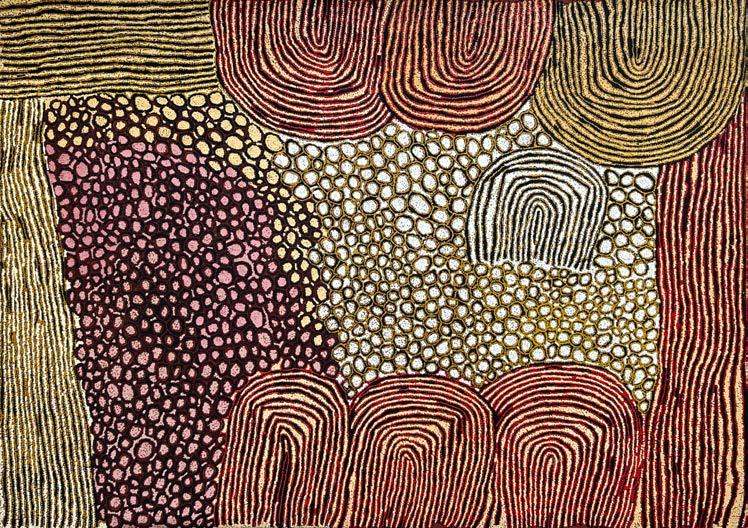
Kathleen's art captures the changing colours of the wild bush plums as they ripen between Christmas and May, from yellow and orange to pink and purple. In her paintings she also traces the journeys ofthewomeninsearchofthismuchprized fruit and follows the changing colours of the seasons, the sacred topography, and theprocessoftravelthroughhercountry.
AnmatyerreartistKathleenNgalebelonged to the Anmatyerre tribe and lived on Arlperre country which covers several hundred kilometres from the Sandover RiveronUtopiaStation,NorthernTerritory.
MINNIE PWERL(E) (1922-2006) BUSHMELON,2003
syntheticpolymeronlinen 120x120cm
PROVENANCE
MbantuaGallery,NT,CatNo.MB18979
PrivateCollection,NSW
EST $8,000 - 10,000
Minnie Pwerle, began painting late in life, yet the impact of her colourful haptic works amongst collectors was immediateandelectric.
Her painting style was instinctual and exuberant with its rounded forms tumbling across the painted surface in vividcolourevokingaloose,pulsingrhythm.
The Bush Melon, a key women’s Dreaming from her country, Atnwengerrp, signifies more than sustenance - it embodies fertility, nourishment, and women’s custodial tiestolandandkin.
Minnie’s expressive freedom and raw physicality quickly placed her alongside Emily Kame Kngwarreye in critical discourse during her lifetime. For collectors, her work is bothvisuallystrikingandhistoricallysignificant–capturing a late-emerging but enduring voice in the canon of AustralianAboriginalart.
EUNICE NAPANANGKA JACK (1940-)
HAIRSTRING,2009
syntheticpolymeronlinen 183x122cm
PROVENANCE
IkuntjiArtCentre,NT,CatNo.16036-08/09
PrivateCollection,Vic
EST $4,000 - 6,000
Born in 1940 at Lupul in the Sir Frederick Ranges, Eunice Napanangka Jack brings a distinctive palette and narrative sensibility to her painting practice. In Hairstring, she engages a theme shared by many Pintupi womensymbolising not only the act of making, but the intricate relationshipsbindingkinandcountry.
Her brushwork is deliberate; her palette luminous. Interwoven forms evoke both labour and lineage, with ceremonial resonance embedded in even the most domesticgestures.Herartcapturesthecontinuityoflife— howeverydayactsbecomesacredthroughrepetitionand memory.
Her work has drawn growing curatorial attention for its confidentexecutionandinterpretivedepth.Forcollectors, herworkoffersagroundedyetdistinctivevoicewithinthe broadertraditionofPintupiwomen'spainting. 10
JULIE NANGALA ROBERTSON (C.1974 - )
MINA MINA DREAMING, 2022
synthetic polymer on linen
91 x 152 cm
PROVENANCE
Art Mob, Tas, Cat No. AM 20102/22 Private Collection, Tas
EST $4,500 - 5,500
The daughter of renowned award-winning artist Dorothy Napangardi, Julie Nangala Robertson spent her early life around Warlpiri painters working in Alice Springs and Yuendumu.Shebeganpaintingwhenstillayoungwoman andhasdevelopedastylethatresonateswiththerhythms and movements of her mother's renditions of the Mina MinaDreamingsite.
In this lovely experimental work, she has interpreted her mother's Dreaming in vivid colours. Julie won the Telstra NATSIAGeneralPaintingAwardin2023.
BARDAYAL 'LOFTY' NADJAMERREK AO (1926-2009)
BARRK-ROCKWALLABY,C.1990
naturalearthpigmentonstringybark 125.5x54cm
PROVENANCE PaintedforRegMasonofArnhemLand Art,Oenpelli,NT PrivateCollection,NSW accompaniedbyaletterdescribingthe worksignedbyRegMason
EST $7,000 - 9,000
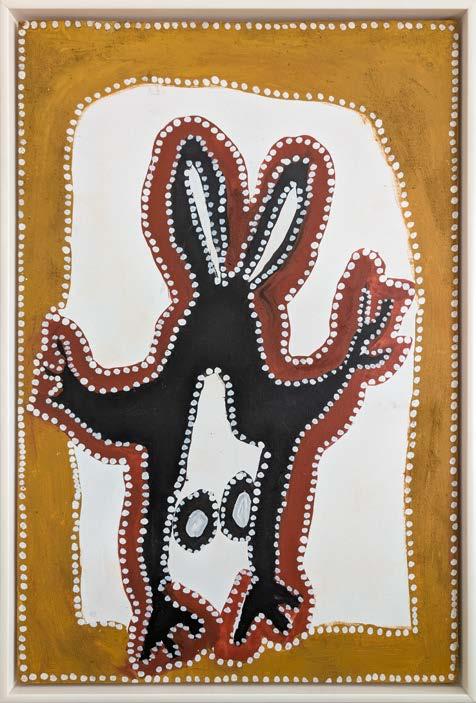
Lofty Nadjamerrek was a master of the x-ray painting style, famed for his depictions of Stone Country animals rendered in natural ochres on both stringybark and paper. In Barrk, he presents the agile rock wallaby, a species closely associated with the rugged escarpments ofArnhemLand.
The wallaby is shown in profile, delicately shaded with fine infill and internal anatomical detail—a technique derived from ancient rock shelter traditions. Lofty's hand is steady, his linework confident, bridging millennia of visualcontinuitywithasenseoflivingimmediacy.
Lofty Nadjamerrek, a senior Kunwinjku artist, was among the last to work directly within the rock art tradition before adapting it to bark painting. His works offer not only technical brilliance, but a rare, living link to over 20,000yearsofIndigenousmark-making. 12
AUCTIONRESULT
COMPARISON
Type:Closelyrelated
Auction:Bonhams,The EvattCollectionof AboriginalBarkPaintings andSculpture,Sydney, 24/11/2013,LotNo.1
Price:A$28,060
Description:Ngalyodthe RainbowSerpent, naturalearthpigmentson eucalyptusbark,129x49 cm
AUCTION RESULT
COMPARISON
Type:Closelyrelated
Auction:Deutscherand Hackett,Important AustralianIndigenousArt, Melbourne,26/03/2025, LotNo.22
Price:A$22,091
Description:Milmilngkan Site,2008,earthpigments withsyntheticbinderon eucalyptusbark,130x53 cm(irregular)
JOHN MAWURNDJUL AM (1952-2024)
MILMILNGKAN,2010
naturalearthpigmentonstringybark 138.5 x42.5cm
PROVENANCE
ManingridaArtsandCulture,NTCatNo.1224-10 AboriginalandPacificArt,NSW PrivateCollection,NSW
Accompaniedbyoriginalcertificatesof authenticityfromManingridaArtsandCulture
EST $8,000 - 10,000
In this work, John Mawurndjul presents the sacred site of Milmilngkan, a billabong imbued with profound ancestral significance. It is here that the Rainbow Serpent— Ngalyod—resides beneath the water's surface, embodying both generative and destructive power. Within Kuninjku cosmology, Ngalyod is a central figure, linked to seasonal cycles, rainfall, and the creation of sacredsites(djang)throughoutclanlands.
Mawurndjul, who lived near this site, evokes its spiritual force through the use of rarrk—meticulous cross-hatching that represents ceremonial power and ancestral presence.Thepatterningitselfissymbolic,channelingthe metaphysical essence of the Mardayin ceremony and the serpentine energies said to animate the waterhole below.
This bark painting is a powerful expression of site-based knowledge and ceremonial law, offering collectors not only a masterwork of technique but a window into the cosmologicalfoundationsofKuninjkuculture. 13
14
KAY LINDJAWANGA (1957-2024) MARDAYINDESIGN,2004
naturalearthpigmentonstringybark 159x39.5cm
PROVENANCE ManingridaArtsandCulture,NTCatNo.2229-04 AboriginalandPacificArt,NSW PrivateCollection,NSW
EST $6,000 - 8,000
Kay Lindjuwanga was a Kuninjku artist and daughter of renownedpainterPeterMarralwanga.Shewastaughtto paint by her husband, the acclaimed artist John Mawurndjul. This work concerns the Mardayin ceremony anditscontentisofasecretandsacrednature.
AUCTION RESULT
COMPARISON
Type:Closelyrelated
Auction: Cooee Art, Aboriginal Works of Art, Sydney, 03/12/2019, Lot No. 12
Price:A$12,000
Description:Macassan Traders,c.1968 naturalearthpigmentson stringybark,108x37cm.
MUNGGARAWUY YUNUPINGU (1945-2023)
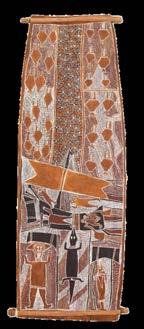
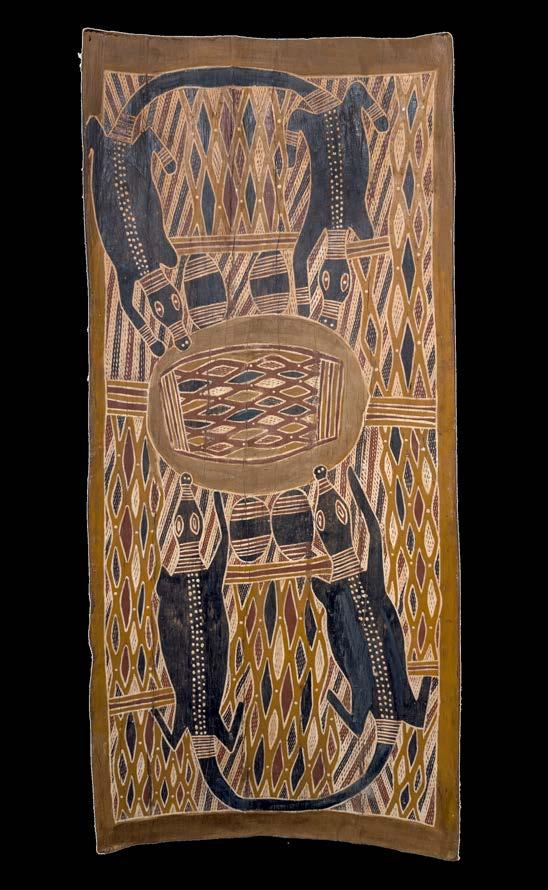
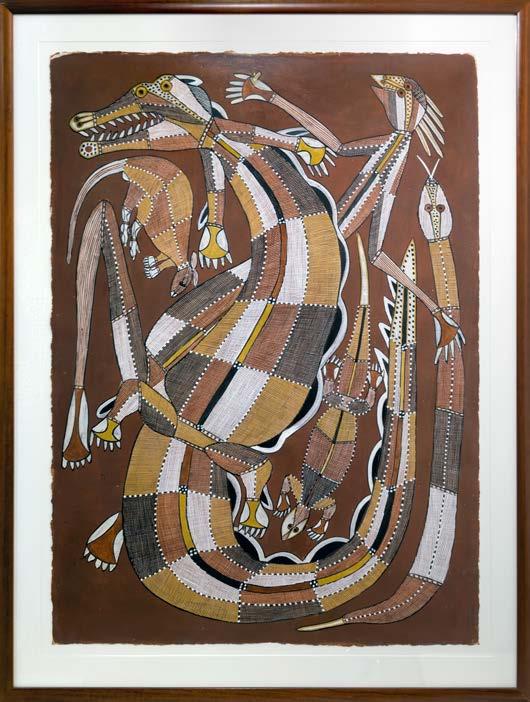
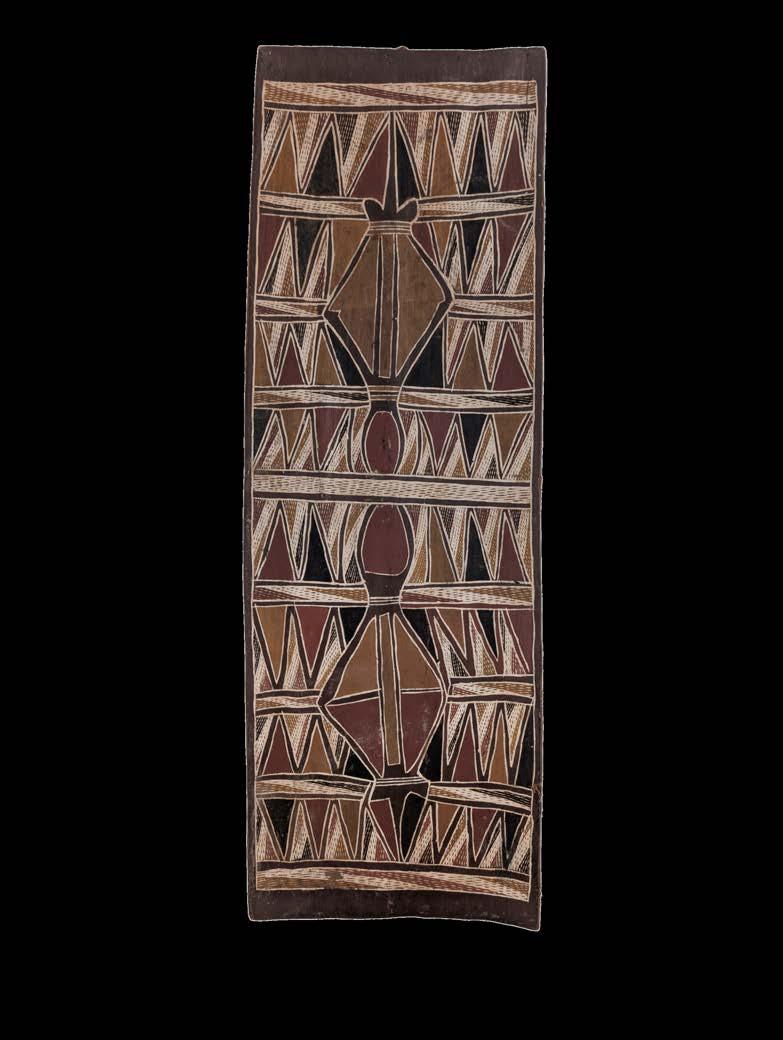
YIRRITJADESIGNSASSOCIATEDWITHBARU(THE CROCODILE),1965
naturalearthpigmentonstringybark 95.5x56cm
PROVENANCE
Sothebys,AboriginalandTribalArt,Sydney,9/11/1997. LotNo.312.JohnMagersCollection,Sydney PrivateCollection,NSW
AttributionendorsedbyWillStubbs–fromBukuLarrngayMulka
EST $5,000 - 7,000
Munggurrawuy Yunupingu was a master of ceremonial painting and an esteemed Gumatj lawman from Arnhem Land. In this work, he depicts Baru - the ancestral crocodilespiritoftheYirritjamoiety-whoseassociations includefire,initiation,andtransformation.
The composition features rarrk cross-hatching, geometric infill, and emblematic clan motifs - each corresponding to specific sites and ceremonial functions. These are not simply decorative devices, but acts of cultural continuity. Yunupingu's cultural authority is embedded in every lineeach one a cipher for sacred identity and ancestral memory.
YAMA MUNUNGGURRITJ AND/OR HIS BROTHER WATJUNG
BÄRUINCALEDONBAY-GUMATJ
ANCESTRALFIRESTORY,C.1970
naturalearthpigmentonbark
81.5x36cm
PROVENANCE
SourceUnknown,CatNo.LSICM5 FireworksGallery,Qld PrivateCollection,Vic
EST $4,000 - 6,000
Attributed to Yama Mununggurritj or his brother Watjung, thisbarkpaintingrecountsthemythicactionsofBäru,the ancestral crocodile, in Caledon Bay—central to Gumatj clan identity. Elemental in force, the story tells of Bäru emerging from the water bearing fire, bringing both illumination and danger, and marking the land with ancestralauthority.
Thebarkisadornedwithboldrarrkcross-hatchinginvivid reds and blacks, evoking both the crocodile's scales and the flames it carries. The image works across registersas a literal being, a clan totem, and a metaphor for law andtransmission.
In Yolngu culture, collective authorship is common. For collectors, such pieces can offer unique insights into collaborativeknowledgeandsharediconographiesrarely visibleinWesterntraditionsofauthorship. 16
17
WAIGAN DJANGARA (C.1929-)
WANDJINA,C.1985
naturalearthpigmentonstringybark 92x41.5cm
PROVENANCE
WaringarriArts,WA,CatNo.1394
D'LanDavidsonContemporaryArt,Vic PrivateCollection,Vic
EST $3,500 - 4,500
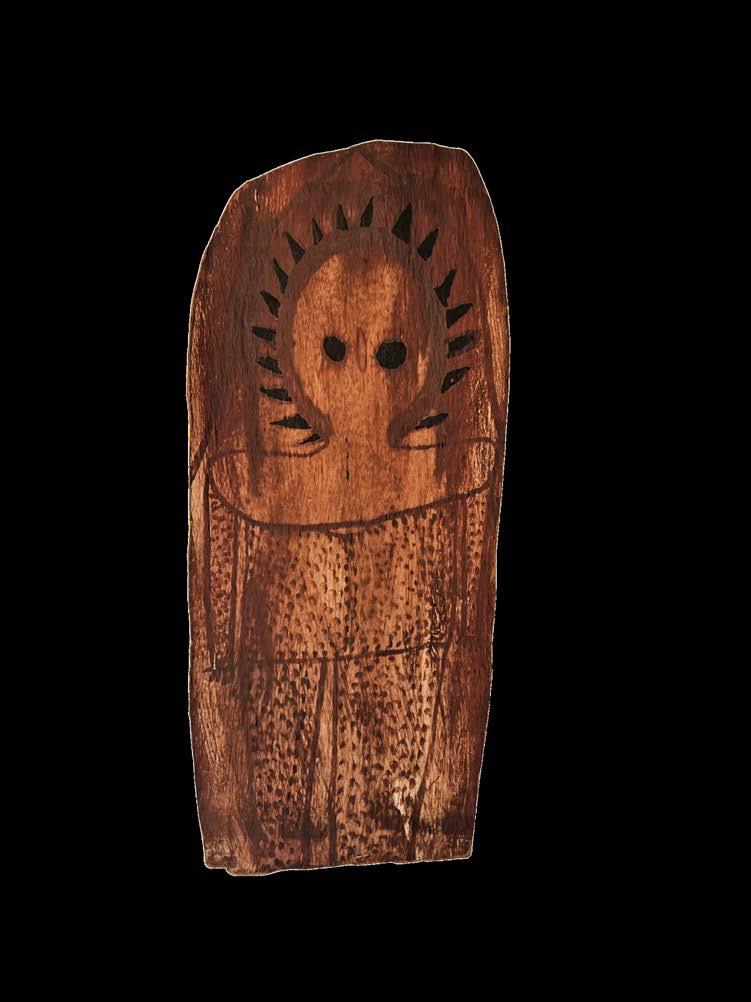
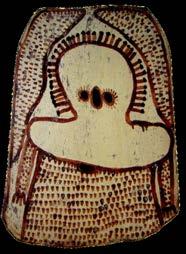
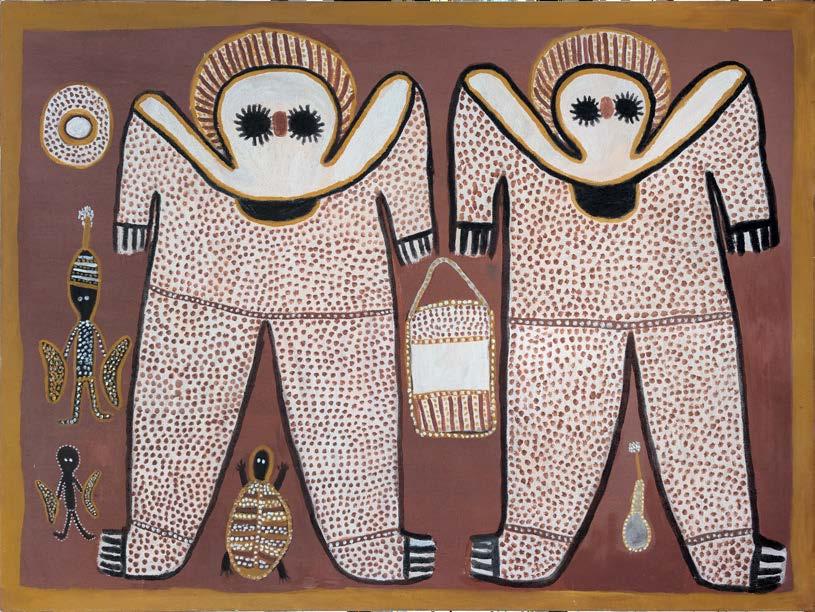
Waigan Djangara specialised in painting Wandjina, the ancestral spirits responsible for rain, storms, and creation in the Kimberley region. Wandjina are recognisable by their large, round heads and halo-like headdresses—silent yet expressive figures depicted without mouths, as their power is understood to exist beyond speech. In this work, the Wandjina emerges in pale pigments—white, ochre, and black—hovering againstaflatfield.
These images are not simply visual; they are acts of renewal, connected to ceremony and seasonal change. They have been repainted on cave walls over the millenniainordertoensurefertilityandincrease.
While Waigan is possibly less widely known than several other Wandjina painters, his works embody a deeply localisedexpressionofenduringancestralpresence.For collectors, Wandjina paintings provide a powerful intersection between spiritually iconic imagery, revivification, and seasonal rhythm—between art and weather.
AUCTION RESULT
COMPARISON
Type:Closelyrelated
Auction:Phillips Auctioneers,20th CenturyArt&Design, Sydney,02/05/1999,Lot No.160
Price:A$5,060
Description:Wandjina Figure,1990 naturalearthpigments andnaturalbinderon eucalyptusbark,75x50 cm
18 naturalearthpigmentsoncanvas 120x160cm
LILY KARADADA (C.1937-) WANDJINA-RAINSPIRITS,2001
PROVENANCE
NarrangunnyArts,WA,CatNo.N-2108-LK LawsonMenzies,AboriginalFine Art,2005,LotNo.205 PrivateCollection,NSW
EST $5,000 - 7,000
Lily was born near the Prince Regent River and is the last of a generation of fully initiated artists who painted Wandjina on cave walls and canvas. In her refined style, she paints these spirits with the distinctive pointy shoulders of her particular cave area, often accompanied by totemic animals and ceremonial figures.
Wandjina are powerful creator ancestors and fertility spirits who bring the monsoon rain to the Kimberley each year, thereby ensuring the health and well being of all its inhabitants. Large eyesdominateinamouthlessface,sometimesontopofasimple robe-like body, or with limbs and feet (as in this work). Radiating lines around the eyes or in a halo around the head represent the lightningthatheraldsthestorm.
The earliest images transferred from rock to bark were created at the request of early missionaries and explorers during the 1930s, after the Benedictine mission was established. The missionaries had displaced Lily’s Wanambal people from their traditional lands, and disrupted their way of life, including the regularre-touchingoftheWandjinaatimportantcavesites.
PADDY JAMINJI (1912-1996) DEVILDEVIL,C.1982
19 naturalearthpigmentoncomposition board
45x124cm;49x127.5cmframe
PROVENANCE
FieldCollected,WA
PrivateCollection,Vic LawsonMenzies,AboriginalFineArt, Lot212,Sydney,June2007
PrivateCollection,NSW CooeeArt,IndigenousFineArt-Spring Sale,Lot70,Sydney PrivateCollection,Vic
EST $25,000 - 35,000
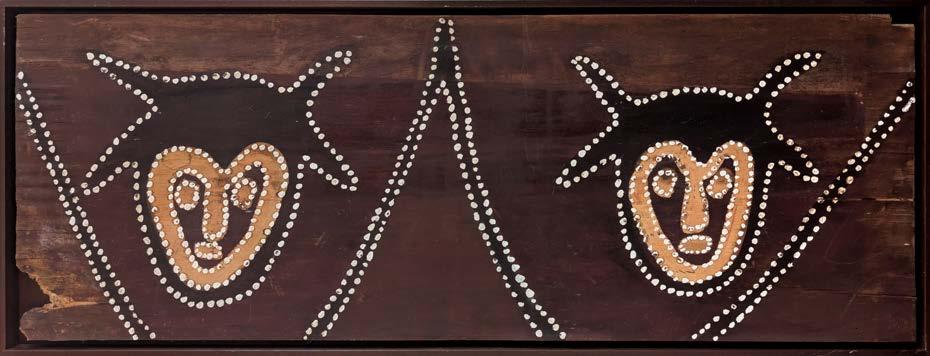
Paddy Jaminji was born on Bedford Downs station and is best known for his early ceremonial boards and ochre paintings created in the East Kimberley tradition. In Devil Devil, he depicts the spirit beings known for causing fear and disturbance—figures that roam between worldsandactaswarningsforsocialbehaviour.
The forms are stark: solid fields of colour punctuated by wide eyes and minimal outlines. These spirits are not anthropomorphised but remain ambiguous and powerful—part animal, part shadow, entirely ancestral.
Paddy Jaminji’s work carries seminal status. As one of the earliest artists to emerge from the region, his paintings are held in deep regard for their connection to ceremonial practice and their raw, graphicimmediacy.
AUCTION RESULT
COMPARISON
Type:Closelyrelated
Auction:Sotheby's, ImportantAboriginalArt, Melbourne,24/07/2007, LotNo.32
Price:A$102,000
Description:TheSpirits, JimbiandManginta,pre 1983
naturalearthpigments andnaturalbinderson plywood,62x122cm
20
PADDY BEDFORD (1922-2007) DJUMPINDEVILSPIRIT,2001
naturalearthpigmentonillustration board
91x61cm
PROVENANCE
PaintedinDerby,WA PrivateCollection,Vic
EST $8,000 - 15,000
Paddy Bedford, was an enigmatic octogenarian at the time he began painting, yet he immediatly stood out as auniquelytalentedartist.
This work was created early in his career as an artist, during a workshop organised by Neil McLeod for Jack DaleathishomeinDerbyduringlate2001.Bedfordwas stayingwithhisoldfriendDaleatthetime,anddecided that he too would like to paint. The small number of works produced were photo-documented and as a consequence, this piece is accompanied by two good photographsoftheartistatworkonthepainting.
This image depicts both the spirit and the site southwest of Bedford Downs where a creek bed runs between high, sheer cliffs. The story is from his mother's country whose birthplace was nearby at Wirndoowoon. According to the artist, this was a place of dangerous DevilDevilDreaming.
AUCTION RESULT
COMPARISON
Type:Closelyrelated
Auction:Lawson Menzies(nowtradingas Menzies),AboriginalFine
Art,Sydney, 23/05/2007,LotNo.9
Price:A$30,000
Description:Cavesand Waterholes,Bedford Station,2001 naturalearthpigmentson board,ontwopanels, signedverso,92x61cm
21
QUEENIE MCKENZIE (1930-1998) WOOLWOOLYIHILLS,1996
naturalearthpigmentsonBelgianlinen 72 x 99 cm
PROVENANCE
BurrinjaGallery,Vic
FireworksGallery,Qld,CatNo.FW3680
CooeeArtGallery,NSW,CatNo.20205
PrivateCollection,Qld
PrivateCollection,NSW
EST $7,000 - 9,000
AUCTIONRESULT COMPARISON
Type:Closelyrelated
Auction:LawsonMenzies (nowtradingasMenzies), AboriginalArt,Sydney, 22/11/2006,LotNo.172
Price:A$14,400
Description:Texas DownsHorsemansCreek Area,1996
naturalearthpigmentson canvas,signatureand schemaverso,76x91cm
Queenie McKenzie began her life of cooking for the stockmen, tending and riding horses, and journeying as they drove cattle across the vast pastoral region of the north.Shewasthefirstwomantogainprominenceinthe EastKimberleypaintingmovement,inspiringotherwomen to become involved and to embrace their 'women's law business'ofwhichshewasarespectedcustodian.
Often she would recreate the country of her youth. Her birthplace and its geographical location in relation to Blackfella's Creek; the large termite mound that was small when she was a child but grew bigger and bigger throughout her life; the hills of Rosewood Station where she had worked as a cook for the Aboriginal stockmen; Old Texas Station where men would collect white quartz used for spear heads; Corella, Echidna, and Bowerbird Dreaming sites and many more. Her manner was always decisive and vigorous, reflecting her belief in the importance of maintaining her culture and recording its history. This included the brutal massacres of her people, longrememberedintheiroralhistory.
22 naturalearthpigmentsoncanvas 140x150cm
SHIRLEY PURDIE (1947-) SANDFROGDREAMING,2000
PROVENANCE
WarmunArtCentre,CatNo.431/00 PrivateCollection,NSW
EST $5,000 - 7,000
At Winnaba Springs on Mabel Downs cattle station, the sandfrog, a creature linked to waterholes and ceremonial law, makes its home. Inthiswork,Shirleyhasdepictedaseriesofshallowrapidsthatflow around and through large monolithic rocks. It maps the animal's habitat and the springs, creeks, and watercourses where these ancestralbeingsreside.
Shirley's use of earthy tones—ochre reds, black, green and grey— creates a landscape that evokes lived experience. Concentric circles mark large rocks, while the surrounding hills place the location of the ancestral frog's journey as both literal path and mythicpassage.
As a senior Gija artist and custodian of her mother's Dreaming, Shirley'sworkscarrynotonlyculturalauthoritybutstylisticclarity.Her paintings remain key examples of East Kimberley narrative traditions andcontinuetoattractcollectorsdrawntostory-richlandscapes.
23 colourlithographEdNo.33/40 68x101cm;105x137cmframe
ROVER THOMAS (1926-1998) JAANDOO-WILDDOGDREAMING,1995
PROVENANCE
PrintedbyFrankGohieratNorthern TerritoryUniversityPrintWorkshop(later NorthernEditions,CharlesDarwin University)
PrivateCollection,NSW
EST $3,500 - 4,500
Rover Thomas transformed the Australian art landscape with his austere ochre paintings that distilled ancestral stories intoelementalforms.InJaandoo(WildDog Dreaming), he charts the ancestral wild dog's journey across Wroowina in the GreatSandyDesert-asitesaturatedwith story,spirit,andmemory.
Using a minimal palette and geometric planes, Rover evokes both topography and mythic presence. The wild dog is a guardian, a hunter, and a law-carrier. Eachfieldofcolourholdsnarrativeweight; eachlineregistersamomentofmovement ormemory.
This work captures the quiet intensity and restraint that brought Rover Thomas international acclaim - and continues to speak to collectors attuned to abstraction andculturaldepth.
AUCTIONRESULT COMPARISON
Type:Closelyrelated
Auction:Christies, ModernAboriginal Art,Sydney, 12/10/2004,LotNo. 142
Price:A$6,572
Description: WurritjiCountry, colourlithograph, numberedPM75 AP5/5,75x60.5 cm
IVAN NAMIRRKI (1961-)
CROCODILE,MIMI,FILESNAKE,ANDROCK WALLABY,C.1995
naturalearthpigmentsonarchescottonragpaper 105x75cm,124x94cmframe
PROVENANCE
PaintedforRegMasonofArnhemLandArt, Oenpelli,NT PrivateCollection,NSW
EST $1,500 - 2,500
Kuninjku artist Ivan Namirrikki was taught to paint by his father, the renownedThompsonYulidjirri,andworkswithinalineagethatextendsfrom rockshelterarttoceremonialdesign.Thisworkbringstogetherfourtotemic figures - crocodile, mimi spirits, file snake, and rock wallaby - all intrinsic to thestonecountryofWestArnhemLand.
The crocodile is poised with latent menace; the mimi, delicate and elongated, hover like ancestral echo. Mimi spirits are said to inhabit the rocks, revealing themselves in dreams or ceremony - their presence here impliesalayeredcosmologywhereland,myth,andmemorycoexist.
Ivan Namirrikki's paintings are celebrated for their visual discipline and lyrical clarity.For those drawn to the deeper structures of Kuninjku storytelling, this work offers a densely woven visual narrative - highly collectableandincreasinglyrecognisedbymajorinstitutions. 24
PADDY FORDHAM WAINBURRANGA (C.1932-2006)
ARTIST'SCOUNTRY,DAMDIBU,1984
naturalearthpigmentonstringybark 111x53.5cm
PROVENANCE
EST $2,800 - 3,500
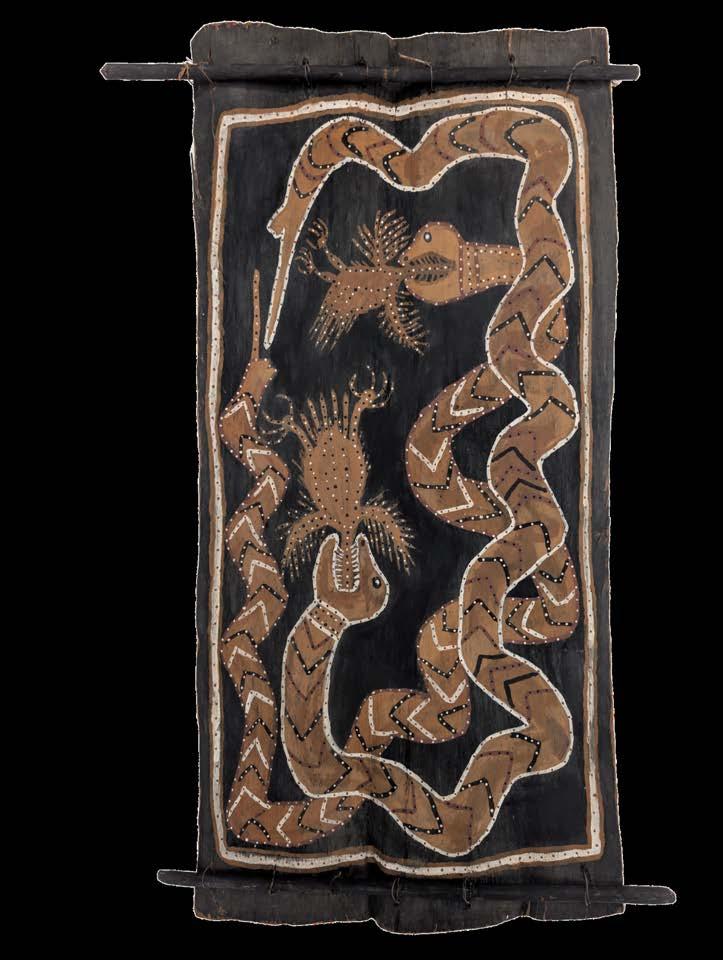
During his lifetime, renowned artist, dancer, didgeridoo player and storyteller, Paddy Fordham Wainburranga embodied the living history of the people of Australia's far north. Born in the bush near Bulman, northeast of Katherine, Paddy first encountered whites at the age of eleven.
Despite being best known for his history paintings, his most enduring contribution to Australian art, and the preservation of Aboriginal culture, are his narrative depictions of traditional Rembarrnga myths and legends. In barks such as this, he related how Aboriginal life began,howhispeoplebecamedividedintomoietiesand skin groups, what 'pay back' means and how the clan system works including human relationship with the spirits,withnatureandwitheachother.
Here two snakes represent the two moieties, Dhuwa and Yirritja.
CLOUDS,STRINGRAYANDCUTTLEFISH,C.1970
naturalearthpigmentonstringybark 104x34.5cm
PROVENANCE
PurchasedArnhemLand,NT FireworksGallery,Qld PrivateCollection,Vic
EST $2,500 - 4,500
This painting by Liwukang Bukulatjpi, brother of David Burrumarra, draws together elemental forces—clouds, stingrays, and cuttlefish—linking sky, sea, and ceremony. Each motif carries its own cosmological charge: clouds signal the monsoon and ancestral breath; stingray and cuttlefish as totems, hunters, and beings of transformation.
Rendered with clarity and poise, the composition suggests the interdependence of marine and weather systems—a foundational theme in Yolngu cosmology. The artist is rooted in the Djamarrpuyŋu clan tradition, andthispaintingreflectsthatinheritance.
Liwukang Bukulatjpi’s work, though less commonly seen in the market than his brother’s, offers a refined and grounded perspective on coastal mythologies, with layered detail that rewards both aesthetic appreciation andculturalinquiry.
LIWUKAŊ BUKULATJPI (1927-2007)
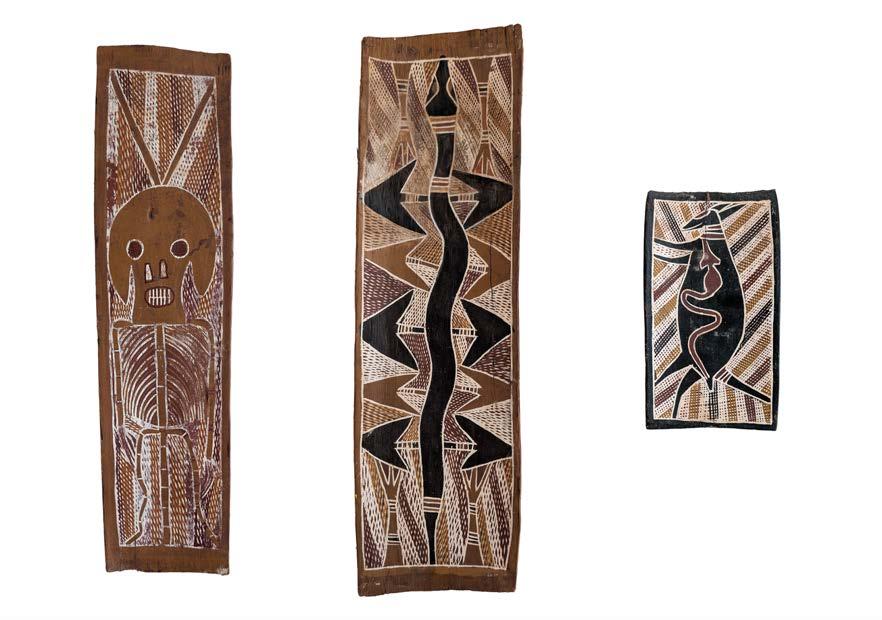
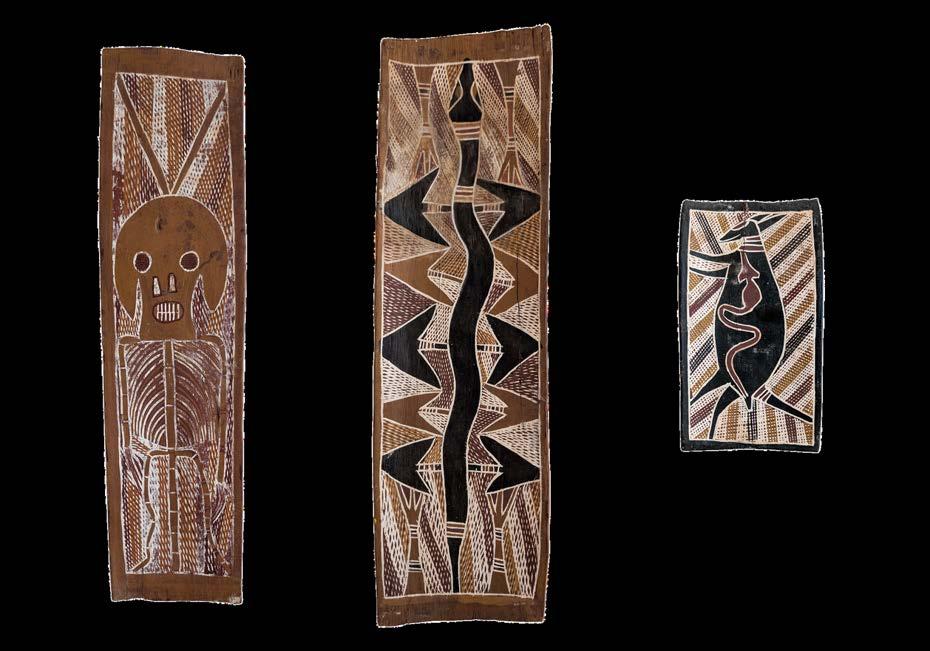
ARTIST ONCE KNOWN
GALPUCLAN-FILESNAKEANDLILLIES,C.1970
MOKOY,TRICKSTERSPIRIT,C.1970
UNTITLED,C.1970S
naturalearthpigmentonstringybark 55.5x16cm,51x13.5cm,24x13.5cm
PROVENANCE
PurchasedArnhemLand,NT FireworksGallery,Qld PrivateCollection,Vic
EST $1,200 - 1,800
The first of these small barks represents the intertwined systemsoffreshwaterlife.Eachelementhasceremonial resonance—the snake is a water spirit and guide; the lilies, signs of seasonal change and ecological abundance.
Mokuy are ghost-like spirits in Yolngu cosmology, often portrayed as agents of mischief, danger, or moral correction.
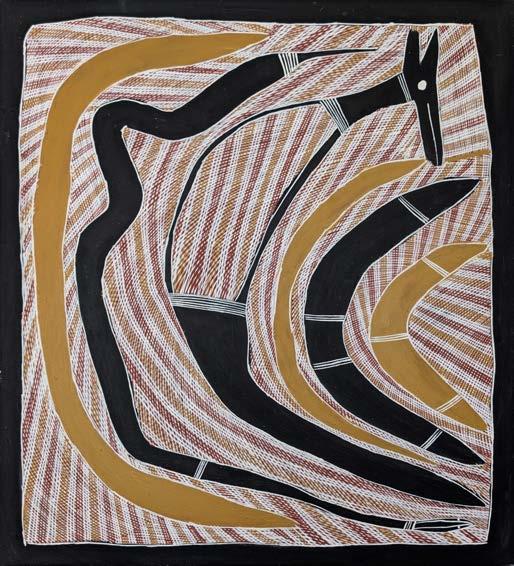
The Kangaroo is rendered in the X-ray style typical of CentralandWesternArnhemLandtradition.
Works like these speak to the longevity of ancestral narratives - and the enduring mystery of art created within systems where authorship is communal, and knowledgeheldintrust.
JIMMY DONEGAN (C.1940-) WATIKUTJARAWANAMPI,2015
syntheticpolymeroncanvas 153x122cm
PROVENANCE
NinukuArts,NT,CatNo.15-73
ArtMob,Tas,CatNo.AM14671/17
PrivateCollection,Tas
EST $6,000 - 8,000
Jimmy Donegan's paintings depict ancestral stories, mostly focusing on his paternal heritage. His father was from Dulu, a rock hole in the Gibson Desert well known fordingopacksandspirituallyassociatedwiththeDingo Dreaming (Papa Tjukurpa). His grandfather's country is Pukara, a sacred men's site south of Irrunytju that is closely associated with the story of the two snake men (WatiWanampiKutjara).
Though he first painted in 2001, Donegan gained greater renown after joining Ninuku Arts, when it was established in 2006. His painting Papa Tjukurpa munu Pukara won the National Aboriginal & Torres Strait IslanderArtAwardin2010.
29
WALANGKURA NAPANANGKA I (UTA UTA’S WIFE) (C.1922-2010)
LUPUL,2006
syntheticpolymeroncanvas 153x61cm
PROVENANCE
PapunyaTulaArtists,NT,CatNo.WN0603182
PrivateCollection,NSW
EST $4,000 - 6,000
AUCTION RESULT COMPARISON
Type:Closelyrelated
Auction:Sotheby's, ImportantAboriginalArt, Melbourne,07/06/2011, LotNo.168
Price:A$6,960
Description: Rockholes andSoakageWatersat Lupul(2006) syntheticpolymerpainton canvas,122x91cm
The roundels in the painting depict the rockholes and soakage water at Lupul, south of the Kintore community. The Peewee (small bird) Dreaming is associated with this site. In mythological times a large group of ancestral women gathered at this site to perform dances and sing the songs associated with this site. While at Lupul the women made hair string with which to make hair string skirtswhicharewornduringceremonies.Uponconclusion of the ceremony the women moved on to Nyirrpi. The wavy lines in this work represent the hair string. The gridlikedesignrepresentsthesurroundingrockyoutcrops.
As they travelled they gathered large quantities of the ediblefruitknownaspura,orbushtomato.Thisfruitisthe size of a small apricot, and after the seeds have been removed, can be stored for long periods by halving the fruit and skewering them onto a stick. The small circles in thisworkrepresentthepura.
PADDY SIMS JAPALJARRI (1917-2010)
YANJIRLPIRRIJUKURRPA(STAR DREAMING),2008
syntheticpolymeronlinen 183x122cm
PROVENANCE
WarlukurlanguArtistsNT,CatNo.1997/08 ArtMob,Tas,CatNo.AM10072/13 PrivateCollection,Tas
EST $8,000 - 12,000
ThesitedepictedinthiscanvasisYanjirlypiri(Star)where there is a low hill and a water soakage. The importance of this place cannot be over emphasised as young boys are brought here to be initiated from as far as Pitjanjatjara country to the south and Lajamanu to the north. The men wear Jinjirla (white feather headdresses), during the ceremony, on either side of their heads. They also wear wooden carvings of stars which are also laid outonthegroundaspartofthesandpaintingsproduced for business. Ngalyipi (snake vine), here shown as long curved lines, is used to tie Witi (ceremonial spears) vertically to the shins of the dancing initiates. These Witi are shown as long straight lines. The white circles depict Yanjirlpirri(stars).
AUCTIONRESULT COMPARISON
Type:Closelyrelated Auction: ArtLeven (formerlyCooeeArt), IndigenousFineArt Auction,Sydney, 20/06/2023,LotNo.67
Price:A$13,500
Description:Yanjirlpirri Jukurrpa(StarDreaming), 2007 syntheticpolymerpaint onlinen,122x173cm
31 watercolouronpaper
WALTER EBATARINJA(1932-1958)
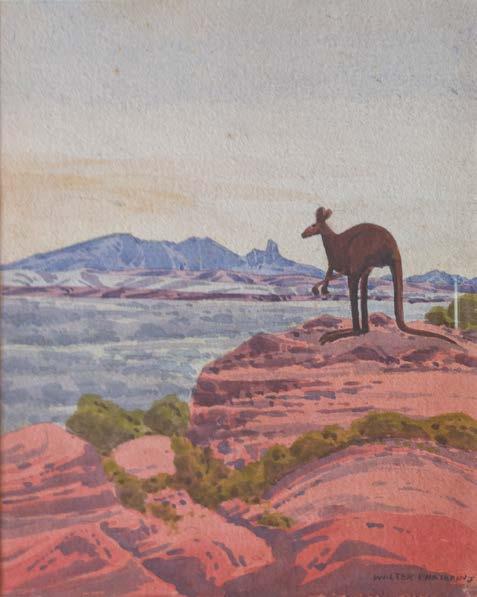
WALLABYWITHMOUNTSONDER,C.1945
34x27.5 cm,51.5x45cmframe
PROVENANCE
PurchasedfromtheartistbyRaymondJohn Noble,DeputyDirectorArmedForces,Alice Springsc.1945
AdrianandAnneNewsteadCollection,NSW
EST $900 - 1,500
Walter Ebatarinja was among the first generation of Arrernte watercolour painters trained under Rex Battarbee at Hermannsburg. His landscapes reflect a moment of great artistic adaptation: traditional knowledgerenderedinWesternperspective.
In Wallaby with Mount Sonder, Walter includes both the iconic silhouette of the mountain and a native animal, drawing the viewer’s attention to Country as not just scenery but ecosystem. The composition is serene, the palette soft, yet there is a distinct sense of embeddedness—ofpaintingaslivedobservation.
WalterEbatarinja’sworksareincreasinglyrecognisedfor their role in shaping Australian art history. This piece, withitsquietdignity,isanevocativedocumentofcrossculturalexchange.
32 watercolouronpaper
WALTER EBATARINJA(1932-1958)
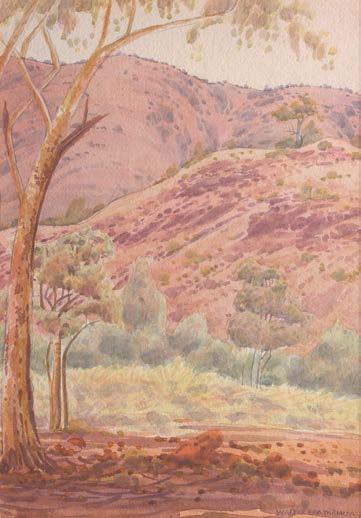
UNTITLEDWESTERNMACDONNELLLANDSCAPE,C.1945
37.5x26.5cm,53x42cmframe
PROVENANCE
PurchasedfromtheartistbyRaymondJohn Noble,DeputyDirectorArmedForces,Alice Springsc.1945 AdrianandAnneNewsteadCollection,NSW
EST $900 - 1,500
This work, like much of Walter Ebatarinja’s oeuvre, captures the spiritual grandeur of the Western MacDonnell Ranges. Untitled, yet unmistakably located, the painting features rounded hills and soft shadows that recall both the geological and sacred contours of ArrernteCountry.
Walter’s style is confident yet unhurried—his brush articulates presence without theatricality. This is landscape not as a tourist might see it, but as someone bornintoitseesit:layered,inhabited,known.
Collectors attuned to early 20th-century Aboriginal art movements have come to value Walter Ebatarinja's contribution for its nuance and historical resonance. Each of his landscapes quietly challenges assumptions aboutgenre,authorship,andbelonging.
WALTER EBATARINJA(1932-1958)
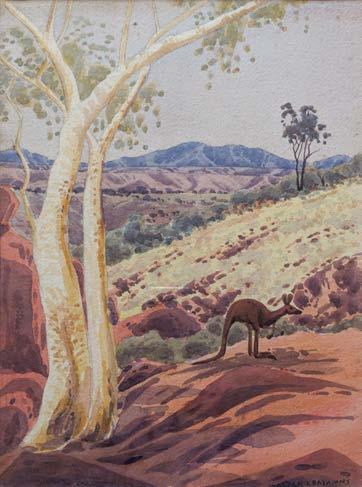
WALLABYNEARMOUNTGILES,WESTERNMACDONNELLS,C.1945
watercolouronpaper 38x28;55.5x45.5cmframe
PROVENANCE
PurchasedfromtheartistbyRaymondJohn Noble,DeputyDirectorArmedForces,Alice Springsc.1945 AdrianandAnneNewsteadCollection,NSW
EST $800 - 1,500
AnotherviewoftheMacDonnellRanges,thistimewitha wallaby foregrounded near Mount Giles, one of the region’s most rugged escarpments. Walter Ebatarinja’s choice to include native fauna adds a layer of intimacy andecologicalspecificity.
This is not a romantic view of untouched wilderness but a relational landscape—an environment shaped by millennia of coexistence between people, animals, and landforms.
The repetition of these forms across his work reveals not redundancy,butreverence.Eachrenderingisavariation on knowing, a shift in light and memory. For collectors, this work deepens the narrative offered by the previous entries and enriches any collection focused on HermannsburgSchoolworks. 33
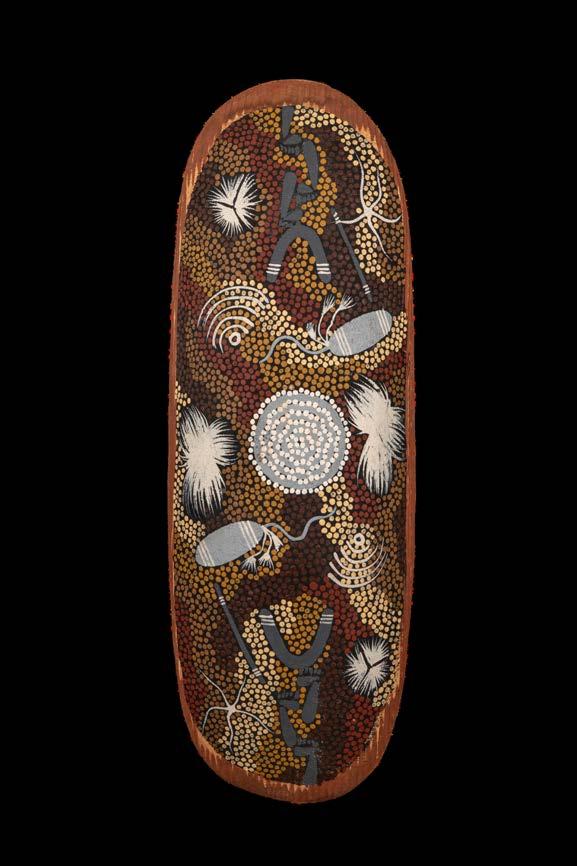
THE BLYTHMAN COLLECTION
painted artefacts
Lots 34 – 39
FINE AUSTRALIAN ABORIGINAL ART | AUGUST 2025 | SYDNEY
DARYL BLYTHMAN — AN EXTRAORDINARY COLLECTOR
Daryl Blythman grew up in the Victorian Mallee, where ploughing fields often unearthed stone axe heads and relics—sparking a lifelong interest in Aboriginal culture. As he grew older, he frequented second-hand dealers, visited old farming properties, and became a fixture at auctions. When he raised his hand to bid on an Aboriginal artefact, it stayed up until he secured it. His dedication, travel, and repatriationeffortssoonbuilt aremarkablecollection.
Daryl was also deeply generous. Over two decades, he made substantial donations toboththeSouthAustralianMuseumandtheMuseumof WesternAustralia.
While working in Alice Springs during the construction of the Papunya hospital, he was invited to visit the community. There, he purchased several early Papunya paintings—without realisingtheir historical significance.
As contemporary Aboriginal art gained popularity, Daryl formed friendships with artists from regions north-west of Alice Springs and Lajamanu. In 1992, he commissioned Clifford Possum to paint canvases and later, wooden shields. Though Clifford laughed at first, he agreed. His painted artefacts were so powerful that Daryl continued the idea, founding what would become the “Painted Artefact Collection.”
From 2009 onwards, Daryl travelled through the Central Desert collecting wooden shields, coolamons, boomerangs, and woomeras. With the help of a local art dealer, he commissioned original artists to paint them. The process was often emotional— artists would chant as they painted, sharing stories and the cultural meaning behind eachdesign.
By2011, Daryl hadbuilt not onlyacollection, but alegacy.
—HaroldGallasch
CLIFFORD POSSUM TJAPALTJARRI (C.1932-2002)
GIDGEECREEKATNAPPERBYSTATION,C.1992
syntheticpolymeron1950sbeanwoodshield 64cm
PROVENANCE
TheBlythmanCollection,NSW
ILLUSTRATED
TheBlythmanCollection-Acollectionofpainted artefactsfrom.AustralianAboriginal Artists.Illustratedpp10-11
acopyofthisbookaccompaniesthework
EST $4,000 - 5,000
WILLY TJUNGURRAYI (1936-2018)
THESANDHILLSANDTHESANDSTORMTHATKILLEDTHE ANCESTRALTINGARIMENINTHEDREAMTIME,C.2009
syntheticpolymeron1950sbeanwoodshield 69cm
PROVENANCE
TheBlythmanCollection,NSW
ILLUSTRATED
TheBlythmanCollection-Acollectionof paintedartefactsfrom.AustralianAboriginal Artists.Illustratedpp106-107
acopyofthisbookaccompaniesthework
EXHIBITED
TandanyaAboriginalCulturalInstitute,Adelaide SA2021
EST $2,500 - 3,500
RONNIE TJAMPITJINPA (1943-2023) MEN'SCEREMONY,2005
syntheticpolymeron1950sbeanwoodshield 74cm
PROVENANCE
TheBlythmanCollection,NSW
ILLUSTRATED
TheBlythmanCollection-Acollectionof paintedartefactsfrom.AustralianAboriginal Artists.Illustratedpp78-79
acopyofthisbookaccompaniesthework
EXHIBITED
TandanyaAboriginalCulturalInstitute, AdelaideSA2021
EST $3,000 - 4,000
PADDY JAPALJARRI STEWART (1935-2013) HONEYANTDREAMING,2010
syntheticpolymeronwoodencoolamon 79cm
PROVENANCE
TheBlythmanCollection,NSW
ILLUSTRATED
TheBlythmanCollection-Acollectionof paintedartefactsfrom.Australian AboriginalArtists.Illustratedpp140-141
acopyofthisbookaccompaniesthework
EXHIBITED
TandanyaAboriginalCulturalInstitute, AdelaideSA2021
EST $2,500 - 3,500
2011
syntheticpolymeronwoodencoolamon 70cm
PROVENANCE
TheBlythmanCollection,NSW
ILLUSTRATED
TheBlythmanCollection-Acollectionof paintedartefactsfrom.AustralianAboriginal Artists.Illustratedpp306-307 acopyofthisbookaccompaniesthework
EXHIBITED
TandanyaAboriginalCulturalInstitute, AdelaideSA2021
EST $2,000 - 3,000
YINARUPA GIBSON NANGALA (1960) MYCOUNTRYKIWIRRKURRANEARJUPITERWELLS,WA,
CLIFFORD POSSUM TJAPALTJARRI (C.1932-2002)
TWOMENSITTINGATBROOK'SWELL,C.1992
syntheticpolymeron1950sbeanwoodshield 80cm
PROVENANCE
TheBlythmanCollection,NSW
ILLUSTRATED
TheBlythmanCollection-Acollectionof paintedartefactsfrom.AustralianAboriginal Artists.Illustratedpp10-11
acopyofthisbookaccompaniesthework
EST $2,500 - 3,500
40 syntheticpolymeronlinen 152x182cm
WILLY TJUNGURRAYI (1936-2018)
TINGARIATKAAKURATINTJA,2003
PROVENANCE
MasonArtGallery,NT,CatNo.WT0304 PrivateCollectionVic
accompaniedbyanoriginalcertificate ofauthenticity
EST $30,000 - 40,000
Willy Tjungurrayi and his elder brother Yala Yala Gibbs Tjungurrayi were among the first group of painters at Papunyaintheearly1970s.
According to Pintupi mythology, the Tingari ancestral beings moved around the land creating its features, including the life sustaining fresh waterholes, and establishedPintupilawduringtheearth'screation.
This painting depicts designs associated with Kaakuratintja (Lake MacDonald). A large group of Tingari Men, both young and old, travelled to this site from the west. A fierce hailstorm occurred which killed them all. Since events associated with the Tingari Cycle areofasecretnaturenofurtherdetailwasgiven.
TJAMPITJINPA (1943-2023)
TINGARI,C.2006
syntheticpolymeronlinen 90x118cm
PROVENANCE
MukMukFineArt,AliceSprings,NT PrivateCollectionNSW
EST $4,000 - 6,000
The classic Pintupi style of linked concentric circles tells of a sacred geometry. It is derived from body paint designs, cartography of country,andancestralnarratives.
More than any other figure, Ronnie Tjampitjinpa can be credited with having forged a new artistic direction in embracing aesthetic minimalism, thereby freeing up further possibilities for the emerging generationofpaintersandchallengingfixedperceptionsofWestern Desertart.
His hypnotic designs explore interacting geometric shapes which emanate an eye-catching, pulsating action. Still infused with the DreamingsofhismythicalTingariancestors,Tjampitjinparefinedthe characteristic Pintupi simplicity of design, boldly scaling up fundamental pictorial elements, freeing them from their iconographic reference points and strongly emphasizing the distinctiverepetitionoflineandformthathasalwaysinfusedPintupi artwiththespiritoftheirvastandancientlands.
RONNIE
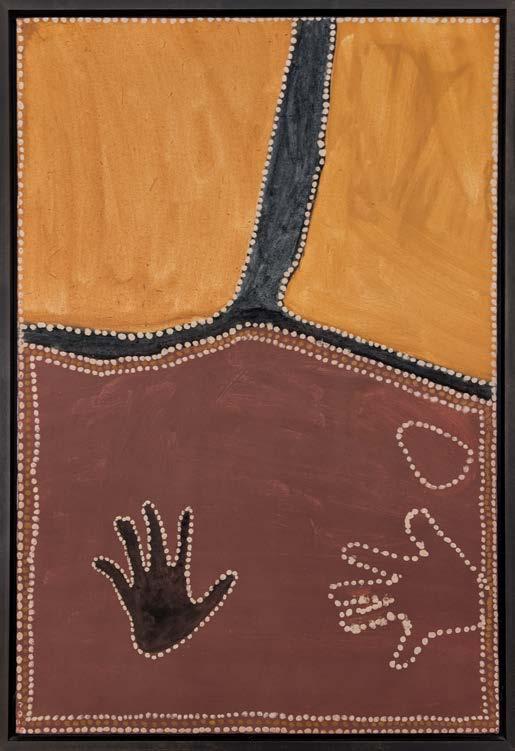
Rover Thomas spent a lifetime driving cattle along the Canning Stock Route and between outback Queensland and the loading yards at Wyndham.ThoughhewasoriginallyfromMartucountryhemovedwith hisfellowstockmentoTurkeyCreekaftertheEqualPaydecisioninthe early1970s.
This untitled work, featuring the artist's own handprints, carries deep symbolic weight—linking individual identity to ancestral Country through direct bodily imprint. Rover's use of ochre and natural pigments creates a surface that feels geological—more like weathered ground than painted canvas. His handprints are not marks of authorship but acts of presence: a reaffirmation of connection to thelandandthespiritsthatdwellwithinit.
AsoneofthefoundingfiguresofEastKimberleypainting,Rover'swork helped redefine the trajectory of Aboriginal art in Australia. For collectors, his handprints are both signature and invocation—rare, tactile,andculturallyresonant.
42
ROVER JOOLAMA THOMAS (1926-1998)
UNTITLED,ROVER'SHANDPRINTSONCOUNTRY,1993
naturalearthpigmentsoncanvas 90x60cm,95x64.5cmframe
PROVENANCE
ChapmanGallery,ACT
PrivateCollection,USA CooeeArt,IndigenousFineArt,Sydney, 2022,LotNo.22
PrivateCollection,Vic
EST $35,000 - 45,000
AUCTIONRESULT COMPARISON
Type:Closelyrelated
Auction:Sotheby's, ImportantAboriginalArt, Melbourne,28/06/1999, LotNo.31
Price:A$107,000
Description:WolfCreek Crater1986
naturalearthpigments andnaturalbinder(bush gum)onplywood,90x60 cm
43
QUEENIE MCKENZIE (1930-1998) HILLSTEXASSTATION,1995
naturalearthpigmentsoncanvas 100x150cm
PROVENANCE Fieldcollected,WA NeilMcLeodFineArtsStudio PrivateCollection,Vic
EST $18,000 - 25,000
In characteristic style, Queenie depicts her traditional Country in soft pastels and layered forms, capturing the undulating hills of Texas Downs station. Her brushwork is intuitive but grounded in lived memory—each line a reference to walking tracks, birthplaces, and ceremonial sites.
QueenieMcKenzie’spaintingsareoftenautobiographical, yet they function as collective histories. Her depictions of hills are not just scenic—they are repositories of stories, songs,andlawspasseddownacrossgenerations.
AkeyGijaartistandcommunitymatriarch,Queenie’swork has become essential to understanding women’s painting intheEastKimberley.Herpaintingsholdaplaceofdignity andwarmthinbothinstitutionalandprivatecollections.
AUCTION RESULT
COMPARISON
Type:Closelyrelated
Auction:Deutscherand Hackett,TheCollection ofWilliamandLucyMora, FineAbor,Melbourne, 21/07/2010,LotNo.12
Price:A$42,000
Description:Wirdimand DoolngayimCountry, C1996,naturalearth pigmentsandsynthetic binderoncanvas,100x 140cm
EMILY KAM(E) KNGWARREY(E) (C.1910-1996)
ALTYERRE,SPINIFEXDREAMING,1994
syntheticpolymeronlinen
118x93cm,120.5x96cmframe
PROVENANCE
UtopiaBatikandArt,NT,CatNo.EK225* AboriginalGalleryofDreamings,Vic,CatNo.3532 PrivateCollection,Vic
*CommissionedbyAlanGlaetzer,thestoremanagerat Utopia.GlaetzerwentontosetupUtopiaBatikwith thecommunitycouncil,whichranfornearlyfouryears throughtheearly1990s.Later,heworkedfortheCentral LandCouncil.
EST $120,000 - 140,000
Emily Kngwarreye was an entirely intuitive painter whose painting style changed month by month throughout the 7-year painting careershebeganat79yearsofage.
Her early painting style featured visible linear tracings following the tracks of the Kam (Yam) and animal prints, as in Emu Dreamings, with fields of fine dots partially obscuring symbolic elementsandplayingacrossthesurfaceofhercanvases.
By 1992 her fine dotting and symbolic underpainting had given way to works in which symbols and tracks were increasingly concealed beneath a sea of dots until eventually they were no longerevidentatall.
During the period when Emily created this beautiful painting in thesummerof1994,herworkshadbecomehighlydescriptiveof
country as if viewing the undulating landscape from an omnipotentviewpoint.
Here the fine highly colour charged dotting emanates energy due to the keyed-up expectation of rain, the excitement of its arrival and the explosive flowering of the desert. The painted surfacebreaksupintoorganicshapesandpatternssuggesting hills and valleys, underground water sources, and of course the landscapeinfloralprofusion.
The rhythmic arrangement of shapes evokes a sense of natural harmony and movement, reflecting her deep spiritual relationshipwiththeland.Thecompositionconveysarichvisual texture, suggesting the intricate interplay between the natural environment and ancestral traditions. Paintings like this were soon to give way to works that became progressively visually abstractedandethereal.
syntheticpolymeronlinen 183x250cm
PROVENANCE
MasonArtGallery,NT,CatNo.TW0501
PrivateCollection,Vic accompaniedbyanoriginalcertificateofauthenticity
EST $50,000 - 75,000
AUCTION RESULT COMPARISON
Type:Closelyrelated
Auction:LawsonMenzies (nowtradingasMenzies), AboriginalFineArt, Sydney,23/05/2007,Lot No.56
Price:A$240,000
Description:Waltitjatta, 2006
syntheticpolymerpainton linen,204x251cm
Tommy Watson was a senior Pitjantjatjara man whose works resonate with spiritual intensity. He began painting in 2001, when well into his sixties, and quickly rose to acclaim. Though his technique is distinctly contemporary, his works are deeply grounded in the law and geography ofhisancestors.
Inthisworkhedepictedhisfather'scountryandtheplace where he was born. Here, the vivid colours signal the energy of ancestral presence, layered over a surface that shimmerswithceremonialgravity.
Guided by his heritage and ancestral narratives, he painted intuitively, bringing his mother's and grandfather's stories of country to life. Tommy Watson's canvases are sought not only for their vibrancy but for the depth of cultural knowledge they carry—a compelling combination for collectors at every level of engagement with indigenousart.
45
TOMMY YANNIMA WATSON (C.1935-2017) ANAMARAPITI,2005
BILL TJAPALTJARRI WHISKEY (1920-2008)
ROCKHOLESNEARTHEOLGAS,2007
syntheticpolymeronlinen 91x153cm
PROVENANCE
WatiyawanuArts,MtLiebig,CatNo.77-07381
PrivateCollection,NSW
EST $35,000 - 45,000
AUCTIONRESULT COMPARISON
Type:Closelyrelated
Auction:LeonardJoel, IndigenousArt, Melbourne, 22/08/2022,LotNo.14
Price:A$39,273
Description:Rockholes NeartheOlgas2006 syntheticpolymerpaint onBelgianlinen, WatiyawanuArtistsCat No.10-0670,150x92cm
Bill Whiskey was a senior Pitjantjatjara lawman from the remote community of Amunturrngu, west of Haasts Bluff. His late-life painting career was brief but meteoric, producing highly detailed andvisuallypowerfulcanvases.
In Rockholes near the Olgas, he painted the site of Piltati, where ancestral serpents created waterholes and shaped the surrounding landscape.
His technique is layered: thousands of fine dots and pointillist clusters coalesce into glowing forms that oscillate between topographicmappingandspiritualradiance.TheOlgas(KataTjuta) are rendered not as inert rock formations but as charged ancestral sites—repositoriesoflaw,memory,andmyth.
These paintings are not only visually striking but spiritually exacting. Bill Whiskey's short but exceptional painting period has made his works some of the most highly prized in contemporary desert art, attracting collectors who value both visionary detail and the gravitasofseniorculturalknowledge. 46
NANCY ROSS NUNGURRAYI (1935 - 2010)
WOMEN'S CAMPSITE AT THE ROCKHOLE SITE OF MARRAPINTI , 2009
synthetic polymer on linen 76 x 84 cm
PROVENANCE
Yanda Art, NT, Cat No. NR200914 Private Collection , Vic
EST $2,500 - 3,500
Nancy Ross Nungurrayi, sister of senior artist Naata Nungurrayi, presents a ceremonial landscape tied to Marrapinti - a sacred rockhole in the Western Desert where ancestral women camped during ceremonial journeys.
Finely stippled dot fields denote sandhills (tali), water sources, and ceremonial travel routes. These marks encode the journeys of ancestral women performing rituals of fertility and food preparation - especially the harvestingofseedsandcraftingofceremonialobjects.
Nancy’s paintings are recognised for their subtle tonal shifts and spatial logic, drawing viewers into a layered mapping of memory, gendered knowledge, and country. Her practice forms part of the wider legacy of Pintupi women artists, whose interpretations of Dreaming sites offeraestheticrefinementandprofoundculturalinsight. 47
48
WALANGKURA NAPANANGKA I (UTA UTA’S WIFE) (C.1922-2010)
TJUKURLA,2007
syntheticpolymeronlinen 121x152.5cm
PROVENANCE
PapunyaTulaArtists,NTCatNo.WN0702190 MetroFiveGallery,Vic PrivateCollection,Vic
EST $14,000 - 18,000
Walangkura Napanangka's canvas encodes the iconography of Tjukurla, a significant site on the Pintupi–Luritja songline. Concentric roundels mark the rock-holes, while parallel striations trace the surrounding sandhills.
According to the women's Tingari narrative, ancestral women gathered here to dance and sing, spinning hair-string into ceremonial skirts and harvesting bush tomatoes (Solanum chippendalei) that grow here in abundance.Afterpreparingtheapricot-sizedfruitforstoragebyhalving and skewering them, the women resumed their ceremonial passage to Illpilliand,later,thecountrynearNyirrpi.
49
WALANGKURA NAPANANGKA II (1946-2014) TRAVELSOFKUTUNGKA,2006
syntheticpolymeronlinen 205x290.5cm
PROVENANCE
MukMukFineArt,AliceSprings,NT ChalkHorseGallery,NSW PrivateCollection,Vic
EST $20,000 - 30,000
InthisseconditerationofTravelsofKutungka,Walangkura offers a variation on the theme that is her primary inspirational source. Introducing subtle formal shifts, the structure is more spacious, the palette is warmer. This suggests a new rhythm to the journey or a shift in ceremonialfocus.
Rather than repeating herself, Walangkura reveals how each retelling deepens meaning. Just as oral history transforms with each performance, her painting practice honours both continuity and variation. While the ancestral woman's journey remains central, here the emphasis is morelyrical—moreatmospheric.
Suchworksrewardclose,comparativeviewing,andareof particular interest to collectors drawn to series-based practices—where repetition is not duplication, but devotion.
AUCTION RESULT COMPARISON
Type:Closelyrelated Auction:Deutscherand Hackett,ImportantFine Art+AboriginalArt, Sydney,02/12/2015,Lot No.104
Price:A$48,800
Description:Johnny Yungut'sWife,Tjintjintjin, 2007,syntheticpolymer paintonlinen,183x244 cm
NYURAPAYA NAMPITJINPA (MRS BENNETT) (1935 - 2013)
ROCKHOLE SITE OF YUMARRA, 2004
synthetic polymer on linen
71.5 x 56 cm, 74.5 x 59 cm frame
PROVENANCE
Yanda Art, NT, Cat No. JJC98 Private Collection, Vic
EST $2,000 - 3,000
Nyurapayia Nampitjinpa—also known as Mrs Bennett—was born at Yumari and began painting in the 1990s after a long life spent immersed in ceremonial life. In this work, she paints Yumarra, a rockhole near her birthplace, central to women's ceremonial activity.
Nyurapayia's brushwork is bold and assured. In this work earthy tones convey both the topography and spiritual resonance of the site. The work may reference ceremonial body paint designs and other ritual motifs, anchoring the composition in lived cultural practice.
Nyurapayia'sworkisrepresentedinmajorpubliccollectionsandis increasingly sought after for its vibrancy and connection to rarely depicted women's narratives. For collectors, her paintings express cultural continuity from one of the few senior women artists to emerge as a key figure during the Papunya Tula movement's expansion. 50
51
THOMAS TJAPALTJARRI (C.1964-2024)
TINGARIWESTOFLASTMCKAY,2004
syntheticpolymeronBelgianlinen 182x300cm
PROVENANCE
MasonArtGallery,NT,CatNo.TTJ0402
PrivateCollection,Vic accompaniedbyanoriginalcertificateof authenticity
EST $25,000 - 35,000
Pintupi artist Thomas Tjapaltjarri was born in the desert and lived a traditional life until first contact in the early 1980s. After emerging as one of the “last nomads ” Thomas and his brothers, Warlimpirrnga and Walala brought unique first-hand knowledge of pre-contact life intotheworldofcontemporaryart.
These artists depict the epic journeys of the ancestral Tingarimenwhotraversedvastdistances,creatingsacred sites and dictating ceremonial law as they moved across the land. In this work Thomas arranged a grid of concentric lines and sinuous tracks, rendered with methodical dotting in an earthy palette. The composition reflects the structured ceremonial geography of his ancestralCountry,linkinglandwithsong,kinship,andlaw.
52
GEORGE WARD TJUNGURRAYI (1943) NYUMPU,C.2006
syntheticpolymeronlinen 200x200cm
PROVENANCE
MukMukFineArt,AliceSpringsNT,CatNo.A7442
PrivateCollection,Vic
EST $8,000 - 10,000
AUCTION RESULT
COMPARISON
Type:Closelyrelated
Auction:LeonardJoel, AboriginalArtTimed Auction,Online, 27/07/2018,LotNo.8
Price:A$8,527
Description:acrylicon canvas,artist'snameverso, CatNo.GT200301,214x183 cm
Since he first began painting in 1984, George Ward has become renowned for artworks that evoke ancestral sites through a calibrated matrix of dots and concentric forms, encoding ancestral presence, ancient ceremony, and a tangiblesenseofplace.
His meticulous dot technique generates a topographical rhythm, animating his canvases with quiet intensity. More than creating maps of place, his works are a choreographyofstoryandsong-holdingandtransmitting cultural knowledge. He largely abandoned Papunya’s restrainedearthtones,andintroducedchromaticvibrancy intoartworkswithoutcompromisinggravitas.
Among the younger generation of senior men to take up painting in the Western Desert, George Ward's work has insinuated itself through compositional finesse and ceremonial depth - qualities that have secured his place in major institutional collections, and international biennales.
NYURAPAYA NAMPITJINPA (MRS BENNETT) (1935-2013)
YUMARRAROCKHOLE,2000
syntheticpolymeronlinen 121.5x91.5cm,125.5x96cmframe
PROVENANCE
PapunyaTulaArtistsAliceSprings,NT,CatNo.NN0007048
PrivateCollection,NSW
EST $6,000 - 9,000
This painting depicts the Yumarra rockhole—an important water source near Yumari, Nyurapayia’s birthplace—infused with sacred ceremonial significance. The site is closely associated with ancestralwomen’sstoriesandritualpractices.
Boldly composed with arcs, circles, and linear tracks, the work reflectsboththephysicalcontoursofCountryandtheceremonial traces left by travelling ancestors. Mrs Bennett’s use of deep reds and contrasting white forms renders the terrain not as empty but charged—markedbyaction,memory,andspirit.
Nyurapayiawasamongthefewseniorwomenpainterstoemerge during the expansion of the Papunya Tula movement in the 1990s. Her paintings are now highly regarded for their strength of design and the authority of her ceremonial knowledge. For collectors, workssuchasthisembodyarareconfluenceofaestheticintensity andculturalgravitas.
NYURAPAYA NAMPITJINPA (MRS BENNETT) (1935 - 2013)
ROCKHOLE SITE OF YUMARRA, 2007
PROVENANCE
Bannan and Pallin Fine Art, NT, Cat No. MRS.B13/1207BPG
Private Collection, NSW
EST $8,000 - 10,000
Nyurapayia Nampitjinpa—often referred to as Mrs Bennett—was born near the site of Yumari and began painting late in life after decades of ceremonial participation. This striking work depicts Yumarra, a significant rockhole site tied to women's ancestral activities, executed with a visual confidence that marks Nyurapayia'smaturestyle.
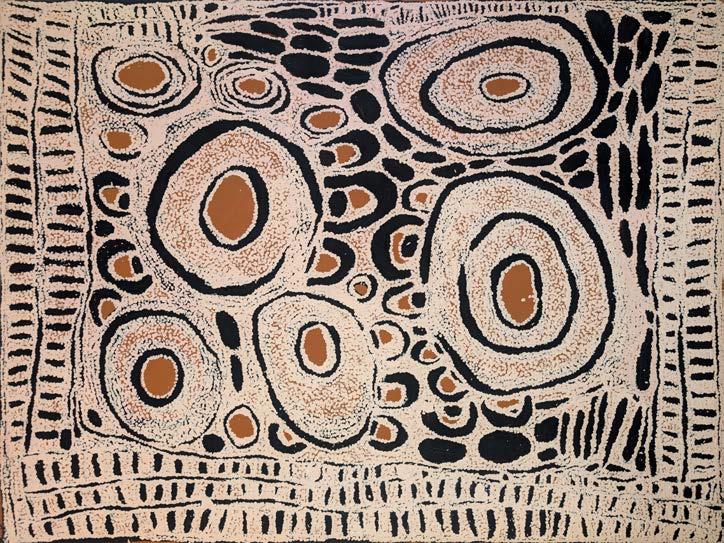
The concentric roundels at the painting's centre denote water sources and ceremonial gathering places, while the interstitial black fields and dotted borders suggest rock fissures, Spinifex, and the residual imprints of ancestral movement. Each oval motif radiates from a terracotta core, pulsing outward through fields of stippled paint—gestural echoes of songlines and ceremony. Informed by body paint designs and the tactile memory of place, the work offers not just a map of Country but an invocation of its spirit.
With their resolute forms and lyrical complexity, Nyurapayia's paintings have become increasingly sought after by collectors for their uncommon narrative depth and cultural authority— particularly as one of the rare senior women to paint for Papunya Tulaattheheightofitsexpansion. 54
synthetic polymer on linen 91 x 121 cm
55
WALANGKURA NAPANANGKA II (1946-2014)
UNTITLED,2001
syntheticpolymeronlinen 152.5x242cm
PROVENANCE
HighonArt,Vic,CatNo.HOA0105/WALN PrivateCollection,Vic accompaniedbyoriginalcertificateof authenticity
EST $35,000 - 45,000
This painting depicts designs associated with women's ceremonial activities around the sacred site of Kintore, the artist's homeland. While untitled, the work references the travels of women who stopped here duringritualobligationsandgatheredbushfoods.
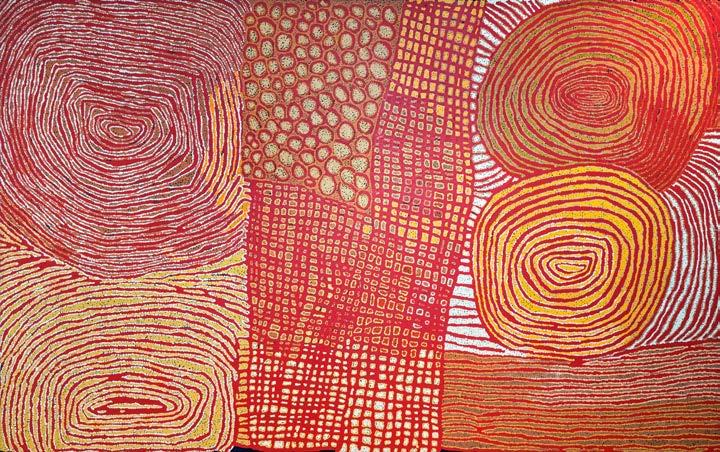
Typically, Walangkura's brushwork is assertive, dominated by concentric motifsandfierytonalcontrasts.Heruseofdeepreds,yellows,orange,and starkwhiteenergisesthesurface,echoingtherhythmofsonglinesthrough thedesert.
Even when unnamed, her paintings relating to the creation myths of her country retain powerful narrative strength, making them valuable both as cultural documents and aesthetic statements. For collectors, such works reveal how abstraction and ancestral memory can be interwoven with spiritandmeaning.
AUCTION RESULT COMPARISON
Type:Closelyrelated Auction:LawsonMenzies (nowtradingasMenzies), Modern,Contemporary AustralianandImportant Abor,Sydney, 19/03/2008,LotNo.242
Price:A$52,800
Description:Kutungka NapanangkaatPapunga 2005 syntheticpolymerpainton linen,182x300cm
MAGGIE WATSON NAPANGARDI (1C.1925 - 2004)
WOMEN'S STORY, 1995
PROVENANCE
Ngintaka Art, Alice Springs, NT
Private Collection, Vic
Art Mob, Tas, Cat No. AM 22797/24
Private Collection, Tas
EST $20,000 - 30,000
Maggie Watson created paintings for 15 years but was never a prolific artist. She began painting at 60 years of age and became the senior femaleartistatYuendumu,bythetimeofherdeathin2004.
Foremost amongst the major themes depicted by Maggie, Dorothy Napangardi Robertson and other female Yuendumu artists is the epic narrative tale of the Karntakurlangu. The hair string belts they made to carrytheirbabiesandpossessions,andthemagicalemergenceofdigging sticks out of the ground at Mina Mina, equipping them for their vast travels,issuperblyillustratedinthiswork.
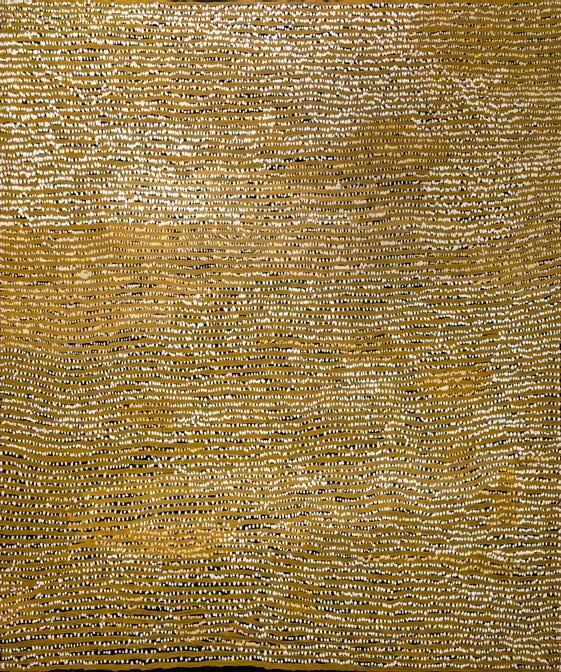
Maggie Watson’s paintings are characterised by the linear precision created by dots applied in alternating bands of colour. When viewed in varying arrays across the canvas these meticulously applied textured striations impart a rhythmic trance-like quality thereby evoking the movement of lines of women as they dance and their repeated chanting duringceremony.
HAIR
PROVENANCE
EST $16,000 - 24,000
Judy Watson lived a nomadic life near Mt. Doreen in the vast Warlpiri country that lies between the Tanami and Gibson deserts before settling into Yuendumuandbringinguptenchildren.Atthetime she began painting, the influence of those early years spent walking through the land of her ancestors burst forth in art works focused on creation stories of the Karnta-kurlangu ancestral beings at Mina Mina, west of Yuendumu. It was here that they danced across the land, creating important sites, discovering plants, foods and medicines and establishing the ceremonies that wouldperpetuatetheirgenerativepowers.
The dancing women wore hairspring belts (Marjardi) and tassels rubbed with red ochre and fat, emphasising their passion and power. The potent life force with which they imbued the country is evoked in Judy’s love of colour and richly textured, drag-dotting style which traces the sinuous lines of dancing women crossing the country.
AUCTIONRESULT
COMPARISON
Type:Closelyrelated
Auction:Deutscherand Hackett,Inaugural AboriginalArtAuction, Melbourne,25/03/2009, LotNo.53
Price:A$21,600
Description:Kurrkara JukurrpaatMinaMina, 2007,syntheticpolymer paintonlinen,inscribed verso:artist'sname,size andWarlukurlanguArtists cataloguenumber 788/07,183x122cm.
57 synthetic polymer on linen
122 x 181.5 cm, 125.5 x 185 cm frame
Metro Five Gallery, Vic Private Collection, Vic
JUDY WATSON NAPANGARDI (1925 - 2016)
STRING STORY, 2007
LORNA NAPARRULA FENCER (C.19252006)
CATERPILLARDREAMING,1998
syntheticpolymeronlinen
121x121cm,123.5x123.5cmframe
PROVENANCE
TingariArtsofCentralAustralia,NT,CatNo.TJP518 PrivateCollection,Vic
Accompaniedbyacertificateofauthenticityfrom TingariArts,NT&3photographsoftheartistwith thework.
EST $4,000 - 5,000
Lorna Fencer, was the custodian of inherited land Yumurrpa situated near Chilla Well, south of the Granites Mine in the Tanami Desert. She was the custodian of many Dreamings including the Yarla (bush potato), Luju (caterpillar), Bush Tomato, Onion and Plum Dreamings, as well as many different seeds and, importantly, spring water for the NapurrurlaJupurrurlaandJakamarra-Nakamarraskingroups.Shealsohadancestral rightsovertheWaterSnake,whichbecomenumerouswhenthecountryis inflood,andtheriverbedsandclaypansfillwithwater.
Her paintings reflected the traditional stories of Ancestral women journeyingthroughthebush,singinganddancingastheycollectedfood. Sometimes her female ancestors would come upon a caterpillar, ‘that cheeky one’ that bites them while they are picking fruit, making them itchy. In other works Lorna would paint the digging sticks they used to find the bush potato or yam that spread underground in a meandering complex of roots and bulbs, a primary source of food in their arid homeland.
59
WALANGKURA NAPANANGKA II (19462014)
TRAVELSOFKUTUNGKA,2007
syntheticpolymeronlinen 202x292cm
PROVENANCE
MukMukFineArt,AliceSprings,NT
CatNo.A11095
PrivateCollection,Vic
EST $15,000 - 25,000
AUCTION RESULT
COMPARISON
Type:Closelyrelated
Auction:LawsonMenzies(now tradingasMenzies),Colonial toContemporaryIncluding AboriginalArt,Sydney, 25/03/2009,LotNo.122
Price:A$31,200
Description:Kutungka NapanangkaatPapunga2006 syntheticpolymerpainton linen,inscribedverso,CatNo. WN0602,183x301cm
Walangkura, a Pintupi artist, was renowned for her dynamic, high-intensity compositions that celebrate women's ancestral journeys. This particular work depicts an old female ancestor traveling through sandhill country, pausing at sacred water sources and performing rituals that imbue the land with a numinous spirit. The painting is a symphony of undulating forms and pulsating dotting, with Kutungka's travels unfolding in waves of rhythm and light. Each cluster of concentric forms maps a ceremonial site, layered with color and symbolic resonance, generatingbothtopographicalandemotionalintensity.
Her works—particularly those narrating women's Tjukurpa (Dreaming)—are celebrated not only for their painterly powerbutalsoforaffirmingtheauthorityofseniorwomen asculturalcustodians.
TIMOTHY COOK (1958-) KULAMA,2010
60 naturalearthpigmentonarchescottonragpaper 75x56cm,93x75cmframe
PROVENANCE
JilamaraArts,MelvilleIsland,NT,CatNo.(hiddenby frame)
TheJacquieMcPheeCollection,WA
ILLUSTRATED
TheGreatestPassionofAll,
TheJacquieMcPheeCollection,2017,BluestarPrint, MelbourneIllustratedp274 acopyofthebookaccompaniesthework
EST $4,000 - 6,000
The Kulama ceremony is performed in the Tiwi Islands at the end of the wet season, celebrating life cycles, food abundance, and spiritual renewal. Timothy Cook’s paintings of Kulama are bold, circular invocations of this moment, representing the moon, yam, and the circular arenawheretheceremonyunfolds.
Executed in white, yellow, and red ochre on black or dark ground, his works strike a balance between sacred repetition and painterly improvisation. Each concentric form pulses with rhythm, reflecting both cosmic cycles andthegroundedritualsofTiwiceremoniallife.
Timothy’s work has become one of the defining expressions of contemporary Tiwi painting—both immediate and coded, gestural yet ceremonial. For collectors, his canvases offer visual dynamism and spiritualdepthinequalmeasure.
JEAN BAPTISTE APUATIMI (1940-2013)
JIKAPAYINGA-FEMALESALTWATER CROCODILE,2004
naturalearthpigmentsonlinen
69.5x89cm
PROVENANCE
MunupiArts,NT,CatNo.MU11JBA079 MetroFiveGallery,Vic PrivateCollection,Vic
EST $2,500 - 3,500
Jean Baptiste was taught to paint by her husband, the revered Tiwi elder and artist Declan Apuatimi. She emerged as an artist in her own right after he died and, in old age, became one of Tiwi Design's most successfulartists.
Inthisdesign,taughttoherbyDeclan,grids of irregular squares with bright flashes of white and yellow ochre create a powerful optical dynamic. They rhythmically draw the eye around the picture plane to evoke watersurgingoveracrocodile'sscalyskin.
AUCTIONRESULT COMPARISON
Type:Closelyrelated
Auction:LeonardJoel, IndigenousArt, Melbourne, 22/08/2022,LotNo.68
Price:A$4,418
Description:Turtini, NguiuBathurstIsland, naturalochresoncanvas, inscribedversowith artist'snameandTiwi DesignstampwithCat No.555-04,80x80cm.
62 naturalearthpigmentsonlinen
JEAN BAPTISTE APUATIMI (1940-2013)
JIRTAKA,SWORDFISH,2002
114x53.5cm
PROVENANCE
TiwiDesigns,NT,CatNo.TD#171-02
CooeeAboriginalArtGallery,NSW PrivateCollection,NSW
EST $2,500 - 3,500
Jean Baptiste, was just 14 years of age when she married therenowneddancer,singerandthepre-eminentTiwiartist of his time, Declan Apuatimi. During their life together they raised fourteen children and, as she watched him create poles for important Tiwi ceremonies, he taught her how to mixochresandpaint.
Jean’s beautiful and personal paintings conform with the twinconventionsofTiwiart-movingbetweenthefigurative depiction of ceremonial objects, and body painting designs (Jilamara). She inherited the right to depict jirtaka (sawfish) from Declan. However, her own personal interpretation abandoned tight formal composition by magnifying design elements, as exemplified in this particular artwork. She was a meticulous painter who took great care to keep her ochres pure, thus ensuring that her paintings emanated the truepowerofhertimelessTiwitradition.
63
BOBBY NGANJMIRRA (1915-1992) SALTWATERCROCODILEINFRESHWATER,C.1990
naturalearthpigmentonstringybark
100.5x46.5cm
PROVENANCE
PaintedforRegMasonofArnhemLand
Art,Oenpelli,NT
PrivateCollection,NSW
accompaniedbyaletterdescribingthe worksignedbyRegMason
EST $3,000 - 5,000
Saltwater crocodiles - apex predators - are both revered and feared across Northern Australia. In this dynamic bark painting, Bobby Nganjmirra captures the charged moment of the crocodile entering freshwaterdisrupting ecological balance and, with it, social and spiritualorder.
In this work, Nganjmirra's traditional clan rarrk patterns merge an anatomical study with ancestral power. More than a natural being, the crocodile is archaic, embodying ancient stories of transformation and consequence.
A revered Kunwinjku elder and ceremonial lawman, Nganjmirra's practice is grounded in lived knowledge and inherited responsibility. His crocodiles are icons of potency,renderedwithreverenceandformalclarity.
AUCTION RESULT
COMPARISON
Type:Closelyrelated
Auction:Sotheby's, AboriginalArt, Melbourne,24/11/2009, LotNo.47
Price:A$9,600
Description:Sacredand Secret-Kunapipi Ceremony,Naturalearth pigmentsoneucalyptus bark,bearsartist'sname Badjerai[sic],titleand sizeonthereverse,75x 47cm.
BARDAYAL 'LOFTY' NADJAMERREK AO (1926-2009)
HUNTINGPARTY,1990
naturalearthpigmentsonarchescottonragpaper 102.5x74cm,117x88cmframe
PROVENANCE
PaintedforRegMasonofArnhemLandArt,NT PrivateCollection,NSW
EST $4,000 - 6,000
AUCTIONRESULT COMPARISON
Type:Closelyrelated
Auction:Deutscherand Hackett,Important AboriginalArtfromthe LavertyCollection,Sydney, 08/03/2015,LotNo.130
Price:A$6,000
Description:DjekerreFemaleBlackRockWallaby /Ngarrbek-Echidna,1996
Naturalearthpigmentswith syntheticbinderonpaper, inscribedverso:artist's name,titleandInjalakArts andCraftscat.CU:134-696,75x105cm
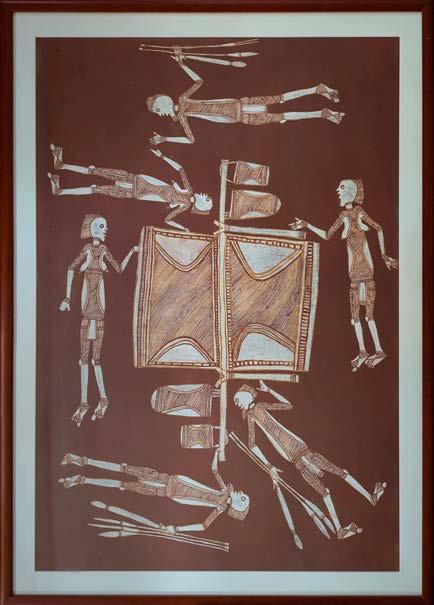
LoftyNadjamerrekwasbornandspenthisyouthintheMannRiverregionof WesternArnhemLand.Hebeganpaintinginthelate1960s,andbytheearly 1990s he had become one of Western Arnhem Land's most significant artists.
His subjects ranged across a wide array of secular and spiritual themes. Figurative elements were predominantly white, often with X-ray details of internal organs, combined with his own uniquely identifiable rarrk patterns restricted to red parallel lines. These were contained within an unadorned red, brown or black ochre background. In this work a hunting party surrounds a Yolngu bark shelter with dilly bags hanging at each end of a cross-polesuspendedontwoforkedsticks.
During the later part of his life, Lofty painted on Arches paper due to the difficultyofcollectingsuitablebark.Afteralifelonglegacyofcreativity,he was awarded the Order of Australia in 2004, for his lasting contribution to Australianculture.
65 naturalearthpigmentonstringybark 128x59.5cm
GAWIRRIN GUMANA (1935-2016)
FISHTRAP,2005
PROVENANCE
Buku-LarrngayMulkaCentre,YirrkalaArtCentre,NT,CatNo.2573Y AnnandaleGalleries,NSW,CatNo.BLA305 Bonhams,ImportantAustralianArt,August2022,LotNo.65 PrivateCollection,NSW
AccompaniedbyacertificateofauthenticityfromBuku-LarrngayMulka Centre,YirrkalaArtCentre
EST $4,000 - 6,000
Yolngu artist Gawirrin Gumana was an important cultural leader from the Gangan area, and the eldest sonoftheDhalwanguClanleaderBirrikitji.Gäṉgaṉ isa freshwater area consisting of rivers, waterholes, and stringybarkeucalyptusforest.
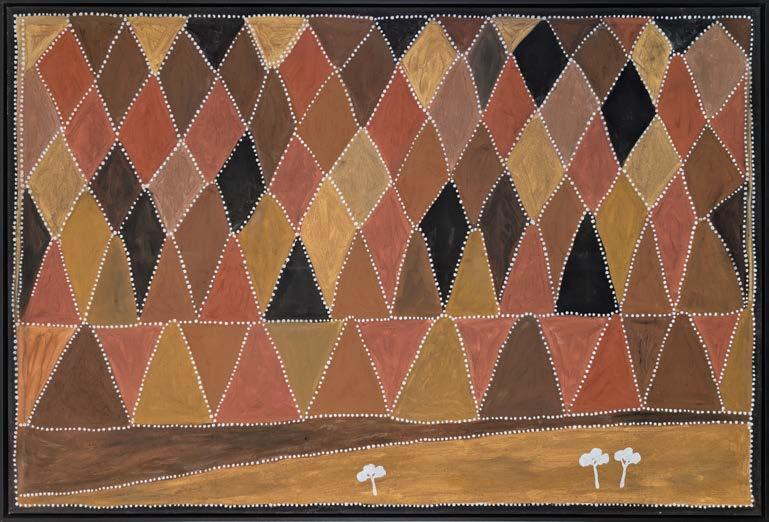
Hispaintingswereoftenfocusedontheareaaroundthe sacredwateringhole,BlueMudBay,andthestoryofthe ancestral hero, Laintjun who taught the meaning of the diamond pattern to the Dhalwangu clan, and brought withhimtheYirritjatotems.
This painting demonstrates the use of the rarrk crosshatching that made Gawirrin's painting style distinctive. It includes ancestral animals such as turtles, fish,andcrayfish.
As an artist, he perfected the depiction of water in motion, showing how the water changes from the presenceofthepowerfulcreatorDjan'kawuSisters.
Gawirrin was the last surviving member of the group that, in 1962, painted the historic Yirritja moiety Church Panels to proclaim the law and culture of the Yolgnu people long before the missionaries arrived in Arnhem Land. These panels can be viewed at the BukuLarrnggayMulkaArtCentreinYirrkalatothisday.
66 naturalearthpigmentonstringybark 175x65cm
GAWIRRIN GUMANA (1935-2016)
BARALTJAMONUK,2008
PROVENANCE
BukuLarrngayMulka,Yirrkala,NT,CatNo.3377L
PrivateCollection,NSW
AccompaniedbyacertificateofauthenticityfromBukuLarrngayMulkaCentre,YirrkalaArtCentre
EST $7,000 - 10,000
The artist of this work is the son of the late Birr'kitji, leader of the Madarrpa clan. He was the most senior active artist of the entire Yirritja moiety of north east Arnhem Land when he painted this work, following the deathofhisbrotherWakuthiin2005.
Baraltja is plains country behind the shores of Blue Mud Bay. Water from the Gangan River flows into the Baraltja. This is represented by the long elliptical shapes that are 'calmed' as it surges inland with the tide to the floodplains, home of Mundukal, the Lightning Snake. From the onset of the wet season, the freshwaters run ontothesesamefloodplains.Theserpenttastesthenew season's water with its forked tongue and stands on its tail to spit lightning into the skies, back towards where these sacred waters come from. This action is a metaphor for explaining connections to land and sea countrywithassociateclangroups.
Presented here are four paintings by Emily Kam(e) Kngwarrey(e) painted for Peter van Groesen the husband of Maggie Napangardi Watson’s daughter and a prominent art dealer in Alice Springs during the 1990s. All are offered for sale with photo-documentation.
Emily Kam(e) Kngwarrey(e)
When Emily painted her first works between 1989 and 1990, they featured fine dotting and symbolic underpainting. Thereafter however, they gave way to works in which symbols and tracks were increasingly concealed beneath a sea of dots, until eventually they were no longer evident at all. Employing larger brushes, she created lines of dots that ran across vibrantly coloured, haptic surfaces which, during the years that followed, became progressively visually abstracted, cloudlike and ethereal, as in Lots 68 and 70.
By the mid 1990s, Emily was creating wildly colourful canvases by double dipping brushes into pots of layered paint, thereby creating floral impressions with alternately coloured variegated outlines. Despite her age, her physicality was evident as she painted. Often with a brush in each hand she simultaneously pounded them down onto the canvas spreading the bristles and leaving the coagulating paint around the neck of the brush to create depth and form. The runnels of dotted colour across the surfaces of her more abstracted works began to be more formally arranged in parallel lines as exemplified by Lot 67 (NA1-79) in this sale. These gave way to ‘line’ paintings as early as 1993. She began working in this style more intensely during the last two years of her life. Solid lines of colour, stark and unadorned as in Lot 69, were often painted on multiple panels, and represented the body markings that were created during the ceremonial origins of her artistic practice. Formal compositions comprising these parallel lines eventually gave way to the meandering paths traced by the roots of the pencil yam as they forged their way through the desert sands.
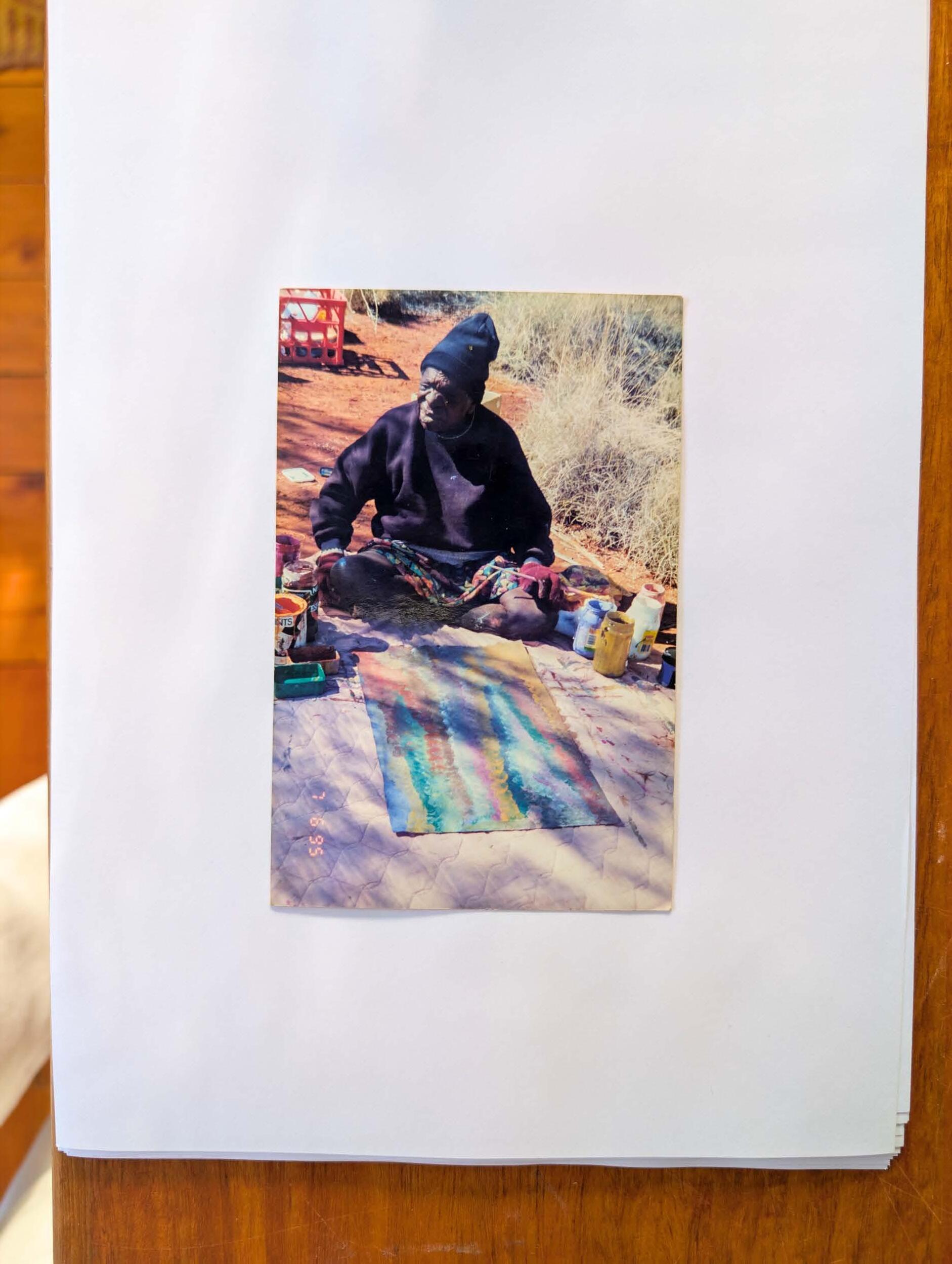
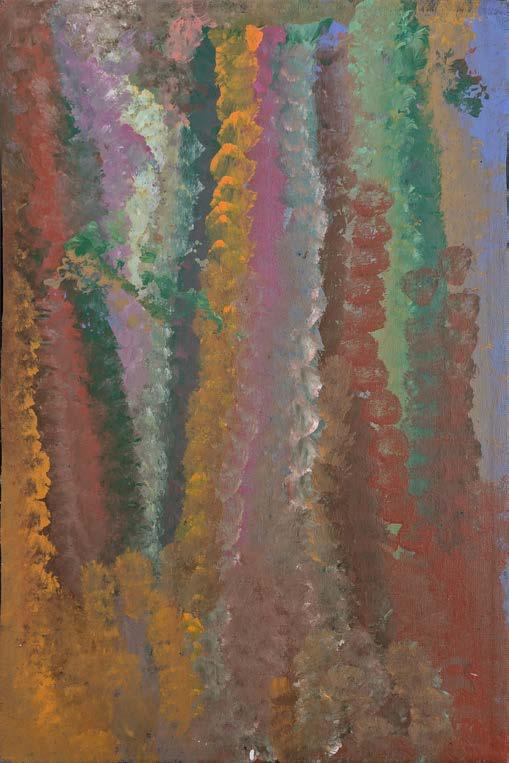
EMILY KAM(E) KNGWARREY(E) (C.19101996)
UNTITLED-AWELYE,C.1995
syntheticpolymeronlinen 66x44cm
PROVENANCE
NgintakaArts,NT
PrivateCollection,SA
Accompaniedbyfourphotographsofthe artworkintheprocessofbeingcreated
EST $10,000 - 15,000
AUCTIONRESULT
COMPARISON
Type:Closelyrelated Auction:Sotheby's, AboriginalArt,NewYork, 25/05/2022,LotNo.51
Price:A$17,755
Description:Untitled (Alhalkere),1995
Syntheticpolymerpaint onpaper,bearsartist's name,dated14.4.95, MulgaBoreArtists cataloguenumber23495andsignedby RodneyGoochonthe reverse,74.9x49.5cm
EMILY KAM(E) KNGWARREY(E) (C.19101996)
UNTITLED - AWELYE, C.1995
synthetic polymer on linen 58 x 55 cm
PROVENANCE
Ngintaka Arts, NT Private Collection, SA
Accompanied by a photograph of the artwork in the process of being created
EST $6,000 - 8,000
AUCTIONRESULT COMPARISON
Type:Closelyrelated
Auction:Gibson'sAuctioneers &Valuers,Australian& InternationalArt,Melbourne, 21/04/2024,LotNo.199
Price:A$9,760
Description:WildFlower1994 Acryliconlinen,inscribedwith catno.verso:EmilyKngwarreye /'WildFlowers'/1994/ DG02079,61x59.5cm
EMILY KAM(E) KNGWARREY(E) (C.19101996)
AWELYE - BODY MARKS, C.1995
PROVENANCE
Ngintaka Arts, NT Private Collection, SA
Accompanied by three photographs of the artwork in the process of being created
synthetic polymer on linen 117 x 40 cm
EMILY KAM(E) KNGWARREY(E) (C.1910 - 1996)
MY COUNTRY – YAM DREAMING, C.1995
synthetic polymer on linen
PROVENANCE
Ngintaka Arts, NT Private Collection, SA
Accompanied by a photograph of the artwork in the process of being created
127.5 x 45 cm
ROSELLA NAMOK (1979 - )
BIG STORM COMES WE'RE ROCKY POINT, 2004
paint
PROVENANCE
Lochart River Art Centre Cat No. RNC20040326
Hogarth Galleries, Sydney, NSW Private Collection, NSW
EST $4,000 - 7,000
Rosella Namok emerged as a member of the Lockhart River Art Gang in the 1990s, pioneering a contemporary painting language grounded in Far North Queensland’s changing skies, seas, and family rhythms. In Big Storm Comes, We're Rocky Point, she evokes the tropical tension just before a storm breaks—a theme resonant with both seasonal knowledge and emotional undercurrents.
Rosella’s vertical mark-making mimics rain sheeting across corrugated iron or mangrove trunks, while her muted greys and blue-blacks conjure heavy skies rolling in over the coastline. This work, while abstract in form, carries the lived texture of place—coastal life framed by saltspray,monsoon,andkin.
Collectors have increasingly gravitated toward Rosella’s practice for its distinctive fusion of landscape, weather, and social memory—an evolving voice in Indigenous art that speaks directly to a contemporary world without losingculturaldepth.
71 synthetic polymer
on linen 106.6 x 175 cm
72
KATHLEEN NGAL(E) (1930 - 2021)
ARNWEKETY - BUSH PLUM , 2009
synthetic polymer on linen 88 x 120 cm
PROVENANCE
Delmore Gallery, NT, Cat No.09J012
Metro Five Gallery, Vic Private Collection, Vic
EST $5,000 - 7,000
Anmatyerr artist Kathleen Ngale painted Arlperr country, whichcoversseveralhundredkilometersthroughwhichthe Sandover River on the Utopia clan lands in the Northern Territory.
Kathleen's art captures the changing colors of the wild bush plums as they ripen between Christmas and May, from yellow and orange to pink and purple. In her paintings, she also traces the journeys of the women in search of this much-prized fruit and follows the changing colors of the seasons, the sacred topography, and the processoftravelthroughhercountry.
MAKINTI NAPANANGKA (1922 - 2011)
UNTITLED, 2010
synthetic polymer on linen
152 x 92.5 cm, 155.5 x 95.5 cm frame
PROVENANCE
Ngintaka Arts, NT, Cat No. ASAAMN2364 Private Collection, Vic
During mythological times a group of ancestral women visited the rockhole site of Lupulnga, south of the Kintore community. They held ceremonies which are associated with the area to this day, before continuing their travels north to Kaakuratintja (Lake MacDonald), and later the Kintore area. The lines in the painting represent hair-string which is spun to make the hair-belts, which are worn by bothmenandwomenduringceremonies.
EST $5,000 - 7,000
74 syntheticpolymeroncanvas 190x151cm
JOSEPHA (JOSIE) PETRICK KEMARR(E) (1955-) BUSHFLOWERS,2005
PROVENANCE
TingariArtsofCentralAustralia,NT,CatNo.TJP518 PrivateCollection,NSW
Accompaniedbyacertificateofauthenticityfrom TingariArts,NT&3photographsoftheartistwiththe work.
EST $2,500 - 3,500
Josie Petrick's paintings are based on the native plants of her homeland and her favourite bush tucker species at various stages of their growth. She is known for innovative works that createasenseofvisualharmonythroughfinevariegatedfields of immaculately applied dotting. Her aerial depictions of countryandbushtuckerfeatureoverlappingdotworkwithonly thebarestreferencetoAboriginaliconography.
This painting is typical of her 2000 - 2005 period. It depicts the landscape and the seasonal cycle of wild bush berry plant from an omnipotent view, with the barren desert landscape transformed after rain into abundant vegetation. At this time the women gather the edible bush berries, which are a principal source of nutrition for Aboriginal people living in Central Australia. The women’s celebration of this Dreaming ensures fertility, regrowth and abundance in the months to follow.
75 syntheticpolymerpaintoncanvas 144x83cm
LUURN WILLIE KEW (1930-) HILLSATNYIRLA
PROVENANCE
MangkajaArts,WA,CatNo.WJ1840
TheJacquieMcPheeCollection,WA
ILLUSTRATED
TheGreatestPassionofAll, TheJacquieMcPheeCollection,2017,Bluestar Print,MelbourneIllustratedp282-283 acopyofthebookaccompaniesthework
EST $4,000 - 6,000
“Nyirla is my place, my country,” said Luurn Willie Kew. “That’s a good one. It’s got water. Good hills.” This simple affirmation lays at the heart of Kew’s painting: a lyrical, memory-infused landscape of the remote Western Desert, articulated in warm ochres and dark outlines.
The artist’s lines map the curvature of the land—the hills, creeks, and waterholes—shaped by ancestral presence and lived experience. His restrained palette and composed structure speak to the patient watchfulness ofdesertlife.
As part of the Martu art movement, Willie’s work is less stylised than that of some of his contemporaries though it retains a quiet dignity. For collectors interested in the poetics of place and direct engagement with desert storytelling,hisworkhasasteady,groundedpresence.
76 naturalearthpigmentsoncanvas 90.5 x121cm
JACK BRITTEN (1921-2001)
GNAIRARINY-CARR-BOYDRANGES,1999
PROVENANCE
NarrangunnyArtTraders,WACatNo.N-0640-JB PrivateCollection,NT CooeeArtIndigenousFineArt-2022,Lot24 PrivateCollection,Vic
EST $8,000 - 12,000
Jack Britten was at Tickelara Station in the north-east Kimberley when he began painting later in life. In this work he portrays the Carr-Boyd Ranges with rhythmic energy andtonalvariationthatbringsthelandtolife.
His palette is typically earthy—ochres and reds offset by white highlights that define ridges and escarpments. These are not mere landscapes; they are visual testaments to Country as kin, as witness, as law. Jack’s hills rise not only fromearthbutfromstory.
Jack Britten’s approach to painting—grounded in memory and ceremony—earned him significant acclaim during his lifetime. Works like this continue to appeal to collectors seeking early Kimberley artists whose connection to place wasdirectandunmediated.
77 naturalearthpigmentsoncanvas
HECTOR CHUNDALOO JANDANAY (1929-2007)
DIAWUN,1997
90.5x120cm
PROVENANCE
WarmunTraditionalArtists,WA,CatNo.HC0038. KimberleyArtGallery,Vic,CatNo.KAHC0038/97 LawsonMenzies,AboriginalFineArt,Sydney,2005,Lot19 PrivateCollection,NSW
EST $10,000 - 15,000
Hectorbeganpaintinginthelate1980s,andatthetimehe created this work, he was the oldest member of the Warmun artists, at Turkey Creek. Though his family history was littered with harrowing tales of persecution, he became an inspiration and delight to anyone who found thetimetojustsitandenjoyhiscompanyandhumour.
He would build the surface of his canvass slowly and carefully by applying soft earth colours, pink, greens, greys and later introducing warm yellow, reds, cream, and blacks. He gained renown for quirky figurative depictions and irregular hill formations rendered with an innate sense of spacial geometry. Hector treated the surface of his work as if it were sacred, touching and rubbing his hand gentlyacrossitreverently.
Watchinghimuseastonetorub,sandandsmooththethin washes of softly coloured earth pigment that had been mixed from rocks gathered and carefully ground in the surrounding environment, made one feel as if he believed thepaintingtobethecountryitself.
78 synthetic polymer on linen 136 x 201 cm
LINDA SYDDICK NAPALTJARRI (C.1927 - 2021)
THE WINDMILL & THE MEDICINE MEN, 2007
PROVENANCE
Painted for Greg Willock, Alice Springs, 2007 Art Mob, Tas, Cat No. AM 4968/07 Private Collection, Tas
EST $7,000 - 9,000
Linda was born in the Gibson Desert at Lake MacKay, in 1937. At the age of eight, she walked out of the desert all the way to Haasts Bluff on foot with her family and her step- father, Shorty Lungkata Tjungarrayi. Walking behindthemwasthe‘skinnyoldman’theWalpiriwitchdoctor.
WhentheygottoMountLiebig,theysawawindmill.Atfirst,thefamilywas frightened but Shorty knew what it was because he had been working for theArmyduringthewar.Heexplainedtothemthatthiswhirlingthingwas harmlessandwasusedformakingwater,soitwasalright.
Later, the old witch doctor caught up with them but was so tired from walkingthathefelldown,andwenttosleepwithoutseeingthewindmill.
When he woke up, he rubbed his eyes and saw the noisy apparition standing before him. He began shouting ‘Mamu Mamu!! this is a devil spirit, come to kill us!”. He started throwing his spears at it and, but they bounced off with no effect. He then threw some magic stones at it, but nothing happened. The poor old man then fell sobbing to the ground until Shorty came to his side and told him not to worry that this was a good thing, made by white fellas to get water out of the ground. He showed him the pool of water at the base of the windmill and finally got the old mantodrink.
79 synthetic polymer paint on linen 88 x 130 cm
ROSELLA NAMOK (1979)
OVERCAST DAY...SPRING RAIN, 2007
PROVENANCE
Lochart River Art Centre, Cat No. RNC20070537
Hogarth Galleries, NSW Private Collection, NSW
EST $3,000 - 5,000
Rosella Namok emerged from the Lockhart River Art Gang in the 1990s, developing a unique painterly languagethatblendsancestralstorieswithobservations ofchangingweather,tides,andtime.
In Overcast Day...Spring Rain, Rosella uses gestural mark-making—vertical streaks, drag marks, and subtle tonal shifts—to evoke tropical rain moving across the land. The work feels immersive and atmospheric, capturingbothamoodandamoment.
Rosella’s paintings speak to a younger generation of Indigenous artists redefining what ‘country’ looks and feels like. For collectors, her work offers a contemporary perspectivegroundedinculturalcontinuity,andapoetic responsetoseasonandplace.
80 syntheticpolymeronlinen 152x183cm
TJAWINA PORTER NAMPITJINPA (1950 - 2024)
SANDHILLCOUNTRY,2010
PROVENANCE
YandaArt,NT,CatNo.201016
PrivateCollection,NSW
EST $5,000 - 7,000
The sister of Esther Giles and half-sister of NyurapayiaNampitjinpa,TjawinaPorterwasaskilled craftsperson, and her paintings reflect that same attentiveness to form and rhythm. In Sandhill Country, she evokes the vast dunes and claypans of her ancestral lands with sweeping arcs and finely applied dots. The painting is a visual recollection of walkingtracks,waterholes,andceremonialsites.
Her palette—subtle creams, browns, and warm reds —recalls the shifting hues of desert sands at different times of day. Like a woven basket, the composition is tight, functional, and beautiful—a visualmapoflawandland.
Tjawina Porter’s work has been collected by institutions and private collections alike, and for goodreason:shetransmitsthecalmgravityofsenior knowledge through a meticulous and meditative hand.
81 syntheticpolymeronlinen 166.5x121.5cm,169.5x125.5cmframe
JUSTIN CORBY TJUNGURRAYI (1982) MENSDREAMING,2007
PROVENANCE IkunjiArtCentre,NT,CatNoIK07JC117 MetroFiveGallery,Vic PrivateCollection,Vic
EST $6,000 - 8,000
Justin Corby was born in Kintore on the border of the Northern TerritoryandWesternAustralia.
Thisboldgeometricdesignrelatestohisfather'sstoryoftheKanpi Tjukurrpa (Emu Dreaming) by drawing on ancient Pintupi narratives in which the emu is a powerful ancestral being. The story describes the emu’s journey across the land, shaping waterholes,songlines,andsacredsitesstillhonouredtoday.
The intricate patterns and rhythmic lines are borrowed from the ancient men’s key designs seen on ceremonial objects. It represents the emu’s nesting places, and spiritual presence in his country.
This painting is a connection to ancestral knowledge and an act of cultural continuity, transmitting the law, land, and lineage throughcontemporaryexpression.
82
LUCY NAPANANGKA YUKENBARRI (1934-2003) MYCOUNTRY,1999
syntheticpolymeronlinen 100x150cm
PROVENANCE
WarlayirtiArtists,WACatNo.527/99
PrivateCollection,NSW
PrivateCollection,Vic
EST $3,000 - 5,000
Lucy Yukenbarri was among the last generation of Kukatja women to live traditionally in the bush before settling at Balgo Hills in the northwestern reaches of the Tanami Desert. She began painting in 1989 with assistance from her husband, Helicopter Joe, as they explored their vast knowledge of the waterholes in theGreatSandyDesert.Intimetheyeachdeveloped their own style. Lucy's single colour fields of dotting gave way to paintings in which her dots converged, creating dense masses of pigment on the surface of the canvas. Her distinctive signature style created effects that were quite unique amongst her female desertcontemporaries.
AUCTION RESULT
COMPARISON
Type:Closelyrelated
Auction:Sotheby's, AboriginalArt, Melbourne,31/10/2006, LotNo.55
Price:A$15,600
Description:Marpa 2000 syntheticpolymerpaint oncanvas,bearsartist's name,sizeandWarlayirti Artistscataloguenumber 785/00onthereverse, 180x120cm
83 syntheticpolymeroncanvas 120x80cm
BOXER MILNER TJAMPITJIN (1935-2009)
PURKITJI,2006
PROVENANCE
WarlayirtiArtists,WA ArtMob,Tas,CatNo.AM4294/06
100%ofthehammerpriceonthispaintinggoes totheAboriginalBenefitsFoundationwhich supportsthehealthandwelfareofartistsand theircommunities
EST $7,000 - 10,000
BoxerMilnerlivedonTjaruland,wherethecountryandvegetation move from flat and featureless rolling Spinifex plains to flood plains with enormous river channels and permanent water holes. Here the yearly cycles of flood and dry create swamps with abundant bird life, through which runs Purkitji, or Sturt Creek. This work depicts a ceremonial re-enactment of the creation story of Djaringarra,asitefoundalongthecentralsectionsofthecreek.
Boomerangsthatwerecarvedbytheartistwereusedasastencil to create the painting. These boomerangs are clapped together during men's ceremonies. The circles represent tjurrnu (rockholes) which occur after the waters of Purkitji have receded following the wet season. Boxer's unique aesthetic was informed by his intimate knowledge of all the facets of the river system. His paintingsalldepictdifferentphysicalandmythologicalaspectsof themiddleandupperstretches.
TIMMY PAYUNGKA TJAPANGATI (1940-2000)
TINGARIANCESTORS,1989
syntheticpolymeronlinen 122x41cm
PROVENANCE
WarumpiArts,NT,CatNo.TP899701 AboriginalFineArtsGallery,NT,CatNo.1438 PrivateCollection,NSW
AccompaniedbyacertificateofauthenticityfromAboriginal FineArtsGallery,Darwinincludingaphotooftheartistwiththe work.
EST $4,000 - 6,000
Timmy Payungka Tjapangati was a Pintupi elder and original member of the Papunya Tula movement. In Tingari Ancestors, he maps the journey of powerful ancestral beings who crossed the Western Desert, creatingsacredsitesandestablishinglaw.
The composition employs dense dotting and geometric structure to map multiple ceremonial sites - often rendered as concentric circles - and the ancestral paths that connect them. These tracks are not only narrative— they are ontological, defining the very structure of land andlaw.
Forcollectors,thispaintingoffersadirectencounterwith the foundational visual language of the Western Deserta cultural matrix rendered with both precision and authority.
CHARLIE TJARARU (C.1925-1999) & WILLIE TJUNGURRAYI (1932-2008)
BANDICOOTANCESTORSFIGHTINGOVERFIREAT TALTALTANYAM,MADE1979ANDPRINTED1981
screenprintonpaper 76×56cm, 90.5x71.5cmframe
PROVENANCE
MalStudio,TheLarryRawlingprintworkshopEdn20/90 PrivateCollection,NSW
EST $700 - 1,200
This print is of great historical significance, created by two senior Pintupi men: Charlie Tjararu and Willie Tjungurrayi, whose names are associated with the foundational years of the Papunya movement. The subject matter is drawn from Taltalpa, where ancestral bandicoots fought over fire—a Dreaming that encodes lessonsaboutsharing,power,andsurvival.
The composition, though printed rather than painted, carries the visual intensity of early Papunya works: concentric circles, journey lines, and pulsing geometries. It reflects not just a story, but a cosmology—an encoded mapoflawsandconsequences.
Prints like this are rare and historically significant, often overlooked in favour of canvases but increasingly recognised for their documentary and artistic value. They offer new and seasoned collectors alike a window into the collaborative spirit and narrative depth of early desertart. 85
OLD MICK WALLANGKARRI TJAKAMARRA (1910-1996)
MEN'SSITE,1978
syntheticpolymeronboard
37x27.5cm,39.5x30.5cmframe
PROVENANCE
PurchasedbyAustralianartistTim Johnson,directlyfromdirector AndrewCrockeratthePapunya TulaArtistsStockroom,NT,1981
AccompaniedbyaletterfromTim Johnson
EST $4,000 - 6,000
Old Mick Tjakamarra was among the founding artists at Papunya and a senior custodian of desert law. In Men’s Site, he depicts a ceremonial ground used by initiated men - a space where sacred songs and knowledge are passed on underancestrallaw.
The composition is deliberately pared back: concentric circles, linear motifs, and a restrained dot palette reflect the artist's preferenceforclarityoverornamentation. His paintings stand as early markers of a cultural shift - when sacred knowledge entered public space with both caution and resolve - positioning him as a key figure for collectors drawn to works of historicalgravity.
AUCTIONRESULT COMPARISON
Type:Closelyrelated
Auction:Davidson
Auctions,Estate& Collector-Pictures& Tribal(Artlotsonly), Sydney,09/03/2024, LotNo.450
Price:A$6,000
Description:'HoneyAnt Dreaming,'1976 acryliconcanvasboard, 50.5x40cm
BILL TJAPALTJARRI WHISKEY (1920-2008)
ROCKHOLESNEARTHEOLGAS,2008
syntheticpolymerpaintonillustrationboard 2panelsx38x25cm,40x27cmframe
PROVENANCE
WatiyawarnuArts,MtLeibig,CatNos.10-08229and10-08301
PrivateCollection,NT
EST $2,500 - 3,500
In this complementary pair of works, the compact spatial arrangement and saturated palette offer a distinct visual rhythm to the artist’s rendition of rockholes near the Olgas intheCentralDesert.
The work seems to pulse inward, as if drawing viewers toward the heart of the story. The waterholes are not simply landscape features—they are places where spiritual andgeologicalhistoriesintersect.
Collectors often seek multiple iterations of Bill Whiskey’s work precisely because each one, while thematically related, opens a different visual door into an ancient cosmologyrenderedwithstartlingmodernity.
88 syntheticpolymeroncanvas 60.5x38cm
CLIFFORD POSSUM TJAPALTJARRI (1932-2002) CARPETSNAKEDREAMING,1995
PROVENANCE
Purchasedbythecurrentownerdirectlyfromtheartist,NT PrivateCollection,NSW
Signedverso
EST $2,000 - 3,000
CliffordPossumTjapaltjarri(c.1932–2002)wasa foundationalfigureintheWesternDesertmovement, best known for transforming ancestral narratives into complex,dynamiccompositions.
Carpet Snake Dreaming, follows the journey of the ancestral snake through country dotted with Spinifex grass.
The depiction of the carpet snake is not merely that of ananimal—itisanancestralpresencewhosemovements shaped the landscape, waterholes, ceremonial grounds, anddictatedsocialmores.
Inthissmallwork,Cliffordbringstogethersacred cartographyandpainterlyrhythm,creatingasurface thatisbothlayeredandluminous.
The work exemplifies the narrative authority and formal claritythatsetCliffordPossumapartfromhispeers.
AUCTION RESULT
COMPARISON
Type:Closelyrelated
Auction:LawsonMenzies (nowtradingas Menzies),Australian AboriginalArt,Sydney, 14/11/2007,LotNo.260
Price:A$7,200
Description:Eagle DreamingatMt.Allan 1989,syntheticpolymer paintoncanvas,signed verso,55x40.5cm.
89 syntheticpolymeronlinen 100x150cm
TREVOR TURBO BROWN (1967-2017) GATHERINGOFMAGPIES
PROVENANCE
Purchaseddirectlyfromtheartist ArandaArt,Vic PrivateCollection,Vic
EST $2,000 - 3,000
Trevor Turbo Brown was born with an intellectual disability and was abandoned by his family at a young age. As a teenager he took up boxing and became a recognised rapper and breakdancer, and when his adoptive parents joined a visual arts course, they took him along with them. This was a transformative experience by giving him directionandapositiveoutlookthroughart.
Turbo’s subject matter is the outdoor world of birds and animals he encountered as a homeless youth, living along thebanksoftheMurrayRiver.Atthattimetheanimalswere hisspecialfriends,andthesebrightandcolourfulcreatures weretheprimaryfocusofhisworldandart.
90 syntheticpolymeronlinen 66x71cm
JORNA NEWBERRY (1959) WALPATJUKUPA(WINDDREAMING),2021
PROVENANCE
Purchaseddirectlyfromtheartist ArandaArt,Vic PrivateCollection,Vic
EST $1,500 - 2,500
Pitjantatjarra artist Jorna Newberry first began painting in the mid-1990s at Warakurna under the guiding hand of her uncle, the famous artist Tommy Yannima Watson. Foremost amongst thesubjectssheexploredinherartwereWaru(FireDreaming), Ngintaka (Perentie) and Walpa (Wind). Her use of delicate line anddotworkbecamehersignaturestyle.
Wind Dreaming relates to her mother’s country at Utantja, a large stretch of sacred ceremonial land that has hilly country and a large rock hole. In this work she has pared back her palette, using white, creams and neutral tones on a black background. The intricate movement and rhythm of the wind is rendered with a contemporary aesthetic, while simultaneously preservingtheartist'sdeepculturalintegrity.
91 syntheticpolymeronlinen 122x91.5cm,125x94.5cmframe
BARBARA WEIR (1945-2023)
GRASSSEEDDREAMING,2004
PROVENANCE
MbantuaGallery,NT,CatNo.MB24464
PrivateCollection,NSW
EST $6,000 - 8,000
BarbaraWeirwasbornonBundyRiverStationandwasamember of the Stolen Generation. She later reconnected with her mother, Minnie Pwerle, and her extended family, rising to artistic prominence in the 1990s with shimmering, texturally abstracted paintings.
Her Grass Seed Dreaming works refer to an important women's story from Atnwengerrp country. Native grass seeds, once ground into flour and forming a dietary staple, were gathered in a process interwoven with kinship, ceremony, and seasonal cycles. In Weir's hands, this ancient practice transforms into pure visual rhythm; the fine linework suggests movement, wind, and abundance.
These paintings are often described as meditative, even musical, with a surface complexity that invites close attention. Her career, marked by international exhibitions and critical acclaim, positioned her as a key voice in the Utopia movement and a compellingfigureforcontemporarycollectors.
PADDY FORDHAM WAINBURRANGA (C.1930 - 2006)
DANCING
MIMI MAN WITH MEN'S CLAPSTICKS, C.1995
PROVENANCE
Katherine Art Gallery, Cat No. P-1097 Private Collection, NSW
EST $800 - 1,200
During his lifetime, Paddy Wainburranga Fordham was not only a respected artist but also a dancer, hunter, and storyteller. This work depicts a Mimi spirit— supernatural beings from Arnhem Land known for their extremethinnessandagility—caughtmid-dance,holding ceremonialclapsticks.
Paddy’s figure is elongated and animated, rendered with vivid ochres against a dark background. The image pulses with movement, recalling the traditional dances that transmit law and Dreaming across generations. His art bridges myth and performance, capturing the presenceofancestorswithinlivedritual.
Paddy’s work is held in several public collections and remains a favourite among those who seek expressive figurationrootedinArnhemLandlawandoraltradition.
92 synthetic polymer paint on canvas 90 x 62.5 cm
LIN ONUS (1948-1996)
DJALNGBALTJIGINYUNIDJINIGIMA,1994
originalexperimentalscreenprintEdn14/70 30x65cm(irregular);50x70cmpaper
PROVENANCE
PortJacksonPress,printmaker:ShaikeSnir PrivateCollection,Vic
EST $3,500 - 4,500
Lin Onus was instrumental in the recognition of urban Aboriginal art post-1970.OfYortaYortaandScottishdescent,hispracticebridged Western techniques and Indigenous iconography, through humour, wit,andbeauty.
The composition of his paintings and prints combine naturalism with formal patterning—such as those in which eucalypts set against water surfaces that glimmer with cross-hatching or mirrored reflection.
Lin Onus’s work has become emblematic of bicultural fluency—his paintings offer layered commentary on history, environment, and belonging. For collectors, they represent both a distinct chapter in Aboriginalarthistoryandabridgeintobroaderculturaldiscourses.
AUCTIONRESULT COMPARISON
Type:Closelyrelated
Auction:LeonardJoel, Prints&Multiples, Melbourne,10/11/2021,Lot No.97
Price:A$6,136
Description:Gumiring Garkman1994
Screenprint,ed.H/C, editioned,titled,signed anddatedinpencilbelow image,50x70cm
ARTIST ONCE KNOWN
TURTLE,FILESNAKES,ANDFISH,C.1980
naturalearthpigmentonstringybark 91.5x37cm
PROVENANCE
PurchasedArnhemLand,NT FireworksGallery,Qld PrivateCollection,Vic
EST $1,500 - 2,500
This bark painting offers a finely composed study of wetland fauna - turtle, file snake, and fish - each linked to specific clans, hunting practices, and ceremonial knowledgeintheArafuraSwamplands.
The file snake, known for its smooth skin and aquatic grace, is associated with freshwater systems and seasonal renewal. The turtle signifies both sustenance and ritual power, while fish traverse the symbolic threshold between water and spirit. The composition balances naturalism and stylisation, likely through x-ray infill and rarrk, rendering the animals as spiritually chargedforms.
Forcollectors,theworkstandsasafragmentofalarger cosmological map - one that continues to shape identity,movement,andmeaninginArnhemLand.
95
GEORGE MILPURRURRU (1934-1988)
ARAFURASWAMPSCENE,C.1990
naturalearthpigmentsonarchescottonragpaper 76x102cm,92x120cmframe
PROVENANCE
PaintedforRegMasonofArnhemLandArt,Oenpelli, NT PrivateCollection,NSW
EST $1,500 - 2,500
George Milpurrurru was raised in his father’s country, known for its sprawling wetlands and rich animal life. This painting presents a layered portrait of the Arafura Swamp - birds, fish, turtles, and freshwater plantsrenderedwithfineobservationalskillandrefinedrarrk.
George's strength lies in orchestrating ecological abundance with clarity and grace. Every element holds its place, forming a harmonious depiction of interconnected life cycles. The composition reads almost like a visual diagram of seasonal rhythms, hunting knowledge, and custodial stewardship.
Milpurrurru‘sworkwasfeaturedinthe1988BiennaleofSydney,andhewas the first Aboriginal artist have a solo exhibition at the National Gallery of Australia. For collectors, Milpurrurru offers a poetic lens on Arnhem Land ecology-onethatisbothdelicateandassured.
96 syntheticpolymeroncanvas 95x86.5cm
PHILLIP GUDTHAYKUDTHAY (C.1925-2022)
GANDAYALA-REDKANGAROO,2017
PROVENANCE
Bula’BulaArts,Ramingining,NT,CatNo.641-17
PrivateCollection,NSW
EST $2,500 - 3,500
Gandayala—the red kangaroo—is the creation ancestor of Ramingining in Central Arnhem Land. The Gandayala/Garrtjambal story originates from the artist’s mother’s country. Gudthaykudthay was the junggayi, or traditional owner, of the land where the community stands,arightinheritedthroughhismother’slineage.
In its creation story, Garrtjambal journeyed from Roper River in the south, naming various sites along the way. Upon reaching the place now known as Ramingining, he consumedaspecificyam.Thisactcausedhimtochange his language to Djardewitjibi, the language of this area. Several sacred sites around the Ramingining community are named after different parts of the red kangaroo’s body.
97 syntheticpolymeronlinen 56x41cm
GLORIA PETYARR(E) (C.1945-2021) LEAVES,2007
PROVENANCE BoomerangArt,SA,CatNo.4259 PrivateCollection,NSW
Accompaniedbyacertificateofauthenticityfrom BoomerangArt,SAwhichincludesaphotographofthe artistholdingthework.
EST $500 - 700
Gloria Petyarre was an extremely prolific painter influenced, no doubt, by her equally prolific aunt Emily Kame Kngwarreye, with whom she lived and workedformanyyears.AlthoughGloriaremained verymuchinEmily’sshadowduringheraunt’slife, she emerged as an artist of note from 1996 onward.
She is said to have pioneered the depiction of Bush Medicine leaves, a theme that is now ubiquitous amongst the women of the Utopia region. Although medicine leaves paintings of todaycanoftenfeaturetheleavesofothertrees, the leaves of the Kurrajong tree are especially significant because they were traditionally used for medicinal purposes and are known to have healingproperties.