Inside the issue
cyber security p. 6
March 2013
online predators p. 12
800 Maryville Centre Drive, Town and Country, MO 63017
1
JOplin p. 16
Westminster Christian Academy
e h T sue Is sue Is
www.thewildcatroar.com
The Wildcat Roar Westminster
Christian
Academy
Volume
X
Issue
V I I
March
2013
This issue of the Wildcat Roar is referred to as the “issue issue” because every story gives voice to an issue a staff member believes needs one. The purpose is not simply to raise awareness of these causes, but to provide realistic solutions. Students and teachers have the power to take advantage of these opportunities to fight toward eradicating these issues. The hope is that these stories will show how attainable this goal is. FInd out more about the Issue Issue in the staff editorial on page 8.
Three Going on Thirty Child beauty pageants inculcate superficial morals in young girls by over-emphasizing beauty, thereby causing low selfworth. Curled hair, spray tans, whitened teeth, and... tantrums? The glamour side of society isn’t so glamorous, especially when toddlers are involved. Childhood should consist of being carefree, having fun, and getting dirty, not
the constant pressure of attaining perfection. Child beauty pageants can be detrimental to young girls’ self-identity; after all, they are being judged on how cute they appear. Beauty pageants have a tendency for emphasizing a young girl’s body over her personality. In an article for Psychology Today, Martina M. Cartwright, Ph.D., R.D. found a connection between eating disorders and superficial values implanted in girls at young ages including “physical perfection, thinness, athletic prowess and attractiveness.” Cartwright later explains that “intense participation in activities that spotlight physical appearance instills the idea that physical beauty and superficial charm are the keys to success, thus making self-worth and self-esteem inextricably tied to attractiveness.” Due to the intense competition, parents will place their participating child on a diet in order to fit her into smaller costumes. Children, who are by no standard overweight, are forced to go on diets. No wonder a majority of these girls struggle with eating disorders and body dissatisfaction later on in life.
One may argue that girls are taught a valuable lesson of dedication and how to handle competition. This may be a valid argument if it were not for the fact that, for most pageant-participating young girls, academics are pushed aside. Sometimes school is missed in order to travel to a pageant, or time is spent practicing a pageant routine rather than working on homework or studying. In these cases, parents are showing their child that her appearance is more important than her performance in school. The priorities in these situations are backwards. Beauty is not something girls should depend upon for a lifelong career. Besides, most girls will not make a profession out of modeling. The motives and goals for why parents choose to place their child in pageants vary. Some claim that it was what the child desired, but in most cases it is evidently otherwise. In an article from Psychology Corner, Lucia Grosaru, psychologist, M.A., offers that “mothers of these children are usually trying to live their own dreams through their daughters.” Not to mention the mere fact that prize money is awarded to the winning girl. While some girls embrace the pageant lifestyle, others dread every minute of it. Young girls are being used for the personal gain of their parents, whether superficially or financially. Various clips of Toddlers and Tiaras display the emphasis most parents place on the pageants. One mother admitted to immediately deciding her daughter would be a “pageant girl” after receiving news that she would have a daughter.
End of WInter sports P. 18 & 19
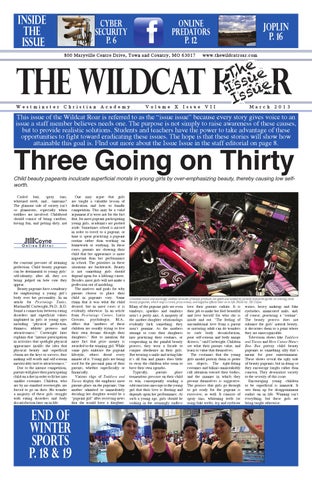
Countless hours and seemingly endless amounts of beauty products are spent and wasted by parents and participants on winning child beauty pageants, which reap a crown, prize money, and negative effects later on in life. Photo by: Jill Coyne
Many of the pageant girls are even tomboys; sparkles and tomboys aren’t a pretty mix. A majority of the mother-daughter relationships evidently lack something: they aren’t genuine. As the mothers attempt to coax their daughters into practicing their routines, or cooperating in the painful beauty process, they wear a facade to conjure obedience in their girls. But wearing a smile and acting like it’s all fun and games does little to sway the children who seem to have their own agendas. Typically, parents place tremendous pressure on their child to win, consequently sending a subconscious message to the young girl that their love is fleeting and depends upon her performance. At such a young age, girls should be soaking in the seemingly endless
love their parents radiate. It is their job to make her feel beautiful and love herself for who she is inside and out. “The feeling of unconditional love from a parent or nurturing adult can do wonders to curb body dissatisfaction, poor self-esteem and body image distress,” said Cartwright. Children see what their parents value, and learn to value that themselves. The costumes that the young girls model portray them as petite sex objects. The tight-fitting costumes and bikinis unmistakably call attention toward their bodies, and the manner in which they present themselves is suggestive. The process that girls go through to get ready for the pageant is excessive, as well. It consists of spray tans, whitening teeth (or using fake teeth), leg and eyebrow
waxes, heavy makeup and fake eyelashes, manicured nails, and, of course, practicing a “routine”. The beauty process does not enhance the girls’ natural beauty, it decorates them to a point where they are unrecognizable. Television shows like Toddlers and Tiaras and Here Comes Honey Boo Boo portray child beauty pageants as something silly that’s meant for pure entertainment. These shows reveal the ugly side of beauty pageants, but in doing so they encourage laughs rather than concern. They desensitize society to the severity of this issue. Encouraging young children to be superficial is immoral. It sets them up for disappointment earlier on in life. Winning isn’t everything, but these girls are being taught otherwise.
2 f e at u r e s
Westminster Christian Academy
Made by Robots
Technological innovation creates a hyper-connected world where job competition is stiffer than ever. The U.S. Olympians’ appearance during the opening ceremony in London this past summer was met with much criticism, due to the fact their outfits were made in China. Once again, Americans were reminded of the sore “made in China” subject. When it comes to blue collar jobs in America, much blame is commonly placed on American
companies moving their factory jobs to China. But, the reality is that terms such as “made in China” and “made in America” are gradually becoming irrelevant. In fact, many trade professionals, including Pascal Lamy, chief of the World Trade Organization, would
1965
out of date. From a blue-collar perspective, more and more jobs will continue to be taken by robots and technology because they are simply cheaper. Rodney Brooks, behind the robot company, Rethink Robotics, that recently created a robot named Baxter, says that his creation will cost $22,000 and have a life of 6,500 hours, which is nearly three years of a factory life. Although this may seem ridiculously expensive, Brooks says it actually averages out at $3.40 per hour, which is close to the wage of Chinese factory workers. In a time where companies must have efficiency and productivity to survive stiff competition, his robot proves to be an inevitable option due to its efficiency and price. The result is more and more factory jobs will be taken away. It is important to consider that machinery, including this
I Want This, I Need That, I Cannot Live Without This Modern day society is very focused on what everyone has and does not have. As a society, we tend to feel like we need more then we do. I want this, I need that, I can’t live without (insert item here). Americans, especially teenagers, constantly worry about material things instead of the more hard pressing issues of society. In modern day society, things such as a new purse or a new video game strikes Americans and teenagers alike as a necessity. A very popular question is who is to blame? Parents? Celebrities? Many people can take the blame, but materialism is a growing problem in today’s society. Materialism is growing in
2007
Photo Credit: Wikimedia Commons.
argue that the new theme is “made in the world”. From a job perspective, the problem is no longer outsourcing, but rather, technology. America has clearly established itself as the capital of innovation during the past 100 years. Various inventions, from Henry Ford’s first car to the iphone, are evidence of such innovation. Even today, the progresses in technology taking place in Silicon Valley are mindboggling. But, technological innovation has proved to be double-sided. Innovation in technology has connected the world with internet, texting, emailing, and calling. Yet, at the same time, created more and more intense competition when it comes to jobs. “In the last decade, we have gone from a connected world thanks to the end of the cold war, globalization, and the Internet - to a hyper-connected world - thanks to those same forces expanding even faster,” said Thomas Friedman, a columnist of the New York Times. Take blue-collar workers during the industrialization of the West for example. Before war, globalization, and the Internet ran their courses, blue-collar workers, such as farmers, competed for jobs on a national level. Due to the before listed affects, the world became connected, and they had to compete with more workers from other countries, such as China or India. Friedman suggests that as the world becomes hyper-connected, due to even more expansion, the new challenge will be to attain a white-collar job. No longer is the competition reduced to bluecollar jobs, rather, white-collar workers are beginning to compete with robots, software, and cheap geniuses from other countries, putting the “made in China” term
robot, create jobs. Robots require programming, machinery requires checkups, and technology requires fixing - innovation in technology also creates jobs. So, do the jobs created compensate for the jobs lost? Not exactly. The big issue is that the jobs created by technological innovation require more skills than the jobs lost in factories. The jobs of blue collar workers that robots replace on an assembly line might be welding, assembling, or painting. But, the only job that would be created by the robot might be programming. And, the special skills required to program some robots are very different than those required to weld pieces of metal together. The point is, robots are stealing factory jobs, and leaving blue collar factory workers with whitecollar jobs. From a bigger perspective, the result is jobs are becoming more and more difficult to attain. And as innovation continues to take its course, more and more will be needed to land a job. In 1908, Henry Ford introduced the first working assembly line. During this period of time, in order to get a well paying factory job, one had to have the skill of assembling and screwing things into place. Today’s culture portrays a very different picture: in order to get a good job, one must graduate college with a degree. Such good jobs might include an engineer, teacher, or architect. The difference in skill sets demonstrates the effect technological innovation has had on the past 100 years. And, if innovation continues to accelerate as it has in the past 100 years, who knows if there will even be any blue-collar jobs and how difficult it will be to attain a white-collar job in the next 50 years.
March 2013
Americans alike, but teenagers have caught the bug worse then others. Teenage girls between the ages of 13-18 in the modern world are consumed with how they look and what appearance they put forward. Not every teenager is consumed with these everyday thoughts, but the percentage is growing. Although the only people we can blame is ourselves, we also can give some of the blame to the way things are advertised and marketed to people everyday. When walking in a store such as J. Crew, the first thing you will see is pictures of happy people on the beach or other lavish places. The girls look skinny and have huge smiles plastered across their faces while giggling and flirting with cute boys. Along with being in lavish places, they are covered head to toe in J. Crew. The easy, breezy, carefree lifestyle seems to be one that can only be achieved by putting on the right pair of eighty dollar J. Crew shorts. The price
to have a name brand across your clothes is never too high to pay to stay in with the trend is what many people believe. In our society today, we are constantly seeing multimillion dollar outfits on television shows and that celebrities and the wealthy wear in everyday life. When we see how we could be living, we cannot stop thinking about those possibilities. We constantly see things that we cannot afford, but the American culture tells us that looking glamorous is more important than anything else. In a New York Times article, Carey Goldberg said, “In recent years, researchers have reported an ever-growing list of downsides to getting and spending - damage to relationships and self-esteem, a heightened risk of depression and anxiety, less time for what the research indicates truly makes people happy, like family, friendship and engaging work. And maybe even headaches.” Today’s society has put the message in everyones minds that we cannot be happy if we are not spending money and getting the biggest and best new things. In the NY Times article Diener said, “Materialism becomes a more difficult goal than many,because it is open-ended and goes on forever - we can always want more, which is usually not true of other goals such as friendship. With friends, we have them and enjoy them but usually are not taught that we keep needing more. We believe in the long run, money will bring us lots of happiness for a long amount of time, but when the harsh reality comes out, we realize that money and material things can only satisfy that craving for a short amount of time. The modern struggle with
Photos By: Wikimedia Commons and Jessica Johnson
materialism brings out what Americans value. The front we put forward is that we value materialistic things more than other aspects of life. The more expensive a product is, the better the product must be. Instead of focusing all on what people want and what people think, America should consider focusing more on how better we could use our money and what our money could be doing to help others in American and around the world. Americans are the only ones who can cut their own spending. People can choose where their money goes and how they wish to use it. Americans are the only ones who can change our materialistic values. There are places all over our world and right here in America where money could possibly be better spent. People around the world suffer from not having clean water, having no place to sleep, not being able to feed their children. People could spend their money to help other countries along with out own instead of buying name brand items. Skipping little things here and there can make a huge difference on out materialistic culture. Skipping starbucks coffee and making home brewed coffee can save arround $780 a year according to www. consumer-action.org. By cutting out name brand beauty supplies and hair care and usuing the stores brand can save lots of money. Instead of spending money on name brands people can give their money to organizations such as Education International, Food and Agriculture Organization of the United Nation, etc. Spending money in different areas of peopels everyday lives can change America as a whole.
f e at u r e s March 2013
3
Westminster Christian Academy
One Giant City, One Giant Problem Throughout the past several months, cases of gang rape have been reported from the streets of New Delhi.
Scared teenage girls huddle together in tight groups as they walk the streets of New Delhi, early in December. They are all terrified for their lives; afraid that at any moment they can be kidnapped, raped, and killed. As of December 16, 2012, several cases of gang rapes had been reported to the authorities of India, but specifically in New Delhi. Rape is now the first leading cause of death among women
ages 16-25 in India. The incident generated widespread national and international coverage and was condemned by various women groups. Due to so many cases within the last 3 months, the public authorities of India, and officials in New Delhi have been put on trial and revolted against in public riots by women who claim that there is not enough protection and safety enforced throughout the city. These crimes reflect an alarming trend in India; which results to men as a growing business and promotes the dominant trait in men. Rape has increased 25% in six years, and New Delhi has recorded 572 rapes in 2012. Women are now beginning to stand up and
speak up for their rights, and what they believe in along the lines of the rape predicament. A local woman activist in New Delhi explained to CNN reporters, “I think it’s great that the younger generation is standing up and saying they’ve had enough. All women in India face the threat of rape in this culture,” said Nina Hishad. So far, women, and young girls have made drastic headway in the fight against rape in India. The tragic devastations of women being abused on a daily basis are what is causing the country to fall into a downhill spiral, and plummet into a nation of despair and sexism. However, with the help of supportive friends, and other cultures, New Delhi will be able to slowly mend the wounds that have been caused by the men and male authoritative figures in this country. Women around New Dehli are forming “love groups”, which are goal oriented towards finding safe havens for females ranging from young girls to elderly women who are and have been consistantly rapped in the past.
Citizens riot over the issue of gang rape in the streets of New Delhi. Photo by: Wikicommons
North Korea Is Violating Basic Human Rights North Korea spends billions on military and wealthy elite while millions of its own citizens suffer from malnutrition. North Korean nuclear tests endanger millions with potentially deadly radiation. Meanwhile, thanks to the diverting of money toward this military spending, countless North Koreans live in daily fear of starvation. Thanks to the media’s thorough coverage, a majority of Americans know about North Korea’s nuclear weapons and recent rocket test. What they may not know is that the billions of dollars that the North Korean government spends on their nuclear program could have fed North Korea’s 25 million
impoverished citizens for several months. There are an increasingly large number of reports of famine North Korea confirmed by North Korean refugees, who recently fled the country. “Things are a bit better than during the Arduous March [ the famine in the late 1990s], but the level is still not sufficient. The biggest change is in people’s minds,” Said Sang-Hyun, a North Korean refugee. Many people are worried that this famine could be as severe as the famine of the mid-1990s. Occurring shortly after the death of North Korean dictator Kim Il Sung, 15% of North Korea’s population died of starvation from rampant food shortages. The famine ended
only after several million tons of food were given to North Korea by the UN. According to German news agency Deuche Welle dissident North Korean nationals, known as “Citizen Reporters”, have
100th birthday of North Korea’s eternal leader Kim Il-Sung. This elite party diverted millions of dollars to North Korea’s privileged few, when it should’ve been use to rescue it’s starving citizens. According to the
“assist in recovery.” According to Sang-Hyun, often this does more harm than good, as the malnourished soldiers steal what is left of the civilians’ crops and food. Through the U.N., several
reported that about 10,000 people have died as a direct result of this most recent outbreak of famine. Many people are speculating that this most recent famine was caused by the government of North Korea spending millions of dollars on a lavish celebration in its capital, Pyongyang, commemorating the
New York Times, there are also confirmed reports of cannibalism. This fall, millions North Koreans will live in constant fear of starvation. Traditionally, the North Korean government repairs the damage from an outbreak of famine, by sending North Korean troops to
nations, including the United States, Russia, China, Japan, and South Korea are again donating millions of tons of food aid to the recluse state. For the last 20 years, the steady stream of food aid has been severed only once. North Korea immediately saw a spike of starvation in its populace at
that time. The U.N. only agreed to resume food aid on the condition that Pyongyang stop all nuclear testing, an agreement the North Korea has honored more often in the breach. All of these countries are well within the range of North Korea’s missile system. With the military that consists of over 1 million troops, and 8 million reserves, North Korea poses a legitimate threat to even the most technologically advanced military. Though it is impossible to conjecture the exact amount that North Korea spends on its military, it is widely thought to be about one third of its national budget. According the Christian Science Monitor, North Korea’s recent military advances are not just a danger to its own citizens. Their military imposes a very real threat to all countries that that surround the hermit state of North Korea. North Korea and the U.N are caught in a vicious circle. If the U.N. decided to stop sending aid to North Korea, the hostile government would fall, but countless millions would die in the famine that would follow. Millions more would flee to China, a country that routinely imprisons millions of its own citizens without due process. North Korea’s refusal to step down its nuclear program and military spending and spend its resources on its people is a problem for which the rest of the world has no immediate solution.
4 f e at u r e s
March 2013
Westminster Christian Academy
It’s the prep that counts. Sylvan understands the pressure and challenges students face in making the most of their college entrance exams. Sylvan’s ACT® prep course can reduce your stress and increase your score. • Real results - Sylvan students increase their ACT score by 3-4 points • Individualized instruction • Twenty hours focused on the exact skills you need • Two timed practice tests • Expert instructors know the test and understand the challenges of preparing for college Don’t wait! Courses fill up quickly.
PREP FOR APRIL TEST! Call today for a FREE Practice Test!
Sylvan of Ballwin
Sylvan of Chesterfield
636-394-3104
636-537-8118
ballwin@sylvantutors.net
chesterfield@sylvantutors.net
Offer expires 05/30/2013.
ENGLISH, MATH, READING, SCIENCE, REASONING, WRITING AND MORE!
f e at u r e s 5
March 2013
Westminster Christian Academy
A Fallen City is Easily Overlooked A look into why East St. Louis is the way it is Just across the river, there is a whole forgotten world. It has become very easy and fashionable in a west county community to sponsor a child from Africa and maybe send them a Christmas present every year. However, how often does one venture into the
notorious East St. Louis and try to fix the numerous problems closer to home? The reason for help sent being scarce is the lack of awareness of what happened and continues to happen in this neighboring city. It is of utmost importance to open the eyes of the average St. Louis county citizen in order to do something about this forsaken land. “No matter how bad you think the crime and corruption problem is in East St. Louis, it's probably worse. Stephen R. Wigginton, the U.S. attorney for southern Illinois, says that East St. Louis and the nearby communities of Alorton, Brooklyn and Washington Park are ‘America's war zone,’” wrote the Editorial Board from the St. Louis Post-Dispatch on May, 6 2012. But the reason for East St. Louis’ downfall remains unclear to many. Years before it was bustling with industry and economic success. According an article written by the Federal Reserve Bank of St. Louis in the winter of 2002-2003, “At the turn of the century, East St. Louis was a thriving industrial town built by the ‘great capitalists,’ including Andrew Carnegie and J.P. Morgan. The railroad played a major role in its economic growth. Factories ran 24 hours a day. Jobs were plentiful. The population not only grew, but doubled each decade through the first half of the 1900s. In 1959, the National Civic League named East St. Louis an All-America City, honoring its culture of civic excellence and the cooperative spirit among residents, businesses, nonprofits
and government.” Unfortunately, businesses began moving out to find bigger opportunities between 1960 and 1970. This led to a shockingly high unemployment rate of 70%, and the population began to quickly decrease for the rest of the twentieth century. “East St. Louis and devastation became synonymous,” states the
St. Louis and in nearby distressed cities,” wrote the Federal Reserve Bank of St. Louis One driven lady along with seven of her friends banded together with the University of Illinois at Urbana-Champaign to create the East St. Louis Action Research Project. According to the Federal Reserve Bank of St. Louis, “The group
“The homicide rate in East St. Louis is 20 times the national average. It’s more than twice the rate of Gary, Ind., Detroit and St. Louis. It’s higher than Iraq’s...It is a national tragedy.” -St. Louis Post Dispatch Federal Reserve Bank of St. Louis As a result, poverty and crime are abundant in the city, and it’s streets are much more dangerous. According to the St. Louis PostDispatch, “The homicide rate in East St. Louis is 20 times the national average. It's more than twice the rate of Gary, Ind., Detroit and St. Louis. It's higher than Iraq's...It is a national tragedy.” A few things have been done to get the city back on its feet. The federal government’s Enterprise Community Program has worked to improve the community with the help of private-sector investors. “Other partners that are committed to improving East St. Louis include the Casino Queen Foundation, which provided partial funding for Kim's Kids, a 24-hour day-care facility; the Jackie-Joyner Kersee Center, which provides educational and recreational programs for children; and the Metro East Lenders Group, a group of banks working together on economic development in East
LIKE THE WILDCAT ROAR ON FACEBOOK!!
sought help from the university and also was instrumental in organizing a coalition of black churches to assist them. Through the years, they were able to develop partnerships among local community-based organizations, public agencies and university students and faculty.” The Illinois state treasurer eventually noticed their efforts and gave $75,000 to the city. “They used it to buy materials for more serious rehabs of houses. Habitat for Humanity workers offered their help and started a faith-based initiative in East St. Louis to construct new houses,” stated the Federal Reserve Bank of St. Louis While dedicated community groups have tirelessly worked to improve East St. Louis, it still seems to be stuck in a rut. With a political system that’s not working and an unforgiving cycle of poverty trapping the citizens, much more work will be needed to revive the once great city.
ADMIRALTY r CLASS ACTION r COMMERCIAL LAW r EMPLOYMENT LAW r ENVIRONMENTAL LITIGATION r HEALTH LAW r INSURANCE LAW r PERSONAL INJURY r PRODUCT LIABILITY r PROFESSIONAL LIABILITY
One South Memorial Drive Twelfth Floor St. Louis, MO 63102 314.588.7000 314.588.1965 (fax) Photo Courtesy of Wikimedia Commons. These abandoned apartments in East St. Louis are just one example of the dwindling population, poverty, and deteriation of the city.
866.588.7001 (toll free)
6 f e at u r e s
March 2013
Westminster Christian Academy
The Navy Seals of Youth Ministry Urban K-Life, a non profit organization, engages north St. Louis teenagers in a safe and loving community. Imagine sleeping with noises of gunshots exchanged every night. Imagine coming home to a vacated house with no parent in the vicinity. Imagine living below the poverty line day after day and trying to hold up for your family and yourself. Kids in north St. Louis have to experience this everyday. Gunshots and death is a part of their lives. Due to many varying factors (which are often similar) that arose in the city’s past history, kids do
not have the same opportunity of having a parent, teacher, or even a role model in their lives. According to Aaron Layton, director of diversity and middle school learning center teacher, kids have to live the dangerous life in north St. Louis that was set before them over fifty years ago. In the 1970s and 80s, the educated and working class emigrated out of the African American community and left the low-income neighborhoods and criminals behind. As a result, north St. Louis has, to this day, experienced a lack of resources. This entails limited jobs and brings about a frustrated community. For some time now, many in the inner city have come
to feel hopeless that nothing will change or improve. This can lead to self-destructive behavior. Because of these frustrations, some children and teenagers grow up experiencing little else but the hopeless feeling in their community. Many students in the public high schools knows a friend or family member that was shot and killed in their lives. As they deal with these often occurrences, some children and teens alike see violence as a solution to conflict. “Contrary to what people think, kids don’t choose to be like that. They are born into it,” said Layton. Many kids who grow up in single-parented households (or even without any parents) do not have any guidance. They grow up following the footsteps of older people they see in their neighborhoods because they do not know otherwise. As hopeless as life seems for teenagers in north St. Louis, there are rays of hope and help that seek to infiltrate some of the most dangerous public high schools. A nonprofit organization called Urban K-Life has a mission to engage high school students in a loving and safe community at after school events. Cloaked as academic counselors, coaches, etc., the staff of Urban K-Life volunteers to become a part of the lives of students and immerse them in the Gospel. By slowly familiarizing themselves to students, the staff
spends time to gain the students’ trust. Even though they work as volunteers at school to help kids who need academic or sports guidance, the Urban K-Life staff have a deeper purpose of being there. “We become a natural part of the school by volunteering there. We are there to serve and help kids. We gain the right of entering into their lives and by doing so, we jump up on the treadmill right next to them,” said Jason Julian, Director of Urban K-Life. In Urban K-Life there are three levels of ministry. Level one, which is called exposure elements, engage kids with the Gospel, and according to Julian, there is not a lot of transformation that occurs. They have Klub once a week on Thursdays where they have programs, can hang out, eat a full meal, and are told about Jesus Christ. Knowledge, the second level, brings high school students together in small groups and Bible studies. Kids can open Bibles and can listen to the knowledge of the Gospel. Staff members often meet once a week with students personally. Lastly, Influence is the level that deals with the discipleship relationship. The staff identifies someone who is hungry for somebody to enter into their life as mentor. Accordingly, a member of the K-Life staff gives them undivided attention and hopefully
rights. Honest people with no criminal record can now be monitored 24/7 through the NSA’s vast network of cameras and info extracting devices. Recently, the court okayed the police to use warrantless cameras. This gives them the ability to track and monitor completely innocent people. Social networking sites are also under the government’s thumb. Just as our friends have access to our pages, complete strangers can access that information as well. Many of these laws are coming
into exsistence because of The Patriot Act. The Patriot Act was created in October of 2001 in response to the 9/11 attacks. This act dramatically reduced the restrictions that law inforcment have when gathering information. Although it was designed to prohibit another terrorist offensive, it actually began a transformation that has allowed the government far to much freedom. In countries such as China, entire websites are wiped off of the internet. These governments do this because they want to restrict
life-changing results come from this relationship. According to Julian, many who have come and stayed with the ministry call Urban K-Life and their volunteers home and family accordingly. Urban K-Life becomes a safe haven and a place of contentment and joy, a break from life at home. Home for teenagers is not a place for gentle, tender love. Often kids who have grown up in this tough city have self-protection mode on all the time; due to not having parents present or elders around, they make decisions on their own. But when they enter K-Life,
their guard drops, and they are surrounded in a loving and caring community. “They have lived like this their whole lives, and because of that, they have become resilient, strong in spirit, and tough kids. They have the keen ability to see through adults in five minutes and discern the agendas they have in mind,” said Julian. Through K-Life many students have been successful in graduating high school and pursue higher levels of education. They take away valuable experiences in which someone gave them undivided love and attention.
A graph from the Urban K-Life displays statistics. Photo by: urbanklife.com.
Cybersecurity: Are you Safe?
Our entire lives are spent with technology. Whether its a phone, computer, or television, our hours are consumed with media of some fashion. But the more information that we put into technology, the more valuable it becomes and the more important it is to protect. We all know about the common identity thief. We all know about the creepy social network stalker. But what about those who have sworn to protect that information? Who monitors them? In reality, the government could be the online predator we should be most afraid of.
Our government is hurting the same people they are trying to protect. As technology grows and expands, so does the government’s resources. They have access to the information on nearly every electronic device. “Governments can listen in on cell phone calls, use voice recognition to scan mobile networks, read e-mails and text messages, censor web pages, track a citizen’s every movement using GPS, and can even change email contents while en route to a recipient,” according to a blog post on the Electronic Frontier Foundation’s website. That is a shocking reality, and a clear violation of the most basic human
their citizens resources by limiting their knowledge and access to information. Although this isn’t a serious problem in America, other parts of the world have huge issues with this type of privacy violation. In fact, the head of the U.S. governments spy network, the Director of National Intelligence, has admitted that they have violated constitutional rights “at least once.” But this may not be the due to the governments struggle for power as much as it is due to us allowing them to take control. The citizens in our society
constantly turn a blind eye to our authorities, assuming that they are the ultimate authority, the ultimate good. They aren’t God. They are humans just like us. And in their humanity, they experience the same senses of greed, dishonesty, and corruption. At Westminster, our students are divided. While some don’t really care, others believe that the government is seriously infringing on our personal privacy. The government needs to be more limited so that each of it’s citizens can enjoy their basic human rights.
opinions
March 2013
7
Westminster Christian Academy
Weighing In What do you hope to accomplish through the “Give Well” project?
“My goal is to involve the whole community, and get them involved in helping the whole state get involved in helping tackle the lack of clean water around the world. This is a huge problem and if we get a lot of people to help us, then it will be a lot easier to get rid of this issue in the world,” said Dean Karanes, eighth grade.
Let’s Get Excited Again
With Twitter and Facebook at our fingertips, cynicism is running rampant in America C.S. Lewis once said that “friendship is born at that moment when one person says to another: What! You too? I thought I was the only one.” Nowadays, friendship is often born in the mutual hatred of
something. People love to whine about all things, from celebrities and politicians to websites and clothing styles. In fact, complaining has become a staple of the American culture. In under ten seconds and 140 characters, anyone can become an authority on anything, and easily broadcast their opinion on a virtual megaphone. With complaints, critiques, and whining pouring in at exponential rates, finding something to get excited about without being criticized is almost unheard of anymore. Online, the few who become fans of a band or a TV show more often than not experience backlash just for the crime of being happy about something. Internet “trolls” spend their days in YouTube comments or on Reddit forums to decry a fandom or a song they personally dislike. With the anonymity provided by the internet combined with this critical, modern mindset, it is no wonder we live in a society of cyberbullying, depression, and pessimism. In Modern America, cynicism is king. What do we do? I would like to naively tell everyone to think positively, to like something for once--but that seems to be the start of a solution to a problem. Just not complaining. What if we lived in a world where we got excited about things again? What if we remembered that we can dislike something without ruining it for others? According to author and
self-proclaimmed “nerd” John Green, one way we can fight this pessimistic worldview is by falling in love with life again. “Nerds like us are allowed to be unironically enthusiastic about stuff. Nerds are allowed to love stuff. When people call people nerds, mostly what they are saying is, ‘You are too enthusiastic about the miracle of human consciousness.’” Complaining may be easier than searching for something positive, just as making fun of a new idea or fad may be considered cooler than becoming excited about it. But like John Green said, why can’t we get “unironically enthusiastic about stuff” again? If one negative voice spreads a grumbling attitude, a positive one can be like a breath of fresh air. It turns out that criticism may be bad for your brain as well as for your own happiness. A study in Trevor Blake’s book Three Simple Steps: A Map to Success in Business and Life, studies show that too much exposure to negativity ‘peels away neurons in the brain’s hippocampus.’ “That’s the part of your bain you need for problem solving. Basically, it turns your bain to mush,” said Blake, quoted in an Inc.com article. That being said, in my own life, I am still the Queen of the Critical. I aspire to be a movie critic someday, and I struggle with the balance between pointing out a flaw in a film and being destructive for humors sake. As I began to write this article, however, I became acutely aware of my own negative attitude. I had a bad day, but with my article in the back of my mind, I attempted to hold back when asked about what had happened that day. I refused to let the disappointing morning hang over my head like a storm cloud, and for once I chose to look forward to something good than to reflect on bad events. By three o’clock, it was as if my terrible morning had never happened. Focusing on the next class, on the joke to share with my friends, on my favorite song
to sing in choir was enough of a push to keep me from dwelling on the normally complaint-worthy morning. That being said, I was not cured of my grumbling nature. But a little perspective--the idea that my attitude would greatly effect that of others around me--did provide a more positive day for me. So let’s be excited again. Let’s be optimistic again. There are problems in the world, there are problems at Westminster and even in our own hearts. Passiveaggresive tweets and whining may help us feel better for a moment, but before long, something else becomes the subject of our complaints. A little positive text or note can go a long way. Even the smallest boost can turn someone’s day around. With our 140 characters, let’s say something kind, share something exciting, find a positive side to a negative situation. Who knows... if one person can make our community feel a little safer, what will happen when dozens do?
Now What? If you did not like chapel this week, know that out of every student and teacher in our school, someone must have benefited from the talk. If you hate our dress code, formulate a good argument against Land’s End and take it to someone who can makes a difference, not someone who can join in your anger. If you think your friend’s favorite band is stupid, talk with them about it anyway. Listen to their music. Maybe get excited about a song, even if liking “that kind of music” is not considered cool to some people. Cynicism breeds cynicism and can strangle excitement and optimism. What would happen if we became enthusiastic about life again?
“My goal is to get everyone here at Westminster to come together and all focus on one issue to fight against. That way, our school will be more unified, and we will be closer as a community,” said Michael Shaw, eighth grade.
“Our eighth grade class has decided to find an issue every year, and bring Westminster together. Next year, we will plan to try and help St. Jude’s Hospital in Nashville Tennessee,” said Alex Lawrence, eighth grade. Graphics by: Catherine Bakewell
Negativity and a critical attitude is contagious nd can hang over our heads like a storm could if it is not kept under control. Illustration by: Catherine Bakewell
8 opinions
Westminster Christian Academy
LETTER TO THE EDITOR Dear Editor, What would it be like to be thirsty? I mean really thirsty, having to walk many miles per day to get dirty and diseased water. For millions of our brothers and sisters in Christ, this is daily life. This year, our school has had an overflowing amount of support for Project Give Well. In early december when this idea started in an eighth grade Bible class, we had a vision that together, as students and a community, we could reach our goal of ten thousand dollars. Around the holidays, we tried to get people to buy one less gift and use that money to donate to Project Give Well. It was important for us to stress to WCA that we wanted students to give from themselves and not just from their parents’ money. Well, now we have raised over six thousand dollars towards building a deep water well in a third world country. We know that our goal is huge, but we also know that through prayer and community support we can reach it. While we need the money, we want students to give from the heart. The money that has been given towards the well will be doing things for those around the world that need clean water. Jesus says in Matthew 25:39, “Truly, I say to you, as you did it to one of the least of these my brothers, you did it to me.” When you give to those in need it is like giving to Jesus. Samaritan’s Purse (the organization we are giving to) uses ten percent of the money raised to spread the gospel in the area that the well is being built. This helps to prove that not only is your money buying clean water, but also the eternal living water of Christ. We would like to thank those of you who have given already. This project has been a long journey and a blessing to all of us that have supported it. Its never too late for you to give, whether its one dollar or one hundred dollars- any contribution to this project will be helpful. Thank you to all of those who have supported it.
The Project Give Well Team
March 2013
Behind the Issue Issue
The staff members of the Wildcat Roar work on the “Issue Issue” every year because it gives us a chance to share what we’re passionate about with the community. A couple years ago, an editor of the Wildcat Roar started the “Issue Issue”—an issue of the newspaper dedicated solely to issues that students on staff are interested in and want other people to learn more about. The editors have kept this annual issue alive to give these students a chance to speak out about what they want to change in the world. The reason why we do the “Issue Issue” is to allow the staff members to go in-depth on a pressing and current issue in order to enlighten our readers and bring about some change. Whether it is halfway across the globe in North Korea or right here at home dealing with materialism, these stories that staff members have written this issue shed light on something they care about in the world. As high schoolers, this opportunity is invaluable. Teenagers seem to have opinions on almost every subject, and in order to be heard, they need some sort of platform to get those opinions out there instead of simply complaining about it to their friends at the lunch table. This issue of our newspaper is dedicated to these issues—these staff members are sharing their passion for issues and causes all across the globe with our school community. Through these articles, our staff members hope to be heard and taken seriously so that readers can understand what they are writing about and have a reaction that will help shed light on some of these topics. Staff members have not written these articles simply to spout information and statistics about topics that many people may not know about. Although that is important, these students want to take it a step further and try to give practical, realistic solutions to solve whatever problems or issues their stories address. And although that may be difficult, that is what the “Issue Issue” really is about—not only sharing statistics about what is happening in the world, but offering solutions to these issues that they are passionate about. The stories in this paper are all issues that our staff members are interested in and want to voice their opinions about. This edition of the Wildcat Roar is filled with stories and ideas ranging from toddler pageants and self-image to high school relationships to the need for rebuilding of homes after natural disasters. Although they are diverse, we believe that our readers will be interested by some of these issues and take notice of them after reading what we have to say. Middle school students at our school have done an excellent job recently of voicing their opinion to the rest of the student body and trying to get something done about what they think is important in the world. They want to build a well in Africa through an organization called Samaritan’s Purse, and through speaking in chapel, organizing a “jeans day” for students, and placing water jugs for cash in various places around the school, they are working towards meeting their goal. They are a good example for
the rest of the school of how hard work and getting opinions out there really does make a difference. They got up in front of the entire school and shared what they’re passionate about and what they want to change in the world, and that has set an amazing example to the rest of the school. By these middle school students coming before everyone to share their opinion and gain support, they will change a little part of the world in Africa. So many times we underestimate power that our opinions and passions have, and these middle school students are a good reminder that we can make a difference if we really care about something and want other people to care about it too. In this “Issue Issue,” we use this paper as our own platform to share what we are passionate about and why these issues must be given some attention. While all the stories are very different and written by very different people, we all, through this edition of the Wildcat Roar, are trying to make these issues more known and get something done about what we believe in.
Although it may be difficult, this is what the “Issue Issue” really is about—not only sharing statistics about what is happening in the world, but offering solutions to these issues that the staff is passionate about.
Editor in Chief - Ellie Straub Print Editor - Parker Briden Design Editor - Sadie Stipanovich Online Editor - Jill Coyne Opinions Editor - Morgan Koetting Sports Editor - Steven Davis Section Editor - Summer Smith Section Editor - Melinda Oliver Features Editor - Jessica Johnson Photography Editors - Elise Hearne and Scott Rupprecht Staff Reed Montgomery Eli Parham Chrissy Talent Eichel Davis Megan Galvin Christian Linhoff Audrey O’Neill Catherine Bakewell
Nina Thampy Sam Parham Mary Wynn Andrea Reed Maggi Eachus John Pottebaum Robert Davis
The Wildcat Roar welcomes letters to the editor from students, staff, and public-at-large that are signed and helpful in the public forum. it retains the right to edit or omit letters according to limitations
on space. the wildcat roar also welcomes advertising that does not conflict with westminster academy’s mission statement.
contact us at:
EllieStraub@wcapublications.com
visit us at:
www.thewildcatroar.com
Christian
opinions March 2013
9
Westminster Christian Academy
It’s a Mess
The bureacracy that dominates the Immigration system causes problems throughout the country. For youngsters with a penchant for solving puzzles, there is no better toy than a Rubik’s Cube. 54 tiles must be manipulated to form a final picture with each color falling in it’s predetermined place. The US Government should start recruiting some of those kids now, because our current immigration system is a Rubik’s Cube with 40 million tiles, virtually unsolvable. President Barack Obama called for new solutions to immigration in his inaugural address and the State of the Union. A bipartisan “gang
of eight” senators endeavored to tackle the issue recently, prompting a national conversation. The buzzword for true solution is “comprehensive immigration reform.” It was attempted in 2006 and failed in part due to then Senator Obama’s opposition to an increase in the guest worker program. Now, it is time again to unpack the most complicated, bureaucratic issue in American politics. In order to determine an approach to immigration reform, we must first understand the fundamental problem. A 2012 Gallup poll found that nearly two thirds of Americans are dissatisfied with the current level of immigration into the United States, with 42 percent of respondents saying it should be decreased. Most dissatisfaction with immigrant levels is largely due to illegal immigration. Illegal immigrants fundamentally harm two groups when they enter the country and find employment. They hurt low-skilled workers attempting to legally immigrate to the country by skipping the legal process and lessening the space available, and they hurt under educated Americans trying to create a career in fields like landscaping, house care, and food preparation. The majority of illegal immigration traffic occurs on the Mexican-American border. Given low average schooling, few Mexican citizens qualify for most legal means of entry. As a consequence, illegal immigration is the most viable way for Mexican citizens to find work in America. And for many impoverished Mexicans, America is the promised land. For a twenty-five-year-old Mexican male with nine years of education, migrating to the United States would increase his wage from $2.30 to $8.50 an hour, adjusted for cost of living differences. That’s money that is usually sent right back to his family, and can significantly change lives. However, for immigrants waiting to come to America from countries far from the border it causes significant problems. Every job filled by an illegal immigrant is
one that cannot be taken by a legal immigrant. And for most legal immigrants, their residency is tied to employment. So when you lose your job, you lose your legal status. Of course, illegal immigrants cannot be blamed for all the issues in our immigration system. In fact, the bulk of the responsibility lies in the government’s outdated and inefficient policies determining the process of legal immigration. In theory, immigration should be closely related to the amount of jobs available in the United States. When the US economy is booming, and many jobs are available, legal immigration should increase. When the economy slumps and many natives cannot find jobs, immigrants should wait in line. However, there is no discernible link between legal immigration and employment opportunity. Temporary work visas have traditionally lagged employment growth by two to three years. This is due to the rampant bureaucracy that dominates the immigration system. For people waiting to immigrate to the United States, the easiest way to do so is through a family relation. Of the 958,000 legal permanent immigrants admitted in 2004, 66 percent gained entry under preferences for family-sponsored immigrants. That’s because the most important immigration laws came from the Hart-Celler Immigration bill of 1965, which made family reunification a central feature of U.S. admission decisions. While this is an admirable goal, it flies in the face of economic logic. In order to benefit the greatest number of natives and immigrants, a quality immigration system would focus on bringing in low-skilled labor and high-skilled labor. We need people to come to the country who are improving their lives by taking farming, housecare, and kitchen jobs. And we need people who have skills that are rare in America like engineering and computer genius. A true immigration system would be based on skills, not who has an uncle or cousin already in the country. This solution would help smooth out the bureaucracy of determining who is and is not eligible to enter the country. No more quotas by race, no more exceptions for family, just earning your way into the United States. People around the world would be encouraged to work hard to learn necessary skills that are limited in the nation. Of course, that still presents problems with illegal immigration, a beast in and of itself. But before attempting to curb illegal immigration we must reform the problems of the legal immigration system that are practically forcing millions to enter through illegal means. Increased security, deportations, and more boots on the border will do little if we cannot present a plausible legal alternative to illegal means of entry.
10 C e n t e r S p r e a d March 2013
Westminster Christian Academy
Responding to Terror: Examining Gu
On December 14th, 2012, families across the country bowed their heads to say a pray shocked the nation, especially coming on the heels of two other recent shootings, the 2011 Aurora, Colorado theater in 2012. Since 2009, there have been 43 mass shootings in 25 sta all ends of the political spectrum to agree on one thing: something must be done. From Pr for everyone involved, the debate has changed. Re-examining gun control in the wake of Sa on balancing the 2nd Amendment protections that gunowners enjoy and security for all in violence in the country. One represents the left, arguing for strict restrictions on gun owne years, and has extremly passionate followers. Gun rights activists on the right are equally i its protections of their right to keep and bear arms. The third group is a more moderate ma healthy us
The anti-gun view is mostly associated with the Democratic party, but it is not limited to this group. There has been a rise in the past few years of people that claim to be against unlimited gun usage. This increase is partially due to the horri�ic tragedies that have taken place recently in the United States. Murderous rampages such as the incidents in Aurora Colorado and Newtown Connecticut have anti-gun groups pushing harder than ever for guns to be outlawed throughout the country. While most believe that illegalizing all types of guns in the U.S. is against the 2nd amendment’s right to bear arms, anti-gun groups claim that the 2nd amendment does not give citizens the right to keep and bear arms, but only allows for the state to keep a militia (National Guard). Basically, Anti-gun groups believe that if the government limits guns to law enforcement agencies and the military, violence will decrease dramatically. Therefore, the common notion that Anti-gun groups are against all violence of any kind is not all together true. Many people associated with the anti-gun policy support necessary war and protection of U.S. citizens through the threat of a gun, but only if that gun is being used by the “right” person. There are many associations that are looking for ways to limit the dangers of a gun, but only anti-gun groups are fully against public use of guns. This means that people associated with the anti-gun group would be against hunting and gun ranges even with all the safety regulations already in place. Many anti-gun activists take such a strong stance because they believe that U.S. citizens have given up their rights to own guns due to previous travesties that have involved �irearms. Some of the most prominent
Gun Control
organizations that have these same beliefs are the handgun Control Inc., the Brady Campaign, the Coalition to Stop Gun Violence and the Freedom States Alliance group. Most of these groups’ main goal is to reduce gun violence in America, but they believe that banning guns is the most effective way of doing this, unlike many other middle of the ground gun control organizations. Many of these anti-gun groups take strong stances against groups that defend people’s rights to own guns. At anti-gun rallies, hundreds of signs can be seen that blame the National Ri�le Association (N.R.A.) for the deaths of people that were murdered in national tragedies involving guns. Many signs have photos of children that have been killed in gun tragedies, and the people holding the signs will blame those that protect guns rather than the shooter. These actions are what separate anti-gun groups from every other gun group. This group takes very radical measures to get their beliefs out and ban the use of guns throughout the United States. While the middle ground on gun control is made up of both liberals and some conservatives, those that prefer banning guns is almost entirely a liberal point of view. No other group is willing to take away the second amendment right to bear arms, but many liberals take after Dianne Feinstein, U.S. senator, who said that “Banning guns addresses a fundamental right of all Americans to feel safe.” The fundamental principles of anti-gun groups is to create a safer world for all U.S. Citizens. The way they hope to create this safety separates them from all other political groups. Their radical agenda is like no other, and in recent events their cause has only greatened leading to an even great amount of U.S. politicians and citizens pushing for a world without gun
“Banning guns is an idea whose time has come.” --Vice President Joseph Biden
“I’m a proud outdoorsman and hunter, but this doesn’t make sense. This awful massacre has changed where we go from here. Our conversation should move beyond dialogue,” -- Sen. Joe Manchin
“It’s time for Democrats, Republicans and independents to say … the strongest conceivable gun control laws won’t stop all acts of violence. But, also, to acknowledge that the stronger our gun control laws are, the fewer acts of violence including mass violence that will happen in our society.” -- Sen. Joe Lieberman
“If I could have banned them all - ‘Mr. and Mrs. America turn in your guns’ - I would have!” - Diane Feinstein
Middle Ground
A hot topic in Washington has become the issue of gun control. Conservatives and Liberals have opposing opinions on what should be done in the aftermath of many tragedies involving guns. The most prominent opinions in Washington have to do with whether stricter regulations for guns should be allowed or not. Most progressives, including President Obama, are in favor of stricter regulations for �irearms in the hope that it could save American lives from tragedies similar to what occurred in Newtown Connecticut. A common notion of associations that are in favor of new gun control rules is that Americans do have the right to bear arms, but the 2nd amendment’s right to own a gun is not absolute and can be negotiated. Many have come to this conclusion because they believe that controlling the distribution of guns could ultimately save lives. Some of the new regulations that many liberals hope to pass on guns involve requiring national licenses for all handguns and if possible ri�les and shotguns, requiring state licenses in addition to national licenses, banning military style �irearms, requiring stricter background checks on all gun owners, and banning the more fatal equipment used by gun users. The main goal behind these rules would be to lessen the likely hood of national tragedies involving guns occurring in the future. Bill Clinton, the 42nd president of the United States, was and still is a strong supporter of regulating gun use. In one of his speeches he summed up the feelings of many gun control activists by saying that “When we got organized as a country, [and] wrote a fairly radical Constitution, with a radical Bill of Rights, giving radical amounts of freedom to Americans, it was assumed that Americans who had that freedom would use
c e n t e r s p r e a d 11
March 2013
Westminster Christian Academy
un Control After Mass Shootings
yer after the horrific news from Sandy Hook. 26 dead, even more injured. The terrible news 1 Tucson, Arizona shooting of US Representative Gabrielle Giffords and the 12 deaths in the ates — or nearly one per month. These sickening statistics and stories have lead people on resident Obama to the NRA, virtually everyone has an opinion on the proper next step. But andy Hook and other mass shootings requires tact and sensitivity.The debate largely hinges n the nation. There are basically three schools of thought in terms of what to do about gun ership and regulations on manufacturing. This view has been seen in the country for many if not more passionate about their views. They see the 2nd Amendment as perfectly clear in arriage of the two. They recognize that some weapons may not be appropriate but respect a se of guns. “As a general principle, I believe that the Constitution confers an individual right to bear arms. But just because you have an individual right does not mean that the state or local government can’t constrain the exercise of that right” -- President Barack Obama it responsibly .... When personal freedom is being abused, you have to move to limit it.”
While Conservatives argue that te second amendment is not a negotiable subject, most liberals look towards the saying of Clinton and agree that new regulations need to come about because they believe it will increase the safety for Americans. As of now, Obama is in the center of all negotiations on gun control laws. Obama’s overall belief is that “we have to enforce the laws we’ve already got, make sure that we’re keeping guns out of the hands of criminals and those who are mentally ill.” The President’s main goal is to limit the dangers that arise when the “wrong person” has a dangerous �ire arm. He has recently taken action on this issue and hopes to please his fellow liberal followers by continually decreasing the freedoms that certain Americans have when it comes to guns. Many people share the views of President Obama and hope to regulate the use of guns. In a recent Pew Research Center Poll Americans said it was more important to control gun ownership than to protect gun rights. In the poll 51 percent favored regulations to the 45 percent that believed in protecting gun rights. Overall, the middle ground on gun control believes that U.S. citizens do have the right to bear arms. They are different than the radical gun control activists that promote a United States where guns are only used in the military or federal agencies, and they are different than the conservative pro-gun activists that �ight for the supremacy of the second amendment. The middle ground hopes to �ind a balance between these two groups by limiting gun use but not banning it all together.
“A free people ought not only to be armed and disciplined, but they should have sufficient arms and ammunition to maintain a status of independence from any who might attempt to abuse them, which would include their own government.” - George Washington “The world is filled with violence. Because criminals carry guns, we decent law-abiding citizens should also have guns. Otherwise they will win and the decent people will lose.” - James Earl Jones
“To disarm the people is the most effectual way to enslave them.” - George Mason
Gun Rights Activist
Americans in all parts of the nation use guns every single day. A farm country father may take his boy to learn how to shoot clay pigeons. A waitress in St. Louis may carry a handgun in her purse for self protection. But every once in a while, a gun falls into the hands of a man or woman who does not have good intentions. A gun is inarguably powerful, and when used incorrectly has disastrous consequences. 2nd Amendment supporters largely understand this fact. The National Ri�le Association sees gun safety education as the �irst step to stopping deaths by guns. Heidi Cifelli, manager of the National Ri�le Association’s Eddie Eagle Gun Safe Program, a children’s gun safety program, argues that knowing proper gun handling procedure is the best way to eliminate many risks associated with �irearms. “Gun education is not mandatory in any state as far as we know, but of course we think all schools should have it,” said Cifelli. “Gun education is the best way to save young lives.” The NRA system teaches kids in grades K-6 to “Stop. Don’t Touch. Leave the Area. Tell an Adult,” when they see a gun, sometimes using an Eddie Eagle mascot. Of course, gun safety education does little to stop the horri�ic mass shootings that have prompted the national discussion on gun control. The NRA’s solutions for school safety are radically different from current proposals. According to USA Today, 70% of public schools do not have a police of�icer; more than half have no security staff. The NRA has proposed putting armed security in every public school in the country. “When you’re dealing with an armed assailant bent on harming people, the best defense you have is a person who is trained and armed to deal with that situation,” said Mo Canady, executive director
of the National Association of School Resource Of�icers. Critics have said focusing on school shootings and armed of�icers would not stop random acts of violence, and could have a detrimental effect on schools. But the NRA still believes their plan would be the most effective in preventing school shootings. “The only thing that stops a bad guy with a gun is a good guy with a gun,” said NRA executive vice president Wayne La Pierre. The other main proposal for dealing with mass shootings is to deal with mental health problems often associated with violence. At least 38 of the 61 mass shooters in the past three decades “displayed signs of mental health problems prior to the killings.” Acute paranoia, delusions, and depression were rampant among them, with at least 36 of the killers committing suicide on or near the scene. The Gun Control Act of 1968 prohibits gun sales to individuals who have been committed to a mental institution or “adjudicated as a mental defective.” However, background checks for the mentally ill are hobbled by ACLU court cases and fear of lawsuit, so they are sporadically enforced. Gun rights activists also see gunfree zones, the typical response to school shootings as worsening the problem. Economist John Lott argues that gun-free zones have a direct link to mass shootings, saying, “With just one single exception, the attack on congresswoman Gabrielle Giffords in Tucson in 2011, every public shooting since at least 1950 in the U.S. in which more than three people have been killed has taken place where citizens are not allowed to carry guns.” The NRA has argued that a gunfree zone attracts killers, and that it often acts as an invitation for violence.
12 o p i n i o n s
On The Prowl
March 2013
Westminster Christian Academy
Teenagers are jeopardizing their safety and allowing online predators to get close by releasing too much personal information on social networks and applications.
Setting the Example as a Senior Baby boomers have much potential to help prevent our country from going bankrupt. Debt is powerful. It can ruin a reputation, put someone in jail, or even bring a nation to its knees. The latter has been the case for numerous countries, including France. One of the key catalysts to the French Revolution was the
There are eight mutual friends, the person looks semi-familiar in his/her profile picture and his/ her name seems like one you have heard before. With a click of the mouse, that person has been accepted into your friend list. Accepted seems like such an innocent, happy, welcoming term.
In reality, becoming friends with someone and accepting their friend request opens up many more doors for personal information to be shared and for the wrong people to get close. Online chatrooms and sites like Myspace are a thing from the past and were known for being dangerous places that predators manipulated, but predators are using the same tactics as those old sites in social networks today. Privacy settings on Facebook and Twitter do not restrict as much as some may think. When a person makes a status or posts a picture, it gives a pinpoint location of where it is being uploaded from. Any of a person’s so-called “friends” can know the exact location of a person. It is unsafe not exercise the necessary precautions and change privacy settings to stop that and to stop allowing most people to access personal information. Also, posting private information on a site helps predators get to know a person so that they have a foundation upon which to start a conversation. Teenagers think repercussoions from this will never happen to them, and that is where they are naive because it can easily happen to anyone if they are not careful. An innocent chat on Facebook could turn into an online friendship with someone a person has never met. It is extremely easy to hide behind a false identity and get
pictures off of the internet to create a fake account. Teenagers do it every day by posting things to create the image that they want people to view them as. Just as easily, an adult could pretend to be a teenager to lure in other teenagers. If people filtered more of what they put online it could potentially cut back on teenagers being abducted, sold into sex slavery, and other horrors. Companies have undercover agents that make accounts as young men and women, and then they entice predators to trick them into getting caught. Predators are there and are looking for ways to get information. Ignorant teenagers post statuses and tweet about how their parents are gone all weekend and how they are excited for a fun weekend, when, to predators, this looks like a great time to meet up or come to a teenager’s house when they are not expecting it. Scenarios like this seem to be extreme, but they are the reality. Even new applications such as Snapchat are being used for the wrong purposes. Friends use it as a funny way to send selfies back and forth, but that can get twisted into being a tool for anyone. It is easy to find friends’ Snapchat names and a person can search for people’s Snapchat name even if they do not know them. Sending one friendly snapchat to someone you do not know starts a relationship that people may not even realize they are starting. A picture shows what a person looks like and what their surroundings are. It is not a stretch to say that predators do research on Facebook on individuals and then use new applications like Snapchat that everyone is excited about to get new victims. Also, Snapchat has become a sexting application for a lot of teenagers. Sexual predators are using this as a tool because teens are tricked into thinking that the pictures delete after a few seconds. They can delete, but individuals can take screenshots and save these pictures. Just like a social media site, these can be saved forever. Teenagers make themselves vulnerable when they send these pictures and are jeopardizing their
safety. Some people view Facebook and Twitter as aspects of technolgy that are on their way out and will soon become things of the past, but Snapchat and even one of the newest applications, Tinder, brings about new problems. Tinder is an application where people can set up a profile and see other people’s pictures and decide if they like them or not. If a person likes another person’s picture and they like the person’s picture back, then they can have a conversation and get to know each other. This application finds the people’s profiles that are within a certain distance of the person. This can be dangerous because teenagers can start conversations and relationships with people that they do not know, but are close by. When two people talk on this application, it shows that a person is two miles away, for example, because it gives a pinpoint location. The same problem arises with this as the other applications because people can make their profiles to be whoever they want to be and portray themselves in any way to lure people in. Teenagers are trusting and though these unknown predators are threats, even people you see and interact with on a daily basis can be a threat because they know you so well. Organizations such as Enough is Enough are working to make families aware and stop online predators. Enough is Enough is a non-profit organization that has been working to educate the public on the dangers of the internet such as illegal online pornography, child stalking, sexual predation, and other forms of online victimization. It has become a reputable organization among the public, media, and law enforcement because it has helped to cut down on these issues. Online at www.enough.org and www.internetsafety101.org people can learn tips and important details on how to stay protected and avoid being a victim of an online predator. The first step to using the internet and applications in a safer way is to think through what you post because anyone can see it and read into it.
oppressive taxes and massive spending on behalf of the government that sent the country spiralling into debt. Eventually, France went broke and thus started the Revolution that would be remembered for ages for its casualties and savagery. Just as debt had the power to
the age of 65 than ever before. This might be in large part due to the huge number of baby boomers that are now seniors, but whatever the cause, the fact is that according to a study done by the United States Census Bureau, the population of those over 65 has increased by 15.1% while that of all Americans only by 9.7% from 2000 to 2010 is a reality that we must face. So one of the issues is that more people are on medicare and social security than were ten years ago, but the issue does not stop there. While medicare per capita according to Medpac (Medicare Payment Advisory Commission) cost $4826 in 2000, ten years later in 2010 it costs an incredible $8147 per capita. That means that not only have the number of medicare users increased, but also the amount of spending per person has risen by 70%.
take down France, it also has potential to ruin our country. With our national debt recently found in a study by Peter Baker and Michael Cooper of the New York Times to be nearly $16 trillion, the US runs the risk of coming to a complete standstill as have other countries in the past. Another part of the problem is that teenagers, the people that had little if anything to do with the debt, are continuing to have its weight put on their shoulders. Grandparents are ‘handing the baton’ to the next generation in the belief that nothing more can be done on their part to fix it or in the idea that they would rather keep their money and efforts to themselves. The truth, however, is that the job of the baby boomers is not finished, and that they have much power over the fate of our country. This power comes through their ability to cut the cost of medicare and social security. Costs of medicare and social security to the US have been steadily rising for the past decade due to different reasons. One is that there are simply more people over
The point is that in a country with a huge debt problem seniors have, consciously or unconsciously, been catalysts to the issue. A counter-argument might be that the amount of debt that baby boomers have created is little compared to the total US debt, but according to a report in 2011 written by Republican Senator Mike Johanns of Nebraska, with Social Security’s unfunded liability at $6.5 trillion and that of Medicare at $38.4 trillion, these are definitely large contributing factors. The US debt can be very depressing to any American citizen, but the point is not that this country is going to inevitably go bankrupt and that the world will come to an end. The idea trying to be expressed is that senior citizens’ jobs are not finished, and that they actually have huge potential to help save our country. Seniors’ insurance programs have created much debt, and it is time that they realize it. Once they have this in their minds our elders can either turn their eye to the issue or they can respond to such a crisis and cut their spending in order to lead by example.
o p i n i o n s 13
March 2013
Westminster Christian Academy
A Place to Call Home
Many children are growing up without a family of their own. The Foster Care System in the U.S. is extremely overcrowded and full of problems. In 2011, 401,000 children were in foster care. Because of their backgrounds, children growing up in foster care are more likely to have behavioral or emotional problems. Research proves that people who grew up in foster care are more likely to endure homelessness, poverty, bad health and unemployment after they leave the foster care system. “The minute they turn 18, the funding ends, unless the foster family has personal funds, the child has to leave,” said Major George Rocheleau of the Salvation
Army. Only about half of the children that grow up in the foster care system earn a high school diploma. 25% experience homelessness and only 2% earn a Bachelors degree or higher. There are many different reasons why a child has been placed up for adoption. Regardless of the reason, that child should be able to have all the opportunities he or she deserves. These children deserve to grow up in a loving, stable environment that they can call home. They do not deserve to go from one home to the next, never knowing what it is like to have a real family. Research shows that an average foster baby will live in
three different homes before his first birthday. According to Foster Care Statistics provided by A.B.C news, approximately 800,000 children every year come in contact with the foster care system The United States foster care system is overcrowded. There are many children in foster care who are waiting for adoptive families to give them permanent homes. The adoption and foster care process may take much time and effort, but the rewards are well worth the effort. “The journey through foster care and adoption has not always been easy, but God has met my needs and my kids needs each and every step of the way. The blessings have greatly surpassed the challenges,” said Emily Nienhuis, who works with One Heart Family ministries. Neinhuis grew up with two biological siblings and four adopted siblings. She has been a foster mom to 19 children and has adopted four girls through the foster care system. She has worked for One Heart Family ministries, a ministry founded to help children in the Foster Care system, for eight years. She recruits, assists, trains and supports Christian families who are foster and adoptive families. One Heart Family ministries is an organization founded by Robin and Dave Kruse along with Eddie
and Judy Getts. They all shared the same passion- to find more Christian families to nurture or adopt hurting children in the Foster Care System. They started One Heart Family Ministries in hopes of finding hundreds of children a Christian family to care for them. Over 100 families have been recruited and trained to be Missouri State foster and/or adoptive families with One Heart since January of 2004. According to Child Welfare data, there are far more children waiting in foster care to be adopted than are adopted each year. 24 children enter foster/residential care everyday in the state of Missouri.
Oneheartfamilyministries.org contains a link that takes web viewers to a list of children in St. Louis waiting to be adopted. Each child’s bio contains information about them including their personality traits, interests, and talents. Almost anyone can adopt. There are a few requirements to adopt in the state of Missouri that include being 21 years old, being in good health, having a stable income, and a few others. Married or single adults are all encouraged to adopt. One Heart Family Ministries offers foster care and adoption training classes. Their website has a copy of a Missouri State Adoption Application that can be
The Benes family has adopted two children, Brock and Bliss Benes, the two youngest children in the family
downloaded and used. Millions of women are facing infertility problems. They are seeking medical help from doctors to get pregnant and have a child of their own. In many cases, infertility is treated by drugs or surgery which both cost a lot of money. In my opinion, these women should choose adoption as a first option and not a last resort. At sharedjourney.com, women share their successful adoption stories to encourage other families to adopt. Many of these women choose adoption because they were unable to get pregnant. “We realized we had lost sight of our goal which was to parent a child, not necessarily become pregnant. When we decided to adopt it was like a weight had been lifted off our shoulders,” said Cindy D, adoptive mother. Adoptive parents (who could not have their own children) realize that their adopted children bring so many blessings to them that they come to terms gladly with their situation. They grow through adoption themselves. There are many different services available to adoptive parents. These services include adoption subsidies and financial aid for adoptive families as well as adoption support groups and training on parenting after adoption. Information on these resources can be found at adoptuskids.org.
Their Heartbreak. Our Stepping Stone. Society teaches us to use other’s tragedies as a spring board to our goals. In the early mornings of a cold January day, people gasped in shock of the news headline. A movie regarding the little school of Sandy Hook was in the works. It had only been a mere two months since the country was rocked by the tragedy, and now it was being used as another step in someone else’s success. Since the beginning of time, we have found a way to beat an agenda out of someone elses heartbreak. We use it as the steps to our great success, leaving it behind once we have sucked all we needed out of it. Tragedies today are becoming less tragic and more opportunistic to a changing culture with a changing view of the broken world and the terror it has to offer.
In November 2012, twenty little children were killed during a school shooting, and over the next few days the world caught its breath over what had happened in the once irrelevant town of Newtown. But after the smoke had cleared and the people of the small town tried to pick up the shattered pieces of their lives, the rest of the country went to battle over two very big issues. For some, the option seemed clear on gun control, and the supporters did not leave the victims out of their stacks of support for
A flag made of all the victims names stands in the town square of Newtown, Ct. Photo By: WikiCommons
their causes. “Before you make up your mind about a proposed assault weapons ban, or stronger gun regulations, take it out of the abstract, look at the faces, and let it get personal. We owe that much to Dawn,” said one recent San Francisco Times article. Dawn Hochsprung was the principal of Sandy Hook Elementary school who gave her life to protect the children of her school. The innocence of a small town had been ripped from them and still news channels used the grief of others to make sure their agenda was heard. Another article reached far back into the tragic history of school shootings and brought back up Columbine High School, where 15 students were killed using guns and explosives. Columbine High School was an average high
school in Colorado that became the all around poster child for school shootings, so much so that people today have a tendency to whisper when they say it and lower their heads at the mention of it. Columbine was a tragedy served up to gun control supporters on a silver platter. “When something as terrible as Columbine’s tragedy occurs, politicians immediately look for a scapegoat such as the NRA. They immediately seek to pass more restrictive law that continue to erode away our personal and private liberties,” said Darrell Scott, father of two of the victims at Columbine. An online political newspaper named Polymic pulled his testimony from a senate meeting back in 2000, when the issue of gun laws were on the table.
Whenever one of these tragedies occur, it seems like the hounds of politics come to tear their own agenda out of it, instead of trying to fix the problem before there are more victims, more victims to the add to the statistic. And in all the debate of gun control or mental health it seems no one ever stops arguing enough to come a simple realization. Maybe it’s a puzzle with many pieces instead of just one. The issue of using tragedy to promote causes is no more prevalent than in American politics. In 2005, the Gulf Of Mexico and the city of New Orleans were decimated by Hurricane Katrina, which caused 150 billion dollars in damages. The politicians, safe and dry on Capitol Hill, saw, as one news outlet put it, “A giant laboratory for testing their competing domestic-policy agendas.” The Democrats wanted more funding for the needy, and the Republicans wanted to ease the environmental laws. Each used the broken landscape of New Orleans as the battleground, and each showed their truly ugly and uncaring sides. But while the problem at hand is big, it is a story that is played out over and over again all the days of our lives. We, as a culture, love a good success story, but the story of the fallen and down trodden captivates our interest far more.
We like to see others fail, and we love using others’ shortcomings in our own road to success. Whether or not its using someone else’s mistake to make your’s seem small and minimal or whether is using it to hide your fualts from the eyes of the world, everyone uses the bad in others lives as the springboard to their goal of the top. From the seats on Capitols Hill, to the long and narrow halls of Westminster Christian Academy, the use of others’ heartbreak as fuel for our fire is prevalent. It doesn’t have to be a giant tragedy for our use of it to be tragic, and broken. It can be as small as one person or as big as Columbine. It’s wrong, but almost impossible not to fall into it’s trap. We, as a community, can try to fix the problem by not gossiping. Gossip might be one of the biggest thing in spreading peoples tradegies and making them something they are not. It might be for national agendas or it might even be to help others through their trying times, but deep down in the corner of our souls, and in the pit of our stomachs we know the true reason for the using of others misgivings. It is for us, and for our success, and our road to the top of the world. And as C.S. Lewis once said, “ We say a man is proud of being rich, or clever or good-looking, but they are not. They are proud of being richer, cleverer, and more good-looking than others.”
14 F O C U S O N
March 2013
Westminster Christian Academy
s r s e e r t e n e t u l n o u v l o t v n t e d n e u t d u S t : S n : O n s O u s c Foocu F Zach Lokey, senior, volunteers at Spoede Elementary School for his Faith in Action project. Photo By: Suzie Brown
Jonah Anderson, senior, serves at the Ladies Advent by showing people around the new campus. He served alongside many other National Honor Society members that night. Photo by: Sarah Holley
Leah Janseen, senior, reads a children’s book to a class during her senior service. Photo By: Suzie Brown
Morgan Brasier, freshman, and Cailyn McCarthy, junior, talk to guests during Westminster’s open house in Auguest. Photo by: Sarah Holley
15
F E AT U R E S March 2013
Westminster Christian Academy
Cheap Knowledge
In a culture where knowledge is cheap and easily found, schools are trying to find a system which engages and teaches their students Every day, students trudge to school and drag themselves through the day. They sit through all their classes and write down everything their teachers tell them. Then they go home with a heavy backpack and try to finish all their homework. School has always
been this way, and it continues to stay this way, even though every other part of the culture is rapidly changing. In this culture, where students have Google in their pockets and information is cheap, schools and educators are scrambling to try and find a good system that balances the information students have to learn. Many teachers want to keep the same system, and the only change they make is increasing the amount of information their students learn. However, many educators disagree with this method, and say that it actually inhibits learning. “Schools cover so much, but don’t develop the topics with depth. So students can’t actually understand and form an opinion,” said Nancy Greenlee, a tutor who lives in St. Louis and helps kids with autism as well as high school kids, “They are presented with too much information and are required to learn it too fast, and in the end,
they don’t learn much.” Students are used to having their minds filled and then emptying all the information they ‘learned’ on a test. Due to all the information they are expected to learn, and the fast pace they learned the information, students can’t form an opinion. They don’t learn how to think, only how to hear and repeat. The exams test students’ memories, not their understanding. That’s not to say there is no learning going on in school. Plenty of students do understand the information given to them in school. “I see many students who are learning and understanding. Are all students learning and understanding all the time? Probably not. It’s hard to get it right with so many different types of learners and students ready to learn on all different levels,” said Kathy Karigan, upper school guidance counselor. Balance has always been a challenge for schools. Many educators will admit this, but many schools haven’t changed at all to attempt to obtain balance. The system is the same as it was 100 years ago, even though technology has improved by leaps and bounds and the information taught in schools can be found with a simple Google search. “Education professors by and large are working on a model that has existed for 100 years... our future teachers are not in touch with current trends or movements,”
said Josh Stumpenhorst, a sixth teachers to actually look at and they have increased engagement grade social studies teacher who is change their teaching methods for and their students are achieving a large advocate for reforming the the better. However, it is not the at a higher level than ever before. answer. Stumpenhorst found that Yet, when you talk further with education system, on his blog. Recently, schools have the teachers who said the flipped these people, they are not operating implemented the ‘flipped classroom helped their teaching a flipped classroom and pushing classroom’ model. Popularized by actually just started teaching and lectures at home. They are simply evolving their teaching to meet the the Kahn Academy, the flipped helping the individual. “I have talked with teachers needs of the individual learners and classroom model is where the students take a recording of the that are firmly on the flipped are using a plethora of tools and lesson home and watch it on a bandwagon and will tell you their resources to do so. In my book, this DVD, and then go to the classroom teaching has been transformed for is not flipping…this is teaching as and do practice problems to see if the better. They have shared how it should be,” said Stumpenhorst. they’ve processed what they have learned. This allows the teacher to have more hands-on work with his students, and it also allows the student to replay and relearn the lesson until they truly understand what is being taught. But this is only one of the many ways school could be changed, and not everyone agrees that it is a good system. “For me, the flipped classroom is bad. Period. With that being said, I think the flipped classroom idea has allowed some people to move out of a comfort zone. It forced some teachers to look at their practice with a critical eye which is a good thing,” said Stumpenhorst. The flipped classroom The Flipped Classroom model is one of the many ways educators are changing the school system. model has allowed
For The Love Of Gambling
A gambling ring surrounding a youth football league in South Florida shows how youth sports are being used for the betterment of adults rather than the kids who play them. Youth sports are ideally intended to introduce kids to a game and teach them its fundamentals. In the process the kids build character
and have fun playing sports. This is basically the mission statement of almost every single youth sports league in the country. While it is obvious that some youth sports
leagues do not really follow their mission statement, there is one case that is exceptionally bad in this regard. A story done by “Outside The Lines,” a television program on ESPN that examines critical issues in sports outside the field of play, in May of 2011, first revealed an extensive gambling problem in several youth football leagues in Florida. The show used hidden cameras to capture video of men attending these
Youth football players such as these kids pictured above are put at risk by fans, and coaches due to the gambling on their games and the dangerous environment that creates. Photo Courtesy Of: Wikimedia Commons
youth football games exchanging money after games or even certain plays. Consequently, it was revealed that these men also payed players who played on the teams they bet on for accomplishments such as touchdown scored or games won. This gambling occurred openly, sometimes within mere feet and in full view of police officers. While this unauthorized gambling was obviously illegal, it also created an unsafe environment for the kids playing the game. “Just to be straightforward, these guys, they’re drug dealers who are doing this gambling. They’re the only guys that have this type of money to bet on little kids,” said Al Harris, a former NFL cornerback, in an interview with ESPN. Harris played football as a child in the South Florida Youth Football League, one of the leagues affected by gambling. His son played in the league before entering high school. What’s more, coaches in these leagues were often spotted exchanging bets on the sideline during games and riding their players about their performances by telling them how much money they had bet. With this, the problem had intensified. After Outside The Lines came out with their story, league officials said that they would work to deter gambling. However, when Outside The Lines returned to South Florida in November of 2011,
they found that the gambling had simply moved more underground and that the coaches were organizing these gambling rings and setting up point spreads. The leagues and the law enforcement immediately began to truly crack down on the issue. USA Today’s Rachal George reported that the investigations lasted 18 months and finally resulted in the late 2012 arrests on felony bookmaking charges of nine coaches involved in the gambling ring. However, this problem still exists in this league. ESPN’s Paula Lavigne reported in November of 2012 that organized gambling rings still exist in South Florida. “Unfortunately, we only nicked it, and that’s the truth of it. [This gambling is] way more widespread than I ever would have imagined. It’s everywhere,” said Lt. Frank Ballante of the Broward (Fla.) Sheriff’s Office, which is the office investigating the gambling rings. While these leagues in South Florida are beginning to head in the right direction in terms of eliminating gambling, this incident is just a symptom of the disease of regarding winning as a higher good than teaching kids fun, fundamentals and the love for the game that is spreading through youth and high school sports in America. While concussions and single-sport specialization in youth sports obviously need to
be addressed, seemingly isolated incidents such as these reveal to true affliction upon youth sports in America; winning at any cost without the best interest of the athletes in mind.
By The Numbers Number of youth football coaches in South Florida arrested on felony bookmarking charges:
9
Number of these coaches with an extensive criminal background:
6
Amount of money gambled on a youth football game between the Northwest Broward Raiders and the Fort Lauderdale Hurricanes:
$20,000
16 F E A T U R E S
March 2013
Westminster Christian Academy
Death Becomes Relative in The Netherlands An analysis on the Right to Die law in the Netherlands. In a university hospital located in Belgium, a pair of 45-year-old twin brothers suffering from loss of hearing and declining sight say goodbye to their families and proceed to go into a back room, they are then put to death by willful lethal injection and fade away. This is an example of one of the many cases of assisted suicide now rising in Europe: more specifically in the Netherlands, which has become of a model of the extent euthanasia can come to. The Right to Die law has received lots of criticism as well as praise in this
country. It all started with the “Postma case”, (or less commonly referred to as The Netherlands District Court vs. Mrs. Postma) in which a Physician helped her ill mother die on her own terms after repeated calls for euthanasia that fell on deaf ears. The physician only got a small release from her license as a punishment, although in the court case she got charged for murder. While the physician’s mother was in a challenging and often tricky state of being, killing her was still murder as the court ruled out in the end. The case brought awareness to the subject of euthanasia across the Netherlands and sparked interests in the Dutch. The situation only escalated when the Schoonheim case came knocking on the Dutch Supreme Court’s door. It would be the first euthanasia case to be judged by the Dutch Supreme Court. The case
was about a euthanasia request that came from a 95-year-old patient who suffered from declining sight, hearing, and speech. The patient also happened to be bedridden. The physician who performed the deed was acquitted, unlike the famous case of Mrs. Postma, having been justified by his conflicting interests as a physician, to do no harm, and to relieve suffering. Harm, however, can come in more ways than physiological or physical. Harm can be attributed to human life in the purest essence in which life itself should be preserved, and any damage to it would be considered harm. In this way, the Hippocratic oath was violated. The Schoonheim case put euthanasia in the spotlight and soon the Ministry of Justice, with the Royal Dutch Medical Association, allowed euthanasia under strict conditions that had to be approved through a submission that each physician would turn in through a process. This increased the act of euthanasia even further until finally, on April 1, 2002, the Dutch parliament legalized euthanasia as long as the physician assesses that the request is voluntary and wellconsidered, the patient’s suffering is unbearable and hopeless, the patient is notified on his situation and prospects, there are no other legitimate options, another physician is consulted, and the ending of the patient’s life should be handled with proper medical care and attention. Euthanasia, in some cases, could happen without the patient’s consent. The Groningen Protocol which was published in 2005 allows the euthanasation of kids up to
12-years-old with just the parent’s consent which some call “extended abortion.” This means that if the parents feel like the child is under unbearable suffering or they just don’t want the child, (and in that case lie about their circumstances) they can sign paperwork for the child to be put to death. This raises some issues, such as if the 10-yearold with Down Syndrome voices his outcries against being euthanized. Physicians are permitted to do no harm: that is their job. However, in ending a patient’s life, it is still possible to cause unwanted emotional and physical harm. This would be contradicting the doctor’s motives and in turn, he would be breaking his own principles as a physician while trying to fulfill it. Another issue that comes with the Right to Die law in the Netherlands is the issue of failed euthanasia. If a terminally ill patient is about to undergo euthanasia and the lethal injection does not work, that leaves the patient at a severe disadvantage. Not only is he worse off than before, he now becomes a bigger burden to his loved ones. The New England Journal of Medicine backs up this claim in the study they did in their February 2000 edition, where they found that in many cases, whether it be euthanasia or assisted suicide, the process of death fails. The patient is either left in coma or regurgitates the lethal medicine, though there are still multitudes of other complications that they recorded. As of now, no organization has found a real solution to this problem, they either stand all for the Right to Die law or all against it.
Puppy Love Turned Dangerous
Teens and parents must learn to watch out for the warning signs of unhealthy relationships. They call it “puppy love”—that excited, rush of adrenaline a young girl might get the first time her crush flashes a smile her way, or the pride that swells in a teenage boy’s chest the moment he is able to call the object of his affection his
girlfriend. It all seems so innocent and brilliantly hopeful and right. The couple is infatuated, and can’t get enough of one another. There are daydreams of a bright future with one another; nights spent talking to until the sun comes up on the phone, hands being held as they walk through the hallway and stolen kisses when he drops her off at home after a date. That’s what high school romance is all about—or so it seems on television and in the movies, but is this the whole story? Maybe not, says Patty Wetterling, a sexual violence prevention director for Minnesota’s Health Department. “Physical abuse occurs…but it’s emotional and verbal abuse that they see most often in teen relationships,” said Wetterling In teen relationships, where both participants are still maturing and
in most cases naïve to the problems dating might present, it is easy for young people to be swept up into situations that they are not ready to deal with. Infatuation can quickly turn into obsession and the definition of what “love” is may be askew. When teens enter into their first “serious” relationships, they typically do not know their limits and do not set boundaries. They are often times blinded by fleeting emotions and an intense, new attraction that they could never imagine this new person could hurt them. With this sort of mentality, they leave everything they have to offer up for grabs whether that be their time, their feelings, their bodies, their hearts, or their selfesteem. This is dangerous because if these precious attributes are not placed in the hands of someone who respects and cares for them, they are likely to be abused. It is often a slow transition into any type of abuse. The signs of a possibly abusive relationship are not evident when a relationship first starts. They grow so accustomed to hearing words of praises from their significant others and receiving warm hugs, they start to feel safe and begin feeding off of their new boyfriend or girlfriend’s “love”. They no longer have to build up
their own self-esteem because their partner is now doing that, and they no longer have to learn to be okay with being alone because now they always have someone else to occupy their idle time. According to Dr. Claire McCarthy, relying too heavily on a boyfriend or girlfriend or spending too much time with one another is a serious possibility in high school and even a warning sign of an unhealthy relationship. “It can be sweet at first when he calls all the time or wants to be with her every moment but when it doesn’t let up, and when it starts to get in the way of seeing friends or doing actives, it’s a warning sign of problems,” said McCarthy. There is often nowhere to turn for young people who feel like their relationship is out of control. They may feel that no one will be able to offer them real solutions that can help them. Reaching out to a parent, friend or teacher that they feel comfortable with is the first step. Realizing that they are not alone and do not have to be consumed by their relationship will help them begin letting go. Teens should realize they have every right to tell their boyfriend/ girlfriend “no” and to walk away if they are ever made to feel worthless or uncomfortable.
Are YOU in an unhealthy relationship? See back page!
Rebuilding JOMO
Two years after the fact, Joplin continues to recover from the tornado that devestated the town in May 2011.
Photo by Elise Hearne
Many think back on the year of 2011 and think of the earthquake and tsunami that struck Japan’s coast, the year the Packers beat the Steelers in the Super Bowl, or that royal wedding that captivated so many. However, the devastating tornado that terrorized Joplin, Missouri is less noted. At first, volunteers came by the busloads, eager to help in any way they could, whether that be rebuilding some of the thousands of buildings that had been leveled, or joining a search and rescue team to find missing persons. But as
the months went by, the number of volunteers began to dwindle despite the overwhelming amount of work the town of Joplin still needed to complete. As an eighth grader, Emily Huddleston, attended her brother’s graduation on May 22nd. The graduation was held at Missouri Southern State University, as there were too many graduates for the ceremony to be held at the high school that would later be completely flattened by the tornado. Huddleston was driving home along with her parents and two younger siblings when the tornado took hold of their Suburban and lifted the family, throwing them three blocks from where they had originally lost control of the car. “After we landed, my parents both turned around to see if we were all okay. I know that was hard for them to do, they didn’t want to see anyone hurt. I looked down at my leg and saw a lot of blood, I knew it wasn’t good, but I kept telling myself that it could always have been worse,” said Huddleston. Though she was unaware of the severity of her injuries at the time, Huddleston was in great danger of losing her leg. She was transferred to a hospital in Parsons Kansas where she was treated for eleven days. “My whole hospital visit is kind of a blur, but I remember parts of it. I remember that sometime that day or the next my family came to see me. I was so happy to see that they were all okay. I think the first time I cried was when I was able to hug them all,” said Huddleston. Huddleston’s home was one of over seven thousand that were completely flattened by the storm. After some time had passed, they were able to begin the process of rebuilding and Huddleston recognizes just how blessed she and her family are.
Today, the town of Joplin is still rebuilding. There are houses slowly popping up one by one where entire neighborhoods used to stand, but the town still has much to complete. “Almost two years after the disaster, the town still looks quite desolate. There are little to no trees and driveways leading to empty lots where houses once stood. It looks like a town rebuilding after a war,” said Steven Howell, sophomore. Metal roofing is still wrapped around trees, debris piled up in abandoned lots, and a once bustling town now seems much more desolate. And that’s today. Two funnels collided in Joplin to create one massive, mile wide tornado that ripped through the town destroying over eight thousand buildings and causing over six hundred casualties. But the damage caused in Joplin was greater than just the physical demolition of the town. “While in Joplin, I met a little girl whose family was driving in their Suburban during the storm and was thrown two blocks away by the tornado who still hyperventilates every time there is a thunderstorm,” said Mattie Drury, senior. Media pays much less mind to the small town of Joplin, despite the current struggles to rebuild even two years after the storm. Because there is little news coverage, Joplin falls out of memories and most assume that the city has moved on. But there is still much to be done. “The tornado has forever changed the city and people of Joplin. The section of Joplin that got hit was completely stripped of trees, grass, and plants. It looks like a wasteland. And even though they have rebuilt a good majority of the houses, the destruction form the tornado is still obvious two years later,” said Drury. Some organizations and churches in Joplin have recruited volunteers and hope to continue to do so until the town has made a full physical recovery. Organizations that are still aiding the town of Joplin today are American Red Cross, Catholic Charities, Salvation Army, Rebuild Joplin, along with many churches and local efforts. The traumatic experience of the storm still leaves many in fear of nature’s power, however the town of Joplin is rife with hope. And though there are many projects and jobs to be completed in order for the town to make recover, the city has come a long way. Joplin residents are very supportive of one another and continue to hope for the best in every circumstance that comes their way.
f e a t u r e s 17
March 2013
After the Storm
Months, or even years, after a natural disaster, people are still suffering from the devestation, but organizations such as Samaritan’s Purse help get them back on their feet. Endless hours of news coverage highlighted the terrible calamity left by the natural disaster. Interviews, pictures, and satellite images covered every news station. Although the storm was a colossal tragedy, there was much less coverage and thought about the disaster a week later because there were other tragedies to report. Even if the majority of the world had forgotten about the storm and moved onto other issues, the people who were affected are left to suffer for months, possibly years, after.
Samaritan’s Purse is a disaster relief operation that assists people rebuild their homes and start a new normal. After a natural disaster occurs they rebuild people’s houses who do not have insurance. One location that Samaritan’s Purse has helped rebuild houses is Joplin, Missouri. The Joplin tornado was a catastrophic EF5 that struck in the late afternoon of Sunday, May 22, 2011. Although the storm only lasted a few minutes, the consequences are still affecting people years later. A group of Westminster students ventured to Joplin last month. The group worked on rebuilding a house that was destroyed in the tornado. “I loved rebuilding the house because I knew I was helping people who need help,” said Andy Thomas, junior. Although the storm was years
ago, people are still suffering the aftermath. “I couldn’t believe Joplin was still so barren. There were hardly any trees and many of the houses still lay in ruin. I wish the media gave these people more attention because they are still suffering,” said Thomas. Last summer, my family went to Joplin to rebuild a house. We were shocked to see how desolate the city still was. There were hardly any trees because the tornado had leveled the city. Despite the fact that the tornado occurred more than a year before, many houses still lay in ruins. “I was so sad to see that the people were still suffering after over a year. Even though it was over 100 degrees when we were working, our suffering did not compare to theirs,” said Katherine Galvin, freshman. Luke McGowan, class of 2006, went to Joplin from February through much of December in 2012. He went with AmeriCorps as part of the Joplin recovery program. “I was motivated to reach out and serve my fellow Missourians and help those in desperate need. I had just graduated from college and without a job I had time to volunteer. While I was there volunteering I learned of the AmeriCorps St. Louis Emergency Response Team and applied. The vast devastation I witnessed motivated me to join an organization and commit to assistance on a longer term basis,” said McGowan. AmeriCorps mission is “to be a purveyor of skill, a beacon of hope, and a model of public stewardship.” Like Samaritan’s Purse, AmeriCorps arrived in
Luke McGowan, volunteer with Americorps helps to rebuild a house in Joplin, MO. Photo Courtesy of: Luke McGowan.
Joplin merely hours after the storm, ready to help. Although there are many good orginazations helping in Joplin, the media still does not give the victims enough attention. This problem is occuring all across the country at disaster sites. Another place Samaritan’s Purse has assisted rebuild homes is Long Island, New York. In January 2013, my family and I went to New York to help rebuild a house that was destroyed by Hurricane Sandy. Although the storm hit in October of 2012, people were still suffering months later. My family traveled to New York to help rebuild Josè Rodriguez’ house. Rodriguez had been been a policeman in dangerous areas of downtown Manhattan for over twenty years. However nothing could prepare him for seeing his own house destroyed and knowing that he could do nothing to stop it. Almost four months after the storm hit, Samaritan’s Purse came to Rodriguez rescue. A team of ten volunteers began to gut out his house. Without the help of Samaritan’s Purse, many people such as Rodriguez would still be suffering from natural disasters that have destroyed their homes. Franklin Graham, the son of Billy Graham, realized that people were still suffering and not getting enough attention after a natural disaster occurs. Victims who have suffered natural disasters needed help getting their houses rebuilt and their lives started again. Graham founded Samaritan’s Purse. According to their mission statement, “Samaritan’s Purse is a nondenominational evangelical Christian organization providing spiritual and physical aid to hurting people around the world. Since 1970, Samaritan’s Purse has helped meet needs of people who are victims of war, poverty, natural disasters, disease, and famine with the purpose of sharing God’s love through His Son, Jesus Christ.” Samaritan’s Purse gives victims of natural disasters relief and attention that the media does not. Although the media covers many hours of wreckage, there is little to no coverage of people and how they are still suffering after. Follow-up is needed to ensure that victims are recovering well by getting the necessary help. Everyone can help by either volunteering at a disaster site, or by giving money to Samaritan’s Purse. It’s important to realize that even after the intial relief effort comes to aid these affected regions, there is still often much to accomplish. Cities, towns and even countries are often not in positions to provide totally for misplaced or hurt citizens and need outside support for many years afterwards. Stories of organizations, individuals and families who have gone out of their way to create long-standing relief and rebuilding efforts have touched the lives of many and have encouraged others to reach out and make a differencee, as well. No contribution is too little when livelihoods of entire communities are at stake.
Westminster Christian Academy
Inside and Out Childhood obesity and how it is being tackled Todays children are bigger than ever. Kids are not going outside, and are not getting all of the nutrition they need. American children are not nearly as active as they shoould be, and it may seem like nothing is being done about it. There are a few organizations that are fighting for the better of the younger generation’s health. Both are fighting to get kids outside, and also getting the government involved. A ConsumerAffairs.com article, “American Kids More Obese Than Ever,” by Mark Huffman, explains the Kaiser Permanent Southern California’s Department of Research and Evaluation in Pasadena, California study on Childhood Obesity.
Huffman said, “The study found that 7.3 percent of boys and 5.5 percent of girls were extremely obese, translating into more than 45,000 extremely obese children in this cohort. The percentage of extreme obesity peaked at 10 years in boys and at 12 years in girls. The heaviest children were black teenage girls and Hispanic boys. The percentage of extreme obesity was lowest in Asian-Pacific Islanders and non-Hispanic white children.” “What is particularly tragic is that studies have suggested that obesity in children today may contribute to a 2-5 year decline in their life expectancy, shorter than that of their parents, due to obesity related diseases that are largely preventable,” said Jessica Bartfield, MD, internal medicine and medical weight-loss specialist at Gottlieb Memorial Hospital, part of the Loyola University Health System. The problem does still exist,
Graphic by Maggi Eachus
but first lady, Michelle Obama has been working to tackle the epidemic. In 2010 she started the “Let’s Move” campaign. She has begun the healing process by taking practical steps to help fix the problem. “In order to make progress on something like childhood obesity, you need the nation to care about it. She’s been helpful in that respect,” said Kelly Brownell, director of the Rudd Center for Food Policy and Obesity at Yale University to The Nation, in the article “Michelle Obama’s Moves,” by Bridget Huber in the October 29, 2012 addition. Michelle Obama has pushed bills to improve school lunches, and has held numerous functions to bring light to the situation. Her campaign is all about making parents and children aware, and teaching them how to make healthier choices at home. "Childhood obesity isn't some simple, discrete issue. There's no one cause we can pinpoint. There's no one program we can fund to make it go away. Rather, it's an issue that touches on every aspect of how we live and how we work." said Obama at the Congressional Black Caucus Foundation Legislative Conference. The Chesapeake Bay Foundation has also begun a program called No Child Left Inside. It encourages children to get outside and explore the environment. The No Child Left Inside act would increase the number of environmental and educational field trips in public schools. It would get kids more involved with the world around them, and encourages kids to get outside. It seems that the overall approach to this problem has been to make the kids aware of the problem and to encourage them to be kids again. America still continues to struggle with this issue, but people have begun taking steps to solve the problem.
18 s p o r t s
Westminster Christian Academy
March 2013
Bennett Lewis Wins The Wrestling State Championship at 195, Chris Cacciarelli Finishes 6th at 182 The Wildcat wrestling team finished a respectable 16th in Class 3 at the state wrestling
meet with 37 points. The state meet was highlighted by the success of Bennett Lewis and Chris Cacciarelli, seniors. Lewis defeated Rudy May of Rockwood
Summit 16-1 on a tech fall in the finals of the 195 pound weight class to cap off an undefeated season. Cacciarelli overcame losing in the first round to finish 6th in state in the 182 pound weight class. Overall, 10 Westminster wrestlers qualified for the state tournement; Lewis, Cacciarelli, Joe Welker, Mike Nothum, Dominic Barressi, Keegan Brown, Brink Thompson, and Joe Isaacs, seniors, Wes Park, junior, and Michael Weston, sophomore.
Top Left: Chris Cacciarelli, senior, celebrates after winning a match in the 182 pound weight class during the state tournement. Photo By: Nancy Cacciarelli. Top Right: Bennett Lewis, senior, stands on the podium after winning the state wresling championship for the 195 pound weight class. Photo By: Darell Lewis. Bottom: Lewis wrestles Rudy May of Rockwood Summit in the ďŹ nal of the tounement for the 195 pound wieght class. Photo By: Darell Lewis
March 2013
s p o r t s 19
Women’s Swimming Finishes Strong
Westminster Christian Academy
The varsity girls’ swim team finished up one of the best seasons Westminster has ever had at their state meet at the St. Peter’s Rec Plex on Feb. 15 and 16. One of the state qualifying events included the 200 Medley Relay team of Lauren Massot, freshman, Kaitlin Kittelson, sophomore, Leah Votava, junior, and Ellie Straub, senior.
Leah Votava, junior, swims the butterfly leg of the 200 Medley relay at the state preliminaries (in lane 2), while Ellie Straub, senior, does her relay start off the blocks to swim the final freestyle leg.
This relay was extremely successful this season, breaking the school record a total of 5 times and finishing first at their conference meet in mid-January. They went
From left to right, the girls’ state team: Coaches Marjan Kempen and Kent Kehr, Leah Votava, junior, Kaitlin Kittelson and Megan Galvin, sophomores, Ellie Straub, senior, Kaitlin Terschak and Lauren Massot, freshmen, Lauren Vanek, junior, and Amber Terschak, senior. Both Terschaks attended the meet as alternates. Photos courtesy of: Terri Straub
into the state meet seeded 15th, and they qualified for the top-16 finals on Friday by placing 15th in the preliminaries. The next day, the relay swam an outstanding and school-record breaking time of 1:54.35, placing 13th overall. Another interesting fact about the relay is that it consisted of a freshman, sophomore, junior, and senior, giving the girls a unique opportunity to bond closely with each other despite their differing ages and come together for their common goal of breaking the school record and never letting each other down. Because of their amazing team chemistry and trust that these girls shared, they were able to go beyond their goal and
accomplish something amazing to finish off their season perfectly. Other state qualifying events included Massot in the 100 freestyle and the 100 backstroke. She finished 22nd in the 100 free. In the 100 back, she moved on to the finals in the top 16 and placed 11th overall, breaking the school record in the process. Kittelson also placed an outstanding 18th in the 100 breaststroke with a time of 1:11.36. The last event that the Wildcats swam at the state meet was the 200 free relay of Votava, Lauren Vanek, junior, Megan Galvin, sophomore, and Straub. They placed 35th overall.
The 200 Medley Relay team of Ellie Straub, senior, Leah Votava, junior, Kaitlin Kittelson, sophomore, and Lauren Massot, freshman, smiles after placing 13th at the state finals.
WCA’s Varsity Dance Team Finishes 2nd in State
WCA’s varsity dance team finished 2nd in the state of Missouri for the 4th consecutive year, taking first place in their hip-hop routine and second in their pom
routine. The Wildcats finshed in second behind St. Francis Borgia. Smithville High School in the Kansas City area took 3rd. Photos Courtesy Of: Becky Linton
20 B A C K P A G E
Westminster Christian Academy
“I Ma y Re memb er” Ther lang e comes a
uag po taboo e class wh int in ever . Thoug en Englis y foreign eventu h h a l I may until y ly your co difficult becomes re ou rea mpreh at fi a nd I w member. In and w ch the r e volve atch n ill und point nsion expa st, me, th e That i n e s how ws stories at you can ds c Last seme rstand.” s i r l n I e t a er, th ad found sses that Acco in Ind wrote letter e English a sixt rding to an out about language. i s a M e a some . These pas to children suicid en year ol rticle we re orocco. t a e d receiv people h few weeks rapist after bein girl had d in class, av , . In e g forc c o m m t childr d respons e actuall raped , the r hat country ed to marr itted es fr en. M y apist w o y siste y her , if a victim enoug r wa m the h to min oul in Natur order to for d have to m or was When receive tw s fortunate arry th disgus ally, ever ego going a resp she hear o. e yone d ted w o t o j a i l i Perso claim nse, she w that she nally, hen they n my clas . i h n a s was I my tr h any. g that she s in disbe ad anslat wasn’t en eard the l h “ i a Y io ti n I rese of the ou’re pr d never w ef, arched n skills. W rely confid ews. o r b e sure e teache other Ma ably thin ote nough the proble hen I got nt in di r k m h in tha , her le . But sure ,” she tol ing t Fren I had unde a bit mor ome, e d t n t e o the rs, a ugh, e, and rstood and ju ch cla those d notes, nd as she they were to pr ges would ss. Appare what I read t s he qu es n estion he rememb pored over such a erve the encourage tly, parent s M y s f t s family she had ered each a comp Burned Al mily’s ho he marriag as o r e a d romis e n i i ng w passed the ked the gi f ing a ve recount or. Boo r h l l s. a a But I e t dmirin tt fam ks th g the they had ers around ago. A read that ily’s hono e horrors o h ad dr , pretty writt r. f nd boo end, M awn in the pictures en and As yo I have done k nearly t th can b u go throu nothing a hree years I can adi decided backgroun at they bout i e very gh thi w d , . I r “ i I t t. s that t Once e them bac ’m going to n the here easy to rea “Issue” Is k s o . see if ” mebo is a sue, i ch the and s the ca dy b lot t o u c it. Ev mething s of bad in onclusion peopl se, it is diff ecomes in ho e. vo en i t on the Often tim cult to dism lved in just m tually all uld be d he world e o i o s p o a laun roblems. I , the focus ss those cloud rph into o f the wor ne about t ing ou l i d n d s c r e ’ a y placed s n list of be eas with We ca t the face nebulous p issues y t h w t i o o n s r g n r mak l o s d, of t turn ble t Our c or pu oncer but what hat are wro e t dow off the TV he individu m, n sho in the ng n that good als. , close about ul w the ne o affect orld but r d not be t is that? want t ur normal r wspaper a laptop, he iss . a nd go o o ue sympa We need to ther the pe on one p feel bad fo utine. Yet, o t ple th s learn hy an r that lace t when p ey t d o l o h w a n a w can tu ce. depar elcom t from rn on t this one f e thing in th e e e m I r t a ’ve a sympa pathy hat sw iend s t lways th a in its i trips by Sta etic person tch and be id, we h a e r a e r d a goo s . But rbuck o m exper d, th sa our m ience. ewhat of that missi indset nd compl en we drive o a life i n d After i vidua how m et -chan ns b l g f c uch w ecause we ely change i a oming the pr ng ces be tea lat o e are back, te. cravin remember of us h blems. Real gin to eme g that rg a f May of the ve the abil aces. Thou e from chai i can se be it’s a g g t w y oo p becom orld, ther to go to o h not all e are ther p and ou arate our em d thing tha e inv ar a o buyin t r g a cu lved even lways way ts catego own lives pathy for o we s p i t t n ri h if h to o medit es. After a to two diffe ers c en again, m f Fair Trad it’s simp ate o l l e r h l y a e , a c y n w n o b t g ff h e it’s n tho ing ou time? just a ee. But, se thi o wants to r a a n t d t e t n o the ngs a The peopl tion from t matter of ll the e. he pro issues way we blem M is the o v r i ew gan K educa s a w m o e oett tio rl a by Co n. It follow s some vie d ing nfuciu w s a n old q s that and I uote sa will fo rget. ys, “Tell m Show e me, an , d
March 2013
Are You In An Unhealthy Relationship? M’s Quiz
1. How does your significant other affect your personal self- esteem/ worth? A. Positively. They build me up regularly. B. It depends. Sometimes I feel loved and valuable to them and other times I don’t. C. Dating my bf/gf is hard on my self- esteem.
2. How often do you see your bf/gf? A. Regularly- but I still have time to focus on friends, family, school, etc. B. Sometimes I feel suffocated but I would not feel comfortable telling them that C. You tend to “play house,” meaning that it is rare that you are not together. 3. How do you deal with fights and/ or disagreements within the relationship? A. We try to talk it out and are willing to compromise for one another. B. He/ she often shuts down and doesn’t want to talk when an issue arises. Often times problems are not resolved, they are ignored. C. He/ she reacts abrasively and explosively. It is hard to ever communicate with my significant other when they are upset. 4. Do you feel like your bf/gf respects your personal boundaries and morals? A. Absolutely! We make sure to communicate exactly how we feel and trust the other to respect that. B. Usually, though sometimes we may disagree if they aren’t in 100% support. C. I do not feel like what I believe or want is valued or taken into consideration. I have compromised a lot of my personal values for the relationship. 5. Do you feel purposefully attacked or embarrassed by your bf/ gf? This includes words and actions. A. NO, and if I ever was, I know that I could tell them B. Occasionally, there are minor incidents but they typically apologize and try not to do it again. C. Yes, and when I try to communicate my feelings, they are not respected.
If you answered mostly...
A’s - You feel comfortable and respected in your relationship. You are able to bring positively into one another’s lives while continuing to grow individually as people. B’s - You may need to learn how to better communicate your feelings and establish respect for one another. There are a few warning signs that should be addressed before ‘little” issues become “big.” C’s - Your relationship is breeding negativity and is often more hurtful than helpful. Try reaching out to a friend, parent, or teacher you can trust, if you feel personally in danger.