For manufacturers, wholesale shipments are looking good
Industry works to rein in counterfeit pickleball paddles
Is wearable tech wearing out its welcome?
If you work with juniors, you'll need to deal with parents

For manufacturers, wholesale shipments are looking good
Industry works to rein in counterfeit pickleball paddles
Is wearable tech wearing out its welcome?
If you work with juniors, you'll need to deal with parents
We continue to recognize individuals and organizations that are driving pickleball as the fastest growing sport.


EDITOR'S NOTE
One of the most complicated issues in
In late April, college tennis took yet another blow: The University of Arkansas announced it is cutting both its men’s and women’s tennis teams. This is on top of Gardner-Webb University in North Carolina announcing it was dropping its programs earlier this year.
These are just the latest shots at college tennis, a critical area and one we can’t continue to lose. And, importantly, this is a problem we all must work to resolve. Do not think this is just a challenge for the Intercollegiate Tennis Association or the USTA.
This also is an incredibly complicated and long-term situation, one in which I don’t pretend to know all the relevant issues, nor do I—or anyone— have a solution.
Cutting these college programs is partly financial, but it’s not that simple. In some cases, tennis programs are cut while other college programs that lose more money than tennis are retained. Part of it has to do with “roster efficiency”—how many athletes a sport supports per dollar, how the program may help balance Title IX requirements, how the program may fit into revenue-sharing or NIL (Name, Image, Likeness) structures. Tennis generally is weak in these areas.
College tennis programs also are falling victim to “strategic restructuring,” which adds sports that appear to be coming into their own and growing fast, such as women’s flag football or acrobatics & tumbling.
And, of course, there's the $2.8 billion House v. NCAA settlement approved last June requiring payment of back damages to athletes and allowing schools to share $20 million in annual revenue with players.
The NIL issue prioritizes sports that drive revenue or visibility, such as football. But again, these aren't the
only factors clobbering college tennis. I urge you to research this. (I had help here from industry expert and Contributing Editor Peg Connor, herself a former D1 college player and coach.)
So, what can we all do to help fix, or at least ease, this crisis? Again, no one has any silver bullet here, but Peg and I discussed a few things that might help, in no particular order:
• Welcome the public to college tennis facilities. It seems only a small percentage of college facilities are open to the public. Whatever happened to pushing the “community hub” idea?
• Attend a college tennis match, and attend alumni events.
• Write a check earmarked for the tennis team. Businesses, get involved.
• Let college athletic directors know how important college tennis is to you and the community.
• Connect with local media and local tennis pros and develop the fan base.
• Host college tennis showcases.
• On a larger scale, work toward an easily understandable pathway from K-12 phys ed, through interscholastic and intercollegiate tennis, to the pros.
• Make college tennis more fanfriendly, both live and televised.
• Let’s better connect high school tennis and college tennis.
• Lobby to include a team tennis event in the Olympics.
College tennis can’t just “defend tradition”—that will not work and the college game will simply keep losing. We need to adapt and respond to the new realities. It's a complicated issue, but a challenge we all must take on.
Peter Francesconi Editor Peter@AcePublishingGroup.com

PRESIDENT/PUBLISHER JOHN HANNA
MANAGING DIRECTOR ROBYN SOBELSON
EDITOR
PETER FRANCESCONI peter@acepublishinggroup.com
MANAGING EDITOR CORY SEKINE-PETTITE
ART DIRECTOR GARON HART
PRODUCTION MANAGER MEGAN WILLIS mwillis@nspmag.com
SPECIAL CONTRIBUTOR BOB PATTERSON
CONTRIBUTING EDITORS
KIM BASTABLE, CYNTHIA CANTRELL, PEG CONNOR, JOE DINOFFER, JUDY LEAND, GREG MORAN, KENT OSWALD, CYNTHIA SHERMAN, MARY HELEN SPRECHER, JOE TEDINO
CONTRIBUTING PHOTOGRAPHER DAVID KENAS
CIRCULATION MANAGER AMY FINE afine@nspmag.com
RACQUET SPORTS INDUSTRY 9040 Roswell Rd., Suite 210 Atlanta, GA 30350
ADVERTISING DIRECTOR JOHN HANNA jhanna@nspmag.com/770-650-1102, x125
APPAREL ADVERTISING CYNTHIA SHERMAN cstennisindustry@gmail.com/203-558-5911
ADVERTISING EXECUTIVES SHERRY GASAWAY JENNIFER GONZALEZ
Racquet Sports Industry is published 10 times per year: monthly, January through August, with combined issues in September/October and November/December, by New South Publishing, Inc., 9040 Roswell Road, Suite 210, Atlanta, GA 30350. Periodicals postage paid in Atlanta, GA and additional mailing offices (USPS# 004-354). June 2026, Volume 54, Number 6, (C) copyright 2026 by New South Publishing, Inc.
All rights reserved. Racquet Sports Industry, RSI and the logo are trademarks of New South Publishing, Inc. Printed in the U.S.A. Yearly subscriptions $25 in the US, $50+ elsewhere. Postmaster: Send address changes to Racquet Sports Industry, 9040 Roswell Road, Suite 210, Atlanta, GA 30350. Racquet Sports Industry is the official magazine of the USRSA, RIRG and ASBA.
Looking for back issues of Racquet Sports Industry? Visit the archives at our website at TennisIndustryMag. com for free digital versions.

RACQUET INDUSTRY RESEARCH GROUP

TENNIS INDUSTRY UNITED


Information to help you run your business
Sarah Ansboury left the Professional Pickleball Registry (PPR) in April, after nearly eight years with the organization, most recently as Vice President.
“When I stepped into this role, the opportunity was clear—help bring structure, credibility and global vision to coach education at a pivotal moment in pickleball’s growth,” Ansboury (below) wrote on social media after her departure. “I’m thankful to the partners and team members who are deeply committed to growing the sport the right way. The work being done in education
is critical, and I’m proud to have been part of that progress. As I look ahead, I remain fully committed to the continued growth of pickleball globally—particularly in areas of education, international development and high-performance pathways.”
Julie Jilly will be coordinating PPR operations, ensuring continuity and support for all programs and initiatives, the organization said. “Julie’s longstanding commitment to our members and deep understanding of our mission will be invaluable as we continue to grow and strengthen our community,” added Lynne Rolley, Interim CEO of PTR and PPR.
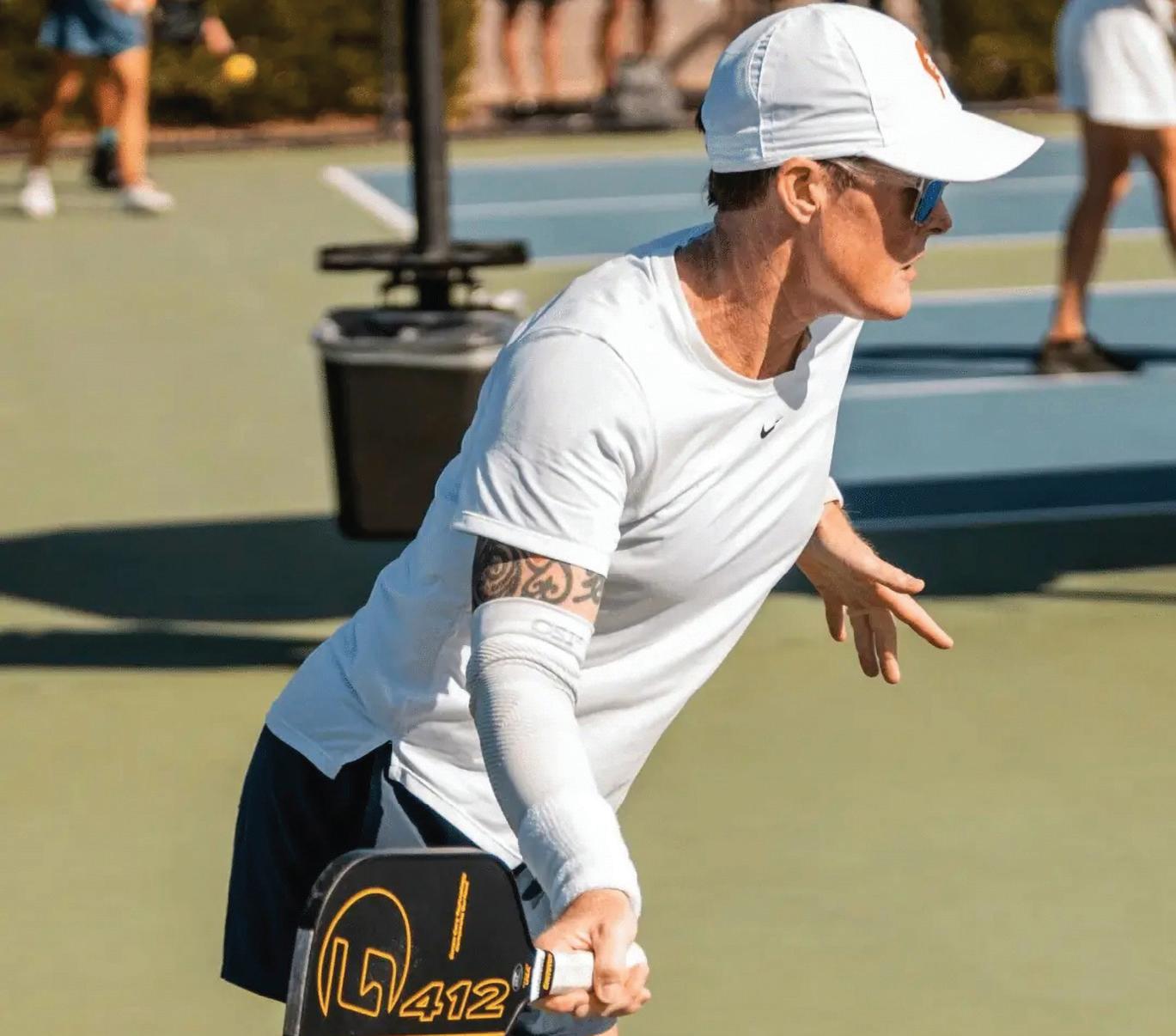

The Kansas City [Mo.] Convention Center will host the third annual PickleCon conference and show July 24-26, for players, professionals, fans, manufacturers and businesses. The conference will feature tournament and open play, pro-ams, exhibitions, clinics, skill challenges, a vendor village, networking opportunities and social events.
Organizers said last year’s PickleCon drew more than 2,300 attendees from 37 states and featured 55 courts, with 90 brands. Visit picklecon.com.
As this issue of RSI was being completed, we learned of the passing of pioneering performance psychologist Dr. Jim Loehr, who died April 20 at age 83 in Colorado. His contributions to tennis were profound and lasting. Over more than three decades, he worked alongside some of the sport's most respected coaches and guided thousands of coaches and professional and junior players. A tribute from one whose career he influenced is on page 44.
The U.S. will host Hungary in the Billie Jean King Cup playoffs in November, after the American squad lost to Belgium in April in qualifying for this year’s finals. The U.S. has won the BJK Cup championship a record 18 times.
Padeltek is the official Racket Partner of the Pro Padel League. PPL’s 2026 season opens July 9-12 in New York City.
La Roche-Posay is officially “sponsoring” Jannik Sinner’s shadow in a campaign to promote sun protection. The company says the shorter and sharper your shadow, the stronger the UV, and suggests, “If you see your shadow, protect yourself.”
The U.S. qualified for the finals in all four premier junior team competitions—the 16-and-under Junior Davis Cup and Billie Jean King Cup and the 14-and-under ITF World Junior Tennis for boys and girls—by each team finishing first in its Qualifying group competition in April. The finals of the Junior Davis Cup and Billie Jean King Cup will be held later this year at a site and
a date to be confirmed, and the ITF World Junior Finals will be Aug. 3-6 in Czechia.
The 1989 US Open men’s singles championship trophy won by Boris Becker recently sold at auction for $357,456, one of the highest-priced pieces of tennis memorabilia ever sold publicly.
The Association of Pickleball Players has announced a partnership with Vietnam-based sporting goods brand Wika Sports as Official Premium Paddle Partner of the APP Tour.
Always Alpha, the first sports talent agency built exclusively for women, announced its first acquisition: Courtside Talent, the tennis-focused management and advisory firm, which counts Grand Slam champ Sloane Stephens among its clients.
INTENNSE, the team based professional team tennis league, announced a continuation of its distribution partnership with Swerve TV, the Los Angeles-based independent programmer of live sports on free ad-supported streaming television (FAST).
Longtime industry leader Patricia “Pat” Freebody passed away on April 6, at age 85. Freebody, who was general manager of Mid-Town Tennis Club in Chicago from 1980 to 1988 and president of World TeamTennis from 1989 to 1992, served as USTA Midwest Section E.D. from 1993 to 1996 then moved to New York to work at the USTA National Office, where her many leadership roles included overseeing USTA Leagues, JTT, adult tournaments and more. She was named RSI Person of the Year in 2012.
The USTA has hired Jennifer Gregg as Senior Director–Advocacy, a new position. A Certified Association Executive, Gregg most recently served as Executive Director for USTA South Carolina.
For the 50th time, Dr. Louie Cap, the Senior Head Professional at the Van Der Meer Tennis Center, crossed the finish line at the Boston Marathon. The PTR Master Professional, who has a Ph.D. in nuclear physics, has dedicated his life to teaching,
mentoring and growing the sport. He finished this year’s race in under seven hours, placing him 14th in the 80+ age division.
Doug Chapman, the boys’ tennis coach at Somerset Berkley Regional High School in Somerset, Mass., reached a milestone 800th match win on April 21.
Carlos Alcaraz and Aryna Sabalenka, who finished 2025 as the No. 1-ranked men’s and women’s pro tennis players, were named Sportsman and Sportswoman of the Year in April at the Laureus World Sports Awards. The awards were co-hosted by Novak Djokovic and champion freestyle skier Eileen Gu.
Grand Slam Champion Sloane Stephens has joined INTENNSE as a Pulse Partner for the 2026 season. She will serve in an advisory and ambassadorial role for the Rips team, helping shape team identity while lending her experience, leadership and perspective.
Jimmy Parker, an 83-year-old RSPA Master Pro, received the 2026 National Men’s Tennis Association Player of the Year Award on April 12
during the newly named NMTA Jimmy Parker Classic in Columbus, Ga. Last year Parker, of Santa Fe, N.M., won a record-breaking seventh Grand Slam—capturing national 80 singles championships on clay, grass, hard, and indoor courts.
Tennis champion Maria Sharapova has joined Amulet as an investor and strategic advisor. Amulet is a sciencebacked hormonal health company designed to help women perform at their best through every phase.
Infosys announced a multi-year partnership with Carlos Alcaraz, the youngest athlete ever to achieve the World No. 1 ranking in men’s tennis. He will be a Global Brand Ambassador.
Genie Bouchard, a 2014 Wimbledon finalist and one of the most recognizable names in professional pickleball, has signed a representation deal with Park Place Technologies, a global leader in IT infrastructure services.
Portia Archer, the former NBA executive who has served as chief executive of the WTA Tour since August 2024, has left the organization.
The USTA’s new substack, “Inside American Tennis,” is a one-stop destination for all the non-stop excitement that has come to define the sport in the U.S. The substack, which is free, launched in early April and continues to gain followers.

“Our game plan is to shine a spotlight on the outstanding players who carry the standard for American tennis— both the established champions and the ever-growing cadre of young stars who are quickly earning their stripes,” writes Editor Mark Preston.
“We will take you beyond the scores to showcase the remarkable personalities whose incredible talents continue to raise the game to exciting new heights. You’ll hear their insights, learn what drives them, understand their goals and
ambitions—and have a little fun along the way.”
Subscribe to the free substack at insideamericantennis.substack. com
The USTA’s strategic investment initiative USTA Ventures has invested in Fastbreak AI, to employ Fastbreak’s software to optimize scheduling for millions of adult USTA League matches per year.
More than 300,000 players compete in USTA Leagues yearly, contributing to more than 2 million court hours of play that are currently scheduled manually. The USTA will utilize Fastbreak’s scheduling software, which has been employed by pro and amateur sports leagues worldwide, including the NBA, NHL and MLS, to automate and optimize that process, which manually requires hundreds of staff and thousands of hours. The USTA will
pilot Fastbreak in a number of USTA League areas by the end of 2026, with the goal of a wider rollout in 2027.
“By freeing the substantial volume of resources currently dedicated to League scheduling, Fastbreak has the potential to have a tremendous impact on helping the USTA reinvest in directly growing the game of tennis,” says Michael Hughes, USTA Senior Director, Digital Strategy & Business Development.
USA Pickleball has partnered with Boys & Girls Clubs of America (BGCA) in a collaboration that is expected to introduce pickleball to millions of youngsters. USA Pickleball becomes the official provider of pickleball programming for BGCA, delivering equipment, resources and programming.
“By aligning with a partner that reaches millions of kids every year, we have the opportunity to introduce


pickleball at scale and create lasting impact in communities nationwide,” says Jose Moreno, Chief Marketing and Strategy Officer of USA Pickleball. BGCA operates more than 5,500 locations nationwide, serving over 4 million young people each year.
The initiative will deliver pickleball starter kits to BGCA locations nationwide, beginning with a launch in Arizona that will reach all 75 clubs across the state and more than 50,000 youth. Each kit includes Franklin paddles, balls and nets, supported by custom training modules. To help accelerate the program, USA Pickleball will contribute an initial $100,000 to support implementation and growth and will also commit to installing one pickleball court at a Boys & Girls Club location every year. Visit usapickleball.org.
Westbridge Licensing has been appointed the global licensing representative for Boast, the American tennis-inspired apparel brand. Founded in 1973, Boast (www. boastusa.com), often recognized by its Japanese maple leaf logo, has built a following through its distinctive identity, premium sportswear, and deep connection to tennis, country club lifestyle and classic American leisure.
Westbridge Licensing will develop strategic licensing programs designed to expand Boast into a broad range of consumer product categories, including apparel extensions, accessories, footwear, sporting goods, collaborations, and lifestyle products that reflect the brand’s unique position at the intersection of sport and culture.
The inaugural US Open TYPTI Championships, the first major professional and amateur TYPTI event, was slated to take place May 20-24 at Calabasas Pickleball Club near Los Angeles. The five professional divisions offered $100,000 in total prize money, and numerous amateur events were
planned, including ratings, seniors and junior divisions. The event launched the TYPTI world rankings (visit TYPTI.com).
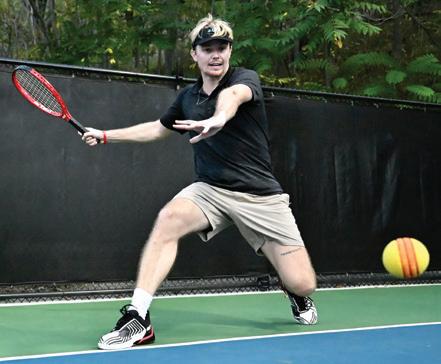
Additionally, in partnership with the Intercollegiate Tennis Association and Barnes Tennis Center, another professional event is planned for San Diego July 10-13 during the ITA Collegiate Summer Series Tour stop, allowing collegiate players to compete for $25,000 in prize money in singles, doubles and mixed professional TYPTI events. There will be a full slate of amateur events as well, says TYPTI CEO and Chairman Steve Bellamy.
“Barnes Tennis Center has revolutionized the traditional racquet club with 25 tennis, 30 pickleball, and seven padel courts, and stadiums
for tennis and padel,” adds Bellamy. “This recent transformation truly redefines the vernacular, ‘racquet club’.” Barnes will be programming TYPTI workouts throughout the year, will stock TYPTI racquets, balls and accessories, and will be another West Coast hub for the sport.
Distinguished tennis officials Shirley Damiano, Darren Potkey and Carl Richko were honored recently with USTA Umpire Awards for their dedicated and exemplary service to the game.
Damiano, of Syracuse, N.Y., received the Woodie Walker C.A.R.E. award, which recognizes a tennis official whose contributions to the game best exemplify ‘Commitment, Accountability, Responsibility, and Excellence.’ Potkey, of Powder Springs, Ga., received the John T. McGovern Award, which recognizes
a USTA-certified chair or line umpire with at least 10 years of service who has demonstrated outstanding contributions to tennis officiating. Richko, of Hewitt, N.J., received the Nicholas E. Powel Award, which recognizes the importance of officiating at the local level.
“Shirley, Darren and Carl each exemplify excellence in officiating and have come to embody everything that’s good in our game,” said Jake Garner, USTA Managing Director–Competition Operations and US Open Tournament Referee.
Mizuno is re-entering the North American tennis racquet market with the launch of two new performance frames: the AcroSpeed 100 and AcroStrike 98. Designed and engineered in Japan, the racquets combine the brand’s signature feel with modern power and spin

technologies, says the company.
The AcroSpeed 100 is engineered for explosive pace, delivering effortless power and accelerated ball speed from all areas of the court. The AcroStrike 98 is designed for players seeking control and consistency, offering a stable, connected feel through impact.
“By combining new frame construction with advanced grommet systems, we were able to achieve both enhanced energy return and greater dwell time, giving players a rare combination of power, control and feedback,” says Yohei Yamashita, lead engineer on the project. Visit usa. mizuno.com.
Both frames introduce a suite of proprietary technologies, including:
• ENERZY Frame—a cross-sectional frame design that transfers energy at impact for enhanced power.
• Dual Spring Technology—a carbonbased construction to amplify frame flex and increase energy return for
greater ball speed.
• ABG Grommet—to help strings better grab the ball.
• 4-Way Pocket Grommet System— for multi-directional string movement to enhance snapback and generate more spin.
• Booster Grommets—to extend ball dwell time and promote deeper, more penetrating shots.
The USTA Foundation has partnered with The Reginald F. Lewis Foundation to empower future leaders and honor outstanding mentors through the Reginald F. Lewis Game Changer Award and the newly rebranded Reginald F. Lewis Career Days program.
The Game Changer Award will recognize individuals who demonstrate extraordinary dedication to mentoring the next generation of
leaders. It will be given annually to two individuals—including coaches, educators and mentors—from the USTA Foundation’s national network of community-based organizations (NJTLs), nominated by young people who participate in their programs. Recipients will receive a trip to the 2026 US Open, along with a $10,000 grant to support and strengthen youth development efforts at their organization.
The Reginald F. Lewis Career Days in Washington, D.C., held in July, aims to help young people from underresourced communities learn about corporate and civic career pathways and build networking skills. Visit ustafoundation.com.
Padel has officially surpassed 1 million players in the U.S., according to the 2026 Topline Participation

Report by the Sports & Fitness Industry Association (SFIA), which tracked the sport for the first time in its history. The report recorded 1,073,000 Americans who played padel in 2025, including 238,000 who played eight or more times.
This milestone coincides with a broader boom in racquet sports, with overall participation rising from 13.9 percent of the U.S. population in 2020 to 20.6 percent in 2025.
The U.S. Padel Association (USPA) has seen parallel growth in its own metrics, with club membership up 51.5 percent and sanctioned tournaments jumping from 104 in 2025 to a projected 255 in 2026. Looking ahead, the USPA is investing in junior development, collegiate championships, and an Olympic Pathway program aimed at Brisbane 2032. Based on current momentum, the organization projects the U.S. could reach 10,000 courts and more than 10 million players by 2030. For more info, visit padelusa.org.
USTA Coaching has joined WeCOACH as a “mission partner” and will participate in initiatives designed to recruit, develop, support and retain women in coaching at all levels of tennis.
USTA Coaching also is promoting a new program, “Serving All: Aspiring Coaches powered by WeCOACH,” which aligns with USTA Coaching’s mission to educate and serve coaches to create inspiring tennis experiences for players of all levels. The program is intended to support collegiate women tennis players entering the tennis coaching profession, and provide aspiring coaches with practical tools, reflective learning opportunities and ongoing professional support.
USTA Coaching also will provide a select number of participants from the USTA Coaching community with complimentary WeCOACH
memberships, providing access to WeCOACH’s professional development platform and resources that support continuous learning and leadership development programming.
“We often hear sport leaders who are hiring ask, ‘Where are all the women?’ This program is designed to be part of the solution by expanding the pipeline of talented women coaches ready to lead in tennis,” says Vanessa Fuchs, CEO of WeCOACH.
USRSA Names MRTs, CSs
Master Racquet Technicians
Yanira Escobar, Glendale, Calif.
Weiyi Gao, Mississauga, Ontario, Canada
Certified Stringers
Joko Suryo, Jakarta, Indonesia
Chun (Jun) Kim, Tenafly, N.J.
Buddy Turl, Bakersfield, Calif.
Zhu Zhao, Phoenix, Ariz.
Visit RacquetTech.com for more info.


Junior player David Filer’s battle with cancer inspired his South Bend community to transform a new tennis center in his honor.
By Kent Oswald
There are times when a love of tennis makes the difficult and painful easier to bear. For example, there is the clarity of vision for how much the game meant to David Filer, who began playing at age 2 and would reach as high as that in national rankings. Inspiration from his battle with brain cancer—a fight that drew support from Roger Federer and Novak Djokovic, among others—rallied his South Bend, Ind., community to find the will and funding for the $1.8 million refurbishment of the Leeper Park courts David loved into a top-tier tennis destination.
needed to be honored. Actually, we were just looking for a tournament, not the courts. It sort of evolved with the help of everyone here in South Bend.”
According to Patty Schrock, president of the South Bend Community Tennis Association, “David was known for his love of tennis, work ethic, sportsmanship, natural ability, [and] desire for South Bend to host a national level tournament and provide a quality facility where all kids can learn to love tennis, which was a ‘tipping point’ for the project.”
Opened in May 2026, the David Filer Tennis Center features lighting and clubhouse upgrades, and 13 refurbished
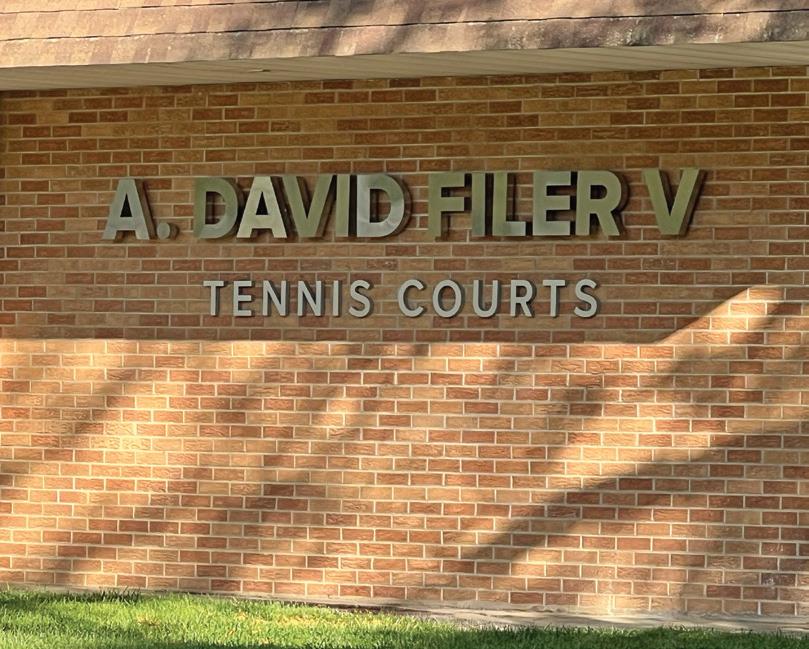
Passion and devotion to their son compelled his parents, David and Pamela Filer, as they led local forces and attracted national support, marshalling political and economic will to reconstruct a foundational tennis facility in a magnificent park on the banks of the St. Joseph River. Speaking at the groundbreaking last summer, Mr. Filer said, “When David passed away [in March 2023, at age 16], he was such a special person that we just felt his legacy
also delivered a substantial grant. Todd Carlson, the USTA’s Senior Director, Tennis Venue Services, Partnerships and Strategic Planning, explained that, in addition to offering grant funding, his group “helped develop a business model, provided technical expertise including creating 3D renderings, and facilitated conversations with local partners,” among other resources and support.
Tennis Venue Services also helped strengthen project success by conducting comprehensive plan reviews, recommending design and operational modifications, resolving design and site constraints, and balancing technical requirements with budget considerations.
The Filer Center honors the past while creating sustainable opportunities for the next generation.
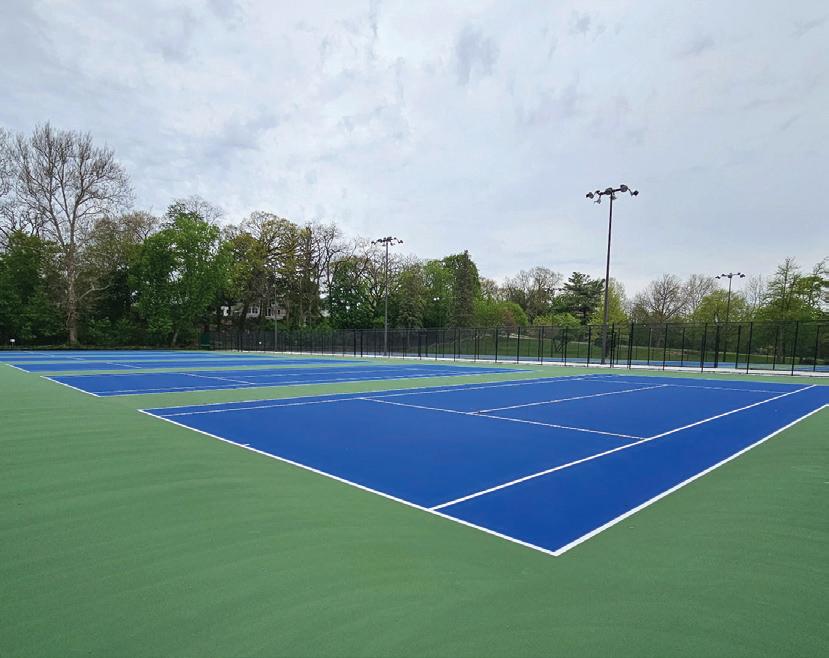
post-tension concrete courts, which are now home to USTA tournaments, adult leagues, Junior Team Tennis, local tournaments, lessons, camps and drop-in play.
Local engagement in the project was key. The South Bend tennis community raised nearly a third of the funding on its own. This was supplemented by the City and Visitor’s Bureau funding, as well as USTA Midwest and Northern Indiana District contributions. USTA National
Kylie York, Director of Growth and Facilities for USTA Midwest, noted that, “Supporting a site like Filer allows the section to preserve and celebrate that legacy while also using it as a platform to introduce new players to the sport. Beyond history, the David Filer Tennis Center offers the infrastructure and environment needed to deliver quality programming, host events and serve as a regional hub for tennis activity. By investing in a facility with both historical significance and growth potential, the section can bridge tradition with innovation, honoring the past while creating sustainable opportunities for the next generation of players.”
Sponsored content. For more on how USTA’s Tennis Venue Services can help your facility or project, visit usta.com/facilities or email facilities@usta.com
In our May 2026 issue, we ran the exclusive U.S. Racquet Stringers Association Racquet Selector chart, listing more than 400 frames currently on the market and which are all in the USRSA database. A few manufacturers were unable to send us their models in time to be included in that issue, so we’re following up here with 24 more frames.
UNDERSTANDING THE SPECS
1. HEAD SIZE: Square-inch measurement of the hitting surface (strung area).
2. LENGTH: Length of the frame from the butt of the handle to the top of the hoop.
3. WEIGHT: Overall weight of the STRUNG racquet, listed in both ounces and grams.
4. BALANCE: Measurement from the butt end of the racquet to the “Balance Point,” measured in centimeters.
5. FLEX: Measurement of the strung racquet’s stiffness using the Babolat Racquet Diagnostic Center (RDC).
6. SWING WEIGHT: The dynamic inertia of the strung racquet measuring the distribution of mass along the length in kg x cm2.
7. POWER FORMULA: Determined by an algorithm in the USRSA Database using key specs that contribute to power of the strung racquet: Length, Head Size, Flex and Swing Weight.
is helping players and coaches in all sorts of ways, but with health privacy concerns, is wearable tech wearing out its welcome?
By Mary Helen Sprecher
It’s no secret that the intersection of sports and technology has been getting increasingly busy, with AI, streaming services, player analysis— and, of course, wearable tech.
But what’s often not a secret is the personal health data of users. That information is being tracked and recorded by wearable tech and often, by extension, the companies that
in a gray area, despite the fact that the data it collects is the very same data that is protected in the medical profession. Cassidy, in response, has introduced the Health Information Privacy Reform Act (HIPRA), a bill that, if passed into law, would create new privacy standards around wearable tech.
“Smart watches and health apps change the way people manage
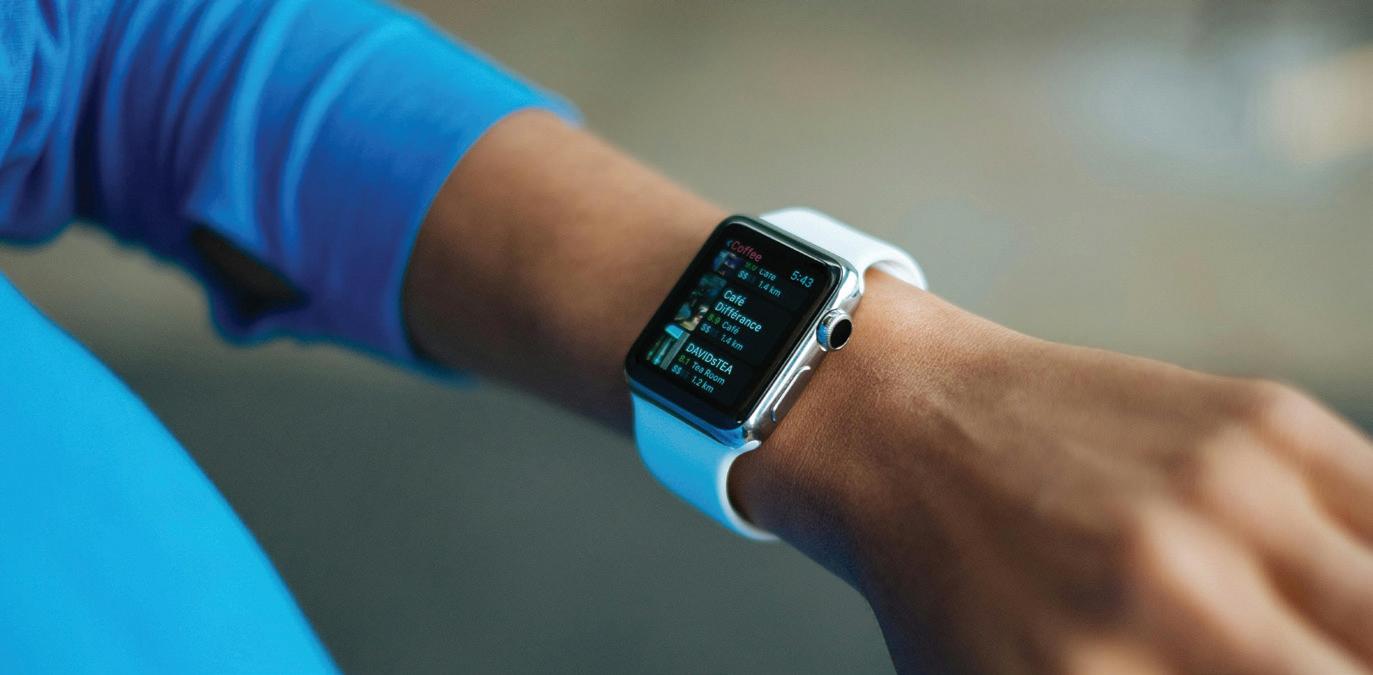
manufacture these devices. And that has lawmakers concerned.
Back in November, Sen. Bill Cassidy (R-LA), the chair of the Senate Health, Education, Labor and Pensions Committee, sounded the alarm about the fact that smart watches, rings, trackers and health apps (and the data they compile and record) currently fall outside the protection of the Health Insurance Portability and Accountability Act of 1996 (HIPAA).
Wearable tech has long operated
their health,” Cassidy said in a press release. “They’re helpful tools, but present new privacy concerns that didn’t exist when it was just a patient and a doctor in an exam room. Let’s make sure that Americans’ data is secured and only collected and used with their consent.”
If the bill were to become law, companies that collect health data would need to clearly explain what information they gather and how it is used or shared. HIPRA also cracks open the door to the possibility that
consumers could have the option of whether or not to share their data for research purposes—and if they do share it, whether they could be compensated for doing so.
Already, the U.S. Food and Drug Administration has put wearable brand Whoop on notice, stating that its Blood Pressure Insights (BPI) feature is a medical device that lacks required marketing authorization under federal law. (Whoop, for its part, clapped back at the FDA, claiming BPI is a wellness feature, rather than a diagnostic tool.)
Oura, another device manufacturer, has entered the chat, trying to reassure users that its data remains private; this followed a social media storm that broke last summer when the company announced a collaboration with data analytics firm Palantir on projects with the U.S. Department of Defense.
Ultimately, though, the fact that personal health information might not be as private as users might think is taking a back seat to concerns related to personal safety.
Sweden’s national security service said it was investigating reports that bodyguards accidentally exposed the private travel locations of high-profile officials, including the country’s king and queen, after their running and cycling routes were publicly visible on the social fitness app Strava (another major player in the wearable tech sector).
And with the uptick of youth athletes who use wearable tech while training and who often post healthrelated information on social media as bragging points (running routes, workout stats from games on a municipal court or at a club, etc.), it’s clear these won’t be the last concerns we hear.
The almost daily news of data leaks and identity theft has spurred on interest in HIPRA. While the bill’s passage isn’t guaranteed (similar privacy legislation has stalled out previously), it is likely that regulation of data is coming sooner rather than later.
RACQUET/PADDLE SPORTS
SFIA research tracks
wholesale
equipment shipments by manufacturers, and for racquet & paddle sports, the news is good.
By Mary Helen Sprecher
If you want to know what sports are growing, ask the manufacturers what they’re selling. That’s the bottom line when it comes to the “Manufacturers’ Sales by Category 2026 Report,” the newest research released by the Sports & Fitness Industry Association (sfia.org).
The annual report tracks U.S. wholesale sales across sporting goods equipment, athletic footwear, sports
billion. This represents a 3.7 percent year-over-year increase, as cost pressures and evolving trade and tariff policies continue to impact the industry.
Drilling down into racquet sports, the following details are noteworthy:
Pickleball Is the Biggest News: Pickleball wholesale sales hit $409.7 million in 2025, a 22 percent yearover-year surge—by far the fastest growing category tracked. Paddle sales led the charge at $292.8 million (an increase of 24 percent year over year), followed by balls at $116.9 million (an increase of 17.3 percent).
Racquetball Did Not Fare as Well: After recording $7.4 million in sales in both 2024 and 2023, racquetball sunk to $6.1 million in 2025, for a year-over-year loss of 17.5 percent, and a total drop of 29.9 percent since the 2020 sales figure of $8.7 million.
Boomed: SFIA reports total tennis/ court footwear sales in 2025 were $240 million, an increase of 5.8 percent since 2024 (when sales were $226.9 million). The growth in tennis footwear sales between 2020 and 2025 was 57.2 percent.
Overall, SFIA notes, “Athletic footwear remains the largest single sales driver, totaling $24.1 billion in 2025, outpacing the broader industry growth rate. Sports apparel and licensed merchandise also posted gains.”
Athletic Attire is a Big Growth Sector: The SFIA report does not break out apparel into specific sports. However, the following statistics are relevant:
• In the category of Dresses, sales grew from $37 million in 2020 to $43.5 million in 2025, a five-year growth of 17.7 percent.
apparel and licensed merchandise, providing a comprehensive view of the industry’s health and trajectory.
According to SFIA, “Since 2020, wholesale sales have grown 34.7 percent, underscoring sustained post-pandemic momentum as Americans continue to prioritize physical activity.”
The sporting goods industry reached a new milestone in 2025, with wholesale sales totaling $130
Tennis Continues its Success Story: In tennis, racquet sales hit $287 million in 2025. That is a 5 percent jump since 2024 (when sales were $279.2 million) and a 27.5 percent rise between 2020 and 2025. Tennis ball sales were also up by 1.5 percent over the year before. Between 2020 and 2025, ball sales rose 32.9 percent, and are now sitting at $104.8 million.
Table Tennis Also Recorded a Bounce: Manufacturers noted $73.5 million in table tennis equipment sales for 2025. That is a gain of $3.5 million over sales figures in 2024 (a 4.9 percent increase) and a 20.9 percent rise since 2020.
• In the category of Shorts/Skirts, manufacturers recorded $2.2 billion in sales in 2025, an increase of 49.0 percent since 2020.
• In the category of Shirts/Tops, manufacturers ended 2025 with $12.59 billion in sales, a 57.3 percent increase since 2020.
• Kids’ footwear (not broken out by sport) ended 2025 with $3.13 billion in sales, up 21.6 percent since 2020.
The SFIA’s Manufacturers’ Sales by Category 2026 Report has far more insights, distilled by player ages and categories, and is a resource for clubs, pro shops and retailers dealing in racquet sports, as well as the broader sports market. To purchase the report, visit sfia.org and click on the “Research” tab.
USA Pickleball and other players in the sport are working to identify and eliminate counterfeit paddles.
By Mary Helen Sprecher
Pickleball paddles keep evolving to give athletes the enhanced control, increased power and dependable spin that contribute to a better game.
Putting all that technology at players’ fingertips, however, comes at the cost of months of R&D and a heavy investment on the part of manufacturers, which is why high-end paddles can cost upwards of $300. That, in turn, has sent players scurrying to the web, trying to find better deals. Which has led them straight to the black market—whether they realize it or not.
Riley Burgess knows a thing or two about that. As Vice President of Equipment Compliance for USA Pickleball, he works with manufacturers, as well as with the organization’s testing lab, whose
mission it is to seek out those paddles that are the evil twins of the real thing: almost identical until it comes to actual playability. And the more valuable the brand, the more desirable the paddle is, making it a prime candidate for counterfeiting.
“If you are a counterfeiter,” says Burgess, “and you’re selling a $250 paddle to the consumer for $50, that’s a very attractive gap.”
A quick visit to Alibaba proves him right. Paddles that routinely cost north of $300 when purchased through legitimate retailers can be found on the platform for as low as $12.50. Some are even imprinted with USA Pickleball’s logo and the words, “USA Pickleball Approved.” Talk about chutzpah.
Of course, many black-marketers also trip themselves up; for instance,
instead of being lettered as “CRBN,” for high-performance, carbon fiber paddles (and as the name of a specific company), several paddles read “CRN.” Some refer to having “USAPA” approval—that’s the old name for the governing body; it’s been USA Pickleball (USAP) for a number of years now. Others are so obviously photoshopped that they appear to be the size of tennis racquets. And often, counterfeit paddles will have misspellings.
But to some players, all that is easy to overlook, often on purpose.
“People want that paddle for its status,” says Burgess. “It might look very close to the real thing, but once you start playing with it, you’ll realize the quality control is not there.”
In the meantime, he notes, “There are plenty of very good paddles on

the market that you could be buying instead for $100 or $120.”
Counterfeiting has become such a problem that in December, the pickleball industry released a statement addressing it. Signing onto the statement under the banner of the United Pickleball Association were the Association of Pickleball Players (APP Tour), Dynamic Universal Pickleball Ratings (DUPR), Major League Pickleball (MLP), Professional Pickleball Association (PPA Tour), United Pickleball Association of America (UPA-A), USA Pickleball and the World Pickleball Federation (WPF).
Calling it “one of the fastestgrowing threats to the sport,” the organizations noted that counterfeit equipment undermines competitive integrity and can pose safety risks because of the use of unregulated materials. Inferior equipment also has long-term performance issues.
“Authentic manufacturers invest heavily in research, testing and innovation to meet performance standards,” the United Pickleball Association added. “Counterfeiters do not.”
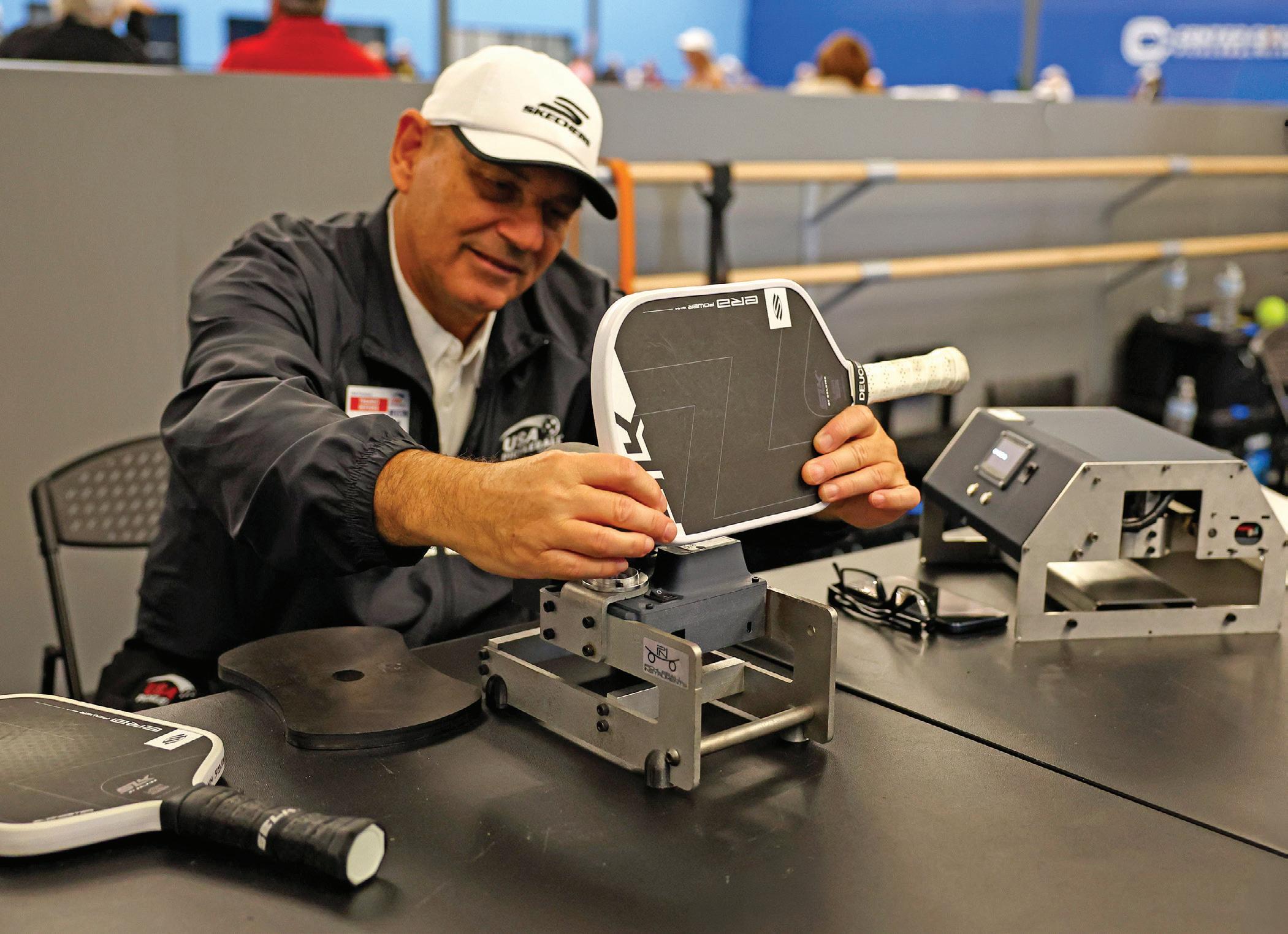
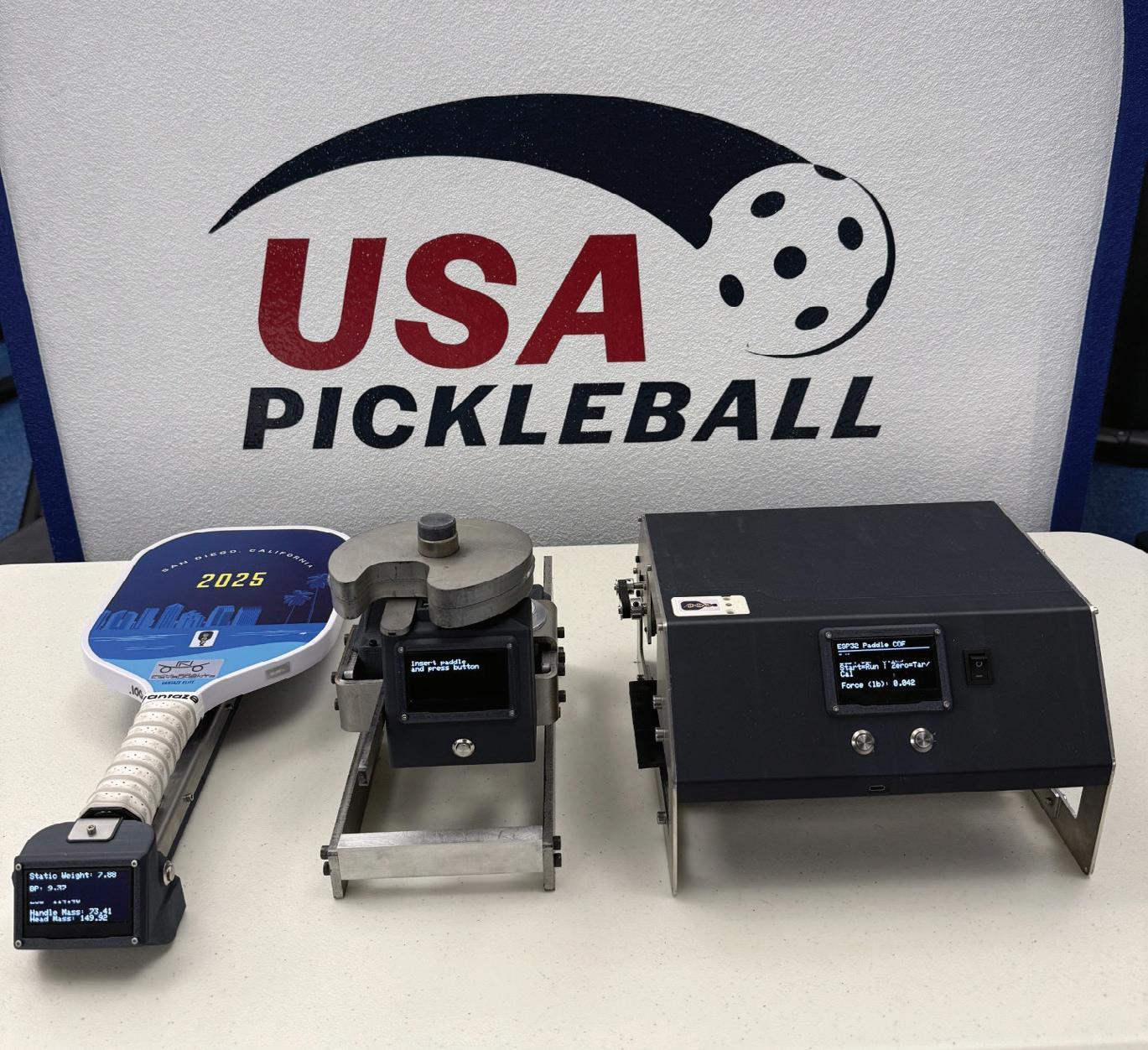
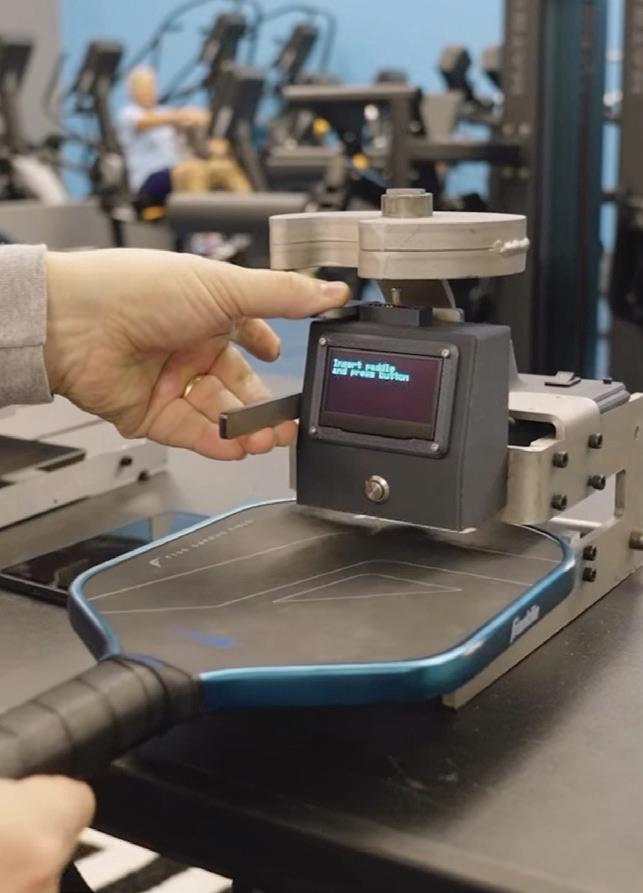
In mid-January, USA Pickleball and Pickleball Instruments took the statement a step further and launched a new event-based initiative: Field testing of paddles. The move allows for onsite testing of paddles using Pickleball Instruments’ equipment. Paddle testing covers three data points: coefficient of friction, deflection and weight/ balance properties.
The three pieces of testing equipment, each approximately the size of a laptop, are collectively referred to as a suite and are, in Burgess’s words, “extremely portable and affordable,” making it easy to bring the testing to the game. “This is the same testing and the same equipment we use in the lab,” he notes.
In future iterations, additional performance data, such as Paddle/ Ball Coefficient of Restitution (PBCoR) and spin measurements, will be incorporated into testing.
USA Pickleball tested paddles at its tournaments in Glendale, Ariz., and Las Vegas, both of which were Golden Ticket events, making attendance (and wins) highly sought-after and thus, generating strong registration numbers. And instead of meeting
with resistance or hesitation, Burgess notes, players were lining up to have their paddles tested.
“I was preparing to have difficult conversations, but what we have found is that people were very curious; they liked the idea,” he says. “They’re really intrigued by the
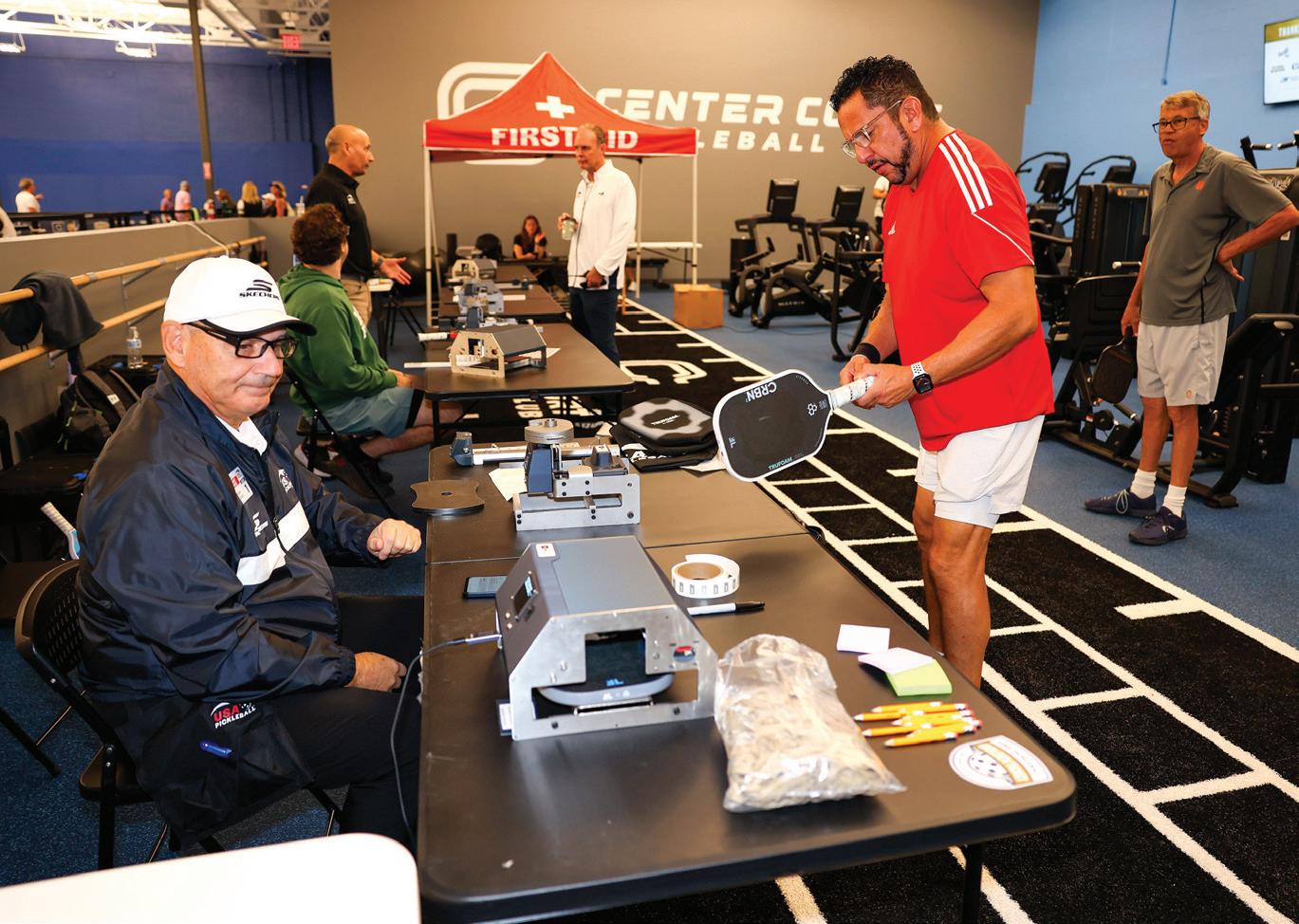
technology and how it works.”
Out of nearly 1,000 paddles tested at each event, he added, there was a small percentage of counterfeits.
Testing takes less than five minutes per paddle. Each tested paddle receives an RFID sticker that allows players to scan and view their equipment data. An accompanying mobile app will enable players to track how individual paddles change over time and will help ensure that all competitors are using compliant equipment when they are playing in tournaments—or even when they are just playing.
In order to take the court at the Golden Ticket events, players were required to show match officials that their paddles had successfully been tested.
USA Pickleball’s long game, according to Burgess, includes having facilities that host tournaments on a regular basis start purchasing and using their own equipment.
Paddle testing can provide a
marketing point in the crowded tournament sector, since it creates a more even playing field and can additionally help identify and eliminate equipment that has been doctored in order to provide an unfair competitive advantage.

The problem of counterfeiting is rampant throughout the sports industry and can be found in both equipment and apparel. It continues because of widespread ignorance of the actual damage caused by the black market, including the fact that it hurts the business of legitimate merchants who run brick-andmortar stores and/or verified e-commerce shops.
Burgess, who previously worked with Dick’s Sporting Goods, where he oversaw vertical brands, became familiar with the insidious nature of the black market. Despite the fact that multiple governmental agencies are involved in trying to break the counterfeit chain, and that sites like StopFakes.gov exist (and include portals for reporting incidents), it’s only a temporary fix.
“I know you can’t stop Chinese counterfeiting,” he says. “You can have a seller’s portal shut down on Alibaba, but it’ll just pop up under another name. That’s not effective, it’s not permanent and it doesn’t bring about real change.”
What USA Pickleball is doing, by contrast, is raising player awareness around the issue and making it more difficult to use black market paddles in sanctioned competition.
Ultimately, Burgess adds, that will lead to counterfeits becoming less desirable overall, which will lower the demand for them in the U.S. After all, if a player knows paddle testing will be conducted and that he or she will be caught, cheap paddles won’t seem like such a bargain any longer. “You’re not even going to want to practice with a piece of counterfeit equipment,” Burgess says.
Instead of taking a view from 30,000 feet, as do the governmental agencies, USA Pickleball is zooming in to address the issue on a granular level.
The black market for paddles “is having a detrimental effect on the sport,” adds Burgess. This new effort, however, “is boots on the ground” in the war against counterfeiters.
“It’s getting the message out,” he concludes.
In RSI’s second installment for 2026, we honor people and organizations that continue to make pickleball America’s fastest-growing sport.
Compiled by Judy Leand
Carl Schmits is one of those rare people who has had multiple accomplished careers spanning science, technology, engineering and racquet sports—all the while being an avid tennis player, then pickleball player.
Currently, he serves as Chief Technical Officer at USA Pickleball and chairs the Equipment and Evaluation Committee. His responsibilities include working to define, design and implement standards and testing protocols; facilities development and certification; and research in the areas of player and performance analytics and acoustics. He also chairs the Pickleball Equipment and Facilities Subcommittee for ASTM International (American Society for Testing and Materials).

But this is just the tip of the iceberg regarding Schmits’ extensive résumé. His training was in industrial and systems engineering with Battelle Memorial Institute, and he also had executive-level roles within information and communications technology, medical device development, robotics and renewable energy. He holds a CTO certification from MIT Professional Education. His professional racquet sports experience includes sports club management and field product development.
In 2014, following a 16-year stint at Intel (which he left in 2010), and other work in Europe, he decided to semi-retire, and he and his wife took up pickleball—and got hooked. They founded a local club in 2015, became USA Pickleball ambassadors, and grew their club to more than 600 members over six years.
USA Pickleball brought Schmits on in 2020 as director of equipment standards, and in 2022 added facilities and development to his responsibilities. In 2024 he became Chief Technology officer, which includes work in analytics (biometrics and player performance) and acoustics (addressing pickleball’s noise issue).
At present, Schmits is working on professionalizing product, materials and manufacturing processes and configurations for paddles. “There are plans to roll out a direct test for spin rate in the next couple of months, to control the upper end of a spin rate of balls,” he explains. This is expected to be implemented through ASTM in Q2 2026, followed by facility surfaces testing to come in the back-half of 2026. And, in addition to all this, he is a key member of the joint ASBA-USAP task forced charged with updating and revising the Pickleball Courts: Construction & Maintenance Manual for 2026.
“I’m really proud of what USA Pickleball does. There’s a community focus, and we’re now addressing youth at high school age and younger,” Schmits says. “We have a long-term roadmap for pickleball to become a lifetime sport. Pickleball is still a new sport, but it’s also a multibillion-dollar sport, meaning there’s no shortage of new technologies.”
PICKLEBALL BUILDER/ CONTRACTOR OF THE YEAR
With more than three decades dedicated to building athletic courts, Sean Berry of Boston-based Ace Sports Surfaces has played a steady and meaningful role in the growth of pickleball infrastructure, earning him recognition as RSI’s Pickleball Builder/Contractor of the Year. His work spans projects across the United States and internationally, including recent installations in Belize, reflecting both experience and adaptability in a rapidly expanding market.

In 2025 alone, Ace Sports Surfaces completed 260 pickleball courts, including 12 large indoor facilities. That volume speaks not only to demand, but to the confidence owners and developers place in Berry and his team to deliver quality work at scale. He brings extensive knowledge of all major court surfacing systems, with particular expertise in CushionX installations, helping facilities meet performance and durability expectations.
and a willingness to support partners across the sport, he continues to make a lasting impact on pickleball’s long-term growth.
“One of the world’s premier court builders, Sean has installed pickleball surfaces on a global scale,” says Tracy Lynch, Vice President of Business Development at AT Sports. “What sets him apart is his deep knowledge of surface playability, ensuring every court he builds performs at the highest level.”

Equally important is Berry’s commitment to the broader industry. He invests time training and mentoring other installers, sharing practical knowledge that strengthens the overall standard of court construction. Through consistent workmanship, technical experience,
In 2016, Tim and Ashley Owens cofounded CourtReserve, now a leading management platform powering racquet and paddle sports clubs and facilities worldwide. “It was the lack of technology at our own tennis club that led us to the idea of building CourtReserve,” Ashley Owens told an interviewer recently. “There was no way for us to see the club’s availability. Our club didn’t even have a phone number. There was no way to sign up for a lesson, other than in person. We knew there had to be a better way.”
That “better way” led to customizable technology that is able to organize and automate scheduling, create interactive events, and handle reservations and essential tasks such as memberships and billing, helping to ensure that daily operations run smoothly, save time and reduce costs to providers.
Now serving more than 2,000 racquet and paddle sports clubs and over 5 million players, CourtReserve has helped professionalize pickleball’s infrastructure by enabling facilities, tournaments, and communities to operate and scale more efficiently, adding fuel to the sport’s continued growth and commercialization.
“CourtReserve is the heart of our operations. It provides the flexibility to scale while ensuring all locations run smoothly,” says Will Richards, Co-Founder & CEO of Dill Dinkers, which started in 2022 with one location in Columbia, Md., and now has more than 15 active locations and 380 franchise locations in development.
Adds Devan Egan, co-founder of Club Pickleball USA: “In our thorough assessment … it was quite apparent that this was one of our easiest decisions. CourtReserve had the most experience, the most robust software tools and the highest level of customization and control.”
The World No. 1 female player, who turned 19 earlier this year—and who became the youngest pro player and champion in history at age 12—is one of the highest-paid athletes in pickleball, reportedly earning over $3 million annually. She has captured a
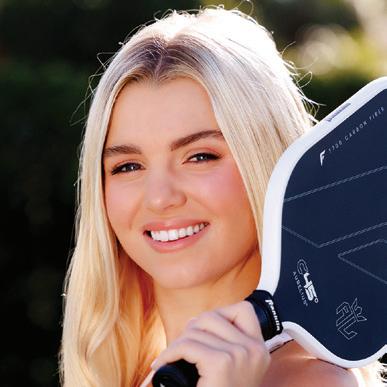
historic 181 gold medals and 39 triple crowns—the most of any player in professional pickleball.
This past January, Waters continued making history by inking two mega endorsement deals (which some dubbed, “The making of ALW Incorporated”)—the first with Franklin Sports and then with Nike. The Franklin contract, a three-year pact estimated to be worth $10 million, includes product testing as well as co-design of a signature product line that will offer pickleball paddles, bags and accessories. Waters’ exclusive apparel and footwear partnership with Nike, the terms of which have not been publicly disclosed, makes her the first-ever pickleball athlete to join the brand’s global roster. Beyond wearing Nike gear, she will serve as a global ambassador for the sport on behalf of the Swoosh.
Originally teaming up with her mother, Leigh Waters, who remains her coach and manager, Anna Leigh helped pioneer a new, aggressive style of play that won her a passionate following. Her fierce love for the game is matched only by her dedication to her fans, inspiring a new generation of pickleball players around the world.
“Anna Leigh’s remarkable talent, competitive spirit, and passion for the game align perfectly with our mission to support athletes at every level while continuing to grow the sport globally,” says Adam Franklin, president of Franklin Sports.
ONLINE PICKLEBALL RETAILER OF THE YEAR
Since its establishment in 2016, Pickleball Warehouse, a subsidiary of San Luis Obispo, Calif.-based Sports Warehouse, has been known for its wide selection of pickleball gear and its player-led customer service. The business was founded
by tennis players who transitioned into pickleball, and is positioned as a one-stop-shop for the sport’s community.
In 2024, Total Pickleball rebranded to Pickleball Warehouse, and is currently part of a portfolio that includes Tennis Warehouse, Tennis Warehouse Europe, Tennis Only, Total Padel, Running Warehouse, Running Warehouse Europe, Running Warehouse Australia, Tackle Warehouse, Skate Warehouse, Inline Warehouse, Ice Warehouse, Derby Warehouse and Riding Warehouse, making it a significant and established player in the e-commerce sporting goods market. As of March 2026, Sports Warehouse, led by CEO Drew Munster, had nearly 200 employees across four continents.
This past February, RSPA expanded its long-standing partnership with Tennis Warehouse to include Pickleball Warehouse and Padel Warehouse as its Official Online Retailers. The deal allows RSPA members to receive 30 percent off MSRP footwear and apparel and 20 percent off equipment, and grants access to expanded product lines across all three Warehouse platforms.
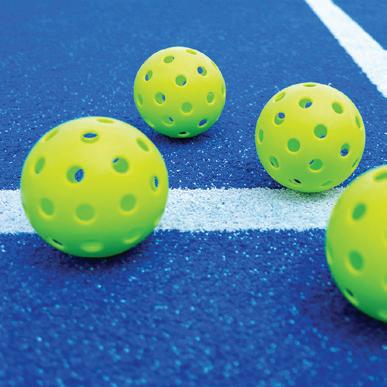
Pickleball Warehouse is often compared to a “candy store” for players due to its extensive inventory and customer-centric policies. For example, customers can take advantage of a 30-day paddle guarantee, free shipping on orders over $50, a 90-day return policy, and price matching. Beyond retail, Pickleball Warehouse maintains a YouTube channel with 380-plus videos. It also engages in community outreach by partnering with organizations, including PHIT America, dedicated to growing the sport globally.
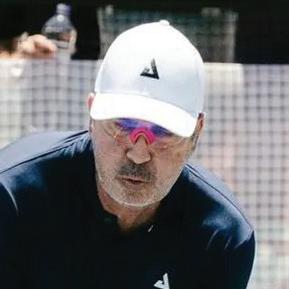
A top senior professional pickleball player, Dayne Gingrich is a seventime national champion, seventime US Open champion, and has won more than 60 gold medals as a senior pro. Using these experiences, he has also become a best-selling author and mental performance coach, dedicated to helping individuals and teams unlock their full potential. Gingrich’s mission is simple: to inspire people to think bigger, work smarter and perform at their best every day.
Together with Jill Martin, an attorney turned personal trainer and pickleball zealot, Gingrich operates pbMindset.com, a website dedicated to achieving mental and physical success in pickleball, business and life. Their book, Pickleball Mindset: The Blueprint to Peak Performance, dives deep into the mental game and focuses on overcoming selfdoubt, improving partnerships and maximizing potential.
“I’ve been a mental performance coach for over 16 years and have worked with professional, collegiate and high school athletes in every major sport,” says Gingrich. “My passion lies with the chess match of figuring out how my opponents operate, mentally, and attempting to exploit their weaknesses. Matches aren’t won because of the shots we hit; they’re won due to the puzzle we solve.”
Jersey Pickleball Club recently opened its inaugural location inside the historic Bell Works building in Holmdel, N.J. The 2-millionsquare-foot venue, once home to Bell Laboratories, has been reimagined as a “metro burb” containing offices, restaurants, retail, and now the Jersey Pickleball Club.
The club currently covers 14,000 square feet that contain five CushionX courts, LED lighting, TVs, speakers, WiFi and live cameras recording play, as well as additional sound proofing. JPC currently has more
than 2,500 clients, and during January alone it hosted or facilitated 40-plus events, including daily lessons, intro, advanced and open play, Friday Night Socials and more. JPC has even developed several Cross-Club League teams, and is now organizing youth group camps and summer programs and is working with local high schools to facilitate after-school open play and instruction. This past February, JPC hosted its first Picklefest tournament that included prize money and awards—and larger and more competitive tournaments will soon be added to the roster.
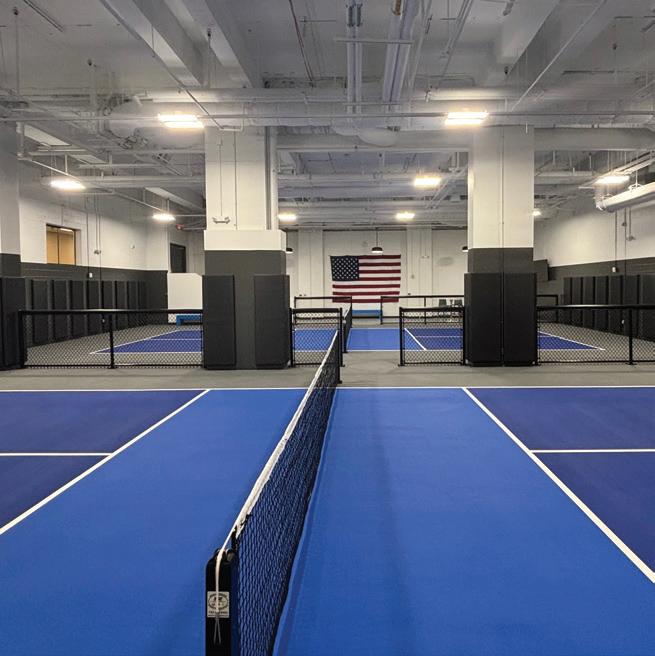
in discussions with Bell Works to expand its footprint with the addition of indoor/outdoor covered courts for pickleball, padel, and perhaps even badminton.
Given its success, JPC is already
“Jersey Pickleball Club pairs the premium amenities of a largescale franchise with a genuine community feel,” says one industry insider who has visited and played on the courts a number of times. “It’s a place where the owners know every member by name, ensuring a warm welcome from the moment you walk through the door.”

If you work with junior players, you’ll also have to deal with their parents.
By Greg Moran
If you work with juniors, their parents will be a part of your life. Most will get it. They know little Billy is not going to be the next Roger Federer. They just want him to learn the game, make some friends and have fun. They trust you to do your job and only get involved if an issue arises.
Then there are those who don’t get it and can make your life miserable. For example:
• Mark, the obsessive parent. Every Wednesday, Evan attends his tennis class and every Wednesday his father, Mark, comes with him. Throughout the class, Mark videos Evan and
pantomimes instructions. When the class ends, Mark immediately pounces on his son in the lobby to talk about his play. Mark calls or emails Evan’s pro three times a week (at least), with comments and suggestions for his son’s tennis. On more than one occasion, Mark has called to complain that Evan was fed less balls than the other kids during the class. Yes, he actually counted! By the way, Evan is 7 years old.
• Dave, the overly competitive parent. Dave is a very successful entrepreneur and ex-college basketball star. To Dave, life is a contest, and the only acceptable outcome is to win. Dave puts enormous pressure on his daughter, Emily, to perform at a high level. During matches, Dave lives and dies with every shot. If Emily wins a point, he pumps his fist and loudly cheers. When she loses one, Dave falls back
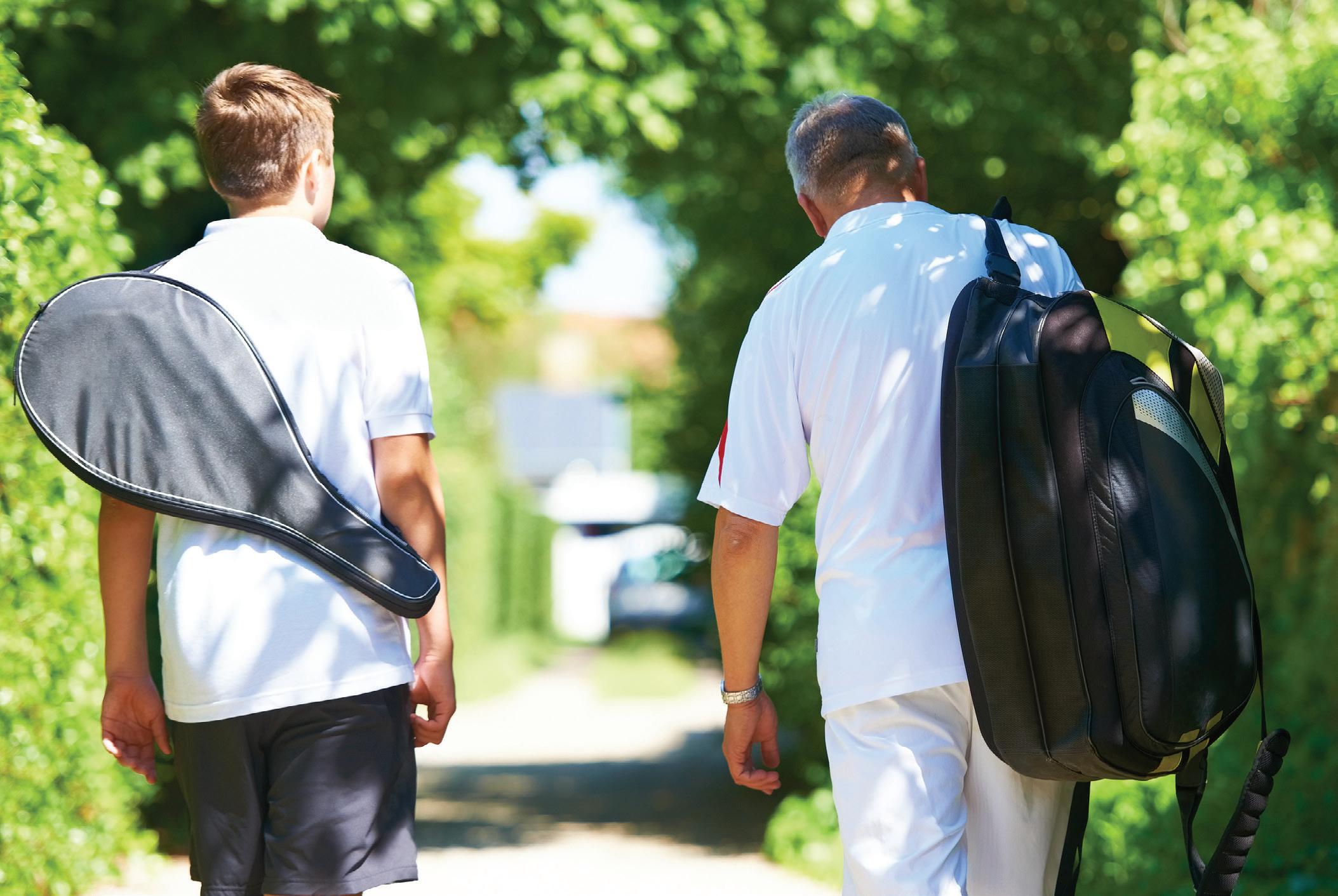
In his new book, “Beyond Hours & Dollars: A Career Guide for Rackets Professionals,” industry professional Greg Moran shares the lessons he’s learned during his nearly 50 years in this business. This comprehensive book covers every aspect of being a professional, and aspiring to be one. And importantly, it’s all offered for free— Moran wants to make it available to anyone interested in starting, growing and improving themselves and their careers.
For more information, visit beyondhoursanddollars.com. Moran can be reached at GMoran@ beyondhoursanddollars.com.
Here, we excerpt Chapter 19 of “Beyond Hours & Dollars.”

in his chair as if he’d been punched in the stomach. Too many times to count, Emily has left the club with tears in her eyes after her father has scolded, “How could you lose to her?”
• Pam, the know-it-all parent. “Be more aggressive.” “Hit it to his backhand.” “Get to the net.” These are comments that Pam yells to her son, Frankie, during his USTA team matches. After each match, Pam demands a meeting to discuss Frankie’s play. During the meeting, she tells his pro what should be worked on during future lessons. Pam is a 2.5 level player and has never played a competitive match. However, she’s “read a lot of books,” watched dozens of YouTube videos and “really studies the game.”
• Mike, the delusions of grandeur parent. Mike believes his son, Sammy, is an exceptionally talented athlete, destined for tennis greatness. He takes Sammy to lessons three days a week and tournaments on the weekends. Mike informs everyone who will listen that Sammy is going to excel in junior tennis, secure a college tennis scholarship and eventually compete on the professional circuit. In reality, 10-year-old Sammy is an average athlete. He hates competition and has told his pro he’d rather practice his guitar than play tennis.
Navigating these personalities will be a challenging, sometimes frustrating, part of your job. Begin by keeping these in mind:
• Always be professional. Regardless
of how annoying a parent may be, how ridiculous their comments are, or how aggressively they come at you, always behave professionally.
• Have empathy. If you’re a parent, you know that it’s easy to get emotional and have your judgment clouded with anything regarding your child. Try to remember this when speaking with your student’s parents. A little empathy will go a long way.
HERE ARE A FEW MORE SUGGESTIONS:
Communicate clearly and consistently. If you run a junior program, before every season, hold a parents’ information meeting. It could be via Zoom or in person. Tape the meeting so you can send it to those who can’t attend. If you’re a
freelance pro, and a parent tells you they’d like you to work with their child on a regular basis, meet with them as well. During the meeting, go over your teaching philosophy, the schedule, and other logistics of your program. Clearly outline your guidelines and standards. Notice, I don’t use the word "rules." I feel it sets an aggressive tone. Frame it in a way that the parents will realize following your guidelines and standards will help you help their child become a better player. For example:
“Thank you for signing your son/ daughter up for our program. Our goal is to work together with you so that we can ensure that your child has an enjoyable experience and reaches their potential as a tennis player. With that in mind, I’d like to go over our program guidelines and standards.”
Your guidelines will outline the structure of your program as well as what’s expected of the player from a training perspective. A few things to consider:
• Will you require your players to take a designated number of lessons each week?
• Will they have to play a certain number of weekly practice matches?
• Will they be required to do off-court fitness?
• Will they have to compete in tournaments or junior team tennis matches?
Your standards will relate to the behavior expected from both player and parents. For the players, behavior standards might be:
• Listen to the pros.
• Respect the other players.
• Put in a full effort during matches and practice.
• Maintain control of your emotions.
• Don’t abuse your opponent physically or verbally.
For the parents:
• Be supportive. Show interest and enthusiasm for your child’s tennis.
• Let the pros be the teachers.
• Emphasize long-term development over early wins.
• Don’t coach your child during matches.
• Avoid criticizing your child.
• Keep control of your emotions when watching lessons and matches.
• Encourage good sportsmanship.
Then, go over your responsibilities. For example: “As your child’s pro, I will teach them how to play tennis, while also helping them develop their personal skills and confidence. This includes:
• Instructing your child on proper techniques, strategy and rules of the game.
• Planning lessons, practices and tournaments.
• Assessing your child’s progress and performance.
• Offering feedback to both player and parents.
• Creating individual player development plans.
• Helping your child develop confidence and skills while also having fun.”
Create a document clearly outlining all of the above and give a copy to the parents. Go over every point and ask if there are any questions. When the meeting ends, there should be no confusion as to what’s expected from players, parents and pros.
Ongoing communication is an essential part of the pro/parent relationship. Provide frequent updates on their child’s progress and let them know you welcome their questions and feedback. When you receive that feedback, listen respectfully and don’t be defensive—even when what they say makes no sense.
Set boundaries for when (and how) parents should contact you. Often, they’ll try to talk to you right after the lesson. If you have the time, great. More likely, you’ll have to get back to the court. If that’s the case, say something to the effect of: “I’m sorry but I need to get to my next lesson. Please send me an email and I’ll get back to you as soon as I can.” Then be sure to get back to them within 24 hours.
Will your guidelines and suggestions always be followed?

With all my tennis parents, I would suggest they read Frank Giampaolo’s excellent book, The Tennis Parent’s Bible: A Comprehensive Survival Guide to Becoming a World Class Tennis Parent (or Coach). I kept copies of Frank’s book in my office and would give them to parents whose kids were new to tennis or the club. In addition to providing great information, I felt it was a nice customer-service touch.
Of course not. Will you be able to change parents’ extreme behavior? Not likely. All you can do is clearly communicate your guidelines and standards, hold firm with them and do your best to professionally finesse the challenging moments. There’ll be many and, as time moves along, you’ll become more comfortable dealing with whatever’s thrown at you. It often won’t be easy. The parent is the customer, and you want to keep their business, so it’ll be tempting to let things slide and lower your standards. Do all you can to resist that temptation. It may cost you a few students, but in the long run, having
a reputation as a pro who stands up for his/her philosophy will bring you many more.
Note: If you notice a parent being physically or emotionally abusive toward their child, you have a responsibility to step in. Immediately address the behavior privately with the parent. Let them know that their behavior is unacceptable and that, if it continues, you will report the incident to the appropriate authorities. The U.S. Tennis Association works with the U.S. Center for SafeSport and the U.S. Olympic and Paralympic environment for players of all ages. Certified coaches must be SafePlay approved; the program and online training are free. Visit USTA.com/ safeplay for more information.
Will you allow parents on the court during lessons? I feel it’s best if parents are not on the court during lessons, however, you will come across those who will be aggressive about it, their attitude being: “I want to see and hear what I’m paying for.” Here’s how I handled it.
During group lessons, I would not allow parents on the court. When they’d push back, I’d explain that if I allowed one on the court, I’d have to allow them all and the lesson would be chaos. Of course, they were welcome to watch from the upstairs lobby.
The one exception was very young children who were nervous about being away from their parents. In this case, I’d allow the parent to be on the court but would ease them off as soon as possible.
Private lessons, I felt, were a different situation. A parent on the court (behaving poorly) during a group lesson would impact the experience of the other players. That can’t be allowed to happen. A private lesson is a one-on-one situation. If a parent behaves inappropriately, the only person whose experience they’re impacting is their child’s.
If a parent insisted on being on the court during their child’s
lessons (from a customer service standpoint), I’d allow it. However, I would tell them that I didn’t think it was a good idea and explain why. Should parents attend lessons? Some pros tell parents not to attend the lessons at all, just show up occasionally to demonstrate support and see their child’s progress. I think this is extreme. Many parents enjoy watching their kids play. They behave appropriately and the kids love having them there. Going to the lessons each week is something they both look forward to.
That said, I once had a father attend every lesson, then call me after every lesson, frantically asking
why his son wasn’t improving. “In fact,” he would say, “it looks like he’s getting worse.” He’d get so emotionally worked up, I was afraid the poor guy was going to have a heart attack.
For his own health (and my sanity) I finally suggested he stop coming to the lessons. I told him to come back in six weeks and assured him that he would see progress.
Keep in mind that whether you agree or disagree with how I handled these things doesn’t matter. What’s important is that you give some thought to these areas and come up with what you think is the best way to handle them.
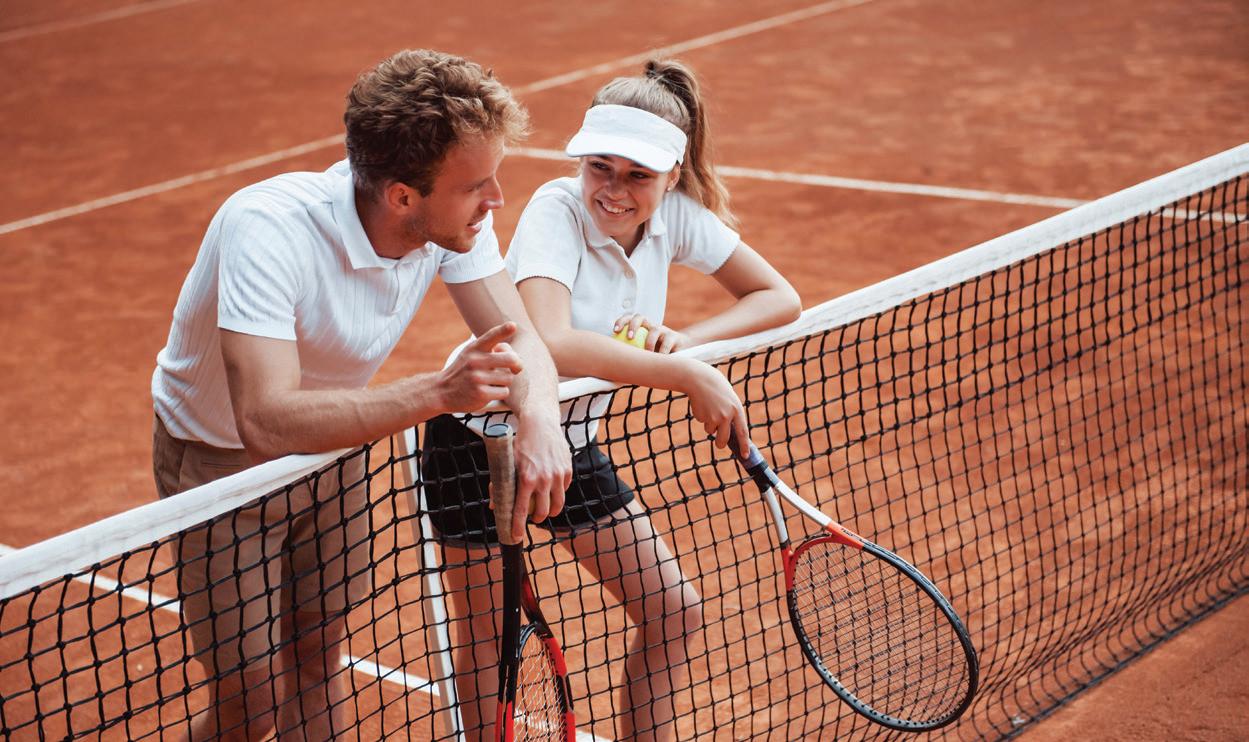
• Understand parent types. Most parents just want their kids to learn and enjoy tennis, but some can be obsessive, overly competitive, know-italls or have unrealistic expectations. Recognize these personalities and stay professional, patient and empathetic.
• Set clear guidelines. Hold a parent meeting before each season to explain your teaching philosophy, program structure, player responsibilities and parent behavior standards. Provide written guidelines to avoid confusion and establish boundaries.
• Communicate consistently and professionally. Give regular updates on player progress, welcome feedback respectfully and set clear rules for when and how parents can contact you. Stand firm in your philosophy— short-term pushback may cost you some students, but long-term it builds your reputation and credibility.
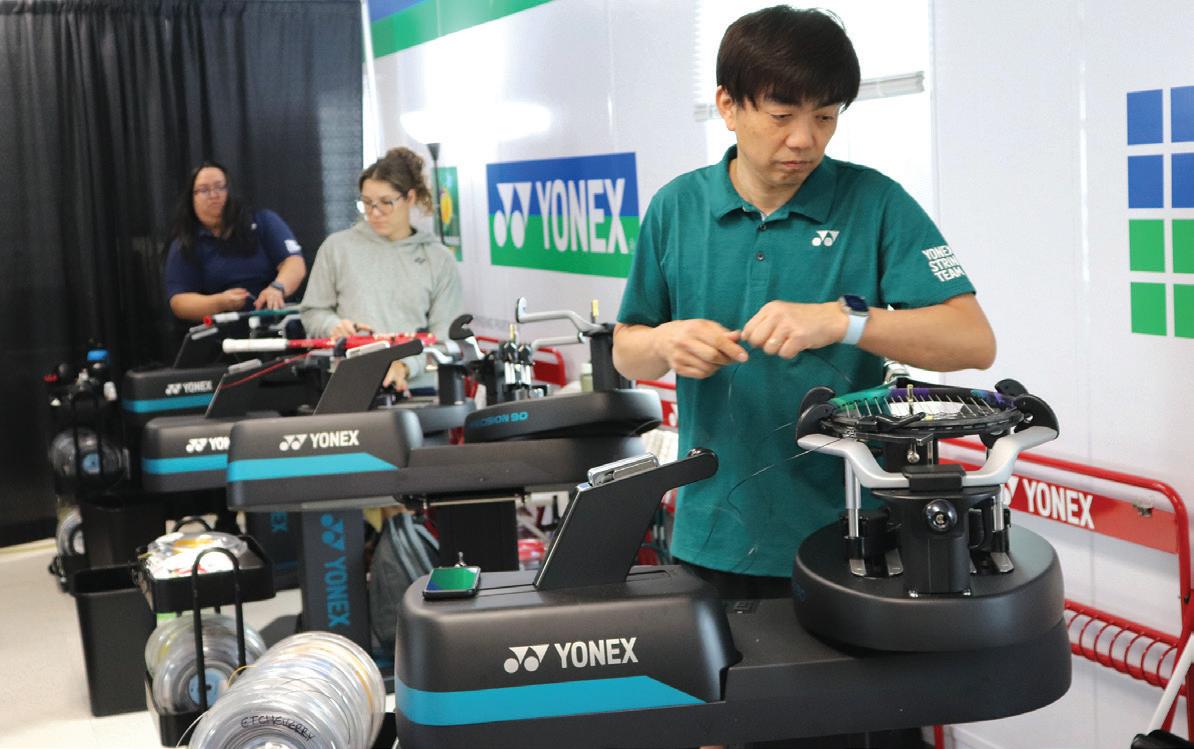
Yonex put nearly 4,000 racquets through their paces as the Official Stringer for the 2026 BNP Paribas Open.
Yonex has a track record of providing stringing services at major international tournaments, including the Australian Open and the Shanghai Masters. This year, in a partnership agreement that runs through 2028, the company served as the Official Stringing Partner for the BNP Paribas Open, held annually in March in Indian Wells, Calif.
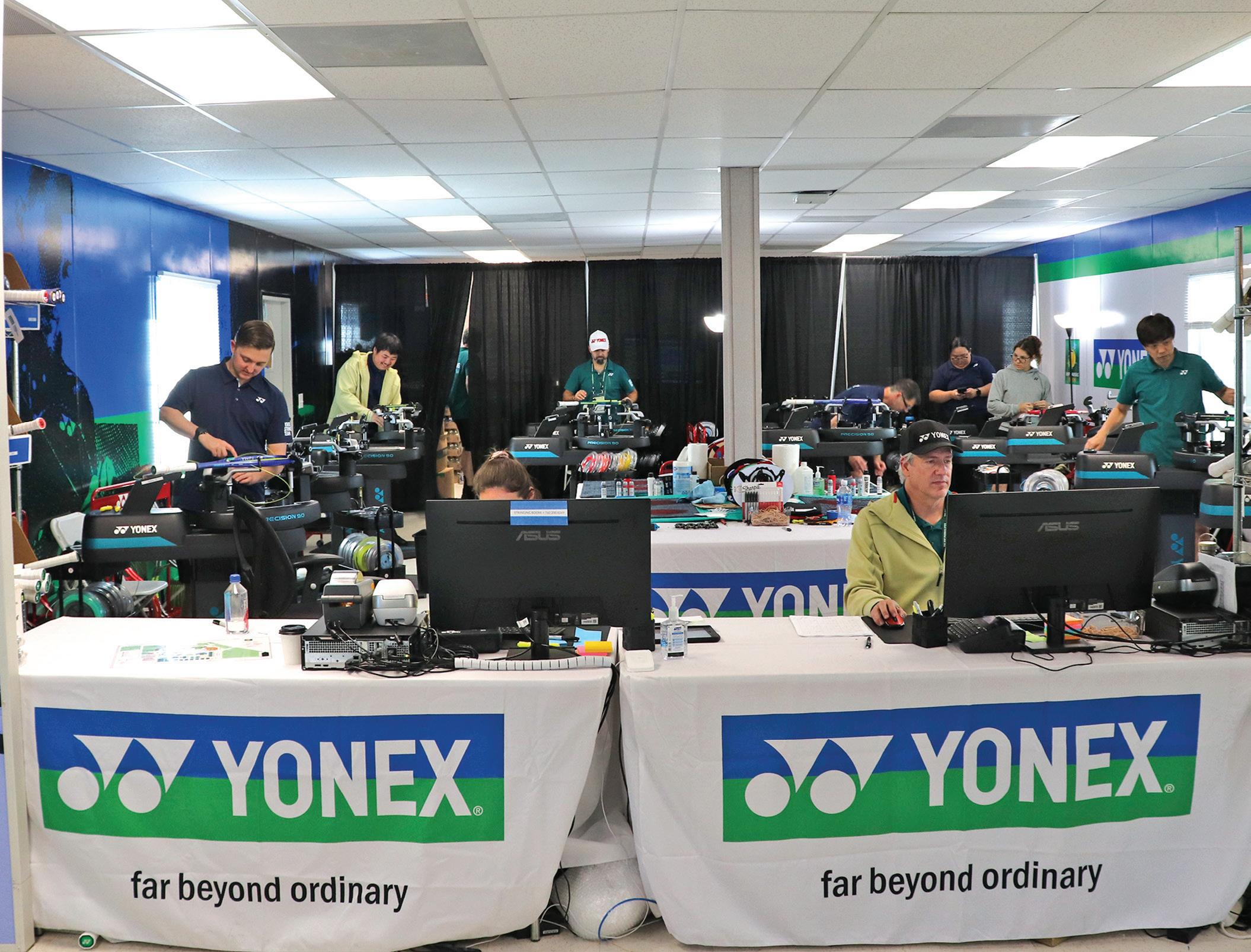
At the 2026 BNP Paribas Open, Yonex provided stringing services to players, practice partners and coaches. The tournament stringing room serviced nearly 4,000 racquets at the tournament site from late February through March 15, averaging 206 strung racquets each day, which included practices and qualifying matches, in addition to maindraw matches.
“We are excited to welcome Yonex as the Official Stringing Partner of the BNP Paribas Open,” said Philippe Dore, Chief Marketing Officer at the BNP Paribas Open. “Their expertise and commitment to supporting professional players align perfectly with the level of excellence our tournament represents.”
“Being named the Official Stringing Service for the BNP Paribas Open has given us the opportunity to support each athlete’s journey in a deeply hands-on way,” added Yonex USA President LaNiece Douglas. “Bringing precision, care and intention to every racquet we touch—it’s in these details that performance is elevated and a true connection to the sport is felt.
“We’re proud of what this first year has meant, and we look forward to continuing to build something meaningful together through 2028.”
Here are stats from the Yonex tournament stringer’s logs of Yonex strings and racquets serviced, in addition to the overall count.
Yonex—Official Stringing Partner of the BNP Paribas Open Stringing Services Provided: Feb. 25-March 15, 2026
Total Racquets Strung
3,919
Average Daily Racquets Strung 206 Day Most Racquets Strung 403 Tue. Mar 3 - Women’s Qualifying, Men’s Qualifying
POLYTOUR PRO 125
POLYTOUR STRIKE 125
POLYTOUR SPIN 125
POLYTOUR FORCE 125
POLYTOUR REV (gauge unspecified)
POLYTOUR PRO 120
POLYTOUR FORCE 130
POLYTOUR FIRE (gauge unspecified)
POLYTOUR SPIN 115
POLYTOUR PRO 115
At this year’s BNP Paribas Open, Yonex provided stringing services to players, practice partners and coaches.
Racquets Strung
POLYTOUR PRO 125
POLYTOUR STRIKE 125
POLYTOUR SPIN 125
POLYTOUR FORCE 125
POLYTOUR REV (gauge unspecified)
POLYTOUR SPIN 125 / POLYTOUR PRO 125
POLYTOUR PRO 125 / POLYTOUR SPIN 125
POLYTOUR PRO 125 / Other
POLYTOUR SPIN 125 / POLYTOUR PRO 120
POLYTOUR PRO 120
IN MEMORIAM
Jim Loehr's groundbreaking approach to mental toughness—in sports, business and life—will continue to make the world better.
By Carlos Salum
[Editor’s Note: World-renowned performance psychologist Dr. Jim Loehr passed away April 20 at age 83. A pioneer in his field, Loehr influenced athletes, executives and leaders for more than three decades, while his coauthored best-selling book, “The Power of Full Engagement,” continues to help readers live a more engaged, resilient and fulfilling life.]
Dr. Jim Loehr was a trailblazer, a thinker, a leader, a successful entrepreneur and an altruist. He envisioned the future of sport psychology, carved a path with his intellect and his courage, and invited a fortunate few to walk alongside him. I was one of those people, and my life found both a philosophical core and a destiny.
In 1988, I persuaded Jim to let me build his international network through speaking tours. We shook hands with nothing but trust and a shared vision. No contract. No guarantees. Together, we traveled through Europe and Japan taking his model of Peak Performance and Mental Toughness to athletes, coaches and corporations hungry for a competitive edge.
The five years of our collaboration shaped my professional identity. Jim believed in me and sponsored my residency and later my citizenship, and mentored me while we walked through the labyrinth of building a business from nothing. He trusted my instincts. I trusted his vision. We shared a rare and sacred dynamic.

When we worked with Pete Sampras, Andre Agassi, Monica Seles, Jim Courier, Sergi Bruguera and so many others, we were not fixing their flaws. We helped them access their Grand Slam selves under the most challenging conditions. Gabriela Sabatini’s victory at the 1990 US Open was her breakthrough as a great champion—and proof that Jim’s approach to mental toughness worked at the highest level.
What Jim understood—and what set him apart from every other coach— is the postulate that performance is not merely a physical or technical event. It is an energy management challenge, multidimensional and deeply human. He gave athletes a language for what they already felt but could not articulate: the Ideal Performance State, Full Engagement, the connection between emotion, purpose, and execution. How to attain it and sustain it.
Jim’s impact on tennis worldwide is transformational and lasting. He produced a generation of coaches who understood that emotional and physiological control were trainable skills. Video analysis, heart monitors and mental training protocols became essential because Jim proved that intuition and guesswork were not sufficient to master the skills. He held the profession to a higher standard, and the profession rose to meet him.
Jim was also the most trustworthy person I've ever known. World-class athletes called him at 3 a.m. because they trusted him to be there with them at their darkest hour. He induced trust through years of listening deeply, asking the right questions, and approaching every person without preconception and with absolute respect. Billie Jean King told us in 1992 that the greatest capital we had was the trust of the players. She confirmed that it would be the cornerstone of our future success. His legacy extends beyond his 19 books and The Human Performance Institute, which he founded with Dr. Jack Groppel. His legacy is in every athlete who learned to say, “I love problems; I love the challenge” instead of surrendering, in every coach who understands how to train mental toughness, in every person who chose to live in Full Engagement rather than settle for less.
Jim, you made the world better and transformed sport forever, from its essence: by helping humans become better humans. Those of us who carry your legacy forward are your ambassadors—and we will not stop. That was always the mission. You made sure of it.
Carlos Salum is an international Leadership Performance Strategist helping executives, entrepreneurs and elite performers master clarity, resilience and decision velocity. His work bridges sports, business and leadership to turn pressure into breakthrough and achievement into resonant impact. https://www.saluminternational.com
We welcome opinions and comments. Email peter@acepublishinggroup.com.


After being around this industry for many years, you know greatness when you see it. You see it in how professionals carry themselves, their eye contact, their energy and the dignity with which they treat everyone around them.
But do we truly know what “great” looks like when we strip away the charisma? Our members serve as directors of racquet sports, head professionals and assistants. Regardless of the title, each possesses varying degrees of greatness. The question is: how do we measure it?
In recent conversations with general managers from both private clubs and public facilities, we explored this very question. Historically, greatness was often defined by technical mastery. Legends like Vic Braden, Dennis Van der Meer, Dr. Jack Groppel, Dr. Jim Loehr and Dr. Dave Porter were technically elite both on and off the court.
Others, like the industry legend Peter Burwash, redefined greatness through hospitality—an effortless, genuine care for the guest experience. While these icons set the bar, greatness today requires a blend of both technical expertise and authentic human connection. We can all spot a phony from a mile away; authenticity remains the industry’s most valuable currency.
Today, we must ask ourselves: are we still striving for greatness or have we settled for okay?
Greatness requires a commitment
that transcends the baseline. It means valuing certification—the cornerstone of the Racquet Sports Professionals Association (RSPA) for nearly a century—and maintaining an insatiable thirst for learning. While there are now lower-priced alternatives and faster “express” certifications, those options rarely foster greatness. They offer a shortcut; we offer a standard.
I recently spoke with a top-tier general manager who was unaware of how RSPA certification directly impacts the member experience. When I explained the rigor of our process and stringent continuing education requirements, his perspective shifted instantly. When I mentioned that every member has a “professional report card” documenting their career investment, his response was immediate: “Tell me more.”
At our annual World Racquets Conference, we celebrate the members
Brian Dillman, RSPA CEO

who treat education as a competitive sport. Last year, our top ten achievers earned a collective 3383.75 hours of continuing education—more than a 330-hour average in an industry where the minimum requirement over a twenty-year career is only 100 hours.
That is the margin of greatness. That is the data point that separates a professional from a hobbyist.
A general manager isn’t just looking for someone to run a drill; they are looking for a professional who is committed to their craft.
Greatness isn’t a destination we reached in 1927; it is a daily choice to exceed the minimum. It is the difference between having a job and having a calling. As we look toward the future of the RSPA, we must continue to ask ourselves: are we content with being “certified” or are we committed to being great?
The industry knows the difference. Your members know the difference. And most importantly, you know the difference.
Brian Dillman RSPA CEO




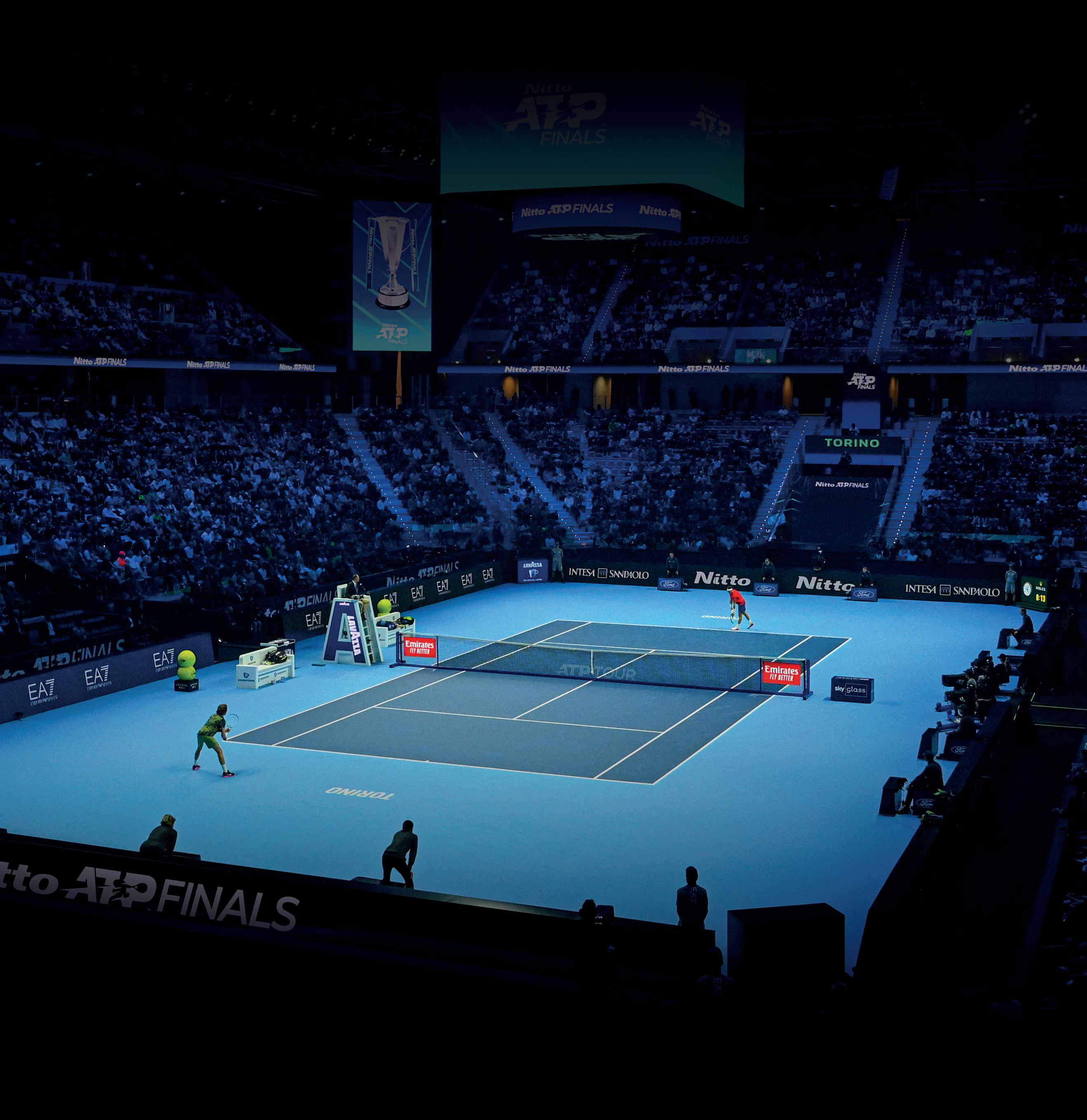
OFFICIAL BALL OF RSPA TENNIS COACHING




RECYCLABLE PAPER LID MADE FROM 30% RECYCLED PLASTIC
PAPER LABEL

Mel Mcree, RSPA Vice President

n the earliest human societies, survival depended on shared learning. One person discovered how to control fire. Another figured out how to shape stone into tools. Over time, those lessons spread—not through books or screens—but through observation, conversation and repetition within a community.
That’s how progress happened.
From the earliest tools to more advanced civilizations, progress didn’t happen in isolation—it was shared, demonstrated and refined together.
Fast forward to today: while the tools have evolved, the way we learn best remains the same.
This isn’t just a theory; it’s backed by how people actually learn and grow.
Researchers have identified something called tacit knowledge—the kind of knowledge that’s hard to write down or teach in a video. It’s the feel, timing and decision-making that comes from experience.
In our world, that’s the difference between knowing how a drill is supposed to work and knowing how to adjust it when it’s not working. It’s how you handle a difficult member, manage energy in a clinic or make real-time decisions on court.
There’s also the idea of “weak ties,” introduced by Mark Granovetter—the connections you don’t interact with every day, like the pros you meet at conferences and events. These relationships are often the most valuable when it comes to new ideas and solving unfamiliar problems.
And when you build those relationships over time, you’re creating social capital: the value that comes from having a network of people you trust and can rely on.
That’s what allows you to make a phone call when you need help with a
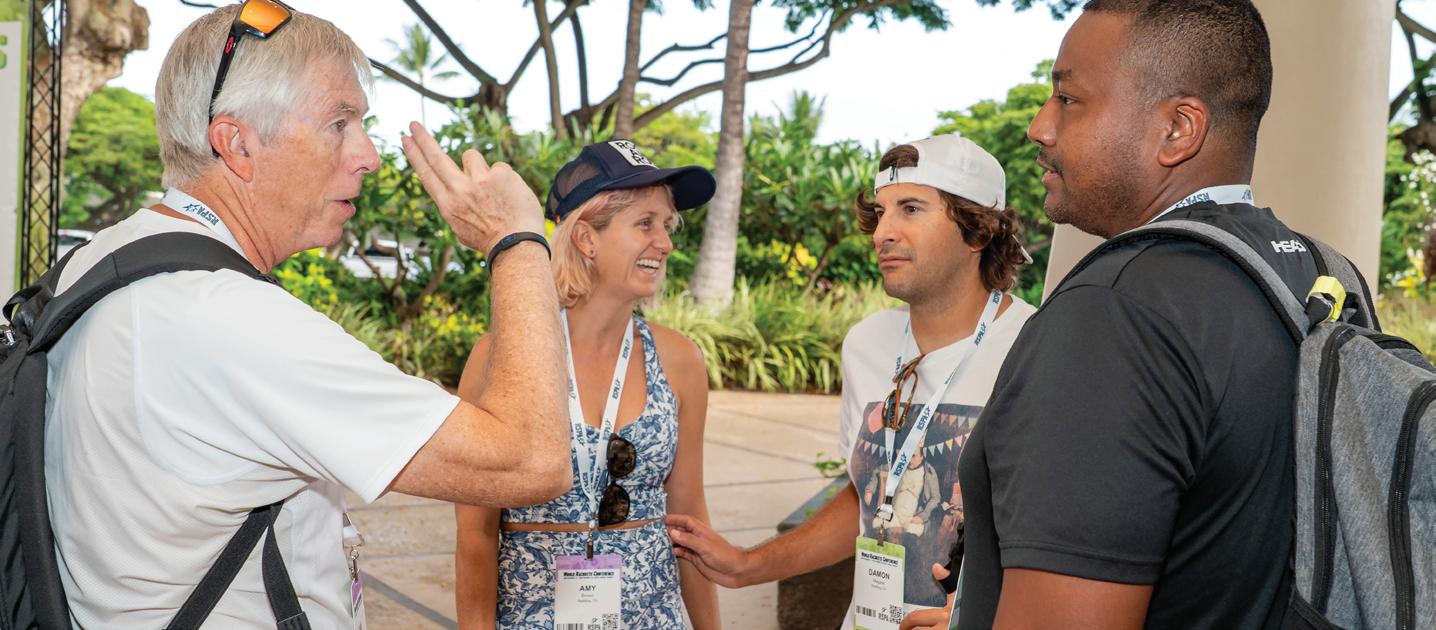
tricky problem, when a member is traveling and needs a warm-up court, or when you’re looking for your next opportunity or your next hire.
When you step back, you start to see how these all work together.
Tacit knowledge is how we refine what we do. Weak ties are how new ideas are introduced. Social capital is what allows those ideas to spread and be applied.
Without those three things working together, it would have been nearly impossible for early innovations—like fire, tools and technology—to spread from one group to another. And the same is true today.
In person, you gain access, trust and perspective. That’s the kind of learning that can only happen in the room, not through the screen.
In our profession, that place still exists. It’s the modern-day campfire—the RSPA Division and World Racquet Conferences.
When I first joined the RSPA over 20 years ago, I went to conferences looking for information: better drills, better technique, better ways to teach the game. And I got that, but what I didn’t expect was everything else.
Some of the most valuable lessons didn’t come from a scheduled session. They came from conversations after the day was over, listening to professionals who had been doing it longer and better than I had. I still use information from those conversations today.
Over time, I realized I was developing that tacit knowledge, building weak ties with professionals outside my day-to-
day circle and creating social capital that would become incredibly valuable throughout my career.
Working in West Texas, I don’t have a large network of professionals around me. It’s easy to operate in your own system without ever being exposed to something different. Showing up to conferences changed that.
As I became more involved—attending regularly, volunteering on committees, serving on boards and speaking at conferences—those relationships grew into something much more valuable.
Now, I don’t just have answers. I have people: people I trust, people I can call and people who bring new ideas and different perspectives.
That network has helped me solve problems faster, improve my programming, create better experiences for my members and open doors I wouldn’t have had otherwise—including leadership opportunities at the national level.
None of that came from a video.
It came from showing up and sitting around the campfire.
Conferences cost money, and you may lose a weekend of lessons, but you’re not losing; you’re investing in

From my experience, the return on that investment is far greater than anything you give up being there.
You’re gaining real knowledge from experienced professionals, but you’re also gaining what I believe is our greatest asset: the network of the RSPA. That network is built at our conferences, big and small.
LED COURT LIGHTING yourself.
Be part of the campfire. Learn from the best, become the best and pass those lessons on to the next generation.
PADDLES PICKLEBALLS
PORTABLE NETS
NET POSTS
BALL CARTS BACKPACKS
P PADDLE GRIPS
BALL PICK-UPS
COURT LINES
BALL MACHINES
WINDSCREENS
COURT PAINT
COURT BENCHES






Scott Hinkle | RSPA Member
How often do you use green balls with your novice players? We have found that having this in your beginner/novice tennis or platform tennis program at the beginning of a session is very beneficial for multiple reasons. We will cover the benefits of why this is important for your racquets program.

Jeremy Carl| RSPA Member

Before we delve into the benefits of this approach, we would like to point out what studies have shown about the types of sports adults participate in and what they enjoy about the sports learning experience (not just tennis). Also, we will briefly review U.S. tennis participation.
In a survey by Statista Consumer Insights from April 2022-March 2023 of 21,803 U.S. adults (ages 18-64) it found that when asked what sport you occasionally play, tennis or other racquet sports did not make the first eight sports/activities for either men or women. Some of the activities that made the first eight responses for both men and women included hunting, fishing, fitness, aerobic, cardio, and cycling (Zandt, 2023). The top activity for women was fitness, aerobic and cardio and the top activity for men was basketball.
In a study of various peer-reviewed literature that in total included 48,695 predominantly active sport participants by Crossman, it was found that some key facilitators of adult sport involvement included “focus on enjoyment and considering co-designed sport modifications to alleviate perceived constraints.” The published studies reviewed for Crossman, were from 1983-2023 and included individual sports (including tennis) and team sports. Specifically, a study by
Buszard, published in the article “Implementation of a Modified Sport Programme to Increase Participation: Key Stakeholder Perspectives,” found that a modified tennis program for adults—using slower-bouncing balls and emphasizing player skill development—had a positive impact on participation and retention.
From the national coach stakeholders surveyed in Buszard, it found that they viewed modified tennis program practices as “positively associated with increasing talent development and people’s attitude toward tennis.”
While these statistics show a challenge for our industry, it is encouraging to know that according to the 2025 U.S. Tennis Participation Report (based on 2024 data) U.S. tennis participation grew in 2024 by 8%. At the same time, in this same report the only key group that saw a decline was beginning tennis players in 2024, which was down 5% from 2023. We wonder if part of the answer to turning this decline into an increase could be to incorporate green dot balls in your racquet sports beginner classes.
We will now discuss the benefits we see from including green balls in your beginner/ novice adult tennis and platform tennis programs.
in the class due to the greater chance of rally practice, which in turn increases confidence and reduces the fear/constraint of not feeling competent enough to rally points. In the study by Crossman, “social connection” was the leading facilitator to adults’ sport participation under interpersonal factors. We have found this especially apparent when players are doing volley to volley live ball work for tennis. The use of green dot balls gives players a better chance to understand the concept of absorbing, catching or bumping up and hitting the ball back.

This helps parents and juniors of the green ball age to feel like they can go out and have rallies with each other and not just have the parent feeding a ball to their child. In the study by Crossman, “inclusion of family in activities” was a leading family facilitator to adults’ sport participation.

As we know, green balls bounce slower and lower. We have found that the ability for beginner adult players to hit the ball in the strike zone sooner increases the social connectedness of all those
Through our shared coaching experiences (combined more than 48 years) and continuing education through the RSPA and our college and university degrees we have learned that being an athlete-centered coach requires an intentional desire to create an environment in the lesson that cultivates empowerment, positivity, and collaboration for and with the players. We have found that this approach fosters much

greater chance to ask questions to students such as “Thoughts on that?” or “How do you process that?” These questions in turn help students feel comfortable giving a well-thought-out answer because the students have more time to process what is happening between shots with green dot balls versus yellow balls.
We have found that students when for example are put in their first rally skills activity of say a certain number of hits in a row inside the orange ball court view their misses as more of part of the process and not as setbacks that will be seen as their skill level plateauing. Dr. Carol Dweck, author of the book Mindset, describes growth mindset as people having the belief that their learning and
persistence can grow their skill set with time and experience. For example, we have started to find that adults that have done our beginner classes for several weeks love the “triples” game with the green ball for the following reasons (1) gives more time to react for player in the “hot seat” at the T, (2) facilities tennis problem solving, (3) creates the start of doubles teamwork and (4) focuses on fun as key aspect of the sports experience, which are all qualities of growth mindset.
We’ve also had great success with using green balls in our beginner platform tennis clinics. It can be very intimidating using paddle balls in the first phase of learning the game. Once a beginner gets hit with the ball, they
tend not to come back on the court. By changing to green balls, those same players continue coming back. On the tennis side, many of our adult beginners that have started out with green balls are finding it much easier to transition into yellow balls. Scott has a group that started with green balls and are now playing with yellow balls after six hours of lessons. These players are now playing yellow balls with friends and are looking to join one of our ladies’ teams.
In conclusion, from our experiences and continuing education we are confident this is a worthwhile approach to try with your beginner players and see if it fits the culture and vision of your program. Now that we’ve had great success with green balls in our smaller beginner groups, we are incorporating this philosophy more into our Adult Tennis Programs.
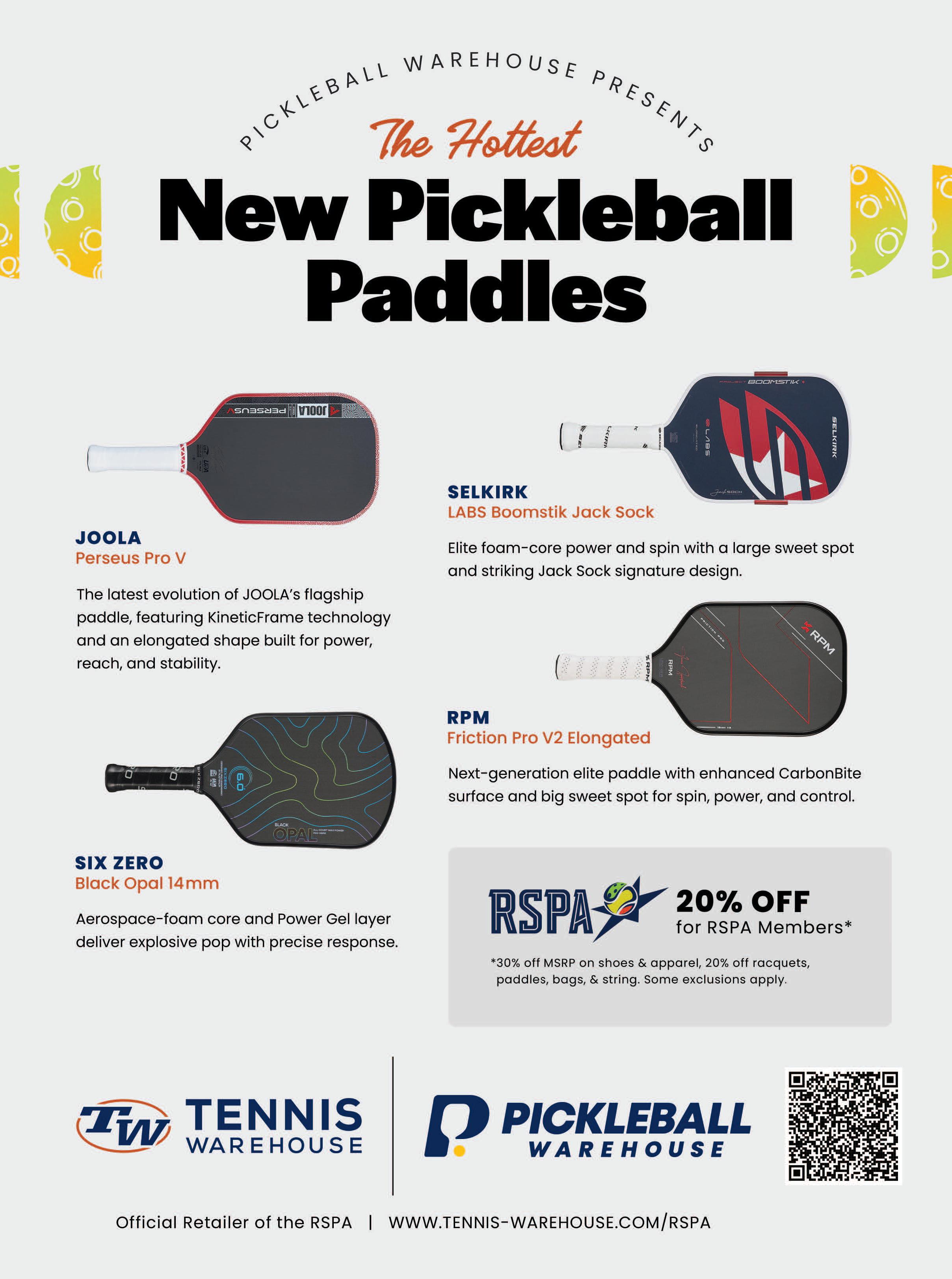
Sportsfield Specialties, Inc. provides confidence and leadership in the manufacturing and sale of sports construction equipment for all levels. Let our sales team and industry partners assist you with the design, engineering, and installation of your next project. Our experience and expertise makes us the leader in sports construction equipment.


Introducing Sportsfield Specialties new line of PaDelhi™ Outdoor Panoramic & Indoor Full Panoramic Padel Court Systems proudly manufactured in the USA. Our Padel Court Systems feature an engineered design and user-friendly installation comprised of durable raw materials and high-quality manufacturing processes. Sportsfield’s PaDelhi™ Padel Court Systems incorporate everything needed for installation, including the structural posts with welded base plates, wire mesh frames, tempered glass panels, light posts/fixtures, posts/net, synthetic turf surfacing, and sand infill material.
Coming Soon: PaDelhi™ Outdoor & Indoor Base Plate Padel Court Systems
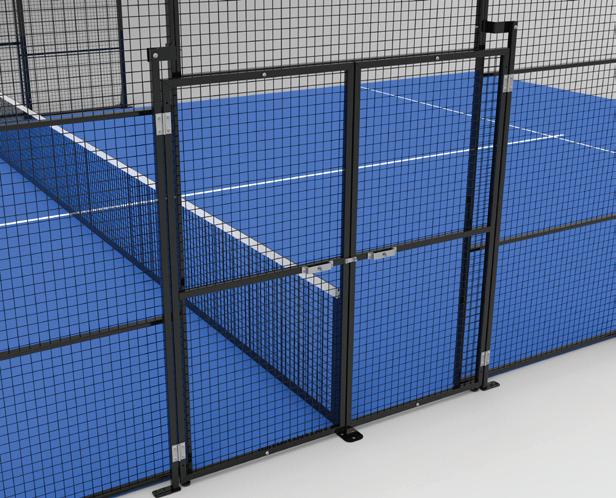
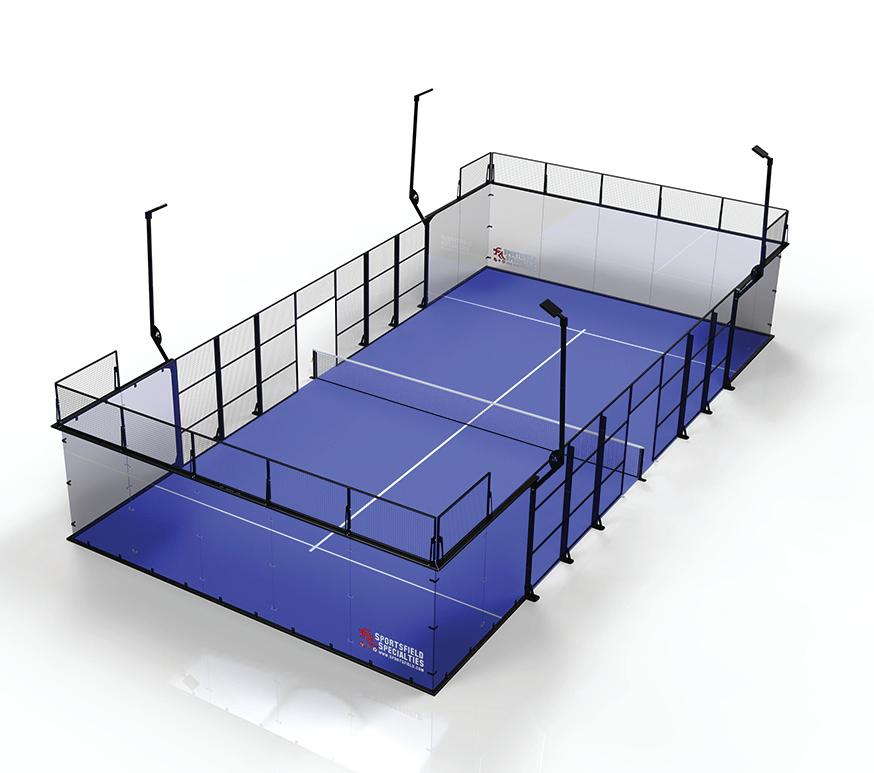

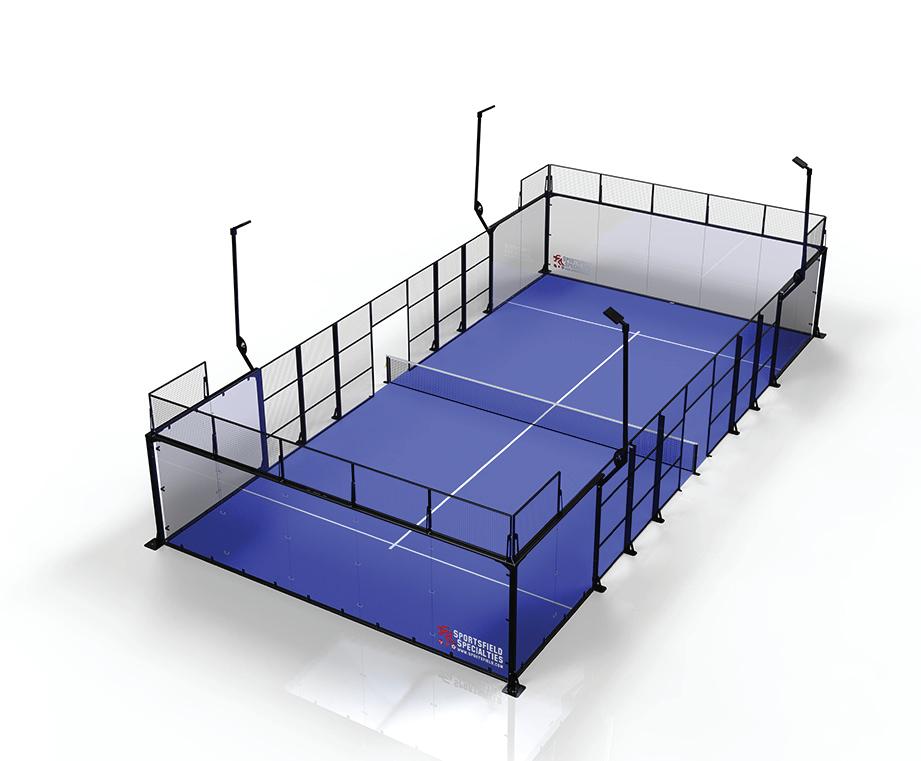

Daryl Fisher | RSPA Member
In February 2024, headlines proclaimed that, for the first time in tennis history, no players using a one-handed backhand (1HBH) appeared in the world’s top ten. The moment was quickly framed as proof that the 1HBH was “dead,” followed by a wave of speculative explanations for its supposed demise. Such conclusions, however, warrant closer examination. Is the 1HBH truly obsolete, or are we mistaking a short-term trend for a permanent verdict?
As professionals in the sport, we have an obligation to approach this question with care and rigor. Our beliefs influence coaching practices, player development pathways and ultimately the future of the game itself. We should therefore resist simplistic narratives, unsupported claims and logical shortcuts. As stewards of tennis, our conclusions must be grounded in evidence, historical perspective and sound reasoning.
Our collective influence on the prevalence of the 1HBH has been—and remains—substantial. As we guide the sport’s evolution, it is essential that we approach both the one- and two-handed backhands with nuance and intellectual honesty. Only then can the future of tennis be shaped by informed judgment rather than headlines or assumptions.
Over the past several decades, the percentage of junior and collegiate players using a 1HBH has been extremely low—nearly zero among female players and well under one percent among males. Given those numbers, it should come as no surprise that few 1HBH players appear at the very top of the professional rankings. Quite simply, there have not been many in the developmental pipeline.
That reality, however, does not imply that the two-handed backhand is inherently superior. At the same moment, there were no 1HBH players in the men’s top ten; there were also no left-handed players in the top ten. Few would argue, based on that fact alone, that right-handed players are superior to left-handed players. Representation, by itself, is not a measure of effectiveness.
If half of junior players were trained with 1HBH and none reached the top 100, we would have legitimate grounds to question the stroke’s viability. Instead, the data suggests the opposite: players who use a 1HBH reach the professional level at rates far exceeding their junior participation.
For context, approximately 10–12 percent of the general population is naturally left-handed and left-handed players are represented in the professional rankings at roughly the same rate. As of May 2024, there were 13 left-handed men in the ATP Top 100 and 11 left-handed women in the WTA Top 100.
If 1HBH players were represented proportionally to the small number of juniors trained with the stroke, we would
To understand the dominance of the 2HBH in junior development, it is important to consider the practical realities coaches face. The 2HBH is generally easier to teach, particularly to young children and beginners. Most elite players begin at a very young age and many who might ultimately thrive with a 1HBH are simply not strong enough to execute it effectively early on.
Novak Djokovic has described initially wanting to hit a 1HBH but realizing that he was too small and weak at the time. This experience is common. For many players, the 2HBH is not a strategic preference but rather a developmental necessity.
Later in a player’s development, transitioning to a 1HBH requires a significant investment of time—often several months or more, even for elite players such as Federer, Sampras and Edberg. That transition period frequently coincides with increased pressure to produce results, secure sponsorships

For most players and families, the perceived risksment outweigh the potential long-term
Left-handed players will always emerge naturally, so fluctuations in their representation rarely provoke concern. The number of 1HBH players, by contrast, is largely driven by choice—and choice is shaped by information, belief and prevailing narratives.
When a skill becomes less common, it often attracts simplified or flawed explanations for its decline. Coaches should be especially wary of “common knowledge” arguments. Repetition does not confer accuracy.
Even elite players occasionally repeat assumptions that go unexamined. As teaching professionals, our responsibility is to evaluate claims critically rather than accept them unchallenged.
It is also worth remembering that the 2HBH faced similar skepticism for much of tennis history. When the 1HBH dominated the game, the twohander was widely believed to limit reach, spin, power and net play. Players who succeeded with it were treated as
exceptions. In the 1970s, Björn Borg was even asked whether he intended to switch to a 1HBH—a question that assumed the obvious superiority of the 1HBH. That notion now seems ironic, if not unthinkable.
If the 1HBH is ever truly “dead,” it will not be because it failed com-
petitively, but because we allowed it to disappear through neglect. There is no credible evidence that one backhand style is categorically superior to the other. Each possesses distinct strengths and limitations, and each deserves careful, individualized consideration. Our responsibility as teachers is not to produce uniformity, but to help players discover the technique that best supports their physical attributes, competitive goals and long-term development.
Yet the decline of the 1HBH has created a self-reinforcing cycle. As fewer players use the stroke, fewer coaches gain experience teaching it; as fewer coaches teach it, even fewer players are exposed to it. Left unaddressed, this cycle risks turning a developmental choice into an unintended mandate. To present the 1HBH fairly, teaching professionals must actively develop and maintain expertise in its instruction.
Although the 1HBH has returned to the ATP top ten, the structural forces that limit its adoption—early physical constraints, entrenched assumptions and performance pressure —remain firmly in place. Vigilance is therefore required. Coaches must be clear-eyed about the stroke’s comparative strengths, confident in how to
teach it, and willing to introduce it as a legitimate option when circumstances allow.
In fact, many players respond positively when given the opportunity to try the 1HBH. While some find it to be more natural, fluid, or free, others value its reach, versatility, or aesthetic appeal. For certain players, particularly those who benefit from additional range or who thrive on timing and extension, the stroke can be transformative.
Going forward, preserving the one-handed backhand is not an act of nostalgia; it is an act of professional integrity. By expanding our own knowledge and presenting players with genuine choices, we serve their individual development—and protect the technical diversity that has always been one of tennis’s greatest strengths.
Present it as an option. Introduce the one-handed backhand as an alternative for players, especially those who show a preference for extended reach.
• Use age-appropriate trials. Allow physically mature juniors and adult players to experiment with the stroke during controlled drilling before making any long-term decisions.
• Evaluate fit, not fashion. Assess what is good for an individual rather than current trends on the professional tour.
• Expect a learning window. If a player explores the 1HBH seriously, plan for a short-term adjustment period and manage competitive expectations accordingly.
• Maintain teaching competence. Even if few players ultimately adopt the 1HBH, retain the ability to teach its fundamental mechanics so players receive informed guidance.
• Revisit the option over time. A player’s physical development, confidence, and tactical needs can change—keep the door open.
Certification Calendars on RSPA.net for the most up-to-date information

Over the past decade, padel has emerged as one of the fastest-growing racquet sports worldwide.
After experiencing rapid expansion across Europe and South America, the sport has begun gaining significant traction in the United States as clubs, developers, and racquet sport facilities introduce padel courts to new audiences. For operators in the racquet sports world, padel is a logical next step one that complements traditional sports while attracting a broader range of players.
In the rapidly evolving world of athletic amenities, Mindspring Padel stands out as a premier strategic partner dedicated to transforming underutilized spaces into vibrant, revenue-generating hubs. Launched in 2024 by a leadership team with decades of experience across global sports, finance, and facility operations, Mindspring was born from a vision to bridge the gap between traditional capital and the unique needs of modern sports clubs.

Let’s be honest: traditional financing for sports facilities can be a bit of a nightmare. Banks often want your firstborn as collateral, and leasing companies love to send bills even when your courts are empty. Mindspring Padel breaks that mold. They aren’t just a lender; they are an aligned capital partner who shares in both the upside and the operating risk.
Key features of the Mindspring partnership include:
• Total Capital Support: Mindspring covers up to 100% of equipment, installation, and essential club-related upgrades upfront.
• Performance-Aligned Payments: There are no fixed monthly payments or minimum guarantees; you only
share revenue once the courts are actually generating it.
• Zero Equity Requirements: You keep your ownership and independence— no surrendering equity to investors.
• Full Ancillary Benefits: You retain 100% of all secondary revenue, from pro shop sales to the extra postmatch drinks at the café.
While it’s true that padel is the fastest-growing sport in the world, Mindspring’s capabilities extend across the entire racquet and multi-sport spectrum. They understand that a “padel” company needs to speak the language of all club owners. They serve as a comprehensive partner for:
• National Federations: They are the exclusive financing partner for Tennis Australia, Swiss Tennis, and the German Tennis Federation (DTB).
• Multi-Sport Venues: Helping tennis, golf, and pickleball clubs integrate new amenities like simulators or additional courts.
• Industry Leaders: Mindspring is a proud court financing sponsor for the Racquet Sports Players Association (RSPA) and the International Association of Pickleball and Padel Facilities (IAPPF).
Mindspring provides a “thought partnership” that goes far beyond just pouring concrete and stretching nets. Every project benefits from a rigorous diligence process where the team analyzes projected booking rates and cash-flow impact before any capital is de ployed. Partners also gain access to:
Article Provided By MindSpring Padel
• Professional-Grade Infrastructure: Exclusive relationships with certified manufacturers ensure you get the same high-quality courts used by professional clubs.
• Operational Wisdom: With experience from dozens of facility launches, the team helps you navigate member flow, retail opportunities, and common pitfalls.
• Global Momentum: With a goal of supporting over 1,000 courts worldwide by 2027, Mindspring brings the benchmarks of a mature global platform to your local club. Mindspring Padel believes that that underutilized space in your facility shouldn’t be “mocking you” every time you walk past it. By aligning capital with community demand, they empower you to expand your programming and build long-term value without the stress of unnecessary risk.
Ready to Stop Debating and Start Building?
Discover how Mindspring Padel can help you maximize your space and diversify your revenue.
Visit: mindspringpadel.com Contact: Jennifer Hebrock | jh@mindspringpadel. com | +1 (561) 446-1461


Linda Gordon | RSPA Director of Membership
The racquet sports industry generates billions in revenue annually across a variety of avenues: tournaments, equipment, facility operations and lessons. There is an increasing demand for highly qualified professionals who not only have a passion and knowledge of racquet sports and the ability to share their experience and expertise with those interested in learning how to get better at the sport, but also the ability to run programming and facilities at top-class levels. Employment is expected to grow over 6% in 2026, and there are currently more than 20,000 open roles across LinkedIn and Indeed for racquet sports professionals.
As a racquet sports professional certified with the RSPA, the RSPA job board provides an exclusive platform where you are able to find new openings across a variety of positions at different levels, spanning the entire country. Whether you are newly certified, trying to find your first assistant coach or pickleball professional position, or you have 20+ years of experience as a director of racquets moving to a new area looking to maintain the same level of employment, you won’t have a problem finding a future employer that checks all of your boxes. You can submit your application to the hiring committee through our job board, ensuring that they are aware of your qualifications, including the necessary education, certification and continuing education requirements that make you a
worthy employee.
As a general manager, director of racquets or hiring manager at a facility, having a platform where you can post a position and know that only qualified professionals have the ability to apply can provide ease in the hiring process. Sifting through hundreds of resumes only to find a few quality applicants can be frustrating. The RSPA Job Board provides a place where you can list unlimited positions, guaranteeing tens of thousands of impressions every month. There are three different packages that you can choose from: Standard, Enhanced and Premium. The standard package is included with an RSPA membership, and is $149 for non-members. The enhanced package provides 2x as many applicants, with listed positions being included in our job alert emails, posted on the top of the job search page and featured on the RSPA website. This package is $149 for members and $249 for non-members. The premium package results in 4x as many applicants as the standard package, with a 60-day job post length as opposed to a 30-day with other packages. It also designates your company as a featured employer, standing out on the career center homepage along with resume search capability that uses AI-powered matching to proactively match with candidates on our platform.
For those looking to post job openings on our platform, our incredible RSPA Job Board partner, Jack Fardo, is able to assist
You Coming Along?
every step of the way. Any questions that you have on the platform, including what package is recommended for your use, he can provide with his vast experience in this field. To schedule a call with Jack, simply scan the QR code below!
There has never been a better time to be in the racquet sports industry. Whether you have or are looking to turn your passion into your profession and become a racquet sports professional, or if you see the value in building a new racquet facility or expanding your current one with a new set of courts, you want to find quality in either your employer or employee. The RSPA Job Board provides a user-friendly, seamless site to achieve your professional goals. If you want to start with an RSPA certification and get the resources that can help your career blossom, visit www.rspa.net to see the many certification options that we offer and start your career journey today. If you are already certified and are looking to find your next role, or the next director of racquet sports for your club, visit jobs. rspa.net . As always, the RSPA membership team is just a phone call or email away, and we would love to help in any way that we can! Email: Membership@rspa.net or call: 407-634-3050, option 2.
Set up a call with Jack! -->