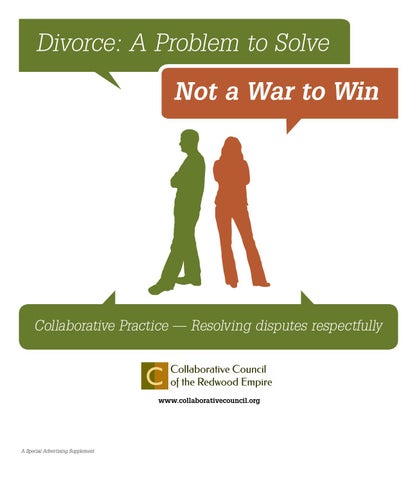
Divorce: A Problem to Solve Not a War to Win
Collaborative Practice — Resolving disputes respectfully
www.collaborativecouncil.org
A Special Advertising Supplement
Getting a Divorce Why it’s hard
by Mike Blount
Common Questions about Collaborative Divorce How much does Collaborative Divorce cost? It’s hard to predict how much any divorce will cost. Dealing with complicated legal issues can increase the cost, but a common reason that a divorce gets very expensive is because strong emotions lead to conflict and a lack of trust. When you have a Collaborative Divorce, you can trust that no one will be a party to secrets or game-playing and that saves you money. Collaborative Divorce helps people manage the emotions that come up in a divorce and communicate effectively, which reduces conflict and saves money.
Does Collaborative Divorce get finished faster than going to court? Stock Image
G
etting a divorce is hard. It’s mentally and physically taxing. You can’t sleep. You can’t eat. You are consumed with thoughts of how life is going to be moving forward, yet you are stuck in the present, needing to sort through it all — thinking about what happens to the kids, the house, the cars, the pets. You feel overwhelmed, and it’s hard. Or, maybe you are just so done. At a time when you may not want to deal with your spouse and talk about the future, you know that is exactly what has to happen. But often, there are still a lot of negative feelings involved. In some cases, one of the people in the relationship was blindsided by the decision. Maybe you have been fighting for a long time. Maybe you have talked for hours and gotten nowhere, and you feel that you will never agree on anything ever again. This is also the time people in a relationship are the most vulnerable, and being considerate of your spouse’s feelings and needs is not on your radar.
Moving on from any broken relationship can be difficult, but sometimes it is even harder to do that when the divorce process itself aggravates the pain.
2
You need to give yourself time to get your bearings, and the more contentious the process of divorce is, the harder it will be to get business taken care of and move on. Moving on from any broken relationship can be difficult, but sometimes it is even harder to do that when the divorce process itself aggravates the pain. You’re constantly being forced to feel the hurt, the fear and the frustration. You know how to push each other’s buttons and you get nowhere. You need help. If you have children, you need to remind yourself that the children are what’s important. Your dignity is important. Your emotional well-being is important. And, you can’t move forward if you are stuck fighting a war with your spouse. And you can’t just walk away. You’re going to have to learn a new way to communicate and interact if you are going to work out things like the care of your children, how to pay bills and how to divide your things. You’re facing so many life-changing decisions and you need help. You can move forward in a positive, collaborative way with a mutual goal of finding a resolution that meets everyone’s needs.
In Collaborative Divorce you control the pace of the process. By contrast, in a conventional divorce you have to fit in to the court’s schedule, which often involves continuances when the court schedule is overcrowded. In Collaborative Divorce, if you need time, you get the time you need. If you are motivated to get things done quickly, you can move through the process much more quickly than you would in court.
Why do we need Divorce Coaches? Ending a marriage involves a difficult mix of personal and businesslike issues. When children are involved, the emotional impact is often much stronger. When you’re in court, you are expected to take care of business — showing emotion in court can work against you. So, if you’re lucky, your lawyer might try to help you control your emotions, even though a lawyer is not really trained to do this and charges a high hourly rate. In Collaborative Divorce, you have a Coach who is properly trained to help you recognize and address the emotions that naturally arise so they don’t get in the way of moving forward to reach agreements. Plus the Coach’s hourly rate is typically much lower than that of your lawyer. When each person has a Coach, you have an effective team that helps you move through the process in a productive way.
Why do we need a Financial Specialist? Using one neutral Financial Specialist is the most effective way to collect and organize your financial information. The Financial Specialist has the training and experience to guide you through this part of your divorce with skills that are not normally part of a lawyer’s training, at a substantially lower hourly rate. The neutral Financial Specialist is particularly qualified to help you and your spouse develop a realistic plan for your separate financial futures.
Divorce: A Problem to Solve — Not a War to Win | Collaborative Council of the Redwood Empire | www.collaborativecouncil.org | A Special Advertising Supplement
Collaborative Practice How to divorce without going to court
T
he Collaborative Council of the Redwood Empire, an association of independent professionals, provides an alternative to a conventional divorce that allows you and your spouse to resolve your issues respectfully. Instead of each person trying to navigate the divorce alone, there is a team of skilled professionals ready to help manage the many complicated aspects of divorce. From legal issues, concerns about the children, property and financial questions, to the emotional well-being of both people — the team is there to help you and your spouse take control of your divorce process and give you each the opportunity to move through to a resolution. Divorce is a life-changing event. Members of the Collaborative Council of the Redwood Empire, a nonprofit organization, can help you, your spouse and your family find a compassionate ending and a healthy new beginning. By taking part in Collaborative Divorce, you and your spouse can move forward in the most positive way possible — laying the groundwork for and planning your new lives. As part of Collaborative Divorce, you both commit to treating each other with mutual respect. This is a fundamental aspect of this process and is based on three principles — a pledge to resolve issues without going to court, a complete and open exchange of information and a solution that takes into account the interests of both of you and your children. Collaborative Divorce ground rules help you move forward and assure you and your spouse focus on your mutual interests, make discussions
more productive and pave the way to reaching agreements. Open communication is also key to Collaborative Divorce. If communication breaks down, so does the ability to reach agreements. Even if the decision to divorce is mutual, communication can be strained at the end of a marriage. That’s why it’s important to find a way to keep the lines of communication open and work through your differences face-to-face. This is supported through meetings between you, your spouse and members of your Collaborative team. The difference between a conventional divorce and Collaborative Divorce is that both you and your spouse pledge to reach an agreement without going to court. In a traditional divorce, you may see your spouse as the enemy and the divorce as a battle you have to win, with a judge deciding the outcome. But in Collaborative Divorce, you and your spouse make the decisions yourselves, rather than giving that responsibility to a judge. You agree to work out your differences together, with the help and guidance of your Collaborative team. And to achieve this, all parties consent in writing to be part of a team that works together to avoid court and reach resolutions both of you can live with. Finding an agreement that works for everyone is crucial to Collaborative Divorce. Reaching the decision to divorce is only the beginning and the Collaborative Process is designed to help you and your spouse reach an agreement with both of your interests in mind. It is also designed to protect the well-being of your children. It is important to
by Mike Blount
resolve your issues based on mutual agreement in a workable environment. Instead of focusing on your grievances, the team will help you and your spouse find common ground again and help each of you move forward with your new lives.
Divorce is a life-changing event. Members of the Collaborative Council of the Redwood Empire can help you, your spouse and your family find a compassionate ending and a healthy new beginning.
Finally, Collaborative Divorce focuses on both of your futures. While a divorce marks the end of your marriage, it doesn’t mean that you have to sever all ties and your relationship. When children are involved, both parents must work together to make sure their children are taken care of and have what they need. Collaborative Divorce helps you and your spouse continue to communicate after the divorce by encouraging respectful and meaningful interactions throughout the divorce process.
Stock Image A Special Advertising Supplement | www.collaborativecouncil.org | Collaborative Council of the Redwood Empire | Divorce: A Problem to Solve — Not a War to Win
3
Finding the Right Help Man finds the Collaborative Process easier than traditional divorce
by Beatrice Hogg
A
fter 15 years of marriage and two children, John* and his wife, Donna*, had grown apart. Donna suggested that they look into getting a Collaborative Divorce. The 40-year-old considered mediation, but then discovered that Collaborative Divorce was a better process for them. Not only did he have an attorney, but also a Divorce Coach, a neutral Financial Specialist and a neutral Child Specialist. Having those professionals working side by side with him helped him gain perspective and learn empathy, and that made life after divorce better for the children. John was surprised by how helpful the Child Specialist was to his family. “I was extremely skeptical,” he remembers. “But it was enlightening. I learned the reality of what was going on with my children.” The Child Specialist met with his children, ensuring that their opinions and needs were considered.
ach party’s thoughts and opinions E were considered and valued.
Instead of an adversarial process, Collaborative Divorce helps both parties remain civil and maintain respect. Everyone on the team was a seasoned professional. The attorneys “didn’t go for the jugular.” John says Collaborative Divorce was better for him and his wife because they “didn’t want to trash each other in front of the children.” Initially, he says, Collaborative Divorce may seem to be more expensive, but it is less costly in the long run, both financially and emotionally. John’s issues were resolved quickly, helping them get back to living their lives. In John’s case, the process took about three months. For a while, the parties and their teams met weekly. Other times, they met at three-week intervals, depending on what was needed. Using Collaborative Divorce, clients receive guidance on
Stock Image how to control their emotions. “[The team] helps you to understand the reality,” he says. “My Divorce Coach was amazing.” John says he would recommend Collaborative Divorce to anyone. “Follow this process. Anyone who doesn’t is just hurting themselves.” He feels that it is the only process where both sides are encouraged to understand each other’s needs and interests. During the process, sometimes Donna would make a statement that his Coach agreed with, and his Coach would help him understand the reasoning behind her
Can my privacy be protected? In Collaborative Divorce, you have the power to arrange your meetings to suit your schedule, and these meetings are not in an open public courtroom. When conflict escalates in a divorce, a great deal of very personal information can end up in the court file. When emotions and conflict are managed effectively, your issues are addressed in a private setting. When clients are working collaboratively, they can work together to keep as much of their business private as possible.
4
statement. The reverse also happened. The team helped to “reopen those doors to let the information in.” Each party’s thoughts and opinions were considered and valued. John feels that even though it is hard to go through a divorce, the Collaborative Divorce team made it easier. He says, “[It’s] like noninvasive surgery. It’s not pleasant, but it is as pleasant as it can be.” *Indicates name has been changed to protect client’s privacy.
Can we use Collaborative Divorce if we have children? Collaborative Divorce is specially tailored to serve the needs of children. It is well established that conflict between parents poses the greatest risk of emotional harm to children in a divorce. Collaborative Divorce is designed to manage conflict, so children’s needs are met and agreements are reached. A Collaborative Child Specialist gives a voice to the child in the divorce process — something that rarely happens in the courtroom.
Divorce: A Problem to Solve — Not a War to Win | Collaborative Council of the Redwood Empire | www.collaborativecouncil.org | A Special Advertising Supplement
Working Together for a Better Future
Divorcing with the best possible outcome
W
hen Jane’s* marriage to Howard* ended, the stay-at-home mom had to figure out how she would support herself and her family. Jane once worked as a high-level executive, but now, in her 40s, she stayed home to care for their special needs child. Her ex-husband’s job was the family’s main source of income, and Jane was worried that she might not receive sufficient financial support in a traditional divorce. She considered mediation for their divorce, but her husband’s lawyer recommended they look into Collaborative Divorce.
“ Learn to let go of some things to reserve your energy for when you really need it. Sometimes things need to fall apart to get a better conclusion. I’m thankful for Collaborative [Divorce].” Jane Client
When her divorce started, Jane says she was worn out. The stress of caring for their daughter and the emotional wear and tear from her marriage were almost too much to bear. Since she had recently moved, she did not have a circle of friends or family nearby that she could rely on for assistance or empathy. When she met with her Divorce Coach, she says, “I was an emotional basket case.” Her Coach talked to her about the emotional part of the divorce process and understood the issues surrounding the care of a special needs child.
by Beatrice Hogg
The neutral Child Specialist was part of the team to represent the child’s interests. Consideration of the child’s current and future needs made a big difference in developing an outcome that was beneficial. The Child Specialist looked at issues from the child’s standpoint, which were then discussed with the group. At first, Jane wasn’t sure that Collaborative Divorce would work, due to the very strained relationship between her and Howard. But by working with the Divorce Coaches, Howard was able to see her in a different light and understand what she was going through. The process included regular meetings for more than six months. The neutral Financial Specialist reviewed Jane’s monthly expenses and determined that she needed more money to care for their daughter. Jane says this independent and neutral viewpoint had more impact on her husband than anything she could have said to him. Even when she and her husband were not meeting, Jane says, their Divorce Coaches were working on their behalf. In the end, the Coaches and Specialists made a difference in her life, providing services she would not have received in a traditional divorce. Jane recommends Collaborative Divorce — especially when there are children involved. She advises, “Listen to the Collaborative [team] even if [their advice] sounds crazy — they know what they’re talking about.” Jane still uses some of their advice today. “Learn to let go of some things to reserve your energy for when you really need it. Sometimes things need to fall apart to get a better conclusion,” she says. “I’m thankful for Collaborative [Divorce].” *I ndicates name has been changed to protect client’s privacy.
Is this process right for you? Here are some additional questions to ask yourself: · Are you open to solutions that will respect your and your spouse’s needs and interests? · Do you want to make decisions affecting your future and the future of your family from a calm place? · Do you want to act ethically for yourself, your spouse and for the sake of your children? · Do you want a mechanism for your children’s feelings to be considered? · When the divorce is completed, do you want to be able to look back and feel good about the outcome and how you handled yourself during the process? (Adapted from “Is Collaborative Divorce a Suitable Process For Me?” by Nancy J. Foster, JD, Northern California Mediation Center, San Rafael, CA.) If you have more questions about Collaborative Divorce, please visit www.collaborativecouncil.org, or contact any of the Collaborative professionals listed on the back page.
Stock Image A Special Advertising Supplement | www.collaborativecouncil.org | Collaborative Council of the Redwood Empire | Divorce: A Problem to Solve — Not a War to Win
5
Collaborating Through a Divorce Attorneys keep divorcing couples out of court
by Sukhi K. Brar
A
ttorney Margaret Anderson has represented clients in contentious divorce cases for nearly 40 years. Litigation often leaves at least one party unhappy and has given Margaret many sleepless nights. She knew there must be a better way to handle divorces. About 15 years ago she decided instead to adopt a process where couples could come together and solve things outside of the courtroom. Anderson joined with other like-minded professionals in forming the Collaborative Council of the Redwood Empire. The group, which was formed in 2004, focuses on helping divorcing families achieve the best possible solution for all parties involved. Collaborative Practice offers a different approach to divorce. “The biggest difference between being in a courtroom and Collaborative Divorce is that the parties retain control over the creation of a resolution tailored to their most important priorities,” Anderson says. Collaborative Divorce is a process in which a divorcing couple, along with trained professionals, work as a team to resolve disputes respectfully and without going to court. Both spouses have their own Divorce Coach, in addition to their own attorney.
“ The biggest difference between being in a courtroom and Collaborative Divorce is that the parties retain control over the creation of a resolution tailored to their most important priorities.” Margaret Anderson Attorney
“Divorce is stressful. Coaches help clients identify and articulate what matters to them, and learn communication skills necessary to a mutually acceptable resolution,” says attorney Amy Rodney, a founding member and past president of the Collaborative Council of the Redwood Empire. If the couple has children, a neutral Child Specialist works in the best interests of the entire family and assesses what needs the children may have. “A neutral Child Specialist gives a voice to the children so that they feel they are part of the process. Parents more easily listen to someone trained to consider children’s needs, which minimizes conflict,” says Rodney.
6
Stock Image
Collaborative Divorce also includes neutral Financial Specialists, who provide advice and assist couples with their finances while dividing up assets on their own terms. “Neutral Financial Specialists gather the financial information and educate one or both parties so both are capable of making informed decisions,” Rodney says. Putting all of these pieces in place can help move the process along faster than it would go in court. In the end, couples are able to achieve a more favorable resolution in a less hostile setting. “Couples can tailor the solution to their circumstances and what is important to both of them and their family. They make the decision rather than a third party,” explains attorney Catherine Conner, a founding member and first president of the Collaborative Council of the Redwood Empire and immediate past president of the International Academy of Collaborative Professionals. She notes that the communication skills the clients gain during Collaborative Divorce have a lasting effect. “Couples who learn how to work through conflict and reach mutually acceptable agreements will be better able to resolve conflict in the future. Children whose parents can co-parent well together have healthier lives,” says Conner. Shannon Springmeyer contributed to this report.
The Attorney’s Role Each of you has a Collaboratively trained attorney to advise you about your rights and responsibilities and assist you in negotiating your agreement. Collaborative attorneys focus their efforts on helping you develop creative solutions. “Collaborative attorneys are advisers, rather than adversaries,” says attorney Jennifer Jackson. “Although they represent only their own clients, they are committed to helping clients consider their partner’s goals while advocating for their own in a constructive, rather than combative, manner.” Jackson has been an attorney with the Collaborative Council of the Redwood Empire for five years, having practiced Collaborative Divorce since its inception in the early 1990s. “Having had 15 prior years of trial experience, I much prefer Collaborative, as it fosters respect, cooperation and integrity among colleagues, not the ‘we-they’ attitude that permeates a more traditional approach,” she says. “This enables the attorneys to prioritize the welfare of the family and allows the attorneys to work together with both clients to brainstorm creative ideas that honor both parties’ interests.”
Divorce: A Problem to Solve — Not a War to Win | Collaborative Council of the Redwood Empire | www.collaborativecouncil.org | A Special Advertising Supplement
The Importance of Communication Coaching clients through a divorce
by Bryce Brown
I
n more than a decade as a Divorce Coach with the Collaborative Council of the Redwood Empire, Randy Cheek, MFT, has helped countless couples make positive decisions during the restructuring of their families. Coaches like Cheek act as personal allies and helpers for individuals who are going through a divorce. “As a Coach, my role is to help clients prepare to have difficult conversations with their former partner as they are negotiating their divorce,” Cheek says. “Often clients have not had challenging conversations like this for many years.” The importance of a Divorce Coach in Collaborative Divorce cannot be overstated. The stressful nature of a divorce necessitates having a Coach, who is dedicated to providing support in whatever way the person needs, whether it’s emotional encouragement, assisting with stress management or teaching effective communication skills. “Divorce is one of the most significant stressors someone will experience. It is a time when many conflicting emotions surface,” Cheek says. “The divorcing parents and their children benefit from assistance from professionals who are trained to deal with the wide range of feelings that surface during a divorce.” In Collaborative Divorce, each spouse sees a separate Coach. The Coach works with the spouse to ensure that their feelings, concerns and needs can be expressed in a positive and constructive manner.
“ I want to understand who my clients are. This is a painful time for them and they need assistance while moving through their divorce.” Randy Cheek, Divorce Coach Past President, Collaborative Council of the Redwood Empire and Collaborative Practice California “Collaborative Coaches are experienced, licensed psychotherapists,” Cheek explains. “We utilize all of our skills and training to assist our clients in managing their feelings and understanding the depth of their grief so they can
Stock Image
have the legal negotiations needed to settle their divorce and begin to plan for their future, postdivorce.” In such an emotionally charged environment, discussions between spouses can take a negative turn in an instant. Coaches work with a spouse to identify specific triggers that generate a negative emotional response. “I want to understand who my clients are,” Cheek says. “This is a painful time for them and they need assistance while moving through their divorce. Having conversations about the children, the house and family assets can be overwhelming and depressing. The role of the Coach is to prepare clients for the meetings where these sensitive issues are resolved.” Whether working with the husband or the wife, the Coach supports the person from the start of the process to the finish. Coaches are present at meetings so they can provide direction and guidance to the parties, while continually keeping the process focused on a cooperative solution. Cooperation is what sets Collaborative Divorce apart from traditional litigated divorce. You take control of your future.
The Divorce Coach The Divorce Coach is a vital element of the Collaborative Process. You each have a Collaboratively trained Divorce Coach to help you manage the strain of changing relationships, improve communication skills and focus on goals for today and the future. Your Coach fulfills a unique role, helping you be at your emotional best during this difficult time. “Your Coach listens and understands your needs and interests in order to help you state them calmly and clearly so that you can be successful in achieving the best outcome for you and your family,” says Barbara Bowen, LCSW, a Divorce Coach with the Collaborative Council of the Redwood Empire.
Shannon Springmeyer contributed to this report.
A Special Advertising Supplement | www.collaborativecouncil.org | Collaborative Council of the Redwood Empire | Divorce: A Problem to Solve — Not a War to Win
7
Money Matters Financial Specialist helps spouses develop fiscal options
P
eople facing a divorce often experience fears about the financial impacts of the separation: Will I be able to keep the house? How will my lifestyle change? Judith F. Sterling, a Certified Public Accountant and Certified Divorce Financial Analyst, enjoys her work because she is positioned to help both parties have a stable financial future, alleviating some of the uncertainties. Sterling has been a Financial Specialist with the Collaborative Council of the Redwood Empire since 2006, and touts the advantages of Collaborative Divorce. “Knowledge is power,” Sterling says. “People are very fearful initially. Having the knowledge that they need to make a decision, I think, is very helpful. They can be more certain that they’ve made the right decision.”
“ If the parties are willing to work together, it’s almost always a positive result.” Judith Sterling, Financial Specialist President, Collaborative Council of the Redwood Empire
Sterling describes herself as “an educator for the parties and for the attorneys,” and begins the process by gathering financial information. In Collaborative Practice, the neutral Financial Specialist works for both parties equally. “I take both parties’ concerns into account,” Sterling says. “I get everything out on the table.” Because many couples include one partner who managed the shared finances, the Financial Specialist
often works one-on-one with the partner who had less contact with the family’s finances in order to bring that client up to speed. She then analyzes the clients’ fiscal situation, simplifying what is often a complex financial jigsaw puzzle into distilled, easy-to-understand reports on assets, debts, income and expenses that will help the clients make informed decisions. The reports are just as useful to the attorneys, who then do not have to do duplicate work to understand their clients’ financial situation. “Divorce is difficult and there are decisions that need to be made,” Sterling says. “We try to help the couple do it from a family perspective and from a needs and interests perspective.” Sterling helps clients decide how to divide assets and debts and informs them of the tax consequences of their potential decisions, while keeping in mind the goal of preserving the long-term financial security of both clients’ households. In some instances she will prepare long-term projections of different scenarios to aid the clients’ decision-making process. This process often alleviates a great deal of the stress associated with making the financial decisions of the divorce, she says. Collaborative Practice is dramatically different from traditional litigated divorce, in that all professionals involved operate as a team, united in the goal of serving the needs of both parties and their children. “On the teams that I work on, there’s full communication amongst the two attorneys, Divorce Coaches and myself. It benefits the clients when we all know and understand the concerns of both clients,” Sterling says. The financial aspects of divorce are resolved in a more streamlined, cost-effective and mutually beneficial manner in a Collaborative Divorce, Sterling
by Shannon Springmeyer says. Because parties’ needs are considered equally, the Collaborative Process often results in a more durable financial agreement, one that will prevent future legal battles down the road. When one participates in a decision, one is more likely to keep the agreement, she explains. But perhaps the biggest benefit Sterling offers to her clients, and what brings her the most satisfaction, is making the divorce process easier, both logistically and emotionally. “I often have clients tell me how grateful they are that I was part of the process,” she says.
The Financial Specialist “The mission of the Financial Specialist is to provide a comprehensive assessment of a couple’s current financial situation, to educate clients so that they are able to make informed decisions and to provide guidance to help them understand the short- and long-term impact of decisions they will need to make,” says Susan Campbell, CDFA, CFP, a Financial Specialist with the Collaborative Council of the Redwood Empire, who sees the Financial Specialist’s role in Collaborative Divorce as being as much about education and confidence-building as about spreadsheets and settlements. In Collaborative Divorce, the Financial Specialist works with the couple as their “financial neutral.” In the typical adversarial divorce, both parties have their own financial adviser, and both have their own set of documents. “Reviewing different settlement options and the long-term impact of those can help alleviate the emotions and allow people to reach reasonable outcomes in the best interest of their family,” says Campbell. Stock Image
8
Divorce: A Problem to Solve — Not a War to Win | Collaborative Council of the Redwood Empire | www.collaborativecouncil.org | A Special Advertising Supplement
Advocating for Children During Divorce Child Specialist keeps children in mind during Collaborative Divorce by Kendall Fields
D
ivorce can jolt a child’s world. Children often assume they caused the separation; they want their parents to stay together and desperately try to repair their family. Children may lose their home, security and stability. And often a divorce is not something a child chooses. “For many children divorce is a foreign concept and is often confusing,” says Michael Tonjum, Ph.D. Tonjum is a Child Specialist and Divorce Coach with the Collaborative Council of the Redwood Empire. “After meeting with the children, the role of the neutral Child Specialist in the Collaborative Process is to be their voice at the table. The Child Specialist must be experienced, sensitive to the needs of children and be ready to represent what truly will be in the best interests of the children.”
“ With attention to the children’s needs considered, they are more likely to make a healthier adjustment to their changing lives.” Dr. Michael Tonjum Child Specialist and Divorce Coach
Beyond representing the children’s needs during the divorce, the Child Specialist is also available to promote co-parenting communication and educate the parents on what they can do for the children to assure a more successful life after their parents’ divorce. Tonjum, who even sees college-aged children, says, “Kids are resilient and can bounce back from change. However, many parents are unaware of how their emotional state affects the children. Adults don’t realize how much the children understand. Their little ears are always listening, often interpreting what they hear as their fault.” That’s why it’s essential to remain mindful of the children during a divorce process, and the Child Specialist helps ensure children’s needs are met. “It is so easy for children to get lost in all the drama of divorce,” Tonjum warns. “If parents are not careful, a child will begin to act out or emotionally regress during the divorce.” Dr. Tonjum and his colleagues encourage parents to spend one-on-one time with their children to address all
of their needs. He stresses that each child deals with divorce differently because of age, gender, temperament and developmental stage. During Collaborative Divorce, the neutral Child Specialist meets with both parents together and listens to their impressions and concerns about each of their children. The parents fill out an extensive questionnaire for each child, so the Child Specialist can assess their relationships and begin to gauge each child’s level of development and reaction to the divorce. This initial meeting can also serve as a forum for parents to voice concerns and ask questions about their children. After talking with parents, the Child Specialist meets with the children to get a better understanding of how they are dealing with the divorce and address any concerns. A big part of this meeting is determining what a successful future might look like for each child. “This is the children’s opportunity to express their concerns and worries. I’ll ask, ‘What do you want your parents to know?’ I’ll find out what they think their parents could be doing differently,” Tonjum says. After these meetings, the Child Specialist meets with the parents and the Collaborative Divorce team to present the Specialist’s impressions of each child. Parents find this information very helpful in developing a parenting plan. “With the Child Specialist as the advocate for the children, their voice is heard and their concerns are considered,” Tonjum says. “With attention to the children’s needs considered, they are more likely to make a healthier adjustment to their changing lives.” Shannon Springmeyer contributed to this report.
The Child Specialist Children should be a priority, not a casualty. The Child Specialist meets with your children privately, helping them express their feelings and concerns about the divorce. The Child Specialist then communicates their feelings, concerns and hopes to the parents and the team to consider when planning for the children’s lives. “Knowing the ‘voice’ of the child helps parents focus the decision-making for the parenting plan toward the child’s time and developmental and psychological needs with each parent, as opposed to the parent’s time or rights,” says Tina Chase, M.S., MFT, a Child Specialist with the Collaborative Council of the Redwood Empire.
Stock Image A Special Advertising Supplement | www.collaborativecouncil.org | Collaborative Council of the Redwood Empire | Divorce: A Problem to Solve — Not a War to Win
9
Photo courtesy of Superior Court of Sonoma County
with Commissioner Bayles-Fightmaster
Commissioner Louise Bayles-Fightmaster
by Mike Blount
ouise Bayles-Fightmaster has been a Superior Court Commissioner for Sonoma County for nine years. While working as a Family Law Specialist and attorney, BaylesFightmaster says she saw her share of divorces take their toll on families, both emotionally and financially. Today she advocates for dissolving family relationships outside of the court system.
“ W hen trying to resolve the dissolution of a family relationship I advocate for trying to achieve this outside of the court system for the sake of the parties and their children. The Collaborative model is one of those options. With the Collaborative Process, everybody lays their cards out on the table.” Commissioner Louise Bayles-Fightmaster, Superior Court of Sonoma County
What are some common issues that arise in a divorce and how can they be avoided through the Collaborative Process? I was a Family Law Specialist and attorney as well as a Family Law Facilitator for several years. I’ve been in the court system for 17 years and one thing I always tell litigants is the court system definitely has its shortcomings. Some of the shortcomings are time, budget and having a stranger make life-changing decisions for you. Also, there is a lack of transparency because there are very strict rules about how things get into evidence. If it doesn’t get in as evidence, the court doesn’t get to consider it. When trying to resolve the dissolution of a family relationship I advocate for trying to achieve this outside of the court system for the sake of the parties and their children. The Collaborative model is one of those options. With the Collaborative Process everybody lays their cards out on the table. You don’t have people playing “hide the ball.” All the formalities that go along with the court system are gone and you can then have control over the outcome. You can do things in Collaborative Process that you can’t do in court. Generally it’s more fair. It’s essentially saying, “I’m willing to do what’s right in spite of what the law says.”
10
How does a divorce affect people emotionally? Well, the court system is historically an adversarial system that pits people against each other. This makes it a difficult arena where the parties are in a grief process. That grief often carries a whole lot of anger and hurt with it and causes a lack of communication. There isn’t time for each person to really process that the marriage has died. Sometimes they have issues that go way back in their lives that arise when they get a divorce. They may see the kids as chips to be played. Because there is so much anger and hurt, they can’t see the forest for the trees when it comes to divorce.
What would you say to someone considering their options for divorce? I would say try anything that’s not the court system. Again, it does have its shortcomings — the formalities, the lack of power, having a judge make a decision about your life. Try to resolve it somehow outside of the court system. The Collaborative model is a particularly good model for addressing those needs. You have a financial person who does a neutral evaluation. There’s a mental health counselor who helps each person deal with their feelings. Each attorney has come to the table with an agreement not to litigate. It may seem really expensive at first to have all of these professionals come together around a table to help you make decisions but it’s worth it in the long run. The average divorce takes anywhere between 18 months to two years — and that’s an easy one without having to litigate. If you have a complicated case it could take three to five years. Most Collaborative Divorces are completed within a year. You have the ability to really focus in on the task at hand and move forward.
What’s the most important thing you’ve learned about divorce over the course of your career? I’ve been doing this for a long time and one thing I have seen repeatedly is parents losing sight of their kids and their needs in the dissolution of a family relationship. I have warned parents early on in their case that if they don’t focus on their children’s needs and communicate and respect each other, their children are going to have problems as they get older. Too many times the parents end up coming back to the court years later. They are still in the same stance and their kids are having serious problems: drugs, truancy, psychological problems, et cetera. Parents need to start out a dissolution in good faith and say to each other, “Not only are we dissolving our relationship, but we have kids that we’re going to have the rest of our lives.”
Stock Image
L
Divorce: A Problem to Solve — Not a War to Win | Collaborative Council of the Redwood Empire | www.collaborativecouncil.org | A Special Advertising Supplement
The Tools to Move On Divorce Options workshop provides information you need
T
he thought of getting a divorce can be confusing and overwhelming. People can find comfort and make far better decisions if they are educated early-on about the divorce process and their options. That’s why the Collaborative Council of the Redwood Empire presents monthly Divorce Options workshops. For three hours on a Saturday morning, the group’s members give an unbiased overview of basic information to help people considering divorce explore their options and move forward with their lives. It includes the legal, financial, psychological and social issues of divorce, available community resources, and how to select the best option for saving time, money and frustration.
During a time of stress, people’s imaginations can run away with them. The fear of the unknown can be overwhelming. This workshop will help dispel that fear.
The typical schedule includes attorneys outlining divorce options, including selfrepresentation, mediated divorce, Collaborative Divorce, traditional negotiation and litigated divorce. Attorneys also talk about the stages in the divorce process, child custody, child and spousal support, property and differences in married and domestic partner divorces. A Financial Specialist provides an overview to help prepare for divorce, including division of property, real estate issues and tax consequences.
With a basic understanding of the legal steps they have to go through, when people eventually sit down with an attorney, they can ask more informed questions. A mental health professional discusses emotional issues such as: dealing with guilt, anger and grief; how to break the news to children and the impact divorce can have on them; how to co-parent more effectively; and how to preserve relationships with extended family. There is a question-and-answer period at the end. Even though there’s a set agenda, the amount of time spent talking about a particular issue is tailored to the participants’ needs. A common thread among workshop participants is that many have had wellmeaning friends and relatives give them advice that’s biased by their own experiences, sometimes telling them to go out and hire an aggressive litigating attorney. But getting into a nasty legal battle can not only rack up the costs, but also tear families apart. And if there are children, conflict between parents can cause long-term harm. People can get distorted views from TV and movies that depict divorce. During a time of stress, people’s imaginations can run away with them. The fear of the unknown can be overwhelming. This workshop will help dispel that fear. There are many people who don’t realize there are alternatives in how they resolve their divorce. Participants have found the workshop to be very helpful — some of them have written evaluations explaining how it improved their divorce process. Workshop participants have attested to the value found in the programs. One participant writes: “I learned that it doesn’t have to be so negative … I have more knowledge and feel more empowered to make a better choice … My husband and I attended the workshop at the same time so we could
by Linda DuBois
hear the same information … I liked hearing about the options that are more focused on family.” All this professional information comes at a very low cost: as little as $35 per person to cover the workshop space rental and materials. The volunteer presenters typically include an attorney, a Financial Specialist and a mental health professional. Financial professionals and mental health professionals may attend for free so they can provide the information to their clients. Workshops are offered every second Saturday. For information on dates and location, turn to the back page or visit www.collaborativecouncil.org/divorceoptions.html.
The Collaborative Process and LGBT Families Marriage equality for California samegender couples also means equal treatment at dissolution of state domestic partnerships or divorce. Collaborative Practice can particularly allow same-gender couples to reach more creative solutions in evolving areas of the law, including:
• Parenting matters where marriage equality does not always have the intended result, or potential custody issues when children travel or one parent lives, or plans on moving, outside California. • Determining when the legal relationship started if the couple formed before marriage was available to samegender couples. • Addressing financial decisions same-gender couples made in the past because there was unequal treatment, which now do not express their intent under current equal estate and income tax treatment. • Keeping your dissolution under your own control, rather than the courts’, which in some areas are still learning to treat same-gender couples equally under the law.
A Special Advertising Supplement | www.collaborativecouncil.org | Collaborative Council of the Redwood Empire | Divorce: A Problem to Solve — Not a War to Win
11
The Following Professionals Support Collaborative Practice in Our Community: Collaborative Attorneys Suzan Barrie Aiken
Sausalito, CA 415-332-9400 sbaiken@earthlink.net
Margaret L. Anderson
Santa Rosa, CA 707-546-4677 www.margaretlanderson.com mlanders@sonic.net
Susan Barrett
Santa Rosa, CA 707-523-0480 www.clr829.com sbarrett@clr829.com
Jeanne Browne
Santa Rosa, CA 707-575-5162 www.jeannebrowne.com JMBcounsel@aol.com
Catherine Conner
Santa Rosa, CA 707-523-0480 www.clr829.com conner@clr829.com
Morrill Dunn
Sonoma, CA 707-938-8560 mdunnlaw@sonic.net
Carol A. Gorenberg
Santa Rosa, CA 707-523-1810 www.cagfamilylaw.com carol@cagfamilylaw.com
Brittany Birnie Greene
Robert E. Marmor
Sebastopol, CA 707-823-8593 www.birnielaw.com brittany@birnielaw.com
Sarah Glade Gurney
Sebastopol, CA 707-823-6500 www.gurneyattorney.com sarah@gurneyattorney.com
Laura Tracy Hawkins
Santa Rosa, CA 707-576-7182 www.lauratracyhawkins.com ltracyhawkins@gmail.com
Karen Hendrickson
Sebastopol, CA 707-823-2130 www.quietdivorce.com karen@quietdivorce.com
Jennifer Jackson
Santa Rosa, CA 707-523-0570 www.jacksonpage.com familylaw@jacksonpage.com
Santa Rosa, CA 707-578-2100 www.robertmarmorlaw.com robertmarmorlaw@gmail.com
Financial Specialists
Barbara Bowen, LCSW
Kathryn Amenta
Santa Rosa, CA 707-575-5300 www.chinnstreetcounseling.com/ bowen barbbowen@aol.com
Trish Nugent Santa Rosa, CA 707-523-1135 www.trishnugent.com trish@trishnugent.com
Tina Chase, M.S., MFT
Santa Rosa, CA 707-523-0480 www.clr829.com arodney@clr829.com
Randy Cheek, MFT
Mill Valley, CA 415-383-5600 www.lawtsf.com pbs@lawtsf.com Santa Rosa, CA 707-570-2424 www.DivorcewithIntegrity.com betty@divorcewithintegrity.com
Santa Rosa, CA 707-525-8881 mtonjum@sbcglobal.net
• You want a civilized resolution of the issues that involves not only achieving your own goals, but finding a way to respect the reasonable goals of others.
Thomas Shula, Real Estate Broker
Santa Rosa, CA 707-527-9900 www.sonomacountylawyer.com starklaw@sonic.net
Santa Rosa, CA 415-518-0117 www.TomShula.com tshula53@gmail.com
WHAT YOU NEED TO KNOW ABOUT DIVORCE
Civil Collaborative Practice offers help for variety of legal issues
An informational workshop open to those who want to learn more about the process of divorce
Attend the workshop to:
When:
• Hear about mediation, Collaborative Divorce and other alternatives to help you avoid court.
The second Saturday of each month, 9 a.m. to 12 p.m.
• Learn from experts who have guided other people through divorce: a divorce lawyer, a financial adviser and a family counselor.
2014: January 11, February 8, March 8, April 12, May 10, June 14, July 12, August 9, September 13, October 11, November 8, December 13
• You want to keep open the possibility of a respectful relationship after the dispute is resolved, especially if you share friends and family.
• Understand the legal, financial, psychological and social issues of divorce.
• You believe that you are able to make the best decisions for yourself and do not want to hand over decision-making to a stranger, such as a judge.
• Learn how to talk about divorce with your children.
• You have ethical or spiritual beliefs that place high value on taking personal responsibility for handling conflicts with integrity.
• LGBT community welcome.
For more information about resolving civil disputes through Collaborative Practice, visit www.collaborativecouncil.org.
Resource Specialist
Charles D. Stark
Beyond Divorce
• You value your privacy in your personal affairs and you do not want details of your problems to be available in the public court record.
Santa Rosa, CA 707-538-2665 www.sterlingcdfa.com jude@sterlingcdfa.com
Michael Tonjum, Ph.D.
Betty Ann Spencer
Civil Collaborative Practice is an innovative new process that uses Collaborative strategies rather than adversarial techniques to resolve civil disputes such as those between neighbors, those between owners of a family business, probate disputes and employment disputes. Civil Collaborative Practice may be right for you for any of the following reasons:
Susan Campbell, CDFA, CFP
Judith F. Sterling, CDFA, CPA
Petaluma, CA 707-778-1720 www.randycheek.com rjcheek@comcast.net
Peter B. Sandmann
San Francisco, CA 415-333-6972 www.kamenta.com kathryn@kamenta.com Santa Rosa, CA 415-439-8811 www.bvfinancialresources.com susan@bvfinancialresources.com
Corte Madera, CA 415-383-5122 tinachasemft@aol.com
Amy Rodney
Martie H. Leys
Petaluma, CA 707-789-0390 www.divorcewithcare.com martiesq@sonic.net
Divorce Coaches/ Child Specialists
• Discover community resources available to help you.
Where: The Collaborative Practice Center 829 Sonoma Avenue Santa Rosa, CA
$35 with pre-registration $45 at the door To register, visit www. divorceoptions.eventbrite.com
For more information: 707-523-0570 www.collaborativecouncil.org/divorceoptions.html DivorceOptions@hotmail.com Divorce Options workshop is a community service sponsored by The Collaborative Council of the Redwood Empire.
For more information and to find a Collaborative Practice professional near you, please visit our website at www.collaborativecouncil.org, attend a Divorce Options workshop, or contact any of the Collaborative professionals listed above.