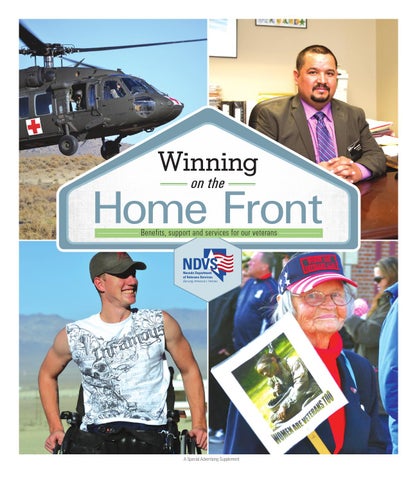
Winning on the
Home Front Benefits, support and services for our veterans
A Special Advertising Supplement
Proud Support to
Our
Barbara Purvis served in the Marine Corps for 13 years. JobConnect helped her translate her military experience and get a civilian job as a veterans representative. Photo by andreo Jab Buhay
Veterans Connecting vets to benefits that make a difference by Evan Tuchinsky
T
hey’ve served our country. Now that their service is complete, we all have the responsibility to support the men and women who have served us. Today, U.S. service members transitioning out of the military and into civilian life have access to more services than ever before. Yet, many of them are unaware of or overwhelmed by the numerous benefits — federal and state, public and private — that are available to them. “There are so many resources that the Pentagon refers to it as ‘the Sea of Goodwill,’” says Caleb Cage, director of military and veterans policy for the office of Nevada Gov. Brian Sandoval. “Everybody is trying to support the troops: to provide services, benefits and opportunities that allow service members, veterans and their families to reintegrate successfully into society.” Veterans should know they have help in navigating this complex system. The State of Nevada Department of Veterans Services (or NDVS) has two new ways to connect veterans to services that provide assistance with education, employment and wellness. First, the new statewide Green Zone Network gives veterans, service providers, family members, friends and community supporters an online tool to share information, post events and search for benefits. Second, the Nevada Veterans Advocacy program enlists community members to complete an online training program that provides an overview of available resources, helping put more “boots on the ground” to direct veterans to services.
These pioneering efforts expand the work already being done by NDVS employees, including the Veterans Service Officers (or VSOs) who counsel veterans on benefit claims and advocate on their behalf. The projects stem from the Green Zone Initiative, Gov. Sandoval’s blueprint for coordinating veterans services statewide. “What we tried to do is set up an initiative that would marshal all available services and put them in a logical framework where veterans and service members could access them better,” Cage says, “and where those service providers could find out what else was being provided in the state.” The idea is, with a large cadre of individuals and organizations working in unison, gaps will get filled. Fewer veterans will go it alone. Fewer needs will go unmet. “It makes Nevada unique,” says Kat Miller, director of NDVS, “because what we’ve done is create a collaboration — broken down silos — and we’ve ensured that veterans returning to Nevada don’t become like a pinball in a pinball machine, going from agency to agency.” Miller wants to see all veterans connected to the benefits they’ve earned, and wants veterans to know they’re not alone. The network of support — from NDVS resource centers and VSOs throughout the state to civilian advocates — exists to help veterans and their families claim what’s rightfully theirs. “If everybody’s working together in the Green Zone Initiative, no matter who you are — public, private,
Dear veterans, service members and supporters, Our nation has been at war for over a decade, which has had a tremendous impact on our service members, veterans and their families. Thankfully, Nevada has not taken their service for granted; instead we have offered crucial services, resources, benefits and opportunities to ensure that our heroes have everything that they need. This has been a part of our effort to show our appreciation, to show support, and ultimately, to achieve our goal of making Nevada the most military- and veteran-friendly state in the nation. Nevada has worked toward this goal in several innovative ways. We have worked through the Green Zone Initiative to identify gaps and
nonprofit — you’re able to steer that veteran to the correct resource,” Miller says. The key, of course, is participation. NDVS needs community members to “enlist” as Nevada Veterans Advocates and Green Zone Network members. Nevada reaps great benefits by helping veterans reintegrate into civilian life. Veterans come home and serve as volunteers, community organizers, skilled workers and entrepreneurs. They bring strength to our state. “Celebrating the legacy of America’s heroes is what we are about,” Miller says. “Being a part of building something wonderful in Nevada.”
Read on to find out more about benefits and services available to U.S. service members and their families, and how NDVS can help veterans claim them. Also learn how you can get involved in the statewide initiative to support those who’ve served us all.
needs, develop partnerships to better coordinate services, research policy changes, and develop networks of veterans and family members so that services could be delivered through personal relationships. We have worked to reduce barriers and increase opportunities through legislation, such as the creation of a second state veterans home in Nevada, which is a top priority of mine. We have created the Nevada Veteran Advocate program to increase the number of service providers statewide. And there are many more efforts to improve outcomes for Nevada’s service members, veterans and their families, too. If you want to be more involved, I encourage you to learn more about how you can personally engage with the efforts that are already underway.
2 | Winning on the Home Front | Nevada Department of Veterans Services | A Special Advertising Supplement
“Celebrating the legacy of America’s heroes is what we are about.” Kat Miller Director, State of Nevada Department of Veterans Services
And if you are already serving our veterans, I encourage you to see how we can better collaborate. There is much work left to do, but we can accomplish our goals if we all work together. I am very proud of the hard work that Nevada has done to serve our veterans. I am pleased that Nevadans are working together to address these important challenges, too. Those who sacrifice and serve selflessly on our behalf deserve nothing less. Sincere regards,
Brian Sandoval, Nevada state Governor
Helping Vets Transition to
Chrishelle Trevett struggled in college after she got out of the Air Force in 2002. The lack of resources on campus inspired her to start a group to advocate for veterans on the campus of Nevada State College. Photo by andreo Jab Buhay
by Mike Blount
Higher Education Woman inspired to start resource center on campus
W
closely with the coordinator to make sure she hen Chrishelle Trevett got out of was filling out the paperwork for her benefits the Air Force in 2002, she knew and receive tutoring when she needed. But she wanted to go to college to when she transferred to Nevada State College continue the medical training she received in 2012, she was disappointed to learn there in the military. Although she enrolled right was no veterans coordinator or resource away, Trevett struggled with the transition center on campus. A year later, she was from learning on the job to learning from a struggling again in school. textbook. In the Air Force, she was a medical “I was having to read things three or technician, assisting doctors and taking the four times to understand them and getting vital signs of patients. But in school, she had left behind in the classroom,” Trevett says. “I trouble focusing on the basics of respiratory didn’t know what to do, so I went to one of therapy in a classroom. my teachers and asked for help. She sent me “My grades weren’t great and I wasn’t to the student disability office on campus so I getting tutored,” Trevett says. “I was having could get help.” a lot of trouble. There wasn’t anyone on With the help of a note-taker and tutor, campus who could help me. There were no Trevett was able to graduate in 2014. But resources for veterans. I failed out of the she still wanted to do something to help her program the next year, which made me feel fellow veterans. discouraged and worthless.” At the University of Trevett suffered from “Having other Nevada, Las Vegas, a veterans post-traumatic stress veterans on resource center has helped disorder and the residual service members on campus effects of a traumatic brain campus you since its creation in 2012. injury she received in 2000, can network Director Ross Bryant says the affecting her short-term with is crucial.” facility is a “one-stop shop” memory and making it for veterans looking to further harder for her to retain Chrishelle Trevett Air Force veteran their education. Trevett visited information. Her PTSD the resource center at UNLV also made her anxious to be in 2014 to see what other veterans found around other people. For her, learning in a useful and help start her own program at classroom was a challenge. her school. Trevett didn’t go back to school until “I started the Nevada State College 2010, when she decided to attend a different Veterans and Allies to provide resources community college. But by then, her GI Bill for veterans on campus,” Trevett says. benefit had almost expired. The veterans “Once a month, we hold meetings so coordinator at the College of Southern veterans on campus can network with each Nevada helped her apply for the Post-9/11 GI other and help other veterans transition Bill, which never expires. Trevett qualified to the college environment. Having other for the extended benefits because she was still veterans on campus you can network with in the Air Force until 2002. is crucial. Some of them wouldn’t make it Having a veterans coordinator on campus without that support.” was a huge asset to Trevett. She worked
Easing the
transition For veterans pursuing higher education after their service, transitioning to the college environment can be an intimidating process. That’s why many schools in Nevada offer a variety of programs to help veterans identify and apply for education benefits they’ve earned, network with other veterans and plan for a future career. Here is a list of services available for veterans on many campuses across the state: • Veterans Resource Centers provide a one-stop shop for veterans to get help with VA paperwork, network with other veterans and navigate their education.
• Veteran career fairs give veterans a chance to meet with local employers.
• Priority registration allows veterans to expedite VA benefit payments for school and housing.
• Teachers are trained on how to talk to veterans and how they can help them succeed in the classroom.
• VetSuccess program provides VA benefits counselors on campuses across Nevada.
• Peer-to-peer counseling allows veterans to receive guidance from peers they can relate to.
A Special Advertising Supplement | www.veterans.nv.gov | Nevada Department of Veterans Services | 3
From Deployment to
by Brittany Wesely
Employment Hiring veterans is good for business
E
ver since he was a young boy, Servando Lara dreamed of being in the military. At age 18 he left his home and his family in Mexico to start a better life for himself in the United States, and that dream persisted. Lara worked tirelessly in his first year in the country, and attended night school in order to get his high school diploma. Then he immediately enlisted in the U.S. Army. “I always said I was going to be a soldier, and what better than to join the best one in the entire world,” Lara says. He served in a personnel position at Army bases across the country and in Korea. Then he spent 15 months deployed in Iraq for Operation Iraqi Freedom. Lara loved his time in the Army. But after he and his wife got married, they started talking about children and the idea of frequently uprooting them didn’t seem ideal. “I served for eight years. I served the country who did well for me,” Lara says. “And, I tell you, this country has done so much for me. But it was time for me to transition.” Since Lara’s position in the military was administrative, he says the transition into civilian life wasn’t as tough as it might be for others. But it still wasn’t easy. Lara immediately sought help from an employment agency in New York, where he had been stationed when his service ended. The company helped him translate his military experience into job skills that he could put on a resume.
Jobs for
vets
Soon after, Lara moved to Las Vegas, where his wife was already living. He quickly began hunting for jobs. He accepted a position as a human resources clerk at Caesars Entertainment Corp. Nine years later, Lara is now the father of triplets and the employee labor relations manager for three Caesars casinos. He says he is proud of the company’s efforts to support and hire veterans. In 2013, Caesars launched a program called Enlisting Heroes, which pulled together community and business leaders to drive the local movement to counter the high veteran unemployment rate. Eloise Scavella, vice president for employment and training at Caesars, says making the decision to hire veterans is a win-win for businesses. “Throughout their military career, veterans display skills like honor, loyalty, drive and dedication. We knew that those same skills would transfer into the workforce and have astronomical results,” Scavella says. In the first year of the program Caesars hired more than 1,000 veterans. Today, the company continues to help veterans find employment by hosting conferences, job fairs and mixers. Caesars also ensures that it keeps the agenda of veterans at the forefront with an internal resource group called Salute. “It’s not that [hiring veterans] is good. It’s that it’s the right thing to do,” Scavella says. “We just love our veterans.”
If you are a veteran and are seeking employment, the Nevada Department of Training and Rehabilitation’s JobConnect is the best place to start. Nevada JobConnect is a statewide network that connects businesses to employees. Veterans representatives at JobConnect offer help translating military experience into specific skills that can be put on a resume. There you may also get assistance with resume writing and interviewing skills, and may attend workshops to ease the transition from service into the civilian workforce. To get connected with a veteran representative at JobConnect, visit www.nevadajobconnect.com.
Servando Lara served in the U.S. Army for eight years before transitioning to the civilian workforce. Lara now works at Caesars Entertainment Corp., a company with a heavy emphasis on supporting and hiring veterans. Photo by andreo Jab BuhaY
Looking to
hire a veteran? You likely already know the many reasons why veterans make exceptional employees — their loyalty, leadership ability and teamwork experience — but how do you go about hiring a veteran? The Green Zone Network employer program helps connect employers with veterans seeking employment. The program exists to educate employers about military culture and how to best meet the unique needs of veterans
4 | Winning on the Home Front | Nevada Department of Veterans Services | A Special Advertising Supplement
and their families. If eligible, the Green Zone Network will also connect you to tax incentives for hiring veterans. To find out more about the Green Zone Network, visit www.greenzonenetwork.org.
Connecting to
Health Benefits from
A to Z
Health Care Help by Evan Tuchinsky
Veteran gets support from NDVS to access health benefits
B
en McFarlane had been in the Air Force five years when the call of duty prompted him to volunteer for a tour in Iraq. At the time, he was stationed at Nellis Air Force Base, having transitioned from security forces to medical administration. He returned to security for his combat deployment in March 2004. He spent 100 days safeguarding civil engineers in Baghdad and Balad before coming home to Nellis. “It’s life-changing, I’ll tell you that,” McFarlane says. Like many veterans, he endured trying experiences in Iraq. He recalls the life-and-death threat of continuous mortar barrages and the trauma of witnessing the death of a close friend. Six months later, in January 2005, he completed his service, but his deployment had taken a toll on his body. He left the Air Force with a handful of ailments: ringing in his ears, back pain, a problem with his right knee and a shoulder injury. McFarlane applied for disability benefits the summer after his discharge and was seen by VA doctors. McFarlane then returned to college via the G.I. Bill and graduated from the University of Nevada, Las Vegas. But then in late 2010, McFarlane ran into delays and red tape in the processing of his benefit paperwork to receive full recognition. So he enlisted help. He connected with the Nevada Department of Veterans Services, and Michael Mader became his Veterans Services Officer. McFarlane says Mader has been a powerful ally. VSOs like Mader are knowledgeable about the process, paperwork and supporting documentation necessary to help claims be successful, and can help veterans through every step of connecting to all the benefits they qualify for. “He’s been an individual who’s assisted me with filing the claim and explained to me the process of the claim,” McFarlane says. “He’s been awesome in the sense of communicating with me and having an open door for me to actually give him a call and then he’ll call me back and explain it.”
McFarlane, who works as a compliance audit investigator for the Nevada Secretary of State’s Security Division, inspecting brokerage and investment adviser firms, had invested significant effort in managing the paperwork process when he was going it alone. The files, records and Post-it notes piled up. But now, he has backup. McFarlane says he’s been impressed with Mader’s dedication to helping his claim get filed correctly. “This is the only individual I know who would call me on a Saturday or a Sunday. I was amazed — ‘Wow, you’re working?’ He’s helped me out a lot,” McFarlane says. With Mader’s help, McFarlane has filed the appropriate claim and is awaiting a response to an appeal for VA benefits. In the meantime, McFarlane can get back to focusing on living his life, and worrying less about his VA paperwork. Which is important, since he and his girlfriend, Wendy, recently welcomed the birth of their first child, a son named Sergio Jon. Ben McFarlane, pictured with his girlfriend, Wendy, and newborn son, Sergio Jon, is an Iraq veteran. He got help from the NDVS filing claims for health care benefits related to his service-connected disability. Photo by andreo Jab Buhay
Anyone who’s served knows the military loves acronyms, and so does the Veterans Administration. Two important ones to know, particularly when pursuing benefits, are VHA and VBA. VHA stands for Veterans Health Administration. That’s the VA branch administering CBOCs (community-based outreach clinics) and hospitals. VBA stands for Veterans Benefits Administration. That branch processes claims and determines eligibility for health care, pensions and other benefits. “Everybody seems to believe that everybody’s going to get VA benefits once they serve in the military,” says Michael Mader, a Veterans Service Officer (VSO) with the Nevada Department of Veterans Services. “That’s not necessarily true.” Many factors impact eligibility, such as service in war versus peacetime, service-related injury or income, Mader explains. “It’s not just a one-sentence answer or a one-paragraph answer; it’s more involved than that,” he says. So Mader, who served in the Navy and received VA health care afterward, encourages fellow veterans to sign up with the VA or consult with a VSO about benefits, regardless of whether they think they qualify. VSOs are valuable allies, ensuring veterans don’t have to navigate the system alone. “You need to understand what your potential benefits could be,” Mader says. “It doesn’t take that long to do, and you could be throwing away eligibility if you don’t do it.”
VSOs are knowledgeable about the process, paperwork and supporting documentation necessary to help claims be successful. A Special Advertising Supplement | www.veterans.nv.gov | Nevada Department of Veterans Services | 5
Become a
Nevada Veterans Advocate Who would make a good Nevada Veterans Advocate?
Nick Lazzarino has begun training to become a Nevada Veterans Advocate through an innovative program that arms participants with the knowledge and skills to help veterans. Photo by Gil Folk
How You Can
Help New program recruits civilians to advocate for veterans
V
eterans, service members, relatives and survivors are entitled to numerous and varied benefits. These range from health care and education to pension and tax breaks. Most benefits don’t come automatically. They require applications with specific supporting documents. Some Nevadans submit forms on their own, working directly with a federal representative; but many require assistance, which is where a Veterans Service Officer — or VSO — comes in. “There’s a big difference from filing your claim by yourself and having a Veterans Service Officer,” explains Kat Miller, director of the Nevada Department of Veterans Services. “A Veterans Service Officer is your advocate. They’ll take all the time in the world; it’s a whole-life concept.” For instance, a veteran may want help filing a claim over a service-related disability. A VSO will help the veteran complete the paperwork, identifying
“Anybody who might be in a position to answer questions about veterans’ services or opportunities,” says Kat Miller, director of the Nevada Department of Veterans Services. “It’s not the job you have; it’s whether you are in a position to provide information to somebody who might need it.” A librarian, for instance, would make a fantastic advocate. So would a government office worker who routinely meets the public. Volunteers with military service organizations, discharge advisers with the National Guard … the possibilities are endless. Even if you haven’t served, you can serve those who have. Those interested in becoming a Nevada Veterans Advocate need only participate in online training. People can view as many modules as they wish; those who complete all 20 courses will get officially certified as an NVA, which entails receiving a state-issued certificate and polo shirt, plus getting partnered with a Veterans Service Officer. To get started, visit the Nevada Online Professional Development Center website: nvelearn.nv.gov.
all the necessary components to prove the claim, and mount an appeal should the initial application get denied. In addition, VSOs will advise veterans about other earned benefits they may not be aware of. “That advocate will not only work the issue you came in for, but by Evan Tuchinsky they’ll go top to bottom on your wellness issues, or possible education benefits for your family members,” Miller says. “You can see how a VSO is so critical if you want the outcome you hope for. In complex cases, going it alone would be like going to court without a lawyer.” However, Nevada only has around 30 active VSOs, 12 of them within the Nevada Department of Veterans Services, to serve more than 300,000 veterans and countless other eligible family members. The majority of VSOs are located in Las Vegas and Reno, though Veterans Services has offices in Elko, Fallon and Pahrump, and operates a program called ROVER (Rural Outreach for Veterans Enrichment and Resources) to get its VSOs out to remote areas. Even so, VSOs need help serving all the state’s veterans. That’s why Veterans Services has begun training citizen-advisers known as Nevada Veterans Advocates (NVAs). The process is simple. Volunteers sign up and go through educational modules online, at their
6 | Winning on the Home Front | Nevada Department of Veterans Services | A Special Advertising Supplement
“ Being a Marine veteran, I understand the challenges that many of our nation’s servicemen and women face in their transition to civilian life.” Nick Lazzarino Nevada Veterans Advocate
own convenience. Upon completion, they receive a certificate and polo shirt from Veterans Services, plus get connected with a VSO who can provide support as needed. Veterans Services is hoping to increase the number of NVAs across the state in 2015. Nick Lazzarino, a Marine veteran, recently began training to become an NVA. “Being a Marine veteran, I understand the challenges that many of our nation’s servicemen and women face in their transition to civilian life,” Lazzarino says. “As an advocate, I strive to provide them with the help to get the benefits they have earned to further their success in the State of Nevada.” The goal is to enlist 10,000 NVAs. They are vital in small towns, where VSOs don’t visit very often, but metro-area veterans lacking transportation may be just as cut-off. So, really, it’s help-wanted everywhere. “There’s something to be said for face-toface contact,” Miller says. “A lot of our veterans, families and survivors want to sit down and talk with a person — and if you go online, you may miss important information a personal discussion will uncover.”
The
Benefits
You Deserve by Evan Tuchinsky
As a Veterans Service Officer for the State of Nevada, Scott Fincher works with active and discharged service members and families to help get all the benefits they’ve earned. It’s more than just a job to him — it’s work with special meaning, because he’s a disabled veteran himself. Fincher served between 1977 and 1984 in the 25th Infantry and at the Fort Sill Artillery School. After receiving his master’s degree and working in the mental health field, he became a VSO in Ohio. A series of moves led him to Nevada, where he’s now program manager for veterans advocacy and support teams for the Nevada Department of Veterans Services. Along with helping the public, Fincher coordinates with other VSOs in Reno, Las Vegas, Pahrump, Fallon and Elko — making him the ideal individual to explain how Veterans Service Officers help vets.
What is a VSO? A Veterans Service Officer is a person who works for either a county, state or national service organization representing veterans. Veterans Service Officers are highly trained, usually by their internal organization but also national trainings, to provide assistance to active military members, veterans and their families.
Q&A with Scott Fincher How many VSOs are there in Nevada? There are 31 active in the state. With client contact and case management, we could serve anywhere from five to 10 clients per VSO [per day], depending on what the need is.
Do you worry people are falling through the cracks? Absolutely. If you do the math, you’ve got around 30 Veterans Service Officers and 300,000 veterans — that’s an average of 10,000 veterans per Veterans Service Officer currently. We would have to triple and quadruple the number of Veterans Service Officers to meet the demands and the needs.
“ Veterans Service Officers are highly trained … to provide assistance to active military members, veterans and their families.”
Will the Nevada Veterans Advocacy program bridge some of that gap? Yes. When a Veterans Service Officer has an appointment scheduled with a veteran, generally we have a basic idea of what they’re coming in to talk with us about — the type of claim we’ll be working on. With Nevada Veterans Advocates (NVA), our goal is they’ll be like our feelers out in the community, not only to assist the Veterans Service Officer in gaining information on the client, but also to be able to talk to veterans, advise them appropriately and refer them to the proper source.
What’s an example of how NVAs can help veterans? If a veteran is in a community talking to an NVA and has just a basic question about a home loan, the NVA would have a resource directory. They wouldn’t have to make an appointment with a VSO to get that information. That would open up the door for a veteran who needed to file for a monetary benefit, like compensation or a pension, to have an appointment with a VSO.
Scott Fincher, Veterans Service Officer
What kind of help can they offer? The assistance is not only to determine if there’s a claim against the U.S. Department of Veterans Affairs to draw a claim or a pension benefit; we’re also trained to submit the claim and follow it all the way through to the point where the client is awarded a benefit, or if it goes into appeal status, represent them all the way up to the Board of Veterans’ Appeals. We also help refer clients not only to VA facilities, but also to other state and federal programs they might be entitled to. We’re also a clearinghouse of information for state and federal benefits. Scott Fincher is a Veterans Service Officer for the state of Nevada. Photo by Gil Folk
A Special Advertising Supplement | www.veterans.nv.gov | Nevada Department of Veterans Services | 7
Support for
Those Who
Served If you’re a veteran, or a civilian who supports our troops and former service members, NDVS wants you! The Nevada Department of Veterans Services offers multiple ways to get involved: 5460 Reno Corporate Drive, Ste. 131 Reno, NV 89511 775-321-4880 Toll free: 866-630-8387 www.veterans.nv.gov
Become an Advocate
Join the Network
Sign up for the Nevada Veterans Advocacy program at https://nvelearn.nv.gov and help connect vets to information, benefits and services.
Log onto the Green Zone Network at www.greenzonenetwork.org and add your name, business or service organization to the growing group.
Contact Veterans Services Reach a Veterans Service Officer, or learn more about programs and benefits, by contacting your local Veterans Advocacy and Support Team (VAST) office or NDVS.
Produced for Nevada Department of Veterans Services by: (916) 498-1234 | www.nrpubs.com P U B L I C AT I O N S
Get the benefits you’ve earned.
Contact us today!
VAST Las Vegas 6900 N. Pecos Road, Rm. 1C237 North Las Vegas, NV 89086 702-224-6025 or 702-791-9000, ext. 46025
VAST Fallon 485 W. B St., Ste. 103 Fallon, NV 89406 775-428-1177
VAST Rural Outreach Coordinator 5460 Reno Corporate Drive, Ste. 131 Reno, NV 89511 775-688-1653
VA Southern Nevada Healthcare System 6900 North Pecos Road North Las Vegas, NV 89086 702-791-9000
VAST Reno 5460 Reno Corporate Drive, Ste. 131 Reno, NV 89511 775-321-4880
VAST Elko 762 14th St. Elko, NV 89801 775-777-1000
VA Sierra Nevada Health Care System 975 Kirman Ave. Reno, NV 89502 775-786-7200
U.S. Department of Veterans Affairs 1-800-827-1000 www.va.gov
8 | Winning on the Home Front | Nevada Department of Veterans Services | A Special Advertising Supplement