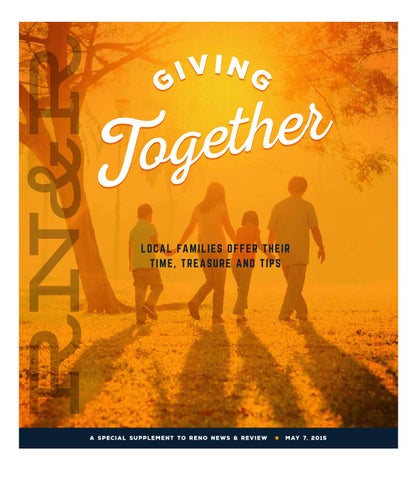
Loca L fa miLies offer t heir t ime, t re asure a nd t ips
A S PECIAL SU PPLE M E NT TO R E N O N EWS & R EV I EW
MAY 7, 2 015
E. L. Cord ChiLd CarE CEntEr truCkEE MEadows CoMMunity CoLLEgE
Located on the dandini Campus Through a quality child care program, TMCC Child Care will provide care and education based on best practice.
Art is in your DNA. Express it here! Offering more than 250 classes per year for people of all ages and skill levels. From baby painting to pottery, life drawing to calligraphy, the Museum School will spark creativity in even the most novice of artists.
Program Highlights • • • • •
Open to Community year round, Monday-Friday, 7am to 6pm Semester-Care and Extended-Care Well-developed policy guides High-quality Programming All employees meet state of Nevada Child Care Licensing requirements Accredited by the National Accreditation Commission (NAC)
Educating Children For Life E.L. Cord Child Care Center 7000 Dandini Blvd Reno, NV 89512 775-674-7515 www.tmcc.edu/childcare 2
View the complete class schedule at bit.ly/elcord-schedule
Fa m i ly G u i d e
M ay 7, 20 1 5
Donald W. Reynolds Center for the Visual Arts E. L. Wiegand Gallery 160 West Liberty Street in downtown Reno 775.329.3333 | nevadaart.org
A S P E C I A L S U P P L E M E N T TO R E N O N E WS & R E V I E W
T
hanks for picking up our latest family guide. This one’s about generous and inspiring people right here in Reno: philanthropists, volunteers and a nonprofit leader who have made a routine of helping others, and have taught children and teenagers to do the same. Some are kids themselves, actually. If you give your all to strangers or animals—and you’ve even managed to pull young people into your circle of influence—well, you’re a hell of a lot further along than most of us, and certainly further along than me. You’re probably happier, too. Some say a life of service starts in childhood, no matter your means, and the good folks in this guide certainly seem to think so. What we do with our piddling free time and money is about as personal as it gets, though, so pushing anyone to contribute to one cause or another (no matter how worthwhile) has always struck me as being a little preachy. That’s not what these stories are about, but hopefully they can be a bit of an inspiration. Thanks as always for reading, and please don’t hesitate to reach out with feedback. I’m all ears.
Georgia Fisher georgiaf@newsreview.com
CHILDREN OF THE EARTH: PAGE 4 ANIMAL FRIENDS: PAGE 6 GENEROUS GENES: PAGE 9 ASKING ASKIN: PAGE 10
A S P E C I A L S U P P L E M E N T TO R E N O N E WS & R E V I E W
M ay 7, 20 1 5
FA m i ly G u i d E
3
Want to g et yo u r k i ds i nvo lve d i n co n s e rvati o n e ffo rts? H e r e ’ s h ow.
“A
s boring as Reno can get sometimes, we have a lot of really great opportunities that other places don’t have,” says 16-year-old Louis Bubala. Exploring the Black Rock Desert, for example. “I love the playa,” he says. “I think it’s interesting how open it is, especially in the morning with the sunrise. You can see for miles. It’s completely flat.” No wonder that’s where he got into photography. Louis has traveled to the playa and other spots in the Black Rock and High Rock Deserts—including Stevens Camp, Soldier Meadows and Pahute Peak—as a volunteer for Friends of Nevada Wilderness, along with his parents and two sisters, Maylyn, 8, and Zora, 10. He’s helped monitor hot springs, and he remembers tagging along with adults when he was younger as they built fences to protect things such as dunes, kit foxes and historic artifacts. He started going to National Public Lands Day camping events when he was in kindergarten. He and his family have helped out at events held by the Bureau of Land Management and the Lahontan
4
Fa m i ly G u i d e
M ay 7, 20 1 5
Audobon Society. The Bubalas have also collected seeds at Washoe Lake State Park, which would be used later to replant fire-damaged areas. “My dad’s really into camping and outdoor stuff,” Louis says. His dad, Lou, adds, “There’s nothing better than seeing the world as it naturally is. It provides a great change from the daily routine of life, giving me a chance to clear my mind and soul.” He got hooked on volunteerism early on in life: “My parents took us all around the country on summer vacations, and I got to see a lot of amazing parks, mountains, forests, lakes and oceans. I decided I wanted to spend my extra time working to preserve and protect the outdoors.” Naturally, he’s passed the habit down to his children.
all-aGes environmentalism Earth Day wasn’t your last chance to help the environment. The groups that work to protect Nevada’s wetlands, deserts and forests need a hand all year round. Here’s a sampling of volunteer opportunities for families. And if your kids’ busy lifestyles
make it hard to commit to a weekend or an afternoon of outdoor work, some groups need help with tasks that can be done from a laptop.
your own backyard — keep truckee meadows beautiFul By combating illegal dumping, recycling Christmas trees and hosting cleanup events, Keep Truckee Meadows Beautiful strives to do just what its name suggests. Young volunteers help clean up neighborhoods, rivers and open-space areas. More info: 851-5185, ktmb.org Upcoming event: Clean Safe School Cleanup, May 16 Armchair activism: KTMB recommends opting out of junk mail at www. catalogchoice.org to help reduce paper use. Best place to start: Sign up online for KTMB’s newsletter to learn about volunteer dates.
wild times — Friends oF nevada wilderness
by Kris Vagner
Upcoming events: Families can help restore the cabin at Stevens Camp in the High Rock Desert June 6 or pull noxious weeds at Hunter Creek June 13 and 17. Armchair activism: Sign petitions and thank senators for acting to protecting wildlife species. Best place to start: Get on the “enews” mailing list.
seeds oF chanGe — the nature conservancy Volunteers as young as 6 help with planting on the Truckee River. Spring planting season is coming to a close; summer dates may include events at Independence Lake Preserve and River Fork Ranch Preserve. More info: nvfovolunteer@tnc.org, www.nature.org Upcoming event: Events are often scheduled on short notice due to changing seasonal needs. Join the mailing list online for the most current information. Best place to start: Follow “The Nature Conservancy in Nevada” on Facebook. Ω
More info: 324-7667, www.nevada wilderness.org. A S P E C I A L S U P P L E M E N T TO R E N O N E WS & R E V I E W
Bully’s is proud to be your neighborhood hangout – a place the whole family can enjoy. With a smoke-free environment, game room, kids menu and friendly staff, we make game time fun for everyone.
MY TEAM. MY BULLY’S. B U L LY S S P O R T S B A R . C O M A S P E C I A L S U P P L E M E N T TO R E N O N E WS & R E V I E W
M ay 7, 20 1 5
Fa m i ly G u i d e
5
“H A Nevada Humane Society shelter resident awaits a new home.
K i ds an d te e n s ar e valuab le vo lu nte e rs at th e N evada H u man e So ci et y
6
FA m i ly G u i d e
M ay 7, 20 1 5
P H OTO/ K R I S VA G N E R
by Kris Vagner
ow much do you want a pet?” I ask my son, Nico. “Probably more than the average kid,” he says. “Do you think you’d be a good pet owner?” “I’ve got no clue.” “What do you think are the responsibilities of owning a pet?” “Scooping poop, walking them, feeding, giving them water, being sweet to them so they don’t feel lonely, playing with them and training them.” I ask, “How much time do you think that would require?” He estimates a number of minutes for each task: two for feeding, 200 for training, 140 for playing catch. His total is 544 minutes, which works out to nine hours a week. Thinking like a mother, I add that there are a few concerns about pets’ health, safety and whereabouts to consider. Thinking like an 11-year-old boy, Nico adds, “You might have to be mean and make them take a bath.” His time estimate for baths was 45 minutes, 15 of which would be spent convincing the pet to bathe. This conversation took place on the way to the Nevada Humane Society, and it was theoretical. I clarified before, during and after that we were not actually going there to adopt a pet. My ulterior motive was to spend months or even years making sure my son has realistic expectations about being a pet owner before becoming one. My real motive was to find out what it’s like to volunteer at the shelter, especially from a kid’s perspective. Of the 300 or so people a month who lend a hand at the shelter, about a quarter are kids age 10-18, give or take a few. Community programs manager Nikole Nichols said it’s hard to come up with a solid number because many people fill out volunteer forms but don’t end up volunteering. Most kids who volunteer do it simply because they love animals, and Nichols also hears from kids who are thinking about becoming veterinarians. The Nevada Humane Society, which cares for about 8,000 animals each year, is located in a campus that looks like a self-contained, stucco strip-mall, which also includes a clinic. Inside, Nico observed, “It looks like it’s supposed to be comfortable.” Cheery 20-somethings greeted and directed visitors from behind a long, curved desk. The open reception area looks like that of a hospital, with a cookie jar of dog treats on the counter
and, where a hospital’s gift shop might be, a window-lit room full of placid-looking rabbits. They’re in cages arranged for browsing, just like in a store. Each cage has a sign with details about the rabbit’s name, age, personality and arrival date. Nichols mentioned that this room sometimes also has birds, lizards or other small pets that have been surrendered or rescued. She showed us to the “cat colonies,” rooms that look and feel like offices, in which several cats roam freely. They have large windows that make strolling through the hallway seem like cat shopping in a cat adoption mall, which is exactly what several visitors were doing. A dark gray cat was curled up asleep inside a carefully crafted wooden arch that perfectly fits one of the showcase windows. The arch has oval-shaped holes to crawl into, steps to climb and a small metal plaque explaining that it was built by an Eagle Scout. “Cats prefer to have various levels of heights,” Nichols said. “One of the things that’s most frustrating for cats in a shelter is a lack of choice.” She explained, “We work very hard to make this place comfortable, but no matter how hard we work, it’s still a shelter, and it’s still a stressful environment for the animals. We put a lot of effort into making it clean, making it comfortable, and that depends a lot on our volunteers.” One teen built an agility course for dogs in the exercise yard, using plans he found online. Other young helpers have come in with their families to pitch in with tasks such as laundry, administrative duties and socializing with cats. (Dogs need buddies to socialize with too, but for that job you have to be 18 or over.) “We are contacted often by kids’ groups who want to do a project but don’t become regular volunteers,” Nichols said. Girl Scout groups and church youth groups have held supply drives, for example, collecting kitten food, dog treats, litter, bedding and toys. For groups, Nichols said, “It helps us if they come in with an idea.” For those who aren’t sure where to start, she has some handouts to get them on the right track. With construction projects, Nichols pointed out, “We have final design approval.” But she’s amenable to ideas, and she appreciates initiative. One preteen boy was at the shelter recently while his mom helped with administrative tasks. He asked Nichols if she’d like a flier to advertise off-site animal adoptions. “I made one,” he announced, showing
A S P E C I A L S U P P L E M E N T TO R E N O N E WS & R E V I E W
her the image on his laptop. She recounted, “It was great little flier, so I said, ‘Absolutely. If you want to print that off and hand it to friends at your school, go ahead.’” Nichols also said, “If you like to sew or bake or crochet, come talk to us. There’s a good way to put that to use for our animals. Just because it’s not on our list doesn’t mean it can’t be useful. Some volunteers just like to take pictures. Well fabulous, we need pictures.” “Our volunteer program is pretty flexible,” she explained. “If we have a specific need we put it out there, but the volunteers really choose when, where and what.” Unless their mothers intervene, which I did. Nico wanted to play with cats, but I insisted we help with a more mundane task first: folding cardboard litter boxes. They’re like the bottom half of a box that a dozen doughnuts would come in, and the shelter, in an effort to keep things clean and sanitary, goes through a few ceiling-high stacks a day. They come flattened in a case and need to be assembled by folding on creases and putting slots into notches. At first, Nico was mildly exasperated with this unglamorous post, but he dutifully went with the flow. We creased and folded for about a half hour.
Afterward, we looked in on some sleeping kittens. My non-cat-person heart warmed at this sight of these tiny balls of sleek, black fur and adorable pink noses. Nico beamed in adoration and announced, “I’m literally going to melt. I think I might ditch the architecture career idea and work here.” Mothers think it’s adorable when their kids are loving toward animals, and I did think it was adorable, but half my mind was still on the lookout for signs that my son could be developing some realistic sense of what it’s like to care for an animal. We headed back to the cat colonies for the more coveted cat-petting job, and he rose to the challenge, gently approaching cats to see if they were friendly, keeping his cool when they rejected his affection, and patiently interviewing a knowledgeable 21-year-old volunteer for tips on interacting—or not—with cats who might be anxious. “Mom, tail swipe,” he alerted me, “you should give that one some space.” He’d learned while we were there that when cats “wag” their tails, it’s not necessarily to express contentment, as dogs do. For cats, it could mean distress. “Good looking out,” I said. Mission accomplished. Ω
Pro tiPs f o r p r o s p e c t i v e yo u n g n e va da H u m a n e s o c i e t y vo l u n t e e r s
The minimum age for volunteers is
10.
to work with dogs, you must be
18 or over.
Before you go, fill out a volunteer profile online, at www.nevadahumanesociety.org. The list for most-needed supply-drive items changes frequently, so if you’re planning a supply drive, contact the shelter in advance.
Volunteers under
16
need an adult supervisor.
follow nevada Humane society on facebook, pinterest, twitter, and youtube to keep on top of the shelter’s current needs.
Got an idea you think would help the shelter? call nikole nichols at (775) 856-2000.
a s p e c i a l s u p p l e m e n t to r e n o n e Ws & r e v i e W
M ay 7, 20 1 5
Fa m i ly G u i d e
7
Enrichment & Theatre Camps Grades K-6th Session One: June 22nd-June 26th Session Two: June 29th-July 3rd Theatre Camp-Grades 1st-8th: June 22nd-July 3rd www.summerattheridge.org
Lake Tahoe School’s
Rocks, Ropes & Boats In Collaboration with Discovering Grace Adventures and Project Discovery This year we are offering the exciting Rocks, Ropes and Boats Camp for Students entering grades 2-9, as well as a High Adventure Teen Camp for campers in grades 7-11. Camp will include lots of rock climbing, swimming, rappelling, caving and many other adventures that we will share in our week long high adventure together. Transportation provided from Reno and Incline Village
Learn more and REGISTER at ProjectDiscovery.com Rocks, Ropes & Boats Rocks, Ropes & Boats High Adventure Camp July 6th-10th
July 13th-17th
July 27th-31st
CelebraƟng Over 50 Years of Excellence
ring
nee Engi
Art Cra�
Brookeld welcomes campers
s
from 2 years old to 8th grade.
Sports
We are offering weekly Summer Adventure Camps. Explore a wide range of classes while having fun! To register, please visit our website at:
www.BrookeldSchool.com Science
Acad
emic
prep
6800 S. McCarran Blvd. * Reno, NV 89509 * 775-825-0257 8
Fa m i ly G u i d e
M ay 7, 20 1 5
A S P E C I A L S U P P L E M E N T TO R E N O N E WS & R E V I E W
Susan Lynn (left) and her grown children, Buzz and Jennifer, hail from a four-generation family of philanthropists and volunteers.
A ph i l anth ro pi c m oth e r an d dau g hte r o pe n u p ab o ut th e i r fam i ly
by Georgia Fisher georgiaf@newsreview
M
aybe real generosity feels a little ordinary to the benefactor, or like something simple and natural that’s free of ego, at least. For Susan Lynn of Reno, it’s just part of her family’s rhythm. Her mother, now a nonagenarian, was a civil engineer at Iowa State University in the 1930s, and later a bacteriologist. Many shrewd investments and well-lived decades later, her charitable endeavors include helping young women pursue careers in math and science. She also has a soft spot for veterans, animals and water-quality issues. “She’s had to work very hard,” Lynn says of the family matriarch—a modest sort who hates being the object of fuss, and who’d especially cringe to see her name in print. Noted. As for the rest of the family, well, they’re philanthropic, too. Like her mother, Lynn has long been involved with the Community Foundation of Western Nevada, a multifaceted organization that connects local donors to all manner of causes, and with the Nevada Women’s Fund, which provides
grants and scholarships. Her brother and sister-in-law, Neal and Jo, also aid programs dear to their hearts, namely ones that help needy children and adults. Lynn’s grown children, Buzz and Jennifer, support charities too, including the Community Foundation’s You’N-I initiative, which benefits homeless and runaway youth as well as kids who are aging out of the foster system. And her 21-year-old granddaughter, Emily, is “really starting to get it,” she said, describing a young woman who’s begun to work with veterans at a Santa Cruzarea nonprofit, among other things. A second granddaughter, Whitney Thompson, died in a 2011 car accident, not long after she’d fought an addiction and begun to turn her life around. It wasn’t until her funeral service that her heartbroken relatives grasped how deeply she’d connected with others all along—urging her friends to get treatment too, for example, and helping one leave a violent relationship. “I found out so many of these things after she passed away,” recalls her mother, Jennifer Thompson. “I didn’t realize she’d been the caring shoulder
A S P E C I A L S U P P L E M E N T TO R E N O N E WS & R E V I E W
for so many people. To me, she was my daughter who I was trying to direct and help, and I didn’t realize she was directing and helping so many people herself.” The younger Thompson “also made us realize that there are a lot of kids in this community who are on the streets, either through their own volition or because their parents ceased to be parents,” Lynn said. “They really needed something—somewhere to go, or some resources—and they were completely overlooked in the community, except through the Children’s Cabinet, and other things.” So how does one raise selfless offspring? “Well, there are those kids who aren’t grateful, who’re the entitled ones who are about themselves and who don’t feel like giving anything back to society whatsoever,” Thompson said. “So every day, when [yours] are little tiny kids, you go to work and you have them be grateful for what they have. I think parents play a big part in having kids recognize that not everybody is as lucky as we are.
“We get that way though hard work and honesty, and being a good person, and doing the right thing. But I think there are a lot of people who may not be as fortunate with their families, and you don’t get to pick your parents, unfortunately. I also think they have choices as well, but they maybe don’t have the avenues to go forward.” It’s worth noting that Lynn and Thompson didn’t volunteer for this story, and that when the mother and daughter talk about themselves and their kin, it’s with lots of cautions and modest caveats. “We’re not grandiose at all,” she said with a chuckle. “We’re not the biggest names. There are a whole bunch of families here that have way, way more funding, and they all do their charitable contributions. Generosity is a good value to have—to help others and to give people a hand up without needing something back in return—though you always hope that if you give somebody a hand they’ll give somebody else a hand, and it will all snowball into everyone helping each other out.” Ω
M ay 7, 20 1 5
Fa m i Ly G u i d e
9
C
hris Askin is president and CEO of the Community Foundation of Western Nevada, an organization connects willing donors with a number of causes in the area, including ones that help local children and young people in need. It’s tied to broader efforts, too, and at the time of this writing, the foundation was seeking (among other things) help for earthquake victims in Nepal via Soroptimist International Truckee Meadows. Askin’s own children are in their 20s now. He didn’t mind a few questions about their upbringing and about volunteerism and philanthropy in general.
So how does the foundation work with philanthropists and volunteers?
A n o n pro fit le ad e r p o n d e rs vo lu nte e r i s m , ph i l anth ro py an d th e art o f r ai s i n g g e n e ro us k i ds
by Georgia Fisher
georgiaf@newsreview.com
10
Fa m i ly G u i d e
M ay 7, 20 1 5
At the Community Foundation, we provide opportunities for people to get engaged with philanthropy. We’re not so much on the volunteerism side, but we know the organizations that are. [Choosing them boils down to] everything from going on the website for Nevada volunteers, which lists volunteer opportunities throughout the state, to calling United Way, to getting involved with a local organization like Keep Truckee Meadows Beautiful, which does the river cleanups and things like that. Volunteerism is a great way to get involved with philanthropy initially, and to not think about money. You’re giving of your time. And if you’re going to give of your money, of your treasure, you’re going to give something incredibly precious to you that you worked really hard for, so you want to make sure that it’s meaningful. If you give an organization a check, let’s say for $100, and you get a nice thank-you from them, you may or may not be connected to the type of impact your gift is making.
What about the nature of generosity itself? Do you think we’re born selfish? We all know the toddler who’s saying “Me, mine,” or “My toy!” And you have it between siblings; we all know if you give a bright shiny toy to the younger sibling, the older sibling who typically sees himself as being in control of the younger sibling at all times gets incredibly jealous—going, “Why don’t I get that? I should get it! Why? Because I’m me; I deserve it, because I just get everything!” And if the parents are always looking at that shiny new car, if they aren’t happy with what they have, that sends messages to the kids, too. Why should the kids be happy? They need more. So there’s an incredible amount of modeling that goes into that. You know what’s interesting, though? If you start getting involved with charities, even if it’s not really in your heart, and you go through the motions … well, let’s say you’re visiting the food bank, and you go down to the food bank, and you’re volunteering to help pack up food. At first, you didn’t want to go. You weren’t feeling
particularly generous, and you’re thinking that some of the people there to get food should really just get a job, but now you go down there, and now you’re going to hear about it from the source.
That would change things, wouldn’t it? Yes, because they take that food, and they deliver it to people. They don’t just blindly hand out the food; they keep statistics, and people have to qualify. They do this incredible about of due diligence to make sure the food only goes to those people who really need it. So you learn more, and you also say, “OK, they’ve got all the cereal and all the canned beans they need, but they don’t have the fresh produce,” which you think is really important, or maybe they need more formula, more diapers or whatever. There are very, very few times a volunteer will get involved with a charity and not think that charity is important. If you give it a try, it changes you.
What about people who have no free time, or who really believe they don’t? Is that an excuse to be disengaged? (If so, I’ve been guilty of using it.) Let’s go back to the situation where you’re modeling for your kids, and you’ve got a 3-year-old and a 5-year-old, and you have no time, because you work all the time, and are you just kind of immersed in that world. Well, if you make some time to get involved with a charity-and it could even be joining a charity board-you will learn more about people in need, you will become more empathetic, and that will change how you interact with your own family. In lots of subtle and different ways, your family will become more empathetic and more caring about their fellow citizens. But you have to put yourself in that position; you can’t live above it. You can’t just go from your house to your car to your job, and then from your car to your house to the super-nice restaurant, and never interact. [In that case] you’re basically insulating yourself from a huge part of society that is engaged with helping each other, and you’re also denying yourself a part of engagement in your community that can make your life much more meaningful. I would say for the families, it’s important to get
A S P E C I A L S U P P L E M E N T TO R E N O N E WS & R E V I E W
W IN A
You can’t just go from your house to your car to your job, and then from your car to your house to the super-nice restaurant, and never interact.
FAMILY FuN PLuS MEMBERSHIP TO THE TERR Y LEE WEL LS NEVA DA DISC OVER Y MUS EUM !
How do you teach this sort of thing to your own kids? One thing we did with our kids is we would take them Christmas shopping, so they would buy clothes and things for certain ages, and then we would take them over to the Kids Kottage, because they always need clothes. Another time, we took some toys up to the pediatric playroom at Renown. … There are organizations that always need things replenished like that. For the kids to see the parents first of all modeling like that, not just dropping the kids off; but actually doing it themselves, then the kids can participate in a way they feel is meaningful, because they’re going to want to do it if the parents are doing it.
How did your children respond when you brought them to the hospital? Very well. They were pretty excited, actually. Even going down the hallway, we’re going past the pediatric rooms, and you can see all the kids in the different beds there with visitors, and that made it all the more real, too. But we didn’t want to try and push it to where they were taking toys to the kids [directly], because then you’re getting this immediate thank you, and really it’s not about that. It’s
How old were your kids at the time? They were in elementary school; 6 and 8, or maybe 8 and 10.
So is there an age that’s too early, or one when young people are especially open to observing the experiences of others?
I don’t think there’s any time to not be involved, but to varying degrees there are times when you just really buckle down. In terms of getting kids involved, I think the earliest experiences are the best, so it becomes part of what they’re ingrained with. A number of parents give their kids an allowance, and they separate it so part of it goes into donation money, and part of it goes into savings, and part of it they can spend. It’s trying to teach kids budgeting. I’m not quite so sure about that approach myself, because when kids are willing to do it on their own, I think it makes a bigger difference. In a lot of these situations, the giving precedes the engagement, and I would be much more excited about kids getting engaged with some cause. Ω
A S P E C I A L S U P P L E M E N T TO R E N O N E WS & R E V I E W
VEGGIES • FRUIT • FLOWERS WEEKLY ORGANIC FARM BOX DELIVERIES
WWW.MOUNTAINBOUNTYFARM.COM
President and CEO Community Foundation of Western Nevada
about picturing them after you’re gone, walking into the room and finding these toys—a kid playing with a stuffed giraffe or a train set or something else that would help brighten their day.
TRUCKEE • TAHOE • RENO
SIGN UP ANYTIME (530)2929-3776
Chris Askin
involved early, because it changes the household culture. … Everyone does have some time; it’s just that everybody has their own personal priorities. I don’t like to ever live with regret, so it’s hard to look back and say, “Last year, did I spend time doing something that ended up not being meaningful to me?” If you can somehow become wise and figure out when you’re doing that, maybe there is time.
SHARE IN THE BOUNTY
TO ENTER: · Send an e-mail to contest@newsreview.com · Put “DISCOVERY” in the subject line · Include your full name, birth date and day phone · DEADLINE to enter is 5/28/15 · Winner will be notified by phone and e-mail
WIN TICKETS
2 1 family fun!
The secret to getting healthier? Getting started.
for
2 for 1 skate pass with coupon
NOT GOOD WITH ANY OTHER OFFER OR SPECIAL EVENTS
At Northern Nevada HOPES, our integrated medical and wellness clinic can help get you on the path to better health. Whether it’s primary care, women’s health services, behavioral health counseling, or a pharmacy with medication delivery, we’re here to help you live well. We accept the insured and uninsured and welcome everyone age 12 and over, regardless of ability to pay. To get started on the path to better health, call us at (775) 786-4673 or visit us at nnhopes.org. Hablamos español.
580 W 5TH ST | RENO, NV 89503 | (775) 786-4673
WWW.ROLLERKINGDOM.ORG M ay 7, 20 1 5
Fa m i ly G u i d e
11