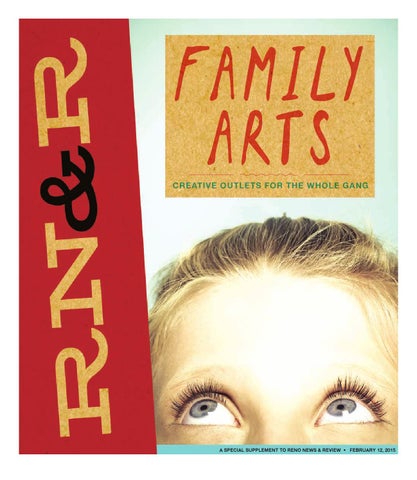
Creative outlets for the whole gang
A SPECIAL SUPPLEMENT TO RENO NEWS & REVIEW • FEBRUARY 12, 2015
E. L. CORD CHILD CARE CENTER
TRUCKEE MEADOWS COMMUNITY COLLEGE Located on the Dandini Campus Through a quality child care program, TMCC Child Care will provide care and education based on best practice.
Creative outlets for the whole gang
CONTENTS
TALENT SHOWS GROW UP DANCE REVOLUTION ACADEMIC ARTISTRY
4 6 9 10
W Program Highlights • • • • •
Open to Community year round, Monday-Friday, 7am to 6pm Semester-Care and Extended-Care Well-developed policy procedure guides & High-quality Programming All employees meet state of Nevada Child Care Licensing requirements Accredited by the National Accreditation Commission (NAC)
Educating Children For Life E.L. Cord Child Care Center 7000 Dandini Blvd Reno, NV 89512 775-674-7515 www.tmcc.edu/childcare 2
elcome to the RN&R’s first family guide of 2015. This time around, we’ve focused on fine arts, and the many ways in which creativity and selfexpression benefit Reno kids and their parents. With them in mind, we’ve included a Q-and-A with Washoe County School District’s fine-arts coordinator and music supervisor, Julye Neel, who tells us about the many ties between local schoolchildren, the University of Nevada, Reno, and award-winning organizations like the Reno Philharmonic. She also explains the arts’ crossover benefits in academia, and she imparts tips for parents on a budget: how to spend next-to-nothing on live music, for example, or forgo sticker shock when your child decides to play an expensive instrument. Meanwhile, Ashley Hennefer—a self-dubbed theater nerd—relays some artsy coming-of-age tales of her own, and Jessica Santina delves into the details of UNR’s fine-arts outreach program, which serves tens of thousands of kids and has a $13 million impact on Northern Nevada each year. You’ll also meet Kia Crader, a veteran dancer who runs an all-ages special-needs program with the help of her sons, and offers a variety of other classes at her family-oriented studio. If we can be sure of anything, it’s that everyone wants the best for their kids, that all family time is at a premium, and that a foray into the arts never hurt anyone. So thanks for reading. And hey, feel free to turn this into origami when you’re done.
Georgia Fisher
Special Projects Editor
P
by Jessica Santina
Chip De Stefano conducts a concert at the Lake Tahoe Music Camp.
4
eople often don’t think of us as part of the community, but as a landgrant university, that’s our mission,” says Chris Money, assistant director of programming at the University of Nevada, Reno’s School of the Arts. “My job is to go out and show people that we’re doing this for them, contributing to the community.” This extends beyond health clinics and job fairs. The university’s School of the Arts, through employment of faculty and staff, and its arts events, makes a $13 million annual impact on Northern Nevada. And in a world where arts programs usually are the first to go in tough budget environments, it is perhaps even more meaningful that the school engages more than 25,000 children each year in fine arts activities, both on campus and throughout the community in schools, library, hotels and other public spaces. Kids ranging from preschool-aged to college-aged have hundreds of opportunities each year to take part in performances, workshops or clinics in music, dance, theater and visual arts.
“Our outreach efforts are many, particularly in the area of music,” says director Larry Engstrom. “Not only are we training teachers to go out and teach music in our public schools, but our music-education teacher leads programs in preschools and elementary schools that enable kids to use instruments. All our graduates are exposed to that program and have worked with kids as well.” Engstrom adds that the school offers up its facilities on Friday afternoons for a kids’ Suzuki strings program, which teaches string instruments to students from preschool to high school. Additionally, the music department works closely with the Washoe County School District to conduct jazz workshops in the schools, and host day-long events focusing on certain instruments, such as Flute Day, Day of Percussion, and TubaFest. (Visit www.unr.edu/music for information.) In the art department, schoolkids come from around the area to tour facilities where
PHOTO/CHRISTOPHER MONE Y
UNR students are working, and guest artists often give talks to those kids. “Last summer,” Engstrom says, “faculty led an interactive drawing activity with preschoolers. They used a 30-by-10-foot board where kids could create their own artwork.” Engstrom also points out the many performances on campus and community activities that involve university faculty. “Our theater faculty may work with kids in local performances,” Engstrom says. “For instance, I play in a brass quintet and have gone to elementary schools, doing performances and explaining the instruments. Most of us faculty are doing things like that all the time.”
Performing Arts series
During the three-day festival, roughly 9,000 participants, more than 300 school groups and around 75 clinicians, performers and adjudicators converge on the UNR campus for what is one of the world’s largest and most respected festivals of its kind in the world. According to Money, up to 7,000 participants are younger than college age. This year’s festival is slated for April 23-25, and as Engstrom points out, there are four different ways to enjoy it. First, there are all-day, every day performances from school groups from around the west and other parts of the world, taking place every half hour. Second, on the hour, all day, every day, workshops presented by guest artists or clinicians from around the country are taking place. Third, each night features concerts from some of the best performers in the world. And fourth, for each school group that attends, that group is given a clinic immediately following every performance. School of the Arts outreach efforts to solicit participation start with invites to each campus in the area, from elementary through high school. But anyone is welcome. Tickets are $15-$60. For information, visit www.unr.edu/rjf/.
As Money points out, a primary vehicle for providing arts access to the community is the Performing Arts Series, established in 1962 in response to the community’s request for local performances by national and international touring artists. With the mission of “enriching the cultural life of our community,” the series presents shows for adults and children, with at least five family-friendly events per year at libraries or schools. “When I work with agents to book guests lAke tAhoe music cAmP for the Performing Arts Series, I specifically Registration for this week-long event just am looking to line up residencies, clinics began on Feb. 2, and more than 40 staff and workshops with them, so that they will members, local band directors and music not only perform here on campus but also teachers are lined up to work with the roughly in schools or in the community,” Money 200 students who can be accommodated at says, explaining that the Thursday night the 4-H camp at South Lake performances are public, and Tahoe. From July 5-11, student then performers stick around for musicians in grades 7-12 (some additional school or community 6th graders may be accepted shows, workshops or talks. i’m told that based on experience) will have Coming up in March is The the opportunity to fine-tune Intergalactic Nemesis ~ Book the starbucks their skills while enjoying One: Target Earth, a show on campus is the a full camp experience. with a comic-book feel Campers can participate in in which sound effects, busiest one in concert bands, jazz bands projected illustrations and and a variety of wind and wacky actors’ voices the world during percussion chamber present a 1930s-style the weekend of ensembles during a full radio play. Following week of rehearsals, the public performance the reno Jazz clinics and concerts. For on March 12, kids from festival. i don’t information or to register, various schools around visit www.unr.edu/ltmc/. the area will come to know if that’s As Engstrom and campus for their own true, but we Money both point out, this special performance. is just a sampling of the For the full Performing definitely break activities offered by the Arts Series calendar, visit records. School of the Arts to engage kids www.unr.edu/pas/. and their families in the arts. LARRY ENGSTROM “It’s our mission to challenge reno JAzz festivAl FESTIVAL DIRECTOR audiences, to provide them “I’m told that the Starbucks on with something different,” says campus is the busiest one in the Money. For more information world during the weekend of the about the School of the Arts, as Reno Jazz Festival,” says Engstrom, who also well as a full events calendar, visit www.unr. directs the event. “I don’t know if that’s true, Ω edu/arts/. but we definitely break records.”
Education that Works
ACE HIGH SCHOOL OPEN HOUSE Open House featuring ACE’s exclusive TMCC Career Programs on the TMCC Edison Way Campus - See how ACE is YOUR ticket to learning high-tech skills for the emerging job market!
@ TMCC Edison Way Campus 475 Edison Way, Reno Saturday, February 21 11am - 1pm Why You Should Choose ACE: Free Public School Earn College Credit & High School Credit Small Class Size Personalized Attention Hands On Learning Proven Academic Results Proven Workforce Development A School All About - YOU!
CONSTRUCTION | ARCHITECTURE | MACHINING DIESEL TECHNOLOGY | RENEWABLE ENERGY | CADD
“LIKE” us on Facebook at facebook.com/acehighschool
ACEHIGHSCHOOL.ORG 775-324-3900 5
A by Ashley Hennefer
photo: GeorGia fisher
How I came of age In nortHern nevada’s art scene
The Nevada Museum of Art brings world-class exhibitions to an accessible local venue.
6
fter living in Reno for almost 10 years, I’ve become quite passionate about the city’s art scene. To give you some context for my upbringing, I was born in Berkeley, California—quite possibly the art mecca of the West Coast. Or at least that’s how its inhabitants see it. Regardless of its reputation, I was immersed in cultural weirdness from an early age. I spent the first 13 years of my life living in the Bay Area, and my parents signed me up for an unbelievable number of art classes and camps. I must have taken almost every type of art class available— ballet, tap, dance, theater, voiceover lessons, singing lessons, guitar lessons, cooking classes, and even a Harry Potter-themed week-long summer camp (which was pretty much the coolest thing ever). I loved them all. When I started high school, my parents uprooted my little brother and me and plopped us down in Gardnerville, Nevada. I was all in favor of moving to a new, different community, and I learned that even small towns have a unique perspective on art and culture. I think this was an important lesson to learn early on— creative people can be found anywhere. Sure, places like New York City or San Francisco are cool and full of great museums and cultural centers, but great artists aren’t confined by geography. They’ll live anywhere that inspires them, and as a young writer, Gardnerville certainly inspired me. Many of the most creative people I’ve ever met happened to be in Gardnerville at the same time I was. I spent all of high school as a drama nerd, and my family and I saw dozens of plays throughout the Carson Valley region. By the time I was getting ready to go to the University of Nevada, Reno for college, I couldn’t wait to see what Reno had to offer.
Urban legends When I moved to Reno, I started UNR as a theater major with the intent of being a playwright or dramaturg, so I spent a lot of time exploring Reno’s theater scene. Although I changed my major, I still think Reno theater is fascinating. I vividly remember my first visit to the Brüka Theatre in particular— after spending a few years in Gardnerville, being in downtown Reno to see a play with my college friends felt positively urban. I was stoked, and I remember thinking, “This theater has couches!” As my mom would say, “That’s totally Berkeley.” My mom and I tend to use “Berkeley” as a way to describe things that are quirky, weird, unique and cool, and 18-year-old me thought Brüka was the place to be. And down the street from Brüka is the Nevada Museum of Art. After visiting museums in places like London, Istanbul, Vancouver and even the Louvre in Paris, I still think NMA is a damned good museum. The building is beautifully designed and the exhibits are well-curated and thought provoking. As a college freshman, it became my go-to place for when I was missing the Bay Area and needed a quick shot of stimulating culture. Despite being born and raised in a densely populated area, my family and I never felt like Reno
was lesser because it wasn’t Berkeley or San Francisco. In fact, it made discovering gems like Brüka that much more exciting. My friends and family back home in the Bay frequently assume that Nevada is the rural Wild West, and in many ways, it is, and that comes through in much of its art. But Reno is a city, and its residents crave those unique cultural experiences that tend to be found in more populous places.
PHOTO COURTESY OF ASHLE Y HEN NEFER
I say all this to give you some context for how I view and value Reno’s art and artists. To me, Reno has the best of both worlds—many of the same cultural elements of a big city with the perks of a small, close-knit community.
starting fires While in college, I worked for the Brushfire literary arts journal, UNR’s student art publication. Brushfire gave me direct access UNR alumnae Kelly Gesick (nee Bridegum), Sarah Hall (nee King) and Ashley Hennefer found to writers, visual artists and photographers their niche at Brushfire. in Northern Nevada. And editing Brushfire allowed me to survey the region as a curator city for what it is. It’s been a few years since I was part would—what are the themes emerging among of Brushfire, but I’m still involved in Reno’s art scene all of these artists? What do artists want and need to by writing about it, and I’ve been fortunate to be a part be fulfilled creatively here? Connections to nature and of Northern Nevada’s growing maker movement. This the desire for a strong community came up again and is where I see the future of Reno art: the collaboration again. I saw this firsthand when I went to the opening between creatives, scientists and technologists. And of the first Holland Project location, or watching much of this is already evident through events like my friends perform at Walden’s open mic night, or Reno Mini Maker Faire and Burning Man. This is camping at Pyramid Lake for a secret music festival, also where I think Reno can solidify its reputation: or when I read poetry in a spontaneous poetry reading a city where artists work and live together and make on the UNR quad at night. good art together. And maybe the next generation These experiences, among countless others like of locals will have a memorable moment and think, them, confirmed what I’ve always suspected about Ω “That’s totally Reno.” Reno—this is a cool place with plenty of experiences to have if you’re open-minded and willing to see the
Hunger doesn’t end when the bell rings. Free Kids Cafe after school Meals open to all children ages 1-18. Contact 775-331-3663 or fbnn.org to find the site closest to you. ĩnn.org 775-331-3663 Kids Cafe is a program of the Food Bank of Northern Nevada. USDA funds meals. USDA is an equal opportunity provider and employer.
7
W IN A
FAMILY PLUS MEMBERSHIP TO TH E TE RR Y LE E WE LL S NE VA DA DI SC OV ER Y M US EU M !
WIN TICKETS TO ENTER: · Send an e-mail to contest@newsreview.com · Put "DISCOVERY" in the subject line · Include your full name, day phone and birth date · DEADLInE to enter is Thursday, February 26th, 2015 · Winner will be notified by phone and e-mail
SWEET DEALS FOR THE WHOLE FAMILY SAVE AT LEAST 50% ON GIFT CARDS FOR LOCAL RESTAURANTS AND MORE!
RN&R
W W W. N E W S R E V I E W. C O M
8
Studio offerS Special-needS claSSeS, boyS’ groupS and more story and photo by Georgia Fisher
georgiaf@newsreview.com
W
Students take part in a ballet class at Fascinating Rhythm School of Performing Arts. Kia Crader founded the school 20 years ago in Reno.
hen Lane Saunders was a kid, he and his mother, Kia Crader, struck a deal: She’d fork over $1 every time he took a ballet class, but would charge him 25 cents whenever he yawned in the process. The system lasted a few months. “You don’t have to pay me anymore,” the little boy finally said. “I like ballet.” Saunders is now 23, and a professional dancer. He’s also a teacher at Crader’s studio, Fascinating Rhythm School of Performing Arts, where he leads tap, parkour and special-needs classes, among others. The special-needs program is a popular one, and it’s especially dear to Crader’s heart. As a college student, the California native studied child psychology with an emphasis in autism education—a brand-new notion back then—and she’d planned to pursue a related career. “But then I got an opportunity to dance professionally, and then another opportunity, and another opportunity, and I began dancing professionally all my life,” she said. Crader actually took her first paid role at age 16, then came to Reno in the late ’70s for the massive stage show Hello Hollywood, Hello. She lived in New York back then, with her opera-singer aunt, and a friend tipped her off about the audition. “They hired me right on the spot,” she said with a laugh, “and they said, ‘So you start tomorrow.’ And I said, ‘I don’t even live here.’” She got a three-day grace period, and never looked back.
Now huge gaggles of girls are apt to giggle and sweep their way through her studio, which turns 20 this year and is also home to the Sierra Nevada Ballet Academy. It’s an art-filled place on South Virginia Street, with friendly clutter and various distractions to occupy students’ younger siblings as they mill about in the waiting area. (The pink play kitchen seems to be a favorite.) But male dancers have a home here, too. Like younger incarnations of Saunders, most start their classes gingerly. The school’s boys-only tap class usually feels safest at first. “The guys who start in tap, a lot of them are taking ballet now, and recognizing what a strengthening style of dance it is,” Crader said. “I’m proud to say that we have a lot of male dancers here.” Logan Strand, 13, fears no ballet. He tap dances, too. At first, he said, “I was the only boy in an all-girls tap class, and then one day like five years ago, all these boys came, and it was the happiest day in my whole life. It’s almost a filter to make friends; they’re people who share your same interests, and aren’t afraid to go out and do something weird like dance.” Strand couldn’t talk for long; it was time for him to clackity-clack into class. A minute later, as bass thumped from the stereo, he and a handful of other teenage boys moved their feet to Saunders’ lead. They looked cool and seemed to know it. In the room next door, instructor Joanna Wagner and student-teacher Hannah West led a large ballet class, mostly of kids under the age of 10. There was
a single boy, and at one point he threw his arms over his head and waved them around in sheer glee. “A lot of people don’t recognize the importance of dance as far as what it does for your brain, because it really does work both sides of the brain,” said Crader. “And it releases the endorphins to feel good.” She remembers a student who’s now a self-assured high-schooler, but was once so shy that she’d default to looking at the floor and covering her face with her hands. Dancing “just brought her a confidence and a comfort in her own skin.” The special-needs class, which runs every Saturday, is all about confidence and fun. It’s opened its doors to children who aren’t much older than toddlers as well as adults, including a past student in her 40s. “We have all different abilities as opposed to disabilities,” said Crader. She quickly started the class in 2006 when a couple of local parents approached her and told her no one would teach their daughters, who have Down syndrome and cerebral palsy, respectively. Lane and Crader’s elder son, Sean, both help with instruction. Sean is also a certified behavioral analyst at the University of Nevada, Reno, specializing in early intervention with autism— one more chip off the old block. With the special-needs class, which covers many genres of dance, “our goal was for these families to have a regular dance experience,” Crader said. “They’re in the recital like everybody else, and treated like everybody else. And they are, hands down, the hit Ω of the show.”
9
Tips and insighTs from an arTs adminisTraTor by Georgia Fisher
georgiaf@newsreview.com 10
Washoe County School District’s Julye Neel reveals a stash of cellos. Many instruments are available for rent through WCSD. PHOTO/GEORGIA FISHER
T
alk about a long job title. As a K-12 fine arts coordinator and music supervisor for Washoe County School District, Julye Neel has a broad range of duties. She’s also in a position to affect thousands of lives, seeing as every single elementary student in the district takes music, and all sixth graders enroll in band, orchestra or choir. Neel grew up playing the flute in her native Alaska, and now sings soprano with the symphonic choir at the University of Nevada, Reno. Her moonlighting isn’t unusual. She says most of WCSD’s music teachers are involved in ensembles, choirs and other such projects. Here’s to ’em.
Let’s start really broadly, here. Why are the arts important?
Students who are involved in the arts— in music, in visual arts, in theater— are connected to their schools, and connected to communities of art. It’s one of the most amazing connections you can make. There are students who stay in school because they’re in band or they’re in choir or they’re in orchestra, or because they love their art teacher, or they love theater. Those are reasons for kids to stay in school. We know our kids who stay in music ... we have statistics that show they have a very high rate of graduation. There are all kinds of reasons for staying in music, for staying in art.
So, in many ways, it spreads out to influence other parts of a child’s life that wouldn’t necessarily appear to be artsbased?
Music and art, all fine arts classes, are integral in a child’s development. They cross all the borders of math,
of language arts, of social studies, because in a music class you’re going to do math, you’re singing, and you’re working with a libretto—you’re working with a poem, a piece of literature. And you’re learning to count. You’re using your body to express [yourself]. There are so many reasons for the arts that support what kids do academically in the classroom. … Kids who can walk to a beat can read. And speech therapists use music all the time to help kids who may be struggling.
Do you feel like arts funding is where it should be?
Oh, I always feel like arts funding should be more! But I feel very, very supported by Washoe County School District. They provide us with teachers, with resources, with instruments, with equipment. We’re always looking for more, but we feel very, very supported by our school district and by our superintendent, and we have a lot of support from the Reno Arts
Consortium. They’re folks who are mostly from nonprofits around town and from Northern Nevada, and they advocate for us regularly on a local level, on a state level and on a national level. They have been awesome. One of my goals is to get art teachers into the elementary schools. We have a few, but we also have 65 elementaries, and you can’t administer art to 65 elementaries. But we do have music teachers in every school—every elementary school, every middle and every high. So, a goal is to grow the visual arts program, also. As far as feeling supported by the community, we have access to different kinds of grants around here through the Redfield Foundation and through E.L.Cord, and we have an anonymous donor who continues to give grants to [middle- and high-school music] teachers who apply every other year. We also have the university here, and its huge arts program, music program and theater program. We’re very well
connected, and most of the teachers at the university in some way participate in our festivals, and our in-services and our professional development, and all their interns learn from our established teachers.
How does Reno’s arts world compare to that of other towns you’ve seen?
I’ve never been in a town this size that can support [organizations like] the Reno Philharmonic, the Reno Chamber Orchestra, the Reno Jazz Orchestra. We’re just blessed with talented, talented people. It’s small enough in Reno to have a small-town feel, yet big enough to offer a lot of arts experiences.
Let’s say parents are reading this guide and going, “You know, we really can’t afford to have our kid play the trumpet,” or “We can’t possibly pay for something like band camp.” Are there ways to make up for this sort of thing at home?
I can speak to what we do here in the school district. Every child will have music, and will have a music teacher from kindergarten through sixth grade. At the beginning of sixth grade, they have a choice: they can take orchestra, band or choir. We do have a substantial inventory of instruments, and we don’t want to turn anyone away who can’t afford [them]. There are a lot of ways to rent instruments. We try to reserve them for students and families in need first, and once we satisfy those needs of those families, other students can rent. There are ways to do it, and the music teachers in the building will help them figure that out.
What about students who freeze up and think they just aren’t cut out for music? What would you tell them and their families?
For some kids, it’s going to be very natural for them to just sit down and learn the trumpet or the flute. But the more students are exposed to—and hear, see and listen to—performers, the more natural it will be, because there are all kinds of models out there. Even if Mom and Dad don’t play or go to performances, there’s all kinds of outdoor concerts here in the summertime. In the fall, Bartley Ranch has an amazing series of concerts, and all through the winter they have $3 concerts on Saturday nights. [While $3 is the suggested donation, the park’s Come in From the Cold Family Entertainment Series, which runs through March, is technically free.] The Reno Philharmonic also has an educational outreach program that is phenomenal. They have something called Young People’s Concerts—the YPCs, we call them—so every single elementary school has the option of attending a concert in the fall and a concert in the spring. The Reno
Phil plays during the day, and many of our music teachers are already members, so there’s a lot of teachers on the stage anyway. Music teachers can sign up. They can bring their kids to a fall concert, they can bring their kids to a spring concert, and there’s a minimal charge of $1 or $1.50 per child. And someone from the Reno Phil got a really nice grant, so they pay for all the buses. The exposure is huge around here. Something else parents can become involved in: Once their kids are in sixth grade, and they start in an instrumental program or they choose choir, every high school will host something called a Zone Concert, which showcases music education from sixth grade to 12th grade. So on the gym floor, here’s the elementary group, the middle school group, and the high school group, and they normally all play something the sixth graders can play at the end. Moms and dads sit in the bleachers, and there are over 35 Zone Concerts in March. There’s a lot going on! It’s almost overwhelming. But it’s so easy for families to take advantage of, especially here, because we do have the inventory of instruments, and we do have [music] teachers in every building. It’s a lot to offer.
What about students who just don’t want to practice? Any advice you can give their parents?
It is really hard. My mother used to set a cooking timer, and if I stopped practicing, I had to start it over. But she was hardcore. Just encourage them, and notice the things they do really well. Help them find the instrument that’s best for them—that’s probably the key. Practicing, like anything, is going to be hard. You’ve got to be diligent and dedicated to it, and if you’re going to be any good at all, you’ve really got to practice. It’s not easy, ever, but to make it fun, maybe there’s a reward at the end. Just like homework—it’s the same kind of idea. But make sure that it’s set aside as an important time of day. Maybe it’s the same time of day, or maybe it’s not every day but every other day, if you have a child who’s not too keen on practicing so much. But the key to practicing, too, is choosing the best instrument for your child to begin with. What our teachers do before our kids start choosing is they have what they call an “instrument petting zoo.” At the end of fifth grade when kids are getting ready to choose their instrument for sixth grade, teachers will say, “This is the flute, this is the clarinet, this is the trumpet, this is trombone,” and they let the kids kind of touch it and play it, and then they’ll bring in players—someone who can really play and demonstrate it. … I don’t think people in the community realize what a great chance these kids have—what a great opportunity they have to participate in music, Ω in art and in theater.
1 Think 2 family fun!
Free
for
2 for 1 skate pass with coupon
NOT GOOD WITH ANY OTHER OFFER OR SPECIAL EVENTS
WWW.ROLLERKINGDOM.ORG
11
OPENING SATURDAY, FEBRUARY 14
SEEKERS, SAGES, STORYTELLERS & SHAMANS NO BOUNDARIES Aboriginal Australian Contemporary Abstract Painting Hands ON! Second Saturday: Aboriginal Inspirations 10 am – 6 pm / FREE Admission Didgeridoos, dot painting, and stories from the outback.
Donald W. Reynolds Center for the Visual Arts | E. L. Wiegand Gallery 160 West Liberty Street in downtown Reno | 775.329.3333 | nevadaart.org
Marawa (detail), 2012. Synthetic polymer paint on canvas. 72 x 96 in. (182 x 244 cm) © The Artist Licensed by Aboriginal Artists Agency Ltd, Courtesy Papunya Tula Artists.