The Problem with Plastic How
We Can Save Ourselves and Our Planet Before It’s Too Late
By Judith Enck,with Adam Mahoney
![]()
By Judith Enck,with Adam Mahoney
ABOUT THE BOOK:

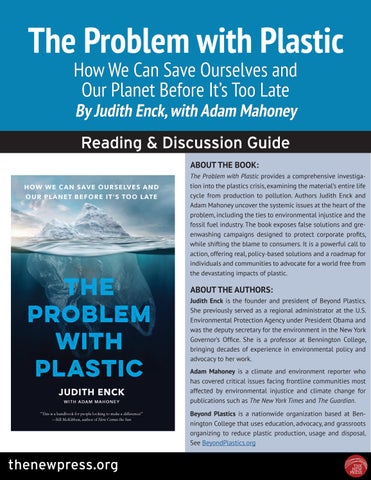
The Problem with Plastic provides a comprehensive investigation into the plastics crisis, examining the material’s entire life cycle from production to pollution. Authors Judith Enck and Adam Mahoney uncover the systemic issues at the heart of the problem, including the ties to environmental injustice and the fossil fuel industry. The book exposes false solutions and greenwashing campaigns designed to protect corporate profits, while shifting the blame to consumers. It is a powerful call to action, offering real, policy-based solutions and a roadmap for individuals and communities to advocate for a world free from the devastating impacts of plastic.
ABOUT THE AUTHORS:
Judith Enck is the founder and president of Beyond Plastics. She previously served as a regional administrator at the U.S. Environmental Protection Agency under President Obama and was the deputy secretary for the environment in the New York Governor’s Office. She is a professor at Bennington College, bringing decades of experience in environmental policy and advocacy to her work.
Adam Mahoney is a climate and environment reporter who has covered critical issues facing frontline communities most affected by environmental injustice and climate change for publications such as The New York Times and The Guardian.
Beyond Plastics is a nationwide organization based at Bennington College that uses education, advocacy, and grassroots organizing to reduce plastic production, usage and disposal. See BeyondPlastics.org

This chapter traces the origin of plastic, from its invention as a revolutionary “wonder material” to its current status as a global environmental threat. It details how plastic production skyrocketed and how the industry strategically crafted a narrative that placed the responsibility for plastic waste on consumers, all while lobbying to prevent government regulation.
Plastic, and our dependence on it, is such a nascent invention that nearly half of all the plastic ever created has been around only since 2007.
Protecting the planet wasn’t exactly the mission of this coalition. Instead, these companies and other major plastic producers began crafting a strategic narrative: Plastic pollution is your fault—the consumer’s fault.
The industry got what it wanted, though: more decades of drastically increasing plastic production without government interference.
There is only one true solution to curb the plastic that is choking our planet and contaminating our bodies: Companies must stop producing so much of it. Policymakers are the only ones with the authority to enforce such a change.
• How has the perception of plastic changed since it was first introduced?
• Discuss the strategies the plastics industry used to shift responsibility for pollution onto consumers. How effective were these campaigns?
• What role did the “crying Indian” ad play in shaping public perception of plastic pollution?
• How did the industry’s promotion of recycling confuse the public and policymakers?
Chapter 2 explores the dangerous connection between plastic and human health. It explains that plastics are made from fossil fuels and thousands of chemical additives, many of which are toxic. The authors detail how microplastics and nanoplastics are now found in our air, water, food, and even our bodies, posing significant health risks that are still being discovered.
Researchers believe that many of the microplastics we consume pass through our bodies and are excreted. However, some are small enough to be absorbed through the intestines and enter the bloodstream.
Turning a small amount of oil or a puff of ethane into something as simple as a plastic fork requires a massive amount of refining and manufacturing, which is why chemical additives are used.
• What are some of the health risks associated with microplastic exposure?
• Why are chemical additives used in plastic production, and what dangers do they pose?
• The book states that policymakers are the only ones with the authority to enforce a reduction in plastic production. Do you agree or disagree? Why??
• Before reading this chapter, were you aware of the extent to which microplastics have infiltrated our bodies? How does this knowledge change your perspective on plastic?
• Discuss the environmental justice dimension of the plastics industry. Why are residents and workers in low-income communities and communities of color disproportionately affected by the health risks of plastic production??
Chapter 3 systematically debunks the myth that recycling is a viable solution to the plastics crisis. It reveals that the vast majority of plastic has never been recycled and explains the economic and technical limitations of the process. The authors also differentiate between true recycling and “downcycling,” where plastic is turned into a lower-quality product that cannot be recycled again.
Despite being portrayed as a green panacea, plastics recycling is fraught with fundamental problems. The harsh reality is that the vast majority of plastic waste—over 90 percent globally—has never been recycled.
At its most basic level, recycling means taking something used and making it into roughly or exactly the same sort of thing. . . . Downcycling means taking something used and making it into a very different sort of thing—usually something less valuable than the thing you started out with.
Given the negligible amount of plastic that is actually being recycled, compared to the vast quantities produced and discarded, it’s clear that plastics recycling, on the whole, has been a failure.
• What are the primary reasons why plastics recycling has failed on a large scale?
• What’s an example of recycling and an example of downcycling?
• How have corporations used the idea of recycling to justify continued single-use plastic production?
• How does the failure of plastic recycling reinforce the argument that the only real solution is to produce less plastic?
This chapter connects the plastics crisis to climate change and environmental injustice. It highlights how the petrochemical industry’s production facilities are disproportionately located in low-income communities and communities of color, exposing residents to toxic pollution. Through personal stories, the chapter illustrates the devastating human cost of our reliance on plastic.
Today, the total climate change-driving emissions of plastics, from production to disposal, are estimated to be four times those of the global aviation industry.
“You can’t survive without water, you can’t survive without air, and you can’t survive without land,” she says, and the governments and industries driving this destruction are aware of this.
“It’s intentional neglect, and it’s killing us. They’ve left us underwater.”
• How does plastic production contribute to climate change at every stage of its life cycle?
• What is “environmental racism,” and how does it relate to the plastics industry?
• Discuss the term “sacrifice zones,” What does it mean for the communities located near petrochemical plants?
• Why is the story of communities like St. James Parish, Louisiana (part of “Cancer Alley”), central to understanding the true cost of plastic?
• The chapter title is “The Cost of Convenience.” What are the costs, and who pays them? Discuss the connection between consumer convenience and the environmental and social damage described.
The focus of this chapter is the catastrophic impact of plastic pollution on our oceans and freshwater ecosystems. The authors describe the staggering amount of plastic waste that ends up in marine environments, killing wildlife and contaminating the food web. The chapter emphasizes that surface-level cleanups are insufficient to address a problem that extends to the deepest parts of the ocean.
Over 171 trillion pieces of plastic are estimated to be in our oceans.
The ocean has become a deep landfill. Skimming the surface isn’t going to solve the problem.
Each year, plastic waste is responsible for the deaths of up to 1 million seabirds, 100,000 sea mammals and marine turtles, and untold numbers of fish.
• In what ways does plastic harm marine animals?
• What are the main sources of plastic pollution in the ocean?
• The chapter argues that ocean cleanup initiatives, while well-intentioned, are not a solution. Why?
• How does plastic pollution in the oceans eventually impact humans?
• The chapter explains how microplastics move up the food chain from small organisms to fish, whales, and ultimately humans. Discuss the long-term implications of this contamination for both wildlife and human health.
Chapter 6 critically examines and debunks the “false solutions” promoted by the plastics industry to avoid regulation. These include so-called chemical recycling (also known as “advanced recycling”), plastics-to-fuel technologies, and bioplastics. The authors argue that these are misleading, energy-intensive, and polluting tactics that fail to address the root cause: overproduction.
Chemical recycling is a deceptive false solution to plastic pollution. It claims to address the issue without actually reducing plastic production and consumption.
Just as mechanical recycling was a myth, so, too, is chemical recycling. It is yet another unicorn trotted out by the petrochemical industry to delay regulation, confuse the public, and maintain profits.
Federal regulators in the United States and across Europe have subsidized chemical recycling facilities to the tune of hundreds of millions of dollars.”
• What is chemical recycling, and why do the authors consider it a “false solution”?
• Why are bioplastics not the environmental panacea they are often claimed to be?
• How does the promotion of these technologies serve the interests of the fossil fuel and plastics industries?
• Why do you think governments and investors are putting money into these unproven technologies instead of focusing on reduction and reuse?
This chapter shifts from problems to solutions, outlining a clear path forward focused on policy and systemic change. The authors advocate for proven strategies like single-use plastic bans, extended producer responsibility (EPR) laws that hold companies financially responsible for their packaging, and modernized bottle deposit systems. The core message is that reducing production and embracing reuse are the only viable solutions.
Every lasting solution to plastic pollution hinges on this simple concept: produce and use less, so there’s less to waste.
As Zero-Waste Chef’s Anne Marie Bonneau once said, “We don’t need a handful of people doing zero waste perfectly; we need millions of people doing it imperfectly.”
Individual choices alone cannot regulate production or hold corporations accountable, which is why creating a more equitable approach to reducing plastic pollution must begin at the policy level.
• What is extended producer responsibility (EPR), and how would it help solve the plastic problem?
• Discuss the effectiveness of single-use plastic bans. What are some of the arguments against them, and how does the book address these?
• What are “bottle bills,” and why are they considered a successful model for recycling and reuse?
• The book emphasizes policy over individual action. How can individuals best contribute to driving policy change?
• Discuss the quote: “We don’t need a handful of people doing zero waste perfectly; we need millions of people doing it imperfectly.” How does this idea make environmental action feel more accessible? What “imperfect” actions could you take?
To counter the overwhelming nature of the crisis, this chapter provides inspiration by sharing stories of activists and communities who are successfully fighting back against Big Plastic. It highlights the power of grassroots organizing, particularly leadership from women, in achieving tangible victories and creating a global movement for change.
Reducing plastic production and use is not rocket science. But systemic change through new laws and regulations is being blocked by political science.
This hard work should not be done exclusively by women, although the reality is that today it is.
History shows us that transformative change often begins with ordinary people who refuse to accept the status quo.
• What common strategies or characteristics do the successful activists in this chapter share?
• Why do you think women are often at the forefront of the environmental justice movement against plastic pollution?
• Which story of activism in this chapter did you find most inspiring or impactful, and why?
• How do these stories demonstrate that local action can lead to broader, systemic change?
The final chapter offers a practical guide for readers who want to take action. It provides a list of concrete steps to reduce personal plastic use, such as performing a home waste audit and switching to reusable alternatives. While it offers individual tips, the chapter reinforces the message that the most crucial action is to get involved in collective efforts to advocate for policy change.
Switching to reusable versions of single-use products . . . is an easy way to help prevent wasted resources, avoid toxic chemicals, and reduce both plastic pollution and climate-warming greenhouse gas emissions.
Even if you were to do all of the things mentioned—and more—it still wouldn’t be enough.
Starting or joining a Beyond Plastics Local Group or other environmental or community organization fosters the motivation, idea sharing, and action we desperately need.
• Which of the “10 Easy Reuse Solutions” seems most achievable for you to implement in your life? Which seems most difficult?
• What is the purpose of a household waste audit, and how can it help reduce plastic consumption?
• The book says that individual actions are not enough. Do you agree? How can we balance personal responsibility with the need for collective action?
• What is one concrete step you can take this week to get involved in advocating for systemic change in your community?
The Problem with Plastic emphasizes that while individual actions matter, lasting change requires collective action and systemic reform. Consider how you can move beyond personal choices to become an advocate for the policy changes and cultural shifts needed to create a world beyond plastic.
• Systemic Change is Essential: The core message of the book is that individual action and recycling are not enough. The plastic pollution crisis is a systemic problem driven by corporate irresponsibility and government inaction, not just individual choices. It can only be solved through strong public policy, regulation, and holding corporations accountable.
• Recycling is Not a Solution: The book systematically debunks the myth of plastics recycling, revealing it as a public relations strategy created by the industry to promote consumption, not a viable waste management solution. The only effective way to address the crisis is to drastically reduce the production of single-use plastics.
• Plastic is a Health and Justice Issue: The entire life cycle of plastic is harmful. The production, use, and disposal of plastic have profound consequences for human health and disproportionately harm low-income and minority communities, making plastic pollution an issue of environmental and social justice.
• There is Power in Collective Action: While the problem is enormous, the book provides a hopeful message that through collective advocacy, grassroots organizing, and public pressure, citizens have the power to challenge the plastics industry and create a healthier, more sustainable future.
• How has reading The Problem with Plastic changed your understanding of the issue? What was the most surprising thing you learned?
• The book connects plastic pollution to broader issues like climate change, public health, and social justice. Discuss the importance of viewing these issues as interconnected.
• After reading about both the scale of the problem and the potential solutions, do you feel more hopeful or more pessimistic about our ability to solve the plastic crisis? Why?
• What role should corporations that produce plastic play in the cleanup and transition away from a single-use economy?
• What do you believe is the single most important action that needs to be taken to address the crisis? Is it a policy change, a shift in corporate behavior, or something else?
• Which false solution were you most surprised to learn about?
• What gives you the most hope for addressing the plastics crisis?
• Why do you think the recycling myth has been so persistent despite evidence of its failure?
• What makes chemical recycling and bioplastics false solutions rather than genuine alternatives?
• How do corporate voluntary pledges compare to mandatory regulations in effectiveness?
• What role does the fossil fuel industry play in perpetuating plastic production?
• How has this book influenced your daily choices about plastic use?
• Which of the book’s solutions feels most achievable to implement in your life?
• How do you balance individual responsibility with the need for systemic change?
• Conduct a household waste audit to identify your main uses of plastic.
• Systematically replace single-use items with reusable alternatives (e.g., water bottles, coffee cups, shopping bags, food containers).
• Ask your local grocery store manager to offer plastic-free options and reduce single-use plastic packaging.
• Support businesses that are actively working to reduce their plastic footprint, such as local refill shops and food coops.
• Contact your local, state, and federal elected officials to advocate for policies like single-use plastic bans, strong PR laws, and bottle bills.
• Join or establish a local Beyond Plastics group or if you are active with an existing group, have them become a Beyond Plastics affiliate.
• Create a personal action plan to reduce plastic use in three key areas of your life.
• Plan a “plastic-free challenge” for your organization or friend group.
FURTHER RESEARCH
• Investigate the specific plastic-related policies being considered in your city or state.
• Research the environmental justice impacts of petrochemical facilities in Louisiana (“Cancer Alley”), Texas, and the Ohio River Valley.
• Explore the science behind the health effects of endocrine-disrupting chemicals found in plastics.
• Look into the Global Plastics Treaty being negotiated by the United Nations.
• Map plastic production facilities, landfills, and incinerators in your region and their proximity to schools, day care centers and homes.
• Research your state’s laws and regulations on chemical recycling legislation.
• Search for microplastic contamination studies conducted on local waterways.
• Beyond Plastics: A national organization based at Bennington College that leads grassroots organizing, education, and advocacy efforts to end plastic pollution.
• Follow Beyond Plastics on Facebook, Instagram, Twitter/X, Bluesky, Threads, TikTok, LinkedIn, and YouTube
• Just Zero: A national nonprofit working to implement just and equitable Zero Waste solutions across the country.
• Follow Just Zero on Facebook, Instagram, Twitter/X, and LinkedIn
• International Pollutant Elimination Network (IPEN): A global network of public interest NGOs working to create a toxics-free future..
• Follow IPEN on Facebook, Twitter/X, and YouTube
• Beyond Petrochemicals: A campaign that aims to stop the rapid expansion of over 100 new U.S. petrochemical facilities.
• Follow Beyond Petrochemicals on Facebook, Twitter/X, Instagram, and LinkedIn
• Break Free From Plastic movement.
• Follow Break Free From Plastic on Facebook, Instagram, Twitter/X, and LinkedIn
• How to join a Beyond Plastics local group or affiliate (or start your own!)
• How to write a letter-to-the-editor that will be published
• How to start a petition
• How to host a rally
• How to host a plastic-free event
• Beyond Plastics’ fact sheets
• Beyond Plastics’ model bill to effectively reduce plastic production and use
• Beyond Plastics’ reports on the failure of recycling, chemical recycling, bioplastics, and more
Before the Streetlights Come On: Black America’s Urgent Call for Climate Solutions by Heather McTeer Toney, Broadleaf Books, 2023
Deceit and Denial: The Deadly Politics of Industrial Pollution by David Rosner and Gerald Markowitz, University of California Press, 2013
Merchants of Doubt: How a Handful of Scientists Obscured the Truth on Issues from Tobacco Smoke to Climate Change by Naomi Oreskes and Erik M. Conway, Bloomsbury Publishing, 2011
A Poison Like No Other: How Microplastics Corrupted Our Planet and Our Bodies by Matt Simon, Island Press, 2025
Thicker Than Water: The Quest for Solutions to the Plastic Crisis by Erica Cirino, Island Press, 2022
Thank you for engaging with this book published by The New Press; we hope you enjoyed it. New Press books and authors play a crucial role in sparking conversations about the key political and social issues of our day.
To find your next read and learn more, follow us on social media and visit us at thenewpress.org
To request an Exam / Desk Copy for course use the QR code below to fill out our Academic Requests form or email academic@thenewpress.org
