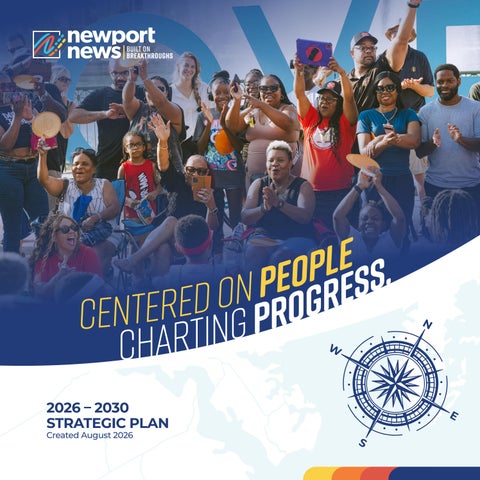
2026 – 2030 STRATEGIC PLAN Created August 2026
A MESSAGE FROM THE MAYOR & CITY MANAGER Newport News is a city shaped by its people, its neighborhoods, and the opportunities we create together. The 2026 – 2030 Strategic Plan reflects our commitment to building a community where people have opportunities to thrive, neighborhoods are strong and sustainable, residents feel connected to their city, and local government is responsive to the people it serves. At the heart of this plan is the idea of being Centered on People. Charting Progress. Being centered on people means looking beyond the work we perform to the difference that work makes in the lives of our residents. It means creating opportunities for learning and economic mobility, supporting safe and healthy neighborhoods, strengthening connections across our community, and ensuring City services are accessible, responsive, and effective. Charting progress means being equally committed to results. This plan establishes clear objectives, strategies, and measures that will allow us to better understand where we are making progress, where challenges remain, and where our efforts and resources can have the greatest impact. By focusing on meaningful outcomes, we can strengthen accountability while continuing to learn, adapt, and improve. The priorities and strategies in this plan were developed through collaboration across City government and informed by the experience and expertise of those who serve our community. The process brought together City leadership and employees while also building upon existing City performance measures and lessons from communities that have developed strong approaches to measuring progress. Over the next four years, this plan will guide our decisions, investments, and partnerships as we work to expand opportunity, strengthen our neighborhoods, support a resilient economy, celebrate the character and culture of Newport News, and provide the high-quality services our residents expect. We are grateful to the residents, members of City Council, City employees, and community partners whose ideas, leadership, and dedication continue to shape Newport News. By keeping people at the center of our work and measuring the progress we make together, we can build on our strengths and continue moving Newport News forward.
Phillip Jones Mayor
Alan Archer City Manager
Centered on People. Charting Progress. | STRATEGIC PLAN
3
CITY MANAGER & CITY COUNCIL Mayor
Phillip Jones
NORTH DISTRICT
CENTRAL DISTRICT
SOUTH DISTRICT
4
City Manager
Alan Archer
City Clerk
Xavier D. Clark
City Attorney
Robert Pealo
City Auditor
Tammie Dantzler
Councilman Marcellus L. Harris III North District 1, Seat A
Vice Mayor Curtis D. Bethany III North District 1, Seat B
Councilman Robert Coleman Central District 2, Seat A
Councilman Cleon M. Long, P.E. Central District 2, Seat B
Councilwoman Tina L. Vick South District 3, Seat A
Councilman John R. Eley III South District 3, Seat B
Centered on People. Charting Progress. | STRATEGIC PLAN
TABLE OF CONTENTS
6 7 8 9
INTRODUCTION
HOW THIS PLAN WAS BUILT
DESIGN PRINCIPLES
GOAL 1. People First: Opportunity & Learning
1.1 Lifelong Learning ............................................................. 10 1.2 Workforce Development .................................................. 13 1.3 Business Growth & Economic Resilience ........................... 15 1.4 Financial Empowerment & Wealth Building ....................... 18
20
GOAL 2. Strong & Sustainable Communities: Safety, Housing, Environment & Mobility
2.1 Public Safety & Emergency Readiness ............................... 21 2.2 Community Health & Wellness ......................................... 24 2.3 Environmental Resilience ................................................. 26 2.4 Housing Access & Neighborhood Revitalization ................ 28 2.5 Public Space Landscaping & Neighborhood Pride ............ 31 2.6 Safe, Connected & Accessible Transportation Options ...... 33
36
GOAL 3. Culture & Connection
3.1 Arts, Culture & Community Celebration ............................ 37 3.2 Community Events & Civic Engagement ........................... 39 3.3 City Identity & Strategic Branding ..................................... 42
44
GOAL 4. Engaged Government: Innovation & Service
4.1 Operational Excellence.................................................... 45 4.2 Accessible Services & Infrastructure Excellence ................ 48 4.3 Transparent Communication & Informed Engagement ....... 50 4.4 Community Engagement & Civic Empowerment ............... 52
Centered on People. Charting Progress. | STRATEGIC PLAN
5
INTRODUCTION Newport News’ 2026 – 2030 Strategic Plan reflects a shared vision for the future of the city, shaped by the priorities of City Council, the perspectives and experiences of residents, and the expertise of City staff. Building on the City’s previous strategic framework, the plan provides a more focused approach to aligning priorities, guiding action, and measuring progress over the next four years. At the center of this work is a vision for the future of Newport News: Rooted in maritime excellence, we are building a future-focused economy that attracts talent, accelerates innovation, and expands opportunity across a thriving riverfront community. This vision provides the foundation for the goals, objectives, strategies, and measures that make up the plan and guides the City’s work over the next four years. The plan was developed through a collaborative process that brought together City Council direction, resident input, and the knowledge and experience of City staff. Council established a shared vision and strategic priorities through research, interviews, and consensus-building. Resident perspectives were incorporated through community surveys and direct engagement, including iNNoX in fall 2025. Designed to make strategic planning more innovative, accessible, and engaging, iNNoX used hands-on activities, voting, mapping, and discussion to gather structured resident feedback that helped shape the priorities and direction of the 2026–2030 Strategic Plan. City departments and leadership then worked to translate those priorities into actionable strategies and measurable outcomes. The result is a framework of 17 objectives and 27 citywide key performance indicators (KPIs) designed to connect priorities to action and provide a clear way to understand and communicate progress. As a living framework, the plan will continue to guide decisions, investments, and partnerships while allowing the City to respond to changing community needs and emerging opportunities.
6
Centered on People. Charting Progress. | STRATEGIC PLAN
HOW THIS PLAN WAS BUILT The 2026 – 2030 Strategic Plan was developed through a collaborative and data-informed process that connected Council direction, community voice, City expertise, and measurable outcomes. 1. COUNCIL & COMMUNITY PRIORITIES The process began by establishing a shared vision and identifying the priorities most important to Newport News’s future. City leadership reviewed existing plans and reports, conducted indepth interviews, primarily with members of City Council, and facilitated a consensus workshop with Council. Resident perspectives helped inform and strengthen that direction. Feedback from the December 2024 budget engagement survey, May 2025 citizen survey, and iNNoX provided insight into residents’ experiences, priorities, and aspirations. Together, Council direction and community input established the foundation for the plan’s goals and objectives. 2. FROM PRIORITIES TO STRATEGIES With the overall direction established, City departments worked to translate those priorities into actionable strategies and measurable outcomes. Through four Goal Task Force Workshops, staff from across the organization contributed operational knowledge and subject-matter expertise and identified how City services, investments, programs, and partnerships could advance each objective. The City also reviewed its existing performance measures to identify where current measures could be elevated, adapted, or aligned with the new citywide framework. This helped connect the strategic plan to work already underway while identifying areas where new measures were needed. 3. RESEARCH, REVIEW & REFINEMENT The framework was further informed by research into communities recognized for strong
Centered on People. Charting Progress. | STRATEGIC PLAN
7
citywide performance measurement practices, including Charlotte, Baltimore, Boston, Louisville, Kansas City, and Somerville. Their approaches provided useful lessons for developing a focused and understandable system for measuring progress. Draft strategies and KPIs were then refined through multiple rounds of department, departmenthead, Deputy City Manager, and Executive Leadership Team review. In total, approximately 109 comments were reviewed and addressed before the framework of citywide strategies and 27 KPIs was finalized. The result is a plan that connects the vision and priorities established through the planning process with the actions the City will take and the results it will measure over the next four years.
DESIGN PRINCIPLES Several principles guided how strategies and KPIs were drafted:
8
•
Build on what's already there first. Where the City already has data or a measurement program in place, we propose using it. Net-new instruments are reserved for outcomes the City genuinely cannot measure today.
•
Outcome measures over output measures. A KPI counts what changed for residents and the city, not just what activities the City completed. Counts of activities (events held, projects completed) generally live at the department level, not the citywide level.
•
Reduce reporting burden where possible. A citywide KPI should ideally absorb or replace one or more department measures so departments have less to track at the program level, not more.
•
Keep the citywide KPI list short. This framework includes 27 citywide KPIs total — about one to two per objective across the plan’s 17 objectives, comparable to the focused citywide scorecards of peer cities.
Centered on People. Charting Progress. | STRATEGIC PLAN
GOAL 1.
PEOPLE FIRST: OPPORTUNITY & LEARNING Centered on People. Charting Progress. | STRATEGIC PLAN
9
1.1
LIFELONG LEARNING
Objective: Ensure every Newport News resident has access to high-quality, career-connected learning from early childhood through adulthood — by strengthening Pre-K readiness, improving K–12 education system, expanding adult education and workplace training.
Citywide Strategies 1. Build a mapped, partnered continuum of learning resources from early childhood through adulthood, with clear pathways to careers and credentials. The city will inventory existing programs across departments and community partners, identify gaps (especially in adult learning and credential attainment), and coordinate access points so residents know where to turn at each life stage. 2. Strengthen Pre-K readiness and early intervention by deploying literacy and schoolpreparation support to highest-need locations, with family engagement as the core lever. City will expand library early literacy outreach and coordinate with Parks & Recreation youth programs, Human Services family-engagement programs (such as Parents As Teachers and Healthy Families), and schools to reach families before kindergarten entry, reducing downstream dropout risk.
10 Centered on People. Charting Progress. | STRATEGIC PLAN
3. Connect K–12 outcomes to the city's actual career landscape. Support schools in expanding work-readiness, digital literacy, and credential options (ACT, technical certifications) — with explicit career-exploration pathways into the trades, technical fields, and researchadjacent occupations that anchor the local economy. Partner with Newport News Public Schools and regional workforce providers to keep supporting learners as they leave the K–12 system — building deliberate bridges that carry high school completers into adult training, credentialing, and employment pathways. 4. Remove structural barriers to learning and employment access by designing programs, spaces, and services that meet residents where they are. City will audit physical accessibility, transportation, childcare, and digital literacy barriers; coordinate across libraries, parks, and community partners to lower enrollment friction (e.g., co-locate services, reduce eligibility paperwork, offer multiple modalities).
Centered on People. Charting Progress. | STRATEGIC PLAN
11
Citywide KPIs 1. Percentage of Newport News residents with active participation in at least one City learning opportunity in the past 12 months. 2. Credential & Skill Attainment. Percentage of City-sponsored workforce program completers earning an industry-recognized credential, digital literacy certification, or post-secondary enrollment within 12 months of program completion.
12
Centered on People. Charting Progress. | STRATEGIC PLAN
1.2
WORKFORCE DEVELOPMENT
Objective: Strengthen partnerships with industry leaders and regional training providers to align workforce development with employer needs, fostering collaborative talent pipelines that equip residents for high-demand careers and support a resilient, future-ready economy.
Citywide Strategies 1. Align workforce programs to the talent gaps in Newport News's real employer base. Establish shared labor-market intelligence with the Workforce Development Board, community colleges, and the city's anchor employers — across skilled trades, technical fields, and research-adjacent occupations — that forecasts demand and informs which occupational training programs the city and its partners prioritize and scale. 2. Reduce barriers to career entry and advancement for disadvantaged residents. Target outreach, wraparound support, and direct access to training for residents facing structural barriers (transportation, childcare, digital literacy, prior contact with justice system), with explicit performance tracking by demographic. Build continuous pathways from youth engagement and prevention work (2.1) into year-round adult economic-mobility pathways. 3. Build employer commitment through pipeline partnership and hiring accountability. Formalize commitments with anchor employers and growing industry clusters (skilled trades, healthcare, IT) to participate in talent development, commit to hiring graduates, and report hiring outcomes—positioning Newport News as a dependable talent source.
Centered on People. Charting Progress. | STRATEGIC PLAN
13
4. Position Newport News's workforce — and the depth of the industries that built it — as a primary differentiator in business attraction. Market the region's workforce development ecosystem (programs, partnerships, outcomes) to recruit and retain businesses, leveraging the city's distinctive industrial and research base as a draw for compatible investment.
Citywide KPI 1. Job placement and 90-day retention rate for city-supported workforce participants. Percentage of workforce program participants achieving job placement within 6 months of program completion, who remain employed at 90 days; disaggregated by demographic group and program type.
14
Centered on People. Charting Progress. | STRATEGIC PLAN
1.3
BUSINESS GROWTH & ECONOMIC RESILIENCE
Objective: Strengthen the city's economic foundation by attracting and retaining diverse businesses including homegrown enterprises, shipbuilding, advanced manufacturing, and technology sectors — while preserving and expanding the presence of military and federal facilities to drive innovation, job creation, and long-term prosperity for Newport News residents.
Citywide Strategies 1. Anchor business incentives to the sectors defining Newport News's economy and its next chapter. Systematically assess and respond to workforce gaps, expansion opportunities, and barriers across shipbuilding, advanced manufacturing, federal defense, and the research and innovation activity increasingly drawing investment to the peninsula. Partner with HR Alliance, VEDP, and other regional and statewide partners to close leads that compound this anchor advantage. 2. Streamline business entitlement and site activation processes to reduce time-to-market. Reduce processing times for zoning, permits, and economic development applications while actively promoting certified business-ready sites, making Newport News a frictionless alternative to competitor regions. 3. Strengthen the small business and entrepreneurial ecosystem through curated access to capital, mentorship, and operational support. Institutionalize connections between emerging entrepreneurs and SWaM suppliers with existing support resources and financing programs, moving beyond awareness to measurable utilization and enterprise survival.
Centered on People. Charting Progress. | STRATEGIC PLAN
15
4. Secure and expand military and federal presence through proactive relationship management and strategic infrastructure investment. Embed dedicated federal/military liaison capacity and coordinate physical/cyber infrastructure improvements that signal longterm commitment to retention and future investment. 5. Advance digital infrastructure as economic infrastructure, with the City as convener and coordinator. Treat the networks, sites, facilities, and trustworthy operations that move, store, and protect data as an ecosystem essential to business growth — not a single project. Working with anchor institutions and partners across defense, shipbuilding, research, healthcare, and higher education, convene providers and align public, private, and institutional needs — and prepare carefully selected sites, policies, and partnerships — so the City can meet the reliability, redundancy, and scalability its anchors and largest industries require, attract responsible digital investment on its own terms and extend the benefits of connectivity to every neighborhood.
16
Centered on People. Charting Progress. | STRATEGIC PLAN
Citywide KPIs 1. Total Private Capital Investment. Cumulative dollar volume of confirmed new private investment (equity, debt, reinvestment) in Newport News, measured annually. Includes investment both within and outside designated incentive zones. 2. Public Investment Leverage Ratio. Ratio of confirmed private capital investment to public dollars deployed in direct support of that investment (incentives, grants, and infrastructure tied to a specific development).
Centered on People. Charting Progress. | STRATEGIC PLAN
17
1.4
FINANCIAL EMPOWERMENT & WEALTH BUILDING
Objective: Seek partners who will equip residents with the tools, education, and opportunities to build lasting financial independence through expanded access to financial literacy programs, homeownership pathways, and career-connected income growth that supports generational wealth and economic resilience.
Citywide Strategies 1. Expand down-payment assistance and debt-reduction programs targeted at rental-tohomeownership pathways. Move beyond processing efficiency to outcomes: design and resource programs that actively move renters toward ownership (down-payment assistance, counseling, developer partnerships for acquisition of city-owned or tax-foreclosed units) and deploy debt-reduction interventions that measurably improve credit and liquidity. 2. Subsidize digital literacy and broadband access as enablers of financial empowerment. Recognize that financial literacy programs, loan applications, and wealth-building resources are increasingly digital-dependent; bundle broadband subsidy, device access, and digital skills training with financial education to remove friction for ALICE (Asset Limited, Income Constrained, Employed) and unbanked populations.
18
Centered on People. Charting Progress. | STRATEGIC PLAN
3. Stabilize neighborhood wealth in the corridors where most residents actually build their lives. Focus housing code enforcement, rehabilitation subsidy, and property acquisition strategy on neighborhoods with high ALICE concentration. Increase confidence in long-term ownership and reduce displacement through rising maintenance costs.
Citywide KPIs 1. Low-income households served through City housing assistance programs. Unique lowincome households served in the reporting year through City housing-assistance and neighborhood-support programs, divided by total Newport News households at or below 80% AMI. 2. ALICE population percentage change, 3-year rolling baseline. Percent change in the count of ALICE households (as defined by the United Way ALICE methodology) measured every three years via the American Community Survey (ACS).
Centered on People. Charting Progress. | STRATEGIC PLAN
19
GOAL 2.
STRONG & SUSTAINABLE COMMUNITIES: SAFETY, HOUSING, ENVIRONMENT & MOBILITY 20
Centered on People. Charting Progress. | STRATEGIC PLAN
2.1
PUBLIC SAFETY & EMERGENCY READINESS
Objective: Deliver responsive, community-centered police, fire, and emergency services, that protect the safety of all residents, employees, and visitors — by fostering trust, ensuring rapid response, and maintaining secure environments across neighborhoods, workplaces, and public spaces.
Citywide Strategies 1. Build visible, trusted police and fire presence in neighborhoods. Community safety improves when residents see responsive personnel, know how to reach them, and experience consistent engagement. This strategy prioritizes station visibility, foot patrols, and planned community touchpoints over incident-driven visibility alone — shifting from a city that is passed through to one that is known and present. This presence also supports, monitors, and encourages positive youth engagement, including work with court-involved youth and their families. 2. Expand emergency services to meet demand and ensure equitable response times across all neighborhoods. Targeted recruitment, staffing, and station placement support consistent emergency response across all districts as the city grows. 3. Connect residents to opportunity through primary, secondary and tertiary prevention approaches that operate alongside traditional enforcement. The City and communitybased organizations (CBOs) work under shared expectations to expand community safety
Centered on People. Charting Progress. | STRATEGIC PLAN
21
capabilities and wraparound services for those most impacted by violence, including courtinvolved youth and their families, by partnering with young people and those with lived experience — connecting youth and families to resources, mentorship, and reentry supports — to enable a community-owned safety ecosystem. 4. Partner with businesses and community organizations to prevent and solve crime together. This strategy coordinates business and CBO involvement in crime prevention, connects them to problem-solving, and supplies technical guidance to underserved commercial corridors. 5. Invest in technology and best practices to accelerate emergency response and investigation. Faster 911 processing, advanced dispatch, data-driven deployment, and investigation tools increase effectiveness and officer confidence while reducing resident wait times.
22 Centered on People. Charting Progress. | STRATEGIC PLAN
Citywide KPIs 1. Crime Rate per 100,000 Population (FBI Part I Offenses, 12-month rolling). Total number of reported FBI Part I offenses (homicide, rape, robbery, aggravated assault, burglary, larcenytheft, motor vehicle theft, and arson) divided by mid-year population estimate, scaled to per-100,000 standard. 2. 90th Percentile Response Time to Priority 1 Emergency Calls (Police, Fire, EMS combined). Across Police Patrol priority 1 calls, Fire Suppression, and EMS transport-eligible calls, the 90th percentile response time (dispatch receipt to on-scene) is tracked separately by service. 3. Wraparound service connection and completion for those most impacted by violence. Percentage of individuals most impacted by violence who are successfully connected to and complete community-based wraparound services delivered by trained, lived-experienceinformed organizations, reported annually.
Centered Centered on on People. People. Charting Charting Progress. Progress. || STRATEGIC PLAN 23
2.2
COMMUNITY HEALTH & WELLNESS
Objective: Advance the well-being of Newport News residents by expanding access to health and wellness services, fresh food, and active lifestyle opportunities.
Citywide Strategies 1. Mobilize community-based health and wellness services in underserved neighborhoods. Partner with CBOs and health providers to deploy trauma-informed, culturally competent services where residents live—not just in downtown or waterfront corridors. Emphasize prevention and early intervention over downstream rehabilitation. 2. Expand food access and nutrition equity citywide. Create pathways — through retail development, community gardens, mobile markets, and SNAP partnerships — that ensure all residents, regardless of neighborhood or income, can access fresh, affordable food. 3. Strengthen mental health and crisis support through coordinated city systems. Deploy mental health and crisis services across the community in coordination with city departments and community partners; position the City, over a multi-year build, as an accessible first responder for mental health crises rather than relying on emergency departments alone.
24
Centered on People. Charting Progress. | STRATEGIC PLAN
4. Invest in youth and family stability to reduce downstream enforcement burden. Prioritize prevention services, kinship placements, and family support in early childhood and adolescence — recognizing that investing upstream in kids reduces costs and improves life trajectories.
Citywide KPIs 1. Resident satisfaction with access to health and wellness services. Percent of Newport News residents reporting they can access the health and wellness services they need. Tracks both awareness and actual access across physical health, mental health, and food security. 2. Fresh food retailer access. Percentage of Newport News residents living within a half-mile of a SNAP-authorized grocery store, supermarket, or superstore (convenience stores excluded), reported annually.
Centered on People. Charting Progress. | STRATEGIC PLAN
25
2.3
ENVIRONMENTAL RESILIENCE
Objective: Advance environmental stewardship as a foundation for community health and safety by investing in sustainable infrastructure, protecting natural resources, and promoting practices that enhance air and water quality, and help to mitigate climate risks.
Citywide Strategies 1. Integrate climate risk and flood resilience into capital planning and infrastructure design decisions. All city-funded infrastructure projects — from water main replacement to street resurfacing — must screen for sea-level rise and stormwater risk and build resilience into design, prioritizing neighborhoods with highest exposure. Coordinate climate-resilience and sustainability practices across municipal operations — facilities, fleet, energy use, and procurement — to reduce long-term risk and operating costs where feasible. 2. Protect and restore natural buffers — shorelines, wetlands, and tree canopy — as costeffective flood defense and habitat. Deploy living shorelines and nature-based solutions in high-risk coastal areas; expand tree canopy in interior neighborhoods (where most residents live) to manage stormwater and improve air quality. 3. Strengthen stormwater and surface water quality monitoring and transparency so residents understand conditions in real time. Publish accessible, regularly updated data on stormwater quality, combined sewer overflows, and beach water quality; involve community science volunteers in monitoring programs.
26
Centered on People. Charting Progress. | STRATEGIC PLAN
4. Advance sustainability across the city’s largest landholders and new development through both partnership and standards. Work with anchor institutions, major landholders, and suppliers — where the City’s lever is collaboration — to adopt lowimpact practices (reducing impervious surfaces, managing stormwater on-site, improving energy/water efficiency), while applying development standards and code where the City has regulatory authority. Align private and public resilience in a region where the same flood risk affects everyone.
Citywide KPIs 1. Tree canopy cover (%). Satellite-derived estimate of canopy coverage citywide and by neighborhood, updated annually. 2. FEMA Community Rating System (CRS) classification. The City’s class under the FEMA Community Rating System, a community-wide rating of floodplain-management effort.
Centered on People. Charting Progress. | STRATEGIC PLAN 27
2.4
HOUSING ACCESS & NEIGHBORHOOD REVITALIZATION
Objective: Expand access to safe, affordable, and high-quality housing for residents of all income levels — while eliminating blight, enhancing the appearance of neighborhoods, and fostering vibrant, welcoming communities across Newport News.
Citywide Strategies 1. Coordinate cross-departmental blight elimination and neighborhood maintenance as a unified standard. Codes, Public Works, Parks, and community partners operate under shared expectations for property condition, safety, and appearance — moving from reactive code enforcement to proactive neighborhood stewardship. 2. Improve the development review and permitting process, making it more transparent, consistent, accountable, and efficient. Give applicants clear, up-front guidance on requirements and expected timelines, coordinate reviews across the departments a project touches, and provide visibility into where each submission stands — so housing and neighborhood-revitalization projects move predictably from application to approval. 3. Build community ownership in neighborhood revitalization through resident engagement and local partnership. Strengthen existing neighborhood associations and create forums where residents, businesses, and City staff jointly identify and shape improvements.
28 Centered on People. Charting Progress. | STRATEGIC PLAN
Centered on People. Charting Progress. | STRATEGIC PLAN 29
4. Invest in corridor and gateway visibility to signal neighborhood quality and create conditions for private investment. Prioritize high-visibility corridors (commercial strips, neighborhood entries, transit nodes) for public improvements in lighting, landscaping, and streetscape that raise the baseline and attract private reinvestment.
Citywide KPI 1. Blight prevalence. Percentage of residential properties citywide with one or more validated high-priority code violations during the reporting year.
30 Centered on People. Charting Progress. | STRATEGIC PLAN
2.5
PUBLIC SPACE LANDSCAPING & NEIGHBORHOOD PRIDE
Objective: Enhance the beauty, functionality, and community pride of Newport News by investing in the thoughtful landscaping of parks, medians, and public areas — creating inviting, wellmaintained spaces that reflect the city's commitment to quality of life and neighborhood vitality.
Citywide Strategies 1. Develop a neighborhood-centered park master plan that prioritizes interior city parks and green corridors. Interior parks and medians are the daily public realm for most residents; a coordinated maintenance and design standard ensures visibility of city investment where it matters most. 2. Establish clear maintenance standards and accountability for parks, medians, and public grounds citywide, supported by the grounds crews, fleet, and equipment capacity that make consistent upkeep possible. Consistent upkeep signals respect for neighborhoods and removes barriers to resident pride; transparent schedules build trust in city commitment. 3. Activate community stewardship through structured neighborhood partnerships on public space appearance. Residents care for spaces they help define; partnership models (adopt-a-corridor, community beautification grants) distribute maintenance burden and deepen neighborhood ownership.
Centered on People. Charting Progress. | STRATEGIC PLAN
31
Citywide KPI 1. Park Facilities Satisfaction. Percentage of residents reporting they are satisfied with the quality, maintenance, and programming of Newport News parks and green spaces.
32
Centered on People. Charting Progress. | STRATEGIC PLAN
2.6 SAFE, CONNECTED & ACCESSIBLE TRANSPORTATION OPTIONS Objective: Strengthening transportation connectivity across Newport News and the region for travel by foot, bike, car, transit, and air. Improve mobility by enhancing the flow of traffic, expanding public transportation, and increasing the availability of bike and walk lanes.
Citywide Strategies 1. Coordinate transportation investments across departments and regional partners to move projects forward in concert. Use shared planning checkpoints so street, transit, and accessibility projects advance together and align with regional agency priorities (VDOT, HRT, federal facilities access).
Centered on People. Charting Progress. | STRATEGIC PLAN 33
2. Maintain and improve street and bridge conditions to a consistent, measurable standard across all neighborhoods. Peninsula geography concentrates maintenance demands. A formal pavement condition rating program ensures every neighborhood benefits from the same level of upkeep, and signals the City's commitment to basic infrastructure reliability. 3. Expand and communicate multimodal transportation options so residents understand the full menu of mobility choices. Many residents perceive limited options because information is fragmented. A coordinated effort (digital, print, community events) that highlights existing and new infrastructure builds ridership and walking/biking adoption. 4. Monitor emerging transportation technologies and pilot programs and adapt longrange plans accordingly. Peninsula geography and proximity to federal research and industrial infrastructure create unusual opportunities for innovation partnerships. Staying ahead of trends positions Newport News to attract research funding and serve the regional economy more efficiently.
Citywide KPIs 1. Annual Pavement Condition Rating. Percentage of City-maintained street miles in "good" or "excellent" condition (using the PCI score scale 1 – 100). 2. Multimodal Trips and Mode Share. Annual count of pedestrian, bicycle, transit, and car trips on major corridors.
34
Centered on People. Charting Progress. | STRATEGIC PLAN
Centered on People. Charting Progress. | STRATEGIC PLAN
35
GOAL 3.
CULTURE & CONNECTION 36
Centered on People. Charting Progress. | STRATEGIC PLAN
3.1
ARTS, CULTURE & COMMUNITY CELEBRATION
Objective: Expand access to creative expression and cultural experiences by supporting opportunities for all residents to engage with the arts, enjoy diverse entertainment, and participate in community festivals, parades and other events that foster joy, connection, and civic pride.
Citywide Strategies 1. Remove operational and financial barriers for residents to participate in arts and cultural programming. Reduce fees for low-income households, expand free community events, and simplify registration processes. 2. Activate arts and cultural programming in neighborhoods where residents live, not just downtown or signature venues. Deploy mobile pop-up events, partner with community centers and parks, and embed cultural activities into regular civic programming. Recognizes that access means geographic proximity and integration into everyday life. 3. Recruit, support, and highlight nontraditional and community-based artists and performers in citywide events. Actively seek diverse creative voices — local historians, makers, musicians, performers from underrepresented communities — to enrich event programming and signal that the city's cultural narrative includes all residents.
Centered on People. Charting Progress. | STRATEGIC PLAN
37
4. Co-design major citywide events and campaigns with participating communities before planning begins. Shift from afterthought consultation to deliberate partnership from concept through execution. Builds trust and ensures programming resonates with intended audiences.
Citywide KPI 1. Resident satisfaction with access to arts and cultural experiences. Percentage of surveyed residents who report satisfaction (very/somewhat satisfied) with their ability to access and participate in arts, cultural, and entertainment programming.
38
Centered on People. Charting Progress. | STRATEGIC PLAN
3.2
COMMUNITY EVENTS & CIVIC ENGAGEMENT
Objective: Foster meaningful resident engagement by supporting and creating inclusive community events — such as festivals, forums, and neighborhood gatherings — that celebrate local culture, spark dialogue, and provide accessible opportunities for residents to connect, contribute, and shape the future of Newport News.
Citywide Strategies 1. Embed event logistics and safety support across neighborhoods. City departments provide permitting, traffic, crowd safety, and vendor coordination in ways that reduce friction for grassroots and community-led events — not just downtown anchors. This lowers barriers to organizing and signals that every neighborhood's gathering matters. 2. Co-design major city events and signature experiences with residents and community partners before execution. Rather than city-led events handed to residents, involve residents and neighborhood organizations in planning, programming, and promotion — so the city’s signature events, festivals, and public-space activations reflect what residents want to celebrate, the stories they want to share, and how they want to be part of it. Designed this way, these experiences do more than draw a crowd: they strengthen neighborhood identity, build community pride, and generate authentic stories residents carry forward — turning one-time events into lasting community assets.
Centered on People. Charting Progress. | STRATEGIC PLAN
39
3. Establish a unified event calendar and volunteer coordination hub. Centralize information about city, nonprofit, and neighborhood events in one accessible place, paired with a streamlined volunteer matching system that lowers friction for residents to participate — whether at city events or community-led ones. 4. Use face-to-face engagement to build trust and invite residents to events. Prioritize doorto-door and neighborhood-based outreach from city staff and trusted community partners to identify safe spaces, build relationships, and personally invite residents — especially those who don't see themselves reflected in current events or don't perceive the city as inviting.
Citywide KPI 1. Resident sense of belonging and inclusion at city events. Percentage of survey respondents who agree that "City events make me feel welcomed and included" or "I see people like me participating in City events."
40
Centered on People. Charting Progress. | STRATEGIC PLAN
Centered on People. Charting Progress. | STRATEGIC PLAN
41
3.3
CITY IDENTITY & STRATEGIC BRANDING
Objective: Position Newport News as a vibrant hub of innovation, culture, and riverfront vitality by developing inclusive branding and marketing strategies that celebrate the city's unique assets, elevate its regional and national profile, and foster civic pride among residents.
Citywide Strategies 1. Anchor the city's identity in its working waterfront legacy and forward-looking innovation. Build brand messaging around what makes Newport News distinct — a deepwater port, federal defense presence, research institutions, and shipyard heritage — as the foundation for regional leadership, not as nostalgia. Avoid the perception-gap trap by naming the city's real assets plainly. 2. Establish clear brand governance and make compliance intuitive across departments. Create a shared brand toolkit (standards, templates, messaging guidelines) that departments can operationalize without friction. Governance should enable, not gatekeep; the barrier to brand alignment is often confusion, not resistance.
42
Centered on People. Charting Progress. | STRATEGIC PLAN
3. Build and align a community-driven narrative — rooted first in the people of Newport News, and in the industries, institutions, neighborhoods, and experiences they have built — so residents and visitors encounter a coherent identity across touchpoints. Coordinate storytelling and marketing themes across Communications, Tourism, Parks, Economic Development, and other city-facing channels so the city reads as intentional, not fragmented. This is the connective tissue between departmental campaigns. 4. Invest in external recognition and visibility that positions the city as a peer to innovation hubs in the region. Pursue awards, features, and partnerships (e.g., innovation rankings, regional media spotlights, university/research collaborations) that reshape how outsiders see Newport News. Perception follows proof; external validation accelerates internal pride.
Citywide KPI 1. Resident sentiment on city pride and civic identity. Percentage of residents who agree (strongly agree + agree) with the statement: "I am proud to live in Newport News."
Centered on People. Charting Progress. | STRATEGIC PLAN
43
GOAL 4.
ENGAGED GOVERNMENT: INNOVATION & SERVICE 44
Centered on People. Charting Progress. | STRATEGIC PLAN
4.1 OPERATIONAL EXCELLENCE Objective: Deliver efficient, fiscally sound government services by investing in a skilled and engaged workforce, modernizing technology and cybersecurity infrastructure, and fostering a culture of innovation and continuous improvement that enhances the resident experience and builds public trust.
Citywide Strategies 1. Build fiscal health as a competitive advantage. Align budget cycles with strategic priorities, adhere to financial policies, and pursue Government Finance Officers Association (GFOA) Awards for Excellence in Government Finance and the Distinguished Budget Presentation to strengthen credit rating, reduce borrowing costs, and promote truth in budgeting — signaling operational discipline to residents and investors alike. Coordinate citywide grantsmanship and external-funding capacity — identifying opportunities, strengthening applications, and managing compliance — to leverage state, federal, and philanthropic dollars against City priorities.
Centered on People. Charting Progress. | STRATEGIC PLAN
45
2. Modernize the city's digital foundation and cybersecurity posture. Invest in IT infrastructure resilience, data interoperability, and cybersecurity maturity to reduce risk exposure, ensure service continuity, and establish trusted environments for internal decisionmaking and public-facing transactions. 3. Develop and retain a technically skilled, engaged workforce. Strengthen succession planning, invest in continuous training (especially technical literacy and safety), and foster accountability and collaboration across departments to reduce turnover, minimize operational risk, and position the city to deliver complex, cross-departmental projects. 4. Shift from reactive to proactive service delivery and risk management. Institutionalize continuous improvement cycles, data-driven decision-making, and performance measurement across departments to anticipate problems, reduce misdirection, and build consistent, responsive government. Build the City’s data analytics and business-intelligence capacity — improving data quality, standardizing reporting, and expanding dashboards — so departments move from ad hoc reporting to timely, trusted insight.
Citywide KPIs 1. External Credit Rating. The City's general-obligation bond ratings, tracked annually. 2. Critical City Services Uptime. Percentage of time that core public-facing city services (online payments, permitting, utility billing, public safety dispatch, and resident-facing portals) are operational and free from cybersecurity-related disruption.) 3. Employee Net Promoter Score (ENPS). The City workforce’s likelihood to recommend the City as a place to work.
46
Centered on People. Charting Progress. | STRATEGIC PLAN
Centered on People. Charting Progress. | STRATEGIC PLAN
47
4.2
ACCESSIBLE SERVICES & INFRASTRUCTURE EXCELLENCE
Objective: Ensure all residents have access to high-quality city services by strengthening service delivery systems, investing in long-term infrastructure development and maintenance.
Citywide Strategies 1. Consolidate the City's resident input and service-request collection sources into a single system of record. Reduce the multiple doors and entry points residents navigate today so there is one consistent, lower-friction way to report issues, request services, track status, and share input, regardless of how a resident first makes contact. Capturing that activity in a single record also gives the City a more complete, 360-degree picture of residents and emerging community needs, turning routine interactions into a shared source of insight across departments. Priority focus: interior neighborhoods where service awareness gaps are widest. 2. Explore and deploy an asset management framework to align infrastructure renewal with fiscal plans and reduce reactive maintenance. Prioritize long-term stewardship over short-term fixes and stabilizing operational budgets. Move toward consistent lifecycle standards in how the City maintains its facilities, fleet, equipment, and the skilled-trades workforce that underpin frontline service delivery.
48
Centered on People. Charting Progress. | STRATEGIC PLAN
3. Modernize the city's digital service experience to meet resident expectations for speed, transparency, and accessibility. A rebuilt web platform and mobile-accessible service request tracking enable residents to access services on their terms and stay informed without phone calls or in-person visits. 4. Strengthen customer service standards and accountability across all departments and service delivery. Establish clear response-time commitments that reflect the nature of each request, with a citywide floor that every resident inquiry is acknowledged within 48 hours regardless of department or request type. Pair these with quality benchmarks and feedback loops so residents know what to expect and experience consistency whether interacting in person, by phone, or digitally.
Citywide KPI 1. Resident Satisfaction with City Services and Service Delivery. Survey item: "How satisfied are you with the quality and responsiveness of city services you've used in the past year?"
Centered on People. Charting Progress. | STRATEGIC PLAN
49
4.3 TRANSPARENT COMMUNICATION & INFORMED ENGAGEMENT Objective: Strengthen public trust and civic participation by delivering timely, clear, and accessible information through different communication channels and platforms to help inform, connect and engage residents and city businesses about city services and policy making.
Citywide Strategies 1. Establish a single, accessible point of entry for city information. Consolidate communications channels (311, website, social media, neighborhood-specific outlets) under a unified voice and consistent response standard.
50
Centered on People. Charting Progress. | STRATEGIC PLAN
2. Communicate decisions and trade-offs in plain language, with context about priorities. When the city makes a choice (budget allocation, policy change, service adjustment), explain what was weighed, why, and what residents gave up — not after the fact, but proactively. Builds understanding of realities and priorities and reduces misinformation. 3. Systematically listen to and act visibly on resident feedback. Set response expectations according to the type of input received, consistent with the customer-service commitments established under Objective 4.2. Establish a clear feedback loop: collect input, acknowledge receipt, report what changed (or why it didn't), and close the loop publicly. Visibility matters as much as the listening itself. 4. Ensure communication reaches interior neighborhoods and residents outside traditional civic channels. Deploy neighborhood liaisons, multilingual materials, and offline entry points (paper, phone, in-person) to reach residents who don't follow social media or visit nnva.gov. 5. Expand open data access to improve transparency, accountability, and public understanding. Publish high-value City datasets in accessible formats with clear context and definitions, maintain regular update schedules, and align releases with City priorities so residents, businesses, researchers, and staff can find and use City information.
Citywide KPI 1. Resident Trust and Feeling Informed. Percentage of residents who agree (strongly + somewhat) that the city provides timely, accurate information about decisions, budgets, and services that affect their lives.
Centered on People. Charting Progress. | STRATEGIC PLAN
51
4.4
COMMUNITY ENGAGEMENT & CIVIC EMPOWERMENT
Objective: Advance a culture of community engagement by supporting the development of grassroots community organizations, elevating resident-driven ideas, and creating inclusive feedback channels that strengthen Council decision-making and deepen trust between residents and government.
Citywide Strategies 1. Establish inclusive civic feedback mechanisms that reach beyond traditional civic centers. Create multiple, accessible channels (neighborhood-based listening sessions, digital comment platforms, community partner networks) through which residents can learn about pending decisions and submit input before Council action. Prioritize interior neighborhoods where civic infrastructure is thinner. 2. Strengthen the effectiveness of the City's existing community advisory bodies. Clarify the role, scope, and charge of current boards and commissions so their advisory input flows through structured pathways into departmental planning and Council deliberation. Focus on making the bodies already in place more effective, with clearer purpose, better support, and visible follow-through on the input they provide, rather than adding new ones. Publish how resident input shaped outcomes.
52
Centered on People. Charting Progress. | STRATEGIC PLAN
3. Identify, support, and elevate grassroots community and civic organizations. Map existing CBOs and neighborhood groups; remove barriers to their growth (training, fiscal sponsorship partnerships, grant access); create a visible "community partners" platform that connects residents to organizations doing civic work. 4. Embed resident-led problem solving into City processes. Pilot a "resident idea to action" pathway where residents can propose solutions to defined City challenges; provide mentorship and small funding for promising ideas; report back publicly on implementation.
Citywide KPI 1. Resident satisfaction with opportunities to participate in City decision-making. Percentage of surveyed residents who report they have adequate ways to learn about and influence City decisions affecting their neighborhood or interests.
Centered on People. Charting Progress. | STRATEGIC PLAN
53
nnva.gov