
February 25, 2025

February 25, 2025
Serving on a city council is one of the most demanding tasks a citizen can perform, especially in a city as large, as diverse, and as complex as the City of Newport News. Council members are pulled in many directions, are often called upon, and (due to the very nature of decision-making) are often subject to criticism. Serving on a city council, however, is also one of the most rewarding tasks a citizen can perform.
Compared to the federal, and even state level, municipal decisions most directly affect people in the community. Decisions made about local infrastructure, education, zoning, housing, public safety, development, transportation and taxation directly affect each of your fellow citizens, your neighbors.
We hope this handbook will offer information, and perhaps a few suggestions, that will make your decisionmaking job easier. Obviously, no handbook can possibly touch upon every relevant subject, as the real world is a dynamic, nuanced and complex place. But it does include a good overview of what we think are the most important subjects, to include, Council structure, meeting procedures, strategic priorities, and a budgeting overview in addition to other topics that may come up from time to time.
Of course, if you don’t find what you need within these pages, or if you need clarification of what information is provided, we are ready to assist you in any way we can.
Working for your success,
Alan Archer City Manager
The Newport News City Council Handbook has been prepared to help elected officials of the City of Newport News carry out the duties and responsibilities of public office. The manual is intended to be used as a reference and includes excerpts from the Charter and Code of the City of Newport News, the Code of the Commonwealth of Virginia, City policies and materials provided to elected officials by the Virginia Municipal League.
Key sources referenced throughout include:
• Charter of the City of Newport News (Charter) https://library.municode.com/va/newport_news/codes/code_of_ordinances
• Code of the City of Newport News (City Code) https://library.municode.com/va/newport_news/codes/code_of_ordinances
• Code of Virginia (Va. Code) https://law.lis.virginia.gov/vacode/
• Virginia Freedom of Information Act (FOIA) https://law.lis.virginia.gov/vacodepopularnames/virginia-freedom-of-information-act/
• Virginia State and Local Government Conflict of Interests Act (COIA) https://law.lis.virginia.gov/vacodepopularnames/state-and-local-government-conflict-of-interests-act/
• Robert’s Rules of Order (Robert’s Rules) https://robertsrules.com/
• Virginia Municipal League’s Elected Official Materials (VML) https://www.vml.org/Publications/Handbooks-Guides-Reports
The City Council Handbook is to be adopted biennially by the City Council at its organizational meeting in January and thereafter can be amended by a majority vote of the elected members of Council, with the exception of those rules which are required by law. Once adopted, this manual constitutes Council policies and procedures in addition to those established by law.
“I do solemnly swear (affirm) that I will support the Constitution of the United States, and the Constitution of the Commonwealth of Virginia, and that I will faithfully discharge and perform all duties incumbent upon me as a City Council member of the City of Newport News according to the best of my ability. So help me God.”
Constitutional Officers & Local Officials
City Treasurer
Clerk of the Circuit Court
Commissioner of the Revenue
Commonwealth’s Attorney
Courts
Magistrate
Registrar
Sheriff
Assessor
Budget
Codes
Communications
Citizens of Newport News
Mayor & City Council
City Manager
City Departments
Assistant
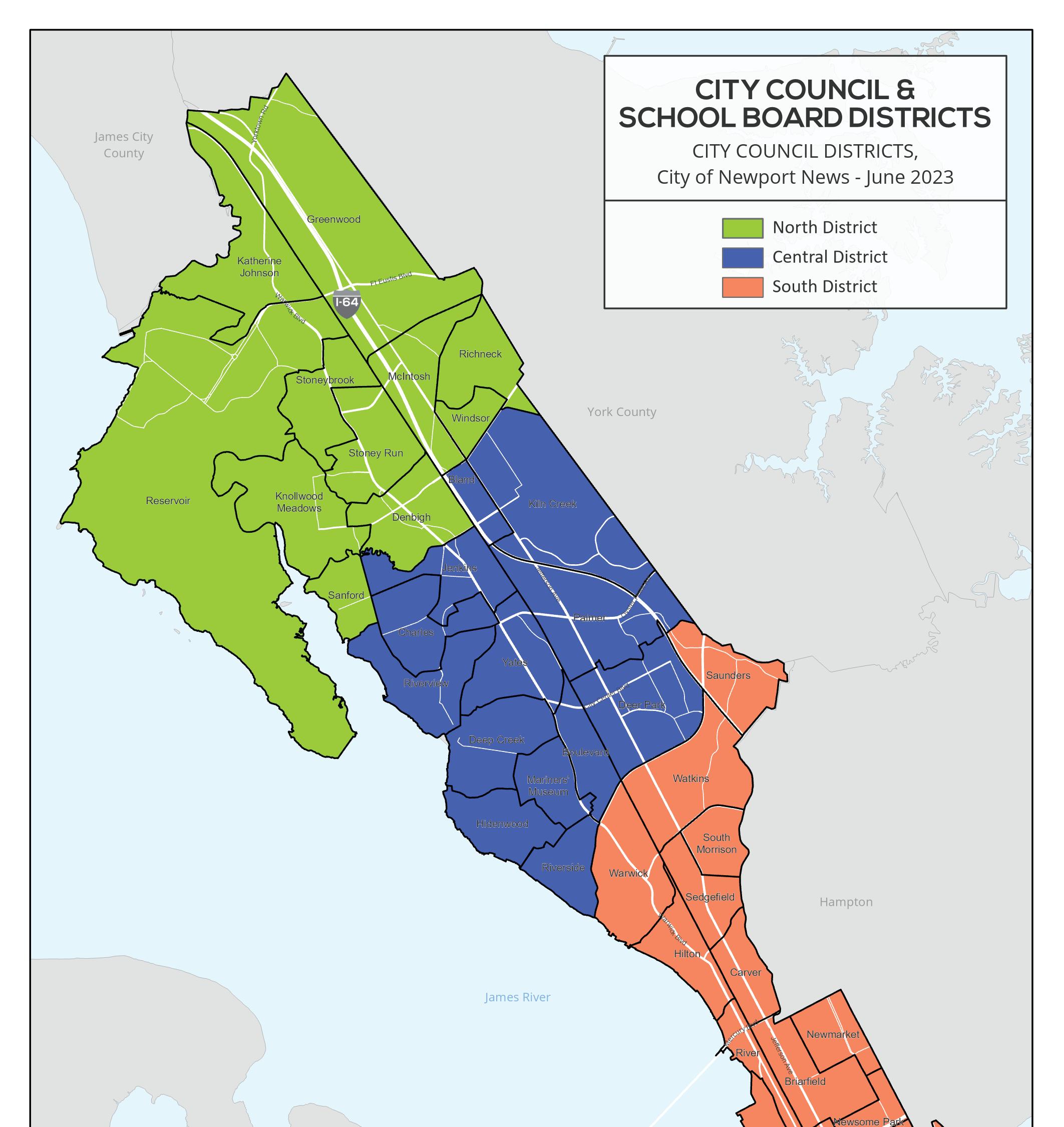
City of Newport News – June 2023
North District
Central District
South District
Local Government powers are conferred on the elected City Council by the Commonwealth of Virginia and the people of Newport News. Such powers are defined by the Charter of the City of Newport News, the Code of Virginia, and the Virginia Constitution. As interpreted by the Dillon Rule, localities are “tenants at will” of the state legislature, and depend on the Virginia General Assembly for their operating authority.
Section 4.02: “The council shall be the policy determining body of the city and shall be vested with all the rights and powers conferred on councils of cities of the first class…”
In addition to the rights and powers conferred on “councils of cities of the first class” by the Code of Virginia, the Council has several powers enumerated in its Charter.
These powers include the ability to:
• Pass ordinances and resolutions that appropriate money, levy taxes, and require licenses
• Adopt an annual operating budget
• Pass emergency measures to preserve public peace, property, health and safety
• Choose the Vice Mayor from among Council members
• Fill vacant Council seats
• Appoint/remove the City Clerk, City Auditor, City Manager, and City Attorney
• Adopt Council meeting rules, set times, appoint Council officers and committees, compel member attendance
• Appoint/remove members and chairs of boards and commissions
• Inquire into the official conduct of any City office or officer under its control
• Create, abolish, reassign, transfer, or combine City functions, activities, or departments
• Order an independent audit of accounts, books, records, and other financial transactions of the City
• Fix the schedule of compensation for City officers and employees
• Prescribe the amount and condition of surety bonds required of City officers and employees
• Dedicate new public streets
• Prescribe some of the duties of the Treasurer and Commissioner of the Revenue
• Require the sale of delinquent real estate tax property
• Issue negotiable bonds and notes
• Pass zoning ordinances1
1 Charter Secs. 2.06, 3.04, 4.02, 4.04, 4.05, 4.06, 4.08, 4.13, 4.14, 6.12, 5.01, 7.01, 7.02, 8.03, 8.14, 8.15, 10.02 City Code Secs. 2-6, 2-11.1. 2-21.1, 40-202, 40-202.1
Mayor
According to Section 3.01 of the Charter, the Mayor shall be elected at large by the qualified voters of the City. The Mayor shall preside over meetings of Council and be recognized as the head of the government for:
• All ceremonial purposes
• Purposes of military law
• Service of civil process2
Vice Mayor
The Vice Mayor is chosen by Council peers at the first meeting of a newly elected Council to perform official duties in the absence or disability of the Mayor.3
The council-manager form is the most popular structure of government in the United States among municipalities with populations of 2,500 or more. Under this form, residents elect a governing body — including a Mayor — to adopt legislation and set policy. The governing body then hires a manager with broad executive authority to carry out those policies and oversee the local government’s day-to-day operations. The City of Newport News has operated under the council–manager plan since 1920.

The council-manager form of government recognizes the critical role of elected officials as policy makers, who focus on mapping out a collective vision for the community and establishing the policies that govern it. This form also recognizes the need for a highly-qualified individual who is devoted exclusively to the delivery of services to residents. The structure is similar to that used by many corporations, in which the board of directors hires an experienced CEO, who is granted broad, executive authority to run the organization. These boards establish the company’s overall policy direction, while the CEO oversees implementation of that policy.4
City Council provides a collective vision for the City through its Strategic Plan. Strategic planning provides a high-level roadmap for elected officials and city governments and presents a vision for the city, the mission of city government and high-level strategic priorities, goals and objectives to guide the use of city resources. The City of Newport News Strategic Plan includes three strategic priorities – People, Places and Government – and seven subordinate goals. Each of the seven goals has supporting strategic objectives with strategies and measures of effectiveness to track progress on achieving the strategic objectives.
The Comprehensive Plan, which is adopted every five years 5, and the supporting neighborhood and area plans are more detailed companion documents that serve as primary tools to guide future investment in and development of the City for the next 20 years. The development, implementation and update of the goals in the Strategic Plan provide a means of sorting out priorities and is a major determinant and driver of the City’s budgeting process.
Updates to the Strategic Plan are typically done through a goal setting process every two years, with City Council’s adopted goals then becoming a guide for the two succeeding budgets. Newly elected Council members inherit a Strategic Plan, giving them time to become familiar with the workings of City government before charting the City’s Course.
“A



“There shall be a city manager who shall be the chief administrative officer of the city and shall be responsible to the Council for the proper administration of the city government.” Charter Sec. 5.01
“He shall be appointed solely on the basis of his executive and administrative qualifications, with special reference to his actual experience in or knowledge of accepted practice in respect to the duties of his office. The City Manager shall be responsible to the Council for the proper administration of all affairs of the city placed in his charge…” Charter Sec. 5.01
The City Charter is an enactment of the Virginia General Assembly and is, therefore, state law specifically applicable to the City of Newport News. The City Charter delegates broad administrative power to the City Manager subject to Council’s continuing review. Qualifications, powers, and duties of the City Manager are provided for in Chapter 5 of the Charter. Enumerated duties include the ability to:
• Have direction of and control over all departments of the City except as otherwise provided in the Charter
• See to the enforcement of City ordinances and state laws
• Execute, under the direction of Council, all contracts, deeds, and other papers
• Make policy recommendations to Council
• Keep Council advised on financial condition and future needs
• Prepare and submit an annual budget
• Prepare and submit a comprehensive financial report of activities of the City during the fiscal year ending on the preceding June 30
• Prepare and submit requested reports
The governing body of every locality in this Commonwealth shall appoint a qualified person, who shall not be a member of the governing body, to record the official actions of such governing body. The person so appointed shall be called clerk for the board of supervisors or council, as the case may be.6
The City Clerk is the clerk of the Council. Duties of the City Clerk are provided for in Chapter 4 of the Charter, Va. Code Sec. 15.2-1539, and the City Code. Duties include:
• Recording the proceedings of all meetings of the Council
• Acting as the custodian of all official records of the City
• Acting as the custodian of the corporate seal of the City
• Coordinating Council travel, to include travel advances, ticket acquisitions, reservations, etc.
• Performing such clerical duties on behalf of the Council or its members as the Council may, by ordinance or resolution, prescribe
• Publishing such reports and ordinances as the Council is required by law to publish and such other reports and ordinances as it may direct
The City Attorney is the legal advisor of the Council, the City Manager, and of all departments, boards, commissions and agencies of the City, including the School Board, in all matters affecting the interests of the City. The City Attorney shall be an attorney-at-law licensed to practice law in the Commonwealth and shall not engage in the private practice of law. Powers and duties of the City Attorney are provided for in Chapter 10 of the Charter. Duties include:
• Providing written opinions on questions of law
• Preparing ordinances for introduction
• Drawing or approving all bonds, deeds, leases, contracts or other instruments to which the City is a party or in which it has an interest
• Representing the City as counsel in any civil case in which it is interested and in criminal cases in which the constitutionality or validity of any ordinance is brought in issue
• Instituting and prosecuting all legal proceedings he shall deem necessary or proper to protect the interests of the City
The City Auditor is the head of the Office of the City Auditor. Powers and duties of the City Auditor are provided for in Chapter 9 of the Charter and by ordinance. Duties include:
• Developing and executing an annual comprehensive audit plan based on a city-wide risk assessment.
• Conducting performance, operational, compliance and financial audits;
• Providing city departments with assurance and consulting services to evaluate and improve processes;
• Reviewing established systems of controls to ensure compliance with city, state, and federal laws and regulations, policies and procedures;
• Investigating complaints concerning the management of funds and/or resources; and
• Providing findings, observations and recommendations for improved effectiveness and efficiency
The authority of the department to conduct performance, operational, compliance and financial audits extends to all city departments and agencies, as well as programs and other entities included within the City’s Adopted Operating Budget that are subject to supervision by the City Manager or City Council.
The Council has created standing committees to provide advice and recommendations on matters referred to such standing committees. The current standing committees are:
• Finance and Government Performance Committee: to advise the City Council regarding policies concerning the financial affairs and government performance of the city.
• Public Safety Committee: to advise the City Council regarding policies to enhance public safety in the city.
• Neighborhood, Recreation, and Parks Committee: to advise the City Council regarding policies to promote and improve neighborhood and civic engagement, public parks, public recreation, and public entertainment opportunities.
Each standing committee consists of two members of City Council who are assigned by the Mayor to serve as Chair and Vice Chair of the Committee during the Council’s organizational meeting. The City Manager designates members of city staff to provide support and information to each committee. Each standing committee holds meetings as it deems necessary.

Matters may be referred to a committee by the Mayor, after consultation with the City Manager and City Attorney or by motion and majority vote of the City Council. Committees deliver their reports to the Mayor and City Manager, who review for consideration at a future City Council meeting. Copies of committee reports are maintained by the City Clerk.
Standing committees are advisory in nature and do not have the power or authority to bind the city or the City Council to any course of action. Standing committees may be added or modified through resolution of the Council.
While the City Manager, City Clerk, City Auditor and City Attorney serve at the pleasure of the Council, all other City staff are employees of the City Manager, City Clerk, City Auditor or City Attorney. Neither the Council nor any of its members are permitted to direct or request the appointment or removal of officers and employees in the administrative service of the City.7
Except for the purpose of inquiry, the Council and its members shall deal with the administrative services solely through the City Manager, and neither the Council nor any member thereof shall give orders either publicly or privately to any subordinate of the City Manager. Any Council member violating the provisions of this section or voting for a motion, resolution or ordinance in violation of this section shall be guilty of a Class 4 misdemeanor, and upon conviction thereof, shall cease to be a Council member.8 Any violation by a member of the Council should be brought to the immediate attention of the City Attorney.
While it is inappropriate for any Council member to instruct a City employee, it is entirely appropriate to inquire since information is the basis for understanding and action. Information that would be difficult or time-consuming to produce, however, or that relates to a current or future agenda item should be formally requested of the City Manager, preferably during a City Council meeting, rather than requested of an individual staff member. Council members’ requests generally fall into one of the following categories:
1. Requests for information readily available
2. Follow-up for a constituent relative to a municipal problem or question
3. Requests for information not readily available and requiring significant staff time and research effort
4. Initiation of a new priority or program
Normally, items 1 and 2 can be handled directly between the Council member and the City staff. Items 3 and 4 should be requested of the City Manager. If a Council member is not satisfied with the information received, he or she should approach the City Manager who will work to improve the flow of information to and from key staff members.
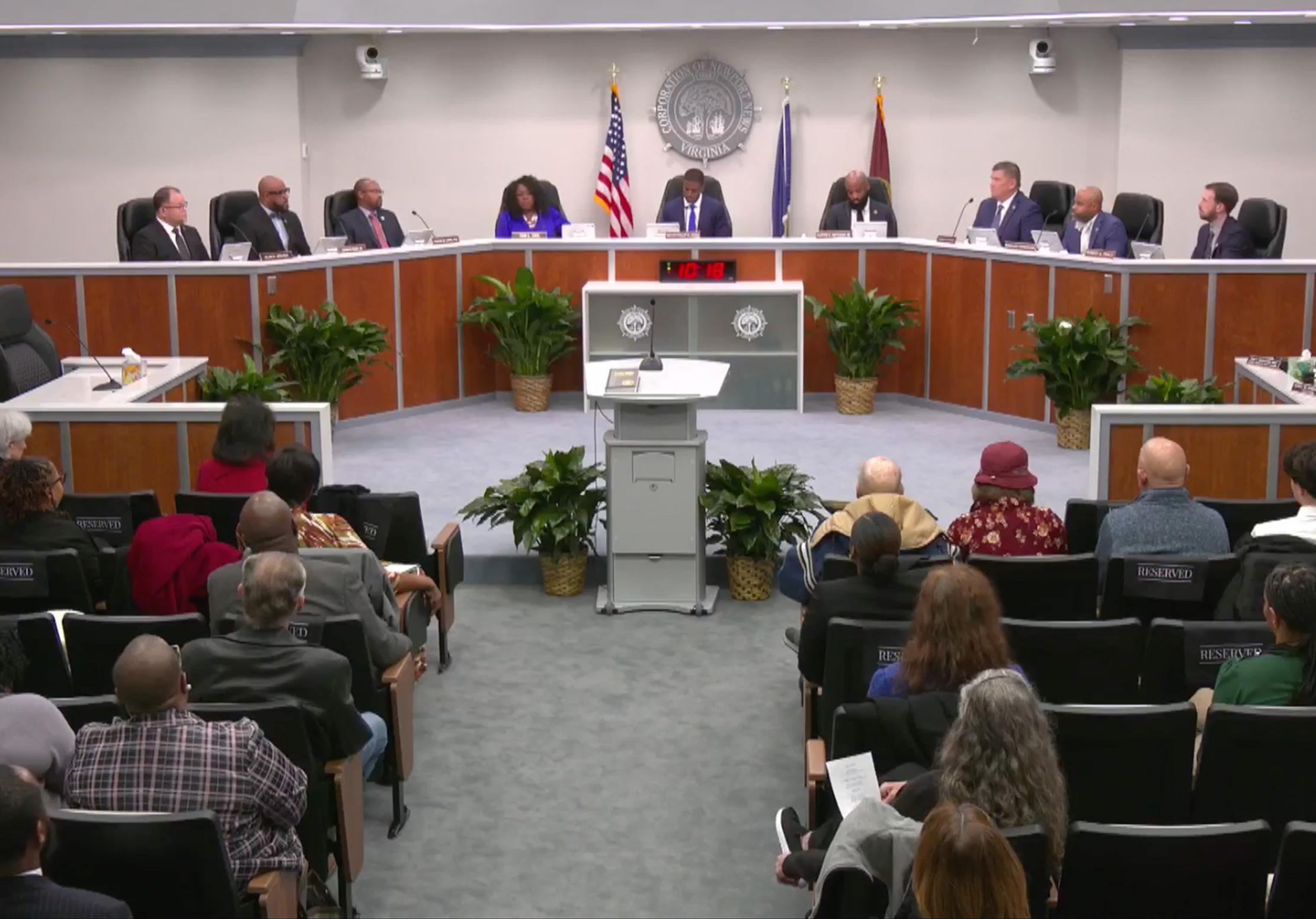
City Council primarily exercises its powers through public meetings.
Regular City Council meetings commence at 7 p.m. on the second and fourth Tuesday of each month, except there shall be no meeting on the fourth Tuesday of July, August and December. Should the day established by the governing body as the regular meeting day fall on any legal holiday, the meeting shall be held on the next following regular business day, without action of any kind by the governing body.9
Regular meetings typically have on the agenda only those items ready for a Council decision. Activities of key importance during regular City Council meetings may include:
• Public Hearings as required by law or Council policy. Public hearings may cover subjects such as proposed budgets, proposed Comprehensive Plan amendments, rezoning land, special use permits, and street closing requests
• Reports and Recommendations from the City Manager, City Auditor and City Attorney
• Reports and Recommendations from the Planning Commission and other advisory boards
• Ordinances and Resolutions which are legal instruments whereby Council establishes public policy either in the form of local laws (ordinances) or formal statements of fact and intent (resolutions)
• Appropriations of funds
Work Sessions are typically held prior to the regular Council meetings.10 Work sessions facilitate Council discussion in a more informal setting. Items for which action may be taken at a later regular meeting typically appear on the work session agenda. Work sessions may also be used on an ad hoc basis to delve deeper into complex issues, such as the budget.
The first meeting of a newly elected Council shall take place on the date of the first regularly scheduled meeting of City Council in the month of January following the election. At or before this meeting, the oath of office shall be administered to the duly elected members.
The first order of business is for members to elect the Vice Mayor.
9 Va. Code 15.2-1416
10 City Code 2-21.1
Special meetings of the City Council may be called at the request of the Mayor, City Manager, or any three members of the Council.11
When called, the Clerk notifies Council in writing of the meeting. All notices of special meetings to Council members shall state the subjects for which the meeting is being called.12
Electronic Mail or facsimile transmissions may serve as written notice. Phone calls may be used as needed to supplement other special meeting notices.
Unless the Council votes unanimously, no business except the items on the special meeting agenda can be transacted. Meetings must be open to the public unless members vote to convene a Closed Session.
The City Council holds two City Council retreats annually. These retreats typically occur in January and July and are designated as special meetings.
January Retreat: The focus of the January retreat is on items such as budget planning, policy reviews, and operational updates. This retreat provides an opportunity for in-depth analysis and discussion of critical matters that impact the city’s operations and governance.
July Retreat: The focus of the July retreat is on strategic planning. This includes long-term goal setting, vision alignment, and discussions about future initiatives to advance the city’s mission and objectives.
Both retreats aim to provide the Council with dedicated time to address specific areas of importance and foster collaborative decision-making.
According to the Charter, meetings of the Council shall be open to the public except when the public welfare requires Closed Sessions. A City Council or committee may go into Closed Session and exclude the public for certain stated reasons. In accordance with FOIA, more than 20 items relevant to various aspects of City business may be discussed in a closed session. Closed Session issues typically involve:
• Personnel: VA Code § 2.2-3711(A)(1)
• Acquisition or disposition of real property: VA Code § 2.2-3711(A)(3)
• Discussion with legal counsel: VA Code § 2.2-3711(A)(7) or 2.2-3711(A)(8)
11
12 FOIA 2.2-3707
The procedure for convening a Closed Session is as follows:
1. While in public session, a majority of Council members must approve a motion to go into Closed Session. The motion must include the subject and a citation for the specific code section containing the FOIA exemption allowing the Closed Session. Allowances for Closed Sessions are located in Section 2.2-3711 of the Virginia Code.
2. While in the Closed Session, Council members may discuss only the subject mentioned in the motion.
3. Certify by recorded vote, after Council completes the Closed Session and returns to public session, that the discussion in closed session was restricted to only those matters identified in the motion to go into Closed Session.
No closed meeting shall be held unless the above-mentioned procedures are followed.

The City Code permits the public to speak during a Public Hearing on matters germane to the business of the Council. Members of the public shall register to speak by providing the City Clerk with their name and residential address and indicating the item on which they wish to speak. Speakers shall confine their remarks to no more than three minutes and should confine their remarks to matters germane to the agenda item on which they are speaking or, if made during citizen comments, to matters germane to the business of Council.13 To encourage public involvement, regular work sessions and Council meetings are televised.
Setting the Meeting Agenda
All meeting agenda items which require formal Council action are placed on the agenda for consideration. The agenda of the regular meeting is typically finalized on the Thursday prior to the Tuesday Council meeting. Consequently, all items should be submitted in time for distribution to Council on the Thursday of the week before the regular monthly Council meetings. If an item involves a legal matter, it should be submitted in sufficient time to allow a review by the City Attorney.
Items originating from Council members should be shared with the City Manager or the Mayor by the established deadline. Department directors normally submit agenda items to the City Manager three weeks prior to a regular Council meeting. The City Manager generally meets with the Mayor, City Attorney, and City Clerk on the week prior to the Council meeting to review and finalize the agenda.
The City Manager is responsible for preparing and distributing the agenda.
Mayor as Presiding Officer
The Mayor presides at every meeting of the Council and at the hour appointed, calls the Council to order, provided a quorum is present. The Mayor signs all ordinances and resolutions on behalf of the Council.
The Mayor preserves order and, with the assistance of the City Attorney, speaks to and decides all points of order. The Mayor has control of the Council Chamber and the connecting halls and corridors. In case of a disturbance or disorderly conduct, the Mayor may order the same to be cleared.
The Vice Mayor presides in the Mayor’s absence.14
Attendance of members is an important and necessary component of service on City Council. Failure of a Council member to attend Council meetings affects the ability of City Council to conduct its public business. A Council member who is unable to attend a meeting shall notify the Mayor of that impending absence prior to the date of the meeting.
Order of Business 15
1. Roll Call
2. Invocation
3. Pledge of Allegiance
4. Presentations
5. Public Hearings
6. Consent Agenda
7. Other City Council Actions
8. Appropriations
9. Citizen comments on matters germane to the business of City Council
10. Old Business, New Business and Council member Comments
11. Adjournment
The City Manager, who has a duty under the Charter to attend all meetings of the Council with the right to speak but not to vote, may include a report or recommendation under any item of business.16 The City Attorney and department directors participate in discussions as their respective issues are discussed.
The order of business at regular or special council meetings shall not be departed from except by the consent of four (4) members of the council.17
Section 5 “It shall be the duty of the city manager to attend all meetings of the Council with the right to speak but not vote …”
Familiarity with and use of rules of procedure provide the means whereby the affairs of the Council can be controlled by the general will of the members. Council meetings proceed in a controlled and predictable manner, allowing the business of the citizens of Newport News to be handled in a direct, constructive, and democratic manner. Rules of Procedure for Council meetings are set out in Chapter 2 of City Code and summarized below:
• Obtaining the floor: A member desiring to speak at a meeting may, from his accustomed seat, obtain the floor by addressing the presiding officer by his official title thusly: “Mr. Mayor,” or if a woman, “Madam Mayor” and, if the member is entitled to the floor, the presiding officer assigns the member the floor by announcing the member’s name.
• Manner of speaking: No member shall speak on pending motions until he has been recognized by the Mayor and, during the time allowed him, he shall confine himself strictly to the question before the Council. No member shall, in debate, use any language or gesture calculated to wound, offend or insult another member. No member, while speaking, shall be disturbed in any manner by private conversation or otherwise.
• Violations of order: For any willful transgression of the rules or for any repetition of a transgression, the Mayor shall or any member may call the offender to order, in which case the member so called to order shall immediately yield the floor unless permitted to explain. For flagrant or repeated violations of order, especially if persisted in after the admonition of the presiding officer, a member shall be liable to the censure of the Council and may, in addition thereto, be removed from the Council chamber by order of the Mayor.
• Order of questions: The Mayor shall propound all questions in the order in which they are moved, unless the subsequent motion shall be previous in its nature.
• Motions under debate: When a question is under debate, the Mayor shall receive no other motion than to adjourn, to lay on the table, for the previous question, for the pending question, to postpone to a certain day, to amend or to postpone indefinitely, which several motions shall have precedence in the order in which they stand arranged.
• Division and Amendment: If the question for decision includes several definite propositions, the same may be divided upon demand of any one (1) Council member, but a motion to strike out and insert shall not be divided, nor shall a motion to strike out, being lost, preclude either an amendment or a motion to strike out and insert. No motion or proposition on the subject different from that under consideration shall be admitted under color of amendment.
• Form of question: The Mayor shall put a question, and questions shall be distinctly put and the following form may be used: “As many as agree that, etc. (as the question may be) say `Aye”’ and, after the affirmative vote is given, “Those opposed, `No”’
• Points of order: The Mayor may speak on points of order in preference to other members, and shall decide questions of order without debate, subject to an appeal to the Council. On every appeal, the Mayor shall have the right to assign reasons for his decision, and such decision shall be final unless reversed by a majority vote of all the other members present.
• Adjournment: A motion to adjourn shall be in order at any time except on an immediate repetition or when, on the call of the previous question or the pending question, the same shall have been ordered or when a member shall have the floor or pending the verification of a vote and such motion to adjourn shall be decided without debate.
• Reconsideration of motions: No motion for reconsideration of an ordinance or resolution shall be in order: (1)unless made at the same meeting at which such ordinance or resolution was considered, and such motion shall be proposed by one (1) of the members of the prevailing side and shall require the consent of four-sevenths ( 4/7 ) of the entire Council; or (2) a written notice at least twenty-four (24) hours in advance has been given to each Council member that such motion shall be proposed at the next regular Council meeting by one (1) of the members of the prevailing side and shall require the consent of foursevenths ( 4/7 ) of the entire Council.
• Amendment, suspension or repeal: No ordinance shall be amended, suspended or repealed except by ordinance regularly introduced and passed, nor shall any section of an ordinance be amended unless the whole section of the ordinance be reordained.
• Robert’s Rules: The rules of parliamentary practice comprised in “Robert’s Rules of Order, Newly Revised,” 12th Edition, 2020 Copyright, shall be parliamentary authority in the Council except as otherwise provided.

Every member who shall be present when any question is put, including the presiding officer, shall vote unless excused by the Council; provided, however, that no member of the Council shall participate in the vote on any ordinance, resolution, motion or vote in which such member has a personal interest, as defined by the State and Local Government Conflict of Interests Act (COIA), unless an exception under COIA applies.18
No ordinance, resolution, motion or vote shall be adopted by the Council except at a meeting open to the public and, except motions to adjourn, to fix the time and place of adjournment, and other motions of a purely procedural nature, unless it shall have received the affirmative votes of at least four (4) members. All voting, except on procedural motions, shall have the ayes and nays recorded in the journal.
No ordinance can be passed or resolution adopted that appropriates money or creates indebtedness or directs the payment of any sum of money, except by concurrence of four-sevenths of all members elected to Council.19
After a vote is announced, no member shall change his vote without the consent of the Council. The right to change a vote shall be limited to the current meeting and not continue for any subsequent meeting.
A copy of each ordinance or resolution, legibly written or printed, will be furnished to each Council member when introduced unless there is unanimous consent to waive the requirement.
All ordinances and resolutions passed by Council take effect on the tenth day following their passage, unless another date is specified therein and except as otherwise provided in the City Charter.20
FOIA generally requires that all meetings of the Council as well as most other public bodies, such as Planning Commissions, Boards of Zoning Appeals, School Boards, Redevelopment and Housing Authorities, be open to the public. It is important to note that committees appointed by Council or any other public body subject to the FOIA must also be open to the public. Therefore, all committees appointed by Council, whether composed of selected members of Council or of non-council persons or a mixture, and regardless of number are subject to the FOIA’s public meeting requirements.
FOIA provides that in order to constitute a “meeting” a quorum must be present. Therefore, FOIA applies to regular meetings as well as gatherings of three or more Council members where City business is discussed.
20
FOIA requires that Council and committees and subcommittees appointed by Council give advance written notice of every meeting to every citizen, including news media, who has requested to receive such notice. Council may require that the requests for notice be renewed annually. In addition, copies of agendas and materials distributed to Council must be simultaneously made available for public inspection unless a FOIA exemption applies. The City Clerk and the City Attorney typically handle the notice requirement to media for Council.
Information packets are typically posted electronically on the Thursday before a regular Council meeting to Council members and are made available to the public and press. Minutes must be kept of all meetings of Council, including work sessions and informal meetings at which no official action is taken. Vote is by roll call and the ayes and nays of any question are recorded in the minutes of the meeting. Secret ballots are prohibited.

Section 2.2-3704.3 of the Code of Virginia requires local officials to participate in training within 2 months after assuming the office and thereafter biennially, for as long as they hold such office so they can be familiar with these and other provisions of FOIA.
The Council may meet by electronic means without a quorum physically assembled at one location when either the Governor or the City has declared a state of emergency, provided that the nature of the declared emergency makes it impracticable or unsafe to physically assemble at one location and the purpose of the meeting is to provide for the continuity of government operations. Regarding such meetings, FOIA requires notice to the public, electronic access by the public, and an opportunity for the public to comment.
In accordance with adopted policy, individual Council members may participate electronically in two regular meetings per year provided a quorum is present in the physical meeting location.

The City Council shall hereby adopt a Code of Ethics by which it shall be governed. The purpose and intent of this Code of Ethics is to prescribe a high standard of conduct for members of the Newport News City Council. in order to promote public confidence in the integrity of local government as well as its fair and effective operation. Achieving this requires that Council members:
1. Obey all applicable laws regarding official actions taken as a Council member.
a. Support the Constitution of the United States and the Constitution of Virginia.
b. Administer the laws of the Nation, Commonwealth, and City fairly and impartially.
c. Abide by the spirit and the letter of the laws of the United States, Virginia and City.
d. Carry out all lawful orders and policies, including this Code of Ethics, of the City Council.
2. Act with Integrity and Independence.
a. Grant no special treatment or advantage to any citizen beyond that which is available to every other citizen except by due process of law.
b. Grant to every citizen a fair and impartial hearing on any matter which may be heard before the public official.
c. Avoid the appearance of impropriety.
3. Abstain from voting upon a matter in which the public official has a personal interest, except as permitted by law after full disclosure of such interest.
4. Refuse to offer or accept personal gifts, favors, or special privileges in every instance where there is a reasonable likelihood that the gift, favor or special privilege is being afforded or if received would influence him or her in the performance of official duties.
5. Not use information that is unavailable to the general public for his or her personal or financial advantage.
6. Faithfully perform the duties of office.
a. Council members shall faithfully attend all relevant public meetings whenever possible.
b. Council members shall endeavor to be prepared in advance of public meetings in order to effectively participate in such meetings.
c. Council members shall refrain from engaging in conversations outside of formal quasi-judicial hearings over which they will preside.
7. Conduct official business in an open and public manner.
a. Council members shall comply with all applicable laws related to open meetings and public records.
b. Council members shall foster an atmosphere of transparency and candor in conducting public business.
To ensure citizens that the judgment of public officers and employees is not compromised or affected by inappropriate conflicts, the Virginia General Assembly adopted the Virginia State and Local Government Conflict of Interests Act (COIA). The law requires all Council members to:
• Disclose financial interests once each year.
• Refrain from contracting for business with the local government, except under limited and defined circumstances.
• Abstain from voting on items of personal interest that apply solely to the Council member or that prevent impartial voting, except when defined exceptions apply and upon advice of the City Attorney.
• Refuse to accept any gift from person whose interests may be substantially affected by performance of the Council members official duties and in any event, refuse to receive any combination of gifts with an aggregate value in excess of $100 within any calendar year.
• Refrain from use of confidential information required as a Council member, and not available to the public, for the member’s personal economic benefit.
• Refrain from offering or accepting money or anything of value to obtain a contract for any person or business with the City.
The City Attorney and the local Commonwealth’s Attorney are the proper persons to turn to for competent legal advice concerning conflict of interest questions. As a member of a local governing body, Council members are entitled by statute to obtain a formal opinion from the local Commonwealth’s Attorney. A knowing violation of COIA is a criminal offense, however a Council member shall not be prosecuted for a knowing violation if the alleged violation resulted from good faith reliance on a written opinion of the Commonwealth’s Attorney or a formal opinion or written informal advice of the Virginia Conflict of Interests and Ethics Advisory Council made in response to a written request for such opinion or advice after full disclosure of the facts.
Council members should be mindful of law, policy, and procedures when using electronic mail. All email communications among Council members should be considered open to Freedom of Information Act (FOIA) inquiries. Contemporaneous email communication between three (3) or more Council members regarding City business constitutes an unlawful meeting under the provisions of FOIA, and is, therefore, improper. All email communications to and from staff members should be in accordance with established guidelines for staff inquiries.
At the start of a City Council member’s term and at the request of the City Council member, the Information Technology Department will provide a laptop/tablet for the member to use at home for the purpose of conducting City business. In addition to this device, the City will also establish an email address at the City and Internet access if necessary. This will allow the Council member to communicate with City employees as well as
with citizens. Requirements for Council’s use of information technology, social media, and use of city equipment and property shall be the same as established by the City Manager for City employees as outlined in Personnel Administrative Policy 1403 – Use of Information Technology, 1410 – Social Media Policy and 1412 – Use of City Property and Equipment.
At the end of the City Council member’s term, the member may elect to keep the laptop/tablet provided to them. Based on experience, a four-year-old device has reached its useful life and will therefore be deemed fully depreciated. If the member elects not to keep the device, the member will contact the Information Technology Department and schedule a time for the device to be returned to the City for inventory purposes.
Provisions of COIA concerning financial disclosure apply to Council members of all cities and towns with populations greater than 3,500.
In January of each year, the City Clerk will supply appropriate disclosure statements to Council members and the applicable members of Boards and Commissions that must be filed by February 1. The Real Estate Holdings and Financial Disclosure Forms will be submitted to members of boards, commissions, and authorities as required by State Code. The City Clerk and City Attorney shall assist all members with filing appropriate forms prior to their start of term. Additionally, local elected officials are required to complete an online Conflict of Interest training module every two years. The module can be accessed through the Virginia Conflict of Interest and Ethics Advisory Council website.

Sound financial management and budgeting are essential for the effective delivery of government services. A government that shows it is thinking strategically, planning for the future, basing its spending decisions on citizen input, and managing its financial resources wisely can develop and retain the confidence of its citizens.21
Council’s primary responsibility for budget development is to give general policy direction to the City Manager, through the long range goals identified in its Strategic Plan.
The primary purposes of a governmental budget are to account for and control the use of public resources and to provide a legitimate process for the expenditure of public funds. However, budgeting is more than just a device to authorize and control revenue raising and spending. It is the principal vehicle for setting fiscal and program policy. Budgets are also used to:
• Establish priorities for the local government
• Plan for the rational distribution of resources
• Establish performance objectives and desired outcomes and relate them to expenditures
• Evaluate the performance of departments and programs
• Explain to citizens the types and levels of services funded with their tax dollars
• Ensure that funds are expended in a way that meets the planned budget objectives
The City prepares two types of budgets each year:
1. Operating Budget. Applies to the recurring or one-time activities that are financed through current revenues. Major revenues estimated in the operating budget include general property taxes and other local taxes and fees. Major expenditures include staff salaries and benefits, debt service, materials, and services to support City services and facilities. By law, revenues and expenditures must be equal in the Annual Operating Budget, commonly referred to as a balanced budget. The Operating Budget appropriates funds for one fiscal year (July 1 – June 30) and appropriations cease on the last day of the fiscal year.
2. Capital Budget. Addresses long-term physical improvements that involve longer life spans, longrange returns, and relatively high costs. Capital budgets typically appropriate funds through the life of the project. The Capital Budget includes new construction or renovations to existing school buildings and other city structures, major street, bridge, and sewer repair projects, and upgrades to existing park facilities or new park structures.
These budgets are closely related, and each one contributes to the sound fiscal management of the community.22
The budget process is by its nature an exercise in conflict resolution and compromise. This is not bad. It reflects the fact that all players involved – elected officials, managers, department heads, budget analysts, and citizens – have a different perspective on the budget process. A natural tension exists between the desire to provide services to citizens and the need to be fiscally prudent. As such, negotiation and compromise will always be hallmarks of the budget process.23
The community’s long-term solvency is a key factor for the governing body to consider as it maps out a course for the future. Sometimes the City Manager and the budget staff may have to interject a cautionary note in this effort. For example, the desire to fund major improvements or new programs should be tempered by a realistic assessment of future revenue growth. Similarly, one-time revenues or other windfalls should not be used to build an operating budget that cannot be sustained over time.24
Maintaining an appropriate level of fund balance is also a priority of the City when developing budgets. City staff consult with a professional financial advisor on the appropriate level of fund balance. The City has adopted fund balance policies to ensure cash flow stability, to maintain or increase the City’s bond credit rating and to support unpredictable revenue shortfalls. Use of fund balance to finance operations should be resisted unless the balance has grown beyond an appropriate level. In this circumstance, fund balance usage should be matched with non-recurring expenditures (capital projects, one-time expenses) and not be used to fund personnel or recurring expenditures.25
The City’s annual operating budget process is a complex undertaking involving the entire government. The City is required by its Charter to adopt a final budget by June 15.26
The City Manager submits a recommended operating budget to City Council on or before April 1st. The Manager’s recommended budget includes a budget message explaining the proposed financial policies of the City for the budget year and describing the important features of the budget plan. The Manager’s budget message also sets forth the reasons for salient changes from the previous year in cost and revenue items and explains any major changes in financial policy. For each line item, the Manager will also provide:
• Amounts appropriated and expended during the preceding fiscal year
• Current fiscal year’s appropriations
• An estimate of revenues for the upcoming fiscal year
• Proposed expenditures for the upcoming fiscal year and any increases or decreases proposed 27
City Council must approve the budget and fix a Real Estate tax rate by June 15. The budget calendar below provides a timeline of the budget process.
Date Action
July 1 Beginning of Fiscal Year
October Budget preparation instructions distributed to departments and agencies
November – January Departments and agencies develop budget requests
February – March Budget Hearings conducted by City Manager with Department of Budget & Evaluation
Late March City Manager submits proposed budget to City Council
April – May City Council work sessions on budget and budget public hearings
May 15 Date by which schools budget must be approved
June 15 Date by which City Operating Budget must be approved
June 30 End of Fiscal Year
After the City Manager has submitted a proposed budget to the Council but before any public hearing is held, City Council has one or more work sessions with the City Manager and staff. Work sessions can give the members of City Council a better understanding of the key issues in the budget and the rationale behind the City Manager’s strategy. They also give the members of City Council the opportunity to ask questions, identify significant concerns, and suggest other issues they would like to see explored before the budget is adopted.28
Before adopting the budget, City Council must hold at least one public hearing to give citizens an opportunity to voice their support or objections to items recommended in the City Manager’s budget.
Any proposal for a tax increase must be published in a newspaper at least seven days before adoption, and a public hearing must be held before adopting the tax increase. When the reassessment of real property results in the total real property tax levies increasing by more than 1 percent, a locality must first publish a notice of its intent in the newspaper seven days prior to a public hearing on the proposed tax rate. The public hearing may not be held at the same time as the budget hearing.29
After the conclusion of the public hearing, Council may insert new items of expenditures or may increase, decrease or strike out items of expenditure in the budget, except that no item of expenditure for debt service as required by law shall be reduced or stricken out. The Council shall in no event adopt a general budget in which the total expenditures exceed the revenues, estimated as hereinbefore provided, unless at the same time it adopts measures for providing additional revenue in the ensuing fiscal year sufficient to make up the difference.
The local budget is for “informative and fiscal planning purposes only.” Therefore, the adoption of the budget is accompanied by passage of an appropriations ordinance. The appropriations ordinance is the legal instrument that distributes funds for the fiscal year.30 The City Manager has the authority to transfer budgeted amounts among departments within any fund; however any revisions altering the total appropriations of any fund must be approved by City Council. The budget may also be accompanied by ordinances altering the tax rate on real estate and personal property or levying a new tax or altering the rate of other taxes necessary to balance the budget.
Once the budget is approved, there is significant focus on the control of expenditures and monitoring revenues. Ongoing monitoring of revenues and expenditures throughout the year is a responsibility shared by department directors, the Department of Budget and Evaluation and the City Manager. The City Manager keeps City Council appraised of the ongoing financial condition of the City through quarterly financial reports.
The Capital Improvements Plan (CIP) is a multi-year planning document. In its most basic form, the CIP is a fiveyear schedule of capital improvements and includes new construction or renovations to existing school buildings and other city structures, major street, bridge, and sewer repair projects, and upgrades to existing park facilities or new park structures, among other planned capital expenditures. The CIP lists each capital item approved by
the governing body, the year in which it will be purchased or started, the amount to be spent in each year, and the proposed method of financing. The CIP includes future projects for which financing has not been secured or legally authorized. As a result, the “out-years” (future years) of the CIP are subject to change.
Like the operating budget, City Council’s strategic priorities guide the CIP process. The City Manager must submit to Council a multi-year Capital Improvements Plan that is consistent with the policies established by the Council for such programs by November 1 each year.31
By approving the multi-year CIP, Council authorizes the first year of the plan to be implemented. Appropriations are then made on a project-by-project basis.
Financing strategies for capital projects differ from those of ongoing operating expenses because of the sizable one-time costs and prolonged life cycles typical of capital projects. Accordingly, the capital budget cannot be fully funded with current revenues. A key element of the capital budget is a financing plan that spells out how the projects will be funded.
Most projects in the CIP are funded by 20-year General Obligation (GO) Bonds issued by the City with level annual principal payments. Debt financing is typically used for expensive capital facilities with long, useful lives, so that bond repayment occurs over the period during which the facility will be used.32 The annual principal and interest payments (debt service) are included in the City’s annual operating budget. The General, Wastewater, Stormwater, and Solid Waste funds each pay for a proportionate share of principal and interest payments. The Waterworks Fund pays all of the debt service related to its capital projects. Capital projects may also be funded using current resources (cash capital) or through Federal or State grant funds.
The types of debt commonly issued by the City include the following:
These bonds are instruments of indebtedness issued by the City and secured by the full faith and credit and general taxing power of the issuer. They are frequently used to finance the costs of non-revenue-producing projects, such as schools, courthouses, government office buildings, jails, libraries, parks, and roads. The City is required by law to levy taxes on all property of the locality subject to taxation sufficient to pay the principal and interest on general obligation bonds.
Revenue bonds are debt instruments issued by local governments and secured by the pledge of a specific source of revenues. The City typically issues revenue bonds to finance Waterworks projects. The issuance of revenue bonds does not count against a locality’s debt limit.
Before the city can borrow the funds or even commit to begin a project, State law requires adherence to several steps. State law requires that a public hearing be conducted on a bond authorization by the City Council. A bond authorization indicates an amount of funds that the city intends to borrow (at some time in the future) to pay for capital projects. A notice (advertisement) that the public hearing will be held by the City Council must be advertised in the newspaper twice during the two-week time period before the public hearing is actually held. The advertisement lists the amount of funds that the city intends to borrow (at some time in the future) and provides an estimate of the amount of money by category that it intends to spend on capital projects. The public hearing gives citizens an opportunity to express their views about the city’s intention to incur additional debt for capital projects.
When the bond authorization is approved by the City Council, it signifies that the City will use bonds as the funding source to pay for projects up to the amount of the bond authorization. It does not mean that the City intends to sell bonds immediately or even in the very near future. Generally, the city only sells bonds when the cash is needed and when market conditions are the most favorable (lowest interest rates) for the City to borrow the money.

The City has adopted policies which guide its capital improvement planning and its issuance of long-term debt. These policies are intended to help the City maintain or improve its bond rating, help the City manage its capital investments in a manner which does not create an undue financial burden on its citizens and taxpayers, and keep changes in debt service obligations at levels that do not reduce the City’s ability to provide acceptable municipal and educational services to its citizens.
The following are the City’s Capital Financing Debt Management Policies:
Outstanding General Obligation to Taxable Real and Personal Property Value No greater than 3.0%
General Fund Debt Service to General Service Fund Revenue No greater than 9.5%
Proportion of Capital Improvement Plan spending with Cash Capital No less than 20%
Outstanding General Obligation Debt Scheduled to be repaid within 5 years No less than 30%
Outstanding General Obligation Debt Scheduled to be repaid within 10 years No less than 60%
A copy of the City’s financial policies can be found in the appendix of this handbook.
In addition to debt management policies, the City has adopted a Fund Balance Policy, which sets minimum guidelines for the General Fund unassigned fund balance to ensure the City maintains sufficient working capital and has the ability to address emergencies without borrowing, and a Pension Funding Policy, which guides the City’s pension funding activities. Together, these policies ensure the City’s long term fiscal stability.
The City and City’s Waterworks Department maintain strong credit ratings with the financial ratings agencies Standard & Poor’s (S&P) and Moody’s. These credit ratings allow the City to gain access to capital at lower interest rates.33
Use of City Council Funds
Each fiscal year, as part of Council’s approval of the annual operating budget for the City, or as amended during the year, Council appropriates a certain amount of public funds for expenditure by “City Council” and for “City Council Contingency”. These funds are taxpayer dollars that the City has collected from the public to provide vital local services. As such, it is City Council’s ongoing responsibility to consider the highest and best use of these limited public resources. Council’s expenditure of these funds is also governed by Federal and State law.
To ensure all use serves the community’s interest and adheres to applicable law, public funds appropriated for expenditure by “City Council” and for “City Council Contingency” may be expended by City Council in accordance with this Council Procedure document, as follows:
Funds may be expended (without a vote of City Council) for routine, ongoing costs necessary for the day-to-day business of City Council, to include:
1. Purchase of office supplies, books, newspaper subscriptions, and other professional publications, membership dues in organizations related to City Council’s duties (VML, Virginia First Cities, NLC, etc.), printing and copying costs, postage, professional headshots, and City logo attire related to the business of City Council or for the use of individual Council members or Constituent Service Representatives (CSRs) for official City business;
2. Cost of technology provided to individual Council members and CSRs for official City business, including computers, tablets, cellular phones, internet hotspot devices, printers, webcams, other peripherals and accessories, cases, carrying bags, and fees for service and data storage associated with such devices;
3. Purchases of goods and services, including catering and meals, for City Council Work Sessions and/or City Council Meetings, functions, or retreats (for example: a facilitator for a Council workshop; facility rental, catering for a City Council meeting or retreat);
33 Credit ratings reaffirmed in 2023
4. Costs related to attendance at official functions within the United States to which City Council, or an individual Council member or their staff, are invited or are required to attend, including registration, transportation, lodging, other incidental travel and meeting expenses, banquet costs and business meals (when a per diem allowance is not provided) in accordance with the City’s Travel and Meeting Expense Policy (“travel policy”) and this Handbook. With respect to airline travel, members of Council may book any fare class, with the exception of first class, and may incur additional airline charges for seat selection of any economy or premium economy seat and up to 2 checked bags. The City Clerk is responsible for determining that such expenditures are appropriately justified; ensuring compliance with the City’s travel policy and this Handbook; and when required, completing travel forms on behalf of City Council members or their staff within the times specified within the City’s travel policy.
5. Charitable institution’s event table sponsorships or individual seats, provided that the charity is located in the City of Newport News, serves Newport News citizens, the purpose of the event is non-sectarian, and funds are available within the City Council budget line item for Table/Seat sponsorships.
6. Tokens of sympathy or appreciation purchased on behalf of City Council to recognize career milestones, retirement, sympathy for the loss of a family member, and similar circumstances for the City Clerk, City Manager, City Attorney, other current and former City elected officials, officers, staff, members of Boards and Commissions, and officials of other governmental agencies.
Payment for the expenditures listed above shall be arranged by the City Clerk or City Manager, on behalf of City Council, using a credit card (p-card) issued by the City or by another form of payment used by the City in the normal course of business. Individual Council member credit cards (p-cards) shall not be used to pay for these expenditures, except as otherwise allowed below.
Funds may be used to reimburse individual members of Council and/or their staff for expenses incurred by such individuals for official City business provided that the expenses are itemized and documented to the extent feasible. In lieu of incurring a reimbursable expense and then submitting a reimbursement request to the City, any individual member of Council or Council staff may use a City credit card (p-card) issued to such Council member/ staff person to purchase eligible goods and/or services.
Goods and services purchases which may be reimbursed to individual members of Council and/or their staff, or which may be purchased on a City credit card (p-card) by members of Council and/or their staff are limited to:
1. Costs related to attendance at official functions within the United States to which City Council, or an individual Council member or their staff, are invited or are required to attend, only when such expense cannot reasonably be arranged by the City Clerk in advance (for example: taxicabs at the travel destination, parking fees, road tolls, internet connection charges at a conference, etc.). Travel costs shall be limited to only those expenses that are allowed under the City’s travel policy. The use of City funds to accommodate personal comfort, convenience, and taste is not permitted.
2. Meals or refreshments for an individual member of Council himself/herself/themselves, while meeting with one or more constituents, if receipts are supported by documentation meeting IRS standards for allowable business expenses (identification of the business purpose of the meeting, the topic(s) discussed, the person(s) participating in the meeting, etc.) Expenditures for business meals shall be limited to the amount allowed under the City’s travel policy;
3. Business meals or refreshments for an individual member of Council and accompanying City employees, employees of other governmental agencies or employees of charitable institutions (charitable institution must be located within the City of Newport News or if located outside the City, provide services to Newport News residents). Business meals must be supported by documentation meeting IRS standards for allowable business expenses (identification of the business purpose of the meeting, the topic(s) discussed, the person(s) participating in the meeting, etc.). Expenditures for business meals shall be limited to the amount allowed under the City’s travel policy. Other governmental agencies and charitable institutions include, but are not limited to, the following organizations:
• Federal Departments, Agencies and Elected Officials, including Jefferson Lab, Joint Base Langley Eustis and US Navy
• State Departments, Agencies and Elected Officials including VDEM, VDEQ, VDH and VDOT
• Public Colleges & Universities including CNU, HU, ODU, VPCC and W&M
• Local & Regional Governmental Agencies including CSB, HRPDC, HRT, HRWC, NNPS, NNRHA, and PAC
• Local and Regional Chambers of Commerce
4. Mileage, at the standard mileage rate set forth by the IRS, for use of a personal vehicle to conduct official City business (reimbursement only).
5. Home office supplies for individual Council members or staff of Council such as copier paper, pens, notepads, etc. not to exceed $25 per item. Other office supplies shall be purchased by the City Clerk.
6. Tokens of sympathy or appreciation for the City Clerk and his/her/their staff, the City Manager and his/her/ their deputies and assistants, and the City Attorney and his/her/their staff to recognize career milestones, sympathy for the loss of a family member, and similar circumstances. The value of a transaction for any such purchase shall not exceed $50.
7. Goods, services, or items approved by City Council, as a body, to be purchased with an individual Council member’s credit card (p-card).
In accordance with Resolution 12637-14, each member of City Council shall adhere to the City employee Travel and Meeting Expense Policy (“travel policy”) except as otherwise provided in this Handbook. Each member shall read and become familiar with all applicable provisions of the travel policy and adhere to such provisions while conducting City business. Cost limitations and requirements for documentation of purchases made with a Cityissued credit card (p-card), as well as travel advance (per diems) and mileage reimbursement requests, shall be the same as outlined in the City’s Travel and p-card policies.
Travel reports shall be filed with the City Clerk within fifteen (15) days after a member’s return from travel. In addition, travel shall not be authorized unless and until outstanding travel reports, if any, have been completed and submitted.34
Requiring Approval of Council as a Body
Funds may be expended for any other lawful purpose when approved by a majority vote of City Council, including, without limitation:
1. Charitable donations authorized by state statute;
2. Contractual services related to the business of City Council (for example: consulting services for a City Council initiative);
3. Travel costs for a Council member or their staff for attendance at official functions outside the United States, and other travel costs, including any policy exceptions, which otherwise would require approval by the City Manager under the City’s travel policy
To request the use of contingency funds to support an event or organization, the requesting Council member should provide all required forms and supporting documents to the City Attorney to verify eligibility. Once eligibility and support is confirmed, the request is then presented during a Work Session meeting, with a vote held at the following Work Session requiring majority approval. Once approved, the Mayor’s Office verifies and processes the request, forwarding it to the City Clerk and Budget Director, who finalize payment and notify the Mayor’s Office upon completion.
The following expenditures of City funds are PROHIBITED and are UNAUTHORIZED as to every individual member of Council and each member of their staff:
No City funds shall be used to obtain, purchase, or pay for any of the following — whether the purchase or payment is made or obtained by means of a City-issued credit card (p-card), expense reimbursement request, City-issued check, cash or cash equivalent (gift card) or otherwise:
1. Alcoholic beverages and tobacco products and paraphernalia
2. Personal entertainment not related to business such as movie rentals, premium cable fees, gym access fees, spa services, personal sight-seeing or shopping, night clubs, bowling, or similar recreational activities
3. Personal clothing, toiletries, medicines, reading materials, barber or salon services, or other personal items or services
4. Passports and other identification required to travel
5. Money orders, traveler’s checks, ATM or banking service fees, except reasonable foreign transaction fees when on international travel
6. Non-business telephone call charges and personal postage
7. Childcare, eldercare, babysitting, or pet care costs
8. Personal vehicle repairs or towing, parking or moving violation fines, bail, or legal fees
9. Loss of funds or loss/damage to personal belongings
10. Gifts or donations to any individual(s)
11. Personal vehicle fuel (Reimbursement for use of a personal vehicle to conduct official City business is at the Standard Mileage Rate set forth by the Internal Revenue Service)
12. Meals for which a per diem advance or reimbursement was otherwise provided or requested
13. Medical expenses (Human Resources will need to be contacted if a work related injury occurs)
14. Any purchase or expenditure that exceeds funding that is available within City Council’s fiscal year budget at the time of the purchase or obligation of City funds
15. Any purchase or expenditure not specifically authorized within these Council Rules and Procedures
If any individual member desires to use a City credit card (p-card) that is issued to the individual but is not sure whether or not a particular purchase is allowable, it shall be the responsibility of the member of Council to seek guidance from the City Clerk, the Finance Director, or the City Attorney’s Office prior to use of the credit card (p-card) for the contemplated purchase. Inquiry shall be made regardless of whether similar purchase(s) have previously been made prior to the adoption of the City Council Handbook.
1. The City Clerk shall send quarterly budget-to-actual expenditure reports to City Council, reporting all expenditures from City Council’s budget for the preceding quarter (inclusive of p-card purchases), as well as the total amount of funds remaining to be spent during the fiscal year. It shall be the responsibility of City Council, as a body, to review the budget-to-actual expenditure reports and to address any apparent concerns as a group, with Council staff and each other.
2. If any member of Council or their staff has a question about whether any credit card (p-card) purchase or other expenditure complies with the procedures set forth in the City Council Handbook, the question should first be presented to the City Clerk, and assistance from the Finance Director or City Attorney may be requested, as needed.
3. Any member of City Council who uses a credit card (p-card), or otherwise obligates City funds to be expended, for purposes not authorized by the City Council Handbook may be subject to civil fines, reimbursement to the City, and/or criminal prosecution.35
City Council’s annual operating budget includes funding for part-time Council Constituent Service Representatives (CSRs). In their capacity as part-time employees, CSRs serve as liaisons between members of City Council and the community for the purpose of responding to constituent inquiries; helping maintain the calendars of individual City Council members; representing members of the City Council at special events in times of a Council member’s absence; and working directly with members of City Council on projects of concern, among other job duties.
1. Council members may hire more than one part-time CSR, provided that the total hours between an individual Council member’s CSRs do not exceed 29 hours per week.
2. No member of the immediate family of any member of City Council shall be eligible for appointment as CSR.
3. CSRs shall receive as compensation such salary as the City Council may from time to time establish in adopting the City’s annual budget. The salary for all representatives shall be uniform.
4. Hours of work will be established between each CSR and his or her member of City Council, provided the hours do not exceed the average of 29 hours per week. CSRs will submit a weekly timesheet to the City Clerk’s Office designee who is responsible for approving the timesheet in accordance with City payroll deadlines.
5. All expenditures by CSRs will be paid or reimbursed on an actual expense basis. No cash advances for anticipated expenditures will be made except as it relates to approved travel per diems per the City’s travel policy. All documents requesting payment will require the signature of the CSR and one of the following: City Clerk, Chief Deputy City Clerk, Special Assistant to the Mayor, or designee. All documents must be in accordance with the City’s procurement procedures and limitations outlined in Part Four – Budget; City Council Expenditures.
6. CSRs must review and acknowledge receipt of the City Attorney’s guidelines on CSR activity.
7. CSRs shall follow all City policies and procedures, including but not limited to, Personnel Administrative Manual Sections 1401, 1403, 1405, 1410 and 1412.
8. Travel in the Commonwealth of Virginia only will be authorized for CSRs for attendance at meetings, conferences, and seminars and for other assigned work directly related to their Council responsibilities. Travel outside of Virginia will be undertaken only in accordance with an affirmative vote of City Council in a public session.
a. All such official travel by CSRs will be subject to the provisions of the City’s Section 1405 Travel & Meeting Expense Policy
b. Only mileage which is incurred as a result of travel on City business is to be shown on the travel record; mileage for transportation to and from the CSR’s home to City Hall/City Center is not reimbursable
1. While CSRs are permitted to participate in political activities while off duty, out of uniform, and not on the premises of their employment with the locality, CSRs are prohibited from:
a. using their official authority to coerce a subordinate employee to pay, lend or contribute anything of value to a political campaign or to discriminate against any employee or applicant for employment because of that person’ s political affiliations or activities;
b. discriminating in the provision of public services or responding to requests for such services on the basis of politic affiliations or the political activities of the person or organization requesting the service;
c. suggesting or implying that the locality has officially endorsed a political party, candidate or campaign.
d. attending political campaign functions with or on behalf of any City Council member during their compensable employment hours. CSRs will not be paid for time spent participating in or attending political activities.
2. No member of City Council may delegate his/her authority to vote on any matter to a CSR. Further, No CSR shall serve as a member of any City advisory board, commission or committee that is charged with making recommendations upon which his or her member of City Council will or may be voting.
3. The CSRs will have a similar relationship to City staff as members of City Council have to such staff, as is defined in Section 5.03 of the City Charter. Specifically, members of City Council are prohibited from directing or requesting the appointment of any person to, or his removal from, any office or employment by the City Manager or by any of the Manager’s subordinates and prohibits members of Council from in any way taking part in the appointment of or removal of officers and employees of the City except as specifically provided in the Charter. This section further prohibits any member of Council from giving orders or direction either publicly or privately to any subordinate of the City Manager. Accordingly, CSRs are not permitted to do, on behalf of their assigned Council member, that which the Council member is otherwise, prohibited from doing. As such:
a. The primary points of contact in the City Manager’s office for the CSRs will be the City Manager on matters of major importance and the City’s Legislative Liaison or Assistant City Managers within their assignments. However, all members of the City Managers Office function as a unit and are available to assist the CSRs.
b. The City Manager’s office shall provide or arrange for such clerical services for the members of City Council and CSRs as cannot be provided by either the City Clerk or the CSRs themselves.
Background
One of the City Council’s most important responsibilities is that of appointing citizens to serve on various boards and commissions. Boards and commissions exercise a number of advisory, administrative, and quasi-judicial powers and functions essential or useful to the operation of city government. They also provide an opportunity for citizen involvement in local government.
Boards and Commissions are created and enabled in different ways. Some are creations of the General Assembly, some are creations of the City Council. Terms of office and qualifications for office vary as well. Most terms, however, begin and expire either at the beginning of the calendar year (January 1) or the beginning of the fiscal year (July 1). In making appointments, the City Council will be assisted by the City Clerk to administer the process.
It is the City Council’s objective to manage the appointment process so that:
1. Boards and Commissions are composed of capable, dependable, and effective members
2. Citizens are encouraged to apply for board appointments. Council desires that boards reflect the diversity of the community
3. To encourage maximum participation, Council gives consideration to new appointees while balancing the importance of institutional knowledge and experience of incumbents
4. Appointments are made on time
5. New members are oriented and prepared for their roles
6. Retiring members are recognized and thanked
Procedures
The City Clerk will administer the appointment process per the quarterly cycle and as follows:
Applications
The City invites citizens to apply for board appointments on forms provided for that purpose. Applications may be submitted at any time and will be retained for two years for use when vacancies occur. Invitations to apply will be made periodically (at least once per year) via social media outlets and the City’s website. Applicants may apply for more than one board but must indicate a priority. Associated Departments may interview candidates and provide a recommendation to the City Council for an appointment.
City Council will normally receive and discuss the recommendations in Closed Session, prior to voting on appointments in Open Session.
The City Clerk will notify appointees in writing of their appointment by City Council, with copies to the board chairman and/or staff member on the board. The appointee will be sworn in at the office of the City Clerk or Clerk of Courts.
The board chair or staff member on the board is responsible for informing the new member about meetings, the attendance policy, and orienting the new member to their duties.
Anyone appointed by City Council to a Board or Commission as listed below who fails to attend meetings consistently, who has irregular attendance, or unexcused absences, as defined in City Code Section 2-11.1, shall be considered after the steps mentioned therein have been taken to have voluntarily resigned. The Chairperson of the board/commission shall notify the City Clerk of attendance concerns so that Council is aware when it considers an individual for removal, appointment, or reappointment to an appointed body.
This policy shall apply to all boards/commissions listed below, provided however, that if State law or City Ordinance addresses attendance requirements in an alternative manner, such law shall prevail over this policy.
Each Board or Commission will be assigned a member of City Council to serve as a liaison. The primary role of the liaison is to facilitate communication and collaboration between the Council and the respective group. This assignment ensures an open line of communication and promotes alignment between the Council’s goals and the work of its boards, committees, and commissions.
The following is a list of boards/commissions/authorities/committees that shall be subject to this policy (and in the case of regional boards, shall apply to the City’s appointed members):
• Board of Appeals
• Board of Trustees – Pensions & Retirement
• Commemoration Advisory Commission
• Committee on Investments 36
• Downing-Gross Cultural Arts Center Board
• Eastern Virginia Medical School Board of Visitors
• Hampton Newport News Community Criminal Justice Board
• Hampton-Newport News Community Services Board
• Hilton Village Architectural Review Board
• Human Services Advisory Board
• Industrial Development Authority
• Law Library Advisory Committee
• Insight Enterprises, Inc. Board of Directors
• Newport News Arts Commission
• Newport News Community Policy & Management Team
• Newport News Human Rights Commission
• Newport News Occasions
• Newport News Planning Commission
• Newport News Public Library – Board of Trustees
• Newport News Redevelopment & Housing Authority
• Newport News Wetlands Board
• Newsome House Museum & Cultural Center Foundation, Inc Board of Directors
• North End/Huntington Heights Architectural Review Board
• Peninsula Agency on Aging
• Peninsula Airport Commission
• Reservoir Protection Appeals Committee
• Southeastern Virginia Health System
• Virginia Peninsula Community College Board of Directors
• Towing Advisory Board
• USS Newport News Liaison Committee
36 On December 31, 2029, the Committee on Investments shall cease to exist in accordance with City Code Sec. 31-80(e)
Strategic Plan
https://www.nnva.gov/440/Strategic-Priorities
Comprehensive Plan
https://www.nnva.gov/1763/Comprehensive-Plan
Fund Balance Policy – City Council Resolution 12365-12
https://docs.nnlocal.org/WebLink/DocView.aspx?id=47024&dbid=0&repo=CityClerk&searchid=1910cf3032af-453e-bf98-7241a80334f4
Capital Financing and Debt Management Policy – City Council Resolution 11349-07
https://docs.nnlocal.org/WebLink/DocView.aspx?id=20118&dbid=0&repo=CityClerk
Pension Funding Policy – City Council Resolution 13526-22
https://docs.nnlocal.org/WebLink/DocView.aspx?id=55126&dbid=0&repo=CityClerk&searchid=e5705c fa-f365-45f9-b61b-e2da91ceae62
Personnel Administrative Manual
https://www.nnva.gov/200/Administrative-Manual
• 1401: Vehicle Use
• 1403: Use of Information Technology
• 1405: Travel and Meeting Expense Policy
• 1410: Social Media
• 1412: Use of City Property & Equipment
Adherence to Travel and Meeting Expense Policy – Council Resolution 12637-14
https://docs.nnlocal.org/WebLink/DocView.aspx?id=48171&dbid=0&repo=CityClerk&searchid=1854 0c93-ad9e-4b07-908a-d92ec33ea4fe
P-Card Policy
https://portal.nngov.com/dept/purchasing/public/Documents/2023%20PCard%20Policy%20and%20 Procedures-9-23.pdf
This page is intentionally left blank
This page is intentionally left blank
This page is intentionally left blank