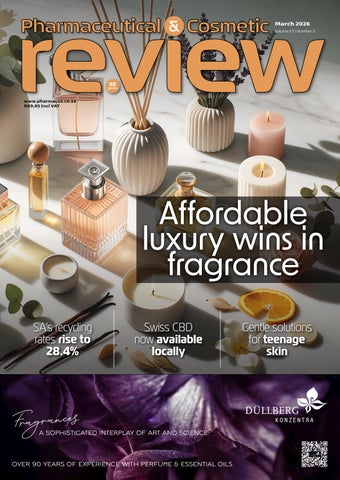
Pharmaceutical & Cosmetic Review March 2026

Page 1


SA PRA

South African Health Products Regulatory Authority

KIRSCH PHARMA SOUTH AFRICA IS FULLY COMPLIANT

Kirsch Pharma SA, licensed by SAHPRA, has been supplying high-quality individual products to the southern African market for over 35 years.

We are constantly striving to provide our clients with new and alternative raw materials for them to expand and enhance their existing formulations.

Contact us to find out whatʼs new at Kirsch Pharma South Africa.

Kirsch Pharma South Africa. World class products. World class service.

6 News

Bodo Möller Chemie consolidates its presence in Africa

Major facility acquisition for Prime Product Manufacturing

Solabia to purchase Mibelle Biochemistry

10 Fragrances & Perfumery Ingredients

Düllberg Middle East on redefining the role of a modern fragrance

New fragrance house lands in South Africa

Sweet notes and social media transform the market

Let’s get personal: Key trends for 2026

How to enhance fragrance performance in body care

Iberchem explores the scent of ink

Neogourmand – a new era in fragrance

24 Contract Manufacturing & Packing

Transform your processes with smart sensors from VEGA

Omron is future proofing pharma, one pixel at a time

28 Sustainable Packaging

Plastics SA releases 2024 industry data on recycling figures

The steel advantage: Infinite recyclability meets performance

32 Teenage Skincare

Formulating makeup for young skin with AECI Specialty Chemicals

Gentle fermented solutions by Bloomage Biotech

37 Pharma Focus/ Cannabis, CBD & Terpenes

How terpenes influence product safety

Swiss CBD now available in SA

Association News/Coschem

The society gears up for IFSCC seminar and 2029 congress

Celebrating excellence in cosmetic science – 2025 prize giving dinner

An industry on the move

The personal care industry is buzzing right now, and we've managed to capture some of the most exciting developments happening across the market. Prime Product Manufacturing has acquired the former L'Oréal manufacturing facility in Midrand, Gauteng, and Bodo Möller Chemie recently inaugurated its new personal care lab in Dubai. Both developments show that market confidence is growing in the EMEA region. In P&C Review this month, our fragrance coverage is particularly impressive. We're exploring the fascinating neogourmand trend that's reshaping the market, plus diving into the emerging ‘scent of ink’ aesthetic in niche perfumery.

Look out for the interview with Mahdi Zahreddine from Düllberg Konzentra

Middel East about the expansion of the fragrance house in Southern Africa, and we reveal Carvansons UK’s news of its new office in South Africa to support growing the demand for expert-led fragrance solutions in the region. Turn to page 10 for more.

Sustainability continues to drive conversations in the packaging industry. Plastics SA has released its latest annual plastics consumption and recycling figures for the year ending December 2024. The results offer an encouraging outlook, with recycling rates rising to 28.4%. We take an in depth look at these results in our Sustainable Packaging feature on page 28

If you’re thinking of enhancing your brand or product development pipeline, our feature on teenage skincare – a growing market segment – offers some fantastic opportunities for formulators willing to think differently about gentle, effective products for young sensitive skin. Read more on page 32

We also bring you highlights from Coschem’s AGM and student prize giving dinner. Turn to page 42 read the reviews on these events.

Enjoy!

The team

EDITORIAL

EDITOR: Abby Vorster +27 (0)71 359 4519 abby.vorster@media24.com

LAYOUT & DESIGN: Andipha Nkoloti

PRODUCTION CONTROLLER: Mandy Ackerman

COVER IMAGE: gettyimages

CONTRIBUTORS: Kelly Hu, Dean Hatt

ADVERTISING

KEY ACCOUNT MANAGER: Pepa Giesing +27 (0)72 187 2757 pepa.giesing@media24.com

INTERNATIONAL SALES

Germany/Austria/Switzerland: Eisenacher Medien Erhardt Eisenacher +49 228 249 9860 info@eisenacher-medien.de

Italy: Ngcombroker

Giacomo Rotunno +39 370 101 4694 g.rotunno@ngcombroker.com

Taiwan: Ringier Trade Media

Sydney Lai +886 4 2329 7318 sydneylai@ringier.com.hk

CIRCULATION

CIRCULATION MANAGER: Felicity Garbers felicity.garbers@media24.com

PUBLISHING TEAM

GENERAL MANAGER: Dev Naidoo

HEAD OF CONTENT & DIGITAL STRATEGY: Varushka Padayachi

PRODUCTION MANAGER: Angela Silver

GROUP ART DIRECTOR: David Kyslinger

MEDIA24 MEDIA

CEO: Minette Ferreira CFO: Lana Goliath

MEDIA24 CORPORATE

CEO MEDIA24: Raj Lalbahadur CFO MEDIA24: Nelmarie Beyers

JOHANNESBURG OFFICE

Building 13, The Woodlands Office Park, 20 Woodlands Drive, Woodmead, Sandton PO Box 784698, Sandton 2146 Tel: +27 (0)11 713 9000

POSTAL ADDRESS PO Box 784698, Sandton, Johannesburg, 2146

Bodo Möller Chemie consolidates presence in Africa and the Middle East

The Bodo Möller Chemie Group has opened a new personal care laboratory in Dubai Science Park, the Middle East’s leading science-focused hub and part of TECOM Group PJSC.

With this investment, the company is consolidating its strategic position in the personal care market while also signalling an extended collaboration with BASF in the Middle East and Africa. As part of the inaugural event, industry partners and guests were given guided tours of the laboratory, providing insights into the new technical infrastructure.

Bodo Möller Chemie’s new personal care laboratory is equipped with advanced technology for physicalchemical testing, which is essential for hair, body and skincare product development and quality assurance. Analytical capabilities include stability tests as well as measurements of pH values, viscosity, concentrations and moisture content. In this way, innovative formulations can be developed and tested for a wide range of applications, from creams, shampoos and conditioners through to serums, baby products and sunscreen lotions.

With this investment in an ultramodern laboratory, the Bodo Möller Chemie Group is creating its own technical infrastructure for the personal care segment. Manufacturers in the region now have access to a competence centre, where formulations can be tested and selectively adapted to specific application requirements. At the same time, the company is also intensifying its partnership with BASF in this segment, expanding in the African market to provide high-grade raw materials together with technical guidance and support for formulation.

Major facility acquisition for Prime Product Manufacturing

Prime Product Manufacturing, based at Pelindaba, is pleased to announce the successful acquisition of the former L'Oréal South Africa manufacturing facility located in Midrand. Effective immediately, the facility will operate as Prime Product Manufacturing Midrand, under the ownership of the BrillianceCare Group – marking a significant milestone in the group’s strategic growth.

This landmark acquisition substantially expands the group’s operational capacity, effectively doubling its production footprint and strengthening its position as a leading contract manufacturer in the African cosmetics and personal care sector.

The Midrand facility is widely recognised for its advanced infrastructure, technical capability, and compliance with global quality standards. Its integration with Prime Product Manufacturing establishes a dual-site manufacturing platform designed to service both local and international brands with enhanced scale, efficiency, and technical excellence.

The acquisition includes sophisticated manufacturing assets previously utilised for global brands. This strengthens Prime Product Manufacturing’s commitment to research, development, innovation and world-class manufacturing standards.

BrillianceCare Group reaffirms its dedication to South African manufacturing and job security. As a result, the Midrand facility will continue operating as a centre of excellence, preserving its legacy while contributing to sustainable economic growth.

“This acquisition represents more than physical expansion – it is a strategic investment in the future of ‘Made in South Africa’ beauty and personal care manufacturing. By integrating the Midrand facility into our operations, we are strengthening our technical expertise, expanding our capacity, and providing our clients with an unmatched manufacturing platform.” says Lethepu Matshaba, CEO of Prime Product Manufacturing.

From left to right: Korinna Möller-Boxberger, managing director, Bodo Möller Chemie; Lionel Breuilly, managing director Bodo Möller Chemie West Europe, North Africa, India, Middle East & APAC; Frank Haug, CEO, Bodo Möller Chemie Group; Abdallah Dabaghi, executive vice president MEA, Bodo Möller Chemie Middle East; Hamad AlZarooni, senior manager – business development, Dubai Science Park; Basem Siaj, managing director, Bodo Möller Chemie Middle East & Nigeria.
The former L'Oréal South Africa manufacturing facility located in Midrand is now owned by Prime Product Manufacturing

Nouryon wins Henkel 2025 sustainability award

Nouryon, a global leader in specialty chemicals, has been recognised by Henkel Consumer Brands with the prestigious 2025 Sustainability Award.

This accolade highlights Nouryon’s innovative, fully biodegradable ingredient solution designed to optimise water hardness in laundry detergents. The award was presented during the 2026 American Cleaning Institute (ACI) meeting, underscoring Nouryon’s commitment to sustainability and innovation.

The plant-based ingredient developed by Nouryon offers a sustainable alternative to traditional detergent components. It matches the performance of conventional ingredients while supporting cleaning efficacy in hard water

conditions. Additionally, the solution meets the stringent requirements of leading ecolabels, including the EU Ecolabel and the EPA Safer Choice programme.

Nouryon’s award-winning ingredient is a testament to the company’s role as a trusted innovation partner for major consumer brands. By providing a biodegradable solution that aligns with sustainability goals, Nouryon enables brands to reformulate their products without compromising on performance. This development is particularly significant for environmentally conscious consumers and companies aiming to meet global sustainability standards.

The ingredient is part of Nouryon’s Consumer & Life Sciences segment, specifically within the Home and Personal Care unit. It is designed to help brands achieve their sustainability targets while maintaining the high-quality cleaning performance that consumers expect.

The recognition from Henkel Consumer Brands highlights the growing importance of sustainable chemistry in the consumer goods sector. As more companies prioritise eco-friendly formulations, innovations like Nouryon’s biodegradable ingredient are paving the way for a greener future. This achievement not only reinforces Nouryon’s position as a leader in sustainable solutions but also sets a benchmark for the industry.

Nouryon is represented locally by IMCD South Africa.

Solabia to acquire Mibelle Biochemistry

Solabia will acquire Mibelle Biochemistry in the coming months. This move will combine their expertise in biotechnology and plant-based science to lead in cosmetic and nutraceutical innovation.

Mibelle is a Swiss company known for its naturally derived active ingredients for cosmetics, nutraceuticals and food. This acquisition marks a significant step in combining expertise in biotechnology, plant-based science and sustainable innovation.

Mibelle Biochemistry offers advanced technologies like PhytoCellTec. The company has a strong portfolio that spans skin beauty, healthy ageing, hair care and cognitive support. With a presence in over 50 countries, Mibelle has established itself as a leader in delivering sciencebacked solutions. Solabia’s acquisition also aims to broaden its portfolio, accelerate innovation, and expand its global reach while maintaining Swissmade quality.

The collaboration between Solabia and Mibelle Biochemistry will create a leading independent player in the cosmetic and nutraceutical ingredients

market. By leveraging complementary expertise, the partnership will scale technologies and drive sustainable innovation. The transaction will likely close in the coming months, with financial terms remaining undisclosed.

This acquisition is likely to redefine the landscape of cosmetic and nutraceutical ingredients. By combining their strengths, Solabia and Mibelle Biochemistry will deliver cutting-edge solutions that meet the growing demand for sustainable and science-driven products.

Vantage Specialty Chemicals is the local agent for Solabia.

2026 SUBSCRIPTION FORM

block letters, select your subscription option, and returnthisform,alongwithyourpayment to:

Media24 (Pty) Ltd

PO Box 440, Green Point, Cape Town 8051 Emailfelicity.garbers@newmedia.co.za

OPTIONS (please tick)1 YEAR2

Review +

APRIL

in-cosmetics Global 14 to 16 April Paris, France www.in-cosmetics.com/global

Pharma West Africa 14 to 16 April Lagos, Nigeria www.pharma-westafrica.com

IFSCC Coschem Seminar 23 April

Joburg, South Africa www.coschem.co.za

MAY

Vitafoods Europe 5 to 7 May Barcelona, Spain www.vitafoods.eu.com

West Africa Pharma & Healthcare 6 to 8 May Accra, Ghana www.westafricapharmahealthcare.com

CPHI Middle East 11 to 13 May Saudi Arabia, UAE www.cphi.com/middle-east/en

JUNE

Propak China 15 to 17 June Shanghai, China www.propakchina.com/en

Cosmoprof CBE ASEAN 25 to 27 June Bangkok, Thailand www.cosmoprofcbeasean.com

Celebrating 30 years, Sensetek thanks you for being an essential part of our success story

The future of partnerships in fragrance

Mahdi Zahreddine, managing director of Düllberg Konzentra Middle East, reflects on 2025 being a transformative year for the company. This year, Düllberg’s evolving journey is redefining the role of a modern fragrance house.

LOOKING BACK, HOW WOULD YOU DESCRIBE DÜLLBERG’S JOURNEY; WHICH MILESTONES STAND OUT AS DEFINING MOMENTS?

Mahdi Zahreddine (MZ): Transformative – an evolution, or even a fragrance revolution. There wasn’t a single defining moment; everything was interconnected. It began with welcoming 15 new team members, followed by our move to a new JLT office, redesigned as a creative and recreational space.

We were also constantly on the move, attending seven to eight fragrance events worldwide. The standout milestone was Beautyworld – an exceptionally positive showing for Düllberg – marked by six intense days of activations and teamdriven energy.

HOW HAS THE REVIVAL OF DÜLLBERG MIDDLE EAST CONTRIBUTED TO THE COMPANY’S MOMENTUM, AND WHAT IS

THE STRATEGIC ROLE OF THE REGION?

MZ: It was never a revival, but a resurgence. Düllberg has been present in the UAE for nearly two decades and has gained a strong market share across the region. However, considering political challenges and increasing global complexities, expanding further into sub-Saharan Africa and the wider GCC has become a highly strategic priority for us.

Düllberg Dubai will serve as the central hub for our African operations, covering Southern Africa, while supporting our expansion into South Asia.

TELL US MORE ABOUT BEAUTYWORLD MIDDLE EAST 2025?

MZ: Our key focus at Beautyworld was sponsorship-led partnerships and active education – both now core to Düllberg’s philosophy. The trade show provided an ideal platform to bring our vision to life. This was reflected in two stands: one inspired by Nabati Arabic poetry, paying tribute to the UAE and its culture, and the other was a fragrance universe where visitors could turn an idea into a finished perfume through one-on-one VIP sessions with our perfumers, using over 100 ingredients sourced globally.

We curated this experience for Quintessence participants –representing around 100 niche brands worldwide – whom we proudly sponsored as the exclusive fragrance partner of the Quintessence Art of Perfumery pavilion. We were also the main sponsor and fine fragrance partner of Next in Fragrance, a platform dedicated to industry knowledge sharing.

In addition, Düllberg sponsored, organised and participated in the educational programme with two talks – one by our perfumer Rebecca Krichemeier and another presented by me. We also hosted our first exclusive customer and partner gathering – a Poetry and Perfumery evening at the

The only constant in fragrance is change, and that’s its greatest complexity

25hours Hotel Dubai One Central, set against Dubai’s Museum of the Future.

WHAT WERE THE MOST NOTABLE MARKET AND OLFACTIVE TRENDS OF 2025, AND HOW HAVE THEY INFLUENCED YOUR CREATIVE AND COMMERCIAL APPROACH?

MZ: Amber continues to replace oud as the dominant oriental note, captivating souls and senses. Amouage has played a defining role in elevating frankincense as a protagonist ingredient in ultra-luxury perfumery, most notably through its Odyssey collection – Purpose, Guidance, Search, Decision, Existence and beyond.

The industry has also been swept up by a fascination with intense, unexpected tropical notes. Mango, passion fruit, guava, pomegranate and raspberry are taking centre stage, often paired with powerful oriental elements such as oud, woods and spices. Standout examples include Black Guava by Born to Standout , Oud Maracuja by Maison Crivelli , Nectar Oud by BDK , and Gods of Fire by Stéphane Humbert Lucas

HOW WOULD YOU DESCRIBE THE FRAGRANCE AND BEAUTY MARKET IN TERMS OF CHALLENGES, SHIFTS AND OPPORTUNITIES FOR GROWTH?

MZ: I don’t think there was ever a time when the fragrance market wasn’t evolving. Today the real challenge and excitement are the speed of change. We’re constantly racing to keep up with

Mahdi Zahreddine, managing director of Düllberg Konzentra Middle East

trends, new packaging ideas and shifting formulations, with little stability in ingredients or concepts. This puts pressure across the entire value chain – from R&D and perfumers to marketing, commercial teams, supply chain and logistics.

The demand for new creative ingredients and captives is stronger than ever, often driven more by marketing stories than true differentiation. At the same time, increasing regulations and newly restricted or banned materials create reformulation challenges linked to health and wellbeing concerns. Another emerging shift, seen in a few markets and niche segments, is the move away from ‘beast mode’ scents toward ‘no-fragrance’ concepts. Whether this will scale remains to be seen – but I hope the desire to smell great, not just good, will always remain.

WHAT EMERGING TRENDS OR CONSUMER

BEHAVIOURS DO YOU EXPECT TO SHAPE PRODUCT DEVELOPMENT AND BRAND STRATEGY IN THE YEAR AHEAD?

MZ: 80% of brands today are followers –copying, cloning, and iterating on existing ideas. Very few truly innovate or create products that genuinely resonate with real consumer needs and desires.

To truly disrupt, I envision a new concept I call CGB or CGP – consumer-generated brand or product. In this model, consumers

are directly involved in the creation process itself, contributing to the narrative, storytelling, design preferences, packaging and, of course, the scent.

WHAT DISTINGUISHES DÜLLBERG FROM OTHER COMPOSITION HOUSES IN TERMS OF CREATIVITY, AGILITY AND CLIENT COLLABORATION?

MZ: We are more than a fragrance house. Düllberg is redefining how the fragrance industry operates by placing partnerships and value at the core of its mission. We aim to be the go-to partner – where brands walk in with ideas and walk out with a finished product. While brands focus on selling and marketing, we bring together the best service providers to deliver a full-fledged new product development experience. That is the future – and we are building it today.

HOW

IS DÜLLBERG’S GERMAN HERITAGE MATCHED WITH A CONTEMPORARY, GLOBALLY RELEVANT VISION IN ITS LATEST PROJECTS?

MZ: Unlike suppliers that simply trade raw materials, we operate our own distillation units and a GMP-certified pharma facility. This enables us to develop proprietary natural captives, with our scientists refining and creating natural ingredients enhanced for superior olfactory performance.

We actively source unique materials, including CITES-certified natural ouds used in many of our oriental fragrances. Our perfumers stay closely connected to the global fragrance scene, creating scents that are relevant today and stable for tomorrow.

WHAT ARE BRANDS LOOKING FOR NOWADAYS BEYOND COMMERCIAL GOALS, AND WHAT HAS DÜLLBERG LEARNT THAT WILL SHAPE HOW YOU MOVE FORWARD IN 2026?

MZ: The only constant in fragrance is

change, and that’s its greatest complexity. Trends and preferences shift overnight, fuelled by the unprecedented influence of social media. Consumers are spending more time streaming content, but they are also becoming more informed. Düllberg aims to be an educational platform, not just a fragrance-making house.

Through strategic partnerships over the coming years, we are focused on meeting evolving market needs and becoming a resourceful partner that adds value to brands, teams and customers alike.

WHAT MESSAGE WOULD YOU LIKE TO SHARE WITH OUR READERS?

MZ: The future of fragrance is Düllberg. 2025 was exceptional, and 2026 will be outstanding.

We will be present at more events worldwide and continue to push the limits of what’s possible in the fragrance industry. There are many surprises ahead, so keep an eye on P&C Review – we truly value our partnership with the magazine and its incredible team. This article was first published in Parfums Plus, volume 13 – issue 3 •

The Düllberg Konzentra team at Beautyworld Middle East 2025

New fragrance house lands in South Africa

Carvansons is proud to announce the launch of Carvansons South Africa. This exciting venture will see the further expansion of the brand’s presence in Africa.

Based in Johannesburg, Carv ansons South Africa has been established to support growing the demand for expert-led fragrance solutions. Heading up the local business division is Zaheer Ernest, who will work closely with brand owners and manufacturers throughout the region to identify and implement fragrances that align with their brand identity, environment and consumer expectations.

With a strong understanding of the South African market and many years of experience within the fragrance industry, Zaheer will play a pivotal role in growing the Carvansons brand within central and southern Africa.

“Scent has the power to transform spaces and influence how customers connect with a brand,” says Zaheer Ernest, managing director of Carvansons South Africa. “I’m excited to work with South African businesses to help them discover our fragrances, which not only elevate their environments but also

DID YOU KNOW?

Carvansons is a global fragrance solutions company specialising in scent design and fragrance selection for commercial environments. Through a combination of creativity, technical expertise and market insight, Carvansons helps businesses create memorable sensory experiences.

I’m excited to work with South African businesses to help them discover our fragrances

create lasting emotional connections with their customers.”

A COMMITMENT TO THE AFRICAN MARKET

The establishment of Carvansons South Africa is part of a broader strategic commitment to Africa, ensuring closer collaboration, greater support and deeper market understanding across the region.

“South Africa is a vital market within our African strategy,” said Ethan Whowell, coordinator for Africa at Carvansons. “The formation of Carvansons South Africa shows our commitment to acting globally but thinking locally. Zaheer brings with him extensive fragrance knowledge and experience, and I am excited to see where this new venture takes us.”

Carvansons South Africa will support a wide range of industries, from beauty and personal care to household, cleaning and automotive product manufacturers. Zaheer will support

customers in these industries by offering guidance on fragrance selection, fragrance trends and regulatory requirements. •

Carvansons – zaheer@carvansons.co.uk , www.carvansons.co.uk

Carvansons HQ
Left to right: Luke Whowell, CEO; Ethan Whowell, Africa coordinator; John Whowell, Chairman; Zaheer Ernest of Carvansons South Africa; and Annu Chidakashi of Carvansons Africa

Sweet notes and social media transform the market

Fragrance manufacturers are dealing with shifting consumer behaviours and scent preferences that are reshaping production priorities and retail strategies. According to Spate's latest trend report, analysing over 900 billion search signals and 200 million social media posts, the fragrance category has posted remarkable 18.4% year-on-year growth, with predictions pointing to a 31.0% increase ahead.

The report reveals that gourmand fragrances have exploded by 85.1% year-on-year, fundamentally changing ingredient sourcing and formulation strategies. Vanilla perfume alone commands 15.1 million in average monthly popularity with 24.4% growth, whilst more adventurous gourmand notes are driving extraordinary demand. Pistachio has surged 852.5%, caramel 764.7%, and honey approximately 1 000% year-on-year.

This shift extends beyond traditional sweet notes. Unusual gourmand ingredients like matcha, guava and banana (999.0% growth), as well as osmanthus are gaining serious traction amongst consumers seeking novel olfactory experiences. For manufacturers, this presents an opportunity and complexity in sourcing these previously niche ingredients at scale.

LAYERING DRIVES

CATEGORY EXPANSION

The traditional perfume bottle is no longer sufficient. Hair perfume has grown 114.7% yearon-year, whilst layering fragrance concepts have increased 63.9%. Consumers are building comprehensive scent routines across shower products, body mists, perfume oils and solid formats, creating multiple touchpoints for manufacturers to capture value.

Particularly noteworthy is the emergence of context-specific fragrances. Bridal perfume has surged 196.5% year-on-year with 116 000 average monthly searches, indicating significant white space for occasion-driven product development. This trend suggests manufacturers should consider seasonal and life-moment collections rather than solely focusing on signature scents.

DIGITAL DISCOVERY ON THE RISE

Perhaps most significantly for industry players, consumer discovery patterns have fundamentally shifted. TikTok now drives 68.9% of vanilla perfume conversations and 81.7% of marshmallow fragrance discussions. Creator-led reviews, comparisons and educational content have become primary drivers of purchase intent, with consumers increasingly buying fragrances without prior sampling.

This digital-first approach has particularly benefited affordable-luxury positioning. Luxury perfume has grown 123.7% yearon-year, but much of this growth centres on ‘luxury-smelling but accessible’ products and comparison content highlighting dupes and value propositions.

Traditional Western fragrance houses face new competition as Arabian and oud-forward fragrances gain mainstream appeal. Brands like Arabiyat Prestige have achieved extraordinary year-onyear growth of 15 600%, whilst Lattafa has reached a 17.9 million popularity index with #lattafa emerging as the top branded hashtag. This expansion indicates significant opportunity for

TikTok now drives 68.9% of vanilla perfume conversations and 81.7% of marshmallow fragrance discussions

cross-cultural fragrance development and ingredient exploration.

KEY STRATEGIC CONSIDERATIONS

For manufacturers, these trends demand several strategic shifts. Ingredient sourcing must accommodate novel gourmand notes whilst managing potential supply constraints. Product format diversification becomes essential rather than optional, with consumers expecting comprehensive scent ecosystems.

Digital-native marketing strategies also require fundamental reconsideration of sampling and discovery programmes. When TikTok creator reviews drive purchase decisions more effectively than traditional retail experiences, manufacturers must invest heavily in creator partnerships and online education.

Finally, the data suggests speed-tomarket advantages for brands able to rapidly iterate on trending notes and formats. With marshmallow perfume growing 242.1% year-on-year from a standing start, agile product development capabilities may prove more valuable than traditional lengthy development cycles.

For manufacturers willing to adapt quickly, the convergence of digital discovery, novel ingredients and format innovation creates substantial growth opportunities that demand immediate attention rather than cautious observation. •

To download the 2026 Fragrance Report by Spate, click here: https://tinyurl.com/2e8jfp37

Spate – www.spate.nyc

Everyday routines become moments of joy, comfort, and self-expression. From energizing showers to soothing night rituals, personal care is now emotional, intentional, and truly personal.

Feel First

Fragrance and texture lead the way. Products that match your mood, style, and identity.

Luxury in the Everyday

Real & Inclusive

Gentle, effective, beautifully scented — small indulgences that make routines feel special.

2026 is personal Rituals that comfort, scents that linger, moments crafted just for you.

Authentic, flexible, and for everyone. Selfexpression over perfection.

Let’s get personal: Key trends for 2026

The latest trend insights from Fragrance Oils International, represented in South Africa by Brenntag, reveal how fragrance is becoming the primary design driver for 2026, reshaping everything from ingredient selection to brand positioning strategies across the personal care industry.

Products are focused on rituals – leaning into moods and feelings

The beauty and personal care category are no longer being defined by routine or rules. Instead, it has become an intim ate space where emotion, identity and sensory experience are all intertwined. As consumers juggle fast- paced lives, digital overload and ongoing economic uncertainty, everyday rituals are being reimagined as moments of wellbeing, comfort and self- expression.

The category is evolving beyond hygiene and function, responding to a deeper desire for products that offer a sensory appeal through innovative packaging, unique textures and emotionally relevant fragrances. Here we discuss some of the key trends transforming personal care for the year ahead.

EMOTION LEADS THE EXPERIENCE

One of the most significant shifts shaping 2026 is the move from benefit-led messaging to emotion -led storytelling. While efficacy remains essential, consumers are increasingly motivated by how products make them feel rather than what they promise to fix.

From mood-boosting shower gels to scent layering body lotions and mists, fragranceled personal care allows for self-expression and individualism. Consumers are valuing feelings over function and are in search of products that connect with them on an emotional level through how fragrance makes them feel.

Products are focused on rituals – leaning into moods and feelings – whether that’s an energising shower in the morning or comforting night cream applied before bedtime. Reframing personal care for its emotional appeal fits into the wider movement for intentional living, where small daily rituals play a vital role in mental wellbeing.

FRAGRANCES &

SKINIFICATION SIMPLIFIED

The Skinification trend is now fully embedded across personal care, but it has evolved. Instead of a clinical, ingredient heavy focus, the trend has matured into something more intuitive and lifestyle driven.

Consumers expect body washes, lotions and deodorants to support the skin barrier, respect the microbiome and deliver gentle, long term care. However, we are seeing a shift away from heavily science driven messages towards comforting scents, appealing textures and delivering sensory pleasure.

The result is personal care that feels simultaneously effective and effortless –science remains important but is embedded quietly within this subtle sophistication.

SCENT IS THE STORY

Fragrance has evolved from a supporting role into the emotional backbone of personal care. In 2026, scent will be the starting point of product development, shaping formulation and brand identity.

Personal care products are being developed around olfactive concepts – tempting gourmands, pops of fruit or comforting skin scents – with other ingredients and actives selected to support scent delivery and longevity.

We are seeing an elevated approach to products such as deodorant, body lotions and body mists, blurring the line between fine fragrance and functional personal care. Consumers are demanding sophisticated, long-lasting scents that emotionally resonate with them and support the positioning and benefit of the product.

EVERYDAY LUXURY REDEFINED

With continued global tensions and economic uncertainty, consumers seek small moments of indulgence within their daily routines rather than grand, occasional treats. Luxury is not extravagant; it is all about elevating the ordinary in 2026.

Think beautifully fragranced hand washes, sophisticated deodorants and body lotions that feel closer to fine fragrance than functional care. Our homes now shape our personal care routines with bathrooms evolving into wellness zones as we take time out to slow down and escape. Packaging is more tactile and considered, thoughtfully designed to sit proudly on open shelving and inspired by spa environments and interior design.

These products deliver a sense of quiet escape, a touch of luxury in the everyday, rewarding consumers with wellness routines that enrich, both physically and emotionally.

AUTHENTICITY OVER IDEALS

Perhaps most importantly, personal care in 2026 will reflect a rejection of narrow beauty standards. Gender-neutral positioning, inclusive fragrances and flexible product use is becoming the norm rather than the exception. Consumers are growing tired of AI perfection and are looking to brands that are authentic and showcase human creativity.

Our homes now shape our personal care routines with bathrooms evolving into wellness zones

Gen Z and younger Millennials are at the forefront of asserting their identities and differences; older generations too are embracing the freedom to express themselves and challenge traditional age-related expectations. We will continue to see a focus on self-expression, radical honesty and products that adapt to mood, moment and individuality. This demands a new level of authenticity from personal care brands.

LOOKING AHEAD

As personal care continues to evolve, this year success lies in understanding the subtleties of consumers’ needs. Products need to connect on an emotional level through fragrance, textures, storytelling and authenticity. The category’s future is more personal than ever before – rooted in everyday rituals that provide a moment of connection, comfort and pleasure. In a complex world, personal care offers something quietly powerful: a moment of calm, crafted just for you. •

Brenntag SA – www.brenntag.com/en-za

Enhancing fragrance performance in body care

Formulators and brand owners developing body care products now have access to two innovative solutions through Vantage Specialty Chemicals: the Bliss n Bloom fragrance collection from Parfums plus and Expertgel® EG 412 fragrance fixative technology. These products offer enhanced formulation possibilities for creating distinctive body care lines with superior fragrance performance.

The Bliss n Bloom collection offers formulators three distinct olfactory directions, each designed to capture specific consumer moods whilst providing technical versatility across multiple product formats.

1. Tropical Eden delivers a woody fruity profile anchored by mango, coconut, and papaya top notes, transitioning through frangipani and orange blossom hearts to warm vanilla and amber bases, providing exceptional freshness for daily-use body care products.

2. Scarlett Kiss presents a floral fruity orientation centred on red berries, with strawberry and raspberry opening notes complemented by fig, violet and jasmine florals. The addition of vanilla, amber and woody base notes creates depth suitable for premium body care lines targeting younger demographics.

3. Velvet Nectar completes the collection with a fruity ambery profile featuring peach and apricot, supported by osmanthus florals and a sensual base of sandalwood, musk and vanilla. This composition enables formulators to create products with perceived luxury positioning.

Each fragrance provides clear olfactory guidance through well-defined accords spanning fruity, floral fruity, woody fruity, oriental gourmand and chypre fruity families. This breadth enables formulators to select appropriate variants for different product categories whilst maintaining brand coherence across product lines.

ADVANCED FRAGRANCE

FIXATIVE TECHNOLOGY

Expertgel® EG 412 represents an innovative approach to fragrance retention using thermogelling technology. As a thermosensitive polymer system (INCI: Poloxamer 407 and PPG-12/SDMI Copolymer), Expertgel® EG 412 remains liquid at room temperature, facilitating easy incorporation during manufacturing. Upon skin application, the material gels at near-body temperature, forming a thin polymeric film that effectively traps fragrance molecules and reduces volatilisation rates.

Performance testing demonstrates that formulations containing Expertgel® EG 412 show significantly higher residual perfume levels after extended wear periods compared to control formulations. This enhanced retention translates to improved consumer perception of fragrance intensity and duration, providing measurable benefits for product performance.

TECHNICAL FORMULATION

CONSIDERATIONS

For optimal results, formulators should incorporate Expertgel® EG 412 at 0.5% to 3% during the cold process phase, allowing 30 to 60 minutes for complete dissolution. The material shows excellent compatibility with typical cosmetic ingredients and maintains stability across pH 1 to 12, providing formulation flexibility. Its film-forming properties also contribute to improved product adherence and reduced transfer.

The thermogelling mechanism offers additional benefits beyond fragrance fixation, including enhanced sensory properties and

Expertgel ® EG 412 represents an innovative approach to fragrance retention using thermogelling technology

improved product texture. The material creates a luxurious, transformative feel that changes from liquid to gel upon skin contact, adding perceived value to formulations.

SYNERGISTIC PRODUCT DEVELOPMENT OPPORTUNITIES

The combination of Bliss n Bloom fragrances with the Expertgel® EG 412 technology offers formulators comprehensive tools for body care product development. The fragrance collection provides appealing olfactory profiles with clear positioning opportunities, whilst the fixative technology enables enhanced performance claims and premium positioning strategies.

This pairing allows brands to develop products with distinctive fragrance signatures that maintain their appeal throughout the wear period.

Both products are available in South Africa from Vantage Specialty Chemicals, providing local technical support, formulation guidance and regulatory assistance to ensure successful implementation in manufacturing processes. This local support structure enables formulators to optimise product performance whilst maintaining cost-effectiveness in development timelines. •

Vantage Specialty Chemicals –www.vantagegrp.com

The scent of ink: Emerging olfactive aesthetics in niche perfumery

In an era obsessed with storytelling, ink symbolises creativity and intellect. Once confined to libraries, tattoo studios or the quiet intimacy of handwritten letters, the scent of ink has emerged as one of niche perfumery’s most intriguing new languages.

Anew olfactive aesthetic is emerging in niche perfumery: the scent of ink. This aesthetic is exemplified by recent launches such as Muse by Yves Saint Laurent, Black Lacquer by Tom Ford, Mortal Skin by Stéphane Humbert Lucas 777, and Ink by Akro.

Dark, mineral, cool and slightly metallic, ink reflects a shift away from sweetness and excess toward something more subtle and pure. As consumers increasingly seek personality over prettiness, ink offers a new narrative in which the skin serves as paper.

INK AS A FRAGRANCE CONCEPT

Ink is no longer confined to the page. It emerges as a new language of identity, intimacy and rebellion, a fragrance movement that transforms black fluid into olfactory art. Ink is permanent, yet fluid. It is both shadow and light, a paradox captured in scent. Olfactory compositions translate the essence of ink into scent, weaving together notes of black pepper, mineral accords, dark leather, amber and smoked wood. Although ink is neither a colour nor a fragrance, it becomes a whisper of personality, evoking mystery, creativity and the allure of what cannot be erased.

“Ink is not a single note, but rather a multifaceted accord,” explains Luz Vaquero, Iberchem’s head perfumer. “It is built through contrasts: cool mineral facets, dry wood, smoky and resinous touches, and with a metallic reverberation. The result is an accord that feels powerful and intimate at the same time, like the smell of freshly printed pages or an old library where every book carries a memory. Ink represents a new neutral that is versatile, genderless and quietly strong.”

WHY INK? WHY NOW?

This trend is inspired by India ink, a material originally developed in China over 2 000 years ago (even though the origin is Chinese, the common name is still “India ink”). It was traditionally made for calligraphy by baking branches, often from pine wood or vegetable oils, to produce carbon black pigment in liquid or solid form. Historically, it was also used in tattooing, illustration and brush painting.

The fascination with ink reflects a broader cultural movement towards quiet luxury, where refinement, material quality and intellectual resonance are valued over visibility or branding.

Ink does not exist as a natural raw material in perfumery. Instead, perfumers construct

Ink represents a new neutral that is versatile, genderless and quietly strong

it as an illusion. Metallic aldehydes create the sensation of cold steel. Vetiver and patchouli evoke the dryness of paper and wood pulp. Smoky notes suggest charred resin or carbon, while subtle leather accords hint at bindings and portfolios.

A TREND WITHIN QUIET LUXURY

This new family of scent aesthetics aligns with the broader macro-trend of quiet luxury, inspired by refined compositions and visual minimalism. It favours distinctive notes and carefully constructed accords in timeless and daringly elegant fragrances that stand

on their own: not through the power of a brand name, but through the strength and integrity of their composition.

Quiet luxury in fragrance does not announce itself across a room; it rewards attention, just like ink. Steeped in centuries of literary and artisanal symbolism, ink embodies heritage, craftsmanship, and understated refinement, almost invisible to the eye but unmistakable to the nose.

Discover more about this trend by exploring Iberchem’s new INK collection and fragrance concept,

Between The Lines , at the upcoming trade show, in-cosmetics Global 2026, taking place in Paris, France and at Beautyworld Saudi Arabia 2026 in Riyadh.

“With the INK collection, we wanted to do more than to introduce a new trend; we wanted to present a new olfactive family and a fresh way of thinking about fragrance,” adds Luz. “Ink is the black outfit of perfumery: timeless and versatile without limiting creativity.” •

Iberchem – www.iberchem.com

Neogourmand – a new era in fragrance

The fragrance industry is set for significant activity this year, with overlapping and coexisting trends, innovative ingredients and a host of surprises. The landscape is being shaped by neogourmand notes, unexpected ingredients and the rise of quiet luxury.

According to CPL Aromas, one of the most notable trends this year is the continued prominence of gourmand accords, reimagined in more sophisticated and intricate ways. Known as neogourmand, this evolution offers a modern sensory journey, blending refined pleasure with complex olfactory layers.

THE RISE OF NEOGOURMAND

These fragrances explore imaginative interpretations of culinary inspirations. From notes reminiscent of exquisite pastries to conceptual perfumes incorporating unusual ingredients like wasabi, seaweed, bread, rice, or truffle, neogourmand compositions play with contrasts between sweet and savoury. The uniqueness of this trend lies in integrating ingredients with pronounced umami profiles, delivering depth, richness and intensity while exploring subtle nuances of salty, herbal, smoky and even vegetal tones.

Neogourmand innovations reflect an interest in merging perfumery with culinary

Neogourmand reflects a broader shift in perfumery toward wellness-inspired fragrances. Ingredients traditionally associated with healthy eating and holistic care – such as miso, celery, or matcha – play an increasingly important role. These notes not only contribute new aromatic facets but also strengthen the connection between perfumery, well-being and lifestyle, aligning

scents with a pursuit of balance, naturalness and conscious sensory experiences.

QUIET LUXURY AND SUBTLE ELEGANCE

The concept of ‘quiet luxury’ is gaining traction, in contrast to traditionally bold and heavy perfumes. This movement emphasises subtlety, sophistication and refined elegance. Fragrances in this category feature soft, balanced compositions designed to complement discreetly rather than overwhelm the wearer.

Musk acts as a comforting thread, while delicate woods provide depth and structure, supporting lighter, ethereal accords. Citrus notes introduce brightness and dynamism, resulting in fragrances that convey modernity and discretion. The sensory experience is one of refinement rather than theatricality.

REINVENTING CLASSIC NOTES

While innovation is key, classic ingredients remain central to the industry. Rose, orris and aldehydes – all pillars of perfumery for decades – are experiencing a renaissance with fresh, contemporary interpretations. By combining timeless elegance with lighter, more modern compositions, perfumers are responding to the evolving olfactory sensibilities of today’s consumers.

BALANCING TRADITION AND INNOVATION

Perfumery in 2026 and beyond is set to be defined by a delicate balance of heritage and modernity. Classical notes, primarily woods and floral elements, remain the backbone of compositions, providing elegance, familiarity and emotional resonance. Layered upon this foundation, neogourmand accords introduce unexpected elements without overshadowing the classic structure, enhancing the narrative while preserving the integrity of tradition.

EXPERIMENTAL AND SENSORY PERFUMERY

Industry experts predict heightened experimentation in perfumery, focusing on experiences that go beyond simple enjoyment. Neogourmand innovations reflect an interest in merging perfumery with culinary, sensory and emotional concepts, creating scents that are lived and felt, not merely smelled.

Gourmand fragrances have a unique ability to evoke comforting memories of childhood and pleasurable culinary experiences etc, bringing warmth and sophistication to the wearer. These notes also convey a sense of comfort that restores serenity.

THE EMERGENCE OF UNEXPECTED INGREDIENTS

Looking ahead, perfumery will continue to explore unexpected ingredients, which break traditions and create novel sensory experiences. For example:

• Expanded neogourmand notes of miso, soy, maple syrup, honey, sesame, flax, praline, croissant, bread, and truffle.

• Vegetal elements of seaweed, fennel, lotus root, fig, basil, celery, beetroot.

• Beverage-inspired notes of rum, cognac, kombucha, sake.

• Spices and smoked accents of cardamom, pepper, saffron, smoky notes.

• Reinvented classics, such as green florals and fruits like peach or guava.

The overarching trend is toward fragrances that offer textured, emotional and multi-sensory experiences, fusing gastronomy, nature, and well-being while challenging traditional notions of what a perfume ‘should’ smell like. •

CPL Aromas is represented locally by IMCD South Africa.

CPL Aromas – cplaromas.com IMCD South Africa – www.imcdsa.co.za

Transform your processes with smart sensors

Contract

manufacturers gain a competitive edge with VEGA’s compliant measurement solutions, featuring non-contact radar sensing for single-use bioreactors and intelligent pressure monitoring for steam sterilisation.

Sub-Saharan Africa has witnessed gradual developments in its pharmaceutical industry. Ensuring the safe and timely delivery of medicine has emerged as a priority for regional governments, offering lucrative opportunities for local manufacturers.

Similarly, the cosmetics contract manufacturing sector continues to grow rapidly, as more brands outsource production to specialist facilities to remain agile, efficient and compliant. With increasing regulatory requirements, demand for faster timeto-market and the complexities of scaling production without compromising quality, manufacturers are turning to high-precision automation and smart instrumentation to gain an edge.

In these industries, VEGA’s level and pressure measurement solutions are proving to be essential partners in profitability. Whether it’s a single-use bioprocessing vessel, a capsule filling line or a steam sterilisation process, VEGA’s radar, pressure and point level sensors are built to perform with speed, accuracy and intelligence.

SMARTER BIOPROCESSING

Single-use bioreactors have become increasingly popular in pharmaceutical contract manufacturing due to their reduced risk of cross-contamination and faster turnaround times between batches. Yet the plastic vessels present a challenge for traditional level measurement methods, particularly when accuracy is required from outside the container.

The VEGAPULS 6X is a next-generation radar device that offers continuous, noncontact level measurement. It can detect even the smallest signal differences, making it ideal for use in transparent or semi-transparent plastic bioreactors. The sensor easily measures through the wall of the container, there’s no need for direct contact, ensuring sterility is maintained. With no moving parts, VEGAPULS 6X is also extremely low maintenance, offering longterm stability and reliability.

FAST, RELIABLE PRESSURE READINGS

Steam sterilisation is another critical step, especially in contract facilities where production lines are reconfigured for different clients and products. Maintaining stable pressure during saturated steam sterilisation is vital to ensure proper microbial kill rates and avoid damage to sensitive components.

The VEGABAR 29 pressure sensor is designed for this application. Its fast response time allows it to detect even small fluctuations in pressure within seconds, helping operators maintain precise control over the sterilisation cycle. With its IO-Link digital interface,

Because contract manufacturers often run a wide range of products with different sterilisation requirements, the ability to rapidly adjust settings, monitor live process conditions and avoid unplanned downtime translates directly to operational savings.

CAPSULE FILLING CONFIDENCE

Capsule filling machines operate at high speed and require accurate point level detection to ensure every dose is complete, clean and compliant. Traditional sensors can be inconsistent in detecting small volumes of powder or liquid, especially when switching between different formulations or capsule sizes.

The VEGAPOINT 31 is a plug-and-play capacitive point level switch engineered for these kinds of applications. It detects the presence or absence of material in the filling line with high precision and features a 360° full-colour status display that operators can view from any angle even in tight production spaces. It helps contract manufacturers reduce waste, eliminates line stoppages and guarantees consistent quality.

WHY VEGA?

BIOPROCESSING STARTS HERE

VEGAPULS 6X: Non-contact radar measurement through plastic bioreactors for aseptic precision. VEGABAR 29: Fast-response pressure control for reliable steam sterilisation cycles.

• VEGAPOINT 31: Plug-and-play detection for capsule filling accuracy. Together, these innovations give contract manufacturers a measurable edge –enhancing quality, speed, and compliance.

Unlike some of legacy solutions, VEGA’s sensors are designed for the connected, compliant factory of the future. All devices are built with hygiene in mind, using FDA and EC1935/2004-compliant materials. The sensors are also certified for use in ATEX zones and meet all relevant international standards, including GMP, EHEDG, and 3-A.

More than just a component supplier, VEGA partners with manufacturers to help them design more intelligent, reliable and costeffective processes. Its decades of experience in pharma and cosmetics manufacturing applications ensure clients get a solution tailored to their specific needs. •

VEGA – www.vega.com/en-za/industries/ pharmaceutical

SMARTER

Looking for the level? Measuring the impossible with radar.

Everything is possible. With VEGA

No matter whether your products are liquid or solid, hot, cold, or corrosive – for decades, our radar technology has been setting the standards in level measurement for the pharmaceutical industry. We deliver precise, reliable measured values exactly where they’re needed, resulting in more stable processes, greater safety, and maximum product quality. With our radar solutions, innovation knows no limits.

Future proofing pharma, one pixel at a time

Omron’s vision systems prepare manufacturers for the next decade of demand.

South Africa’s pharmaceutical industry is under pressure to deliver consistent product quality, ensure regulatory compliance,and maintain competitiveness in a fast-evolving global market. As production volumes rise and product variation becomes more complex, traditional inspection systems often struggle to keep pace.

Omron’s FH-AI and FHV7-AI vision technologies offer a reliable solution by bringing advanced artificial intelligence, simplified setup and robust performance to pharmaceutical production lines.

QUALITY CONTROL WITH A SIXTH SENSE

In manufacturing, and more so pharmaceutical manufacturing, there’s no room for error. From blister packs and vials to labels and date codes, every component must meet strict quality standards. Omron’s FH-AI and FHV7-AI systems introduce AIpowered inspection that adapts to real-world variability; something conventional rulebased vision systems cannot easily achieve.

The FHV7-AI detection camera automatically learns from a few sample images, eliminating the need for extensive manual configuration. This reduces setup time from hours to minutes while maintaining stable, repeatable inspection accuracy even as product conditions change. The system can detect missing components, verify product types, identify scratches or dents and ensure that date codes are present and legible, all critical tasks in pharmaceutical packaging and serialisation.

One of the biggest barriers to adopting advanced vision systems is the need for technical expertise. Omron addresses this challenge with intuitive, step-by-step interfaces that guide the operator through setup, lighting adjustments and reference image registration. Even teams with limited machine vision experience can deploy robust inspection processes quickly.

The FHV7-AI’s all-in-one design simplifies installation. It features integrated lighting, autofocus lenses and an IP67-rated housing.

The construction of this camera is ideal for pharmaceutical environments where humidity and temperature fluctuations can compromise less durable systems.

CHANGEOVERS WITHOUT THE CHAOS

South Africa’s pharmaceutical industry includes contract manufacturers, largescale producers of generics and specialised producers of biologics and sterile injectables. Omron’s FH-AI and FHV7-AI systems support this diversity with flexible configuration options.

The FHV7-AI series offers multiple focal lengths, wide installation distance ranges from 59mm to 2000 mm, and a 1.6 MP colour sensor with white LED illumination. This allows manufacturers to inspect a wide variety of packaging formats and product sizes without changing hardware. The autofocus function enables rapid changeovers, which is an essential capability for facilities running multiple SKUs on shared production lines.

GOODBYE GUESSWORK, HELLO PRECISION

Industry bodies like the South African Health Products Regulatory Authority demand rigorous compliance with quality and traceability standards in pharmaceutical manufacturing. Omron’s AI vision systems play an important role in meeting these requirements by providing reliable support for several key compliance functions.

These systems ensure accurate serialisation and date-code verification, helping manufacturers maintain the integrity of product tracking and expiry information. They offer dependable detection of packaging defects,

The FHV7-AI’s all-inone design simplifies installation

guaranteeing product quality and patient safety. The technology delivers consistent inspection outcomes, regardless of shift or operator, which means that high standards are maintained throughout production. Additionally, features such as automated documentation and traceability streamline record-keeping and support audit requirements.

By minimising human error and enhancing the repeatability of inspections, Omron’s AI vision systems enable pharmaceutical manufacturers to remain audit-ready and reduce the risk of expensive product recalls.

Beyond performance, Omron’s AI vision solutions deliver these cost advantages:

• Reduced engineering time thanks to automated learning and simplified setup.

• Lower maintenance costs due to rugged, integrated hardware.

• Minimised downtime through fast product changeovers.

• Scalable deployment across multiple lines or facilities.

For South African manufacturers facing rising operational costs and competitive pressures, these efficiencies translate into meaningful long-term value.

BE FUTURE READY NOW

Omron’s vision systems prepare manufacturers for the next decade of demand. Embracing innovative vision technologies will only help manufacturers meet the demands of a growing market, but also sets new benchmarks in quality, compliance and efficiency.

By investing in advanced automation today, pharmaceutical manufacturers can future-proof operations, enhance global competitiveness and ensure the consistent delivery of safe, highquality products to end users. •

Beyond the bin: SA's recycling rates rise to 28.4%

South

Africa used more recycled plastics in 2024 as recycling rates improved – but as industry data shows promising progress toward circularity, the need for a waste management system that works for everyone in the value chain has never been clearer.

Plastics SA, the umbrella body representing the South African plastics industry, has released its latest annual plastics consumption and recycling figures for the year ending December 2024. The 2024 results offered an encouraging outlook despite persistent challenges within South Africa’s waste management system and significant economic and operational pressures that had to be overcome by recyclers.

Anton Hanekom, executive director of Plastics SA, acknowledges that the 2025/26 figures might paint a different story once all the data has been collected and verified.

“The purpose of Plastics SA is to collectively enhance the South African plastics industry’s long-term growth and sustainability. Each year, we compile this report by conducting in-person interviews with raw material producers and plastic re-processors (recyclers) across the country, ensuring that the data is accurate, verified and truly reflective of what is happening on the ground,” he says.

What we now need is a waste management system that works, markets that value recyclate and policies that enable long-term investment in the circular economy

SOUTH AFRICA IN THE GLOBAL CONTEXT

In global terms, South Africa’s virgin plastics consumption represents approximately 0.4% of total global plastics consumption. However, our country remains the largest plastics industry in Sub-Saharan Africa, supplying products to neighbouring countries both directly and indirectly through local manufacturers.

One of the most significant findings from the 2024 data is the continued shift towards recycled content. While virgin polymer consumption has grown steadily over the past decade, recyclate consumption has grown at a much faster rate, demonstrating the industry’s commitment to circularity.

“Over the last 10 years, virgin plastics consumption grew by 18%, while recyclate consumption increased by an impressive 67%. This clearly shows that local re-processors and manufacturers are actively supporting the transition towards a more circular plastics economy,” Hanekom explains.

WHERE PLASTICS ARE USED LOCALLY

The packaging sector remains the largest consumer of plastics in South Africa, accounting for 49.4% of total plastics use, across flexible and rigid applications. This is followed by building and construction (13.2%) and agriculture (10%).

“South Africa lacks a strong non-packaging plastics sector. Engineering, industrial and customised plastic products have the potential

to generate higher margins and greater economic value. Yet we continue to import large volumes of finished plastic goods – including floor, wall and ceiling coverings, sheets, films, boxes, crates and builders’ ware –which could be manufactured locally to stimulate employment and local procurement,” he notes.

A SYSTEM UNDER PRESSURE

Internationally, recycling is under pressure due to increasing collection and processing costs whilst virgin polymer prices plummet. Hanekom highlights that over the years, South African re-processors have showed incredible tenacity and endurance to tough times and continued to grow despite the challenges they face.

“While South Africa’s recycling performance compares favourably with many countries, it remains highly dependent on manual collection and sorting, largely driven by waste pickers and small-to-medium recycling businesses. Our country’s recycling value chain is long, fragmented and costly, largely due to inefficiencies in waste collection and sorting. Although this model delivers impressive recovery rates, it is also highly vulnerable,” he explains.

Furthermore, recycling growth is increasingly constrained by South Africa’s failing municipal

KEY RECYCLING HIGHLIGHTS FOR 2024

South Africa’s mechanical plastics recycling rate reached 28.4%, placing the country well above the global average and ahead of many developed economies when it comes to mechanical recycling.

Total plastics recycled increased to 471 000t in 2024, continuing a steady upward trend over the past five years. Circular plastics content in new products rose to 22%, compared to just 16% a decade ago.

• Recycling volumes increased for most polymers, notably:

- 166 692t of low and linear low-density polyethylene (LD/LLDPE) - 96 838t of polypropylene (PP)

- 96 635t of PET

- 73 442t high-density polyethylene (HDPE)

Post-industrially sourced recyclable waste increased from 17% in 2023 to 24% in 2024, reflecting greater recovery of cleaner waste directly from generators such as farms, contractors and distribution centres, rather than from landfill.

End-markets for recycled plastics are becoming increasingly diverse. Key sectors include flexible packaging (28%), clothing and footwear (12%) and agriculture (10%), alongside applications in building and construction, furniture, toys and leisure products. No single market sector relies on only one material. Instead, recycled polymers are used across a wide range of end-markets, each selected to meet specific performance and fit-for-purpose requirements.

waste management system, with an estimated 36% of households still lacking regular waste removal services.

“Recyclers cannot recycle what they do not receive. Contaminated waste, poor collection systems and a lack of separation at source result in valuable recyclable material ending up in landfills. In many cases, material that has already been collected is ultimately sent back to landfill due to sorting inefficiencies or contamination,” says Hanekom.

UNLOCKING FURTHER GROWTH

To enable further growth in recycling and strengthen South Africa’s circular economy, Plastics SA stresses the urgent need to:

• Fix municipal waste collection and sorting infrastructure.

• Invest in and support local recyclers, particularly small and medium enterprises.

• Develop new end-markets for recycled plastics, especially beyond packaging.

• Stimulate demand for recycled content through intentional product design and responsible procurement practices.

A CALL FOR COLLABORATION

Plastics SA emphasises that no single stakeholder can address South Africa’s waste and recycling challenges alone. Meaningful progress will require stronger collaboration between government, industry, Producer Responsibility Organisations (PROs), recyclers and consumers.

“Recycling is not the problem – it is part of the solution. South Africa has proven that it can recycle. What we now need is a waste management system that works, markets that value recyclate and policies that enable long-term investment in the circular economy so that this vital industry can continue to grow,” Hanekom concludes.

The Executive Summary as well as the full Plastics SA 2024 industry data report is available at www.plasticsinfo.co.za •

South African domestic consumption for 2024

recycled

Materials recycled

Recycling operations

Tonnages

The steel advantage: Infinite recyclability meets performance

Brands across the world are facing increasingly stringent environmental regulations and growing consumer demands for sustainable packaging solutions. In response, the industry focus has shifted dramatically towards circular, recyclable materials that deliver on performance and environmental responsibility.

Afrontrunner in this space is Sonoco. The packaging supplier’s comprehensive approach to sustainable packaging innovation was showcased at Paris Packaging Week, marking the company’s first major European exhibition since integrating its metal and rigid paper packaging activities into a unified consumer packaging business.

The global packaging landscape is undergoing significant transformation, driven by legislation such as the EU’s Packaging and Packaging Waste Regulation (PPWR) and Extended Producer Responsibility (EPR) frameworks, also relevant in South Africa. These developments are reshaping how manufacturers approach material selection and design. In response, Sonoco has developed a portfolio of solutions that prioritises circularity, recyclability and reduced environmental impact whilst maintaining the high-performance standards that brands demand.

THE BEAUTY OF STEEL PACKAGING

Central to this sustainable approach are Sonoco’s steel-based packaging innovations, which leverage one of the most recycled materials on earth – steel. In Europe, steel achieves recycling rates of up to 80.5%, with recycled content reaching up to 67% in new packaging applications.

This exceptional circular performance underpins Sonoco’s aerosol can range, including the revolutionary G3 2-piece steel aerosol can featuring an integrated dome design with no side seams, capable of withstanding pressures up to 15 bar.

The beauty of steel packaging lies in its infinite recyclability without quality degradation

The beauty of steel packaging lies in its infinite recyclability without quality degradation. Every steel package can become part of the circular economy, reducing the need for virgin materials whilst maintaining structural integrity and barrier properties that protect product quality.

A STRONG SUSTAINABILITY STRATEGY

Beyond material selection, Sonoco’s sustainability strategy encompasses lightweighting initiatives and fit-forpurpose design innovations that minimise material usage without compromising functionality. Its rigid paper packaging solutions offer brands alternative sustainable options, particularly for promotional applications and gift sets that combine environmental responsibility with premium aesthetics.

The company's comprehensive sustainability support extends to lifecycle assessments (LCAs), which help brands quantify the environmental impact of their packaging choices. LCAs also assist in

making informed decisions that align with brands’ sustainability goals. This technical expertise, combined with in-house design and prototyping capabilities, enables Sonoco’s customers to develop packaging solutions that meet performance and regulatory requirements.

Sonoco’s manufacturing footprint –spanning 51 facilities across EMEA and more than 250 globally – further enhances the sustainability proposition by minimising transportation distances and associated carbon emissions. This regional approach also provides supply chain agility and supports compliance with evolving regulatory frameworks across different markets.

TRADE SHOW HIGHLIGHTS

At Paris Packaging Week, visitors got to experience how these sustainable packaging innovations translate into real-world applications. From highimpact decorative finishes using techniques like hot stamping to foodgrade vacuum closures that extend product shelf life, Sonoco demonstrated that sustainability and premium positioning can coexist successfully.

Sonoco’s participation in the international trade show featured comprehensive displays of aerosol cans, rigid paper containers, promotional packaging, and metal gift sets – all designed with circularity principles and PPWR compliance at their core. Industry professionals who visited their stand got to explore how these solutions support sustainability objectives whilst delivering the performance and aesthetic appeal that consumers expect.

As the packaging industry continues its evolution towards a truly circular economy, companies like Sonoco are proving that sustainable innovation isn't just an environmental imperative – it's a competitive advantage that drives brand value and business success. •

Sonoco – www.sonoco.com

In an industry where every millimetre of package space tells a story, VR Print has carved out a reputation as the label technology partner that transforms complex packaging challenges into competitive advantages.

Buckle Packaging is driving sustainable growth across Southern Africa. The company continues to lead the charge in sustainable packaging innovation, helping manufacturers across diverse industries transition to eco-friendly solutions without compromising on performance.

In a market where packaging choices can make or break product success, Bright Packaging & Raw Materials has established itself as the go-to partner for companies seeking quality, flexibility, and sustainability without compromise.

www.b2bcentral.co.za/digital-issues/packaging-review-issue-5-2025/

ADVERTISING

Interested in advertising in PACKAGING REVIEW?

If you are a supplier to the packaging industry, this will be an ideal opportunity to showcase your product offering and create additional brand awareness within the food, beverage, pharmaceutical, cosmetics, personal care, and home care manufacturing sectors.

Contact our advertising Key Account Managers to book your space:

Càndida

Formulating makeup for young skin in a social media-driven world

The teenage years mark a major turning point in skin physiology. As hormonal activity increases, so does sebum production. This often results in oiliness, clogged pores and occasional breakouts. Teenage skin also remains thinner and more sensitive than adult skin, making it particularly vulnerable to irritation.

With skincare and beauty trends dominating TikTok, Instagram and YouTube, teens are increasingly exposed to advanced skincare and makeup products originally developed for mature skin. Many of these viral offerings contain strong active ingredients such as exfoliating acids, high pigment loads, heavy film formers or drying solvents.

While effective for adults, these components can compromise the developing skin barrier when used too early or frequently. The opportunity for brands today lies in creating gentle, protective and age-appropriate beauty products that support teenage skin rather than aggressively treating it.

DESIGN MAKEUP LIKE SKINCARE

Makeup is no longer reserved for special occasions or adult consumers. Today’s teenagers are experimenting with tinted lip oils, glosses, lightweight foundations, cream blushes and brow products at younger ages driven largely by digital beauty culture and influencer routines.

Traditional long-wear, heavily fragranced or highly occlusive makeup can easily trigger breakouts, redness and irritation in teenage skin. Rather than focusing on heavy coverage or aggressive oil control, teen makeup should prioritise lightweight textures, breathable wear, non-comedogenic emollients and barriersupportive systems.

By combining modern ester technologies, mild film formers and gentle base

Formula NOI: 100% Naturally Derived (ISO 16128)

Key ingredient benefits:

• Beantree is an Ecocert and COSMOS approved 100% natural ester derived from castor and rapeseed oils. It is a light, dry ester that is a good alternative to silicones in skin, hair and makeup products

Dermol SLLC-L is a biodegradable and naturally derived surfactant that helps form rich and long-lasting foam. It is very mild, has antimicrobial properties, is oil-soluble and improves rinseability of anhydrous makeup removers.

Trivent OC-G is a naturally derived saturated triglyceride with very low viscosity and a silky skin feel

formulations, it is now possible to create makeup that feels like skincare, enhancing appearance while protecting young skin.

SMART INGREDIENT TECHNOLOGIES

Modern naturally derived esters, mild surfactants and flexible film formers allow formulators to create makeup that:

• Feels weightless

• Improves spreadability

• Boosts comfort

• Supports moisture retention

• Enhances wear without clogging pores. Ingredient portfolios from AECI Specialty Chemicals showcase how ester chemistry can replace heavy silicones and petro-derived emollients while delivering elegant sensory profiles ideal for younger consumers.

KEY MESSAGING FOR TEEN MAKEUP

Beyond performance, teen-focused makeup should emphasise:

• Breathable on skin

• Gentle for sensitive skin

• Non-greasy feel

• Barrier-friendly

• Everyday comfortable wear. This builds trust with among teenagers and parents, which is a critical factor in this market segment.

Table 1: Natural anhydrous makeup remover
Figure 1: Illustration of make-up remover in action

Teen colour cosmetics are moving away from full-coverage glam toward skinlike finishes, skincare-inspired textures, minimalist ingredient lists, and gentle performance. The brands that succeed will be those that treat teenage makeup as an extension of skin health – not just colour. The plumping natural lip serum gloss formulation in table 2 demonstrates how teen makeup can deliver performance and sensorial appeal without compromising skin comfort. By combining lightweight, naturally derived esters with moisture-retaining polymers, the formula provides high shine, cushion and long-lasting hydration while remaining breathable and non-greasy on young lips. The subtle stimulating effect from capsicum extract enhances fullness without harsh irritation, creating a healthy looking plump rather than an aggressive tingling sensation.

FORMULATING TO SUPPORT SKIN HEALTH

As teenage beauty continues to evolve under the influence of digital culture, the responsibility of formulators becomes

Key ingredient benefits:

• BioMade BB is a 73° C melting point waxy ester that is a great naturally derived alternative to petrochemical derived waxes.

Dermol MBDD is naturally derived polymer from mango butter and rapeseed oil. It melts at body temperature, provides high shine and is great for retaining moisture.

• Dermol LL is an ester that provides cushion to the application and a silky after feel to skin and lips.

increasingly important. Rather than adapting adult products for younger consumers, the future lies in creating makeup specifically designed for developing, sensitive and hormonally active skin.

By prioritising lightweight textures, barrierfriendly ingredients and gentle performance, teen makeup can support skin health while

Capsicum (Cayenne) Herbasol® Extract IPM lip care active offers stimulating properties to provide a plumping effect. AECI Specialty Chemicals

allowing for creativity and self-expression. This skin-first approach not only reduces irritation and breakouts today but also helps establish positive skincare habits that benefit young consumers well into adulthood. •

Table 2: Plumping natural lip serum gloss

Gentle fermented solutions for teenage skin troubles

In a market increasingly focused on authenticity and efficacy, Bloomage Biotech’s approach to teenage skincare offers a refreshing alternative to traditional harsh treatments.

Adolescence is a crucial time for skin development, and it’s often accompanied by hormonal fluctuations, oily skin and exposure to external stressors. These factors make sensitive skin and unbalanced skin microecology the most common skin woes for teens.

As a result, the demand for gentle, effective and targeted skincare products has been skyrocketing.

More teens and their parents are now realising the importance of a balanced skin microecology. This, coupled with functional ingredients that soothe sensitivity while regulating skin’s microflora, has become the heart of the teenage skincare market.

Bloomage Biotech, a leader in bioactive ingredients, has developed a range of high-quality ingredients that work together to create a complete solution for teens. These ingredients include Microecobeauty ME-1, Zinc Hyaluronate (HA-Zn), Microecobeauty ME-3, Ectoine, and Schizophyllan (SPG) – available in South Africa from Savannah Fine Chemicals.

MICROECOBEAUTY ME-1

Made from the fermented lysate of Lactobacillus rhamnosus (a probiotic strain isolated by Bloomage Biotech), ME-1 is key to regulating skin’s microecology. It contains intracellular and extracellular metabolites of Lactobacillus rhamnosus, plus active bacterial components, with a solid content of at least 3%. This includes over 10g/L of 23 different amino acids, 15g/L to 20g/L of lactic acid, no less than 8g/L of protein, and no less than 6g/L of sugars.

For teens, this ingredient effectively keeps harmful skin bacteria – like Propionibacterium acnes (which causes acne), Staphylococcus aureus , and Candida albicans – in check. It also maintains beneficial bacteria (such as lactobacilli), balancing skin’s microflora. Furthermore, ME-1 helps regulate oil production and water balance, it slightly adjusts skin’s pH level and reduces water loss to keep skin moisturised long term. It also boosts the production of antimicrobial peptides like HBD2 and HBD3, enhances the expression of the immune-related gene TLR2, strengthens skin’s microbial and immune barriers and eases redness and sensitivity.

ZINC HYALURONATE (HA-ZN)

This ingredient includes a unique combination of hyaluronic acid and zinc to provide moisturising and oil-regulating benefits. Zinc

Hyaluronate (HA-Zn) is perfect for soothing and repairing teenage sensitive skin. It retains hyaluronic acid’s excellent moisturising properties, deeply hydrating skin to ease dryness and tightness. In addition to the effect of hyaluronic acid, it has the benefit of zinc. Zinc significantly inhibits oil production in human sebocyte cells and reduces dihydrotestosterone (DHT) synthesis by targeting 5 α-reductase activity, addressing one of the primary hormonal triggers of teenage acne. Furthermore, HA-Zn effectively neutralises harmful free radicals (like hydroxyl and superoxide radicals), reduces oxidative damage to skin cells and speeds up barrier repair by promoting skin cell growth and migration.

In vitro tests show HA-Zn, at a concentration of 0.05mg/mL, significantly increases the collagen III to I ratio, helping to reduce scarring from acne and other skin damage. In vivo test results show that a 0.5% HA-Zn solution increases skin moisture by 18% and reduces water loss by 10% after just seven days. It’s gentle, nonirritating and safe for teens to use long term. The recommended dosage for HA-Zn in skincare products is 0.1% to 0.5%.

MICROECOBEAUTY ME-3

A high-purity bifida ferment filtrate, Microecobeauty ME-3 focuses on strengthening the skin’s natural barrier, making it ideal for teens with fragile skin. Every drop of ME-3 contains 50 million probiotic extracts, with a solid content of 0.8% to 2.3%.

It is rich in vitamins, organic acids, water-soluble proteins and amino acids. ME-3 boosts the production of skin barrier proteins like filaggrin (FLG), loricrin (LOR), and involucrin (IVL), and significantly increases aquaporin AQP3 levels – all of which help lock in moisture and strengthen skin’s protective barrier.

ME-3 also promotes cell migration to repair damaged skin cells, protects against UV-induced cell damage and death, and eases sensitivity caused by environmental stressors (like pollution or

DID YOU KNOW?

Over 60% of teenagers aged 12 to 18 have dealt with sensitive skin symptoms such as redness, dryness, itching and tightness, according to latest market research.

temperature fluctuations). For teens with sensitive skin, ME-3 reduces skin’s reaction to lactic acid irritation: a 0.5% ME-3 serum cut lactic acid-induced tingling by 23.7% after two weeks of use, helping skin return to a healthy state.

ECTOINE

A powerful shield for teenage sensitive skin exposed to daily stressors, Ectoine is extracted from salt-loving bacteria. As a cyclic amino acid derivative, it boasts high hydrophilicity and exceptional stability, maintaining its efficacy at pH levels 1 to 9 and at all temperatures. This means it remains effective even in different skincare formulations and harsh environmental conditions.

Through the ‘Kosmotropic effect’, Ectoine forms a stable, breathable protective layer around skin’s cells, DNA and enzymes. This layer acts like a ‘protective fortress’ to lock in moisture deeply, prevent water loss and shield skin from a wide range of external irritants, including UV radiation, pollution, temperature fluctuations, and even the irritation caused by acne treatments or other skincare products.

Ectoine delivers excellent anti-stress and repairing benefits:

• it protects the integrity of skin cell membranes

• reduces sunburn and photo-damage from UV rays

• inhibits inflammatory factors like IL-6 and TNF- α to ease redness and itching

• accelerates the repair of damaged skin barriers.

In vivo tests show that Ectoine at a concentration of 1.0% can reduce skin redness by 35% and improve barrier function by 42% after two weeks of use. What makes it particularly suitable for teens is its extreme gentleness. Ectoine is non-irritating to skin and eyes, has no phototoxicity or genotoxicity, and is compatible with all skin types – even the most fragile and teenage sensitive skin.

SCHIZOPHYLLAN

Another star ingredient from Bloomage Biotech, Schizophyllan offers unique advantages for teenage sensitive skin. It is a high-purity β-glucan derived from advanced bio-fermentation technology, with dual effects of barrier repair and immune regulation. These advantages make it a perfect accompaniment to Ectoine in formulations.

Schizophyllan forms a lightweight, breathable and moisturelocking film on the skin's surface which neither clogs pores nor feels greasy, making it ideal for teens with oily or combination sensitive skin.

As a clinically proven immune regulator, Schizophyllan can enhance skin's active defense capability by increasing the expression of NO, TNF- α , IL-1β and IL-10 in macrophages. This strengthens skin's innate immunity, while simultaneously reducing excessive inflammation by inhibiting the over-secretion of inflammatory factors induced by endotoxins. Ultimately, it effectively soothes chronic redness, itching and sensitivity caused by seborrheic dermatitis or repeated skin irritation. It also promotes the synthesis of collagen and mucopolysaccharides, helping to repair damaged skin tissues and reduce scarring from acne or minor scratches.

Schizophyllan has been clinically verified for its safety, with no irritation or sensitisation, and it can significantly enhance the efficacy of other ingredients when used in combination.

Bloomage Biotech is empowering teenagers to take control of their skin health

COMMITTED TO EMPOWERING TEENS

Adolescence is a time of self-discovery and confidence building, and healthy skin plays a crucial role in these processes. By understanding the unique challenges of teenage skin and developing advanced formulations that work with skin's natural systems, Bloomage Biotech is empowering teenagers to take control of their skin health.

The combination of ME-1, HA-Zn, ME-3, Ectoin and Schizophyllan represents a revolutionary approach to teenage skincare – one that nurtures, protects and balances rather than battles. This science-based solution offers long-term benefits for skin health, helping teenagers navigate this challenging period with confidence and comfort. •

Bloomage Biotech – www.bloomagebioactive.com/En Savannah Fine Chemicals – www.savannah.co.za

Ectoine improves cells' anti-stress ability and resists external pressures

How terpenes influence product safety

CIn this article, Dean Hatt, senior toxicology consultant at Broughton, a medicinal cannabis testing consultancy, explains the importance of cannabis aroma compounds in product performance and risk assessments.

annabis has an extremely distinctive smell that is instantly recognisable with a mix of citrus, pine, pepper and floral notes. Beneath these aromas lies complex chemistry attracting scientific attention, especially in the laboratory.

As the medicinal cannabis market continues to grow, terpenes are a focal point for safety, consistency and product performance.

Terpenes are naturally occurring aromatic compounds produced in a wide range of plants, including the cannabis plant. The same types of molecules are responsible for the scents of many other plants such as pine, citrus, lavender and pepper. In cannabis, they are produced in the trichomes, the same resin glands that generate cannabinoids like tetrahydrocannabinol (THC) and cannabidiol (CBD).

Each cannabis strain or cultivar has its own terpene profile, which contributes to its biological and therapeutical effects as well as its flavour and aroma. Over 200 terpenes have been identified – with myrcene, limonene, pinene, linalool and beta-caryophyllene being the most common.

Increasing evidence suggests terpenes may interact synergistically with cannabinoids to produce enhanced therapeutic effects in what’s called the entourage effect, which can enhance or modulate their physiological impact. For example, myrcene may promote relaxation or sedation, limonene could elevate mood and pinene may counteract some cognitive effects of THC such as short-term memory impairment.

This potential has spurred demand for cannabis products positioned by desired effects, such as focus, calm or sleep, with terpene profiles playing a central role.

DIFFERENTIATION ADDS UNCERTAINTY

For producers, terpenes are key to strain identity, consumer targeting and market positioning. This is particularly true in more

Terpenes are key to strain identity, consumer targeting and market positioning

mature markets, such as in North America, where flavour and experience drive consumer preference.

Terpenes shape the sensory identity of cannabis products. Their composition directly influences flavour, smoothness and perceived quality. Terpene requirements from product developers vary, with some seeking distinctive aroma profiles and others preferring milder blends, making an industry benchmark unclear.

While this product variability exists, it shows the need for consistent scientific assessment to formulate safe and effective products.

PRODUCT QUALITY AND SAFETY

As terpenes can oxidise or degrade during processing or storage, this will affect product consistency and safety. Therefore, testing for terpene content and stability is included in regulatory submissions, quality control and formulation development.

Risk assessments are important in assessing the safety of terpenes. They identify the toxicological concerns, quantify them individually and collectively and compare exposure to safe limits. This confirms

product safety and compliance with whichever regulatory body the product is submitted under.

Even for professionals working in pharmaceutical science, terpene chemistry can be more complex than expected. In addition to contributing to flavour and aroma, these compounds can subtly affect how consumers feel, from promoting relaxation to enhancing alertness. Highlighting these nuances helps ensure that product formulations are both effective and responsibly designed.

Broughton’s capabilities include providing a complete development pathway by combining analytical science, manufacturing expertise and toxicology insight to advance the cannabis sector safely and responsibly. Its team is working at the forefront of cannabis science, evaluating analytical techniques such as gas chromatographymass spectrometry and headspace analysis to improve accuracy and robustness in terpene testing. •

Broughton – www.broughton-group.com

Swiss CBD now available in SA

The market for cannabinoid therapeutics continues to expand. Brenntag Pharma responds with Swiss-manufactured, pharmaceutical-grade CBD API solutions, distributed locally.

As interest in cannabinoid-based therapeutics accelerates across the EMEA region, the pharmaceutical industry faces a defining challenge: securing consistent, high-purity cannabidiol (CBD) ingredients that meet stringent regulatory and pharmacopeial requirements. Natural CBD Pure API, a crystalline, highly purified CBD active pharmaceutical ingredient produced in Switzerland, directly addresses this need.

Developed under rigorous quality standards and supported by Brenntag’s established pharma distribution infrastructure, it enables manufactures, pharmacists and researchers to confidently integrate CBD into compliant dosage forms and clinical developments.

Natural CBD Pure API is suitable as a raw material in the pharmaceutical industry, clinical research, and in the veterinary industry as a component for ointment, creams or emulsions.

RELIABLE SUPPLY AND TAILORED PACKAGING

As a global market leader in chemicals and ingredients distribution, Brenntag plays a critical role in delivering Natural CBD Pure API safely, efficiently and in compliance with pharmaceutical distribution standards.

Brenntag’s Pharma team ensures that each delivery meets the diverse regulatory requirements across the EMEA region, simplifying compliance for manufactures and pharmacies.

With an established GDP-aligned logistics network, Brenntag safeguards cold-chain

Cannabidiol continues to gain traction as a therapeutic candidate

or controlled-temperature storage where required, as well as safeguards batch traceability, documentation accuracy and ontime delivery across pharmaceutical sectors. Secure supply, batch testing, technical support and flexible packaging options ranging from 5g to 1 000g, with tailored packaging through its value-added services team round out the offering from Brenntag. This allows customers to focus on formulation and development, while the company manages the complexities of sourcing and distribution.

THE FUTURE OF

CANNABINOIDBASED PHARMACEUTICALS

Cannabidiol continues to gain traction as a therapeutic candidate across pain management, neurology, dermatology,

veterinary medicine, and broader clinical research. Natural CBD Pure API –supported by Brenntag’s distribution, compliance expertise and customercentric technical service – forms a reliable foundation for this next generation of cannabinoid-based innovations.

For pharmaceutical manufacturers seeking purity, consistency and regulatory-aligned sourcing, this API represents a dependable and forward-looking option. •

NATURAL CBD PURE API QUALITY STANDARDS

• The pharmaceutical production of Natural CBD Pure API is carried out in compliance with GMP standards according to ICH Q7.

• It is analysed according to the current Ph. Eur. Monograph (Ph. Eur. 3151 Cannabidiol) and released in line with current pharmaceutical standards.

• Natural CBD Pure API meets API requirements for the production of CBD medicinal products in small quantities.

Brenntag South Africa –charlotte.treurnicht@brenntag.com

GMP sampling service at Brenntag´s new Pharma GMP Hub in Europe

Natural CBD Pure API is a crystalline and pure cannabidiol (CBD) powder particularly suitable for extemporaneous formulations or for processes that require standardized products of consistent highest quality and properties.

Applications

■ Pharmacies (extemporaneous preparation)

■ Pharmaceutical industry

■ Clinical research

■ Veterinary industry

Packaging

■ Standard: 5g and 10g

■ On demand: 500g and 1.000g

■ Individual packaging can be offered by our Value Added Services team

Contact Charlotte Treurnicht

Business Development Specialist

Phone: +27 834 423 475

E-Mail: charlotte.treurnicht@brenntag.com

brenntag.com

Coschem gears up for IFSCC seminar and 2029 congress

The Society of Cosmetic Chemists South Africa (Coschem) reported robust financial health and outlined key strategic priorities during its AGM held on 11 February. More than 80 members gathered both in person and online to review Coschem’s progress and plan for the year ahead.

Marcel van Rooyen, 2025 president, presented a comprehensive report on all activities conducted by the society and its active subcommittees. She commented that she had thoroughly enjoyed her year in the role of president and expressed her gratitude to the office bearers, council members, subcommittees and members for their support.

Following the society’s annual appointment cycle, Stephanie Gompel-Ratsiane assumes the role of president for 2026, succeeding Van Rooyen who now serves as immediate past president. Lee-Ann Raaff takes on the vice president role while continuing as chair of the seminar committee.

In a LinkedIn post shared after the AGM, Gompel-Ratsiane stated: “It is with great honour that I assume the role of president of the Society of Cosmetic Chemists South Africa for 2026. I look forward to continuing to promote science and education, while also striving to

inspire emerging and established cosmetic scientists.”

EXECUTIVE COMMITTEE APPOINTMENTS FOR 2026

The annual appointments to Coschem’s executive committee and council bring together experienced leadership with fresh and forward-thinking representatives. The executive committee includes Gompel-Ratsiane (president), Van Rooyen (immediate past president), Raaff (vice president), Erica de Kock (honorary treasurer) and Ivor Zwane (honorary secretary).

In addition to this, Beverley Gardner, Kudzai Gwazira, Rukaya Mansoor, Cynthia Farnham, Ann-Tarlia Moodley, Jacques Strydom, Aeysha Jakoet, Tiffany Wilson and Wayne van Wyk continue as council members with Ange Lukoki, Nontokozo Masuku and Michelle Nott joining council this year as newly elected members.

IFSCC SEMINAR MARKS MAJOR 2026 MILESTONE

A key highlight of 2026 will be hosting an IFSCC Seminar in Johannesburg on 23 April, representing a crucial stepping stone toward the 2029 Congress. This event will provide valuable experience in managing international cosmetic science gatherings while showcasing South Africa’s capabilities to the global community.

The Cape Town Chapter's continued development becomes particularly

1: Ettienne Retief and Bridget MacDonald
The Coschem AGM was well

2026 council members and office bearers

significant as the city prepares to welcome international delegates and speakers in 2029 for what promises to be a landmark congress for the African continent’s cosmetic science community.

This year, Coschem will continue to emphasise educational advancement and member inspiration, particularly targeting emerging cosmetic scientists alongside established professionals.

The annual appointments to Coschem’s executive committee and council bring together experienced leadership with fresh and forwardthinking representatives

The society’s educational initiatives, including the popular cosmetic science course, are key to fostering professional development opportunities within the cosmetic and personal care industry.

LOOKING AHEAD

With a clear strategic direction, Coschem enters 2026 well-positioned for the opportunities that lie ahead.

The society’s commitment to advancing cosmetic science education and fostering industry connections provides solid groundwork for achieving objectives throughout the year.

The 2029 IFSCC Congress in Cape Town represents more than an event –it symbolises the growing international recognition of cosmetic science in South Africa and Coschem’s development as a leading professional society on the continent.

Members and industry professionals alike are encouraged to actively support the society’s initiatives throughout the year, with the collaborative spirit evident at the AGM suggesting strong momentum for success. •

Coschem – www.coschem.co.za

Marcel van Rooyen Stephanie Gompel-Ratsiane
Bevereley Gardner
Kudzai Gwazira Aeysha Jakoet
Ann-Tarlia Moodley
Lee-Ann Raaff Jacques Strydom
Wayne van Wyk Tiffany Wilson
Ange Lukoki
Michelle Nott Erica de Kock
Ivor Zwane Nontokozo Masuku
Cynthia Farnham Rukaya Mansoor

Celebrating excellence in cosmetic science – 2025 prize giving dinner

To honour the class of 2025, the Society of Cosmetic Chemists South Africa (Coschem) proudly hosted its annual prize giving dinner at the Blueberry Hill Hotel in Honeydew, Gauteng. The venue set the backdrop for a truly special evening as the society celebrated its students along with the dedicated lecturers, education committee and outstanding award winners.

Coschem is committed to the dissemination of scientific information, and its cosmetic science course continues to thrive thanks to the passion, expertise and commitment of its lecturers and members of the education committee, who generously share their knowledge with aspiring cosmetic chemists. Since COVID, the course has remained online to meet the growing demand for virtual learning. With many Coschem students now based outside of Johannesburg, occasions like the prize giving are even more meaningful for connection and networking.

TOP HONOURS AND PRIZE WINNERS

Congratulations to the top achievers:

• Amber Jooste – Top Module 1 Student 2025.

• LeZette Keyser (Cape Town) – Top Module 2 Student 2025, and the recipient of the

prestigious Norman Sanan Award for the highest Module 2 project mark.

• Karishma Dookharan (KZN) – winner of the Sensient Creativity Award for the top Module 2 presentation.

• Leani van der Walt – winner of the P&C Review Essay Prize for the top Module 1 essay.

RECOGNITION TAKES CENTRE STAGE

During the prize giving, Coschem also took time to acknowledge two incredible contributors.

Thank you to Annabe Pretorius, who has passionately presented packaging lectures since 2018 and has now handed this role to a colleague. Gratitude was also shown to Jaco Botha for his valued service on the Education Committee since 2022.

Congratulations to all the Coschem students and thank you to everyone who makes this journey possible

The prize giving was a wonderful evening of celebration, connection and inspiration, providing a reminder that education is colourful, passionate and truly transformative. Congratulations to all the Coschem students and thank you to everyone who makes this journey possible. •

Coschem – www.coschem.co.za

Module 1 students
Kudzai Gwazira, Amber Jooste and Percy Sibanda
Kudzai Gwazira and Karishma Dookharan Kudzai Gwazira and Leani van der Walt Lumbi Nxumalo, Annabe Pretorius and Kudzai Gwazira
Michelle Nott, Jaco Botha and Kudzai Gwazira
Module 2 students
LeZette Keyser

Turn static files into dynamic content formats.

Create a flipbook