First for the professional personal financial adviser
31 MAY 2026 R69.95 INCL VAT
www.moneymarketing.co.za
INSURANCE From product innovation to the pressures of affordability, the insurance industry is undergoing meaningful transformation. These shifts have significant implications for advisers. Pg5-10
INVESTING IN AFRICA With resilient markets and untapped potential, Africa presents a compelling yet complex investment frontier. These are some of the trends and strategies shaping this investment sector. Pg16-17
DFMs As adviser businesses become more complex, DFMs are stepping in to provide deeper investment expertise and scalable support. We unpack how DFMs are adapting and where they add the most value. Pg18-19
UNIT TRUSTS With thousands of unit trusts available, choosing the right blend for clients has never been more important. We explore fund flows, manager strategies and how advisers can navigate an increasingly competitive landscape.
Image: www.shutterstock.com
Pg22-23
WANT MORE VALUE FROM YOUR INBOX?
Scan to subscribe to our weekly newsletters.
Why Futuregrowth’s property fund has outperformed for three decades By Sandy Welch
Editor MoneyMarketing
I
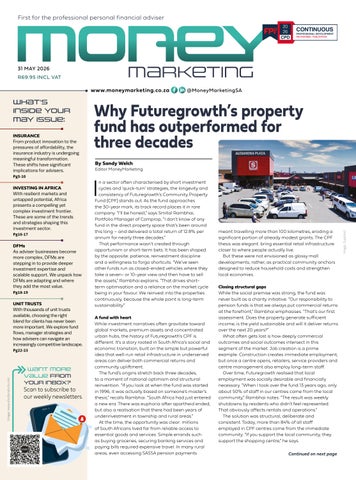
n a sector often characterised by short investment cycles and 'quick-turn' strategies, the longevity and consistency of Futuregrowth’s Community Property Fund (CPF) stands out. As the fund approaches the 30-year mark, its track record places it in rare company. “I’ll be honest,” says Smital Rambhai, Portfolio Manager of Comprop, “I don’t know of any fund in the direct property space that’s been around this long – and delivered a total return of 12.8% per annum for nearly three decades.” That performance wasn’t created through opportunism or short-term bets. It has been shaped by the opposite: patience, reinvestment discipline and a willingness to forgo shortcuts. “We’ve seen other funds run as closed-ended vehicles where they take a seven- or 10-year view and then have to sell the assets,” Rambhai explains. “That drives shortterm optimisation and a reliance on the market cycle being in your favour. We reinvest into the properties continuously, because the whole point is long-term sustainability.” A fund with heart While investment narratives often gravitate toward global markets, premium assets and concentrated urban hubs, the history of Futuregrowth’s CPF is different. It’s a story rooted in South Africa’s social and economic transition, built on the simple but powerful idea that well-run retail infrastructure in underserved areas can deliver both commercial returns and community upliftment. The fund’s origins stretch back three decades, to a moment of national optimism and structural reinvention. “If you look at when the fund was started in 1996, it was actually based on someone’s master’s thesis,” recalls Rambhai. “South Africa had just entered a new era. There was euphoria after apartheid ended, but also a realisation that there had been years of underinvestment in township and rural areas.” At the time, the opportunity was clear: millions of South Africans lived far from reliable access to essential goods and services. Simple errands such as buying groceries, securing banking services and paying bills required expensive travel. In many rural areas, even accessing SASSA pension payments
meant travelling more than 100 kilometres, eroding a significant portion of already modest grants. The CPF thesis was elegant: bring essential retail infrastructure closer to where people actually live. But these were not envisioned as glossy mall developments; rather, as practical community anchors designed to reduce household costs and strengthen local economies. Closing structural gaps While the social premise was strong, the fund was never built as a charity initiative. “Our responsibility to pension funds is that we always put commercial returns at the forefront,” Rambhai emphasises. “That’s our first assessment. Does the property generate sufficient income, is the yield sustainable and will it deliver returns over the next 20 years?” What often gets lost is how deeply commercial outcomes and social outcomes intersect in this segment of the market. Job creation is a prime example. Construction creates immediate employment, but once a centre opens, retailers, service providers and centre management also employ long-term staff. Over time, Futuregrowth realised that local employment was socially desirable and financially necessary. “When I took over the fund 13 years ago, only about 50% of staff in our centres came from the local community,” Rambhai notes. “The result was weekly shutdowns by residents who didn’t feel represented. That obviously affects rentals and operations.” The solution was structural, deliberate and consistent. Today, more than 84% of all staff employed in CPF centres come from the immediate community. “If you support the local community, they support the shopping centre,” he says. Continued on next page
Image: Supplied
WHAT’S INSIDE YOUR MAY ISSUE:
@MoneyMarketingSA