First for the professional personal financial adviser
30 JUNE 2026 R69.95 INCL VAT
www.moneymarketing.co.za
WHAT’S INSIDE YOUR JUNE ISSUE: GUIDING YOUR CLIENTS THROUGH A VOLATILE GLOBAL ENVIRONMENT In these times of uncertainty, advisers need to ensure clients remain focused on their long-term goals. Pg7-12
CHANGING MEDICAL AIDS Choosing the right medical aid option means ensuring any switch aligns with clients’ healthcare needs, budget and long-term financial wellbeing. Pg14-19
CRITICAL COVER Increased education can help clients protect themselves against the potentially devastating financial impact of serious illness, injury or loss of income. Pg20-23
FIXED INCOME A cornerstone of diversified portfolios, fixed income still offers investors stability, predictable returns and an important buffer against market volatility. Pg26-28
FINTECH FOR ADVISERS As fintech continues to transform the advice landscape, is your practice fully prepared to improve client engagement and deliver more personalised financial solutions?
Image: www.shutterstock.com
Pg30-34
WANT MORE VALUE FROM YOUR INBOX?
Scan to subscribe to our weekly newsletters.
@MoneyMarketingSA
Debt Capital Markets comes into sharper focus at Futuregrowth By Sandy Welch
Editor MoneyMarketing
F
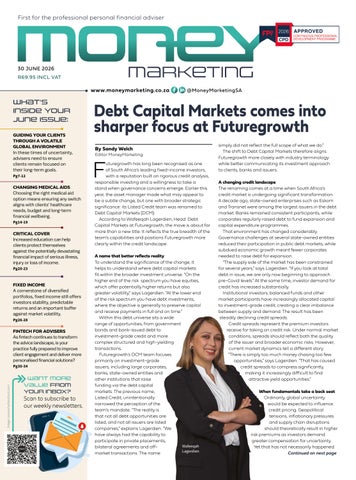
uturegrowth has long been recognised as one of South Africa’s leading fixed-income investors, with a reputation built on rigorous credit analysis, responsible investing and a willingness to take a stand when governance concerns emerge. Earlier this year, the asset manager made what may appear to be a subtle change, but one with broader strategic significance: its Listed Credit team was renamed to Debt Capital Markets (DCM). According to Wafeeqah Lagerdien, Head: Debt Capital Markets at Futuregrowth, the move is about far more than a new title. It reflects the true breadth of the team’s capabilities and positions Futuregrowth more clearly within the credit landscape. A name that better reflects reality To understand the significance of the change, it helps to understand where debt capital markets fit within the broader investment universe. “On the higher end of the risk spectrum you have equities, which offer potentially higher returns but also greater volatility,” says Lagerdien. “At the lower end of the risk spectrum you have debt investments, where the objective is generally to preserve capital and receive payments in full and on time.” Within this debt universe sits a wide range of opportunities, from government bonds and bank-issued debt to investment-grade credit and more complex structured and high-yielding transactions. Futuregrowth’s DCM team focuses primarily on investment-grade issuers, including large corporates, banks, state-owned entities and other institutions that raise funding via the debt capital markets. The previous name, Listed Credit, unintentionally narrowed the perception of the team’s mandate. “The reality is that not all debt opportunities are listed, and not all issuers are listed companies,” explains Lagerdien. “We have always had the capability to participate in private placements, Wafeeqah bilateral agreements and offLagerdien market transactions. The name
simply did not reflect the full scope of what we do.” The shift to Debt Capital Markets therefore aligns Futuregrowth more closely with industry terminology while better communicating its investment approach to clients, banks and issuers. A changing credit landscape The renaming comes at a time when South Africa’s credit market is undergoing significant transformation. A decade ago, state-owned enterprises such as Eskom and Transnet were among the largest issuers in the debt market. Banks remained consistent participants, while corporates regularly raised debt to fund expansion and capital expenditure programmes. That environment has changed considerably. Governance challenges at several state-owned entities reduced their participation in public debt markets, while subdued economic growth meant fewer corporates needed to raise debt for expansion. “The supply side of the market has been constrained for several years,” says Lagerdien. “If you look at total debt in issue, we are only now beginning to approach pre-Covid levels.” At the same time, investor demand for credit has increased substantially. Institutional investors, balanced funds and other market participants have increasingly allocated capital to investment-grade credit, creating a clear imbalance between supply and demand. The result has been steadily declining credit spreads. Credit spreads represent the premium investors receive for taking on credit risk. Under normal market conditions, spreads should reflect both the quality of the issuer and broader economic risks. However, current market dynamics tell a different story. “There is simply too much money chasing too few opportunities,” says Lagerdien. “That has caused credit spreads to compress significantly, making it increasingly difficult to find attractive yield opportunities.” When fundamentals take a back seat Ordinarily, global uncertainty would be expected to influence credit pricing. Geopolitical tensions, inflationary pressures and supply chain disruptions should theoretically result in higher risk premiums as investors demand greater compensation for uncertainty. Yet that has not necessarily happened. Continued on next page