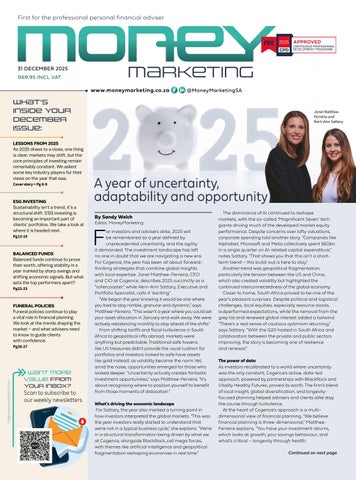
MoneyMarketing December 2025

Page 1


31 DECEMBER 2025

R69.95 INCL VAT

WHAT’S INSIDE YOUR DECEMBER

LESSONS FROM 2025

As 2025 draws to a close, one thing is clear: markets may shift, but the core principles of investing remain remarkably constant. We asked some key industry players for their views on the year that was.

Cover story + Pg 6-9

ESG INVESTING

Sustainability isn’t a trend, it’s a structural shift. ESG investing is becoming an important part of clients’ portfolios. We take a look at where it is headed next.

Pg13-19

BALANCED FUNDS

Balanced funds continue to prove their worth, offering stability in a year marked by sharp swings and shifting economic signals. But what sets the top performers apart?

Pg22-23

FUNERAL POLICIES

Funeral policies continue to play a vital role in financial planning. We look at the trends shaping the market – and what advisers need to know to guide clients with confidence.

Pg26-27

WANT MORE VALUE FROM YOUR INBOX?

Scan to subscribe to our weekly newsletters.

A year of uncertainty, adaptability and opportunity

For investors and advisers alike, 2025 will be remembered as a year defined by unprecedented uncertainty, and the agility it demanded. The investment landscape has left no one in doubt that we are navigating a new era. For Cogence, the year has been all about forwardthinking strategies that combine global insights with local expertise. Jonel Matthee-Ferreira, CEO and CIO at Cogence, describes 2025 succinctly as a “rollercoaster”, while Kerri-Ann Sattary, Executive and Portfolio Specialist, calls it “exciting”.

“We began the year knowing it would be one where you had to stay nimble, granular and dynamic,” says Matthee-Ferreira. “This wasn’t a year where you could set your asset allocation in January and walk away. We were actively rebalancing monthly to stay ahead of the shifts.”

From shifting tariffs and fiscal turbulence in South Africa to geopolitical rifts abroad, markets were anything but predictable. Traditional safe havens like US treasuries didn't provide the usual cushion for portfolios and investors looked to safe have assets like gold instead, as volatility became the norm..Yet, amid the noise, opportunities emerged for those who looked deeper. “Uncertainty actually creates fantastic investment opportunities,” says Matthee-Ferreira. “It’s about recognising where to position yourself to benefit from those moments of dislocation.”

What’s driving the economic landscape

For Sattary, the year also marked a turning point in how investors interpreted the global markets. “This was the year investors really started to understand that we’re not in a typical business cycle,” she explains. “We’re in a structural transformation being driven by what we at Cogence, alongside BlackRock, call mega forces, with themes like artificial intelligence and geopolitical fragmentation reshaping economies in real time.”

The dominance of AI continued to reshape markets, with the so-called ‘Magnificent Seven’ tech giants driving much of the developed market equity performance. Despite concerns over lofty valuations, corporate spending told another story. “Companies like Alphabet, Microsoft and Meta collectively spent $60bn in a single quarter on AI-related capital expenditure,” notes Sattary. “That shows you that this isn’t a shortterm trend – this build-out is here to stay.”

Another trend was geopolitical fragmentation, particularly the tension between the US and China, which also created volatility but highlighted the continued interconnectedness of the global economy. Closer to home, South Africa proved to be one of the year’s pleasant surprises. Despite political and logistical challenges, local equities, especially resource stocks, outperformed expectations, while the removal from the grey list and renewed global interest added a tailwind. “There’s a real sense of cautious optimism returning,” says Sattary. “With the G20 hosted in South Africa and collaboration between the private and public sectors improving, the story is becoming one of resilience and renewal.”

The power of data

As investors recalibrated to a world where uncertainty was the only constant, Cogence’s active, data-led approach, powered by partnerships with BlackRock and Vitality Healthy Futures, proved its worth. The firm’s blend of local insight, global diversification, and longevityfocused planning helped advisers and clients alike stay the course through turbulence.

At the heart of Cogence’s approach is a multidimensional view of financial planning. “We believe financial planning is three-dimensional,” MattheeFerreira explains. “You have your investment returns, which looks at growth; your savings behaviour; and what’s critical – longevity through health.

Jonel MattheeFerreira and Kerri-Ann Sattary

Adminimum

Less admin means more time for clients

As an independent DFM, we empower you to prioritise your clients and business growth with our optimised, advice-led solutions

Continued from previous page

“Our partnership with Vitality Healthy Futures data help clients not just live longer but healthier lives in retirement.” This holistic perspective has become increasingly relevant in a year marked by market volatility and shifting economic trends.

The human touch still matters

“Amid the noise, opportunities emerged for those who looked deeper”

Sattary emphasises the importance of the human and technological integration in their work. “My role is to bridge the gap between technical investment insights and practical support for advisers,” she says. “The Cogence portfolios are built by BlackRock, bringing their global expertise to local environment.” Sattary notes, “The investment environment is constantly evolving, and to stay relevant and make sure clients get what they need, Cogence is committed to evolving, enhancing, and innovating to respond to the changing markets.”

This collaboration with BlackRock, the world’s largest asset manager, has given Cogence a global perspective. “It’s not just about having a presence in over 70 countries,” Sattary notes. “It’s about understanding the macro environment and using that to construct portfolios that are resilient, dynamic, and responsive to change.”

These uncertainties reinforced the importance of behavioural investment principles. MattheeFerreira underscores the value of staying invested: “The worst time to take money off the table is during a market dip. Education for advisers and clients has been critical and we’ve shown how staying invested through volatility maximises long-term outcomes.” Sattary adds, “This is where having a discretionary fund manager (DFM) really adds value. We de-risk client portfolios and guide advisors through these periods, ensuring informed decisions rather than emotional reactions.”

Technology lifts the load

Technology has been another cornerstone of 2025’s investment strategy. Sattary explains how the Cogence technology platform addresses the multidimensional requirement of financial planning.

Using Aladdin Wealth™, BlackRock’s industryleading investment and risk technology platform, and Vitality Healthy Futures insights and data, advisers are able to generate cobranded holistic reporting with investment, health and wealth recommendations, tailored to their client’s individual financial planning needs. Uniquely, through the Aladdin Wealth™ stresstesting capability, advisers can understand the impact of potential market events on clients’ goals. This approach enables data-driven conversations, which are key to helping their clients remain invested despite volatile markets.

Artificial intelligence has long been embedded in BlackRock’s systematic strategies, even before the AI boom in 2022. “BlackRock has been using AI for almost 20 years in systematic strategies,”

Sattary notes. “Tools like the thematic robot analyse earnings reports, detect sentiment, and support portfolio construction. The human element remains crucial, so while AI provides the data, humans interpret and act on it.”

Offshore continues its upsurge

Offshore exposure was also an important theme of 2025. Matthee-Ferreira highlights the advantages of Regulation 28 changes, which increased offshore investment limits.

“South Africa is a small part of the global universe. Expanding offshore exposure widens opportunities and enhances diversification. Sattary adds that private markets are becoming a tool for enhanced offshore exposure. “With over 88% of global companies generating returns of more than $100bn being private, gaining access to this part of the global economy is important.”

Sattary notes, “We have recently launched two new investment solutions, which include an allocation to unlisted private market assets across private equity, private debt, infrastructure, and real assets. These markets are largely uncorrelated with public markets and can provide deepened diversification, and potential enhanced returns.”

Remaining flexible is paramount

As 2025 closes, the lessons for advisers are clear: resilience, adaptability and a holistic view of financial planning are essential.

Matthee-Ferreira emphasises the longterm picture, coupled with active tactical adjustments: “You need to focus on strategic asset allocation for long-term returns, while remaining nimble to take advantage of market opportunities. It’s about optimising outcomes with lower volatility.” Sattary summarises the approach: “Partnering with a specialist investment partner and considering savings behaviour, longevity and investment outcomes together ensures clients are in the best position to meet their financial goals.”

Looking ahead to 2026, the team identifies themes likely to continue shaping portfolios: Demographic Divergence, Digital Disruption and AI, Fragmenting World, Future of Finance increasing the need for Private Markets, and Low Carbon transition. Certain countries, including the US and India, are expected to benefit from these mega forces, while alternative assets like gold and private markets remain key tools for diversification. As Matthee-Ferreira says, “The future of financing will see private markets play an increasingly important role. The structural transformation we’ve seen this year is just the beginning.”

For those navigating this dynamic environment, the lessons of 2025 – embracing uncertainty, leveraging technology, and

ED'S LETTER

What a year it has been. Even the most seasoned economists have described 2025 as a bumpy ride – a year shaped by tariffs, geopolitical tension and the kind of erratic policy decisions from an unpredictable US president that left global markets on edge. Yet, in the midst of the noise, one theme emerged clearly: resilience. And once again, investors were reminded that discipline, diversification and patience remain the bedrock of long-term success. For global investors, the strongest signal came from the US, where markets held steady through uncertainty. But closer to home, South Africa delivered its own encouraging story. Our exit from the FATF greylist strengthened market confidence, the rand showed surprising resilience, and hosting the G20 placed South Africa on the world stage as a country capable of leading critical economic conversations. For advisers, these milestones matter: confidence fuels investment, investment fuels growth, and growth builds the foundation for long-term financial wellbeing.

This edition explores some of the themes shaping adviser conversations right now – from the growing importance of ESG integration to shifts in multi-asset strategies and the evolving landscape of risk cover.

As we reflect on a year defined by both turbulence and tenacity, one message stands out: clarity and connection matter more than ever. Whether guiding clients through ESG considerations, constructing balanced portfolios or helping them protect their families, advisers remain the calm voice in a noisy world.

Stay financially savvy,

Note: If you subscribe to our MoneyMarketing newsletter, see QR code on the cover, you will receive a special discount off a News24 or Netwerk24 subscription*.

*Offer available to new subscribers only.

thinking globally while acting locally – will be crucial as they step into the new year. “Ultimately,” concludes Matthee-Ferreira, “the lesson of 2025 was simple: volatility can be unsettling, but if managed well, it’s also the birthplace of opportunity.”

Kim Howard Chief People Officer, Ashburton Investments

What exactly does a People Officer do and how important is your role in a financial services company?

As Chief People Officer, my role is to align Ashburton Investments’ people strategy with its business strategy. In a high-performance, knowledge-driven industry like asset management, talent is the differentiator. My responsibility is to create the conditions where our investment professionals, operations teams and distribution teams can perform at their highest level. This includes building a culture of belonging, curiosity and excellence; ensuring we attract and retain diverse talent; and removing obstacles that hinder performance so teams can focus on what they do best. In asset management, where pressure, scrutiny and constant change are the norm, supporting people holistically is essential to sustained success.

How long have you been working in the financial field, and how did you end up in your current position?

I have worked in the financial sector for more than 33 years. I qualified as a Chartered Accountant and completed my articles at KPMG before beginning my career as a stockbroking analyst at HSBC. I later led Standard Bank’s Investor Relations for eight years and subsequently completed a PhD in Social Psychology.

My transition into Human Capital came from wanting to combine my love of people with my deep understanding of the financial services environment. After working at Ninety One in Organisation Development and risk-taking psychology in asset management, I joined Ashburton Investments, where my financial background and psychology expertise allow me to support an industry I understand intimately.

What are the most significant barriers still preventing women from entering and advancing in the asset management field?

The biggest barriers remain early-stage access, representation, and structured support. Many girls and young women still haven’t been exposed to asset management as a viable career path. Without role models who look like them, the industry can feel inaccessible. At more senior levels, the barriers shift to sponsorship, confidence and progression opportunities. The CFA pipeline is still overwhelmingly male, creating a qualification gap that affects long-term advancement. Lastly, organisational cultures in parts of the industry can still struggle with inclusion and

psychological safety, which are crucial for women to thrive in investment teams.

How does diversity translate into better business outcomes at Ashburton, both in terms of culture and investment performance?

Diversity is a strategic imperative for us, not a compliance exercise. Cognitive, gender, and racial diversity give us better thinking, better debate, and ultimately better investment decisions. Diverse teams challenge groupthink, pressure-test assumptions, and see risks and opportunities through different lenses. Culturally, diversity fosters belonging and curiosity, two ingredients that drive high performance. Investment teams that feel psychologically safe are more willing to challenge one another, interrogate ideas, and look beyond conventional thinking. That ultimately shows up in stronger decisionmaking and better outcomes for clients.

“Diversity fosters belonging and curiosity, two ingredients that drive high performance”

What have been your biggest lessons in terms of people management in the asset management field?

One lesson is that asset managers are wired differently – they are analytical, restless and operate under constant pressure. They thrive when they are challenged and stimulated, but they also need autonomy and space to think deeply. Creating an environment that balances support with independence is crucial. Another lesson is the importance of removing ‘noise’ – administrative friction, unnecessary meetings, and processes that distract from investment work. When people are enabled and not hindered, their performance improves dramatically.

Finally, high-performing environments demand resilience. Helping people build confidence, adaptability, and internal agency is essential.

How do you think companies can support women who are pursuing the CFA designation?

Supporting women on the CFA pathway requires both inspiration and practical, sustained action. At Ashburton, our involvement in the CFA Society South Africa’s Day of the Girl job shadowing initiative reflects our belief that

gender equity is not just a value; it is a strategic imperative. Diversity leads to better thinking and ultimately better results, and initiatives like these help plant a seed of possibility for girls who may never have considered the investment industry as a career.

Internally, we focus on creating an environment where women can progress with confidence. Currently, we have 10 female CFAs across our offices – a number we’re proud of but determined to improve. Increasing access and support for women pursuing the CFA designation is a key priority, because representation matters. When more women qualify, more women enter and thrive in investment teams, and that ultimately strengthens the entire industry.

You’ve spoken about the importance of a culture where people feel ‘psychologically safe’. What does that look like in practice?

Psychological safety means people feel safe to challenge ideas, question assumptions, and offer dissenting views without fear of being judged or penalised. In asset management, where poor decisions often come from unchallenged groupthink, this is critical.

In practice it looks like:

• Constructive and candid feedback delivered with respect

Leaders who invite challenge and reward curiosity

Environments where diverse perspectives are actively sought out

• Teams that debate rigorously but respectfully

• An atmosphere where mistakes are seen as part of growth, not as career-limiting events

When people feel safe and included, performance rises.

What role do mentorship and sponsorship play in advancing women’s careers, and how does Ashburton cultivate these relationships internally?

Mentorship builds confidence, capability and belonging. Sponsorship – which is when senior leaders actively advocate for women –opens doors, creates visibility, and accelerates progression. Women need both.

At Ashburton, we are intentional about creating these pathways. Our FirstJob graduate programme is 80% women, and we engage actively with schools, universities, and the CFA Society to build a strong pipeline. Internally, we focus on creating a culture where senior women and men support emerging talent through coaching, knowledge sharing, and active sponsorship.

FNB’s astonishingly good year

It’s been an outstanding year for FNB. Not only did the bank receive four accolades at the Global AI Awards 2025, but RMB Private Bank was also the overall winner in the 2025/26 Ask Afrika Orange Index, and secured the title of Best Private Bank for the second time in just three years. In addition to its recent accolades in the Ask Afrika Orange Index®, at the 2025 Euromoney Global Private Banking Awards, RMB Private Bank was named the best Private Bank in South Africa, further reinforcing its position as a leader in client-centric financial services. At the 2025 Krutham Top Private Banks and Wealth Managers Awards, the bank walked away with Best Private Bank, Best Private Bank for Young Professionals, Best Private Bank for Entrepreneurs, and Best Private Bank for Executives.

It was also the year FNB Premier celebrated its 25th anniversary, with new insights from the bank’s customer data revealing the financial evolution of South Africa’s middleincome earners. The analysis highlights how professionals earning between R300 000 and R750 000 annually have transformed from cash-reliant consumers into digitally savvy, value-driven individuals focused on long-term financial wellbeing. “FNB Premier is among the first banking solutions designed for the aspiring middle income group in South Africa. Today, it serves a generation that is aspirational, responsibility driven, and seeking financial confidence in a volatile economy,” says FNB Personal Core Banking Product Head Garth Keshwar.

Rolling out new products and collaborations Innovation has been a key aspect of FNB’s strategy for 2025, with a plethora of new products launched.

• In November, FNB and Mastercard unveiled Globba™, a new cross-border payments solution designed to close one of the most persistent gaps in financial inclusion, which is the ability for ordinary people to send money home easily, affordably and securely. Built in partnership between FNB and Mastercard Move, and available through the FNB and RMB Private Banking apps, Globba™ allows

customers to send money to 120 countries in a way that is fast, transparent, traceable and designed with real people in mind. It reflects a global shift that is aligned with the G20 roadmap’s focus on speed, access, and cost –but it’s also deeply rooted in everyday realities across Africa. With millions of people on the continent living and working far from home, Globba™ expands the ability to send money to places like Zimbabwe, Malawi, Mozambique and Ghana, strengthening financial connections across borders and families. And it goes further. Transfers can be paid into bank accounts, mobile wallets, or collected at cash pick-up points – meeting people where they are, not where systems expect them to be.

• FNB also formed a strategic partnership with VezoPay, the fintech company behind Africa’s first smart payment ring. Certified by Visa and Mastercard and enabled by Fidesmo, the VezoPay ring offers a secure, everyday payment solution. The collaboration aims to expand access to safe, contactless payments for South Africans through innovative new wearable technology.

Helping to better serve communities

FNB continues to improve access to affordable housing for low- to middle-income South Africans, amid rising property prices and economic challenges. The bank approved R3.3bn in affordable housing home loans

EARN YOUR CPD POINTS

over the last 12 months, putting close to 6 000 families earning less than R34 000 into homes. The bank also supported customers with an integrated Financial Linked Individual Subsidy Programme (FLISP) process, helping customers with R72m in government subsidies.

• FNB also partnered with Reunyte (previously known as Robin Hood Unclaimed Benefits, an unclaimed benefits-tracing fintech company. This platform, which is now available to all FNB customers and RMB Private Bank clients, is designed to address unclaimed benefits, such as policies, pension and investment funds, through aggregated data from multiple sources into a single database. Reunyte’s platform enables asset holders to trace, verify, and process payments through technology to simplifies the claiming process. Over the past few months, FNB has successfully matched 6 000 customers with unclaimed financial benefits through Reunyte’s intelligent platform, unlocking a potential deposit value of R10m.

• FNB’s deliberate shift away from only using traditional credit scoring methods to a more inclusive data-led cashflow analysis strategy has resulted in over 40 000 SMEs being pre-approved for credit monthly. Through data-led credit scoring, the number of pre-approvals generated by FNB annually almost represent half of its SME customer base in South Africa of over 1.2 million clients.

The FPI recognises the quality of the content of MoneyMarketing’s December 2025 issue and would like to reward its professional members with 2 verifiable CPD points/ hours for reading the publication and gaining knowledge on relevant topics. For more information, visit our website at www.moneymarketing.co.za

MDiscipline, diversification and the power of staying the course

arkets have always loved a good story, and 2025 delivered plenty of them. From the surge in artificial intelligence and shifting interest rate expectations to an ever-changing geopolitical landscape, investors had no shortage of headlines to chase. But amid all the noise, one timeless lesson stood out: discipline still matters most.

“This year reinforced that valuation and process will always outlast market hype,” says Roné Swanepoel, Head of Distribution at Morningstar South Africa. “At Morningstar, we continue to see that sticking to a clear investment philosophy rooted in fundamentals, data and research creates better outcomes than chasing narratives. Markets will test your conviction, but discipline, diversification, and patience still do the heavy lifting.”

A year of milestones

For Morningstar, 2025 was a landmark year. “A real highlight was celebrating the first anniversary of the Morningstar Global Fund range,” says Swanepoel. “It’s been rewarding to see how these funds have performed but, more importantly, how they’ve given South African investors simple and meaningful access to global diversification.”

She adds that this year also marked a turning point for how Morningstar’s global expertise translates into local impact. “We introduced our enhanced manager research framework to South Africa, aligning with the global standards that Morningstar applies everywhere else. It’s been a game changer for advisers – raising the bar for how managers are evaluated and giving them greater confidence in what they recommend to clients.”

Surprises and shifts in the market

If 2025 proved anything, it’s that markets have a way of defying consensus. “The technology rally in the US tested investors’ patience with valuations, while emerging markets, including China and Latin America, quietly delivered some of their strongest returns in years,” Swanepoel notes.

“The challenge wasn’t about spotting winners, but staying balanced when headlines pulled portfolios in different directions. Diversification helped us avoid concentration risk and stay focused on valuation rather than market excitement.”

After several years of inflation uncertainty and shifting rate cycles, one key lesson emerged: forecasting is not a strategy. “Markets have swung from inflation fear to optimism and back again in record time,” she says. “The investors who benefited most were those who built portfolios to be resilient, not reactive. They focused on what is knowable and important such as valuations, risk management and long-term balance, rather than trying to predict each policy move.”

The human advantage in an AI world

Artificial intelligence dominated both corporate headlines and investment conversations in 2025, and for good reason. Swanepoel believes its role in wealth management is not to replace human judgment, but to enhance human connection.

“The real opportunity with AI is that it frees advisers to spend more time doing what only humans can do, which is having meaningful conversations,” she says. “Morningstar’s research consistently shows that clients don’t value advice for stock selection or spreadsheets; they value calm, clarity and confidence. Technology can help automate the routine so advisers can focus on relationships and behavioural coaching, which remain the most under-recognised parts of good advice.”

Diversification and the global lens

Globally, diversification continued to be a crucial driver of portfolio resilience. “The most effective strategies in 2025 were those guided by valuation discipline and rigorous research,” Swanepoel explains. “It’s about having the confidence to own less popular parts of the market when fundamentals support them, and balancing those exposures with areas that benefit from strong momentum.”

“It comes down to conviction – identifying genuine value and holding it, while maintaining flexibility.”

Emerging markets once again proved their value as part of a long-term allocation. “China delivered a solid rebound, while Latin America benefited from renewed growth and commodity momentum,” she says. “Emerging markets reward patience. They can be volatile in the short term, but often deliver the best returns over time. The key is disciplined exposure, not big all-in bets.”

Global vs local balance

For South African investors, global diversification remains a key buffer against concentration risk, but Swanepoel cautions that it requires careful calibration. “We’ve taken a measured approach to offshore exposure in recent years. The stronger rand has reminded investors how currency movements can significantly affect returns. The lesson is balance, because offshore exposure must be managed in line with each client’s goals and risk tolerance.”

Behavioural lessons and adviser insight

Perhaps the most consistent behavioural lesson of 2025 was how emotion can still derail sound investment plans. “We saw investors chase performance in narrow market segments, particularly large technology names, driven by the fear of missing out,” says Swanepoel.

“Morningstar’s Mind the Gap study continues to show how much value is lost when investors act on emotion. The gap between what the average fund delivers and what the average investor earns remains wide, largely due to poor timing decisions. Great advice is about helping clients avoid that mistake. It’s not about being the smartest person in the room; it’s about keeping clients calm and consistent when the world isn’t.”

2026: Simplicity, clarity and human connection

Morningstar’s approach combines opportunities that may be overlooked with those driving current sentiment, creating portfolios that can perform in a range of conditions.

“Valuation and process will always outlast market hype”

Looking ahead, Swanepoel says the advisers who thrive in 2026 will be those who simplify their processes and prioritise relationships. “The fundamentals of great advice haven’t changed – clear communication, disciplined investment processes and behavioural coaching are still what matter most. Our research shows that advisers still spend too much time on fund selection, compliance and rebalancing, and not enough time in front of clients. Partnering with a trusted DFM can help shift that balance.”

For both advisers and investors, the biggest takeaway from 2025 may be that discipline, not drama, defines success. As Swanepoel puts it: “Markets will always change. Narratives will come and go. But focus, patience and diversification remain the constants that deliver lasting outcomes.”

2Beyond

the rally

025 has been an exhausting year. Growth forecasts at the beginning of the year were strong and the world was optimistic. Three months later, Donald Trump ‘tariffied’ the world on 2 April – so-called Liberation Day. Suddenly ‘worst-case’ tariff forecasts were factored into growth expectations and equity markets plunged. Fund managers globally, finding their portfolios way overexposed to US assets (the average global equity fund was 72% invested in US equities), started to reallocate out of the US and into Europe, the UK and emerging markets. It’s important to stress that this was not a bet against the US, nor a reason to exit the US, but more prudent diversification after years of portfolios becoming increasingly overweight the US.

So, as we near the end of the year, let’s take stock of where we are and what we can expect from 2026.

What can we expect from 2026?

Global markets post April’s trauma seem to have largely digested the tariff news. However, Trump needs tariffs lower. Having Brazil, India and China at 50% or above will be felt by Americans, and he can’t risk a spike in inflation, so expect a softening of tariffs shortly: Brazil, India, China, and hopefully even South Africa.

Thank heavens for the oil price, which has played a major role in keeping inflation low and providing relief to consumers. Having started the year at US$75 per barrel, the oil price has spent most of the year around current levels of US$65. The US consumer is thus fairly robust and, given that they constitute 70% of the US GDP number, the economy is in reasonable shape.

In terms of geopolitics, the ceasefire in the Middle East is holding, and hopefully the momentum can see both sides adhering to the agreement details. As we approach the fourth year of the Russia-Ukraine conflict, it is, first of all, amazing that Ukraine has managed to hold back Russia for this long. But what’s becoming clear is that no amount of

“2025 has had it all – volatility, shocks and even a few silver linings”

Trump shouting is going to get Volodymyr Zelensky to forfeit land, while Vladimir Putin needs something to save face. He can’t put Russia through war for four years, with close to a million men killed or wounded, and then walk away with just a ceasefire. Any solutions, however, would be beneficial in terms of stimulating a risk-on environment, supporting emerging markets – the so-called ‘risk dividend’.

Looking ahead, lower oil prices keeping inflation under control, softer tariffs, and interest rates heading down (with a few extra cuts for Trump) all point to firming growth, healthy corporate earnings and market opportunities. However, skyhigh technology share prices, stretched valuations and leveraged retail investors, not to mention an unpredictable president, are a dangerous cocktail, so tread carefully. By contrast, as global investor attention finally turns to emerging markets, South Africa, too, is feeling better. We have indeed come a long way since the dark depths of mid-2023. To me, that was when we as a country hit ‘rock bottom’.

It was pre-GNU, the ANC was large and in charge, and everything was broken. We were limping post state capture, we had just been grey-listed, we had level 6 loadshedding (with rumours it could

go up to level 15), the railways and ports were broken, and on top of that, the US had just accused us of supplying Russia with weapons.

Adding insult to injury, it was midwinter and South Africans were cold and depressed. It was, essentially, our Winter of Discontent! Two years later, things are looking better. The GNU is functioning, albeit imperfectly, and progress is being made. Visa backlogs have been cleared; Home Affairs is being digitised; Operation Vulindlela has essentially fixed electricity; and railways and ports have made significant progress. Their next focus is on water, crime and municipalities – fixing the country one step at a time.

We’re off the grey list, growth is improving, gold is up 50% this year, and the JSE is one of the top-performing stock markets globally in dollar terms this year –yet it remains reasonably priced.

Bottom line

From the depths of despair mid-2023, South Africa has been trending slowly in the right direction. Momentum looks set to continue, with a positive medium-term outlook for the next couple of years.

It’s been a long time since we’ve been able to say that.

DA resilient global economy has surprised

espite a volatile year marked by tariff conflict, shifting global sentiment and political uncertainty, the global economy remains more resilient than expected. According to Maarten Ackerman, Chief Economist at Citadel, the risk of a global recession has receded, replaced instead by the likelihood of a controlled slowdown.

“This year has certainly thrown the markets a few curveballs,” says Ackerman. “While 2025 started on a buoyant note, by April markets were pricing in a global recession after United States (US) President Donald Trump’s tariff announcements. Yet, as we close the year, the data tells a different story: the world has managed to absorb these shocks with surprising resilience.”

Ackerman says Citadel’s role is to “filter through the noise” and help clients position themselves for opportunity while managing risk, a philosophy that earned the firm the 2025 Raging Bull Award for South African (SA) Manager of the Year. “That award is not just about performance,” he explains. “It’s recognition that we’ve achieved strong results while taking on lower levels of risk. In uncertain times, that’s what separates good asset managers from great ones.”

Global

growth

slows but avoids recession

Ackerman believes the global economy is entering a period of moderate expansion, with growth likely to hover between 2% and 2.5% over the next few years, enough to support corporate earnings without fuelling overheating.

US: Soft patch ahead

“The US economy remains resilient,” he says. “Growth above 3% earlier this year surprised markets, but we expect a soft patch as tariffs begin to bite. This is not a recession, but a moderation to around 2% growth.” He adds that sticky inflation and cooling job creation will make the next phase of US growth narrower and more uneven. “Artificial Intelligence (AI) and technology investment remain powerful tailwinds,” says Ackerman. “But much of the current momentum is being supported by pre-emptive consumer and business spending ahead of higher import costs.”

Europe and the United Kingdom: Modest recovery

Europe’s recovery, he says, has been “gradual but positive”, supported by higher fiscal spending and resilient consumers. Growth across the European Union (EU) is expected to average around 1.3% in the coming years. The UK shares a similar trajectory, with slightly higher inflation and weaker investment.

“In this environment, it is important that we ‘box clever’ and find the right opportunities”

“Business confidence and productivity remain challenges,” Ackerman notes. “But both regions are slowly stabilising.”

China: From factories to families

China continues to target growth of around 5% but faces a prolonged property slump and weak consumer confidence. “China’s challenge is shifting from investment-led to consumptiondriven growth; without stronger stimulus, growth could slip closer to 4% per year. Still, its diversified exports to Africa, and the broader BRICS bloc are cushioning the blow from US tariffs,” Ackerman says. He adds that expanding trade between emerging markets now accounts for nearly 50% of global commerce –a structural shift that makes the world economy more resilient to Western shocks.

“America is no longer the only game in town; the BRICS economies represent half the world’s population and a third of global gross domestic product (GDP). That diversification is key to the next phase of global growth,” he notes.

SA: Quiet progress beneath the noise

Back home, Ackerman says SA is benefitting from favourable global dynamics, particularly a robust commodity cycle that has supported the Johannesburg Stock Exchange (JSE), strengthened the rand, and underpinned tax revenues. “The demand for platinum and gold has lifted our economy, but this is a cycle, not a structural fix,” he cautions. “The real opportunity lies in restoring competitiveness, improving productivity and attracting investment.”

Encouragingly, governance and fiscal discipline have improved. The Government of National Unity (GNU) has provided a more

balanced and business-friendly approach, while private investment in renewable energy has sharply reduced loadshedding.

“Eskom’s turnaround shows what’s possible when private capital is allowed to work,” says Ackerman. “There’s still much to fix, but the direction is positive.” He notes that SA’s second-quarter GDP growth of over 3% marked the first broad-based recovery since the pandemic, driven by manufacturing, mining and retail activity. “For the first time in years, we’re seeing more contributors to growth rather than isolated spikes.”

However, headwinds remain. “Consumer confidence is weak, investment is sluggish and productivity is negative,” he says. “Our population is growing faster than our productivity, which caps growth potential around 1%. Unless we improve competitiveness and reduce red tape, that won’t change soon.”

Boxing clever: Citadel’s strategy for 2026

Looking ahead, Ackerman says, “When we look more closely at the economic fundamentals, while we cannot deny that we are in an environment where there is going to be softness globally over the next year, there are still a lot of opportunities for investors.”

He concludes. “In this environment, it is important that we ‘box clever’ and find the right opportunities, because not all companies will do well in this current economy. Our job is to find those that do and to then find alternative investment opportunities that support or preserve wealth and, more importantly, to ensure we avoid any potential downside risk. As we move into 2026, our focus remains on preserving and growing our clients’ wealth with resilience and foresight.”

MGold, tech, and the temptation to panic: Lessons from 2025

any investors enter the market with good intentions – they intend to invest for the long-term, not worry about shorter-term fluctuations (or bumps) to get to their long-term goals, but then they get tripped up over short-term panic over market volatility. They often disinvest and then take too long to reinvest – missing out on recoveries and making short-term decisions that are detrimental to them achieving their long-term goals.

This behaviour is exacerbated during times of heightened volatility and during very narrow markets. 2025 has been an interesting year, as markets continue to be driven by a select number of stocks. Offshore, the tech stocks continue to dominate and locally, our market has been driven by resources, especially gold. Investors would be excused for thinking that our market has been down for the year to date if they were only looking at equity funds, as many managers continue to underperform their benchmarks. But those that were paying attention would understand that only nine funds in the ASISA General Equity Fund category outperformed and a substantial weight in gold stocks mostly drove performance. Resources have been up 95% year-todate, with gold up 52% between January and November.

If you truly believe in the concept of diversification, you would be uncomfortable with a portfolio made up purely of resources or gold stocks. Markets go through cycles, and there are times when a very narrow sector drives performance, but over the longer term, diversification ensures a smoother investment journey.

Financial advisers play a pivotal role in helping their clients navigate these types of markets. By educating clients and communicating with them regularly, they can explain the short-term drivers of markets and what the effect of making the wrong short-term decisions might be on their longer-term goals. Understanding clients’ risk appetite allows advisers to

recommend portfolios matched to these appetites, ensuring better adherence and less disinvesting during volatile times.

Understanding how a portfolio is constructed, its downside potential over rolling 12 months, the composition of the underlying assets and how they are likely to perform during both positive and negative markets makes it easier for advisers to match clients to the appropriate portfolio for their individual needs.

The amount of unit trusts, hedge funds and other investment options makes it hard to decide where to invest your money. Investors who were worried about South Africa might have considered taking more money offshore, only to find that the rand has actually strengthened versus most currencies. Offshore markets might have seemed very attractive to investors chasing the technology theme, but the S&P 500 only delivered 2.80% in October 2025, while the ALSI SWIX was up 1.64%*.

And investors who invested in diversified portfolios with exposure to a variety of traditional and alternative asset classes both domestically and internationally would have been rewarded for staying invested.

More than a third (36%) of financial advisers are now partnering with a discretionary fund manager (DFM) to help them navigate the ever-increasing complexity in investment markets*. This number is expected to rise to 45% over the next few years. Their portfolio construction capabilities, ability to model for expected drawdowns and risks in each of their portfolios, ability to access both listed and unlisted traditional and alternative asset classes, and access to investment strategies, funds and fee classes that may not always be available to retail investors, make DFMs the perfect partner to help advisers navigate the investment market. As an independent discretionary fund manager, we enable you to do what really matters - spending more time with your clients and building your business. To find out more, visit eqinvest.co.za

“More than a third (36%) of financial advisers are now partnering with a discretionary fund manager (DFM)”

Celebrating excellence in financial planning

Avery big congratulations to the winner of the 2025 Financial Planner of the Year Award, Nicola Langridge from Private Client Holdings. (See interview with Langridge on the opposite page.)

The runners-up were Brendan Dunn, executive head at Hewett Wealth in Johannesburg, and Theoniel McDonald, head of financial planning at Carmel Wealth and senior financial planner at Wealth Associates.

The winners across various categories were announced at a gala dinner in Sandton during the Financial Planning Institute’s (FPI) annual convention.

For the past 25 years, the FPI Financial Planner of the Year Award has recognised a CFP® professional who demonstrates outstanding achievement and excellence in the field and practice of financial planning. “All nominees were required to meet rigorous criteria and showcase their talents, innovative thinking, technical skill, and uncompromising ethics in client engagements,” the FPI said in a media release.

Professional Practice of the Year

Pretoria-based Ascor Independent Wealth Managers received the FPI Professional Practice of the Year Award, with Consolidated Wealth and Veritas Wealth named as runners-up.

Founded in 2005 by Martin de Kock and Wouter Fourie, Ascor was among South Africa’s first multi-disciplinary independent, fee-based wealth management firms. The company integrates financial planning, investment management, tax strategies, estate planning, auditing, and legal advice to deliver comprehensive solutions for individuals and businesses. Notably, Fourie himself won the Planner of the Year Award in 2015.

The Professional Practice of the Year Award recognises firms that demonstrate exceptional professionalism, innovation, and commitment to their clients and to advancing the financial planning profession.

Global recognition for FPI CEO

The FPI’s chief executive, Lelané Bezuidenhout, was honoured with the 2025 Noel Maye Award by the Financial Planning Standards Board (FPSB) for her outstanding contribution to the profession.

Announced in October, Bezuidenhout shared the award with Stephen O’Connor of New Zealand. The Noel Maye Award recognises individuals who have made a lasting global

impact on the advancement of financial planning and CFP® certification through leadership, advocacy, and volunteer service.

Under Bezuidenhout’s leadership, the FPI has achieved several significant milestones, including surpassing 5 000 CFP® professionals in South Africa.

Other exemplary awards

2025 FPI Diversity and Inclusion Award

Winner: Stephanus de Witt, CFP®

This award celebrates individuals who have made a meaningful impact in promoting diversity, equity, and inclusion within the profession. Stephanus de Witt, CFP®, was recognised for his continued efforts to create a more inclusive and representative financial planning community in South Africa.

2025 FPI ‘It Starts with Me’ Award

Winner: Katlego Mei, CFP®

Launched in 2015, this award honours a CFP® professional who embodies the spirit of professionalism and advocacy for the financial planning profession. Katlego Mei, CFP®, was recognised for actively championing the CFP® designation and inspiring others to uphold the highest standards of professional conduct.

2025 CFP® PCE Candidate Award

Winner: Anza Masia, CFP®

This award recognises the top performer in the CFP® Professional Competency Examination (PCE), a key milestone toward earning the CFP® designation. Anza Masia’s achievement reflects exceptional technical knowledge and professional readiness.

2025 CFP® Financial Plan Assessment Award

Winner: Verusha Naidoo, RFP®

This award honours excellence in the Financial Plan Assessment, a crucial step in the CFP® certification process. Verusha Naidoo, RFP®, was commended for her exceptional ability to craft comprehensive, client-focused financial plans that reflect true professional competence.

Financial Planner of the Year 2025 Nicola Langridge.
2025 FPI Diversity and Inclusion Award winner Stephanus de Witt, CFP.
Above: Ascor Independent Wealth Managers received the FPI Professional Practice of the Year Award.
2025 'It Starts With Me" Award winner Katlego Mei, CFP®.

When Nicola Langridge walked onto the stage at the 2025 FPI Convention to accept the Financial Planner of the Year Award, she wasn’t just celebrating a personal milestone – she was stepping into a role she has envisioned since the first day she joined Private Client Holdings (PCH) in 2017.

“For as long as I can remember, this has been a dream of mine,” she says. “When I started at PCH, Mark MacSymon had just won the award. Watching the platform it gave him, the opportunities to teach, speak and give back, I knew it was something I wanted to work towards.” Today, after her first-ever entry into the competition, Langridge is still “on cloud nine”.

From chiropractic to finance

Langridge’s journey into financial planning was anything but conventional. Raised in a family of medical professionals, she initially studied to become a chiropractor before realising it wasn’t the right fit. “I love working with people, but not the hands-on part,” she says with a laugh.

After time abroad in London and Asia, she returned to South Africa and enrolled for a Business Science degree at UCT. By her second year, she had fallen head over heels for finance. An internship with Citigroup in New York during the credit crunch cemented her fascination with markets and investment behaviour.

She started her professional career at PSG Asset Management on the investment side, but something was missing. “I realised I needed the human connection,” she explains. “I wanted

Meet Nicola Langridge –2025 Financial Planner of the Year

to work with people, not only portfolios.” After earning her Postgraduate Diploma in Financial Planning and her CFP® designation, she joined Private Client Holdings – and found her home.

The philosophy behind her practice

Coming from a family steeped in holistic medical thinking, Langridge sees financial advice through a similar lens. “I’ve simply moved from one form of wellness to another,” she says. “Financial wellness is also about looking at the whole picture. You can’t silo a person’s goals, fears, behaviours, or life circumstances.” Empathy, she believes, is the most essential skill in the profession. “If you can’t understand what drives someone, especially what drives their money decisions, you can’t build a plan they’ll trust or follow.”

This holistic approach has helped shape a broad client base, with a strong emphasis on women and medical professionals. “Women tend to look for an adviser who can genuinely listen and connect. There still aren’t many female advisers in the high-net-worth space, so clients naturally gravitate to that empathy.”

Growing a career – and the next generation

The need for new entrants into financial planning is something Langridge is passionate about. With women still making up just 20% of the advice industry, and only about 35% of CFP® professionals, she sees her win as an opportunity to inspire. “I’d love to motivate more people, especially women, to join the profession. We need diversity. We need more qualified planners giving ethical, high-quality advice.”

PCH has been proactive here, running structured internship programmes that allow young professionals to move from admin roles into paraplanning and eventually advising. Since winning the award, she has already had aspiring planners reach out for mentorship.

“I had people do that for me when I was coming up,” she says. “If someone wants a coffee or a quick call, I’ll always try to make time.”

Her advice to young professionals? “Be patient. Ask for more responsibility. Don’t be afraid to reach out to mentors. And understand that becoming an adviser takes time. It’s a huge responsibility.”

Adapting

in a shifting world

Reflecting on the past year, Langridge notes the turbulence in both local and global markets but says her long-term approach has stayed consistent. “It’s been a really strong year for returns. Our focus is always on long-term investing and staying the course. Clients love you in years like this,” she jokes. What has challenged advisers more, she says, isn’t markets but misinformation. “Clients often send me videos from ‘finfluencers’ or deepfakes circulating online, sometimes even fabricated clips of world leaders giving fake financial advice. People get anxious. Part of our role is to help cancel out the noise.”

What comes next

Winning Financial Planner of the Year brings visibility, and Langridge is ready to use it. “My goals are twofold: continue growing my book, and build a strong public-speaking and media presence.” For the past five years, she has hosted popular women-focused and medicalprofessional events, often partnering with female asset managers or female winemakers. “It’s a wonderful way to share knowledge and build community. And it helps sharpen my communication skills. I'm never fully comfortable on stage, but once I'm up there, it’s exhilarating.” With her new platform, she plans to expand this engagement and help shape the next generation of qualified, ethical advisers. “If you’ve got a message worth sharing, why not share it?”

Private Client Holdings is taking the lead in South Africa when it comes to providing high net worth families with an all-inclusive wealth management solution.

AStop waiting: Your clients are already using AI for financial planning

financial planner recently shared on LinkedIn that they had lost a long-standing client. The reason? The client decided to use ChatGPT instead (for now). This is not an uncommon story. Clients are asking AI tools for retirement projections, investment scenarios, and debt strategies before they walk into review meetings.

The question is no longer whether to adopt AI. The question is whether you will be ready when clients arrive armed with information, projections, and questions generated by the AI of their choice. This article maps a practical path through three decisions: identify what really holds you back, decide where technology belongs in your practice, and take the first steps in the next 90 days.

Identify and articulate the real problem

Most firms blame the wrong thing. They say their CRM does not work, their planning software is outdated, or their team resists change. The real problem sits deeper.

Tools fail when five building blocks are not in place: mindset, business clarity, documented processes, aligned people, and clean data.

Mindset first. If your team still says “I am before

across the six steps of financial planning and the ten steps of client engagement. Identify where emotion or tension appears. Those points demand human attention. Everything else can be automated or turned into templates.

Data is the fuel. Not just numbers in spreadsheets or entries in your CRM. Data tells your business story. It powers how efficiently you work, strengthens risk management, and enables you to personalise service for each client. Without structured data, AI and automation deliver little value.

Invest in the right technology

Financial planning practices invest heavily in AdviserTech such as planning tools, calculators, and report writers. But they spend too little on AdminTech. AdminTech includes everything that makes the business run smoothly, including the entire end-toend client journey, the back-office systems, and the workflows that free advisers to advise.

Technology is not just a cost. It generates income in three ways. It creates new revenue streams. It saves time by removing repetitive tasks. It manages risk by maintaining compliance records and protecting client

retirement shortfall needs empathy. A client celebrating a goal achievement wants recognition. Keep humans at those moments. Automate everything else.

Take action in 90 days

• Week one: Draft an AI policy. Specify which tools you approve, what data can be shared, who oversees use, and how you train your team. According to Microsoft, 75 per cent of employees already use unauthorised AI tools weekly. They are being resourceful, not reckless. Give them guidelines instead of bans.

• Weeks two to four: Audit your systems. List every tool your operations team uses. Identify the three biggest time drains. Pick one workflow to fix. Document it, test it, measure the time saved.

• Weeks five to twelve: Pilot three wins. First, add meeting transcription tools. They save hours across dozens of meetings. Second, automate appointment booking. When a client schedules a meeting, send your onboarding form automatically and create a prep task for your team. Third, test AI meeting prep in your CRM. Ask it to pull every relevant note and email before a client review. It will spot issues you missed and draft personalised updates in seconds. These

Closing the ESG gap in SA venture capital

As ESG principles play an increasingly important role in investment mandates globally, South Africa’s venture capital (VC) ecosystem is grappling with how to apply them effectively to early-stage businesses.

At the recent SA Venture Capital and Private Equity Association (SAVCA VC) Conference, a lively debate explored whether ESG serves as a genuine value driver for startups or a potential distraction from growth, revealing a more nuanced challenge: the need to align expectations between limited partners (LPs), general partners (GPs), and founders.

Moderated by Muziwakhe Zwane, Director at Camaku Transaction Advisory, the debate brought together leading stakeholders from across the ecosystem. Arguing for ESG were Clayton Wiggill, Investment Principal at Keyo Ventures, and Kiara Suttner-Tromp, Partner at HAVAIC, while arguing against were Brett Commaille, Partner at Hlayisani Capital, and Paula Mokwena, CEO of Fireball Capital.

Zwane framed the discussion around ESG within VC being marked by “two levels of tension” – between LPs and GPs on the one hand, and between GPs and founders on the other.

Balancing ambition with practicality

Wiggill argued that, far from being a burden, ESG can serve as a meaningful risk indicator.

“We see ESG as a strong signal of operational discipline and risk management,” he said. “Screening for ESG factors can reveal not just environmental risks but also hidden operational and governance issues. For funds, this provides an additional layer of protection; a way to derisk our investments while helping companies scale more effectively.”

He added that early adoption can pay off later. “Companies that think about ESG earlier are able to scale faster through the value chain.”

For HAVAIC’s Suttner-Tromp, the value of ESG lies in its integration rather than compliance. “When ESG is embedded operationally, it becomes a strategic tool,” she said. “We’ve seen firsthand that companies with strong governance practices are better positioned to raise international capital and expand into new markets. Similarly, diversity and inclusion aren’t just social metrics – they drive innovation, employee retention and, ultimately, financial performance.”

The case for caution

Mokwena and Commaille argued that the current approach to ESG in VC can be counterproductive when applied without context. Mokwena outlined three key challenges: “Firstly, there’s no standardised framework for ESG assessment, so founders end up overwhelmed as every investor arrives with their own criteria. Secondly, the approach we use in VC is often copy-pasted from other asset classes and doesn’t reflect the realities of early-stage entrepreneurship. And thirdly, benchmarking is difficult – much of the data we request isn’t easily verifiable.”

Rather than penalising companies for noncompliance, Commaille urged investors to reward progress. “We need to be enablers, not barriers. We should incentivise improvement rather than punish companies that are still developing their ESG capability.”

A shared responsibility

Panellists agreed that ESG undoubtedly has a role to play at every stage, provided expectations are calibrated. “The challenge is to find stage-appropriate ways to measure impact,” said Commaille. “GPs are small teams with heavy reporting burdens, and LPs need to recognise that. A twoway conversation between LPs and fund managers is critical.”

Mokwena emphasised the importance of education. “If we can help founders understand how ESG translates into both risk mitigation and value creation, we’ll move beyond the perception of it being a tick-box exercise,” she said. “That understanding must be driven from the top.”

Suttner-Tromp echoed this sentiment. “The more education and direction founders receive from fund managers, the more meaningful and strategic their conversations

“Far from being a burden, ESG can serve as a meaningful risk indicator”

around ESG become,” she said. “It’s about alignment and integration, not compliance for its own sake.”

LPs call for pragmatism

From an LP perspective, speakers from another panel at the conference acknowledged both the permanence of ESG expectations and the need for proportionality. Julian Mixon, Associate Fund Principal for the Early-Stage Fund at the Public Investment Corporation (PIC), said: “ESG reporting is here to stay, so we need to find workable solutions.”

While also noting the importance of ESG reporting, Johann Stahnke, Investment Manager at DEG, cautioned against excessive data demands. “We have to apply the right level of scrutiny at different stages, so as not to overwhelm founders or GPs,” he said. “We request a lot of data points and, admittedly, not all of them are always completely necessary, but they do help paint a general picture that is undoubtedly correlated to risk and overall performance.”

Finding the middle ground

By the end of the session, the consensus was that the path forward lies in balance, collaboration, and clearer guidance from LPs where ESG should evolve from a prescriptive checklist into a stage-appropriate, practical framework that supports growth, resilience, and long-term value creation.

“When done right, ESG positions businesses to scale faster, setting them up for funding success at each new stage of growth,” Wiggill concluded.

Is ESG really adding value for South African Listed and Private Credit Investors?

ESG (Environmental, Social and Governance), a buzzword in recent years, is currently undergoing some changes. There has been a notable retreat by US investors from ESG, with US sustainable funds experiencing net outflows over 12 consecutive quarters, according to a recent Morningstar Sustainalytics report. This investor shift is partly being driven by Trump’s growing anti-woke and anti-climate change sentiments. While the US pulls back on ESG, European investors seem to be doubling down on their commitments.

Despite the divergence between Europe and the US on ESG issues, the importance of ESG continues to grow within South Africa. The fiduciary duty Regulation 28 places on trustees to follow a responsible investment approach and consider all factors that affect long-term sustainable performance suggests that ESG is not just a buzzword, but an investment imperative. However, the question remains: is it really adding value for listed and private credit investors?

ESG in Private Credit: Deal specific with a focus on outcomes and risks

Private credit funds in South Africa largely provide customised growth, acquisition or working capital debt financing to mid-market private businesses. Funding is provided directly to borrowers and not through intermediaries. Although private credit funds do not become shareholders, they have close and direct contact with shareholders and management teams throughout the due diligence process and the life of the investment. This proximity allows for detailed and deal-specific assessment of ESG risks and opportunities, ongoing and meaningful engagement, and the ability to influence better ESG-related outcomes.

For instance, private credit funds can reward borrowers with a lower cost of funding should they meet certain social outcomes, such as jobs created over the life of an investment. Because the tenor of a private credit loan typically

ranges from three to five years, this outcomesbased ‘carrot’ approach can influence key business decisions and shareholder behaviour over the medium term, making outcomes far more sustainable and effective as opposed to outright exclusions.

Fraud is becoming a growing and pervasive ‘G’-related risk. In September 2025, Tricolor, a USbased lender providing car loans to individuals with poor or non-existent credit history, filed for liquidation amid fraud allegations. This corporate action amounted to a default, causing financial institutions such as Barclays and JP Morgan Chase, that had funded Tricolor, to declare losses. While fraud can be a complex risk to manage, the requirement that private credit funds have to receive bank statements as part of their ongoing monitoring of borrower performance can assist in early detection. The security-backed nature of private credit loans, the ability to hold bonds over physical assets that can be realised, and sufficient portfolio diversification help to minimise losses should a fraud-driven event of default occur.

ESG in Listed Credit: Putting money where the ESG is

Within the South African listed credit market, ESG has been observed to be value-adding, with the extent of the benefits depending on market dynamics, issuer transparency, the specific ESG factors that are prioritised, and the approach as well as depth of analysis applied. ESG integration has become an essential component of analysis and is increasingly embedded in South African fixed-income markets. Evidence and market trends indicate that ESG considerations may help mitigate credit risk, but the advantages are not uniformly distributed. Key themes in the South African market frequently pertain to governance and social risks, such as power reliability, stateowned enterprise performance, labour disputes, and policy uncertainty, which are often more

significant to credit assessments than purely green considerations. Locally, cases such as SA Taxi also highlight how social and operational vulnerabilities can escalate into full credit deterioration when not properly monitored.

ESG analysis initially gained momentum in the equity market, where the focus was largely on how ESG considerations affected brand, revenue growth, and long-term competitiveness. Over time, however, it has become clear that bondholders, as capital providers, hold significant influence in shaping behaviour and assessing long-term risk. In the credit market, ESG plays a fundamentally different role than it does in equities. For bond investors, the focus is on how environmental, social and governance factors may alter a borrower’s cashflows, refinancing prospects and probability of default. Several analytical approaches can be used for integrating ESG into credit assessments. Investors can apply an ESG overlay to their traditional credit process or incorporate ESG factors directly into valuation models, alongside deeper issuerlevel ESG analysis. Bondholders can also express their preferences through participation in green, social and sustainability-linked bonds. These labelled instruments are increasingly relevant for institutional, professional, and even retail investors seeking both financial returns and measurable impact. Effective ESG integration in credit begins with understanding the specific risks an issuer faces and assessing how well equipped the company is to manage those risks.

A key question often raised is whether issuers with stronger ESG credentials benefit from meaningfully lower yields or tighter spreads. To date, global research has not established a consistent correlation between ESG ratings and bond pricing. Locally, the South African market shows no clear evidence of a persistent ‘greenium’ (a pricing premium for green or sustainability-linked bonds). This also reflects structural factors such as limited liquidity, small issuance volumes, and the small size of the domestic ESG-labelled debt market relative to the broader bond universe.

ESG has proven value in both private and listed credit

Overall, ESG integration can help uncover overlooked risks that have the potential to widen spreads or increase default risk. ESG integration can also identify undervalued credit drivers and promote positive sustainability outcomes. While the jury is still out on whether ESG factors enhance returns, it is clear that ESG has an ability to drive impact and is a non-negotiable when it comes to risk management.

Oyena Mtuzula Head of Listed Credit and ESG Analyst, Terebinth Capital

Sustainable investment at a crossroads: Beyond ESG

Talk of the “ESG backlash” has dominated sustainable investment circles over the last year or two. It’s tempting to treat the shift in headlines, fund flows and focus as a pause, or as growing pains, which will reverse once political winds change and common sense prevails.

Such simplifications, of the challenge or the solutions, miss the mark in our view. Sustainable investment faces more existential questions. While a lot of the sustainable investment field is focused on terminology such as reassigning the meaning of E, S and G, or re-labelling ‘sustainable’ to ‘resilient’, re-badging the field is less important than being clear about objectives and approaches to delivering those objectives.

At Schroders, our purpose is to “create prosperity together”, which means working with our clients to deliver the investment outcomes they expect, using our commitment to interrogating key investment challenges. In sustainability terms, this means looking past superficial screens for ‘good’ investments.

Three key areas stand out:

1

Differentiating between issues

The finance industry has not always found it easy to be clear about the distinction between social challenges and investment drivers, or between investing to manage risks and investing to promote positive change. The business and investment case for tackling many social challenges is clear and strong. For example, the policy support for clean energy technologies, and the ~90% and ~70% declines in solar and wind generation costs over the last decade1 as their use has expanded, has led to renewable energy becoming the lowest cost source of new power capacity. As a result, 91% of all new renewable projects in 2024 delivered electricity at lower costs than fossil fuel alternatives2

Across the Schroders group, our emphasis is on the areas of greatest investment importance. In 2021, we announced that all the strategies we manage across Schroders had established and documented their approaches to integrating sustainability factors into investment decisions3

In practice, this means each team can articulate how they identify issues they consider relevant, examine them, apply that analysis to investment decisions, and engage with portfolio investments. We emphasise casting a wider net of analysis, rather than restricting investment, integrating structured analysis with the judgement and collective insight of our investment teams.

Many investors will continue to prioritise investment in the most socially important areas, and we have worked with many clients to help them do so – through analysis of how that prioritisation can affect investment performance, and by designing strategies to mitigate trade-offs.

2

Investing in change and improvement

Sustainable investment has largely been defined as a characteristic, rather than an outcome that is unlocked over time. Regulation has largely pushed the industry further in this direction in recent years, typically demanding that sustainable portfolios focus on companies or investments that are already sustainable, rather than on the improvement they deliver.

Our focus is also turning increasingly to transition over leadership – identifying the companies or assets in the strongest position to improve in the future, and using our voice and influence to encourage and support that change. While the market does not reward improved performance in all areas equally, in most common areas of sustainability it has rewarded improvement more richly than sustained leadership.

For example, whereas companies with the lowest carbon emissions have slightly underperformed the market over the last five years, those that have decarbonised quickest have delivered close to 4% annual outperformance over that period.

Improving companies also deliver the strongest and most valuable real-world outcomes. Building a portfolio of companies with already-low carbon emissions, or strong sustainability practices, provides an optically ‘sustainable’ portfolio but does little to contribute the transition needed in so many areas of society and its impact on the environment.

“Improving companies also deliver the strongest and most valuable real-world outcomes”

3 A web of change

Perhaps the biggest challenge of all is that disentangling the myriad structural trends driving global economies, industries and investment portfolios into individual issues that can be examined in isolation risks missing key risks and opportunities.

For example, the growth of AI presents significant opportunities, not least in delivering innovations to tackle environmental challenges. However, that growth also places huge stress on energy infrastructure and represents over 10% of annual greenhouse gas emissions growth. There is also the threat of social impacts as the most highly valued skills change more quickly than workforces can adapt. Examining any of these issues in isolation, without considering its impacts and causes, risks missing an important part of the picture.

Tackling this is clearly challenging. While it is instinctive to try to distil complex challenges into simplified views – focusing on one issue at a time and considering a limited number of potential scenarios – in practice, systems thinking is becoming increasingly important.

By prioritising a comprehensive view of long-term sustainability factors in our investment processes, we aim to cast a wider net, encompassing causes and consequences in our analysis. But advances in technology promise opportunities to bring a more structured lens to this holistic view of the world and the spectrum of futures it holds.

limate risk management requires ongoing capacity building and capability development, especially for banks and insurers that are highly susceptible to climate-related risks. The South African financial sector is particularly exposed to both financial and non-financial impacts as a result of exposure to climate-sensitive sectors. The disclosure of climate-related risks and opportunities is therefore critical to ensure that meaningful information is available to stakeholders for the assessment, pricing and management of such risks.

There is an evolving body of voluntary frameworks to regulate the disclosure of climate and sustainability-related information, notably the standards developed by the International Sustainability Standards Board – IFRS S1 and S2. The Basel Committee on Banking Supervision (BCBS) has recently published a voluntary framework for the disclosure of climate-related financial risks, which is intended to be considered by jurisdictions and ultimately implemented domestically. The framework recognises the multiple qualitative and quantitative metrics needed to form a comprehensive picture of banks’ exposure to climate-related financial risks, given the significant impact of climate change on traditional risk categories.

“The question around mandatory reporting is no longer ‘if’ but ‘when’”

South Africa’s financial sector regulators have previously taken steps to promote the voluntary disclosure of climate-related risks within the financial services sector. On 10 May 2024, the Prudential Authority (PA) published Guidance Note 2 of 2024 (G2/2024) and Guidance Note 3 of 2024 (G3/2024), which outlined the principles and foundations for climate-related disclosures by insurers and banks, broadly aligned with IFRS standards. Following the publication of the International Association of Insurance Supervisors’ (IAIS) application paper on the supervision of climate-related risks in the insurance sector and BCBS’s framework for voluntary disclosures for banks (June 2025), the PA published Guidance Notes 3 of 2025 (G3/2025). This updated guidance replaces G2/2024 and G3/2024 and provides revised direction on climate disclosures for insurers and banks (replacing).

Updated climate-related disclosure guidance for banks and insurers

While compliance with G3/2025 is currently voluntary, early adoption is encouraged for South African insurers and banks, as it provides a robust framework to prepare for anticipated mandatory requirements and to align with emerging industry best practice.

Why is compliance with G3/2025 useful for banks and insurers?

G3/2025 aligns directly with global reporting standards, including BCBS and IFRS S1 and S2. Following the structure of IFRS S1 and S2, G3/2025 creates a disclosure framework for insurers and banks across four pillars: (i) governance, (ii) strategy, (ii) risk management and (iv) metrics and targets. The IFRS standards set out qualitative disclosure requirements and encourage entities to include quantitative metrics associated with particular activities or common features of their participation in a specific industry. This qualitative and quantitative disclosure framework is reflected in G3/2025 and is also fully aligned with the BCBS and IAIS frameworks. For quantitative disclosures, specifically metrics and targets, G3/2025 recommends disclosure on physical and transition risks using the reporting templates provided by BCBS and IAIS, representing clear alignment with industry guidance as recommended by IFRS. The integration of IFRS, BCBS and IAIS standards creates a bestpractice framework for South African insurers and banks, which will be useful for financial institutions seeking to prepare for mandatory climate-related disclosures.

How does the disclosure framework in G3/2025 differ from other disclosure frameworks?

The sector-specific disclosures set out in G3/2025 offer important guidance for insurers and banks. Climate exposure risks differ based on the sector and type of exposure, and institutions cannot expect to follow a one-size-fits-all approach. The PA provides guidance on the different types of risk exposure, and how insurers and banks should assess and disclose these risks.

For insurers, the quantitative disclosure requirements focus on climate-related risk indicators. Physical risk indicators are key and will include natural disasters, geographical risk exposures, catastrophic events and projected financial impacts due to different warming scenarios. Insurers may also consider assetspecific risk assessment across categories and sectors. Transition risk indicators will assess exposure to high-carbon industries and

technological developments under different transition scenarios.

For banks, the requirements centre on transition risk exposures and financed emissions by sector, although physical risk exposures by geographic region, based on chronic and acute climate events, are also important. Detailed reporting on physical risks should be scaled up over time. Banks should ultimately set sector-specific targets based on financed greenhouse gas emission intensity per physical output. The quantitative tables for measurement of these risks are taken directly from the BCBS framework and annexed to G3/2025.

Does G3/2025 create mandatory disclosure requirements?

The PA currently does not require disclosures to be subject to external assurance, nor does G3/2025 create any mandatory disclosure requirements for banks and insurers. However, the PA “encourages banks to be proactive in their climate-related risk management and disclosures, and not wait for regulation to be issued or be compliance-driven”. Further, it is acknowledged that “climate-related disclosures are expected to become mandatory over time”. This echoes the stance of the Financial Services Conduct Authority (FSCA). In March 2025, the FSCA published a Sustainable Finance Update Report, stating its intention “to proceed with introducing corporate sustainability disclosure requirements aligned to IFRS S2, taking a climate-first approach. Considering the current landscape in South Africa, the FSCA is of the view that mandatory disclosure requirements are ultimately necessary to improve the levels of disclosure in South Africa and provide certainty regarding baseline corporate sustainability disclosure requirements.” The introduction of mandatory disclosures will require a transition period, including capacity-building, legislative development and alignment across regulatory bodies.

With South Africa’s market conduct authority (the FSCA) and PA communicating a clearly aligned message, the question around mandatory reporting is no longer ‘if’ but ‘when’. G3/2025 emphasises the importance of a phased implementation of climate risk management and presents the industry with tailored guidelines for climate-related disclosure, which align to the BCBS and IAIS, and guides insurers and banks towards comprehensive climate-related disclosure, in line with international best practice.

AI represents the next horizon for ESG

Artificial Intelligence (AI) is advancing at an unprecedented pace globally. The exceptional growth of data and the rapid adoption of AI technologies are reshaping industries. However, these technological developments also bring significant governance challenges, particularly in the field of Environmental, Social and Governance (ESG) obligations.

As organisations integrate AI into their operations, there is a pressing need for strong and effective governance frameworks to ensure that innovation aligns with ethical standards, regulatory requirements, and the protection of stakeholder interests.

Internationally, the European Union (EU) AI Act establishes a risk-based framework for AI regulation. The EU AI Act prohibits harmful AI practices, imposes strict compliance obligations on high-risk systems, and requires robust cybersecurity measures to protect AI systems and related data. Similarly, the Organisation for Economic Cooperation Development (OECD) AI Principles have emerged as a global benchmark for responsible AI use.

When POPIA comes into play

Although there is currently no dedicated AI legislation in South Africa, the intersection of AI, data, and ESG is becoming increasingly relevant. The Protection of Personal Information Act, 2013 (POPIA) is central to how South African organisations use AI in ESG reporting and governance. POPIA, which is South Africa’s primary data privacy and protection law, reinforces the principles of lawfulness, fairness, purpose limitation, data minimisation, and transparency. It acts both as a constraint on irresponsible AI use and as a baseline governance framework that strengthens trust in ESG reporting.

POPIA prohibits the processing of personal information for purposes of fully automated decision-making unless such processing is subject to human oversight, protects the legitimate interests of the data subject, or is required or authorised by law or codes of conduct that safeguard data subject rights. Importantly, individuals who are subject to a fully automated decision-making process must be given an opportunity to make representations after being provided with sufficient information to understand the methodology behind the automated decision. Interestingly, POPIA provides that

this prohibition does not apply where the automated decision-making relates to the conclusion or execution of a contract and the outcome is favourable to the data subject.

POPIA limits cross-border transfers of personal information by permitting such transfers only in specified circumstances, for instance, where the data subject has provided express consent, or the recipient is subject to laws, binding corporate rules, or agreements that ensure protections equivalent to those under POPIA.

This limitation has practical implications for organisations that rely on cloud-based platforms, an integral part of ESG data collection and reporting. The Information Regulator has confirmed that a Guidance Note on cross-border transfers is forthcoming, which will provide greater clarity on compliance expectations for companies using global data platforms.

“The intersection of AI, data, and ESG is becoming increasingly relevant”

While POPIA provides the foundational legal framework for the responsible use of data through AI, there is growing recognition that AI governance will require specific regulatory direction. Stakeholders are increasingly calling for AI-specific legislation to ensure ethical, transparent, and accountable implementation.

AI, data and ESG in South Africa

AI tools are now widely used for the collection and reporting of ESG data. As AI begins to play a greater role in gathering, analysing, and reporting ESG metrics, boards and management must ensure that these tools are governed responsibly. This includes incorporating appropriate human oversight and aligning with recognised ESG reporting frameworks and best practices.

King V Code

The King Code of Corporate Governance, while not binding legislation, remains the cornerstone of ethical leadership, transparency, and sustainable value creation in South Africa. The latest iteration, the draft King V Code of Corporate Governance, was released for public comment in 2025.

King V represents an evolution from King IV, with a strong emphasis on the integration of ESG and technology into governance practices. It explicitly anticipates oversight of AI and emerging technologies, requiring governing bodies to consider ethical use, data protection, cybersecurity, and stakeholder impact.

For South African boards, King V reinforces the principle that AI, data and ESG are not peripheral concerns but integral components of responsible corporate governance.

National AI Policy

In October 2024, South Africa reached a significant milestone with the release of the National AI Policy Framework by the Department of Communications and Digital Technologies. The Framework sets out a national vision for AI that is ethical, inclusive, and aligned with constitutional values. It identifies strategic pillars such as fairness and bias mitigation, transparency and explainability, human oversight, privacy protection, and environmental sustainability. The Framework signals the direction of future AI regulation in South Africa by aligning AI governance with ethical environmental and social objectives. It underscores that AI systems must serve not only economic growth but also social equity and environmental stewardship.

The policy marks the first formal step toward developing comprehensive AI regulation in South Africa, potentially culminating in the codification of these guiding principles.

AI represents the next horizon for ESG. As technology evolves, so too must governance frameworks. There is a clear need for regulation that addresses not only AI itself but also privacy, accountability, and data protection in AI-driven decision-making. In South Africa, the absence of a dedicated AI legal and regulatory framework presents both a challenge and an opportunity.

As AI and data continue to redefine the ESG landscape, governance must evolve in tandem with technological progress. South Africa, while currently relying on instruments like POPIA and the King Code, stands at a pivotal moment. The National AI Policy Framework sets a promising foundation, but dedicated regulation is essential to ensure that AI serves as a tool for ethical, transparent, and socially responsible governance. The challenge now is to move from principle to practice while establishing laws and standards that safeguard rights, foster innovation, and align AI use with the broader goals of sustainable development.

Senior Associate, Webber Wentzel
Sinalo Matubatuba Candidate Attorney, Webber Wentzel
Ilhaam Fredericks Candidate Attorney, Webber Wentzel

The importance of stewardship in South Africa

Integrating environmental, social and governance (ESG) issues into investment decision making and applying stewardship practices are two key parts of our role as a responsible investor, also known as Responsible Investing (RI). The two strategies are complementary as we integrate these insights to ensure the sustainability of our clients’ capital. In this article, we review the concept of stewardship and show how we implement it in practice.

Stewardship means taking ownership –acting as an owner of an asset. This involves using your legal rights by either engaging and voting with investee companies, or by engaging with the appointed investment managers who are managing mandates on your behalf. The importance of stewardship applies to all types of asset classes because the principle of taking ownership is universal. Our proxy voting and engagement policies serve as guiding frameworks as we use our investor rights to make decisions and work towards sustainable outcomes with our investee companies. We strongly encourage our investee companies to be transparent and disclose the required ESGrelated information to the public. Transparency enables higher quality conversations between the engaging parties, allows for management accountability, and ensures well-informed proxy voting decisions. In turn, investors also have an obligation to be transparent with their clients and ensure actions are evidenced in their Stewardship Report and published voting records on their website.

Within the listed equity asset class, we believe that full participation is necessary to make a difference. Therefore, we vote on all company corporate resolutions (regardless of our percentage holding in the company) and to never abstain, unless it is a related party of Momentum Group as defined by the Companies Act. As a responsible investor, you need to understand what you’ve invested in and address ESG-related matters to protect your investment, regardless of the nature of the asset you own. Collectively, investors have the potential to make a positive impact on the sustainable outcome of South African companies.

Exclusionary policies, negative screening or divesting from entities are not popular strategies among South African investors. The small, concentrated and declining investable listed universe in South Africa makes exclusionary policies very expensive in terms of lower levels of portfolio returns and higher levels of portfolio risk. Additionally, there is the imperative to invest in opportunities linked to the Just Transition, which means that investors’ most valuable mechanism

to navigate through the ESG risk landscape is through sound stewardship principles.

As a signatory to the United Nationssupported Principles for Responsible Investing (PRI), we pre-declare our voting actions of the top-20 shares, by benchmark weight of the FTSE/JSE All Share Index (ALSI), where we have exposure, on the PRI pre-declaration platform. The intention is to be transparent in our motivations and advocate to other investors what we believe is best practice.

When engaging with company management teams, we take a focused approach, selectively engaging with companies where we are deemed material investors. Engagement topics will link to our ESG-focused themes we have committed to address as a company. We will also respond to material ESG matters that may arise during the year and seek collaboration opportunities with other investors to have a meaningful presence and hopefully turn the dial towards a positive direction.

“As a responsible investor, you need to understand what you’ve invested in”

own climate change investment policy. We believe that a policy within an organisation should have oversight and hopefully become a positive steppingstone to climate progress and alignment with our own journey.

Within the fixed income teams, stewardship efforts are evidenced in their engagement register. This register records engagements with issuers about ESG concerns, their strategy and management thereof. It enables reflection on progress and identifies agreed next steps between parties. There is acknowledgement that collaboration initiatives are necessary. We are signatories to the Climate Action 100+ initiative and serve on the Eskom and Sasol engagement groups with other investors, which helps us to be part of critical conversations, although we might not be the material investor leading the engagement.

As stewards of the assets invested in either fund of hedge funds or multi-managed portfolios, we understand the breadth of our influencing sphere and its limitations. Regardless of the investment vehicle type, whether it be a reinsurance agreement, unit trust, or a pooled or segregated mandate, there is always some progress to be an active owner and effect positive influence. Our segregated investment mandates include responsible investment clauses that link to our responsible investment policy, and advise that we will vote according to our own proxy voting policy. When we have more limitations, for example being an investor in a unit trust vehicle, it wouldn’t stop us from sharing our views with the appointed investment manager.

Through our commitments to the sustainable development goals (SDGs), our teams have committed to engage with their appointee managers to encourage them to publish their

Alternative investments such as infrastructure, real estate and private equity create a stewardship-friendly environment for investors through partnership and direct co-investment arrangements offered in these investments. These investment vehicles allow for closer involvement by allowing us to serve on the advisory board, advisory committees, or attend the shareholder meetings. Within the private equity landscape, side letters are another mechanism that allows investors to specify ESG guidelines. Given our team’s respective SDG commitments, they have engaged directly with their investee companies to establish climate policy adoption and reached out to request impact-related metrics, for example carbon emissions metrics and number of jobs created.

One of the key learnings from our SDG initiative was that the simple request for data or queries around policy often resulted in fruitful engagements in the form of meetings, phone calls, emails and other follow-up engagements with management of the investee company. The sentiment across our investees is always positive and helpful, and some have shared with us that our requests have begun new processes and considerations within their own organisations.

We focus on building relationships with our various types of investees, using the opportunity to engage and explain why we stand by our principles. We also acknowledge that we are continuously on a journey to improve our responsible investment practices, which is essential for delivering sustainable returns to our clients. The principle of stewardship is fundamental to our RI practices. By viewing ourselves as the de facto owners of assets, we are both obligated and empowered to achieve change on behalf of our clients. This is the most powerful way to achieve the change that is required to improve the sustainability of our investments in the future.

South African investors need to catch up with the global ETF shift

Exchange Traded Funds

(ETFs) have long been seen by South African investors and wealth managers as simple, low-cost vehicles for tracking an index like the JSE Top 40. This perception has driven the local ETF market’s steady growth, offering investors broad market exposure at a fraction of the cost of traditional funds. But this narrow view has also limited how investors understand the full potential of these instruments. The South African ETF landscape has evolved well beyond plain-vanilla index trackers, introducing more sophisticated options such as Actively Managed Exchange Traded Funds (AMETFs). These funds blend the accessibility and transparency of ETFs with the tactical decision-making of active management, offering the possibility of outperformance, flexibility, and even downside protection.

By the end of September 2025, there were 30 AMETFs listed in South Africa, with a combined market capitalisation of about R23.5bn, according to ETFSA. Their growing popularity underscores a pivotal shift that both investors and advisers can’t afford to ignore. Understanding this evolution is crucial for anyone looking to build resilient, diversified portfolios or deliver more tailored, forward-thinking investment strategies.

The first step is challenging the outdated assumption that all ETFs simply track an index. In reality, today’s ETFs can do far more than follow the market – they can help investors navigate it.

Five common misconceptions about ETFs

• ETFs are always cheaper: While indextracking ETFs are generally lower cost through their value chain, AMETFs are not automatically cheaper than traditional active funds. They involve research, oversight, and active management, which can mean associated fees, similar to traditional unit trust structures. However, added transparency and trading flexibility often justify these costs.

• ETFs are harder to manage: Some investment managers think launching an ETF, especially an active one, is operationally complex. In reality, the core investment process stays the same. With the right partner managing logistics and compliance, investment managers can focus on their investment strategy. If we consider that

there are 121 ETFs currently listed on the JSE – representing a variety of asset classes, including local and foreign equities, bonds, property, and commodities, with a total market capitalisation exceeding R225bn –there’s no room for misconceptions. We need to instil a culture of understanding among investors and wealth managers if we are to not only see the vision of more listings realised but also ensure that the market embraces and leverages these instruments to their full potential.

• ETFs and unit trusts can’t coexist: Both have important roles. Unit trusts remain essential, especially within certain institutional mandates and traditional LISP platforms, where ETFs are not yet fully integrated. However, thanks to platforms like EasyEquities, ETFSA, and the ability to invest via various banking apps, ETFs, including AMETFs, are already widely accessible to retail investors in South Africa.

• All ETFs are passive index trackers: Many still believe ETFs can only mirror an index. The reality is that AMETFs allow investors to pursue outperformance and may

“AMETFs allow investors to pursue outperformance and may provide downside protection”

provide downside protection, offering more strategic options than purely passive products. ETFs therefore give a lot more active opportunities and fund product types aligned to current traditional unit trusts.

• ETFs are only suitable for broad market exposure: ETFs, especially actively managed and thematic ones, can target specific sectors, regions, or strategies, making them highly versatile tools within a portfolio.

Providing insights into the current landscape and future prospects of the South African ETF market, Prescient Fund Services has published a special ETF Evolution Report, timed to coincide with the 25th anniversary of ETFs in South Africa.

MAre there hidden risks lurking in your multi-asset fund?

ulti-asset funds are a staple of the investment industry, both locally and abroad, where they are often exemplified by the 60/40 portfolio (60% equities, 40% bonds). Their popularity stems from the fact that they offer investors an integrated, diversified portfolio of assets, enabling the fund manager to adjust the portfolio composition as conditions change. This can help to manage investor behaviour and avoid emotional decision-making, which has been shown to have detrimental impacts on the outcomes investors ultimately achieve. These funds typically include asset classes such as equities, real estate, bonds, and cash. In some cases, they also offer exposure to more niche areas, such as private assets or commodities. Despite their popularity, a closer look shows that many multi-asset funds rely on a rigid set of methodologies and assumptions in constructing and managing portfolios. While this approach has been successful in the past, it is less clear that it is suited to a rapidly changing environment that bears little resemblance to that of the past. Applying such methodologies and assumptions in a thoughtless manner holds several risks for investors.

Risk #1: The fund is positioned too conservatively to achieve its long-term objectives

Investors tend to disproportionately weigh the importance of short-term pain over long-term gain. Considering that multi-asset funds are often key components of investors’ retirement savings, however, the importance of achieving enough long-term growth should be clear. Longevity and inflation are in many cases the primary risks for most investors, and those with sufficiently long time horizons should incorporate appropriate exposure to growth assets to ensure long-run objectives are achieved. Yet many growth-oriented multi-asset funds have been run too conservatively, prizing lower volatility over positioning for returns.

Riks #2: The fund manager is relying on outdated assumptions to construct the portfolio

The portfolio construction processes of many investment managers are underpinned by strategic asset allocation (SAA) models. These models often inherently assume the post-Global Financial Crisis (post-GFC) period from 2009 to 2019 provides the baseline for how markets and asset classes should behave. This reference period, however, coincided with globalisation, low and stable inflation, monetary policy dominance and very low interest rates, as well as negative bond and equity correlations. Zooming

out, it becomes clear that this may have been an anomalous period.

Today’s typical global 60/40 portfolio relies on this negative correlation between bonds and equities, assuming that dips in one asset class will be offset by gains in the other. However, historically this is only the case when inflation is stable and under control. More recently, bonds and equities have become increasingly correlated, with long duration bonds potentially amplifying equity risk instead of mitigating it. 2022 provides a key example of this, and the relationship is also more consistent with history. It’s the period from 2000 to 2019 that is the anomaly. Going forward, bonds should be owned for their income and return credentials, and not only for their portfolio hedging characteristics. Increasingly, investors need to look to alternatives that can act as portfolio diversifiers. This includes: select commodities (especially gold), inflation-linked bonds, infrastructure assets, special situation equities, and cash.

The typical SAA process also extrapolates historical returns and correlations into a mix of assets that would have delivered on the fund’s long-term targeted outcomes. Therefore, any large structural breaks in the environment could potentially leave investors unable to achieve their long-term goals.

Risk #3: The fund manager is equating volatility with

risk

Many investors equate risk with volatility. This is understandable, as volatility is easy to calculate and manipulate into various financial and statistical models. While sometimes helpful, this approach does have several shortcomings.

Some of these include that volatility is based on historical data and is therefore not always a reliable guide for the future (i.e. realised volatility can vary over time). Additionally, it does not distinguish between ‘good’ upside volatility and ‘bad’ downside volatility. Lastly, it is often used in models relying on normal return distributions, while research clearly shows that this is a poor proxy for the real-world distribution of outcomes.

PSG Asset Management prefers to focus on more meaningful risk measures like portfolio drawdown and time taken to recover. Focusing on maximum drawdown is a sensible alternative risk measure in our view, given that it is the larger actual losses that inflict pain on investors. By focusing on managing overall losses, rather than short-term volatility, we believe we can deliver better long-term returns for our clients at appropriate levels of risk.

Ensure your fund can meet challenges head on In 2025, it is becoming clearer that the future is likely to look very different and more chaotic than the relative calm of the preceding decades, which often anchor our expectations for investment outcomes and asset class behaviour. While the past can provide clues, there is no certainty about the future, and navigating an evolving and unpredictable environment successfully requires humility and an open mind. In this context, there is an opportunity to challenge some widely held assumptions that often underpin multi-asset portfolios and investment choices. Appreciating when they are helpful and when they can be hazardous will be the difference between meeting investment goals or falling short of them.

Rolling 36-month correlation between S&P500 and US bond total returns

Adapting the classic balanced portfolio to a New World Order

The end of easy diversification

For decades, the classic 60% stocks/40% bonds portfolio was the gold standard for investors. It thrived because stocks and bonds usually offset each other: when stocks dipped, bonds provided stability. From the 1980s to 2020, both stocks and bonds thrived under globalisation, disinflation, and falling interest rates. Yet, since 2020, the return of inflation and geopolitical fragmentation disrupted this balance.

Insight: “When inflation rises, stocks and bonds stop singing to different tunes; they rhyme together.”

Inflation:

The portfolio’s new enemy

Inflation is the silent killer of the 60/40 balance. Rising prices prompt central banks to increase interest rates, which push bond prices down. Meanwhile, higher real yields compress stock valuations, especially for growth companies whose value lies in earnings far in the future. Consequently, both stocks and bonds can decline simultaneously, as witnessed in 2022 – the worst year for the 60/40 model since the 1930s.

Echoes of the 1970s

The 1970s taught us how inflation and energy shocks can devastate balanced portfolios. Back then, double-digit inflation and rising bond yields eroded returns across asset classes. Today’s world – marked by supplychain bottlenecks, energy volatility, and fiscal expansion – bears unsettling similarities, casting doubt on the effectiveness of traditional diversification.

Insight: “The 2020s rhyme with the 1970s –just with more data, debt, and geopolitics.”

The fragmentation factor

Globalisation once served as a powerful disinflationary force through cheap labour, efficient logistics, and open trade. But rising geopolitical tensions, trade wars, and ‘friend-shoring’ are reversing this trend, promoting fragmentation that leads to sticky inflation and high volatility, simultaneously hurting both bonds and equities. A traditional 60/40 portfolio, whether domestic or global, may no longer provide adequate diversification.

Augmenting 60/40 for an inflationary, unstable, fragmented world

To adapt to this new order, we extend the 60/40 portfolio to improve inflation-resilience and shock-absorption:

• Commodities and gold: Protect purchasing power when inflation spikes

• Inflation-linked bonds: Preserve real returns

• Infrastructure and real-assets: Offer income linked to real-world pricing

• Alternative strategies: Provide uncorrelated return.

• Regime-based active management: Navigates risks from inflation, interest rates, the economy, and geopolitical changes.

Doing it differently at All Weather Capital

At All Weather Capital, we recognise the need for flexibility and depth in our Balanced and Fixed Income strategy. We are:

• Style-agnostic: We adapt to opportunities without rigid ideology Benchmark-cognisant: We align strategies with long-term investor goals

• Total-return focused: We balance income generation with capital appreciation

• Diversified by design: We source returns from multiple levers – income, duration, credit, traditional asset classes, and alternatives

• Downside-aware: We employ protective measures, such as gold and options, to manage drawdowns.

The bottom line

The era of falling inflation and stable geopolitics has ended. Diversification is a living strategy, responsive to changing regimes and inflation. Prudent diversification leads to a more resilient and profitable portfolio. Our flexible discipline enables swift navigation of market shifts while maintaining principles of long-term wealth creation.

Everything you need to know about balanced products

Balanced products (also known as balanced funds or mixed-asset funds) are investment vehicles that combine multiple asset classes within a single product. They typically include:

• Equities (shares/stocks)

• Fixed income (bonds/gilts)

Cash equivalents

Sometimes alternative investments (property, commodities).

The key characteristic is that these products maintain predetermined asset allocation ranges, automatically rebalancing to stay within target parameters.

Types of balanced products

Risk-targeted funds

• Conservative (20-40% equities)

• Moderate (40-60% equities)

• Adventurous (60-80% equities)

Target date funds

• Automatically adjust risk as retirement approaches

attractive as they offer a comprehensive single solution requiring minimal ongoing monitoring, allowing busy professionals to maintain diversified portfolios without constant attention. Cost-conscious clients often discover that balanced funds are significantly cheaper than building equivalent separate allocations across multiple asset classes, particularly when factoring in dealing charges and platform fees. Additionally, inexperienced investors appreciate how balanced products remove the complexity of multi-fund selection, eliminating the need to understand correlations between different asset classes and the intricacies of portfolio construction, while still achieving professional-grade diversification.

Practical application strategies

• Start equity-heavy, become more conservative over time

Multi-asset absolute return funds

• Aim for positive returns regardless of market conditions

• More flexible asset allocation.

How financial advisers should use them

Core portfolio building

Balanced products serve as foundation holdings for clients seeking diversified exposure across multiple asset classes without the complexity of managing individual funds. They are ideal for smaller portfolios where building equivalent exposure through individual asset class funds would not be cost-effective due to minimum investment requirements and proportionally higher dealing costs. These products are also highly suitable for clients who want the benefit of professional asset allocation management but prefer not to engage with the technical aspects of portfolio construction and ongoing rebalancing decisions themselves.

Client suitability assessment

When assessing client suitability, balanced products cater to several distinct investor profiles and circumstances. Conservative clients benefit from balanced funds with lower equity allocations that provide growth potential while maintaining capital preservation as the primary objective. Timepoor clients find these products particularly

Financial advisers can implement balanced products through several practical application strategies that enhance portfolio efficiency and client outcomes. The core-satellite approach proves particularly effective, using a balanced fund as the core holding representing 60-80% of the portfolio, then adding satellite holdings for specific themes or regional exposures that align with client preferences or market opportunities.

This strategy works seamlessly with riskprofiling alignment, where advisers match the fund’s risk level directly to the client’s established risk profile, significantly simplifying ongoing reviews and adjustment processes. From a platform efficiency perspective, this approach reduces dealing costs and administrative burden while minimising rebalancing requirements, as the balanced fund’s internal management handles the tactical allocation adjustments that would otherwise require multiple transactions across separate holdings.

Key benefits for advisers

Balanced products offer significant advantages for financial advisers across multiple operational areas. They considerably simplify the advice process by reducing research requirements across multiple asset classes, streamlining portfolio construction, and making recommendations easier to explain to clients. From an ongoing management perspective, professional fund management handles tactical allocation decisions, automatic rebalancing saves valuable adviser time, and consistent risk exposure maintenance reduces the need for frequent intervention. Additionally, these products enhance regulatory compliance by providing a clear audit trail for investment rationale, making it easier to demonstrate appropriate

“These products maintain predetermined asset allocation ranges”

diversification to regulators, and creating a simplified pathway from fact-find to investment matching that strengthens the adviser’s documentation and justification process.

Client communication

Effective implementation of balanced products requires robust client communication and documentation practices. Advisers must clearly explain the ‘black box’ nature of allocation decisions to clients, ensuring they understand that fund managers make tactical adjustments within predetermined parameters, rather than following client-specific preferences. Setting realistic expectations about volatility is essential, as clients need to appreciate that balanced funds still experience market fluctuations despite their diversified nature. Providing regular updates on underlying changes, such as manager alterations or strategy shifts, maintains transparency and client confidence. From a documentation perspective, advisers must record the rationale for balanced fund selection, thoroughly document the risk-profile matching process to demonstrate suitability, and maintain clear switching criteria that outline the circumstances under which alternative solutions might become more appropriate for the client’s evolving needs.

When to use them

Balanced products can be excellent tools for financial advisers, particularly for mainstream advice scenarios. They offer professional diversification and risk management while simplifying the advice process. However, they require careful selection and ongoing monitoring to ensure they continue meeting client needs and delivering value for money. The key is matching the right balanced product to the right client scenario, rather than using them as a one-size-fits-all solution.

How South Africans can invest in global AI stocks with structured protection

Liberty has launched a unique structured investment opportunity that lets South Africans invest in a carefully selected portfolio of global Artificial Intelligence (AI) driven companies. This offering comes alongside a seventh tranche of the insurer’s popular Structured Global Performer portfolio, which offers opportunities in some topperforming international companies.

In launching these updated offerings, Liberty says the demand for structured investments has grown, particularly among affluent investors seeking offshore exposure while maintaining a degree of capital protection. These solutions offer a balance between growth potential and downside protection, making them ideal for investors navigating through uncertain markets.

AI investing for the long term

The new Liberty Structured Global Performer AI V1 portfolio is based on the MSCI Global Artificial Intelligence 5% Decrement Index, which tracks companies that form part of the broader AI ecosystem. This includes businesses enabling AI through their products and services, as well as those integrating AI to enhance

their core operations. “AI is transforming how we live, learn, and work. From an investment perspective, it represents one of the most significant growth themes of our time,” says Luvhani Makoni, Lead Specialist for Investment Propositions at Liberty.

“The demand for structured investments has grown, particularly among affluent investors”

Taking your money global with Liberty

Alongside this opportunity to invest in AI aligned companies, Liberty is also offering a seventh tranche of its popular Structured Global Performer portfolio, which focuses on exchange leading companies in the US and Europe with an equal weighting of 50% to both the American S&P 500 and the Euro Stoxx 50 indices. “This basket of indices has been part of Liberty’s proposition since 2018, with previous structures delivering on the promised minimum returns at their respective maturity dates,” Makoni says.

The advantages

of investing with Liberty

The AI V1 portfolio offers indicative yields of 12.50%* p.a. for individuals and 11.38%* p.a. for companies, while the Global Performer V7 offers 7.15%* p.a. for individuals and 6.46%* p.a. for companies.

There are also allocation enhancements, a 1% allocation enhancement for lump sum investment amounts over R1m and 2% for lump sum investment amounts over R3m.

• In terms of capital protection, downside protection applies if the basket does not fall by more than 30% over the five-year term**. And there is no currency risk, as the investment is denominated in rands.

• These structured portfolios are offered via an endowment – Liberty’s Evolve Investment Plan and Evolve Investment Plan (Sinking Fund), which provides clients with tax efficiency and helps them with estate planning.

The closing date for contributions to both investments is 28 November 2025 and the minimum entry amount is R250 000. Both portfolios are fixed-term products over five years, giving investors clarity on potential outcomes and peace of mind.

Gold prices have surged since the start of 2025, with investors in gold indices seeing similar gains. In a year marked by heightened volatility, fuelled by escalating global trade tensions, and the unravelling of the post-Bretton Woods consensus after 79 years, it’s not surprising that investors are turning to gold as a haven.

Earlier this year, Standard Bank started offering individual investors a thematic structured investment with a lower minimum investment value of R25 000. Structured investments, known for providing targeted exposure to areas showing huge growth potential, usually require investors to have minimum deposits of around R50 000 to R100 000.

This makes Standard Bank’s Structured Products one of the most accessible options of its kind in South Africa.

Why invest in a structured investment?

Structured investments are usually built around specific investment themes or trends, such as technology, healthcare, renewable energy, or demographic changes. They’re built to deliver returns over a set time (usually a few years), with less risk than investing directly in shares.

In this case, the focus is on gold – allowing investors to capitalise on the sector’s current growth trajectory. The bank’s Gold Miners

Autocall is linked to the performance of the VanEck Gold Miners ETF, which tracks top global gold mining companies. Even if the index stays flat or only rises slightly over a three-year period, the product has a favourable return profile together with a capital guarantee attached to your investment.

“We’re seeing strong interest in these types of investments, even outside our high-net-worth clients,” says Nivedna Maharaj, Head of Global Markets Retail Investments at Standard Bank. “They’re a great way for individuals to diversify their portfolios.”

Why consider gold now?

Gold has always been a popular and reliable option among investors seeking to hedge against market volatility and currency fluctuations. It protects against inflation and tends to hold its value when other assets, like stocks or currencies, fall.

Globally, more investors are moving beyond just bullion and ETFs, diversifying to structured products that target gold mining equities. “These offer a balanced way to protect and grow wealth, especially in times of inflation and geopolitical risk,” adds Maharaj. “There’s also growing interest in sustainable gold production, which adds another dimension to how investors think about gold exposure.”

Adrian Hammond, Gold Analyst at SBG Securities, believes the price of gold could rise even higher, potentially up to US$4 000/oz in the future. “Current Price/NAVs are lower, making now a good time to add gold exposure,” he says. Reasons for retail investors to add gold to their portfolios:

• Protection against uncertainty and inflation: Gold can help shield your money during global instability and when inflation eats away at the value of cash

• Diversification: Gold doesn’t move in the same way as stocks or bonds, so including it in your portfolio can reduce your overall risk Alignment with financial goals: Whether you’re planning for the long term or looking for more stability, gold can support your investment goals. It’s important to review your personal needs and speak to a financial advisor before making decisions.

Investing in gold through structured products like the Gold Miners Autocall gives investors a smart way to tap into gold’s potential, with built-in protections and clear outcomes. Investors can visit the Online Share Trading platform or speak to their financial advisor or banker at Standard Bank to learn more about accessing the Gold Miners Autocall Structured Product.

Bridging SA’s funding gap with structured finance

In our current economic climate, many micro, small and medium (MSME) South African businesses are facing a harsh reality. Although the market is awash with money in the market, access to traditional credit is becoming scarce due to regulations like Basel III, requiring banks to hold more capital and tighten their risk assessments. Often the timeframe for approving loans is extended due to all the necessary compliance restrictions.

We all know the vital role these MSME businesses play in creating jobs, driving innovation and economic growth, but they are struggling more than ever to get the finance they need, when they need it most. In the first quarter of 2025, data shows that just 28% of business loan applications were approved by traditional banks, begging the question of who helps the remaining 72%?

Sadly, this statistic paints a rather bleak picture for businesses who rely on funding to survive, to grow, and of course, to scale. This delay in the approval for traditional lending has created a financing gap, especially for borrowers needing customised loan structures, nonstandard repayment schedules, or faster funding. All of this takes place against the backdrop of a R350bn funding gap for MSMEs. One might call it a crisis, but it’s also an opportunity for creative financing models to step in.

When technology steps in

According to the 2025 South African MSME Access to Finance Report, the SME sector has increasingly shifted towards technologyenabled lending solutions due to their ability to provide faster approvals, personalised loans, and greater accessibility compared to traditional bank lending, which remains constrained by conservative credit scoring models.

Structured finance is essentially a toolkit of non-traditional funding instruments that allow companies to create custom flexible funding solutions to suit their unique needs at different levels of their finances. It provides a flexible approach that gives access to capital, without businesses being forced to give up equity, or being constrained by rigid bank criteria.

These complex structured financial deals combine different types of funding methods, such as loans that sit between traditional debt and equity (mezzanine funding), arrangements where an asset is sold and then leased back to generate cash (sale and leasebacks), partnerships between businesses (joint ventures), services to raise funds (presale facilitation), funding holding company structures (where the senior debt in the underlying company is

originated and structured), and options allowing one party to buy or sell at a set price in the future (call/put options).

The role of private debt

Private debt, sometimes called private credit, is a key component of these structured finance strategies. With a growing number of small and mid-sized businesses seeking capital, private debt offers the flexible, nimble solutions that potential borrowers need. Let’s look at a few case studies from Paragon Finance, a leading South African non-bank lender:

Case Study 1: Securing property without upfront capital

A client needed to purchase the property they had been renting for years, but lacked the liquidity. The team came up with a solution where they formed a joint venture (NewCo) to acquire the property, structuring a 10-year lease with the client’s operating company, while raising third-party funding.

Paragon financed the remaining balance and gave the client a call option to purchase the NewCo shares in the future. A few years later, the client exercised their option and now owns the property outright.

In this example, Paragon Finance ran a competitive process to raise the senior debt from the six institutions, on a competitive basis, offering the mezzanine funding themselves.

Case Study 2: Turnaround funding during a crisis Following the death of the business owner, the client (under the management of a corporate advisor) required a working capital loan to pay a key supplier. The company owned a commercial property, but the banks declined funding to avoid the complexities of a deceased estate. Paragon stepped in with a tailored solution: they sourced the capital for the property through a sale-and-leaseback and, together with a working capital loan, provided a bridging facility to the client. This enabled the client to move quickly to pay back the supplier before the transfer of the property took place.

A call option allowed the client to repurchase the property after loan repayment, at a predetermined price. The result? The business was able to preserve their supplier relationship during a difficult transition. And after repaying the loan, they regained full property ownership within six months.

Structured

finance offers significant benefits

In the mid-cap space especially, funding needs are becoming more complex and sophisticated, requiring bespoke solutions compared to those offered by traditional financial institutions, which are often focused

on standardised ‘vanilla’ lending. Discussing the need for complex custom solutions, Gary Palmer, Founder and CEO of Paragon Finance, says, “In practice, this means that non-bank lenders need to be a lot more creative when it comes to providing unsecured credit or senior debt for anything non-standard. It’s time to think differently and this is the space to be creative. Our smaller, more agile teams and funding structures are well-positioned to deliver tailored, flexible financing structures.

“At Paragon Finance, we’re a high-touch, tech-enabled business where the deals we negotiate are complicated, typically nonstandard. We’re deal-makers, often requiring our team to approach a problem from a different angle, coming up with a creative solution for our clients,” Palmer explains.

“Structured finance is essentially a toolkit of non-traditional funding instruments”

Looking ahead

Over the last decade, South Africa has seen significant growth in private debt, reflecting a broader shift toward alternative financing sources. This growth reflects major changes in the global financial system, evolving regulations, and a rising demand from borrowers for financing that is more flexible and tailored to their specific needs. Private debt, in particular, has become a key source of funding, especially for mid-sized businesses and real asset projects.

“What makes private debt appealing is its flexibility, and the speed at which it can be processed. Unlike public credit, which is standardised and traded openly, private debt deals are individually negotiated. This allows both lenders and borrowers to customise terms, conditions, and repayment schedules, often benefiting both parties,” adds Palmer.

Taking a step back, one can see the ripple effect of smart, accessible capital is profound: job creation, business continuity, property development, and community upliftment. Structured finance isn’t just about numbers; it’s about South Africa’s future.

Traditional finance might not be meeting the needs of today’s MSMEs, particularly in highgrowth sectors or those without hard collateral; however, there’s a flux of alternative financing sources that can help. If your business is being held back by traditional financing, it could be time to change tack and find out who to present to and what options are available for your business.

Funeral cover as financial and cultural support

In South Africa, funeral policies are more than just insurance products –they are a cultural cornerstone and a critical part of financial planning for millions of households. With over 17 million policies in place out of 36.8 million risk policies, funeral cover remains the country’s most widely held insurance product. This figure has grown steadily from 15 million in 2024, underscoring the enduring importance of these policies, even in an era of changing economic and consumer landscapes.

Belinda Sullivan, Head of Corporate Consulting Strategy at Alexforbes, observes that funeral policies continue to reflect both cultural significance and practical affordability. “Funeral cover is deeply embedded in South African society,” she explains. “It’s often the first financial product that households engage with because it addresses an immediate and tangible need, and the premiums are accessible compared to life insurance or other risk products.”

Consumer demand and market growth

Despite steady growth, the market faces its own set of challenges. High lapse rates – where policyholders discontinue their cover – remain prevalent, primarily due to financial constraints. In the first half of 2025 alone, nearly 4,5 million recurring premium risk policies lapsed, according to ASISA data.

“Affordability is a critical factor,” Sullivan notes. “Many South Africans simply can’t sustain their cover when economic pressures mount, such as inflation or job losses. This is why insurers are innovating with flexible payment methods, shorter benefit periods, cash-back options, and payroll deductions, which make premiums easier to manage and help policyholders stay covered.”

Funeral benefits also represent a significant portion of the group risk market, accounting for 6% of total group risk premiums, or approximately R1.7bn, according to Swiss Re’s 2024 survey. With rising funeral costs – South Africa consistently ranks among the highest globally – and the need for financial security in lower-income households, demand for these policies remains strong.

Shifts in consumer behaviour

Consumer behaviour in the funeral market is changing. Policies are increasingly family-focused, providing coverage for extended family members, not just the policyholder or immediate household. Middleincome earners, while conscious of affordability, are also exploring higher-value benefits to ensure broader financial protection.

“The workplace is playing a growing role in how benefits are accessed,” Sullivan points out. “Employees are looking to their employers to facilitate group arrangements that provide affordable cover for themselves and their families. This is especially true in organisations where payroll deduction is available, allowing members to maintain coverage without the financial strain of upfront or manual payments.”

Flexibility is key. By offering policies that can be adjusted to suit individual and family needs, insurers are making funeral cover more accessible and relevant in a society where households often support multiple generations.

“Funeral policies are critical for younger consumers who carry responsibilities for multiple family members”

Demographic trends and emerging markets

South Africa’s youth population, aged 15 to 34, totals around 21 million, representing nearly one-third of the national population and over 50% of the working-age demographic. A significant portion of these young adults are heads of households, often supporting extended families, which places considerable financial pressure on them.

“Funeral policies are critical for younger consumers who carry responsibilities for multiple family members,” Sullivan explains. “Emerging markets and informal sectors are showing notable growth as insurance increasingly becomes part of everyday retail experiences. Micropremium products, mobile platforms, and locally tailored benefits are helping insurers reach new audiences.”

Differentiation in a crowded market

Funeral insurance is often viewed as a commoditised product, but insurers are finding ways to stand out. Value-added services such as repatriation for rural burials, legal assistance, grief counselling, and grocery or airtime vouchers are becoming standard. Rapid claims processing, with payouts often completed within 48 hours, is now a benchmark expectation.

Partnerships with burial societies, churches and retailers embed coverage into daily life, enhancing both convenience and visibility. These innovations reflect a broader trend of embedding insurance products into the cultural and social fabric of South African life, rather than treating them solely as financial instruments.

Product innovation and digital transformation

Technology is reshaping funeral insurance. Mobile-first onboarding, app-based claims submission, WhatsApp integration, and AI-powered claims automation are modernising the traditionally paper-heavy process. These digital innovations improve client experience while also enhancing fraud detection and operational efficiency.

However, adoption challenges remain, particularly in rural areas where connectivity and digital literacy gaps persist. “Digital platforms are excellent for efficiency and engagement,” says Sullivan, “but advisers remain crucial for educating clients, ensuring they have adequate cover, and guiding them through more complex policy structures.”

Indeed, adviser-led distribution continues to dominate the group risk market. While self-service digital tools are on the rise, employers and individuals still rely heavily on consultants for advice on life, disability, and funeral benefits. The combination of technology and personalised guidance ensures that clients not only obtain coverage but understand its value and limitations.

The role of affordability and

payment methods

Affordability remains the primary driver of policy uptake and retention. Premiums that are deducted directly from salaries, rather than via debit orders, significantly reduce the likelihood of lapses. Shorter benefit periods and modest coverage amounts allow clients to maintain continuous protection without overextending financially.

“Group schemes and payroll deductions are key to reducing lapses,” Sullivan says. “They help manage costs through economies of scale and make coverage predictable, which is especially important for households with multiple dependents relying on the policy.”

Funeral cover often serves as the gateway to other financial products. Its low cost, ease of setup, and ability to cover multiple family members make it an accessible entry point into the broader insurance landscape. Larger policies can also assist in covering executor fees, allowing estates to be finalised without placing additional financial burdens on grieving families.

Building trust in the funeral market Trust is essential in an industry historically affected by mis-selling and poor claims experiences. Insurers are embedding the Treating Customers Fairly (TCF) outcomes into product design and service delivery, ensuring transparency, suitability, post-sale support, and fair claims handling. “Clear communication about exclusions and waiting periods, regulatory compliance, and FAIS-aligned practices are vital,” Sullivan emphasises. “When insurers integrate TCF outcomes throughout the customer journey, they not only mitigate mis-selling risks but also strengthen client confidence.”

Cultural relevance

and community values

Funerals in South Africa are not merely financial events; they are deeply cultural and community-based experiences. Insurers are increasingly designing products that respect these traditions, offering benefits that support community mourning practices, repatriation for rural burials, and marketing in local languages. Collaborations with churches, burial societies, and community organisations ensure that policies remain culturally relevant while meeting financial needs. “Funeral insurance reflects both economic necessity and cultural values,” Sullivan explains. “Products must be designed and communicated in ways that respect these traditions, making coverage meaningful and practical for families across the country.”

Opportunities

and challenges in the future

As the funeral policy market continues to grow, insurers face both opportunities and challenges. Digital transformation, product innovation and expanded demographic reach offer pathways for growth. Yet affordability pressures, high lapse rates and connectivity barriers remain persistent concerns. “The market is robust but competitive,” Sullivan notes. “Differentiation through value-added services, digital innovation, and culturally sensitive products is critical. At the same time, advisers play an irreplaceable role in educating clients, ensuring coverage is adequate and maintaining trust.”

South Africa’s funeral policy market is a lifeline, a cultural touchstone and a gateway to broader financial inclusion. Insurers that can balance affordability, innovation and cultural relevance will not only grow their client base but also provide meaningful support to families navigating one of life’s most difficult experiences.

Women are key decision makers in purchasing funeral insurance

Across South Africa, women continue to play an outsized role in household financial management, often making the toughest decisions to keep families afloat. From stretching grocery budgets to covering extra family costs, their financial sacrifices are both frequent and profound. But new data from Standard Bank Insurance and Fiduciary shows that these efforts go well beyond daily expenses: women are increasingly driving key financial protection decisions, particularly when it comes to funeral cover.

Among clients under 35, women are significantly more likely than men to hold funeral policies and to use them to insure multiple family members. “Their insurance buying patterns are often family oriented,” says Shaka Zwane, Head of Insurance & Fiduciary at Standard Bank SA. “Policies covering eight or more lives are mostly taken out by women. This points to the broader caregiving and financial stewardship roles women assume from a young age.”

This trend reflects a deep sense of responsibility and a desire to shield families from financial hardship during bereavement. Many young women, often earning modest incomes, choose to protect their families – parents, siblings, and extended relatives – even if it means postponing personal investments or limiting other spending. “It shows an incredible sense of responsibility, one that often goes unseen but has a profound impact in moments of crisis,” says Elaine Markus, Head of Personal Lines Insurance Products at Standard Bank Insurance Brokers.

For financial advisers, this data underscores a crucial insight: young women are not only key influencers but also early adopters of protection products. Many step into financial decision-making roles sooner than their male counterparts, particularly as primary breadwinners supporting both older and younger generations. As Markus explains, “In South Africa, many young professionals are financially responsible for parents nearing retirement, younger siblings in school, and extended family members. This reality means women often prioritise funeral cover early on, because they know the financial burden of a funeral would fall on them.”

However, advisers have a vital role to play in helping clients balance short-term protection with long-term security. While funeral cover offers immediate financial relief during times of loss, it should form part of a broader financial plan. “Women need to pair short-term protection with long-term strategies such as life insurance and investment planning,” Markus adds. “That balance is what builds lasting financial resilience.”

For advisers, understanding this mindset opens meaningful opportunities to engage clients – not just by selling products, but by empowering women to turn their instinctive financial care for others into comprehensive, generational financial wellbeing.

TThe state of African insurance in 2025

he 2025 edition of Kearney’s report on the future of insurance in Africa outlines how insurers can move beyond incremental improvement and instead position themselves as enablers of resilience. That means not only modernising underwriting and distribution but also contributing meaningfully to sustainable development goals, by closing protection gaps, supporting climate adaptation, and innovating inclusive financial products.

With regeneration being an important concept in the 2024 report, the urgency for regeneration has only intensified in 2025. The insurance industry finds itself at a critical point: navigating regulatory reform, climate volatility, emerging technologies, and rising socioeconomic inequality – all within structurally underpenetrated markets.

Despite modest improvements, Africa’s insurance penetration remained below 3 percent in H2 2024; significantly lower than the global average of 6.8 percent. South Africa remains an outlier at 11.5 percent, while most of the continent continues to face protection gaps that expose individuals, businesses, and economies to unmitigated risk. This underinsurance challenge is compounded by mounting climate shocks. In just the first half of 2024, natural disasters in Africa caused more than $500m in damages, with less than 1 percent insured. Devastating floods in Sudan, back-to-back cyclones in East Africa, and widespread displacement in Chad and Malawi underscore the growing mismatch between rising systemic risk and limited coverage capacity.

At the same time, momentum is building. Regulatory regimes are shifting toward riskbased frameworks and broader coverage mandates. Public-private sustainability coalitions are taking root. Digital platforms and insurtechs are expanding reach, while early experimentation with cyber cover, AI and microinsurance offers glimpses into the next frontier. Insurers must respond to a convergence of disruptive trends such as shifting regulation, escalating climate risk, accelerating digitalisation, and mounting geopolitical and economic uncertainty. This report outlines system-level shifts and how insurers must adapt their underwriting, distribution, capital, and product strategies to stay commercially relevant.

Overview of regulatory reforms

African insurance markets are undergoing a wave of regulatory modernisation. Governments and supervisory authorities are accelerating reforms to improve sector resilience, expand financial inclusion, and align with international standards such as the IAIS Core Principles and risk-based solvency frameworks. From capital adequacy updates to universal health mandates, the common thread is a desire to build trust, attract investment, and increase access. These reforms reflect broader policy ambitions: formalising economies, safeguarding underserved populations, and promoting private-sector involvement in development. However, while the reform agenda is advancing across much of the continent, implementation remains uneven, seeking scalable growth across multiple markets.

Insurers must move beyond compliance, aligning strategies with evolving public mandates to deliver affordable, inclusive, and commercially viable offerings.

Governments are expanding public health coverage through hybrid systems. In Morocco, millions of informal workers have joined public schemes since 2021. In South Africa, the National Health Insurance Act (NHI) proposes a phased single-payer model. Yet private insurers still account for most health spend, underscoring persistent demand for speed, quality, and optionality.

In markets such as Israel and Singapore, private modular plans coexist with public coverage, focusing on speed of access, elective care, and diagnostics. Private insurers should reposition from risk-bearers to service orchestrators. Modular bolt-ons, such as digital chronic care or employer-funded outpatient bundles, can fill public gaps. Early investment in product design, data integration, and claims automation will anchor insurers within emerging health ecosystems.

Climate volatility is now a capital risk

Climate volatility is no longer a future scenario; it is a present-day solvency threat. In 2024, floods and cyclones across Southern and East Africa caused more than $500m in economic losses, yet insurance coverage for these events remained below 1 percent. This rising exposure is directly eroding underwriting margins and triggering a repricing of risk across the continent.

The market impact for this has been clear. Reinsurers globally have responded to rising climate losses with tighter terms: attachment terms points are increasing, capability narrowing, and pricing hardening, especially for weather-sensitive portfolios. Internationally, regulators in advanced jurisdictions such as Japan are implementing climate-scenario stress testing for insurers and banks to safeguard capital adequacy under extreme weather events.

To remain commercially viable, insurers should consider deploying forward-looking climate intelligence, enforce disciplined portfolio controls, and adopt diversified risktransfer mechanisms, such as parametric instruments or catastrophe bonds, especially for agriculture and underinsured segments.

Politics and economics

Macroeconomic volatility and political transitions continue to reshape insurance demand and capital strategy across Africa. In early 2025, South Africa reported approximately 8.2 million risk policies lapsed over the previous year, indicating lapse rates remain elevated despite slight improvements from 2024. Concurrently in Nigeria, fuel subsidy removal has tripled petrol prices, while rural inflation has surged nearly 23 percent, with households spending up to 60 percent of income on essentials. These affordability pressures are triggering policy cancellations and deferred renewals across income segments.

International parallels reinforce the trend. In Argentina, triple-digit inflation has prompted insurers to redesign micro-insurance and low-ticket products to retain their low-income customer base.

Affordability is no longer a pricing lever; it is a design constraint. To preserve scale and solvency, insurers should develop ultra-lowcost, modular offerings that maintain value under financial strain. This will require:

• Granular affordability segmentation and household analytics

Actuarial models with dynamic repricing capacity

• Modular product architecture aligned to economic volatility.

Domestic bond exposure is eroding solvency amid sovereign fiscal fragility.

Sovereign risk is weakening insurer balance sheets and distorting investment decisions. In Ghana, the 2025 debt restructuring led to material impairments for insurers exposed to domestic bonds. In Nigeria, debt servicing now consumes approximately 45 percent of government revenue, crowding out public risk pooling and depressing yields on local fixed income instruments widely held by insurers.

“Insurers must respond to a convergence of disruptive trends”

As fiscal fragility grows, the historical overreliance on domestic sovereign assets is becoming a solvency threat. Insurers should pivot to alternative, risk-adjusted assets, including:

• Regional infrastructure and pooled vehicles

Investment-grade regional corporates

Diversified multi-market exposures matched to liabilities.

Delivering this shift will require strengthened asset-liability management (ALM) frameworks, refined portfolio risk models, and proactive regulatory engagement. Those that do not adapt risk being locked into low-return assets and impaired capital buffers in the face of volatility.

Technology

Digital-first distribution is fundamentally reshaping insurance economics across Africa. By 2025, sub-Saharan Africa is expected to host more than 600 million unique mobile subscribers, equal to approximately 50 percent of the population, underscoring the commercial imperative for mobile-led origination strategies. In South Africa, digitally native insurers such as Naked and Pineapple have built fully automated platforms that sharply reduce acquisition costs and enable real-time underwriting.

Meanwhile, across borders, aYo, a joint-venture between MTN and Metropolitan, has reached around 18 million policyholders via embedded mobile propositions in multiple markets. Both models are winning but require fundamentally different execution paths.

To compete, insurers should define a viable digital route-to-market based on their core strengths – whether through building, partnering, or white-labelling –that requires clear prioritisation, ecosystem design, and sequencing; areas where consulting support is critical to ensure execution is commercially viable, not just technically feasible.

Microinsurance is graduating to recurring micro-revenue engines

Microinsurance is increasingly shifting from a financial inclusion initiative to a robust, recurring-revenue model. As of mid-2025, Turaco reports more than 3.5 million lives covered across Ghana, Kenya, Nigeria, and Uganda, with median claims turnaround times as low as four hours, demonstrating the scalability of micro-premium platforms. These micro-products, delivered via mobile networks, agribusiness channels, or employer partnerships, generate predictable premium revenue and enable early-stage customer engagement at volume.

Capturing this potential requires more than product innovation. Success depends on embedding offerings into the right partner ecosystems, aligning incentive structures, and building interoperable data and claims infrastructure.

Continued on next page

Continued from previous page

AI is reshaping insurance

AI in African insurance is shifting from experimental pilots to a critical capacity tool. By 2025, pan-African insurers are expected to generate between $2.1bn and $3.2bn in economic value from generative AI deployment, with South Africa frequently cited as the most advanced market in enterprise adoption and scale. South African insurers are increasingly deploying voice bots, document intelligence tools, and AI copilots to support claims, underwriting, and customer engagement functions at scale.

Discovery Insure, for example, is publicly investing in AI for claims and fraud analytics workflows, enabling faster case triage and improved anomaly detection. These implementations have demonstrably reduced manual workloads and enhanced operational efficiency.

These pilots suggest potential reductions in manual claims-handling time and cost leakage, though broader African adoption remains nascent due to fragmented data, outdated core systems, and governance gaps.

The commercial barrier is no longer experimentation, it’s integration. AI impact hinges on embedding use cases into frontline workflows and aligning them with measurable KPIs. Success depends on:

A secure, well-governed data platform

• Execution-focused model governance

• Targeted use cases such as KYC automation, informal-segment risk scoring, and fraud detection.

Cyberattacks are rising

Cybercrime is escalating rapidly across Africa, outpacing insurance coverage, especially among SMEs. According to Interpol’s 2025 Africa Cyberthreat Assessment, cyber-related offenses represent more than 30 percent of reported crime in Western and Eastern African countries. Ransomware detections in South Africa alone reached about 17 849 in 2024, with thousands more in Kenya, Nigeria and Egypt. Yet fewer than 5 percent of African SMEs carry cyber insurance, despite accounting for most breach incidents. The protection gap is structural and is driven by low awareness, affordability concerns, and limited availability of tailored products.

Cyber is no longer a large-corporate, standalone product. It should be embedded into SME digital ecosystems to achieve scale. This means integrating affordable, parametric cyber products into SME banking apps, POS terminals, and digital wallets, triggered by breaches or downtime. Execution requires:

• Simplified underwriting engines built on limited loss data

Partnerships with cybersecurity providers to offer bundled response services

• Real-time claims triggers and payout automation.

• Insurers that bridge product, data, and partner integration will convert cyber protection from niche to mainstream.

Implementation imperatives

The logic of standalone policies is giving way to bundled service ecosystems that create stickiness, scale, and speed to market. Leading insurers are embedding insurance within the broader life journey – whether in mobility, health, property, or life planning – via endto-end ecosystems that address adjacent customer needs.

For example, auto insurance ecosystems now integrate financing, telematics, roadside support, and repair centres. Similarly, health platforms extend beyond coverage to include remote consultations, chronic care, wellness services, and diagnostics.

To execute, insurers should orchestrate across owned and third-party services, align data and claims infrastructure, and deploy APIs that support seamless customer experience across touchpoints. The outcome is not convenience; it is competitive defensibility.

Embed insurance at the point of need

Embedded insurance is moving from concept to commercial advantage. As digital adoption accelerates across the continent, insurers must integrate products seamlessly into hightraffic consumer platforms, across banking, e-commerce, transport, and telco.

“AI in African insurance is shifting from experimental pilots to a critical capacity tool”

Execution models vary and include funeral coverage bundled into airtime purchases; motor insurance offered at car dealerships; and device protection added at e-commerce checkout. What matters is not channel ownership, but placement precision, delivering protection at the exact moment of need.

This model solves for both reach and affordability. It reduces distribution cost, improves conversion, and enables micropremium innovation. But success depends on robust APIs, flexible underwriting rules, and partnership management capabilities –areas that many incumbents find challenging.

Simplify and bundle insurance to unlock mass market scale

The mass-market opportunity in Africa lies in product simplification and bundling, and not just digital UX. Leading insurers are moving toward prepackaged offerings that combine multiple coverages (for example, motor, funeral, household) into tiered bundles, often discounted and aligned to clear life stages or business types.

Bundling creates clarity, lowers acquisition friction, and supports modular upsell pathways. But it requires a deep understanding of customer archetypes, simplified claims frameworks, and agile pricing infrastructure.

Execution will define the next frontier

These imperatives are not strategic options. They are becoming cost-of-entry for relevance in the next decade of African insurance. Execution (not intention) will define the winners. Insurers that operationalise these models early will shape the next phase of growth. Those who don’t risk being boxed into commoditised, low-margin segments as more agile players rewire the rules of engagement.

The full report is available at kearney.com/ industry/financial-services/article/the-stateof-african-insurance-in-2025

How to structure broker fees in short-term insurance

Broker fees in shortterm insurance are a critical yet often misunderstood aspect of financial services. Advisers must navigate a regulatory landscape that demands transparency while also ensuring their businesses remain profitable. Striking the right balance between compliance and competitiveness is essential, especially as the Financial Sector Conduct Authority (FSCA) increases its scrutiny on broker fees.

For short-term insurance brokers, the challenge lies in structuring fees that are fair, justifiable and compliant with regulations while maintaining strong client relationships.

Understanding broker fees in a compliance context

One of the fundamental compliance requirements for broker fees in short-term insurance is transparency. Regulatory changes in recent years have introduced clearer rules to ensure that policyholders are treated fairly and are fully informed of any additional charges.

When Section 8(5) of the Short-term Insurance Act was repealed on 1 January 2018, insurers had until 31 December that year to stop facilitating broker fees without a written agreement. Today, such facilitation is governed by Rule 12.4.1 of the Short-term Insurance Policyholder Protection Rules (PPRs), which places strict conditions on when and how insurers may deduct and pay broker fees.

Under these rules:

• The fee must be reasonable and commensurate with the service provided

• It must be explicitly agreed to in writing by the policyholder

• The fee must relate to a specific, actual service provided to the policyholder and must not constitute an intermediary service (i.e. services typically covered by commission).

There must be no duplication of remuneration – a broker cannot charge a fee for a service that is already being remunerated through commission or another form of payment from the insurer. Brokers must ensure that

any additional fees they charge are for services that go beyond policy placement. These services must be clearly outlined and accepted by the client.

Broker fees vs. commission

Many brokers are unsure of how to differentiate their fees from commission-based remuneration. Understanding this distinction is key to ensuring compliance.

Commission: Paid by the insurer for rendering services as an intermediary. The maximum commission rate is regulated and calculated based on the policy premium and class of policy. For example, commission for motor policies is capped at 12.5%. It is essential to carefully assess whether your services might be classified as intermediary services because the regulators often interpret this definition broadly.

Broker fee: A separate fee charged to the client for additional services that fall outside of intermediary, outsource and binder functions. These services must be clearly defined and justifiable.

If a broker charges fees beyond commission, the regulator expects them to provide, and provide proof of, these additional services. For example, if a broker charges a policyholder a monthly fee for ‘administrative support’ but does not provide any documented or tangible services beyond what is already covered by commission, or if there is an additional outsource arrangement with the insurer, this could be flagged.

Why should clients pay broker fees?

Brokers need to justify their fees in a way that clients understand and appreciate. Value-based fees ensures that clients see the benefit of additional services, rather than simply viewing broker fees as an extra cost.

Examples of services that justify a broker fee include:

• Risk profiling: Helping clients assess their risk exposure outside of financial planning and structuring appropriate coverage solutions

• Insurance strategy meetings: Providing in-depth consultations on insurance planning beyond policy placement

• Self-insurance management: Managing deductible structures and claims floats for clients

• Value-added services: Facilitating additional services such as risk mitigation strategies, fraud prevention advice, and business continuity planning.

Key questions brokers should ask themselves

Before structuring broker fees, FSPs should take a step back and evaluate whether their approach is both compliant and client focused.

• Are all additional services – beyond intermediary functions, outsource and binder services – clearly defined and documented?

• Do your fees reflect the actual value of those services?

• Are fees clearly disclosed, justified and agreed to in writing by clients?

• Do you have a reliable system for recording fee agreements and the services provided?

• Are your fees benchmarked regularly?

To support this assessment, brokers should have:

• Well-documented internal policies outlining how fees are calculated, justified and communicated

• Processes for regularly reviewing and updating fee models to remain aligned with regulatory expectations and market norms

• Comprehensive records of client fee agreements, as insurers may request signed consent before processing broker fees.

Brokers must be able to demonstrate and provide documented evidence of services rendered, should the regulator request verification.

Transparent fee disclosure: Best practices

A well-structured fee agreement should include:

• The FSP’s name and regulatory registration number

• The client’s name and confirmation of their agreement to the fee structure

• A statement that the FSP has been appointed to provide services related to short-term insurance policies

• An acknowledgment that the policyholder understands the FSP will earn commission for rendering intermediary services and, if applicable, outsource or binder fees

• A declaration confirming that the additional fees do not relate to services already remunerated through commission or other fees

• A clear separation between commission earned and the additional services covered by the fee

• Explicit written consent from the client to pay the additional fees

• A cancellation clause that allows either party to terminate the agreement, if necessary.

Proper disclosure ensures that clients fully understand what they are paying for, reducing the likelihood of disputes or regulatory issues.

If you subscribe to our MoneyMarketing newsletter you will receive a special discount off a News24 or Netwerk24 subscription. Scan the QR code to subscribe today!

Fresh look, same powerful financial insights.

MoneyMarketing is proud to launch its newly revamped website, offering better navigation, richer content and a sleek new design. e improved platform features a dedicated “Advice for Advisers” section, tailored to support financial professionals with insights, tools and resources.

Explore a smarter, faster and more adviser-focused online experience today.

Image:

Turn static files into dynamic content formats.

Create a flipbook
Issuu converts static files into: digital portfolios, online yearbooks, online catalogs, digital photo albums and more. Sign up and create your flipbook.