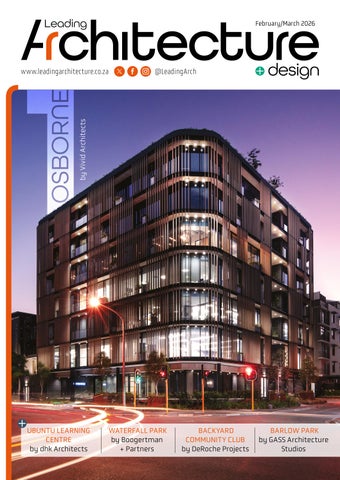
Leading Architecture + Design Feb/March 2026

Page 1


Contents

05 EDITOR’S NOTE & BOOK REVIEW

06 OPINION BROUGHT TO YOU BY BLUM SOUTH AFRICA

PROJECTS

08 BACKYARD COMMUNITY CLUB, ACCRA, GHANA

Sports facility and youth community venue centred on a tennis court in a crowded neighbourhood.

14 BARLOW PARK, JOHANNESBURG

GASS Architecture Studios’ thoughtfully designed mixed-use development addresses urban fragmentation.

20 WATERFALL WALK, MIDRAND

Natural light and seamless accessibility are the cornerstones of this premium retail centre.

26 UBUNTU LEARNING CENTRE AT BISHOPS, CAPE TOWN

Flexible, multifunctional spaces geared for 21st century learning, by dhk Architects.

32 1 OSBORNE, CAPE TOWN

Vivid Architects marries commercial imperatives with environmental responsibility in this sophisticated commercial landmark.

NEWS

38–50 Duram’s innovative three-product range; Bathroom renovations on a shoestring by Dulux; Wave goodbye to ostentatious gadgets and unnecessary complexity, says Miele; Thermal insulation sorted by Alliance and Samsung at a place of worship and a wine farm; AfriSam’s quality construction materials

directly affect strength and durability; Saint-Gobain boosts local manufacturing with new Ekurhuleni plant; Baker Baynes Extraordinary Women in BIM initiative; Bijiou’s contemporary clévo range of taps and mixers; ASP Fire: the importance of using the correct sprinkler systems in commercial buildings

EDITORIAL

EDITOR: Tracy Greenwood

email: tracy.greenwood@media24.com

SUB EDITOR: Anita van der Merwe

ART DIRECTOR: Julia van Schalkwyk

ADVERTISING

KEY ACCOUNT MANAGERS: Nolusindiso Mbambo

Email sindi.mbambo@media24.com

+27 (0)11 877 6011 | +27 (0)64 677 0110

Erika Sparks

Email: erika.sparks@media24.com

+27 (0)11 715 8503 | +27 (0)83 644 8532

PHOTOGRAPHY

Unless previously agreed in writing, LeadingArchitecture+Design owns all rights to all contributions, whether image or text.

SOURCES: Shutterstock, Getty Images, supplied images, editorial staff. COVER PHOTOGRAP H: Paris Brummer

SUBSCRIPTIONS

Rae Morrison email: rae.morrison@media24.com

PUBLISHING TEAM

General Manager: Dev Naidoo

Head of Content & Digital Strategy: Varushka Padayachi

Production Manager: Angela Silver

Group Art Director: David Kyslinger

MEDIA24 MEDIA

CEO: Minette Ferreira

CFO: Lana Goliath

MEDIA24 CORPORATE

CEO MEDIA24: Raj Lalbahadur

CFO MEDIA24: Nelmarie Beyers

Published by Media24 B2B

© Copyright LeadingArchitecture+Design Magazine 2026

B2B JOHANNESBURG OFFICE

Building 13, The Woodlands Office Park, 20 Woodlands Drive, Woodmead, Sandton | PO Box 784698, Sandton 2146 | Tel: +27 11 867 6111

LeadingArchitecture+Design is printed and bound by Novus Print.

COMMUNICATE & CONNECT

Whileprecautionshavebeentakentoensuretheaccuracyofitscontentsand informationgiventoreaders,neithertheeditor,publisher,oritsagentscan acceptresponsibilityfordamagesorinjurywhichmayarisetherefrom.Allrights reserved.©LeadingArchitecture.Nopartofthispublicationmaybereproduced, storedinaretrievalsystemortransmittedinanyformorbyanymeans, photocopying,electronic,mechanicalorotherwisewithoutthepriorwritten permissionofthecopyrightowners.Thispublicationmaycontaincontent generatedorassistedbyartificialintelligence(AI).

BACKED BY FOURWAYS GROUP | 5-YEAR WARRANTY

Ducted Inverter: Quiet, powerful airflow for open spaces.

Editor's note

The architectural landscape continues to evolve at an unprecedented pace, driven by shifting societal needs and environmental imperatives. This issue explores how contemporary design responds to the challenges of our time while remaining rooted in human experience.

Our exploration of workplace trends reveals a fundamental shift towards more adaptable, human-centred environments. New research demonstrates that noise pollution significantly impacts productivity while rising office attendance places unprecedented strain on existing spaces.

From Accra comes an inspiring example of community-driven architecture. The Backyard Community Club showcases DeRoche Projects’ innovative precast rammed earth system, demonstrating how sport and ecological practice can unite to create transformative public space where green infrastructure remains scarce.

In South Africa, we examine how architects are addressing urban challenges across multiple contexts. Barlow Park in Sandton exemplifies GASS Architecture Studios’ commitment to healing historical spatial segregation through high-density affordable housing. Waterfall Walk by Boogertman + Partners redefines retail architecture through its emphasis on accessibility and natural light. Meanwhile, 1 Osborne in Claremont demonstrates Vivid Architects’ sophisticated approach to sustainable commercial development, where strategic material choices and passive design strategies create compelling urban landmarks.

The Ubuntu Learning Centre at Bishops illustrates how educational architecture can honour heritage while embracing contemporary pedagogical approaches.

Each project demonstrates architecture’s capacity to respond meaningfully to social and environmental challenges.

Editor’s bookshelf

Cottagecore Gardens – A New Take on Living Landscapes

EDITOR AND PUBLISHER: GESTALTEN

Cottagecore gardens are evolving, climate-responsive landscapes that challenge conventional design orthodoxies. Rather than pursuing rigid aesthetic frameworks, this book champions gardens that develop organically over time and careful stewardship, featuring soft borders, self-seeded pathways and weathered textures that create authentic character.

The book demonstrates how cottage-inspired principles adapt across diverse contexts, from flood-resilient London basements to Parisian rooftops and California homesteads. Each case study emphasises ecological responsibility, biodiversity enhancement and material reclamation while maintaining contemporary relevance. The projects convincingly argue for gardens as multifunctional spaces serving as refuge, resource and intentional domestic extension.

Particularly valuable for practitioners navigating climate challenges, the publication is a compelling resource for those seeking sustainable approaches to landscape creation.

Office design trends for 2026

At Trend Group, our designers are seeing these shifts play out in real time across markets, and the insights align closely with leading global research.

Recent statistics highlight the urgency of this evolution. Noise and distraction remain the number one barrier to productivity worldwide.

Open-plan layouts, once seen as the hallmark of modern office culture, are no longer supporting the concentration people need. This is especially true after teams have become used to working from the quiet of their own home. Although hybrid work has normalised, reports show that office attendance is rising across many regions. This increase is placing fresh pressure on space, seating and shared resources. Together, these data points signal a global recalibration of how workplaces function.

1 THE NEW PRIORITY

One of the most significant shifts for 2026 is the rise of quiet. After years of hyper-open layouts, organisations are acknowledging the need to mitigate sensory and digital overwhelm. Teams are seeking spaces that support deep work without constant interruption.

As a result, there is a notable resurgence in semi-private offices, phone booths, acoustic pods and sound-absorbing materials that create pockets of calm throughout the office. These breakaway spaces focus on restorative experiences rather than group interaction. By restoring this balance, companies can directly improve staff productivity and wellbeing.

2 ‘RESIMMERCIAL’ DESIGN

In parallel, office interiors are embracing a richer, more residential aesthetic. The ‘resimmercial’ movement, which blends residential warmth with commercial durability, is maturing into something more sophisticated. Offices are becoming layered, textured and emotionally supportive spaces that feel comfortable to be in.

Designers are using warmer palettes (dark woods, earthy tones, blues as new neutrals), tactile materials, curated décor, and layered lighting to create zones that help employees feel more comfortable. This shift acknowledges that psychological support is a core driver of performance. Workers thrive when the office feels welcoming, so there is a move away from corporate minimalism as companies lean into sensory design.

3 DESIGNING FOR A CROWD

Another major trend shaping 2026 is the recalibration of hybrid work. With more teams returning to the office more frequently, workplaces are feeling the strain. The need for additional seating, meeting rooms, collaborative spaces and flexible zones is growing.

Work styles now happen in bursts as employees shift between focus, collaboration, socialising and hybrid meetings throughout the day. In response, offices must become more adaptable –think smart planning, multi-use zones, moveable furniture, plugand-play technology for 'hoteling' setups and agile workstations. Flexibility is no longer optional;

it’s the foundation of a futureready workplace.

4 CONNECTION: THE NEW WORKPLACE CURRENCY

As remote work has highlighted what cannot be replicated digitally, organisations are reframing the office as a hub of culture, mentorship and shared experience. Workplaces that intentionally foster connection are seeing higher retention and stronger engagement.

Roughly nine in 10 Gen Zs (89%) and millennials (92%) consider a sense of purpose to be important to their job satisfaction and wellbeing – according to a report by Deloitte.

Employees tend to stay longer at a company when they feel that their physical environment reflects the identity and values of the organisation.

Café-style gathering spaces, zen rooms and lighting that considers neurodivergent needs are becoming integral to creating offices where people genuinely want to spend time.

5 DOING MORE WITH LESS

To reduce potentially high costs, we’re seeing companies embracing more strategic, financially conscious approaches to sustainable design. Reuse and refurbishment are

gaining traction, with organisations increasingly opting to reupholster existing furniture, refresh finishes, and use modular systems that can adapt over time.

There is also a renewed focus on longevity and on sourcing materials and products locally. These decisions reduce environmental impact while keeping projects within budget into 2026.

6 TECH THAT ELEVATES WORK

Smart systems, AI-enabled booking tools, digital collaboration platforms, and data-led space planning are transforming how work environments function. Wirelessfirst, plug-and-play environments allow rapid reconfiguration, while data-driven design optimises space usage and informs evidence-based layout decisions.

Together, these insights point toward a clear direction for the future. The next generation of workspaces is purpose-driven and deeply human. Offices are being designed to balance focus with connection, comfort with performance, flexibility with identity, and sustainability with cost-efficiency.

Trendgroup.co.za

GAME, SET, MATCH

In Accra, where public investment in recreational space is limited and green areas increasingly scarce, the Backyard Community Club proposes a new model for shared civic life.

PHOTOGRAPHY: Julien Lanoo

Set within a compact plot in the dense neighbourhood of Osu, in Accra, Ghana, the Backyard Community Club is a community sports facility centred on a tennis court, that demonstrates how design can deliver inclusive, sustainable and socially transformative environments.

More than a sports facility, the club is a

youth community space where training, cultivation, gathering and learning take place side by side. By connecting sport with ecological practice, the Backyard Community Club sets out a model of public space that supports social exchange, environmental responsibility and the sustainable use of resources.

INNOVATION

Designed by DeRoche Projects, The Backyard Community Club is Ghana’s first project using a precast rammed earth system – an innovative method pioneered by the studio that reimagines an ancestral material for contemporary, scalable use.

At once a local landmark and a replicable prototype, Backyard exemplifies how design can respond to urgent questions of civic quality, environmental stewardship, and cultural identity.

Built to international standards, the clay tennis court is designed for professionallevel doubles play, providing athletes under 18 with a high-quality training environment while fostering access to the sport through free lessons for children in the community.

A shaded, built-in floating bench allows players and spectators alike to observe, rest, or review drills. Ancillary spaces, including changing rooms, shaded seating, outdoor prep counters, and a barbecue area, are quietly integrated into the site. Showers are naturally lit, simply detailed, and feature a planted niche that brings the landscape into moments of rest and daily routine.

STRUCTURAL PRESENCE

Wrapped by a rhythmic enclosure of 4-metre-high precast rammed earth panels, the court is both sheltering and open. This locally fabricated envelope provides privacy without isolation, offering porosity and visual connectivity. Its subtle rhythm and sculptural form reduce crosswinds and casts a pattern of shadows that moves across the site. This composition gives the structure presence while maintaining a sculptural elegance.

‘Backyard is about more than tennis; it’s about creating a platform for youth, for mentorship, and for community. We developed a custom precast system that acts as both structure and expression, pushing construction to meet the ambition of a purpose-built community space. The architecture is deliberately open-ended, where lines between sport, gathering, learning, and rest are blurred. It’s in the court, the shaded walkways, and lush vegetation where life emerges, shaped not by a fixed programme but by the people who use it,’ says Glenn DeRoche, Creative Director.

BEYOND TRAINING

Surrounding the court is a 230m2 sustenance garden: over 20 species of edible and medicinal plants cultivated not for appearance, but for performance. Guava, banana, lemongrass, peppermint, soursop, coconut and blue pea flower were selected for their health and recovery properties, nourishing the young athletes who train here. The garden serves a purpose beyond decoration. Youth learn to tend the land as they train on it, harvesting ingredients for fresh juices, post-practice snacks and community meals. The act of growing becomes part of the rhythm of play, embedding values of self-reliance, responsibility and ecological awareness into daily routines.

The court serves the community as a place for exercise, gardening, produce exchanges and evening gatherings. It also adapts as an outdoor screening space, offering access to professional tournaments and sports education otherwise constrained by infrastructure.

Backyard Community Club offers an alternative to conventional approaches to designing sports facilities, proposing a model of building rooted in material honesty, local knowledge and social purpose. From

the outset, our team prioritised deep engagement with local builders, athletes, and educators – from the Rome Masters to rammed earth technical advisors –to define a design process that is both inclusive and exemplary.

SUSTAINABILITY

The Backyard Community Club integrates a range of sustainable strategies throughout. The project champions local, low-carbon building materials and systems, with rammed earth construction to enclose the clay court. As clay courts require a lot of water to keep their performance for play, a borehole system and redirected stormwater runoff provide irrigation for the clay court and landscaped areas, reducing reliance on municipal water and supporting resilient, drought-tolerant planting. An earth slurry finish replaces traditional cementitious renders, offering a breathable, low-impact alternative that further reduces embodied carbon. The ancillary structures are designed to function without air conditioning or mechanical extraction, instead relying on the stack effect for passive ventilation and abundant natural light, minimising energy demand and reducing dependence on the main grid.

GHANA’S FIRST PRECAST RAMMED EARTH SYSTEM

Emerging from a broader investigation into sustainable building practices, the research departs from conventional building practices in Ghana. Applying for the first time the precast rammed earth panels, alongside a modular system tailored to local transport and labour, the project establishes a model for scalable, sustainable construction.

Traditional rammed earth construction is slow, labour-intensive and weather-dependent, which has long limited its use in commercial or communityscale projects. The system used bypasses these constraints through off-site fabrication, allowing for advanced quality control, tighter structural tolerances and parallel workstreams between site preparation and panel production. The result is a modular, climate-responsive and replicable system tailored to the realities of Ghanaian transport, labour, and climate. It is delivered more quickly, with less waste, and with a fraction of the embodied carbon of concrete. More than a construction method, it is a new framework for building from the ground up, using the ground itself.

By applying precast rammed earth modules at this scale, the project pioneers a model for future development, showing how innovative, material-driven design can advance sustainable urban life while safeguarding cultural identity and environmental values.

Professional team
Architects: DeRoche Projects Structural engineers: Richard Ofori Addo Civil engineers: Elorm Benjamin Nyornator
Mechanical engineers: Synergy Mep Ltd Electrical engineers: Carllyn Rammed earth consultant: Earth Structures Rammed earth contractor: Brazz Construction contractor: Kasa Konsult

DESIGNING AGAINST SEGREGATION

A mixed-use development demonstrates how thoughtful design can address historical urban fragmentation while delivering contemporary, sustainable architecture.

Nestled between Johannesburg’s M1 highway and Katherine Street, alongside the verdant Innisfree Park, Barlow Park represents more than just another mixed-use development. This multi-billion-rand precinct in Sandton stands as an architectural manifesto – a deliberate response to the spatial segregation that has long characterised South African urban landscapes. For GASS Architecture Studios, the challenge was clear: create a high-density, affordable residential precinct that doesn’t merely occupy space, but actively heals the urban fabric.

The precinct’s master plan fundamentally rejects the fragmented urbanism inherited from apartheid-era planning. By strategically blending residential, commercial and recreational programmes within a cohesive environment, the development creates what the architects term an ‘integrated city within a city’. This approach transcends mere mixed-use programming; it represents a conscious effort to foster social cohesion through spatial design.

Phase 2, comprising two residential blocks with 846 rental units, exemplifies this philosophy. The buildings are positioned strategically above a retail podium, accessed via a sweeping staircase that leads to communal amenities including a school, recreation centre and business facilities. This layered organisation creates a gradient from public to private spaces – a spatial transition that maximises views while maintaining human-scale engagement at street level.

The residential towers’ deliberate setback from the shopping level serves multiple purposes: it ensures unobstructed sightlines to surrounding areas, prevents the buildings from overwhelming the streetscape and preserves natural light penetration to ground-level spaces. This careful massing strategy demonstrates how density can be achieved without sacrificing environmental quality or urban permeability.

AUTHENTIC MATERIALITY AND HUMAN SCALE

The material palette celebrates authenticity over ostentation. The façade composition relies primarily on durable face brick – a pragmatic choice elevated through sophisticated application. Rather than treating brick as a merely functional element, varied laying techniques were used to create textural depth and visual interest across the building envelope.

The northern elevation particularly showcases this approach, where detailed red brick soldier courses frame generous recessed balconies. These balconies serve dual purposes: they articulate the façade with rhythmic depth while extending living spaces outward, creating private outdoor rooms for residents. The interplay between face brick, painted flush-jointed brickwork, and off-shutter concrete creates a cohesive architectural language that speaks to both material honesty and design sophistication.

Internally, the residential blocks organise around north-facing courtyards – a climatic response that maximises solar access and promotes natural ventilation. Even utilitarian elements receive thoughtful treatment: parking decks are designed as open structures allowing passive basement ventilation, while trees planted between parking bays introduce landscape qualities to otherwise functional zones.

LANDSCAPE AS URBAN INFRASTRUCTURE

The project’s environmental strategy extends beyond individual building performance to encompass broader urban ecology. The architects drew on the lush landscape of adjacent Innisfree Park via landscaped green belts planted with indigenous species including false olive, white stinkwood, river bushwillow and wild plum.

This landscape strategy activates ‘inbetween spaces’ as extensions of residents’ living environments, fostering community life through shared outdoor experiences. A network of pathways – planned to eventually incorporate a full running track linking to Innisfree Park – encourages active engagement with outdoor spaces while strengthening connections to the broader urban context. The development’s EDGE certification was attained through the use of integrated sustainable systems. On-site water sourcing, treatment and storage reduce infrastructure burden on municipal systems. Solar power arrays and energyefficient systems are woven throughout the buildings’ operations, while innovative heat recovery systems capture exhaust air from retail chillers to heat water. Future phases plan even more ambitious sustainability measures, including water attenuation dams functioning as heat sinks.

PROJECT

CONSTRUCTION INNOVATION

The project demonstrates how comprehensive risk management and quality control can deliver complex urban projects successfully. A dedicated safety protocol ensures worker wellbeing while maintaining construction quality, supported by regular inspections and continuous monitoring systems.

Time, cost and quality management are rigorously quantified throughout the construction process. Detailed scheduling software tracks progress against milestones, while comprehensive budgeting and regular financial audits maintain cost control. Quality assurance protocols ensure all construction meets specified standards without compromising schedule or budget requirements.

Risk identification encompasses financial fluctuations, operational delays, safety hazards, environmental impacts and regulatory changes. This proactive approach to risk management creates a framework for future similar projects, balancing development pressure with sustainability and safety requirements.

BACKGROUND BUILDINGS WITH FOREGROUND IMPACT

GASS Architecture Studios deliberately pursued what they term ‘background buildings’ – architecture that serves the broader urban fabric rather than seeking individual landmark status. This approach prioritises the quality of shared spaces and the relationships between buildings over singular architectural gestures. The strategy proves particularly powerful in addressing Johannesburg’s urban challenges. By creating highquality, high-density affordable housing within walking distance of Sandton’s economic hub, Barlow Park offers an alternative to sprawling suburban development patterns. The precinct’s mixed-use programming ensures equitable access to essential services and amenities within a single, interconnected environment.

Professional team

A MODEL FOR URBAN HEALING

Barlow Park’s architectural significance extends beyond its individual buildings to its demonstration of how thoughtful design can address complex social and urban challenges. The development proves that density, affordability and quality need not be mutually exclusive when supported by comprehensive planning and authentic architectural expression. The precinct stands as evidence that architecture can be both pragmatic and transformative, addressing immediate housing needs while contributing to longer-term urban healing. In doing so, it sets a precedent for future developments across South Africa and beyond, demonstrating architecture’s capacity to foster inclusive, sustainable communities where diverse populations can thrive together.

Architect: GASS Architecture Studios Structural engineer: Gelderblom Consulting Engineers Mechanical engineer: Graeme Page Consulting Engineers Wet services: IZAZI Consulting Engineers Lift consultant: Solutions for Elevating Safety: Cairnmead Industrial Consultants Electrical: One Zero Electrical Engineers Fire: Fenco Fire Engineers Quantity surveyor: RLB Pentad QS Landscaping: Daniel Rebel Landscape Architects

RETAIL APPEAL

Waterfall Walk, designed by Boogertman + Partners, combines thoughtful architecture, natural light and seamless accessibility to create a welcoming new open-air retail destination in Waterfall, Midrand.

Photography: Malan Kotze, courtesy of Boogertman + Partners

Waterfall Walk is a premium open-air retail centre just off the Allandale/N1 interchange in Midrand, Johannesburg. Its core aim is to offer a welcoming and enjoyable shopping experience to daily shoppers through a combination of architectural elegance, convenience and a high-quality retail environment. Conceived as distinctly modern but accessible, Waterfall Walk was designed to attract shoppers seeking an elevated retail experience at a comfortable and vibrant neighbourhood centre suited to both quick errands and leisurely visits. The tenant mix balances everyday essentials with lifestyle and leisure offerings across a gross lettable area of 4431m2 . Anchored by Woolworths Food, Woolworths Café and Clicks, the centre includes fashion boutiques, health and beauty outlets, coffee shops and eateries.

DESIGN CONCEPT

Boogertman + Partners envisioned Waterfall Walk’s architecture as an exercise in simplicity and elegance, underpinned by thoughtful spatial planning and a sophisticated, premium material palette.

The architectural language is characterised by clean lines softened with subtle curves. Organic concrete canopies frame key entrances and seating areas, providing shelter and serving as sculptural focal points. The interplay between clean lines and organic curves, particularly in the forms of the concrete canopies, introduces visual interest and architectural refinement. Overall, the design prioritises natural light and fresh air;

and offers generous access to outdoor seating around the cafés, restaurants and retail outlets.

Ease of access is central to the visitor experience with direct shopfront access from on-grade parking. A key innovation lies in the structure of the walkways, where steel canopy columns are integrated into the shopfronts to form the roof’s supporting beams. This approach removes the visual clutter of traditional standalone columns, resulting in an open, unobstructed walkway that improves pedestrian flow, increases shopfront visibility and enables a seamless transition from the parking area.

At the heart of the centre is a vibrant gathering space framed by two restaurants. Their outdoor seating overlooks landscaped gardens and a sculptural water feature with views towards Allandale Road. This central zone forms a natural social hub that encourages relaxation and interaction. A dedicated staff pause area offers tenant staff a comfortable space to unwind separate from customer-facing areas.

MATERIAL PALETTE

Steel, concrete, glass and timber are used to establish a refined and cohesive architectural language. Bamboo composite components are paired with black steel to create distinctive roof canopies, façades and screening elements. The composite material was selected for its consistency and versatility, allowing its use across balustrades, extruded aluminium pergolas, freestanding screens and façade cladding.

This continuity reinforces a polished and unified visual identity. Planters throughout the walkways contribute biophilic elements that soften the industrial tones and create an inviting environment.

Another notable feature is the signage, custom-designed by Boogertman + Partners in a restricted black-andwhite palette, which strengthens visual cohesion and elevates the centre’s overall aesthetic. It also contributes to a consistent brand experience and reinforces the development’s premium positioning.

SUSTAINABILITY

Although Waterfall Walk does not hold formal sustainability ratings, it incorporates a range of practical, environmentally conscious measures. Its open-air design enhances comfort while reducing reliance on mechanical ventilation. Provision for solar panels supports commonarea energy needs, while LED lighting improves efficiency. Clerestory windows in the largest anchor tenant space maximise daylight, reducing the need for artificial lighting. Walkway canopies provide shade that minimises solar heat gain on shopfronts and reduces the need for

Tel: +27 (0)11 790 1600 Email: info@boogertman.com www.boogertmanandpartners.com

mechanical cooling. Bamboo composite cladding makes for a sustainable alternative to conventional materials. The landscaping features indigenous, drought-resistant planting that supports biodiversity while requiring very little artificial irrigation. The integration of planters and trees into walkways and seating areas improves air quality, offers shade and creates a pleasant pedestrian environment. Tenants are encouraged to use lowconsumption electrical fittings and energy-efficient bulbs. Together, these measures demonstrate a commitment to operational efficiency, environmental responsibility and improved user comfort.

CONCLUSION

Waterfall Walk’s design establishes a convenient retail and leisure destination that is well integrated with the neighbouring Waterfall Ridge centre. It introduces a lively but sophisticated visitor experience within the broader precinct and contributes to an elevated social environment. The development also involved upgrades to public infrastructure, including roads, landscaping and green spaces, improving accessibility and the overall appeal of the area.

Professional team

Development manager: Abcon Developments

Project manager: Abcon Developments Leasing manager: Dorpstraat Architect: Boogertman + Partners Town planners: Abcon Developments | Craft

Quantity surveyor: Quanticost Civil & structural engineer: Kantey & Templer Consulting Engineers

Electrical engineer: MNS Consulting Engineers Mechanical engineer: Q-Mech Consulting Engineers

Wet services: Wills Franklin Pretorius Fire engineer: Ronald Koekemoer & Associates Health & safety consultant: Cairnmead Industrial Consultants Main contractor: Mike Buyskes Construction

The Ubuntu Learning Centre at Bishops School facilitates contemporary learning practices within an historical campus.

PHOTOGRAPHY: Sean Gibson

Bishops Diocesan College in Rondebosch, Cape Town, is one of South Africa’s top boys’ schools. As one of the country’s oldest institutions, the school embarked on modernising learning environments on its historical campus. This led to transforming the existing Molteno Library and New Lecture Theatre, located within a cluster of buildings at the heart of the academic campus. The new building was named Ubuntu Learning Centre, designed to facilitate collaborative learning practices that characterise contemporary 21st century education. The building was designed by dhk Architects, with interior design by dhk Interior Design. The project called for flexible, efficient and multifunctional learning spaces that could respond to different user demands and offer opportunities to release space elsewhere on campus. Key requirements included large gathering spaces hosting up to three classes together, complemented by breakaway spaces. The brief also called for improvements to the library, IT support hubs and a larger staff room.

SITE BACKGROUND AND CHALLENGES

The site lies at a crucial fulcrum of campus routes, surrounded by existing buildings and mature trees requiring retention. This limited available space for new construction. A high water table required intricate civil engineering solutions, including new drainage channels and pipes to divert water around buildings. Existing buildings were inward-focused, connected with dark, unwelcoming passages and disconnected spaces.

PROJECTS

Key challenges included creating large, flexible spaces with generous dimensions while meeting acoustic and ventilation requirements in the constrained footprint. This was complicated by height restrictions, the water table below and the need to align with floor levels of existing surrounding buildings. The team had to navigate the complexity of moving large numbers of people through spaces using existing circulation routes as escape routes, while preserving natural light and ventilation.

DESIGN CONCEPT

When designing a new insertion into a tight, historical setting, there may be temptation to opt for less traditional shapes, highlighting contemporary approaches. During early concept exploration, the design team tested more amorphous shapes as symbols of distinction contrasting against the rectilinear buildings. However, the more restrained iteration responded more favourably to site constraints and offered greater operational flexibility.

The rectangular cube design creates a modern learning environment offering flexible spaces supporting various learning styles, accommodating private study and public spaces. To lighten the insertion’s impact, the cube is conceptually ‘lifted’ off the ground floor. The ground floor space is largely glass-enclosed, offering greater openness and connection to outdoor surrounds. This large room can be subdivided into smaller learning spaces or opened into a multipurpose venue or exam hall.

A key conceptual idea was creating a vertical privacy gradient. This approach organises the building, balancing the busy ground floor openness with the need for focused workspaces on upper levels. The mid-level contains group work areas and a secondary collaboration room, serving as transition space between the public ground floor and the private upper level reserved for staff and quiet student study.

The Molteno Library, with its characteristic pitched slate roof, is treasured school history requiring retention. The design incorporates a glazed ‘gasket’ connection creating deliberate separation between the old, pitched roof and new monolithic form hovering above. This retains the library’s intimacy while modernising the facility. New façades feature deep, tall windows with angled reveals introducing playful abstraction referencing existing campus architecture.

FLEXIBLE SPACES AND INCLUSIVE ACCESS

Spaces are flexible, enabling students to choose places suiting their mood and learning style, from ‘homago’ spaces (hang out, muck around, geek out) to traditional study areas. These include collaboration and quiet study zones, informal seating, meeting pods and relaxed beanbag areas. Common areas foster collaboration, interaction, learning and community. The flexible, open-plan ground floor serves as the primary common area. Extensive glazing creates strong indoor-outdoor connection and effectively extends usable space.

PROJECTS

A key feature is the terraced outdoor area, serving as spill-out space for gatherings or outdoor learning and providing additional socialising places. Stairways and circulation areas also form common spaces, with one staircase wall identified as gallery space for student artwork exhibitions.

Access has been carefully planned to optimise flow, functionality and circulation while meeting safety requirements. The building acts as a filter, absorbing and facilitating movement through various levels and spaces. Existing staircases were adapted as primary routes and fire escapes, enabling efficient movement while providing focused work and collaboration spaces. A new glazed bridge link improves flow between buildings and enhances wheelchair access.

The interior design follows a visual thread expressing all architectural elements. The colour palette and materials create a calm yet stimulating environment. The approach is restrained and functional, with understated aesthetics designed to endure, avoiding trendy elements that might date quickly. The colour scheme honours Bishops’ corporate identity, with complementary colours adding playful elements. Materials and colours transition subtly through the building, signalling shifts from public to private spaces.

SUSTAINABILITY

Applying adaptive reuse principles, the project repurposes existing spaces, significantly reducing environmental impact. Natural ventilation stacks maximise air flow and reduce reliance on mechanical cooling. Solar-fitted heat pumps provide energy-efficient heating and cooling. Tall windows with angled reveals control glare and optimise natural light, reducing artificial lighting reliance. The building envelope design through thermal mass helps maintain comfortable temperatures, minimising energy use. These sustainable elements reduce operational energy demand and create a healthier, more comfortable learning environment while serving as practical teaching tools demonstrating sustainable practices to students daily.

PROJECT

Urban harmony

A sophisticated commercial landmark demonstrates how thoughtful architecture can enhance both urban fabric and environmental performance.

Photography: Paris Brumme & Art.Hub

With its strategic material palette and passive design strategies, 1 Osborne presents a compelling vision for sustainable office development in South Africa’s evolving commercial districts.

Positioned at the vital intersection of Cavendish Street and Osborne Road, 1 Osborne occupies a prominent corner site that demanded architectural sensitivity to both commercial viability and neighbourhood character. The building’s strategic location adjacent to Cavendish Square places it at the heart of Claremont’s bustling retail and business district, while its upper floors capitalise on the site’s elevated position to frame sweeping views from the Constantiaberg mountains across to Table Mountain’s iconic silhouette.

The architectural response acknowledges these dual imperatives through a carefully orchestrated massing strategy. Rather than presenting a monolithic block, the design breaks down the building’s scale through varied façade treatments that respond to orientation, view corridors and street-level activation. This contextual sensitivity extends from the building’s urban interface right through to its rooftop, where a considered setback creates both visual relief and premium amenity space.

CLIMATE-CONSCIOUS DESIGN

The architecture of the building is fundamentally defined by the principles of good passive design, with each façade tailored to address specific environmental challenges.

The west-facing elevation, which bears the brunt of Cape Town’s intense afternoon sun, presents a robust response through solid painted brickwork punctuated by carefully sized openings. This heat-mitigating strategy reduces both glare and thermal gain while maintaining essential connections to the urban landscape beyond.

In contrast, the east and north façades embrace a lighter touch through vertical aluminium screens that read as warm timber while delivering superior durability and minimal maintenance requirements. These screens provide graduated solar shading throughout the day, filtering harsh light while preserving views and visual connections for occupants. The interplay between solid and screened elements creates a dynamic façade composition that performs as well as it appears.

MATERIAL AUTHENTICITY

Material selection reflects a philosophy that prioritises both aesthetic warmth and long-term performance. The palette of off-shutter concrete, painted brickwork and durable aluminium timber-look slats was chosen for longevity and maintenance ease, acknowledging the practical realities of commercial property management and avoiding the sterile appearance often associated with purely functional buildings.

At ground level, the entrance sequence softens this robust material palette through carefully integrated handmade tiles, natural timber elements and lush planting.

This transition strategy recognises the building’s role within a mixed-use precinct that includes residential streets, creating a welcoming interface that encourages pedestrian engagement, while simultaneously maintaining commercial sophistication.

VERTICAL LANDSCAPES

Greenery plays a fundamental role in the building’s environmental performance and occupant experience. External planters on every office level introduce vegetation that provides shading, visual softness and biophilic benefits for workers. The integration of creeping plants creates living façades that will evolve and mature over time, adding temporal richness to the architectural composition.

This commitment to an integrated landscape reaches its culmination at the rooftop level, where large planters accommodate mature trees that serve as both environmental moderators and visual anchors. The top floor’s generous setback accommodates an entertainment deck that transforms the building’s crown into a destination, complete with continuous ribbon planters that soften the structure’s termination while providing panoramic views.

ENVIRONMENTAL PERFORMANCE

Sustainability extends beyond passive design strategies to encompass active building systems and water management. Rooftop solar panels contribute to the building’s energy profile, and energy-efficient HVAC and lift systems reduce operational consumption. A borehole irrigation system supports the extensive planting programme without placing additional demands on municipal water supplies, demonstrating integrated thinking about resource management.

The concealment of five levels of basement parking represents another dimension of environmental consciousness, eliminating surface parking while supporting the street-level retail activation that gives life to urban precincts. This approach prioritises pedestrian experience over vehicular convenience, contributing to the walkable, mixed-use character that makes Claremont an increasingly sought-after business location.

WORKPLACE INNOVATION

Full-height glazing on office floors maximises connection to Cape Town’s spectacular mountain context, and small north-facing balconies provide essential break-out spaces for occupants. This attention to human scale within a commercial framework acknowledges changing workplace expectations and the growing importance of environmental quality in attracting and retaining talent.

The building delivers AAA-grade commercial space that balances efficiency with amenity, creating environments where the quality of light, air and outlook contribute to

occupant wellbeing. In an era where workplace design increasingly influences business success, 1 Osborne provides a template for offices that serve both productivity and human flourishing.

URBAN LEGACY

As Claremont continues its evolution from suburban shopping destination to integrated mixed-use precinct, 1 Osborne demonstrates how contemporary commercial architecture can contribute positively to urban transformation. The project’s integration of retail activation, pedestrian amenity, environmental performance and architectural sophistication points toward a more holistic approach to development. By harmonising commercial imperatives with environmental responsibility and urban sensitivity, the building establishes new benchmarks for office development in South African cities. Its success lies not merely in achieving sustainability targets or meeting commercial requirements, but in demonstrating that these objectives can be pursued simultaneously without compromise to architectural ambition or urban quality.

Professional team

Client: Magma Property Group Architect: Vivid Architects, Bruce Burmeister Architects & Associates Quantity surveyor: Hope & Warren

Structural engineer: De Villiers Sheard Engineer (fire, electrical, mechanical): Triocon Façade engineer: PDK Civils & Construction Interior designer: NMC Interior Design & Project Management Landscape architect: Alistair Turrell Landscape Architect Contractor: Isipani Construction

Revolutionary paint systems transform project delivery

Duram’s innovative three-product range eliminates traditional painting constraints while delivering superior performance

STREAMLINING SPECIFICATION COMPLEXITY

For architects and designers grappling with increasingly complex renovation projects and demanding construction programmes, a new range of dual-action paint and primer systems promises to revolutionise both specification and delivery timelines. Duram’s comprehensive trio of water-based formulations –Direct-to-Multiple-Surfaces, Direct-to-Wood, and Direct-to-New-Plaster – addresses the persistent challenges of mixed substrate finishes, lengthy curing periods, and coordination complications that frequently plague contemporary projects.

MULTI-SUBSTRATE MASTERY

The standout performer, Duram’s Direct-to-MultipleSurfaces system, eliminates the traditional nightmare of achieving consistent finishes across disparate materials. The self-priming formulation adheres directly to notoriously difficult substrates including ceramic tiles, melamine, Formica, aluminium, galvanised steel, glass and PVC – materials that typically require extensive preparation or specialist treatments. This extreme adhesion capability proves particularly valuable in adaptive reuse projects where existing finishes vary dramatically across a single space.

ACCELERATED PROJECT DELIVERY

Perhaps most significantly for project timelines, the Direct-to-New-Plaster variant permits painting just 24 hours after plastering, tolerating up to 60% moisture content while allowing the substrate to breathe properly. This breakthrough eliminates the traditional 28-day wait, delivering substantial programme savings without compromising long-term performance. The water-permeable formulation actively resists alkali damage, efflorescence and delamination – common failure points with conventional systems on fresh masonry.

For external and internal timber applications, the Direct-to-Wood system offers penetrating adhesion with a flexible formulation specifically engineered to accommodate natural wood movement. UV-tested and fade-resistant, it blocks tannin bleeding while reducing water absorption –critical factors for maintaining both aesthetic intent and structural integrity over extended periods.

DESIGN INTEGRATION

All three systems share exceptional opacity and tintability across 800+ colour options, delivering the smooth, hardwearing satin finish increasingly demanded by contemporary interiors. The water-based, low-odour formulation ensures site-friendly application, while the two-coat coverage significantly reduces labour requirements.

PERFORMANCE ASSURANCE

Backed by a 12-year guarantee and engineered for scratch, stain, UV and weather resistance, these systems support contractors’ long-term reputation while reducing lifecycle maintenance considerations –increasingly important factors in sustainable design strategies.

If you’re looking to streamline specification complexity while enhancing project delivery speed, this comprehensive range represents a genuine paradigm shift in paint system performance and application flexibility. Duram.co.za

NEW PLASTER PAINT

Duram OneForPlaster is a unique premium low-sheen paint and primer in one, with a 12-year guarantee. Designed for newly plastered walls, it allows painting just one day after plastering — no 28-day wait or separate primer needed. Only two coats are required for a beautiful finish in over 800 colours, saving time and labour for faster project completion. OneForPlaster’s formula tolerates up to 60% moisture and lets plaster breathe thereby preventing issues like water uptake, alkali damage, efflorescence, and delamination.

Affordable bathroom updates

Your bathroom is more than a functional space – it’s a personal sanctuary where you start and end each day. The good news? You don’t need a major renovation to transform it into a calm, welcoming retreat. With smart paint choices and budget-friendly updates, you can create a space that supports relaxation and self-care.

MAKE A BOLD STATEMENT WITH PAINT

A fresh coat of paint is the quickest, most affordable bathroom upgrade. A single feature wall in a calming colour creates impact without overwhelming smaller spaces. In larger bathrooms, paint multiple walls for a cohesive look. Consider painting the vanity or cabinetry for added personality – it’s a small investment with big visual results.

MAKE IT PRACTICAL AND FUN

LIGHTING MAKES ALL THE DIFFERENCE

Swap outdated fixtures for warm LED lights or soft pendant options. Dimmable lighting is affordable and allows you to adjust the mood for different times of day. Layer your lighting with a combination of overhead fixtures, mirror lights and accent lighting to create depth and warmth throughout the space. Good lighting highlights your paint colour and makes the space feel larger and more inviting.

Choose washable, moistureresistant paint designed for humid environments as it protects your investment. Introduce pattern and personality through accessories: patterned tiles, colourful artwork, vibrant towels or printed shower curtains. Paint shelves or refresh a medicine cabinet in a complementary shade. Add plants for air quality, integrate practical décor choices like hooks, mirrors and budget storage solutions to keep the space uncluttered while maintaining a peaceful feeling.

ADD WARMTH AND PERSONALITY

Balance your chosen colour with warm accents that won’t break the bank: terracotta soap dishes, woven baskets, affordable copper or goldtoned fixtures and natural wood elements. Layer in soft textures –plush towels and a woven bathmat – to invite relaxation without major spending.

‘With thoughtful choices and strategic updates, your bathroom becomes more than a place to wash up. It becomes a daily invitation to slow down, breathe and reconnect with yourself, without breaking the bank,’ says Dulux Colour Expert, Palesa Ramaisa. Dulux.co.za

Seamless design meets sustainable innovation

As we approach 2026, the modern home is undergoing a quiet revolution. Gone are the days of ostentatious gadgets and unnecessary complexity. Instead, homeowners are embracing a philosophy of timeless design, practical technology and sustainability that prioritises longevity over novelty.

The kitchen, once dominated by statement handles and bold finishes, is moving towards a more refined aesthetic. Handleless designs are becoming the norm, creating seamless visual flow that extends beyond the kitchen into open-plan living spaces. Miele’s ArtLine range exemplifies this shift, offering push-to-open functionality alongside elegant finishes like Pearl Beige glass that complement rather than compete with the home’s overall design language.

‘We’re seeing a move away from trends that quickly date,’ explains Sicelo Champion, Head of Brand Activation and Own Retail at Miele South Africa. ‘People want appliances that will look and function beautifully for decades, not just a few years.’

This philosophy extends to colour palettes, where neutral and timeless materials are replacing bold statements. The result is homes that feel calmer, more sophisticated and less likely to require frequent updates.

SMART TECH WITH PURPOSE

While smart home technology continues to evolve, 2026’s approach is markedly different from the tech-heavy homes of the past decade. The focus has shifted from impressive features to genuinely useful automation. Remote monitoring, predictive maintenance alerts and intelligent energy management are becoming standard, but only where they solve real problems.

‘The smart features that matter are those you don’t have to think about,’ notes Champion. ‘Our appliances learn your patterns and adapt accordingly, rather than requiring constant interaction.’

This includes everything from refrigeration systems that maintain precise temperature and humidity control to extend food freshness, to washing

machines with automatic load detection that optimise water and energy usage without user intervention.

THE SUSTAINABILITY IMPERATIVE

Perhaps the most significant shift is towards appliances designed for genuine longevity. While the industry average lifespan hovers around seven years, forward-thinking manufacturers are designing products tested to last the equivalent of 20 years’ use.

This approach reflects a broader cultural shift towards sustainability through durability. Steam cooking is gaining popularity not just for its health benefits in preserving nutrients, but for its versatility in reducing the need for multiple appliances. Similarly, advanced laundry technologies that protect fabric fibres extend clothing life, reducing replacement frequency.

EVERYDAY LUXURIES

The coffee culture that emerged during remote working is now permanently embedded in home design, with built-in machines becoming as essential as dishwashers. These aren’t just convenience items – they represent a broader trend towards bringing professional-quality experiences into the home.

Energy efficiency remains paramount, but it’s no longer marketed as a compromise. Instead, it’s seamlessly integrated into performance, with features like heat-pump technology in dryers offering both environmental benefits and superior fabric care.

As we move towards 2026, the message is clear: the future home values substance over spectacle, longevity over novelty, and practical intelligence over flashy features. It’s an evolution that promises more thoughtful, sustainable and genuinely liveable spaces.

Miele.co.za

Creating comfort for Kingdom Fire Ministries

When Kingdom Fire Ministries sought to transform an older industrial warehouse in Stellenbosch into a welcoming place of worship, one of the greatest challenges was the climate. The region is known for its extremes, with winter mornings dropping to just a few degrees and summer temperatures soaring above 30°C. For a space that accommodates hundreds of people in worship, maintaining comfort throughout the year was essential.

To achieve this, Kingdom Fire Ministries partnered with Promech Engineering Services, who designed and installed a climate-control solution built around Alliance High Static Ducted inverter units. Four of Alliance’s 96 000 BTU systems were specified, with both indoor and outdoor units carefully positioned to deliver consistent comfort across the 700m 2 space. The challenge was significant.

The church occupies a triple-volume area, with an 18m roof height and no ceiling detail. This meant the system had to deliver effective heating and cooling for the occupied zone, the lower 2,4m where people gather, without the inefficiency of conditioning the full volume.

Promech’s design, combined with Alliance technology, successfully addressed the challenge through precise engineering. Specialised swirl diffusers were installed to optimise airflow for both heating and cooling. Return air grilles were placed at a low level to ensure that air circulation remained within the occupied zone, rather than extending to the full height of the space. Fresh air was carefully integrated into the system: part of it was pre-mixed with the return air, while the remainder was directed upward to reduce heat build-up at the roof level. This approach eases the cooling load in summer while helping retain warmth closer to the ground in winter.

The results are clear. In winter, the system can raise the indoor temperature from 3°C to 24°C in just 15 minutes. In summer, it cools the space from 32°C down to 22°C in 30 minutes, maintaining the set point

with consistent efficiency. Sonic-lined ducting further enhances comfort by reducing noise, preserving the calm environment needed for worship.

ALLIANCE DUCTED HSP INVERTER RANGE

At the heart of this project lies the Alliance Ducted HSP inverter range, a proven solution for large-scale applications. These high-static pressure hideaway units provide powerful airflow, reaching up to 10,800m 2 /h, and ensuring efficient distribution even in large spaces. With high-capacity heating and cooling, they provide reliable year-round performance, backed by the nationwide support of the Fourways Group. Alliance’s focus on competitive pricing and proven reliability makes the range a practical choice for churches, warehouses and commercial buildings alike.

The success of this installation shows the capability of Alliance solutions in demanding environments.

The Ducted HSP inverter units deliver a total cooling capacity of over 351 000 BTU/hr and heating capacity of 424 000 BTU/hr, a performance level designed to match the alternating extremes of Stellenbosch’s seasons.

Even more than technical performance, the installation reflects the Alliance Difference. A solution that is carefully considered, reliable and designed to support daily life. For Kingdom Fire Ministries, that means creating a space where people can gather in comfort, free from the distractions of the climate outside.

With the support of Promech Engineering Services and the backing of Fourways Group, Alliance has once again proven its ability to deliver thoughtful climate control at scale. For worshippers, it translates into something simple, yet powerful: a comfortable, welcoming environment that allows occupants to focus entirely on what matters most.

Fourwaysgroup.co.za

Precision cooling for a design-driven space

Nestled in the Franschhoek Valley , one of South Africa’s most picturesque wine regions, Paserene Wine Farm stands out not only for its premium wines but also for its strikingly modern architecture. The tasting room, designed by Etienne Stols Architects, reflects a bold yet refined aesthetic that blends seamlessly with its natural surroundings.

This highly considered design required an equally considered approach to climate control. With extensive glass façades that invite natural light and views of the landscape, along with a steel-framed structure featuring limited ceiling voids, the project team required an air-conditioning solution capable of delivering consistent comfort quietly without compromising the architectural intent.

Samsung, together with Fourways Group and specialist installer Elite Eco Systems, provided a customised solution that met both the technical and visual requirements of the space.

The Samsung DVM Eco system was selected for its high energy efficiency, compact design and long piping capability. These features made it possible to position the outdoor units approximately 50m from the building, with all pipework sleeved and routed underground. This allowed the architecture to remain clean and uninterrupted, aligning with the vision of keeping all services out of sight.

Samsung 360 Cassette units were selected as the optimal indoor solution. Initially, standard 4-Way Cassette units were considered; however, once the architectural team learned about the 360 Cassette, its refined

circular aesthetic immediately stood out. The units blended seamlessly into the ceiling, enhancing the modern design while delivering powerful, quiet airflow.

Four 14 kW 360 Cassettes were installed across two independent systems. This zoning approach ensures flexibility for different usage scenarios, including private events hosted in one wing, while also providing redundancy for ongoing reliability.

The Samsung 360 Cassette units offer more than visual appeal. Their omnidirectional airflow delivers consistent temperatures without uncomfortable drafts, while the inverter-driven system ensures low energy consumption and quiet operation. The sleek design of the units made them suitable for installation within the building’s limited ceiling spaces.

The entire HVAC system was designed by Pietre Louw of Elite Eco Systems, installed by the Elite team, and supplied by Fourways Group. The result is a responsive, efficient and visually integrated climate solution that complements the form, function and sustainability ethos of the Paserene Wine Farm project.

Samsung remains committed to enabling architecture to thrive through smart, invisible innovation. This project stands as a clear example of what is possible when performance, sustainability and design are brought into perfect balance.

Fourwaysgroup.co.za

Quality aggregates equal durable construction

In the world of construction , the quality of materials directly determines the strength, durability and long-term performance of any structure. Among these materials, aggregates – whether used in concrete, asphalt or base layers – play an essential role. Ensuring that aggregates are correctly sized and properly graded is not just a technicality, it’s a vital factor in achieving structural integrity, performance consistency and compliance with design specifications.

‘Aggregate grading is about more than just particle size,’ explains Amit Dawneerangen, Construction Materials Executive: Sales & Product Technical at leading construction materials supplier, AfriSam. ‘It determines how the material compacts, how concrete mixes perform and how well load-bearing structures can handle stress over time.”

When aggregates are incorrectly sized or poorly graded, voids can occur within the mix, reducing density and compromising strength. This often leads to issues such as cracking, shrinkage and water ingress – all of which can shorten the lifespan of roads, buildings or infrastructure.

Conversely, well-graded aggregates create dense cohesive mixtures that enhance workability, reduce cement or binder demand, and ensure more uniform compaction and stability.

Beyond physical performance, consistent aggregate quality ensures that engineers and contractors can meet design standards and regulatory specifications. Projects designed around specific grading envelopes depend on accurate and repeatable aggregate properties to perform as intended.

QUALITY MANAGEMENT

However, achieving this level of precision requires technical expertise, process control and rigorous testing, which is why working with a reputable quarry or construction materials supplier is critical. Trusted suppliers operate under strict quality management systems, implement regular laboratory testing and maintain calibrated crushing, screening and blending processes to ensure product consistency.

‘Partnering with an established, credible supplier provides confidence that every load delivered meets specification,’ says Dawneerangen. ‘It also means access to reliable technical advice and traceability –from the source rock right through to the final product.’

Reputable suppliers invest heavily in quality assurance infrastructure, from advanced testing laboratories to on-site quality control technicians. Their focus extends beyond supply: they actively collaborate with engineers and contractors to ensure that the correct material is selected for each layer or mix design, reducing the risk of costly rework and ensuring longterm performance.

In a market where quality, compliance and sustainability are non-negotiable, correct aggregate sizing and grading are the cornerstones of successful construction.

‘Working with a trusted technically capable supplier is therefore not just a purchasing decision, it’s a quality assurance choice that safeguards the integrity and longevity of every project,’ Dawneerangen concludes. Afrisam.co.za

BUILD IT ONCE

BECAUSE YOU ARE A PROFESSIONAL

Our wide range of locally produced, fit-for-purpose cement products delivers consistently superior quality for both construction and structural work. Trusted by professionals for over 90 years, AfriSam High Strength Cement provides reliable performance, excellent durability and dependable results — project after project. If you want to build it only once, use the A1 Choice, use AfriSam High Strength Cement. Ask for AfriSam.

Saint-Gobain strengthens local manufacturing with new Ekurhuleni plant

Saint-Gobain Africa has opened a new state-of-the-art manufacturing plant in Ekurhuleni, marking an investment of more than R500m in local manufacturing. The event brought together government representatives, industry partners and community stakeholders, marking a strong vote of confidence in South Africa’s economy and industrial potential, rooted in international collaboration and local empowerment.

The French multinational, with upwards of 360 years’ global manufacturing and innovation expertise and more than 90 years’ presence in South Africa, confirmed that the new plant will produce fibre cement, a durable composite building material valued for its strength, and fire and moisture resistance. The investment is expected to create numerous direct and indirect job opportunities, while strengthening local supplier development and skills transfer.

The investment forms part of Saint-Gobain’s long-term commitment to Africa and aligns with the company’s global purpose, Making the World a Better Home, which extends beyond products to supporting sustainable growth, industrial development and social progress.

‘This investment of more than R500m is not simply about expanding capacity; it is a clear demonstration of our long-term belief in South Africa as a key industrial hub for the continent,’ says Aymeric d’Ydewalle, CEO of Saint-Gobain Africa. ‘We continue to invest because we believe deeply in South Africa’s talent, its manufacturing capability and the importance of strong

partnerships between the public and private sectors in driving sustainable growth.’

The Ekurhuleni plant brings Saint-Gobain Africa’s Make it in Africa to Build Africa (MABA) commitment to life, demonstrating its focus on local production alongside skills development, community empowerment and the strengthening of regional value chains.

‘Through our MABA commitment, we are focused on producing locally, developing people and contributing meaningfully to the communities in which we operate,’ d’Ydewalle adds. ‘This new plant is designed to support job creation, supplier development and skills transfer, while contributing to the revitalisation of South Africa’s manufacturing sector.’

The opening of the Ekurhuleni plant marks a significant milestone in Saint-Gobain Africa’s long-term presence in South Africa. As the company continues to invest in local manufacturing, innovation and skills development, it remains focused

FIBRE CEMENT AT A GLANCE

Fibre cement is a durable building material widely used in modern construction for applications that demand strength, moisture resistance and fire performance. It is commonly specified in areas exposed to humidity, weather or higher wear, both indoors and outdoors.

Engineered for long-term performance, fibre cement is valued for its stability, resilience and versatility across residential, commercial, and infrastructure projects.

Fibre cement is used across a range of construction applications, including:

• External cladding and façades

• Ceilings, eaves, and soffits

• Internal partitioning in moisture-prone areas

• Roofline elements such as fascias and barge boards

• Flooring and permanent shuttering systems

• Its adaptability makes it suitable for diverse climatic conditions and building types.

on building resilient industries, supporting economic growth and contributing meaningfully to the country’s industrial future.

Saint-gobain-africa.com

Strength, Durability & Quality.

Introducing our latest innovation in building materials - Fibre Cement Flat Boards.

Engineered for performance and built to last, these boards o er exceptional strength, moisture resistance, and dimensional stability.

Gyproc RhinoROC™ 4 mm and 6 mm fibre cement flat boards have been designed to withstand rotting, swelling and warping in areas susceptible to moisture.

This makes RhinoROC™ ideal for ceilings in high humidity environments, internal rooms such as kitchens and bathrooms.

Due to its versatility and durability, Gyproc RhinoROC™ 6 mm is suitable for outdoor applications like eaves.

Extraordinary Women in

When women are given visibility, validation and access to global industry platforms, the impact often extends far beyond the individual. This has become increasingly evident through the Extraordinary Women in BIM initiative, hosted by Baker Baynes and supported by Autodesk, which continues to spotlight and elevate women driving digital transformation in the built

sharply into focus through Astrid van der Laan, the 2025 Extraordinary Women in BIM winner, whose journey recently took her to Autodesk University 2025. What followed was not only a professional milestone, but a powerful shift in perspective.

A GLOBAL PLATFORM

Attending Autodesk University

is often described as energising. Thousands of architects, engineers, contractors and technologists gather from across the world to explore what is next for design and construction. But

CONFIDENCE THAT CARRIES FORWARD

Recognition does not end with a title or a moment on stage. For Astrid, being named the 2025 winner gave her deeper confidence

The architecture, engineering and construction industry continues to evolve rapidly, yet gender representation in technical and

Sharp lines, sharper style

Forget everything you thought you knew about bathroom and kitchen mixers. Bijiou’s new clévo range has arrived to shake up contemporary design with its uncompromising angular aesthetic.

FORM MEETS FUNCTION

The first thing you notice about clévo isn’t subtle – and that’s entirely the point. These aren’t your average taps. With sharp edges

and an architectural silhouette that wouldn’t look out of place in a modern art gallery, each mixer commands attention from the moment you walk into a room.

The design philosophy is refreshingly honest: why hide utilitarian fixtures when you can make them the star of the show?

Whether you’re renovating a minimalist bathroom or creating a statement kitchen, clévo transforms

mundane daily routines into something approaching ritual.

BUILT TO LAST

Strip away the design credentials and you’ll find serious engineering beneath. The entire range is crafted from high-grade stainless steel – a material choice that speaks to longevity rather than quick fixes. This isn’t just about looking good on installation day; it’s about

maintaining that crisp aesthetic for years of heavy use.

The practical benefits include superior corrosion resistance, minimal wear and the kind of structural integrity that justifies the investment. Each mixer also carries SABS approval, meeting South African safety and performance standards.

COLOUR YOUR WORLD

Four finishes allow for serious customisation. Gold brings warmth to stark spaces, while Black delivers the kind of contemporary drama that interior magazines love. Gun Metal strikes an intriguing balance between industrial edge and refined sophistication, and Chrome offers timeless appeal for those playing the long game with their design choices.

Bijiou clearly believes in what they’ve created. The coloured finishes – Gold, Black and Gun Metal – come with a five-year warranty on manufacturing defects. Chrome variants get an even more generous 10-year warranty, ensuring long-lasting performance and reassurance for years to come.

With clévo, Bijiou has moved decisively away from safe, middleground design towards something with genuine personality. For those tired of forgettable fixtures, it offers a chance to make every interaction with your taps a small statement of intent.

Sometimes the details really do make all the difference.

Bijiou.co.za

The importance of correct sprinkler systems in commercial buildings

The importance of selecting the correct sprinkler systems for commercial buildings is often overlooked, increasing the fire risk potential and raising concerns for fire life safety, says ASP Fire CEO Michael van Niekerk.

‘Often, a developer installs the bare minimum sprinkler system, which is fine for certain uses. But if a tenant starts using the building for something more combustible, like storing plastic instead of steel, the system may no longer be adequate,’ he says.

This underscores the need

for involving certified fire engineers in the design process to ensure the system is tailored to a building’s specific use. While there are requirements for certified engineers to sign off on fire protection systems, Van Niekerk warns about the risk of substandard installations.

‘Unfortunately, sometimes unscrupulous installers cut corners. This is why peer reviews by independent certified engineers are so valuable; they ensure that the fire protection system meets all necessary regulations,’ he adds.

SAFETY FIRST

Sprinkler systems significantly reduce the risk of injury and death during a fire. They can control or extinguish a fire before it spreads, giving occupants more time to evacuate safely. Buildings with sprinkler systems have an 87% lower death rate due to fire, according to the National Fire Protection Association (NFPA). These systems minimise property damage by controlling the fire early, not only protecting the building structure but also its contents, such as equipment, inventory and sensitive data.

Many building codes and regulations, such as the National Building Regulations Act, require the installation of sprinkler systems in commercial buildings. Compliance with these regulations is not only a legal obligation but also a moral responsibility to ensure the safety of occupants.

Buildings with properly installed and maintained sprinkler systems are less likely to have insurance cover withdrawn due to the risk of extensive fire damage being significantly reduced. By controlling fires quickly, sprinkler systems minimise downtime and allow businesses to resume operations faster, which is crucial for maintaining revenue and reputation. ‘Sprinkler systems are a proactive measure to mitigate the risk of fire-related incidents, providing early detection and suppression, reducing the spread of flames and smoke,’ concludes Van Niekerk.

Aspfire.co.za

Turn static files into dynamic content formats.

Create a flipbook