![]()


08 LOWVELD EYE INSTITUTE, MBOMBELA
This consolidated hub for specialised hi-tech eye care prioritises a warm and welcoming patient experience.
16 SANDTON DRIVE LINK BRIDGE, JOHANNESBURG
More than a pedestrian crossing, this new bridge is a vision for urban connectivity.
22 PPS HEADQUARTERS , CAPE TOWN
Financial services group PPS's new HQ marries corporater gravitas with human warmth.
26 SOSHANGUVE MALL, TSHWANE
The nearby Tswaing Meteorite Crater is the design inspiration for this community-focused retail space.
32 MUSIC CLASSROOMS AT WESTERN ACADEMY OF BEIJING, CHINA
Architecture and accoustics play together in classrooms designed for teaching, group work and ensemble rehearsals.
36 SPECIAL FEATURE: BRICK IS BEAUTIFUL
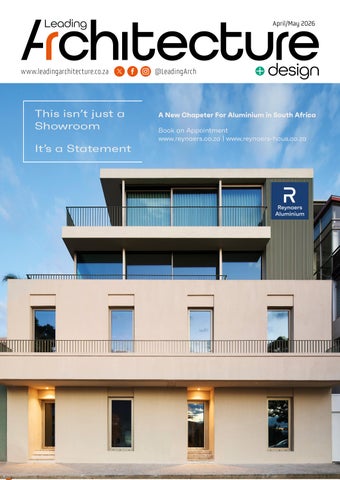
41–50 Iconic sofas by Roche Bobois; new ArmaGuard paint by Duram; Weylandts to open at Sibaya Coastal Precinct; Reynaers Aluminium's first African showroom; premium, solvent-based, all-in-one, quick-drying wood varnish from Medal Paints; the true cost of poor workmanship in construction; Extraordinary Women in BIM 2026; Cool Cities Lab platform helps lower city temperatures; poor maintenance equals fire safety system failure; Saint-Gobain flooring solutions; the evolution of commercial air conditioning.


EDITORIAL
EDITOR: Tracy Greenwood email: tracy.greenwood@media24.com
SUB EDITOR: Anita van der Merwe
ART DIRECTOR: Julia van Schalkwyk
ADVERTISING
KEY ACCOUNT MANAGER: Erika Sparks
Email: erika.sparks@media24.com +27 (0)11 715 8503 | +27 (0)83 644 8532
PHOTOGRAPHY
Unless previously agreed in writing, LeadingArchitecture+Design owns all rights to all contributions, whether image or text.
SOURCES: Shutterstock, Getty Images, supplied images, editorial staff.
COVER PHOTOGRAP H: Franz Rabe
SUBSCRIPTIONS
Rae Morrison email: rae.morrison@media24.com
PUBLISHING TEAM
General Manager: Dev Naidoo Head of Content & Digital Strategy: Varushka Padayachi
Production Manager: Angela Silver
Group Art Director: David Kyslinger
MEDIA24 MEDIA
CEO: Minette Ferreira
CFO: Lana Goliath
MEDIA24 CORPORATE
CEO MEDIA24: Raj Lalbahadur
CFO MEDIA24: Nelmarie Beyers
Published by Media24 B2B
© Copyright LeadingArchitecture+Design Magazine 2026
B2B JOHANNESBURG OFFICE
Building 13, The Woodlands Office Park, 20 Woodlands Drive, Woodmead, Sandton | PO Box 784698, Sandton 2146 | Tel: +27 11 867 6111
LeadingArchitecture+Design is printed and bound by Novus Print.
COMMUNICATE & CONNECT

Whileprecautionshavebeentakentoensuretheaccuracyofitscontentsand informationgiventoreaders,neithertheeditor,publisher,oritsagentscan acceptresponsibilityfordamagesorinjurywhichmayarisetherefrom.All rightsreserved.©LeadingArchitecture.Nopartofthispublicationmaybe reproduced,storedinaretrievalsystemortransmittedinanyformorbyany means,photocopying,electronic,mechanicalorotherwisewithouttheprior writtenpermissionofthecopyrightowners.Thispublicationmaycontain contentgeneratedorassistedbyartificialintelligence(AI).


BY EDITOR TRACY GREENWOOD
This issue celebrates the diversity of contemporary architecture, with projects that demonstrate how thoughtful design can address complex human needs.
We open with the Lowveld Eye Institute in Mbombela, where Boogertman + Partners has reimagined healthcare architecture through a gradient of intimacy that guides patients from public arrival spaces to private clinical zones. Set against the dramatic landscape of Mpumalanga, this ophthalmic facility demonstrates how biophilic design principles and careful attention to wayfinding can transform the medical experience.
Our cover story takes us to the transformative Soshanguve Mall by KMH Architects, a retail development that transcends commercial purposes to become a genuine community catalyst. Inspired by the nearby Tswaing Meteorite Crater, this project reflects architecture’s power to address social inequality while celebrating cultural identity and fostering economic empowerment.
Infrastructure as urban catalyst takes centre stage in our feature on the Sandton Drive Link Bridge, where StudioMAS has created much more than a pedestrian
crossing. This 106m span serves as a beacon of connectivity, linking communities and establishing a landmark that celebrates movement and accessibility in Johannesburg’s urban landscape.
Workplace innovation is on show at the PPS headquarters in Cape Town, where Trend Group's humancentric approach weaves together biophilic materials, flexible spaces and employee wellness amenities to create an environment that balances professional gravitas with warmth and accessibility.


In Beijing, we are inspired by studio vapore's music classroom renovation at the Western Academy of Beijing, where colour psychology and acoustic engineering converge to create learning environments that inspire creativity. Finally, we explore the enduring appeal of brick. From Chris van Niekerk’s contextual Mountain House in Cape Town, to Kengo Kuma’s sculptural UCCA Clay Museum in China, contemporary architects are reimagining brick’s expressive potential. These projects remind us that exceptional architecture emerges when designers listen to human needs, honour cultural contexts, and imagine equitable spaces for all.
EDITOR AND PUBLISHER: TENEUES
A compelling examination of adaptive reuse strategies that successfully bridge historical preservation with contemporary design sensibilities, this book showcases diverse approaches to heritage integration through detailed project documentation. Notable case studies include San Francisco’s Alamo Square Residence, where sophisticated façade restoration is paired with modern additions, Berlin’s ‘The Village Within’ factory conversion using modular wooden structures, and Cartagena’s Casa de Los Barcos, where restoration revealed historic maritime murals that became central design elements. The book offers insights into regulatory navigation and creative problem-solving, effectively arguing that heritage preservation represents a competitive advantage rather than constraint in today’s design market.


BY PHUMUDZO MOTALANE, OFFER MANAGER: POWER PRODUCTS – LV SYSTEMS AT SCHNEIDER ELECTRIC
Today’s buildings account for up to 40% of global energy consumption and CO 2 emissions, a well-known statistic. But buildings face a conundrum of sorts as these structures are expected to deliver higher availability and stronger safety performance, while being sustainable at the same time.
Granted, there is an increased awareness and subsequent movement toward greener buildings, but there are still some pieces on the chess board that are being overlooked. It is these very pieces that can make a huge difference in the way buildings are developed, upgraded and managed.
A perfect example is the electrical room. For decades, low-voltage (LV) switchboards have been treated as static infrastructure, designed to distribute power safely, but largely invisible – one would expect – once commissioned. Herein lies a fantastic opportunity, particularly in today’s digitised and electrical world. For one, electrical faults remain one of the leading causes of fires and unplanned downtime in buildings, while reactive maintenance approaches expose organisations to avoidable risk, cost, and disruption.
This is where the digital switchboard steps into the ring. Today, a digital switchboard represents an important shift in the way an electrical distribution is designed, operated, and maintained. No longer a passive endpoint, it is a connected, data-driven asset, capable of delivering real-time visibility, predictive insights, and measurable performance improvements.
Digitally connected LV switchboards are relevant across a myriad of structures, from commercial buildings, schools and campuses to light industrial sites that all share common challenges, such as mitigating downtime, improving maintenance and reducing energy. Indeed, by embedding intelligence directly
into the switchboard, facility and energy managers gain true insight into their electrical infrastructure in ways that were previously impossible without disrupting IT systems or adding unnecessary complexity.
Safety remains paramount in any building. However, according to EMFSA – an organisation dedicated to the health effects of electromagnetic radiation exposure from cell phones, cell towers, Wi-Fi, smart meters, and other wireless technology – faulty electrical installations and overloaded circuits remain among the leading causes of building fires in South Africa, posing serious risks to both property and life.
EMFSA highlights that inadequate maintenance of electrical equipment is a critical fire hazard, with many incidents traced back to wiring faults and non-compliance with safety standards. Taking these considerations into account, building stakeholders require demand systems that are safe by design, available by default, and compliant by construction. It is here where digital switchboards offer valuable support, offering enhanced protection and monitoring capabilities that include arc-flash risk mitigation, early detection of thermal anomalies, and continuous monitoring of switchboard and device health.
Availability is equally important, which is why enhanced discrimination, draw-out breaker designs, and predictive maintenance capabilities allow faster fault resolution and more controlled maintenance interventions – reducing unplanned outages and extending asset life. Furthermore, alignment with standards such as IEC 61439 and TR 61641, as well as power quality and seismic requirements, must be supported by ongoing visibility and documentation.


Energy efficiency and decarbonisation targets are now operational realities, and electrical distribution plays an important role in achieving both. Digital switchboards enable detailed energy monitoring, benchmarking, and power quality analysis at the point of distribution. In turn, this allows building owners to identify inefficiencies, detect anomalies, and optimise consumption profiles in line with operational needs. Also, when integrated with energy management platforms, this data supports site-level carbon reporting, sustainability certifications, and informed decision-making around energy investments.
Historically, some of the barriers to digital adoption in electrical rooms include fragmented architectures, multiple gateways, long commissioning times, and heightened cybersecurity concerns. Here, modern digital switchboards simplify connectivity by reducing the number of digital components, enabling plug-and-play integration through standardised communication protocols, and minimising commissioning risk. This approach accelerates deployment while ensuring scalability, therefore allowing systems to evolve as building requirements change. Native digital connectivity also enables seamless integration with monitoring and analytics platforms, providing a single source of truth for electrical performance, alarms and maintenance insights across on-premises or cloud environments. In an era where buildings are expected to be smarter, greener and more resilient, the electrical room can no longer remain analogue. The digital switchboard is not a future concept; it is already available and the logical next step in the evolution of power distribution.


The design of the Lowveld Eye Institute in Mbombela, Mpumalanga, by Boogertman + Partners, explores how architecture can reshape the experience of healthcare through spatial clarity, light and connection to landscape.
PHOTOGRAPHY: Dean van der Westhuizen


The Lowveld Eye Institute in Mbombela, Mpumalanga, led by Xpedient, was developed to bring together several local ophthalmologists’ consulting suites under one roof. Establishing a consolidated hub for specialised ocular care in the region allows the individual consultants to better fulfil their mission of ‘rejuvenating sight’ in the community they serve.
The clients sought a facility aligned with its identity as a progressive healthcare provider. While the centre was designed to function as a high-tech clinical environment with advanced medical equipment, the doctors were clear that the centre needed to provide a warm, welcoming, patient-centred environment. Their desire was to create a facility that would support advanced medical procedures while reducing the anxiety typically associated with healthcare spaces.
With this in mind, the clinic was designed to incorporate natural light, strong visual connections with its surroundings, and to resonate with the local setting and context, harnessing proximity to nature to improve the healing environment.


The site is located on an elevated section of a new mixeduse precinct on the eastern edge of the Mbombela CBD, close to recent retail and commercial developments. With very little in the way of significant architectural precedent or existing urban fabric to provide stylistic cues, Boogertman + Partners took inspiration from the surrounding expansive Lowveld grassland and horizon views. The site overlooks a valley on one side and a golf course on the other.
Mpumalanga – which means ‘Place of the Rising Sun’ – prompted a symbolic and conceptual theme related to light and vision. The clinic’s logo draws on a similar association, incorporating a sunrise into a graphic representation of an eye.
The steep slope of the site and positioning of facilities, especially the parking area and access points, imposed spatial constraints that made it impossible to achieve ideal solar orientation. These restrictions, however, prompted spatial solutions that became central to the architectural concept.
The unorthodox orientation had the advantage of
maximising the views, which the design sought to frame and invite into the heart of the building, enhancing the sense of a contextually grounded, biophilic healing environment.
The building is broken up into three parallel pitched volumes connected by recessed flat-roofed sections. The architectural language balances a contemporary industrial/residential character with a sense of lightness and refinement. Economical sheet metal roofing is employed as a practical and durable material choice, while the pitched roof forms establish a rhythmic sequence reminiscent of parallel barn structures. This articulation breaks down the overall mass into smaller components, allowing the building to sit comfortably in its context while maintaining a strong visual identity.
Setbacks, screens and overhangs are used to manage light and heat, and fenestration is minimised in thermally exposed areas. Strategic massing and placement of services also mitigate against heat gain, creating a double-skin façade in key areas. The vertical emphasis of the façade screening was inspired by the distinctive linear patterns of light and shadow of the surrounding grasslands.

The primary pitched volume establishes a prominent and easily recognisable entry point, immediately orienting and ushering visitors on their patient journey.
The core organisational principle is a ‘gradient of intimacy’ that guides patients from the open, public arrival spaces through a series of semi-public spaces and then through to the clinical and private spaces. This intuitive progression enhances the patient experience, providing orientation devices, clarity and reassurances that are fundamental to a calm, stress-free experience.
The site’s steep slope was used to create split levels. By cutting into the slope, a semi-basement condition allowed for the efficient separation of clinical, surgical and public functions.
The upper ground floor acts as the primary interface for patients and the public specialists intended for consulting and diagnostics. The lower ground floor houses the clinical spaces – the surgical and theatre complex – with two major theatres equipped with advanced soffit-mounted Zeiss microscopes. Specialised wards have a treatment area with 10 recliners for same-day procedures, and a day ward with 10 modern beds for patients requiring a longer recovery time.
The building’s upper levels are dedicated to essential support functions and technical infrastructure that enable the hospital’s efficient operation. The loft level accommodates administrative services, storage areas and key vertical circulation hubs, ensuring that back-of-house activities remain seamlessly connected, yet separate from clinical environments.


Clean lines and minimalist forms create a sense of precision and visual calm. The use of natural materials such as stone and timber, combined with the clarity of steel and glass, provide further tactile surfaces and a sensory experience that create an environment that feels warm and welcoming rather than impersonal and institutional.
Importantly, the building is designed so that corridors always open onto a view, never a dead end. This means that visual connections with the natural surroundings are maintained throughout the buildings, framing focal views and subtly reinforcing the institute’s focus on vision and perception. Patients never feel closed in or claustrophobic, and the views and visibility aid with orientation and wayfinding. Together with the clear and structured sequencing of spaces, this sense of openness reinforces clarity and reduces stress for patients navigating the facility, especially those with limited vision.
The project was delivered through a fully digital workflow, with 100% cloud-based co-ordination enabling seamless collaboration across disciplines and locations. By migrating project data from traditional on-premises silos into a unified Common Data Environment (CDE) hosted on Autodesk Forma, all consultants and contractors

were integrated within a shared digital environment, supporting real-time information exchange and efficient decision-making throughout the process. Client engagement and co-ordination were conducted through online platforms, while model-driven technical resolution aligned with ISO 19650 information management principles, allowing challenges to be addressed proactively and with precision. This transition to a CDE allowed for a ‘single source of truth’ ensuring that the complex technical requirements of the surgical theatres and specialised ocular equipment were coordinated with precision before a single brick was laid. Together, these approaches position the project as both architecturally and operationally forward thinking.
Through its considered response to site, climate and programme, the Lowveld Eye Institute demonstrates how architecture can meaningfully contribute to both healing and operational excellence. The interplay of natural light, framed views and a carefully structured spatial sequence creates a calm, comforting and reassuring environment for patients, while supporting the demands of an advanced medical practice. Through thoughtful design and a human-centred vision, Lowveld Eye Institute has positioned itself as a forward-looking model for specialised healthcare environments.

Tel: +27 (0)11 790 1600
Email: info@boogertman.com www.boogertmanandpartners.com
Professional team
Architect: Boogertman + Partners Interior design: Boogertman Interiors Turnkey
Landscape architect: Boogertman + Partners Civil engineer: Endecon Ubuntu
Electrical engineer: Veld Du Toit Fire engineer: CFS Engineering Consultants
Mechanical engineer: Spoormaker & Partners Wet services engineer: JL Concepts
Quantity surveyor: DELQS Structural engineer: Endecon Ubuntu
Main contractor: H Kampman Construction


The newly opened Sandton Drive Link Bridge by StudioMAS for Growthpoint is a testament to architectural ambition and engineering excellence in the heart of Johannesburg’s financial district.
IMAGES SUPPLIED BY GROWTHPOINT


After an 18-year journey from conception to completion, the Sandton Drive Link Bridge now stands as a gleaming symbol of modern Johannesburg – a city that continues to reimagine itself through bold infrastructure investments that prioritise both human need and architectural ambition.
Officially opened in December last year, the bridge represents more than just a pedestrian crossing – it embodies a new vision for urban connectivity in one of Africa’s most dynamic commercial centres.
The R26m structure, spanning an impressive 106 metres across Sandton Drive, connects Growthpoint Properties’ The Place office building directly to the iconic Sandton City shopping centre. This angular, stainless-steel clad walkway has transformed what was once a challenging pedestrian crossing into a safe, accessible corridor that bridges not just physical space, but commercial, retail and residential districts within central Sandton.
At the heart of the bridge’s design lies a sophisticated blend of materials and construction methods that reflect modern engineering capabilities. The structure features prefabricated stainless-steel
sections that were manufactured off-site before being assembled on location, an approach that minimised construction disruption while ensuring precision in the finished product. These gleaming stainless-steel elements are supported by robust concrete columns and walkways constructed in situ, creating a striking visual contrast between the industrial strength of the support structure and the sleek modernity of the pedestrian areas.
Perhaps the most captivating element of the bridge is its central glass viewing deck –a covered ‘glass box’ that serves as both an architectural focal point and a practical rest area for users. This glazed pavilion offers panoramic vantage points across Sandton’s bustling streetscape and incorporates colour-changeable, eco-friendly lighting systems that can be adapted for seasonal events and celebrations.
The laser-cut patterned cladding on the bridge creates visual transparency that prevents the structure from appearing monolithic, and the distinctive balustrades ensure safety without compromising the clean lines of the design. Architectural lighting and ‘light box’ elements serve as visual beacons, making the bridge a landmark feature both during the day and at night.


The engineers and architects behind the project prioritised universal access, ensuring that the bridge accommodates pedestrians, cyclists and mobility-impaired users with equal consideration. The structure serves as a vital endpoint for the Rosebank cycle route, integrating seamlessly with Johannesburg’s broader sustainable transport initiatives. This inclusive design approach reflects a growing understanding that modern infrastructure must serve all members of the community, regardless of physical capability or mode of transport.
The structure’s influence extends beyond its immediate physical presence, with practical considerations that demonstrate how thoughtful infrastructure development can serve multiple community needs. By creating a direct, weather-protected connection between major commercial and retail destinations, it has altered pedestrian movement patterns in Sandton Central. Office workers at The Place can now access Sandton City’s shops, restaurants and services without navigating busy street-level crossings, and shoppers get to enjoy improved access to the broader commercial district.
The bridge operates on a managed
access schedule, remaining open to the public during daytime hours via Sandton City, with controlled access during evening hours to ensure security without sacrificing functionality. This operational model balances public access with practical security considerations – a crucial element in urban infrastructure management.
As a piece of ‘placemaking infrastructure’, the bridge represents Growthpoint’s broader strategy of precinct-led value creation. The company’s investment reflects confidence in Sandton’s continued growth as a premier African business destination. By enhancing connectivity and urban experience, the bridge supports local property values while also attracting further development in the area.
The structure’s role in linking Sandton Central and Sandown districts creates new possibilities for integrated development, supporting the area’s evolution from a collection of individual buildings into a cohesive urban precinct. This transformation is already evident in related projects such as the nearby Olympus Sandton residential development, indicating sustained confidence in the area’s future.

More than simply an impressive engineering achievement, the structure represents a new model for urban development in African cities. By prioritising pedestrian safety, accessibility and architectural excellence, it demonstrates how infrastructure investment can drive broader urban transformation while addressing more immediate practical needs.
As Sandton continues to evolve as a major economic hub, this bridge will likely serve as a catalyst for further connectivity projects, establishing new standards for how cities can better serve their residents, workers and visitors. In spanning Sandton Drive, it has bridged not just physical space, but past limitations and future possibilities, creating a lasting monument to the power of persistent vision and collaborative development.

Professional team
Developers: Growthpoint Properties, Liberty 2Degrees and Pareto Principal contractor: Probest Projects architect: StudioMAS
Quantity surveyor: Turner & Townsend Structural engineer: Pure Consulting Project managers : Morta Project Managers Electrical engineer: Claasen Auret Lift engineer: Solutions for Elevating Health and safety consultant: Cairnmead Industrial Consulting
Financial services group PPS’s new 4 200m2 Cape Town headquarters balances corporate gravitas with community warmth. Client suites, collaborative areas, onsite gym and wellness facilities reflect the company’s employee-centric ethos while maintaining the professional standards expected of a financial institution.
Photography: Johann Lourens

For a company built on the ethos of mutuality, PPS needed a workspace that could reflect the gravitas of a financial institution and the warmth for a community of employees. Trend Group was brought in to design and build their new headquarters in Newlands, Cape Town. Their brief? To create a space where clients feel welcomed and employees feel at home. The result? A facility that features client suites, collaborative areas, an on-site gym and wellness facilities, all reflecting the company’s employee-centric ethos while maintaining the professional standards expected of a financial institution.
Tasked with end-to-end design and fit-out, Trend worked closely with the PPS leadership team from day one. Through in-depth consultations with heads of department,
the design process was shaped by real, human insight, not assumptions. The result is a workplace that reflects the diverse needs of professionals across various teams and the unique structure of PPS itself.
The design concept balances corporate confidence with approachability. Every zone was intentionally curated –from private client suites to collaborative team areas – to reflect a space that feels both aspirational and accessible. While rooted in PPS’s brand identity, the corporate palette was softened to complement a more organic material direction: warm timber tones, lush greenery and expansive external views of trees provide a grounding connection to nature.


On the ground floor, soaring volumes define the clientfacing experience, but height is used with restraint, creating a sense of openness without feeling cold. A cosy coffee bar anchors the reception area, while bespoke boardrooms and training rooms offer comfort, clarity and discretion. Acoustic performance was carefully considered throughout, with material selections that mute noise while elevating the atmosphere.
Across the space, contrast plays a key role. Brass and natural stone lend a sense of refinement, offset by the tactile honesty of polished concrete and timber. The layering of finishes – smooth, raw, soft and sleek – reflects the nuanced world of financial services: technical yet human, rigorous yet relational.
For PPS, belonging doesn’t stop at a well-designed desk or a quiet meeting pod. It’s about creating an environment where their staff feel seen, supported and able to bring their whole selves to work.
Employees have access to a fully equipped on-site gym, encouraging movement and balance during the workday. A cafeteria on-site offers both convenience and community, with fresh, nourishing meals served in a space designed for social connection and pause.
A dedicated wellness room offers a calm, private space to rest, reset, or manage personal health needs. It’s also been sensitively designed to accommodate breastfeeding and pumping mothers, providing dignity and privacy without detachment from the workplace.
A serene, purpose-built multi-faith room invites quiet reflection, prayer, or meditation, honouring the diversity of the PPS team. And for moments of fresh air or informal catchups, the rooftop balcony offers sweeping views over the surrounding area.
While the building shell was still being finalised, Trend worked closely with the landlord’s professional team to ensure timelines aligned. Regular collaboration, open channels and mutual trust helped navigate inevitable shifts in programme without compromising on quality or delivery.
Though the interior fit-out did not pursue official certification, it was designed with sustainability in mind. Fixtures were aligned with green principles: LED lighting, motion sensors and water-saving sanitary fittings were standard throughout. All desks were locally manufactured, and many other furniture pieces were sourced from South African designers and makers, reinforcing PPS’s commitment to operating as a business rooted in sustainability.
As SA continues to grapple with the legacies of spatial apartheid and economic inequality, Soshanguve Mall by KMH Architects shows that thoughtful development can serve as a powerful tool for community empowerment.
PHOTOGRAPHY: Franz Rabe

Standing proudly in the heart of Gauteng’s vibrant Soshanguve township, the new Soshanguve Mall is more than a conventional retail development. It is a powerful symbol of community empowerment, architectural innovation and cultural celebration that promises to reshape the economic landscape of one of South Africa’s most significant townships.
The mall’s most striking feature lies in its architectural concept, which draws inspiration from the nearby Tswaing Meteorite Crater, some 40km northwest of Pretoria. This geological marvel, formed more than 220 000 years ago, provides the creative foundation for the mall’s distinctive design language. Curvilinear shapes, fluid lines and unique roof structures echo the drama of the impact crater.
The 55 500m 2 double-tiered retail centre unfolds around a central double-volume link mall, conceptualised as ‘where the meteor has landed’. This dramatic space serves as the architectural heart of the development, connecting two main entrance nodes through carefully choreographed circulation routes. The design narrative
follows the meteorite’s journey through distinct cores – atmospheric entry, descent and landing – creating an immersive experience that transforms shopping into a cosmic adventure.
The architectural strategy cleverly breaks up the potentially overwhelming scale of such a large retail space through colour-blocked double-level moments at intermediate cores. The eastern cores feature both stairs and lifts for optimal accessibility, while the western cores incorporate stairs alone, creating varied spatial experiences throughout the mall. Four architecturally unified yet functionally distinct spaces ensure that visitors encounter diverse environments – from intimate retail clusters to grand communal areas.
A particularly innovative feature is the flexible plaza designed as an urban activator. This open space accommodates various community activities, from traditional markets and cultural festivals to concerts and commercial displays, reinforcing the mall’s role as the heart of a community rather than merely a shopping destination.


The desire to honour cultural traditions extends beyond surface decoration. The name ‘Soshanguve’ serves as the project’s cultural cornerstone, representing the four primary ethnic groups – Sotho, Shangaan, Nguni and Venda – that call this region home. This multicultural identity, born from the apartheid-era resettlement of residents from Mamelodi and Atteridgeville in 1974, has evolved into a rich tapestry of languages, traditions and artistic expressions.
The interior design incorporates identity-driven zones themed to represent each ethnic group’s distinctive arts and crafts. Traditional patterns and motifs find contemporary expression throughout the development, while carefully curated murals and artistic installations showcase the talent of local artisans. These elements ensure that the mall functions as both a commercial space and a cultural gallery, celebrating the township’s diverse heritage while providing economic opportunities for local creative practitioners.
The integration of cultural elements extends to material choices and landscape design. Indigenous plants and green spaces create connections to the natural environment, and seating areas and pedestrian pathways encourage community interaction and cultural exchange. This thoughtful approach transforms the mall from a purely commercial venture into a platform for cultural integration and artistic expression.
The mall’s influence on Soshanguve extends far beyond its impressive architectural footprint. During construction, the project created 1 959 jobs specifically for local residents, with 30-40% of workers receiving formal construction and trade training. This skills development initiative represents a significant investment in the community’s long-term economic prospects, providing residents with transferable skills that extend well beyond the immediate project.
At capacity, the mall is projected to sustain around 3 700 permanent employment opportunities across diverse sectors. From retail and hospitality to security and maintenance, these positions offer local residents access to formal economy participation previously limited in the area. The development team’s commitment to local procurement has further amplified economic benefits, with suppliers, contractors and service providers drawn extensively from the immediate community.
The mall’s tenant mix reflects careful consideration of community needs and aspirations. Major anchor stores including Shoprite, Woolworths, Dis-Chem and Mr Price provide essential retail services, and popular fast-food outlets such as KFC and Chicken Licken cater to local preferences. The inclusion of all major banking institutions ensures that financial services become more accessible to residents who previously faced lengthy journeys to access such facilities.

Perhaps most significantly, the development incorporates dedicated trading spaces for local entrepreneurs and informal traders, acknowledging and supporting existing economic networks rather than displacing them. This approach ensures that the mall enhances rather than disrupts established community commerce patterns.

Beyond direct employment creation, the development has catalysed broader community improvements. Upgraded soccer fields provide enhanced recreational facilities for local youth, while the paving project at Memezelo Secondary School directly improves educational infrastructure. The comprehensive cleaning of Ward 94’s dumping area addresses environmental concerns and also demonstrates the developer’s commitment to holistic community upliftment.
These initiatives recognise that successful retail developments require thriving, well-supported communities. By investing in education, recreation and environmental improvement, the mall’s developers have established foundations for sustained community prosperity that will benefit generations of residents.
Soshanguve Mall stands as a compelling example of how major retail developments can honour local culture and act as a powerful tool for community empowerment. The project’s meteor-inspired architecture creates a distinctive identity that celebrates both cosmic wonder and earthly heritage, and its comprehensive approach to community engagement ensures that development benefits flow directly to local residents.
The mall’s ultimate success will be measured not merely in retail turnover or architectural accolades, but in its ability to serve as a genuine catalyst for community prosperity and cultural celebration. Early indicators suggest that this ambitious vision is well on its way to becoming reality, offering hope and inspiration for similar developments across the continent.


Professional team
Main contractor: GVK – Siya Zama Architect: KMH Architects Operations manager: Exemplar REIT Project manager: MDA Projects Quantity surveyor: De Leeuw Group Structural engineer: Axiom Consulting Civil engineer: WSP Consulting Electrical/electronics engineer: e-Consulting / DMCE Mechanical and fire engineer: DMCE / Meccanitek Consulting Landscape architect: Newtown Landscape Architects Tenant co-ordinator: TC Squared Town planner: Van Blommestein and Associates Health and safety consultant: Cairnmead Industrial Consultants Environmental specialist: Mills and Otten Environmental Consultants Community engagement: EmpowerPloy Land surveyor: Geometric Surveys Solar specialist: Imbue Sustainability


Beijing-based design studio vapore’s renovation of the music classrooms at the Western Academy of Beijing reworks existing spaces to support different modes of music education.
PHOTOGRAPHY: Vincent Wu and Shawn Koh

Beijing-based multidisciplinary design firm studio vapore, specialises in integrating storytelling with technical expertise to create thoughtful and imaginative spaces. With a focus on educational design, studio vapore has collaborated with public and private schools across China, including the Western Academy of Beijing, where they have created a carefully orchestrated environment where architecture and acoustics dance together.
The design follows a simple concept: a series of classrooms connected by a shared corridor, each paired with practice rooms that feel like musical sanctuaries. Each classroom serves as a stage for teaching, group work and ensemble rehearsals, while the adjacent practice rooms offer refuge for individual musicians and small groups to hone their craft. Glass partitions create a visual dialogue between these spaces – teachers can supervise while multiple musical activities unfold simultaneously. It’s compact efficiency that doesn’t sacrifice functionality.

The spaces aren’t completely soundproofed. Working closely with acoustic engineers, the team created what they call ‘controlled overlap’– a deliberate calibration of sound insulation that allows music to bleed thoughtfully between rooms.
Walking down the corridor becomes an auditory journey. The gentle hum of a violin lesson mingles with the rhythmic pulse of percussion practice, creating an ambient soundtrack that extends the presence of music far beyond individual rooms. Strategic acoustic treatments in walls, ceilings and floors manage reverberations while preserving this intentional musical conversation.
Colour is the department’s visual conductor, organising the space through a vibrant system that is both functional and inspiring. Three main classrooms are distinguished by warm tones – red, orange and yellow – each corresponding to different age groups. These colours serve as wayfinding beacons from the corridor, creating clear visual thresholds that help students and teachers navigate intuitively.
Professional team
The entrance to the music department itself makes a bold statement with a saturated field of colour, announcing the creative zone to the entire building.
Inside the classrooms, the design strikes a sophisticated balance. Teaching areas maintain neutral tones to avoid distraction, while a bold band of colour runs along the window side, visually connecting each classroom to its practice room neighbours. Even, consistent lighting supports focused learning.
In the practice rooms the designers embraced full saturation, allowing each space to develop its assigned colour through rich variations in tone and material. Custom-made felt panels, co-ordinated fabrics and three-dimensional acoustic elements create immersive environments, while warmer lighting fosters the intimate atmosphere essential for individual practice and rehearsal.
By treating sound as a shared condition and colour as an organising principle, the designers have created spaces where music flows, connects and inspires across every square metre.
Designer: studio vapore Acoustic engineering: Delhom Acoustics Lighting design: Studio Vapore and Beijing Mostar Technology General contractor: Beijing Xiangyang Hongda Construction Custom furniture: LMFU Furniture


Brick is one of architecture’s most enduring materials. It has weathered thousands of years, and outlasted countless generations, styles and civilisations. This humble yet extraordinary material possesses a timeless quality that transcends eras.
Far from being relegated to historical pastiche, brick continues to inspire contemporary architects who are reimagining its potential for the 21st century. Modern construction methods have liberated designers from traditional constraints, enabling them to experiment with classic bonds while creating entirely new brickwork combinations that push the boundaries of what this ancient material can achieve.
The aesthetic versatility of brick is perhaps its greatest strength. It seamlessly transitions from classical grandeur to contemporary minimalism, offering sturdiness and protection from the elements without compromising on visual appeal. Whether forming the robust walls of mediaeval
castles or the sleek façades of modern urban developments, brick adapts to architectural vision with remarkable flexibility.
Some of the most beautiful and innovative buildings from across the world have been shortlisted for the prestigious international Brick Award 2026. Presented every two years the Brick Award gives architects a platform for their unique designs.
The finalists in this year’s competition span five continents and feature 50 projects from 21 countries. Our favourite – no, of course we aren’t biased! – hails from Cape Town


MOUNTAIN HOUSE, CAPE TOWN
ARCHITECT: CHRIS VAN NIEKERK
PHOTO CREDIT: GREG COX
Set on a 4 000m 2 site on the slopes of Steenberg Ridge in Cape Town, Mountain House sits lightly within its semi-rural landscape. The design uses a restrained palette of materials that express the earth’s colours and textures, allowing the building to age gracefully. Rooted in a primordial sense of shelter, it embraces simple, unadorned materials to create a timeless sense of enclosure.


LEIPZIG POWER STATION, GERMANY
ARCHITECT: ATELIER ST
PHOTO CREDIT: ATELIER ST – DUC VIET NGUYEN
Fired clay in the form of glazed panels with a fine, irregular vertical structure was used for the façade of the plant buildings at Leipzig Cogeneration Plant.
WHITE BRICK HOUSE, BRAZIL
ARCHITECT: BLOCO ARQUITETOS
PHOTO CREDIT: OANA FRANCA
Built using artisanal techniques and exposed solid bricks painted white, the varying brick spacing in this home creates different levels of openness and privacy for each room.

WAREHOUSE AND OFFICES IN JALISCO, MEXICO
ARCHITECT: ATELIER ARS, ZAPOPAN
PHOTO CREDIT: CÉSAR BÉJAR
Local ceramics and stone from the site excavation anchor the buildings at this tequila factory in their volcanic topography.

UCCA CLAY MUSEUM, CHINA
ARCHITECT: KENGO KUMA AND ASSOCIATES
PHOTO CREDITS: EIICHI KANO, FANGFANG TIAN
The structure’s distinctive roof is defined by a series of peaks that reference the nearby Shushan mountain. Described by the studio as ‘an inverted shell structure carved by virtual spheres’, the framework is cloaked with 3 600 handmade ceramic tiles glazed in dark and light brown tones, evoking the colour changes that occur in pottery as it is fired.
SHAFAGH TOMB, IRAN
ARCHITECT: 35-51
ARCHITECTURE
PHOTO CREDIT: 35-51 ARCHITECTURE
An inverted dome with inscriptions flowing freely across its surface transforms the architecture of the Shafaq Tomb into a canvas that celebrates freedom of expression. Acting as a gateway to the cemetery, the tomb redefines a traditionally private space as a monument for all – a place where the sacred meets the everyday.


Feast your eyes on this selection of iconic sofas created by Roche Bobois in collaboration with some of the world’s most eminent creatives.
The Conversation sofa, designed by Philippe Bouix for RocheBobois, allows you to place and move the backrests however you like. It includes various padded seat and back cushions that are completely modular, allowing you to create perfectly customised support for sitting, lying down, reading, or chatting.
Pedro Almodóvar x Roche Bobois is a unique collaboration giving rise to exclusive creations, united by a common language –colour. The iconic Bubble sofa, designed by Sacha Lakic, is reimagined in original shades created by Pedro Almodóvar. Cushions, furniture, and fabrics further extend the tribute to his cinematic universe.


With its generous curves and sculptural presence, the Script modular sofa, designed by Sacha Lakic for Roche Bobois, reinvents the codes of relaxation. Its inviting lines and enveloping backrests create a living space that is both playful and sophisticated. An invitation to let go, where ergonomics follow every movement, transforming design into an immersive sensory experience.
Imagined by renowned American architect David Rockwell, this collection of sofas, coffee tables and rugs reveals particularly soft and organic forms. The sofa, with its smooth and enveloping lines, evokes the purity of a pebble polished by time. Its vibrant fabric captures light differently depending on the angle, creating a subtle play of shades and depth. Eco-designed model.


Designed by Philippe Bouix for Roche Bobois, the Altea modular sofa perfectly combines elegance and comfort. Classic in appearance yet sophisticated in detail, it captivates with its balance between generosity and simplicity. Resting on a recessed wooden base, it does away with traditional legs, gaining a sense of lightness. Between sleek design and enveloping comfort, Altea embodies timeless elegance, refined and without excess.
www.roche-bobois.com/en-ZA/
Furniture and homeware retailer Weylandts has announced plans to establish a striking flagship showroom in the Sibaya Coastal Precinct, positioning the development as a premier design destination along KwaZulu-Natal’s coastline near Umhlanga.
The multi-level pavilion, designed by StudioLandt in collaboration with Craft of Architecture, will serve as an immersive retail experience that celebrates both local craftsmanship and the natural coastal environment. The showroom forms part of Sibaya’s ambitious next phase of commercial development, reinforcing the precinct’s evolution into a mixed-use design quarter.
‘This flagship represents a significant investment in creating a designled retail experience that truly reflects our commitment to craftsmanship and authenticity,’ says Chris Weylandt, CEO of Weylandts. The architectural concept emphasises locally sourced materials including granite, basalt, concrete, sand and sugar cane, and incorporates darker earthy interior tones and flowing water motifs that echo the coastal setting.
Brad Winstanley, Commercial Director at Devmco Group, highlighted the strategic significance of the partnership: ‘Weylandts’ presence will be instrumental in establishing Sibaya as a recognised design destination, aligning perfectly with our vision for long-term placemaking and sustainable development.’
The showroom’s design prioritises visitor experience through what architects describe as a ‘layered circulation path’ that guides customers
Duram has unveiled ArmaGuard, a revolutionary exterior wall paint engineered to withstand extreme weather conditions while delivering exceptional aesthetic appeal. The premium coating, backed by a comprehensive 15-year quality guarantee, represents a significant


through carefully curated displays of craft and design. The entrance provides a transitional space offering respite from the coastal humidity, while multiple vantage points throughout the pavilion create an exploratory retail journey.
This development marks a significant expansion for Weylandts, known for its distinctive South African aesthetic and commitment to local artisanship. The brand’s decision to anchor its flagship presence at Sibaya reflects growing confidence in the precinct’s potential as a commercial and cultural hub.
The architectural approach demonstrates particular sensitivity to environmental considerations, with the use of abundant local materials reducing carbon footprint while creating authentic connections to place.
The Sibaya Coastal Precinct has been gaining momentum as a significant mixed-use destination, combining residential, commercial and recreational facilities along the KZN coastline. The addition of Weylandts’ flagship showroom is expected to enhance the precinct’s appeal to design-conscious consumers and tourists exploring the greater Durban area.
While no specific opening date has been confirmed, the announcement signals Weylandts’ commitment to expanding its retail footprint through carefully considered architectural partnerships that celebrate South African design heritage and environmental consciousness. weylandts.co.za
advancement in protective exterior paint technology.
The innovative formulation combines Optiflex technology with advanced ColourSmart capabilities, ensuring superior flexibility and remarkable colour consistency. ArmaGuard’s fine-textured finish cleverly conceals hairline cracks and plaster imperfections, creating a refined, premium appearance that enhances architectural features.
Unlike traditional roughtextured alternatives, the sophisticated surface allows light to reflect more evenly, eliminating unsightly patches and shadows. The reduced surface
depth significantly improves dirt resistance, limiting accumulation of dust, grime, and algae – and making routine maintenance considerably easier for homeowners.
Laboratory testing confirms the formulation’s exceptional durability, with high dry film build providing robust protection against UV damage and harsh weather conditions. The water-vapour permeable formulation ensures excellent adhesion and recoating properties, while delivering lowsplatter application with rapid drying times.
Environmental considerations have not been overlooked. The water-based paint maintains low odour and minimal VOC emissions, remaining APEO-free throughout its lifespan. This eco-conscious
approach protects both user health and environmental welfare without compromising performance.
Colour options have been dramatically expanded, and feature 20 pre-mixed standard shades alongside full tinting capabilities for accessing Duram’s complete colour range. The carefully curated palette ranges from light, subtle tints to dramatic, deep hues, catering to diverse architectural styles and personal preferences.
For enhanced colour accuracy, each shade is now available in convenient 250ml factory-tinted samples, enabling customers to assess how colours adapt to changing light conditions throughout the day. duram.co.za
Belgian aluminium systems specialist Reynaers Aluminium has opened its first African showroom in Cape Town’s historic Bo-Kaap district, marking a significant milestone for the premium fenestration brand’s continental expansion.
Reynaers Haus Cape Town, located at 220 Buitengracht Street, officially opened its doors in March 2026, following nearly three years of careful development and construction. The purpose-built experience centre represents a substantial investment in the South African market, where the company aims to elevate standards in aluminium architecture through education and demonstration rather than price competition.
The showroom occupies a heritage-protected building where original stonework has been meticulously preserved and showcased behind glass panels, creating a striking contrast between historical Cape Dutch architecture and contemporary minimalist design. Natural light floods through the space, highlighting clean geometric lines and drawing attention to a central green atrium that frames dramatic views of Table Mountain.
‘Reynaers Haus Cape Town is a testament to our commitment to excellence,’ explains Bianca Simões, Commercial Manager for Reynaers Aluminium South Africa. ‘We aim to inspire and educate, setting a new standard for aluminium architecture in South Africa.’

The facility functions as far more than a traditional showroom. Interactive displays allow visitors to experience full-scale, functional aluminium systems including sliding doors, façades, and window configurations. Each installation demonstrates the precision engineering and quality finishing that has made Reynaers a European leader in premium fenestration solutions.
Beyond product demonstration, the centre serves as a training hub and competence centre for the local construction industry. Architects, developers, homeowners and fabrication partners can attend guided tours, technical workshops and networking events designed to showcase certified fabrication standards and European installation practices.

South African distributor operating from both Cape Town and Johannesburg. Together, they’re positioning the brand as a quality-focused alternative in a market traditionally driven by cost considerations.
The Bo-Kaap location holds particular significance, situating the international brand within one of Cape Town’s most culturally rich neighbourhoods. The careful integration of heritage elements with cutting-edge display technology reflects Reynaers’ broader philosophy of respecting architectural context throughout their global operations.
With the African construction market experiencing continued growth, the Cape Town showroom positions Reynaers to capture demand for premium aluminium systems across residential, commercial and institutional projects. The facility’s emphasis on hands-on experience and technical education signals the company’s long-term commitment to developing local expertise rather than simply importing European solutions.
For an industry often focused on basic functionality and competitive pricing, Reynaers Haus Cape Town presents an alternative vision where precision engineering, aesthetic refinement and technical education take priority. Whether this approach resonates with local architects and developers will likely influence similar international brands considering African market entry strategies. www.reynaers.co.za/.co.za

Medal Paints has launched what they claim is the South African market’s first premium, solvent-based, all-in-one, quick-drying wood varnish, promising to revolutionise how homeowners and DIY enthusiasts approach timber restoration projects.
The Medal Premium All-In-One Quick Drying Wood Varnish combines the functions of primer, sealer and topcoat in a single product, eliminating the traditional multi-stage process that can stretch projects over several days. With touch-dry times of just one hour and re-coating capability after four hours, users can now complete entire projects within a single day.
‘This represents a significant breakthrough in wood finishing technology,’ explains a spokesperson from the Johannesburg-based manufacturer. ‘We’ve managed to create a product that doesn’t compromise on quality for speed – it’s both quick-drying and incredibly durable.’
The versatile formula works as a self-priming preservative topcoat that doubles as both knotting and sanding sealer, making it suitable for a wide range of applications from interior furniture and skirtings to exterior doors and fascias. The UV-resistant formulation provides excellent protection against weather damage, making it equally effective for both indoor and outdoor projects.
Available in six attractive finishes – Clear, Light Oak, Dark Oak, Teak, Mahogany and Ebony – the varnish
delivers a glossy finish that revitalises tired timber surfaces. The alkyd-based formula offers impressive coverage, with approximately 8-10m 2 per litre, depending on surface porosity.
Confidence in the product’s durability is reflected in Medal’s generous 10-year quality guarantee, provided a maintenance coat is applied every two years. This represents exceptional value for consumers in search of long-term protection for their timber investments.
The range is available in convenient 1-litre and 5-litre pack sizes, catering to both small household projects and larger renovation undertakings. Professional decorators are already embracing the product for its ability to dramatically reduce project turnaround times without sacrificing finish quality.
Medal Paints, which operates from branches in East London, Durban and Cape Town, has built a reputation for innovation in the South African paint industry. The company’s products are now exported to more than seven countries, testament to their growing international appeal.
For homeowners tired of multi-day varnishing projects that disrupt household routines, this new allin-one solution offers the perfect blend of convenience, quality and professional results. Medalpaints.co.za

Construction bosses are facing unprecedented scrutiny following a spate of fatal building collapses that have exposed the dangerous consequences of corner-cutting in South Africa’s construction industry.
The latest incidents in George and Ormonde have thrust a spotlight on an alarming trend: the widespread use of unregistered contractors and undocumented workers.
Industry experts warn that up to 38% of South Africa’s construction sector operates outside formal systems, creating a shadow economy where workers remain invisible to authorities. This off-the-books approach allows non-compliant contractors to undercut legitimate firms by an estimated 25 to 35%, distorting the market and putting lives at risk.
The Building Industry Bargaining Council (BIBC) has sounded the alarm over what it terms a ‘catastrophic’ situation where layered subcontracting arrangements fragment accountability and enable operators to dodge essential obligations. Workers employed through these networks often lack proper training, adequate safety equipment, and access to critical benefits including unemployment insurance and compensation for occupational injuries.
Recent investigations have revealed the shocking human cost of this culture. When accidents occur, unaccounted workers complicate rescue operations and investigations, leaving families without proper recourse for compensation. Fatal cases can trigger unpaid benefit obligations –liabilities that ultimately fall on principal contractors and developers.
The regulatory landscape is shifting dramatically in response. Multiagency high impact task teams, comprising representatives from the Department of Employment and Labour, tax authorities and police, now possess enhanced powers to shut down non-compliant sites immediately. These enforcement units are targeting private estates and high-value developments with particular vigour, signalling the end of what officials describe as the ‘passive client’ model.
Developers and project owners are discovering they cannot simply delegate their legal responsibilities. Joint liability provisions mean that when subcontractors collapse or disappear, principals become liable for substantial back-pay, penalties and interest.
The industry is calling for urgent implementation of a unified digital system that would link labour records, contractor registration and realtime site access controls. Such technology would provide the traceability currently missing from many projects and help prevent unqualified operators from accessing construction sites.
Construction professionals are being urged to conduct rigorous due diligence when appointing contractors. The key questions they must ask are becoming increasingly stark: Is the contractor properly registered? Are all workers documented and compliant? And crucially, who is actually present on site? The days of turning a blind eye to cheap labour appear numbered.
Bibc.co.za

The true cost of cutting corners: SA’s built environment pays the price
A stark warning about the hidden financial impact of poor workmanship is resonating across South Africa’s construction industry, as mounting evidence reveals that substandard practices are creating a costly cycle of rework and repairs.
Paul Adams, Managing Director at Sika South Africa, has highlighted how the construction sector’s tendency to prioritise short-term savings over quality execution is creating a ‘pay twice’ reality affecting everyone from major developers to individual homeowners.
‘People tend to treat failure as an isolated incident, but in the built environment, it often becomes a chain reaction,’ Adams explains. ‘When quality slips or specifications are misunderstood, you’re looking at additional materials, labour costs, delays, professional fees, downtime and significant reputational damage.’
The scale of this challenge is staggering. Recent parliamentary figures reveal that the infrastructure maintenance backlog for stateowned facilities alone stands at approximately R570bn, underscoring how reactive repairs have become exponentially more expensive than preventive measures.
The issue extends beyond largescale public projects. Homeowners experience the same costly consequences when waterproofing systems fail after the first rainy season or sealants underperform.
What begins as manageable maintenance can quickly escalate into ongoing financial burden.
Recent high-profile public cases have reinforced the critical importance of accountability and compliance, particularly highlighting failures in oversight and building control processes.
South Africa’s ageing building stock compounds these challenges, with significant maintenance backlogs creating additional pressure on stretched budgets.
‘These numbers reframe prevention as a strategy rather than an afterthought,’ says Adams. ‘Whether we’re talking about public infrastructure, commercial developments or residential properties, reactive repairs are expensive.’
The solution lies in returning to fundamental principles: systemled specifications, consistent workmanship standards and accessible technical guidance. For an industry grappling with tight margins, companies embracing quality-first approaches are positioning themselves to avoid the hidden costs that plague cornercutting competitors.
This renewed focus on quality may prove exactly what South Africa’s built environment needs to break free from the expensive cycle of failure and repair.
Zaf.sika.com
South Africa’s construction and architecture industries are set to celebrate their most innovative female talent with the launch of this year’s Extraordinary Women in BIM Award, a prestigious recognition programme designed to spotlight women driving measurable transformation through Building Information Modelling (BIM) technology.
The award, presented by Baker Baynes in partnership with Autodesk, represents a significant shift in how the industry recognises achievement. Rather than focusing on job titles or public visibility, the programme specifically targets women who have delivered tangible, measurable impact through BIM
forefront of this technological transformation, driving adoption and delivering innovative solutions that reshape how projects are conceived and executed.
The award criteria emphasise real-world results over traditional markers of success. Candidates are evaluated on their demonstrated ability to create sustained change, whether through technical implementation, leadership initiatives, mentoring programmes, or organisational transformation. The focus remains firmly on outcomes that can be measured and verified, ensuring the recognition programme maintains credibility and meaningful impact.
Winners will receive an extraordinary opportunity:

The judging process reflects the programme’s commitment to industry credibility. An expert panel of professionals evaluates submissions based on real project impact and measurable value creation. The programme also builds continuity and community, with the 2025 recipient returning to serve on the judging panel, creating a network of recognised leaders who can guide future selections.
This initiative arrives at a
professionals who can bridge technology and practice.
The award programme represents more than recognition; it actively promotes industry standards and ensures diverse representation in a sector historically dominated by male professionals. By highlighting women’s contributions to BIM advancement, the initiative aims to inspire future generations and demonstrate the value of


Building Africa’s Next Chapter: From Specification
As Africa’s cities grow and infrastructure demands evolve, the role of architects, designers and specifiers has never been more critical.
Saint-Gobain Africa is partnering with the built environment community to deliver performance driven systems that respond to both global standards and local realities.
Through our regional commitment, Make it in Africa to Build Africa (MABA), we focus on sustainable construction and technical support that empowers professionals to design healthier, more efficient buildings.


• Waterproofing Solutions
• Concrete Works Solutions
• Concrete Repair & Protection
• Silicones, Sealants & Adhesives

• Industrial Flooring Solutions
• Commercial Flooring Solutions
• Decorative & Residential Flooring Solutions
• Specialist Construction Solutions
• Specialist Corrosion Protection Solutions
• Primers & Additives
• Tile Adhesives
• Tile Grout
• Pool Plaster & Paint
• Self-Levelling Screeds
• External Plasters

"We care about building better for
people and the planet"

Urban heat poses an escalating threat to global communities, with extreme temperatures claiming approximately 489 000 lives annually. As 2023, 2024, and 2025 mark the three hottest years on record, construction, engineering and architecture professionals find themselves at the forefront of an urgent challenge: designing and building cooler cities to protect vulnerable populations.
The World Resources Institute (WRI) has launched the Cool Cities Lab, a groundbreaking global platform that maps heat down to the block level and helps cities identify the most effective solutions to lower temperatures and protect communities. Currently covering 20 cities across five continents –including London, Barcelona, Amsterdam, Atlanta, Boston, Cape Town, Mexico City, Jakarta and São Paulo – this tool represents a paradigm shift in how the built environment sector approaches heat mitigation.
Urban heat disproportionately affects densely built neighbourhoods with minimal green space and shade coverage. Low-income communities face the greatest risks, often lacking access to cooling resources while enduring higher temperatures due to limited tree canopy and inadequate infrastructure. The uneven distribution of cooling assets across urban landscapes has historically hindered effective, targeted responses to heatrelated health and economic impacts.
For construction and engineering professionals, this challenge presents both a responsibility and an opportunity. The built environment directly influences urban temperatures through material choices, design decisions and infrastructure placement. Every roof specification, street design and development plan contributes to the thermal profile of surrounding communities.
The Cool Cities Lab platform demonstrates the measurable impact of specific interventions, providing construction and architecture professionals with robust data to support design decisions and policy recommendations. In Campinas, Brazil, increasing street tree coverage by 20% could reduce felt temperatures by 1.7–8°C. Meanwhile, Cape Town’s Central Business District

shows that combining street trees with reflective rooftops nearly doubles cooling effectiveness compared to implementing either measure alone.
These findings underscore three key interventions where built environment professionals play critical roles:
Reflective roofing systems: Atlanta’s Cool Roof Ordinance exemplifies how policy and construction standards converge. Informed by Cool Cities Lab data, the ordinance is projected to achieve citywide cooling of 1.4°C, with up to 3.5°C reductions in the hottest, most vulnerable neighbourhoods. For architects and contractors, this represents a shift towards specifying highreflectivity materials that contribute measurably to community health.
Urban tree canopy expansion: Engineering teams designing streetscapes and public spaces can now quantify the cooling benefits of tree placement. The platform’s modelling capabilities enable professionals to optimise tree species selection, placement strategies and canopy coverage targets based on local heat patterns and community needs.
Integrated shade infrastructure: From bus stop design to pedestrian pathway planning, the platform identifies where strategic shade structures can provide maximum cooling benefits. This data-driven approach allows architects and urban planners to prioritise installations in areas where vulnerable populations face the greatest heat exposure.
For construction, engineering and architecture professionals, the Cool Cities Lab offers several practical applications. Project teams can use block-level heat mapping to inform site-specific design decisions, from building orientation and material selection to landscape architecture and public space planning. The platform’s scenario modelling capabilities enable professionals to demonstrate the quantifiable benefits of cooling interventions to clients, policymakers and communities.
In Hermosillo, Mexico, the platform’s data directly informed the design of a new park in a previously hot, low-shade area, demonstrating how heat mapping can guide infrastructure investment decisions. This evidencebased approach strengthens the business case for sustainable design solutions and helps professionals advocate for cooling-focused building standards.
The platform’s integration with initiatives such as the UN Environment Programme’s Beat the Heat Implementation Drive, C40 Cities’ Cool Cities Accelerator, and the Smart Surfaces Coalition’s Cities for Smart Surfaces programme creates opportunities for built environment professionals to engage in broader cooling strategies. These partnerships facilitate knowledge sharing, technical assistance and scaled implementation across multiple cities.
As urban heat intensifies, construction, engineering, and architecture professionals possess the technical expertise and creative capacity to implement life-saving cooling interventions. The Cool Cities Lab provides the data foundation needed to transform this expertise into targeted, measurable action, ensuring that the next generation of urban development prioritises community health and climate resilience through thoughtful, evidence-based design.
www.wri.org/data/cool-cities-lab
Industry experts warn that critical fire detection and suppression systems are failing when needed most, putting lives and property at risk across the country. The alarming trend has prompted calls for urgent action from building owners and facility managers to prioritise regular maintenance of their fire safety infrastructure.
Michael van Niekerk, CEO of fire safety specialist ASP Fire, warns that many organisations are operating with compromised fire systems without realising it.
‘A fire system is only as effective as its last service,’ says Van Niekerk. ‘Without scheduled inspections, these issues often go unnoticed until it is too late.’
The problem stems from the gradual deterioration of system components over time. Fire detectors become contaminated, batteries degrade, sprinkler heads corrode and critical valves, pumps and gas cylinders can fail without warning.
In South Africa’s challenging environmental conditions, particularly coastal areas where salt corrosion is prevalent and dusty industrial environments, these issues are accelerated significantly.
Beyond the obvious safety risks, many property owners are unknowingly falling foul of legal requirements. South Africa’s Occupational Health and Safety Act, SANS standards and municipal bylaws all mandate regular fire system maintenance.
Van Niekerk emphasises that compliance requires more than basic visual checks. ‘Scheduled inspections should be carried out by competent, accredited technicians in line with applicable SANS standards and manufacturer specifications.’
The maintenance regime must include systematic testing of detectors, control panels, wiring, communication pathways and standby power systems. Equally important is maintaining detailed documentation of all work performed.
‘This documentation is critical for audits, insurance and legal compliance,’ Van Niekerk notes.
The fire safety expert advocates for a fundamental shift from reactive to proactive maintenance strategies. Regular servicing not only identifies existing defects but enables corrective action before systems fail.

These maintenance visits also provide opportunities to reassess whether current systems remain suitable as building uses change or new risks emerge.
‘Fire safety cannot be reactive,’ warns Van Niekerk. ‘Regular maintenance ensures that when a fire emergency occurs, the system responds exactly as designed. That reliability saves lives and protects assets.’
aspfire.co.za

Flooring is often one of the last elements considered on a project, yet it is one of the most heavily used parts of any building. When performance is overlooked, floors are among the first things to fail. Beyond finish and colour, floors need to withstand daily wear, regular cleaning, moisture, movement and extreme working conditions. When this is not properly planned for, the consequences are immediate: safety risks, higher maintenance costs and operational disruption.
Across commercial, industrial and public buildings, flooring plays a vital role in how spaces function over time. For architects, designers and specifiers, this means looking at flooring not just as a finish, but as a layered system that directly influences durability, comfort, hygiene and long-term value.
Responding to these demands requires an approach that looks at the entire floor build-up, from substrate condition through to final surface performance. This thinking better guides specification decisions across different building types and is where Saint-Gobain’s flooring solutions are most relevant.
A floor’s performance is never defined by the finish alone. Substrate preparation, moisture management, bonding, protection and final finish all affect how a floor performs throughout its lifecycle. In high-traffic commercial environments, this may mean prioritising smooth finishes and wear resistance. In industrial spaces, chemical resistance, hygiene and thermal stability become critical. In refurbishment projects, time constraints and unpredictable substrates add complexity.
By thinking about flooring as a system, rather than a single product, specifiers can reduce risks between trades, improve compatibility between layers and achieve better long-term results. This approach allows issues to be addressed early, instead of responding to failures after a building is in use.
Through its brands Weber, a.b.e. and Technical Finishes, Saint-Gobain offers solutions that support each stage of a flooring project, from preparation and protection to high-performance finished surfaces.
Every reliable floor starts with what is beneath the surface. The quality of the substrate directly impacts how a finished floor looks, how long it lasts and how it performs, especially where tolerances are tight or fast turnaround times are required.
www.saint-gobain-africa.com/en
The evolution of commercial air conditioning has reached a pivotal moment where aesthetic integration, energy efficiency and intelligent connectivity converge to reshape how construction professionals approach climate control in modern buildings. No longer confined to purely functional considerations, today’s HVAC solutions must seamlessly blend with interior design concepts and deliver sophisticated performance through smart technology integration.
Contemporary commercial architecture demands air conditioning systems that complement rather than compromise interior aesthetics. The traditional approach of retrofitting bulky units into completed designs has given way to integrated planning that considers climate control as an integral design element from project inception.
Modern cassette systems exemplify this shift, with innovative circular 360 Cassette units available in black finishes that integrate naturally with contemporary ceiling designs. These units deliver uniform airflow distribution without visible blades, creating comfortable environments that maintain visual clarity. For projects requiring more discrete installation, slim 1-Way Cassette systems provide targeted cooling with minimal visual intrusion, enabling design teams to preserve clean sight lines and uncluttered ceiling planes.
Where complete concealment is paramount, ducted systems offer comprehensive climate control with no visible interior units. This approach proves particularly valuable in high-end commercial spaces where aesthetic integrity cannot be compromised, allowing mechanical systems to deliver performance through concealed infrastructure.
Commercial projects increasingly require robust climate control solutions that extend beyond comfort cooling to encompass mission-

critical applications. Server rooms, data centres and sensitive equipment spaces demand precision cooling with built-in redundancy to ensure continuous operation.
Project teams are implementing dual-system approaches that combine WindFree™ technology with standard inverter mid-wall split systems, creating redundant cooling capacity that prevents service interruptions. These configurations connect to backup power systems, ensuring climate control continuity even during power failures. Such strategic redundancy planning has become essential for commercial projects housing critical IT infrastructure or sensitive operations.
The integration of R32 refrigerant across these systems delivers improved energy efficiency and reduced environmental impact compared to traditional refrigerants, aligning with sustainability objectives that increasingly drive commercial development decisions.
The transformation of air conditioning from standalone units to connected building systems represents a fundamental shift in how construction professionals must approach HVAC integration. Modern commercial systems incorporate AI-driven optimisation algorithms that continuously adjust performance based on occupancy patterns, external conditions, and energy demand profiles.
SmartThings connectivity enables facility managers to monitor and control climate systems remotely, providing real-time performance data and predictive maintenance alerts. This connectivity extends to BIoT (Building Internet of Things) integration, allowing air conditioning systems to communicate with other building systems for comprehensive facility management.
For construction teams, this connectivity requirement necessitates careful co-ordination of data infrastructure, ensuring robust network connectivity reaches all climate control components. The planning phase must account for both current connectivity needs and future expansion capabilities as building intelligence continues to evolve.
For construction and design professionals, the shift toward intelligent air conditioning represents both an opportunity and a responsibility. Projects must accommodate increasingly sophisticated climate control requirements through careful infrastructure planning and system integration.
The convergence of aesthetic integration, energy efficiency and smart connectivity creates new parameters for commercial HVAC specification and installation. Successful projects will result from collaborative approaches that consider climate control as an integral building system rather than an afterthought, ensuring that commercial developments meet both current performance standards and future technological capabilities.

As commercial buildings become increasingly intelligent and connected, air conditioning systems serve as critical components in broader building performance strategies, making their thoughtful integration essential for successful project delivery.
Fourwaysgroup.co.za