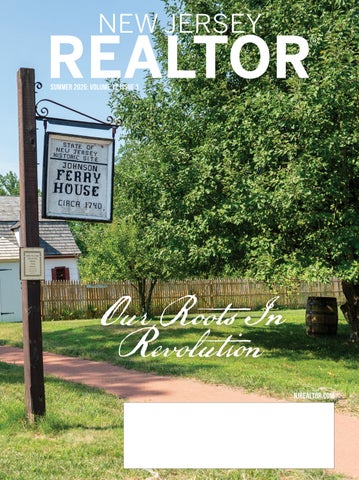
NEW JERSEY
REALTOR
®
Summer 2026: VOLUME 12 ISSUE 3
Our Roots In Revolution NJREALTOR.COM
America 250 Events Music in the Garden
Aug. 7, 2026, 6-8 p.m. Liberty Hall, Union Watch a live band perform from sheet music in the museum’s collection.
RevNJ Race Series
Aug. 9, 2026, 8:30-11 a.m. Monmouth Battlefield State Park, Manalapan Run, walk, or jog through Monmouth Battlefield and celebrate the history of the Battle of Monmouth.
A More Perfect Union
Sept. 1-Dec. 31 Pushcart Players, Verona Enjoy the folk musical, A More Perfect Union, as it describes how our country came to be.
RevNJ Race Series
Sept. 6, 2026, 8:30-11 a.m. Princeton Battlefield, Princeton Run, walk, or jog through Princeton Battlefield and celebrate the history of the Battle of Princeton.
We Declare: Words That Shaped a Nation
Sept. 14, 2026, 7:30-9:30 p.m. F.M. Kirby Shakespeare Theatre, Madison The Shakespeare Theatre is proud to produce a reading from the founding documents and key writings from the birth of the nation.
British and Hessian Retreat Fun Run
Sept. 19, 2026, 9-11 a.m. Main Street, Moorestown Walk, run, or jog one mile through historic Moorestown, where British troops looted homes and burned fields 250 years ago.
Revolutionary Newark in the Park: History and Remembrance
Sept. 19, 2026, 11 a.m.-12 p.m. Harriet Tubman Square, Newark Meet at the Newark Academy monument for a walking tour of Harriet Tubman Square.
Lord Stirling’s 1770’s Festival
Battle of Petticoat Bridge
Defense of Little Egg Harbor
Washington’s Landing
Colonial Beer Making Class at Liberty Hall
Washington’s Crossing
Oct. 4, 2026, 11:30 a.m.-4 p.m 190 Lord Stirling Road, Bernards Experience a day in colonial times featuring colonial craft demonstrations, period music, and Revolutionary War militia maneuvers. Oct. 10, 2026, 9 a.m.-3 p.m Little Egg Harbor Monument, Little Egg Harbor Township Honor the history of Little Egg Harbor, including new archive-based research on the Revolutionary War battle.
Oct. 10, 2026, 10 a.m.-5 p.m Liberty Hall, Union Become a colonial-age brewer and learn how the colonists make beer with food, games, and more.
Somerset County’s Journey Through the Past
Oct. 10-11, 2026 Somerset County Discover the long history of Somerset County through family-friendly activities, live music, blacksmith demonstrations, and more.
RevNJ Race Series
Oct. 11, 2026, 8:30-11 a.m. Batsto Village, Hammonton Run, walk, or jog through Basto Village and celebrate its history.
November 1776: When the Revolution Came to Newark
Nov. 19, 2026, 6-8 p.m. Newark Public Library, Newark Join Dr. Timothy Crist for a presentation on the six days spent by George Washington and his troops in Newark.
Retreat to Victory 250
Nov. 21-22, 2026, 9 a.m.-4 p.m. Fort Lee and Historic New Bridge Landing, Bergen County Witness the reenactment of the invasion of Fort Lee following the Revolutionary War victory.
Dec. 12, 2026, 10 a.m.-1 p.m. 1871 Jacksonville Jobstown Road, Columbus Learn about the Battle of Petticoat Bridge as reenactors demonstrate what troops were met with after they crossed. Dec. 13, 2026, 11 a.m.-3 p.m. Washington Crossing State Park, Pennington See how George Washington guided his troops across the Delaware River, followed by the March to Trenton with four reenactment groups. Dec. 25, 2026, 12-2 p.m. Washington Crossing State Park, Pennington Watch George Washington’s famous Christmas night crossing of the Delaware River with a live reenactment, historical presentation, and refreshments at The Nelson House.
Patriots Week in Trenton
Dec. 26-31, 2026, 9 a.m.-5 p.m. Patriots Week Visitors Center, Trenton Experience historic tours, lectures, and battle reenactments to commemorate the 250th anniversary of the Revolutionary War and how it affected Trenton.
Battles of Trenton Reenactments Dec. 26, 2026, 11 a.m.-5 p.m. Patriots Week Visitors Center, Trenton Experience both the first and second historic battles of Trenton alongside a commemorative ceremony.
Battle of Princeton Reenactment
Dec. 27, 2026, 9:30 a.m.-12 p.m. Princeton Battlefield State Park, Princeton Immerse yourself in this Battle of Princeton Reenactment featuring hundreds of reenactors, narrated battle action, and opportunities to engage with live historians.
Source:
Celebrate the 30th Anniversary of the Governor’s Conference on Housing and Economic Development
Join us...
September 29-30, 2026 HARRAH’S RESORT ATLANTIC CITY
September 29–30, 2026, at Harrah’s Atlantic City for two days of learning, collaboration, and celebration as we mark 30 years of advancing stronger, more inclusive communities across New Jersey.
•
This milestone event will bring together leaders from the public, private, and nonprofit sectors to shape the future of New Jersey’s housing and economic development. Governor Mikie Sherrill will deliver the keynote address, highlighting the administration’s commitment to expanding housing opportunities and strengthening the state’s economy.
njhousingconference.com
SUMMER 2026
Contents FEATURES
7
14
Honoring 250 Years in the Garden State
New Jersey is full of Revolutionary War history, and as a Realtor®, the 250th anniversary is the perfect excuse to share New Jersey’s past and present with your clients. Highlight hidden gems, turn your historical knowledge into sales, and so much more.
20
11
Spotlight on Hamilton Township
Filled with parks, historic neighborhoods, and hidden rurality, Hamilton Township is the largest Mercer County town and home to more than 94,000 residents.
16
New Jersey State Parks Guide
Even though our state is small, it’s rich in preserved spaces waiting for you and your clients to visit.
Find Hidden Gems in New Jersey Antique Stores
31
Tech Column AI has Jersey Roots
32
Legislative Update New Jersey Realtors® Closes First Quarter of Legislative Session with Several Victories for Real Estate
33
26
Meet the Decision Maker State Senator Bob Smith
More Than Just a Pretty Façade
These photogenic homes are rich in both beauty and in Garden State history.
2 | NEW JERSEY REALTOR ® | SUMMER 2026
5
From the CEO’s Desk Celebrating 10 Years in Our State’s Capital
6
From Farmhouses to High Rises: The Evolution of Real Estate in New Jersey
Discover spots across New Jersey to bring history and physical mementos into your home. No matter if you’re an avid thrifter or a casual browser, these shops are sure to please.
President’s View Level Up Your Business and Build New Connections
Important Dates & Deadlines
Each New Jersey region, town, and neighborhood has its own story, but the American Dream of homeownership threads throughout each narrative for generational stability and building wealth.
24
3
Letter from the Editor
4
Mercer County
Named after General Hugh Mercer, this Central Jersey county is rich in revolutionary history. Visit the Old Barracks Museum, discover secret tales of the Abbott family, and see where George Washington landed after crossing the Delaware River.
COLUMNS
35
Board/Association News
LETTER FROM THE EDITOR
The American Dream, Realized
T
he 250th anniversary of our Independence Day (and, if I’m being honest, the endless loop of Hamilton that plays in my house) has me thinking about the delicate intersection of our freedom and the American Dream.
Living in New Jersey means history isn’t tucked away in a textbook—it’s all around us. We drive past Revolutionary War battlefields on our morning commutes, take lunchtime walks by incredible landmarks, and are constantly surrounded by the places where our nation’s story was written.
There’s something about turning the key in your own home for the first time that feels uniquely American, like a dream finally realized. The ability to have a place to call your own feels patriotic in its own right because, for generations, homeownership has represented the opportunity and freedom to build a life of your own. I know that dream feels further away than ever. It’s undeniable that those hoping to be homeowners face more obstacles than the generations before them. But every day, you help your clients navigate those challenges. Every set of keys handed over, every closing that makes it to the table, is proof the dream is still alive. You’re still here. We’re still here. And we’re not giving up. As you read this issue, I hope you’ll take a moment to appreciate the role you play in keeping the American Dream alive and in helping people finally realize a dream that’s worth going after.
NEW JERSEY REALTOR® | SUMMER 2026 | 3
PRESIDENT’S VIEW
Level Up Your Business and Build New Connections
I
f you’re looking for ways to grow your business, one way that probably hasn’t hit your list yet is applying for a New Jersey Realtors® committee. When people think about expanding their real estate business, they usually think about marketing, social media, networking events, or the latest technology. Those are all important, but one of the best professional development opportunities available to Realtors® is volunteering with your association on the local, state, or national level. Serving on a committee strengthens the association, but it elevates your career even more. Every meeting is an opportunity to gain new insights, hear fresh perspectives, and build skills that directly benefit your business. If you’re just getting started, my advice is simple: begin at your local board or association. Your local association is where you’ll meet other Realtors® in your community, learn inner workings of organized real estate, and discover issues that matter most to you. It’s also where many of today’s state leaders— including me—began their leadership journey. Just as valuable are the relationships you’ll build along the way. Some of our best ideas began around a committee table. Surrounding yourself with engaged, knowledgeable professionals challenges you to think differently and helps you grow both personally and professionally.
If you’re applying: • Tell us why you’re interested—not just what committee you want. • Highlight what experiences and perspectives you’ll bring. • Mention any local involvement. • Be open to serving where your talents are needed. At the end of the day, committee service is professional development. You deserve to spend your little free time volunteering for work that is, yes, larger than yourself, but is also useful to your own business. When applications open in a month, I hope you’ll consider taking that first step. You might be surprised where it leads.
PRESIDENT
Gloria Siciliano
4 | NEW JERSEY REALTOR ® | SUMMER 2026
FROM THE CEO’S DESK
Celebrating 10 Years in Our State’s Capital
A
nniversaries have a way of making us reflect not just on how much time has passed, but on the decisions that have shaped us. As New Jersey Realtors® celebrates 10 years in our Trenton headquarters, we’re reminded that this building has never been just office space. It represents a strategic decision to place our association where we can best serve our members and make a lasting impact on the future of real estate in New Jersey. Our association’s history has taken us across the state. We spent many years in Newark before relocating to Edison, and later shared a space with our friends at the New Jersey Builders Association in Hamilton. We chose Trenton as our permanent home for a clear reason: purpose. Our volunteer leaders understood that being the leading voice for homeownership and private property rights meant positioning New Jersey Realtors® at the center of decisionmaking. They understood that advocacy is most effective when you’re not just following legislation, but helping shape it. Ten years later, that vision has proven to be the right one. Every day, lawmakers and regulators consider policies that affect housing affordability, property rights, land use, taxation, environmental regulations, and the real estate profession. Being headquartered just blocks from the statehouse gives us an unmatched opportunity to engage in those conversations before decisions are made. It allows us to meet with legislators, testify before committees, work alongside coalition partners, and respond quickly when issues arise. Effective advocacy isn’t accomplished from a distance. It requires relationships, credibility, and a consistent presence. Over the past decade, that presence has made a difference.
We’re equally proud to call Trenton home. As New Jersey’s capital, this city has long been the center of our state’s government and history. It is where ideas become laws and where decisions made today shape communities for generations. Operating in the state capital reinforces our commitment to ensuring the voice of New Jersey Realtors® remains integral to housing policy conversations. Looking back, it’s clear that establishing our headquarters in Trenton wasn’t simply an investment in a building. It was an investment in our mission. It positioned New Jersey Realtors® to be proactive instead of reactive, to lead instead of follow, and to advocate more effectively for the members and consumers we represent. As we celebrate this milestone, I’m grateful to the volunteer leaders whose foresight made this possible and to the members whose continued support has strengthened our association over the past decade. Their decision to establish New Jersey Realtors® in Trenton allows us to make a greater impact than ever before. Ten years later, we’re exactly where we need to be… and we’re just getting started.
CHIEF EXECUTIVE OFFICER
Douglas Tomson
NEW JERSEY REALTOR® | SUMMER 2026 | 5
CALENDAR
Important Dates & Deadlines August
®
Housing Opportunity Foundation
7 Purple Heart Day
10 Hamilton Avenue Trenton, NJ 08611 Phone: 609-341-7100 njrealtor.com
19 World Humanitarian Day
DIRECTOR OF PUBLIC RELATIONS & MARKETING Colleen King Oliver, RCE | editor@njrealtor.com
26 Women’s Equality Day
DIRECTOR OF SOCIAL MEDIA & CONTENT Erin McFeeters COMMUNICATIONS COORDINATOR Lauren Melville
September 7 Labor Day—NJ Realtors
A publication of New Jersey Realtors®
CHIEF EXECUTIVE OFFICER Douglas M. Tomson, RCE
BLACK BUSINESS MONTH / WELLNESS MONTH
6 Phillies Baseball Night—NJ Realtors
NEW JERSEY REALTOR®
AFFORDABLE HOUSING MONTH / HISPANIC HERITAGE MONTH / REALTOR® SAFETY MONTH
2026 OFFICERS
PRESIDENT Gloria Siciliano PRESIDENT-ELECT Judy Moriarty FIRST VICE PRESIDENT Janet Ginsberg TREASURER Phil Greco IMMEDIATE PAST PRESIDENT Kathy Morin
21 Yom Kippur
®
Office Closed
26 Sukkot
12-13 Rosh Hashanah
EXECUTIVE SERVICES & MARKETING COORDINATOR Julia Ventrone
ADVERTISING SALES Colleen King Oliver, RCE coliver@njrealtor.com
October
DISABILITY HISTORY & AWARENESS MONTH / ITALIANAMERICAN HERITAGE MONTH / BREAST CANCER AWARENESS MONTH
12 Columbus Day & Indigenous
Peoples’ Day
November 1 Daylight Saving Time Ends 6 Diwali 7 Election Day
31 Halloween
®
Office Closed
26 Thanksgiving Day—NJ Realtors
Office Closed
ENCOMPASS MEDIA GROUP Rebecca Ryan McQuigg rebecca@encompasspubs.com New Jersey Realtors® provides legal and legislative updates as well as information on a variety of real estate related topics solely for the use of its members. Due to the wide range of issues affecting its members, NJ Realtors® publishes information concerning those issues that NJ Realtors®, in its sole discretion, deems the most important for its members.
NEW JERSEY WINE MONTH / AMERICAN INDIAN & ALASKAN NATIVE HERITAGE MONTH
11 Veterans Day—NJ Realtors
DESIGN
®
The content and accuracy of all articles and/or advertisements by persons not employed by or agents of NJ Realtor® are the sole responsibility of their author. NJ Realtors® disclaims any liability or responsibility for their content or accuracy. Where such articles and/or advertisements contain legal advice or standards, NJ Realtors® recommends that NJ Realtors® seek legal counsel with regard to any specific situation to which they may seek to apply the article. New Jersey Realtor®, publication number 13260, ISSN number 00285919. Published quarterly each year. Member subscriptions allocated annually from annual dues: $3. Non-member annual subscription: $10. Known office of publication: 10 Hamilton Avenue, Trenton, NJ 08611. Periodicals postage paid at Trenton, NJ 08650 and at additional mailing offices. POSTMASTER: Send address change to Editor, 10 Hamilton Avenue, Trenton, NJ 08611.
6 | NEW JERSEY REALTOR ® | SUMMER 2026
State of New Jersey – Princeton Battlefield State Park
MERCER COUNTY BY ERIN McFEETERS
A CLOCKWISE FROM TOP LEFT: Mercer County Park; Princeton Battlefield State Park; Battle of Princeton; Residential street in Robbinsville
t the center of it all is a county abundant in parks and preserved open spaces, with a community culture rich in history, arts, and education. Mercer County, while officially established in 1838, was historically significant before it officially bore a name. The name it bears, Mercer, is after General Hugh Mercer, who played a crucial role in the New Jersey Revolutionary War battles and died following the Battle of Princeton. “Mercer County is named for Brigadier General Hugh Mercer, the highest-ranking
American officer to die from wounds sustained at the Battle of Princeton,” said Curator of Collections and Research at the Historical Society of Princeton Stephanie Schwartz. “When the county was established in 1838, it was named in recognition of his sacrifice during one of the Revolution’s defining campaigns.” Beyond the Battle of Princeton, Mercer County’s location in the Delaware River Corridor placed it in the heart of the early days of the Revolutionary War. “All the armies are traveling up, down, and along it [Mercer County]. It’s hard not to find American forces, whether militia or Continental Army,” said Old Barracks Museum Assistant Director of Interpretation & Curation Mark A. Turdo. “So, at any given moment, Mercer County is occupied by some or all of these forces. Especially early war, where the focus was in the midAtlantic and New Jersey in 1776 into 1777. This is the heart of what’s happening.” NEW JERSEY REALTOR® | SUMMER 2026 | 7
Battle of Trenton
The area was paramount to the Continental Army’s ultimate success and a fundamental part of America’s founding. It’s here that George Washington crossed the icy Delaware River and where the Old Barracks helped sick and injured Continental Army soldiers recuperate. Filled with hospitals and supply depots, Mercer County became a rallying point for the Continental Army, especially for soldiers coming from the southern part of the country, according to Turdo. “Trenton becomes this place where they seem to meet, form up, and then go meet the Continental Army wherever they’re headed,” said Turdo. The county also boasts Nassau Hall, which briefly served as the U.S. capital, and the Alexander Douglass House, which hosted George Washington and army officers while they planned the Second Battle of Trenton. “The reason that Trenton, Princeton, and the crossing are so important is because it’s this moment where the army and thus the revolution either is going to survive or it’s all going to fall apart,” said Turdo. “I often say that the Battles of Trenton, because there are two, what that’s doing, it’s defending and preserving the Declaration of Independence in American liberty. All of that is happening in Mercer County, not just Trenton. It goes off to Princeton, and then they push out from here.” This deep-rooted history at America’s start cultivated dedication to education, with Princeton University, The College of New Jersey, Rider University, Thomas Edison State University, and Mercer County Community College all within Mercer County’s borders. Creativity is also abounding in arts centers and theatres. This summer, see McCarter Theatre’s rendition of All the Devils Are Here, visit one of TIME Magazine’s World’s Greatest Places—The Princeton Art Museum, sign up for an art class at the Arts Council of Princeton, walk the grounds of the renowned Grounds for Sculpture, or stroll the New Jersey State Museum’s new exhibit: The Power to Change: Revolutionary Stories from the New Jersey State Archives. Beyond arts and education, there’s so much to love about Mercer County towns, all unique in their offerings 8 | NEW JERSEY REALTOR ® | SUMMER 2026
to residents and visitors. Trenton, the capital of the state and the county seat, plays a vital role in our state and local government, and houses the largest employer in the county, The State of New Jersey. It’s also known for the CURE Insurance Arena and the historic 19thcentury homes in the Mill Hill district. Princeton, a college town known for its downtown area and Palmer Square, has unique restaurants and shops, and of course, Princeton University. “When people think of Princeton, they usually think of the Battle of Princeton, Princeton University, or Albert Einstein,” said Schwartz. “But that’s really just scratching the surface. Princeton has an incredibly rich history, and one of the things I love most about my job is helping people discover the stories they never knew were here.” Hopewell Township, a more rural area of the county, is filled with preserved farmland and is where George Washington landed after his trip across the Delaware River. Hamilton Township, the most populous town in Mercer County, has 94,000 residents, according to the U.S. Census, and is known for
Princeton Battle Monument
parks such as Sayen House & Gardens and Veterans Park, historic neighborhoods, along with Grounds for Sculpture, a 42-acre sculpture park and museum. Robbinsville Township is a rural community with a growing residential area and downtown. It’s home to DeLorenzo’s Tomato Pies and Papa’s Tomato Pies, both must-visit spots for Trentonstyle tomato pie. With so many more such as East Windsor Township, a suburban area with plenty of shopping; Ewing Township, home to The College of New Jersey; Hightstown Borough, known for its historic downtown; Hopewell Borough, an antique store filled historic borough; Lawrence Township, home to Meatheadz Cheesesteaks and the Gingered Peach; Pennington Borough, a small town with main street shopping; and West Windsor Township, a mainly residential area with Princeton Junction train station and Mercer County Park. The best part: Mercer County’s central location puts everything in the Garden State at your fingertips. The NJ Transit Northeast Corridor line goes from Trenton all the way to NY Penn Station, while you can take SEPTA from the
Trenton Train Station to arrive in Center City Philadelphia. Interstates 95, 195, and 295, along with U.S. Route 1, run right through Mercer County, making it easy to commute to work or visit the Jersey Shore once the weekend hits. Across the county, the single family median sales price is $500,000 yearto-date, $100,000 less than the New Jersey single family median sales price. Inventory is on the rise in Mercer County, with 596 single family homes for sale in June 2026, 12.5% more than in June 2025. Homes are on the market for more days than last year, but demand is strong, with offers consistently above the listing price.
TAKE A STEP BACK IN AMERICA 250 HISTORY
Six months after the American colonies came together to sign the Declaration of Independence, the Ten Crucial Days of the Revolutionary War transpired within Mercer County’s borders. “Present-day Mercer County was the setting for the Ten Crucial Days campaign, including the Battle of Princeton, during which a series of American victories revitalized the Continental Army, renewed support for independence, and helped turn the tide of the Revolutionary War,” said Schwartz. It began with George Washington and his troops crossing the Delaware River and concluded with the Battle of Princeton. Ultimately, this series of battles and strategies changed the course of the war and cultivated this country’s identity of the United States of America, according to Turdo. “After the Ten Crucial Days, after everything that happens here, people who are not already in the army say, ‘Hey, you know what, maybe this revolution will work, maybe we can defend it.’ You see enlistments start to go up. You see USA buttons being used. You see U States or USA being stamped on guns and equipment,” said Turdo. “Suddenly, there’s an identity that is able to exist that didn’t exist the year before. That’s where that very much comes right out of the Ten Crucial Days. There’s a direct tie. So not only are they defending the Declaration, but they believe in this new identity of the United States of America.”
Morven Museum & Gardens, Princeton
Alexander Douglass House Trenton While not open to visitors without an appointment, the Alexander Douglass House is the former home of Continental Army Quarter Master Alexander Douglass, if you couldn’t guess by the name. During the Second Battle of Trenton, Washington used the house as his headquarters, according to revolutionarynj.org, and held a council of war with his officers. Johnson Ferry House Titusville Located on the grounds of Washington Crossing State Park, the house is said to have been used by George Washington and his officers during the Christmas night crossing of the Delaware River, according to the Washington Crossing Park Association. Today, visitors can tour the house, which is furnished with furniture from the revolutionary era. Morven Museum & Gardens Princeton Essential to New Jersey history, the Morven is the former home of Declaration of Independence signer Richard Stockton. Before Drumthwacket, Morven was New Jersey’s first official governor’s mansion and the home to Gov. Edge, Gov. Meyner, Gov. Hughes, Gov. Cahill, and Gov. Byrne. In the late 1980s, Morven officially transitioned into the museum it is today, according to morven.org.
Nassau Hall Princeton Princeton University’s campus was once a battleground, according to the Princetoniana; troops from both armies occupied Nassau Hall until British troops surrendered it to George Washington in 1777. From June to November 1783, Nassau Hall served as the nation’s capital and housed the Continental Congress. Outside of the building, known as Cannon Green, there’s a Revolutionary-era cannon that was abandoned after the Battle of Princeton. It remained there until it was used in New Brunswick during the Battle of 1812. It was returned and buried on Cannon Green in 1840, according to Princeton University, and is one of the oldest publicly displayed cannons in the U.S. Princeton Battlefield State Park Princeton The Battle of Princeton was the last battle of the Ten Crucial Days, where troops surprised and defeated British troops. It was here that General Mercer was fatally wounded on the battlefield. Not far from the spot of his death is the Mercer Oak, which is believed to have once stood on the battlefield, according to the Department of Environmental Protection State Parks, Forests & Historic Spots. While the original oak has since fallen, a sapling from the tree now stands next to the stump.
NEW JERSEY REALTOR® | SUMMER 2026 | 9
Old Barracks Museum, Grand Reopening
John Abbott II House Museum Hamilton Township Located in the town’s Veterans Park, the historic home of John Abbott II is said to have helped conceal money during the Revolutionary War. According to revolutionarynj.org, the state treasurer, Samuel Tucker, left money in the care of the Abbott family while fleeing the British in Trenton. The family hid the money in the cellar, hidden under broken dishes and other household items. So, when British troops ransacked the home, they only found Tucker’s trunk filled with personal effects and a small amount of funds. Today, the museum is open for tours every weekend to experience the revolutionary era.
Trenton Battle Monument Trenton Towering over the city is a monument topped with General Washington himself commemorating the Continental Army’s victory at the Battle of Trenton. Washington Crossing State Park Titusville Visit the spot where troops completed the perilous 10-hour Christmas night crossing of the Delaware River. Undergoing massive renovations, the park is expected to reopen this summer with a brand-new visitors center, new signage throughout the park for a more immersive experience, repaved roadways, and an exterior restoration of the Johnson Ferry House.
John Abbott II House Museum
Nelson House, State of New Jersey – Washington Crossing State Park
10 | NEW JERSEY REALTOR ® | SUMMER 2026
Trenton Battle Monument
Old Barracks Museum Trenton After undergoing extensive restoration, the Old Barracks Museum hosted its grand reopening on Independence Day with brandnew exhibits, in addition to a complete refresh of the outside of the building. Since closing its doors temporarily last May, Turdo and his team of curators, archivists, and living interpreters have been hard at work reviving the history of the Old Barracks into an interactive experience for visitors of all ages. “We invite you into the recreated spaces so you can see what it’s like to live in the barracks or be an officer,” said Turdo. “It’s meant to break down the museum wall of ‘I just listen as someone talks at me.’ We’re trying to get people to come in and be in the immersive experience.” Unlike other battles, Trenton was already an established city, with combat occurring in the middle of town down the streets that are still present today, according to Turdo. When you walk along Warren and Broad Street, you’re walking on what was once a battlefield. “You get to literally be where these guys fought. Right where all of this action happened,” said Turdo. During the war, the Old Barracks wasn’t necessarily where the fighting occurred, but it is known as a place where the Continental Army received their inoculations against smallpox. In light of Turdo and his team’s research, they discovered from 1777 forward to the end of the war, the Old Barracks served more patients as a recuperative hospital with hundreds of patients from around the colonies coming through to recover and heal, according to Turdo. Fast forward to today, the museum will feature stories of these patients and where they headed next in the new exhibits, and the Old Barracks remains a glimpse back to the Revolutionary War era in a bustling capital city. “The barracks itself historically was on the outskirts of town, and Trenton slowly encompassed it, enveloped it, and we’ve become this little oasis of the 18th century in the middle of a very modern city,” said Turdo. “Even the capital, which was built almost 40 years after the barracks, has been added onto and modernized, and it’s very different. We get to be this little 18th-century moment in the midst of all of this 20thcentury architecture and the way people like about that part of town.”
TOWN SPOTLIGHT
HAMILTON TOWNSHIP BY ERIN McFEETERS
T
here’s a reason generations of families have chosen to put down roots here. Since 1686, this town has grown into a thriving community where historic character, expansive parks, hidden pockets of rural beauty, and year-round events create a place that’s both welcoming and enduring. During the Revolutionary era, tales of hidden treasure, spies, and critical passageways filled the town’s folklore. The Abbott House, located in Veterans Park, is the former home of John Abbott and his family, who concealed funds from the British during the Battle of Trenton. Continental troops also moved through Hamilton during the Ten Crucial Days campaign, specifically through today’s Five Points in Mercerville. A lesser-known tale is that of Isaac Pearson, who was the township’s tax collector, justice of the peace, and a New Jersey Provincial Congress delegate in 1775. According to the Crossroads of the American Revolution, Pearson was mysteriously killed following the Battle of Trenton. Some say he was a loyalist with great allegiance to the crown and was killed by the Continental Army, but it remains a mystery. His home still stands and is on the National and NJ Register of Historic Places. Last October, Hamilton received a grant of nearly $80,000 to restore the home in the hopes of opening it to the public. Prior to the 1840s, the town went by a different name you’ll likely see throughout town on street signs, the historic pub, and the little league team: Nottingham,
CLOCKWISE FROM TOP: Grounds for Sculpture, “Nine Muses” by Carlos Dorrien; Flower garden at Veterans Park; Sayen House and Gardens; Olde Nottingham Tavern
NEW JERSEY REALTOR® | SUMMER 2026 | 11
established in 1686. Due to its large size of 40 square miles, residents named various neighborhoods—Hamilton Square, Groveville, Mercerville, Yardville, and Nottingham— names that are still commonly recognized by locals today. Each smaller neighborhood is even complete with its own elementary school, 17 public elementary schools to be exact, which feed into three middle schools and three high schools. As such an expansive town, events bring the neighborhoods together and keep the community spirit alive. The annual Oktoberfest, held in Veterans Park, features live music, craft beer gardens, a pumpkin patch, vendors, and more. Winter Wonderland, held at Kuser Park, is the town’s annual holiday event featuring light displays, visits from Santa Claus, and the historic Kuser Mansion staff going all
out with holiday decorations and themed rooms to explore. Come springtime, Hamilton paints the town green for The Original St. Patrick’s Day Parade, which runs through the town’s historic district along Mercer Street and Nottingham Way. Around Mother’s Day each year, you can visit Sayen Gardens, a park and botanical garden, for the Azalea Festival filled with craft vendors, food trucks, live music, and more than 250 thousand flowering bulbs, azaleas, dogwoods, rhododendrons, and more. Hamilton is also home to not one, but two Memorial Day Parades. The first, the Groveville-Yardville Memorial Day Parade, is the oldest in New Jersey and the second oldest in the U.S., according to the parade’s Facebook page, and the second runs along Nottingham Way. To celebrate America 250,
Hamilton commemorated the occasion at its annual Independence Day Fireworks & Concert, featuring live entertainment, countless food vendors, and more. Homes throughout the township range in size and price, with distinct styles in each neighborhood. In Yardville, you’ll find quaint Cape Cods and Ranch-style homes, while in Hamilton, you’ll find center hall colonials, and in Hamilton Square, you’ll find homes in the historic Victorian style. According to New Jersey Realtors® June 2026 housing market data report, the median sales price for single family homes is $450,000. That’s 7.1% more than this time last year. Currently, there are 143 homes for sale, which is 12.6% more than in June 2025. For clients in search of an area with easy access to public transportation, the Hamilton Train Station is a commuter hub along NJ Transit’s Northeast Corridor line, which offers direct rides to New York Penn Station and the Trenton Transit Center. As you travel to the train station, you’ll see lifelike sculptures by local artist Seward Johnson welcoming you to Grounds for Sculpture. This 40-acre sculpture garden features contemporary sculptures, art galleries, and restaurants. Looking ahead for Hamilton Township, there are pockets of redevelopment and expansion. A vacant strip mall on Whitehorse-Mercerville Road will soon become the new municipal building, set to open this fall. Additionally, the Children’s Hospital of Philadelphia is transforming the former AMC Theater site into a medical center. Other upcoming projects include apartment complexes, industrial spaces, and 55+ duplexes and townhomes.
CLOCKWISE FROM TOP LEFT: Aerial view of Hamilton; Sayen House and Gardens; Grounds for Sculpture; Veterans Park
12 | NEW JERSEY REALTOR ® | SUMMER 2026
Then & Now
BRIDGE AT WASHINGTON CROSSING
Courtesy of the New Jersey State Library
NEW JERSEY REALTOR® | SUMMER 2026 | 13
Honoring 250 Years in the Garden State BY JULIA VENTRONE
A
s one of the original 13 colonies, New Jersey holds so much history within its borders. While America’s 250th anniversary celebrates a milestone date, the meaning extends far beyond July 4. From Washington’s Crossing to our state capital, Trenton, there is a centuries-long past that has made New Jersey what it is today. That’s not where the importance of the semiquincentennial ends. It affects our neighborhoods and communities far and wide across the Garden State. As a Realtor®, you’re often the bridge between a property and its place in history. The excitement surrounding America’s 250th anniversary offers a unique opportunity to deepen your knowledge of our state’s history and integrate that local expertise into your business.
“All across New Jersey, counties are making improvements to their historic neighborhoods to honor America’s 250th anniversary.” The Statewide Momentum All across New Jersey, counties are making improvements to their historic neighborhoods to honor America’s 250th anniversary. According to WRNJ Radio, various counties are investing in visitor improvement projects and historical landmark restoration. “Among the state’s largest projects is the construction of a new museum and visitor center at Washington Crossing State Park in Mercer County, which officials have described as New Jersey’s gift to the nation for the semiquincentennial celebration,” said WRNJ Radio. Other historic site improvements 14 | NEW JERSEY REALTOR ® | SUMMER 2026
Battle of Monmouth Reenactment at Monmouth Battlefield State Park
George Washington
include Trenton Battle Monument, Princeton Battlefield State Park, Monmouth Battlefield State Park, Proprietary House in Perth Amboy, Indian King Tavern in Haddonfield, Wallace House in Somerville, Boxwood Hall in Elizabeth, and Rockingham in Kingston, according to the New Jersey Department of Environmental Protection. These projects are making neighborhoods more attractive for new homeowners looking to plant roots.
The “Crossroads” of the American Revolution Johnson Ferry House, State A shared history brings people of New Jersey – Washington together, regardless of scale. Communities throughout Crossing State Park the state are sharing stories of their roles in the Revolutionary War and why the 250th anniversary matters. For example, Morris County is improving the visitor experience for all the history buffs looking to take a trip into its past. According to Sarah Neibart, Executive Director of the Morris County 250th Anniversary Celebrations Committee and Mendham Township Mayor, “History belongs to all of us, and America 250 has provided an opportunity to celebrate that shared heritage as a community.” From students to businesses, Morris County wants
The Seventh ‘Washington’s March’ Obelisk in Hamilton Township
“Being an expert in your community means not only knowing the famous landmarks but also the hidden gems in your area.”
everyone to help celebrate their heritage. “We are currently launching a series of self-guided digital tours through the STQRY platform, utilizing Morris County’s Revolutionary Planning and Preservation Maps. These tours will allow residents and visitors to explore Revolutionary-era sites and stories at their own pace while learning about the people and places that shaped our county and our country,” said Neibart. Hidden Gems Across the State Being an expert in your community means not only knowing the famous landmarks but also the hidden gems in your area. Morris County is a great example with a wide variety of historical evidence throughout the county. While many are familiar with historical sites like Washington’s Headquarters and the Jockey Hollow encampment, “Fort Nonsense is another great example. People drive by it all the time without realizing it served as an important defensive position overlooking Morristown during the Revolutionary War,” said Neibert. “The WashingtonRochambeau Revolutionary Route is another hidden gem. Many residents don’t realize Morris County is connected to the route used by American and French forces as they coordinated military operations that ultimately helped secure independence.” Turning Knowledge Into Sales The longstanding American Dream is homeownership. Sharing local history with current and potential clients accredits you as a trusted source.
Morris County’s selfguided digital tours through the STQRY platform, utilizing Revolutionary Planning and Preservation Map.
Morse Telegraph Machine
Washington’s Headquarters Museum, Morristown
Henry Wick House, home of Revolutionary troops in Morristown Park
Some valuable ideas for your physical or digital marketing to tie into the American 250th anniversary include: • A “Did you Know?” section of a brochure or online space to list one historical fact about the home or area. • Share walking tours and revolutionary facts with your audience on social media through written or video posts. • Highlight historical sites and hidden gems in your town that someone may not know. The National Association of Realtors® is accepting short oneminute videos on how you have contributed to helping a client unlock the American Dream of homeownership. Share how you have helped grow a community by closing or selling a home. The significance of America’s 250th anniversary and the revitalization of historic sites and preservation play a significant role in the community. As a Realtor®, share the story of your town’s or municipality’s history. Every community has a story unlike any other, and to become part of a community is to become part of its continuing story. Some Non-Revolutionary War-Based Historical Sites to Discover • Historic Speedwell: Where the telegraph was demonstrated • Morris Canal: A canal to carry coal mined in Pennsylvania to New Jersey • Patriots’ Path: A connection of trails and open spaces linking federal, state, municipal parks, land, and more through Morris County • Acorn Hall: One of the last standing historical homes in Morris County, from 1853 • Fosterfields Living Historical Farm: Experience how farm life was 100 years ago • Waterloo Village: Authentic 19thcentury village in Musconetcong NEW JERSEY REALTOR® | SUMMER 2026 | 15
Barnegat Lighthouse State Park
New Jersey State Parks Guide BY LAUREN MELVILLE
W
ith a stunning collection of over 40 state parks and 11 state forests, the Garden State truly lives up to its name, inviting residents from every county to step outside and explore. Whether you want to bird watch with your toes in the sand at Island Beach State Park, conquer the Monument Trail at High Point for soaring tri-state views, or escape the city bustle to enjoy the Manhattan skyline from a distance at Liberty State Park, there is an outside adventure calling your name. If you’re a history buff, set your sights on Fort Mott State Park in Pennsville to wander through its fascinating Civil Warera coastal defenses and gun batteries. Or, head to Barnegat Lighthouse State Park to meet ‘Old Barney,’ the iconic lighthouse that once guided sailors and kept a watchful eye during wartime. Find an artifact along a trail? It’s most likely a part of the state’s vast history. According to the New Jersey Division of Parks and Forestry, visitors can come across Revolutionary War battlegrounds to 19th-century industrial and agricultural life. A notable historic spot, nestled in the center of the state, brings park visitors back in time to 19th-century agricultural life. Spanning over 70 miles, the Delaware & Raritan Canal State Park offers a flat, continuous path for walking, bike riding, running, and a dose of history. 16 | NEW JERSEY REALTOR ® | SUMMER 2026
Fort Mott State Park
Island Beach State Park Cape May Point State Park
Hopatcong State Park
“The extensive network of trails and its waterway creates a seamless experience for walkers, cyclists, and paddlers, allowing for everything from short outings to long connected journeys. Beyond recreation, the park also plays an important role in sustainable transportation. Many of its trail segments link directly to suburban and urban centers, giving commuters a safe, scenic and environmentally friendly option for traveling to a diversity of destinations by bike or on foot,” said New Jersey Department of Environmental Protection Senior Press Officer Caryn Shinske. Once used as a thoroughfare for mule-drawn canal boats traveling between New York City and Philadelphia, now used for recreation by nature lovers, according to NJ DEP. “With its 19th-century bridge and lock tender houses, remnants of lift locks, cobblestone spillways, aqueducts, and handbuilt stone-arched culverts, the Delaware & Raritan Canal State Park is a tremendous attraction for history lovers,” said Shinske.
High Point State Park
Delaware & Raritan Canal State Park NEW JERSEY REALTOR® | SUMMER 2026 | 17
New State Park Looks to Join the List What once was a rail line transporting ice from New Jersey’s lakes to Jersey City and New York City, now is being transformed into a nine-mile destination for transportation and recreation. The “nine-mile greenway,” as it’s being referred to until New Jerseyans cast their vote on their favorite name, is officially under construction. Spanning across nine miles from Montclair to Jersey City, this linear park’s goal is to provide residents and visitors with an outdoor recreation haven, alternate transit access, and community. Once complete, the linear park will connect eight municipalities across Hudson and Essex counties—Jersey City, Secaucus, Kearny, Newark, Belleville, Bloomfield, Glen Ridge, and Montclair. The New Jersey Department of Environmental Protection acquired the rail property from Norfolk Southern in 2022 with Phase one of the project kicking off in Newark in July Liberty State Park
2025, the city’s one-mile stretch, according to NJ DEP. “The push from local advocates, leaders, and elected officials really gave this project the momentum it needed,” said Essex County Commissioner Brendan Gill. Being involved in the green-way project for over 15 years, Gill thought the newest addition to New Jersey’s state parks would never happen. “In its early stages, this project was supported by community members in Essex and Hudson County who held meetings to highlight the greenway’s economic and environmental benefits,” said Gill. The greenway will connect communities like never before. “Interconnectivity of communities along the trail is a feature residents can look forward to. Many residents can be in Newark and never visit Montclair, this project will bring communities together through passive recreation, people wanting to commute to local communities. Whether passive, walking, running, potential intermodal transportation, many different options are still being explored,” said Gill. He imagines New Jersey’s answer to New York City’s High Line as an essential, everyday hub for the towns it connects, “maybe someone who wants to commute into Manhattan on their bike can do that or a high school holds their cross country meet,” said Gill. 12 33 28
15 2
1. 2. 3. 4. 5. 6. 7. 8. 9.
Allaire State Park
Allamuchy Mountain State Park
Barnegat Lighthouse State Park Cape May Point State Park Cheesequake State Park
Corson’s Inlet State Park
Delaware & Raritan Canal State Park Double Trouble State Park Farny State Park
10. Fort Mott State Park
11. Hacklebarney State Park 12. High Point State Park
13. Hopatcong State Park
14. Island Beach State Park
15. Kittatinny Valley State Park 16. Liberty State Park
17. Long Pond Ironworks State Park
18 | NEW JERSEY REALTOR ® | SUMMER 2026
30
9 13
26
New Jersey State Park Breakdown
17 24
11
16 32
18. Monmouth Battlefield State Park
25
19. North Brigantine Natural Area 20. Parvin State Park
21. Pigeon Swamp State Park
31
22
7
5
21 18
22. Princeton Battlefield State Park
1
23. Rancocas State Park
24. Ringwood State Park
23 8
25. Six Mile Run Reservoir Site 26. Stephens State Park
27. Stow Creek State Park
28. Swartswood State Park
29
3 10
29. Tall Pines State Preserve 30. Voorhees State Park
14
New Jersey Pinelands
27
20
19
31. Washington Crossing State Park 32. Washington Rock State Park
6
33. Wawayanda State Park
4
Courtesy of the New Jersey State Library
Then & Now CARNEGIE LAKE IN PRINCETON
NEW JERSEY REALTOR® | SUMMER 2026 | 19
FROM FARMHOUSES TO HIGH RISES:
THE EVOLUTION OF REAL ESTATE IN NEW JERSEY BY MICHELE LERNER
A
s the U.S. celebrates its first 250 years, New Jersey residents are reflecting on the history of their communities, which is intertwined with the nation’s past. Each region, town, and neighborhood has its own story, but some themes thread throughout their narrative. As farmlands morphed into villages, villages into towns, and towns into cities, New Jersey changed from an agricultural state to one driven by the Industrial Revolution, connected by railroads, and eventually by cars. Throughout these phases and into today, New Jerseyans continue to focus on an important element for generational stability and for wealth building: real estate. “Today people think of home as a place to live or as an investment, but in the colony’s earliest days homeownership represented freedom from oppression,” said Joe Grabas, a Freehold-based certified title professional, expert in historical land title research, and author of Owning New Jersey. “The freedom to own real estate opened the door to greater success in life. Until the mid-19th century, you couldn’t vote unless you owned land. That meant people who owned land controlled the government.” In his own family, said Grabas, some of his ancestors from Poland came to America to throw off the feudal system that limited land ownership to only a select few people. “The classic American Dream—the desire to own land and a home—is a theme throughout American history that holds true in New Jersey,” said Grabas. 20 | NEW JERSEY REALTOR ® | SUMMER 2026
COLONIAL AND EARLY FEDERAL TIMES
1746
The Old Eagle Tavern in Trenton is the oldest commercial building in New Jersey still standing.
1765
Princeton University, originally founded as the College of New Jersey in Elizabethtown.
1766
Rutgers University is founded as Queens College.
In the 1600s, when the first European visitors arrived in what is now New Jersey, the area was populated by approximately 8,000 Indigenous people in a network of communities. From the early 1600s into the mid-1700s, English and Dutch settlers began to establish farms and colonies in New Jersey, joined by Swedes, French Huguenots, Walloons from Belgium, Germans, Finns, Welsh, Scots, and Scots Irish settlers, according to the New Jersey’s official history. “Haworth, Ridgewood, and other nearby towns were initially mostly Dutch farms, so the farmhouses were mostly Dutch colonial style,” said Beth Potter, Haworth Borough Historian, a library assistant at the Haworth Municipal Library, and owner of HouseTales, a service that researches the history of old houses in Haworth and nearby towns. The town of Watchung and other nearby areas in Somerset County were first settled in the early 1700s by farmers moving from surrounding towns, according to Susan Tucker, a Realtor® with Coldwell Banker Realty in Watchung. “Wealthy families moved from Plainfield in the 1800s, which was an elegant city at that time, and bought farms with 100 to 300 acres in Watchung,” said Tucker. “They built grand houses on those farms and in town. We still have historic homes standing from before the revolution and the late 1700s.” Historic preservation groups and individuals have saved many properties over the past 250 years. For example, in Trenton, the Old Eagle Tavern is estimated to be the oldest commercial building still standing in town, according to Preservation New Jersey. Built in 1765, the Tavern was originally home to Robert Waln, a U.S. Representative and business owner. It was converted into a tavern in 1817 and has since
1802
1831
The Van Reypen House, one of the oldest homesteads in Jersey City, is an example of Dutch Colonial architecture.
John Stevens, the “Father of the American Railroad” builds a steam engine and circular train track on his Hoboken property in 1831. been a restaurant, hotel, office, and apartment. The City of Trenton is currently restoring and renovating the building as a tourist attraction. David Schure, a Realtor® and broker associate with Callaway Henderson Sotheby’s International Realty, who is active with historic preservation groups in Princeton, hopes the 250th anniversary of the U.S. will spark renewed enthusiasm for landmark buildings. He became interested in preservation work during the Bicentennial. “Princeton was settled by colonists in 1683, primarily based on land grants to William Penn that were subdivided,” said Schure. “Quakers and Europeans settled along Stony Brook Creek for irrigation. The College of New Jersey, which eventually became Princeton University, was founded in 1746 in Elizabeth, then moved to Princeton in 1756.” Queen’s College, which eventually became Rutgers University, was established in 1766, which, according to the New Jersey government, made New Jersey the only North American colony with two chartered colleges at that time. “Princeton University is central to the town’s development, but wealthy people were also drawn to the area and built estates here like Morven, which was built in the 1750s by the Stockton family,” said Schure. “Smaller houses in town and outside town belonged to local business owners and landowners.” Morven Museum and Garden, now a historic site open to the public, was built by Richard Stockton, a signer of the Declaration of Independence. Further south, many of the earliest residents of Camden and Gloucester Counties moved north from Salem County along Newton Creek and were primarily from Ireland and England, according to
Douglas McVarish, a retired historic preservation expert in Collingswood, and author of Researching the History of a New Jersey House and Collingswood, New Jersey: A History in Buildings and Landscapes. “Very few homes are still standing from that era, but there are some archaeological sites and graveyards,” said McVarish. “All of South Jersey was agricultural at the time and settled along the Delaware River plains. The inland area near Collingswood is about 60 miles from the Atlantic Coast and about five miles from Philadelphia.” Large farms, some of them with more than 100 acres, were the norm in places that are now highly developed, such as Cherry Hill, said McVarish. “In Cape May, Salem, and Cumberland Counties, there’s still an agricultural economy,” said McVarish. “Partly because of the climate there, but also there were fewer railroad lines built into that part of the state.”
RAILROAD EXPANSION: CONNECTED TOWNS The industrial revolution and the expansion of railroads transformed New Jersey from its agrarian and colonial roots into a series of connected towns and spokes linked to the powerhouse locations of New York City and Philadelphia. “If you look at a railroad map of New Jersey from 1887, you’ll see an extraordinary number of rail lines all across the state,” said Grabas. “In 1831, J.P. Stevens, a textile and manufacturing industrialist, bought a train engine and built a circular railroad on his property. Within 60 years, the entire state was covered by rail lines, especially the Northeast.” Other industrialists changed the landscape of New Jersey, including a silk baron named Catholina Lambert in Paterson, who built Lambert Castle in 1892, according to Grabas. The castle is now a museum and home to the Passaic County Historical Society. As Philadelphia grew, Camden became an industrial center with a ferry to Philadelphia. “Collingswood pre-dates the NEW JERSEY REALTOR® | SUMMER 2026 | 21
railroad, but many towns in New Jersey started when the railroads were built,” said McVarish. “Collingswood had some small industry at the time, such as a turbine manufacturer, a company that used eggs to make photo paper, and glassmakers.” Some of New Jersey’s growth patterns were tied to summertime escapes from New York, Newark, and Philadelphia, made possible by railroads. At first, Grabas said, people opted for “wilderness camps” in Morris County and Mount Tabor, where they set up tents. Eventually, people built homes in those locations. “The railroads changed everything,” said Potter. “Once the railroad connected Haworth and other towns to New York City in the 1870s and 1880s, that lured people from Manhattan and Brooklyn to build summer houses so they could get fresh air. They would take the ferry to Weehawken and then from there get the train to their country homes.” In the early 1900s, Haworth became known for its concrete homes built by the Franklin Society, said Potter. “These were advertised as fireproof, insectproof houses, and they were very attractive and yet affordable,” said Potter. “Tradespeople and painters would buy them, and so would New York City merchants and preachers.” Some areas in South Jersey, such as Riverton and Wenonah, had large Victorian houses built in the late 1800s and early 1900s that catered to wealthy people who owned businesses or worked in Philadelphia, said McVarish. In towns near Camden, more affordable homes were built for people who worked in the shipyards during World War I and World War II, he said. “Basically, these were single-family homes built for people moving out of rental housing and rowhouses in Philadelphia and Camden,” said McVarish. At the time, these were homes for middleclass families, but today, McVarish pointed out, prices for those homes are too steep for first-time homebuyers. “Cherry Hill was kind of the epitome of development in New Jersey in the early 20th century because smaller farmers started to suffer as larger farms with larger crops became more common,” said McVarish. “The smaller farms were sold to developers from Philadelphia who started neighborhood developments, especially close to the Ben Franklin bridge, so people could commute by streetcars, buses, and trolleys into the city.” While that started in the 1920s and 1930s, after World War II, suburban development grew exponentially. 22 | NEW JERSEY REALTOR ® | SUMMER 2026
1879
The Emlen Physick Estate in Cape May is one of the best examples of Victorian Stick Style architecture in the country.
1900S
1920S
Affordable cars allow families to leave crowded cities for suburban locations.
Associated Press Nov. 25, 1922
Haworth, New Jersey became known for its concrete homes built by the Franklin Society.
1922
Courtesy of Beth Potter, Haworth Library/Haworth Borough Historian
Work begins on The Holland Tunnel, linking Jersey City to Manhattan.
POST-WAR CAR CULTURE AND SUBURBAN DEVELOPMENT New Jersey’s car-centric phase began as soon as cars became more affordable to average families, leading to more diversity in suburban locations as some people left behind crowded cities. “My own family of Poles and Italians, who settled in the Bronx and Newark, moved out of the city neighborhoods to Irvington, then to Linden, East Brunswick, and now I live in Freehold,” said Grabas. “They liked the idea of having a real backyard and a little bit of land instead of a front stoop shared with neighbors.” Since Watchung didn’t have its own direct railroad connection and residents needed to drive 12 to 15 minutes to nearby stations, a bigger impact on the town came when Route 78 was built in the late 1960s, said Tucker. “That created a boom for the whole region because suddenly we were viable as a commuter town to New York City,” said Tucker. “We saw a lot of development in the 1960s and 1970s related to that.” While many communities changed due to rail or road connections, Tucker said the leaders in Watchung were smart to establish strict zoning laws in the 1960s that required at least 1.3 acres per house. “That helped our community maintain its woodsy, hilly character and stopped it from being chopped up into smaller lots,” said Tucker. “Between our hills, which make it hard to develop, plus the zoning, most homes here are custom-built individual homes rather than subdivisions.” While the university was central to Princeton’s development, its train and car access to New York City was important. “In the 1950s and 1960s, mid-century modern houses became
popular in Princeton,” said Schure. “You had a mix of academics who wanted interesting or novel houses, professionals in the town, and executives at the pharmaceutical companies in town with average or above average salaries who were also interested in new designs.” Schure said the School of Architecture at Princeton drove some of the enthusiasm for modern designs, along with the mix of international and European academics who came to the university and could afford to buy land just outside town for new homes. Today, he said, more buyers want to be closer to town for walkability. “When the train service stopped in the 1950s to Haworth, we got better bus service, and the population just continued to build,” said Potter. “We’re not a big town, but we’re about an hour from New York in traffic, have good schools, and plenty of trees, so that’s kept our population stable.” Unfortunately, home prices have risen dramatically over time, with prices at $2 million and up to live there, said Potter. “A teardown just sold for $1.2 million, and once the new house is built, it will be worth about $3 million,” said Potter. “But nearby towns with train service, like Montclair and Ridgewood, are even more expensive.”
1960S
An east-west interstate highway, I-78, connects New Jersey to Pennsylvania and New York City, leading to the development of suburban neighborhoods such as East Brunswick in Middlesex County.
HOUSING MANDATES AND NEW URBANISM The Mount Laurel Doctrine, an affordable housing requirement established through a series of decisions by the New Jersey Supreme Court, creates a constitutional obligation for every New Jersey municipality to provide its fair share of affordable housing. Each town must create its own Housing Element and Fair Share Plan, but they have flexibility in how they meet their obligations. Still, enforcement of this law is driving change in most communities. “The Mount Laurel Doctrine means every town has some development of affordable housing, whether it’s townhouses or condos or smaller single-family homes,” said Tucker. “Builders can apply to build market-rate housing and include affordable units.” Each town can decide whether they want to approve mixed-income housing, age-restricted housing, special needs housing, or build 100% affordable developments, as long as they meet state requirements to set aside housing accessible to individuals and families who meet income restrictions. In addition to affordable housing mandates and the desire for walkable towns with access to public transit, the pandemic changed some priorities for homebuyers. “In the 1980s and 1990s, people would drive farther and farther to afford a house, but then when the pandemic hit, and more people could work remotely, people were able to move even farther to places like Cape May without any commute at all,” said Grabas. “Now that more companies require people to work in an office, we’ll see if that changes priorities again. Still, more people can work remotely than in the past, so at least some of them have that advantage of living anywhere in the state.”
1975
The Mount Laurel Doctrine creates a constitutional obligation for every New Jersey municipality to provide its fair share of affordable housing.
FOR MORE INFORMATION ABOUT NEW JERSEY HISTORY AND HOUSING, TRY THESE RESOURCES: • New Jersey State History • Mount Laurel Doctrine • Owning New Jersey by Joe Grabas • Collingswood, New Jersey: A History in Buildings and Landscapes by Douglas McVarish • Researching the History of a New Jersey House by Douglas McVarish • Mapping New Jersey: An Evolving Landscape by Maxine Lurie and Peter Wacker • Owning the Earth: The Transforming History of Land Ownership by Andro Linklater
NEW JERSEY REALTOR® | SUMMER 2026 | 23
BY LAUREN MELVILLE
N
ew Jersey is a living time capsule. While iconic historical moments are safely recorded in books, countless physical mementos are still scattered across New Jersey, waiting for the perfect finder to bring them home. Calling all casual thrifters to serious antique collectors, pick up a little piece of the past at these New Jersey antique destinations. The Abram Demaree Homestead Closter abramdemareehomestead.org This privately owned 18th century homestead landmark seamlessly blends Dutch and English colonial history with a vibrant modern-day experience. Listed on the National Register of Historic Places, this Bergen County gem functions as a working farm, a cozy café, and a sprawling antique haven. Wander into the massive barn to explore the Vintage Goods and Antique Shop, where you can find timeless treasures across the decades—from vintage jewelry and furniture to retro clothing, books, and art. The Vintage Goods and Antique Shop is open every weekend, 10 a.m.-5 p.m. Fuel up at The Farm Cafe for delicious, light refreshments before you browse. Open Wednesday through Saturday from 10 a.m. to 6 p.m., and Sundays from 10 a.m. to 5 p.m. 24 | NEW JERSEY REALTOR ® | SUMMER 2026
Antique Emporium Asbury Park @antiqueemporiumasburypark on Instagram Rainy summer day down the shore? Don’t let a gloomy afternoon ruin your beach trip. Instead, dive into the artifact-filled aisles of the Antique Emporium in Asbury Park. It’s a treasure hunter’s paradise where you can lose track of time gazing at shimmering vintage jewelry, browsing unique glassware, and discovering one-of-a-kind statement furniture. Open seven days a week, 11 a.m.-5 p.m., Sunday 12 to 5 p.m. Antique Village West Creek West Creek antiquevillagewestcreek.com Located just off of Long Beach Island, Antique Village West Creek is a treasure trove packed with coastal charm and heavy-hitting nostalgia. Vinyl enthusiasts can lose themselves in crates of vintage records, while interior lovers will find everything from retro kitchenware to antique clocks. But the real showstopper here is the sports memorabilia. You can comb through rare baseball card collections, marvel at original Yankee Stadium blueprints, or even check out the one-of-a-kind Softail Florida Gators motorcycle signed by Tim Tebow and Urban Meyer—originally built to celebrate their national championship wins.
Cape May Antique Center Cape May facebook.com/capemayantique Thanks to its coastal roots, this premier antique destination is a hotspot for unique maritime collectibles and nautical-themed gems. Yet, Cape May Antique Center caters to far more than just sailor gear. With options to fit every budget, shoppers can uncover everything from vintage sheet music and fine jewelry to mid-century to modern furniture and framed stained glass. The Lafayette Mill Antiques Center Lafayette millantiques.com Step back in time at the Lafayette Mill Antiques Center, where history and treasure hunting collide inside a 200-year-old historic gristmill. For more than 45 years, this iconic destination has been a mecca for collectors, showcasing over 50 select vendors offering everything from fine china and artwork to vintage toys and heirloom furniture- you name it, they’ve got it. Need a breather from browsing the multi-level mill? Head next door to the Millside Cafe to recharge with a freshly brewed cup of coffee. Outside the gristmill, the center holds its flea market on the last Sunday of every month from April to October.
Historic Burlington Antiques and Art Emporium Burlington antiquesnj.com Shoppers will find antiques of all kinds at the Historic Burlington Antiques and Art Emporium. Nestled between Philadelphia and New York City, this spot is a wonderland for genuine antiques hailing from all decades. You can spend the day lost among over 65 vendors and dealers, with finds from vintage jewelry to pottery to furniture to home decor across individual booths. Open Sunday through Monday 11 a.m.-5 p.m. Summit Antique Center Summit thesummitantiquescenter.com Since 1990, The Summit Antique Center has curated antiques, vintage art, furniture, collectibles, gifts, props,
A
ntique lovers, welcome to paradise. Known affectionately as “Andover NJ Antique Row,” this historic shopping district along Main Street in Sussex County is an absolute must-visit. The charming streets are lined with multiple antique shops and multi-vendor collectives, delivering an incredible, ever-changing variety of unique pieces just waiting to be discovered. The Andover Village facebook.com/andovervillage Nestled right in the heart of Antique Row, The Andover Village serves up a mix of multi-dealer spaces where local history quite literally comes alive. Whether you’re hunting for a rare midcentury relic, estate jewelry, or just some rustic farmhouse decor, this collective offers a sprawling selection that makes the thrill of hunting effortlessly fun. This collection of antique shops is a true village, made up of different
clothes, silver, toys, and home decor right in Union County. With the help of over 50 experienced dealers and two floors worth, this spot also provides vintage goods from the Victorian era to mid-century modern. Bring a bag, or a U-Haul for your next trip. Valley Vintage West Orange valleyvintage168.com If you prefer a more intimate, boutique shopping experience, Valley Vintage is a quirky joint you have to check out. Curating a tight-knit community of over 20 specialized dealers, it takes the overwhelming guesswork out of antiquing. It’s the perfect spot to hunt for specific hidden gems, from local art pieces and vintage vinyl to retro dishware and prints. Open Monday through Saturday 11 a.m.-6 p.m., Sunday 12-5 p.m.
locations filled with antique goods inside The 1868 House, The Carriage House, The Cottage, The White House, and The Court Yard, all within walking distance. Shoppers can find outdoor vintage statues, gnomes, and fountains perfect for any garden at The Court Yard or explore The Carriage’s holiday-themed collection. Head to this antique metropolis to find exactly what you’re looking for, open Thursday through Monday 11 a.m.-5 p.m. Grey Barn Antiques greybarnantiques.com Tucked away inside a historic old Annex building, Grey Barn Antiques is a local staple featuring over 25 curated vendors. It’s the ultimate spot for tracking down pristine antique furniture, rare collectibles, and nostalgic vintage goods. Can’t make the trip out to Andover just yet? You can still catch their weekly Facebook Lives to sneak a peek at their latest arrivals.
Scranberry Coop scranberrycoop.com A 10,000 sq. foot building, filled with antiques? A dream for antique enthusiasts. Housed in an unmistakable bright yellow building right off Route 206, Scranberry Coop has spent the last 39 years bringing vintage dreams to life. With over 150 vendor booths, it’s packed with everything from rare vinyl records and statement mid-century furniture to quirky trinkets and original art. Don’t miss their outdoor flea markets, hosted on the first Sunday of every month. Open Wednesday through Sunday 10 a.m. to 5 p.m. Good luck walking away empty-handed.
NEW JERSEY REALTOR® | SUMMER 2026 | 25
More Than Just a Pretty Façade THESE PHOTOGENIC NEW JERSEY HOMES ARE RICH IN BEAUTY AND HISTORY
B
BY DINA CHENEY
“DESIGNED BY A WHO’S WHO OF ARCHITECTS, THESE MANSIONS AND ESTATES REPRESENT A MIX OF STYLES, FROM GEORGIAN, FEDERAL, AND BEAUX-ARTS TO VICTORIAN AND TUDOR, GREEK, AND RENAISSANCE REVIVAL. READ ON FOR A “TOUR” OR VISIT IN PERSON—MOST PROPERTIES ARE OPEN TO THE PUBLIC.”
26 | NEW JERSEY REALTOR ® | SUMMER 2026
eauty is more than what’s on the surface, as these New Jersey homes prove. The 14 properties, many now museums, are a testament to history. Most were home to noteworthy Garden State residents, from politicians to Gilded Age magnates. Designed by a who’s who of architects, these mansions and estates represent a mix of styles, from Georgian, Federal, and BeauxArts to Victorian and Tudor, Greek, and Renaissance Revival. Read on for a “tour” or visit in person—most properties are open to the public. EMLEN PHYSICK ESTATE, CAPE MAY Cape May is renowned for its Victorian architecture. This estate, Cape May’s only Victorian house museum, represents the Stick style. This subtype of Victorian architecture, defined by a grid of raised boards overlaying clapboard walls, was considered avant-garde at the time. Designed by Frank Furness and built in 1879, the sprawling 18-room mansion features a front porch, oversized chimneys resembling upside-down smokestacks, dormers, towers, and porch brackets. The interior includes detailed woodwork and custom period furniture. VAN VLECK HOUSE, MONTCLAIR Architect, Joseph Van Vleck, Jr., designed this U-shaped home for his brother. “It’s a beautiful example of Mediterranean-inspired architecture and feels both grand and intimate,” said New Jersey-based interior designer Beth Diana Smith. “The elegant home is rich in detail without feeling overly formal.” The house, built in 1916, is surrounded by gardens featuring rhododendrons, azaleas, evergreens, and wisteria.
Emlen Physick Estate Courtesy of Cape May MAC
Hennessey Hall Courtesy of Fairleigh Dickinson University
HENNESSY HALL (THE MANSION) AT FAIRLEIGH DICKINSON UNIVERSITY, MADISON When designing this Georgian-style home in the 1890s, acclaimed architect Stanford White was inspired by British architecture. He modeled a fireplace after one at Windsor Castle and a wing after a portion of Henry VIII’s Hampton Court. Now part of Fairleigh Dickinson University, the 150-foot-long mansion originally included 100 rooms, Italian marble staircases, and fireplaces. The floor in the Great Hall is Italian Carrara marble. Frederick Law Olmsted, landscape architect of New York City’s Central Park, designed the gardens. MORVEN MUSEUM AND GARDEN, PRINCETON Built in the mid 1700s for Richard Stockton, a signer of the Declaration of Independence, Morven was the official New Jersey governor’s residence from 1945-1981. The white brick Georgian Colonial with cream shutters features a Greek Revival porch dripping with wisteria. The interiors boast original wide-plank floors, hand-carved mantels, and period wallpaper patterns. The five-acre property includes a Colonial Revival-style garden. NEW JERSEY REALTOR® | SUMMER 2026 | 27
LIBERTY HALL, UNION William Livingston, New Jersey’s first elected governor and a signer of the U.S. Constitution, built this lemon curd-yellow and white Georgian-style home in the 1770s. Shutters, a portico, and a fanlight above the front door ornament the façade. The original home included 14 rooms. Future residents enlarged the home to 50 rooms and added Federal and Victorian-style elements. The grounds include an English parterre garden and a maze. BLAIRSDEN, PEAPACK-GLADSTONE Evergreens characterize the Renaissance Italian-style gardens at this castle-like hilltop property. The 62,000 sq.foot, 38-room Beaux-Arts-style mansion with a slate roof was designed by Carrère and Hastings, also known for the New York Public Library and Henry Clay Frick mansion, now the Frick Collection. James Leal Greenleaf, the landscape architect of the Lincoln Memorial grounds, designed the gardens. Built in 1897 for a finance and railroad magnate, the grand Gilded Age estate is now privately owned. Blairsden Mansion, Courtesy of The Historical Society of the Somerset Hills
PROPRIETARY HOUSE, PERTH AMBOY In the Colonial era, the English architect and builder, John Edward Pryor, designed this Georgian-style home as an official royal governor’s residence. Only one person in this position ever lived there: William Franklin, Benjamin Franklin’s illegitimate son. The stately four-level home included 16 fireplaces and advanced features like lead gutters and a lightning rod. During the Revolutionary War, Proprietary House was occupied by British and Patriot forces. After the war, the home’s history was still tumultuous. The estate shifted from a family estate hosting illustrious guests like John Jacob Astor and U.S. President John Tyler, to a resort hotel, charitable organization, and board house associated with prostitution. The building has since been restored. THE GREAT HALL (SHADOW LAWN), WEST LONG BRANCH Some scenes in the film, “Annie,” were filmed at this 130 room mansion, now part of Monmouth University. Designed by Horace Trumbauer and Julian Abele, the Beaux-Arts style mansion built in 1929 features limestone from Indiana, 50 types of Italian marble, and steel and concrete framing. Abele, one of the first professional Black architects in the U.S., also designed the Harvard University Widener Memorial Library, the Central Branch of the Free Library of Philadelphia, and the Philadelphia Museum of Art. The 17 master suites were decorated to evoke different historical periods, and the 19 bathrooms include gold or silver-plated fixtures. Gould Mansion, Interior
RINGWOOD MANOR, RINGWOOD The late Abram Hewitt once served as mayor of New York, which is reflected by the gardens at his former estate. The grounds include columns from the original New York Life building; gates from the Astor family’s home; and gate posts from Columbia College, Columbia University, along with European statuary and garden ornaments. The original house, built in 1810, was Federal-style and contained 10 rooms. Later renovations added Victorian and Italianate elements, like a neoclassical portico, and even more living space. The enlarged mansion grew to encompass 28 bedrooms, 24 fireplaces, 13 bathrooms, and more than 250 windows. MACLEAN HOUSE, PRINCETON This Georgian-style brick house was intended for presidents of Princeton University, 10 of whom have resided there. Designed by Robert Smith and constructed in 1756, Maclean House was occupied by George Washington during the Battle of Princeton in 1777 and again in 1783. Now yellow with black shutters, the charming, elegant building is the site of the school’s alumni association. 28 | NEW JERSEY REALTOR ® | SUMMER 2026
Gould Mansion, Interior Gould Mansion, Courtesy of Georgian Court University
SKYLANDS MANOR, RINGWOOD Built in the 1920’s, this 35,000-square-foot mansion was designed to appear much older, John Russell Pope, the architect of the National Archives and National Gallery of Art, designed the Tudor Revival whose façade features a slate roof and stone quarried on site. Antique paneling removed from English manor houses ornaments the interiors. Among the 44 rooms, the Great Hall, with its stainedglass windows and arched beams, stands out. Samuel Parsons, a founding member of the American Society of Landscape Architects, was the property’s original landscape architect. More recently, the grounds were redesigned and currently comprise the state’s official botanical garden. BALLANTINE HOUSE, NEWARK Now part of the Newark Museum of Art, this red brick and limestone mansion, designed by George Edward Harney and completed in 1885, is a mix of Renaissance Revival, Colonial Revival, and Gothic architectural styles. Facing Washington Park, the 27-room Gilded Age mansion with a dramatic portico features interiors with various types of wood paneling, decorative plaster ceilings, stained glass, imported fireplaces, and period furnishings. GOULD MANSION, LAKEWOOD Representative of America’s grand country estates in the late 19th-century, this property, now part of Georgian Court University, was designed by Bruce Price and built for railroad executive and financier George Jay Gould. The Gilded Age mansion, a mix of Beaux-Arts and Georgian styles, features a stone façade and interiors with elaborate woodwork and decorative plaster.
Drumthwacket, Courtesy of The Drumthwacket Foundation in Princeton, NJ, Photo by Andrew Wilkinson
GETTING TO KNOW DRUMTHWACKET, PRINCETON Before Drumthwacket became the official New Jersey governor’s residence, the 49-acre property was owned by private citizens. In 1835, the first, Charles Smith Olden, began constructing the Greek Revival mansion, which originally included a center hall with two rooms on each side, and a large portico. Olden, who gave the property its name, meaning “wooded hill” in Scottish Gaelic, became governor in 1860. After purchasing the estate, industrialist and banker Moses Taylor Pyne added both wings, which were designed by Raleigh C. Gildersleeve. According to Robyn Brenner, executive director of Drumthwacket Foundation, Pyne had the first telephone in Princeton. “His number was Princeton 1. We like to joke, ‘Who was he calling?’” said Brenner. Pyne hired Daniel Webster Langton, one of the founding members of the American Society of Landscape Architects, to design the grounds. Modeled after the Villa Gamberaia in Settignano, Italy, they featured terracing, greenhouses, bridle paths, ponds, a bowling green, and a lawn tennis court. Pyne also converted the Olden House into a home for exotic birds and monkeys. “We have a letter from a woman who visited, tried to give the monkeys bubblegum, and was reprimanded,” said Brenner. Abram Nathanial Spanel purchased the home in 1941. An inventor, he held 2000 patents by the time of his death. Spanel’s company, the International Latex Corporation,which became the International Playtex Corporation, won a contract to develop a spacesuit for NASA. Spanel also conceived of inflatable rescue rafts, a pneumatic stretcher for carrying soldiers wounded in the water, and a consumer hair-cutting device. In 1966, the state purchased Drumthwacket. When Tammy Snyder Murphy, wife of former Gov. Phil Murphy, became president of the board of the Drumthwacket Foundation, “she had a legal pad of everything she wanted to get done,” said Brenner. Murphy devoted a lot of her attention to the grounds, whose formal gardens, woodlands, and walking paths are maintained by two groundskeepers and several volunteer master gardeners. Along with installing lighting, she partnered with Rutgers University on sustainability initiatives, adding beehives, rain gardens, and a meadow. She also hired the acclaimed interior designer, Anthony Baratta, to “refresh” the public rooms. During tours of the home, “typical fan favorites” include the dining room with its hand-painted Gracie wall panels and the library with its hand-painted ceiling and grand fireplace, said Brenner. The book-lined space reminds schoolchildren of Harry Potter. Amongst the holdings in the Drumthwacket Foundation’s collection of 18th and 19th-century furniture, paintings, and decorative objects, Brenner highlighted the American classical flame mahogany secretary and flame mahogany tall case clock. “I love the touchpoints around that clock and what it has witnessed,” said Brenner. Opening a door on its front reveals chalk markings with the names and dates of past repairmen. Visitors can also view an oil portrait of Albert Einstein, which appeared on the cover of Time Magazine in 1938. Brenner has been commuting to Drumthwacket for the past 16 years. “I often tell people it is well worth it,” referring to her one-hour drive in each direction. “Look where I land: a beautiful building with incredible history. It is the ‘people’s house’ and a symbol of our amazing state.” NEW JERSEY REALTOR® | SUMMER 2026 | 29
Courtesy of the New Jersey State Library
Then & Now
JOHNSON FERRY HOUSE IN WASHINGTON CROSSING STATE PARK
State of New Jersey – Washington Crossing State Park
30 | NEW JERSEY REALTOR ® | SUMMER 2026
TECH COLUMN
AI HAS JERSEY ROOTS BY WILLIAM THOMPSON, NJ REALTORS® DIRECTOR OF TECHNOLOGY
I
f you’ve felt like your world has been flipped upside down over the past couple of years as artificial intelligence has burst onto the scene, you’re certainly not alone. To most of us, it seems like AI materialized out of thin air, instantly transformed from a sci-fi concept into an everyday tool we use to draft listing descriptions, brainstorm social media content, and create checklists. However, as we look back through a historical lens, the truth is, AI is not a modern overnight success story but a decades-long evolution of multiple technologies coming together. A surprising amount of its foundational history was written right here in the Garden State.
THE MOUSE THAT SOLVED THE MAZE
Long before computers could turn you into an action figure or serenade you with a personalized rock anthem, scientists were trying to answer a deceptively simple question: Can machines think? In 1950, British mathematician Alan Turing, who earned his doctoral degree from Princeton University, published a paper introducing what we now call the Turing Test, which established a benchmark for judging whether a machine could exhibit intelligent behavior indistinguishable from a human. In the same year, right here in Murray Hill, Claude Shannon, a Bell Labs scientist, created a robotic mazesolving mouse known as Theseus. Equipped with a series of electronic relays, Theseus was designed to navigate a metal maze, locate a brass “cheese” target, and remember mistakes it made along the way. This is widely recognized as one of the
earliest examples of machine learning. Shannon later joined John McCarthy, Marvin Minsky, and Nathaniel Rochester as one of the organizers behind the 1956 Dartmouth Summer Research Project, the gathering widely credited with launching artificial intelligence as a formal field of study.
WHEN COMPUTERS LEARNED TO READ
Following the initial excitement of the 1950s and 60s, AI hit its first major slowdown when funding tightened, and technology struggled to live up to some of the era’s boldest promises. In the late 1980s, the technological thaw had begun, and one clear example came from AT&T Bell Labs in Holmdel, where a researcher named Yann LeCun developed a breakthrough using a convolutional neural network, or CNN. Inspired by how the biological visual cortex processes information, LeCun built and trained a system to recognize handwritten characters. This foundational technology helped teach computers to read handwritten ZIP codes for the U.S. Postal Service and later supported systems used to read dollar amounts on bank checks. Every time an AI tool recognizes text in an image, reads handwriting, or interprets visual information, you’re seeing the legacy of work that took a major leap forward in a Monmouth County lab more than thirty years ago.
AI IN PLAIN SIGHT
By the time the 2000s arrived, artificial intelligence had stopped being an experimental proof of concept and had slipped into our daily lives without us even knowing. Personal computers,
online platforms, and connected devices have become so integrated into our daily lives that many of us can’t remember a time before them. Think about the early Automated Valuation Models, designed to estimate property values using hundreds or thousands of data points. Consider the smart home craze of the 2010s, like the smart thermostat, which actively learns homeowners’ daily routines to shave money off monthly utility bills. We didn’t call it AI back then; we just called it software. These platforms didn’t use conversational language to generate text for us, but they relied on the same machine learning principles established decades earlier. They worked quietly in the background, analyzing massive amounts of data to turn raw numbers into actionable business insights.
ANOTHER TOOL IN THE TOOLBOX
Tools like ChatGPT are not magical entities that appeared out of nowhere to disrupt your livelihood. They represent just the latest iteration of a continuous, seventy-year technological evolution that New Jersey minds helped build from the ground up. Just like carbon paper, e-signature platforms, and cloud storage solutions, modern AI is another tool designed to create efficiency. It excels at automating the routine, repetitive behind-the-scenes tasks like drafting outlines, analyzing data, and jumpstarting creative projects so you can focus on the one thing technology can never replicate: human relationships.
NEW JERSEY REALTOR® | SUMMER 2026 | 31
LEGISLATIVE UPDATE
New Jersey Realtors ® Closes First Quarter of Legislative Session with Several Victories for Real Estate BY BRUCE SHAPIRO, NJ REALTORS® DIRECTOR OF RPAC AND REGULATORY AFFAIRS
A
s the New Jersey Legislature concluded the first six months of its 222nd Session with passage of the Fiscal Year 2027 State Budget, New Jersey Realtors® secured several key wins for the real estate industry after a busy and productive legislative session. With nearly 10% of the Legislature made up of newly elected lawmakers, New Jersey Realtors® focused not only on advancing policies that protect private property rights and the real estate profession, but also on building relationships with new legislators, commissioners, and Gov. Mikie Sherrill’s administration. Those relationships ensure that when issues arise, we have trusted lines of communication to advocate on behalf of our members. One of the most significant achievements this session was the passage of the continuing education reform bill, which the governor signed into law in July. The legislation will take effect July 1, 2027, and will apply to the next real estate license cycle— not the current one. The bill increases continuing education requirements from 12 to 18 credit hours, updates mandatory course topics, and streamlines the course approval process through the New Jersey Real Estate Commission. A complete overview of the legislation is available at njreal.to/ce-bill-june. New Jersey Realtors® also successfully protected the industry while lawmakers considered legislation
32 | NEW JERSEY REALTOR ® | SUMMER 2026
addressing rental pricing algorithms. While the bill was intended to regulate algorithmic rent-setting practices, its original language risked unintentionally impacting the day-today work of real estate licensees and Multiple Listing Services. Working closely with lawmakers, New Jersey Realtors® secured language explicitly protecting traditional brokerage practices and MLS operations. Just eight days before the budget deadline, New Jersey Realtors® quickly mobilized after last-minute amendments were added to legislation governing portable solar devices. As amended, the bill limited landlords’ ability to determine whether tenants could install portable solar panels on rental properties, raising significant private property rights and safety concerns. Through direct engagement with bill sponsors and stakeholders, New Jersey Realtors® secured several important amendments, including requiring compliance with product safety standards and the Uniform Construction Code, ensuring landlords receive adequate notice before installation, and clarifying that tenants may not install the devices when they are not responsible for the property’s electric bill. As budget negotiations concluded in late June, the Government Affairs Department remained actively engaged throughout Senate and Assembly Budget Committee hearings and final voting sessions to guard against tax and fee increases affecting
New Jersey real estate. The final Fiscal Year 2027 budget included no increases to the realty transfer fee, seasonal rental taxes, or taxes on commission payments—an important outcome for New Jersey property owners and real estate professionals. With the state budget now in effect, the Legislature is expected to recess until the fall. In the meantime, New Jersey Realtors® continues to meet with lawmakers and state officials on emerging legislation while preparing for this November’s local and federal elections, ensuring the voice of New Jersey’s real estate industry remains strong year-round.
RPAC
OF NEW JERSEY Fundraising total as of July 20, 2026
2026 RPAC Goal: $973,964.00
2026 RPAC Dollars Raised:
$613,875.53 63% of goal
27.72% Member Participation Rate 31% Member Participation Goal
Realtors® Q&A
Meet the Decision Makers
W
STATE SENATOR BOB SMITH
elcome to our series, Meet the Decision Makers, where we interview key decision makers on their influential role within New Jersey. For this issue, we have State Senator Bob Smith. His verbatim responses are italicized below. Do you have an idea of someone you’d like to see us interview? Email editor@njrealtor.com
In this issue of the magazine, we’re featuring New Jersey State Parks. Can you explain how your committee, Environment and Energy, has a hand in shaping policies that preserve these spaces? One of my bills, S3944, passed the Senate in May and is now making its way through the Assembly. This bipartisan legislation would allow renewable energy systems to be installed on preserved farmland, generating clean, renewable power for nearby properties that may not otherwise have access to solar energy. Along with expanding access to clean electricity, the bill provides farmers with an additional source of income, creating a practical solution that supports both environmental sustainability and agricultural viability for farmland preservation. At the most recent agenda meeting, the Environment and Energy Committee also passed bill S4423, which would appropriate approximately $77 million to the Department of Environmental Protection (DEP) for park improvements and open space acquisition, which will help preserve public recreational and open spaces for years to come.
Can you tell us about your favorite State Park and what residents can expect if they visit? My favorite State Park is Cheesequake State Park in Middlesex County.
This unique park features creeks, marshlands, and forests, creating a diverse and scenic environment. The fields along the water are perfect for picnicking, and the forest trails provide opportunities to observe a wide variety of wildlife. Whether for a day trip or a camping getaway, Cheesequake State Park offers a rich outdoor experience with varied ecosystems to explore and abundant wildlife to enjoy.
Other than State Parks and related programs, what else is your committee working on that you’re excited about? During our final committee meeting of the legislative session in June, we passed S2338, the “Polluters Pay” bill. This bill would require certain fossil fuel companies to contribute to the costs associated with the environmental and economic impacts of greenhouse gas emissions. Funds collected through this legislation would be directed toward climate adaptation and resilience projects to help communities address the effects of climate change.
Is there anything you’re working on right now that impacts the real estate industry or homeownership?
property owners who sell land to conservation organizations. S615 would establish a Corporate Business Tax (CBT) credit for businesses that retrofit existing warehouses with solar panels. Together, these bills offer financial incentives for property owners and businesses while also promoting land conservation and the expansion of renewable energy use.
What is your favorite piece of legislation you have ever worked on? I am proud of the legislation I authored, particularly the Plastic Bag Ban, which was signed into law under the Murphy Administration in 2020. The law prohibits businesses from providing single-use plastic bags and polystyrene foam containers to consumers. According to estimates from the New Jersey Plastics Advisory Council, the ban (which took effect in 2022), eliminated approximately 5 billion single-use plastic bags in its first year. This law has significantly reduced litter and helped prevent environmental harm across the state, including more microplastic particles in the environment, which is a danger to human health.
Two of my bills, S672 and S615, will have meaningful impacts on the real estate industry. S672 would provide gross income tax deductions to NEW JERSEY REALTOR® | SUMMER 2026 | 33
NEW JERSEY LEGISLATIVE BILLS
A3586
A4007
Requires the State to issue a biennial report of unutilized Stateowned property and potential for use as affordable housing.
Burzichelli (D3)
Greenwald (D6), Lopez (D19)
New Jersey Realtors® Position: SUPPORT We support this bill as it will ascertain potential locations that can be used to create additional housing opportunities in New Jersey.
Bill History: 1/13/2026—Introduced in Assembly and referred to Assembly Housing Committee 3/9/2026—Reported out of the Assembly committee with amendments and referred to the Assembly Appropriations Committee
A4508
Sauickie (R12) Requires the Commissioner of Community Affairs to conduct a study quantifying the market impact of housing regulations.
New Jersey Realtors® Position: SUPPORT We support this bill requiring all DCA housing regulations to be reviewed to determine their impact on permitting delays, development costs, and impacts on the rental and home sale markets.
Bill History: 3/9/2026—Introduced in Assembly and referred to the Assembly Housing Committee
34 | NEW JERSEY REALTOR ® | SUMMER 2026
Bailey (D3), Stanley (D18)
S3403
Requires sellers of real property to disclose the presence of dams.
New Jersey Realtors® Position:
MONITOR
We are monitoring this bill as amendments were secured, ensuring those selling their homes will have access to the information needed to determine if a dam is present on their property and delaying the effective date until this information is available and the Property Condition Disclosure Statement is updated.
Bill History: 2/5/2026—Introduced in Assembly and referred to the Assembly Housing Committee 2/9/2026—Introduced in Senate and referred to Senate Commerce Committee 6/8/2026—Reported out of the Assembly committee with amendments, second reading in the Assembly 6/8/2026—Reported out of Senate committee, second reading in Senate 6/11/2026—Passed by the Assembly (780-1) and received in the Senate without reference, second reading in the Senate
BOARD/ASSOCIATION NEWS Greater Bergen Realtors®
Greater Bergen Realtors partnered with Rebuilding Together North Jersey for National Rebuilding Day, a nationwide initiative dedicated to helping homeowners in need through critical home repairs and community revitalization efforts. Over 40 volunteers from GBR’s Community Outreach Committee, Realtor® members, and affiliates came together to complete interior and exterior repairs aimed at improving safety, accessibility, and quality of life for a local homeowner. ®
Liberty Board of Realtors®
Liberty Board of Realtors® hosted a Prom Pop-Up Shop, supporting students throughout Hudson County by providing free formalwear and accessories for prom season and other special events. The event welcomed more than 50 students and their families, helping them find dresses, suits, shoes, and accessories for proms, formals, recitals, graduations, and other milestone celebrations.
Members hosted a Prom Pop-Up Shop, providing Hudson County students free formal wear and accessories. Members partnered with Rebuilding Together North Jersey to complete housing repairs for a local homeowner.
Sussex County Association of Realtors®
The Sussex County Association of Realtors® Community Outreach Committee hosted a bowling fundraiser in support of Do it for Dean to raise money for a local pre-school student with Cerebral Palsy. Over 80 Realtors® raised $2,000 to help Dean’s family make their home more accessible and purchase needed medical equipment.
Mid Jersey Association of Realtors®
Mid Jersey Association of Realtors® hosted its Annual Shred Event, collecting over 5,000 pounds of documents. Members safely and securely disposed of confidential documents while enjoying educational offerings from the Realtors® Property Resource, networking with the MJAR leadership, and lunch.
Members hosted an annual Shred Event, collecting over 5,000 pounds of documents. Members hosted a bowling fundraiser to raise money in support of Do it for Dean.
Monmouth Ocean Regional Realtors®
The Monmouth Ocean Regional Realtors® raised over $4,000 at their annual Spring Soiree Charity Fundraiser. This year’s charity was the Alayna Jayne Foundation, which provides financial assistance and support to adolescent and young adult cancer patients throughout every stage of their cancer journey.
Members raised money in support of the Alayna Jayne Foundation.
North Central Jersey Association of Realtors®
North Central Jersey Association of Realtors® partnered with a local painting contractor, the Military Assistance Pantry, and the Great Falls Rotary Club to repaint the home of a local veteran and her family. This project improved the home for a deserving family, reflecting NCJAR’s commitment to supporting those who have served our country.
Members partnered with local organizations to repaint the home of a local veteran.
NEW JERSEY REALTOR® | SUMMER 2026 | 35
MARKETPLACE
Your Go-To Inspection Partner
Scan for Priority Scheduling
Licensing, Continuing Education & Licensing, Continuing Exam Prep Courses &Education Seminars& Exam Prep Courses & Seminars Salespersons, Brokers, Appraisers, Salespersons, Appraisers, MortgageBrokers, Loan Officers Loan Officers Life,Mortgage Health, Property, Causality Life, Health, Property, & Title AgentsCausality & Title Agents INCLASS ONLINE ONSITE INCLASS ONLINE ONSITE Call 800-288-5154 Call 800-288-5154 www.AmericanSchoolNJ.com www.AmericanSchoolNJ.com
Q2 HOUSING MARKET DATA REPORT AVAILABLE NOW Download reports on the municipal, county, and state levels, which cover sales prices, inventory levels, closed and pending sales, and so much more.
NEW JERSEY REALTORS® MEMBER PERKS PROGRAM
Now offering savings on group health insurance.
Follow us on
@njrealtors
Love the content but not the paper? Use the QR code to opt out of receiving a print copy of New Jersey Realtor® Magazine or visit njrealtor.com/account. Visit issuu.com/newjerseyrealtor to read on your tablet or mobile device, share articles to social media, and download the digital edition of this magazine.
36 | NEW JERSEY REALTOR ® | SUMMER 2026
SEPTEMBER 25
State of New Jersey – Washington Crossing State Park