


By Leo Adam Biga
Bishop J. Scott Barker shepherds 53 Episcopal Diocese of Nebraska parishes, ranging from small rural ones to large urban ones. A particular parish that pricked his heart three decades ago, Church of the Resurrection (COR) in North Omaha, holds special meaning for how it matured his faith and deepened his humanity. COR formed from the blending of all-Black St. John’s and all-white St. Philip’s congregations. Serving there from 1997-2002 connected him with social justice efforts around race that his late father, Joseph Barker III, engaged in during the 1960s and foreshadowed the Episcopal Church’s current racial reconciliation efforts.
Barker family Omaha roots go back to the mid-1850s in real estate, insurance and civic leadership. As a sixth generation Barker, J. Scott became an outlier by choosing a sacrificial life of service in ministry.
As a good shepherd he sometimes tends a hurting flock. He’s known pain himself having endured the untimely death of his mother and younger brother.

“Those losses are huge touchstones for my faith journey,” he said.
He was 15 when his charismatic, irreverent mother, an alcoholic addicted to sleeping pills, died. “That combination,” he said, “is what did her in on a night when she had too much to drink.”
“It was a super tragic and surpris-

Members of the Omahawks RC Club get to experience flying radio controlled model airplanes weekly at Standing Bear Lake and other people can to. Learn more about how to get involved in the model airplane hobby on Page 16.
ing death. It shook and reshaped our family and friends.”
Susan Ahstrand Barker didn’t live to see her “all-American boy at Omaha Central” ordained a cleric, inducted in Central’s Hall of Fame, elected bishop of the Nebraska diocese or nominated to succeed Michael Curry as presiding bishop in America.
“By the time I graduated from college (Barker was a Yale legacy after his father and grandfather) the ministry was still up in the air for me,” he said. “I was clear I was a Christian, but my relationship with Jesus and the church was kind of a mile wide and an inch deep. It took some more growing before I really connected in a more meaningful way with all of that.”
Then there was “the weight” of expectations.
“It was very clear my father and grandfather felt I should take up the mantle as the next generation of Barker businessmen. It was a fair amount of pressure as I wrestled with whether I might be called or not to ministry.” He took a real estate exam and studied law. None of it felt right. That’s when he came clean. “As soon as I articulated to my father I was called to be a priest he did a 180. I needed to have a path that was really for me before I could say with confidence I have to do my own thing. Once I did, he jumped in with all the support he possibly could and gave me permission to go in a direction that did
--Barker continued on page 8.
In September, you will receive your Annual Notice of Change (ANOC.) Even if you’re happy with your current plan and usually automatically renew, this is not the year to do that. All standalone Part D plans and Medicare Advantage plans with Prescription Drug coverage are going to make changes to their formularies and/or benefits because of the Inflation Reduction Act.
Part of the Inflation Reduction Act, signed into law in 2022, intends to lower drug costs for those on Medicare, which is good. Some of the preliminary unintended consequences for Part D beneficiaries may be bad.
You’ve likely heard of some of the changes that have already been implemented in 2024, such as the $35 cap on insulin and the expansion of Low-Income Services, also known as Extra Help, to 150% of
the federal poverty level.
Beginning in 2025, the coverage gap, or donut hole, is going away and the legislation adds a hard cap on beneficiary out-of-pocket spending on Part D drugs at $2000. The law also reduces Medicare’s liability for spending above the out-ofpocket cap.
Medicare’s share of total costs above $2000 will decrease from 80% to 20% from brand-name drugs and to 40% for generic drugs. Medicare Part D plans’ share of costs will increase from 15% to 60% for both brands and generics above the $2000 cap, and drug manufacturers will be required to provide a 20% discount on brandname drugs.
The legislation also requires manufacturers to provide a 10% discount on brand-name drugs between the deductible and annual out-of-
--Coverage continued on page 13.


By Andy Bradley Contributing Writer
We all recognize that our brains change with age. But the good news is, according to Dr. Jane Potter, professor of geriatrics at the University of Nebraska Medical Center (UNMC), many of those changes are actually for the better. “Our brains do change with age,” Potter said. My brain is different at 73 than it was at 43.”
“But it’s not all decline in cognitive and brain function as we age. As a matter of fact, some things get better.” Examples include our general storehouse of knowledge, vocabulary, social decision-making skills, emotional regulation, empathy and compassion. In addition, “There is wisdom . . . the wisdom of age. It’s something that all of us who spend time with older people appreciate.”
Conversely, working memory does begin to decline – things like remembering phone numbers, directions and names. It may take longer to recall the name of an acquaintance or the location of an oft-frequented market. Beginning in our 50s or 60s, “we’re slower to receive, interpret and respond to information,” said Potter.
But these are all examples of normal aging and not a cause for panic.
Dr. Potter and other experts in gerontology convened Aug. 9 at the University of Nebraska at Omaha (UNO) to discuss issues involving memory and aging. The day-long workshop attracted by a diverse gathering of about 100 health care professionals and social workers, as well as caregivers and those under their care.
term that includes several types of brain diseases, the most well-known and prominent one being Alzheimer’s Disease (AD).
AD represents 50 to 75 percent of dementias, she said, and is experienced by seven million Americans. Vascular dementias, i.e. stroke, represent 15 to 20 percent. According to the National Institutes of Health, Most AD cases emerge after age 65, accounting for five to ten percent of this age population. This number rises to 50 percent in people older than 85, and women are at higher risk for developing the disease.
According to Jenkins, dementia may be suspected when there is an observable decline in the performance of daily tasks, and this decline is not caused by other medical or psychiatric conditions.
Dementias are typically caused by abnormal proteins in the brain that create structural changes. The core presenting symptom, according to Jenkins, involves eroding short-term memory. Soon, other symptoms may surface, including changes in mood, behavior and language.
Early caution flags of dementia, according to information provided by the Alzheimer’s Association, include difficulty completing familiar tasks, misplacing things and losing the ability to retrace steps, withdrawing from work or social activities, confusion with time or place, difficulty speaking or writing and significant changes in mood or personality, among others.



While Potter opened the program describing optimistic prospects for healthy aging, the day focused primarily on what happens when brain function declines. Speakers addressed multiple issues related to dementia, including types of dementia, progressions and stages of the disease, the latest in drug therapies, and measures everyone can take to help forestall the disease.
Dementia in its various forms was defined and described by Dr. Jessie Jenkins, an assistant professor of geriatrics at UNMC. She said dementia is an umbrella
popular “PM” sleep aids, older generation anti-anxiety medications, muscle relaxers, opioid pain relivers and anti-psychotics.
Concerned family members should not hesitate to have their loved one assessed. A clinical assessment should include a review of the patient’s meds, testing for cognitive abilities, an examination of the client’s ability to complete activities of daily living (ADLs), including established routines related to bathing, dressing, grooming, eating and mobility. In addition, instrumental activities of daily living (IADLs) will be examined. These include, among others, the ability to drive safely (if still driving), prepare meals, and use a telephone.
If the assessment suggests the presence of dementia, loved ones and patients are eager to learn what to expect next.
Typically, “there is a very slow and gradual progression over about 10 years,” said Jenkins.
The progression of Alzheimer’s is staged as early (mild), middle (moderate) and late (end stage).
While Alzheimer’s is not curable, Dr. Sobeski described several new and promising pharmaceutical interventions that, while not stopping the disease in its tracks, may help slow its progression.
Jenkins cautioned that many physical conditions can imitate dementia. That is, certain behaviors that appear to be signs of dementia could actually be indicators of vitamin deficiencies, medication side effects, electrolyte imbalances, sleep problems and other fixable factors.
Certain over-the-counter and prescription medications can be particularly worrisome. In particular, Dr. Linda Sobeski, an associate professor at the University of Nebraska College of Pharmacy, warned about the potential side effects of antihistamines, including
Most notably, new immunotherapy treatments have shown promise by helping reduce plaque in the brain. The medicine is administered by an IV infusion every two to four weeks for several months. These treatments “are in the infancy of development and the ultimate impact has yet to be determined,” Sobeski said. “Hopefully there will be ever more new therapies down the road.”
Sobeski cautioned against over reliance on supplements that may have no positive impact, such as Vitamin B, Omega-3, Vitamin E and others. “Often there is a strong desire to try anything given limited options,” she said. These agents are either generally ineffective or lack convincing scientific data confirming their ability --UNMC continued on page 3.
“Did you lose electricity? How long? Did you get any tree damage?”
These are questions that have been repeated by most of us throughout the past few weeks. In a strange way the catastrophic storm in Omaha has pulled us together. We have shared a common experience while, at the same time, each of us has had our own story to tell.
The shared experience reminds us of our common needs. Our stories are likely quite similar. By the third night I could not endure the heat any longer, so I stayed at a friend’s house whose electricity had been restored. In order to save my frozen food, I took some to my next door neighbor who had a generator. I took other items to a relative’s apartment. There was a wonderful sense that we were all in this together.
Those who had could share with those who were without. Neighbors helped neighbors clear branches and bushes. My young neighbor had my sidewalk and driveway cleared within one hour of the storm. Ablebodied people helped those of us who lacked the energy and strength to do it all. We got through it by supporting
By Nancy Hemesath
one another. Shared adversity has a way of pulling us away from our differences so we can focus on our more common immediate needs. We all suffer from extreme heat when the AC is out. We all need food that is unspoiled. Most of us need our morning coffee. We all need clear streets and the means to dispose of broken trees and branches.
This leads us to appreciation for the OPPD workers who toiled feverishly to restore our power. We are fortunate to have city services that pick up damaged trees and branches. Personally, I am grateful for our neighborhood association that engages an arborist and lawn care people to clear my yard. I am also grateful for functioning coffee shops and fast-food restaurants who provide for my appetite.
During times of smooth sailing, it is easy to take all these services for granted. We may even begrudge the utility bills, city taxes, association fees and increased food costs. However, when
UNMC continued from page 2. to corral dementia.
“Before starting a supplement, talk to your doctor about it to make sure it is going to be safe.”
One well-advertised supplement, Prevagen, “hasn’t been shown by the Food and Drug Administration or the Federal Trade Commission to be effective,” cautioned Sobeski.
Nevertheless, “There is a lot we can do” to ward off dementia, said Potter, that usually doesn’t entail the consumption of “pills, vitamins or supplements.”
Research suggests that “physical activity is going to be your number one thing,” Potter said. Ideally, 150 minutes a week is the target, but just “starting with an hour a week” is helpful said Potter.
Libby Guenther, a UNMC wellness specialist, also focused on the importance of balance and fall prevention. She suggested that health conditions often spiral downward after a fall. In addition, those who have taken a serious tumble often surrender doing the activities they enjoy for fear of falling again.
Other factors potentially reducing the risk of dementia include avoid smoking, controlling obesity, maintaining social contacts, reducing alcohol consumption, controlling blood pressure and keeping the brain actively engaged. “There is more information all the time about what things are important to keep our brains well-functioning,” concluded Potter.
we are slammed by a storm, we realize all the benefits we enjoy together.
Another blessing which comes from weathering this adversity is that we do not focus on our differences while we cope with the challenges. Instead of thinking of our political, religious, or cultural divides, we see the common need and the common good. Going forward, the memories of neighborly acts will survive whether we are Republicans, Democrats, Catholics, Jews, immigrants or native born.
We are one human community, depending on one another to survive and thrive. I, for one, am grateful for all the ways my life has benefited by systems, organizations, neighbors, and friends who have been there for me during this time.
(Hemesath is the owner of Encore Coaching. She is dedicated to supporting people in their Third Chapter of Life and is available for presentations. Contact her at nanhemesath@gmail. com.)
In addition to prevention strategies, all seniors should engage in advance care planning, according to Dr. Brandi Flagg, a geriatrician and primary care physician. An advance directive is a legally binding document that identifies the types and extent of medical interventions a person chooses. Such directives, for example, address the use of resuscitation, ventilation machines and tube feeding. Directives are prepared while the author is mentally astute.
Part of the process is identifying in writing a Health Care Power of Attorney –someone you trust to carry out your medical wishes when necessary. Health care professionals can provide questionnaires and sample templates and documents to aid in the process. To be legal, the final directive must be signed by a notary or two witnesses (not spouse or children), and copies should be retained at home and with medical providers, said Flagg.
The Memory and Aging conference were supported by the Federal Health Resources and Services Administration as part of a five-year grant – this being the final year of funding. Partner agencies included the Eastern Nebraska Office on Aging, the University of Nebraska Medical Center, and the local Alzheimer’s Association chapter.
(An article in next month’s New Horizons will focus on the role of the caregiver, including available supports, and the new Nebraska law that benefits them.)

New Horizons is the official publication of the Eastern Nebraska Office on Aging. The paper is distributed free to people over age 60 in Douglas, Sarpy, Dodge, Washington, and Cass counties. Those living outside the five-county region may subscribe for $5 annually. Address all correspondence to: Ron Petersen, Editor, 4780 S. 131st Street, Omaha, NE 68137-1822. Phone 402-444-6654. FAX 402-444-3076. E-mail: ron.petersen@enoa.org
Advertisements appearing in New Horizons do not imply endorsement of the advertiser by the Eastern Nebraska Office on Aging. However, complaints about advertisers will be reviewed and, if warranted, their advertising discontinued. Display and insert advertising rates available on request. Open rates are commissionable, with discounts for extended runs. Circulation is 9,000 through direct mail .
Andy Bradley
ENOA Board of Governors: Mary Ann Borgeson, Douglas County, chairperson; Don Kelly, Sarpy County, vice-chairperson; Lisa Kramer, Washington County, secretary; Pat Tawney, Dodge County, & John Winkler, Cass County.
The New Horizons and the Eastern Nebraska Office on Aging provide services without regard to race, color, religion, sex, national origin, marital status, disability, or age.

• Homes starting in the $401’s
• One Floor Living
• “Open Concept” design –easy traffic flow
• Step-less Front Door & Garage Entries
Homes designed with your future in mind! Open concept floor plans with “Universal Design”* standards
• Wider Hallways
• Wider Doorways (most doors)
• Low-Curb or Zero-entry (per plan) Shower Access
• Low Maintenance Exteriors
• Available in over 20 Communities
Locations available in all parts of the Omaha area For NW/Elkhorn Living: 402-916-9883 For SW/Gretna Living: 402-895-1100 For Papillion Living: 402-896-9200 For Bellevue Living: 402-614-6088

www.RegencyHomesOmaha.com
*This is Universal Design; not ADA Standards.

By Andy Bradley Contributing Writer
Curiosity never retires. This is the motto for the Osher Lifelong Learning Institute (OLLI), which provides non-credit learning opportunities to persons over 50 on 125 college campuses nationwide.
Locally, classes are offered through the University of Nebraska-Lincoln (UNL), and most of them are scheduled in the Capitol City. That is about to change.
Five hundred local area seniors attended an OLLI information session on the campus of the University of Nebraska-Omaha (UNO) on July 25. OLLI officials scheduled the showcase to gauge the level of interest in expanding to Omaha, and officials left convinced offerings would be well received here.
“Omaha is underserved when it comes to offering lifelong learning opportunities,” said UNL OLLI director Bob Michl. The
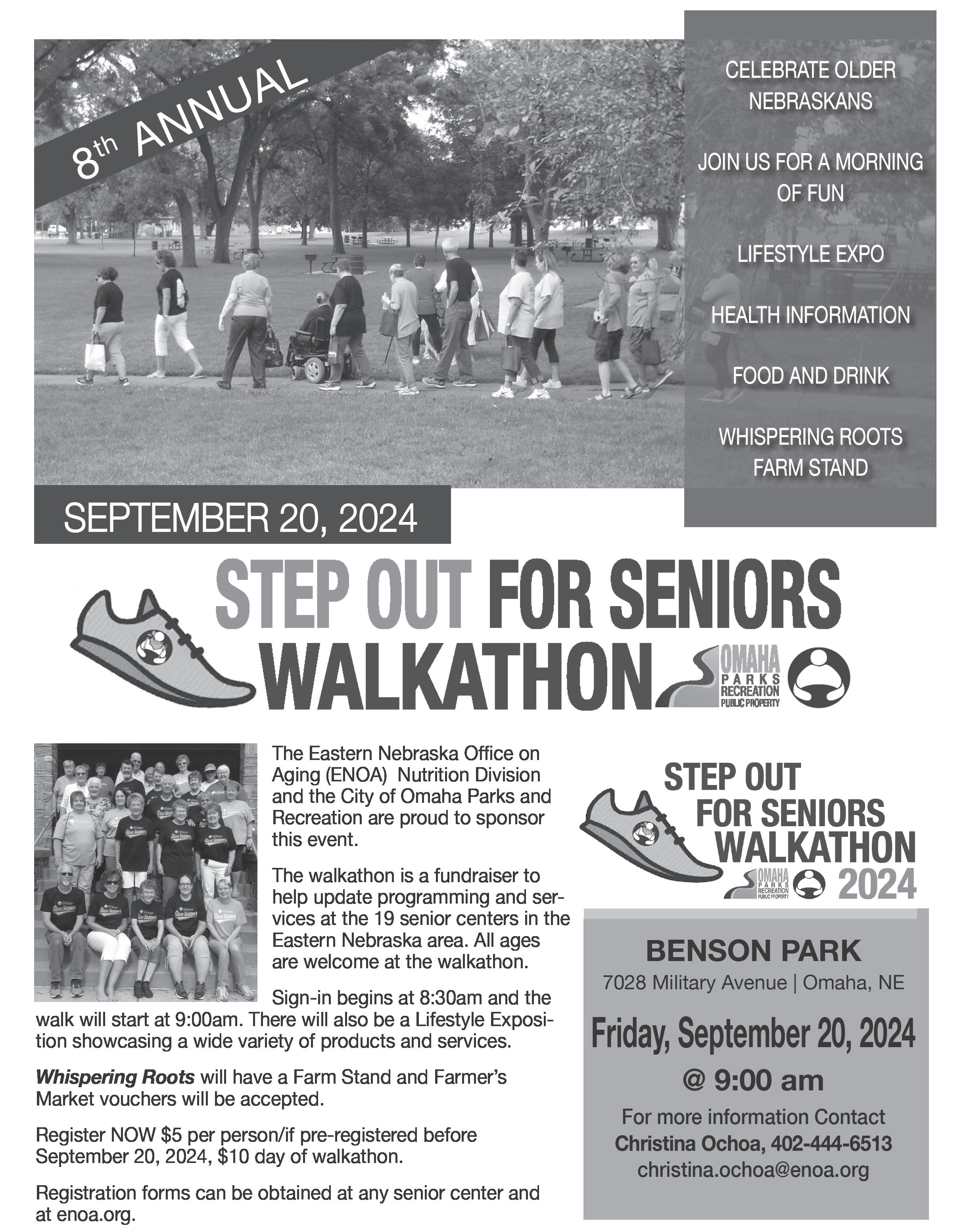
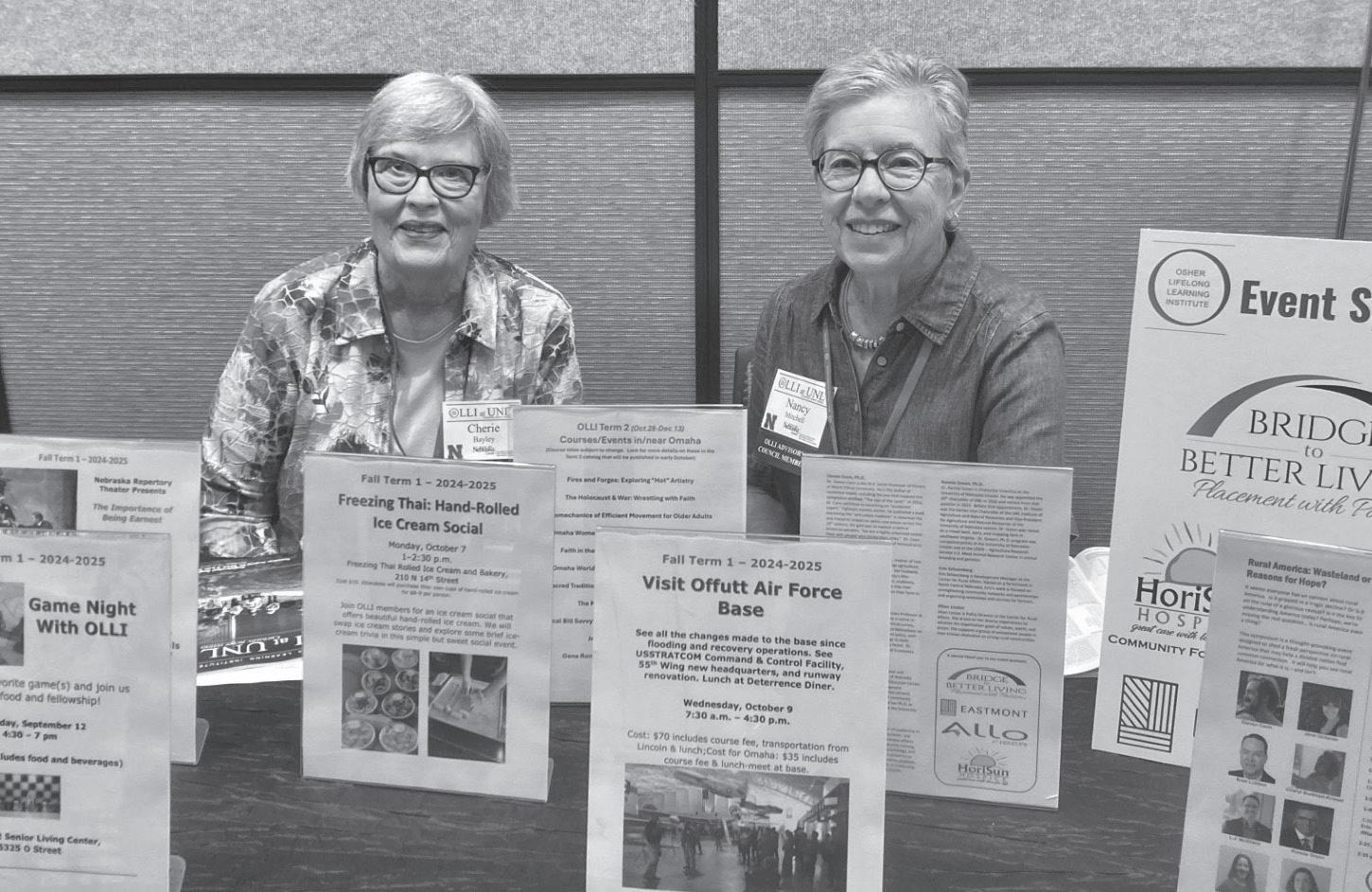
OLLI volunteers Cherie Bayley and Nancy Mitchell display information about special events sponsored by the institute throughout the year.
Nebraska chapter of OLLI has 1,600 members, the 12th largest affiliate in the United States, but just 200 are from the Omaha metro area.
OLLI offered 315 classes last year, attended by 12,000 participants. Classes met weekly for up to six weeks. The program is part of a national project that expanded to UNL in 2007. The showcase on the UNO campus unveiled ambitious plans to expand OLLI programming into the local market this fall.
The Omaha program will commence with a dozen offerings this fall, with more expected later. Examples of local courses in the works include:
• The Holocaust and War: Wrestling with Faith
• Biomechanics and Efficient Movement in Older Adults
• Omaha Women Who Led the Civil Rights Movement
• Faith in the Public Square: Politics and Religion
• Omaha World-Herald Archives: Stories and Photos
• Sacred Traditions: Exploring Native American Religion
• Touring The Malcom X Birth Site and Museum
• Medical Bill Savvy: Mastering Healthcare Savings for Seniors
More details will be posted at olli.unl.edu in early October.
Classes are taught by volunteer facilitators, including college professors, retired educators and subject-area experts.
Enrollees are called “members” who pay a $75 annual fee to attend unlimited classes and activities.
Individual class fees are also collected, ranging from $10 to $35, depending upon course length.
Michl, a retired Nebraska high school principal, has led the institute since 2020. He encourages Omaha area residents to submit suggestions for new classes. “Most of our ideas for classes come from the members,” Michl said. And many classes can be provided both in person and via Zoom. Although intended for lifelong learners over 50, the average age of Nebraska members is over 70. The two-fold purpose of OLLI, according to Michl, is to foster curiosity that keeps the mind sharp and focused, and to create a sense of community through social engagement.
Supplementing in-person classes are interest groups, special events, travel opportunities and pre-recorded classes that can be enjoyed anytime.
Interest groups are small communities of seniors who convene to learn from one another. Twenty-two groups explore their mutual hobbies and interests in subjects including art appreciation, baseball, biking Omaha trails, international affairs, gardening to name a few. Special events are onetime offerings that vary in length from two hours to a full day. Eight events are scheduled this fall. They include attendance at the Lincoln Symphony, a performance of “Hamlet,” and a tour of Offutt Air Force Base. In addition, a daylong symposium in Lincoln on Oct. 12 will address critical issues and opportunities facing rural America. Last
--OLLI continued on page 5.
Your eyes are to thank for reading these very words.
All of the sights you’ve ever seen—from memorably life-altering to utterly mundane—are a product of your trusty eyes and all the cones, rods and intricate hardware within them. While some may think of them as pesky, eye exams are crucial to keep your eyes in working order so you can experience countless more marvels. Read these reliable reminders on how sight affects your life, in both obvious and lesser-known ways.
How does seeing dictate satisfaction? At the very beginning of life, as an infant’s sight develops, so does its brain. With sight comes the ability to visualize—or picture things in your mind— and equally important is the ability to merge millions of visual stimuli into scenes your brain can comprehend. Therefore, it’s not surprising to learn that sight plays a sizeable role in your overall well-being.
Seeing an enriching sight can lower feelings of anxiety and cultivate your cognition in a unique way. On the other hand, when your vision declines or is entirely lost, it’s common to experi-
--OLLI continued from page 4.
year, OLLI staff and volunteers organized 48 events, said Michl.
Special event programming is a great way to “learn about interesting things that you didn’t know much about,” said Nancy Mitchell, a UNL professor and a five-year OLLI volunteer. “We need to get Omaha people to make suggestions” for special programs, Mitchell said.
Also popular with members are national and international travel programs designed in partnership with Star Destinations, an Iowa-based tour company. Four trips are planned in 2025, including a Rhine River cruise, an excursion to Philadelphia in anticipation of USA’s 250th birthday, a visit to Scotland and Ireland in August and a Smokey Mountain getaway in September.
Carol Myers chairs the UNL OLLI travel committee. She said the tours are capped at 30 travelers and fill up quickly. The small size creates a sense of community where “we all take
ence anxiousness, feelings of depression and a desire to self-isolate.
The University of Bath’s Psychology Department studied how blind-frombirth individuals perceive the world, and while their experiences are certainly different from those of sighted folks, the main takeaway is that their satisfaction in life still exists to the fullest.
Are there ways to elevate eyesight? Actively taking steps to prioritize your health goes a long way, which is why your annual exams—including for your eyes—are so crucial to your senses. Some natural ways of encouraging your eyesight are maintaining fitness, avoiding smoking or vaping, wearing sunglasses and managing chronic health conditions.
Also, the old wives’ tale that carrots boost your sightseeing abilities is indeed true! Eating well doesn’t just benefit your belly, but keeps your vision sharp. Start with a balanced diet that includes beta carotene: a form of Vitamin A that’s found in many yellow, orange and red fruits, vegetables and leafy greens.
care of each other,” she said.
Finally, OLLI offers 11 pre-recorded classes that can be accessed online anytime.
The 40 hours of on-demand programming can be viewed for $30. Samples include “Fascism, a Warning From History” (four sessions); “100 Years of Nebraska Memorial Stadium;” and “America’s Founding Fathers” (six sessions).
OLLI was founded in 2001 by Bernard Osher, a San Francisco businessman and philanthropist. Osher, now age 97, was the founding director of World Savings, once the second largest savings institution in the United States. OLLI’s headquarters is housed north of Chicago at Northwestern University.
To learn more about future opportunities in the Omaha area, or to become a member, access the website at olli.unl.edu.
“Omaha people have been asking for this,” said Charlyne Berens, co-chairman of UNL OLLI’s curriculum committee. “It’s such a great opportunity to make new friends and to meet new people.”
Throw in some omega-3’s for good measure and you may be seeing—and feeling—better than ever. What’s in an eye exam? A routine eye exam will test your vision and eye health, meaning your optometrist isn’t just ensuring that your prescription is correct, but also that your eyes and eye muscles are working as they should. Expect to read off a classic lettered “eye chart,” look through a special refraction device and have your peripheral vision checked.
Besides the obvious vision changes, an eye exam can also find anomalies that indicate high blood pressure, diabetes, elevated cholesterol or autoimmune diseases—which can save you future time, money and stress as you reach a conclusion or diagnosis that you wouldn’t have received without this brief checkup.
This health tip is brought to you by Tabitha.
The Eclectic Book Review Club, founded in 1949, is announcing its Fall 2024 schedule of author appearances. Each event includes readings and discussion by the noted book’s author. New members are being accepted. The monthly meetings, which include lunch and the author book review, are held at noon at The Field Club of Omaha, 3615 Woolworth.
To reserve a seat, call Jo Ann at (402) 571-5223.
Reservation deadline is the Friday morning prior to the Tuesday meeting. Authors for fall 2024 include:
• September 17- Stu Pospicil, Omaha World Herald feature writer will share reminiscences of 1949 as the Book Club continues its 75th anniversary celebration.
• October 15- Carla Ketner, author, and Paula Wallace, illustrator, will present Ted Kooser: More Than A Local Wonder. This book focuses on Ted Kooser, U.S. Poet Laureate emerita, as a youth celebrating the power of stories and finding oneself through words.
• November 19- Michelle Wieck’s mystery, Finding Maura, tracks the efforts to track down Maura after she leaves for remote get-away. Who doesn’t want Maura found?

Traditional funding sources are making it more difficult for ENOA to fulfill its mission. Partnership opportunities are available to businesses and individuals wanting to help us. These opportunities include volunteering, memorials, honorariums, gift annuities, and other contributions These gifts are tax exempt.
$34 = The cost of one emergency response system for a month.
$56 = The cost of two hours of respite care.
$93 = The cost to deliver one of forty-four meal routes daily.
$100 = The cost of meals for one senior center daily.
$208 = The cost of one person receiving a weekly bath for a month.
$335 = The cost of mileage for 20 volunteers.
$500

Please
$250
LaVon Stennis-Williams
$50
Mary Reid
$25
Linda Kay Hermesch
Glenn Irwin
$15
David Bang
$10
Jay Rosario
$5
Kathleen Koons
James Thompson
Life can bring on stress for many of us. Finding ways to relieve stress are important to our overall health and wellbeing. Caregivers are not immune to this stress.
Please contact Respite Across the Lifespan at edbennett@unmc.edu or 402-559-5732 to find out more about respite services and to locate resources in your area.
You’re invited to visit the La Vista Senior Center, located at 8116 Park View Blvd. The facility provides activity programs and meals Monday through Friday from 8 a.m. to 5 p.m. Please call 402-331-3455 for general Community Center hours.
Meals are served weekdays at 11:30 a.m. Reservations are due by noon the business day prior to the date the participant wishes to attend and can be made by calling 402331-3455.
A $5 contribution is suggested for the meal if you are age 60 and older. If you are under age 60, then the meal cost is $9.50.
In addition to meals being served daily, the La Vista Senior Center offers a variety of activities such as: Bingo, outings, cooking classes, movies with popcorn, arts and crafts, a variety of card games, quilting, tai chi, exercise classes, musical entertainment and various parties.
Please visit our website at cityoflavista.org/seniors for updated information or call 402-331-3455.
By Paula Crozier
As September ushers in the cool, crisp air of fall, it’s an ideal time for older adults to focus on their health and well-being in preparation for the colder months ahead. With the changing seasons, there are several steps you can take to stay healthy, safe, and comfortable as the weather transitions.
1. Get Your Flu Shot and COVID-19 Booster: Flu season begins in the fall, making it essential to get your annual flu shot. Additionally, consider getting the latest COVID-19 booster, especially if you’re at higher risk. Both vaccines can significantly reduce your chances of severe illness.
2. Review Your Medications: As colder weather approaches, it’s a good time to review your medications with your healthcare provider. Ensure you have enough supply, especially for conditions like arthritis, which may flare up in cooler temperatures.
3. Prepare Your Home: Make sure your home is ready for the winter months. Check that your heating system is working efficiently, and stock up on essentials such as blankets, non-perishable food, and medications. Ensure that walkways and stairs are free from potential hazards, such as wet leaves, which can cause slips and falls.
4. Stay Active Indoors: As outdoor activities may become limited, find ways to stay active indoors.
Simple exercises, like stretching or light weightlifting, can keep you flexible and maintain your strength during the colder months. There are plenty of videos online
and streaming channels.
5. Stay Connected: The fall and winter months can sometimes feel isolating, especially as the days grow shorter. Make an effort to stay connected with family and friends. Regular phone calls, video chats, or even safe in-person visits can help combat feelings of loneliness.
6. Check Your Nutrition: As the seasons change, so do your nutritional needs. Ensure you’re eating a balanced diet rich in vitamins and minerals that support your immune system.
Incorporate seasonal fruits and vegetables, such as apples, squash, and leafy greens, into your meals.
7. Dress in Layers: As temperatures drop, dress in layers to stay warm and comfortable. This allows you to easily adjust your clothing as needed when indoors or outdoors. Check your clothing and shoes for excessive wear and replace them with safer new items if needed. By taking these proactive steps, older adults can enjoy the beauty of fall and winter while staying healthy and safe. Remember, preparation is key to a comfortable and enjoyable season and outdoor exercise during calm weather is key to increasing endorphins and maintaining health.
Paula is the Director of Marketing and Development at Florence Home Healthcare Center, Royale Oaks Assisted Living and House of Hope Assisted Living and Memory Care. In her spare time, Paula is rediscovering all the things she did as a child that she can still do like painting, coloring, hiking and bike riding.
The Sokol Omaha Polka Hall of Fame will host its annual dance and induction ceremony on Sunday, Sept. 8 at The Admiral Theater, 13th and Martha streets. The doors will open at 2 p.m.
This year, Randy Skarka, Steve Hines, Greg Blecha, Donna Svanda, Charlie Svagera, John Armbrust and Joe Masek will be inducted. Dance to the sounds of The Milligan Czech Brass Band from from 3 to 5 p.m. The induction ceremony follows from 5 to 6:30 p.m. Food and beverages will also be available.
For more information, please go online to www. sokolomahapolka.com.
Some of you may have heard of the term “macro” in reference to tracking macros, especially when it is about eating healthy or losing weight. Macros are macronutrients, and your body needs these nutrients in larger amounts in order to function properly. Additionally, these nutrients provide your body with energy measured in the form of calories.
The three types of macronutrients are carbohydrates, proteins, and fats.
All carbohydrates break down into glucose which is your main energy source for your body and more specifically your brain. Not all carbohydrates are created equally so it is important to know the difference between simple and complex carbohydrates. Simple CHO are easy for your body to breakdown for energy or glucose and these are usually sweet such as honey, sugar, milk/yogurt, and fruit.
Complex CHO take more time for your
body to break down and are typically found in starches and grains: Rice, pasta, bread, and starchy vegetables.
Proteins main functions are to allow your body to grow, build and repair tissues, and protect muscle mass.
Proteins are composed of amino acids and there are two types: Nonessential and essential. Non-essential amino acids are not required to be consumed as your body can make these. Essential amino acids are required through your diet. Protein rich foods include meat, poultry, fish, egg, milk, cheese, or other types of animal byproduct foods.
Submitted by Karen Rehm, Wellness Services Manager, Nebraska Safety Council. To schedule a “Healthier & Happier You” presentation, contact Karen at 402-4832511 ext. 102 or send an email to Krehm@ nesafetycouncil.org.
You’re invited to visit the Fremont Friendship Center, 1730 W. 16th St. (Christensen Field). The facility is open Monday through Thursday from 9 a.m. to 3 p.m. and Friday from 9 a.m. to 12:30 p.m.
A meal is served weekdays @ 11:30 a.m. Reservations, which are due by noon the business day prior to the meal the participant wishes to enjoy, can be made by calling 402727-2815. A $4.25 contribution is suggested for the meal.
This month’s activities will include:
• September 4: Music with Johnny Johnson @ 10:30 a.m.
• September 5: Presentation from Nye @ 10 a.m.
• September 10: Nutrition Minute @ 10 a.m.
• September 11: Music provided by Merry Maker’s by Tim Javorsky @ 10:30 a.m.
• September 12: Mobile Library @ 9:30 a.m.
• September 12: Sing-along with Jeanne @ 10 a.m.
• September 18: Cinnamon Rolls provided from Nye @ 9:15 a.m.
• September 18: Music with Billy Troy @ 10 a.m.
• September 25: Music with John Worsham @ 10:30 a.m.
• September 26: Presentation on Anxiety @ 10 a.m.
Tai Chi offered every Tuesday and Friday from 9:15-10 a.m.
If you can’t stay for lunch with our friends and you currently participate in any activity at the center, you may now order a Grab-n-Go meal to take home for your lunch. Grabn-Go meals must be reserved the day before by noon and the person ordering the lunch must come in to the center to pick it up at 11 a.m. The number of Grab-n-Go lunches are limited to a first come first serve basis. Suggested donation is $4.25.
For meal reservations and more information, please call Laurie at 402-727-2815.
You’re invited to visit the Intercultural Senior Center (ISC), 5545 Center St.
The Intercultural Senior Center facility – open weekdays from 8 a.m. to 4:30 p.m. – offers programs and activities from 8 a.m. to 4:30 p.m. Monday to Friday.
The ISC offers a morning snack, and regular or vegetarian lunch.
Come and exercise at the ISC. It’s never too late to learn and have fun. Join their language classes, technology, jewelry and crafts, and field trip options. The garden is green and growing, volunteers are welcome. If people need assistance with their benefits, the ISC can help them out.
Enjoy coffee and chat every Friday between 2 p.m. and 4 p.m.
Lunch reservations are due by 9 a.m. A voluntary contribution is suggested for the meal. The dining room will have lunch available at 11:30 a.m., and after lunch, you can continue to practice your technology skills, attend crafts, and enjoy other fun activities.
Monthly food pantries are available for adults ages 50 and older.
For more information, please call 402-444-6529 or visit the ISC website at interculturalseniorcenter.org.
You’re invited to visit the Millard Senior Center at Montclair, 2304 S. 135th Ave., this month for the following:
• September 4: Board Meeting @ 9:30 a.m.
• September 9: Bunco @ 12 p.m.
• September 11: Senior Field Day
• September 18: Sewing Club @ 9:30 a.m.
• September 20: Multi Cultural Festival/Lunch @ 11 a.m.
• September 23: Book Club: “The Women” by Kristin Hannah @ 1 p.m.
Tai Chi on Mondays and Fridays @ 9:30 a.m.
Bingo every Tuesday and Friday @ 12 p.m.
Hand-N-Foot Wednesdays @ 8:30 a.m.
MahJongg Wednesdays @ 1 p.m.
Chair Volleyball Thursdays @ 9:30 a.m.
Dominoes Thursdays @ 12:30 p.m.
For more information, please call 402-546-1270.
When it comes to staying safe online, it usually helps to remember an old rule: “If it seems too good to be true, it usually is.”
Cybercriminals are trying to trick you into forgetting this simple rule by sending you phishing emails. The phishing emails say that you have an opportunity to win a prize, usually from a major organization or brand, such as Marriott, Costco, Lowes, and more.
The emails vary slightly in their content, but they all offer you the opportunity to win a prize by simply clicking a button and providing some personal information. However, the emails were sent by cybercriminals.
If you click the link, you will be directed to a webpage that they control.
If you enter any personal or financial information here, the cybercriminals will be able to see it immediately. You won’t win any prize from clicking the links, but
the cybercriminals will. They’ll be able to steal your data.
Follow these tips to avoid falling victim to a phishing scam:
• Major companies don’t usually give things away for free. Be very cautious of any unsolicited emails that offer something at no cost.
• Be very cautious when entering personal or financial information, especially after clicking a link in an email. If you need to enter your information online, make sure that you are on the organization’s official webpage.
• Look for signs of a phishing email. Most will contain a call to action, such as clicking a link in order to win a prize. If you aren’t sure about the legitimacy of an email, follow your organization’s policy for reporting suspicious emails.
For more information, visit KnowBe4. com.

not line up with his hopes for my life and the family legacy. He never wavered in that commitment.”
Soon after seminary and ordination, Barker worked at Trinity Cathedral in Omaha before leading COR. Then he pastored a small church in upper New York State. Soon after coming home to Nebraska he was elected right reverend (bishop) in 2011.
“I’ve become much more humble in many ways. I’ve realized the limits of my ability to influence or change anything by myself. I’ve come to be far more reliant on praying my way through the day, trusting God is in charge and will show up and do something.”
A controversial decision concerned the Tri-Faith Initiative, a then-fledgling interfaith campus of Christian, Jewish, Muslim congregations. “When I got elected the diocese was fully committed to being the Christian partner. My discernment was we had bitten off more than we could chew, so with real reluctance we gave up the significant status of being the Christian partner and handed it over to Countryside Community Church knowing they had resources we couldn’t match. I think history has proved it was a wise and faithful decision.”
Long before the Episcopal Church’s election of a new presiding bishop in July, Barker emerged as a serious candidate.
“I had known for years my age and experience level would place me in a relatively small group of bishops who were sort of natural candidates. So that had been on my radar. The church’s search and discernment process was quite extended. There were two years of active interviewing, writing and ultimately attending retreats, all of which culminated in the announcement that I was on the short list of candidates. So while not exactly a surprise it was still every bit an honor.
“It’s quite something to have the larger church recognize my ministry when I have mostly been in small places. I’ve made choices that have taken me out of the mainstream of Episcopal ascendancy, and I’ve stuck close to home. It’s remarkable the church saw what I was up to and was willing to gamble on me. It felt like a real affirmation of my life’s work.”
Barker said he was “excited” about the prospect of “embracing a really different adventure and having to learn a lot of new things” should he get the nod, which would have meant moving to New York City. He finished a distant second in the vote.
“To have that path blocked entirely and forever in one simple election has been somewhat difficult,” he said. “On the other hand, I get to stay home. I’m so clear that I have made a difference here and I will continue to make a differ-
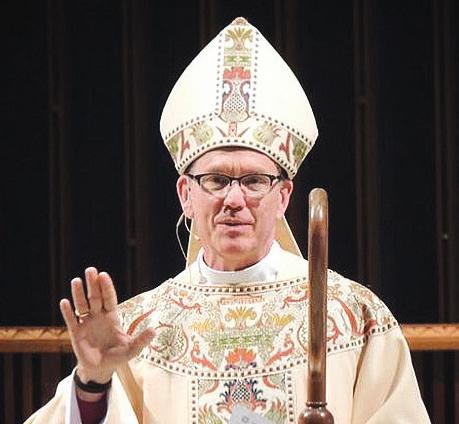
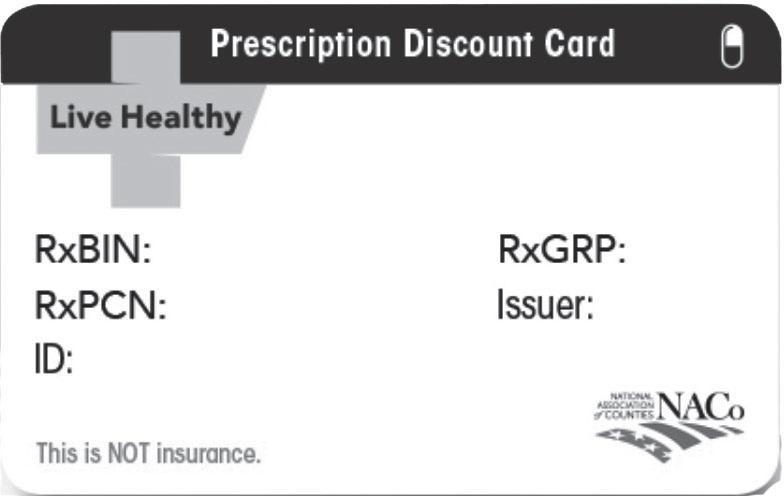
Bishop J. Scott Barker serves as the chief pastor of the 53 Episcopal worshiping communities planted across Nebraska’s 77,000 square miles.
ence here. I have such an affection for home. I feel so lucky to serve a place that I care so deeply about and that I understand so well.”
Bridging divides is what drew J. Scott to COR. “I felt like I could do something there that carried on that family legacy.” When he arrived in 1997, he said, “The hardest work had probably been accomplished in that the folks from both previous communities who could not align together had left. That had been painful and probably inevitable. But it was done, they weren’t coming back, and I didn’t have to fight that battle.”
What he did contend with was “paternalism” by some white members toward their Black brothers and sisters and universal “ambivalence” about being one church. “We hadn’t yet achieved a shared sense of being family.” Then there was the deepseated racism that had to be confronted.
“That was true of me, too,” he acknowledged. “For all my family’s progressive commitment to making Omaha a better place they were also fundamentally conservative. Around race the messages I got as a kid were people of color are special but also really different and part of our job is to lift them up and care for them. It was a really paternalistic and condescending message. And it was complicated. My parents had real friends who were people of color but they also employed people of color as domestic helpers. So my own upbringing is tinged with constant messages about race that are racist. It took years to uncover, unpack and recover from it. And the people at Resurrection changed me. That’s why I feel so strongly about that community.
“The Black members especially were tolerant and welcoming of my efforts to learn and to grow, but I know they put up with some idiocy as I was learning about what it was to be Black in Omaha.”
For counsel, he said, “I intuited the only sensible choice for a senior warden was an African-American woman because I saw within moments of arriving that the most powerful leaders in the community were the older women of color.”
COR’s women leaders, Black and white, led the way.
“The real work of overcoming racism and becoming the beloved
community Dr. King talked about happened in that small circle of powerful women who loved their church so much that they were willing to figure out how to love one another despite some freight of history. They inspired the rest of us to become who we became. They were very patient and incredible coleaders.”
Said Barker , “I figured out the job of a priest in that setting was to nurture, celebrate and amplify the gifts of the lay leaders rather than thinking everything was in my hands. So I was able to be a more collaborative and supportive leader than I might have been otherwise. That was key.”
Leading tiny COR came with baggage. “It was small enough that a lot of my peers looked down on it. We were constantly scraping for money and other resources. It wasn’t a job with a lot of status. But it was so delightful. The people were so sincere about loving one another and trying to journey in their faith life in a way that would change or shape them. And the parish got recognition for the hard work we were trying to do, so that was gratifying. My older colleagues saw we were doing a special thing.”
Despite race being foundational to COR’s identity, he said, “I was fearful about too directly addressing issues of race from the pulpit for a long time because I was aware of the pretty deep stream of racism still present in the congregation. I wasn’t quite sure how to speak about that in a way people would be able to take in. I was afraid I would do more harm than good.
“Then there came a time when I decided it was time to take the risk. Resurrection was invited to do structured work around racism promoted by the larger church. I was like, I know we look like the church that should do this, but I’m afraid to do it. That’s when I realized it was time to do it. That’s the story I told when I finally preached a sermon that became a very important turning point for the congregation. I said, ‘This is our work more than anybody else’s and I’m afraid to do it,’ and I shared really clear expressions of racism I had seen in the shared life of the parish.
“I think the thing I said that struck a chord in everybody is, ‘You know, we’re a black church.’ Because of the nature of how race is understood in America if you’re a church with an ascendent African American community that celebrates its culture than you’re a Black church. Naming Resurrection a Black church felt liberating. And it was challenging, especially to the white folks. They didn’t want to hear that. But I think on a deeper level that’s how they conceived of it, too.”
Barker’s own education about racism predated the larger Episcopal church’s acknowledgment that “issues of class, culture and race have sinfully infected the institution,” he said. Its first Black presiding bishop
Michael Curry advanced Sacred Ground as a racial reconciliation program for members.
“I’m so proud we’re working on that in such deep ways now,” Barker said, “but I’m also embarrassed it’s such a long time coming because it’s so clearly a sinful deficit of our community. I learned early on at Resurrection a hopeful narrative that we can overcome that as an institution.”
Sacred Ground has found traction in Nebraska. “What an extraordinary thing the Diocese of Nebraska has a higher percentage of Sacred Ground graduates than any diocese in the entire Episcopal Church. That’s not the story anybody would expect about politically bright Red Nebraska, yet our people keep flocking to this program. And when they get through it they’re activated to change how they are in the world and how their church looks. That’s totally the work of the Holy Spirit addressing this ancient ill that’s been a part of who we are for too long.”
Though 53 worshiping communities across 77,000 square miles fall under his domain, he said, “It’s not so much that I don’t know people when I walk in the door of any church I visit.”
Each time he visits COR, he said, “It certainly feels like a profound homecoming. Partly that’s because it looks, smells, feels the same and I speak from the same pulpit where I spent so many beautiful, formative years. Even though it’s been decades now I look out on familiar faces who’ve been so supportive of me across the years in helping me to grow and thrive. Many people I knew there are gone now but I still feel their presence. Visiting Resurrection is about the communion of saints.”
The diocese is committed to having a strong Black parish but he’s aware COR struggles with meager finances and dwindling numbers that mirror the challenges of other small parishes.
Surrendering to the belief that what should be will come to pass, he said, is “the inevitable last season of a sincere religious vocation.”
“You will inevitably get to a point where the only thing that makes sense is to embrace God’s mystery and paradox because you’ve lived so long with the tension of the big theological questions going unresolved.”
Long known as a welcoming place, COR continues being a mixed race church.
Whenever Barker steps down as bishop, he may opt to return to his humble roots.
“Lots of bishops retire and then work part-time back at the parish level as essentially a parish priest,” he said. “There are days when I entertain that fantasy because this job is so demanding. I’m also sure I’m looking with rose-colored glass because parish work is challenging, too. But it’s possible I’ll return to a church like Resurrection to finish my career doing daily pastoral ministry.”
By Ron Petersen
There are special concerts and then there are memorable concerts.
Cheri Moore isn’t going to forget the first time she performs outdoors with her granddaughter.
“I’ve been trying to get her to join the orchestra for years,” Moore said.
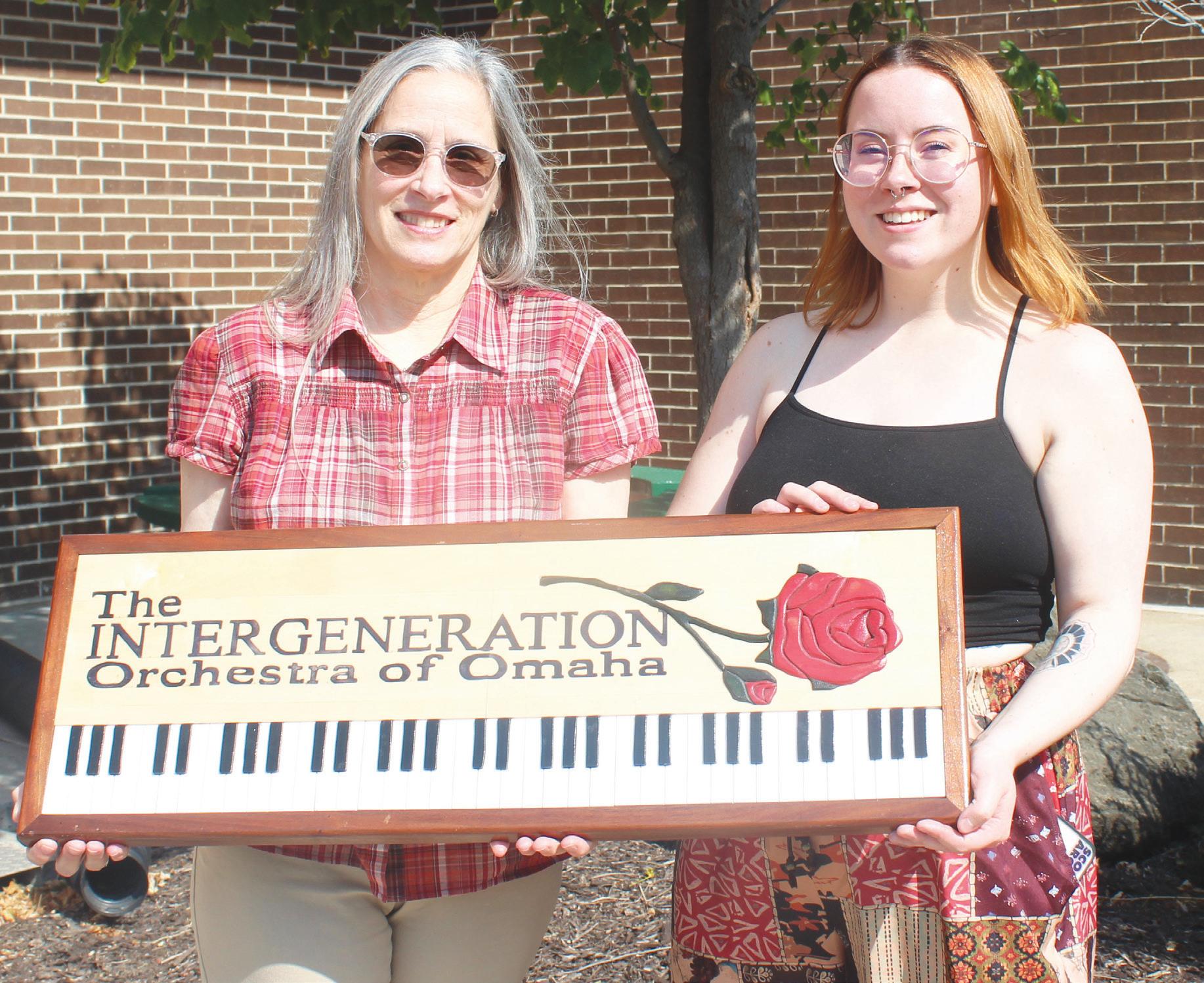
The 16-year member of Intergeneration Orchestra of Omaha is incredibly close to her granddaughter Julie Cheek, a 21-year-old who hasn’t performed in front of an audience since she was in high school.
“I’ve missed performing but now I am excited to be able to get to do it again,” Cheek said.
The Intergeneration Orchestra of Omaha is a unique musical ensemble that consists of musicians that are either age 50 and older or age 25 and younger. There are no minimum or maximum age restrictions in the ensemble.
“It’s like an age gap musical group — there’s a lot of different kinds of people with different backgrounds, with different years of practice and skill levels,” Cheek said.
Moore uses her violin skills to contribute to the group, while Cheek is a vocalist.
Moore sticks with the violin because she said many musicians have different talents, so she plays what she knows best.
“We have people from all walks of life, and we’ve been a growing orchestra for years,” Moore said.
It’s going to be a little different experience for Cheek, with this being her first time performing in an orchestra. Cheek has performed in three different choirs while in school, along with participating in the marching
band.
Moore noticed that her granddaughter found a little more free time to do something different, and she knew that the Intergeneration Orchestra of Omaha was a perfect fit.
“I’ve been trying to get her in for years,” Moore said. “It will be exciting to play alongside her.”
That is a different story for another duo in the group.
Cathryn Jordan, and her mother Carolyne, have been performing in the orchestra for years and have decided to come back for another season.
“My mom isn’t as independent as she was once was, so we go together and perform together, which is something we look forward to every year,” Cathryn Jordan said. “My mother has performed in the orchestra for over 30 years, so it was great when I was able to
Legal Aid of Nebraska operates a free telephone access line for Nebraskans ages 60 and older.
Information is offered to help the state’s older men and women with questions on topics like bankruptcy, homestead exemptions, powers of attorney, Medicare, Medicaid, and Section 8 housing.
The number for the Elder Access Line is 402-827-5656 in Omaha and 1-800-527-7249 statewide.
This service is available to Nebraskans ages 60 and older regardless of income, race, or ethnicity.
The Legal Aid of Nebraska hours of operation are 9 a.m. to noon and 1 to 3 p.m. Monday through Thursday, and 9 a.m. to noon on Friday.
join her in the group.”
Cathryn is known for playing the flute, while her mother is a vocalist. They’ve been practicing and performing together for years, and even last year they sang a duet together.
“It’s been really nice to be able to play the flute while
she sings,” Cathryn Jordan said. “It was a very fun thing to do, because I don’t know how many more years she wants to sing in the orchestra.”
Rehearsals for the Intergeneration Orchestra of Omaha started in August as they prepared for concerts
that start in September.
“This orchestra is like a second home for me,” Moore said. “I am excited to get it going again.”
IGO 40TH SEASON
September 15
Crown Pointe 2820 S 80th St. Omaha, NE 68124
October 20
Aksarben Senior Living 1330 S 70th St. Omaha, NE 68106
November 17
Immanuel Senior Living 6803 N 68th Plz. Omaha, NE 68152
February 16
Douglas County Health Center 4102 Woolworth Ave Omaha, NE 68105
March 16
Homestead of LaVista 8507 Granville Pkwy LaVista, NE 68128
April 13
Pops & Pie: Omaha Conservatory of Music 7023 Cass St. Omaha, NE 68132
All concerts will begin at 2 p.m.

Each September, Pain Awareness month gives us an opportunity to reflect on the needs of the millions of people with chronic pain, as well as the research that we hope will better prevent and

Chronic pain is highly persistent, with almost twothirds (61.4%) of those who reported chronic pain in 2019 still reporting chronic pain a year later. There are more new cases of chronic pain in the United States per year than new cases of hypertension, depression or diabetes, according to research from the National Center for Complementary and Integrative Health (NC-
NIH supports a highly integrated, comprehensive research portfolio to address this pressing need.
U.S. Pain Foundation on a webinar series connecting researchers with those living with pain.
• Do you have questions about the Eastern Nebraska Office on Aging, its programs, or services?
• Do you have a comment about the agency and how it serves older adults in Douglas, Sarpy, Dodge, Cass, and Washington counties?
• Do you have a story idea for the New Horizons newspaper, or would you like to receive a FREE copy each month?
Please send your questions, comments, and story ideas to:
The National Institute of Neurological Disorders and Stroke (NINDS) is one of many NIH Institutes, Centers, and Offices (ICOs) committed to understanding, preventing and treating pain. Because pain is a crosscutting health problem, the ICOs work together to find solutions, including through the NIH Pain Consortium and the NIH Helping to End Addiction Long-term ® Initiative, or NIH HEAL Initiative®. Together, we strive to bridge the gaps between basic research, clinical trials, and implementation science towards meeting the needs of people living with chronic pain and co-occurring conditions.
Importantly, NIH’s pain research efforts are guided by the wisdom and experience of those living with pain. A key priority of our current NINDS Strategic Plan is to increase patient engagement throughout the research process. None of this work would be possible without the expertise of those who live with pain, including the HEAL Community Partner Committee (HCPC) and others who advise individual studies, as well as the people who volunteer to participate in studies and clinical trials. The NIH HEAL Initiative® recently launched a web page to promote patient and community engagement efforts and provide resources for researchers to help them involve “experience experts” as advisors and partners to their studies. During Pain Awareness month, NIH is partnering with the
While pain is both a broad public health issue that we must work as a nation to address, it is also a series of individual circumstances that necessitate an individualized and whole-person approach to pain management. Each year, the NIH Pain Consortium hosts a symposium to highlight NIH-funded research related to pain. This year, we focused on Resilience and Pathways to Recovery, and on how whole-person health and a person’s environment affect pain. Members of the pain community shared their research showing how experiences with pain are unique and influenced by their social and physical environment, as well as the condition causing the pain, their genetic makeup, and their lived experience.
Research from across the ICOs is improving our understanding of the biology underlying different pain conditions, identifying potential pain targets, and elucidating mechanisms that cause pain or deliver relief, and testing new treatment approaches:
• Researchers funded by NINDS and our partnering ICOs are uncovering potential new cellular targets that influence pain, identifying new molecules that could provide alternatives to opioids, and adapting known therapeutics in a way that might make them more effective against pain receptors.
• These new discoveries include identifying pathways in mouse models that can modulate pain-related behavior, and the brain circuitry that underlies how sound provides pain relief. Other research has found promising new targets that could ease chronic visceral pain. And researchers are finding promising new molecules that could lead to nonopioid pain therapies, and improving existing drugs in a way that could help better treat pain.
• Further along the research spectrum, clinical trials are building on advances made in preclinical research and are using novel technologies to reveal more about the pain experi-
ence and pain treatments. For example, a randomized clinical trial used imaging to show what parts of the brain played a role in providing the pain relief when engaging in mindfulness meditation. And in a small, early-stage study, a team of multidisciplinary researchers were able to identify signals in the brain that predicted chronic pain severity. Their findings suggest that a region of the brain called the orbitofrontal cortex might be an important mechanism in the perception of chronic pain.
This last research finding is a great example of cross-NIH ICO collaboration at work – the tools for measuring brain activity were developed by the NIH BRAIN Initiative, and the study was additionally supported by NIH HEAL Initiative® funding to develop innovative devices for pain treatment. Neuroimaging research can supplement a person’s self-report of pain to find brain-specific causes of pain and to provide new research directions.
In September, amid our search for safe and effective pain management approaches, we must also acknowledge the opioid crisis that continues to evolve in dangerous ways. Just a few weeks ago, we recognized the last day of August as Overdose Awareness Day, and September is also National Recovery Month. Overdoses and rates of substance use disorder have increased dramatically, further highlighting the need for alternatives to opioid analgesics. Research funded by our federal partners both at NIH and at other agencies show promising trends, but more must be done. The use of non-pharmacological treatments for those with chronic pain has been increasing, and more research is needed to maximize their efficacy. Broadening the availability of non-opioid treatments will empower people living with chronic pain to work with their providers in choosing the most effective and safest approaches to manage their pain.
To keep up the pace of discovery, we need to grow and support the pain research workforce and
Welcome spring and create continuous color for several months with a collection of spring-flowering bulbs. After planting in the fall, you’ll enjoy an array of flower colors that combine nicely with other spring-flowering trees, shrubs, and flowers.
Start the season with early blooming snowdrops. As winter fades watch for the dangling white flowers on six- to ten-inch-tall plants. Include these small flowers in rock gardens, mixed borders, and informal landscapes in sunny and part-shade locations. Include a tapestry of colors with white, purple, lavender, and yellow crocus. Large Flowering Pickwick crocus offers unique blooms of white flowers with purple pinstripes. Its striped petals surround the red-orange stamens making this a standout in any planting. Crocus are a favorite of critters as well as gardeners so consider protecting them with a repellent as the leaves emerge in spring. Look to early, mid, and late spring blooming tulips and daffodil varieties to maximize the color in your landscape throughout the spring. Check catalog descriptions and package labels to help you select an array of bloom times. Longfield Gardens’ Bloom Times Guide to Spring and Summer Bulbs (LongfieldGardens.com) can also help you plan for three months of color in your landscape. Look to Emperor, Kaufmanniana, and Greigii tulips for a bit of early spring color. Add some fragrance and showy, peonylike flowers with Double Early Foxtrot. This awardwinning tulip has sturdy, weatherproof stems that support its loosely cupped flowers.
Its petals contain a range of pink shades from white

The late spring blooming bulb Purple Sensation allium has four-inch round purple flowers and is critter-resistant.
to deep rose.
Plant some Darwin Hybrid and Triumph tulips for mid-spring color in the garden. The two-toned flowers on Apricot Impression seem to glow and as a Darwin hybrid, they will have a long-lasting presence in your garden. Finish the spring season with fancy ruffled parrot tulips, fringed and lily tulips, and more single and double late bloomers. You’ll enjoy the extended show and late spring flowers to enjoy in arrangements.
Don’t overlook daffodils. You’ll find a variety of flowers with long, short, large, and split trumpets. Daffodil flowers may be one color, or the trumpet may be a different color than the color of the surrounding petals. Double varieties add a unique look to any garden. The earlyto mid-spring blooming Cyclamineus Tete-a-Tete daffodil may be small in stature at seven inches but the bright yellow flowers and three blossoms per stem make it visible from a distance.
Combine some Armenian grape hyacinths with midspring blooming tulips, daffodils, and perennials. Their small, cobalt-blue, fragrant flowers last weeks and look good wherever
Pain Awareness continued from page 10.
continue a commitment to the inclusion of unique perspectives in the research community. NINDS and the NIH HEAL Initiative® have developed several programs to help pain researchers gain more experience and connect with potential mentors and other scientists across the research spectrum. The PURPOSE Network (Positively Uniting Researchers of Pain to Opine, Synthesize & Engage) is a career development network that organizes an annual meeting and provides a collaborative online space for pain researchers to learn
they are planted.
Bridge spring and summer flower seasons in your garden with Purple Sensation allium. This late spring blooming bulb has fourinch round purple flowers high atop 24 to 30” stems. These reliable bloomers are critter-resistant like daffodils and grape hyacinths. Enjoy them in your garden, fresh bouquets, and dried flower arrangements.
Make this the year you select and do some fall planting of various early, mid, and late spring flowering bulbs. You’ll be rewarded with a burst of early spring color and sustained beauty from a mix of spring flowering bulbs.
Melinda Myers has written more than 20 gardening books, including the recently released Midwest Gardener’s Handbook, 2nd Edition and Small Space Gardening. She hosts The Great Courses “How to Grow Anything” DVD instant video series and the nationally syndicated Melinda’s Garden Moment TV & radio program. Myers is a columnist and contributing editor for Birds & Blooms magazine and was commissioned by Longfield Gardens for her expertise to write this article. Her website is www. MelindaMyers.com.
about new pain funding opportunities, career opportunities, peer networking, and ongoing education and training.
The pain research community is more aligned than ever, but we still have a long way to go. NINDS and the other Institutes, Centers, and Offices across NIH are committed to listening to patients, communities, and scientists – towards ensuring that we support research that will improve our understanding of and deliver effective new treatments for pain.
(Information provided by National Institute of Neurological Disorders and Stroke).
The Eastern Nebraska Office on Aging’s (ENOA) Senior Companion Program and Foster Grandparent Program will be hosting two meet and greet events in September.
Learn more about the Senior Companion Program and Foster Grandparent Program during a meet and greet at the Intercultural Senior Center on September 4 from 12-2 p.m. The Intercultural Senior Center is located at 5545 Center St. in Omaha.
The Plattsmouth Senior Center is also hosting a meet and great on September 18 from 11 a.m. to 12 p.m. The Plattsmouth Senior Center is located at 308 S 18th St. in Plattsmouth.
Contact Abby Wayman at 402-444-6503 for more information.
You’re invited to visit the Ralston Senior Center, 7301 Q St., Suite 100 this month for the following:
• September 4, 18 & 25: Bingo @ 12:15 p.m.
• September 11: Board meeting @ 9:30 a.m.
• September 11: Music provided by Billy Troy from Merrymakers @ noon
• September 12 & 26: Bingo @ 1 p.m.
Lunch is catered in on Wednesdays @ 11:30 a.m. A $5.50 contribution is normally suggested for the meal. Reservations are due by noon on Tuesday. Games and bingo will be played after lunch. Contact Darla @ 402331-1529 for reservations. Obtain an annual Ralston Senior Center membership for $10.
Contact Ron Wilson @ 402-734-3421 for further information.
Discover tranquility amidst the trees during Yoga at the Forest each Sunday.
Each Vinyasa-style yoga class will incorporate a blend of mindful movement and breath work, all guided by experienced instructors.
Whether you’re a seasoned yogi or new to the practice, our inclusive classes cater to all levels, fostering a supportive community where everyone can thrive.
Session will take place at the Nature Center, either outside on the lower plaza or inside the Forest Room.
Also, are you ready to get outside after the work week?
Grab your friends, coworkers or significant other and come wind down during our Sunset Hike. This hike will explore the gravel and dirt trails near the Nature Center then head to the third loop of the Boardwalk to watch the sunset over the Missouri River.
By Dr. Lindsay Huse, Director of the Douglas County Health Department
The Douglas County Health Department (DCHD) aims to serve everyone in Nebraska’s most populous county. In this column for New Horizons, we will look at what seniors might be thinking about as summer turns into fall.
This is a good time to remind everyone,
as we did last month, that the flu season is close and now is the time to consider getting a flu shot. The
seasonal influenza can be especially hard on those who are 65 and older, so please take this seriously. It takes two weeks for the vaccine to become effective. DCHD begins monitoring the flu in October.
Fall also brings with it the potential for slippery conditions from rain or an early frost. Avoid the risk of falling at home by removing tripping hazards, enhancing the lighting, and using nonslip mats.
Stay active within your limits to help manage chronic disease. Cooler temperatures can affect chronic conditions like arthritis and with that joint stiffness. Be aware of how your body feels daily.
It’s known as SAD which stands for Seasonal Affective Disorder. As we experience less daylight there can be a change in moods or even depression. Be aware, stay engaged in your favorite activities, and don’t be ashamed to ask for help.
Don’t let the change in seasons let you alter your healthy eating habits. Remember to include fruits and vegetables in your balanced diet, and stay hydrated, even in cooler weather.
And, given what we’ve been through so far this year, pay attention to the weather. Who knows what’s in store.
Enjoy the fall.
Nebraska’s new voter ID law (LB514) requires all registered Nebraska voters to present a photo identification (ID) when voting in an election in the state of Nebraska.
Every election in Nebraska after the May 2024 primary will require voter ID.
Photo IDs:
• Nebraska driver’s license (from DMV).
• Nebraska state ID (from DMV).
• Nebraska college ID (public or private).
• Nebraska political subdivision ID (state, county, city, school, etc.)
• United States Passport, Military ID, Tribal ID, Hospital, assisted-living facility or nursing home record.
ID must have your name and photo. ID can be expired.
How voter ID will work:
• Voting in person at the polls: Present a photo ID or vote provisionally.
• Voting early at the election office: Present a photo ID or vote provisionally.
• Voting early by mail: Write driver’s license/state ID number on ballot application or enclose a copy of photo ID or reasonable impediment certification with your ballot application.
• Voting in by-mail precincts or by-mail special elections: Write driver’s license/ state ID number on ballot return envelope or enclose a copy of photo ID or reasonable impediment certification in your ballot return envelope.
Active-duty military members, activeduty military spouses, and citizens overseas covered by UOCAVA (Uniformed & Overseas Citizens Absentee Voting Act) are exempt from voter ID.
If you cannot get an ID due to disability/illness, religious objection to being photographed, or lack of documents to obtain a free state ID, you can complete a reasonable impediment certification.
Visit VoterID.Nebraska.gov for more information.
By Tony Harris AARP NE Information Center
Did you know that each year Medicare gives beneficiaries a chance to review their coverage and make any changes that will help them get the most out of their Medicare benefits? Unfortunately, experts say too many enrollees overlook this annual opportunity to possibly save money and improve their coverage.
On September 18 at 1:30 p.m., anyone is invited to attend the AARP Ne-

braska Information Center’s monthly program to hear from experts from Volunteers Assisting Seniors who will talk about what you need to know about the 2024 Medicare Open Enrollment period and why it is important to review things like your prescription drug coverage every year. They will also talk about the latest Medicare-related fraud and scams and ways that you can keep yourself
protected.
Located at 1941 S 42nd St. in suite 220, the Information Center is open on Tuesdays, Wednesdays and Thursdays from 10 a.m. until 4 p.m.
If you are interested in becoming more involved, stop by the Information Center to learn more about the many opportunities to get involved in the community by becoming an AARP Nebraska volunteer.
For more information call the Information Center at 402-916-9309.
Cybercriminals are sending out phishing emails that claim to be from many different banking organizations.
By impersonating different banks, the cybercriminals hope to trick even more people into clicking on malicious links. The emails all have different images and text, depending on which bank the cybercriminals are impersonating. However, all the emails claim that you need to take urgent action and download an attachment.
No matter which email you receive, there will be a link to an attachment.
If you click the link, the attachment will download and display a clickable image of a PDF logo. If you click the image, malware will begin installing on your device.
--Coverage continued from page 1.
pocket spending cap, replacing the 70% price discount in the coverage gap phase under the current benefit design.
What does that mean?
Part D beneficiaries who are spending more than $2000 a year on their prescriptions is going to be happy, so this will be good for approximately 4% of the Part D population. The other 96% will likely be pitching in on this in the form of higher Part D premiums, drug formulary changes, more utilization management, more step therapy, and potentially decreased Medicare Advantage ancillary benefits. (According to KFF. org, in 2021, 1.5 million out of 39 million on Part D paid more than $2000 for their prescriptions.)
It was starting to get ugly. Some standalone drug plans are leaving the market in 2025. Several Medicare Advantage companies are reducing their footprint and have announced changes to their benefits to compensate for increased costs of the drug coverage. The national average bid amount for Standalone Drug Plans increased from $64.28 in 2024 to $179.45 in 2025. However, on July 31, 2024, after CMS (the Center for Medicare and Medicaid services) received the initial bids from the drug companies and perhaps realized that the good intentions of the Inflation Reduction Act may have the bad result of beneficiaries not enrolling in the higher cost plans at all, CMS introduced “Voluntary Part D Premium Stabilization Demonstration.” In a nutshell, there is a new rebidding process happening at the time of this writing, and agents and beneficiaries are now a little more hopeful that the Drug premiums won’t be as negatively impacted as originally
This malware can then gather personal data and financial information and even steal email addresses from your email inbox. The malware can then send similar phishing emails to all of your email contacts. Follow these tips to avoid falling victim to a malware scam:
• Scammers rely on creating a sense of urgency to trick you into clicking on links. If you receive an unexpected email, always stop and think before you click.
• In this situation, the email claims to be from your bank. Instead of clicking on a link in the email, you should contact your bank directly to verify if action is needed.
For more information, visit KnowBe4. com.
projected.
This will be good for the beneficiaries: Another big change with the 2025 plans that will help those on higher cost drugs is known as the Smoothing/MP3/ Medicare Prescription Payment Plan: Patients must be given the option to pay for their out-of-pocket prescription costs in monthly installments, with a monthly limit on spending.
This monthly payment plan will be set up with the Insurance company, and not with the pharmacy. Enrolling in the Medicare Prescription Payment plan is optional. The pharmacy will inform the enrollee about the program and provide the “Medicare Prescription Payment Plan Likely to Benefit Notice.” The plan does not cover Part B drugs or medications not listed on the member’s plan formulary. Once beneficiaries opt into the program, their insurance carrier will distribute their prescription drug costs over the remaining months of the plan year, eliminating the need for payment at the pharmacy.
Note: This monthly Medicare Prescription Payment Plan program does not reduce the amount of money that an individual pays in annual out-of-pocket costs; it helps individuals with high costs spread those costs out throughout the plan year. The Medicare Savings Programs and Medicare’s Part D Low Income Subsidy (also called LIS/Extra Help) are programs that help reduce costs for individuals who qualify based on
income and resource limits, individuals are strongly encouraged to check their eligibility for these programs before they consider enrolling in the Medicare Prescription Payment Plan.
As before, grants will still be allowed to be counted towards the TrOOP (True Out Of Pocket Costs) in 2025. If you apply for a grant and are approved, the prescription will be processed through your insurance first, then to the grant. The grant money can be used to pay your drug deductible, copay, and coinsurance.
The amount paid by the grant, on your behalf, counts towards your true out of pocket costs (TrOOP), so it is possible to reach the catastrophic level although you are paying little to nothing for the medication. If/when you hit the catastrophic level, all of your formulary medications will be zero for the remainder of the year.
New plan information for 2025 will not be available until October 1st 2024. Your agent or SHIP counselor is going to be busy and backlogged. Make your appointment now for after October 1st. Changes can be made between October 15th – December 7th 2024 for January 1st, 2025. If you miss reviewing your plan and you’re on a standalone drug plan and get surprised in 2025, you won’t be able to make any changes until the following year. If you’re on a Medicare Advantage plan and get surprised after the first of the year, you have an additional window to make changes January 1st to March 31st for the following month. Good luck. And here’s to all your changes in your plan being good and not bad, nor ugly.
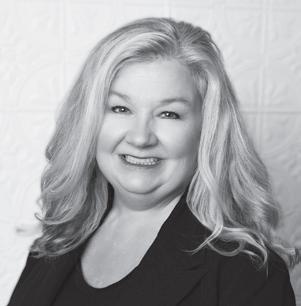
Mary Hiatt is President of Mary the Medicare Lady at www.hiattagency.com, mary@hiattagency.com or call or text 402-672-9449.
You’re invited to visit the Camelot Friendship Center, 9270 Cady Ave., for regular activities, which include Chair Yoga, card games, Tai Chi, Pinochle, 10 Point Pitch, and bingo. This month’s events include:
• September 10: Early Bird Decoration & Bake Sale @ 10 a.m.
• September 11: Meal Site Closed – Senior Field Day @ Mocking Bird
• September 12, 13: Decoration & Bake Sale Finale’ @ 10 a.m.
• September 12: Presentation with Archwell Health “Managing Downsizing & Life Changes” @ 11:45 a.m.
• September 13: “Camelot Team Spirit Day” – wear your favorite team shirt or hat
• September 17: Elder Law Presentation @ 11:45 a.m.
• September 19: Billy Chrastil Performes compliments of Merrymakers @ 11:45 a.m.
• September 20: Meal Site Closed – WALKATHON @ Benson Park @ 8:30 a.m.
• September 25: Presentation “Using Technology to Stay Connected” @ 11:45 a.m.
• September 27: Celebrate Broadway with our Tuesday Tappers @ 11:45 a.m.
• September 27: Book Club @ 12:30 p.m.
No Tai Chi July 3, 4, 9, 11, 16 & 18
Every Wednesday – Chair Volleyball @ 10 a.m.
Every Monday – Card Game: Manipulation @ 10 a.m.
Every Monday – Pickleball @ 10 a.m.
Grab N Go meals are available.
For more information, contact Barb at 402-444-3091 or barbara.white@cityofomaha.org.
You’re invited to visit the Florence Senior Center, 2920 Bondesson St.
At the Florence Senior Center, lunch is served at 11:30 am. A select menu is offered Monday thru Friday. Meal reservations must be made one day in advance. Please call by noon the day before for a meal reservation. The center hosts activites such as Tai Chi, annual picnics/special events, bingo, cards, gym & game room access, special guest speakers and socials. They also provide health and nutrition programs. For more information, please call Colleen Metz @ 402444-6333.
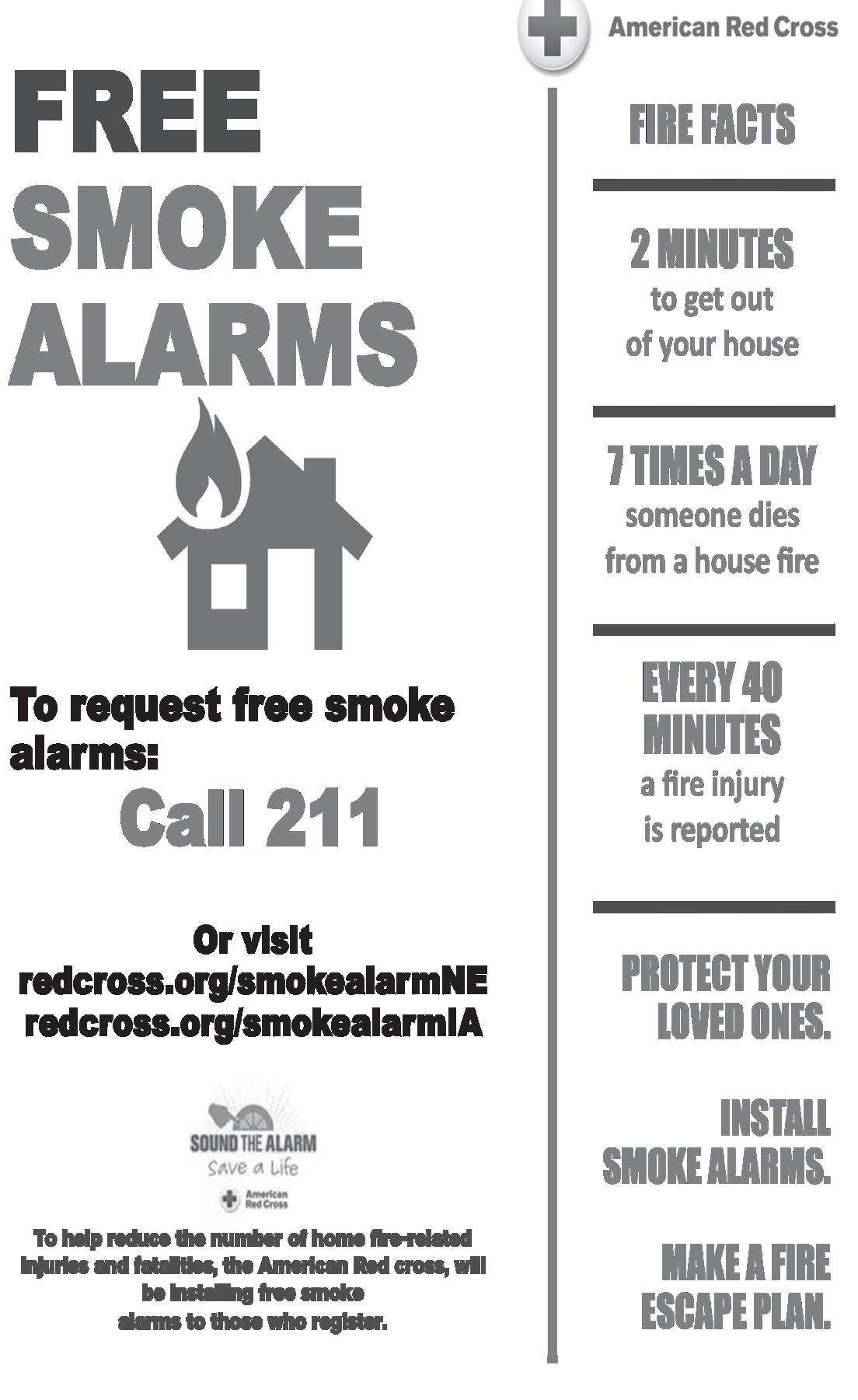
Although Nebraska’s latest health care workforce report suggests steady growth for most professions, challenges remain.
The “2023 Status of the Nebraska Healthcare Workforce” report, commissioned and funded by the Office of Rural Health Initiatives at the University of Ne-
braska Medical Center and the Nebraska Area Health Education Center Program (AHEC), pointed to declining numbers of some health professionals, such as primary care physicians.
The report also shows troubling trends as many regions of the state continue to grapple with shortages of
health care professionals.
In addition, the report sees a trend of health care workers becoming increasingly concentrated in metropolitan areas such as Omaha and Lincoln.
“As the state’s only academic medical center, UNMC’s mission includes improving the health of our
fellow Nebraskans across the entire state,” said Jeffrey P. Gold, MD, chancellor of UNMC. “While these findings illustrate real challenges, UNMC already has initiated programming that will help address these shortages, such as expanding our class offerings on
the University of Nebraska at Kearney campus to include more health professions students and, for the first time, medical students, as well as beginning twiceannual nursing admissions at our Kearney and Lincoln nursing divisions.”
Among other challenges highlighted in the report:
• Nebraska’s rural communities encounter significant obstacles in both attracting and retaining health care professionals in Nebraska, with 83% of all diagnosing and treating practitioners currently concentrated in metropolitan areas of the state.



• Demographically, health care professionals do not mirror the diverse composition of the state population, with most professionals identifying as White. In contrast, 23% of Nebraska’s overall population identifies as persons of color.
The study also noted, although not in detail, the substantial economic impact of the health care workforce to the state in 2023, the health care and social assistance industry contributed $9.7 billion to Nebraska’s Gross Domestic Product (GDP), the fifth largest contributing industry to the GDP, behind such industries as manufacturing ($15 billion) and agriculture ($12 billion).

By David Kohll, Pharm.D.
The CDC recommends everyone 6 months or older receive the updated flu and covid vaccine with few exceptions.
This year, the influenza vaccine is different than it was last season. COVID-19 has become a major player alongside influenza, and you may be asking about a new virus strain.
In March 2024, the FDA recommended that flu virus strains be made with a trivalent vaccine composition for use in the upcoming 2024-2025 flu season; last season, a quadrivalent vaccine was used. These trivalent seasonal influenza vaccines include 2 influenza A viruses (H1N1) and 1 influenza B virus.
The trivalent formulation of egg-based influenza.
• an A/Victoria/4897/2022 (H1N1)
Tpdmo9–like virus
• an A/Thailand/8/2022 (H3N2)–like virus
• a B/Austria/1359417/2021 (B/Victoria lineage)–like virus
For the trivalent formulation of cell- or recombinant-based influenza vaccine, FDA contains as follows2:
• an A/Wisconsin/67/2022 (H1N1) pdm09– like virus;
• an A/Massachusetts/18/2022 (H3N2)–like virus
• a B/Austria/1359417/2021 (B/Victoria lineage)–like virus
Why the change from the quadrivalent to trivalent for this season? One of the strains that had been circulating—the B/Yamagata—has been dormant since 2020, since the strain has been dormant, the FDA decided to drop it. They’re going back to the trivalent [composition], which has historically always been the flu vaccine. There is also a nasal
he Omaha Fire Department’s Public Education and Affairs Department will install free smoke and/or carbon monoxide detectors inside the residences of area homeowners.
To have a free smoke and/or carbon monoxide detector installed inside your home, send your name, address, and telephone number to: Omaha Fire Department Smoke/Carbon Monoxide Requests 1516 Jackson St. Omaha, Neb. 68102
For more information, please call 402-444-3560.
First United Methodist Church has some excellent adult curriculums available. They are free for any Christian group, which would like to study prayer, discipleship and beliefs.
Call First United Methodist Church at 402-556-6262 if you wish to receive more information about the list of the studies available.
spray flu vaccine option for those between age 2-49 years old.
COVID-19 has permanently changed the landscape of flu season. Today, preparing for this highly contagious period means getting vaccinated for both viruses.
This year is going to be the first season where the COVID-19 vaccines are going to be available when the flu vaccine is available. Getting both vaccines at the same time is fine. Plus getting other vaccines you’re due for like shingles, pneumonia, RSV, etc. at the same time is also fine.
Individuals who have had a solid organ transplant will need the higher dose of the vaccine (65 and over vaccine even if less than 65 years old).

Join Flaherty Senior Consulting for a series of Solutions Group gatherings that will address the questions and challenges caregivers face.
Solutions Groups provide opportunities for caregivers to learn how to deal with various issues, obtain skills and knowledge, engage in discussions, and interact with others in similar circumstances.
Upcoming meeting dates and locations are:
• Sept. 10, Nov. 12
St. Vincent de Paul Church 14330 Eagle Run Dr.
• Sept. 28, Nov. 30
Faith Westwood United Methodist Church 4814 Oaks Ln.
• Oct. 3, Dec. 5
The Servite Center of Compassion 72nd St. and Ames Cr.
• Oct. 16, Dec. 18
St. Timothy Lutheran Church 93rd and Dodge streets
The Solutions Groups are facilitated by Nancy Flaherty, MS, CDP, president of Flaherty Senior Consulting. She has extensive experience working with family caregivers and caregiver groups.
For more information, email Nancy at flahertyconsulting@cox.net or call/text her at 402-312-9324.

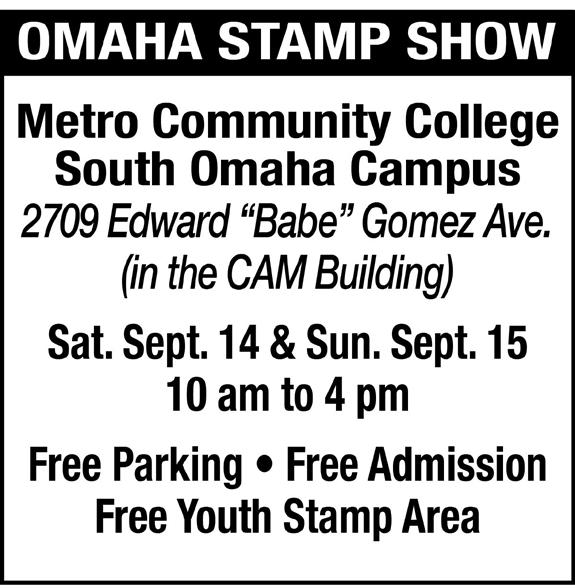


By Ron Petersen
An Apprentice STS airplane sat
on the runway.
As the runway was cleared for takeoff, the model airplane started to roll its tires on the ground and then it lifted in the air.
The plane among many radiocontrolled model airplanes built to scale the air were on display at training night on Thursday at Standing Bear Lake.
“It’s exhilarating — it’s a rewarding feeling to get the plane up in the air,” Omahawks member, Rick Sessions said.
Every week you can find dozens of people in Omaha pilot their radio-controlled model aircrafts through acrobatic maneuvers high in the sky.
The Omahawks RC Club, the largest club of radio control hobbyist’s in and around the local Metropolitan area, has a partnership with the City Parks and Recreation Department to manage one of the premier flying fields within the country.
Members can fly their planes at Hawk Field, which is located at Standing Bear Lake Recreation Area entrance on 138th and Fort Street.
“It’s a great atmosphere — everyone in the club is friendly and helpful, willing to show new people about the hobby,” Omahawks RC Club president, Grant Schulte said. “I’ve made a lot of friends and the hobby itself is a lot of fun.”
The Omahawks RC Club was first established in 1953.
Their early flying fields were located at Benson Park, Sunset Speedway, Tranquility Park, and around other sites in Omaha.
In 1986, the club was forced to leave their flying field on Ida St. due to a neighbor’s complaint of noise, starting in 1982, which later led to a lawsuit. In search of a more permanent and improved flying field, the club asked the city of Omaha if the temporary field could be made larger.
Since the Corps (federal government) does not normally acquire land located above top of dam elevation, they did not buy all the land where Hawk Field is now located.
“We flew at different places over the years,” Omahawks RC Club treasurer, Kevin Hyde said. “I’ve seen a number of members come and go, and I’ve also seen a lot of changes in the club.”
Over the last eight years, the club has had three presidents including Rick Sessions, Luke Hughes and Grant Schulte.
When Rick Sessions joined the club in 2017, the club had about 120 members, but he later found out that the club had over 250 members in the 1980s. He knew he needed to do

The Omahawks RC Club welcomes people of all ages to go to Standing Bear Lake to fly radio controlled model airplanes.
something when he became president in 2018, to help grow the club.
“The club was aging, has still been aging, but we have been getting younger members to join. I wanted to redirect the membership to try and introduce kids into the sport. We did so by reaching out to elementary schools,” Sessions said. “It’s great to see youngsters get hold of the sport — it’s exciting to see a youngster get excited about flying a plane. It gives them an area of interest that they can interact with older adults. Along with problem solving, they build, fly and have fun. It’s rewarding to get youngsters out of the house and enjoying an activity.”
Not only did the club get younger, but they also implemented a training night, which is held every Thursday evening. It is open for anyone to join.
“We started to hold training nights on Thursdays, which helped get our club numbers up,” former president, Luke Hughes said. “We show you how to fly a plane – using a buddy controller. We have trainers on site that could take over a plane in a matter of seconds to help people fly and to also get any planes back on track.”
While the club has become even more accessible for people of all ages, the ability to make airplanes have become easier to master.
“The first factor when it comes to building an airplane is the introduction of foam airplanes. You don’t have to take 50 to 75 hours to build a model that will be up in the air for a couple of minutes. Secondly, the electronics is way more advanced. You used to have nitro motors, but the other 70 percent is electric,” Sessions said. “Finally, you buy an ARF, Almost-Ready-To-Fly, airplane. In this case, the wings are already prebuilt, so you just assemble
it. Instead of taking 50 hours, it will take five hours. With the foam, you just glue one seam and put it back in the air.”
When it comes to flying an airplane, you need to have a field permit.
• A Field Permit is required for all flying members and is included with the Omahawks membership.
• The issuance of a Field Permit requires a valid and current AMA membership. This is required as an AMA Charter club and serves to provide insurance for the field, the club, and its members. If the AMA membership expires before the expiration of the Omahawks Membership the Field Permit expires on the date of the AMA membership expiration. Members are responsible for notifying the Membership chairman when the AMA membership is renewed, and a new Membership card will be issued.
• FAA regulations require that all Unmanned Aircraft Systems (UAS) be registered. One can register at FAA Recreational Drone Registration (faaregisterdrone.com). During Omahawks membership process, the member will need to enter their FAA registration number. This number will be shown on the Omahawks Membership/Permit card.
To become a member of the Omahawks:
• Membership dues is $75 for adult membership and $10 for Junior membership (members under 19 year of age) and includes a flying permit. A non-flying membership is available for $20 and does not include a permit.
• Membership purchased from January 1 to October 1 expire the end of the year that the dues is paid.
• A reduced adult membership fee of $35 is offered between August 1 and October 1 because of the re-

duced flying season available.
• Memberships purchased on or after October 1 will expire 12/31 of the following year.
It’s notable that part of the dues will go to a nonprofit organization. The Omahawks have supported nonprofit organizations over the years including the Make-A-Wish foundation in Nebraska.
Omahawks members have supported the Make-A-Wish organization for over 42 years and have contributed over $110,000. Every year (except 2020), they have held a yearly Labor Day Model Air Show so that the proceeds can be contributed back to the Make-A-Wish foundation. Many members have dedicated long hours in planning and execution of this event over the years and can take pride in helping young children enjoy a special wish come true.
“The money we make from the Labor Day airshow can vary anywhere from three to 10,000 dollars a year,” Hyde said.
While the club is made of people of all ages, they all have one thing in common and that is the love of flying airplanes.
“One of the nicest things about the club is the community involvement. We have people from all walks of life, and it’s amazing to think that we all have one common interest,” Schulte said. “It’s a lot of fun and relaxing.”
For more information about the Omahawks RC Club, visit their website at www.omahawks.org.