


By Leo Adam Biga
Omaha native Ken Bird’s unconventional path from welder to school hall monitor to national special education expert to Westside Community Schools superintendent was not your everyday journey.
“I’ve been blessed to have a full circle of life and to have experiences with very diverse people,” Bird, 76, said. “As I think about a road less traveled mine was unique. It wasn’t calculated or planned. I didn’t come from a family that expected me to go on to higher education. They were about, ‘Go to work and work hard, and good things will happen.’ ”
He doesn’t believe in road maps for life. “People want to reduce it to a script that you follow step by step. That’s certainly not how my life has been.”
How he went from the factory floor to the C Suite is an unlikely story with far-reaching impact.
“In high school (Westside) I wasn’t a very good student. I would not have been the most likely to succeed in anything. It’s just a fact. I grew up in a family with limited resources. We lived in tract housing. My dad was a sheet metal worker/ handyman. My mother a grocery store clerk and bartender. After high school I got on at Eaton Metal Products as a sheet metal worker. I took classes part-time at then-Omaha University and became certified as a

welder.”
The backdrop to his coming of age was civil unrest due to the Vietnam War and racism. “It was a very contentious time,” he said. Several friends and classmates saw duty. “A close cousin of mine was one of the first American servicemen killed in Vietnam. We’ve got a memorial wall at Westside of alumni who lost their lives in action. I was proud to get that done.”
A traumatic industrial accident Bird suffered gave him a deferment. “Then when the (draft) lottery started I drew a high number. I felt bad about it. My friends were being

Being prepared and taking precautions can help ensure you enjoy a much-needed trip. Learn about basic travel tips from local travel advisors on Page 16.
DEBRA
drafted right and left and I was back hanging out drinking beer.”
At the height of racial tensions he worked in northeast Omaha’s potboiler environment. “Most of the night crew I worked with were Black or Native American. Even during the riots there they’d stop on the way home at some bars, dragging little Ken Bird along with them. I had quite the experiences over time.”
He rues how people relate to each other. “My sense is the issues back in the ‘60s were more personal and today they seem more political.” Regarding the Vietnam War,” he
said, “I could never fully understand what was going on and why we were involved. Losing family members and friends made it much more closer to home and personal.”
As for America grappling with its legacy of racism, he said, “In the first phases of integration and voluntary desegregation what the public schools were trying to do was correct and right.”
Today, he said, “It’s higher stakes in many ways but so polarized. It’s we versus they within our own systems. It’s not organic problems, it’s people mad at each other. Certainly the intensity is much different due to social media. My adult children are old enough that they’re going to figure it out. But with all the hateful attitudes I worry more for our grandkids. I didn’t feel that even with the race issues back in the day. My friends I worked with didn’t look like me, and they didn’t care, and I didn’t care.”
That experience of looking past differences, he said, “helped shape a lot of who I am.” It’s a shame, he added, “we’ve got to pick sides now that we didn’t have to pick before, and it’s hard to be in the middle.”
Bird often found himself in the fray as a superintendent. He’s sure he would not have ended up in education, much less in such a political
--Bird continued on page 8.
Humor us with this metaphor: if your mind is a small, green sprout— barely peeking through the ground in which it was planted—volunteering is the sunshine, water and nourishing nutrients your brain needs in order to thrive. It’s a known fact that the benefits of dedicating yourself to a meaningful cause go beyond self-empowerment. As it turns out, volunteering can benefit your professional psyche in many ways.
Volunteering utilizes—and validates—your strengths. Have a particularly niche talent that you don’t get to use in everyday life? Want to further develop a skill you would like to implement—or perhaps already use—at work? Volunteer-
ing is a purposeful way to put those to use for the good of others. Since everyone’s interests and skill sets are different, there’s bound to be a perfect volunteer gig out there for anyone and everyone.
A prominent part of volunteering is the positive mood boost that comes along with it. It’s likely that you’ll feel a sense of accomplishment—as well as an increase in self-esteem, pride and belonging—when you witness the impact you’re making. This may translate into your professional life as selfassuredness, confident communication and improvements in problem solving.
Trying something new is a little --Volunteering continued on page 3.



By Ron Petersen
Everyone loves eating out.
And thanks to the Eastern Nebraska Office on Aging’s (ENOA) Diner’s Choice Program, those who participate in the program are able to eat their meals in an easy and affordable way.
“I really like the Diner’s Choice meal because I can go over to the Hy-Vee and eat whenever I want,” Diner’s Choice Program participant, Becky Janda said.

“The older I’ve gotten with health issues, it’s harder for me to get motivated to do much cooking for myself. So, I appreciate having the ability to go somewhere to have a nice meal.”
The Diner’s Choice program is open to individuals 60 years of age or older. A spouse (less than 60 years old) of someone 60 years of age or older may also participate in the Diner’s Choice program. Individuals with disabilities who live at home and are dependent on an individual over the age of 60 is eligible to participates with the older adult.
“The Diner’s Choice program has grown to over 250 participants since it started in 2015. Back then the program was only available at the Hy-Vee located on 51st

and Center. In May of 2021 the program expanded to all of the Hy-Vees in Omaha, and Papillion. Shortly after, the Hy-Vees in Plattsmouth and Fremont were added. The program helps older adults get the nutrition they need, at a reasonable contribution,” ENOA Nutrition Program Assistant, Christina Ochoa said.
HOW TO GET DINER’S CHOICE MEAL CARDS?
To participate in ENOA’s Diner’s Choice program a person must attend a registration session. If registering online, a YouTube video must be watched before completing any forms.
The forms that must be filled out include:
• Intake form with demographic and nutrition screening information
• Order form with the requested number of meal cards
Participants will receive:
• Reorder forms/with envelopes
• Menu
• Nutrition Education materials
• Magnet A suggested contribution of $6.00 is requested and will be collected at the time of registration or when additional meal cards are ordered. The full cost of the meal is $11.00.
Each participant may order up to 20 meal cards per month. Meal cards do not expire and can be ordered every month by completing a re-order form.
“I live alone – in order to stay healthy and to eat a balanced meal, I’ll go to Hy-Vee,” Janda said. “It’s nice being able to go somewhere to eat a meal and to see other people. You have the choice to communicate with other adults. It’s available and its nutritious.”
The meal card will work at any Hy-Vee grocery store located in Omaha, Papillion, Fremont and Plattsmouth. You are not allowed to use the card for a carry out meal. The meal must be eaten at the Hy-Vee location. Diner’s Choice is available at the following Hy-Vee stores:
• 5150 Center Street, Omaha 68106
• 14591 Stony Brook Blvd, Omaha 68144
• 8809 W. Center Rd, Omaha 68124
• 10808 Fort Street, Omaha 68164
• 7910 Cass Street, Omaha 68114
• 9707 “Q” Street, Omaha 68127
• 747 N. 132nd Street, Omaha 68154
• 17810 Welch Plaza, Omaha 68135
• 3410 N. 156th Street, Omaha 68116
• 1000 S. 178th Street, Omaha 68118
• 11650 South 73rd Street, Papillion 68046
• 840 E 23rd Street, Fremont 68025
• 16418 Westside Drive, Plattsmouth 68048
• 10855 S 191st St., Gretna 68136
“I try different Hy-Vees because they are all different,” Janda said. “I do have my favorites, but they are all run differently.”
WHAT TYPE OF FOOD WILL I RECEIVE?
You will get a meal that is 1/3 of the Dietary Guidelines for Americans. The portions are adjusted to meet the nutritional requirements of the program and may differ from the standard portion provided to other Hy-Vee customers.
The Diner’s Choice meal provides a serving of meat/ protein, two servings of vegetables, one serving of fruit, a serving of bread or starch, and eight ounces of milk, tea, or coffee. Any additional drinks, desserts or other food items are not provided with the Diner’s Choice program, and cost extra.
“I try to eat very healthy,” Janda said. “Often times I will make something that can be put into containers. I stick to fresh fruits and vegetables.”
Breakfast, lunch, or dinner is available seven days a week from the Hy-Vee kitchen. Breakfast is served from 6 a.m. to 2 p.m. and lunch and dinner is served until 7pm every day. The meal cards can only be used one time per day.
“It’s a treat – it’s a good deal for everybody. Hy-Vee is getting the notoriety for the food,” Janda said. “We as consumers, for older people who live alone or do not cook as much for themselves, it’s a good opportunity to get a good meal as often as they want a month. I’ve recommended it to some of my older friends who struggle to cook.”
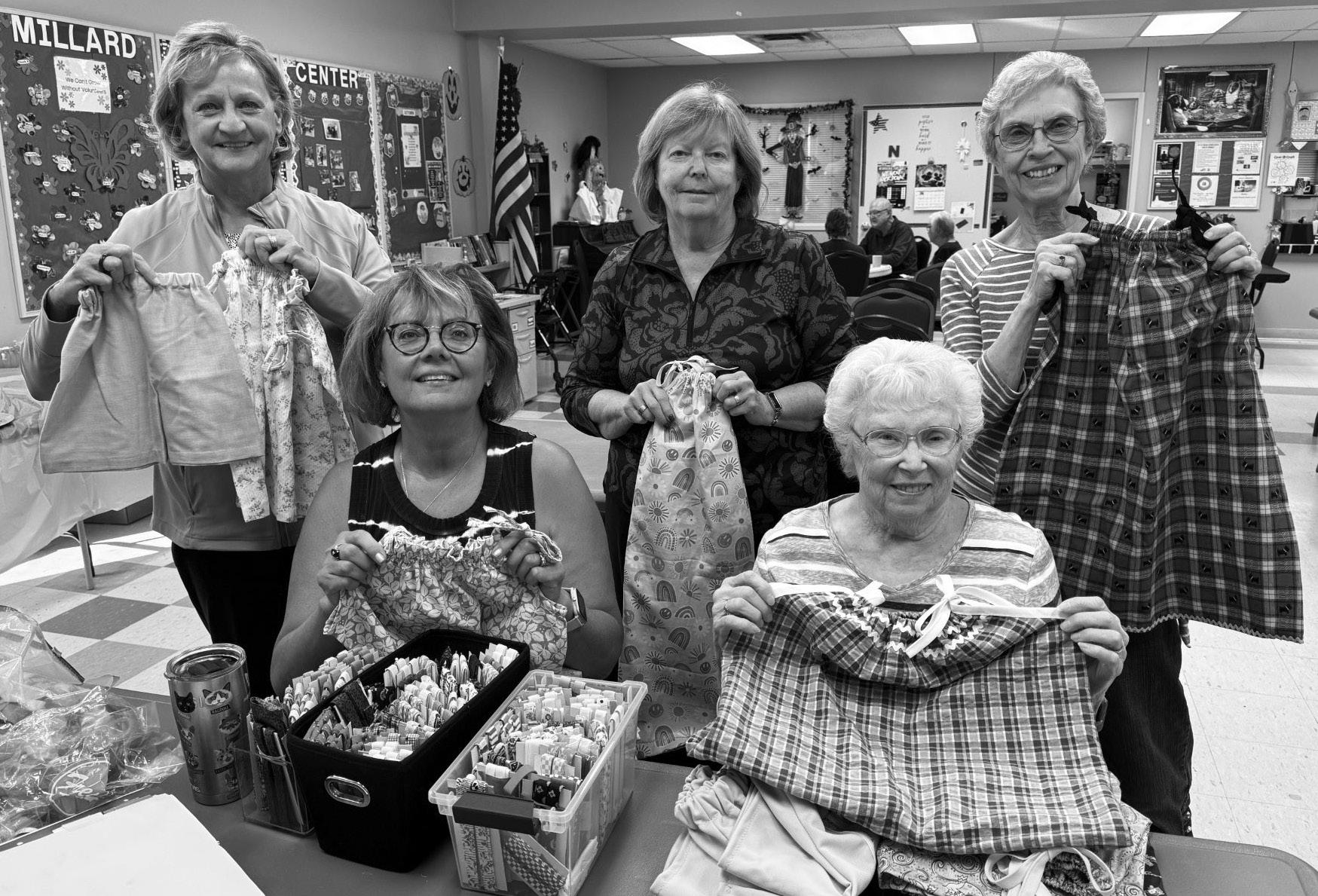
Once a month, the Millard Montclair Senior Center hosts a sewing club, for anyone who likes to make dresses, shorts, blankets and other pieces of clothing to be donated around the world through the Orphan Grain Train.
By Ron Petersen
Asewing group is making it their goal to help children in poverty around the world. Millard Montclair Senior Center’s sewing club makes everything from dresses, to purses to shorts for kids.
The sewing group said, they started making dresses for an orphanage in Haiti, which has then turned to sending clothes to more kids in various parts of the world.
“We all love doing it — we are volunteers that like to sew, and it feels good to give,” a member of the group, Cheryl Nelson said.
Once a month, a group of women meet at the Millard Montclair Senior Center to discuss what they are making and show off what clothes they have made to each other.
With the help of the Orphan Grain Train, the sewing club will take the dresses, shorts, blankets and purses that they made and send them to all walks of life.
“Everything we make will go all around the world,” Nelson said. “We can make
Volunteering continued from page 1.
less scary with friends. One thing you’ll learn when you begin volunteering is how quickly you’ll form connections with others. This isn’t limited to those you’re helping—it includes fellow volunteers who are applying their own time and energy to the cause. If you happen to stumble along the way, no problem! They’re alongside you for support, conversation and guidance as your combined efforts better the lives of others.
Whether you start by volunteering once a week or you make it an all-in commitment, you can dip your toes into different pools of
about anything, but making dresses and shorts have been our main focus.”
The Orphan Grain Train shares personal and material resources with needy people in America and around the world.
After the sewing club meets, they will then go home and on their own time, make the clothes using their own sewing machines. They have a small budget, but they have enough of the basic materials to make high quality dresses and shorts.
“We rely on donations — when we meet, we go through our donations and see what our budget is,” Nelson said. “We show each other our dresses.”
The club made 313 dresses in 2020, but four years later they have already surpassed 600 dresses in one year.
“We’re appreciative of Montclair for hosting us because they support us, allow us to be creative, and to give to the needy,” Nelson said. “As a collective club, we are doing really well.”
opportunity—for example: an organization you’re curious about, a local community or networking group you’re interested in joining, or even a workplace you’d like to work at.
Anyone and everyone has the ability to do something great. Another awesome thing about volunteering is how accessible it is. Commitments of time and energy are totally up to the volunteer’s discretion. Someone with limited mobility can perform altruistic activities at home, or even over the phone. Older adults can feel fulfilled by staying active and making social connections outside of their usual circle. Youth can

New Horizons is the official publication of the Eastern Nebraska Office on Aging. The paper is distributed free to people over age 60 in Douglas, Sarpy, Dodge, Washington, and Cass counties. Those living outside the five-county region may subscribe for $5 annually. Address all correspondence to: Ron Petersen, Editor, 4780 S. 131st Street, Omaha, NE 68137-1822. Phone 402-444-6654. FAX 402-444-3076. E-mail: ron.petersen@enoa.org
gain new perspectives and understanding of the world around them.
Whether you volunteer because you love it or you’re simply choosing to do so because it looks good on a resume, putting others first can be life-alteringly positive for your mind and soul.
Who knew that volunteerism nurtures your growth so deeply? As a volunteer, your impact extends far deeper than the surface—it opens doors, strengthens critical resources and tends to the community you live in and love. Go make a difference today.
This health tip is brought to you by Tabitha.
Advertisements appearing in New Horizons do not imply endorsement of the advertiser by the Eastern Nebraska Office on Aging. However, complaints about advertisers will be reviewed and, if warranted, their advertising discontinued. Display and insert advertising rates available on request. Open rates are commissionable, with discounts for extended runs. Circulation is 9,000 through direct mail .
ENOA Board of Governors: Mary Ann Borgeson, Douglas County, chairperson; Don Kelly, Sarpy County, vice-chairperson; Lisa Kramer, Washington County, secretary; Pat Tawney, Dodge County, & John Winkler, Cass County.
The New Horizons and the Eastern Nebraska Office on Aging provide services without regard
or age.
Life can bring on stress for many of us. Finding ways to relieve stress is important to our overall health and well-being. Caregivers are not immune to this stress.
Please contact Respite Across the Lifespan at edbennett@unmc.edu or 402-559-5732 to find out more about respite services and to locate resources in your area.
By Jeremy Turley Flatwater Free Press


O• Homes starting in the $375’s
• One Floor Living
• “Open Concept” design –easy traffic flow
• Step-less Front Door & Garage Entries
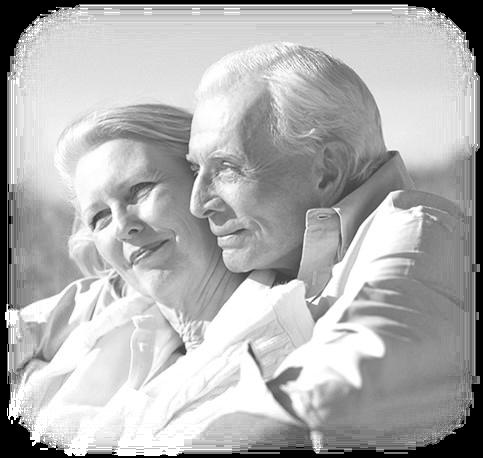
Homes designed with your future in mind! Open concept floor plans with “Universal Design”* standards
• Wider Hallways
• Wider Doorways (most doors)
• Low-Curb or Zero-entry (per plan) Shower Access
• Low Maintenance Exteriors
• Available in over 20 Communities
Locations available in all parts of the Omaha area For NW/Elkhorn Living: 402-207-9556 For SW/Gretna Living: 402-207-9137 For Papillion Living: 402-207-9763 For Bellevue Living: 402-207-9380

www.RegencyHomesOmaha.com

*This is Universal Design; not ADA Standards.
n the hottest day of July 1948 in Norfolk, a second-page ad in the local newspaper presented readers with a flavorful way to cool off.
The recently opened Baldridge Zesto Shoppe touted its “new and different … high quality dairy product” that contained 6% butterfat but was “not ice cream.”
The product would soon be widely known by a more recognizable name: Soft serve.
The Norfolk Zesto was one of the first few dozen links in a chain of ice cream joints that once stretched from California to Florida and threatened Dairy Queen’s dominion.
The upstart brand’s sweet spot came between the coasts in places like Nebraska. Over a five-year span, at least 11 shops cropped up in the state, including a location in South Omaha that would become part of College World Series lore.
But Zesto’s heyday lasted just a few years. Amid an increasingly crowded fast-food marketplace, its parent company, an Illinois ice cream machine manufacturer, ditched the retail business in the mid-1950s and left franchisees out in the cold.
Today, more than 30 surviving locations across the Midwest and the South make up a loose network of restaurants that bear the Zesto name but operate mostly independently of one another.
Now, two Nebraska-born ice cream obsessives who grew up on Zesto dream of broadening that network and bringing the brand back to the masses.
“We always felt like there should be more of them to bring to the public because we were that in love with the ice cream,” said Todd Jansa, a Wahoo-area farmer who co-owns the federal trademark for Zesto with business partner Jerry Irons.
Louis A.M. Phelan was no stranger to the patent office by the time he turned his attention to ice cream. His inventions included dozens of electrical apparatuses that gave him claim to a mountain of intellectual property.
But the creation that launched Phelan’s reputation as a fast food pioneer
came around 1945 when the Illinois-based Taylor Freezer Corporation rolled out the Zest-O-Mat, a hulking softserve ice cream and frozen custard machine.
A few years later, the company began delivering a simple pitch to newspaper readers all over the country: Buy a Zest-O-Mat machine and open a Zesto franchise in your town.
A shop opened in El Paso, Texas, in April 1947 and the chain spread like wildfire, operating in at least 32 states between 1947 and 1955, according to a Flatwater Free Press search of newspaper archives.
After Nebraska’s first shop in Norfolk, franchises emerged in Fremont, Lincoln and Alliance. All three are still in business more than seven decades later. Others in Columbus, Hastings, Scottsbluff, South Sioux City and Sidney proved more short-lived. The Norfolk Zesto eventually closed, too.
By 1953, Omaha had twin Zestos — an iconic location across from Rosenblatt Stadium in the south and a still-running shop in Florence to the north.
It’s not exactly clear why Taylor deserted the Zesto concept in the mid-1950s, but the move came as the American fast food hierarchy began to take shape, with giants like Dairy Queen (now owned by Omaha’s Berkshire Hathaway) and McDonald’s at the top.
The Taylor Company, still a leading manufacturer of ice cream machines, did not respond to multiple requests for comment.
Without the support of its mothership, most stores struggled and eventually shuttered, but a sprinkling of Zestos survived – and even thrived – as communities like Omaha grew around the retro-looking establishments.
Ungoverned by a franchisor’s branding guidelines, the dispersed restaurants formed their own personalities and developed quirky provincial menus.
Several Atlanta Zestos offer a Big Mac-like burger called the ”Chubby Decker.”
A location in Columbia, South Carolina, serves a pimento cheese sandwich.
A now-closed Seattle Zesto sold fish and chips. Two of the three Omaha shops carry pickle fries.
Zesto’s demise as a national brand mirrors the
stories of many other chains that tried and failed to “become the next big thing” during the postwar fast food boom, said A.S. Rogers, who authored the “Broken Chains” blog.
The Michigan-based Rogers visited and wrote about more than 200 such “broken chain” businesses, including two Indiana Zestos.
It’s common for a few left-behind stores to find profitability in pockets of the former empire and “to take on the local identity of their surviving market,” Rogers said.
The original South Omaha Zesto took on a life of its own due to its de-facto association with Rosenblatt Stadium.
Waiting in line for a treat became elemental to the College World Series experience for locals and visiting fans alike.
Tom Kelley, whose father Mike owned the restaurant in the 2000s, fondly remembers bringing shakes, fries and burgers to the ESPN crews during game broadcasts.
On the other end of town, Chris and Rick Minturn grew up in the 1990s on chili footlongs and malts from the Florence Zesto. The cousins started working there as teenagers – a rite of passage for neighborhood high schoolers. Their grandma had worked there three decades prior.
They recall taking the older kids out to a patch of grass next to the store for collegial wrestling matches after close.
Chris later left for college, but Rick rose through the Zesto ranks to become the general manager of his local store and a northwest Omaha location that opened in the mid-2000s.
By 2012, the Minturns owned both locations. They kept the classics but added more savory food, including a hand-breaded pork tenderloin sandwich.
Regulars noticed every little change – a few older customers complained that the hot dogs were no longer red. (It’s the same meat, but the supplier stopped using red dye in production, Chris said.)
But the expansion of the hot food menu has helped the stores evolve from seasonal ice cream stands to sustainable year-round restaurants, the Minturns said.
The Zesto near Rosenblatt closed a few years after the --Zesto’s continued on page 5.
--Zesto’s continued from page 4.
College World Series moved downtown to TD Ameritrade (now Charles Schwab) Field in 2011.
But the late Mike Kelley made it his mission to ensure college baseball fans could still get Zesto near the new stadium, his son said. After a back-and-forth with city planners, the elder Kelley and his partners built a seasonal Zesto window anchored by year-round restaurant Blatt Beer and Table.
The 10-day College World Series are some of their busiest days of the year, said the younger Kelley, who now co-owns the business.
Minutes before the first pitch on Sunday, traveling fans dressed in Tennessee orange and Aggie maroon flocked to the window.
For A&M fans Karen Tobin and Meg Foreman, snagging a cone before entering the stadium was a matter of superstition. They’d gotten Zesto twice before games earlier in the tournament, and the Aggies won both times.
Plus, it’s great ice cream, Tobin said.
Carrying on the Zesto tradition at the World Series is a major responsibility, but the window near the ballpark has a winning formula, Kelley said.
“You want to put the customer first and make sure the ice cream’s cold when
they get it,” Kelley said.
Jansa’s attachment to Zesto goes back long before he acquired the federal trademark – perhaps all the way to the womb.
On the day Jansa was born, his mother stopped at the Lincoln Zesto for a black raspberry malt before heading to the delivery room at Bryan Hospital, she recounted to him years later.
“She said, ‘I was feeding you umbilically,’ ” Jansa said. “So, I think I started (eating Zesto) pre-birth.”
Jansa and Irons, two self-identifying “car guys,” met in the mid 1980s while cruising Lincoln’s O Street. They made frequent nighttime stops at the Zesto down the road, where they each ordered two large malts.
Irons moved out to California, but Jansa stayed in Nebraska and still farms near Wahoo.
The friends eventually became business partners and approached Harold “Brownie” Brown in the 2000s about buying the Zesto trademark. Brown, the longtime operator of a few Missouri locations, “knew we were in love with the product” and dealt them first the Nebraska trademark and then the federal one, Jansa said.
The original Zestos are mostly grandfathered into the brand, but some locations have licensing or fran-
You’re invited to visit the Ralston Senior Center, 7301 Q St., Suite 100 this month for the following:
• December 4: Music provided by Tim Javorsky from the Merrymakers @ 1 p.m.
• December 11: Board meeting @ 9:30 a.m.
• December 18: Bingo @ 12:15 p.m.
Lunch is catered in on Wednesdays @ 11:30 a.m. A $5.50 contribution is normally suggested for the meal. Reservations are due by noon on Tuesday. Games and bingo will be played after lunch. Contact Darla @ 402-331-1529 for reservations. Obtain an annual Ralston Senior Center membership for $10.
On days the Ralston Public Schools are closed due to the weather, the Ralston Senior Center will also be closed. Contact Ron Wilson @ 402-734-3421 for further information.
You’re invited to visit the Florence Senior Center, 2920 Bondesson St.
At the Florence Senior Center, lunch is served at 11:30 am. A select menu is offered Monday thru Friday. Meal reservations must be made one day in advance. Please call by noon the day before for a meal reservation.
The center hosts activites such as Tai Chi, annual picnics/ special events, bingo, cards, gym & game room access, special guest speakers and socials.
Arts and crafts will be held on the third Wednesday of each month. They also provide health and nutrition programs.
For more information, please call Colleen Metz @ 402444-6333.
chise agreements with Jansa and Irons.
The trademark holders recognize that each Zesto has a unique identity, but they hope to ensure customers can get the same rich soft serve at every location.
That means prescribing the ice cream machine settings used by the newer stores, Jansa said.
Those machines are usually made by Taylor, the company that spawned Zesto. Jansa said he and Irons established a national account with the firm.
Going forward, Jansa and Irons would like to add Zesto locations near the brand’s existing turf. They’re keen on convincing the Minturns to add a new location in the suburbs south of Omaha. The cousins are also considering adding a new location.
But they’re also looking to franchise new stores in parts of Zesto’s former footprint.
There’s a plan to open one on Los Angeles’ Venice Boardwalk about a year from now, Irons said.
Irons hopes that some of the southern fans visiting Omaha for this year’s
College World Series will want to open a store in their hometowns after tasting the downtown location’s product.
“I think there’s a very bright future in Zesto, and we’re really excited about it,” Jansa said. “We just
want the story to keep going.”
The Flatwater Free Press is Nebraska’s first independent, nonprofit newsroom focused on investigations and feature stories that matter. Learn more at flatwaterfreepress.org
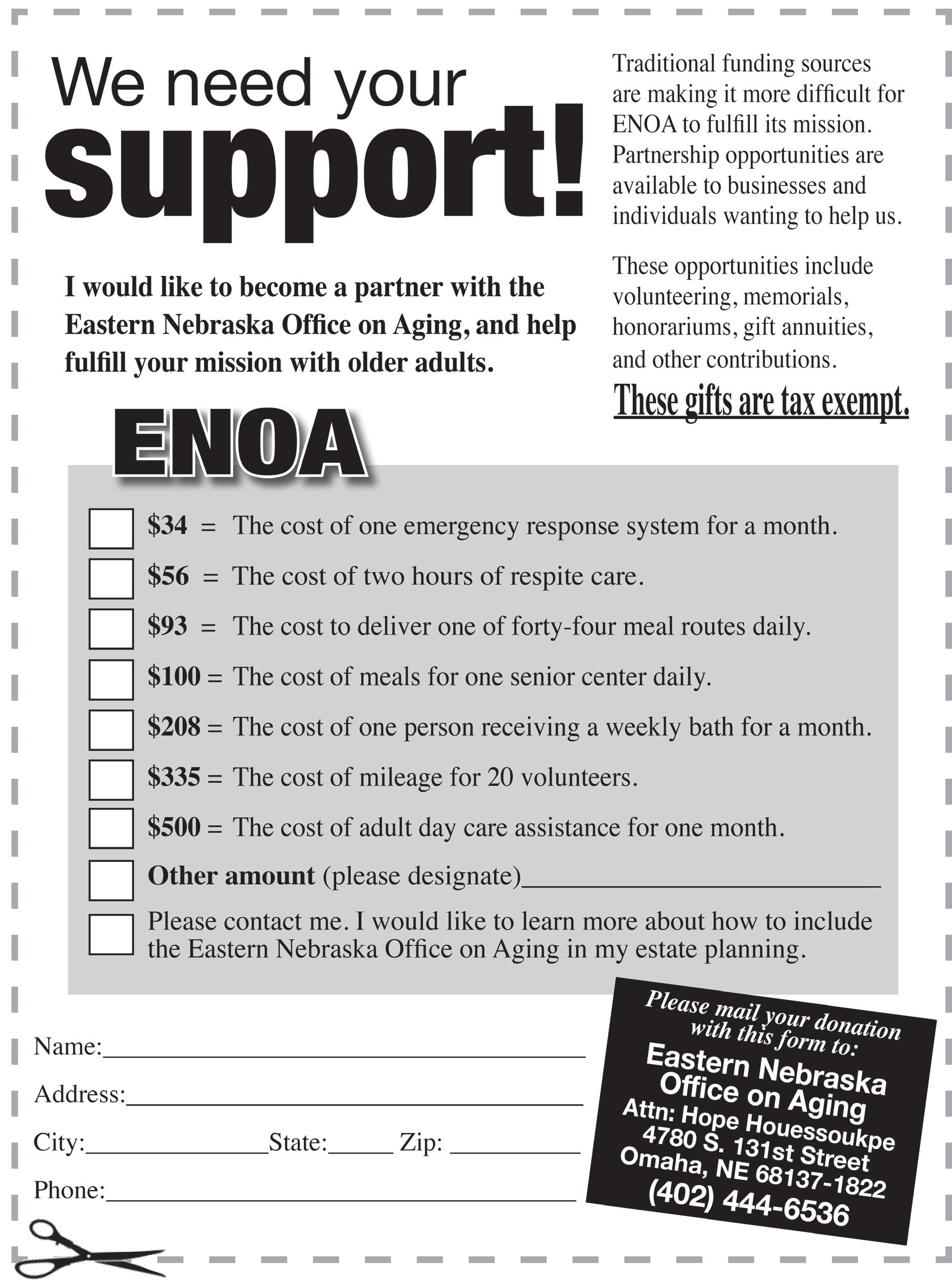
Please see the ad on page 3
$25
Keith Cook
$15
Janet McGaughey
Linda Beber
$10
Cindy Gensler
$5
Kathleen Koons
Anita Wyllie
Cindy Stigge
William Nye
The CAPACITY Lab in the Department of Gerontology at UNO is looking for healthy adults and caregivers to an older adult with a chronic disease (e.g., dementia, cancer, cardiovascular disease), to participate in a research study about the impact of aging on the neural and behavioral bases of social processing.
The study will include an online, at home component (7 hours over 4 days), and one in person visit (2 hours, 30 minutes), which will take place at the University of Nebraska Medical Center (UNMC). There will be an experiment that involves an online questionnaires and interview, computer tasks, saliva collection (for hormone analyses), blood draw, and brain imaging. Compensation for study participation is available. Parking is complementary and located a short walk from the building where the experiment will take place.
Do you qualify? They are looking for adults between the ages of 19-90 years, you must have comprehension of written and spoken English, have mobility to travel to UNMC to participate and you must have completed a minimum of two years of high school or higher.
The second study is about recruiting family caregivers for older adults with dementia.
The study will include two in-person visits of approximately three hours each that will take place at the University of Nebraska at Omaha (UNO) and the University of Nebraska Medical Center (UNMC). The study involves completing questionnaires, interviews, and tasks, a blood draw, and brain imaging. Parking is complementary and located a short walk from the building where the experiment will take place. Compensation for study participation is available.
To qualify, you must be an adult between 45–75 years of age, female, right-handed, and currently on unpaid family caregiver to an individual with Alzheimer’s disease, frontotemporal dementia, vascular dementia, or Lewy body dementia for at least 10 hours a week and for at least 6 consecutive months. You must have comprehension of written and spoken English, have normal or corrected to normal hearing and vision, have mobility to travel to UNO and UNMC and must have completed a minimum of two years of high school or higher.
If you are interested please call 402-554-2951 or email Janelle Beadle, Ph.D. at UNOCapacity@unomaha.edu.
Life can bring on stress for many of us. Finding ways to relieve stress is important to our overall health and wellbeing. Caregivers are not immune to this stress.
Please contact Respite Across the Lifespan at edbennett@unmc.edu or 402-559-5732 to find out more about respite services and to locate resources in your area.
By Nicole Burton, NP-C, Archwell Health
If you’re feeling less than jolly about the holidays, you’re not alone. Last year, two-thirds of Americans reported an increase in stress during the season of supposed merriment.
But whatever you’re dealing with — loss of loved ones, isolation in cold weather, sundowning or different stressors altogether—holiday blues don’t have to get the best of you. Keep reading for practical ways to prioritize your mental health this holiday season.
If winter weather permits, take a brisk walk to start your day, or just sit outside to get some fresh air and natural light. Even if the day is cold or cloudy, the outdoor light can boost your mood, especially if you go out within the first two hours of your day.
Despite holiday disruptions, try to stick to a daily routine that includes moderate exercise, a healthy diet, limited screen time and adequate sleep. Limit alcohol consumption, especially if you are feeling sad or have health issues that make drinking inadvisable. And if cold weather is keeping you indoors more than you’d like, prioritize projects around the house to help you feel productive and accomplished.
To combat loneliness, reach out to long-distance loved ones with phone calls, letters and holiday cards. Spend time with local friends and family whenever possible, even if it’s just for a cup of coffee.
As the days get shorter, many of us experience sadness, grief or stress. You might even feel all those things alongside happier emotions. Try to acknowledge and accept the way you feel rather than judging your emotions with “shoulds” or “oughts.” It’s OK to have complicated feelings about the holidays.
Volunteering is a great way to help others and lift your mood at the same time. Whether you serve holiday meals at a food bank, teach a child to read or support families impacted by natural disaster, there are countless ways you can make a difference. Connect with AmeriCorps Seniors or contact local schools, hospitals or places of worship to find the right opportunity for you.
If you feel the loss of loved ones more acutely over the holidays, consider lighting a candle in their honor, making their favorite holiday treat or continuing another meaningful family tradition or personal remembrance ritual. These practices can help you feel connected with your loved ones and keep their memory alive.
As we get older, holidays don’t look the same as they used to—and they typically don’t follow the format of a Hallmark movie. Try to be realistic about the holidays in your current season of life. Cherish

To prioritize your mental health during the holiday season, focus on self-care practices like scheduling dedicated time for relaxation, setting realistic expectations, saying no to events when needed, practicing mindfulness, maintaining a healthy lifestyle with balanced meals and exercise, and reaching out for support if you need it.
your memories of the past but be ready to embrace new traditions as well.
Sometimes, what seems like a case of the holiday blues can mask a more serious condition like seasonal affective disorder (SAD). This type of depression is related to changes in daylight hours, not the calendar. Symptoms of winter-onset SAD may include oversleeping, overeating, social withdrawal and feelings of hopelessness. If you or your loved ones think you may be clinically depressed, contact your healthcare provider to discuss a personalized treatment plan.
If you’re living with Alzheimer’s or dementia, the winter holiday season can pose additional challenges. Sundowning—increased confusion as day turns to night— may get worse in winter because there are fewer hours of daylight, plus darkness falls earlier in the day. This can disrupt the body’s natural sleep-wake cycle, leading to sleep problems and winter blues. Try these tips to help prevent sundowning this winter:
• Stick to your sleep schedule. Go to bed and get up at the same times all year round. Avoid late afternoon naps, which can interfere with nighttime sleep and cause confusion when you wake up in the dark.
• Let the light in. Before it gets dark on winter evenings, make sure your home is well lit. This can help you transition from day to night and adhere to your regular bedtime. Good lighting can also minimize shadows that lead to confusion and agitation.
• Reduce evening stimulation. Doing chores, watching TV or listening to loud music may be too stimulating in the evening. Instead, engage in activities that you find soothing and enjoyable, such as looking at pictures or listening to calming music.
A Word from ArchWell Health: Wherever you are on the memory loss journey, you are not alone. The compassionate team at ArchWell Health is always ready to assist caregivers and older adults with their primary care needs. Make an appointment with your local ArchWell Health provider in Omaha or Lincoln today.
You’re invited to visit the Fremont Friendship Center, 1730 W. 16th St. (Christensen Field). The facility is open Monday through Thursday from 9 a.m. to 3 p.m. and Friday from 9 a.m. to 12:30 p.m.
A meal is served weekdays @ 11:30 a.m. Reservations, which are due by noon the business day prior to the meal the participant wishes to enjoy, can be made by calling 402727-2815. A $4.25 contribution is suggested for the meal. This month’s activities will include:
• December 2: Bill Wilt Memorial Pitch Tournament @ 12:30 p.m.
• December 4: Music with Ben Tomasello @ 10:30 a.m.
• December 5: Early Bird Bingo @ 9:15 a.m.
• December 5: Nye Presentation @ 10 a.m.
• December 5: Music with Kim Eames provided by Merry Maker’s @ 10:30 a.m.
• December 7: 46th Annual Parks and Recreation Craft Show @ 9 a.m.
• December 11: Music with Bill Chrastil @ 10 a.m.
• December 12: Ugly Christmas Sweater Contest
• December 12: Nutrition Minut @ 10:15 a.m.
• December 13: Bingo with Pro-Med Care @ 10:30 a.m.
• December 18: Music with the Links @ 10 a.m.
• December 19: Christmas Carol Sing-along w/ Jeanne @ 10 a.m.
• December 24 & 25: Center Closed
• December 31: Special Music with Tim Javorsky and celebrate New Year’s Eve @ 10 a.m.
Craft class on Tuesday afternoons @ 1:30 p.m.
Tai Chi offered every Tuesday and Friday from 9:15-10 a.m.
If you can’t stay for lunch with our friends and you currently participate in any activity at the center, you may now order a Grab-n-Go meal to take home for your lunch. Grabn-Go meals must be reserved the day before by noon and the person ordering the lunch must come in to the center to pick it up at 11 a.m. The number of Grab-n-Go lunches are limited to a first come first serve basis. Suggested donation is $4.25.
For meal reservations and more information, please call Laurie at 402-727-2815.
You’re invited to visit the Millard Senior Center at Montclair, 2304 S. 135th Ave., this month for the following:
• December 2: Secret Santa lists handed out
• December 3: Ornament Exchange
• December 4: Board meeting @ 9:30 a.m.
• December 5: Durham Museum Visit @ 9:30 a.m.
• December 6: Ugly Sweater Contest and Cookie Exchange @ 10 a.m.
• December 9: Christmas Pajama Day
• December 10: Collecting Secret Santa Gifts
• December 11: Christmas Hat Day, P.A.W.S Group @ 9:30 a.m.
• December 12: Passing out Candy Canes
• December 13: Annual Christmas Party @ 11 a.m.
• December 17: Archwell coming to discuss Osteoporosis @ 10:45 a.m.
• December 25: Center Closed for Christmas
• December 31: New Years Eve Celebration @ 10 a.m.
Tai Chi on Mondays and Fridays @ 9:30 a.m. Bingo every Tuesday and Friday @ 12 p.m. Sportswear Fridays. Wear your favorite team attire every Friday.
Hand-N-Foot Wednesdays @ 8:30 a.m.
MahJongg Wednesdays @ 1 p.m.
Chair Volleyball Thursdays @ 9:30 a.m.
Dominoes Thursdays @ 12:30 p.m.
For more information, please call 402-546-1270.
First United Methodist Church has some excellent adult curriculums available. They are free for any Christian group which would like to study prayer, discipleship and beliefs.
Call First United Methodist Church at 402-556-6262 if you wish to receive more information about the list of the studies available.
When it comes to your health, the way you handle stress has been found to be more important than cholesterol, blood sugar, blood pressure, or any other risk factor in determining whether you will live a long and healthy life.
The best remedy doesn’t come in a pill, and it can’t be found in your doctor’s office. The dramatic and powerful connection between your mind and body, and between your body and your mind are where these tools to manage stress can be found.
With a current epidemic of stress-related disorders in our society including depression, anxiety, attention deficit disorder, and memory disorders it is more important than ever to learn how to manage stress in a healthy way.
Tools for managing stress such as consciously building your network of friends, family, and community, moving your body, and working with your doctor to find
out if you have food intolerances or vitamin deficiencies are great places to start.
Your social community is your most powerful allies in achieving long-term health. Moving the body daily, ideally outside, has a profound impact on stress levels. Refining your diet to include foods that nourish you and eliminate foods that you may an intolerance to, leading to anxiety promoting response.
Keeping consistent rhythms in your schedule can be key because your hormones are balanced in rhythms. Waking at the same time every day, going to bed at the same time every day, eating at the same time every day — these are the rhythms. Naps are also a great way to reset.
Submitted by Karen Rehm, worksite wellness specialist. To contact Karen at 402-483-1077 or send an email to krehm36@gmail.com.

position if not for that onthe-job accident years before. He was working with a high speed power drill outfitted with a composite disc to polish welds.
“The disc blew up, ripping right through my leg, which was left hanging by a back tendon. I was 30 feet up on a storage tank when it happened and I ended up on the ground. They rushed me by ambulance to Methodist Hospital. I had steel-toed high-top boots on and some nurse was trying to get the boot off and every time she pulled it was excruciating. The doctor yelled, ‘For ‘chrissakes, cut that damn boot off.’ The next thing I remember is waking up and being scared to death to look to see if I still had a leg.”
“By the grace of God,” he said, he did. He underwent bone graph surgeries. Recovery took a year. Then an interaction occurred that changed the course of his life in unimaginable ways.
“Eaton president John Marshall, whose father Herb started the business, asked to see me. John chaired the Westside school board. He said, ‘We don’t want you back here in the plant but they’ll have a job for you there (Westside).’ I became the first answer to a school resource officer to offer discipline and whatever needed doing.”
Little did he know it would lead to a half-century education career. At the time, he said, “I had no interest in education, much less special education, or anything like that. I had no aspirations for anything other than maybe another blue collar job.”
That was before he met Jane Rankin.
“Jane was a Home Ec teacher who taught kids with disabilities life skills,” Bird said. “My hall monitor duties took up only five hours a day, leaving time for other things as needed. One day Jane asked me to work alongside her and I fell in love with that. She lived by Westside and we’d walk to her house to use the kitchen to teach the kids how to cook. I’d run around the city to help find them jobs and monitor their employment. People in special ed then tended to have a loved one with disabilities, so a deep emotional attachment formed. I didn’t. But I got in there and could relate to it anyway.”
Showing him the way were Rankin, Ruby Huebner and Vi Morrow. “I was
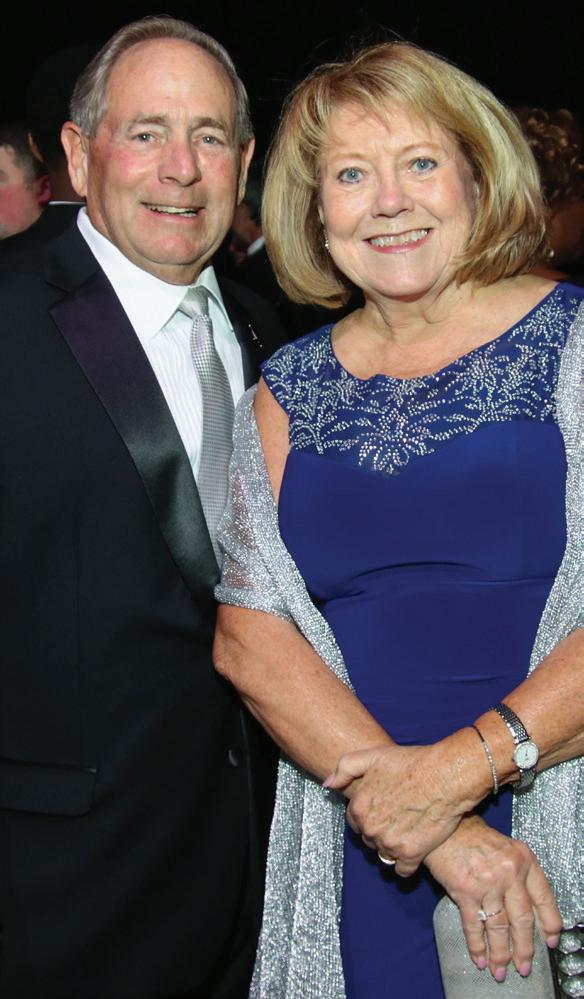
fired by Phelps. Bird went to work for the state but only four years later was rehired as the district’s director of special ed.
“Special ed laws were being passed nationally. I got very involved at the federal level. I was president of the national administrators of special ed organization. I did lobbying and governmental relations.”
After 16 years leading Westside Community Schools he accepted the challenge of Omaha philanthropists to start from scratch Avenue Scholars, a school-to-career pipeline program for high need youth.
in my early 20s and these ladies were in their 50s, and they took me under their wing. None had advanced degrees, but they were the most compassionate, best educators I ever worked with. Having those mentors was really critical for me.”
Lifelong relationships were made with students, several of whom he’s remained in touch with. He and his wife Annie, an autism expert, recently dined with some of his former students. All are getting by, some independently. Most are retired now.
“They were part of that light switch for me.”
He still marvels at how things evolved “from welder to unemployed, laid up with an injury for a year, to being immersed in an educational community that saw him drive a bus, work as a teacher’s aide, and get curious enough about special ed to earn a degree.
“Jane, Ruby and Vi were great proponents for me. At Omaha University-UNO professor Don Grandgenett was kind of my conscience, cracking the whip to have me do stuff, including getting a masters.”
He felt supported by Westside administrators led by Vaughn Phelps. “Vaughn was an iconic, renowned school administrator nationally. He led Westside from essentially a one-room schoolhouse to a thriving, progressive, lighthouse district.”
Bird ran afoul of the mercurial Phelps when he was recruited by the state education department to replicate the district’s career technical special educational needs program. Unknowingly Bird violated a continuing contract law and was
Then in 1982 he was named Westside superintendent. “I didn’t set out to be superintendent.” In going from bouncer to boss he went through 11 job titles. “I always approached things as just roll up your sleeves and do the work. I liked consensus building which I think is a huge part of leadership. I liked winning. It just came natural to me and I was willing to do the work where sometimes people just want the position and title and not the work that goes with it.”
He liked, too, the interactions that came with the job.
“In the end leadership’s communication and collaboration. I’m really proud of the breadth of relationships I have – from custodians to CEOs, from developmentally disabled adults just getting by to millionaires. I don’t think I’ve ever valued people on their positions or their social status. I hope I see them for who they are. My wide-ranging experiences have enabled or empowered me to communicate across socioeconomic and cultural groups and to feel comfortable with whatever group I’m with.”
Being authentic, he’s found, is the best policy. It’s why he makes no secret he’s more at home in the great outdoors (he’s a lifelong fisher and hunter) than in boardrooms. But he’s nothing if not adaptable.
Though he left Westside in 2008 he keeps a close eye on the educational landscape and is sought after for his insights. The issue of how Nebraska schools are controlled and funded is thorny.
“We’ve been a strong local control state. Any shift of funding off property taxes to more funding from the state will bring more state control. There’s somewhere around 1,900 public officials in education and no single point of communication or coordination. I think that’s problematic. I think we’re migrating to more centralization but it has to be done right with respectfulness to local city schools.”
NEW CHALLENGE
“The board said, ‘We trust you to take everything you know to go build a program.’ I learned real quickly I didn’t know everything but I learned what I didn’t know and we built Avenue Scholars. I probably couldn’t have done it without the work I did at Westside. It gave me the foundation and the visibility.”
He credits Annie for helping him achieve so high. “She’s my rock star.” They’ve served on several boards together.
Under his leadership the program’s now integrated into several schools, each with a career coach and curriculum, and secured partners in Metropolitan Community College and major employers to support students.
The program’s expanded into Iowa.
In September he stepped aside as president/CEO, though he remains involved.
Bird’s never forgotten his blue-collar roots. It’s why he easily identifies with nontraditional students.
“My personal life history and work history certainly has had a strong influence on my thinking about Avenue Scholars. I drew strongly from all the work I did in the area of individuals with disabilities and special vocational needs and in school administration and legislation. Generally it was focused on academic excellence and achievement and that transitioned to Avenue Scholars saying there’s more to life than getting degrees. There’s a lot of great careers people can realize without a four-year degree, though certainly certifications and associate degrees help.”
After trial and error, Bird’s team designed a seamless student support system.
“The thing I knew from my education background is that these transition points from elementary to middle school, from middle school to high school, from high school to college are where you have the most loss of kids. There’s nobody to catch kids coming out of high school with safety nets and life boats as they transition from whatever training they get to a job. They’re on your own 99 percent of the time.
Bird’s found satisfaction in each phase of his career but there’s nothing as fulfilling as making a startup a success. None of it would have happened if John Marshall hadn’t refused to take him back and redirected him to that job waiting for him at Westside.
“I regret that I never said thank you to that guy. He’s long deceased.” Then the opportunity for a posthumous thank you suddenly presented itself.
“I was at a Horatio Alger (Association of Distinguished Americans) meeting in Washington DC. Escorting Annie and I was this young lady, Lindsay Marshall, who mentioned how her family was heavily involved in Omaha. I looked at her and said, ‘And your grandfather was John Marshall and your great grandfather was Herb Marshall,’ and she looked at me like, How’d you know that? I told her my story and that roughly 50 years later I had this emotional reaction of never having thanked anyone in the Marshall family, and I gave her a hug. And there we were in the middle of the Ritz Carlton lobby crying.
“It was such a full-circle moment. His intervention for me was a turning point. And when I had the chance to start Avenue Scholars it was an opportunity to pay it forward by helping young people find that turning point and realize more than they think they can be.”
Just like the students Avenue Scholars guides today, he said when he was their age “I never thought about degrees and careers.” The only reason he considered those things was because caring individuals encouraged him to realize a potential they he saw in him that he didn’t see in himself.
“Annie and I have talked a lot about that interaction with Miss Marshall and the opportunity it gave me to finally express my thanks to John Marshall who I suppose saw something in me. I’ll never know.”
He’s not sure what allowed that closure to happen – divine intervention, coincidence – but he’s sure that as “surreal” as it was it was also meant to be.
“It just put an exclamation point on my life and career.”
It reminded him, too, that he’ll always be a blue-collar guy in white-collar duds.
“It’s okay to be who you are.”
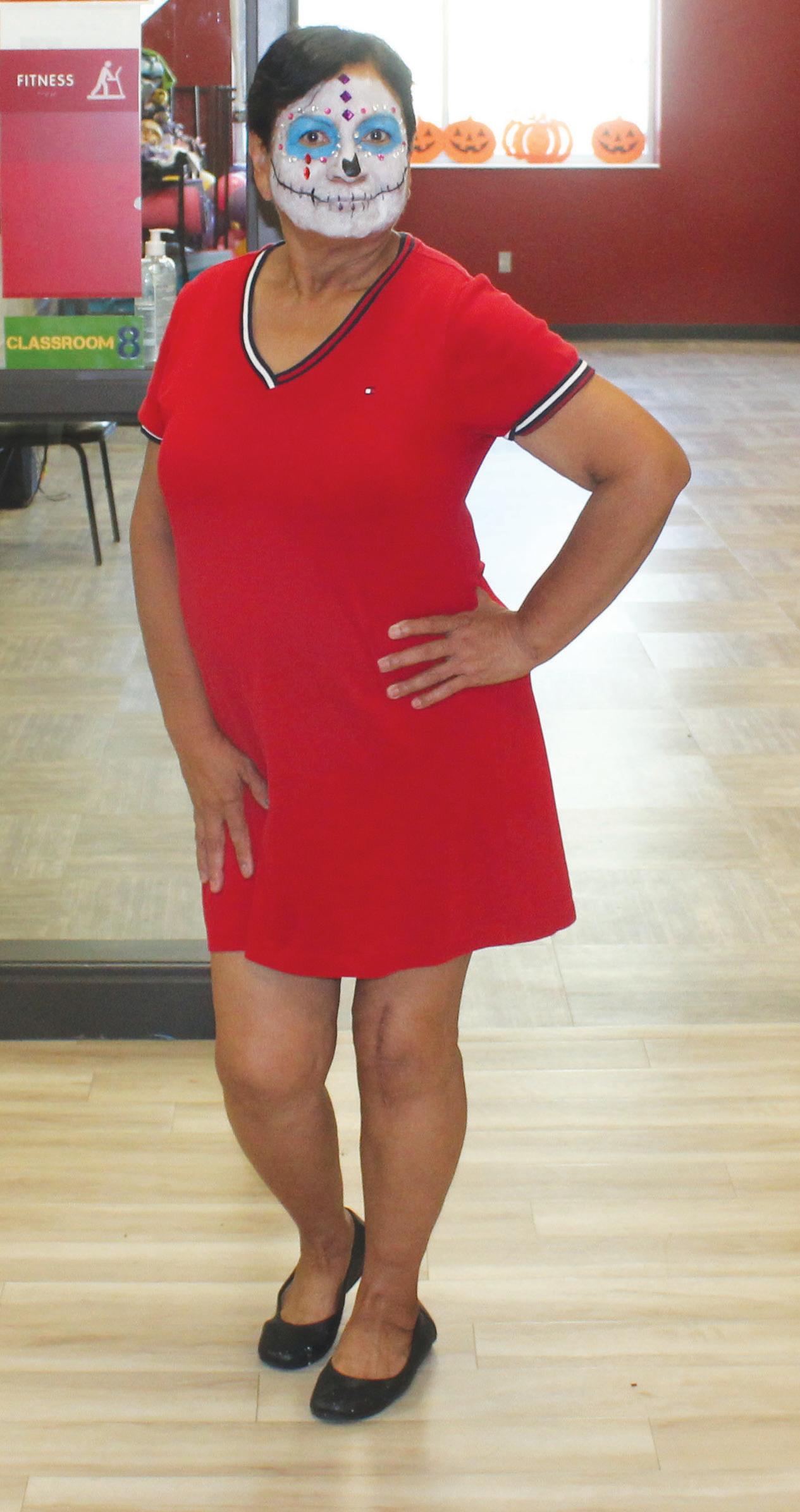

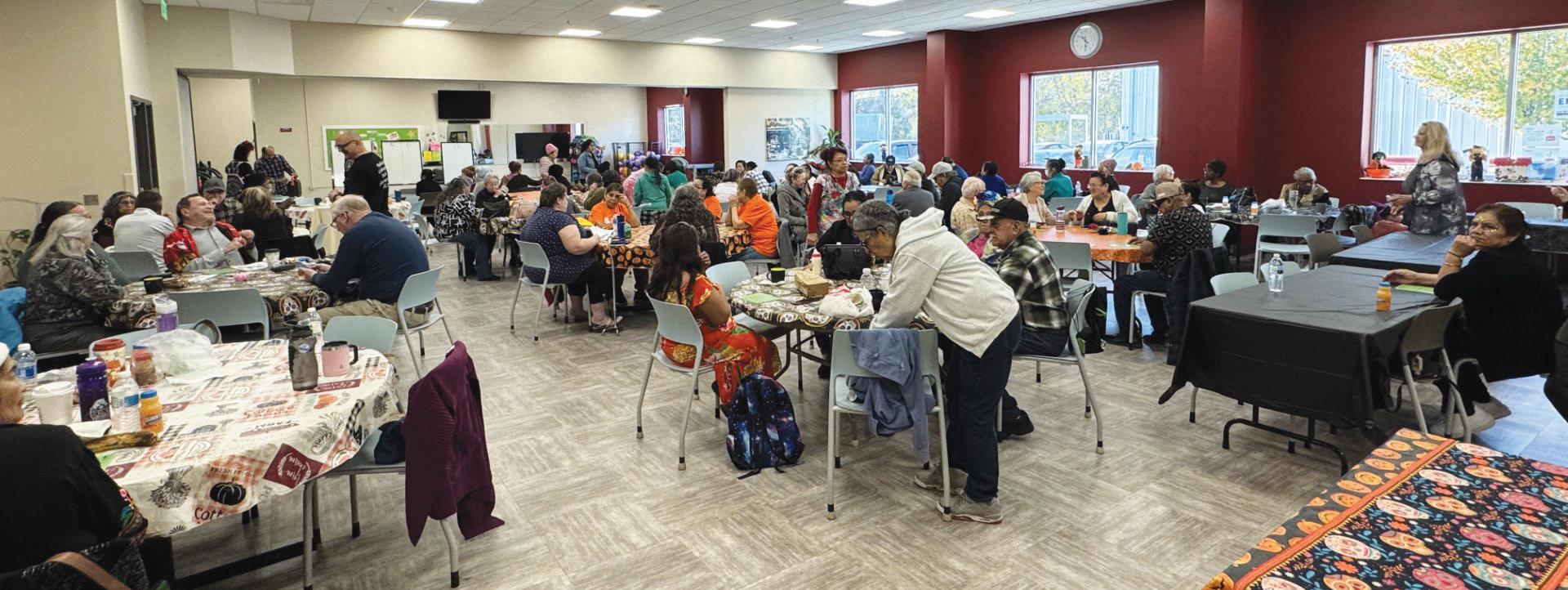
The Day of the Dead altar (photo above) sits in place during the annual Día de Muertos (Day of the Dead) celebration at the Intercultural Senior Center, on 5545 Center St. The festivities this year included trick-or-treating, poker, arts and crafts, Bingo!, traditional decorations and an altar display. The celebration took place on October 25.
In August 2022, President Biden signed the Inflation Reduction Act of 2022 (P.L. 117-169) into law. The law makes improvements to Medicare by expanding benefits, lowering drug costs, and improving the sustainability of the Medicare program for generations to come. The law provides meaningful financial relief for millions of people with Medicare by improving access to affordable treatments and strengthening Medicare, both now and in the long run.
For the first time, the law provides Medicare the ability to directly negotiate the prices of certain high expenditure, single source drugs without generic or biosimilar competition. The Centers for Medicare & Medicaid Services (CMS) selected ten drugs covered under Medicare Part D for the first cycle of negotiations for initial price applicability year 2026 and engaged in voluntary negotiations with the drug companies for the selected drugs.
CMS negotiated in good faith consistent with the requirements of the law on behalf of people with Medicare and the Medicare program. Throughout the negotiation process, the CMS team took into ac-
count the factors outlined in the law in negotiating these prices, which supports the need for innovation and drug development with better prices for people with Medicare and the Medicare program.
CMS engaged in genuine, thoughtful negotiations with each participating drug company. CMS developed an initial offer for each drug, consistent with the process described in the statute and the agency’s guidance, and each manufacturer responded with a counteroffer. CMS held three meetings with each participating drug company to discuss the offers and counteroffers, discuss evidence, and attempt to arrive at a mutually acceptable price for the drug.
During the course of the negotiation process, CMS revised its offers for each of the drugs upward in response to these discussions. Likewise, many drug companies revised their counteroffers for their drugs downward, based on the discussions with CMS.
For five of the selected drugs, this process of exchanging revised offers and counteroffers resulted in CMS and the drug company reaching an agreement on a negotiated price for
the drug in association with a negotiation meeting.
In four of these cases, CMS accepted a revised counteroffer proposed by the drug company. For the remaining five selected drugs, CMS sent a written final offer to those drug companies, consistent with the process described in its guidance, and in each instance, the drug company accepted CMS’s offer on or before the statutory deadline.
Overall Medicare Spending and Out-of-Pocket Spending in 2023: For the time period between January 1, 2023, and December 31, 2023, about 8.8 million of the 54 million people with Medicare Part D coverage were dispensed these drugs to treat a variety of conditions, such as cardiovascular disease, diabetes, autoimmune diseases, and cancer. These selected drugs accounted for $56.2 billion in total Part D gross covered prescription drug costs, or about 20% of total Part D gross covered prescription drug costs during 2023.
During that same time period, people with Medicare Part D pre-
scription drug coverage spent $18.9 billion in out-of-pocket costs for all drugs covered under Part D, including $3.9 billion out-of-pocket for these drugs selected for negotiation.
Estimated Medicare Net Savings in 2023: Compared to 2023 Medicare spending net of all rebates and certain fees and payments, if the prices agreed to between CMS and participating drug companies under the Negotiation Program had been in effect during 2023, the negotiated prices would have saved an estimated $6 billion in net covered prescription drug costs, which would have represented 22% lower net spending in aggregate.
Projected Savings for People with Medicare Part D Coverage: When the negotiated prices go into effect in 2026, people enrolled in Medicare prescription drug coverage would save under the projected defined standard benefit design an estimated $1.5 billion.
These savings from the Negotiation Program are in addition to savings from other cost saving provisions in the Inflation Reduction Act, such as the first ever cap on out-ofpocket drug costs for people with Medicare.


• Do you have questions about the Eastern Nebraska Office on Aging, its programs, or services?
• Do you have a comment about the agency and how it serves older adults in Douglas, Sarpy, Dodge, Cass, and Washington counties?
• Do you have a story idea for the New Horizons newspaper, or would you like to receive a FREE copy each month?
Please send your questions, comments, and story ideas to:
We appreciate your interest in ENOA and the New Horizons

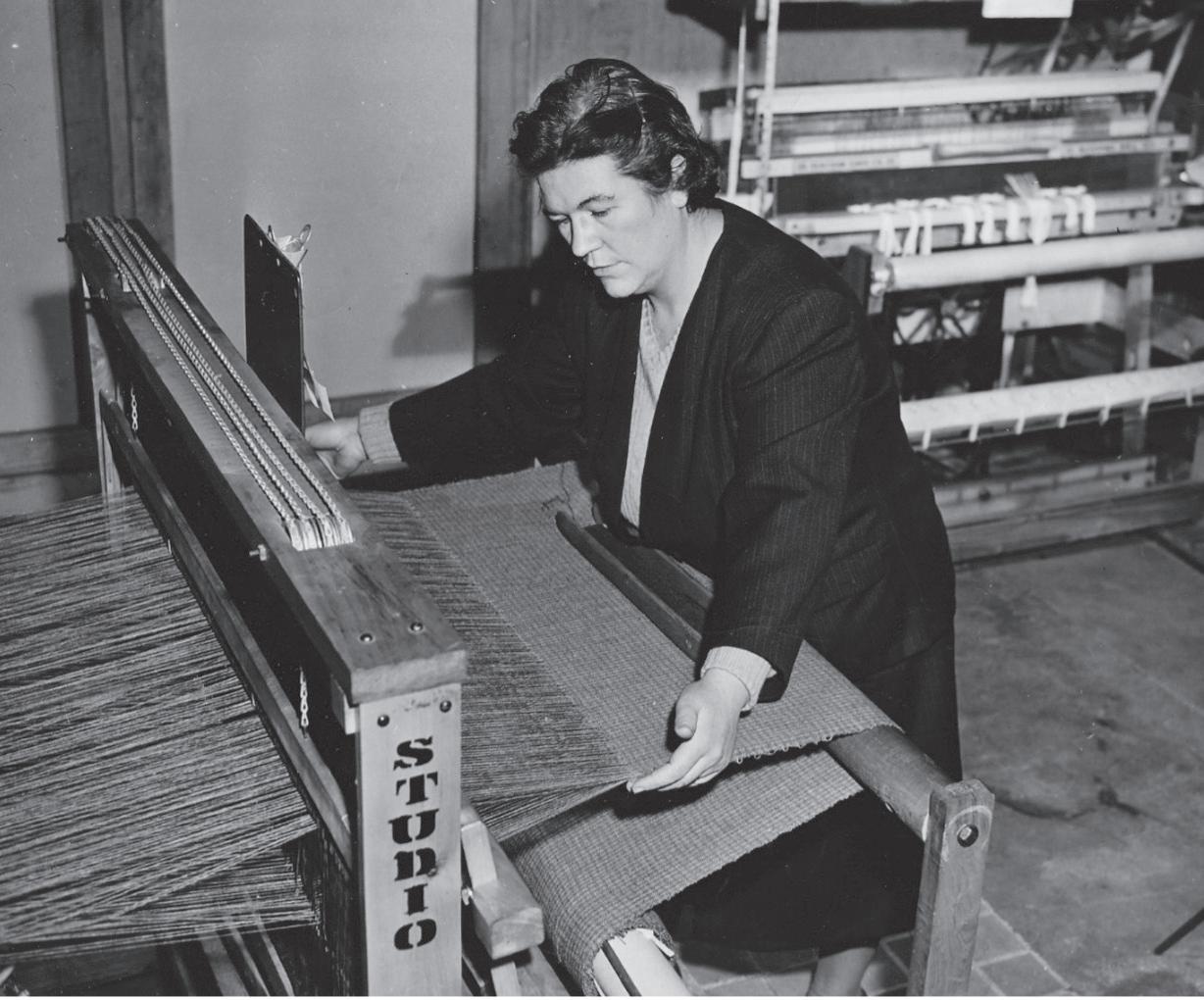
A well-kept secret is a group of Omaha Weavers and Spinners who quietly weave cloth on looms or spin yarn on a spinning wheel. They meet monthly at Underwood Presbyterian Church in Omaha to share information and their skills. Through several special events in 2024 and 2025, this group of fiber artists are going to get noisy as they celebrate their 75th Anniversary.
To kick off OWSG’s 75th Anniversary celebrated, a “Sheep to Shawl” demonstration event. The event showed how fabric is made by carding and cleaning wool fiber from a sheep’s fleece; spinning raw fibers into yarn; then using the yarn to weave a piece of cloth.
On March 17, 1950, the Omaha Weavers Guild was founded by William and Cornelia Nelson with 10 charter members. The first Guild project was a gift of saleable handwoven items to Children’s Hospital. The second project was to begin the Guild Library.
The Guild first displayed table linens designed and woven by members for a contemporary china exhibit.
Within six months, the membership more than doubled to 23, and plans were underway for the first Guild show held at Joslyn Art Museum.
On May 15, 1973, the craft of spinning was officially recognized by the Guild and the name was changed to the Omaha Weavers and Spinners Guild. Through the years the Guild has given demonstrations at schools, museums, and art fairs to promote their art and craft. Art shows have been held at Joslyn Art Museum, Gallery 72, Craftsman Guild Gallery, Dale Clark Library, the Hilmer Gallery, Franklin Street Gallery, Culinary Services, Hot Shops and Lauritzen Gardens. There’s currently an annual sale on the Saturday before Thanksgiving at the Westside Community Center.
In 1975 when Cornelia moved to Omaha after college graduation, she stopped at the Craftsman’s Gallery in the Old Market and asked the owner if she could connect her with a weaving teacher.
Months later Cornelia called her and offered to teach her to weave by giving
lessons from her home until she was able to buy her own table loom. Since Cornelia expected her students to become OWSG members, she did. Layna has been weaving since and states that OWSG has been a driving force in her weaving life providing workshops, education and a lifetime of great friends. Today OWSG has grown to 51 members.
In June 2008, the Guild hosted Midwest Weavers Conference, “Roots” at Dana College in Blair, providing classes, vendors and numerous exhibits and tours to approximately 200 participants from across the country.
The Guild library today houses over 230 books and DVD’s on weaving, spinning and related fiber arts. The Guild also owns seven looms, one spinning wheel and drum carder that are available for members.
The second event is a nod to their history with the Joslyn Art Museum, 2200 Dodge St., Omaha. On Saturday, March 22, 2025, from 10 a.m. to 2 p.m., they will present a history of early beginnings with the museum and participants can take part in a spinning and weaving demonstration by Guild members.
Finally, the main event will be held at a gallery exhibit at the Roberta and Bob Rogers (RbR) Gallery on 1806 Vinton Street, Omaha. Woven, spun, felted and other textile artwork by current Guild members will be on display, plus woven pieces the Guild has kept from members of our historical past. The gallery will be open Wednesday through Saturday from 10 a.m. to 6 p.m. from April 11- May 3, 2025.
Guild meetings are held monthly, programs include all fiber related arts: Weaving, spinning, dyeing, basketry, and even how to raise sheep. They also have a showand-tell period to see what others are doing. In addition, small groups meet to learn and study various facts of spinning and weaving.
For more information about the upcoming events, check out the schedule of all classes and events on their website, owsguild.com or their Facebook page.
By Paula Crozier
The holiday season, often associated with joy and togetherness, can be a time of emotional distress for many older adults. With the loss of loved ones, physical isolation, and the strain of limited social interactions, feelings of sadness and loneliness can intensify. According to the National Institute on Aging, approximately 28% of older adults report feeling lonely, a statistic that tends to rise during the winter months. For older adults, especially those living alone or in assisted living, the holidays can highlight these feelings of isolation. Social isolation and loneliness are serious concerns for older adults. Studies show that chronic loneliness can lead to depression, a weakened immune system, and increased risks for heart disease. The Centers for Disease Control and Prevention (CDC) found that adults aged 65 and older who are socially isolated are at higher risk for cognitive decline and early mortality. With these statistics in mind, it’s crucial for older individuals and their families to take proactive steps to reduce feelings of loneliness during the festive season. One effective way to combat loneliness is by staying socially engaged. Older adults can join holiday activities at local senior centers, participate in virtual family gatherings, or volunteer for holiday events. Many communities offer opportunities for seniors to meet new
people, such as holidaythemed exercise classes or meal programs. Research suggests that maintaining regular social interactions not only reduces loneliness but also promotes mental well-being, which is especially important as individuals age.
Physical activity is another essential component of staying active and engaged. Regular movement, such as walking, stretching, or chair exercises, can lift mood and provide opportunities for socialization. Many senior living communities and community centers offer fitness classes tailored to older adults, ensuring that individuals can stay active in a safe and supportive environment. Exercise has been shown to improve mood by releasing endorphins, the body›s natural “feel-good” hormones, which can help counteract feelings of sadness and depression. Technology also plays a crucial role in reducing loneliness. Older adults can use video calling platforms like Facebook, What’s App and Zoom, to connect with family and friends, regardless of geographical distance. Online groups, book clubs, or hobbybased communities are another way for seniors to stay involved and interact with others who share similar interests. A study published in the Journal of Gerontological Nursing found that older adults who used technology to stay in touch with loved ones reported higher levels
of happiness and reduced loneliness. Finally, older adults can also combat holiday loneliness by focusing on self-care and mindfulness. Taking time to reflect on positive memories, engaging in hobbies like crafting or reading, or practicing meditation can help center emotions. For many older adults, establishing a daily routine that includes activities they enjoy can bring a sense of purpose and fulfillment. Whether it’s baking holiday treats, decorating the house, or simply enjoying a warm cup of tea, small acts of kindness to oneself can be a powerful antidote to the emotional challenges of the season.
By staying active, engaged, and connected, older adults can ease the emotional toll that often accompanies the holidays. With the right support and practical strategies, seniors can find joy and comfort during this festive time, reducing the risks of loneliness and creating meaningful experiences that last well beyond the season.
Paula is the Director of Marketing and Development at Florence Home Healthcare Center, Royale Oaks Assisted Living and House of Hope Assisted Living and Memory Care. In her spare time, Paula is rediscovering all the things she did as a child that she can still do like painting, coloring, hiking and bike riding.
Cybercriminals are using Google search results to try to trick you into calling a phone number that they control. If you search for an organization on Google, scammers can manipulate the search results to display a fake phone number for the organization. Don’t take a chance of losing your investments on a risky phone call. If you search on Google and call the fake number from one of these manipulated search results, you will be connected to a scammer.
They will attempt to trick you out of your money by saying that your account needs updates or you need to transfer funds. They may ask you for your login information so that they can access your
account. Once they gain access to your account, they can quickly transfer your funds to accounts that they control. This is one investment that you don’t want to risk! Follow these tips to avoid falling victim to a phone number scam:
• Confirm that you are on the organization’s official website if you are going to buy one of their products or use one of their services.
• Double-check that the listed phone number is the same one on the organization’s official website.
• Report any fake listings, ads, or any other type of disinformation through Google’s Report services.
For more information, visit KnowBe4. com.
Nutrition is a vital part of aging well. For older adults, unhealthy eating habits can increase the risk of acute and chronic conditions like heart disease, type 2 diabetes, obesity, osteoporosis, and certain cancers. Malnutrition—or the lack of nutrients needed to thrive—can lead to a greater risk of falls, a weakened immune system, decreased bone mass, and slow wound healing.
While most of us know that eating well can help us live a longer, healthier life, putting it into practice every day isn’t always simple or easy. Sometimes it’s helpful to have someone guide us in making the right food choices.
That’s where nutrition counseling comes in.
According to the ACL Nutrition and Aging Resource Center, nutrition counseling “provides personalized guidance to individuals who are at nutritional risk because of their health or nutritional history, dietary intake, chronic illness, or medication use.”
Nutrition counseling is typically provided by a registered dietitian (RD) or registered dietician nutritionist (RDN). Through a supportive, one-on-one counseling process, an RD/RDN can help you understand how diet affects your overall health. They can also help you plan healthy meals that meet your daily nutrition needs and lifestyle. It’s important to understand that nutrition counseling is not a quick fix. The goal is to make gradual, sensible dietary changes you can maintain over the long term.
A registered dietitian or registered dietitian nutritionist is a food and nutrition expert with extensive education and training. The RD and RDN credentials have the same meaning; both show that a person has met the Commission on Dietetic Registration’s strict guidelines for certification. While RD was the original credential given to certified dietitians, the Academy of Nutrition and Dietetics added RDN as an option in 2013.
The addition of “nutritionist” to the credential conveys that dietitians are highly trained in nutrition and
the role it plays in human health and wellness.
Beyond offering nutrition advice, RDs and RDNs provide Medical Nutrition Therapy (MNT), an evidence-based medical approach to treating certain conditions. These professionals work in a variety of environments including hospitals, private health care practices, and community centers. Some work with clients over the phone or remotely through video conferencing.
It’s important to know that a nutritionist is not the same as an RD/ RDN. All dietitians are nutritionists, but not all nutritionists are certified and registered dietitians.
Every nutrition counseling program is different. However, in general, the dietitian you meet with will spend some time getting to know you and your cultural preferences, budget concerns, medical conditions, and goals for the program. They may: Review your general health and medical history. Your RD/RDN may ask about food allergies or sensitivities, digestive issues, or health conditions that are affected by the way you eat. They may request a list of medications or supplements you’re taking. They will also want to know about your physical activity level, current eating habits, and where you struggle the most.
Your RD/RDN will be looking for signs of nutrient deficiencies such as hair loss or severe muscle cramps, since this may mean you’re missing key vitamins and minerals from your diet.
Explain the basics of good nutrition. You’ll learn how different foods impact your health and the way you feel. Your RD/RDN may also teach you how to read food product labels, understand the number of servings per container, and visualize what individual serving sizes look like. You may be given informational materials to take home with you. Show you how to make mindful food choices. Your RD/RDN may help you recognize negative thought patterns and emotions around food. They can also help you identify hunger cues and improve your relationship with foods and beverages. This can prevent problems like compulsive eat-

ing, yo-yo dieting, and binge eating. Help you prioritize dietary changes and set goals. Taking into account your unique needs, your RD/ RDN will help you understand your calorie requirements.
They will explain what dietary changes you should focus on first and help you set realistic goals. Create a personalized nutrition plan. In creating your action plan, your RD/RDN will consider your ideal calorie and nutrient intakes, food preferences, and budget. They may also provide you with sample meal plans and healthy, culturally relevant recipes you can try out at home. Some dietitians may also show you how to make minor adjustments to food preparation without sacrificing flavor and enjoyment.
During your nutrition counseling appointment, you’ll be able to share any concerns you have and ask questions. You should expect to schedule one or more follow-up appointments, which will allow your RD/RDN to monitor your progress and make necessary changes to your eating plan.
Nutrition counseling can help improve your health and wellness in many ways. Its benefits include:
1. Preventing and managing chronic conditions
Along with other lifestyle changes, improving the way you eat can lower your risk of developing hypertension, type 2 diabetes, insulin resistance, obesity, and other chronic conditions.
If you already have a chronic disease, nutrition counseling can help ease some of the physical symptoms you’re experiencing or even reverse the condition altogether. For example, if you’re diabetic, losing weight through dietary changes could help bring your blood glucose down to normal levels.
2. Achieving a healthy weight
Obesity is a common, serious, and growing health issue in the U.S. Between 2017 and 2020, the rate of obesity was 41.9%—a 37% increase from just a decade before.1 Carrying too much extra weight can increase your risk for heart disease, stroke, type 2 diabetes, and even COVID-19 complications. It can also affect your mobility and overall quality of life.
Although it’s not a one-size-fitsall approach, good nutrition is key when it comes to reaching a healthy weight. Nutrition counseling may help you shed pounds by making you aware of how many calories you need for your level of activity. You’ll also learn how to get the proper balance of nutrients.
There is a full range of treatment options for those living with obesity. Speak with your health care provider to find the path that’s right for you.
Likewise, many older adults
experience changes in their metabolism and appetite, putting them at risk for unintended weight loss and malnutrition. If you’ve had unintended weight loss and you’re struggling to maintain a healthy body weight, an RD/RDN can help you create a plan to gain weight at a slow, safe pace.
3. Feeling better overall
Improving the quality of what you eat doesn’t just reduce your risk for disease. It can also help increase your energy levels, enhance your sleep, improve your digestion and bowel movements, boost your mood, and even sharpen your thinking and concentration.
When you combine a nutrientdense diet with smart lifestyle habits like exercising regularly, staying socially connected, and avoiding smoking, your body can function at its best.
4. Developing long-term healthy habits
Nutrition counseling focuses on helping you gradually improve your eating habits through individualized, practical, and manageable changes.
Once you have the tools and knowledge to make better choices, it becomes second nature. One good choice followed by another leads to healthy habits that can last for the rest of your life. Your RD/RDN is an important part of your medical care team. They can help you prevent a decline in your health and keep your immune system working properly.
The best place to start is asking your doctor if nutrition counseling is right for you. They may be able to refer you to a program where you live. You can also contact your Area Agency on Aging to ask about senior nutrition programs in your community. Many programs include services such as nutrition screening, education, and counseling. Find local aging services providers by visiting the Eldercare Locator and entering your zip code.
If you’re having trouble affording healthy foods, it’s worth finding out if you qualify for the Supplemental Nutrition Assistance Program (SNAP). With an average benefit of $118 per month2 (for a one-person older adult household), SNAP helps people with low income put more nutritious meals on their table.
Just ask Randolph Hamilton, age 68. Randolph visited one of our Benefits Enrollment Centers (BECs) for help in replacing his SNAP EBT card. When asked why he participates in SNAP, he teared up, explaining, “I get SNAP so that I can eat and not worry about going hungry.”
(Information provided by the National Council on Aging).
The high costs associated with aging represent one of the greatest financial risks Americans face in their later years. Planning for these expenses is essential to ensure the peace of mind that comes with knowing that your financial future is secure after a lifetime of hard work.
This financial risk doesn’t stop with healthcare. While it’s uncomfortable to think about, personal funeral arrangements can also be a significant expense—and someone will need to cover those costs.
No matter how difficult the path may seem, one key truth remains: final expenses must be addressed during the individual’s lifetime. If they are not, it will fall to the family to cover the funeral costs.
A Funeral Expense Trust is a small, guaranteed-issue life insurance policy that is irrevocably assigned to a trust. Because the funds are probate-exempt, payments can be made quickly. Your Irrevocable Funeral Expense Trust is fully protected from creditors and nursing homes. As an exempt asset, it will not interfere with an individual’s Medicaid or SSI eligibility.
IRREVOCABLE FUNERAL EXPENSE TRUSTS HELP WITH MEDICAID ELIGIBILITY
Funeral trusts can help people who might not otherwise qualify for Medicaid by turning countable assets into noncountable assets. Once assigned it is generally considered an exempt asset by Medicaid and is not subject to the five-year lookback rule. Many states allow
Medicaid applicants to purchase funeral trusts for their children and spouses. In Nebraska, as of September 1, 2024, the maximum value of an irrevocable funeral trust is $6,507 per trust, and you can open a funeral trust for yourself, and for immediate family members, including children, spouses, siblings, parents, and stepchildren.
The entire amount of the trusts is exempt from Medicaid’s asset limit.
Once assigned, this trust is typically considered an exempt asset by Medicaid, meaning it is not subject to the five-year look-back rule.
There are many benefits of a Funeral Expense Trust over prepaying for funeral expenses. One is that you will have the flexibility to move to a different city or state. You’re protected if the funeral home closes or changes ownership. You can feel secure knowing that the funds you’ve set aside are protected from creditors or potential claims, such as those from nursing homes.
Prepaying funeral costs through a Funeral Expense Trust is a straightforward process, offering several benefits. There are no upfront trust fees, and no income tax is due on the funds paid out for funeral expenses.
The trust can be set up
in a location that is most convenient, eliminating the need to visit funeral homes.
You can designate that the funds be used at any funeral home across the U.S., no matter the location. Funeral trusts can cover a variety of expenses, including caskets, urns, transportation, funeral home services, cremation, embalming, and more.
You can instruct the funds to be used for cremation and use the excess funds for travel for family and a Celebration of Life.
There is no underwriting for a funeral trust. Applicants cannot be denied a policy based on their physical condition.
Funeral expenses are not usually tax deductible for individuals, but they may be deductible from the estate’s taxes if the trust was funded by an estate.
By utilizing an Irrevocable Funeral trust, you can ensure that your final wishes are met and that expenses are managed with minimal stress and with no financial burdens on loved ones.
Mary Hiatt is President of Mary the Medicare Lady (A non-government entity.) She is a member of a pharmacist-led organization that helps her clients source savings for medications. She offers Educational Workshops on Medicare, Drug Savings, How to Stop Phone Calls, and more at no charge. Not connected with or endorsed by the U.S. government or the federal Medicare program. See www.hiattagency. com or contact licensed independent agent mary@ hiattagency.com or call or text 402-672-9449 for more information.
Cybercriminals frequently target people who are looking for opportunities. You might receive a text message or email with what looks like real job listings from a cybercriminal posing as a recruiter. The message even includes flexible hours, positions, benefits, and salary. If you reply, the cybercriminal asks you for further information, such as your pay expectations, making this scam convincing.
Then, they direct you to continue the chat through a separate app, such as WhatsApp, Skype, or Telegram. In that separate app, they ask for your personal information. They may ask for your Social Security Number, driver’s license number, or even your credit card number for application fees. The catch is that no real job recruiter will ask you to pay them a fee upfront. The
cybercriminals are trying to steal your personal data and money.
Follow these tips to avoid falling victim to this employment scam:
• If you receive a text message from someone claiming to be a job recruiter, be cautious. Real job recruiters never reach out by text messages.
• Scammers will often ask you to reply to them in a separate app so that they can avoid security oversights. Always be cautious if someone asks you to respond to them using a different app or platform.
• Cybercriminals can pose as anyone, including job recruiters. If you receive a job offer that seems too good to be true, it probably is.
For more information, visit KnowBe4. com.
You’re invited to visit the Intercultural Senior Center (ISC), 5545 Center St.
The Intercultural Senior Center facility – open weekdays from 8 a.m. to 4:30 p.m. – offers programs and activities Monday to Friday.
The ISC offers a morning snack, and regular or vegetarian lunch.
Come and exercise at the ISC. It’s never too late to learn and have fun. Join their language classes, technology, jewelry and crafts, and field trip options.
If people need assistance with their benefits, the ISC can help them out.
Lunch reservations are due by 9 a.m. A voluntary contribution is suggested for the meal.
Monthly food pantries are available for adults ages 50 and older.
For more information, please call 402-444-6529 or visit the ISC website at interculturalseniorcenter.org.
You’re invited to visit the Camelot Friendship Center, 9270 Cady Ave., for regular activities, which include Chair Yoga, card games, Tai Chi, Pinochle, 10 Point Pitch, and bingo. This month’s events include:
• December 12: Lunch & Learn Presentation @ 11:45 a.m.
• December 13: Mike McCracken performs compliments of Merrymakers @ 11:45 a.m.
• December 17: Christmas Party
• December 19: “Jackpot Bingo” @ 12:15 p.m.
• December 20: Book Club meets @ 12:30 p.m.
• December 20: Cookie Exchange @ 12:30 p.m.
• December 24: Camelot is Closed
• December 31: New Year’s Eve Party @ noon
Every Monday – Card Game: Manipulation @ 10 a.m.
Every Monday – Pickleball @ 10 a.m.
Every Tuesday, Wednesday and Thursday – Kings in the Corner @ 12:30 p.m.
Every Wednesday – Hand & Foot @ 12:30 p.m.
Every Wednesday – Chair Volleyball @ 10 a.m.
Grab N Go meals are available.
For more information, contact Barb at 402-444-3091 or barbara.white@cityofomaha.org.

You’re invited to visit the La Vista Senior Center, located at 8116 Park View Blvd. The facility provides activity programs and meals Monday through Friday from 8 a.m. to 5 p.m. Please call 402-331-3455 for general Community Center hours.
Meals are served weekdays at 11:30 a.m. Reservations are due by noon the business day prior to the date the participant wishes to attend and can be made by calling 402-331-3455.
A $5 contribution is suggested for the meal if you are age 60 and older. If you are under age 60, then the meal cost is $9.50.
In addition to meals being served daily, the La Vista Senior Center offers a variety of activities.
Please visit our website at cityoflavista.org/seniors for updated information or call 402-331-3455.
Legal Aid of Nebraska operates a free telephone access line for Nebraskans ages 60 and older.
Information is offered to help the state’s older men and women with questions on topics like bankruptcy, homestead exemptions, powers of attorney, Medicare, Medicaid, and Section 8 housing.
The number for the Elder Access Line is 402-827-5656 in Omaha and 1-800-527-7249 statewide.
This service is available to Nebraskans ages 60 and older regardless of income, race, or ethnicity.
The Legal Aid of Nebraska hours of operation are 9 a.m. to noon and 1 to 3 p.m. Monday through Thursday, and 9 a.m. to noon on Friday.
AARP released a report that shows an estimated 15,500 Nebraskans on Medicare prescription drug plans will see savings thanks to a new out-of-pocket cap that starts January 1, 2025. The savings are made possible by a provision in the 2022 prescription drug law that AARP championed which caps out-of-pocket prescription drug costs every year, beginning at $2,000 next year, for America’s 56 million Medicare drug plan enrollees.
The AARP report analyzes the number of enrollees who will benefit from the cap by state, age, gender, and race between 2025 and 2029.
The findings indicate that Medicare drug plan enrollees nationwide who reach the new out-of-pocket cap will see average sav-
ings of roughly $1,500, or 56%, in 2025 for their prescription drugs.
“AARP fought hard for the prescription drug law of 2022 because we knew it would provide crucial relief for Medicare enrollees here in Nebraska and across the country by lowering drug prices and outof-pocket costs,” said Todd Stubbendieck, State Director of AARP Nebraska, which serves nearly 200,000 members age 50 and older in the state. “Knowing they won’t pay a dime over $2,000 next year—maximum—for prescription drugs they get at the pharmacy gives Nebraska seniors on Medicare drug plans some peace of mind as they struggle to keep up with rising costs for other everyday essentials like housing, groceries and utilities.”
I admit it. I am distraught with anxiety because of the November 5 election. I have some fear for myself but mostly for the welfare of others. I fully understand not all my readers agree with me and many are happy with the election results. My purpose here is not to discuss politics but to explore how to handle fear and stress. We all have it sometimes.
The Buddhists have a term to describe our emotional response to fear, doubt and concern. It is called Monkey Mind. There are countless manifestations of Monkey Mind. Each of us has our favorites. For example, we may talk

By Nancy Hemesath
of the present as if it were the past or the future. We do anticipatory suffering because of what might come to pass. “Either-or thinking” is another Monkey Mind symptom. “Either this is the end of all good things or it is a panacea!”
Solidifying a thought as if were unchangeable is another symptom. “I believe what I believe, and nothing can change it.”
Taking things personally and being defensive is a common symptom of Monkey Mind. “If you disagree with me, that is a personal insult to my character.”
Of course, each of these manifestations of Monkey Mind is untrue.
Functioning on the Monkey Mind level makes it very difficult to have calm, rational conversations with anyone, especially those who differ with us. Batting down Monkey Mind is not a solution but simply energies it, causing an internal battle. The best strategy is to observe Monkey Mind and then refocus our attention on something else which is more positive and interesting.
The opposite of being reactive is to be intentional. Focusing our attention on what we want to do with our lives is empowering. We have the capacity to set intention, pursue our goals for good purpose and to make our own part of the world a better place. Truthfully,
I can only do this when I am reflective and centered. Personally, I need time to think, read inspiring material, get my sleep, hang out with good friends and do enjoyable activities. Then I am more able to resist the ploys of Monkey Mind and have purposeful days. One useful and productive intention is to look for what we share in common, making connections on these terms. For example, we all need to be seen and heard. When we truly see and hear another, we build bridges of understanding. We discover that their heartfelt needs and vulnerabilities are not so different from our own. We then know how to support and encourage the other, creating genuine community.
We can worry about the world and our nation, but seldom can we make substantive changes on such a big stage. In reality, we each have a small world in which we are influencers. When we are intentional in our daily interactions instead of reactive, we are creating building blocks for a better world. After all, the whole is always the sum of its parts.
(Hemesath is the owner of Encore Coaching. She is dedicated to supporting people in their Third Chapter of Life and is available for presentations. Contact her at nanhemesath@gmail. com.)
Join Flaherty Senior Consulting for a series of Solutions Group gatherings that will address the questions and challenges caregivers face.
Solutions Groups provide opportunities for caregivers to learn how to deal with various issues, obtain skills and knowledge, engage in discussions, and interact with others in similar circumstances.
Upcoming meeting dates and locations are:
• Dec. 5, Feb. 6, April 3, June 5, Aug. 7, Oct. 2, Dec. 4 The Servite Center of Compassion 72nd St. and Ames Cr.
• Dec. 18, Feb. 19, April 16, June 18, Aug. 20, Oct. 15, Dec. 17 St. Timothy Lutheran Church 93rd and Dodge streets
• Jan. 14, March 11, May 13, July 8, Sept. 9, Nov. 11 St. Vincent de Paul Church 14330 Eagle Run Dr.
• Jan. 25, March 22, May 17, July 26, Sept. 27, Nov. 29 Faith Westwood United Methodist Church 4814 Oaks Ln.
The Solutions Groups are facilitated by Nancy Flaherty, MS, CDP, president of Flaherty Senior Consulting. She has extensive experience working with family caregivers and caregiver groups.
For more information, email Nancy at flahertyconsulting@cox.net or call/text her at 402-312-9324.
The Durham Museum is excited to announce its 2025 featured exhibition lineup.
The museum is thrilled to host, for the first time, a tactile image experience, beginning the year with Abraham Lincoln: President, Emancipator, Corporate Pitchman. The exhibition offers a transformative multi-sensory exploration of one of America’s most notable figures.
In February, The Durham will be taken over by dinosaurs with the arrival of Antarctic Dinosaurs, which dives into the history of the “Lost Continent” and the animals that inhabited it millions of years ago. An “animated” summer awaits with the arrival of Animation Academy: From Pencils to Pixels®, which takes visitors on an immersive ride through their favorite cartoons and the fascinating realm of animation.
The year ends with HOCKEY, Faster Than Ever, an exhibition that will have sports fans and science enthusiasts cheering from the front-row seats.
The Durham Museum in Omaha’s beautiful art deco Union Station is home to permanent exhibits that preserve Omaha’s vibrant history, traveling exhibits covering subjects ranging from history and culture to science and industry, and many entertaining, educational, family-oriented activities. The Durham Museum is an affiliate of the Smithsonian Institution and has strong ties with national and international museums and lending institutions. For information about The Durham Museum please visit the museum’s website at www.DurhamMuseum.org.
Today’s 65-year-old can expect to live another 20 years, according to the Social Security Administration. This unprecedented gift of longevity brings with it exciting opportunities—and a price tag. Unlike their parents and grandparents, today’s preretirees and retirees face a vastly different retirement security landscape. The traditional three pillars of retirement income are changing.
NCOA worked with the LeadingAge LTSS Center @UMass Boston to examine both the challenges and potential solutions. Our research analysis found that 80% of older adults are either financially struggling now or are at risk for economic insecurity in retirement.
Our 2024 updated analysis of data from the Health and Retirement Study found living independently

in the community without some assistance is out of reach for most older adults.
Nearly 50% of adults 60 and older had household incomes below the Elder Index value for where they lived. This means their average income was below the standard needed to afford basic needs. This was a nearly 5% increase in 2020 compared to data from just two years earlier.
“Financial insecurity has largely remained unchanged for those already most at-risk: in 2020, those in the bottom 20% had no wealth, and those in the next three quintiles (21% to 80%) saw a decrease in the value of their financial assets from 2018,” according to the 2024 analysis.
“Financial patterns over the next several years would need to improve dramatically in order for most older Americans to maintain economic security in the face of rising living costs and increasing risks of financial shocks. While COVID-19 health and employment shocks

may have contributed to the decline seen between 2018 and 2020, even if there is a return to modest improvements in 2022, the vast majority of older adults remain at financial risk.”
U.S. WEALTH GAP WIDENING: 47 MILLION OLDER AMERICAN HOUSEHOLDS FACING FINANCIAL RISKS
The analysis of 2018 data previously found that 80%—or 47 million households with older adults— are financially struggling today or are at risk of falling into economic insecurity as they age.
The updated analysis found that despite older adults’ preference to age in place, 60% would be unable to afford two years of in-home long-term services and supports. And 45% of people 60 and older had household incomes below the Elder Index value for their geography.
(Information provided by the National Council on Aging).
Month’s Sudoku Answers
Month’s Crossword Answers



By Ron Petersen
While travel can be fun, rewarding, and even life-changing, it can also be very stressful for many people. Traveling during a busy season, such as summer or around the holidays, can add more pressure. If you are traveling, there are several tips to keep in mind to help make your journey as smooth as possible.
The first step when planning a vacation is finding where you would like to travel, when and with how many people.
This might start with the direction from a travel agent.
“I would suggest finding someone with experience or specializing in the type of travel you are looking for,”
Omaha travel advisor, Tracy Waugh said. “A good travel advisor will not only be able to assist with the booking process but can help to match the client to the best itinerary for their wants.”
When finding the right destination for your trip, it begins with what you are looking to do or what you are looking to avoid.
Are you looking for romantic beaches in Southeast Asia? The perfect vacation with your children in Australia? Or do you prefer

When planning a trip, it’s important to discuss ideas for the vacation, research accommodations, tour guides and restaurants, know what to pack, plan how to get to the airport or plan for stops and build in downtime during the trip.
sightseeing in Europe?
“Everyone has different interests and wants when it comes to travel. However, as my clients get older, they tend to start moving away from beach destinations to cruises, tours, and more cultural destinations. Europe and river cruises are very popular and a great way to visit a lot of different places in the easiest way possible,” Waugh said. “I think that the biggest similarity with all of the options is looking for the availability of assistance during travel. That assistance could be with mobility
issues, it could be more concierges like with someone making dining reservations or lining up private tours, or it could be assistance in the forms of drivers and tour directors. Older adults in particular are less likely to want to venture out on their own without a plan in place.”
The United States, with its diverse landscapes and vibrant cities, presents numerous opportunities for older adults to embark on exciting journeys, along with views from various locations across the pond.
on small, elegant ships with wide-open views and fewer crowds.
“They are huge in Europe and there are some lines now in the U.S. that offer them on U.S. rivers,” Waugh said. “It is such a fantastic way for older adults especially to travel as there is no driving, no sitting on uncomfortable buses. You spend each day in a new destination with tours included. And they always have something for people who may have mobility issues.”
Not only is it ideal to find out when the best time of year to travel, but it is also important to have travel insurance in case of an emergency.
“Europe and Alaska are very popular right now,”
Omaha travel advisor, Stacy Owens said. “You also have to consider some of the obstacles you might encounter when booking a trip.”
When travelling, travelers must deal with physical limitations, health concerns, and reduced hearing along with lack of access to transportation and intimidation by new technology.
To help ensure a safe and smooth trip, older adults can consider planning ahead, taking precautions, accounting for accessibility or medical needs and assessing their physical abilities.
“For my clients in particular the biggest obstacle they face is air travel. Out of Omaha we don’t have a lot of nonstop options so dealing with traveling gate to gate, allowing time in case of delays, lining up assistance from gate to gate if needed, it can be overwhelming. Throw in the multitude of different classes of airfare and what each airline includes or excludes, and air travel can be daunting if you are not experienced in it,” Waugh said.
“As an advisor I will look at layover times, departure and arrival times, connecting airports, and time of year to make sure that my clients are in the best possible position to have disruption free travel.”
River cruises in particular have become very popular vacations for local older adults over the last couple of years. They offer a convenient and hassle-free way to travel and explore the world. River cruises can be a safe and smooth journey through iconic destinations
“Anytime kids are in school is going to be better than when they are out. If pricing is a primary consideration avoid Christmas, Spring Break, and summer vacations. If looking for a cold weather destination but wanting to get bang for buck look for early December as it is going to be cold at home but warm in destination. And pricing will be much better than January/February. If looking at Europe late spring and late fall are going to be great for weather and pricing. Think April and May and October into early November,” Waugh said. “Travel insurance is really important in general, especially for older adults. It is imperative if you are leaving the country for medical coverage.”
Lastly, there are plenty of deals available that can older adults can take advantage of. Check with the hotels, resorts or other accommodations for their off-season rates which can be a substantial savings, and you can always check for senior citizen discounts or AARP discounts cruises, train travel, airlines, bus travel, hotels and motels, restaurants, parks and campgrounds.
“Cruise lines will offer senior discounts on some cruises. Tour companies may as well and many hotels do,” Waugh said. “It is important to book early if looking for a senior discount as they can be capacity controlled. Keep in mind though that sometimes booking a package deal can be better pricewise than a senior discount, so it is important to look at it from all angles.”