PRSRT STD U.S. POSTAGE PAID OMAHA NE PERMIT NO. 389
A publication of the Eastern Nebraska Office on Aging
New Horizons Former football coach reflects Happy New Year!
January 2026 | Vol. 51 | No. 1
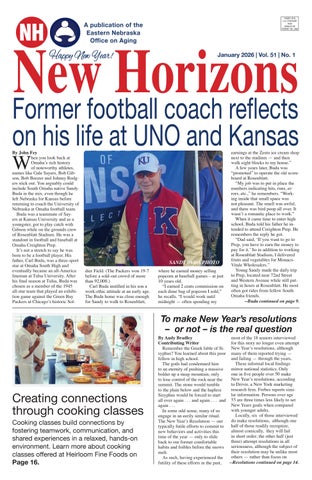
on his life at UNO and Kansas By John Fey hen you look back at Omaha’s rich history of noteworthy athletes, names like Gale Sayers, Bob Gibson, Bob Boozer and Johnny Rodgers stick out. You arguably could include South Omaha native Sandy Buda in the mix, even though he left Nebraska for Kansas before returning to coach the University of Nebraska at Omaha football team. Buda was a teammate of Sayers at Kansas University and as a youngster, got to play catch with Gibson while on the grounds crew of Rosenblatt Stadium. He was a standout in football and baseball at Omaha Creighton Prep. It’s not a stretch to say he was born to be a football player. His father, Carl Buda, was a three-sport star at Omaha South High and eventually became an all-America lineman at Tulsa University. After his final season at Tulsa, Buda was chosen as a member of the 1945 all-star team that played an exhibition game against the Green Bay Packers at Chicago’s historic Sol-
W
SANDY BUDA PHOTO dier Field. (The Packers won 19-7 before a sold-out crowd of more than 92,000.) Carl Buda instilled in his son a work-ethic attitude at an early age. The Buda home was close enough for Sandy to walk to Rosenblatt,
where he earned money selling popcorn at baseball games – at just 10 years old. “I earned 2 cents commission on each dime bag of popcorn I sold,” he recalls. “I would work until midnight — often spending my
earnings at the Zesto ice cream shop next to the stadium — and then walk eight blocks to my house.” A few years later, Buda was “promoted” to operate the old scoreboard at Rosenblatt. “My job was to put in place the numbers indicating hits, runs, errors, etc.,” he remembers. “Working inside that small space was not pleasant. The smell was awful, and there was bird poop all over. It wasn’t a romantic place to work.” When it came time to enter high school, Buda told his father he intended to attend Creighton Prep. He remembers the reply he got. “Dad said, ‘If you want to go to Prep, you have to earn the money to pay for it.’ So in addition to working at Rosenblatt Stadium, I delivered fruits and vegetables for MonacoVitale Wholesalers.” Young Sandy made the daily trip to Prep, located near 72nd Street and Western Avenue while still putting in hours at Rosenblatt. He most often got rides from fellow South Omaha friends. --Buda continued on page 9.
To make New Year’s resolutions – or not – is the real question
Creating connections through cooking classes Cooking classes build connections by fostering teamwork, communication, and shared experiences in a relaxed, hands-on environment. Learn more about cooking classes offered at Heirloom Fine Foods on Page 16.
By Andy Bradley most of the 18 seniors interviewed for this story no longer even attempt Contributing Writer Remember the Greek fable of Si- New Year’s resolutions, although syphus? You learned about this poor many of them reported trying — and failing — through the years. fellow in high school. These informal local findings The gods had condemned him mirror national statistics. Only to an eternity of pushing a massive one in five people over 50 make bolder up a steep mountain, only New Year’s resolutions, according to lose control of the rock near the to Driver, a New York marketing summit. The stone would tumble research firm. Forbes reports simito the plain below and the hapless lar information. Persons over age Sisyphus would be forced to start all over again . . . and again . . . and 55 are three times less likely to set New Years goals when compared again . . . with younger adults. In some odd sense, many of us Locally, six of those interviewed engage in an eerily similar ritual. do make resolutions, although one The New Year’s Resolution — our half of those readily recognize, typically futile efforts to commit to almost comically, they will fail new behaviors and activities this in short order; the other half (just time of the year — only to slide three) attempt resolutions in all back to our former comfortable seriousness, although the subject of habits and foibles before the snows their resolution may be unlike most melt. others — rather than focus on As such, having experienced the --Resolutions continued on page 14. futility of these efforts in the past,
Hospital indemnity plans: The quiet safety net filling coverage gaps
OMAHA SENIOR LIVING SERIES
REMEMBERING WHEN: A FIRE & FALL PREVENTION PROGRAM FOR OLDER ADULTS
Back to our Regular Location!!! Millard Branch of the Omaha Library
Wednesday JAN 21, 2026
13214 Westwood Ln Omaha, NE 68144
2.00 pm - 3.00 pm
JANUARY’S SPEAKER: OMAHA FIRE DEPARTMENT
Call (402) 212-5282 to reserve your seat Refreshments Provided!
Hosted by: Nebraska Realty Senior Real Estate Specialists
As healthcare costs continue to rise and insurance plans shift more financial responsibility onto patients, a once-overlooked product is stepping back into the spotlight: hospital indemnity insurance. Long regarded as a supplemental add-on rather than a core piece of coverage, these plans are increasingly being used by both seniors and those under age 65 who are looking for predictable protection from unpredictable hospital bills. Hospital indemnity plans—sometimes called “fixed indemnity” or “hospital cash” plans—provide a simple promise: If you are hospitalized, the insurer pays you a set amount of cash. Unlike major medical insurance, which reimburses healthcare providers directly, hospital indemnity plans pay the policyholder. The benefit can then be used for anything—medical bills, transportation, lost income, childcare, or even household expenses that pile up when illness disrupts daily life. This flexibility is one reason the product is finding renewed popularity. A RESPONSE TO RISING OUT-OF-POCKET COSTS Deductibles and coinsurance requirements have grown at a pace many Americans find hard to manage. Meanwhile, many Medicare Advantage plans, while offering robust benefits, still impose copays on hospital stays. For individuals living on fixed incomes—or families trying to maintain financial stability—these unforeseen costs can quickly lead to debt. STRAIGHTFORWARD STRUCTURE, FLEXIBLE USE The simplicity of hospital indemnity plans is part of their appeal. Policyholders often know exactly what they will receive if certain conditions are met. A threeday hospital stay means three days of benefits. A trip to the emergency room may be eligible for a separate payment. Because compensation is based on a fixed schedule rather than actual charges, there is no complicated billing process or worry about whether the claim will be deemed medically necessary by an
Page 2
•
New Horizons
•
January 2026
insurer. Consumers increasingly appreciate this predictability. Indemnity payments can be used for many of these expenses, making them distinct from traditional health insurance, which only applies to medical costs.
ization charges. Hospital indemnity coverage has become a practical, affordable add-on. Most plans cost significantly less per month than major medical insurance, often ranging anywhere from $30 to $60 depending on age and benefit level. For many households, that cost feels manageable compared to the risk of an unexpected $3,000 hospital bill. Hospital Indemnity plans can be purchased any time of the year and do not have any special election periods.
GUARANTEED ISSUE One of the lesser-known advantages of hospital PARTNERSHIP WITH indemnity plans is the availMAJOR MEDICAL ability of guaranteed-issue PLANS Hospital indemnity insur- plans, which require no ance is not meant to replace medical underwriting. Several carriers allow comprehensive health covapplicants to enroll without erage. Instead, it works as a answering health questions, complement, especially for and many offer guaranteedthose with high-deductible issue eligibility up to age health plans (HDHPs), employer plans, or Medicare 79. This makes the plans accessible to older adults, Advantage plans. Brokers individuals with chronic have specialized quoting conditions, and consumers tools that can help “fill the gaps” left by your insurance. who may not qualify for other forms of supplemental For example, a Medicare insurance. Advantage enrollee might For those who have been face a daily hospital copay declined for life or health of $500 for the first five products before, guaranteeddays of an inpatient stay. A hospital indemnity plan may issue hospital indemnity offer a daily benefit of $500, plans provide a rare opportunity to secure meaningful effectively neutralizing the financial protection. out-of-pocket exposure. Some plans can also cover LIMITATIONS AND ambulance services or observation stays—often areas MISCONCEPTIONS Despite their benefits, where costs catch patients hospital indemnity plans are off guard. sometimes misunderstood. Younger adults, too, are purchasing indemnity plans They do not cover routine medical care, doctor visits, to offset the steep deductor prescription drugs. They ibles that come with many also do not act as substimarketplace and employertutes for major medical sponsored health plans. A insurance—something that serious illness or accident regulators emphasize reguearly in the year can force larly. These plans pay fixed them to meet the full deamounts, not actual costs, ductible before insurance which means a large bill pays. A supplemental plan could still leave a policycan soften that financial holder financially strained. blow. Consumers are encourAFFORDABILITY IS aged to read the fine print A KEY REASON FOR carefully. Some plans THE POPULARITY OF impose waiting periods on HOSPITAL INDEMNITY pre-existing conditions. PLANS A GROWING ROLE IN Independent insurance AMERICA’S brokers note a surge in HEALTHCARE demand, especially during LANDSCAPE the Medicare Annual ElecAs the healthcare system tion Period. As consumers compare plan options, many evolves, so do the tools consumers use to navigate discover they are comfortit. Hospital indemnity plans able with their Medicare have become a key part of Advantage low monthly the supplemental insurance premiums, but uneasy with potential hospital--Safety Net continued on page 3.
Easy-care flowering indoor plants By Melinda Myers Brighten your home’s décor and elevate your mood by adding a few flowering plants to your indoor garden. You may be surprised to find a wide array of flowering plants that will bloom when they are grown indoors. Match the plant to the growing conditions and your maintenance style for ease of care and greatest success. Add a long-blooming moth orchid (Phalaenopsis) to your collection. It thrives in most home environments, making it the easiest of all the orchids to grow. Position your orchid in a brightly lit location that’s free of hot or cold drafts. Water thoroughly with tepid water once a week. Leave the flower stalk intact and wait for a second smaller flush of flowers. Or prune it back to an inch above the foliage, provide proper care and watch for a fresh set of flowers in about a year. Or gift the non-flowering plant to a gardening friend. There’s always one who’s willing to wait for the next set of flowers. In the meantime, you can invest in a new variety for your home. Treat yourself to an easycare anthurium. You can now find white, red, pink, lavender and even yellow anthuriums for sale almost year-round. The colorful heart-shaped “flowers” are modified leaves that hold their color for many weeks. Grow this low maintenance, very forgiving plant in bright, indirect light and water thoroughly whenever the soil begins to dry. Include bromeliads, another long bloomer with unique tropical flowers. Those with pliable leaves are more tolerant of lower light, while the stiff-leafed bromeliads need bright light to thrive. Water the soil often enough to prevent the roots from drying. After weeks and even months of flowering, the plant eventually dies but forms offsets,
COURTESY PHOTO Bromeliads are long bloomers with unique tropical flowers.
known as pups, you can grow to maturity. The tubular, red-burgundy flowers of lipstick plant (Aeschynanthus radicans) reveal the inspiration for its common name. Grow this long-blooming, trailing plant in a warm location with bright, indirect light. Water thoroughly when the top inch of soil begins to dry. Move it to a slightly cooler location and allow the soil to dry a bit more between waterings during the winter. Have fun by adding a hanging basket of goldfish (Nematanthus) to your collection. This easy-care plant produces long-lasting, orange-red flowers that resemble goldfish. Place it in bright, indirect light and water when the soil begins to dry. Keep these and your other houseplants healthy and minimize pest problems by providing proper growing conditions and care. Fertilize actively growing plants with a flowering houseplant fertilizer according to label directions. Boost the humidity by grouping plants together. As one plant loses moisture, transpires, its neighbors’ benefit. Place pebbles in the saucer or tray to elevate the pot above any water that collects there. As the water evaporates, it increases the humidity around the plant and eliminates the need for you to empty ex-
--Safety Net continued from page 2. landscape, offering simple, predictable benefits at a time when medical cost-sharing grows increasingly complex. Their straightforward structure makes them appealing across demographics—from younger families enrolled in high-deductible plans to seniors who want added protection alongside Medicare Advantage. Mary Hiatt is a Retirement & Insurance Advisor and President of Mary the Medicare Lady (A non-government entity.) She is Certified in Long Term Care Programs, Policies, & Partnerships and Annuities. She
cess water out of the saucer. Check all your plants for insects each time you water. It is easier to manage small populations than larger infestations. Use yellow sticky traps to monitor and trap white flies, fungus gnat adults, thrips and other houseplant pests. Manage fungus gnat larvae residing in the soil with organic Summitâ Mosquito Bits®. It contains a naturally occurring soil bacteria, Bacillus thuringiensis israelensis (Bti), that’s safe for people, plants, and pets. Just follow the label directions for the most effective control. Look for opportunities to include these and other flowering plants in your home. You’ll enjoy the added color and beauty these plants provide. Melinda Myers has written over 20 gardening books, including Midwest Gardener’s Handbook, 2nd Edition and Small Space Gardening. She hosts The Great Courses “How to Grow Anything” instant video and DVD series and the nationally syndicated Melinda’s Garden Moment radio program. Myers is a columnist and contributing editor for Birds & Blooms magazine and was commissioned by Tree World Plant Care for her expertise in writing this article. Her website is www.MelindaMyers.com.
offers Educational Workshops on Medicare, Long Term Care and more at no charge. She helps retirees convert their 401Ks and IRA’s into guaranteed income streams as well as helping clients get Medicaid with eligible spend-down plans and Funeral Expense Trusts. Not connected with or endorsed by the U.S. government or the federal Medicare program. Medicare Supplement insurance plans are not connected with or endorsed by the U.S. government or the federal Medicare program. See www.hiattagency.com or contact licensed independent agent mary@hiattagency.com or call or text 402-672-9449 for more information.
January 2026
New Horizons New Horizons is the official publication of the Eastern Nebraska Office on Aging. The paper is distributed free to people over age 60 in Douglas, Sarpy, Dodge, Washington, and Cass counties. Those living outside the five-county region may subscribe for $5 annually. Address all correspondence to: Ron Petersen, Editor, 4780 S. 131st Street, Omaha, NE 68137-1822. Phone 402-444-6654. FAX 402-444-3076. E-mail: ron.petersen@enoa.org Advertisements appearing in New Horizons do not imply endorsement of the advertiser by the Eastern Nebraska Office on Aging. However, complaints about advertisers will be reviewed and, if warranted, their advertising discontinued. Display and insert advertising rates available on request. Open rates are commissionable, with discounts for extended runs. Circulation is 9,000 through direct mail .
Editor................................Ron Petersen, 402-444-6654 Ad Mgr................Mitch Laudenback, 402-444-4148 Contributing Writers.........Leo Biga & Andy Bradley ENOA Board of Governors: Mary Ann Borgeson, Douglas County, chairperson; Don Kelly, Sarpy County, vice-chairperson; Lisa Kramer, Washington County, secretary; Pat Tawney, Dodge County, & Taylor Boyle, Cass County. The New Horizons and the Eastern Nebraska Office on Aging (ENOA) complies with applicable federal civil rights laws and does not exclude, deny services to, or otherwise discriminate against any person on the basis of race, color, national origin, disability, age, sex, marital status, veteran status, or religion.
•
New Horizons
•
Page 3
AFFORDABLE APARTMENT HOMES A 55+ ACTIVE SENIOR COMMUNITY BELLEVUE, NE
NOW LEASING 1 & 2 BEDROOM APARTMENTS Spacious • Modern • Vibrant Living
Features You’ll Love
Why Choose Walnut Creek?
• Central Heating & Air Conditioning
• Affordable rents through the Low-Income Housing Tax Credit (LIHTC) program
• Fully Equipped Kitchen
• Income and student status restrictions apply
• Generous Closet & Storage Space
• Supportive staff committed to your comfort
• Community Space
• On-site Computer Center
• Conveniently located near shopping, dining & entertainment
• Playground & Outdoor Gathering Spaces
• Live your best life, independently.
2204 Albert Street, Bellevue, NE 68147
Call Today: 402-819-3999
walnutcreeknebraska.com
CAPTCHA screens can be dangerous E By Kelly C. Bourne ven if you don’t know what a CAPTCHA screen is, the odds are that if you spend any time online you’ve encountered many of them. They frequently pop up when you go to websites that enforce at least a minimal level of security. CAPTCHA is an acronym for “Completely Automated Public Turing test to tell Computers and Humans Apart.” They’re screens used by websites to verify that the user is a human being instead of a computer program or bot. Bots are computers that have been taken over by a computer virus and are frequently controlled by a criminal. CAPTCHA screens fulfill a legitimate need to prevent bots from performing activities like creating accounts on social media sites, posting misleading information, sending spam or stealing information from websites. The actions requested by a CAPTCHA screen are relatively easy for a human to complete but very difficult for bots to perform. The simplest CAPTCHA
Homes designed with your future in mind! Open concept floor plans with “Universal Design”* standards • One Floor Living • “Open Concept” design – easy traffic flow • Step-less Front Door & Garage Entries • Wider Hallways
• Wider Doorways (most doors) • Low-Curb or Zero-entry (per plan) Shower Access • Low Maintenance Exteriors • Available in over 20 Communities
Locations available in all parts of the Omaha area
For NW/Elkhorn Living: 402-916-9883 For SW/Gretna Living: 402-895-1100 For Papillion Living: 402-896-9200 For Bellevue Living: 402-614-6088
www.RegencyHomesOmaha.com * T hi s i s Uni v ers al Des i gn; not A DA S t and ar d s .
Page 4
•
New Horizons
•
January 2026
screens simply display a software can be used to monitor all your keystrokes, check box next to the label mouse clicks and other “I’m not a robot.” When actions on the device. This you click on the check box would enable the bad guys behaviors like how long it to learn your user ID and took you to respond and your mouse movements are passwords for accounts at your bank, credit card proanalyzed. If the system is vider, email provider, etc. convinced you’re a human, 3. Crypto mining software the web page you requested can be loaded onto your will be displayed. If the computer. It runs continusystem isn’t sure whether you’re human or not, then a ously in the background to “mine”, i.e., create Bitcoin more advanced CAPTCHA or other cryptocurrencies. screen will be displayed. The criminals will keep the CAPTCHAs can display newly created wealth while an array of photographs, and you’re required to click you end up with a computer that runs slower than norall the squares that include mal and a higher than usual images of school buses, electric bill. motorcycles, traffic lights, 4. Your computer might stairs, etc. Other versions of become a bot, i.e., a comCAPTCHA screens display puter that’s controlled by the letters that have been decriminal. As a bot it might formed or twisted, and you be used by the criminal (or need to identify the letters botmaster) to send spam to and type it into a text field. innocent victims, spread disA recent version requires information on social media that you slide a piece of a puzzle into the correct posi- sites or be part of a group of bots to take down a website tion to complete an image. in a DDOS (Distributed DeThings that have become familiar to us are frequently nial of Service) attack. 5. Any virus or malware overlooked and CAPTCHA installed on your computer screens are no exception. has the potential to make it We see them all the time. run extremely slowly, crash They have simply become more frequently or become part of the landscape and completely unusable. therefore we pay little atThe following steps are tention to them. The danger common ones that malicious with this level of familiarCAPTCHA screens will ask ity is that criminals have you to perform. created screens that are 1. If the first screen very similar to legitimate CATPCHA screens. Instead displayed has a checkbox followed by the label “I’m of providing security, they not a robot” then you need are designed to download a to be on your guard. Norvirus onto the user’s commally this screen is OK, but puter. it can be the first step down Criminals are counting a dangerous path. If this on us being so accustomed is a malicious CAPTCHA to CAPTCHA screens screen, then it will load a that we’ll mindlessly folscript with dangerous code low their directions even if they’re a little different than into your computer’s clipboard area. what we’re used to. These 2. If the next step you’re new faux security screens directed to take is press the include steps intended to Windows key and the “R” trick you into loading malikey simultaneously then it’s cious code into your comdangerous. Doing this opens puter’s clipboard area and a command prompt, i.e., a then executing it. window used to send comIf the criminals are sucmands directly to a computcessful in tricking you into er’s operating system. loading their malware, a 3. The next instruction number of unpleasant things is likely to press the Concan happen. Some of these trol key and the “V” key undesirable outcomes insimultaneously. This pastes clude: the script loaded into the 1. Ransomware can be clipboard by step 1 into the installed on your computer. command prompt. Critical files will be en4. The final step is to crypted, and you’ll have to press the Enter key. This pay a ransom to get them instructs the computer to unlocked. 2. Keystroke logging --CAPTCHA continued on page 5.
Make medication Y safety your mantra Did you remember to take your pills today? 66% of all adults in the United States take at least one prescription drug every day, but even the most cognizant, “withit” individual may fumble when it comes to taking the correct dose of their prescriptions at the right time. Because of this, practicing medication safety is a must. What are the most basic prescription safety practices? Draft up a list of the medications you are currently taking, as well as each drug’s dosage and frequency. Don’t forget to include over-the-counter (OTC) remedies, vitamins, supplements, or any other medicinal items included in your daily routine, like ointments or injections. Follow safe prescription storage methods by keeping meds in a dry, safe space in their original packaging or bottle. If you rely on ibuprofen or Tylenol to alleviate chronic pain symptoms, check with your doctor or pharmacist to ensure these familiar OTC meds don’t clash with your current prescriptions and result in unpleasant side effects. While these tips may seem like common sense, the U.S. Food & Drug Administration (FDA) receives over 100,000 medication error
reports per year—so a refresher never hurts. How can I tell if a medication is working for me— and if not, how do I bring it up to my doctor? Part of October, or “Talk About Medications” Month, is selfevaluation: are your meds working for your body, behavior and lifestyle? Everyone is different when it comes to adverse or allergic reactions. Thus, noticing side effects or the beginnings of anaphylaxis will save you a lot of discomfort—and potentially a lot of money, too. Have your doctor educate you on the side effects of each drug before it becomes part of your regimen. If a prescribed medication turns out to be detrimental to your energy levels, state of mind or overall health, make sure to discuss these issues with your care team before going off of it entirely. Additionally, if you run into financial problems with a particular prescription, don’t feel ashamed discussing options with your doctor or pharmacist; they have your best intentions in mind, and a less expensive, generic alternative may be just as successful as the pricier, name-brand drug. What if I need help tracking and taking all my medications? Some simple tactics
--CAPTCHA is continued from page 4. execute the code that was just pasted into the command prompt. If you were fooled into performing all of the above steps you’ve very likely infected your computer with a virus. Malicious CAPTCHA screens may be a new form of attack, but they don’t have to mislead you. Steps that can help you avoid this new threat of infecting your computer with a virus include: 1. Keep the antivirus (AV) software on your computer up to date. If your AV software is current, then it should protect you even if a fake CAPTCHA screen fools you. 2. New variations of this type of attack will continue to appear, so you need to be cautious. The bottom line is
that if a CAPTCHA screen asks you to do something other than type in a couple of random letters or click on pictures, you should be skeptical. 3. A legitimate CAPTCHA screen will never request that you press the Control key or a combination of keys like Control-C or Control-V. If you’re directed to this do by a CAPTCHA screen, then something is wrong. 4. Listen to your gut. If you’re instructed to do something that feels wrong or uncomfortable, then don’t do it. Close all the tabs on your browser and exit out of it. Kelly’s newest book, “Ransomware, Viruses, Social Engineering and Other Threats: Protecting Your Digital Assets” is available on Amazon and at The Bookworm.
for prescription tracking are using a daily pill box, jotting down notes on a readily visible calendar or trying tech out with an automatic pill dispenser. Need some extra help? Have a reliable family member or friend stop by every so often to ensure drugs are being taken correctly. If you are comfortable with them accompanying you to doctor’s appointments, this additional information may be beneficial for both of you. Studying up on safety practices gives you an advantage: It yields understanding on important objectives to keep yourself and loved ones on the right track. After all, knowledge is power: especially when your health is on the line.
La Vista Senior Center
ou’re invited to visit the La Vista Senior Center, located at 8116 Park View Blvd. The facility provides activity programs and meals Monday through Friday from 8 a.m. to 5 p.m. Please call 402-331-3455 for general Community Center hours. Meals are served weekdays at 11:30 a.m. Reservations are due by noon the business day prior to the date the participant wishes to attend and can be made by calling 402-331-3455. A $5 contribution is suggested for the meal if you are age 60 and older. If you are under age 60, then the meal cost is $9.50. In addition to meals being served daily, the La Vista Senior Center offers a variety of activities such as: Bingo, outings, cooking classes, movies with popcorn, arts and crafts, a variety of card games, quilting, Tai Chi, exercise classes, musical entertainment and various parties. Please visit our website at cityoflavista.org/seniors for updated information or call 402-331-3455.
This health tip is brought to you by Tabitha.
support! We need your
I would like to become a partner with the Eastern Nebraska Office on Aging, and help fulfill your mission with older adults.
ENOA
Traditional funding sources are making it more difficult for ENOA to fulfill its mission. Partnership opportunities are available to businesses and individuals wanting to help us. These opportunities include volunteering, memorials, honorariums, gift annuities, and other contributions.
These gifts are tax exempt.
$25 = One month of Personal Emergency Response. $50 = Provides one week of Meals on Wheels for one older adult. $75 = Provides one week of meals and activities at a senior center. $125 = Full month of bathing assistance. $175 = Helps provide respite care for an older adult. $250 = Provides urgent relief and essential support to individuals during unexpected emergencies. Other amount (please designate)__________________________ Please contact me. I would like to learn more about how to include the Eastern Nebraska Office on Aging in my estate planning.
Name:_____________________________________ Address:___________________________________ City:______________State:_____ Zip: __________ Phone:____________________________________
January 2026
•
Please ma il with thisyofour donation rm to: Ea
stern Office oNnebraska Aging Attn: Hop eH
ouessou 4780 S kpe Omaha, . 131st Street NE 6813 7-1822 (402)
New Horizons
444-6536
•
Page 5
January is Glaucoma Thank you to the New Horizons Club members Awareness Month Please see the ad on page 3
$20 Cheryl Lambert $15 Jim Ely $10 Deb Palmtag
$5 Jeanette Sterba Dodie Eickman Florence Senior Center You’re invited to visit the Florence Senior Center, 2920 Bondesson St. At the Florence Senior Center, lunch is served at 11:30 am. A select menu is offered Monday thru Friday. Meal reservations must be made one day in advance. Please call by noon the day before for a meal reservation. The center hosts activites such as Tai Chi, annual picnics/ special events, bingo, cards, gym & game room access, special guest speakers and socials. Arts and crafts will be held on the third Wednesday of each month. They also provide health and nutrition programs. For more information, please call Colleen Metz @ 402444-6333.
Creighton Research Study The School of Pharmacy and Health Professions at Creighton University is conducting a research study and are looking for older adults with sarcopenia. The goal of this research study is to provide evidence for the use of internal and external cues to optimize resistance training within rehabilitation. You may qualify if you are 60-95 years of age, are physically independent and if you have reduced muscle mass. You should not be in this study if you have known neurological, circulatory, or edema pathology. If you are interested, please call Rashelle Hoffman at 402-280-5691 or email movecoglab@creighton.edu.
January is National Glaucoma Awareness Month, an important time to spread the word about this sightstealing disease. More than 3 million people in the United States have glaucoma. The National Eye Institute projects this number will reach 4.2 million by 2030, a 58 percent increase. Glaucoma is called “the sneak thief of sight” since there are no symptoms and once vision is lost, it’s permanent. As much as 40% of vision can be lost without a person noticing. Glaucoma is the leading cause of irreversible blindness. Moreover, among African American and Latino populations, glaucoma is more prevalent. Glaucoma is 6 to 8 times more common in African Americans than Caucasians. Over 3 million Americans, and 80 million people worldwide, have glaucoma. Experts estimate that half of them don’t know they have it. Combined with our aging population, we can see an epidemic of blindness looming if we don’t raise awareness about the importance of regular eye examinations to preserve vision. The World Health Organization estimates that 4.5 million people worldwide are blind due to glaucoma. HELP RAISE AWARENESS Talk to your family about glaucoma. In the United States, approximately 120,000 are blind from glaucoma, ac-
counting for 9% to 12% of all cases of blindness. Here are some ways you can help raise awareness: Talk to friends and family about glaucoma. If you have glaucoma, don’t keep it a secret. Let your family members know. Refer a friend to our web site, glaucoma.org Request to have a free educational booklet sent to you or a friend. Get involved in your community through fundraisers, online information sessions or group discussions, etc. Connect with Glaucoma Research Foundation on Facebook or follow us on Twitter and Instagram for regular updates on glaucoma research, treatments, news and information. Share information about glaucoma with your friends and family. WHAT IS GLAUCOMA? Glaucoma is a group of eye diseases that gradually steal sight without warning. Although the most common forms primarily affect the middle-aged and the elderly, glaucoma can affect people of all ages. Vision loss is caused by damage to the optic nerve. This nerve acts like an electric cable with over a million wires. It is responsible for carrying images from the eye to the brain. There is no cure for glaucoma—yet. However, medication or surgery can slow or prevent further vision loss. The appropriate treatment depends upon the type of glaucoma among other factors. Early detec-
tion is vital to stopping the progress of the disease.
TYPES OF GLAUCOMA There are two main types of glaucoma: primary openangle glaucoma (POAG), and angle-closure glaucoma. These are marked by an increase of intraocular pressure (IOP), or pressure inside the eye. When optic nerve damage has occurred despite a normal IOP, this is called normal tension glaucoma. Secondary glaucoma refers to any case in which another disease causes or contributes to increased eye pressure, resulting in optic nerve damage and vision loss. REGULAR EYE EXAMS ARE IMPORTANT Glaucoma is the second leading cause of blindness in the world, according to the World Health Organization. In the most common form, there are virtually no symptoms. Vision loss begins with peripheral or side vision, so if you have glaucoma, you may not notice anything until significant vision is lost. The best way to protect your sight from glaucoma is to get a comprehensive eye examination. Then, if you have glaucoma, treatment can begin immediately. Glaucoma is a leading cause of blindness among African-Americans. Also, siblings of persons diagnosed with glaucoma have a significantly increased risk of having glaucoma. (Information provided by Glaucoma Research Foundation).
Programs changing this month at AARP NE Information Center By Tony Harris AARP NE Information Center For more than 90 years, Social Security has been a cornerstone of financial security in America, helping millions of families stay out of poverty and enjoy peace of mind in retirement. Today, more than 370,000 Nebraskans rely on these benefits—earned through a lifetime of hard work. On January 21 at 1:30 p.m., anyone is invited
Page 6
•
New Horizons
•
January 2026
to attend an informative presentation about Social Security. This program will help you understand how your claiming decisions can impact your future, how Social Security is financed, and what’s at stake for generations to come. You’ll learn what Social Security really is, how to secure your benefits, and why it matters now more than ever.
Located at 1941 S 42nd St. in Suite 220, the Information Center is open on Tuesdays, Wednesdays and Thursdays from 10 a.m. until 4 p.m. If you are interested in becoming more involved, stop by the Information Center to learn more about the many opportunities to get involved in the community by becoming an AARP Nebraska volunteer. For more information call the Information Center at 402-916-9309.
Y
Fremont Friendship Center ou’re invited to visit the Fremont Friendship Center, 1730 W. 16th St. (Christensen Field). The facility is open Monday through Thursday from 9 a.m. to 3 p.m. and Friday from 9 a.m. to 12:30
p.m. A meal is served weekdays @ 11:30 a.m. Reservations, which are due by noon the business day prior to the meal the participant wishes to enjoy, can be made by calling 402727-2815. A $5 contribution is suggested for the meal. This month’s activities will include: • January 3: Happy New Year! Center is closed. • January 7: Special music with Tim Javorsky @ 10:30 a.m. • January 8: Nye Presentation @ 10 a.m. • January 9: Bingo with Pro-Med Care @ 10:30 a.m. • January 14: Special Music with Billy Troy @ 10 a.m. • January 15: Presentation-Senior Life solutions @ 10 a.m. • January 19: Martin Luther King Day, center is closed. • January 21: Special Music with Kim Eames @ 10:30 a.m. • January 22: “See the Positives with Hospice” Visiting Angels & St. Croix Hospice @ 10 a.m. • January 23: Game Day! Play a game of your choice. • January 27: Board Meeting @ 1:30 p.m. • January 28: Merry Maker’s Presents Mark Irwin @ 10:30 a.m. Craft class on Tuesday afternoons @ 1:30 p.m. Tai Chi offered every Tuesday and Friday from 9:15-10 a.m. If you can’t stay for lunch with our friends and you currently participate in any activity at the center, you may now order a Grab-n-Go meal to take home for your lunch. Grabn-Go meals must be reserved the day before by noon and the person ordering the lunch must come in to the center to pick it up at 11 a.m. The number of Grab-n-Go lunches are limited to a first come first serve basis. Suggested donation is $5. For meal reservations and more information, please call Laurie at 402-727-2815.
This attachment is officially phish-y Beware an alarming email from the Social Security Administration, or SSA. The email has an urgent subject line that warns about an issue with your account and includes an attachment that looks like an official government letter. The letter claims that your Social Security number is linked to criminal activities and has been suspended. It provides a phone number for you to call immediately to avoid being prosecuted. However, this email is a phishing scam, and the attached letter is a fake! If you call the number, a cybercriminal will answer and pretend to work for the SSA. They may even use the name of a real government employee to make their scam even more convincing. They will ask you for your personal information and money to “fix” the problem with your account. But there isn’t actually a problem with your account, and the scammer will steal any money or personal data that you give to them. Follow these tips to avoid falling victim to this phishing scam: • Scammers often use official-looking
attachments and a sense of urgency to make you act quickly. Real government organizations won’t pressure you to act immediately. Always stop and think before taking action. • Never trust a phone number listed in a suspicious email or attachment. If you’re concerned about your Social Security account, visit the official government website. • Never provide personal information or money to anyone who contacts you unexpectedly. Remember, the SSA will never ask you for money through a phone call, text, or email. • If you receive a text from a number you don’t know, don’t reply. Replying to the message lets cybercriminals know that your phone number is active. • Be cautious of any promises of guaranteed profits or zero-risk returns. These are major red flags for scams. • Never send money, cryptocurrency, or gift cards to someone you haven’t met in person. For more information, visit KnowBe4. com.
SPEND LESS
on your prescriptions with the
FREE
Estate Planning Services Students from the University of Nebraska College of Law will help area adults aged 60 and older prepare their wills, powers of attorney, health care powers of attorney and living wills. This is a free service co-sponsored by the Eastern Nebraska Office on Aging (ENOA) and the Department of Health & Human Services, State Unit on Aging. Documents will be prepared in advance by student attorneys following phone consultation(s) and then finalized during your scheduled appointment in the Omaha area on Friday, April 12. Pre-registration is required, limited spots are available.. To register for an appointment, contact the University of Nebraska College of Law Clinical Program at 402-4723271. Callers should press “0” when you hear the recording. Registration deadline is March 5.
Respite Across the Lifespan Life can bring on stress for many of us. Finding ways to relieve stress is important to our overall health and wellbeing. Caregivers are not immune to this stress. Please contact Respite Across the Lifespan at edbennett@unmc.edu or 402-559-5732 to find out more about respite services and to locate resources in your area.
Camelot Friendship Center You’re invited to visit the Camelot Friendship Center, 9270 Cady Ave., for regular activities, which include Chair Yoga, card games, Tai Chi, Pinochle, 10 Point Pitch, and bingo. Every Wednesday – Chair Volleyball @ 10 a.m. Everyday – Card Games @ 10 a.m. Grab N Go meals are available. For more information, contact Barb at 402-444-3091 or barbara.white@cityofomaha.org.
Douglas County Prescription Discount Card
FREE enrollment for Douglas County residents of all ages who are without prescription drug coverage.
AVERAGE SAVINGS OF 20%! • No age requirements. • No income requirements.
This program is offered in a joint effort of Douglas County and the National Association of Counties (NACo).
• Unlimited use for the whole family. • No claim forms to fill out and no annual fee to pay.
For more information call 1-877-321-2652 or visit
nacorx.org
This plan is not insurance. Discounts are only available at participating pharmacies.
January 2026
•
New Horizons
•
Page 7
Senior Life program at Salvation Army Kroc Center hosts intergenerational card-making event with dreamweavers
NEW HORIZONS PHOTOS Older adults at the Salvationa Army Kroc Center decorated holiday cards for the Dreamweaver Foundation. The Dreamweaver Foundation distributed cards to adults around the city in December.
Millard Senior Center
TABI_PAPR_0062_250403_A
S E RV I NG T H E O M A H A M ET RO A R E A
Because every moment matters. Compassionate care that elevates your quality of living and helps you enjoy those special moments is what hospice is all about. Tabitha Hospice | A Collaboration with Immanuel focuses on what you love and what’s important to you. Guided by Tabitha’s experts, loved ones are surrounded with encouragement, comfort and connection.
You’re invited to visit the Millard Senior Center at Montclair, 2304 S. 135th Ave., this month for the following: • January 1: Center is closed. • January 7: Board Meeting @ 9:30 a.m. • January 12: Bunco @ 12:15 p.m. • January 13: Soup Day @ 11:30 a.m. • January 14: P.A.W.S (Puzzles & Words with Seniors) @ 9:30 a.m. • January 19: Center is closed. • January 26: Book Club: “All the Colors of the Dark” by Chris Whitaker @ 1 p.m. • January 27: Banana Split Day @ 10 a.m. Tai Chi on Mondays and Fridays @ 9:30 a.m. Bingo every Tuesday and Friday @ 12 p.m. Sportswear Fridays. Wear your favorite team attire every Friday. Hand-N-Foot Wednesdays @ 8:30 a.m. MahJongg Wednesdays @ 1 p.m. Chair Volleyball Thursdays @ 9:30 a.m. Dominoes Thursdays @ 12:30 p.m. For more information, please call 402-546-1270.
Fontenelle Forest
TAB I T HA .ORG / OM A H A | 4 0 2 .8 1 9 .4 9 4 9
Page 8
•
New Horizons
•
January 2026
Join Rob Bozell, retired Nebraska State Archeologist, for his fascinating talk about these early peoples. Seniors Understanding Nature is a program held at 10 a.m. on January 13. Learn more at fontenelleforest.org
--Buda continued from page 1. “Because I lived across town from Prep, we tried using that as an excuse for being late for school — that and the occasional snowstorm,” Buda said. “There was a popular pool hall about halfway between my neighborhood and Prep, and often we stopped there for games of billiards.” Those “side trips” on occasion would cause them to be tardy for class, but they couldn’t use that as the reason for being late. “Thinking we were smarter than our teachers,” Buda recalls, “we had to be creative with our stories, and one day we thought of a foolproof one. It was one of those winter days where light snow was falling in Omaha. Two classmates, Walt Moravic and Mike Montello, joined me at the pool hall. We figured we could use snow as an excuse — but we also had an added twist to our story.” The tardy students were greeted at the main entrance by the teacher of the 8 o’clock class they missed. Asked why they were late, they claimed the snowfall was heavier in South Omaha and that they had to stop to fix a flat tire. By missing that morning’s exam, they were told they would flunk the class. “We quickly begged for a second chance. After all, we told him, it wasn’t our fault the snow and flat tire caused us to be late. We all prayed he would buy the lie, and we thought at first that’s just what happened.” After some thought, the teacher allowed them to retake the test, but they weren’t ready for how it was to be administered. “Each of us was directed to go to a separate classroom to prevent any cheating,” Buda said, “and he would give us the test. A couple minutes later, he walked into the room and handed me my test. On it was just one question: ‘Which tire went flat?’ Father outsmarted us! We never dreamed he would ask that question, and we flunked the test.” RETURNING TO WORK AT ROSENBLATT By Buda’s sophomore year at Prep, he joined the grounds crew at Rosenblatt. That’s when he met the pitcher who would become a Major League Hall of Famer. Buda usually arrived at the park four hours before the first pitch, and he took note as the players went through their pregame routines. “I got to watch them stretch, run, play catch and play pepper,” Buda relates. “Occasionally, we were invited to shag balls before batting/infield practice began. I played soft-toss with Bob Gibson. What a delight for a young South Omaha teen.” Rosenblatt Stadium was built primarily for baseball, but it was also the home for other events, especially football. Many high school games were played there, and even one NFL game that Buda vividly remembers. He was in eighth grade when he worked as a waterboy for an exhibition game between the De-
COURTESY PHOTO
Sandy Buda coached at the University of Nebraska Omaha from 1978 to 1989. troit Lions and St. Louis Cardinals. where he hooked up with another Buda’s job was to take care of star prep player from Omaha. FreshLions star Alex Karras (who later men weren’t allowed on the varsity became a film and television actor). team back then, but by his sophoKarras wore thick glasses, and Buda more year (1964), Buda was a tight was to hold them when Karras went end with Gale Sayers starring at in for plays. running back. “When it was his time to enter the He won’t forget that first seagame, he would hand me his glasses son when KU played host to topand started running to the defensive ranked Oklahoma. Sayers returned huddle, growling on the way. Once the opening kickoff 97 yards for the ball was snapped, the growling a touchdown. But the Jayhawks got louder. At the end of each series, entered the fourth quarter trailing he returned to the sideline, grabbed 14-7. KU shocked the Sooners with his glasses from me and again pera score as time expired, then sucformed his bench routine.” cessfully executed a 2-point converIn the second quarter of the game, sion for a 15-14 upset. Karras yelled at Buda, “Kid, hot Another memory during Buda’s dog!” He was given a dollar by the KU years didn’t involve sports. It equipment manager and instructed happened his senior year, when he to purchase a hot dog for Karras. He and a roommate drove to St. Louis returned to the bench with the hot to catch the 1967 World Series. He dog and watched in amazement as was aware that his dad was planning Karras devoured the dog in just two to be there, but they had trouble bites. finding each other. Shortly after Remembers Buda: “When I settling into his seat, he heard his turned to the trainer to give him the father’s distinctive voice yelling at 85 cents change, he said, ‘Keep it. him. He’ll want more hot dogs.’ Sure Carl Buda was sitting just behind enough, Karras gobbled up two home plate, and after Sandy talked more in the second half.” his way past an usher he discovered his dad was sitting next to . . . Frank CHOOSING KU OVER Sinatra. NEBRASKA It turned out Sandy’s dad came After a standout career playing without a ticket in hand and just football and baseball at Prep, it was happened to spot Sinatra coming time to decide where Buda would out of a limousine. As a fellow Italattend college. He hoped to earn a ian, the elder Buda yelled, “Hey, scholarship 50 miles south to Lincuz, got an extra ticket?” (Cuz is the coln and play both sports he loved. universal word Italians use to say He remembers getting a home visit they’re a fellow Italian.) So Sinatra from Bob Devaney, who was into invited an Omaha bar owner to join his second year as Nebraska’s foot- him. ball coach. “Devaney didn’t have that big GETTING INTO COACHING of a reputation then,” Buda recalls. FOOTBALL “But he was funny, and my dad reAfter finishing his three-year ally enjoyed him. When I talked to Kansas playing career – he was Devaney, I told him I wanted to play honorable mention All-Big 8 Conboth football and baseball. He told ference in football and baseball – me no to baseball if I was on a full Buda became a graduate assistant football scholarship. That concerned under KU football coach Pepper me, and I immediately eliminated Rodgers. Ex-UCLA defensive Nebraska from consideration.” tackle Terry Donahue also was hired As fate would have it, Kansas as a grad assistant, and he and Buda University coaches agreed to allow became good friends. Both later Buda to play both sports, and that’s became successful head coaches.
January 2026
•
Buda spent eight years coaching at KU – four under Rodgers and four with Don Fambrough. In 1975, Buda accepted the defensive line coaching position at Kansas State under Ellis Rainsberger. Three years later, Buda came home when he accepted the job as head coach of UNO’s struggling NCAA Division II football program. In the four seasons before Buda’s arrival, the Mavericks posted an 11-29-2 record. He turned their fortunes around that first season by going 8-3 and earning a berth in the NCAA Division II playoffs. Before the season started, returning players immediately discovered Buda would be tough on discipline. The new coach told his players that he operated on “Buda time.” What’s that mean? He explains: “I told the players from the start, ‘Buda time means if you’re supposed to be there at 8 o’clock, you’ll be there at least no later than 7:55.’ If the bus was leaving at 8 o’clock, the players needed to be on the bus or find themselves left behind.” To show he was serious, five starters were left in Omaha when UNO opened Buda’s first season at South Dakota in Vermillion. That meant Buda’s roster was trimmed from 38 to 33 for the game that the Mavericks still won. Buda’s rule also applied to his assistant coaches, which Ron Pecoraro found out the hard way when UNO traveled to Grand Forks to play the University of North Dakota. “When it came time to leave, Ron was missing,” Buda said. “I told the bus driver to head out, and as we turned onto Dodge Street heading east toward the Missouri River, I heard some of the players trying to get my attention. One of my offensive linemen yelled, ‘Coach Buda, coach Buda! Coach Pecoraro is driving next to us honking at us!’ ” The bus didn’t stop to pick him up, and Pecoraro ended up following the bus all the way to Grand Forks. In Buda’s 12 years there, UNO won two conference titles and compiled an 84-48 record. Buda received the District IV national Coach of the Year Award and three times was named North Central Conference Coach of the Year. In 1996, six years removed from coaching, Buda was named head coach of the East Squad of the Snow Bowl All-Star Game played in Fargo, North Dakota. Meanwhile, he started a second career working for two sporting goods companies — Gilman Gear and Riddell Sports. An opportunity to return to coaching came 10 years after leaving the profession when he led the Omaha Beef of the Indoor Professional Football League until 2005. Nine years later, he was named head coach of a new professional outdoor franchise, the Omaha Mammoths of the Fall Experimental Football League. That lasted just one year, ending Buda’s long coaching career. Buda has been married to his wife, Nancy, for 54 years. They have four grandchildren.
New Horizons
•
Page 9
What are statins? A guide for older adults Statins are one of the most commonly prescribed drugs in the United States. In fact, more than 40 million Americans take them. But what are they? And why might you need one? We’ll take a look in this post. A QUICK LOOK AT CHOLESTEROL Before we talk about statins, we need to talk about cholesterol. Cholesterol is a type of
waxy fat that your body has to have. It helps your body make everything from vitamin D to hormones. About 20% of your body’s cholesterol comes from the food you eat; your liver and intestines make the rest. Although cholesterol is important, you can have too much of a good thing — and many of us do. One way cholesterol moves through your body is as low-density lipoprotein
(LDL). This “bad” cholesterol can cause atherosclerosis (clogged arteries), which increases your risk of having a heart attack or stroke. On the other hand, “good” cholesterol — high-density lipoprotein (HDL) — helps clean out your arteries. You may remember when doctors just talked about total cholesterol numbers. Today, they know that several numbers are important. Here’s what heart-healthy cholesterol numbers look like: • Total cholesterol: under 200 • LDL cholesterol: under 100 • HDL cholesterol: 60 or higher A simple blood test will show you your numbers. If your total and LDL cholesterol numbers get too high, your provider will probably talk with you about ways to get those numbers down. Options include lifestyle changes and medications like statins. A statin prescription is more likely if: • Your LDL cholesterol number is over 190. • Your LDL cholesterol number is over 70, you’re 40 to 75 years old, and you have diabetes. • Your LDL cholesterol number is over 70, you’re 40 to 75 years old, and you have a high risk of heart attack. • You’ve had a heart attack, stroke, or peripheral artery disease. HOW STATINS WORK Statins do several things: • They slow down how much cholesterol your liver makes. • They boost your liver’s ability to clean out the LDL cholesterol in your
bloodstream. • They can increase your HDL cholesterol. • They can lower your level of triglycerides. This is a type of fat in your blood that can increase your heart disease risk. Taken together, those things help keep your arteries unclogged. And that lowers your risk of heart attack and stroke.
LOTS OF STATINS TO CHOOSE FROM The most common statins are rosuvastatin (Crestor®) and atorvastatin (Lipitor®), but there are plenty of options. Statins come in different forms and dosages, and they come with different instructions about when and how to take them. Your provider will work with you to find the right medication for your situation. It’s worth noting that statins are maintenance drugs. That simply means you need to keep taking them until your provider tells you to stop. This is different from, say, an antibiotic you stop taking after a week or two. If statins don’t work for you — or if you have side effects — other drugs are available. These include cholesterol absorption inhibitors and PCSK9 inhibitors. These drugs can also be taken along with a statin. SIDE EFFECTS OF STATINS Like most drugs, statins can cause side effects, although they’re not all that common. These can include: • muscle pain • liver damage • increases in blood sugar (which contributes to type 2 diabetes) • memory loss or confusion
Some of these go away when you stop taking a statin. However, like we said earlier, statins are longterm drugs, so that doesn’t help much. Several factors can increase your risk of side effects though, so keep these in mind as you start the medication: • Interactions with other drugs (and even grapefruit juice!) • Being age 80 or older • Being female • Having a slight build • Drinking too much alcohol • Having kidney disease, liver disease, or other conditions As always, it’s important to tell your provider what other medications you’re taking to ensure there are no potential complications or contraindications. That includes prescriptions, over-the-counter drugs, and supplements. WHAT ABOUT LIFESTYLE CHANGES? We mentioned that lifestyle changes can also help in lowering high cholesterol. These include: • Eating less food that’s high in saturated fat and cholesterol • Increasing your physical activity • Maintaining a healthy weight You should do these things even if you’re taking a statin – they’ll benefit you in many other ways. A Word from ArchWell Health: Wherever you are on the memory loss journey, you are not alone. The compassionate team at ArchWell Health is always ready to assist caregivers and older adults with their primary care needs.
Dare to take charge of your healthcare. Right now, during Medicare Open Enrollment Period, is a great time to move to ArchWell Health. Our doctors take the time to get to know you — not just your symptoms. With centers right in your neighborhood and same-day sick appointments, we help you make better healthcare a part of your daily routine. Plus, our pharmacy team is always just a call away to ensure your medications are current and delivered right to your door. Take charge of your health today — make the move to ArchWell Health.
JOIN Y TODA
Page 10
•
New Horizons
Visit ArchWellHealth.com or call (531) 895-9805 and become a member today.
•
January 2026
Primary Care for Omahans Age 60+
Transitioning to retirement and your healthcare dollars By Mike Carsey Volunteers Assisting Seniors The Asset Preservation Wealth & Tax organization reports that almost 50% of adults 65 and older now expect to work past retirement age. CNBC reported that about twothirds of people over 65 work in order to cover essential costs that Social Security and savings do not meet. The Bureau of Labor Statistics stated that about 38% of the 65 and older population participated in the labor force by working part time as a transition to retirement in 2024. Into which group do you fall? No matter the reason for working past age 65, your healthcare coverage is crucial. Healthcare costs are high and extremely unpredictable for each of us but the amount we spend can be a significant factor in our satisfaction with our retirement years. Medicare is the primary vehicle providing healthcare for people over 65. No one wants to spend more than necessary for their healthcare but we all want to receive the best care possible. What can I do to stretch my healthcare dollars to achieve both objectives? Volunteers Assisting Seniors can help you understand and plan for Medicare. Our mission is to provide free, unbiased information about Medicare utilizing a network of 50 volunteers. Volunteers Assisting Seniors is a nonprofit organization. We are the Eastern Nebraska representative for the Senior Health Information Assistance Program (SHIP). SHIP is part of a national network, funded by the Centers for Medicare & Medicaid Services. All counselors are certified by SHIP and the Nebraska Department of Insurance. I AM THINKING ABOUT USING MEDICARE AS MY HEALTHCARE COVERAGE IN 2026 WHAT SHOULD I DO? When should I start the information gathering process? Where can I go to get some of my questions answered? If I have a unique situation, can Volunteers Assisting
Seniors help me design a plan? I have heard about financial penalties for doing the wrong thing when it comes to Medicare— How do I avoid those? I receive lots of mail about Medicare—what should I keep and what can I throw away? I get emails, texts, and calls about Medicare. I am afraid of fraud but I do not want to miss out on something important—how should I handle all these communications? I am still employed. If I decide to start receiving my Social Security income before I turn 65, do I have to take Medicare? To provide answers to these and many other questions, Volunteers Assisting Seniors recommends a two-step process. First, attend a New to Medicare workshop. The workshop is free and provides an overview of the basics of Medicare. Second, after attending the workshop, make an appointment to see one of our counselors. This hour-long session will provide an opportunity for you to discuss details which may be unique to you. Our objective is to partner with you and help you develop a plan of action complete with timeframes and directions on how to move forward and implement Medicare as your healthcare coverage. While it is certainly true that Medicare is complex, our certified counselors work with you, and together, we use the complexity to your advantage. When we discuss your specific circumstances, the complexity allows us to formulate plans that best fit your individual needs. Our experience has demonstrated that people who avail themselves of both steps make fewer Medicare related mistakes, have a better understanding of the decisions they make regarding their Medicare coverage, and have more peace of mind transitioning to Medicare coverage. I am 65 or older and still employed. I have an employer group health plan in place. Can I move to Medicare without penalty? Will the counselors at Volunteers Assisting Seniors help me compare my employer coverage
with Medicare? Yes, every day our counselors help people compare their employer group health plan with Medicare and assist them in determining the best option. If you have an employer plan in place and it is tied to someone’s active employment, you can enroll in Medicare without penalties. When a person turns 65, Medicare becomes an option for healthcare that you can put in place anytime. WHEN SHOULD I BEGIN PLANNING FOR MY TRANSITION TO MEDICARE? People contemplating using Medicare for healthcare coverage should begin the information gathering process at least 90 days before their proposed Medicare start date. If you are not sure of your start date, that is ok. We can help you arrive at the start date decision that is the best for you. SAVE THE DATE Volunteers Assisting Seniors hosts workshops in Douglas County. The workshops are interactive and questions are encouraged. Workshops can be attended at: Location: New Cassel Retirement Center, 900 North 90th Street, Omaha Time: 6:30-8 p.m. Dates: Wednesdays – Jan 21, Feb 18, Mar. 18, Apr 15, May, June 17. Please call Volunteers Assisting Seniors 402444-6617 for registration or see www.vas-nebraska. org for more information and workshop dates in the second half of 2026.
This Month’s Crossword Puzzle
Follow Volunteers Assisting Seniors on Facebook at “VAS Nebraska.” Information about Medicare and Fraud are included. “Fraud Friday” is a feature providing the latest information about phone and email scams as well as other information about fraud. Call today: Contact Volunteers Assisting Seniors for your appointment or more information 402-4446617. We have moved to a new address: Volunteers Assisting Seniors 900 South 74th Plaza, Suite 403 Omaha, Ne 68114.
January 2026
This Month’s Sudoku
•
New Horizons
•
Page 11
Intercultural Senior Center You’re invited to visit the Intercultural Senior Center (ISC), 5545 Center St. The Intercultural Senior Center facility – open weekdays from 8 a.m. to 4:30 p.m. – offers programs and activities from 8 a.m. to 4:30 p.m. Monday to Friday. The ISC offers a morning snack, and regular or vegetarian lunch. Come and exercise at the ISC. It’s never too late to learn and have fun. Join their language classes, technology, jewelry and crafts, and field trip options. Enjoy coffee and chat every Friday between 2 p.m. and 4 p.m. Lunch reservations are due by 9 a.m. A voluntary contribution is suggested for the meal. The dining room will have lunch available at 11:30 a.m., and after lunch, you can continue to practice your technology skills, attend crafts, and enjoy other fun activities. For more information, please call 402-444-6529 or visit the ISC website at interculturalseniorcenter.org.
Respect and guard each other’s dignity A hotly contested volleyball game is lots of fun. However, I don’t enjoy “battling it out” when dealing with values and conflicts in our public life. A challenge we face now is how to bridge the divisions in society that have been tearing us apart. Unfortunately, these conflicts do not remain on the macro-level but infiltrate families and friendships, often causing long lasting and painful rifts. None of us want this but often feel helpless in overcoming the chasms. Recently I heard a helpful talk about the “Dignity Index,” a means of reducing barriers in relationships. The main principle is that all human interactions fall on a scale from extreme contempt to respect for dignity. When we function from a mindset of contempt, assuming the worst of another, there is little or no chance of building a true relationship. On the other hand, if we build relationships that assume the dignity of the other, the likelihood of creating a strong connection is almost certain. The most egregious expression of contempt is: “They are not even human. It is our moral duty to destroy them before they
Conscious Aging By Nancy Hemesath
destroy us.” Other statements are less volatile but communicate a similar feeling. “We are better than these people. They don’t belong. They are not one of us.” How many times do we hear or even make similar statements? By contrast, the dignity mindset is totally opposite. “The other side has a right to be here and to be heard. They belong here too.” Clearly it takes greater effort to treat people with dignity. It means really listening to the other while we keep our own egos in check. It means being curious about the values and interests of the other rather than seeing them as the opposition. We open ourselves to learning from those who may seem different from us. When we listen, we may find their experiences and ideas are similar to our own and we may, indeed, find common ground. We may even find that we are more alike than we are different. Whether or not we find ourselves agreeing with another, we give the gifts of sincere listening. When one feels heard, defenses naturally diminish. They may even return the favor by
listening to us. The Dignity Index is a tool to help us consciously choose to move away from contempt into relationships based on dignity. It is a skill that needs to be built and does not happen all at once. It is a step-by step process. The full expression of dignity is the following: “Each of us is born with inherent worth, so we treat everyone with dignity---no matter what.” I invite you to learn more about the Dignity Index by searching dignity.us on the internet. You will see the eight point scale from contempt to dignity. It provides suggestions on how to build the attitude and mindset. It even has a daily quiz to help you recognize contempt and dignity when hearing statements from others. I issue this challenge to you as I take it up myself. I will confine my competitiveness to sports while learning to respect the opinions of others. (Hemesath is the owner of Encore Coaching. She is dedicated to supporting people in their Third Chapter of Life and is available for presentations. Contact her at nanhemesath@gmail. com.)
First United Methodist Church First United Methodist Church has some excellent adult curriculums available. They are free for any Christian group which would like to study prayer, discipleship and beliefs. Call First United Methodist Church at 402-556-6262 if you wish to receive more information about the list of the studies available.
Elder Access Line Legal Aid of Nebraska operates a free telephone access line for Nebraskans ages 60 and older. Information is offered to help the state’s older men and women with questions on topics like bankruptcy, Homestead Exemptions, powers of attorney, Medicare, Medicaid, and Section 8 housing. The number for the Elder Access Line is 402-827-5656 in Omaha and 1-800-527-7249 statewide. This service is available to Nebraskans ages 60 and older regardless of income, race, or ethnicity. The Legal Aid of Nebraska hours of operation are 9 a.m. to noon and 1 to 3 p.m. Monday through Thursday, and 9 a.m. to noon on Friday.
Page 12
•
New Horizons
•
January 2026
A new year for new beginnings By Lois Jordan Happy New Year. As we welcome January and the beginning of a new year, I want to extend my warmest wishes for health, connection, and joy in 2026. The start of the year is a natural time to pause, reflect, and set intentions for what we want the months ahead to bring.
A SEASON FOR INTENTIONAL LIVING While many people use January to make resolutions, I’ve always appreciated it as a time for intentional living. It’s an opportunity to focus on what truly enriches our lives—whether that means nurturing relationships, exploring new interests, simplifying daily routines, or prioritizing personal wellness. In our senior living community, we see every day how purpose and engagement improve quality of life. Acts of creativity, connection, mentoring, or learning have a powerful impact, no matter where someone is on their life journey. FOCUSING ON WELLNESS THIS WINTER Winter can present challenges: colder temperatures, shorter days, and sometimes a slower pace. But it also offers the perfect opportunity to take small, meaningful steps toward better health. Consider: • Staying active in ways that feel enjoyable. • Keeping in touch with friends and family. • Prioritizing rest and hydration. • Seeking supportive environments that encourage social connection and wellbeing.
Consistency in these habits can make a significant difference.
PLANNING FOR THE FUTURE A new year often brings fresh motivation to think about long-term plans. Many people take this season to evaluate their goals: • Is it time to simplify or downsize? • Would more support or convenience improve daily life? • Does a community environment with social activities and wellness programs fit their vision for the future? Senior living options have evolved significantly, offering vibrant lifestyles, personalized support, and freedom from the burdens of home maintenance. Learning about these options before they’re needed provides peace of mind and confidence in future decisions. THE POWER OF COMMUNITY If recent years have taught us anything, it’s that community matters. Strong social connections—whether in neighborhoods, workplaces, or senior living settings—are essential to our emotional and mental wellbeing. This month, I encourage all of us to look for small ways to nurture connection: checking in on a neighbor, reaching out to an old friend, or participating in local events. Wishing you a bright and hopeful start to the new year—one filled with purpose, comfort, and connection. Lois Jordan, CEO for Midwest Geriatrics Inc. Management company for Florence Home Healthcare Center, Royale Oaks, and House of Hope Assisted Living and Memory Care
Preventing hypothermia this winter Working outside or participating in recreational activities create certain physical risks. Hypothermia is one of those risks which many times is not recognized. Hypothermia affects judgment and reasoning and consequently one can find themselves in a serious, if not life threatening situation in a short matter of time.
EFFECTS ON BODY Hypothermia is a decrease in the core body temperature to a level which normal muscular and brain functions are impaired. The most common cause of body temperature loss is exposure to wet and or cold conditions. When exposed to cold, the body can lose heat by contact with cold or wet objects like snow or wet clothing. Another way the body loses heat is by convection where heat is lost by contact with wind, for example wind chill. Sweating and respiration also lower the body’s temperature by evaporation. Once the body’s core temperature starts to drop, signs and symptoms of hypothermia will start to show up. RECOGNIZING HYPOTHERMIA A person suffering from mild hypothermia (body temperature from 95 -98.6 may start shivering and lack coordination. Moderate Hypothermia (body temperature from 90 -95) may exhibit extreme shivering, lack of muscle control, confusion and pale look to the skin.
Severe Hypothermia, shivering stops the muscles may become rigid, pupils may dilate, skin is cold to the touch and cardiac arrest is possible. TREATMENT Mild: Remove all wet clothing. Replace with dry clothing and layers of blankets and other warm materials. Encourage the victim to stay active and drink warm (not hot) fluids. Avoid alcohol and caffeine. Moderate: Replace any wet clothing with dry clothing and blankets. Cover all parts of the body including the head. Use warm objects such as hot water bottles along the victims’ head, neck, chest and groin areas to help increase core body temperatures. Moderate hypothermia could be considered life-threatening, so victim should be evaluated by medical facility. Severe: Handle very gently. Call 911. Victims need to get to a medical facility as soon as possible.
1-833-422-1751
PREVENTION IS THE BEST TREATMENT Wear the proper clothing for cold environments. Stay hydrated. Don’t venture out alone. Know the signs of hypothermia and prevent the situation from getting worse. Always be prepared. Submitted by Karen Rehm, worksite wellness specialist. To contact Karen at 402483-1077 or send an email to krehm36@ gmail.com.
January 2026
•
New Horizons
•
Page 13
--Resolutions continued from page 1. fitness, health and weight loss (the theme of 80 percent of attempted resolutions according to Drive Research) these seniors concentrate more on altruistic or personal self-improvement pursuits. Ninety-year-old Larry Watzke, for example, has an ongoing resolution of “curbing my tongue,” citing the stressful quagmire people can experience when their language is unfiltered. He said the focus is on better listening, followed by “thinking before you speak.” In another unconventional approach, one person will meditate on a single word throughout the year – “joy.” Alther Decker’s resolution last year was to be a good caregiver for an ill loved one. Dan Falcon, a zealous and committed community volunteer and Army veteran, resolves to spend more time with his family next year, including his eight grandchildren. His son exhorts him to slow down, saying, “Dad, you’re retired!” He’s optimistic about his chances for success. “I’m a goal setter and I follow through with them,” he said. “That’s the military side of me.” Several persons interviewed made a distinction between goal setting and resolution making. Resolutions are deemed perhaps more frivolous and superficial while goal setting has a more serious or profound connotation. They admitted to shunning resolutions while adopting personal goals. Barb Irvin, for example, said “I don’t make resolutions anymore, but I do have goals . . . A resolution only lasts about a week,” while goals require a greater level of commitment. “I’m
Moving Made Simple
Personalized moving solutions designed specifically for seniors and their families. • • • • • • • • • •
We Organize pre-move Move our Clients Mediate Family Issues Prepare assets for online auction Real Estate Broker Licensed Federal Firearm Dealer Auto Auction Dealer Coin Collections Asset Appraisal We love to Move Seniors
25 Years of Moving, Liquidation and Valuing assets. Complimentary consultation info@GoldenYearsRelocation.com
Call 402-571-7065
Page 14
•
New Horizons
•
January 2026
pretty good about achieving them.” Four others said they will make one or more resolutions for the new year, while fully understanding they will fall by the wayside in very short order. This confirms national research on the subject. Overall, Driver reports that fewer than one in 10 resolutions will be kept (even though 85 percent start the year believing in their heart of hearts that they will be successful). Furthermore, 23 percent of those freshly minted resolutions will be discarded by the end of the first week, and 43 percent by the end of the month. For example, John Krajicek joined a health club in 2025 in an attempt to shed a few extra pounds. “I didn’t do real well,” he confessed with a smile. He worked out faithfully — about three times. Karen Baker made concerted efforts this year to improve her health and fitness by strolling on her treadmill daily. Her efforts fell short, however, not because of a lack of motivation or determination, but because her treadmill conked out on her. “I did feel better,” she acknowledged. “I’ve made a lot of them (resolutions), but never keep them, said 93-year-old Alta Russell, a long-time resident of Arlington. “I said I’m going to lose a lot of weight, but food just kind of got to me,” she chuckled. “So I quit worrying about it. At my age, I’m not worrying about it anymore.” Similar sentiments were voiced by Karen Ladehoff, also of Arlington. “All of us hope for good health,” and she, too, strove for that illusive ideal weight. “When I was young it was all about losing weight. But that
comes and goes and now I don’t care about it.” Cheryl Abbot has stopped caring about resolutions as well. Abbott, the manager of the Bennington 60-Plus Center, said she “always started out with good intentions . . . then I’d think about it and say, “No, that’s too much work!” Terry Beals echoes similar outcomes. He embarks with good intentions. “They’re good for about six or seven days, then they disappear into thin air.” Still others, as the research indicates, don’t even try — forgoing the effort altogether. “At our age, we’re through making resolutions,” admitted June Schlegelmilch. Her only real resolution now “is to survive.” “I don’t make resolutions, admitted 85-year-old Gene Spence. “I’m not known for them. If I made one, then I’m stuck with it,” he quipped. Gerald Primm called them unnecessary. “I’m comfortable with my life and what I’m doing.” Dee Neal agreed. “I always thought they were silly.” Nila Chappelear said, “When you get to be 90 years old, you just live as best you can.” So all in all, the focus among those interviewed was more on resignation, not resolution – a sense of acceptance and gratitude for what they have rather than continual striving and chasing after phantom goals. So unlike an eternity of futile striving experienced by Sisyphus, most seniors today feel a sense of relief and release from the selfimposed burden of chasing one well-intentioned, but evasive, aspiration after another. Happy (resolution-free) New Year’s.
Flaherty Senior Consulting Join Flaherty Senior Consulting for a series of Solutions Group gatherings that will address the questions and challenges caregivers face. Solutions Groups provide opportunities for caregivers to learn how to deal with various issues, obtain skills and knowledge, engage in discussions, and interact with others in similar circumstances. Upcoming meeting dates and locations are: • Jan. 13, March 10, May 12, July 14, Sept. 8, Nov. 10 St. Vincent de Paul Church 14330 Eagle Run Dr. • Jan. 24, March 28, May 16, July 25, Sept. 26, Nov. 28 Faith Westwood United Methodist Church 4814 Oaks Ln. • Feb. 5, April 2, June 4, Aug. 6, Oct. 1, Dec. 3 The Servite Center of Compassion 72nd St. and Ames Cr. • Feb. 18, April 15, June 17, Aug. 19, Oct. 21, Dec. 16 St. Timothy Lutheran Church 93rd and Dodge streets The Solutions Groups are facilitated by Nancy Flaherty, MS, CDP, president of Flaherty Senior Consulting. She has extensive experience working with family caregivers and caregiver groups. For more information, email Nancy at flahertyconsulting@cox.net or call/text her at 402-312-9324.
UNO Research Study The University of Nebraska Omaha is conducting a research study and are looking for older adults for a study evaluating strategies to improve recovery from long-COVID. The purpose of this 12 week research study is to find out whether warming your lower body (heat therapy) or walking more often can help people who had COVID-19 and now feel constantly tired or less able to move. You may qualify if you are 50 90 years old or if you are experiencing lasting symptoms from COVID 19. If you are interested, please call Gwenael Layec at 402554-3779 or email or unovrl@unomaha.edu.
T
How woman will afford future health costs and retirement A national survey of women ages 25+, commissioned by the National Council on Aging (NCOA) and Women’s Institute for a Secure Retirement (WISER), finds that American women continue to face significant economic stress, and they are concerned about how to pay for health care and other daily expenses in retirement. Across demographic and party lines, women express strong bipartisan support for federal policy solutions that could help. For the second year in a row, What Women Say™: Insights and Policy Solutions for Lifelong Security asked women about their financial situation today and how they feel about their future. This year’s survey also included a new set of questions about women’s health. The online poll— conducted by the bipartisan team of Public Opinion Strategies and Lake Research Partners—also explored women’s support for 12 potential policy solutions. “Health and financial
security are the bedrocks of a good quality of life— regardless of age,” said Ramsey Alwin, NCOA President and CEO. “The survey points to ways we can change women’s retirement prospects,” said Cindy Hounsell, President of WISER. “We can remove the barriers and improve the safety net that so many low- and moderate-income women depend on. We can increase access to retirement plans and provide outreach and information to help women improve their financial decision-making. Clearly, we must begin to make the future more secure for women of all ages and incomes.” KEY HEALTH FINDINGS Women are candid about their fears and concerns when it comes to their health. • From a list of words, women select “uncertain” and “worried” the most when asked how prepared they are for health costs later in life.
CLASSIFIEDS
• Women rate their general health worse than their mental health, and low-income and rural women rate their general and mental health a net negative. • In the past year, roughly 1 in 3 women report having experienced delays in access to health care or food insecurity issues, and 1 in 5 report delays in filling prescription medicines. • Women view having a low-income as the most negative influence on a person’s health. KEY FINANCIAL SECURITY FINDINGS For the second year in a row, American women report substantial economic stress. • Less than half (49%) of women and only one-third of rural women report having saved for retirement. • Majorities report they are not financially secure, including 79% of lowincome women and 67% of rural women. (Information provided by the National Council on Aging).
Please call 402-444-4148 or 402-444-6654 to place your ad
Senior Citizens (62+)
Omaha Fire Department
Accepting applications for HUD-subsidized apartments in Papillion & Bellevue.
he Omaha Fire Department’s Public Education and Affairs Department will install free smoke and/or carbon monoxide detectors inside the residences of area homeowners. To have a free smoke and/or carbon monoxide detector installed inside your home, send your name, address, and telephone number to: Omaha Fire Department Smoke/Carbon Monoxide Requests 1516 Jackson St. Omaha, Neb. 68102 For more information, please call 402-444-3560.
Bellewood Courts
1002 Bellewood Court Bellevue (402) 292-3300 Bellewood@KimballMgmt.com
Monarch Villas
201 Cedar Dale Road Papillion (402) 331-6882 Monarch@KimballMgmt.com
Managed by Kimball Management, Inc. PO Box 460967 Papillion, NE 68046 www.kimballmgmt.com
Follow New Horizons on Facebook
GET RID OF IT! Haul away, garage, basement, rental clean out…
Johansen Brothers
We do business in accordance with the Fair Housing Law.
This Month’s Sudoku Answers
Call Frank
402-312-4000
This Month’s Crossword Answers
January 2026
•
New Horizons
•
Page 15
Make connections through cooking classes at Heirloom Fine Foods
By Ron Petersen or many people, food is more than just sustenance — it’s a joyful way to connect with others, stay active and explore creativity. As more older adults seek enriching ways to spend their time, cooking classes are gaining popularity for their social and wellness benefits. There are many culinary experiences tailored for older adults who want to learn something new, rediscover a passion for cooking, or simply enjoy a fun group activity. And beyond the kitchen skills, these classes offer something just as valuable — friendship and connection. “The classes usually turn into parties and become a social event,” Heirloom Fine Foods co-owner and executive chef, Shelley Elson-Roza said. “It can be more about the social aspect, than the cooking.” Cooking is inherently collaborative. Whether it’s slicing vegetables side by side or sharing a homecooked meal, preparing food together sparks conversation and camaraderie. In group classes, older adults often swap stories about favorite
F
COURTESY PHOTO
Cooking classes are important because they provide a structured environment to build essential culinary skills, boost confidence in the kitchen, and encourage healthier eating habits. They also offer social connections, a way to explore new cuisines and cultures, and can even improve mental well-being. family recipes, learn about ing classes. In our kitchen, country and region. Those new ingredients, and work you are working on three to classes are suited for people of all different skill sets. We as a team to bring a dish to four recipes over two hours teach people about basic life. Cooking becomes a and then you’ll sit down knife skills, recipes that help reason to gather, laugh, and for a group dinner. Those form connections that might classes are technique base or develop skill sets, and the not happen as easily in other culinary tricks,” Elson-Roza final thing is that we want people to make these recipes settings. said. “We also do classes at home when we are done. “We do a hands-on cook- about the cuisine in the We want to make it fun for people to want to come back again.” While their technique driven classes are more serious and focus on specific classic cooking techniques, Heirloom Fine Foods
focuses on the culinary adventure style classes that include cooking and some demonstration of skills by their team of chefs. “Our classes are multigenerational – part of what we do is to help transport people for an evening into cultures they haven’t experienced before,” Elson-Roza said. “Everything we do is sensory based, so we want people to get excited about travelling and trying foods they haven’t tried before.” Not only are cooking classes supposed to enhance cognitive function, boost social connections, and promote healthier eating habits, but they are supposed to be fun. “Cooking is something that everyone has good memories about, eating or making meals with family and friends in the kitchen. We want to encourage community building, getting people back in the kitchen and wanting to cook together, and to empower people to embrace cooking at home again,” Elson-Roza said. “You want to be able to laugh and joke with friends around a meal. We normally have to kick people out by the end of the evening because they are having so much fun.” For more information about upcoming cooking classes, visit Heirloom Fine Foods website at heirloomff. com.
Nebraska Savvy Seniors Nebraska Savvy Seniors Empowerment Seminars are held on the first Wednesday of every month in 2026. Nebraska Savvy Senior Empowerment Seminars, a popular, always-free educational series for mature adults and their families, is expanding to Omaha by popular request. The new Omaha series will launch on Wednesday, January 14, at St. Andrew’s Methodist Church, 15050 West Maple Road, Omaha. For more than two years in Lincoln, Nebraska Savvy Senior Empowerment Seminars have consistently drawn strong attendance and heartfelt feedback from mature adults, caregivers, and adult children. Each 90-minute session focuses on real-life topics that help participants feel educated, equipped, and empowered to make informed decisions about housing, health, finances, legacy, lifestyle, and more. These seminars are designed to educate, equip, and empower adults 55+ and their families with trustworthy, practical information on the issues that matter most as they age—housing options, financial guidance, downsizing, caregiving, legal planning, safety, and more. The long-term goal is to establish these seminars across the entire state of Nebraska, creating consistent, supportive resources for seniors wherever they live. To register, please call 402-499-8147 or email at nesavvyseniors@gmail.com.
Page 16
•
New Horizons
•
January 2026