

C.
Sarah
Brodie
Marty
Tammy
Judith
New Hampshire Municipal Association
C.
Sarah
Brodie
Marty
Tammy
Judith
New Hampshire Municipal Association
























Margaret M.L.Byrnes
Happy May! Although the first day of spring was actually (allegedly) in March, this winter made a point of hanging around a little longer—even longer for the North Country! While I’m happy for the skiers, I assume we can all agree that spring is a welcome sight. (I’ve never been so happy to see the daffodils poking out of the ground.)
I hope you're able to participate in—or watch, in our workshop archive—the many educational sessions available to members this spring. In addition to our standard annual offerings, the 2026 NH Women’s Leadership Conference was recently announced, as well as an AI Conference, both of which are scheduled for November. More details to come on that!
This time of year at the legislature sort of feels like the 7th inning stretch at Fenway Park; at the time this issue goes to publication, we'll be less than a month away from the conclusion of the 2026 legislative session. NHMA’s top priorities after Crossover include major expansions to electioneering and local government liability statutes, risk pool regulation, and zoning mandates. Time is getting short for municipal officials to speak to their representatives and senators about key legislation that could help or hurt their communities. You can read more about the legislation we’re following in our Legislative Bulletin or by checking out our bill tracker.
And with summer nearly upon us, I want to remind NHMA members that I’m available to come and speak at your select board, council, or aldermen meetings if you’re interested—whether on legislation, NHMA membership, or to receive feedback on our services.
Oh, and also—have a GREAT summer!

Warmest regards,
Margaret M.L. Byrnes, NHMA Executive Director
Is something new and exciting happening in your city or town? We'd love to include it in Town & City! Email us at publications@nhmunicipal.org
NH Association of Counties Legislative Breakfast
Margaret Byrnes presented on a panel about the state of local government at the NH Association of Counties Legislative Breakfast on February 24, along with Representative Joe Sweeney and Cheshire County Administrator Chris Coates.

League Federal Legislative Listserv
The American Rescue Plan Act's (ARPA) State and Local Fiscal Recovery Funds (SLFRF) program was a historic investment in communities. It provided direct funding to cities, towns and villages to help communities weather and recover from the COVID-19 pandemic. On its 5-year anniversary, NLC has published a report looking back on the wide-ranging impact SLFRF has had on communities and how federal funding dollars can be administered in the future to prioritize both efficiency and federal oversight. The resource page for the report can be found here: https://www.nlc.org/resource/direct-funding-worksfive-years-of-the-state-and-local-fiscal-recovery-funds/
The State and Local Cybersecurity Grant Program (SLCGP) Training Offerings Have Expanded Exponentially!
Did you know that all local government and public K12 employees are eligible to take “free to you” training? When NH the Dept. of Information Technology (DOIT) started this program, they trained 131 people in a Security + certification. The next year they added a variety of advanced Cybersecurity Certifications. The year after that, they added “end user training on the Microsoft Suite” training subscriptions.
Now they have expanded the available training offerings by hundreds of available courses. There is something for everyone. Head to www.doit.nh.gov/news-and-media/blog/slcgp-bulletinmarch-2026
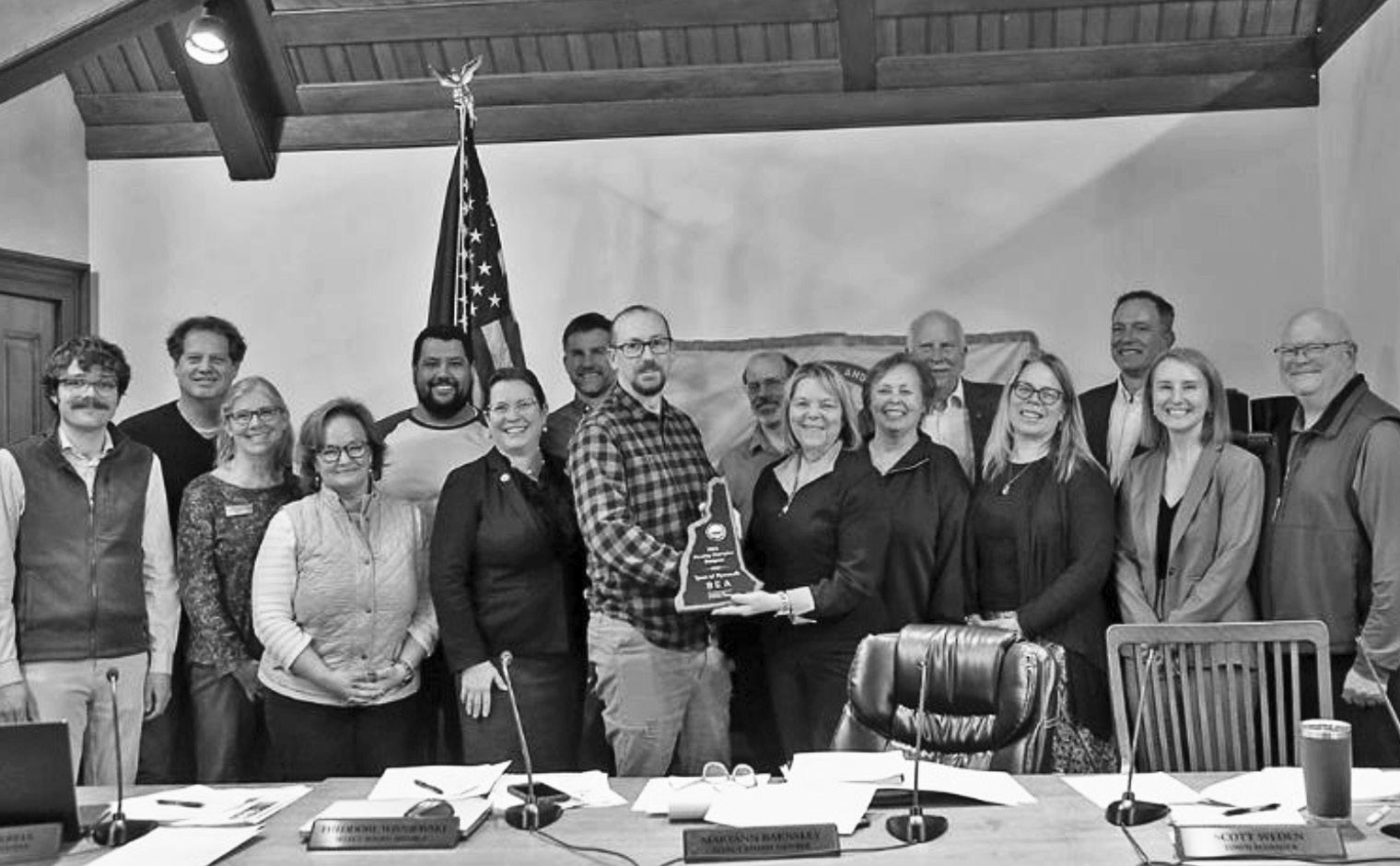
The Department of Business and Economic Affairs (BEA) recently recognized Plymouth as a Housing Champion, highlighting its efforts to expand housing opportunities through local planning initiatives and collaborative partnerships. NHMA was represented by Margaret Byrnes at the event.
The designation is part of BEA’s InvestNH program, which recognizes municipalities that have taken steps to support housing development. Plymouth was selected for actions that increase housing availability while aligning with local planning goals and preserving community character.
Ten communities received the Housing Champion designation this year for implementing policies related to land use, zoning, and permitting that encourage housing growth; 18 were recognized in 18 communities last year.
“Communities like Plymouth demonstrate how local planning decisions can make a real difference in expanding housing opportunities,” said Andrew Dorsett, director of the Office of Housing and Infrastructure Development. “By taking proactive steps, they help ensure New Hampshire can meet the housing needs of residents and employers alike.”
Through the Housing Champions initiative, BEA has awarded $5 million in grants statewide supporting the development of approximately 2,700 housing units. Housing production grants helped complete roughly 400 units, while infrastructure improvement grants are supporting projects expected to enable an additional 2,300 units.
Launched in 2023, the Housing Champions program is part of the state’s broader effort to work with municipalities on solutions to housing challenges. Since its creation in 2022, InvestNH has helped support nearly 5,000 housing units and has provided technical assistance to more than 70 municipalities statewide.
C. Christine Johnston, Legal Services Counsel
Local government only works when people are willing to step up and serve their communities. Some citizens are not only willing to serve on one board, but on multiple boards at the same time. While this dedication to public service is laudable, there are some drawbacks to multiple board memberships that should be considered in advance. This article addresses some of the issues raised by multiple board memberships among land use boards and governing bodies.
When considering whether a current board member should be appointed to (or run for) another board, it is helpful to consider the capacity in which both boards act. If a board must notify abutters, hold hearings and hear and weigh evidence before rendering a decision (such as on a variance application), those decisions are characterized as judicial or quasi-judicial. In contrast, many of the other functions of a board are administrative (enforcing the zoning ordinance) or legislative (amending subdivision regulations). This is an important distinction because when a board is acting in a judicial or quasi-judicial manner, courts will apply a higher standard regarding potential conflicts of interest of the board members deciding the case. Winslow v. Holderness Planning Board , 125 N.H. 262 (1984).
To illustrate, suppose a select board member offers to serve on the zoning board of adjustment (ZBA). There is nothing in RSA 673:3, membership of the ZBA, or in RSA 669:7, incompatibility of offices, that would prevent a select board member from serving on the ZBA. However, the ZBA hears and decides appeals of administrative decisions, which can include decisions made by the select board in, among other situations, the issuance of notices of violation under the zoning ordinance and the decision to grant or deny a building permit. If the select board makes a decision that is later appealed to the ZBA, the ZBA member who is also on the select board will not be able to participate in that case. This is so because the ZBA is acting in a judicial capacity when it decides the appeal of the administrative decision. As such, any member of the ZBA who was part of making the select board decision that is now being reviewed by the ZBA would be disqualified for any cause to act as a juror upon the trial of the same matter See RSA 673:14. Therefore, a select board member who is also a ZBA member would not be able to participate in such an appeal brought before the ZBA and would be required to recuse themselves.
Having a select board member recuse themselves every time such an appeal comes before the ZBA means that the ZBA chair will need to call upon alternates to fill in for the disqualified member. It is not uncommon for a land use board to have one or more empty alternate positions. In addition, advance notice of the need for an alternate is not always provided, and of course not all alternates will be available for any given meeting. Having a full board present is of particular importance to applicants before the ZBA because RSA 674:33, III requires concurring votes of three members to take any action. The frequent disqualification of one board member may mean applicants have a difficult time obtaining a hearing before a full board. The odds of this occurring are much greater when one member is likely to be disqualified from a large number of matters. It is generally recommended that, in fairness to applicants, when a ZBA cannot designate alternates in time to have a full board present, an applicant be given an opportunity to reschedule the hearing to a time when a full board can participate. Having to reschedule a large number of hearings, or proceed with less than a full board, will result in more work for the board and will make it more difficult for citizens to get timely and fair consideration of their application. The ZBA is also required to hold a hearing on all applications within 45 days after receipt of the application and to decide applications within 90 days after receipt, which might lead to additional pressure in this situation. RSA 676:7, II; RSA 674:33, VIII.
Another situation in which a conflict would arise is if the select board decided to request a rehearing or court appeal of a ZBA decision under RSA 677:2 and RSA 677:4. This would present a clear conflict of interest because the select board member would be deciding (as a member of the select board) whether to challenge or appeal their own decision (as a member of the ZBA). In that case, the person would be required to recuse themselves from the select board’s discussion and decision regarding whether to request a rehearing or pursue an appeal. This would leave the remaining two or four select board members to make that decision without them, creating the possibility of a tie vote. There are no alternates for select board members in this situation, of course.
Now let’s suppose that a ZBA member wishes to serve simultaneously on the planning board. No statute specifically prohibits one person from serving on both land use boards at the same time. However, several practical difficulties may arise. Most obviously, the ZBA is the body that hears appeals of planning board decisions involving the application or interpretation of any provision of the zoning ordinance. As discussed above, RSA 673:14 prohibits a member from participating in a case that he or she would be disqualified from sitting on as a juror if the same matter were in court. Furthermore, as of 2025, when a ZBA member also serves on a planning board, they are required by law to recuse themselves from voting on every matter previously decided by or pending before the planning board in a quasi-judicial capacity in which that member participated as a voting member. RSA 673:3, V. This means that an alternate would be required to sit in that person’s place for every appeal from a planning board decision in which that ZBA member had participated as a planning board member.
There is one situation in which a governing body member is actually required to be a member of a land use board at the same time. The law requires one select board member, or other administrative official chosen by the select board, to serve as an ex officio member of the planning board. RSA 673:2. “Ex officio member" means any member who holds office by virtue of an official position and who shall exercise all the powers of regular members of a local land use board. RSA 672:5. If a select board member wishes to serve as a regular member of the planning board (as opposed to an ex officio member) he or she may only serve if the ex officio member appointed by the select board is not another member of the select board. This is because RSA 673:7 prohibits two or more planning board members from serving together on the governing body (i.e., select board), conservation commission, or any other “local land use board” as defined in RSA 672:7 (ZBA, planning board, historic district commission, agriculture commission, housing commission, building code board of appeals, or any other board or commission established under RSA 673). Therefore, if the select board’s ex officio member to the planning board is a select board member, then no other select board member can serve on the planning board at the same time because that would mean two planning board members are serving together on the select board.
As with service on the ZBA, a select board member serving on the planning board might be disqualified from participating in certain matters that come before both boards. For instance, the select board has the ability to request a ZBA rehearing on an appeal of a planning board decision and to appeal that decision to court (RSA 676:5 and 677:2). A select board member who participated in the underlying planning board decision would be disqualified from participating in the select board’s subsequent pursuit of rehearing or appeal for the same reasons explained above.
Another potential problem with a select board member serving on land use boards will arise if the select board needs to consider removing a member of that land use board. The select board has authority to remove a member of a land use board for inefficiency, neglect of duty, or malfeasance in office. RSA 673:13. Any select board member who was serving on that particular land use board would arguably have a conflict even
if the select board was discussing the removal of a different board member (and would, without question, have a disqualifying conflict if the member under discussion was that member themselves). That select board member would therefore probably not be able to participate in that decision, and there is no legal provision for alternate select board members in this situation.
Ultimately, while it is commendable that people are willing to put in the time and effort required to serve on multiple municipal boards, when land use boards are involved, it is important to consider the potential problems that this situation may present. When a board is acting in a judicial or quasi-judicial capacity, its members will be held to higher standards regarding conflicts of interest than if they were acting in an administrative or legislative capacity. Courts are likely to invalidate the judicial and quasi-judicial decisions made by a board when a member with a disqualifying conflict of interest participated. This results in wasted time, effort, and money for everyone. To avoid this, there is an increased need for alternates because disqualified members will be forced more often to step down from cases. In the interests of fairness to applicants and in the proper and smooth administration of local boards, careful consideration should be given before a person is appointed to, or runs for election to, multiple boards.
Do you have insights or expertise to share with New Hampshire's municipal community? Town and City invites municipal leaders and industry experts to contribute articles that inform, inspire, and engage readers across the state.

A Hard Road to Travel Workshop
9:00 am – 2:30 pm
Tuesday, May 5
25 Triangle Park Drive, Concord, NH 03301 and Zoom
Overwatch Foundation Webinar
12:00 pm – 1:00 pm
Wednesday, May 6 Zoom
Local Officials Workshop
9:00 am – 4:00 pm
Wednesday, May 13
Newington Town Office, 205 Nimble Hill Road, Newington, NH 03801
NHMA Board of Directors Meeting
9:30 am – 12:00pm
Friday, May 15
25 Triangle Park Drive, Concord, NH 03301
For more information or to register for an event, visit our online Calendar of Events at www.nhmunicipal.org. If you have any questions, please contact us at registrations@nhmunicipal.org.
Financial Policies Certificate Program, Course I. Internal Controls, Segregation of Duties, Fraud and Risk
9:00 am – 4:00 pm
Tuesday, May 19
25 Triangle Park Drive, Concord, NH 03301
Financial Policies Certificate Program, Course II. Policies for Operations and Budgeting
9:00 am – 12:00 pm
Thursday, May 28
25 Triangle Park Drive, Concord, NH 03301
Financial Policies Certificate Program, Course III. Fund Balance Policy
1:00 pm – 4:00 pm
Thursday, May 28
25 Triangle Park Drive, Concord, NH 03301

For the most up-to-date event and training information, please visit the NHMA website at www.nhmunicipal.org. Event times and dates are subject to change. Thank you.

For more information or to register for an event, visit our online Calendar of Events at www.nhmunicipal.org. If you have any questions, please contact us at registrations@nhmunicipal.org
Financial Policies Certificate Program, Course IV. Revenue Policy
9:00 am – 12:00 pm
Thursday, June 4
25 Triangle Park Drive, Concord, NH 03301
Financial Policies Certificate Program, Course V. Expenditure Policy
1:00 pm – 4:00 pm
Thursday, June 4
25 Triangle Park Drive, Concord, NH 03301
Municipal Trustees Training Workshop
9:00 am – 2:00 pm
Wednesday, June 10
25 Triangle Park Drive, Concord, NH 03301 and Zoom
Financial Policies Certificate Program, Course VI. Investment Policy
9:00 am – 12:00 pm
Thursday, June 11
25 Triangle Park Drive, Concord, NH 03301
Financial Policies Certificate Program, Course VII. Debt Policy
1:00 pm – 4:00 pm
Thursday, June 11
25 Triangle Park Drive, Concord, NH 03301
A Guide to Effective Code Enforcement
9:00 am – 12:00 pm
Tuesday, June 16
25 Triangle Park Drive, Concord, NH 03301 and Zoom
Meeting Minutes and Non-Public Sessions Webinar
12:00 pm – 1:00 pm
Wednesday, June 17
Zoom
NHMA Board of Directors Meeting
9:30 am – 12:00pm
Friday, June 19
25 Triangle Park Drive, Concord, NH 03301
Financial Policies Certificate Program, Course VIII. Capital Planning and Fiscal Capacity
9:00 am – 4:00 pm
Tuesday, June 23
25 Triangle Park Drive, Concord, NH 03301
Art of Welfare Workshop
9:00 am – 12:00 pm
Wednesday, June 24
25 Triangle Park Drive, Concord, NH 03301 and Zoom
Legislative Wrap Up Webinar
12:00 pm – 1:00 pm
Thursday, June 25
Zoom
For the most up-to-date event and training information, please visit the NHMA website at www.nhmunicipal.org. Event times and dates are subject to change. Thank you.

Jonathan Cowal, Legal Services Counsel
For many SB2 towns, March is the time for annual meeting and official ballot voting day.
One of the most important topics voted on every year is the adoption of the yearly operating budget. Unlike with a traditional town meeting, where the voters must stay and vote until an operating budget has been adopted, for those towns which have adopted the Official Ballot Referendum (commonly called SB2) form of town meeting, if the operating budget is voted down, the default budget comes into play. Every year, the select board, or budget committee, must prepare a default budget which will go into effect if the operating budget vote fails. The default budget is generally calculated by taking the last approved operating budget and removing any one-time expenditures. Given that costs generally increase year to year due to inflation, rising energy expenses, and the growing needs of the community, it is usually the case that the default budget will be somewhat, or perhaps significantly, less that what the town has proposed in their operating budget. Consequently, if the operating budget fails to pass a vote at town meeting, the municipality may be left trying to make do with much less than what they anticipated needing.
However, simply accepting the default budget and trying to make do until next year is not the only option. The legislature built into RSA 40:13 the ability for SB2 towns to hold a second, special town meeting specifically for the purpose of having a second chance at adopting a revised operating budget. This special meeting does not require court approval, like certain other special meetings do, and it does not count toward the yearly limit placed on the ability to hold certain special meetings. For all intents and purposes, it is a free second chance at adopting an operating budget, albeit one that does require some additional work to accomplish. Recently, it seems that more and more municipalities have shown interest in utilizing
this option, instead of just accepting the default budget. This article will explore some of the reasons why municipalities may want to consider holding a special meeting on a revised operating budget, and what process must be followed to accomplish this goal.
Q. What statute allows municipalities to hold a special town meeting to adopt a revised operating budget?
A. RSA 40:13, XVI provides for the ability to hold a special meeting on the budget. RSA 39:4 also prescribes that the warrant for the special meeting shall be published in a newspaper of general circulation in the area. The statute makes it clear that this meeting is an option that all SB2 towns have, it doesn’t need to be approved or adopted by the town or the court, the decision rests with the governing body. It also does not count toward other statutory limits or restrictions on holding special town meetings later in the year if necessary.
Q. What is the process for holding a special town meeting to adopt a revised operating budget?
A. First, you need to establish a date and time for both a deliberative session and the official ballot voting day, just like the recently completed town meeting. The same rules will apply to the deliberative session in that voters may propose amendments or changes to the revised operating budget. As for timing, the statute says, “The second session shall be warned for a date not fewer than 28 days nor more than 60 days following the first session.” Since you must present a revised operating budget, the town must hold a hearing on the revised operating budget at least 25 days before the first session. Additionally, if your municipality has an official budget committee, the budget committee will be the entity required to provide a proposed, revised operating budget stating its
recommendations thereon in the same fashion as the originally proposed operating budget.
The special meeting will be a duplicate of a regular SB 2 town meeting, only the sole issue will be a revised operating budget. Should it pass, the municipality will have an accepted operating budget, meaning that the default budget will no longer be needed for this year.
Q. Why might a municipality want to go through the process of holding another town meeting to adopt a revised operating budget over simply accepting the default budget?
A. There are a number of potential benefits and advantages of utilizing the ability to pass a revised operating budget over accepting the default budget. Depending on your unique and individual circumstances, these factors could make the extra work of holding a special town meeting worthwhile. SB2 is a relatively recent change to the law, and consequently, it has been around just long enough to really start to see some of the effects this type of town meeting can have over the long term. Some municipalities have unfortunately found themselves trapped in a default budget for several years in a row. As a result, we have started to see how being trapped in a default budget cycle can wreak havoc for municipalities year after year, and the longer you are stuck in a default budget the harder it can be to adopt an operating budget. If a municipality accepts the default budget this year, the municipality will be confined to last year's operating budget, minus any one-time expenditures. Considering the fact that most operating budgets fail because they are asking for an increase in appropriations from the year before, this means that the

town will be operating with less than what they believed the needed for the coming year.
Where this becomes a major issue is when it comes time to propose a new operating budget the next year. As we all know, costs are not going to go down, and so not only will the municipality still need to account for the funds they didn’t approve the previous year, but it is very likely you will need to ask for even more to cover those rising costs and needs. This means that if the voters voted down an operating budget last year that proposed, say a 5% increase from the year before, your new operating budget may need to constitute a 10% increase over the current default budget that is now two years outdated. Since the default budget is always calculated using the last approved operating budget, every year that a municipality fails to approve a budget it becomes harder and harder to get a new operating budget passed.
While the special meeting can be a lot of work, it does give municipalities a chance to actually accept an operating budget, which in turn gives them a better starting point for next year's budget and a bigger number to work off of for next year’s default budget. Even if the revised operating budget is thousands of dollars less than what the municipality originally wanted, that could still be thousands of dollars more than the default budget allows, and once accepted, those funds could be used for calculating next year’s default budget. Furthermore, accepting a revised operating budget will mean that you may not need to call for such a large increase in next year’s proposed operating budget, making it more likely to pass a vote.


Marty Karlon, NHMA Policy & Research Analyst
s the 2026 New Hampshire legislative session enters its final months, a number of land use and zoning bills remain in play. While the makeup of the legislature has not changed, the tone has. Legislators have had almost a full year of hindsight on the sweeping zoning preemption measures they enacted in 2025, and many are realizing that the implications of those decisions are more complicated than the rhetoric that propelled them. Bills proposing statewide mandates haven’t gone away, but the runaway train that was the 2025 session has slowed down considerably.
A report in late January by the state Department of Business and Economic Affairs (BEA) injected fresh context to this year’s debate. The report found that cities and towns issued 5,822 building permits in 2024, the most since 2006. The fact that such a high number of permits were issued before the state enacted several statewide land-use mandates in 2025 significantly undercuts the narrative that local governments have been the primary obstacle to housing production. Instead, the new data reinforces the argument made in NHMA’s recent whitepaper, Room for Everyone, which traces the state’s housing deficit back to nearly two decades of economic, demographic, and market pressures. (see: https://www.nhmunicipal.org/housingpolicy-and-local-governance)
New Hampshire’s housing shortage is a multifaceted crisis driven by a decade-plus of underbuilding following the Great Recession, which has been further strained in recent years by inflation and high interest rates. While increasing housing stock is vital, state policy has recently shifted away from successful state-local partnerships toward universal zoning mandates. However, land use rules alone did not create this shortage, and preempting local authority cannot solve it. Meaningful progress requires addressing the
true drivers of costs such as financing, construction materials, labor availability, and infrastructure capacity.
The NHMA paper, released in January, about a week before the BEA report, argues for a renewed partnership between state and local governments— one that blends infrastructure investment, targeted incentives, and flexible, locally tailored tools. The BEA report offers evidence that such partnerships work: the 28 municipalities designated as Housing Champions accounted for 45% of all housing units approved in 2024. Created in 2023 with a $5 million appropriation, the Housing Champions program provides grants to communities willing to take proactive steps to expand affordable housing. It is voluntary, collaborative, and— judging by the numbers—effective.
Unfortunately, the House voted in February to pass HB 1196, which repeals the program entirely. As of this writing, the bill remains with the Senate; the Governor has publicly opposed the repeal.
Regardless of the ultimate fate of Housing Champions, it’s becoming clear to more and more people that New Hampshire’s housing shortage is the product of intertwined forces, not a single villain. Reducing the issue to “local zoning” not only misrepresents the problem but also alienates the very communities the state needs as partners. It ignores real infrastructure limitations and shifts costs onto local property taxpayers when state support evaporates.
As lawmakers weigh the remaining 2026 bills, there appears to be greater awareness of these complexities than there was a year ago. Visit NHMA’s online bill tracker for the status of this year’s planning, zoning and land use bills: https://fastdemocracy.com/sharedbills/?sharing-bill-list-id=t3J1BVd5ziQz


Tammy Letson, Government Finance Specialist
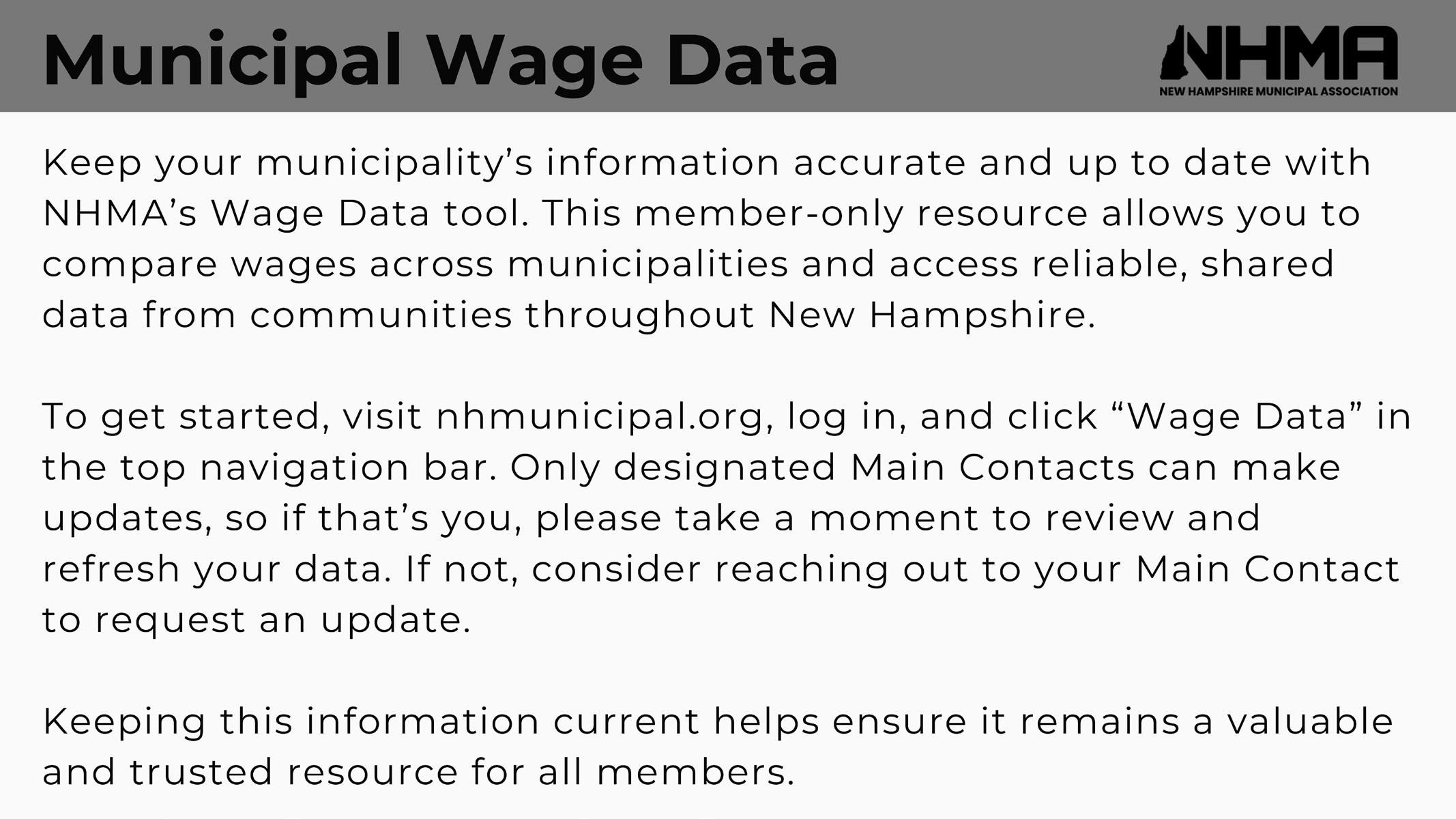
For this issue of Town & City, I’m taking a brief step away from Excel to highlight a valuable feature on our website that many members use, but fewer regularly update. Keeping this data current is important so that you and your fellow members can continue to rely on it as an accurate, useful, and up to date resource. For those of you who enjoy learning new tips and tricks in Excel, don’t worry, we will be back to that next issue. We will even use data from this feature to explore how you can narrow down your results to find exactly what you are looking for.
Every year a common question heard throughout the municipal world is “How do our wages compare to other towns?” Years ago, NHMA heard that question and started asking municipalities to share their wage data with us so we could make it accessible to all our members.
Whether you’re looking to access data submitted by other municipalities or update your own, simply visit nhmunicipal.org. Please note that this resource is available to members only, so you’ll need to log in first. Once logged in, click on “Wage Data” in the green bar at the top of the page.
Only designated Main Contacts for each municipality are able to update wage data. If you are the Main Contact, now is a great time to make sure your information is current so other members can benefit from this tool. If you’re not the Main Contact, we encourage you to reach out and ask that they update your municipality’s data at their earliest convenience.
With town meeting season wrapping up, this is the perfect opportunity to ensure your data is as accurate and up to date as possible!
To help narrow down the data to what you are looking for, we offer three drop-down boxes. Organization is the list of every member who has uploaded their data; Role is the position within the government; and Population Group allows you to choose population ranges.
Each drop-down box offers multiple selections allowing you to garner data broadly or narrowly depending on your choices. Not only is all the data in each drop-down listed alphabetically, but it is also searchable. Best of all, you can choose multiple items from each drop-down box. With these options available, you can decide just how small or large a dataset you want to access. When making your selection, you can choose to use any combination of the data within any of these drop-down boxes, or none at all.
For example, if you want to see all the village districts who have submitted data, you can start to type “district” in the Organization drop-down and the district members who have submitted their data will appear.
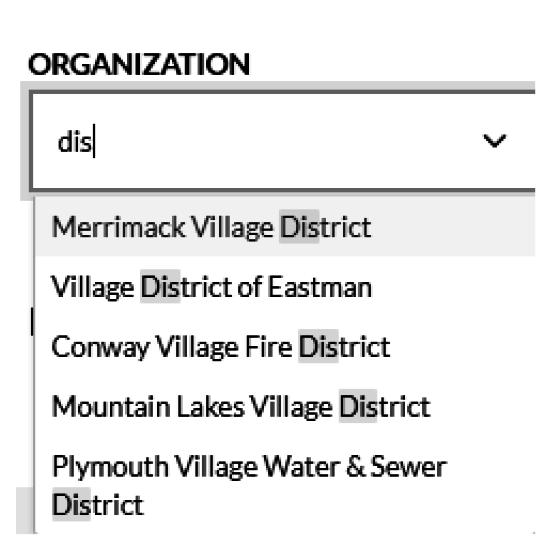
You can now click on each district to individually add it to your parameters. Because Precinct and District are interchangeable when it comes to their names, you can also start typing “precinct” in the Organization box to find the members who have precinct instead of district in their name. Once the list is narrowed down to those members, you can click on their names to add them to your district selections. If you selected an organization you did not want, simply use your mouse to place the cursor after that selection and press the backspace button on your keyboard. The incorrect selection will be removed. You can do the same thing with the role and the population group or you can leave them blank so you get all the data from all the village districts you selected.
After you have selected your choices, the Filter button will show you the results of your selection and / or the Export to CSV will export the data to a Comma-Separated Value file format for easy access with multiple outside programs, including Excel. Your selections remain on the screen for you to make changes if you wish or you want to start a new selection you can select the Reset button that appeared after filtering or exporting.

Now that you’re familiar with the Wage Data tool and how to use it, in the next issue we’ll build on this by working with the exported data in Excel. We’ll focus on ways to refine and filter your results so you can quickly find exactly what you’re looking for.

John Haffner (UVLSRPC), Jennifer Rowden (RPC), Todd Horner (SRPC), James Vayo (SNHPC) and Sylvia von Aulock (SNHPC)
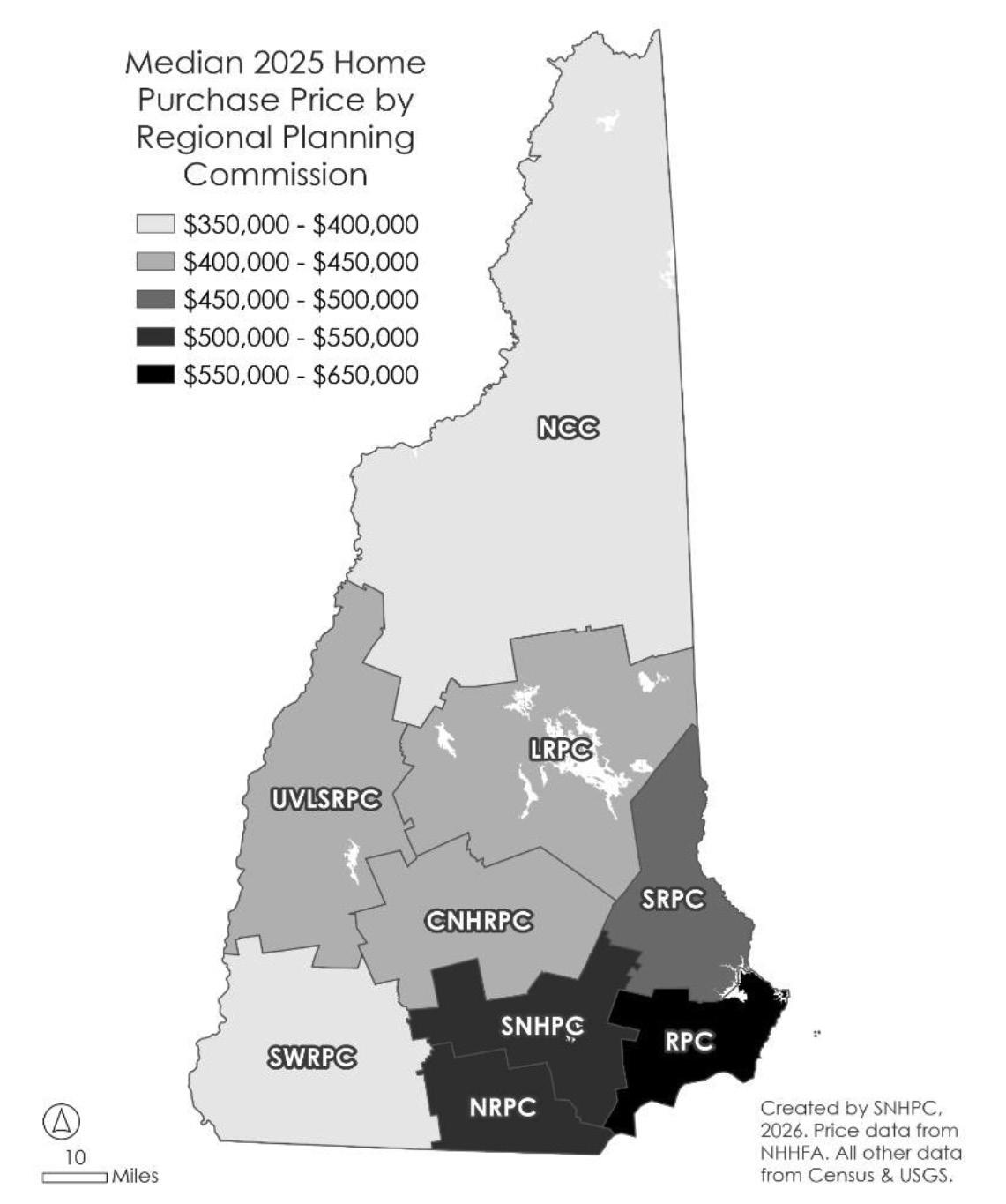
If you haven’t looked at housing availability and prices in New Hampshire for a while, it may be advisable to sit down and be prepared for serious sticker shock. What is available is minimal and the prices are often off the charts. Houses are commonly over a million dollars in many communities, and lots are often in the $200,000 range. Comparing the average home cost per region, one can clearly identify how the cost varies across the state. Note: the data represents all owner-occupied homes including manufactured, condos and single-family homes.
The need for more affordable and innovative housing solutions has been recognized by developers, employers, universities, planners, legislators, and of course, the consumers. Thanks to many out-of-the-box thinkers, there’s a movement gaining ground in New Hampshire for innovative housing solutions that focus on affordability through smaller units, smaller lots, sustainable building practices, prefabrication, shared amenities, and other cost saving techniques. Innovative housing appeals to people of all ages and abilities as they can be very efficiently built, are easier to maintain, provide a sense of community due to thoughtful site design, and are often pedestrian friendly.
In order to create innovative housing solutions, communities need some flexibility in zoning regulations such as building within commercial areas or allowing smaller setbacks. This is an era where innovation and allowances will result in much-needed affordable options for people of all ages, abilities, and various income levels. This article will provide a few examples of the state’s latest successful innovative housing options.
Cottage courts (or cottage clusters) are typically a set of small, detached single family dwelling units oriented around shared green space. The cottages themselves are modest in size, ranging anywhere from 400-1,200 sq ft. The minimum lot size and maximum lot coverage can be flexible as well, so cottage courts can adapt to a variety of zoning districts.
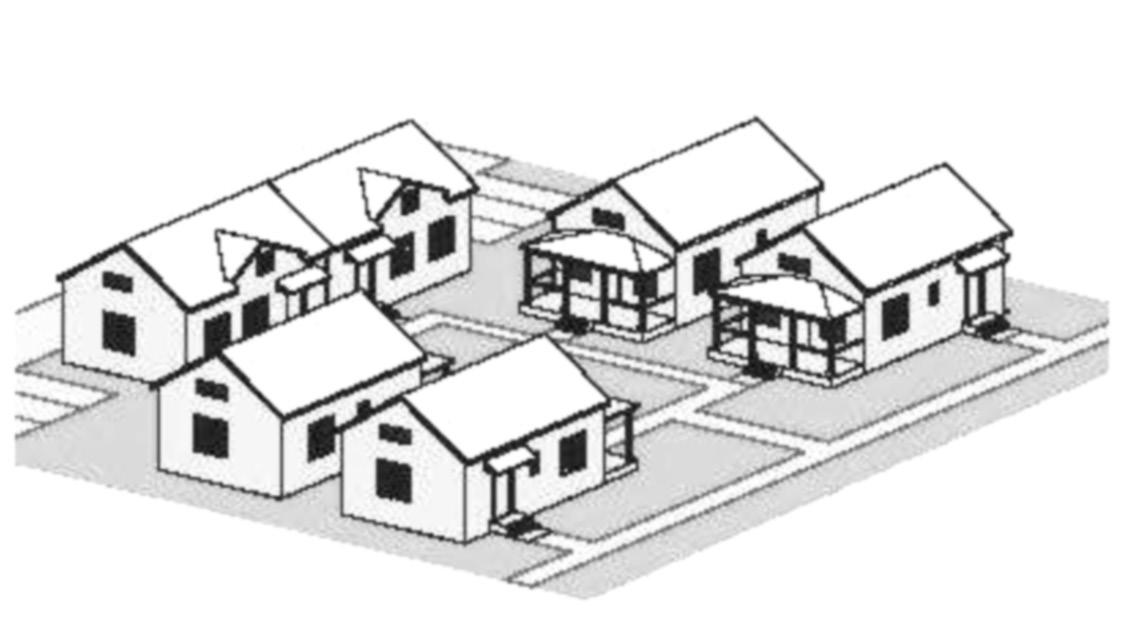
Cottage court developments occupy an interesting position in the missing middle housing spectrum. They are by all accounts single-family homes, however, the ratio of shared space on the overall lot and the modest square footage of the units are more akin to a multi-family configuration.
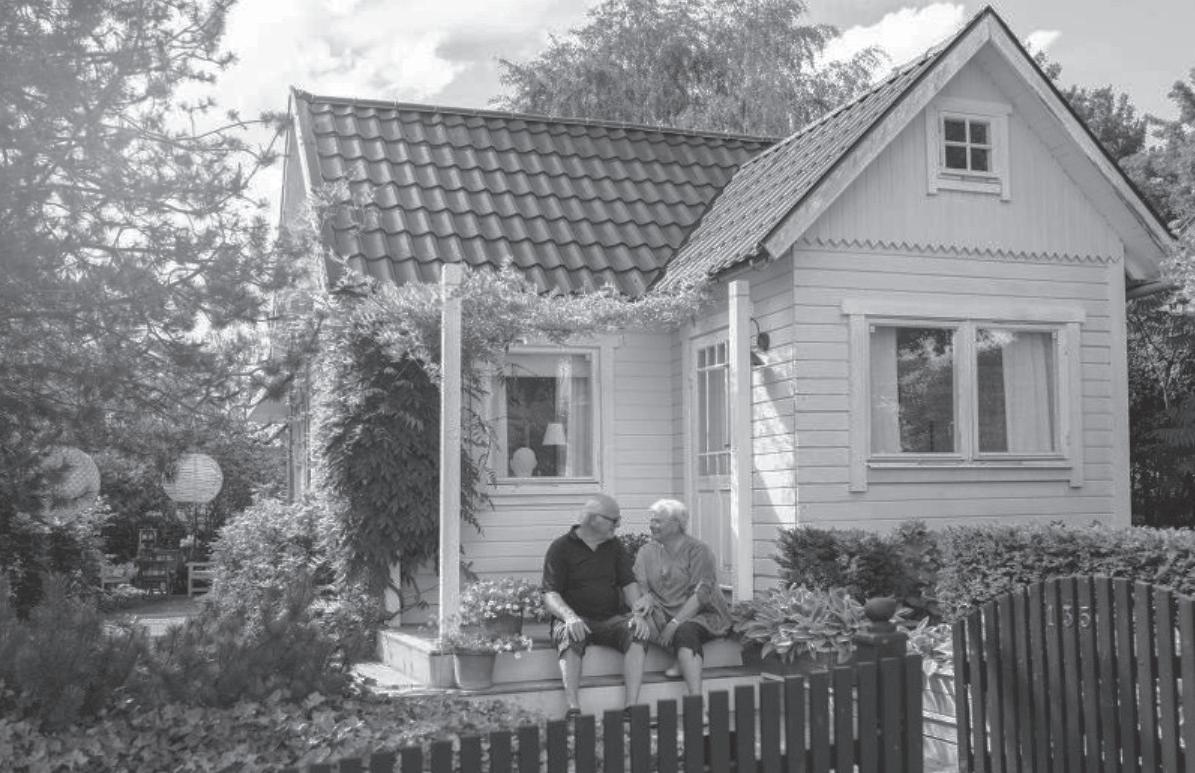
Municipalities across New Hampshire are utilizing cottage courts as an infill development opportunity that provides gentle density beyond single-family construction. In some municipalities, cottage courts are allowed by right whereas others are a conditional use permit. Both towns and cities are putting cottage court ordinances on the books. Cities like Keene and Claremont both added ordinances in 2024, while New London voted one in during the most recent elections.
Most ordinances are being applied across all residential and mixed-commercial zoning districts. While this type of housing configuration is most efficiently used on existing water and sewer, the shared open space that often triggers a need for an HOA agreement likewise supports shared well and septic infrastructure.
At first glance, developers might balk at a cottage court development in favor of conventional multifamily housing that allows for greater density on the same size lot. Moreover, affordability might seem elusive when construction costs increase as more units are detached due in part to the need for each freestanding unit to have its own utilities versus a centralized mechanical room for multiple units. Still, land use regulations and construction methods can help offset some of the increased costs of cottage courts. Ensuring efficient land use by reducing parking minimums and setbacks can make the cost-per-unit lower for end-users. Incorporating low-impact stormwater management techniques into site plan regulations such as rain gardens can avoid expensive stormwater treatment infrastructure typically required for multifamily development.
Off-site construction can help reduce the cost of cottage courts. Focusing on modular development and limiting customization through stock plans can reduce the costs as much as 20% according to some estimates. Modular builders may even be willing to bring costs down even more if developments are coordinated across sites and units are purchased in bulk.
Given the aesthetics of cottage courts, the adaptability of the building typology for infill development in a variety of zoning districts, and the functionality of its use across the cycle of residential end-uses (i.e., from starter home to down-sizing), this housing type deserves a place within the innovative housing category. Co-living
Co -living is emerging as an innovative and pragmatic response to New Hampshire’s housing shortage, particularly in smaller cities where wages have not kept pace with rising rents. By rethinking how space is shared—private bedrooms paired with high- quality communal kitchens and living areas—co -living delivers
dignity, safety, and affordability without sacrificing location or design. This model is especially well-suited for downtowns with underutilized buildings, where adaptive reuse can simultaneously expand housing options and strengthen neighborhood vitality.
In downtown Keene, Belltower Property Management is managing an approved redevelopment project that exemplifies this approach. The long-vacant professional building will be transformed into a mixed-use property, with office space on the first floor and a four-bedroom co -living apartment above. The project includes substantial life-safety and quality upgrades—such as a full sprinkler system, modern mechanical and electrical systems, a new shared kitchen, a full bathroom conversion, hardwood flooring, and low-VOC interior finishes—resulting in warm, efficient, and code- compliant housing. Reactivating this dormant property will also improve safety and activity along the block, reducing the impacts of vacancy while supporting downtown revitalization.
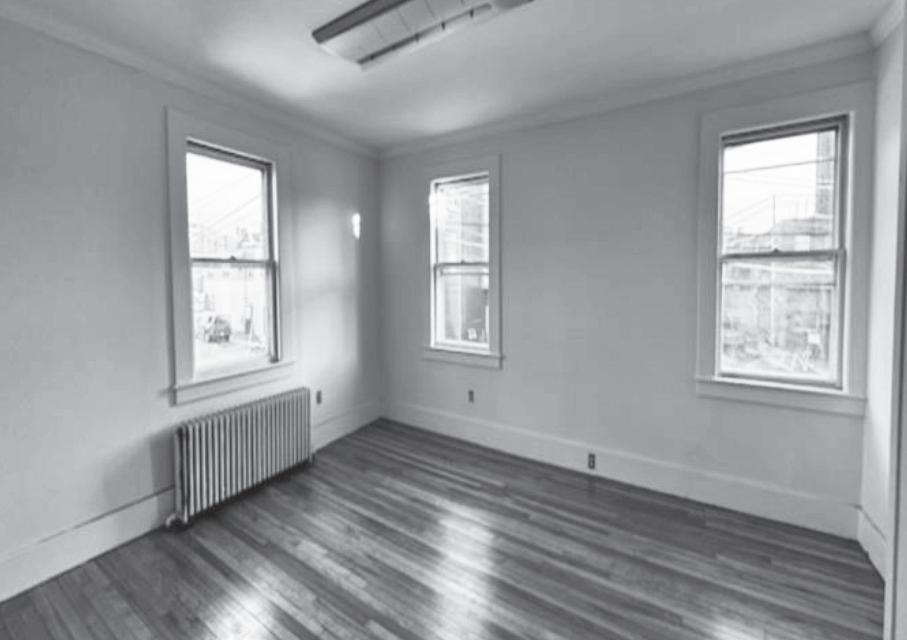

The affordability impact is concrete and measurable. This single property alone is expected to save tenants approximately $24,000–$44,000 annually compared to conventional rental alternatives. Fully furnished rooms will rent for $750–$895 per month, including utilities, fiber internet, and parking. At the most affordable tier, residents need to earn about $2,250 per month—or $27,000 per year—to meet standard rental eligibility guidelines, placing housing within reach for individuals just above 30% of the area median income. At roughly $13.50 per hour, a local worker can sustainably afford a room without a cosigner or special conditions—demonstrating how thoughtfully designed co -living can bridge the gap between survival and stability in a strained housing market.
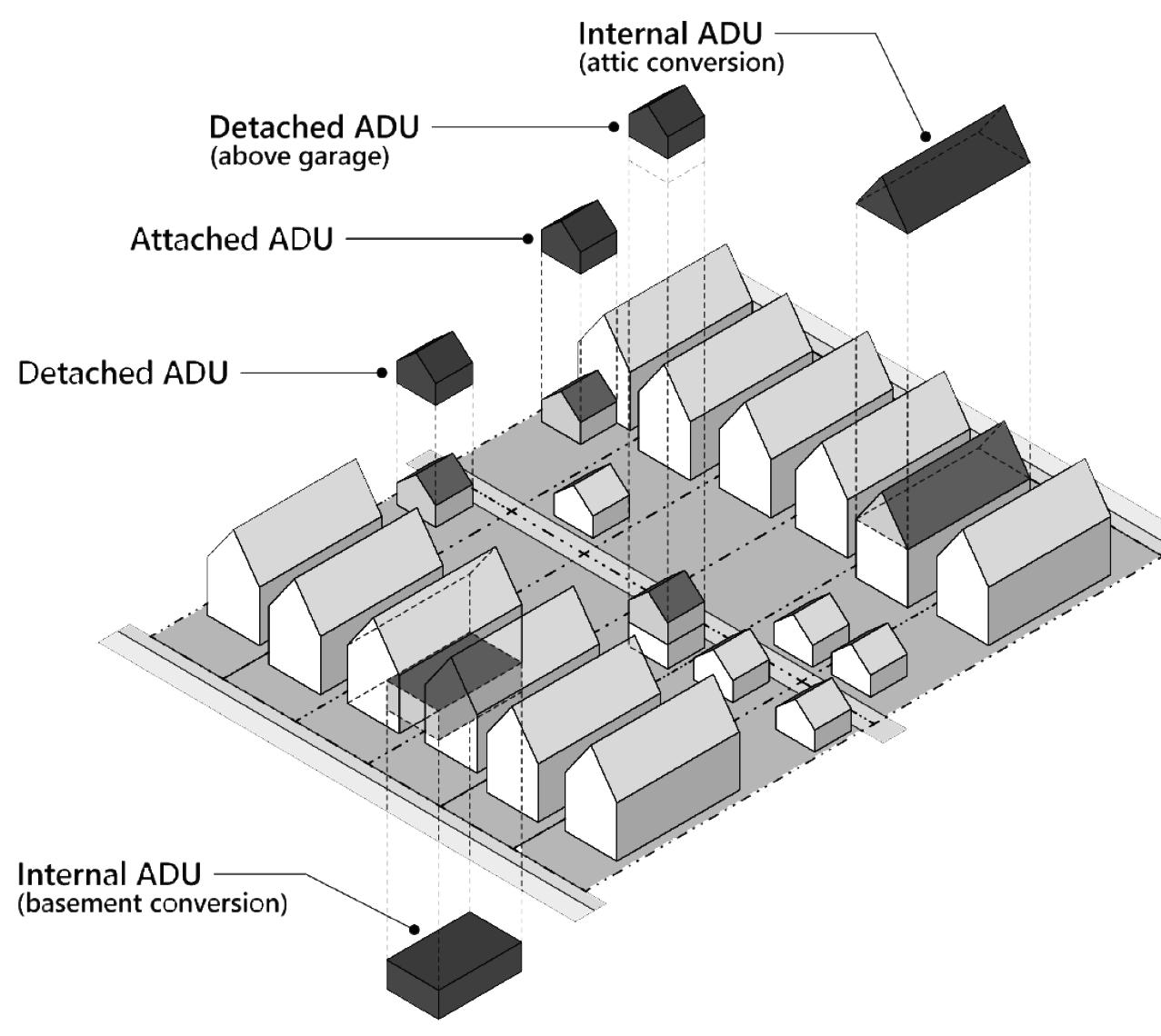
Accessory Dwelling Units (ADUs) are emerging as one of the most flexible and practical ways to expand housing options in New Hampshire. An ADU is a small, independent living space located on the same lot as a single-family home. Sometimes called in-law apartments, garage apartments, or backyard cottages, these units can provide housing for aging parents, young adults, caregivers, or renters while allowing homeowners to make better use of existing properties. Because ADUs are typically smaller and built within established neighborhoods, they offer a way to incrementally increase housing supply and reduce pressure to build large-scale development and major infrastructure expansions.
Recent changes to state law have strengthened the role ADUs can play in addressing housing needs. In 2025, the Legislature adopted House Bill 577 (HB 577), which expanded New Hampshire’s ADU framework and requires municipalities to allow one ADU. ADUs are allowed either attached or detached, as a matter of right in any zoning district where single-family homes are permitted. By establishing a clearer
statewide baseline, the law aims to reduce regulatory barriers while still allowing communities to maintain reasonable standards applied to single-family homes.
To help communities and homeowners navigate these opportunities, NH Housing hired the Southern New Hampshire Planning Commission (SNHPC) to help develop two ADU resources for the state. This includes the recently released New Hampshire Homeowner ADU Guide as well as the Policy and Program Models for Creating Accessory Dwelling Units in New Hampshire report. Both resources are available through NH Housing’s webpage dedicated to ADUs: https://www.nhhfa.org/housing-challenges-solutions/ accessory-dwelling-units/
One innovation featured in the Homeowner ADU Guide highlights how new construction methods are expanding where, and how, ADUs can be built. In the town of Barrington, a manufactured ADU was built off-site and delivered to the property as a completed unit, then lifted into place by crane and set on its foundation in just a few hours. Off-site construction reduced on-site disruptions and made project delivery more predictable. As modular and prefabricated construction techniques continue to evolve, new approaches like this may offer a faster and potentially more cost-effective way for homeowners to quickly place ADUs in backyards all across existing neighborhoods in New Hampshire.

Housing is a notoriously tricky issue to tackle at the local level. Cities and towns generally do not build housing, unless they are one of the 14 housing authorities in the state. Yet decisions made by municipalities – whether about zoning and land use regulations, infrastructure investment or community development priorities – all have huge implications about the ability of municipality to meet its housing goals. Determining what kind of housing a community wants, needs and can support requires information like demographics, housing data, and location and capacity of infrastructure. Much of this information is available in the 2023 New Hampshire Statewide Housing Needs Assessment and the 2023 Regional Housing Needs Assessments developed by all nine NH regional planning commissions in accordance with RSA 36:47(II).
Information and data are important, however, having ongoing opportunities for public outreach and input are just as critical when making decisions about local housing policies. Simply put, decision makers should check in with residents to collaborate on housing goals before asking them to support zoning changes or to invest tax dollars into infrastructure improvements that enable more housing. Finding the local solutions that work for each municipality takes time and resources. Solving the housing needs of the state or even a
region cannot be achieved by one or two communities, but rather by all municipalities examining needs, policies, and regulations on a larger holistic scale.
Since its launch in 2022, the InvestNH Housing Opportunity & Planning Grants (HOP) Program has provided over $4.3 million in grants to help over 70 municipalities analyze and update their land use regulations to increase housing opportunities. Within Rockingham Planning Commission’s (RPC) region alone this grant program provided 15 cities, towns and village districts over $900,000 in grant funds to help communities enable more housing with increased technical assistance. Work conducted by RPC specifically under these grants resulted in over 40 local housing conversations and surveys, nine local needs assessments, six master plan housing chapters, and nine housing regulatory audits. All of this work has culminated in local housing regulations shifting in nearly all the RPC communities with many using the options outlined below. The RPC region also had one of the highest amounts of new housing units permitted in recent years as noted in BEA Office of Planning and Developments Current Estimates and Trends in New Hampshire's Housing Supply –2025 Update. The municipalities that increased housing and opportunities were those most engaged in having community conversations.
In addition to the work under the HOP Grants, RPC and other regional planning commissions have leveraged other funding resources to provide technical assistance to municipalities that are struggling to meet housing needs, keeping up with state mandates, and balancing broader community demands and costs. Some of this funding includes New Hampshire Community Development Finance Authority (CDFA) and US Department of Defense funds awarded to help deal with housing needs of the Portsmouth Naval Shipyard.
Much of the funding available to assist with local housing policy and infrastructure investment, including the HOP grants, has run out. Housing remains amongst the top issues facing communities in the state and many are on the cusp of regulation shifts and infrastructure investments. For example, the nine regional planning commissions traditionally used the $100,000 in Targeted Block Grants funds awarded by the Office of Planning and Development to provide support for local technical assistance on topics like housing. The current state budget has removed those limited funds - $11,111 per regional planning commission. To offset this, the Rockingham County Commissioners provided $11,111 in their budget to ensure RPC would be able to provide technical assistance on regional issues to municipalities.
To continue to move the needle forward on housing, NH communities need be able to continue to have good data, local conversation and technical assistance to enable supported housing policies and local infrastructure investments.


Francesca McCann, Director of Alternative Funding, Financing and P3, Black & Veatch
The funding landscape for infrastructure projects is complex and dynamic. Facing intensifying challenges from extreme weather to aging systems, cities, towns and villages must be strategic in their infrastructure planning, diversification and partnering approach. Those that plan holistically, build strong partnerships and maximize their funding opportunities will be in a position to meet their goals for resilience and growth.
Strong Systems, Strong Cities: Linking Financial Resilience to Infrastructure Resilience Infrastructure is the backbone of public health, business development and economic vitality. Yet, as demand for reliable and affordable power and water intensifies, the U.S. faces a $3.7 trillion infrastructure investment gap, according to the American Society for Civil Engineers’ 2025 Report Card. Strictly in terms of disasters, from extreme storms to wildfires, the U.S. Chamber of Commerce notes that every $1 not invested in resilience can cost communities up to $33 in lost future economic activity. Especially with the uncertainty surrounding federal funding sources, the need is clear. Cities must fortify their financial resilience to build their infrastructure resilience.
Navigating the New Infrastructure Funding Landscape
See below for a look at how funding sources are evolving:
Some programs remain the same, some have been paused or frozen and others have been eliminated. Many programs are being adjusted based on revised priorities.
• Delays are common, with staff capacity stretched thin and a shift in approval processes and timelines.
• As always, recipients and projects must comply with federal requirements.
• Competition for funds will likely increase.
• Rural communities may have more funding opportunities.
States are expected to launch new programs, particularly around hazard mitigation, preparedness and disaster response.
• Many states are waiting for clarity at the federal level; for example, regarding FEMA’s future. The capacity to develop and implement funding programs varies by state.
• Competition for funds will likely increase.
• As always, recipients and projects must comply with state funding requirements.
Revenue Generation
Cities can examine local options for raising revenue (where not preempted by state law), such as increases in sales tax or special ballot initiatives.
• Programs can benefit when communities communicate understandable and significant benefits for just a penny of investment.
• For example, the Penny for Pinellas program in Florida has funded roads, stormwater and public safety projects.
Corporate/Private/Partnership Funding
Cities are increasingly partnering with industrial users, utilities and business enterprises to co-fund infrastructure.
Examples
• An industrial user helps a community cover the cost of a water plant expansion.
• Tech companies have water stewardship programs that can include grant and sponsorship money.
• While not subject to federal or state rules, such funding has its own requirements and tends to be very specific and limited.
NGOs
Many non-governmental organizations (NGOs) offer grant or sponsorship money for projects.
Key Points
• Eligible project types and locations tend to be narrowly defined.
• Funding is limited and competitive.
• While not subject to federal or state rules, such funding has its own specific requirements and metrics.
Alternative Delivery
Examples include:
• Public-private partnerships (P3s) are long-term services agreements (typically 20-50 years). Public and private entities partner to form a Special Purpose Company (SPC) or Special Purpose Vehicle (SPV) that provides such services as design, construction, financing, ongoing operations and/or management. A P3 can yield lower lifecycle costs, efficient project funding and delivery, the ability to smooth rates over time and optimal allocation of risk. Additionally, a P3 can support regulatory compliance, provide strong asset management, promote operations and maintenance best practices and mitigate cost overruns.
• Design-build is where a single entity — typically a firm or consortium — is responsible for both the design and construction of a project. The integrated approach streamlines communication, accelerates timelines and reduces costs by eliminating the traditional separation between designer and builder. For cities, towns and villages, design-build offers faster delivery, fewer change orders and improved collaboration, making it especially effective for complex or time-sensitive infrastructure projects.
Another funding mechanism local governments use are special districts. For example, forming a stormwater utility or infrastructure improvement district can help a city unlock dedicated revenue streams and improve long-term planning.
Regardless of the source or method, successful funding strategies require:
• Early planning. Fully understand funding needs and plan for funding cycles.
• Understanding eligibility. Check to see if funds are available only to a specific city entity, such as a utility.
• Timing awareness. Align timing of funding with the project’s schedule and milestones.
• Lifecycle thinking. Plan from application to award, through compliance and reporting.
• Matching requirements. Ensure program funding match requirements are met.
• Compliance planning. Include requirements in design and delivery as needed and develop and implement a compliance plan.
The funding landscape is evolving as federal, state and local priorities shift. Fresh, forward-looking funding strategies can help cities, towns and villages move projects from planning to implementation with confidence.
Visit the National League of Cities (NLC) Strategic Partnerships page to learn more about the organizations like Black & Veatch dedicated to making NLC the premier resource for local governments.
• Pay-for-performance ties compensation directly to the achievement of specific, measurable outcomes. Payment is based on how well the project performs — such as meeting water quality targets, energy savings or stormwater runoff reductions. The approach reduces financial risk for the public sector, incentivizes innovation and promotes accountability. It can be valuable for infrastructure projects where long-term performance is critical.

The New Hampshire Broadband Mapping Initiative (NHBMI) is working to identify where internet access is available, how it can become more widely available, and how to encourage higher levels of broadband adoption and usage in New Hampshire. Now in its fourth year, the NHBMI is a collaboration between the NH Department of Business and Economic Affairs (BEA) and NH GRANIT at the University of New Hampshire’s Earth Systems Research Center. The Initiative has solicited regular data collections from participating internet service providers and the Federal Communications Commission as well as crowd-sourced internet service and speed data from NH residents in order to develop high-quality maps of broadband internet access for New Hampshire. The public can access the NHBMI’s findings through https:// nhbroadbandmapping.unh.edu.
There are four aspects of the NHBMI website which may be of interest to municipalities and the public. First is the interactive, statewide Broadband Dashboard and Web Map. The public can use this map to look up statistics for their municipality and service status for individual addresses. In addition, town-based maps are available for participating towns through the Municipal Broadband Availability Maps page. These maps are updated approximately four times a year.
The public is encouraged to contribute to this project through the NH Broadband Speed Test Site and the Connectivity Survey, both of which are anonymous. Anyone can run the speed test using their home internet connection to learn their upload and download speeds. The Connectivity Survey is a quick way to report a location with slow or no connectivity. Both of these tools help to improve the accuracy of the statewide broadband maps and to identify areas for potential improvements in broadband infrastructure. The NHBMI encourages municipalities to publicize these tools in your communities.
BEA and NH GRANIT appreciate your investment of time and attention into this important effort as we work to support stronger New Hampshire communities. For more information, email granit@unh.edu or visit https:// nhbroadbandmapping.unh.edu.


Track key legislation affecting New Hampshire municipalities in real time. The New Hampshire Municipal Association (NHMA) advocates for the interests of cities and towns at the New Hampshire General Court and state agencies. With the legislative session running January to June, NHMA tracks state actions that could significantly affect the state's 234 municipalities.
• Real-time updates on legislative activity through FastDemocracy
• Access to bills categorized by legislative topic
• NHMA's stance on key measures
• Optonal daily or weekly email updates with new bill actions and upcoming hearings
• No account is required to access FastDemocracy, but members can create one for additional customization








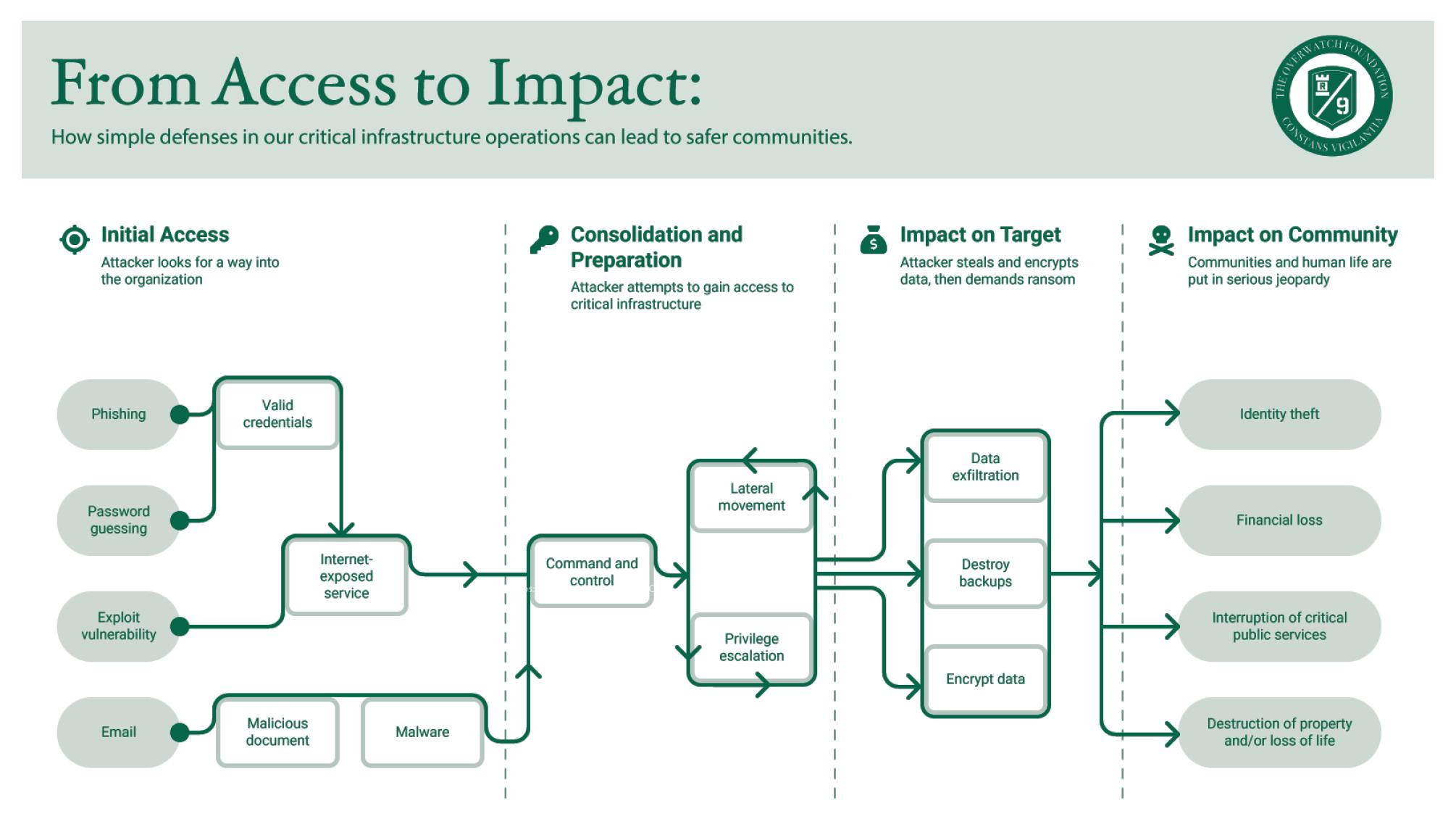
When we think of "data hygiene," we often think of annoying password resets or software updates. But what is missing from these reminders is the context that a single, "small" security oversight can spiral into a major public safety event. Cyber hygiene is the first line of defense for our critical infrastructure. By securing the "initial access" points—like using MFA and spotting malicious documents— we aren't just protecting data; we're protecting hospitals, water treatment plants, personal identities, and financial stability. In collaboration with The ATOM Group, The Overwatch Foundation created the below graphic to better illustrate this. The path from a simple phishing email to the interruption of critical public services is shorter than you think.
101010110101101011010101010110101011000001110101010110101101110101010010000101011010110101101010110101101010101010101011001 0101010100000110101011010110101010101010101100101010101000001011110110111011010110101101010101010101010110101101011010101010 1010111101101110110101101011010101000000111010101011010110111010101001000010101101011010110101011010110101010101010101100101 0101010000010111101101110110101101011010101010101010101101011010110101010101101010101011010110101101010101010101101011010101 010100011101010101101011000000111010101011010110111010101001000010101101011010110101011010110101010101010101100101010101000 0010111101101110110101101011010101010101010101101011010110101010101000001110101010110101101110101010010000101011010110101101 0101101011010101010101010110010101010100000101111011011101101011010110101010101010101011010110101101010101010101111011011101 1010110101101010100000011101010101101011011101010100100001010110101101011010101101011010101010101010110010101010100000101111 011011101101011010110101010101010101011010110101101010101011010101010110101101011010101010101011010110101010101000111010101 0110101101110101010010000101011010110101101010110101101010101010101011001010101010000010111101101110110101101011010101010101 0101011010110101110000010111101101110110101101011010101010101010101101011010110101010101010111101101110110101101011010101000 000111010101011010110111010101001000010101101011010110101011010110101010101010101100101010101000001011110110111011010110101 1010101010101010101101011010110101010101101010101011010110101101010101010101101011010101010100011101010101101011000000111010 101011010110111010101001000010101101011010110101011010110101010101010101100101010101000001011110110111011010110101101010101 0101010101101011010110101010101000001110101010110101101110101010010000101011010110101101010110101101010101010101011001010101 010000010111101101110110101101011010101010101010101101011010110101010101010111101101110110101101011010101000000111010101011 0101101110101010010000101011010110101101010110101101010101010101011001010101010000010111101101110110101101011010101010101010 101101011010110101010101101010101011010110101101010101010101101011010101010100011101010101101011011101010100100001010110101 1010110101011010110101010101010101100101010101000001011110110111011010110101101010101010101010110101101011100000101111011011 101101011010110101010101010101011010110101101010101010101111011011101101011010110101010000001110101010110101101110101010010 0001010110101101011010101101011010101010101010110010101010100000101111011011101101011010110101010101010101011010110101101010 101011010101010110101101011010101010101011010110101010101000111010101011010110000001110101010110101101110101010010000101011 0101101011010101101011010101010101010110010101010100000101111011011101101011010110101010101010101011010110101101010101010000 0111010101

It is this sobering reality that motivated the design of all Overwatch Foundation turnkey cybersecurity “in a box” programs. Each “box” is designed to not only contain all the core technologies and training your community may need to reach a safer baseline, but we also offer every layer of support your community may need to complete the full rollout of these measures. No community’s risks or needs are the same, but our efforts and program offerings are the same so that we can reach a Statewide baseline.
At present, we have free, grant-funded cybersecurity programs for K-12, drinking and wastewater, and local government sectors that are available to every state and local New Hampshire municipality. Reach out to us at www.overwatch.org/apply to learn more about how we can help you protect your community.

.GOV Program
Transition to a .GOV domain and help minimize cyber threats in New Hampshire. A .GOV domain means you’re official and trustworthy.
NH water systems are critically vulnerable, and you have a duty to protect our communities. Our program assesses and secures the network perimeter, PCs, and remote access alongside your partners.
Protect NH K-12 education from disruption by preventing ransomware and data breaches. Through the .GOV and Crowdsrike initiative, take action on increasing your security. Phase 2 will include perimeter protection with a firewall.


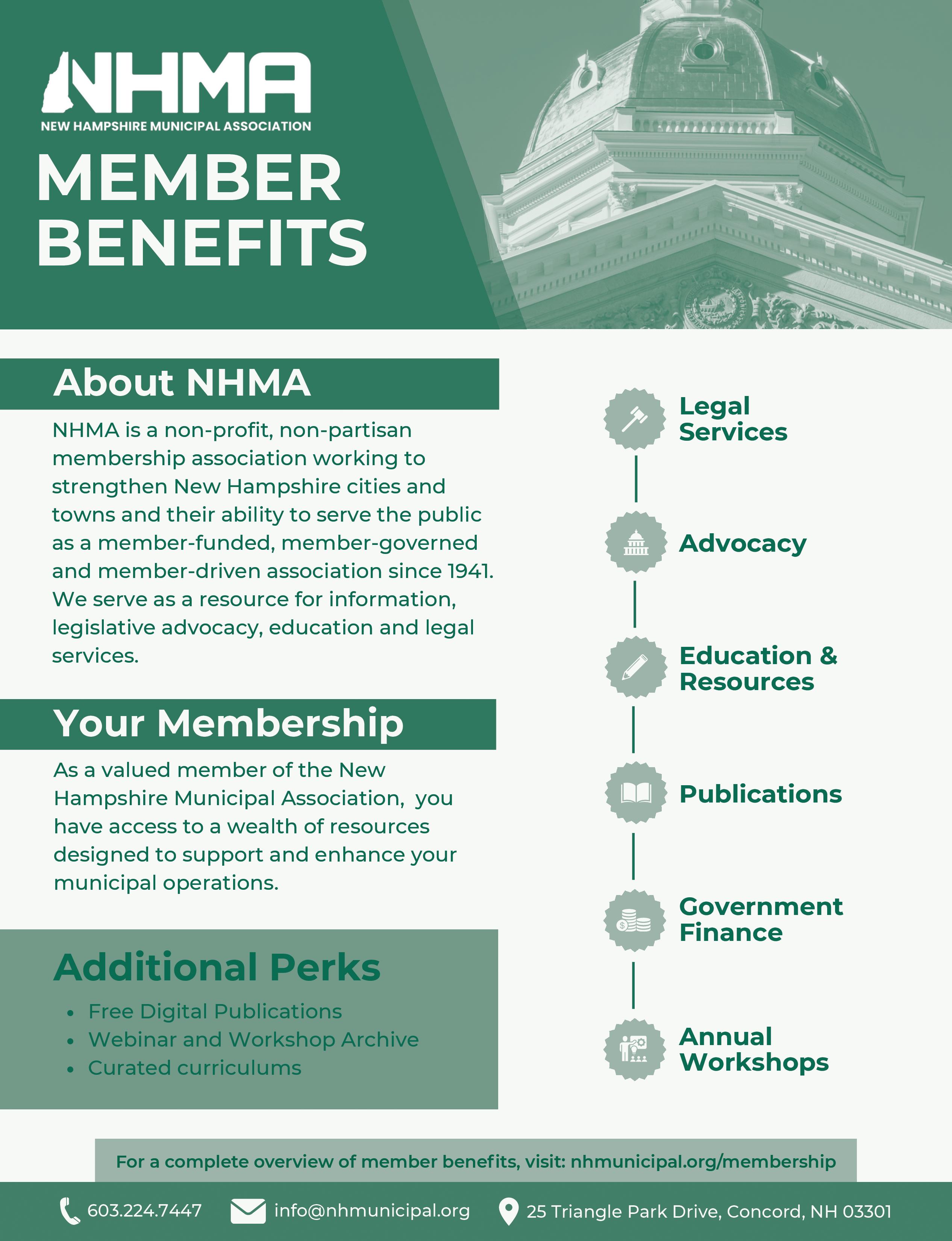
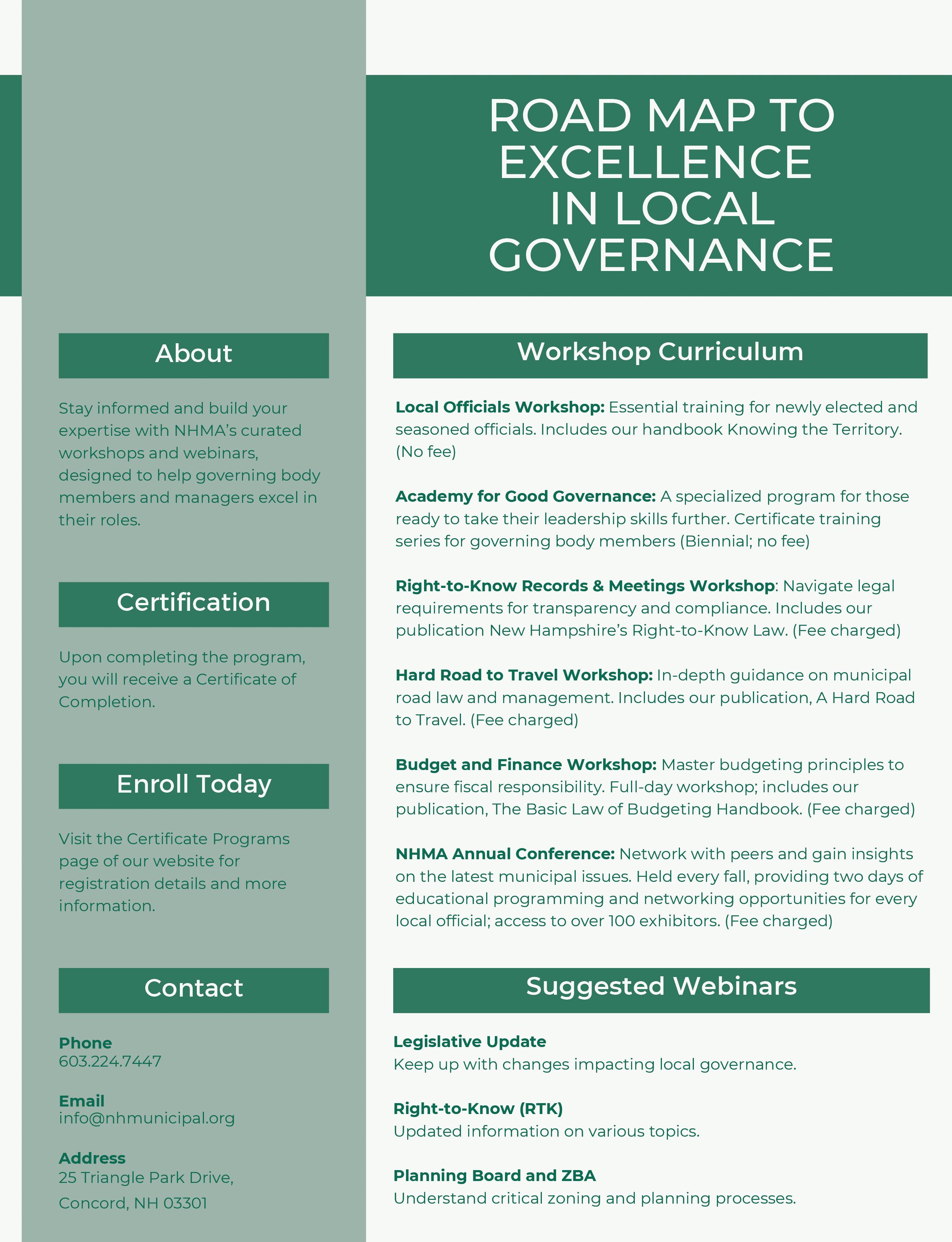
Our Training Archive is a valuable benefit available to all NHMA members. Behind the member wall on our website, you'll find a library of recorded trainings, at no additional cost. These sessions offer practical guidance and support for your ongoing learning and professional development.
The Training Archive is just one of the many resources included with your NHMA membership. Explore the Training Archive today and make the most of all your membership benefits! Unlock the Full Potential of Your NHMA Membership with Our








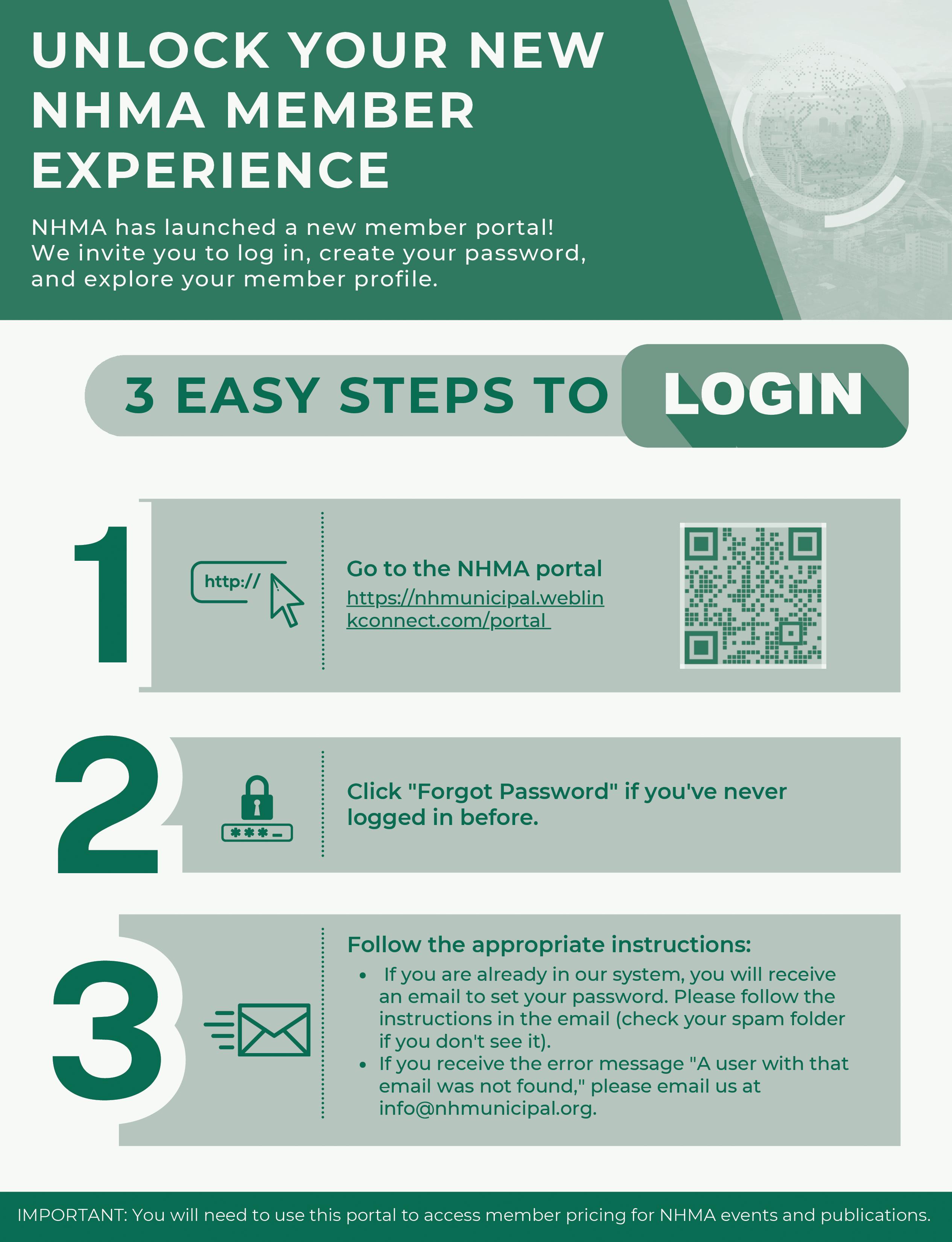
1. Log into your member portal.
2. Click "Edit This Profile."
3. Select "Newsletter Management."
4. Under "Email Subscriptions," check "Legislative Bulletin."
5. "Save this profile."





New Hampshire Town and City is the official magazine of the New Hampshire Municipal Association, a nonprofit organization serving cities, towns, village districts, and counties. With a circulation of 2,500, this magazine is the only publication that comprehensively reaches the entire New Hampshire municipal market. Over 1,500 physical copies are distributed across the state, with an additional 1,000 digital versions sent directly to recipients. On average, the publication garners 65,000 impressions annually. Subscribers include mayors, councilors, selectmen, city and town managers, road agents, public works directors, assessors, clerks, and finance directors.
Page
Page
X 4.75
X 2.25
X 2.25
ACCEPTANCE OF ADVERTISING: All advertisements are subject to the approval of the publisher. The publisher reserves the right to place the word "advertisement" with advertising copy which, in the opinion of the publishers, resembles editorial matter. Responsibility for claims and actions based on advertising content is borne by the advertiser.
ISSUANCE AND CLOSING DATES: Published 6 times a year on a bi-monthly production schedule (Jan/Feb, Mar/ Apr, etc.). Closing date for advertising file and payment is 5 weeks prior to the publication month (e.g., the May/June issue deadline for ad file and payment is the last Friday of March).
COMMISSIONS: New Hampshire Municipal Association does not allow for any agency commission.
ADVERTISING MATERIAL: New Hampshire Town and City is printed on 100 lb. paper for the cover and 70 lb. paper for the inside pages by the photo off set process. The binding is saddle stitched. Complete mechanicals should be furnished for all ads requiring a special layout.

Archaeological evidence shows that the area now known as this town has been inhabited for roughly 10,000 years, first by Indigenous peoples of the Northeastern Woodlands.
European settlement began in 1638. The town’s highest point is the summit of Great Hill, rising 246 feet above sea level just north of Weare’s Mill.
The 7,400-acre community was granted as an independent municipality in 1726, though it continued to be referred to as a parish until the Revolutionary War. Early written references to the town’s official name often appeared with a lowercase “f,” a practice that persisted into that same period.
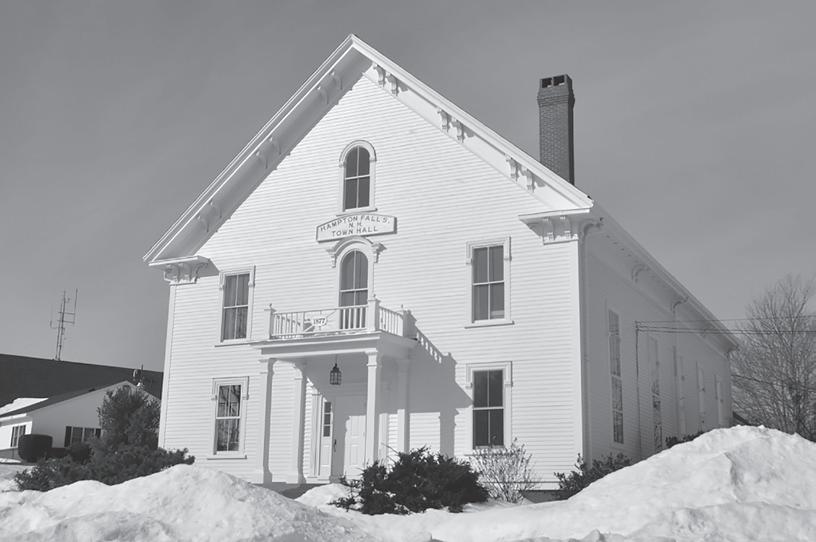
In 1732, residents attempted to separate the western portion of the town and establish it as a parish of Kingston. While the proposal did not succeed as intended, the land was ultimately set apart and, in 1737, incorporated as the town of Kensington.
In 1739, seventy-two residents, including Meshech Weare, petitioned for the town (then encompassing Seabrook and Kensington) to join Massachusetts, but the effort failed. Later, in 1765, Presbyterians living in the southern part of the community sought to form a new parish around their existing church. After a town meeting on December 30, residents agreed to divide the town, leading to the creation of the new parish in 1768. It was soon incorporated as Seabrook. A proposal to reunite Seabrook with portions of this town surfaced in 1782 but did not advance.
Natural events have also marked the town’s history. On the night of October 29–30, 1827, an earthquake struck, partially or completely toppling at least three chimneys and cracking several others. An even stronger earthquake affected the area on November 18, 1755. More recently, on May 21, 2006, an F2 tornado touched down around 6:30 p.m. EST near Interstate 95, overturning a truck, injuring two men, and leaving a kayak lodged in a tree.
When you have figured out the answer, email it to publications@nhmunicipal.org. The answer will appear in the July/ August 2026 issue.
ANSWER TO PHOTO IN THE MARCH/APRIL ISSUE: The photo on page 56 in the last issue of New Hampshire Town and City magazine is that of the Town of Somersworth.
Special thanks to Sue Girourad and Marshall Buttrick who responded with the correct answer!