

New Hampshire Municipal Association
New Hampshire Municipal Association
























Welcome to the summer edition of Town & City!
M.L.Byrnes
The 2026 legislative session officially ended June 4. There were many wins for municipal government this year— although, unfortunately, so many of those wins were defeats of bills that would have hurt local government operations or further eroded local decision-making. Keep an eye out for NHMA’s Final Legislative Bulletin in late August or September, which details all the municipal-related bills that become law. You can also watch the Legislative Roundup webinar on June 25.
Next year is the start of a new biennium—which means a new state budget. It also means that NHMA will have a new set of member-adopted Legislative Policies and Principles. The NHMA legislative policy committees completed their work in May, and the Legislative Policy Conference, where municipalities can vote on the proposed policies and principles, will take place on September 11. You can find more details on our website; make sure your municipality sends a delegate!
Of course, summer also means that NHMA’s fall training is right around the corner. Local officials can participate in NHMA’s Academy for Good Governance, Budget & Finance Workshop, and NHMA’s Annual Conference—just to name a few. You can check out all our events on our website.
And finally, in case you weren’t aware, July also marks the end of my incredible ride at NHMA. I announced in May that, after nearly 12 years with NHMA, my last day will be July 17. I’ve spent most of my professional career at NHMA and learned everything I know about leadership, advocacy, and policy; met and worked with incredible people; and grown as a person and a professional. It’s even because of this job that I met my husband: a “meet cute” at the legislature, now that’s what I call romantic!
It’s time for me to move onto my next adventure: CEO & President of CASA of NH, an organization I’ve volunteered with for many years. The transition and hiring process for NHMA’s next Executive Director is well underway. Sarah Burke Cohen, one of NHMA’s legislative advocates, will serve as interim director until a new executive director is in place. I’m not only confident our board and staff will ensure the next director is an exceptional fit, but I’m also truly excited for whomever that person may be.
There are so many things I love about local government: the collective power of regular people, a spirit of volunteerism, and nonpartisan problem-solving, to name a few. And though it will be in a different capacity, I will take those same values and beliefs with me in my new role, working with incredible volunteers from across the state who also believe in the power of community, volunteerism, and strong advocacy.
So, what can I say, other than thank you?
Thank you to the staff for their commitment to the organization, their humor, and their support of me—including letting me know when I might not have it right!
Thank you to the members, without whom there would be no organization, and for your support, advocacy, and commitment to your communities; you are the backbone of this state.
And thank you to the board of directors, who, back in 2019, took a chance on me, and gave me the opportunity to be the organization’s next leader. All the success in my career flows from that one decision; and so, no matter where I go from here, it will always be true, for me, that it all started with local government.
See you around the state!

Warmest
regards, Margaret M.L. Byrnes, NHMA Executive Director
Is something new and exciting happening in your city or town? We'd love to include it in Town & City! Email us at publications@nhmunicipal.org
After nearly 12 years at NHMA, Executive Director Margaret Byrnes has announced she will be stepping down this July to become the next President & CEO of CASA of NH.
From staff attorney to Executive Director, Margaret’s impact on local government, advocacy, and communities across New Hampshire has been immeasurable.
Read CASA of NH's announcement: https://casanh. org/2026/05/margaret-m-l-byrnes-named-next-presidentceo-of-casa-of-new-hampshire/
Webinar: Examining New Hampshire’s Property Tax
NHMA Executive Director Margaret Byrnes was a panelist on an April webinar hosted by the New Hampshire Fiscal Policy Institute on its latest report, "Property Taxes in New Hampshire: How They Work and How They Compare."
NHFPI Executive Director Gene Martin, Byrnes, and Phil Sletten, Research Director of NHFPI, discussed how property taxes are structured, how they vary across communities, and how New Hampshire’s reliance on local property taxes compares to other states. A recording of the event is available at: https://nhfpi.org/events/webinarexamining-new-hampshires-property-tax/
NHMA Executive Director Joins State Senator for Keene’s Town Hall Meeting
State Sen. Donovan Fenton moderated a May town hall in Keene featuring city, county, and school officials, along with NHMA Executive Director Margaret Byrnes. The focus was how state budget decisions are affecting local taxpayers. Beyond education funding, the discussion covered additional pressure points, including road and bridge maintenance, county nursing home funding, and the financial stability of higher education institutions.
The New Hampshire Retirement System (NHRS) employer contributions rates for fiscal years 2028-2029 are good news for municipalities, made even better by the collective advocacy of NHMA and its members. The NHRS Board of Trustees approved the rates, which take effect July 1,
2027, in April. The employer contribution rates for all four member groups—employee, police, fire, and teacher—are all going down, with municipal employee, police, and fire rates decreasing more than 10 percent from the current rates. (State of NH Rates are also going down, but by lower percentages.)
www.nhmunicipal.org/sites/default/files/uploads/News_ Documents/nhrs_empoyer_rates_2026-05.pdf
BEA Recognizes Town of Hampton as Housing Champion
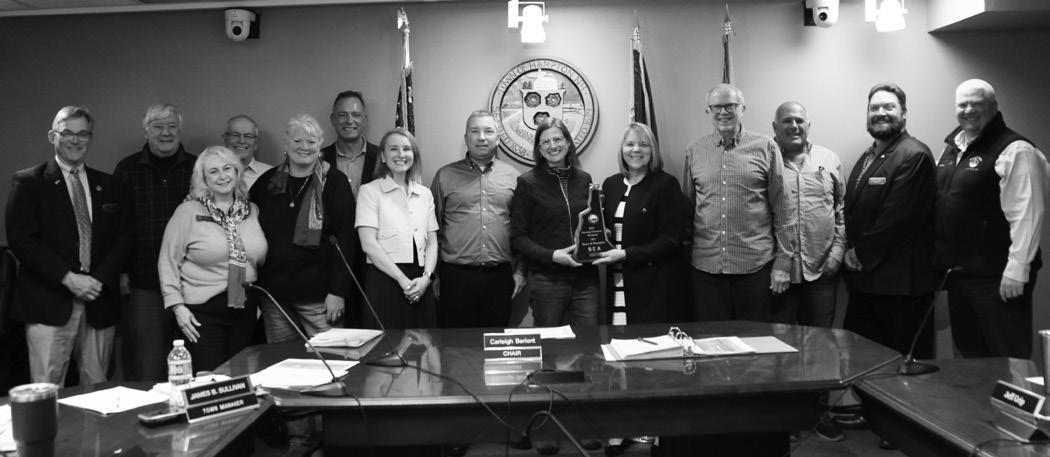
Margaret Byrnes attended the Hampton Select Board meeting on April 13, 2026, where the Town of Hampton was recognized as one of 10 designated in 2026 for taking steps to increase housing opportunities.
Join for a Lunchtime Q&A via Zoom with Unitil to learn more about this unusual and exciting offer and meet the people who are ready to help you take advantage of it. Clean Energy NH will be on hand to help you get your questions answered about project eligibility, how the rebates and financing work, what the application and implementation process is like, etc.
www.eventbrite.com/e/lunchtime-qa-with-nh-saves-forunitil-municipal-gas-and-electric-customers-registration1989918778634?aff=oddtdtcreator
The New Hampshire Department of Natural and Cultural Resources is pleased to announce that Grant Round 37 of the Land and Water Conservation Fund – Local Assistance Program is now open.
the LWCF is a federal financial assistance program from the National Park Service directly to the states, and as
pass-through assistance from the states to local units of government through a competitive selection process. Successfully procured funds may be used for the acquisition and/or development of public outdoor recreation lands and facilities. Grant awards are available between $150,000 and $1,000,000. Recipients must commit to a minimum 1:1 match-to-grant share of final project costs. Funded properties must be maintained and managed, by the recipient, for public outdoor recreation in perpetuity, per 54 U.S.C. § 200305(f)(3).
Now through April 2027, prospective applicants can simply apply through the online application platform at any time.
New Hampshire Bureau of Education and Training 2026-2027 Certified Public Manager Program Orientation August 28, 2026, Classes September 28, 2026 - June 26, 2027
The NH Certified Public Manager© program is a nationally accredited management development program intended specifically for leaders in federal, state, and local goverment. This 12-month program provides participants with knowledge and skills across several key professional competencies for success in public administration and management.
Those who complete the program are awarded the professional Certified Public Manager© (CPM) designation, which is a registered service mark of the National Certified Public Manager Consortium. Students completing the NH CPM program may be eligible for graduate or undergraduate credits at several NH colleges and universities.
www.training.nh.gov/programs/certified-public-managerprogram
Do you have insights or expertise to share with New Hampshire's municipal community? Town and City invites municipal leaders and industry experts to contribute articles that inform, inspire, and engage readers across the state.

Abatements Webinar
12:00 pm – 1:00 pm
Tuesday, July 7
Zoom

For more information or to register for an event, visit our online Calendar of Events at www.nhmunicipal.org. If you have any questions, please contact us at registrations@nhmunicipal.org.
Do's and Don'ts of Estimating Revenues on the MS-434 Webinar
12:00 pm – 1:00 pm
Wednesday, August 5
Zoom
Planning with Purpose: Unlocking Census Data for Local Impact
11:00 am – 12:00 pm
Thursday, August 6
Zoom
Class VI Roads Webinar
12:00 pm – 1:00 pm Wednesday, August 12 Zoom
For the most up-to-date event and training information, please visit the NHMA website at www.nhmunicipal.org. Event times and dates are subject to change. Thank you.


Jonathan Cowal, Legal Services Counsel
Recently, it seems that the topic of tax and budget caps has been talked about more and more among municipalities. Even though there are currently only a few municipalities which have actually adopted a tax or budget cap, the New Hampshire legislature has also shown a renewed interest in making some changes and alterations to that way that tax and budget caps are implemented, calculated, and removed. This guidance will seek to provide a quick reference for municipalities on the most important aspects of tax and budget caps and provide an explanation of how a tax or budget cap may affect a municipality after implementation.
Q. What is the difference between a tax cap and a budget cap?
A. A tax cap limits the amount of funds that can be raised by taxation each year, based on a specific formula, thus keeping the yearly tax impact on residents lower than it may have been without the cap. The estimated amount to be raised by local taxes as shown on the proposed budget certified by the select board or official budget committee (as the case may be) and posted with the warrant may not exceed the amount of taxes actually raised for the prior fiscal year by more than the amount calculated by the cap. This includes the operating budget and all other warrant articles with a tax impact. RSA 32:5-b, I.
In 2025, the Legislature also added an option for towns to implement a budget cap rather than a tax cap. RSA 32:5-g and RSA 32:5-h. A budget cap limits the budget that can be proposed to an amount not to exceed the dollars spent by the town per resident in the prior fiscal year times the current population, plus either a fixed percentage or a percentage annual increase for inflation as reported by the Bureau of Labor Statistics or American City or County. This cap would be adopted in the same manner as a tax cap except that, unlike any other budgetary or tax question under any statute, voters at the deliberative session or traditional business session are not permitted to amend the variable
portions of it (the percentage or other portions of the question that are not prescribed by the statute). They can only vote for or against it when it is time to vote on the article. RSA 32:5-h, V.
Q. How are tax caps adopted?
A. The answer depends on whether or not your municipality operates via a charter. Cities and towns with a charter can adopt a tax cap through an amendment to their charter. This process follows the usual charter amendment process under RSA chapter 49-B. If there is a tax cap in the charter, there must also be a provision allowing the legislative body to override the cap but requiring a supermajority vote to do that RSA 49-C:12, III; RSA 49-C:33, I(d); RSA 49-D:3, I(e). A charter without an override provision or which says that a cap can be overridden by a simple majority vote will not be valid.
In other towns which do not have a charter and which operate with either a traditional town meeting or official ballot referendum (SB2) town meeting, the voters may adopt a limit on annual increases in the estimated amount of local taxes in the proposed annual budget. RSA 32:5-b; RSA 32:5-c. The question of adopting a cap may be placed on the warrant either by the governing body or by citizen petition under RSA 39:3. The governing body must hold a public hearing on the question 15-30 days before it is to be voted upon. In a town with a traditional town meeting, voting on the question is by ballot conducted at the business session of the meeting; it does not get placed on the official ballot used for the election of officers. In an SB 2 town, the question is voted upon on the official ballot with all other questions. In either case, adoption of the cap requires a threefifths majority of votes cast. If a cap is adopted, it takes effect beginning with the subsequent fiscal year. A cap can be repealed in the same manner in which it is adopted. RSA 32:5-c.
Q. How are tax caps calculated?
A. Again, it can be somewhat different depending on whether or not your municipality operates under a charter. In charter municipalities, the charter amendment will need to outline how the cap is calculated. Amendments to the tax cap statutes effective in 2021 limit the ability of a city or charter town to exclude things from the cap or avoid its application through accounting practices. The charter can provide that the calculation of the cap will not include certain dedicated, enterprise, or self-supporting funds or accounts, capital reserve funds, grants, or revenue from sources other than local taxes, or interest and principal payments on municipal bonded debt, or capital expenditures, but doing so requires a supermajority vote of the legislative body. The same is true for any ordinances or accounting practices that have the effect of redistributing excludable budget items from within the limits of the capped budget to outside the limits of the capped budget. This means that a town or city cannot exclude particular items from their cap or use clever accounting to do anything that would have the effect of avoiding the cap on appropriations funded through property tax unless the legislative body of the town or city approves it by a supermajority vote.
The law provides a variety of different methods among which non-charter towns can choose to determine a cap. The original options were a fixed dollar amount or fixed percentage maximum increase over the amount actually raised by taxes in the prior year. Towns now also have the option to set the cap based on a multiplication factor used to adjust the amount actually raised by taxes in the prior year; this multiplication factor is based on inflation (the Consumer Price Index) and the town’s population. RSA 32:5-b, I-b and II. When calculating the cap using any of these methods, if the taxes for the prior year were reduced by the use of fund balance, that amount is added back in and included in the amount to which the tax cap is applied. RSA 32:5-b, I-a.
Q. Can the legislative body override the tax cap?
A. As mentioned above, charter municipalities must include an override provision to the cap. For noncharter towns, under the law as amended in 2025, the business session of a traditional town meeting must now vote on every appropriation that would override a tax cap or budget cap by secret ballot vote
and each such vote requires a 3/5 majority to pass. RSA 32:5-b, III; RSA 32:5-g, III. The same 3/5 vote is required to override a tax or budget cap in a town using the SB 2 form of government (where all votes are taken by official ballot on election day). However, the law is not entirely clear on how this will work. The statute does not explain whether votes at the deliberative session to amend the amount of an appropriation which would have the effect of exceeding the cap would require a secret ballot vote or a 3/5 majority, although presumably they would. In addition, the statutes provide that if the warrant article for the operating budget results in appropriations exceeding the tax or budget cap but has received less than a 3/5 majority in favor on the final vote, “the adopted operating budget shall be reduced by appropriations already raised to remain compliant with the cap.” RSA 32:5-b, III(a); RSA 32:5-g, IV.
Q. What are some things that municipalities should consider when presented with the possibility of adopting a tax cap?
A. While tax caps can be an effective tool to help municipalities keep tax impacts low for residents, municipalities will need to plan carefully for when the need to spend arises. Not all spending follows a predictable yearly pattern. Sometimes, municipalities may find themselves in need of raising funds for a one-time, large expense, project. This could involve a large tax impact that may be limited due to an existing tax cap. In a situation such as this, the municipality would need to seek a supermajority to override the cap, or would need to find the funds elsewhere to make up the difference. Another practical consideration for municipalities when entertaining the possibility of implementing a tax cap is the effect it can have on debt and borrowing. For larger expenditures, municipalities with tax caps can look to lease or bond agreements to keep yearly tax impacts lower. This is usually done at the expense of funding something like a capital reserve fund, which may entail a larger, one-time, payment and can sometimes have a more immediate impact on the tax rate. However, entering into debt can result in a continued shifting of taxpayer dollars away from current services and towards paying down debt and interest. It is also a more involved process to seek approval to enter into debt than it would be to expend funds previously deposited into a capital reserve fund.

Marty Karlon, Policy & Research Analyst
NHMA’s biennial Legislative Policy Process wrapped up its first phase in May, setting the stage for member municipalities to shape advocacy priorities for the 2027-2028 legislative sessions. The process, which is driven by municipal input and collaboration, will culminate in September with the Legislative Policy Conference.
At the center of the effort is the draft 202728 proposed Legislative Policies and Principles, developed through a structured, member-driven system that ensures representation from communities of all sizes and regions. The process begins each cycle with outreach to municipalities, inviting local officials to participate in the committee process and/ or submit policy proposals to address issues that affect their communities.
These proposals — along with all of the 2025-2026 Legislative Policies and Principles—are then reviewed by three legislative policy committees: Finance and Revenue, General Administration and Governance, and Infrastructure, Development, and Land Use. Composed of elected and appointed officials, the committees meet throughout the spring to evaluate submissions, draw on their own experience, and consider developments from recent legislative sessions. Their work ultimately results in a set of recommended policy positions to guide NHMA’s advocacy. More than 40 local officials, representing communities in all 10 New Hampshire counties, took part in this year’s policy committee process.
The next major step in the process is the Legislative Policy Conference, scheduled for Friday, September 11, at NHMA’s offices in Concord. At this in-person meeting, each member municipality may send a voting delegate, and each municipality—regardless of
population—receives one vote on all policy matters.
NHMA shared the draft policies and principles on our website in June https://www.nhmunicipal. org/sites/default/files/uploads/legislative-bulletins/ LPP/2027-2028-proposed-policies-principles.pdf and provided instructions on how member municipalities can participate.
Leading up to the conference, municipalities are encouraged to review the proposed policies and principles and formally discuss them with their governing bodies. While towns and cities may take internal votes to guide their delegates, those positions are not submitted to NHMA directly.
The conference also provides an opportunity for municipalities to introduce additional ideas through the “floor proposal” process. Any new policy submitted in this way must be approved by a majority vote of the municipality’s governing body and submitted in writing by August 4. These proposals are then distributed statewide before the conference to allow for review and discussion.
Once adopted, the legislative policies become the foundation for NHMA’s advocacy work during the legislative biennium. They guide staff in representing municipal interests before the state legislature and state agencies, ensuring that local perspectives remain central to policymaking discussions.
In addition to specific policy positions, NHMA relies on a set of broader legislative principles to address issues that arise unexpectedly. These principles— such as opposing unfunded mandates, protecting municipal revenue streams, and preserving local authority—provide flexibility and continuity when
new legislation emerges that has not been explicitly addressed by adopted policies.
Throughout the legislative session, NHMA’s advocacy staff report regularly to the Board of Directors, which retains the authority to establish interim policy positions as needed between biennial conferences. This structure helps ensure that NHMA can respond in real time to evolving legislative challenges while remaining grounded in member direction.
Ultimately, the legislative policy process underscores NHMA’s role as a unified voice for municipal governments across New Hampshire. By participating in the process—from submitting proposals to casting votes at the September conference—local officials help shape the organization’s priorities and influence the direction of state policy affecting cities and towns statewide.


Tammy Letson, Government Finance Specialist
Now that you have downloaded data from NHMA’s Wage Data (see the May/June 2026 issue), let’s discuss how we can work with the data so it will help us accomplish our needs.
The first thing I do when opening an exported dataset is to do some quick formatting to easily review what is in the file. Let’s start by resizing the column widths so we can see what they contain. Highlight each column with data in them – my export has data in columns A – H. To highlight them, I left click and hold in the cell that shows the A then drag the mouse over to column H. If you want to include additional columns to be sure you have everything, go for it.


Now bring your mouse to any of the vertical lines between two of the highlighted columns until your icon turns into a vertical line with arrows pointing both left and right. Once you have that icon, double click the left mouse button. All highlighted columns will resize to the maximum width needed for all the cells within said column. (With that same icon, you can click and drag left or right so all highlighted columns will resize to the same size as the one you are adjusting.)
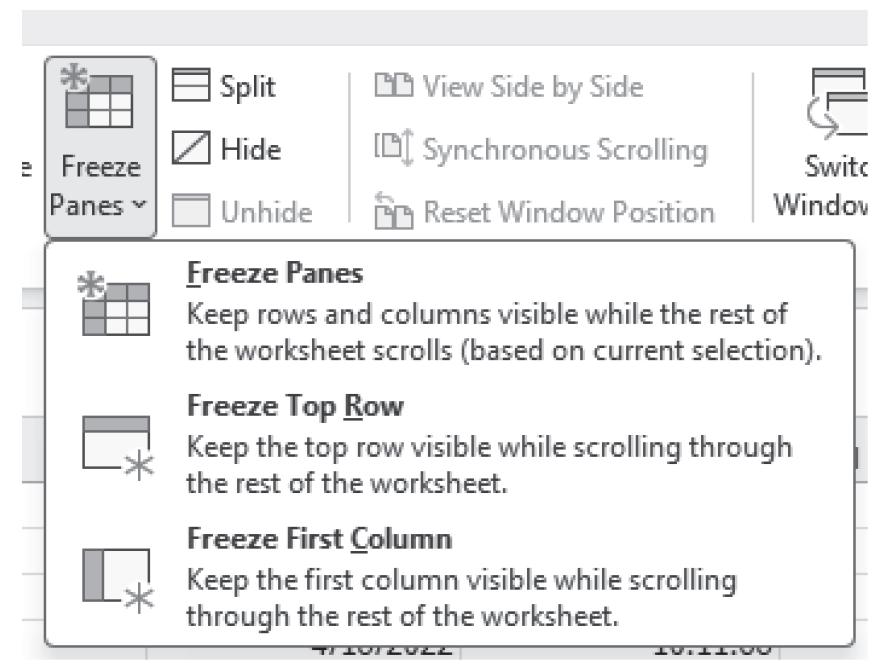
With the data in the columns visible, we can see there is a row at the top that has headers. Because I can be forgetful, I might not remember the title descriptions in each column, so I like to freeze that row in place. The freeze option is found on the View tab of your ribbon in the Window section. Excel allows you to freeze data at the top of the screen, the left of the screen, or both. Because I want to see the header row, as well as the Organization and Role columns, I am going to click in cell C2. Once there, click on the Freeze Panes icon in the ribbon and select Freeze Panes. You will now see a solid line running across the screen (including between two row numbers) and down the screen (including between two letters). This is the visual as to where your screen is frozen. When you scroll down or to the right, the top line and two left columns will not scroll off the screen.
When I glance at the data, I can see there are dollar amounts in the minimum and maximum columns. In looking at what exported, the accounting part of my brain goes into freak mode because of the lack of formatting in those two columns. To forestall that portion of my brain from completely shutting down, I quickly highlight those two columns. On the ribbon, go back to the Home tab and review the options in the Number section. I find that dollar signs at the beginning of each cell to be overwhelming, so I typically opt for the comma feature. This option will make each cell have two decimal points and place a comma where necessary.
**Tangent** (or Tam-gent as it has been suggested I call it.) As long as we are discussing this section, let me go on a very quick tangent and explain the two icons with arrows and zeros. The icon with an arrow pointing to the left will increase the number of decimal places while the icon with an arrow pointing to the right will decrease the number of decimal places. Excel will automatically round the number it displays as necessary when the decimal places are reduced. Be very careful when using this feature as any formulas are based on the actual number and not the displayed number. See the example below.
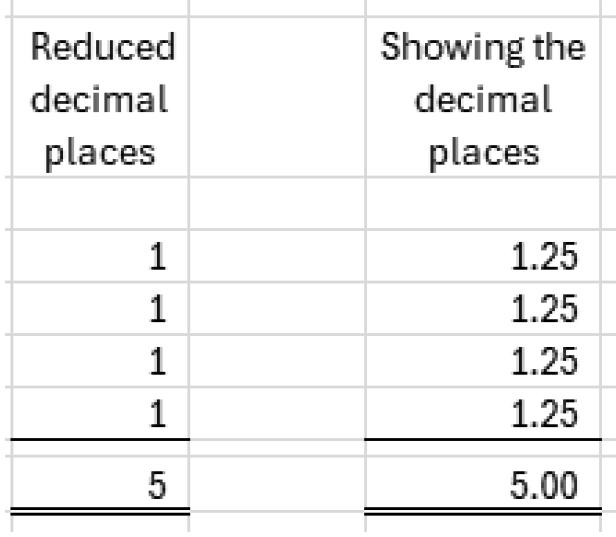
Here is a quick navigation tip. If I export the entire wage data set, I end up with 3,554 rows in information. Very few of the rows have something in the notes fields. If you wish to navigate quickly to the first field that has something in it, click in any of the blank cells in the Notes column. On the keyboard tap the End button then the down arrow button. Excel will automatically reposition you to the first field that has data in it. The reverse is also true. If you are on a field with data on it, tapping the End button then any of the arrow buttons will move you to the first field in that direction that does not have data in it.
When you save this export file, it will default to wanting to save as a CSV file because that is what opened. You may want to consider saving it as an Excel Workbook (.XLSX) file so the formatting will be retained.

David
Walker (RPC), Colin Lentz (SRPC), Adam Hlasny (SNHPC), and David Tilton (SNHPC)
Transportation safety is a national challenge; 40,901 lives were lost in crashes in 2023. The United States has the poorest highway safety record compared to other developed countries. However, the Federal Highway Administration and states have a shared goal of zero deaths and serious injuries on public roads in the U.S. In New Hampshire and beyond, Regional Planning Commissions (RPCs) play an important role in reaching that aspirational but necessary goal.
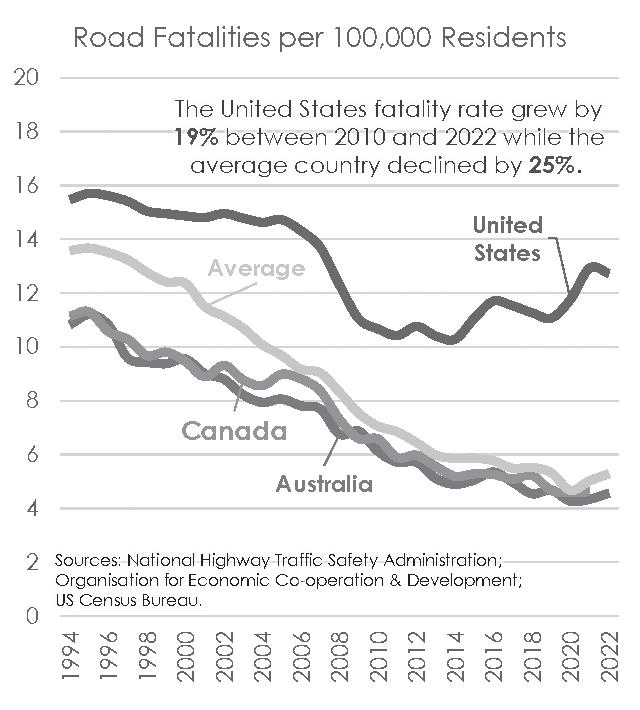
Image 1: Road Fatalities per 100,000 Residents: 1994-2022.
Source: SNHPC
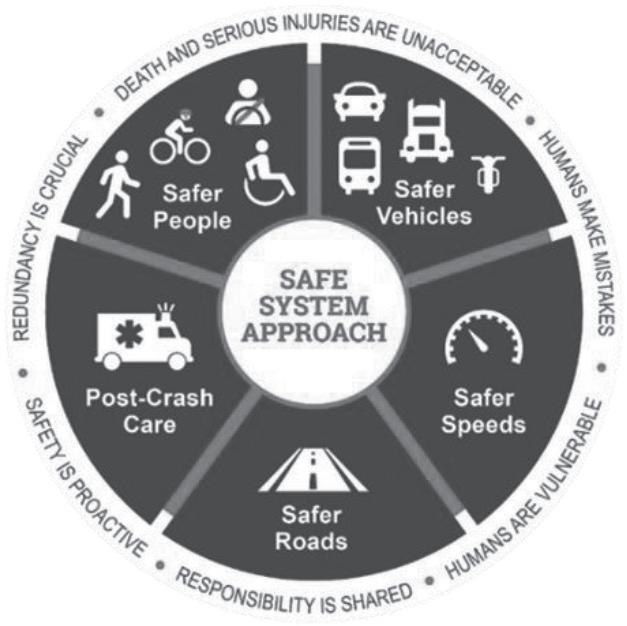
Image 2: Safe System Approach
Source: U.S. DOT
This article will discuss three programs that are utilized by RPCs and Departments of Transportation (DOTs) to ensure that our roadways are safe for all modes of transportation.
The NH Highway Safety Improvement Program (HSIP) is intended to achieve a significant reduction in fatalities and serious injuries on all public roads. It aims to do this by implementing safety improvement projects based on data-driven approaches. New Hampshire’s FY 2026 apportionment under the Infrastructure Investment and Jobs Act (IIJA) is $13,264,464).
A key part of the HSIP is New Hampshire’s Strategic Highway Safety Plan (SHSP). The SHSP is a safety roadmap that explains where and why serious crashes occur and finds the best ways to prevent them; it is updated every five years, with an update currently underway in 2026.
This SHSP update is guided by the Safe System Approach. Unlike other approaches, the Safe System Approach recognizes that people make mistakes. Instead of relying on any one solution or anticipating perfect behavior, it builds multiple layers of protection into the transportation system—through safer roads, speeds, vehicles, road users, and post-crash care.
New Hampshire’s SHSP will review the entire transportation system through the lens of the Safe System Approach. It will also;
• Prioritize strategies that prevent severe crashes and reduce the chance of death or serious injury when crashes do occur;
• Promote shared responsibility among roadway designers, policymakers, law enforcement, public health professionals, emergency responders, and road users.
New Hampshire’s first SHSP was developed and adopted in 2008. Each update is a process that brings together many partners, including state and local agencies, law enforcement, emergency responders, regional planning commissions, public health organizations, safety advocates, and members of the traveling public.
For the 2027-2031 plan update, NH DOT will use many tools including crash data analysis and stakeholder workshops to identify priority issues and develop strategies. Working groups will convene through this summer, with regional safety summits planned for the fall and a draft final plan targeted for release in December 2026.
The resulting coordinated plan will be designed to save lives and reduce serious injuries on New Hampshire’s roads. For questions on this process, please contact Mark Munroe of the NH Department of Transportation (mark.t.munroe@ dot.nh.gov).
Road Safety Audits (RSAs) are one of the best ways for a municipality to respond to critical transportation safety issues. Wherever crashes have caused fatalities or serious injuries on any public road, a municipality can apply for a road safety audit through a simple application to NHDOT. The NHDOT application requires a detailed diagram of crashes; the local police department is the best source for accurate records that are critical for a successful RSA application. The best way to start is by contacting your Regional Planning Commission. Full local crash reports have vital details about what might have caused crashes, from road and weather conditions to the behavior of drivers. RPC staff can help analyze crash information and generate a diagram in cooperation with local police.
The RSA process is rooted in engagement and comprehensive investigation of safety challenges by all stakeholders. It starts with a visit to the site of concern by staff from NHDOT, their engineering consultant, municipal staff, and other related stakeholders. The site visit is an opportunity to observe safety hazards first-hand and discuss potential improvements. NHDOT’s consultant team will then develop alternatives for safety improvements for short, medium, and long-term implementation. NHDOT and the municipality then prioritize which improvements to implement. There is usually some cost sharing; however, many improvements may be funded 100% with federal funds.
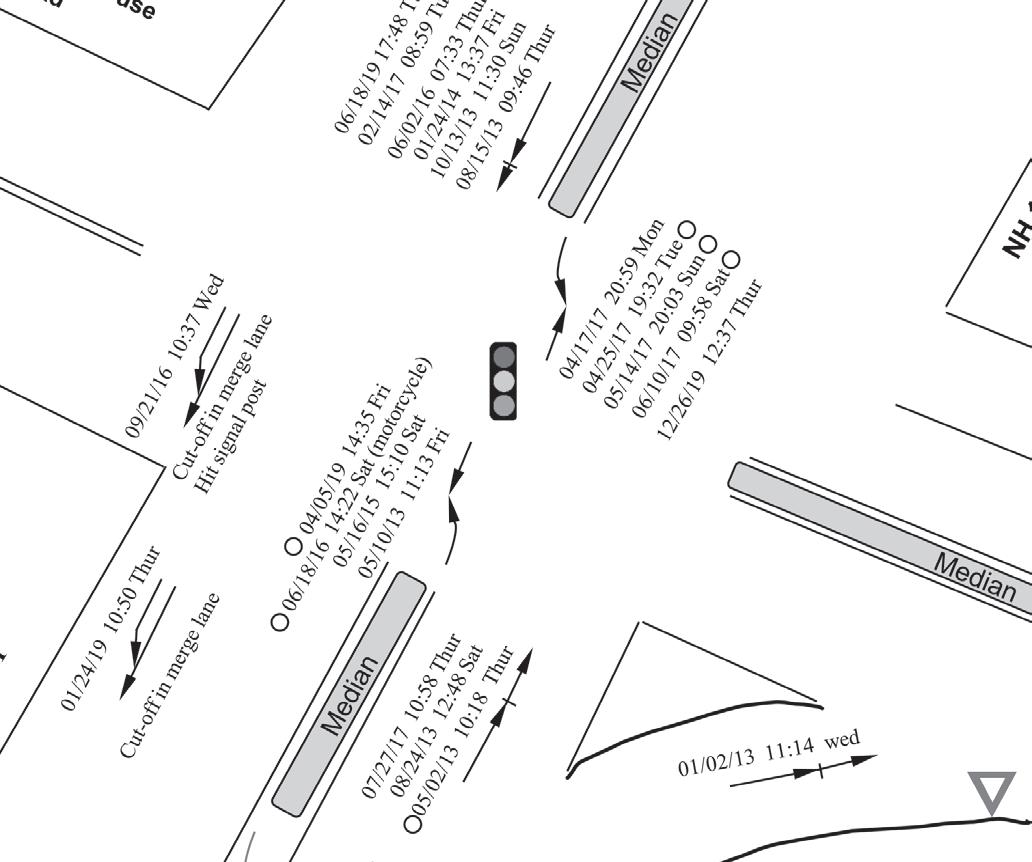
Examples of RSA’s and resulting improvements:
• A 2011 RSA led to a roundabout being built in Pelham in 2025 at the intersection of Sherburne Rd and NH128 (Google Map location).
• A 2019 RSA in Conway led to a roundabout being built in 2025 at the intersection of East Conway Rd and US 302 (Google Map location).
• Left-turn and center turn lanes were built along NH125 near the Rockingham Superior Court in 2025 after a 2023 RSA in Brentwood. Those improvements were constructed at the same time as planned road paving (Google Map location).
• An RSA was conducted in 2025 in Newmarket on NH108 south of downtown. NHDOT is currently working with town staff and leaders to select the best improvement and may use temporary materials to test improvements prior to permanent construction. (Google Map location)
Demonstration projects are a novel approach to developing transportation infrastructure improvements. Also known as “quick-build” or “pop up” projects, many communities are using temporary materials such as paint, cones, and signs to test potential designs to ensure permanent improvements will be cost-effective. A demonstration approach can be highly effective for the RSA process – especially for pedestrian safety
projects. NHDOT and Regional Planning Commissions are working with communities to implement demonstration projects.
Full flow chart of RSA process: https://www.dot. nh.gov/sites/g/files/ehbemt811/files/inline-documents/ rsa-flowchart.pdf
RSA handout: https://www.dot.nh.gov/sites/g/files/ ehbemt811/files/inline-documents/road-safety-auditinformational-handout.pdf
The Safe Streets and Roads for All (SS4A) grant program, established as part of the Infrastructure Investment and Jobs Act (IIJA) in 2022, allocates $5 billion nationally in competitive grant funding over five years (2022-2026) to support regional, local, and tribal initiatives (not states) aimed at preventing serious injuries and fatalities from roadway crashes. There are two types of grants available: Planning and Demonstration grants, and Implementation grants.
Planning and Demonstration grants are utilized to develop Comprehensive Safety Action Plans (also known as Action Plans), conduct supplemental safety planning activities once an Action Plan is in place, or to undertake demonstration projects that test viability of safety approaches and projects prior to committing to permanent changes.
Implementation grants require that a community, region, or tribe have a Safety Action Plan (or similar) in place. The grants have a wide variety of eligible activities that include applying low-cost system-wide safety treatments, bicycle and pedestrian safety improvements, enhanced transit services, emergency response and trauma response system enhancements, education initiatives, and roadway improvement projects.
The City of Keene and the 72 communities contained within the Nashua, Rockingham, Southern NH, and Strafford Regional Planning Commissions are covered by approved Safety Action Plans and are eligible for Implementation Grants. Other communities may have transportation safety plans in place that meet requirements as well and the SS4A website includes a self-certification eligibility worksheet to assess this prior to applying for funds.
The Rockingham Planning Commission (RPC) was awarded a planning grant from the SS4A program in 2023 for four New Hampshire planning commissions (NRPC, RPC, SNHPC, and SRPC) to cooperatively develop regional
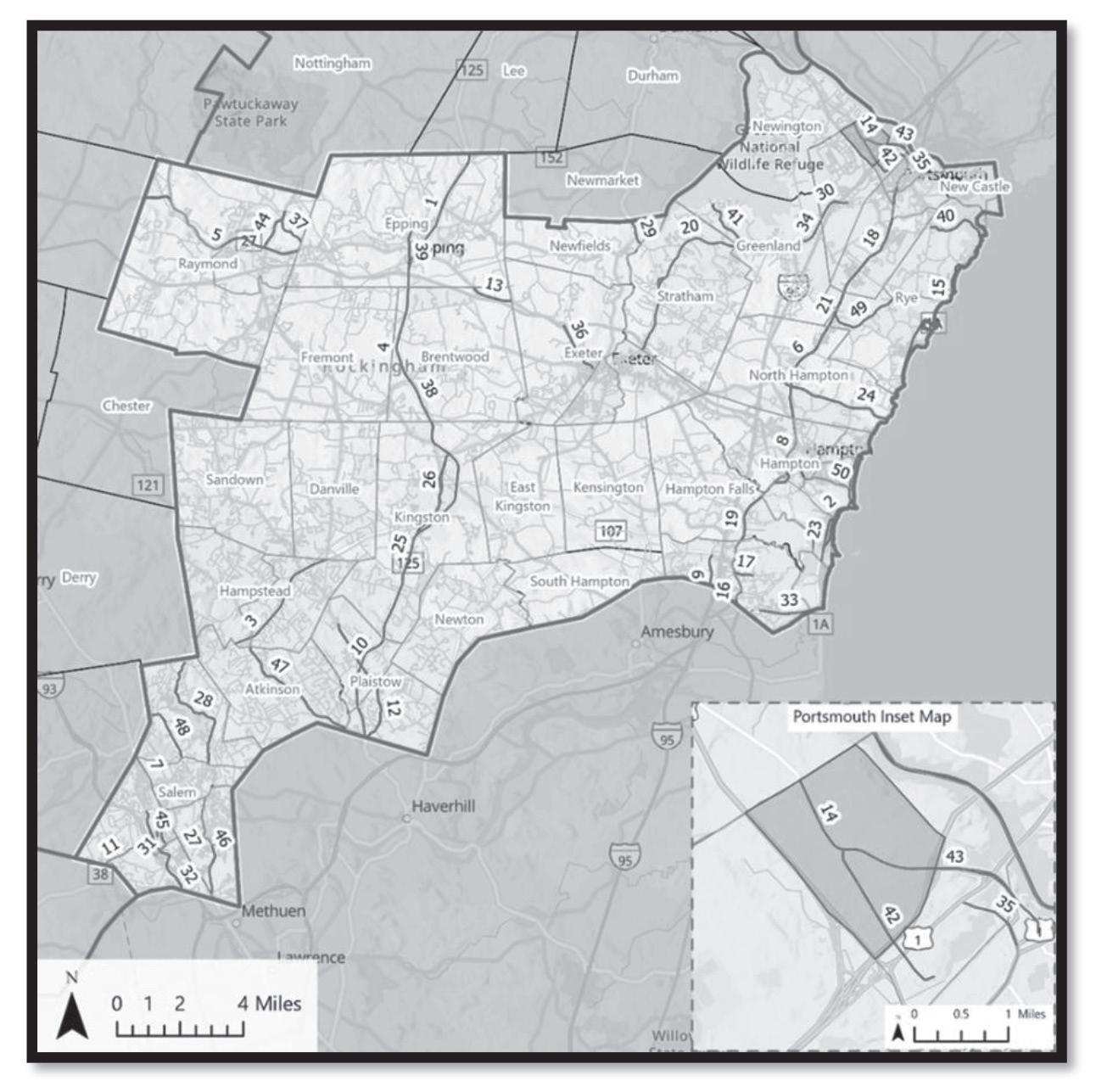
Safety Action Plans. The four worked in collaboration with stakeholders such as transportation agencies, law enforcement, public health organizations, and community members and completed the process in early 2025 with each planning commission adopting a Safety Action Plan for their region and ensuring that each of the communities within their regions meet that basic requirement for pursuing SS4A Implementation Grants.
Safety Action Plans are comprehensive, data driven efforts that identify current traffic safety patterns and outcomes in a community or region and outline specific strategies and measures to enhance transportation safety, reduce crash frequency and severity, and ultimately eliminate serious injuries and fatalities. This process also relies heavily on inclusive public engagement where the concerns of a wide variety of stakeholders are heard and incorporated into the resulting recommendations and strategies.
They begin with a comprehensive analysis of crash data to identify high-risk locations, patterns, and behaviors, and risk factors leading to fatal and serious injury crashes. Local, regional, and state plans and policies are reviewed to understand the decision-making tools influencing roadway safety, and community input is gathered to incorporate the experiences and concerns of residents, workers, and travelers. The data analysis results and community input are summarized to establish a set of emphasis areas that reflect the region-specific safety issues and patterns observed.
Strategies are identified by linking these emphasis areas with the principles and elements of the Safe Systems Approach and FHWA’s Proven Safety Countermeasures resulting in a prioritized set of engineering, enforcement, education, and emergency response recommendations. Specific actions are identified for each strategy to create an implementation framework, and action items are prioritized for each of the emphasis areas and the High Injury Network which is a subset of roads where a high proportion of fatal, serious, and minor injury crashes occur. In the RPC region for example, the analysis indicates that 35% of the fatal, serious, and minor injury crashes occur on only 7% of the roadway network.
Implementing the Safety Action Plans involves continuing to collect crash data and monitor performance metrics, ongoing coordination with state and local partners, and seeking out funding opportunities for addressing identified local and regional priority actions. Funding sources available for implementing safety improvements include dedicated safety programs such as the federal SS4A program and NHDOT’s Highway Safety Improvement Program (HSIP). Other grant programs such as the Congestion Mitigation and Air Quality (CMAQ) and Transportation Alternatives Program (TAP) can be used for some types of safety projects.
In some cases, particularly for very low-cost improvements, utilizing local funding may be the fastest path to implementation. Additionally, the State Ten Year Plan is an option for longer-term improvement needs. Contact your Regional Planning Commission to discuss your project
needs and they can aid you in determining funding options and limitations.
Improving transportation safety may seem difficult and complex. However, among the difficult changes facing our communities, there are copious ways to make significant safety improvements in the near term. Many transportation safety improvement actions have lower costs when compared with other municipal infrastructure projects. There are several resources and tools for identifying the best safety improvements for unique challenges in your community. The friendly folks at your Regional Planning Commissions are available to help.
Authors:
• David Walker – RPC Executive Director. dwalker@ therpc.org; 603-658-0514
• Colin Lentz – SRPC Senior Transportation Planner. clentz@straffordrpcnh.gov; 603-994-3500 ext. 102.
• Adam Hlasny – SNHPC Senior Transportation Planner, ahlasny@snhpc.org; 603-669-4664.
• David Tilton – SNHPC Senior Transportation Planner, dtilton@snhpc.org; 603-669-4664.
Source Materials:
HSIP Section - NHDOT website
SS4A Section - Safe Streets and Roads for All (SS4A) Grant Program website, SS4A Clearinghouse website, FHWA Proven Safety Countermeasures, RPC Regional Safety Action Plan
Francesca McCann, Director of Alternative Funding, Financing and P3, Black & Veatch
State laws shape the extent to which municipalities can raise and manage revenue. These laws define what types of taxes cities can levy, how those taxes are collected, and the degree of flexibility local governments have to respond to changing fiscal conditions.
In addition to defining tax authority, many states impose tax and expenditure limits (TELs). TELs are legal constraints that restrict how much revenue a local government can raise or how much it can spend. These limits can take several forms, including caps on property tax rates or levies, restrictions on revenue growth, or requirements for voter approval before increasing taxes.
Together, tax authority and TELs shape how municipalities fund services, plan budgets, and respond to economic changes. While TELs are often designed to promote fiscal discipline or limit tax burdens, they can also influence the composition of local revenues and the tools cities use to maintain financial stability.
Since 2019, the National League of Cities (NLC) has partnered with the Center for Public Health Law Research at Temple University Beasley School of Law to track and understand state-level preemptions of local authority. This brief provides an overview of trends in tax and expenditure limits tracked in the CPHLR database from 2019 to 2022. The analysis highlights types of tax expenditure limits that states impose on local governments. Additionally, this analysis also looks at different general fund tax collection authorities of municipalities across the country.
The brief is available for download: https://www.nlc.org/resource/tax-authority-tax-and-expenditure-limits/



Your 234 Town and City Clerks across are continuously preparing for our Local, State, and Federal Elections. It is ongoing process of continuous education and learning. It is an honor to represent all local, state, and federal elections held in New Hampshire, in addition to the other duties and responsibilities of City and Town Clerks. Vital Records; Car Registrations; Record Keeping; Dog Registrations; Taxes and Permits all requiring attention to detail, awareness of our laws and changes to our laws that are made at the state level, and high level communication skills
along with compassion and empathy. We are often referred to as the Heart of Our Communities.
April 14th through Wednesday, April 15 Joan Dargie Town Clerk of Milford and Sherry Farrell Londonderry Town Clerk were asked to represent New Hampshire at the Election Assistance Commission which was held in Chicago. Two Clerks from each state were asked to attend. This was an educational and networking conference so that thoughts and concerns regarding our upcoming elections could be discussed and new innovative ideas and preparations could be shared.

April 28th was Advocacy Day in Washington, D.C. Town and City Clerks were invited to meet and talk with their state representatives.

The picture highlights from L to R Town Clerks Joan Dargie, Milford; Kerri Parker, Meredith; U.S. Senator Maggie Hassan; Tina Gilford, Derry; Judy Welch, Woodstock.
The NHCTCA Association's Executive Board Treasurer, who has served as the Exeter, Town Clerk retired in May. Andie has been a mentor to new clerks entering into our profession and is an outstanding example of leadership, integrity, and the ability to wear many hats and continuously problem solve while serving the people of her community, as well as at the state level. She will be missed, but we wish her well as she starts the next chapter of our life. Andie made a difference and made our NHCTCA a better organization.











Christina Simpson, Esq. and Sarah Freeman, Esq.
The Immigration Reform and Control Act of 1986 was established to control the employment of unauthorized aliens and to protect authorized workers from unfair immigration-related employment practices. Among other things, the Act requires employers to timely and properly complete I-9 forms for covered individuals. The purpose of the I-9 is to verify the identity of the individual providing services to an employer and that the individual is authorized to work in the United States.
Employers are required to complete an I-9 form for all individuals who receive “remuneration” in exchange for providing services. Accordingly, municipalities must have valid I-9s for both employees and volunteers who receive a nominal fee. The exception to this rule involves election judges and poll workers. Employers must have a completed I-9 on file for all current employees hired on or after November 6, 1986. Following termination however, employers can destroy I-9s for separated employees either one year after the date of termination or three years after the date of hire, whichever is longer.
Homeland Security Investigations (HSI) may conduct administrative inspections of employers’ compliance with the I-9 requirement. Typically, an inspection will begin with the service of a Notice of Inspection (NOI). The NOI provides employers with three business days to produce all I-9s along with additional documentation, including but not limited to, an employee roster and payroll information. Accordingly, while I-9s may be considered personnel file documents, many employers elect to maintain these forms separately from an employee’s official personnel file in a combined “active employee” binder, as well as a “terminated employee” binder, so that all forms are easily accessible in the event of an audit.
Employers can face fines for failure to maintain I-9s and/ or for failing to have properly completed I-9s. Technical violations are minor, correctable errors in the I-9 completion that do not relate directly to an employee’s authorization to work. During the inspection process, an auditor may identify technical failures on the I-9s and afford the employer with
the opportunity to make corrections. However, substantive violations are serious, non-correctable errors in Form I-9 which directly relate to and question the employee’s authorization to work. Baseline penalties for substantive violations are up to $2,861, per I-9, prior to the application of aggravating and mitigating factors. Higher fines are also assessed in more serious circumstances, such as the knowing hiring of undocumented aliens. Criminal charges can also be brought against employees of the organization if there is reason to believe that the organization is harboring illegal aliens, trafficking in illegal aliens, or engaging in other criminal conduct. These penalties are generally assessed by U.S. Immigration and Customs Enforcement (ICE).
In March 2026, ICE issued new rules regarding substantive and technical violations of Form I-9. These changes were made to ICE’s “Form I-9 Inspection Under Immigration and Nationality Act § 274A,” a fact sheet that lays out the I-9 audit process. Below is a non-exhaustive list of the “new” substantive violations:
• Failures of electronic I-9 system’s audit trails, electronic signature protocols, or security documentation that falls short of specific DHS standards (particularly relevant if original paper Form I-9s are retained electronically);
• List A, B, or C data not fully recorded/incorrectly recorded in Section 2, such as name of document, number of document, issuing authority, or expiration date, regardless of whether a copy of an underlying document, such as green card or driver’s license, was retained;
• Failure to ensure an employee provides their date of birth, USCIS number, or signature in Section 1;
• Missing name and title of the employer representative; and
• Failure to provide the first day of employment in the Certification;
Prior to this update, it was not uncommon for employers to discover that up to 80% of their I-9s contained errors. Based
upon this error rate, a town or city with 45 employees (including volunteers who receive a nominal stipend), faces a potential fine exceeding $100,000. By expanding the list of substantive violations, ICE has substantially reduced employers’ ability to avoid fines for routine administrative mistakes and reduced the errors that could be corrected in order to decrease fines.
The following are immediate action items for municipal employers:
1. Invest in Training. Given that many of the newly reclassified substantive violations arise from simple errors and carelessness in filling out the form, municipalities should ensure that trained personnel handle I-9 completion and verification. If the individual completing your I-9s routinely makes a mistake that is now considered substantive, that one simple error could cost hundreds of thousands of dollars.
2. Evaluate Use of Electronic I-9 Storage and Systems. If a municipality uses an electronic I-9 system or electronically stores copies of I-9s, it should ensure full compliance with federal regulatory requirements, including audit trails, indexing, and electronic signature standards.
3. Conduct Internal I-9 Audits. Contact an immigration attorney and request an internal I-9 audit. Even if one has been done in the last few years, municipalities should review audit results to confirm whether previously identified technical errors, that are now substantive violations, were remediated after the audit. Employers that identify and address issues before any NOI will not eliminate all risk of penalties, but will likely be better positioned to leverage mitigating factors to seek reduced fines. And, internal audits help to show that the company is proactive in addressing potential problems.
We have all the tools to meet your needs.
Drummond Woodsum’s attorneys are experienced at guiding towns, cities, counties and local governments through a variety of issues including:
• Municipal bonds and public finance
• Land use planning, zoning and enforcement
• Ordinance drafting
• Tax abatement
• General municipal matters
• Municipal employment and labor matters
• Litigation and appeals
We work hard to offer clients the counsel and support they need, precisely when they need it.
This is not a legal document nor is it intended to serve as legal advice or a legal opinion. Drummond Woodsum & MacMahon, P.A. makes no representations that this is a complete or final description or procedure that would ensure legal compliance and does not intend that the reader should rely on it as such.



Your Town Has a Name. To a Threat Actor, It Has an IP Address.
Municipal leaders have always carried the responsibility of protecting the systems that keep their communities running. Today, many of those systems—water treatment, emergency communications, payroll, schools, permitting, and public safety—depend on technology that was never designed to withstand modern cyber threats.
0101010100000110101011010110101010101010101100101010101000001011110110111011010110101101010101010101010110101101011010101010 1010111101101110110101101011010101000000111010101011010110111010101001000010101101011010110101011010110101010101010101100101 0101010000010111101101110110101101011010101010101010101101011010110101010101101010101011010110101101010101010101101011010101 010100011101010101101011000000111010101011010110111010101001000010101101011010110101011010110101010101010101100101010101000 0010111101101110110101101011010101010101010101101011010110101010101000001110101010110101101110101010010000101011010110101101 0101101011010101010101010110010101010100000101111011011101101011010110101010101010101011010110101101010101010101111011011101 1010110101101010100000011101010101101011011101010100100001010110101101011010101101011010101010101010110010101010100000101111 011011101101011010110101010101010101011010110101101010101011010101010110101101011010101010101011010110101010101000111010101 0110101101110101010010000101011010110101101010110101101010101010101011001010101010000010111101101110110101101011010101010101 0101011010110101110000010111101101110110101101011010101010101010101101011010110101010101010111101101110110101101011010101000 000111010101011010110111010101001000010101101011010110101011010110101010101010101100101010101000001011110110111011010110101 1010101010101010101101011010110101010101101010101011010110101101010101010101101011010101010100011101010101101011000000111010 101011010110111010101001000010101101011010110101011010110101010101010101100101010101000001011110110111011010110101101010101 0101010101101011010110101010101000001110101010110101101110101010010000101011010110101101010110101101010101010101011001010101 010000010111101101110110101101011010101010101010101101011010110101010101010111101101110110101101011010101000000111010101011 0101101110101010010000101011010110101101010110101101010101010101011001010101010000010111101101110110101101011010101010101010 101101011010110101010101101010101011010110101101010101010101101011010101010100011101010101101011011101010100100001010110101 1010110101011010110101010101010101100101010101000001011110110111011010110101101010101010101010110101101011100000101111011011 101101011010110101010101010101011010110101101010101010101111011011101101011010110101010000001110101010110101101110101010010 0001010110101101011010101101011010101010101010110010101010100000101111011011101101011010110101010101010101011010110101101010 101011010101010110101101011010101010101011010110101010101000111010101011010110000001110101010110101101110101010010000101011 0101101011010101101011010101010101010110010101010100000101111011011101101011010110101010101010101011010110101101010101010000 0111010101

Across the country, local governments are increasingly being targeted by ransomware groups and other threat actors because they often lack the staffing, visibility, and resources needed to defend complex technical environments. Through our grant-funded programs, in New Hampshire we have identified that the trend persists.
Overwatch has identified a concerning trend across New Hampshire municipalities: most organizations have limited visibility into and understanding of their own technical environments. The causes are understandable. High staff turnover, aging infrastructure, limited budgets, and dependence on outside vendors who are equally constrained by time and expertise, at times, create environments where technology grows faster than oversight. In our program assessments, we often find that the municipal leader is fully relying on their IT person or their vendor without gaining enough of an understanding of the moving pieces themselves. Many reveal that they are aware of components of their technical environments that they aren’t even sure are working or what function they serve or who is responsible for maintaining it. It is generally accepted that municipal leaders are not supposed to be technology experts. It’s certainly easiest to trust the people around them. Municipal staff and service providers are working hard to support their communities. But good intentions alone cannot secure critical infrastructure.
Trust isn’t a security strategy. What good is a locked front door if you gave away the key and didn’t know it?
The data we’ve collected reflects the scale of the challenge. Thirty-nine percent of municipalities assessed lacked an adequate firewall. Seventy-four percent had no identity management controls. Sixty-five percent had never conducted cybersecurity awareness training or don’t do so annually. Across towns, schools, and water systems, the average cyber risk score was a D+.
These are not simply technology gaps. They are operational risks that can disrupt public services, compromise sensitive data, and threaten community safety.
The good news is that resilience does not require perfection. Many of the most important improvements are foundational: understanding what systems exist, improving access controls, training staff to recognize phishing attempts, and building partnerships that strengthen local capabilities. There are highly skilled technologists and teams out there that can safely test and document the core elements of your environment, including but not limited to the assessments provided by The Overwatch Foundation.
The municipalities who will be safest are not the ones with the largest budgets, but the ones treating cybersecurity as a leadership and public safety issue—not just an IT problem.

C. Christine Johnston, NHMA Legal Services Counsel
Why do tax abatements exist? What rules, if any, limit when they can be granted? When someone’s taxes are abated, what impact does it have on everyone else’s taxes? If you’ve ever wondered about any of these questions, read on to learn more!
Property taxes and tax abatements in New Hampshire are governed by state law. Municipal officials and employees often begin by assuming that a town or city can take any action it would like unless there is a statute (or constitution) which says otherwise. In New Hampshire, however, this is not true. While we have a long tradition of rugged individualism, the reality is that our state Constitution does not grant any authority directly to towns and cities. As a result, towns and cities may only take actions that are directly authorized or required by a statute, or which are “necessarily implied” in a statute. Girard v. Allenstown, 121 N.H. 268 (1981). Furthermore, if a statute does grant authority, municipalities must abide by all of the limitations in the statute regarding the way in which that power can be used and they cannot add extra powers or expand the scope beyond what the statute provides.
The New Hampshire Supreme Court has been very clear in its opinions that towns and cities must be authorized by the legislature to tax real estate and may only do it in the way that the legislature provides. DirecTV v. Town of Hampton, 170 N.H. 33 (2017); Canaan v. Enfield Fire Dist., 74 N.H. 517 (1908). Similarly, towns and cities must be authorized by the legislature to relieve taxes, and may only do so in the way that the legislature allows (using exemptions, credits, deferrals, and abatements). Opinion of the Justices, 115 N.H. 228 (1975).
Abatements are authorized in RSA 76:16, which says that the “selectmen or assessors, for good cause shown, may abate any tax, including prior years’ taxes, assessed by them or their predecessors, including any portion of interest accrued on such tax….” Although this statute doesn’t say much more about the purpose of abatements or the standards that apply, these issues have been litigated for hundreds of years. What is the purpose of a tax abatement?
Abatements are a time-honored way to eliminate an “irregularity or illegality” in the assessment of property taxes. See Briggs’ Petition, RSA 29 N.H. 547 (1854). The critical issue is whether the taxpayer is unlawfully or unjustly taxed as between them and other taxpayers. Bretton Woods Co. v. Carroll, 84 N.H. 428 (1930); Appeal of City of Berlin, 174 N.H. 733 (2022). This is in direct contrast to many of the other tax-relief programs authorized or mandated by law, such as
exemptions and credits designed to encourage certain types of land use or to encourage open space, environmental, or historic preservation. It is, instead, about correcting mistakes and avoiding unjust situations.
When is an abatement appropriate?
The only hint in the law about when an abatement should be granted is the mention in RSA 76:16 of “good cause.” It has never been defined by statute. Over the past two hundred years or so, courts have upheld abatements only for two types of situations: disproportionate assessment and poverty/ inability to pay. Even when noting that “good cause” is not necessarily limited solely to these two things, the NH Supreme Court has focused in its opinions on the “remedial justice” that abatements are supposed to accomplish. In other words, the point of a tax abatement is to correct an unfair situation. See Carr v. Town of New London, 170 N.H. 10 (2017).
Disproportionate assessment
Our state Constitution requires property taxes to be assessed proportionately and equally across the taxing district. N.H. Const., Pt I, Art 12; Pt II, Art 5. If one taxpayer pays less than their fair share, it leaves that share to be paid by others. This violates the constitutional mandate that each citizen is bound to contribute his or her fair share of the tax burden. Extracting part or all of one taxpayer’s burden from another taxpayer generally would not be constitutional. See Morrison v. Manchester, 58 N.H. 538 (1879).
To accomplish this goal, taxpayers are entitled to have their property taxes assessed based on the same standard of values as is applied to all other property in the municipality. They are also entitled to pay their proportional share of the overall municipal tax burden. This is the purpose of RSA 75:1, which requires municipalities to appraise all property at market value, which is defined as its “full and true value.” (All property except, of course, those classes of property for which another statute dictates a different measure of value, such as land in current use under RSA chapter 79-A, qualifying historic buildings under RSA chapter 79-G, telecom poles and conduits under RSA 72:8-c, etc.) To arrive at this value, multiple acceptable valuation methods can be used depending on the situation. Three commonly-accepted methods are “replacement cost less depreciation,” “comparable sales/market data,” and “capitalization of income.” The choice of method depends on many factors, including whether the property is income-producing, or if comparable sales data is available, or if the property has unique characteristics. No single method is

Tax Deeding
April 1st
Tax Caps
April 15th
Meeting Minutes and Non-Public Sessions
June 17th
Abatements
July 7th
Class VI Roads
August 12th
First Amendment Audits
September 22nd
Default Budgets
September 29th
correct in all cases, and sometimes a combination of methods is most appropriate. However, in every case, the goal is to determine the correct value using the proper standard so that this value is in proportion to the value assigned to other properties in the municipality.
If the appraised value of a property is not correctly determined using whichever valuation method applies, then the taxes assessed on that property using that value are also incorrect. The result is that the taxpayer is being charged more (or sometimes less) than their fair and proportionate share of public expenses. This is what is meant by “disproportionate assessment.” The burden of proving disproportionate assessment is always on the taxpayer. See Dartmouth Corp. of Alpha Delta v. Town of Hanover, 115 N.H. 26 (1975). Proportionality is really the key. The issue is not, technically, whether the property is appraised in excess of its fair market value; the taxpayer must demonstrate instead that the property is assessed at a higher percentage of fair market value than other property in the municipality. See, e.g., Shaw’s Supermarkets v. Town of Windham, 174 N.H. 569 (2021).
Also falling under the umbrella of disproportionate assessment are those situations involving mistakes and other unjust circumstances surrounding the assessment of taxes that result in a taxpayer being assessed more than their fair share of the tax burden:
• If all or a part of a lot was taxed to a taxpayer who did not own it, or if the taxpayer can demonstrate a mathematical error in the assessment, an abatement would be proper. See Winnipiseogee Lake Cotton & Woolen Mfg. Co. v. Laconia, 74 N.H. 82 (1906).
• If a property has been granted an exemption under one of the statutory categories (such as charitable, religious, or governmental use, or something like the exemption for the blind under RSA 72:37) but was then taxed anyway, it would be a proper subject for an abatement request to correct the mistake. Appeal of Taylor Home (BTLA), 149 N.H. 95 (2003).
• If property is damaged or destroyed after April 1, the owner may apply for a prorated assessment under RSA 76:21 or an ordinary abatement under RSA 76:16 so that they are taxed less (or not at all) for the portion of the year when the property was no longer able to be used for its intended use. See also Carr v. New London, 170 N.H. 10 (2017).
• Note, however, that municipalities are not permitted to create their own programs for abatements to address situations that are not authorized by statute. See Barksdale v. Town of Epsom, 136 N.H. 511 (1992)
(towns may not create an abatement program to grant $1,000 abatement for all taxpayers who send a child to public school in a different school district; people are not entitled to a tax abatement if they do not personally add to the expenses being funded by those taxes because paying for public programs is part of living in society).
Inability to pay has long been a basis for tax abatements. “The poor man who has lost his health from accident or disease, who has lost his property by fire or other misfortune…, and to save them from the cold charity of the workhouse,” has good cause for an abatement of taxes. Briggs’ Petition, 29 N.H. 547 (1854). Today, of course, there is no threat of jail or the poor house for failure to pay local property taxes, but inability to pay continues to be a valid reason for an abatement. Although it is quite a different set of circumstances than disproportionate assessment, the common thread is that an abatement is intended to restore fairness to the distribution of the tax burden.
This relief has its limits, however. A taxpayer must demonstrate that they are making reasonable efforts to pay. If a taxpayer has equity in the property, they must show that it is not reasonable to sell/relocate, to refinance, or otherwise to obtain additional public assistance; if not, it would not be equitable to abate the taxes. The mere fact that they spend all of their income on essentials is not sufficient to establish “good cause” for an abatement based on poverty. See Ansara v. Nashua, 118 N.H. 879 (1978). In addition, the Board of Tax and Land Appeals routinely concludes that a taxpayer who has actually paid the taxes in full cannot establish poverty or inability to pay (having, in fact, paid). See, e.g., The Child Advocacy Center of Carroll County v. Town of Wolfeboro, 2025 NH Tax Lexis 8, 2/11/2025, Docket No. 30972-23PV (it made no difference that the taxpayer used funds to pay the taxes which had been earmarked for activities related to the organization’s purpose).
What effect does an abatement have on municipal finances?
A tax abatement does not affect only the finances of the individual taxpayer to whom it is granted. Not to overstate the obvious, but every tax abatement reduces the amount of tax revenue a municipality receives (or retains, if the taxpayer is getting a refund). In addition, when an abatement requires a refund to the taxpayer of taxes previously paid, the municipality must also pay the taxpayer 4% interest on that amount from the date of their payment through the date of the refund. RSA 76:17-a. It can also have effects going forward. If an abatement is granted on the basis that the assessment of the property was too high, the assessment must be kept at that reduced level in future years until either (a) the property is reappraised in good
faith under RSA 75:8 after changes are made to it, such as renovation or addition, or (b) a municipal-wide revaluation is performed. RSA 76:17-c.
What is happening here, of course, is that the taxpayers who receive abatements are paying a lower share of the overall tax burden than they were initially charged. So who makes up the shortfall? Everyone else. The reduction of taxes for one taxpayer causes the tax effort to increase for all other taxpayers. (This is the point at which it is important to bear in mind that abatements exist to restore fairness, so they are really reallocating the tax burden among other taxpayers to the level it should have been to begin with.) It does require some adjustments to be made, however. To account for this, the law permits the municipal governing body (select board, town council, city council or mayor/board of aldermen) to choose each year to base that year’s tax rate on a slightly higher total amount to be raised by taxes. This is called the “overlay.” It can be up to 5% of the overall amount that needs to be raised by taxes that year. RSA 76:6. The purpose is to make up the
shortfall that the town or city will experience that year when it grants abatements. In a good year, the actual amount of taxes abated will be less than the overlay amount, and the excess will go into the municipality’s fund balance (the total amount of operating surpluses and deficits since the beginning of that municipality’s existence). The fund balance can then be used in subsequent years as a source of revenue for appropriations, to pay for emergencies, or to reduce the tax rate.
Abatements are an inescapable part of property taxation because constitutional mandates for equity and fairness require them when mistakes have been made or when certain inequitable situations arise. While the process can create confusion and headaches, it is something all municipalities must manage and all municipal officials should understand.

Municipalities continue to face a multitude of requests for services, the need to repair aging infrastructure, and requirements to meet more stringent federal and state mandates and regulations, all while combating the inflationary pressures the private sector also faces. Examples of these challenges include:
• Highway construction projects, according to the National Highway Construction Cost Index, have increased 68%-70% since 2021.
• The opioid crisis, as well as the peripheral issues associated with it, has stressed public safety services, often creating the need for additional personnel.
• Changes in federal and state environmental regulations have put a strain on local governments; PFAS monitoring and mitigation and the Lead Service Lines Inventory Project are just two examples.
• Since the onset of the COVID pandemic, labor costs have increased more than 25%, according to the Social Security Administration’s Average Wage Index.
• Not only were some municipalities participating in a health insurance risk pool asked to pay a one-time assessment in 2025, but most municipalities have seen an increase in their health insurance premiums up to 35% this year alone.
• Requests are constantly coming from residents and area businesses to spendfunds on culture and recreation, economic development, conservation, etc.
Even with these and the many more issues municipalities face, cities and towns are asked to deal with them with little to no increase in property taxes. Compounding the outcry from some residents and legislators that local taxes are out of control, is the perception that when schools, precincts, or the county have property tax increases, it is the municipality’s fault as they are the entity who sends out the bill.
With these thoughts in mind, the New Hampshire Municipal Association has reviewed the changes in property taxes, estimated revenues, and appropriations since the Great Recession of 2008. We gathered data from the NH Department of Revenue Administration and used the NH Public Finance Consortium to fill in information back to 2009. The amounts shown below are the total statewide amounts.
As you can see from the graph, the growth in appropriations has, as expected, increased over the last decade and a half. When finding revenue to offset those appropriations, municipalities have begun to identify other funding sources, thus allowing their estimates to grow at a faster rate than the property taxes.
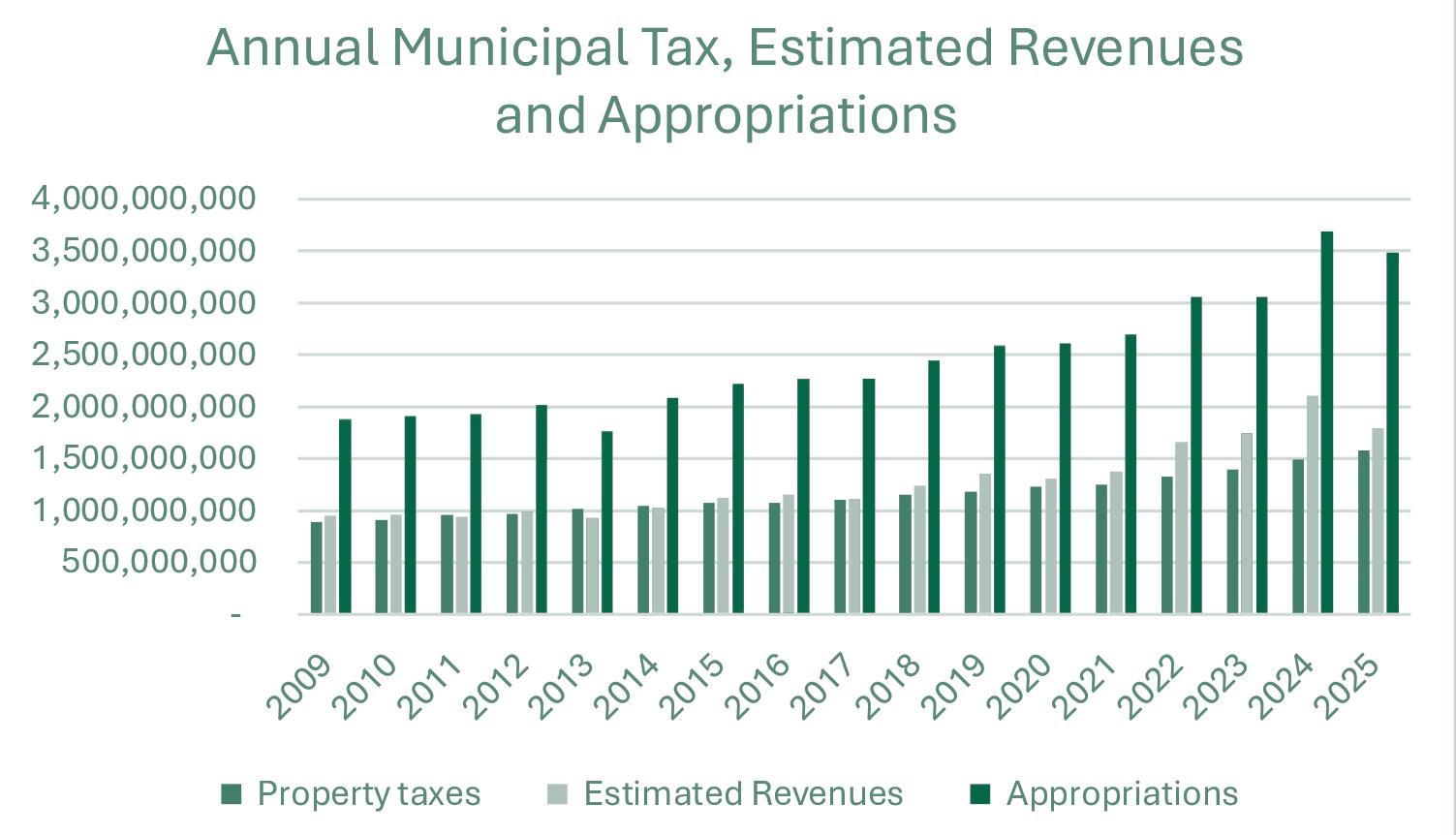
When digging deeper into the amounts that make up the above graph, NHMA found, based on the percentage change from 2025 as compared to 2009, the largest areas of increase were in other proprietary funds (such as development authorities and sports facilities like ice skating rinks), special revenue funds (such as highway funds and parking meter funds), capital reserve and expendable trust transfers, capital outlay and water distribution. Using the same parameters, special revolving funds, water revenue, proceeds from long-term notes and bonds, sewer revenue and miscellaneous revenue had the top increases in estimated revenue sources.
A significant percentage of the increase in appropriations in recent years has come from Post-COVID federal aid to states and cities, primarily from the $350 billion Coronavirus State and Local Fiscal Recovery Funds (SLFRF) under the American Rescue Plan Act. As of this year, most of this temporary emergency relief funding has wound down.
As a result, as the federal and state governments continue to push more services and mandates down onto the local governments, municipalities will need to continue to look for non-traditional revenue sources to offset those increasing appropriations. For example, while some of these ideas are not allowed under current state law, other states, counties and municipalities across the nation have begun to implement new revenue sources such as vacant property and “ghost hotel” taxes, tourism improvement districts, congestion pricing, tax increment financing,
digital advertising taxes, single-use bag and container fees, and heavy truck / VMT fees. While not all these ideas may be right for our state, it might be time for New Hampshire and the local governments to look outside the box for additional revenue sources—in addition to continuing to advocate for more federal and state aid and grants, particularly for big-ticket infrastructure water, wastewater and road projects.
In the meantime, you can always try the “Adopt a Pothole” concept and ask local businesses and residents to pay to fix potholes in town. ***
If a member has found any viable, creative, legal ways of increasing revenues, let us know and we will share with the rest of our members.


By Weston R. Sager, Esq. and Richard D. Sager, Esq., Sager & Smith, PLLC and NH Tax Deed & Property Auctions
n occasion, municipal staff and officials have told us they don’t intend to sell properties taken by tax deed for non-payment of municipal property taxes. They believe that doing so would be met with public resistance, that they cannot sell properties that lack “clear title,” or that it would result in only negligible proceeds to their town or city.
When done thoughtfully, selling properties by tax deed is a great benefit to the municipality, the former property owners, and the community, and can be accomplished without exposing the municipality to undue legal risk. Perhaps most importantly, not conveying such properties could run afoul of state and federal law.
Municipalities should dispose of tax deeded properties promptly
Before 2020, municipalities were incentivized to hold onto tax deeded properties for several years. Under RSA 80:89, VII, the municipality’s obligation to distribute proceeds in excess of what the municipality was owed for back taxes, interest, costs, and penalty to the former property owners terminated three years after the date of recording of the tax collector’s deed. By simply waiting out the requisite period, the municipality would realize a windfall if a property sold for more than the municipality was owed. See RSA 80:89; RSA 80:90.
In 2020, however, the New Hampshire Supreme Court ruled that this law violated the takings clause of the state constitution because towns and cities were not providing “just compensation” to the former owners. See Polonsky v. Town of Bedford, 173 N.H. 226 (2020); see also Tyler v. Hennepin County, 598 U.S. 631 (2023) (reaching a similar conclusion under the U.S. constitution). Now, when a property is taken by tax deed and later sold, the former owners are always entitled to excess proceeds resulting from the sale after the appropriate payments have been made to the municipality and to lienholders that existed at the time of the tax deed.1
1 RSA 80:89, VII still provides in relevant part that the “duty of the municipality … to distribute proceeds pursuant to RSA 80:88 … shall terminate 3 years after the date of recording of the deed.” Although the New Hampshire Supreme Court determined this three-year limitation for returning excess proceeds to former owners was unconstitutional, the New Hampshire legislature has yet to update the statute to reflect this judicially imposed change in the law. Similarly, the state legislature has not updated RSA 80:91— which affords municipalities broad protections in connection with tax deeded properties—since Polonsky and Tyler were decided. Municipalities should not
rely on this statute because it may have been directly or indirectly invalidated by these decisions.
In our experience, former owners often receive tens of thousands of dollars from the sale of a tax deeded property. This money can, and has, helped these people have a fresh start. In some cases, selling a tax deeded property at a welladvertised auction probably resulted in a better financial outcome for the former owners than if they had sold the property through a private real estate agent before it was taken by tax deed.
Municipalities should no longer wait to convey their tax deeded properties.2 If a property is sold soon after the property is taken for non-payment of taxes, it typically will be easier to locate the appropriate recipients and distribute any excess proceeds to them. Further, the longer a tax deeded property is held by the municipality, the less the former owners and lienholders likely will receive; pursuant to RSA 80:90, I(a)-(b), the municipality is entitled to recover all taxes and interest that would have accrued but for the municipality’s ownership of the property. And, as practical matter, if the property contains one or more structures, the property almost certainly will diminish in value due to lack of upkeep. This not only could harm the former owners’ and lienholders’ total recovery, but also will make it less probable that the municipality will recoup everything it is owed from the sale proceeds.
2 A common misconception is that a municipality must wait three years before selling a tax deeded property. Instead, the municipality can sell the property in as little as ninety days if it sends notices of the impending sale to the former owners and mortgage lenders. See RSA 80:89.
Tax deeded properties are frequently less desirable than your average piece of real estate. Many of our auctions have included parcels with dilapidated buildings, no known road access, minimal acreage, and difficult terrain. If a property had been more marketable, the former owner likely would have made great efforts to pay the back taxes, or a mortgage lender would have foreclosed on the property before it was taken by tax deed.
Despite a tax deeded property’s potentially undesirable traits, as well as the above-mentioned cap on how much municipalities may recover from the sale of such properties, the towns and cities we represent still realize substantial revenue from a well-advertised auction. Although certain

tax deeded properties may be unappealing to traditional homebuyers, they may still be attractive to abutters, contractors, and real estate investors. Because of this, in our experience, the average multi-parcel auction regularly results in the municipality realizing hundreds of thousands of dollars that can be used to help offset budget shortfalls, fund projects, or ease local taxes. More importantly, these dormant, non-tax-revenue-generating properties are back on the tax rolls and providing regular income to the municipality once more.
Returning tax deeded properties to private ownership can help rejuvenate the community
Tax deeded properties can be a blight on the municipality. Because these properties may have been unoccupied for years, they are frequently unkempt and littered with debris. They can also be attractive sites for vandalism and other illicit behavior. Such properties diminish surrounding property values and detract from the broader community.
Selling tax deeded properties to private individuals is the best way to revitalize them. In our years of auctioning municipal real estate, we have seen many success stories of skilled contractors purchasing neglected tax deeded parcels, rehabbing the structures, and selling the properties to families or businesses. Along the way, everyone realizes a benefit—the municipality is reimbursed for what it was owed, the former owners and lienholders receive the excess proceeds, the contractor receives compensation for their time and investment, and the ultimate purchaser enjoys a property that otherwise would have been unavailable.
Selling undeveloped tax deeded parcels provides similar benefits to the community. Abutting landowners often purchase these lots to provide additional privacy or to simply increase the size of their property.3 Larger vacant parcels have offered opportunities for residential development, increasing the municipality’s tax base and helping to address New Hampshire’s ongoing affordable housing crisis.
3 On occasion, members of the public have expressed concern that selling vacant properties would nudge adjacent landowners over the current use acreage threshold, reducing the municipality’s overall tax base. See RSA Ch. 79-A. This should not be a material consideration of the municipality when selling tax deeded properties for several reasons. First, the most valuable, developed land would remain fully taxable even if other portions are placed in current use. Second, having a new property in current use likely would only delay payment to the town. Assuming the property owner will eventually take actions that would remove all or a portion of the land from current use, the municipality would receive the benefit of the land use change tax. See RSA 79-A:7. Finally, even if the sale of a vacant tax deeded property could result in a modest reduction to the municipality’s tax base in the near term due to a new current use designation, this does not relieve the municipality’s obligation from providing “just compensation” to the former owners and lienholders of the tax deeded property.
Municipalities can shield themselves from legal risk when selling tax deeded properties
In an ideal world, every town and city would keep perfectly detailed records about its tax deeded properties. But in practice, this is not the case for even the most scrupulous municipal staff—particularly for tax deeded properties that were taken many years ago. Such incomplete records can generate uncertainty as to whether the characteristics of these properties are consistent with the information contained in the municipality’s tax cards and whether the properties have marketable title.
Although the New Hampshire Supreme Court has been clear that municipalities must follow the appropriate procedures when taking and selling tax deeded properties, see, e.g., J & N Fieldstone Supply, Inc. v. BHC Development Corp., 146 N.H. 500 (2001), it has also stated that such properties ought to be readily conveyable, see Marshall v. Burke, 162 N.H. 560 (2011) (recognizing the “strong public interest in insuring the ready marketability” of tax deeded real estate). This is especially true in today’s legal landscape because, if towns or cities neglect to sell their tax deeded properties, they may be unwittingly committing a constitutional violation by not attempting to provide “just compensation” to the former owners and lienholders via excess proceeds distributions.
To balance these considerations, municipalities should seek to convey their tax deeded properties with legal protections against future claims.
First, tax deeded real estate should always be conveyed “as-is, where-is, with all faults.” This protects a municipality from claims that the property did not comply with the municipality’s disclosures (or non-disclosures) about the property’s characteristics. This is particularly important if a purchaser intends to build on the property, but the property ends up being unsuitable for development due to zoning regulations, environmental considerations, or other limitations.
Relatedly, all tax acquired properties should be sold with the disclaimer than interested buyers must do thorough independent due diligence before the sale. That way, potential purchasers are on notice that it is up to them— not the municipality—to determine whether there are any concerns surrounding the property.
Finally, a municipality should only convey tax deeded real estate via a “deed with no covenants” (rather than a warranty deed or quitclaim deed). This form of deed provides no representations that the property is being sold is free of liens or with marketable title. The property may, in fact, have no liens or title issues, but the municipality
New Hampshire Town and City is the official magazine of the New Hampshire Municipal Association, a nonprofit organization serving cities, towns, village districts, and counties. With a circulation of 2,500, this magazine is the only publication that comprehensively reaches the entire New Hampshire municipal market. Over 1,500 physical copies are distributed across the state, with an additional 1,000 digital versions sent directly to recipients. On average, the publication garners 65,000 impressions annually. Subscribers include mayors, councilors, selectmen, city and town managers, road agents, public works directors, assessors, clerks, and finance directors.
Page
Page
Page
Page

X 9.75
X 4.75
X 2.25 4.75 X 2.25
ACCEPTANCE OF ADVERTISING: All advertisements are subject to the approval of the publisher. The publisher reserves the right to place the word "advertisement" with advertising copy which, in the opinion of the publishers, resembles editorial matter. Responsibility for claims and actions based on advertising content is borne by the advertiser.
ISSUANCE AND CLOSING DATES: Published 6 times a year on a bi-monthly production schedule (Jan/Feb, Mar/ Apr, etc.). Closing date for advertising file and payment is 5 weeks prior to the publication month (e.g., the May/June issue deadline for ad file and payment is the last Friday of March).
COMMISSIONS: New Hampshire Municipal Association does not allow for any agency commission.
ADVERTISING MATERIAL: New Hampshire Town and City is printed on 100 lb. paper for the cover and 70 lb. paper for the inside pages by the photo off set process. The binding is saddle stitched. Complete mechanicals should be furnished for all ads requiring a special layout.
should not make any such representations about the quality of title being conveyed or it may expose itself to claims from the purchaser or subsequent property owners.
By taking these and other protective measures the municipality is, in essence, shifting the risk to the purchaser. Generally, however, the purchaser is willing to assume this potential liability because it is preferable to having no opportunity to buy the property. In practice, purchasers of tax deeded properties will address potential defects after acquiring the property by obtaining releases from the former owners and lienholders, filing a quiet title action in New Hampshire Superior Court, and pursuing other curative measures.
In most cases, the former owners and lienholders prefer that the municipality sell tax deeded properties with the above conditions, even though doing so may reduce the overall sale price. Generally, these parties would rather have the opportunity to receive excess proceeds resulting from the sale sooner than waiting months or years for the municipality to take all necessary steps to convey the property with clear title and full warranties. Attempting to resolve all property issues before the sale also likely will reduce the amount of excess proceeds available—the municipality will, as noted above, accrue additional back taxes and interest as long as it owns the property, and it probably will incur thousands of dollars in legal fees and other costs that will be reimbursed first before the lienholders and former owners receive any funds. See RSA 80:88; RSA 80:90, I.
Municipalities should consult with legal counsel for problematic properties
Even when employing the protective measures described above, a tax deeded property may have known defects or unusual problems that should be addressed prior to the sale because it could expose the municipality to legal risk. Such concerns include (among others): People occupying the property at the time of sale; federal mortgages that cannot be extinguished by operation of a tax deed; known former owners, mortgage lenders, and other required recipients that did not receive notices of the impending tax deed and sale; and unresolved rights of first refusal held by third parties.
If these or similar issues arise, the municipality should contact legal counsel to determine the best approach, which may include disclosing the issue in the municipality’s sale materials, or withholding the property from the sale, resolving the problem, and attempting to sell it later. As noted above, the legal fees and other costs incurred in pursuing such remedies are recoverable assuming the
property sells for a sufficient amount. See RSA 80:90, I(d).
Converting tax deeded properties into permanent municipal real estate can be a great benefit to the community … if done properly
In most instances, tax deeded properties will be of little interest to the municipality due to their location or characteristics. For these parcels, typically the best approach is to sell them in a well-advertised auction so they can resume generating tax revenue for the municipality.
That said, a town or city may want to keep a tax deeded property permanently for public use, such as a police station, recreational fields, or a nature preserve. Municipalities are permitted to do this, see RSA 80:80, V, but given the changes in the law mentioned earlier, they must follow the appropriate procedures. If a municipality converts a tax deeded property into permanent public property without attempting to pay the former owners and lienholders the difference between what the municipality is owed and the probable market value of the property, it risks committing an unconstitutional taking because it is not seeking to provide “just compensation.” See Tyler v. Hennepin County, 598 U.S. 631 (2023).
If your town or city is considering converting tax deeded property to permanent municipal real estate, be sure to consult with legal counsel before doing so. It may require extra steps, but it is worthwhile to assure that the municipality is not violating the law when increasing its public spaces.
Municipalities now have every incentive to dispose of their tax deeded properties soon after taking them. Doing so will maximize the direct and indirect financial benefits to the municipality, the former owners and lienholders, and the community as a whole. It also relieves the municipality of concerns about whether it is complying with state and federal court decisions regarding government takings of private property. And with the proper protections in place, the municipality can realize these many benefits without exposing itself to unnecessary legal risk.
Weston R. Sager and Richard D. Sager are partners at Sager & Smith, PLLC and co-owners of NH Tax Deed & Property Auctions. Both are dual-licensed attorneys and auctioneers with experience in municipal law, real estate law, and auction law. Weston may be reached at weston@sagersmith.com or weston@nhtaxdeedauctions.com , and Rick may be reached at rick@sagersmith.com or rick@nhtaxdeedauctions.com
The information contained in this article is not intended as legal advice or as a legal opinion.


How to Subscribe:
1. Log into your member portal.
2. Click "Edit This Profile."
3. Select "Newsletter Management."
4. Under "Email Subscriptions," check "Legislative Bulletin."
5. "Save this profile."
Staff members at the Elkins Public Library in Canterbury have been wearing hats and gloves to keep warm while working throughout the cold winter months due to the building’s lack of insulation. However, our friends at the library can put away their outdoor gear following the recent completion of a weatherization project that will improve heating, reduce energy usage and provide comfort for years to come.
In 2021, an energy audit of the library identified the lack of insulation in the building, which was originally constructed in the early 1960s to serve as a fire station and highway garage. The building was renovated in 2004 and became the new home for the Elkins Public Library.
The solution for the library’s chilly interior came via Unitil, a NHSaves® utility partner, who provided a $7,210 energy efficiency incentive to the town to help offset the cost of energy efficient solutions. These improvements included adding insulation throughout the building, incorporating interior air sealing of a rear door and gaps around the trim of 34 windows and repairing holes in the ceiling.
These upgrades to the library were designed specifically to reduce heat loss during colder months while also keeping the building cooler during the summer, resulting in year-round comfort and lower energy demand.
Library Director Rachel Baker said the energy efficiency incentive provided significant savings for the town toward the $20,000 total project cost. Unitil was able to offer the incentive through NHSaves, a collaboration of New Hampshire’s electric and natural gas utilities working together to provide customers with information, incentives and support designed to save energy, reduce costs and protect the environment statewide.
The completed energy efficiency enhancements are expected to lower the library’s annual energy usage by an estimated 1,447 therms, which is equivalent to approximately 1,515 gallons of propane—the building’s current heat source. The reduction could lead to estimated energy bill savings of $4,500 a year.
Following the success of the insulation project, the library is exploring options for the replacement of its current heating system with a geothermal system or heat pumps, which are high-efficiency heating and cooling systems that use electricity to draw heat energy out of the environment to heat a building.
For more information on energy efficiency incentives available through NHSaves, visit nhsaves.com/businesses-towns


Marty Karlon, Policy & Research Analyst
The New Hampshire Retirement System (NHRS) employer contributions rates for fiscal years 20282029 are good news for municipalities, made even better by the collective advocacy of NHMA and its members.
The NHRS Board of Trustees approved the rates, which take effect July 1, 2027, in April. The employer contribution rates for all four member groups—employee, police, fire, and teacher—are all going down, with municipal employee, police, and fire rates decreasing more than 10 percent from the current rates. (State of NH Rates are also going down, but by lower percentages.)
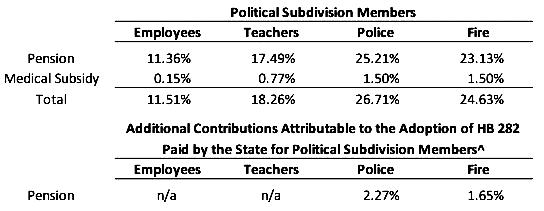
Source: NHRS
Overall, the retirement system stated that rates decreased due to strong investment performance over the two-year period ended June 30, 2025. Local employer rates for police and fire costs also decreased due to a $42 million state appropriation included in legislation last year that restored most pension benefits for about 1,500 first responders hired before July 1, 2011, and not vested prior to January 1, 2012, that were changed through legislation in 2011. The FY 2026 appropriation was $14.5 million, and the FY 2027 appropriation is $27.5 million.
The retirement legislation (Chapter 142, Laws of 2025HB 282) included the promise of at least $262 million in state funding through 2034, although only the $42 million in the current budget cycle is guaranteed.
NHMA did not oppose the benefit changes; our concern was only to ensure that there was no cost downshifting
to municipalities to pay for these changes. Thanks to the ongoing advocacy of NHMA and its members, the Senate included the funding language in the final bill.
While the rates won’t change until next year, based on projected municipal police and fire payroll data, municipalities will save approximately $10 million per year in FY 28-29 retirement contributions over what they would have paid without the state appropriation.
Members are encouraged to thank their local legislative delegation and the governor for supporting this funding last year—and including it in future state budgets, as promised.
For more information on the rates, see the NHRS FAQ at: https://www.nhrs.org/faqs/faq---employer-contributionrates.







Track key legislation affecting New Hampshire municipalities in real time. The New Hampshire Municipal Association (NHMA) advocates for the interests of cities and towns at the New Hampshire General Court and state agencies. With the legislative session running January to June, NHMA tracks state actions that could significantly affect the state's 234 municipalities.
• Real-time updates on legislative activity through FastDemocracy
• Access to bills categorized by legislative topic
• NHMA's stance on key measures
• Optonal daily or weekly email updates with new bill actions and upcoming hearings
• No account is required to access FastDemocracy, but members can create one for additional customization




Our Training Archive is a valuable benefit available to all NHMA members. Behind the member wall on our website, you'll find a library of recorded trainings, at no additional cost. These sessions offer practical guidance and support for your ongoing learning and professional development.
The Training Archive is just one of the many resources included with your NHMA membership. Explore the Training Archive today and make the most of all your membership benefits!



Born in 1832, Thaddeus S. C. Lowe grew from a local farm boy into a world-renowned inventor of aerostats (dirigibles) and other innovations. After consulting with President Abraham Lincoln during the Civil War, he organized a balloon corps before later inventing the ice-making machine and developing the watergas process, which fueled gas lighting in hundreds of cities for many years. His father, Clovis Lowe, was part owner of nearby Low and Burbank’s Grant, which encompasses much of Mount Adams and Mount Madison. Lowe’s legacy is commemorated by New Hampshire historical marker number 19.

The area is also home to two additional historical markers. In 1885, a landslide on the north side of Cherry Mountain destroyed the Stanley farm and fatally injured a worker. The disaster quickly became a tourist attraction, with local hotels organizing daily excursions to the site, now commemorated by historical marker number 152, “Cherry Mountain Slide.” Historical marker number 229 recognizes Deborah Vicker, known as “Granny Stalbird,” who is said to have brought the first Bible to the North Country.
During the early 1900s, the area flourished as a popular summer destination, featuring one of the largest grand hotels in the White Mountains. At the height of tourism, visitors could choose from more than 30 inns and boarding houses, supported by several mainline railroad depots. While some original station buildings still remain, many have been relocated nearby. The Great Depression led to a decline in tourism, and by the end of that era, travelers increasingly favored alternatives to the grand hotel experience.
When you have figured out the answer, email it to publications@nhmunicipal.org. The answer will appear in the September/ October 2026 issue.
ANSWER TO PHOTO IN THE MAY/JUNE ISSUE: The photo on page 44 in the last issue of New Hampshire Town and City magazine is that of the Town of Hampton Falls.
Special thanks to Tammy Flewelling and Marshall Buttrick who responded with the correct answer!