January/February 2026
TownandCity N E W
H A M P S H I R E
A PUBLICATION OF NEW HAMPSHIRE MUNICIPAL ASSOCIATION
In This Issue: 16 Things Every Citizen Should Know About Town Meetings . . . . . . . . . . . . . . . . . . . . . . . . . . . . . . . . . . . . . . . . . . . . . . . . . . . . . . . . . . . . . . . . 6 NHARPC: Reboot your Natural Resources Inventory . . . . . . . . . . . . . . . . . . . . . . . . . . . . . . . . . . . . . . . . . . . . . . . . . . . . . . . . . . . . . . . . . . . . . . . 18 Through the Looking Glass (Again): 2026 Zoning Legislation . . . . . . . . . . . . . . . . . . . . . . . . . . . . . . . . . . . . . . . . . . . . . . . . . . . . . . . . . . . . . . . 24 The Hidden Value of a Closed Business Day: How the Durham Town Clerk–Tax Collector’s Office Learned to Do More with Less ������������� 27 Opportunity Zones 2.0: Why Readiness Today Shapes Tomorrow’s Investment . . . . . . . . . . . . . . . . . . . . . . . . . . . . . . . . . . . . . . . . . . . . . . . . 29 Partisan Elections—Making Your Town Government More Like Congress . . . . . . . . . . . . . . . . . . . . . . . . . . . . . . . . . . . . . . . . . . . . . . . . . . . . . 35
Contents Table of
Volume LXIX • Number 1
January/February 2026
3 A Message from NHMA Executive Director 4 Happenings 11 Tech Insights: Excel Multiple Tab Changes 16 Upcoming Events 17 Legislative Update: New Digs for House Committees in 2026 22 Introducing: Christine Johnston 32 Cyber Safety Update 46 Legal Q and A: Remote Participation In Public Meetings Guidance 52 Trivia: Name That Town or City
6 13 18 24 27 29 35 38 41
16 Things Every Citizen Should Know About Town Meetings Sixteen Communities Selected to Participate in National Housing Supply Accelerator Program NHARPC: Reboot your Natural Resources Inventory Through the Looking Glass (Again): 2026 Zoning Legislation The Hidden Value of a Closed Business Day: How the Durham Town Clerk–Tax Collector’s Office Learned to Do More with Less Opportunity Zones 2.0: Why Readiness Today Shapes Tomorrow’s Investment Partisan Elections—Making Your Town Government More Like Congress Funds from PFAS settlements are coming to New Hampshire. How will they reach affected towns? NLC: Federal Shutdown is Over, but January Deadline Looms: What it Means for Local Leaders
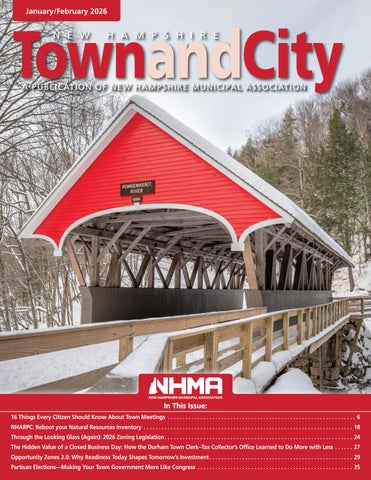
Front Cover: Historic Flume Covered Bridge, built in 1871, in winter, Franconia Notch State Park.
New Hampshire Municipal Association Staff Miranda Blaikie, Communications Coordinator, Town & City Editor in Chief Margaret M.L. Byrnes, Executive Director Jonathan Cowal, Legal Services Counsel C. Christine Johnston, Legal Services Counsel Sarah Burke Cohen, Legislative Advocate Brodie Deshaies, Legislative Advocate
Official Publication of the New Hampshire Municipal Association 25 Triangle Park Drive • Concord, New Hampshire 03301 Phone: 603.224.7447 • Email: info@nhmunicipal.org • Website: www.nhmunicipal.org New Hampshire Municipal Association: NEW HAMPSHIRE TOWN AND CITY (USPS 379-620) (ISSN 0545-171X) is published 6 times a year for $25/member, $50/non-member per year, by the New Hampshire Municipal Association, 25 Triangle Park Drive, Concord, New Hampshire 03301. All rights reserved. Advertising rates will be furnished upon application. Periodical postage paid at Concord, NH 03302. POSTMASTER: Send address changes to NEW HAMPSHIRE TOWN AND CITY, 25 Triangle Park Drive, Concord, NH 03301.
Ashley Methot, Event Coordinator
NEW HAMPSHIRE TOWN AND CITY serves as a medium for exchanging ideas and information on municipal affairs for officials of New Hampshire municipalities and county governments. Subscriptions are included as part of the annual dues for New Hampshire Municipal Association membership and are based on NHMA’s subscription policy. Nothing included herein is to be construed as having the endorsement of the NHMA unless so specifically stated. Any reproduction or use of contents requires permission from the publisher. POSTMASTER: Address correction requested.
Pam Valley, Administrative Assistant
© Copyright 2025 New Hampshire Municipal Association
Marty Karlon, Policy & Research Analyst Tammy Letson, Government Finance Specialist Judith Pellowe, Business Administrator
www.nhmunicipal.org
Production/Design Evans Printing Co.
JANUARY/FEBRUARY 2026
1
New Hampshire Municipal Association
B OA R D O F D I R E C TO R S Elizabeth Fox -
Joanne Haight - Secretary Select Board Chair, Sandwich
Joseph R. Devine - Treasurer Town Manager, Salem
Asst. City Manager, HR Director, Keene
Conservation Commission, Holderness
Shelagh Connelly
Phil D’Avanza Planning Board, Goffstown
Andrew Dorsett Zoning Board of Adjustment, Lyman
Dale Girard Mayor, Claremont
Bonnie Ham Planning Board, Woodstock
Robert Edwards Selectman, Antrim
Jennifer Kretovic City Councilor, Concord
Holly Larsen Finance Director/Tax Collector, Berlin
Conner MacIver Town Administrator, Barrington
Jim Michaud Chief Assessor, Hudson
David Moore City Manager, Somersworth
Shaun Mulholland Town Manager, Londonderry
Matthew Normand City Clerk, Manchester
Lori Radke Town Councilor, Beford
Lori Rautiola Town Administrator, Swanzey
Thomas Seymour Moderator, Hill
David Stack Town Manager, Bow
Dennis Shanahan - Chair Deputy Mayor, Dover
Jeanie Forrester - Vice Chair Select Board Member, Meredith
Michael Branley Town Administrator, Windham
Laura Buono Town Administrator, Hillsborough
Stephen Fournier Town Manager, Newmarket
2
NEW HAMPSHIRE TOWN AND CITY
Immediate Past Chair
www.nhmunicipal.org
A Message from the
I
NHMA
Executive Director
Margaret M.L.Byrnes
Happy New Year!
hope you had a fun and restful holiday session, with purely civil family gatherings and not a single delayed flight or traffic jam! In NHMA’s world, the new year means preparation for most of our members’ town meetings and elections
and the start of another legislation session. Legal services is busy answering your questions about town meeting procedures, petitioned warrant articles, and warrant article amendments, while also providing our annual Moderator Workshops—one for traditional town meetings, and one for SB 2 town meetings. Meanwhile, downtown Concord, your advocacy team is working with legislators and other stakeholders to promote and advocate for NHMA’s member-adopted legislative policies and principles. Of course, the work that goes into this session actually started at the end of the 2025 session—with just a little bit of a break in between! Please remember that for 2026, legislative hearings will take place at the State House and at a new, temporary location called Granite Place, while the Legislative Office Building (LOB) undergoes renovations. Please refer to page 17 of this issue of Town & City for information on the Granite Place location. We need local officials in Concord testifying at hearings and speaking to legislators—not lost somewhere in the Capitol City! Speaking of member policies and principles, “even years” at NHMA have another important purpose: they serve as legislative policy years. This is an opportunity for city and town officials to work to craft, and ultimately adopt, NHMA’s legislative agenda for the upcoming biennium. To get involved, please contact governmentaffairs@ nhmunicipal.org. Finally, as I hope you’ve seen by now, NHMA unveiled its new logo at our Annual Conference in November. This effort was part of our strategic plan, and we see it as a simple—yet significant—modernization of our prior logo. We hope you love it!
Warmest regards,
P.S. Member dues invoices were sent out in late October 2025. Please submit your municipality’s 2026 dues payment, or a statement of when you intend to pay, by January 31, 2026. If you have questions
Margaret M.L. Byrnes, NHMA Executive Director
about your invoice, please contact us at finance@nhmunicipal.org.
www.nhmunicipal.org
JANUARY/FEBRUARY 2026
3
HAPPENINGS Is something new and exciting happening in your city or town? We'd love to include it in Town & City! Email us at publications@nhmunicipal.org 84th Annual NHMA Conference Recap The 2025 NHMA Annual Conference brought together local officials, municipal staff, and industry partners from across New Hampshire for two days of learning, collaboration, and connection. Attendees enjoyed a full schedule of educational sessions, with over 50 workshops, along with an expanded Expo Hall featuring more than 100 exhibitors and sponsors. Thank you to everyone who joined us in celebrating and strengthening New Hampshire’s municipalities. We look forward to seeing you next year on October 28 and 29, 2026.
NHMA Partners with the Overwatch Foundation OVW delivers grant-based services in cybersecurity, systems modernization, network and physical defense, training, and workforce development to state, local, and federal agencies along with New Hampshire associations and government organizations. Most of these services are free of cost to local and state government entities. Open World Leadership On October 14, Executive Director Margaret Byrnes spoke with international local officials visiting the states through an exchange program called Open World Leadership, in conjunction with the Rumsfeld Fellowship. The focus was accountable governance and economic development, and Byrnes enjoyed a lively and thought-provoking conversation with them about local government structures, community governance, citizen engagement, and municipal accountability. As always, NHMA was so honored to be part of this program agenda! 4
NEW HAMPSHIRE TOWN AND CITY
BEA Highlights Newmarket as Housing Champion "The New Hampshire Department of Business and Economic Affairs (BEA) on Wednesday (11/12) recognized the Town of Newmarket as a Housing Champion for its leadership and commitment to addressing the state’s housing needs through its innovative local policies and partnerships. Newmarket earned the designation from BEA’s InvestNH housing program for taking meaningful action to expand affordable and accessible housing actions that align with community goals. It is one of 10 communities receiving this designation for their proactive approaches to land use, zoning, and www.nhmunicipal.org
permitting that encourage housing development while maintaining local character. With the 18 designated communities designated in 2024, this brings the total designated communities to 28." Head to https://www.nheconomy.com/news-press/ bea-highlights-newmarket-as-housing-champion to read on! NH DOIT The update to the Americans with Disabilities Act Title II, regarding Accessibility of Web Information and Services of State and Local Government Entities, was published in the Federal Register on April 24, 2024. This rule provides guidance, in the form of the web content accessibility guidelines (WCAG) 2.1, level AA. While State and local government websites, web apps and mobile applications have been covered under Title II of the Americans with Disabilities Act since the Act was signed in 1990, the new rule clarifies the need to bridge the digital accessibility gap and points to WCAG 2.1 AA for technical guidance. This update reinforces the importance of ensuring that government websites and digital services are
www.nhmunicipal.org
accessible to individuals with disabilities. Compliance is essential for providing equal access to information and services for all residents, including those who rely on assistive technologies such as screen readers, keyboard navigation, and voice recognition software. As of 2023, one in eight New Hampshire residents were reported to have some type of disability, which is defined as a physical or mental impairment that substantially limits one or more major life activities. To assist municipalities in achieving compliance, the State is offering access to DubBot, a tool that scans websites for accessibility barriers, highlights areas for improvement, and provides actionable recommendations. By leveraging this resource, municipalities can proactively enhance their digital content and ensure access by all members of the community. Government entities serving more than 50,000 people will have two years from date of publication by the Federal Register. The date of compliance for all State agencies and larger municipalities is April 24, 2026. Municipalities serving fewer than 50,000 people will have three years (compliance date: April 26, 2027).
JANUARY/FEBRUARY 2026
5
16 Things Every Citizen Should Know About Town Meetings By H. Bernard Waugh, Jr.; Edited by C. Christine Johnston This article, written by H. Bernard Waugh, Jr., then NHMA Legal Counsel, first appeared in Town and City magazine in February, 1990. It has been updated where necessary by C. Christine Johnston, NHMA Legal Services Counsel. Although this article was first written before the adoption of “SB 2,” and therefore contemplated only the “traditional” form of town meeting, almost everything in it applies to both forms of town meeting. The wisdom of the original author rings as true today as it did 35 years ago.
W
*
*
*
e keep hearing it in New Hampshire: “Town meetings don’t work anymore.” “They’re an anachronism.” “They’re rigged.” “Nothing important is decided there.” But these are self-fulfilling prophecies. Local voter apathy feeds on itself.
It’s not all apathy, either. This article assumes that part of the problem is good old honest ignorance: people who’ve moved in from places without town meetings; young people who grew up in families with no tradition of participation for them to absorb; people who for years have heard their cynical friends telling them they can’t make a difference and never bothered to find out the truth. This is for them, and you. Officials and others receiving this magazine should feel free to share this article with other voters. An informed town is in everyone’s interest. In the end, nobody benefits from voter ignorance. 1. Every Voter Is a Legislator. Those quaint sayings about town government being a “pure democracy” are true! State law refers to the town meeting as the “legislative body” (RSA 21:47). The town meeting is to the town what the Legislature is to the State, or the Congress is to the United States: the town meeting has all the basic power. There is no higher authority in town. But to have the right to participate, you must be a registered voter of the town, and you must attend. If you don’t go, how can you justify blaming anybody but yourself? 2. The Moderator Presides and Can Do What It Takes to Maintain Order. The town meeting’s business is regulated by the moderator, and your right to vote is subject to the moderator’s authority to keep order. Voters may not talk without being recognized. If someone keeps on being disruptive after being warned, the moderator can ask a police officer to escort him/her out of the meeting (RSA 40:7-:9). 3. The Voters Can Always Overrule the Moderator by a Simple Majority. The moderator isn’t a sovereign ruler. S/he is merely a facilitator to enable the voters to take orderly joint actions. It is illegal for the moderator to preside in such a way as to make it impossible to overrule his/her rulings. Therefore, people who say that the moderator “rigs” the meeting are talking through their hats. Many voters mistakenly believe that state law contains all sorts of complicated parliamentary rules governing town meetings. It doesn’t. All state law says is that the moderator can prescribe rules, but the voters can alter those rules (RSA 40:4). Nobody can pull parliamentary tricks if the voters stay alert and remain aware that they can vote, by a simple majority, to change the rules to accomplish what the majority wishes to accomplish. In many towns, the moderator begins the meeting with their own set of rules. Some towns, at the beginning of the meeting, adopt a set of rules for convenience, such as Robert’s Rules of Order. In other towns, the moderator just makes rulings as the meeting goes along. Any of those are fine. In any case, however, the only legally binding rule is that the voters can overrule the moderator by a simple majority. 6
NEW HAMPSHIRE TOWN AND CITY
www.nhmunicipal.org
Example: Suppose the town begins the meeting by deciding to adopt Robert’s Rules for the duration. And suppose, a little later, someone moves to amend a motion a certain way, which is perfectly proper under Robert’s Rules, and the moderator declares that the amendment is valid. But now suppose it is moved and seconded to overrule the moderator, and the motion carries. Who wins? The voters, of course. Even though the moderator was “right” under Robert’s Rules, the voters are “right” because they are the higher authority when acting by majority vote. 4. There’s No Such Thing as an “Illegal Vote.” “What!? You mean the town’s lawyers are all wrong?” No, I don’t mean that. Pay close attention. It’s true that there are plenty of types of town votes which, if they pass, will not be legally binding (i.e. would not be enforceable in court). But that doesn’t mean the town can’t vote on those things anyway. No group of voters has ever been arrested for taking a vote, no matter how off-the-wall it might be. Example: Suppose it is moved and seconded to create a “No Parking” zone in front of the town hall. Then the town’s attorney says that vote would be of no legal effect because state law gives the select board, not the town meeting, complete control over parking regulations. Does that mean the vote can’t be taken? Of course not. If you let the lawyer intimidate you like that, you don’t have the stubborn, independent Yankee gumption I think you have. In my view, legal opinions are far too often used to effectively deprive voters of their right to express their views and preferences to the officials they have elected to serve them. If a vote most likely isn’t going to be binding, then it’s best, in order to avoid later confusion, to rephrase the motion in a form that recognizes that it may not be enforceable in court, but still lets the officials know that it may be enforceable at the ballot box. For example, “I move that the select board be strongly urged to create a ‘No Parking’ zone in front of the town hall.” Most of the rules in this article tell you what types of town meeting votes are legally enforceable in court. But don’t be misled into thinking that non-binding votes are somehow “illegal.” Use the lawyer’s advice to help make your votes as effective as they can legally be, not to discourage you from taking a vote. 5. It’s OK to Ask Questions. The beauty of the traditional “deliberative” session of town meetings (as compared with questions on the “Official” or “Australian” ballot usually used for elections) is that through the process of discussion and debate, the voters can educate themselves about the question at hand, and about the procedure, and become able to vote more intelligently. Don’t shyly assume that everybody but you knows what’s going on. They probably don’t. 6. No Vote Can be Legally Binding Unless Its Subject Matter Was Stated in the Warrant. The “warrant” is a sort of agenda for the town meeting, which is posted two weeks in advance by the select board for traditional town meetings; a slightly different timeline applies for SB 2 towns. In most towns it’s also printed in the town report which is published before the annual town meeting. The requirement that all subject matter must be stated in the warrant (RSA 39:2) keeps the meeting orderly, prevents surprise, and lets voters who might otherwise stay home know that some topic of interest to them is coming up for discussion and possible action. The warrant law requires only the general subject matter to be stated. The actual votes don’t have to be wordfor-word the same as the warrant articles. You don’t have to “take it or leave it.” Amendments will be legally valid, even if they change the effect or original intent of the article, so long as they are within the same general subject matter. But amendments which add some brand-new subject matter will not be legally effective. (Sawyer v. Railroad, 62 N.H. 135.) You can see from this rule that any vote taken under a warrant article entitled “other business” cannot be legally binding, because that article doesn’t state any subject matter. Of course, a vote to name someone “Volunteer of the Year,” a vote to thank the Scouts for the sandwiches, or even a vote to strongly urge the select board to www.nhmunicipal.org
JANUARY/FEBRUARY 2026
7
16 THINGS EVERY CITIZEN SHOULD KNOW from page 7
appoint an advisory committee to look into a parking garage, doesn’t have to be legally binding, and therefore can be passed under an “other business” article. 7. Any Twenty-Five Voters Have the Right to Add Articles to the Warrant by Petitioning the Select Board Five Weeks in Advance of the Annual Town Meeting. Under state law, the select board has control over the contents of the warrant, except that they must insert any article submitted by petition, signed by 25 or more voters, or 2 percent of the registered voters in town, whichever is less, but not fewer than 10 registered voters, submitted to them by at least the fifth Tuesday before the annual meeting (RSA 39:3). (There is a different deadline for SB 2 towns.) In other words, ordinary citizens can contribute to the agenda (can keep the meeting from being “rigged,” if you will), but it takes a little advance planning. [EXCEPTION: Petitions for Zoning or Building Code amendments must be submitted between 120-90 days before the annual meeting (RSA 675:4) and need 25 signatures instead of just 10.] 8 Ordinary, Everyday Language Is Perfectly Okay. Are you hesitant to submit petitioned warrant articles, or to make motions at town meeting, because you think you’ll need to hire a lawyer to come up with the right wording? Don’t be! The N.H. Supreme Court has said time and again that technical rules will not be used to defeat the plain intent of the voters, using ordinary common language. As U.S. Supreme Court Justice Holmes once said: “The machinery of government would not work if it were not allowed a little play in the joints.” (Quoted in Lamb v. Danville School Board, 102 N.H. 569.) In fact, if you’re worried about the wording, it might be better to check with, say, an English teacher, instead of a lawyer, to see if your proposed wording says what you intend it to. There are a few types of articles where the traditional words can be legally important (the worst example is a vote to discontinue a road “subject to gates and bars”), but these are few and far between. 9. Any 50 Voters Can Call a Special Town Meeting. A “special” town meeting means any meeting other than the annual meeting. In most towns, the annual meeting is held the second Tuesday in March (RSA 39:1). But the select board can call a “special” meeting whenever they feel there’s a need for it. To petition for a special meeting, you need 50 voters’ signatures on a petitioned warrant article, submitted to the select board. The select board must call the meeting, unless the annual meeting is only 60 days away or less, in which case they can just add your petitioned article to the annual meeting warrant (RSA 39:3). [CAUTION! Money articles (i.e. articles requiring the appropriation of funds) can’t be voted on at special meetings unless at least half the town’s voters show up, or unless the select board has obtained permission from the Superior Court (RSA 31:5).] 10. You Can Ask for a Secret Written Ballot on Any Question. There are two ways for the voters to request a secret written ballot at town meeting: (a) Any 5 voters can make the request in writing to the moderator before a vote is taken, (if the town’s population is less than 500, it only takes 3 voters) or (b) After a non-ballot vote has been taken and declared by the moderator, any seven voters can orally request the vote to be taken again using a secret written ballot, but the request must be made immediately, before the meeting moves on to other business (RSA 40:4-a and 40:4-b). 11. Virtually any Town Vote Can Later Be Reconsidered and Rescinded. So, you think you finally finished the debate over the blankety-blank town administrator’s salary. The rest of the meeting is routine. Now you can go home and pay the babysitter. Right? Well, no, you’d better not. Unless the meeting votes to restrict reconsideration, that salary vote can legally be reconsidered later, right up until the 8
NEW HAMPSHIRE TOWN AND CITY
www.nhmunicipal.org
meeting is finally adjourned, even if it’s 2 a.m. and almost everyone’s gone home (Byron v. Timberlane School District, 113 N.H. 449). In fact, if two votes taken by a town meeting are inconsistent, the courts will probably say that the later vote impliedly rescinded the earlier vote, even if there was no formal vote to reconsider. (Lamb v. Danville School Board, 102 N.H. 569). However, the town meeting may vote to restrict reconsideration on one or more articles (RSA 40:10), and this is commonly done. This action doesn’t prohibit reconsideration. If the meeting votes to restrict reconsideration of an article, it may still subsequently vote to reconsider the article; but if it does, the reconsideration must take place at an adjourned session held at least seven days later. Notice of the time and place of the adjourned session must be announced before the close of the original session and published in a newspaper at least two days before the session. In an SB 2 town, a vote at the deliberative session to restrict reconsideration is deemed to prohibit further action on the restricted article until the second (official ballot) session. (RSA 40:13, IV.) Votes taken on the official ballot may not be reconsidered. 12. The Actions of One Town Meeting Are Not Binding on Later Town Meetings. This rule is just a logical extension of the rule that all (or at least most) votes can later be reconsidered. The right to reconsider and rescind a prior vote (either explicitly or by implication) carries over from one year to the next, or from the annual meeting to a special meeting. Example: Suppose you went home after that important vote on the anti-surfing ordinance. But, reading online the next day, you find out that the vote was reconsidered and rescinded after you left. If you can get 49 other voters to join you in petitioning for a special meeting, you can bring about another vote on that same ordinance. Of course, there are some Exceptions: a
A vote can’t be reconsidered where action has been taken in reliance on that vote. Example: Suppose the annual meeting passes a vote to sell town-owned land. Later, 50 voters petition to have a special meeting to reconsider. But before the special meeting is held, the select board signs the deed in reliance on the first vote. The deed creates a vested interest, and reconsideration would now be too late. (Preston v. Gillam, 104 N.H. 272.)
b
A vote to go into debt (to authorize the issuance of bonds or notes) is obviously binding once the note is signed or the bonds are issued because, at that point, the town is legally obligated to pay off that debt. The fact that such a vote is binding on future town meetings (unlike most votes) is precisely the reason for the next rule, which is:
13. A Vote to Go into Debt (Issue Bonds or Notes) Must Pass by a 3/5 Ballot Vote. In fact, if the amount of the proposed debt exceeds $100,000, the moderator must keep the polls open for at least one hour after the end of the discussion on the issue (RSA 33:8-a). If you couldn’t get a babysitter, now’s the time to rush home and tend the kids so your spouse can rush in to vote on that bond issue too. Don’t be confused about this. A vote on bonds or notes does require a ballot vote, but it’s not something that can appear on the “official” ballot (the one used for electing officers). It’s simply a “Yes/No” paper ballot during the business session of the meeting, the same type of ballot used when a secret written ballot is requested. Things are necessarily a little different in an SB 2 town, where ultimately every article appears on the official ballot, including bond articles. 14. You Can Act on, or Amend, Particular Line Items in a Budget. The proposed budget must be posted with the warrant, and is considered part of the warrant, giving you notice of what you’re going to be asked to raise and appropriate money for. To “appropriate” money means to www.nhmunicipal.org
JANUARY/FEBRUARY 2026
9
16 THINGS EVERY CITIZEN SHOULD KNOW from page 9
earmark a certain sum for a particular purpose, so that the governing board (select board or school board) is then authorized to spend that amount for that purpose over the course of the fiscal year. To “raise” money is to identify the revenue source for that appropriation (taxes, grants, capital reserve fund, etc.). Money can be “appropriated” either through a line item in the budget, or under a separate warrant article. The amount of any particular appropriation (line item) can be amended up or down, or an appropriation can be deleted entirely by the voters. However, it is not legally effective to add a new purpose (line item) to the budget. Why not? Because adding a new purpose violates Rule #6 (above) - the requirement that all business must be stated in the warrant. The voters can’t take any binding action on a subject matter which wasn’t stated in the warrant (or in this case in the budget). The same goes for any appropriation in a separate warrant article. Some people believe that voters can only act on, or amend, the bottom line of the budget, and not specific line items. That’s not quite right. What is right is that the voters cannot limit the governing board’s ability to transfer amounts from one line item to another during the year, as needs and priorities change. (McDonnell v. Derry, supra). Therefore, even if you do vote to lower, say, the police budget by $1,000, the select board, later in the year, can still replace that $1,000 into the police budget, as long as they don’t exceed the bottom line of the entire budget. However, just because only the bottom line is legally binding, that doesn’t mean the voters can’t amend line items. The voters have a legal and political right to express their preferences. A vote on specific line items sends a strong message that may later be “enforceable” through the ballot box, even if it’s not enforceable in court. Also, if the meeting votes to delete an appropriation within a warrant article or budget, or reduces the amount to zero, or does not approve an appropriation contained in a separate article, no amount of money may be spent for that purpose during that budget year. (RSA 32:10, I(e).) This is often referred to as the “no means no” rule. Hint: Transfers cannot be made during the year out of appropriations made by petitioned separate warrant articles (RSA 32:3, VI(a) and 32:10, I(d)). Therefore, the way to prevent an appropriation from being diverted to other purposes is to submit a petitioned warrant article for that appropriation. Official Budget Committee: If your town has an “official” budget committee to prepare the budget to be voted on, then the voters are legally bound by the so-called “Ten Percent Rule.” Under this rule, the voters cannot appropriate more money at any single town meeting than the total amount recommended for that meeting by the Budget Committee, plus ten percent. 15. Attend Your School District Meetings, too! The low attendance at most New Hampshire school meetings shows that far too few people understand their significance. A school district is, legally, a separate municipal entity, on equal footing with the town. Its meetings work the same way. Every one of the above rules still applies. Just erase “select board” and insert “school board.” And erase “town meeting” and insert “school district meeting.” The voters still have all the legislative power. If they don’t seem to have all the power, that’s only because they aren’t exercising it. Towns, and not school districts, send out the tax bills in New Hampshire. But don’t lose sight of the fact that your tax bill includes money being raised for the school district, as well as for the town. In fact, usually the school share is higher than the town share. If you don’t go to the school meeting and vote on the budget, more than half your property tax bill represents taxation without representation - representation you’re giving up without a fight. 16. Democracy – Use It or Lose It. In a town meeting, more than any other form of government on earth, your community and the services it provides originate not from some “they” in the sky, but from you, the voters. If you haven’t been to town meeting lately (or ever), this is a good year to inform yourself, attend, vote, and make it work. 10
NEW HAMPSHIRE TOWN AND CITY
www.nhmunicipal.org
Tech
Insights
Excel Multiple Tab Changes
Sigh! It’s January and you just found a typo in the perfect spreadsheet you created last year. Each month last year you copied the prior month’s tab to the current month and just updated values. Now you have twelve tabs all with the same typo. You momentarily think, no one noticed, I can fix just this year and have it correct moving forward. John vs Joan, does it really make a difference? I’m sure John Rivers will not mind the typo, after all, shouldn’t he be proud to be mixed up with the pioneer of women’s comedy and the queen of fashion critics? The more you try to live with this thought process, the more your brain starts thinking about all the people who might see that typo still. The auditors are coming. It might be part of the annual town report. What if that naysayer in town gets hold of it – that person would never turn it into a joke on social media. Most importantly, you know it is wrong. You just can’t leave it be. Relax, with only a couple of extra clicks, you only need to make the fix once and all twelve tabs will be correct. Open your spreadsheet and expand the tab section so you can see all the tabs you need to correct. This can be done by moving4 your mouse over the three dots between the tabs and the bottom scroll bar. Click and drag those dots to the right to make that section bigger. You may need to click on the right or left angle brackets to make the tabs show. Next, click on the first tab you need to fix, hold the shift key on the keyboard and click on the last tab you need to fix. All the tabs are now highlighted. If your tabs do not fit, you can still click on the first tab then use the angle brackets to find the last tab. Hold the shift and click on the last tab. All the ones in the middle will be selected. Alternatively, if you need to select multiple tabs that are not in a row, click on the first tab you need, hold the control (CTRL) key on your keyboard and click individually on the tabs you want to select.
www.nhmunicipal.org
Tammy Letson, Government Finance Specialist Any change you make on one tab will be made in that same cell on all the highlighted tabs. Now navigate to Joan Rivers (A3 in my scenario) and change the name to John Rivers. That change will happen in cell A3 on every tab that is highlighted. Once the all the changes you want made to all tabs is complete, be sure to click on a tab or two on the bottom so multiple tabs are no longer selected. You do not want to change all tabs to be January’s values. BEWARE, if you inserted rows or columns, it will change the exact same cell on every tab. So, if you inserted a row for Ignatius before John / Joan in March, you may override Ignatius’ name with John’s. Now you will have a John and a Joan in March, but no Ignatius.
Will become:
Tangent! (Anyone who has ever attended a training session I presented knows I love my tangents.) If copying tabs takes more than one click, I’ve got a shortcut for you. Hold the CTRL key on your keyboard, click and hold the tab you want to copy and drag your mouse to the right. A small box will appear with a plus (+) symbol in it. Let go of the mouse and keyboard and Presto, you have a copy of the tab. If you prefer the new tab to be on the left, simply drag the new tab to the left now that it has been created.
JANUARY/FEBRUARY 2026
11
12
NEW HAMPSHIRE TOWN AND CITY
www.nhmunicipal.org
Sixteen Communities Selected to Participate in National Housing Supply Accelerator Program National League of Cities Press Release Washington, D.C. — The National League of Cities and the American Planning Association named 16 communities to participate in the Housing Supply Accelerator Challenge. The Housing Supply Accelerator Challenge is designed to accelerate the implementation of proven and innovative housing strategies and expand the supply of housing in communities nationwide. Rooted in action and results, the challenge will support local leaders to put the Housing Supply Accelerator Playbook: Solutions, Systems, Partnerships into practice. Communities selected to participate in the challenge include: Alachua County, Florida; Champaign, Illinois ; Clifton Forge, Virginia; Cottonwood, Arizona; Cranston, Rhode Island; Dover, New Hampshire; Evanston, Illinois; Greensboro, North Carolina; Lebanon, New Hampshire; Greater Lowell, Massachusetts Region (Northern Middlesex Council of Governments); Marquette County, Michigan; Plattsburgh, New York; El Paso, Texas; Santa Fe,
www.nhmunicipal.org
New Mexico; Sterling Heights, Michigan; and solutions. As the oldest and largest organization representing cities in America, NLC is focused Sun Prairie, Wisconsin. Selected communities will engage in virtual on the issues that matter most to cities — from learnings; obtain peer learning opportunities and the largest metros to the smallest towns. The tailored technical assistance; access best practices, National League of Cities is a trusted partner to tools and housing supply experts; and receive local cities and a steadfast voice for municipal national recognition from the National League issues in Washington, D.C. of Cities and the American Planning Association. About American Planning Association The American Planning Association is an About the Housing Supply Accelerator not-for-profit educational A partnership between National League of independent, organization that provides vital leadership in Cities and the American Planning Association, creating great communities for all. APA and its the Housing Supply Accelerator was created professional institute, the American Institute of to help communities tackle their local housing Certified Planners, are dedicated to advancing challenges. The campaign is narrowly focused the profession of planning, offering better on identifying locally driven housing supply choices for where and how people work and live. solutions that expand, preserve and improve the APA’s nearly 40,000 members work in concert quantity and quality of housing. with community residents, civic leaders and About National League of Cities business interests to create communities that The National League of Cities (NLC) is the enrich people’s lives. voice of America’s cities, towns and villages, representing more than 200 million people. NLC works to strengthen local leadership, This article was originally published in the NH influence federal policy and drive innovative Bulletin on Sep. 12, 2025. https://nlc.org
JANUARY/FEBRUARY 2026
13
Stay Informed with our Bill Tracker Track key legislation affecting New Hampshire municipalities in real time. The New Hampshire Municipal Association (NHMA) advocates for the interests of cities and towns at the New Hampshire General Court and state agencies. With the legislative session running January to June, NHMA tracks state actions that could significantly affect the state's 234 municipalities. • • • • •
Real-time updates on legislative activity through FastDemocracy Access to bills categorized by legislative topic NHMA's stance on key measures Optonal daily or weekly email updates with new bill actions and upcoming hearings No account is required to access FastDemocracy, but members can create one for additional customization
Unlock the Full Potential of Your NHMA Membership with Our Training Archive! Our Training Archive is a valuable benefit available to all NHMA members. Behind the member wall on our website, you'll find a library of recorded trainings, at no additional cost. These sessions offer practical guidance and support for your ongoing learning and professional development. The Training Archive is just one of the many resources included with your NHMA membership. Explore the Training Archive today and make the most of all your membership benefits!
Scan to get started!
14
NEW HAMPSHIRE TOWN AND CITY
www.nhmunicipal.org
www.nhmunicipal.org
JANUARY/FEBRUARY 2026
15
Upcoming
Events
For more information or to register for an event, visit our online Calendar of Events at www.nhmunicipal.org. If you have any questions, please contact us at nhmaregistrations@nhmunicipal.org.
JANUARY
FEBRUARY
New Years Day (NHMA Offices Closed) Thursday, January 1
Presidents’ Day (NHMA Offices Closed) Monday, February 16
Town & School Moderators SB2 Workshop 9:00 am – 1:30 pm Saturday, January 10 Zoom
NHMA Board of Directors Meeting 9:30 am – 12:00pm Friday, February 20 25 Triangle Park Drive, Concord, NH 03301
NHMA Board of Directors Meeting 9:30 am – 12:00pm Friday, January 16 25 Triangle Park Drive, Concord, NH 03301
Town & School Moderators Traditional Town Meeting Workshop 9:00 am – 1:30 pm Saturday, February 21 Zoom
Martin Luther King Day (NHMA Offices Closed) Monday, January 19
Right-to-Know Law for Law Enforcement Workshop 9:00 am – 1:00 pm Wednesday, February 25 25 Triangle Park Drive, Concord, NH 03301 and Zoom
For the most up-to-date event and training information, please visit the NHMA website at www.nhmunicipal.org. Event times and dates are subject to change. Thank you.
16
NEW HAMPSHIRE TOWN AND CITY
www.nhmunicipal.org
Legislative Update:
New Digs for House Committees in 2026 Marty Karlon, NHMA Policy & Research Analyst
M
embers of the NHMA Advocacy Team follow several hundred bills of interest to municipalities during each legislative session, monitor legislative hearings, testify on bills when appropriate, and work individually with legislators and local officials throughout the year. We love what we do, but we also love company. While distance or pressing local responsibilities may make travel impossible, if a bill is of high importance to your municipality, it is always best to make your case in person. Local officials have the technical knowledge and practical experience to help educate legislators on the real-world impact of a given proposal. Whether you are a veteran of the public hearing process or are coming to Concord for the first time next year, you need to know that New Hampshire House committees are meeting in a new location. The Legislative Office Building (LOB), where House committees typically meet, is closed for renovation through late 2026. Meetings are now being held at 1 Granite Place (GP), which is about 1.6 miles north of the State House.
the House meeting area through an unstaffed exit, you will not be able to re-enter and will have to go around to one of the two secure entrances. The are 800 free parking spots available, which is a plus for anyone who has struggled to find a parking space downtown—although you’ll still need to do that sometimes, as the state Senate will continue to hold its hearings in committee rooms in the State House, including Senate committees that previously met in the LOB. More information on Granite Place can be found on the NH General Court Website at: https://gc.nh. gov/gp/ NHMA has also prepared a one-page handout with more information, photos and a link to layout of the meeting rooms: https://www.nhmunicipal.org/sites/default/files/ uploads/Website/granite_place_handout_2025-26.pdf
Granite Place consists of two buildings sharing a common main entrance/lobby. The complex also houses the state departments of justice and agriculture, as well as the Judicial Council; access to those areas is limited. House committee meeting rooms are on the first two floors of the South building and are clearly marked. There are 10 committee rooms, compared to 14 in the LOB.
So, how will you know when something is coming up that you may want to attend? Every Friday after the House and Senate calendars are released, NHMA posts a link to the Bill Hearings Schedule for the upcoming week in our Legislative Bulletin. We also send out priority bill alerts at the beginning of most weeks, which highlights key hearings or votes. You can also sign up for alerts on specific bills you want to follow through NHMA’s bill tracking application, Fast Democracy. Visit our Advocacy page to learn more about Fast Democracy and the Legislative Bulletin: https://www.nhmunicipal.org/legislative-advocacy
The House committee meeting area has the same safety and security protocols as the State House and security guards are posted at two entrances; if you leave
NHMA has you covered at the State House, but remember, there is strength in numbers and your voices really can be the difference.
www.nhmunicipal.org
JANUARY/FEBRUARY 2026
17
NEW HAMPSHIRE ASSOCIATION OF REGIONAL PLANNING COMMISSIONS
Reboot your Natural Resources Inventory
18
Craig Tufts (CNHRPC), Jay Minkarah (NRPC), Olivia Uyizeye (UVLSRPC), Theresa Walker (RPC), Rachel Dewey (SRPC) The What and Why
N
atural Resources Inventory (NRI) is a term used to describe a document that includes the natural and cultural resources information that all Conservation Commissions are required to inventory under New Hampshire law. RSA 36-A:2, the stature that enables cities and towns to form conservation commissions, states in relevant part that conservation commissions “[ ] shall keep an index of all open space and natural, aesthetic or ecological areas within the city or town, as the case pertinent to proper utilization of such areas, including lands owned by the state or lands owned by a town or city. It shall keep an index of all marshlands, swamps and all other wet lands in a like manner, and may recommend to the city council or selectmen or to the department of natural and cultural resources a program for the protection, development or better utilization of all such areas.” At minimum, an NRI typically includes tables and maps describing town/city and state-owned conservation land along with town forests, parks, and other recreational areas. NRI’s also include maps and tables describing wetlands, streams, lakes, ponds, and usually groundwater resources such as high yield aquifers. Important wildlife habitat areas and key natural features such as steep slopes, farmland soils, forest cover and other similar natural features are also included. Often, the NRI will also serve as a conservation plan and contain recommendations designed to protect a community’s natural resources which can include policy related recommendations such as changes to land use regulations, recommendations for managing town or city-owned conservation lands or strategies for land acquisition. In other communities, the NRI is strictly an inventory, and a separate conservation plan is prepared that focuses on conservation related strategies. Active and engaged conservation commissions usually look beyond the minimum required components of the NRI to include a broader range of natural and cultural resources of particular importance to their communities. This article explores some different approaches and innovative practices that have been adopted by local
NEW HAMPSHIRE TOWN AND CITY
conservation commission and the regional planning commissions working on their behalf. For more information on NRIs, the publication, Natural Resource Inventories, A Guide for New Hampshire Communities and Conservation Groups prepared by the UNH Cooperative Extension is an excellent resource (https:// extension.unh.edu/nhnriguide) Tailored Content With every NRI update, community leaders decide whether to include topics beyond those foundational ones. Unique conditions and project budget inform which topics to include. A few scenarios are when a community decides– • Recent growth in the local recreation economy warrants prioritization of a recreational resources section. • New challenges require direct attention to inform targeted action, such as those with stormwater management and flooding, invasive species, or new threats to water quality pollution (e.g., Per- and polyfluoroalkyl substances [PFAS]). • Insufficient detail on priority natural resources calls for the addition of new data sources, when available.
Town of Warner Weighted Co-Occurrence Map
www.nhmunicipal.org
www.nhmunicipal.org
JANUARY/FEBRUARY 2026
19
NATURAL RESOURCES INVENTORY from page 18
For example, expanded citizen science platforms (e.g., eBird, iNaturalist) may expand inventory of plants and wildlife.
overview of a community’s agricultural industry and includes information pertaining to soil type and acres, number and type of farms, and zoning and agricultural land use.
• Urgent action is needed, such as on climate change due to worsening impacts (e.g., flooding, drought, maple sap production). New data sources (e.g., 2016 Resilient and Connected Lands by TNC) make this more possible.
Coastal differentiation Threats from rising sea level and coastal storm surge require coastal communities to inventory natural resources needed to mitigate these threats. Salt marsh, tidal wetlands, dunes, and coastal rivers and streams form the frontlines of defense and protection of these natural resources can mitigate the impacts of sea level rise and storm surge. Vulnerability Assessments have been completed by the Rockingham Planning Commission for all coastal communities in New Hampshire and an NRI should reference the maps and recommendations included in these assessments.
Agriculture and Working Landscapes An NRI provides a platform for communities to elevate the importance of the working landscape of agricultural soils and active and potential farmland as critical infrastructure needed
Engaging Your Community Developing an NRI presents an opportunity to engage your community on the issues and hear what is most important to them. A public involvement component can add legitimacy, improve transparency, and ensure the community’s needs and values are reflected in the document. Natural resources provide a range of services to people and nature, all of which have value. Part of the task of the NRI should be to parse out where
Aprilla Farm, Warner Photo Credit Nancy Martin
to strengthen resiliency. In addition to food production and scenic, rural character, farmland provides a myriad of ecosystem services, including wildlife habitat, floodwater mitigation and storage, and carbon sequestration. Inventorying existing farms in town and mapping farmland soils are important first steps for adding food production and agriculture to the list of key natural resources in the community. Additional steps include developing an agricultural profile that provides a comprehensive Photo credit Karinne Heise
and how each of these resources are valued so we can best meet the needs of the community and the environment.
Photo Credit Nancy Martin
20
NEW HAMPSHIRE TOWN AND CITY
An outreach component to an NRI may seek input on specific categories like agriculture, wildlife habitat, recreation, etc. and perhaps weigh them against each other. Outreach can also seek to align natural resource protection efforts in conjunction with other community goals, such as housing and economic development. Simple questions, like “what open spaces in town are most important to you, and why?” are great ways to engage and map out the most loved natural spaces. www.nhmunicipal.org
The Central New Hampshire Regional Planning Commission includes a public input component to each NRI it conducts for its communities, typically through the use of online surveys, and events or open forums hosted by a project team of staff and town volunteers. The scale, scope, and sophistication varies depending on the need and budget, but an earnest effort to solicit input strengthens community buy in and adds value to the process. Co-Occurrence and Weighted Co-Occurrence Analysis Most NRIs have a co-occurrence analysis of some form, where different data layers representing natural resource features are stacked on top of each other to show which parts of town serve multiple natural resource functions. Features such as important wildlife habitat, drinking water aquifers, and buffers from streams can all be mapped to show where they overlap. Areas that have the most overlap are likely to have the most natural resource value because they serve multiple purposes.
Newmarket Cooccurrence (land resources) and Priority Protection Areas
Co-occurrence mapping can be taken a step further by weighting each input data layer. Public input can be incorporated by weighing more heavily natural resource layers that are most important to the town. If public outreach indicates that the community most strongly values its public
www.nhmunicipal.org
water supply resource, the public water supply aquifer (or watershed) could be scored higher (10 points), with relatively fewer points (4 or 2) for other resource layers. The result is a map where each area has a combined score, with the highest scores representing lands with the highest natural resource value. Communicating the Results An NRI will need to have technical information and detail, but it is also important to make sure the information is accessible, and the primary points of the document are clearly communicated. One effective tool for communicating the NRI and its results is to pair the NRI document with an interactive online component, such as a story map. A story map is an online map that has been given context with supporting information, pictures, legends, and other functions to help engage the reader. A reader can scroll through the post and read descriptions of each map, with an ability to zoom, interact, investigate, and follow the narrative. Check out the Deering NRI Story Map to see an example created by Central NH RPC: https://arcg.is/nbSmK0 NRIs and Master Planning Pairing an NRI with a plan that includes specific action items and goals can help to improve the natural resources in a community. The Strafford Regional Planning Commission is working on a full update to the Town of Newmarket’s Master Plan. While not a full NRI, the Open Space Plan used a process similar to that of a traditional NRI. It included two cooccurrence analyses for land-based and water-based resources. These analyses were used to identify priority land and source water conservation areas. As part of a larger Master Plan update effort, the development of the plan included robust community engagement and resulted in a list of goals and implementation actions. (https://strafford.org/uploads/documents/plans/rpc/ masterplan_2024_newmarket_openspace.pdf)
JANUARY/FEBRUARY 2026
21
INTRODUCING:
Christine Johnston
NHMA's Newest Legal Services Counsel! Christine (Fillmore) Johnston returned to NHMA in October 2025 and provides legal services to NHMA’s member municipalities, including legal advice, training programs, and educational publications. She finds it immensely rewarding to work with municipal officials – who are often volunteers – to fulfill their duties and serve their communities. She has worked both in private practice (most recently as a shareholder with Drummond Woodsum) and with NHMA, exclusively representing municipalities for more than two decades in all aspects of municipal law. She is also the current co-author of the four municipal volumes of the NH Practice legal treatise series. Christine received her B.A. from Tufts University and her J.D. from Boston College Law School. To contact Christine with your inquiries, please use the legalinquiries@nhmunicipal.org email address, or call us at 603.224.7447.
22
NEW HAMPSHIRE TOWN AND CITY
www.nhmunicipal.org
www.nhmunicipal.org
JANUARY/FEBRUARY 2026
23
Through the Looking Glass (Again): 2026 Zoning Legislation Brodie Deshaies, Legislative Advocate
L
ike Alice in Lewis Carroll’s Alice’s Adventures in Wonderland, the state legislature fell down a rabbit hole last year. In the legislature’s case, it was not to chase a well-dressed rabbit concerned about being late; instead, it was to pursue more housing by passing a plethora of bills imposing statewide zoning mandates. The state is certainly late for the affordable housing party, but the new zoning laws enacted this year are not the solution. Local officials are now experiencing layer upon layer of state constraints and Mad Hatter requirements as they seek to develop local solutions to address housing shortages. The legislation that passed last year would even make the Cheshire Cat frown (you can review those new laws in my previous article, published in the September/October 2025 edition of Town & City). I mention Alice in Wonderland because last year reminded me of the Caucus Race in the book. The animals are all wet, and they must find a way to get dry. Mr. Dodo exclaims that they must have a caucus race. When asked by Alice what a caucus race is, Mr. Dodo says the best way to explain it is to have one. He draws a circle on the ground, and all the animals begin to run erratically around the circle. Alice joins them, confused, not knowing where to run. After half an hour of running, everyone is finally dry. Mr. Dodo then declares all the animals are winners and instructs Alice to give them all prizes. Sometimes, this is how the policy-making process feels, and especially last year when it came to legislation affecting local zoning. It was messy and disorganized; legislation was rife with errors and contradictions, and no clear solutions or goals for affordable housing were ever presented. It then ended similarly to the caucus race. Not a single investment in affordable housing or the infrastructure necessary to sustain it was made; rather, cuts were made to funding for existing programs that did. When the dust cleared, it was declared that policies had been enacted that adequately addressed the state’s housing shortage. And like Alice, we remain 24
NEW HAMPSHIRE TOWN AND CITY
confused about the result. This year, NHMA will advocate for clarity in these newly established laws and for increased and restored local decision-making over development and zoning. There are multiple pathways we are seeking to utilize as we carry out our work this year. Our biggest goals will be to… • Fix the poorly drafted Mixed-Use / Multi-Family Residential Uses by Right in All Commercial Zones mandate • Restore local decision-making provisions in the Accessory Dwelling Unit (ADU) and Mixed-Use laws • Return to the previous law for the issuance of building permits on a Class VI road, which better balances property rights with public safety and local resources • Establish new sections in the Innovative Land Use laws to enable municipalities to better incentivize affordable and workforce housing • Create clarity in ambiguous or vague sections of newly established zoning mandates, so local officials and property owners can easily interpret the law We have been supporting legislators in drafting several key bills and amendments to achieve these goals, as well as others that offer alternative paths to success. Some bills and proposed amendments make very limited changes to existing state-imposed zoning mandates, such as updating the definition of “commercial zoned land” in RSA 674:79 to allow municipalities to adopt a local definition for “commercially zoned land” and cleaning up the convoluted definitions for attached and detached accessory dwelling units in RSA 674:71. We are encouraging legislators to repeal the contradictory detached Accessory Dwelling Unit law (ADU), RSA 674:73, and clarify what an “existing structure” means in the updated ADU law, RSA 674:72. These smaller initiatives are seeking to establish clarity in newly established, but poorly written, zoning mandates and www.nhmunicipal.org
will help limit disputes between municipalities and property owners. Other bills and amendments make substantive and valuable edits to how the new zoning mandates work or may be implemented. Some bills seek to allow municipalities greater flexibility to ensure that new developments and housing units, including ADUs, have adequate on-site parking. For example, legislators are seeking to allow municipalities to require 1.5 parking spaces per unit of housing for large multi-family dwellings (10 or more units) or small units that qualify as workforce housing (one-bedroom apartments), returning the law to the reasonable compromise established in 2024. There is also an effort to require on-site parking for ADUs, provided the ADU parking requirements are no more stringent than those for a single-family dwelling in the same zoning district. There will be legislation this year to restore the local option for whether a municipality shall allow detached ADUs, and permit municipalities to approve ADUs by either a conditional use permit or special exception, as determined by local ordinance. The same legislation will also include enabling local ordinances for ADUs to meet workforce housing requirements, more flexible design ordinances to ensure continuity with the existing structure and neighborhood, and onsite parking for ADUs that are no more restrictive than those for single-family dwellings in the same zoning district. There will also be a bill to allow municipalities to determine whether to allow detached ADUs in protected shoreland, while still requiring municipalities to allow detached ADUs outside protected shoreland. Regarding the new state zoning mandate requiring multifamily residential uses by right on commerciallyzoned land, there will be a proposal to amend the law before it takes effect on July 1 of this year. The current legislation will better define “multi-family residential development,” changing the term to the more recognizable “multi-family dwelling units” and aligning it with the definition for the same term in RSA 674:43, the law that establishes the powers to review site plans. The same bill will better define “infrastructure” to align with the capital facilities listed in RSA 674:21, V, and make it clear that the municipality’s planning board, governing body, building code official, or any combination of them www.nhmunicipal.org
will determine whether the existing infrastructure is adequate. The bill would also enable municipalities to determine which commercially-zoned land mixeduse developments will be permitted, requiring only a majority of the commercial land to be mixed-use, not all of it. Another proposal re-establishes the old procedure for approving building permits on Class VI roads, which are discontinued public ways not maintained by the municipality for 5 or more years. The previous process required the governing body to approve building permits for structures built on lots with frontage solely on a Class VI road. The property owner would also sign a waiver recognizing that the municipality was neither responsible for maintenance nor liable for any damage resulting from the property owner living on a Class VI road. And the property owner would register this waiver with their deed. The new law, which goes not into effect on July 1, 2026, mandates that municipalities must issue a building permit to a property owner whose property only has frontage on Class VI road if the property owner acknowledges the municipality won’t maintain the road or accept any responsibility for losses or damages caused by a lack of services and provides evidence the lot and building are insurable and proof that the waiver is registered with the deed. This new process requires premature and scattered development in municipalities and poses safety risks to residents and first responders. The previous process does a much better job of balancing public safety and promoting reasonable development opportunities on a case-bycase basis. Long-term, it saves the municipality from potential future costs. There are a few new proposals for our state that have been explored or implemented in other states. These bills would expand local decision-making and provide opportunities to make locally tailored decisions to address housing and affordability. First, there is a proposed expansion of the Innovative Land Use Controls law, RSA 674:21, that would allow municipalities to establish “affordable housing investment fees.” This bill would allow municipalities to assess a fee on every new unit of housing that does not meet local inclusionary zoning ordinances or regulations to help the municipality invest in future JANUARY/FEBRUARY 2026
25
THROUGH THE LOOKING GLASS from page 25
affordable housing units. There is also legislation to allow municipalities to require Inclusionary Zoning, a part of the Innovative Land Use Controls law, for new housing units. This would ensure that a portion of the new housing units built in a municipality are actually affordable and prevent developers from opting out of building affordable housing units. Both bills utilize appeal procedures that currently exist in law. A few legislators have even proposed fully repealing entire laws that impose mandates on local zoning decisions. While it’s unlikely that these bills will be signed into law, we will still support them in furtherance of our member-adopted policies. Additionally, there are some disappointing proposals that undermine local decision-making over zoning, and NHMA will vigorously oppose them. Some we have seen before, and others are new. These proposals would… • Mandate Manufactured Homes (often called “mobile homes”) by Right in All Residential Zones • Require attached and detached Accessory Commercial Units by Right in Every Residential Zone • Establish significant limits on subdivision and site plan reviews, including newly imposed, unworkable timelines for these reviews, and unlimited dead-end road lengths • Repeal the Hardship Requirement for Variances • Several other bills with innocuous titles that could/ will be harmful to local decision-making over zoning (this article was written before every bill became public) This is only a small sample of all the proposals
26
NEW HAMPSHIRE TOWN AND CITY
NHMA has reviewed, worked on, or is actively advocating for or against or tracking. There are even more we follow daily, and you can follow along with us by signing up for our weekly Legislative Bulletin on the member portal or by emailing info@nhmunicipal. org. Feel free to contact the Advocacy Team at governmentaffairs@nhmunicipal.org as well. We can help provide information on proposals before the legislature or support your advocacy. Back to the caucus race that was mentioned in the beginning. After Alice hands out prizes upon the completion of the caucus race, she tells the animals that her cat, Dinah, would probably love to run in a caucus race. The animals begin to fret because a cat is mentioned, and they all run away. Alice realizes the animals don’t seem to like her cat. However, Alice believes that Dinah is the best cat in the world, and she cries because no one else can see Dinah's value. Like the animals who didn’t want to hear about Dinah, many legislators don’t want to consider the value of local decision-making over zoning or work to create actual incentives for affordable housing. While some legislators intentionally devalue local governments, many others simply feel the pressure of housing costs and want to do something, while also being faced with the reality that state revenues are limited. But we won’t cry like Alice; we will continue to discuss these topics and educate state policymakers about their benefits. We encourage you to do the same. Call and email your legislators or even invite them to a local meeting to discuss these proposals and others. Contact NHMA for support. Like you, we believe that local decision-making on zoning is best, and we want to help you share that message. As Alice lamented, “It would be so nice if something made sense for a change,” and it starts with our advocacy, educating state policymakers together.
www.nhmunicipal.org
The Hidden Value of a Closed Business Day How the Durham Town Clerk–Tax Collector’s Office Learned to Do More with Less Durham Town Clerk–Tax Collector Rachel Deane
A
cross New Hampshire, municipalities face a familiar challenge: rising costs, shrinking budgets, and limited staff. Durham is no exception. Like many towns in the state, it lacks a major commercial tax base to help offset growing expenses fueled by inflation. As a result, residential property owners shoulder the bulk of local government and public-school funding. Rising health care and insurance costs add to the strain, causing even the most experienced municipal official concern. And as federal and state budgets tighten, towns and cities are often forced to absorb more expenses. Despite these pressures, the Town Clerk–Tax Collector’s Office in Durham found a way to adapt reducing office hours while maintaining nearly full access for residents. A Pivot Years in the Making Long before “contactless” became a household term, many communities were already moving toward online access for basic transactions. In 2020, Durham’s online traffic surged while foot traffic declined due to COVID-19—a trend that hasn’t reversed. Today, residents routinely renew car registrations, pay property taxes or utility bills, and license their dogs from a laptop or phone—no wait time, no lines, and no hunt for a coveted parking spot. In March 2025, the Durham Town Clerk–Tax Collector’s Office embraced the shift toward online services by expanding web-based payment options and ensuring all online requests were processed within one business day. Quick responses to resident questions and fast transaction turnaround were key to the transition’s success. To accommodate residents who preferred not to pay online fees—or who had limited computer access—the office also promoted a 24-hour secure drop box outside Town Hall. www.nhmunicipal.org
What Reduced Hours Make Possible Durham’s schedule adjustment wasn’t only about saving money—it was about using time more intelligently. Closing one day a week helped the office reduce overtime, plan around vacation and sick leave, and staff more effectively during peak public demand. Predictable schedules made coverage easier and the workweek noticeably calmer. The unexpected bonus: customer service improved. The Hidden Value of a Closed Business Day Setting aside one day for administrative and residentsupport work has created a more balanced, less reactive environment. Wednesday is not a “closed” day—it’s a productive one. It’s the day clerks can assist residents who need accommodation, such as off-site notarizations for elderly or homebound individuals. It’s when staff can finally connect with State partners and then return long, complex calls that require patience and detailed explanation. Training, professional development, and lingering administrative tasks—often squeezed out during busy open hours—now have dedicated space.
The result: healthier, more productive staff; smoother workflows; and a more thoughtful, individualized level of service. JANUARY/FEBRUARY 2026
27
THE HIDDEN VALUE OF A CLOSED BUSINESS DAY from page 27
When Fewer Hours Mean More Work for Others Of course, no change comes without friction. The Durham Business Office initially absorbed an uptick in foot traffic from residents surprised to find the Clerk’s counter closed. More signage, clearer communication, and regular interdepartmental check-ins helped ease the transition. Challenges remain. Increased online transactions generate additional paperwork for Durham’s finance team, which is already managing a backlog of bank reconciliations and the tedious task of matching batched credit card and ACH transactions. These growing pains highlight how even small structural shifts can ripple across municipal departments.
A Glimpse of the Future Durham’s experiment reflects a broader trend in New Hampshire municipal operations: fewer public hours, but more impactful ways to serve residents. It’s a pragmatic response to budget pressures and workforce shortages—one that will depend on reliable technology, clear communication, and a willingness to rethink long-held assumptions. As more government agencies look for efficiencies in the workplace, completing transactions from home and additional systems move online, the hybrid model emerging in Durham—online convenience paired with targeted in-person service—may soon become the new norm.
What Still Requires a Counter Visit Online convenience has its limits. Certain transactions—such as new car registrations that require a title, marriage licenses, notarizations, and voter registration—still must be completed in person. While reduced office hours require residents to plan, they also highlight which services could benefit most from future modernization. Other departments, such as Assessing or Code Enforcement, face greater constraints. Without an adequate web-based infrastructure and online payment options for these departments, contractors and property owners often require in-person access, making a universal “closed day” impractical for every municipal office.
Cordell A. Johnston _________
Attorney at Law
28
NEW HAMPSHIRE TOWN AND CITY
Rachel Deane has spent over 15 years in municipal government and has served as the Town Clerk–Tax Collector for Durham, New Hampshire, for the past three years. She holds a bachelor’s degree in political science and previously worked at a federal-level economic development nonprofit in Washington, D.C., before transitioning to municipal service.
Representing towns and cities P.O. Box 252 Henniker, NH 03242 603-748-4019 cordell@cajohnston.com
www.nhmunicipal.org
Opportunity Zones 2.0: Why Readiness Today Shapes Tomorrow’s Investment Ericka Canales, Backroads Strategies
O
pportunity rarely knocks twice, but with the passage of the One Big Beautiful Bill Act (OBBBA), New Hampshire’s municipalities have been given a second chance to shape the next decade of investment and revitalization. Opportunity Zones 2.0 is not just a policy update; it’s an invitation for towns and cities to imagine what they could become with the right partners, preparation, and vision.
But this opportunity is only as powerful as the preparation behind it. Communities that can find the time over the next few months to identify priority sites, summarize their assets, and build relationships with developers will be ahead of when the Governor begins evaluating nominations in early 2026. Many of these actions may require appropriations or warrant articles, making this year’s budget season especially significant.
History When the original Opportunity Zone (OZ) designations were rolled out in 2018, there was very limited time, data, and coordination capacity to respond. The Governor’s Office was given roughly 90 days to nominate eligible tracts, and the state lacked a pipeline development, fund structuring, or investor engagement. As a result:
A Stronger Path for Rural Renewal Perhaps the most encouraging reform is the creation of the Qualified Rural Opportunity Zone. For rural communities, this is a recognition of what we have long known: reinvestment looks different from urban centers. Smaller projects, older buildings, tighter margins, and more limited local capital have historically made redevelopment difficult.
• Selection was reactive, based largely on census eligibility rather than project readiness. • There was no centralized fund or intermediary to aggregate capital or guide investors, other than a landing page on the BEA website.
This new rural zone changes that equation. With a 30% basis
• Municipalities were not yet organized around promoting or packaging OZ projects. • The state had few incentives or policy frameworks to attract or retain OZ capital. In short, New Hampshire identified the zones, but lacked the infrastructure, partnerships, or communication channels to leverage them. The upcoming OZ 2.0 cycle presents a strategic opportunity to correct that and design a coordinated, investable approach. As local leaders head into budget season and prepare for Town Meeting, this moment offers an important question: What future do we want to build, and what do we need to do now to make it possible? Readiness Is the New Advantage One of the defining changes in OZ 2.0 is the shift from static designations to a program that refreshes every ten years. For the first time, eligible communities have a predictable opportunity to compete for designation based on their current conditions, not what existed a decade ago. A village center planning for reinvestment, a former industrial corridor ready for new life, a downtown where rising housing demand outpaces supply, these are the kinds of places now able to make their case. The flexibility gives every region, from the North Country to the Seacoast, a real chance to position itself for the next wave of investment. www.nhmunicipal.org
boost and a lowered improvement threshold by 50%, projects that once seemed financially out of reach suddenly come into focus. Picture a shuttered mill repurposed into a mixed-use hub, a vacant lot transformed into workforce housing, or an aging downtown block restored into its next chapter; these visions become far more attainable when investor expectations align with rural reality. But incentives alone don’t create progress. What moves the needle is when leaders can step forward to champion the work: clarifying permitting, engaging property owners, articulating community goals, and ensuring there is a shared understanding of what redevelopment should look like. Rural places have always known how to make the most of limited resources, and OZ 2.0 JANUARY/FEBRUARY 2026
29
OPPORTUNITY ZONES 2.0 from page 29 provides a platform to amplify that strength. Learning From What Worked Berlin’s North Country Growers project offers proof of what happens when opportunity and readiness meet. With more than $70 million in OZ investment behind it, and a second phase on the horizon, the project has delivered jobs, grown the tax base, and increased state GDP. Berlin didn’t stumble into success; it set the table for it. It created clarity, aligned stakeholders, and made room for private investment to take root. Every community in New Hampshire has its own version of a “North Country Growers” waiting to happen. A project that could change the arc of a neighborhood. A downtown parcel with unrealized potential. A municipal property ready for its next chapter. OZ 2.0 is the moment to bring those possibilities to the forefront. Why This Matters for Local Taxpayers For many municipalities, the biggest takeaway from OZ 2.0 is not the federal tax benefits, it’s the local fiscal impact. By encouraging private investment in underutilized or blighted properties, OZs can expand the taxable property base without raising rates. Each new housing unit, renovated commercial space, or redeveloped mill adds long-term assessed value, spreading the tax burden across more properties and helping stabilize local tax rates. As communities seek to balance affordability and fiscal health, OZ 2.0 offers a new way to grow the base rather than the rate. What Municipalities Can Do This Year The next several months represent an important window, one that aligns directly with budget planning and Town Meeting cycles. Municipalities that begin organizing now will have a meaningful advantage when the state begins its nomination process. This preparation doesn’t need to be overwhelming. It starts with conversations: Which properties hold the most potential? Which owners are open to redevelopment?
30
NEW HAMPSHIRE TOWN AND CITY
Which infrastructure improvements would unlock new investment? What story do we want to tell the Governor and future investors about our community’s readiness? From there, communities can build simple but powerful tools, a summary of priority sites, a prospectus outlining local strengths, identifying additional funding sources, and a shared understanding among boards and commissions about goals and timelines. These pieces create clarity. Clarity attracts investors. And investors drive the projects, creating optimal public-private partnerships. What’s In Progress Beyond project development and the creation of prospectuses, there is a third critical piece: a structured, compliant investment fund to attract investors and manage capital effectively. To help ensure no community is left behind, efforts have begun to build a statewide Opportunity and Impact Fund: pooling capital, complying with federal regulations, and attracting institutional investors. For municipalities, it means when a project is ready, there would be a place to send it, a partner prepared to evaluate, finance, and support local redevelopment. Creating the needed trifecta for success: readiness, designation, and funding. A Call to Action Opportunity Zones 2.0 arrives at a pivotal time. With federal programs shifting, development pressures rising, and local budgets tightening, communities need tools to protect their economic future. This program offers a pathway, not a guarantee, to help strengthen the tax base, attract new partners, and bring projects to life. The communities that will benefit most are those that act early. Those who take a thoughtful look at their assets. Those who understand the importance of proactive preparation. This is not just about attracting investment. It is about shaping what comes next for New Hampshire’s towns and cities, for their downtowns, their families, their tax bases, and their identity.
www.nhmunicipal.org
www.nhmunicipal.org
JANUARY/FEBRUARY 2026
31
10 0101010 1010100 10101101 10 10110101 10101101 010101010 101101011 1010101101011010 101101110 0110111011010110 110110101 0101101011010110 0 0 1 1 1 0 0 1 1 1 0 1 1 1 0 0 0 1 1 1 1 0 0 1 0 1 1 1 1 1 1 0 1 0 0 1 0 00 0 1 1 1 0 0 1 1 0 0 0 1 0 1 1 1 1 0 1 0 000101 0 0 0 1 1 0 0 10 10 00 011 000 111010101 011001010 10110 001000010 0101010110101101 101010110 1011001010101010 1 1 1 0 0 0 1 1 1 0 0 0 1 1 1 0 0 0 1 1 1 011010110 0 1 0 0 1 0 1 1 011010101 110101101 101101011 101010110 011010110 010101010 010101101 1010101001000010 110101010 0110101101011010 1 1 010101101 1101010110101101 1 0 0 0 01101110 1 0 0 0 1 0 1 0 0 1 000 11011 10101 010101111 10111 01101 01010 0 0 1 1 1 1 1 0 0 1 0 0 1 1 0 1 1 0 0 1 1 0 1 0 0 0 1 0 0 1 1 0 1 0 1 0 1 101010100 0 1 0 0 1 1 10 101101011 101010100 101010000 000111010 101110110 011010110 101010110 1010101011001010 101011011 1011010101010100 0 1 010111101 1111011011101101 010101 1 0 1 0 1 1 1 0 1 0 1 0 1 0 0 0 1 0 1 0 010 0111 01010 10110 10101 11010 0 1 0 0 0 0 0 1 1 1 0 1 1 0 0 0 1 0 1 1 0 0 1 0 1 1 1 0 1 0 1 0 1 1 1 0 1 0 101010000 0 0 01 01 01 11 10101010 101 010101011 101010101 010101011 0110101101011010 101101110 0110101101011010 1 1 0 1 1 1 0 0 1 1 0 0 1 0 1 0 101000111 1101101011010110 1010100 10 00 111 101 101 011010110 011010110 1000001011110110 101010101 1110101010010000 1 1 0 0 0 0 1 1 1 1 0 1 0 1 0 1 0 1 1 1 0 1 0 1 0 0 010111101 10 0110101 11 110 011 101 010101010 0111010101011010 011101101 1101 101011110 101010101 1010101011001010 1 1 0 1 1 1 1 0 0 0 0 1 1 1 1 0 0 1 0 1 1 1 1 1 1 1 0 0 0 0 0 1 1 1 00 10 10 001 010 0001 101010100 010110101 101010101 0101011010110101 010101000 1010101101011000 1 1 0 1 0 1 1 0 1 0 0 1 0 1 1 0 1 0 0 0 1 1 1 1 0 0 0 1 1 1 1 0 0 10 10 1010101 01 011 110 010101010 010110101 0001010110101101 011010110 1010 101010101 1101010101010001 1 1 1 0 1 1 0 1 0 0 1 0 1 1 1 1 0 1 0 1 1 1 1 0 1 0 1 1 0 1 1 0 0 0 0 1 01 011101101 011110110 110101011 101011001 010101101 110101010 101111011 101000001 0101101010101010 101011010 0110101101010101 0 0 1 0 01011 1 0 110101101 0 1 0 1 0 0 1 0 0 1 0 1 1 0 1 0 1 1 0 0 1 1 0 0 01011 01101 11010 00001 01011 10010 1 1 0 0 1 0 0 0 1 0 0 1 1 1 0 1 1 0 1 0 1 0 0 1 0 1 1 1 1 0 1 0 0 0 0 1 0 1 1 1 1 1 1 0 0 0 0 1 1 11 01 10 1010101 101 011 101011010 1011010110101010 110101101 0100100001010110 010110101 0110101101010101 1 0 1 0 1 0 1 0 1 1 1 0 1 0 1 0 1 1 1 1 1 1 0 0 0 110101 10 01 110 101 101 100001010 101 101010111 0010111101101110 101101011 1010110101101110 101010101 0 0 0 0 0 1 1 1 1 0 0 0 0 1 0 1 1 0 0 0 0 1 0 1 1 0 1 0 0 1 0 0 0 1 0 111 101 010 1101 100 101 011010110 1010111000001011 011010110 1010110010101010 101110101 1010101010000011 1 1 1 0 0 0 1 1 1 0 0 0 1 1 1 0 0 1 1 1 0 1 0 1 0 10 010010 01 01 and cities are the critical 101key functions 010 towns entities in the Granite State managing 010110101 ew0Hampshire's 101110101 101 101010100 0101010101010110 011010101 0110101101010101 1 1 0 1 1 0 1 0 0 1 0 1 1 0 1 1 0 1 1 0 1 1 0 1 0 0 1 1 1 0 1 1 10 01 110 0101 101011 011administrative 011010treatment from and response 011101010like10property 00processes 01010emergency 110110111 ranging 101011010 01101to 01101water 0 1 1 1 1 1 0 0 1 0 0 0 0 1 0 1 1 1 1 0 1 1 1 0 1 0 0 0 1 1 0 0 1 1 0 0 0 1 1 0 1 1 0 0 1 1 0 10 10 00 101011 110 0101infrastructure 1110records 0101vital 0110101digital 01vital 101101011 and01access 01today's tax data. world, 101this 01to 010100100 records, 010010000 000 1In 10collection, 1 0 1 1 1 0 0 0 0 0 0 1 1 0 1 1 1 0 0 0 1 0 1 1 1 1 1 1 0 1 0 1 0 1 0 1 1 1 1 1 1 0 1 0 1 0 1 10 101 1110110 1011110 110010101 101101011 1101011010101010 10110vulnerable, 101101010 0101reliant 0101010it 101010for 0111often 0101010on 101making technology, a prime, cyber criminals. But 0 01and 011target 0 1 0 0 1 0 0 0 1 1 0 1 0 0 011010110 is01increasingly 1 0 0 0 1 0 1 1 0 0 1 0 0 1 1 0 1 1 1 1 1 0 1 0 010 10101 011010 011 0 10101101 101010101 Or, perhaps, like many 010101100 planning 111010aligned 101010101budget 010110101 are 0110criticality? 000efforts 010municipal your and with 01this 0101emergency 1 1 1 1 0 0 1 0 1 1 0 1 0 0 1 0 1 1 0 1 0 1 1 0 1 0 1 1 0 1 0 1 11 0101101 011010110 1010110101011010 11101101and 101budgets 10101011together 0000IT 1municipalities, 010lumping are you your IT staffing plans for both IT and cybersecurity, 0 0 1 1 1 0 0 0 1 1 1 0 0 1 1 1 0 1 0 1 0 1 0 1 001 10010 10110 1 0 0 1 1 1 0 0 1 1 0 0 1 1 0 0 0101 and budgets of1 one domain to be responsible for both? 0101experts 1the 010110101 expecting 011101010 010110101 1 0 1 1 0 1 0 1 101
Cyber Safety Update
Beyond the Firewall: Why New Hampshire Municipalities Must Budget for Cybersecurity
N
With the ever-growing frequency of major critical infrastructure outages tied to cybersecurity, now is the time for municipal leaders to recognize that cybersecurity is not a luxury or a temporary fix or even an avoidable cost; it is core to public safety and a financial necessity that demands its own, dedicated budget line item. You may not see it, but cyber criminals and threat actors are, indeed, probing the defenses at all levels of our State and local government entities, threatening the foundational institutions we rely on. Cybersecurity is not just about data privacy and financial losses. It is one of our largest emerging public safety issues. The Critical Distinction: IT is Not Cybersecurity A common and dangerous misconception in local government is that the existing IT budgets and contracts with outside IT vendors inherently covers cybersecurity. This is often untrue, and it bares not only a view of contracts, but also revisiting how we think about our allocation of resources and responsibility in general. •
IT (Information Technology) focuses on enabling operations. Its primary goal is to keep systems running, ensure workers have the tools they need (computers, networks, software), and manage infrastructure. IT is about functionality and convenience.
•
Cybersecurity focuses on enabling secure operations. Its primary goal is to protect those systems, data, and users from malicious and accidental threats. Cybersecurity is about risk mitigation and resilience.
Dedicated funding ensures that necessary, specialized security measures—like advanced threat detection, staff training, and compliance audits—are implemented and maintained, not delayed or cut to pay for a new server. The Staggering Cost of Inaction The potential financial fallout from a successful cyberattack far outweighs the cost of preventative measures. For New Hampshire municipalities, an attack is no longer a matter of "if," but "when." The last published result was that the total value lost in 2023 to cyber crime in New Hampshire was $27.2 million. •
32
Recovery Costs Dwarf Prevention: Research consistently shows that the cost to recover from a ransomware attack, including remediation, expert consultants, and legal fees, can reach into the millions of dollars.
NEW HAMPSHIRE TOWN AND CITY
www.nhmunicipal.org
01 0 01 01 11 1 01 00 1 10 1 01 1 10 1 11 0 10 1 00
•
Disruption of Critical Services: A breach can take down systems that manage water quality, emergency services, schools, and tax collection. The disruption to public life is an immeasurable cost, eroding citizen trust and compromising public safety.
•
Loss of Federal and Citizen Data: Local governments and law enforcement officials maintain sensitive resident data, including property records, social security numbers, criminal records, and voter information. Failing to safeguard this information exposes the municipality to significant legal and compliance penalties, as well as lawsuits stemming from identity theft and privacy breaches.
Leveraging State and Federal Resources New Hampshire has taken a unique and proactive approach to supporting municipalities against these looming public safety threats. In conjunction with the New Hampshire Department of Information Technology, numerous grant-funded programs exist to help offset funding challenges and make it easier for overburdened municipal leaders to implement well-established cybersecurity best practices. Municipal leaders can and should leverage these programs in the short-term, while also preparing to sustain these efforts longterm. They cover a wide range of protections from cybersecurity best practices assessments to turnkey technical upgrades to role-specific cybersecurity training sessions. •
NH's "In a Box" Programs: The State offers turnkey programs like the .GOV “In a Box" and Community Water Cybersecurity “In a Box" initiatives through The Overwatch Foundation (www.overwatch.org), a turnkey approach to delivering grant-based services in cybersecurity, critical systems modernization, network and physical defense, training, and workforce development for the benefit of New Hampshire’s local government entities.
•
Municipal Workforce Training: As a part of the Municipal Cyber Defense Program (“MCDP,” www.theatomgroup.com/mcdp) sponsored by the State of New Hampshire, The ATOM Group offers free, live trainings for NH workers and educators, Incident Response Planning, and specialized training for financial teams, leadership teams, public boards, and emergency responders.
While grant-funded programs can provide an initial boost or cover a specific project, they are rarely sufficient for long-term, continuous defense. Cybersecurity is an ongoing process, not a one-time purchase or something that can be relegated to a third-party or individual technical leader. A dedicated budget line item ensures the municipality can fund the necessary personnel, recurring software subscriptions, and continuous staff training needed to maintain the "security posture" established by these programs. The Call to Action: Making Cybersecurity a Core Public Safety Priority Municipal leaders must view a dedicated cybersecurity budget as an insurance policy and part of their core emergency response planning—approaches that aim to prevent catastrophic losses and ensure the continuity of government operations. By establishing a separate, transparent budget for cybersecurity, New Hampshire municipalities send a clear message: We are prioritizing the protection of our citizens' data and critical infrastructure. This critical shift in financial strategy is the best way to move beyond patchwork solutions and build the long-term resilience needed to protect the Granite State in the digital age.
www.nhmunicipal.org
JANUARY/FEBRUARY 2026
33
Contribute to Town & City! Do you have insights or expertise to share with New Hampshire's municipal community? Town and City invites municipal leaders and industry experts to contribute articles that inform, inspire, and engage readers across the state. 34
NEW HAMPSHIRE TOWN AND CITY
www.nhmunicipal.org
Partisan Elections—Making Your Town Government More Like Congress Cordell Johnston
D
uring town meeting season in 2025, there was a push by small groups of voters in some New Hampshire towns to adopt the partisan ballot system for town elections. It appears likely that these efforts will be renewed with vigor in 2026. This is not a small change; adopting this system is not merely a matter of allowing candidates to put an “R” or “D” after their names on the ballot. Rather, it would allow party caucuses to choose candidates for local elections, and it would put serious pressure on candidates to run on a party “ticket,” whether they want to or not. It would work a tectonic shift in local government and the manner in which town officials work together. This article explains the process and the consequences of the partisan ballot system. Some background. Most (but not quite all) New Hampshire towns use the “official ballot” to elect local officials. (Cities must use the official ballot.) The official ballot is the ballot we are all familiar with—a preprinted form that lists the candidates for each office, with boxes or ovals for voters to mark their choices. This is in contrast to the “unofficial ballot” that was widely used from the mid-1800s into the 1900s (and is still an option today), which consists of blank slips of paper on which voters write their choices during the town meeting. (There was no separate “election day”—elections by unofficial ballot were held during the business session of the town meeting. And prior to 1842, there wasn’t even an “unofficial” ballot—officials were elected by voice vote during the meeting.) Cities and towns that use the official ballot have a choice of using either a partisan or a non-partisan official ballot. As the words suggest, with the partisan official ballot system, candidates are listed on the ballot by political party; with the non-partisan official ballot system, candidates are listed without party designation. How many municipalities use a partisan ballot system? There are 234 towns and cities in New Hampshire. Of those, the number that use the partisan www.nhmunicipal.org
ballot system is exactly zero. Perhaps there is a reason for that. Note: Because of media reporting, many people are under the impression that Manchester, the state’s largest city, has a partisan election system. It does not. Manchester’s city charter expressly states that the mayor and other officials are elected on a non-partisan basis. The city has a non-partisan primary, and the two candidates who receive the most votes for each position (or four candidates for certain positions) are selected to appear on the general election ballot. While this usually results in one Republican and one Democrat running for mayor and other positions, that is not automatic, and the candidates’ parties are not indicated anywhere on the general election ballot. It is a strictly non-partisan system. Neither Manchester nor any other city or town in New Hampshire currently uses the partisan ballot system. Choosing the partisan ballot system. Under RSA 669:12, for a town to adopt the partisan ballot system, an article must be placed on the town meeting warrant asking whether the system should be used in the town. The question goes on the official ballot (or on an unofficial ballot if there is no official ballot), and if a majority votes in favor, the partisan ballot system will go into effect the following year. The process. The partisan ballot system is governed by RSA 669:37 to :53. The following describes how the system will work in a municipality that adopts it. The caucus. The process begins with nominations made by “a caucus of legal voters representing a political party,” but only if that party’s candidate for governor received at least 3 percent of the vote in the previous election. As a practical matter, this means that only the Republican and Democratic parties can nominate candidates, since, with one exception (2016), no other party’s gubernatorial candidate has received more than 3 percent of the vote in the last 30 years. JANUARY/FEBRUARY 2026
35
PARTISAN ELECTIONS from page 35
Thus, candidates for local office—selectboard, town clerk, trustees of the trust funds, land use boards, and many others—would be chosen by Republican and Democratic caucuses. If you are one of the 39 percent of New Hampshire voters who do not belong to either party, you could not participate in a caucus—and presumably you would have little chance of being nominated for any local office. There is no quorum requirement for a caucus—it could be one or two people. The caucus must be held not later than the sixth Friday before the town election, which means around the end of January in most towns. One might wonder how many people are likely to attend a caucus in late January to choose candidates for sewer commissioner. It seems fair to expect that only the most active—i.e., the most partisan—Republicans and Democrats will show up. Since each party can nominate only one candidate for each position, if you want to get your name on the ballot for town clerk, moderator, cemetery trustee, or anything else, you must put partisan politics over the nonpartisan problemsolving that is the backbone of local government in New Hampshire. A caucus must be “called by a notice posted in 4 conspicuous places in the town and published in some newspaper.” The statute does not say who calls the caucus. The caucus apparently may be held anywhere. Voting must be open for at least two hours, or three hours in a town with a population over 2,000. The checklist. Under RSA 669:41, “The checklist for use at any caucus shall be prepared by the local executive committee of the party holding the caucus” after it receives “evidence and suggestions as to the make-up of the checklist.” What if there is no local executive committee? The statute does not say. But what is clear is that the town’s official voter checklist, scrupulously regulated by state law and overseen by the supervisors of the checklist to ensure its integrity, is not used. Instead, the “local executive committee”— if there is one—can create its own checklist, based on “evidence and suggestions” received. Voting. Under RSA 669:43, voting at the caucus “shall be by ballot.” Secret ballot? The statute does not say. Under RSA 669:38, the party may “make regulations 36
NEW HAMPSHIRE TOWN AND CITY
concerning the manner of holding the caucus consistent with the provisions of this subdivision.” Thus, again, the rules are whatever a small group of partisans decides. Under RSA 669:48, “No person shall vote in any caucus unless he intends to support the ticket of the party holding the caucus at the next election.” Yes, you must support “the ticket.” Never mind that you may think the other party’s candidate for town clerk or moderator is the best candidate. If you intend to vote for that person, you may not vote in your party’s caucus. Doing so is a misdemeanor, punishable by a fine of up to $1,200. An (extremely difficult) alternative for independents. It is not quite impossible for an independent candidate to get on the ballot under this system. RSA 669:52 allows, as an alternative to the party caucuses, nomination by “nomination papers.” This has its own process, governed by RSA 655:40 to :45. Any candidate for local office who does not want to submit to a party caucus would have to use this process. To get on the ballot in this manner, a candidate must file 50 “nomination papers” signed by registered voters in the town. Note: one paper signed by 50 voters does not work; the candidate must file 50 separate papers, each signed by one voter. Each paper must include “the name and domicile of the candidate, the office for which the candidate is nominated, and the political organization or principles the candidate represents.” The nomination papers must be filed with the supervisors of the checklist, not the town clerk. Since the supervisors in most towns do not have an office or regular office hours, this will present its own challenge. The supervisors must check every paper and certify whether the voter who signed it is a registered voter in the town. Needless to say, a candidate will want to file well over 50 nomination papers to be certain that at least 50 of the signatories are registered voters. This is in contrast to the non-partisan system currently used in every town, in which any candidate can get on the ballot by filing a one-sentence declaration of candidacy at the town clerk’s office. Even with the current system, most towns have trouble finding enough candidates to run. One can only imagine how much harder it would be with “nomination papers.” www.nhmunicipal.org
An unadvertised special: exemption from public meeting requirements. The partisan ballot system comes with a feature that appears not in the election statutes, but in RSA 91-A, the Right-to-Know Law. That law requires “meetings” of public bodies to be open to the public; but the definition of “meeting” in RSA 91-A:2 excludes “a caucus consisting of elected members of a public body of the same political party who were … elected on a partisan basis by a town or city which has adopted a partisan ballot system.” Thus, in a municipality that uses the partisan ballot system, if the majority of the members of the selectboard or city council, or any other local board or commission, are from the same political party, they can meet in private to discuss and decide every issue. They can then have a perfunctory public meeting where they vote on the matters they have already decided in private. If one member of the board is not a member of that party, he or she could be shut out of all meaningful discussion. If all members are from the same party, the entire board could essentially conduct all business in private; this would be perfectly legal. Is the partisan ballot system a good idea? Of course, it’s a matter of opinion. Let’s review the consequences of choosing the partisan ballot system: •
•
It discourages participation by the almost 40 percent of New Hampshire voters who are not members of a political party. It lets a private organization use a murky process to decide who can participate in candidate
www.nhmunicipal.org
selection and enables a few party activists to control the process. •
It means that candidates seeking nomination for town clerk, planning board, road agent, and every other elected office are likely to be judged not on their competence or knowledge of local government, but on their positions on immigration, abortion, the war in Ukraine, and whatever else the political parties deem important.
•
It means that candidates who don’t want to align with a political party must spend hours jumping through hoops to get on the ballot.
•
It enables majorities on the selectboard, land use boards, and every other elected board and commission to decide every issue in private.
•
It virtually guarantees that local boards will become forums for partisan maneuvering and bickering, rather than serious discussion of town issues.
If that all sounds good, then yes, your municipality may want to be the first of 234 to choose this system. Otherwise, it should stick with the non-partisan system that has worked for New Hampshire municipalities for over 350 years. ____________________ Cordell Johnston is an attorney who represents towns and cities, and is the town moderator in Henniker. Any opinions expressed in this article are those of the author and not necessarily of NHMA.
JANUARY/FEBRUARY 2026
37
Funds from PFAS settlements are coming to New Hampshire. How will they reach affected towns? Molly Rains, NH Bulletin Originally published in the NH Bulletin. Reprinted with permission.
M
unicipalities that have invested in expensive projects to address “forever chemicals” in drinking water will see some relief from settlements with certain companies deemed liable, though the payments are not expected to cover the full cost of handling toxic per- and polyfluoroalkyl substances, or PFAS.
The New Hampshire Department of Environmental Services laid out a plan to distribute an initial $45 million in settlement dollars across PFAS-affected public water supplies Nov. 17 during a meeting of the New Hampshire Drinking Water and Groundwater Trust Fund Advisory Commission. “No, everybody’s not being made whole. But again, you’re getting, I don’t know what the best figure is — 20 cents, 25 cents on the dollar that you may not have gotten before, so be happy,” NHDES Commissioner Robert Scott said at the meeting. The settlements The $45 million discussed Nov. 17 is an initial portion of settlements with the chemical companies 3M and DuPont resulting from a nationwide class-action lawsuit. NHDES expects that these settlements and two others involving the companies Tyco Fire Products LP, Chemguard, Inc., and BASF Corporation will continue to bring remediation funding into the state. Exactly how much remains unclear, PFAS Response Administrator Amy Rousseau said at the meeting. The companies involved manufactured PFAS, which are also known as “forever chemicals” for the thousands of years they can potentially endure in the environment without breaking down, and firefighting foams that contain either PFAS or dangerous related chemicals. Through the litigation, New Hampshire and other states are seeking damages for the harms caused by PFAS and the firefighting foam, according to a September press release from the New Hampshire Department of Justice. The settlements will be paid out in several phases, but New Hampshire expects to receive about $56 million during the first phase, according to the release. About $45 million of that total is estimated to be available for distribution after litigation costs and attorney’s fees are paid, according to NHDES; however, NHDES and the New Hampshire Department of Justice are not set to be paid from the funds, according to information provided by NHDES Nov. 17. The state expects to have about $26 million in hand by the end of the year, Rousseau said at the meeting; the rest of the approximately $45 million will follow in coming years. The exact amounts of future disbursements aren’t yet clear, according to NHDES, and payments will likely come in installments. Additionally, down the line, New Hampshire could see another $6 million to $10 million from settlements still in litigation, according to the September press release. Private homeowners across the state have also made significant investments in water treatment systems. But these settlements deal exclusively with public water supplies and can be applied only to public systems, said Rousseau. New Hampshire waterways, residents affected PFAS released into the environment contaminate soils and groundwater. The chemicals have been linked to health impacts including some cancers, decreased fertility, hormonal imbalance, immune system depression, obesity, and developmental delays, according to the U.S. Environmental Protection Agency. 38
NEW HAMPSHIRE TOWN AND CITY
www.nhmunicipal.org
Contamination is present at sites around New Hampshire, and concern about potential effects is, too. A type of kidney cancer previously linked to PFAS exposure is about 38% more common in Merrimack than in the rest of New Hampshire, a preliminary Dartmouth study concluded in October. That study did not assess causality, but researchers noted that PFAS are much more concentrated in the Merrimack area than in many other areas across the state. NHDES has said much of that contamination came from the former Saint-Gobain Performance Plastics plant, and legislators and advocates from the area contend that area residents suffer health consequences from the plant’s pollution. While research into the true extent of PFAS-related health concerns is ongoing, for two major types of PFAS chemicals called PFOA and PFOS, there is no level of exposure that does not entail at least some risk to human health, according to the EPA. Making contaminated water safe again is costly Water supplies where PFAS are detected must be treated to comply with EPA and state guidelines. Removing PFAS contamination from groundwater is intensive and costly. Public water system administrators around the state who have discovered PFAS in their supply have invested significantly in technology to make their water safe to drink. In Merrimack, where water from public wells was found to contain PFAS above allowable levels, the Merrimack Village District has invested heavily in filtration systems that use activated carbon to remove the chemicals. The installation of treatment facilities for four wells has cost the district about $14.5 million, according to the district’s website; this included allocations from the district’s budget as well as state revolving funds, loans, and grants, business manager and water quality specialist Jill Lavoie said in an email. Distributing the funds NHDES will consider factors including the type of water system, severity of PFAS contamination, water usage, and source capacity to determine how much of the settlement funding to award each recipient, according to a document provided at the Nov. 17 meeting. The department broke remediation projects across the state into several categories for the purposes of designating settlement funds. The first group includes projects that have previously been awarded NHDES funding or are currently underway with funding from NHDES. Systems that have completed grant-funded projects will not be paid out, because they have already been funded, Rousseau said. Projects that received NHDES loans, however, will see their PFAS settlement dollars applied to the outstanding balance of their loan. In total, this first category encompasses 47 water systems and about $18 million in projected settlement dollars, according to Rousseau. The second category includes public water supplies that NHDES considers likely to need remediation action in the future, based on water quality sampling data. This includes 42 community water systems that currently exceed EPA limits for PFAS, which NHDES estimates will receive about $14.7 million for remediation projects. The category also includes 38 community water systems with PFAS levels approaching EPA limits and 112 water systems that are not expected to exceed the limits; these groups together are estimated to receive about $11.2 million. The disbursements are not expected to cover the total amount that municipalities have expended on PFAS remediation, Scott said. Unallocated funds can be applied to broader PFAS initiatives statewide, according to NHDES. The department has also expended more than a million dollars to collect data and prepare the claims, Scott said; when future disbursements are released, he said, the agency can be reimbursed for that expenditure. This article was originally published in the NH Bulletin on Nov. 20, 2025. https://newhampshirebulletin.com/ www.nhmunicipal.org
JANUARY/FEBRUARY 2026
39
Stay informed with the Legislative Bulletin
How to Subscribe: 1. Log into your member portal. 2. Click "Edit This Profile." 3. Select "Newsletter Managementy." 4. Under "Email Subscriptions," check "Legislative Bulletin." 5. "Save this profile."
40
NEW HAMPSHIRE TOWN AND CITY
www.nhmunicipal.org
Federal Shutdown is Over, but January Deadline Looms: What it Means for Local Leaders
F
Irma Esparza Diggs
rom urging Congress to prioritize municipal needs to pressing for restoration of programs like SNAP and LIHEAP, to elevating the economic impacts of the shutdown to organizing our state and local partners, NLC remained a steadfast advocate for local governments throughout the longest federal shutdown in history. We maintain that stable federal funding is vital for communities to thrive. Wins in This Temporary Budget Bill for Local Governments • State and Local Cybersecurity Grant Program (SLCGP) is reauthorized through January 2026, helping local governments strengthen defenses against cyber threats • FEMA Disaster Relief Fund and grant programs maintained at FY 2025 levels • National Flood Insurance Program authorization extended • HUD housing vouchers fully funded to prevent loss of rental assistance • SNAP benefits restored through September 2026 • LIHEAP funding released to help families with winter heating costs • Small Business Administration loans expedited to support local economies Why a Strong Local-Federal Partnership Matters Local governments are the backbone of our nation’s services and infrastructure. When Washington stalls, cities feel the impact first — be it delayed disaster reimbursements, halted housing assistance or uncertainty for families relying on nutrition benefits. As NLC President Mayor Steve Patterson said, “NLC stands ready to continue working alongside Congress and the Administration to strengthen the federal-local partnership and deliver for communities across America.” Looking Ahead It has been nearly three decades since Congress last passed all 12 appropriations bills on time. It is this ongoing funding uncertainty and federal policy changes that have created a complex environment for municipal planning and intergovernmental coordination. Local governments must stay alert and adapt to evolving federal actions that influence funding, regulation and authority, as they are advocating to protect federal funding already budgeted for, demonstrating the ROI of every federal dollar, and staying focused on what they need to see in reauthorizations of water and transportation infrastructure programs. Let us be clear: this short-term resolution is not enough. We need Congress to deliver a comprehensive funding package that strengthens the federal-local partnership. NLC stands ready to work with lawmakers and the Administration to ensure that cities have the resources they need to serve residents and drive national progress. Despite federal uncertainty and ongoing advocacy to be done here in Washington, we applaud local governments for their leadership the past 43 days: staying solutions-focused, people-centered, fiscally responsible and committed to passing a balanced budget every year without interruption. Your strength over the past few weeks has been the reason NLC has been successful in fighting for you. www.nhmunicipal.org
JANUARY/FEBRUARY 2026
41
Thank you to our
42
NEW HAMPSHIRE TOWN AND CITY
www.nhmunicipal.org
Conference Sponsors
www.nhmunicipal.org
JANUARY/FEBRUARY 2026
43
44
NEW HAMPSHIRE TOWN AND CITY
www.nhmunicipal.org
www.nhmunicipal.org
JANUARY/FEBRUARY 2026
45
Legal
Q and A Remote Participation In Public Meetings Guidance Jonathan Cowal, Legal Services Counsel
I
n the post Covid-19 world that we live in, one of the big “Covid Era” trends that has lingered on and appears to be here to stay is the increased interest in remote participation options for public meetings. During the pandemic, many municipalities began live streaming their public meetings and allowing public attendance via platforms such as Zoom or Microsoft Teams. Some public bodies even held entirely virtual meetings under the expanded remote meeting rules put in place during the height of the pandemic. Now that those emergency orders have long expired, and we are back to adhering to the current state of RSA 91-A when it comes to public meeting rules, many questions have arisen regarding what level of remote participation remains for both members of public bodies and members of the public. This guidance document will address some of the most common questions our legal services team receives on this topic. PUBLIC BODY MEMBER REMOTE PARTICIPATION Q. Are members of a public body still allowed to attend and/or participate in public meetings remotely? A. Yes. In fact, they have been allowed to participate remotely since long before the pandemic, but specific rules must be followed. RSA 91-A:2 states that a board may choose to allow one or more members of a public body to participate remotely if a quorum of the public body is still present, in person, at a physical location open to the public, and the board member states for the record why it is not reasonably practicable for them to attend in person. Q. What does the law mean by “not reasonably practicable”? A. This is an undefined term in the statute. Therefore, it can be interpreted differently by each individual municipality or by each individual board or body. It would be advisable for public bodies to define this term for themselves in their rules of procedure. “Not reasonably practicable” could be defined as something as minor as a person is recovering from an illness and they don’t want to get everyone else sick, or it could be set at a higher bar, like the person is traveling out of state for work or a family emergency. Wherever the bar is set, the important thing is to have it clearly defined in writing and to apply the standard consistently and fairly. Q. What if the same person is always appearing remotely and it seems like they may be abusing this privilege? A. Notice how we use the term “privilege” when referring to the ability to participate remotely? That is because RSA 91-A:2 says that public bodies may allow a member to participate remotely. It does not say that they shall or must. In the law, the use of the term may in a statute means that it is optional. In a situation where one particular member of a public body may be abusing this privilege of appearing remotely, the first step would be to more clearly define the term “not reasonably practicable” in your rules of procedure. If that does not solve the problem, a public body is always free to choose not to allow remote participation by board members if need be. 46
NEW HAMPSHIRE TOWN AND CITY
www.nhmunicipal.org
Q. If a public body member is appearing remotely, can they still vote? A. Yes, remote board members are granted the same authority as if they were physically there in person. They may vote, make motions, speak, attend non-public sessions, and participate in any other way necessary. They are not limited by the fact that they are appearing remotely. Consequently, if you are going to allow remote participation, it is important to make sure that the remote member can hear and be heard by those in attendance adequately to facilitate their participation. It is also important to note that all votes taken while any member is participating remotely must be roll call votes. MEMBER OF THE PUBLIC REMOTE PARTICIPATION Q. Are we required to allow members of the public to “zoom in” to a public meeting? What if we have allowed this in the past? Must we continue to do so? A. During the pandemic, many public bodies allowed members of the public to participate in public meetings via Zoom or some other remote platform. This was a lot more practical when the entire meeting was taking place via Zoom. It is less so now that there needs to be an in-person quorum. However, it is entirely the choice of the municipality if they wish to continue to allow members of the public to attend meetings remotely. Just because you have done it in the past doesn’t mean that you must continue to do it in the future, but you do not want to be in a situation where you are picking and choosing certain situations where you are allowing it and others when you aren’t. Again, the best approach is to have clearly defined rules as to when, if ever, a member of the public will be allowed to appear remotely at a public meeting. Consider limiting remote public participation to only those circumstances where the person absolutely needs to be able to participate and there is a significant reason why they could not be there in person. Q. What if we just stream our meetings online, must we allow remote public participation or can we just provide viewing access? A. You can absolutely provide only viewing access to a live stream of a public meeting. Remember, under RSA 91-A the public does not have a right to speak at a public meeting unless the public body chooses to grant them that right. This same limitation applies to a public meeting that is being streamed. You are free to allow the public to access a live stream without being compelled to allow remote participation. However, you should make sure that this is clear in your rules of procedure. If you are going to allow in-person attendees to speak, you again want to make sure you are very clear that the live stream is just for viewing purposes and that, in order to speak, people must attend in-person.
www.nhmunicipal.org
JANUARY/FEBRUARY 2026
47
New Hampshire Town and City is the official magazine of the New Hampshire Municipal Association, a nonprofit organization serving cities, towns, village districts, and counties. With a circulation of 2,500, this magazine is the only publication that comprehensively reaches the entire New Hampshire municipal market. Over 1,500 physical copies are distributed across the state, with an additional 1,000 digital versions sent directly to recipients. On average, the publication garners 65,000 impressions annually. Subscribers include mayors, councilors, selectmen, city and town managers, road agents, public works directors, assessors, clerks, and finance directors.
AD SIZE
WIDTH X HEIGHT (IN)
PRICE
Full Page
7.25 X 9.75
$605
Half Page
7.25 X 4.75
$491
Quarter Page
7.25 X 2.25
$374
Sixth Page
4.75 X 2.25
$347
ACCEPTANCE OF ADVERTISING: All advertisements are subject to the approval of the publisher. The publisher reserves the right to place the word "advertisement" with advertising copy which, in the opinion of the publishers, resembles editorial matter. Responsibility for claims and actions based on advertising content is borne by the advertiser. ISSUANCE AND CLOSING DATES: Published 6 times a year on a bi-monthly production schedule (Jan/Feb, Mar/ Apr, etc.). Closing date for advertising file and payment is 5 weeks prior to the publication month (e.g., the May/June issue deadline for ad file and payment is the last Friday of March). COMMISSIONS: New Hampshire Municipal Association does not allow for any agency commission. ADVERTISING MATERIAL: New Hampshire Town and City is printed on 100 lb. paper for the cover and 70 lb. paper for the inside pages by the photo off set process. The binding is saddle stitched. Complete mechanicals should be furnished for all ads requiring a special layout.
603.224.7447 publications@nhmunicipal.org 25 Triangle Park Drive, Concord, NH 03301 48
NEW HAMPSHIRE TOWN AND CITY
www.nhmunicipal.org
www.nhmunicipal.org
JANUARY/FEBRUARY 2026
49
50
NEW HAMPSHIRE TOWN AND CITY
www.nhmunicipal.org
www.nhmunicipal.org
JANUARY/FEBRUARY 2026
51
?
?
NAME
THAT
TOWN OR
CITY
? ?
52
Settled in 1743, this New Hampshire community was once part of a larger town and originally known as “Charmingfare”, likely because of the many bridle paths or “parades” that wound through its pleasant scenery. It was incorporated in 1763 and renamed in compliment to Governor Benning Wentworth, whose chosen name for the town referenced an island in the Mediterranean Sea that once held him as a prisoner. The community was later served by the Portsmouth & Concord Railroad, which connected its namesake cities. In 1862, the rail segment between this town and Suncook was abandoned after a new segment opened between Manchester and the same community, creating a revised line from Manchester to Portsmouth. Ownership shifted to the Boston & Maine Railroad in 1895, becoming the Portsmouth Branch. Passenger service ended in 1954, and the last trains passed through in the early 1980s. The tracks were abandoned in 1982 and removed between 1983 and 1985. Today, the former railbed is part of the Rockingham Recreational Trail. When you have figured out the answer, email it to mblaikie@nhmunicipal.org. The answer will appear in the March/April 2026 issue. ANSWER TO PHOTO IN THE NOVEMBER/DECEMBER ISSUE: The photo on page 52 in the last issue of New Hampshire Town and City magazine is that of the City of Nashua Special thanks to Janet Facella, Pam Moul, Boyd Chivers, Sarah Downing, Sur Girouard, and Marshall Buttrick who responded with the correct answer!
NEW HAMPSHIRE TOWN AND CITY
www.nhmunicipal.org
Ser ving the Needs of New Hampshire Municipalities for Over 30 Years
Relevant Experience Effective Solutions Valuable Results
Fund Accounting for New Hampshire
Municipal Resources, Inc.| Municipal Technology Systems 603.279.0352 | info@mrigov.com www.mrigov.com
25 Triangle Park Drive | Concord, NH 03301
Periodical Postage Paid at Concord, NH
We’re Better Together Taking care of your health isn’t a solo journey. Your employees have help from many people along the way, including the team at HealthTrust. As a trusted partner in health, HealthTrust is here to ensure your employees and their loved ones are making the most of their benefits and services. Together, we’ll make 2026 their best, and healthiest, year yet. 800.527.5001 | www.healthtrustnh.org
Medical and Prescription Drug | Dental | Benefit Advantage FSA and HRA Services | Disability and Life HealthTrust Well-Being Programs: Slice of Life | Medical Care Access | Expert Medical Support Disease Management | Mental Health Resources