New bank is born Berkshire Bank and Brookline Bank plan a $1.1 billion “merger of equals.”
What will the future hold? Pages 2-4
Paul Perrault PROVIDED PHOTO

New bank is born Berkshire Bank and Brookline Bank plan a $1.1 billion “merger of equals.”
What will the future hold? Pages 2-4
Paul Perrault PROVIDED PHOTO
JANUARY 2025 I VOL. 4, NO. 1







BY MATT MARTINEZ
The Berkshire Eagle
LENOX — They say lightning never strikes the same place twice.
At the Electric Power Research Institute’s Transmission and Distribution Laboratory, lightning strikes as many times as it likes — just not in bolts, per se.
For the electrical engineers working at EPRI, conjuring electric surges to rival a summer storm is a routine matter.
The 37-acre compound is home to three “impulse generators” — imposing structures that can generate high-voltage surges at will. The tallest is a massive green polygon similar in size to a grain elevator, housing 56 capacitors aligned on top of each other and capable of generating up to 5.3 megavolts. One megavolt — a unit of electric potential equal to 1 million volts — is enough to power 8,000 household outlets.
Researchers use that power to simulate a strike of lightning on a power transmission line or conductor, explained Andrew Phillips, vice president of transmission and distribution in-
frastructure for EPRI. The simulation comes in handy for utility companies when testing the durability of equipment against power surges in the field.
That’s one of more than 100 tests taking place at the facility, Phillips said. Many of the other tests have a similar goal: To maximize the safety and efficacy of our nation’s power grid and to gird it to withstand environmental threats.
The EPRI laboratory, located at 115 East New Lenox Road, can simulate a variety of situations. At one corner of the laboratory grounds, a levered pole is rigged strategically to bludgeon a set of power lines, simulating the impact of a fallen tree.
In another, a group of composite insulators — vital equipment for controlling the flow of current in an electric circuit — is battered with rain, salt and ultraviolet light in a “rapid aging chamber” that can simulate a decade’s worth of wear in a single year.
The goal there is to see how long the composite insulators hold up — some have lasted up to 70 years, Phillips said. The durability of composite insulators has increased thanks to improvements made by manufacturers based on the research. When such tests first started in the 1990s, most composite insulators didn’t last more than two years in the chamber.
That’s a fraction of the work that goes on at the Lenox laboratory, which is in a class of its own among its contemporaries, according to Phillips. He would know. In the same way devoted baseball fans make pilgrimages to baseball parks, Phillips visits the best high-voltage labs in the world.
“There’s no lab that does what this does in the U.S.,” Phillips said. “And there’s really maybe two other ones in the world that do what this does.”
EPRI, Page 9

BY JANE K AUFMAN
PITTSFIELD — The parent companies of Berkshire Bank and Brookline Bank have agreed to a “merger of equals” in the second half of 2025.
The all-stock transaction is valued at approximately $1.1 billion.
The merger of the two banking powerhouses — Berkshire Hills Bancorp and Brookline Bancorp — will create an institution with approximately $24 billion in assets, $18 billion in total deposits, $19 billion in total loans and more than 140 branches across five states.
The merger will allow both publicly held banks to increase their scale and enhance their performance under a new name — and at a $10.8 million cost to market that new brand.
The merged bank will be led by Brookline Bancorp president and CEO Paul Perrault, topping a six-man executive team, with three from Berkshire and three from Brookline.
Nitin J. Mhatre, Berkshire Bancorp’s CEO since January 2021, is not on the flow chart and will exit when the merger closes.
The two banks took five months to perform their due diligence prior to making the announcement.
Shareholder value was top of mind among the bank executives during a web call held jointly by the two banks.
Deposits held by rural customers, mostly customers of Berkshire Bank — at less competitive and lower interest rates than in more competitive urban markets, mostly held by Brookline — are paramount to bolstering shareholders’ earnings.
Mhatre said, “Stable funding that comes from some of these smaller rural markets ... [will] support the lending in the faster growing metro markets.”
He continued, “So I think there is a little bit of an advantage for us … compared to now similar sized banks that have maybe tighter footprints and maybe don’t have that advantage.”
Berkshire Bank has closed some of its branches in recent years, most notably the only bank in Otis in 2023 despite public outcry.
Will there be more or fewer branches under the merger?
“You’re always doing some pruning,” Perrault said. “Maybe you’re closing one. Maybe you’re opening one or moving one. And so I would expect that, that pattern would continue with the en-

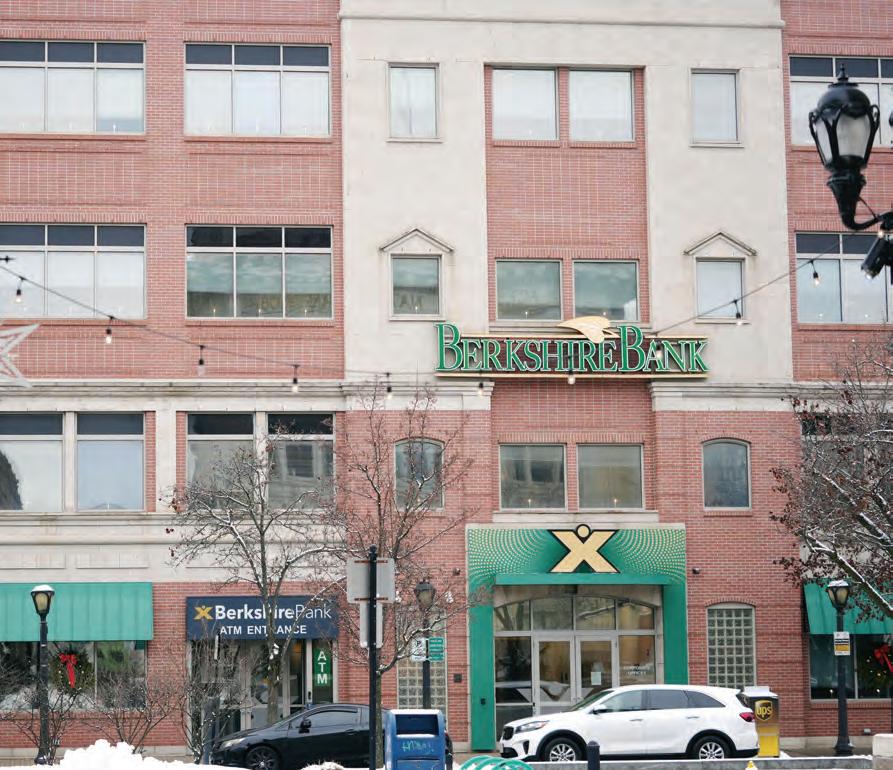
BEN GARVER
Berkshire Bank’s parent company, Berkshire Hills Bancorp, has announced it is merging with Brookline Bancorp.
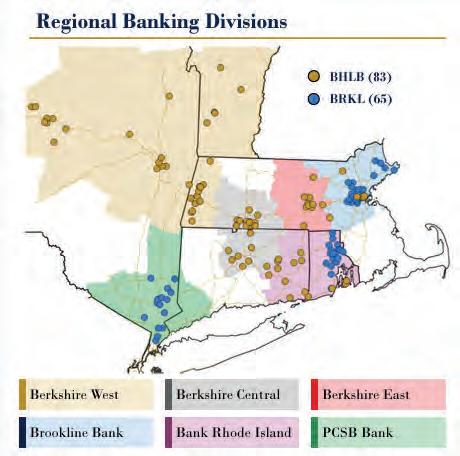
This screenshot shows the six regions that will be served by a merged Berkshire Hills Bancorp and Berkshire Bancorp if a merger is approved by the U.S. Securities and Exchange Commission.
BERKSHIRE HILLS BANCORP AND BROOKLINE BANCORP SCREENSHOT
larged footprint.”
The merged bank will be divided into six regions and led by three regional presidents from each company. Berkshire County would join a region that includes Vermont and much of Northern New York.
Chuck Leach, president and CEO of Lee Bank, listened to the conference call and said he heard “nothing Earth-shattering” on the call.
“To me, I think it just further defines the distinction between a community bank and a publicly traded bank,” he said. “We’re just focused on our own backyard, on our community, on our customers. We don’t have to be concerned with creating shareholder value year after year.”
John Bissell, president and CEO of Greylock Federal Credit Union, said there’s a place for large-scale banks in the North-

east as backers of major development. He contrasted that with the role of smaller financial institutions, which cycle money through the local economy.
“I’m grateful for the work of Berkshire Bank Foundation in
turning some of those profits into philanthropy here locally,” Bissell said. “It’s been very generous and provided a leadership role over the years, and I hope that continues to benefit our region in the years to come.”
Leadership team
Under the merger, the top leaders of a combined Berkshire Hills Bancorp and Brookline Bancorp will be:
David Brunelle, chair; Paul Perrault, president and CEO;
Carl Carlson, chief financial o cer; Sean Gray, chief operating o cer; Michael McCurdy, chief banking o cer; Mark Meikeljohn, chief credit o cer; Jacqueline Courtwright, chief human resources o cer; Ashlee Flores, chief risk o cer.
In addition, six people will serve as regional presidents. These are their names and current roles:
Darryl Fess, president and CEO of Brookline Bank; Michael Goldrick, president and CEO of PCSB Bank;
James Hickson, senior managing director – middle market and regional president of Berkshire Bank;
Elizabeth Mineo, managing director – private banking of Berkshire Bank; James Morris, market president of New York and managing director –commercial real estate of Berkshire Bank; William Tsonos, president and CEO of Bank Rhode Island.
Brookline Bancorp is a multibank holding company for Brookline Bank, Bank Rhode Island, PCSB Bank and their subsidiaries. Headquartered in Boston, it has $11 billion in assets and 65 branches throughout Massachusetts, Rhode Island and New York.
Berkshire Hills Bancorp Inc. is the parent company of Berkshire Bank, which operates in New England and New York. With $11.6 billion in assets and 83 financial centers, Berkshire is headquartered in Boston. Berkshire Bank was founded in Pittsfield Feb. 6, 1846.
The merger will be subject to SEC approval.

By Jane K aufman
A day after Berkshire Bank’s parent company announced a $1.1 billion “merger of equals” with Brookline Bancorp, the leader of the potential powerhouse spoke with The Berkshire Business Journal.
Paul Perrault is CEO and chairman of the board of Brookline Bancorp. He will serve as president and CEO of the new entity.
The deal is subject to SEC approval and is expected to close in the second half of 2025.
This account has been edited for clarity and brevity:
THE JOURNAL: What will the merger’s impact be on the Berkshires — including southern Vermont, northern Connecticut and eastern New York?
PERRAULT: I frankly don’t think it’s going to be very much, but one of the overriding reasons for this deal is that Berkshire Hills moved from Pittsfield headquarters to Boston headquarters a few years ago. We’re going to organize this new company into six regions, one of which will reestablish Pittsfield as one of the one of those six.
THE JOURNAL: Who will be the president of the Berkshire West region, which incorporates parts of eastern and northern New York as well as southern Vermont?
PERRAULT: We’re still sort of sorting that out. There are different candidates that we’re getting to know.
THE JOURNAL: Will the


name Berkshire Bank remain?
PERRAULT: The holding company and the bank will be getting a new name.
THE JOURNAL: Affordable housing is often listed as the top challenge facing the Berkshires. What role will the merged bank play?
PERRAULT: Brookline has a history of being very active in buying tax credits for affordable housing projects. So, we are likely to get involved both in purchasing the tax credits. But also, we have a very robust commercial real estate lending operation, and so we would have interest in doing the construction finance. So I think it bodes well for the Berkshires.
THE JOURNAL: Will anyone in the Berkshires lose their jobs as a result of this merger, particularly back office support, where there may be redundancies between the two entities?
PERRAULT: I don’t know enough about who does what, where, [in] what appears to us to be a pretty spread out kind of support in Berkshire for their operations. But I can’t say that there won’t be some impact.
THE JOURNAL: [Recently] you spoke of “pruning” bank branches as a strategy. Will that happen in the Berkshires?
PERRAULT: It is unlikely that there would be material changes in the branch structure in Berkshire County. Having said that, I do have a history of trying to modernize where our branches are because traffic patterns change. We are not there to close branches. There’s no over-


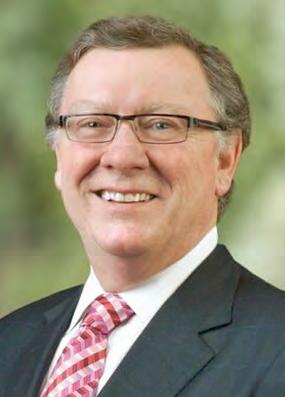
Paul Perrault, chairman and CEO of Brookline Bancorp, said a merger with Berkshire Hills Bancorp “bodes well for the Berkshires.”
laps. So I don’t think anything material will happen, certainly not for a long time.
THE JOURNAL: Can you talk about the importance of rural deposits to the strength of the merged entity?
PERRAULT: Our experience tells us that when you get away from the large urban areas, people’s behaviors seem to be a little less hyperactive about moving their money into the highest rate accounts, a little bit. It’s not massive, but somebody in a rural area seems to just handle their checking account and their savings account, whereas in a large urban area they might more aggressively try to move


that money into a CD.
THE JOURNAL: What will happen to Berkshire Bank Foundation? Does Brookline Bancorp have a similar foundation?
PERRAULT: I don’t know enough about the foundation to suggest that maybe we can do more, but we certainly have no plans to reduce. Brookline does not have a foundation, but Berkshire’s will survive the transaction.
THE JOURNAL: Will Nitin J. Mhatre, Berkshire Hills Bancorp CEO since January 2021, exit?
PERRAULT: This banking model is one that I have perfected over 30 years, this regional model. Their board and our board felt it’s appropriate that we lead the way to execute on it. Nitin will be well taken care of, and he’ll go on to some new adventure when the deal closes.
THE JOURNAL: What’s the history of this deal?
PERRAULT: Years ago, [in about 2019] I had talked to their then-Chairman [Bill Ryan], who was a friend of mine, about maybe putting it together. At that time, their board had no interest in looking at a combination because they were a bit troubled. Earlier this year, one of their newer directors asked the management if it was OK for them to approach me and talk about this merger of equals idea. She did, and I was interested, and we pursued it.
THE JOURNAL: How does merging help Brookline Bancorp?
PERRAULT: We are fortunate in that our banks and operating companies are prolific origination machines. I’m exaggerating a little bit. We’re very good at it in commercial banking. Funding those loans has become a bit of a challenge. We fund a lot of these loans with wholesale borrowings. It’s OK, but it’s expensive, and it’s something that the regulators keep an eye on.
We have a history of being expert in lending into commercial real estate — things like office buildings and apartment buildings. And in the current environment, that’s out of favor in the investor marketplace, and by the regulators. Both of those things get quite tempered when you put these two companies together. This has the effect of reducing the relative amount of real estate that the entire company has.
THE JOURNAL: And how will it help Berkshire Bancorp?
PERRAULT: In order to make money, banks need to make loans. We are very good at doing that. Them, less so.
THE JOURNAL: Would you back development in the Berkshires?
PERRAULT: We would certainly back the right sponsors of development. There’s a lot of tourism out that way. We’ve got nice niche businesses on Martha’s Vineyard, Nantucket. We do a lot in Newport, Rhode Island, and so we would look to bring that expertise there.




By Jane K aufman
PITTSFIELD — After Berkshire Bank’s parent company merges with Brookline Bancorp in 2025, one of the most notable changes might be the level of autonomy the six regional presidents will have.
“Each president will actually run a business unit,” said Matthew Emprimo, senior vice president at Berkshire Bank and commercial team leader for Berkshire County and Vermont regions. “So Berkshire West will be its own profit center, and that president will be responsible for the profitability of that region.”
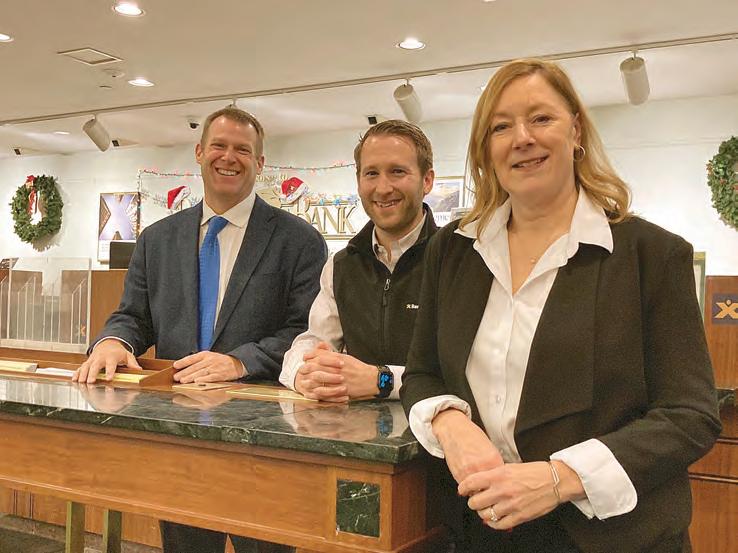
Emprimo was one of three Berkshire County-based employees of Berkshire Bank who talked with The Journal about the $1.1 billion merger and what it will mean for Berkshire Hills Corp’s 1,200 employees and for Berkshire County customers.
The “merger of equals” is subject to SEC approval.
Decisions about branch closures and openings now made by a retail team leader at the corporate level will ride with the presidents, according to Lorelei Gazzillo Kiely, who is currently Berkshire Bank’s regional president in Pittsfield.
“That regional president will have a lot of authority to say, ‘I think we should have a branch here or there,’” Kiely said. “So it will be someone local that we’ll be working with.”
The newly envisioned Berkshire West region, the largest geographically of the six regions under the new entity, will encompass Berkshire County, southern Vermont and northern New York. Six names have been released as regional presidents — three from Berkshire and three from Brookline — but the decision as to who will lead each region hasn’t yet been finalized.
As to the Berkshire West region, “I think it’s going to be Jim Morris,” said Paul Perrault, who is chair and CEO of Brookline Bancorp and will be president
and CEO of the merged entity. Morris is now Berkshire Bank’s regional president for New York state.
In the meantime, Kiely said, “We feel we’re right-sized here in Berkshire County with our 12 branches.”
In fact, Berkshire Bank is investing in renovation projects at four Berkshire branches — in Lee, Lenox and at two Pittsfield branches on Cheshire Road and Elm Street.
“There are plans to renovate additional branches into the future, next year and the year after,” Kiely said.
Kiely will continue in her role as a key leader for Berkshire County employees as well as in her position as director of Berkshire Bank Foundation, running
philanthropy for the corporation.
“We provide over $2 million in funding each year to organizations throughout our footprint, and the large majority of that funding is provided right here in Berkshire County,” Kiely said.
Gary Levante, chief communication and sustainability officer, said Brookline also has a commitment to its communities.
He said in conducting the five-month due diligence, the two banks found they have complementary regions and cultures as well as operating philosophies.
“I think this merger is also going to bring together the best of both of those cultures, the best of those operating philosophies, so that we can tackle issues like affordable housing here, building


on the strengths that we already have at Berkshire Bank and their strengths to really tackle and address these issues,” Levante said.
From his standpoint as a commercial loan officer, Emprimo said the merged entity will allow more capital to flow into the Berkshires.
“It’s going to increase lending capacity,” he said, adding there will be “a broader breadth of loan products, of financial solutions than what we would have been able to offer just as Berkshire Bank alone.”
Employees at Berkshire Hills Bancorp were notified in a video meeting.
“This is a multi-month process where we’re getting now an even deeper understanding of each company’s operating environment, how they do business, and identifying all of the roles of the new company,” Levante said.
As for Berkshire Bank employees, “Really it’s business as usual.”
As a next step, a business integration team made up of people from both companies will ramp up over the next several months, Levante said.
“Ultimately, what impact that has on employees, it’s still really early to tell, because there will be opportunities for employees to step into new and expanded roles,” Levante said. “There will be more career mobility for employees at a much larger organization. So there’s also a lot of benefits that come along with a transaction like this for employees.”
Emprimo said Berkshire Bank employees are used to adjusting to new partnerships.
“This is not new to us,” he said. “We did 10 transactions in 10 years.”
Both Kiely and Levante said they sense excitement among employees.
“We are very strong here, and we look forward to continuing to be strong,” Kiely said. “I think people feel good about that, knowing that this is a very important market for the bank.”


PITTSFIELD
BIC appoints experts to board of directors
The Berkshire Innovation Center has appointed two new members to its board of directors: Tanja Srebotnjak, executive director of The Zilkha Center for the Environment at Williams College, and Garth Klimchuk, founder and managing partner at NorthRenew Energy.
Both are already actively involved in the mission of the BIC and bring a range of expertise that will be critical to the organization as it grows and evolves.
Srebotnjak has worked on sustainability strategy and operations and in a variety of settings. She obtained undergraduate and graduate degrees in statistics from Dortmund Technical University, Germany, and the University of Auckland, New Zealand, before joining the UN Statistics Division to work on environmental statistics and indicators. She later pursued doctoral research in environmental statistics and policy from the Yale School of the Environment and was the director of the Yale-Columbia Environmental Performance Index.
Since then, she has led research, education and strategic initiatives to address sustainability, climate and environmental health issues in academia and K-12 education as well as for environmental advocacy and think tank organizations in the U.S. and Europe.
Klimchuk has over 35 years of project development and financial advisory experience across the broad energy spectrum, with the last 15 years dedicated exclusively to renewable energy. As a developer, investment banker, CFO and consultant he has executed financial and strategic solutions representing over $10 billion in transaction value for companies ranging from startup to Fortune 100.
Prior to NorthRenew, he was founder and managing partner of NorthWinds Advisors, a financial advisory firm and broker-dealer. Through his broad responsibilities on behalf of his clients, he was engaged in deep due diligence and negotiation processes across a wide range of renewable energy projects and technologies.
Garth holds an MBA from The Wharton School, a master of arts degree in Energy Management and Policy from the University of Pennsylvania and a bachelor of science in geology from Brown University.
The American Bankers Association Foundation has honored Berkshire Bank for its dedication to economic inclusion with the foundation’s Community Commitment Award, which recognizes banks for extraordinary corporate social responsibility activities.
Specifically, the award recognized Berkshire’s Community Comeback program for providing $5 billion in lending, investment and technical assistance, an increase of approximately 70 percent over three years.
The Community Comeback focuses on four key areas: fueling small businesses; community financing and philanthropy; financial access and empowerment; and environmental sustainability. It has helped consumers realize the dream of homeownership, improve financial outcomes, create jobs, redevelop neighborhoods, and build a more equitable and sustainable future.
Community Commitment Award winners must embody banking at its best and demonstrate success in measurable terms. The awards selection committee, comprised of independent national experts, reviewed bank nominations from across the country and chose winners based on specific criteria, including the creativity and thoughtfulness of the program.
GREAT BARRINGTON
Flying
Flying Cloud Institute has received an $8,000 matching challenge gift from a summer camp family, which allowed donations received by Flying Cloud on Giving Tuesday, Dec. 3, to be doubled, up to $8,000.
All funds raised will enable Flying Cloud to run its innovative science and art programs at two local Berkshire County schools, offering in-school science residencies and after school workshops to area youth.
Flying Cloud educators will lead project-based investigations and model the Next Generation Science Strategies for inquiry-based learning. They will bring local STEM (Science, Technology, Engineering and Math) professionals as expert resources to the classroom, along with local artists who help students express their learning through original, creative work such as sculpture, dance, poetry, painting, or film.
GREAT BARRINGTON Berkshire Bounty awarded challenge grant
Berkshire Bounty, a nonprofit food rescue organization, has received a challenge grant from Warrior Trading, an online educational platform that offers a wide range of courses, training programs and software for individuals interested in day trading.
Donations up to $5,000 to Berkshire Bounty on Giving Tuesday were matched dollar for dollar by Warrior Trading.
Berkshire Bounty’s goal was to raise $100,000 by the end of 2024. Berkshire Bounty was to follow up Giving Tuesday fundraising with a crowdfunding campaign in which it will reach out to supporters to complete that goal.
For more information or to inquire about making an online or offline donation, contact Sara Haimowitz, Berkshire Bounty director of development, at sara@berkshirebounty.org.
STOCKBRIDGE Grinspoon funds access to
In a move to provide in-depth mental health care to emerging adults living in Massachusetts, philanthropist Harold Grinspoon has gifted $250,000 to the Austen Riggs Center to support the Riggs Online Intensive Outpatient Program. The funding, which Riggs is matching, will provide $500,000 for up to 13 weeks of treatment to 16 individuals over the course of the coming year.
The Online IOP serves individuals residing in Massachusetts between the ages of 18 and 30 and features nine hours of group meetings and two hours of individual psychotherapy with a doctoral-level clinician each week. In addition, it offers medication management, family therapy and coordination with other mental health resources, all of which are integrated in three times a week multidisciplinary team meetings.
The establishment of the Harold Grinspoon IOP Patient Aid Fund seeks to broaden access to the Online IOP by supporting prospective patients who lack either enough private funding or sufficient insurance coverage to pay for the program.
The Online IOP is accepting applications for admission and support via the Grinspoon fund. To find out more or to apply, call Jessi Nolet, Online IOP Program coordinator, between 8:30 a.m. and 5 p.m. weekdays at 833-921-5700 or via tinyurl.com/37b46yxn.
LEE
Canna Provisions wins awards for cannabis line
Canna Provisions has announced that its exclusive cannabis line, Smash Hits Cannabis, has achieved dual honors in the 2024 Leafly Budtenders’ Choice Awards for Massachusetts.
Chem D, an iconic strain cultivated by Smash Hits, was named by Massachusetts budtenders to be Strain of the Year, while Smash Hits itself was crowned Cannabis Flower Brand of the Year.
Previously, Chem D was chosen as the top strain in the 2023 Budtenders’ Choice Awards for Massachusetts as well, making this the latest in back-to-back wins for Canna Provisions and Smash Hits.
Greg “Chemdog” Krzanowski, director of cultivation for Canna Provisions, oversees the entire Smash Hits cannabis line from seeds to harvest and quality control of the final product.
Canna Provisions, an employee-owned, award-winning cannabis dispensary, operates retail stores in Lee and Holyoke.
GREAT BARRINGTON Center for Justice earns paralegal program grant
The Berkshire Center for Justice has been awarded a $5,000 grant from the Jewish Women’s Foundation of the Berkshires to support BCJ’s paralegal position.
The paralegal provides case assistance for center’s legal and wraparound community services for underrepresented low-income residents. The center offers six free legal clinics each month at Pittsfield and Great Barrington locations, and on the phone.
The Center for Justice is a nonprofit, charitable organization that provides legal, educational, social referrals and mentoring services that promote social and community justice. It was founded in 2006 by attorney Eve Schatz.
To support the organization’s justice programs, donations can be made at BerkshireCenterforJustice.org, or call 413-854-1955 for more information and volunteer opportunities.
Carr Hardware customers in Lenox and Pittsfield raised $1,856.35 through the company’s round-up initiative, directly benefiting the local Thanksgiving Angels program. The donation helped provide holiday meals for over 2,000 families in Berkshire County.
Throughout the month of October, Carr Hardware hosted a round-up campaign at its Lenox and Pittsfield locations, encouraging customers to round up their purchases to the nearest dollar.
The funds collected through this initiative were donated to the South Community Food Pantry’s Thanksgiving Angels program, which has been serving local families for years. The program works to ensure that families in need across Berkshire County can enjoy a full Thanksgiving meal, complete with all the traditional trimmings.
BHS is among Top 100 Women-Led Businesses
The Women’s Edge, together with its partner The Boston Globe, recently announced that Berkshire Health Systems was again named one of the annual Top 100 Women-Led Businesses in Massachusetts.
The 100 organizations honored generated over $124 billion in total revenue in 2023, demonstrating that women leaders continue to be key drivers of the state’s economy. This is the second year in a row that BHS has been recognized.
“On behalf of the more than 4,000 dedicated health care professionals that serve Berkshire County and the surrounding region, we are very grateful to The Women’s Edge and Boston Globe for this recognition,” said Darlene Rodowicz, president and CEO of Berkshire Health Systems.
This is the 24th year that The Women’s Edge — a Boston-based nonprofit organization devoted to advancing women in leadership positions created the list through a nomination process and reviewed both for-profit and not-forprofit organizations, and the 12th year that the list was created in collaboration with The Boston Globe.
In addition to revenue or operating
budget, factors considered in the evaluation included workplace and management diversity, board makeup and innovative projects.
PITTSFIELD
1Berkshire announces tech assistance cohorts
1Berkshire has announced its upcoming slate of technical assistance offerings through the Berkshire Economic Recovery Program.
The winter 2025 program includes three cohorts: “Building a Social Media Marketing Strategy” (full; waitlist open); “Let’s Jumpstart Your Crowdfunding Campaign”; and “Let Robots Do The Work: AI Tools for Small Business Success.”
These cohorts will each provide up to seven participating organizations/businesses support through a two-hour kickoff workshop and resources, followed by up to two additional hours of one-onone direct targeted technical assistance by a paid provider.
1Berkshire, through competitive grant funding from the U.S. Department of Agriculture, is able to provide this high-impact service at no cost to businesses, entrepreneurs and organizations located in any of the 32 cities and towns of Berkshire County, representing a more than $1,000 direct value per business in each cohort.
Through its series of cohorts spanning nearly four years, the Technical Assistance series has been able to support more than 200 businesses through targeted training and focused convenings, resulting in notable business improvements, and quantified by over $2,500,000 in funding collectively accessed by businesses through their participation.
For details and to register, bit.ly/ BERPTA. For more information or additional inquiries, email EconomicDev@1berkshire.com.

Afreemonthlypublicationby TheBerkshireEagle 75SouthChurchStreet, Pittsfield,MA01201
Visitberkshirebusinessjournal.comfor advertisinginformationandtosubscribe.
NEWSDEPARTMENT 413-447-7311 news@berkshireeagle.com
ADVERTISINGDEPARTMENT
AMYFILIAULT,AdvertisingManager 413-496-6322 afiliault@berkshireeagle.com
CHERYLGAJEWSKI,Directorof AdvertisingSales 413-841-6789,413-496-6330 cmcclusky@berkshireeagle.com
ShareyournewswiththeBerkshire BusinessJournal. Ifyouhaveacompany promotion,anewbusinessoranewventure,let theBerkshiresknowaboutit.Rememberthe 5Wsandthatbrieferisbetter.Emailtextand photostoBBJ@newenglandnewspapers.com. ProvideyourexpertiseintheBerkshire BusinessJournal. Doyouhavetheanswer toapersistentquestionaboutbusiness andtheBerkshires?Doyouhaveideasand suggestionsonhowourbusinesscommunity cangrow?Ifyouhaveacommenttomake aboutdoingbusinessintheBerkshiresor ifyou’relookingtoraiseanissuewiththe businesscommunity,thisisthevenuefor that.Wewelcomelettersupto300wordsand commentaryupto600words.Sendtheseto BBJ@newenglandnewspapers.com
BerkshireBusinessJournalispublished monthlybyNewEnglandNewspapersInc., 75S.ChurchSt.,Pittsfield,MA01201. PeriodicalspostagepaidatPittsfield,MA01201. BerkshireBusinessJournalisdeliveredfree tobusinessesinBerkshireCountyviathird classmail.Additionaldistributionismade viadrop-offatselectareanewsstands.The publisherreservestherighttoedit,rejector cancelanyadvertisementatanytime.Only publicationofanadvertisementshallconstitute finalacceptanceofanadvertiser’sorder.All contentsarecopyrightedbyNewEngland NewspapersInc.
By Jane Kaufman
LEE — Baja Charlie’s California Cuisine is closed, and a new restaurant will soon open in its place.
Last week, Baja Charlie’s owner Charles Hebler sold the furniture, fixtures and equipment at his restaurant at 62 West Center St. for an undisclosed price to Emre Semerci. The new restaurant, Lee Corner Kitchen, will offer American fare.
Hebler, who owned Baja Charlie’s for its 12-year run, said he began thinking about a change in his career as he approached the age of 65. The closing of the restaurant not only marks the end of the eclectic California Mexican cuisine in Lee, but also the beginning of a new cooking chapter for Hebler.
Hebler is planning to return to catering, where he launched his career in 1989 with the Rolling Stones Steel Wheels Tour. He’s looking at mobile kitchens and plans to launch his as-yet-unnamed catering business in the spring.
The restaurant has been “temporarily closed” since September when Hebler placed a classified ad in The Berkshire Eagle in for the “turnkey restaurant” with lease available.
In October 2021, Hebler had a life-threatening accident on his mountain-bike — flipping over a fence on Route 102 he didn’t notice.
He closed the restaurant for six months during his recovery. He said he’s particularly grateful to customers who returned when he reopened.
Since then, he hasn’t felt up to the daily grind and pressure that running a restaurant poses, and he looks forward to being able to pick his gigs.
While his first job, at his
grandparents’ business, The Cheshire Store, included making hot dogs, he didn’t discover a passion for food until his first year of college.
Born in Pittsfield, Hebler graduated from Pittsfield High School in 1977. After graduating, he enrolled at the University of California at Los Angeles, studying English. A course on Italian cooking lit him on fire. His father, Gordon Chestnut, had also studied at Cordon Bleu in Paris, influencing his decision to switch
from the classroom to the kitchen. Hebler left UCLA and graduated from Ma Cuisine Cooking School in Newport Beach, Calif., in 1987, then talked his way into a year-long apprenticeship at renown chef Michel Richard’s Citrus in Los Angeles. He was thrown onto the meat station of the Michelin-star-rated restaurant after Richard threw out a chef for ruining a steak.
Working with business part-
ner and neighbor, Terry Shapiro, he left that apprenticeship to cook for the Steel Wheels Tour.
Since then he’s cooked for dozens of bands, including the at Woodstock ‘94, Tanglewood and for Lollapalooza.
Once a 50-pound bag of ice split as he was carrying it into Billy Joel’s dressing room. The piano man took it in stride, breaking into a tap dance. He was moved when Elton John sent gifts of toys and teddy bears for his daughter after he sent
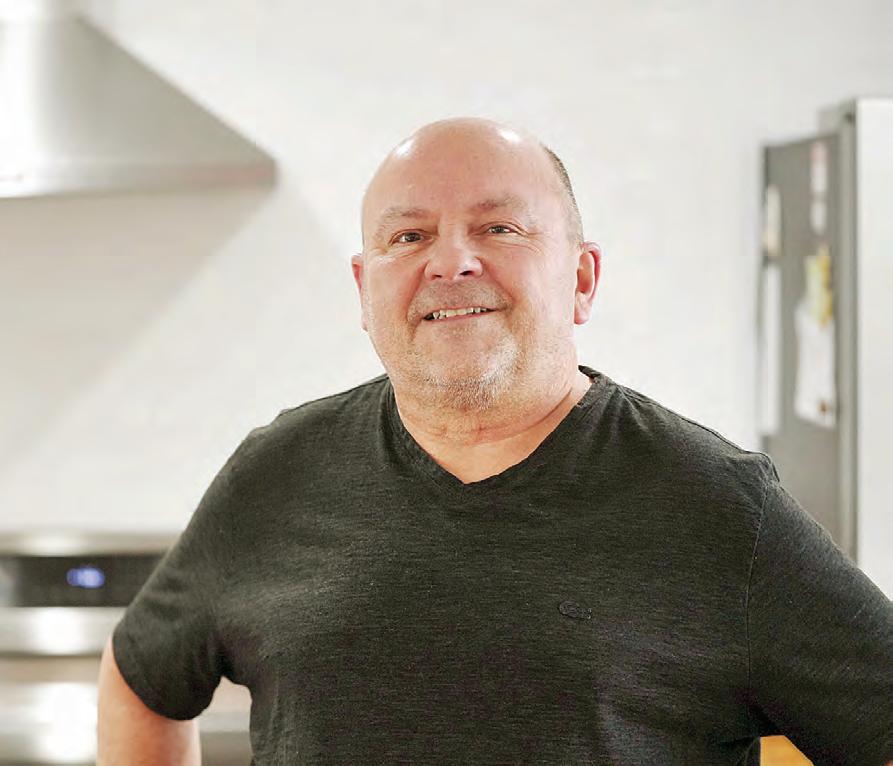
Owner Charles Hebler is planning to return to catering, where he launched his career in 1989 with the Rolling Stones Steel Wheels Tour.
John a letter and drawing she’d made for him.
Hebler met Shirley White on Laguna Beach and the two married in Lake Forest, Calif. When their daughter, Alex, was young, the two divorced. Hebler returned to the Berkshires, partly motivated by what he perceived to be better schools for her. He opened Napa California Cuisine in Lenox, which he ran as a restaurant for 12 years prior to opening Baja Charlie’s in 2012.
He later married Kelly Simmons, a retired teacher, and the two live in Lee. Would he live his life the same way if he had the chance to do it over again?
“There’s ups and downs to everything in everything in life,” he said. “I love music. I chose to cater bands because I loved the people who created the music, working for them, making them happy.”
He said he enjoyed particularly working with young talent, “who were just getting up there and getting behind them and giving them the best catering we could, give them more than they asked for.”
Having been through his neardeath experience, he feels certain of one thing.
“There’s purpose to life,” he said. “After my accident, life is about servitude.”
By Jane K aufman
BECKET — A year after opening the Becket Country Store, owner Ryan Eley is planning to expand the retail operation, add gas pumps and — eventually — a fastcharging station for electric vehicles.
Eley has helped out many drivers whose tanks are low and don’t want to risk making the drive from his store to Papa’s Healthy Food & Fuel 8.2 miles away. He’s planning to have three gasoline terminals and one diesel, with a total of six pumps for cars and trucks.
“I’ve topped people off with my own personal [gas] can probably a half dozen times,” he said. “All the time, people get stuck out here.”
Eley already has approval from Eversource to run the necessary three-phase power from Route 8 in order to power the fast-charging station, similar to those on the Massachusetts Turnpike. However, money has dried up to subsidize the project at a level of 75 percent to 90 percent, so he’ll wait for another round of government funding to pursue that part of the plan.
Eley said if he gets approval this winter from the town, he’ll get started in 2026 on the gas station.
In the meantime, he’s also planning to add floor space to the store from an office area at the back end, of the building, using most of the 3,100-square-foot building for retail.
He gutted the interior and did exterior and site work prior to opening Dec. 1, 2023.
He envisioned the space as a community hub and plans to add ice cream cones

JANE KAUFMAN
He’s hoping to get a list of all the necessary steps for approval before embarking. He wants to add space on the package store side of the business as well as provide more retail space.
While he doesn’t know exactly how much it will cost, he says he has a ballpark idea.
While Eley opened Dec. 1, 2023, he didn’t get a liquor license until April.
“It’s not been a full year of full operation but yeah, it was pretty good,” he said. “The summer was about what I thought it would be. We’ll see how this winter is having the liquor license. ... Good enough to keep going. But I think the gas station is really what would lock in the traffic.”
Getting up and running took more time than Eley expected.
“There’s a lot of regulation for a business like this,” said Eley, who found his initial efforts to open frustrated by the permitting process he wasn’t familiar with or prepared for. “It’s been tough to kind of square in on first, what is it that we’re required to do and how do we do it and then how do we finance doing it.”
Without a public water supply, the state Department of Environmental Protection and local Board of Health both have a role.
as a point of connection for Becket’s many summer camps.
“The deli’s been great,” Eley said. “We’ve had a really good lunch crowd through the week.”
He outsources baked goods from certified country kitchens and carries locally
produced goods.
The Becket Country Store hosted a farmers market during the summer, which also went well, Eley said.
He is now proposing a new site plan adding parking, with the gas station, EV charging stations and new entry ways.
“Now that we’re about a year in, we’ve kind of hashed everybody that is regulating us has at least sent me an email by now. We’re just trying to figure out how to get in the good graces of all those folks,” he said. “But that’s been really burdensome from my perspective. It’s probably a bit too overwhelming for a small business to have to keep up with that sort of compliance regime.”
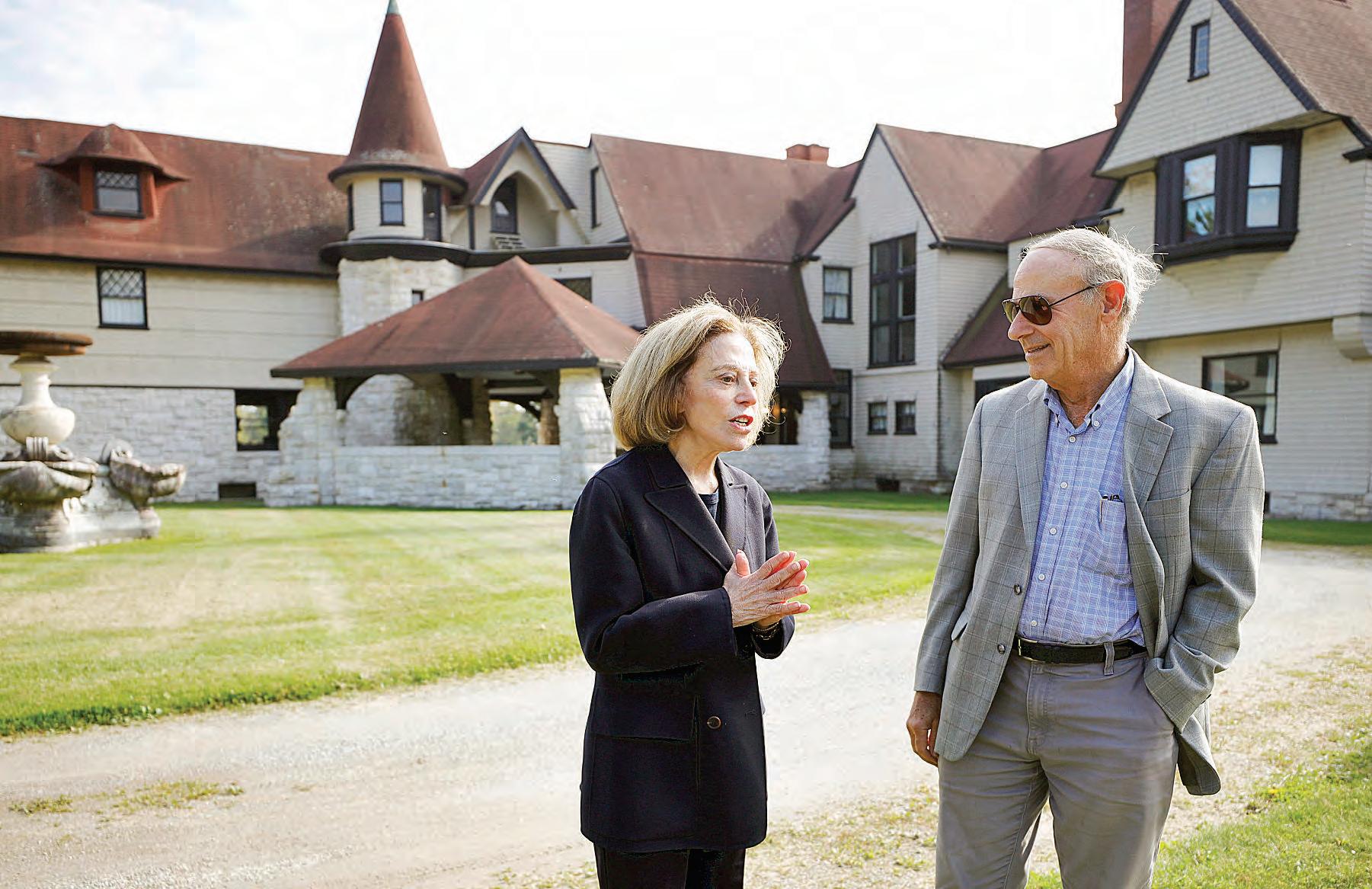
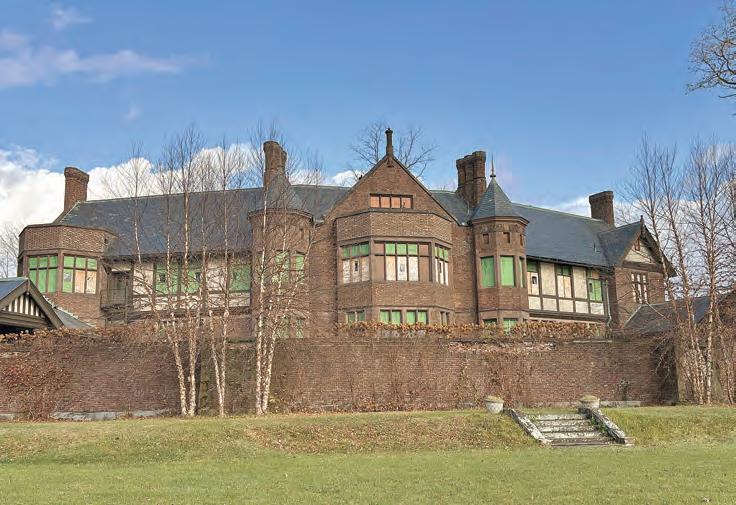
Elm Court owner Linda Law and her business partner Richard Peiser, seen in October 2023, discuss the ongoing renovation and transformation of the historic property. “This is magnificent,” Law said, “however no one’s ever been able to make it successful.”
By C larenCe Fanto
STOCKBRIDGE — The historic Elm Court estate may soon emerge from a lengthy holding pattern, and with a new plan that doesn’t include a hotly debated annex.
Its current owners intend to submit changes to its existing development plan to Stockbridge and Lenox officials within the next several months.
Those changes include eliminating a planned three-anda-half-story, 96-room annex to the Gilded Age estate’s manor house, which raised eyebrows among some neighbors. They also include adding a yet-to-bedetermined number of guest cottages to the property and some custom lots.
Real estate entrepreneur Linda S. Law, who sold the highend Blantyre resort in 2017 after four years of ownership, and Richard Peiser, who holds an endowed chair at Harvard, bought Elm Court in December 2022 for $8 million.
The seller, real estate company Front Yard LLC of Denver, failed to develop Elm Court after a decade of ownership. In 2012, the company acquired the property from members of the Vanderbilt-Sloane family for $9.8 million.
Changes to the development plan would have to be approved by both towns, as 3 acres of the 89-acre property and its road frontage lie in Lenox.
In an interview with The Eagle earlier this week, Law said the cottages would be out of sight for neighbors and passers-by.
“From the street and the man-

The Elm Court estate in Stockbridge has been undergoing extensive renovations. A revised plan for a scaled-down resort, eliminating a massive 89-room annex in favor of 48 small guest cottages, is in the works for submission to town boards.
or house, you can see nothing,” she said. “We want to do this right, so it’s a win-win for everybody. I believe in this project and the jobs it will bring.”
Law projected the development would create $4.5 million in annual revenue for Stockbridge and Lenox from taxes and fees, as well as indirect positive financial impacts.
The manor house would offer 30 suites, as approved in the existing development plan.
Under a special permit previously approved for Front Yard LLC in Lenox, a sidewalk along
Old Stockbridge Road can be developed at the discretion of the town’s Select Board and ZBA along with significant sewer and water line enhancements along the roadway.
Under the banner of Amstar, a major real estate development company in Denver and its subsidiary, Travassa Destination Resorts and Spas, Front Yard had proposed a 112-room resort at Elm Court.
However, the plan was abandoned during the COVID-19 pandemic in the spring of 2020 following intense neighborhood opposition. The property
went on the market in October 2020 as a single-family residence for $12.5 million, but there were no takers.
“I know that even though the plan was approved, there were a lot of concerns about the massive 96-room addition from the neighbors,” Law said. “We have been developing and analyzing alternative site plans that would not utilize the addition.”
Front Yard’s original proposal carried a $50 million price tag.
The special permit granted by both towns, with extensions, allowed for 14 more rooms added to the 16 existing suites in the
Gilded Age manor house, as well as the 96-room annex linked to the main house. The plan included a 60-seat public restaurant and a 15,000-square-foot spa.
Law said she is also in talks with several clubs and envisions “dedicated space in the manor house for a small club room.”
Law sold the high-end Blantyre resort in Lenox for $15 million in November 2021. She and her investor-partners had purchased the property from the Fitzpatrick family for $8.7 million in June 2017, including the business, furnishings and equipment.
Blantyre remains closed pending additional investment to complete significant infrastructure repairs to its 1902 manor house.
Elm Court, listed on the National Register of Historic Places, was built in 1886 as the summer home of William Douglas Sloane, whose family owned a prominent furniture company, and Emily Thorn Vanderbilt, the granddaughter of Cornelius Vanderbilt. Its grounds were designed by Frederick Law Olmsted.
It was the last 19th century Berkshire Gilded Age Cottage still under original family ownership when it was sold in 2012 by Robert Berle and family members, descendants of the Vanderbilt-Sloane family.
Law resides in Lenox and the Silicon Valley region of California. Peiser is the Michael D. Spear Professor of Real Estate Development at the Harvard University Graduate School of Design.
Developer pays $14M for resort under repair
By C larenCe Fanto
LENOX — For the third time in eight years, the historic Blantyre resort has changed hands as the cost of repairs soared far beyond projections.
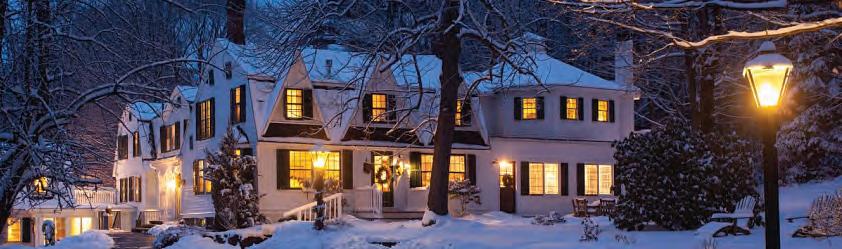
The 1902 Gilded Age mansion has been shuttered for extensive renovations and proposed expansion since November 2021. Now, as signaled at a November zoning board hearing, it has been purchased by hospitality industry investor and developer William “Liam” Krehbiel for $14 million.
He’s the founder and CEO of Chicago-based Topography Hospitality LLC, which specializes in renovating, developing and operating luxury country hotels. Krehbiel is also the co-managing partner of Ballyfin Demesne, a luxury hotel in Ireland that opened in 2011.
Krehbiel has described Blantyre as “a truly remarkable place that deserves to be restored in a very sensitive, thoughtful way to bring it back to its original splendor in a way that honors the history of that property.”
He predicted completion of the entire project and the reopening of the Blantyre resort would take two or three years.
According to Middle Berkshire Register of Deeds documents, Krehbiel’s recently formed Blantyre Property Co., a limited liability corporation based in Delaware and registered in Massachusetts, paid $14 million last month for the mansion and its surrounding 87 acres at 16 Blantyre Road, as well as its two adjoining lots, parcels and land on Patterson Road.
The seller, Blantyre LLC, was owned by Texas-based real estate investor
Clark Lyda and managing partner Ken Fulk, a noted interior designer.
They had paid previous owner Linda Law and her partners $15 million for the property in November 2021.
She had purchased it in June 2017 from the Fitzpatrick family of Red Lion Inn and Country Curtains fame for nearly $7 million and envisioned a $90 million buildout project. Law currently owns the Elm Court mansion on Old Stockbridge Road and is planning a scaled-down expansion there.
Since acquiring the 25-room Blantyre hotel, Lyda and Fulk had planned on investing at least $4 million on renovations before halting work more than a year ago
as costs outpaced available financing.
Last April, according to a Berkshire Superior Court judgment, with Krehbiel’s help they agreed a $3 million settlement with Bulley and Andrews LLC, a Chicago-based construction firm, for unpaid renovation work.
At a January 2023 zoning board meeting, Lyda had estimated that an extensive five-year renovation would cost well over $10 million. “It’s a big, ambitious project, there’s a lot of work to be done,” he said then.
A year later, all work had been halted and Lyda acknowledged that the mansion was in far worse shape than he and Fulk had realized. “We didn’t have a full
appreciation” of how much work was needed,” Lyda acknowledged.
Apart from renovations, an even more costly phased expansion had been outlined, first by Law and then by Lyda and Fulk.
The zoning board approved a special permit in 2020, revised in 2023, allowing a 45 guest-room annex, 20 condominium townhouses that would be privately owned (but available for hotel guest rentals when owners are not present) and 14 building lots for single-family homes to be held under separate ownership.
Last November, the ZBA confirmed that the special permit remained in effect because at least some of the necessary renovation had been completed.
Zoning Board Chair Robert Fuster said that, in 2023, the board already decided that substantial progress had been made on the renovation, meaning that the special permit would remain valid with no expiration date, based on Massachusetts case law.
Special permits do expire after two years if no work has begun, Fuster noted.
In a 5-0 vote, the ZBA members agreed that the existing special permit remains in effect and needs no extension since substantial construction work has been done.
At that November meeting, Fulk conceded that he had been “under-informed” about how much work and money was necessary.
“We didn’t understand the cost and the scale,” Fulk told the zoning board. “The quantity of work needed to protect the structure is staggering.”
The project includes an ongoing commitment to contribute to the town’s Affordable Housing Trust one existing house as well as four, 1-acre lots for development.
A series of hulking metal structures loom about the laboratory grounds and into the nearby woodlands. The structures appear like massive gates with tallest standing about 125 feet and a series of others about 100 feet tall, according to EPRI lab manager Steven Baker.
These are the remains of a threephase transformer constructed by General Electric in the 1960s, Phillips said, in an attempt to reach a 1 megavolt (1,000 kilovolts) capacity and usher in a new era for American-made transformers. In those days, most transformers could only transmit about 230 kilovolts, Phillips said.
GE was eager to increase the output of transformers, which “step up” voltage to high levels for efficient travel over long distances and also “step down” voltage when it reaches end users.
In its attempt, dubbed “Project EHV,” or “extra high voltage,” GE constructed a series of transformers traversing 4 miles of woodlands to a substation in Lenox Dale, and ran a high-voltage power line all the way through in the hopes that it would reach 1,000 kilovolts through a series of tests.
“If you go through the woods — which I have been, biking and hiking — you’ll find the foundations of these funny, big structures here,” Phillips said, pointing to the large metal structures near the lab.
The experiment resulted in a number of findings, Phillips said, but the most important was that the GE researchers didn’t reach their 1,000-kilovolt goal. Rather, the series of tests could only reach 765 kilovolts — a milestone for the development of 765-kilovolt
PAGE 1 EPRI, Page 10

Transmission and Distribution Laboratory in Lenox, the Electric Power Research Institute runs a variety of experiments that test the limitations, capabilities and safety






Inside EPRI’s multistress aging chamber, electrical insulators
temperatures, salt, fog and humidity.
FROM PAGE 9
transmission lines, now in use by major utilities including American Electric Power, New York Power Authority and the Chicago-based Commonwealth Edison Company.
The research done at the laboratory in Lenox allowed those high-voltage transmission lines to be created, Phillips said.
The GE lab was later purchased by EPRI, which was established in 1972 to “help power society toward a reliable, affordable and resilient energy future,” according to its website. EPRI also has laboratories in Charlotte, N.C., and Knoxville, Tenn.
Ever since, the transmission line has resulted in many electric industry “firsts.” In 1993, the line was used to develop methods for safe maintenance of live transmission lines via helicopter.
That feat has been enshrined in the laboratory’s main lobby through a series of photographs — some of which include electrical corona whirring through the rotors of the helicopter, in an image almost reminiscent of science fiction.
“We developed the methods on how
Workers reset a tree-strike simulation arm after a resiliency test of a new cement utility pole at
you would put a helicopter on an energized line, bond it so people could get on [to] fix things when it’s energized, and get off,” Phillips said.
In other words, the tests aimed to see how effective a helicopter would be in repairing live wires, depending on the aircraft’s position between the towers of a transmission line and whether or not the helicopter was “bonded” electrically.
In the EPRI tests, they used a “bonding wand” to achieve this, according to the 1993 final report on the tests. The lineman uses the wand to touch the electrified line to balance the voltage between the wire and the helicopter and lineman.
A mannequin named “Chicken Charlie,” so-called because of its chicken wire frame, was also placed on the helicopter’s work platform with a conductive suit to represent a live maintenance worker.
The tests helped develop best practices for helicopter maintenance, including safe work distances and bonding techniques. In recent years, the Lenox laboratory has continued along a similar trend by conducting testing for unmanned drones, which may be used by utilities in the coming years to perform visual inspections.
EPRI, Page 11








There are countless tests happening on a given day at the EPRI laboratory that would likely mystify the uninitiated — but only one gets the facility’s entire staff to drop what they’re doing and watch.
As Phillips describes it, the laboratory’s 14 full-time staffers gather amidst an array of high-speed cameras all pointed at the same thing: a manhole cover, affixed on top of a vent. What gets pumped through that vent varies from test to test — Baker said it could be methane, acetylene or carbon monoxide, among others.
Those are all gasses that have been found during field work in major sewer systems, Phillips said, which are known to cause explosions when pent up that can send manhole covers flying in populated areas.
At EPRI, researchers blow them up on purpose for the greater good.
The idea is to test out different sets of hinges and concrete bases to determine their durability against a simulated explosion.
The testing began in the 1990s, Phillips said, with the ultimate goal of reducing free-flying manhole covers that could potentially hurt people.
Most of the newly installed manhole covers are hinged, making them come up like “a dragon’s mouth” to let the gas out instead of flying off and endangering the public, Phillips said.
But testing still needs to be done to see how older manhole covers, and covers that are ensconced in older concrete, might hold up under the same pressure. At EPRI’s Charlotte lab, there’s an aging
chamber that can be used to rapidly weather manhole covers to see how older ones might hold up.
There are six underground vaults worth of manhole covers from scores of municipalities at the laboratory.
Improving safety and mitigating real-world harm are vital parts of the Lenox laboratory’s research — Phillips showcased an experiment to improve automatic shut-offs for downed power lines on nonconductive surfaces, such as asphalt, which could be instrumental in preventing wildfires that could start on the ground as a result.
Other tests are helping to strengthen utility poles from external force from felled trees and car collisions — a pole break can take a very long time to repair after a storm or hurricane, Phillips said, with an average time of between 16 and 24 hours for a fix.
The facility’s other major service is to give companies a place to innovate without fear of real-world consequences — utilities are very risk-averse, Phillips said, and can’t afford blackouts or problems that would affect real people in the name of technical progress.
The EPRI lab allows those utilities to “increase their confidence in new technologies, and identify risks” — giving companies the chance to work out the kinks and improve service with minimal, if any, disruption to customers.
But the laboratory is about far more than just the equipment — its researchers play a vital part in its success, Phillips said, and the success of the technologies that come from it.
“It’s not only about the test facility,” Phillips said. “It’s about the smart people who work here that think of all the things that could go wrong, and how we can test it.”
Matt Martinez can be reached at mmartinez@berkshireeagle.com.









By Sten Spinella
NORTH ADAMS — Chris Bonnivier’s patience has proved virtuous.
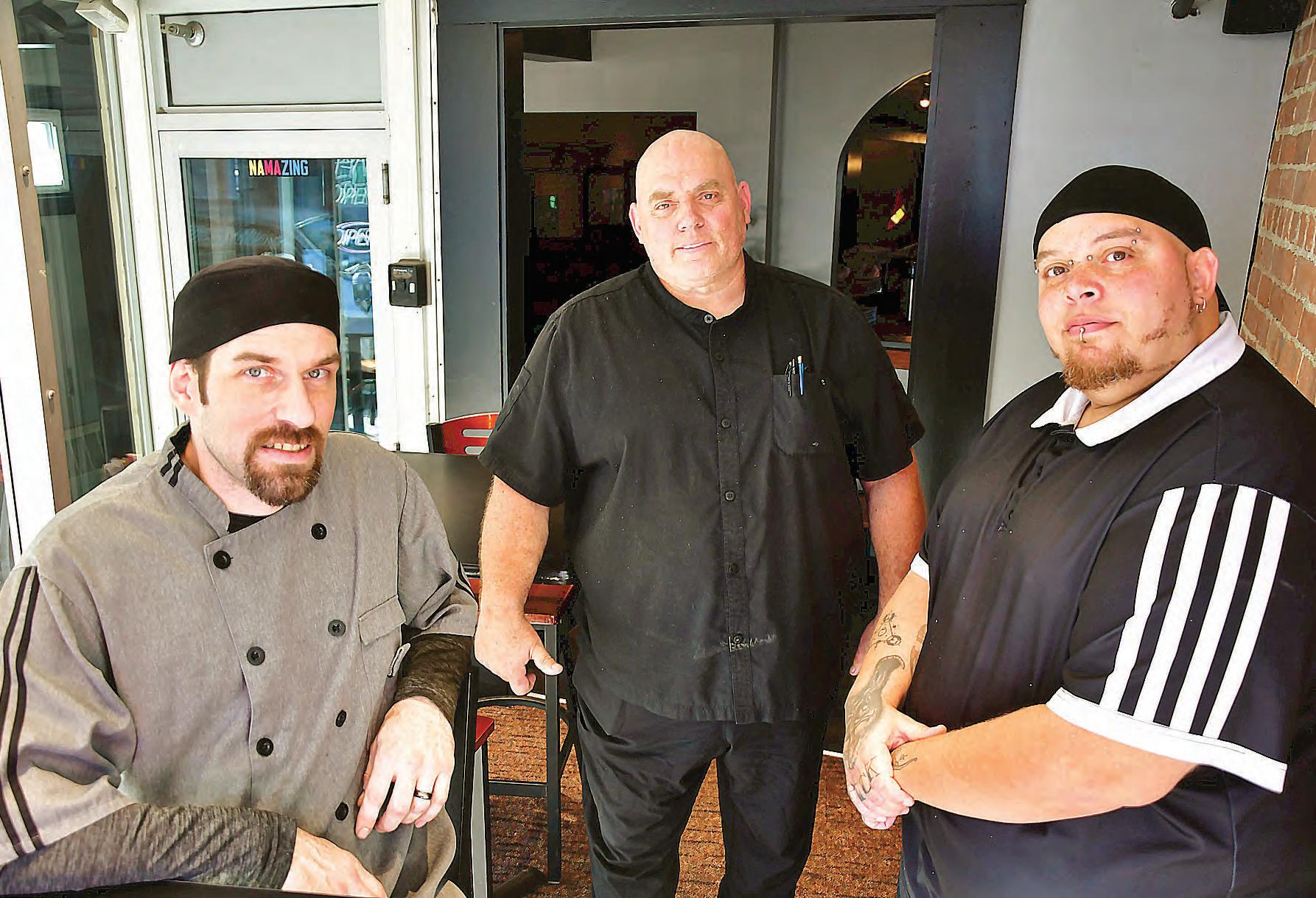
The multifaceted dining space is the brainchild of Bonnivier, a North County native who has appeared on Food Network’s “Beat Bobby Flay,” and runs Full Belly Food Truck. Segala opened Eagle Street Cafe, a breakfast and lunch spot, in November; Kelly was set to open Fewd, a bakery; and Radicci, a pop-up concept Bonnivier is helming, will feature different local chefs one or two weekends a month.
“I wanted to create a common space for everybody to have, where more people could be a part of something without having to pay expensive rent,” Bonnivier said. “I got with a couple other folks and collaborated with my landlord Yina Moore, and we said, ‘How can we better Eagle Street? What does this community need?’”
The newly minted proprietors are aware that staying in business in the Berkshires can be hard — Bonnivier referenced Firehouse Cafe’s recent closing in Adams. That’s a major reason why the three establishments will be housed together.
The business owners will each pay one-third of the $1,500-$2,000 rent, rather than the whole thing. Radicci will have different hours than Eagle Street Cafe, and Fewd will be connected to both as a dessert and pastry supplier.
Bonnivier said he was inspired by a month-long series of pop-ups at 90 Main, and recruited two chefs he respected in Segala and Kelly to make the rest of the vision come true.

There have been a lot of local inquiries to the businesses from people needing work, Bonnivier said, but they’re going to take time before ramping up hiring.
Years of traveling, and a desire to stay put, spending time with his grandkids and his wife, all played a role in Bonnivier’s commitment to the 23 Eagle Street property.
“I’ve been working on the road a
lot, so I’m excited to be home with my family now,” Bonnivier said. “This is about me coming home.”
Through it all, Bonnivier has remained a steadfast cheerleader for the city, noting its commitment, along with Moore’s, to success at the address.
Radicci, which is Italian for “roots,” is itself rooted in change — Italian one weekend, fried chicken
the next.
“One thing about the North Adams community, they like what they’re used to, but people at the same time like something new, and they venture to something when it’s new,” Bonnivier said. “I’ll throw my smoker out where they demolished the building next door, pop picnic tables over there, and we’ll have live music.”
By Jane K aufman
PITTSFIELD — As men accustomed to being outside and laboring for a living, Dave Mason and Jammie Sears decided they’d like to try something a little easier on their backs and knees.
In October, the two went to Florida to pick up the equipment to launch a business that will keep them outside, but won’t require nearly as much muscle power as, say, tree work, construction or landscaping — all ways they have earned their keep.
Now, they’re hoping that a propane-powered kettle, which pops oversized kernels of dried corn, will be a ticket to success.
Mason and Sears, operating as Patriot Pop, set up shop in front of Pittsfield’s Tractor Supply on Friday. Under a yellow canopy, the two were working with Alex Sears, Jammie Sears’ son.
The 180-quart propane-fired kettle pops mushroom corn in corn oil in less than five minutes. The popped corn is both fluffy and geometric, quite different from the home-popped type.
The entire setup, which they bought used in Florida, cost about $10,000, with entire business setup costing about $15,000 total. That doesn’t include the cost of a Chevy Silverado pickup truck with a 7-by-14-foot enclosed utility trailer they use to cart around the equipment. They already owned that.
They serve lemonade, locally sourced hot mulled cider and gourmet hot chocolate, for which they concocted their own recipe.
The business launched about a month ago at Cheshire Sporting Goods, which Sears owns. Since then, they’ve popped up

at a Cheshire craft fair, Canna Provisions in Lee, and this past Saturday at the North Adams American Legion. On Dec. 6, you can find them at the Lee Hop & Shop. They’ll be back at Tractor Supply Dec. 14 for a pet photo event.
How did this business come together?
“One, my wife loves kettle corn,” Mason said, referring to Jennifer Mason, whose name is also on the business.
He’s got a friend from high school who lives in South Carolina and has been at this business for 15 years or so. “He had been telling me to do it. It’s really good. It’s not as physically demanding as some of the work I’ve done.”
Mason joined the Army National Guard in 1992. He deployed to Tobyhanna Army Depot in Pennsylvania in 2002, and to Iraq in 2007 and 2008, providing personal security for VIPs throughout the city of Baghdad and beyond. For his service there, he earned the Combat Infantry Badge.
As a veteran-owned business, he hopes to help other veterans.
Another friend also told Mason it’s a solid business.
“There’s a whole community on Facebook that does this,” Mason said. “It’s just been awesome. Everyone’s so helpful. They’ll share recipes and some tricks.”
He said most of the recipes and quanti-

ties are tried and true.
“Some of it is a little bit of experimenting,” he said. “Some of the seasonings come from other veteran-owned companies that have well established seasonings and just playing with the amount and how strong we want it.”
On Friday, Patriot Pop rolled out an orangish cheddar jalapeno for the first time.
“It was perfect right off the bat, didn’t have to mess with anything,” Mason said. Patriot Pop sells exotic flavors in what they call kettle cups, quart containers with white chocolate and Oreos, for example.
“There are other people that do this,” he said. “We try to create different flavors to draw in more people.”
A pink-colored cherry apple isn’t selling as well.
“But everybody who’s bought it says, ‘Oh my goodness,’” Mason said. “My wife, that’s all she wants.”
While Mason and Sears produce kettle corn in batches on the spot, the popped corn will save — for two weeks on the shelf and for up to two months in the freezer, Mason said.
Mason said he expects the first year of this business will include smaller events and hopes to hit larger events in the second year.
Sears said working with Mason is going well.
“He’s a hard worker,” Sears said.
Alex Sears, who graduated from Westfield State University in 2023, said he enjoys working this business when he’s available.
“Funnily enough,” he said, “I have kind of an addiction to kettle corn.”


By Sten Spinella
ADAMS — Despite high hopes for Red’s Viking Pub when it opened early last year, the restaurant and bar says its run is over.
“Folks, Red’s is closing its doors effective immediately,” the business posted on its Facebook page. “Thank you to everyone that has become part of the regular crowd and for the support for the last few years.”
Just as there was a swell of support on social media for the establishment when it was opened by Bill Sweeney and Christin Fetterolf in late 2022, the disappointment, even devastation was palpable online after its closing.
Sweeney said that it ended up being too much work for them to shoulder, especially after he took a separate full-time job.
“We thought when I went back to work, Christin could do the payroll, ordering, and the place would be manageable,” Sweeney said. “But we went through 25 or more employees in less than three years. I’m not faulting anybody, but when people tell you running your own small business is a lot of work — it’s a lot of work.”
Fetterolf, nicknamed “Red” for her hair color, and her husband, Sweeney, bought the Viking Pub building at 83 Commercial St. on an October morning in 2022 and had it running under its new name by the afternoon: Red’s Viking Pub.
The couple originally opened the place because they wanted somewhere to play pool. It also became a way for Sweeney to put together a kitchen staff and flex
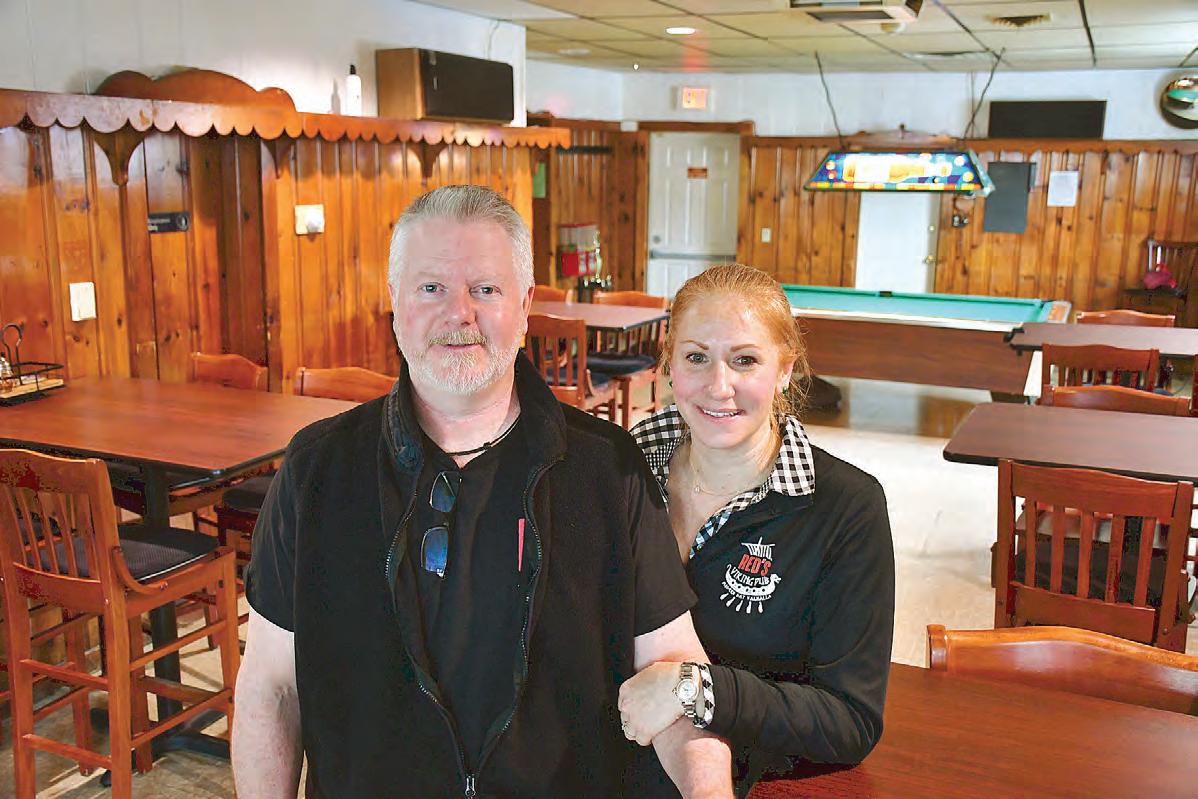
his culinary abilities. Fetterolf, who also had a hand in building the kitchen, ran the bar.
Sweeney said he and Fetterolf are grateful for the outpouring of well-wishes. The two transformed the space, cleaning and fixing everything up, redoing the kitchen and ceilings, bringing in
furniture and pool tables, and they still own the building and hope for someone to take over the bar or kitchen or both.
“We own the building, and have four apartments with nice tenants. We’re not leaving by any stretch,” Sweeney said. “I have a realtor who’s going to help us
look for someone to take it over, lease the kitchen, so we’re looking at all our options.”
Sweeney called it a turnkey operation, including pizza ovens, dishwashers, an extended bar, two taps.
True to the spirit of their opening, Red’s said on Facebook
that it will open the doors for local pool leagues to play for their current seasons.
“It’s not Adams,” Sweeney said of why Red’s is closing. “People bash on Adams a bit, but with the Glen and everything around that, there’s definitely something here.”
By Sten Spinella
NORTH ADAMS — Chef
and businessman
Matt Tatro has put Trés Niños Taqueria on the market and will soon move his other popular restaurant, Grazie, from its long-time home.
But don’t worry, Tatro says, it’s all good news.
“I’m really grateful and thankful for the time I had on Marshall Street, it holds a special spot in my heart,” Tatro said of where his Italian restaurant has been housed for nine years. “But things change; it’s simply business.”
Grazie will be moving to 310 State St. next year. Tatro is buying the building, currently an event space called The Venue, for $375,000. The restaurant will not be closing as the business slowly moves in to State Street; Tatro anticipates keeping Grazie running the first half of 2025 at Marshall Street.
Tatro’s other restaurant, Trés Niños, is officially for sale at $59,900.
Tatro caused a stir in March when he announced on Facebook that the Mexican restaurant was for sale. He later walked that sentiment back in an interview with The Eagle, but maintained that the possibility of a sale was “definitely something I’ve considered before.”
Marketed as a “turn-key taqueria,” Tatro says the eatery has been profitable for five years, has more than 20 seats inside and strong take-out sales.
He’s parting with Trés Niños largely because it’s cutting into time with his family, he said. He had initially started the business thinking he’d be mostly hands-off, but that hasn’t been the case.
As for Grazie, Tatro said it became apparent that buying property, rather than renting as he had been doing, and giving Grazie a “forever home,” as he put it, would be advantageous.
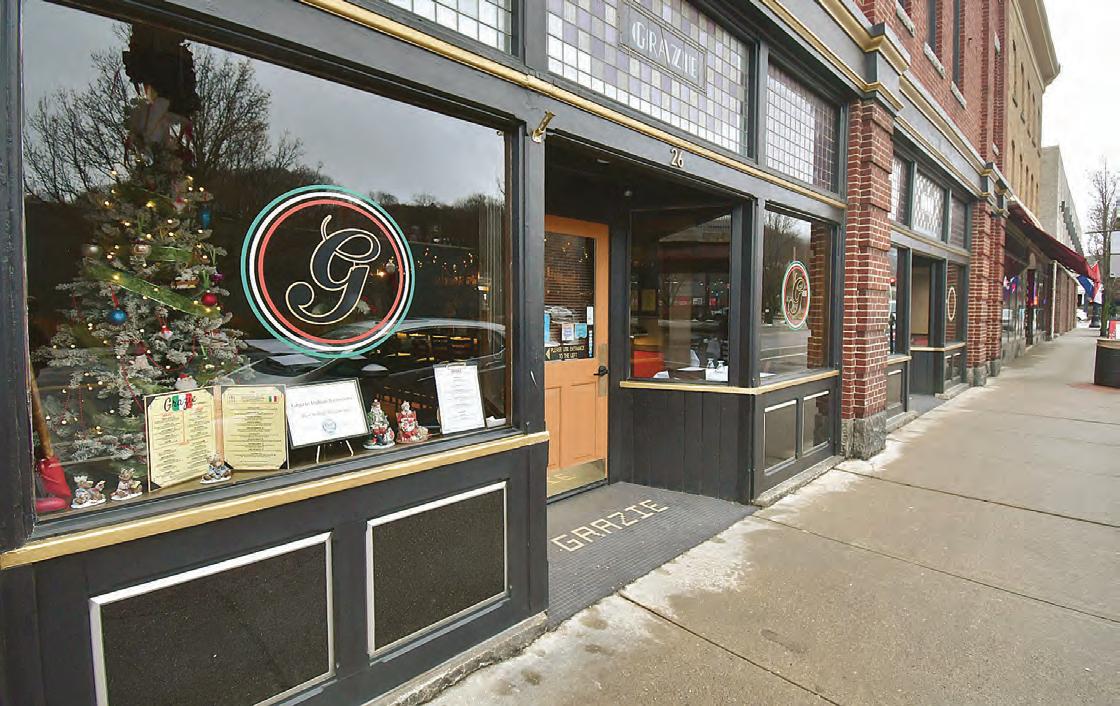
The restaurant’s new home on State Street was previously owned by Tom Rumbolt and Jason Nocher, who bought it last March for $255,000, according to city property records.
Rumbolt is Tatro’s former baseball coach and current lawyer. That connection ties into Tatro’s belief in the importance of “native investment” —
he credits local developer Dave Moresi for his work originally going in on and co-owning Grazie. And Tatro recalls how he, Rumbolt and Nocher were on the verge of buying the former Hot Dog Ranch building at 310 State St. a few years ago, before an employee’s personal circumstance forced Tatro to “pump the brakes.”
“Things have come back full circle,” Tatro said. “I’ve worked at a lot of restaurants, but I’ve never worked at a place with this camaraderie and family-type feel. That was reflected in the feedback from people online: We’re a local, family restaurant.”
Sten Spinella can be reached at sspinella@ berkshireeagle.com or 860-853-0085.
One of the oldest and most-trusted rules of investing is to get more conservative as you age. The thinking goes that the typical investor ought to reduce exposure to stocks, which are more volatile and therefore considered riskier, as they get older.

They would then allocate a greater percentage of the portfolio toward cash and bonds, which offer a lower historical return but have been less volatile and are considered less risky.
Age-based “target-date” funds follow this pattern. These funds typically offer investors a target retirement year. When you are younger and the target date is far in the future, these funds allocate primarily toward stocks. As the target date gets nearer, target date funds start to put more in bonds and less in stocks.
For example, the Vanguard Target Retirement 2055 Fund currently holds 90 percent in stocks versus just 10 percent in bonds, whereas the Vanguard Target 2025 Retirement Fund holds just 51 percent in stocks versus 49 percent in bonds. This is seemingly rational, and most people follow some version of this rule of thumb.
The problem is that our financial circumstances did
not come out of a mold. A cookie-cutter investment plan might work if you are financially “normal,” but what does that mean?
Everyone has a different situation, with various goals and capacity for risk-taking in a portfolio. What works in academic literature does not necessarily apply to you or me.
I explored this topic years ago when I was writing academic articles on spending in retirement. Every article I came across in my research used an example retiree with a $1 million portfolio. At the same time, I was preparing a financial plan for a single woman with a teacher’s pension from Vermont.
Her pension plus Social Security benefits were enough to cover her living expenses and then some. She had far less than $1 million saved in her 403(b) plan, but she also was not reliant on that nest egg for regular expenses. The academic starting point seemed irrelevant, and so did the standard investment rules of thumb.
For this retiree, we devised a portfolio strategy that set aside one sum of money for emergency expenses, another bucket for required minimum distributions, and the rest of
the portfolio was structured for longer-term growth. Even though she was in her late 60s, this meant that the portfolio ended up with more in stocks than the traditional rules of thumb would suggest.
Because she spends little from the portfolio each year, she has been growing the value over time. This gives her options. She has more money if she requires expensive long-term care. She also has the option to now increase her spending because her portfolio has grown.
Was this approach “risky”? In terms of potential volatility, the answer is yes. But in terms of planning for her needs and possible future outcomes, it may have reduced the risk that she depletes her portfolio with expensive long-term care. There are many kinds of risk in the world, and volatility is only one measure.
To be perfectly honest, it has taken many years of practice as a financial planner to realize when to avoid these kinds of rules of thumb. It’s easy as a financial advisor to plop anyone in their 60s into a moderate portfolio and nobody is likely to complain. As I have evolved, however, I try hard to understand the spending needs and long-term objectives before setting a default portfolio.
A preferable strategy, in my opinion, is to “bucket” investments into short and medium-term needs, and longer-term objectives. Keep spending needs in cash, money markets, CDs, and short-term bonds for safety. This could be anywhere from one to seven years’ worth of spending needs depending on your age and tolerance for risk. The rest of the portfolio might be better structured for growth with a higher allocation to stocks.
If you’re risk averse, this might still be a moderate portfolio. But for many people, this may mean a much higher allocation to stocks for this longer-term bucket. Many people in their 60s have become accustomed to the gyrations of the stock market and are willing to tolerate these fluctuations for long-term gain.
This bucketing strategy may end up resulting in a 60/40 portfolio, or it may not. It depends entirely on your spending needs, risk tolerance, and long-term goals. This kind of asset allocation requires more nuance and understanding of your financial plan than a simple model portfolio. You could do a lot worse than a simple 60/40 portfolio, but it may or may not be perfectly targeted to your circumstances.
In many cases, a bucketing
strategy may also result in a portfolio that gets more aggressive as you get older. If the portfolio value increases faster than spending, which has been happening for many people as the stock market rises, a larger relative share of the portfolio will be in the long-term bucket.
The overall portfolio may therefore get more aggressive. Several in the academic field of financial planning have argued for this so-called “rising equity” glide path, meaning that exposure to stock increases as you get older.
Regardless of what the academics say, there will never be a one-size-fits-all investment rule of thumb that is perfect for everyone. I believe the best way to approach your investment portfolio is to first have a solid grasp of your own short-term spending goals, longer-term financial objectives, and risk tolerance.
This solid foundation of a financial plan will help guide you toward a well-intentioned investment portfolio, not just the 60/40 portfolio or agebased strategies that too many people use as a default.
Luke Delorme is director of financial planning at Tableaux Wealth in Stockbridge.

By A my SoSne
When we think of education, we think of students sitting at desks beginning as early as first grade. Students attend elementary school, middle school, and go off to high school.
Outside of the classroom, students may be encouraged to join clubs, activities, sports, and to participate and be part of something, but this time is on top of academics.
Students feel pressured to be part of something, to be effective doers and motivators in a community for a variety of reasons; a resume for a college application, a topic for a personal essay, and just to feel a sense of self-efficacy, confidence and belonging within a community.
All too often, this pattern follows students to college. In colleges that are rooted in providing a diverse, liberal arts education, students enter as first years and immediately think about their next path. They often don’t feel capable or have the skills to immerse themselves in a profession.
Many apply for fellowships with their robust resumes of extracurriculars and strong transcripts, with the plan to attend a graduate school, which may finally land them in a profession. This pathway is long, arduous, expensive, and often not desired, practical or realistic for young individuals in today’s society.
Now, more than ever, it is imperative to respect the enormous changes in our economy, society, and within our communities as we educate our students from elementary school all the way up to high school and beyond. Learning answers in textbooks or on videos played on the smart board, taking obsolete standardized tests, and failing to lean into community resources surrounding us, may not be the best way to proceed in education. Of course, we all understand the challenges of trying to shift a whole curriculum and way of learning that has been embedded in our society since tiny little schoolhouses.
Let’s be honest, we spent nearly a year using technology to teach our students during the COVID-19 pandemic. We developed and were forced to innovate and navigate different platforms for learning and tools to engage our students from outside the classroom.
We cannot go back to the classrooms and pretend that this innovation and interconnectedness does not exist. Instead, we need to use these tools and lessons to provide more accessible resources, partnerships and innovative teaching methods into all our schools.

but students also need to practice their learned skills in the real world so that they leave college having learned how to interact, ask the right questions, and use collaborative resources.
Our local children need the same skills and need to start practicing them at an early age. Luckily, we live in a community ripe with intellect and opportunity, we just need to continue to find ways to connect all our resources.
How students think and perceive themselves as members of a community starts at a young age. In our rural community — struggling with an opioid crisis and staff shortages at schools and health care institutions — it is imperative that we use our resources to empower our youth to believe that they can impact the world they live in and that they can graduate from school and go into occupations of their choosing.
The program has been a perfect example of a collaboration that pools skills and resources to positively impact students across the board.
This fall, thanks to a grant from the Williams College TIDE Program (Toward Inclusion and Diversity and Equity) and funding from North Adams Public Schools’ 21st century program, along with support from the Berkshire Innovation Center, we — myself and some of my college students — initiated a new afterschool Robotics Club at Colegrove Elementary School.
The program has been a perfect example of a collaboration that pools skills and resources to positively impact students across the board. It also shows just how ripe Berkshire County is with opportunities to engage students in STEAM education, which is foundational to the future of education.
Williams College students want to be active participants on campus, but also in the communities that surround our campus. College can no longer be limited to textbooks, classrooms, learning answers, writing research papers, problem sets, and traditional final exams. Students in college need the skills to interact with different populations and to learn how to create and impact and make a difference within communities. Foundational knowledge from the expertise of professors is important,
Oct. 21 marked Day 1 of the new afterschool Robotics Club at Colegrove. The energy amongst the 15 elementary students, the four Williams College students, the coordinators from the North Adams Public Schools and the BIC has been nothing but magical.
“Do we get to do this every week,” exclaimed one student the first week the club met. “It works; it’s dancing,” another student shouted after programming the robot they built together.
In this club, there are no barriers to learning, there is no judgment, there is just a team commitment to building Lego obstacles, robots, programming and learning, as well as a strong mentor/ mentee relationship that has developed with the college students, the BIC, and North Adams afterschool team.
There is a unity that defines the future of teaching, learning, collaborating and maximizing community interconnectivity to allow all individuals and communities to reach their full potential. The footprint of programs such as the Robotics Club at Colegrove, with multiple partners collaborating, is a fantastic model what the future of STEAM education and innovating learning can look like.
This year, there are over 30 teams from across the county participating in the Berkshire Innovation Center’s Berkshire Robotics Challenge, including our two teams from Colegrove Elementary, the first teams from North Adams in as long as anyone at the school can remember.
The season culminates with a countywide competition at Wahconah High School in March. The robotics clubs are a great example of interactive, project-based learning that teaches self-efficacy, interpersonal skills, and teamwork.
Students learn facts, but more impor-
tantly they learn to ask questions, find answers, and flex their curiosity. These are building blocks that lay a foundation for success for students of all grades — elementary through college.
Amy Sosne is assistant director for North Adams Elementary Outreach, Center for Learning in Action at Williams College.



No matter your politics, we can all agree that in 2025 our country is in for significant change. The impact on the nonprofit sector likely will be tremendous.
With drastic ideas and strategies, such as creation of DOGE to eliminate one-third of the federal budget and Project 2025, to name just two, changes to our federal government these next four years may impact every nonprofit subsector.
see ahead, your strategy is old news. Time for an update.
• Scenario planning. If you haven’t already, begin scenario planning with your staff and board. Identifying trends, events, and issues along with the impact on your organization is a great place to start, allowing glimpses into the future and flexinb your team’s creativity muscle.
We know from previous crises and political shifts that revenue fluctuation, demand from your clients, staff burnout, and donor fatigue are just some of the threats ahead.
You need a game plan.
Now is the time to create your strategy despite the uncertainty.
When you’re driving in your car and you see a problem in the road ahead, you don’t just let go of your steering and coast into it, right? No! You find a better route.
Here are a dozen areas to get you started with that route change. As you consider these ideas, stay grounded in your vision, 2024 accomplishments, and momentum ahead.
STRATEGY
No matter what year of your strategy you’re in, unless your organization anticipated all the shifts and changes we
• Future-focused strategy. Use your scenario planning to define your preferred future and the strategy to get there.
• All hands on deck. Include your board in these efforts. During the pandemic, a common refrain I heard from nonprofit CEOs was that board members had no idea how difficult life had become. Get a head start on that education process.
Trust in our institutions — particularly the media and government — is low. Regard for businesses and NGOs is better, but it’s time to step it up to counter misinformation and disinformation.
Your organization needs a more rigorous communications plan so that multiple audiences understand the issues, your role in solving them, and the systemic impact.
• Advocacy: Alliance and strategy.
Create advocacy strategies now, including through forming alliances with like organizations to have a greater impact.
• Engage your legislators. Members of Congress at state and federal levels simply do not know your work like you do. Connect dots for them so they understand how issues and legislation impact your — and their — community.
• Media engagement and letters to the editor. Engage reporters at local, regional, and statewide news outlets and don’t forget to write letters to the editor. Help people understand the issues and your expertise.
• Inform your community. You are probably already doing a great job here with social media and e-newsletters. However, there are always improvements you can make, such as providing stronger context for the issues, sharing stories, staying focused on key messages, and making your points explicit.
Start poking around at your revenue; where might your organization have risk? What funding stream could be hit? How could a recession impact your work? If deportations begin, would your industry be in trouble?
• A whole lot of creativity. Shoring up reliable forms of revenue, particularly those that generate surpluses, should be your priority. Getting creative with the drivers of these revenue forms, such as relationship building, market-
ing, and new offerings and revenue sources that fit your business model, will power you forward.
• Build your financial reserves. If something goes haywire with revenue sources you count on, you need to continue to function and serve your community.
• Better budgeting. Use your scenario planning to create budget scenarios.
THE HUMAN SIDE
• Take care of yourself. Your staff, board, and communities are counting on you. Nonprofit burnout rates are high, up to 95 percent! Prioritize your health and wellness as you lead.
• Buckle up. It’s likely to be a long four years. Maybe longer. Being agile, creative, and resilient will be your and your staff’s best supports.
If you were in the workforce during the Great Recession and the COVID-19 pandemic, you have experience with two national emergencies. You have capabilities that you can tap into. Here’s hoping that the next four years are smooth-sailing and that this game plan is unnecessary. However, better to be overprepared than sideswiped.
Gail Bower is the founder and president of Bower & Co. Consulting LLC, a revenue strategy firm that helps nonprofits become self-sufficient by developing reliable sources of earned revenue. To learn more, visit GailBower.com.
As we step into 2025, the familiar mantra of “New Year, New You” takes hold. For many, this is a time to reset, refocus, and embrace habits that prioritize wellness and self-care. Cannabis can play a meaningful role in this journey, whether you’re a seasoned enthusiast or someone curious about how it fits into a wellness-focused lifestyle. The new year offers an opportunity to explore its benefits and incorporate it into your self-care routine. And starting out your new year, recovery. Recovery as in your first few days of post-NYE festivities (which, by the way, you can now lean on the rise of THC-dosed beverages over alcohol as a completely accessible option now), right though to the kind you’re in the first few weeks of physical activity and exercise when muscles ache and joints creak. That’s when the need to not get discouraged and careening off that early track leading one to healthier habits is at its greatest, and where cannabis in its various forms, particularly topicals and fast-onset products, is at the ready for you.
CANNABIS AND WELLNESS: A NATURAL FIT
Cannabis has long been associated with wellness, offering benefits that range from relaxation and stress relief to aiding with sleep, inflammation, and pain management. Products such as tinctures, topicals and edibles provide diverse ways to experience these benefits, catering to individual preferences and needs.
For example, incorporating a CBDrich tincture into your daily regimen can be an easy and nonintimidating way to support balance and calm. THC-infused topicals, often made with a base like coconut oil, are another option for localized relief and relaxation — perfect for those looking to ease sore muscles or unwind

Products such as tinctures, topicals and edibles, such as these THC gummies being removed from a mold, provide diverse ways to experience these benefits, catering to individual preferences and needs.
When you shop locally, you’re not just purchasing a product — you’re investing in businesses that care about your wellness journey.
after a stressful day. With cannabis, wellness can be as simple as finding what works best for you and your goals.
DIY CANNABIS FOR WELLNESS
One of the most empowering aspects of cannabis is its versatility. For those who enjoy a hands-on approach to their self-care, making DIY cannabis products at home can be both fulfilling and cost-effective. With the right products from your local dispensary, creating infused items such as oils, balms, or even bath
soaks is easier than you might think. Start with a high-quality tincture and mix it with coconut oil to create an at-home topical that suits your needs. These can be customized with essential oils like lavender or eucalyptus for added therapeutic effects. Many consumers are surprised at how simple it is to make these wellness products — and how rewarding it feels to create something tailored specifically for their needs.
SUPPORTING LOCAL CANNABIS BUSINESSES: A WELLNESS ACT IN ITSELF
Choosing local cannabis businesses that prioritize education, quality, and community engagement is another way to practice self-care. When you shop locally, you’re not just purchasing a product — you’re investing in businesses that care about your wellness journey.
At Canna Provisions, we believe that offering experiential events and
educational opportunities is essential to empowering our community. Whether it’s understanding how to microdose for stress management or discovering the benefits of new products, the goal is to support unique needs while building a culture of informed, confident consumers.
SELF-CARE AS A TWO-WAY
Self-care isn’t only about what we do for ourselves; it’s also about the choices we make in the products and businesses we support. In 2025, cannabis businesses — like all industries — should focus on listening to their customers and adapting to their needs. This means not only providing top-notch products but also creating environments where people feel welcome to learn, explore, and grow their understanding of cannabis.
For local consumers, choosing businesses that prioritize education and engagement ensures you’re getting more than just a product — you’re gaining a partner in your wellness journey.
STARTING THE NEW YEAR RIGHT
The start of a new year is an invitation to reflect and recalibrate. It’s a chance to set intentions for a healthier, more balanced lifestyle. By incorporating cannabis into your wellness routine, you’re opening the door to a variety of benefits that can help you feel your best — physically, mentally and emotionally.
And remember, self-care extends beyond the products you use. It’s about building a supportive community, choosing businesses that align with your values, and taking the time to educate yourself about what works best for you. The goal is to make this journey as fulfilling and sustainable as possible.
As 2025 unfolds, let’s embrace the “New Year, New You” spirit with open minds and a commitment to self-care. Together, we can make this year a transformative one — for ourselves and for our community.
Meg Sanders is CEO of Canna Provisions.
The start of a new year is a time when many business owners lock in their plans for growth and expansion. Key to the success of many of those plans is funding.
The right funding source offers access to the desired capital while allowing owners to maintain control of their business with minimal conditions or strings attached.

A popular choice for startups and creative projects — particularly those in tech, gaming and design — crowdfunding lets business owners raise small amounts of money from a large number of consumers.
Today’s business owner has more funding options than ever. Of course, not every option is right for every business. Factors, including the stage of your business’s life, industry, the scale of your growth plans, available assets and the useful life of the asset you are purchasing. All of these factors will impact what you qualify for and what makes the best fiscal sense for you.
Here are some of the most popular funding options.
For businesses with a solid financial history, a comprehensive business plan, and the ability to demonstrate their ability to repay, bank loans continue to be a solid option.
While the process to secure a bank loan can be lengthy when compared to other options, they offer relatively low interest rates, predictable repayment terms, and a reliable source of capital.
Built on platforms like Kickstarter, Indiegogo, GoFundMe, and Patreon, crowdfunding involves setting a fundraising goal and developing a campaign that makes a compelling case for why your business deserves funding. It’s up to you to then promote the campaign via social media.
If you decide to pursue this route, it’s important to consider the platform options carefully, as some offer more flexibility than others (e.g., allowing you to keep what you raise even if you don’t hit your funding target).
In addition to providing access to significant amounts of capital to fund a launch or growth, venture capital can support a business in other important ways. For example, venture capitalists often bring decades of industry-specific experience to the table and provide opportunities for networking and exposure. As a business grows, they can also tap their network to bring the right talent to the team. Plus, their funding
structure doesn’t require monthly payments.
While these advantages are enticing, you’re often required to give up equity and/or some degree of control of your business.
For businesses that don’t qualify for traditional bank loans, microloans can be a viable alternative.
Offered through the U.S. Small Business Administration and a number of specialty lenders, these types of loans make it possible for entrepreneurs without a demonstrated record of success to launch or expand their business.
Microloans typically have competitive interest rates and longer repayment terms compared to other alternative financing options and may provide some flexibility in terms of how the funds can be used (e.g., payroll, inventory, supplies, etc.).
On the downside, most microloans are capped at $50,000; they cannot be used to pay down or restructure debt or to purchase real estate. In addition, the timeframe for distributing funds may be as long as 60 to 90 days.
In many cases, some microloan lenders require the applicant to put up some form of collateral or personal guarantee. If you’re unable to repay the loan, you may lose your asset.
Government grants for small businesses are financial awards provided by federal, state or local governments to support specific business activities or initiatives. Unlike all other forms of funding discussed so far, small-business grants do not typically need to be paid back.
Not surprisingly, grants are highly competitive. While there are thousands available, the application process can be challenging and time-consuming. In addition, there may be restrictions on how funds can be used, and some include reporting obligations.
Recipients who fail to use the funds as designed or to comply with required reporting may have to repay the grant, possibly with interest.
To learn more about government grants, visit grants.gov.
Regardless of how much money you need or the scale of your plans, securing funding is about more than gaining access to cash in the moment.
It’s about positioning your business for long-term success. The right funding source will address your financial needs today while ensuring a sustainable and successful financial structure for tomorrow and beyond.
J. Jay Anderson is president and CEO of Pittsfield Cooperative Bank (Co-op Bank).
The U.S. housing market is shaping up for a notable rebound in 2025, according to economists at the National Association of Realtors.
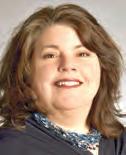
During the recent Real Estate Forecast Summit I attended, experts highlighted key trends that suggest stronger home sales, stabilizing mortgage rates, and a growing inventory of homes for sale. These developments are expected to create better opportunities for homebuyers after two years of subdued market activity.
“Homebuyers will have more success next year,” said Lawrence Yun, NAR’s chief economist. “The worst of the affordability challenges are over as more inventory, stable mortgage rates, and continued job and income growth pave the way for more Americans to achieve homeownership.”
HOME SALES AND MARKET TRENDS
NAR predicts that existing-home sales will climb by 7 percent to 12 percent in 2025, with further growth of 10 percent to 15 percent anticipated in 2026. Sales of new homes are also expected to rise, increasing by 11 percent in 2025 and 8 percent the following year. After hitting a 15-year low during the summer of 2024, these projections signal a turning point for the market.
A critical factor driving this rebound is the anticipated stabilization of mortgage rates. Economists forecast that rates will hover near 6 percent throughout 2025, offering significant relief compared to the 7 percent-plus rates seen in 2024. According to NAR’s research, a drop to 6 percent could make homeownership more attainable for an additional 6.2 million buyers. Already, there are signs of renewed activity. This fall, sales began to pick up as mortgage rates eased slightly, an encouraging development that economists believe will carry into the spring of 2025. “All the factors are lining up,”
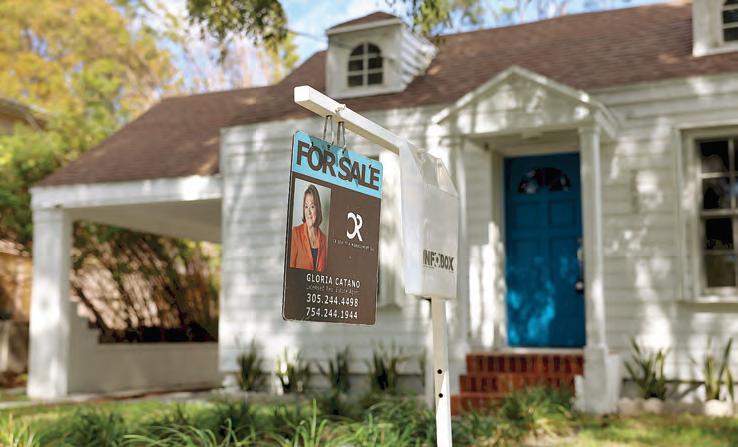
said Michael Frantantoni, chief economist at the Mortgage Bankers Association. “The increase in inventory will be especially important.”
Housing inventory is expected to expand meaningfully in 2025. Listings rose by 20 percent year-over-year in October, and this upward trend is likely to continue as more homeowners are motivated to sell. Stabilizing mortgage rates, along with a more balanced market, are key factors encouraging sellers to re-enter the market.
New home construction will also play a major role nationally. Builders are projected to reach the historical average of 1.5 million new units annually over the next two years, helping to ease inventory shortages. Much of this activity is concentrated in the South, where construction in exurban and outer suburban areas has surged. Builders are also offering incentives such as mortgage rate buydowns and upgraded amenities to attract buyers.
Additionally, the construction of townhomes and other affordable housing options has increased, providing more opportunities for first-time buyers.
“Any frustrated buyer unable to find what they need on the resale market should explore new homes,” said Robert Dietz, chief economist at the National Association of Home Builders.
Pro-growth Massachusetts housing legislation is also underway to help ease inventory issues in our state. With new accessory dwelling unit regulations expected in February 2025, we look forward to new options for additional housing units. We can also expect movement from the Affordable Homes Act signed into law in August 2024, authorizing $5.16 billion in funding over five years and the nearly 50 policy initiatives designed to address housing affordability and supply shortages.
The so-called lock-in effect, where homeowners with ultra-low mortgage rates hesitate to sell, is expected to
diminish in 2025. Realtor.com data indicates that the share of homeowners with mortgage rates below 6 percent will drop from 84 percent to 75 percent by year-end, as life events like growing families and job changes prompt moves.
“Repeat buyers will play a bigger role in the market,” Frantantoni said, adding that many will use their home equity to fund new purchases. First-time buyers, however, are likely to continue facing affordability challenges, though increased inventory and moderating home prices could offer some relief.
Home prices are expected to rise modestly — by 2 percent in both 2025 and 2026 — reaching a median of $410,700 next year. This slower pace of appreciation reflects a more-balanced market, which is good news for buyers and sellers alike.
Meanwhile, homeowners are benefiting from record-high equity levels, which have significantly boosted their net worth compared to renters. According to Yun, about one-third of repeat buyers are paying cash for their next home, a trend contributing to the 26 percent share of all-cash sales in 2024.
With stabilizing mortgage rates, increased inventory, and continued job growth, the housing market is on track for a healthier balance in 2025. “A housing market that is better balanced works better for everyone,” said Danielle Hale, chief economist at realtor. com.
While first-time buyers may still face hurdles, the overall outlook for 2025 is positive, with more opportunities for buyers and sellers to achieve their goals. After years of uncertainty, the housing market appears ready to turn a corner and head toward sustained growth.
ADAMS
Walter D. Lesure sold property at 121 East Hoosac St., Adams, to Dylan J. Chaffee, $175,000.
Tom Wnuk, personal rep. of Walter Wnuk Jr., sold property at 125 East Road, Adams, to Berkshire Family and Individual Resources Inc., $340,000.
Amy E. Krutiak sold property at 65 East Mountain Road, Adams, to James A. and Laura A. Delmolino, $359,900.
Pamela J. Lillie sold property at 12 Simon Ave., Adams, to Ashley Sexton, $268,000.
Thomas N. and Cynthia A. Bishop Tinney sold property at 100 Walling Road, Adams, to Deborah G. Grace, trustee of the Deborah G. Grace RVT, $895,000.
Joan B. Pause sold property at 28 Meadow St., Adams, to Henry E. Klein, $150,000.
Faith Kruszyna sold property at 242 Columbia St., Adams, to James Anthony Rancourt and Jodi Elizabeth Gyurasz, 242 Columbia St., Adams, $196,000.
Terry J. Rougeau, attorney in fact for Joan Dubis, sold property at 30 Anthony St., Adams, to Caleb M. Cimini, $201,000.
Heidi H. Bailey sold property at 3-5 Marsh Lane, Adams, to Yinhai Zhao and Xiaoqian Gong, $45,000.
Jesse Cook-Dubin, trustee of Palomeda RT, sold property at 399 Old Columbia St., Adams, to Holland Company Inc., $60,000.
Sharyn and Heidi Alibozek, personal reps. of Doris C. Alibozek, sold property at East Mountain Road, Adams, to Mountain Stream LLC, $197,000.
Michael R. and Darlene A. Lapierre sold property at 28 Morningside Ave., Adams, to Gina G. Fraser and John F. McAuliffe, $359,900.
BECKET
Susan L. Deacon sold property at 42 Beaver Brook Road, Becket, to Adam M. and Kara A. Baldwin, $38,500.
Marina Shimshi sold property at Skyline Ridge, Becket, to Jason Brady, $42,500.
James B. Murphy sold property at 119 Johnson Road, Becket, to Vicki M. Cookson, $305,000.
Jeffrey R. and Marianne Berke sold property at Sherwood Drive, Becket, to Brittany Bonyeau and Scott Vogus, $32,500.
Barry, Simon and Karen Landsman sold property at 32 Hayscent Drive, Becket, to Evan Kenward and Kerry Dyer, $489,000.
Robert N. Lowell, trustee, 1242 Main Street RT, sold property at 1242 Main St., Becket, to Debra A. Cranwell, trustee, Debra A. Cranwell RVT, $325,000.
Joseph Edward Kuras sold property at 71 Beach Road, Becket, to Elizabeth M. Allured, $200,000.
Black Bear Holdings II LLC sold property at 180 Long Bow Lane East, Becket, to Courtney Marie and Patrick Chase Dragoon, $685,000.
U.S. Bank NA, trustee, and Kathy T. Ragusa sold property at 293 Quarry Road, Becket, to U.S. Bank Trust Co, NA, trustee, $91,803. Town of Becket sold property at Long Bow Lane East, Becket, to Thomas W. Rumbolt, trustee of Niridium NT, $2,500.
CHESHIRE
Betty A. Baumert sold property at 116 Wells Road, Cheshire, to Roberto M. Quintos, $239,000.
David S. Phelps and Paula J. Paradise sold property at 74 Furnace Hill, Cheshire, to Cassie L. Scott, $270,000.
Nolan M. and Katie Brassard sold property at 145 Furnace Hill Road, Cheshire, to Keith Manning and Katie Kujala, $460,000.
Mary J. LaForest, personal rep. of Kirt Charles LaForest, sold property at 222 Brough Road, Cheshire, to Terry G. Beer and Diana L. Knaebe, $549,900.
Matthew R. and Marissa L. Kirchner sold property at 147 & 152 Richmond St., Cheshire, to Nicole and Colin Elliott, $535,000.
Arthur W. Gordan, trustee of the Rita E. Gordon 2014 Irrevocable Trust, sold property at 147 Railroad St., Cheshire, to Seth Ivas, $189,900.
Robert M. and Kathleen A. Mazzeo sold property at 107 Yorkshire Drive, Cheshire, to Angelia M. Elser, $300,000.
CLARKSBURG
Paul O. Cote and Jennifer Cote Nance, trustees of the Carole F. Cote Revocable FT, sold property at 485 North Houghton St., Clarksburg, to Michael R. and Darlene A. Lapierre, $440,000.
Hunter and Kamaree Saldo Wick sold property at 738 River Road, Clarksburg, to Ellies Holdings LLC, $145,000.
Joyce M. White sold property at 27 Pine St., Dalton, to Emily E. Cowan, $167,500.
Magerick LLC, Louis A. and Elena Piccone sold property at 519 Kirchner Road, Dalton, to Magerick LLC, $727,504.27.
Doris M. Gingras sold property at 141 Hale St. Extension, Dalton, to Madeline McCain and Perry Burdick, $334,000.
Robert A. and Summer Ostellino sold property at 290 Old Windsor Road, Dalton, to Kevin L. Herkelman and Katherine M. Perney, $465,000.
Donald J. and Tammy L. Wright sold property at 60 Tilda Hill Road, Florida, to Scott R. Smith, $340,000.
PAH Properties LLC sold property at 53 Tilda Hill Road, Florida, to Courtney Cross, $323,000.
Carrie and Michael P. Laird sold property at 327 River Road, Florida, to Robert Carl and Melissa Jillian Curtain, $716,500.
GREAT BARRINGTON
Matthew J. Merritt III sold property at 9 Railroad Ave., Great Barrington, to Lindy Marcel, $85,000.
Beech Tree Apartments LLC sold property at 24 Silver St., Great Barrington, to Beech Tree Residences LLC, $8,000,000.
Kathleen A. Shields sold property at 8 Abbey Hill Drive, Great Barrington, to Andrew L. Turell and Kaeleigh McCone, $515,000.
Cinbad LLC sold property at 16 Woodland Hill Road, Great Barrington, to Gregory Seidell and Devon Seidell, $1,022,250.
COP LLC sold property at Lake Buel Road and 93 Lake Buel Road, Great Barrington; Northwest Cove and 25 Deerwood Park Drive, Monterey; and 170 Deerwood Park Drive, New Marlborough, to Buel Lake Associates LLC, $2,000,000.
Nathaniel S. Gopen and Lucas R. Merchant sold property at Castle Lane, Great Barrington, to Nathaniel Gopen, $10,000.
Nathaniel S. Gopen and Lucas R. Merchant sold property at 18 Castle Lane, Great Barrington, to Christopher M. Prindle and Anne S. Walsh, $820,000.
HANCOCK
Kenneth L. Packer and Margaret M. Haemer sold property at 37 Corey Road, Unit 626, Hancock, to Howard Greenspan, $130,000.
Susan F. and Richard D. Clairmont sold property at 420 Brodie Mountain Road, Hancock, to Jamie and Colin Downey, $445,000.
HINSDALE
Paige M. and Joaquin R. Rosier sold property at 97 George Schnopp Road, Hinsdale, to Chad N. and Morgan T. Civello, $645,000.
Rosemarie Robert sold property at Clovis Road, Hinsdale, to Alyson Voltoline, $61,000.
Alan O. and Tracey Lussier sold property at 106-108 Main St., Hinsdale, to MaKenna Brewer, $205,000.
Steven Bernard Goldstein and Carol Bonnie Marmor sold property at 160 Pine Cone Lane, Hinsdale, to Charles J. and Suzanne L. Newman, $455,000.
LANESBOROUGH
Christopher H. Covington sold property at 0 Kessler Road, Lanesborough, to Shelly A. Icardi, $160,000.
Edward Vella Jr. sold property at 20 Swamp Road, Lanesborough, to Jonathan E. Vella, $320,000.
U.S. Bank, National Association, as trustee, sold property at 33 Iroquois St., Lanesborough, to Scott Graves and Michael McCormick, $120,750.
Stephen R. and Amy L. Perry Mercier sold property at 30 Balance Rock Road, Lanesborough, to Aahudgee Greene, $331,500.
Andrew C. and Lauri J. Byrnes sold property at 7 Olsen Road, Lanesborough, to Stephen R. and Amy L. Perry Mercier, $590,000.
Kyle and Dawn E. Ford sold property at 289 Chanterwood Road, Lee, to Christopher Putnam and Arlene Vallon, $596,250.
Laura Rueli sold property at 125 Mountain View Terrace, Lee, to Holly Jones, $482,000.
Debra A. Cranwell, trustee, Debra A. Cranwell RVT, sold property at 160 Paul Drive, Lee, to Nina and Martin Antonetti, $530,000.
Edward C. Abderhalden Jr., personal rep. of the Estate of Jean Marie Abderhalden, sold property at 360 East St., Lee, to 360 East St. LLC, $430,000.
Robert and Margaret A. Wellspeak sold property at 1500 Pleasant St., Lee, to Ronald R. Ringo Jr. and Shirley M. Ringo, $269,000.
Wilmington Savings Fund Society, FSB, trustee, sold property at 169 East Dugway Road, Lee, to Teva Salem Smith, $276,000.
865 Fairview LLC sold property at 825 Fairview St., Lee, to Jonathan M. and Carrie R. Hornbeck, $763,000.
Nina R. Molin sold property at 2 Dunmore Court, Lenox, to Stephen M. Weiner and Donald G. Cornuet, $985,000.
David J. and Amy N. Novitsky sold property at 8 Melville Court, Lenox, to James M. Rosenberg, trustee, James M. Rosenberg 2019 Revocable Trust Agreement, and Klaus Jakob, $1,725,000.
Barbara G. Solomon, personal rep. of the Estate of Sylvia Solomon, sold property at 17 Westminster Road, Lenox, to David J. and Amy N. Novitsky, $480,000.
Joseph Sarcinella and Irene Wong sold property at East Street, Lenox, to Susan H. Barnett, trustee, Susan H. Barnett 2014 FT, $50,000.
Gary Goldsmith sold property at 5 Wexford Court, Lenox, to Marilyn Horen, trustee of the Horen Family Revocable Living Trust, $545,000. Eileen, Ann Marie and Joseph Carroll and MaryEllen Carroll-Rogan sold property at 327 Walker St., Lenox, to Joseph Michael Carroll, trustee, Joseph Michael Carroll RVT, $555,000.
MONTEREY
Ephraim A. McDowell and Susan M. Pelletier sold property at 77 New Marlboro Road, Monterey, to Ariel Nehorayoff and Callie Hernandez, $700,000. R. Eric Montgomery and Holly H. Montgomery sold property at 29 Fairview Road, Monterey, to M. June Stephens, trustee of Moose Family Trust dated April 20, 2007, $5,600,000.
Stephen G. Frank and Kathryn B. Frank sold property at 40 Sylvan Road, Monterey, to Edmond J. Sannini and Concetta Frezzo, $2,100,000.
NEW MARLBOROUGH
Ellen R. Dripps sold property at 1799 Hartsville New Marlboro Road, New Marlborough, to Helen Goldberg, $555,000.
NORTH ADAMS
Shire Mountain Estates LLC sold property at 183 State St., North Adams, to Lester Wharton, $200,000.
Jonathan Alford and Johanna Alida Slob sold property at 18 Spring St., North Adams, to Kathryn F. Adams, $280,000.
Jane A. Farnham, Cheryl J. Ladouceur and Katherine J. Quirk sold property at 66 Chenaille Terrace, REAL ESTATE, Page 20



North Adams, to Katherine J. Quirk, Ashley Hakkinen and Matthew Trabold-Flanagan, $200,000.
Michael A. and Renee C. Tessier sold property at 83 Walker St., North Adams, to Saime Ozkan, $395,000.
Aleigha Marie Bush, personal rep. of Brenda Lee Girard, sold property at 282-286 Houghton St., North Adams, to D&B Real Estate Ventures LLC, $135,000.
Karen S. Blondin and William O’Connor sold property at 352-354 West Main St., North Adams, to Leto Commercial Group LLC, $299,000.
Gail Knotek and James E. Cunningham sold property at 728 East Main St., North Adams, to John D. Wilk and Ann M. Scott, $215,000.
Paul and Karen Shiebler sold property at 190 Prospect St., North Adams, to Justin M. Wagg and Julie Katharine Blake, $231,000.
Elizabeth O’Melia and Julia McGrath, personal rep. of Ann M. Craven, sold property at 9 Freeman Ave., North Adams, to Living Hope Community Church, $70,000.
Russell Webber sold property at 99 Tremont St., North Adams, to Eriq Santos, $137,500.
Trusted Results LLC sold property at 314 Church St., North Adams, to Nicholas Moore, $229,900.
Lynn S. Nelson, personal rep. of Peter Joseph Solari, sold property at Lyman Street, North Adams, to Steven D. and Geneva M. Smith, $7,000.
Thomas H. and Beth Marie Foggo sold property at 36 Pinehill Terrace, North Adams, to Logan Sprague, $355,000.
Thomas W. Douglas and Mary Jane Desmarais sold property at 16 Harding Ave., North Adams, to Jeffrey Allen Swift and Barbara J. Tallman, $212,900.
James C. Nicol Jr. sold property at 177 Phelps Ave., North Adams, to Richard Larocque, $102,500.
James C. Nicol Jr., personal rep. of John C. Nicol, sold property at 177 Phelps Ave., North Adams, to Richard Larocque, $102,500.
Marc A. Lescarbeau sold property at 52 Phelps Ave., North Adams, to Amanda Marie Cobb, $196,000.
Charles R. Ransford Jr., trustee of the 315 Ashland Street NT, sold property at 315 Ashland St., North Adams, to Saime Ozkan, $180,000.
Mitchell John Bresettt, trustee of the 656 Reservoir Road RT, sold property at 656 Reservoir Road, North Adams, to Jerry and Lorraine Richter, $275,000.
Collin R. and Kayla L. Murdock sold property at 35 Rand St., North Adams, to Heather and Robert Clermont, $95,200.
OTIS
Alan J. Berrouard sold property at Route 8, Otis, to Julie and Michael A. Moriarty, $60,000.
Brian F. Battista and Brian J. Kolodziej sold property at 35 South St., Otis, to Jameson L. Leveille, $180,000.
Julianne Kinsman sold property at 9 Oberlaken Lane, Otis, to Mary E. Sliech and Gary F. Geiger, $300,000.
Donna M. Horrigan sold property at 10 Drive B, Otis, to Marshall A. Seibold III, $469,900.
Cayle G. and Lawson T. Sargent sold property at 257 West Center Road, Otis, to William and Kimberly Greim-Felong, $420,000.
Karen M. Adamo, trustee, Karen M. Adamo 2013 RVT, sold property at 267 Mountain Drive, Pittsfield, to Scott and Elyse Coty, $820,000.
Michael E. Pisani, personal rep. of the Estate of Katherine H. Pisani, sold property at 3 Virginia Ave., Pittsfield, to Iu Yam Irene Wong, $234,900. David Silva, Edward Albuquerque and Diana Mancivalano sold property at 51-53 Edward Ave., Pittsfield, to Francisco Palestino Zamudio and Shannon Marie Palestino, $334,900.
Michael D. and Karen Grady sold property at 7 Brattle St., Pittsfield, to Althea Jean Couchman, $405,000.
Caleb M. Cimini sold property at 57 Park St., Pittsfield, to Joshua Moser and Tabitha Baran, $206,000.
Shelby Reynolds sold property at 29 Crystal St., Pittsfield, to Daniel Clukey, $60,000.
Joanne Robinson sold property at 61-63 Wilson St., Pittsfield, to Jonathan and Joseph Griffin, $214,000.
TCI Holdings LLC sold property at 55 Revilla Terrace, Pittsfield, to Jeffrey Lynch, trustee, 95 Dalton Avenue NT, $375,000.
First Church of Christ in Pittsfield, Congregational, sold property at 27 East St., Pittsfield, to Price Memorial A.M.E Zion Church, $75,000.
Jeffrey D. Manion sold property at 63 Dalton Ave., Pittsfield, to Luis A. Quizhpi-Buestan, $240,000.
Kimberly B. Boland and Nancy J. Gleason sold property at 35 Robert St., Pittsfield, to Osmar Salles and Cristiane Silva De Barros De Melo, $199,000.
TCI Holdings LLC sold property at 123-125 Lincoln St. and 129-131 Lincoln St., Pittsfield, to Jeffrey Lynch, trustee, 95 Dalton Avenue NT, $250,000.
Brian Wayne Hulse sold property at 136 Pomeroy Ave., Pittsfield, to Sarah Bogoian and Michael Mullen, $450,000.
Dorathea W. Speth sold property at 119 Orlando Ave., Pittsfield, to Ian and Tiffany Roberts, $128,000.
Danielle L. Care and Ioannis A. Karampasis sold property at 12 Pond St., Pittsfield, to Michael P. and Edyce A. Mulligan, $209,000.
Thomas J. Anderson, trustee, Skowronski Trust Dated Jan. 10, 2006, sold property at 40 Plymouth St., Pittsfield, to Austin Scott and Brittany Desautels, $350,000.
John A., Stephen G. and Thomas J. Sykes sold property at 10 Grace Terrace, Pittsfield, to Grace L. and Alfred K. Enchill Jr., $266,500.
Adam Koprek, personal rep. of the Estate of Shirley Marie Karpenski, sold property at 76 Mohgean St., Pittsfield, to Stephanie Taylor, $235,000.
Paul J. and Victoria Connor sold property at 115 Stratford Ave., Pittsfield, to Thomas A. and Lisa Tisdale Wolf, $375,000.
Charles S. and Jon P. Koscher, personal reps. of the Estate of Richard Edward Koscher Sr., sold property at 202 Allengate Ave., Pittsfield, to Andrew Battaini, $240,000.
Scott R. and Kim M. Raymaakers, trustees, Kim M. Raymaakers RVT, sold property at 35 Pleasant St., Pittsfield, to ASSAF LLC, $205,000.
Brittany L. Desautels and Austin W. Scott sold property at 8 Marco Drive, Pittsfield, to Mark W. Broderick, $270,000.
Eric Paul and Tara Postens Schwartz sold property at 57 Egremont Ave., Pittsfield, to Elizabeth B. Luscier, $305,000.
Elenore R. Selin and Elenore R. Selin, trustee Selin Family NT, sold property at 37 Gravesleigh Terrace, Pittsfield, to John R. Franzoni and Ellen Sutherland, $672,000.
James and Jennifer Summers sold property at 235 Fort Hill Ave., Pittsfield, to Susan Reagin, $535,000.
Tiffany and Ian Roberts sold property at 28 Dutchess Ave., Pittsfield, to Donna Lesure, $308,500.
Ellies Holdings LLC sold property at 157 Cheshire Road, Pittsfield, to Heather and Kayla Reyes, $285,000.
Julia C. Edmonds, trustee Julia C. Edmonds 2014 RVT, sold property at 75 Broad St., Pittsfield, to Matthew E. and Lesley C. Herzberg, $450,000.
A. Roger Bowlby, trustee, Bowlby Nominee Real Estate Trust, sold property at 155 Egremont Ave., Pittsfield, to James T. and Linda M. Bellmore, trustees, Bellmore Family NT, $244,000.
William A. O’Bryan, trustee, William A. O’Bryan Revocable Trust, sold property at 26 Davis St., Pittsfield, to Bartlett Yard Care LLC, $90,000.
Michael Steven Merriam, trustee, Erika Ingrit Lynn RVT, sold property at 100 Thomas Island Road, Pittsfield, to Fabiana Maria Santiago and Dimitri Gomes Ferreira, $350,000.
Clement A. Ferris sold property at 58 Abbott St., Pittsfield, to Shawn McGivern, $237,500.
Larry and Katherine Hopkins sold property at 17-19 Seymour St., Pittsfield, to Ricardo N. Silva, $190,000.
Nicholas Robert Cote sold property at 18 May Terrace, Pittsfield, to Joanne Fischetti, $285,000.
Frank J. Herforth sold property at 10 Summit Ave., Pittsfield, to Andrew R. Hopkins Sayers,
$210,000.
Sharon Wong sold property at 7 Trova Terrace, Pittsfield, to Arturo Aguillon, $469,900.
Sylvia H. Gurley, trustee, Sylvia H. Gurley FT, sold property at 91 Whittier Ave., Pittsfield, to Jon Gotterer, $400,000.
Carrie Hillenbrandt, personal rep. of the Estate of Betty J. Jackson, sold property at 54 Glenwood Ave., Pittsfield, to Adolfo F. Estacio Rivadeneira, $208,000.
Christine E. Lee and Aretha C. Whitehead sold property at 31 Newell St., Pittsfield, to Loralee Shoffner and Michelle McKinney, $274,000.
Copley Terrace Properties LLC sold property at 17-19 Copley Terrace, Pittsfield, to Flora D. Phiri Perry, $325,000.
Massachusetts Housing Finance Agency and Brandon Edmund Germann sold property at 88 Lyman St., Pittsfield, to Massachusetts Housing Finance Agency, $160,882.35.
Barbara A. Burke, trustee, Barbara A. Burke Revocable Trust, sold property at 32 Patricia Ave., Pittsfield, to Kerri Streibel, $215,000.
Mark A. Delsoldato sold property at 80 Preston Ave., Pittsfield, to Conor D. Clark and Molly C. Callahan, $268,000.
Meredith Roy, trustee, Barker Road RT, sold property at 500 Barker Road and Bryant Street, Pittsfield, to Thomas D. and Nancy R. Tierney, $225,000.
Angelia M. Elser sold property at 72 Gale Ave., Pittsfield, to Tabitha McGonagle, $255,000.
Renee M. Ostellino, Brett L. Beauchamp and Nicole A. Maffuccio sold property at 62 Curtis Terrace, Pittsfield, to Nichole Courtney, $249,900.
Hieu T. Le sold property at 86 Sampson Parkway, Pittsfield, to Chaya Schneider, $411,000.
Elizabeth A. Miller, personal rep. of the Estate of Kurt Grunow, sold property at 914 East New Lenox Road, Pittsfield, to Darren and Elizabeth Miller, $285,000.
Matthew William Esko sold property at 122 Maple Grove Drive, Pittsfield, to Elena Krijt, $355,000.
M. Virginia Roach and M. Virginia Roach, personal
rep. of the Estate of Stephen S. Smith, sold property at 29-31 Hamlin St. Pittsfield, to Pedro Xicotencatl-Leon and Talesky Xioctencatl, $247,000.
Berkshire Neighborhood Development Partners Inc. sold property at 724 West Housatonic St., Pittsfield, to Marnique T. Rivera, $230,000.
Pamela J. Desautels sold property at 96 Broadview Terrace, Pittsfield, to Branden Boos and Maleah Speers-Brown, $235,000.
Nicholas R. Disantis, trustee of Nicholas R. Distantis RVT, sold property at 3-5 Lanckton Court, Pittsfield, to Enrique Martinez Hebreo, $240,000.
Pamela R. Green, trustee, Robert Frank Van Der Goore LT, sold property at 24 Walden Lane, Pittsfield, to William J. Powers and Mark J. Lane, $405,000.
Towerco 2013 LLC sold property at Lenox Mountain, Richmond, to Towerco Special LLC, $35,000.
Adam Benjamin and Elissa Faith Cohen sold property at 60 Cone Hill Road, Richmond, to William James Schierloh and Misty Mars, $575,000.
Jamie L. Roth sold property at 482 Canaan Road, Richmond, to Megan L. Rose and Shane J. Broderick, $645,000.
Gregory Lee Rawlings sold property at 15 Reservoir Road, Richmond, to Edit Mello, $529,000.
Estate of Daniel C. Love sold property at 112 West St., Sandisfield, to Samsoset Group LLC, $120,000.
Paul A. Folta sold property at 125 West St., Sandisfield, to Grant Hackett and Audrey Hackett, 375,000.
Irma S. Annes sold property at 0 Lakeshore Drive, Sandisfield, to Sabrina Toback, $40,000. Stephen Ochser and Linda S. Ochser sold property at 372 Deer Run, Sandisfield, to SGA Partners LLC, $910,000.
Stephen A. Klein and Joanne R. Klein sold property at 363 Deer Run, Sandisfield, to Jonathan E. Lewis and Laura A. Daniels, $649,000.

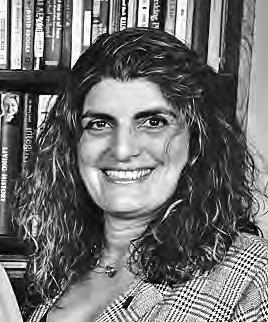


George Haddad, owner of Haddad Auto Group, is one of a select group of 49 auto dealers from across the country to be nominated for the TIME Dealer of the Year award.
Haddad was chosen to represent the Massachusetts State Automobile Dealers Association in the national competition — one of only 49 auto dealers nominated for the 56th annual award from more than 20,000 nationwide.
The nominees will be honored at the 108th annual National Automobile Dealers Association Show in New Orleans in January. The award is one of the automobile industry’s most prestigious and highly coveted honors, recognizing the nation’s most successful auto dealers who also demonstrate a long-standing commitment to community service.
Haddad, a 1981 graduate of St. Michael’s College in Colchester, Vt., has always worked for his family’s dealership group. The business was originally founded by his grandfather, George, in the 1940s with a single Pontiac store. His father, Louis, later shepherded the company and oversaw impressive growth.
Today, George Haddad oversees dealerships in Pittsfield and Adams, as well as a location in Saint Albans, Vt. The group represents Toyota, Subaru, Hyundai, and GMC.
Haddad is a longtime supporter and board member of the Boys & Girls Club of the Berkshires, where he has served on many committees and still runs the annual golf tournament. He is an adviser to Taconic High School’s automotive technology program, which he helped create in collaboration with Toyota, making it the first program of its kind in the country.
Haddad supports a number of nonprofit organizations including Soldier On, Berkshire Humane Society and The Christian Center, among others.
Dealers are nominated by the executives of state and metro dealer associations around the country. A panel of faculty members from the Tauber Institute for Global Operations at the University of Michigan will select one finalist from each of the four NADA regions and one national Dealer of the Year. Three finalists will receive $5,000
Sean D. Stever sold property at 316 Chapel Road, Savoy, to Shawn and Bridgette Meyle, $330,000.
Edward John Rossi Jr. sold property at 20 Hawley Road, Savoy, to Daniel Buckley and Kathryn Aldham-Buckley, $339,900.
SHEFFIELD
Joseph C. Hurlburt and Susan A. Hurlburt sold property at Rannapo Road, Sheffield, to Rannapo Partners II LLC, $120,000.
Sarah L. Swain sold property at 1088 Ashley Falls Road, Sheffield, to Beth E. Carlson, $330,000. Berkshire Property Rentals LLC sold property at 194 East Main St., Sheffield, to Michael F. Holland and Patricia A. Smith, $810,000.
Mildred Gertrude Tenenbaum and Steven Dunsky, co-trustees of the Mildred Gertrude Tenenbaum Revocable Trust and the Marcel Tenenbaum Revocable Trust, sold property at 424 Cooper Hill Road, Sheffield, to Robert Polkinghorn Jr. and Kathleen M. Polkinghorn, co-trustees of the Polkinghorn Family Trust, $650,000.
Robert E. Bonetti sold property at 139 Silver St., Sheffield, to Vivian Kimmelman, $159,000.
Carly Jane Shafiroff sold property at 248 Water Farm Road, Sheffield, to Elizabeth Jackson, $1,150,000.
Robert M. Norris Jr. and Barbara Bockbrader, trustees of Norris/Bockbrader Nominee Realty Trust,
for their favorite charities and the winner will receive $10,000 to give to charity, donated by Ally.
In its 14th year as exclusive sponsor, Ally also will recognize dealer nominees and their community efforts by contributing $1,000 to each nominee’s 501©3 charity of choice. Nominees will be recognized on ally.com/go/tdoy, which highlights the philanthropic contributions and achievements of TIME Dealer of the Year nominees.
Haddad was nominated by Robert O’Koniewski, executive vice president and general counsel of the Massachusetts State Automobile Dealers Association.
Rich Weisenflue, the longtime CEO of BFAIR, will retire effective March 27, the company has announced.
Weisenflue’s departure marks the end of a career spanning over three decades of leadership in human services, including 25 years with BFAIR.
“It has been an extraordinary privilege to lead BFAIR and work alongside such talented and compassionate colleagues. Committed and caring professionals throughout are to be commended for their work contributing to BFAIR’s success in offering quality services for the past 30 years,” he said in a prepared statement. “I am confident the organization’s mission and positive culture will continue to thrive under new leadership.”
Under Weisenflue’s leadership, the organization expanded its offerings to include a wide range of residential, day, employment, community-based, family and individual support services, as well as a bottle and can redemption center that offers employment opportunities for people with disabilities.
Today, BFAIR serves over 400 clients and employs more than 300 staff members, making it a vital part of the region’s human services landscape.
Originally from Pennsylvania, Weisenflue began his career in the human service field as a live-in house manager with Keystone City Residence and later developed innovative recreation and community inclusion programs for people with disabilities through the Deutsch Institute.
sold property at 1815 North Main St., Sheffield, to Elegant Earth Berkshires LLC, $2,085,000.
STOCKBRIDGE
Jane Miller and Terrence C. Shea, trustees, Jane Miller Shea RVT, and Jane Miller and Terrence C. Shea, trustees, Terrence C. Shea RVT, sold property at 17 Main St., Stockbridge, to Fred G. and Leslie Adler, $1,210,000.
Laura B. Flint, trustee, Laura B. Flint RVT, sold property at 2 Wallace Road, Stockbridge, to Shara E. Bailey, $236,000.
TYRINGHAM
Zachary W. Desantis sold property at 73 Goose Pond Road, Tyringham, to Sebastian Leo-Esparolini and Madison Jane Desantis, $171,000.
WEST STOCKBRIDGE
Jeffrey Fairfield and Michelle Fairfield sold property at 2 Bobolink Road, West Stockbridge, to Lisa Fairfield, $360,000.
Estate of Eva D.K. Orlow sold property at 20 Pixley Hill Road, West Stockbridge, to Ergis Aliai and Eleni Barka, $395,000.
Timothy J. Barrett sold property at 6 Washington Square, West Stockbridge, to Carrie Negrini, $79,000.
Douglas D. Anzalone and Carolyn M. Anzalone sold property at 27 Iron Mine Road, West Stockbridge, to Brian M. Tenney and Sarita Anzalone, $290,000.
Donald R. Dion Jr. sold property at 118 Bulkley St.,
After relocating to Berkshire County, he dedicated 35 years to nonprofit human services, joining BFAIR in 2000 as associate executive director. He was promoted to executive director in 2001 and to CEO in 2018.
He earned a bachelor’s degree in psychology and a master’s degree in human resource administration from the University of Scranton, complemented by nonprofit management coursework at the Harvard Business School Executive Education. In 2019, he was honored for executive leadership by the Nonprofit Center of the Berkshires, and most recently presented with a lifetime achievement award by UCP of Western Massachusetts.
An active member of the community, Weisenflue serves on the board of directors of the Provider’s Council, a statewide association of community-based organizations, and previously on the Northern Berkshire United Way. His past board roles include the Employers Association of the NorthEast, the Human Service Forum, the Williamstown Chamber of Commerce, and the Rotary Club of North Adams, among others.
“The board of directors extends its deepest gratitude to Rich for his dedication and leadership,” board Chair Pete Mirante, said in prepared remarks. “It was a pleasure working together with him along with the senior leadership team focused on service excellence and options, staff recognition and professional development and building community partnerships.”
The search for BFAIR’s next CEO is being managed by the Employers Association of the NorthEast. This transition will ensure that the organization continues to provide exceptional support and services to individuals with developmental disabilities, autism, and acquired brain injuries throughout Berkshire County and the Pioneer Valley.
Goodwill Industries of the Berkshires and Southern Vermont has promoted Mary Killeen as its new chief executive officer.
Killeen will focus on advancing Goodwill’s programs, strengthening its community impact, and ensuring the organization continues to meet the evolving needs of
those it serves.
She brings a wealth of experience and a commitment to the organization’s mission of empowering individuals through employment and education.
Killeen joined Goodwill in 2020 as an accountant and was promoted to director of finance in April 2022. She was named chief finance officer in January 2024 and served in that capacity until April when she was promoted again to chief operating officer.
Killeen previously worked at WCVBTV in Boston and in television production at Boston-based Metromedia Producers. She owned and operated The Bookshelf, a former secondhand bookstore in Pittsfield, for 20 years.
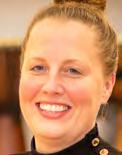
Community Access to the Arts has announced the hiring of Chaya Schneider as its new development coordinator, as well as new full-time resident faculty artists Adam Gudeon, Caroline Calkins and Katie Herbst. In addition, Courtney Maxwell was promoted to program coordinator, and Gary Schiff was appointed to the board.
CATA has expanded programs serving people with disabilities in recent years, with an innovative, community-based model rooted in strong partnerships with disability agencies, day-habilitation programs, residences and schools. These new appointments will help CATA deepen community partnerships and expand financial support for the organization, giving people with disabilities across the Berkshires and Columbia County more opportunities to explore their talents and express themselves creatively.
Schneider brings a diverse background in corporate IT, along with extensive volunteer experience with several nonprofit organizations. She holds a master’s degree in music from Teachers College, Columbia University, and a bachelor’s degree in music from Barnard College.
Maxwell joined CATA in 2022 as program associate. Previously, she worked
PEOPLE, Page 22

Williamstown, to Thomas H. Green III and Kristen L. Johanson, $1,895,000.
Camille and Nadav Zafrani sold property at 475 Water St., Williamstown, to Carrie and Matthew Brooks and Angela Vescio Wilcox, $389,900.
Vivienne S. Jaffe sold property at 47 Lower Windflower Way, Williamstown, to Monica Neset and Allen Joslin, $389,000.
Joan Dix Blair sold property at 1571 Oblong Road, Williamstown, to Brian S. Williams and Catherine A. Lemmer, $950,000.
Mary Jo Carpenter, trustee of the Carpenter NT, sold property at 283 Bulkley St., Williamstown, to Russell H. and Jacquelynn K. Varney, $765,000.
Elizabeth S. Cohen, trustee of the Elizabeth S. Cohen 2013 Trust, sold property at 32 Cluett Drive, Williamstown, to Joel Lee and Joanna Slater, $695,000.
Jacqueline Galusha sold property at 189 Stratton Road, Unit 1C5, Williamstown, to Christopher C. Jowett, $221,000.
Stephen M., Susan M. and Jean M. Jacob sold property at 900 North Hoosac Road, Williamstown, to Susan M. Jacob and George Grinberg-Funes, $211,512.
FROM PAGE 21


at Mass MoCA as a gallery art teacher and at Brattleboro Memorial Hospital in Vermont as an occupational therapist. She has a graduate degree in art education from Lesley University in Cambridge and a graduate degree in occupational therapy from Kean University in Union, N.J. In her new role, she will support the program director team, with a focus on programs taking place in CATA’s studios in Great Barrington, and help coordinate adaptive tools, resources and art-making approaches.
Gudeon, a children’s book author and illustrator, and arts educator, will serve as a full-time resident faculty artist teaching comics, illustration, graphic art, painting, and more. His picture books and early readers have been published by HarperCollins, Holiday House Books for Young Readers, and Boys Mills Kane. He previously served as a special education teacher at Berkshire Meadows School (Justice Resource Institute). He has a fine art degree from Pratt School of Art and Design.
Calkins, an actor, theater-maker and teaching artist, will serve as a full-time resident faculty artist in theater, teaching improv, acting, Shakespeare and more. She has has performed on local stages for many years, and has worked with hundreds of students in theater workshops and residencies across Berkshire and Columbia counties, mainly through her work with the education program at Shakespeare & Company.
She has a bachelor of arts degree from Brown University and a master of arts degree in theater education from Emerson College, and trained at the National Theater Institute.
Herbst, a Berkshire-based performing artist with deep connections to the local community through her work as a farmer and musician, will serve as a full-time resident faculty artist in music, teaching singing, songwriting and more. Herbst comes to CATA from Stanton Home, a residential and day


program for adults with developmental and intellectual disabilities, where she worked as the farm and garden program coordinator. She also performs with the local folk/Americana band Rounders Revival. She received a degree in social work from the University of Vermont.
Schiff, an Adams native, is a past member of the CATA Finance Committee. From 201524, Schiff served as the managing director of October Mountain Financial Advisors, a newly formed division of Springfield-based St. Germain Investment Management and joint venture with Lee Bank. Previously, he had a 21-year career with TD Private Client Wealth LLC and TD Bank USA’s predecessor banks in New England, beginning in 1995 with Bank of Boston. Prior to TD he held various management positions with Mass MoCA, Heritage Development Group and the SWA Group, Boston.
An active member of the community since the 1980s, Schiff is a member of the Berkshire Funders’ Roundtable, a corporator of the Massachusetts College of Liberal Arts Foundation, a member of the Berkshire County Estate Planning Council, a member of the Harvard University alumni interviewing committee, a director and chair of the Congregation Knesset Israel Investment Committee, and chair of the Jewish Federation of the Berkshires’ Investment Committee.
Tristan Wilson, founding managing director of the Great Barrington Public Theater, is set to take his final bow, according to board Chair Susie Weekes Roeder.
Wilson will hand off responsibilities in January to Serena Johnson, who joined the company as director of development earlier this year. Wilson will remain as company adviser.
“Tristan is respected and wellknown in the Berkshires and has a depth of valuable professional experience and know-how,” Weekes Roeder said. “He came aboard five years ago to get GB Public efficiently organized and operating on target. The plan has always been to pass the baton to the right candidate. We hired Serena with that in mind and Tristan has been working closely with her to bring her up to speed on all aspects of financial and administrative management. We’re very pleased with her imagination, creativity and watchful insights and are ready to expand her role.”
Johnson, a resident of Canaan, N.Y., is active in Berkshire business and cultural communities. She came to the theater company by way of the 1Berkshires Leadership Program. A classically trained singer and stage performer originally from California, Johnson was a member of the team that successfully developed funding and operations for the Antaeus Theatre in Glendale, Calif.
She brings proven theater management expertise to her new role and plans to expand audience, donor and corporate relationships throughout the Berkshires and adjacent towns.
“Serena’s skills and energy are a great match for our culture and future. She’s already kicked the ball ahead quite a bit since joining us, increasing our donor base and playing a key role in our success during the 2024 season,” said Jim Frangione, the theater’s founding artistic director. “We’re extremely fortunate to have had Tristan at the helm these past several years. His experience and leadership have been instrumental to the organization’s success and his positive attitude and unflappable nature in the face of inevitable theatrical crises will be sorely missed.”
The company’s summer season plays from June through August on two stages in the Daniel Arts Center at Bard College at Simon’s Rock. Readings and free community events are also presented across the year at St. James Place. Visit greatbarringtonpublictheater.org for more information.
Berkshire Money Management, a financial and retirement planning firm with offices in Dalton and Great Barrington, has hired Michael O’Brien as a financial paraplanner.
Most recently, O’Brien worked in the insurance industry. He has a strong background in client service and
financial planning, with experience helping high-net-worth people protect their assets and their futures.
O’Brien is a licensed property and casualty insurance agent and is currently studying for the Series 65 exam so he can advance into a junior advising role. He will focus on supporting the director of financial planning and learning how to deliver personalized service to the firm’s clients.
A lifelong resident of Pittsfield, O’Brien is a former Mr. Taconic and a 2024 graduate of the Berkshire Leadership Program. He holds a bachelor of arts in communications with a minor in Spanish from Massachusetts College of Liberal Arts.

Dr. Rebecca Robinson, DMD, has joined Dr. Natalya Yantovsky, DMD, at the Pittsfield Dental Center at 188 East St.
The practice is now accepting new patients.
Robinson graduated from Tufts University School of Dental Medicine in Boston in 2016. She is a member of the Massachusetts Dental Society, Berkshire District Dental Society and American Dental Association.
Pittsfield Dental Center is open Monday through Friday. New patients can call 413-447-7600.
Goodwill Industries of the Berkshires and Southern Vermont has promoted Mary Killeen as its new chief executive officer.
Killeen will focus on advancing Goodwill’s programs, strengthening its community impact, and ensuring the organization continues to meet the evolving needs of those it serves.
She brings a wealth of experience and a commitment to the organization’s mission of empowering individuals through employment and education.
Killeen joined Goodwill in 2020 as an accountant and was promoted to director of finance in April 2022. She was named chief finance officer in January 2024 and served in that capacity until April when she was promoted again to chief operating officer.
Killeen previously worked at WCVBTV in Boston and in television production at Boston-based Metromedia Producers. She owned and operated The Bookshelf, a former secondhand bookstore in Pittsfield, for 20 years.
The Berkshire Eagle
Berkshire Bank says Olympic gold medalist and NBA champion Derrick White is its new brand ambassador. This partnership highlights the bank’s focus on financial health and its goal to bring innovative banking solutions to more people.
White’s career on the court has been nothing short of remarkable, but his impact off the court is just as impressive. He’s been deeply involved in causes like Special Olympics and Boston Medical Center’s Curbside Cares program, which
delivers pediatric and midwifery services directly to families.
“We’re proud to have Derrick White join the Berkshire Bank team,” said Sumant Pustake, executive vice president and chief strategy and marketing officer.
“His dedication, integrity, and community focus align perfectly with our mission. Together, we hope to inspire positive change and help more people take charge of their finances.”
White will represent Berkshire One, the bank’s digital-first suite of services designed to make banking
Derrick White is Berkshire Bank’s new brand ambassador.
GREGORY CHERIN

simple. Features include no monthly fees, streaming reimbursement, enhanced fraud protection, ATM fee refunds and free cell phone insurance.
“I’m excited to team up with Berkshire Bank as an ambassador for Berkshire One,” White said.
“It’s a great fit with my values and my commitment to helping communities thrive. I look forward to working together to make a difference.”
Berkshire Bank, with $11.6 billion in assets and 83 locations across New England and New York, has been helping communities for over 175 years. Named one of Newsweek’s Most Trustworthy Companies in America, the bank remains focused on empowering people and making an impact. Learn more at BerkshireBank.com.