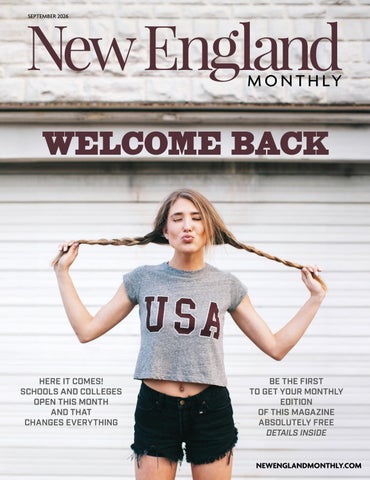
SEPTEMBER 2026
WELCOME BACK
HERE IT COMES! SCHOOLS AND COLLEGES OPEN THIS MONTH AND THAT CHANGES EVERYTHING
BE THE FIRST TO GET YOUR MONTHLY EDITION OF THIS MAGAZINE ABSOLUTELY FREE DETAILS INSIDE
NEWENGLANDMONTHLY.COM
WELCOME BACK
A New Season. A New Schedule. Perhaps a New Address.
T
here is a subtle transition that happens after Labor Day. As we move from the heat of summer to the cooler nights of autumn, energies shift, as do schedules and back-to-school preparation. Backpacks are filled, calendars too; familiar routines we nearly forgot about return with a gentle sigh. It is a season of forward momentum and fresh possibilities, making it the perfect time to consider what lies ahead for you and your family. Does your current home still fit the life you are living today? Perhaps it has become too large, too small, or simply no longer reflects your priorities. You may be imagining a home by the water, a walkable village lifestyle, more room to grow, a place closer to family or greater freedom with less maintenance. Time is a progression of growth and evolution; things we wanted to do but didn’t have the time are now taking shape. A lifelong dream of living on the water, connecting with a community that makes the time to engage. Or, as many have found, the pleasantness of driving less and enjoying the daily walks that only a village lifestyle offers. And lastly, what would you do with greater freedom by being closer to family, or enjoying a home that requires less maintenance? I’m Erin Hovan of Compass Real Estate, and this is my wonderful family. We enjoy the SouthCoast immensely, and because of that,
I’ve committed to helping other families eager to call this enchanting community home. Whether you are upsizing, downsizing, rightsizing, relocating, purchasing your first home, or maybe your last, I can help you prepare to sell your property and find another. You can rely on me during the entire process, because I’ve lived the experience. A home isn’t just a building; it’s a special place filled with memories. And when it’s time to move to a new one, you don’t want it to become a transaction. It should be a meaningful transition, an opportunity to create a new lifestyle and new memories that better align with where life is taking you. The right real estate representative and strategy begin well before a property is listed or an offer is written. It starts with understanding your goals, exploring options, and creating a thoughtful plan that aligns with your priorities and timing. If you are beginning to imagine a new chapter, I invite you and would be honored to serve as your trusted real estate advisor. Together, we will create a thoughtful plan designed to achieve the most successful outcome while making your transition as seamless and rewarding as possible. Welcome Home
ERIN HOVAN, REALTOR® BROKER ASSOCIATE
SRS · ABR · RSPS · RENE · GREEN · PMP® PSI - Price Strategy Adviser SRS - Seller Representation Specialist
Start a conversation:
203.606.6033
erin.hovan@compass.com erinhovan.com · compass.com
HOVAN PROPERTY GROUP
SouthCoast · Cape Cod · South Shore Farm Coast · East Bay · Newport Compass is a licensed real estate broker and abides by Equal Housing Opportunity laws. All material presented herein is intended for informational purposes only. Information is compiled from sources deemed reliable but is subject to errors, omissions, changes in price, condition, sale, or withdrawal without notice. This is not intended to solicit property already listed. Photos may be virtually staged or digitally enhanced and may not reflect actual property conditions.
| LUXURY LIVING |
A Historic Canvas. A Remarkable Opportunity.
This Mattapoisett Village gem is like a blank canvas, ready to become a dream home.
F
ormerly known as Red Oak Farm, this circa-1924 residence blends Colonial Revival architecture with Craftsman-style details. Set on more than an acre of gently sloping land, the property has been cleared, graded, and terraced, creating a beautiful backdrop for gardens, outdoor living, and recreation. A detached two-car garage and fully enclosed post barn add exceptional character and versatility. Thoughtfully restored and structurally reinforced, the barn features new support beams, restored windows, salvaged sliding doors, and a new wooden staircase leading to the second floor. Significant improvements have been completed, including new roofs, gutters, and drainage for the buildings; new electrical service from the street; buried conduit; and a seal-coated basement. The interior of
ACCEPTING OFFERS
39 Ryder Lane, Marion $1,600,000
ACCEPTING OFFERS
5 Acorn Lane, Mattapoisett $899,000
the primary residence has been substantially prepared for renovation, allowing the next owner to create a home tailored to their vision. The property currently has limited interior lighting and outlets, an exterior water faucet, but does not have complete electrical, plumbing, heating, or cooling systems. Ideally situated near shops, restaurants, beaches, harbor, and recreational opportunities of Mattapoisett Village, with convenient access to area highways. This distinctive property brings together history, land, craftsmanship, and remarkable potential. The groundwork has been laid. The next chapter is ready to be written. Offered at $799,000.
WINTER RENTAL
16 Jefferson Shores $4,000/month
SOLD
57 Oak Street, Wareham $1,125,000
UNDER CONTRACT
15 Oakhill Road, Wareham $850,000
SOLD
414 Point Road, Marion $3,125,000 Buyer Representative
SEPTEMBER 2026
AUGUST 2026
SOCOMAGAZINE.COM
Welcome to the South Coast
2026
is gonna be a summer to Remember!
MARCH 2026
SOCOMAGAZINE.COM
The SouthCoast Over-Building In Small Coastal Communities It’s An Issue That Won’t Go Away It’s Our 21st Anniversary, And The End To A Decades-Long Battle
APRIL 2026
Reflecting on What Makes Spring Special It Starts With Long Walks, Bushels of Flowers & Colorful Sunsets But, There’s Much More To Appreciate
VS.
BEACH BUNNY
The Family Office Is Becoming The New Status Symbol Learn How It Could Benefit Yours
You Have A Decision To Make
AUGUST 2026
JULY 2026
JUNE 2026
MAY 2026 APRIL 2026
Start Packing
We Have Ten Things To Love About Six Destinations Waiting For Your Arrival
Summer Shoes
For Dudes Revisiting The Classics
We’re Watching Out For You n n n
How To Make & Keep Your Money Growing How To Find A Date And Keep Them Around And, How Not To Die On Vacation—Yikes!
Get Out Of Town The Best Locations For Spending A Memorable Memorial Day Weekend
Keeping What’s Yours – An Attack On Financial Freedom & Choices The SouthCoast Faces A Formidable Challenge: Over-Building In What Were Rural Communities
BE THE FIRST TO GET YOUR MONTHLY EDITION OF THIS MAGAZINE ABSOLUTELY FREE DETAILS INSIDE
NEWENGLANDMONTHLY.COM
NEWENGLANDMONTHLY.COM
NEWENGLANDMONTHLY.COM
NEWENGLANDMONTHLY.COM
MARCH 2026
How Will You Celebrate Spring? Let Us Count The Ways
MARCH 2026 | VISIT NEWENGLANDMONTHLY.COM FOR A FREE DIGITAL SUBSCRIPTION
The Best In Coastal Real Estate
In The Most Desirable Locations
MARCH 2026 | VISIT NEWENGLANDMONTHLY.COM FOR A FREE DIGITAL SUBSCRIPTION
Summer at Last
MAY 2026 | VISIT NEWENGLANDMONTHLY.COM FOR A FREE DIGITAL SUBSCRIPTION
JUNE 2026 | VISIT NEWENGLANDMONTHLY.COM FOR A FREE DIGITAL SUBSCRIPTION
What Will It Take To Stop It?
A Tribute To Those Who Thought Celebrating Those Who Fought And Recognizing Those Carrying The Torch Thank You, To All, For What You Have Accomplished
JULY 2026 | VISIT NEWENGLANDMONTHLY.COM FOR A FREE DIGITAL SUBSCRIPTION
THE ASSAULT ON AMERICA HAS BEGUN
AUGUST 2026 | VISIT SOCOMAGAZINE.COM FOR A FREE DIGITAL SUBSCRIPTION
SEPTEMBER 2026 | VISIT SOCOMAGAZINE.COM FOR A FREE DIGITAL SUBSCRIPTION
HERE IT COMES! SCHOOLS AND COLLEGES OPEN THIS MONTH AND THAT CHANGES EVERYTHING
EMBRACING AI FOR CAPITAL CHANGE
SKI BUNNY
Will It Be Moguls Or Waves For A Vacation?
250 Years Young
SEPTEMBER 2026
WELCOME BACK
SOCOMAGAZINE.COM
SOCOMAGAZINE.COM
MARCH 2026 | VISIT SOCOMAGAZINE.COM FOR A FREE DIGITAL SUBSCRIPTION
YOUR PASSPORT TO PREMIUM REAL ESTATE, MODERN CULTURE, AND INTELLECTUAL CURIOSITY
MAY 2026
SOCOMAGAZINE.COM
APRIL 2026 | VISIT SOCOMAGAZINE.COM FOR A FREE DIGITAL SUBSCRIPTION
Happy Birthday America
JUNE 2026
MAY 2026 | VISIT SOCOMAGAZINE.COM FOR A FREE DIGITAL SUBSCRIPTION
TODAY’S NEWEST LUXURY IS PRIVACY AND TO REMAIN UNSEEN
SOCOMAGAZINE.COM
JUNE 2026 | VISIT SOCOMAGAZINE.COM FOR A FREE DIGITAL SUBSCRIPTION
A COUNTRY UNDER SURVEILLANCE
JULY 2026 | VISIT SOCOMAGAZINE.COM FOR A FREE DIGITAL SUBSCRIPTION
JOIN THE SOUTHCOAST LIFESTYLE AND EXPERIENCE ITS UNRIVALED INFLUENCE AND ENDURING RELEVANCE
AUGUST 2026 | VISIT SOCOMAGAZINE.COM FOR A FREE DIGITAL SUBSCRIPTION
SEPTEMBER 2026 | VISIT SOCOMAGAZINE.COM FOR A FREE DIGITAL SUBSCRIPTION
MEMORIES THAT NEVER FADE WRITE THE PROLOGUE FOR THE REST OF YOUR LIFE
JULY 2026
SOCOMAGAZINE.COM
WE EXPLORE THE INEVITABLE RESULT OF A
NEW ERA
PREPARE NOW AI IS MAKING A DIFFERENCE IN EVERYONE’S LIFE
NEWENGLANDMONTHLY.COM NEWENGLANDMONTHLY.COM
SEPTEMBER 2026
AUGUST 2026
SWEET MEMORIES OF A SUMMER PAST
JUNE 2026
MAY 2026
In the summer
401OCEANSTATE.COM
401OCEANSTATE.COM
SEPTEMBER 2026
401OCEANSTATE.COM
AUGUST 2026
JULY 2026
Aging: Do Genes Matter? We Investigate The Truth Vs. The Hype
GOVERNMENT MISMANAGEMENT WHAT’S MINE IS MINE & WHAT’S YOURS IS MINE TOO WHAT’S A GENERATION TO DO?
THE TRILLION DOLLAR TRANSFER HAS BEGUN
AI FEAR IS A REALITY TO SOME For Others, The Time Has Arrived For A New Economy
MARCH 2026
IT’S ABOUT TIME–I’VE BEEN WAITING FOR YOU Spring Has Sprung
MARCH 2026 | VISIT REVEALCONNECTICUT.COM FOR A FREE DIGITAL SUBSCRIPTION
A Travel Guide That Removes The Guessing And the Stress Of Planning The Memorial Day Weekend
Wealth & Legacy
401OCEANSTATE.COM
APRIL 2026
APRIL 2026 | VISIT REVEALCONNECTICUT.COM FOR A FREE DIGITAL SUBSCRIPTION
FINALLY, A MAGAZINE WITH DEEP THOUGHTS FOR THOSE WHO THINK DEEPLY.
Peace Is The Path Forward This 4th Of July 1776 -2026
APRIL 2026 | VISIT REVEALCONNECTICUT.COM FOR A FREE DIGITAL SUBSCRIPTION
We Can Explore The Universe But Can’t Stop Spam And Robo Calls—It’s Time To Learn Why
WE CREATED A LIST OF GREAT CHOICES FAR FROM HOME ARRIVE EARLY & STAY LATE
DISCOVERING HOW WE ENJOY THE FOUR-SEASONS OF NEW ENGLAND
401OCEANSTATE.COM
MAY 2026
It’s Up To You, But A Staycation Might Not Be A Great Idea This Summer
CHEERS!
Toasting The Season’s Return— Just In Time
401OCEANSTATE.COM
JUNE 2026
JUNE 2026 | VISIT REVEALCONNECTICUT.COM FOR A FREE DIGITAL SUBSCRIPTION
THE INVASION OF TECHNOLOGY
JULY 2026 | VISIT REVEALCONNECTICUT.COM FOR A FREE DIGITAL SUBSCRIPTION
AUGUST 2026 | VISIT SOCOMAGAZINE.COM FOR A FREE DIGITAL SUBSCRIPTION
SEPTEMBER 2026 | VISIT SOCOMAGAZINE.COM FOR A FREE DIGITAL SUBSCRIPTION
THE END OF SUMMER & THE BEGINNING OF FALL
401OCEANSTATE.COM
Over-Building In Small Communities When Changing The Landscape Goes Too Far
MARCH 2026
FEBRUARY 2026 | VISIT 401OCEANSTATE.COM FOR A FREE DIGITAL SUBSCRIPTION
Yachts, Trots & Beaches We’re Your Go-To Guide For The Memorial Day Weekend And The Rest Of The Summer
FEBRUARY 2026 | VISIT 401OCEANSTATE.COM FOR A FREE DIGITAL SUBSCRIPTION
Special Taxes On The Rich Are Causing A Storm Of Controversy
MAY 2026 | VISIT 401OCEANSTATE.COM FOR A FREE DIGITAL SUBSCRIPTION
Is front page news the next day
JUNE 2026 | VISIT 401OCEANSTATE.COM FOR A FREE DIGITAL SUBSCRIPTION
SIGN UP FOR A COMPLIMENTARY ONE-YEAR DIGITAL SUBCRIPTION
APRIL 2026
Fleeing The Coasts
What goes on in Newport JULY 2026 | VISIT 401OCEANSTATE.COM FOR A FREE DIGITAL SUBSCRIPTION
AUGUST 2026 | VISIT SOCOMAGAZINE.COM FOR A FREE DIGITAL SUBSCRIPTION
SEPTEMBER 2026 | VISIT SOCOMAGAZINE.COM FOR A FREE DIGITAL SUBSCRIPTION
IF IT’S IN HERE, GUARANTEED IT’S WORTH YOUR TIME
JULY 2026
AMERICANS CLAIM THEY ARE EXHAUSTED, UNDERPAID & ENTITLED TO MORE If So, Who Is At Fault?
NEWENGLANDMONTHLY.COM
THE DOW HITS 50,000 What’s Next?
The Cyber Revolution Has Arrived *There’s No Turning Back
No part of this publication may be reproduced, copied, or duplicated, or used for promotional purposes by any method electronically or otherwise without written permission from New England News + Media. All information and contributions within this publication are deemed to be accurate and reliable. New England News + Media and its affiliate companies assume no responsibility or financial liability for misinformation, errors, or omissions in content and advertisements. Associated companies, the publishers, partners, managers, sub-contractors, and others contributing to this publication promote advertisers and may at times recommend services we provide or that of outside resources; however, we make no claims to satisfaction, promises, or guarantees to products and such services. All content is copyright protected: SouthCoast Publishing Group, New England News + Media and affiliated titles SOCO Magazine™, 401 Ocean State Magazine™ & New England Monthly®.
4 | SEPTEMBER 2026 | NEW ENGLAND NEWS + MEDIA
| AGENDA |
10
13
IMPRESSIONS
DOSSIER
Thoughts From The C-Suite. A state of confusion, loss of identity, and the strength and determination to power through the tough stuff are a few of the challenges added to the fight to publish magazines that balance the accounts of cultural and social progress that many don’t want to be made public.
Words of Wisdom That Took A Lifetime To Learn. It’s time to listen and learn from those with miles traveled, volumes of experience, and knowledge gained from a lifelong path of successes and defeats.
6 | SEPTEMBER 2026 | NEW ENGLAND NEWS + MEDIA
22
26
LIVING WELL
A Task Americans Need To Wake Up To. We know that in America, those who begin to lose their youth are marginalized and then disregarded. As each year passes after 25—admittedly or not—chips of youth and immortality flake away, opening the door to microaggressions of ageism. But you don’t have to take the criticism anymore. Health interventions are being discovered, and people are transforming into what they want age to look like.
HOME
Village Living At Its Best: Welcome To Marion, Massachusetts. Whether for the summer, holidays, or all year long, it’s a SouthCoast lifestyle you can’t get out of your mind.
NEW ENGLAND NEWS + MEDIA | SEPTEMBER 2026 | 7
34
INTIMACY
The New Landscape For Finding Love. Practical advice for addressing roadblocks, bottlenecks, and myths about finding that someone special.
38
8 | SEPTEMBER 2026 | NEW ENGLAND NEWS + MEDIA
CULTURE
The Missing Link: No One Taught Them To Struggle. It’s been a problem for decades, and now we act as if we didn’t see it coming. The new term used by grandparents when describing children and grandchildren when they are out of sight is referred to as the ‘Wining’ Generations. Could it be time to redefine parenting, expectations and protocols?
44
48
MEDIA
The Influencer Plague. They are exhausting, loud, and intrusive, and that’s the best of them. How tony resort communities are banning the ‘Hollywood’ wannabes from their boutiques, bars, restaurants, and even coffee shops. It’s the beginning of the end for an era that has played out and is out of vogue; or what they might refer to as “so base.”
CAPITAL
The Unglamorous Dynamic That Builds Wealth And Creates A Financial Legacy. Numerous rewards await those with a plan to achieve financial independence if begun at an early age. Among them is a chance to make millions of dollars, which in turn, makes millions of dollars—while you effortlessly watch. It isn’t difficult, but you need to be disciplined and focused. We show you how.
NEW ENGLAND NEWS + MEDIA | SEPTEMBER 2026 | 9
| DOSSIER |
Pain. Peril.
Publishing.
Why We Do This, And What Does The End Game Look Like We start with an all-encompassing definition we were surprised to find in our research. It is only an excerpt of what would take volumes to share if we had the time. THOUGHTS FROM THE C-SUITE
10 | SEPTEMBER 2026 | NEW ENGLAND NEWS + MEDIA
“Heutagogy is the most unencumbered and self-determined approach for lifelong adult learning. It is a self-regulated management and training framework in which individuals take 100 percent ownership and responsibility for their educational pursuits, professional development, and personal and business endeavors.” Regarding local microcosms within society, practitioners of heutagogy do not rely on false propositions, manipulated hypotheses, or the contrived expectations of unvetted social experiments. They actively reject the flawed narratives and groupthink used by modern-day tribes to manage cultural affairs. Instead, they devote their energy to examining the truth of these claims through rigorous critical thinking, purposefully attempting to disprove their own conclusions until the data validates their thesis. This empirical, data-supported formulation is not limited to education and research; it should be actively applied to the preservation of modern society, which has always been fundamentally subject to “Science.”
“Within contemporary cultural silos, the unspoken goal is to maintain—or even maximize—social homeostasis at the expense of informational accuracy. Facts are routinely omitted, and truth is reconfigured into alternative narratives to escape the reality of failure. In its extreme form, a dominant power vacuum exerts strict control over anyone deemed an ideological threat. Utilizing extortion, blackmail, threats, and false narratives, collective actors isolate targets to eliminate these voices. This strategy sends a chilling message to the group’s own cadre: dissent is dangerous. Consequently, potential defectors remain silent out of fear, successfully preserving a facade of ideological solidarity for outside observers.”
“The fatal flaw in this system of social control is that these communities masquerade as open, welcoming environments that embrace intellectual curiosity and diversity of thought. In reality, their actions betray their self-proclaimed image as enlightened planners. Through deceptive rhetoric, deliberate omissions, and malicious actions, their overinflated egos become obvious to anyone paying attention. This profound conceit is matched only by their myopic vision of the future. Cowardly at their core, these actors never dare to challenge the best and brightest face-to-face; instead, they rely on manipulation and behind-the-scenes attacks. When recruiting vulnerable followers, they offer a mere pittance for loyalty—just enough crumbs to manufacture a false sense of belonging, while keeping them completely excluded from the decisions that shape their futures.”
NEW ENGLAND NEWS + MEDIA | SEPTEMBER 2026 | 11
For skeptics, the theory can be reduced to its cleanest form: “Heutagogy offers complete learner freedom—which might sound chaotic—even though it is highly accountable and self-directed. Organized systematically, it allows learners to accurately define a problem, independently research and analyze it, and discover appropriate solutions. This is the exact framework utilized by modern ‘garage’ startups and the world’s most sophisticated technology labs. It stands in stark contrast to traditional pedagogy and andragogy, where a ‘trainer’ or ‘ leader’ enforces a rigid system to track and resolve problems already adjudicated by an elite few. In that traditional model, predetermined answers are simply indoctrinated into the masses—a method that now dominates both public education and political discourse.” Having explored how heutagogy operates within society, culture, and research, we can now examine the cognitive mechanics of the individuals who possess the unique ability to dismantle these manipulative, reality-distorting systems. This self-determined learning structure is further elevated in individuals who possess the rare capacity for Pattern Analysis Connectivity. The synergy between heutagogy and pattern analysis creates an internal mechanism allowing the mind to sort, filter, match, and draw conclusions with striking accuracy. Free from the need for a curator, leader, or ‘playbook,’ this non-linear cognitive architecture easily bypasses the messy intellectual negotiations that so often compromise accurate predictions. To understand why this cognitive loop is so heavily targeted by corrupt systems, consider a concrete example of how these power-hungry brokers weaponize false narratives. When a free-thinking entity poses a threat to social homeostasis, bad actors deploy a coordinated strategy of intimidation: relentless threats via mail, email, text, and phone calls. The resulting peril is tangible and documented, manifesting as aggressive boycotts, direct operational interference, and financial extortion weaponized against both the primary target and their proxies.
12 | SEPTEMBER 2026 | NEW ENGLAND NEWS + MEDIA
Beyond this slow drip of harassment lies an even more overt threat: the manipulation of public money, disguised as public service, weaponized against private enterprise. Donors remain entirely blind to where their contributions are invested or which agendas they fund. This insidious endgame, played out before an unsuspecting public, represents far more than a localized battle between ideology and truth. Today, the media landscape on every front traffics in deception, false narratives, and deliberate ignorance. From digital platforms to cable networks and broadcast television, the few outlets left standing no longer deserve to be called “news.” Instead of offering common-sense perspectives, these agents of misinformation have become partisan cheerleaders—elevating tribal politics over the public interest with the ultimate goal of destabilizing modern society. What distinguishes this media company from all others— local, regional, and national—is simple: we answer to no one. No influence, no favors. We have no teacher looking over our shoulder, no script to follow, and no special interests to serve. Despite the challenges, we have endured by exposing reality, pinpointing deception, connecting the dots—and yes, we have the map—while offering sound, practical solutions to the stagnation gripping this community. While the needle hasn’t moved, the smoke and mirrors certainly have. Yet, one perceived problem remains—one that merely scratches the surface of a larger iceberg of discontent felt across SouthCoast homes and businesses. That problem is us. We are the disruptors. We are fiercely independent, and as bright as the sun. Our team keeps its eyes fixed squarely on the horizon while preserving the past. We move forward, fueled by the loyalty of the readers, followers, and sponsors who generously sustain us. In turn, we give back to the communities we serve, remaining committed to answering the questions you didn’t think to ask and exposing the agendas they desperately try to hide. A healthy democracy thrives on free, open dialogue; we depend on you to keep this fight alive. H
| IMPRESSIONS |
Words of Wisdom That Took A Lifetime To Learn - UNKNOWN-
CENTENARIANS SIT IN QUIET SHADE A CENTURY OF TRUTH AND UNDERSTANDING, PRECISELY MADE WHILE WE CHASE THE CURRENT WHIM, THE MODERN TREND UNKNOWINGLY, WE TREAT YOUNG CROWDS AS GUIDES AND FRIENDS YET THEY POSSESS THE RAW, EMPIRICAL VIEW DISTILLING DECADES INTO WHAT IS TRUE THEY SEE THE PATTERNS WE REPEAT IN HASTE THEY HEAR THE EMPTY WORDS WE CHOOSE TO WASTE THROUGH LONG ANALYSIS OF JOY AND TEARS THEY KNOW EXACTLY HOW THE FUTURE STEERS WE SKIP THE VERIFICATION MARKED BY THE OLD FOR EASY, FLEETING MYTHS THAT TEASE WITH MARKET GOLD TO PASS THEM BY IS HIGHER LEARNING’S COST A MASTERCLASS OF LIVING, ALAS, DEEPLY LOST
NEW ENGLAND NEWS + MEDIA | SEPTEMBER 2026 | 13
MARION, MASSACHUSETTS Set on 2.47 private acres in one of Marion’s most desirable neighborhoods, this custom-designed 3,438 sq. ft. Colonial offers an exceptional opportunity to create a legacy property, just a short stroll from Silvershell Beach and the Village. This spacious home features timeless Colonial architecture, generous living spaces, 4 bedrooms, and 2 full and 2 half-baths. EXCLUSIVELY LISTED AT $1,175,000
MARION, MASSACHUSETTS Beautifully maintained, this 3 bedroom, 2.5 bath Colonial offers over 2,450 sq. ft. of thoughtfully designed living space in one of Marion’s seaside enclaves that includes deeded rights to a sandy beach on Buzzards Bay. Built in 2011, this home offers an open concept with a kitchen that flows seamlessly into the dining area, family room, and screened-in porch. Effortless coastal living at its finest! EXCLUSIVELY LISTED AT $895,000
MATTAPOISETT, MASSACHUSETTS
EXCLUSIVELY LISTED AT $2,495,000
Rare opportunity to own a private coastal retreat set on 6.68 acres with direct ocean frontage in desirable Mattapoisett. Tucked away at the end of a private road, this contemporary post-and-beam residence offers 2,750 sq. ft. of living space surrounded by mature trees, sweeping water views, and exceptional privacy. The home features 3 bedrooms, 3 full baths, a private tennis court, attached 2 car garage, and direct access to a private beach. A truly unique waterfront estate offering an extraordinary lifestyle on the SouthCoast.
MARION, MASSACHUSETTS Discover timeless New England charm in this impeccably restored 1880 antique home located on highly desirable Water Street in Marion Village. Set on .81 beautifully landscaped acres, the house boasts 5,541 sq. ft. with 8 bedrooms and 5.5 baths. Sweeping water views, a detached garage/barn, gunite swimming pool, and deeded access to a shared dock on Sippican Harbor. Rich in original charm yet thoughtfully reimagined, this exceptional home is a rare opportunity to own a true New England classic.
UNDER AGREEMENT
ConverseCompanyRealEstate.com | 166 Front Street | Marion, MA 02738 | (508) 748-0200
Apply Yourself Fall Model Call
Time waits for no one, and opportunities follow suit. Memories, on the other hand, will follow you forever—those you create, but especially the ones allowed to slip away. Most everyone has wondered what it takes to model for a ‘Cover’ of a magazine; yet, only a few will enjoy the experience. Time is valuable, memories are forever, and choices are personal. Let us know if you’d like to know more. Send an email to nemedia@earthlink.net or text 508-971-1969.
PROFESSIONAL PHOTOGRAPHY FROM NEW YORK RUNWAYS TO NEW ENGLAND COASTLINES
WORK FREE OR DIE
COMMERCIAL SPACE AVAILABLE AT THE DEPOT PLAZA 264 MAIN STREET LINCOLN, NEW HAMPSHIRE (KANCAMAGUS HIGHWAY/ROUTE 112)
Property Overview:
WORK FREE OR DIE
Office/Retail/Mixed Use Approximately 1,370 sq.ft. Lease Type: NNN - CAM, Utilities (includes heat), taxes are tenant’s responsibility Available this Summer Lease Term Minimum of 3Yrs +
Key Features • Highly visible mountain location at a four-season tourist destination • Located between South Peak & Loon Mountain • Foot traffic from multiple condo developments and anchor tenants • Traffic count: Route 112 is a major conduit between Lincoln and North Conway, 6-9k vehicles passing daily • Excellent curb appeal, with the storefront facing a large parking lot and a roadway at ground level • Central heat & ac, security cameras, newly renovated as an office, offers a flexible floor plan for retail conversion • Large vertical roadside (double-facing) signage advertising tenants; one sign above the space • Fees, taxes & utilities: CAM: Utilities (includes heat), taxes are tenant’s responsibility
Current Configuration: reception area, partitioned work spaces, for four employees, primary office, conference room, kitchen & break area, secure storage and bathroom
Uses: Mortgages, Investments, Real Estate, Insurance, Child Care, Guest Services, Dental or Medical Office, Spa, Salon, Beauty Services, Attorney, Psychologist, Retail, Packaged Foods, Contracting Services, Showroom. Parking: Open lot
More Information: 603-380-0740
Caregiver Payments
Caring for someone at home? You may qualify for a monthly payment. Are you facing the challenges of caring for a loved one at home? Perhaps trying to wholeheartedly balance their needs and the daily demands life delivers you? If this sounds familiar, we are here to assist you in providing an unmatched standard of Adult Foster Care benefits for those striving to stay in their homes. Mass Care Link is evolutionary, providing a monthly payment to those caring for someone at home while supporting them with a personalized touch. Costing less than assisted living facilities and nursing homes, with a record of compassion and empathy, we cover the unique needs of our clients. Families and individuals rely on our services to: • Ensure caregivers receive a tax-free monthly
stipend/payment
• Review and verify MassHealth paperwork and
qualifications
• Train and assist with the management and demand
of providing 24-hour care
• Not be the legal guardian or legally married to the
person being cared for
• Provide necessary medical care and assistance that
meets the needs of the person they care for
For your family member or loved one to qualify for Mass Care Link services, they must meet these eligibility points: • Be 16 years of age or older • Be approved for MassHealth insurance • Live with the primary caregiver in the same home • Require supervision and cueing, or physical assistance
daily with at least one of the following needs: bathing, toileting, ambulation, transferring, eating, and/or dressing.
If this sounds attractive and meets your level of interest, contact us today for additional information or to schedule an appointment.
Mass Care Link, Inc.
You may not know this fact, but if you qualify as an at-home caregiver, you can earn up to $18,240 yearly.
99 South Main Street, Fall River, Massachusetts 02721 Hablamos Español | Falamos Português
For a caregiver to meet state requirements, they must:
call for more information or visit us online at:
• Be at least 18 years of age • Reside in the same home as the person they care for
DEFINING THE CULTURE AND LIFESTYLE OF THE SOUTHCOAST, WE ENGAGE THE REGION’S MOST AFFLUENT READERS, AND OFFER AN UNPARALLELED PLATFORM FOR PREMIER BUSINESSES TO REACH THEM Expand your reach and align with excellence. As the SouthCoast’s premier and most widely read publication, we elevate your brand to the region’s most discerning audiences. NEMedia@earthlink.net
SEPTEMBER 2026
SEPTEMBER 2026
SOCOMAGAZINE.COM
SEPTEMBER 2026
SEPTEMBER 2026
IF IT’S IN HERE, GUARANTEED IT’S WORTH YOUR TIME
SIGN UP FOR A COMPLIMENTARY ONE-YEAR DIGITAL SUBCRIPTION
401OCEANSTATE.COM
THE END OF SUMMER & THE BEGINNING OF FALL
FINALLY, A MAGAZINE WITH DEEP THOUGHTS FOR THOSE WHO THINK DEEPLY.
SEPTEMBER 2026 | VISIT SOCOMAGAZINE.COM FOR A FREE DIGITAL SUBSCRIPTION
YOUR PASSPORT TO PREMIUM REAL ESTATE, MODERN CULTURE, AND INTELLECTUAL CURIOSITY
SEPTEMBER 2026 | VISIT SOCOMAGAZINE.COM FOR A FREE DIGITAL SUBSCRIPTION
JOIN THE SOUTHCOAST LIFESTYLE AND EXPERIENCE ITS UNRIVALED INFLUENCE AND ENDURING RELEVANCE
SWEET MEMORIES OF A SUMMER PAST SEPTEMBER 2026 | VISIT SOCOMAGAZINE.COM FOR A FREE DIGITAL SUBSCRIPTION
SEPTEMBER 2026 | VISIT SOCOMAGAZINE.COM FOR A FREE DIGITAL SUBSCRIPTION
MEMORIES THAT NEVER FADE WRITE THE PROLOGUE FOR THE REST OF YOUR LIFE
WELCOME BACK
HERE IT COMES! SCHOOLS AND COLLEGES OPEN THIS MONTH AND THAT CHANGES EVERYTHING
BE THE FIRST TO GET YOUR MONTHLY EDITION OF THIS MAGAZINE ABSOLUTELY FREE DETAILS INSIDE
NEWENGLANDMONTHLY.COM
| LIVING WELL |
HONORING THE AGED:
IT’S A TASK AMERICANS NEED TO WAKE UP TO BY ROB SAINT LAURENT, M.ED.
AGING
So natural, yet pushed out of our minds, it won’t be long before you are standing in this line— you’re older than you were mere minutes ago; count them up, because you’re running out of time.
apan esteems its seniors. Every September on the third Monday is a national holiday called Respect for the Aged Day, or Keirō-no-Hi. It’s a day when the nation officially celebrates longevity and the contributions, wisdom, and experience of its elderly. A highlight of Japan’s strong respect and gratitude for people long in years, and for family and community. This reverence is called keirō culture, stemming from Japan’s long-standing Confucian values of familial devotion and respect for elders. The way of life goes far beyond Japan’s reputation for civility. It reflects an attitude woven into everyday interactions and family relationships: children are taught to honor and care for their parents, elders are addressed with special forms of polite speech known as keigo, and young people are often attentive to the needs of older adults in public. Japan’s national long-term care 22 | SEPTEMBER 2026 | NEW ENGLAND NEWS + MEDIA
insurance system, Kaigo Hoken, further supports families as they care for aging relatives. At the same time, an ethos of remaining active and maintaining a sense of purpose later in life—known as ikigai—helps shape how aging is viewed.1 With this collective mindset and supportive environment, it isn’t surprising that Japan has one of the highest overall life expectancies in the world at 85.15 years, ranking fourth out of 234 nations, regions, and territories.2 Japan’s women have held first place globally since 1985, with an average life expectancy of 88.2 years.3 As for the U.S.? 62nd place with an overall life expectancy of 79.76 years.2 From this number, it’s not the best option for aging gracefully. In this country, there’s a more conflicted attitude toward older adults. On the one hand, America respects the wisdom and experience of its elders; on the other hand, ageism is deeply ingrained in the culture and older people are marginalized. It’s reflected almost everywhere, from the workplace and media to our medical system and social life. Youth is idealized, while aging is ostracized.
Every first Sunday after Labor Day is Grandparents Day in the U.S. But it’s not a public holiday and, for most of us, is probably less notable than Groundhog Day. With this sense of unimportance, it serves as another example of how and why our seniors often feel invisible and disrespected, and many languish in isolation. Worth noting, it wasn’t always this way. In the Journals of Gerontology: Series B, researchers Reuben Ng and Ting Yu Joanne Chow examined 210 years of aging narratives within the Corpus of Historical American English and Corpus of Contemporary American English, from 1810-2019. They found a distinct trend over time.4 Their analysis revealed that, in the 19th century, elderly Americans were portrayed in literature (books, magazines, newspapers) and the community in an uplifting manner, with themes of heroism, kinship, affection, and wisdom. They were romantics, war heroes; the family pillars. They were viewed positively in 71 percent of topics examined. In a time of family farms and early industrialization, multigenerational households were relied upon. An elder was an important contributor economically and socially and held high status within the family and community. Like the Japanese, who view aging as an evolutionary process, physical maturity in early America was seen as a respected and natural process, not a medical issue. By the 20th century, industrialization and medicalization shifted the narrative, and ageism crept in. Instead of heroism, the media
Hallmarks of Aging
propagated themes of decline, illness, burden, and death. Age descriptors became more negative, though terms describing elder roles in fictional works stayed mostly positive. Today, just 38 percent of age descriptors are positive compared to 82 percent historically. Getting older is now often depicted as frailty, vulnerability, and inexorable decline, with older people seen as societal burdens. One wonders what will become of America’s aging population, as the U.S. greys at a rapid pace. At least 18 percent of the U.S. population is now aged 65+ (over 61 million Americans), rising 3.1 percent from 2023-24 alone.5 In 2025, 30 percent of Japan’s population was aged 65+— the highest in the world—and, like the U.S., is growing steadily as birth rates decline.6 WHAT HAPPENS WHEN WE AGE To grow old gracefully, it’s motivational to know what actually happens underneath the hood over time, or what biogerontologists call hallmarks of aging (described below). These “root causes” of aging don’t happen in isolation as a single broken system. They overlap and influence one another, creating a network problem.7 And because of these overlapping issues, the question on most minds after 40 is how to keep our network systems
7,8
BIOLOGICAL PROCESS
WHAT IT MEANS
DNA DAMAGE
DNA can be harmed by normal metabolism and the environment. Over time, cells can become dysfunctional and even cancerous.
TELOMERE SHORTENING
Telomeres are protective endcaps on chromosomes that can shorten over time. Cells can stop dividing or become dysfunctional, affecting cellular integrity and tissue repair.
EPIGENETIC CHANGES
Changes in gene activity can be triggered by behavior, aging, and the environment, without changing DNA itself. These changes are often reversible by modifying lifestyle.
LOSS OF PROTEIN QUALITY
Proteins are continuously folded, repaired, and recycled, but aging can cause them to fold and build up leading to diseases like Alzheimer’s and Parkinson’s.
METABOLIC DYSREGULATION
Growth, repair, and metabolism pathways, like insulin-like growth factor (IGF-1), can be chronically overactivated and lead to metabolic disease.
MITOCHONDRIAL DYSFUNCTION
Cell mitochondria turn food into energy but can become less efficient over time leading to fatigue, inflammation, and reduced organ function.
CELLULAR SENESCENCE
Damaged cells that stop dividing may not die; these zombie cells can cause inflammation and disturb nearby cells leading to chronic inflammation and overall decline.
STEM CELL EXHAUSTION
Tissues need stem cells for maintenance and renewal, but numbers and function can drop with age leading to slower healing, less resilience, and organ decline.
DISRUPTED INTERCELLULAR COMMUNICATION
Age can disrupt how cells and tissues talk to each other, promoting chronic inflammation that can accelerate other aging processes.
DISABLED AUTOPHAGY
Autophagy (“self-eating”) is the body breaking down damaged cellular parts for reuse. Aging slows the process leading to buildup of cellular debris and loss of function.
CHRONIC INFLAMMATION
Aging leads to constant low-grade inflammation (immune cell activity without a threat), or inflammaging, driven by senescent cells, fat tissue, etc., and promoting disease.
GUT DYSBIOSIS
Beneficial bacteria can decline with age, and gut barrier integrity can diminish (leaky gut) causing inflammation, nutrient malabsorption, and brain dysfunction. NEW ENGLAND NEWS + MEDIA | SEPTEMBER 2026 | 23
running smoothly for as long as possible. The short answer is: Be Proactive! Aging well and accepting the last stages of a good life begin with choices that focus on lifestyle and environment, because of the roles each plays in longevity. Gerontologists say embracing personal agency, or the ability to make choices that affect health, is tied to setting realistic goals and acting on them; this alone is essential to prolonging good health and maximizing lifespan. It is especially true and important for aging in place, as a healthy lifestyle is vital for maintaining independence and quality of life. Blue Zones seem to illustrate this. These are areas suspected of having an unusually high number of healthy centenarians for generations: Okinawa (Japan), Sardinia (Italy), Ikaria (Greece), Nicoya Peninsula (Costa Rica), Loma Linda’s Seventh-day Adventist population (California), and Singapore as of 2023. Researchers have identified nine lifestyle factors common to these regions (outlined below).9 Research shows four pillars of longevity that, taken together, help keep all our network systems in proper working order: exercise, fasting/caloric restriction, sleep, and stress management.8 Another emerging factor in health and life extension is AI. Its presence is felt in longevity biomarker and drug research; personalized preventive medicine, such as metabolic optimization, predictive disease risk scoring, and early disease detection; and in elderly care advancements, like fall detection, movement assistance, medication tracking, smart home systems for helping maintain independence, and companion robots (robotic dogs, for example) for combating loneliness. Japan is the world leader in AI-powered social robots. For almost 20 years, the bots have been used by over 10,000 nursing homes as part of a national strategy amid an eldercare worker shortage. Subsidized by the government and culturally accepted, these companions and mobility-assistive attendants are ubiquitous in nursing homes, hospitals, and homes.10
Blue Zone Lifestyle Factors
9
NATURAL MOVEMENT
An environment that promotes continuous low-grade activity, like gardening or walking
FEELING OF PURPOSE
Okinawan ikigai, or the reason for waking, linked to up to seven years of added life
STRESS MANAGEMENT
Daily rituals, like remembering ancestors (Okinawans), praying (Adventists), napping (Ikarians), or evening social gatherings (Sardinians)
CALORIC MODERATION
Okinawans never eat to feeling full; in Blue Zones, the smallest meal is the last one of the day in the late afternoon or early evening, with no more eating before bed
PLANT-HEAVY DIET
Analyzing 154 surveys of Blue Zone centenarian diets, 95 percent were plant-based, with beans a cornerstone (fava, black, soy, lentils)
MODERATE ALCOHOL
All Blue Zones except Loma Linda drink 1-2 glasses of wine daily with food and friends
FAITH-BASED COMMUNITY
Of 263 Blue Zone centenarians, all except five were part of a faith-based community; attending services weekly was linked to 4-14 years of added life
FAMILY ORIENTATION
Committing to a life partner, multi-generational households, and investing heavily in children are all common to Blue Zones and associated with less disease and longer life
SOCIAL SUPPORT
The most aged in all Blue Zones benefited from social circles that supported healthy behaviors, like Okinawan moais that are small life-long social groups
24 | SEPTEMBER 2026 | NEW ENGLAND NEWS + MEDIA
Aging well and accepting the last stages of a good life begin with choices that focus on lifestyle and environment, because of the roles each plays in longevity.
CONFRONTING AGEISM Time ultimately wins the race. As people approach the end of their mortal coils, surely they should be treated with respect and dignity at every societal corner. Medical advancements and AI may help us stay younger longer. Still, they may also reinforce the notion that aging is a biological problem to be fixed rather than a natural process to be accepted and valued. It’s here that the transition needs to be made. Ng and Chow found predictors of increasing ageism in 20thcentury American literature, still seen in today’s media: decreasing descriptors of high status, warmth, and competency, with increasing descriptors of physical health (i.e., medicalization of aging) and social exclusion.4 Despite our youth-centric, throwaway consumer culture, perhaps one day we, like the Japanese, will draw inspiration from our supercentenarians, such as Naomi Whitehead of Pennsylvania, who’s nearly 116 years old. Ng and Chow warn: “If unchecked, ageism will exert a greater toll on mortality, healthcare cost, and disability.” 4 To their minds, societal ageism is “one of our generation’s most insidious threats.”4 Yet, even though we have the tools to reverse the damage done to our elders, it will take a neighborhood, a community, a state, and then a country to work together and eliminate the stigma placed on those much wiser than the rest of us. H 1. Healthy Aging Hub. (2025, October 20). How Japanese Respect Elderly People: The Cultural Roots and Everyday Practices of Keirō. 2. Worldometer. (2026). Life Expectancy of the World Population. 3. Eun-jung, N. (2026, July 24). Japan’s women top global longevity rankings for 41st consecutive year. The Herald Business. 4. Ng, R. & Chow, T. Y. J. (2021, November). Aging Narratives Over 210 Years (1810-2019). The Journals of Gerontology: Series B, 76(9), 1799-1807. 5. U.S. Census Bureau. (2025, June 26). Vintage 2024 Population Estimates by Age, Sex, Race, Hispanic Origins. 6. World Bank. (n.d.). Population ages 65 and above (% of total population) – Japan. 7. PatientGuide.io. (2026, June 9). The Hallmarks of Aging Explained. 8. Trover Health. (n.d.). The 12 Hallmarks of Aging. 9. Science Insights. (2026, March 25). What Are Blue Zones and Why Do People Live Longer There? 10. Saparov, P. (2025, May 30). Aging Meets AI: Where Nations Lead—Or Lag Behind. World Population Review Newsletter.
NEW ENGLAND NEWS + MEDIA | SEPTEMBER 2026 | 25
26 | SEPTEMBER 2026 | NEW ENGLAND NEWS + MEDIA
| HOME |
THE ART OF FAMILY LIVING If There’s an Ideal Location to Raise a Family, It May Well Be Marion, Massachusetts 39 Ryder Lane, with its thoughtful amenities and private grounds, is an oasis in the heart of one of the SouthCoast’s most beloved seaside communities. EDITED BY LINDA BERTRUM
S
ome homes provide a beautiful setting, while others give a family room to grow, allowing its needs to change without disrupting the rhythm of daily life. This month’s featured home at 39 Ryder Lane combines both—a beautiful backdrop and space to grow—within a community with a character all its own. Set within Marion Village, it sits close to the harbor, beaches, Tabor Academy, boutique shops, dining, and waterfront destinations, offering easy access to the places that give the village its distinctive appeal. Morning walks, afternoons by the water, trips into the village, and quiet evenings at home all become part of daily life here. The home’s appeal, though, extends well beyond its address. Its scale, layout, and range of amenities provide a rare flexibility: a house built for gathering without sacrificing privacy, welcoming guests while preserving the comforts of daily life, and taking full advantage of the SouthCoast landscape of farms, forests, coastline, and vineyards. It is a region where every season feels like a vacation. NEW ENGLAND NEWS + MEDIA | SEPTEMBER 2026 | 27
28 | SEPTEMBER 2026 | NEW ENGLAND NEWS + MEDIA
CHARACTER, COMFORT, AND A NATURAL SENSE OF FLOW Originally built in 1910 and thoughtfully expanded over time, 39 Ryder Lane retains the warmth, character, and charm of a classic New England home while offering the open, functional spaces expected of modern living. The result feels established rather than newly built, yet practical rather than precious: a home meant to be lived in, shared, and enjoyed. The kitchen, renovated in 2010, features custom cabinetry, stone countertops, a Viking gas range, radiant heat, a wet bar, and an informal dining area. Generously scaled for serious cooking and entertaining, it is equally suited to weekday breakfasts, homework at the counter, and quiet coffee before the day begins. Its easy connection to the surrounding living areas allows conversation and activity to move fluidly from room to room.
Nearby, the dining room offers a more intimate atmosphere. A wood-burning stove and skylights bring warmth and personality, making the room inviting well beyond formal occasions—ideal for holiday dinners, long conversations with friends, or a quiet meal on a winter evening. The expansive living room is designed for year-round comfort. Radiant-heated floors provide warmth underfoot, while a fireplace anchors the room. Sliders connect the main level directly to the deck and backyard, allowing the indoor and outdoor spaces to flow together when the weather turns warm. Summer gatherings extend easily toward the pool, while cooler evenings invite time around the fire. All of this comes together at 39 Ryder Lane, with more than 4,300 square-feet of living space, 6 bedrooms, 3 full and 2 half baths, a heated saltwater Gunite pool, and a detached 3-car garage with finished bonus space above.
The finest homes often distinguish themselves through details that make everyday life easier. Here, the mudroom includes a built-in shoe heater, an especially welcome detail after a damp coastal walk or a winter day outdoors. Multiple heating zones, central air conditioning, and ductless mini-split systems support year-round comfort, while programmable thermostats add an extra layer of control. A full-house gas generator provides reassurance during storms and power interruptions. Integrated Sonos audio and a Vivint security system bring convenience throughout the property. Below, a cedar wine cellar with temperature and humidity control provides a dedicated space for a serious collection, and adds another appealing feature for those who enjoy entertaining.
NEW ENGLAND NEWS + MEDIA | SEPTEMBER 2026 | 29
ROOM FOR LIFE TO EVOLVE One of the property’s greatest strengths is its adaptability. A first-floor primary suite offers ease, seclusion, and direct access to the deck and hot tub, an arrangement well suited to owners planning for main-level living over the long term. It also separates the primary retreat from the additional bedrooms upstairs, offering privacy when family and friends are visiting. With 6 bedrooms and multiple flexible areas, the house can accommodate a wide range of lifestyles. Guest rooms, home offices, creative studios, fitness spaces, or quiet reading rooms can be configured to suit changing priorities, without requiring any one room to serve multiple purposes. The scale is generous, but the home remains grounded by warm materials, familiar architectural details, and spaces that invite everyday use. The detached, heated 3-car garage adds valuable flexibility. Beyond substantial parking, storage, and workshop capacity, the finished bonus space above measures approximately 473 square-feet and includes a wet bar and half bath, ready to serve as an entertaining room, an office, a studio, or a private retreat. Previously permitted renovation plans are also available, giving prospective owners useful context should they wish to explore its potential as an accessory or in-law suite, subject to current approvals and requirements. A PRIVATE SUMMER RETREAT YOU CALL HOME The Ryder Lane neighborhood delivers privacy without isolation, a setting quiet enough to feel private, yet close enough to the village to remain connected to it. The surrounding grounds have been professionally landscaped with stone walls and decorative lighting. A hot tub extends outdoor enjoyment into cooler evenings, while a storage shed and dedicated boatstorage pad add practical value. The result is a private retreat made for long afternoons by the pool, relaxed dinners outdoors, and evenings beneath the landscape lighting. THOUGHTFULLY IMPROVED, READY FOR WHAT COMES NEXT The property has benefited from meaningful investment over time. Recent work includes structural upgrades to the composite deck and a replacement pool filter in 2026; primary-bath flooring, a living-room slider, foundation repairs, and 30 | SEPTEMBER 2026 | NEW ENGLAND NEWS + MEDIA
window-frame replacements in 2025; and a replacement pool motor in 2024. The dishwasher was replaced in 2023. Earlier improvements include the saltwater pool conversion and pool fencing, an updated first-floor powder room, the installation of composite flooring over hardwood, the expanded kitchen, a whole-house generator, climate-control systems, audio, security, and the controlled cedar wine cellar. Together, these improvements reflect a home that has been carefully maintained and steadily refined. They also allow the next owner to move in with substantial improvements and amenities already in place, while still having the opportunity to personalize the property to their own vision and priorities. THE VILLAGE Marion has long been a special place on the SouthCoast, with an enduring sense of community that feels both refined and approachable. For many buyers, the challenge lies in finding that village connection without giving up space, storage, recreation, or flexibility. That balance is what makes 39 Ryder Lane stand apart, offering the charm of the village alongside the convenience and scale of a true family estate. It is equally compelling as a year-round residence, a multigenerational gathering place, or a seasonal retreat designed for extended stays. More than a collection of features, it offers a setting for living well: mornings that begin quietly, rooms that fill easily, summer days centered around the pool, and the village always close at hand. At 39 Ryder Lane, there is room not only for the life you lead today, but for the chapters still ahead. H
The property is offered at $1,600,000 and can be seen by contacting Erin Hovan, Broker Associate, REALTOR®, Hovan Property Group at Compass, at 203-606-6033 or erin.hovan@compass.com | erinhovan.com.
NEW ENGLAND NEWS + MEDIA | SEPTEMBER 2026 | 31
17th Century Chinese Coromandel Lacquer Panels Kangxi-Period Attribution, Circa 1690
A
rare and complete set of six antique Chinese Coromandel lacquer panels, executed in the traditional kuancai (“incised and colored”) technique on a black lacquer ground with rich polychrome pigment and gilt detail. The scene depicts a sweeping imperial palace complex—multi-tiered pavilions, a garden procession of court officials and attendants, musicians, banner-bearers, guardian lion figures, and gnarled pine and rockery landscape elements—bordered above by a carved dragon-andlotus scroll frieze. The composition and subject matter are consistent with the palace-life narrative scenes associated with fine Qing-dynasty Coromandel production. Construction & Condition Each panel is built in the traditional layered manner: a wood core stabilized with a fabric ground, a gesso/ composition base, and multiple fine coats of lacquer incised and filled with pigment. The panels show fine, irregular surface craquelure and areas of lacquer lifting and loss consistent with age and material aging over time, along with wear in keeping with their history. The panels are currently configured for wall display (no folding hinges present) rather than as a freestanding screen. Each panel measures approximately 76" H x 18" W. Provenance The documentation describes the panels as ‘House Boiserie’, Paris, France, and their prior ownership and location within the residence of the famous novelist Alexandre Dumas (1802–1870). Offering A complete, matched set of six panels, sold together. Given their age and condition, these panels are best suited to an experienced collector or connoisseur rather than general decorative use. Full documentation, including the original dealer receipt, is available to serious inquiries. Contact for price and viewing.
Fletcher & Company fine art, antiques & collectibles
for more information, contact fletcher.company@yahoo.com or call 603.380.0740 Serving New England to New York
Your Coast. Your Culture. Your Complimentary Subscription Is Here.
SEPTEMBER 2026
SOCOMAGAZINE.COM
SEPTEMBER 2026 | VISIT SOCOMAGAZINE.COM FOR A FREE DIGITAL SUBSCRIPTION
MEMORIES THAT NEVER FADE WRITE THE PROLOGUE FOR THE REST OF YOUR LIFE
JOIN THE SOUTHCOAST LIFESTYLE AND EXPERIENCE ITS UNRIVALED INFLUENCE AND ENDURING RELEVANCE
YOUR PASSPORT TO PREMIUM REAL ESTATE, MODERN CULTURE, AND INTELLECTUAL CURIOSITY
New England is a place of seasons—of coastal summers and mountain winters, of old money and new ideas, of quiet elegance and unimaginable ambition. And for over 21 years, SouthCoast Publishing has delivered you to the center of it all. For a limited time, we are offering a complimentary one-year subscription to any one of our four acclaimed titles: › SOCO—culture, wealth, and luxurious coastal living
SEPTEMBER 2026
SEPTEMBER 2026 | VISIT SOCOMAGAZINE.COM FOR A FREE DIGITAL SUBSCRIPTION
WELCOME BACK
HERE IT COMES! SCHOOLS AND COLLEGES OPEN THIS MONTH AND THAT CHANGES EVERYTHING
BE THE FIRST TO GET YOUR MONTHLY EDITION OF THIS MAGAZINE ABSOLUTELY FREE DETAILS INSIDE
NEWENGLANDMONTHLY.COM
SEPTEMBER 2026
› New England Monthly—the region, from coasts to mountains, attracting an International audience of curious visitors › 401 Oceanstate—the Rhode Island shoreline’s definitive voice on style and substance › REVEAL Connecticut—edgy, thoughtful, and from a place drenched in a metro vibe
SWEET MEMORIES OF A SUMMER PAST SEPTEMBER 2026 | VISIT SOCOMAGAZINE.COM FOR A FREE DIGITAL SUBSCRIPTION
IF IT’S IN HERE, GUARANTEED IT’S WORTH YOUR TIME
SIGN UP FOR A COMPLIMENTARY ONE-YEAR DIGITAL SUBCRIPTION
401OCEANSTATE.COM
SEPTEMBER 2026
SEPTEMBER 2026 | VISIT SOCOMAGAZINE.COM FOR A FREE DIGITAL SUBSCRIPTION
THE END OF SUMMER & THE BEGINNING OF FALL
FINALLY, A MAGAZINE WITH DEEP THOUGHTS FOR THOSE WHO THINK DEEPLY.
Delivered straight to your inbox every month, it’s one less thing to think about and one more reason to look forward to what’s next. Inside every issue, you’ll find sharp perspectives on culture, finance, and entertainment; the region’s most luxurious real estate; candid takes on relationships and modern life; plus exceptional editorial and photography for readers who expect the very best— and settle for nothing less. Read it anywhere—your phone, laptop, at work on your office desktop, or even better, turn the pages of our magazine on your tablet. However you move through your day, your subscription moves with you so you’ll never miss a beat. And as always: we don’t sell our readers’ information. Your privacy is part of the subscription.
Here are the steps to your next issue: Send an email to NEMedia@earthlink.net requesting a 1-year complimentary subscription. Please indicate the magazine of choice, your name, address, and phone number for verification that you’re not a ‘Bot’ or ‘Spammer.’
Get prepared to enjoy ‘Four titles,’ ‘One region,’ ‘Every season,’ at ‘Zero cost.’ It’s our gift to the communities we serve.
| INTIMACY |
The New Landscape For Finding Love Navigating modern mating in an age of infinite choices BY STEVEN CHAN
F
inding a long-term partner has never been more complicated, and by this point, your single friends have likely explained this dilemma in dramatic detail. With Americans having unprecedented access to potential mates, from Gen Z to the Baby Boomer generation, a large number of single adults report ongoing discontent, punctuated by unprecedented rates of frustration, anxiety, and loneliness in their search for love. The digital marketplace has reshaped courtship into something closer to a transaction than a journey. One would surmise that the more options provided, the better the matches; unfortunately, the result is a continuous failure to deliver. Behavioral research on choice overload shows that the opposite pattern exists. With 34 | SEPTEMBER 2026 | NEW ENGLAND NEWS + MEDIA
an abundance of options, the results tend to produce decision paralysis and lower satisfaction with whoever is eventually chosen.1 Sociologists at Stanford, tracking how American couples meet and stay together, have documented a parallel and sharper trend: informal courtship itself is collapsing, and the share of adults without a steady partner has surged across every age bracket.2 The obstacles are not identical for a 26-year-old swiping between shifts and a 64-year-old re-entering the market after a divorce or a death, but they rhyme. Three roadblocks recur at every age and across both sexes: a broken system for finding options, a distorted definition of compatibility, and a culture that glorifies the start of romance while offering almost no map for what comes after. Understanding each one is the first step toward getting past it.
THE SOURCING BOTTLENECK: INDUSTRIALIZED UNCERTAINTY & BAD BEHAVIOR An Illusion Of Endless Options Dating apps did not simply digitize introductions; they industrialized them. Matching algorithms are built on the same variable-reward mechanics that drive slot machines and social media feeds, optimized to keep users swiping rather than to produce lasting matches.3 The effect on daters is what researchers call swipe fatigue: a low-grade exhaustion paired with a corrosive habit of optimization, in which a perfectly viable connection is abandoned on the theory that someone better is one more swipe away. Over years of repetition, that habit hardens into a default setting, and the search itself starts to feel less like meeting people and more like shopping through a catalog that never runs out of pages. A second cost of the digital shift is frictionless disrespect, which is social rather than psychological, because accountability has largely disappeared from early courtship. Ghosting, the sudden and unexplained end of contact, and breadcrumbing, the practice of stringing someone along with sporadic and noncommittal messages, have become ordinary enough to earn their own vocabulary. Neither behavior would survive in a dating pool built on shared friends, workplaces, or neighborhoods, because a reputation would be at stake. Strip away the shared social network, and the reputational cost of bad behavior drops to zero. What is left, for the person on the receiving end, is a slow accumulation of small emotional injuries that researchers link to burnout and a kind of learned helplessness about dating itself. Before the apps, most long-term couples met the old-fashioned way: through repeated, low-stakes exposure at work, church, school, or a neighborhood bar; a pattern sociologists call the proximity effect. Much has changed due to remote work and the decline of local gathering places, which have quietly dismantled that infrastructure.2 The practical result is that meeting someone in person now often means skipping straight from a text thread to a first date, with none of the gradual, low-pressure familiarity that used to soften the leap. For daters over 45 in particular, who came of age with those third spaces intact, the jump from screen to inperson vulnerability can feel less like a first date and more like a cold opening act.
THE COMPATIBILITY ROADBLOCK: THE PERCENTAGE MYTH Filters Are Not Compatibility Once a connection is made, the next hurdle is figuring out whether it is actually built to last, and without a doubt, modern dating culture answers that question rather badly. Apps train users to treat compatibility like a filter, matching hobbies, taste in music, politics, or a shared love of hiking or skiing. Decades of research out of the Gottman Institute point to something less tidy and quite surprising: thriving long-term couples disagree on roughly 69 percent of the recurring, unresolvable issues in their relationship.4 Real compatibility is not the absence of friction; it is a shared, workable way to live with friction that never fully resolves. Couples who search for a partner with zero perpetual disagreements are searching for someone who does not exist. Therapy As A Weapon A second distortion has entered the culture more recently: the mainstreaming of therapeutic vocabulary. Terms like toxic, narcissist, and red flag, once clinical shorthand for genuinely serious patterns of behavior, now get applied to ordinary discontent—a partner who needs space after an argument, a difference in love language, or an incompatibility surrounding finances. The upside of therapy-speak becoming common currency is real: more people have language to describe harm than they once did. The downside is a shrinking tolerance for the everyday discomfort that any long-term relationship requires, and a tendency to escape at the first sign of stress rather than build the skills to work through it. A generation fluent in identifying dysfunction is not automatically fluent in tolerating the ordinary discomfort of being known by another person. The Autonomy Trap A subtler tension sits underneath the two previous faults: the cultural premium on self-actualization has, for some daters, curdled into hyper-independence that treats compromise as a threat. Building a life with someone requires ceding a measure of control, rearranging plans, absorbing another person’s preferences, tolerating dependence in both directions, and being present even when difficult. With a generation raised on messaging about boundaries and self-sufficiency, ordinary compromise can register less as intimacy and more as erosion. The healthiest couples tend to hold both truths at once: a strong individual identity and a genuine willingness to be changed by another person, rather than treating the two as opposites.
“Decades of research out of the Gottman Institute point to something less tidy and quite surprising: thriving long-term couples disagree on roughly 69 percent of the recurring, unresolvable issues in their relationship.” NEW ENGLAND NEWS + MEDIA | SEPTEMBER 2026 | 35
ACROSS THE DECADES—THE SAME HURDLES, DIFFERENT COSTUMES The three roadblocks above show up differently depending on where a person stands in life, even though the underlying mechanics remain constant. 20s and Early 30s: Options Without Anchors
50s, 60s, and Beyond: Rebuilding After Loss
Younger daters face the sourcing bottleneck at full strength. Career instability, geographic mobility, and a dating pool that feels functionally infinite combine to push commitment further down the priority list, not because young adults want love less, but because the apparatus of modern life keeps presenting the search as something to optimize indefinitely rather than resolve. The compatibility roadblock hits this group hardest through therapyspeak, since it is the most fluent demographic in the vocabulary and most prone to applying it liberally.
Older daters, often navigating the search after a divorce or the death of a spouse, face a version of the sourcing bottleneck shaped by a thinner set of third spaces and, in many cases, less familiarity with app-based courtship itself. Sociological research on singlehood shows that the surge in unpartnered adults is not confined to the young; it spans every age cohort now studied.2 The compatibility roadblock looks different, too: partners in this bracket are less likely to be searching for a blank slate and more likely to know already their own perpetual problems well, which can make the Gottman insight easier to apply in practice than it is for a 25-year-old still discovering what those problems are. The longevity bottleneck, meanwhile, often has less to do with dopamine and more to do with logistics, blending finances, adult children, and established routines built over decades apart. What holds across every bracket is the shape of the problem, not its content. A sourcing failure, a compatibility misread, and a longevity gap will sink a relationship at 28 or at 68; only the specific triggers change.
Late 30s and 40s: Compressed Timelines, Real Stakes Daters in this bracket often carry significant baggage (prior relationships), sometimes including children, and a sharper sense of urgency, which changes the compatibility calculus considerably. The percentage myth becomes especially costly here, because a rigid checklist eliminates otherwise strong matches over surface-level mismatches at exactly the point in life when the pool of available partners has narrowed. The longevity bottleneck also looms larger, since many in this group are trying to build lasting stability quickly rather than easing into it, which raises the emotional and financial pressure on a new relationship before it has had time to mature.
36 | SEPTEMBER 2026 | NEW ENGLAND NEWS + MEDIA
SURVIVING ROMANTIC EXHAUSTION The Dopamine Drop-Off Even couples who clear the first two hurdles run into a third: staying together once the initial chemical rush fades. Neuroscience on romantic attachment shows that limerence, the intoxicating, obsessive early stage of a new relationship, reliably fades somewhere between six months and three years into a relationship.5 Popular culture, meanwhile, is saturated with imagery of that early stage, the meetand-‘all is grand’ introductory period, the honeymoon phase, then a continuous blasting of fireworks, offers, and says almost nothing about what a stable, mature partnership feels like day to day. When dopamine recedes and the unglamorous work of ordinary partnership begins, plenty of couples mistake the loss of intensity for a loss of compatibility and feel an urge to walk away from something that was never broken to begin with. Old Wounds, New Relationship Long-term intimacy has an unavoidable side effect: it reflects whatever attachment patterns formed earliest in life. Without some self-awareness, couples fall into predictable loops: the anxious partner pursuing closeness while the avoidant partner retreats, each response provoking the other and eroding the sense of safety both partners need. Neither partner is behaving irrationally by their own lights, and neither loop resolves on its own. It takes a level of insight, often built through therapy or deliberate reflection, that most people are never taught before they need it. Squeezed by the Economy of Modern Life Life is difficult and expensive, and beneath the psychological hurdles lie closely related physical ones: exhaustion, long work hours, financial strain, and the constant 24-hour pull of a phone leave many couples with little bandwidth left for each other. Partners depleted by the economic demands of ordinary life often lack the emotional surplus that sustaining intimacy requires, resulting in neglect setting in—not through conflict, but a slow process of depletion. For daters over 50 rebuilding a household after divorce or widowhood, and for younger couples juggling dual careers and rising costs, the calculus of time and energy is often the quietest relationship killer of all. A continuous negative balance cannot run long distances.
SO—WHAT WORKS? None of the three roadblocks above are permanent conditions of contemporary life; they are patterns, and patterns can be interrupted. A few adjustments, drawn from the research above, apply across all age groups and stages of the search and are a good place to start. Treat apps as an introduction tool, not a casino. Set a firm cap on how many active conversations to run at once, then move promising ones offline within a week or two, that is, before the algorithm’s variable-reward pull can do its damage.3 Rebuild a third space. Recurring, low-stakes environments—a class, a league, volunteer commitments, or maybe a regular table at a familiar restaurant—produce an easy familiarity that a single swipe cannot manufacture. Getting out into the world and increasing exposure has been, and will always be, a reliable source of connection. Screen for method, not for sameness. Instead of asking whether a potential partner shares every interest, ask how they handle disagreement, stress, and disappointment. Better yet, watch the behavior and block out the noise and explanations. Perpetual differences are the rule, not the exception, in every lasting relationship.4 Expect the dopamine to fade and plan for it. Couples who understand that the early intensity is temporary by design are far less likely to mistake its absence for incompatibility and far more likely to invest in the deliberate rituals, shared meals, undistracted conversation, and physical affection that sustain intimacy once the chemistry alone can no longer carry it. Protect your time. Whatever the household budget or career stage, a relationship that never receives dedicated, undistracted attention will eventually starve, regardless of how compatible the two people are on paper. Have and enjoy your personal time, but when you share it, give it all away; it will be immensely appreciated. Singles who navigate today’s landscape successfully are not the ones with the most options or the most polished profiles. They are the ones who understand that the sourcing problem, the compatibility issue, and the difficulties associated with longevity are three separate hurdles that require distinct strategies. Stop the swipe, end the filtering, and go public. The spark you’re looking for will be found in another’s eyes, which can only be seen in person. H 1. Research on choice overload and decision satisfaction in consumer and relationship psychology, widely associated with the “paradox of choice” literature. 2. Michael Rosenfeld, Stanford University Department of Sociology, drawing on the How Couples Meet and Stay Together (HCMST) study. 3. A nalyses of dating-app engagement design and variable-reward mechanics, discussed in behavioral-technology and relationship-psychology literature. 4. The Gottman Institute’s research on perpetual versus solvable problems in long-term couples. 5. N euroscience and psychology research on the time course of limerence and early-relationship attraction.
NEW ENGLAND NEWS + MEDIA | SEPTEMBER 2026 | 37
38 | SEPTEMBER 2026 | NEW ENGLAND NEWS + MEDIA
| CULTURE |
THE MISSING LINK:
No One Taught Them To Struggle From the Depression to the participation trophy, how comfort became our culture’s quiet catastrophe BY STEVEN CHAN
Complaints fly from every corner of the country: “What will we do?” “We can’t allow this to happen,” and “It’s time to stop AI from taking our jobs.” Yet the battle cries originate from those whose grandparents and parents laid the groundwork for the necessity of replacing human workers. As for those unworried, they might have a secret tool that was handed down to them over the generations that others don’t have: a work ethic.
I
t is exhausting to listen to the excuses. It is worse to watch the effort behind them evaporate in real time. Walk into an office, a job site, a restaurant kitchen, or a broker’s call center and the pattern repeats itself with numbing consistency: a job half done, a question left unasked, a standard quietly lowered until nobody remembers it was ever there. The conflict this creates is not random. It shows up in public, in the workplace, and in every ordinary location where people are supposed to show up and perform. At the center of it sits a hidden attitude and a shrinking appetite for meeting even a minimal standard. It disguises itself as a deflection of personal responsibility, gaps in basic life skills, and an unwillingness to make an effort withheld because the payoff is not immediate or easily measured. For those of us who still hold ourselves to an actual standard at work, home, and in public, it is painful to watch how little motivation, presence, and follow-through so many refuse or are unable to apply to the simplest tasks.
NEW ENGLAND NEWS + MEDIA | SEPTEMBER 2026 | 39
THE WIRE Consider what happened when I needed to wire funds from one brokerage house to another. I prepared everything myself: names, phone numbers, account numbers, routing codes, and the exact description required to keep the transfer seamless. When I called, I reached a young broker, licensed for the job, probably 25 to 30 years old. I explained the task clearly, reviewed it twice, and gave him room to ask questions. He confirmed the details and went off the line to complete the paperwork, a process that was supposed to fill the same day. When he came back on the line, the first flaw surfaced. Somewhere in the four minutes it took him to fill out the form, he had forgotten what I told him at the outset: that he, not I, would initiate and complete the wire between institutions. He asked whether I wanted to make the transfer online myself, as though the work I had already done, gathering every account number and code so his job would be effortless, had not been enough. At my insistence, he agreed to send the wire he was licensed and paid to do—I thought. We went line by line through the form together, his copy and mine, so I could confirm accuracy as we went. I told him plainly that the line carrying my name and account number had to be exact, or the funds would bounce back to my brokerage account. He assured me it was correct, that the data entry was precise, and that the money would land by the end of the day. I went back to work with the kind of relief that comes from believing a simple task would be handled. The day moved the way every day does: calls, emails, texts, a running tally of things chased down as fast as they arrived. Near the close of the market, I logged on out of habit to see what had moved and what I might have missed. At 3:59 in the afternoon, an email appeared. The wire did not go through, and my account was not credited. An error returned the money to the originating account, and an apology for the inconvenience was provided. There it was in writing: a licensed professional, in a position of real trust, unable to execute the single most basic function of his job. I called the brokerage and politely but pointedly asked what could have gone wrong. A patient representative promised to look into it and asked me to hold. I waited. And waited. When she finally returned, she explained that the last line of the form, the one carrying my name and account number, the very line I had reviewed twice with the first broker because I know from experience how much that line matters, had been left incomplete. The entire process had to start over because one young man could not be bothered to finish what he had already been shown, twice: how to finish the assignment. This error exemplifies the very reason I share my account with readers this month. All too often, I am spending twice the necessary time to accomplish what should not be complicated tasks, all because I am foolish enough to possess an expectation that the person over the phone, across the screen, or behind a desk, has—at the very minimum—the knowledge and experience to do the job they protest to protect. This particular disappointment is not an isolated incident. It was simply the clearest example of something I run into constantly: explaining, teaching, and double-checking the work
40 | SEPTEMBER 2026 | NEW ENGLAND NEWS + MEDIA
of people who are supposed to know their jobs better than I do. Nearly every week, I find someone in a position of responsibility lacking the skills, training, or motivation to achieve the most basic level of competence and do the job correctly the first time. The not-funny thing about these error-prone events is that, if not noticed, the lapses would cost me money or wasted time, which is even more valuable than ever before. I could chalk it up to age and experience on my side, but that explanation falls apart under scrutiny. What I am watching is not a skills gap. It is an attitude problem: a lack of care, a thin work ethic, if not an entirely absent one, and, in some cases, a quiet resentment at having to serve others. No eye contact, a grunt in place of a verbal confirmation, and the all-too-familiar sigh or immediate defensiveness when a correction is necessary. The pattern is not limited to finance. I have explained to contractors how to install kitchen appliances and plumbing to avoid blocking future access. I told painters to put the brushes down until the sanding dust clears. Standing on a job site, I walked a crew through the order of operations that any apprentice a generation ago would have learned in the first month on the job. None of this requires advanced training. It requires little more than an acceptable level of common sense applied to improve interaction or response. What makes it worse is how rarely any of this gets acknowledged, let alone corrected, by the people doing the work. Point out a mistake, and the reaction is social hostility or microaggression, regardless of how nice you explain yourself. Offer a correction, and it is treated as an imposition rather than the free lesson it actually is. Somewhere along the line, being told you are wrong stopped being useful and became an affront. That shift alone explains much of what follows a person through a career, putting them at odds with achieving the success they believe they deserve. FROM HARD TIMES TO SOFT TIMES None of this happened by accident. It is the accumulated result of decades spent softening the terms of American life, one generation at a time. The children who came through the Depression and then World War II did not have the luxury of a participation trophy. They rationed food, went without heat, repaired what broke, worked multiple jobs, and treated a day without incident as a luxury. Hardship was not a topic of discussion for that generation. It was Tuesday. What they built afterward, the postwar prosperity, the suburbs, the sense that tomorrow would be better than today, was earned through a discipline that assumed nothing and demanded everything of itself. Each generation since has inherited a little more comfort and been asked to earn a little less of it. Somewhere along the way, showing up became an accomplishment in itself. Children were handed rewards and accolades for attendance rather than winning, praised for effort regardless of outcome, and shielded from the natural consequences that once did the teaching for us. Parents who meant well began doing their children’s homework, drafting their college essays, and intervening at the first sign of friction with a teacher, coach, or boss. An entire generation grew up rarely encountering the unprotected, unforgiving world that the rest of us had to face without a safety net.
When he came back on the line, the first flaw surfaced. Somewhere in the four minutes it took him to fill out the form, he had forgotten what I told him at the outset: that he, not I, would initiate and complete the wire between institutions. He asked whether I wanted to make the transfer online myself, as though the work I had already done, gathering every account number and code so his job would be effortless, had not been enough. At my insistence, he agreed to send the wire he was licensed and paid to do—I thought.
NEW ENGLAND NEWS + MEDIA | SEPTEMBER 2026 | 41
If there is a lesson worth passing along, it is not complicated, and it was never about money. Let your children struggle when the struggle is survivable. Let them fail at something that matters little now so they know how to recover from events and decisions that will matter more later. Praise effort that is real, not contrived. Step back from the homework, the college essay, and the argument with the coach, and let your child discover what it feels like to solve a problem without a parent standing between them and the outcome.
42 | SEPTEMBER 2026 | NEW ENGLAND NEWS + MEDIA
The result is now evident every day, location after location, wherever a task requires the kind of extraordinary, unglamorous effort that used to be the baseline. Life got soft, and the culture that depends on personal accountability went along with it. That softness is not a harmless cultural quirk. It is dangerous, because it quietly widens the distance between people who were taught to power through and those who were taught that someone would always step in between them and adversity. That gap shows up later in income, occupation, and the outcomes people can build for themselves and their families. There are few winners here. A PARENT’S GIFT Growing up, if I did not ask how or why something was being done, I was made to stand there and learn it anyway. I did not always love that in the moment, but it trained me to be curious, to pay attention, and to absorb whatever I could about how things actually worked. Then there was pride, which my parents delivered without ceremony. I learned early that I was not going to be wrapped in Teflon, and that if I wanted anything beyond the basics, it would not come from them; I had to earn it. A work ethic was instilled in our house and, whether or not I said so at the time, it was appreciated. I worked jobs that were degrading, exhausting, and occasionally dangerous. I painted houses three stories up while balanced on a ladder. I dug a trench by hand until my palms split open and bled. I once had a short-order cook, unstable and vindictive, hurl a metal plate of hot grease at me across the kitchen. I have no regrets about any of it, because every one of those experiences became a marker on the road, pointing toward success or failure depending on future choices. TWO SENTENCES, 97 YEARS APART My father died recently at 97, after a life that spanned the Depression, the Korean Conflict, and every cultural shift that followed. In one of our last conversations, he said something I had never once heard him say in all the years I knew him: “Work hard and make money.” I was stunned. For my dad, it was never about money, not once in all those years of building a life the hard way; the only thing my parents ever asked of me, over and over, in a thousand small moments rather than a single deathbed sentence, was simpler yet harder to satisfy: “Always do your best.” Money was never the reason or purpose; effort and completion were. Everything else—career, financial success, and a blessed personal life that I am proud of—followed from that one instruction, repeated often enough that it became instinct rather than advice. And to this day, nothing I do is less than my very best, which has resulted in a foundation of standards and guardrails. THE GAP What troubles me most is not any single broker, contractor, or painter. It is what their collective shortfall represents. When an entire generation is raised to expect intervention rather than consequence, praise rather than correction, and comfort rather than challenge, the deficit does not stay contained to their personal lives. It shows up in the businesses that depend on their competence, or lack thereof, to the clients who trust them with their resources and homes, and in the coworkers who end up quietly redoing the work originally assigned to them.
Over time, such deficits harden into something more structural. The people who were taught to take on what comes their way and power through end up in different rooms, different tax brackets, and with different outcomes than those who were taught to rely on someone else. It is not a judgment made from comfort. It is an observation earned from having lived both sides of it, from the ladder and the trench to the boardroom and the brokerage floor. A soft culture does not distribute its costs evenly. It focuses on those who never learned to carry their own weight in the first place, while giving an advantage to those who demonstrate responsibility. At this moment, the finger has to point somewhere other than the 25-year-old on the phone, who didn’t have the ability or interest to perform as expected; he didn’t raise himself. Somewhere behind every underprepared employee is a chain of adults: parents first, then teachers, then coaches, and finally the first boss who let a poor habit slide rather than correct it, deciding that comfort mattered more than competence. The broker who lost track of a wire is not the villain of this story; he is the product of neglect. The people who owe the apology are the ones who created the conditions that made the error possible, because they handed him a license and a phone without expecting a result. UNWANTED, BUT NOT UNWARRANTED ADVICE FOR THE NEXT GENERATION OF PARENTS If there is a lesson worth passing along, it is not complicated, and it was never about money. Let your children struggle when the struggle is survivable. Let them fail at something that matters little now so they know how to recover from events and decisions that will matter more later. Praise effort that is real, not contrived. Step back from the homework, the college essay, and the argument with the coach, and let your child discover what it feels like to solve a problem without a parent standing between them and the outcome. Society has failed more than one generation by pampering, avoiding, and protecting young people who would have grown up more capable and more responsible if the adults around them had simply gotten out of the way. As I mentioned, my father never told me to make money until the very end of a long life, because he never had to. He and my mother gave a different instruction, and they said it often enough that I never forgot it: always do your best. It’s still the assignment. Everything else, the money included, is not the focus, because a job well done is eventually rewarded, and success, along with luck, tends to follow those committed to being the best they can be. H (Epilogue. After gathering the necessary information, speaking with four separate registered brokers at two different investment companies over 48 hours, the funds were eventually transferred. Had I used a Bot and AI (if each were available), the transaction would have taken less than five minutes and confirmation would have been sent in a text, within seconds. Anecdotal evidence, yes. Coming soon, I can't wait.)
NEW ENGLAND NEWS + MEDIA | SEPTEMBER 2026 | 43
| MEDIA |
THE INFLUENCER
PLAGUE
Lights, Camera, No Action: The Delusional Rise of the Coffee Shop Spielbergs
BY CATHERINE HILDERBRAND
How a generation of self-appointed content directors, armed with cell phones and unearned confidence, is ruining public spaces from Dartmouth to the Hamptons—and why it’s time to turn the cameras off.
T
here is a distinct, modern horror that begins with the scrape of a metal chair on a boutique concrete floor. And it happened just the other morning in Marisol’s, a perfectly lovely, otherwise peaceful coffee shop in Dartmouth. The ambiance was ideal: the gentle hiss of the espresso machine, the low murmur of locals waking 44 | SEPTEMBER 2026 | NEW ENGLAND NEWS + MEDIA
up, the comforting aroma of roasting beans. Then, she arrived. Young and aggressively loud, she carried a phone with a light ring accompanied by an unearned swagger of a mid-century Hollywood mogul. Flanked by a “crew” of three subservient friends, seemingly evolved to hold props that looked as though the dollar store had just opened, they continuously nod on command, as she commandeered the center of the room.
Within a few short seconds, a quiet breakfast corner was forcibly converted into a closed set. Avocado toast was repositioned with surgical precision. Cold brew was lifted, swirled, and set down seven times to capture the perfect “organic” condensation drip. The pushy young director barked orders at her entourage, entirely oblivious that the paying patrons around her were trying to enjoy their morning in peace, not serve as extras in her digital vanity project.
THE NEW GUEST EXPERIENCE: Part diner. Part production set.
This particular morning isn’t an isolated incident of annoyance. It is a symptom of a cultural disease. Over the last few years, a specific demographic—primarily young women with too much screen time and too little to do, joined by a handful of equally insufferable “creative” men—has succumbed to a collective delusion. They genuinely believe they are the next Stanley
Kubricks, and that the public square is their personal backlot. We are witnessing the rise of the childprodigy filmmaker who has never actually made a film. Armed with a smartphone, a stabilizing gimbal, and a complete lack of self-awareness, these amateur auteurs are systematically destroying the public’s right to be left alone. The intrusions are escalating far beyond local coffee shops.
Reports, headlines, and in-person accounts document a full-scale invasion of the region’s most notable and remarkable four and five-star establishments. The quiet luxury of the Hamptons, the historic charm of Nantucket, the pristine shores of Martha’s Vineyard, even the refined dining rooms of Boston are all being actively degraded by this relentless circus.
“The public square is their personal backlot.”
NEW ENGLAND NEWS + MEDIA | SEPTEMBER 2026 | 45
There was a time when lifestyle journalism and restaurant reviewing followed a strict code of ethics and procedures. When this publication conducts an interview or a culinary review, it is a professional operation. We book pre-arranged appointments, use high-end equipment swiftly and discreetly, and go to great lengths to remain entirely out of the picture, removed from the narrative. Why? Because the story isn’t about us. It is about the chef, the craftsmanship, the architecture, and the resort’s business. The modern content creator represents the exact inverse of this respect. To them, the five-star hotel or the Michelin-starred tasting menu is merely a passive prop for their two-minute video of self-fame. They care nothing for the culinary artistry or the ambiance that took decades to build. They see a historic dining room only as a brightly lit backdrop to superimpose their own faces onto a shared screen, hoping to nail that all-unimportant moment entitled, ‘Hey, look at me!’
background in a TikTok video destined to be viewed by bot accounts and teenagers. The sheer audacity of the commentary is perhaps the most grating element of the entire phenomenon. There is nothing quite as
weekend go-to drink is, in all statistical likelihood, a lukewarm Bud Light, which eventually spills over the front of their shirt in a Boston beerhall. Yet, there they sit, squinting at a plate of Wagyu, repeating buzzwords they learned from a Food Network clip three days prior, acting as though their palate has been refined by decades of global travel rather than a steady diet of campus dining hall chicken tenders. It has gotten completely out of hand, largely because a swelling army of talentless imitators has replaced the original wave of moderately talented creators. The worst of the bunch are the ones with absolutely no experience in media, production, or hospitality. They rely entirely on a well-rehearsed, high-energy pitch to hustle their way into these exclusive venues, promising “exposure” to management in exchange for a free meal or a complimentary suite. For a while, naive marketing managers fell for the pitch. They saw the follower counts and panicked, thinking they needed
“The story isn’t about us.” THE EXPERIENCE IS SUPPOSED TO BE THE POINT.
While these amateur directors film their 74th take of walking through a doorway in slow motion, the rest of the room is simmering with collective fury. The top echelon of clientele—the people who actually fund these high-end establishments—are not amused by the antics. They are paying premium prices for privacy, intimacy, and relaxation, not to be featured or inconvenienced as the involuntary 46 | SEPTEMBER 2026 | NEW ENGLAND NEWS + MEDIA
profoundly irritating as a just-minted adult offering authoritative culinary or tasting advice to their followers, when they likely received the legal license to drink a mere 24 months ago. To hear a 22-year-old selfproclaimed “gastronomy expert” critique a delicate reduction sauce or analyze the notes of a rare vintage is an exercise in comedic absurdity. This display is ridiculous and serves only to identify a demographic whose
to appeal to the digital generation. But the tide is turning. Proprietors are waking up to a harsh financial reality: the young director’s “audience” doesn’t have the money to buy a $600- 800 dinner for two, and the wealthy clientele who do have the money are walking out the door because they are tired of being blinded by LED lights during their main course.
THE BACKLASH When luxury means getting away from the camera. The financial damage is real. High-networth individuals are quietly retreating from their favorite summer haunts. They are abandoning the historic inns and the celebrated coastal dining rooms, choosing instead to hide away in private residences or exclusive clubs where photography is strictly banned. The very soul of New England and Long Island summering is being hollowed out, replaced by a transient crowd of exhibitionists who value the documentation of an experience infinitely more than the experience itself. Thankfully, the backlash has officially begun. A growing number of elite establishments are putting their foot down, flatly forbidding entrance to anyone carrying vlogging rigs or overly intrusive setups. Cell phone bans are migrating from trendy Manhattan lounges to coastal resorts. Management is finally realizing that protecting the peace of their loyal, highpaying customers is more valuable than a fleeting spike in social media engagement. The ultimate fate of these amateur directors is not fame; it is social ostracization. Public sentiment has shifted
from mild amusement to active deplorability. Collectively, customers are tired of waiting for them to finish taking photos of the chicken finger tower (which used to be made of seafood when they were still nursing) before the table next to them can get their order. And tired of hearing their loud, performative laughter designed specifically to be picked up by an external microphone. Eventually, the market will correct itself. The money will dry up as brands realize that true luxury consumers want to disconnect, not engage with noisy digital clutter. When the sponsorships vanish, these young women and their pseudo-artistic male counterparts will be forced to confront a devastating truth: nobody was ever actually interested in their short-lived film careers. Yet, until that glorious day of reckoning arrives, those of us who value privacy and peace can only retreat, waiting patiently for the hospitality industry to reclaim its senses. The cohorts are voting with their wallets, supporting the establishments that ban the flagrant use of cameras and protect the sanctity of dining rooms, hotel lobbies, pools, and private beaches. In the meantime, one can only look at these hyperactive young women, endlessly rearranging their breakfast plates at Marisol’s, and offer a quiet, sincere prayer: May they all find nice, deeply consuming boyfriends very, very soon, if only to finally give them something else to do with their time. Until then, cut the cameras, wrap the set, and let the rest of us eat our breakfast in peace. Amen. H
CUT THE CAMERAS. WRAP THE SET. LET THE REST OF US EAT OUR BREAKFAST IN PEACE.
AMEN.
NEW ENGLAND NEWS + MEDIA | SEPTEMBER 2026 | 47
| CAPITAL |
T H E U N G L A M O R O U S D Y N A M I C T H AT
Builds Wealth And Creates A Legacy A grounded playbook for 20-somethings on ignoring the hype, respecting the clock, and letting disciplined cash flow do the heavy lifting.
E
BY JAMES HOLDEN
very social media site hypes a 23-year-old who supposedly turned $500 into a Lamborghini stuffed with two supermodels five years older than him, with all indications that he completed the task by the time lunch was served at his newly purchased mansion in the hills of California. It looks effortless and deserving, something you are already behind on. But in reality, pulling you back from the clouds, it’s all noise and performance. A deepfake, if you will. Still, there are so many of these rags-toriches illusions and fantasies filling prisons. You see, except for scoring a lottery ticket for around a billion—which you have little to no chance of doing—the next elevator stop on this investment charade is the unlucky 13th floor where you’ll find orange jumpsuits, beatdowns, and long sentences that serve a boatload of grief for its passengers. No holds barred, getting rich is a gamble dressed up as a strategy, while building wealth is planned discipline with its own set of rules: quiet, repeatable decisions that compound while nobody is watching or stroking fragile egos. Naturally, a little urgency is healthy, but chasing speed at the expense of an organized plan of action is how young investors blow themselves up before they have really started. What
continuously works and is on your side is time, a plan you can stick to when it’s boring, and the patience to let the calculator do the heavy lifting. For anyone in their 20s with the desire to someday be free from the restrictions life will put upon them, there is one unforgiving fact: every year you delay making that initial investment costs more than the dollars you did not put in. The real expense is the compounding you can never get back. THE COST OF WAITING Picture two investors, let’s call them Early Emily and Late Lindsey. At 20, Emily starts early and puts away $500 per month, $6,000 each year, and continues the contributions for exactly 10 years. At 30, she stops contributing entirely and never adds another dollar. From a quick calculation, we see that her total outof-pocket investment stands at $60,000. Lindsey, who arrived late to the decision to invest, waited until she was 30 to get started. But to catch up, she contributes the same $500 per month for the next 35 years and continues her plan until she reaches 65. Conversely, her total out-of-pocket investment of $210,000 was three and a half times what Emily had socked away.
Assuming a historical average market return of 8 percent, here is where Early Emily and Late Lindsey land at 65. (see chart below) Startlingly, Early Emily, with $150,000 less than Late Lindsey, stopped contributing before she turned 30 and still finished with roughly a quarter million dollars more. How can that be? Well, that gap is not luck; instead, it is what happens when money gets a decade’s head start on growing before anyone touches it again. None of this means you are doomed if you did not start at 20. It means the cost of waiting is real and specific, and the earlier money starts working, the less of the burden falls on you later. In plain language, Lindsey blew nearly $250,000, causing Emily to teasingly ask her whether the fun she had blowing that money on experiences was worth it. You get the point. WHERE’S THE DRAIN? At this age, attention is worth real money, and if it is not guarded, it gets spent for you. One of the biggest leaks is not a bad investment; it’s a lifestyle built to impress those who stick around. Be honest about who and what is being funded. Is it weekends built around financing an image, being noticed at the
Investor
Start Age
Stop Age
Years Contributing
Total Invested
Balance at 65
Early Emily
20
30
10
$60,000
$1,285,300
Late Lindsey
30
65
35
$210,000
$1,033,900
48 | SEPTEMBER 2026 | NEW ENGLAND NEWS + MEDIA
‘right’ restaurants, taking long weekends in Nantucket, or exotic winter flings in Asia? Perhaps it’s the Rover you can barely afford; with certainty, all are on the table for a hard look—that is, if you’re serious about becoming wealthy. A partner who only shows interest in what gets spent on them is not a partner; they are a recurring subscription with no off switch. Someone who values what you are building alongside you is worth every dollar. Anyone who only shows up for the spending spree is quietly pulling the whole plan off pace. None of this means living like a monk or a nun in a convent in the mountains of Italy. Spend, enjoy the decade, take a trip, but operate inside one non-negotiable rule: never let outflow exceed inflow. Translation: don’t spend using credit! Break this rule, and the cost is not just a short month. Instead, it sets up a slow bleed of debt that will keep you anxious, comparing yourself to everyone around you, and furious each time your bank statement shows up in your inbox. It also makes for an easy target for a comforting story: that the system rigged it, that some distant force is uniquely responsible for an empty savings account. Blaming the system for a missing emergency fund feels good for about a day, and it costs real agency. At the same time, fix the cash flow and the story has a happy ending. COMPOUNDING FEELS SOOO GOOD Getting through the early, uneventful years is easier once the engine is understood. Compounding is money making money, and then that money also making more money. It is exponential, but it rarely feels that way at first. Put $10,000 in the market and earn 8 percent, and the return is $800. It barely registers, and doesn’t move the needle. Meanwhile, someone on a feed just posted a screenshot of a five-figure day trade, and abandoning the plan starts to look tempting. But stick with it for 20 years, and the math flips. That same base, fed by steady monthly contributions, has turned into a real financial engine. Eight percent is now worth 10s of thousands of dollars a year, more than most people clear from actual labor over that same stretch of time. It’s at this stage where the wealthy actually operate. They’re not glued to a trading app,
None of this means you are doomed if you did not start at 20. It means the cost of waiting is real and specific, and the earlier money starts working, the less of the burden falls on you later.
when every account on a feed is celebrating a new high, when confidence is everywhere you look but is unearned, that is the signal to sit still and keep saving rather than chase a room that is already full. Real money gets made waiting for the correction; when stomachs churn, and the antacids come out. When the headlines turn and the crowd that was celebrating starts selling out of fear, that is where real attention pays off. Treating a downturn is like a clearance sale on quality goods. The smart money doesn’t run from the store; it quietly and slowly walks in with the cash saved (while everyone else was buying at the top) and begins picking up bargains. Getting good at this takes a specific kind of patience. A financial life is not a highlight reel. It is a vanilla, repeatable system, focused on a budget and a refusal to let lifestyle creep into its plan. Skip the shortcut. Skip getting rich by the end of the month. Fix the cash flow, start the clock today, and give the math room to work. The outcome depends less on talent than on the simple ability to outlast the crowd’s noise. Investing is something anyone can do; it starts with what you can afford, not someone telling you what to invest. And for those of you who are single, if you have the opportunity, meet up with Emily, because Lindsey will cost you more money than you think. H Disclaimer: This article is for educational and informational purposes only and does not constitute financial, investment, or legal advice. Investing involves risk, including the potential loss of principal. Before making any financial decisions, consult a qualified, licensed financial expert or certified financial planner to evaluate your specific situation.
catching every swing; their core capital is automated into diversified, inexpensive index positions, treated like a recurring bill, paid monthly, without drama, while the calendar does what it does: it makes more money. PATIENCE IS A POSITION So what happens with money beyond the automated core? Disciplined investors do not buy at the top of a crowded, euphoric market. Patience is the biggest edge a new investor has. When the market is loud, NEW ENGLAND NEWS + MEDIA | SEPTEMBER 2026 | 49
The Annual UMASS Library’s Author’s Brunch Announced Friends of the Library will hold their annual literary event on
Sunday, October 4th, 2026,
commencing at Noon, in the UMass Dartmouth Marketplace event space This year’s honored guests include: NORM DESMARAIS
JANE HEALEY
B.A.SHAPIRO
A Professor Emeritus from Providence College, an author, and an active reenactor. He is a member of Le Regiment Bourbonnais, the 2nd RI Regiment, and Brigade of the American Revolution. He is also the editor-in-chief of The Brigade Dispatch. Desmarais has authored a multivolume Guide to the American Revolution, as well as America’s First Ally: France in the American Revolution.
An Amazon Charts and Washington Post Best-Selling Author of The Beantown Girls and The Saturday Evening Girls Club. Healey’s motivation came from when her children were young, when she left a career in high tech to pursue her passion for writing historical fiction about littleknown women in history.
She’s a Best-Selling and Award-Winning Author of ten novels including The Lost Masterpiece, The Muralist, The Collector’s Apprentice and The Art Forger. Her books have been selected as Community Reads across the country and have been translated into over a dozen languages.
The ‘High-Tea’ Brunch includes: Author Lectures, Q&A Sessions, and Book Signings. For more information or to reserve an invitation, contact Maria Sanguinetti at 508-991-5096 or msanguinetti@umassd.edu or the General Alumni Office at 508-999-8031 or email alumni@umassd.edu.
DAY TRIPPING!
Catch a fast, fun, safe trip to beautiful Cuttyhunk Island on board the M/V Cuttyhunk! • Depart from New Bedford’s historic waterfront; a short walk to downtown New Bedford’s many restaurants, boutique shops, museums & galleries. • Enjoy the gorgeous views of Buzzards Bay as you make your way to the laid back island of Cuttyhunk. • Friday Night Sunset Cruises! Breathtaking scenery, comfortable accommodations, not to be missed excursion.
66B State Pier, South Bulkhead New Bedford, MA 508.992.0200
CuttyhunkFerryco.com
WEATHER NOTE: IF SEVERE WEATHER IS PREDICTED, IT IS ADVISABLE TO CALL IN ADVANCE OF DEPARTURE FOR POSSIBLE SCHEDULING CHANGES. RESERVATIONS ARE REQUIRED FOR ALL PASSENGERS AND FREIGHT SUMMER: JUNE 19, 2026—SEPTEMBER 7, 2026 DEPART NEW BEDFORD *ADDITIONAL TRIPS LABOR DAY WEEKEND–MONDAY, SEPTEMBER 7 AT 1pm SUN 9am, 1:30pm
MON *9am
TUE 9am
WED 9am, 1pm
THU 9am
FRI 9am, 1pm, 6pm
SAT 9am, 1pm
DEPART CUTTYHUNK **ADDITIONAL TRIPS LABOR DAY WEEKEND–MONDAY, SEPTEMBER 1 AT 11am SUN 11:30am, 4pm
MON **3pm
TUE 3pm
WED 11am, 3pm
THU 3pm
FRI 11am, 3pm, 7pm
SAT 11am, 3pm
THU 9am
FRI 9am, 5pm
SAT 9am
THU 3pm
FRI 3pm, 6pm
SAT 3pm
EARLY FALL: SEPTEMBER 8, 2026—SEPTEMBER 20, 2026 DEPART NEW BEDFORD SUN 9am
MON 9am
TUE 9am
WED 9am DEPART CUTTYHUNK
SUN 3pm
MON 3pm
TUE 3pm
WED 3pm
FALL: SEPTEMBER 21, 2026—OCTOBER 12, 2026 DEPART NEW BEDFORD *ADDITIONAL TRIPS COLUMBUS DAY–MONDAY, OCTOBER 12 AT 1pm. FRIDAY NIGHT BOAT THROUGH OCTOBER 9 SUN 9am
MON *9am
FRI 9am, *5pm
SAT 9am
DEPART CUTTYHUNK **ADDITIONAL TRIPS COLUMBUS DAY–MONDAY, OCTOBER 12 AT 11am. FRIDAY NIGHT BOAT THROUGH OCTOBER 9 SUN 3pm
MON **3pm
FRI 3pm, **6pm
SAT 3pm
To get a ticket you must have a reservation through our online reservation system. No charge for children 2 years and younger. The office must be notified at the time of ticket purchase about each child 2 years and under that will be traveling with you, in order to accurately count all persons on board the vessel. Dogs, on leash, are welcome at no charge. For non-web or special group payments and for check, cash or different form of payment, please email reservations@cuttyhunkferryco.com or call 508.992.0200. You can leave a message and your reservation will be held.
FALL
IN LOVE WITH YOUR DREAM HOME!
When you list with Anne Whiting Real Estate, your home receivesunparalleled exposure through our expertly crafted marketingplan. Our new & improved luxury website showcases your propertywith stunning imagery, engaging details, and custom interactiveproperty websites, while our professionally designed listingbrochures create a standout first impression. With a strategicapproach that captures the right buyers, we make sure your homegets the attention it deserves!
Sara Farland (508)951-4437
Fatima Simas (508)287-0003
Nona Sbordone (508)951-2429
Lori Pacheco (508)951-4957
Yasmin Aponte (781)367-8897
Brooke Riley (774)451-7356
Matt Moniz (508)204-9545
Melissa Silvia (508)965-2665
Paula Popeo (617)697-1326
GET IN TOUCH FOR A FREE CONSULTATION 250 Elm St. Padanaram Village, S. Dartmouth | 508-999-1010 | annewhitingre.com