A Tribute To Those Who Thought Celebrating Those Who Fought AndThoseRecognizing TheCarrying Torch
10 Questions in 10 Minutes With Real Estate Broker Erin Hovan
What drew you into real estate, and how do you stay so passionate about such a demanding business?
Erin: Real estate is ultimately about people. Every client has a goal, a dream, or a challenge they’re trying to overcome; helping them navigate one of the biggest decisions of their lives is incredibly rewarding. And to be honest, no two days are ever the same, which keeps it endlessly interesting.
Please share what you enjoy most when you’re not working?
You’ll usually find me outdoors, in my vegetable garden, on a trail, or spending time on the water with my family. I’m passionate about health, nutrition, and local food sourcing; my family jokes that I can turn almost any conversation into one about organic foods, reducing waste and avoiding plastics.
How does your personality fit within an industry that combines emotions, numbers, and negotiation?
I’m enough of a nerd to genuinely enjoy spreadsheets and market data, yet empathetic enough to understand that no one has ever fallen in love with a home because of the absorption rate. Numbers help us make smart decisions; emotions help us choose the perfect home.
How do you help clients through the emotional aspects of buying or selling a home?
The first step is listening. Sometimes my role is strategist, sometimes educator, and occasionally an unlicensed therapist. My goal is always to provide clarity and calm during what can be a very emotional and trying process.

How are technology and AI changing real estate?
Technology and AI allow us to analyze markets faster, understand buyer behavior more effectively, and expose properties to audiences around the globe. But it can’t walk through a waterfront home at sunset and understand the human emotions that fill a room when someone falls in love with it.
Buying a home can be stressful. How do you help clients through the process?
Most people don’t buy or sell homes every day—but I do. My job is to anticipate issues before they become problems, communicate clearly, and give clients confidence that someone is looking out for their interests every step of the way. Being authentic and personally involved with a family making such an important decision is how I approach the process.
How is today’s real estate market evolving?
Real estate is hyper-local. While national headlines focus on broad trends, well-priced homes in desirable SouthCoast and East Bay locations continue to attract strong interest, particularly waterfront properties, village locations, and distinctive homes.
Digging deeper, what has changed in home buying, and what remains timeless?
Technology has changed, but human nature hasn’t. People still want a place where memories are made; today’s buyers arrive with far more information before they walk through the front door.
What makes the SouthCoast such a desirable place to live?
The SouthCoast offers something increasingly rare: quality of life. You can enjoy boating, beaches, farms, village centers, and a strong sense of community while remaining within reach of Boston, Providence, Newport, and Cape Cod.
This next question is always up for debate: When is the best time to buy a home?
The best time to buy a home is when you find the right one (laughing). Markets and interest rates will always change, but the right home, in the right location, at the right stage of your life, is what matters most.

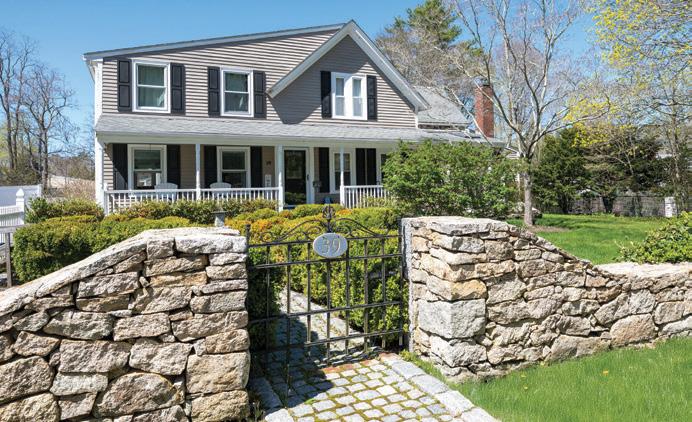
A New Journey Begins at 39 Ryder Lane
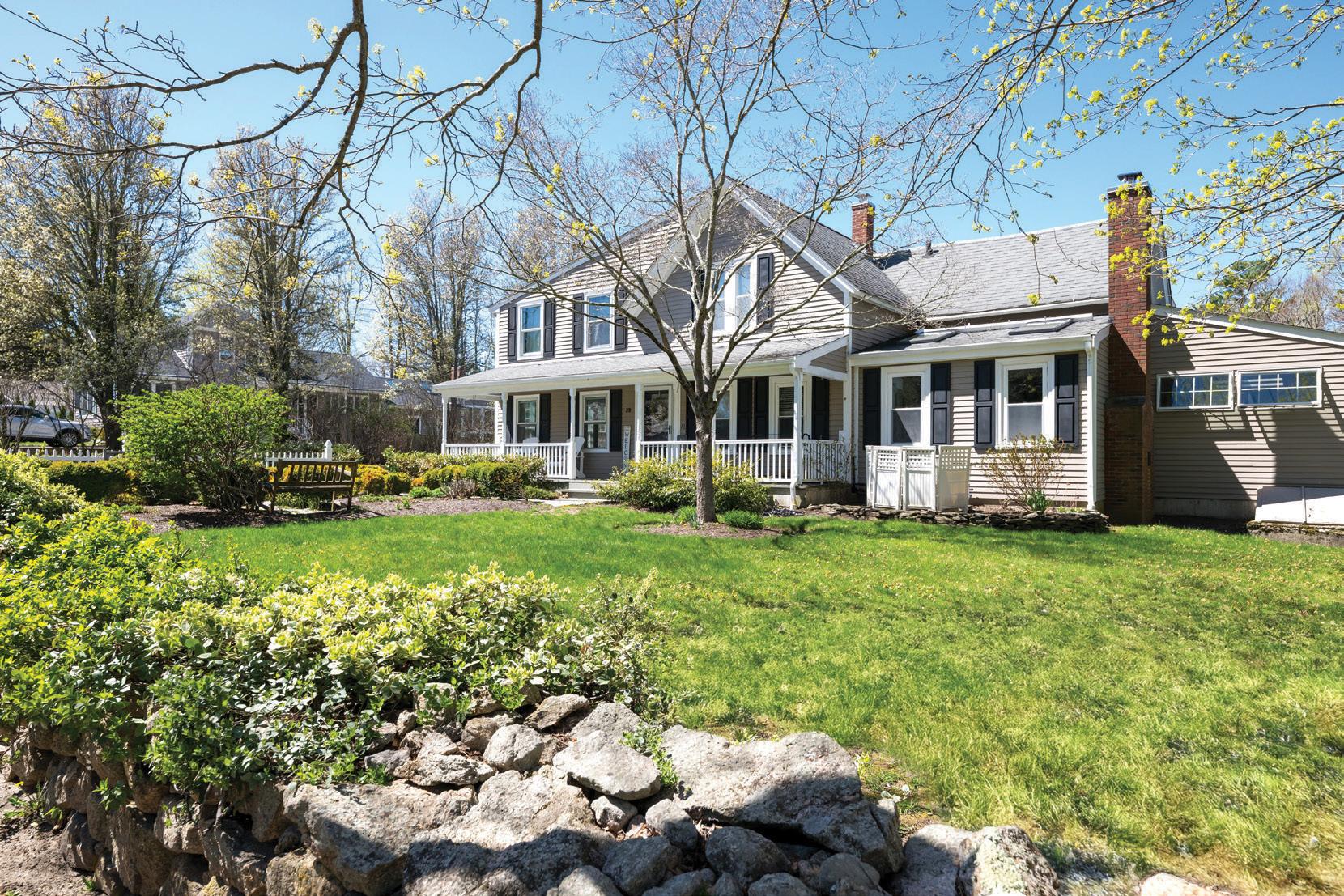
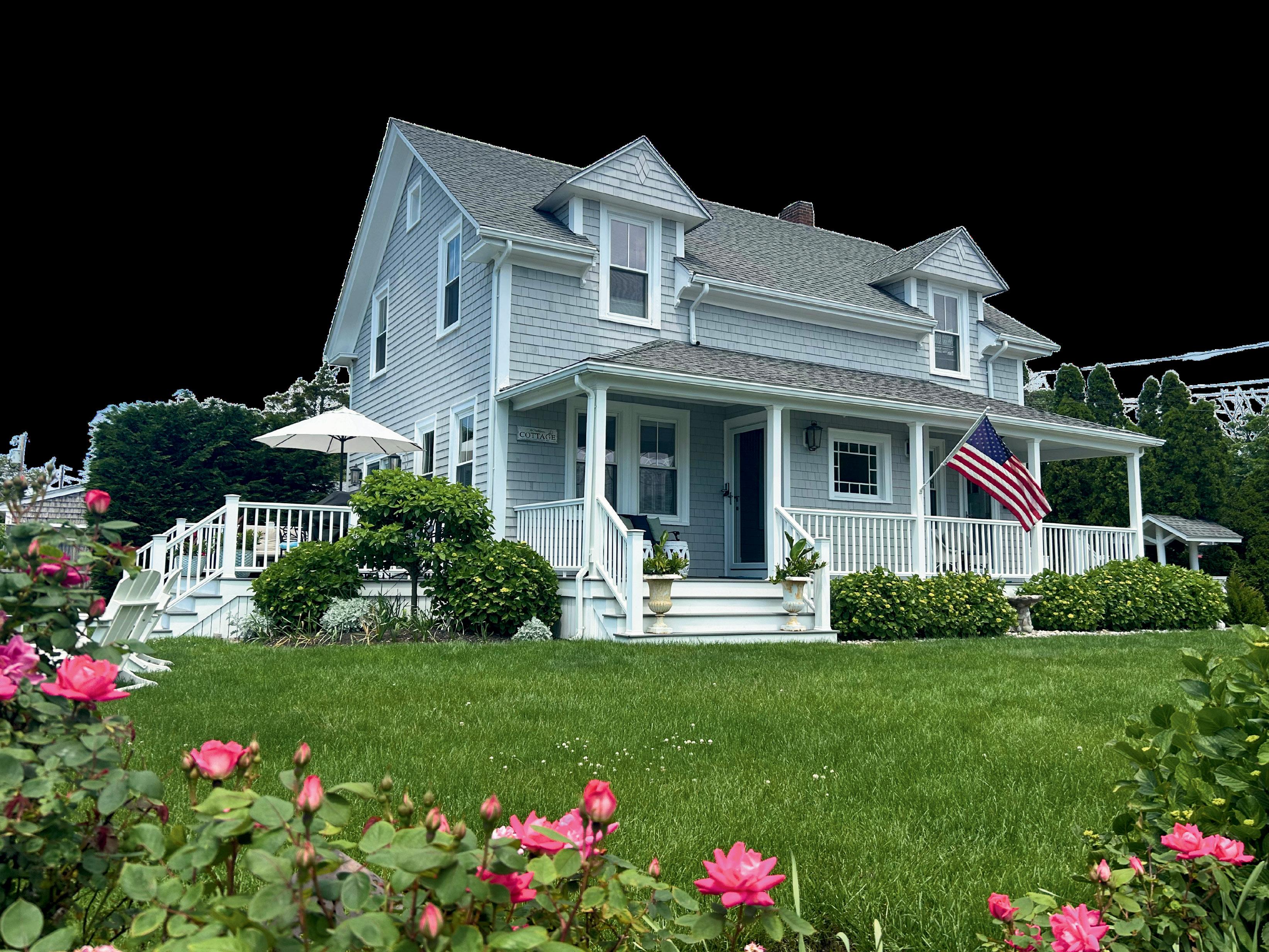
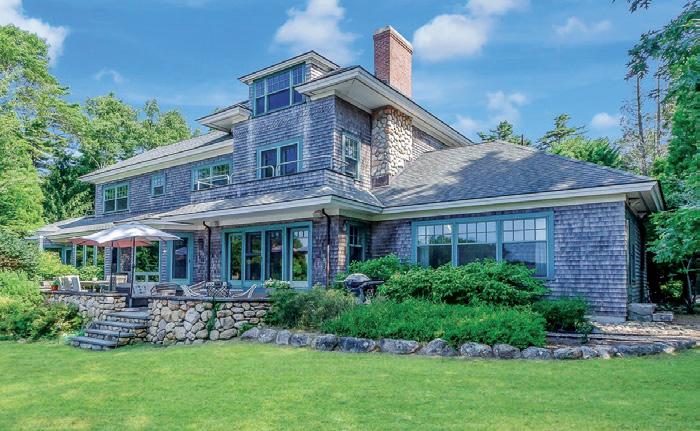
S et in the heart of Marion Village, just moments from Sippican Harbor, there is an opportunity that is rarely available. It is home that defines a lifestyle, one of walkability, connection, and an authentic sense of community. Whether strolling to the harbor, the beaches, the village center, or Tabor Academy, daily life here is shaped by sea air and the natural cadence of coastal living. A legacy home, 39 Ryder Lane is a refined example of coastal living at its best. Offered at $1,699,000.





























BARNSTABLE $5,650,000
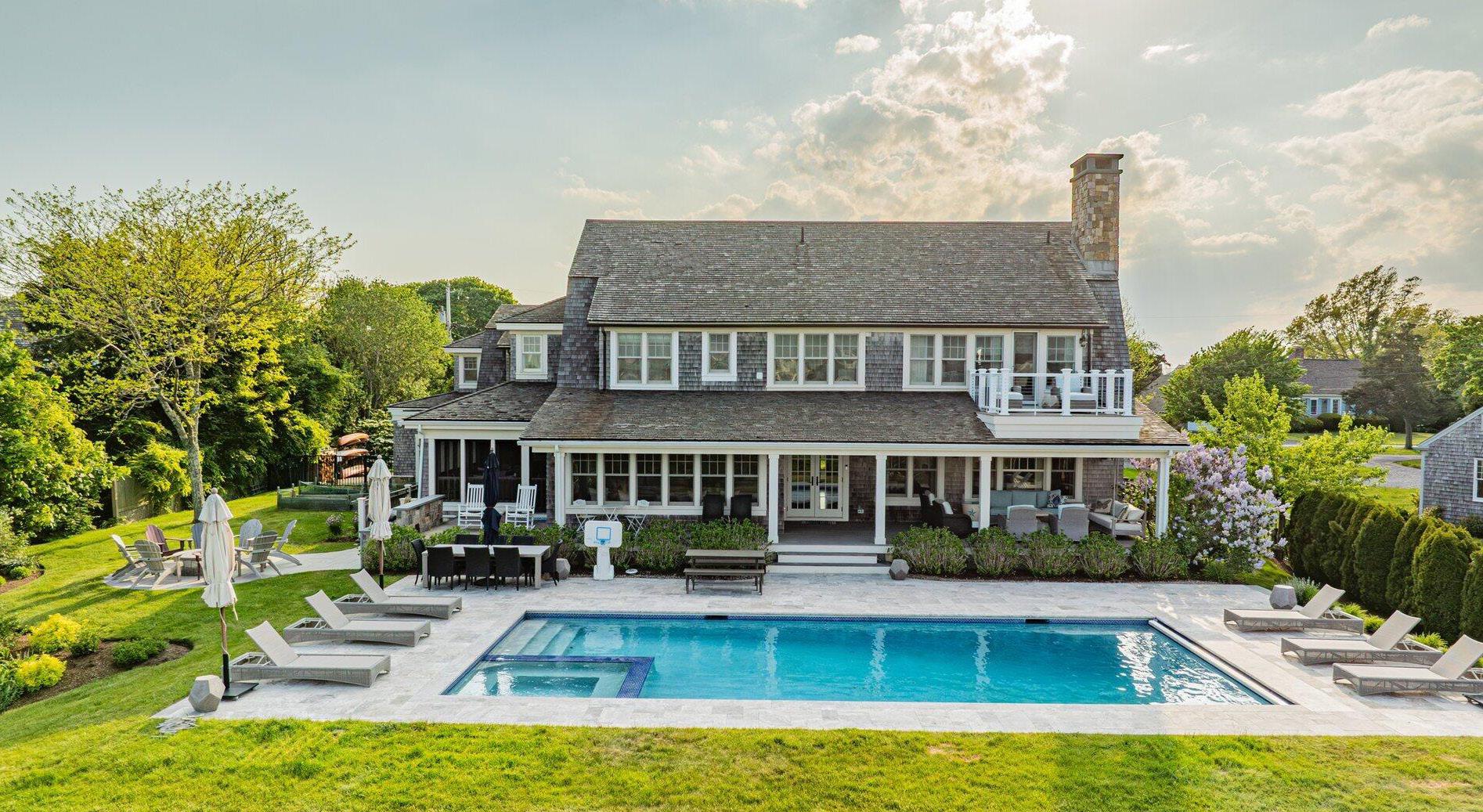
Located within coveted Salten Point, this custom six bedroom home captures sweeping views of Barnstable Harbor and Sandy Neck Beach.
MARION $2,850,000
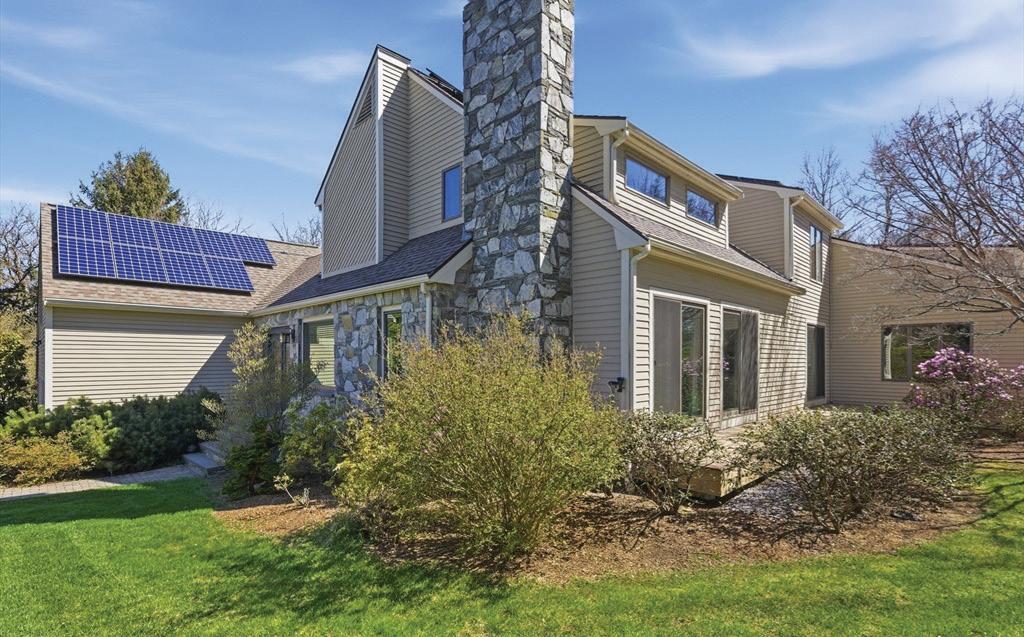
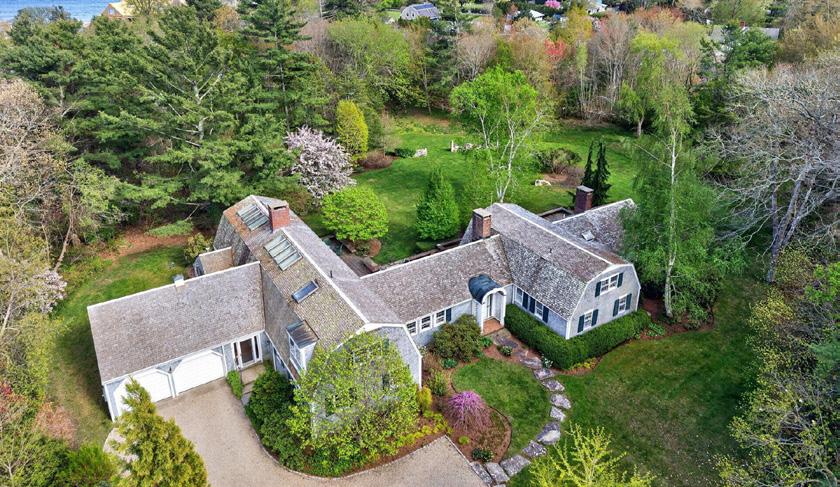
Set on 1.6 acres of private, park-like grounds in the heart of Marion Village, this sprawling Contemporary Cape offers a rare opportunity to enjoy a truly special retreat.


FALMOUTH $1,549,000
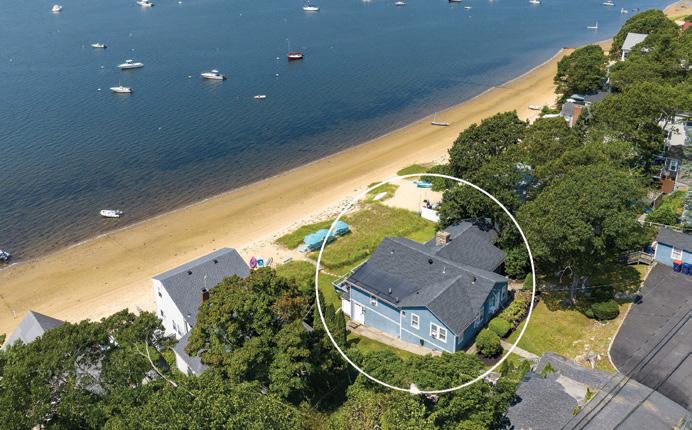
Downtown Falmouth home with harbor views and a location that puts you moments from Falmouth Marina, Main Street, and ferries.
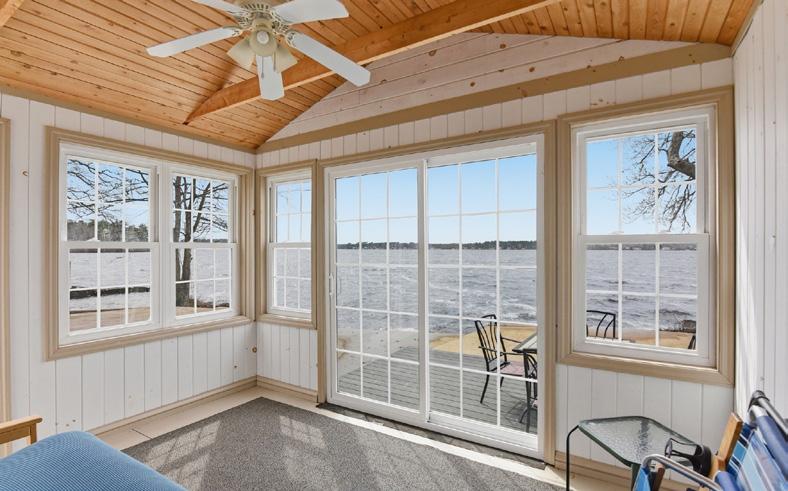
LAKEVILLE $998,000

SOUTH BOSTON $1,325,000
This newly refreshed 2+ bedroom, 2-bath residence offers an exceptional blend of modern design and urban convenience. WELLFLEET $1,200,000 Mid-century
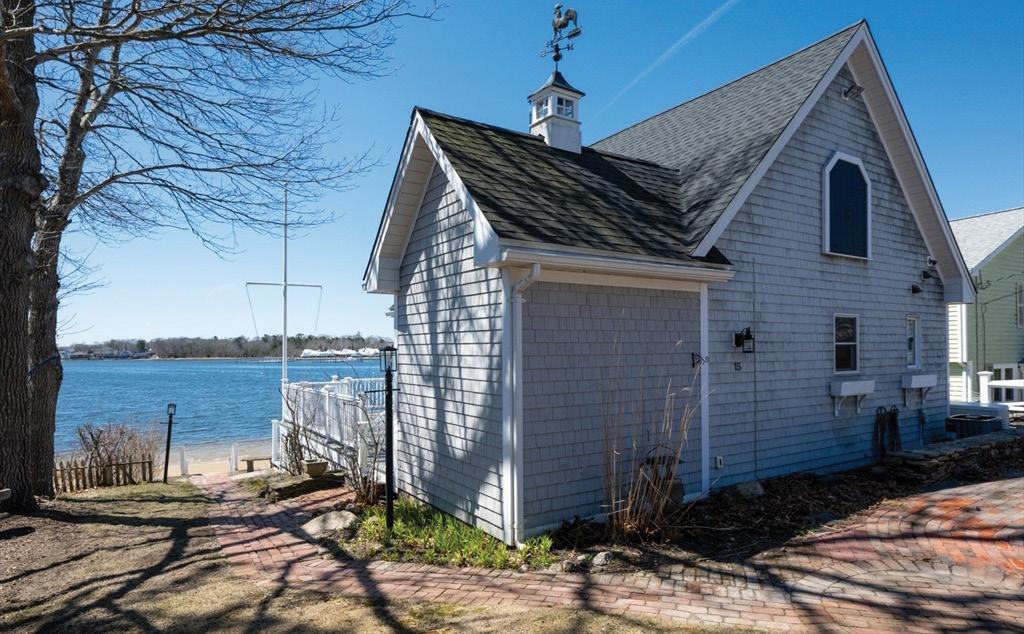
50’ of waterfront with private boat ramp and beach on Long Pond - Massachusetts’ largest fully recreational pond.
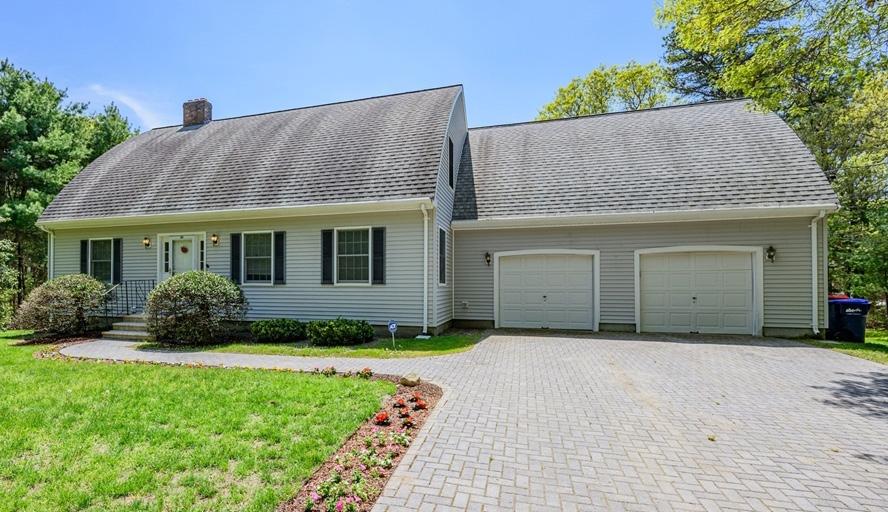
EAST WAREHAM $799,000
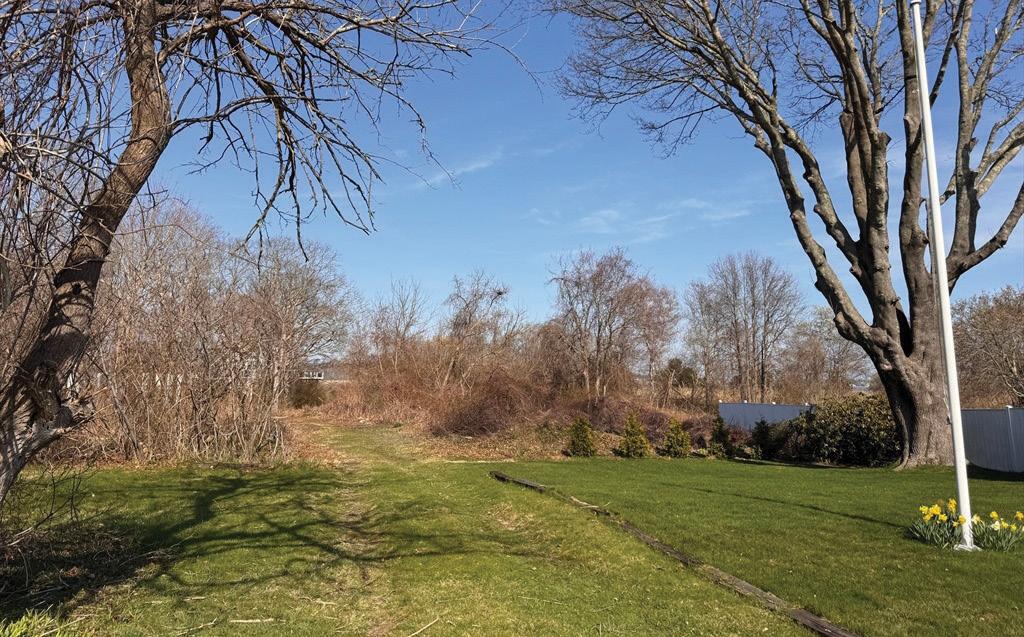
Seaside retreat offers 1.29 acres of privacy and breathtaking sunsets overlooking Shell Point Bay and Sunset Cove.

10
DOSSIER
INSIDE COVER
Luxury Living. ‘10 Questions In 10 Minutes’ with Erin Hovan.
Thoughts From The C-Suite. It is a wake-up call to all Americans when Uncle Sam puts his feelings into words for a better future.

13

IMPRESSIONS
Is The Answer Really Blowing In The Wind? A poem enveloping humor, reality, and a question of climate reality.

22
LIVING WELL
Staying Fit Is A Lifelong Endeavor For A Long, Healthy Life. This month, our health specialist, Rob Saint Laurent, offers insight and valuable tips on exercises after 50 to get the most out of your daily routine through Strength Training, Flexibility, Function, and Balance.

26
COMMUNITY
Welcoming Your New Neighbors. For decades, the public—from around the world—has questioned the existence of life beyond our solar system. At the same time, governments have denied other life-forms from visiting the Earth, even though they have left behind evidence that we are not the only ones roaming the galaxies. Learn of the boy’s encounter and what the current Administration found in top-secret files now being released that could substantiate his claims.

34
INTIMACY
This Month, It’s Hypogamy. Throughout history, cultures and societies’ mating practices have transitioned for countless reasons. It began with Endogamy (the practice of marrying within one’s own specific social, religious, or ethnic group). That option began to shift toward Hypergamy (marrying up as high on the chain of success and perceived value as possible), only to reverse course into today’s quest of practicing Hypogamy, where women select a counterpart who is beneath their level of education, wealth, and even beauty to lessen the chance they might stray. We have to ask, is this new attraction actually taking hold?

38
CAPITAL & MARKETS
SpaceX—The First Step In Exploring A New Frontier. You can’t get away from the tone of support and tenor of fury inside conversations surrounding what is being touted as the largest Initial Public Offering (IPO) in history. It seems the controversy continues because even though Elon Musk’s decision to make SpaceX public, resulting in his employees and confidants becoming millionaires and billionaires (at least on paper) through what was a finely orchestrated event, changes and an announcement that took place at the last minute, seem to suggest the success might have been tied in part to the hope, dreams, and pockets of those known as ‘retail investors.’ As for everyone else? Many still wonder if they are MO on owning a piece of history.
MIND & PERFORMANCE
Human AI Theory Application. Pattern Theory Data Analysis is real and was crucial in the development of machine-based Artificial Intelligence as we know it. The concept was initially identified and described as an innate and unconscious skill certain humans use to turn off internal ‘noise,’ much of which is chaotic and in the form of raw and unrelated data points, while unconsciously analyzing large amounts of stored information within their memories, and turn it into structural mapping, foregoing individual and concrete fact detection. This unique skill set manifests as a predetermined, all-inclusive, decisionmaking process towards predicting solutions and and managing outcomes. Learn more about this edge, especially if you seem to know the answers before the questions are asked.


CULTURAL
The Hidden Costs Of Building Memories Rather Than Artifacts. Investing in intangibles because of FOMO is making already rich sports figures and entertainers richer at your expense. Is it time to examine entertainment investments positioned and articulated to make your life better, when in reality, someone else’s is improving monumentally?
HAPPY BIRTHDAY, SAM
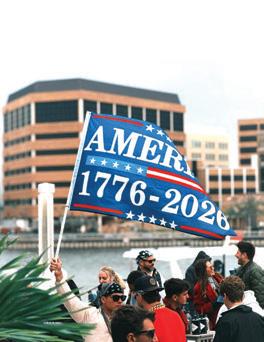
Two hundred and fifty years in, and the experiment is still operating
Welcome to a month that needs no introduction but does make a request. July arrives the way it always has, carrying fireworks and flags and the low hum of a country still working out what it wants to be when it grows up. Call it an anniversary party, a block cookout scaled to continental proportions, or simply the one occasion each year when Americans pause long enough to acknowledge the remarkable, improbable, maddening, and genuinely awe-inspiring nature of what was set in motion 250 years ago. Whatever you call it, you are invited. The only ask, as with any gathering of good people, is that everyone makes a reasonable effort to present their best behavior.
Two events of extraordinary consequence are unfolding as Sam surveys the national scene; both deserve a moment of honest reflection.
The first is very much of this earth. Guests from across the globe have arrived in the United States for the 2026 FIFA World Cup, and what they are finding appears to be catching them pleasantly off guard. Visitors from dozens of nations, many arriving with preconceived ideas about American dysfunction shaped by coverage that favors conflict, are encountering something different: functional cities, warm hospitality, genuine enthusiasm, and a
Thoughts from the C-Suite
Uncle Sam, with that familiar expression somewhere between exasperation and genuine concern, is not scolding. He is reacting. At 250 years old, the republic he represents is in the long arc of civilizational history, yet still quite young. Parents of toddlers understand the calculus: independence and autonomy are the whole point, yet someone still needs to remind the room that behavior has consequences occasionally. In this case, Sam is the facilitator—he’s seen a few things.
Consider the nation as a day school, and the teacher steps out of a classroom. A reasonable working environment, shared purpose, with a posted set of rules that most remaining broadly accept. Without active supervision, however, a certain dynamic emerges. Someone always attempts to commandeer the agenda. Alliances form, and the noisiest voices fill the space. None of it is unprecedented, nor does it represent catastrophic failure. It is simply what communities do when the center of gravity shifts. The key, which the founders understood with imperfection but genuine clarity, is that no single voice, faction, or quarter-hour news cycle gets to own the room permanently. The school keeps running. The experiment continues.
country that, whatever its internal arguments, still knows how to put on a remarkable show for the world. They are impressed. Some are surprised to be. For those Americans inclined toward reflexive national self-criticism, the reception from international visitors carries a useful message: the country that the rest of the world actually encounters is not always the one described in the most agitated corners of the domestic conversation.
The second event is, quite literally, out of this world. The SpaceX initial public offering represents something beyond a financial milestone. It marks the moment when the long-held human ambition to become a multiplanetary civilization acquired a balance sheet and a ticker symbol. Planets once confined to imagination are now line items in a prospectus. Galaxies that existed only in science fiction are now addressable coordinates on a roadmap written by engineers in California and Texas. Few moments in the long arc of American innovation arrive with consequences so difficult to calculate. Whatever one thinks of the personalities involved, the underlying proposition, that humanity needs not remain a single-planet species, is among the more serious ideas the civilization has yet committed capital to pursuing.


Which brings us, by a natural progression, to a question this magazine, which has chosen to take seriously on its pages that follow, asks: what, precisely, do we look like from the outside?
Not as seen by FIFA spectators or foreign journalists, though those perspectives matter, but from considerably farther away.
Evidence from government disclosures, credentialed researchers, and a growing body of documentation increasingly suggests that the question of contact with non-human intelligence is no longer a fringe proposition. Governments around the world maintain teams working through the possibilities. The scenarios are extensive, the outcomes range widely, and deliberations are largely conducted in private. Whether one accepts the premise or holds it at arm’s length, the underlying question it generates is worth sitting with: if a civilization sufficiently advanced to arrive here, and to assess our civilization, what would their analysis conclude?
Would they observe a unified world society, one species cooperating across its differences toward common purposes? Or would they find fractured continents in persistent conflict, a civilization that has split the atom and mapped its own genome but cannot reliably agree on shared ground? Would our demonstrated capacity for organized aggression be seen as a strength or as a warning? These questions are not rhetorical. Advanced civilizations, by most reasonable frameworks for imagining them, would approach first contact with a risk calculus; it’s only logical, and we ourselves are doing it as you read this page. How prepared they chose to be would depend significantly on their long-sought observations.
Unusual questions, certainly. But it’s the difficult questions that tend to matter most before they become necessary. The line between those two categories is shorter than it once was, now that we have access to decades of evidence, whistleblower testimony, and personal accounts from those who have seen—up close—what our government has disingenuously told us doesn’t exist.
What these events point toward, a birthday, the World Cup,
SpaceX’s milestone, and the longer view from beyond the atmosphere, is the same persistent observation: unity is not a soft aspiration; more importantly, it is an operational requirement for a civilization that intends to remain one. Unity of opinion, which is neither achievable nor desirable, isn’t in the realm of possibilities. Still, unity of purpose, the kind that allows people who disagree profoundly yet agree nonetheless that a project is worth continuing, is achievable.
From the person who faces real disadvantages on an ordinary day to the billionaires and a trillionaire who almost certainly have contingency plans for scenarios the rest of us would prefer not to contemplate, the republic contains everyone. Its founding promise was not one of comfort or perfection. It was the possibility of selfgovernance by people willing to accept the responsibility that accompanies freedom and self-determination. It remains the proposition and has never been anything else.
Too much of what passes for public discourse has abandoned the forward view in favor of the immediate score. The appetite for conflict or for the spark that generates the most reaction before anyone has had time to think has become the dominant editorial instinct of the age. Media organizations, whatever their stated purpose, have too often become accelerants of the discord they claim to document. Sam, watching from the poster, has an opinion about that too. Perhaps the more accurate caption would have read: I want the media to behave.
But the birthday is not a moment for grievances. It’s a moment for something more demanding: honest assessment paired with genuine optimism. The republic is imperfect, frequently frustrating, and 250 years into an experiment that was never guaranteed to succeed. It is also extraordinary, capable of self-correction, and still the most watched political project on the planet. The rest of the world is here, in American stadiums, eating American food, navigating American cities, and finding, by and large, something worth admiring.
Sam is still pointing as he always has; the invitation is still open. Let’s show our best behavior—please. H
WIND WEARY
B y P eet N ourjia N

Wild wind as haunting as a ghost
Kicks up high surf that slams the coast
Smacking whitecaps out on the bay
Swamping sailors along the way
A bawdy breeze that lives to dance
Innocent trees don’t stand a chance
Twisted branches, boughs in distress
Leaves left in stages of undress
Kids clutching kite strings at the shore
Swept off the ground as their kites soar
Beach umbrellas spin through the air
With buzzsaw teeth, so kids beware
We liked the old wind that we faced
With open mouths it had a taste
Part clothesline laundry out to dry
Part pine forest breathing nearby
Our old wind spoke in soothing tones
As smooth as tenor saxophones
This new gale force beats its bass drum
Reminding us there’s worse to come
The warming of our precious globe
Demands a congressional probe
When facts are told we’ll realize
Our weather has been weaponized. H




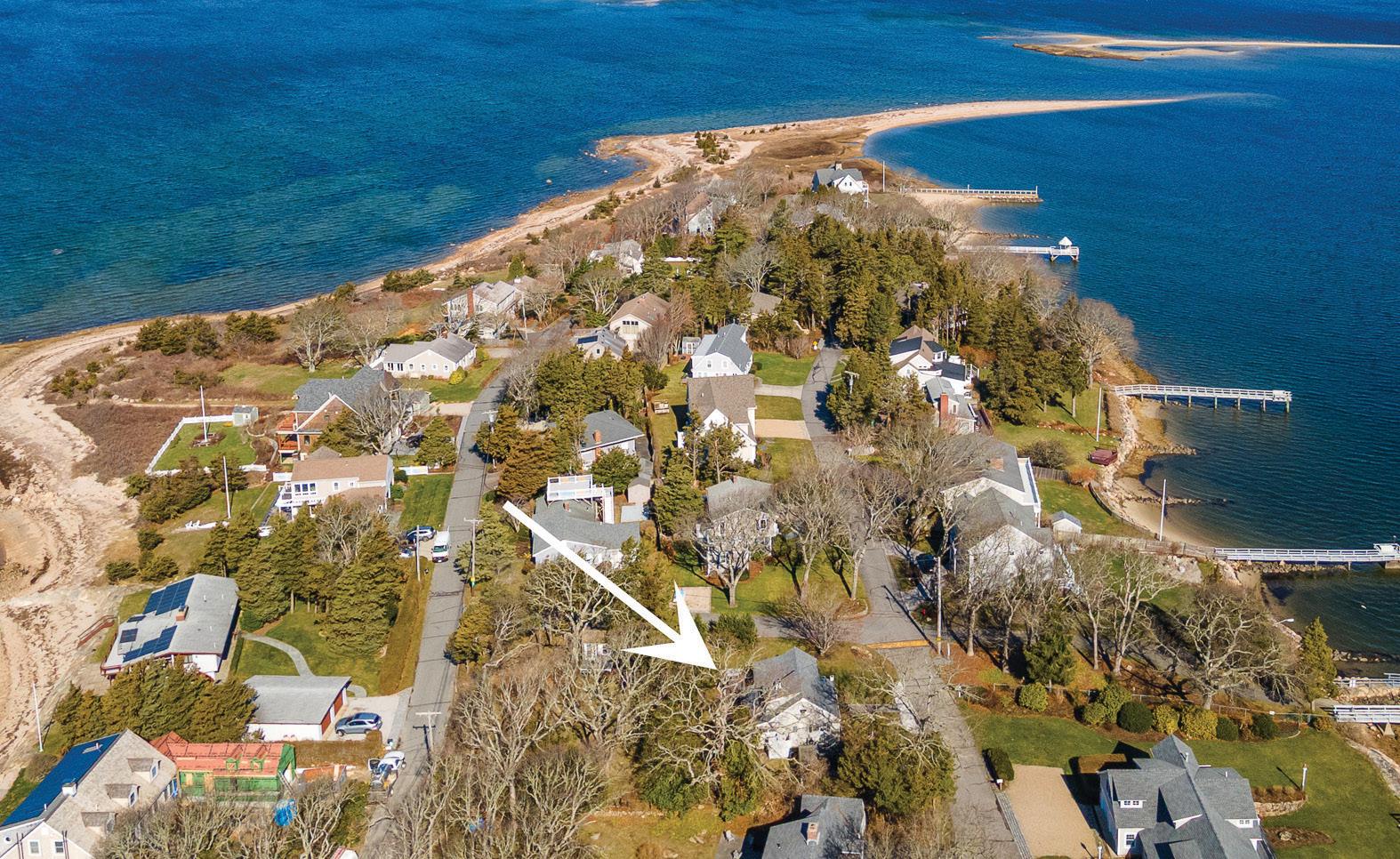
MARION, MASSACHUSETTS
EXCLUSIVELY LISTED AT $1,395,000
MARION, MASSACHUSETTS
Custom-designed and built estate set on a 10+ acre estate in the secluded Hammett’s Cove neighborhood in East Marion. This property offers an unparalleled blend of elegance, privacy, and coastal charm. Complete with a 4,000 +/- sq. ft. main home, 3-car garage, gunite pool, pool house, putting green, and access to the association beach and dock, offering easy access to Sippican Harbor!
Welcome to River’s Edge—one of Marion’s most desirable neighborhoods. This move-in-ready 4-bedroom, 3.5-bath home offers 3,592 sq. ft. of updated living space on a private 1.19-acre lot, including a fully finished basement for added flexibility. The chef’s kitchen features high-end finishes and flows seamlessly into spacious living and dining areas, perfect for entertaining. Upstairs, enjoy brand-new hardwood floors throughout, while renovated bathrooms and central air add modern comfort. Step out from the sunroom onto a beautiful bluestone patio to enjoy a stylish, durable outdoor living space.
EXCLUSIVELY LISTED AT $4,650,000
Tucked away on Planting Island in East Marion is this quintessential water-view Cape and adjacent buildable lot. With unobstructed water views and loads of coastal charm, this Cape Cod-style home is ideally located across from the association dock on Planting Island Cove. This 1,242 +/- sq. ft. 3-bedroom, 1 bath home captures the essence of coastal living. What truly makes this property unique is the .18-acre buildable lot included in the sale, offering endless possibilities for expansion, a guest house, a family compound, or added privacy.
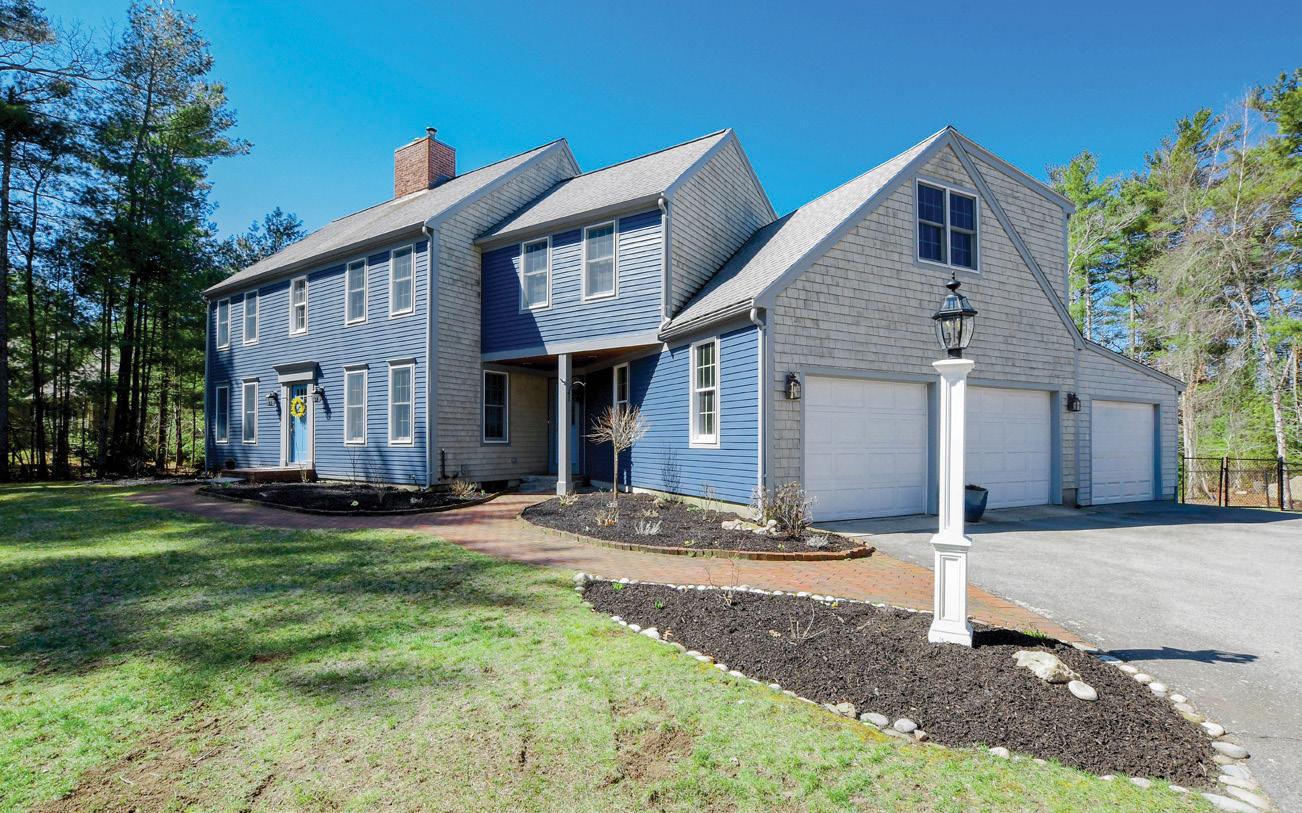
EXCLUSIVELY LISTED AT $1,285,000
MARION, MASSACHUSETTS
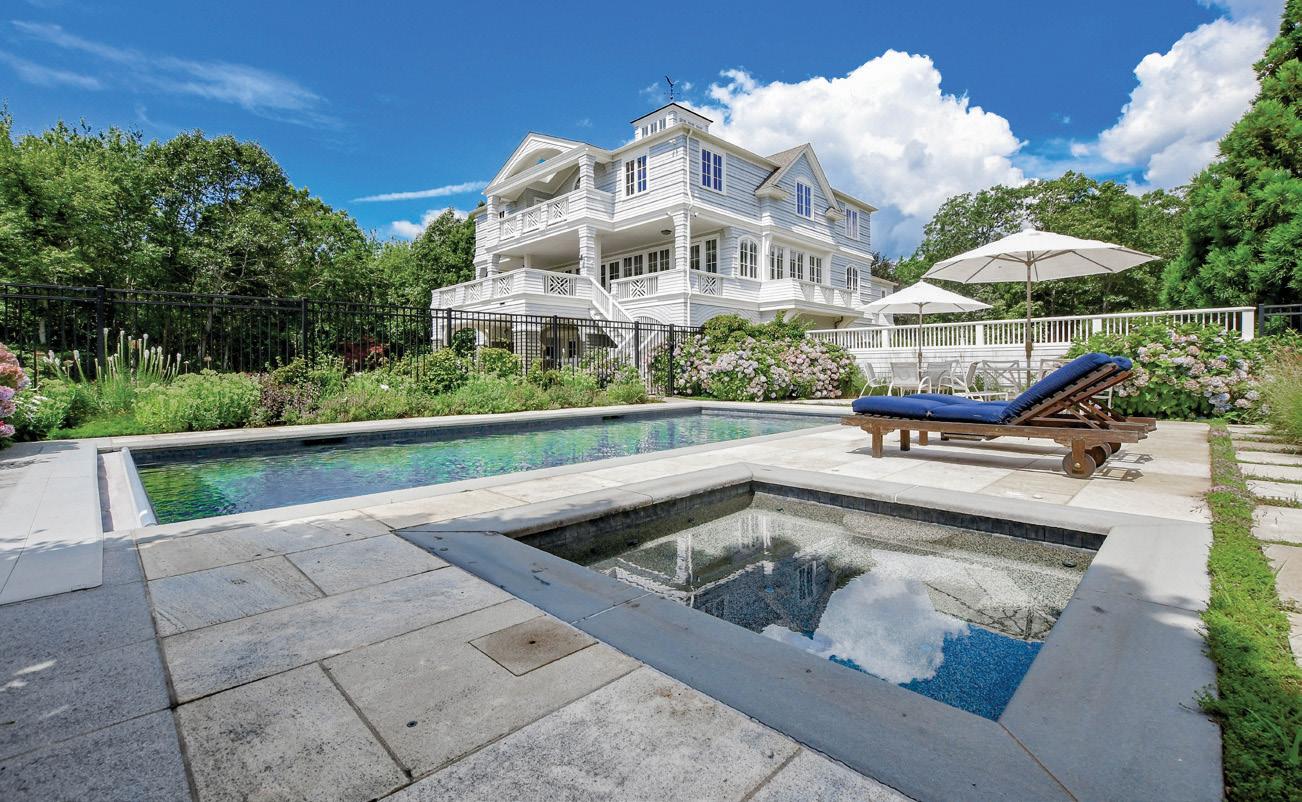
Welcome to Marion’s Converse Point, an exclusive waterfront enclave on Buzzards Bay. Set on 2.76 acres, this 5,030 sq. ft. residence offers breathtaking views of Buzzards Bay and effortless coastal living. Built in 2012, this home features 5 bedrooms, 4.5 baths, an elevator, and multiple decks showcasing the sweeping views. The chef’s kitchen features premium appliances and custom cabinetry, flowing to sunlit living spaces ideal for entertaining. Enjoy a heated swimming pool, hot tub, and pool cabana.
WORK FREE OR DIE

COMMERCIAL SPACE
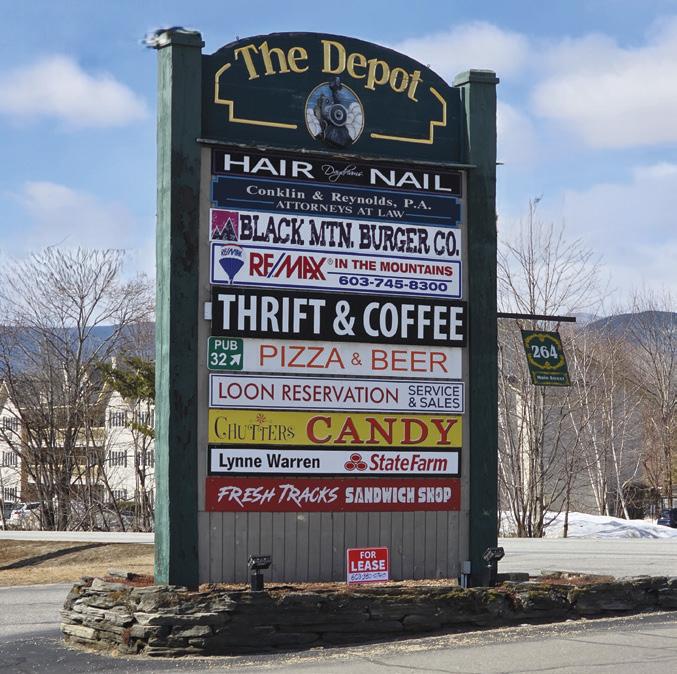
AVAILABLE AT THE DEPOT PLAZA 264 MAIN STREET
LINCOLN, NEW HAMPSHIRE (KANCAMAGUS HIGHWAY/ROUTE 112)
Property Overview:
Office/Retail/Mixed Use
Approximately 1,370 sq.ft.
Lease Type: NNN - CAM, Utilities (includes heat), taxes are tenant’s responsibility
Available this Summer Lease Term Minimum of 3Yrs +
Key Features
• Highly visible mountain location at a four-season tourist destination
• Located between South Peak & Loon Mountain
• Foot traffic from multiple condo developments and anchor tenants
• Traffic count: Route 112 is a major conduit between Lincoln and North Conway, 6-9k vehicles passing daily
• Excellent curb appeal, with the storefront facing a large parking lot and a roadway at ground level
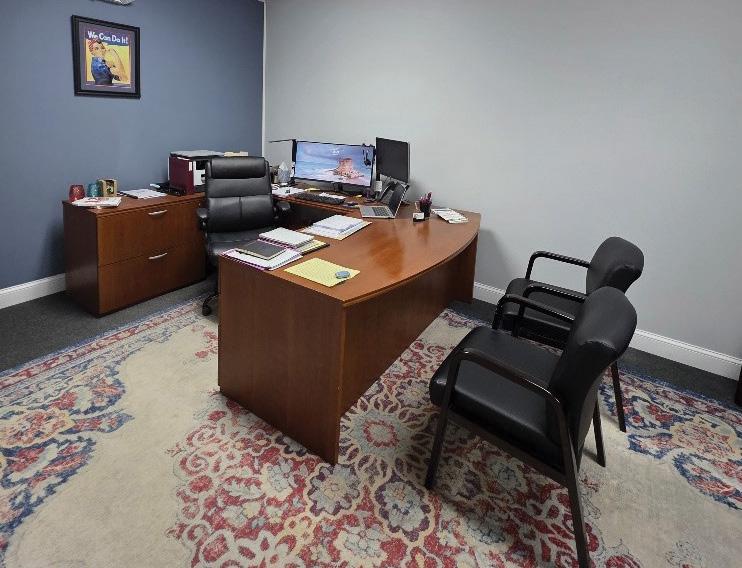
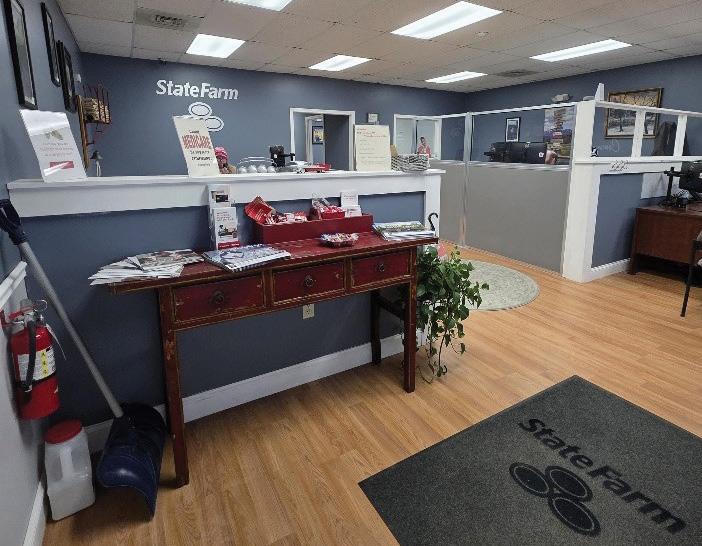
• Central heat & ac, security cameras, newly renovated as an office, offers a flexible floor plan for retail conversion
• Large vertical roadside (double-facing) signage advertising tenants; one sign above the space
• Fees, taxes & utilities: CAM: Utilities (includes heat), taxes are tenant’s responsibility

AND ACCESSORIES
Fine art, furnishings, collectibles, and accessories for interior design projects, home-sale staging, studio photography, and theatre events—for purchase or lease. Flexible terms available.




JUNE 26 – NOV 1, 2026
ROSECLIFF, NEWPORT, RI
The Preservation Society of Newport County
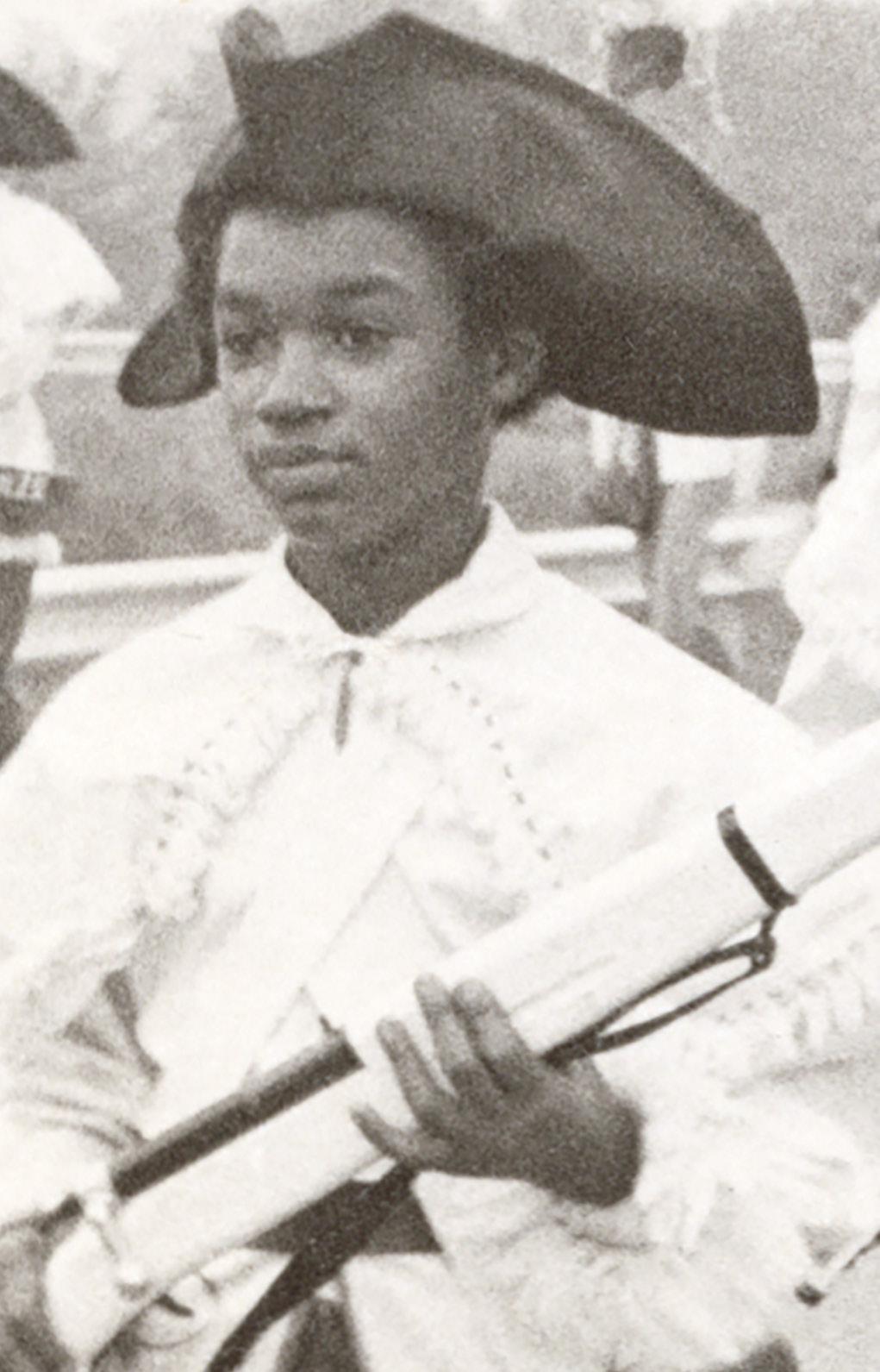
ince Colonial and Revolutionary times, Newport has been a place where history happens. This Semiquincentennial summer at the Newport Mansions will be one to remember, with a major new exhibition at Rosecliff, theatrical performances and family programs at Hunter House, and lectures by distinguished experts in history and the arts. Celebrate with us! EVOLVING STORIES FROM



AP&S Welcomes Randall T. Weeks, Jr.
We are pleased to welcome Randall (“Randy”) T. Weeks, Jr. to the firm. Randy brings extensive experience advising a diverse client base, including financial institutions, business services companies, medical groups, wholesalers, retailers, professional service organizations, and manufacturers. His strong presence and longstanding relationships in the SouthCoast business community will further enhance our ability to serve clients throughout the region.

Providence & Newport, RI • Boston & SouthCoast, MA Manchester, NH • New York, NY
apslaw.com

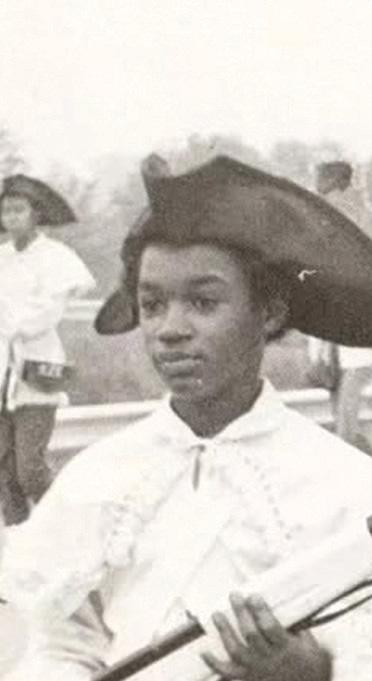


The Preservation Society of Newport County is getting into the Spirit of 2026 with an insightful exhibition and theatrical performances that bring Newport’s Revolutionary history to life.
• Exhibition, June 26-Nov. 1, Rosecliff: “Revolution Reimagined: Evolving Stories from Newport’s Past.” Curated by Dr. Nicole Williams, the Preservation Society’s Curator of Collections. This exhibition explores Newport’s vital role in the American Revolution through the lens of myth and memory.
• Theatrical performances, Tuesdays and Saturdays, June 30 through September 1, 6-7:15 p.m., Hunter House: “Loyalty or Liberty: Tales from Revolutionary Newport.” Produced in partnership with Plays in Place, “Loyalty or Liberty” combines three short plays highlighting the difficult choices faced by many during the American Revolution.
Information and tickets for each program are available at newportmansions.org/events.

Discerning People — Find Each Other




EXERCISE AS MEDICINE
Why Fitness Matters Most After 50 and What You Can Do to Stay Well
The U.S. is aging rapidly, not because of declining births and increasing life expectancy, but because baby boomers are now in their 60s and 70s, and their children have reached their 40s.

BY ROB SAINT LAURENT, M.ED.
ith the nation graying, maintaining independence moves front and center, since the risk of chronic diseases rises as people age, and more older people are chronically ill than in decades past.
While medical advancements have allowed us to live longer, our healthy years, or healthspan, have been shrinking, leaving many seniors spooked by the prospect of languishing in a nursing home.
AGING GRACEFULLY
Most of us know exercise promotes good health. But the importance of physical fitness for maintaining health and mobility in our later years is often underappreciated. A landmark 2024 study in JAMA Network Open examined health records, biological samples, and death registries of over two million people aged 20-97 in the U.S. (1997-2018), U.K. (2006-2010), China (2004-2008), and Taiwan (1997-2016). Across all ages, the multinational study showed a consistent connection between meeting physical activity recommendations and lower deaths. But the effect increased with age, especially in those
over 60 and with higher activity levels, and was most pronounced in people aged 70-79.1
Exercise reduces the risk of “hypokinetic” disease, or chronic illnesses that are largely preventable through physical activity and healthy living. A study of over 46,000 U.K. participants aged 40-69 found those with high cardiorespiratory and muscle strength enjoyed a 10 percent lower risk of experiencing cancer, heart attack, diabetes, chronic obstructive pulmonary disease, stroke, congestive heart failure, dementia, and death than those less fit. These diseases can prematurely end healthspan and speed biological aging. 2
Regular physical activity protects telomeres, the protective caps on the ends of chromosomes that gradually shorten from cell division. It’s this shortening that makes cells less functional, increasing the risk of disease and death. Moderate-vigorous aerobic exercise appears to help maintain longer telomeres for healthier aging and longer life, though more research is needed.3
The ideal longevity workout format, according to science, is a combination of cardiorespiratory and strength/weight training, with supplemental flexibility and balance work.
How might this look in practical terms for people starting out at home?
CARDIORESPIRATORY TRAINING
The American College of Sports Medicine recommends a minimum of 150 minutes/week (30 minutes 5 days/week) of moderate-intensity aerobic exercise, or 75 minutes of vigorous cardio activity, with moderate intensity defined as being able to talk but not sing while exercising.
It can be brisk walking, cycling, swimming, home elliptical machines, stair climbing, pickleball, etc. Health benefits accrue beyond 150 minutes, says the American Heart Association; for example, having a goal of 300 minutes/week.
If you’re tracking heart rate, you can calculate a personalized training range using the formula below.
KARVONEN METHOD FOR CALCULATING TRAINING HEART RATE RANGE (60-year-old)
1. Maximum heart rate: 220 beats per minute (bpm) – age = 160 bpm
2. Heart rate reserve (HRR): 160 – resting heart rate (best taken upon waking) (for example, 60 bpm) = 100 bpm
3. HRR x desired training intensity (for example, moderate at 40%) = 40 bpm
4. 40 bpm + resting HR (60 bpm) = 100 bpm (lower limit of range)
5. HRR x desired intensity (for example, moderate at 59%*) + resting HR (60 bpm) = 119 bpm (upper limit)
Training HR range: 100-119 bpm
*Vigorous intensity would be 60%+ of HRR.
Generally, progression is by first increasing duration (the amount of time spent exercising), then increasing intensity speed or resistance level).
New research on nearly 100,000 people in the European Heart Journal suggests just 15 minutes/week of vigorous aerobic exercise, like brisk stair climbing that leaves you slightly breathless, can dramatically lower risk for major diseases such as heart disease, diabetes, and dementia.4
STRENGTH TRAINING
Two proven indicators of longevity are leg and grip strength, which are critical to maintaining overall health, functionality, and independence.
To get a baseline of leg strength, several tests are sit-to-stand, bodyweight squat, and wall sit, all of which are described online. In sit-to-stand, the goal is to measure how many times you can stand from a chair in 30 seconds with arms crossed on your chest. If you can’t rise without using your arms, your score is zero. For women, above average (i.e., lowest risk of falling) is over 17 repetitions (reps) for a 60-year-old, over 15 reps for a 79-year-old,
and over 11 reps for a 90-year-old. Above average for men is 19 reps for a 60-year-old, 17 for a 79-year-old, and 12 for a 90-year-old.
In bodyweight squats, you lower the hips from a standing position until the knees reach 90 degrees, then rise by pushing through the heels, keeping the back straight throughout. In 60 seconds, an aboveaverage score for women is 18-21 reps for a 50-year-old and 14-16 for ages 65-plus. Above average for men is 25-38 for a 50-year-old and 19-21 for ages 65-plus. Use a steady tempo.
In wall sits, you’re standing with your back flat against a wall, feet about 24 inches apart, lowering your hips until your thighs are parallel to the floor, keeping your lower back pressed against the wall to engage the buttocks. Stay seated for as long as possible without shifting. (For safety, position cushions or a stool just beneath your hips.) Average scoring for women is 45-90 seconds for a 49-year-old and 20-45 seconds for ages 60-plus; for men, 1-2 minutes for a 49-year-old and 30-60 seconds for ages 60-plus.
To get stronger, aim for 2-3 sets per exercise, weekly, to start. Adding standing single-leg gluteal extensions (raising one foot to the rear while keeping the leg straight) to strengthen the buttocks can help protect the knees and lower back while improving posture.
Regarding grip strength, yours may be waning if your handshake is weaker and grocery bags are more of a chore.
To get stronger, repeatedly squeeze a tennis ball as deeply as possible for a minute, seeing how many full reps you can complete and progressing beyond that. You can also hold and/or carry two objects, like gallon water jugs or suitcases, for a minute and gradually increase duration, then weight.
Training the upper body as a whole is essential for maintaining health and independence: back rows; pushups for chest (conventional, kneeling, off a wall or table, etc.); overhead presses and arm extensions for shoulders; overhead triceps extensions; biceps and wrist curls.
Bodyweight, a pair of adjustable dumbbells, and/or fitness tubing can suffice for home training.
Select 1-2 exercises per muscle group weekly to start, 2-3 sets of 8-12 reps per exercise. Use about two-thirds of your maximum weight at 8 reps. Gradually increase to 12 reps before increasing resistance. Rest 1-2 minutes between sets.
Build up to training the entire body twice weekly. For efficiency, split workouts into lower and upper body; for example, Mon/lower, Tues/upper, Thur/lower, Fri/upper.
For optimum fat burning, it’s generally best to lift weights before cardio, unless cardio is done separately in the a.m. before breakfast (use moderate intensity).
FLEXIBILITY, FUNCTION, AND BALANCE
To gauge flexibility, a sit-and-reach test involves sitting on the floor with legs extended in front, then reaching toward your toes. This task measures lower back and hamstring range, which are important for overall mobility.
To improve, focus on static stretches of the lower back, hamstrings, hips, and calves, holding the stretch for about 30 seconds and repeating 2-3 times.
Dynamic stretches also promote mobility and involve repetitive muscle movement with a full range of motion. All described online: torso twists, alternate knee raises, leg swings, arm circles, and windshield wipers.
Because of smartphone culture, upper cross syndrome is prevalent today, where chest muscles are tight, shoulders rounded, and neck muscles weakened from heads always tilted downward. Stretching the chest and front shoulders, and performing supermans on the floor, can help improve posture and reduce the risk of injury and chronic pain.
To help protect the lower back, switch to a golfer’s lift rather than bending over when lifting everyday objects weighing less than five pounds. Keep one leg planted close to the object; with the back straight and core tight, reach down with one hand as you raise the rear leg to counterbalance.
Balance ability is an often-overlooked component of fall prevention, important for better proprioception (body awareness and muscle activation) and reaction time.
In a single-leg stance test, you’re counting the time until you either touch the ground with the raised foot, shift the anchor foot, take your hands off your hips, or lose balance. Less than five seconds is predictive of serious falls in older adults; 10 seconds or more is linked to a lower risk of all-cause mortality.
Going further, try putting on a sock while balancing—a test of flexibility, balance, and core stability.
Strengthening the core (planks, bird dogs, leg raises, etc.) can enhance balance and make movement easier.
Incorporating an inflatable balance disk can help keep balance work fun and engaging.
Perform stretching and balancing two to three times/week; dynamic stretches and balancing before your primary workout, then static stretches afterward.

FORMING A NEW HABIT
Government statistics show most older Americans still don’t exercise enough. Studies suggest it takes at least six weeks of regular exercise for it to stick.
Patience, using cues like “after work”, tracking and rewarding milestones like making six weeks, and exercising with a partner or qualified home trainer can help make fitness a lifestyle as you build confidence.
If you’re thinking about regular exercise but not quite ready, listing pros and cons and figuring out ways to overcome any perceived barriers may help you decide.
Ultimately, the best exercise is the one you’ll stay with, as it may take a while for an active lifestyle to significantly impact mortality risk and longevity.5
Starting exercise can seem daunting, but small modifications, like moving more and not sitting still for too long, can pay dividends.
Any amount of physical activity counts! H
(Consult with your healthcare provider before beginning any exercise program, particularly if you have special medical considerations.)
1. Martinez-Gomez, T., Lou, M., Huang, Y., et al. (2024). Physical Activity and All-Cause Mortality by Age in 4 Multinational Megacohorts. JAMA Network Open, 7(11).
2. Chen, Z., Collings, P. J., Wang, M., et al. (2025, October). Physical Fitness, Biological Aging, and Healthy Longevity. Journal of the American Medical Directors Association, 26(10).
3. Schellnegger, M., Lin, A. C., Hammer, N., & Kamolz, L.-P. (2022, September 4). Physical Activity on Telomere Length as a Biomarker for Aging: A Systematic Review. Sports Medicine Open, 8(111).
4. Wei, J., Shen, M., Li, S., et al. (2026, March 29). Volume vs intensity of physical activity and risk of cardiovascular and non-cardiovascular chronic diseases. European Heart Journal.
5. Jakicic, J. M. (2024, November 21). Physical Activity and Reduced Mortality Regardless of Age—Considerations for Public Health. Ovid.

Caregiver Payments
Caring for someone at home? You may qualify for a monthly payment.
Are you facing the challenges of caring for a loved one at home? Perhaps trying to wholeheartedly balance their needs and the daily demands life delivers you?
If this sounds familiar, we are here to assist you in providing an unmatched standard of Adult Foster Care benefits for those striving to stay in their homes.
Mass Care Link is evolutionary, providing a monthly payment to those caring for someone at home while supporting them with a personalized touch.
Costing less than assisted living facilities and nursing homes, with a record of compassion and empathy, we cover the unique needs of our clients.
Families and individuals rely on our services to:
• Ensure caregivers receive a tax-free monthly stipend/payment
• Review and verify MassHealth paperwork and qualifications
• Train and assist with the management and demand of providing 24-hour care
You may not know this fact, but if you qualify as an at-home caregiver, you can earn up to $18,240 yearly.
For a caregiver to meet state requirements, they must:
• Be at least 18 years of age
• Reside in the same home as the person they care for
• Not be the legal guardian or legally married to the person being cared for
• Provide necessary medical care and assistance that meets the needs of the person they care for
For your family member or loved one to qualify for Mass Care Link services, they must meet these eligibility points:
• Be 16 years of age or older
• Be approved for MassHealth insurance
• Live with the primary caregiver in the same home
• Require supervision and cueing, or physical assistance daily with at least one of the following needs: bathing, toileting, ambulation, transferring, eating, and/or dressing.
If this sounds attractive and meets your level of interest, contact us today for additional information or to schedule an appointment.
Mass Care Link, Inc.
99 South Main Street, Fall River, Massachusetts 02721 Hablamos Español | Falamos Português call for more information or visit us online at:


WHO’S OUT THERE?
Is 2026 the Year the American Public Finally Learns the Truth About Unidentified Flying Objects?
After a decades-long debate, the Administration has vowed to release information and confirmation, one way or another, on whether life originating beyond our galaxy actually exists. What we learn, and what remains under wraps, is anyone’s guess. However, the shadow forces remain intent on derailing the disclosure. On these pages, we lay out a story that, depending on what the government reveals, may land very close to home.

BY JAMES HOLDEN
hether or not you believe in the existence of alien life is a personal matter. Fascinating, certainly—but not one worth turning into an argument. What it does not negate, however, is the accumulating weight of physical evidence, first-hand military accounts, and documented sightings that have pried open Pandora’s box, stoking a level of nationwide curiosity and unease that no administration can much longer contain.
Before we arrive at what Washington is preparing to tell us, there is another story worth sharing. A local one. A true one. And, depending on how the coming disclosures unfold, it could potentially be one of the most personally significant accounts this magazine will ever publish.
We ask that you set this issue aside when you have finished it. Keep it somewhere you will find it again. Because
whenever, wherever, and whatever we learn about the possibility of visitors from beyond our atmosphere, the heart of the disclosure will either prove or disprove what a sevenyear-old boy witnessed on a bright Sunday morning, roughly 60 years ago, on a quiet road in a place that would eventually become known as the SouthCoast of Massachusetts.
What follows is drawn from many conversations I have had with that boy—and with the man he became; we’ve known each other for a very long time. He has asked that his name not be used, but what I can tell you, having spoken with him across many years and many sittings, is that not a single detail has ever shifted. Not the road. Not the weather. Not the description of what he saw above the treeline. The location, the color, the light, the silence— identical in every telling. Consistency of that caliber, across that span of time, is not something a person manufactures. It is something they quietly carry with them.
He offered his account without performance or persuasion, projecting a humble certitude of someone who long ago stopped needing to be believed. Here is what he told me.
IN HIS OWN WORDS
We had recently moved to Dartmouth, Massachusetts. I was enrolled at the Padanaram School on Elm Street, in the southern part of town. My sister was a bit younger, so her only duty was to stay home and play until I got back from school. My father worked on the sea, and my mother made and maintained our home. It was an exciting time for all of us; the town seemed young and uncertain, just as we were. With only a few businesses here and there, I recall most were tiny shops owned by locals; it wasn’t unusual to have the butcher as your teacher.
The roads were narrow and less traveled, and more often than not, horses and cows were found crossing from one field to another. Having moved from a small city, we were astonished to find that everyone knew each other. I remember feeling it was an ideal place to grow up, with plenty of room to run; I always felt safe and secure. In hindsight, it was the very reason my parents bought a home there.
Sundays were reserved for church and family drives: out to Horseneck Beach, through the country, or down to the working docks of New Bedford to watch the ferries deliver tourists to and from the Islands. Each day was a pleasure, and I believed there wasn’t a worry in the world that couldn’t be solved since we didn’t face many. We were a model family.
And although there were many wonderful Sundays, there is one that has never left me: it remains as crisp and clear as it was that day.
passing down the narrow and darkened tree-lined roadway.
On one side, I noticed more homes were set high above the road surface, and on the other, open pastures with long views toward what would eventually become UMass Dartmouth provided glimpses of intermittent daylight into our car.
As we continued past the school, the road briefly straightened before tightening into a hard right, then leveled for a few seconds before requiring us to make a sharp left in front of a home known to belong to a tennis family.
It was at that bend, directly in front of that house, when it happened.
We were not moving fast, perhaps 10 to 15 miles per hour. I was looking out the window to my right as the car began to pass the entrance to a long, steep driveway leading up to the home, which was significantly above grade. Suddenly, without warning, something caught my attention, resulting in my eyes rising to its peak. What I saw in the sky, no less than a 100 feet above, burned a vivid image into my memory, which is as clear today as it was that day.
This particular Sunday was perfect in every sense. Around 11 in the morning, the four of us loaded into our new black VW Beetle—destination unknown. My sister and I had claimed the back seat as our permanent territory. I sat behind my mother, who was in the front passenger seat; my sister sat behind my father, unless she had curled herself into the open storage hatch behind the rear seat. Seat belts were still years away, so we moved around freely, unaware of any danger that lurked.
The sun was out, not a cloud in sight; the air was warm, dry, and comfortable; I attributed that to the tree cover that shaded much of Dartmouth in those years; it was rural. I wore a madrastype shirt and light-colored chinos, yet for the life of me, I can’t tell you what anyone else had on that day.
My father had heard about a road in town that offered drivers an opportunity to navigate twists and turns, rises and falls unlike any other. As for the rest of us, it was the serene scenery and natural growth that lined Tucker Road that provided entertainment.
On this day, we had made our way from the waterfalls at Russells Mills to where Allen Street intersected Tucker Road. In a moment, I noticed a change in the landscape; homes grew larger, and Friends Academy appeared as a castle, towering over the manicured lawn. As we continued, my eyes went wide,
It was enormous. My eyes wide open, I saw a shiny, brightly lit disc-shaped ship, broad and squat, with a diameter many times its height. The upper surface rose in a low, smooth dome, lined with reflective windows that outlined the separation between the dome and the base. The steep and smooth ‘plate’ of the craft was gently convex, like an inverted shallow bowl; its vertical outer edge resembled a hull, slightly flaring outward, with a seamless rim wrapping the entire circumference, from at least the area I could see. Every surface was immaculate. There was an abundance of the brightest lights I had ever seen, yet they didn’t illuminate outside of the ship itself; I couldn’t tell where they were placed, but they made for a perfect view. Notably, there were no rivets or seams; it was uniformly constructed. The object moved in a wild, hovering agitation, as though it was spinning at a speed the eye could not register, generating enough force to sustain itself in the air.
My first reaction was not fear; my emotional state was more aligned with recognition, not that I had seen anything similar before. I knew that, with my limited creativity, I could never have imagined a visual of this magnitude, yet I felt I was meant to see it at that very moment. Uncharacteristically, a calm settled over me that, looking back, makes no sense for a seven-year-old under those circumstances. I did not call out. I did not point or shout. I stayed fixated on the orb as we passed.
The seconds felt like minutes. The object made no sound. No vibration reached the car. Then, as the VW completed its turn, and I pivoted to look through the rear window, I had to confirm what I had seen. To my disappointment, whatever it was had disappeared. And as odd as it felt as we continued towards Route 6, I understood that I would not see it again.
My next thought was, “How am I going to explain what I just saw?” With few options available, I turned to my sister
and quietly asked, “Did you see that?” With a puzzled look, she abruptly said “No,” causing me to ponder whether she saw but was too frightened to admit to it. It was years before we ever addressed what happened that day, and by then, she had no recall.
As we drove on, I worked through my options. Do I say something? Did I actually see what I think I saw? Would I be better off saying nothing? The answer came quickly. I had been raised not to keep secrets, and I believed honesty mattered. Without drama, in a tone I would describe as matter-of-fact, I told my mother and father that I had just seen a giant saucer—a space ship, above the treeline, back near the house at the bend. I described it exactly as I have described it here. What came back from the front seat was: “I see,” followed by, “Okay.” I was left holding onto an experience I couldn’t explain, nor did I understand.
We never discussed it again as a family—not until we were all adults. My sister and I returned to it over the years, and she always arrived at the same conclusion: ‘I have to believe you. In our entire lives, you have never changed the story by a single word.’ When I told her I intended to share the account publicly, she said, ‘Maybe now people will believe there is something out there that none of us can explain.’
THE WRITER
At this point in the story, most accounts would end. A childhood sighting, vivid and unverifiable, filed away under the broad heading of the unexplained. But that is not where this one goes.
Some 20 years later, our witness had traveled, built a career, and returned to the area. His social circle was at the age when engagements and weddings became a steady backdrop. He was not in any particular rush—but that summer, he met someone.
Educated, striking, and, by his account, unlike anyone he or his friends had encountered before, she was new to the coastal

community. After their first introduction, it was clear to both of them that it would not be the last. It was not. He asked her out. She gave him her address and a time, and he thought nothing more of it—until a week later, when he was in his car, paper in hand, reading the address aloud for the first time.
TUCKER ROAD
He drove slowly. He ticked off the addresses as he passed the homes. When he reached a number that matched, he pulled over. The handwritten note beneath the address read: Drive around the first house. Ours is behind it, not visible from the road.
He sat at the roadside for a long moment, looking up through the trees toward the patch of sky above the property. The same sky. The same bend in the road. The same location where, two decades earlier, he had watched something enormous and silent hover without explanation above a roofline on a Sunday morning.
He did not mention it on that first date. He decided it would be better to leave it alone. When he eventually married her— a year later—he brought it up with his family and shared the full account as he recalled it. He found humor in their reaction; it was about as uneventful as when he first described the incident to them 20 years prior.
In his adult mind, he framed it the only way he knew how: as something that had happened twice, at the same coordinates, 20 years apart, and for which he had no explanation beyond the obvious. He often asked himself whether there could have been a metaphysical or cognitive connection among three entities: one he knew was human, another he had sometimes questioned (it’s a joke), and the last one that could not be explained.
As if to complete the geometry, the couple later found themselves renting a property two miles down Tucker Road!
He put it to me plainly at the end of our last conversation, stating: “I’m less focused on whether other life forms exist—I got that; what my concern has turned into is more of a thesis as to what, exactly, it wanted with me.” What was the purpose of the encounter?
He went on to explain, in a tone of near secrecy, or maybe more bewilderment, when he followed up with, “The day that all took place, you know, what I saw, I was seven years old, I was as innocent and unaware of anything outside my immediate scope— but also wondered if there could be some strange relationship outside of our reality?”
Then, unexpectedly, he added a piece of information that he had never mentioned before. “You might be interested in knowing that the day I saw the ship, my wife hadn’t been born yet; she was in her mothers womb, during her first trimester and was delivered at the end of December.” It was at that very moment, the reality of something so personal and selective, specific to him, caused me to become a believer, and recognize that he did in fact have a verifiable encounter.
As an update, the two lovebirds divorced after two years of marriage. Our subject in this story continued his education, earned an advanced degree, pursued postgraduate work, then became a successful entrepreneur, holding onto the hope that one day he would receive confirmation that what he saw was what he saw. As for his wife, she moved back to her hometown and started a business. The two never discussed the event in Dartmouth, and they haven’t spoken to each other in decades.

WHO’S OUT THERE? continues
Stories like this have lived for decades in a peculiar no man’s land—too specific to dismiss, too unverifiable to publish in most places, too persistent to disappear. For a long time, the official position of the United States government on accounts like our subject’s was somewhere between polite indifference and quiet ridicule. That position is no longer tenable. In the span of a few remarkable years, the architecture of denial has not simply cracked. In places, it has come down entirely.
What follows is not speculation. It is a summary of what has been formally documented, testified to under oath before Congress, and released to the public through the federal government’s own disclosure apparatus—a system that, as of this writing, has generated more than 1.7 billion visits to a single government website since its launch six weeks ago. Whatever one believed about this subject before May 2026, the landscape has fundamentally changed.
THE LONG ROAD TO ADMISSION
The modern era of government acknowledgment began not with a dramatic press conference but with a leak. In 2017, the New York Times published footage obtained from within the Pentagon— videos shot by Navy pilots depicting objects that moved in ways no known aircraft could replicate. The objects accelerated instantaneously, hovered against strong winds, descended from 80,000 feet to near sea level in seconds, and in at least one case appeared to submerge into the ocean. The Navy eventually confirmed the footage was authentic. The Pentagon confirmed the objects had never been identified.
That confirmation, understated as it was, represented a significant departure. For five decades following the closure of Project Blue Book in 1969, the official federal position was that UFOs had been studied, explained, and retired as a serious subject. The 2017 disclosures made clear the study had never actually stopped—it had simply moved to a place no one outside a very small compartment could see.
By 2021, the Office of the Director of National Intelligence released a preliminary assessment acknowledging 144 Unidentified
Aerial Phenomena (UAP) incidents reported by military personnel between 2004 and 2021. Of those, exactly one was explained. The remaining 143 were categorized as unresolved. The report did not conclude an extraterrestrial origin. It also did not rule it out. What it did confirm, with the carefully crafted language of official restraint, was that trained military observers were regularly encountering objects whose flight characteristics exceeded any known human technology, domestic or foreign.
THE TESTIMONY THAT CHANGED EVERYTHING
Congressional hearings on UAPs resumed in earnest in 2022 for the first time in more than 50 years. They produced startling testimony, but nothing prepared the public for what arrived in the summer of 2023. David Grusch, a decorated former Air Force intelligence officer and one-time representative to the Pentagon’s own UAP Task Force, appeared before a House subcommittee and made claims that, had they come from anyone outside the intelligence establishment, would have been dismissed without consideration, or perhaps, never be heard from again.
Grusch testified under oath that the United States government has, for decades, operated a covert program dedicated to the retrieval of craft of non-human origin—vehicles that were not built by any human civilization and could not be reverseengineered with any technology available to the nation at the time of their recovery. He also stated that he had personally interviewed officials with direct knowledge of the program, that classified information had been illegally withheld from Congress, and that he had himself suffered documented retaliation for bringing these matters forward through proper legal channels.
He went further. Grusch told lawmakers that among the materials recovered by these programs were what he described as non-human biologics, the remains of whatever occupied the craft. He stated his belief, formed through official duty and interview rather than speculation, that the government has been aware of non-human activity on or near this planet since at least the 1930s. He described multiple distinct types of craft and suggested the government may know more than one category of non-human intelligence.
The response from official Washington was, characteristically, managed. A 2024 review by the Pentagon’s own All-domain Anomaly Resolution Office stated it had found no verifiable evidence to support Grusch’s specific claims about recovered materials. Grusch and his allies in Congress countered that the office conducting the review had itself been denied access to the programs it was tasked with investigating, a denial the office acknowledged without full explanation. The contradiction has not been resolved.
PURSUE: THE ARCHIVE OPENS
Whatever the government’s internal contradictions, the public disclosure effort it launched in May 2026 is unlike anything attempted before. On May 8th, under an executive directive requiring maximum transparency on UAP-related records, the Department of War activated the Presidential Unsealing and Reporting System (PURSUE), for UAP Encounters—and published the first of what it described as rolling tranches of declassified material on a dedicated public portal.
The response was immediate and staggering. Within days, war.gov/UFO had received more than one billion visits. Within six
weeks, that number exceeded 1.7 billion. Three separate tranches have been released as of this writing, comprising more than 300 files drawn from at least seven agencies: the Department of War, the FBI, the CIA, NASA, the Department of Energy, the State Department, and the Office of the Director of National Intelligence.
The material spans eight decades. The first tranche alone contained 162 declassified files covering more than 400 individual incidents between 1944 and 2025. Among the contents: military mission reports from active combat theaters including the Arabian Gulf, Syria, and the East China Sea; NASA crew transcripts from the Apollo 11, 12, and 17 missions in which astronauts describe anomalous light phenomena that were never explained; FBI historical photograph files; State Department cables; and approximately two dozen encounter videos, several of them never previously seen by the public.
The second tranche, released May 22nd, added gun-camera footage from the F-16 that intercepted and shot down an unidentified object over Lake Huron in February 2023— an incident the government described at the time as routine. The footage is not routine. It also included infrared recordings of a formation of four unidentified objects flying in a coordinated
pattern over the Persian Gulf in October 2019, and audio from Apollo 12 crew members describing what they characterized as streaks of light accompanying the spacecraft that mission controllers could not explain.
A third release followed on June 12, adding records dating from the 1940s through 2026, including FBI-verified civilian eyewitness videos of what they described as glowing orbs, some plasma-like in character, and historical CIA files that had never been made public. Every released case carries the same official notation: unresolved, due to insufficient data. Not a single file in the archive contains a government conclusion of extraterrestrial origin. Yet, no file rules it out.
WHAT IS STILL NOT BEING SAID
The PURSUE releases are significant. They are also, by every measure applied by researchers who have spent careers on this subject, incomplete. The records made public thus far represent the declassified surface of a far larger classified body of material— one whose existence the government has effectively confirmed by selectively releasing content.
Grusch returned to Capitol Hill as recently as this month, joining a bipartisan coalition of lawmakers demanding the release of what they characterized as far more detailed hidden records involving non-human intelligence. He accused political appointees of failing to comply with existing disclosure law—a charge that, notably, has not been formally denied. Representative Tim Burchett of Tennessee, one of the most persistent voices on the subject in Congress, put it plainly: anyone given access to the most classified sites would find them empty because nothing is there, but because whatever is there moves before the inspection party arrives.

The National Security Agency, for its part, released a 334-page production of UAPrelated signals intelligence records in May 2026 following a Freedom of Information appeal, a document set that researchers are still working through. The Department of Energy has contributed incident reports from nuclear facilities, including at least one account of an unidentified object tracked by ground surveillance radar at the Pantex Plant, the nation’s primary nuclear weapons assembly facility. The proximity of UAP incidents to nuclear infrastructure has been a consistent pattern in the historical record, noted by military researchers as far back as the 1940s and confirmed in multiple declassified files across multiple administrations.
What the government has not released, and what Grusch and others continue to allege exists, is the core material: physical evidence, recovered technology, and the classified assessments produced by the programs that have been studying it. Whether those materials exist
in the form described—or at all—remains the central unresolved question of the entire disclosure effort. The government’s silence on that specific category of evidence is, at minimum, louder than its disclosures.
THE QUESTION THAT REMAINS
Somewhere along a quiet bend in Tucker Road, on a Sunday morning 60 years ago, a seven-year-old boy saw something silver and silent above a rooftop, and the memory never changed. He was not the only person in the history of that road, or that county, or that coastline, who could have reported something they could not explain. He was simply one of the few willing to put it on record, with his family, quietly and without embellishment, and to live with whatever that record eventually means.
The federal government has now, through its own hand and in its own name, confirmed that objects exhibiting capabilities beyond any known human technology have been repeatedly observed, recorded, and reported by trained military personnel across decades and across theaters. It has been confirmed that programs existed to study and potentially retrieve materials of unknown origin. It has released footage, transcripts, and incident reports that, taken together, constitute the most significant official acknowledgment of unexplained phenomena in the history of the republic.
What hasn’t been confirmed is what those phenomena are or where they are from. That answer, if it exists in the classified archive, may yet come through PURSUE or the pressure Grusch and his congressional allies continue to exert. It may arrive in a form that reframes everything the public thinks it understands about the boundaries of known life and known intelligence. Or it may be withheld indefinitely, released in fragments too small to cohere into a conclusion, leaving each person to assemble the available evidence and decide for themselves.
Our subject on Tucker Road has already decided. Not loudly, and not with the need for anyone else’s agreement. He saw it first-hand 60 years ago on a Sunday morning when something enormous and silent hovered above him and looked, in whatever way such things look, back. What remains more difficult for him to square is the reasoning behind him and a woman who had never been to New England, never mind Massachusetts, and who was very different on so many levels, formed a connection at a location where an unworldly encounter took place.
While he was curious, what stuck with me was his explaining that while the day he saw the ‘ship,’ as he fondly calls it, was remarkable and unforgettable, what touched him the deepest was not knowing the connection between the sighting, the woman, and the man that might have co-existed in a single moment, only to be united at a later date. He then made an interesting observation that made my hair stand up on end. He quietly looked at me with a grin and said, “I may have been seven years old, but my soon-to-be wife was in the first trimester of gestation in her mother’s womb, and was born in December the same year.”
The gentleman says he still watches the sky, not because he expects another sighting, but because he believes there is an explanation for the triangulation of the parties and the events that touched him long ago.
This story is filled with information and speculation, leaving many of us to look towards the stars with curiosity and wonder.

Could advanced civilizations be observing our actions as a world community? Are we pawns on a gameboard, or perhaps an experiment of what unbridled freewill looks like over time?
We are celebrating a birthday. Without question, there is something out there, and we can only hope they see us as friendly and not aggressive, although it appears we have been less than welcoming to our guests thus far. H
Sources
U.S. Department of War, PURSUE Program — Presidential Unsealing and Reporting System for UAP Encounters. Public archive: war.gov/UFO. First release: May 8th, 2026; Second release: May 22nd, 2026; Third release: June 12th, 2026.
Office of the Director of National Intelligence. Preliminary Assessment: Unidentified Aerial Phenomena. June 25th, 2021.
Grusch, David. Testimony before the House Subcommittee on National Security, the Border, and Foreign Affairs. July 26th, 2023.
Grusch, David. Press conference testimony, U.S. Capitol. June 2026. Reported by NewsNation, LA Magazine, and Unidentified Phenomena.
All-domain Anomaly Resolution Office (AARO). Historical Record Report on UAP, Volume 1. Released March 8th, 2024.
House Oversight and Government Reform Committee, Task Force on the Declassification of Federal Secrets. UAP Transparency Hearing. September 9th, 2025.
Kean, Leslie, and Blumenthal, Ralph. ‘Intelligence Officials Say U.S. Has Retrieved Craft of Non-Human Origin.’ The Debrief. June 5th, 2023.
National Security Agency. UAP-related SIGINT records production, released May 2026, following FOIA appeal.
DefenseScoop. ‘Military whistleblowers share new evidence of alleged UAP at transparency hearing.’ September 10th, 2025.
Marrying Down, Moving Forward: The New Logic of Hypogamy



Why High-Achieving Women And The Men They Chose Look Different From The Past
Ever noticed a well-dressed and primped woman with a guy in a T-shirt and jeans in need of a shave? Of course you have, but now we understand why.






There is a particular type of social arithmetic that, in the past, has governed romantic selection in high-net-worth communities. Under normal circumstances, wealth accrues to wealth and credentials seek credentials. For generations, the implicit expectation was that two people of roughly equal standing, financially, educationally, and socially, would find each other, consolidate resources, and maintain, if not rise, the class position they occupy. It was less a theory of love than the construction of a defensible portfolio applied to human beings and their status. As for the doubters, or those who disagree with just about everything, all it takes is to try to cross the invisible but identifiable barrier, and you’ll become a believer. However, with a changing tide, the logic is becoming frayed, and less shallow; or is it?
Quietly, persistently, and with increasing statistical support, a growing number of highly educated and economically successful women are choosing partners who do not match their professional status or personal pedigree. The term for this juxtaposition is hypogamy: the practice of pairing with someone of lower social status, educational attainment, and often income. It is the inverse of the more commonly discussed behavior known as hypergamy. And in the past decade, it has become one of the more consequential and underexamined shifts in American relationships.
The shift is not uniform, but it has a pronounced demographic signature. Women with advanced degrees are driving much of it. As female educational success has outpaced male achievements at virtually every credential level since the 1980s, the math of assortative mating has taken an exit from traditional paths. Since there are not enough men with equivalent degrees to go around for women who want equally bright partners, something has to give, and increasingly, the outcomes of finding a partner meeting an expectation on paper have lost luster and availability.
That said, what replaces the requirement is more interesting than its absence.



THE CREDENTIAL GAP NOBODY TALKS ABOUT
For a long time, discussions of marriage and class mobility focused primarily on women marrying up: securing economic protection through a wealthier spouse. The hypergamous calculus was so deeply embedded in both popular culture and social science literature that hypogamy, when it appeared, was treated as an anomaly, a curiosity, or a subject of mild alarm. Parents, beginning at the grade level, would object and then mold their daughters’ innocent acceptance of advances from those they viewed as unacceptable. But in many cases, it didn’t hold and became a tool of rebellion.
Surprisingly, the cultural infrastructure for understanding downward status-pairing remains underdeveloped and, in some cases, undercover. With equality, diversity, and equity voiced by many, when it comes to the door, the focus changes, and a remedy is sought.
We have rich language for gold diggers, sugar babies, and trophy spouses, filling the roles of escorts, social climbers, and strategic marriages. We have almost no neutral vocabulary for a woman with an MD or a JD, or a portfolio of eight figures, who chooses to build a life with someone who earns a fraction of what she does and is entirely at peace with it; yet such acceptance doesn’t negate the raised eyebrows and cocktail chatter.
Such a language gap reflects a chasm in cultural permission. Hypogamy in women has historically been policed through the mechanisms of reputation and social disapproval. What does it say about her? What does it say about him? These questions carry a particular charge when the differential is visible, when one partner’s status markers are simply unmistakable.
But, regardless of social stigma and an awakening of malpositioned partners because of necessity, status has eased and sometimes ceased to matter in elite communities, but because the definition of social station is quietly deferred for political politeness.
REDEFINING WHAT A GOOD MATCH MEANS
Spend time in conversations with high-achieving women in their 30s and 40s who have chosen hypogamous partnerships, and several themes emerge with surprising consistency. The first is a rejection of performance. After years of operating in environments where every credential and achievement is legible and evaluated, there is a reported relief in partnerships where professional standing is not the primary currency of attraction or respect. The second is something they describe variably as groundedness, calm, or presence: qualities they find less reliably in peers who have spent equivalent time in high-pressure professional orbits.
It isn’t a romanticization of lower socioeconomic status, nor is it a flight from ambition. Most of these women remain professionally aggressive and financially autonomous. What they are reporting is a recalibration of what they want a partnership to provide, and a growing recognition that the things they most need at home are not the things they are maximizing for at work.
Men who partner hypogamously tell a different version of a related story. For high-earning men who choose partners with lower income or fewer credentials, the narrative often centers on complementarity rather than competition. The contemporary professional environment, particularly in finance, law, technology, and entrepreneurship, is already saturated with zero-sum dynamics. For some men, the appeal of a partnership less structured around parallel ambition is genuine, not a concession.
Neither portrait is universal, and both admit of significant complexity. Hypogamous partnerships carry real structural risks. Financial asymmetry, if unaddressed, creates leverage that can quietly distort everything from daily decision-making to longterm planning. The higher-earning partner bears disproportionate economic exposure, particularly in the event of dissolution. In communities where reputation is professionally and socially loadbearing, a conspicuously unconventional partnership can attract scrutiny that the couple would prefer to avoid.
THE CLASS ANXIETY UNDERNEATH
What makes hypogamy such a charged subject in affluent communities is that it reveals a set of anxieties about reproduction that usually stay submerged. The mating norm has never been simply about love or compatibility; it is usually based on an unspoken understanding, neatly organized in a binder, that addresses intergenerational wealth transfer, network consolidation, and the perpetuation of social position. When a high-achieving individual marries someone with substantially fewer resources, the questions that surface, even among sympathetic observers, tend to be less about the couple and more about the children. What schools will they attend? What networks will they inherit? What implicit messages will they absorb about effort and reward, usually based on merit, or at least displays of participation?
These are not trivial questions, and they do not have easy answers. But they also reveal the degree to which the disapproval of hypogamous partnerships is frequently less about the individuals involved than about the perceived threat to a system of class replication that operates, in affluent communities and genres, almost entirely through marriage and connections.
Something is clarifying about confronting this structure directly rather than operating within it unreflectively.
WHEN IT WORKS, AND WHAT THAT REQUIRES
Hypogamous partnerships that prove durable tend to share several features that have less to do with the status differential itself than with how the couple manages it.
Explicit financial architecture matters enormously. Couples who navigate economic asymmetry are more successful than those who treat it as a logistical reality to be deliberately designed rather than a source of ambient tension to be avoided. Prenuptial agreements, independent accounts, transparent income reporting, and agreed-upon frameworks for major financial decisions are not signs of distrust; they are the infrastructure of a genuine partnership.
Communication about the status differential also matters, particularly in how each partner experiences it. The higherearning partner’s discomfort with perceived dependence, and the lower-earning partner’s discomfort with perceived inadequacy, are both predictable and manageable, provided they are surfaced rather than suppressed. The couples who seem to handle this most gracefully are those who have developed a mutual language for the dynamic, a way of naming it that removes its capacity to operate covertly.
What is perhaps most striking in conversations across these partnerships is how rarely the status differential itself is the primary source of tension. The issues that prove most corrosive are the ones that affect all partnerships: mismatched assumptions about lifestyle, disagreements about how to raise children, divergent social appetites, and the ordinary but grinding work of keeping two people’s needs and ambitions in productive alignment.
THE LARGER PICTURE
Hypogamy is not a movement, and it would be a mistake to treat it as one. It is, more accurately, a demographic consequence of structural changes that nobody fully planned. As women have secured educational and economic parity, and in many respects superiority, the old architecture of matched-pair marriage has become increasingly difficult to find or sustain.
What is emerging in its place is something messier, more individuated, and arguably more honest. Today, people are choosing partners based on who they actually want to live with, rather than who fits the expected template. Status still shapes those choices, and it would be naive to suggest otherwise, but it does so in more complex and varied ways than the traditional framework can accommodate.
The couples who are navigating this most successfully are not, for the most part, making an ideological statement. They are simply solving a problem that their grandparents did not have to solve, in a world that has not yet fully decided what it thinks about the solution.
That ambivalence, too, is worth understanding. The discomfort that hypogamous partnerships provoke in observers frequently says more about the observers than about the couples themselves. It exposes the degree to which we still treat marriage as a social performance with an implied audience, rather than a private arrangement between two people who have decided to build something together.
Whatever else hypogamy represents, it is at least a refusal to acknowledge or participate with the naysayers. H
SHOOTING FOR THE MOON
How SpaceX Launched An IPO, But Controlled Where It Landed
BY STEVEN CHAN
It was only a few months ago we predicted that a trillionaire would be confirmed by 2026—but no later than 2027. At the time, it sounded far-fetched, although the potential bullpen had quite a few contenders with a long runway. While some major news sources intimated that a few billionaires were on the way to this grand status, and others reported it after the fact, our publications, based on all the research we conducted, were among the first, if not ‘the first’, to conclude that it would happen this year. Congratulations, Mr. Musk—but we have questions.
Elon Musk is polarizing. He is loved, worshipped, and hated— sometimes by the same person on different days of the week, and all of the time by others. Such extreme views reek of politics, and while this article is not about ideology, pardon us if we unintentionally brush up against them.
The real story is about money, markets, and an IPO constructed with the precision of a rocket launch sequence. Which, given the company in question, is perhaps the most appropriate metaphor imaginable.
SpaceX, formally Space Exploration Technologies Corp., priced its longanticipated IPO at $135 per share on June 12, 2026, raising approximately $1.7 billion and valuing the company at roughly $350 billion at the offering price. Trading under the ticker SPCX, shares opened to the public the following trading day and climbed sharply, reaching approximately $161 within days as retail enthusiasm met constrained supply. The stock had barely touched the launchpad before it was already in orbit.
The speed at which this offering materialized was, to put it mildly, extraordinary. SpaceX had operated as a private company for over two decades, famously resistant to the scrutiny and quarterly pressure of public markets. The IPO, when it finally arrived, did not feel like

the culmination of years of investor demand so much as a carefully timed deployment—a capital event engineered to serve specific ends, on a timely schedule, by people who do not make large decisions casually.
And that is where the story becomes interesting—not in what happened, but in how it unfolded.
The presale process was, by most accounts, a masterclass in controlled scarcity. Retail investors who registered interest through participating brokerages quickly discovered that the “six-week period” to purchase shares at the $135 offering price was more of an invitation than an opportunity. Coming onto the public like the old-time parade of elephants and clowns doing a slow walk through town on the way to the fairgrounds, the excitement couldn’t be contained, resulting in untold numbers of investors responding in kind. Reports circulated widely that some investors requested 1,000 or more shares, only to receive an allocation of one, while others didn’t even get one.
The mechanism was presented as democratic access; the execution was anything but. Brokerage platforms lit up with frustrated customers who had done everything right, followed every instruction, met every deadline, and were rewarded with tokenism.
It is not illegal. In fact, it is standard operating procedure for high-demand IPOs, where institutional investors and investment banks receive the lion’s share of allocations before retail participants see a single share. What is unusual—and worth noting—is that SpaceX marketed the offering with a distinctly populist tone. The company and its underwriters made much of the retail window, framing it as an opportunity for everyday investors to get in at the ground floor. The gap between that framing and the reality of allocation is where honest observers should focus. In fact, in the final week leading up to the target date, the ongoing narrative boasting that up to 30 percent would be made available to retail investors, about a week before the opening of the IPO, the forecast was recalibrated down to only 20 percent, which caused a small panic by many, especially with those who had sold other equities to fund this new investment journey. They felt compromised.
Once the IPO went live and the presale period closed, shares were in short supply. The secondary market had plenty to go around—at a price well above $135. Retail investors who had been rationed to a single share at offering found themselves buying in at $155, $160, or higher, paying a premium that went not to SpaceX, but to those who had received generous allocations and were now, quite naturally, willing to sell into the excitement. The enthusiasm that drove the price upward in the first days was real. Who captured the financial benefit of that enthusiasm is a fair question.
Investment banks that underwrote the deal—Goldman Sachs led the syndicate— and their institutional clients walked away from the IPO window flush with shares acquired at the offering price, as the market was already bidding above it. The spread between $135 and the first week’s trading range represented a genuine, immediate wealth transfer. Underwriting has always operated this way, and it is not a secret. But it is worth saying plainly, particularly when the public-facing narrative emphasized access and inclusion.
Then there is the matter of valuation—and with it, the question of whether Elon Musk is, in fact, a trillionaire.
At the IPO price of $135 and an initial trading range near $161, SpaceX’s market capitalization was reported to be $350
billion to $420 billion, depending on the share count and methodology used. Musk’s personal stake, combined with his Tesla holdings, ownership of X (formerly Twitter), and other ventures, pushed various Forbes and Bloomberg estimates past the trillion-dollar threshold. The distinction that matters—and which the financial press handled with varying degrees of rigor—is that a valuation is not a bank balance. It is a number derived by multiplying the price at which the most recent transaction occurred by the total number of outstanding shares. It is, in a meaningful sense, hypothetical until realized.
Musk cannot sell a trillion dollars’ worth of stock without moving the market dramatically against himself. No one can.

The trillion-dollar figure is a snapshot, a data point, a headline—and it will move with the market, with sentiment, with geopolitics, and with whatever Musk himself says or does on any given morning. It is also, and should be noted, a number that the IPO pricing mechanism itself helped establish. When the company you control goes public at a valuation of $350 billion or more, and the market immediately prices it higher, your net worth calculation adjusts accordingly. The architecture of the event shapes the outcome.
Which brings us to lockup provisions, the other lever in this remarkably wellengineered transaction.
Standard IPO lockup agreements prohibit insiders, founders, employees, and early investors from selling shares for a defined
period following the offering, typically 180 days. A safety switch protects new public shareholders from being immediately overwhelmed by insider supply and gives the market time to establish a stable trading range. The SpaceX lockup structure, by contrast, was designed with multiple expiration tranches extending through the end of 2026, with staggered release windows allowing controlled amounts of insiderheld stock to enter the market at intervals. Controlled. Managed. Engineered.
This structure benefits insiders and underwriters by preventing a single, cliff-like moment when a flood of newly eligible shares could send prices crashing, think supply and demand. It also, not incidentally, provides a roadmap for institutional traders who can
position around anticipated supply increases. Whether it equally benefits the retail investor who bought in the secondary market at $161 and is now watching each lockup window with some anxiety is a different conversation. Legal? Entirely. Favorable to the average shareholder? That is a matter of perspective—and the holding period.
The ethical question is worth sitting with. None of what SpaceX and its underwriters did falls outside established practice. The allocation methodology, the marketing approach, and the lockup architecture are features of the current IPO system, not aberrations. But just because a practice is within bounds and commonly exercised does not mean it is beyond scrutiny. When the presale is packaged and promoted as a gift to retail investors, while institutional allocations dwarf anything available to the public, the gap between narrative and reality deserves to be named. The IPO process in America has long served the interests of capital far more reliably than those of the individual investor, and the SpaceX offering was a particularly well-lit example of how that dynamic operates.
There is, however, a coda to this story that may prove more interesting than the IPO itself.
As SpaceX shares are absorbed into index funds, ETFs, and broadly diversified mutual funds—as they inevitably will be, given the company’s capitalization—millions of Americans will become SpaceX investors, whether they intend to or not, through their 401(k)s and IRAs. The diversified growth fund that you selected from a dropdown menu and have not thought about since 2019 will likely have added a new position. If SpaceX earns its way into the S&P 500 or major technology indices, it will become a constituent of the portfolios of people across every political and ideological spectrum. Liberals who find Musk’s public conduct objectionable, Conservatives, who celebrate it, and all of those in between who have never heard of SPCX will all be gathered together under the SpaceX tent.
Such a process creates a dynamic that is both ironic and clarifying. The market, in the end, is not ideological. It does not care about your views on Musk’s management of federal agencies, his posts on social media, or his geopolitical associations. What it cares about is whether the revenue line moves in the right direction and whether the company deploys capital more efficiently than its competitors. And on those measures, SpaceX has a record that is genuinely difficult to argue with: Falcon 9 has achieved an extraordinary launch cadence, Starlink has become a global broadband infrastructure business, and the Starship program represents the most ambitious attempt at a fully reusable heavy-lift vehicle in the history of spaceflight.
Doubtful, then, that the average investor reviewing a quarterly statement showing meaningful appreciation in the funds holding SPCX will call their advisor to demand divestment on ideological grounds. Politics, it turns out, tends to recede when it is your money on the line. In that sense, if SpaceX performs, it may do more to scramble the culture-war investment debate than any amount of ESG scoring or shareholder activism ever managed.
What we are left with is a transaction that was, by any technical measure, a success— the company raised the capital it sought, the stock found an enthusiastic market, and the man at the center of it all added a comma
to his net worth that the English language had not previously needed to accommodate. Whether the mechanics that produced that success were fair, balanced, or designed with the ordinary investor in mind is a question worth asking—and asking again when the next high-profile offering arrives with a retail window and a populist pitch.
Teasing out one final metaphor, or more accurately, a symbolic conclusion: The rocket went up successfully, leaving only one question to be answered: Who is on board? H
For Full Disclosure: The author holds a long position in SpaceX (SPCX) shares acquired during and after the IPO offering period described in this article. This piece is intended for informational and editorial purposes only and does not constitute investment advice. Readers should consult a qualified financial professional before making investment decisions. The views expressed are those of the author and do not represent the position of this publication’s advertisers or affiliated entities.
“Politics, it turns out, tends to recede when it is your money on the line.”

THE QUIET EDGE
Pattern Theory, Intuition, and The Cognitive Architecture of Those Who Read The World Ahead of Its Displays and Convictions

A hidden talent that develops without warning, yet can take a lifetime to discover.
Once recognized, it’s a cognitive treasure chest that can never be closed.
BY STEVEN CHAN
There is a particular kind of knowing that precedes its own explanation. A seasoned investor scans a set of seemingly unrelated market signals and registers something wrong before the analysis is complete. A diplomat reads a room and understands the conversation beneath the conversation. A physician examines a patient and arrives at a diagnosis before imaging confirms it. Ask them how they knew, and the most honest answer is often some version of: “It fit.” The pattern was there, and they all assumed correctly.
Neither magic nor luck accounts for it. The capacity is the product of a specific cognitive process that researchers have studied for decades under various names, chief among them, pattern recognition theory, naturalistic decision-making, and expert intuition. The phenomenon is real, well-documented, and unevenly distributed across the population. What separates those who possess it in abundance from those who encounter it only occasionally is a combination of neurological architecture, personality, accumulated experience, and the largely undervalued practice of broad and deep reading. Understanding the mechanism does not diminish it. If anything, understanding it clarifies why some people consistently see around corners.
WHAT PATTERN THEORY ACTUALLY DESCRIBES
The formal study of expert intuition gained significant momentum through the work of research psychologist Gary Klein, whose investigations into naturalistic decision-making produced one of the most important correctives in cognitive science. Klein’s Recognition-Primed Decision model, developed through fieldwork with firefighters, military commanders, emergency physicians, and other professionals operating under high-stakes uncertainty, challenged the prevailing laboratory view that decision-making proceeds through systematic comparison of alternatives.1
What Klein found instead was that experienced professionals rarely deliberated in the conventional sense. They did not enumerate options and weigh tradeoffs. They looked at a situation, recognized it as belonging to a type they had encountered before, and acted. The recognition was not a shortcut around analysis;
it was analysis compressed into perception through thousands of hours of exposure and feedback. The fire commander who senses that a burning room is about to flash over is not guessing. He has internalized so many structural patterns, so many relationships between flame behavior, spatial configuration, and heat indicators, that recognition comes before verbal reasoning catches up.
Daniel Kahneman, the psychologist and Nobel laureate whose work on cognitive bias sits in deliberate tension with Klein’s, nonetheless joined with Klein in 2009 to produce a landmark paper in American Psychologist examining precisely when intuition can be trusted. Their joint conclusion was that reliable expert intuition develops in environments with two essential features: regular structure and sufficient feedback. The surgeon’s intuition is more dependable than the political analyst’s, not because surgeons are smarter, but because surgical outcomes provide rapid, legible feedback that allows the pattern library to be continuously calibrated. The more structurally complex and feedback-delayed the environment, the harder it is to develop reliable intuition. 2
Herbert Simon, who first formalized the concept, described intuition as “analyses frozen into habit.” The phrase is deceptively simple. What it captures is that intuition is not the absence of thinking, but thinking whose intermediate steps have been automated through repetition, so that they no longer require conscious attention.3
THE NEURAL ARCHITECTURE UNDERNEATH
Pattern recognition is not localized to a single brain region; it is distributed across cortical systems that collaborate across both hemispheres and multiple lobes. The occipital cortex handles visual pattern extraction. The temporal lobes, including the fusiform gyrus, manage categorical recognition, including the identification of faces, objects, and semantic relationships. The prefrontal cortex provides the executive overlay that monitors for inconsistency and novelty. The hippocampus serves as the archive, encoding and retrieving the episodic and semantic memories that feed recognition.
What distinguishes high-pattern-recognition individuals is not simply the capacity of any single region but the quality and density of the connective tissue between regions. The prefrontal cortex’s capacity to hold multiple representations simultaneously and cross-reference them against a rich hippocampal store enables the associative leaps that characterize advanced intuitive thinking. When someone registers the shape of an argument, the structure of a negotiation, or the geometry of a market movement before any explicit analysis has been conducted, they are drawing on a network that processes information in parallel rather than sequentially. Researchers call the result non-linear cognition: not chaotic, but simultaneously multi-nodal.
The brain’s default mode network, active during reflection and memory consolidation, plays an underappreciated role here. In individuals who report strong intuitive pattern recognition, this network appears to remain more active during ostensibly task-focused states, suggesting they continuously and largely automatically integrate current perceptual input with stored relational schemas. The insight does not come from nowhere; it comes from a background process that never fully switches off.
HOW IT IS IDENTIFIED
In practice, the capacity presents itself as a consistent asymmetry between what a person knows and what they can immediately explain about how they know it. The asymmetry is sometimes mistaken for poor reasoning, particularly in institutional contexts that reward the explicit articulation of chains of logic. A person who arrives at the correct conclusion through pattern recognition and then, when pressed, constructs a post-hoc justification, may appear to be working backward. In many cases, they are not. They concluded first and are now translating a rapid, compressed cognitive process into the linear format that the audience requires.
Reliable markers include: the ability to detect what is absent from a situation with the same facility as what is present; a tendency to identify the operative question before the conversation has arrived at it; an instinct for narrative structure in information, meaning the capacity to sense when a sequence of events implies a conclusion that has not yet occurred; and a notable discomfort when a situation’s apparent pattern does not cohere with its stated explanation. That last indicator is particularly informative: while others accept a narrative that superficially fits, the high-pattern-recognition individual registers a kind of cognitive friction that signals misalignment, even before they can articulate what, specifically, is wrong.
referenced. The investment analyst who has also read military history, studied behavioral economics, followed climate science, and spent a decade tracking geopolitical developments does not simply know more than a peer confined to financial literature. She processes financial information differently because she can locate it within a broader network of structural analogies. When a particular corporate behavior pattern emerges, she may recognize it not only from market history but also from political history, organizational psychology, and competitive biology. The pattern has more anchors and greater dimensional depth, and therefore produces more specific and reliable inferences.
Deep reading, in particular, trains the ability to hold a complex argument in suspension across time, to track nested relationships between ideas, and to detect when a conclusion follows from premises and when it does not. Fiction trains the theory of mind, the ability to model other people’s internal states and predict behavior from interior logic rather than surface presentation. History trains the recognition of structural recurrence: the same human dynamics presenting in different costumes across centuries. Philosophy trains the ability to identify the hidden assumptions that govern a line of reasoning before those assumptions are examined. Each domain of serious reading adds another dimension to the pattern library.
Across domains, these individuals tend to share a characteristic processing style: they absorb detail at a granular level and then reorganize it almost immediately at a structural level. They are not remembering facts so much as encoding relationships between facts. The individual data point is less interesting than what it implies about the system it inhabits.
THE LIBRARY IN THE CORTEX: HOW READING AND EXPERIENCE FINE-TUNE THE SKILL
The capacity for pattern recognition exists on a spectrum, and it is not fixed. Research on expert performance by K. Anders Ericsson and colleagues established that the distinguishing feature of expert cognition is not raw intelligence but the quality and quantity of the mental representations built through deliberate, varied exposure over time.4
Those findings carry direct implications for how the skill is cultivated. The cortical library, as it might be described, is a function of how much has been read, retained, and cross-
Retention matters as much as exposure. A widely read person with poor recall builds a shallow library. A person with deep retention builds a searchable, richly cross-indexed one. Hence why individuals who combine voracious reading with strong memory often appear to make connections that seem, to others, either brilliant or implausible; they are simply matching current input against a denser and more varied archive than is typical.
WHO CARRIES THE SKILL IN GREATER MEASURE
Personality research offers a consistent profile. Among the Big Five dimensions, the trait cluster most strongly associated with advanced pattern recognition is Openness/Intellect, which encompasses not just intellectual curiosity but what cognitive scientist Colin DeYoung and colleagues have described as cognitive exploration: the disposition to actively engage with abstract ideas, to seek out complex and ambiguous information, and to tolerate the uncertainty that comes with incomplete pattern resolution.5
Individuals scoring very high on Openness/Intellect tend to exhibit wider attentional scope, meaning they process more of the peripheral
field before narrowing focus. Processing at that breadth is cognitively expensive, which is part of why high openness correlates with both creativity and certain forms of exhaustion in overstimulating environments. The permeability of the attentional filter that enables broad pattern detection is also the source of the overstimulation sensitivity that many such individuals report. Kahneman’s System 1 and System 2 framework is useful here: high-openness individuals appear to have a more porous interface between the two systems, allowing more rapid information from the associative, patternmatching mode to surface into conscious awareness.6
Introversion, or more precisely the inward-oriented processing style associated with introversion, provides a complementary advantage. Where extroverted processing tends to organize around social and environmental responsiveness, introverted processing more often involves extended internal consolidation, the quiet, recursive working-through of relational structures in the absence of external stimulation. Dreyfus and Dreyfus, in their foundational work on expertise, described the highest stage of skill as one in which the expert no longer calculates or deliberates but perceives: situation and response, fuse into a single act of recognition. That stage is reached more readily when the cognitive environment supports extended, undistracted integration.7
Among personality typologies in wider use, those designated as INTJ and INFJ in the Myers-Briggs framework, and their counterparts in more psychometrically rigorous systems, consistently report the experience of knowing conclusions before knowing their derivations. The pattern is characteristic of individuals whose dominant cognitive function operates at the level of structural and systemic perception rather than sequential data processing. They are often described by others as uncanny, as ahead of the conversation, or as making intuitive leaps whose basis is hard to trace. What those leaps actually represent is inference from a larger pattern library, operating at a speed and depth that outpaces verbal explanation. 8
There is also a neurological dimension that researchers are beginning to map more precisely. Individuals with certain attentional profiles, including those associated with high sensitivity and, as studied in the ADHD literature, divergent thinking, sometimes demonstrate an enhanced capacity for rapid cross-domain associative leaps, precisely because their attentional architecture imposes less filtering between information streams.9
THE BURDEN OF SEEING CLEARLY
It would be incomplete to describe high-level pattern recognition without acknowledging its cost. The individual who consistently reads situations accurately, who detects the contradiction beneath the surface of stated positions, who identifies the structural outcome of a decision sequence before others have registered the decision, operates in a particular kind of isolation. The insight arrives faster than the social context can receive it. The conclusion is reached before the group has formulated the question. The correct call is made at a moment when the surrounding environment still reads it as presumptuous. Finishing someone’s conversation, interrupting with an answer to a question unasked, and being able to secure and confirm an accurate profile of a stranger’s career, family life, or political
sway before they say a word are just a few of the many examples that those with the skills discussed here claim to be habitual in their social interactions. An unaware audience often attributes the ability to magic, a cocktail-party trick, or, with great fervor, “mind-reading.”
There is also the burden of the environments that resist legibility. High-pattern-recognition individuals are most effective in domains with sufficient structural regularity to reward the pattern library they have built. When conditions are genuinely novel, when the underlying structure of a situation has changed in ways the library has not yet cataloged, the same speed and confidence that produce accurate recognition can lead to confident error. The most sophisticated practitioners of this kind of thinking are those who have developed the metacognitive capacity to distinguish between pattern matches that feel right because they are right and pattern matches that feel right because the library has a strong prior that happens to fit. Calibrating that distinction is perhaps the most difficult refinement the skill demands.
When false positives go unexamined and drive consequential decisions, the cost is not simply a wrong call. The pattern of error becomes legible to others before the gifted acknowledges it, and what began as a cognitive miscalibration acquires the social weight of a personality reference and judgment. Left unresolved, that social exposure carries a second cost: those with a unique talent begin to doubt their specialized recall and calculation. With this reckoning, confidence erodes not only across the failures but across the full range of performance, and the 90 percent of accurate reads is shadowed by the memory of the 10 that were not.
What remains, for those who have cultivated pattern recognition honestly and broadly, is sort of an enigma that resists simple description but is immediately recognizable in practice: a quality of attention that sees structure where others see noise, hearing questions embedded in what others are saying, knowing ahead of time the answers, and with a certainty that arrives before reasoning, the confident acceptance that something is about to change to a predictable degree.
Still, certainty is not infallible. But in the hands of someone who has carefully built the library, keeps it current, and knows when to trust it, it is among the most durable competitive advantages available to any individual operating in a complex world.
Who do you know with this talent?
1. Klein, G. (1999). Sources of Power: How People Make Decisions. MIT Press.
2. Kahneman, D., & Klein, G. (2009). Conditions for Intuitive Expertise: A Failure to Disagree. American Psychologist, 64 (6), 515-526.
3. Simon, H.A. (1992). What is an Explanation of Behavior? Psychological Science, 3(3), 150-161.
4. Ericsson, K.A., Krampe, R.T., & Tesch-Romer, C. (1993). The Role of Deliberate Practice in the Acquisition of Expert Performance. Psychological Review, 100 (3), 363-406.
5. DeYoung, C.G., Quilty, L.C., & Peterson, J.B. (2007). Between Facets and Domains: 10 Aspects of the Big Five. Journal of Personality and Social Psychology, 93 (5), 880-896.
6. Kahneman, D. (2011). Thinking, Fast and Slow. Farrar, Straus and Giroux.
7. Dreyfus, H.L., & Dreyfus, S.E. (1986). Mind Over Machine: The Power of Human Intuition and Expertise in the Era of the Computer. Free Press.
8. Oleynick, V.C., et al. (2017). Openness/Intellect: The Core of the Creative Personality. In the Cambridge Handbook of Creativity and Personality Research. Cambridge University Press.
9. Malloy-Diniz, L.F., et al. (2007). Impulsive Behavior in Adults with Attention Deficit/ Hyperactivity Disorder. Journal of the International Neuropsychological Society, 13 (4), 693-698.
THE BLUE DOT ECONOMY
When Concert And Event Culture Becomes Financial Self-Sabotage
BY SUSAN FLETCHER

There was a time when concerts and sporting events represented rebellion, freedom, entertainment, and memories. A ticket stub tucked into a drawer was proof that life had been lived loudly. Today, live events and entertainment have evolved into something more complicated: a status economy dressed up as culture. What once belonged comfortably to the middle class increasingly resembles a luxury market engineered to extract maximum emotional spending from the people least equipped to absorb it, or to extract wealth from those who can afford it in exchange for personal-value performance; for example, according to multiple sources, seats during the recent run-up to the 2026 NBA Championship were found to be beyond the pale.
Least Expensive Tickets
Ranged from around $3,383 to over $9,000, depending on which game in the series.
Upper-deck seats
$3,383—$9,000+
Priced at $6,000 and above before Game 3. $6,000+
Lower-Level Seats
Better view, seats ranged from $7,700 to $75,000 and more.
Courtside Seats
Coveted courtside seats were listed between $50,000 and $103,000+
Celebrity Row
A pair sold for $1 million at a charity auction; another pair sold for $280,000 on the secondary market.
$7,700—$75,000+
$50,000—$103,000+
$1,000,000 (auction) $280,000 (secondary market)
The contradictions are hard to ignore. Families agonize over grocery bills, the cost of gasoline, and the price of energy, but rationalize spending at the low end of $1,200 on live music, to a zero-cap at the top end. Young adults lament the unattainability of homeownership while financing events through installment apps. Parents worry about inflation while underwriting VIP experiences for teenagers who fear social exclusion more than debt to see pop stars for a couple of hours.
Here is another example. We plug the following question into ChatGPT, and this was the response:
Estimate the cost for a family of four from Cape Cod, hoping to attend the FIFA World Cup 2026 in Foxboro, Massachusetts; not the cheapest day, but one that would be memorable and one they could share with friends to show their perceived social status.
Answer: For a middle-to-upper-middle-class family of four from Cape Cod wanting a memorable World Cup day trip that also carries some social prestige, I’d estimate:
These results were unexpected and unsolicited, with the following:
• The affluent version:
• Many affluent families will:
• Buy hospitality-club access.
• Sit near midfield.
• Stay overnight at a quality hotel.
• Purchase premium merchandise.
• Entertain friends or clients.
That pushes the cost toward $10,000–$20,000+ for a family of four. In terms of pure status signaling among friends on Cape Cod, a World Cup match with good seats probably ranks above a luxury cruise or a new vehicle because it is a rare event that cannot easily be replicated once the tournament leaves North America.
The cultural ramifications, more precisely, the problem, isn’t simply that tickets are expensive. It’s that inflated entertainment spending has been normalized as emotionally necessary, and somewhere along the way, financial discipline lost rational thinking to FOMO.
restaurant
Food & drinks in the stadium
Team merchandise (4 jerseys, hats, etc.)
Professional photos/souvenirs
Miscellaneous
TOTAL
$250–$500
$150–$350
$400–$900
$50–$150
$100–$250
$3,000–$7,200


CONSEQUENCES THAT LAST LONGER THAN THE ENCORE
The phenomenon informally known as “blue dot fever,” referring to unsold seats displayed as blue dots on ticketing maps, reveals more than softening demand. It points to a widening gap between those who can comfortably afford luxury spending and those who sacrifice long-term stability for temporary social relevance.
The industry itself has shifted. Concerts and events no longer mean buying a ticket and showing up. It now includes dynamic pricing, service fees, premium seating, parking, merchandise, transportation, hotels, meals, drinks, and resale markups. A single evening can quietly rival a mortgage payment.
Artists and promoters have learned that demand feeds on stimulation. Tours, festivals, pop-up events, and limited-release experiences fill calendars year-round, creating a nonstop cycle of spending pressure.
For consumers between 19 and 40, the stakes are higher still. Many entered adulthood already carrying student debt, elevated housing costs, and wages that haven’t kept pace with asset inflation. Yet despite those pressures, experiential spending has become nearly untouchable culturally. Declining an event can feel socially isolating in a way that’s genuinely difficult to dismiss. That pressure is the real engine here: exclusion anxiety.
ENTERTAINMENT AS A LUXURY BRAND
Artists, teams, and promoters today don’t simply perform or provide a service—they curate scarcity. Limited dates, exclusive venues, platinum tickets, fan presales, VIP tiers, and dynamic pricing algorithms create the impression that attendance signals membership in something desirable.
It’s a modern version of keeping up with the Joneses, amplified by social media. Experiences are no longer private memories; they’ve become social currency. Attending the right game or concert signals relevance and belonging. Missing it can feel, especially online, like dropping out of the conversation entirely. Validation rules.
The ticketing ecosystem reinforces this through urgency. Countdown clocks, fluctuating prices, resale surges, and limited-access tiers create an atmosphere closer to financial speculation than entertainment purchasing. Consumers are conditioned to act fast because hesitation feels costly.
Luxury fashion once sold aspiration; today’s entertainment industry sells participation as cultural relevance.
A SHIFT IN PRIORITIES
Americans debate the rising cost of necessities tied to survival. Yet many of those same households remain comparatively quiet about entertainment spending that would have seemed outrageous a decade ago.
Part of that contradiction stems from emotional framing. Essentials feel imposed; experiences feel chosen. Discretionary spending offers temporary relief from stress and routine, and during difficult economic periods, that appeal becomes stronger, not weaker.
There’s also an intergenerational dimension worth examining. Parents and grandparents increasingly subsidize experiences through housing assistance, tuition support, and delayed expectations of financial independence—freeing younger adults to direct more income toward lifestyle spending. Older generations often express genuine concern about economic instability while simultaneously funding consumption patterns that make wealth accumulation harder for the next generation.
For affluent families, the consequences may be minor. For middle-class households trying to build or preserve financial ground, repeated discretionary excess quietly erodes progress over time.
WHAT HAPPENS TO $2,500
If invested with an average 14% annual return
$30,000
$20,000
$0,000
$2,500
THE HIDDEN COST OF ENTERTAINMENT
Money spent at 25 isn’t simply gone at 25. It’s money that never
A $2,500 summer spent chasing concerts and festivals may not feel catastrophic in isolation. But using historical long-term returns associated with aggressive growth funds (roughly 13 to 15 percent annually) increases the minimum to approximately $8,500 over 10 years and nearly $29,000 over 20 years. Repeat that pattern annually, and the math becomes significant.
The larger issue isn’t any single purchase. It’s repetition.
It’s here, where it gets psychologically complicated. Many younger adults feel genuinely locked out of traditional wealthbuilding. Homeownership feels unreachable. Retirement feels abstract. If the future already looks inaccessible, maximizing the present becomes easier to justify: Why delay gratification for something that already feels out of reach?
That reasoning is understandable. It’s also how manageable financial decisions quietly accumulate into real long-term setbacks.
WHEN RESIGNATION BECOMES SELF-FULFILLING
There’s an important distinction between structural economic difficulty and voluntary financial self-sabotage. Housing costs are largely outside any individual’s control. Spending thousands annually on luxury entertainment is not.
Here is where the conversation gets uncomfortable, because modern culture has increasingly dictated that restraint is joylessness. Financial caution gets coded as deprivation. Yet nearly every durable form of wealth (inherited or built) has depended on some degree of delayed gratification.
Social media accelerated the shift away from such a necessary trait. Platforms built around curated visibility transformed leisure into performance. The concert isn’t simply attended; it’s documented, posted, and measured by its reception. Experiences now carry secondary value in the form of online validation, reinforcing the public financial pressure to participate.
THE DISCONNECT AT THE CENTER OF IT
There’s an uncomfortable tension surrounding the artists and athletes themselves. Many who once embodied anti-establishment authenticity now operate within aggressively monetized systems. They are reasonable in pointing out legitimate costs—large-scale events are genuinely expensive to produce. But prestige pricing is also real: higher prices create exclusivity, and exclusivity creates desirability.
$8,500
$29,000
The result is a growing disconnect. Celebrities of all types maintain populist public personas while their live events increasingly price out the working- and middle-class fans who built those careers. The blue dot phenomenon may be an early signal that the market is sorting itself accordingly—the biggest global acts still command extraordinary demand. At the same time, mid-level performers struggle to fill venues at elevated prices. It’s a pattern that mirrors the broader American economy more than most people in the industry want to acknowledge.
RESTORING PROPORTION
The argument here isn’t against concerts, music, or sports. It’s about proportion and being clear-eyed about what’s driving the decision.
A concert feels special precisely because it’s occasional. For parents, the challenge is helping young people understand opportunity cost not as punishment but as reality: wealth rarely disappears in one catastrophic decision; it erodes through the gradual normalization of excess.
For younger adults, the more useful question may be a simple one: how much of this spending reflects genuine enjoyment, and how much reflects social pressure? The two aren’t always easy to separate—which is exactly what the industry is counting on.
The most expensive ticket is rarely the one you bought. It’s usually the future you quietly traded to afford it.
The most expensive ticket is rarely the one you bought. It’s usually the future you quietly traded to afford it. “ ”
You Got This


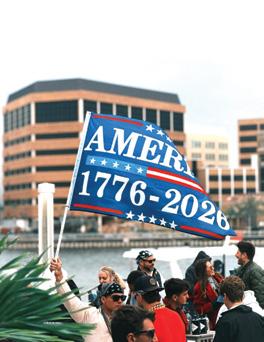


Model Call-Out For Our Summer Issues
Have you ever thought about seeing yourself on the cover of a magazine?
Of course you have, and this is your chance to live out that dream.
Our model search is open to anyone who wants to step into the spotlight and be seen; no prior modeling experience required, just a fresh face, confidence, and personality.
Whether you’ve always wanted to model or curious about what it’s like, this is the opportunity to be celebrated on our covers.
All you need is the desire to participate and the confidence to put yourself out there: You Got This!
To learn more, send an email to nemedia@earthlink.net or text 508-971-1969.






• Depart from New Bedford’s historic waterfront; a short walk to downtown New Bedford’s many restaurants, boutique shops, museums & galleries.
• Enjoy the gorgeous views of Buzzards Bay as you make your way to the laid back island of Cuttyhunk.
• Friday Night Sunset Cruises! Breathtaking scenery, comfortable accommodations, not to be missed excursion.