
NOSTRA 2026

Page 1


Letter from the Editors

Dear readers,

The Newcomb Scholars Program is a research and leadership program focused on gender equity that selects ~20 intellectually curious students to be scholars each year. Through our four years in the program, our cohorts develop written and communication skills while forming bonds with students across academic disciplines. NOSTRA publishes the written and artistic work of Newcomb Scholars, demonstrating that there is space for artistic expression within feminist scholarship.

NOSTRA means “ours” in Latin. Since our first print issue in 2023, this magazine has provided a place to tell our stories and explore our individual and collective histories in community.

In this issue, titled “Our Roots,” we invite our readers to consider: what does “home” mean for you? Is it where you were born? Where you currently live? Is it a tangible place at all?

As college students, the concept of home can become less straightforward. Home is where we grew up, but home is also movie nights on the couch with our roommates and late night study sessions under lamplight. We are nomadic, with no set sense of place, frequently asked where we want to end up and whether we’re inclined to stay put.

This year’s issue challenges us to confront the concepts of home and belonging through an exploration of our roots and our present selves. Our roots can shape how we view the world and how we handle change and new experiences—but perhaps roots aren’t something fixed. Maybe in the same way a tree adds rings with age, we add roots, with each new place and experience grounding us through the journey of self-discovery. In these pieces, our contributors reflect on their roots and how their upbringings influence the way they navigate their lives in New Orleans and beyond.

Since its inception, NOSTRA has published work that grapples with pressing questions facing women and gender minorities in the 21st century. We encourage our contributors to view art not only as an aesthetic or expressive outlet but as a tool for social change. In this issue, our contributors explore their identities and sense of place. Through this inward-facing reflection, we hope that they are able to inch closer to determining what sort of changemakers they wish to be in the world.

– Ella (‘26), Malai (‘27), and Zoe (‘28)

THIS SPACE FOR WRITING MESSAGES

Previous Issues

NOSTRA Volume III: In Our Hands

This issue was an exercise of speculation and designing future worlds. This may seem near impossible due to the speed and magnitude in which we receive information, as it feels as though we are constantly spectators to the worst disasters of our time. Yet, “In Our Hands” challenges us to look beyond what is, and imagine what could be.

NOSTRA Volume II: Labor of Love

In 1886, Josephine Louise Newcomb donated $100,000 (today worth 2.7 million) to the Tulane Board of Administrators. This donation helped establish the first degree-granting coordinate college for women in the United States: Newcomb College. In a world where few options existed for women, women’s colleges provided potential opportunities for future employment. This volume of NOSTRA asked: what does our labor mean? As women, non-binary and trans students, queer people, disabled people, and people of color, what does it mean for us to enter the workforce?

NOSTRA Volume I: The 21st Century Feminine

The first-ever print edition of NOSTRA illustrates what it means to be a feminist in the 21st century. From art about nature to musings on Roe v. Wade’s overturning to poetry about aging, motherhood, and identity, this magazine showed our readers how creative, brilliant, young women think about their identity and place in the world. This issue was a testament to the power of feminist storytelling. We were proud to amplify the voices of Newcomb Scholars that simply demand to be heard.

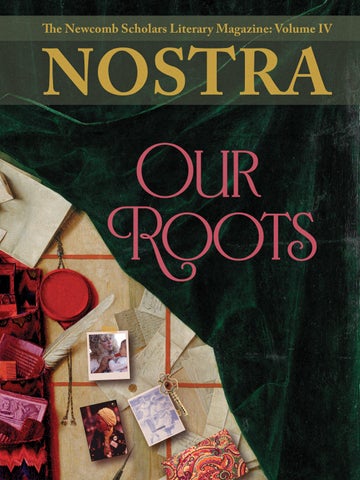
Collage-style cover by Rebecca Gipson, featuring a grid of vintage letters, envelopes, and photographs interwoven with personal mementos like keys, combs, and small portraits, set against a dark green background. Orginially from the the Public Domain Image Archive.

NOSTRA

“Nostra” means “ours” in Latin. That is what we, the editors of this magazine want it to be: ours. A place of collaboration, elevation, and celebration of creative feminist works by Newcomb Scholars.

Editors

Ella Jeffries (‘26)

Malai Harrington (‘27)

Zoë Roberts Churchill (‘28)

Graphic & Production Designers

Tara Nicole Brown (‘20)

Rebecca Gipson(‘21)

Toria Smith

Contributors

Zoë Roberts Churchill

Sydney Durocher

Abigail Halberg

Malai Harrington

Ella Jeffries

Yubin Lee

Claire Masquida

Piper Oh

Farah Selim

Jia Sharma-Chaube

Audrey Wiley

To learn more about the Newcomb Scholars, visit newcomb.tulane.edu/ scholars or use the QR code below.

Belonging

Home is belonging. It’s when you feel safe enough to be yourself.

A state you can return to when you feel lost. A grounding center.

Home is not always easy to find. It takes work and stepping beyond familiarity, branching out into the unknown, hoping to land on your feet.

When I was a kid, home had a literal meaning. It was the house where I slept, ate, and played. But even then, something felt off. I was different from my family, passiveaggressively nudged to make myself smaller, more palatable. It wasn’t until high school that I began to understand how harmful that pressure was, and how much of myself I had shelved away. Around that same time, my definition of home began to shift.

I found home in orchestra class, of all places. The friendships I made there felt easy and genuine. We shared similar backgrounds, personalities, and interests. At a pivotal point in my life, they became family. With them, I learned who I was and found rhythm in a place I never expected. I discovered what music resonated with me, how I liked to dress, found comfort in my personality, and accepted my quirks instead of hiding them. I flourished and became someone I was proud of.

And then, just as suddenly, my home disappeared.

I had always wanted to leave my hometown for college. Distance felt like freedom and independence. I wanted to live life without the weight of family expectations on my shoulders. But when I left, the light I started to see went dark. I packed up my life and tried to fit into a dorm that never felt like mine.

College felt like a complete reset I didn’t want, yet had chosen. I struggled to find people I clicked with. The ease of socializing I used to have resembled a life-or-death struggle. I felt like a visitor in my own hometown and in my own life. I watched everyone else appear to thrive while I unraveled. I was told my experience was normal, but it never felt that way. My once proud, unapologetic sense of self retracted into a

shell of a person who was lost, timid, and scared. Even high school friendships slipped away, leaving behind a deeper sense of isolation where I once held solace.

My home was dismantled, and I wasn’t sure if I would ever find it again. I carried a heavy grief for the version of home I had lost, and for the person I used to be inside of it.

Eventually, new people entered my life and brought with them a sense of hope. It happened sporadically, in unexpected ways, and right when I needed it most. Still, I kept myself guarded. I didn’t trust they would stay, and I was afraid of being seen and then losing that feeling again. Even now, that fear still lingers in ways it never used to.

I am still finding my footing in my new home, which often still feels fragile under me. Change, especially the kind that comes with moving, hasn’t ever gotten easier. But it has widened my understanding of the world and myself.

I’ve learned that home is an ever-evolving concept. It shifts and reshapes itself as we grow. Home isn’t always a place, but rather a feeling created in environments that allow us to belong. Some homes are temporary, just as some people aren't meant to stay in our lives forever. I carry pieces of them with me in memories, lessons, and proof that I do belong. They live on in old photos on my phone, moments of reflection, and the person I’ve become.

To the women who are not my mother

My mother is the light of my life, the hope of my mornings, and the steady joy of my heart. She raised me to be the considerate, empathetic, hopeful, and creative woman I am today. I owe her the foundation of my existence, and to her I dedicate every success I earn.

But she was not the only woman who raised me.

I am, in truth, the product of many women’s hands, hands that steadied me, guided me, challenged me, and held me with a tenderness that resembled motherly love in its purest form. Each left her mark in ways both subtle and indelible, shaping who I have become.

My sister was my first idol and the most beautiful girl I have ever known. We shared a bedroom, a childhood, and an unspoken understanding that life would be faced together. Her spirit is Spartan, unyielding, disciplined, brave, yet her wit and glamour place her among the stars in my mind. She lives on my phone’s background: a photograph of us as babies,

together from the very beginning. Her short arms wrap protectively around my oversized baby head, a promise I didn’t yet understand. Even now, every time we reunite, I find myself waiting for her arms to circle me once more, as if no time has passed at all.

My many aunts, though separated by geography, have loved and supported me since birth. I am shaped by their care: Mary Jo, Mayada, Nancy, Pat, Laurie. Distance never dulled their devotion.

Then there are my friends who are older than me, older in years, perhaps, but kindred in spirit. Jo and Julia, Caro and Coral: women who taught me the ways of the world simply by living honestly within it. They are the big sisters beside my own, sources of inspiration and gratitude. Their youthful spirits and sunlit beauty showed me who I might grow into.

My teachers and professors, so many of them women, gave their lives to the education and care of students like me. From preschool

nap times, when I could only sleep in the arms of Ms. JoAnn, to Ms. Nahorski and Ms. Glaser, whose classrooms sparked my love of reading and writing. In high school, Ms. Goochey became Gigi, teacher, friend, and one of my greatest champions. And now, my women professors, embracing every question I bring forward. Each one taught me not only information, but also belief in myself, in learning, in persistence.

And beyond them still: My friends’ mothers, my mother’s friends, my childhood bus driver, my primary care doctor, my diocese’s administrator, the women who write the Substack posts I read, the women who played the princesses at my birthday parties, the swim instructor and corner store clerk, the actresses of my favorite shows and the authors of my favorite books. Women who may never know my name, yet who have nurtured me in quiet, enduring ways.

While these women are not the only important people in my life, and not even the only women, each has shared a form of motherly love whose impact I still carry. We live in a beautiful circle of nurture and grace, and I am forever blessed and thankful to have been a recipient of such affection.

Through them, I have learned how to live.

Dedicated to Nancy Vales Antich, rest in peace and love.

Just O-H “ ”

“Have you ever seen KPop Demon Hunters?” I’m asked this question at the beginning of my volunteer shift. “Yes...,” I answer tentatively, already knowing where this question is leading. I wonder which one he’ll say I look like. I’ve seen the movie a few times, and I’m somewhat familiar with the characters, but to me, it was mostly the songs that stuck out from that movie. “Well,” he continues, “you look like all of them.” His companions all laughed and stared at me as I looked at him in shock.

To paint a picture of my face in that moment, it was a mix of anger, incredulity, and frustration. “What??” First of all, they all look wildly different. I’ve heard the jibes that “All Asian people look the same,” but really? At least I’m part Korean, I suppose, so he got it somewhat right. Even still, I can imagine he’d make the same comment to a Chinese, Japanese, Vietnamese, or any other -ese person there is. Maybe it was my hair. I had straightened my usually wild curls into flat, stickstraight locks. Or my makeup? I was wearing a pair of fake eyelashes that mimicked the look of an anime character (still not Korean though). Maybe he just thought he was being funny?

No matter what it was that made him think his comment was appropriate, it stuck with me. If I’m being honest, I’ve never felt fully connected to my Asian heritage. I’ve always been told I looked

“white-passing,” which actually just translates to, “You’re not Asian enough.” And so, while I was mainly feeling angry and offended by his comments, embarrassingly enough, I was feeling a bit of validation as well. It’s so strange to think about how racism can both cut and soothe at the same time. Being misrecognized still made me feel seen in a way.

My mom is white, and my dad is Korean and Japanese. Growing up, we didn’t really talk much about culture. My only tangible tie was our mochi-making family reunions. Every year, the whole family would get together and make mochi. We had big stations set up for assembly, raffles with fun prizes, and piñatas to keep the kids entertained. I remember my grandmother patiently teaching me how to roll the starchy dough into neat ovals, and me never being able to get it just right. These memories are what I look back upon most fondly when thinking about my roots.

These reunions disappeared when my family moved across the country from California to South Carolina. At that time, I was just starting high school, and I was drowning in a sea of white faces while doing my time in the South Carolina public school system. When meeting strangers, I usually get asked these same questions in this same order: “Where are you from? No, where are your parents from? What’s your background, though? What

are you?” I developed an elevator pitch with my response that I repeated so frequently it became second-nature. In response, I was sometimes told that I was “white-passing,” which I never really understood. What does it even mean to be “white-passing?” It seemed to be delivered as a compliment, a compliment that was always insulting. It was like they were saying, “Wow, you do such a great job at blending in! We would’ve never even guessed that you're different.”

I think that’s why, for a while, I tried to always look more Asian. I straightened my hair (despite the fact that I got my curls from my Korean grandmother), tanned frequently (despite pale skin being the beauty standard in Japan and Korea), and I tried on the contradictory version of myself that I thought others wanted. I clung to anything that connected me to my Asian-ness, even if it didn’t always make sense. The disconnect that

stemmed from outside interactions confused the way I viewed myself and heavily affected the time it took for me to understand my identity.

When I think about my future now, I worry about losing connections to my culture. For example, it’s possible I’ll lose my last name if I get married. I used to hate it when I was younger. During swim meets, I would check in at the front table, and they’d ask, “Last name?” “Oh,” I’d respond quietly, “just O-H.” It took them a second to understand; they never got it on the first try, and honestly, who could blame them? I’m sure you, the reader, first thought I was pausing before saying my name. I suppose it’s unexpected if you haven’t heard it before. It sounds like I’m pausing before I tell them my real last name, or that I’m surprised they’re even asking. Once they realized, it would always elicit a laugh and an “Ohhhh!” in response.

As an extremely shy child, I hated these interactions. While they weren’t inherently harmful by themselves, they made me despise the reason for all this extra attention. Why couldn’t I just have a normal last name, something easy like Smith or Johnson? I would think about future careers and wonder, how can I be a doctor or teacher if my name is going to be Ms. Oh or Dr. Oh? That’s so short and unserious. Patients and kids won’t take me seriously as a professional, and I’ll be embarrassed every time I introduce myself. Ironically, Oh is one of the most common surnames in Korea.

Even today, it’s hard knowing where I stand with my “culture.” My friend’s white sister is getting a tattoo with Japanese lettering traced on her ribs. She seems more connected to my culture than I could ever be. It was funny when I first heard about it—truly a classic white person move—but I also hated knowing that she could permanently wear something I still sometimes feel like I’m borrowing.

I used to worry that I didn’t have real roots, and that I only had a few fragments. But in thinking more deeply about it, roots don’t just grow straight down. They can stretch sideways, or diagonally, through distance and discomfort, through names that are embarrassing and cultures that feel far away. And while mine might not look the way people expect, I’m happy with them all the same.

The Substance and Its Awfully Confusing, Absurdly Overwhelming, and Amazingly Alarming Symbolism

The Substance is one of the first feminist movies to critique the treatment of older women in the entertainment industry. The Substance is a dark body-horror movie with comedic and psychological elements (“The Substance”). It was released in 2024 to a great popular reception, but some critics claimed the movie ironically lacked “substance” (“The Substance”). Mainly due to director Coralie Fargeat’s reputation as a feminist director, The Substance is only exploitative when it is stripped of its context and purpose. It becomes a problem when the broad, maybe uneducated, and possibly critical audience breaks the movie down so severely that it becomes decontextualized and unclear. However, these opinions of the movie are based on misleading information and interpretations. This movie did not have a massive budget with an enormous projected gross income, and while it was not “underground,” it was not mainstream. Additionally, the point was not to introduce the viewer to ageism in the entertainment industry. Especially considering Fargeat’s interviews about the movie, the casting choices of Margaret Qualley and Demi Moore in their respective roles, and the film’s overall satirical approach to its subject, the team’s likely goal was to critique this maltreatment through a

feminist lens. Although some viewers might be uncomfortable with the casting of Dennis Quaid as Harvey, considering his openly conservative and Trumpian beliefs. I would argue that Quaid made for the perfect villain of this movie and furthered the sarcastic symbolism of the film. Furthermore, it is likely that many viewers were female and would not interpret the slow shots of Margaret Qualley’s (Sue) body in the same way male viewers might. Some critics feel The Substance is more exploitative than exposing, but considering the intended audience and overall themes and symbolism, the movie proves to be a piece of valuable feminist cinema.

In The Substance, Demi Moore plays an older fitness instructor, Elisabeth Sparkles. It is clear Sparkles is still at the peak of physical fitness, but on her literal fiftieth birthday, her producer fires her. He insinuates the cause is her aging appearance, saying, “At 50, it stops” (The Substance). And so does he. Even when Sparkles asks him to explain what “it” is, he ends the conversation and ignores her as he leaves the meeting. He immediately makes moves to replace her by putting an advertisement in the paper for the “next Elisabeth Sparkles” (The Substance). Sparkles is involved in a car

accident shortly after her termination when she gets distracted by the dismantling of one of her billboards. While receiving her treatment at a hospital, a male nurse shares his experiences with “The Substance.” He gives her a USB drive about The Substance and a note saying, “It changed my life” (The Substance). On the USB drive, there are instructions for starting The Substance and its rules. These include a weekly switch between the original self and the other self. This is understandably referred to as the “balance” (The Substance). The rules clearly state, “Everything comes from you. Everything is you…You are one. You can’t escape from yourself” (The Substance).

Elizabeth does not jump on this opportunity, but the hunger and pain from her rejection remain present. Even though she is hesitant to take The Substance, her curiosity, self-loathing, and desire for praise overcome all logical thoughts. When she inevitably takes The Substance, she is reborn as Sue. Sue is young, hot, and the perfect replacement for Elisabeth Sparkles. Thus, she becomes the star of the new show, Pump It Up. The balance is disrupted when, although Elizabeth and Sue are constantly reminded that they are one, they act as if they were two different people. Elizabeth views Sue as egotistical and selfish, and Sue sees Elizabeth as “gross, old, fat, [and] disgusting” (The Substance). It is Sue disrespecting “the balance,” which leads to the slow corrosion of Elizabeth’s body. When Sparkles calls The Substance help line, all she is told is “What has been used on one side is lost on the other side. There’s no going back” (The Substance). Sparkles rejects this, but her only option now is to quit The Substance and remain as her original self. It is only until Sue waits three months before switching back that Sparkles finally declares she wants to quit. This imbalance does irreparable damage to Sparkles’ original self, but while trying to terminate Sue, she stops. There are illusions and scenes of Sparkles’ self-hatred throughout the movie, but this is clearly depicted when she says to Sue’s lifeless body, “I need you ‘cause I hate myself. You’re the only lovable part of me” (The Substance). Since Sparkles does not finish the termination, Sue wakes up while Elisabeth is still conscious. Sue kills Elisabeth for trying to terminate her, even though they are one. Without her other half, Sue rapidly deteriorates, losing her teeth and her ear as she runs home. When Sue gets home, she uses

the rest of The Substance that she originally used to create the other self, despite its single-use warning. This time, she is reborn as “Monstro Elisasue.” Impressively, this version of Elisabeth actually seems to be her most secure self. After more gore and terror, a part of Monstro Elisasue, a piece of Elisabeth’s face, breaks away as the rest decomposes. While melting away on top of the Elisabeth Sparkles star on the Hollywood Walk of Fame, the Elisabeth slug creature imagines a radical acceptance by society and thus itself.

There are many clear demonstrations of the movie’s critical message through its display of the intersection of ageism and sexism in society. To convey this, the movie used a somewhat exaggerated portrayal of the entertainment industry. Even the casting of Demi Moore as Elizabeth Sparkles illustrates this exaggerated portrayal. While an actress being told she was “too old” for a role is not an uncommon occurrence in the entertainment industry, Demi Moore publicly shared her experience with this exclusion and discrimination. As feminist critic and content creator Jordan Theresa describes, Moore was the highestpaid actress in 1996 but soon gained a sort of “diva” reputation due to her standards for her roles. Her marriage to her ex-husband, Ashton Kutcher (over a decade younger than her), additionally gave her a reputation as a cougar (Theresa). Conversely, Moore is still considered an attractive woman, so the idea that she would be fired for looking “too old” is ludicrous for audiences, but that paradox reflects reality. Objectively gorgeous women experience inequity in Hollywood all the time when they age, even when they are still much younger than their male counterparts.

Likewise, the appearance and treatment of Sue and Elisabeth support the film’s satire. Regarding Sue, through her scant clothing, prosthetic breasts, and the slow and deliberate camera shots, she embodies the ideal of male-dominated Hollywood. With Sparkles, especially once Sue disrespects the balance, the camera angles are harsh, and she is treated poorly by supporting characters. Additionally, all the physical manifestations of Sue not respecting the balance appear on Elisabeth as signs of aging. Yet, this seems like a portrayal of Sparkles’ irrational and misogynistic fear. It is also symbolic of the common misconception that people can and should “live” and

Illustration

insult their bodies (if they are going to) while they are young, even if those unhealthy behaviors (like alcohol or drugs) have negative repercussions later in life. Elizabeth’s only motivation is to maintain her youth, which adds to the message of the film. There is a heartbreaking and visceral scene with Elizabeth getting ready for a date, but she ends up staying in because of how much she hates her appearance. This scene is best seen and not described, but Jordan Theresa, an online feminist critic and essayist, agrees that this was one of the most disturbing scenes of the whole movie, even though it includes no gore. It truly depicts the hatred and anger one feels when they despise their appearance (Theresa). Elizabeth’s whole career was built on her appearance, and she felt that it was the

only interesting and valuable thing about her. It never occurred to her how temporary it is for women because she was benefiting for so long. Sue’s seizure of Elisabeth’s show embodies an image of younger women profiting off of ageism until it becomes their problem, as well as the tendency for people to abuse their younger body and forget that their younger and older, damaged bodies are one.

Other frustrations with the movie arise from what some critics see as ambiguity in the film’s message (Theresa). Only 20 pages of the 150-page script are dialogue, which means that the movie’s significance could be misunderstood. In her personal review of The Substance, Theresa describes that the movie relies “quite heavily on the viewer to interpret

it through a feminist lens, which is a lot to ask of people” (Theresa). But this movie is also an intense experience that is rich with symbolism. It genuinely is hard to watch at times because of the sound design and visuals. Weirdly, the lack of dialogue seems to be made up for in the dialogue surrounding the film. It is in the analysis of the film where the message and the symbolism in the film really shine. From the possibly complicated allegories and an established feminist director, the targeted audience was educated feminists, as the symbolism is not well understood without the awareness of ageism or the extent of the patriarchy in the entertainment industry. Fargeat describes the movie’s violence as “not delicate…not small…not kind. It doesn’t smile. It’s something

overpowering… [for it] to be true to the story I wanted to tell, the film had to show it, make people feel it and, above all, not censor itself at all on the level of intensity” (Keslassy). It was too explosive for financiers but not clear enough for some audiences. These varying opinions show that this movie’s emotion is only identified by those equipped with contextual awareness and experience. The movie’s goal was not to educate audiences, just create dialogue among them. Thus, if the movie told the viewer the message as opposed to showing, it would take away from the different interpretations in the subsequent discussion. Everything great has its critics, but those discussions, disagreements, and debates are partially what make it so engrossing. Theresa’s personal critique is the unity of the

original and the other self. Specifically, towards the end of the movie, when both Sue and Elisabeth are conscious at once, Theresa feels lost and mildly dissatisfied. To her, it seemed like the movie adopted that narrative in some instances while it disregarded it in others (Theresa). Even though her confusion is reasonable, as the movie is strange to say the least, clarification emerges with Monstro Elisasue’s arrival. In her last moments, Elisasue mutters, “I’m Elisabeth! I’m Sue!” (The Substance). This plainly states that even though only Sue used the Substance again, Elisabeth was always a part of her. It became confusing since both selves acted as if they were different people, but they were always one.

The discord over the controversial casting of Dennis Quaid is subjective. Quaid was not the original choice for the character, Harvey, but he was a perfect choice, in my opinion (Theresa). He was able to personify Harvey’s filthy and repulsive nature, naturally or otherwise. His casting introduces a problem with the movie and its production, though. He is publicly a

proponent of Trump, and given Trump’s misogynistic statements, the casting of Quaid in a feminist film that specifically critiques the ageism and misogyny in the entertainment industry is suspect. This opinion is purely personal and heavily influenced by one’s bias, but I think it adds to the satirical nature of the film. It seems that even in the effort to create this film, the production team could not escape the pervasive misogyny of Hollywood. It is plausible that there are critics, producers, and investors of this film who align more with Harvey, which initially seems antithetical to their beliefs. But when the goal is financial, whether a person agrees with the message of the project is irrelevant. Moreover, other feminist critics feel Harvey (the character) was not duly punished. But, with the exclusion of Harvey Weinstein, are problematic male producers in Hollywood generally punished for misogyny? There are not many male producers who are publicly seen as morally corrupt due to the anonymity of their position.

Considering much of the reviewers’ disappointment is in regard to the lack of clarity in the movie’s message, it is also possible that the Harvey caricatures behind the film did not even recognize the meaning of the movie and the character.

Admittedly, I did not watch Theresa’s video until recently because I feared it would ruin how much I loved The Substance. While it brought valuable critiques and opinions, like Dennis Quaid’s casting and the subjectively vague perception from the film, it did not convince me that anything about The Substance should be changed. Was the casting of Quaid controversial? Yes, but educated viewers cannot expect even the loudest feminist films not to have hints of misogyny, especially in the male-dominated Hollywood culture. Additionally, the ideal audience for this movie is not men, so the suggestion that it is exploitative due to its camera shots and rhetoric seems too fastidious. I disagree with the opinion that the film is ambiguous, too. Like Theresa, I believe that if the film had a lot of dialogue, it would be a bit unbearable. The viewing experience is best defined as “completely invasive” and sensorially overwhelming (Theresa). So, the addition of dialogue might take away from the smooth plot progression or just be lost in the overwhelming experience. In both cases, it would be inappropriate to have dialogue at all because it would only detract from the viewer’s experience of the movie. Of all the symbolic scenes in the movie, my favorite scene is the ending when Elizabeth melts into her Hollywood Walk of Fame star. It is when she is completely disembodied that she is happiest, but it is still based on praise. It presents the parody that many women experience when gaining or living with fame. Many female content creators, like Theresa, retain consistent haters, for lack of a better word, only due to their looks, outspoken personalities, age (specifically regarding their biological clock), or past relationships. The most famous example is Taylor Swift. The biggest criticism directed

towards her is her tendency to write her songs about past relationships. It is only recently that her lyrics and music were criticized due to their allegedly lower quality or “cringey” nature. While Swift is not an exact one-to-one comparison of Elisabeth and Sue, she is a good reference point for the prejudice female-presenting artists receive. One of the main parts of her identity that the broader media will hyperfocus on is her gender-identity because that tends to provide better headlines. Simply put, society has a habit of seeing women’s success as surprising because they are women, and women are not inherently seen as capable of success. These injustices and double standards are only compounded when there are other intersectional identities to account for. The Substance is an exaggerated portrayal of life as a woman in Hollywood, but it also gives insight into what life is like as a woman, period. To be a woman is to perform and perform well or face backlash.

Works Cited

Keslassy, Elsa. “The Brains behind ‘the Substance:’ How Coralie Fargeat Stayed True to Her Gutsy Vision: ‘Everyone Wanted Me to Make It Less Violent, Less Excessive.’” Variety, 29 January, 2025, https://variety.com/2025/global/global/ the-substance-coralie-fargeat- oscars-1236289808/.

The Substance. Directed by Coralie Fargeat, Mubi, 2024. “The Substance.” IMDb, https://www.imdb.com/title/ tt17526714/.

Theresa, Jordan. “I Don’t Know How To Feel About The Substance (2024).” YouTube. 28 October, 2024, https://www. youtube.com/watch?v=XUXWyJbNUjQ

root grafting

I.

i know all about roots and what they do. i have seen the broken sidewalks and the gaping potholes and i have chipped my tooth tripping over displaced cement one too many times to leave them in the ground. i know all about roots and what they do, and i want mine gone. like delos, i will float aimlessly upon the wide and wild ocean and when—no, if i return to shore, that is when you will see me, and i will deign to greet you. if you are lucky, i will accept your tithing your kisses on my cheek your stroking of my hair and then i will be gone again before i can propagate once more. that’s when you will see me. otherwise, i will be untouchable. i will have no roots and then i will be free. and then i will be happy.

II.

i look at you all in profile your faces cast in shadow and adorned in glitter young gods and goddesses traipsing through ancient streets unbeholden, your roots cast off drunk and disorderly walking in the footsteps of giants and dancing and swaying to an entirely unfamiliar rhythm and i push down the words threatening to burst through the sidewalk like those overgrown roots but i love you, i love you and the only way forward is through. the only thing i fear more than the roots growing under the surface wrapping themselves around everything in sight is breaking this spell my heart is full when i see your faces glowing in the neon your smiles marred by chipped front teeth i worry that the roots are my arms and i will not be able to let go when the time comes.

III.

but i am not an oak tree i do not line the streets of the city with beads flowing in my hair and my roots do not riddle the path forward with knots. my roots are tender fragile as the new foliage on my mother’s rosebushes. yet no matter how i try (and good lord, i have tried scrabbled at the earth with my bare hands, more animal than human, foaming at the mouth, hungry for freedom for success for any place other than here and anybody other than myself as though pulling up the roots will get rid of the rot) these damn roots won’t move an inch.

IV.

the plane ride home is long and dark and when i am not sleeping i am waiting impatiently for: my mother’s hand in my hair my father’s embrace the first real plate of food in months the backyard where my sisters and i used to play the warm and solid weight of the cat on my chest the smell of my room and the way the dust rising from my bookshelf looks in the morning sunlight. every minute feels like hours and when the door finally opens the cold air hits me like a freight train but i mustn’t forget i was the one to jump in front of it. my roots are here and there, growing and growing but i cannot explain it aloud and when i attempt to disentangle this tangled web i discover the plants have grafted onto one another. i’ve become somebody i don’t recognize. neither place is home and when i wake up in my bed it takes me a moment to remember which one, which life.

sometimes i think i’ve finally done it. i raise the ball of roots over my head triumphantly: a tangled web, a great big clusterfuck of sisters and uncles and cousins and brothers and parents and people i’ve never met with my blood running through their veins and it tastes like victory. then i look down and it’s there: the mother root the master key i grab hold, i pull with all my strength until the muscles in my arms are trembling and my heart is hurting then i land flat on my ass. i rebury the roots. i wipe the mud off my face. it tastes like defeat like wet earth trapped under my fingernails that i scrub and scrub and scrub bristles stinging my raw red skin as i try to convince myself that next time, i’ll finally do it. i’ll be strong enough. then next time comes and i find myself at the sink again with the smell of the soap burning my nostrils and i wonder: why can’t i get rid of this damn dirt?

VI.

“where are you from?” there are two responses that come to mind. what the fuck do you care? what do you know about me or think you know? if i tell you where i’m from will you nod wisely? will you imagine you know me and pat yourself on the back with a clean hand and perfect fingernails?

number two: isn’t it obvious? can’t you smell it on me? you don’t see the outline i left behind you don’t see the dirt in the crevices on my hands the new plant growing where i tried so hard to pull up the roots can’t you smell the rain nurturing the plant from afar? can’t you smell it on me?

V.

Best of Mothers, Best of Daughters

I’ve been thinking about the time my mom’s friend, Pooja, came to visit last year— specifically, her daughter. I can’t quite remember her daughter’s name, but I think it was Priya. Or one of those other Indian-but-stilleasy-to-pronounce names that first gens who were teased for their name would name their kid.

I can hardly blame her. Growing up in the 70s as a brown girl, your name is just absolutely begging to be butchered by mild-mannered but wellintentioned Canadian school teachers. Or, at worst, mocked relentlessly by the pudgy, freckled Irish boys who lived in her neighborhood. I digress.

It was her daughter I was thinking of. When my mom told us that her friend would be bringing along her daughter, who was the same age as us, to visit, I thought I was prepared for any scenario. I was ready if she was mean, if she was irritating, if she was incredibly idiosyncratic and strange, but not fun strange, like Richard Simmons, but scary strange, like Charles Manson. A small, optimistic part of me hoped she was even cool or funny or sweet or, at the very least, someone I’d never see ever again but follow on social media for the next ten years until I forget how I knew her in the first place. That hope died when my mom told me that Priya’s main interest was musical theater. Even still, I was ready to whip out the few shows I knew, both from having an entirely gay friend group in high school as well as my own passionate, albeit short-lived, musical phase I had as an eleven-yearold. What I hadn’t prepared for was for her to be utterly, irredeemably, impossibly boring.

A conversation with her was like a hearty game of tennis, only the kind of game where you hit the same ball over and over again in the same spot

on a brick wall while your opponent sits inside counting down the minutes till your mom comes to pick you up. Even the short chats I was forced to carry, in the few times our mothers were too engrossed in catching each other up over the last decade, seemed to drag on for eons. I was almost impressed—she had an unnatural talent for making minutes feel like hours, hours like days. To call her dry seemed to be too generous—the word could imply an aloofness, or maybe pessimism, which could imply a personality, or at the very least, an identifiable worldview. This was not the case. She seemed, at least to me, to be void of both.

In group settings like dinner with our families, she hardly spoke at all, content to sit in neutral silence

with a fluoride stare. All the while my sister and I dutifully performed the same roles our parents unspokenly expected of us when in the company of a friend of theirs—India, be impressive and smart, but not arrogant, and Jia, be funny and charming, but always polite. It wasn’t until prompted directly did she talk, and even then, it was two-word answers at most. The only time she ever exhibited any enthusiasm or interest was when discussing the topic of her brother. More specifically, how cool he was, how funny he was, how he was so popular and had so many friends. She scrolled through her camera roll, giggling and smiling to herself at photos before she even showed us. When she actually showed us his photos, I became even more frustrated. He was not only the sibling with a better personality, he was also obviously the hotter one. Tall and lean, with warm brown skin and a thick dark head of hair, always with an easy, bright smile.

All this made me think about two things. First, if her mom ever came to visit again, I hoped she would decide to bring her son instead. Second, holy shit, this girl totally wants to fuck her brother.

One unexpected saving grace of the visit was that, fortunately, Priya’s inability to carry a social interaction didn’t seem genetic— her mother, Pooja, was actually quite an interesting woman, who told interesting stories. One in particular stuck out—a summer day during her time working at big advertising firms in the 2000s, when a sweet, sticky disaster struck Central Park. She was the head of a marketing campaign for Snapple, executing a harebrained PR stunt she had very little to do with the actual planning of. The idea was simple, really, if not doomed from its inception—erect a 25-foot-tall popsicle in the middle of summer in Central Park in order to unveil Snapple’s new line of popsicles, as well as break the world record for largest popsicle. In an unfortunate turn of events that, to this day, I cannot fathom how no one saw coming, an error in engineering caused the tropicalflavored Chekov’s Gun to pour hundreds of gallons of melted syrups into the streets of Manhattan. However, what would be a careerending disaster for the engineers, who failed to account for the giant wooden stick in the center of the popsicle when calculating the temperature needed for the storage container, would prove to be a boon for Pooja’s career. She sprang into action, getting the streets cleaned in less than a day, apparently providing damage control so effective she received a cushy job promotion immediately after. This was just one of many bizarre and thoroughly entertaining stories Pooja told us. She also told us of the time she was cast in a Canadian show called Bulging Brides, a makeover-type reality show that followed brides on a mission to get extremely buff and fit before their weddings, and, at my mother’s giggling behest, of the time she performed a surprisingly sensual and wildly inappropriate Fosse-esque dance routine for the school talent show, inspired by the last hour of All That Jazz she had managed to tape over the family’s VCR of an old Bollywood movie.

These stories, the woman standing before me, with a warm smile and a loud, giggly laugh, did not match the image I’d had from stories my mother had told me about her. Ever since I was a kid, I latched on to every story my mom told me about her life before I was born, every bit of information immediately stored into my long-term memory. She had described to me a short and twiggish girl with her hair in a long oily braid and bushy eyebrows her mother forbade her from plucking. She remembers how the kids at school used to tease her for clothes smelling like the spices her mother cooked with. When I told my mom I was pleasantly surprised with how much fun it had been talking to Pooja, how I had assumed she’d be less outgoing and confident, she replied simply: “Pooja was never shy. She was just suffocated.”

I remembered these details too. Pooja’s father was a bitter alcoholic, nasty and controlling towards her and her sisters. She wasn’t allowed to play with the rest of the kids in the neighborhood playground just yards away from her apartment building. My mom recalled with a sad smile how she used to wave to Pooja from down below, even though she couldn’t see Pooja ten stories up, because she knew that Pooja would still see her from where she stood at her

It occurs to me now that Pooja letting her daughter act the way she acted on the trip, not expecting her to be talkative or entertain conversations out of politeness, was her way of giving Priya something she didn’t have as a child—space to be herself, whoever that may be. It was the same as when my own mother brags to her friends how I won best in class in Creative Writing in high school, or glares at my aunt when she says how I’m wasting my intelligence by not becoming a surgeon or lawyer until she inevitably trails off into embarrassed silence. However loving my mom’s parents were, it was difficult for her family to understand what she wanted to do with her life. A terrific writer and academic herself, my goals to be the same don’t scare the living daylights out of her like it did for her mom. For the most part. At the very least, it doesn’t confuse her—and maybe that’s the real American dream, that Pooja loves her dull, slightly incestuously-inclined daughter just as fiercely as my mom loves the neurotic feminist with a prescription for Prozac she gave birth to. Maybe the most important thing my mom and Pooja have in common, besides four decades of friendship, is their quiet resolve to accept their daughters as they are.

freshly dug

the dress She hangs proudly on the rack so many try her on in the light of the dressing room the wearer sees every flaw and the dress is shamed for each unwanted bulge and roll that the dress hugged first but that couldn’t love Her— back to the storeroom She goes awaiting someone who loves themself enough to let Her love them in return.

on display Her heart has been broken (so has yours) but now She is open and giving out tours of every chamber and candle-lit space hoping that someone may seek to adore Her most prized possession — the heart of Her girlhood displayed in a jar dazzling for all but blinding to many for it has been shattered and pieced back together creating a kaleidoscope with dizzying refractions that strike the imaginations of child hearts like Hers.

groceries

I can’t escape you –Your name on the egg carton, your favorite song playing in the grocery store I see us in a pair of strangers at the check out who seem so familiar and I imagine a life of me buying eggs and bread and milk to come home and flip pancakes while you scramble the eggs and wash the dishes as I feed the kids but I take a second look –the milk is expired, the eggs are cracked, and you aren’t there as I close the refrigerator door with the taste of sour milk in my mouth.

the windows are wet so are my eyes something about the rain brings out the tears — a release of pain, a mourning of things that were never mine roll down my cheeks — a vignette.

All Suns

Twigg County, Macon, Georgia is where my grandmother’s parental heritage leads back to. At least, that’s how far she was able to pinpoint. A fire broke out and destroyed historical records and documentation; such as the identities of my ancestors: enslaved Africans.

I was a young child when I was disgusted with my heritage. My “roots” were weak, easily snappable branches that were (and continue to be) considered insignificant compared to the heritages of other ethnic groups within and outside of the African Diaspora. Ours were juvenile and unstable—we lacked traditional wear, music, language, and place. Knives scratched my throat whenever the word, “Here,” crawled out of my tongue in response to questions like, “Where are you from? But no, where are you

really from?” “Where are your parents from?”

“So, you’re just American?”, and nearly a million other ignorant interrogations sprouted like leaflings breaking soil. Except, I wasn’t beautiful. Neither were my responses. They were underwhelming. My physical being was shrunk to less than nothing, less than human. I existed simply as an entity for exploitation, or as a beautiful forecasting to cultures that were more cultural than mine.

The bodies of the Soulaan people were stolen despite the fight they may have responded with, on their land, during voyage, and/or throughout captivity.

Our mother language

erased from our minds, and dignity whipped and reduced to whatever capacity that allowed us to survive, another day, another garden, another sun.

Today, we dance under all suns. Our physical presence on this land is no longer under the guise of survival, but owning the fact that we did survive. Now, we are able to create our own culture, our own language, our own tradition, our own dances, and lives that lead solely back to us. Our roots were planted among soil destitute of life, leading us to breathe it into each other. We worked with unfamiliar cadences, so we created the blues, jazz, hip hop, rock, and more, that rang of our struggle, our love, and pain. We were fed the most insalubrious things, so we baked the

sweetest potato and peach pies. We could not afford dental care, so we decorated our teeth with gold. Our afros were picked out so big they were a warm blanket of comfort during revolutionary Blackness that resisted assimilation. I could write indefinitely about examples of Soulaan cultural beauty—what it was, what it continues to be, and how our influence is so embedded into American society that it is hard to distinguish.

Today, I am proud to say that although I am unable to trace my lineage back to the land of my ancestors, I can attest to the roots they were forced to plant here. How durable they are in time everlasting. And so, the struggle for freedom remains—through our impact, influence on American society, and under all suns.

My Arabic Y’all

In my high school sophomore English class, someone asked me if we have cars in Egypt. At that moment, I felt a surge of emotions.

I felt anger from the media that chooses to portray us as primitive, sadness at being in such a situation, and, quite frankly, surprise at this individual’s ignorance. But when I thought about it later on, I just couldn’t blame them. I remembered as I walked towards the plane, that same year, just about a month earlier, I had this thought that refused to leave my mind, “What if my nose couldn’t breathe the air there? What if the day wasn’t as bright, the nights weren’t as serene, the water not as quenching, or the food not as filling?” These thoughts consumed me, and though the absurdity of these ideas wasn’t lost on me, I still couldn’t internalize it. I was leaving all I knew, for all I didn't.

When I was younger, I thought a person was like a blob of clay; once it dries, there’s no changing it. It didn't matter where I lived or where I worked—the only thing that mattered was where I grew, where I was shaped. I didn’t need to understand this new place or learn anything about it. I would never be a part of it. Most importantly, it would never be a part of me.

Arabic still colors my thoughts, even when English dominates my speech. Faith structures my days in ways that often go unnoticed. No matter how many English songs I know, I’ll always sing Arabic in the shower. But as I get older, I realize that though we

are born with some roots, we plant most of them. As we move through life, the choices we make, the people we love, and those we let go of shape who we become—until belonging becomes something we built, not something we inherited.

I say “y’all” now without thinking, a souvenir from my time in Houston. I reach for brownies from the cafeteria when the stress of school and practice threatens to overwhelm me—dense, slightly dry, but just so comforting. And though I’m ashamed to admit it, I do “Costco Sundays.”

Today, I walk around Tulane under the thick trees, looking at squirrels, wearing a tote bag, and holding an iced coffee, as American-coded as one could be, and it feels like home. College often frames us as transient, as if we’re just passing through.

Yet, I’ve learned that roots aren’t fixed to a single place. In the same way that our day, today, will be a memory tomorrow, a small seed we plant will one day grow into something intertwined with who we become. They grow in language, habits, instincts, and relationships. They deepen with every new experience, every place where I push myself to belong, and every moment where I remember who I am. Home isn’t one city or one memory. Home is this accumulation—my song, my words, my tastes, my stance, my community.

I am grounded, not by walls or streets, but by the collection of places, people, and practices I’ve carried with me and added along the way. And wherever I go next, I know that I will bring all of it with me—layered, resilient, and undeniably mine.

An Gorta Mór

Mercy measured not in human breath, They called it rule, yet ruled through famine’s reign,

While fields stood ripe, the people starved in vain, And grain sailed east to fill an empire's hold.

A crown of guilt was forged in Stephan’s hall, Where pity’s tongue was quitted by decree.

They watched a nation starve and named it law, Then prayed for peace, sold their charity.

What empire stands when built on hollow graves? What kingly right survives the widow’s wail?

What law absolves a child too weak to cry? Starvation hollows bodies into ghosts.

A slow, painful undoing made by human hands; Not diving fate but deliberate violence.

No throne is just that feeds on those it braves, Nor flag unstained by those it casts to die.

The harp still keens where life used to grow, For famine’s thread was sown by the Lion’s woe.

ode to friendship

again, i move.

battered by the brashness of change unforgiving yet untethered swept away by spontaneity always, i move. i have no home.

an ephemeral moment draped by the innocence of youth we all meet. our laughter intertwines our hearts touch we have no home.

barred from solitude comforted through change drifting wandering floating we all move. i found my home.

gazing at the constellation of my memories–you all will always be there always, we stay. you are my home.

Dear readers,

It is an honor to see the fourth print issue of NOSTRA come to fruition, my third and final issue as Co-Editor in Chief. The Newcomb Scholars program has been an invaluable part of my Tulane experience, and having the chance to edit the Newcomb Scholars Literary Magazine has been a core element of my experience as a Newcomb Scholar.

NOSTRA has been a rewarding continuation of my past work on literary publications. I started a literary magazine at my high school back in my home city of Seattle, Washington. For most of my childhood, I was passionate about creative writing. I etched poems onto sticky notes or the back of used wrapping paper. I loved to pass my poems out to friends or teachers and hear their thoughts on my work. It was that feeling, the rush of sharing one’s work with others and standing bravely by one’s own words, that made me want to start a literary magazine. I loved creating a platform where any student, from experienced writers to those who had never written a creative piece before, could share their writing and become published authors.

As a freshman, when the editors of NOSTRA came to speak to my class, I knew immediately that I wanted to work on the magazine. Through NOSTRA, I have been able to build on my joy for creating literary platforms, and hopefully motivated others to explore their creativity.

In NOSTRA, we aim not just to publish literary work but to encourage our contributors to expand their perception of the purpose of art and artistic expression. We encourage our authors and readers to view art not merely as a means of self-expression but as a vehicle for questioning, for protest, for social change.

I believe that writing and artwork can provide us with the tools to imagine the world that we want to live in, and think creatively about how to forge those worlds. I hope that as the magazine continues into its fifth print issue and beyond, we continue to promote the view that art holds not just an aesthetic purpose but can deepen understanding and sway minds. Particularly in this issue, where we explore the concept of roots and a sense of home, reading others’ exploration of their roots can help us better understand the perspectives of others and the unique paths that we each navigate.

For many, these past few years have come with feelings of dread or uncertainty, whether it be about the state of our country or the world. One thing that I find myself frequently wondering when I feel frustrated or overwhelmed is, what can I do? It is simple to acknowledge that there are problems, but it is a much more difficult task to seek solutions and ways forward. I believe that writing is one forum through which we can take steps towards change. I encourage you to think about ways that your ideas may be convincing to those with other belief systems, or think about what audience can most effectively use your ideas as a basis for change. Whether you pen an op-ed for your local paper or write to an elected official, I implore you to find an outlet that allows you to convey your ideas in ways that are persuasive to a variety of audiences, and can have a concrete impact.

For all of my fellow Newcomb Scholars, I hope that NOSTRA continues to be a home for your literary and artistic expression, as well as your deeply-held convictions. I cannot wait to see what the future of this magazine holds.

Sincerely,

Ella Jeffries (‘26) - Co-Editor-in-Chief and Content Director

Ella Jeffries is a senior from Seattle, Washington, majoring in Political Science with minors in English and Economics. In her free time, she enjoys dancing, journaling, and exploring New Orleans with friends. In addition to NOSTRA, Ella is on the executive board of Club Ace, a hip hop dance group and a member of Phi Alpha Delta, a pre-law organization. Outside of Tulane, Ella is a Research Assistant for Jane Place Neighborhood Sustainability Initiative, a housing justice non-profit. She has also worked in local politics, conducting campaign and fundraising work for elected officials in Washington State.

Malai Harrington (‘27) - Co-Editor-in-Chief and Production Manager

Malai Harrington is a junior from Atlanta, Georgia, majoring in Earth and Environmental Science with a minor in Climate Change: Science and Practice and a certification in Geographic Information Systems. In her free time, she enjoys playing on the Tulane Women’s Rugby Football Club, crocheting, and exploring thrift stores and cafes around New Orleans. Apart from NOSTRA, Malai is a student researcher in the Tulane River Coastal Science and Engineering department, a Gulf Scholar, and the Sustainability Manager for the Tulane Earth Day Festival electoral board!

Zoë Roberts Churchill (‘28) - Co-Editor-in-Chief and Creative Director

Zoë Roberts Churchill is a sophomore from Sumner, Washington, majoring in English with a concentration in Creative Writing. Outside of NOSTRA and Newcomb Scholars, Zoë is currently an undergraduate research assistant for the Tulane University History Project and works in customer service at Campus Recreation. She is also a proud member of Tulane Rowing and serves as her team’s social media manager. In her free time, Zoë enjoys glassblowing, reading comic books, and suffering through protein shakes that taste like sand.

Turn static files into dynamic content formats.
Create a flipbook
NOSTRA 2026 by Newcomb Institute - Issuu