NEW COLLEGE RECORD 2025
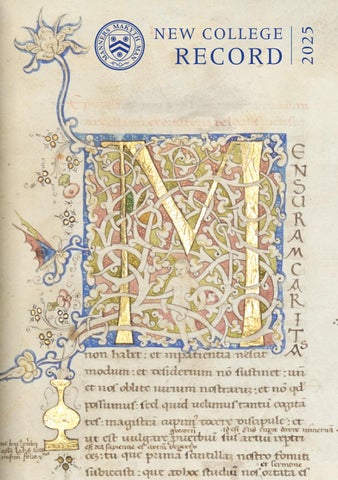
Front cover
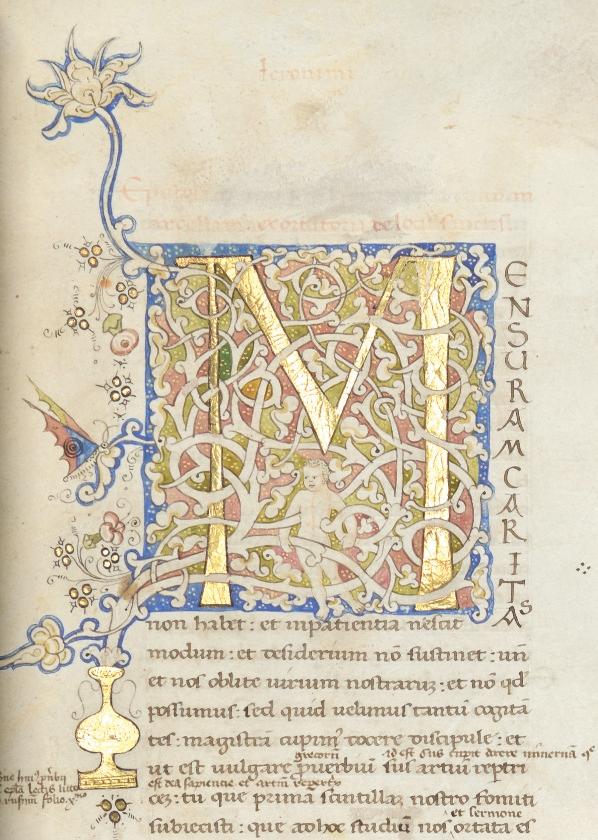
Illuminated initial with white vine-stem decoration
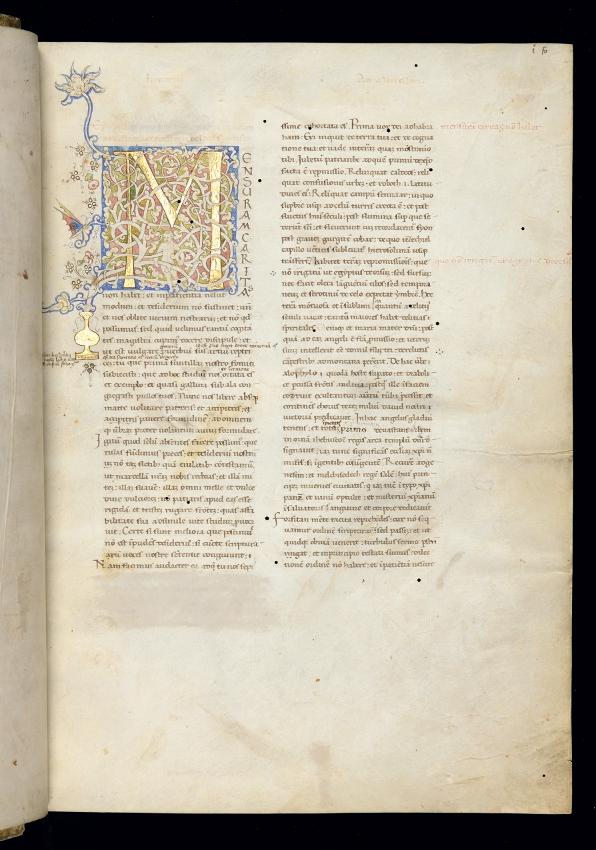
The Letters of St Jerome (Florence, c. 1440) New College Library, Oxford, MS 384, f. 1r
Originally part of New College’s collections, the manuscript was bequeathed by College Fellow, Andrew Holes (d. 1470). It vanished centuries ago, but, thanks to the generosity of book history scholar and New College Honorary Fellow Nicolas Barker, OBE, FBA, it was returned to New College Library in January 2025.
© Courtesy of the Warden and Scholars of New College, Oxford
Editorial
Another year, another Record, and the last one which will appear while Miles Young is still Warden. There will be fuller accounts of all that he has done for the college at another time, but for now I would like to offer him my grateful thanks for all the thoughtful support that he has given to this publication over the past decade.
This is a bumper issue of the Record, and all its usual sections put into high profile many aspects of the rich and varied collegiate life which we are privileged to share. In particular I would like to draw readers’ attention to the Features and Obituaries sections: in the former you can, inter alia, read of the Founder’s skill as a builder, make a visit to Benidorm, learn about Archery at New College, or even discover how to discomfit a thief of your personal property with a Romano-British curse; and the latter contains many fine tributes and appreciations, a number of them of Old Members whose distinguished achievements have won both national and international renown.
And, of course, I cannot end without expressing, as always, my most grateful thanks to the Assistant Editor, Nathalie Wilks, without whose skill, expertise and phenomenal efforts no issue of this publication would ever see the light of day.
Editor Stephen Anderson
Assistant Editor Nathalie Wilks
To give us your news for the next edition, please contact: The Editor, New College Record, New College, Oxford OX1 3BN Email: oldmembers@new.ox.ac.uk Telephone: 01865 279509
You can also update our records and give information for the Record using the email address above.
New College is registered with the Charity Commissioner (Registration No. 1142701) ‘New College Oxford’ is a registered trade mark - ® No 2588652
© John Cairns
Fellowship
VISITOR
The Bishop of Winchester
WARDEN
Miles Young, MA
FELLOWS
David Palfreyman, OBE, MA (MBA Aston, LLB Oxford Brookes), FRSA, Bursar
Martin S Williams, MA (BSc, PhD Brist), David Clarke Fellow, Professorial Fellow, Pro-Vice-Chancellor (Education)
Sir Dieter R Helm, CBE, MA, DPhil, Tutor in Economics, Professor of Economic Policy
David A Parrott, MA, DPhil, Penry Williams Fellow, Tutor in History, Precentor, Professor of Early Modern European History
Mark S Griffith, MA, DPhil, Richard Ellmann Fellow, Tutor in English
Michael J Burden, MA (BA MA Adelaide, PhD Edinburgh), Tutor in Music, Dean, Chattels and Pictures Fellow, Professor of Opera Studies
Richard Whittington, MA (MBA Aston, PhD Manc), Millman Tutorial Fellow in Business Studies, Professor of Strategic Management, Tutor for Undergraduate Admissions
Stephen J Mulhall, MA, DPhil (MA Toronto), Russell H. Carpenter Fellow, Tutor in Philosophy, Professor of Philosophy
Timothy Williamson, MA (MA Dubl) DPhil, FBA, FRSE, Professorial Fellow, Wykeham Professor of Logic
Richard T B Mash, MPhil, DPhil, Tutor in Economics
Dori Kimel, MA (BA LLB Tel Aviv) DPhil, Tutor in Law, Reader in Legal Philosophy
David J Gavaghan, MA, MSc, DPhil (BSc Durh), Supernumerary Fellow, Professor of Computational Biology
Jane L Lightfoot, MA, DPhil, FBA, Charlton Fellow and Tutor in Classics, Professor of Greek Literature
René Bañares-Alcántara, MA (BSc UNAM, MS, PhD Carnegie Mellon), Tutor in Engineering, Reader in Engineering Science
Susan J Bright, MA, BCL, Harvey McGregor Fellow, Tang Lecturer and Tutor in Law, Professor of Land Law
Volker Halbach, MA (MA PhD Munich), Tutor in Philosophy, Professor of Philosophy
William E Poole, MA, DPhil, John Galsworthy Fellow and Tutor in English, Senior Tutor, Fellow Librarian
Oliver G Pybus, MA, DPhil (BSc Nott, MSc York), Professorial Fellow, Professor of Evolution and Infectious Diseases
Victor Flynn, MA (BA Otago, PhD Camb), Tutor in Mathematics, Professor of Mathematics, Sub-Warden
Christiane R Timmel, MA, DPhil (Dip Chem TU Dresden), Tutor in Chemistry, Professor of Chemistry, Outrider
Adrianne D Slyz, MA (BSc Harvard, MSc, PhD Columbia), Tutor in Physics, University Lecturer in Physics
Mari Sako, MA (MA Johns Hopkins, MSc, PhD Lond), Professorial Fellow, Professor in Management Studies
Jonathan Black, MA (MEng Camb), Professorial Fellow, Tutor for Welfare, IT Fellow, Director of the Careers Service
Marcus du Sautoy, OBE, MA, DPhil, Professorial Fellow, Charles Simonyi Professor for the Public Understanding of Science, Professor of Mathematics
John E McGrady, MA (PhD ANU), Tutor in Chemistry, Professor of Computational Inorganic Chemistry
Mark E Curtis, MA, Director of Development
Erica D Longfellow, MA, DPhil (AB Duke, DipTheol Kent), Chaplain and Dean of Divinity
Hannah Sullivan, (BA Camb, MRes London, PhD Harvard), Tutor in English, Associate Professor of English
Joseph P Conlon, (BSc R’dg, MA, PhD Camb), Tutor in Physics, Professor of Theorical Physics
Masud Husain, MA, DPhil, BMBCh (FRCP Lond) FMedSci, Professorial Fellow, Professor of Neurology and Cognitive Neuroscience, Wellcome Trust Principal Research Fellow
Paolo Fait, (BA, PhD Florence), Anthony Quinton Fellow, Tutor in Classical Philosophy
Steven A Balbus, MA (BS MIT, PhD Berkeley) FRS, Professorial Fellow, Savilian Professor of Astronomy
Grant C Churchill, MA (BSc, MSc Saskatchewan, PhD Minnesota), Tutor in Medicine, Fellow for Equality and Diversity, Professor of Chemical Pharmacology
Ashleigh S Griffin, (BSc, PhD Edinburgh), Tutor in Biological Sciences, Professor of Evolutionary Biology
Robert J H Quinney, MA (MA, MPhil Camb) FRCO, Tutor in Music, Organist, Associate Professor of Music
Andrew R Meadows, MA, DPhil (MA Michigan), Tutor in Ancient History, Professor of Ancient History
Andrew J Counter, (MA, MPhil, PhD Camb), Tutor in French, Professor of French
Alexander S Morrison, MA, DPhil, Tutor in History, Assistant Professor of History, Dean of Arts
Gez Wells, MA (BA Open), FCMI, Home Bursar
Nino Luraghi, (MLitt Venice, PhD Rome), Wykeham Professor of Ancient History, Tutor for Graduates
Barbara D Rossi, BEng, MSc, MAS (PhD ULiège), Tutor in Engineering, Associate Professor in Engineering Science
Robert Hepach, (BSc Konstanz) MSc/MRes (PhD Leipzig), Tutor in Psychology
Jean-Paul Carvalho, MPhil, DPhil (BEc PhD UWA) Tutor Economics, Associate Professor of Economics
Jeanne Morefield, (BA Oberlin, MA PhD Cornell), Tutor in Politics, Associate Professor in Political Theory
Stephan Uphoff, MSc, DPhil, Tutor in Biochemistry; Associate Professor of Molecular and Cellular Biochemistry
Natalia Ares, (BA, MA Buenos Aires, PhD CEA Grenoble), Tutor in Engineering, Associate Professor in Engineering Science
Shivaji Sondhi, (BSc Delhi, PhD UCLA) Wykeham Professor of Physics, Leverhulme International Professor of Physics, and Tencent Chair of Theoretical Physics
Elena Baena-Gonzalez, (BA Oulu, DPhil Turku), Tutor in Plant Sciences, Associate Professor of Plant Sciences
Paola Conconi, (BA Bologna, MA Johns Hopkins, MSc PhD Warw), BP Professor of Economics
Shreya Atrey, BCL (BA LLB Nalsar) DPhil, Senior Teaching Fellow, Associate Professor of International Human Rights Law
Peter Boxall, (BA MA S’ton, PhD Sus), Professorial Fellow, Goldsmiths’ Professor of English Literature
Bernhard Malkmus, (BA Wurz, MA Kons, PhD Camb), Tutor in German, Professor of Modern German
Meera Sabaratnam, MA (MSc PhD LSE), Tutor in Politics, Associate Professor in International Relations
Christian Sahner, (AB MA PhD Princeton) MPhil, Non-Tutorial Margoliouth Fellow in Arabic, Associate Professor of Islamic History
Margarita Vaysman, (PhD (k.f.n.) PSU) MPhil DPhil, Tutor in Russophone and Associate Professor of Russophone Literature
Polly Waite, DClinPsy PhD, Tutor Fellow in Psychology, Associate Professor of Experimental Psychology
Tom Murphy, (BA Austin Peay, MA Phil PhD New York), Career Development Fellow in French
Samuel Cohen, (BSc DPhil Adelaide), Tutorial Fellow in Mathematics; Professor of Mathematics
Dominic Joyce, MA, DPhil, FRS, Savilian Professor of Geometry and Professorial Fellow
SENIOR TEACHING FELLOWS
Alex Pitcher, MA, BM BCh, MRCP, DPhil, Fellow in Clinical Medicine
Bethan Psaila, (MA Cantab), MBBS, MRCP, PhD, FRCPath, Fellow in Clinical Medicine
Nazila Ghanea, (BA Keele, MA Leeds, PhD Keele) MA, Senior Teaching Fellow and Associate Professor of International Human Rights Law
Sarah Jones, BA (MA UCL, PhD RCA), Senior Teaching Fellow in Fine Art
SENIOR RESEARCH FELLOWS
John March-Russell, MA (BSc Imperial, AM PhD Harvard), NonStipendiary Senior Research Fellow, Professor of Physics
Cameron Hepburn, (LLB BEng Melbourne) MPhil, DPhil, NonStipendiary Senior Research Fellow, Battcock Professor of Environmental Economics, Director of the Smith School of Enterprise and the Environment
Chris J Lintott, (BA Camb, PhD UCL) FRAS, Non-Stipendiary Research Fellow, Physics
James Willoughby, MA (MA Camb), DPhil, FSA, Non-Stipendiary Research Fellow, History
Peter Frumkin, (MPP Georgetown, PhD Chicago), Gradel Institute of Charity Academic Director and Visiting Fellow
David Clifford, (BA, MSc PhD S’ton), Gradel Institute of Charity Senior Research Fellow
JUNIOR RESEARCH FELLOWS
Shai Agmon, (BA LLB Tel Aviv, MSc LSE) DPhil, Rank Manning Junior Research Fellow, Social Sciences
Jack Avery, (DPhil), Non-Stipendiary Junior Research Fellow, History
Panayiotis Christoforou, (MA St And) MPhil, DPhil, Non-Stipendiary Junior Research Fellow
Tessa Devereaux, (BA Camb, MSc, MA PhD Cornell) MSc, Herbert
Nicholas Junior Research Fellow, Political Science
Morgan DaCosta, (BA Urbana-Champaign, MPhil), Stipendiary Herbert
Nicholas Junior Research Fellow, Politics
Bethany Dubow, (BA PhD Camb) MSc, Salvesen Junior Research Fellow, English
Jacob Chatterjee, BA, MSt, Weston Junior Research Fellow, History
Jaimee Comstock-Skipp, (MA CIA, PhD Leiden), Non-Stipendiary Junior Research Fellow, Asian and Middle Eastern Studies
Olivier Higgins, (BA Carleton, MPhil PhD Camb), Non-Stipendiary Voltaire Junior Research Fellow
Bang Huynh, (BA MSci MA PhD Camb), Oglander Junior Research Fellow, Chemistry
Barry Ginat, (PhD TIIT), Leverhulme-Peierls Fellow Junior Research Fellow
Maisha Jabeen, (BMedSci BM BCH PGCert Sheff), Todd-Bird NonStipendiary Junior Research Fellow, Medicine
Ishaan Kapoor, BA, Todd-Bird Stipendiary Junior Research Fellow, Medicine
James Kennedy, BM BCh MA (Dipl Glas) MRCP, Non-Stipendiary Todd-Bird Junior Research Fellow, Clinical Medicine
Shoni Lavie-Driver, BA MPhil (PhD Cantab), Esmee Fairbairn Junior Research Fellow, Classics
Rakoen Maertens, (BSc MSc Ghent, PhD Cantab) DPhil, Juliana Cuyler
Matthews Stipendiary JRF, Psychology
Lora Martucci, (MSc Paris Saclay), Todd-Bird Junior Research Fellow, Medicine
Tom Metcalf, MA, MSt, DPhil, Christopher Cox Junior Research Fellow, Music
Thomas Monahan, (DPhil), W.W. Spooner Non-Stipendiary Junior Research Fellow, Engineering
Alp Müyesser, (PhD Lond), G. H. Hardy Junior Research Fellow, Mathematics
Jonathan Nathan, (BA Chicago, MPhil PhD Camb), Non-Stipendiary Junior Research Fellow, Engineering
Richard Nies, (BSc Tübingen, MA, PhD Princeton), Non-Stipendiary Junior Research Fellow, Physics
Meindert Peters, (BA Amsterdam) MPhil, DPhil, Non-Stipendiary Junior Research Fellow, Modern Languages
Antony Psarras, (BA Thessaloniki, MSc Imperial, PhD Leeds) MRCP, ToddBird Non-Stipendiary Junior Research Fellow, Clinical Medicine
Dominic Sandhu, MChem, DPhil, Non-Stipendiary Junior Research Fellow, Chemistry
Fiona Sargison, (BSc PhD Edinburgh), Non-Stipendiary Todd Bird Junior Research Fellow, Biochemistry
Nicholas Smart, BA, MSt, Dhil, Astor Junior Research Fellow, English
Rebecca Truby, (BMBCh, BSc, MRCP) MSc, DPhil, Todd-Bird NonStipendiary Junior Research Fellow, Neuroscience
Philine van Overbeeke, (PhD Erasmus Univ), Gradel Institute of Charity Research Fellow
STIPENDIARY LECTURERS
Geraint Jones, MA, DPhil, Computation
Christopher J Tyerman, MA, DPhil, FRHistS, Medieval History, Professor of the History of the Crusades
Stephen G Davies, MA, DPhil, Extraordinary Lecturer in Chemistry, Professor of Chemistry
Antony Galione, MA (PhD Camb) FRS, FMedSci, Extraordinary Lecturer in Biochemical Pharmacology, Professor of Pharmacology
Holly Bridge, MA, DPhil, Physiological Sciences
Stephen P Anderson, MA (MA Dubl), Rodewald Lector in Classical Languages, Dean of Arts
Robert Jacobs, MA, DPhil, Chemistry
Jim Thomson, MChem, DPhil, Chemistry
Stefanie Burkert-Burrows, MSt, (Staatsexamen Eichstätt, PGCE MMU), German
Roy Norton, MA, DPhil, Spanish
Luke Lewis, (BA Salford) MSt, DPhil, Music
Marco Grossi, (MPhil St And) DPhil, Philosophy (Logic)
Stephen J Dimelow, (LLB Glamorgan, LLM Camb) DPhil, Law, Outreach Fellow
Christophe Barnabé, (MA Paris-Sorbonne, PhD Bern), French
Jani Bolla, MSc, PhD, Biochemistry
Emma Bond, (MA Edin) MSt, DPhil, Italian
Sanjay Manohar, (MA Camb, MRCP, PhD UCL), Psychology
James Munro, MA, MMath (PhD Cantab), Mathematics
Beril Boz, (LLM Pennsylvania, LLB Bahcesehir, CPGS Camb) DPhil, Law
Lydia Gilday, BA, MChem, DPhil, Inorganic Chemistry
Ruth Percy, (BA Sus, PhD Toronto), History
Hanna Willis, (MSci York), Psychology
Jonathan Price, (PhD Leid), Roman Law
Mikhail Vaganov, (PhD Dresden) DPhil, Physics
Christopher Vogel, (BA Auckland) DPhil, Engineering
Paul Deb, (PhD Warw), Philosophy
Rosa Bonifacii, (BSc Sus, MSc PhD Exeter), Biology
Jana Hunter, (BA Durh, MPhil Camb) DPhil, Modern European History
Holly Langstaff, (PhD Warw), French
Tommy Pitcher, MChem, Chemistry
Marlene Danner, (BA MA Vienna), German
Charlotte Spence, (BA, PhD Exeter), Ancient History
Henry Fahrenkamp, BA, BCL, Roman Law
Rowan Dowling, BA, MSt, DPhil, Modern Languages
Edward Jennings, BA, BPhil, Philosophy
Daniel Bundred, MEng, DPhil, Engineering
Federico Fedele, (PhD Copenhagen), Engineering
Yang Han, (BA Peking, MSc LSE) Dhil, Politics
Evangelos Kitsakis, MJur, MPhil, Law
Boaz Laan, (BA King’s London) MSc, DPhil, Philosophy
Oleg Larionov, (BA MA St Petersburg), Modern Languages
Maria (Letizia) Lo Faro, (MA, PhD Univ of Catania), Biochemistry
Mariona Miyata-Sturm, (BA MA Oslo, MA Stockholm) DPhil, Philosophy
Mihika Poddar, BCL, MPhil, Criminal Law
Kate Tallon, BA (MSc UCL, PhD Dubl), Linguistics Organising Tutor
DUMMETT FELLOWS
Femi Fadugba, (MEng, MPA Pennsylvania)
Prasanna Puwanarajah, MA, BM, BCh
Rageh Omaar, MA
Alison Cox, MEng, FICE, FCIOB
HONORARY FELLOWS
Neil L Rudenstine, MA (BA Princeton, PhD Harvard), DCL
Neil MacGregor, OM, MA, Hon DLitt, Hon FBA, FSA
Sir William B Utting, Kt, CB, MA
Sir Christopher J Hampton, CBE, MA, FRSL
Sir Brian Unwin, KCB, MA (MA Yale)
Professor Peter R L Brown, MA, FBA, FRHistS
Professor Ioan M James, MA, DPhil, FRS, dec’d
Charles J Perrin, CBE, MA, Hon FRCP
The Lord Hannay of Chiswick (David Hugh Alexander Hannay), GCMG, CH, DLitt, MA
Professor Sir Chris Llewellyn Smith, Kt, MA, DPhil, FRS
Sir Suma Chakrabarti, KCB, MA (MA Sussex)
Sir John Gieve, KCB, MA, BPhil
Professor Beresford N Parlett, MA (PhD Stanford), dec‘d
Professor Nicola M Lacey, CBE, BCL (LLB Lond), FBA
The Rt Hon Lord Justice Bernard Rix, Kt, PC, MA (LLM Harvard)
Professor Dame Hermione Lee, DBE, MA, MPhil, FRSL, FBA
Thomas P Campbell, BA (MA, PhD London)
Professor Alan Ryan, MA, DLitt, FBA
Nicolas J Barker, OBE, MA (DUniv York), FBA
Professor Marc T Tessier-Lavigne, BA (BSc McGill, PhD London), FRS, FRSC, FMedSci
Hugh J M Grant, BA
Sir Peter Westmacott, MA, CGMG, LVO
Professor Michael J Hopkins, DPhil (BA, PhD Northwestern)
Andrew D Garrad, CBE, BA (PhD Exeter, DEng Bristol), FIMechE, FRAeS, FREng
Shona L Brown, MA (MSc, PhD Stanford, BEng Carleton)
Susan E Rice, MPhil, DPhil (BA Stanford)
Sir David Davies, Kt, MA
The Rt Hon Nicholas E Underhill, MA
Professor Anna C Nobre, MA (MS, DPhil, PhD Yale), FBA
Sir Curtis A Price, KBE (BA Southern Illinois, AM PhD Harvard)
Tony Hope, MA (PhD Lond), FRCP
Alice Oswald, MA
Stanley Whittingham, MA, DPhil
Katherine Birbalsingh, CBE, MA (MA Lond)
Professor Irfan Habib, (BA, MA AMU) DPhil
Professor Richard Joseph, (BA Dart) BPhil, DPhil
Professor John Wideman, (BA Pennsylvania) BPhil
Sara Weller, MA, CBE
Mark Byford, MA, DPhil (MBA INSEAD)
Rachel Reeves, MA (MSc LSE)
Owen Sheers, FRSL, MA (MA East Anglia)
EMERITUS FELLOWS
Derek B Hope, MA, Dphil, dec‘d
Jean A Lodge, MA
David F Mayers, MA (BA, PhD Camb)
Tom Snow, MA
Jonathan C B Glover, MA, BPhil
David Wiggins, MA, FBA, AAAS (Hon. DPhil Univ York)
Gerald S Smith, MA, DLitt (BA, PhD Lond), FBA
Robin B Stinchcombe, MA (BSc, PhD Birm)
Joy M Boyce, MA, DPhil (BA Open)
P Tony Cox, MA, DPhil
Christopher J Allsopp, CBE, BPhil, MA, dec’d
David W Clarke, MA, DPhil, FREng, FRS
Richard Dawkins, MA, DPhil, DSc, FRSL, FRS
Trevor Powell, MA, DSc (BSc, PhD Lond, PhD Texas)
David Sherrington, MA (BSc, PhD Manc), FRS
Craig A Raine, MA, BPhil
Alastair I White, MA (BSc, PhD London, ACA)
Klim McPherson, MA (BA Camb, PhD Lond), FMedSci, HonFRCP
Joseph I Silk, MA (MA Camb, PhD Harvard), FRS, AAAS
Robin Lane Fox, MA, Garden Fellow
Derek A Terrar, MA (BSc, PhD Lond)
Edward Higginbottom, MA, DPhil (MusB, PhD Camb), FRCO
Jeremy A Thomas, OBE, MA (BA Camb, PhD Leic)
Martin E Ceadel, MA, DPhil
Ann M Jefferson, MA, DPhil, FBA
Jeremy M Harris, (MA Camb)
Nigel J Hitchin, MA, DPhil, FRS
Robert C Parker, MA, DPhil, FBA
Ruth Harris, MA, DPhil (BA, MA Pennsylvania), FBA
Alain R M Townsend, MA, MBBS (PhD Lond), FRCP, FRS
Caroline M A Thomas, MA, MLitt (BA Wales, MBA Aston)
David N J Limebeer, (BSc Witwatersrand, MSc PhD Natal, DSc Lond)
Peggy A Frith, MA (MD Camb), FRCP, Dean of Arts
Miles R C Hewstone, MA, DPhil, DSc (BSc Brist, Habil Tübingen), FBA
Elizabeth Frazer, MA, DPhil
Catriona Kelly, MA, DPhil, FBA
R George Ratcliffe, MA, DPhil, Dean of Arts
Karen J Leeder, MA, DPhil
Frances C Kirwan, (BA Cantab) DPhil, FRS, DBE
Giles R L Spackman, MA (MBA Harvard)
Andrew J Wathen, MA (PhD R’dg)
Rosalind A M Temple, MA, MPhil (PhD Wales)
Andrei Zorin, MA (PhD Moscow)
WYKEHAM FELLOWS
William D Eason, MA (MSI Dip)
Anne Kriken Mann, (BA Berkeley) HonFRIBA
Richard Oldfield, MA, DL
Christopher M Gradel, MEng
Dame Vivien Duffield, DBE, MA
Eugene Ludwig, MA (MA Haverford, JD Yale)
Robert Easton, (BSc QMUL) DPhil, FCGI
Stephen A Schwarzman, KBE (BA Yale, MBA Harvard)
Humphrey Battcock, CBE (MA Camb, MBA LBS)
Joan M Benham, (PhD UCLA)
Bernard Taylor, CVO, CBE, DCL, DL, MA
Alexander Ross, (BA Camb, PhD East Anglia), FRHistS
COLLEGE OFFICERS
Alan Blowers, (CPFA) Accountant (alan.blowers@new.ox.ac.uk)
Charles Campion, (MRICS) Land Agent (charles.campion@new.ox.ac.uk)
Christopher Skelton-Foord, (MA Cantab, MBA Dunelm, MA Lough, PhD Cardiff) Librarian (christopher.skelton-foord@new.ox.ac.uk)
Michael Stansfield, (BA Brist, DPhil, DAA UCW Aber) Archivist and Records Manager (michael.stansfield@new.ox.ac.uk)
Jenny Thomas (BA, FCA), College Accountant ( jennifer.thomas@new.ox.ac.uk)
Christopher Thompson, Director of IT Services (christopher.thompson@ new.ox.ac.uk)
STAFF CONTACTS
Stephanie Angell, Warden’s Office Assistant (wardens.office@new.ox.ac.uk)
Yvonne Appleby, HR/Payroll Manager (yvonne.goodgame@new.ox.ac.uk)
Ellen Baker, Domestic Services Manager (ellen.baker@new.ox.ac.uk)
George Balkwill, Senior Development Officer (george.balkwill@new.ox.ac. uk)
Mark Barrett, Accounts Student Finance (mark.barrett@new.ox.ac.uk)
Adrian Bosher, Accounts/Payroll (adrian.bosher@new.ox.ac.uk)
Susan Bridge, Associate Chaplain (susan.bridge@new.ox.ac.uk)
Sam Brown, Project and Systems Analyst, Website Developer (sam.brown@ new.ox.ac.uk)
Sophie Carp, GIC PR and Marketing Coordinator (sophie.carp@new.ox.ac.uk)
Brian Cole, Catering Manager (brian.cole@new.ox.ac.uk)
Michael Collett, Clerk of Works (michael.collett@new.ox.ac.uk)
Samuel Cruickshank, Head Chef (sam.cruickshank@new.ox.ac.uk)
Tracy Curtis, Estate Office Secretary (tracy.curtis@new.ox.ac.uk)
Janaina Dal Zotto Boff, Senior Admissions Administrator (janaina. dalzottoboff@new.ox.ac.uk)
Harriet Dawson, Fundraising and Communications Officer (harriet. dawson@new.ox.ac.uk)
Phuntsok Dhondup, Accounts Assistant (phuntsok.dhondup@new. ox.ac.uk)
James Dore, ICT Officer (james.dore@new.ox.ac.uk)
Lily Fowler, Conference and Events Assistant (lily.fowler@new.ox.ac.uk)
Milly Gray, Welfare Administrator (milly.gray@new.ox.ac.uk)
Hassan Hamed, SCR Butler (hassan.hamed@new.ox.ac.uk)
Florie Harmer, PR and Marketing Coordinator (communications@new. ox.ac.uk)
Paula Hart, Conference, Events and Tourism Manager (paula.hart@new. ox.ac.uk)
Sheena Hinton, PA to Bursar, Home Bursary and Catering Secretary (sheena.hinton@new.ox.ac.uk)
Shelby Holmes, Deputy Academic Registrar (shelby.holmes@new.ox.ac.uk)
Bradley Hoover, Chapel Administrator (chapel.admin@new.ox.ac.uk)
Sophie Jones, Concert Administrator for the New Space (sophie.jones@ new.ox.ac.uk)
Jacqui Julier, Deans’ and College Officers’ Secretary (jacqui.julier@new. ox.ac.uk)
Malwina Kozłowska, Outreach and Admissions Officer (malwina. kozlowska@new.ox.ac.uk)
Mark Lambourne, ICT Support Technician (mark.lambourne@new.ox.ac.uk)
Freyja Madsen, Academic Registrar (tuition@new.ox.ac.uk)
Emily Meeson, Assistant Home Bursar (emily.meeson@new.ox.ac.uk)
James Morgan, Accounts Clerk (james.morgan@new.ox.ac.uk)
Jason Morgan, Assistant Librarian (jason.morgan@new.ox.ac.uk)
Soon-Mi Newman, Accounts Assistant (soon.newman@new.ox.ac.uk)
Joanna Pavelin, Accounts Assistant (joanna.pavelin@new.ox.ac.uk)
Monika Pietruszewska, Food Services Manager (monika.pietruszewska@ new.ox.ac.uk)
Michele Pitson, Deputy Clerk of Works (michele.pitson@new.ox.ac.uk)
Daniel Powell, Head of Outreach and Communications (outreach@new. ox.ac.uk)
Diego Ramírez Alcalde, Chapel Manager (diego.ramirezalcalde@new. ox.ac.uk)
Felicity Reeves, Student Services Officer (student.services@new.ox.ac.uk)
Hugh Rowlands, Assistant Organist (hugh.rowlands@new.ox.ac.uk)
Jonathan Rubery, Communications and Events Manager (jonathan. rubery@new.ox.ac.uk)
Peter Roberts, Choir Administrator (peter.roberts@new.ox.ac.uk)
Georgie Savastano, Senior Outreach Officer (georgie.savastano@new.ox.ac. uk)
William Shire, Deputy Librarian (william.shire@new.ox.ac.uk)
Aimee Stewart, Executive Assistant to the Warden (aimee.stewart@new. ox.ac.uk)
Alexandra Sufaru, GIC Executive Administrator (alexandra.sufaru@new. ox.ac.uk)
Tracey Walkington, Head Porter (tracey.walkington@new.ox.ac.uk)
Daniel Weller, Deputy Accountant (daniel.weller@new.ox.ac.uk)
Nathalie Wilks, Alumni, Database and Publications Officer (nathalie.wilks@ new.ox.ac.uk)
© John Cairns
From the Warden
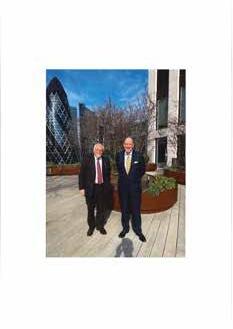
A retrospect on a single year from the Warden’s Lodgings inevitably feels somewhat kaleidoscopic: dancing reflections, vivid hues, multiple layers – but still with some sense of an underlying pattern. So here are just a few random flashes from 2025’s kaleidoscope of memories: the red dragon of Wales flying above the Robinson Tower (celebrating our now established St. David’s Day dinner and our relationship with Wales as an access region); the bronze interior of the New Space packed for our annual Women’s Lecture by alumna Anna Bateson (conveying her experience as CEO of the Guardian Media Group and enjoining our students to ‘embrace nuance’); the college grounds transformed into une ville lumière (for a century Paris-themed Commemoration Ball); the swathe of green planting on New College’s least known garden on the roofs of 80 Fenchurch Street, EC3 (and reflecting there with the Bursar on its importance to our bottom line and on the wisdom of William of Wykeham in purchasing it); the coruscating gold of the illuminated initials in the fifteenth century book of St Jerome’s letters returned to the Library after centuries of absence (and carried back gingerly by me from London in a plastic bag collected from Nicolas Barker, their rediscoverer and donor); the reddish brown ‘ Waseda University, our most recent international partner (bearing fruit in an agreement for a visiting student programme); the sober graphics of the Gradel Institute of Charity’s report, ‘A Third Way of Doing Growth’ which for the first time
The Warden and the Bursar on the roof of 80 Fenchurch Street
quantified the Third Sector’s real contribution to the UK economy (and is being followed up by new research which highlights the dramatic decline in volunteering since the pandemic); a faded sepia photograph of D. S. Margoliouth, peering out from an exhibition which celebrated his extraordinary career as an Arabist at New College (marking the return of Arabic in the college and an inaugural lecture bearing his name); and, right at the end of the year, the vast, dramatically illuminated concert hall of Paul Andrieu’s ‘egg’ close to Tiananmen Square in Beijing (where the
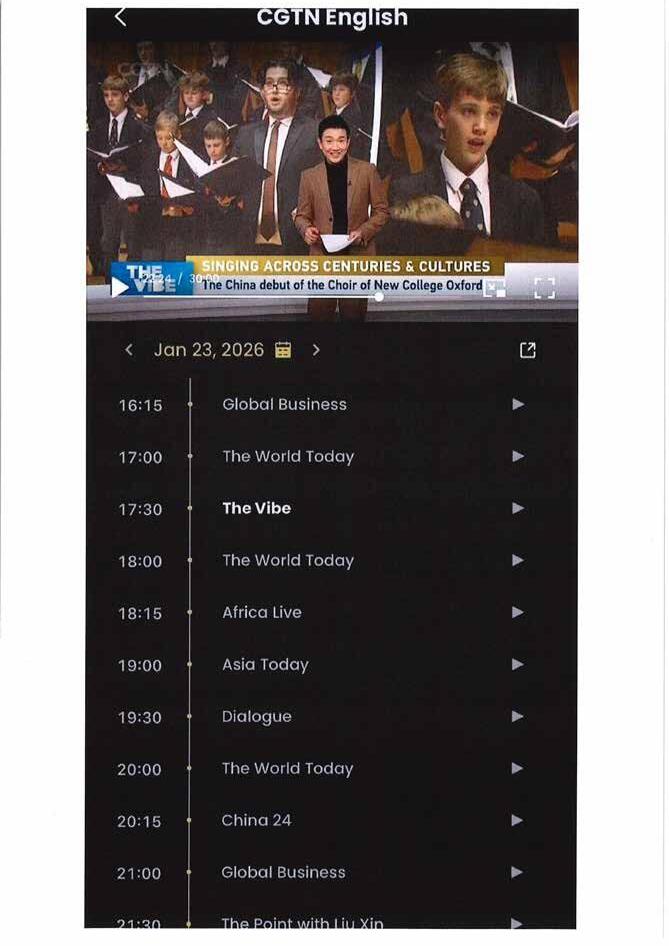
A composite media shot of the choir singing in China
frankly) abhorrent. These included references to ‘new models of college membership’ which would have undermined the long-standing principle that all matriculating students who study for a degree must be full college members, whether they are full-time, part-time or online. Behind this is the appetite of the University for putting significant amounts of teaching online. It seems inexplicable that in all those early drafts the role of the University as a teaching organisation was reticent almost to the point of absence. Conference pushed back but, even after several efforts, it was still expressing the view that it would ‘like the strategy to foreground teaching, in particular the place of tutorial teaching, as an intrinsic and distinctive characteristic of the Oxford USP. It is still the case that half of all students are undergraduates and teaching them is core to the University’s and colleges’ mission (and charitable purposes)’. Regrettably, at the moment, in the finally published plan it is still not foregrounded.
Quite rightly, the University research role is highlighted in spades, but the teaching role feels derogated. Derogation causes, in turn, a tendency to contemplate dumbing down. The latest example of this is discussion about creating a general ‘humanities degree’, born in part out of the financial crisis in the Modern Languages faculty. We are a University which has achieved success through teaching deeply out of subject-area excellence, and this seems like another assault on our USP and a dangerous lurching towards the generic.
While none of these things are ill-meaning when they emerge from the University bureaucracy, and while our Vice-Chancellor is very well meaning, they do signal something quite worrying: perhaps just a hairline crack at the moment, but maybe the earliest sign of a fissure between the research and teaching sides of the University, quite unlike what exists within a college where research and teaching exist in more or less perfect harmony. In a cash-hungry (and at times spendthrift) University one can understand that the demands from research are increasingly urgent. But that should not lead to an imbalance along either the teaching/research axis or the humanities/STEM one.
As in all things, it is best to get issues out in the open. So perhaps we are coming to a time where some fundamental questions need to be asked. One of them is, how long can the current structure of the University cope with all of its burgeoning research role? Thinking ten years ahead, if, thanks to the efforts of our Honorary Fellow, the Chancellor of the Exchequer, the Oxford – Cambridge railway has materialised, we might envisage much closer research links between the two Universities, which could even become institutionalised. Could we create in some parts of our STEM universe, a super, MIT-style ‘OCIT’, enabling an integrated research and economic cluster between Oxford and Cambridge, with plant in
Milton Keynes, Bedford and Tempsford which would take on similar clusters in Massachusetts, California and North Carolina, and even the Yangtze and Pearl River Basins? After all, no University is an island, also. When we ask students why they select New College, the site and sense of place trump all other reasons. So it gives me particular pleasure that carefully nurtured plans for the main college site are all now moving along at various speeds and at different trajectories – but, gratifyingly, they are moving.
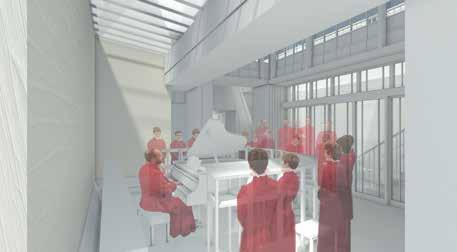
The Song Room project, to replace the inadequate space in which the Choir is currently supported at the side of the Chapel, has now found funding, and the sensitive designs prepared by Oliver Caroe are likely to be completed within two years, providing the modest but highly functional facilities which a world-class choir deserves.
Meanwhile, the Library extension, about which I wrote in the last issue, has had slower progress. We are still in negotiation with the City. Things seem positive, but we also have a little more work to do. On our side, we are very pleased indeed with the plans which reflect some appropriate reverence to the shade of Sir Hubert Worthington, architect, but also the pressing need for more reading space and for a place to display our historical books and archives. This project will be very much a feature of my successor’s life during the next years.
At this point, I should anticipate with unalloyed pleasure the impending installation of Sir Robin Niblett as our next Warden. With three degrees at New College and a distinguished career leading Chatham House, he combines New College sensitivity with the profoundest of
Artist impression of the new Song Room
international perspectives. Lammy and I wish Trisha and him all the happiness and welcome we have felt and have received here over the last ten years.
Finally, I should record with pleasure the election of Professor Dominic Joyce, as Savilian Professor of Geometry, following in the footsteps of many renowned predecessors. We also welcomed Sarah Jones as Fellow for Fine Arts.
We said goodbye to Professors Andy Wathen and Rosalind Temple after many years of faithful service on Governing Body. Professor Zorin also retired; his role as Professor of Russian will be sadly missed across the University, a post which we earnestly hope will be ‘unfrozen’.
During the year Professor Volker Halbach was Sub-Warden. His pragmatic and phlegmatic manner stood us in very good stead at all times, and his good humour, dedication and thorough checking out of premises (philosophical not physical) was profoundly helpful to the college. I am most grateful to him.
The Warden
Sir Robin Niblett, KCMG
(1980, Modern Languages), Warden-Elect
Sir Robin Niblett KCMG has been elected to succeed Miles Young as Warden of New College. Sir Robin will take up the post in September 2026. Until 2022 he was Director and Chief Executive of the Royal Institute for International Affairs, Chatham House, and prior to this was Executive Vice-President and Chief Operating Officer at the Center for Strategic and International Studies (CSIS) in Washington, DC.
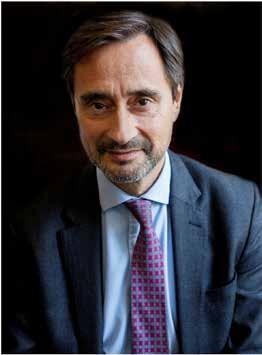
Currently he is the Director of Ledwell Advisory and a member of the International Advisory Board of Brown Advisory, the US investment firm. He is a Distinguished Fellow of both Chatham House and the Asia Society Policy Institute and a Senior Adviser with CSIS. He is also a member of the Board of Overseers of the SNF Agora Institute at Johns Hopkins University. A leading expert on the relations between Europe, the US and Asia, he is the author most recently of The New Cold War: How the Contest Between the US and China Will Shape Our Century, which was published by Atlantic Books in 2024.
In 2022 he was appointed Knight Commander of the Order of St Michael and St George for services to international relations and British foreign policy.
NEW COLLEGE NOTES
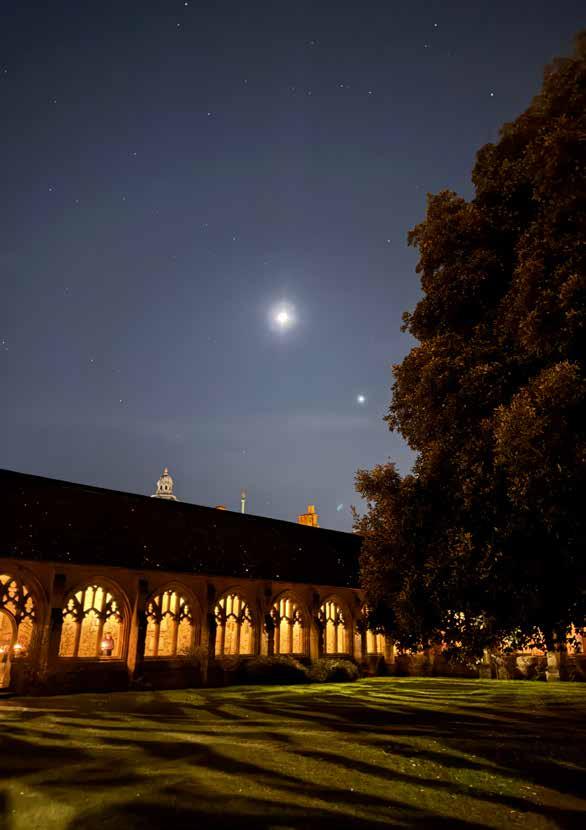
© chorister parent
The Bursar writes…
The Founder is watching over his Oxford creation! Each time we risk drifting into potentially choppy financial waters we gain planning permission (after many years of effort, nudging an application through the tortuous regime!), and then achieve a sale of development land as a vital much-needed boost to our Permanent Endowment - the annual yield from which at a prudent draw-down rate of 3.25% funds the sizeable loss the college runs in operating its ‘academic’ activities (a loss of c£5k pa on each of our 450 or so UK undergraduates, even after we receive c£5k of the £9500 University tuition fee).
Thus in 2012 we were rescued by the sale of land at Banbury, and most notably in 2005 by our £56m from the development at Aylesbury; there have also been smaller but welcome transactions at Lechlade and Buckingham. Over my time since 1988 we have added about £150m to Endowment from the successful seeking of planning permissions as set in train by a review of our land holdings which I commissioned in 1989: note, it then took 16 years before we hit the Aylesbury jackpot! It is a clear requirement of charity law in terms of the fiduciary duty upon the Fellows-qua-trustees (as well as being in accordance with the lengthy Latin oath taken by each new Fellow on Admission to Governing Body) that the college’s Endowment assets must be maximised by all lawful means and with due regard to risk.
Performing that duty sometimes generates ‘flak’ from local communities affected by the planning application proposals - and this has happened over the past few months with regard to our land being part of a planning application for 9000 houses at Upper Heyford (where we in fact already have a permission for a smaller development which will be marketed during 2026). The 9000 scheme will be considered in the usual way by Cherwell District Council as the relevant planning authority (as also for our Banbury land) and it has to take into account any and all objections. Given the Government’s push for new homes, it is possible, however, that the application will be ‘called in’ and the decision taken by the Minister - and it is also conceivable that Upper Heyford will be selected as one of a dozen suggested ‘new towns’ so that all decision-making will then shift to a New Town Development Corporation (such as oversaw the growth of Milton Keynes back in the 1970s).
A previous Warden, when receiving objections to the college’s ‘wicked’ development plans in locality X or Y, usually responded expressing sympathy, but stressing that the Bursar was beyond control! In promoting
our land transactions I am grateful to a succession of Land Agents (Messrs Harwood, Tuely, and currently Campion), as well as to our long working relationship with Hallam Land Management (which commenced back in 1993): it is HLM that funds the hefty cost of the endless badger/newt/bat surveys, the planning application fees, the legal fees for any appeal, and the preparation of planning applications running to several hundred pages – and they bravely appear at public meetings! Their CEO - Nick Duckworth - has just retired after working with us for over 30 years from being a ‘junior’ back in 1993, and the college is grateful for having had his considerable expertise.
In broad terms our 25/26 Budget assumes a turnover of some £24m, and just over £10m is the income from the Endowment. The recent sale of housing land at Banbury has brought in £42m, the annual yield from which is timely in offsetting a hefty hike in pay costs driven by the extra employer’s NI contributions and by changes in the remuneration of staff resulting from the University introducing an ‘Oxford Weighting’ for all its employees (and the colleges matching it for theirs). Our routine operating expenditure is predicted at £22.4m and the £1.6m difference is the amount we transfer back to Endowment - having borrowed from it, as permitted by charity law, to fund the massive decades-long refurbishment of staircases, the Kitchens/ Buttery project, and a contribution to the cost of the Gradel Quads’ new bedrooms plus new-build for the School. That debt to Endowment is due to be cleared by some point in the 2050s - and only then can the Governing Body contemplate other building projects such as extending the Library (unless a very generous donor can be found as we benefited from in the case of the recent Gradel Quads project...).
Fortunately, in contrast to the ‘cost’ centres of Tuition & Research, Chapel, Choir, School, and Library, we have an increasingly useful contribution to the bottom line from our ‘profit’ centres by way of the conference trade and tourists, the latter’s flow of folk through the New College Lane Gate being greatly helped by our co-operation with location managers so that we are featured in various films (notably Harry Potter and the Goblet of Fire and the Mamma Mia prequel) and in Netflix/TV productions (such as His Dark Materials and Morse/Lewis/Endeavour). My long-suffering PA (Mrs Hinton) and our Maintenance Manager (Mr Lowe) work hard to ensure that the whims of the directors of such productions can be accommodated while minimising disruption to college routines. We have earned well over £500k from such ‘facility fees’ over my time - and far in excess of that in terms of the flow of tourists visiting ‘The Harry Potter Tree’ in the Cloisters (tourist income in 24/25 was at £493k after paying wages for staff ‘on the gate’ - and is projected to reach £591k in 25/26...). If we ever give up on the loss-making academic stuff, we have a future as a Theme Park!
David Palfreyman – Bursar
The Home Bursar writes…
This year’s entry into the Record begins at the end. A novel concept and one that I doubt will catch on. The reason for such madness is that I have just returned from Paris, having been dispatched to collect the Prix Versailles Laureate for the World’s Most Beautiful Campus 2025. The honour has been bestowed on our Gradel Quadrangles and I was delighted to be joined by our Architect, David Kohn. The acceptance speech focused on the importance of creating a positive of openness and collaboration in successful projects. Much of the remainder of this year’s note runs along a similar theme.
And so, to jump back to the start of 2025. The year began and has continued with projects making their way through various stages of the planning regime. We have appointed a talented professional team to begin the detailed design work for our Library Extension. Working in conjunction with members of college, the scheme has tested many different scenarios to deliver a challenging brief. The intention is to provide the college with a fully accessible Library, increased reader spaces, a purposebuilt exhibition area, increased archive storage and staff amenities. We aim to achieve this with an extension that respects and is subservient to Sir Hubert Worthington’s original Library building, completed in 1939,
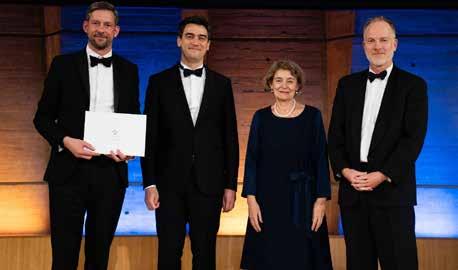
The Home Bursar and David Kohn collecting the Prix Versailles award from Jérôme Gouadain, Secretary General of the Prix Versailles and Irina Bokova, the former Director-General of UNESCO
whilst introducing modern technology to provide renewably sourced heating and cooling and upgrading existing facilities.
Our early-stage plans have been well received by Historic England and the City Planners, so we are hopeful of being able to deliver a fantastic new building which is so important in the working life of the college.
We have also been able to restart the design engines on the Chapel Song School project. Put on ice in 2018, and further frozen by the Covid years, thanks to the generosity of donors, we have re-engaged with our design team to develop the scheme in preparation for diocesan approval in early 2026. Whilst not as visible as an extension to the Library, the Song School will significantly improve the day-to-day operations of the chapel and choir. Logistically challenged, being sandwiched between the northern façade of the chapel and behind the City Wall, the Song School will require forensic design, detailing and engineering in order to be constructed.
Away from capital building projects, a brave team of staff sought a different kind of challenge in early May. Having taken on Yr Wyddfa in 2024, the group raised funds for the Alzheimer’s Society by completing the Yorkshire Three Peaks Challenge. A test of physical fitness and mental fortitude, this involved 15 college members testing their resilience by walking 24 miles across three of the highest peaks in England in under 12 hours. This latest challenge put teamwork to the test and was a great bonding experience for all of those involved. It was also a precursor to 2026, when the group will be taking on the National Three Peaks challenge, climbing the three highest mountains in Scotland, England and Wales within 24 hours. At the end of Trinity Term the college was transformed into La Vie en Rose as the New College Commemoration Ball Committee put on what will be fondly remembered
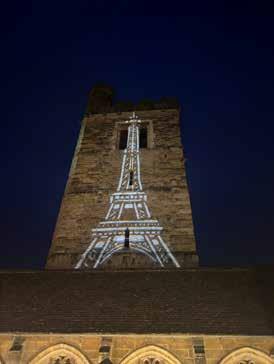
as one of the very best parties the college has ever hosted. The evening was spectacular with guests treated to wonderful entertainment, great food and plenty of fizz as they danced their way into the early hours, a few hundred souls making it as far as the survivors’ photo at 5am, long after the sun had risen. The logistical challenge for such a large one-off event is complex, but the student committee, whilst studying full time, made it seamless. A happy Home Bursar during a ‘Commem Ball’ is a rare sight, but one that was seen this year. My thanks extend to the whole committee and to the college staff who worked so hard in the build-up, during the event and long after the last guest had left. The college by some miracle had returned to its original splendour by Monday afternoon - quite the feat!
The long vacation seemed busier than ever thanks to conferences and summer schools taking up residence. We are blessed in having strong relationships with clients who return year on year: for them the college feels like their second home. Visitors to the college continue to be transfixed by the beauty of the buildings and grounds. Many remain cloaked and on broom sticks muttering incantations, others are more reflective and enjoy the scenic walk around the garden. In August we launched a new audio tour guide on the platform Smartify. The Warden, Fellows, Students and Staff came together to share their experiences of what makes New College quite so special. The audio tour (feel free to look it up online) allows visitors a greater understanding of what goes on here and has made the college more accessible than ever.
I end, as ever, by thanking those members of college staff who left us in 2025. Of note, our Head Porter, Chris Wyatt, earned his full set of stripes and entered retirement. Both our Academic Registrar, Freyja Madsen and Clerk of Works, Michael Collett left for pastures new. I wish them all well with their next chapters.
Gez Wells - Home Bursar
The Chaplain writes…
‘Be it known also to everyone that it is appointed in the custom of the church that on this day we should carry our lights to church, and let them be blessed there: and that we should go afterwards with that light among the houses of God, and sing the hymn which is appointed for that.’
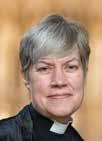
So wrote the great Anglo-Saxon preacher Aelfric of Eynsham more than a thousand years ago about the midwinter feast of Candlemas, the dedication of Jesus as the first-born and the ritual purification of his mother Mary after birth. In medieval times every parishioner was obliged to bring a candle, and the candles would be carried about the town or village, and then kept to be lit in dark and fearful times, or placed into the hands of the dying. In our own time the chapel supplies the candles, slim dripless tapers that would not last an evening, much less many dark nights of winter. But nevertheless this could, in many ways, be a description of what we do in chapel, not just at Candlemas, but six nights a week in term time: we light a candle to defy the darkness, and to remind ourselves of the light that is our gift, and we sing to draw our hearts and minds above the tumult of everyday life, and to recall the love that is our source and our grounding.
At New College Candlemas comes soon after the start of the calendar year but almost at the midway point of the academic year, and brings together students, staff and Fellows to celebrate the light. And it is in such special services that the chapel draws the whole college together, particularly Freshers’ Evensong, Leavers’ Evensong and Graduation Evensong, to mark the start and end of the students’ time here, the College Commemoration Service when we remember our history, and the St John Passion and the Christmas Carol Services when the peerless talent of the choir is especially apparent. Our termly Cantata Vespers service brings in many from outside the college for the rare chance to hear a full Bach Cantata in a liturgical setting. This year we heard Ich steh mit einem Fuß im Grabe (BWV 156), Ihr werdet weinen und heulen (BWV 103), and in Michaelmas Term the choir reprised the beloved Wachet auf, ruft uns die Stimme (BWV 140). Alongside these sparks of brilliance, the dayto-day round of evensong, vespers, compline and eucharist are the steady flames that shine night after night, keeping the chapel as a place of refuge at the centre of the college. At times we find our way there to remember those who have gone before, in memorial services or the Requiem for All
Souls, or to say a final farewell. At the very end of 2025 we bade adieu to Dr Dee Ferguson Sichel, who with her husband Dr John Sichel served as a College GP for almost three decades until their retirement in 2012. The chapel was packed with Fellows, colleagues, former students and patients who came to pay their final respects.
It is, of course, music that fuels our spiritual flame, if you will forgive me stretching the metaphor a little. It is one of the great privileges of my role to commission new music for the choir, and one of the important ways that the chapel and college further music-making and the arts in an increasingly straitened environment. At the Epiphany Carol Service on the first Sunday of the year the choir gave the first performance of Kim Porter’s The Single Loving Heart. A particular highlight of 2025 for me was the service in Trinity Term when the choir sang a new anthem by Nico Muhly, setting a moving text from a farewell sermon by John Donne, and I read from one of Donne’s marriage sermons, to mark the publication of vol. vii of The Oxford Edition of the Sermons of John Donne, which I edited with Professor Peter McCullough. Commissioning music is just one way that we partner with musicians. In November the ensemble Tonus Peregrinus, founded at New College by Old Member, Antony Pitts, stepped in to cover services while the choir was in Versailles, in exchange for using the chapel and cloisters to record a trailer for their new project, ‘Opening the Eton Choirbook’. That same month we were also delighted to welcome the girl choristers of Merton College who sang evensong with the clerks on Remembrance Sunday, and in December we were able to give rehearsal space to former chorister Guy Cutting before a glowingly-reviewed Wigmore Hall recital. Throughout Michaelmas Term we were also privileged to welcome back Dr Andrew Lumsden, Head Chorister at New College during the tenure of his father, Sir David Lumsden, as Organist (1959–1976), and most recently Director of Music at Winchester Cathedral. Dr Lumsden served as Acting Organist during Robert Quinney’s sabbatical, and finished the term with a splendid series of Christmas services culminating in Midnight Mass.
As I write, the new round of services for 2026 is just beginning, and I draw hope in the delight of music old and new, in the faithful stewardship of our twin steady flames of spiritual sanctuary and musical excellence. We have also welcomed several new members of staff, including Diego Ramírez Alcalde as part-time Chapel Manager, and the Revds. Dr Oliver Wright (former chorister) and Canon Dr Peter Groves (Old Member) in the new role of Honorary Chaplain, taking the occasional service and preaching from time to time. Old Members and former clerks and choristers are warmly welcome at chapel services; only the Christmas services and the St John Passion are ticketed, so usually there is no need
to book. If you cannot get to Oxford, Sunday services and special services are also livestreamed on the New College Choir YouTube channel. We look forward to seeing you in 2026. Deo gratias!
Erica Longfellow - Dean of Divinity
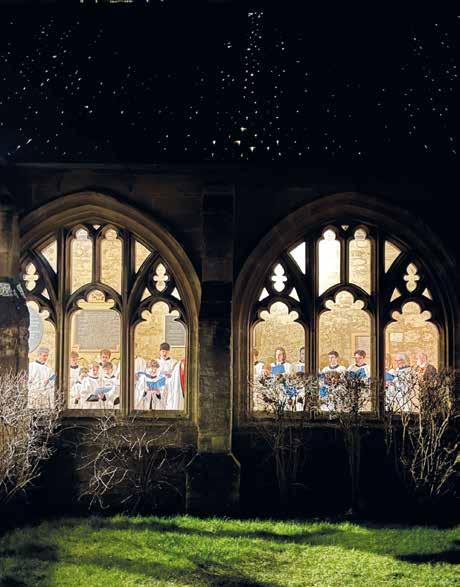
Candlemas
The Organist writes…
Since the choir’s work in chapel has been so comprehensively covered in the preceding article, I will concentrate on our activity beyond the walls of the college – of which there is happily much to report. Our extracurricular activities are mostly confined to the vacations, for obvious reasons. With planning and the generous understanding of colleagues in college and school, occasional extra commitments can, however, be accommodated in mediis rebus – of which more below.
The Spring vacation saw us once again in the ideal acoustical surroundings of St John the Evangelist on the Iffley Road – sadly no longer a concert venue, but, we hope, still accessible for recording – making our third disc in a series for Linn Records of music from the Golden Age of English polyphony. This time, following discs of John Sheppard and William Mundy, the composer was perhaps the best-known of all his contemporaries: Thomas Tallis. Our recording focusses on the music likely to have been written in the 1550s, specifically during the five years of Mary Tudor’s reign, which were particularly fruitful in musical terms – an almost palpable response to the lean Edwardine years, in which composers’ wings were severely clipped by reformers whose preference, one suspects, would have been for no liturgical music at all (as was the case under Zwingli in Zürich). The centrepiece of the disc is only the second recording by a choir of our kind of the Mass ‘Puer natus est nobis’ (the first, made by the Choir of King’s College, Cambridge in the early 1980s, is at a high transposition no longer thought to represent sixteenth century practice). It is in seven voice parts, and is constructed according to a unique cantus firmus technique, in which the plainchant of the title (the Introit on Christmas Day) is sung in long notes, whose duration depends on the vowel sound. Arcane stuff, but the result is music of spellbinding beauty. For a group consisting largely of schoolchildren and students, performing this complex music with style and assurance is no small achievement; I hope our recording will stand as a challenge to lazy assumptions that such repertory is the preserve of fully professional ensembles. Look out for what I hope is a noteworthy addition to the (large) Tallis discography, out in the autumn. Quite apart from the sonic experience, our CDs also look wonderful, thanks to an excellent (as it happens, Belgian) design team – as you can see from the image overleaf of our William Mundy disc. If you still have a CD player, please consider
William Mundy
Vox Patris caelestis
ROBERT QUINNEY
CHOIR OF NEW COLLEGE OXFORD
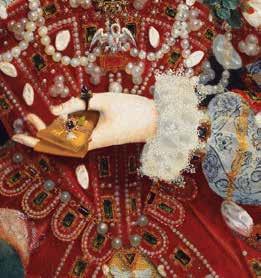
buying a copy rather than simply streaming it via Spotify or a similar service: the sound quality is far superior, and it helps us cover the considerable cost of making the recording. (Of course, if you wish to support these endeavours at the point of conception rather than delivery, you will find me eager to discuss future projects with you.)
So to the summer, and a trip to Sweden. We visited the cathedral and university town of Uppsala, the capital Stockholm, and Vadstena – site of an Abbey dedicated to St Bridget, who founded her order of distinctivelywimpled nuns there a decade before the foundation of New College. Here, in the rural centre of the country, we stayed on the shore of Vättern, a huge freshwater lake over which we watched the sun set in a glorious Abenddämmerung: a memorable end to the academic year.
In Michaelmas Term I was on sabbatical leave. There was a concurrent changeover between Assistant Organists, Hugh Rowlands replacing George Herbert, who departed to pursue studies in Collaborative Piano at the Royal Academy of Music. So we needed someone to take over the direction of the choir. Who better than a former chorister, whose very genes carry the New College code? Dr Andrew Lumsden, until recently Director of Music at Winchester Cathedral, left our choir (and school, of course) in the same year his father David stepped down as Organist and Tutor in Music. The omens were good, and their fulfilment a huge success – stimulating for the singers and organists to have fresh perspectives, and a delight for your correspondent to know that they were in the best possible hands. In early November I made a short reappearance for a very stimulating collaboration with Ensemble Marguerite Louise, a period instrument group based in Paris. Together we presented Royal Triumphs and Farewells, a concert featuring music from both countries, by Charpentier, Delalande, and Purcell – first in the stunning Royal Chapel in the Palace of Versailles, then in Smith Square Hall in London. The balletic conducting of Gaétan Jarry drew performances of tremendous élan in the French music, and I kept the British end up in the Purcell; the Observer
celebrated ‘the cross-border nature of this exceptional concert [at Smith Square]’. Just over a month later, Andrew’s term with the choir culminated in excellent carol services and a superb account of the first three parts of Bach’s Christmas Oratorio – which we now customarily present every December, alternating with the second three parts.
I will now stray slightly beyond my brief, in order to give an account of our most remarkable venture in 2025, which extended over the New Year: a week-long visit to China, the choir’s first. We landed in Shanghai on 29 December, and after a day of acclimatisation gave our first concert in the Symphony Hall, a 1200-seat space with a pleasingly lively acoustical response. Our programmes were, as is always the case in China, entirely secular in content, which meant that the choir had performed very little of it before (save a few folksongs, familiar to readers who have attended a Gaude over the last few years). My nerves may have been understandable, but they were unfounded nevertheless; an excellent concert in Shanghai was followed by another in Beijing, in the concert hall of the extraordinary National Centre for the Performing Arts. In both cities the audience response was especially warm for arrangements of Chinese folksongs by Iain Farrington and our own Hugh Rowlands; we added a third folksong as an encore, in an arrangement I made on the high-speed train from Shanghai to Beijing! In between performances we made several cultural visits: most memorably, a New Year’s Eve cruise down the Huangpu River in Shanghai, a tour of the Forbidden City, and – unforgettably for any of us – a morning at the Great Wall. We even managed to perform one of the folksongs on the wall, once a security guard had been assured that we were a bona fide ensemble. Our knowledge and appreciation of Chinese cuisine was expanded and enhanced at every meal; the choristers surpassing our (and, I think, their own) expectations of their adventurousness. All in all an outstanding, fascinating tour: my thanks to the Warden for first suggesting, and subsequently ensuring, that it took place; and to the whole touring party for their skill and excellent company.
Robert Quinney - Organist
The Librarian writes . . .
The return to New College of a magnificent, 15th-century illuminated Florentine manuscript copy of the Letters of St Jerome, missing for centuries, sounds like a fairytale— but that is indeed what happened in January. First bequeathed to the library by College Scholar and Fellow, Andrew Holes (d. 1470), Royal Proctor to the Papal Curia, the manuscript dates from around 1440, and comprises 368 leaves of vellum, and is virtually complete. Its illuminated gold and coloured initials, with white interlaced vine-stem decoration (bianchi girari), are the work of a painter (or painters) of huge talent, and have been beautifully executed using very fine materials. A spectacular opening blue-framed initial ‘M’, in quite flawless gold, is filled with delicate pinky-brown and green colours, featuring a putto (cherub), a charmingly painted butterfly, and a bright golden vase from which entangling vine stems emanate. This is the image illustrating the front cover of this year’s Record. Purloined from college most likely in the 16th or early 17th century, by at least 1690 the manuscript was held in the Mostyn family’s Gloddaeth Library in Wales. It passed through the hands of several rare books dealers, Sotheby’s, Maggs Bros., Christie’s, and Bernard Rosenthal, before book history scholar and librarian at the British Library, Nicolas Barker, purchased it. Subsequently an erased inscription in the manuscript, revealed through ultraviolet photography, indicated Andrew Holes’s ownership, and thereafter, thanks to the great generosity of Nicolas Barker, and the good offices of our Warden, Miles Young, it was donated and restored to New College. It has now become our MS 384, our foremost manuscript acquisition in recent years. You can read more about it in the college’s sister publication New College Notes (www.new.ox.ac.uk/ restitution-st-jerome-new-college-librarys-ms-384).
The generosity of New College friends and alumni, the energy and expertise of library and archives staff, and the richness of our collections continue to stimulate donations to the library and archives. This year has been a bumper year for gifts generally, and I am most grateful to the 80+ individuals and organisations who have donated financial gifts and collections items to us in 2025, including sizeable book gifts from both Professor Karen Leeder and Dr Ros Temple. Overall, this year we added 2,083 items to the library’s printed book collections, a modest 9.5% increase on last year’s 1,903. Our collection continues to be very heavily used by students and academics. The number of book renewals increased a little this year, though overall borrowing dropped 5.5% from 30,904 items in 2024
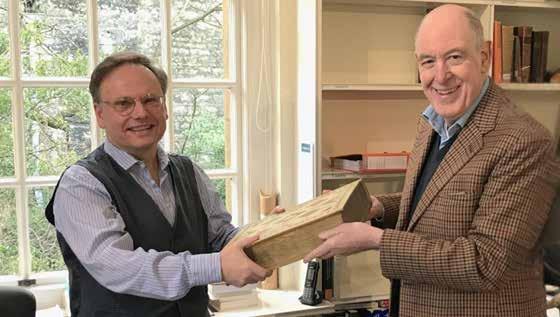
The New College Warden (right) returning MS 384 to the Librarian (left) to 29,191. This equates to a figure representing 41.7% of our entire modern book collection actively used in one year, suggesting the appropriateness of the selection of titles we hold, and the return on investment of our entire book stock. Notable this year was the growing popularity of the library’s auxiliary borrowing services for equipment (chargers, adapters, DVD drives) that we loan out to students. Service improvements in 2025 have included an upgrade of our Bibliotheca borrowing machines, carried out smoothly and without disruption to users. A timely upgrade saved college money, and proved an exemplar to some other college libraries, while others had to resort to buying new kit entirely. Our digitisation programme to provide high-quality digital surrogates of our internationally significant manuscripts collection made good progress, with digitising of ten more medieval manuscripts now completed. The environmental monitoring and control system for our strongrooms in the Bell Tower is approaching 30 years old; such an age is often considered to be approaching the outer limit of a plant’s effectiveness. So, it is timely for college to give thought to implementing improvements or commissioning a replacement. Nevertheless, it was heartening to read in an external environment and systems review of the college that in relation to the care of our special collections of extraordinary high monetary value ‘there is exemplary curatorial practice’, with staff ‘generally being attentive and careful’.
Exhibitions we staged this year included library treasures for members of the Grolier Club, New York (a major American bibliophiles society), one for a delegation of Chilean visitors, one to accompany the Open Day for Parents and Guardians of our Freshers, another for the
Freshers themselves, one for pupils of New College School (focusing on the theme of space and the solar system), and another for the college’s Hong Kong summer school students. We also put on four large-scale exhibitions. Two were the most recent in our series (instituted 2018) of subject-themed library exhibitions, namely The Art of the Book, showcasing illumination, illustration, fine bindings, and private press books, and Babel: Arabic, Hebrew, and Languages of the Levant, featuring manuscripts dating from the 10th century onwards, incunables, and other early printed items. The latter we hosted to accompany the college’s Margoliouth Symposium of 13 November, organised by Margoliouth Fellow in Arabic, Dr Christian C. Sahner, celebrating the return of Arabic as an undergraduate subject to the college. We also put on two separate exhibitions as contributions to the city’s annual Oxford Festival of the Arts. Magnificent Oxford, our most popular of the year attracting 238 visitors in one day, featured beautiful illuminated parchment, maps, and printed engravings, and for Magnificent Monarchs we displayed medieval documents, seals, and signatures. To mark the Feast of St Thomas on 13 December, we showed archival items relating to food and drink—our menu cards, wine accounts, and the like. For a visit of the Association of Jewish Refugees in February, we exhibited some of our Jewish manuscripts and early printed books, and at the unveiling by the Belgian Ambassador of a plaque in New College Lane in April, we displayed newsprint, photographic, and documentary materials relating to the college’s reception of First World War Belgian refugees. In addition, we have staged various small ‘pop-up’ displays for show-and-tell and similar activities, and displays in the library entrance hall. The archivist’s walkand-talk tours and the library’s student welfare initiatives and special collections handling workshops continued to be popular throughout the year.
The library published as planned two issues of New College Notes (www.new.ox.ac.uk/new-college-notes), the college’s scholarly e-journal, re-established as a twice-yearly publication back in 2018, focusing on our history and rich collections, and building into an ever more useful body of commentary and research on our institution. Twenty articles appeared on, among other things, some of the most important early printed book and archival documents acquired for the collections over the course of the year. These include volumes by 16th-century Catholic theologians and college alumni Nicholas Sander and Thomas Stapleton, a Winchester College parchment Long Roll of 1733, 17th- to 19th-century imprints by New College poets with notable manuscript insertions and associations, archival documents and printed materials by college novelists including A. P. Herbert and John Fowles, letters by other famous alumni, Warden William Spooner and Duff Cooper, and a range of 20th-century publications
relating to New College, generally rare and hard to come by. Alongside the spectacular manuscript of St Jerome, another standout acquisition was a fine post-incunable with a very telling provenance, the most notable early printed book the library has purchased for some time: Sigebert of Gembloux’s Chronicon in its 1513 Paris imprint, bearing the ownership signature and annotations of alumnus and theologian Thomas Stapleton (1535–1598).
The most recent in our popular video series Curators’ Choice, excellently delivered by our outgoing curatorial assistant Dr Jessica HendyHodgkinson, promoted our late 13th-century copy of the Rota Nova, or ‘New Wheel’, one of only four manuscript copies of the work which survive, and the most complete text of the work and earliest surviving copy as well. A beautifully presented, well-researched online New College Through Time exhibition (www.new.ox.ac.uk/new-college-through-time/welcome), expertly co-ordinated by Deputy Librarian Will Shire, has also been launched. Drawing upon the outstanding collections in our library and archives to give an insight into college life over the centuries, and including interactive elements, it ranges from our medieval origins to the opening last year of the Gradel Quadrangles.
We put on two physical exhibitions in the upper reading room cases of the library. ‘Cyril Hare (1900–1958)—Murder Mystery Novelist’ was about a leading figure of the golden age of detective fiction, and one of New College’s most popular authors, Alfred Alexander Gordon Clark, who gained a first here in Modern History. Alongside his high-powered legal and civil service career he wrote fiction under a penname constructed from the addresses of his Battersea home, Cyril Mansions, and his barristers’ chambers, Hare Court. We were delighted to welcome to the library his daughter, the Pugin scholar Alexandra, Lady Wedgwood, and several of his grandchildren. The other exhibition was on one of the most influential American artists of the 20th century: ‘Edward Gorey (1925–2000)—An Anniversary Exhibition’ has proved to be our most visited exhibition in cases to date. This fine collection of Gorey materials was donated to the library by the New College alumnus and financier David Mann (1935–2012). The subject of another library donation, this time one from the 18th century, a copy of our famous ‘Vinegar Bible’ (1716–17) given by our alumnus Bishop Robert Lowth as a memorial to his son, provided the image of the Adoration of the Magi for the college’s beautiful Christmas card this year.
I am pleased to record my gratitude to outgoing Warden, Miles Young, who has championed the library and supported our endeavours in so many ways during my librarianship. In July our 16th-century ‘Admissions of Wardens’ archival box, normally kept in the Muniment Tower, had a starring role in chapel, serving as a ballot box for the election
of the new Warden. The library is looking forward very much to working with Sir Robin Niblett KCMG from September 2026.
Christopher Skelton-Foord – Librarian
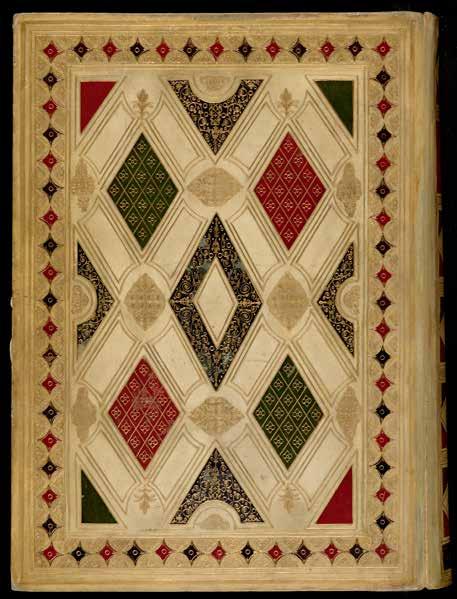
19th-century gilt vellum binding of MS 384—featuring inlaid mosaic-patterned triangles and lozenges in green and red calfskin, with a gilt-tooled border of similarly panelled alternating green and red
Donors Giving Collection Items and Financial Gifts to the Library 2025
• All Souls College Library
• Mr Philip Arathoon
• Ms Sue Ashcroft-Jones
• Mr Andrew J G Banks
• Professor J Batchelor
• Ms Charlie Batori
• Bodleian Library Publishing
• Ms Jo Bowd
• Professor S Bright
• Ms Geraldine Brooks, AO
• Sir Stephen J L Bubb
• Ms Iris Julia Bührle
• Mr Allan E Bulley III
• Professor M Burden
• Ms Georgia de Chamberet
• Christ Church Library
• Corpus Christi College Library
• Dr Jennifer Crane
• Mr John Davies
• Mr Martin Davis
• Ms Rachael DavisFeatherstone
• Dr P Deb
• Mr Pablo Dubois
• Mr Gerry Eaton
• Dr Richard Foster
• Ms Suzanne Foster
• Mrs Sarah Fowles
• Mr Patrick Gale
• The Revd Dr Lee Gatiss
• Mr Bertrand Gibert
• Mr R Gullifer
• Professor V Halbach
• Professor Jonathon L Hart
• Dr C Jeremy Harvey
• Dr Barbara B Haws
• Professor M Husain
• Professor Ludmilla J Jordanova
• Mr R J Lane Fox
• Mr Peter J Larkham
• Professor K Leeder
• Professor J L Lightfoot
• Mr Scott D Little
• The Revd Dr E Longfellow
• Professor Bernhard F Malkmus
• Dr Remus Gabriel Manoilă
• Mansfield College Library
• Ms Julia Marshall
• Professor Mairi McLaughlin
• Professor Darrin M McMahon
• Professor A R Meadows
• Dr M Melfi
• Mr J W Morgan
• Dr A Morrison
• Mr Yusuf Naeem
• Mr Rajendra Prasad Narla
• Dr John A Oddy
• Mr Michael I Ohajuru
• Professor R C T Parker
• Professor D Parrott
• Parson Woodforde Society
• Dr David C Pearson
• Philosophy and Theology Faculties Library
• Professor Olivier Poncet
• Mr Terence M Russell
• Professor A J Ryan
• Dr C C Sahner
• Mr Tony D Sanderson
• Dr C J Skelton-Foord
• Mr Arthur Snell
• Somerville College Library
• St Antony’s College Library
• St Hilda’s College Library
• Mrs Carla Stanley
• Dr Frederick Stocken
• Mr Ian Sturton
• Taylor Institution Library
• Dr R A M Temple
• Professor C J Tyerman
• Alexandra Mary, Lady Wedgwood
• Professor M Williams
• Wolfson College Library
• Warden Miles Young
New Chamber Opera
2025 was the two hundredth year after the death of Antonio Salieri (1750-1825), an Italian opera composer best known today for his supposed role in the death of Mozart. But this belies the fact that he was a skilled composer who profoundly influenced the style and construction of late 18th century opera.
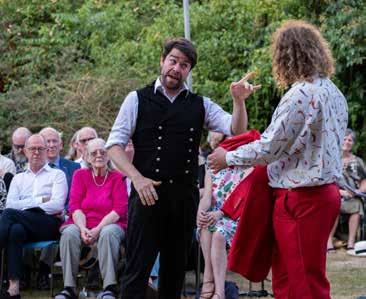
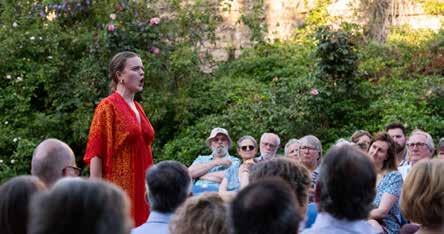
First up was Falstaff, a work which we staged for the Summer Opera in 2011. The story of the opera is that of Shakespeare’s Merry Wives of Windsor, and the central character is the foolish Falstaff who courts both Mss Ford and Slender – and loses … twice! A central moment includes a scene in which Falstaff, hiding from Mr Ford in a laundry basket, is carried out of the house right under his nose. Using an English translation by courtesy of Gilly French & Bampton Classical Opera, the student performers made this a rambunctious event indeed. The cast members -– Ben Gilchrist (Falstaff), Seb Evans (Mr Ford), Becky Devlin (Ms Ford), Theodore Nisbett (Mr Slender), Anneka Vetter (Ms Slender), Emily Aldridge (Betty), and Akbar Ali (Bardolfo) - were directed by Theo Jolly, a second-year music undergraduate making his directorial debut.
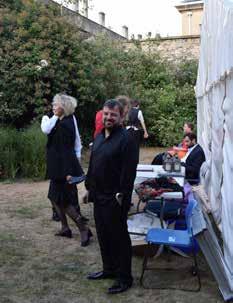
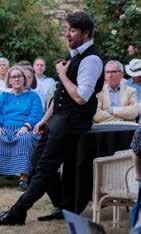
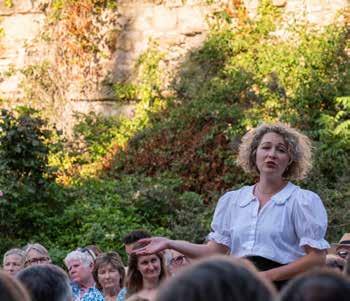
In the summer, we chose his School for Jealousy (La scuola de’ gelosi), first performed in Venice on 27 December 1778. Our castArshak Kuzikyan (Blasio), Stephanie Franklin (Carlotta), Ben Gilchrist (Lumaca), Kate Semmens (Ernestina), Áine Smith (Countess Bandiera), William Anderson (Count Bandiera) and Lawrence Thackeray (Tenente) – included five singers making their first appearance in a Summer Opera. The opera – a tale of jealous derring-do - tells the story of the merchant Blasio’s jealous love for his wife Ernestina; of the Count of Baniera’s love for Ernestina; of the Countess’s supposed love for the Lieutenant; and of Blasio’s love for Lisetta (whom we never see in the opera). The opera has been understood as a set of dangerous (but unrealised) entanglements, in which the aristocracy, the bourgeoisie, and the servant class come close to crossing established social norms.
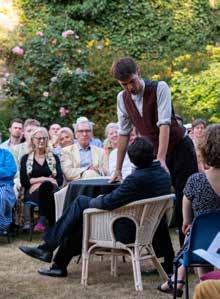
Michaelmas saw a cast of four - Ischia Gooda (Sally), George Hill (Thomas), Sebastian Evans (Squire) and Matilda Bates (Dorcas) – tackle a staging of Thomas Arne’s Thomas and Sally, or The Sailor’s Return (1760) under the baton of another of the company’s repetiteur scholars, Rudyard Cook. Sally, a country lass, is in distress because Thomas, the man of her heart, is about to depart on a long sea voyage. After the lovers have tearfully said goodbye, the Squire appears; he has long been infatuated
Steven Devine, Musical Director
with Sally and now sees the opportunity to press his case. Thomas, of course, arrives, just in time to rescue Sally from the Squire’s attentions.
The Studio’s Recital Series has continued with Ivo Sawbridge; the repertory offered has continued to expand, and there have been some excellent performances of both well-known and lesser-known composers. We have also seen some welcome development of joint and group recitals, allowing larger numbers to take part.
Michael Burden – Dean, Professor in Opera Studies
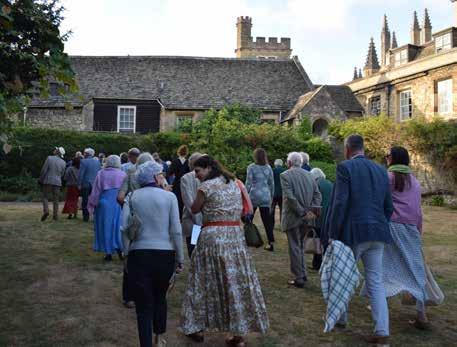
La scuola de’ gelosi – Old Members walking to the Cloisters for supper
@Nathalie Wilks
New College School
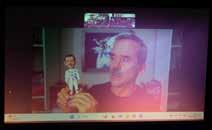
It is in the nature of these reports that it is tempting to ‘out-do’ the previous year’s. I cannot offer you any new buildings this time, nor the foundation of any new orchestras, nor indeed record numbers (we would have to start stacking the kids). But I can offer you an astronaut. Our annual SHTEAM Festival – STEM with Humanities and Arts, thank you very much – seems to grow each year with more workshops, more speakers, more extracurricular treats. When we decided on last year’s theme of space, one of my colleagues knocked on my door to say ‘I think I can get you an astronaut’. I probably should not repeat the words I replied in disbelief, especially when said astronaut was apparently going to be Colonel Chris Hadfield. Anyway, I had to eat those words a few months later when I received a text reporting ‘CH has said yes’. Towards the end of Hilary, then, the whole school came together for half an hour or so to hear directly from Chris Hadfield, former Commander of the International Space Station, including an extended Q and A session. It was a surreal, once-in-a-career experience, and I hope the NCS boys realised that it is not ‘normal’ to get such access to an astronaut on a Monday lunchtime.
It is great to have these highlights, of course, but most of school life consists of day-to-day lessons, assemblies, chapel services, fixtures, plays, concerts, and the like. So NCS continues humming along in its happy and productive way. As I write this, we are getting ready for our Carol Services (the school has two), and before long the choristers, taking into account the college services, will probably have racked up about six or seven in total. That is a lot of harking the herald angels singing, and a lot of eye-watering (in a good way) descants, ‘evermore and evermo-ooore’. Other chapel highlights for the whole school include our Spring Service at the end of Hilary and Year’s End service in Trinity. More moist eyes in the latter, as we bring together music and appropriately emotional readings about moving on, to mark our Year 8s’ departure to their senior schools.
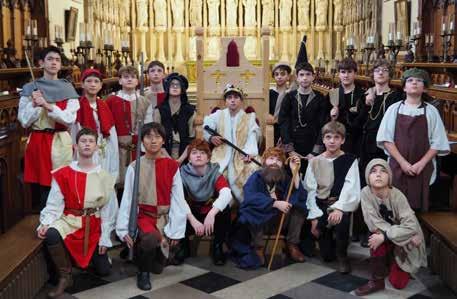
We have also just put to bed this year’s senior production of Richard II, which was described by many in the audience as our ‘best ever’. We have been performing abridged Shakespeare in the chapel for about fifteen consecutive Novembers now, and each year we get to enjoy pupils’ joy and confidence in language that, society likes to tell them, is too difficult or too removed from their day-to-day lives. It is not our style to be told what to do by outside forces (especially those which are unambitious) so we just ignore those voices, set high standards, and enjoy young people managing to reach them. Speaking of which, last summer saw our triennial Sheldonian concert, the highlight of which was a performance of Richard Rodney Bennett’s All the King’s Men. Every single pupil was involved, alongside the Oxford Children’s Chamber Orchestra (also based at NCS), and I think I am allowed to say it must have been pretty much unrivalled among prep-age pupils. As I told the audience at the end of the concert, we are constantly told in the media about how young people cannot focus and, therefore, cannot achieve decent progress or results. I pointed out that, well, yes they can if they are taught how to, encouraged to, and given something worthwhile on which to focus.
The choristers have been hard-working, as ever, and they are in the middle of one of their busiest touring years for a while. Summer 2025 saw them venturing to Sweden, taking in Stockholm and Uppsala, and culminating in an idyllic sunset over the country’s second biggest lake. Michaelmas Half Term saw them travel to Versailles for a concert in the
Chapel Royal there and we have just signed off the schedule for their upcoming tour to China, taking in Beijing and Shanghai over the New Year. They will be back in the USA next Easter. And, as ever, they have been admirably singing day-to-day services during university term in the chapel. Demand for choristerships at New College remains high; I think it is fairly easy to see why.
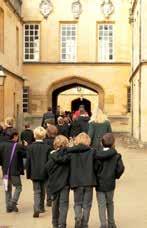
Other trips, for all the boys, have seen classes heading off to the Peak District, Isle of Wight, Wittenham Clumps, France, and Sicily. But to come back to my original theme: these highlights necessarily sit among the day-today academic and pastoral life of the school, which has its routines, but never seems to get boring. Perhaps it is because the year seems to speed by so quickly (such is the nature of routine), or because we see similar experiences through new eyes each year: new pupils, new families. It can be easy to become complacent in such a setting, or to take it for granted. But I am frequently jolted out of any sense of complacency or Novemberinduced ennui by the talented colleagues with whom I work, and the sparky and charming pupils we get to teach.
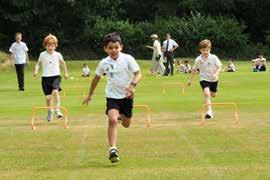
Each year I opine that the pressures to narrow education become ever greater. Each year I am not lying – the bureaucratisation speeds up, the race to measure things turns a new, faster, corner. But if we want to produce young people who are curious, intelligent, eager, and fundamentally happy, then we have to keep feeding their curiosity and to keep reminding the wider world that a pupil is not just another statistic. And we have to keep their curricular and extracurricular diet rich, varied and stimulating. New College School has been doing that for six and a half centuries, as an integral part of the college; it is both humbling and a privilege to be at the helm of an institution that cares deeply about the core values of getting education ‘right’, eschewing the fads and the bean-counters we might have to encounter along the way.
Matt Jenkinson - Headmaster
New College Society
The New College Society (NCS) has completed another rewarding year, providing our former and current students a special opportunity to develop and nurture connections amongst Old Members and between Old Members and the student body. For a modest one-off charge when students arrive at college, the NCS enables our alumni/ae to retain and build their links with the wider New College community for many years. As the NCS President aptly describes it, our purpose is not to promote fund-raising but rather ‘friend-raising’.
The NCS fosters these links in three principal ways:
• A series of professional networks to connect those who have similar career backgrounds.
• A Careers Forum each spring that allows current students to connect with and question Old Members who have worked in fields that they may wish to pursue.
• Various social events each year to appeal to the different generations and interests of Old Members.
The Professional networks not only allow alumni/ae to meet others working in similar areas, but we also encourage students to attend events if they want to network and learn about specific professions. Network highlights are as follows:
• The City & Professional Network is now run by John Rowland (1998).
The latest event was a panel discussion about the state of the IPO Market in London, hosted by Linklaters and concluding with drinks. This followed a talk on the Takeover Panel in late 2024 held at the offices of Evercore, a leading investment bank.
• The Entrepreneurs Network, under the joint leadership of Alex Hearn (2001) and Chi Okafor (2020), held two stimulating events in 2025, designed to give aspiring business builders the opportunity to meet and hear about early-stage companies that have been founded by, or have a close link to, a New College Old Member. Known as the ‘Narwhals’, a reference to the sea unicorn, the network has since its foundation had presentations from a wide range of companies, a number of which have become highly successful businesses in their own right.
• Following a successful launch in 2024, the Health Sector Network, headed by Tarun Gupta (1998), held its second event ‘Bench-to-Bedside: A Discussion on Translational Medicine’ at the London offices of the Wellcome Collection. It took the form of a panel discussion with a distinguished group of Old Members exploring how scientific discovery becomes practical medicine — and what drives innovation at the interface between academia, industry, and investment. This discussion and the drinks afterwards received very positive feedback and bode well for the future of this network.
• The Media Network, in the capable hands of Charlotte Mikkelborg (1995), hosted a fascinating talk by Dame Melanie Dawes DCB (1984) who, as a very senior career Civil Servant, was appointed Chief Executive of Ofcom in 2020. Her address focused on the Online Safety Act 2024 and other efforts to protect the public from online abuse.
• Under the new leadership of Patrick Moody (1985), a senior Foreign & Commonwealth official and former Ambassador to the United Arab Emirates, the Government and Public Service Network held a panel event at Portcullis House in February. The 29 students who attended engaged in animated discussion with the panellists who represented a broad range of subjects and disciplines across the Civil Service.
• The Third Sector network held its inaugural event in March. This consisted of a talk by Professor Peter Frumkin, Academic Director of the Gradel Institute of Charity at New College and Visiting Fellow, followed by drinks. This network is run by Caroline Kay (1979), a former JCR President with a lengthy career in the sector. The event was held at the law firm Farrer & Co. in Lincoln’s Inn Fields and was attended by 25 Old Members who engaged in vigorous discussion afterwards. The network is particularly keen to encourage not only those working in charities and the Third Sector to join but also trustees and others connected with NotFor-Profit activities.
Anybody wishing to join a network or interested in participating in an event should contact the Development Office at oldmembers@new. ox.ac.uk; they will then be placed on a mailing list to receive notifications of relevant events.
The Society prides itself on its commitment to supporting students in an increasingly challenging workplace environment whilst also strengthening bonds with the student body through the annual Careers Forum. This provides an opportunity for Old Members to offer advice and guidance to current and recent undergraduates and post-graduates on career choices in a virtual format – a series of 25-minute one-on-one Teams meetings over a Saturday afternoon. The 2025 event facilitated meetings
between 51 Old Members and 96 students, whose feedback to the organisers was overwhelmingly positive.
A key part of the Society’s mission is to develop and nurture friendships across the alumni community. Hence, as in previous years, the Society arranged a wide range of social events in 2025. The following were particularly notable:
• A Diversity Dinner in February attracted 49 students and several Old Members to hear guest speaker Alev Scott (2005), author of Ottoman Odyssey: Travels Through A Lost Empire.
• The Women’s Annual Lecture was given in March by Anna Bateson (1990), CEO of The Guardian Media Group who entitled her outstanding talk ‘Truth, Trustworthiness, and Authenticity in 2025’, encouraging the audience to reflect on how and why they could come to trust her narrative and authority.
• The London Lecture was given in May by Polly Waite, Tutorial Fellow and Honorary Consultant Clinical Psychologist (Oxford Health NHS Foundation Trust), on ‘The Rise in Childhood Anxiety Problems – What Can We Do?’.
• The Young Old Members, for those up to 15 years from matriculation, held a most convivial drinks party at the Brydges Place Club in London, enjoyed by 60 Young Old Members.
• The annual LGBTQIA+ Reception and Lunch was well supported in October by a group of 30 who gathered to hear the guest speaker, Denis Flannery, Associate Professor of English and American Literature at the University of Leeds.
The Committee wishes to record its gratitude to Katie Brewer (1987) and Bandwidth Conversations for continuing to record podcasts with distinguished Old Members. During 2025 she completed recordings with Toby Spence (1988), the famous British tenor; Steve Hilton (1987), political commentator, former director of strategy for UK Prime Minister David Cameron and adviser to US President Donald Trump; and Dr Rachel Clarke (1990), a British writer and physician. We now have a total of 18 podcasts available on the New College website at www.new.ox.ac.uk/podcasts, featuring conversations with a diverse range of our alumni/ae, described by Katie as the ‘Rock Stars of Life’.
In closing, the Committee would like to thank most heartily the Warden for his loyal support for all activities of the Society, and all the members of the Development Office, without whom the Society would not be able to operate successfully: their skill and dedication are greatly appreciated.
Charles Irving-Swift (1973) - Honorary Secretary
The Gradel Institute of Charity
2025 was a year of strong momentum at the Gradel Institute of Charity. Over the year we saw encouraging progress across our research, engagement, and programmes.
Our research and staff teams have expanded significantly. We were excited to welcome Isabel de Bruin Cardoso as the founding director of the GIC’s newly established Nonprofit Ethics Lab. The Ethics Lab, which launched in the summer, has spent recent months advancing its literature review and experimental agenda. It will be convening in the coming months to create a roadmap for the study of non-profit ethics and how it can most usefully be applied in practice. Plans are also progressing for a Pro-Social AI Lab, which will focus on ethical decision-making in AI systems. On the staff side, Sophie Carp was appointed as PR and Marketing Coordinator to strengthen the promotion of our programmes and extend the reach of our research activities.
Continuing our mission to attract the most promising non-profit researchers to further our knowledge base of the third sector, we welcomed six new visiting researchers from around the world to the research team. The team is made up of academics who work – and regularly collaborate - on innovative projects including charity management, government contracting with non-profits, and the consequences of commercialisation within the third sector internationally. In addition we hosted a group of graduate students as part of our summer doctoral fellows programme, which allows participants to bring to Oxford a draft research paper that is honed and improved through intensive discussion and commentary.
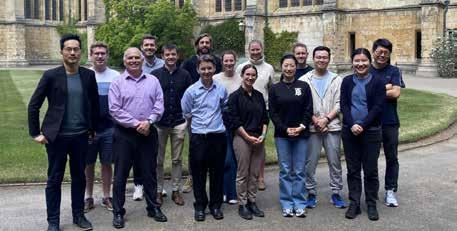
Visiting Researchers 2025, with Peter Frumkin (second from left)
This year projects ranged from international grant-making and charitable food aid provision to philanthropic motivation and women’s economic empowerment in Ghana. Peter Frumkin and Matthew Bennett serve as programme co-directors.
In the spring we held our first symposium, A Third Way of Doing Growth, attended by charity CEOs, economists, academics, impact investors, and current and former civil servants, to examine how the third sector’s economic contribution can be better recognised and significantly expanded. We published a report based on the findings, in partnership with Pro Bono Economics, laying out how a well-functioning third sector is crucial for a growing and inclusive economy, recommending several ways of unlocking the sector’s potential, fostering stronger growth, greater wellbeing, and a more connected society.
The report was widely disseminated and prompted responses from senior policymakers, most notably the Chancellor of the Exchequer. Building on this work, we continued dialogue with parliamentarians on the role of the sector in promoting inclusive growth, including a meeting with the shadow DCMS committee, and attendance at the Charity Commission’s Annual Public Meeting.
In response to evidence from our A Third Way of Doing Growth symposium report, highlighting a sharp decline in volunteering since 2019, we convened a sector roundtable in the autumn. Hosted by GIC Research Fellows David Clifford and Philine van Overbeeke, the roundtable saw nonprofit researchers, policy makers and frontline practitioners come together to examine whether falling volunteering levels are consistent with what organisations are observing within their own communities, and what might be driving recent shifts in volunteer behaviour. A report on the findings has just been published, and concludes that our understanding of volunteering – how we define it, measure it, and support it – has failed to keep pace with societal changes. If volunteering is to remain a vital force in social and economic life, it must be understood not as unpaid labour to be extracted, but as a relational, resource-dependent practice that needs care, investment and imagination.
Anyone wishing to read our reports in full can download them from the GIC website. Printed copies are also available on request.
In June a newly initiated Charity Advisory Board came together for the first time, followed by a second meeting in November. The Board is chaired by Matt Hyde from Lloyds Bank Foundation and comprises a broad range of senior charity leaders. It serves as a sounding board for the GIC’s activity, as well as a forum for discussing the key challenges faced by the third sector. This exchange between research and practical relevance is at the heart of our work and directly informs our strategy.
As a result, engagement with sector leaders across the UK has continued to be a core priority. Directors Peter Frumkin and Sir Stephen Bubb presented GIC research at the National Conference of Scottish Funders and Grant Makers in Stirling, and at meetings with the Leeds Community Foundation and Yorkshire Impact Hub, with further regional meetings planned in Sheffield, Cornwall, South Wales, and the Northeast in 2026. Locally, we strengthened links in Oxfordshire through engagements with the Lord-Lieutenant, the Oxfordshire Community Foundation, and initiatives such as The Room (a philanthropic circle based in Oxford), and the ‘Making a Difference’ programme in partnership with Oxford University’s Careers Service.
In September we were excited to launch our executive programme on Leading Social Impact, in collaboration with Clore Social Leadership. A cohort of 37 international charity leaders started the course with a four-day residential in Oxford, which achieved strong feedback. Participants are now engaged in a series of online workshops, and the programme will close with a final in-person day of workshops and celebration in London in spring 2026.
In November the first Penn Oxford Social Impact Lab (POSIL) took place at Spicer Manor, Yorkshire, bringing together 20 global changemakers - social entrepreneurs, creative intrapreneurs, community builders, and innovators - who are leading transformative initiatives around the world. The six-day residential programme aimed to equip participants with the tools, training, and support they need to take their ventures to the next level. Tailored workshops focused on advanced strategies in business models, design thinking, and leadership, while fostering collaboration and peer learning. By living and learning together in an inspiring setting, participants not only strengthened their initiatives but also forged lasting connections with a diverse, global network of peers.
After many months of development and testing, we launched a free online social innovation course in December, allowing those who work in a non-profit or social enterprise, or are launching their own initiative, to turn vision into action using practical frameworks and tools. Project-managed by GIC Research Fellow Philine van Overbeeke, the course is presented by our Academic Director, Professor Peter Frumkin, and draws on his and Suzi Sosa’s graphic novel on social innovation. It introduces 20 actionable tools across four key phases of the innovation journey: define, design, pilot, and scale. The course is run on the Coursera platform, and can be accessed by learners worldwide.
As you can see, it has been a busy and rewarding twelve months in which solid foundations were laid for the year ahead.
Sir Stephen Bubb
Development Office
It was with some trepidation that I set out to arrange a talk for our Chemistry students on the Friday afternoon of 8th week of last Michaelmas Term. Visions of students frantically packing, or, in the case of the more efficient of them, stuffed into the King’s Arms, made me wonder if our guest speaker would be addressing an array of empty chairs in the Lodgings Tower Room. But I had clearly underestimated the draw of the Nobel Prize winning Old Member, Professor Sir Stanley Whittingham (1960), and the enthusiasm of the invited audience. There was not a spare seat as Sir Stan reflected on his time at New College, early industrial career and work as an academic, ultimately leading to his joint discovery of the lithium-ion battery.
As a college, we are blessed by the engagement and wisdom of so many extraordinary Old Members who are prepared to share their experiences and offer words of advice to the current student cohort. For our annual Women’s Lecture Anna Bateson (1990), Chief Executive of Guardian Media Group, urged her audience to challenge their perceptions of ‘Truth, Trustworthiness, and Authenticity in 2025’. At a broader level, over a hundred current students took advantage of the annual careers’ forum and the opportunity it gave to explore possible career paths with a group of over fifty Old Members willing to offer advice. Many others have given up their time to speak at student society events, or to mentor students one-on-one as they think about their future calling.
I am equally grateful to Old Members who are involved with the college and Old Member community as volunteers on our various committees. Whether as members of the New College Society Committee, whose report can be found elsewhere in the Record, as Board Members of the American Friends of New College, or serving on College SubCommittees, they offer service and guidance which is greatly welcomed and appreciated.
Along with advice, our students are fortunate to benefit from the generous financial support provided by so many Old Members. Our 2025 Donor Impact Report, available on the college website, highlighted just a few examples of how the £100,000 invested in our Student Support Fund, Sporting & Cultural Awards and Welfare Fund makes a transformative difference to people’s lives at the college. In addition, a generous donation has established a new Fund, AccessAble, to support students with disabilities, whatever form those may take. Most of these funds come from
the multitude of regular monthly or annual contributions we receive, thus ensuring that no student should be prevented from making the most of the opportunities open to them during their time with us.
Following the completion of the Gradel Quadrangles last year, the college has been somewhat quieter on the construction front. However, initial work started on two discrete projects, a redevelopment of the Chapel Yard and Song Room and a feasibility study for extending the library. Chapel Yard is a rather hidden space, lying between the northern walls of Chapel and the City Wall. The Song Room, vestries and storage spaces are currently separated by an open-air yard, through which choir and clergy must pass to reach the Antechapel. Two substantial donations will allow us to cover in the yard and substantially reconfigure the layout, creating much-needed space and far superior facilities for choristers, clerks and clergy. The Library project started to look at how essential additional reader spaces, a new exhibition space and better book and manuscript storage could be provided taking into account the challenging setting of the existing building. A scheme is being developed to extend the library to the north and merge into one of the Holywell Street cottages, to create a library fit for the long-term future. We hope that Old Members will wish to support these endeavours and more will follow in 2026.
Just under £6 million was donated to the college during the year, including gifts for graduate scholarships, a new set of travel grants, undergraduate bursaries, the Gradel Institute of Charity, and many other areas of college life. We are grateful to all who contributed and to those who so generously left money to the college in their Wills.
I remain fortunate in having a dedicated and supportive development team around me, so my thanks to Jonathan Rubery, Nathalie Wilks, Harriet Dawson and George Balkwill for all their efforts over the year.
Mark Curtis - Fellow & Director of Development
© Florie Harmer
SCR News
We report with great sadness the death of Honorary Fellow, Professor Ioan M James, MA, DPhil, FRS on 21 February 2025, and of Emeritus Fellows, Mr Christopher John Allsopp, CBE on 5 March 2025, Dr Derek Hope on 30 October 2025 and Dr Diana (Dee) Ferguson Sichel on 20 November 2025.
Andrew J Wathen MA (PhD R’dg), Rosalind A M Temple, MA, MPhil (PhD Wales) Andrei Zorin, MA (PhD Moscow) have been elected Emeritus Fellows.
42 new members have joined the SCR. They include:
Panayiotis Christoforou is a Non-stipendiary Junior Research Fellow at New College, and a Marshall Research Fellow at the Pharos Foundation, Oxford. He teaches and researches Greek and Roman History. His first book, Imagining the Roman Emperor was published by Cambridge University Press in 2023. Pan is currently writing a history of popular political activity in the early Roman Empire, and has published on topics including sensory experiences of imperial funerals and the office of tribune of the plebs.
Yang Han is a Stipendiary Lecturer in Politics at New College. She completed her DPhil in International Relations as a Swire Scholar at St Antony’s College, University of Oxford (2025). Her doctoral monograph explores China’s understandings of international hierarchies in the 21st century, through its discourses on Africa. Beyond academia, Yang also serves as the gender mainstreaming advisor to the United Nations Industrial Development Organisation, taking the lead on gender mainstreaming efforts in a range of global and regional projects. Previously she studied at Peking University and London School of Economics and Political Science, with a multi-disciplinary background in Politics and Psychology.
Olivier Higgins joined New College in October 2025 as a Postdoctoral Researcher in Enlightenment Studies at the Voltaire Foundation. After completing his BA in his native Ottawa, he moved to Cambridge for his MPhil and PhD in History, which won the Melvin Richter prize for best dissertation in the History of Political Thought. Before taking up his postdoc in Oxford, he held a teaching position at Cambridge. Olivier is a historian of ideas working primarily on German political philosophy of
the eighteenth and nineteenth centuries. His current research examines how the tradition of idealism from Immanuel Kant to G. W. F. Hegel reimagined the idea of progress at the end of Enlightenment, through the turmoil of revolution and the rise of new empires.
Sarah Jones holds a PhD from the Royal College of Art and joined New College in September 2025 as Senior Teaching Fellow in Fine Art. She is an artist working across sculpture, performance, sound, and text, with broad research interests. Since moving away from photography as a primary mode of documentation, her practice has explored what stands in for the artwork when the artwork is absent. Recent work includes a self-forecast horoscope of anagrams, ‘Surviving Elements of a Future Ruin’, and projects involving song, dance, and celestial bodies. She is also a Senior Tutor at the Ruskin School of Art.
Dominic Joyce came to Oxford as an undergraduate in 1986 and never left. He did his BA and DPhil at Merton, was a Junior Research Fellow at Christ Church, and a University Lecturer and Tutorial Fellow at Lincoln, before moving to a professorial position in the Mathematical Institute in 2006. In 2025 he became the Savilian Professor of Geometry, and migrated to New College. Dominic works in several areas of Geometry: Differential Geometry, Algebraic Geometry, and Symplectic Geometry. He gives undergraduate and graduate lectures in the Mathematical Institute, and has supervised many DPhil students and postdoctoral researchers.
Enes Samil Kiraz is a DPhil student in History. He was a Non-Stipendiary Lecturer in History during Michaelmas 2025. He is broadly interested in the Caucasus under the Russian and Ottoman empires at the turn of the twentieth century. His thesis explores the Russo-Ottoman borderlands from the Congress of Berlin (1878) to the Russian Revolution (1905). He holds a BA in History from Boğaziçi University and an MA in International Relations from Bilkent University.
Boaz Laan joined New College in September 2025 as a Stipendiary Lecturer in Philosophy. He completed his BA in Mathematics and Philosophy at King’s College, London, and his MSc in Mathematics and DPhil in Philosophy at Pembroke College. He works in the philosophy of logic and mathematics, and in particular researches questions surrounding truth, modality, and mathematics. Currently, he is focussing on whether mathematics has an implicitly generative nature, and if so how to make this explicit.
Shoni Lavie-Driver joined New College in October 2025 as the Esmée Fairbairn Junior Research Fellow in Classics. He completed his BA, MPhil and PhD in Classics at Jesus College, University of Cambridge. His research examines language in Roman Judaea-Palaestina (c. 63 BC – 640 AD), on the basis of texts in ancient Aramaic, Greek, Hebrew and Latin written by Christians, Jews, pagans and Samaritans. His PhD focused on the capital city of the province, Caesarea Maritima, and he is now intending to research Roman Jerusalem.
Letizia Lo Faro joined New College in September 2025 as a Stipendiary Lecturer in Biochemistry. Letizia is a Senior Postdoctoral Scientist in the Oxford Transplant Research Group, Nuffield Department of Surgical Sciences and holds a PhD in Biomedical Sciences from the University of Exeter. Letizia’s research focuses on investigating molecular mechanisms of tissue injury and repair and particularly energy, metabolism and mitochondrial function in abdominal organ donation and transplantation. Her work also includes investigating the molecular mechanisms of action of different ex-situ organ preservation (perfusion) strategies.
Mariona Miyata-Sturm joined New College in September 2025 as a Stipendiary Lecturer in Philosophy. Mariona works on aesthetic aspects of reasoning and decision-making, particularly in the geosciences, drawing together philosophy of science, epistemology, aesthetics, cognitive science, and history of science. She completed her DPhil in Philosophy at New College in August 2025, a MA in theoretical philosophy at Stockholm University, and a MA and BA in philosophy at the University of Oslo. She is also a postdoctoral researcher, funded by the Analysis studentship and hosted by the Faculty of Philosophy, researching the role of beauty in the development and acceptance of plate tectonics.
Jonathan Nathan joined New College as a Non-Stipendiary Junior Research Fellow in 2025. A native of New York City, he studied as an undergraduate at the University of Chicago, where he graduated in 2015 with a degree in History. He went on to study at the University of Cambridge, where he received an MPhil in 2016 and a PhD in 2022, both times in History. He was then a Senior Research Fellow at the Max Planck Institute for Public and International Law in Heidelberg, before moving to Oxford in 2023 to be a Research Fellow at the Pharos Foundation, an appointment he still holds.
Richard Nies is a Leverhulme-Peierls Fellow at New College and the Rudolf Peierls Centre for Theoretical Physics. Before coming to Oxford, he completed his PhD and Master of Arts at Princeton University and earned
his Bachelor of Science at the University of Tübingen. His research focuses on theoretical plasma physics relevant to nuclear fusion. He is especially interested in the turbulence that arises at the extreme temperatures required for fusion reactions. Understanding and ultimately controlling this turbulence is key to improving energy confinement in fusion reactors. To address these challenges, he studies how flows and reactor geometry influence turbulent behaviour, using a mixture of analytical theory and numerical simulations.
Fiona Sargison joined New College as a Non-Stipendiary Todd Bird Junior Research Fellow in Biochemistry. She completed her undergraduate studies in Biochemistry at the University of Edinburgh, followed by a PhD at the Roslin Institute within the College of Medicine and Veterinary Medicine. Her doctoral research focused on how the bacterium Staphylococcus aureus evades immune defences in both humans and birds. In 2022 Fiona moved to the University of Oxford to take up a postdoctoral position in the laboratory of Professor Stephan Uphoff, where she has been applying advanced singlemolecule microscopy techniques to investigate how bacteria regulate essential processes while residing within immune cells. Her research is driven by a deep interest in how bacteria cause disease, with the broader aim of identifying new strategies to combat bacterial infections and understanding how simple infections can progress into complex diseases.
Bridget Smart joined New College as a Non-Stipendiary Lecturer in Mathematics in 2025; she teaches probability and statistics. She is a Rhodes Scholar and a DPhil candidate in Mathematics at St John’s College. Her research combines network science, information theory, and statistics to develop robust mathematical models for complex real-world systems, with a focus on dynamics with long-range memory on networks. She is currently developing models that separate structural and temporal effects, enabling more reliable inference in low-data settings relevant to economics, online behaviour, and biological systems.
Kate Tallon joined New College as Linguistics Organising Tutor. She is a Departmental Lecturer in Phonetics and Phonology and a Stipendiary Lecturer in Linguistics at St Catherine’s and St John’s Colleges. She completed her BA in French and Linguistics at New College, followed by an MA in Linguistics at UCL and a PhD at Trinity College, Dublin. Her research focuses on sociophonetics, particularly the influence of social factors on speech patterns. Her doctoral research examined speech variation among Irish–English bilinguals and language contact between Irish and English in the west of Ireland.
SCR Appointments, Honours and Publications…
(The following refers to 2025 unless otherwise stated)
Stephen Anderson, ‘William Grocyn, (Coll. 1463 - 65): Father of the New Learning’, in Wykeham Journal 2024 (Winchester College, 2025)
Michael Burden, Domenico Paradies, Fetonte, Recent Researches in Music of the Baroque Era, 242 (Wisconsin; A-R Editions, 2025); Zanaida, Introduction, in J. C. Bach: Operas and Dramatic Works, ed. Paul Corneilson, V (Los Altos: The Packard Humanities Institute, 2025); Orione, ossia Diana vendicata, Introduction, in J. C. Bach: Operas and Dramatic Works, ed. Paul Corneilson, IV (Los Altos: The Packard Humanities Institute, 2025); Productions: Pepusch: Venus and Adonis; Salieri: Falstaff; Salieri: The School of Jealousy; Arne: Thomas and Sally
Jaimee Comstock-Skipp, ‘Design transfers and working methods (design process, kitabkhana)’ in the section ‘Knowledge exchanges in technologies and materials’ in Architecture, monuments and urbanism, Part I: Architectural influences along the Silk Roads. UNESCO Thematic Collection of Cultural Exchanges along the Silk Roads series published by UNESCO (Paris, 2025): 237254
Paul Deb, Happiness and Tears, After Cavell: New Readings in Hollywood’s Comedy of Remarriage and Melodrama of the Unknown Woman (State University of New York Press, 2025); ‘Awakening our Sleeping Selves: The Appalling Business of Amit Chaudhuri’ in Literature, Voice, Meaning: Philosophical Aspects, ed. G. L. Hagberg (Palgrave Macmillan, 2025); Guest editor, Conversations: The Journal of Cavellian Studies, 12 (Dec 2025): Special issue on Moral Perfectionism
Marcus du Sautoy, Blueprints: how mathematics shapes creativity, Fourth Estate, (2025); Around the World in 80 Games, Fourth Estate, 2023, the Spanish edition was published by Acantilado (November 2025); Judge on the International Booker Prize for 2026; writer and director of a new play The Axiom of Choice which was performed at the Oxford Playhouse (November 2024), toured in India for five weeks performing at 15 different venues, and was also performed in Portugal at a Theatre and Science festival in Coimbra
Adrian Fernandes, won the UKLA Student Research Prize (2025)
Ashleigh Griffin, Griffin, A S and A Leeks, ‘Exploiting social traits for clinical applications in bacteria and viruses’ in Nature Antimicrobials and Resistance, (2025); West, S A, S R X Dall, J P Cunningham, S H Alonzo and A S Griffin,
‘Behavioural ecology in the twenty-first century’ in Nature Ecology and Evolution 9, 2193–2205, (2025); Habich, A., Y Liu, M Ghoul, S B Andersen, H Krogh Johansen, S Molin, A S Griffin*, D Unterweger* ‘Occurrence of type VI secretion system effector genes in longitudinal isolates of P. aeruginosa from people with cystic fibrosis’ in Microbial Genomics 11, 001555. [*joint senior author], (2025); West, S A, A Dewar, R Iritani, L Belcher and A S Griffin, ‘The evolutionary and ecological consequences of cooperation’ in The American Naturalist 739292 doi:10.1086/739292, (2025); Caro, S M, A C Velasco, T. van Mastrigt, K. van Oers, A S Griffin, S A West, C A Hinde, ‘Parental control: ecology drives plasticity in parental response to offspring signals’ in Behavioural Ecology, 36 (4), araf058, (2025); European Research Council: Consolidator Grant Panel ChairEnvironmental Biology, Ecology and Evolution (LS8)
Volker Halbach, The Definition of Logical Validity, OUP, (2025)
Nigel Hitchin, awarded the 2025 De Morgan Medal of the London Mathematical Society
Masud Husain, Our Brains, Our Selves: What a Neurologist’s Patients Taught Him About the Brain (Canongate); Shibata K, Chen C, Tai X Y, Manohar S G, Husain M (2025) Impact of APOE, Klotho, and sex on cognitive decline with aging in Proceeding National Academy Sciences 22:e2416042122; Husain M (2025) ‘On the responsibilities of intellectuals and the rise of bullshit jobs in universities’ in Brain 148:687-688; Royal Society Trivedi Best Science Book Prize winner 2025; Financial Times Best Science Books 2025
Enes Samil Kiraz, ‘Becoming Russia or Becoming Japan? The Russo-Japanese War and the Ottoman Public Opinion’ in Turkish Historical Review 16:1, (2025): 25-53.
Frances Kirwan, L’Oréal-UNESCO For Women in Science Awards Laureate for Europe, (2023); London Mathematical Society Polya Prize, (2023)
Boaz Laan, ‘How Should We Understand the Modal Potentialist’s Modality?’, published in Philosophia Mathematica, Volume 33, Issue 2, (June 2025)
Karen Leeder, winner of Griffin Poetry Prize 2025 with Durs Grünbein, Psyche Running: Selected Poems 2005-2022; Visiting International Professorship in Beijing; ‘Construction of German Literary Studies, under the Framework of International Innovative Cooperation: German Modernism and New Approaches’, (2025); Ulrike Almut Sandig’s Shining Sheep, trans. by Karen Leeder, longlisted for Oxford Weidenfeld Translation prize 2025; invited by Goethe Institute to tour Indian Festivals as part of Germany’s year as Guest Nation at the Kolkata Book fair (JanFeb 2025); developed and will convene a new Masters course, ‘Creative Translation’ (2025) which launched for first admission in 2026; ‘Wolfgang Martin
Roth, Dawit or Every Century has its own Monstrous Face’, trans. by Karen Leeder, Film Premiere, European Parliament in Brussels, (May 2025)
Luke Lewis, current work includes a commission from the Carice Singers for King’s Place, London, where his work features a few times throughout 2026; Unfeathering, based on a poem by alumna Alice Oswald, was premiered by violinist Peter Sheppard Skaerved; premiere by Sinfonia Cymru of Quiet Thoughts, after Gwen John as well as a second performance of his large-scale work The Echoes Return Slow for ensemble and electronics, to which was added a new spoken epilogue written by alumnus Owen Sheers; paper at the Royal Musical Association’s annual conference, late 2024
Erica Longfellow, E Longfellow and P McCullough, eds, The Oxford Edition of the Sermons of John Donne, vol. vii: Sermons Preached at Marriages, Christenings, and Churchings (Oxford: OUP, 2025)
Thomas Metcalf, ‘Graphic Notation’ in DEUMM Online, Répertoire International de Littérature Musicale (RILM), forthcoming, early 2026; release of ‘Pixelating the River’ on Something So Transporting Bright (Kreutzer Quartet), critically acclaimed in Gramophone and other international outlets; commission for Mad Song Ensemble, Photogenia, performed in London and Oxford, positively reviewed in The Observer by Fiona Maddocks; publication of ‘Dreamsong’ for beginner recorder in Recorder Mix, by the Associated Board of the Royal Schools of Music (ABRSM); premiere of Mantra for violin, performed by Peter SheppardSkærved (New College Chapel); premiere of Involuntary for piano, performed by David Palmer (Milton Court Concert Hall, London), with repeat performances at St Hilda’s College and New College
Mariona Miyata-Sturm, Miyata-Sturm, M E ‘Aesthetic Considerations in the Development of Plate Tectonics’ in Studies in History and Philosophy of Science, 108, (December 2024), pp.1-9
James Munro, MPLS Teaching Award to honour innovation and significant contributions to student learning, (2025)
George Ratcliffe, L J Sweetlove, R G Ratcliffe and A R Fernie (2025) ‘Noncanonical plant metabolism’ in Nature Plants 11, 696-708.
Shivaji Sondhi, elected a Fellow of the Royal Society, (2025)
Christopher Tyerman, ‘The History and Pre-History of Hertford College, Oxford. Survival and Renewals’ (OUP 2025)
Stephan Uphoff, appointed Professor of Physical Microbiology in the Department of Biochemistry via the 2025 Recognition of Distinction exercise
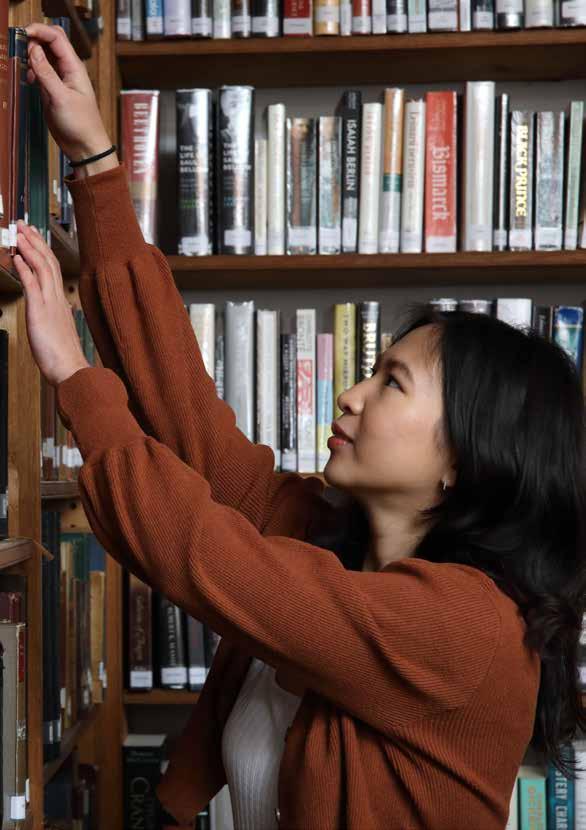
© Sarah Turton
MCR Report
Despite the winter gloom throughout Hilary Term, the MCR returned from the Christmas Vacation for another packed social calendar. This ranged from weekly salsa classes, bar nights and BOPs to, of course, a range of formal exchanges with a number of other Oxford colleges. Later in the term, we welcomed King’s College, Cambridge for the usual exchange, before a return visit to Cambridge in mid-March. The select few making the journey came back with new friends, and many an interesting story to tell!
Spring had sprung as we returned for Trinity, and we were met with glorious sunshine for the start of term in April. With bi-weekly MCR Guest Nights being a staple in the social calendar for many, we were pleased to start a new tradition of hosting a prosecco drinks reception before these dinners. Such receptions proved to be popular, with many of us gathering on Holywell Lawn to soak up the spring sunshine before dinner. Of course, the post-prandial tradition of MCR second desserts also continued, as strongly attended as ever.
In Michaelmas, we were pleased to welcome a cohort of more than 120 new graduate members to our common room. They brought with them lots of energy, fresh insights and, as always, a whole array of different backgrounds and areas of interest. Freshers Fortnight was a great success with events running daily for all our new members – highlights included the annual Où est le Poulet social, for which the chickens were unfortunately found in record time, a sports tournament and BBQ at Weston, and our very own inter-collegiate BOP on Matriculation Day. With lots of members sadly leaving us in Trinity Term 2025, a General Meeting was held early in Michaelmas Term to elect a fantastic new cohort of committee members. I must, however, give particular recognition to our three social secs who ran an exceptional term card with a record number of formal exchanges.
Following lots of work with college and the JCR President surrounding college spaces, we were very happy to receive the news late into Michaelmas that a motion had passed in the JCR that would allow the North Undercroft to become an MCR-only space. This felt like a huge step forward and should bring us a lot closer to the heart of college, something that has been a key objective for some time. With use of some of the MCR reserves, a significant amount of time was spent ordering fresh furniture for the space, in order to rebrand the room into something that embraced a ‘collegiate’ feel – notably with photographs of MCR cohorts from the last two decades and, our new prize possession, a donated portrait of the Founder.
All in all, a very successful year for our community and, as I come toward the end of what has felt like a very short tenure as President, I feel extremely optimistic for what the future holds for our fantastic common room!
Christopher Gregory - MCR President
JCR Report
From the opening weeks of Hilary Term to the final celebrations of Michaelmas Term, the New College Junior Common Room has enjoyed a lively and varied social calendar, shaped by a strong sense of community and our hardworking JCR committee team. Across all three terms in 2025, students came together to celebrate, support one another, and make the most of college life, creating a year that captured the very best of New College.
Setting a vibrant tone for the year, Hilary Term opened with a range of events that reflected the sheer diversity of our common room. The annual Diversity Dinner once again provided an important space for conversation and reflection, made all the more significant by guest speaker Alev Scott, who joined us to share her unique insights. Social highlights followed soon after, including a Valentine’s Day formal swap with Mansfield College, which proved to be a particularly popular occasion and a welcome opportunity to expand our social circles beyond the college grounds. The term also saw our annual darts and pool tournament, with newcomers and seasoned players alike vying for the top spots. Hilary concluded with the Sports Formal, celebrating the commitment and achievements of New College athletes and reinforcing the strong presence of sport within our community.
As the days lengthened, Trinity Term took on a brighter character, defined by warmth, creativity and a packed social calendar. The term began on a creative note with one of our regular pottery brunches, providing a relaxed space for students to decompress before the focus shifted to our high-energy Sports Day with Cambridge. Hosted at Weston, the day was a standout success for collaboration and friendly rivalry. As exam season approached, the JCR’s focus turned to welfare, most notably with the Cookie Fairy deliveries, which provided a much-needed morale boost and energy to sustain long nights in the library. This communal support carried over to the river for Summer Eights, where New College pride was on full display as students turned out in force to cheer on our crews. As the term drew to a close, the Garden Party offered a traditional summer farewell, providing a relaxed opportunity for the community to gather in the sunshine one last time before the break.
The social season reached its peak with the annual Boat Party aboard the Dixie Queen, a spectacular night on the Thames that remains a defining highlight of the New College experience. This momentum carried into Week 9, which saw the highly anticipated return of the New College Commemoration Ball. For one night, the college was completely transformed into a breathtaking venue for a White Tie celebration, welcoming students and alumni alike for an unforgettable evening of music and festivities. The scale and elegance of the Ball served as a spectacular centrepiece for the year, showcasing the college’s ability to host world-class events within our historic grounds.
As the summer drew to a close, Michaelmas Term began with the arrival of a new cohort of students, who were welcomed into the college through a busy and vibrant Freshers’ Week. From local pubs to relaxed film nights in the JCR, the week was a whirlwind of discovery, while returning students reconnected with familiar spaces and traditions. The social calendar continued at pace with a Halloween party at the Varsity Club, which set an energetic tone for the term ahead. From family brunches to pumpkin carving, these welfare-led initiatives ensured there was something for everyone, providing our community with quieter moments during a busy academic term. The year concluded with our annual Christmas Dinner, bringing the common room together to celebrate the festive season and reflect on the term’s successes.
Taken as a whole, the past year reflects a common room that continues to value inclusivity, community and collaboration. Through formals, welfare initiatives, sporting events, and long-standing social traditions, New College students have sustained a vibrant and supportive community. We remain grateful for the continued support of alumni and friends of the college and look ahead to the coming year with excitement for what lies ahead!
Harry Aldridge - JCR President
Arts
In 2025 we have really seen the arts thrive at New College, something which has been made possible through all the enthusiastic support we have received from college, from the JCR and from individual student contributions, particularly those of our new Freshers.
Once more we have continued the New College tradition of Pottery Brunches across the year, culminating in the immensely popular, and free, Freshers’ Week event. Over eighty students came to College Hall to eat brunch and paint bowls, mugs or plates with their friends.
We were absolutely thrilled with the attendance and saw some amazing pieces, with popular designs including flowers, fruit, animals and icons of Oxford, such as the Rad Cam. Sadly the JCR Art Store, from which students can borrow pieces to furnish their rooms, was unable to open during Michaelmas. Eviction from its former home and damp delays in its new one have kept the Hockneys off our walls for now. We have, however, been assured a new, purpose-built Art Store, which is set to open in 2026, and will allow this vital service to resume.
The highlight of the year was the exceptional Arts Week in Trinity, which showcased the full breadth of artistic life at here New College. We were treated to a diverse programme of music, cinema, theatre and fine art, expertly curated by Arts Reps Freddie Sugarman and Joseph Rogers. On the one hand we had a gallery opening, Mozart in the Garden, and a particularly excellent talk from alumnus, Neil MacGregor, former Director of the British Museum, on ‘New Histories from Old Things: the potential to reframe objects to tell new and different stories’. On the other we had Techno in the Chapel, Jazz in the bar and Technoshamanic Healing, a free club night for New College students featuring DJs from the JCR. Students really got to enjoy all that Art can offer. This hectic week was rounded off by a party in the Warden’s Garden to mark the launch of the annual New College Arts Anthology. We had to wait till the following week to see the Arts Week Play, an excellent production of Emma arranged by Eleanor Grant. This featured great performances all round, and quite exceptionally so from Lucia Mayorga as Emma.
Over the summer Freddie and Joseph handed over the baton to me and my fellow Arts Rep, Anna Reeves. We thank our predecessors for all their excellent work, as well as their help and advice. We began the academic year with a Freshers’ Week packed with Arts events. This started strongly with the karaoke night at the Mad Hatter pub, giving all the First Years an opportunity to show some bravery and make some new friends by belting out ABBA together. It was a great success, and the First Years were even able to convince our JCR President, Harry Aldridge, to come up to the stage for a performance of Sweet Caroline by Neil Diamond. Following on this success, we organised a guided painting night in the Junior Common Room, led by one of our Fine Art students, Ruby, who kindly volunteered her expertise to a grateful group of First Years. We provided watercolours with paper and brushes to a packed room of students who were able to produce some brilliant pieces, while getting a break from the hectic pace of Freshers’ Week. Finally, students of all years got to enjoy a free Pottery Brunch. This was all enabled by funds from the JCR Freshers’ Week budget, which continues to provide First Years with an incredible introduction to life at Oxford.
We then moved on to the rather intimidating challenge of holding the College Oxmas Pantomime. This is traditionally a brief, comic affair held after Christmas Dinner in Hall. This year we chose to base the plot loosely on A Christmas Carol and enlist the services of the fabulous Ben Naylor as director. The cast consisted of Iris Ferrars, starring as an especially irascible Scrooge, Kit Rush as Cratchit, Ben Hartigan as a rave-obsessed Tiny Tim, and many others. Musical accompaniment was provided by an incredibly skilled ensemble of recorders and Ben Dakshy on saxophone. Thank you to everyone who came to watch, we hope it was good fun and were delighted to continue the tradition. We are looking forward to carrying on as Arts Reps in 2026. As well as finally getting the Art Store back, we hope to add open-mic nights to the cycle of termly events, hold a couple of Arts related talks and open up the JCR gallery to visitors more often. We would also like to continue last year’s successful initiative of forming a committee of JCR students to plan Arts Week. This will maximise participation and let everyone who wants to make a mark on New College’s creative scene.
Zach Burgess and Anna Reeves
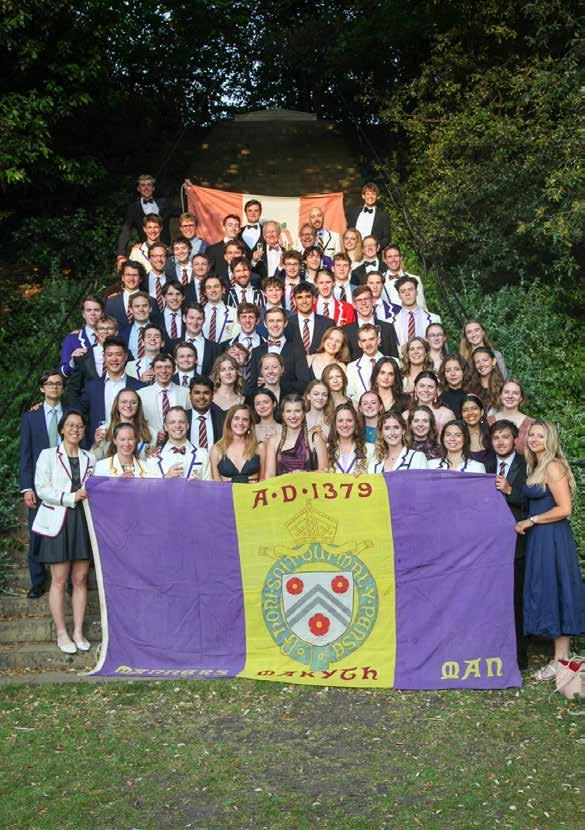
New College Boat Club, June 2025
Sports
Sport at New College enjoyed another outstanding year in 2025, marked by strong performances across a wide range of disciplines, growing participation, and continued success on the Cuppers stage. The college once again demonstrated the depth of its sporting culture, combining competitive excellence with a thriving, inclusive community across teams.
One of the standout stories of the year was the continued success of New College Rugby. The men’s side secured victory in the Rugby Cuppers final for the third time in four years, cementing their status as one of the most formidable college rugby teams in Oxford. This achievement reflects not only talent on the pitch but also the strength of collaboration and consistency within the squad. The final was also really well attended by members of New College, with the support providing a massive boost for the team – and even a saxophone could be heard leading the singing in the crowd.
Football also enjoyed a strong season, with both men’s and women’s sides making their mark. The men’s team reached the Cuppers semi-finals, showcasing resilience and tactical discipline throughout the competition. The women’s football team in collaboration with Jesus College similarly impressed, continuing to build momentum and contributing to a strong year for women’s sport at New College more broadly.
Cricket had a successful campaign across both Cuppers and League competitions, while croquet made a memorable appearance with a Cuppers run that raised more than a few eyebrows. Alongside this, Sports Day at home proved to be a highlight of the calendar, combining competitive spirit with a strong sense of college pride.
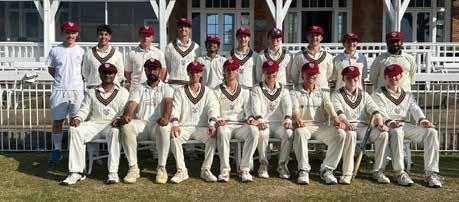
The Cricket Team
The New College Boat Club had a particularly notable year. With record levels of participation, the club fielded seven boats in Summer Eights, making it the largest college boat club in Oxford. The men’s first boat climbed from 10th to 7th on the river, narrowly missing blades and recording a standout bump on rivals Magdalen. The women’s first boat also enjoyed success, finishing a strong campaign by securing a place in Division I. Summer Eights week was, as ever, buoyed by strong support, sunshine, and the inevitable flow of Pimm’s.
Netball continued to go from strength to strength. New College Netball Club (NCNC) enjoyed a successful and exciting year across both women’s and mixed competitions. The women’s team progressed to the quarter-finals of Women’s Cuppers and recorded further wins in the Cuppers league during Michaelmas term. A particular highlight was the revival of the mixed netball team, which reached the Cuppers quarter-finals and won their first-ever friendly match with a dramatic last-minute goal. On Sports Day the mixed team delivered a commanding 19–7 victory over King’s College, Cambridge, showcasing both skill and cohesion. An influx of talented Freshers has further strengthened the club, and with a growing squad and strong results, NCNC looks well placed for future success.
Participation also continued to rise in Hockey, Bouldering and Squash, reflecting broader engagement with sport across the college. These societies have benefited from increased interest and accessibility, contributing to a more diverse and active sporting community. There was even the formation of a new Poker Society, further underlining the breadth of extracurricular life at New College.
Overall, 2025 has been a year defined by competitive success, expanding participation, and sustained excellence, with New College proudly holding two major Cuppers titles and remaining a strong presence across the sporting landscape. With enthusiasm high and foundations firmly in place, the college looks well positioned for another successful year ahead.
Matilda Bowden – JCR Sports Representative
Basketball
2025 marked a period of competitive prowess and strong development for New College Basketball Club, with successes across all three terms.
During Hilary Term the club competed in the college basketball league. Although the number of fixtures played was limited, the team secured key wins and performed well when called upon. These results were sufficient to qualify for Cuppers held in Trinity Term.
Trinity Term proved to be the competitive highlight of the year.
The team successfully progressed through the play-in stage to qualify for Cuppers, consistently showing composure in high-pressure moments. In the first round of Cuppers New College recorded an impressive win against a strong Kellogg College side. This victory was a standout result, watched by many spectators, and showcased the team’s clutch-factor.
The subsequent round saw us face Wolfson College, widely regarded as one of the favourites for the competition. The match was closely contested throughout, thanks to many of our players operating with precision and passion for the club. Unfortunately we ended up narrowly losing to Wolfson, the result being ultimately decided by only a few baskets. Despite the loss, our performance was highly competitive and demonstrated that the team could match the strongest sides in the tournament. Importantly, both Kellogg and Wolfson are exclusively postgraduate colleges, and many players have a lot more experience than our much younger, undergraduate-dominated team; and yet we managed to rise to their level, and in some ways, even above it.
Michaelmas Term 2025 laid an excellent foundation for the current academic year. Fresher recruitment was particularly strong, with over 30 active members joining the club chat and engaging regularly with training and fixtures. This influx of new players has significantly strengthened squad depth and greatly boosted team spirit. Alongside recruitment, for the first time in the club’s history, proposals were submitted to the Junior Common Room for the improvement of our equipment. These proposals were successful and resulted in the purchase of new basketballs, new nets for Weston Court, and a new pump. This funding marked a significant moment for the club’s future, materially improving the quality and consistency of training sessions, and demonstrating JCR support.
Overall, 2025 was a successful and encouraging year for New College Basketball Club, setting up a promising 25-26 season, where we will seek to go further in Cuppers.
We have never been bigger or better, and I have every confidence that the club will continue to grow in a positive direction.
Kaveer Ali – Basketball Captain Boat Club
2025 saw New College exert undisputed dominance over the world of Oxford rowing. Following Torpids and Summer Eights, our men and our women are solidly Division 1 on both leaderboards (for the first time since 2016), while a concomitant upgrade to our fleet stands us in good stead for further triumphs. We continue to grow and cement our position as the largest boat club in Oxford. Following an obscene 10 entries into Summer Eights last
Women’s 1st VIII, Summer Eights, May 2025
Trinity, and with a bumper crop of new athletes, we expect our legion of athletes to continue to build on their successes.
Hilary 2025 was met with resolve. A crew of men and a crew of women blasted down the Hammersmith Head course, with our men taking home the victory in the Open Development 8+ category. Our rivals ought to have taken note of this ill omen, though they were not to be spared a grim fate. When Torpids rolled around (regrettably restricted to our first boats, owing to adverse weather), M1 and W1 smashed their way unfettered through their hapless foes (+1 and +4, respectively). Credit is due to the five other crews we entered into Torpids; despite not being allowed to race, their efforts in training were exemplary, and meant the club was a well-oiled machine by the start of Trinity.
Men’s 1st VIII, Henley Royal Regatta Qualifying Races, June 2025
Having had such a hoot at Hammy Head, we went back to the Tideway for seconds: the Head of the River Race (both WeHoRR for the women and HoRR for the men). The women were the second fastest Oxford college of five (after Hertford), and the men were the fourth fastest out of eleven (after Wolfson, Pembroke, Hertford). The Tideway was also the site of our Easter training camp; we set up shop at Furnivall Rowing Club and studied the art of the (rowing) blade. Around this time, we were thrilled to cheer on Ben Atkinson, Rahul Marchand (both lightweights) and Tom Rigney (Isis) at the Boat Race. We should all be proud of their efforts.
Trinity rolled around and we entered an unprecedented ten crews into Summer Eights – seven of which qualified. The Bacchanalia of Pimm’s,
meat and racing which followed scarcely needs describing; you have all been there. What matters is that New College was not to be trifled with. Special mentions are due to W1 (back in Div 1) and M1 (for missing blades by the skin of their teeth). Overall stats: +3, -1, -3, -2 for the men; +1, +2, -5 for the women.
Why stop there? It was only fitting that we send our boldest troops to the greatest battlefield of all – Henley. A crew of men and a crew of women left it all on the royal racecourse, a stage of global proportions. Although neither qualified for their respective tournaments, it sure tasted like victory, with rowers sipping glasses of bubbly on Old Member Andy Trotman’s balcony – gazing over the course, and viewing the end of the season in style.
Michaelmas Term picked up where Trinity left off. With our new batch of novices, we scrambled to train about 13 crews’ worth of rowers. The river gods were kind enough to permit extensive training on the water, as well as adventures in the field; we entered a men’s crew and a women’s crew each to Upper Thames Autumn Head and Teddington Head. With Torpids on the horizon, our skills are sharp!
Thanks are due to everyone who donated to our annual ergathon in memory of Issie Mogg, and in support of the British Heart Foundation. Similarly, thanks are due to the generous Old Members who have contributed to the club’s endowment fund, helping keep rowing accessible for all members of the college.
Overall, NCBC remains a mainstay of college life, and continues its legacy of forging memories and bonds of trust. Its athletes, dauntless and inexorable, face the year ahead with gumption and perennial resolve. Stay tuned: we may be on the cusp of a new golden age.
Eamon Coates – Boat Club President
Cricket
After a successful previous season, and bolstered by a large intake of Freshers, the club set its sights on silverware. A strong showing away at St Hugh’s got the season off to a winning start, with Marcus McDevitt taking 2-3. Similarly, our Cuppers’ campaign also started smoothly; a convincing win over Regent’s Park with a mid-innings break for the Theology students (seemingly their whole team) to watch the announcement of the new Pope. A win over Univ in the league, including an outstanding century from Captain Max Woodford, as well as walkovers going our way, we charged confidently into a top of the league clash against Jesus College. With crucial knocks from George Campbell-Ferguson (27) and man of the match, Sourav Mondal (33), we had a good first innings platform. Yet with Jesus requiring six runs off the
last over, it seemed all was lost. Up stepped Skipper Max, taking two wickets off the first two balls, with the help of some excellent catching from Sourav and Mr Reliable, Faris Jafar, and closing out a 1-run win.
A second fixture against Univ, this time in the Cuppers competition, was quickly dealt with, by means of a Rory Hayes 4fer and a George C-F (48*). A friendly vs Worcester College continued the winning streak with a man of the match performance from club legend and stalwart Robert Brettle. Escape from the league group stage secured, we unfortunately received our first defeat of the season on a sticky wicket at Merton Mansfield, narrowly missing out after Matthew Rolfe got clean bowled missing a reverse sweep to a straight one. It happens…
On we went to the quarter-finals of both competitions. First came the league, dispatching Magdalen with surprising ease thanks to a George C-F (50), followed by a tough Cuppers draw vs Pembroke. Initially struggling to get going in our batting innings, a strong cameo from resident Blue Saqlain Choudhary (56* (22)) gave us a defendable total of 161. A good fielding effort, bar a few dropped catches, and some tight bowling pushed us onto the semi-finals.
The final stages of the league were the focus – a semi-final against reigning champions Balliol. The NCCC batters set a strong target of 173, however Balliol started better, scoring 105-0 after 10 overs. All seemed lost. In came William Marriage, bowling an over of WW1WWW, taking five in the over and six in the match. With the match flipped on its head, we strode to victory.
The final came a few days later, vs season rivals Jesus College. After some dubious early calls by the opposition umpire, the batters rallied, including a wonderful half-century from Skipper Max, and strong contributions from George C-F and Sourav. After setting 153, and a strong opening spell from James Bridson, the game was hanging in the balance. Marcus with three wickets in an over, and finishing figures of 3-30, with the help of some excellent Sourav death-bowling, secured the League win for NCCC.
With the first piece of silverware under our belt, and properly celebrated, we set our sights on the Cup. A semi-final two days later vs KebleQueens was swiftly dealt with by the help of a Saqlain 76 and a Max 4-21. Fresh off the win, we entered University Parks the next afternoon to face favourites Magdalen. Magdalen’s many Blues put early pressure on our batters. Some sticky middle overs were countered by an excellent ending flurry by Sourav and Zach Roberts (30*(22) and 23*(15)) and we set a score of 155, which felt around par. We needed the early wickets of their Blues players, and Marriage (2-15), Saq (3-24), and James (2-12) provided, leaving Magdalen 5 down at the end of their fifth over. The match was comfortable from then, as NCCC secured the first ever double in college cricket history, losing only one match, and with almost thirty-five players contributing throughout the course of the season.
I would like to give thanks to Captain Max, and Vice-Captain Marcus for the effort they put in throughout the year in organising fixtures and fostering a phenomenal atmosphere within the squad. Also, thanks to our leavers, Robert Brettle and Sourav Mondal, for the passion and performances they gave throughout their years here. With few players leaving, and a good inflow of Freshers, I look forward to the season ahead and hope to bring more success to the club.
Rory Hayes – Cricket Captain
Football 1st XI
The squad returned to Oxford in January 2025, excited to see where our Cuppers run might take us. We narrowly scraped a 1-0 win against St John’s, defending a scrappy early goal right through to the final whistle, or rather the shout of ‘Whistle!’, as the referee did not have his! Goalkeeper Chris Gregory was outstanding throughout and rightly earned Man of the Match. This win set up a semi-final clash against St Catherine’s College, a side New College had lost to the previous season in the Plate final.
Mixed returns in the league left us nonetheless optimistic of achieving a cup upset. Despite an even start to the game, Catz broke the deadlock just before half-time, scoring two quickfire goals from corners. Forced to chase the game as the match went on, New College created a fair share of the chances but failed to convert. The opposition strikers were far more clinical, and the match ended, just as in the Plate final, in a 5-0 defeat. It proved to be little consolation that Catz went on to win the final, as we all felt that we had missed out.
In the league we limped to relegation, finishing bottom of Division 1. There were, however, clear glimmers of hope. A stellar late-season performance saw us put five goals past the eventual league winners Brasenose, winning comfortably in the pouring rain, thanks to a hat-trick from Kai Nieuwenburg. This performance proved we did have the quality, but perhaps lacked the squad depth required to perform consistently well over a long season.
Trinity Term brought further encouragement with a strong run in Futsal Cuppers, going out on penalties in the semi-finals, once again to Catz. Reaching two cup semi-finals in a single season, however, demonstrated genuine promise for the years ahead. That summer we also said goodbye to several club legends, including former Vice-Captain Ted Torpey-Aldag and former 2nd XI Captain and 1st XI striker Joshua Adeyemi.
The start of the 2025/26 season offered a fresh start following relegation to Division 2. The club immediately showed signs of growth and renewed engagement, with forty first-years showing up at Weston for trials.
Relegation combined with a strengthened team led to a hugely different league experience from normal, with New College winning six from six in Michaelmas with a goal difference of +42. This was inflated by a record-breaking 21-1 win vs Magdalen, including five goals from our very own US soccer star Andrew Imai, and four from Fresher Luke Skates. There were also tighter contests, with the team coming back twice from behind to beat Oriel 5-3 in the opening game of the season, which included a stunning long-range strike from Fresher midfield sensation, Henry Adams.
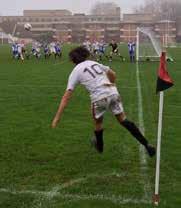
With the league firmly under control, attention turned fully to Cuppers. A bye in the first round set up a doubleheader against The Queen’s College, whom we were also due to face in the league shortly after. Cuppers came first, and a New College team, fuelled by team pasta night, dispatched Queen’s in a statement 9-0 win, including a superb solo goal early on from veteran winger Matthew Rolfe, skipping past countless challenges and slotting home from outside the box. Vice-Captain Alec Mitchell-Thompson added a late hattrick, with further attacking contributions from Will Alexander, Andrew Imai, and Kai Nieuwenburg. Queen’s fared marginally better against us in the league, losing 9-1.
In the next round, we faced Keble - historically one of the most successful colleges in Cuppers. The team quietly hoped that Keble’s overconfidence and reliance on two ‘loan’ Blues players from postgraduate colleges would count in our favour. New College emerged with a deserved 4-2 victory. Alec Mitchell-Thompson opened the scoring, followed by another incredible moment from Matthew Rolfe, whose dangerous cross looped over the Keble keeper and nestled in the top corner. Ex-Captain and Fourth Year Nieuwenburg showed his experience by
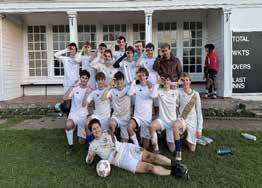
The 1st XI team after the win against Keble
Matthew Rolfe whipping in a corner in the Cuppers victory against Queen’s
coolly converting two chances to put the game beyond reach. Although New Coll led throughout, Keble dominated for periods of the second half, urged on by their sizeable home crowd. Composed defending and perfectly timed sliding tackles from our centre-back pairing Harvey Thompson and Harry Young proved vital. Andrew Imai battled tirelessly up front to retain possession, while former captain Hari Bassi played a starring role at right-back.
The team now prepares for another Cuppers semi-final against St Catherine’s in January. Hopefully, this time, the outcome will be different.
George Campbell-Ferguson - Football First XI Captain
Football 2nd XI
A strong first half of the season left us through to the round-of-16 of the Cuppers competition, and well placed in the league competition. The round-of-16 fixture vs the St Peter’s Bravehearts: a cold away-fixture, where the referee had arrived and refused to officiate; we knew we were in for a thriller! After a tetchy first half, NCAFC were 3-2 up. A rousing team talk from captain Matt Rolfe was extremely effective, as we scored thirteen goals in the second half, to secure a 16-3 victory. Such moments as goalkeeper Marcus McDevitt scoring, and hat tricks from Manuel Alex and Jiho Ro stood out in what became a club favourite match.
Next round came Teddy Hall in a tough home-draw. 2-2 with a short amount of time left felt promising; however disaster struck, with Teddy knocking another one in. Every shot narrowly missed the target as we retook control of the game. Yet it was too little, too late, and we were knocked out of the cup in the quarter-finals.
Our match vs Merton Mansfield at the end of the term was a nice opportunity for a good final showing, especially for those in their final game. Ed Beswick, having recently recovered from an ACL injury from the year prior, took to the field for his first, and last, game of the year, hammering home an excellent shot to score in his final match. We breezed home with a final win of the season.
I would like to take this opportunity to thank 24/25 Captain, Matt Rolfe, for all that he did. From the way he led from the front to his… ‘enthusiastic’ team talks, his passion for the team could never be questioned and was an inspiration for all those in the side. Further thanks go to our leavers for all they gave throughout the year(s): former captain Joshua Adeyemi, Theo Peters, Ed Beswick, Jack Morrin and Manuel Alex.
With a new year came a fresh wave of enthusiasm and excitement for the club, especially with the largest intake of Freshers we have received in a long time. Our targets were set high – to challenge for both the cup and the league. The season got off to a shaky start, with a 3-0 loss to title favourites Worcester. It felt an unfairly tough scoreline, given that we played well, but left us with hope for the rest of the season if we could continue to grow as a team.
A 13-2 away-win at Magdalen felt much better and gave us the confidence we deserved moving forward into the next week’s fixture vs St Anne’s. 3-1 up at half time and further contributions from Freshers Rohil Bhattad and Ben Brooks, as well a strong new back two of Matt Rolfe and Will Brown, left us 7-2 at full time and back on track. Soon came our first Cuppers match against last year’s rivals – a new and improved St Peter’s Bravehearts. Somehow 2-0 down at half time, with stand-in keeper George Campbell-Ferguson twice chipped from the edge of the box, we came back after half-time ready to give everything for the next 45 minutes. And that we did. A Ben Brooks goal from a corner, and then a penalty coolly slotted home by Fin Adams gave us parity in the game at 2-2. In a moment of excellence, Fin spun their left back, firing in the cross which bobbled in off Rohil’s shoulder to put us 3-2 up and in control of the game as we escaped the first round of the tournament. A 3-2 loss against physical Christ Church in the league was tough to take, especially after dominating the game. However, we found ourselves top of the league at Christmas and ready to push on. Our final fixture of the season came against St John’s in the Cuppers round-of-16. We showed signs of our best football, and as soon as we got going, we did not stop. A final-minute penalty from visiting student Nicholas Booth, as he scored with the last kick not only of the match, but also of his short NCAFC career, gave us a 5-1 finish. With a strong run of form so far this year, I look forward to the second half of the season, hopefully pushing on in the league and continuing our form in the cup to the quarter-finals and beyond.
Rory Hayes – 2nd XI Football Captain
Women’s Football
The New College Women’s Football team, in partnership with Jesus College, has seen another excellent year, fuelled by sportsmanship and camaraderie. Starting 2025 in Hilary, we made our way out to the waterlogged pitch at Bartlemas Close to play the quarter-final of Cuppers, narrowly missing out on the win over Wertonfield. As the term progressed, Jesus-New’s football seemed to have improved with the weather, rounding off the term with a lovely 17-1 victory over Spires. When the
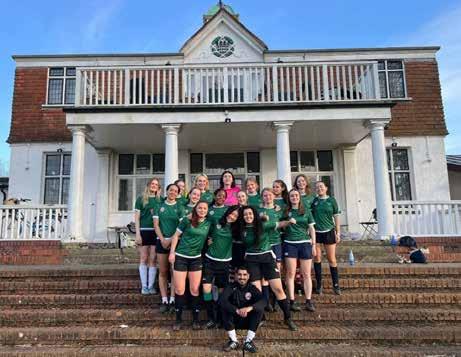
sun is shining, goals are going in one after the other, and the promise of promotion is in the air, it is hard not to smile. The end of Hilary saw a heartfelt Nandos send-off for coach Sachin as he left for Luxembourg, and the announcement of the new committee — Isabelle Corbett as Captain, Iona Morgan as Vice-Captain, and Poppy Mumford as Social Secretary. Trinity Term saw early morning treks to Iffley, where we made it to the quarter-finals of futsal, rounding off an excellent year for Jesus-New.
Michaelmas Term saw record numbers of sign-ups from eager Freshers, which we would need for our first term in Division 1 of the league. The team saw a very rocky start to the year, with the Captain’s words of encouragement echoing through the New College sports grounds. Despite the unfortunate number of losses and the immediate Cuppers knockout, spirits remained high. Standout talents include (but are not limited to) Emily and Eliza from Jesus — each making their mark as star wingers, (‘Fresher’) Neave Ormsby being a once-in-a-generation goalie, and Lizzy Kemmish and Iona Morgan consistently putting in a shift on the back line. After welcoming our new Social Secretary, Sehr Laiba, social attendance and team bonding skyrocketed to new levels, ending the year off with optimism and excitement for the upcoming term.
The Women’s Football Team
We continue to train for upcoming league matches in Hilary, with other exciting opportunities such as a sponsored Women’s College Football mini tournament graciously planned by our very own Social Secretary, Sehr, and anticipation is high for the announcement of our 2026 tour.
Isabelle Corbett - Women’s Football Captain Netball
New College Netball Club (NCNC) has enjoyed a successful and exciting year in 2025, marked by strong performances across both women’s and mixed competitions. The women’s team progressed to the quarter-finals of Women’s Cuppers, and has enjoyed further wins in the Cuppers league during Michaelmas Term. A particular highlight of the year was the reintroduction of the mixed netball team, which reached the Cuppers quarter-finals, and in its first ever friendly match, took away a 12-11 win, with a last-minute winning goal. Another standout moment was on Sports Day, when the mixed team won 19–7 against King’s College, Cambridge, showcasing both skill and teamwork. The club has benefited hugely from the arrival this Michaelmas of talented new Freshers, who bring so much effort and enthusiasm to our training, weekly matches and socials. With a growing squad and strong results, NCNC is looking forward towards Cuppers, and building on our success over the coming year.
Tilly Bowden – Netball Captain
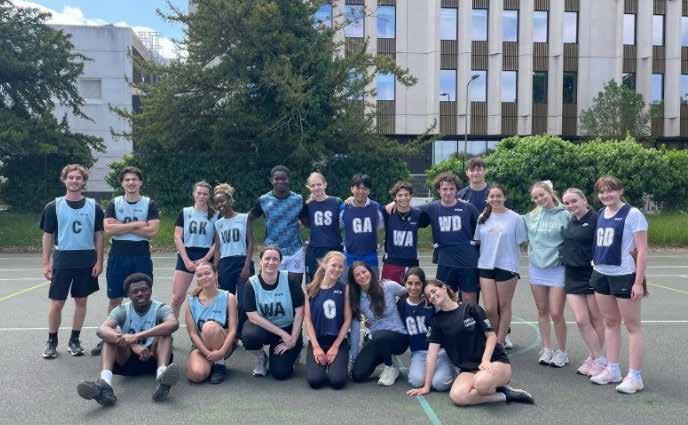
Mixed team with Kings, Cambridge on Sports Day
Rugby
NCRFC’s 2024-25 season began with the traditional 0th Week Old Boys’ game. In a tight contest the younger squad narrowly won, scoring on the last play of the game to win against a strong Old Boys team. With Freshers recruited, the new team was keen to prove themselves in the league after a strong first game. Then the league fixtures began: a narrow loss against a strong Teddy Hall side, and, in an unusual 9-a-side fixture, another loss against St Peter’s. The season had not started according to plan.
Returning in Hilary, with the rest of our league games unfortunately cancelled, the club’s sole attention was now turned to Cuppers, where New College was hoping to win for the third time in four years - exactly 100 years after their first Cuppers’ win. Their first run out in the competition came at the end of week 0, where Keble awaited in the quarter-finals. With tries from Eytan Brown, Noah Miller and James Clegg, New College ended up winning 32-7 and were into the semi-finals. Returning for Trinity, the boys were eager finally to play some more rugby and show what they could achieve. Because of a delayed semi-final at the end of week 1, the squad managed to fit in four training sessions at the start of the term, so they were well-prepared. However, despite all the training, within 5 minutes of the clash with Saints (St Anne’s and St John’s), New College were 5-0 down. This did not deter the boys in brown and white, as the team scored two tries before half-time, and managed to claim another four before the end of what turned out to be a dominant 36-19 win. NCRFC had cruised into the final and were facing Hildalen (Magdalen and St Hilda’s) for the second year in a row, hoping for the same result.
Another two mid-week training sessions followed. The squad was ready. Following a team brunch, NCRFC descended to the hallowed ground of Iffley Road, with fans and Old Boys in support. The warm-up commenced, and following motivational words in the changing room, the team charged out onto the pitch. Once again, despite vigorous preparation, NCRFC were caught out within five minutes. A 50:22 followed by many missed tackles meant Hildalen went over the line unchallenged to go 7-0 up. However, with George Morgan finding touch from a penalty, NCRFC finally had a chance to play in the opposition’s half. A huge line break from Jack Sander brought them 5m short of the line, and after a quick offload, Freddie Hawkins dotted the ball down to make it 5-7. Soon after, Josh Adeyemi took matters into his own hands, dancing through opposition players to dive over the line, making it 12-7, in what can only be described as a solo wonder try in his last game for the club. Despite two penalty kicks for Hildalen, NCRFC finished the first half 19-13 up after Jack
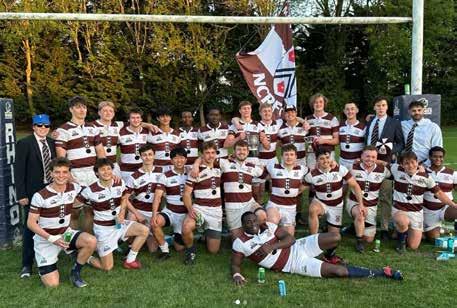
Botham capitalised on an overthrown line out from Hildalen, bringing play to their 22 and ultimately finishing off the move a few phases later.
After a call to war from Ben Hartigan, who was now off with a shoulder injury, and with the fresh legs of Faris Fahal, NCRFC started the second half keen to retain the cup. Linkup between Jack Sander, Noah Miller and Sam Thompson led to the team’s fourth try scored on one wing, with Freddie Hawkins dotting it down on the other shortly after. With huge defensive hits coming in from everyone on the team, the pressure was on Hildalen, who had not yet scored this half: 29-13. Oscar Cobb went on to score his first-ever Cuppers try after a line break from Noah Miller: 34-13. Cameron Tilley then dashed any hopes Hildalen had of scoring again, unleashing an out-the-back no-look pass spanning 15m to relieve the brown and white army of pressure from a chip and chase. On the final play of the game, the never-before-seen move ‘Fire and Brimstone’ was called and saw 13 brown and white bodies charge into a maul to score one final try. Final score: 39-13.
There it was. Twice in a row. Three in four years. The cup was back with New College.
The 2024-25 season was one of few games, but one to remember. Despite just falling short in touch rugby, the season was a huge success and one to be proud of as NCRFC looks to 2025-26 to make it three in a row.
James Clegg – Rugby Captain
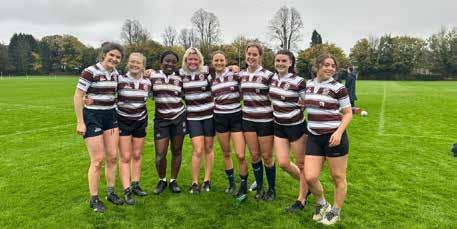
Women’s Rugby
Women’s rugby at New College has had a stellar year, with great representation at the university level across all three teams. There has been brilliant uptake to the sport, with many of our girls playing for their first year, and making it all the way to the university Pumas, Panthers, and even Blues. In 2024/25, NCRFC women consistently fielded full sides for 7s league games, despite being one of the only colleges to have the players for a stand-alone team. We also had a strong Cuppers campaign, although our side struggled in the summer given that the team was mostly formed of otherwise-engaged Finalists. Nonetheless, the highly anticipated Varsity matches saw great success for our New College girls. The University 2nd XV, the Panthers, won their match against the Tabs 26-5, thanks in no small part to the 6 NCFRC women on the team sheet, whilst Sky Stewart-Roberts and Libby Smith clinched a brilliant victory for the Blues at StoneX Stadium. In Michaelmas 2025 we have had a great uptake to the club, with many girls trying rugby for the first time. We anticipate going from strength to strength this season, building on the foundations set over the last few years and ensuring that women’s rugby is valued and enjoyed at our college.
Charlotte ScowenWomen’s Rugby Captain
The Women’s Rugby Team
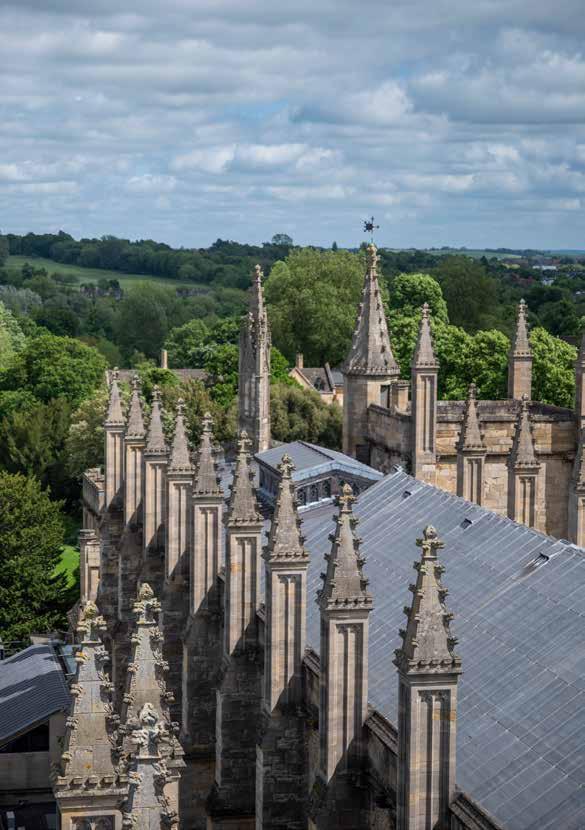
FEATURES
© John Cairns
William of Wykeham’s Obit: the Warden’s address to Winchester College in Winchester Cathedral, 23 September 2025
May I speak in the name of the Father, the Son and the Holy Ghost. Amen.
My text is from our Second Lesson, the words of the First Epistle of St Paul to the Corinthians.
‘According to the grace of God given to me, like a skilled master builder, I laid a foundation, and someone else is building on it’.
Today we commemorate the death of William of Wykeham, who certainly knew something about building. He died 621 years ago. It is an honour for me to speak to you tonight as Warden of one of his two foundations.
First, let me try to evoke him a little. What did William of Wykeham look like? This is a question I confronted at New College quite recently when we wanted to erect a statue to our Founder in our newly built quadrangles just outside the site which he purchased for us. Certainly, he was very tall for his times; that is convincingly attested. But his facial image has been distorted by much later portraits, such as those which hang in our colleges. For the avoidance of doubt, these bear no resemblance whatsoever to him. They are all derived from an original by a hack artist called Sampson Strong, practising in the Oxford area in the late 16th century, and who allegedly used an athletic Oxford blacksmith as his proxy model. And they look like it! More convincingly, in the wonderful church of Adderbury given by him to New College, there is a fine bust high up on a corbel, wrought after his death by a mason who knew him. It feels true to life, especially because it has a wart clearly visible on his chin.
But we’re actually very close to what he looks like here, for just down the aisle, over there, lies his tomb. It was created before 1403, and we can therefore surmise it was seen and approved by Wykeham. There is no wart on it! In fact, it does belong to a period when accurate likenesses had come into vogue, and came from a known London alabaster workshop. The body is in alabaster, the face in marble. It was placed in
what Wykeham described in his will as ‘a certain Chantrey built by me’, facing a mini-reredos which he can ‘see’ and ‘meditate’ upon. It depicts a man of some presence, imposing indeed, even as he is lying supine – with a long face, a chin which recedes, full cheeks and a fleshy neck. Here in this Cathedral which he rebuilt, how can we not see William of Wykeham very literally as the ‘master builder’ of St Paul’s letter?
And, indeed, his buildings represent the first of what I think are his three important legacies to us.
He was the quintessential builder, obsessive and prolific. Of course, he had been trained as a builder, as Clerk of Works, in the massive reconstruction of Windsor Castle; and he continued building all his life. Barely an edifice in his diocese wasn’t improved or restored by him in his long episcopacy. Windsor itself – of which only the Round Tower and its innovative plan of hall backed onto chapel survive – is an achievement masked by subsequent rebuilding. His two colleges carried that plan forward, and created the modern academic quadrangle. In London you can still see remnants of his great palace at Southwark, with a lovely rose window. You can’t see his work at Highclere, now Downton Abbey, but you can at East Meon and at Bishop’s Waltham, the building in which he chose to die.
And here: well, if you seek his monument look around you! Dramatically transforming a renovation project of his predecessor, Bishop Edington, this nave was reimagined and rebuilt in its current gigantic form. Before, the arches were rounded and squat; afterwards soaring and pointed. So it was that William of Wykeham became associated with the arrival of the perpendicular style. In Victorian times he was seen as single-handedly inventing it. For instance his very unlife-like statue is present as an architect, alongside Michaelangelo and Christopher Wren on the Albert Memorial. This is an anachronistic imposition on the late Middle Ages of what the term ‘architect’ now means. Wykeham was not an architect in our sense. But he was more than a client. He was a very active and involved patron. But even more than that: his professional training seems to have equipped him to knit together a team of loyal experts – Wynford, Yvele, Glazier. With them he seems to have influenced both the over-arching plan and the meticulous detail. The model was more collective than we are used to these days. But the collective required a driver and Wykeham was a highly effective CEO. As the biggest and most conspicuous builder of his times we can credit the crystallisation and popularisation of the perpendicular style in England to him more than to anyone else. And as a bishop he undoubtedly saw himself as doing all this work in celebration of the ‘foundation that is Jesus Christ’.
I suggest that Wykeham’s second great legacy was as a statesman of considerable merit. Is this an implausible claim?
Certainly, there have been detractors who would believe so. For instance, he doesn’t go down well with old Etonians or Lollards. Jonathan Sumption’s magisterial History of the Hundred Years War inexplicably writes him out. John Wycliffe famously derided him – ‘one wise in building castles or other worldly doing although he knoweth not the commandments of God’. Such omissions and commissions impact on perceptions of legacy. Yet the contrary evidence is strong and convincing. So, it was Wykeham who held the kingdom together as Chancellor in the most critical period of the Hundred Years War, raising the money and organising the logistics which kept Edward III and the Black Prince in the field, at a time of unprecedented economic crisis caused by the Black Death. And the records show his role as a bishop to have been pretty exemplary: rooting out laziness, neglect, corruption, venality. His secular career has been taken for a lack of piety, but the evidence is that he was extremely pious. His rewards have been taken for greed, but his household accounts show considerable frugality.
He was entirely self-made and from modest origins, a kind of poster boy for social mobility; it is an amazing testimony to his abilities that he held the reins of power to differing degrees under three kings, Edward III, Richard II and Henry IV. His exercise of power was humane and intelligent, but it varied between the monarchs. In the period of Richard he had to mentor and constrain the apparent permanent adolescence of this troubled individual, while at the same time seeking to preserve his own rights and royal favour. Not for nothing are there White Harts, Richard’s badge, plastered around this cathedral – from the same vintage as the many pubs named in the same way! He mediated, advised, found the middle way; despite his age, he was indefatigable. Modern historiography emphasises his centrality in this period, as Chancellor for the second time and then as member of the Royal Council. Consistently at moments of crisis Wykeham’s influence was to promote in his own words ‘quiet, peace and tranquillity, right and justice’. When the crunch came with the coup d’état of Henry Bolingbroke, he voted in favour of these principles – in the end, he moved to accept the new régime. Richard had become the epitome of everything untranquil and unjust. He migrated into Henry IV’s Council, and, in his late seventies, remained an active member. His expertise was clearly deeply valued. More than that, he subsidised Henry, not least his Royal wedding here with Joan of Navarre – but by then he was too ill to attend in person. In all of this there was undoubted self-interest, but also a sense of duty and service. He was no unprincipled Bishop of Bray: in fact he once said ‘if I please men I should not be the minister of Christ’. Perhaps there is a lesson for modern statesmen here. He was a bridge builder.
His third legacy was educational. The conventional wisdom is that he founded his two colleges to train replacements for clergy lost in the Black Death. No doubt this was a component, but I think it’s a bit deeper than a recruitment exercise.
First, we have to understand that there was a profound belief in scholarship related to the veneration of the Virgin Mary, the patroness of learning, to whom both colleges are dedicated. If we had visited our colleges in 1400, we would have seen among the windows in our chapels massive trees of Jesse in stained glass (one replaced, one dismembered) culminating in an image of the Virgin, the nursing mother, the milk-giver, central to the incarnation and a symbol of compassion. In our statutes Wykeham described grammar as ‘that sweet and pleasant milk of the doctrine of the first science whereby infants may be nourished’. The tree itself symbolises, in his words in New College’s statutes, ‘a well-watered garden’, where the ‘budding vine engenders a fruitful progeny for our college at Oxford to bring forth many flowers and honeyed fruits in the vineyard of the Lord’s grace’.
Finally, Wykeham’s educational zeal has to be placed in the context of the medieval belief in purgatory and in intercessions, prayers for the dead in expectation of the same from generations to come, smoothing the path to Judgment Day. You could effect this by founding a chantry, an endowment which paid for priests, or, as here, for permanent structures, so that masses could be chanted and prayers said for the repose of souls. It is clear that his educational foundations were, in effect, chantries. Their function was intercessory, not just educational. Our statutes required us (and still do!) to pray ‘pro anima fundatoris nostri Willielmi’.
So we come full circle to this Chantry, where in a few minutes the tomb will be censed and flowers laid. On April 16th, 1404, just six weeks before he died in Bishop’s Waltham, Wykeham negotiated, with all his customary specificity of detail, an agreement with the Cathedral authorities for the saying of masses here, a gift from them in return for all his building work. Always the builder!
He carried on working, conducting business from his bed until September 23rd when he could do no more. Four days later it was over. He died.
Amen.
Paradise in Prokopi: A Classic New College Tradition
Adjusting to life at university at the tender age of eighteen is never an easy task, but meeting the people with whom you will be spending the next four years of your life in the Arrivals area of Athens International Airport is assuredly one of the more daunting experiences that can be thrust upon a hapless Fresher. Roaming through boundless hallways, you listen keenly for the familiar sounds of a group of young adults speaking the English language: upon identifying them, however, you come to the shocking realisation that their speech is quite foreign. Words such as ‘collections’, ‘plodge’, ‘vac res’ and ‘subfusc’ seem almost Orwellian in coinage; it is all Greek to you. That, of course, is the reason you are here, or so at least you have gathered from the information you received by email before you had even sat your A-levels – you will be reading texts in Ancient Greek and Latin in order to prepare you for your studies over the coming year. Not only that, but you will be guided in these sessions by Stephen Anderson himself, a name that you have often seen emblazoned on the front cover of your textbooks, but which at this point seems more mythical than mortal.
The main house at Candili
Once your group of around 24 is fully assembled, the coach journey to Candili may begin – up through Attica, into Boeotia, across the New Euripus Bridge, on to the isle of Euboea (Evia) and up through thickly wooded mountains to the tranquil village of Prokopi. Rather unexpectedly, this community of fewer than a thousand inhabitants has served as the final resting place of St John the Russian (or, perhaps more accurately, the Ukrainian) ever since his remains were moved there from Cappadocia, and as such is a popular place of pilgrimage for those in the Eastern Orthodox Church. It is here in Prokopi, on a country estate nestled in the folds of a looming mountain, that you will spend the next ten days; in other words, in paradise. Philip and Eliza are enormously welcoming, and you will instantly feel at home after a long day of travelling. The grounds are simply stunning - no wonder, then, that relatives of the prominent philhellene Lord Byron have made Candili their home since the Greeks gained their independence from the Ottomans in 1832. Almost two centuries later the estate is just as picturesque, and no less rich historically than gastronomically.
The food at Candili is nothing short of heavenly. Each meal is freshly prepared in the kitchen by the brilliant Stavroula, and fully showcases why Mediterranean cuisine is regarded as amongst the best in the world. Every dish is accompanied by a healthy bowl of salad grown in Candili’s own vegetable garden and drenched in local olive oil, and an ever-popular meal, regularly scheduled for the middle Friday of the trip, consists of a whole grilled fish each, glassy eyes and all! If all this were not enough, the cool veranda where you will enjoy these meals overlooks acres of gorgeous rural scenery, as well as Candili’s two swimming pools. You will certainly not leave the estate on an empty stomach!
It is at this point that you will probably start to relax into the company of your fellow classicists – noticing your bewildered expression, one of the older years will take pity on you and help you to translate some of the famously abstruse Oxford jargon, as well as some classics-specific terminology, like ‘Mods’, ‘Greats’ and ‘MILC’. The first night, and indeed most others, are filled with games and icebreakers in the sitting room, introducing you to the rest of your fellow classicists before you even step foot in Oxford for the first time, an experience for which you will be profoundly grateful during the mayhem of Freshers’ week. The curfew, of
Staircase to the bedrooms at Candili
course, will be rigidly observed, and it is on the morning after that the trip truly begins.
There is no other way to put it – the first reading class of your first Evia is an enormously nerve-racking experience. You are immediately thrown in at the deep end, translating aloud the masterpieces of Homer and Virgil in a room full of your peers and those in the year above you, under Stephen’s watchful gaze. Inaccuracy and imprecision in translation are not tolerated in these sessions, as one of my classmates (who will remain anonymous) discovered almost immediately within the first five minutes of our very first reading class, when as a translation for the sixth word of the Iliad, ‘οὐλομένην’, they offered the utterly tone-deaf ‘cataclysmic’, before being corrected with a stern glare to something along the lines of ‘baneful’. All the second years appear to have perfected this majestically articulate style of translation, something which seems quite unattainable to apprehensive Freshers, though in fact they will soon master it for themselves.
This rather terrifying portrayal of the first session does not, however, accurately convey the typical experience of a New College reading class. I had never thought myself even remotely capable of laughing so much in a session focused on translating the works of Homer, Virgil, Caesar and Xenophon, but Stephen’s combination of a fiercely accurate, not to mention stylish, style of translation with a razor-sharp wit to match means that his pupils are able to accelerate in their understanding of the Greek and Latin languages at a record-breaking rate, while thoroughly enjoying themselves at the same time. Even in the relatively short time I spent at Candili before my first year, my ability to grapple with such titans of classical literature improved noticeably, an experience which proved invaluable as I began my time at New College. As far as I am aware, no other course or college offers this kind of unique opportunity to immerse yourself utterly in a subject before the beginning of each year, let alone before even the beginning of your degree.
Not only this, but the experience of getting to know your future classmates and tutors in such a paradisiac setting is part of what makes the New College classicists such a close group of friends as well as academic peers.
The first break from the schedule of three daily reading classes is the day trip on Wednesday. In my first year this meant an early coach journey to the site at Delphi, along with the nearby archaeological museum. For someone who had never been to Greece before this proved a fascinating opportunity to connect the works of ancient literature I had been reading with the remains of the historical sites which lay before me. Later in my first Michaelmas Term we would go on to read the passage in Iliad Book IX where Achilles claims not to value as equivalent to even a single life all the wealth contained ‘Πυθοῖ ἔνι πετρηέσσῃ’ (in rocky Pytho), generally agreed to refer to the seat of Pythian Apollo, god of prophecy, at Delphi. The site of Delphi was pivotal in ancient times, once believed to be the true centre of the world, and so the artefacts that can be found there represent the diverse and far-flung nations from which kings or their envoys would come to seek the advice of the Pythia, the oracular mouthpiece of Apollo. When one considers how many museums just like the one at Delphi are spread all over Greece, it really puts into perspective just how many brilliantly preserved artefacts survive to us from the ancient world, and how that can influence our understanding of historical events. We can only learn so much through reading alone, and so the trip to Evia offers a unique opportunity to analyse in tandem the physical as well as the literary elements of the classics.
This last year a boat trip was arranged to the nearby island of Skopelos, famed for its use in the 2008 film Mamma Mia. Although the voyage was postponed for several days owing to unfavourable weather conditions, we were fortunately able to get there (and even more fortunately, back!) on the Friday. Having previously spent time on the quieter isle of Evia, it was an interesting experience to see the more touristy, but no less beautiful, side of Greece, replete with merchandise shops and Mamma Mia-themed boat trips on offer. Beneath the rather commercial veneer, however, there lies an island that is just as culturally rich as any other in Greece. At the top of the hill overlooking the homonymous main town, traces can be found of original Byzantine fortifications from over a millennium ago, later reinforced by the Venetians in the 13th century. Occupied at various times throughout its history by the Macedonians, Romans, Byzantines, Venetians and Ottomans, as well as more recently by the Kingdom of Italy and Nazi Germany, Skopelos, like all of Greece, bears the scars of countless wars and conquests, although its natural beauty is never diminished. After taking in the sights of the main town, we took a bus to a nearby cove to enjoy the crystal-clear waters of the Aegean sea, a welcome relief from the merciless Mediterranean sun before taking the ferry back to Evia.
Several other excursions are offered during the trip, including a gruelling but rewarding hike to the summit of the mountain that lies above Candili on the morning of the second Sunday, as well as dinner out in Limni, a nearby town, on the penultimate night of the trip. On the final evening one last excursion is made to the crest of a nearby hill in order to relax, reminisce about the previous ten days and make bets on the exact timing of the sunset. It is either here or on the previous night that college family pictures are taken with all four generations of classicists, from mewling Freshers to wizened finalists.
This was the point in my first year at which I began to suspect that the classicists of New College must be among the most tightly knit cohorts in the whole of Oxford, and this suspicion was only confirmed throughout my first year. Not only are these the people in whose company I spend hours each week in tutorials, reading classes and lectures, but many of them have become some of my closest friends during my time at New College so far. A great part of this bond is owed to the truly unique experience that this trip offers – you simply cannot quite explain it to someone who has never experienced it for themselves. We are incredibly grateful to Phil and Eliza for welcoming us into their home, and to the tutors, without whose commitment these memorable trips could not possibly take place. Over the last two years, I have made far too many memories to recount in an article of this brevity, and I await my final two trips with as much anticipation as I already have nostalgia for my first two.
Oliver Laxton - 2nd Year student
View across the bay at Limni
Three Genoese Connections
Four years ago I wrote about the challenges of ministering in Genoa in a time of pandemic1. A great deal has happened since then, including the celebration of two significant anniversaries. The church building was dedicated by Charles Amyand Harris, third Bishop of Gibraltar, on 4 June 1872. Seventy years later, in October 1942, an RAF Lancaster, presumably aiming for Genoa’s docks, hit the church instead, causing serious damage. To mark this double anniversary a history of the Anglican community in Genoa was commissioned by the Church Council2. In the course of research for that book it was discovered that members of New College had played a significant part in the story of the chaplaincy at Genoa from the very beginning.
The first Church of England ministry in Genoa of which we know was provided by two military chaplains accompanying Lord William Cavendish-Bentinck’s expeditionary force in the Mediterranean theatre toward the end of the Napoleonic Wars. The first ‘civilian’ ministry of which we know was provided by The Revd Dr Thomas Trevor, the incumbent of two parishes in the Wirral and a Prebendary of Chester Cathedral, who arrived in Genoa in October 1818. Dr Trevor, a Cambridge graduate who also held the degree of DCL from Oxford, spent some months in the city on his way to Tuscany, having been warmly welcomed by the British Consul, Major James Sterling, with the invitation to officiate on Sundays at Anglican services to be held in Sterling’s house. The local response was very positive with, according to Dr Trevor, a congregation of from 100 to 150 every Sunday.3 In the light of this, Trevor discussed with his diocesan, the forward-looking Bishop George Law, the possibility of establishing in Genoa a permanent chaplaincy, such as had existed for over a century at Leghorn and had recently been established at Rome. Law appears to have been encouraging, but it was not his to decide. The oversight and licensing of Anglican clergy outside England was then, as it had been for nearly three centuries, the responsibility of
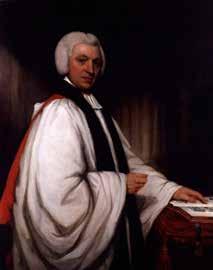
William Howley
the Bishop of London, who in those days was William Howley, formerly of Winchester (where he was a Fellow) and New College. Six months after Dr Trevor’s arrival in Genoa the Bishop received a letter setting out the situation4, followed up four months later by a detailed account of the congregation’s growth on which Trevor based a strong case for a permanent, self-sustaining chaplaincy5.
Howley, who went on to become Archbishop of Canterbury in 1828 (the most recent member of New College to hold that office), has the rare distinction of having crowned two monarchs, William IV and Queen Victoria. He was also one of the small group who attended the seventeenyear-old princess to inform her that, following her uncle’s death, she was now Queen of the United Kingdom of Great Britain and Ireland. Sadly, although Thomas Trevor’s letters to London have been preserved in the collection of ‘Fulham Papers’ at Lambeth Palace, Howley’s letters in reply have not survived. However, he appears to have been won over by Thomas Trevor’s enthusiasm, because when Trevor finally moved on in the summer of 1819, the first official chaplain arrived in Genoa very shortly afterwards. He was Thomas Lewthwaite, the son of a Cumbrian parson, which suggests that there had been some correspondence between Bishop Howley and Bishop Law, whose diocese stretched across most of northwestern England. It is also possible that Lewthwaite was one of the first graduates of Law’s new diocesan training college for clergy which had opened in 1816 at St Bees near Whitehaven. Although the first officially authorised Church of England services in Genoa are dated to his time6, Lewthwaite’s stay was a short one. In June 1820, less than a year after his appointment, he informed Bishop Howley that the sum collected by the English community for his maintenance was seriously inadequate, being only ‘100£ a year’, without any advantage whatever: and without even a prospect of this sum being continued to me on account of the smallness of the society consisting of no more than four or five families. I write to inform your Lordship that this sum being so inadequate to my support I have come to the determination of returning to England.7 What was Howley to do? He appears to have been unwilling to end the experiment after so short a time, but as he took matters further it seems that he decided not to rely on the recommendation of others, but to use his own contacts, one of whom was a young Fellow of New College, Martin Stow, who had been crossed in love. The whole sad story of Martin Stow’s devoted love for Maria Leycester and hers for him, thwarted by her parents, has been told by Maria’s adopted son, Augustus Hare8. Stow’s move to Genoa does not appear to have
required him to resign his fellowship9, which, in the light of Thomas Lewthwaite’s comments about the financial support available locally, may have been a considerable blessing. Stow seems to have been kept busy during his time in Genoa. In a letter to Bishop Howley regarding what would now be called an ‘inter-Church marriage’ between an English heiress and a Polish aristocrat, he comments that he has ‘already had occasion to celebrate several marriages as well foreign as English’10. Among the English marriages was that of Amelia Augusta Wright and Edward Le Mesurier11, whose eldest daughter, Amelia Louisa, was to become a sharp-eyed, and occasionally acerbic, commentator on the life of the English in Genoa later in the century. Martin Stow’s ministry in Genoa also included the pastoral care of Mary Shelley following her husband’s death in a shipwreck off Lerici.12 However, that ministry was cut short when Reginald Heber, ten years Stow’s senior, and a friend and mentor for some years, was appointed Bishop of Calcutta. Heber, who was also a friend of Maria Leycester13 and well aware of the lovers’ unhappy situation, invited Martin Stow to accompany him to India as his Chaplain, a post which Stow accepted, leaving for Calcutta on the ship ‘Ganges’ on 30 September, 182314 after a final interview with Maria. Within three years both he and Heber would be dead.
There was a gap of seven decades before the next New College connection with Genoa. After a period of relative stability, from 1824 to 1874, during which chaplains at Genoa normally spent between five and ten years in post, the withdrawal of Foreign Office funding for ‘Consular Chaplaincies’ like that at Genoa gave rise to a period of uncertainty about chaplaincy finance and a more rapid turn-over of chaplains, despite the completion in 1872 of a church building to the designs of G.E. Street. From the 1870s until 1899 a stay of five years or more became the exception, rather than the rule. Robert Langton Douglas was no exception. After going down from New College in 1886 with a Second in Mediaeval History, he offered himself for ordination and, after training in Lichfield, was ordained deacon in 1887 and priest in 1888, serving as a curate in South London. He then returned to Oxford as Diocesan Secretary of the Church of England Temperance Society, moonlighting, it is said, as an Extra-Mural lecturer until 1895 when he moved to Italy to take up the post of Anglican Chaplain at Leghorn15.
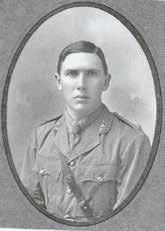
Robert Langton Douglas in military uniform
After about a year in Leghorn, Douglas moved to Genoa, where he stayed for two years, during which time he was to achieve immortality in the world of sport. On 7 September, 1893 a group of young men from the British Colony had founded the Genoa Cricket and Athletics Club. Initially it was founded ‘by Brits for Brits’, but the arrival in 1896 of a new doctor to work with British sailors and dock workers engaged in the coal trade brought about a change of direction, from athletics to (association) football, and a move from exclusion to inclusion. At the initiative of Dr James Spensley the Genoa Cricket and Athletics Club became the Genoa Cricket and Football Club and membership was opened to Italians16, with massive consequences both for the sporting culture of Italy and for the wider sporting world. From the beginning members of the Anglican community had been involved. The recently appointed British Consul, William Keene, a pillar of the Church of the Holy Ghost, and later Churchwarden, took over as president of the club, and when Robert Douglas arrived shortly after James Spensley, to take up the post of chaplain, he became vice-president.
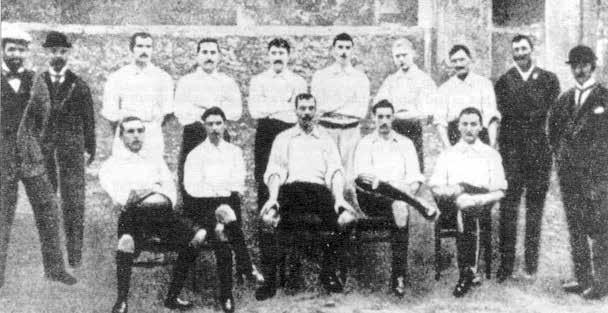
His moment of sporting glory, however, was not to come until his final year in Genoa, when he was asked to referee the final of the first ever Italian Football Championship, organised by the Federazione Italiana Giuoco Calcio (FIGC). It was played between three teams from Turin and Genoa Cricket and Football Club, as a knockout tournament within a single day. Genoa CFC, having beaten Ginnastico Torino in the morning won the final against Internazionale Torino, after extra time, and the team was to be a dominating presence in Italian football during the next three decades, winning the Championship eight more times before the mid-1920s. It has admittedly been less successful in recent
years, having spent time in Italian football’s second tier, Serie B, although it has now happily been restored to Serie A. Although the cricket side of the club has all but disappeared, its British roots are still acknowledged in the English spelling of the city’s name (‘Genoa’ rather than the Italian ‘Genova’) and in the continued use of the title ‘Cricket and Football Club’. And The Reverend Robert (sometimes misnamed as ‘Richard’) Douglas is still honoured as the referee of that ground-breaking final17 . Tony Dickinson (1967)
Endnotes
1 New College Record 2021, pp 80-83
2 Tony Dickinson, Redeemed from Fire, Genova, 2022
3 Fulham Papers, Howley 4, fol.592, Trevor to Howley, 5th February, 1819
4 Fulham Papers, Howley 4, fol.591ff, Trevor to Howley, 5th February, 1819
5 Fulham Papers, Howley 4, fol.601ff, Trevor to Howley, 24th June, 1819.
6 G.E. Biber, The English Church on the Continent, London, 1845, p.75, E.J. Bayly, response to Article I of the Articles of Enquiry attached to Bishop Sandford’s Visitation Letter of 31st October, 1876 (original in London Metropolitan Archive)
7 Fulham Papers, Howley 4, fol.595-599 Lewthwaite to Howley, 28th June, 1820
8 A.J.C. Hare, Memorials of a Quiet Life, London, 1872–76) vol. 1, pp 47-64. I am grateful to Michael Stansfield for this information. The book is available to read on-line at https://babel. hathitrust.org/cgi/pt?id=mdp.39015002995721&seq=11
9 In a wedding announcement in the London Morning Herald of 27th August, 1821, Stow is described as “Fellow of New College, Oxford, and Chaplain to the Protestant Residents” of Genoa.
10 Fulham Papers, Howley 41, fol.181f, Stow to Howley, 2nd November, 1822.
11 Morning Post, London, 2nd August, 1822, which names the bride as ‘Augusta Amelia’. This is contradicted by the family records included as an appendix to the collection of the letters of Amelia Louisa Vaux Gretton (née Le Mesurier), known by her family nickname of ‘Raven’, which were published in 2016 as ‘The Raven at her Writing-Desk’. https://digital.library. adelaide.edu.au/dspace/handle/2440/100855
12 Mary Shelley to the Reverend Martin Stow, chaplain to the English residents at Genoa, 29th September 1822. New York Public library, Carl H. Pforzheimer Collection of Shelley and His Circle MWS 0319
13 Mary Leycester’s father was incumbent of the parish of Stoke-on-Terne in Shropshire, which adjoins Heber’s former parish of Hodnet.
14 Public Ledger and Daily Advertiser, 29th September, 1823.
15 Crockford’s Clerical Directory, London, 1899.
16 For full details, including the founding of the Federazione Italiana Football – Italianised in 1909 to the Federazione Italiana Giuoco Calcio, see Chris Lee, https://www.gentlemanultra. com/2018/10/13/the-founding-fathers-of-italian-football-a-tribute-to-edoardo-bosio-jamesrichardson-spensley-and-herbert-kilpin/ 22.08.2022. For a short account of James Spensley’s wider impact on the Italian scene, see Fabrizio Càlzia, 101 perché sulla storia di Genova, Rome, 2019, No. 12
17 After his moment of footballing glory the richly varied career of Robert Douglas took him out of the ministry of the Church of England and back into the world of art history, where he won a high reputation. In 1940 he settled in New York city. He died in Fiesole on 14th August, 1951 aged 87.
Platelets Shown to Sequester DNA in Study that could Transform Cancer Screening
Study led by Professor Bethan Psaila, Fellow in Clinical Medicine uncovers previously unknown function of platelets as DNA ‘vacuum cleaners’ in the blood, with profound implications for cancer diagnosis and prenatal screening.
‘Platelets like these capture DNA (red) from the bloodstream’. Lauren Murphy
Research from Professor Psaila’s team based at the Weatherall Institute of Molecular Medicine, University of Oxford has discovered an unexpected and powerful new function for platelets - the tiny blood cells primarily known for their role in blood clotting. The Cancer Research UK-funded study, published in Science in August 2025, demonstrates that platelets also act as scavengers, capturing and storing fragments of DNA that are circulating in the blood, including fetal DNA and mutated DNA shed by cancer cells. Analysis of platelet DNA via a simple blood test was found to reveal the presence of even ‘pre-cancerous’ changes – indicating this may be a powerful technique for the early detection and prevention of cancer.
It is already known that fragments of DNA are released into the bloodstream by dead and dying cells. Too much of this ‘cell-free’ DNA is harmful, causing unwanted activation of immune cells or other health complications. Exactly how the body protects against this is not known. The current study suggests that platelets internalise these DNA fragments, thereby playing an important role in clearing DNA fragments from the blood and preventing unwanted immune activation.
Remarkably, the study found evidence of fetal DNA within the platelets of pregnant mothers, and mutated DNA in platelets from patients diagnosed with cancer and even those with pre-cancerous conditions. These findings offer new possibilities to refine and improve genetic testing methods used today.
Analysis of DNA fragments in the blood is emerging as an important screening method in a number of healthcare settings, and current approaches discard the platelets and focus only on plateletdepleted blood plasma. There has been a lot of interest in developing methods to track down the genetic ‘clues’ that spill into the blood when cells in the body die. Psaila’s team turned this question on its head – and instead investigated the way that the blood cleans itself up.
The postdoctoral researcher who led the project, Lauren Murphy, said ‘Our study suggests that platelets might be even more important for our health than we previously realised. It also indicates that current liquid biopsy screening methods are overlooking valuable genetic information that is contained within platelets. Our finding that platelets contain cellfree DNA means the sensitivity of cancer screening tests can be improved, enabling cancers to be detected much earlier than has previously been possible.’ The research team is optimistic that future applications could lead to earlier detection of cancers and other genetic disorders, improving patient outcomes.
Bethan Psaila, senior author for the study, said: ‘Our discovery that platelets act as tiny DNA dust-busters in the blood was unexpected. One lucky consequence of this is that platelets bear hallmarks of DNA damage that has occurred in all tissues in our body – and analysis of platelets can potentially improve screening tests, including for cancer. This study was a team effort with the Universities of Edinburgh and Swansea and we are hugely grateful to our many collaborators, to Cancer Research UK who funded the study, and in particular to all patients who donate samples for scientific research.’ Dr David Crosby, Head of Prevention and Early Detection Research at Cancer Research UK, which funded the study, said:
‘Platelets do not have any DNA of their own and it’s interesting and potentially important that they can internalise cancer DNA circulating in the bloodstream. This discovery means that many more parts of a blood
sample could be used to find cancers earlier, long before any symptoms appear. It may find clues of cancer that have previously been overlooked. Blood tests that can find tiny fragments of DNA shed from tumours are already in development. These ‘liquid biopsies’ have huge potential in the clinic, both for early detection and to detect cancers that are coming back after treatment. This discovery could dramatically expand that research into new blood tests which use DNA gathered by platelets. Further research will be needed to assess which parts of platelet DNA provide the most useful information about cancer and how blood tests can look for them accurately. But this discovery moves us a step closer to finding better ways to catch cancer earlier, when treatment is more likely to be successful.’
Platelets are the second most common type of cell in the body, but also the smallest – and they do not contain a nucleus. ‘There were some people who asked what on earth we were doing when we started analysing them for DNA, given that they lack a nucleus,’ Psaila says, ‘but whenever we spoke to actual platelet biologists, they were really fascinated. Lots of them had seen a little bit of a signal of DNA in platelets. Even though previous research may have treated platelets as background signal, we now know that they contain a signal that points to something real.’
Bethan Psaila - Fellow in Clinical Medicine; Professor in Haematology
Looking Down on Benidorm, and Looking Up Again
This was not where I expected to end up as I completed my Modern Languages degree towards the tail end of the last century. A continental European destination – or destiny – seemed likely enough, it was true. Even as I saw my philosopher peers transmogrify upon graduation into lawyers, historians into web designers and fellow linguists into financiers, my own intellectual and cultural inclinations remained on their initial course, surprising though that might seem to my former tutors.
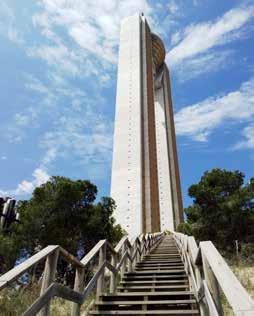
So it was in Spain I settled, taking up translation – of contracts more than sonnets – as my trade. But why had I now moved here, of all places, to the outskirts of Benidorm, the very last city where one would imagine the services of a translator to be required, except perhaps as an interim interpreter in the summertime drunk tank of the Policía Municipal? Surely everything in this monoglot enclave was written and spoken in English? And hadn’t I spent years turning my nose up and my gaze away as I drove along the AP-7 coastal motorway past its brutalist monoliths?
But here fate had brought me, to a small, and much more traditionally picturesque town neighbouring the self-styled Beniyork –Manhattan of the Med, which made the situation seem even odder. While most think of Benidorm as a place you visit to forget the drudgery of daily life courtesy of an overdose of sun, sea, sand, sangría, et cetera, for me it instead became a regular destination for paperwork at the tax office, ophthalmology appointments at the health centre, or my car’s annual roadworthiness test.
‘Benidorm’s tallest building – for now – rising from pineclad sand dunes.
Only once the brazenly grotesque media image of the town had been stripped away was I able to see how ordinary a place it largely was: not really all that different from dozens of other ‘formerly quaint and peaceful fishing villages’ dotted the length of Spain’s Mediterranean coastline and beyond; as popular, in truth, with Spanish tourists as with Brits, while elderly pensioners riding mobility scooters vastly outnumbered rowdy stag-parties pedalling beer bikes.
So how and why had Benidorm risen to the top – or sunk to the bottom, depending on your perspective – of all those coastal towns, to become the apotheosis of sunburnt excess? As I began to explore the resort’s history, I grew increasingly fascinated – entranced even – by the tales I uncovered and how the motley jigsaw of today’s Benidorm had been pieced together. It turned out there was enough to write a book about. So I did.
Looking Down on Benidorm, to be published by the Ybernia imprint in Madrid in June 2026, tells that story of how I learned to stop sneering and fall a little in love with the incongruous neon lights twinkling in the waters of a bay that was once strung with elaborate tuna nets. It offers an invitation to rethink what we have been told about Benidorm, and above all to open our ears to what Benidorm itself has to tell us, about tourism, society and even sustainability.
So where do we begin? One historical perspective on the chronological shifts of the local economy first struck me as I sat on a restaurant terrace in neighbouring La Nucía, just off the main road leading
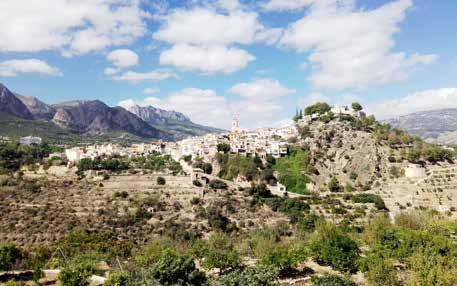
Polop with the castle and church on top of the hill
down to skyscrapers on the coast. I was looking the other way, though, towards the inland mountains and the castle of Polop, squatting atop its promontory just across the valley. It is the living (just about!) definition of a ‘sleepy, whitewashed village’ these days, all cobbled streets and dog-day siestas, its more storied past hinted at merely by Google Maps’ insistence on referring to it grandly as The Barony of Polop.
For a thousand years ago this was the frontline of the Reconquista; no less a figure than El Cid himself, first sword of Castile, was rallying his troops to capture the strategic fortress for Alfonso VI. Back then, whoever held Polop controlled the fertile valleys all around, and the conquering king would install a trusted favourite to serve as its baron. Polop’s days of glory gradually faded once peace removed the need for impregnable hilltop fortresses. Instead, the farmland district of La Nucía (‘Delicious’ in the original Arabic, ‘Naziha’) rose to greater prominence as an independent town, while swords were beaten into ploughshares. Benidorm, meanwhile, barely existed a millennium ago. It was little more than a cluster of fisherfolk’s huts, prey to marauding bandits and corsairs, dependent on the irrigation channels inland even for its fresh water.
Come the 1950s, and the traditional almadraba net used to catch tuna returning from their Mediterranean spawning grounds was stretched across the bay for the last time. The town had barely been sustaining a population of 2,000, and dwindling fish stocks meant it was now in real trouble, as was Spain in general. The country had yet to recover from the Civil War, and Franco’s regime was starved of foreign currency by its pariah status. This provided the stage for Benidorm’s ambitious young mayor, Pedro Zaragoza Orts, to muscle his lowly town to the forefront of Spain’s new economy. But to convince the ideologically liberated northern Europeans to holiday on Spanish beaches, he first had to override the bishops’ ban on an immodest and immoral foreign import: the bikini.
According to local legend, like a latter day El Cid astride his charger, Mayor Zaragoza headed off on his trusty old Vespa to buttonhole Generalísimo Franco himself in Madrid, convincing him to allow overseas visitors to wear their bikinis on the beaches of Benidorm, making it the first Spanish resort with such a licentious dress code, and so the first choice for Europe’s Baby Boom and Benidorm, Benidorm. So good they named it four times?
Wirtschaftswunder generation. It is a great tale, now written into the official origin story of Spain’s tourism sector. Sadly, research by historians into the Pedro Zaragoza Orts archive at Alicante University reveals it to be nothing more than a myth. The mayor’s true impact on Benidorm’s development in fact lay in the same gift for publicity that promulgated that story itself, as he invited Laplanders in traditional costume to visit the town, with TV crews in tow, or sent local wine labelled ‘Bottled Sunshine’ to Queen Elizabeth II – anything that would place his obscure town on the map and claim mind share for the nascent resort, decades before the marketing term was even coined.
The local authority, meanwhile, opted for a bold town planning stratagem. The whole municipality was defined as a single zone, with no height limit on constructions. ‘If you plan it, they will build’ was the philosophy – and build they did, hence the city we see today, of 80,000 permanent residents, but a population nearer half a million in high season.
Benidorm understood back in the 1950s that as Europe’s prosperity grew, foreign holidays would no longer be the preserve of the Grand Tour aristocrats of yore, nor the wealthy bourgeoisie strolling the promenades of Saint Tropez beneath their parasols. Instead of singlestorey villas with private gardens, its municipal architects took their lead from Le Corbusier, building high while allowing space at ground level for communal facilities.
Benidorm was ahead of its time – and in many ways remains so. Although its planners could scarcely have foreseen the pressures of modern tourism, they anticipated the antidote. While the Balearics and Canaries, Barcelona and Seville, now struggle with the impact of tourist accommodation on their housing sector – hence the mass protests seen regularly over recent years – Benidorm always has space for everyone, both residents and visitors. And it does so within an urban footprint a tiny fraction of that required for swanky Marbella’s ‘authentically Mediterranean’ villas The
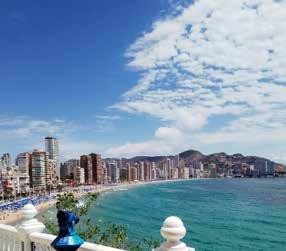
concrete skyline of Benidorm, echoing the Sierra Helada behind
and golf courses. A 21st-century 15-minute city devised at the dawn of the 1950s. That is one of the more surprising discoveries made in researching the significance of my neighbouring town. Far from being the very worst model of tourism, it is in many ways the most ecologically and socially sustainable, guaranteeing anyone their annual 15 days of sunshine, without encroaching on the nature parks, mountains and orange groves still circled closely around its urban heart.
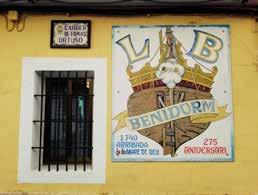
All human life is here, from the tawdry karaoke dive bars of the strip, to the artisanal arrocerías of the cobbled old town, to the millionaire penthouses of Europe’s tallest residential building. J.G. Ballard loved it. So did Sylvia Plath, who wrote the uncharacteristically joyous poem Fiesta Melons in the market here while on her honeymoon.
There is far more to Benidorm than meets the eye. I only realised that once I shook off my preconceptions and gave the place a chance. Which is perhaps another lesson in itself.
Matthew Clapham’s exploration of the surprising social and cultural layers of Benidorm is published by Ybernia on 19/06/2026. More of his writings on Spanish language and culture can be found online at https://letterfromhispania.substack.com/
Matthew Clapham (1989)
Benidorm sign in old town
Gown Hijinks and Hijackings
Charlotte Spence, Stipendiary Lecturer in Ancient History (2024-2025) offers some sound advice to the SCR on how to deal with gown thieves.
When I first arrived at New College, I was very earnestly urged to put my name in my new (to me) polyester black MA gown, and even better to keep it secured in my office. ‘Really,’ I thought to myself, ‘is there no honour amongst New College SCR members?’ It turns out that the theft of gowns, or in some cases long-term borrowing, is a common feature of SCR life.
On entering the SCR, one is greeted by a scattering of gowns on the pegs next to the Chequer, and those upstairs near the Smoking Room are positively stuffed with gowns. However, what at first appears to be a uniform mass of black gowns upon closer inspection reveals a dark secret. If, dear reader, you find yourself without a gown when you have already been called in to dinner, you will be unable to find a single garment which is appropriate. There is the obvious issue of length, and it does make for an enjoyable moment, watching a colleague either trying to keep a borrowed gown from dragging on the floor, or floating along in something much too short. However, the issue of length is the least of the difficulties which can be encountered when grabbing a gown ‘off-the-peg’, as it were. You may borrow one with a certain type of embroidery pattern, which you are then asked to explain. Or, heaven forbid - and heaven only knows how they ended up on a peg in Oxford - you may end up with (hushed tones) a Cambridge gown!
It is one thing to procure a gown in times of urgent need and replace it on the hook, but what of those poor fellows who carefully hang their gown up after dinner and head into the SCR to continue the evening with a glass of something and some fine conversation? Sometimes, even for the most careful amongst us, the evening slips away, and we find ourselves later on lying in bed, suddenly gripped by the thought of ‘My gown! I forgot my gown.’ We soothe ourselves with the thought that, of course, all will be fine. Sadly, when one comes in for dinner the next day, all too often the cry goes up, ‘I can’t find my gown, I’m sure it was here!’ In my early days, when I was still disbelieving about the extent of gown-mishaps, I was regaled with tales of a gown going missing for weeks, in some cases for exactly 3 years (I am sure the implication was that a naughty JRF had borrowed it for the duration; sometimes, even, they were apparently lost for ever - or until they turned up in an office which was being vacated!
But what can be done? Is there a remedy? As with so many things in life, the answer lies in our ancient past.
In sanctuary sites not far from Oxford itself, primarily Bath and Uley, almost 2,000 years ago thefts of a similar gravity were being committed. There was, however, an excellent solution. Curse the blighter!1 Small, inscribed lead tablets were deposited into bodies of water at these two sanctuary sites, and the divine powers were asked for help with the loss of all manner of items. A particular problem was the loss of cloaks or gowns.
These tablets inform us that a key issue when cursing a thief is to keep things in perspective. For instance:
1 Solinus to the goddess Sulis Minerva. I give to your divinity (and) majesty (my) bathing tunic and cloak. Do not allow sleep or health to him who has done me wrong, whether man or woman, whether slave or free, unless he reveals himself and brings those goods to your temple... Or in particularly vexatious cases:
2 Docilianus son of Brucetus to the most holy goddess Sulis. I devote him who has stolen my hooded cloak, whether man or woman, whether slave or free. May the goddess Sulis inflict him with the greatest death, and not allow him sleep or have children now nor in the future, until he has brought my hooded cloak to the temple of her divinity.
In short, next time you find your gown is AWOL, maybe take a moment to procure a piece of lead, invoke our illustrious founder, who would have been no enemy to righteous justice, make use of one of the above formulae (it is important to cover all bases if the identity of the thief is unknown e.g. whether man or woman, whether fellow or non-stipendiary lecturer), and seek some
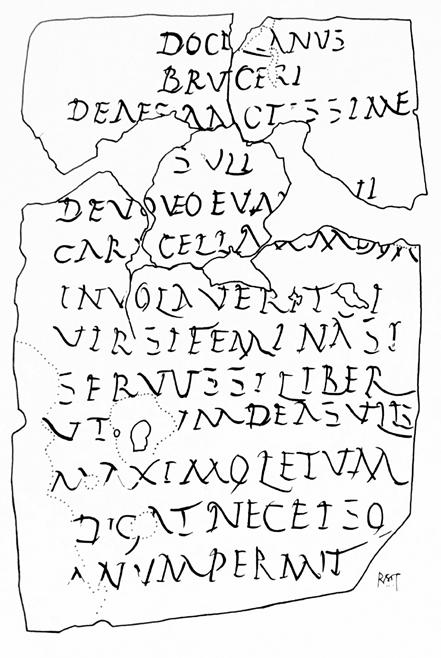
Drawing by R. Tomlin and reproduced from Tomlin, R. S. O. 1988. ‘The Curse Tablets, in Cunliffe, B. (ed.) The Temple of Sulis Minerva at Bath Volume 2: The Finds from the Sacred Spring. Oxford. 59-227.
vengeance3 upon the accursed thief (unless they can promptly deposit your gown in the chapel and so avoid the wrath of William of Wykeham). After all, there need be only the threat of painful death to deter any future gownrelated crimes and to ensure a heap of returned gowns on the chapel doorstep early one morning.
Charlotte Spence - Stipendiary Lecturer in Ancient History
1 Tab. Sulis. 32 from the Sacred Spring at the Sanctuary of Sulis Minerva at Bath, dated to the second century AD. Text and translation adapted from: Tomlin, R. S. O. 1988. ‘The Curse Tablets,’ in Cunliffe, B. (ed.) The Temple of Sulis Minerva at Bath Volume 2: The Finds from the Sacred Spring. Oxford. 59–227: no. 32.
2 Tab. Sulis. 10 from the Sacred Spring at the Sanctuary of Sulis Minerva at Bath, dated to the second century AD. Text and translation from Tomlin, R. S. O. 1988. ‘The Curse Tablets,’ in Cunliffe, B. (ed.) The Temple of Sulis Minerva at Bath Volume 2: The Finds from the Sacred Spring. Oxford. 59–227: no. 10.
3 N.B. The author takes no responsibility for any mishaps which may occur if any reader decides to undertake ancient cursing rituals after reading this piece.
Completion of Staff Portraits Series New College Heads of Department by Joel Ely
Some years ago, inspired by the 2003 exhibition ‘Below Stairs: 400 Years of Servants’ Portraits’ at the National Portrait Gallery, the College developed a project with artist Joel Ely to commission a series of staff portraits for the South Undercroft. With the support of College Old Member, Richard Borchard, the project began before COVID-19 and was finished in 2021. Recently, Joel finished two more portraits to complete the set, and these were welcomed at the Silver Audit in November 2025. The college is deeply indebted to both Joel Ely and Richard Borchard for their enthusiasm and interest in the project. It is also indebted to the college staff who agreed to be involved, and who spent time sitting for Joel on one of his periodic visits to Oxford.
Michael Burden
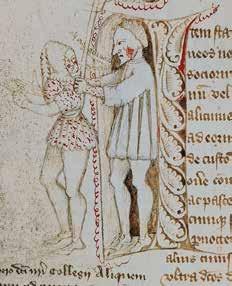
One of the earliest representations of a New College staff member: The College Porter, c. 1400
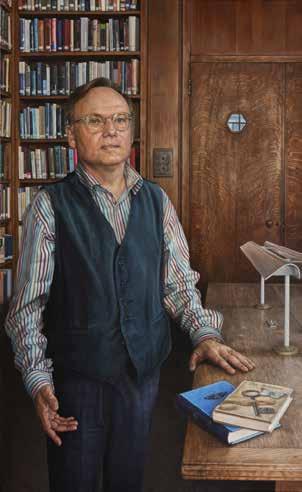
Dr Christopher Skelton-Foord, the College Librarian
Madsen, the College Academic Registrar until the end of 2025
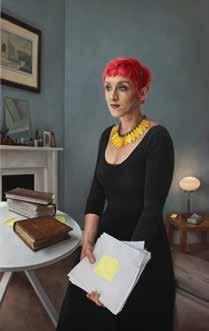
Freyja
Archery at New College
As far as the modern New College is concerned, archery is a lost sport. It does, however, have a long and distinguished history as a pastime, and like many sports, its original role was to ensure that participants were practised and ready for deployment. By the Regency archery was a gentleman’s sport, one which could on occasion include women. Much is obscure about its origins at New College, but it seems likely that one of the moving forces in the Archery Club was John Egerton, of Thorncomb, Devon, who matriculated in 1815, became a Fellow in 1818, Dean of Arts in 1824, and Bursar in 1825; he resigned in 1828 on marrying and becoming Vicar of Bunbury. Also involved was John Eldon of University College (Viscount Encombe, later the First Earl of Eldon) who seems to have been Egerton’s supporter, and to whom the club was principally indebted for its formation and organization. Harmer’s Anecdotes of Archery recounts that:
The New College Archers’ Society was founded in 1825 and is composed entirely of the students from New College, Oxford, who have an annual shooting match with the St. John’s College Archers. The distance usually shot is eighty and sixty yards, in consequence of the ground not being sufficiently large for conveniently shooting a greater distance.
The butts were on ground which had been a Bowling Green, but which ‘in more recent times was devoted to Archery, now (1906) a lost art, which was in great vogue here until the seventies.’ One of the Chattels purchases in 2025 was a stereoscope card, seen in illustration 1, which shows the butts; this is the only visual record known of them.
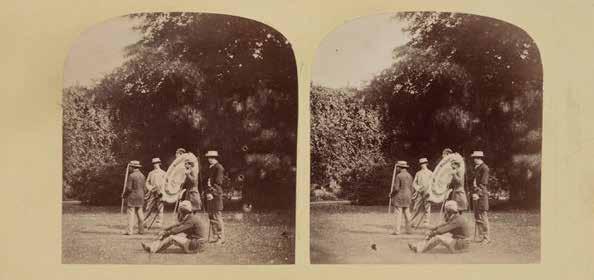
A stereoscope card of New College undergraduate archers at the archery butts on the Bowling
c. 1870. Taken from a stereoscope view from a collection of Oxford views. NCI: 2025.
Green,
Stereoscope cards were produced in large numbers and in sets; these were marketed in thematic collections, this one coming from a group of views of Oxford. The Archery Club had a carefully specified uniform:
Coat: dark green, with the large Club button; Waistcoat: light buff with the small button; Black Hat and Black Neckcloth; White trousers, straps and boots; A belt of white or black leather. The buttons of this ensemble, see in illustration 2, are described as having:
A frosted ground with a W … composed of six arrows of bright gold raised in the middle and encircled with a garter containing the Founder’s motto.
The uniform was mandatory; the rules state clearly that ‘none but clergymen or those in mourning’ should be excused wearing the correct outfit.
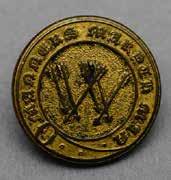
A button, c. 1870, from a New College archer’s uniform. NCI: 5008
The Society was, of course, competitive; there were two prizes of cash to be given annually by the club, ‘as large in value as the funds may permit’. There were also two annual challenge prizes, one a silver star given by Lord Stuart, and the other, a silver quiver, by John Egerton. Of the silver star there is currently no trace, but the silver quiver, seen in illustration 3 overleaf survives in the college’s collections, a Regency piece with particularly fine casting made in 1828. The arrows in the quiver are fixed, and it has a silver loop for a belt at the waist, or perhaps over the shoulder.
At a later date a third prize was added, presented to the Society by Viscount Encombe, and consisting of a large badge (see the back cover illustration). Also presented to the Society in 1828, it was the subject of an annual competition. The badge escaped the confines of New College through a condition which the donor added to his gift, that ‘whoever won the badge three times in a row should keep it’, a feat that was achieved in 1842. The winner’s name is not preserved however, and the badge, of which there was no description or visual record, then vanished. It reappeared in 1964 in a London antique shop, where it was purchased by William Terry who had a lifelong passion for archery, and had developed one of the largest private collections of archery books, artefacts, and ephemera in Europe with the intention of establishing a museum. When these plans did not come to fruition and after Terry’s death, Olympia Auctions dispersed the whole collection in three sales, and it was in the last of these that the New College badge appeared; and was knocked down
to the Chattels Fellow (under the lower estimate) after some brisk bidding! Its reappearance has drawn attention to the college’s involvement in 19th century archery and has already inspired some reassessment of the Society.
Michael Burden – Dean, Pictures and Chattels Fellow
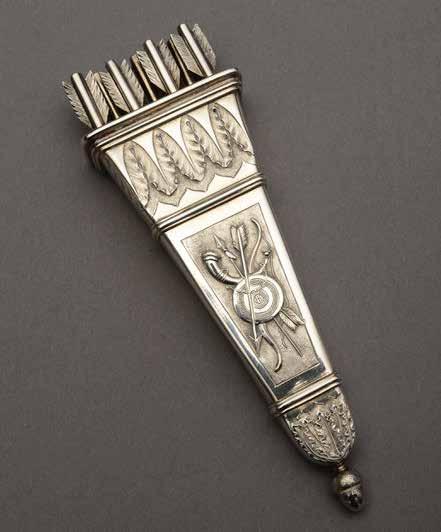
The New College archery trophy in the form of a quiver, presented to the College by John Edgerton in 1829. It has the mark of Mary Ann & Charles Reilly, 1828. Other recorded items marked by the firm - a decanter label, grape shears, and a punch ladle – suggests a concentration on small items. NCI: 1829.
OBITUARIES
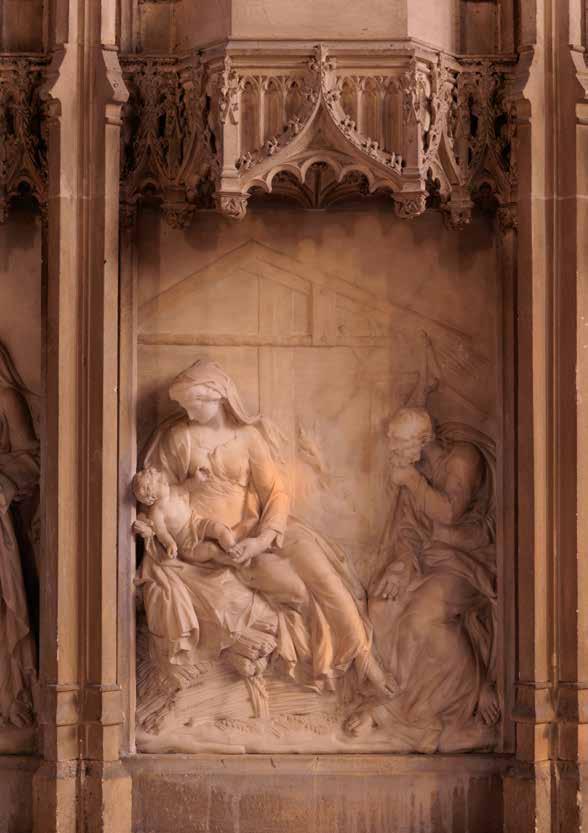
© Erica Longfellow
Christopher John ALLSOPP, CBE (Fellow 1967-2008), was born on 6 April 1941 and spent his first four years in Somerset. He and his twin brother, Roger, were brought up by their mother and grandmother, while their father, an architectural historian, was away at the war. Chris attended Bootham, a Quaker school in York, and then went on to study at Balliol College in Oxford. Like many influential economists, he began his academic life as a scientist, graduating in 1963 with a BA in Physics. Only subsequently did he change course by enrolling for the MPhil in Economics at Balliol and then at Nuffield College. Immediately after that he landed a job with Nicky Kaldor, the legendary Cambridge economist who was advising the Labour Government. He then went on to his fellowship at New College and a position at the UK Treasury.
Chris Allsopp was a distinguished policy economist and an inspirational teacher, remembered by his students as a man of great style and warmth. He was elected a Fellow of New College as a second economist to Roger Opie in 1967, and was later appointed Reader in Economics at Oxford University, where he continued to teach at both undergraduate and graduate levels until he retired in 2008. He was devoted to the college and took on various administrative roles, though he was not a talented bureaucrat and will be better remembered for his slightly subversive attitude on some internal political issues. Early in his career he fought a campaign against austerity in college financial management (later reflected in his attitude to wider issues of government accounting and debt management - where he was less successful!).
Chris’s long career as an economist had many facets. His research and writing focussed on macroeconomics - spanning both monetary and fiscal policies - on the economics of energy, and on the challenges of monetary union. His policy advice on these subjects was just as important as the papers which he wrote; he was one of the advisers to the Labour Party as New Labour came into power in 1997 and was appointed by Gordon Brown, first to the Court of the Bank of England in that year, then to its monetary policy committee from 2000 to 2003, and finally to lead the Allsopp Review into the provision of statistics for economic policy making.
Back in the early 1970s Chris, with Marian and their two young daughters, spent a year in Paris, where he served as Head of the Economic Prospects Division at the OECD and edited the OECD Economic Outlook. It was the extraordinary time of the first great oil shock, and Chris was remarkably young – just 33 – to hold these senior positions. His Keynesian view - that macroeconomic policies needed to become much more expansionary – shaped the policies which the OECD advocated in an important way. Later, in the 1980s and 90s, he gave advice on reform in
Eastern Europe – particularly in Poland - and did valuable work in China - during the early days of groundbreaking reform.
Chris’s policy interests led him to help John Walker set up Oxford Economics, which has become perhaps the world’s most important economic advisory firm; Chris was for many years a Non-Executive Director. And his ongoing interest in energy economics – such a big topic now because of climate change - led to him becoming Director of the Oxford Institute for Energy Studies between 2006 and 2013.
In the mid-1980s Chris was the driving force behind the creation of the Oxford Review of Economic Policy (OxREP), himself editing a total of 18 issues of the journal, and shepherding many other issues to the press. From the beginning, Chris established the ethos of OxREP that has survived to this day, as an academic journal which bridges the gap between cutting-edge economic theory and actual economic policymaking. Many papers published in OxREP have shaped academic thought and real-world policy choices, not just in the UK but much more widely.
Most importantly of all, Chris was a highly regarded teacher of macroeconomics, at both undergraduate and graduate levels. Like so many earlier generations of Oxford dons, he thought of teaching as his real job. This teaching profoundly shaped the careers of many students, including that of Rachel Reeves, the current Chancellor of the Exchequer. Chris was a fine colleague and a trusted friend. His loss is keenly felt amongst academic economists and policymakers, and also by the wider economics community. This is especially true at the present time, when good policy advice is so greatly needed. Chris died on 5 March 2025 and is survived by his wife Marian, his daughters Kath, Hermione and Hattie, and six grandchildren.
Marian Allsopp and David Vines (colleague and friend)
Peter Miles Pearce ATKINSON (1972) was born on 24 December 1944. He arrived in Oxford in 1972, with a Magna cum Laude from Harvard and several years’ teaching experience, to write a thesis on British overseas aid in the post-war period while studying for a BPhil in History. The only child of British parents who had settled in Manhattan, he was thoroughly English, except perhaps for requesting strawberry jam every day at breakfast, despite its complete absence from New College’s cupboards. He had long sought British citizenship, eventually granted only recently following a rule change.
Tall, spare and bespectacled, notebook and pencil always in his shirt pocket, Peter was unfailingly thoughtful and courteous, and a steadfast friend, visiting his Clerkenwell house each summer to keep in
touch with UK friends. His final visit to New College was to present to the college his small but perhaps unique coin collection – one from each reign since William the Conqueror.
After some years of teaching and organizing the United World College in Moshi, Tanzania, and a brief spell in London, Peter settled into a job at the United Nations International School in New York, where he continued to enjoy teaching into his seventies: in 2014 his swansong to his graduating class was given in the UN General Assembly. Peter lived in the Manhattan flat where he had grown up, with a small holiday home in Conway, MA.
Peter, the quintessential bachelor for 40 years, delighted his friends by marrying Judy Wermuth, an academic who had escaped Bulgaria in the Soviet era with her two sons. She died in 2023 shortly after their silver wedding anniversary. Peter was very proud of his stepsons Jassen and Calin who reciprocated his love, especially in his final illness, which he bore with great dignity. He died on 26 January 2025.
Edmund Jessop (1972) and friends
Roger Merrik Burrell BAGGALLAY (1972) was born in Canterbury on 23 September 1954. Reading Law at New College he developed enduring friendships and became known for a fine Donald Duck imitation. Mildly left of centre in his politics, he was elected in his second year to the JCR committee. In March 1976 he emerged from law school to a career in London at Coward Chance, first in the shipping department and later in litigation. Upon the merger to create Clifford Chance in 1987, he became a partner and served as head of banking litigation. Known for clarity of thought, fairness, and steady judgement, Roger was especially valued for his mentorship. For many years after retirement in 2007 he contributed to the selection of new partners.
Roger travelled widely for both work and pleasure. He made extended walking and cycling expeditions in the Scottish Highlands and Islands, and briefly studied Gaelic. In mid-December 1979, during a stopover at Kabul airport, tanks guarded the runway as he and fellow passengers were confined at gunpoint—a week or more before the widelyacknowledged start date of the Soviet occupation of Afghanistan.
A lifelong and eclectic passion for music started with the cello and piano at school. Roger introduced many friends to his beloved jazz at the 100 Club and one night brought Liz Morcom; they married in 1982, not long after she had become a Master of Wine. Roger strove to balance the demands of his legal career with family life and the family’s retreat in Roussillon. In retirement, intellectual curiosity undimmed, he maintained
a thoughtful interest in history, politics and legal affairs. Roger’s acuity and quiet humour endured even as he struggled with Parkinson’s dementia. Survived by Liz, their sons Merrik and Alex and four grandchildren, he died in Edinburgh on 5 July 2025.
Stewart Dutfield (1972)
Martin Charles Owen BAX, FRCP (1952) was born on 13 August 1933 and died, aged 90, on 24 March 2024. When he came up from Dauntsey’s in Michaelmas 1952 to read Medicine, nobody (least of all his contemporaries) foresaw his future double life in the arts and medicine. He was apparently a run-of-the-mill public school boy, who played coarse hockey and sometimes went beagling; but most importantly he fell in love with Judy Osborn, the daughter of missionaries, and one of the beauties of her year, who was reading Maths at Somerville. His tutors’ termly reports on Martin’s science prelims at New College were less than ecstatic. One correctly predicted that ‘in spite of the distraction of becoming engaged he has done quite a lot of work and should get a place in the Second Class.’ In the Record’s list of marriages for 1956 alphabetical accident places him and Judy immediately before John Bayley and Iris Murdoch.
Martin was still a medical student at Guy’s Hospital (he qualified in 1961) when he launched—as a counterblast to the greyness of British life—the quarterly magazine Ambit which he edited until 2013. In it he published poetry, art, and prose, choosing what he and a few close adjutants liked but with no discernible informing theory. The magazine was run from his Highgate home where Judy managed its shaky finances. The first issue in 1959 was hand-set on a Variotyper, a now more or less obsolete device, which enabled art work and photos to be pasted on to pages between sections of type. Initially most contributors were Martin’s friends, and the bigger names who came later lacked reputations at the time. To list a few they included the poets Fleur Adcock, Edwin Brock, Carol Ann Duffy, and Peter Porter; J. G. Ballard (fiction editor for a period) and Bax himself were among the prose-writers; art came from David Hockney, Eduardo Paolozzi, and illustrator Mike Foreman, who was the magazine’s long-time art editor. True to Martin’s anarchist principles Ambit eschewed formal management. Discussion of the next issue with the editor over wine at the Chelsea Arts Club was the magazine’s nearest approach to an editorial conference. Ambit had a penchant to provoke. In 1967 it ran a competition for ‘the best creative work ... written under the influence of drugs’, which triggered outrage from Lord Goodman, Harold Wilson’s legal adviser and meddlesome fixer, who threatened prosecution. The winner of the £40 prize was the experimental novelist Ann Quin who
said that she wrote under ‘my usual combination’ of nicotine, caffeine, and oral contraceptives. Among other ‘scandals’ Foreman made what Martin called an ‘elegant’ drawing of the Statue of Liberty being raped by a policeman—the occasion being the 1968 riots in Chicago. And Hockney’s drawings of ‘men in a club in Amsterdam’ raised eyebrows - but not Martin’s.
In parallel Martin pursued his medical career as a specialist in developmental medicine and especially the treatment of cerebral palsy (CP). From 1978 until his retirement in 2003, he was editor of Developmental Medicine and Child Neurology. He co-founded and for many years was the senior editor of Clinics in Developmental Medicine, a series of books; his day job was as a consultant paediatrician in the NHS. Martin had published a pioneering paper differentiating types of CP as early as 1964. Later he did significant work in identifying the causes of CP, in particular how it may relate to incidents during pregnancy. A 2006 article of which he was the guiding author drew on survey statistics of CP cases in various parts of Europe in the search for their causes. It called for ‘a systematic approach to identifying and treating maternal infections’, investigation of infant stroke, and the close monitoring of multiple pregnancies as well as MRI scans for all children with CP. In this field he won an international reputation and many awards. The list of his articles in professional journals is long. He was an official friend of both the American and European Academies of Childhood Disability.
Martin also wrote fiction. Among his novels The Hospital Ship (1976) achieved cult status. It is the dystopian story of a ship carrying doctors around the world in the aftermath of an unspecified catastrophe. Martin was concerned by threats of nuclear war and chaired the editorial board of the journal Medicine, Conflict and Survival (1991-2005).
These remarkable careers were of course facilitated by Judy. With Martin she had three sons and a teaching career which culminated in headship of the comprehensive Parliament Hill School, Gospel Oak. After retirement she served as a Labour member of Haringey Borough Council. She died in 2015.
The marriage was sometimes turbulent. It could not have been easy to live with someone of such varied, demanding, and fulfilled callings as Martin.
Chris Hall (1952)
Sir David BERRIMAN (1949) was born on 20 May 1928 in Kenilworth, Warwickshire and his family moved to Oxford when he was twelve. He came up to New College, after Winchester and two years’ National Service in Egypt with the Royal Corps of Signals, to read Engineering, a choice
influenced by his father, Algernon Berriman OBE, a renowned engineer, expert in aerodynamics and involved in the development of early airplanes and motor cars. After passing Honour Moderations in Natural Science, David decided that he was better suited to a business career. The Warden agreed to his taking advantage of War Statutes granting immediate BA degrees to those who had passed Honours Mods. He then read Economics and Political Science for two years. He was delighted later to serve as a trustee of the college development fund from 1983 to 1995.
Coming down from New College, he spent twelve years in banking and industry before joining the old established merchant bank, Morgan Grenfell, which had taken over the equipment-leasing company that he was running. He became a Managing Director of the bank four years later in 1968. In 1973 he moved to Guinness Mahon merchant bank, initially as the Managing Director. During his 14 years there he was encouraged by his chairman to become a non-executive director of a wide range of companies, notably Cable and Wireless and Britannia Building Society. He helped establish and was appointed Chairman of the first satellite television company in the UK, which became Sky Television after News International acquired control.
In 1981 he was invited to become involved in the health service as one of the early business person appointments. He first became Chairman of the NHS district which included Guy’s Hospital. In 1984 he moved to become Chairman of the North East Thames regional health authority, which was then responsible for approximately 10% of the NHS budget. He was knighted for services to health in 1990.
Sir David lived in Kent for some 50 years. In 1990 he was asked by Kent County Council to become Deputy Chairman of a new charity looking after residents with dementia. The charity later extended its reach to the greater London areas of Greenwich and Bexley. It was a role he undertook with vigour and determination until he was aged 80.
In 1985 he became a Name of the Corporation of Lloyd’s insurance business and was elected Chairman of the Association of Lloyd’s Members in 1994. He negotiated on behalf of Names a rescue involving the mutualisation of Names assets and liabilities to avoid the Corporation becoming bankrupt from failure to make adequate reserves over many years for potential asbestosis and pollution claims. He spoke his mind plainly and worked tirelessly, drawing on his intellect and resolution, to find a solution. A 2014 book by Andrew Duigid titled: How a crisis transformed Lloyd’s of London records that ‘had there been military awards for those involved in sorting out the problems at Lloyd’s, Sir David Berriman would have deserved the George Cross.’
In 1970 he helped establish and became Chairman of MacIntyre, initially a small charity with one school for eight children with learning disabilities. That has grown today to become a leading national charity employing over 2,000 people and providing care, education and support to over 1,400 children and adults with learning disabilities. His younger son James, who has Down’s Syndrome and James’s late wife Angela, who also had Down’s Syndrome, were supported by MacIntyre over many decades. They were one of the first couples in the UK with Down’s Syndrome to marry. MacIntyre’s supportive culture, development and national reach was a source of great pride to Sir David. His involvement continued through the mentoring and advice he provided to his elder son John Berriman who was a partner and chief operating officer of PwC and who chaired MacIntyre for 20 years until 2024.
A love of tennis ran in the family and was the sport at which he excelled. He played Lawn Tennis for the University and for Oxfordshire, as well as being Honorary Secretary of Oxford University Lawn Tennis. He was for many years both a member of the All England Club at Wimbledon and of the International Tennis Club. He was also a proficient and competitive golfer and a member of golf clubs in Kent and Spain. He was a long-time member of the Royal Automobile Club, as were his father and son John, creating an unbroken 116 year line of membership. He enjoyed bridge, classical music and opera and reading political and historical biographies. Having outlived three previous wives who had each died of cancer, Sir David had been very happily married to Caryl since 2014, and took great delight in his sons and stepchildren. He died on 13 March 2025.
John Berriman
Terence Augustine COGHLAN (1964) was born on 17 August 1945 and raised in Geneva and South Africa before attending Downside. His 1963 gap year was spent in Perugia, inspiring a life-long love of Italy. While there he persuaded Ezra Pound to lunch with him.
While reading Law at New College, Terry learned to fly in the Oxford Air Squadron. He was called to the Bar in 1968 and took silk in 1993, specializing in medical negligence. In 2000 he suffered severe head injuries in a skiing accident. With characteristic determination he resumed his successful legal career and became a Recorder in the Crown Court. Latterly he chaired tribunals deciding whether to release inmates from psychiatric hospitals like Broadmoor. A further contribution to the legal community was his service as Master of the Cellar at the Inner Temple. He dug below his family home in Clapham to cellar his own collection.
Along with wine, travel and sport - he was no mean batsman, scoring a century against the MCC in his youth – music was his passion. His trumpet could be heard from his rooms in New College above the kitchens. Later his support for choirs, orchestras and music festivals was constant. He was on the board of The City of London Sinfonia, Trustee and Director of the Temple Music Foundation and Chairman of the Board of Trustees of the two Endellion Festivals in Cornwall. He and his wife were founder members of The Festival Choir, a local choir in Clapham.
Terry was also devoted to New College and was a committee member of the New College Society 1978-1986. In 1973 he married Angela Westmacott who survives him with three children and five grandchildren. One obituary noted Terry’s ‘tiggerish’ enthusiasm; this energized the warm hospitality always on offer at his family home. It was sadly extinguished on 18 November 2024.
Andrew Schuller (1963)
Richard Maurice McEwen COMPTON MILLER (1963) read History at New College, Oxford between 1963 and 1966 following in the footsteps of his father and step-brother. In 1965 he was elected as the Editor of Cherwell and it was to be the beginning of a glittering career in journalism.
Richard worked on Cherwell during what became one of the most exciting periods in post-war history. It encompassed Harold Wilson’s new Labour government, drugs, the ‘swinging sixties’, the Beatles and the Vietnam War. Richard’s first encounter with journalism was as a freelance writer for Isis which was, in those days, an expensively-produced glossy bankrolled by Robert Maxwell, who was then a university textbook publisher keen to gain respectability. Passionate about pop music, Richard found a niche interviewing chart-topping stars like Adam Faith and Gerry and the Pacemakers. His first discovery about university journalism was that the outside world (and the national newspapers in particular) were hugely impressed by life at Oxford and Cambridge, viewing undergraduates as belonging to the Brideshead Revisited era. One of the perks of being Cherwell editor was being courted by the nation’s media and Richard would regularly provide stories to the Daily Mail and Daily Express. On leaving university Richard qualified as a barrister but the law was not for him. Even while he studied for the Bar, he worked as a Saturday reporter on the Sunday Express. Thereafter he became a freelance diary and feature writer for the Daily Mail, the Sunday Times, the Evening Standard and Harper’s and Queen. Richard’s true love was gossip, and he edited three daily gossip columns ultimately becoming the Editor of the William Hickey column in the Daily Express. Alongside his journalism
Richard wrote four editions of Who’s Really Who – the definitive guide to Who’s In and Who’s Out in Britain in the days before social media.
Apart from writing, Richard was an enthusiastic collector of small 19th century antiques, modern paintings and sculpture. He could not pass an antique shop without looking in and no charity shop was left unrifled. He had a particular love for Victorian papier-mache objects, and in 2005 he donated his wonderful collection of objects painted with Oxford University scenes to New College in memory of his father. The collection is now beautifully displayed in the MacGregor Matthews Room.
Richard was born on 18 March 1945 at Brocket Hall in Hertfordshire, the son of Sir John Compton Miller (later Senior Registrar of the Family Division) and Mary Baird-Smith. He was educated at Westminster School and brought up in the Inner Temple – minutes away from Fleet Street. At Oxford he rowed for the College Eights and attended many glamorous debutant dances in London. Throughout his life he was a generous supporter of many charities – co-founding Advise, a free legal advisory service for black people in London and chairing the Leonard Trust, a charity set up to help Leonard Lewis, the legendary hairdresser who created Twiggy’s signature cut, when he fell on hard times. In 2006 Richard became a member of the New College Society Committee which advises and ‘friend-raises’ for the college. Richard regularly returned to New College on visits most recently for Benefactors’ Day in March last year.
Richard lived in Chelsea, Islington and St Leonards-on-Sea. In London he enjoyed all the delights the city has to offer; he loved the theatre, art exhibitions and pop concerts. At weekends he decamped to his flat by the sea. Even when illness struck, he was one of life’s enthusiasts, always wanting to see and try new things. He died on 25 November 2025.
In March 2022, Richard married his long-term partner, Nicola Muir on a beach in Antigua. He will be greatly missed.
Nicola Muir
John Nicholas (Nick) ELAM, CMG (1958), who was born on 2 July 1939, was at New College as a Scholar reading Modern History. His father Jack, Headmaster of Colchester Royal Grammar School, and a chorister at New College School before the First World War, was delighted to see his son join the college as an undergraduate. Nick thrived, and chairing the JCR Art Committee he pushed the boundaries by spending the budget on a picture by the then-unknown British Pop artist, Joe Tilson. Nick met Kenneth Clark and seemed destined for a career in Art History. Sir William Hayter, the Warden and an ex-diplomat, instead nudged Nick towards the Foreign Office, which fitted his mother Joan’s ambitions for him. It was his younger
sister Caroline who became a distinguished art historian, proudly supported by Nick.
Nick’s early years at the Foreign Office took him to South Africa where he met his wife Helen, then on to Bahrain and Brussels. He then accompanied Lord Soames via Ascension Island to a soon-to-beindependent Zimbabwe and stayed for his most challenging posting. Moving subsequently to Montreal was a big contrast: while some demanded Quebec independence – separatists had kidnapped one of Nick’s predecessors from the house on Mount Royal where we lived – the mood had quietened by the time he arrived.
Used to drafting policy documents well into the evening, Nick now had time and space to engage in the arts. This went down well with the Québécois, often looked down on culturally by the metropolitan French and the English-speaking Canadians. He agitated for Michel Tremblay, who wrote in French Canadian vernacular, to be awarded the Nobel Prize for Literature, and joined the board of the Ballets de Montréal Eddy Toussaint, a modern ballet company which was to win a host of international prizes. Returning to the UK, Cultural Relations seemed a natural fit, and Nick spearheaded exchanges with glasnost Russia, Eastern Europe, and a newly opening China.
Becoming Ambassador in Luxembourg was a fitting culmination of his career. Its slightly Ruritanian character suited his sense of humour; the fin-de-siècle residence on the ramparts of the city included a full-time chef; the pass-through of senior politicians - including Tony Blair in his prime - added glamour. Through his excellent French Nick was able to build relations with Jean-Claude Juncker, then Prime Minister of Luxembourg. Nick launched an-artist-in-residence programme, hosting a range of British artists including Julian Bond, Edmund de Waal, Mali Morris, Stephen Lewis and Gavin Maughfling. The Foreign Secretary praised it as an example of soft power, drawing a series of waspish comments from Nick’s ambassadorial colleagues who felt they were engaged in more weighty matters. In retirement Nick was administrator of the Caine Prize for African Literature, director of Dance Umbrella, and chairman of the Henri Oguike Dance Company. Nick Elam died on 24 November 2024. He is survived by his wife of 57 years, Helen; children Peter (Julianna), Michael (Camille) and Alexandra; and four grandchildren.
Peter Elam
Mark ELLIOTT, CMG (1959) was born on 16 May 1939. After he left Eton, National Service took him to Fife to learn Russian at the Joint Services School of Languages under the auspices of the Intelligence Corps. He then
went up to New College to read Classics. On leaving he opted against GCHQ, a natural extension of his National Service, choosing instead to join the Foreign Office. One of his earliest postings was to the UN, where his task was to watch who voted which way at the General Assemblythere being no formal record at that time. He was then posted to Tokyo in 1965, learning Japanese - a language he truly mastered. Subsequent postings included London (on the Law of the Sea during the Cod Wars); Cyprus, in the aftermath of the Turkish invasion in 1974; and Belfast, on an unusual posting to set up the Northern Irish secretariat, a new body for the two governments to discuss Northern Irish issues. In 1988 he was appointed British Ambassador to Israel, a posting that covered the first Gulf War. After a stint in London, his final posting was as Ambassador to Norway. Unsurprisingly, he spoke all of the relevant languages fluently.
Mark met Julian at Oxford; they were married in 1964 and the family grew to include two sons, Justin and Giles. Retirement saw Mark and Julian settled in the Lake District, in the small village of Lorton. Here he happily dedicated himself to climbing fells, to acting as secretary of the church council, and to being secretary, then president, of CoScan, the Anglo-Scandinavian society. Happily there was still time left for cryptic crosswords and sudokus, for reading and for drinking good wine –important activities all. He died at home in Lorton on 6 January 2025.
The Elliott Family
Donald Cameron (Cam) FINDLAY (1982) was born on 7 September 1959 and passed away on 11 July 2025 from congestive heart failure at age 65. The condition was a by-product of damage to his heart from treatment for Hodgkin Lymphoma while a student at Northwestern University.
Cam was a man who lived to the fullest. In high school in Elkhart, Indiana, he set swimming records, performed in theatre and created his own magic show. He graduated first in his class at Northwestern and received a Marshall Scholarship. At Oxford he read PPE graduating with a First, and then went to Harvard Law School. His record gained him a clerkship with Antonin Scalia at the US Supreme Court. He married Amy Scalera, a Harvard classmate. They raised two good young men.
Cam served in both Bush Administrations, including as Deputy Assistant to the President in the first and Deputy Secretary of Labor in the second. He went on to build a sterling career as general counsel for Aon, Medtronic, and Archer Daniels Midland.
Beyond his accomplishments, what remained striking about Cam was the strength of his character. Modesty could not conceal the fierce intellect; he was generous to the point of selflessness, brave, curious, and
cheerful in the face of long odds. The Harvard Law Bulletin reflected on his career and called him a ‘Fixer’, but there was a finer quality to him. Perhaps more accurately, like the Notre Dame American football motto, he played like a champion. He enjoyed the journey. He threw decennial birthday parties; wore red pants for the family Christmas photo. For all his success, he was most proud of his family, and devoted to his many friends.
It was said about John Kennedy that he seemed to understand from the beginning that life is one fast moving train. You have to jump on and feel the wind through your hair. In the sadness, what is heartening is that Cam understood it too.
Wade Dyke (1981) and Nancy Gibbs (1982)
Paula HEISTER (2005) died on 26 April 2025, aged 40. At time of passing she was a Bye-Fellow and Teaching Associate in Medicine at Downing College, Cambridge. Alongside a research career that included positions at Columbia University and Queen Mary, University of London, Paula was a practising clinician and children’s illustrator.
Born in Switzerland on 5 June 1984 and raised in Germany, Paula first moved to London aged 13 and fell in love with the UK. After a short spell back in Germany, she returned to study Psychology, Philosophy and Physiology at St Hilda’s College, before moving to New College to undertake her MSc in Pharmacology. After two further years back in Germany, during which time she began training in clinical medicine in Munich, she returned to New College in 2008 to undertake her DPhil research.
Alongside activities at the college, including a stint on the MCR committee and enthusiastic participation in college theatre, Paula began training with the Oxford University Fencing Club (OUFC), and became the first student of the university to fence for the Blues team having never trained in the sport before arriving at Oxford. She went on to fence at an international level but did far more than simply compete: she became President of OUFC (2010–11) and played a major role in making the sport accessible to new and improving athletes, transforming it into one of Oxford’s largest sports clubs by individual membership. As if this was not enough, she also found time to become the women’s captain of Oxford University Pistol Club (2011–12), all while also conducting cutting-edge research in the laboratory.
Paula’s doctoral research focused on pancreatic beta cell signalling in diabetes, and she was the first to demonstrate successfully NAADPdependent elementary calcium signalling in these cells. She then completed training in clinical medicine at Imperial College London, graduating in 2016. As a doctor, Paula’s brilliance was in talking to patients and tackling their problems with boundless perseverance; the same gifts
made her many circles of friends, whom she rejoiced in bringing together at every opportunity. While working in the NHS, Paula balanced research and teaching, a later focus of hers being the role of tetrandrine as a potential therapeutic agent for the SARS-CoV-2 virus. In 2019 she took a post as a Specialty Registrar in Histology at Cambridge University, and in 2020 began teaching medicine at Downing College. As a committed tutor and mentor, she took great joy in sharing her passion and experience, and in seeing her students develop both during and after her tutelage.
Concurrently Paula followed another long-term ambition and undertook a part-time MA in Children’s Book Illustration at the Cambridge School of Art (Anglia Ruskin University). With a special flair for printmaking and anthropomorphic animals, she was signed by United Talent Agency (UTA), with whom she worked to produce both fiction and non-fiction works for young readers. Paula’s artwork was exhibited across the UK, in Bologna, and Hamburg, and received recognition from various bodies, including a High Commendation (second place) in the Science & Technology category at the World Illustration Awards. In 2023 Paula married Christopher Jones, a scholar in Buddhist studies and former team-mate from OUFC.
In early 2025, Paula was awarded a fellowship at the Radcliffe Institute of Harvard University. With no knowledge of an impending illness, her aim was to draw upon her expertise as a pathologist to produce a children’s book on the science and societal understandings of death. Only weeks after receiving this news, she was diagnosed with an aggressive glioblastoma. She spent her final weeks at her home in Vienna, surrounded by family and friends.
Although it was cut tragically short, Paula lived a vibrant life as a researcher, clinician, artist, and writer, as well as a devoted friend, wife, sister, and daughter. Years after leaving Oxford, she remained a lynchpin of the international OUFC community, as well as a committed alumna of St Hilda’s College, where she proudly served on the Committee of the Association of Senior Members. She was also enthusiastically involved in volunteer work with children at her local church in Cambridge, Our Lady and the English Martyrs (OLEM). Paula’s intelligence, kindness, humour and commitment to individuals and causes close to her heart left indelible marks across multiple colleges, laboratories, hospitals, sports centres, art rooms, churches and more, both in the UK and abroad. She is remembered for her incredible talent for weaving together her diverse skills and areas of expertise, but also – by her family, colleagues, and many circles of friends – for her love and talent for bringing people together.
Chris Jones
Derek HOPE (Fellow 1967-1997) was born in Manchester on 8 July 1930 and died in Oxford on 30 October 2025 aged 95. Derek was first a Senior Research Fellow at New College in 1967 and then Tutorial Fellow in Biochemistry. He became an Emeritus Fellow in 1997.
Derek attended King Henry VIII School in Coventry and was there during the war years. His school was partially bombed so they had classes in makeshift huts. The fall of the cathedral made a lasting impression, as did the anxiety of sleeping in an air raid shelter. Inspired by his teachers, to whom he attributed his curiosity and love of learning, he continued exploring new topics all his life.
Derek won the Sir Thomas White Scholarship to St John’s College, Oxford to read Chemistry. For Part II he joined Dr Paul Kent (Christ Church) in Biochemistry. Paul introduced him to Dr Hugh Blaschko in Pharmacology where he did his DPhil on taurine metabolism. Hugh Blaschko was a distinguished scientist and refugee from Berlin and Heidelberg. Through him Derek met and interacted with many leading scientists including Sir Hans Krebs who was one of his DPhil examiners. For his National Service Derek was at the MRC Radiobiological Research Unit, Harwell, working on radiation sickness and its effects. At a conference in Roscoff he was invited to Rice University, Houston for a year and then on to Cornell University Medical School, New York. There he was Assistant Professor to Professor V du Vigneaud, a Nobel Laureate. These were very enjoyable and productive years working on the pituitary gland (posterior), specifically Oxytocin and Vasopressin, and producing many publications. The result of this joint work is widely used in mammals to stimulate lactation after birth. Dr Blaschko visited him in New York and persuaded him to return to Oxford. St Catherine’s was just opening (1962) and he got a Ford Foundation Fellowship for 5 years so becoming a Founding Fellow. These were exciting and very interesting times in the course of the college’s early development. Our wedding was the first to be held there.
Derek then went on to New College and became University Lecturer in Biochemical Pharmacology. He continued working on neurosecretion and polypeptide hormones, liaising with groups all over the world. He led a research team with many students doing their DPhils from numerous countries and producing many papers. There were strong links with Berne University, Switzerland and the University of Leuven, Belgium with a lot of exchange of personnel. He enjoyed teaching and was a rigorous tutor, not allowing any unjustified excuses. At the same time he was supportive and interested in the individual, their ideas, difficulties and aspirations. He helped those who were financially disadvantaged to get funding. He engaged well with the young, not only
students, but also people from all disciplines and backgrounds within our family and friends. I have received many letters telling me how he had inspired and guided, sometimes giving books, music and quite mischievously telling stories from life. He liked to get to the truth in everything with scrutiny and integrity, that being the basis of pure research.
As Dean of Arts he set a tradition of leading the procession to the Sheldonian over the grass in the front quad, telling them ‘this is the first and last time you’ll do this!’
All through his life Derek played the piano, having lessons at the Juilliard School in New York, with Madame Gombrich in Oxford and James Gibb at the Guildhall. Music became even more important to him as his eyesight diminished and he finally became blind. Over the years he heard most of the leading pianists play, but his favourite venue was his beloved Wigmore Hall.
He was a good linguist, learning Norwegian during a student visit and later refreshing it at Morley College. In his retirement he learnt Greek in classes at the University language laboratories, using it on our many Greek holidays. He sought out local people to engage with and was invited into their kitchens and homes - not the usual tourist!
Botany was another passion and he was never without a hand lens. He loved Kew Gardens and we went to many lectures there, and also on botanical trips with the Alpine Garden Society. His retirement was long and very fulfilled; many things interested him, but always Chemistry was foremost. In his last visit to hospital he questioned everything and gave the medics the structure and mechanisms of the drugs he was receiving.
Derek never embraced the digital age!
Bridget Hope
David John KEEP (1957) was born on 4 December 1936 in Bedford and attended Bedford Modern School. During National Service he trained as a Russian translator, followed by monitoring air traffic in Berlin. At New College he graduated in History. To train for the Methodist ministry, he moved to Wesley House, Cambridge, part of Fitzwilliam College, and read Theology. On 1 August 1962 he married Carolyn Herbert and they moved to Zürich, where David researched Henry Bullinger, a sixteenth century Protestant reformer and the subject of his Sheffield PhD.
David served in the Coalville Circuit, Leicestershire, then in Belper, Derbyshire. In 1969 he became Head of Religious Education at Pilgrim School, Bedford. Nicholas and Philippa were born in 1966 and 1969. Appointed to Rolle Teacher Training College in Exmouth, Devon, in
1971, he lectured on all aspects of Religious Education. An enforced move to History was followed by two years as Head of Resources.
Settling in Woodbury, David edited the village magazine for twenty years. He was a governor of Exmouth Community College and a trustee of the Devon Historic Churches Trust. He served on the Exeter Prison Parole Review Committee, the London Schools Examination Committee, chaired the West Country Writers’ Association three times and organised school speaking competitions for the Exeter branch of the English-Speaking Union. Stamps, books, transport and politics were always important interests.
In 1989 David returned to part-time ministry in the Totnes Methodist Circuit. For the same sixteen years he was an officiating naval chaplain at the Royal Marines Training Centre. David accepted the increasing restrictions of Parkinson’s with stoicism but particularly missed singing with Clyst Valley Choral Society. He died peacefully at home on 20 January 2025 with family around him. Tributes speak of his gift for making life-long friends and of how he lived his Christian faith.
Carolyn Keep
Laurence Charles Kevin Victor KELLY (1952) was born on 11 April 1933 in Brussels. After school at Downside and National Service with the Life Guards, he won a scholarship to read History at New College in 1952. It was a fervent time. With the Second World War a recent memory, historians were still trying to make sense of what Europe had been through – and what it might look like in future. Laurence enjoyed debating all this with his tutor, Raymond Carr, who would become a lifelong friend, and dabbling in the kind of mischief with which New College undergraduates today would sympathise.
His childhood was peripatetic. As the son of a diplomat – Sir David Kelly held ambassadorships in Moscow, Buenos Aires and Istanbul – and gregarious grande dame, Marie-Noële Kelly, herself an accomplished author, Laurence was well placed to navigate the postwar world. Right to the end of his life he could comfortably hold forth in Russian, French, Spanish, German, Italian and Turkish. His multilingualism served him and others well: during a visit to Britain in 1983, the Nobel Prize winning author Aleksandr Solzhenitsyn declared that Laurence, acting as his interpreter, had made him feel like ‘a duck in water’ – a compliment Laurence cherished for the rest of his life.
Following a business degree at Harvard, Laurence worked briefly for the Foreign Office before joining the steel industry, serving as chairman of Helical Bar from 1984 to 1988. His heart, however, was
always in the arts. Alongside work, he found time to become a noted historian, specialising in the literary elites of early 19th century Russia. He published prize-winning books about the Russian Romantic poet Mikhail Lermontov and the murdered Russian ambassador to Qajar Persia, Alexander Griboyedov. Copies remain available in the New College Library today. His expertise on Soviet Russia was called upon on several notable occasions – escorting the Soviet premier Kosygin during a British visit in 1967 and successfully advising Margaret Thatcher on her 1987 ‘historic mission’ to the USSR.
Laurence’s literary efforts were always encouraged – and caringly edited – by his wife, Linda, a fellow historian and authority on Chatterton, Sheridan and Talleyrand. The couple married in 1963 and lived together in London, hosting the elites of the literary, artistic and political worlds for tea – including, at one time, every member of the Georgian State Ballet. Despite suffering a debilitating stroke in 1987, which left him semi-paralysed, Laurence retained his voracious appetite for all things cultural. He chaired the Opera da Camera charity for over five years and edited a series of high-brow travel guides, as well as an anthology on love (co-edited with Linda). Both husband and wife were elected Fellows of the Royal Society of Literature in 2003.
New College ran in Laurence’s family – as did languages. His son, Nicky, came up to read French and German in 1986 where he met his future wife, Mehreen, an historian. Grandpa was therefore delighted when I told him in 2013 that I would be heading up to read Classics (or ‘Greats’, as he corrected me). He said to watch out for any undergraduates detonating ‘flashbangs’, as some had once done in New College Lane when he was living there. Every generation of undergraduates has its own definition of mischief!
Laurence Kelly died peacefully at home on 23 July 2025. He is lovingly remembered by his children, grandchildren and greatgranddaughter.
Edward Grigg (2013)
Michael Harry KLINE (1971) was born on 15 February 1949 and passed away at home on 6 May 2025. The son of immigrants from Europe, he was raised in the tiny town of Alligator, Mississipi where his father ran the Whale Store, a dry goods emporium. Learning was important to Michael from an early age. He earned a bachelor’s degree in History from Yale University, before coming up to Oxford, where he continued his studies at New College with Penry Williams as an esteemed tutor.
After Oxford Michael received his Law degree at the University of Pennsylvania and served as an Assistant Attorney General for the
commonwealth’s Transportation Department. He met the love of his life, Rabbi Hava Pell, in 1982, and they married the following year. They supported each other in an exceptionally loving marriage and through a too-brief retirement full of travel, including a memorable visit to New College. Michael was a loving father of their son Alex, always at the field to see his son compete in football, basketball, baseball and golf.
Michael treasured his time at Oxford, where he helped cultivate a network of students in the Middle Common Room. He connected with people of all backgrounds and brought them together for cheap dinners at pubs and fancier ones at the Joshua Lipschitz Society. He loved classical music, and with Hava he regularly attended the Philadelphia Orchestra and Tanglewood. For his 70th birthday, they co-commissioned a violin concerto, performed by the Harrisburg Symphony, and turned the occasion into a festive weekend for family and friends.
Michael is survived by Hava and Alex S. Pell-Kline, by his brother, Gerald B. Kline, and his wife Dee, and by several nieces, nephews and friends, who will always miss him, but be thankful he was a vital part of their lives.
Richard Galant (1972)
Thorlief (Nevill) Edward MANGIN (1952) was born on 7 September 1932 in Alnwick, Northumberland to Mary and Sir Thorlief Mangin who later became Chief Commissioner of the Gold Coast Colony in Africa. When aged nine his mother died and he was later sent to Marlborough. In 1950, following his father’s death, he went up to New College to read Modern Languages. After graduation, then, and National Service in the Royal Artillery he decided to pursue a career in education.
As a Modern Languages teacher he worked first at King’s College, Taunton, followed by Gordonstoun. He loved the combination of academic education with outdoor pursuits especially climbing, sailing, hockey, fencing, ice hockey, ice skating and running the CCF. With this ethos in mind in 1965 he co-founded a boarding school at Dunrobin Castle in Golspie, Sutherland. Unfortunately, owing to financial pressures the school closed in 1972, but Nevill continued teaching becoming a housemaster at Rannoch School in Perthshire.
Retirement was not in his DNA, so in his latter years he pursued his many interests focusing on playing the church organ as well as the piano and flute. He loved glass engraving, painting and involving himself in local community projects. His garden topiary atop a very high hedge became the Percy Lion, a reference to his childhood days in Alnwick. It became a landmark for tourist coach tours around Loch Rannoch. He was proud to be the last of the Mangins in England to trace his Huguenot
lineage directly to one of those burnt at the stake in Meaux, France in 1545. He died on 6 June 2025 and will be very much missed by his family, friends and the former pupils present at his funeral in July 2025.
Caroline Clugston (niece)
Brian Russell MASSEY (1966) was born on 23 August 1947 in a British Military Hospital in Ismailia, Egypt; his father was an officer stationed there, and his mother had been born there, into a family originally from Italy and Romania. Brian and his sister Corinne enjoyed an idyllic early childhood in Cairo. This was brought to an end by the Suez crisis of 1956 when the family was forced to return to England via a short period in Paris.
Brian attended Cranleigh School and came up to New College in 1966 to read Jurisprudence. After Oxford he qualified as a solicitor with McKenna & Co. where he carried on working for some three years, then moving into the family security business in order to build it up for eventual sale. In this he was successful, and after some years went back into the law. He worked as a corporate lawyer until the age of 50 and then served until retirement as Practice Manager of a substantial law firm.
In 1971 Brian married Lili (St Anne’s 1967) whom he had met towards the end of his time at Oxford. They had more than 50 extremely happy years together and had two children, Alexander, a partner at Deloitte, and Lara, a deputy head-teacher in Abu Dhabi.
Brian loved the sun and enjoyed nothing more than spending time at their house in the south of France. His regular pastime was playing squash twice a week, once with me and once with another friend: we were still playing at the age of 77 at the Oxford and Cambridge Club where Brian became an honorary member after 50 years of membership.
Brian died after a short illness on 13 October 2025; he was a dear friend to many and will be missed enormously.
Philip Enoch (1966)
Peter Thomas McQUAY (1970) was born on 3 May 1952. The son of a GP, he grew up in Blackburn and went to Sedbergh School, strongly rugbyplaying but also always high then in the Oxbridge entrance stakes. There his rebellious streak was epitomised by his marked preference for playing soccer. Soon after leaving, he acted in the general election of June 1970 as agent for Labour’s successful candidate in Kettering –astonishing maturity aged barely 18.
At New College, where he read Modern History (reckoning English too luxury a subject), we became good friends. Half a century on, some memories of Peter during those three years: long hair, but never a hippy (and at concerts, disdain for performers who began late); politically of the Left, but never a Trot; a packet of Player’s No. 6 seldom far away; a toughtackling, even ruthless, midfielder in the college football team that won the League in 1972 and got to the Cuppers Final in 1973; starting a review in Isis of a John Lennon record with the verbless, four-word sentence, ‘A pretty savage disappointment’; and saying to me once, ‘I can tell you this, David; the Sixties never happened in Blackburn’. The sardonic humour was always there, but socially he could be quite anxious, and every now and then he would reveal himself as a real softy at heart.
Peter also used to say, rather gloomily, that he expected to finish up as a teacher in Wrexham. That particular fate he avoided, but arguably his post-Oxford life was of someone never really finding his niche. After teacher-training at Hull, he taught at Pimlico Comprehensive, followed in the late 1970s and early 1980s by a restlessly itinerant life (Sudan, Libya, Saudi Arabia, Malaysia, Brunei) teaching English as a foreign language. From 1982-85 he was at the University of New Mexico, doing a Masters in Linguistic Philosophy; and from 1985 he was based in Thailand, teaching at the Chulalongkorn University in Bangkok until disabled in 1999 by a serious coronary. In 1990 he had married Jumnong, with whom he had two sons. From 1999 he lived in northern Thailand, where he died on 31 March 2025.
Peter’s life is a reminder that not all Oxford graduates lead lives of conventional success. We had lost touch back in the 1980s, but I often thought about him, especially when reading Anthony Powell’s A Dance to the Music of Time. Was he in some way a real-life version of Charles Stringham, with that obstinate, irreducible element of nihilism in his make-up? Perhaps. And anyway, as surely all readers of Powell would agree, far better a Stringham than a scheming, careerist Widmerpool.
David Kynaston (1970)
Michael Hugh MOSLEY (1975) was born on 22 March 1957 in Calcutta (Kolkata) and died on 5 June 2024 on the island of Symi, Greece. Most readers will, like millions of others in Britain and abroad, know of Michael’s many broadcasts, podcasts, talks, newspaper articles and books about human health and diet. His output ranged widely from the faintly gruesome (think tapeworms and bacteria) to the beautifully simple Just One Thing on BBC Radio 4. His broadcasts were not just of academic interest – rather, they changed the lives of countless listeners for the better.
And few readers will be unaware of his tragic death on Symi at the age of 67 and of the public tributes and obituaries in the UK national press that followed.
Were there signs of the hugely successful career that lay ahead during Michael’s three years at New College? On the face of it, no. Although his A-levels at Haileybury had been in Maths and Sciences, he chose to study PPE. He was taught mainly by Christopher Allsopp, Jonathan Glover and Alan Ryan, and was most stimulated by Moral Philosophy tutorials with Jonathan Glover.
When Michael arrived at New College in 1975 he was a little younger than most and confessed to being shy and naturally introverted. Nevertheless, he threw himself into college life. He was soon active on the JCR and Ball Committees, and participated enthusiastically in the inaugural New College Panto of 1976 (Cinderella) and in the follow-up Aladdin production in 1977. He had a large and eclectic set of friends (to most of whom he was plain ‘Mike’). Despite his slim build, he played rugby, clearly thriving on the mud and pain. On a holiday trip to the Lake District with us he hopped up Helvellyn with his leg in a plaster cast and wielding crutches, having broken his ankle only a few weeks before. Michael was always busy, endlessly curious, determined to challenge himself, both mentally and physically, and something of a risk-taker. In hindsight, these were clearly important character traits that informed his later career.
Shortly after graduating from Oxford in 1978, Michael opted to work in the financial sector. This surprised nobody, nor were we surprised when he switched radically in 1980 to study Medicine at what was then the Royal Free Hospital Medical School in London. Here he met fellow student Clare Bailey, his future wife, and even found time to put his New College-acquired panto skills to good use. Then in another career twist, on passing his final exams, Michael decided not to go into medical practice but instead joined the BBC as a trainee assistant producer in 1985.
Early in his new career Michael worked on a range of BBC television productions, especially scientific programmes like Tomorrow’s World and later Horizon. It was an episode of Horizon in 1994 called ‘Ulcer Wars’ that really made his name as a producer. The programme documented the unconventional work of Barry Marshall, later a Nobel laureate, that eventually changed utterly the treatment of stomach ulcers. This experience sowed a seed in Michael’s mind that later led him to pitch an idea for a series of radically new programmes, which required the presenter to self-experiment by, for example, ingesting horrible things (those tapeworms) and some not so horrible things (magic mushrooms). Finding willing presenters to do this was a problem, so Michael offered himself. And so was launched his dual producer/presenter career in 2008.
Eating the world’s hottest chillies certainly demonstrated his willingness to suffer for his art, but he was most nervous about what the genetic screening he underwent might reveal.
Thereafter, he never stood still. Amid other work, Michael relaunched Trust Me, I’m a Doctor in 2013, which ran for several series. Prompted partly by his own health issues, he began to focus on sleep and especially dietary issues, producing programmes and articles not just for the BBC but also for a host of other media. The list goes on. But we hope readers will forgive us for circling back to Michael’s last great contribution, Just One Thing, a gentler, simpler and almost elegiac BBC radio series that offered eminently practicable health tips to us all.
We can say with confidence that Michael is greatly missed, not only by those who knew him but also by many, many people who did not. He is survived by Clare, their four children and his three siblings.
Stephen Briggs and Philip Murray (both 1975)
Jeremy MURRAY-BROWN (1952), noted television journalist, documentarian, author and professor, passed away on 27 October 2025 aged 93, leaving behind the large and loving family he considered the great achievement of his life: his wife, Lucy, and his six children, 13 grandchildren, and one great-grandchild.
Jeremy was born in the North-West Frontier Province of British India, where his father, Gilbert, worked as a civil engineer on vast irrigation projects. His mother, Norah (née Burkitt), was the daughter of the province’s chief engineer. Like many British children of the Raj, Jeremy and his older brother, Ian, were sent off to school in England at an early age – Jeremy was 6 and Ian was 8. Although their parents intended to visit the boys every summer, Worl War II kept the family apart for the next five years.
After attending Forres School and Winchester College, where he immersed himself in Latin, Greek and Scripture, Jeremy completed his two compulsory years in the National Service as an officer in the elite King’s Royal Rifle Corps. He then enrolled at Oxford, earning a double first in Modern History from New College.
Jeremy went to work as a producer at BBC Television, contributing to high-profile programmes including the current affairs show Panorama (where he was on the team that broadcast the infamous spaghetti-tree hoax on April Fool’s Day 1957). He travelled to dozens of countries as a BBC documentarian, once getting tossed into a Paris prison by jittery gendarmes the day Charles de Gaulle returned to France, and another time hitching a ride to his Moscow hotel on the back of a Soviet tank on May Day. His films for the BBC include Suicide of a Nation, A Third
Testament, and Ten Years of What? about the 1960s. During this period, Jeremy met many of the political and cultural leaders of the day, including Queen Elzabeth II, and the Beatles.
A shift to freelancing allowed Jeremy to work on a broader array of projects, including Portraits of Power, a 26-part series on 20th-century leaders co-produced by The New York Times, and several documentaries made in collaboration with journalist and social critic Malcolm Muggeridge, a close friend from his BBC days. He also wrote books, including Kenyatta, a portrait of Kenya’s first president, and Faith and the Flat: The Opening of Africa. To help finance his work and support his growing family, Jeremy created a business preparing politicians and business leaders to appear on television.
Jeremy had three teenage children (Mark, Kate and Andrew) from his first marriage when he married Lucy Coombs, an American with three children of her own (Sayre, Cokey, and Holly) in 1979. They initially lived in Washington, D.C., and two years later moved to Cambridge, Massachusetts, where Jeremy became a Professor of Film and Television at Boston University. He was a dedicated teacher, known for his keen interest in his students’ ideas and aspirations, his probing intellect, and his gift for sharing the power of non-fiction storytelling through film. He stayed in contact with many of his students long after he retired from teaching in 2007.
Jeremy found his greatest happiness and purpose in his blended family. To his children and grandchildren, he was a warm and wise listener and an unflagging source of support as they made their way into the world. His deep devotion to Lucy was apparent to all, and even as dementia finally stole much of his memory, he never forgot that she was the person he adored most in the world.
Among Jeremy’s other fond companions in life were his Labrador retrievers, especially his beloved Casper. A lifelong walker, he was often seen out and about with a dog at his side. In his final years Jeremy and his family were blessed to be aided by his extraordinary caregiver, Kato. Jeremy was guided by his strong Christian faith, and his loved ones find solace in knowing that he has found eternal peace.
Kate Murray-Brown
David ORMROD (1965) was born in London on 5 May 1946. He grew up in Caversham and attended Reading School. Before university he worked as a volunteer, building a water system in Greece - just one example of his dedication to helping others. Others included joining the university expedition to Florence after the 1966 floods, working in a Romanian
orphanage in 1992, and acting over many years as a volunteer for the Samaritans.
David went up to Oxford in 1965 to read Law. He was a successful and highly respected cox of the New College 1st VIII in 1966 and 1967. The Summer Eights 1966 crew memorably won their blades with David as cox keeping the rudder. According to the Boat Club journal, they were ‘a very fast, powerful but very rough crew’, led by the legendary Dan Topolski. David was also vice-captain of the Boat Club in 1967-68.
After graduation David worked as a solicitor in Cornwall, before moving in 1994 to East Sussex where he specialised in legal aid and family law. He retired in 2007.
David married Helen in 1975. This very happy marriage would have been celebrated at their Golden Wedding in December this year. A devoted family man and keen photographer, David was also involved in the local church and amateur dramatic society. He researched the dramatic wartime adventures of his parents and in 2021 published Bob and Audrey’s War.
His later years were affected by the onset of Parkinson’s but he remained cheerful throughout. In March 2025 he was diagnosed with advanced lymphoma and died peacefully in hospital on 27 September 2025.
David was a gentle person of integrity who will be greatly missed by Helen, James and Rachel, their two grandchildren and all their family and friends.
Timothy (Giles) PAXMAN (1970) was born on the 15 November 1951 in Gosport, the second of four children born to Keith, a former Naval Officer, and Joan a strong, independent matriarch. He grew up surrounded by animals, and by parts of the engines that Giles and his brothers liked taking apart and putting back together again.
Always a keen linguist, Giles studied French and Spanish at New College and went on to complete the Cycle des Etudiants Etrangers at the École Nationale D’Administration (ENA) in Paris. There he met his wife, Ségolène, who introduced him to summers in her family’s house in a village in the Auvergne. In Chilhac Giles led long walks through the surrounding hills, challenged his new family to competitive tennis matches and had afternoon naps on deckchairs in the sunshine.
Giles’ life as a civil servant started in the Department for the Environment. His early work was on global warming, the understanding of which was then very much in its infancy. His proficiency in languages
Martin Greenwood (1965) and Anthony Rathbone (1965)
quickly led to a transfer to the Foreign Office, and a posting in Brussels. There he started a life-long mission of persuading his colleagues from European countries that Britain was a worthy ally.
A brief stint back in London was followed by three years as Deputy High Commissioner in Singapore. Giles, Ségolène, and their three daughters (Julia, Lauren and Alice) travelled extensively around SouthEast Asia, and Giles got a little obsessed by how easy it was to grow orchids and tropical fruit in their beautiful garden. After this he found himself working back in the Cabinet Office during the breakdown of the Soviet Union: the family got used to a steady supply of cheap caviar from his trips to Moscow. A posting in Rome as Commercial Councillor followed, and he became an expert in both Italian diplomacy and Giolitti’s ice cream flavours.
Giles had by now developed a reputation as a solid, safe pair of hands in the Foreign Office, and as Britain’s relationship with the EU started to falter (Maastricht, Shengen, the Euro…) Giles returned to a job at the UK Representation to the EU in Brussels. Ségolène’s favourite posting came next, the family spent three years in Paris, where Giles was the Minister Plenipotentiary. Royal visits were celebrated, the Entente Cordiale’s centenary was marked, and in 2005 Giles was called up to his first Ambassadorial posting in Mexico City. Hurricane Wilma arrived in Mexico in the same week as Giles and Ségolène, causing him to rush to Cancun to help get the 30,000 British tourists there into hurricane shelters. This consular baptism of, erm, water served Giles well in his following Ambassadorial posting too. In Spain he travelled all over the country supporting British pensioners whose pensions were not quite stretching far enough, and trying to persuade teenagers to holiday responsibly: somewhere in the Channel 4 archive, much to his daughters’ amusement, there is footage of a chino-wearing Giles talking about dodgy ecstasy pills in Pascha nightclub in Ibiza.
Giles retired in 2014 and immediately shifted focus to becoming a devoted grandfather (to Amelie, Luca and Olivia), playing golf, and doing cryptic crosswords… but also sailing across the Pacific a couple of times, and across the Atlantic too. He had been a keen sailor since childhood, but retirement gave him the time to put his Day Skipper qualification to good use. Ségolène and he continued to travel all over the world, returning to postings they had loved and visiting close friends. Eventually they settled into a slightly more sedate life in leafy West London, and the family enjoyed all living in the same city for the first time in over a decade.
Giles was diagnosed with lung cancer in November 2024 and died on 8 March 2025, surrounded by his family.
Lauren Paxman
Sir John Christopher SAINTY, KCB (1953), distinguished parliamentary administrator and historian, was born on 31 December 1934 and died on 8 June 2025 at the age of 90. His childhood, spent mostly in Sussex, was overshadowed by the Second World War and the death of his American mother, Nancy Lee, when he was ten years old. His father Christopher Lawrence was a civil engineer involved in the war effort. John was educated at Winchester College. In 1953 he was admitted to New College to read Law. This proved an unhappy choice of subject and – after a brief interlude of PPE – he switched to History, his lifelong academic passion. John graduated from Oxford in 1956.
After a year in Canada and the United States (during which he spent time with his mother’s American family) he enrolled at the Courtauld Institute in London to study Art History. Unable to postpone a decision on employment any further, he applied for a position in the Parliament Office and was appointed a clerk in the House of Lords in 1959. In 1963 he was seconded for two years as Private Secretary to the Leader of the House of Lords and Chief Whip, serving three distinguished Leaders: Viscount Hailsham, Lord Carrington and the Earl of Longford. During this time he met Frances Sherlock, Secretary to the Chief Whip, Lord St Aldwyn, and they were married in 1965. At the beginning of what was to be a long and happy marriage they bought a run-down farmhouse in the Dordogne which became a much loved retreat for family and friends over the next sixty years.
Back in the Parliament Office, as Clerk of the Journals, John acted as secretary to two high-profile joint committees with the Commons: in 1962 on House of Lords reform (concerning the right to surrender peerages in the light of Tony Benn’s campaign to stay in the Commons); and in 1967 on the censorship of the theatre (leading to the Theatres Act 1968 and the abolition of censorship). In the 1960s John developed a passionate interest in parliamentary history and office-holding which remained with him for the rest of his life. In 1970 he left the Parliament Office for the Institute of Historical Research. Over the next four years he established himself as one of the foremost and most productive scholars of British government and administration from the seventeenth century onwards. During this period he began to produce a series of publications which have laid the foundations for study in this field. By the end of his career he had published over sixty such volumes and papers.
John returned to the House of Lords in 1974 as Reading Clerk, one of the three Clerks at the Table. In 1983 he succeeded Sir Peter Henderson as Clerk of the Parliaments. The House of Lords was a changing and rapidly growing institution which often sat well into the night. There was a developing select committee structure, with requirements for
additional accommodation for Members away from the Palace of Westminster, for a library with professional staff and for the application of new technologies. A surprising development in 1985 was the decision – ahead of the Commons – to allow House of Lords proceedings to be televised. With the minimum of fuss he successfully oversaw all these important developments. John had little time for ancient procedures which no longer served a useful purpose. Under his leadership, the Journals of the House were simplified and shortened, and he succeeded in at least partially discontinuing the remaining use of Latin, making the effective argument that it had largely disappeared from the documents of central government by the middle of the seventeenth century. He tried without success to discontinue the production of vellum copies of acts of parliament – a change which was only finally achieved in 2017. John was appointed Knight Commander of the Order of the Bath in the Queen’s Birthday Honours 1986. Following a serious illness in 1988, he retired from the House of Lords in 1990.
Generous tributes were paid to John in the Chamber. Lord Jenkins of Hillhead described him as ‘one of the most scholarly and wisest of the Clerks of the Parliaments’. The Leader of the House, Lord Waddington said: ‘Sir John’s mild manner concealed a strong sense of the House’s traditional values. In defence of tolerance, courtesy and fair play he could display more than a hint of steel.’
In retirement, John was appointed a member of the Royal Commission on Historical Manuscripts and a Senior Research Fellow of the Institute of Historical Research. The journal Parliamentary History, of which he became a trustee, published a festschrift of essays in his honour in 2013.
John is survived by his beloved wife Frances and his three sons Christopher (1985), Henry (1988) and Edward.
Christopher Sainty (1985)
Diana (Dee) Ferguson SICHEL (Doctor 1984-2014), who died suddenly on 20 November 2025 aged 75, came to Oxford as a GP in 1982 and was appointed College Doctor to New College in 1984 alongside her husband John Sichel. Coming from a long line of doctors in a tradition of public service, she was brought up in London where her father, John H Lees Ferguson was a Consultant General Surgeon at The Middlesex Hospital. She attended Westonbirt School, Gloucestershire where she was Head Girl, and from where she was given a place at Cambridge to read Medicine at Girton College. She enjoyed her university career, gaining a Fencing Half Blue and after passing MA, MB BChir in her Medicine Finals,
proceeded to The Middlesex Hospital to complete her clinical studies. She enjoyed the breadth of all the specialties and was House Physician to Dr Peter Cotton, Gastroenterologist and Dr Geoffrey O’Riordan, specialist in Hypercalcaemia. Her warm and gentle personality soon marked her out to be ideally suited to treating women and children. She was trained by Dr Christopher Nourse, Paediatrician at Ipswich Hospital and Dr Cliff Roberton at the Cambridge Neonatal Unit at Mill Rd Maternity Hospital. Thereafter she concentrated on preparing herself for General Practice achieving DRCOG, DCH, MRCGP.
Training initially in a Suffolk rural practice they moved to Carshalton for a while. Dee gave birth to her first baby, a son, in Cambridge in 1981. In 1982 they joined the 27 Beaumont Street Practice in Oxford where the demands of a busy central Oxford practice, incorporating Student Health, Police work and Intrapartum GP Obstetrics into a General List, created a lot of interest. A second baby, a daughter, arrived in 1983. Developing Mother and Baby Clinics was a keen interest. Contraceptive practice, especially among the student population, was particularly important. This extraordinary aptitude for all the branches of General Practice led to her being invited to take on the Health Care of New College and Hertford College. The work was demanding and hugely successful. In the 1980s New College had more clinical students than any other college. She was popular, and the students loved talking to her, as did her general patients. Thus the medical community at New College enabled her to work to her strengths. She permitted herself a dalliance into Alternative Medicine studying Homeopathy, and attaining the MFHom qualification. It gave her an additional insight into patients and their problems. She kept up to date and read widely. At this time she was permitted to incorporate her Cambridge degree enabling her to teach medical students within the University of Oxford. This created not only prestige but a lot of extra interest in her Practice. The workload in the Practice increased considerably after a few years, and with responsibility for her own children, it became necessary to offload some clinical responsibilities, and this resulted in splitting the Practice. 28 Beaumont Street was acquired in 1992, and for the next 20 years her reputation grew as the Practice consolidated and flourished despite the many difficulties that Medical Practices are heir to. Her outstanding qualities of kindness, warmth, her capacity for listening and caring, her modesty, and her lively and vibrant intelligence, consolidated her place in the hearts of her community.
Dee’s home life was marked by a happy marriage and interest in her two children and six grandchildren with holidays in the Isle of Wight and sailing, and the tending of her orchard and garden.
She joined in the activities of the Oxford Regional Girtonians, and was much respected in the field of education. She was a wonderful support to her husband in his role as Master of the Merchant Taylors’ Company in 2012-13, and was for many years an outstanding Safeguarding Governor at Summer Fields School, Oxford. On retirement she accepted with gratitude the invitation by New College to become Emeritus Fellow.
Dee’s health was challenged by treatment of a Breast Cancer which led to her developing significant Hypertensive Heart Disease. Her sudden death was precipitated by a viral Upper Respiratory infection that had led to an acute Myocarditis.
John Sichel
John David Cameron SMILEY (1962), beloved husband, father, and grandfather, died peacefully on 16 August 2025 at the age of 82. Born on 6 July 1943 to Elsie and Norman Smiley, he grew up in Beaconsfield with Ruth, Caroline, and Tim, developing a love of nature, adventure, and meticulous attention to detail.
After Marlborough, John read Chemistry at Oxford, following his father’s example. His time at New College was formative—intellectually and personally. He captained the college hockey team (1963-64) and the Oxford Occasionals, beating Cambridge 1–0 in 1965. He embraced student life with energy and warmth. At a Commemoration Ball in 1963 he met Victoria (Vicky) Hambly; their partnership of over fifty years was marked by laughter, shared faith, birdwatching, and Hebridean holidays.
John’s career began at Guinness, first managing hop farms and then in Personnel at Park Royal. He later moved to Lloyd’s of London, working with Thomas R. Miller and Sons.
Faith, nurtured from childhood, became the defining thread of his life. His relationship with Christ was thoughtful and sincere, expressed through service to family, church, and community. He worshipped at St Helen’s, Bishopsgate and St James, Gerrards Cross, later helping also to establish a congregation in Henley-on-Thames. In retirement, as founding chairman of A Rocha UK, he united his love for creation with his conviction that caring for the earth is a Christian calling.
John will be remembered for integrity, gentle humour, and unwavering faith. His family take comfort in his words, ‘looking forward to heaven’—and now, at last, he is home. He is survived by Vicky, sons Tom and Mark, and six grandchildren.
Mark Smiley (1997)
Richard John STONEMAN (1969) came to New College from Rugby, where the rigours of life for a non-games player at a boarding school
were mitigated by excellent teachers such as Keith Maclennan, and friends for life such as Andrew Wallace-Hadrill and Fred Curzon. At New College he took Firsts in Mods and Greats, inspired not least by the teaching of Edward Hussey for Early Greek Philosophy in Mods, and Geoffrey de Ste Croix for Greek History in Greats. He also found time to play the doomed king Pentheus in an Oxford production of Euripides’ Bacchae in the Cloisters (in which Andrew Goodson (1970), played the vengeful god Dionysus). His research on Pindar issued in two articles and, later, a short monograph.
Richard then embarked on a highly successful career in publishing, at Croom Helm, which mutated into Routledge. His generous efforts in seeking out and supporting authors did not impede a prodigious output of books of his own. Highlights include his anthology of translations from classical poetry, Daphne into Laurel (Duckworth, 1982), his bilingual edition of the Alexander Romance for the Fondazione Valla series (Milan, 2007), and The Greek Experience of India: from Alexander to the Indo-Greeks (Princeton, 2019). He was particularly interested in travellers (in his spare time [!] he organised tours to classical sites in Turkey): whence Land of Lost Gods: the Search for Classical Greece (I.B. Tauris, 1987), A Literary Companion to Travel in Greece (Harmondsworth, 1984) and Across the Hellespont (Hutchinson, 1987); also a Traveller’s History of Turkey (Windrush Press, 1993). The Ancient Oracles: Making the Gods Speak (New Haven/London, 2011) introduces the reader to more oracular sites, and methods, than any other book. He was also interested in the classical heritage: witness Daphne into Laurel (above), and A Luminous Land: Artists Discover Greece (Getty Museum, circa 1998). And there was much more. Scholar, traveller, publisher, friend, husband, father: Richard’s was an exceptionally rich life, though one cut short much too soon.
Robert Parker (1968)
Gladwyn Richard William TURBUTT (1948) was born on 8 October 1927, the last member of a family which came to Derbyshire in 1717 after marrying into the Revell family of Ogston. After his education at Charterhouse and a degree in Modern History at New College, he did National Service in the Royal Artillery and then the TA with the Sherwood Foresters. He entered the Civil Service in 1952, posted to the Ministry of Fuel and Power as Private Secretary to the departmental Permanent Secretary, Sir John Maud. He then became Private Secretary to Lord Hailes, the first Governor-General of the Federation of the West Indies, going out to Trinidad with Lord Hailes to establish a new Federal
Government. He became a long-standing member of the BritishCaribbean Association, and founded a Prize Fund for history students at the University of the West Indies in Jamaica.
Ill health forced Gladwyn’s resignation from the Civil Service and he returned to Derbyshire, becoming involved in many county activities. He was President of the Derbyshire Record Society from its foundation in 1977, President of the Derbyshire Archaeological Society, and President of the Derbyshire Victoria County History Trust. He served on the Chesterfield RDC, became Chairman (1985-80) and then President (1990-8) of the Derbyshire branch of the Country Landowners’ Association (CLA). He was also on the national council of the CLA (1977-97), was a member of the Agricultural Land Tribunal (1981-96) and served as High Sheriff of Derbyshire in 1998-99.
Gladwyn was an enthusiastic local historian and a published author. His most ambitious work was his 4-volume ‘A History of Derbyshire’ (1999) which earned him the March Country Life ‘Rural Book of the Year’ Award in 2000. He was awarded an Honorary Doctorate of Letters by the University of Derby in 2001. He died on 12 September 2025 at the age of 97.
Patrick Harris (nephew)
Michael George VINEALL (1958) was born on 4 March 1938 and died on 2 November 2025. From Leeds Grammar School he secured a Leeds City Scholarship to New College in 1958 to study PPP. He loved New College, with lots of double bass playing and a great social life, but with enough work done to graduate in 1961 with a second. The Psychology provided a firm foundation for his subsequent career in marketing, first at Guinness and later as a consultant.
He married Mary in 1962 and they lived in Buckinghamshire until a return to Yorkshire in 1989. Life with Mary meant dogs and walks and entertaining. For the entertaining Mike and Mary settled on a distribution of labour which might nowadays be regarded as a little oldfashioned: Mary did all the preparation and the cooking, and in return Mike did 95% of the talking. But when his children were old enough, he evened things up a bit by adding to his own responsibilities the task of leading pre-lunch outings to the pub.
Mike served for 25 years on the PCC of St Mary’s Amersham, including two stints as Churchwarden, and for 20 years on the Deanery Synod, and then at Bolton Abbey he was an active and regular member of the congregation, and a regular server and chalicist.
He was firm in his beliefs and forthright in defending them, but tolerant of those who disagreed. The point was the debate, not the
conclusion. He judged other people not by their opinions, but by whether they adhered to his own exacting standards of behaviour.
Given his dual obsessions of Leeds United and cricket at Lords, it is fitting that Mike was cremated wearing his MCC tie and LUFC socks. He is survived by Mary, children Anne and David, and 6 grandchildren.
Nicholas Vineall (nephew)
Stephen James WALMSLEY (1996) was born on 7 September 1977 in Salford. By the time he arrived in Oxford in 1996 Stephen was already running his own digital inventory and order management business. He read Computer Science and enjoyed all that New College had to offer, also giving back to the college as a member of the 1379 Society.
Upon graduating in 1999 Stephen built a successful career in technology at JPMorganChase, Reech Capital, Royal Bank of Scotland and NatWest where he was Head of Single Risk Engine Quant Development at the time of his death. He built a devoted team at work and is deeply missed by his colleagues.
Stephen’s life passion was classical music, particularly the organ. He travelled extensively to visit and play organs around the world. For more than two decades he volunteered as Curator and Webmaster for the Alexandra Palace Organ Appeal, dedicated to the preservation and restoration of the Grand Organ there.
His joy in life was his partner, Anna Bleeker, with whom he spent more than two decades, enjoying long country walks, music, food and travel. They met while exploring the world and theirs was a rare but true love at first sight.
Stephen passed away suddenly at the young age of just 47 on 4 August 2025 from a heart complication while riding his bicycle near his home in Surrey. He had been planning an early retirement and looking forward to spending it with Anna. He was a modest man, a decent human being and a true friend. He is missed every day by his family, friends and colleagues, who admired and loved him in life.
Iavor Lubomirov (1996)
Madeleine Sophie WICKHAM (née Townley), aka Sophie Kinsella, (1987) was born on 12 December 1969. She came up to New College to read Music, and after a year changed to PPE. She later commented that when reading out her essays in Philosophy tutorials, she could not help but slip in jokes; and this was how she developed the comic voice that led her to become one of the world’s most successful novelists. Writing as
both Madeleine Wickham and then as Sophie Kinsella, she has sold over 50 million copies in over 60 countries, and been translated into more than 40 languages.
Born in London in 1969, Maddy (as she was universally known) was brought up by her parents David and Patricia, both teachers, to work hard. She had a special talent for music, and played piano concertos both at school and at Oxford. Later, after taking a First in PPE, she went to King’s College London where she gained an MMus. Music was hugely influential in her life, not just playing and composing: she met her future husband Henry Wickham (1984), a choral scholar, at a Music party on her first night at Oxford. They were married in the College Chapel in 1991.
After completing her studies, Maddy took a job writing for Pensions World, a financial magazine, and later moved to Resident Abroad, a financial magazine for ex-pats. But she self-effacingly professed to know very little about what she wrote, and in her spare time worked on her first novel The Tennis Party (1995). It was a comedy of manners, featuring characters ten years older than herself: she was not interested in writing the autobiographical first novel. After seven Madeleine Wickham novels, she could not contain her comedic impulses any longer, and in 2000, under the pen name Sophie Kinsella, she published The Secret Dreamworld of a Shopaholic, a first person comedy of a financial journalist who gets hopelessly into debt. An instant hit, it spawned eight sequels and was turned into the 2009 movie Confessions of a Shopaholic, which grossed over $100m. Ironically, Maddy herself was always very conscious of money and hated to be mischaracterised personally as a spendthrift: she emphasised that the Shopaholic books were all about the consequences of careless spending, and the crazy logic that leads to bad decisions.
As Sophie Kinsella, Maddy became a hugely successful novelist but despite her achievements, she remained down-to-earth and very kind. She formed a close friendship with a small group of other novelists, including Jojo Moyes, Jenny Colgan and Lisa Jewell, which lasted through all the ups and downs of work and life.
Maddy and Henry had five children: Freddy, Hugo, Oscar, Rex and Sybella. All follow her in musical abilities, and the family regularly sing carols and close harmony together. Twice they have scraped through Bach St John Passion at home, with Freddy and Maddy alternately on the piano. New College organists past and present would probably squirm, but for Maddy, music had an element of fun which she loved to indulge. That said, Maddy would always say that her passion came out most in music – and she worked on the lines in her books as if they were cadences in music. She and Henry would work through plots and jokes carefully
like practising music, until her intricate plots felt seamless, and her jokes had exactly the right beat to get the laugh. Maddy was never happier than when a reader would tell her that she had made them burst out laughing on the tube or by the pool.
As well as the Shopaholic novels, Maddy wrote twelve comedy romances (her preferred description), including Can You Keep a Secret? which was made into a 2019 film, and The Undomestic Goddess, satirising both the workaholic culture of the legal world and impossible expectations of perfect home-making. She also wrote a series of children’s books Mummy Fairy and Me, and a Young Adult novel Finding Audrey about a teenage girl suffering from anxiety, which blended serious issues with her trademark humour and warmth.
In November 2022, shortly after attending her Gaude at New College with Henry, Maddy was diagnosed with glioblastoma brain cancer. If anything, this terrible diagnosis brought out the finest qualities in Maddy’s character. She bore the disease with grace and good humour, undertaking the best treatments available (and there aren’t many) until they failed, preparing her family beautifully and lovingly for the inevitable, and continuing writing while she could. In autumn 2024 she published a novella What Does It Feel Like?, a fictionalised memoir of her illness, full of humour, sadness and warmth. Henry Marsh said: ‘Of all the books I have read about living with cancer this is by far the best. Beautifully written, profound and deeply moving’. It was an instant bestseller and listed in the New York Times list of 100 Most Notable Books of 2024.
Appearing on Good Morning America in July 2024, Maddy was asked, as the ‘Queen of Happy Endings’, what she thought her own happy ending would be. Maddy replied that, after obviously a miracle cure and living forever, her real happy ending would be for everyone to be OK: her family, her friends and her readers to carry on and enjoy the gift of living. She loved the sounds of living - the family singing or playing board games in an adjoining room – and treasured them until the end.
She died peacefully at home on 10 December 2025, two days short of her 56th birthday. She leaves her husband and five children.
Henry Wickham (1984)
Werner Paul WOLF (1948) was born on 22 April 1930 and died on 16 September 2025 at the age of 95. Born in Vienna, Austria, he immigrated to England following Hitler’s Anschluss in 1938. Having won a scholarship to Oxford, he received his DPhil for research on low-temperature magnetic salts in 1954. Also that year he married Elizabeth (Liz), a fellow Oxford Physics graduate student.
In 1963, following several academic positions at Oxford and a year as a Research Fellow at Harvard, he accepted a joint appointment at Yale in the newly-created Department of Engineering and Applied Science and in the Physics Department. His research continued to be focused on magnetic materials at very low temperatures. He published over 150 papers and supervised the PhD theses of 20 graduate students with whom he developed close bonds. In addition to his research responsibilities, he taught undergraduates, including non-scientists, and brought science demonstrations to New Haven high schools. He was very proud to be awarded the Sheffield Distinguished Teaching Award by the Yale Faculty of Engineering.
He also held various administrative positions, including 15 years as Chairman of two different Yale Departments and the Council on Engineering, 7 years as Director of Undergraduate Studies, 4 as Director of Graduate Studies, and 4 as Director of Educational Affairs for Engineering. He was very involved in the successful efforts to preserve and rebuild the science of Engineering at Yale in the 1990s.
Werner is survived by Liz, his wife of 71 years, his sister Brigitte Lankenau, his grandchildren Jeremy and Eleanor Wolf and his daughterin-law, Robin Wolf. His son Peter pre-deceased him and his daughter Mary-Anne also died in September 2025. His proud grandchildren will remember his love of classical music, ‘interesting’ cheeses and good wine and, especially, demonstrations using liquid nitrogen and a miniature cannon at their elementary school science fairs.
Robin Wolf (daughter-in-law)
We also very much regret to report the death of the following Old Members:
Mr V W Baldwin (1970), 9 August 2025
*The Rt Hon the Lord Boswell of Aynho (1961), 30 August 2025
*Dr K S Brecher (1967), 11 December 2023
Mr R Burgess (1953), 14 January 2025
*Professor M V Casey (1967), 21 November 2025
Mr R Chester (1955), 6 March 2025
Mr T J Cox (1966), 17 October 2025
Mr A N Dacre (1965), 28 December 2025
The Rt Hon The Earl of Donoughmore (1945), 25 April 2025
Mr P L Edelin de la Praudière (1959), 24 October 2025
*Mr C F Foster (1952), 27 May 2025
*Mr G W James (1970), 23 December 2025
Mr P B Jubb (1959), 5 September 2023
The Revd J J Goring (1959), 6 November 2023
The Revd J P P Illingworth (1955), 2 May 2023
*Mr G W James (1970), 23 December 2025
Mr G Laurence (1969), 5 April 2025
Mr M Marriott (1952), 30 July 2025
*Mr I S McDonald (1959), 15 July 2025
Mr G A J D McMillan (1957), 5 February 2024
Dr P C Redford (1950), 9 January 2025
Mr D E Richards (1944), 15 July 2024
Mr A J J Scott (1970), 17 July 2023
Mr L A Smithson (1959), 28 February 2025
*We hope to print an obituary in the 2026 issue
Any Old Member willing to offer an obituary of any of those names is asked to write to the Editor.
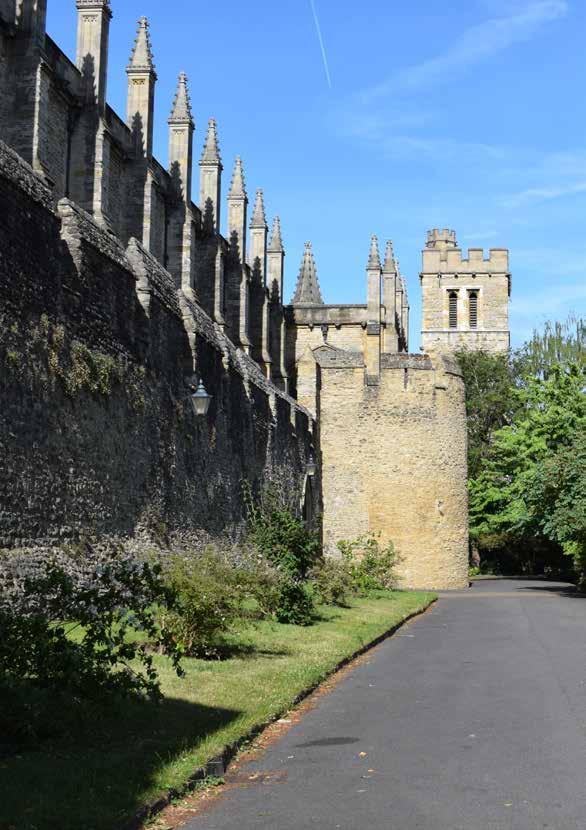
DONORS
© Nathalie Wilks
Donors
The College is most grateful to the many Old Members and Friends who donated to the college during 2025.
1944
Dr E L Simmons
1945
Judge John Mockett
1947
Mr P H Bartrum
Mr J M A Gunn, OBE, TD, DL. dec’d
1948
The Rev’d C G Turner
1949
Lieutenant Colonel E H L Aubrey-Fletcher, DL
Mr P Davies
Dr W J Mowbray, KC
1950
Mr J B Bell
The Rev’d R H Watkins
1951
Mr R G Searle-Barnes
Sir William Utting, CB
1952
Mr J N Fergus, FRCS
Mr C F Foster, dec’d
Mr D D Green
Dr M I S Keir, FRCP
Mr J W Snashall
Sir Anthony Vineall
1953
Mr T M Farmiloe
Sir John Sainty, KCB, dec’d
1954
Professor R H Cassen, OBE
Mr R T A Hohler
Mr R G Jeffrey, dec’d
The Rev’d P C K O’Ferrall, OBE, FRSA
Mr G D Scott-Kerr
1955
Mr W E W St G Charlton
Mr A S Gordon
Mr H A King
Sir Brian Unwin, KCB
1956
Mr J T Bach
Mr G J Bacon
Mr R C Gridley
The Rt Hon the Lord Hannay of Chiswick, GCMG, CH
Mr I J Mather
Dr M H Stacey
Mr E M Thomas
Mr D J Wilson
1957
Mr H J Arbuthnott, CMG
Mr D H Doble
Mr J R Fells, CBE
Mr A J Hastings
Mr D Howorth
Mr M J Leach
Mr B R Meadows
Mr J G Ouvry
Mr C J W Owen
Mr D R K Seddon, dec’d
Dr B C Southgate
Mr P M Vincent
Mr C D R Williams
The Rt Hon the Lord Willoughby de Broke, DL
1958
Mr R M Bennett, MBE
Mr J R Booth
Mr J M Buhagiar
Dr C D S Field
Mr D L Giles
Mr P F Higgins
Mr J A Hoyle
Sir Michael Llewellyn Smith, KCVO, CMG
Mr M E Ponsonby
The Rev’d J B Potter
Mr R M L Webb
Mr D P Weizmann
1959
Mr C C R Battiscombe, CMG
Professor J L Cox
Mr E P Evans, MBE
Mr P D Furlong, OBE
Mr I Halford
Dr C J Harvey, FRSA
Mr J G R Hindley
Mr J P Jackson
Mr R R Langley
Mr I S McDonald, dec’d
Mr D I Minns
Professor M J Rustin
Mr B R Salter
Professor A B Savile
The Rt Hon the Lord Wasserman
Mr G C V Wells
Mr C P D Williams
1960
Mr B M Ash, KC
Mr R W Bedford
Mr J D Birchall
Mr G J Bowtle
Mr P E Cheeseman
Mr D G T d’Adhemar
Mr K E Davies
Mr C V Dinwiddy
Dr R W Farrington, JP
Sir Anthony Goodenough, KCMG
Mr R A S Gray
Mr T R O Hart
Mr P L B Mynors
Dr D K Oates
The Hon Tobias Tennant
Mr F K Toukan
1961
The Rt Hon the Lord Boswell of Aynho, dec’d
Dr V K Datta
Mr P Georgiou
Mr D C C Hamm
Mr M G Hignett
Mr N G Homsy
Mr D R Markham
His Honour Judge Maxwell
Mr B J J Peek
Mr G E Proctor
Mr M R Streatfeild, dec’d
Mr M J Terry, dec’d
1962
Mr P N Bongers de Rath
Mr P L Brookman
Mr P G Constable-Maxwell
Mr A R Cross
Mr B W Digweed
Mr P A Duncan
Dr M J Grundman
Dr P H P Harris
Dr J T Lynch
Dr D Mettrick
Dr M F Muers
Mr R K Musgrove
Mr J E P Newitt
Mr J D Pears
Mr P A Rees
Sir Bernard Rix, Kt, PC
Mr R A K Scallon
Mr J M Singer
Mr G C Steele
1963
Mr J P Attree
His Honour Judge Boney, KC
Mr D Brown
Mr M Bunclark
The Rev’d J A L B Caterer
Mr F D Dassori
Mr C J Duff
Dr A G Duncan
Mr R J Fort
Dr P Greenwell
Mr R M Haslam
Mr W T Kerr
Dr W W Lewis
Mr P G Maxted
Mr D F Morrison
Dr D J Neild
Mr A L Schuller
Mr W Tegner
Professor F R Terry
Dr E J Will, FRCP, FBRS
1964
Dr P G Ballance
Mr R W Batchelor
Mr E H Bradby
Mr S F Chadwick
Mr B K P Evans
Mr J P Falk
Dr W G Fiennes
Mr M J Green, MBA
Mr R M H Heseltine
Professor K W Hoskin
Mr C W Ingram
Mr A M K Jourdier
Mr T F G la Dell
Professor R H Macve, FCA, HonFIA
Dr M A McCain
Mr J K Moore
Mr F W R Pattison
Mr D Puttock
Mr N M S Rich, CBE
Mr D A Staines
Mr G S Thomas
Mr J R Uttley, OBE
Dr A J Warren, MBE
Mr J B Werner
Mr D C Willis
1965
Mr M R L Astor
Mr R M Borchard
Mr D J M Browne, CBE, KC
Professor R A Cooper
Mr J H Dixon, FRCSE
Mr B L Glicksman, CB
Mr A M Greenwood
Mr R A Hallows, MBE
Mr B C Hargreaves
Mr P H Ling
Mr C H McKane
Dr J M Mendelssohn
Dr D J Murphy
Professor J C Pickup
Mr A G G Post
Mr A Powell
Dr A R Rathbone, MBBS, FRCGP
Mr G M Rogers
Dr C G Scales
Mr J A Schofield
Mr S J Sher, KC
Mr R T Stanger
Mr M H Streatfeild
Mr W H Williams
Dr R D Worswick, FRSC
1966
Dr N H Bennett
Mr P K Burke, MBE
The Hon William Cawley
Mr R O Cook
Mr A G Cubitt
Mr N L Denton, FBCS
Mr J P H Frearson
Mr J L Hinks
Dr M Jewess
Professor N A McCubbin
Mr C A Monson
Mr R A Niven
Mr R W Nowell
Mr J Onions
Dr G H Pollard
Mr A S Purkiss
Mr N C Sloan
Mr E H R Thomas
Mr R R Varey
Mr W R Walker
Mr J G Yates
1967
The Rt Hon the Lord Aldington
Mr A Bent
Mr A N Campbell
Dr R W Clayton
The Rev’d Canon A W Dickinson
Mr A F S Donovan
Mr A J Dufort
Mr R B J Dunipace
Mr A R Durden
Mr G C S Gates
Mr J W Hinton
Mr A B Ingram
Mr C A S Jenkins
Mr C J Kettle
Mr P J Larkham, MRSC
Dr P D M Macdonald
Mr J R Madden
Dr R C B Odgers
Mr R H Porter
Mr J G Y Radcliffe, OBE, QVRM, TD
Mr D S Sloan
Mr X De C Smiley
Dr C G Steer
Mr H A R O Tweedie
Mr T M Whelan
Mr D F Wood
Mr D M Young
1968
Mr K G Baillie
Mr S J Boyd
Dr J V Brophy
Mr R P Daniels
Mr W D Eason
Mr D A Hill
Mr G Holden
Mr J Luscombe
Mr G P C Macartney
Dr D C Pearson
Mr N C V Pollock
The Hon J Stephens
1969
Mr Y Aso
Mr J C Bradby
Mr H C Elgot
Professor D M Harper
Mr A L Houghton
Professor A P Jenkins, FRHistS
Rear Admiral Mark W G Kerr, DL
Dr R G Menaker
Dr E M O’Dwyer
The Rev’d T E Phipps
Dr M P Powell
Mr O P Richards
Mr J W B Rider
The Rev’d C P Sherlock
Mr D J Wadsworth
Sir Peter Westmacott GCMG LVO
Mr A G Whiffin
Mr S C Whiteley
Mr A D Wiles
Mr J C M Wise
Professor J WoodheadGalloway
1970
Dr G Belcher
Dr J J Birtill
Mr C R Boodle
Dr P R Brown
Mr J A Carpmael
Mr J J Dillon
Mr A G Dunn
Mr B J Finlinson
Dr E R B Forman
Mr P G Hinton
Dr J H M Horne
Mr T R Hyde
Mr G W James, dec’d
Mr M D Kettle
Mr D J Marks
Mr D J McDonald
Mr G M H Mills
Mr I S Newton
Mr W J Norris, KC
Mr J V Romano
Mr A G F Ruck
Mr J B Rudman
Dr A P Tonkyn
Mr J S Williams
1971
Dr J C Barrett
Mr A H R M Brown
Mr R E Cockton, FCA
Professor P K Davies
Mr I E Dilks, OBE, FCA
Dr J A Duffy
Mr C G Eyre
Dr J R Glover
Professor P R Green
The Rev’d T R Haggis
Mr R Horton
Mr R A Humphreys
Mr A P Jollans
Mr P W Manns
Mr G J Powell
Dr M F Pye
Professor S J Ross
Mr N Rushworth
Mr S W Shaw
Professor P D G Skegg, CNZM
Mr J R S Taylor
1972
Dr C N Adams
Mr S R Brodie
Mr R J A Brown
Dr M J Clark
Dr S A Dutfield
Mr R L Galant
Dr A Garrad, CBE
Mr T E Gidley-Kitchin
Mr M M Hann
Dr R P Harpin
Dr E G Jessop
Mr S Loewenstein
Dr J W T Lovett
Mr R D Luskin
Mr A D Mackenzie
Dr GG Neal
Mr N J Palmer
Mr S Powell
Mr D H Ridgeon
Dr P R Sims
Mr E R A Strauss
Mr N J Szczepanik
Dr M G Turner
Mr S M W Venables
1973
Mr S P F Best
Mr C A Collins
Dr T Diggory
Mr S Drowley
Mr A J Elliott
Mr P R Evans
Mr P G Giles
Mr A M D Glendinning
Mr D A Haig
Professor C J S Hodges, OBE
Dr N C G Jackman
Professor A A Lacey
Mr N M A May
Mr G M Miles
Mr D E Philps-Tate
The Lord Remnant, CBE
Mr A D M Rutherston
Professor W C Sharpe
Mr D G Stephenson
Mr P M Young
1974
Mr P Brook
Mr R J Casey
Mr W P Cotton
Dr R L Elliott
Mr M J Evenett
Dr J L M Ferrara
The Rt Hon the Lord Grantley
Dr N R Haywood, CVO
Mr T J Hyam
Mr S H Jones
Mr L C Laurence Smyth, CB
Mr J A H Lawden
The Rev’d F A Miller
Mr A L Milton
Mr A C M Norton
Mr Z Novakovic
Dr J C Smith
Sir Jonathan Taylor, KCMG
Mr C R Wall
The Rev’d Dr H R B White
1975
Mr N J Beard
Mr S R Coals
Dr C M Francis
Mr A G Goodall
Mr J M A Howell
Mr J C Hudson
Dr R G James
Mr A N Joy
Mr J J Macnamara, TD, JP, FCA
Professor T A Magnell
Mr A D Noble
Dr W A Nowlan
Dr I C C Phillips
Dr M R Platt
Dr J T Sehn
Professor A G E Stephanson
Mr A P Tolley
Mr P H Wellings
Mr G J Williams
1976
Mr N M Berwin
Dr E H Best
Mr S J Butt
Mr P Cahill
Mr R F T Coles
Mr R M Cordy
Mr M L Crick
Mr W J Driscoll
Sir Stephen Eyre
Mr R B Ferris
Mr I P Fitter
Mr A K Fraser
Professor B R Hoffman
Dr C B James
Mr A J Keith
Mr C N Lane
Mr C E Latter
Dr A J Mansfield
Mr H S G Mather
Mr A M Mead
Mr P T Melly
Mr I D Nisbet, HonRSCM
Mr J R Parker
The Hon Adam Russell
Dr M Slaney
Mr R T Smith
Colonel P J Tabor
1977
Mr M T Beaudouin
Dr J Cassel
Mr J G G Clarke
Mr M A Corteel
Mr H Ellis Williams
Mr T E Fairhead
Mr D M G Fletcher
Mr M B Francis
Mr D M Fullbrook
Mr M J Hill-Reid
Dr D J Knight
Mr A S Kurucz
Mr R M U Lambert
Mr C B Lethbridge
Mr A V Lewis-Jones
Canon K R Malcouronne
Mr R J Milbank
Mr I A Miles
Mr R S Morse
Dr I M Newington
Mr B P Robins
Mr R F Sheahan
Mr J T Starky
Mr T E B Weitzman
1978
Mr M D Agrast
Mr C S G Bagnall
Mr T H Bell
Mr T W Burford
Mr D R B Champion
The Rev’d Dr S H Cocksedge
Mr R N F Drewett
Mr M F Fisher
Mr J A Gibson
Mr M G Gregory
Mr M G Hall
Mr R Sharrock
Mr G R Smith
Mr M H J Spence
1979
Mr M A N Ager
Mr M C B Bloomfield
Mr W L Cullum
Dr S K Harbron
Mr C J Iley
Ms F C Johnson
Lady Jane Kaplan (née Primrose)
Ms C M Kay
Mr N N Lane
Mr C R Lister
Ms S M Martelli
The Rev’d Dr R W Micklem
Dr B E Mobbs
Mr N C C Neale
Mr A N Pinkess
Dr R E M Reakes (née Palmer)
Mr P H Reeve
Mr M D Spurgeon
Mrs S V Weller, CBE (née Hawke)
1980
Mr J E Ball
Mr M L Brockway
Dr M S Byford
Mr M P Conder
Dr D Ellis
Ms A M Henry
Mr C W E Jaques
Mr A T Kermode
Mr A M Lodge
Mr D P O’Keeffe
Mr M H D Payne
Mr D W Ross
Professor D Schatz
Professor Sir Terence Stephenson, DM, FRCP, FRCPCH
Professor M T Tessier- Lavigne, FRS, FRSC, FMedSci
Mr A R J Thomson
Mrs J A Unwin (née Wakelin)
Ms S J Webb
1981
Mr R C Bridges
Ms S J Burden
Professor J D Chester
Mrs L Connolly (née Colley)
Ms G M Davies
Ms P J French
Sir Martin Griffiths
Dr W A Hallett
Mrs S Hamilton (née Krikler)
Mr C H Jillings
Mr M S E Kaplan
Dr M P Little
Dr N C T Martin
Mr P J R Miles
Dr J D Nuechterlein
Mr B W Ramsay
Dr R C Thomas
Mr S N T Waring
Mr C R S Williams
Mr N J Wilson
1982
Ms J S Asscher
Mr J R A Bond
Mr G I Broomhead
Mrs C J Cooper (née Taylor)
Dr A G Darlison
Mr A Foord
Dr T G M Freegarde
Mr O J Fryer
Mr J M Garvin
Mr N J Greenwood
Mr R W L Henwood
Dr R G Jackson (née Gilbert)
Mr S H Lazell
Mr S P F Macklow-Smith
Mr T J Robinson
Ms H R Samuel
Mr M P Taylor
Dr J W Thorpe
Mr N J Tombs
Professor L J Vale
Ms C E Wesley
Dr S K Wilkinson
Mr D P Wyatt & Mrs S E K Wyatt
Mr R Zebaida
1983
Mr R H N Barlow
The Honourable Daniel Benjamin
Dr M B Chadwick
Dr A A Farmer
Dr A C Hesford, DRCOG, DFFP, DPD, MRCGP
Mr J M Hornby
Mr J H Marriott
Mrs A J McGonigle (née Eastham)
Mrs C C Morland (née Platt)
Mr M J Pointon
Mr D J Pope
Mr C R Power
Dr M Stubbs
Dr P R Sudbury
Dr P F Tokarczuk
1984
Ms M L Ainsworth
Dr K A Armstrong
Mr J A W Astor
Ms C V Barlen
Mr J H Barne
Dr P R J Barnes
Captain M D Beeston
Mr A D R Cotton
Dame Melanie Dawes DCB (née Brogan)
Mr J S Dobson
Dr S J Dowell
Dr R J C Easton
Ms S C Hardy
Mr I K Hart
Mr B D J Kent
Ms K R McNulty
Mr A S Pettitt
Ms L E Price
Mr G R L Spackman
Dr J E Spenceley
Dr J K Sunderland
Mrs S J Tapley (née Day)
Mr A G P Tusa
Mr M W Wells
Mrs K Yamada (née Lockyer)
1985
Mr N Blake
Mr D P Blunt
Dr A C Bushell
Mr M J B Calverley
Mrs E R V Critchley (née Freegarde)
Mr R C Dibley
Mrs R A Downie (née Staniforth)
Mr G M Edwards
Dr A A Helm (née Cooley)
Dr P Klenerman
Dame Eleanor-Jane MilnerGulland, DBE
Dr A J Moran, KC
Mr M E Warren
Mr T J Way
Mr R A White
Mrs L P Whittome (née Broke)
1986
Mr M J Birchall
Mrs J A Brady (née Durham)
Mrs E J Brettle (née Bach)
Professor S J S Chataway
Mr S S Clarke
Mr J B W Cowling
Dr M I Greenwood
Dr C L Hanna (née Garbutt)
Mrs A T Harris (née Berrie)
Mr T G Hart
Mr S R Hawe
Professor R C Henderson
Dr P M Hubel
Mr S J Lindsay
Dr A J Mayne
Professor I A McNeish
Mrs K M Moss (née Muir)
Ms D D Nadel
Mr G J Roberts
Mr I C W Sleightholme
Dr P Vanderstar
Professor N A Watkin
Mr P G Weston
1987
Dr M D Baker
Professor J H D Bassett
Mr B H D Brown
Dr S L Brown
Dr P Campbell
Mr S M S Catherwood
Mr A Chaplin
Mr G P A M Conway
Mr M S Feeley, KM, KCHS, KCSG
Mr R A L Harris
Ms A C King-Farlow
Mr T Lack
Mr S D Maddock, OBE
Mr T K O’Malley
Dr N A Pitchford
Mr M E Simcock
Mr J P Smith
Dr M J Spilsbury
Mr D M Stilitz, KC
Ms J L Stratford, KC
Sir John Stringer, KCB, CBE
Mr J R Walsh
Professor G Watt
Mr N G Williams
1988
Mrs L Ansdell (née Potter)
Mrs L M Batchelor (née James)
Mr J R J Carter
Mr P M A Coombe
Mr J M Daniel
Dr H M Dignum
Mr C C R Goulding
Ms R Gwyon
Dr J T James
Mr D S S Jowell, KC
Mr J T Michael
Ms G A B Mynors (née McNeish)
Mr E W Paton
Mr K S Pavlowitch
Mrs V S Rangeley-Wilson (née Warren)
Mrs P V Scampion (née Khiroya)
Ms E E Sepanski
Ms R E Shaw
Mr J W Shepley
Mr E J Smith
Mr N H Thistleton-Smith
Mrs I F Thompson (née de May)
Mr A D Vaughan
Mr J A M von Moltke
Mr A P Walker
Mr N G Williams
1989
Mrs J C Andrew (née Kerr)
Mr R J Angelini-Hurll
Dr N P Byott
Ms V J Collins
Mr J Dean
Mr D A Gal
Mr A D Halliwell
Dr P F Henry
Mrs R M Howard, KC (née Sabben-Clare)
Mrs C D Jayasinghe (née Wijayadasa)
Mr A D Koch
Ms R D J Lawrence
Mr H C H L’Estrange
Mr R A Mansi
Mr H C Martin
Ms E C Rudgard
Dr K E Selway, KC
Mr D S Smith
Mr D R J Taylor
Ms J M Waugh
Mrs J A Wearing (née Levay)
Mr T C Weekes, KC
Dr N L White (née Birchall)
Dr B Whitehead
1990
Mr G M Baker
Ms K L Bond
Mr C M Bosworth
Mr A E Bulley III
Mr F A E Ceccato
Ms E L de Sousa
Dr S J E Edwards
Mr N J E Flower
Mr C M Gradel
Mr P M G Hort
Ms E D Klempner
Mr F R B McLusky
Ms E A Neale
Mr P E Nystrom
Mrs B A Robertson (née Blakeney)
Dr C A Ten Holter
Ms J Waugh
1991
Mr N J Barnes
Mrs A L Crispe (née Dix)
Dr N D Forester
Mr C C Gabriel
Dr M E Gibbs (née Raggatt)
A M Harford (née Gans)
Mr P P A G Harrison
Mr N G Helsby
Dr A C Humphries
Professor R R Mather
Mrs H E McMurray (née Towers)
Mr S L Merriner
The Hon D R D Turner II
1992
Mrs A Agostini (née Lange)
Dr R K Beaton (née Jones)
Mr D J Ewins, KC
Mrs S A Finch (née Litt)
Baroness Freeman of Steventon
The Rev’d J J Frost
Ms S F Handslip
Mrs A J Harris (née Harrison)
Mr B G Helps
Mr A J Mellington
Mrs N M R Perrin, MBE
Mr T J Raskin
Dr J A Verdicchio
Mr J M Wiffen
1993
Mrs S E Armstrong (née Jones)
Mr P K Buckley
Mrs E Coddington (née Schafer)
Mrs T E Crouch (née Sardharwala)
Mr J M Fraser
Mr D P Gooda
Mr C R Hildrew
Ms E Levendoglu
Dr J S A Merron
Mr R I W Murray-Bruce
Mr N S J Myatt
Mrs K E Nepstad (née Jones)
Dr A M Normand
Ms H F Randall (née Raw)
Dr H A E Riviere (née McIntyre)
Mrs J C Robinson (née Hudson)
Ms A M Ruffel
Mr A Z Spiers
1994
Mrs C J Barsby (née Richards)
Dr A M Blood
Ms C L Cowell
Mr R I J Griffin
Mr H G Ingham
Ms E M Mack
Mr G J Outteridge
Mr R A Ralph
Ms J M Sanders
Professor O G Sheers
Mrs L H Trueman (née Watt)
Ms C M J Vickery
Mr G I Wearden
Mr P B Wright
1995
Mrs A E Brennan (née Warland)
Ms H M Evans
Mr J W Evers
Mr M C B Goldring
Dr W E Greenland
Mr D J Hames
Dr A D Hennessy
Mr B W Hickey
Mr C J Jenkins
Mr H X Ke
Mr A J King
Mrs S L Lilleby Prabhu
Dr I R Macmullen
Mrs C K Mikkelborg (née Windle)
Mr R Phakey
Mr R J Voller
Dr L E Wilbrecht
Mr N H Williams
1996
Mr S J Adfeldt-Still
Mrs K M Atsinger (née Collman)
Ms N C Bleicher
Mr M J Childs
Mr N M R Fenton
Dr A A W Fergus
Mr G D Francis
Professor R N J Graham
Mrs L G Harrison (née Cameron)
Ms H J M Lambourne
Mr A R M Learmonth, KC
Dr L B Meldrum-Carter
Dr C J Miller
Mrs R P J Payne (née Brett)
Mr A N Ross
Mr B A Thompson
Ms S H Walker
Mr S J Walmsley, dec’d
1997
Dr C B Alexander Cole
Mr A J Ball
Ms T R Biswas
Professor B W Dolan, OBE
Dr S Frackowiak
Mr J P Fuller
Dr S Furuta
Mr O A Gin
Mr B S Gustason
Mr S C Holland
Dr L B Middleton
Mr H Morton Jack
Mr E H K O’Malley
Miss S G Parker
Mr D A Robinson
Mr A Takano
Mr A S Thirlwell
Mr F P van der Spuy
Ms J C Wallace
Mrs R C Ward (née Dyer)
Mr A M Wiblin
1998
Dr J L Baker (née Brignall)
Mr E F Barlow
Mr H T Chamberlayne
Mr C G Clothier
Mr R J Coxson
Mr C P Fallis
Mr J J Fowles
Dr J M R Goulding
Dr T Gupta
Mr H A Laing
Dr S S A Livermore
Dr H L MacMullen
Mr H T Nottberg
Mr M N Rosen
Mr S C Ross
Mr J D Rowland
Mr L V Streatfeild
Mr J W B Summers
Mr D I Tenner
Ms S E Trombley
Mrs D M Wallace (née Manley)
Mrs C J Wright (née Halliday)
1999
Mr S C R Blake
Mr M J Ellis
Mr T D F Foster-Carter
Mr W S Gresford
Mr M J Heal
Mr E P Howard
Dr S A Howes
Mr J E Lightfoot
Mr T P Moran
Dr E Peeren
Mr H S Rai
Ms E K Sanderson
Dr D J Sheridan
Mr R D N Smalley
Mr W D J Straw, CBE
Mr J R S Whewell
2000
Mr N J Akhurst
Mr A C M Anslow
Mr S P Buckland
Mrs E K Commander (née Mason)
Ms E M Devine
Dr J N Fullerton
Dr L Iyadurai
Mr A M King
Mr J C Rangel
Miss G V Roberts
Dr B Vaqas, MRCS
Miss H L Walker
Mr R W Waring
2001
Mr K Adithyan
Ms N Basson
Mr C D Burns
Mr E A G Cooke
Mrs C Ellis (née Whitbread)
Mrs A M Filippi
Mrs A L Hewitt (née Coleman)
Miss E A Hopson-Hill
Dr J B Jacobs
Mr O I John
Mrs L A Jordan (née Siddall)
Dr K E Jaques (née Halliday)
Miss M F Mear
Mr J I Mistry
Dr J S Palmer
Ms C R Periton
Mr T C Ridgway
Mr M J Rosel
Ms J E Thomson Rose
Dr H M Tobin (née Ledermann)
Miss A S Winter
Ms R Woodworth
Ms A Zitna
Dr T G Zlosnik
2002
Ms E I Aracic
Mrs S L Chaggar-Kemp
Dr J Clark-Matott
Dr E O Dowlen
Dr R E Dugdale
Mr E J Gleave
Mr P D Hackwell
Mr A J Harbinson
Mr J A Houston
Mrs G C H Jennings (née Tinson)
Mrs K E R Lloyd-Jukes (née Ross)
Miss O K Macdonald
Mr P McGuire
Dr A J McLennan
Mr S M Miller
Mrs C C Parkinson (née Griffin)
Mr T B Rogers
Mr S A Schrijnen
Mr A Sonic
Mr O E J Spencer
Mrs E F Stuckey (née Richards)
2003
Mr G T Doctor
Mr M G P Doran
Mr D W Downes
Dr S M Golodetz
Mrs L J Jacobs (née Griffiths)
Mr G O Jacobs
Ms K C Jones
Mrs I A Michell (née Ridley)
Mrs J M Oakey (née Armer)
Ms C I Pinder
Mr S T Szuhay
Dr G A Wellen
Dr E M White (née Parker)
2004
Mrs M O Adigun (née Ogunsekan)
Mr A J Black
Mr Y Chen
Dr C J Chu-Wai-Chow
Miss A V Connor
Dr D N Crosby
Mr S I Daniel
Mr C M Fitch
Dr H C N Jacobsen
Dr R S Johnson
Mr T P Kaye
Mr C E G Leeming
Miss N-N Li
Ms R Scarbrough
Dr P A Taylor
Dr K Wehling-Giorgi
2005
Mr P Baxter
Mr T R H Corby
Mrs N L Corke (née Godfrey)
Mr R E Fargo
Dr A M A Hamilton
Mr J M Howard
Mr S D R Liddle
Dr T J A Lorkin
Mr R Moss
Miss A L Porteous
Mr K F Wolff
2006
Mr A J G Asher
Dr A P Clibbon
Mr T L G Coates
Mr J E Davies
Mr M W Gulliford
Dr R L Hoare
Mrs S E Laing (née Pugh)
Dr S L M Linthwaite
Miss C A M Marshall
Mr S A Nash
Mr D W C Tan
Dr J M Trombello
Miss K R Wood
2007
Miss M G Barlow
Dr K H Brodersen
Miss S C Chamberlain
Miss H F Chambers
Mr J Chittenden-Veal
Miss J L T Edmunds
Mr S E G H K Miller
Mr B M P Samuel
Mr A N Somji
Mr W H P Spray
Mr A J Urbelis
2008
Dr W L Coleman
Miss H C Davidson
Mr P D Hudspith
Mrs I E J Jordan (née Lenon)
Mr I E Karadag
Dr J M Kennedy
Mr J S J Lua
Miss F S O’Hagan
Mr T J Roberts
Mr J M Rowan
Professor L Schaposnik
Mr S P Silvius
Mr G H J Simon
Mr J E Strang
2009
Dr J R Hitchen
Mr A F Hola-Peryer
Dr E C Law
Mr O P Longland
Mr A J G Murray
Mrs R F Ogilvie-Gilbert (née Smith)
Miss N J Parmar
Dr D M Trott
Miss C M S Quadranti
2010
Mr T J H Anderson
Mr J G Crole
Mr F J R Hoffman
Mr S Islam
Mr C Kamara
Mr A T Magnell
Mr D Mahtani
Miss G I V Mizen
Ms I R E Paterson-Taylor
Mr M Ursachi
2011
Mr B Bloor
Dr J O Day
Mr H C E Hudson
Ms B Li
Mr A Mallevays
Mr A Naik
Miss C R L Nixon
Dr T A Stewart
Mr D F Talbot
2012
Miss E Caddick
Mr T M Cohen
Mr J M Durbin
Dr C Floe
Mr J Glancy
Miss J Hao
Mr S Loveridge
Ms E Sanchez Martin
Dr A A McCunn
Mr M Stolyarov
Ms K C Sudell (née Nicholls)
Dr P R Taylor
2013
Mr R Arora
Dr P Barlow
Mr A Dwornik
Ms C A Graubert
Mr A S Hundle
Mr S Kim
Mr S Purkess
Mr S Raval
Mr G Speak
Mr C S Wickramarachchi
2014
Mr E R X Berney
Mr N Biswas
Mr D L Chow
Miss E J Holt
Miss F Martin
Ms A K Mowbray
Mr C J Nowek
2015
Miss T I A Andrews
Mr A Dumbleton
Mrs J Hanganu
Miss A Lawrence
Mr G E Leigh
Mr O S S Rapaport
Mr N J Sale
Mr A J S Tawana
2016
Dr M Ahrens
Mr H Davidson
Dr D J Hatem
Mr C Hewis
Miss G B Mills
Miss E Pennington
Mr R Rammaya
2017
Miss E Cubitt
Ms K O Hampton
Dr D D Malliouris
Mr P D L Marwood
Mr N T McKee
Mr E A Springett
2018
Miss B L Arrowsmith
Dr S J Delle
Dr B B Haws
Mr R L A Pangalangan
Mr D P Shannon
Mr T Varakuta
Fellows and Friends of the college
Dr G M V Alexander (née Pirani), dec’d
Americans for Oxford
Ms D Andrews
Apple
Mr P M Ashwell
Mr Edward C Atsinger III
Mr W C Auckland
Mr O E Baikoff
Mr G F W Balkwill
Mrs L Ballard
Professor J G Basker
Mrs J M Benham
Ms Ann Beswick
Mr M Borkan
Dr J M Boyce
Dr Keith Brain
Mr O H Brettle
Professor M Burden
Mr H H Carter
Mr L Chen
Mr R Covey-Crump
Mr M E Curtis
Ms J Evans
Fidelity Giving Marketplace
GeoComply
Mr J Giddings
Dr E Gill
Mrs H Girdlestone
Dr M S Griffith
Mr A G Hagwood
Professor J L Hart
Mr R J Helsby
Mr K Henry
Dr P A Hodgetts
Mr R Hulbert
Mrs J H Hunnisett
Mr C Hyland
Mr K Klock
Mr R Korver
Ms C H Kruse
Professor Dimitri Kullmann, FMedSci, FRS
Mrs Anne Kriken Mann (née Girard)
Mrs S K McGill Andrews
Mrs B Mewawalla
Mr K Minns
Mrs C Nieuwenburg
2019
Dr N D Natividad
2020
Mr R Karaki
Mr D J Lederer
2022
Mrs H L Cooper
Mr C R Leigh
Mr D B Lysenko
2023
Mr R H McCord
Mrs M Nuttall, dec’d
Mr F Nyonyo
Mr & Mrs S Parkinson
Professor D A Parrott
Dr M G Parry
Mr O F G Phillips
Porticus Foundation
Miss B Potter
Prisanlee Trust
Mr C A Raine
Mr G S J Russell, MBE
Professor A J Ryan, FBA
Mrs J Seccombe
The Rev’d Dr D G Selwyn
Mrs F J Staveley-Taylor (née Roberts)
Mr & Mrs G P Stoner
Mr & Mrs D F Tallon
Mr B J Taylor, CVO, CBE DCL DL HonFREng
Mr N Thornbrough
Mr M S Wainwright, MBE
Ms M L Williams
Mrs J Williams
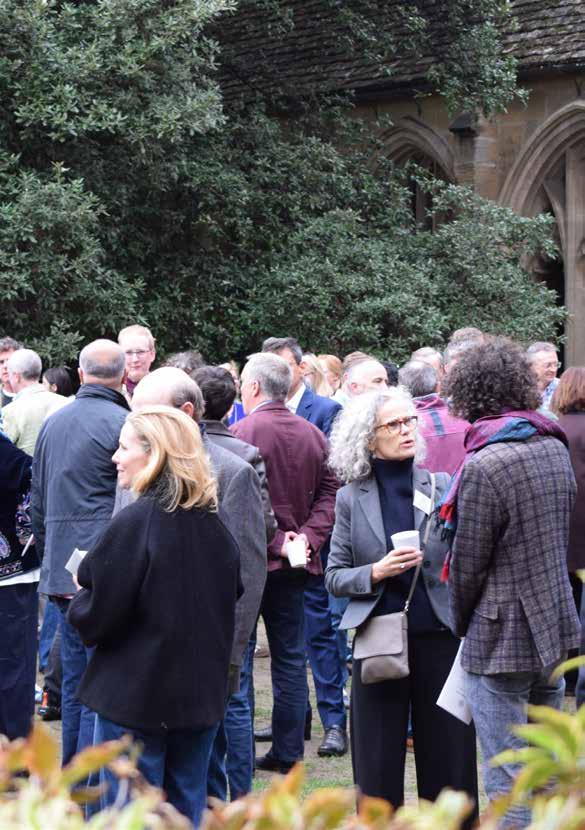
Gaude September 2025 (1988-1990) –
@Nathalie Wilks
Appointments, Honours and Awards
Richard Morris (1963), Board Member, European Movement International, Brussels (2023-26)
Malcolm Bacchus (1972), Junior Warden of the Livery Company of the Chartered Accountants in England and Wales for 2025-26; President of the Institute of Chartered Accountants in England and Wales for 2023-25; Deputy President of the Institute of Chartered Accountants in England and Wales for 2023-24
Patrick Russill (1972), Papal Knight of the Order of St Gregory, 2024; Professor Emeritus, University of London, 2024; Emeritus Head of Choral Conducting, Royal Academy of Music, London, 2024
Tony Sanderson (1972), elected Chairman of the Federation of Recorded Music Societies
Christopher Hodges (1973), Chair, Advisory Board on Revenue Protection Practices, Office of Road & Rail, 2025; Member, Civil Justice Council Working Party on Litigation Funding (2024-5)
Tom Levitt (1975), Associate Lecturer (Sustainability), Claude Littner Business School, University of West London; Advisory Board Member, Centre on Household Assets and Savings Management (CHASM), Birmingham University
Bruce Hoffman (1976), Doctor of Letters, honorary degree awarded by the University of St Andrews (UK), August 2024 – to be conferred 30 June 2026; Neave Prize for best book contributing to the understanding of terrorism, March 2025
Clive Lane (1976), Senior Judicial Commissioner, the Judicial Appointments Commission, May 2025
Clive Woods (1976), Vice-Chair of Conduct Review Committee of the Institute of Electrical and Electronics Engineers (IEEE), starting January 2025, reconfirmed for January 2026; named as MACE Electrical Engineer of the Year by Mobile Area Council of Engineers, 2025
Robert Drewett (1978), appointed as Vice Lord-Lieutenant of Somerset
Roger Hirst (1979), MBE for services to policing and community safety, 30 December 2025
Gethin Rhys (1980), received as an Honorary Member (Blue Robe) of the Gorsedd of Bards at the National Eisteddfod of Wales, Wrexham, August 2025
Sean O’Brien (1983), appointed Judge of the Upper Tribunal (Immigration and Asylum Chamber), July 2024
Raymond Perrier (1984), awarded PhD by the University of KwaZuluNatal, 2023, entitled ‘Paddy Kearney: An example of the creation and recreation of a Christian Activist over Five Decades’
Verity Hancock (1985), awarded an OBE for services to further education in the recent King’s Birthday Honours, June 2025
Alice King-Farlow (1987), awarded the National Theatre’s 28th Rayne Medal for outstanding contribution as Director of Learning & National Partnerships, 2009-25; Member of the Cultural Programme Steering Group, Stephen Schwarzman Centre, University of Oxford
Rachel Clarke (1990), winner of the 2025 Women’s Prize for Non-Fiction, The Story of Heart
Will Hetherton (1990), Visiting Fellow, Oxford University Centre for Corporate Reputation, 2025; Board Member, International Forum of Sovereign Wealth Funds, 2024; Board Member, Investor Leadership Network, 2023
Francis McGrath (1991), appointed King’s Counsel, March 2025
Vincent Fung (1993), Deputy Commissioner for Labour, HKSAR Government
Jonathan Fowles (1998), appointed by the Attorney General as Junior Counsel to the Treasury in Charity Matters, September 2024
Mary-Frances Morris (1999), re-elected to the Board of Alzheimer Europe, 2024 ; appointed Co-Chair of the Board of Alzheimer Scotland, 2024; appointed Partner of Emery Cooke, British Virgin Islands (while continuing to practice as a Barrister of the Courts of England and Wales), 2023 [The firm was founded by Andrew Emery (1998)]
Sam Hogarth (2001), 1. koordinierter Kapellmeister (1st coordinated Kapellmeister) at the Staatstheater, Mainz 1 January 2026
Jen Thomson (2001), Member of the Events Commission of World Rowing, February 2025
Benjamin Phillips (2012), joint winner of Rights Professionals of the Year at the 2025 British Book Awards, as one of the two-person Adult Rights Team at Simon & Schuster UK
Stefania Kapsetaki (2015), Study UK Alumni Award Finalist in the Science and Sustainability category (in Greece)
George Robarts (2013), First Prize in the Lotte Lenya Competition, awarded by the Kurt Weill Foundation in the USA
Nathan McKee (2017), appointed Vice-President of Finance at McKee Foods Corporation, December 2025
Eric Cheng (2023), Federal Prosecutor (barrister) in Nunavut, Canada; appointed to represent the Law Society of Nunavut at the Council of the Federation of Law Societies of Canada
Books, Recordings and Films
Denis Doble (1957), Diplomatic Passage, kindle edition (John Pine, 2024)
John Cox (1959), Cox J L and Cox K E, The Carer’s Role in Recovery: A Stroke of Misfortune (Cambridge Scholars Publishing, 2025)
Nicholas Parsons (1964), The Shortest History of Austria (Old Street Publishing, 2025)
Guy Wilson (1968), True Steel of Ripon: The metalworkers of Ripon (Basiliscoe Press, 147)
Stephen Bates (1972), The Man Who Sold Honours: The First Modern Cash for Honours Scandal (Icon Books, November 2025)
John Fisher (1974), How to Build, Buy, and Sell a Small Business, (Routledge, November 2024)
Ashley Goodall (1975), release of first choral album with Circle Singers, based in Oxford (2025)
Tom Levitt (1975), The Business of History: Tales and Lessons from Two Centuries of British Commerce (LPP, 2025)
William Boulter (1976), One Arm Bowls a Little – 100 years of the Stragglers of Asia Cricket Club (Whitefox, 2025)
Bruce Hoffman (1976), God, Guns and Sedition: Far-Right Terrorism in America (Columbia University Press, 2024)
Tony Lewis-Jones (1977), The Summer Before the War (Writers Café USA, 2025)
Simon Cocksedge (1978), Becoming Prayer: a Franciscan Guide, S Cocksedge and N A Worssam (Canterbury Press, January 2026)
Sophie Hyndman (1982), Humphrey’s Hum, Children’s picture book (Barleyfrog Books, 2025)
Jay Griffiths (1983), How Animals Heal us (Hamish Hamilton, Penguin, 2025)
Raymond Perrier (1984), Paddy Kearney: a Prophet for our Times (Micromega Press, Durban SA, 2024)
Rachel Clarke (1990), The Story of a Heart (Little, Brown Book Group, 2025)
Ashley Jackson (1992), with A Stewart, Superpower Britain: The 1945 Vision and Why It Failed (Oxford: Oxford University Press, 2025)
Charlotte Cowell (1994), English translation: Pneumatology Book II: The cosmic dialectical process and the manifestation of the monad by Vladimir Shmakov (August 2024); Pneumatology Book I: The binary worldview and ecstasies of Apollo and Dionysus by Vladimir Shmakov (November 2023); The Eidolons by Louise Darwen (Shin Publications Imprint, April 2023)
Helena Echlin (1994), Clever Little Thing (Headline, 2025)
Erica Hesketh (2001), In the Lily Room (Nine Arches Press, May 2025)
Edward Dowlen (2002), Marx’s Concept of Alienation Origins and Implications (Efialtes Doble, 2024)
Rachael Davis-Featherstone (2006), Oxford Blood (Walker Books, August 2025)
Joey D’Urso (2010), More Than A Shirt: How Football Shirts Explain Global Politics, Money and Power (Orion, 2025)
Kevin Noles (2016), Indian Prisoners of War in Japanese Captivity during World War Two (Oxford University Press, 2025)
Bradley Hoover (2018), The Aesthetic System of François Delsarte and Richard Wagner: Catholicism, Romanticism, and Ancient Music (digitally released from Cambridge University Press, 2025)
Retirements
Stephen Oxman (1967), Senior Advisor, Morgan Stanley, January 2024
Gethin Rhys (1980), Policy Officer for Cytûn (Churches Together in Wales), April 2025
Marriages and Civil Partnerships
Raymond Perrier (1984) to Ockert Fourie, 23 June 2023
Rajan Phakey (1995) to Andrea Mally, 16 August 2025
Wilf Jones (2011) to Daniel Grayson, 13 August 2025
Kate Tallon (2011) to Oisín Hennigan, 8 June 2024
Benjamin Phillips (2012) to Koren Morgan, 23 July 2023
Matthew Collyer (2014) to Stephanie Chapman, 23 August 2025
Mike Spenceley (2014) to Macushla Lovell-Meade (2014), 2 May 2025
Nick Evans (2015) to Leah McCusker, 26 April 2025
Matthew Lucas (2016) to Hannah Clarke (2016), 26 April 2025
Irene Yang (2018) to Russell Buchanan (2019), 14 September 2024
Wedding Anniversaries Celebrated
Silver Wedding Anniversary
Katrina Atsinger née Collman (1996) and Edward Atsinger, 15 April 2025
Siobhan McInerney-Lankford (1996) and Nate Lankford, 16 December 2025
Ruby Wedding Anniversary
Mike (1969) and Wendy Seigel, 22 December 2025
Golden Wedding Anniversary
Denis (1957) and Patricia Doble, 18 July 2025
Diamond Wedding Anniversary
John (1959) and Karin Cox, 1 August 2024
Births
Daughters to:
Andrew Eastwood (1997)
Emma Ashley (2003)
Jane Oakey (2003)
Adam Chekroud (2010)
Rosie Selby (2011)
Poppy 20 September 2024
Beatrice 28 September 2023
Harriet 16 September 2024
Zoe 21 July 2025
Abigail Eleanor 24 December 2024
Izabela Karasinska-Stanley (2012) Esme 13 July 2024 and Edward Grigg (2013)
Abigail Swain (2012)
Raphael Pangalangan (2018)
Aasim Ali Al-Thani (2023)
Sons to:
Stephen Curtis (2009)
Oscar Lee (2010)
Matilda 15 January 2025
Penelope 02 May 2021
Alejandra Elisa 28 April 2025
Sheikha Aalia 06 March 2025
Rafael 03 June 2024
Miles 19 February 2024 and Beth Leggate (2011)
Benjamin Phillips (2012)
Hursh Mehta (2018)
Grandchildren to:
Richard Morris (1963)
Stephen Bates (1972)
Jonathan Cave (1972)
Clive Lane (1976)
David Coy (1977)
Edward 15 February 2025
Lakshya 05 March 2025
Elton 17 March 2024
Lenny 27 June 2021
Alexandra 24 April 2024
Cassandra 06 November 2022
Hazel 26 December 2024
Seren 11 April 2025
Rea 16 August 2025
Nora 13 November 2022
Alison Lee née Black (1980) Miles 19 February 2024 and Matthew Lee (1980)
Damien Foster (1989)
Lauris 09 October 2025 and Kari Foster née Egerton (1989)
© John Cairns
Scholarship and Awards University Awards
15 prizes winners overall.
Saanvi Bahadur (BA Jurisprudence), Law Faculty Prize in A Roman Introduction to Private Law (for the best performance in A Roman Introduction to Private Law paper)
Tom Elliott (BA Literae Humaniores), Harold Lister Sunderland Prize (for an excellent performance in the Greek Literature papers in the FHS of Literae Humaniores, Classics and English, Classics and Modern Languages, and Classics and Asian & Middle Eastern Studies)
Eleanor McIver (BA Literae Humaniores), Comparative Philology Prize (for the best performance in the Comparative Philology paper in Honour Moderations in Classics), Harold Lister Sunderland Prize (for excellent performance in the Greek papers in Honour Moderations in Classics)
Iona Morgan (BA Modern Languages [Russian and Beginners’ German]), Andrew Colin Prize (for the best performance in Russian Prelims)
Dominic O’Loughlin (BA Ancient and Modern History), C.E. Stevens and Charles Oldham Scholarship in Classical Studies (for travel abroad during the 2025 summer vacation)
Anders Pang, (BA Jurisprudence), Law Faculty Prize for History of English Law (for the best performance in the above FHS paper)
Freddie Pflanz (BA PPE), John Hicks Foundation Prize (for the best performance in Macroeconomics)
Alexander Sacks (MBiol Biology), Prize for excellence in the 2024/25 Preliminary Examination (for demonstrating meritorious work in the examinations)
Ela Tabbouche (MBiochem Molecular and Cellular Biochemistry), Gibbs proxime accessit prize (for second-best performance in FHS Part I and Part II Examination in Molecular and Cellular Biochemistry); Gibbs Research Project Prize (for the highest mark in the dissertation research project)
Miranda Thomas (BA Literae Humaniores), C.E. Stevens and Charles Oldham Scholarship in Classical Studies (for travel abroad during the 2025 summer vacation)
Tomos Waddington (BA Jurisprudence), Law Faculty Prize for Civil Dispute Resolution (for the best performance in the above FHS paper)
College Prizes
There were 119 winners overall.
Ben Brown Cultural Travel Award
Alexis Broad
Ruby Kimber
Boyer Prize
Chris Howe
Burden-Griffiths Award
Iona Morgan
Henry Tebbs
China Travel Award
Sheen Bendon
George Campbell-Ferguson
Ellen Davies
Anne-Sophie De Brauwere
Sean Hartnett
Max Monjauze
Nathan Osafo Omane
Hari Reilly-Singh
Aditya Singh
Imogen Scott-Gall
Freddie Sugarman
Colgate Literary Prize
Sophia Hussain
Instrumental Awards
Sheen Bendon
Sebastian Eatwell
Stephanie Jonas
Euan Kemp
Myfanwy Meeran
Karen Thornton Memorial Prize
Sam Worsley
Lionel Grigson Memorial Prize
Ted Fussell
Morris Long Vacation
Travel Grant
Alice Boyle
Nick Roth Travel Award
Ivo Sawbridge
Nuttall Fund Award
Sophia Hussain
Christiana Hutchings
Alice Robey-Cave
Rowland Travel Grants
Sophia Hussain
Morwenna Wood
Westmacott Travel Award
Eleonora Coull
Ben Hartigan
Mutayyeb Malik
Miranda Thomas
Graduate Scholars
There were 28 graduate scholars overall.
1379 Society Old Members’ Scholarship
Elena Russo
Clarendon-New College Awards
Gabriel Abrahams
Lara Boudinot
Naga Sumedha Nalluru
Michele Pecorari
Masooma Rajput
Joshua Selfe
Carlo Zanetti
Lord Dacre Scholarship in History
Matthew Leech-Gerrard
Galant Scholarship
Juan Miguel Lopez Munive
Juel Jensen Scholarship
Elizabeth Nicholls
Margaret Bridges Music Scholarship
Harrison Smith
New College Humanities Scholarship
Elena Russo New College Marshall Scholarship
Samuel Brody Kyrolos Georgey
New College Schwarzman Scholarship
Daria Nepochatova
The Reynolds Scholarship
Ciara Beale
Roche Scholarship
Thomas Bullemore Lasarte
Urowski Scholarship
Michelle Codrington-Rogers
Yeotown Scholarship
Caleb Batley
James Somper
Juliet Turner
Undergraduate Scholars
There were 93 undergraduate scholars overall.
Biology
Marcus Ashworth
Winchester College
Sienna Rattigan
Clitheroe Royal Grammar School
Phoebe Reid
St Helen and St Katharine
Sky Stewart-Roberts
Truro & Penwith College
Cell and Systems Biology
Giulia Gardumi
d’Overbroeck’s
Juliet Martin
King Charles I School
Kai Nieuwenburg
St Paul’s School, London
Molecular and Cellular
Biochemistry
Eliza Copland
Haberdashers Askes School for Girls
Aabha Gokhale
Global Indian International School
Singapore
Noah Miller
King Edward VI Aston
Ela Tabbouche
City of London School for Girls
Chemistry
Eamon Coates
St Paul’s School, London
Freya Mills
Emanuel School
Luca Morgan
Beths Grammar School
Charlie Muston
Manchester Grammar School
Lucy Stopford
James Allen’s Girls’ School
Tomasz Urbaniak
Glenthorne High School
Economics and Management
Sophie Isotta
St Paul’s Girls’ School
Aditya Singh
Reading School
Emeline Yong
Kolej Yayasan UEM
Engineering Science
Aryan Gupta
Eltham College
Alex Jackson
Twycross House School, Atherstone
Rahul Marchand
St Paul’s School, London
English Language and Literature
Eleanor Grant
St Paul’s Girls’ School
English and Modern
Languages
Sophia Hussain
Old Palace of John Whitgift School
History
Robert Brettle
Oundle School
Harry Edmondson
Lancaster Royal Grammar School
Patrick Maxwell
St Edward’s School, Oxford
Jurisprudence
Anders Pang
St Paul’s Co-Educational College
Jude Shayeb
King Edward VI Camp Hill School for Girls
Literae Humaniores
Tom Elliott
Winchester College
Jakob Hobbs
Abingdon School
Ethan Walker
Abingdon School
MMath Mathematics
Chris Howe
Thorpe St Andrew School & Sixth
Form
Mathematical & Theoretical
Physics
Dev Patel
Harris Westminster Sixth Form
Medicine – Preclinical (3yr)
Joe Davidson
The Sixth Form College
Farnborough
Ei Lwin
Minster School, Southwell
Modern Languages
William Marriage
Uppingham School
Philosophy, Politics and Economics
Max Monjauze
Royal Grammar School, Guildford
Tess Ruddell
Dubai College
Maria Sticlea
International British School of Bucharest
Samuel Turkington
Wellington College, Belfast
Physics
Joel Adams
King James’s School
Hanshuo Du
Raffles Junior College, Singapore
Experimental Psychology
Shannon Bacon
Shenley Brook End School
Nancy Chen
Macleans College
Undergraduate Exhibitioners
There were 24 undergraduate exhibitioners overall.
Biology
Daniel Shapiro
Albuquerque Academy
Molecular and Cellular
Biochemistry
Kevin Guan
Campion School, Northampton
History
Jess Taylor
Llanidloes High School
MMath Mathematics
Sophie Keenan
Kirk Hallam Community Academy
Henry Livings
South Bromsgrove High
Medicine – Preclinical
Emilia Sleight
Exeter College
Philosophy, Politics and Economy
Felix von Moltke
Winchester College
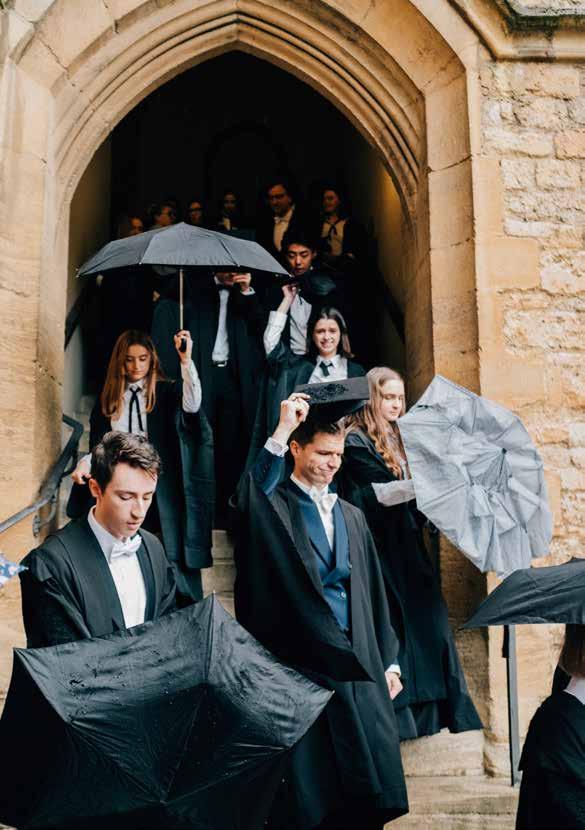
© Luke Pennystan
Final Honour School Results
In 2025 undergraduate students at New College achieved 48 Firsts, 63 Upper Seconds, 6 Lower Seconds, and one Third. One student failed and one student was Deemed to Deserve Honours. Below are the Finalists who wish to share their results.
Copland
Modern
Final Award Results 2024-2025
40 Postgraduate Research students overall. None gave permission to share.
Postgraduate Taught
George
Oliver Haythornes
Dheeraj
Blues and Team Colours
Onakanmi Alli American Football
Ben Atkinson Boat (Men’s)
Lara Boudinot Basketball
Samuel Brody Basketball
Oliver Brunt Golf
Saqlain Choudhary Cricket
David Coope Powerlifting
Bibi Elliott Hockey
Iona ffrench-Adam Football
Half Blue
Half Blue
Full Blue
Full Blue
Full Blue
Full Blue
Full Blue
Full Blue
Full Blue
Iona ffrench-Adam Rugby League 1st Team Colours
Anne Freise Ultimate
Angelina Göbl Trampolining
Christopher Gregory Football
Ben Hartigan Rugby Football
Grace Haworth Equestrian
Joe-Luka Mahoney Handball
Rahul Marchand Boat (Men’s)
Alice McGonnell Equestrian
Charlie Muston Ski & Snowboard
Half Blue
Half Blue
Full Blue
Full Blue
Half Blue
Full Blue
Half Blue
Half Blue
Half Blue
Kephas Olsson Baseball 1st Team Colours
Jonah Poulard Eton Fives
Tom Rigney Boat (Men’s)
Joseph Rodgers Korfball
Aaron Rose Golf
Harry Rourke Polo
Jack Sander Rugby Football
Barnabas Shaw Athletics
Libby Smith Rugby Football
Half Blue
Half Blue
Half Blue
Full Blue
Half Blue
Full Blue
Half Blue
Full Blue
Libby Smith Rugby League 1st Team Colours
Alexander Sokolov Water Polo
Half Blue
Bradley Stanley-Clamp Australian Rules Football 1st Team Colours
Sky Stewart-Roberts Rugby Football
Full Blue
Benjamin Stimpson Australian Rules Football 1st Team Colours
Lucy Stopford Hockey
Lorenza Valensise Eton Fives
Full Blue
Half Blue
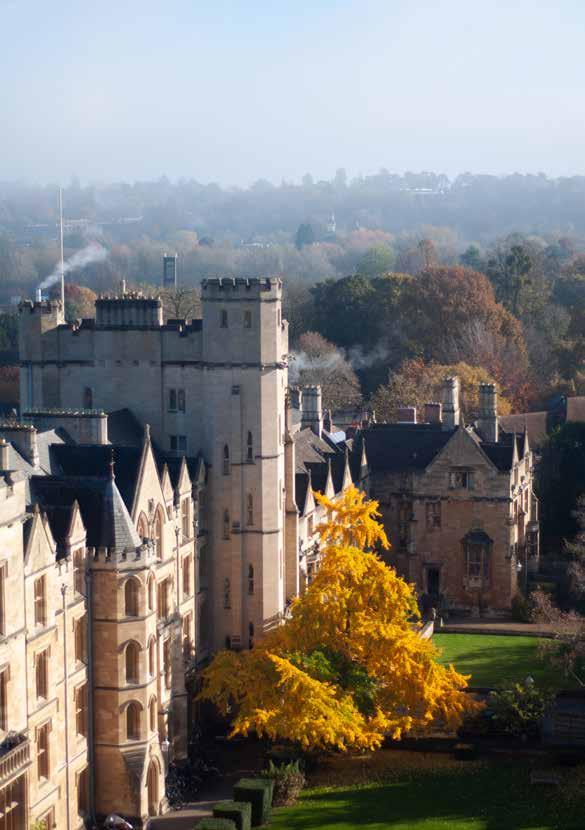
© Florie Harmer
Back cover
A large parcel-gilt award badge presented by John Eldon ( Viscount Encombe, later the First Earl of Eldon) to the New College Archers, Oxford, 1828, depicting the coats of arms of New College and of the donor, with two bows encircled by a wreath and an eight-pointed star made of arrows, the rear covered in blue cloth with a plaque inscribed ‘presented by Lord Encombe to the New College Archers, 1828’ with a large pin. NCI: 5696 - 2026.
© Courtesy of the Warden and Scholars of New College, Oxford