
In Kenya’s agricultural heartland, Nakuru County shows how participatory foresight planning can shift institutional thinking to better integrate biodiversity with economic development for long-term food security. Through evidence-based visioning with a wide range of stakeholders, a Manifesto for Change was embedded into county plans and budgets. It also fostered institutional champions promoting agroecological practices and sustainable finance within broader circular economy goals. Strategic policy engagement, strong community ownership, and multi-stakeholder platforms, including unconventional partnerships, proved critical in driving systemic change in the local food system, linking healthy ecosystems with inclusive economic opportunities. The Nakuru experience highlights how collaboration, transformative leadership, and iterative learning can connect grassroots action to county and national frameworks.
Nakuru County exemplifies Kenya’s agricultural dilemma where productive agriculture and high-end horticulture offer economic opportunities but at the expense of land, soils, water and biodiversity, potentially causing longterm ecosystem harm.
Intensive practices around Lake Naivasha and Lake Nakuru have created environmental impacts including deforestation, water pollution and flooding, while large-scale agriculture displaces indigenous crop varieties and traditional farming, undermining genetic diversity needed for climate adaptation. These environmental pressures threaten to compromise agricultural systems’ ecological foundation, compounded by weak linkages between biodiversity conservation and agricultural development policies that limit opportunities for synergistic interventions enhancing both ecological health and farmer livelihoods.
KEY TERMS
Participatory Foresight: A collaborative methodology that engages multiple stakeholders in exploring possible futures and developing adaptive strategies for complex socio-ecological challenges.

Nakuru County’s food systems transformation initiative is anchored by the Foresight4Food framework and led by Oxford University’s Environmental Change Institute in partnership with Wageningen University. Funded by the Netherlands through IFAD’s FoSTr programme, the collaboration provides technical advisory support and capacity building for local institutions. This multi-stakeholder platform brings together community networks, county and national government entities, research partners including the Results for Africa Institute (RAI) and the International Livestock Research Institute (ILRI). Additional collaborators include the University of Nairobi, Egerton University’s Living Lab, various county-level research and extension services and the private sector. The initiative has successfully engaged over 40 diverse stakeholders in developing comprehensive scenario planning for Nakuru County’s food system future.
Circular Economy: An approach that minimizes waste and maximizes resource use by recycling, reusing, and creating value from by-products (e.g., waste-to-value initiatives).

Payment for Ecosystem Services: Financial incentives provided to farmers or communities in exchange for managing land or resources in ways that maintain or restore ecosystem services.
Bottom-Up Economic Transformation Agenda (BETA): Kenya’s current national development strategy focused on inclusive, grassroots-led growth, with strong emphasis on agriculture and food systems.
Ecosystem Diversity: Integrated landscape management linking agricultural production with biodiversity conservation through corridors, agroforestry systems, and restoration of degraded land.
Policy and Governance: Embedding biodiversity–food systems integration into county governance and budgets through a collaborative Manifesto for Change vision. This aligns with Kenya’s National Agroecology Strategy for Food System Transformation (2024–2033), which promotes agroecological transitions through decentralized, participatory, and inclusive approaches across counties Markets: The Manifesto for Change promotes a shift from extractive to regenerative farming, integrating traditional crops and foods into modern value chains. It creates market incentives for maintaining agricultural biodiversity while supporting nutrition and cultural preservation.
The initial three-phased collaborative process in Nakuru County was facilitated using the Foresight4Food framework, which combines social, technical, economic, environmental, and political (STEEP) analysis with participatory engagement and computer-based modelling. Over forty participants from government, the private sector, research institutions, faith organizations, and community groups jointly explored systems dynamics and the future of the food system. Through this process, stakeholders identified practical strategies showing how biodiversity conservation and agricultural productivity can be mutually reinforcing rather than competing priorities.
Building on these foundations, the collaborative foresight process has deepened to strengthen whole-of-government and whole-of-society engagement, moving from systems understanding and scenario development to multi-level mobilization and implementation through the Manifesto for Change.
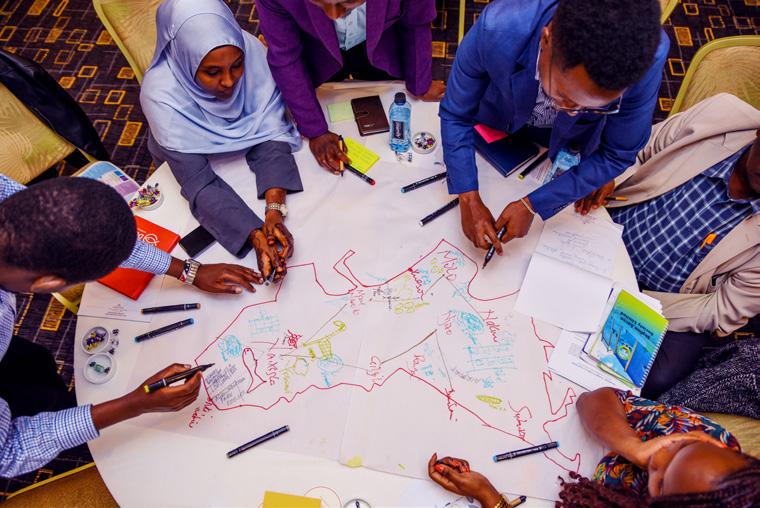
Participants created visuals mapping relationships between food systems and environmental linkages. This exercise deliberately confronted stakeholders with the visible costs of environmental degradation, allowing biodiversity concerns to emerge organically as ecosystem threats became apparent through the analysis of current agricultural practices. Through this shared mapping, stakeholders collectively identified key drivers of change, ecological pressures, and leverage points for aligning biodiversity goals with agricultural productivity and community well-being.
Causal loop diagramming helped stakeholders understand how biodiversity and agriculture create positive feedback loops. Using participatory foresight tools and empirical evidence, they visualized trade-offs, risks, and synergies across the scenarios, identifying strategic pathways that could align biodiversity conservation, nutrition, and economic development objectives. Through this systems-based analysis, stakeholders co-designed the Think and Go Green pathway, emphasizing circular economy approaches, agroecological practices, water harvesting, waste-to-value initiatives, and agroforestry investments. This process linked foresight insights with tangible strategies, bridging collective visioning to actionable interventions.
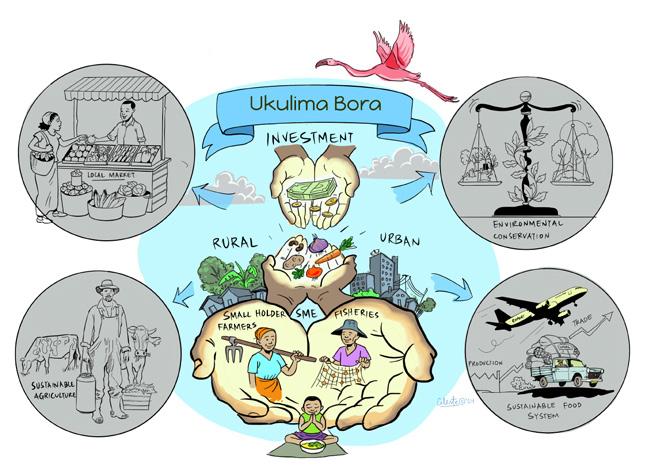
Building on four critical uncertainties—business structure, healthy diet adoption, environmental sustainability, and market destinations—participants co-developed five distinct scenarios. The preferred Ukulima Bora scenario explicitly integrated sustainable agriculture with indigenous crops, highlighting opportunities for regenerative practices, circular economy models, and inclusive market growth.
A multi-sector, multi-level commitment process introduced foresight into public planning, anchoring a BiodiversityEmbedded Manifesto for Change. This stage emphasizes inclusive co-creation and shared accountability among government, private sector, academia, and community stakeholders to institutionalize foresight practices within policy, financing, and investment systems.
The process now emphasizes practical implementation through a framework of pathways, processes, and partnerships fit for purpose. This ensures foresight outcomes are embedded in policy cycles, blended financing mechanisms, and accountability frameworks, enabling continuous learning, adaptive management, and long-term institutional capability.
“What we tend to find is that the market moves the system more than the producers. So, if the market can move the system with the emphasis on regenerative farming and biodiversity then you’ll see the change.”
– Wangeci Gitata-Kiriga, Foresight4Food Kenya
The collaborative foresight process created financial incentives for biodiversity-positive practices by applying circular economy principles and payment for ecosystem services (PES). Revenue streams include premium markets for sustainably produced foods, carbon credits from agroforestry activities, and ecotourism leveraging agricultural landscapes. Blended finance mechanisms combine public investment, development partner funding, and private sector engagement. The emphasis is on building local institutional capacity for financial management and market development, which reduces dependence on external funding over time. Green energy investments and waste-tovalue initiatives aim to create additional revenue streams while also reducing environmental impacts.
The collaborative Manifesto for Change articulates shared vision and transformation pathways now embedded within Nakuru County’s 2023-2027 Strategic Plan and budget. The county committed 117 billion Kenyan shillings to promote agroforestry adoption, indigenous crop cultivation, and payment for ecosystem services, while also attracting business and financial service providers to invest in biodiversity-supporting value chains.
1 County officials shifted from viewing conservation as a productivity constraint to recognizing biodiversity as essential for food security.
2 Faith leaders emerged as environmental champions expanding conservation advocacy into communities.
3 Financial service providers incorporated biodiversity criteria into agricultural investment decisions, responding to rising demand for sustainably produced foods.
4 The Think and Go Green pathway, emphasizing circular economy, agroecological practices, water harvesting, and agroforestry investments, was operationalized through county budget allocations.
Participatory scenario planning identified concrete pathways: riparian protection was linked to water quality and floriculture viability; agroforestry to soil health and yield stability; and indigenous crops tied to nutrition and climate resilience. Emphasis on regenerative farming and indigenous crop varieties attracted new market opportunities and premium pricing mechanisms that reward biodiversity-positive practices.
Kabazi Ward, within Nakuru County’s sub-county structure, created a decision-support ecosystem from the onset that integrates systems thinking and foresight approaches with bottom-up leadership rooted in authentic community ownership. The ward leveraged pre-existing Beyond 2030 Networks comprising ward departments, chiefs’ forums, school heads, women’s groups, local businesses, and community actors as the foundation for co-creation and systemic change.
These organized community networks provided visionary, lived-reality perspectives into the county’s Manifesto for Change through scenariobased foresight processes, introducing context-relevant approaches to promote indigenous crops and applying circular economy principles.
This grassroots mobilization generated the credibility and evidence needed for county-level adoption. By leveraging existing social capital, Kabazi Ward demonstrated local implementation pathways and provided legitimacy for county-wide policy integration. This creates a replicable model for nature-positive food systems transformation that is both locally relevant and institutionally supported. They learning has been to connect grassroots action with multi-level governance through a multi-stakeholder network advising the county government.
“It
is the people, it’s coming from the people, what the people want. It’s not somebody coming to tell the community what they want to do for them. The community are already organized, and they’re already ready to be partners in their development.”
- Hannah Oduor, Nakuru County Government
The Nakuru foresight work showed that inclusive, evidence-based dialogue helps stakeholders see biodiversity and agricultural productivity as interdependent rather than competing goals. The process helped shift local perspectives from short-term interventions toward more systemic, long-term resilience
A key insight was the power of multi-level engagement—linking community foresight in Kabazi Ward with county planning and alignment to national frameworks such as the Bottom-Up Economic Transformation Agenda (BETA). This strengthened ownership and began embedding foresight principles in policy and budget decisions.
The process also highlighted the role of knowledge intermediaries such as Egerton University’s Living Lab in bridging science,
governance, and community practice. Their facilitation helped translate research into actionable pathways and sustained collaboration among diverse actors
While rooted in Nakuru’s experience, this approach offers valuable lessons for other counties in Kenya seeking to institutionalize foresight—building both capacity and culture through continuous learning, reflection, and adaptive action anchored in the Manifesto for Change.
What is different about the Kabazi Model is grassroots ownership and implementation. The Foresight multi-stakeholder and inclusive approach has been demonstrated as being very effective in moving from policy to action.
Building on Nakuru County’s Kabazi Model, foresight methodologies can be institutionalized through Kenya’s devolved governance framework and the national Bottom-Up Economic BETA. Leveraging this multi-level structure allows whole-of-government, whole-of-society, and multi-sector stakeholder mobilization to adopt foresight processes that enhance biodiversity integration across county development plans and the national food systems transformation agenda.
A framework for linking biodiversity foresight and innovation should connect research and emerging best practices with people, policy, institutions, communities of practice, markets, and trade. This linkage strengthens Kenya’s vision of aligning biodiversity outcomes with economic and social well-being.
Regionally, expanding the foresight-based Kabazi model across diverse agroecological zones in East Africa would test adaptability, while South–South collaboration (e.g., with similar biodiversity–food systems contexts) can accelerate mutual learning and refinement. Beyond agriculture, foresight approaches could extend to fisheries, forestry, and pastoralism, broadening biodiversity impact and resilience across multiple production systems.
Embedding foresight within policy, financing, and accountability mechanisms ensures continuity and performance improvement. This includes:
y Policy integration: Align foresight-driven biodiversity strategies with agricultural, environmental, and economic development frameworks.
y Policy alignment: The draft National Biodiversity Strategy and Action Plan (NBSAP) complements the National Agroecology Strategy for Food System Transformation (2024–2033) by outlining pathways for conserving and restoring ecosystems that sustain food production, reinforcing ongoing efforts toward integrated food systems transformation.
y Blended and public–private financing: Mobilize investments through blended finance models and PES, creating sustainable incentives for biodiversity-positive practices.
y Monitoring and evaluation: Institutionalize foresight-informed tracking, reporting, and learning systems to enable adaptive management and continuous improvement.
A flagship whole-of-government, whole-of-society biodiversity capability enhancement initiative (e.g., Kenya @100 – Kenya 2063) can build the competencies and foresight culture required to sustain long-term transformation. This should empower both current and future stakeholders, institutionalize foresight in policy cycles, and embed learning loops across local, national, and regional systems.
Partnerships with universities (e.g., Egerton University’s Living Labs), research institutions, and international biodiversity centers are critical for developing contextspecific foresight indicators and impact assessment methodologies By linking community innovation models (like Kabazi Ward) with national and global platforms, Kenya can lead in foresight-driven biodiversity mainstreaming—building a community of practice that bridges science, policy, and local implementation.
“Through the multi-stakeholder perspective, and the linking up with Egerton’s Living Lab, local regenerative farmers networks, and with faith leaders, we got very different perspectives than if we only worked with agri-business and technical experts.”








Karssenberg mkarssenberg@nlfoodpartnership.com